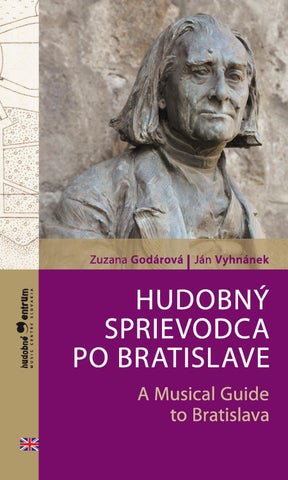
Zuzana Godárová Ján Vyhnánek
HUDOBNÝ SPRIEVODCA PO BRATISLAVE A Musical Guide to Bratislava
B R AT I S L AVA 2 016
Zuzana Godárová – Ján Vyhnánek Hudobný sprievodca po Bratislave A Musical Guide to Bratislava Copyright © Zuzana Godárová, Ján Vyhnánek 2016 Slovak-English edition © Hudobné centrum 2016 Translation © Katarína Godárová, Veronika Zitta 2016 Cover and original photos © Martin Janoško 2016 Copyediting by Sally Evans-Darby (Write Sense Media). We would like to thank Bratislava Rolls, NGO (Bratislavské rožky, o. z.), for their kind permission to use archive photographs. ISBN 978-80-89427-24-6
Hudobný sprievodca A Musical Guide po Bratislave to Bratislava The year 2016 has been declared the Year of Slovak Music by the Ministry of Culture of the Slovak Republic. This declaration was on the initiative of the Music Centre Slovakia, an initiative that now sees the publication of this book. This book aims to map the places, people, ensembles and events in Bratislava – also called the “city of music” – that are particularly related to classical music, but also includes other music genres. The chapters “Musical Walking Tours” and “Musicians’ Places of Eternal Rest” look to the past: those who wish to can trace the footsteps of the famous and less famous personalities who worked in our city, improving the quality of its musical life, or visited it even for a short time, thereby leaving a permanent imprint of their presence here. The past flows into the present in the chapter “Concert Venues of Bratislava” – the halls, palaces, galleries, churches and theatres, resonating with the echoes of music from times past, invite visitors to drink from the well of music of today. “Orchestras, Ensembles and Choirs” presents a selection of twenty music ensembles with a short description of their past and current work. The book also maps Bratislava’s musical life today: its festivals and concert series, clubs, music shops and other music institutions. The entries are interconnected by references. Of course, due to its limited scope, this volume does not aspire to completeness. Its authors, active tourist guides in Bratislava who specialize in its musical life, offer their knowledge both to the inhabitants of Bratislava and the visitors of our city. We wish our readers many beautiful musical discoveries in Bratislava! ও
Zuzana Godárová Ján Vyhnánek
Na podnet Hudobného centra bol rok 2016 vyhlásený Ministerstvom kultúry SR za Rok slovenskej hudby. Súčasťou projektu je i predkladaná publikácia, ktorej ambíciou je zmapovať miesta, osobnosti, súbory a udalosti, ktoré v Bratislave – nazývanej aj „mestom hudby“ – súvisia s klasickou hudbou, ako aj s ďalšími hudobnými žánrami. Kapitoly „Hudobné prechádzky“ a „Miesta posledného odpočinku hudobníkov“ sa vracajú do minulosti, pričom záujemca sa môže vydať po stopách slávnych i menej známych osobností, ktoré v našom meste pôsobili a pozdvihli jeho hudobnú úroveň, alebo ho len krátko navštívili, ale dodali tým mestu nezmazateľný punc svojej prítomnosti. Minulosť sa prepája so súčasnosťou v kapitole „Koncertné miesta Bratislavy“ – siene, paláce, galérie, kostoly, divadlá, presiaknuté ozvenou hudby dôb minulých, lákajú návštevníkov, aby načerpali zo studnice hudby dneška. Kapitola „Orchestre, súbory a zbory“ predstavuje dvadsiatku vybraných hudobných telies so stručným popisom ich minulého i súčasného pôsobenia. Publikácia mapuje aj dnešné hudobné dianie v meste, festivaly a koncertné cykly, bratislavské kluby, predajne hudobnín a iné hudobné inštitúcie. Jednotlivé heslá sú prepojené odkazmi. Pre obmedzený rozsah si, samozrejme, publikácia nenárokuje na úplnosť. Autori, aktívni sprievodcovia po Bratislave so zameraním na hudobné dianie, ponúkajú svoje poznatky tak Bratislavčanom, ako aj návštevníkom nášho mesta. Želajú čitateľom veľa pekných zážitkov spojených s objavovaním hudby! ও Zuzana Godárová Ján Vyhnánek
5 51 75 99 103 105 109 119
Koncertné miesta Bratislavy Concert Venues of Bratislava
Orchestre, súbory a zbory Orchestras, Ensembles and Choirs
Festivaly a koncertné cykly Festivals and Concert Series
Hudobné múzeá Music Museums
Predajne hudobnín Music Shops
Iné hudobné inštitúcie Other Music Institutions
Miesta posledného odpočinku hudobníkov Musicians’ Places of Eternal Rest
Hudobné prechádzky Musical Walking Tours
KONCERTNÉ MIESTA BRATISLAVY 5
CONCERT VENUES OF BRATISLAVA
HUDOBNÝ ŽIVOT V BRATISLAVE (do r. 1919 Pressburg/Pozsony/ Prešporok) má dlhú tradíciu. Mnohé koncertné sály a ďalšie miesta konania koncertov ponúkajú bohatý program, stačí si z neho vybrať. Niektoré miesta však už zanikli, napr. bývalá Sieň reprezentantov, ktorá sa nachádzala na nádvorí Starej radnice. Táto sieň, postavená v r. 1868 pre vonkajších členov mestskej rady (reprezentantov), bola až do svojho zbúrania v r. 1910 najvýznamnejšou koncertnou sálou Bratislavy. Od r. 1871 tu vystupovali napr. Hans von Bülow (za účasti Franza Liszta), Henrik Wieniawski, David Popper a Sophie Menterová, Pablo de Sarasate, Ignaz Brüll, Camille Saint-Saëns, Ferdinand Hiller, Joseph Joachim, Carl Reinecke.
6
Z novších dejín to bol bývalý Park kultúry a oddychu (PKO), kultúrne zariadenie na nábreží Dunaja, postavené v r. 1940 – 1948 pôvodne na účel konania Dunajských veľtrhov, prestavané na kultúrno-spoločenské zariadenie v r. 1951 – 1959. Bolo svedkom mnohých koncertov a plesov, výstav a veľtrhov, festivalov Bratislavská lýra ( s. 76) a Bratislavské jazzové dni ( s. 91) a i. Po odpredaní pozemkov pod budovami odstavili PKO z prevádzky a na prelome rokov 2015 – 2016 ho zbúrali.
MUSICAL LIFE IN BRATISLAVA (known as Pressburg/Pozsony/Prešporok until 1919) boasts a long tradition. Many concert halls and other concert venues offer a rich and varied programme – something for everybody. Some sites, however, have already ceased to exist, such as the former Hall of Representatives, which was located in the courtyard of the Old Town Hall. This hall, built in 1868 for the external members of the city council (representatives), was in its time the most important concert venue in Bratislava. From 1871 until its demolition in 1910, it hosted performances by Hans von Bülow (in the presence of Franz Liszt), Henrik Wieniawski, David Popper and Sophie Menter, Pablo de Sarasate, Ignaz Brüll, Camille Saint-Saëns, Ferdinand Hiller, Joseph Joachim, and Carl Reinecke, to name just a few. In more recent times it was notably the Park of Culture and Relaxation (PKO), a cultural centre located on the bank of the river Danube, built in 1940–1948 originally for the Danube Trade Fair and transformed into a venue for cultural and social events in 1951–1959. It held a number of concerts, balls, exhibitions and fairs, including the festivals Bratislava Lyre ( p. 76) and Bratislava Jazz Days ( p. 91). After the sale of the land under the PKO buildings, it was closed down and demolished at the beginning of 2016.
FOTO: PETER BRENKUS
The Reduta building was built in the years 1913–1919 on the site of a former granary from the times of Queen Maria Theresa. It is representative of the Neo-Baroque style with elements of Rococo and Art Nouveau. The project was designed by the Budapest architects Marcell Komor and Dezsö Jakab. Its Small Hall opened to the public in 1916; the Concert Hall in 1919. The building housed the City Music School, the cinema Redoute and a café, and held concerts and balls. Since 1949 the Reduta has been the seat of the Slovak Philharmonic, which first played here in 1950. The Concert Hall originally didn’t have an organ; during its installation in 1956, the balcony in the front part of the hall, which had held an orchestra during balls, was removed. Since 1965
Reduta Budovu Reduty postavili na mieste bývalej sýpky z čias Márie Terézie. Stavba bola realizovaná v r. 1913 – 1919 v neobarokovom štýle s prvkami rokoka a secesie. Projekt pripravili budapeštianski architekti Marcell Komor a Dezider Jakab. Malá sála bola otvorená v r. 1916, Koncertná sieň v r. 1919. V budove sídlila Mestská hudobná škola, kino Redoute, kaviareň, konali sa v nej koncerty a plesy. Od r. 1949 sa Reduta stala sídlom Slovenskej filharmónie, ktorá tu prvýkrát koncertovala v r. 1950. Koncertná sieň nemala až do r. 1956 organ, pri jeho inštalácii bol odstránený balkón z čelnej časti siene, na ktorom hrával orchester počas plesov. Od r. 1965 je Reduta miestom konania významného
Námestie E. Suchoňa 1
// w w w.f i l h a r m o n i a . s k KO N C E R T N É S Á LY, PA L ÁC E A G A L É R I E
7 CONCERT HALLS, PALACES AND GALLERIES
Reduta
Online concert archive: stream.filharmonia.sk
Námestie E. Suchoňa 1
FOTO: ARCHÍV SF
FOTO: ARCHÍV SF
CONCERT HALLS, PALACES AND GALLERIES
8
the Reduta has served as the venue for the Bratislava Music Festival ( p. 77), an important musical event. The building underwent a complete reconstruction in 2009–2012. Today the Concert Hall of the Slovak Philharmonic has 708 seats available for its visitors, the Small Hall has 168 seats and the glassed-in B. Bjørnson Courtyard offers space for various smaller events. The Reduta is also used for social events; for example, in 2008 it held a ceremonial banquet in honour of Queen Elizabeth II and Prince Philip. The Reduta has hosted many renowned performers, such as Claudio Abbado, Eugen d’Albert, Béla Bartók, Pierre Boulez, Philip Glass, Aram Khachaturian, Erich Wolfgang Korngold, Fritz Kreisler, Zubin Mehta, Olivier Messiaen, David Oistrakh, Dmitry Shostakovich, Krzysztof Penderecki, Sviatoslav Richter, Richard Strauss, Eugène Ysaÿe, Felix Weingartner and Alexander von Zemlinsky. ও
festivalu Bratislavské hudobné slávnosti ( s. 77). Budovu kompletne zrekonštruovali v r. 2009 – 2012. Dnes ponúka Koncertná sieň Slovenskej filharmónie 708 miest, Malá sála Slovenskej filharmónie 168 miest a zastrešené Nádvorie B. Bjørnsona priestor pre konanie kultúrnych a spoločenských podujatí. Reduta sa využíva aj ako miesto spoločenských podujatí, napr. v r. 2008 sa v priestoroch Reduty uskutočnil slávnostný banket na počesť britskej kráľovnej Alžbety II. a princa Philipa. Reduta hostila mnohé významné osobnosti, ako boli Claudio Abbado, Eugen d’Albert, Béla Bartók, Pierre Boulez, Philip Glass, Aram Chačaturjan, Erich Wolfgang Korngold, Fritz Kreisler, Zubin Mehta, Olivier Messiaen, David Ojstrach, Dmitrij Šostakovič, Krzysztof Penderecki, Sviatoslav Richter, Richard Strauss, Eugène Ysaÿe, Felix Weingartner, Alexander von Zemlinsky a i. ও online archív koncertov: stream.filharmonia.sk
// w w w.f i l h a r m o n i a . s k KO N C E R T N É S Á LY, PA L ÁC E A G A L É R I E
The building was constructed in 1911–1912 to hold the Austro-Hungarian military headquarters on the basis of the design of Josef Rittner, a Viennese construction engineer. The object contains an Art Nouveau social hall currently named after the composer Alexander Moyzes (1906–1984), which is accessed from the Vajanský Riverside. Thanks to its outstanding acoustics, it is often used as a concert hall (e.g. for the Melos-Ethos festival); in 1986–2001 it was regularly used as the venue for the Slovak Philharmonic concert series (Moyzes Hall of the Slovak Philharmonic). Among those who have performed here are Eugen d’Albert, Ernst von Dohnányi, Robert Stolz, Felix Weingartner and Ottorino Respighi. In 1926–1930 the first radio studio in Slovakia broadcasted from here, which is commemorated by a plaque on the building. Since 1960 the building has belonged to the Faculty of Arts of Comenius University. ও
Moyzesova sieň Budovu postavili v r. 1911 – 1912 pre rakúsko-uhorské vojenské veliteľstvo podľa projektu viedenského stavebného inžiniera Josefa Rittnera. Do objektu je zakomponovaná aj secesná spoločenská sála, s vchodom z Vajanského nábrežia, v súčasnosti nesúca pomenovanie po hudobnom skladateľovi Alexandrovi Moyzesovi (1906 – 1984). Pre výbornú akustiku sa využíva najmä ako koncertná sála (napr. festival Melos-Étos), v rokoch 1986 – 2001 pravidelne ako súčasť koncertných cyklov Slovenskej filharmónie (Moyzesova sieň SF). V minulosti tu vystupovali napr. Eugen d’Albert, Ernst von Dohnányi, Robert Stolz, Felix Weingartner, Ottorino Respighi. V r. 1926 – 1930 vysielalo z tejto budovy prvé rozhlasové štúdio na Slovensku, o čom svedčí aj pamätná tabuľa na objekte. Od r. 1960 v budove sídli Filozofická fakulta UK. ও
Vajanského nábrežie 12
// w w w.fp h i l . u n i b a . s k KO N C E R T N É S Á LY, PA L ÁC E A G A L É R I E
9 CONCERT HALLS, PALACES AND GALLERIES
Moyzes Hall
FOTO: VLADIMÍR KURIC
Radio and Television Slovakia, the Building of the Slovak Radio
CONCERT HALLS, PALACES AND GALLERIES
10
The regular broadcast from this inverted pyramid building commenced in 1985. The building consists of two pyramids, with the inner one containing the broadcasting equipment and recording studios. The Large Concert Studio of the Slovak Radio with 523 seats holds concerts of the Slovak Radio Symphony Orchestra ( p. 59), as well as other classical and popular music concerts. It contains one of the largest organs in Central Europe with 6,300 pipes. This is where the Organ Concerts under the Pyramid ( p. 84) take place. The hall has excellent acoustics for recording; it is positioned on springs which serve as an acoustic silencer, preventing vibrations and sound echoes. The Slovak Radio Symphony Orchestra, the Slovak Radio Folk Instruments Orchestra (OĽuN), and the Slovak
Mýtna 1
RTVS, budova Slovenského rozhlasu Pravidelné vysielanie z budovy obrátenej pyramídy sa začalo v r. 1985. Budova pozostáva z dvoch pyramíd, pričom vnútorná obsahuje vysielacie zariadenia a nahrávacie štúdiá. Vo Veľkom koncertnom štúdiu Slovenského rozhlasu, s kapacitou 523 miest, sa konajú koncerty Symfonického orchestra Slovenského rozhlasu ( s. 59) a ďalšie koncerty klasickej a populárnej hudby. Nachádza sa tu jeden z najväčších organov v strednej Európe so 6 300 píšťalami. Uskutočňujú sa tu Organové koncerty pod pyramídou ( s. 84). Sála má vynikajúcu akustiku pre nahrávanie, je osadená
// w w w. r t vs .o rg KO N C E R T N É S Á LY, PA L ÁC E A G A L É R I E
Concert Hall Dvorana of the Academy of Performing Arts The Academy of Performing Arts (APA) was founded in 1949 as the first specialized university institution for music, drama, dance and film arts in Slovakia. The APA is currently composed of three faculties: Music and Dance Faculty, Theatre Faculty, and Film and Television Faculty. The former radio building at 1, Zochova Street today serves as the seat of the Music and Dance Faculty (Music Faculty until 1992). The APA Concert Hall Dvorana with 130 seats holds chamber and orchestral concerts of smaller instrumental line-ups, seminars and workshops. Besides events organized by the faculty, external concerts, festivals and other events also take place here. ও
na pružinách, ktoré slúžia ako akustický tlmič, čo bráni vibráciám a zvukovým odrazom. Nahráva tu SOSR, OĽuN, Detský a dievčenský spevácky zbor SRo a tiež externé telesá. Koncerty a nahrávanie sa uskutočňujú aj v Malom koncertnom štúdiu, ktoré pojme 183 divákov, a Komornom koncertnom štúdiu s kapacitou 130 miest. V priestoroch SRo sa od r. 2014 usporadúva festival Radio_Head Awards, dvojdňová koncertná prehliadka toho najlepšieho za uplynulý rok z ponuky Rádia Devín a Rádia_FM (www.radiohlavy.sk). Osobnosti, ktoré vystupovali v budove SRo: John Abercrombie, Jon Anderson, Boris Berezovskij, Branford Marsalis, Al Di Meola, Steve Reich, Dawn Upshaw a i. ও
Dvorana VŠMU Vysoká škola múzických umení bola založená v r. 1949 ako prvá špecializovaná vysokoškolská inštitúcia hudobného, dramatického, tanečného a filmového umenia na Slovensku. VŠMU tvoria v súčasnosti tri fakulty: Hudobná a tanečná, Divadelná, Filmová a televízna. V starej rozhlasovej budove na Zochovej 1 sídli Hudobná a tanečná fakulta (do roku 1992 Hudobná fakulta). Koncertná sála Dvorana VŠMU, s kapacitou 130 miest, je určená pre komorné a orchestrálne koncerty menšieho nástrojového obsadenia, semináre a workshopy. Okrem podujatí fakulty sa tu konajú aj externé koncerty, festivaly a pod. ও
Zochova 1
// w w w. h t f.vs m u . s k
KO N C E R T N É S Á LY, PA L ÁC E A G A L É R I E
11 CONCERT HALLS, PALACES AND GALLERIES
Radio Children’s and Girls’ Choirs all record in the Studio, as do some external music bodies. Concerts and recordings also take place in the Small Concert Studio of the Slovak Radio, which can host 183 visitors, as well as the Chamber Studio with its 130 seats. The Slovak Radio building has held the Radio_Head Awards festival since 2014, a two-day concert showcasing the best of the past year in music broadcast from Devín Radio and Radio_FM (www.radiohlavy.sk). Some of the personalities who have performed in the Slovak Radio building include John Abercrombie, Jon Anderson, Boris Berezovsky, Branford Marsalis, Al Di Meola, Steve Reich and Dawn Upshaw. ও
CONCERT HALLS, PALACES AND GALLERIES
12
Bratislava Castle The Music Hall of Bratislava Castle is located in the northern wing of the Castle, in the former Baroque chapel. Following the reconstruction of the Castle in the 1950s and 1960s, the venue was used as an assembly hall, and later as a music hall for organ concerts. The furniture from the 1970s has been partly preserved. The organ was made by the state-owned enterprise Varhany Krnov in 1975. Traces of stucco decoration of the niche in which the altar of the chapel had been placed are visible on the western wall behind the organ. The painting on the ceiling, Symphony from 1968, is by Ester Šimerová-
Bratislavský hrad
Bratislavský hrad V severnom krídle Bratislavského hradu v priestore bývalej barokovej kaplnky sa nachádza Hudobná sieň Bratislavského hradu. Po obnove hradu v 50. a 60. rokoch 20. st. sa priestor používal ako zasadacia sieň, neskôr ako hudobná sieň pre organové koncerty. Mobiliár zo 70. rokov sa čiastočne zachoval. Organ vyrobil národný podnik Varhany Krnov v r. 1975. Na západnej stene za organom sú viditeľné stopy štukovej výzdoby niky, v ktorej bol umiestnený oltár kaplnky. Maľba na strope Symfónia z r. 1968 pochádza od Ester Šimerovej-Martinčekovej. Na stenách sú dva obrazy s námetom
// w w w. s n m . s k KO N C E R T N É S Á LY, PA L ÁC E A G A L É R I E
Nanebovzatia Panny Márie. Prvý je od Antona Schmidta z r. 1762 – 1763 zo zbúraného kremnického kostola Blahoslavenej Panny Márie. Druhý od neznámeho stredoeurópskeho maliara z r. 1760 – 1790 je zo zbierok SNG. V sieni sa každoročne uskutočňuje Bratislavský organový festival ( s. 85). So záujmom sa stretli aj koncerty cyklu Bratislava Goes Classical v réžii Bratislava Tourist Board s cieľom pritiahnuť aj zahraničných turistov (www.bagoclassical.sk). Koncerty sa konajú aj na nádvorí a na Západnej terase hradu (Viva Musica! festival, Tom Jones a i.). ও
Bratislavský hrad
// w w w. s n m . s k KO N C E R T N É S Á LY, PA L ÁC E A G A L É R I E
13 CONCERT HALLS, PALACES AND GALLERIES
Martinčeková. Two paintings hang on the walls with the theme of the Assumption of Virgin Mary. One of them was painted by Anton Schmidt in 1762–1763 and was taken from the demolished Church of the Blessed Virgin Mary in Kremnica. The other painting, by an unknown CentralEuropean painter from 1760–1790, comes from the Slovak National Gallery collection. The chapel annually holds the Bratislava Organ Festival ( p. 85). The concerts of the Bratislava Goes Classical series organized by the Bratislava Tourist Board, aimed at attracting foreign visitors, have also met with a positive response (www.bagoclassical.sk). Concerts also take place in the courtyard and on the West Terrace of the Castle (Viva Musica! festival, Tom Jones and others). ও