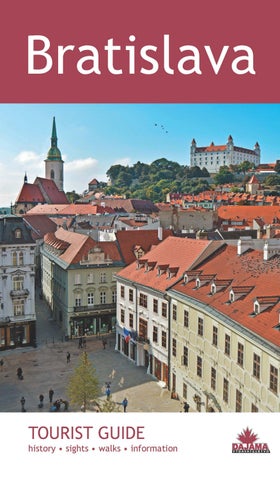
Bratislava Juraj Kucharík
TOURIST GUIDE history • sights • walks • information
Published with financial from the Literary Fund and ARS BRATISLAVENSIS
Bratislava Tourist guide 1st edition, 2016 © Text: Juraj Kucharík Editor: Daniel Kollár Technical editor: Marianna Lázničková © Photography: Juraj Kucharík (510), Ján Lacika (85), Lucia Lázničková (7), Zuzana Kollárová (5) and archive of DAJAMA Publishers Special consultant: Marián Bilačič English translation: Lucia Faltinová Maps: Ján Lacika Historical maps: Peter Juriga Hand-painted maps: CBS Publishers Ltd., www.painted-maps.com Map tiles: Marianna Lázničková © Design and typography: Marianna Lázničková Print: Slovensk Ltd., Bratislava Any reproduction, in full or in part, may only be done upon written permission by DAJAMA Publishers. © RNDr. Daniel Kollár − DAJAMA Ľubľanská 2, 831 02 Bratislava Tel: +421 (2) 446 317 02, info@dajama.sk, www.dajama.sk Published by DAJAMA Publishers in 2016 as its 274th publication. ISBN 978-80-8136-065-7
Contents Author‘s Note .............................................................. 4 Bratislava on the map .................................................... 8 Getting to know Bratislava ............................................ 10 History .................................................................... 14 Areas of Bratislava ...................................................... 32 Mediaeval Town ...................................................... 35 Castle and Castle Hill ............................................... 93 Square Hviezdoslavovo námestie and around .................. 127 East End .............................................................. 143 North End ............................................................ 155 Greater Bratislava .................................................. 177 Themed walks .......................................................... 198 Culture and leisure .................................................... 211 Gastronomy ............................................................. 227 Practical information .................................................. 232
4
Bratislava is an astounding city. It is the only European capital city the borders of which are at the same time those of two countries – Austria to the west and Hungary to the south. Its location on both banks of the river Danube which is joined by the river Morava in the city district of Devín, and the fact that city is also built on the crossroads of ancient trade routes plus on the foothills of the emerging Malé Karpaty determined Bratislava for its historic significance. No wonder that Bratislava as Celtic oppidum was here as early as at least in the 1st century BC. The southern parts of the present city were later incorporated in the Roman Empire. The Romans called the area north of Danube barbaricum. Bratislava played major role in the 9th century, the period of the Great Moravian Empire. After the year 1000 it was an important frontier point of the emerging Kingdom of Hungary. The coronations of Hungarian monarchs and their spouses that were held here between 1563 and 1830 added extra glamour and glory to Bratislava. The 19th century saw the multinational city the rise of a group of scholars led by Ľudovít Štúr who carried on the legacy of their ancestors and laid the foundations of the Slovak nation. Since 1993 Bratislava is the capital of the Slovak Republic. This guide is intended to introduce Bratislava as an attractive destination for weekend breaks or, even better, for longer tourism. It is divided into five parts that correspond with the five areas of the Old Town, the former historic Bratislava. The sixth part presents sights in the areas surrounding the city centre and slightly farther afield (the Greater Bratislava). Additional chapters tell you a bit about history and culture, give you tips for themed walks, and offer some practical information. Do explore the spirit of the old Bratislava, her sights, quiet romantic corners, nature, museums, galleries, as well as culture events. Bratislava is lately referred to as the “little big city”. Indeed, you are bound to find here everything that is on the smorgasbord of large European capitals, though here it is veiled in peaceful, chamber-like atmosphere. Enjoy the reading and exploring Bratislava! Juraj Kucharík
6
7
Bratislava on the map Bratislava is the capital city of the Slovak Republic. The city enjoys favourable locations, as it is based on the border of three countries – Slovakia, Hungary and Austria, with the Czech border just a few miles away. It also stretches across both banks of the river Danube and along the foothills of the Malé Karpaty. Bratislava is the political, administrative and cultural centre of Slovakia. With the area of 367.6 km² and population of 417,389 (as of 31.12.2013) it is the largest city in Slovakia and one of the largest ones in Central Europe.
Facts & figures Area: 367,6 km2 Population: 422 932 Height above sea level: 126 − 514 m
8
Location: 48° 09´ north 17° 07´ east Number of districts: 5 Number of boroughs: 17
Oslo
Helsinki
Stockholm
Tallinn Riga Copenhagen
Vilnius Minsk
Dublin London
Warsaw
Berlin
Amsterdam Brussels
Kiev
Prague
Paris
Bratislava
Chisinau
Vienna
Bern
Budapest Zagreb Belgrade
Bucharest
Sarajevo
Lisbon
Rome
Madrid
Podgorica
Sofia
Istanbul
Skopje Tirana Athens
Table of distances: Amsterdam Athens Belgrade Bern Budapest Bucharest Helsinki Kiev Lisbon
1,270 km 1,680 km 570 km 950 km 200 km 1,020 km 1,725 km 1,230 km 3,040 km
London Madrid Moscow Oslo Paris Prague Rome Sofia Stockholm
1,600 km 2,500 km 1,950 km 1,700 km 1,360 km 320 km 1,200 km 960 km 1,735 km
Warsaw Vienna Zagreb
660 km 65 km 390 km
Trnava Žilina Banská Bystrica Poprad Košice
50 km 200 km 210 km 340 km 440 km
(www.malovane-mapy.sk)
9
Getting to know Bratislava Location Bratislava enjoys truly unique geographical location, which has always kept it in the at the centre of attention. In the past it laid by the crossroads of ancient trade routes between the North to the South, and the West and East. Danube has become an important transportation artery. Today the western and southern frontiers of the city are also national borders between Slovakia and Austria, and Slovakia and Hungary, respectively. Bratislava is the only capital in Europe to border with two countries; and it is only 70 km away to the border with the Czech Republic. Bratislava and Vienna, which are just 65 km apart, are the closestbased capitals in Europe.
Nature Those who believe Bratislava to be a stone city are quite mistaken. The Malé Karpaty reach into the city, creating its distinctive hills. One of them was transformed into an urban forest park called Horský park. A vast woodland
10 1 0
park, Bratislavský lesný park, is in the northern parts of the city, offering an ideal setting for outings and leisurely tourism. The slopes of Devínska Kobyla in the city borough of Devín have been listed as a national natural reserve. It includes the internationally recognised paleontological site of the sand massive Sandberg. Devínska Kobyla is often referred to as the natural pearl of Central Europe. Unique flora and fauna can also be found along the Danube and Morava rivers. Bratislava is also fortunate to have fine quality potable water.
A blend of cultures Even though today Slovak nationals make up ninety percent of the residents in Bratislava, there were times when they were a mere minority. Bratislava was long known as trilingual city. The residents spoke fluent German, Hungarian and Slovak, which was not thought
of anything exceptional. Some still speak the three languages. Along with the three ethnic groups, Bratislava was also home to Jews, Czechs, Croats, Bulgarians and, in antiquity, Italians. In terms of religious structure, Roman Catholics represent the majority, followed by Protestants of the Augsburg confession, Calvinists, Russian Orthodox, and Jews. Despite the extensive blend of cultures, the city never experienced any major conflicts. All ethnicities coexisted peacefully what earned Bratislava an epithet of the City of Tolerance.
Diversity of sights Bratislava prides itself with a vast number of sights dating over two millennia back. Celtic mint was discovered in the Pálffy Palace which now houses an exposition mapping the Celtic period here. Historical reminders of Celts, now beneath
the Mediaeval development, were discovered in a number of houses. Striking findings of Antique buildings were also made at the Bratislava Castle. Specialists deem them to be comparable with the sights of Bibracte in France or Magdalensberg in Austria. The uncovered Roman military camp Gerulata in the borough of Rusovce, along with the adjacent museum, portrays the life in Roman Empire through period artefacts. Roman sites have also been discovered at the Devín Castle and in the borough of Dúbravka. The
artefacts from the periods of Slavs and the later Great Moravian Empire have been revealed at the Bratislava and Devín Castles. The Old Town is open air treasury of Gothic, Renaissance and particularly Baroque architecture. All styles can often be found along the same building. Classicism and Art Nouveau are well represented in Bratislava at the Primciálny palác [Primate’s Palace] and Modrý kostolík [Blue Church] respectively, along with a number of other historic sights. The interwar Functionalism surrounds the Mediaeval city. Buildings from the Communist period are a special category. Finally, contemporary architecture makes quite a presence in the city.
Arts and culture In part because of its proximity to Vienna, sculpture, painting and music have reached high standards in Bratislava. Distinguished musicians such Ludwig
van Beethoven, Joseph Haydn or Franz Liszt gave concerts here. The city gave the world three major composers and pianists: Johann Nepomuk Hummel, Ernest von Dohnány and Franz Schmidt were born here. Béla Bartók studied at the secondary school in Bratislava. It was here that the major artists of the 18th century, Georg Rafael Donner and Franz Xaver Messerschmidt made their chef d‘oeuvres. The city was also the birth place of some acclaimed 19th century sculptors including Viktor Oskar Tilgner and Ján Fadrusz, or Arthur Fleischmann. His works are on display in a museum in his house at the street Biela ulica. Bratislava has a range of galleries and museums. The grand buildings of the Slovak Philharmonics and the Slovak National Theatre highlight fine musical and theatre tradition of the city. A number of cultural events are held in Bratislava throughout the year, many of which have become an established part of its cultural life.
Castles Only a handful of cities in the world
11
can pride themselves with a castle. Bratislava has two! Though the Bratislava Castle in the city centre is better known, the Devín Castle in the borough of Devín, is no less attractive and popular. Moreover, the surroundings of the city pride themselves with quite a few additional castles. The Pajštún Castle is on the hill above the town of Borinka. The cellars of the castle Červený Kameň that is above the town of Častá are among the largest compounds of the kind in Central Europe. The castle Plavecký hrad oversees the town of Plavecké Podhradie.
Capital city Bratislava has always been an important administrative centre. It played major administrative role as early as in the times of Celts and of the Great Moravian Empire. During the reign of Sigismund of Luxemburg, Bratislava was home to high European politics. It first acquired the title of the capital city in 1536 when it became the capital of the Kingdom of Hungary. 1563 launched the history of Bratislava as the
coronation city. In modern times, between 1939 and 1945 Bratislava was the capital of the Slovak wartime state. After the federation of Czechoslovakia in 1968, Bratislava became the capital city of the Slovak Socialist Republic. Since 1993, following the split of Czechoslovakia, Bratislava is the capital of the Slovak Republic.
Trams The sounds of Bratislava are distinctive for the ringing of electric trams that are part of public transportation network. Trams were introduced here in 1895, making Bratislava the first city on continental Europe to have trams. During summer or cultural events, historic trams are paraded through the city. Those dating back to the 1980s still service some of the tram lines.
Historic names of Bratislava The name Bratislava is used since 1919. It is derived from the older forms of the name. The city was called Prešporok in Slovak, Pressburg in German, Poszony in Hungarian, and 12
Posonium in Latin. These linguistically relevant forms are still used in some parts of the neighbouring countries. After World War I an initiative was launched to name the city the Wilson City, as a tribute to US President Woodrow. One of the popular nicknames of the city is Danubian Beauty. Bratislava also prides itself with the epithet the City of Peace, referring to the peace accords that had been signed here. The City of Tolerance refers to the peaceful coexistence of the individual ethnic groups in the city.
Discover If you want to get to know the genius loci of Bratislava, keep on exploring. Many gems are concealed in the courtyards or in the narrow streets of the Mediaeval city. Don’t stick just to the traditional tourist routes. Explore additional, unexplored sites, such as the southern slope underneath the Bratislava Castle at Žižkova Street, Kapitulská Street, historic cemeteries, museums and galleries, parks, Bratislava hills or the boroughs of Devín, Rusovce or Čunovo.
Crème de la crème It is indeed not enough to come to Bratislava for a day. If you really want to get the feel of the city, you should plan on spending at least three to four days here, though weekend tourism in Bratislava is quite popular. The following pages highlight the very best of Bratislava.
TOP sights Bratislava Castle (pp 94 − 103) St. Martin’s Cathedral (pp 62 − 71) Primate’s Palace (pp 84 − 89) The Old Town Hall (pp 38 − 41) The Chatam Sofer Memorial (pp 112 − 115) The Most SNP Bridge (pp 138 − 139) The Slovak National Gallery (pp 134 − 135) Historic Building of the Slovak National Theatre (pp 128 − 129) Slavín (pp 174 − 175) Devín Castle (pp 182 − 185) Gerulata (pp 196 − 197)
The prettiest churches Franciscan Church (pp 48 − 49) Trinitarian Church (pp 122 − 123) Clarissian Church (pp 56 − 57) Blue Church (pp 148 − 149) Elisabethan Church (p. 164)
The prettiest palaces and historic buildings Mirbach Palace (pp 46 − 47) Pálffy Palace (pp 80 − 81) Grassalkovich Palace (pp 156 − 157) Apponyi Palace (p. 42) The Good Shepherd House (p. 106) Michael’s Gate (pp 50 − 51)
The prettiest parks and historic cemeteries The Janko Kráľ Gardens (pp 140 − 141) The Grassalkovich Garden (pp. 158) Medical Garden (p. 152) St. Andrew’s Cemetery (pp 150 − 151) Goat Gate Cemetery (p. 120)
The prettiest in Greater Bratislava Devínska Kobyla (p. 180) Danubiana Gallery (pp 192 − 193) Bratislava Zoo (p. 179) Bratislava Forest Park (pp 188 − 189) Dúbravka and Villa Rustica (p. 186) Wine Route through Malé Karpaty (pp 190 − 191) 13
History Prehistoric and ancient Bratislava 5000 BC − 4th century AD Prehistoric Bratislava (5000 − 2000 BC) The first inhabitants of Bratislava lived here during the younger Stone Age. Traces of their dwellings date back some 7,000 years. The settlements of Neolithic farmers dotted the valley Mlynská dolina. Here they enjoyed water supply from the creek Vydrica and were protected by the waters of river Danube. Animals from the hills of the mountain range Malé Karpaty would get all the way down. The findings of artefacts from the people of the Cannel ceramic culture date back over 4,200 years. Members of the tribe had already mastered different crafts, selling their products. Bronze Age dawned c. 2,000 years BC. Items made of bronze found on the territory of Bratislava are among the oldest in Central Europe. People of the Kalenderberg culture arrived in Bratislava in the older Iron Age. Their settlements spread across the lowlands and on the foothills of Malé Karpaty. One of the settlements was also located in the hill of Bratislava Castle.
Celtic Bratislava (4th − 1th century BC) Celts were the first ethnic group on the territory of Bratislava whom we were able to identify, with the the Celtic tribe of Boys arriving here. Abundant archaeological findings offer evidence that Celts founded in Bratislava a major centre (oppidum) that was, at the time, among the largest in Central Europe. It emerged on what is today the Castle Hill and further to east. Oppidum spread through the present day streets of Palisády, Svoradova ulica, the squares Hurbanovo námestie and Námestie SNP, and the streets Panská ulica and Laurinská ulica. All the Celtic coins way to the southern slopes of the Castle. Clay of Bratislava ovens were discovered in the area of what is today square Námestie slobody. The size of the Celtic oppidum was larger than the later mediaeval town. Its prominence has been multiplied by the discovery of the Celtic mint in the area of Panská Street. Celts minted coins based on Macedonian tetradrachms. The coins bear inscriptions in Latin which was used, for the first time, on our territory. Biatec is the most frequent inscription, most likely referring to the name of the local Celtic chief. The rise of Celtic oppidum ended on the break of millennia when German tribes gained increasing influence over the region. Discoveries of scattered skeletons and bodies laid to rest without pious ceremony indicate likely violent end of the oppidum in about mid-1st century BC. Celts had risen Bratislava to European standard. From 2008 to 2010 and between 2013 and 2014 archaeological works were carried out at Bratislava Castle bringing new discoveries that further enhanced the significance of the oppidum. The excavated buildings were probably made by Roman builders and commissioned by Celtic nobility to enjoy the standards of Roman comfort. Additional noteworthy discovery involved gold and silver coins that also bore the inscription Biatec. It is the Celts because of whom we can speak of Celtic Bratislava with its large “Celtic feast” oppidum that was here over 2,000 years ago. 14
Roman Bratislava (1st − 4th century AD) Romans reached the Danube basin in the 1st century AD. Here they built the famed border Limes Romanus to protect the Roman Empire against allien attacks from the North. Danube was the main line alongside which the frontier was delineated. The town of Carnuntum in Lower Austria, just 15 kilometres from Bratislava, was the administrative centre of Upper Pannonia. Limes Romanus was safeguarded by a network of fifteen Roman camps. A smaller one, Gerulata, with an adjacent Roman settlement was based on the right bank of Danube in the present-day Bratislava. In the sophisticated system of fortification the Romans incorporated the castle of Devín, using it as bridgehead fortification point in Barbaricum. Emperor Valentinian I resided at Carnuntum in 375. He repelled Barbarian attacks from the “nearest fort”. The report probably refers to the castle of Devín. Later, around the break of centuries, the mid-Danubian Roman border started to disintegrate. A number of traces suggest that Romans were on the territory of mediaeval Bratislava, though that remains hypothetical.
Exploring prehistoric and ancient Bratislava Traces of Celts and Romans are patchy and were found in a number of objects. Abundant artefacts of prehistoric and ancient Bratislava are in museums, particularly in the Museum of Archaeology of the Slovak National Museum (p. 110). The Pálffy Palace houses an exposition of Celtic mint (p. 80). Remarkable discoveries of an ancient stone dwelling from Celtic times were made in the area of Bratislava Castle (pp 94 − 103). The military camp Gerulata (pp 196 − 197) is the prettiest historic monument, located in Rusovce. A museum documenting the life of the Romans in Bratislava was opened by the Roman excavations. The remains of Roman brick buildings can still be seen in the area of Devín castle (pp 182 − 185). Villa Rustica (p. 186) is a remarkable artefact of Roman Empire is in the district of Dúbravka.
Historic calendar 5000 BC − the oldest settlements 2200 BC − the culture of Cannel ceramics 2000 BC − bronze items 750 BC − Kalenderberg culture 4th century BC − arrival of Celts 1st century AD − arrival of Romans 21 − 50 − The Kingdom of Vannius 166 − 180 − Marcomannic Wars 375 − Emperor Valentinian dies 476 − the fall of West Roman Empire
Roman stamped bricks discovered in Bratislava Emperor Augustus (27 BC – 14 AD) incorporated Pannonia to the Roman Empirei
The camp Gerulata in Rusovce is identified on the map as 14 Roman miles away from Carnuntum
Tabula Peutingeriana, the mediaeval transcription of a map from Roman Empire that also shows the area of central Danube
15
Bratislava between Antiquity and Middle Ages 5th − 6th century − 907 Slavic Bratislava (6th century − 833) The demise of Romans was followed by a period of interregnum and the massive migration of nations. Archaeological discoveries indicate that Bratislava and its adjacent areas were among the oldest Slavic settlements in Central Europe. Slavs arrived here on the break of the 5th and 6th centuries. Major tribal union of Slavs emerged in 623, led by Samo the merchant named the union Samo’s Empire. This was the first ever attempt to develop state structure. The Chronicle of Fredegar is the source of information about the Empire. The might of the Empire is also evidenced by the defeat of Frankish king Dagobert I by Slavic army of Samo, marking a major victory. The battle was held by the castle of Wogastisburg the location of which has not yet been specifically identified. One of the hypotheses suggest that is was within in Bratislava. Samo’s Empire fell in c. 658. Written sources remain silent about the decades that followed. It wasn’t until the defeat of Avars in 796 that Slavs were able to progress further. The Principality of Nitra began to develop around the year 800, with the city of Nitra as its centre, 90 kilometres from Bratislava. Apart from Samo’s Empire, the Principality of Nitra was the first state entity of our Slavic ancestors. Prince Pribina became the first known representative of the Principality. Mojmír II drove Pribina away in 833, laying the foundations of Great Moravia. The territory of Nitra, however, retained its privileged status all the way through the Kingdom of Hungary in 11th century. Places to see Bratislava from the period of the break of Antiquity and Middle Ages One can experience life in a semi-sunken hut in the Museum of Archaeology (p. 110) whith its perfect replica. The foundations of the Great Moravian fort that included a basilica have been excavated in the area of Bratislava Castle (pp 94 − 103). A church has also been found in the court of Devín castle (pp 182 − 185) that also contains a number of Slavic buildings. A number of museums in the city display ample artefacts related to the presence of Slavs in Bratislava. The Museum of Archaeology is certainly well worth a visit.
Historic calendar 623 − Samo’s Empire 631 − defeat of Dagobert I by troops led by Samo 658 − probable fall of Samo’s Empire 796 − Avars defeated by troops led by Pippin 833 − foundation of the Great Moravian Empire 863 − arrival Cyril and Methodius in Great Moravia 864 − written mention of castle Dowina 880 − foundation of bishopric with the seat in Nitra 907 − battle by Bratislava
Bratislava in the 2nd half of the 9th century
(Map from the project Bratislava – Past and Future, http://mapy-ba.g-studio.sk/) 600 650
Samo (623 − 658)
16
700
750
Bratislava and the Great Moravian Empire (833 − 907) Slavic forts based in Bratislava became part of the Great Moravian Empire in 833. A fort spreading over 5.5 hectares was located at the Castle Hill in Bratislava. It was a major frontier, administrative, economic and religious centre. Stone palace in the centre was surrounded by dwellings. Local basilica was the largest great Moravian basilica in Slovakia. Smaller settlements were located beneath the Castle, around what is now the street Ventúrska ulica, the square Hlavné námestie, the area of Palisády, and urban districts of Karlova Ves, Dúbravka and Rusovce. The Annals of Fulda from 864 describe the castle of Devín where Prince Rastislav fought against the attacks by the East Frankish King Ludwig the German. Devín served as frontier fort and the seat of a magnate. The castle included a church. The territory of Bratislava was bound to play major role during the era of the Great Moravian Empire. Written sources refer to three Great Moravian seats − Nitra, Bratislava and Devín, with the latter two located in Bratislava. The Annals of Salzburg mention a battle by the castle of Brezalauspurz where Hungarians defeated Bavarian troops. There is no mention of the people of Great Moravia, which is why the fall of Great Moravia is estimated in 907. Great Moravian basilica at the Bratislava Castle
800
850
Slavic female outfit
The area of the present-day street Kapitulská ulica
900
950
1000
Mojmír II (894 − 906) Svätopluk (871 − 894) Rastislav (846 − 870) Mojmír I (833 − 846) Pribina (825 − 833)
Géza (971 − 997)
17
Mediaeval Bratislava 1000 − 1526 Roman Bratislava (11th − 13th centuries) After the year 1,000 Bratislava, along with the rest of Slovakia, became part of the newly founded Kingdom of Hungary ruled by King Stephen I of the House of Arpád. Bratislava Castle underwent major reconstruction that introduced new fortification and gave the Castle Roman look. It became the seat of curial count − royal official entrusted to oversee administrative units called counties. A serf settlement grew beneath the Castle to benefit from the position near the Danube ford. The settlement became the foundation of the later fortified mediaeval town. In May 1189 Bratislava hosted the encounter of participants in the Third Crusade. The campaign troops were led by the French King Philip II Remnants of an 11-th century cemetery can be seen in St. Martin‘s Cathedral Bratislava in the 2nd half of the 13th century
(Map from the project Bratislava – Past and Future, http://mapy-ba.g-studio.sk/)
1000
1050
Stephen I (1000 − 1038)
Peter (1038 − 1041) (1044 − 1046) Samuel Aba (1041 − 1044)
18
1100
1150
Koloman (1095 − 1116) Géza II Ladislaus I the Saint (1077 − 1095) (1141 − 1162) Géza I (1074 − 1077) Béla II Solomon (1063 − 1074) (1131 − 1141) Béla I (1060 − 1063) Stephen II (1116 − 1131) Andrew I (1046 − 1060)
August, English King Richard the Lionheart, German Emperor Frederick, and by Géza, the younger brother of the King of Hungary. From 1204 to 1221 the canonry was moved from the Castle to the town. In mid-13th century Germans, monastic orders and Jews arrived in Bratislava. King Andrew III granted Bratislava privileges of a free town on 2 December 1291. The inhabitants public in the city became independent from the rulers at Bratislava Castle, what gace the mediaeval city a chance develop freely.
Predecessor of St. Martin‘s Cathedral
1200 Béla III (1172 − 1196)
Stephen III (1162 − 1172)
Historic calendar 1000 − foundation of the Kingdom of Hungary 1052 − futile siege of Bratislava Castle by Roman Emperor Henry III 1265 − marriage of Czech King Přemysl Otakar II with Hungarian Princess Kunhuta at Bratislava Castle 1271 − Truce of Bratislava between Přemysl Otakar II and Hungarian King Stephen V 1291 − Andrew II grants Bratislava city privileges 1436 − Sigismund of Luxemburg grants Bratislava deed defining its coats of arms 1464 − Golden Bull by Matthias I Corvinus 1465 − foundation of Istropolitana University 1515 − wedding negotiations in Bratislava The construction of the Franciscan Church was completed at the end of the 13th century Towered houses were owned by wealthy townsfolk
1250
Andrew II (1205 − 1235) Ladislaus III (1204 − 1205) Emeric (1196 − 1204)
Béla IV (1235 − 1270)
Stephen V (1270 − 1272)
1300 Andrew III (1290 − 1301) Charles I Robert (1301 − 1342) Ladislaus IV (1272 − 1290)
19
Gothic Bratislava (14th − 15th centuries) 1304 brought peace of arms of Matthew Csák for more than a century. The long peace helped the development of the city. It wasn’t until the Hussite invasions in 1428 that the state of peace was disturbed. Bratislava became the buttress of the Western frontier. The following year witnessed a summit of the Czech and Hungarian King Sigismund of Luxemburg and Prokop the Great who led the Hussite delegation. Sigismund rewarded his much-loved Bratislava with a number of privileges (rights to storage, minting and coats of arms). The Castle underwent extensive Gothic reconstruction in order to become a representative seat of Sigismund. The king and the later Roman Emperor resided in Bratislava quite frequently making the city a major political centre throughout his long reign. Armorial deed of 1436
Where to see mediaeval Bratislava The shape of the mediaeval city emerged from the end of 13th century long with the town fortification. A line of mediaeval walls with Birds’ Bastion (pp 52 − 53) lines the street Staromestská Street until today. Roman buildings were kept as foundations of houses in the city centre and in the remains of the Water Tower (p. 108) dating to mid-13th century. The Crown Tower at Bratislava Castle (p. 100) has also Roman foundations. Towered houses were a distinctive architectural feature of the city, serving wealthy tenants as small private fortresses. The most popular among them is Jacob’s House until it was later transformed into the Old Town Hall. The numerous Gothic monuments include St. Martin’s Cathedral (pp 62 − 71), the Clarissine Church (pp 56 − 57), or the noble funeral chapel of St. John the Evangelist in the Franciscan Church (p. 49). The Classicistic façade of St. Catherine’s Church conceals Gothic interior from the beginning of the 14th century. Other Gothic monuments are at Bratislava Castle (pp 94 − 103) and the Old Town Hall (pp 38 − 41).
The city and the Castle were in open conflict between between 1440 and 1444. The belligerent parties fought over the Hungarian throne. Matthias I Corvinus was yet another monarch to favour Bratislava. With his Golden Bull of 1464 he reaffirmed all existing privileges. In 1465 Corvinus founded here a university that was to play a major role in the advancement of learning in Hungary. The Istropolitana University was the hub for dissemination of humanistic ideas. Likely portraits of the reeve Jacob II and his wife as part of chapel decoration in Franciscan Church
Sigismund of Luxemburg (1387 − 1437)
1350
1400
Mary (1382 − 1385) Louis I (1342 − 1382)
20
1450
1500
Albrecht (1437 − 1439)
Valdislas I Charles II The Little (1440 − 1444) (1385 − 1386)
Matthias I Corvinus (1458 − 1490) Valdislas II Ladislaus V (1490 − 1516) (1440 − 1457)
21
Modern Age Bratislava 1526 − 1740 Renaissance Bratislava (16th century) 29 August 1526, when the unfortunate Battle of Mohács was waged, proved a milestone in the history of the Hungarian Kingdom and of Bratislava. Paradoxically though, what was a catastrophic battle for the monarchy, proved rewarding for the city. The Turks occupied southern parts of Hungary, forcing the supreme state institutions to relocate to safety up north. In 1536 Bratislava became the capital of Hungary for the nearly two and half centuries to come. The city became the seat of the Vice-Governor (the representative of the King of Hungary), of the Hungarian Diet and the Hungarian Royal Chamber and chancellery. Coronation jewels were kept in the Crown Tower of Bratislava Castle since 1552. The Castle started to be identified as Sedes Coronae Hungariae − the Seat of the Hungarian Crown. The period also saw a reconstruction of the Castle into a representative residence of Ferdinand I Habsburg. On 8 September 1563 Maximilian II was crowned the King of Hungary at St. Martin’s Cathedral, what launched the history of Bratislava as coronation town. Between 1563 to 1830 St. Martin’s Cathedral witnessed coronation of eleven monarchs and eight royal wives. The Turks got close to Bratislava for the first time in 1529, though without surrounding the city. The Turkish threat made the city to enhance its fortification and Bratislava was preparing for war. Bratislava vineyards
Historic Calendar 1526 − The Battle of Mohács 1526 − Ferdinand I elected the King of Hungary in Franciscan monastery 1529 − Turks approach the city 1536 − Bratislava becomes the capital of Hungary 1543 − Trnava becomes the seat of the Archbishop of Esztergom 1563 − first coronation in Bratislava 1606 − foundation of Lutheran seminary 1698 − visit by the Russian Tsar Peter the Great 1722 − confirmation of the Pragmatic Sanction at the Bratislava Diet
16th-century Bratislava
1500
1550
Ferdinand I (1526 − 1564) Louis II (1516 − 1526)
22
1600
1650
Matthew II (1608 − 1619)
Maximilian (1564 − 1576) Rudolph (1576 − 1608)
Ferdinand II (1619 − 1637) Ferdinand III (1637 − 1657) Ferdinand IV (1647 − 1654)
Baroque Bratislava (17th century − 1740) The Turks proved to be merely a threat to Bratislava and no open conflict exploded in the city. 17th century brought Bratislava a threat of uprisings of the estates against the absolutist rule of the Habsburgs. As the metropolis of the Hungarian Kingdom, Bratislava was not spared virtually any of the uprisings. The city was tormented by the troops of Stephen Bocskay (1605 − 1606), Gabriel Betlen (1619 − 1621) and Imrich Thököly (1683). Bratislava also felt the pressure exerted by Francis II Rákóczi (1703). Religious issues further aggravated unrest in what was already a turbulent century. The strictly Catholic court of the Habsburgs vigorously stood against Protestant Churches during re-Catholicisation. In 1683 the Turks were again close to Bratislava. Nevertheless, the city was saved, as the Turks led by Kara Mustafa headed straight to Vienna. Following their defeat in the Battle by Vienna, they were gradually supressed and expelled from Hungary. Despite the liberation of Buda, Bratislava remained the capital and coronation city of the Kingdom. The entry of the city into the next century was less fortunate, as major plague epidemic raged here from 1710 to 1713, claiming Explore Modern Age 3,860 victims. Bratislava City fortification
Old Town Hall tower
1700
Leopold I (1657 − 1705)
Charles III (1711 − 1740) Joseph I (1705 − 1711)
Humanism reached Hungary during the reign of Matthias I Corvinus, it was largely due to his wife Beatrix who was raised in the humanistic context of the court of Napoleon. The Istropolitana University (p. 78) proved to be a major milestone in the dissemination of humanism. Southern lobby of St. Martin’s Cathedral (p. 63) is the first building in Bratislava to bear Renaissance features. Arcaded courtyards of the Old Town Hall (p. 40), the house on the street Uršulínska ulica (p. 82) and the Black Raven House (p. 44) are characteristic examples of Renaissance architecture in Bratislava. Renaissance loggias were constructed in courts of local townhouses. Specific period examples include the Maximillian Fountain from 1572 (p. 37), south-western fortification of Bratislava Castle with the Leopold Gate (p. 103) and Clarissine Monastery from 637 (p. 57). The first Baroque artefacts here include the statue of Our Lady on the Old Town Hall (p. 38), early Baroque chest in the Court Room of the Old Town Hall (p. 41), and the Church and Monastery of the Brothers of Mercy (p. 169). Baroque flourished from the 18th century. The prettiest examples include the Trinitarian Church (pp 122 − 123), the St. John the Almoner Chapel in St. Martin’s Cathedral (p. 70), and St. Elisabeth’s Church and Monastery (p. 164). Numerous Baroque buildings, particularly the palaces of nobility mostly date back to the reign of Maria Theresa.
23