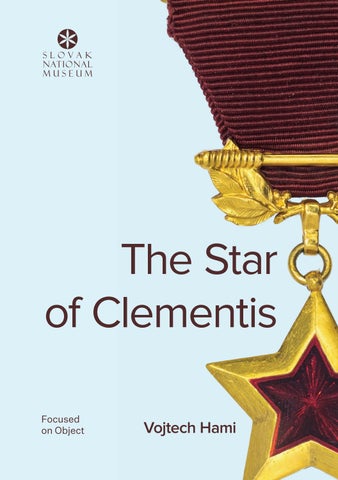
The Star of Clementis Focused on Object
Vojtech Hami
Focused on Object
The Star of Clementis Vojtech Hami
Slovak National Museum Bratislava 2024
Table of Contents 7
35
Foreword
Life story of Vladimír Clementis
10
What is distinction 14
Hierarchy of Czechoslovak orders and decorations during the socialist era
50
Orders and decorations of Clementis in the collections of the SNM – Museum of History 66
Epilogue 23
Hero of the Czechoslovak Socialist Republic 27
Holders of the Gold Star of the Hero of CSSR 32
The Star of Clementis
68
Sources and literature
Fig. 1. Gold Star of the Hero of CSSR. SNM – Museum of History (S. Okkel)
Foreword The Slovak National Museum – Museum of History curates over two hundred thousand collection items. Many of them are accessible to the public only once every few years, usually during a thematic exhibition. One such treasure is the Gold Star of the Hero of the Czechoslovak Socialist Republic. The publication you are holding in your hands aims to introduce you to the gem of Czechoslovak phaleristics. The honorary title associated with the decoration was established during the period of the Czechoslovak Republic (CSR), but was awarded only since 1965 after the Constitution was revised and the name of the state changed into the Czechoslovak Socialist Republic (CSSR). That is why we use the term Gold Star of the Hero of CSSR throughout the publication. The insignia of the highest honorary title of communist Czechoslovakia from 1955 to 1990 exists in only forty-three copies. It is therefore rightfully among the rarest objects in the phaleristics collection of the SNM – Museum of History. The museum acquired it relatively recently, in 1999, from the abolished Institute of History of the Communist Party of Slovakia. The Gold Star with register number 3 was awarded in memoriam to the Slovak communist politician, lawyer and writer Vladimír Clementis. It epitomises the impressive and at the same time tragic story of its holder. The destiny of Clementis was very dynamic. His political orientation already began to take shape at a young age – he was involved in left-wing student circles and presented his political views in the DAV journal. In the interwar period, he joined the Communist Party of Czechoslovakia (KSC) and earned a living as a lawyer in the civilian profession. On the eve of World War II, he sharply criticised the policy of the Soviet Union regarding the issue of the Soviet-German non-aggression pact of August 1939, for which he was later expelled from the Party. He participated in the anti-fascist resistance abroad and after returning to the liberated homeland, he held high positions in the state apparatus. After the forced self-criticism on the issue of Soviet politics, he was re-admitted to the Communist Party. As the Minister of Foreign Affairs, he defended the interests of Czechoslovakia on the in7