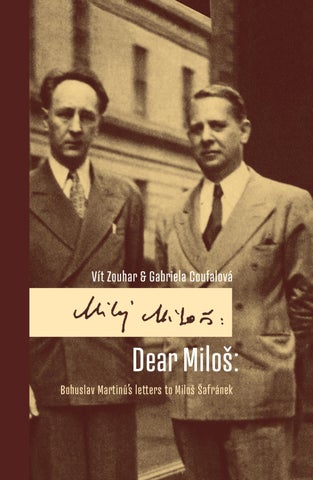
Dear Miloš:
Vít Zouhar & Gabriela Coufalová
Dear Miloš: Bohuslav Martinů’s letters to Miloš Šafránek
Palacký University,Olomouc Olomouc Olomouc 2S19
Reviewed and recommended by: doc. MgA. Mgr. Monika Holá, Ph.D. Mgr. Jaromír Synek, Ph.D.
Published with the kind support of the Czech Science Foundation (GAČR) as a part of the project Bohuslav Martinů Complete Edition – Phase 2, No. 13-19162S.
Unauthorized use of the work is a breach of copyright and may be subject to civil, administrative or criminal liability.
© Vít Zouhar, Gabriela Coufalová, 2019 © Palacký University Olomouc, 2019 Translation © Hilda Hearne, John Hearne and Adam Prentis, 2019 First Edition DOI: 10.5507/pdf.19.24455297 ISBN 978-80-244-5529-7 (print) ISBN 978-80-244-5534-1 (online : PDF)
INTRODUCTION
The extensive correspondence of the composer Bohuslav Martinů (1890–1959) comprises more than two thousand written documents. His letters addressed to Miloš Šafránek (1894–1982) – diplomat, music journalist, promoter and biographer of Martinů – are one of the most impactful subsets of the whole collection. In quantity and in scope of years, they are also the second largest volume of correspondence, second only to the composer’s letters home to Polička. The information that Martinů provided Šafránek over the course of more than three decades is crucial for any deeper understanding of the genesis of Martinů’s works, his reflection of them and meditation on his work, and of the fateful peripeteias of his life. It was not by chance that Martinů stressed to Šafránek in one of his letters: “Now as regards the qoutation [sic] from my letters […], most of [them] are correct, at least to you or musicians, yet sometimes the more-or-less and more private letters are not decisive […].”1 At the same time, these letters are important historical documents that shine light on the musical scenes in Paris in the 1920s and 30s and New York in the 1940s and 50s and narrate the dramatic for tunes of Czech exiles in France and the United States in the course of these four decades of the twentieth century.
1
6
Letter from Bohuslav Martinů to Miloš Šafránek, 20 Apr. 1958, CBM, PBM Kmš 872.
The majority of Bohuslav Martinů’s documents are located in the archives of the Bohuslav Martinů Centre in Polička, the Czech Museum of Music in Prague, the Moravian Museum in Brno, the Paul Sacher Foundation in Basel, and the Bohuslav Martinů Foundation in Prague. However, a plethora of letters is interspersed among the archives of publishing houses (Bärenreiter, Boosey & Hawkes, Universal Edition, etc.), copyright collectives (OSA, ASCAP), and other institutions and private collections. Of this vast quantity, as yet the only sets to be published are his correspondence with the conductor Václav Talich (Kuna, 1970, 1995), a selection of his letters to Polička (Popelka, 1996, 2013), the mutual correspondence with the Czech Academy of Sciences and Art (Maýrová, 2000), the mutual correspondence with Nikos Kazantzakis (Dostálová–Březina, 2003), his letters to the conductor Zdeněk Zouhar (Zouhar, 2008), a selection of letters to the publishing editor Karel Šebánek (Brádková, 2010), his letters to the poet Miloslav Bureš (Zouhar–Coufalová, 2017), and the first volume of his correspondence home (Synek–Všetičková, 2019). Of these, only four are available in English (Popelka, 2013; Zouhar, 2008; Zouhar–Coufalová, 2017; Synek–Všetičková, 2019). This annotated critical edition of the correspondence of Bohuslav Martinů with Miloš Šafránek is based on the editorial guidelines and conception of the editions of Martinů’s letters to Miloslav Bureš and to his family in Polička. In authentic, generously commented form, it publishes 168 letters, seven postcards, six postal cards, one telegram, and one lettercard, which the composer sent to Šafránek in the years 1928–59. Many of them are severely damaged. This set of correspondence was preserved in the estate of Miloš Šafránek and has been housed in the Bohuslav Martinů Centre at the Municipal Museum in Polička since 1986. It can no longer be 7
ascertained whether the set was retained in its entirety. The composer’s silence in the period of 1948–54 can be explained by the political situation in Czechoslovakia; it cannot be ruled out that Martinů truly did not write a single letter to Šafránek in that period. The same goes for the years 1938 and 1940, from which no letters were preserved either. Seeing that Martinů’s Czechoslovak correspondence was monitored by Communist officials, it is possible that some of his letters were never delivered. As in the case of most of the composer’s addressees, Miloš Šafránek’s letters to Bohuslav Martinů have not been preserved. The only exceptions are one letter (CBM, PBM Kmš 891) and one postcard (CBM, PBM Kd 384), which are included in this chronologically ordered edition. The lack of extant received correspondence may be partly due to the composer’s frequent changes of address and the strained political situation, which necessitated a certain level of caution, but it is mainly due to Martinů’s spontaneous approach to all his correspondence. The composer saw letters as a purely communicative tool that was a substitute, at least as far as the received letters were concerned, for the possibility of meeting the addressee in person. Therefore, he did not archive his correspondence and saw no reason to do so. Only in rare cases did he forward them to his sister Marie in Polička (letters from Bruno Walter, Serge Koussevitzky, Charles Munch, Charles August Lindbergh, etc.). In fact, he even encouraged his family in Polička: “I hope you are not keeping my letters, use them as kindling for the stove.”2 To convey at least some of the information contained in the missing letters of Miloš Šafránek and give the unilateral correspondence a second dimension, Bohu2
8
Letter from Bohuslav Martinů to his family in Polička, 14 Mar. 1957, CBM, PBM Kr 559.
slav Martinů’s letters are supplemented in the footnotes with excerpts from his concurrent correspondence with his family in Polička, his friends Frank Rybka, Karel Novák, Jan Kunc, the poet Miloslav Bureš, the music publisher Karel Šebánek, the author Nikos Kazantzakis, the conductor Paul Sacher, the benefactor Elizabeth Sprague Coolidge, etc., and with memories from the composer’s wife Charlotte Martinů.3 The annotations also identify the compositions mentioned in the letters and briefly introduce the people mentioned by Martinů. Inaccuracies are corrected, neologisms – combining Czech words with expressions from whichever language was spoken around him – are explained, and numerous other words are translated or contextualised. Bohuslav Martinů’s letters to Miloš Šafránek encompass the period from 30 July 1928 to 14 May 1959. The initial salutation, “Dear Dr. Šafránek”, changes to “Dear friend” midway through 1931.4 In the mid-1950s, Martinů switches from the more formal mode of Czech “vy” to the more familiar mode of “ty”, which he remarks on only in passing: “So I would like to ask you if you have the continuation of Genesis available, if you could briefly pick some verses from it and send them to me, you know what I mean, and since you cannot defend against it I have begun addressing you as ’ty’.”5 However, this has no impact on the character or content of the subsequent letters. There is only a slight shift in the exact wording of the salutation, as “Drahý Miloš” (“Dear Miloš”)6 irregularly alternates with the 3 4
5
6
Charlotte Martinů, 2003. Martinů first addressed Šafránek in this way in the letter from 24 Jul. 1931, CBM, PBM Kmš 718. Letter from Bohuslav Martinů to Miloš Šafránek, 4 Oct. 1954, CBM, PBM Kmš 819. Letter from Bohuslav Martinů to Miloš Šafránek, 20 Aug. 1955, CBM, PBM Kmš 822.
9
practically indiscernible “Milý Miloši” (also rendered in English as “Dear Miloš”)7 from 20 August 1955. Seeing that Šafránek published articles about the composer from the 1930s onwards and that he helped promote his works as a press attaché in France and later when he was in the US, Martinů regularly supplied him with information regarding new compositions, premieres, and performances of his works. Several of the letters include lists of his compositions, which gradually gave rise to Šafránek’s catalogue of the works of Bohuslav Martinů. Miloš Šafránek collected and compiled information from Martinů himself, but he also made suggestions for new compositions,8 he gave tips on books to read and concepts to consider. His lasting interest in Martinů’s oeuvre led to the publication of his monographs Bohuslav Martinů. The Man and His Music (1944), The Man and His Work (1946),9 Bohuslav Martinů. Život a dílo [Bohuslav Martinů. Life and Work] (1961),10 Bohuslav Martinů, His Life and Works (1962),11 Bohuslav Martinů. Leben und Werk (1964),12 and Divadlo Bohuslava Martinů (1979) [The Theatre of Bohuslav Martinů].13 He also published a selection of texts by Bohuslav Martinů, titled Bohuslav Martinů. Domov, hudba a svět [Bohuslav Martinů. Home, Music and World] (1966).14 7
8
9 10 11 12 13 14
10
Martinů first addressed Šafránek in this way in the letter from 29 Jan. 1956, CBM, PBM Kmš 830. For example, cf. “In Champfleury’s book The Pantomimes of Gaspard Deburau (1889), which I bought from a book stall in Saint-Michel Boulevard, Martinů found the theme of the ballet section of Theatre Behind the Gate.” (Šafránek, 2006, p. 139). Šafránek, 1944; Šafránek, 1946. Šafránek, 1961. Šafránek, 1962. Šafránek, 1964. Šafránek, 1979. Šafránek, 1966.
Bohuslav Martinů willingly reacted to Šafránek’s requests for analyses of his works, albeit at times with irony, as in the summer of 1941: “I had hoped that while writing this letter an idea of analysis for the violin concerto would occur to me, but nothing has occurred to me (perhaps it would if my state subsidy were to be increased???).”15 To assure Šafránek of his position as an established composer, he would include the rare selfassessment: “On the whole, I have not lost confidence in myself, and the most recent performances (Ricercari, the cello sonata and, particularly, the Concerto grosso) have strengthened my position here to such an extent that I myself have almost arrived at the opinion that I am one of the best composers, not so much owing to the pieces themselves, but when I look at the score and scrutinise how it is done I begin feeling respect towards myself, since it is a component that I have reached wittingly by means of great work and patience and that is now indeed such a ’certainty’ that I can now actually begin composing fully aware of having mastered it and so cannot get lost anywhere, whatever may happen.”16 Although there is a break of almost six years between the letters from 8 November 1948 and 5 September 1954, it has practically no impact on the content. This is presumably due to the fact that the composer communicated with his friends via his relatives in Polička, so as not to endanger them in this politically volatile period.17 Besides informing about new compositions, in the 1950s Martinů also gave frequent and detailed 15
16
17
Letter from Bohuslav Martinů to Miloš Šafránek, 14 Sept. 1941, CBM, PBM Kmš 765. Letter from Bohuslav Martinů to Miloš Šafránek, 3 Apr. 1940, CBM, PBM Kmš 748. One example is his mention in a letter to his family: “I am replying post-haste and attaching that list of compositions, send it to Mil.” 31 Mar. 1954, CBM, PBM Kr 457.
11
feedback on Šafránek’s texts about the composer and on the manuscript of Bohuslav Martinů. Život a dílo. In the 1930s and 40s, the composer also made considerable use of Šafránek as his music agent and ally, both to promote his works and, for example, when striving to obtain the post of professor at the Master School of the Prague Conservatoire in the late 1930s, when cooperating with the Czechoslovak government services in the US during World War II, or when building up contacts in the US. He readily informed Šafránek about his compositions, and he often stressed that he gave such information to no one else. Martinů turned to him when he needed help sending performance materials or was in financial straits, when making new contacts, but also when endeavouring to obtain visas to the United States in 1940: “Please intervene very vigorously at the Legation of ours in Washington, it is their duty to take care of me, even if I were to be assigned a typist job or something, but I must get out of here, and should I escape unharmed, they simply cannot ignore the effect it would have everywhere should they not take care of me, and it would also make no sense for me to vegetate around the villages here, explain this to Mme Coolidge, that I directly ask her for it, possibly tell Koussevitzky too, offer him the premiere of my Double Concerto, he could send me an invitation, or even some fictitious job at our Legation, I would find ways how to earn my living over there, and I assure you that this is my very last attempt (even if I escape from here) at constantly beseeching our authorities for something they themselves should offer me in their own interest, I have really had enough of it, especially after the experience over the past ten days, which I will be hard pressed to ever forget.”18 His letters to Šafránek also contain a remarkable testimony 18
12
Letter from Bohuslav Martinů to Miloš Šafránek, 22 Jun. 1940, CBM, PBM Kmš 749.
of how the composer considered emigrating across the Atlantic following the occupation of Czechoslovakia in 1939. Although he had been searching for a way to escape war-torn Europe from mid-1939, he still wrote to America in early June 1940: “[… we are] awaiting other events, which are not encouraging at all, we are waiting to see what Italy will do this week. We may be making a mistake by not leaving, but we don’t feel like abandoning Paris.”19 However, the situation changed dramatically a mere week later, when the Martinůs fled the city in a hurry. In the 1950s, when Šafránek lived mostly in Prague, Martinů’s letters contain his comments on compositions and thoughts on creativity. The composer was responding to Šafránek’s queries in connection with the preparation of his new book about Bohuslav Martinů. The correspondence was thus focused on practical matters and unburdened by personal confidentialities. As if he abided by the principle: “Leave private matters out of the Biography.”20 In the late 1930s, the tumultuous drama of Martinů’s relationship with Vítězslava Kaprálová appears only in subtle strokes. The subject is often not even hinted at, nor is it named, although it appears in many of the letters in 1939 and 1940. Instead, Martinů offers vague statements: “[…] my whole situation has become so complicated that I am not quite sure how to get out of it with my hide intact, and I would really need to be strolling with you along the embankment or breathing fresh air somewhere, I don’t know where.”21 The following letter contains a similar lament: “I myself have it all so tangled up that I don’t know whether 19
20
21
Letter from Bohuslav Martinů to Miloš Šafránek, 3 Jun. 1940, CBM, PBM Kmš 748. Letter from Bohuslav Martinů to Miloš Šafránek, 22 Dec. 1957, CBM, PBM Kmš 863. Letter from Bohuslav Martinů to Miloš Šafránek, 8 Oct. 1939, CBM, PBM Kmš 745.
13
I will get out of it in one piece, too much came at once and I am at my wits’ end.”22 It was not until half a year later that he acknowledged that the complicated situation was not related to the disputes between Osuský’s Czechoslovak legation, the “German legation”, and the Czechoslovak Colony, or to any of the other dangers of the time, but instead: “To be honest, that which holds me back is not so much the outer circumstances, nor the events around, but a completely personal matter about which I cannot write.”23 The same can be said of his relationship with Rosalie Barstow several years later. Martinů only mentions her name in connection with the dedication of String Quartet No. 6, H 312, otherwise merely intimating the subject, of which the addressee was fully aware.24 In 1955–1956, when Šafránek was sent by State Security to gather intelligence in France, the situation reversed, and it was he who asked Martinů for help. The composer repeatedly denied him any financial aid, emphasising his own bad economic situation.25 “Please don’t construe my being slow as dilatoriness and reluctance to help you; as I wrote to you, I had great expenses myself and you see when I send you something then I must do it secretly, you know what it’s like in marriage, so putting a large sum in $ aside is connected with great difficulties. You know, if Ch. knew that I have been sending you money I would be in pretty hot water at home. Nothing is left from my secret reserves that 22
23
24
25
14
Letter from Bohuslav Martinů to Miloš Šafránek, 5 Nov. 1939, CBM, PBM Kmš 746. Letter from Bohuslav Martinů to Miloš Šafránek, 3 Apr. 1940, CBM, PBM Kmš 748. Letter from Bohuslav Martinů to Miloš Šafránek, 19 Nov. 1946, CBM, PBM Kmš 806. Letter from Bohuslav Martinů to Miloš Šafránek, 30 Dec. 1955, CBM, PBM Kmš 828; letter from 15 Jan. 1956, CBM, PBM Kmš 829, later again in the letter from 12 Oct. 1956 CBM, PBM Kmš 848.
I have saved for holidays, so I only have that which I receive as a Chek [sic] and it’s difficult to take anything from it.”26 Instead, he sent Šafránek Sonatina for Clarinet and Piano, H 356, and Sonatina for Trumpet and Piano, H 357, for the latter to publish in the publishing house of his brother-in-law, Alphonse Leduc, for his own profit. It is difficult to surmise the actual reasons for Martinů’s unwillingness to help and whether he may have been partly influenced by suspicions of Šafránek’s secret mission or by the political tension between the McCarthyist United States and Eastern Europe under the Soviets. Later that year the composer wrote to Šafránek in Paris: “I have received the letter, and I actually expected a surprise of the kind you mentioned, yet I still don’t know how I should decide, it is a risky trip, especially given how the situation has developed of late, it doesn’t look like fraternisation of nations, or does it? Here, as you may know, they are very attentive to these histories and it could even happen that next time I wouldn’t get a passport to go to Europe. Well, for the time being it isn’t so hot, I haven’t yet received anything officially anyway, but give me advice, what you yourself think of it.”27 The letters from the 1950s explain the genesis of a number of works, namely, the operas Mirandolina, H 346, The Greek Passion, H 372, and Ariadne, H 370, the cantata Mount of Three Lights, H 349, The Epic of Gilgamesh, H 351, Sinfonietta Giocosa, H 282, the orchestral Parables, H 367, Memorial to Lidice, H 296, but they also shine light on the sources of chamber compositions – Sonatina for Clarinet and Piano, H 356, and Sonatina for Trumpet and Piano, 26
27
Letter from Bohuslav Martinů to Miloš Šafránek, 15 Jan. 1956, CBM, PBM Kmš 829. Letter from Bohuslav Martinů to Miloš Šafránek, 22 Nov. 1955, CBM, PBM Kmš 826.
15
H 357 – and numerous choral works (Brigand Songs, H 361, Songs for a Children’s Choir, H 373, Czech Madrigals, H 278, etc.). From 1957 onwards Martinů responded to Šafránek’s texts about his compositions. He criticised the study Divadlo Bohuslava Martinů [The Theatre of Bohuslav Martinů]28 and lambasted Šafránek’s biographical conjectures and notes on his works and their genesis.29 Martinů’s ruminations on the compositional method are especially momentous.30 The composer provided detailed corrections to Šafránek’s manuscript, Bohuslav Martinů. Život a dílo.31 He wrote about it repeatedly and stressed his aversion to biographical books. He concluded his amendments with a radical assessment: “The book is good but it lacks balance, it’s a heap of facts, as well as conjectures that give the impression that you have finally arranged your notes in chronological order, yet some of the things repeat in various places, almost in an identical version, and so it rather gives the impression that you wrote the entire thing more for yourself than the public.”32 Nevertheless, he returned to the manuscript again in later correspondence. He endeavoured to rectify Šafránek’s inaccurate concepts and data, but also his own diatribes and rash judgements. The letter from 14 May 1959 is again full of questions, plans, and expectations. But none followed. 28
29
30
31
32
16
Letter from Bohuslav Martinů to Miloš Šafránek, 21 Sept. 1957 CBM, PBM Kmš 859; Miloš Šafránek, “Divadlo Bohuslava Martinů”, Divadlo, 1957, 8, 7, pp. 547–67. Letter from Bohuslav Martinů to Miloš Šafránek, 28 Nov. 1957, CBM, PBM Kmš 862. Letter from Bohuslav Martinů to Miloš Šafránek, 7 Jan. 1958, CBM, PBM Kmš 865. Letter from Bohuslav Martinů to Miloš Šafránek, 20 Apr. 1958, CBM, PBM Kmš 872; letter from 25 Apr. 1958, CBM, PBM Kmš 873. Letter from Bohuslav Martinů to Miloš Šafránek, 25 Apr. 1958, CBM, PBM Kmš 873.
The authors would like to express their greatest appreciation to Jaromír Synek, Jaroslav Mihule, Gabriela Všetičková, Karla Zouharová, and Radka Rozkovcová for their valuable observations and comments on the text; to Jiří Malaník for transcribing and translating the French letters and for providing commentary and other ideas with regard to the manuscript. Their gratitude also goes to Jaroslav Mihule and Aleš Březina for kindly loaning the manuscripts. Further acknowledgement is owed to Monika Holá (CBM), Zoja Seyčková (IBM), Jiří Zahrádka (Moravian Museum Brno), Jitka Bílková (Security Forces Archive), and Michal Přibáň (AVČR) for important additional information, and to Alena Přibáňová (AVČR) for feedback on the transcription. Finally, thanks goes to Stanislava Střelcová – President of the Board of Directors of the Bohuslav Martinů Foundation, Prague, to Aleš Březina – Director of the Bohuslav Martinů Institute, to David Junek and Pavla Juklová – Directors of the Municipal Museum in Polička, to James Rybka and Boris I. Rybka for providing access to sources and for permitting them to be published. Vít Zouhar and Gabriela Coufalová Olomouc, May 2019
17
To Zdeněk Zouhar, Věra Zouharová, Karla, Jan, Anna and Vojtěch.
LETTERS
1 [Kmš 710; POLIČKA / Č. S. R. / 30.VII2833]
[Polička 30 July 1928] Monsieur. Mons M. Šafránek. chez Mr Victor Leroy “Croisette” Gerardmer. (Vosges.) France. Dear Dr. Šafránek, I was waiting for the promised correct address, but hopefully this will find you anyway. I am sure you are having a great time and enjoying your holiday. The weather here is quite bad. I look forward to you writing a few lines to me and I wish you a great time. Best regards to you, your good lady wife34 and everybody. Yours B. Martinů. Na Svépomoci 182. Polička.
33 34
22
The postmark is badly legible. Martinů is referring to Miloš Šafránek’s wife ANNETTE MOUSSU (1907–2003).
2 [Kmš 708]
Polička 6/9 1928. Dear Dr. Šafránek, Thank you for your letter, I was delighted by the letter from Minister Beneš,35 mum36 was totally flabbergasted. I am pleased that the minister has got to know about it. Otherwise, I am still cheerfully relaxing by the family hearth, it’s really nice here, the temperature is just right, not too high, not scorching, so I’m revelling in it. I was received in Polička like a celebrity, which makes mum happier than me. Otherwise, I keep marital fidelity37 and go to bed rather early, reading detective stories. I have received a letter from Baden, they have again invited me there, I can no longer put it off, Mr. Burkhard, the music director,38 wrote to me that I had a great success and that many critics wrote that the two small things of mine39 were the best of the entire “Opern35
36 37
38
39
EDVARD BENEŠ (1884–1948), politician and second President of Cze choslovakia, served as the Czechoslovak Foreign Minister in 1918–35. On 18 Jul. 1928 Beneš sent Martinů a letter (CBM, PBM Ko 1133), in which he reacted to the dedication of Rhapsody (Allegro Symphonique), H 171, “Pour Darney.” Darney is a village in the south of France where the Czechoslovak army was formed and where it received its flag from Edvard Beneš on 30 Jun. 1918. Martinů dedicated the composition to the 10th annivesary of this event. Beneš’s letter makes it clear that he was informed of the fact by Šafránek. KAROLINA MARTINŮ (1855–1944), Bohuslav Martinů’s mother. The composer had not yet married his partner, Charlotte Quennehen; he did so three years later, on 21 Mar. 1931 in Paris. HEINRICH BURKARD (1888–1950) was a co-founder of the Donaueschinger Musiktage, and in 1928 he was in charge of the Deutsche Kammermusik Baden-Baden together with Joseph Haas and Paul Hindemith. Martinů wrote Burkard’s surname with an extra “h”, as in “Burkhard” (cf. letter to Šafránek from 8 Aug. 1929, CBM, PBM Kmš 711). Martinů is referring to reactions to the premiere of two movements from Jazz Suite, H 172, “Prélude” and “Musique d’entract”, in July
23
abend”. He has kept them there and they will play them at a concert. He definitely wants me for next year. I have received from America a programme of the festival held by Mme Coolidge,40 I have been positioned very well, mine is among just a few new things. And I have also received a card, so as to fill in whether I want to have a seat reserved. I will probably turn it down for the time being.41 I am in the doghouse with Prague, firstly because Jirák42 isn’t on Coolidge’s festival programme, and then I wrote a reasonably sharp letter to the Music Foundation regarding the Festival43 in Siena, since to date they haven’t deemed it necessary to write to me who has actually been assigned to perform my quartet, and no one has even written a line to me about it.44 As far as I know, no Czech quartet is going and if they think they can make do with an ordinary quartet I am resolved to withdraw it from the Festival and put them to shame at the central office.45 And I have yet to receive a reply to my letter too. I was also paid a visit by Ježek,
40
41 42
43 44
45
24
1928 at the Festival Deutsche Kammermusik Baden-Baden. ELIZABETH SPRAGUE COOLIDGE (1864–1953), patron of the arts. Martinů dedicated his 1927 String Quintet, H 164, to her. Martinů appears to be responding to her letter from 14 Jun. 1928, in which Elizabeth Coolidge informed him of the composition’s inclusion in the Berkshire Festival of Chamber Music in Pittsfield by the Roth Quartet and the violinist Egon Kornstein (cf. IBM, Spr 1928-06-14). The work was premiered at the festival on 21 Sept. 1928. Martinů first set foot in the United States of America in March 1941. The composer KAREL BOLESLAV JIRÁK (1891–1972) was tenured as Professor of Composition at the Prague Conservatoire from 1923; he was a co-founder of the Czechoslovakian Section of the ISCM. Martinů rewrote the lowercase first letter to uppercase. The programme of the 6th ISCM Festival of Chamber Music in Siena in 1928 included a performance of String Quartet No. 2, H 150; see Paul Stefan: “Anlässe im Sommer”, Anbruch, 1928, Vol. 10, No. 7 (August–September), p. 292 (pp. 291–2), Heinrich Strobel: “Die Internationalen in Siena”, Melos, 1928, p. 496 (pp. 494–7), etc. Martinů already knew that String Quartet No. 2, H 150, would be performed in Siena by the Kolisch Quartet from Vienna.
or Yeczeque,46 and it seems to me that it is no longer ça va,47 he is somewhere nearby on holiday. Očadlík48 gave a speech about me on the radio, which teemed with great superlatives. Dear Doctor Šafránek, you’ll be receiving the material for the Symphony.49 Attach to it photographs and the text I am enclosing (please have it re-typed on a machine and translated into French) and send it through someone to the address of Mr Serge Koussevitzky,50 8. rue Consseiller Coligny51 Paris 16e. It is in Passy, nearby the railway station. Kouss. probably won’t be in Paris, but the person can give it to his servant and should ask whether Kous. has already left for America, in which case it will have to be sent to him. Please write to me then whether the material has arrived. I think about 20/1. m. I would also be very glad if you could send it to Č. Slovo,52 or tell Miss Sísová,53 so that it is reported that my things have been premiered at the Chamber Festival in Baden-Baden to acclaim. They are 46
47 48
49
50
51
52 53
The composer JAROSLAV JEŽEK (1906–1942) studied composition under Josef Suk at the Master School in Prague in 1927–9 and undertook a scholarship in Paris from December 1927 to June 1928. French, here meaning “good”. The music critic and author MIRKO OČADLÍK (1904–1964) was employed at Czechoslovak Radio from 1928. Rhapsody (Allegro Symphonique), H 171, was premiered by Serge Koussevitzky and the Boston Symphony Orchestra on 14 Dec. 1928 (cf. The Boston Symphony Orchestra Archives, [accessed 20 Dec. 2018], https://archives.bso.org/Detail.aspx?UniqueKey=24305). SERGE KOUSSEVITZKY (1874–1951) was appointed principal conductor of the Boston Symphony Orchestra in 1924; on 18 Nov. 1927 he premiered La Bagarre, H 155, with the ensemble. He also conducted the Concerts Koussevitzky in Paris until 1928. Martinů is presumably referring to 8 Rue du Conseiller Collignon, not Rue de l’Amiral de Coligny. The Czech daily newspaper České slovo [The Czech Word]. The journalist MILOSLAVA SÍSOVÁ (1883–1947) lived in Paris from 1923; she was a correspondent for the Czech newspaper Národní listy [The National Register].
25
two pieces for chamber ensemble, “Prelude” and “Musique d’entre-act”,54 and it should also be reported that a stage work (which, however, I have still to write)55 will be first performed in the next season. And also that my “Duo” for violin and cello,56 which was premiered in Paris, will be published by the Edition la Sirène musicale, which has also published compositions by Honneger, [Honegger] and that the Czech Dances for piano will be published by M. Eschig.57 Perhaps Miss Sísová is there, or R. Weiner.58 As for the festival in America and the Symphony, let us discuss it again after the holidays. I’m really glad you have that cash of mine and I hope I won’t deposit it in an interest-bearing bank account. Write to me what you are doing, how you are enjoying your holiday, and forgive my belated reply, I have been in a state of permanent laziness and the time runs so fast that I hardly notice it. But now I am finally getting down to work, I’ll be working on the “Suite”.59 The Liberated Theatre too asked me for something, so I agreed, but for a fee, so I don’t know how they will settle on it, but they are said to have enough money.60 Should you by chance find some libretto, don’t forget to keep it until I have 54
55 56
57
58
59
60
26
These first two movements of Jazz Suite, H 172, were first performed at the Festival Deutsche Kammermusik Baden-Baden. Martinů is presumably referring to the opera Three Wishes, H 175. Duo for Violin and Violoncello No. 1, H 157, completed on 26 Jan. 1927, was published by La Sirène Musicale, Paris, in 1928. Three Czech Dances, H 154, were published in 1929 by Éditions Max Eschig in Paris. The poet, prose writer, and journalist RICHARD WEINER (1884–1937) was the Paris correspondent for the Czech newspaper Lidové noviny [People’s Herald] from 1919. Jazz Suite, H 172, was completed by Martinů in the summer holidays of 1928. This may have been some undisclosed and unimplemented plan of the director of the Liberated Theatre [Osvobozené divadlo], JINDŘICH HONZL (1894–1953). Ten years later he directed the opera Juliette, H 253, at the National Theatre in Prague.
arrived. I cordially greet you and send many regards to your good lady wife and daughter,61 and I look forward to you writing something about yourself. Yours B.Martinů Please send me a card so I know whether my letter has arrived.62 The legation is 7e? or 8e?63
61
62
63
Miloš Šafránek married Annette Moussu (1907–2003) in Paris in 1927; on 1 Jun. 1928 they welcomed their daughter Anna (1928–2010), a respectd art historian who married the painter Libor Fára (1925–1988). This sentence is inscribed perpendicular to the text in the top left corner of the first page. Légation de la République Tchécoslovaque à Paris (Legation of the Czechoslovak Republic in Paris), where Miloš Šafránek was stationed as a press attaché, resided at the same address as the present-day Embassy of the Czech Republic – Avenue Charles Floquet 15, 7th Arrondissement, Paris.
27
3 [Kmš 709]
[Paris, ? January 1929] Dear Dr. Šafránek, When you send the Duo64 to M Umilt,65 would you be so kind as to ask him to leave the score with M. Descaves?66 “Hoping for your positive meeting of my request”, I am sending the scZore right away and thank you. Frank67 wrote to me that my quartet was a great success in Leningrad and sent the programme.68 Following his return, he will play the “duo”69 with Amar70 in Germany, and he has promised to send me the Russian reviews, which he said are good, and to write to me about a lot of news. Please ask R. Baton71 as soon as possible (while you are here) when La Bagarre72 could be placed, so that I have the score available for Germany. Once I know 64 65 66
67
68
69
70
71
72
28
Presumably Duo for Violin and Violoncello No. 1, H 157, from 1927. Badly legible. The pianist LUCETTE DESCAVES (1906–1993) performed Concerto for Piano and Orchestra No. 1, in D major, H 149, (cf. Halbreich, 2007, p. 294) in Paris on 11 Feb. 1928. The cellist MAURITZ FRANK (1892–1959) established the Novák-Frank Quartett in 1925 together with the violinist Stanislav Novák; Martinů dedicated String Quartet No. 2, H 150, to the ensemble (cf. Halbreich, 2007, p. 362). Martinů wrote about this performance on 27 Jan. 1929 to Josefina Ganzová (cf. ČMH, G 3709). Duo for Violin and Violoncello No. 1, H 157, from 1927, which Martinů dedicated to Stanislav Novák and Mauritz Frank. Mauritz Frank was also the cellist of the Amar-Quartett at the time. Martinů is referring to LICCO AMAR (1891–1959), violinist, who founded the ensemble and played first violin. RHENÉ BATON (1879–1940), composer and conductor, chief conductor of Orchestre Pasdeloup in Paris in 1919–33. Martinů tried to have La Bagarre, H 155, performed in Germany, but to no avail.
the approximate date of its performance I would write to Germany that the score is available. Yesterday I surmounted the text wonderfully, so I am more cheerful. I will bring the programme from Leningrad to you, but I don’t understand it, it is printed in a different manner than usual. Thank you and best regards. Yours B. Martinů73
73
Martinů drew a self-caricature in black ink under his signature.
29
4 [Kmš 711]
Polička 8/8 1929. Dear Dr. Šafránek, Thank you very much for your kind letter. I really haven’t received the first one, I thought you had taken a dislike to me in your heart. I can see you are well and I sincerely wish it to you. As for myself, it is not very ça va.74 The situation is now much better but at the beginning it was quite sad, you know when someone is ill, and in our family both my mum and sister were sick and I am a bit cack-handed when it comes to nursing someone. And so everything here seems to me somehow changed, and I actually miss Paris. Over there it’s like by the fireplace. You know, a significant role in this respect is played by Charlotte.75 By and large, my holiday is very poor and I haven’t even got down to any work, I am in no mood for it and in point of fact don’t even get out of the house since mum still cannot walk properly, so someone has to be with her, and that’s me. And what’s more, except for a few days of hideous heat, it has been cold and raining here all the time. There were some beautiful storms. But I should also write to you about other things, that is, when it comes to Berlin, Mr. H.76 wrote to me that the translation is more or less finished but the placement is not as easy as he’d imagined.77 This, after all, didn’t really surprise me, it could 74 75
76
77
30
French, here meaning “good”. CHARLOTTE QUENNEHEN (1894–1978), Martinů’s partner from 1926 and from 21 Mar. 1931 his wife. CAMILL HOFFMANN (1878–1944) worked as a press attaché at the Czechoslovak Legation in Berlin in 1920–38. Camill Hoffmann wrote to Martinů on 6 Aug. 1929 from Berlin, saying that the translation of the opera Three Wishes, H 175, “requires a thorough adaptation to the music” (quoted from IBM, Hof 1929-08-06).
have been expected that it wouldn’t be so easy, especially given the fact that they didn’t actually have anything, not even the score, complete there, and it was also the end of the season and everyone was seeking to get out of the city as soon as possible. He mentioned the project to Mr. Tietjen,78 the general director of all the Berlin theatres, and today he again wrote to me that Mr. Tietjen advised him to submit the opera after the holidays to the Charlottenb. Opera, where Furtwängler79 is, which would be very good too. Klemperer80 didn’t have time, yet he invited Mr. H. to seek him out in September in this matter. Klemperer has orchestral concerts scheduled for the next season, but they would like to perform La Bagarre81 in Dresden (Scheinpflug82). I myself have written to Hindemith,83 Frank84 and Burkhard,85 and I think they will be very helpful, and Mr. H., it seems, has made a lot of effort in this respect. On the 78
79
80
81
82
83
84
85
HEINZ TIETJEN (1881–1967) headed the Deutsche Oper Berlin from 1925, together with two other opera houses from 1926 – Theater Unter den Linden and Krolloper. The conductor WILHELM FURTWÄNGLER (1886–1954) headed the Berliner Philharmoniker from 1922 and was guest conductor at the Deutsche Oper Charlottenburg. OTTO KLEMPERER (1885–1973) served as conductor of the Krolloper in Berlin in 1927–31. La Bagarre, H 155, was completed by Martinů in May 1926 in Paris; it was premiered on 18 Nov. 1927 by the Boston Symphony Orchestra and S. Koussevitzky (cf. Halbreich, 2007, p. 255). The conductor and composer PAUL SCHEINPFLUG (1875–1937) served as chief conductor of the Dresdner Philharmoniker in 1929–32. The composer PAUL HINDEMITH (1895–1963) helped prepare the programme of the Deutsche Kammermusik Baden-Baden in 1927–9; he joined the Amar-Quartett in 1929. Martinů is referring to Duo for Violin and Violoncello No. 1, H 157, which he dedicated to the cellist Mauritz Frank and to Stanislav Novák. Heinrich Burkard (1888–1950) was a co-founder of Donaueschinger Musiktage; from 1923 he was also in charge of the Festival Deutsche Kammermusik Baden-Baden together with Joseph Haas and Paul Hindemith.
31
whole, I am not afraid it won’t be placed, but one thing does irk me a little bit, that is, as Mr. H. wrote to me, he talked about it in Berlin with Dr. Branberger,86 and he also mentioned Hába,87 and this coalition has never brought me any benefit. I know what those two are able to do when they care about something. But I hope that nothing will come out of it. Besides, I have Leipzig in reserve, which was interested in the first opera,88 and Frankfurt, where Steinberg89 is now, who has great faith in me and was Kapellmeister at the German theatre in Prague and is also familiar with the situation. But I have the feeling it will turn out well in Berlin. And I will perhaps have to go there myself too, in the winter. I received a letter from Amsterdam, they wrote that they wanted some things of mine for the Festival, so I have sent the “Duo”.90 Now I am scribbling the “Fantasie” for two pianos,91 I have got quite far and think it will be good. At the opening of the theatre,92 I will showcase my piano technique, playing the pieces I wrote
86
87
88
89
90 91
92
32
The music scholar and journalist JAN BRANBERGER (1877–1952) worked in the committee of the Czechoslovakian Section of the ISCM and served as an adviser to the Czechoslovak Minister of Education and National Enlightenment until 1933. In 1928 he was appointed Associate Professor of Aesthetics and Administrator at the Prague Conservatoire. The composer ALOIS HÁBA (1839–1973) was employed at the Prague Conservatoire and at the Czechoslovakian Section of the ISCM from 1923. In this context, Jaroslav Mihule mentions the opera Tears of the Knife, H 169, from 1928 (2002, p. 170). WILLIAM STEINBERG (1899–1978) served as the music director of the Deutsches Landestheater Prag in 1925–9 before taking up the same position at the Oper Frankfurt. Duo for Violin and Violoncello No. 1, H 157. Fantasia, H 180, for two pianos was composed by Martinů in August and September 1929 (cf. Halbreich, 2007, p. 423). Martinů is referring to opening of Tyl House in Polička in August 1929.
to you about this winter.93 The Music Foundation has finally got around to something and they will publish the “Film” for piano,94 which has been lying around there for about four years, they received Kč 1,000 for it from the Academy.95 This year I will again submit the Symphony96 to Brno for the Smetana Prize, and I will keep sending it to them until they give me something.97 It will be in Prague in November.98 So that’s about it. And, besides, I would like to ask you for something. Be 93
94
95 96
97
98
Martinů is presumably referring to the piano cycle Four Movements, H 170, which he completed during Easter 1929 and dedicated “A Monsieur Milos Safranek” (cf. CBM, PBM Aa 17). The programme of the opening ceremony of Tyl House on 14 Aug. 1929 declares: “Boh. Martinů: Three piano pieces performed by the author” (cf. Popelka, 1973, p. 38). Iša Popelka states that contemporary testimonies name one of them as Prélude, H 178. Martinů had dedicated the composition “To the hon. Society of Amateur Actors in Polička to commemorate the grand opening of Tyl House on 14–18 Aug. from B. Martinů” (cf. CBM, PBM Aa 18). The piano cycle Film en miniature, H 148, from 1925 was published by Hudební Matice Umělecké besedy in Prague in 1929 (cf. Halbreich, 2007, p. 404). Hudební Matice requested a grant to fund the publication on 25 Mar. 1929: “Hudební Matice is willing to publish the cycle if its publication will be partly supported. The calculation of the work amounts to 4,000 crowns […].” On 17 May 1929 it received the sum of 20,000 crowns from the Czech Academy of Sciences as support for the publication of multiple works, without specific mention of Martinů’s cycle (cf. Maýrová, 2000, p. 32.). Martinů is referring to the Czech Academy of Sciences and Art. Martinů is presumably referring to the Rhapsody (Allegro Symphonique), H 171, from 1928. In 1928 Martinů entered a competition of the Bedřich Smetana Jubilee Foundation with La Bagarre, H 155, under the title of Symphony. When he informed Jan Kunc of the fact in a letter from 15 Dec. 1928, he called the composition “1st symphony” and asked him to write the name of B. Martinů into the score (MZM, G 29, 49063). However, Kunc replied on 5 Jan. 1929 to say that he had not sent “Symphony” but La Bagarre, which did not win the prize (MZM, G 29, 49063). As noted by Miloš Šafránek only in the Czech edition, Martinů won second place the following year (1929) to receive 8,000 crowns in prize money (Šafránek, 1961, p. 132). The Czech Philharmonic conducted by Ernest Ansermet performed Rhapsody (Allegro Symphonique), H 171, in Prague on 12 Mar. 1930 (cf. Halbreich, 2007, p. 256).
33
so kind as to write me something more about yourself in the second half of August.99 And I would also be glad if you could officially summon me back at the beginning of September, write, let’s say, that something is under way, Jenufa, for instance, and that you need me urgently, by and large, that I simply must be over there.100 You know, it is because of my family, so that I could leave soon, since they would like me to stay here until October, as I did formerly, but it really is lost time for me, because here I am just treading water and my time is unnecessarily running out, and, all in all, I’m not even having a good rest. mum is now recovering quickly, so I think that I might be able to get away from here in September, so I could reason it by that obligation, otherwise I would make them sad by hurrying away from home, but I think that two months of holiday has been enough. So please call me back somehow.101 And there is another favour I would like to ask you to do for me. When you return to Paris, please call the consulate. In the winter I will need to have my passport prolonged and now there are some new laws, there has to be a new certificate of citizenship, which is being made out here. But I have neither my birth certificate nor home certificate here, and I don’t think I can have them sent, I don’t actually have any idea where they are, could you please ask whether they can prolong my passport without them. And one has to pay for it and I don’t like paying. Thank you and I wish you the nicest possible stay, I really look forward to Paris, as you know. Here I conduct grand-scale political debates, above all, and
Martinů added the specific time period later. M. Šafránek was trying to get Leoš Janáček’s opera Jenůfa staged in Paris. 101 This intention was not fulfilled, as his letter to Václav Talich from 1 Sept. 1930 was still posted from Polička (Kuna, 1970, p. 223). 99
100
34
understandably, about Beneš.102 But otherwise there is nothing happening here, just that Novák103 will come over for a while, and I will go for a day or two to Kozlov to see the Ŝvabinskýs.104, 105 As for the scholarship from the Ministry of Education, perhaps it will still be all right this year, as Miss Fína106 has found out, so that would be good. Well, I have described almost the entire story to you and don’t think there is anything more to say, the main thing is that I will be really happy to go back and I look forward to it every day. Write me a letter, mainly about that which I wrote, you can point out that you wrote it previously, in the first letter that has been lost, and summon me back soon. Many regards to you and your good lady wife, and Milošek and the little girl,107 I wish all the best to all of you and really look forward to seeing you again. Yours B. Martinů. The politician Edvard Beneš served as the Minister of Foreign Affairs of Czechoslovakia in 1918–35. On 16 May 1935 he signed a cooperation agreement between Czechoslovakia and the Soviet Union, which he personally delivered to Moscow in June. 103 STANISLAV NOVÁK (1890–1945), a performer of Martinů’s works and a close friend of his 1906, violinist, concertmaster of the Czech Philharmonic and first violinist of the Novák-Frank Quartet. 104 In 1897–1919 the artist MAX ŠVABINSKÝ (1873–1962) would often stay at the log house No. 50 in Kozlov, which belonged to the family of his wife ELA ŠVABINSKÁ, née VEJRYCHOVÁ (1878–1967). Martinů used to visit together with Stanislav Novák (cf. Švabinská, 2014, p. 7; Mihule, 2017, p. 91; Synek–Všetičková, 2019, p. 56). 105 Martinů clearly replaced the caron above the letter “Š” (a Czech diacritic) with a circumflex (a French diacritic): „Ŝ“, as he was wont to do in his Czech correspondence (for example, cf. his letters to his family in Polička). 106 Martinů is referring to his friend J OSEFINA T AUSIKOVÁ G ANZOVÁ (1892–1944), who helped Martinů out of Prague (cf. also Mihule, 2002, p. 135; letter of Hugo Ganz from 13 Feb. 1958, CBM, BM Kd 63). 107 Martinů is referring to Šafránek’s son MILOŠ ŠAFRÁNEK (1922–1983) and his daughter ANNA ŠAFRÁNKOVÁ, later FÁROVÁ (1928–2010), who was born on 1 Jun. 1928. 102
35
5 [Kmš 712; WERDET RUNDFUNKTEILNEHMER / BERLIN-CHARLOTTENBURG 2 / 18 6 30 / 6-7V]
Monsieur M. Šafránek Legation Tchécoslovaque 17. Av. Charles Floquet. France. Paris. [Berlin, 18] June 1930. Vielle Grüsse!108 I am about to go back again,109 and I look forward to seeing you. Yours B. Martinů
108 109
36
German for “many regards”. He informed his mother about his trip to Berlin and his plans for the performance and publication of his compositions in an undated letter from Paris (CBM, PBM Kr 17). However, they remained unfulfulled (cf. Synek–Všetičková, 2019, pp. 72–4).
6 [Kmš 713; POLIČKA / Č. S. R. / 31VII30-10]
Monsieur Milos Šafránek Cactus d’or. La Baule Esc. Loire inferieure France. Polička 30/7. 1930. Dear110 Mr. Šafránek, wife and children, Cordial greetings from our dear Polička, where it has been raining ever since we arrived and we can’t do anything but stare out the window. But Charlotte likes it here nonetheless and has been filling out, to say nothing about myself. I hope you are having a great time, which I truly wish you. Do you have any pleasant news that could cheer me up a little bit amid this dampness? Send us greetings from France. Yours B. and Ch. Martinů. Na Svépomoci 182. Polička. Un aimable bonjour et gros baisers aux enfants. Charlotte.111 Warm regards and a big kiss to the children. Charlotte.
110 111
Preceded by the word “Cher” crossed out by Martinů. Inscribed in Charlotte Quennehen’s hand.
37
7 [Kmš 714]
Polička 15/8 1930 Dear Dr. Šafránek, Your article was published in Pestrý Týden, and it is very well written, I was really pleased by it yet it may not have been to everyone’s taste.112 I wonder what faces I will see when I get to Prague. Thank you very much, I liked it a lot, short and comprehensive. I think that your holiday is coming to an end too. Over here in my town the rain hasn’t ceased since we arrived and it doesn’t seem it will pass any time soon. What’s more, Charlotte had to go back home at the beginning of August since her mum fell ill, so I saw the poor thing off in Prague and now I am here quite alone, all the travelling wasn’t worthwhile, but she liked it here very much and would have had a proper rest.113 It’s really bad luck and I haven’t been overly enjoying it here this year either, you know I had it so nicely scheduled. Charlotte too was unhappy about it and I worry about her having to work too hard at home and harming herself. How was your holiday? It must have been beautiful there, you will tell me. I’ll be going to Prague on 15 September and stay for about 100 days, so that they cannot say that I have become totally estranged, and I will have various meetings there as well. On 20/9, my “Bagarre” will be performed in Prague, at the congress Šafránek, Miloš. “Český skladatel B. Martinů v Paříži, významný zjev moderní hudby evropské” [The Czech Composer B. Martinů in Paris, an Important Figure of European Music], Pestrý týden, Vol. V, No. 32, 9 Aug. 1930. 113 The composer’s partner, Charlotte Quennehen, received a short telegram in Polička on 2 Aug. 1930, which caused her to travel to Vieux Moulin to visit her mother, AMICIE QUENNEHEN (1866–1948), who had fallen ill (cf. Synek–Všetičková, 2019, p. 80). 112
38
of critics.114 I am glad that I will finally hear it, and please have the material sent to me. It is ready in my flat (Charlotte found it there) and the landlady will hand it over. Send someone there to pick it up. It is a large parcel and I think it can be sent as imprimé, but your staff will certainly know how to send it. The address is: Czech Philharmonic Archive (V. Müller), Václavské náměstí 53, Prague II. Please have it sent soon so that it will be here in time for the rehearsals. I must also get hold of the score, it is in Berlin.115 I am also writing to Mr. Monček,116 in case you won’t yet be in Paris. And for my peace of mind, could you send me a card confirming that it was sent (not that I’m worried that you wouldn’t dispatch it, but it is possible that this letter will get lost in the post and so I would write again). I would like to ask you for yet another favour. My sister made a few gowns for Charlotte, but only after Ch. had left, so it is now upon me to deliver them and I am afraid of a customs inspection if I have just female clothes in my suitcase. It will be neither a heavy nor large parcel, so I thought perhaps you wouldn’t mind if I sent it by courier to your name (in October). Write to me what you think of it and how I should arrange it. I considered turning to Mr. Vaněk,117 asking him to arrange it for me
La Bagarre, H 155, was performed by Václav Talich and the Czech Philharmonic on 19 Sept. 1930 in the Smetana Hall of the Municipal House in Prague (cf. the letter from 17 Sept. 1930, CBM, PBM Kmš 716). The concert was held “[…] in honour of the international congress of music critics.” (Lidové noviny, Vol. 38, No. 474, 19 Sept. 1930, p. 6.). 115 He asked Camill Hoffmann to send the score from Berlin to Prague in a letter from 15 Aug. 1930 (cf. Deutches Literaturarchiv Marbach, copy at IBM, Hof 1930-08-15). 116 ŠTEFAN MONČEK (1896–1987), secretary to Štefan Osuský at the Czechoslovak Legation in Paris. 117 VLADIMÍR VANĚK (1895–1965), diplomat and long-standing friend of Martinů; he served in the Czechoslovak diplomatic corps until 1948. 114
39
here, because I would be really suspicious at the border. Wouldn’t you mind if I arranged it that way? I keep causing you problems, don’t I? I am also a little bit worried about what will happen with me, but for now my entire inner being discharges all its energy on rage against the rain and on the cello concerto.118 I have completed the first movement and I have the impression it has turned out well. It wouldn’t be bad if I could get Casals for it.119 Otherwise, I have nothing new. The “Auftakt” will publish an article about me by the Vienna guy Liesse [sic],120 who was in Paris, and in the autumn Vienna’s “Ansbruch”121 will publish an article about the Paris School, in which I will occupy a considerable position. Mr. Claire is definitely resolved to play that sonata of mine. I now want to finish here the second movement and some smaller piano dances for Leduc.122 R. Dessaignes has already sent me the entire Act 1, it is Martinů is referring to Concerto for Violoncello and Orchestra No. 1, H 196 I, which he completed on 17 Oct. 1930 in Paris (Halbreich, 2007, p. 312). 119 The concerto was premiered in Berlin, though not by PABLO CASALS (1876–1973) but by GASPAR CASSADÓ (1897–1966), as Martinů notes in his correspondence (CBM, PBM Kmš 720). Šafránek and Halbreich give the date of the premiere as 13 Dec. 1931 (cf. Šafránek, 1966; p. 355; Halbreich, 2007, p. 312). However, Jaromír Synek and Gabriela Všetičková notice that the composer already informed of the premiere on 13 Dec. in a letter to Polička: “They premiered that cello concerto in Berlin on Friday and broadcast it in the radio, except I did not have time to tell you about it.” (CBM, PBM Kr 61) Therefore, the premiere took place on 11 Dec. 1931 (cf. Synek–Všetičková, 2019, p. 312) 120 He also informed Camill Hoffmann on the same day that the critic ANDREAS LIESS had told him of the article in the Prague magazine Auftakt. Musikblätter für die Tschechoslowakische Republik. (cf. Deutches Literaturarchiv Marbach, copy at IBM, Hof 1930-08-15). 121 The Austrian music magazine Anbruch. 122 Martinů is presumably referring to the piano cycle Borová – seven Czech dances for piano, H 195, which he completed in summer 1930; Alphonse Leduc published it in Paris in 1931 (cf. Halbreich, 2007, p. 410). 118
40
very good, I will consult you about the translation.123 Nothing from Berlin, Mr. Hoffmann is likely to be still on holiday. I am really looking forward to Paris. Should you want me to do anything for you in Prague, write to me, I will have enough time to see to it. Your eyes must already be sore and I assume I should now finish my letter. Thank you and I really look forward to your news, write to me soon. Cordial regards to you and many regards to your good lady wife.124 B. Martinů
The author GEORGES RIBEMONT-DESSAIGNES (1884–1974) wrote the librettos to three operas by Bohuslav Martinů: the one-act opera Tears of the Knife, H 169, which was first performed in Paris on 15 Mar. 1928, Three Wishes, H 175, and the unfinished The Day of Good Deeds, H 194. Here he is referring to the first act of the last of the three mentioned, which he worked on until Apr. 1931. The libretto was translated into German by Camill Hoffmann (Halbreich, 2007, p. 150). 124 Presumably he means Šafránek’s daughter Anna. 123
41
8 [Kd 384; LA BAULE LOIRE INFERIEURE / 26 VIII 30. 15]125
Bohuslav Martinů Composer Na Svépomoci Polička Tchécoslovaquie La Baule 25-8-30 I hereby confirm that the material for the “Bagarre” has been dispatched to Prague.126 We now have fabulously beautiful weather here – I will be in Paris in a week (1 September). Don’t forget about Ot. Šourek127 and Dr. Daneš’s128 title. Best regards Šafránek
A postcard written in Miloš Šafránek’s hand, which is not part of the set of Martinů’s correspondence addressed to Šafránek (PBM Kmš) in CBM, but in the collection of received correspondence (PBM Kd). 126 Šafránek is reacting to the composer’s request in the previous letter: “[…] please have the material sent to me […]” (CBM, PBM Kmš 714). La Bagarre, H 155, was performed by Václav Talich with the Czech Philharmonic on 19 Sept. 1930. 127 OTAKAR ŠOUREK (1883–1956), musicologist, music journalist, author of books about the works of Antonín Dvořák. Martinů was to meet with Šourek and discuss some concerts. 128 JIŘÍ VIKTOR DANEŠ (1880–1928), geomorphologist and diplomat. 125
42
9 [Kmš 715]
Polička l. / 9. 1930 Dear Dr. Šafránek, Thank you for your letter. Now I am writing to you in Paris again. Everything has changed here, the weather is wonderful and Charlotte has come back again, her mother feels much better, she had pneumonia but now she is all right again. Charlotte thought it would be too long to stay on her own, so we made an arrangement with Novák and Zrzavý and she came back here.129 We stroll through the woods and, after all, we will have a good rest here. Thank you for La Bagarre and the card.130 We will go to Prague on the 14th and stay there for about 10 days. I really look forward to La Bagarre. Please write to me who else from Paris could come to the congress.131 I hope to meet them. I will talk to Talich132 and will also do my best to arrange everything to your satisfaction. There is no trace of Novák,133 so I cannot impart you the precise name of Mr. Daneš.134 I don’t know which place he frequents, but now he has Jaroslav Mihule describes how his friends Stanislav Novák and Jan Zrzavý accompanied Charlotte from Prague to Polička (Mihule, 2017, pp. 175–6). 130 Martinů is referring to a consignment of the performance materials to La Bagarre, H 155. Šafránek confirmed this in his postcard from 25 Aug. 1930 (CBM, PBM Kd 384). 131 He returns again to the performance of La Bagarre, H 155, in Prague on 19 Sept. 1930. He would hear the composition for the first time, during an international congress of critics (for example, cf. P. Stf. [Paul Stefan], “Kritikerkongress”, Anbruch, Sept./Okt. 1930, H. 7/8, pp. 261–2). 132 Václav Talich, conductor. 133 Stanislav Novák, the composer’s friend, violinist, member of the Czech Philharmonic. 134 He is reacting to Šafránek’s request to specify the title of Jiří Viktor Daneš in his postcard from 25 Aug. 1930 (CBM, PBM Kd 384). 129
43
to return to Prague, so I will write it to you later. Leduc has published and soon will publish the following: “Sonata per violino et piano”,135 “Les preludes pour piano”,136 “La Poeme de cuisine”, the score and material.137 Cinq [sic] piéces bréves pour violon et piano.138 III. Quattuer particion et material.139 But I don’t know the prices, you’d better call there, the address is 175 rue Sl. Honoré Lamere 12-80 or Central 60-47. The Preludes cost 6 fr, but the surcharge may be a lot. I would be very pleased if you managed to buy something. It will also do Leduc good. Has M. Caffant140 received the copy I have had sent from Leduc? I have nothing new, Mr. Hoffmann wrote to me but nothing has arrived yet from Dresden.141 I hope things will start moving after the holidays. Křička142 visited me, he was also going to leave for Paris, he wanted to seek you out, yet I don’t know whether he decided to go. I am glad that the weather is quite nice now, it was really getting on my nerves here. I am really curious about
Sonata for Violin and Piano No. 1, H 182, completed on 4 Nov. 1929 (Halbreich, 2007, p. 333). 136 Eight Preludes, H 181, completed in 1929, published by Alphonse Leduc in 1930 (Halbreich, 2007, p. 409). 137 Martinů is presumably referring to the suite from The Kitchen Revue, H 161, completed in 1927, published by Alphonse Leduc in 1930 (Halbreich, 2007, p. 208). 138 Five Short Pieces, H 184, completed on 4 Apr. 1930, published by Alphonse Leduc in 1930. (Halbreich, 2007, p. 334). 139 String Quartet No. 3, H 183, completed on 10 Dec. 1929, published by Alphonse Leduc the following year, in 1931 (Halbreich, 2007, p. 364). 140 Badly legible. 141 Camill Hoffmann remarked on the previous offer of The Soldier and the Dancer, H 162, to the Sächsische Staatsoper Dresden in his letter from 22 Aug. 1930: “Dresden unfortunately did not reply at all, so I will have to write to them again.” (CBM, PBM Kd 118). 142 The composer JAROSLAV KŘIČKA (1882–1969). 135
44
Prague and look forward to getting to 10. rue Mandar.143 I didn’t accomplish much during the holiday and am still bogged down in the second movement of the cello concerto, I can’t progress at all, so I will probably leave it for Paris.144 The circumstances here are impossible, it is such a small Prague, in a nutshell, and I have really had enough. All pretence and [phonetics]. I am awaiting Zrzavý,145 he is in N. Brod and I hope he will come and see us too. Now it will run fast, actually I’ll be leaving next week, on Saturday. Should you have any good news for me, write to me, in Prague. I’ll be staying with Novák, the address is Stanislav Novák ul. Z. Wintra No. 19. Praha-Bubeneč (from 14 September). I will speak to Šourek and Müller.146 Even though it is quiet and nice here, I look forward to Paris, I can’t seem to enjoy it here and can’t actually even have a rest, I am sort of discontent and would rather get down to some work, but here I can’t get any done. I will have a lot to catch up with. I am pleased that you had a good holiday. You are probably very busy, but write to me if you find some time. Charlotte sends you her best regards, and my family too.147 In a month, we will be in Paris again. Best regards, Yours B. Martinů The address where Martinů and Charlotte Quennehen lived in Paris. Charlotte Martinů later recalled: “In the spring of 1929 our friends finally found us a smallish flat at 10 rue Mandar.” (Charlotte Martinů, 2003, p. 32). 144 Similarly to his letter from 15 Aug. 1930 (CBM, PBM Kmš 714), he is referring to Concerto for Violoncello and Orchestra No. 1, H 196 I, which he completed on 17 Oct. 1930 in Paris (Halbreich, 2007, p. 312). 145 JAN ZRZAVÝ (1890–1977), painter, a friend of the Martinůs. 146 He met with Otakar Šourek briefly in Prague, apparently to discuss the possibility of exchange concerts between Paris and Prague, according to Martinů’s letter from 4 Oct. 1930 (cf. ČMH, MAD, copy at IBM, Šou 1930-10-04). 147 Best regards from his partner Charlotte Quennehen, his mother Karolina, and his sister Marie Martinů. The Martinů family lived at 143
45
Cher Monsieur Safranek. Je suis bien heureuse d’être revenue auprès de mon grand. J’avais tant de chagrin de l’avoir quitté. il fait un temps radieux, aussi nous en profitons pour faire de jolies promenades. J’espère que vous avez passé de bonnes vacances et que Madame et vos enfants vont bien. Dites beaucoup de choses aimables à Madame et pour vous, je vous adresse toute l’expression de ma vive sympathie. Votre Charlotte Dear Mr Šafránek, I am very happy to be back with my giant. I felt so sad when I had to be apart from him. It is beautiful and sunny, which we have been making use of for nice walks. I hope you had a good holiday and that both your Madame and children are well.148 Give my kind regards to your Madame, and as for you, I send expressions of my great affection. Yours Charlotte
Na Svépomoci 182 in Polička from 1921. The composer’s father, Ferdinand Martinů (1853–1923), was already deceased. 148 Miloš Šafránek was married to Annette Moussu (1907–2003). They lived together with their daughter Anna (1928–2010) and Miloš’s son from his first marriage, Miloš (1922–1983).
46
10 [Kmš 716]
[Prague] Wednesday, 17. [September 1930] Dear Dr. Šafránek, I’m already in Prague and I think I will stay here (not for ever, of course) for about 10 days. I would be very glad if you wrote to me, should you have any answers to your questions. Do you think it would be good to seek out someone at the Castle, Mr. Říha,149 for instance? But I don’t know whether it would be any good and whether I myself should intervene anyhow. I haven’t discussed it with anyone yet, so please write to me what I should do, you may have some news and it is possible that it would be to the benefit if I myself appeared somewhere. I am at Zrzavý’s, at Magistrála 592 Bubeneč.150 Talich will play La Bagarre on Friday.151 I will tell you everything after I have returned to Paris. Best regards from Charlotte152 and I, we look forward to seeing you. Kind regards, Yours Boh. Martinů
JINDŘICH ŘÍHA, an official of the Office of the President of the Czechoslovak Republic, in charge of President Tomáš Garrigue Masaryk’s funds. 150 Due to an illness of Stanislav Novák, Martinů was staying in the flat of his friend Jan Zrzavý. 151 Another reminder of the performance of La Bagarre, H 155, with Václav Talich and the Czech Philharmonic on Friday 19 Sept. 1930. 152 Charlotte Quennehen, Bohuslav Martinů’s partner and future wife. 149
47
11 [Kmš 717; PARIS R.P. DEPART / 15*/9.XII/1930]
[Paris] Mandi [sic] 9 / 12 1930 Dear Dr. Šafránek, Cordial greetings. I must sadly impart to you that I have had such a terrible cold that since Friday I haven’t even been able to leave the house. M. Jeanson153 hasn’t appeared at all, so I don’t know what is up with him. I cannot phone him, perhaps you could ask him what is the matter with him, it might have been an error, perhaps he didn’t write down the correct address. Could you please lend me about 100 fr.? I won’t have any money till Saturday since we bought some stuff for my cold from Charlotte’s salary, and she also had visitors from Vieux Moulin. There’s no chance I’ll be able to visit you now; even though I feel better I’m still afraid to go out. Could you send it to me through someone? If someone from the Legation comes over, please send through him Hurban’s Masaryk. I would read it quickly.154 Thank you very much, I hope I can come to see you towards the end of the week. Regards from Charlotte and me. Yours155 B. Martinů Please send me a brief description of the letter from Pohl. Thank you. Yours unhappily Martinů
Badly legible. He is presumably referring to a text by VLADIMÍR LADISLAV HURBAN (1883–1949), diplomat, military adviser of President Masaryk, and from 1930 a Czechoslovak envoy in Sweden. 155 Badly legible. 153 154
48
12 [Kmš 718]156
Prague 24/9. 1933. Dear friend, Cordial greetings from Prague. Charlotte is cold here, and so am I. The premiere was a success, it has beautiful [†] it also looks very good.157 The scenography158 is [†] totally [†] the greatest efforts [†] let know [†] the scenography markedly [†] far behind the dance. Jenčík159 did very well, yet the fairy tales are rather gruesome – more Hoffmannesque than Czech, but Dorothy and the Spectre’s Bride turned out well. The audience was initially rather disoriented, but they showed great interest and attention, and it would seem that they wanted to comprehend it, and I think they will succeed. By and large, it has been much talked about, and the management promised to keep The Chap-Book in the repertoire 160 as long as possible. Both the director 161 and Ostrčil like it very much.162 The Spectre’s Bride looked The letter is severely damaged and thus badly legible. The symbol [†] marks passages that are illegible due to damage. 157 Martinů is informing of the premiere of the ballet The Chap-Book, H 214, which took place at the National Theatre in Prague on 19 Sept. 1933 (cf. Archives of the National Theatre in Prague, [accessed 20 Dec. 2018], http://archiv.narodni-divadlo.cz/default. aspx?jz=cs&dk=Inscenace.aspx&ic=2556&pn=256affcc-f0022000-15af-c913k3315dpc). 158 The ballet’s scenography was designed by the artist JOSEF MATĚJ GOTLIEB (1882–1967). 159 JOSEF JENČÍK (1893–1945), choreographer and dancer; the director and choreographer of the first production of The Chap-Book, H 214. 160 The ballet was performed 14 times. The closing performance took place on 12 May 1934 (cf. the footnote above). 161 STANISLAV MOJŽÍŠ LOM (1883–1967), playwright and author, director of the National Theatre in Prague in 1931–9. 162 The opera of the National Theatre was headed by the composer and conductor OTAKAR OSTRČIL (1879–1935). 156
49
really beautiful. They will play it in November in Brno, so we will be travelling around attending premieres.163 I am quite satisfied, with the exception of the sets, the reviews in general are quite positive, apart from a few piercing remarks, now and then, and what M. [†], that there is scarcely any Smetana,164 which [†]. The response was interesting. The beginning was received with great distrust, yet then it slowly took off and the applause in the end was spontaneous, the composer [†] in all his finery on the stage many times. When it comes to acquaintances, I saw the Špačeks165 and Dr. Schieszl,166 who was at the theatre with his wife. I will visit him after Sunday. So far, I have spent all my days at the theatre, and only now will I begin to take care of other things. Novák167 has got the third quartet168 and the Sextet169 for the Czech Quartet170. I would like you to call Leduc and ask him whether he is still in possession of the material I have requested from him. I have written to him myself, but you know how agile they are and they may forget about it. Please send a telegram [†] whether he has sent it, it is important, as the concert is scheduled for late October. I am negotiating for the material of Quartet III, which has been published by The Chap-Book, H 214, was first performed in Brno on 25 Nov. 1933. 164 Martinů is referring to the composer BEDŘICH SMETANA (1824–1884), whose opera Libuše had been performed at the grand opening of the National Theatre in Prague in 1883. 165 The diplomat JAROMÍR ŠPAČEK (1895–1968), a consular attaché at the Czechoslovak Legation in Paris in 1923–31. 166 JOSEF SCHIESZL (1876–1970), a politician and employee of the Office of the President of the Republic, T. G. Masaryk. 167 Stanislav Novák, a friend of Martinů, succeeded Josef Suk as the second violinist of the Bohemian Quartet in 1933. 168 String Quartet No. 3, H 183. 169 String Sextet, H 224, completed in May 1932. 170 In 1933 the Bohemian Quartet consisted of Karel Hoffmann, Stanislav Novák, Jiří Herold, and Ladislav Zelenka. 163
50
Leduc.171 Thank you, and please don’t leave Leduc in peace until he has sent it. Would it be possible for you to order several copies of the new piano compositions from Schott?172 I recall our garden and Paris. I think that I will not like it here, one encounters strange things. To date, I have had no time for anything, but it suffices anyway. I will write to you about my impressions later. Please write and, should there be something really important, send it here. Yours, Martinůs (Zrzavý / Na Magistrále 5 Praha Bubeneč173 Cher Monsieur Safranek J’espère que vous allez bien, ainsi que Madame et les enfants. moi je m’ennuie un peu à Prague. et il fait déja un peu froid, j’ai eu un peu de peine de quitter mon petit jardin. Je vous adresse mon bon souvenir. Charlotte Dear Mr. Šafránek, I hope you, your wife and children are well. I am a little bored in Prague, it is quite cold, and I left my small garden reluctantly. Best regards. Charlotte.
String Quartet No. 3, H 183, was published by Alphonse Leduc in 1931. (cf. Halbreich, 2007, p. 364). 172 Martinů is referring to the piano cycle Dance Sketches, H 220, completed in 1932 and published by Schott in 1933 (cf. Halbreich, 2007, p. 412). 173 He gives the address of his friend, the artist Jan Zrzavý, who often hosted him when he was in Prague. 171
51
13 [Kmš 719]
Polička 10 / 2. 1935 Dear friend, I received your letter before I left for Polička, so I only spoke to Jeremiáš by phone. He said that the Mozart would suit him better for the concert in March. The April date is not convenient for him and you wrote that you would also arrange it for yourself for March. 174 When it comes to the precise dates, I will write it to you myself. I didn’t have any more time left for the concert at Mánes,175 so I handed it over to Novák and will take care of it after I have returned. I don’t know whether they will have a concert at the time, but if they do it would rather concern the first performance, or more recent things from the French production. The Ježek and Janáček pieces have already been played there. I will also have a look to see whether something could be played in Brno. The premiere in Brno will be on the 23rd, Saturday, 176 and then, on the 27th/3, the Inventions will be performed by the Philharmonic.177 I haven’t spoken to the Philharmonic, I don’t feel like meddling in their matters, they don’t say how they imMartinů presumably negotiated with the conductor and composer OTAKAR JEREMIÁŠ (1892–1962) about the programme of the radio orchestra of Radiojournal, which Jeremiáš headed in 1929–45. 175 The Mánes Music Group organised chamber concerts in the 1930s and 40s at the Prague residence of the Mánes Fine Arts Association. Bohuslav Martinů was one of its “correspondence members”. 176 The premiere of the opera The Plays of Mary, H 236, at the Regional Theatre in Brno (Halbreich, 2007, p. 153). 177 Inventions, H 234, was first performed on 8 Sept. 1934 in Venice (Halbreich, 2007, p. 258). The Prague rendition with Václav Talich and the Czech Philharmonic was postponed due to the conductor’s illness, as Martinů remarked in a letter from 10 Mar. 1935 to Alfred Kalmus of Universal Edition in Vienna (cf. copy at IBM, UE 1935-03-10). 174
52
agine it and simply act like children. They have already spoken to Mr. Šourek178 but I don’t know about what, perhaps he just told them that Mrs. O.179 should sing. Then I didn’t speak to them any more, they want to see Minister Beneš themselves and they are negotiating with London, Brussels, Switzerland, but I don’t know whether it is true. They always have plenty of plans, but I doubt that anyone sees to their implementation.180 I don’t think that anyone has discussed it yet with Talich;181 after all, Talich wasn’t even here, he is still ill and will only return for the major concerts. I have spoken to Firkušný and told him about the piano concerto, he was somewhat aggrieved; he would like to give the premiere in Prague, otherwise he said that no one would put him on a programme at which Madame182 intends to play it. It would be a pity if the tour fell through, but I don’t want to interfere too much, so183 as not to cause you any bother, because they often change their mind and in the end they could say that it was only me who said it all. I only advised them to make sure to contact you so that different plans wouldn’t be made in Prague and Otakar Šourek, musicologist, music journalist, and external collaborator with Radiojournal in Prague. 179 He is presumably referring to the soprano PAVLA VACHKOVÁ, née OSUSKÁ (1891–1978), a member of the National Theatre in Prague, wife of the Czechoslovak envoy in Paris, Štefan Osuský. They probably discussed the performance of the three orchestral songs Magic Nights, H 119, which Osuská premiered in 1924. 180 The Czech Philharmonic wanted their tour to promote Czechoslovak culture, which is why they contacted Foreign Minister Edvard Beneš. 181 Václav Talich was chief conductor of the Czech Philharmonic at the time. 182 Concerto for Piano and Orchestra No. 2, H 237, is dedicated to GERMAINE LEROUX (1907–1979), the wife of Miloš Šafránek. It was premiered by Martinů’s friend, the pianist RUDOLF FIRKUŠNÝ (1912–1994), together with Václav Talich and the Czech Philharmonic in Prague on 13 Nov. 1935 (cf. Halbreich, 2007, p. 295). 183 The initial letter is “p”, which Martinů rewrote to “a” (“aby” in the original). 178
53
Paris, but it would seem that they want to do everything themselves and are of the opinion that they don’t need you, so I think it is better not to interfere in it. Perhaps you will have new information, I myself can’t really see what is going on. Novák184 doesn’t feel like getting too involved either, yet on the whole you cannot rely on the local management, so I don’t really know what could be done in favour of the matter. What is Munch185 doing? The time is ripe to know what will happen. They want to include in their programmes foreign composers and all the necessary Czech ones. I will be in Brno until the 23rd. Should you feel like writing something, send it to the Provincial Theatre, Brno. It’s freezing here, far too cold for Parisians like us, it is 26° below in the morning. We are skiing, sledging and shivering.186 I will go to Brno on Thursday. We cordially greet you and look forward to seeing you and Madame.187 Just a few members of the decent society have remained in Prague, the people here are really impossible, so conscious of their value that [it]188 is simply ridiculous. Best regards, Yours B. and Ch. Martinů
He is referring to his friend Stanislav Novák. The conductor CHARLES MUNCH (1891–1968) headed the Paris Orchestre philharmonique de Paris in 1935–8. He premiered a number of works by Martinů, who dedicated to him his 1937 Concerto Grosso for chamber orchestra, H 263, among others. 186 These events are presumably depicted in the photographs of Bohuslav and Charlotte Martinů on sledges and skis, which are housed in CBM under call Nos. PBM fBM II 53, PBM fBM II 55, etc. 187 Miloš Šafránek’s wife Germaine Leroux. 188 Badly legible. 184 185
54
14 [Kmš 720]189
Polička 16 / II 1935. Dear friend, I am sending you the promised data, which I have sequenced by epoch. The data concerning the stage works is precise, as for the premieres in Brno, I will check it again and send it later. Anyway, I presume that you will follow the main things. When it comes to the personal notes, I think there is no rule to them. The first phase I would like to talk about is the Impressionist, but in my opinion it was more of a rush for sound than impression (Istar,190 Vanishing Midnight191). The very first compositions (Puppets192), written long before, are not Impressionist. The turning point, a radical one, occurred with Half-time,193 that was when I began somewhat to take my bearings amid the chaos into which I had fallen in Paris, that is, I actually began reflecting on everything. That is the epoch of dynamism (Halftime, La Bagarre,194 Rhapsody.195) Nevertheless, I didn’t abandon the evident form and it is quite interesting that I have always felt more myself in purely chamber music, not getting lost in the momentary trend. Its
The autograph is now housed in CBM in the collection of non-musical autographs, under call No. PBM Na 12. 190 The ballet Istar, H 130, completed in 1921 (Halbreich, 2007, p. 199). 191 The orchestral cycle Vanishing Midnight, H 131, completed in 1922 (Halbreich, 2007, p. 252). 192 The piano cycle Puppets III, H 92, II, H 116, I, H 137, was composed in the years 1914–25 (Halbreich, 2007, pp. 392, 397, 402). 193 Half-Time, H 142, completed in 1924 (Halbreich, 2007, p. 254). 194 La Bagarre, H 155, completed in 1926 (Halbreich, 2007, p. 255). 195 Rhapsody (Allegro Symphonique), H 171, completed in 1928 (Halbreich, 2007, p. 256). 189
55
fruits are the second quartet,196 the quintet197 and the piano trio,198 which I value highly. I work instinctively and with ease, yet with significant difficulty do I adapt to novelties, and following long, long hesitation. This actually always impedes the process, but that which I do embrace is ultimately firmly anchored. This epoch was followed by an evident moderation of the medium (small ensembles, small orchestra) in 1930, the compositions are purer, the form clearer, the style more chamber than symphonic (in the Romantic sense). It is the desire for definitive organisation of the whole and all the components into a living and healthy organism and a harmonic balancing of all the components. There is a perceptible return (especially in the operas) to pure, I would say, almost folkloristic expression, with the symphonic works being oriented, I would say, somewhat more globally. The longer I have been in Paris, the more I have realised the character and traits of Czech, that is, my, music, in comparison with the milieu I have been living in.199 As regards the ideal view, you yourself know me very well. I am no metaphysician and I only accept ideology to the extent that it can really be expressed by means of music. Once it transcends the borders, I immediately resist and close up. After all, in this respect I have been bolstered by living in Paris and the opinion the French have of the arts. Otherwise, despite arriving here amidst very avant-garde struggles in 1923, I have never, not even for a while, abandoned my own line and I have never embraced (entirely instinctively) that String Quartet No. 2, H 150, completed in 1925 (Halbreich, 2007, p. 362). 197 String Quintet, H 164, completed in 1927 (Halbreich, 2007, p. 372). 198 Piano Trio No. 1 (Five Short Pieces), H 193, completed in 1930 (Halbreich, 2007, p. 250). 199 This auto-assessment of his work largely corresponds to the text that Martinů wrote upon arriving in the United States in spring 1941 (cf. CBM, PBM Na 24; Šafránek, 1966, p. 317). 196
56
which I couldn’t make use of in my own way. I have never been an avant-garde artist. My development, however, was very slow and quite arduous. The question of the right orientation, at a time when numerous false trends were announced with great fanfare. When it comes to my style, I think it has always been relatively even, yet the works have not been equally good. My compositions, starting from 1918. Czech Rhapsody200 – written under the influence of the 1918201 manifesto of the Czechoslovak Writers. Perfor med in 1918 – (the Czech Philharmonic – Čelanský). Istar,202 a ballet mystery – written in 1921–22 – Performed on 11 September 1924 – the National Theatre in Prague, 1922 (?), at the Conservatory with Suk.203
The cantata Czech Rhapsody, H 118, was completed in 1918. It was premiered in Prague on 12 Jan. 1919. LUDVÍK VÍTĚZSLAV ČELANSKÝ (1870–1931) conducted the Czech Philharmonic and the Hlahol Choral Society (Halbreich, 2007, p. 448). 201 In mid-May 1917 the author Alois Jirásek sent to the Czech delegation at the Imperial Council a manifest, which was signed by a number of Czech writers, in which they demanded rights for “the Czechoslovak nation”. The Czech daily Lidové noviny published the declaration on 19 May and again on 25 May (Lidové noviny, 1917, XXV, 19 May 1917, p. 2; 25 May 1917, p. 3.). 202 Miloš Šafránek dates the ballet Istar, H 130, to the years 1917 and 1921 based on Martinů’s handwritten dating of 21 Nov. 1921 (Šafránek, 1962, p. 74). Jaroslav Mihule also mentions the period of 1917–21 (Mihule, 2002, p. 582). Harry Halbreich gives the years 1918–1921, or even 1923. The premiere took place at the National Theatre in Prague on 11 Sept. 1924, under the baton of VINCENC MAIXNER (1888–1946) (Halbreich, 2007, p. 199). 203 Bohuslav Martinů had been a pupil of the composer JOSEF SUK (1874–1935) at the Master School of the Prague Conservatoire in 1922–3. 200
57
Who Is the Most Powerful in the World?204 – ballet – Performed at the National Theatre in Brno, 1924, in Prague on 17 / II. 1927, completed in 1922. 1923. departure for Paris Magic Nights205 – for voice and orchestra / 3 songs on Chinese flute. Performed in Prague.206 1st string quartet.207 Vanishing Midnight. 3 movements (with orchestra)208 1923. departure for Paris to Albert Roussel.209 Since 1923. Ballets – The Revolt210 1 Act, ballet sketch, performed in Brno A Christmas Carol211 1 Act, ballet scenes with female choir and soli – (lost)
The ballet Who Is the Most Powerful in the World?, H 133, was completed in 1922 and premiered at the Regional Theatre in Brno on 31 Jan. 1925. The Prague premiere took place at the National Theatre on 17 Feb. 1927 (Halbreich, 2007, p. 201). 205 Magic Nights, three songs for soprano and orchestra, H 119. 206 The premiere was performed by the soprano Pavla Vachková, née Osuská on 2 Apr. 1924 with the Czech Philharmonic at the House of Artists (now the Rudolfinum) in Prague (Halbreich, 2007, p. 484). 207 String Quartet No. 1, H 117, completed in 1918 (Halbreich, 2007, p. 362). 208 The correct title of the orchestral composition is Vanishing Midnight, H 131, which was completed in 1922 (CBM, PBM Ad 160; Halbreich, 2007, p. 252). 209 Martinů studied in Paris under the composer ALBERT ROUSSEL (1867–1937), to whom he dedicated his 1930 Serenade for chamber orchestra, H 199. 210 The ballet The Revolt, H 151, completed in 1925; it was premiered at the Regional Theatre in Brno on 11 Feb. 1928 (Halbreich, 2007, p. 202). 211 The ballet Christmas Carol, H 112, completed in 1917. The score is now missing. Šafránek described a fragment of the ballet and published its libretto (Šafránek, 1979, pp. 20–1, 121–35). 204
58
and in 1926–29 On tourne.212 1 Act – Not performed Echec au roi (Check to the King)213 1 Act „ The Kitchen Revue214 – „ Performed in Prague – (?) The Butterfly that Stamped (Kipling)215 Not performed. Operas Le raid merveilleux216 „ (Lost). The Soldier and the Dancer, 217 opera, 3 Acts, text based Plautus. J. L. Budín. (in 1926–27 – ) Performed in Brno, 5 / V. 1928. 1927–1929 Three Wishes 218 opera, 3 Acts, text by The ballet On Tourne!, H 163, was completed in 1927, but it was not premiered until after the composer’s death, on 8 Jan. 1979 at the State Theatre in Brno, under the baton of Václav Nosek (Halbreich, 2007, p. 198). 213 Échec au roi (Check to the King), H 186. Martinů finished the ballet in 1930, but it was premiered after his death, on 11 Apr. 1980 at the State Theatre in Brno, conducted by Jan Štych (Halbreich, 2007, p. 210). 214 The Kitchen Revue, H 161, completed in 1927. The premiere took place on 17 Nov. 1927 at the House of Artists in Prague under the direction of Stanislav Novák (Halbreich, 2007, p. 207). 215 The Butterfly that Stamped, H 153. Martinů wrote the 1926 ballet after the words of the author and Nobel-Prize laureate RUDYARD KIPLING (1865–1936). The ballet was not staged, presumably due to copyright issues with the libretto. The first recording of the work was performed by the conductor Jiří Bělohlávek and the Prague Symphony Orchestra in 1990 (Supraphon, 1990, SU 110380-2). 216 Le raid merveilleux (The Amazing Flight), H 159; a theatrical production of the opera was undertaken by Václav Nosek and the State Philharmonic in Brno on 25 Jun. 1994. A copy of the autograph is housed in CBM (PBM FAc 49; Halbreich, 2007, p. 206). 217 The Soldier and the Dancer, H 162. The opera to the libretto of J. L. BUDÍN (the pseudonym of JAN LÖWENBACH, 1880–1972), based on the theme by Plaut, was completed by Martinů in 1927. The premiere took place at the Regional Theatre in Brno on 5 May 1928, under the baton of František Neumann (Halbreich, 2007, p. 143). Löwenbach’s first extant letter, in which he describes adjustments to the libretto, is dated 7 Jul. 1926 (CBM, PBM Kd 186). 218 Three Wishes, H 175. The opera to the libretto of GEORGES RIBEMONT-DESSAIGNES (1884–1974) was finished by Martinů in 1929. The work was premiered after the composer’s death, on 16 Jun. 1971 at the 212
59
Ribemont Dessaignes. Not performed. „ Tears of the Knife219 „ 1 Act „ „ Le jour de bonte220 3 Acts „ unfinished Since 1924 Orchestra. Half-time221 – Performed in Prague, 1924. International festival. 1925. Concerto – piano, chamber orchestra222 (Prague, Heřman with the Philharmonic, – Paris orchestra Collon223 – Lucette Descaves 2nd String Quartet.224 (Premiered in Berlin, 1926 (?) ) Festival in Siena. “Entre acte”,225 music for radio. Festival in Baden-Baden, 1927 (?) State Theatre in Brno, conducted by Václav Nosek (Halbreich, 2007, p. 146). 219 Tears of the Knife (Larmes de Couteau), H 169. The one-act opera to the libretto of Geoges Ribemont-Dessaignes was completed by Martinů in 1929. The premiere took place after the composer’s death, on 22 Oct. 1969 at the State Theatre in Brno, under the baton of Václav Nosek (Halbreich, 2007, p. 145). 220 The Day of Good Deeds, H 194. Martinů composed the opera in 1930–1931 but did not finish it. It was premiered on 28 Mar. 2003 at the South Bohemian Theatre in České Budějovice, under the baton of Milan Kaňák (Halbreich, 2007, p. 150). 221 Half-Time, H 142, was completed in 1924, and premiered in Prague on 7 Dec. 1924; the Czech Philharmonic was conducted by Václav Talich. The performance was repeated on 17 May 1925 at the ISCM festival in Prague. 222 Concerto for Piano and Orchestra No. 1, H 149, was completed in 1925 and premiered in Prague on 21 Nov. 1926 by the pianist JAN HEŘMAN (1886–1946), to whom Martinů had dedicated the work. The Czech Philharmonic was conducted by Robert Manzer. The concerto was performed in Paris on 11 Feb. 1928 by the French pianist Lucette Descaves (1906–1993). GABRIEL PIERNÉ (1863–1937) conducted the Orchestre Colonne. 223 Badly legible. 224 String Quartet No. 2, H 150, erroneous dating; the composition was premiered by the Novák-Frank Quartet on 12 Nov. 1925 in Berlin (Halbreich, 2007, p. 362). In 1928 it was performed at the 6th ISCM Chamber Music Festival in Siena by the Kolisch Quartet. 225 Martinů is referring to the second movement, “Musique d’entracte”, from Jazz Suite, H 172. Erroneous dating; the composition was pre-
60
Film en miniature for piano.226 1927. La Bagarre,227 orchestra, premiered in Boston, November 1927, cond. Serge Koussevitzky. Duo for violin and cello.228 Premiered in Paris (Novák Frank) 1928 (?) Czech Dances for piano.229 Obkročák – Dupák – Polka – Nonet . – 230 1928 – Symphony – orchestra – premiered in Boston, 1928.) Serge Koussevitzky. Later titled Allegro symphonique. (W. Straram – Paris.) Definitive title Rhapsodie.231
miered at the Deutsche Kammermusik Baden-Baden a year later, in July 1928. For example, cf. here Bohuslav Martinů’s letter to Miloš Šafránek from 6 Sept. 1928 (CBM, PBM Kmš 708). Halbreich gives the date as 7 Jun. 1928, but the festival took place on 13–15 Jul. 1928 (Halbreich, 2007, p. 346). 226 Film en Miniature – cycle of 6 piano pieces, H 148, completed in 1925, premiered on 2 Apr. 1927 in Paris (Halbreich, 2007, p. 346). 227 La Bagarre, H 155, was first performed by Serge Koussevitzky (1874–1951) and the Boston Symphony Orchestra on 18 Nov. 1927 in Boston. Koussevitzky sent Martinů a telegram on 20 Nov. 1927 with the message: “Premiere Bagarre immense suces […].” (CBM, PBM Kd 163). 228 Duo for Violin and Violoncello No. 1, H 157. Erroneous dating; the premiere took place on 17 Mar. 1927 in Paris, performed by the violinist Stanislav Novák and the cellist Mauritz Frank (Halbreich, 2007, p. 346). 229 Three Czech Dances, H 154, was completed on 9 Nov. 1926 and premiered on 7 (or 17) Mar. 1927 by the pianist Jane Mortier (Halbreich, 2007, p. 405). 230 Nonet No. 1 (Fragment), H 144, was written in 1924–5. Halbreich states that only the “Finale” was performed (Halbreich, 2007, p. 382). 231 Rhapsody (Allegro symphonique), H 171. Martinů had originally titled the composition “Symphonie”. Serge Koussevitzky premiered the work with the Boston Symphony Orchestra on 14 Dec. 1928 in Boston. In Paris it was performed on 3 Apr. 1930 by the conductor WALTHER STRARAM (1876–1933), born Marie Emile Félix Walter Marrast, with the Orchestre des concerts Straram.
61
Musique d’ Entre ’ acte, music for radio. Festival in Baden-Baden, 1928 (?)232 String Quintet.233 Premiered in Pittsfield, U. S. A., E. S. Coolidge Festival (1929234 / ?) 1927 (?) (until 1928 1930, reduced means, reduction of orchestra, disciplined balanced sound 1928–1930 1930–1932 Serenade chamber orchestra235 Premiered in Paris (W. Straram) 19 ? Concerto for cello and orchestra 236 – Premiered in Berlin. (A. Cassado) ? Partita (Suite I) string orchestra.237 ( „ Berlin ? ) performed as a ballet at the Royal Theatre Antwerp.) Quartet with orchestra. 238 Premiered in London. (Pro Arte.)
The second movement from Jazz Suite, H 172, “Musique d’entracte” was already mentioned by Martinů a page earlier and dated “1927 (?)”. The premiere took place in 1927. 233 Martinů dedicated his 1927 String Quintet, H 164, to Elizabeth Sprague Coolidge (1864–1953), patron of the arts. The composition was premiered at the Berkshire Festival in Pittsfield in 1928 (Halbreich, 2007, p. 372). 234 The number “9” is superscribed with “8?” in Martinů’s hand. 235 Serenade for chamber orchestra, H 199, completed on 13 Dec. 1930, premiered on 16 Apr. 1931 by the Orchestre des concerts Straram, conducted by its founder Walther Straram (Halbreich, 2007, p. 269). 236 Concerto for Violoncello and Orchestra No. 1, H 196, completed on 17 Oct. 1930, premiered on 11 Dec. 1931 in Berlin by the Spanish cellist and composer Gaspar Cassadó (1897–1966) (cf. here one of the footnotes to letter Kmš 714). 237 Partita for string orchestra, H 212, completed on 7 Nov. 1931, premiered on 3 Dec. 1932 in Prague; the Czech Philharmonic was conducted by Václav Talich (Halbreich, 2007, p. 270). 238 String Quartet with Orchestra, H 207, completed in summer 1931, in London first performed on 10 Oct. 1932 by Quatuor Pro Arte and the London Philharmonic Orchestra conducted by MALCOLM SARGENT (1895–1967) (Halbreich, 2007, p. 320). 232
62
Trio with orchestra239 (Not performed.) Concertino (piano trio with orchestra) „ Les rondes,240 (small ensemble.) Premiered in Paris – ( A. Cortôt.) Small serenades241 („ „ )242 Not performed. 3rd Quartet243 – Premiered in Paris, (Quat. Roth.) „ Bruxelles. Trio (piano)244 Female choruses245 (to folk texts) Minor works – for violin and piano. Sonatas I, II246 5 short pieces247 p [sic] Arabesques248 . – Concerto for Piano Trio and String Orchestra, H 231, completed during Easter 1933, premiered on 31 Aug. 1963 in Lucerne (Halbreich, 2007, p. 321). 240 Les Rondes, H 200, completed on 23 Nov. 1930, premiered in Paris on 18 Mar. 1932 probably under the direction of the French-Swiss pianist and conductor ALFRED CORTOT (1877–1962). Halbreich states that the performers are unknown but that it was premiered at the Concerts Cortot (Zichová, 2015, s. XI, 190; Halbreich, 2007, p. 380). 241 Serenade No. 1, H 217, completed on 25 Mar. 1932; Serenade No. 2, H 216, completed in March 1932; Serenade No. 3, H 218, completed on 1 Apr. 1932, premiered on 16 Oct. 1947 in Prague by the Prague Symphony Orchestra. The autograph bears the title “Little Serenades” (Halbreich, 2007, pp. 377, 357, 381). 242 Martinů uses a ditto mark for the text in the preceding line “small ensemble”. 243 String Quartet No. 3, H 183, completed on 10 Dec. 1929, premiered on 20 Apr. 1932 in Paris by Quatuor Roth (Halbreich, 2007, p. 363). 244 Could not be identified. 245 Czech Nursery Rhymes, H 209, completed in July 1931, premiered on 4 Apr. 1933 by the Prague Women Teachers’ Choral Society (Halbreich, 2007, p. 430). 246 Sonata No. 1 for violin and piano, H 182, from 1929 and Sonata No. 2 for violin and piano, H 208, from 1931 (Halbreich, 2007, pp. 333 and 335). 247 Five Short Pieces for violin and piano, H 184. Martinů dedicated the work to Miloš Šafránek. Erroneous dating; completed on 14 Apr. 1930, premiered on 5 May 1930 (Halbreich, 2007, p. 333). 248 Martinů also mentions “Arabesques” in an undated list of his works from the 1930s (CBM PBM Na 14). Karel Šebánek terms it “Sept arabesques” in his list of compositions by Martinů from 1938 (CBM, 239
63
for cello and piano. Nocturnes249 – Pastorales250 – Arabesques.251 – Suite.252 „ 2 violins „ Sonatina.253 Piano – Préludes254 – Borová255 – Dance256 – Christmas257 – 1932 – The Chap-Book, ballet with songs.258 National Theatre, Prague, September 1933. Brno, November 1933. String Sextet259 – Prize Premiered in Washington, 1933. Prix [sic] E. S. Coolidge. PBM Na 123, p. 2). Harry Halbreich also calls the cycle Sept arabesques, H 201 A, and lists it under the same catalogue number as a composition for cello and piano (Halbreich, 2007, p. 334). 249 Nocturnes, H 189, completed in 1930, according to Jaroslav Mihule (cf. Mihule, 2002, p. 598; Halbreich, 2007, p. 339). 250 Pastorales, H 190, completed in 1930, according to Jaroslav Mihule (cf. Mihule, 2002, p. 598; Halbreich, 2007, p. 339). 251 Seven Arabesques, H 201, completed in 1931 (Halbreich, 2007, p. 340). 252 Miniature Suite, H 192, completed in 1931 (Halbreich, 2007, p. 340). 253 Sonatina for Two Violins and Piano, H 198, completed in 1930 (Halbreich, 2007, p. 351). Martinů used a ditto mark to repeat the performing forces in the previous line. 254 Eight Preludes, H 181, erroneous dating; completed on 1929. Dedicated to Charlotte Quennehen, the future wife of Martinů (Halbreich, 2007, p. 409). 255 Borová – seven Czech dances, H 195, erroneous dating; completed on 1930 (Halbreich, 2007, p. 410). 256 La danse, H 177, erroneous dating; completed in 1929 (Halbreich, 2007, p. 408). 257 Vánoce (Le noël), H 167, erroneous dating; completed in 1927 (Halbreich, 2007, p. 407). 258 The Chap-Book, H 214, completed on 11 Feb. 1932, premiered on 19 Sept. 1933 at the National Theatre in Prague, under the baton of JOSEF CHARVÁT (1884–1945). The performance was repeated at the Regional Theatre in Brno on 25 Nov. 1933 (Halbreich, 2007, p. 212). 259 String Sextet, H 224, completed on 27 May 1932, premiered on 25 Apr. 1933 in Washington by the Kroll Sextet (Halbreich, 2007, p. 378). In December 1932 Martinů received a prize for the composition from the American composer and benefactor Elizabeth Sprague Coolidge (1864–1953) to the sum of $1,000 (cf. IBM, SPr 1932-12-05, Synek–Všetičková, 2019, p. 132).
64
1933 Rhythmic Etudes for violin.260 Les ritournelles261 – Esquisses des Danses.262 for piano. Sonata for 2 violins and piano.263 (premiered in London, Sonata Players.) Mixed choruses to folk texts.264 Two songs for alto (folk texts)265 (Impromptu for violin and piano)266 Concertino, trio (piano) with orchestra.267 Not performed. Quintet for piano – Premiered in Paris (Triton.)268 1934 1934 Inventions for orchestra,269 premiered in Septem ber1934, Festival in Venice.
Rhythmic Etudes for violin and piano, H 202, completed on 18 Mar. 1932 (Halbreich, 2007, p. 334). 261 Ritornellos – six piano pieces, H 227, completed on 15 Dec. 1932 (Halbreich, 2007, p. 413). 262 Dance Sketches, H 220, completed in 1932 (Halbreich, 2007, p. 412). 263 Sonata for Two Violins and Piano, H 213, completed in January 1932 and premiered in London on 20 Feb. 1934 by members of the Sonata Players, the pianist Mary Ramsay and the violinists Betty Lindesay and Janet MacDonald (Halbreich, 2007, p. 351). 264 Four Songs about Mary, H 235, completed on 17 Jan. 1934 (Halbreich, 2007, p. 431). 265 Two Ballads to Folk Poetry Lyrics for alto and piano, H 228, completed during Christmas 1932 (Halbreich, 2007, p. 477). 266 Impromptu, H 166. Šebánek’s list dates the work’s completion to 1933 (CBM, PBM Na 124, p. 2), but Halbreich claims 1927 (Halbreich, 2007, p. 332). 267 Concertino for Piano Trio and String Orchestra, H 232, completed on 31 Aug. 1933, premiered on 16 Oct. 1936 in Basel (Halbreich, 2007, p. 322). 268 Piano Quintet No. 1, H 229, completed on 16 Mar. 1933, premiered on 9 Mar. 1934 at the Concerts du Triton (Halbreich, 2007, p. 374). 269 Inventions, H 234, completed on 8 Sept. 1934, premiered on 8 Sept. 1934 in Venice at the 3rd Festival internazionale di musica contemporanea (Halbreich, 2007, p. 258). 260
65
Concerto for violin and orchestra.270 ( Not performed. (for S. Duskhin. String Trio.271 Premiered in Paris, Triton 15 / II 1935 P Pasquier) The Miracles of Mary,272 cycle of plays: (Prologue – The Wise and the Foolish Virgins – Mariken of Nimégue [sic] – The Nativity – Sister Pascalina.) Premiered in Brno, 23 / II 1935. Concerto for piano and orchestra.273 – in November. In 1918 – piano compositions – Puppets274 – etc. for piano. Two ballets275 – insignificant. I only acknowledge “beautiful” music, that which can be termed “la beautè”. When it comes to my favourite composers, Mozart 276 has always been number one, I actually struggled the most with him, striving to get Concerto for Violin and Orchestra No. 1, H 226, probably completed in December 1933, dedicated to the violinist S AMUEL D USHKIN (1891–1976). It was premiered after the composer’s death, in 1973, in Chicago by Josef Suk and the Chicago Symphony Orchestra conducted by GEORG SOLTI (1912–1997) (Halbreich, 2007, p. 303). 271 String Trio No. 2, H 238, completed in autumn 1934, premiered on 15 Feb. 1935 by Trio Pasquier at the Concert du Triton (Halbreich, 2007, p. 358). 272 The Plays of Mary, H 236, completed on 26 Jun. 1934, premiered at the Regional Theatre in Brno on 23 Feb. 1935, under the baton of ANTONÍN BALATKA (1895–1958) (Halbreich, 2007, p. 153). 273 Concerto for Piano and Orchestra No. 2, H 237, completed during Christmas 1934 (Halbreich, 2007, p. 295). 274 Puppets III, H 92 (Halbreich, 2007, p. 392); Puppets II, H 116 (Halbreich, 2007, p. 397). 275 He is probably referring to the ballet The Night, H 89, completed on 9 Jan. 1914 (Halbreich, 2007, p. 196), and Dances with Veils, H 93, completed in July 1914 (Halbreich, 2007, p. 197). 276 In his 1941 autobiography, he states similarly that: “If any influence can be named in this period, it is Debussy, as it was Mozart before him 270
66
close to his perfection and balance, natural and organic, as well as contentual. And also a certain constraint, not to explode, simply master the order. I don’t actually control my compositions myself but am governed by circumstances, the theme, form, so I myself perhaps only put into them a certain taste and discipline. That is an entirely personal endeavour. I work quickly and with relative ease, and always on just one piece, until it is finished. I also forget quickly, yet my things are very deliberate,277 not improvisations. As for other composers, I still like Debussy,278 and Dvořák279 and the young Suk from among the Czechs. I didn’t like Bach until recently, but he has totally enthralled me.280 I like Brahms, whom I previously didn’t like, and, contrariwise, I have ceased liking Mahler altogether.281 As for Paris, I like Stravinsky’s L’Histoire du Soldat and Les Noces, and nothing else by any of the others. I hate the trend pursued by Milhaud, Poulenc.282 I highly re(Mozart’s influence affected him for much longer still and perhaps to this day).” (CBM, PBM Na 24, p. 2, Šafránek, 1966, p. 317). 277 Badly legible. 278 Martinů wrote of the works of CLAUDE DEBUSSY (1862–1918) repeatedly in his essays. 279 He also commented on his relation to the works of ANTONÍN DVOŘÁK (1841–1904) in his text On Dvořák (Šafránek, 1966, p. 351). 280 Martinů repeatedly mentions the works of JOHANN SEBASTIAN BACH (1685–1750) as one of his sources of inspiration. Miloš Šafránek wrote in 1943 in his study Bohuslav Martinů: “The modest room in Paris where he lived from 1923 to 1940 was filled with scores of Bach choral music and the operas, symphonies, and sonatas of Mozart, as well as works of Palestrina, Corelli, Orlando di Lasso, the English madrigalists, and many other compositions which newer grow old.” (Šafránek, 1943, p. 329). 281 On the possible influence of Anton Bruckner (1824–1896), GUSTAV MAHLER (1860–1911), and Richard Strauss (1864–1949) on his works, Martinů noted in 1941: “The as-yet immature expression of B. M. stands in opposition to these from the outset and searches for the right way out.” (CBM, PBM Na 24, p. 2, Šafránek, 1966, p. 317). 282 Šafránek states that, conversely, the composer DARIUS MILHAUD (1892–1974) appreciated Martinů. Georges Neveux mediated one of
67
spect Honeger283 [sic] and Hindemith284 as musicians, yet I don’t always understand them.285 With regard to our composers, I fully esteem Vycpálek,286 even though I have objections to his technique, and I like Křička.287 I don’t like, and never have liked, Novák.288 I like Janáček immensely.289 This will perhaps give you a picture of sorts. Best regards. B. Martinů
his recollections many years later: “One of the greatest contemporary composers.” (Šafránek, 2006, p. 233). Martinů also had reservations about the works of FRANCIS POULENC (1899–1963) and to the art of Les Six. 283 ARTHUR HONEGGER (1892–1955) and Martinů had much in common regarding the performance and publication of their works. 284 Paul Hindemith (1895–1963) interpreted Martinů’s String Quartet No. 2 with the Amar-Hindemith Quartet, among other works. 285 This polarised characterisation follows on articles published by Martinů in the 1920s and 30s in Bohemia. In them, he detailed the music that he encountered mainly in Paris (Claude Debussy, Igor Stravinsky, Darius Milhaud, Francis Poulenc, Arthur Honegger, Paul Hindemith, and others; cf. Šafránek, 1966). 286 LADISLAV VYCPÁLEK (1882–1969), composer. 287 Jaroslav Křička (1882–1969), composer. 288 Martinů was familiar with the work of VÍTĚZSLAV NOVÁK (1870–1949) from his student days at the Prague Conservatoire. 289 Martinů repeatedly mentions the works of LEOŠ JANÁČEK (1854–1928) in his correspondence with various addressees in Czechoslovakia (Zdeněk Zouhar, Jaroslav Procházka, Jan Novák, etc.).
68
15 [Kmš 721]
Polička February 1935 Dear friend, The premiere was a success, and here they begin realising that I am not only working randomly, but with certain intents. 290 They have not learnt it from my music, but my articles.291 Yet we will discuss all the rest after you have arrived here, which will be soon. I would like to ask you to do something for me, namely: I saw Mr. Říha292 at the castle, and I hope he will do something for this year, should the papers arrive?, please make sure that they keep them until I have arrived.293 If it is for March, I will have some time in advance, but I think I will return as soon as possible. The films have not come to fruition, and as I won’t earn any money, it will be better for me to leave. In any case, we will wait for you. So arrange it for me. One Mr. Challiot, or something like that, wrote to me (Mr. Steigerhof, who recommended me, knows about it) about music for a Czech film, folklore. Ask about it, and if it is possible to postpone it until I have arrived, I would like not to miss it, I could possibly return earlier than intended.294 There is a third matter – if it does not bother you too much, could you take for me the “Les rondes” with the material and the score, and the opera He is again referring to the premiere of the opera The Plays of Mary, H 236, which took place at the Regional Theatre in Brno on 23 Feb. 1935. 291 Martinů published a number of articles in Czechoslovak newspapers and music magazines (cf. Šafránek, 1966). 292 Jindřich Říha administered the funds of President Tomáš Garrigue Masaryk and was responsible for providing grants. 293 Again referring to financial support from the Office of the President of the Republic. 294 This intention presumably remained unfulfilled. 290
69
“Larmes de couteau”, the piano reduction and the full score. I think everything is in the cabinet in my office.295 I have received the score and the reduction of the piano concerto.296 I look forward to seeing you. Apart from attending a rehearsal in Brno, I have nothing to do here, so I am bored and wasting my time. Talich is still sick. The tour is said to be well on the way, but no one seems to worry about the conductor. Don’t forget about the Bagarre, if the Philharmonic goes there. Here they would only include Smetana and Dvořaček in the programme.297 What have you been doing? The Špaček and the Reissers298 are here now to spend a few days. I have attempted to get The Chap-Book to Yugoslavia, I hope you will help me after you have arrived. Please do not forget about the three things, particularly the scholarship, so they wouldn’t say that I am not there and send it back, and the film too, Steigerhof will explain it to you. Best regards to both of you, and we look forward to seeing you. B. Martinů
Martinů strove to have both compositions performed in Czechoslovakia. Whereas Les Rondes, H 200, were staged in Prague on 17 Mar. 1936 (cf. Zichová, 2015, p. XII), the opera Tears of the Knife, H 169, enjoyed no such success. 296 He is presumably referring to Concerto for Piano and Orchestra No. 2, H 237, dedicated to Germaine Leroux. 297 He returns to the Czech Philharmonic’s planned tour of England and France, which he mentioned in his letter from 10 Feb. 1935 (CBM, PBM Kmš 719). The tour was conducted in November and December 1935, with the Czech Philharmonic and Václav Talich performing on 26 Nov. at the Queen’s Hall in London and on 2 Dec. at the Opera comique. Both concerts included La Bagarre, H 155. The programmes also included works by Antonín Dvořák and Bedřich Smetana. 298 He again mentions Czechoslovak diplomats – Jaromír Špaček and the chargé d’affaires in Denmark, JAN REISSER (1891–1975). 295
70
16 [Kmš 725]
[? Paris, May 1935] Dear friend, Please be so kind and send the opera to Prague, “Radio – Jour nal”.299 (perhaps to Jirák?300) or just “Radio”! As a registered letter. I have also enclosed the article for M. Rouché,301 written in French by myself, please do correct it, especially the endings and plurals, and all. I hope it is sufficient and comprehensible, and if there is any nonsense in it, please correct it. I would be glad if you grant me a copy. Thank you and cordial greetings Yours B. Martinů When will you come and see us?!
He is presumably referring to the radio opera The Voice of the Forest, H 243, which he finished in Paris on 5 May 1935. It was premiered on 6 Oct. 1935 in the Prague broadcast of Radiojurnal, under the baton of Otakar Jeremiáš (cf. Halbreich, 2007, p. 158). At the time, Martinů wrote to Polička: “I already sent that one-act opera to the Radio […].” (CBM, PBM Kr 158). 300 The composer and conductor Karel Boleslav Jirák (1891–1972) worked as the programme director of the Prague radio station Radiojournal in 1929–45. 301 JACQUES ROUCHÉ (1862–1957), a French patron of the arts and the director of l’Opéra de Paris at the time. Martinů wrote in similar manner to his family in Polička: “I am preparing some articles, Mr Šafránek and I want to pique the interest of the director of the Great Opera here.” (CBM, PBM Kr 158). 299
71
17 [Kmš 722]
[? Paris. June 1935] Dear friend, I am sending you the implementations, could you have them copied and sent to Dr. Krofta.302 What is new? Dr. Schieszl wrote that he had informed Mr. Krčmář that he would keep an eye on it.303 He thinks that the competitors will be Ostrčil304 (that would be bad) and Jeremiáš.305 Best regards Yours B. Martinů May[be] I have forgotten about something, but [†]306
KAMIL KROFTA (1876–1945), historian, politician, from 1927 head of the Presidium of the Ministry of Foreign Affairs of Czechoslovakia. 303 Martinů had asked Josef Schieszl to inform the Czechoslovak Education Minister JAN KRČMÁŘ (1877–1950) that he was interested in a professorship at the Master School of the Prague Conservatoire in place of the deceased Josef Suk (1874–1935). Schieszl replied on 6 Jun. 1935 with the same information that Martinů gives here: “You will probably compete with Ostrčil and Jeremiáš. They will have the advantage of home connections, and I know not if also the favour of V. Novák, a probable adjudicator.” (cf. CBM, PBM Kd 252). Martinů asked Václav Talich “speak up on my behalf ” in a letter from 6 May 1935 (Kuna, 1970, p. 229). 304 Otakar Ostrčil (1879–1935), composer, conductor, head of the opera of the National Theatre in Prague (1920–1935). Martinů commented on Ostrčil’s nomination in a letter to Václav Talich: “Stáňa wrote to me about your discussion before the holidays, when there was still talk of Ostrčil as a candidate, in which case I would have cleared out, of course.” (26 Sept. 1935, quoted in Kuna, 1970, p. 230). 305 Otakar Jeremiáš (1892–1962), composer and conductor. 306 Damaged manuscript, illegible. 302
72
18 Kmš 723]
[Paris] Mandi [sic] 30. Juielet [sic] 1935. Dear friends,307 We think of you and wish you plenty of sun, which you probably don’t lack, neither do we, it is really incredibly hot and cold here, we are in the Pyrenees for a while and then in Polička for a while. Thank you for the card. There’s nothing new here, with the exception of the decrets-lois308 and the Tour de France.309 I had a few days off, held communion with my conscience and somewhat released thoughts “refoulées”.310 The bad plan of mine drew upon reasons utterly different from those I specified to you and I myself thought, only now, after the general clearing up of the clutter I have done, can I see it, so I again implore you that Madame forget about getting into my bad books with the concert.311 I will explain it to you here, the entire coup de tête312 had totally different reasons for years. When it comes to the Legation, it has remained in the same place since you left. The Minister313 obviously didn’t feel like paying The composer is addressing Miloš Šafránek with his wife Germaine Leroux and their son Jan (1934–1973). 308 On 16 Jul. 1935 the French Prime Minister Pierre Laval declared 29 décrets-lois (decrees/acts), a set of deflation and austerity measures that provoked widespread outrage. 309 The 29th year of the Tour de France began on 4 Jul. 1935. The final stage on 28 Jul. led from Caen to Paris, and it was won by the Belgian cyclist ROMAINE MAES (1912–1983). 310 French for “suppressed”. 311 Another mention of Concerto for Piano and Orchestra No. 2, H 237, and troubles with the premiere. That is why he asks Šafránek’s wife Germaine (“Madame”) to forget about it. 312 French for “rash act”. 313 As pointed out by Jaromír Synek and Gabriela Všetičková, the composer used the word “minister” to denote the diplomat Štefan Osuský, 307
73
the deposit and Mr. Monček314 might not have wanted to keep urging it, je n’ai pas insisté.315 In the meantime, a dispatch from the Pres. Office arrived, Kč 5,000, yet so that I won’t spend it all at once it has wisely been divided into nine months, that is, approximately 300 francs a month. So I wrote to Prague again, asking if I couldn’t get it all at once, but I still don’t know anything. The Foreign Office hasn’t yet settled anything. Zrzavý316 lent me money to tide me over. I finished the thing for the Russian Ballet, it was tough work, at the temperature of 33 below zero,317 and I’m not sure whether it is not somewhat strained.318 It is weird music. Novák wrote to me that he has got married,319 and regarding the post he wrote that it will perhaps drag on throughout the year, hence I will have the opportunity to take care of it in Prague myself. They are above all waiting to see how it will turn out with Ostrčil, and it who headed the Czechoslovak Legation in Paris (“minister” being the appropriate diplomatic rank, compared to “ambassador” for embassies). This is not to be confused with the Foreign Minister, Edvard Beneš (cf. Synek–Všetičková, 2019, p. 142). The context makes it clear that Martinů is referring to a financial advance that Osuský could have paid, in the composer’s opinion. 314 Štefan Monček, secretary of the Czechoslovak Legation in Paris. 315 French for “I did not insist”. 316 Jan Zrzavý, artist and a friend of the Martinůs. 317 Considering the high temperatures in Paris at the time, he probably meant “above zero” (cf. Šafránek, 1966, p. 183). 318 He is referring to the ballet The Judgement of Paris, H 245. Martinů repeatedly mentions both the ballet and his negotiations with the management of Ballets Russes in his correspondence with Šafránek (CBM, PBM Kmš 724), with his family in Polička (CBM, PBM Kr 161, 166, etc.), with Josef Schieszl, and other addressees. Šafránek stated that the score of the ballet was lost (Šafránek, 1966, p. 183), and Halbreich questioned whether it ever existed (Halbreich, 2007, p. 222). 319 His friend Stanislav Novák married FRANTIŠKA BRANDLOVÁ (1892–?, transported to Ujazdów labour camp in 1942) in summer 1935. Martinů wrote to Polička on 15 Aug. 1935: “Stáňa wrote to me from Yugoslavia, he is there with his spouse, I wonder how their marriage will manage.” (CBM, PBM Kr 164).
74
also does not save the whole annual salary, which must not rise. I have received a letter from Amsterdam, they wrote that Mengelgerg [Mengelberg]320 is interested in performing my quartet with orchestra, in addition, they finally intend to give me an evening, and require that I play the second viola in the quartet, yet I will have to turn it down.321 As for the chamber concerts in Switzerland, they ask for a sextet. I have also received an urgent phone call from Pierre Pasquier,322 whom you alarmed with the news that there is a trio with orchestra,323 but unfortunately it is a piano trio. Firkušný wrote, it seems that he likes the concerto.324 And how has Madame been practising, she’d be better off enjoying as many walks and as much rest as possible.325 I have just received a call from Mr. Monček,326 who said that they have a chec [sic] for me for Kč 5,000 from Minister Beneš. So I will spend it on travelling somewhere for the holidays, I think I really need it, so as to sort everything out in my head quietly by the piano. We cordially greet both of you and look forward to seeing you in Paris. Yours B. Martinů
WILLEM MENGELBERG (1871–1951), chief conductor of the Concertgebouw Orchestra in Amsterdam. 321 Concerto for String Quartet and Orchestra, H 207. 322 The violist PIERRE PASQUIER (1902–1986) co-performed the premiere of String Trio No. 2, H 238, in 1935 as a member of the Trio Pasquier, among others. 323 Presumably Concertino for Piano Trio and String Orchestra, H 232. 324 Another reference to Concerto for Piano and Orchestra No. 2, H 237, which was premiered by Rudolf Firkušný. 325 The composer presumably thought that Germaine Leroux was practising his Concerto for Piano and Orchestra No. 2, H 237. 326 Štefan Monček, the secretary of the Czechoslovak Legation in Paris. 320
75
19 [Kmš 724]327
[? October 1935] Dear friend, I am sending you the material, please compile from it an article for Č.S.328 – Thank you very much. “The Judgment of Paris”. (“Paris”) Completed this year in July, commissioned by Les Ballets Russes (V. de Basil 329). Text Boris Kochno. 330 Premiere in London, Covent Garden. Probably in America – (Metropolitan Opera) and in Paris. (You could say something about Les Ballets Russes )? ?331 Piano [concerto] with orchestra , first performance in Paris in February at the Societé des Conser[vatoire] Germaine Leroux, cond. F. Gaubert.332 Co[ncerto pour clav]ecin and orchestra, first performance in Paris (Radio Paris ) at [††] The letter is badly damaged and only the torso has survived. The symbol [††] marks missing sections of the letter. The symbol [†] marks words that are illegible due to damage. 328 The Czech daily České slovo [The Czech Word]. 329 WASSILY DE BASIL (1888–1951) headed the ballet troupe called Ballets Russes de Colonel W. de Basil. 330 BORIS KOCHNO (1904–1990), a Russian librettist, poet, and dancer. 331 The Judgement of Paris, H 245. The ballet appears to have never been performed. Martinů stated in a letter to Šafránek from 5 Apr. 1947: “The Judgement of Paris has never been performed and I hope it never will be.” (CBM, PBM Kmš 809). 332 According to Halbreich (2007, p. 295), the pianist Rudolf Firkušný premiered Concerto for Piano and Orchestra No. 2, H 237, with Václav Talich and the Czech Philharmonic in Prague on 13 Nov. 1935. Šafránek notes that his wife performed the concerto in 1935 in Prague with the Radiojournal orchestra, under the baton of K. B. Jirák (Šafránek, 2006, p. 236). Halbreich does not mention this concert. Germaine Leroux performed the composition with the Orchester de Société des Concert du Conservatoire in Paris on 31 Jan. 1937. (Halbreich, 2007, p. 295) 327
76
[††] Mme Marcelle de Lacour.333 [††] [Inventions for orchestra] first performance at the Venice Festival (cond. O. Pi[ccardi] [††] [†† re]quested for performance in America ( Mi [††]) cond. A. Ro [††]334 You may quote a review of the premiere at the Venice Festival, which says [†o†] that it was one of the best things at the Festival. [††] [String] Sextet (Coolidge Award) was performed in Paris335 [††] on the programme of concerts in Geneva. (In Paris – Pro Arte [††] [String Trio], premiered in Paris (concert Triton, Pasquier),336 will be in Amsterdam and London: also in Amsterdam Quarter II (Waleson).337 “The Plays of Mary”, a miracle play, will be performed in January at the National Theatre in Prague.338 I am working on a comic opera. It is based on accompanying texts for an ancient commedia dell’arte play, adapted to the present. Three acts, of which a “Ballet – pantomime” [subject †]339 Concerto for Harpsichord and Small Orchestra, H 246, is dedicated to the harpsichordist MARCELLE DE LACOUR (1896–1997), who premiered it on 29 Jan. 1936 at the Concerts du Triton in Paris (cf. Halbreich, 2007, p. 317). 334 Inventions, H 234 (Halbreich, 2007, p. 258). 335 String Sextet, H 224. 336 String Trio No. 2, H 238. 337 String Quartet No. 3, H 183, was performed by the Waleson Quartet in Apr. 1936 at Wigmore Hall in London (The Musical Times, Vol. 77, No. 1120, p. 549). 338 The Plays of Mary, H 236, premiered at the National Theatre in Prague on 7 Feb. 1936 (cf. Archives of the National Theatre in Prague, [accessed 20 Dec. 2018], http://archiv.narodni-divadlo.cz/default. aspx?jz=cs&dk=Inscenace.aspx&ic=2421&pn=256affcc-f0022000-15af-c913k3315dpc). 339 Severely damaged, badly legible. 333
77
and an opera buffa make up a feature-length [play titled]340 “Theatre Behind the Gate”.341 Please could you place it somewhere no one would overlook it. Thank you. Cordial regards, Yours B. Martinů temporary successor at the master school, [††]342, [†] 31. Avenue du Pare Montsouris. Paris 14er (for the time being, Malakoff, until Thursday)343
Severely damaged, badly legible. The opera Theatre Behind the Gate, H 251, completed on 30 Apr. 1936, premiered on 20 Sept. 1936 at the Regional Theatre in Brno, conducted by Antonín Balatka (Halbreich, 2007, p. 161). 342 The missing part of the letter presumably contains the name of Jaroslav Křička, who was appointed interim professor from 1 Oct. 1935 (cf. Kuna, 1970, p. 231). 343 The Martinůs lived in Malakoff, a suburban commune of Paris, until 15 Oct. 1935 (cf. Mihule, 2002, pp. 586–7). 340 341
78
20 [Kmš 726]344
Prague 6 / I 1936. Dear friends, Many regards and wishing you all the best in the New Year. I could not write a letter to you earlier, as I have been really busy with the theatre, it has been loitering there, and so I don’t know whether I will see the premiere.345 My New Year started well, with a prize from Brno,346 should it continue to be this way it will not be bad. Yet, unfortunately, all matters have not proceeded so smoothly. The post at the conservatory is not certain.347 All kinds of complications have arisen, and I could not properly work there due to the holiday. Only tomorrow will I commence action. I am writing to you about it right away, since I believe that it would not be good to delay the intervention you spoke to me about, as it may be too late. The situation is as follows. Ka-
The letter is severely damaged. The symbol [†] marks words that are illegible due to damage. 345 Martinů is referring to the production of The Plays of Mary, H 236, which was premiered at the National Theatre in Prague on 7 Feb. 1936 (cf. Archives of the National Theatre in Prague, [accessed 20 Dec. 2018], http://archiv.narodni-divadlo.cz/default. aspx?jz=cs&dk=Inscenace.aspx&ic=2421&pn=256affcc-f0022000-15af-c913k3315dpc). 346 He is referring to his winning first prize from the Bedřich Smetana Jubilee Foundation for 1935 for the opera The Plays of Mary, H 236, which included the sum of 8,000 crowns (Národní listy, 1936, LXXVI, No. 1, p. 5). 347 Martinů was still interested in a professorship at the Master School of the Prague Conservatoire. Josef Schieszl informed him of the candidates on 8 Oct. 1935: Jaroslav Křička, Rudolf Karel, and Vladislav Vycpálek. He did not think much of Bohuslav Martinů’s chances (cf. ČMH, G11687, copy at IBM, SchJ 1935-10-08a). 344
79
rel348 and Křička349 have directly submitted an application, and Křička would have passed through, but Hoffmeister350 (who probably endorses Karel) vehemently voted against it, and thus it came through. Instead, all of them adopted a resolution, accepting Wider man’s351 application (which was there too) for the post of organist at the master department, and this proposal was submitted to the ministry. Yet in general it is expected to be rejected by the minister, and then, according to your combination, Karel is being considered, and I would take over his post. They simply adhere to the principle of having someone there from the teaching staff, who would get there. I think that an intervention on the part of the ministry in my favour is necessary, albeit in the form of a mere recommendation, and I think it could now be a good pretext for returning Widerman’s proposal, and the minister could, non-bindingly, recommend my candidature. It would in no way infringe upon the conservatory’s rights, and my advocates among the teaching staff would be in a simpler position. I will, of course, file an official application, which I will bring over tomorrow. I will also tell Dr. Schieszl,352 who has promised to help me. But now I also think that [is would not be possible †] to postpone the acRUDOLF KAREL (1880–1945), composer and conductor; a professor at the Prague Conservatoire from 1923. 349 Jaroslav Křička (1882–1969), composer, conductor, and teacher; Professor of Composition at the Prague Conservatoire from 1919. In 1936 he was also appointed Professor of Composition at the Master School. 350 KAREL HOFFMEISTER (1868–1952), pianist and teacher; a professor at the Prague Conservatoire. 351 BEDŘICH ANTONÍN WIEDERMANN (1883–1951), organist, teacher, composer; a professor of the Prague Conservatoire from 1920. He taught at the Master School in 1944–6. Martinů tended to abbreviate his surname and write “Widerman” or “Widman”. 352 Josef Schieszl, an employee of the Office of the President of the Republic. 348
80
tion [through Hodža353] about whom you have talked, it is possible that [†] I stand a good chance, all of them rather [†] the secondary school, which I am likely not to do, [†] to Moscow. I would perhaps arrive [†] in the event that I lose everything here. Tomorrow I will see Dr. Schieszl and tell him all about this, there is still the possibility that Widerman’s application will stay put at the ministry for a long time, it could perhaps be arranged, and thus I would have the time necessary for your plan, of which I will inform Dr. Schieszl too. He suggested to me that he himself visit Hoffmeister or anyone who, as far as I know, could successfully intervene. I will, of course, write to you forthwith, but please do launch the action without delay [since] I think delaying it is very risky, Hodža may notice, notwithstanding the work that is awaiting him here now. It is also possible that min. Krčmář354 will want to settle the matter immediately, even though I have no reason to presume so. I will also do my utmost to prolong it, unless I see that the situation is favourable for me, yet, for the time being, I don’t think it is, I rather assume that it will surely be necessary to exert some pressure, or at least to have a recommendation from above. I will write to you immediately about what has happened, yet for now I believe that the action of yours should be undertaken immediately. Perhaps you could think of another [way], which could be carried out in an instant. When it comes to the teaching staff, I [don’t lay much hope] [†] yet the note “from above” would be beneficial. Otherwise I often strive to be active here, but it has been to no avail, particularly at the National
MILAN HODŽA (1878–1944), politician, Prime Minister of Czechoslovakia in 1935–8 and concurrently Foreign Minister (1935–6). 354 Jan Krčmář (1877–1950), politician, lawyer, Czechoslovak Minister of Education in 1926 and 1934–6. 353
81
Theatre, where such quality is not favoured. Talich355 was not here, he just arrived yesterday, he spends about an hour a day at the theatre, and perhaps Kunc356 will come here from Brno, to act as his administrative deputy, and he would certainly help me a lot. I have not yet been at the Philharmonic, there has actually been nothing. Novák went to see a doctor, who scolded him, he will have to take a holiday and undergo medical treatment somewhere in Gräfenberg, his nerves are totally kaput. 357 Absolutely fantastic stories have circulated here concerning the episode in Paris. I miss Charlotte and Paris alike, it will be [†] if I get there, but nothing doing, I may lose it.358 That is all for now, and I greet [†] you write a few lines in return for this novel and [†] how the situation has developed. You have no news from the Radio [†]. Cordially Yours, B. Martinů St. Novák. V Kolkovně 8. – Praha I359
The conductor Václav Talich was placed in charge of the opera of the National Theatre from 1 Oct. 1935, after the death of Otakar Ostrčil. 356 The composer JAN KUNC (1883–1976), director of the Brno Conservatoire in 1923–45. 357 He also wrote of his friend Stanislav Novák’s nerve problems in an undated letter to his family in Polička from January 1936: “He went to Gräfenberg with his wife, he needs treatment there, his nerves are bad and the tour tired him a lot. He needs a long rest to recover from it.” (CBM, PBM Kr 177). He returned to the subject again in subsequent letters. 358 His assessment was validated when Jaroslav Křička was tenured as a professor at the Master School. 359 When in Prague, Martinů often stayed with his the violinist Stanislav Novák, a friend from his student days. He wrote about his first visit to the flat in a letter to his family: “I am now actually all by myself in Stáňa’s flat, it is very nice here.” (January 1936, CBM, PBM Kr 177). 355
82
21 [Kmš 727]
[Prague] Friday [? January 1936] Dear friend, I would like to inform you about the latest development in the conservatory matter. I spoke to Dr. Schieszl, and I think that he talked to Hoffmeister360 and Branberger, 361 because both of them received me very kindly when I took my application there. I was also received by m. Krofta,362 who, however, did not promise anything [†] was very affable. On Monday, I will see Dr. Schieszl again. He will tell me363 how Hoffmeister and Branberger responded. The main thing is to prevent Wideman’s nomination364 from being approved at the ministry. But now no one knows what decision the minister will take, it would seem that he will pass everything on to his successor and that he will not intervene in anything. If it were Franke,365 it would [†] learn that
Karel Hoffmeister (1868–1952), pianist and teacher; a professor at the Prague Conservatoire. 361 Jan Branberger (1877–1952), musicologist, writer; administrator of the Prague Conservatoire in 1924–38. Martinů often abbreviated his surname to “Branbergr”. In this letter he alternates between “Branbergr” and “Branberger”. 362 Kamil Krofta (1876–1945), historian, politician, diplomat. On 29 Feb. 1936 he was appointed Minister of Foreign Affairs of Czechoslovakia; from 1927 he had served as deputy to Foreign Minister Edvard Beneš and then Milan Hodža. 363 Badly legible. 364 In this letter he is also attempting to stop the nomination of the organist Bedřich Antonín Wiedermann, a professor of the Prague Conservatoire (cf. his letter from 6 Jan. 1936, CBM, PBM Kmš 726). 365 EMIL FRANKE (1880–1939), politician; Czechoslovak Minister of Education from 26 Jan. 360
83
Karel,366 who [†] not prevail over me.367 You have yourself done [†] you will now certainly have no time, but [†] knew about it. Talich368 here [†]. Talich, after all [†] bad at the theatre, it will actually not materialise at all, which will probably give rise to a scandal. Total chaos reigns at the Theatre, so I will be glad if the premiere takes place on 15 February, but I don’t think I will stay here until the premiere, as it costs me a lot of money.369 I would be glad if you wrote to me whether I should undertake something, and what, while I am still here. And I would like to ask you for yet another favour. Please buy and send to me as soon as possible the Jewish play Dybouk,370 it was published within a collection of [contemporary]371 plays, a yellow book, by Rieder, I think at Place St. Sulpice. I don’t know the author (perhaps Aski?372), but they will find it. I would like to [†] with it soon, I would arrange it while I am still here. Yesterday [after a concert again],373 Stáňa Novák374 had a nervous seizure, and so he is like [†]. Another attempt to block the nomination of the composer Rudolf Karel as a professor at the Master School of the Prague Conservatoire. 367 He repeatedly returns to negotiation at the Prague Conservatoire with Karel Hoffmeister, Jan Branberger, and Education Minister Emil Franke. At the same time, he is endeavouring to prevent the appointment of Bedřich Wiedermann and Rudolf Karel. 368 Václav Talich, head of the opera of the National Theatre in Prague. 369 He is again referring to the new staging of the opera The Plays of Mary. The premiere took place at the National Theatre in Prague a week earlier, on 7 Feb. 1936 (cf. the footnotes here to the letter from 6 Jan. 1936, CBM, PBM Kmš 726). 370 S. Ansky: Le Dibbouk légend dramatique en 3 actes. Paris: Edititon Rieder, 1927. 371 Badly legible. 372 S. ANSKY (real name Shloyme Zanvl Rappoport; 1863–1920), author and playwright. 373 Severely damaged letter, badly legible. 374 Martinů repeatedly mentions the nerve problems of this friend, the violinist Stanislav Novák. 366
84
Best regards to you and Madam.375 I look forward to your letter, and please do send me the book soon. Thank you! Cordially Yours B. Martinů
375
Meaning Šafránek’s wife Germaine Leroux.
85
22 [Kmš 728]
[Prague] Saturday 18/I 1936.376 Dear friend, Thank you very much for your help, I think it will work well. I told Dr. Schieszl377 about it, and he was pleased to hear it, as he is now in contact with Hodža.378 If this does not help me, then I would also like to ask you – in case that changes be made at the ministry – to immediately inform about me the minister, who, it would seem, will be Frank.379 I will now talk to the professors, but the mood appears to be in my favour. Yet I don’t know when the decision will be taken, it has somehow gone to sleep. Please, if you could take hold of the Dybbuk380 while I am still here, I would be happy. I am certain that other bookshops have it in store too, it is a theatre play, written by Ansky. While I am still here, I would like to prepare it with a librettist.381 Please [†] found the Dybbuk. Thank you so much. When it comes to the quartet, it could be [†] my quarter, but for the time being the parts are somewhere in [†] through the local legation, it was taken from Prague by one [†] Dating badly legible. Josef Schieszl, an employee of the Office of the President of the Republic, a supporter of Martinů and his bid for a professorship at the Master School of the Prague Conservatoire. 378 Milan Hodža, Prime Minister of Czechoslovakia at the time. 379 Emil Franke (1880–1939), politician. He was made Minister of Education and National Enlightenment on 26 Jan. 1936. 380 He is again requesting S. Ansky’s book Le Dibbouk légend dramatique en 3 actes, similarly to his letter from January 1936 (CBM, PBM Kmš 727). 381 This intention was never fulfilled. 376 377
86
yet Bořkovec382 said that it also concerned [††] I suppose that you have not placed it [††] perhaps it would be the best to place [††] I don’t know about anything else. There is also the quar tet by Pícha,383 probably quite long / then Iša Krejčí and Ježek have quartets, but I think that they are represented by another thing.384 That piece by Iša is poor. Then Fr. Bartoš has a modest quartet. (Bartoš Fr. from Lidové noviny.)385 The others, I believe, are out of the question. Vycpálek’s is an old quartet,386 and as regards the younger ones, no one has anything. What remains is Bořkovec, and his wind quintet,387 which could be kept for the next season. I don’t know whether it will help you, but write once you have decided, or directly request the material at the legation in Brussels. I would bring the score along. I am really busy trying to settle all kinds of matters [†] when I leave here. Anyway, I think that my stay here [†] important, and I am really becoming a kind of [†] I will be happy to be back in A [†] [†] I hope that here [†] premieres [†] Best regards to both of you, I look forward to being in Paris Yours B. Martinů [†] Don’t forget about the Dybbuk. Thank you. PAVEL BOŘKOVEC (1894–1972), composer. Martinů is presumably referring to String Quartet in C-sharp minor Op. 6 by the composer and columnist FRANTIŠEK PÍCHA (1893–1964). 384 Presumably String Quartet in D (1928, rev. 1935) by the composer IŠA KREJČÍ (1904–1968) and String Quartet No. 1 (1932) by the composer, conductor, and pianist JAROSLAV JEŽEK (1906–1942). 385 Presumably String Quartet No. 2 Op. 10 (1935) by the composer FRANTIŠEK BARTOŠ (1905–1973). 386 String Quartet in C major Op. 3 (1909) by the composer Ladislav Vycpálek (1882–1969). 387 Wind Quintet (1932) by Pavel Bořkovec. 382 383
87