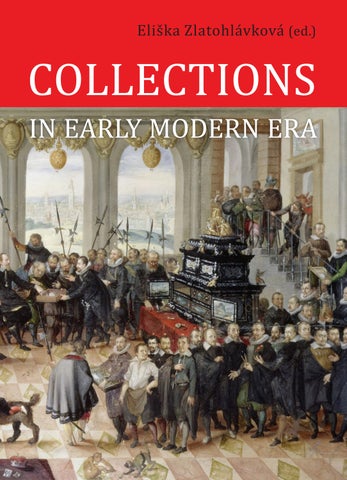
Eliška Zlatohlávková (ed.)
COLLECTIONS
IN EARLY MODERN ERA
Collections in Early Modern Era
COLLECTIONS IN EARLY MODERN ERA Eliška Zlatohlávková (ed.)
with the assistance of Marika Keblusek, Ingrid Halászová and Marcus Becker
Palacký University Olomouc
2024
Reviewers: Renate Leggatt-Hofer Lubomír Slavíček Pier Ludovico Puddu
This publication was made possible thanks to targeted funding provided by the Czech Ministry of Education, Youth and Sports for specific research, granted in 2024 to Palacký University Olomouc (IGA_FF_2024_013).
Unauthorised use of this work is an infringement of copyright and may give rise to civil, administrative or criminal liability. 1st edition
© text Eliška Zlatohlávková (ed.) with Stefan Albl, Sarah Bakkali, Andrea M. Gáldy, Ingrid Halászová, Magdalena Herman, Ludwig Kallweit, Renata Komić Marn, Marika Keblusek, Anne-Sophie Laruelle, Elisa Ludwig, Patrick Michel, Brantly H. Moore, Aistė Paliušytė, Sergio Ramiro Ramírez and Lilian Ruhe, 2024 © Palacký University Olomouc, 2024 DOI: 10.5507/ff.24.24465234
ISBN 978-80-244-6523-4 (print)
ISBN 978-80-244-6524-1 (online: iPDF)
Contents Introduction
7
Reconstruction of Collections
12
Studiolo vs. Kunstkammer: The Scrittoio of Cosimo de’Medici Andrea M. Gáldy (Ludwig Maxmilian University Munich)
Setting up a Wunderkammer: The Encyclopedic Collection of Bernardus Paludanus (1550–1633) Marika Keblusek (Leiden University Centre for the Arts in Society)
The Ludovisi Collection in Rome: A Source of Inspiration for Artistic Creation Stefan Albl (Universalmuseum Joanneum, Alte Galerie)
Thinking about the Space of the Collection in Eighteenth-Century France: From Theory to Practice Patrick Michel (Université de Lille, Centre de Recherche IRHIS)
Facing the Family. The Identification of Aristocrats in an Atypical Ancestral Portrait Gallery or Ahnengalerie in Bückeburg Castle Lilian Ruhe
Objects A Polish Bibliophile in Moravia: Bindings of Books and Print Albums from Jan Ponętowski’s Collection Magdalena Herman (University of Warsaw)
The Collections of the Prince-Bishops of Liège in the Early Modern Era: The Case of the Tapestry Anne-Sophie Laruelle (University of Liege) A Collector’s Guide to Playing with the Art: Embodiment as Methodology Brantly H. Moore (University of Basel)
Between Everyday Item and Collection Object – Observations on the Augsburg Art Cabinets of the 17th Century Ludwig Kallweit (Bavarian National Museum)
12
27
35
76
93
132 132
153
175
202
Art Agents / Collectors Can Secretaries Be Protagonists? A Further History of Collecting at the Court of Philip II of Spain Sergio Ramiro Ramírez (Instituto de Historia, Consejo Superior de Investigación Científicas)
Talking about Objects: The Correspondence between Gottfried Wilhelm Leibniz (1646–1716) and Ferdinand Orban SJ (1655–1732) Elisa Ludwig (Ludwig Maxmilian University Munich)
The Collection of Paintings of Adolf Vratislav of Sternberg Eliška Zlatohlávková (Palacký University Olomouc) Michałł Kazimierz Radziwiłł and His Grünes Gewölbe: A Princely Collection in the Grand Duchy of Lithuania Aistė Paliušytė (Lithuanian Culture Research Institute)
Selling Old Master Paintings across the Channel: Jean-Baptiste-Pierre Lebrun and Britain Sarah Bakkali (Réunion des Musées Nationaux – Grand Palais)
Afterlife
The Transfer of Paintings from Palais Attems in Graz to Yugoslavia in the Light of Provenance Research Renata Komić Marn (France Stele Institute of Art History)
The Pálffy Portrait Collection in Slovakia between the Past and the Present: A Model Example of the Research Tasks and Challenges in Post-Socialist Countries Ingrid Halászová (University of Trnava)
221
221
240 264
290
316
332 332
366
Name Index
399
List of Bibliography
410
Photo Credits
460
Introduction The history of collecting is one of the most interesting fields of art history, offering opportunities for interdisciplinary research. Research on the origins and development of art collections, on how works were acquired through agents and presented to the public, and, last but not least, on the collector integrates many disciplines. In addition to art history, these include history, sociology, psychology, and the history of the art market and diplomatic relations. The study of the provenance of works of art is nowadays a much sought-after discipline not only in the field of scientific research but also in the contemporary art market. You are holding in your hands a volume which is a collection of varied essays dealing with these aspects of early modern collecting by means of selected examples. The book is divided into four sections for better understanding: Reconstruction of Collections, Objects, Agents/Collectors, and Afterlife. Each of these sections emphasises a different approach to the study of early modern collecting, contributing significantly to new ways of approaching the subject, revealing new facts about the background to the creation and formation of collections and the interpretation of the meaning of collections as a whole and of individual objects. However, these are not strictly separate sections, as many of the contributions stand thematically on the borderline between two sections. These are the sections Reconstruction of Collections and Agents/Collectors, which are very close to each other in their subject matter, and in particular the contributions by Marika Keblusek, Eliška Zlatohlávková, and Aistė Paliušytė, which deal with the reconstruction of a collection formed by one particular person, and the character of the objects in the collection is directly related to their owner. The theme of early modern collecting opens the section Reconstruction of Collections, which is the most general in scope and in a way includes all the contributions to this book. As its title implies, the essays included in it reflect on the spatial and content organisation of collections and on the current approach to the study of individual types of collections, and discover previously unknown collections. This is possible with the help of newly-discovered inventories, contemporary treatises, and personal correspondence.
7 │ Introduction
The first contribution is a text by Andrea M. Gáldy, Studiolo vs. Kunstkammer: The Scrittoio of Cosimo de’Medici, in which the author reflects on the accuracy of the existing scholarly classification of early modern collections – studiolo and Kunst- and Wunderkammer. On the basis of an analysis of the function and significance of the Scrittoio di Calliope from the Palazzo Vecchio in Florence and the Tribuna in the Uffizi in Florence, Gáldy asks whether it is not appropriate to reconsider the existing distinction between these two main types of universal collections of the early modern period. In her paper, Gáldy stresses that it is necessary to consider not only aristocratic collections, but also collections from different social classes. This is the only way to better understand the development of modern collecting and to safely answer the question of whether collectors’ cabinets were more like studioli or Kunstkammern, and whether this distinction is still applicable at all. Gáldy’s contribution is therefore thematically followed by Marika Keblusek’s Setting up a Wunderkammer: The Encyclopedic Collection of Bernardus Paludanus (1550–1633), dealing with the cabinet of curiosities (Wunderkammer) of the Dutch physician Bernard Paludanus of Enkhuizen. It focuses on the reconstruction of one of the most important collections of naturalia and ethnographic objects from the period around 1600, that Paludanus created. The author of the paper has managed to reconstruct a hitherto unknown cabinet of curiosities, containing mainly naturalia, which was related to Paludanus’ profession, but especially exotica, on the basis of three inventories and, above all, the Index, a catalogue with drawings of the objects, drawn by the collector himself. The other two papers, by Stefan Albl and Patrick Michel, discuss the spatial arrangement of collections. In a study entitled The Ludovisi Collection in Rome: A Source of Inspiration Albl reconstructs the painting and sculpture collection of the Roman Ludovisi family and, in particular, the impact of selected works by seventeenth-century Venetian painters from this collection, especially Titian, on the work of seventeenth-century painters. In Thinking about the Space of the Collection in Eighteenth-Century France: From Theory to Practice, Patrick Michel sheds light on the still-unanswered question of the spatial arrangement of two types of collector’s cabinets popular in eighteenth-century France – cabinets of small antique statuettes and cabinets of natural history – on the basis of catalogues of these collections, correspondence, and contemporary architectural treatises. Portrait galleries were a fixed component of the pictorial collections of noble families and, in addition to commemorating family memory, also served to represent the family. The final study in this section is Lilian Ruhe’s contribution entitled Facing the Family. The Identification of Aristocrats in an Atypical Ancestral Portrait Gallery or Ahnengalerie in Bückeburg Castle, which studies two 8 │ Collections in Early Modern Era
portrait galleries, one in Jaroměřice Castle and the other in Bückeburg Catsle. It compares the arrangement of the two series of portraits and examines the identification of the sitters and their life stories. The section entitled Objects includes contributions that focus on specific objects from individual collections, whether in terms of interpreting their function, their symbolic significance in the collection of which they are a part, or testimony about their owner or maker. Both Ludwig Kallweit and Brantly H. Moore, in their studies Between Everyday Item and Collection Object: Observations on the Augsburg Art Cabinets of the 17th Century and A Collector’s Guide to Playing with the Art: Embodiment as Methodology, respectively, address the function of artistically decorated cabinets, which were themselves viewed as art objects and as collections in their own right, as they contained either utilitarian objects or objects whose artistic character predominated over their functional character. The study of specific objects can also provide a number of answers to questions about their provenance or their makers, providing valuable information about their collectors as well. In A Polish Bibliophile in Moravia: Bindings of Books and Print Albums from Jan Ponetowski’s Collection Magdalena Herman analyses the collection of bound books and albums of the abbot in the monastery of Hradisko, near Olomouc (1577–1587), who was known to Czech scholars as a cleric. On the basis of similarities in the material used and the way in which the bindings of the volumes were decorated, not only from Ponietowski’s library, but also from other books bound at the same time, she reveals the origin of these volumes in Moravia, which is proof that artistically high-quality bookbinding workshops operated in this region in the second half of the 16th century. Anne-Sophie Laruelle’s contribution, The Collections of the Prince-Bishop of Liège in the Early Modern Era: The Case of Tapestry, studies a set of 16th-century tapestries from the almost unknown collection of the Bishop of Liège using previously unpublished archival sources. It also examines the iconographic significance of the entire collection, which reflected the bishop’s changing political orientation as he expressed support for Emperor Charles V in the field of European diplomacy and distanced himself from King Francis I of France. The third section, Agents/Collectors, unlike the previous two, studies art collections from the perspective of their owner. It focuses on the personalities of collectors and their social status and activities, which offer a different look at their private collections. It addresses the question of the extent to which the personality of the individual and his or her actions can influence the content of the collection. Sergio Ramírez’s paper, Can Secretaries Be Protagonists? A Further History of Collecting at the Court of Philip II of Spain, examines a hitherto neglected aspect of early modern collecting, namely the influence of the king’s secretaries on the 9 │ Introduction
formation of art collections. Works of art have always played an important role in diplomatic relations between courts, and a well-chosen gift according to the taste of the recipient opened the gates of political negotiations. The invisible movers and shakers of these processes were the royal secretaries. In his paper, Ramírez focuses specifically on the secretaries at the court of King Philip II of Spain, who created their own art collections for the purpose of promoting themselves at the royal court, and wonders to what extent their actions contributed to shaping the art collection of the king himself. Elisa Ludwig’s paper, The Correspondence between Gottfried Wilhelm Leibniz (1646–1716) and Ferdinand Orban SJ (1655–1732), looks at collection objects as a means of communication and transformation of social status. The author discusses the collecting activities of the Jesuit Ferdinand Orban and his collection of mathematical instruments. In particular, Ludwig studies the surviving correspondence between Orban and Gottfried Wilhelm Leibniz concerning the now-defunct instruments that Orban acquired as gifts for his collection. The surviving letters allow us to view Orban’s collection from a social perspective, seeing the individual objects it contained as a means of communication. Thus, according to Ludwig, collecting can be understood as part of interpersonal relationships in which the exchange of gifts represents a unique mode of communication. The contributions by Eliška Zlatohlávková and Aistė Paliušytė, The Collection of Paintings of Adolf Vratislav of Sternberg and Michał Kazimierz Radziwiłł and His Grünes Gewölbe: A Princely Collection in the Grand Duchy of Lithuania, present to the professional public for the first time a more comprehensive view of two noble collections, the paintings of Adolf Vratislav of Sternberg and the art collection of Michał Kazimierz Radziwiłł. The study by Eliška Zlatohlávková deals with paintings from the castle in Častolovice in East Bohemia, which were evidently acquired by Adolf Vratislav of Sternberg in the second half of the 17th century. She identifies them using the surviving posthumous inventories of the Sternberg estate among the surviving works from the Sternberg family picture gallery. The contents of the collection and its location within the Sternberg residences point to this nobleman as a great lover of fine art. The paper by Aistė Paliušytė studies, on the basis of surviving inventories, the previously unknown collection of Michał Kazimierz Radziwiłł, which was one of the most important in the Grand Duchy of Lithuania and was stolen after the fall of the Grand Duchy. The paper builds on the assumption that each object in the collection had a symbolic meaning and could convey a hidden message to selected social groups. The collection could therefore be seen as a type of text in which the meaning of each object formed the skeleton of a story, the meaning of which would be altered if the object was removed from the collection.
10 │ Collections in Early Modern Era
This section concludes with Sarah Bakkali’s paper Selling Old Master Paintings across the Channel: Jean-Baptiste-Pierre Lebrun and Britain, revealing the double game of Jean-Baptiste-Pierre Lebrun. Lebrun was one of the first major art dealers to elevate the sale of works of art to a scholarly discipline by publishing auction catalogues that were not mere lists of lots, but inventory catalogues aimed at correctly identifying the authorship of individual works. On the one hand, Lebrun felt patriotic and had a need to protect the cultural heritage of France, and therefore always emphasised good intentions in his auction catalogues. This paper, however, provides evidence that Lebrun’s commercial spirit prevailed and was behind many of his sales of paintings abroad. The book closes with a section entitled Afterlife, devoted to the ‘second’ life, that is, the fate of early modern collections in the 20th century. Renata Komić Marn’s study The Transfer of Paintings from Palais Attems in Graz to Yugoslavia in the Light of Provenance Research and Ingrid Halászová’s Pálffy Portrait Collection in Slovakia between the Past and the Present: A Model Example of the Research Tasks and Challenges in Post-socialist Countries are devoted to the fate of two aristocratic painting and portrait collections that were fatally affected after 1945, when they were confiscated and subsequently dispersed and many works were lost.
Eliška Zlatohlávková
11 │ Introduction
Reconstruction of Collections Studiolo vs. Kunstkammer: The Scrittoio of Cosimo de’Medici Andrea M. Gáldy
The Kunst- and Wunderkammer is a very popular research topic within the history of collecting and early museums. Since the pioneering publications by Julius von Schlosser (1908) and Wolfgang Liebenwein (1977), over 800 books and essays have explored the set-up, contents of, and intentionality behind collecting rooms created in early modern times and intended for small-scale valuables.1 Given the occasional eye-witness report and a number of treatises, as well as surviving architecture and many works of art, scholars can tap into rich, if not always unproblematic source material for their research.2 Nonetheless, the investigation of the phenomenon of the Kunstkammer and of its traditions and developments brings up a range of difficulties. It has so far failed to address a number of issues sufficiently, for example the relationship between European studioli and Kunstkammern, while emphasising alleged dichotomies in relation to geography (north and south of the Alps), to religious 1
2
Cf. SCHLOSSER 1908; LIEBENWEIN 1977; VON SCHLOSSER 2021.
For descriptions, see e.g. VASARI 1881; VASARI 1885; HATFIELD 1970, pp. 232–249. Inventories are preserved in the Archivio dello Stato di Firenze (ASF); see Guardaroba Medicea (GM) 30, fols. 32r–33l, 48r and GM 37, fol. 13v, transcr. in: GALDY 2009a, appendix 16, pp. 259–261 and appendix 17, pp. 261–263. The sixteenth-century treatises by QUICCHEBERG 2013 and Kaltenmarck, see GUTFLEISCH – MENZHAUSEN 1989, pp. 3–32 are important in this context.
12 │ Reconstruction of Collections
confessions (Catholic vs. Protestant), and to terminology.3 In addition, the art market has been regarded as a major influence on the contents of these cabinets by offering a distinct range of goods seen as appropriate for northern Protestant vs. southern Catholic clients.4 Finally, research on the Kunstkammer has so far mostly been reliant on a very restricted sample of cabinets (e.g. Florence, Mantua, Urbino, Dresden, Munich, and, more recently, Vienna) and can therefore hardly be called representative or exhaustive.5 Although an essay is not the place in which to create an alternative history of kunstkammer collecting, it can attempt to bring the above points to the attention of scholars working on the subject and perhaps suggest a change of direction. My essay will therefore analyse the issues mentioned above, look at a specific example, and then discuss possible modes of employment for the knowledge gained in the field of Kunstkammer research.
Terminology
First of all, there is the issue of terminology. In the German-speaking academic world ‘Kunst- und Wunderkammer’ is the term of choice for special collections set up by princes in the Holy Roman Empire. The term originated in the sixteenth century and was used e.g. in the inventories of the electoral collections in Dresden.6 Gabriel Kaltemarckt titled his 1587 treatise How a Kunstkammer should be formed.7 The name also appeared in Quiccheberg’s Inscriptiones vel tituli theatri amplissimi (1565) in the abbreviated form ‘Wunderkammer’ when referring to the collections of the von Zimmern dynasty in Baden-Württemberg.8 The Kunstkammer Building of Ferdinand I in Vienna (1503‒1564),9 and also the collection of his son, Archduke Ferdinand II of Tyrol (1529‒1595), were called by this name. Although there were other labels, such as ‘museum’ or ‘theatrum’ 3
On Catholic vs. Protestant court culture and the supposed reception of the Italian role model in Dresden, see WATANABE-O’KELLY 2002, pp. 5–70.
4 5
NORTH – ORMROD 1998; DE MARCHI – VAN MIEGROET 2006; BRACKEN – TURPIN 2021.
For the history of the collecting cabinet, see LIEBENWEIN 1977; IMPEY – MACGREGOR 1985, and the more recent COLE – PARDO 2005; on specific collections see e.g. DIEMER – DIEMER – SEELIG 2008 (Munich); SCHEICHER 1985, pp. 29–38; SANDBICHLER 2012, pp. 31–41 (Ambras), and MARX 2005 (Dresden).
6
MARX – PLASSMEYER 2014, p. 795, list the ‘KunstCammern’ inventories dated 1587 to 1741 and provides a detailed analysis of the 1640 inventory.
7
GUTFLEISCH – MENZHAUSEN 1989, pp. 3–32.
9
RUDOLF 1996, pp. 166–256.
8
QUICCHEBERG 2013, passim; BASTRESS-DUKEHART 2002, pp. 35–38; JENNY 1959; VON ZIMMERN 1881: https://de.wikisource.org/w/index.php?title=Seite:De_Zimmerische_Chronik_3_350. jpg&oldid=- (accessed 17 May 2019).
13 │ Studiolo vs. Kunstkammer: The Scrittoio of Cosimo de’Medici
(Quiccheberg),10 ‘Kunstkammer’ and ‘Kunst- und Wunderkammer’ have prevailed in modern times and are today often used in English-language publications as well, unless the term ‘cabinets of curiosities’ is preferred. In contrast to the ‘northern’ Kunst- und Wunderkammern, with their associated emphasis on wonders of the artificial and natural world, Italian cabinets of the fifteenth and sixteenth centuries were mostly called ‘studioli’ and ‘scrittoi’ after their presumed functions as places of study and (academic) writing.11 Linked to a traditional view of ‘renaissance’ as a rebirth of classical antiquity, they have long been regarded as places of display and learning set up to perpetuate knowledge of the Graeco-Roman world. Filled with ancient and Renaissance art, the latter often copies of the former, these cabinets offered the gold standard of collecting, which northern collectors tried to emulate but were rarely able to reach.12 A well-known example for this understanding of the distinction between Kunstkammer and studiolo is the comparison between the sixteenth-century collections of the Medici in Florence and the Wettin in Dresden. Starting with Kaltemarckt’s treatise, it seemingly confirmed traditional assumptions such as the alleged dichotomy between Catholic and Protestant collecting or the diversity of the art market north and south of the Alps.13
Categories of Collectors and Collecting Items
In reality, collectors everywhere in Europe amassed objects in accordance with their taste and, from 1554, at least in the Holy Roman Empire and neighbouring territories, in imitation of the example set by Emperor Ferdinand I.14 Whatever they were called specifically, cabinets hosted what was then seen as wondrous and valuable by their owners, often independently of an object’s real value. Works of art, naturalia, books, and scientifica were plucked from the general collections to be staged in a dedicated room or rooms, eventually consisting in the 10 11
12
13
Cf. JENQUEL – NEICKELIO 1727; QUICCHEBERG 1565. COLE – PARDO 2005, pp. 16–18.
GUTFLEISCH – MENZHAUSEN 1989, pp. 3–32.
On the contrast between the collections in Florence and Dresden see GUTFLEISCH – MENZ HAUSEN 1989, pp. 3–32, as well as the publications by MARX – PLASSMEYER 2014 and LIEBENWEIN 2016, pp. 139–52.
14
See Leopold Heyperger’s mention of a ‘Kunsst Camer’ in Vienna, cited in HOLZSCHUH-HOFER [LEGGATT-HOFER] 2014, pp. 203–204 and note 947. Ferdinand I’s separate Kunstkammer Building was first located by and in HOLZSCHUH-HOFER [LEGGATT-HOFER] 2014, pp. 203–211. For the Vienna Kunstkammer collections see Haag – Kirchweger 2012; HAAG – Schlegel 2013 and BUKOVINSKÁ 2017, pp. 69–86. For the new display of Vienna Habsburg Kunstkammer objects in the Kunsthistorisches Museum Wien in 2013, see FOX 2013, pp. 402–407, https://www.jstor.org/ stable/24240782 (accessed 20 May 2020). See also GÁLDY 2020, pp. 23–46.
14 │ Reconstruction of Collections
Fig. 1 Wiener Hofburg c. 1564 in a digital reconstruction of 2013/2018, view from the east; the Kunstkammer Building of Ferdinand I is marked in red
case of Ferdinand’s Kunstkammer of an entire, free-standing building (Fig. 1).15 Therefore, it may be a good idea if modern research abandoned the idea of a notion of Kunstkammern as opposed to studioli. If we were to use a neutral term such as ‘cabinet’, we could start afresh in our search towards a definition of what constituted a special display room and its contents in early modern Europe in c. 1560. Although Kunstkammern and studioli existed on the territory of today’s Germany, Austria, and Italy in accordance with very diverse traditions, heritages, and intentionalities, and filled with collecting items organised into a variety of 15
For the Kunstkammer Building in Vienna, see the reconstruction in LEGGATT-HOFER [HOLZ SCHUH-HOFER] – SAHL 2018, p. 114. The reconstruction available at https://www.geschichtewiki. wien.gv.at/Datei:Hofburg_1590_Ausschnitt.jpg (accessed 25 August 2023) represents the situation 30 years later after considerable enlargements in the days of Maximilian II and Rudolph II. I would like to thank Renate Leggatt-Hofer for generously sharing her expertise with me.
15 │ Studiolo vs. Kunstkammer: The Scrittoio of Cosimo de’Medici
categories, we know that such cabinets existed in many other parts of Europe as well. France tends to be left out from discussions of these display rooms, even though the project ‘curiositas’ literally maps a large number of cabinets of curiosities in France, Belgium, and the Netherlands.16 Examples from Spain and England are frequently overlooked as well. Aristocrats, however, lived an international life and were in contact with their peers and family members outside their own territories. Dynastic brides were able to provide information about cultural features and courtly fashions. It would thus be surprising if Kunst kammern and studioli only occurred in a limited area of Europe. In the cases of the collections of scholars, artists, and citizens we can observe a ‘trickle-down’ effect from the nobility to the professional classes, as well as a change of intellectual interest in particular objects and their origins and possibilities for research.17 While princes may have mainly appreciated the added political status conferred by collecting, scholars’ and artists’ collections were fundamental to their professional activities. Therefore, the time has come to extend the samples used for our research to a representative, pan-European group including collectors from every class, as well as men and women, professionals and amateurs. Furthermore, with the Reformation notions of decorum in the case of works of art displayed in churches changed and bouts of iconoclasm were responsible for the destruction of priceless masterworks. In the context of court culture, however, there was little need to do away with all works of art: portraits were commissioned, so were arms and armour, and curiosities arriving as diplomatic gifts from abroad were also collected.18 Although individual princes and scholars may have been influenced by confessional rules of decorum in many aspects of their lives, collecting and the creation of a Kunstkammer were not a religious activity but expressed political allegiances, as well as research interests. Contrary to traditional expectations, Catholics collected plants and armour (comparable to the botanische Gärten and Rüstkammern in northern Europe),19 while Protestants were happy to include works of art if they could get them. Collecting 16
French cabinets are listed at https://curiositas.org/carte-des-cabinets (accessed 25 August 2023). 17
THORNTON 1997; COLE – PARDO 2005. Some artists set aside spaces for their private studio and scrittoio, as is indicated by Michelangelo’s drawing and the inventory made at the death of Giambologna; see COLE – PARDO 2005, pp. 16–18.
18
Diplomatic gifts of bronzes and Chinese porcelain went to Vienna and Florence: MARX – PLASSMEYER 2014, pls. 106–108 and 144, as well as pp. 59–60, 673–74, 690. In particular, copies of Giambologna’s Mercury were coveted diplomatic gifts sent to Dresden, Vienna, and Capodimonte; see https://www.metmuseum.org/art/collection/search/205648 (accessed 6 September 2023). 19
GARBARI – TONGIORGI TOMASI – TOSI 1991; GÁLDY 2009b, pp. 37–57.
16 │ Reconstruction of Collections
was an exchange of eclectic categories of objects – with regional differences for sure – and depended on funds and markets, which offered a variety of objects, even though not always the same categories of objects everywhere in Europe at an affordable price. Consequently, a petty prince in Italy may have had difficulties in purchasing a particular collecting object similar to those experienced by an imperial elector.
Medici Collections
As is well known, the Medici collections have long been regarded as the high point of collecting and art sponsorship.20 Not the only collectors in Italy, and not even princely to start with, the Medici nonetheless turned Florence into a centre of art production and collecting, the importance of which has remained largely uncontested for over 500 years. In actual fact, several stages of development, as well as of research, need to be examined in tandem. The early Medici bankers collected art and antiquities among several categories, they owned a (long lost) cabinet in the family palace, and they sponsored major artists, e.g. Michelangelo (1475‒1564).21 Cosimo the Elder (1389‒1464) and Lorenzo il Magnifico (1449‒1492) were – and to some extent still are – for many ideal representatives of a Florentine renaissance that probably never existed in quite the way Giorgio Vasari (1511‒1574) and Jakob Burckhardt (1818‒1897) imagined it. These early Medici may have had a predilection for art produced in Florence, but that imposed no limits on their reach and ambitions as collectors. They had economic ties to many parts of Europe and acquired works of art in the North as well as in Italy. When Rogier van der Weyden (1399/1400‒1464) was commissioned for an altarpiece, he went to Rome and found inspiration in the work of Fra Beato Angelico (1395‒1455).22 In the sixteenth century, the Medici collected objects from South-East Asia, founded their own tapestry workshop in Florence, and acquired pieces from the New World.23 20 21
ROMUALDI – DE MARINIS 1992; FUSCO – CORTI 2006; KENT 2006; BALDINI 2013, pp. 59–67.
On the Medici studiolo see STAPLEFORD 2013; BULST 1970, pp. 369–92; HATFIELD 1970, pp. 232–249; CRUM 1996, pp. 403–417; ROOVER 1963; ELAM 1992, pp. 41–84.
22
On Burgundy’s cultural importance see BLOCKMANS ET AL. 2013; LAMBERT – WILSON 2016. For Medici acquisitions of Rogier’s works, see https://sammlung.staedelmuseum.de/ de/werk/medici-madonna and https://www.uffizi.it/en/online-exhibitions/easter-2019#36; LANCKOROŃSKA 1969, pp. 25–42; GILBERT 1998, pp. 5–18; AMES-LEWIS 1979, pp. 255–273; more recently NUTTAL – WILLIAMS 2023, pp. 209–256.
23
On Florence emulating Burgundy see SMITH 1989, pp. 123–129; MEONI 2000, pp. 225–261; on Medici collections of non-European items see TURPIN 2013, pp. 83–117; CLARK 2020, pp. 1–21; see pp. 10–15.
17 │ Studiolo vs. Kunstkammer: The Scrittoio of Cosimo de’Medici
Fig. 2 Agnolo Bronzino, Duke Cosimo I de’ Medici in armour, c. 1545, Art Gallery of New South Wales
18 │ Reconstruction of Collections
When – after bankruptcy, exile, and two popes – the Medici returned to Florence, they arrived with imperial blessings.24 Alessandro de’ Medici (1510‒1537), first duke of Penne, then of Florence, married the emperor’s natural daughter Margaret of Austria (1522‒1586). Soon after the duke’s early death in 1537, his bride entered a second marriage to a competing Italian family and arrived in Parma as the owner of a large number of Medici possessions, both mobile and immobile.25 By 1530, Europe had changed, new worlds had been discovered, and, after the battle of Mohács (29 August 1526) and the death of the Jagellonian King of Hungary, the Ottoman Empire had arrived at the imperial doorstep.26 A great variety of objects from Europe and the wider world became part of collections set up, at least in part, for political and diplomatic reasons.27 Alessandro’s successor, Duke Cosimo I de’ Medici (1519‒1574), found himself in great difficulties (Fig. 2). Young, inexperienced, and not important enough to Charles V (1500‒1558) to be granted his wish to wed Margaret or keep family property, he had to find a way to gain status and maintain power in Florence.28 He was a strong character, able to think independently and creatively; his cultural policy, linked to sound finances and administration, helped him on his way to a less precarious situation. By collecting art, antiquities, and naturalia, as well as scientifica and exotica he established a material link to his well-known ancestors and to the Italian taste for collecting and display in a studiolo. As a member of the cadet branch Cosimo would have found it useful to emphasise this familial relationship. Lorenzo the Magnificent had developed a taste for Etruscan antiquities and Giovanni/Leo X (1475‒1521) liked to present himself as a new Augustus (63 BC‒14 AD).29 Cosimo’s cousin Alessandro had apparently made plans to move his court to the Palazzo della Signoria.30 Cosimo emulated all three as soon as he was able to do so. His marriage to the aristocratic and wealthy Eleonora 24 25
26 27
FLETCHER 2016; STEEN 2013. PARIGINO 1999, pp. 42–51.
ÁGOSTON 2009, pp. 388–389; SZABÓ 2019, pp. 263–275; ÁGOSTON 2019, pp. 287–307.
Cf. for example the so-called ‘Türkensold’ or ‘Türkenverehrung’, frequently consisting of automata, sent by Ferdinand of Habsburg to the Ottoman Empire: KUGEL 2016, pp. 40–45. On the ‘global’ Renaissance, see CLARK – CHRISTIAN 2017, as well as FERNÁNDEZ-ARMESTO – BURKE 2023, pp. 430–464.
28 29
EISENBICHLER 2001; ASSONITIS – SANDBERG 2016; ASSONITIS – VAN VEEN 2022.
On Lorenzo’s Etruscan pieces see ROMUALDI – DE MARINIS 1992; KENT 2006, pp. 31 and 41. On Lorenzo the Magnificent’s and the future Leo X’s approaches to collecting ancient images of Emperor Augustus, see KENT 2006, pp. 148–149.
30
On Alessandro’s plans to move to the Palazzo della Signoria, see FLETCHER 2016, p. 172, note 14, who cites a report of Carlo Borromei, an agent of the Duke of Mantua.
19 │ Studiolo vs. Kunstkammer: The Scrittoio of Cosimo de’Medici
of Toledo (1519/1522‒1562) in 1539 helped him to support and finance his objectives.31 Cosimo started to emphasise the leading role of Emperor Augustus in the foundation of Florence and presented himself on occasion as a new Augustus in his imagery and propaganda.32 He also took on board trends and standards of collecting and propaganda established in the Empire.33 The Habsburg emperors saw themselves in the tradition of the rulers of the Roman Empire, so that Cosimo, Charles V, and Augustus turned into a symbiotic ideal sovereign.34 Cosimo owned several images of the Emperor Augustus, probably inherited from Pope Leo X Medici.35 Thereby, far from being a weak vassal and mere emulator of Habsburg politics, Cosimo managed to build an identity as a strong ruler comparable to both the ancient and sixteenth-century emperors. Like other princes, Cosimo had tried to acquire Roman antiquities to build up his own collection by adding to the possessions still in Florence. Since antiquities were expensive, usually had to be transported from Rome, and needed an export licence from the Papal States, it was not an easy undertaking. From 1560, with the appointment of Cosimo’s son Giovanni (1543‒1562) as cardinal and the boy’s residence in Rome from 1560, antiquities started to arrive in Florence in greater numbers.36 Many of the Roman marble statues and reliefs were taken to the Pitti Palace for display in the Sala delle Nicchie and Boboli Gardens. When the galleria on the top floor of the Uffizi building was created in 1581, they were moved to this new display space and eventually exhibited in the company of portraits, weapons, porcelain, stuffed animals, and scientific instruments. The famous Uffizi Tribuna was set up in 1581‒1583 by Bernardo Buontalenti (1531–1608) and included many statues, as well as small-scale works of art, formerly in the Scrittoio of Calliope and Francesco’s Studiolo at the Palazzo Vecchio.37
The Scrittoio of Calliope
In 1554, Cosimo gained the services of Giorgio Vasari as his leading artist, curator, and impresario. In November 1553, a major discovery of ancient art in Arezzo had put the duke’s collecting activities on a firmer footing and the objects 31
For the financial situation of the Medici in the sixteenth century see Parigino 1999.
33
GÁLDY 2021, pp. 5–12.
32
Cf. MATASILANI 1572, RICHELSON 1978, and the portrait of Cosimo I as Augustus in the Hall of Leo X in the Palazzo Vecchio.
34 35
36 37
GÁLDY 2023, pp. 259–71.
GÁLDY 2005, pp. 699–709. GÁLDY 2010, pp. 153–165.
ALBERTS 2018, pp. 203–216; REID.
20 │ Reconstruction of Collections
Fig. 3 Plan of the Apartment of the Elements, Palazzo Vecchio, Florence
eventually filled the Scrittoio of Calliope, which he commissioned for an apartment of staterooms on the second floor of the Palazzo Vecchio.38 This Apartment of the Elements in the ducal palace’s eastern wing was separate from Duke Cosimo’s own living quarters in the original part of the palazzo. Therefore, a display space was installed as part of two state apartments, the decorative programme of which was intended to celebrate the importance and rise of the Medici family from republican times to ducal status. When the bronze Chimaera was discovered in Arezzo, and a number of small bronzes with it, in 1553, the duke ordered these objects to be taken to Florence before anyone else could take them or melt them down for bullion.39 In Florence, the Etruscans and their art and inscriptions had been studied for some time as they were held to be the founding fathers of the city by some.40 The discovery of a treasure trove of what was regarded as Etruscan works of art therefore chimed well with Florentine identity and Medici traditions. Vasari stated in his Ragionamenti (published in 1588, Giunti) that the special quality of Etruscan 38 39
40
CINELLI 2006, pp. 234–245; GÁLDY 2014, pp. 119–130. GÁLDY 2012, pp. 153–165; RISALITI – ZUCCHI 2017. CIPRIANI 1980; GÁLDY 2012, pp. 153–165.
21 │ Studiolo vs. Kunstkammer: The Scrittoio of Cosimo de’Medici
Fig. 4 Reconstruction of the Scrittoio of Calliope, Apartment of the Elements, Palazzo Vecchio, Florence
art hinted at the birth of Etruscan civilisation well before the advent of a Roman state.41 In 1559, Cosimo commissioned the already-mentioned scrittoio in the new wing of the Ducal Palace (Fig. 3). Under the watchful eyes of the muses, with Calliope as the main representative, a number of works of art were placed on shelves and inside cupboards (Fig. 4).42 The Chimaera, probably for reasons of size, remained outside; perhaps the bronze lion served as a signpost in the Sala di Leone X in a clever play on names.43 Inside the Scrittoio of Calliope over 70 works of art were displayed, creating connections between them by their proximity (Fig. 5). Situated in a corner of this state apartment, the scrittoio could be considered more or less accessible or secret, depending on the route 41
42 43
VASARI 1885, pp. 163–64; GÁLDY 2006, pp. 111–113; GÁLDY 2009a, p. 125.
GÁLDY 2005, pp. 699–709; GÁLDY 2014, pp. 119–130; PEGAZZANO 2014, pp. 131–149. VASARI 1885, pp. 163–64.
22 │ Reconstruction of Collections
Fig. 5 Reconstruction of the Scrittoio of Calliope, Apartment of the Elements, Palazzo Vecchio, Florence with objects to scale
undertaken by visitors. Depending on whether they arrived from the state rooms of the Apartment of the Elements or via a secret spiral staircase and through the (now walled-up) door opposite the stained-glass window, the focus on the objects and the dialogue between them would have varied.44 The contents mostly included portraits of members of the Medici family and small ancient bronzes, as well as modern bronzetti and copies of works from Rome.45 Some of these may have come from the fifteenth-century collections, many from the above-mentioned treasure trove in Arezzo. Several works in marble referred to Emperor Augustus and an unlikely Minerva (or Venus) with Etruscan letters could have been understood as a hint at ancient display practices from the late Roman Republic.46
44
ALLEGRI – CECCHI 1980, pp. 55–113; PAGNINI 2006, pp. 122–125; MOROLLI 2006, pp. 278–147; CINELLI 2006, pp. 234–245, see pp. 234–239; JONIETZ 2017, pp. 234–45.
45
46
GÁLDY 2005, pp. 699–709; GÁLDY 2009a. Cicero. Ad fam. VII, 23, 2.
23 │ Studiolo vs. Kunstkammer: The Scrittoio of Cosimo de’Medici
Kunstkammer vs. Studiolo
What was Cosimo’s intention behind the creation of the Scrittoio of Calliope? And why did he decide to commission a scrittoio as a display room with a decorative programme and carefully chosen collecting items in 1559? The ducal palace had cabinets in each of the available apartments but there was only one display cabinet of this kind. The issue here is whether the Scrittoio of Calliope was created in emulation of a studiolo (Medici) or a kunstkammer (Habsburg) or whether it was a combination thereof. It is likely that in 1559 both kinds of display space may have served as models, since the duke needed to improve his political situation after decades of being caught between foreign powers, i.e. the papacy and the empire. After the abdication of Charles V, his younger brother Ferdinand I ascended to the imperial throne in 1558.47 At the Vienna Hofburg he soon commissioned a building dedicated to his collections. The Kunstkammer Building (1558–1560/63) stood separately from his apartments and displayed carefully chosen collecting items in the vicinity of a collection of citrus trees.48 Stables for valuable horses and an armoury complemented the ensemble. By 1560, many princes of the Empire had followed his example and set up Kunstkammern in their own residences, for example in Dresden, Kassel, and Munich. In Florence the foundation of the Scrittoio of Calliope was eventually going to be complemented by the creation from 1560 of the Uffizi, which by the 1580s contained a gallery, stables, and an armoury.49 The Boboli Gardens, as well as the giardino dei semplici in Florence and the botanical garden in Pisa, were to follow.50 The collections displayed in Florence in the Uffizi Tribuna combined objects from the Medici studiolo, the Scrittoio of Calliope, and the Studiolo of Francesco I, as well as ancient statues in the galleria plus naturalia, scientifica, porcelain, and armour.51 The variety of objects on display was far greater than in the fifteenth-century studiolo in the Palazzo Medici or the Scrittoio of Calliope in the Palazzo Ducale.52 Examining the development and mutability of collections and forms of display, one might regard the Scrittoio of Calliope as located at the cross-roads of Medici collecting. It indicated a change of direction bringing the ducal collections closer to the imperial model. 47
HOLZSCHUH-HOFER [LEGGATT-HOFER] 2015, pp. 60–70; BUKOVINSKÁ 2017, pp. 69–86.
49
REID.
48
HOLZSCHUH-HOFER [LEGGATT-HOFER] 2014, pp. 103–211; LEGGATT-HOFER [HOLZSCHUH-HOFER] – SAHL 2018, p. 114.
50 51
52
GARBARI – TONGIORGI TOMASI – TOSI 1991. GÁLDY 2009b, pp. 37–57. CLARK 2020, pp. 1–21.
24 │ Reconstruction of Collections
Future Projects and Research
Wherever we want to take our research on collecting and display cabinets, we need to extend the number of samples to reach a better understanding of the networks of collectors and model character of particular collections. It is clear that the importance and dissemination of Kunstkammern in Europe cannot be appreciated without the close study and comparison of collections in the context of political, cultural, and artistic developments. A useful investigation needs to include cabinets from every part of Europe, owners from all levels of society, and ‘curators’ from every profession to establish meaningful clusters in time and space and to trace the paths of ‘followers’ of the Kunstkammer phenomenon, as well as the exchange of objects. Given the possibilities offered by modern technology and, in particular, the digital humanities, the creation of a complete or at least truly representative database of cabinets across Europe would go far towards correcting the traditional restricted view. A relational database based, for example, on nodegoat or neo4j, would include the owners and categories of objects, as well as places and dates linked to major events in European history. For all its obvious advantages, the already-mentioned ‘curiositas’ website presents cabinets sorted by centuries, even though cabinets were not created at regular intervals but probably in connection to political, societal, and cultural events, as well as to the activities of particular role models, for example the accession of Ferdinand I to the emperorship in 1558 and the installation of his Kunstkammer in the late 1550s. As a result, it ought to be possible to present the growth and distribution of cabinets, linked to their owners, curators, and the provenance of objects. Relationships between collectors could be established and traced over a specific period. Particular key dates and geographical centres could be traced, for example the imperial court of Vienna as a true centre of collecting in the mid-sixteenth century. Obvious comparative case studies, such as Florence and Dresden, or Dresden and Ambras, which previously seemed a good way towards the creation of templates, will thus lose (or gain?) some of their importance once they are put in a political context and the wider geographical territory of the origins of both display cabinets and collecting items. Archival research has brought to light much new information, while the approaches of cultural history in tandem with the material turn have been able to shine the spotlight on the differences between assemblages and collections, as well as focusing on the objects and their modes of display. The intentionalities of collectors, their taste, and their networks have been investigated, all of which has contributed to a better appreciation of what the standards, causes, and intents of collecting and display may have been during the fifteenth to the seventeenth centuries. 25 │ Studiolo vs. Kunstkammer: The Scrittoio of Cosimo de’Medici
If specialists follow these principles and no longer insist on tight confines of research imposed by means of terminology, it should also become possible to investigate particular cases, for example the Scrittoio of Calliope in Florence, without prejudice and to establish both role models and (political) causes. A relational database such as those proposed above would help to underpin, correct, and document assumptions about display cabinets of the fifteenth to the seventeenth centuries. In connection with digital reconstructions, it could be used for museum practice both as part of the display inside museums and on interactive websites.53 Since the architectural settings in many cases no longer exist and the exhibits have been distributed over museums at home and abroad, the database and reconstructions together would give a much clearer understanding of the use and development of display cabinets. This could also help us to answer the question of whether and when a cabinet was a studiolo or Kunstkammer or whether these distinctions are or have become obsolete.
53
GÁLDY 2020, pp. 23–46; GÁLDY.
26 │ Reconstruction of Collections
Setting up a Wunderkammer: The Encyclopedic Collection of Bernardus Paludanus (1550–1633) Marika Keblusek
In September 1592, travelling from England back home to Stuttgart, Friedrich, Duke of Württemberg and Teck, stayed overnight in Enkhuizen. The next day, after climbing the town’s tower to enjoy a view of the Zuiderzee, Friedrich was given a tour through the museum of Bernardus Paludanus, the town’s physician. Friedrich’s inscription in Paludanus’s album amicorum testifies to this occasion.1 In his Warhaffte Beschreibung Zweyer Reise [True Account of Two Trips] (published in 1603–1604), Jakob Rathgeb, the duke’s secretary, included a report on this:
‘Wunderkammer, which can truthfully be called a Wunderkammer or miracle room, because he [i.e. Paludanus] has such wonderful things, which he himself has brought over from India and Egypt, and other faraway strange lands, things which would not quickly be found anywhere else together. And of each object a description will now follow, for the sake of wonder.’ 2
Using the term Wunderkammer (room of wonders, or cabinet of curiosities), Jakob Rathgeb referred to the type of collection that by the end of the sixteenth century had become a staple at Habsburg princely courts. Whether in Dresden, 1
2
National Library, The Hague (KB); MS 133 M 63, fol. 23r. RATHGEB 1604, fol. 42v.
27 │ Setting up a Wunderkammer…
Münich, or Kassel, the so-called Kunst- und Wunderkammern typically contained large quantities of beautiful objects made by craftsmen (artificialia: Kunst) and precious and strange things found in nature (naturalia: Wunder). Other ‘categories’, such as exotica (objects from Asia, Africa, and the Americas) and scientifica (scientific instruments), hint at the hybrid and overlapping character of these Kunst- und Wunderkammer classifications: an exotic rare thing from nature (say, a piece of coral, ivory, or a coconut) was often transformed by craftsmen such as engravers or goldsmiths to become a stunning new piece of decorative art. Of course, collecting as a phenomenon in Europe did not have its origins in the early modern period. But the opening up of the non-European world, as well as the invention of the printing press, had brought strange, exciting, frightening, and, most of all, unknown objects and information into Europe from the late 15th century onwards – which in turn changed the existing medieval princely culture of collecting. Scholars of natural history tried to reconcile the existence of formerly unknown plants or species – whether the bird of paradise, the armadillo, or the rhinoceros – with sapientia, the ancient wisdom gathered from classical authors (such as Aristotle, Dioscorides, or Pliny), as well as from the Bible. These scholars, often with a medical background, now set up impressive collections, trying to encompass the ‘whole world’ or the ‘materials of nature’ in their studies and libraries by collecting what were also referred to as ‘wonderful’ things.3 Thus, ‘for the sake of wonder’, 23 unpaginated pages were inserted in the Warhaffte Beschreibung of Duke Friedrich’s visit. They contain the first inventory or catalogue of the Paludanus collection, specifically (but not exclusively) of the res omnia naturalia: that is, ‘all the things from nature’. Bernardus Paludanus was born in Steenwijk, Overijssel, as Berent ten Broecke in 1550, and lived abroad from the early 1570s onwards.4 In 1573 he enrolled at the University of Heidelberg and from c. 1576 continued his academic studies in Padua, where he would obtain his medical doctorate in 1580. During his study years, Paludanus visited many cities in Italy, travelled to the islands of Malta and Sicily, and spent four months in the Holy Land and Egypt. In 1580 and 1581, he toured extensively throughout German speaking territories, from Strasbourg, Augsburg, and Innsbruck to Jena, Leipzig, Braunschweig, and Bremen. After his return to his home country, initially to Zwolle and in 1586 to Enkhuizen, where he was appointed as the town’s physician, he only travelled abroad twice, visiting London in 1591–1592 and Hessen in 1597. In 1633, at the age of 83, Paludanus died in Enkhuizen; two years later an epitaph was installed in the Zuiderkerk, commemorating 3
4
See JORINK 2010; FINDLEN 1996.
A biography of Paludanus in HUNGER 1934. I am working on a new biography, to be included in my book on the Paludanus album and his collections, Paper Worlds.
28 │ Reconstruction of Collections
the way his collection comprised objects from four parts of the world: Asia, Europe, Africa, and the kingdom of Nature. Paludanus’s use of the title Index as a key to his collection is revealing. In a sense, this is a sort of visual catalogue, as the objects, arranged according to material – stones, minerals, shells, etc. – are depicted in the drawers that contain them. Grids and tables were certainly used in botanical, medical, and pharmaceutical publications, but other contemporary catalogues in which these were used in a similar way to form a visual index of a collection are, as yet, unknown.5 By the use of this form of visual representation, the drawers are here depicted as if the reader has just opened one and is looking into it from above, seeing all the subdivisions (boxes) at once. Alluding to the performative aspect of collections, this visual cataloguing not only enabled a reader to imagine himself as an active participant in the physical space of the museum, but also allowed him to have an immediate overview of the general and the specific of a certain sort of thing – in other words, to visually understand the classification of specific parts of nature. Yet it is hard to imagine exactly what the Paludanus museum must have looked like and to determine how many objects were preserved there. The Index counts 87 so-called large drawers, probably stored in cabinets (these are not mentioned). These drawers are then divided into ‘boxes’, ‘little drawers’, or ‘little cabinets’, holding a single object (such as a shell or a piece of wood) or groups of objects and materials (several stones or ‘sand from India’). There are three groups: the first 40 drawers (divided into 2096 boxes) are filled with objects and material ‘from the earth and made by fossils’; drawers 41 to 66 (divided into 1665 boxes) contain ‘things belonging to the garden, in and on the earth’, while the third group, of ‘things from the water and the sea’, has twenty large drawers made up from 1845 boxes. All in all, this makes for a minimum of 5600 objects. Paludanus’s interest in ethnographic exotica is evident from the last item in the catalogue; a drawer ‘containing diverse costumes (Kleydung) and foreign things from Syria, Persia, Armenia, the East and West Indies, Turkey, Arabia, and Moscow, several hundreds of them’. The index was drawn up by Paludanus himself, and then published in the Warhaffte Beschreybung, providing an idea of the collection’s vast size and scope around 1592. Three later catalogues – drawn up by Paludanus in 1600, in 1617, and in 1624 respectively – confirm these already staggering numbers and in fact show how the collection grew even larger in the course of time, containing: dried fruits, leaves, and plants; diverse sorts of local and tropical woods; stuffed birds (including birds of paradise and parrots); prepared fish and reptile skins; 5
See SWAN 2002. One exception is a similar visual grid system in a catalogue of the cabinet of Basilius Amerbach in Basel, see LANDOLT 1991, vol. 5.
29 │ Setting up a Wunderkammer…
drawers filled with insects, shells, mussels, and corals; animal bones, horns, and antlers; boxes full of earth and clay specimens, stones, gems, minerals, and large pieces of marble and coral; an extensive collection of antique and contemporary medals and coins of foreign currencies in gold, silver, and copper; ‘exotic’ spears, knives, and swords, as well as items of clothing and utensils from ‘both Indies’; Chinese writing tools and Egyptian mummies.6 Around 1620, Paludanus’s rooms in Enkhuizen held: 400 ethnographic objects from Asia, the Americas, and Africa; 8700 shells; 1900 seeds and plants, and 3400 minerals and fossils. The collection numbered at least 17,000 items. Indeed, his cabinet was the most extensive and influential collection of naturalia and exotica in the Dutch Republic around 1600 and can be considered the starting point of Dutch collecting history. In this paper, I would like to further explore the various ways and means Paludanus used to enlarge, to maintain, and to manage his museum – and thus draw attention to the logistics and practicalities of collecting in the 1600s. It is likely that Paludanus was inspired to develop a collection during his student years in Padua, from 1576 to 1580, and that a great number of objects were gathered by himself during his extensive travels – the first of four main ways to enlarge a collection, followed by donation, exchange, and purchase. During his time in Padua, Paludanus visited Rome, Naples, and Bologna, where he met the most notable naturalist-collectors of the time, such as Ferrante Imperato, Francesco Calzolari, and in particular Ulisse Aldrovandi, whom he would later reverentially refer to as ‘my tutor’.7 At the time physicians and apothecaries such as Aldrovandi and Imperato were highly invested in keeping gardens and collecting natural materials – materia medica – which their profession required. As Paula Findlen has shown, in Italy especially medical professionals assembled large museums as an essential part of the changing scientific culture of the mid-1500s.8 These museums must have inspired Paludanus to expand his own collection of natural specimens, which, as an aspiring physician, he was most certainly investing in. His first professional objects, then, were related to plant materials, and yet he was clearly interested in the budding field of geology as well. 6
Thus far, four different inventories/catalogues of the Paludanus collection are known: RATHGEB 1604; Carpentras, Bibliothèque Inguimbertine, MS 1821, f. 333r–340v (1600); Copenhagen, Kongelige Bibliotek (KKB), MS GKS, 3467, 80 (1617); Florence, Biblioteca Laurenziana, coll. Ashburnham 1828 (1624). For a more elaborate discussion of these see my forthcoming essay in KEBLUSEK 2024.
7
KB, MS 133 B 63, fols. 245v; 248r; 249r; Florence, Biblioteca Laurenziana, coll. Ashburnham 1828, fol. 10r.
8
See FINDLEN 1996, passim.
30 │ Reconstruction of Collections
From inscriptions in his album amicorum, we know that Paludanus visited the islands of Malta and Sicily, where he collected lava fragments and stones from the surroundings of Vesuvius, as he had previously done near Etna. In 1580 and 1581, he travelled extensively through Saxony and Bohemia, with a particular interest in mining areas: Glachau, the birthplace of Agricola, Annaberg-Bucholz, and Joachimsthal (now Jáchymov). According to his letters, he was sometimes allowed to enter a mine and extract minerals and ores himself – and these were also mentioned in the Index published by Rathgeb. Similarly, objects which Paludanus collected during his four months of travel in the Holy Land and Egypt (leaving from Venice on 21 June and returning there on 11 October 1578) made it into his collection, for example ‘relics brought back from Jerusalem and Rome’, ‘little stones from Mount Sion near Jerusalem, where Christ had the Last Supper’, or ‘a little stone from the top of the Olive Mountain, where Christ the Lord ascended into Heaven, where one can see one of His footsteps’. Several Egyptian amulets excavated by Paludanus himself in the necropolis of Saqqara by ‘cracking open the dead bodies’ were also added to the collection.9 Early modern collectors such as Paludanus, who built up private cabinets, were also dependent to a large extent on patrons and friends who would donate or exchange objects. The importance of gift giving and gift display in the early modern period has been well documented and studied, for example by Mario Biagioli, Sharon Kettering, and Paula Findlen. As Findlen has argued, ‘collectors offered patrons multiple ways to express their devotion to them as clients: gifts, visits ... all contributed to the splendour of the museum and its creator. In return, they showered princes with numerous signs of their devotions’.10 We can see this clearly in the portrait of Paludanus by Hendrick Gerritsz Pot (1629), which shows him with a gold portrait medal pendant of Maurits, Prince of Orange, with whom he exchanged letters on antiquities.11 Other princely patrons, all residing in German territories, are mentioned in the inventories: first and foremost, Friedrich of Württemberg-Teck, who donated several objects ranging from specimens of terra sigillata and earth from the Stuttgart area in 1592 to more costly items at a later stage. In the inventory of 1617, there are such artificilia as a pearl encased in gold, a silver-encased salt 9
KKB, MS GKS, 3467, 80, p. 140: ‘Steynlyn von den berg Sion bij Jerusalem, dar Christus syn letzte abentmal gehalten hat’; p. 141: ‘Ein steinlyn oben von den Olijffberg om die gegent dar Christus der Heere nach dem Hemel isz auffgefahren alwar das noch aine von syne fuszstapffen is zu sehn’. See also KEBLUSEK 2022.
10 11
FINDLEN 1996, p. 348.
The portrait of Paludanus by Hendrick Pot, 1629, is kept in the Frans Hals Museum, Haarlem. Letter from Maurits to Paludanus in Leiden, University Library.
31 │ Setting up a Wunderkammer…
cellar made from ‘coral shells’ – red like coral on the outside and white and red on the inside – engraved with the coat of arms of the House of Württemberg-Teck, two ‘beautiful pyramids of red Egyptian marble’, and a beautiful ivory carved ‘fountain with six calyces with many thorns and flowers on top’.12 Landgrave Moritz von Hesse-Kassel supplied the collection with samples of red, yellow, and white earth from the Hesse region, while Duke Heinrich Julius von Braunschweig-Wolfenbüttel presented Paludanus with a ‘beautiful large beaker of German marble, dug up and found by’ his father, set on a ‘heavy and beautiful silver foot’.13 Paludanus must have been held in particularly high esteem by Anna Maria von Anhalt, Countess of Liegnitz-Brieg in Silesia, who sent him gifts related to the geological particularities of her territory, such as a little cup made from ‘red Silesian clay’ as well as a valuable set of spoons made from jasper encased in gold with a ruby on top and other artificialia.14 The relationship between Paludanus and other donors is less easy to establish. Were these fellow-collectors, correspondents, and ‘friends’ with whom he exchanged objects or was their connection one of client and patron? Some of his other patrons may be situated in the political realm and their donations may be interpreted accordingly. According to his catalogues, Paludanus received a mummy from Johan Haga, the brother of Cornelis Haga, the Dutch ambassador in Constantinople. This mummy, he explained in a lengthy note in his 1617 catalogue, had been broken up into several parts which were then stuffed in a large trunk – it had been impossible to leave the body intact, since sailors refused to carry bodies on board ‘for superstitious fear this would bring about storms’.15 Pierre Jeannin, a French diplomat sent by King Henry IV on a mission to the States General in 1607–1609, brought a Handstein with a ‘lovely gold flower grown on top’, probably on the occasion of his visit to the Paludanus museum (he also signed the album amicorum).16 A costly gift that can also be construed as official and thus political came from the Lord Admiralities of the East India Company, the establishment of which Paludanus had been involved in both intellectually and financially (he was a major shareholder). They sent him a ‘beautiful black cabinet made by the Jesuits which our people [i.e. the Dutch East India Company] have found at sea [i.e. looted], which the Jesuits wanted to bring over to Teru, to put on an altar; in this cabinet are 63 bones of
12
13
14 15
16
KKB, MS GKS, 3467, 80, pp. 74; 76–77; 122; 287. KKB, MS GKS, 3467, 80, pp. 233; 288. KKB, MS GKS, 3467, 80, pp. 233; 244. KKB, MS GKS, 3467, 80, pp. 127–128.
KKB, MS GKS, 3467, 80, p. 301; KB, MS 133 M 63, fol. 30r.
32 │ Reconstruction of Collections
apostles and martyrs and in the middle an Agnus Dei with a portrait of Our Lady [i.e. the Virgin Mary]’.17
Paludanus’s close connection with the East India Company as one of its first investors must have been a major factor in the growing number of ethnographic items in his museum from the 1600s onwards. Indeed, a visitor to the collection in 1597 recounted in his travel diary how Paludanus had taken him to the Enkhuizen harbour, where sailors presented him with exotic objects. This happened all the time, Paludanus explained to his guest.18 On the other hand, gifts to the Paludanus museum from the Medici’ hortulanus in Florence, Giuseppe Casabona, or the apothecary Caspar Pantzer from Rostock may be interpreted as a regular aspect of the scholarly system of exchange, which allowed learned collectors to enlarge their collections with materials from elsewhere.19 Botanists especially made use of their correspondence networks to exchange natural materials, seeds, bulbs, and dried flowers. However, unlike his friend Carolus Clusius – whose letters to and from his wide network of correspondents often included objects – Paludanus rarely mentions this type of acquisition in his letters.20 He did make gifts of specimens himself (seeds to Clusius; stones to the great mineralogist Michele Mercati in Rome; antiquities to Ernst Brinck, burgomaster of Harderwijk and an avid collector himself) but whether these were reciprocated remains unclear.21 I have found little archival information on purchases Paludanus may have made. In his last inventory, dating to 1624, he uses the Latin phrase emi (I have bought) several times, for example in the case of a set of ‘Chinese paintings’ (perhaps scrolls?).22 But any financial documents that shed light on the amount of money he spent on his museum and that allow an estimation of the percentage of objects gifted or bought seem not to have been preserved. However, even lacking such financial documentation, it is evident that Paludanus did take good care of his collection and was heavily invested in its maintenance and management. We can conclude this from the way his objects were stored and the way they were described, and of course from the fact that he had his many visitors register their names in his album amicorum. 17
18 19
20 21
KKB, MS GKS, 3467, 80, p. 129. BOBLENZ 2011, p. 274.
RATHGEB 1604, not paginated; KKB, MS GKS, 3467, 80, p. 121. On Clusius and his (epistolary) network see EGMOND 2010.
Paludanus mentioned these gifts in his letters to Joachim Camerarius, now in the Trew Collection, Erlangen. Letter from Michele Mercati to Paludanus: Leiden, University Library.
22
Florence, Biblioteca Laurenziana, Coll. Ashburnham 1828, fol. 16v.
33 │ Setting up a Wunderkammer…
Paludanus’s natural materials and objects were stored in large cabinets, which contained a number of large drawers. Objects that were too large to be contained in drawers were placed on top of the cabinets. These, as we have seen in the visual catalogue of 1592, were in turn divided into little boxes or compartments which could hold an object or a material (‘sand from Egypt’). The cabinets were numbered and probably carried a Titula or inscription, referring to their contents, which was copied in the various catalogues/inventories and indicated the domain of nature to which the objects belonged. It is probably the reason why Paludanus referred to his ‘catalogues’ as Indices: they literally formed the index to his collections – thus conceptually linking the Index and the Museum: the words and the things. However, his collection was not a static sort of body of things, slowly growing larger. Part of the management of the museum also lay in the deaccessioning of things. In 1600, Paludanus signed a contract with Landgrave Moritz of Hessen-Kassel, selling an undisclosed number of ‘wundersachen’, ‘wonder things’, for the enormous sum of 1500 Reichtsthaler.23 In 1615, he tried to sell off his collection en bloc, again to Moritz of Hessen; Paludanus explained in a letter that he was getting on in years (he had turned 65), his heirs were not interested, and he was too old to take care of the collection (however, always a collector, he kept on adding things in later years). In his letter to Moritz, Paludanus was adament that the objects in his museum should remain together.24 Moritz declined, and thus Paludanus sought out other potential buyers – also to no avail. Once, around 1600, one of the most important collections of natural and ethnographic objects in Europe, with hundreds of visitors from all over Europe and poetic praise from Hugo Grotius as ‘a thesaurus of the world, a compendium of everything / The ark of the universe, the depository of sacred’, Paludanus’s Wunderkammer fell apart after his death in 1633.
23
24
Marburg, Hessisches Staatsarchiv, Urk. 10 nr. 944 (17 June 1600). Leiden, University Library, MS PAP 2, Paludanus to Moritz.
34 │ Reconstruction of Collections
The Ludovisi Collection in Rome: A Source of Inspiration for Artistic Creation Stefan Albl
Newspapers, television reports, and social media devoted considerable attention to the Casino Ludovisi on Rome’s Pincio Hill at the beginning of 2022.1 The small building, with murals by Caravaggio, Guercino, and others, once belonged to Cardinal Francesco Maria del Monte before becoming the property of the Ludovisi family in 1622. The so-called Casino dell’Aurora was put up for auction several times in 2022 and early 2023 but could not be sold. It is hoped that the Italian state will acquire the building from the heirs of Prince Nicolò Boncompagni Ludovisi so that it can be opened to the public. A print by Giovanni Battista Falda from 1683 gives an impression of the extensive possessions of the Ludovisi on the Pincio Hill (Fig. 1). The splendid gardens with fountains and labyrinths in one of the most beautiful locations of the Eternal City included the ‘Palazzo Grande’ and smaller buildings referred to in the print’s inscription as ‘Uccelliera nel Giardino secreto adornato di Statue’ and ‘Palazzetto detto del Monte adornato di Statue’. No fewer than 80 ancient sculptures were exhibited outdoors in the so-called ‘Bosco del laberinto’. This ensemble, consisting of standing or seated statues of Mars, Mercury, Minerva, Roma, and different types of Venuses, Bacchus, Fauns, and Satyrs, as well as colossal statues of two Dacian prisoners, must have formed an impressive ensemble. 1
For the Casino and Villa Ludovisi see the issue of the journal Storia dell’Arte 1 (2022). See also Archivio Digitale Boncompagni Ludovisi, www.villaludovisi.org (last accessed June 2023).
35 │ The Ludovisi Collection in Rome: A Source of Inspiration...
Fig. 1 Giovanni Battista Falda, View of the Garden of Prince Ludovisi, Division of Rare and Manuscript Collections, Cornell University Library
A Triton fountain, located near the entrance to the ‘Palazzo Grande’, underlined the wealth of the owners. The Villa Ludovisi was admired early by John Evelyn during his trip to Rome in 1644 and later by Goethe, Winckelmann, and Stendhal, among others.2 Most of the collection of paintings, which we will focus on later, especially the Venetian paintings of the Renaissance, was housed in the Palazzo Grande. As we continue to explore how the works of art in the Ludovisi collection gave rise to new works of art, especially in the 1620s and 1630s, we must not limit ourselves to paintings or sculptures, but always keep both in mind. The synergistic effects must have been particularly strong in this place and, as we shall see, spurred artists to creative achievements. 2
Almost all of this magnificent ensemble on the Pincio fell victim to the building speculation of the 19th century. For a comprehensive study of the villa see BENOCCI 2010. The publication of a book by Rita Boncompagni Ludovisi and T. Corey Brennan, Villa Ludovisi: A Biography, has been announced.
36 │ Reconstruction of Collections
The Ludovisi Family
Alessandro Ludovisi, who was born in Bologna in 1554, became Pope in February 1621 and selected the name Gregory XV.3 Because of his weak health, the new Pope needed numerous people to support him in office and especially a man he could trust unconditionally. His nephew Ludovico Ludovisi, who was 25 years old at the time, was the chosen one, and so he appointed him cardinal. A painting by Domenichino shows Pope Gregory XV sitting solidly on a chair, while Cardinal Ludovisi is standing next to him (Fig. 2).4 This visual poem of different shades of red is in the tradition of Titian’s portrait of Pope Paul III Farnese with his grandsons (Naples, Museo di Capodimonte), but unlike Titian, Domenichino shows a style of painting that emphasises contours more and is more compact, thus probably rendering the Fig. 2 Domenichino, Portrait of Pope Pope more powerfully than corresponded Gregory XV and Cardinal Ludovico Ludovisi, to the reality of his state of health.5 The Béziers, Musée des Beaux-Arts same artist, born in Gregory XV’s and Ludovico Ludovisi’s hometown of Bologna, not only enriched the cardinal’s collection with paintings, including his beautiful Saint Cecil (Paris, Musée du Louvre), but, according to Bellori, was also responsible for the architectural arrangement of the sculptures in the aforementioned ‘Boschetto delle statue’ in Ludovisi’s garden.6 During the short pontificate of Gregory XV between February 1621 and July 1623, the cardinal nephew in particular managed to amass enormous wealth 3
4 5
On Pope Gregory XV, see KOLLER 2002.
SPEAR 1982, vol. 1, cat. no. 74, p. 227 and vol. 2, ill. 245; MORSELLI 2022, pp. 33–35.
Regarding the Pope’s state of health, we need only recall the report of Antonio Possevino of 28 May 1621, and the fact that every sigh of the Pope was interpreted as a sign of imminent death. See VON PASTOR 1928, vol. XIII.I, p. 58, n. 2; KREMS 2002, pp. 180–220.
6
BELLORI 2022, p. 248; FRITZ 1997, pp. 42–51.
37 │ The Ludovisi Collection in Rome: A Source of Inspiration...
for himself and his family, acquiring various palaces in Rome and the Villa Altemps in Frascati. He also made significant donations, such as 200,000 scudi for the construction of the church of S. Ignazio, and played a decisive role in the foundation of the Collegio Irlandese in Sant’Isidoro.7 Among his most important financial transactions was the development of the property near the Porta Pinciana, the already-mentioned Villa Ludovisi. In 1621 and 1622, he acquired several farms in this area of Rome from the Cardinals del Monte, Neri, and Orsini, and was able to expand the property considerably.8 A seventeenth-century handwritten biography of Cardinal Ludovico Ludovisi in the Biblioteca Corsiniana in Rome states: ‘Fece acquisto del bellissimo Giardino di Porta Pinciana, il quale aggrandì di sito e di fabriche et abellì Viali, statue e Pitture eccellentissime e d'altri vaghissimi ornamenti in maniera che oggi può dirsi il più delizioso Luogo che sia dentro le Porte di Roma’. From a report of the Venetian special envoys of 1621, we learn that: ‘Il Cardinale [Ludovisi] è di 26 anni, di nobil maniere, pieno di prudenza, versato nei Studij sotto la disciplina di Gesuiti, d’affabilità nel complir e trattare estraordinaria, ha gusto nel negotio, nel quale stà del continuo fisso, è amatissimo dal Papa, con cui tiene tale autorità, che si può dire in sue mani sij lo arbitrare della volontà del governo del Pontefice.’9 The central role played by Ludovico Ludovisi during the pontificate of Gregory XV is clearly expressed in these words. Caroline Wood has drawn attention to an anonymous seventeenth-century commentator who compared the activities of Ludovico Ludovisi and Cardinal Scipione Borghese as patrons of the arts. The anonymous commentator noted that Scipione Borghese acquired art out of an affectation of gentility (ostentatione di Cortesia), while Ludovico Ludovisi wanted to demonstrate his erudition and knowledge (professione di Sapienza).10 As patrons, the commentator concluded, Scipione’s motto was piacere (joy) and Ludovico’s was gloria (glory). In his ambition to achieve fame and prove his erudition through his art collections and possessions, Ludovico naturally wanted to surpass his peers in every way. When one thinks of the Ludovisi collection today, a prestigious collection of ancient sculptures comes to mind.11 Some of the sculptures were restored by
7
8 9
10 11
On Cardinal Ludovico Ludovisi, see BROGGIO – BREVAGLIERI 2006. BENOCCI 2010, pp. 111–113.
Quoted in KARSTEN 2003, p. 42, n. 91. WOOD 1988, p. 119.
For the antique statues in the Ludovisi collection see PALMA – DE LACHENAL 1983; PALMA – DE LACHENAL – MICHELI 1986; GIULIANO 1992.
38 │ Reconstruction of Collections
artists such as Ippolito Buzio, Gianlorenzo Bernini, and Francesco Algardi, while others entered the collection already in a restored state.12 In 1623, the Cardinal’s collection included about 300 paintings and 460 sculptures, rivaling the Medici, Farnese, and Borghese collections in quantity and quality.13 Relatively few of the works owned by Ludovico Ludovisi were acquired through direct commissions to artists. Rather, most of the paintings and sculptures came into his possession through gifts and bequests or through the real estate he acquired in Rome. The sculpture collection, as Wood points out, must have originated in the ‘statue’ listed in the contracts for the dal Monte and Orsini estates.14 A notarial document of 1622 contains a list of ancient sculptures acquired from the Cesi collection. Before 1623, 37 pieces of ancient marble were acquired from the Cesarini collection, while another nucleus of sculptures came from the Villa Altemps in Frascati.15 On August 13, 1623, Pietro Alfonsi gave Ludovico statues worth 700 scudi, which he wanted to use to decorate his palace. In this context, it is certainly very interesting to see those members of the Cesi, Alfonsi, and Cesarini families were given official positions during Ludovico’s pontificate. To give just one more example in this regard, in May 1622, Conte Gilioli of Ferrara gave numerous paintings and rare objects to Cardinal Ludovico Ludovisi to secure a nunciature for his brother. A short time later, Monsignor Gilioli was appointed nuncio to Tuscany.16
The Lure of Antique Sculptures
While several sculptures, as well as paintings, as will be shown shortly, entered the collection through this type of deal, there is also documented evidence that Cardinal Ludovico, in his desire to own tapestries, furniture, precious gold and silver objects, and exotic curiosities, hired an agent, Sebastiano Ghezzi, to acquire what furniture and luxury items could be had from palace sales.17
12
On the sculptures of the Ludovisi collection and later restorations see BRUAND 1956, pp. 397–418; PALMA – DE LACHENAL 1983; DALTROP 1989, pp. 53–58; GIULIANO 1992; DE ANGELIS D’OSSAT – SCOPPOLA 1997; MARVIN 2003, pp. 225–238. On the statue of an ancient seated figure in Greek cipollino with 16th-century additions, acquired by the Minneapolis Museum of Art in 2009 and displayed in the same room of the Palazzo Grande of the Villa Ludovisi as The Gaul and his Wife and Bernini’s Pluto and Proserpina, see OSTROW 2015, pp. 409–426.
13
14 15
16 17
WOOD 1988, p. 134. Ibidem.
AMADIO 1992, p. 12. WOOD 1988, p. 136. Ibidem, p. 130.
39 │ The Ludovisi Collection in Rome: A Source of Inspiration...
Giulia Fusconi has studied the afterlife of the Ludovisi marbles in the sixteenth and especially in the seventeenth century.18 The scholar has compiled several examples of how artists such as Nicolas Poussin, Giovanni Francesco Susini, and Giovanni Benedetto Castiglione studied the ancient sculptures and used them as a source of inspiration for their works. Artists who had the opportunity to study the ancient sculptures in the Ludovisi collection often incorporated them into their compositions with minor variations, as shown in an engraving by Pietro Testa that was part of a series dedicated to the biblical story of the Prodigal Son, in which the Ludovisi group of Pan and Daphnis appears on a pedestal on the left.19 Despite small differences, for example in the fact that in the etching Pan has his head turned further down towards the pan flute and is not looking directly at the beautiful boy, the model is clearly Fig. 3 Ludovisi Gaul and His recognisable. Direct quotations from ancient Wife, Rome, Palazzo Altemps sculptures are rare in the work of Pietro Testa. In this case, however, the theme – the seduction of a youth by the shepherd-god – may have seemed to him to be well-suited to a pictorial theme that shows the son who has strayed from the right path in life. The same sculpture group did not fail to have an impact on an artist such as Giovanni Benedetto Castiglione, who moved to Rome with his brother Salvatore in 1632 and is still documented in the Eternal City in 1634, when he was admitted to the Accademia di San Luca.20 His paintings, engravings, and drawings reflect not only the study of ancient sculpture that he undertook in Rome, but also the direct contemplation of paintings by the Bassano.21 18 19
20 21
FUSCONI 1992, pp. 19–44.
CROPPER 1984, pp. 63, 174; FUSCONI 2014, cat. no. IV. 27, p. 271. PERCY 1971, p. 138, cat. E11.
For the identification of Jacopo Bassano’s Forge of Vulcan (Madrid, Museo del Prado) with the painting described in the 1623 inventory, see CARAMANNA 2004, pp. 173–184. For another painting by Gerolamo Bassano from the Ludovisi collection see FRASCARELLI 2014, pp. 69–74. See also CAPPELLETTI 2005, pp. 483–506.
40 │ Reconstruction of Collections
Fig. 4 Gianlorenzo Bernini, Pluto and Proserpina, Rome, Galleria Borghese
41 │ The Ludovisi Collection in Rome: A Source of Inspiration...
Sculptures such as Paetus and Aria, also known as The Gaul and his Wife (Fig. 3), were often copied by artists, as evidenced in the drawings of Joachim von Sandrart, who captured the sculpture from various angles.22 The same sculpture was included by François Perrier in his Segmenta nobilium signorum et statuarum of 1638 (plate 32), a repertory of ancient sculptures that belonged to famous collections in Rome. This inclusion and dissemination in print contributed significantly to the fame of the sculpture in the Ludovisi collection.23 The group is first recorded in an inventory of the Ludovisi collection in 1623 and since no previous mentions are known, it is assumed that it was found on the Pincio Hill in the former gardens of Sallust when they were expanding the Ludovisi possessions there.24 The way The Gaul and his Wife was placed in a room of the Palazzo Grande in the Villa Ludovisi must have formed an interesting parallel with a contemporary sculpture, namely Gianlorenzo Bernini’s Pluto and Proserpina (Fig. 4).25 Bernini’s sculpture was commissioned by Cardinal Scipione Borghese in 1621 and presented as a gift to Ludovico Ludovisi.26 After re-examining the payment records, Christina Strunck has determined that Bernini’s Pluto and Proserpina traveled directly from the artist’s studio to the Villa Ludovisi on or before 23 September 1622 without ever having been exhibited at the Villa Borghese in the seventeenth century.27 At the Palazzo Grande, The Gaul and his Wife and Bernini’s Pluto and Proserpina were exhibited in the same room. If we ask ourselves whether this arrangement is reflected in a 17th-century painting, the answer is positive. In this respect, Poussin’s Abduction of the Sabine Women, which belonged to Charles I de Créquy, who was the French ambassador to Rome from June 1633 to July 1634, is an exceptional document, because in his painting Poussin seems to have considered the situation in the Ludovisi collection, where both sculptures were placed close to each other (Fig. 5).28 Looking at this painting, we 22
MAZZETTI DI PIETRALATA 2011, cat. no. 15, p. 102 (Dresden, Kupferstichkabinett, inv. no. C 7193); cat. no. 30, p. 110 (Dresden, Kupferstichkabinett, inv. no. C. 7213); cat. no. 285, p. 178 (Dresden, Kupferstichkabinett, inv. no. C5710).
23
24 25
For Perrier’s Segmenta nobilium Signorum, see LAVEISSIÈRE 2011, pp. 49–305. HASKELL – PENNY 2006, cat. no. 68, pp. 282–284.
In the same room there was the group with Orestes and Electra (Rome, Museo Nazionale). WOOD 1988, p. 132.
26 27
See COLIVA 2022, cat. no. 29, pp. 148–156 (with previous literature).
STRUNCK 2014, p. 188. The sculpture was bought by the Italian state in 1908 and transferred to the Villa Borghese.
28
For a detailed bibliography, reference can be made to the excellent website of the Metropolitan Museum in New York: https://www.metmuseum.org/art/collection/search/437329 (last accessed June 2023).
42 │ Reconstruction of Collections
Fig. 5 Nicolas Poussin, Abduction of the Sabine Women, New York, Metropolitan Museum of Art
Ado not recognise precise copies of the sculptures in a different medium, but references to Bernini in the group of figures in the left foreground, in which a man is lifting a Sabine woman with all his strength, while a reference to the sculpture of The Gaul and his Wife is found on the right, in which a man with a sword is shown being clasped by an older man trying to defend the woman. Although the composition has several other visual references that have already been located by attentive exegetes, we may assume that the deliberate references to the two sculptures in the Ludovisi collection were recognised by the owner of the painting. Usually, the model for this group of figures on the left-hand side of the painting is compared to
43 │ The Ludovisi Collection in Rome: A Source of Inspiration...
Giambologna’s Abduction of the Sabine Women,29 but it seems more likely that Poussin was so impressed by the way the sculptures were set up in the Ludovisi collection that he took Bernini’s Pluto and Proserpina as the starting point for his invention. The juxtaposition of ancient and contemporary sculpture in the Ludovisi collection may have inspired Poussin to engage in a productive competition in which he attempted to surpass both in his painting. That Poussin had access to the Ludovisi collection is attested to by seventeenth-century sources.30 Here, then, we have examined the first case in which the display makes a non-secondary contribution in the conception of the content of a work of art. The fact that Poussin places his transformations of these two sculptures on a line to the left and right of his Abduction of the Sabine Women may shed further light on their spatial placement in the Ludovisi collection. At this point, we can dwell for a moment on the sculpture of The Gaul and his Wife and highlight another case that shows how this sculpture from the Ludovisi collection became the starting point of a sensational seventeenthcentury re-creation. The great influence that The Gaul and his Wife had on contemporary artists is also evident in the work of Guido Reni. The Ludovisi family was among Reni’s patrons in Rome. The Bolognese artist created his large altarpiece depicting The Trinity in the Santissima Trinità dei Pellegrini church in 1624–1626 for Ludovico Ludovisi. In 1633, the inventory of the Villa Ludovisi mentions: ‘Una conversione di San Paolo figura intiera, e grande del naturale sola col cavallo, cornice dorata alta p.mi dieci in circa larga sette e mezzo, mano di Guido Reni.’31 This dramatic painting, based on an episode from the Acts of the Apostles (9:1–9), was rediscovered only a few years ago.32 Several visual models have been cited for this incredibly dramatic and powerful work, ranging from Raphael’s Expulsion of Heliodorus in the Vatican to Parmigianino’s Conversion of Saul (Vienna, Kunsthistorisches Museum), but it has not yet been
29
COSTELLO 1947, p. 200. The Gaul and His Wife has long been acknowledged as a source for Poussin’s painting; see Ibidem, pp. 197–204 and EMMERLING 1939, p. 23. The model effect of Bernini’s Pluto and Proserpina is cited by Kurt Badt, who, however, also points out the differences in poses and emotions. BADT 1960, vol. 1, p. 322.
30 31
32
See below, note 69.
Quoted in REDÍN MICHAUS 2013, pp. 678–680.
Ibidem. For a summary of the different opinions about the date of Reni’s painting (Daniele Benati 1621; Lorenzo Pericolo 1607/1608; Bastian Eclercy c. 1616–1619) see ECLERCY 2022, cat. no. 62, pp. 186–189.
44 │ Reconstruction of Collections
recognised that Reni’s figure of Saul is a creative transformation of the Gaul in the Ludovisi collection.33 It is fair to say that the sculptures in the Ludovisi collection inspired numerous artists of the 17th century to create novel works based on existing masterpieces. Diego Velázquez, who, according to Palomino, painted portraits in Rome in the manner of Titian (‘con la manera valiente del gran Ticiano’34), used, for example, the Ares Ludovisi (Rome, Palazzo Altemps) as a model for his Resting Mars (Madrid, Museo del Prado),35 Andrea Sacchi seems to have received important cues from the Ludovisi Pan for the representation of the shepherd god in his fresco in the Villa Sacchetti in Castel Fusano, and Carlo Maratta included a reference to the ancient sculpture of Dadoforos (Rome, Palazzo Altemps) as a model for the genius with the torch in a drawing that shows the painter Annibale Carracci introducing the personification of painting in Apollo and Minerva.36 We could even assume that an artist such as Simon Vouet was not unimpressed by Cupid and Psyche (Rome, Palazzo Altemps) and transferred the rhetoric of gestures, gazes, and postures to his depictions of Martha Rebuking Mary Magdalene (Vienna, Kunsthistorisches Museum). 33
Reni did not create an exact copy of the sculpture, but quoted the Gaul’s strong torso and arm, as well as his curly hair, after studying the work in the Ludovisi collection, probably from a low vantage point. It is difficult to document the comparison convincingly through illustrations, since to do so we must imagine that Reni viewed the sculpture on-site from various vantage points and finally undertook a creative reshaping in which he imagined the figure turned diagonally to the side and in action, things that the Bolognese artist was undoubtedly capable of doing. The fact that the painting is not mentioned in the inventory of the Ludovisi collection of 1623, but only appears in the inventory of 1633, would suggest (although this should be taken with due caution) that it was only delivered after this date.
34
PALOMINO 1986, p. 175. The Spanish painter travelled to Italy twice, in 1629–1630 and 1649–1651. A series of extraordinary portraits was executed during his second sojourn in Italy (e.g. the portraits of Pope Innocent X. in the Galleria Doria Pamphilj in Rome, Juan de Pareja, New York, Metropolitan Museum, and Camillo Massimo, London, The National Trust, Kingston Lacy). In 1660 Marco Boschini wrote about the portrait of Pope Innocent X that it was executed in a true Venetian manner (‘retrato veramente de valor / Fato col vero colpo venetiano’, quoted in GALLEGO BURÍN 1960, vol. 2, p. 34). It has often been observed that the model for the portrait of Innocent X was Ti tian’s portrait of Pope Paul III (Naples, Museo di Capodimonte) that was on display at the Palazzo Farnese in Rome. Velázquez must have had the chance to study other Venetian paintings in Roman collections as well and to improve his painting technique in dialogue with these works.
35
36
FUSCONI 1992, pp. 32–35.
Maratta’s drawing (Paris, Musée du Louvre, Département des Arts graphiques, inv. 3371) was later published in print by Pietro Aquila. It served as a frontispiece for Galeriae Farnesianae Icones Romae in Aedibus Sereniss. Ducis Parmensis… (Rome, 1674). A copy of the drawing by Antonín Martin Lublinský is in the collection of the Vědecká knihovna in Olomouc. The author thanks Jana Zapletalová for the precious gift of Milan Togner’s monograph on Lublinský in which the copy of Maratta’s drawing is reproduced. See TOGNER 2004, cat. no. 4.6, p. 191.
45 │ The Ludovisi Collection in Rome: A Source of Inspiration...
The impact of the ancient statues in the Ludovisi collection on the visual arts of the 17th and 18th centuries is still evident in the work of artists such as Étienne Parrocel and Giovanni Domenico Campiglia, who drew from the statues.37
The Prestige of Venetian Renaissance Paintings
So much for the ancient sculptures and their formative effect on artists who had the opportunity to view them in the ‘original’ context of the Ludovisi collection. We will now turn to the paintings of the Ludovisi collection and to the Venetian paintings. Two inventories from 1623 and 1633, published by Klara Garas and Caroline Wood, are fundamental documents for the reconstruction of the Ludovisi painting gallery.38 The 1623 inventory was prepared by Giovanni Antonio Chiavacci, the guardaroba of the Vigna di Porta Pinciana. It contains fewer attributions than the inventory made ten years later by Antonio della Corgna but provides some useful descriptions of the paintings. The two inventories have already been compared by Caroline Wood.39 The most famous Venetian paintings mentioned in these two inventories, which record the attributions, subjects, and sometimes dimensions of the paintings, are undoubtedly two paintings by Titian, The Feast of Venus and The Bacchanal of the Andrians, both now in the Prado Museum in Madrid (Figs. 6–7). But how and why did these two paintings end up in the Ludovisi collection? Originally, Titian’s Feast of Venus, Bacchanal of the Andrians, and Bacchus and Ariadne (London, National Gallery of Art) were painted between c. 1518 and 1525 for Alfonso I d’Este, Duke of Ferrara. Together with Giovanni Bellini’s Feast of the Gods (Washington, National Gallery of Art) and paintings by Dosso Dossi, these works decorated a private room located in the connecting corridor called ‘Via Coperta’ between the ducal palace and the castle in Ferrara. When Alfonso II d’Este died in 1597 without a legitimate successor, Ferrara became part of the Papal States. Cardinal Pietro Aldobrandini was sent to Ferrara at the end of January 1598 to settle the smooth return of the duchy to the Papal States with the Este family. On this occasion Cardinal Aldobrandini had Titian’s Bacchanals 37
See, for example, the album of Parrocel’s drawings in the Département des Arts graphiques in the Musée du Louvre, which includes sculptures such as Ares Ludovisi (RF 3729, 171) or various views of Orestes and Electra (RF 3729, 174; RF 3729, 175). Drawings by the Lucchese artist Campiglia after works such as the Ludovisi Sarcophagus are in Eton College (ECL-Bm.12:134-2013).
38
GARAS 1967, vol. 1 pp. 287–289 and 339–348; WOOD 1992, pp. 515–523. For a partial publication of the early inventories of the collection see also FELICI 1952, p. 142.
39
WOOD 1992, pp. 515–523.
46 │ Reconstruction of Collections
Fig. 6 Titian, Bacchanal of the Andrians, Madrid, Museo del Prado
brought to his own collection in Rome.40 According to the inventory of 1603, at that time Titian’s paintings were in the Aldobrandini Palace in Monte Magnanapoli in Rome; in 1621 The Feast of Venus and The Bacchanal of the Andrians were donated by Olimpia Aldobrandini, the heiress of Cardinal Pietro Aldobrandini, 40
This circumstance led Annibale Roncaglia to state in a letter that the ‘Roman harpies’ had stolen of the painting formerly owned by Alfonso. VENTURI 1882, p. 113, Dok. 1.; MENEGATTI 2002, vol. 3, pp. 298–299.
47 │ The Ludovisi Collection in Rome: A Source of Inspiration...
Fig. 7 Titian, Feast of Venus, Madrid, Museo del Prado
48 │ Reconstruction of Collections
to the new cardinal’s nephew, Ludovico Ludovisi.41 In this way, after the death of Cardinal Pietro Aldobrandini on February 10, 1621, the two Titian paintings were transferred from the Aldobrandini collection to that of Ludovico Ludovisi. It is very possible that they became more accessible to artists in Rome from that point on, but that is not to say that they did not receive attention before then.42 In any case, in the early 1620s Titian’s Bacchanal of the Andrians and Feast of Venus were in the Ludovisi collection on the Pincio Hill. They entered the collection as gifts, along with another painting by Titian depicting The Madonna and Child with Saints John and Catherine (Fig. 14) and Correggio’s Noli me tangere (Madrid, Prado Museum). But why exactly did Olimpia Aldobrandini give away these treasures? Pietro Aldobrandini died in early 1621 and on 9 February of that year Alessandro Ludovisi was elected Pope Gregory XV. Within a short time, Olimpia Aldobrandini, the niece and sister of the recently deceased men, managed to secure the favour of the new papal family by arranging the marriage of her son Giovan Giorgio to Gregory XV’s niece, Ippolita Ludovisi, in 1621. The timing and choice of the gift were undoubtedly linked to this family alliance.43 The close ties with the Ludovisi secured the property of the members of the Aldobrandini family and created solid connections with the new rulers. Olimpia Aldobrandini was willing to accept any means that served this end, even if it meant the loss of important works from her brother Pietro’s collection. 41
Presumably the paintings first brought to the Villa Aldobrandini in Frascati; see CAPPELLETTI 2007 p. 198; CAPPELLETTI – VICENTINI 2012, p. 271. In that year, 1603, an inventory was made that later included handwritten notes by Cardinal Pietro’s heiress, Olimpia Aldobrandini, in which she reported that after Pietro’s death, the Bacchanal of the Andrians and the Feast of Venus were presented as a gift to the new cardinal’s nephew, Ludovico Ludovisi, in 1621. The entries about the Feast of Venus and the Bacchanal of the Andrians were therefore crossed out and a note was added in the margin: ‘il Controscritto quadro del no. 201, fú donato dall’Ecc[ellentissi]ma Sig[no]-ra al Sig[no]r Card[ina]le Ludovisio [l’anno 1621]’. Another note in a different hand reads: ‘questa donatione l’ho fatta ad istantia de’ i miei figli Olimpia [Aldobrandina]’. ‘Il Controscritto quadro del no. 202 fú donato dal l’Ecc[ellentissi]ma Sig[no]ra al Sig[no]r Card[ina]le Ludovisio il 1621’, followed by a note in another hand: ‘questa donatione l’ho fatta ad istantia de’ i miei figli Olimpia [Aldobrandina]’. ZIMMERMANN 2013, p. 243.
42
Catherine Puglisi has recently shown that Titian’s Bacchanals were imitated almost immediately after their arrival in Rome, especially by the Carracci and artists in their circle such as Domenichino and Albani, who had access to the Aldobrandini holdings. See PUGLISI 2019, pp. 71–89. We should also remember that Annibale Carracci had written about the Bacchanals, that is, the previously mentioned paintings by Titian, which were once in the possession of Alfonso I d’Este in Ferrara: ‘Queste pitture sì che si possono lodare per le più belle pitture del mondo e che non l’à viste può dire di non aver visto mai alcuna meraviglia del arte’. In fact, these paintings became models for the Carracci and their circle.
43
ZIMMERMANN 2013, p. 243.
49 │ The Ludovisi Collection in Rome: A Source of Inspiration...
The Feast of Venus and The Bacchanal of the Andrians remained in the Ludovisi collection until 1633, when they were given as diplomatic gifts to Don Manuel de Fonseca y Zúniga, Conde de Monterey and Viceroy of Naples.44 When the Viceroy returned to Spain in 1638, Titian’s paintings arrived in Madrid along with other art treasures. By this time, these paintings were already very well known, and their reproduction and distribution in print by Giovanni Andrea Podestà had certainly contributed significantly to their fame. It is reported that Domenichino burst into tears at the loss of such an important cultural asset for Italy.45 The English ambassador in Madrid, Arthur Hompton, wrote a letter on 5 August 1638, saying that ‘King [Philip IV] within this 12 moneth hath gotten an incredible numb[e]r of ancient & of the best moderne hands & over with the conde de Monte Rey came the best of Italy, particularly the Bacanalia of Titian [...].’46
Venetian Renaissance Paintings in Rome
We will shortly say more about these two paintings and the impact they had on the artistic production of the artists who had the opportunity to study them in the Ludovisi collection. Before we do so, however, some general reflections on the actual presence of Venetian Renaissance painting in early seventeenth-century Rome are in order. It is extremely difficult to make a precise statement, since the inventories of Roman collections, as far as we know them, were in most cases made in different years, for obvious reasons.47 However, our impression is that whoever wanted to study Venetian Renaissance paintings in Rome in the 1620s and 1630s, without travelling to Venice, had an incredible opportunity to do so through the representative selection in the Ludovisi collection. Basically, scholars always talk about the influence of Titian’s Feast of Venus and Bacchanal of the Andrians on the artistic production of the artists working in Rome during the 1620s and 1630s, but the Ludovisi collection also contained numerous other paintings from Venice and the Veneto, most of which have yet to be identified. In the inventory of 1633, we find paintings attributed to Giovanni Bellini, Giorgione, Palma il Vecchio, Tintoretto, Veronese, Bassano, Schiavone, and Pordenone and Sebastiano del Piombo. For example, Titian’s Knight with a Clock, a work very different from his Bacchanals in terms of subject matter and colourism, was also part of the Ludovisi collection (Fig. 8). The attribution to Titian is already found 44 45
46
ANSELMI 2000, pp. 101–120. BOSCHINI 1966, p. 194.
GARAS 1967, vol. 1, p. 288. For the relationship between Niccolò Ludovisi and the Spanish monarchy see LÓPEZ CONDE 2019, pp. 45–65.
47
For Venetian paintings by Titian, Tintoretto, Veronese, etc. in the Roman collections of the seventeenth-century, see GIAMMARIA 2009, ad indicem.
50 │ Reconstruction of Collections
Vážení čtenáři, právě jste dočetli ukázku z knihy Collections in Early Modern Era. Pokud se Vám ukázka líbila, na našem webu si můžete zakoupit celou knihu.