3
2
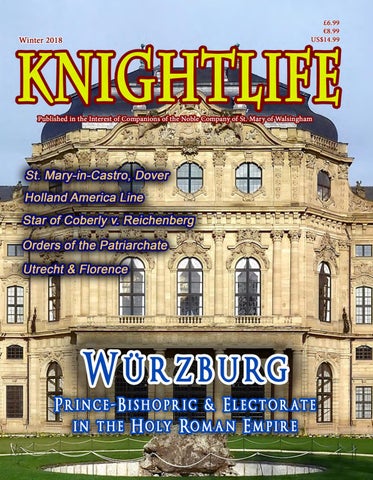
Central portion of the magnificent WĂźrzburger Residenz, the palace home of the Prince-Bishops of WĂźrzburg from the late 18th century. Today it is a UNESCO World Heritage Site.
5
Würzburg would return to status as a state within the Napoleonic Empire. In 1803, the Prince-Bishopric of Würzburg was ceded by Napoleon to the Electorate of Bavaria using provisions of the 1801 Treaty of Lunéville. Also in 1803, the Habsburg Grand Duchy of Tuscany was seized and granted to the House of Bourbon-Parma as the Kingdom of Etruria. The ousted Grand Duke was compensated with the Electorate of Salzburg. However, that territory was ceded to Austria as a result of the Peace of Preßburg in 1805. (It was a very fluid time!) So, Ferdinand, the former Grand Duke of Tuscany became the former Elector of Salzburg. He was compensated with a newlycreated Electorate of Würzburg. When the Holy Roman Empire was illegally dissolved in 1806, the concept of an electorate, being the state of an Elector of the Holy Roman Empire, underwent a transition. The Electors became Kings and Grand Dukes. So, the Elector of Würzburg himself formerly Grand Duke of Tuscany, became Grand Duke of Würzburg, and the state was renamed the Grand Duchy of Würzburg. After the Napoleonic Empire ended, Ferdinand returned to Tuscany to rule a newly -formed Grand Duchy of Tuscany as a satellite of the Austro-Hungarian Empire. Würzburger rule went to the Kingdom of Bavaria. The Roman Catholic Diocese of Würzburg was re-established in 1821, but without temporal power. The historic temporal authority of the Electorate of Würzburg is vested by treaty today in the Patriarchate of St. Stephen. The Patriarch holds the style of titular Prince Archbishop and Elector of Würzburg. The office is administered on behalf of the Patriarch by Prince v. Reichenberg as Regent of Würzburg.
8
Above: Konrad III von Bibra, Duke of Franconia, Prince-Bishop of Würzburg from 1540-1544.
Left: The gonfalon of the Patriarch of St. Stephen, with the arms of Würzburg in the viewer’s bottom lefthand corner, and the Franconian arms of Würzburg in pretense (the small shield in the centre) with the electoral bonnet.