The KM Malta Airlines In-Flight Magazine
ISSUE 24
October 2026
PG 42
A map of the islands with a filigree twist: pushing the boundaries of traditional craft PG 75
Foraging Malta: from wild plants to plate for a taste of nature
PG 30
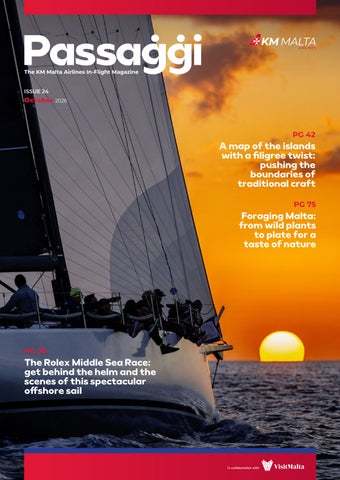
The Rolex Middle Sea Race: get behind the helm and the scenes of this spectacular offshore sail
in collaboration with
BEHIND ???????? PASSAĠĠI
OVER 150
BRANDS
under one roof
The KM Malta Airlines In-Flight Magazine ISSUE 24 October 2026
ISSUE 24
October 2026
PG 42
A map of the islands with a filigree twist: pushing the boundaries of traditional craft PG 75
Foraging Malta: from wild plants to plate for a taste of nature
PG 30
The Rolex Middle Sea Race: get behind the helm and the scenes of this spectacular offshore sail
OPEN EVERY DAY
MONDAY TO SUNDAY 10.00AM – 7.30PM in collaboration with
KM MAGAZINE COVER OCTOBER [SPINE].indd 1
19/09/2026 10:56
ON THE COVER The Rolex Middle Sea Race. Photo: Rolex/Kurt Arrigo.
MEET THE TEAM DESIGN forty Creative Studio
PUBLISHER Associated News Group
EDITOR
PRINTER
Fiona Galea Debono
Gutenberg Press
SALES AND BUSINESS DEVELOPMENT
PHOTOGRAPHERS
Associated News Group
Adriana Bishop Brian Grech David Carabott Fabrice Guerber Guido Bonett Rolex/Kurt Arrigo Sean Mallia Superintendence of Cultural Heritage
CONTRIBUTORS Adriana Bishop Beth Fiteni David Carabott Edward Bonello Fabrice Guerber Friends of the Earth Iggy Fenech Inkontru.app Jeanne Merzaux Lea Hogg Ruth Zammit DeBono Sara Gagliardi Roche
WOULD YOU LIKE TO BE FEATURED IN PASSAĠĠI? For advertising opportunities, get in touch with Associated News Group on passaggi@tbwa-ang.com or (+356) 2131 0608 Abigail: abigail@tbwa-ang.com or (+356) 9929 0518
HOW TO PRONOUNCE PASSAĠĠI
/pasˈsadʒi/ Here’s the breakdown: • /p/ as in pass • /a/ as in art • /sˈ/ as in sun (with stress on the following syllable) • /dʒ/ as the sound of the j in 'judge' (geminated or doubled sound) • /i/ as in eat The word passaġġi means 'passages' in English.
The publisher, authors and contributors reserve their rights with regards to copyright. No part of this magazine may be reproduced or copied by any means without the written consent of the publisher. Editorial features and opinions expressed in Passaġġi do not necessarily reflect the views of KM Malta Airlines, the publisher, or the editorial team. Both KM Malta Airlines and the publisher do not accept responsibility for commercial and advertising content. Although the authors and publisher have made every effort to ensure that the information in this magazine was correct before going to print, the author and publisher do not assume and hereby disclaim any liability to any party for any loss, damage, or disruption caused by errors or omissions, whether such errors or omissions result from negligence, accident, or any other cause. Special thanks to KM Malta Airlines and Visit Malta for the provision of photographic material. All magazine rights are reserved by KM Malta Airlines.
Associated News Group, 3rd Floor, Professional Building, Sliema Road, Gżira GZR 1633 Malta - (+356) 2131 0608
2
Welcome to The KM Malta Airlines In-Flight Magazine
David Curmi
Executive Chairman KM Malta Airlines October marks a change of season across our network. After another busy summer, I would like to take this opportunity to thank all our passengers who chose to travel with KM Malta Airlines, whether for a holiday, for business, or to spend time with family and friends. I would also like to thank our colleagues across the airline whose commitment and hard work throughout the summer helped us deliver our services during one of the busiest periods of the year. While one summer season draws to a close, preparations for the next are already well under way. Our Summer 2027 schedule is now available, giving passengers the opportunity to plan their travel well in advance. We are particularly pleased to be retaining Málaga as part of our summer network, alongside additional routes and frequencies that will further strengthen the choice and connectivity we offer from Malta. Connectivity, however, is about more than the destinations to which we fly directly. This month, we are pleased to introduce our new Train + Air product with SNCF, serving France and Belgium, enabling passengers to combine a KM Malta Airlines flight to Paris Charles de Gaulle or Lyon with onward high-speed rail travel in a single booking. The service opens convenient connections to 25 destinations across France, including Marseille, Bordeaux, Nantes, Rennes, Strasbourg, Lille, Montpellier, Avignon and Aix-enProvence. By bringing air and rail
4
together, we are extending the reach of our network beyond the airports we serve and making it easier for our passengers to travel seamlessly to their final destination. We are also continuing to give passengers greater choice in how they travel with us. Our Business Class Upgrade Option provides passengers with the opportunity to enjoy the additional comfort and benefits of our Business Class product, with upgrades available through our website and mobile app and during the check-in process. Looking further ahead, Christmas and New Year will soon be upon us. This is traditionally another busy period for travel, particularly for those returning home or visiting family and friends, and passengers planning to travel during the festive season may wish to make their arrangements early. As we move into the final months of 2026, our focus remains unchanged: providing Malta with safe, reliable and convenient connectivity while continuing to improve the experience we offer our passengers. Thank you for choosing KM Malta Airlines. Wherever your journey is taking you today, I hope you have an enjoyable flight, and we look forward to welcoming you on board again soon.
Fiona Galea Debono Editor
As the first rains begin to fall and the air takes on a fresher feel, we can slowly put summer behind us and turn our attention inland – to the countryside, its rich landscapes and the secrets of nature. The October issue of Passaġġi slows the pace and sets the tone for the season ahead: a comfortable in-between time when the outdoors is perhaps at its best, sheltered from both the intensity of summer and the colder months to come. Once again, this magazine takes the opportunity to look more closely at things we might otherwise take for granted – such as the rubble walls that snake across the islands, defining boundaries while lending the landscape its distinctive character and charm. Stone by stone, we uncover the soul of the countryside and the skill behind this age-old craft, before turning to another story quite literally ‘set in stone’: the Roman Round Tower of Tal-Wilġa. We explore its history and the work that has brought this site to the attention of an international heritage and archaeological audience. For a taste of nature, we follow the scent of wild plants all the way to the plate, exploring the world of foraging – an activity that is about much more than gathering food. Across Malta’s fields, coastlines and dry-stone walls, a quiet abundance grows in plain sight. Foraging offers a way to rediscover the islands through their seasonal flavours, while learning to look more closely, tread more lightly and reconnect with the land.
experimenting with plant-based dishes to farmers, food-waste initiatives and diners making different choices, a more climate-conscious approach to food is beginning to take root. We remain close to nature as we recount the story of an English woman who arrived in Malta by sailboat, with no fixed plans and nowhere to call home. We discover how – and why – Malta came to fill that role, and follow her Mediterranean countryside life through the eyes of a woman who adopted both an island and a rescue horse. Nature can also be found in the story of the restless, powerful sea, captured here by a French photographer in a grandiose spectacle of crashing waves set against the quiet landscapes of Gozo. It is another love story with the islands, this time told in winter. And, staying with the Mediterranean that surrounds us, we journey more than 600 nautical miles across sea, skill and adventure with the Rolex Middle Sea Race. One of the world’s elite offshore sailing races sets out from Malta, and this month we bring it to you through the eyes and experiences of the sailors who will once again brave its winds and waves. We hope this issue takes you on a journey through the islands that you may not have expected – whether you are arriving in Malta to begin your adventure, returning for another chapter, or simply looking at home with fresh eyes. Wherever your journey takes you, we hope you enjoy the ride… starting from now.
Still on the subject of food, we explore a taste of change: a quiet rethinking of what Malta eats. From restaurants
5
????????
Contents 8
ISLANDS 8
A circular walk around Valletta Exploring the capital’s scenic outer edge
TRAVEL 16
Frites, Magritte and the many faces of Brussels A city that resists a single identity
CULTURE 20
This month’s must-see events October brings fresh energy to a renewed cultural calendar
ART 26
30
Seeing things differently Three exhibitions ask us to look again
ACTION 30
600 miles of sea, skill and adventure Set sail on the spectacular Rolex Middle Sea Race
PETS 39
The dog stroller A must for animal travel
MADE IN MALTA 42
Pushing filigree out of its comfort zone
42
Creating the most unusual, meticulous map of Malta
HERITAGE 46
Stone by stone: the soul of the countryside Malta’s rubble walls are not just boundaries 6
????????
HISTORY 52
About a Roman Round Tower Tal-Wilġa’s international interest
56
The Order that transformed Malta The Knights of St John’s indelible mark on the island
PEOPLE 60
52
66
The lady of the horse Making this Mediterranean island home
ENVIRONMENT 64
Love Malta? Mind your waste One island, one shared responsibility
NATURE 66
When the Mediterranean pretends to be the Atlantic Gozo's wild seas in warm and inviting winters
FOOD 69
Learning the art of pastizzi The tricky craft behind Malta’s best-loved snack
75
Foraging Malta: from wild plants to plate Tasting nature
75
78
Taste of change: rethinking what Malta eats A more climate-conscious way of eating
AIRLINE NEWS 83
Flight, company and destination information All you need to know about flying with KM Malta Airlines 7
???????? ISLANDS
Words by
David Carabott David is a teacher, specialised in mentoring students of different abilities. An avid traveller, his target is to visit all the countries in the world. When he is not in Malta or travelling elsewhere, you can find him somewhere in Rome.
A circular walk around
Photos: David Carabott.
Valletta
8
???????? ISLANDS
Take a stroll around the edge of the capital’s defensive walls for a quieter, scenic side to the capital. If you want to escape the crowds and familiar tourist bustle, set out on a circular walk around Valletta’s fortifications, following the outer edge of the city’s defensive walls. It is not a typical sightseeing route, which is precisely why I enjoy it.
THE FORGOTTEN SALLY PORT Begin near the Auberge de Bavière, once the residence of the Knights of the Langue of Bavaria, before descending towards sea level through a breach in the bastions marked by a large stone arch.
The full circuit takes around two hours at an easy pace and reveals a quieter, more scenic side of the capital.
Historically known as the Jews’ Sally Port, Il-Bieb tal-Lhud in Maltese, this entrance once allowed Jews to enter Valletta under licence from the Grand Master during the rule of the Knights of St John.
There are quiet corners throughout the route, and despite knowing it well, I still discover less visited parts of Valletta.
BESIDE THE SEA Once you pass through the arch, the sea is immediately beside you. It gives me energy and motivation to continue along the very edge of the city, where battles and sieges once unfolded beneath these imposing fortifications. Make your way down towards the rocks at the water’s edge. This area was once a frontline
A wartime pillbox converted into a small bar.
The route follows both the sea-facing bastions and the landward walls, with stretches of uneven ground, steep steps and hidden access points along the way. Comfortable shoes are essential, as parts of the walk can be rough, but the effort is rewarded with views across the harbours, surrounding towns and the open Mediterranean.
9
???????? ISLANDS
where cannon fire thundered across the harbour and warplanes swept overhead. Today, the sea laps gently against stones where armoured galleys once advanced under attack. Standing there, breathing the sharp scent of salt and iodine, it is easy to imagine the noise and chaos that once filled this entrance to the Grand Harbour. Now, there is only the sound of waves and seabirds. The route then leads towards the St Elmo Breakwater Bridge, reconstructed in 2011 - 2012. As you cross it, look out at the open Mediterranean on one side and the sheltered harbour on the other. A few fishermen tend their lines while seabirds circle overhead. THE SACRA INFERMERIA AND FORT ST ELMO Climbing back into the city via a steep flight of stone steps, you arrive beside the Sacra
10
Infermeria, once one of the most advanced hospitals in Europe. Here, wounded knights and sailors were treated using methods considered remarkable for their time. The building commands impressive views over the harbour. Opposite stands Fort St Elmo, guarding the tip of the peninsula like a watchman at the entrance to the harbour. The fort played a pivotal role during the Great Siege and later endured heavy bombardment during World War II. Today, it houses the National War Museum. VIEWS ACROSS THE GRAND HARBOUR Further along, you pass the Siege Bell Memorial, overlooking the Grand Harbour. Each day, the bell rings in memory of those who lost their lives during World War II, its
???????? ISLANDS
Even though I have walked this route many times, there is always something that catches my attention sound carrying across the water to the Three Cities of Vittoriosa, Senglea and Cospicua. Across the harbour rise Fort Ricasoli and Fort St Angelo. The former is Malta’s largest fortification and a popular filming location, while the latter has appeared in several major productions, including Hollywood blockbuster Gladiator. Nearby, pass through the Lower Barrakka Gardens, where sweeping views open across the Grand Harbour. The forts, churches and domes across the water create one of Malta’s most iconic panoramas. The Alexander Ball Monument still catches my eye every time. Its Greek temple design fascinated me as a child, long before I knew anything about its history. Leaving the gardens behind, continue along the coast, climbing Crucifix Hill and crossing into Floriana. In the distance, you can see the Independence Monument by Ġanni Bonnici. MARSAMXETT HARBOUR The route curves along the bastions overlooking Marsamxett Harbour. Walk down Marsamxett Street and Great Siege Road towards the area below St Michael's Bastion, where you can see the Gardjola and the tiny, iconic St Roque's
Church. Mass was once celebrated here for those held in quarantine at the Lazzaretto on Manoel Island, directly across the harbour. Across the water stands Manoel Island, dominated by its star-shaped fort, one of the finest examples of military architecture in the Mediterranean. Along the way, you will pass a preserved wartime pillbox, now converted into a small bar with views over the harbour. From there, make your way back towards the starting point. AN AFTERNOON WELL SPENT As the walk nears its end, I am reminded why I enjoy this circuit so much. It offers the chance to stretch my legs while taking in the fortifications, the sea and the ever-changing views across the harbours. By late afternoon, the sun casts long shadows across the bastions and the sea takes on a softer light. Even though I have walked this route many times, there is always something that catches my attention. Finishing the circuit, I feel relaxed and grateful for an afternoon spent exploring a city that never fails to fascinate me.
11
Wied il-Mielaħ Window
Salt Pans
29
25 ‘Kappar’ Capers
Żebbuġ
26
Tal-Mixta Cave
Għasri
27
Għarb
23
San Lawrenz Xagħra Victoria
24
Qala
Nadur 28
‘Bużbież’ Wild Fennel
Għajnsielem Sannat
Mġarr 22
Sanap Cliffs M
COMINO
ġa rr-
GOZO
KEMMUNA
21
Ċi ew
rk w
G Ħ AW D E X
aM
Crystal Lagoon
Passenger Ferry
ġa rr
12
Vehicle & Passenger Ferry
Ċirkewwa
Red Tower
S T P A U L’ S ISLAND
06
Mellieħa
01 Popeye Village
16 St Paul’s Bay
‘Bajtar tax-Xewk’ Prickly Pears
09 ‘Frawli’ Strawberries 08 Mġarr 05
Mos ‘Merill’ National Bird
Rabat
Airport (MLA)
Valletta 8.1km
01
02
Dingli
B
BEACHES 01 02 03 04 05 06 07 08 09 10 11 12 13 14 15
12
Anchor Bay Armier Bay Balluta Bay Delimara Point Fomm ir-Riħ Għadira Bay Għar Lapsi Ġnejna Bay Golden Bay Marsascala Bay Marsaxlokk Bay Paradise Bay Pretty Bay Salina Bay St George's Bay
Dingli Cliffs
16 17 18 19 20 21 22 23 24 25 26 27 28 29
St Paul's Bay St Peter's Pool St Thomas Bay Wied iż-Żurrieq Xrobb l-Għaġin Blue Lagoon Santa Marija Bay Daħlet Qorrot Dwejra Bay Marsalforn Bay Ramla Bay San Blas Bay Xlendi Bay Xwejni Bay ~ Salt Pans
07
‘Lampuki’ Dolphin Fish
‘Xemx’ Sun
The Breakwater Bridge.
INSTAGRAMMABLE SPOTS AROUND VALLETTA
em
a-
Bu
ġ ib
ba
-M
Mġ
14
ġa
ar
rr
r-V a ll
et
ta
-M
ġa
rr
M A LT A Pembroke 15
Għargħur St Julian’s
Naxxar
Sliema
sta
Gżira
03 02
Valletta Upper Barrakka Gardens
Birkirkara ‘Ħobża tal-Malti’ Maltese Bread
The tunnel leading to Fort St Elmo and the War Museum.
S li
The view of Fort St Angelo across Grand Harbour.
KM Malta Airlines Airbus A320neo
Birgu Qormi
Żebbuġ
10
Buskett
18
Żejtun
01
Marsascala
Luqa 20
Marsaxlokk
Qrendi
‘Qarnita’ Octopus
11
Żurrieq
17
13 19
04 sponsored by
FILFLA ‘Luzzu’ Traditional Fishing Boat
13
Must-see sites
???????? ISLANDS
Words by
Heritage Malta The national agency for museums, conservation practice and cultural heritage, it is the guardian of over 8,000 years of history.
If this is your first visit to the Maltese Islands, you cannot leave without ticking these sites off your list. National Museum of Archaeology
Valletta
With artefacts dating back from Malta's Neolithic period (5900-2500 BC) up till the early Phoenician period (8th6th century BC), the National Museum of Archaeology is definitely your first step to understanding the richness of the land you tread on, its people and their ancestors. Its ground floor is dedicated to the Neolithic period, while the upper floor currently houses the Bronze Age and the Phoenician period sections. The museum regularly hosts temporary exhibitions.
Fort St Elmo and the National War Museum
Valletta
The splendid, unobstructed views of Grand Harbour, enjoyed today from Fort St Elmo, originally served the purpose for which the star-shaped fort was built – to face and hold back the wrath of the Ottoman armada. The National War Museum, located within the fort, is divided into seven sections and covers 7,000 years of Maltese military history from the Bronze Age until Malta’s accession to the EU. Notable artefacts include military armour of the Order of St John and the Ottoman Turks, while World War II is the most represented conflict in the museum. Highlights include the Gloster Sea Gladiator N5520, Faith, Roosevelt’s Jeep ‘Husky’, and Malta’s award for gallantry, the George Cross.
Ġgantija Archaeological Park Xagħra, Gozo The Ġgantija Archaeological Park complex is a unique prehistoric monument listed by UNESCO as a World Heritage Site. Situated in Xagħra, it consists of two structures built between c.3600 and c.3200 BC. Notwithstanding its age, the monument survives in a considerably good state of preservation. Entrance to the Ġgantija Archaeological Park is through an interpretation centre, which houses a selection of the most significant artefacts discovered at various prehistoric sites in Gozo.
14
???????? ISLANDS
Ta’ Kola Windmill Xagħra, Gozo Imagine... a bright new morning with just the right wind; a miller letting the locals know by blowing through a triton shell; the villagers bringing their cereals to be ground into flour. Ta' Kola Windmill is a unique relic of breadmaking in Gozo, transporting you back to such a morning. This 300-year-old building is a living testimony to our forefathers' way of life, marked with hardships and daily struggles, at a time when bread was the most indispensable food item. The exhibits inside the windmill belonged to the last miller residing there and were used to operate and maintain the building and milling mechanism.
Ħal Tarxien Prehistoric Complex Ħal Tarxien
Have the honour and the privilege of stepping inside a UNESCO World Heritage Site! Discovered in 1913 by farmer Lorenzo Despott, the Hal Tarxien Prehistoric Complex consists of four megalithic structures built in the late Neolithic and then re-adapted for use during the Early Bronze Age. The site was excavated between 1915 and 1919 by Sir Themistocles Zammit, Director of Museums at the time. This year marks the 110th anniversary since the first sketches of the site were made by Zammit himself during the initial excavations.
National Museum of Natural History Mdina The National Museum of Natural History in Mdina is housed within Palazzo Vilhena, a Parisian baroque palace commissioned in 1724 by Grand Master Antonio Manoel de Vilhena and designed by Charles François de Mondion. Before becoming a museum, the building served as a temporary hospital during the 1837 cholera outbreak, later a British military sanatorium, and eventually a tuberculosis clinic until 1956. Inaugurated in 1973, the museum is dedicated to the acquisition, curation and conservation of Malta’s biological and palaeontological heritage. Its collections include thousands of minerals, geological specimens, birds, mammals, molluscs, insects and fossils, displayed through thematic exhibitions and supported by active research and public outreach.
15
???????? TRAVEL
Words by
Lea Hogg Lea is a Malta-based journalist and writer, known for her TV programme on current affairs, cultural news and in-depth interviews about politics and global issues.
Frites, Magritte and the many faces of
Brussels cityscape at sunset. English Garden Park, Munich.
Brussels
16
Brussels is a city that resists a single identity. Unmistakably European, it is shaped by communities drawn from far beyond the continent. Its grandeur may command the first glance, but its diversity is what makes it interesting.
????????
suggests
As my coach pulls into Bruxelles-Midi, the station is already in full motion. Locals and visitors stream towards trains, taxis and trams, everyone apparently in a hurry to be somewhere else. People move in every direction. Even for the well-travelled, it is a sensory overload.
empty. The air is crisp, the shopfronts are still closed and, without the usual crowds, Brussels feels unexpectedly peaceful. I make my way slowly towards Mont des Arts and the Royal Quarter, one of the city’s main museum districts, the other being around the Cinquantenaire.
Brussels has its own rhythm. It is a city shaped by different cultures, religions and nationalities, sometimes sitting comfortably together and sometimes rubbing up against one another.
Within the Royal Quarter is the Magritte Museum, housed in the Hôtel Altenloh, a tall and white 18th-century townhouse. The museum is dedicated to René Magritte, the Belgian surrealist who took everyday objects – a hat, an apple, a pipe or a bird – and reimagined them through his vivid and unmistakable artistic vision.
The 20-minute walk towards the centre is not the quickest route, but it is straightforward and gives me an immediate sense of the Belgian capital beyond its formal image. Then I reach the Grand-Place. Restaurants and shops line the famous old square, yet nothing is allowed to disturb its architectural harmony. The pale limestone façades, many dating from the 17th century, are richly decorated with gold leaf. Green-and-red striped awnings add colour without competing with the grandeur around them. The effect is theatrical, but entirely at home in such extravagant surroundings. Throughout the year, the square hosts classical concerts and dramatic performances. Even without a stage, it feels like the cultural heart of the old city. Find a table at one of the restaurants lining the square and allow yourself time to sit, look around and watch as each new arrival discovers the Grand-Place in their own way.
Magritte spent much of his life and career in Brussels. His work, with its familiar objects placed in impossible settings, seems somehow suited to a city that so often changes character from one street to the next. I move slowly through the museum, reading the descriptions and spending time with the paintings rather than treating the visit as another cultural obligation to be completed. One work stops me for longer than the others. The Return, completed in 1940, shows a bird in flight against a star-filled night. Look again and its body is formed from the clouds and sky behind it. Below, a small nest containing three eggs sits quite ordinarily on a ledge. The image is simple, unsettling and beautiful, and I stand in front of it for some time. Eventually, I leave the museum feeling, perhaps rather optimistically, like a new authority on the life and work of Magritte.
A child clutches a warm Belgian waffle dripping with Nutella, attempting and failing to eat it without covering both face and clothes in chocolate. Nearby, a couple pose repeatedly for photographs with the vast Gothic Hôtel de Ville de Bruxelles rising behind them. Everyone wants to take a little piece of the Grand-Place home.
Across the courtyard stands the Palais Royal de Bruxelles, the immense palace of the Belgian royal family. It is used primarily as the working office of King Philippe and as the setting for official state visits. Beyond its tall gates and formal gardens, it is grand without revealing very much about itself.
The next morning, I wake early and walk through streets that are almost
By now, I am hungry and begin walking back towards the centre.
Brussels Essentials
.....
Getting around Brussels has an extensive network of metros, trams and buses, although many central attractions are easily reached on foot. Passengers can pay by tapping a contactless bank card, smartphone or smartwatch when boarding. Further information is available from STIB-MIVB.
Start at the Grand-Place Brussels’ magnificent central square is best enjoyed twice: first when it is alive with visitors, cafés and street life, and again early in the morning, when its gilded façades can be admired in relative peace.
See the art Allow time for the Magritte Museum in the Royal Quarter and look out for the colourful murals forming the city’s Comic Strip Route.
17
????????
Eat like a local Try the frites with béarnaise at Frites Atelier, followed by shrimp croquettes, oysters or fish soup at Noordzee on Place SainteCatherine. For a substantial dinner, Amadeo serves barbecued ribs in one of the city’s most wonderfully eccentric dining rooms.
Make time for chocolate Choco-Story Brussels explores Belgium’s enduring love affair with chocolate, complete with the irresistible scent of cocoa and live demonstrations by skilled chocolatiers. Book in advance through Choco-Story Brussels.
Find the quieter side Walk beyond the principal tourist streets and notice how Brussels changes from one neighbourhood to the next. For a pause, head to the Jardin du Mont des Arts and take in the gardens and rooftops stretching across the city.
Do not miss Manneken Pis may be one of Brussels’ most famous residents, but at just 55 centimetres tall, he is also one of its smallest. His reputation is considerably larger.
For football followers Choose between the purple of RSC Anderlecht and the yellow and blue of Royale Union Saint-Gilloise. A home match offers a lively introduction to a side of Brussels that no museum can capture.
18
The Grand-Place is magnificent, but Brussels becomes more interesting when one moves beyond it. Shop after shop advertises the city’s famous frites, served with an improbable range of sauces in almost every colour. I stop at Frites Atelier and order a portion, adding truffle sauce, béarnaise, basil mayonnaise and the house andalouse from old oak-andbrass barrels. How good can chips and mayonnaise really be? Very good, as it turns out. These are among the best frites I have eaten. The béarnaise alone is worth the stop. When travelling, I prefer to eat a little in several places rather than surrender an entire afternoon to one restaurant. I move from one establishment to another, ordering one or two dishes at each and allowing lunch to stretch across several hours. Conveniently, next door to Frites Atelier is Noordzee – Mer du Nord, a seafood restaurant on a corner overlooking Place Sainte-Catherine. Tables and chairs spill out from the neighbouring cafés and bars, but Noordzee has no indoor dining room. Customers order at the counter and choose their fish from the display. There is a menu, although it feels more like a suggestion. Noordzee is essentially a fishmonger that happens to serve excellent food. I order shrimp croquettes, fish soup and fresh oysters. When the food is ready, someone calls my name across the
square and I return to the counter to collect it. The soup arrives with a rich tomato base and an assortment of seafood. Each flavour remains distinct, but together they create something far greater than the individual ingredients. It is the kind of dish that needs no elaborate presentation. It is simply an exceptional fish soup. Beyond the centre, the smaller streets reveal a different Brussels. The language on the shop signs gradually changes from French to Arabic. Polished glass and metal give way to weathered wood and hand-painted lettering. Some signs look as though they have not been touched in 40 years. I hope they never are. These streets reflect the cultural breadth of the city. People with roots in Lebanon, France, Romania, Italy and Algeria are among the many communities that have made Brussels their home. Inevitably, they have also changed how the city eats. One storefront catches my attention. It is painted a beautiful shade somewhere between sage and olive green. Although clearly now a Lebanese restaurant, the original sign remains: Librairie Minet Frères, written in slightly imperfect gold lettering. On either side are the words Documents Rares et Précieux and Expertises de Livres, Anciens & Modernes. Beneath the window, two elderly Middle Eastern men sit on a bench, talking quietly. The building has changed purpose, language and ownership,
???????? TRAVEL
yet nothing feels erased. The different lives of the place remain visible. Brussels is home to over 180 nationalities, each seeming to have found a corner of the city they can call their own. It is not a place that reveals itself immediately. Just when I think I understand it, another street presents an entirely different version. Some of its most visible stories are told high above street level. More than 60 murals cover the sides of apartment blocks, municipal buildings and car parks, forming the city’s celebrated Comic Strip Route. It began in 1991 with Broussaille on Rue du Marché au Charbon. Among the best known are Asterix and Obelix and, inevitably, Belgium’s most famous fictional traveller, Tintin. He first appeared in 1929, created by Hergé, who was born in Brussels. Tintin survived the 20th century and found another audience through the cartoons watched by children in the 1990s. The murals are large, bright and unexpectedly joyful. Scattered across the city, they have become part of the background to daily life: fictional figures watching over real people as they go about their business below. Not far from Asterix and Obelix stands another Belgian celebrity, although this one is considerably smaller. Manneken Pis is a bronze fountain sculpture of a cherubic boy urinating with complete self-assurance. His pose has earned him worldwide fame. What surprises most first-time visitors is not what he is doing, but how little of him there is. At only 55 centimetres tall, he is much smaller than his reputation. Around the corner, Brussels’ Chocolate Museum occupies a red-brick building tucked into a quiet alley. Its exhibits trace the production of chocolate and the story of how it became so closely associated with Belgium, using a series of vignettes depicting different moments in its history. The warm, distinctive scent of chocolate follows me through the museum. Live demonstrations by chocolatiers reveal the precision involved in producing something most of us consume with very little ceremony.
However compelling a city may be, there comes a point when some distance from the crowds becomes necessary. In Brussels, I find it in the parks and gardens. One of my favourite places to stop is the Jardin du Mont des Arts, a composed, tranquil space, filled with greenery and bands of multicoloured flowers. Neatly shaped hornbeam trees line its paths, their trunks painted white. I sit looking across the flowerbeds as the rooftops of Brussels recede into the distance. Nearby, the equestrian statue of King Albert I has acquired a deep jade-green patina, the bronze slowly transformed by time and weather. The European Quarter presents another face of the city. The PaulHenri Spaak Building, part of the European Parliament complex, is all glass, steel and institutional ambition, shining beneath the clear blue of the afternoon sky. Close by, the Maison de l’histoire européenne – the House of European History – traces the continent’s shared, divided and often difficult past. It is fascinating, and free to enter. In a city so closely associated with European diplomacy, it offers useful context for the decisions being made in the buildings around it. People come to Brussels for its art, history, architecture, food and politics. Others arrive for football. The city is home to RSC Anderlecht, Belgium’s most successful and widely recognised club, with 34 national titles. Royale Union Saint-Gilloise, generally shortened to USG, was once less familiar beyond Belgium but has enjoyed a remarkable revival in recent years. The identities of the clubs are immediately recognisable: Anderlecht in its distinctive purple and USG in brilliant yellow and blue. A match at either ground offers something museums and monuments cannot – the sound and temperament of the city when it is supporting its own. After a full day of walking, I begin looking for dinner. This time I do not want to collect small dishes from several restaurants. I want one substantial meal. Back in the centre, I turn down a side street and see a
flash of red neon. The sign reads: Amadeo – The Place for Ribs. Inside, Brussels disappears. Heavy wooden beams cross a dark ceiling. Red and white gingham cloths cover the tables, wicker chairs fill the room and curious, almost otherworldly, monkey-like statues with a Far Eastern appearance stand among rows of vintage books. It resembles several restaurants, with a library and a private collection of oddities compressed into one room. A waiter approaches. “Ribs, yes, okay?” That is the entire discussion. A large baked potato arrives first, accompanied by a small bucket of orange-coloured butter. Then the waiter appears with a tray piled high with expertly barbecued ribs. I take a rack and begin to eat. The food is hearty, warming and totally uncomplicated, exactly what is required after walking across Brussels for most of the day. When I finish, the waiter offers me another rack. The ribs are, apparently, unlimited. My appetite is not. I decline. Wherever I travel, I like to plan without scheduling every hour. I may mark 100 places on a map and reserve one or two restaurants or events, but I have little interest in dutifully completing a list of the “20 Best Things to Do in Brussels”. A city is found in the spaces between its principal attractions: in the old lettering left above a Lebanese restaurant; in a name shouted across a square; in a tiny bronze boy with an enormous reputation; or in two men talking quietly beneath a former bookshop window. Brussels does not offer one polished version of itself. It offers many, often within a few streets of one another. The pleasure lies in walking far enough, and slowly enough, to notice them.
KM Malta Airlines operates regular flights between
Malta International Airport (MLA) and Brussels (BRU) kmmaltairlines.com
19
CULTURE
Words by
This month’s
must-see events October brings a fresh energy to Malta and Gozo as new cultural seasons get underway and the calendar renews with theatre, music, exhibitions and more. As Halloween approaches, expect things to take a delightfully spooky turn too. Fortress Malta When: Throughout October Where: Fort St Elmo, Valletta
Spazju Kreattiv new season When: Throughout October Where: Spazju Kreattiv, Valletta Spazju Kreattiv has launched its 2026/27 programme, including a full season of cultural and artistic activities. This season opens with two featured exhibitions: Beyond the Visible: the Metaphysical Worlds of Olaug Vethal, a visual arts exhibition showcasing the late artist's work; and Chapters from the Technosphere: Reimagining Ways of Living, a collaborative, researchled project exploring human-made infrastructures and material residues on a planetary scale.
For centuries, Fort St Elmo has stood guard over Valletta's Grand Harbour; now visitors can stand watch too, defending it the way its wartime gunners once did. Step into the shoes of a World War II gunner during an air raid. The mixed-reality setup blends physical props with an immersive virtual environment to recreate defending the Grand Harbour ramparts.
Ready, Aim, Shoot
Discover the Bofors gun through an immersive VR experience at Fort St Elmo.
Exclavic Excursions When: 4th October Where: Offbeat, Valletta Intimate jazz bar Offbeat presents a special night of three diverse ensembles, bringing together musicians from around the world and a myriad of musical cultures. Enjoy harp and cello with Lily Azur and Emma Zarzuela, spontaneous horn sounds from Improper, and fiery Balkan rhythms from Ljuta Trpka. Book ahead to secure your spot.
Edward Caruana Dingli (1876 - 1950) When: 1st - 4th October Where: MUŻA, Valletta This year marks 150 years since the birth of Edward Caruana Dingli, one of Malta’s most influential artists. Born in Valletta, his career took him from military service to becoming Malta’s leading portrait painter. Drawing on a carefully curated selection from the National Collection, this exhibition moves beyond his celebrated portraits to reveal the diversity of his practice and lasting contribution to Maltese art.
20
CULTURE
The Maids When: 2nd - 4th & 9th - 11th October Where: Theatre Next Door, Naxxar In Jean Genet’s explosive classic, translated by Martin Crimp and directed by Scott Le Crass, sisters Claire and Solange live in the shadow of their glamorous mistress. Behind closed doors, elaborate rituals of roleplay, desire and revenge blur the boundaries between servant and master, love and hatred, fantasy and murder. It's a feverish exploration of power, identity and obsession. The production is supported by Arts Council Malta, the French Embassy in Malta, MGRM, LGBTI+ Gozo and Aġenzija Żgħażagħ.
Maker Faire 2026 When: 2nd - 4th October Where: Esplora Interactive Science Centre, Kalkara
Little Shop of Horrors When: 23rd October - 1st November Where: Teatru Manoel, Valletta Teatru Manoel and Masquerade Theatre Company present Little Shop of Horrors, the award-winning musical comedy by Alan Menken and Howard Ashman. It follows Seymour, a struggling florist whose discovery of a mysterious plant, Audrey II, brings unexpected success. and terrifying consequences. As the bloodthirsty plant grows increasingly demanding, Seymour faces impossible moral choices in this darkly entertaining blend of comedy, horror, rock and doo-wop.
Get ready for an unforgettable celebration of creativity, innovation and hands-on discovery at Maker Faire Malta, the island’s hottest festival of makers, thinkers and doers. Hosted at Esplora, this vibrant event will bring together local and international talent to showcase the very best of invention, technology, art and DIY culture. Whether you’re a curious child, a passionate hobbyist, a student or simply someone who loves to explore new ideas, Maker Faire Malta is your playground.
Panto of the Opera When: 30th & 31st October Where: Teatru Salesjan, Sliema This Halloween, the Phantom gets a Dame! As Christine races to save Valletta's Royal Opera House from mysterious chaos, she'll uncover a secret hidden behind the mask. Packed with live music, comedy, spectacle and Halloween magic, Panto of the Opera is the perfect family treat before or after your trick-or-treating. Come in costume!
Discover and experience more with Inkontru.app, your web-based application that prioritises functionality and performance, meaning no need to download, seamless updates, no storage space taken and easy sharing. Enjoy!
21
St Dominic Parish Church, Valletta.
CULTURE
TRADITIONAL FEASTS & CELEBRATIONS
Our Lady of the Rosary, Valletta - 10th September Each October, St Dominic Parish Church in Valletta offers a glimpse into a tradition that has been woven into Maltese Catholic life for centuries. The Feast of Our Lady of the Rosary is celebrated with the Dominican community and the Archconfraternity of the Holy Rosary, an organisation founded under Dominican auspices around 1575. Its members were once known not only for their religious devotion but also for charitable work, including ministering to those condemned to capital punishment.
vespers and a concelebrated Mass, before the celebrations spill out into Valletta's streets in a procession featuring the statues of Our Lady of the Rosary and St Dominic.
The celebrations centre on the richly dressed wooden statue of Our Lady of the Rosary, carved by Mazzeo da Vizzini. On the feast day, the rosary is recited, followed by
For a guide to upcoming religious celebrations and traditional feasts across the Maltese Islands, be sure to visit Inkontru.app
For visitors, this is an opportunity to step inside one of the capital's historic parish churches and experience a more intimate side of Valletta, one shaped by ritual and traditions connecting the city to the Dominican presence in Malta for more than four centuries.
PALAZZO PRECA 54, Strait Street, Valletta Make your celebrations in Valletta extra special with a memorable dining experience at Palazzo Preca, set within a historic 16th-century palazzo on Strait Street. Led by Chef Ramona Preca, the restaurant offers authentic Maltese and Mediterranean cuisine, showcasing fresh local fish, seafood and homemade pasta. Complement your meal with a selection of fine wines and Champagne for an unforgettable experience in the heart of the capital. (+356) 2122 6777 22
palazzoprecavalletta.com
MALTA’S LEADING CONFERENCE & EVENT SUPPLIER iCAN Malta is a leading event management and audio-visual solutions company that specializes in delivering high-quality conferences, corporate events, and productions. Based in Malta, the company offers a comprehensive “one-stop-shop” service, handling everything from planning and logistics to technical execution, including sound, lighting, and video production. With a team of experienced professionals and advanced technology, iCAN is known for creating tailored, high-standard events and has been trusted with major local and international projects. www.ican.com.mt | info@ican.com.mt
BEYOND THE VISIBLE | THE METAPHYSICAL WORLDS OF OLAUG VETHAL Space A, Spazju Kreattiv, St James Cavalier, Castille Place, Valletta This exhibition celebrates the life and artistic legacy of Olaug Vethal (1946 - 2007), the Norwegian-born artist who made Malta her home and inspired generations of students through her teaching and practice. Bringing together works spanning landscape, portraiture, jazz, the human body, Malta’s ancient sites and encounters with Japanese visual culture, the exhibition reveals Vethal’s enduring fascination with the metaphysical dimensions of existence. The exhibition is open until 25th October, Tuesdays to Fridays, 9am - 9pm, and Saturdays and Sundays, 10am - 9pm. info@christinexart.com (+356) 9984 4653
THE VALLETTA WATERFRONT OKTOBERFEST Triq il-Vittmi Furjaniżi tal-Gwerra, Floriana From 7th - 9th October, the Valletta Waterfront hosts a vibrant celebration set against the spectacular backdrop of the Grand Harbour, located within walking distance from central Valletta and Floriana. The festival offers three evenings of great entertainment, food and a wide selection of local and international beers, craft brews, flavoured ciders, as well as non-alcoholic and gluten-free options. Set among the beautifully restored 18th-century warehouses of the Valletta Waterfront, this unique festival offers stunning harbour views and a celebration of global flavours. Admission to Oktoberfest and entertainment areas is free. vallettawaterfront vallettawaterfront.com/oktoberfest
23
CULTURE
INKONTRU.APP MEETS...
What keeps your relationship with the crime novel alive after all these years? I think the crime novel presents a complete package to any reader. Are you interested in puzzle-solving? Do you want to read about contemporary society and its problems? Maybe you are interested in finding out about a new culture or city. Or do you want to think more intently about big moral questions of good and evil? The crime novel satisfies all these criteria and more! That’s why I love it. It is almost 40 years since the publication of your firstever novel in the Inspector Rebus series, Knots and Crosses. John Rebus must feel like family by now. Do you share any similarities? I have been living with John Rebus for 40 years, though that was never the intention! I invented him for just one book, but he got beneath my skin and insisted on sticking around. I keep writing about Rebus to get to the heart of the man, but he is slippery; he keeps wriggling away from me. He also changes and I have taken into account those changes. He was almost 40 years old in book one and is nearing 80 now. I have grown old with him, but we are still not very alike – he is more cynical, tough and brave. But we do like the same music and we drink in the same bar.
Ian Rankin. Photo: Louise Mather.
World-famous Scottish crime writer Ian Rankin digs into why his chosen genre continues to resonate with him all these years, and how his legendary detective John Rebus ‘grew up’ alongside him but also deeply reflects his stomping grounds in Edinburgh. Rankin is speaking ahead of his participation in this year’s edition of the Malta Book Festival, taking place at MFCC, Ta’ Qali, from 4th 8th November and organised by the National Book Council.
Any visitor to Edinburgh who is also a fan of your novels will undoubtedly feel a whiff of Rebus in many parts of the city. What makes the capital such a perfect setting for your books? Edinburgh is a Jekyll and Hyde city, civilised on the surface but with malice hidden just beneath. Tourists only see its friendly face, but I want to show there are other layers that are interesting and worth exploring. It is also like Doctor Who’s TARDIS – small on the outside but teeming within. You can walk it in a day yet spend your whole life trying to make sense of it. And it holds its secrets close to its chest, which makes for good crime fiction. Plus it is a very literary city, from Sherlock Holmes to Harry Potter. And not many people know, but Agatha Christie was married in Edinburgh. Our crime roots go deep!
INSTALL inkontru.app Step into Malta’s scene with Inkontru.app, your personal guide to all the latest art, culture and heritage events in Malta and Gozo. More than just a calendar, the app connects you with exciting events and artists through exclusive interviews and video features. Easily find event details, get directions and purchase tickets – all in one place. Need a ride? Book a cab effortlessly through the app and share your plans with friends and family with ease.
24
Your first step into the history of the Maltese Islands
15% Discount
On the purchase of an adult ticket Please quote “Passaggi” at the ticketing counter to claim your discount. (Not valid with any other offer)
Few places have a history as turbulent and inspiring as the Maltese islands. Its gripping story is that of a country buffeted by world events, in which the bravery and resilience of its people have been tested to the limit. Through beautiful authentic imagery and a gripping commentary, the show covers 7000 years of history in 45 minutes. From the early settlers of the temple period to the Knights of the Great Siege through to the destruction of World War 2, The Malta Experience chronicles the events that have shaped the island's history.
www.themaltaexperience.com
A NEW LIFE FORCE
CULTURE
Nathanaëlle Herbelin Kemi Onabulé Megan Rooney
10 October 2026 – 31 January 2027
Malta’s National Contemporary Art Museum
FIND US
Ospizio Complex, Bieb ilPulverista, Triq Joseph J Mangion, Floriana FRN1830
St Elmo Bastion, Mediterranean Street, Valletta. tel 2552 4000
25
ART
SEEING THINGS DIFFERENTLY
Works by Kane Calì.
Work by Madeleine Fenwick.
From Berlin to Malta, three exhibitions ask us to look again – at images of conflict, at the island’s distinctive light, and at landscapes in constant change. Together, they explore how artists transform what surrounds them into something that makes us pause, reconsider and, perhaps, see differently.
SEE / SAW: WHERE MALTA AND BERLIN FIND THEIR BALANCE At a time when we are confronted daily by competing images, ideas and realities, how much of what we see do we actually see? We consume images of war and human suffering alongside photographs of holidays, lunches and outfits. We are encouraged to react, form opinions and take sides, often before we have had time to properly consider what is in front of us. What happens, then, if we stop scrolling and simply look? That question lies at the heart of SEE / SAW, a joint exhibition by Maltese artist Kane Calì and BritishMaltese artist Madeleine Fenwick, presented by Malta’s R Gallery at AOA;87 during Berlin Art Week, exploring the strange relationship between seeing something and truly engaging with it. The two artists retain distinctly different practices, but find common ground in their use of metal and in their interest in tension, perspective and the uneasy negotiations of contemporary life. “Although our approaches and the visual languages of our work are different, there has always been a continuous dialogue between us around materiality, making and a shared interest in the existential questions that emerge through making,” says Fenwick. Fenwick, who relocated to Malta in 2014, works across sculpture, installation, painting and printmaking. Her
26
SEE / SAW works use stainless steel, neon and brass – materials that carry their own associations with permanence, fragility, industry and memory. Her most literal contribution is a walk-on stainless-steel seesaw that requires two people to operate it. Balance becomes something visitors have to negotiate rather than simply observe. “I’m not interested in equilibrium as a state of balance, but as something that has to be continually negotiated,” she explains. “Whether opposing forces can coexist without one simply having to overcome the other.” Calì approaches the same questions through images. Born in Malta in 1983, the experimental multimedia artist draws on data, technology and political discourse, taking inspiration for SEE / SAW from Andy Warhol’s Death and Disaster series. He transforms images of conflict found online into three-dimensional metal reliefs, sometimes making them visible only from a particular angle. In Human Grenade, influenced by philosopher Timothy Morton’s concept of Dark Ecology, he considers humanity’s simultaneous role as investigator and instigator of global crises. Terror Forming – Hiroshima Deja Vu uses an image often mistaken for a photograph of the first atomic bombing, but which was actually created decades later as a smoke simulation, raising questions about how readily images become accepted as historical truth.
ART
“SEE / SAW is a play on perspective: the difference between seeing something and having really seen it,” Calì says.
Work by Madeleine Fenwick.
As he explains, it all depends on how we approach images and how much time we dedicate to them. “The more time we spend on something, the more likely we are to see it for what it truly is. Now imagine doing that with images of conflict and wars. How horrifying would it be to truly sit with an image of that devastation rather than scrolling past it?” It is a fitting challenge for an age of endless images – to stop moving on so quickly from things we should dedicate time to – and for Berlin, a city where questions of history, memory and perspective remain impossible to avoid. SEE / SAW runs at AOA;87, Sophienstraße 5, Berlin, until 31st October.
A NEW LIFE FORCE: THREE PAINTERS, ONE ISLAND If SEE / SAW asks us to look more carefully, A New Life Force asks what happens when artists are given the time and space to look closely at a place. At the Malta International Contemporary Art Space (MICAS), three internationally acclaimed painters – Nathanaëlle Herbelin, Kemi Onabulé and Megan Rooney – have developed new bodies of work informed by their encounters with Malta. The island’s light is an obvious starting point. At MICAS, Malta’s newest cultural destination, the steel roof and limestone fortifications create a shifting interplay of glare, shadow and reflection, while the galleries themselves are carved into the historic Ospizio complex in Floriana. “MICAS does not simply import shows,” says artistic director Edith Devaney. “It invites artists to come, look and respond.” Herbelin, based in Paris, is known for intimate interiors and figures rendered in softened forms and earthy tones. For MICAS, she draws on the Maltese tradition of ex-voto paintings – small devotional works made in thanks for a rescue, recovery or answered prayer.
Coming and Going by Megan Rooney. Photo: Eva Herzog.
London-based Kemi Onabulé, whose Greek, English and Nigerian heritage informs her practice, turns instead towards the natural world. Her paintings of forests, scorched landscapes and ambiguous skies reflect her interest in humanity’s changing relationship with nature. In Malta, the island’s vitality and traces of its combative history fed into a new group of works, including her largest canvases to date. Megan Rooney’s approach is more physical. She builds up layers of paint through accumulated gestures before attacking the surface with a power sander. At MICAS, she became particularly attuned to the movement of daylight through the galleries, producing paintings on a larger scale than usual. For executive chairperson Phyllis Muscat, that encounter with place is central to MICAS’s role: “The most valuable thing MICAS can offer an artist is not simply a gallery wall but an encounter with our history, our light, our geography, the texture of daily life in these islands.” A New Life Force opens at MICAS, Floriana, on 10th October and runs until 31st January 2027.
Manifestation pour une deuxiême grossesse by Nathanaëlle Herbelin. Photo: Anna Arca.
Sunbather (Dingli Cliffs) by Kemi Onabulé. Photo: Objets Pointus.
27
Works by Debbie Bonello.
ART
OUTDOORS: PAINTING THE FLEETING MEDITERRANEAN That close observation of place continues in Outdoors, Debbie Bonello’s fourth solo exhibition, where the landscape itself becomes the subject. Created entirely on site in Malta and neighbouring Sicily over the past two years, the paintings explore the shifting boundary between abstraction and representation. Bonello works quickly and intuitively, responding to changing light, weather and atmosphere. The August heat, the glare of the Mediterranean sun and the hazy humidity of the sirocco all leave their mark on the paintings. Unlike her previous solo exhibition, Crowded, there are no human figures here. Settings that might once have provided a backdrop to human activity take centre stage, inviting closer attention to their colours, textures, forms and changing atmospheres.
28
Working outdoors demands a particular kind of concentration. Shadows lengthen, weather changes and light disappears; the artist must respond to conditions that cannot be recreated exactly in a studio. The resulting works are therefore more than representations of particular places. They are records of encounters – paintings that preserve fleeting moments while acknowledging that those moments will never occur in quite the same way again. In that sense, Bonello’s exhibition brings the wider theme of these three shows into focus: looking is never passive. Whether confronting an image of conflict, responding to Malta’s distinctive light or trying to capture a landscape before it changes, the act of seeing requires time, attention and a willingness to look again. Outdoors runs throughout October at the Palm Court Lounge, The Phoenicia Malta, and is curated by Charlene Vella.
SIR TEMI ZAMMIT HALL DIRECTED BY
DOROTHY BEZZINA MUSICAL DIRECTION BY
EDWARD MIFSUD
EVERYBODY’S TALKING ABOUT JAMIE IS PRESENTED BY ARRANGEMENT WITH CONCORD THEATRICALS LTD. WWW.CONCORDTHEATRICALS.CO.UK
ACTION
Words by
Edward Bonello Edward is a content writer and PR consultant. He is interested in the wonderfully superfluous and exquisitely redundant. When he's not happily tapping away at his laptop, he enjoys collecting useless trivia and watching B-movies.
600 miles of sea, skill and adventure Every October, one of the world’s elite offshore sailing races sets out from Malta, taking crews on a spectacular 606-nautical-mile journey around Sicily and back. Catch up with sailors Maya Podesta and Luca Schembri Meli, who will be facing the waves once again in this year’s edition of the Rolex Middle Sea Race.
Photos: Rolex/Kurt Arrigo.
For visitors standing on the bastions of Valletta on the morning of 17th October, the sight will be nothing short of spectacular. One by one, fleets of sailing yachts fill the Grand Harbour before gliding by its iconic breakwater and out into the Mediterranean Sea.
30
For those on board, however, the experience is only beginning. The Rolex Middle Sea Race is a 606-nautical-mile offshore race starting in Malta and taking competitors north towards Sicily, through the Strait of Messina, around Stromboli and westwards along Sicily before turning south past Pantelleria and Lampedusa. From there, the boats head back towards Malta, passing through the South Comino Channel before finishing at the entrance to Marsamxett Harbour.
First held in 1968, the race has grown into one of the best-known events on the international offshore sailing calendar. Yet despite the international fleet that gathers in Malta every October, for local sailors the race holds an immensely special and personal place. And few illustrate that relationship better than Maltese veteran sailor and doctor Maya Podesta, who this year will be venturing the waves for her 26th consecutive time. “I was practically brought up on the sea,” Maya reminisces, as she references her late father Arthur, a veteran sailor and somewhat of an icon on the local scene. “I remember my father sailing as far back as I can remember, so the sea was always a big part of our lives.”
ACTION
Maya races the family’s 45-foot boat together with her brothers and partner, and the Rolex Middle Sea Race is the undisputed highlight of their sailing calendar. “It is the crowning moment of the year. It is a great race of international calibre, right on our doorstep, so naturally, the draw is immense.” But if Maya represents a lifetime spent on the sea, 16-year-old Luca Schembri Meli is perhaps on the other end of the scale. At his tender age, he has already amassed considerable experience. In fact, this year’s will be his third Rolex Middle Sea Race already! Luca started sailing when he was just eight, and his introduction to the sport came about almost by necessity. “My parents bought a boat, but they didn’t know how to sail, so basically, I was entrusted to learn the ropes. That is how I started on small dinghies at the Royal Malta Yacht Club, learning the controls and the basic concepts of sailing. By nine, I was completely hooked and taking part in competitions,” Luca explains. His progression was rapid, and by the summer of 2023, he was already experienced enough to be trustworthy, but too young to board
31
the boat. That’s how Luca landed the job of weatherman for one of the Rolex Middle Sea Race crews, staying behind, wiring detailed, last-minute weather reports. “I had to stay up during the night following weather reports. I would even take my laptop to school with me because I was committed to doing the job properly – the teachers weren’t too pleased with that! Then the following year, I finally got the opportunity to actually be on the boat!” Part of the Rolex Middle Sea Race’s tremendous appeal, both for veteran crews, as well as wide-eyed novices, is its unpredictability, as no two editions are quite the same. Over several days at sea, crews can experience everything from powerful winds and heavy seas to frustrating periods of calm when there is barely enough breeze to keep moving. “It is almost a lot of different races rolled into one because the conditions keep changing and you are constantly turning a corner,” Maya reflects. “October can be a very tricky month for sailing. You can go from a storm scenario, to having no wind at all, so there is always something happening and always another challenge coming.” The route itself adds further variables as sailors negotiate open water, islands, narrow straits and changing wind directions. For Maya, 2024 provided a particularly dramatic example. “We were barely a few hours out of the Grand Harbour when the sky started getting greyer and greyer, and waterspouts started appearing on the horizon. We knew we were in for a rough ride, so we decided to shift our course by about 30 degrees to steer clear. We managed to skim around it, making it short-lived, so we didn’t have to go too far off course.” It was a decision that captures one of the basic realities of offshore racing. “To win a race, you need to finish it. Sometimes, you have to take that decision and steer clear of danger rather than take an unnecessary risk.” On a different boat, in the same squall was 14-year-old Luca, who was facing his very first Rolex Middle Sea Race. “At first, we thought, OK, let’s buckle up because we’re going to have some fun,” Luca recalls. “So, we quickly put our oilskins and life jackets on. But suddenly, we were hit by force 9 winds and visibility practically went to zero. There was another boat coming towards us that seemed to have lost control, and it looked like it was going to hit us. We managed to dodge it, making the right manoeuvres while heading in the right direction again. It was a full-on squall.” Around them, other boats were struggling and some were retiring. Luca, however, this being his first experience, had other things on his mind. “My first thought was that we were going to have to retire and I would have had to explain to my friends and family why we didn’t finish the race. But we didn’t! Though everything on the boat was drenched, luckily nothing was broken, so the boat could sail on!
32
ACTION
33
ACTION
“That evening, we kept on sailing through the impressive Messina Strait, and by morning, we were having breakfast under the majestic Etna. Those moments are what makes it all worthwhile. You have just been through something incredibly intense and suddenly you look around and remember where you are.” Back on Maya’s boat, though the squall was behind them, the weather wasn’t their only problem as the boat had lost its wind instrument, forcing the crew to fall back on experience and manual calculations. “We were obviously at a disadvantage, but that is where experience and feel come into play. You have to be able to sail without depending entirely on the instruments. Everybody has their job on the boat, and when something goes wrong, you adapt.” That ability to adapt begins long before the starting gun. For Maya, September is crunch time, with equipment getting inspected, regulations checked, provisions organised and the crew brought together. Many of her crew members return year after year, but sailing on her own boat means that the ultimate responsibility rests with her and her siblings. “It is one thing going on somebody else’s boat and another knowing that if you have forgotten something, you could mess up the race for everyone aboard. One year, we forgot the new
34
igniter for the stove, and the matches were old and damp. So, we had to get very creative indeed to find a solution. That is what happens at sea; you have what you have, and you find a solution.” That philosophy extends to almost everything the crew takes with them. Weight matters on a racing yacht, so luxuries disappear quickly. Food is freezedried and dehydrated; clothing is reduced to the bare minimum and Maya jokes that even your toothbrush might be cut in half. “You take one change of clothes, and you certainly don’t pack anything extra. It creates a particular state of mind, putting everyone on the same page. It is something I try to instil in the younger crew members, which also serves as a great lesson in life – you really don’t need very much,” Maya observes. “We only carry three phones on the boat – you are there to race. For those days, your world is the boat and the people around you.” For Luca, preparations for the Rolex Middle Sea Race also start in earnest, with regular training taking place as early as January. “You don’t want to get rusty, so we train twice a week. However, as summer approaches, training intensifies, even practising certain emergency procedures such as man overboard, and reefing, which is the technique whereby sail area is reduced as quickly as possible due to a sudden change in conditions.
Luca Schembri Meli in action and with crew members.
Maya Podesta at the end of a race and with family and crew.
ACTION
“Training is not only about making the boat go faster. It is also about making sure everybody knows exactly what to do when something doesn’t go as planned.” Now, at 16, Luca is preparing for his third Rolex Middle Sea Race, this time aboard Seven, a 46-foot Grand Soleil. On the boat, apart from his sailing duties, Luca will be responsible for water supplies, a task that also extends to an emergency situation. “If, God forbid, we would need to use the life raft, I would be responsible for water supply there too, as well as the grab-bag with medication, and everyone’s passports. There is a lot more preparation behind the race than people might imagine.” Maya’s full-time profession also gives her added responsibility on board. As a medical doctor, she naturally becomes the person crew members turn to when something is wrong. “I am somewhat the mummy of the crew. I make sure things are in order, everyone is OK, there is enough water and people are looking after themselves. Being a doctor helps, of course, and I think the crew members are more at ease knowing there is a doctor on board.” The Rolex Middle Sea Race pushes sailors to the limit of their skills, but it also offers some truly spectacular and unique treats. “You are out there racing and suddenly you see Stromboli erupting beside you. It is a sight so
beautiful and powerful that you take with you all your life,” Maya confesses. The race has also accompanied Maya through major milestones in her own life. In 2022, she competed while 12 weeks pregnant. Motherhood did not interrupt the tradition either, with subsequent races involving pumping and expressing milk while at sea. In 2024, she was back aboard just four weeks after giving birth. And her competitive record makes that commitment all the more remarkable. In 2019 and 2020, her boat, Elusive 2, won the Rolex Middle Sea Race overall in both consecutive editions, an exceptional achievement for the Maltese family team. “Winning is the culmination of all the effort that goes into it. People see the race itself, but half of the race is won in the preparation. Then, once you are out there, the conditions will play their part too,” Maya explains. For visitors to Malta in October, the Rolex Middle Sea Race offers one of the most spectacular sights of the autumn calendar. The start alone, framed by Valletta and the Three Cities, is definitely worth witnessing. But Maya and Luca’s experiences reveal what happens after those sails disappear beyond the horizon.
35
PROMO
Words by
Jewelbox Valletta
Find it today.
Make it yours. Ready-to-wear fine jewellery, two-hour adjustments and bespoke pieces created during your stay in Malta… Meet Jewelbox founder Warren Giordano, the jeweller behind all this, and learn about four generations of jewellery – and one modern vision. It’s about family heritage, a fascination with gemstones and how jewellery becomes part of people’s stories. HOW DID YOUR JOURNEY INTO JEWELLERY BEGIN? Jewellery has always been part of my life. I am the fourth generation of my family to work in the jewellery world, so I grew up surrounded by precious metals, gemstones and craftsmanship. From an early age, I was fascinated by how something so small could carry such meaning and remain connected to a family for generations. WHY DID YOU CONTINUE THE FAMILY TRADITION? I have always loved jewellery, but what attracted me most was the opportunity to become part of people’s stories. A jewel can represent an engagement, marriage, birth, achievement, or memorable journey. Knowing that something we create may remain with a family for generations gives the work meaning far beyond its materials. HOW DID YOU LEARN YOUR CRAFT? I learned from my family, friends and specialists within the industry, as well as through years of practical experience. Diamonds have always fascinated me, so I completed the GIA Graduate Diamonds Programme. More recently, I learned precision gemstone cutting, including faceting
36
PROMO
"The best jewel is not only something beautiful – it becomes part of your story." and polishing coloured stones. Understanding how light interacts with every facet has deepened my appreciation of what nature creates. HOW HAS MODERN TECHNOLOGY CHANGED YOUR WORK? Combining modern technology with bench experience allows us to create almost any jewel a client imagines. We develop the design digitally, examine its proportions and can produce a physical prototype before working in precious metal. The client understands what is being created and can contribute before production begins. Technology gives us precision; craftsmanship gives the finished piece its character.
DISCOVER
WHICH COLOURED GEMSTONES DO YOU KEEP? We maintain a varied stock, including emeralds, rubies, sapphires, aquamarines and morganites in different colours, shapes and sizes. Clients can examine the actual stones, choose the one they love and match it with an existing setting or use it as the beginning of a bespoke design. CAN A READY-TO-WEAR PIECE BE PERSONALISED? Yes, our in-house workshop means resizing and engraving can normally be completed in approximately two hours. A visitor can choose a piece, continue enjoying Valletta and return later to collect it resized or engraved with a date, name or personal message.
LAB-GROWN DIAMONDS
WHICH PIECES ARE MOST MEANINGFUL TO YOU? The pieces closest to my heart are those where clients explore their own stories and choose gemstones or symbols with personal meaning.I have combined diamonds and coloured stones to represent births, important years, challenges overcome and special people. The finished jewel is more than something beautiful: it becomes a personal record that can eventually pass on to another generation. WHAT CAN VISITORS FIND READY TO WEAR? We offer a strong ready-to-wear collection, including fine jewellery, engagement rings, diamond jewellery and distinctive coloured-stone pieces. Visitors can select a jewel in our Valletta boutique and take it home that day. We guide clients through the options in a relaxed and personal atmosphere without pressure.
A NEW ERA OF BRILLIANCE
HOW HAS YOUR LAB-GROWN DIAMOND COLLECTION DEVELOPED? Jewelbox was the first jeweller to introduce lab-grown diamonds to the Maltese market. Initially, our role included explaining what they are and how they differ from natural diamonds. Today, we offerlab-grown engagement and eternity rings, Exceptional diamonds earrings, pendants, bracelets and statement pieces. We in 18k gold platinum. continuecrafted to offer both natural and and lab-grown diamonds, providing clear information so clients can choose according to their preferences and budget.
MERCHANT STREET, VALLETTA
CAN YOU CREATE A BESPOKE JEWEL IN FOUR DAYS? Yes, once the design, gemstone and materials are agreed on, we can create a bespoke jewel in four days. The client participates by discussing the idea, viewing the digital design and, where appropriate, reviewing a prototype. The piece then passes through casting, stone setting, polishing and final inspection before being collected during their stay. SHOULD VISITORS MAKE AN APPOINTMENT? Walk-ins are welcome, especially for our ready-to-wear collection. However, an appointment is recommended for coloured gemstones, detailed personalisation, or a four-day bespoke commission. Knowing your travel dates, style and occasion allows us to prepare suitable stones and pieces and dedicate sufficient time to your consultation.
SCAN TO EXPLORE THE COLLECTION
• READY TODAY • RESIZING AND ENGRAVING IN APPROXIMATELY TWO HOURS • BESPOKE IN FOUR DAYS BOOK YOUR VALLETTA APPOINTMENT 8 Merchants Street, Valletta +356 2704 2247 jewelboxmalta.com @jewelboxmalta
9924 5535
37
PETS
Words by
Ruth Zammit DeBono Ruth is a passionate traveller, artist and devoted dog mum, who finds joy in storytelling and discovering the world always with her pet by her side.
The dog
stroller
A travel accessory you didn’t know you needed… I must admit, I never thought I would become a dog-stroller sort of person. Then I started travelling with Roy.
Roy travelling in his stroller.
The first time I took his stroller on a trip, I remember thinking: “Are we really doing this?” Fast-forward a few journeys and I completely understand why so many dog parents swear by it. When you are travelling with a dog, particularly a small one, a stroller can be surprisingly useful.
39
points
Travelling with your pet in the cabin – key rules
.....
PETC is available for small dogs or cats only. The pet, including the carrier, must not exceed 10kg in total weight. Only one pet carrier is permitted per adult passenger. Pets must be at least 15 weeks old and weaned for five days. Up to two pets of the same species and breed can be in the same carrier.
It doesn’t mean your dog has suddenly forgotten how to walk. Roy still gets plenty of that! But when we have spent hours exploring a city, walking through an airport, or navigating somewhere crowded, it gives him somewhere comfortable to rest while still being part of everything going on around him. It is also useful in places where there are lots of people, on very hot pavements, or simply when your dog has had enough for the day, but you haven’t. And let’s be honest, there is always that moment on holiday when the human wants to keep exploring and the dog has decided that this is the end of the road. There is another reason I particularly like taking a stroller when flying with KM Malta Airlines. Passengers travelling with a pet in the cabin can check a pet stroller into the hold free of charge, provided the pet has been booked and paid for as PETC (Pet in Cabin). That makes it a very practical addition to a city break. Take Rome, for example, where you can easily clock up kilometres exploring the streets, piazzas and parks. Or Vienna, where a day of sightseeing – and perhaps a Christmas market or two – can be quite a lot for little paws. Of course, the stroller doesn’t replace your approved cabin carrier. During the flight, your dog still travels in the carrier under the seat in front of you. But once you land, having the stroller waiting for you can make exploring together considerably easier.
Planning your next adventure with your pup? Follow Roy and I on Instagram @PupsPaintandProsecco, where I share dog-first travel stories, destinations and practical tips for travelling with your four-legged companion – from Malta and beyond.
40
For me, that is what travelling with Roy is really about. I want him to experience the journey with me, and not simply be taken from one place to another. And if a little stroller helps us both enjoy the adventure, I’m very happy to push it along.
MADE IN MALTA
Words by
Iggy Fenech
A filigree puzzle of the Maltese Islands. Photos: Sean Mallia.
Iggy is a cultural journalist and lifestyle writer. His favourite thing about travelling is getting to discover new ingredients and flavours to blend into his cooking.
42
Pushing
filigree
out of its comfort zone
MADE IN MALTA
Two kilograms of silver, seven months, 17 jewellers, and over 7,000 hours of tedious handiwork have gone into creating one of Malta’s most unusual maps. Meet the mastermind behind it to piece together the intricate filigree puzzle.
The map in the photos adorning these pages may seem familiar at first, as the perimeter, with its coves and peninsulas, comes together to form the Maltese Islands’ iconic coastline. Look a little closer, however, and you’ll quickly realise this isn’t one whole unit, but a jigsaw puzzle made up of 400 pieces, each containing an average of 60 coils. Now, we know you’re on holiday, so we’ll do the maths for you: that’s almost 24,000 pieces for the map of Malta and Gozo. Comino is still being worked on. The visionary artist behind this mind-blowing creation is one of Malta’s quirkiest and most prolific filigree masters, Kevin Attard, who has been toiling at this traditional artisanal craft that twists fine silver or gold wire into delicate, lace-like, ornamental patterns for more than 40 years. This jigsaw puzzle has been on his mind for 10 of those. “I like to set myself challenges, and this was one of the long-term dreams I had on the back burner for
aeons,” says Kevin, who, apart from creating filigree works of art, devotes tens of hours every month to teaching a new generation of artists the secrets of filigree. “Indeed, this is much bigger than just the jigsaw puzzle. Once we’re done with the map, I want to cast solid-silver interpretations of Malta’s temples and castles, as well as its modern towers.” The latter might seem like an unconventional choice for an art form so strongly associated with Malta’s heritage, but that is precisely the point. As Kevin explains: “This is a depiction of modern Malta, and no matter how we feel about the way it’s progressed, the reality is that it’s there and it matters.” This is undoubtedly a fitting philosophy for an artist who has spent years pushing filigree beyond its traditional boundaries. His work in the practice has ranged from abstract jewellery to sculptures of the human skull. He also loves incorporating new and evolving technologies into his work.
43
Just last year, he used a CAT scan of his brain to 3D print a model that he could use to form a complete sculpture of the human brain ranging from the frontal lobe to the cerebellum in silver and gold filigree. It took the master 41 days to do this, during which he had to adapt his equipment, learn new techniques and find ways to stay level-headed as he twisted thousands of pieces of coil sometimes for up to 20 hours a day. Meanwhile, a few years ago, Kevin coordinated an exercise in which the 100 pieces forming a filigree jigsaw puzzle were each connected to 100 different non-fungible tokens. The idea, as Kevin says, was to see how silver, a tangible asset, would compare in the long run to digital assets. Since their peak in 2021, NFTs have lost 70 - 90 per cent of their worth, while silver’s value has increased by approximately 140 per cent over the past five years. It doesn’t stop there, however. Kevin also champions the use of AI in art, a rather controversial position. He took the concept of abstract filigree, which he spearheaded in Malta, to a whole new level when he started feeding designs to AI bots. These would then generate even more eccentric and idiosyncratic designs that he and his team at his Valletta studio, Handcrafted Malta Filigree, located on St Lucia’s Street, went on to create by hand and sell. “Abstract filigree is something that’s only just emerging, and it’s slowly being adopted by artists all across the world. Taking this concept and combining it with a tool as new as AI means that these pieces will, in the future, become historically important... “These,” he goes on to explain, “will be physical manifestations of this moment in time that no future artist would otherwise have access to. In my opinion, AI and 3D printing are now just as much tools of the trade as pliers and scissors, and we should not shun them.” With each new creation, Kevin continues to prove that sometimes, the most impressive and talked-about pieces of art are those borne from a willingness to embrace the controversial and to do things others may well deem to be ‘mad’. Indeed, it is one of the main reasons why his influence continues to grow both locally and abroad, and why so many want to own a piece of his work.
44
MADE ???????? IN MALTA
45
HERITAGE
Words by
David Carabott
Stone by stone: Photos: David Carabott.
the soul of the countryside
46
Malta’s rubble walls are not merely boundaries, but part of a rich cultural landscape that continues to shape its identity.
HERITAGE
I grew up surrounded by stone. Not the cold, lifeless kind found in modern buildings, but the warm limestone walls that weave through the Maltese countryside like threads of memory. As a child, those walls were part of everyday life. They bordered valleys where I played hide-andseek, marked dusty paths I ran along in the heat of summer, and stood quietly beside fields where generations of families worked the land beneath a strong Mediterranean sun. At the time, I paid little attention to the stone walls that divided the fields. They were simply there, as constant as the horizon. It was only later that I began to understand they were not merely boundaries, but part of a rich cultural landscape that continues to shape Malta’s identity.
Malta has never offered easy farming conditions. The soil is shallow, rainfall is limited, and the terrain is uneven and rocky. For centuries, farmers relied on perseverance and ingenuity to make the land productive. They carved terraces into hillsides and supported them with rubble walls that held the soil in place. Known locally as ħitan tas-sejjieħ, these rubble walls are built entirely by hand from rough limestone gathered from the surrounding land. No mortar is used, and nothing should be fixed with cement. Their stability depends solely on weight, balance and the skill of the builder. At first glance, they may appear simple. Yet the more closely one observes them, the more detail emerges. Every stone is selected, turned and placed with
47
HERITAGE
purpose. Their surfaces are weathered by time rather than tools. Even when built on similar ground, no two walls ever look the same. They follow the contours of the land naturally, rising and bending with its form. The origin of rubble wall construction in Malta stretches back centuries. Early forms of stone enclosures appeared in ancient rural settlements, and over time, the technique evolved alongside agriculture. The knowledge was never formally documented. Instead, it survived through observation, imitation and daily practice, passed from one generation to the next. MORE THAN JUST STONE Rubble walls are far from lifeless structures; they form small ecosystems of their own. Within the gaps between the stones, life finds shelter and stability. Lizards and snakes bask on warm surfaces before slipping into crevices, while bees and snails move along the edges where wild plants grow freely. Hardy herbs such as caper and fennel take root wherever soil accumulates. These walls also influence the surrounding environment. In summer, they remain cooler than the ground around them, while in winter, they soften the effects of wind and rain. Across Malta and Gozo, they create a network of microhabitats that support biodiversity and link fields into a continuous rural landscape. During heavy rainfall, their porous structure allows water to pass through the stones and soak gradually into the soil, reducing erosion, helping to prevent flooding, and retaining moisture during long dry periods.
48
THE SKILL BEHIND THE CRAFT Building a rubble wall requires time, strength and judgement. Stones are gathered from the land itself, with larger pieces placed at the base to provide stability. Two outer faces are built simultaneously, while smaller stones fill the core. The structure rises gradually, formed through careful placement rather than force. As it grows, the wall leans slightly inward to strengthen its form. Each stone must fit naturally among the others, held in place by pressure and careful positioning. The builder relies more on experience than measurement, adjusting every piece until it settles securely. The tools used are simple, usually a hammer and chisel, but the knowledge behind their use is profound and acquired over many years. There is a rhythm to the work that demands patience, focus and skill. A WAY OF LIFE Wandering through the Maltese countryside today, I still notice how the fields are divided by lines of stone rather than fences, creating a familiar landscape. Rubble walls are more than a feature of the Maltese countryside; they are part of its identity. Encouragingly, in recent years, courses and training initiatives have been introduced to inspire young people to learn the craft, helping to ensure that this traditional trade does not disappear. These walls represent a way of life that values patience over speed, care over convenience, and balance over excess. In a world that often moves too quickly, they remain enduring reminders that what lasts is built slowly, one stone at a time.
DRINK DIFFERENT
CELEBRATIONS
Words by
VisitMalta
MALTA
– your memorable wedding in a breathtaking destination Choosing the ideal location for a destination wedding is one of the most meaningful decisions a couple can make, and Malta consistently stands out as one of the world's most enchanting wedding destinations. This sun-kissed Mediterranean archipelago offers an irresistible blend of natural beauty, rich history, breathtaking venues and warm hospitality, creating the perfect setting for a celebration that feels both magical and effortless. One of Malta's greatest attractions is its enviable climate, with around 300 days of sunshine each year. This remarkable weather offers couples peace of mind when planning an outdoor ceremony or reception. Whether exchanging vows beneath a brilliant blue sky, celebrating in a historic palazzo, or dancing under the stars, Malta provides the ideal backdrop for unforgettable moments. The island's spectacular wedding venues are another reason why Malta has become synonymous with romance. Couples are spoilt for choice, with an extraordinary variety of locations to suit every style and vision. Elegant palazzos, centuries-old private residences, and heritage sites provide magnificent settings filled with architectural grandeur. Ornate courtyards, sweeping staircases and beautifully preserved interiors create an atmosphere of timeless memories for the wedding couples. Those seeking breathtaking scenery can choose stunning venues overlooking the sparkling Mediterranean Sea or nestled within Malta's peaceful countryside.
50
The allure of the coast and Malta's crystal-clear waters, secluded coves and golden sandy beaches offer idyllic settings for small, intimate ceremonies, offering spectacular sunset receptions and accompanying wedding photographs that capture the couple’s romantic moments in this island's natural beauty. Planning a wedding abroad can seem overwhelming, but professional wedding planners make the process remarkably effortless, organising a destination wedding customised to the couple’s requirements and transforming their unique vision into reality. From guiding couples through legal requirements to coordinating décor, flowers, entertainment, photography and catering, every detail is carefully managed with professionalism and creativity. Their expertise allows couples to enjoy every stage of their wedding journey with confidence, knowing their special day will unfold smoothly, beautifully and completely stress-free. Accommodation is equally impressive. Malta offers an excellent selection of boutique hotels, luxury seaside resorts, charming palazzos and elegant seafront properties that cater perfectly for both the wedding couple and their guests. Whether seeking intimate luxury
Photos: Brian Grech.
or larger resorts capable of hosting celebrations and accommodation in one location, there is something to suit every preference. Beyond its stunning scenery, Malta offers 8,500 years of history and culture, adding depth and character to every wedding celebration. Ancient temples, medieval cities and magnificent baroque architecture create an atmosphere unlike anywhere else in the Mediterranean. Couples can immerse themselves in this rich heritage throughout their stay, transforming their wedding and honeymoon into an unforgettable holiday. Romantic cities such as Mdina, also known as the Silent City, and Valletta, the capital city of Malta and a UNESCO World Heritage Site built by the Knights of St John, offer enchanting streets, magnificent architecture and breathtaking views. The island's fascinating history reflects centuries of Phoenician, Roman, Arab, Norman, French and British influences, creating a unique cultural tapestry waiting to be explored. For those wishing to extend their celebrations, Malta offers countless unforgettable experiences. Newlyweds and their guests can enjoy sailing adventures across the crystal-clear Mediterranean Sea, discover the uninhabited St Paul's Islands, or visit Gozo, Malta's picturesque sister island.
Just a short 25-minute ferry crossing away, Gozo offers a slower pace of life and a wonderfully romantic setting for a honeymoon. Its dramatic coastline, tranquil countryside, boutique hotels, luxurious spas and intimate retreats provide the perfect escape for couples seeking relaxation, adventure, or both. Whether enjoying sunset walks along the shore or sailing through pristine waters, Gozo offers memories that last a lifetime. Malta's renowned hospitality completes the experience. The Maltese are warm, welcoming and genuinely committed to making visitors feel at home. English is widely spoken, making communication effortless for international couples and their guests and ensuring that the planning process is both smooth and enjoyable. In every sense, Malta offers the perfect harmony of sunshine, spectacular venues, rich culture, outstanding hospitality and unforgettable experiences. For couples dreaming of a destination wedding that is both elegant and effortless, the Mediterranean island of Malta promises memories that will be treasured for a lifetime – not only by the bride and groom but also by every guest who shares their special wedding occasion.
51
HISTORY
Words by
David Carabott
About a Roman
Round Tower
52
Photo: Superintendence of Cultural Heritage.
Tal-Wilġa Tower is one of Malta’s most important Punic-Roman heritage sites. Hearing its name mentioned in a distant Italian town and stumbling upon Italian archaeologists who studied this enigmatic ancient monument shows the island’s history reaches far beyond its shores. An unexpected conversation brings this familiar landmark into focus.
Photo: David Carabott.
HISTORY
While wandering through the cobbled streets of Tarquinia’s medieval centre in Italy’s Lazio region, searching for an authentic spot for lunch, I stumbled upon a quiet, family-run place that seemed to have appeared out of nowhere. As I stepped through the doorway, the inviting aroma of herbs and freshly baked bread welcomed me in, transporting me to a world of warmth and charm. As I settled down, Domenico Gentile, who had greeted me on arrival, asked where I was from. When I told him I was Maltese, his face lit up and his eyes shone. He then told me about the five years between 2014 and 2019 that he had spent working on archaeological excavations in Malta, at the Tal-Wilġa Tower, where he had been responsible for logistics and photography. I could hardly believe my ears. But there were more surprises to come. In the kitchen, I was introduced to an archaeologist who had worked on the very same excavation, Dr Angelica Ferraro. That this lesser-known site on the outskirts of my hometown, Mqabba, should resurface in conversation while I was enjoying an exceptional lunch in Italy felt almost surreal. Domenico and Angelica shared their remarkable experience working on an archaeological mission in Malta, where the round Tal-Wilġa Tower, a striking and majestic monument, was investigated. They were part of a team of specialists in a research project supervised by Prof. Giovanni Di Stefano from the Università di Calabria. The project aimed to re-evaluate the tower, examining both its chronology, when it was constructed, and its
broader context, including its purpose and significance within the historical and landscape setting. Domenico and Angelica noted that the more a subject is studied, the more questions emerge about its original date, function and role. I grew up wandering in the surrounding countryside, hiking around the tower and playing in its shadow. I remember standing beside it as a child, marvelling at its scale and the ingenuity of the people who built it. I was taught that it was the surviving remnant of an ancient Roman structure, and it often found its way into the stories about my village that I wrote in primary school. Hearing its name in a distant Italian town made me realise that the world is indeed small and that life is full of surprises. Perched in the south-west of the island, the Tal-Wilġa Tower overlooks a landscape that includes a section of the Malta International Airport runway. It takes its name from the wilġa on which it stands – a flat, open field on top of a hill that also looks down into the Mqabba Valley beside it. The tower, once a massive circular structure, has only its lower portion remaining. It measures approximately 13 metres in diameter and 3.5 metres in height and is constructed from enormous stone blocks. Tal-Wilġa Tower is one of Malta’s most important Punic-Roman heritage sites and is of exceptional archaeological value. First excavated in 1910 by British archaeologist Thomas Ashby, the earliest phase of occupation identified at the site was Punic.
53
HISTORY
Its importance was formally recognised when it was included under the Antiquities Regulations in 1932, while a 100-metre buffer zone was established in 1994 to preserve its historical setting and protect the structure from potential damage caused by vibrations and nearby development. Domenico and Angelica describe the Roman-era tower in Mqabba as one of the most intriguing landmarks in the Mediterranean and seeing it up close was an experience they will always treasure. Tal-Wilġa is one of six archaeological sites on the main island of Malta, commonly referred to as the Roman Round Towers. These are located mainly in the southwestern part of the island, except for Ta’ Ċieda, which lies within the limits of San Ġwann. The others in the group are TatTorrijiet, Tal-Baqqari, Ta' Ġawhar and Tas-Santi.
Some scholars suggest the towers were built to protect hamlets or villages and may have formed part of Malta’s defensive system during the Second Punic War between 218 and 201 BC. Others argue that they functioned as lookout posts overseeing the surrounding fertile agricultural land. Despite their importance, the towers remain fragile and are increasingly threatened by modern construction and environmental pressures.
Dr Angelica Ferraro on site. Photo: Superintendence of Cultural Heritage.
COLLABORATION AND DISCOVERY Domenico spoke warmly of the collaboration with Maltese colleagues, describing how the shared
54
Photo: David Carabott.
Observed and studied by travellers and scholars over the centuries, the towers are generally believed to have served a defence purpose. However, the nature of the threat they were intended to guard against has never been definitively established, nor has a clear pattern emerged in their geographical distribution.
knowledge of local archaeology was invaluable and how exchanging ideas enriched the work. The team not only uncovered the secrets of the tower but also learnt from one another. Their investigations focused on the masonry and foundations, seeking to understand how the tower was constructed and what it was used for. The team also took responsibility for the structural consolidation of the tower to protect it against future deterioration. The experience had been both challenging and rewarding for Domenico and Angelica, who also said that every stone they worked on felt like a piece of history being preserved for future generations. Angelica also highlighted the remarkable work of fellow archaeologists, who employed terrestrial photogrammetry and innovative aerial imaging techniques to document the site. The level of detail they were able to capture was incredible, opening new ways to study these structures that were not available before. Reflecting on the mission, Domenico and Angelica felt that being on site in Malta every day for several years was a constant reminder that there is always history waiting to be uncovered, analysed and understood. The long hours beneath the sun and the demanding nature of the work were entirely worthwhile. Now, Domenico’s talents were shining through his professional and friendly approach to the guests at table. Meanwhile, Angelica, now excavating at Vatican City, surprised them with truly divine dishes, proving that dedication and skill can leave a lasting impression across many fields.
Discover Malta
FROM THE SEA
EXCLUSIVE RHIB EXPERIENCES. UNFORGETTABLE MEMORIES.
+356 9905 3999 | ONDALUXURYCHARTERS .COM
Dating to 3800–2500 BC, the Neolithic Sleeping Lady was discovered at the Ħal Saflieni Hypogeum. A remarkable expression of prehistoric archaeology, she offers a fascinating glimpse into Malta’s ancient past.
Watch her as she sleeps at the National Museum of Archaeology, Valletta.
HISTORY
Words by
Edward Bonello
The Order that transformed Malta
From Valletta’s fortifications and baroque churches to the Eight-Pointed Cross seen across the islands, the Knights of St John left an indelible mark on Malta that remains visible almost everywhere today.
56
HISTORY
Auberge de Castille, Valletta.
Order. The new city was planned as a fortified capital, a marvel of 16th-century military engineering. Its defensive walls, bastions and streets were accompanied over time by magnificent churches, majestic auberges and palaces, and other institutions required by the Order and its government.
The rule of the Knights of St John over the Maltese Islands ended more than two centuries ago, yet the physical and cultural landscape they created remains an unmistakable part of the country’s identity. With October being the month when they sailed into the Grand Harbour for the first time, it is only fitting to reflect on the immense imprint the Order left on the island. To understand Malta, it helps to understand the Knights of St John. Fortifications dominate the entrances to harbours, grand churches rise above towns and villages, palaces, auberges, watchtowers and defensive walls survive across the islands. Valletta itself exists because of the Knights. Even the Eight-Pointed Cross, internationally associated with Malta, has its origins in the Order that made these islands its home for 268 years. The Knights did not originate in Malta. The Order of St John traces its beginnings as a Hospitaller Order established in Jerusalem in the 11th century to care for pilgrims. In 1113, Pope Paschal II formally recognised them as a religious order as they were dedicated to caring for the sick and poor. The Order, however, quickly assumed additional military duties, for the protection of pilgrims in the Holy Land. The Knights established themselves in Rhodes, following the fall of Jerusalem, but their permanence on the Greek island came to an end as they were forced out by the Ottoman forces of Sultan Suleiman the Magnificent in 1522. By 1530, the Knights were sailing Malta-bound when Emperor Charles V granted the Maltese Islands to the Order. Though highly sceptical at first, they soon learnt that the small archipelago occupied an exceptionally strategic position at the centre of the Mediterranean. That realisation came the hard way, in the summer of 1565, when an enormous Ottoman fleet lay siege on the Maltese Islands, with the intent to take over. Fighting centred round the fortifications on the Grand Harbour, namely Fort St Elmo and Fort St Angelo, as well as other strategic vantage points in Senglea and Mount Sceberras.
The Knights themselves came from different parts of Europe and were historically organised into divisions known as Langues, each representing their heritage. Their presence connected Malta more closely with European political, artistic and cultural currents. The wealth and patronage of the Order helped create the extraordinary architectural and artistic heritage that remains one of the country’s defining characteristics. St John’s Co-Cathedral is among its greatest surviving examples. Built as the Order’s conventual church, its comparatively simple exterior gives little indication of the richly decorated baroque interior that developed within. Among its artistic treasures are works by Caravaggio, who spent a period of his turbulent life in Malta and was admitted to the Order before later being expelled. Across Malta and Gozo, the Order constructed and strengthened an extensive network of fortifications. Forts, coastal towers, batteries and defensive lines reflect Malta’s strategic importance during centuries in which control of the central Mediterranean was contested by competing powers. Towns and villages around Malta and Gozo were also developed to cater for the growing population. The Knights’ original identity as Hospitallers remained important as the Order developed medical institutions in Malta, most notably the Sacra Infermeria in Valletta. It also contributed to medical teaching, with a school of anatomy and later a faculty of medicine.
The siege ended with the withdrawal of the Ottoman forces on 8th September, to the celebrations and collective sighs of relief of both Knights and locals alike. By March of the following year, Grand Master Jean Parisot de Valette had already laid the first stone of the brand-new capital city overlooking the Grand Harbour – Valletta. The Knights were here to stay!
The Order’s presence also brought extensive building, artistic patronage and economic activity to the otherwise resourceless islands. Malta became the seat of an institution whose members and connections extended across Europe. Many traces of that transformation have become so familiar that they can easily be taken for granted.
For visitors today, Valletta is perhaps the clearest demonstration of the scale of the transformation Malta underwent under the
The Eight-Pointed Cross is one such example. The symbol predates the
57
.....
Started in 1987 with a handful of volunteers, VOTO is a peripheral organisation, operating within the spirit and ideals of the Sovereign Military Order of Malta, particularly in the fields of spiritual, social and medical welfare.
Order’s arrival in Malta and had been associated with the Knights long before 1530. Following their establishment here, however, it became so closely associated with the islands that it came to be widely known as the Maltese Cross. Today, it remains one of the most instantly recognisable symbols associated with Malta internationally. The Knights’ influence is also embedded in the country’s urban landscape. Names and images of Grand Masters appear throughout Malta, while the baroque character pervasive of most corners on the island owes much to the period of the Order. What visitors experience today is, in many places, the surviving fabric of the islands created or reshaped during those centuries. The rule of the Knights finally came to an end in 1798, when Napoleon Bonaparte occupied Malta during his expedition to Egypt. The Order left the islands, bringing 268 years of government to a close.
A re-enactment of 16th–century military drills conducted by the Knights at Fort St Elmo.
Volunteers of the Order upholding values
St John's Co-Cathedral, Valletta.
notes
On a pilgrimage to Ta' Pinu National Shrine, Gozo.
Today, it has over 90 members who work to achieve its humanitarian mission, focusing on fundraising events to support its patients and events to offer them respite and social opportunity, as well as participateing in the Order's annual pilgrimage to Lourdes.
Today, the institution continues as the Sovereign Military Hospitaller Order of St John of Jerusalem, of Rhodes and of Malta, commonly known as the Sovereign Military Order of Malta. Its government has been based in Rome since 1834, but it maintains excellent relations with the country that once served as its home.
Next year marks VOTO’s milestone 40th anniversary – a time to celebrate its volunteers but to also ensure that its actions remain ambitious, relevant and responsive to a rapidly changing world. 58
Its modern role is very different from that of the military order that defended Malta in the 16th century. The Order states that it no longer performs a military function, retaining its military traditions only in a historical sense. Its work today is centred on its original hospitaller mission. It carries out medical, humanitarian and social work internationally, including assistance to people affected by conflict and natural disasters, healthcare and support for refugees and other vulnerable people. It is also a sovereign subject of international law, maintains diplomatic relations with more than 100 states and has permanent observer status at the United Nations.
EXPERIENCE EXPERIENCE WHERE IT ALL STARTED
WHERE
IT ALL
STARTED
VISIT CISK THE HOME OF
PEOPLE
Words by
David Carabott
The lady of the
horse
Jean Williams riding Stan. Photos: David Carabott.
She arrived in Malta by sailboat with no fixed plans and nowhere to call home. More than a decade later, England is a distant chapter, Malta is home, and a rescued racehorse named Stan has become the unexpected companion at the heart of Jean Williams’ Mediterranean life.
60
PEOPLE
Aurora in the Grand Harbour.
I have ridden a Sahara Desert camel, swaying gently across the golden dunes as the heat shimmered around me. I have ridden an Indian elephant, feeling its immense strength with every slow, deliberate step. Yet somehow, I had never ridden a horse, the very creature that, in my part of the world, was central to a man’s life, especially before cars and machinery existed. I had always longed for the day when, finally, I might mount a horse. I had been eager to meet the mysterious English ‘lady of the horse’ for months. My father often spoke about her, one of our farm neighbours, although I had never met her. I could, however, see the signs of her and the horse everywhere: its dung scattered along the paths, the deep hoofprints in the soft earth, and the faint sound of hooves echoing across the fields. One fine day, as I was walking towards the fields, a distinctly English-looking lady slowed down beside me and asked if I needed a lift. I declined while thanking her politely. As soon as her car disappeared, it struck me that she must have been the lady of the horse. I immediately regretted not introducing myself or asking whether I might see the horse. I wished I had told her that I was the neighbour’s son. Several months later, fortune offered me a second chance. One peaceful afternoon, while I was once again walking to the fields, a car stopped beside me. This time, I was certain it was her. I introduced myself at once and confessed that I had dreamt of riding a horse all my life. She smiled brightly and began to tell me her story. THE VOYAGE FROM NORTH TO SOUTH Her name is Jean Williams, born and raised in Cheshire. She spent several years working at the University of Dundee before life led her to this unexpected Mediterranean chapter. Although she is 80 years old, her smooth skin, lively spirit and steady strength make her seem far younger than her years. Jean’s life-changing journey had been far from ordinary. In 2005, she and her family lost their home in the UK following a legal battle. All they had left was their nine-metre sailboat, Aurora, kept in Scotland. With no permanent home, they decided to leave and sail south in search of a warmer climate.
61
PEOPLE
The Williams left Scotland, sailed along the southern coast of the UK, crossed the English Channel to France, travelled through the canal system, and continued further south along the Mediterranean coast. Italy came next, followed by the Sicilian archipelagos, and eventually Malta. What began as a journey with no fixed destination took a year. They arrived in Malta in September, just in time to spend the winter tied to the breakwater in Ta’ Xbiex among a community of international liveaboards. Spring got them sailing to the Greek islands, followed by winter returns to Malta. They repeated this pattern for many years. The boat was eventually sold in 2017, and Malta, with its welcoming people and pleasant climate, became home. But Jean’s story did not end with her arrival a decade ago. One day, a friend who kept a horse asked for her help and eventually insisted she should have a horse of her own. Jean was aware that owning a horse in Malta was very different from the UK. Here, green fields are rare, and caring for an animal in a smaller, busier space presented daily challenges. Nevertheless, she reluctantly took her friend’s advice on board and eventually acquired a rescue ex-racehorse. His race name was Voici le Bono, a Frenchbred horse whom Jean renamed Stan. Now 17, he is the centre of her daily routine. Each morning from 7 to 11am, she is at the field with him. She rides when the weather allows, usually early in the day, and returns in the afternoon to feed him and settle him for the evening. Jean speaks of Stan with a love that is gentle and determined; with the affection of someone who rebuilt her life one step, one wave and eventually one hoofprint at a time. I brought Jean a homemade jar of capers in vinegar, picked in spring, along with one of pickled onions my father had prepared in autumn. She was pleased, and I told her that when you give, you also receive. A few days later, I returned to meet Jean and Stan. The warmth of her hospitality made the simple morning feel like a moment suspended in time. And, finally, I rode a horse. Dreams have a way of waiting patiently for the right moment. Stan and Jean, the lady of the horse, appeared just when I least expected them, making a long-held dream come true.
62
????????
It’s giving... recharged worth the stop
ENVIRONMENT
Words by
Jeanne Merzaux and Beth Fiteni, Friends of the Earth Malta Friends of the Earth Malta is a local environmental NGO, aiming to make Malta an island where resources are valued, waste is managed responsibly and the environment is protected.
Love Malta?
Mind Your Waste
Sun, sea, beautiful landscapes… and waste? Probably not the first thing that comes to mind when you think of Malta. Yet, behind the island’s crystal-clear waters and busy streets lies a very real challenge: managing waste.
For a small island with limited land and resources, where each piece of waste goes matters. And nobody likes seeing litter on our streets.
WHY DOES SORTING MATTER? Because waste can become a resource! Malta already has a good system to manage waste. Some of it is sent abroad for treatment or recycling, while other streams are managed locally. For example, organic waste is brought to an anaerobic digester – a machine that processes it to create fertilizer, as well as biogas, used to create electricity.
In 2024, the island generated 353 tonnes of municipal waste, around 574kg per person, well above the EU average of 517kg. And with millions of people visiting the island every year, this puts even more pressure on Malta’s waste system.
The better we separate our waste, the easier it is to recover and reuse valuable materials instead of needing to use virgin materials. The less we send to our landfill, the better. And you don't need to do anything complicated to be part of it. It starts with the small
Whether you are visiting for a few days, staying for several weeks or making the island your home, there is one simple way you can help protect Malta’s unique environment: sorting your waste correctly.
64
ENVIRONMENT ????????
Every correctly sorted item is a small step towards keeping valuable materials in use for longer and helping Malta be more sustainable things: choosing the right bag, returning an empty bottle, rinsing a container and simply checking before you throw something away. Here is everything you need to know to sort waste in Malta. FIRST THINGS FIRST: WHICH BAG SHOULD YOU USE? In Malta, household waste is separated into three main bags. Once you know the basics, sorting becomes simple. White biodegradable bag – organic waste: your food waste goes here, from raw and cooked food to fruit and vegetable peels, bones, bread, pasta, food-soiled paper napkins, tea bags and coffee grounds. Do not put: food wrapping, baking paper and foil, cigarette ash, dust, wipes, coffee pods. Malta's door-to-door collection of organic waste is on Monday, Wednesday and Friday. Grey/green bag – recyclable waste: this is where your clean and recyclable packaging belongs. Think paper and cardboard, plastic containers and bags, metal cans and lids, empty aerosol cans, soap bottles and clean foil trays or aluminium foil. One small but important tip: rinse recyclable containers before putting them in the bag. A few seconds under the tap can help prevent unpleasant smells and keep recyclable materials cleaner, which helps maintain the sorting equipment. Do not put: soiled food containers, soiled foil, food leftovers, nappies and wipes, small electronic devices, batteries or clothes. Malta's door-to-door collection of recyclable waste is on Thursday.
Before throwing away an empty beverage container, check whether it is part of Malta’s Beverage Container Refund Scheme (BCRS). When you buy an eligible beverage, you pay a €0.10 deposit. Once you finish your drink, you can get that deposit back by returning the empty container through the BCRS system. There are BCRS machines around the island for your convenience. So instead of seeing an empty bottle as waste, think of it as €0.10 waiting to come back to you, and a container waiting for another life. Find out which containers are eligible and where to return them on the BCRS website, bcrsmalta.mt For glass bottles and jars that are not returnable through the BCRS, you can use Malta’s dedicated glass collection service, which is picked up on alternating Fridays. Before putting them out, simply rinse the bottles and jars and remove their caps or metal lids. The caps and lids can go into your grey/green recycling bag. There are also public recycling bins in various locations around the island to bring your glass in case you miss the pick-up day. A FEW MISTAKES CAN BE COSTLY Sorting your waste correctly can also save you from a fine! Putting waste in the wrong bag can lead to a warning or a fine of up to €50 for households. So before putting your bag out, take a quick look: white biodegradable for organic; grey/green for recycling; black for other waste. ONE ISLAND, ONE SHARED RESPONSIBILITY Whether you are a resident or simply spending your holidays in Malta, you are part of the island’s waste management system. Once you know the basics, it is simple.
Black bag – mixed waste: this is for waste that cannot be recycled or processed through the other collection streams and includes snack packets, sanitary waste, dirty takeaway boxes, ceramics, broken glass and coffee pods.
Every correctly sorted item is a small step towards keeping valuable materials in use for longer and helping Malta be more sustainable.
Do not put: gas canisters, electronic devices, expired medicines, syringes and flares.
Thank you for doing your part. We wish you a wonderful stay in Malta!
Malta's door-to-door collection of mixed waste is on Tuesday and Saturday.
Still not sure where something belongs? You can find more information about waste collection and separation on the WasteServ website wsm.com.mt Also see the locations of the six civic amenity sites, which receive numerous other types of waste, such as e-waste, for recycling.
WHAT ABOUT YOUR EMPTY BOTTLES AND CANS? Here is a fun fact for newcomers: sometimes, your waste can actually give you money back.
65
NATURE
Words by
Fabrice Guerber Former medical biologists, Fabrice and his wife are now enjoying retirement by photographing and immortalising the subjects that have always fascinated them: in particular nature, wide open spaces, dramatic landscapes, wildlife and animal behaviour, movement and photogenic plants.
When the Mediterranean
pretends to be the Atlantic
Photos: Fabrice Guerber.
As winter slowly starts to strip the summer noise, Gozo’s restless sea returns as a powerful, faithful companion to the quiet landscape, and the grandiose spectacle is captured from the wild paths around the island and atop its cliffs.
As a family, we all enjoy hiking and travelling, discovering the great outdoors and observing its flora and fauna. Photography allows us to capture and preserve special moments of intimacy with animals, while I spend a great deal of time researching and studying potential locations before heading out into the field. When winter settles over much of Europe, bringing cold rain, grey skies and short days, there is something wonderfully tempting about heading south. For those of us lucky enough to escape, Malta offers sunshine, warmth and a welcome dose of winter greenery –
66
and, in the heart of the season, the island of Gozo can already feel like spring. Just a two-hour flight from home brings us to Malta, where winter temperatures can climb as high as 23°C. It is an ideal season for exploring the islands’ natural beauty, with the low winter sun providing a particularly magical quality of light – a gift for photographers. After spending several days on Malta enjoying its extraordinary cultural heritage, my wife and I set our sights on Gozo. Smaller, quieter and more intimate
???????? NATURE
than its larger neighbour, it seems to reveal a different personality in winter. With fewer visitors around, it is easier to sense the essence of the island beyond its summer tourist image. But Gozo's winter tranquillity can change in an instant. The Grigal, a strong north-easterly wind, can sweep across the island, transforming the normally tranquil Mediterranean into something altogether more dramatic. On one particularly wild day, we followed the rugged coastal paths and watched enormous waves crashing against the cliffs below us. Sitting safely back from the edge, high above the sea, we could simply watch the spectacle unfold. For a moment, it felt as though time itself had stopped. The coastline seemed to offer a new discovery at every turn: the extraordinary rock formations of Dwejra Bay, with their intriguing layers and impressions of shells and sea urchins; the beautiful salt pans of Marsalforn; and the dramatic cliffs of Ta' Ċenċ. For a photographer, such conditions are irresistible – but they also demand respect. For broad coastal panoramas, I use a wide-angle lens fitted with a polarising filter. When the terrain makes it impossible, or unwise, to approach the cliff edge, a 500mm telephoto lens allows me to isolate distant details and compress the scene. There is, however, one rule that always comes first: no photograph is worth taking an unnecessary risk.
There is another challenge: exposure. Against dark rocks, the brilliant white foam of breaking waves can easily fool the camera's automatic metering and become overexposed. I therefore keep a close eye on the highlights and reduce the exposure compensation when necessary. A small adjustment can make all the difference between losing the delicate detail in the spray and capturing it perfectly. Long after returning home, we will remember those hours spent sitting beside the sea on Gozo, watching the waves roll and crash beneath the winter sky. The landscape reminded us unexpectedly of Iceland – but with considerably more warmth. Perhaps that is Gozo's secret. In winter, the island reveals its many different faces: sometimes peaceful and contemplative; sometimes wild and stormy. It is an island of contrasts, where stone, wind, light and sea seem to exist in a timeless rhythm. The island has inspired poets to celebrate precisely this sense of solitude and intimacy. As British novelist Nicholas Monserrat wrote in his 1973 historical novel, The Kappillan of Malta, Gozo remained “an utterly private place, an island in petto – within the breast – and lucky the man who could find the key, turn the lock, and vanish inside”. My wife and I believe we found that key. But we're keeping it well hidden.
The fierce winds also make a tripod essential. Without one, camera shake can quickly ruin an image. When the waves are rolling slowly towards the shore, I often choose a relatively slow shutter speed – around a 15th of a second – allowing the movement of the water to blur into silky trails across the frame. Then the character of the sea changes. When a huge wave smashes into the rocks and sends a plume of spray soaring perhaps 20 metres into the air, I switch to a much faster shutter speed, such as 500th of a second, to freeze that fleeting instant.
67
Encues
Survey
ta Umfrage
Enquête Felmérés Sondage Ankieta
a s i u esq
P
Scan and Win €500 The Malta Tourism Authority invites you to share your travel experience. Towards the end of your stay, simply scan the QR code, complete the questionnaire, provide a valid email address, and consent to the Terms and Conditions to enter our monthly draw for a chance to win €500. Open exclusively to non-resident tourists aged 16 and over. Your feedback shapes the future of Malta. Thank you for visiting the Maltese Islands and good luck!
FOOD
Words by
Adriana Bishop
Photos: Adriana Bishop.
Adriana is a news journalist and former travel PR executive, now a freelance writer based in Switzerland, with her heart and eyes always set on her forever home, Malta.
Learning the art of
PASTIZZI
In an old Birkirkara house-shop, Michela Cefai is passing on the deceptively tricky craft behind Malta’s best-loved snack. 69
Michela Cefai and Hazel.
FOOD
Once upon a time, in the heart of Malta’s second most populous town of Birkirkara, a woman called Rosalina ran a haberdashery outlet adjacent to her house, advertising “bargains” in big red letters above the shop window. It was the kind of village staple around which a close-knit community was woven. In recent years, Rosalina’s house-shop stood empty and forlorn as life moved on. But today, it has been reborn as a cookery atelier teaching locals and visitors the art of making the most quintessential of Maltese snacks – pastizzi – ensuring tradition still has a place in the old village core. The cheery turquoise doors with their custommade ceramic knockers, featuring the Maltese cross, open on to a welcoming hallway where the genial Michela Cefai greets her guests. It feels like we’ve entered someone’s home, despite it being a purpose-designed cookery space. Today, Michela’s four-year-old daughter Hazel is playing co-host and later shows us all exactly how adept she already is in the kitchen at her tender age, mixing ingredients like a seasoned pro. “She’s been doing this since she was in my tummy,” says her proud mum, who does not even flinch when Hazel accidentally drops the container of flour on the floor, miraculously landing face up without spilling a gram. Originally a graduate in tourism and culture and a qualified EFL teacher, Michela grew up with her grandmother’s baking and an infectious desire to spread the love for Malta’s “unique flavours”. And the crispy, flaky pastizzi, with their
70
lardy multi-layered pastry and comforting filling of either Maltese irkotta (a slightly drier, saltier version of ricotta cheese) or curried peas, are the very essence of ‘Malteseness’ on a plate, or, in most cases, a paper bag. A visit to Malta is not complete without a taste of pastizzi, and that goes for both foreign visitors and Maltese expats. Some Maltese migrant communities have kept the tradition alive as far afield as Canada and Australia, making pastizzi the time-honoured way, rigorously by hand. My relatives in the UK can order frozen pastizzi online. No such luck in Switzerland, so when I’m craving a taste of home, my only option is to put Michela’s instructions to good use and attempt to make pastizzi myself. Which is easier said than done. It’s my second time attending Michela’s pastizzi-making class, but I’m still struggling with the dough. They may be fast food only in so far as they are easily, and cheaply, available, but making them is a labour of love, requiring not only a deft hand at stretching the dough but also the patience to wait for it to rest overnight for those layers to form and ultimately result in the famous flaky pastry. Michela started teaching how to make pastizzi from her own kitchen before moving into her mother’s larger one. But all along, her dream was to find a dedicated space from where to spread her love for authentic Maltese recipes – not just for pastizzi but also other goodies (more on that later).
Birgu ( Città Vittoriosa
Explore more
stories
Discover the maritime city of Birgu (also known as, ‘Città Vittoriosa’), one of Malta’s oldest and most captivating cities. Once Malta’s gateway to the Mediterranean, Birgu’s rich history predates that of our Capital City, Valletta, offering timeless charm and stunning seafront views.
@VisitMalta
)
FOOD
The author's family trying their hand at pastizzi making.
folded and re-rolled out several times and generously smeared with more margarine than your cardiologist would care to know. The dough is stretched by hand until it is translucent, and it is then slowly rolled into a long log and left to rest overnight in the fridge. As we don’t have all day, we use yesterday’s dough to form our pastizzi. The pastry log is cut into 2cm thick rounds, and each piece is gently opened using oiled fingertips. The irkotta pastizzi are folded down the middle while the pea ones are folded right over. Michela tells us professional pastizzi makers can open, fill and fold a pastizz in eight seconds flat. We tried our best, but it’s fiddlier than you may think. No records were broken that day.
“Nobody was giving pastizzi lessons from home, and the estate agents simply couldn’t understand what kind of space I was looking for. Until they brought me to see this place. As soon as I saw it from the outside, I felt this was it,” Michela said. Set just off a little piazza, the traditional Maltese townhouse with adjacent store had been boarded up for some time, with the shop entry blocked by stones. Michela set to work to give it a new lease of life and transform it into the cooking studio she had always dreamed of while retaining all the warmth of the traditional Maltese home she grew up in. “I wanted it to be as Maltese as possible but still with my vibe,” she says. Her new neighbours were initially intrigued as they peered through the window to see how the space was being transformed. The irresistible perfume of freshly baked pastizzi wafting down the street soon won them over. I joined a group of 12 eager to learn the secret to that perfect pastry, with no fancy equipment other than a humble rolling pin, just like it’s always been. “You don’t need much. Just cook from the heart and you’ll do great,” Michela reassures us. The recipe couldn’t be simpler: flour, water, a touch of salt, mixed by hand directly on the work surface. And then you knead. And, in my case (I blame my small hands), knead some more, until the dough is pillowy smooth. A layer of margarine (or lard, if available) is smeared over the ball of dough and it is left to rest. But the tricky part comes next. The dough is rolled out to a cone shape as thinly as possible,
72
And then came the hardest part: waiting for the pastizzi to bake. Those were the longest 15 minutes ever as we tidied up and helped ourselves to Kinnie and Cisk beer from the fridge. It took far less time to devour the baking hot trays of golden, crispy, flaky yumminess. I noticed Michela was holding back. She confesses she gives in to the yummy but fatty delights twice a month, although during her birthday month in June, all restraint was thrown to the wind. “I ate them every day. I even had a pastizzi party for my birthday; that’s how much I really enjoy this,” she says. While peas flavoured with curry and irkotta are the traditional fillings, Michela is keen to experiment with new fillings, both savoury and sweet (Nutella pastizzi and pizza pastizzi are a thing apparently), and she has even played around with creating ice cream cones out of the flaky pastry. “I fill the cones with ice cream as soon as they come out of the oven and then squash them to get that hot/cold contrast. Messy but delicious,” she reveals. Michela is now turning her culinary skills to other traditional local delights such as mqaret, the deep-fried, diamond-shaped, date-filled sweet treats, served with ġelat tan-nanna ice cream made with evaporated and condensed milk. Her autumn menu will also include lessons on her favourite tea-time treat, qagħaq talħmira, which her nanna always made for her, November’s għadam tal-mejtin, almond ‘bones of the dead’, and of course mince pies for Christmas. My mouth is watering already. Groups are kept small for that intimate, authentic experience, where fun is a key ingredient. “I don’t want to pretend I am some Michelin-starred chef. I teach you what I know as a home cook. And I just want to learn from you as well, and enjoy it,” Michela says.
FOOD
Make your own
pastizzi at home Follow this recipe courtesy of Michela Cefai and @a.pastizzi.experience To make 6 small pastizzi INGREDIENTS For the pastry: 200g flour 1/2 cup water 1/2 tsp salt (2g) 100g margarine (or lard)
Since 1969
METHOD Mix together the flour and salt. Create a well in the flour and pour the water in the middle. Slowly mix in the flour by hand, kneading until a soft dough forms and is no longer sticky. You may not need to use all the flour.
riginal Maltese O ks ac Baked Sn
Form the dough into a ball and smear it with some margarine. Let it rest for 20 minutes to one hour, depending on how cold or humid it is. Roll out the dough into a very thin long cone shape. Smear the rest of the margarine all over the dough with your hands. The more margarine you use, the crispier the pastry will be. Starting from the narrowest end, use your hands to roll the dough into a snake-like shape. Cover with clingfilm and let the dough rest again in the fridge for up to eight hours or 30 minutes in the freezer if you want to speed up the process. The dough will keep in the fridge for two days. Using a sharp knife, cut pieces of the dough, about two fingers wide. Dip your thumb into some oil, place the piece of dough between your thumb and forefinger on your other hand and, using the oily thumb, open up the dough until it is a disc shape. Work quickly to avoid the dough getting too warm. Fill the disc, seal and place on a metal tray (no need for greasing). Bake for 15 minutes or until golden at 250 degrees Celsius in a fan-assisted oven.
METHOD Mix all ingredients together and set aside in the fridge until ready to use. Peas filling: 1 can of peas (420g) 5 white onions 2 tbsp curry powder 2 minced garlic cloves Salt and pepper to taste
METHOD Heat up some oil in a frying pan, then add the curry powder to bring out the flavours.
vours Fla
Irkotta cheese filling: 200g irkotta 25 grated hard cheese (Michela uses gbejna – local goat’s cheese) Salt and pepper to taste A pinch of grated nutmeg
Mo re
Sauté the onions and garlic until they become translucent; then add the peas. Canned peas work better than frozen peas as they are already softer. Allow to cook on a low heat until dry, stirring occasionally. Blend into a paste-like consistency. It is important that both fillings must have a dry consistency.
73
MALTA’S OLDEST CAFETERIA IN THE HEART
OF VALLETTA
www.caffecordina.com
FOOD
Words by
David Carabott
Foraging Malta:
Across Malta’s fields, coastlines and dry-stone walls, a quiet abundance grows in plain sight. Foraging offers a way to rediscover the islands through their wild plants, seasonal flavours and forgotten traditions – while learning to look more closely, tread lightly and reconnect with the land.
White Borage. Photos: Guido Bonett.
from wild plants to plate
75
FOOD
There is something all around us yet often overlooked in the Maltese countryside. It reveals itself only when one becomes attuned to nature; when one learns to listen to the wind against dry stone walls, the bees among wildflowers, and the distant echo of the sea. In these moments the land begins to speak, and this is where foraging begins.
with its tangy, cucumber-like flavour. I use its leaves in pesto, ravioli, soups and sauces, while its blue flowers are scattered raw over salads for colour and freshness.
Wall-rocket.
Although I grew up on a farm, I never saw wild growth as a source of food; only as part of the landscape. It was later, guided by curiosity and people passionate about nature, that I looked closer. What I once dismissed as weeds became natural food offered by the land – a quiet and sustainable way of connecting with Malta’s natural environment.
Perennial wall-rocket (ġarġir isfar, Diplotaxis tenuifolia) is another favourite; I add this wild version of rocket to pasta dishes and salads. Alexanders (karfus il-ħmir, Smyrnium olusatrum), a wild relative of celery, I bake with potatoes, garlic and onion, or shred into savoury dishes in place of cultivated greens. Wild fennel.
FORAGING SHARPENS THE SENSES The familiar landscape I once ignored shifted into something productive and nourishing. What had seemed sparse now appeared abundant, if only one knew where to look. The first plant I learnt to recognise was wild fennel (bużbież, Foeniculum vulgare). It grows along paths and field edges, its feathery leaves catching the light with a softness that hides its resilience. Crushing it between your fingers releases a sweet, sharp scent, unmistakably Mediterranean. It was a small revelation that something so common could hold such richness. From there, the wild began to reveal more of its hidden offerings. Edible plants appeared everywhere. Wild beet (selq, Beta vulgaris), a tender form of wild spinach, pushed through stubborn soil. Golden samphire (xorbett, Limbarda crithmoides) and Rock samphire (bużbież il-baħar, Crithmum maritimum) clung close to the coast, tasting faintly of salt and wind. I eat them either raw or cooked. Wild spiny asparagus (spraġġ xewwieki, Asparagus aphyllus) was introduced to me by a Sardinian friend on a walk to the iconic Blue Grotto sea caves. I now add it to risottos. When it comes to nettles (ħurrieq komuni, Urtica membranacea), I dry the larger leaves in summer to add to soups, use them fresh with quinoa, or in omelettes. I also eat them raw from the wild and add them to salads. Borage (fidloqqom, Borago officinalis) is one of those wild plants that has always fascinated me,
76
I learnt to notice subtle differences in leaf shape, changing tones of green, and the way certain plants gather where water lingers or where soil turns thin and pale. Foraging also changed the way I think and walk. Each step became deliberate, each glance more attentive. I learnt the patience of observation, the discipline of certainty, and the importance of knowing not only what to gather, but also what to leave behind. The land offers, but it does not explain itself; I learnt to read it slowly and carefully. Seasons matter, as does timing. A plant too young or too old loses something essential: its flavour, texture and usefulness. Returning to the same place throughout the year reveals a quiet cycle. In spring, the fields soften into green, offering tender leaves and delicate shoots. By summer, the landscape toughens, scents intensify, and what remains grows concentrated and strong. Autumn brings another subtle shift, while winter, though different, is never empty; its greenery remains rich and present. A CONNECTION TO THE LAND In this way, foraging becomes more than food gathering. It is a way of marking time and understanding place. It reconnects one with
Golden samphire.
FOOD
knowledge that once formed part of everyday life. For earlier generations, these plants were not curiosities but necessities, woven into cooking, medicine and survival. In a land where resources have always been limited, nothing useful was overlooked. All the food I eat today derives from wild plants. This reminds me how to care and how to be more in touch with nature once again. There is something special about gathering my own food in this way. A handful of leaves carries a different weight when I pick them myself. The act is simple, yet it reshapes my understanding of value. It brings a quiet sense of responsibility.
But I now know what lies within it. I have walked its edges and paths, knelt to gather what grows low, and reached for what thrives in the open sun. I have tasted what nature offers freely yet quietly. I have learnt that abundance is not always obvious. It often reveals itself in the overlooked, in the edges, in the spaces I pass by. The wild has always been there, patient and enduring, waiting not to be found but to be noticed and understood.
To forage well is to forage carefully. I take only what I need, never stripping a place bare, always leaving enough for plants to propagate and for other living beings to share. I remain aware not only of the plants, but of the wider environment, habitats and balance.
LEARNING TO SEE THE WILD AGAIN Seen from above, the Maltese Islands appear as a patchwork of stone and dry scrub, small and contained within the sea. From that distance, it is easy to overlook the richness within. The wild seems modest, even fragile.
Roman nettle.
And yet, for all the care it requires, foraging offers something remarkably simple: a moment of stillness in a fast-moving world. It asks for nothing more than presence. No screens, no noise, no urgency. Just the slow act of walking, noticing and gathering.
77
FOOD
Words by
Sara Gagliardi Roche
Taste of change:
rethinking what Malta eats
A quiet movement is taking root, one plate at a time. From restaurants experimenting with plant-based dishes to farmers, food-waste projects and diners making different choices, a more climate-conscious way of eating is beginning to stir.
78
FOOD
It is a mild winter evening in Dingli, and at a small restaurant table surrounded by colourful details and pieces of Malta’s past, a pinsa arrives: crisp at the edges, fragrant with wild Maltese mushrooms picked the day before, earthy, salty and aromatic. I arrived at the restaurant for the first time on a rainy day, spotting the owner through the door as she prepared dishes in the corner of the warm, playful space. It is one table, one evening, but for a month, this same scene was playing out in restaurants across the island: a quiet, delicious experiment in what Malta eats, and why it matters. What we consume has a direct impact on our planet, on our cities, and on the people who grow and serve our food. Animal agriculture accounts for between 12 to 20 per cent of the global greenhouse gas emissions and uses nearly 80 per cent of all agricultural land, yet delivers less than 20 per cent of the world's calories. As a small island nation in the Mediterranean Sea, we live with the consequences of climate change in ways few communities do: rising seas, extreme heat, water scarcity, and ecosystems pressed against the edges of a country with nowhere left to expand. And on the land itself, an ageing generation of farmers is contending with shorter growing seasons and increasingly unpredictable harvests. But it is in Maltese character not to give up. EAT FOR IMPACT: STARTING WITH WHAT'S ON THE PLATE Last February, the initiative Eat for Impact gave residents and visitors
a way to do something concrete to mitigate the climate crisis. For a month, several restaurants across Malta joined the initiative, each adding at least one plant-based dish to their menu.
36,000 tonnes of food wasted in Malta every year. It gives local bakeries, supermarkets and restaurants a quick way to list their unsold food so organisations and individuals can collect it for free.
The results spoke for themselves: in only one month, over 2,500kg of greenhouse gas emissions were saved, roughly what you would emit driving from Malta to Finland and back. Enough water was saved to keep 700 people hydrated for a year. And a patch of land was spared, roughly the size of a football pitch.
Food loss and waste are responsible for eight to 10 per cent of global greenhouse gas emissions, consume around 25 per cent of the world’s freshwater use and account for 11.5 per cent of global land use. Instead of letting good food go to waste, Food Connect keeps it in the community. Anyone can download the app to sign up as a donor or a receiver.
When February ended, not everything went back to normal. The participating restaurants chose to keep going: two are still serving the dishes created for the Eat for Impact initiative, one now marks every plant-based option clearly on its menu, and two have gone further still, inventing entirely new climate-friendly dishes of their own. The spirit of the month reached beyond restaurant doors, too. Friends of the Earth Malta invited young people to its Floriana garden for an evening built around one simple idea: that plant-based eating does not have to be complicated. Guests met over dishes prepared by the very restaurants behind Eat for Impact, trading conversation for course after course. BEYOND ONE PLATE: CONNECTING THE WHOLE FOOD SYSTEM Eat for Impact does not stand alone: it sits alongside two other Friends of the Earth Malta projects pushing in the same direction. One of them is Food Connect, an EU-funded app that helps tackle the
Then there is the Malta Farm Map, which connects people directly with local farmers, farm shops and organic producers across Malta and Gozo, cutting out the middleperson and putting a name behind the vegetables on the table. In a country where farmland keeps shrinking and farmers keep ageing, that direct link matters. WHAT’S NEXT: A BIGGER TABLE IN SPRING 2027 Eat for Impact is a global initiative run by Planted Society, working locally with Friends of the Earth Malta, active in Malta's environmental space since 1985. Building on the results of the first edition, Friends of the Earth Malta is bringing the initiative back in spring 2027 with a broader vision. Food is not the only driver of the climate crisis, but it is one we get to choose three times a day. It can start with a plate, a farmer, a restaurant willing to try, and a community unwilling to give up. foemalta.org; @foemalta
TA’ MARIJA – YOUR GASTRO MALTESE KITCHEN Constitution Street, Mosta Established in 1964, Ta’ Marija is one of Malta’s most historically rich restaurants. Enjoy their cultural Folklore Dinner Shows every Wednesday, Friday and Sunday evening for Maltese liveliness (transport can be arranged). The gastro menu is bursting with creativity and local traditions, stamped with Ta’ Marija’s signature flavours. From appetizers and platters to traditional homemade ravioli, Ta' Marija brings Maltese favourites to the table in a unique way. Mains include a popular rabbit selection, fish and shellfish in season, local meats and the famous Whisper chargrilled steaks. (+356) 2143 4444 tamarija.com TamarijaRestaurantMostaMalta
79
FOOD
MUŻA RESTAURANT Merchants Street, Valletta If you're looking for an extraordinary dining experience in the capital city, book a table at MUŻA Restaurant. Situated in the picturesque courtyard of an old auberge, MUŻA provides a cosy, laidback ambiance, perfect for a romantic dinner, or a night out with friends. The menu is bursting with fresh, local ingredients, and the knowledgeable staff can help you select the perfect wine to complement your meal. (+356) 7979 0900 muzarestaurant.com.mt
MUZARestaurantValletta
muzarestaurant
TIDE BISTRO 66, Church Street, St Paul’s Bay Discover Tide Bistro, where the land meets the sea. Located within the historic Gillieru, a beloved landmark dating back to 1966, Tide Bistro brings together the best of both worlds: fresh fish from the sea and great meat from the land, with plenty of variety served in a relaxed seaside bistro setting, where everyone finds something they enjoy. With one of the best sea views in St Paul’s Bay, it’s the perfect spot for a long lunch or a sunset dinner by the water's edge after a day exploring the island. (+356) 7902 2371 tidebistro.mt Tide Bistro
tide_bistro
BOTTEGIN PALAZZO XARA Triq San Pawl, Rabat Tucked away in the heart of Rabat, just a short stroll from the historic Mdina, Bottegin Palazzo Xara offers an authentic Maltese dining experience. Situated within a local band club, the cosy bistro provides a welcoming atmosphere, while the peaceful Mediterranean courtyard offers a tranquil setting for al fresco dining. The extensive menu features everything from hearty breakfasts to pizzas, pastas, grills and traditional local dishes. With soft jazz music and a vibrant, social atmosphere, it's the perfect place to dine like a local! (+356) 7945 4538 bottegin.com.mt
botteginpalazzoxara
botteginpalazzoxara
THE MAMMA MIA EXPERIENCE 66, Church Street, St Paul’s Bay Looking for an unforgettable experience in Malta? Step into a night of music, dancing and seaside magic with the Mamma Mia Experience at Gillieru. Every Friday, this spectacular dinner show brings ABBA’s greatest hits to life with dazzling live performances, sing-along moments, DJ sets and an electric atmosphere that keeps the party going all night long. Enjoy a delicious threecourse dinner, sing along to ABBA’s greatest hits and keep the night going on the dance floor. More than just a meal, it’s a one-of-a-kind experience, where dinner turns into music, dancing and unforgettable memories! (+356) 7902 2371 tidebistro.mt/mamma-mia The Mamma Mia Experience mammamia_experience_mt
80
FOOD
ANDREW’S BAR St George’s Bay, St Julian’s Andrew's Bar is a freshly re-opened venue where fun is not optional, good food is compulsory, and building great memories is essential. Steeped in legacy, this is, in fact, Malta's oldest bar! The place is a go-to, and you're simply going to love indulging in the extensive menu, with a great local cuisine focus, serving traditional Maltese and modern dishes, such as pizza or pasta. Ideal for breakfast, lunch and dinner, it is also perfect for a quiet drink or two. (+356) 2138 8031 info@andrewsbar.com
TA' KOLINA 151, Tower Road, Sliema Ta’ Kolina is a quaint, family-run restaurant on Tower Road (one of Sliema’s most popular spots). Open since 1974, it is a typical Maltese restaurant with a traditional Maltese interior and décor. A set menu comprising of traditional Maltese food offers a choice of starter, main dish, dessert and coffee for €27 per person. There is also a vibrant à la carte menu and daily display of fresh local fish. Dining here is a true Maltese experience for a reasonable price. Ta' Kolina is open for both lunch and dinner from 12 to 10.30pm. (+356) 2133 5106 www.takolina.mt
Eat. Drink. Watch. Unwind. With large screens showing all the biggest sports , it’s your go-to restaurant for great atmosphere, seaside vibes, and a relaxed day or night out.
OpenWaters — St George’s Bay Good food. Cold drinks. Live sports. Sea views.
OpenWaters, St George’s Bay, St Julian’s OpenWaters
81
It’s giving... high fashion worth the stop
Welcome! Merħba! 83
AIRLINE ???????? NEWS
LET'S MEET... Hannah Camilleri Finance Reporting Team Lead
WHAT’S THE MOST REWARDING PART OF YOUR JOB? The most rewarding part of my job is being able to see aviation from a completely different perspective. I’ve always loved flying and, like any other passenger, I used to experience it simply as a customer – getting on an aircraft, enjoying the journey and arriving at my destination. Working in aviation has given me the opportunity to understand everything that happens behind the scenes to make that experience possible. Although I love numbers and the financial side of my role, I also get to touch upon so many different operational aspects of the company and work closely with different departments. I find it fascinating to see how all these moving pieces come together, and how much coordination, decisionmaking and teamwork goes into something that, from a passenger’s perspective, can seem so simple. It has made me appreciate flying on a whole new level. WHAT’S ONE TRAVEL TIP YOU THINK EVERY PASSENGER SHOULD KNOW? Definitely carry a good pair of earphones with you! Whether it’s listening to music, watching a movie, or simply switching off for a while, having something you enjoy makes the journey much more relaxing. I’d also recommend downloading a favourite or comforting movie before you fly. There’s something really nice about settling into your seat, putting your headphones on and watching a movie or an episode from a series you already know you love. It makes the flight feel like part of the experience rather than just a way of getting to your destination. IF SOMEONE’S VISITING MALTA FOR THE FIRST TIME, WHAT’S THE ONE THING THEY MUST SEE OR DO? It really depends on the season, because Malta has something completely different to offer in summer and winter. In summer, I’d definitely recommend taking a boat ride to Kemmuna (Comino) and experiencing the beautiful crystal-clear waters. It’s one of those experiences that really captures what makes Malta special in the summer months. In winter, I’d say head to Mdina or Rabat in the evening, when it’s quieter and the atmosphere is completely different. Take a stroll through the streets, enjoy the cooler breeze and stop for a hot drink along the way.
84
It’s a much slower and more peaceful side of Malta, and one I think visitors should experience too. FAVOURITE MALTESE DISH? Again, I’d say it depends on the season. In summer, you can’t go wrong with a good, crunchy Maltese ftira – especially enjoyed on the beach. But in winter, I’d recommend a proper Maltese lunch in Mġarr at one of the local restaurants. Sitting down to some traditional bebbux (snails) and rabbit, with all the accompanying Maltese dishes, is such a comforting experience. For me, that’s when you really get to enjoy the heart of Maltese food and hospitality. WHERE’S YOUR FAVOURITE PLACE TO RELAX IN MALTA AFTER A BUSY DAY? My favourite place to relax after a busy day is by the sea. Being near the water instantly helps me switch off, slow down and just stop to think. Watching the sunset, going for a quiet walk, or simply sitting somewhere with a coffee and taking in the view gives me a chance to reset and appreciate the little things. WINDOW SEAT OR AISLE SEAT? Definitely an aisle seat! I really like to be comfortable when I travel, and I hate having to wake up the people next to me just to get to the bathroom. I like having the freedom to get up whenever I want, stretch my legs and move around without disturbing anyone. So, for me, the aisle seat is an easy choice.
AIRLINE NEWS
WHAT DESTINATION ON OUR NETWORK WOULD YOU RECOMMEND FOR A WEEKEND TRIP, AND WHY? For a weekend trip, I’d recommend Vienna, especially around Christmas. It’s such a beautiful city at that time of year, with the Christmas markets and festive lights making it feel almost magical. I love the idea of spending a few days simply wandering around the city, visiting the different markets, enjoying some traditional food and taking in the Christmas lights. It’s also a destination that works really well for a short getaway, as you can experience so much in just a weekend. IF YOU COULD SWAP JOBS FOR A DAY WITH SOMEONE IN THE AIRLINE, WHAT ROLE WOULD YOU PICK AND WHY? I think I’d swap roles with someone working in flight operations, specifically within the Operations Control Centre (OCC). I’d love to experience what it’s like to be at the centre of the operation, where you’re constantly monitoring flights, coordinating with pilots and different operational teams, and making real-time decisions to keep everything running safely and smoothly. What fascinates me most is the responsibility that comes with the role. Managing disruptions, delays or changes to the schedule, and making operational decisions and communicating directly with pilots when circumstances require it. Coming from the financial side of aviation, I think it would be interesting to experience a completely different perspective and see first-hand how all the planning and decisions made within the OCC ultimately translate into getting an aircraft and its passengers safely from A to B.
Go further with Train + Air More of France is now within easy reach with KM Malta Airlines and SNCF Voyageurs. One booking. More destinations. More ways to explore…
With our new Train + Air service, you can combine your KM Malta Airlines flight with a high-speed train journey in one convenient booking, opening up more possibilities for your next trip. Flying to Paris Charles de Gaulle (CDG) or Lyon Saint-Exupéry (LYS)? From there, connect seamlessly by train to more than 25 destinations across France and Brussels, including Marseille, Bordeaux, Nantes, Rennes, Strasbourg, Lille, Montpellier and more. Connections via Lyon also open up destinations including Grenoble, Avignon, Nîmes and beyond. Your KM Malta Airlines journey can now take you further into France, whether you're planning a weekend in Bordeaux, exploring the Mediterranean coast, visiting friends and family, or discovering somewhere completely new, Train + Air makes it easier to travel beyond the airport and explore more of what France has to offer. And because your flight and train journeys are booked together, you have the added reassurance of protection in the event of eligible delays or disruptions, with onward travel arrangements made for you at no additional cost, in accordance with the applicable conditions. Discover the full range of Train + Air destinations and find out more on www.kmmaltairlines.com
85
????????
Step into a world of rewards!
Your Journey, Your Rewards
Join
KM Rewards Scan below to register
Discover a world of exclusive benefits with KM Rewards, the loyalty programme designed to make your travels with KM Malta Airlines even more rewarding. Every time you fly, you earn SkyBux, which can be redeemed for flights, extras and more! Join for free today and start turning your SkyBux into unforgettable journeys. Climb the tiers faster and unlock the exclusive perks of KM Elite – before you can say: ‘Ready for take-off!’
Or visit kmmaltairlines.com/en/km-rewards
Download the KM Rewards mobile app
86
WITH KM REWARDS, YOU’LL ENJOY: Exciting travel perks Seamless bookings Exclusive KM Rewards discount on flights
AIRLINE NEWS
NEW FOR 2026 – FLY FOR LESS! Better fares await KM Rewards members who book direct on our website or app! Log in and save with the KM Rewards Discount, guaranteeing the lowest available price on our website. Exclusively for members, applicable on KM operated flights.
EARN INSTANTLY! Just joined KM Rewards? You can still claim flights you took up to three months before your enrolment date. It’s our way of helping you get the most out of every trip, right from the start.
BOOK FASTER, FLY SOONER! Log in before you book and let us do the work for you! Your personal details are filled in automatically, saving you time and making your booking experience smoother than ever. Less typing, more travelling!
REDEEM ON THE FLY! Whether you fly often or just once in a while, your SkyBux can help you save on your next trip with KM Malta Airlines. Just log in and use our slider on the website or app to choose how much SkyBux and Cash to combine. No blackout dates – if the flight is for sale, your SkyBux are ready to go. Use them to lower the cost of your flight or enjoy extras like extra legroom or an additional bag.
87
FLIGHT INFORMATION
KM MALTA AIRLINES DIRECT FLIGHTS
Amsterdam
Berlin
London – Heathrow London – Gatwick
Düsseldorf
Brussels
Prague
Paris – Charles de Gaulle
Munich Vienna
Zurich
Paris – Orly
Lyon Milan – Linate
Rome – Fuminicio
Istanbul
Madrid
Malta
WINTER 2026/27 SCHEDULE Mon
Tue
Wed
Thur
Fri
Sat
Sun
Amsterdam (AMS) Berlin (BER) Brussels (BRU)
TRAIN STATION LINKS
Düsseldorf (DUS) Istanbul (IST) London (LGW)
Destinations from/to Paris Charles de Gaulle Airport (CDG)
London (LHR) Lyon (LYS) Madrid (MAD) Milan (LIN) Munich (MUC) Paris (CDG)
*
Paris (ORY)
**
* **
Prague (PRG) Rome (FCO) Vienna (VIE)
* **
* **
Aix-en-Provence TGV
Lille Europe
Nimes Centre
Angers St Laud
Lille Flandres
Nimes-Pont-du-Gard
Arras
Lorraine TGV
Perpignan
Avignon TGV
Lyon Part Dieu
Poitiers
Bruxelles South Station
Marseille St Charles
Rennes
Champagne TGV
Montpellier Saint-Roch
St Pierre Des Corps (Tours)
Laval + Bordeaux-St Jean Montpellier Sud-de-France
Strasbourg
Le Mans
Valence TGV
Nantes
Destinations from/to Lyon Airport (LYS)
Zurich (ZRH)
Aix en Provence TGV
Avignon TGV
Grenoble
* *Double daily until 17th December only
Marseille St Charles
Montpellier Saint-Roch
Montpellier Sud-de-France
** From 18th December
Nimes Centre
Nimes Pont-du-Gard
Information is subject to change.
Information is subject to change.
FLIGHT???????? INFORMATION
FLIGHT AND COMPANY INFORMATION INFORMAZZJONI DWAR IT-TITJIRA U L-KUMPANIJA
Welcome on board KM Malta Airlines
Merħba abbord il-KM Malta Airlines
We’re excited to have you with us and want to ensure you have a comfortable and enjoyable flight. Here are a few important tips to keep everything smooth and safe for everyone.
Aħna ħerqanin li inti tkun magħna, u rridu nkunu żguri li jkollok titjira komda u pjaċevoli. Hawnhekk issib ftit pariri importanti biex jinżamm kollox pinna u sigur għal kulħadd.
OUR MAIN AIRPORT HUB IĊ-ĊENTRU EWLIENI TAL-AJRUPORT TAGĦNA Malta International Airport (MLA), the main hub for KM Malta Airlines, first opened in 1958 as Luqa Airport and has since grown into a modern, world-class facility. Playing a crucial role in connecting the island to hundreds of destinations, MLA supports KM Malta Airlines’ extensive network of flights. Guided by core values, the airport ensures a seamless travel experience for all passengers. By working sustainably and collaboratively with its partners, MLA continues to enhance Malta's connectivity and deliver exceptional service to travellers worldwide. L-Ajruport Internazzjonali ta’ Malta (MLA), iċ-ċentru ewlieni għall-KM Malta Airlines, fetaħ għall-ewwel darba fl-1958 u minn dakinhar kiber f’faċilità moderna u ta’ klassi dinjija. Bi rwol kruċjali biex jgħaqqad ’il gżiritna ma’ mijiet ta’ destinazzjonijiet, l-MLA jappoġġja x-xibka estensiva tat-titjiriet tal-KM Malta Airlines. Iggwidat minn valuri tal-qalba, l-ajruport jiżgura esperjenza ta’ vjaġġ trankwill għall-passiġġieri kollha. Permezz tal-ħidma sostenibbli u kollaborattiva mal-imsieħba tiegħu, l-MLA jissokta jsaħħaħ l-konnettività ta’ Malta u jagħti servizz eċċezzjonali lill-vjaġġaturi mad-dinja kollha.
OUR FLEET IL-FLOTTA TAGĦNA AIRBUS 320NEO
QUANTITY: 8 IN FLEET NUMBER OF SEATS: 180 ENGINES: CFM LEAP-1A MAXIMUM TAKE OFF WEIGHT: 73.5 / 77 METRIC TONS OVERALL LENGTH: 37.57M WINGSPAN: 35.8M CRUISING SPEED: MACH 0.78 (450KNOTS, 833KM/HR) RANGE: 6,500KM, 3,500 NMI, 4,025 SMI FUEL CONSUMPTION: 1.8 LITRES PER 100KM PER PASSENGER* * Based on a 1,000NM (1,860KM) journey with 180 pax and bags.
89
FLIGHT INFORMATION
A quick heads-up! Inħejjuk bil-quddiem!
SEATBELT SAFETY
Your seatbelt is here for your protection! Please fasten it whenever the seatbelt sign is on or while the aircraft is moving. For your safety, we recommend keeping it fastened throughout the flight. If you’re travelling with a child under two, they’ll need to be secured on your lap with an infant seatbelt, which our crew will be happy to provide.
ALCOHOL CONSUMPTION
Only alcohol served by our crew is allowed on board, and it’s only for passengers aged 17 and over. Remember, alcohol can have a stronger effect at high altitudes, so please enjoy responsibly. In line with international regulations, we may prevent intoxicated passengers from boarding or continuing their journey.
PHOTOGRAPHY ETIQUETTE
We want everyone to feel comfortable, so please respect your fellow passengers and crew. Please do not take photos or videos on board without their verbal permission.
NO SMOKING ZONE
For the safety and comfort of everyone, smoking – including e-cigarettes and vaping – is strictly prohibited at any time when on board the aircraft. If you see anyone smoking, let our crew know immediately.
SURVEY
Customer satisfaction is of the utmost importance at KM Malta Airlines and we are always looking for ways to improve. Scan the QR code to tell us about your experience and be in with a chance to win a pair of return flights with us!
IS-SIGURTÀ TAĊ-ĊINTURIN
Iċ-ċinturin tiegħek qiegħed għall-protezzjoni tiegħek! Jekk jogħġbok aqflu kull meta s-sinjal taċ-ċinturin ikun mixgħul jew sakemm ikun miexi l-ajruplan. Għas-sigurtà tiegħek, aħna nirrakkomandaw li żżommu maqful matul it-titjira kollha. Jekk qed tivvjaġġa bl-ulied taħt is-sentejn, dawn għandhom jinżammu fuq ħoġrok b’ċinturin għat-trabi li l-ekwipaġġ ikun kuntent li jagħtik.
IL-KONSUM TAL-ALKOĦOL
Abbord huwa permessibbli biss l-alkoħol servut mill-ekwipaġġ tagħna, u dan qiegħed biss għallpassiġġieri li għandhom 17-il sena jew iktar. Ftakar, f’altitudnijiet għolja l-alkoħol jista’ jkollu effetti aqwa, għalhekk, jekk jogħġbok, ħu gost b’mod responsabbli. Skont ir-regolamenti internazzjonali, nistgħu nipprevjenu lill-passiġġieri fis-sakra milli jitilgħu abbord jew milli jissuktaw bil-vjaġġ tagħhom.
L-ETIKETT TAL-FOTOGRAFIJA
Irridu li kulħadd iħossu komdu, għalhekk, jekk jogħġbok, irrispetta lill-passiġġieri ta’ miegħek u lillekwipaġġ. Jekk jogħġbok tiħux ritratti jew filmati abbord mingħajr il-permess verbali tagħhom.
POST LI FIH MA TPEJJIPX
Għas-sigurtà u l-kumdità ta’ kulħadd, it-tipjip – inklużi s-sigaretti elettroniċi u vaping – huwa pprojbit f’kull waqt abbord l-ajruplan. Jekk tara lil xi ħadd ipejjep, għarraf lill-ekwipaġġ tagħna minnufih.
STĦARRIĠ
Is-sodisfazzjon tal-klijent huwa tal-ogħla importanza għall- KM Malta Airlines u b’hekk aħna dejjem infittxu modi kif intejbu dan. Skennja l-kodiċi QR biex tgħidilna iktar dwar l-esperjenza tiegħek u idħol fiċ-ċans li tirbaħ magħna żewġ biljetti bir-ritorn!
SCAN & WIN • SKENNJA U IRBAĦ • SCAN & WIN • SKENNJA U IRBAĦ 90
ELECTRONIC ???????? DEVICES
USING PORTABLE ELECTRONIC DEVICES (PEDs) L-UŻU TAT-TAGĦMIR ELETTRONIKU PORTABBLI (PEDs) Most portable electronic devices (PEDs) are equipped with powerful lithium batteries. Under certain conditions, these can overheat and catch fire. By following these instructions, you will be enhancing safety on board our aircraft. Monitor your PEDs during the flight and protect them from damage and unintentional activation. E-cigarettes and power banks can be easily activated and raise their temperature quickly. Keep them on your person if you can, and do not place them next to flammable items such as perfume when in hand baggage. Power banks are not to be used or charged while on board the aircraft. No more than two power banks per person with a limit of 100Wh each are allowed.
PEDs IN FLIGHT MODE
Any devices that can send or receive data by wireless means, such as smartphones, tablets and e-readers must be switched to flight mode before departure and can be used throughout the flight. If data transmission capability cannot be switched off while the device is operating, the device itself must be switched off completely for the duration of the flight. Bluetooth connectivity can be used during all phases of flight.
LARGER DEVICES (LAPTOPS, LARGE TABLETS)
These should be turned off and stowed away during taxi, take-off and landing, but you’re free to use them during the cruise.
USE OF HEADPHONES
Headphones may be used during all phases of flight, however we ask you to remove them during the safety briefing. Customers sitting in an emergency exit row must refrain from using headphones during taxi, take-off and landing.
DAMAGED OR OVERHEATING DEVICES
If any device is damaged, starts to overheat or produces smoke, is lost or falls into the seat structure, please notify our crew immediately. Do not try to retrieve it yourself if it falls between seats; we’ll take care of it. Carriage of damaged, defective or recalled lithium batteries or devices is prohibited on board our flights. We kindly ask that all passengers follow these guidelines for the safety and comfort of everyone on board. Have a fantastic flight with KM Malta Airlines!
Ħafna mill-PEDs huma mgħammra b’batteriji b’saħħithom tallitju. Meta jkunu taħt ċerti kundizzjonijiet dawn jistgħu jisħnu żżejjed u jieħdu n-nar. Jekk issegwi dawn l-istruzzjonijiet, inti tkun qed issaħħaħ is-sigurtà abbord l-ajruplani tagħna. Osserva l-PEDs tiegħek matul it-titjira u pproteġihom millħsara u milli jixegħlu b’mod mhux intenzjonat. Is-sigaretti elettroniċi u l-power banks jistgħu jixegħlu faċilment u t-temperatura tagħhom tista’ tiżdidilhom malajr. Jekk tista’ żommhom fuqek, u tqegħedhomx ħdejn oġġetti li jieħdu n-nar bħal fwieħa meta dawn ikunu fil-bagalja tal-idejn. Il-power banks m’għandhomx jintużaw jew jiġu ċċarġjati fuq l-ajruplan. Kull persuna jista’ jkollha magħha sa żewġ power banks b’limitu ta’ 100Wh ta’ kapaċità kull waħda.
IL-PEDs FUQ IL-MODALITÀ TAT-TITJIRA
Kwalunkwe tagħmir elettroniku li jista’ jibgħat jew jirċievi d-data mingħajr il-ħtieġa ta’ wajer, bħall-ismartphones, it-tablets u l-e-readers għandhom jinqalbu għall-modalità tat-titjira qabel it-tluq, u hekk jistgħu jintużaw matul ittitjira kollha. Jekk il-funzjoni tat-trasmissjoni tad-data ma tistax tintefa waqt li t-tagħmir elettroniku jkun mixgħul, it-tagħmir innifsu għandu jintefa għalkollox tul it-titjira kollha. Il-konnettività tal-Bluetooth tista’ tintuża tul il-fażijiet kollha tat-titjira.
IT-TAGĦMIR ELETTRONIKU TA’ DAQS IKBAR (LAPTOPS, TABLETS KBAR)
Dawn għandhom jintfew u jintrefgħu matul is-sewqan, it-tlugħ u l-inżul, iżda tista’ tużahom b’mod liberu tul il-kruċiera.
L-UŻU TAL-HEADPHONES
Il-headphones jistgħu jintużaw tul il-fażijiet kollha tat-titjira, madankollu nitolbuk tneħħihom waqt l-ispjegazzjoni tas-sigurtà. Il-klijenti bilqiegħda f’xi filliera tal-ħruġ tal-emerġenza m’għandhomx jużaw ilheadphones matul is-sewqan, it-tlugħ u l-inżul.
IT-TAGĦMIR ELETTRONIKU BIL-ĦSARA JEW LI JKUN SAĦAN IŻŻEJJED Jekk xi tagħmir elettroniku jkollu l-ħsara, jibda jisħon jew idaħħan, jintilef jew jaqa’ fl-istruttura tal-pultruna, jekk jogħġbok għarraf lill-ekwipaġġ tagħna minnufih. Tippruvax issibu inti jekk jaqa’ bejn il-pultruni; nieħdu ħsiebu aħna. Il-ġarr ta’ batteriji tal-litju jew tagħmir elettroniku bil-ħsara, difettuż jew wieħed li ntalab jinġabar lura huwa pprojbit abbord it-titjiriet tagħna.
Ġentilment nitolbu li l-passiġġieri kollha jsegwu dawn il-linji gwida għas-sigurtà u l-kumdità ta’ kulħadd abbord. Nixtiqulek titjira fantastika mal-KM Malta Airlines!
91
Where Maltese Hospitality and Mediterranean flavours meet. Upgrade your journey to Business Class and make every moment in the air as special as your time at your destination. Visit kmmaltairlines.com to explore upgrade options.
OVER 150
BRANDS
under one roof
OPEN EVERY DAY
10AM – 7.30PM