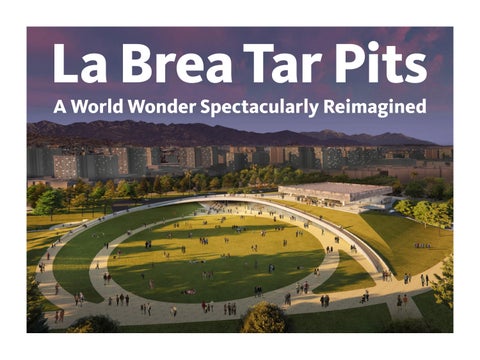
La Brea Tar Pits A World Wonder Spectacularly Reimagined
Beneath L.A.’s Miracle Mile is the real miracle.
2 | REIMAGINING LA BREA TAR PITS
The world’s preeminent Ice Age fossil site La Brea Tar Pits formed when crude oil seeped to the surface through cracks in the Earth’s crust, and over time, its lighter components evaporated, leaving behind thick asphalt that trapped and preserved prehistoric life. The millions of plant and animal fossils excavated at these Tar Pits tell the story of the Los Angeles Basin over the past 60,000 years.
REIMAGINING LA BREA TAR PITS | 3
Like no other place on Earth, La Brea Tar Pits is a time machine, a portal to worlds both old and new where we excavate the past to illuminate one shared future. 4 | REIMAGINING LA BREA TAR PITS
3.5 million specimens unearthed so far Captain George Allan Hancock owned the Rancho La Brea Oil Company where the Tar Pits’ fossils were discovered. In 1913, fearing that the collections would be scattered and taken from the community, Captain Hancock gave the exclusive excavation rights to Los Angeles County.
REIMAGINING LA BREA TAR PITS | 5
The findings here are so significant that the time period when mammoths, dire wolves, saber-toothed cats, and mastodons roamed Los Angeles is designated the Rancholabrean Land Mammal Age. 6 | REIMAGINING LA BREA TAR PITS
A UNESCO and International Union of Geological Sciences designated geoheritage site Southern California once looked like an African savanna with six species of big cats, camels, giant bison, mammoths, and mastodons. Through the Tar Pits, we can understand how these species either went extinct or adapted to thrive.
REIMAGINING LA BREA TAR PITS | 7
New discoveries are made here daily.
8 | REIMAGINING LA BREA TAR PITS
The only active paleontological site in an urban location Our research group investigates big questions related to climate science, evolution, and paleoecology. In addition to our own scientists, large multi-institutional projects bring experts from different disciplines together to help answer pressing research questions. More than a century of Tar Pits research has produced hundreds of scientific publications.
REIMAGINING LA BREA TAR PITS | 9
Now is the time to reimagine what La Brea Tar Pits can mean to the world.
10 | REIMAGINING LA BREA TAR PITS
The museum’s facilities have only been minimally updated since the 1970s. Pictured here, a new entry on Wilshire Boulevard will define a welcoming threshold between La Brea’s Hancock Park and the city, providing greater visibility to the museum and all that it offers. 11
We are seeking visionary philanthropic partners to help us reimagine the entire La Brea Tar Pits experience, what it can teach us, and how it can inspire us. 12 | REIMAGINING LA BREA TAR PITS
A renovated and expanded museum will bring more of La Brea’s incomparable collection to the public. Improved research and collections spaces will connect exhibit material and the process of excavation, conservation, curation, and research. The reimagined museum will include a new
theater, indoor and outdoor classrooms, and visible labs and collections. As a site for community and culture, the museum’s Central Lawn and Loop will provide a destination community lawn that amplifies the rich activities and events that take place in Hancock Park. 13
This is a once-in-a century project. 14 | REIMAGINING LA BREA TAR PITS
The reimagined Tar Pits will be one of the most consequential cultural and scientific sites in the world.
REIMAGINING LA BREA TAR PITS | 15
A global bucket-list destination 16 | REIMAGINING LA BREA TAR PITS
For the first time in 50 years, we will modernize this world wonder to realize its full potential. The new Page Museum and surrounding park will be: a dynamic civic anchor in the heart of Los Angeles the home of a new world-class scientific research hub: the Samuel Oschin Global Center for Ice Age Research an entirely new experience of wonder, discovery, and revelation a pipeline for new generations of scientists REIMAGINING LA BREA TAR PITS | 17
A dynamic civic anchor in the heart of Los Angeles To transform La Brea Tar Pits into a nexus of science, education, culture, wellness, and community, the world-renowned architecture and design firm of WEISS/MANFREDI was chosen through a global competition with major community involvement. New Wilshire entrance with greater visibility for museum and park Half a kilometer of park pathways and Central Lawn and Loop Accessible rooftop promenade and terrace Visitor amenities including the Tar Bar, retail store, picnic areas, shaded amphitheater, and restrooms
The architects’ visionary site plan amplifies what is already innately distinctive about La Brea Tar Pits while reimagining the Page Museum, excavation sites, and surrounding 18 | REIMAGINING LA BREA TAR PITS
Hancock Park as an inside-outside museum inextricably linked to the landscape and the surrounding community.
An elegant walking path will connect park to museum, giving visitors easy access to the museum’s main entrance and new vistas for enjoying the park.
This bold new entrance, conveniently reoriented to the parking lot, will allow for a contiguous zone of public amenities including a new gift shop, and shaded seating in an outdoor amphitheater. These amenities will be available to visitors whether they purchase a ticket or not.
19
Mornings on the Central Lawn and Loop will be a setting for health and wellness programs. As the day progresses, the lawn comes alive with visiting schoolchildren, museum tour groups, and
20
community members. In the evening and on weekends, the green will transform for events, outdoor films, food trucks, and festivals.
With an expansive, glass-fronted gallery facing the park, the renovated museum will share its marvels and connect to our communities and city like never before.
21
A New Scientific Research Hub We envision being the world’s leading center for Ice Age science and its relevance to our modern extinction and climate crises. The Samuel Oschin Global Center for Ice Age Research will be the intellectual core of La Brea Tar Pits, studying how ancient ecosystems responded to climate change and mass extinction, and what those lessons mean for us today. Transformed research facilities built for discovery, collection growth and preservation Dynamic workspaces for resident and visiting scientists Next-gen labs for microfossils and geochemical analysis
A cutting-edge, climate-controlled facility designed to protect and preserve the collection—ensuring its safety for generations to come. 22 | REIMAGINING LA BREA TAR PITS
Samuel Oschin Global Center for Ice Age Research Envisioned as an enduring center of excellence in pioneering transformative science, the Samuel Oschin Global Center for Ice Age Research encompasses research, excavation, scientific analysis, academic publishing, and collections management. Its impact and work will be woven into the landscape of Hancock Park, integrated into the George C. Page Museum, and infused into every Tar Pits program, driving the visitor experience and reaching global audiences. Indigenous communities within the Los Angeles Basin will serve as integral co-developers of research and educational programs. An Active Field Site The Tar Pits’ unique geologic conditions have led to exceptional preservation of Ice Age fossils over millennia. Ongoing excavations, spanning more than a century and projected to continue for decades, have yielded more than 3.5 million specimens. This ongoing work helps us to understand past environments, develop strategies for adapting to climate change, train new scientists, and educate K–12 students along with visitors to the site.
Interdisciplinary World-Class Research The Tar Pits’ rich fossil record attracts scientists, postdoctoral researchers, graduate and undergraduate students globally. In addition, our team goes to tar seeps around the world to train other scientists on the latest techniques and assist with excavations. Through the Samuel Oschin Global Center for Ice Age Research our findings will be translated into actionable knowledge for climate and conservation policy.
Incomparable Collections Distinguished by an extensive collection of dire wolves and saber-toothed cats, and one of the world’s largest bird fossil collections, the Samuel Oschin Global Center for Ice Age Research will be home to the Tar Pits’ 3.5 million specimens. Collections continue to grow with recent efforts focusing on plants, insects, fish, amphibians, reptiles, and small mammals, many of which still live in Los Angeles today. These new finds offer vital insights into past climate shifts and how species responded to environmental change.
Innovation and Preservation The fossils found at La Brea Tar Pits are preserved to such a degree that the compounds necessary for dating and paleoecological analyses are available to researchers. The Samuel Oschin Global Center for Ice Age Research scientists are developing and using new methods for analyzing ancient DNA, creating climate and extinction models, and building digital fossil archives and AI tools for ecological reconstruction.
29 23
Collaborative workspaces and labs will create new opportunities for resident and visiting scientists to unlock the secrets of the past through fossil research.
New research facilities will open doors to grow the museum’s collection in fascinating, often-overlooked realms like ancient plants, insects, and invertebrates.
24
Transformation for impact
Exhibits Education
Lobby, Retail, Restrooms Welcoming arrival space featuring staffed guest services and self-service kiosks for seamless ticketing and visitor support. A new gift shop will be accessible through the lobby and exterior breezeway.
Samuel Oschin Global Center for Ice Age Research Visitor Amenities
Samuel Oschin Global Center for Ice Age Research A new world-class research hub for transformative science bringing together interdisciplinary research, excavation, scientific analysis, incomparable collections, and preservation.
Exhibit Hall All-new, immersive exhibits tell the Tar Pits’ 60,000-year story through interactive, life-like experiences connecting Ice Age Los Angeles to past, present, and future.
Courtyard Dramatically reimagined with Ice Age plant species and engaging sculptures of La Brea animals, the new courtyard will be a flexible indoor–outdoor venue for education, programs, and large-scale events.
Pavilion The current retail area becomes a flexible, technology-enabled space for classes, lectures, and events with capacities ranging from 60 to 120 people, depending on the format.
Research and Collections Centralized, climate-controlled collections and labs bring 3.5 million specimens to life through visible storage, 10 public-view workstations, new chemical labs, and collaborative research spaces.
Classrooms Restrooms
Two technology-enhanced classrooms with built-in storage and exhibit access for student programs, trainings, and meetings—adaptable to a single large classroom.
Theater
Outdoor Classrooms
Expanded, immersive theater doubles capacity with 4K LED, surround sound, haptic seating, and flexible use for films and events.
The current museum entrance becomes a shaded, stepped seating classroom designed for immersive learning and school group orientations that can also serve as an event reception space.
25
A new experience of wonder, discovery, and revelation The Samuel Oschin Global Center for Ice Age Research will be a world-class research center. La Brea Tar Pits will continue to offer unique educational experiences and be a bucket-list travel destination. The entire collection will come to life through exhibits, active excavations, and labs that unleash the fun and mystery of scientific discovery. Enhanced and interactive exhibit spaces providing new experiential and narrative opportunities New visible collections with enhanced visible labs More than double the current interactive exhibitions for guests to enjoy
Visible collections storage area will provide greater accessibility to our important collections. 26 | REIMAGINING LA BREA TAR PITS
The Page Museum pioneered visible labs, revealing the research process to museum visitors for the first time. Visible labs enable a thematic connection between exhibit material and the
process of research. Connections between research and exhibitions serve as a reminder of the distinctiveness of this one-of-a-kind site.
27
A pipeline for new generations of scientists Expanded and enhanced spaces will help us deepen local support for public schools and students through initiatives such as our STEM and STEAM Pathways programs, internships and apprenticeships, and partnerships with community-based organizations. Indoor and outdoor classrooms Upgraded multi-use courtyard for programs and events New theater, classrooms, and pavilion for films, lectures, symposia, and events
A new education grove will be an outdoor classroom engaging park visitors in the process of excavation and placing them at the precipice of scientific discoveries. 28 | REIMAGINING LA BREA TAR PITS
From a large renovated courtyard to a multi-use classroom, a range of spaces will help expand the museum’s role as a formal and informal learning powerhouse for children, youth, and adults.
29
A new pavilion that overlooks the multi-use courtyard will create a dynamic setting for active programming at the reimagined museum.
30
Adjacent to the exhibits, a large flexible theater and the new classroom will greatly increase the capacity for programs, education, and events at the museum.
31
Where science and wonder come together
32 | REIMAGINING LA BREA TAR PITS
Of all the major cultural site projects happening around the world, none weave science, education, community and economic impact like this. And it is happening in Los Angeles, one of the most culturally influential places on Earth.
REIMAGINING LA BREA TAR PITS | 33
Major Scientific Contribution
Site Preservation Preserve Earth’s most important Ice Age fossil site which provides an unparalleled record of environmental change over the past 60,000 years.
Preeminent Research Through the Samuel Oschin Global Center for Ice Age Research, La Brea Tar Pits will be a preeminent research institution for understanding humanity’s interdependence with nature and convening global research collaborations.
Collections Access Expand access to our collections and leverage new and emerging research techniques that promise future discoveries.
34 | REIMAGINING LA BREA TAR PITS
Education and Inspiration
Museum District Anchor Anchor L.A. County’s museum hub adjacent to LACMA and the new Academy Museum, providing greater access to a globally important site and doubling the number of annual visitors to over 800,000 by 2029.
Education Access Expand powerful, immersive education and youth programming while doubling the number of schoolchildren reached to over 75,000 children a year.
Scientist Pipeline Develop scientific literacy for the next generation through education programs and the internships and apprenticeships in our STEM and STEAM Pathway programs.
REIMAGINING LA BREA TAR PITS | 35
Community Wellness and Thriving
Natural Oasis Provide an oasis of nature, gathering space, and urban shade that nurtures health, well-being, and community.
Economic Impact Generate significant local economic impact (over $750 million) and job creation (approximately 4,000) in construction and other adjacent industries and businesses.
Community Partnerships Create deep community partnerships, access, and investment.
36 | REIMAGINING LA BREA TAR PITS
Environmental Leadership
Next-Generation Stewardship Inspire future generations to steward a healthy planet through formal and informal education.
Ambitious Sustainability Adapt and reuse the current museum to preserve energy embodied in the original building as well as an all-encompassing, ambitious approach to energy/carbon impact, water use, ecology/landscaping, waste, health and wellness, and equity.
Environmentally Beneficial Support an environmentally beneficial site through new plantings of native and adaptive plant species, light pollution and heat island reduction, and garden design that is pollinator and bird friendly.
REIMAGINING LA BREA TAR PITS | 37
This is a legacy-making project. Now is the time to reimagine what La Brea Tar Pits can mean to the planet and our shared story. We invite you to join us.
38 | REIMAGINING LA BREA TAR PITS
Natural History Museums of Los Angeles County 900 Exposition Boulevard Los Angeles, CA 90007 Paul Bessire Chief Advancement Officer pbessire@nhm.org 213.763.3306
Design Lead, Museum and Park: WEISS/MANFREDI Architecture/Landscape/Urbanism Executive Architect: GRUENASSOCIATES