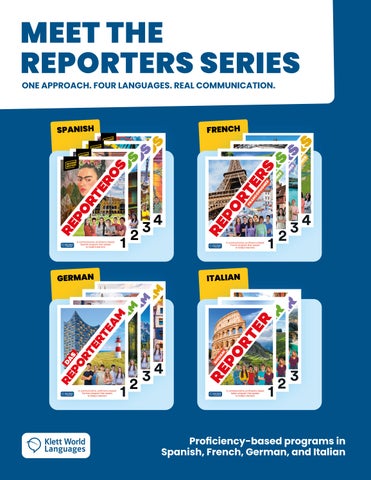
MEET THE REPORTERS SERIES ONE APPROACH. FOUR LANGUAGES. REAL COMMUNICATION.
SPANISH
FRENCH
GERMAN
ITALIAN
Proficiency-based programs in Spanish, French, German, and Italian KLETTWL.COM
THE REPORTERS APPROACH Students Become Reporters The REPORTERS series engages middle and high school students through project-based learning inspired by real-world scenarios. Students step into the role of reporters—exploring cultures, conducting interviews, and crafting narratives in the target language.
Built for Proficiency Fully aligned to ACTFL World-Readiness Standards
Can-Do statements guide every unit Three modes of communication
Authentic Content Students engage with contemporary materials that reflect current realities in Spanish, French, German, and Italian-speaking communities.
integrated throughout
Performance-based tasks with measurable outcomes
Research-Validated The REPORTERS series meets ESSA Tier 4 criteria, validated through rigorous analysis by Johns Hopkins University School of Education.
Klett World Languages
La Borinqueña, Edgardo Miranda-Rodríguez. Featured in Reporteros 1.
Integrated Technology
All programs available on The KWL Hub, an intuitive digital platform with: • Simplified assignment and gradebook tools • Progress tracking and reporting • LMS integration • ADA- and WCAG-aligned accessibility standards • 100% FERPA-compliant
AVAILABLE IN FOUR LANGUAGES Reporteros Revised Edition
©2027 | 4 levels | 6 units per level
4 UNIDAD
Un colegio para todo el mundo
LECCIÓN 1 ¿Cómo es tu colegio?
LECCIÓN 2 ¡Yo participo!
PROYECTO FINAL
Miniproyecto 1 Crear un folleto informativo de tu colegio ideal.
Miniproyecto 2 Crear un póster para un/a candidato/a a personero/a.
Crear un video para presentar nuestro colegio.
ESSENTIAL QUESTIONS
How do Colombian schools differ from American schools? What types of places, people, activities, and rules define student life?
Viajamos a Colombia para hablar de la vida en el colegio.
Students explore the Spanish-speaking world through authentic, real-world reporting projects. The Revised Edition features enhanced vocabulary tools, expanded teacher resources, and updated cultural materials that build proficiency from Novice Low to Intermediate High.
Bogotá Fuente: Banco Mundial, Ministerio de Cultura de Colombia
SPANISH
¿Qué más pues? Soy Juan José, de Bogotá.
COLOMBIA
Capital: Bogotá
Datos curiosos:
Ciudades importantes: Medellín, Cali, Barranquilla, Cartagena
• Es uno de los países con más biodiversidad del planeta.
Población: 50 millones de habitantes Idiomas: español y 65 lenguas nativas
• El nombre Colombia deriva del apellido del explorador Cristóbal Colón.
Comida típica: ajiaco, arepas, bandeja paisa, sancocho…
1 A. Mira la fotografía y lee la información. ¿De dónde es Juan José?
B. Mira el video. ¿Qué es lo que más le gusta de su país?
C. Escribe el nombre de: 1. una ciudad colonial 2. un/a artista
168 ı ciento sesenta y ocho
Reporteros 1
3. un escritor 4. un deportista
ciento sesenta y nueve ı 169
Reporteros 1
It includes LEO, an AI-powered conversation partner integrated into The KWL Hub. Students practice interpersonal communication through lesson-aligned conversations with immediate feedback.
FRENCH
Reporters francophones
4 UNITÉ
Mon lycée
LEÇON 1 Bienvenue au lycée
ESSENTIAL QUESTIONS
t Comment peut-on s’épanouir à l’école? How can you thrive at school? t Comment les activités de loisir peuvent-elles nous rassembler? How can leisure activities bring us together?
Mini-projet 1 Créer un emploi du temps idéal ou horrible
©2024–2026 | 4 levels | 6 units per level
LEÇON 2 Mon temps libre
PROJET FINAL
Mini-projet 2 Participer à une journée des talents
Créer une vidéo de présentation de votre école
On voyage à Fort-de-France, à la Martinique (France), pour parler de l’école et du temps libre. Fort-de-France
Students explore francophone cultures through real-world reporting projects and authentic materials. Each unit develops communication across the three modes while fostering cultural understanding and linguistic confidence.
MARTINIQUE (France)
Bonjour, les amis! Moi, c’est Mélissa, de Fort-de-France.
Brainstorming!
Curiosités:
• Quel est le climat à la Martinique?
• La Martinique est un département et région d’outre-mer (DROM) français.
• Quelles activités on peut faire à la Martinique? • Tu veux visiter la Martinique? Pourquoi?
1
• La langue officielle est le français, mais on parle créole aussi. • Sur l’île, il y a un volcan: la montagne Pelée.
A. Regarde la photo et lis les informations. Quelle est la nationalité de Mélissa? Elle habite où?
B. Regarde la vidéo et complète les phrases.
1. Fort-de-France est… 2. À Fort-de-France, Mélissa aime... 3. Le plat préféré de Mélissa, ce sont...
C. À deux, comparez vos réponses. Regardez à nouveau (again) la vidéo et vérifiez vos réponses. 146 ı cent quarante-six
GERMAN
Das Reporterteam
©2026–2028 | 4 levels | 6 units per level
4 KAPITEL
Unité 4 • Reporters francophones 1
Mein Lieblingsfach
Miniprojekt 1 Create an example of an ideal or a horrible school schedule
LEKTION 2 Mach mit!
ABSCHLUSSPROJEKT
Miniprojekt 2 Create and present an ad for a new club at your school
Present your school in a video report
ESSENTIAL QUESTIONS
Wir reisen nach Dresden, in Deutschland, und sprechen über Schule und Freizeit.
Hallo Leute! Ich bin Sophie und ich komme aus Dresden.
DEUTSCHLAND Dresden
Brainstorming!
Das ist interessant
• Wie heißt der Fluss (river) in Dresden?
• Seit 1990 ist Dresden die Hauptstadt des Bundeslandes Sachsen, im Osten von Deutschland.
• Ist Dresden eher eine historische oder eine moderne Stadt (city)? • Was kann man wohl in Dresden machen?
• Dresden hat viel Kultur und Natur. • In Dresden sprechen viele Leute Sächsisch, einen deutschen Dialekt.
1 A. Sieh dir das Video an.
Nenne zu jeder Kategorie eine Information.
1. Geografie 2. Natur
3. Kultur 4. Traditionen
B. Seht das Video noch einmal und überprüft eure Antworten zu zweit.
144 ı hundertvierundvierzig
4 UNITÀ
Giovani reporter
LEKTION 1 Was haben wir jetzt?
Was macht eine gute Schulzeit aus? What makes a good school experience? Wie können Aktivitäten die Gemeinschaft stärken? How can activities bring us together?
Students explore German-speaking cultures through engaging reporting projects that connect language and culture. Each level develops communication skills across interpretive, interpersonal, and presentational modes using authentic resources and performance-based tasks.
ITALIAN
cent quarante-sept ı 147
Reporters francophones 1 • Unité 4
©2027–2028 | 3 levels | 6 units per level
Das Reporterteam 1 • Kapitel 4
La mia scuola
hundertfünfundvierzig ı 145
Das Reporterteam 1 • Kapitel 4
LEZIONE 1 Com’è la tua scuola?
LEZIONE 2 Il mio tempo libero
PROGETTO FINALE
Miniprogetto 1 Creare il proprio orario scolastico ideale
Miniprogetto 2 Partecipare a una Giornata del Talento
Creare un video di presentazione della propria scuola
ESSENTIAL QUESTIONS
Come puoi crescere e fare progressi a scuola? How can you thrive at school? Come ci possono avvicinare le attività del tempo libero? How can leisure activities bring us together?
Andiamo a Gallipoli, in Puglia, per parlare della scuola e del tempo libero. Gallipoli
Students explore Italian culture through real-world reporting projects that bring language learning to life. Each level builds communication skills and cultural competence through authentic materials and project-based learning.
Ciao a tutti! Mi chiamo Aurora e vivo a Gallipoli. Brainstorming!
Curiosità
• Quali attività si possono fare in Puglia?
• La Puglia è conosciuta come “il tacco dello stivale” per la sua forma e posizione che ricorda appunto il tacco (heel) di uno stivale (boot).
• Secondo te, che tipo di piatti tipici ci sono in Puglia? • Vuoi visitare la Puglia? Perché?
• La Puglia è bagnata da due mari: il mare Adriatico e il mar Ionio.
1 A. Osserva la foto e leggi il testo della vignetta. Dove vive Aurora?
B. Guarda il video e completa le frasi. 1. Gallipoli è… 2. A Gallipoli, Aurora ama… 3. Il piatto preferito di Aurora sono…
C. In coppia, confrontate le vostre risposte. Guardate
nuovamente (again) il video e verificate le vostre risposte.
146 ı centoquarantasei
Giovani reporter 1 • Unità 4
Giovani reporter 1 • Unità 4
centoquarantasette ı 147
klettwl.com/reporters
COMPLETE PROGRAM COMPONENTS FOR TEACHERS
FOR STUDENTS • Student Book (print + digital version) • Workbook (print + digital version) • Unit projects and performance-based tasks • Self-check quizzes for independent practice • Authentic materials and cultural content • And much more
• Annotated Teacher’s Edition (print + digital version) • Proficiency-based assessment plan with rubrics • Differentiation and Heritage Learner Worksheets • Detailed lesson plans with Can-Do alignment • Supplemental resources to support instruction • And much more
THE KWL HUB • Intuitive digital learning environment • Assignment and gradebook management • Analytics and progress tracking • LMS integration for district use • Meets ADA and WCAG accessibility standards • FERPA-compliant data security • And much more
WHY TEACHERS CHOOSE REPORTERS •
Active Learning Students take ownership of their learning through authentic reporting projects.
•
Communicative from Day One Real-world communication practice across interpretive, interpersonal, and presentational modes.
•
Culturally Rich Contemporary perspectives that connect students to communities around the Spanish-speaking world.
•
Proficiency-Building at the Core The REPORTERS series is designed around a clear proficiency pathway. Each unit, task, and assessment aligns with ACTFL Can-Do Statements, helping students move confidently from Novice to Intermediate levels.
•
Research-Based ESSA Tier 4 validated by Johns Hopkins University School of Education, ensuring quality and effectiveness.
REPORTERS Series Spanish • French • German • Italian Contact your Klett World Languages representative to request examination copies. klettwl.com/find-your-rep KLETT WORLD LANGUAGES
8411572958026