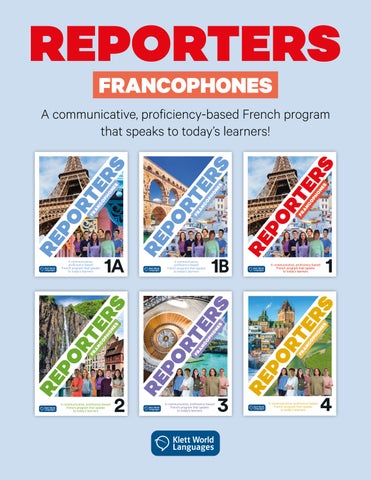
FRANCOPHONES A communicative, proficiency-based French program that speaks to today’s learners!
KLETT WORLD LANGUAGES LANGUAGE SPECIALISTS KLETT WORLD LANGUAGES is a publishing house specializing in print and digital instructional materials for learning and teaching world languages. Our mission is to help students become global citizens by developing their intercultural and critical thinking skills through language learning. We aim to help students learn and use language in real-life situations by creating engaging and meaningful content that sparks their curiosity and motivates them to learn. We strongly believe that teachers play a key role in language learning, and part of our mission is to support them and to provide ample opportunity for professional development.
THESE ARE OUR VALUES
Having them is not enough. We live by them.
1 COMMITMENT Because everyone on the core KWL team has a background in education and works closely with educators and students, our commitment goes far beyond our daily work. We understand the needs of educators and students and we are passionate about looking for solutions and tools to help them succeed.
3
AFFORDABILITY
We are committed to providing high-quality print and digital content at affordable prices to all who want to learn a language. We guarantee lower prices for high-quality content and simple, easy-to-use technology.
5 COMMUNICATION We view languages as tools for communication and action. To learn a language and build authentic communicative competency, students need a realistic context, a true need to communicate, a focus on meaning, and the right linguistic resources. That is what we provide in our educational materials.
2 INNOVATION Our educational materials focus on the most current pedagogical methodology. They follow the ACTFL Guidelines for Proficiency, include Can-Do statements, and address the 5 Cs. Our digital resources provide original and authentic content via a simple and easy-to-use platform.
4 EDUCATOR SUPPORT We see educators as our partners, and the core of our mission is to support them by providing professional development opportunities, highquality documents and activities, and instructor resources in an easily accessible format.
6 GLOBAL PERSPECTIVE Our content is created to help students use language to communicate and interact with other communities and cultures both in the United States and abroad. Our books present a respectful, modern, and open-minded perspective of our world and its cultures that allows students to dismantle stereotypes and to cultivate an awareness of global concerns.
Why REPORTERS FRANCOPHONES?
REPORTERS FRANCOPHONES is a proficiency-based French program that speaks to today’s learners. It follows a communicative, task-based approach to learning through projects inspired by real-world scenarios. Our program offers authentic, engaging content that awakens students’ curiosity about the French-speaking world.
REPORTERS FRANCOPHONES is... A student-centered, 21st century, comprehensive language and culture program A communicative program where real-world language and projects take center stage A fun, meaningful, and motivating approach to the French language A gateway to culture and language throught authentic materials An invaluable tool for differentiation and accessibility A program striving to make learning engaging, relevant, and impactful
ACTFL World-Readiness Standards and a proficiency-based aproach lie at the heart of REPORTERS FRANCOPHONES:
Learning objectives in the form of Can-Do Statements leading to the completion of final projects
The three modes of communication —interpretive, interpersonal, and presentational— are integrated into the lesson sequences
Standards-based activities that integrate the 5 Cs throughout each unit
Essential questions for each lesson promote discussion and foster critical thinking skills
A communicative approach to grammar in which students first focus on meaning, then on structures
Integrated Performance Assessments (IPAs) that incorporate the three modes of communication
Program Organization REPORTERS FRANCOPHONES offers four levels that take students from a Novice Low to an Intermediate High proficiency level in French.
Series’ components include: • Student Edition • Workbook • Annotated Teacher's Edition • Digital versions on Keep reading to learn more about each of the components!
The KWL Hub is a platform offering digital content and resources for students and teachers who work with REPORTERS FRANCOPHONES. It is designed with a clear purpose in mind: to improve teaching and learning experiences in middle school and high school environments with engaging content and helpful, user-friendly tools. The KWL Hub is easy, flexible, and intuitive for all users. It includes a variety of resources, as well as robust functionalities that allow teachers to personalize the textbooks, assign homework, correct students’ work, offer feedback, create their own content, track the progress of each student, etc.
The KWL Hub is available as a website and as an app.
Compatible with: - Smartphones and tablets: iOS and Android. - Computers: Windows, Mac, Chrome OS and Linux.
The KWL Hub features the following components and resources: • interactive version of the Student Edition • interactive version of the Workbook • eBook version of the Student Edition • eBook version of the Workbook • eBook version of the Teacher’s Edition • assessment program • grammar tutorials (videos) • pronunciation tutorials (videos) • scripts for all audio recordings • closed captioning on all videos for students with hearing impairments • audio recordings of all readings for students with visual impairments • differentiation worksheets • assessment rubrics • self and peer assessment rubrics • and many more!
INTERACTIVE VERSIONS OF THE STUDENT EDITION AND THE WORKBOOK
EBOOK VERSIONS OF THE STUDENT EDITION, THE WORKBOOK, AND THE ANNOTATED TEACHER'S EDITION
Interactive, browser-friendly versions with sizeadaptable pages that allow for a full digital learning experience. Students can write directly in the writing fields, record themselves, self-correct, re-do activities, attach files and send all of their work to the teacher.
eBook versions that allow teachers and students to browse through all the pages and grant them access to all of the video and audio files.
Scope and Sequence Level 1
Reporters francophones 1 C’est parti!
COMMUNICATION
• spelling and the French alphabet • greeting people and saying goodbye • introducing oneself • expressing likes • identifying and asking about objects • asking for information • apologizing
LANGUAGE
VOCABULARY • borrowed French and English words • classroom objects • days of the week and months • numbers from 0 to 31 • weather and seasons • everyday words and expressions in French • useful classroom expressions STRUCTURES • Je m’appelle… • Tu aimes…? / J’aime… / Moi aussi. • tu and vous
CULTURE
• Famous Francophone people, landmarks, and objects • French state and city names in the United States • Gestures and greetings • Courtesy in French-speaking countries • Seasons around the French -speaking world (both hemispheres) • Celebrations and traditions in French-speaking countries
Reporters francophones 1
1 J’habite à Montréal What are the different ways in which we greet each other? What kinds of information do we typically share when introducing ourselves? MINI-PROJET 1 Write a skit in French for your theater club MINI-PROJET 2 Create your Carnet de français PROJET FINAL Interview famous Francophone people for a talk show
2 Je suis française How are origin and languages important in our lives? What do our interests say about us? MINI-PROJET 1 Create a map to represent your talent agency’s client profiles MINI-PROJET 2 Create a poster to present your likes and dislikes PROJET FINAL Create a profile for a social media platform
3 Ma famille et mes amis What makes a family? How does style reflect someone’s personality? MINI-PROJET 1 Présenter les personnes de ton entourage MINI-PROJET 2 Écrire un post sur le style d’une célébrité PROJET FINAL Créer et présenter un personnage de BD et son entourage
COMMUNICATION
LANGUAGE
• greeting people and introducing oneself • identifying professions and introducing others • asking about ages and telling one’s age • asking and responding to questions about personal data
VOCABULARY • people • polite expressions • professions • numbers up to 69 • mathematical equations
• identifying countries and saying where you live • identifying nationalities and professions • identifying languages people speak • identifying countries where French is spoken • expressing likes and dislikes about activities • expressing likes and dislikes about animals
VOCABULARY • countries and nationalities • languages • continents • leisure activities • pets
• presenting family members and people who are close to you • describing personalities • asking for and giving information about family relationships • describing what people wear • describing someone’s physical appearance
VOCABULARY • family relationships • personality descriptions • physical descriptions • clothing and accessories • style • colors STRUCTURES • possessive adjectives • adjective agreement • adverbs of intensity • the present tense of mettre
STRUCTURES • subject pronouns • the present tense of être • noun agreement • definite articles: le, la, l’, les • the present tense of avoir • the present tense of -er verbs • question words • expressing dates
STRUCTURES • prepositions with country names • adjectives of nationality • indefinite articles: un, une, des • c’est, il/elle est, ce sont, ils/ elles sont • aimer, adorer + infinitive / noun • the negative form • noun agreement • the pronoun on
CULTURE
• languages spoken in Quebec • greetings in Francophone countries • famous Francophone Canadians • le Cirque du Soleil • la Fête nationale du Québec • being Francophone in Canada • celebrations in Francophone countries
• the TV series Lupin and Arsène Lupin • Francophone celebrities • la francophonie • a TV series set in Paris • the singer Pomme and concert venues in Paris • e-sports in France • la SPA, an animal protection organization • animals in public places in France • nature in Paris
• La famille Bélier, a French movie • the Gainsbourg family • the city of Grenoble, France • shopping in France • French fashion influencers • street art in France • the metric system • Lou!, a French movie and comic book • Kevin Germanier, a Swiss fashion designer
Scope and Sequence Level 1
Reporters francophones 1
4 Mon lycée How can you thrive at school? How can leisure activities bring us together? MINI-PROJET 1 Créer un emploi du temps idéal ou horrible MINI-PROJET 2 Participer à une journée des talents PROJET FINAL Créer une vidéo de présentation de votre école
5 Bon appétit! What makes a healthy diet? How does food reflect Francophone cultures? MINI-PROJET 1 Créer une vidéo de conseils pour bien manger MINI-PROJET 2 Jouer une scène dans un restaurant PROJET FINAL Imaginer un foodtruck de cuisine francophone
6 Bienvenue à Nantes What makes a city a good place to live? How do the ways people shop differ across cultures? MINI-PROJET 1 Présenter ta ville ou ton quartier à des touristes francophones MINI-PROJET 2 Créer un vide-grenier dans la salle de classe PROJET FINAL Créer un itinéraire touristique dans ta ville ou ta région
COMMUNICATION
LANGUAGE
CULTURE
• identifying places in a school • describing school schedules • asking and answering questions about school schedules • saying when and how often you do activities
VOCABULARY • school areas, subjects and schedules • expressions of frequency • levels of education • sports and leisure activities • places in town STRUCTURES • il y a / il n’y a pas • possessive adjectives • telling time • question words • Est-ce que...? • the present tense of faire • the present tense of aller • contractions with articles
• the French grading system • a lycée in Martinique • school systems in Francophone countries • school schedules in the Francophone world • la Journée nationale du sport scolaire • popular sports and activities in Francophone countries • athletes with ties to Martinique
• naming food items • making suggestions for healthy eating • expressing preferences • comparing eating habits • ordering and paying for a meal in a restaurant • shopping for groceries • expressing needs • expressing hunger and thirst
VOCABULARY • foods • meals and eating habits • dining out and menus • adverbs of quantity • stores and merchants • going grocery shopping STRUCTURES • partitive articles • the manger and prendre • il faut + infinitive • the pronoun on (continued) • the futur proche • chez / à
• le couscous, a popular Moroccan dish • popular dishes from around the Francophone world • food products and specialties associated with French cuisine • le dirham, the Moroccan currency • customs in French restaurants • the metric system (continued) • les souks • street food in the Francophone world
• describing places in a city • telling what means of transportation you use • locating places on a map • asking for, giving, and following directions • choosing a gift and telling where to buy it • shopping for gifts and clothing • asking about and telling prices
VOCABULARY • places in town and directions • means of transportation • at the clothing store • gift items • numbers from 70 to 1,000 • types of stores STRUCTURES • prepositions of location • the present tense of pouvoir • the imperative • ordinal numbers • ce, cet, cette, ces • stem-changing verbs: acheter and préférer
• museum discounts for young people • different forms of transportation in Nantes • Les Machines de l’île • Le Lieu Unique, a contemporary cultural center • the Achetons local! movement in France • store hours and shopping etiquette • places to shop in France
Scope and Sequence Level 2
Reporters francophones 2 C’est reparti!
COMMUNICATION
LANGUAGE
CULTURE
• identifying classroom objects • understanding personal information • describing languages, nationalities, and countries • describing likes and dislikes and talking about leisure activities • asking for and giving information about family relationships • describing someone’s physical appearance and personality • describing what people wear • understanding a menu • asking for information and giving directions
VOCABULARY • classroom objects • personal information and professions • languages, nationalities, and countries • numbers • sports and leisure activities • family relationships, physical description, and personality • clothing items and colors • food items • means of transportation and vocabulary about cities
• famous Francophone people • landmarks in Francophone countries • school supplies in French schools • dishes from Francophone countries • Francophone cities
STRUCTURES • definite and indefinite articles • noun agreement • the present tense of être, avoir, regular -er verbs, aller, préférer, prendre, and pouvoir • faire and jouer + sports, games, and musical instruments • the futur proche • possessive adjectives • demonstrative adjectives • partitive articles • à / chez • prepositions of location
Scope and Sequence Level 2
Reporters francophones 2
1 Ma semaine How do daily routines differ around the world? How do young people enjoy their free time? MINI-PROJET 1 Créer un vlog sur une journée type MINI-PROJET 2 Discuter avec des amis/es pour organiser une sortie PROJET FINAL Présenter un programme d'activités pour un week-end en Belgique
2 Sur la route What are the benefits of travelling? What makes traveling memorable? MINI-PROJET 1 Créer une brochure pour des touristes francophones MINI-PROJET 2 Décrire des expériences de vacances marquantes PROJET FINAL Créer un carnet de voyage à la Réunion
3 Il était une fois... How has daily life changed in the last century? How do experiences and memories influence us? MINI-PROJET 1 Créer un poster sur l'enfance MINI-PROJET 2 Raconter une anecdote à l'aide d'un sketchnote PROJET FINAL Participer à un concours de nouvelles
COMMUNICATION
LANGUAGE
CULTURE
• asking and responding to questions about daily schedules • asking and responding to questions about your daily routines • exchanging opinions about music • describing what people do at the weekend • proposing activities, accepting, refusing, and offering alternatives
VOCABULARY • parts of the day • meals and daily routines • expressions for telling time and linking words • music genres • interests and fun activities • expressions of frequency • expressions to propose, accept, and refuse activities
• dining habits of Belgians • famous Belgian comics and artists • the city of Brussels • festivals in Belgium • things to do in Brussels • the Belgian music scene
• describing the geography of a region or country • expressing preferences about travel • promoting sustainable tourism • recounting a past travel experience • describing a travel route
VOCABULARY • geography and landscapes • trips and sustainable tourism • tourist activities • means of transportation • accomodations • adjectives to describe experiences
• describing education in the past • describing objects from the past • narrating a past experience • asking for additional information • understanding and writing a biography • understanding and telling a story in the past
VOCABULARY • education, games, and objects in the past • vocabulary and expressions related to the past • numbers above 1,000 • conversational reactions • expressions used in biographies • past tense markers and logical transition words STRUCTURES • the imparfait • negative forms: ne ... jamais, ne ... rien, ne ... personne, ne ... aucun/e, ne ... plus • the passé composé vs the imparfait
STRUCTURES • the present tense of finir, sortir, lire, and dormir • reflexive verbs • the pronoun y • the present tense of venir and vouloir • stressed pronouns
STRUCTURES • adjective placement • the present tense of connaître and savoir • the passé composé with avoir and être
• seasons in the Southern Hemisphere • Réunion Island • Unesco World Heritage sites at Réunion Island • the festival Embarquement immédiat • outdoor activities at Réunion Island • Francophone travel literature
• games and education in Francophone countries in the past • La Boum, a famous French movie • the city of Marseille • French writer Marcel Pagno • Le Temps des Secrets, a French novel and movie • Le Petit Prince, a novel by Antoine de Saint-Exupéry • Francophone literature about Marseille
Reporters francophones 2
4 Je me sens bien What factors contribute to emotional well-being? What factors influence physical health? MINI-PROJET 1 Animer un forum sur le bien-être des adolescents MINI-PROJET 2 Présenter les bénéfices physiques et émotionnels d'une activité que vous aimez PROJET FINAL Créer des vidéos pour une campagne sur la santé physique et psychologique
5 Chez moi How do homes reflect the culture of a country? How do households in different countries share chores? MINI-PROJET 1 Imaginer le logement parfait pour une famille MINI-PROJET 2 Créer une campagne sur le partage des tâches ménagères PROJET FINAL Faire une simulation de colocation et de l'organisation des tâches ménagères
6 Un monde meilleur What do people strive to improve their communities? How will our actions impact the world in the future? MINI-PROJET 1 Créer une affiche pour promouvoir une école plus écologique MINI-PROJET 2 Animer un débat sur la vie du futur PROJET FINAL Créer un magazine sur le futur
COMMUNICATION
LANGUAGE
CULTURE
• expressing emotions and telling how you feel • asking and telling people what they need, should or must do to feel better • describing the health benefits of physical activity • giving advice • describing symptoms • asking and giving advice about health and well-being
VOCABULARY • emotions and moods • personal well-being, relationships, and healthy lifestyle habits • expressions for giving advice • parts of the body • physical symptoms, ailments, and remedies • useful phrases at the doctor's office STRUCTURES • the imperative of irregular and reflexive verbs • relative pronouns • the pronoun en • the interrogative form: question formation with inversion
• the city of Bordeaux • French wellness campaigns • the happiest places to live in the Francophone world • the French healthcare system
• describing households and buildings • asking for information and • describing housing needs • expressing preferences about interior design and decoration • asking for help with chores • telling what you have to do • understanding a campaign about sharing chores
VOCABULARY • types of homes • parts of a house • furniture • style, decoration, and materials • adjectives to describe a room • household chores STRUCTURES • Il n'y a que... • comparatives • superlatives • the present tense of devoir • the verbs ending in -ayer, -oyer, and -uyer • être en train de... • venir de...
• writer and former Senegalese president, Léopold Sédar Senghor • houses in Dakar • Senegalese architecture and history • a Francophone campaign about equality at home • Senegalese art
• understanding a recycling campaign • giving and supporting your opinion about helping others • reacting and making predictions about the future • imagining and describing lodging in the future • making predictions about the future of our planet
VOCABULARY • recycling and materials • community life and city rules • phrases to express an opinion • changes • new technologies and types of energy • future tense markers STRUCTURES • the present tense of jeter • direct object pronouns • indirect object pronouns • the future tense • si clauses in the present and future
• recycling in France • volunteer associations • the city of Strasbourg • the future of housing • cities of the future
Scope Level 3 TABLEand OF Sequence CONTENTS
Reporters francophones 3 C’est reparti!
14
COMMUNICATION
• comparing daily schedules • describing past travel experiences • describing what cities used to be like in the past • making a grocery shopping list • expressing emotions and giving advice • describing and comparing housing and holiday accommodations • describing housing in the future and making predictions about the future • discussing sustainability and solidarity
LANGUAGE
VOCABULARY • daily routines • activities • linking words • landscapes • trips and experiences • means of transportation • places in a city • food and quantities • feelings • health and well-being • housing • the environment • technology and society • clothing • helping others
CULTURE
• famous Francophone people • landmarks in Francophone countries • French cities in the past and the present • dishes from Francophone countries • Celebrations and traditions in French-speaking countries
STRUCTURES • reflexive verbs • the passé composé • the imparfait • the pronoun y • partitive articles • adverbs of quantity • the present tense of the verb devoir • the imperative • the relative pronouns qui and que • comparatives and superlatives • the futur simple • making hypotheses: si clauses + futur simple • direct and indirect object pronouns
Reporteros 1
Reporters francophones 3
1 Ma génération What is important to teenagers today? How do we build friendships? MINI-PROJET 1 Présenter un collage sur ta vie et tes centres d'intérêt MINI-PROJET 2 Enregistrer un podcast pour raconter une rencontre amicale PROJET FINAL Créer un dossier de présentation des personnages d'une web-série
2 L'art de faire la fête What makes French gastronomy special? How do celebrations reflect the culture of a society? MINI-PROJET 1 Participer au casting d'une émission de cuisine MINI-PROJET 2 Présenter une fête de ton pays PROJET FINAL Préparer une exposition pour présenter une fête francophone
3 Hyper-connectés What is the value of the Internet for young people today? What are our responsibilities as digital citizens? MINI-PROJET 1 Créer un test pour savoir si on est «accro» au portable MINI-PROJET 2 Créer un guide de bonnes pratiques sur Internet PROJET FINAL Participer à un débat sur l'authenticité sur Internet
Reporteros 1
COMMUNICATION
LANGUAGE
• understanding young people’s personal preferences, their interests, and their concerns • describing positive and negative aspects of being a teenager • describing fictional characters and their relationships • understanding and telling personal stories • telling how you met someone special
VOCABULARY • interests and concerns • personalities • adolescent life • feelings • stages of life • relationships • linking words • expressions for reacting to an anecdote
• describing traditional dishes, their ingredients, and their history • understanding and giving cooking instructions • understanding documents about food waste and finding solutions • discussing social customs • exchanging opinions about celebrations
VOCABULARY • food • tastes • food waste • expressions for cooking • expressions of obligation, permission, and prohibition • social habits and celebrations • expressions for habitual actions
STRUCTURES • emphasis with ce que and ce qui • adverbs ending in -ment • reciprocal verbs • past participle agreement with avoir • the past tenses: the imparfait and the passé composé
STRUCTURES • impersonal structures • pronouns with commands • the pronoun en • interrogative forms • indefinite adjectives
• understanding and sharing information about internet habits • exchanging opinions about people's behavior on social media • recommending best practices for being online • recognizing misinformation • writing emails efficiently and politely
VOCABULARY • social media and activities on the internet • expressions to agree and disagree with others • digital responsibility, technology, and news • useful phrases for writing emails STRUCTURES • gerunds • the present subjunctive • the indicative or the subjunctive to express purpose, opinions, doubt or certainty • the subjunctive and the infinitive to express recommendations
CULTURE
• a Tunisian Internet platform and radio station for teens • concerns of Francophone young people • interesting places to visit in and near Tunis • Les Bracelets rouges, a popular French TV series • the French classic novel Le grand Meaulnes • the making of the Tunisian movie Sous les figues
• Diego Alary, a young French chef • dishes from Francophone countries • French zero-waste campaigns • food waste apps • the Fête du citron • the Fête de la musique • French customs • Louisiana and its celebrations
• Canadian illustrator Bach and her comic book Tant pis pour les likes • Quebec's will to protect French and avoid Anglicisms • Canadian influencers • French and Canadian commissions regulating data privacy laws • April Fools' Day • netiquette • digital arts
15
Scope and Sequence Level 3
Reporters francophones 3
4 Futurs talents How can we develop our skills and abilities for the future? How can we prepare for our future careers? MINI-PROJET 1 Créer et présenter une carte mentale sur tes projets MINI-PROJET 2 Répondre à une annonce avec ton CV vidéo PROJET FINAL Organiser un échange de services
5 Vivre ailleurs What can we learn from traveling? What is it like to have more than one cultural identity? MINI-PROJET 1 Créer une brochure pour donner des conseils pour un échange linguistique MINI-PROJET 2 Écrire le récit biographique d'une personnalité ayant une histoire de migration PROJET FINAL Participer à un forum pour encourager des élèves à partir à l’étranger
6 Fictions What makes books, TV series, and movies interesting? How does art reflect the perspectives of its cultures? MINI-PROJET 1 Créer un recueil de recommendations de livres de la classe MINI-PROJET 2 Organiser une mini exposition de tableaux PROJET FINAL Décrire un tableau et imaginer une histoire
COMMUNICATION
LANGUAGE
CULTURE
• describing skills and abilities • identifying the professions that suit you best • explaining what you would like to do in the future • understanding a job offer and discussing the kind of job you would like to have • understanding a video résumé
VOCABULARY • abilities, skills, and attributes • professions and personality traits • time expressions • the world of work STRUCTURES • adverbs of manner bien, mal, vite • demonstratives pronouns • the conditional tense • relative pronouns • si + present tense, present tense or imperative • the subjunctive to express wishes and hopes
• a professional fair in Tahiti • jobs in France • media outlets about professional orientation • remarkable women from French Polynesia • summer jobs in France • the Service Civique • a recruitment campaign for healthcare workers • an inclusive job: sign singing
• identifying reasons to study abroad and encouraging people to do so • understanding and giving advice for going abroad • understanding and telling stories about past events • understanding and recounting changes related to immigration experiences • understanding the experience of a teenager from an immigrant family
VOCABULARY • travel • living abroad experiences • clothing and luggage • migration • biculturalism • time markers STRUCTURES • the pronoun dont • possessive pronouns • the plus-que-parfait • negative forms • past tenses
• linguistic exchanges • tips to prepare to study abroad • the Cité Internationale Universitaire de Paris • immigration in France • the Musée de l'histoire de l'immigration • comic books describing immigration experiences
• taking a test about literary genres and understanding descriptions of imaginary situations • summarizing the plot of a story • understanding and retelling someone else's opinion of a book • describing a painting and making hypotheses about what is happening in the scene • narrating a story about an event in the past
VOCABULARY • literary and film genres • book and film reviews • recommendations • words and expressions to summarize a plot • words and expression to describe art • words and expressions to describe images • linking words STRUCTURES • si + imparfait, conditional • reported speech • passive voice
• Francophone literature • Francophone movies and TV series • art from Francophone countries
Scope and Sequence Level 4
Reporters francophones 4
1 Choix de vie
What impact do our choices have on our future and that of others?
COMMUNICATION • interpreting an infographic and summarizing information about children in Senegal • understanding an article about a special type of school in Senegal • understanding a video about sports and reflecting on its importance in a community • understanding an article about Gnima Faye and discussing the work of the association she created
• interpreting an article about the second-hand clothing market in Senegal • interpreting a video and writing an argumentative text on second-hand clothing • showing interest and asking for details in an informal conversation • writing a cover email to apply for a training program • comparing and contrasting information about music styles in different cultures
2 Un pour tous, tous pour un COMMUNICATION • interpreting an infographic about languages in Switzerland and creating one to present languages spoken in one’s country • understanding an article about Romansh and suggesting ways to support minority languages • understanding an article about stereotypes and discussing and evaluating clichés • understanding a video about the Swiss accent and reflecting on linguistic variations
Reporteros 1
• writing a formal response to an email indicating one’s interest in school activities • understanding a conversation in a linguistic exchange and engaging in a similar conversation • understanding a literary text and sharing experiences • understanding a video about job opportunities in Switzerland and discussing the experiences of crossborder workers • analyzing an article about young expats in Switzerland and writing an argumentative text
PROJET Créer une vidéo pour motiver des gens à FINAL participer à un projet local
LANGUAGE VOCABULARY • analyzing an infographic • education • difficulties and solutions • sports and sports values • helping others • clothing • trade • writing an argumentative text • applications • informal conversations • cover letters / emails • music and instruments • oral presentations • linking words
STRUCTURES • percentages • comparatives • il y a, pendant, and depuis • expressing hopes and wishes • the gerund • infinitives as subjects of sentences • making recommendations • interrogative forms
CULTURE • information about Senegal • the situation of children in Senegal • football manager Aliou Cissé and a special type of school in Senegal • athlete Abdou Diallo and the Jeux olympiques de la jeunesse • athlete Gnima Faye and her association • the second-hand clothing market in Senegal • the école Kourtrajmé • music in Senegal and in Brittany (France)
résenter un programme d’activités pour How can speaking more than one PROJET P mieux faire connaître la langue française et language give us opportunities? FINAL promouvoir son apprentissage
LANGUAGE VOCABULARY • linguistic and cultural identity • analyzing an infographic • clichés • accents • learning a language • writing formal emails • linguistic exchanges • feelings • personal relationships • the world of work and working conditions • cross-border workers • writing an argumentative text • linking words
STRUCTURES • the passive voice • reported speech in the past • making suggestions • the present conditional • the past conditional • the passé simple • emphasizing
CULTURE • information about Switzerland • national languages in Switzerland • the Romansh language • Swiss customs and clichés • the Swiss accent • reasons to learn a foreign language • L’Enfant du placard, a novel by Swiss author Tiffany Jacquet • the enfants du placard in Switzerland • cross-border workers and expats in Switzerland
17
Scope Level 4 TABLEand OF Sequence CONTENTS
Reporters francophones 4
3 Le département vert COMMUNICATION • reading and interpreting an infographic about the richness of the Amazon rainforest • interpreting a video about a project regarding biodiversity in French Guiana and recording a podcast • interpreting an article about the Centre spatial guyanais and discussing the history of France’s space quest • interpreting a video about the CSG and writing an article about it • asking for a favor in an informal conversation
• understanding and replying to a formal message and negotiating terms and conditions • understanding an article about artificial intelligence and discussing its role • interpreting an article about the risks of AI and writing one about its impact on society • comparing and contrasting two inventions in two different countries
4 La Bretagne, terre d’émotions COMMUNICATION • analyzing an infographic about music and discussing cultural and artistic activities • understanding a video about music from Brittany and describing its characteristics and evolution • interpreting the meaning of a song and writing a chorus • understanding an interview with an artist and discussing creative processes, then reading about and discussing music and emotions
18
• understanding a description of a town in a literary excerpt and writing about a childhood home • understanding and providing details about artistic events • replying to a formal email to suggest ideas for an art project in one’s community • understanding a video about a legend and presenting a place with ties to a famous myth or legend • understanding an article about important tourist sites and writing a blog about iconic sites in one’s area
How do scientific and technological innovations impact the environment and society?
PROJET Créer un podcast sur les innovations FINAL scientifiques et technologiques les plus intéressantes du siècle
LANGUAGE
CULTURE
STRUCTURES VOCABULARY • superlatives • wildlife • nature and its protection • making • analyzing an infographic recommendations • the present tense and • space travel and its the futur simple difficulties • direct + indirect object • technology and pronouns inventions • conditional clauses • asking for a favor • the present tense: • writing a complaint irregular verbs message • expressing feelings • artificial intelligence • expressing fear • writing an argumentative text • cinema • the Internet • making oral presentations
• information about French Guiana • biodiversity in French Guiana • the Centre spatial guyanais and the history of France’s space quest • square kilometers vs square miles • the association Sépanguy • the launcher Ariane • the Internet of Things and connected objects • artificial intelligence • famous inventions from France and Switzerland: the cinema and the Internet
How do the cultural traditions of a country or region fit in modern society?
PROJET Créér une exposition pour mettre FINAL à l’honneur différentes régions francophones
LANGUAGE
CULTURE
VOCABULARY • music and festivals • analyzing an infographic and discussing a study • the weather • emotions • talking about a song • creative process • verbs followed by prepositions • architecture • materials • legends • tourism • describing sites • expressions for talking about events and for formal correspondence
STRUCTURES • ordinal numbers • impersonal verbs • si clauses in the imparfait + present conditional • the relative pronouns que, qui, and où • the past subjunctive • conjunctions followed by the subjunctive
• information about Brittany • music and festivals in France • traditional music from Brittany • the fest-noz • La symphonie des éclairs, a song by French singer Zaho de Sagazan • Zaho de Sagazan and her creative process • Chanson bretonne, a novel by French author J.M.G. Le Clézio • the Festival d’art de l’Estran • the land art • the legend of King Arthur
Reporteros 1
Reporters francophones 4
5 Un pays pluriel
What factors contribute to the cultural identity of a country?
COMMUNICATION • interpreting an infographic about the various languages and populations in Canada • understanding an article about multiculturalism • understanding an article about the role of Indigenous art in Montreal • discussing the importance of indigenous art forms in Quebec • understanding the main idea and some details in a literary text about indigenous traditions
• understanding biographies and providing information about oneself in an interview • writing a response to a forum post offering someone support and advice • understanding and analyzing the use of franglais in songs in Quebec • interpreting an article and giving one’s opinion about laws designed to protect a language
6 Fabriqué au Maroc COMMUNICATION • analyzing data about the population of Morocco and making comparisons with the population of one’s country • discussing an article about youth unemployment and pathways to professional success through sports • discussing the cultivation of saffron in Morocco and its economic importance • discussing argan cultivation and production
Reporteros 1
• describing a sport and its rules • replying to an informal email regarding proposals for cultural projects • discussing positive and negative consequences of tourism • writing an argumentative text about the impact of tourism • comparing the cuisine of two countries and describing how products availability and culture influence each one
PROJET Créer un abécédaire de la FINAL culture canadienne
LANGUAGE VOCABULARY • cultural diversity and cultural identity • laws • verbs followed by prepositions • linking words and time markers • continents, countries, and languages • analyzing data • art • indigenous traditions • style and patterns • describing emotions • sports
• qualities • informal conversations • radio and music • Franglish • advertisement STRUCTURES • indefinite adjectives vs indefinite pronouns • countries, cities, and adjectives of nationality • the present participle • the past participle • the infinitive and the past infinitive
CULTURE • information about Canada • multiculturalism in Canada • Canadian chef Antonio Park and the population of Asian descent in Canada • indigenous artists Meky Ottawa, Alanis Obomsawin, and Beatrice Deer • Un pied dans chaque monde, a novel by Canadian author Wab Kinew • Canadian athletes • Franglais in Quebec
What influences the economic and PROJET Créer une brochure pour présenter un élément à inclure dans la liste du social development of a country? FINAL patrimoine de l’Unesco
LANGUAGE VOCABULARY • population • analyzing an infographic • professional retraining • economy • agriculture • sports and games • participating in a podcast • requests for proposals • informal emails • tourism • culinary heritage • making oral presentations
STRUCTURES • indefinite adjectives vs indefinite pronouns • the negative form • the relative pronoun dont • the pronouns en and y • the future perfect
CULTURE • information about Morocco • population in Morocco • the Moroccan NGO Tibu • saffron and argan cultures • Berber people • Unesco Intangible Heritage list • Mokhacha, a traditional Moroccan sport • the impact of tourism • Taghazout, a famous surf spot • Moroccan and Canadian cuisines
19
Essential Questions Two questions (one per lesson) that guide students throughout the unit by putting the main topics of both lessons into perspective. These questions are grounded in the core of the lessons and develop critical thinking skills.
S A M PTL: E U NntIEdition
Stude REPORTERS 1 ı NES FRANCOPHO Unit 5
Reporters’ video Each unit is built around a reporter, a teenager from a French-speaking country. In the video, the reporters introduce themselves, their country, and the main topics of the unit.
Mini-project and Project final The two Mini projects (one per lesson) and the Project final (one per unit) are real-world projects in which students will use the grammar, vocabulary, and communicative skills they learned in each lesson.
Information on the featured country or region A map of the reporters’ country with information, statistics, and interesting trivia facts.
Opening activities Activities based on on the short text and the video about the reporters’ country or region.
Lesson overview A summary of the lesson goals: the first column presents the communicational goals, the second presents the vocabulary and grammar structures, and the third shows the cultural aspects of the lesson.
Authentic resource A diverse choice of authentic realia (photos of famous landmarks, movie posters, awareness campaigns, etc.) relates to the country/region and lesson topic, and provides the main basis for the Pour commencer activities that follow.
Culture Highlighting one of the 5 C’s with a short text about a specific cultural element.
5Cs Question A short question based on Cultural Comparisons or Connections.
Reporters’ chat Text messages in which the six reporters talk about a featured authentic resource. The chat is a fun and relatable way to introduce the main topic of the unit and some basic vocabulary as well.
Can-Do Statement A clearly-defined sentence to allow students to set their learning goal for this section and chart their progress towards language proficiency.
Activity Type Each activity is introduced by one or more verbs (lire, écrire, etc.) which will help students understand which communication skill(s) will be required in the activity.
Jeu Games offer further training on the studied language structures.
Lexique A list of the active vocabulary on the double-page spread, including a reference to the Lexique section at the end of the lesson.
ollaboration activities ctivities that can be ompleted in pairs or in mall groups.
Workbook A reference to the corresponding Workbook pages.
Grammaire Concise, color-coded presentations and examples of the grammatical structures of this section, along with a reference to the page where a more detailed explanation is given.
J’observe la langue This icon indicates that students will analyze an aspect of the language in order to understand it better. Students will also be asked to compare French with English and work out the rules by themselves.
Text recording All of the texts are available as audio recordings to allow students to work on pronunciation and intonation. These recordings are especially helpful for auditory learners.
Materials and worksheets linked to some of the activities of the doublepage spread, like Differentiation Worksheets and the e-Workbook. Listening activity An activity based on an audio recording.
Communication examples Examples of answers serve as a guide for students. They are always written in blue and the grammatical structures are highlighted in yellow. Défi A more challenging activity.
Le magazine des Reporters A magazine feature written by one of the reporters. Each one includes a short article that is adapted to the students’ reading level. The articles are about relevant cultural topics of each reporters country.
Comprehension activities The comprehension activities target the interpretive mode, which calls on students to show deeper understanding, make inferences, etc.
C’est vous les Reporters! An individual presentational writing or speaking project. It consists of a short journalistic report (written or recorded) that can be seen as a contribution to the Le magazine des Reporters.
Grammar presentation Visual, color-coded explanations with diagrams, outlines, examples, and illustrations to help the students internalize the grammatical structures of the lesson.
References to visually appealing Grammar tutorials for each topic. Practice activities Activities to practice the grammatical structures.
Vocabulary presentation A clear, visual presentation: every word is illustrated and translated.
Text recording Students can listen to the words on The KWL Hub.
Jeu A game offers further training on the vocabulary covered in the lesson.
Mon lexique This activity aims to personalize and expand the vocabulary Pronunciation tutorial Each topic goes with an of the lesson. engaging pronunciation tutorial.
Des Lettres et des Sons A brief explanation followed by recordings to listen to and repeat along with practice activities, and video tutorials.
An Assessment Rubric and Self and Peer Assessment Rubrics based on the ACTFL Performance Descriptors for Language Learners.
Alternative A digital or a traditional option to adapt the product to different situations
Final product example A graphic example of a final product.
Mini-Project A real-life task that students must complete using the grammatical structures, vocabulary, and communication skills they studied and acquired in the lesson.
Step-by-step approach All of the videos and some of the texts offer a step-by-step approach to help students understand, interpret, and analyze what they see or read.
Communication examples Examples of answers to serve as a guide for students. They are always written in blue and the grammatical structures are highlighted in yellow.
Project final A real-life task that students can perform by using the grammatical structures, vocabulary, and communication skills they studied and acquired in the unit.
Context and product A detailed description of the context in which the task should be completed and a clear explanation of what the final product should look like.
Task instructions Step-by-step instructions to meet the task’s objectives.
Stratégie Tips and strategies for successfully carrying out the task.
An Assessment Rubric and Self and Peer Assessment Rubrics based on the ACTFL Performance Descriptors for Language Learners.
Real-life communication Presentational and Interpersonal Communication activities are always real-life examples of communication.
Three Modes of Communication Activities practice the three Modes of Communication and consolidate the grammar, vocabulary and culture of the unit. The IPA is based on authentic documents.
Context The IPA is introduced by text indicating a context in which the assessment is carried out.
Stratégie Tips and strategies to successfully carry out each activity.
An Assessment Rubric for each activity based on ACTFL Performance Descriptors for Learning Languages.
Grammar and vocabulary references Students can refer back to the grammar and vocabulary sections for help.
REPORTERS FRANCOPHONES Components In addition to the Student Edition, REPORTERS FRANCOPHONES includes the following components:
WORKBOOK The Workbook of REPORTERS FRANCOPHONES contains an abundance of activities to practice and expand the grammar and vocabulary presented in each double-page spread of the Student Textbook. Furthermore, each unit includes a section to practice the three modes of communication (interpretive, presentational, and interpersonal).
ANNOTATED TEACHER'S EDITION The Annotated Teacher's Edition of REPORTERS FRANCOPHONES contains an abundance of annotations created to complement various teaching contexts and styles (Remote learning, CI, TPR, Gamification…), save time in class preparation, and implement ways for effective differentiation in instruction and assessment. It also includes answer keys, proficiency benchmarks, ideas and recommendations on how to extend the activities further, and much more.
SUPPLEMENTARY MATERIALS REPORTERS FRANCOPHONES includes a comprehensive range of supplementary materials designed to simplify teachers' lives. REPORTERS FRANCOPHONES Differentiation Worksheets Option A worksheets include an adaptation of the Student Edition activities with: • alternative preparation activities (pre-listening or pre-reading) • closed-answer questions for interpretive activities instead of open-answer questions • more examples and language models for answers • more guided presentational and interpersonal activities
Option B worksheets include: • the same activities that are found in the Student Edition • a Défi (challenge) activity at the end, which students can do when they finish the common work.
REPORTERS FRANCOPHONES Components REPORTERS FRANCOPHONES Assessment Program The Assessment program comprises Évaluation, which are dual-purpose tests encompassing closed-ended and semi-open exercises related to grammar, vocabulary, interpretive reading, listening, and presentational writing. Additionally, the program includes Évaluation IPA, featuring communication activities based on genuine documents and students' responses to them. These activities cover the three communication modes and include rubrics. REPORTERS FRANCOPHONES Rubrics
REPORTERS FRANCOPHONES’ Assessment Rubrics are based on the ACTFL Performance Descriptors for Language Learners. They describe how well learners perform and are organized according to three ranges of performance (Novice, Intermediate, and Advanced) and three modes of communication.
Proficiency-based Self-assessment
REPORTERS FRANCOPHONES’ supplementary materials encompass a wide range of resources, including grammar tables, maps, extra materials, and much more.
See what teachers have to say about
REPORTERS FRANCOPHONES
Read the full case study at www.klettwl.com/case-studies
REPORTERS FRANCOPHONES combines communicative learning and authentic tasks with necessary vocabulary and grammar practice. To me, it allows flexibility in my teaching to best meet the needs of my French students. My high school students identify with the diverse Francophone ‘reporters’ in this engaging series who are students like themselves. THOMAS SAPP - LOYOLA ACADEMY (IL)
For more information about REPORTERS FRANCOPHONES, visit www.klettwl.com/reporters-francophones
Would you like to request a free sample? Please scan the code!
Credits All images and texts are protected and licensed for REPORTERS FRANCOPHONES. © 2025 by Difusión, S.L. All rights reserved Printed in the US
www.klettwl.com
Would you like to learn more about our K-12 catalog? Please scan the code!
Instagram: klettwl
LinkedIn: klettwl
Facebook: KlettWL
Spotify: Klett World Languages
YouTube: KlettWorldLanguages
Pinterest: klettwl
EAN: 843601673-687-9
www.klettwl.com