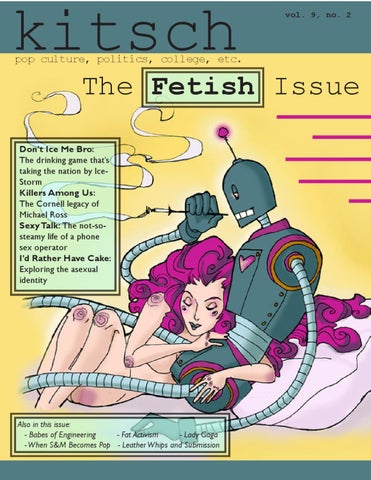
kitsch
pop culture, politics, college, etc.
vol. 9, no. 2
The Fetish Issue
Don’t Ice Me Bro: The drinking game that’s taking the nation by IceStorm Killers Among Us: The Cornell legacy of Michael Ross Sexy Talk: The not-sosteamy life of a phone sex operator I’d Rather Have Cake: Exploring the asexual identity
Also in this issue: - Babes of Engineering - Fat Activism - Lady Gaga - When S&M Becomes Pop - Leather Whips and Submission
kitsch magazine
spring ‘11
letter from the editors
I
n Ithaca, we do “obsessive” well. Whether it’s a Cornell engineer spending twenty-two hours a day on a project team or an Ithaca College drama-type wearing out her vocal chords to get that high note in “Heart and Music” just right, we tend to put our passions above everything else in our lives. Frankly, though, when that “everything else” doesn’t encompass much more than Ithaca’s year-round monochrome, such a circumvention of energies is understandable. These days, mainstream America’s simultaneous obsession with and fear of all things sensual means that the realm of the fetish has expanded from its original Freudian roots. You may not want to actively dry-hump that life-size poster of Ira Glass on your housemate’s door, but your three-year commitment to “This American Life” could still rival your last romantic relationship for its length and voraciousness. In this issue, we do our best to examine the fetish from as many perspectives as possible. Some fetishes are motivated by fear. As philosopher Julia Kristeva wrote, we both hate and love that which reminds us of our own humanity. James Fairbrother and Julianna Ishler investigate pop culture’s obsession with mollifying the monster in “Lady Gaga” (p. 61) and “Crave to Fang Bang” (p. 12), while Shea Lynch discusses the sexualization of the death drive in “Crushing: Fantasy or Torture?” (p. 49) and Kevin Boyd gets his live-action vampire role-play on in “LARP” (p. 30). Other fetishes transform the familiar into exotic. Annie Tsao’s “I Will Make Passes” (p. 20) and Lanny Huang’s “Irony is not an Excuse” (p.58) delve into the appropriation of nerd-culture; Julio Koch’s “Bananasexual” (p. 67) takes the drama of the produce aisle to a whole new level. Meanwhile, Gina Cargas flirts with her new compost-heap boyfriend in “Dumpster Diving at its Finest” (p. 26). Even in what Freud classified as “outlier” sexual activities, there are always the cool kids. Certain classic sexual fetishes have wormed their way into American pop culture. “When S&M Becomes Pop” (p. 50) and “Leather Whips and Submission” (p. 56) work to explore and explain the recent influx of BDSM imagery into Top 40 music, as “Adventures in Nude Modeling” (p. 28) and “Sexy Talk” (p. 16) describe what happens when fetishes become a little too locally available. At the same time, we understand that one’s sexual experiences may be minoritized even among fetish communities. “I’d Rather Eat Cake” (p.13) addresses the local and online asexual communities, who are often left out of the sexual dialogue. Also, some of our articles, while important, do not fit into this issue’s theme. “Killers Among Us” (p. 45) details the story of the sexual violence present in Cornell’s recent history. Here at kitsch, we fetishize the pursuit of knowledge. Frankly, we are as turned on by brainpower as some people are by well-trimmed toenails. What better way, therefore, to get our rocks off than to foist the fruits of our efforts onto the masses? It’s been a good year, folks. Thanks for sharing the ride.
Kisses,
2
Table of Contents 2 - Letter from the Editors 4 - Masthead 5 - Editors’ Page
Bite Size
6 - On the Plaza 7 - Mushrooms in My Tea 8 - Sexy History: Fad Diets 10 - Office Space: Ellis Hanson 11 - Defining Casual 12 - Crave to Fang Bang?
Zooming In Zooming Out
13 - I’d Rather Eat Cake 16 - Sexy Talk 18 - The Plan Against Planned Parenthood 20 - I Will Make Passes 22 - Enviro, en Vogue 24 - Fat Activism
Watch and Listen
49 - Crushing: Fantasy or Torture? 50 - When S&M Becomes Pop 52 - Are you a thief? 54 - Bros Icing Bros 56 - Leather Whips and Submission 58 - Irony is Not an Excuse 61 - Lady Gaga
26 - Dumpster Diving at its Finest 28 - Adventures in Nude Modeling 30 - LARP 33 - Photospread: Babes of Engineering 39 - The Good, the Dead, and the Undead 43 - Eat Pizza, Get Laid 45 - Killers Among Us
Fiction and Poetry
64 - Second Person Sad Sap 65 - Teahouse Ganguro 66 - Relic 67 - Bananasexual 68 - Please, I am an Artist 69 - Starling
3
kitsch magazine
spring 2011
kitsch magazine
an independent student publication
editorial board editors-in-chief Kathleen Jercich Helen Havlak
managing editor Kate Shurtleff
Ithaca College editor
Ariel Lawrence
zooming in
art editor
Michelle Spektor
Meaghan McSorley
zooming out
layout editor
James Fairbrother
Cat Schrage
copy editor
watch and listen
Alex Newman
Laura Van Winkle
fiction editor
webmaster
asst. fiction editor
bite size
Adam Miller
Jen Yang
Renee Tornatore
writers
Michelle Rada
contributors
Felix Bidwell, Kevin Boyd, Natasha Bunzl, Gina Cargas, Dorothy Chan, Anna Corrigan, Jenna Greenbaum, Lanny Huang, Julianne Ishler, Jen Keefe, Julio Koch, Rebecca Lucash, Shea Lynch, Ava Mailloux, Rebecca Ochs, Adi Potashnick, Annie Tsao, Charles Wang, Vicky Wolak
artists
Katy Braun, Natasha Bunzl, Chelsea Chon, Andrew Ebanks, Kayla Figueroa, Jenna Greenbaum, Claire Paduano, Owen Smith, Charles Wang, Katie Griswold, Molly Beckhardt, Lanny Huang
layout artists
Talia Angelitti, Gina Cargas, Spencer Chen, Steven Chen, Jee Lee, Sandra Lee, Catherine Taylor, Charles Wang, Lanny Huang
copy editors
Kristen Askin, Aishani Bansal, Gina Cargas, Subashiny Gengatharan, Sandra Lee, Katie Tregurtha, Jenny Zhao, Natanya Auerbach, Karina Parikh, Rebecca Lucash
advisors Michael Koch English, Cornell University
Catherine Taylor Writing, Ithaca College
cover art by Laura Van Winkle
4
Kitsch Magazine, an independent student organization located at Cornell University, produced and is responsible for the content of this publication. This publication was not reviewed or approved by, nor does it necessarily express or reflect the policies or opinions of, Cornell University or its designated representatives.
BITE SIZE
meet
the
editors
Moose (from left to right): Alex Newman, Ariel Lawrence, Adam Miller, Jen Yang Main (from left to right): Renee Tornatore, Laura Van Winkle, Michelle Spektor, Helen Havlak, Kathleen Jercich, James Fairbrother, Kate Shurtle, Meaghan McSorley, Catherine Schrage, Michelle Rada
5
BITE SIZE be all blue from Watchmen. He may n ta at nh Ma . Dr ely nit fi if he De xy, I wouldn’t even care se so is He d. bo t ea gr a but he has gave me cancer. Angell ‘12 -Marissa
Mr. Roc hest
er, from Ja
ne Eyre.
-An Huang
‘12
Princess from lating if I said the cu as em be it ld ou W Ella Enchanted? -Nathan Cohen‘11
On the Plaza
Who is your fictional crush? art and layout by MICHELLE SPEKTOR
Mr. Darcy. -Tracy A. ‘12
I’d say Hobbes from
Calvin and Hobbes.
-John Jameson ‘12 Who wou ld I bone in a movie Ivanovna or a book from Rain ? Olga y Dawn.
-Jake Burt o
n ‘13
e
elion. Sh
Evang Rei from
That’s e
aracter.
ime c h ’s an an
asy. Ma
ximus fr om Glad -Jim Joh
iator.
nson ‘13
roject.
P Pepper e h t m o r 1 pper f
Pe
arcia‘1
-Alex G
The Flash, for sure. -Ryan Arams ‘12
6 66
1
oi ‘1 -Alex Lo
I
s m o o r h in my s u M
n America, fringe communities of the health conscious have been consuming Kombucha, a traditional fermented Chinese tea, for decades. In the early moments of its American debut, the tea could be found only in very well-stocked health food stores or brewed in the closets of its most devoted drinkers. However, in the past few years Kombucha has begun to grace the shelves of Brooklyn’s hipster emporiums, and now even Wegmans is carrying it! What is Kombucha, you ask? Kombucha is made by placing highly-sugared black tea, such as Darjeeling or Oolong, in a jar with a mushroom called a SCOBY for around three weeks. SCOBY stands for Symbiotic Culture of Bacteria and Yeast, and is not technically a mushroom, but rather a cellulose pancake with bacteria embedded in it. Sounds yummy, hmm? Over the course of this aging process, the mushroom feeds off of the sugar and ferments the tea, leaving a sour, slightly effervescent beverage. To say that it is an acquired taste might be an understatement. Most first-time tasters equate the bite of the tea to vinegar. However, some companies, such as Synergy Drinks, have added fruit purées to ease beginners into the delight. Regardless of your entry methods, it is shocking how quickly the tea becomes pleasant! Frequent consumers speak of a “kombucha high,” a subtle euphoria that sets in minutes after the top is popped off. Although none of the alleged health benefits, such as weight control, liver cleansing, or mood boosting, are confirmed by the Food and Drug Administration (FDA), GT’s Kombucha states that it “promotes overall well-being and helps the body find its natural balance.” The Kombucha high can also, however, be attributed to the slight alcohol content present from the fermentation process. Up until a few months ago, the alcohol content of store-bought Kombucha was minimally regulated, and its purchase required no age limit. When I began my Kombucha-drinking habit a few years before the FDA put its foot down, the questionable alcohol levels were certainly not a small incentive. Should you go buy Kombucha? I’d argue yes, definitely. Not only will you find the taste oddly pleasing after a few cups, but I think you will also feel healthier and happier. Ithaca has many options for buying the drink — almost all supermarkets stock it (particularly Green Star) and on Cornell’s campus the One World Café offers it (and they take BRBs). Also, a new café called Live! Culture on the Commons that serves only living and fermented foods has Kombucha on tap. Alternatively, for the adventurous few, I am offering all a taste of my own home brewing, which I may or may not have been making in a closet of a sorority house with another member of the kitsch staff. Please do let us know if you’d like to do a tasting. Soon we’ll be offering bottled Cornell Cherry Cha and Cornell Concord Cha flavors.
A E T
NATASHA BUNZL
art and layout by CAT SCHRAGE and NATASHA BUNZL
7 7
BITE SIZE
INUIT DIET 1920s Eat only meat and fat. The closest you’ll ever come to actually being a Tyrannosaurus rex.
FLETCHERISM 1900s Chew your food 32 times, once for each tooth, absorb the nutrients, then spit it out and never swallow. The osmosis form of dieting.
CIGARETTE DIET 1920s Use the appetite-suppressing power of nicotine! The cancer is totally worth it.
ZANDER ROOMS DIET 1850s Dr. Gustaz Zander believed that vibration massage could help someone lose weight. Behold, the ancestor of the Shake weight!
GRAHAM DIET 1830s Graham’s vegetarian diet (with plenty of graham crackers) not only results in weight loss, but it cures masturbation too!
GRAPEFRUIT DIET 1930s Eat half a grapefruit before each meal and reap the benefits of non-existant “fat-burning” enzymes. Because the subsequent weight loss has nothing to do with reducing intake to 800 calories per day.
ANTI-SWAMP DIET 1720s If you live by a swamp, you’ll get fat. The alligators KNOW where to find the largest hick-kabobs.
WILLIAM THE CONQUEROR DIET 1080s Eat nothing and drink liquor. Welcome to college life.
VINEGAR DIET 1820s What’s the best way to keep from eating? Douse your food in vinegar so it’s completely inedible.
START
COLONICS Ancient Egyptians Why bother watching what you put in your body when you can suck it all out?
JAMES FAIRBROTHER AND HELEN HAVLAK layout by JAMES FAIRBROTHER
8 88
yHistory x e
S
Fad Diets! T
he trendiest ways to lose weight throughout history. Malnutrition has never been this hot.
MASTER CLEANSE 1940s Drink and eat nothing but a mixture of homemade lemonade, maple syrup and cayenne pepper for several days to detox. If Beyoncé does it, why can’t you?
FINISH MARY KATKINS 2011 Created by comedienne Elaine Carroll for the web series Very Mary-Kate. Look at the food, touch the food, smell the food, listen to the sound of touching the food, then just don’t eat it.
BABY FOOD DIET 2000s For those who want to move to Neverland, go back to your roots as a Gerber baby. Who doesn’t want to eat mushy peas and carrots past the age of one?
BURRITO DIET 2000s Burritos, by nature, emphasize portion control. If you can’t wrap the burrito because it’s overstuffed, you’re eating too much. TAPEWORM DIET 1940s Obviously the best way to lose weight is to swallow a parasite that will steal all the food you eat before it can be digested.
COCONUT DIET 1990s Attempt to replace all the fats in your diet with coconut oil. We still don’t understand how eating all that saturated fat helps with weight loss. Even Jennifer Aniston realized how dumb this sounds. DRINKING MAN’S DIET 1960s The perfect “man” diet. Eat steak, avoid carbs, drink liquor, stay thin.
SLEEPING BEAUTY DIET 1970s Snooze the fat away! Elvis would take sedatives and sleep for days, hoping to wake up thinner. CALORIES DON’T COUNT DIET 1960s It doesn’t matter what you eat, as long as you chase it with vegetable oil. If you can get it down, that is.
FRUITARIANISM 1970s Return to Genesis and eat only fruit, just like Adam and Eve! Paradise is a mouthful away.
9 9
BITE SIZE
Office Space:
layout by MEAGHAN McSORLEY photo from the kitsch archives
Ellis Hanson MEAGHAN McSORLEY
Ellis Hanson, a self-described “Lovechild of Whistler and Wilde,” is a professor in the English Department who famously teaches “Desire” and “Decadence.” As this is the Fetish issue, talking to Cornell’s resident expert in all things lascivious seemed to be an obvious choice for this semester’s Office Space. How did you end up at Cornell? It never occurred to me to apply to Cornell for anything except a job, but I would have been happy as a student here, I think. My students seem spookily happy and well-adjusted, and I attribute this, of course, to my superior teaching skills, which are widely underestimated. I was hired by Cornell probably because I was the only person in the world who actually could do all the laundry on the laughably random list in the job advertisement. Victorian literature, film, queer theory, and I forget what else. I’m still an intellectual whore that way—I’ll teach anything to anyone. Cornell was the first school to use the Q-word in a job advertisement for a professor, I believe, and so one knew they meant business. I was living in Manhattan when I accepted the job, and I thought Cornell must be a few miles upstate somewhere, maybe in Westchester. I had no idea. By the time I finally landed here, I thought, “I must be in Saskatchewan by now!” How did you first become interested in the study of desire? I’m not sure how the students feel about it, but my academic research and my teaching interests make me horny as hell. Ironically, what most people call “pleasure” I get to call “work”—and charge for it. I mean, twist my arm, please. I’m astonished that I have colleagues who are not interested in the study of desire. I don’t believe it, but I have to admit sometimes they can be weird that way. I see whole departments at Cornell devoted to something like “plant pathology,” and I think, yes, a career devoted to blight is very important, but I’d have to cultivate a great many extracurricular hobbies if I had to wrestle with that topic from nine to five. When I was a student, the study of desire and sexual pleasure suddenly changed radically in the humanities, and I wanted to be a part of it. It was no longer just about Freud or sexology or biology or gender. There were new and sometimes contradictory ways of “thinking sex” aesthetically, culturally, politically, philosophically. My career options as a pornstar and rentboy have diminished somewhat over the years, I suspect, but I feel I have found my ideal niche in the sex industry—not just sex for pay, but sex for tenure. Or even better, sex after tenure, which is edifyingly obscene. My field is the ultimate mindfuck.
10 1010
What is “desire” to you? As a general rule, desire is wanting it and sex is getting it. Paradoxically, the former turns out to be immensely more gratifying than the latter. Desire is the space between wanting and having where all of language, all of culture, intervenes. What other wiles do we have at hand to seize the attention of every beloved thing we lack? What this “it” is that we have or lack remains, however, a puzzling question. My course Desire is a series of intellectual collisions around that question, which many great minds have answered and spectacularly failed to answer in a variety of creative ways. Plato, Marx, Freud, Sartre, Barthes, Foucault, Butler—I want the students to hear their own gears grinding a bit before they press the pedal to the intellectual metal, which invariably they do. Yes, but then yes. Tell us about your work with “Digital Desire.” This summer, I’m going to publish a collection of essays on Digital Desire. By “digital” I mean digital technology, and not just the fingers we so often use to participate in it. I mean the desire for the digital and the desire of the digital, as well as desiring through the digital. I need this project because I needed to think through our own erotic moment more clearly. In or about 1996, sex changed. We had a sexual revolution in which no one got shot and no one even had to demonstrate, at least in the political rather than the exhibitionistic sense of the word. For those with an Internet connection and even a great many of those without an Internet connection, desire went online. It also went on digital phone networks in astonishing new ways all over the world. It encountered digital medical technology, digital surveillance technology, digital imaging technology, and digital information technology that crossed borders promiscuously in new ways that defied old laws and customs. Our new cyborg desire has obliged us to rethink the usual rules about erotic desire with respect to privacy, reputation, pathology, medical intervention, community, connectivity, censorship, commodification, consent, surveillance, safety, and access to information—in short, we have witnessed in that past decade-and-a-half a radical transformation in the way we desire now. We are all thinking about this, whether we like what we learn or not.
DEFINING
CASUAL:
photos and story by JENNA GREENBAUM
s I packed for my exhilarating semester abroad, my cosmopolitan friend who had studied in France the year before warned me of only one thing: do not bring sweatpants. Since moving to Italy in January, and throughout my subsequent travels in Europe, I have noticed an enormous distinction between Americans and Europeans in terms of casual dress.
Here in the States, when we run out for groceries we sport college sweatshirts, leggings, or gym pants, and rundown sneakers, or—in the case of Ithaca—Ugg boots. In Florence, when I go to Billa (an Italian grocery store) for the night’s meal, I pass women in chunky sweaters and thick scarves, perfectly fit skinny jeans and leather boots. Absolutely everyone owns a leather jacket, and would never sink so low as to wear, as my landlord put it, “thick cotton clothing.” “We don’t wear cotton in the winter,” she snarked at my CU sweatshirt.
Over the past four months, I have truly come to appreciate the stylish quirks that make each country distinct, especially, as my future ex-pat friend calls it, Parisian girl-chic. The uniform of tights, oxfords, and flimsy little dresses is both feminine and edgy, and for men, the beautiful structured leather shoes alone far surpass any frat star’s signature dunks.
An American in the midst of European fashion is a constant outsider. My New York sensibilities just don’t cut it in a country so dense with culture that it even trickles down to ready-to-wear. Take a look at these photos, then look at your closet and see if you can’t bring some European flair to your wardrobe.
A G L I M P S E AT E U R O P E A N S T Y L E
A
11 11
BITE SIZE
Crave to Fang Bang? A vampire-inspired sex fetish captivates larger audiences
D
oes the idea of being bitten by your partner make you shiver with anticipation? Are you a fan of fast, ferocious role playing—accents optional? Have you ever asked your partner to put on pale makeup and make passionate love to you while biting your neck, earlobes, and wrists, sucking at the stray blood? If you fantasize about any of the following, you may suffer from what is commonly known today as a fang-banging fetish. Sexy vampires are by no means a new phenomenon—the original Dracula had undeniable sexual undertones, and Anne Rice’s 1976 cult novel Interview with a Vampire starred Brad Pitt in the later film adaptation. With the more recent expansion of the vampire fan-base to include a younger, more mainstream audience by the Twilight franchise, however, vampires and vampire groupies alike have started to come “out of the coffin.” Next, for a more mature audience, came True Blood, a series based on Charlaine Harris’s “The Sookie Stackhouse Series,” which premiered in 2008. Unlike the naïve purity seen in Twilight, True Blood portrays vampires as selfish, sexual beings who seek out humans for pleasure. The protagonist, Sookie, is pure and innocent until she becomes vampire bait and begins to live out her intense sexual fantasies. Sex is what drives the show and creates conflict; without it, the show would just be another sexless teenage vampire romp. This transition into the mature mainstream meant that vampires took on a new spotlight as sexual playmates, accompanied by a rash of new fetishes, ranging from the innocent to the franchised to the purely risqué. And hey, if your bedtime fantasies feature a fanged cast, why not drive yourself wild with some steamy vampire sex toys? More and more sex toys are emerging for the fang-bang inclined. Both sexes can enjoy the Succu Dry, a beer-can shaped toy designed to mimic the throat of a vampire, complete with fangs on top. This allows you to enjoy the
12 1212
JULIANNE ISHLER
feeling of sucking and biting while fantasizing about a pair of cold, undead lips. For the ladies, there is the ultimate Twilightinspired Vamp Dildo, which sparkles, shines, and maintains a nice, chilly temperature. There have also been alleged requests to create a Viking Vamp Dildo—referring of course to the sexy Eric Northman from True Blood—which would be all grown up, sans sparkle and shine. For the safety conscious, there is even a vampire condom made from black latex. With all these sex toys, you’ll just be craving more and more. And after all, the vampires of lore always managed to get invited inside. Whether you have a full-blown fang-banging fetish, or are simply wrapped up in the vampire world, we all live vicariously through the dangerous stories with which we are presented. These stories captivate our mind: we all just want to be swept off our feet and become a part of a dark world, where everyone is a superhuman and lives out their most intense fantasies. The question is, what kind of neck biter do you prefer in your bed?
art by KAYLA FIGUEROA
art and layout by HELEN HAVLAK
I’d
Rather
Eat
Cake
Exploring asexuality, an under-the-radar but increasingly outspoken sexual orientation HELEN HAVLAK
S
ex sells—if, that is, the endless stream of sexy commercials advertising anything from shampoo to candy, Bumpits, and Doritos is anything to go by. We are surrounded by sex and obsessed with it, both personally and politically. We care who is having sex with whom, what they are calling their relationship, and which guido Snooki “smushed” last week. In between the sex-laden billboards, radio shows, and TV sitcoms, it can be easy to overlook the growing numbers of people who officially identify as asexual, or just not interested. AVEN, the Asexuality Visibility and Education Network, defines an asexual as simply “a person who does not experience sexual attraction.” This basic definition, however, does not even begin to cover the range of different experiences described by the umbrella term “asexual.” To navigate the complexities of asexual identity, I met with Alexis Karinin, a Cornell junior who first began to identify as asexual about a year ago. “I’ve always sort of realized that I’ve been on a different page,” she told me, “but I always thought that meant I was weird and inept and defective in some way... It took me a long time, a lot of anxiety and a lot of feeling very excluded and inept before I realized that no, I’m normal, just a different kind of normal, and I can find my own ways of expressing myself.” For some time, Alexis had known of the online asexual community’s existence, but she just didn’t think the term applied to her. “I thought everyone experienced sexual attraction the same way that I did,” she said, “And then I sort of heard some non-asexual people talk about how they actually experienced it,
13
zooming out and I was like wait, wait, that’s never— what, what? I’ve never felt like that!” The complex spectrum of emotions that members of AVEN’s community experience is hard to classify, but Alexis broke down some of the more common identities for me. “Some asexuals consider themselves a- or non-sex, which means they’re not interested in romantic relationships and don’t really get crushes in the same way. Some are romantic, so they might want a relationship that is actually very emotionally involved, but does not have much of a sexual component. Some people identify as asexual, but are into S&M and bondage and all of that stuff, but for its own sake. A lot of asexuals might actually engage in sex, either as a compromise for their partners or just for reasons of closeness, in the same way that someone who is straight can have sex with someone of their own gender and even enjoy it, but not really be attracted to them.” However, not all members of the community are so accepting of asexuals who pursue romantic relationships, masturbate, or have sex. Although officially discouraged by AVEN, “asexual elitists” argue that asexuality is defined by sexual behavior, not just sexual attraction. Alexis vehemently opposes this definition, and explained, “There’s this idea of the unassailable asexual. Someone who’s good-looking, so no one can say they just can’t get any; someone who has never been abused as a child, so no one can say it’s trauma; someone who’s been in a relationship, so no one can say they just haven’t found the right person yet. And there’s all these impossible standards. Some people might meet all of them, but then if you hold those people up as the ideal you might belittle those people who have, for example, dealt with sexual abuse. Their asexuality is just as legitimate. There just needs to be acceptance.”
found, consisted of 1.5% of the studied adult male population, 14-19% of unmarried females, and 1-3% of married females. The data that really peaked public interest, however, came from a 1994 study that surveyed 18,876 residents of the United Kingdom about their sexual orientation in order to combat AIDS. In the study, 1.05% of respondents identified themselves as having “never felt sexually attracted to anyone at all.” That official 1% elicited a frenzy of media response and became the focus of intense speculation. It has also, slowly, begun to inspire more serious scholarship, and acted as one of the catalysts for the 2001 founding of AVEN by David Jay in order to “create public acceptance and discussion of asexuality and facilitate the growth of an asexual community.”
O
ne of the most difficult challenges that any asexual faces is public ignorance. Many asexuals talk about “coming out of the closet,” but Alexis told me that it’s a very different issue for asexuals than for homosexuals because the former are less likely to face extreme reactions, such as violence. In fact, Alexis noted wryly, certain environments might actually praise people for being asexual. “I guess the problem is more that people don’t actually believe that asexuals exist,” she told me. “A lot of people assume that if you say you’re asexual you’re really just repressed, or really uptight, or you just haven’t found the right person yet, that’s another line, or that you haven’t matured yet.” Another common misconception of asexuality claims that it is a behavioral disorder or a medical problem. Alexis agrees, to a point. “Any big change in libido can be an indication of something bad,” she said. “One of the definitions of disorder is something that causes you discomfort or distress, but if it’s not causing you distress—if you’ve just always felt this way, or it feels natural—then maybe that’s just who you are and maybe there’s nothing wrong with it. It definitely caused me more distress to deny my asexuality. If it’s not causing someone distress, and if they live comfortably accepting that identity, then maybe it is part of them.” Yet another myth conflates asexuality with anti-sexuality. “I’ve met some people who when I said I was asexual remarked that that meant I was a chastity-belt wearing monk, and I’m, ‘oh my god, no,’” Alexis laughed. “I happen to be a very sex-positive person, but I’m just not interested in it myself… In fact, I think that sex-positivity should encompass asexuality because it should encompass respect for anyone’s decisions about their own body and their own sexuality.” For some reason, she said, “People get offended as though you’re telling them not to have sex.” Surprisingly, Alexis told me, the asexual community has found little support from other sexual minorities. In fact, asexuals are often excluded from LGBTQ spaces. “I have read arguments saying ‘if you’re asexual you’re not actually queer, you’re
“
“It definitely caused me more distress to deny my asexuality.”
T
he first official recognition of asexuality dates back to a 1948 study of sexual behavior by Alfred Kinsey: the same study that famously redefined sexuality as being on a “Kinsey scale” rather than a binary of 100% homosexual versus 100% heterosexual. In the study, Kinsey also identified a group of “X” type individuals with “no socio-sexual contacts or relations.” This group, Kinsey
14
”
I’d Rather Eat Cake just a straight person who doesn’t care about sex.’ That just doesn’t make sense to me.”
U
nlike many sexual minority organizations, AVEN does not have an explicit political mission. Instead, they are more geared towards outreach and visibility—and to correcting negative portrayals of asexuals in the media. Alexis brought up one particularly egregious example: a recent ad for Plan B in which the actress stated earnestly, “After a little problem with my birth control, I could vow to become an asexual, a-social, a-everything girl—or I can get a real plan.” Alexis, like the rest of the asexual community, did not appreciate the sentiment. “That conflation of asocial, asexual… oh god,” she said. Dan Savage, who writes the popular LGBTQ-friendly syndicated advice column Savage Love and puts out a corresponding podcast, has also come under fire from the asexual community. In a February 2011 column, for example, he answered a writer’s concerns about lack of sex drive by asking, “Why would you even contemplate inflicting yourself on a normally sexual person? Why not go find another minimally sexual person?” The idea that a romantic relationship must also be sexual in order to be healthy rankled with not a few asexual blogs and bloggers, one of whom lamented, “Sadly, Savage seems unable to understand that not all men are rapaciously monosexual.” Asexuals also get their fair share of positive coverage, mostly through fictional characters in TV, books, and movies—although J.M. Barrie of Peter Pan fame, Isaac Newton, and Morrissey of the rock band The Smiths were reportedly asexual as well. Notable examples include Sheldon from The Big Bang Theory and Charlie Weasley from Harry Potter who, according to J.K. Rowling, isn’t gay, “just more interested in dragons than women.” Sherlock Holmes never had any significant sexual attractions, even to Irene Adler, who seems more of a professional rival. And, of course, The Doctor from Doctor Who, the great love of asexuals everywhere, who seems to have little or no sexual attraction to anyone, including his varied cast of attractive, young female companions.
O
ne of the most striking things about AVEN is just how tightknit the community seems. While the AVEN site is also filled with abundant testimonials and resources, Alexis told me that she uses it primarily for the social element driven by the forums. In fact, the list of topics under “community” is much longer than that under “asexuality.” Many asexuals make lasting connections through the site, including dating and marriage. Recently, she’s been using a smaller offshoot of AVEN that focuses more heavily on gender issues, but says that it draws its membership almost exclusively from AVEN. “It’s an interesting little online community with some awesomely weird folk,” she said. “We’re all pretty much obsessed with cake and gender issues and Doctor Who. I’ve met a lot of them in ‘real’ life, and in fact, my partner and I are going down to meet some of them in New York City this weekend… It’s almost surprising how close you can become to people very quickly. It’s kind of awkward at first, but we have a lot in common.” By “cake,” Alexis meant the tongue-in-cheek symbol of the asexual community, a slice of cake, which originated when one asexual described his experience by saying, “Between cake and sex, I’d choose cake.” While some asexuals try to date within the community by meeting partners through AVEN or new, asexuality-focused dat-
ing sites such Asexualitic.com, others are more open to dating sexual partners. Alexis emphasized that even though “some asexuals are very sex-repulsed, others are very sex-indifferent... It’s not a bad experience.” Broaching the subject can be awkward, Alexis acknowledged. “Some of the asexuals I know that do date choose to stay within ace-minded communities for that reason, in that it’s kind of awkward to go on the first date and say, ‘Oh, by the way…’ But some of the people I know are very blunt about it, and it works for them.” Overall, Alexis said, many asexual relationships don’t differ all that much from a “normal” sexual relationship. Open relationships do tend to be a greater presence on AVEN than in the general public, though, and many asexuals have more fluid life plans than getting married and having kids at a certain age. “Some people re-adopt that plan later,” Alexis said, “but on their own terms.” One perk of identifying as asexual, Alexis told me, is that many people find that “discovering their asexuality liberated them from feeling like they had to be held up to certain standards, and it helped them become much closer to a lot of their friends, in that they started treating their relationships more like friendships, and their friendships more like relationships.” She clarified, “In a certain way, they try to remove the ‘just’ in front of ‘just friends,’ because no, a friendship does not have to be in any way a lesser kind of relationship than a romantic one. Society makes you think that your goal in life is to find a specific romantic relationship. And ultimately, we should build emotionally close relationships with everyone around us.” Throughout our interview, Alexis’ primary focus returned again and again to acceptance: both within the community of all experiences, and outside the community of asexuality. She sees the goal of AVEN as “just getting the word out there as a legitimate orientation and not a disorder or some kind of deviation.” As she pointed out, “There’s not normal people and asexual people, there’s sexual and there’s asexual people, and they’re both equally legitimate ways to approach the world and have relationships.” ◊
15
zooming out
y x Se
Ta The not-s
o-steamy
L
lk
life of a p
hone sex
ate-night cable TV is filled with overtly-augmented and overly-made-up girls that speak with a sweet, sexy voice and wear next to nothing. Their goal: to entice viewers to call some random hotline and blow their hard-earned cash on a few short minutes of self-pleasure, instead of spending it on something important (like Wednesday night fishbowls). But have you ever wondered who that soothing and oh-so-scintillating storyteller really is on the other end of the line? As you might expect, it’s not the bleach-blonde, thong-clad Amber that’s writhing across your television screen. In fact, it could be someone you already know, like Ithaca local Romana Hamilton. At a height of 4 feet 11 inches, with black, plastic-framed glasses and dark brown hair, Romana is polite and unassuming; no one would ever suspect that she actually spends phone calls helping some guy across the country get his jollies. By the way, this is the same Romana Hamilton that used to deliver your M&M and double-chocolate chunk cookie order from Insomnia Cookies in Collegetown. Very early in my conversation with Romana, it became clear that working as a phone sex operator (PSO) is far from the vision depicted in commercials. It was certainly not her first choice for a job. When I asked her why she chose to become a PSO during the summer of 2010, her initial response was, “I like awkward shit.” At the time, she was working for a regular telephone surveyor, but needed to find a second job to supplement her income. She admittedly loves awkward situations that most people wouldn’t find themselves in, and decided that becoming a PSO was the place to start. She didn’t tell her step-mom until after she quit, but the friends who were in the know were all surprised that she, specifically, had taken the job. At the time, Romana would not have considered herself a very sexual person (and neither did her friends), so to choose such a provocative job was out of character in just about every way possible.
operator
JAMES FAIRBROTHER
looking for love
I
n order to actually find a company and apply for a position, Romana used Google and eventually found USA Live Chat, a call center company that acts as a central hub for many different local PSO companies and then routes the calls to various on-call staff members. “It was probably the sketchiest company there is,” she told me. Romana called a phone number in Detroit and left a voicemail describing why she would make a good PSO, essentially lying about how much she loved sex and the fantasy associated with the position. In reality, all she knew about sex was what she had seen in porn, but she figured she could just use that as the basis for her “stories” when she took calls. A few days later, she received a contract written in Comic Sans font and riddled with typos, which still had the gall to stipulate that a “trashy” pseudonym could not be used during calls. The example used was “Porsche,” also spelled “Porch” later on in the contract. For some reason, the company couldn’t use employees that lived in New York, but luckily her cell phone had a Connecticut area code. There was no handbook available, no training, and no sample conversations, which left Romana to fend for herself with nothing but the might of her wit and her ability to think on her feet (or in this case, her libido). Unlike the myriad of product support and customer service lines with offices full of cubicles and outsourced labor trained in
“
...she received a contract written in Comic Sans font and riddled with typos...
16
Phone Sex Operators specific responses, Romana was entirely on her own. To start a shift, she logged in digitally on her cell phone to let the company know she was on the clock and could receive calls. She didn’t want her family to hear the calls, but she was living with them at the time, so her car became her makeshift office. Because she travels often to visit friends in other states, she has taken calls on the road to Massachusetts, on Interstate 84 in Connecticut, and in various parking lots across several states. She once sat in a McDonald’s parking lot after ordering a snack wrap to take a few calls, only to be interrupted by the woman who had helped her at the drive-through asking if she was okay. Romana’s penchant for awkward situations kicked in and she admitted that she was working as a PSO from the parking lot so that her dad wouldn’t find out—appalling the woman. A typical call is fairly short—most last only approximately ten minutes, which is problematic considering that payment is on a per-minute basis. During the first five minutes, Romana was paid five cents per minute; seven cents per minute for the next five; and ten cents per minute thereafter. Compounded with the fact that she only worked sporadically as a PSO for a month, she never earned the $25 minimum to receive a paycheck and was never actually paid. Most calls ended once the caller climaxed, though there was also a good portion of calls that ended because the caller felt awkward. The first call she ever received was a man who asked, “Why is a manhole cover round?” and then hung up. She then proceeded to ask her next two callers the very same question.
“
her own fantasy, so she took a cue from Law and Order and described a stakeout situation that got hot and heavy. Once she was finished, the guy on the other end still wanted more, and she didn’t know where to go from there.
not all picnics and lingerie
F
or the most part, Romana would try not to think about the guy on the other end. Noises were par for the course, but it wasn’t something she ever got used to. Romana says that after she quit, she had something like post-traumatic stress disorder, where for a few months she didn’t like speaking to men on the phone that she didn’t know (a problem when you have to take cookie orders over the phone from strangers). Romana chose to end her career as a PSO because of one specific call, for which the “whisper message” was “teenager scenario.” This was not the barely-legal college age situation she expected, though; instead, this caller wanted his thirteen-year-old daughter to help him in his fantasy without “mommy” knowing. Romana immediately freaked out, but managed to turn the situation around a bit. Instead of acting as the innocent, know-nothing submissive daughter, she became the sluttish teenager that no parent wants to have, saying things like, “Oh, I know what I’m doing. I’ve sucked a ton of guys at school.” She powered through the call, but never accepted another one after that night. She’s not entirely sure if that situation was condoned by the company (since there was no manual), or if it was even legal, but she felt that it would be better to explore the fantasy if it prevented the man from actually acting on those impulses in real life. Romana tried not to judge him, but found it impossible. Romana’s brief and not-so-turbulent tale of working as a PSO proves, if anything, that no job is entirely what it seems. The best thing that came out of her experience? Learning the area codes for all the cities that she received calls from. “It’s great when you meet someone and get their number and can say, ‘Is that Ft. Lauderdale?’ They’re always impressed.” ◊
Wait, is it in my mouth or my butt?
a day at the office
B
efore a call comes through, Romana says there is a “whisper message” that describes the fantasy requested. Once the caller is patched through, most don’t ask, “What’s your name?” like in normal conversations. Instead they usually say, “Who’s this?” like, Romana told me, “the killer in Scream.” After she identified herself as “Allison,” the calls actually began. If they asked where she was, at the moment, her answer was always “Westchester.” Surprisingly, most calls were from awkward men with mundane fantasies, making the little preparation “Allison” did useless anyway. The most common situation requested was the “girlfriend” scenario. Go on a picnic, act romantic, have sex. Go on a boat ride, act romantic, have sex. She was pretty shocked at callers’ “lack of a sense of continuity.” She often wanted to ask “Wait, is it in my mouth or my butt?” as the callers often forgot what they had already helped narrate. Some callers asked for the “slave and domination” scenario, which Romana didn’t like the idea of at all. One such call was taken in the Gun Hill Apartments parking lot, on speakerphone with a curious friend. She hated the situation so much that she ended the call. While she never developed or used a “sexy” voice, Romana has had some extremely funny calls. One man wanted to be put in a dress and made up. Since make-up is one of Romana’s favorite topics, she was able to get into deep conversation and detail about the type of eyeliner being used and the precise application of the shadow. Another man asked for her to act out
”
art by LAURA VAN WINKLE layout by JAMES FAIRBROTHER
17
zooming out
The Plan Against Planned Parenthood: VICKY WOLAK
D
epressing factoid of the day: liberals and conservatives have been debating the morality of abortion for over forty years. That’s right: ever since the 1973 Supreme Court decision in Roe v. Wade legalized it, somebody’s been whining about it—particularly those somebodies not endowed with baby-fostering equipment. However, the House’s recent bill that cuts the entire federal allotment for family planning, including funding for Planned Parenthood, has inspired renewed outrage not limited to pundits and politicians. Tellingly, Facebook statuses dedicated to the “I Stand with Planned Parenthood” campaign have been a major tool in promoting Planned Parenthood’s online petition, which now has over 700,000 signatures. The Republican Party’s assault on Planned Parenthood is the latest in a string of attacks against women’s health. Earlier this year, New Jersey senator Chris Smith (R) proposed an amendment to the H.R. 3, or the “No Taxpayer Funding for Abortion Act,” that would only allow federal funding for abortion if a woman is “forcibly” raped and becomes pregnant. Other types of sexual assault, such as statutory rape or incest, would be excluded. According to political news organization Talking Points Memo, Republican Mike Huckabee has vowed to make anti-abortion legislature “the centerpiece of his (likely) 2012 [presidential] campaign.” Dr. Zillah Eisenstein, a professor of political theory at Ithaca College, attributes these attacks against reproductive rights to the recent “victory of the right-wing” Republican Party in terms of their Congressional majority. “There’s a renewed commitment to further limiting access to abortion,” Eisenstein said. The passage of the budget without Planned Parenthood would leave millions of low-income women without reproductive health care. But what about the cut’s effects on middle-class, college-age women? The Planned Parenthood of Southern Finger Lakes, located on West State Street in Ithaca, is a valuable resource in a college town. Last year,
“
about half of the clinic’s patients were ages 18 to 24. Students at both Ithaca College and Cornell rely on Planned Parenthood for birth control, cancer screenings, and testing for HIV and other STDs. In fact, 90% of the clinic’s services are in preventative care. “Young women feel safer going there [as opposed to a doctor’s office],” explained Dr. Eisenstein. “Planned Parenthood has a long history of meeting women’s needs when no one else will.” However, conservative Congress members and their supporters say that Planned Parenthood is doing just the opposite. Anti-abortion organization Live Action has accused Planned Parenthood of assisting child prostitution rings. According to a February 4th New York Times article, “Live Action hired an actor who posed as a pimp and told Planned Parenthood counselors that he might have contracted a sexually transmitted disease from ‘one of the girls I manage.’ He followed up with questions about how to obtain contraceptives and abortions, while indicating that some of his ‘girls’ were under age. One counselor, shockingly, gave the ‘pimp’ advice on how to game the system and was summarily fired when the video came out.” This dealt a serious blow to Planned Parenthood’s reputation, though its president, Cecile Richards, stated in the same article, “We have a zero tolerance of nonreporting anything that would endanger a minor. We do the same thing public hospitals do and public clinics do.” Furthermore, conservative politicians argue against federal funding for abortion providers. Representative Mike Pence of Indiana has stated that nothing is more “fiscally responsible” than slashing Planned Parenthood from the budget. However, Casey Martinson, Director of Public Affairs of the Planned Parenthood of the Southern Finger Lakes, stressed “that the federal funding [the clinic] receive[s] is used exclusively for preventive health care services and education programs.” On its website, the Ithaca clinic states that it accepts donations. Martinson assured me that the donations are not lumped into one big cash pile; donors can specify where their money will go,
Planned Parenthood has a long history of meeting women’s needs when no one else will.
18
Planned Parenthood whether to provide education materials, free contraceptives, or abortions. According to their 2009 annual report, the Southern Finger Lakes clinics received over $2 million in government aid. A federal aid cut would equal a loss of roughly 30% of the clinics’ total budget. Sarah McConkey, an executive board member of Feminists United at Ramapo College in New Jersey, shares her views on Planned Parenthood with many of her peers. When she attended a women’s health rally in Philadelphia on January 21, she noted that the participants consisted of “men and women of all ages” and that “there was a large showing of members from the LGBT community.” “Reproductive health is important for every sexually active person, regardless of gender,” Sarah pointed out. “The services that Planned Parenthood offers… go way beyond abortions. They offer supplies and tools that prevent the spread of STDs and STIs, and they also prevent unwanted pregnancy from happening in the first place. Taking away these services on the pretense that it will decrease the number of abortions seems counterintuitive to me.” I tend to shy away from politics, but abortion has always struck an uneasy nerve with me. On one hand, I am a proud member of the Catholic Church, which has been very vocal about its anti-abortion views. On the other, I’m a diehard feminist who believes that every woman should have the right to control her own body. Sex is an unavoidable part of college life, and with it comes great responsibility for our reproductive health and that of our partners. If you don’t support abortion, remember the thousands of women who rely on the 97% of non-abortion services that Planned Parenthood provides. Clinics that promote reproductive health are in serious jeopardy. Now is the time to act. Sign the online petition. Write to members of Congress. If we don’t take responsibility for our bodies, who will? ◊
layout by JEE LEE art by CAT SCHRAGE
19
I Will zooming out
Make
art by MEAGHAN MCSORLEY and KATIE GRISWOLD
Passes
layout by MEAGHAN MCSORLEY
By the Way, My Glasses are Real. ANNIE TSAO
20
L
ast December, I realized that I had just spent over $300 to look like a total douchebag. Whoops. When I picked out these frames over winter break (Claydon in “Red Grain,” by Paul Smith Spectacles), I somehow failed to recognize the douchebaggery that these oversized, square-ish lenses inherently lend to their wearer. This obliviousness could be attributed to a lack of sleep, or perhaps to the dulcet tones of Carlos, the Portuguese optician who proclaimed that this model was “the one” for me. While wearing these loud glasses, I feared that strangers would want to punch me in the face as I walked by. Thus, I prepared an explanatory speech: “I swear, I’m not actually a douchebag! Moreover, you probably think that I’m some tragic fashion victim who wears crappy fake glasses from American Apparel. I just want you to know that these are prescription glasses because I am indeed near-sighted. Cool, you can go now.” Within a week of this purchase, at least two friends had already asked if my glasses were “real,” so my paranoia of being perceived as phony was not delusional. To quote Teri Hatcher’s character in the Seinfeld episode, “The Implant,” “They’re real, and they’re spectacular.” As I reflected on my view of these glasses as a Representation of Self, I entered the phrase “semiotics of glasses” into Google. The results were surprisingly fruitless, apart from a gem in Arthur Berger’s textbook Media and Communication Research Methods. In this excerpt, he discusses a 1991 Washington Post article which offers forthright characterizations of people based on the style of their glasses. Whenever you see someone in Aviators, don’t you also assume that they’re into “masculine adventure,” and don’t silver glasses reveal one’s “mechanical practicality?” Given that this article was published 20 years ago, it now needs a touch of revision. While much of it still holds true in my opinion, including the assertion that small glasses portray “earnest intensity,” I contend that heavy plastic frames are no longer a sign of “big ego, big bucks.” Can you really imagine an aggressive Wall Street businessman wearing my Paul Smiths? Personally, I would change the recorded characterization of such plastic frames to “pseudo-intellectual, fauxhemian, sense of cultural superiority; i.e. having hipster connotations.” I have a very special relationship with glasses, which emerged at age twelve due to my obsessive desire to acquire a pair, despite my then-pristine vision. Overcome by my whining—I wished my eyesight would deteriorate so that I could finally wear glasses—my
Glasses Fetish mother indulged my absurd materialism with a pair of tortoise- audibly in the theater. I wouldn’t go so far as to label myself a shell beauties. When we picked them up at the optician’s, the glasses fetishist, however, which is defined as having “fetishistic man at the store mentioned that it wasn’t uncommon for “Asian attraction to people wearing prescription glasses, sunglasses, women” to buy fake glasses in order to appear smarter during or cosmetic contact lenses, or to the act of wearing glasses or job interviews. Um, great? His comment makes me uncomfort- the glasses themselves. Other related activities include wearing able to this day. I guess the secret’s out now: in middle-school, glasses during sexual acts and ejaculation on glasses.”1 I mean, I accessorized using unneeded glasses. It’s a face-enhancing, if I had a boyfriend with 20/20 vision, I probably wouldn’t spray aesthetic thing. Look no further than Fred Armisen’s line in him in the eyes with isopropyl alcohol simply to damage his vithe opening song of the IFC television show Portlandia, vis-à- sion for my own glasses-seeking pleasure. vis Portland’s female population: “All the hot girls wear glasses, It’s only recently that I’ve begun to grasp the cultural weight yeah.” that I’ve unwittingly assigned to No longer a universal symbol or more specifically that No longer a universal glasses, for the dowdy nerd, eyeglasses are breed of slightly thick black and/or in vogue, and the chunkier the betsymbol for the dowdy tortoiseshell glasses, à la Tina Fey. ter. Warby Parker, a website that sells are many people in my life nerd, eyeglasses are in There vintage-inspired frames for a breaththat I now realize I’ve been drawn taking $95 a pop, had a waiting list of vogue, and the chunkier to merely because they were 20,000 names within four weeks of wearing these attractive glasses, the better. launching last year. Good riddance to which call out to me like a Siren’s that whole “guys don’t make passes song. For instance, before we had at girls who wear glasses” trope, not to mention the cinematic even exchanged a word, I had noticed Josh Helfgott in my large technique of having a geeky girl remove her glasses, only to Social Inequality lecture due to his charming black frames. Now reveal her previously undetected beauty that lay beneath. It’s we’re the best of friends. As a second example, although I had time to reclaim the phrase “four-eyes.” In fact, in anime culture, only interacted with Jakob Kotas via CouchSurfing.com, I knew glasses-wearing women—also known as “meganekko” in Japa- he wouldn’t murder me when we met up for the first time at nese—are glorified to the point where there’s an official name Maté Factor on the Commons because he wore a chic pair. Thus, for the fetish: “meganekko-moe.” According to Wikipedia, the similar glasses have served as this subconscious signal of potenterm “meganekko” is employed by anime and manga fans to tial friendship. To me, they seem to say, “Hi! I am socially progresrefer to females who wear glasses, especially if it’s considered sive, I recycle, and I study foreign languages. I am trustworthy.” My friend Sofia hypothesizes that my glasses fixation is their most attractive trait, although this does not imply that the grounded in the fact that I “like learned people,” as she wordfemale is homely when not donning specs. Such a character is ed it. I don’t know; it’s difficult to often portrayed as “the ubiquitous ‘Class Representative’; a wellrationalize my latent tendendoing, charismatic but sometimes bossy student who is respectcies. Maybe it’s as simple ful of authority.” as presuming that Eventually, my eyesight did deteriorate for real. However, I those with a supestill adore glasses, in spite of the hassle of keeping track of them, rior taste in glasses working out with them, and not breaking them while inebriated. also have great (By the way, I ended up losing my aforementioned red glasses personalities. ◊ in Chicago, an incident that makes want to hurl and cry at the same time.) In Voltaire’s Candide, the character Pangloss claims that our noses were formed purely to carry spectacles, which is a cause-and-effect relationship that sounds about right to me. Olfaction is just a peripheral benefit of having a proboscis. Thank goodness I enjoy glasses, because there’s no way I’m getting contacts anytime soon, considering my disgust for the mushiness of eyeballs. Plus, strangers are nicer to me when I wear glasses. Everyone knows that certain guys go for that bespectacled, sexy librarian look, yet womankind has been excluded from the discourse when it comes to being the enthusiasts—rather than the object—of fetishes concerning the visually-impaired. What is it about a man in classy eyewear, be he old, young, short, or tall? As a matter of fact, my favorite scene in the film The Kids Are All Right is when Mark Ruffalo breaks up with his lady-friend Tanya. Why? Because he’s sporting a stunning pair of Wayfarer-style reading glasses for the first time, transforming him from a dirt-covered bum to an erudite professor. It made me gasp
“
”
Anil Aggrawal, Forensic and medico-legal aspects of sexual crimes and unusual sexual practices, p.21
21
zooming out
Enviro, en
art and layout by CATHERINE SCHRAGE
Vogue
Simple ways to reduce your ecological fashion footprint CATHERINE SCHRAGE
T
he first thoughts that pollution and wastefulness bring to mind might include factories with smoke stacks, plastic bottles, and gas-guzzling SUVs. But what about clothing? Believe it or not, the textile industry is one of the most polluting industries in the world. Americans alone throw away more than 640,000 tons of textile waste per year. Plus, it’s not just the manufacturing of clothing that pollutes, it’s every stage of the textile production process, from the pesticides used in cotton fields to the toxic dyes and washes used in the factories, to how you clean your clothes and dispose of them. There are many easy ways to cut down on textile waste and pollution, but it’s up to consumers to drive those changes through their purchasing decisions. Fear not, you don’t need to give up shopping and dressing fashionably or turn into some hand-me-down, hemp-wearing hippie. In fact, there are plenty of ways to reduce your wardrobe’s environmental footprint while still being perpetually à la mode. All you have to do is read the labels and think a bit more about what you are buying.
investigating the possible negative effects of chemicals and dyes in textiles). Plus, organic farms which produce the cotton usually have better labor conditions for their workers. Bamboo and hemp are quickly renewing resources and they are also usually safe, not to mention organic and biodegradable. On the other hand, bamboo, hemp, and organic cotton clothes are often expensive and/or usually sold in specialty stores that don’t always cater to the fashion and trend-savvy. However, Tencel, modal, rayon, and viscose are great alternatives: synthetic fabrics made out of plant cellulose. They are cheap to produce, yet biodegradable and readily available in clothing everywhere. In fact, I have yet to find a store that does not sell clothes made of at least one of these options. Also, because these fabrics are synthetic, they require less washing than cotton and most other fabrics. Plus, the clothes usually last longer than other natural ones do, and you get a much lighter, softer, stretchier and better-draping fabric.
pay attention to fabrics
skip fast fashion
P
olyester and nylon are cheap and easy-to-produce fabrics that are synthethic—they’re essentially made out of plastic. Polyester, nylon, and spandex are not biodegradable, which means that they have to be burned or recycled. Otherwise, they just sit in a landfill until archeologists dig them up 2,000 years from now. If you are buying something like an expensive wool winter coat or a well-tailored suit that needs to last through rain, shine, and debauchery, it’s okay if there is a little polyester woven into the fabric. Otherwise, consider buying clothes that are made out of natural fabrics like organic cotton, bamboo, hemp, or synthetic fabrics like Tencel, modal, rayon, or viscose. Organic cotton, bamboo, and hemp are the most ecofriendly options. Organic cotton is made with fewer chemicals and is much safer to put close to your body (scientists are still
22
P
opular stores like Topshop, H&M, and Forever 21 follow a “fast-fashion” business model that was created to ensure quicker clothing turnover, otherwise known as “product obsolescence.” These companies produce copies of trendy looks as seen on the runway in less than three weeks, and the majority of these clothes are manufactured in overseas factories in countries such as China, Honduras and India. These clothes are primarily made of polyester and other synthetic fabrics because they are quick and cheap to produce, but these clothes are not made to last forever. The companies actually make them to last a limited amount of time in order to get customers buying again sooner. And since they are so cheap, the consumer nonchalantly tosses the clothing away if the hem tears after three wears. However, while this seems
like a pretty painless shopping experience for you because you get fashionable, cute clothes at cheap prices, it’s wasteful and terrible for the environment in every way.
for the long haul
S
o instead, when you shop for clothes, try to buy things that are going to last a while. Ask yourself if they are good quality items that flatter your body (and will still be flattering even if, god forbid, your weight fluctuates). And consider whether they are classically stylish enough that you will still like them three or more years from now. For example, before you indulge yourself with that $14.99 large fruit-print tunic (à la Stella McCartney, Prada), from H&M, remind yourself that it might wear out even before it ceases to be trendy in four months. Another strategy is to actually spend more money on your clothes. Before you raise your hands in objection, think about it this way: spending more money on something is psychologically proven to make you like it more. While buying two cheap tops might make you feel happier initially—think instant gratification and impulse buying—a top that you spent twice the money on will last you longer and will give you more satisfaction in the long run. You will love it, and you will wear it more often for a longer period of time. It’s a win-win situation. Also, spending more will force you to buy less, which also cuts down on your ecological footprint.
wash with care
W
ashing and drying your clothes actually has the greatest environmental impact. It wastes water and energy and releases harsh chemicals into our water supply. Americans are hygiene-obsessed, and we tend to wash our clothes a lot more than they need to be. It is especially unnecessary to wash clothes like jeans and sweaters after only one use. Plus, toxic chemicals in soaps, detergents, fabric softeners, and bleaches wear down fabrics. Consider washing your clothes only when they are actually dirty and then try to wash them in cold water. Use detergents that are natural, use less chemicals, and, lastly, don’t put your clothes in the dryer unless you really need to. Line-drying clothes is much better for the environment and your clothes. In fact, you might be surprised to see that the labels on most pieces of clothing say not to put them in the dryer at all, or on tumble dry low.
T
o sum everything up, here is a quick example of how you might easily reduce your impact: You go out shopping because you want something new to wear this summer, and instead of buying two sundresses at a fast-fashion store for $29.99 a piece, you meander over to a better quality store. After looking at a few labels, you settle on a modal jersey dress in green and white stripes, which is trendy right now but has never gone completely out of style. You spend $70 on it and you wear it twice that week, and then the third time you wear it to pitchers at CTB, where your friend spills beer on it. You stick it in the washing machine on cold with nontoxic detergent in the mix, then hang it over a chair in your room and... voilà! You’ve started a much more eco-friendly lifestyle with only a few simple changes to your fashion routine. ◊
Buy THIS, not THIS: - Walmart organic cotton tee rather than an Urban Outfitters polyesterblend one (and guess which one is cheaper?). - A Tencel or viscose tee from American Apparel rather than a polyester blend one (they carry a wide range of different fabrics). - Clothes from the new H&M Consciousness collection this summer, rather than from their other collections. - Instead of splurging on silk and cashmere, splurge on Alexander Wang T label which uses mostly natural fabrics and Stella McCartnery Green Labels. 3.1 Phillip Lim, Rachel Roy, and Theory have also done “green” capsule collections.
23
zooming out art by ANDREW EBANKS
Fat
Activism
The shocking notion that fatties are people too
KATHLEEN JERCICH
Y
ou there! Take a look in the mirror! Are you displeased? Don’t be ridiculous! You must be! After all, those thighs/ hips/arms/bellies you’re sporting didn’t grow themselves. The eight beers you shotgunned on Saturday night had consequences more lasting than the next morning’s Facebook album, and now your self-esteem—nay, your self-worth—is at stake. Unless, of course, you try my new diet plan. Such a rhetorical style, as overblown as it may sound, is not unfamiliar to anyone whose Body Mass Index happens to edge just this side of “normal-to-overweight.” People whom society determines to be “fat” are subject to indignities which are, at their core, intended to dehumanize them. Simply typing “fat people should…” into Google, for example, results in a barrage of the following suggestions: “…die,” “…be ashamed,” “…pay more taxes,” “…be killed,” and “…be shot.” In American pop culture, anti-fat bias has become the last vestige of so-called “acceptable” public prejudice. As essayist Harriet Brown wrote in The New York Times last year, “I’ve sat in meetings with colleagues who wouldn’t dream of disparaging anyone’s color, sex, economic status or general attractiveness, yet feel free to comment witheringly on a person’s weight.” The association of being overweight with being unhealthy has permeated the American cultural consciousness to an extreme degree. Even Michelle Obama, who only claims to crusade on behalf of the health of the nation’s children, has recently resolved to put Sasha and Malia on diets. At its heart, such a mentality is no better than single-minded bullying. The dude who persistently called me fat from the back of the bus in the sixth grade is the same one who cat-calls at the size twenty-four woman attempting to cross the street in peace. It shouldn’t be that hard, therefore, to brush such statements off as easily as I did when I Facebook-stalked said dude
and found out that he had an unplanned child at age seventeen. Wha-bam, karma! The problem, of course, is that while it was easy for me to bust out the scepter of snooty social media elitism and stab Devin Hollingsworth’s sixth-grade baby-daddying self, fat-phobia has entered into America’s structure of inequality to a degree that the individual can rarely circumvent. According to psychologist Bethany Teachman, even medical professionals who specialize in the treatment of obesity have been found to have strong negative associations toward people who are overweight. And even when a doctor has a patient’s best interest at heart, his or her preoccupation with the dominant “fat = heart disease” dialogue can lead them to neglect actual medical issues that may be present. Combine that with the whole “fat people are statistically less likely to get high-paying jobs” thing (along with a healthy dollop of fat-phobia from a young age), and you start to paint a familiar picture: poverty-stricken, self-hating, mysteriously dying fatties. As early as the late 1960s, those who self-identified as fat began to rebel against these harmful stereotypes. In 1969, activist William Fabrey founded a social club called the National Association to Advance Fat Acceptance, which staged events such as New York City-based “Fat Ins” and diet book burning sessions. In 1973, a radical NAAFA chapter bloomed to form the Fat Underground, which promoted a stronger activist philosophy based on strong feminist foundations. In the 1980s, scientists who advocated for fat acceptance began to publish their own studies dispelling the
“
Such a mentality is no better than bullying.
24
”
dominant myths about obesity. It was only with the growth of the Internet, particularly the blogging advent of the 2000s, that fat acceptance became accessible to groups all over the world. It’s hard to pinpoint a specific “leader” of the current fat activism movement, but it’s certainly easy to see who’s gotten the most coverage: Kate Harding, formerly of the blog Shapely Prose and currently Queen of the Large Internet (more colloquially known as the Fat-o-Sphere). Harding, who founded Shapely Prose in 2007, has worked to popularize the importance of snarky self-esteem in the face of all the aforementioned oppression. In 2009, Harding co-wrote “Lessons from the Fat-O-Sphere: Quit Dieting and Declare a Truce with your Body.” Harding, along with fellow bloggers Marianne Kirby, Lesley Kinzel, Paul McAleer, and others, has gained attention from major news sources for her apparently radical arguments advocating universal respect (including, yes, respect for the obese). As Marianne Kirby writes on her blog, The Rotund, “Here, I hope, we will come to a place of acceptance. Acceptance for our own bodies and for the bodies of others.” One primary focus of modern fat activists has been fat-phobia’s clearly sexist dialogue. On their podcast, “Two Whole Cakes,” Kinzel and Kirby describe the much higher rates of mistreatment that fat women face as a result of the male heterosexual exacting “ideal body” demands on others. Or, as Kinzel satirically put it on her blog, also called Two Whole Cakes, “The growing incidence of visible fat women, specifically fat women daring to aspire to the lofty heights of sexual agency, is a terrible imposition upon man’s eager inflammation. To put it simply, fat women are making the all-important weens that rule the world into soft, flaccid appendages, of no use for thrusting anything anywhere.” Fat activists have also been staunch in their rebuttals to what Kirby calls “concern trolls:” the countless numbers of people who respond to the fat activism movement with the faceclutching faux-compassion of “But what about your health?” First, as members of the fat activism movement are quick to point out, being fat does not necessarily put someone at death’s door. In 2008, the American Heart Association published findings that those who fell in the Body-Mass Index (BMI) range of “overweight” were actually the least likely to die of heart attacks—and that those who were “normal” had a slightly higher chance than those falling in the “obese” category. It is perfectly feasible, as Harding points out, to eat intuitively and make healthy exercise choices while still comfortably ensconced in a size fourteen--or, for that matter, a size
thirty. On one of Harding’s websites, “The Body Project,” she invites people of all BMI classifications to post self-portraits. These portraits include marathon runners, scuba divers, and stay-athome dads, all of whom have a BMI that labels them “morbidly obese.” For that matter, BMI may as well stand for Bullshit Meter, Incorporated, for all that it indicates as an accurate measure of health. Despite doctors persistently using what is, in reality, an arbitrary categorization of height over poundage as a predictor of future diabetes, the BMI does very little to consistently foresee… well, anything. Unconvinced? A few years ago, the World Health Organization decided to move the “overweight” category a few points lower on the scale. In other words, if you went to bed feeling like a person with self-worth, you might have woken up suddenly obese—with nary a cupcake wrapper to show for your efforts. More importantly, however, when it comes to other people’s alleged health, what the hell do we care? I mean, really. Is that stranger’s decision to have unprotected sex in the Johnny O’s bathroom honestly offensive to those of us who aren’t stuck awkwardly clutching a handful of toilet paper and listening to the drunken donkey-calls in the next stall over? No. Frankly, Ctown-based chlamydia affects me about as much as the weight of my next door neighbor does. You may not find the aesthetic of obesity attractive, but my own eyeballs regularly erupt at the sight of the North Face-leggings-and-Uggs look. It doesn’t mean I get to shout epithets at the nearest sorority girl every time I have a bad day in calculus class. As the fat activist cadre is so very fond of saying, diets don’t work. Not as a general rule, anyway. Our silly metabolisms, so accustomed to eons of running from saber-toothed guinea pigs, are frustratingly talented at getting used to whatever godawful idea Dr. Atkins has next. At the end of the day, it’s just more fun to love your thighs for whatever size they happen to be. Instead of fixating on the bagel you ate this morning, go outside, play some kickball, don’t get your granny panties in a twist, and enjoy the satisfaction of denying the diet industry some of your hard-earned barista bucks. At the end of the day, you’ll be happier. I promise. ◊
zooming in art by KATY BRAUN layout by GINA CARGAS
Dumpster
diving
at its
finest
Freeganism in Ithaca GINA CARGAS
I
thaca is home to a variety of progress-minded individuals, from the perky vegan AgSci majors at Cornell to the passionately socialist pot-smoking townies on the Commons; we seem to encounter these alternative people on a fairly regular basis. However, the most elusive of these fascinating creatures is surely the freegan. Rumors of Ithaca freegans have circulated for years, but increasingly desperate Craigslist ads and phone calls reveal just a handful. So who are these people and where, if not in our beloved left-leaning Ithaca, are they hiding?
documentary The Gleaners and I featured “gleaners”—those that gather leftover crops or food from farmland and urban markets— throughout France. In 2007, The New York Times ran a feature on the freegan lifestyle, following a small group of NYC freegans on a dumpster-dive. In response to this feature, Stephen Colbert mocked the movement on the ever-satirical Colbert Report, urging viewers to “hoard their trash” to foil dumpster-divers. Most recently, IFC’s 2011 comedy show Portlandia ridiculed dumpster divers as disgusting and foolish.
F
F
an urban phenomenon
freegan roots
reeganism emerged from environmentalist and anti-globalization movements of the 1960s and has roots in veganism and San Francisco anarchist groups. According to freegan. info, a website maintained by a group of New York City activists, freeganism takes veganism to a whole new level by recognizing that the “abuses of humans, animals, and the earth abound at all levels of production and in just about every product we buy.” While veganism and freeganism may originate from similarly negative sentiments toward the American food and agricultural industries, freegans place the movement’s emphasis almost entirely on making use of items people discard. In order to combat our corrupt capitalist economy, freegans exclusively forage for food, clothes, furniture, and more. Although freeganism has been around for decades, it has remained relatively underground and disorganized. This lack of organization likely results from the wide variation of ideals amongst freegans. Some adhere strictly to vegan principles, while others will eat anything as long as it’s free. Urban freegan groups tend to exhibit the highest level of organization through informal dumpster-diving meet-ups, which are generally coordinated via email or social media. In recent years, however, freeganism has received some significant media attention. In 2000, Agnès Varda’s award-winning
26
reeganism is finally making a name for itself in the public sphere, but this hyper-sustainable subculture still has yet to properly leave its urban birthplace. In large cities, freegans organize group dives at recommended dumpsters, often near grocery stores or bakeries. Unfortunately, the stigma that accompanies such foraging has caused many storeowners to enclose and hide their dumpsters. Additionally, some supermarkets forbid employees from disclosing the location of their dumpsters. Even in cities as typically liberal as New York, San Francisco, and Portland, freegans face adversity from police, business-owners, and the homeless alike. Within such cities, the advent of social media has brought further organization and publicity to freegan communities. Through Facebook, Meetup.com, YahooGroups, and similar sites, freegans are able to share tips, recommend dumpsters, organize meet-ups, and boast of successful dives. This social media has also allowed freeganism to expand to smaller, less urban areas. Ithaca Freecycle—a local sustainability-focused but not exclusively freegan community—maintains an 8,000-person Yahoo Group. Even with such technology, the freegan lifestyle can be far more difficult in a small city like Ithaca. “Dumpsters aren’t really made available here,” lamented freshman freegan and NYC na-
Dumpster Diving tive Putu Dawkins. “I checked out some, but it’s really grody.” In fact, freeganism at Cornell is so difficult that Putu has been forced to get a meal plan and pay for food on campus. In order to make up for having to buy back into the system, she exclusively purchases vegan food products. “I’m vegan if I’m paying for food,” she said. “And usually vegetarian as a freegan.” While not all freegans are vegan, many, including Putu, started out as such.
D
choice or necessity?
“
espite Putu’s warnings, I was confident that a thriving freegan community existed in Ithaca. Several Craigslist ads, frantic emails, and fruitless attempts to join the Ithaca Freecycle listserv later, I found myself facing an empty inbox and a rapidly approaching deadline. Finally, an eager Jamestown, NY, resident known as Compton contacted me with a brand-new perspective. For Compton and freegans like him, this way of life emerged out of sheer necessity as opposed to progressive and sustainable ideals. “What got me into freeganism was being put out on my own at 14 and having to claw my way through the trials that encompass a youth trying to make high school and a full-time job and an apartment all work together,” he explained. “I didn’t even have a name for it back then. I just dumpster dove to live easier.” Eventually, Compton encountered freegans of the more idealistic variety, who introduced him to the sustainability-focused and anti-capitalist principles that make up the modern freegan movement. “To me it’s not about being completely cashless,” he explained. “It’s about trying your hardest to do things that don’t require money as a form of payment.” For Compton, this meant exchanging volunteer hours at a thrift store for clothes, helping out a local hotel in return for a bed, and living off his own gardens and potlucks. “It’s hard work,” he concluded. “But the rewards are worth the effort.”
freegan week
I
n order to immerse myself in the lifestyle, I decided to test Putu’s claim and try my carnivorous, capitalist hand at a week of freeganism. The first day was easy enough. I picked up some leftover bagels at the end of my shift at the Temple of Zeus, and snagged half a banana from a friend’s dinner plate. Unfortunately, it only got harder. Putu was right; it is next to impossible to access dumpsters at Cornell. Even when waste is available—in such lovely-smelling places as the Risley trash room—all the food has been dumped into enormous compost bins to form a rancid brown mush. Two days into Freegan Week, my obligatory college caffeine addiction kicked in; embarrassingly intense headaches began every morning around 10 a.m. until I finally caved and picked up my daily latté at the Green Dragon. I did, however, manage the whole week with spending a single buck—Big Red or otherwise—on food. One useful resource I discovered was the website omgfreefood.com, whose name and motto, “There is such a thing as free lunch,” pretty much sum up their mission statement. A monthly calendar summarizes the opportunities available for free goodies, from popcorn in RPCC to the Cornell Photo Society receptions, I found the website enormously helpful. Admittedly, it is debatable whether or not this site is really freegan, and it is difficult to determine if the average freegan would accept such mooching. Part of this problem lies in the lack of standardized freegan ideology. As a primarily underground movement, most freegans choose the intensity of their lifestyle based on personal beliefs instead of overarching political goals.
In order to combat our corrupt capitalist economy, freegans exclusively forage for food, clothes, furniture...
”
not just food
O
ne thing Putu, Compton, Wikipedia, freegan.info, and various Internet forums all seemed to agree on, however, is that freegans should not restrict their philosophy to the purchase of food alone. After all, freegan.info reports, “the problem isn’t just a few bad corporations but the entire system itself.” Clothing, certainly a necessity in these infamous Ithaca winters, poses another issue entirely. The lack of dumpster access at Cornell remains an issue here, though the yearly Dump and Run sale, an annual thrift event Cornell organizes to collect and sell items students leave behind at the end of the year, definitely promotes a waste-free lifestyle. So, is freeganism an idealistic remnant of our hippie past? Maybe. Does that mean its principles are any less relevant today? Probably not. As sustainability and environmentalism become more important with every passing day, freeganism fits right into the modern progressive agenda. “As a species on the earth, we don’t really have a right to do all the stuff that we do,” Putu explained. “And the easiest way to remedy that on an individual basis is to make as little waste as possible.” ◊
27
zooming in
Adventuresin
art by KATY BRAUN layout by TALIA ANGELITTI
Nude Modeling
One girl’s desperate venture into the underground world of Craigslist nude modeling requests.
T
here are few kinds of desperation more intense than finding your sorry ass expelled from college and back at your parents’ house—broke, bored, jobless, embarrassed at your inability to sell weed out of your dorm room without getting caught. I was nineteen, and at the time the only thing that mattered to me was money for gas so I could go visit my boyfriend forty miles away. It was springtime in upstate New York, aptly named the “Starving Season,” and I’d been searching for a steady job for three months. I relied on desperate temp positions to keep my tank full and my sanity intact. It wasn’t until I got laid off from my factory job that I decided to start prowling the adult section of Craigslist, looking for nude photographers. Being broke and unexpectedly out of school tends to make one reckless. Aiding me on my quest for nudie stardom was my junkie friend Lisa, who was living with me while trying to kick her habit. We were poor and chronically underemployed. We were well past the point where words like “pride” and “shame” defined our actions; instead we focused on things like “cash” and “gratification.” We felt like terrible people, and, honestly, needed someone we could look down on. So we replied to a few of the nude modeling posts and waited to hear back from whatever men wanted us. It was impossible to back down when we faced it together, not because we found strength in each other, but because we both had something to prove: our rightful place as kings of the wild kids.
A
fter rooting out the flakes, we made an appointment with a guy across town. We chose him because he used his real
28
AVA MAILLOUX
initials in his email address, seemed fairly literate, and was willing to show us his business cards, which proved he was at least semi-legit. He wanted to shoot some “artistic nudes” and would pay us between fifty and a hundred dollars an hour. For me, that was almost two weeks worth of gas; for Lisa, it would ultimately be used to buy a few more bags of junk. We had no idea what “artistic nudes” actually meant, but for that kind of money we were willing to go pretty far. We talked it over, decided to set the limit at actually inserting things into our bodies, and piled into the car to drive to the photographer’s house. We parked outside his house and spent a couple minutes checking each other’s faces to make sure we looked cute. “Ready?” I said. “Hell yeah, I’m ready. Let’s go.” We walked up the driveway, talking and laughing loudly to cover our nervousness, and knocked on the door. The photographer opened it, shook our hands, and let us in. He looked like a math teacher, sort of skinny and balding; he could have actually been a math teacher, for all we knew. He showed us the house, which, as it turned out, was not actually his; it was one his family was selling. I kind of like to imagine it now, kids and dogs playing in the same room where my junkie friend and I were running around with our twats fluttering in the breeze. The photographer, to his credit, really tried to be a nice guy. He showed us some of his other pictures, including a rather uncomfortable close-up of some other girl’s labia that he told us with a straight face “resembled a flame.” I nodded with a pre-
Adventures in Nude Modeling tend-interested look on my face and tried not to glance at my friend. I knew if we made eye contact, we might start laughing, and we hadn’t endured this much awkwardness already only to leave without cash in our pockets. After we dutifully examin his pictures of other naked girls, we finally got started on our own adventure. He showed us his business cards and asked us to sign statements releasing the image rights to him, which included a clause stating that we were over the age of eighteen. The photographer didn’t dive right into the nudie stuff ; instead, he started by taking pictures of our faces, trying out different expressions and different cameras. He kept talking about the enormous respect he had for women as the bearers of children and “mothers of culture” and rambling about how men were scum and he was often ashamed to be one. Lisa laughed and nodded as he went on, but I squirmed, unable to stop myself from thinking about the dangers of subscribing to the man-hating stereotype—he had, after all, hired two girls as a package. I decided to drop the tried-and-true “not interested” line: “My boyfriend is a pretty cool guy. He cooks for me.” The photographer looked at me like I was three-quarters stupid. I shut up. I’m not good at defending my values. We got naked after we concluded dicking around with “passionate expressions.” The photographer began instructing us: “Hold hands. Look at the camera. Move your legs a little further apart. Further. Now look at each other. Smile. No, really smile.” And then, of course, the ultimate moment, the one shot that all of these guys eventually ask for: The Girl Kiss. It was fronted by the most hilarious lie I’ve ever heard. The photographer, after bumbling with his words for a few minutes, claimed that he wanted to capture the passion/innocence of a first kiss but could not find a heterosexual couple to do it. In a clear and natural progression of logic, he had decided that it might be easier to just ask a couple of girlfriends who were comfortable with each other to go for it. I wanted—really, really wanted—to explain that most girls didn’t really practice kissing on their friends, that defining all female sexuality as promiscuous and ambiguous was really just a myth perpetuated by popular culture to appeal to horny guys, that if he really wanted his models to believe that he was a sensitive, spiritual guy then he’d have to think of a better excuse. But I wasn’t being paid to lecture, so I puckered up and we went to work. His voice started to sound heavy as he gave us instructions. “That’s great,” he said. “That’s perfect. This is the kind of moment I wanted to capture. Oh, great passion.” This was the only point where I started feeling seriously uncomfortable. It was quiet in the room and I could hear all kinds of body noises—breathing, smacking, the occasional odd groan. I knew going in, but in kind of an abstract way, that the pictures would probably be used as masturbation fodder in one way or another, but now I was starting to realize they might be used right after we left. “Let’s get the fuck out of here,” I whispered to Lisa as the photographer left to put the pictures on his computer. “Okay,” she said, and we grabbed for our clothes. “We gotta run!” I yelled into the next room. “Don’t you want to see the pictures?” I’d already caught a glimpse out of the corner of my eye as I went to the kitchen. I looked fat and grotesque, my thighs dotted with cellulite and my sunburn peeling scabbily across my
chest. It made me want to be cruel to him, for being so pathetic that he was willing to settle for girls like us, and for making me feel pathetic myself, like a bizarre mirror reflected in pixels instead of glass. I hated myself for thinking I was jaded enough not to care and finding that I wasn’t. “No. I want to get paid,” I said. He reached into his wallet and gave each of us a hundred dollars. I shuffled through the twenties quickly, counting them, then shoved them deep into my pocket. Lisa and I ran back out to the car and high-fived. I started planning what I was going to wear when I saw my boyfriend that weekend. We went back a few times over the next couple of months, eager for more money. It was pretty easy to hide it from my parents, who rarely asked for clarification when I said I was going to “work,” since I had held about five different jobs since starting at the temp agency. During the last encounter, he mentioned he and a friend were making a sex-ed book with actual sex pictures, allegedly hoping that the realism might make it more appealing. We were interested until he mentioned that we wouldn’t get to bring in
“ ” It was quiet in the room and I could hear all kinds of body noises
our own guys. We’d be stuck with his forty-year-old penis. To cut costs, of course. We lied, saying we would think about it, took his money, and escaped. “Never,” I said as soon as my butt hit the passenger seat. “Never in hell,” Lisa said, lighting up a cigarette. I got an email from him a week later asking if we were still interested and saying he was worried a bit about my friend, who seemed like she had some issues. I deleted his emails and his address. I still had enough of my girlhood left to feel ashamed of being naked, perhaps, but not enough to worry about what he might think of my rudeness, and I wasn’t telling him about any of our problems. I still see his ads up every now and then. Everyone needs money these days. I guess he is content in what he does, and the memory of those photos doesn’t bother me the way it used to. I was crueler when I was nineteen, seeing reflections of my own perceived ugliness everywhere in the world around me. I saw him as pathetic then, but he still seems to be going strong three years later, and if it makes him happy, then more power to him. Lisa got in touch with me a few days ago, and I told her I was writing an article on the nude modeling gig. We texted back and forth for a bit, made fun of the photographer and ourselves, made tentative plans to go to Goth Night at the Haunt sometime. It’s easy to laugh about, now that we’re both a little bit older, although it can’t yet be said that we are wise. The photographs are no doubt still out there somewhere, but it’s all right. In them, I might be naked and crass, but that is the truth of how I was in that strange in-between time. It is a truth for which I will not apologize. ◊
29
zooming in
R LA P Live Action Role Playing clubs at Cornell: a thoroughly interactive hobby art by OWEN SMITH layout by STEVEN CHEN
KEVIN BOYD
W
alk into Warren Hall on a Friday night and you might just stumble across a group of people dressed more like they’re going onstage than heading out to celebrate the end of a prelim-filled week. A guy wearing a cape and a mask. Another in a suit straight from the 1940s. A girl in knee-high boots and a blaze-orange Carhartt hat. One in a dress and a blindfold. It could be that you’re witnessing the results of a raid on the costume collection in MVR, but it’s far more likely that you’ve just run into the players of Montreal in Darkness, Cornell’s very own live action role-playing (LARP) group. With the gigantic membership of Massively Multiplayer Online RPGs like World of Warcraft, Eve Online, and EverQuest, it’s no big deal to admit an interest in role-playing these days. Even tabletop games like Dungeons and Dragons are regarded mostly as just something people do; maybe a little nerdy and unusual, but acceptable nevertheless. LARPing, on the other hand, is regarded even by many “traditional” gamers as a bit over the top. WoW players scoff at the thought of dressing in papier-mâché armor and renaissance fair attire. Popular knowledge among D&D nerds is that LARPers are a bunch of dorks who go out into the woods and hit each other with foam swords and who are unable to separate what happens ingame from real life. LARP fares little better in film, where movies like Monster Camp and Role Models make it out to be some sort of sad joke. In reality, LARP is just a variation on the other forms of role-playing, albeit one that is far more concerned with playerto-player interactions than with slaying dragons or gathering tongues from virtual salamanders. LARPing traces its roots to groups such as the Society for Creative Anachronism as well as
to improvisational groups. Its themes and rules evolved from Dungeons and Dragons in the mid-1970s. There are some groups, known informally as “boffers,” who do simulate combat situations with foam weapons. But, like many LARPs across the world, Montreal in Darkness is much closer to the pretend games played by children, with the addition of complex plot elements, interpersonal politics and intrigue, and a set of rules. The basic idea behind most LARP storylines is that there is a group of player characters (PCs) who each assume the role of a person in an alternate reality. That reality is woven by a team of storytellers (STs) who act as architects of the world, interacting with other characters as personifications of fate or luck. It is the STs who decide what is happening around the PCs—whether children are kidnapped in a nearby city, or how many members of the police another group controls. The specifics vary; many
“
LARPing, on the other hand, is regarded even by many ‘traditional gamers’ as a bit over the top.
30
”
LARP groups use published settings as bases, and those settings range from fantasy worlds like Lord of the Rings to horror-based realities like World of Darkness, the setting chosen by the developers of the Cornell LARP. As the group’s founder wrote in an introductory document for new players, “It’s like the real world,
except about 20% more evil and the ‘things that go bump in the night’ actually exist.” Oh yeah, and it’s about vampires. Montreal in Darkness was founded by a Cornell graduate student who started LARPing during his undergraduate years at Oberlin College in Ohio. At Cornell, he is the Head Storyteller: the developer of the house rules and the mastermind of the game.
“
the last session. The show begins around 7:30, when the players—all of whom have dressed in character, though to varying degrees—begin to interact with each other as PCs. Things typically start off with the PCs catching each other up (selectively, of course) on what has happened during downtime. One character, the Prince, is the apparent leader of the city’s Camarilla, and holds meetings in Elysium, a home base and safe spot for the vampires that is set up in one of the five rooms in Warren reserved by the STs. After some time for discussion, the STs begin to circulate among the PCs, who break off into groups for the real gaming to begin. I had the chance to play as a one-time Brujah character (named, with all my creative muster, Jim Finch) that I designed before the game under the guidance of the Head ST. Since I had done tabletop gaming before, I figured that it would be pretty easy to pick up. After all, it was the same idea, just with fewer dice and more intense costumes. In reality, though, it was a completely different experience. Unlike tabletop, where the primary mode of conversation is out of character, LARPing is almost entirely role-playing. As such, I was treated as though I was actually a random Brujah who showed up to cause a ruckus. It was a little bit startling at first, but I found myself falling into character pretty easily. And once I started to get into Jim Finch’s head, the absolute freedom of not having to be me—at least for a few hours— was great fun. LARP sessions typically last until a little before midnight, so the players have ample opportunity to act through the scenes that the STs have prepared. As in real life, every action that the PCs make has consequences, so the STs
”
It’s like the real world, except about 20% more evil.
He imported much of the setting from the Oberlin group, which is known as UnMasqued, but he has tweaked and modified it to accommodate the needs of the fifteen or so Cornell PCs. Three additional Cornell students act as the other STs who write and run the game, and a fourth student helps at game time as an assistant-ST. Together with the Head Storyteller, they organize what happens in the game. They also keep track of what happens between sessions, and keep they story moving by emailing PCs other players’ actions, which includes gathering information and making deals. The players seem to enjoy themselves immensely. One player, Louna, compared it to an improv show. “It’s like make-believe, but taken to the next level.” Another player, Senka, who also plays Dungeons and Dragons, agreed. “Compared to a tabletop game, it’s much more involved,” she says. “I actually prefer LARP a bit, since it has so much emphasis on politics.” A third player, Richard, nodded. “In LARP, you have a lot more control over what happens.” Sean, one of the storytellers, said that this degree of player control is an intentional part of planning the game. “We are really going for a sandbox feel.” Having a sense of influence on the outcomes of the game can make the players feel very involved. “Real people have goals,” he said, “and they act accordingly.”
The game itself is an intricate one, set in a world where vampires live just about everywhere, controlling the world from the shadows and struggling among themselves for dominance while hiding the true nature of occurrences from humans. As in UnMasqued, the world in Montreal in Darkness is one in which the major struggling sects of vampires are the Camarilla, the Sabbat, and a group known as the Anarchs. In Montreal in Darkness, all of the PCs play as members of the Camarilla, who are ostensibly the good guys—vampires who want to stay under the radar and harm humans no more than necessary for the vampires’ survival. In addition to the major groups, each vampire is a part of a clan or bloodline that has its own set of powers and weaknesses. Some of the clans include the Brujah, who are idealistic rebels and rabble-rousers, the Nosferatu, who are hopelessly disfigured but exceptionally influential under the surface, and the Malkavians, who are seers and telepaths with madness in their blood. Montreal in Darkness meets every other Friday, with the STs and many of the players coming in a little before 7 p.m. to set up and to catch up on what has happened in the game world since
31
zooming in keep close tabs on what happens during a session so they can ensure that the story is continuous. After the session has ended, many of the players gather out of character to discuss what happened in the session and to relax a bit before going home. All told, it can be a fairly intense time commitment for the STs. “I timed it once,” said the Head ST, “and it came out to about sixty hours per session.” Sean puts in a little bit less time, but said that the time he spends on the game still works out to another three or four credit class. “But I wouldn’t do it if I didn’t enjoy it,” he added with a grin. Players, on the other hand, typically spend only a few hours per week outside of play time. Senka says that she spends an hour or two of downtime on actions between sessions, and only when it feels like a fun thing to do. Fiona, another PC, adds that she has done a considerable amount of out-of-game research to aid her character development. So how do the players deal with the stigmas attached to LARPing? “I actually haven’t told my parents,” said Senka. “They aren’t even that accepting of D&D.” Another player, who wished to remain anonymous, agreed. “My parents think I’m in an improv group,” he said to a laugh from the rest of the group. Fiona has had a somewhat different experience. Her fiancé is in charge of a tabletop game, and her parents have actually asked him to run a one-shot adventure with them. She’s grateful for the support, but admitted that it would be kind of strange to role-play with her parents. As for their experiences with other Cornellians, the players report that they haven’t had too many negative reactions. The Head ST acknowledged that some other gamers poke fun at LARPers, but hasn’t encountered anything that suggests actual ill will. Senka reported that for the most part, people are curious but polite when she talks about LARPing. Louna just chuckled. “Most people don’t know what LARP is, anyhow.” When she introduces her friends to the fact that she role-plays, she starts it off by comparing it to improvisational acting. Explaining the part about the vampires, she said, happens quite a bit later. Sean, who is set to take the reins next year as the new Head ST, says that he hopes to expand the group to somewhere between twenty and twenty-five players. He thinks this is totally within
32
art by LAURA VAN WINKLE
reach. “LARPing really appeals to a huge variety of people. We’ve got some who are really into game mechanics, others who love character development. There’s plots to solve, things to find, politics—everybody can enjoy this!” And how about those costumes that they wear? Santiago, the man dressed in a black suit and fedora, leaned back and took a drag from his cigarette. “The suit,” he said, “is very important.” ◊ For more information on how to become a vampire (at least a couple of times a month), please send an email inquiry to storytellers@ darkmontreal.com.
Babes of Engineering photos by MEAGHAN McSORLEY and HELEN HAVLAK
BETTY ASCENCIO Freshman Biological and Environmental Engineering, concentration in Biomedical Engineering Where Can You Be Found Besides the Engineering Quad? At the gym or on the dance floor. Quirky Fact: “I stretch when I study!”
33
zooming in
34
NICOLE KIM Junior Operations Research Where Can You Be Found Besides the Engineering Quad? Nowhere in particular—Collegetown, Mann Library, my apartment... Quirky Fact: She can’t tell her lefts from her rights.
MARGARET TAORMINA Sophomore Computer Science Where Can You Be Found Besides the Engineering Quad? Singing with The CallbaXX acappella group, dancing with Breakfree Hip Hop Crew, or driving a racecar with FSAE. Quirky Fact: “My favorite video game when I was younger was called ‘Cookies and Cream,’ which is a two-player game about bunnies—no one would ever play with me!”
35
ROB MORANDI Sophomore Chemical Engineering Where Can You Be Found Besides the Engineering Quad? Club Mann. Quirky Fact: He ran the NYC Marathon in November.
PAUL RICHTER Senior Civil Engineering Where Can You Be Found Besides the Engineering Quad? Lurking in the forests or playing drums at 660. Quirky Fact: “I like burritos.”
JARED KARSON Sophomore Operations Research and Information Engineering Where Can You Be Found Besides the Engineering Quad? Tennis practice at the Reis Tennis Center. Quirky Fact: He color coordinates his shirts with his shoes.
DEREK “Mo” SADDLER Sophomore Material Science and Engineering Where Can You Be Found Besides the Engineering Quad? CTP and mixers. Quirky Fact: His favorite nickname is “Stromile” and he falls on his face a lot.
WILL RANDLE Sophomore Mechanical Engineering Where Can You Be Found Besides the Engineering Quad? Broing out at Sig Phi Fraternity. Quirky Fact: Likes to sleep naked.
37
MICHELLE WIEN Senior Chemical Engineering Where Can You Be Found Besides the Engineering Quad? Probably at Ruloff ’s! Quirky Fact: “The two things I must always have in my backpack are my calculator and my collapsible hairbrush.”
SABRINA PASEMAN Sophomore Biological Engineering Where Can You Be Found Besides the Engineering Quad? With my boyfriend eating pizza and watching movies! Quirky Fact: “I love walruses!”
art and layout by CHARLES WANG photos by NATE SORRENTINO
The Good,
The Dead,
and the (Recently) T
Undead
A Cornellian’s guide to surviving the zombie apocalypse
he Boy Scout motto wonderfully states, “Always be prepared.” In this day and age, that means one thing: preparing for the apocalypse(s). Granted, there may not be much you can do about it. In the nuclear winter scenario, all you can count on is having a good bunker and lots of canned food, and/or living in Antarctica. Alien assault? Get a MacBook and hope for compatibility. Giant meteor strike? Find yourself a god to pray to. Besides, most apocalypses don’t really have a definite time scale. An alien attack is just as likely to happen tomorrow as it is 10,000 years in the future. However, the zombie apocalypse is one cataclysm you can (and should) start planning for. With medicine advancing as quickly as it is—nanobots are just around the corner, and there’s already research being done on re-animating dead cells—it’s only a matter of time before somebody creates a real unliving, unbreathing, shambling zombie. Projections show an approximately 87% chance the world will see a zombie uprising within our lifetimes.
2 kitsch magazine
CHARLES WANG
To make sure everyone is prepared for the zombie apocalypse, kitsch has scoured Cornell for the best Zombocalypse holdouts available and compiled the first and only comprehensive zombie survival guide specifically for Cornellians. When Z-Day finally arrives, Cornell, secluded as it is, may not immediately feel the effects of the zombie apocalypse. President Skorton probably will not cancel classes, and, well, Zombocalypse be damned, you really need to do well on that next orgo exam or your GPA is screwed. Although Cornell may exude peace and safety even in the midst of the worst zombie invasion, it is important to remember that it will only be a matter of time before an infected Hah-vahdite brings the Zombocalypse to campus. When the zombies do make their way over, the first thing you should think about is shelter, a place to hole up while waiting for rescue or preparing your grand escape. In this case, choosing the right shelter is absolutely crucial, but it may be dif-
39
zooming in ficult to choose between the large number and variety of buildings at Cornell. To ease this process, kitsch has compiled a list of major buildings on the Cornell campus, along with ratings of their defensibility, survivability, utility, and comfort. Defense defines how strong a fortress a building is. Survival is determined by a building’s ability to sustain inhabitants during a long siege. Utility refers to the availability of tools and weapons. Comfort is well, comfort.
Uris Library DEFENSE: 3/5 SURVIVAL: 2/5 UTILITY: 2/5 COMFORT: 2/3 TOTAL: 9/18 ou may be slaving away on your homework (read: Facebooking) in Uris Library when the Zombocalypse begins, but it’s not a very good place to hide out. While its few entrance points can be easily defended by a small group of people, the large glass windows of the Cocktail Lounge can be breached with little or no effort. Luckily, other ground-floor windows are barred, and the abundance of furniture can be a source of heat should the apocalypse occur during the winter. As a library, it has no food sources other than vending machines, a fact which may be deadly in a long zombie siege. Regardless, there are lots of books to read to pass the time. The maze-like interior will be a bonus should the entrances be breached, as it will slow down zombies and provide many areas to make a stand before moving on to the next defensive point. One can even dismantle some of the bookshelves to build makeshift melee weapons, and McGraw
Y
Zombie Survival
Zombie tip #52 – Makeshift Weapons While we all know that a good boomstick is about the best thing you can have against zombies, chances are you won’t even find so much as a 9mm at Cornell. Here are a few of our favorite weapons that you can make with nothing more than a little elbow grease and a lot of duct tape. The Stoppin’ Sign: Recommended for the stronger survivors, this weapon requires no construction. Simply rip a traffic sign out of the ground, sharpen the edges, and you’ve got a nice axe to swing around. The Bladestick: Found some kitchen knives, but don’t like the idea of getting personal with a zombie? Duct tape those suckers to a broomstick and stab or slash away. The Pyro: Fill a Super Soaker with gasoline, and rig a lighter or candle on the front. Pull trigger. Enjoy the smell of burning zombies in the morning. Only for the truly fearless.
Tower will be an excellent spot to signal for help. Just be aware that it will also attract zombies as soon as the bells are rung.
Olin Library DEFENSE: 3/5 SURVIVAL: 3/5 UTILITY: 2/5 COMFORT: 2/3 TOTAL: 10/18 lin is the library right across from Uris. As a library, it has the same strengths and flaws as Uris, but received a higher survivability score thanks to the attached Libe Café, which will offer a small store of food during a zombie siege. Again, big glass windows are a liability.
O
Goldwin Smith Hall DEFENSE: 4/5 SURVIVAL: 3/5 UTILITY: 2/5 COMFORT: 2/3 TOTAL: 11/18 ost entrances to Goldwin Smith Hall are small and easily barricaded, while the main entrance is larger but still defensible. The many ground floor windows may be problematic, but upper levels can be easily defended by blockading stairwells. Survivability is also better thanks to the Temple of Zeus food stores, and the couches in the Pale Fire Lounge and other parts of the building provide some comfortable sleeping locations. Like the libraries, weaponry will be limited to clubs made from disassembled furniture.
M
40
The Statler Hotel
Zombie tip #7 – Know Your Zombies! The first step to combating an enemy is knowing what you’re up against. The following excerpts are paraphrased from the Zombie Squad Wiki and The Zombie Hunters, among other sources. Shamblers: The least dangerous but most common type of zombie, Shamblers are typically slow, moving with a slow shuffle and often with a pronounced limp. These tend to be the remnants of partially devoured humans, the victims of a zombie’s late night snack. While individual Shamblers are not particularly dangerous, one should avoid large groups of them. Runners: Fast, dangerous, but relatively rare, these are usually the result of a survivor’s exposed wound coming into contact with zombie blood, leading to a slow death and revival as a Runner. With the majority of their bodies intact, they are capable of running at survivors. Engage with caution. Spitters: The resurrection process is very volatile, and can in rare cases result in various physiological mutations. One such example is the Spitter, which has an overdeveloped digestive system. This gives the zombie the ability to spew acidic vomit at a medium range. Spitters can be identified by their dripping and often partially dissolved jaws.
DEFENSE: 2/5 SURVIVAL: 5/5 UTILITY: 2/5 COMFORT: 3/3 TOTAL: 12/18 he Statler is difficult to defend due to its many entrances and ground floor windows. However, this may not be a problem, as the Statler will likely attract many survivors. Its multiple dining areas and hotel facilities should provide food for a long time, and with its plethora of hotel rooms, it gets the maximum score for comfort. The Statler also received a good survivability rating thanks to its upstairs balconies, which make great signaling platforms. Expect the Statler to be a beacon for survivors and zombies alike. Should the entrances be breached, there are many paths for escape from upper levels, making the Statler a good choice for a shelter as one of the few buildings with legitimate emergency outlets.
T
Duffield, Upson, and Rhodes Halls DEFENSE: 4/5 SURVIVAL: 5/5 UTILITY: 5/5 COMFORT: 1/3 TOTAL: 15/18 ome to the engineers, one can expect to find plenty of survivors congregating in Duffield, Upson, and Rhodes. There are a multitude of entrances on multiple floors, although most are small and easily barricaded. Large upstairs windows offer a good view of the surroundings. Numbers become important here; with sufficient manpower, this complex has the potential to be among the best holdouts. Many survivors will be needed to watch the entrances, but if there are enough, Duffield, Upson, and Rhodes could become an impenetrable fortress; with too few, however, it could end up as a deathtrap. Survival does get full points here, as the multitude of entrances and interior passages will provide good emergency escape routes should any
H
41
zooming in
T
he dorms are among the easiest buildings to defend. Since they employ card-based entry, as long as the electricity is running, it is near impossible for a zombie to access the main entryways. However, these dorms generally have many groundfloor windows, which will have to be strongly barricaded. Food will be scarce as well, as most North Campus dwellers do not have well-stocked food stores, if any at all. However, RPCC is close by so foraging will be easy. Armaments will be easier to come by too, as many people keep various tools and kitchen utensils in their rooms. If you have the strength to break into locked dorm rooms, you’ll find most anything you could need to prepare yourself for a foraging trip. As fully furnished living quarters, the dorms get the maximum comfort score.
North Campus High and Low Rises
section of the complex be breached. Limited food is available at Mattin’s Café and vending machines, but Collegetown is near enough for discreet foraging. The various machine shops will allow MacGyver-minded survivors to construct elaborate and effective weapons to combat the zombies, which will be especially important when striking out to find provisions. Note that the main hall will likely have to be abandoned early, as the massive windows will be easily breached by a large zombie horde, unless satisfactory fortifications can be built in time. The complex takes a penalty to its comfort rating due to the general air of despair and weariness that can be found in the engineering school.
Rand Hall DEFENSE: 1/5 SURVIVAL: 1/5 UTILITY: 4/5 COMFORT: 0/3 TOTAL: 6/18 and Hall has been alternately called an abandoned warehouse, an abandoned dockside building, and an abandoned shoe factory. It has lots of windows, no food, and a rather dismal feel. Besides, many architects were already halfway to being zombies before the Zombocalypse. Just avoid this one, unless you’re desperate for tools, which may be plentiful.
R
North Campus Dorms: Clara Dickson, Court-Kay-Bauer, Mews, and Balch Halls DEFENSE: 4/5 SURVIVAL: 2 /5 UTILITY: 3/5 COMFORT: 3/3 TOTAL: 12/18
42
DEFENSE: 5/5 SURVIVAL: 3/5 UTILITY: 3/5 COMFORT: 3/3 TOTAL: 14/18 he High and Low Rises are a special case of North Campus housing. With their riot-proof design requiring elevator use to leave the ground floor, zombies will be completely incapable of getting upstairs, thus earning these buildings the maximum defense score.
T
Robert Purcell Community Center DEFENSE: 3/5 SURVIVAL: 5/5 UTILITY: 3/5 COMFORT: 3/3 TOTAL: 14/18 PCC is centrally located on North Campus. It received an average defense score due to the large glass windows looking out of the Nasties seating area. Long-term survivability is high, thanks to the availability of food from both the dining hall and Nasties. Utility is limited, but there are plenty of supplies and materials to be found around the building. RPCC is likely to attract additional survivors due to its familiarity and food availability; once foragers visit, they may decide to stay.
R
West Campus Dorms DEFENSE: 4/5 SURVIVAL: 5/5 UTILITY: 3/5 COMFORT: 3/3 TOTAL: 15/18 ike the North Campus dorms, the electronic locking system provides strong protection, but there are many windows on the ground floor. The small number of stairwells should slow down the zombies if they breach the perimeter. Dorms have inhouse dining halls, which offer plentiful food stores for a long period of time, earning the maximum survival score. Utility and comfort are defined the same way as with the North Campus dorms. ◊
L
Eat Pizza,
Get Laid REBECCA OCHS
A
nyone who’s walked through Collegetown late on a Thursday, Friday, or Saturday night has seen the hordes of people standing around drunkenly yelling at each other about the night’s events, the girl wearing four-inch heels and a mini-dress falling on her ass on the icy sidewalk, and the cop parked on the corner, eagerly awaiting an inebriated Cornellian to pass by, Keystone in hand. At the end of the night, these examples of high-end Cornell culture all congregate in one place, and one place alone: the corner of Collegetown Pizza. Nicknamed the "Meat Market" by a few regulars, the CTP corner provides numerous individuals the perfect opportunity
art by LAURA VAN WINKLE
to do the walk of shame the next morning. Some people, obviously under the impression that there is no better aphrodisiac than barbeque-chicken pizza, go there specifically for this purpose; they are shopping, if you will, for the perfect piece of “meat.” But how many people come to the northeast corner of College Ave and Dryden Road specifically to pick up girls? And what are the rest of the people doing there? As a Meat Market frequenter myself (no, I do not go there with the intention of finding a hook-up…or at least, sober me likes to think so) I’ve never once directly included CTP in my Saturday night plans, and I would bet the Keystone hidden in my coat/shirt/purse that most other people don’t exactly plan to end up there at the end of the night either. But somehow huge groups of people flock there every Thursday, Friday, and Saturday around 1 a.m. without fail. After a little self-reflection and an investigative trip to the scene, I was able to finally uncover the mysterious allure of the CTP corner. My first trip to the intersection of College Ave and Dryden Road quickly revealed the Meat Market’s appeal to Cornell’s male student body. That corner instantly provides not one, but an entire slew of wingmen. As last call was announced and the music finally died down at Johnny O’s, girls trickled out onto the street. Figuring out where to go next, they were blithely unaware they had just walked into a real life version of UniversityRated. A group of guys with large cardboard signs—one with an arrow and others numbered 1 through 10—were singling out girls, holding the sign with the arrow above them for an audience across the street. Three other guys would then hold up the numbers, rating each girl on overall attractiveness. Onlookers yelled to their friends who were missing this fantastic opportunity and cries of “Chi Psi is rating girls!” punctuated the underlying buzz of conversation. As the crowd grew and the ratings continued, bystanders erupted in cheers and boos, depending on the number. Until the cops intervened and shut down the show, the collective body of wingmen was pointing every male on the CTP corner toward the direction of grade “A” meat. Not only are there a slew of wingmen at the Meat Market, but a guy on the prowl for a piece of meat doesn’t have to be charming, or even polite, once he makes his selection. On one trip I overheard a guy and a girl discussing their plans for the rest of the night. “Do you wanna fuck later?” he asked her shamelessly.
43
zooming in
CTP Corner Culture
This straightforward inquiry turned out to be successful; a short time later, the two of them caught the next bus back to North. CTP is therefore the perfect place for all those guys out there who don’t want to bother with the formalities of hooking up. Why bother going somewhere where pickup lines are necessary when you can go to CTP and just be direct? One of my finer memories from the CTP corner did not occur outside on the sidewalk, but behind the counter of dear old Collegetown Pizza itself. The circumstances are a little hazy, but somehow I ended up “earning” myself a piece of pizza by taking orders and handing people their food—if your request for “three cheese” turned into “two pepperoni and a chicken-broccoli” that night, my bad. Remembering the good times and tasty (not to mention FREE!) pizza from this night, I have wandered—okay, straight up bee-lined it—back there on a weekend or two since then, with nothing but the scent of garlic knots on my mind. Unfortunately, this trend came to a screeching halt after I ran into my behindthe-counter buddy, along with two people I can only assume to be his wife and child, at Target, in what was arguably the most awkward encounter of my life. But, it turns out I’m not the only fat-ass out there. Many individuals who frequent CTP do so because it’s simply in their line of drunken vision once they leave the bars, or because their friends want pizza and they just can’t resist the allure of greasy deliciousness. When asked why he was ordering pizza at CTP, one guy admitted to me that he wasn’t even hungry. “I’m a little hungry,” he said, adding an explanation. “I dunno, my friends are getting pizza, it sounded good I guess.” The central location of CTP also makes it the perfect place for people to eat and congregate. I asked one person standing there why he went to CTP instead of Collegetown Bagels or Insomnia Cookies, and his response was “Because it’s closer.” CTP employees agreed, highlighting the central location of CTP between several bars. One employee said he thought the big windows drew people there, because those walking by could see their friends inside and stop to talk to them, or vice versa. Other CTP regulars have adopted the establishment as their official late-night hangout spot. One individual, upon being asked why he came to CTP several nights a week, drunkenly insisted, “This is my place. I own this place.” Though I wasn’t actually standing face-to-face with the owner of CTP, this guy was undoubtedly a CTP enthusiast who knew all the CTP employees and their life stories. Besides the convenient location of CTP, numerous males I interviewed noted the aphrodisiac qualities of the pizza itself. One CTP frequenter said, “I buy pizza for girls so that they will make out with me,” adding that he and his friends go out drinking four to five nights a week and always come to CTP afterwards. I did not inquire about his rate of success, but if he’s half as charming
“
layout by SPENCER CHEN as his incredibly inebriated friend who was covered in mustard and could barely stand, then it must be pretty high. The idea of pizza leading to sex got even weirder when Mustard Face gestured to me with his slice and said, “I want to do you with the pizza.” As I put the terrifying thought of bacon bits anywhere near my vagina aside, I suggested that pizza is possibly too flaccid for such purposes, considering getting pizza into the open cavity of one’s mouth can already be a struggle. His obliviousness to the fact that he had just asked a complete stranger if he could screw her with a piece of pizza made it clear that getting him to comprehend this important detail was a lost cause. At least CTP is the perfect place for him and his sleazy pizza-inspired sexcapades. The fact that you can say anything from “Wanna fuck later?” to a public statement expressing your desire to put pizza near a girl’s genitals, reveals the true appeal of gathering in and around CTP. There’s just something about that corner that facilitates the complete degeneration of morals and intellect. In a Cornell world full of prelims and papers, what’s not desirable about being able to act like a total idiot and be liked for it? On weekend nights on the corner of CTP, no one judges you. Except, of course, for the person who’s writing an article about every stupid thing CTP frequenters say and do on a given night. So why do people stand there? There’s always something ridiculous going on. Whether you’re looking for a wingman or a part time job, bumming some free pizza off of the drunk guy next to you in line, or thriving in an environment where you can literally say anything you want, the CTP corner doesn’t disappoint. CTP has something for everyone on weekend nights: a girl to go home with, time with friends, excellent people-watching, or even just some food, you can find it all at CTP. Don’t believe me? Go stand there yourself. I guarantee you’ll have a story to tell the next day, and if you’re lucky, you might even get to see my crazy self lurking in the crowd. ◊
there is no better aphrodisiac than barbequechicken pizza
44
”
Killers among
us
MICHELLE SPEKTOR
T
The Cornell legacy of Michael Ross
layout and photos by MICHELLE SPEKTOR
he weekend before finals started for the Spring 1981 semester at Cornell, the body of Dzung Ngoc Tu, a 25-year-old female graduate student in Agricultural Economics, was found 60 feet downstream of the Triphammer Bridge in the Fall Creek Gorge. Unfortunately, these kinds of events are all too familiar to the Cornell community. But in the two weeks prior to this gorge death, one rape and one attempted rape had been reported to the Cornell police. Reports of several other attempted rapes around Beebe Lake and other locations on and near campus had also been made throughout the course of the academic year. At first, the investigation of Tu’s death resembled most other gorge death investigations. As the autopsy was underway, Cornell and Ithaca Police investigators questioned 15 to 20 of her friends, all of whom doubted the possibility that Tu, a hardworking, friendly, and positive student, committed suicide. An Ithaca Journal obituary that ran on May 19, two days after Tu’s body was found, reported that her death was the “result of a fall.” On May 20, the Tompkins County Medical Examiner Manuel Posso told the Journal that it was still unknown whether Tu’s death was the result of an accident or a suicide. But most Cornell students were skeptical of these evaluations. Despite reassurance from Ithaca Police and University officials that Tu’s death and the recent rapes on campus were unrelated, students posted flyers in Warren Hall, the last place Tu had been seen, and circulated other print materials that suggested a connection between these cases and urged female students to avoid walking alone. By the end of the week on Friday, May 22, a new development in the investigation of Tu’s death made it to the front page of the Ithaca Journal, and confirmed the worst fears of the Cornell student body. Investigators had deemed suicide or an accident to be unlikely. The case was now being investigated as a homicide.
zooming in
Tompkins County District Attorney Joseph Joch told the Ithaca Journal that there were a number of suspects in the case, but investigators were never able to prove that any of Tu’s friends or acquaintances had a motive to murder her. The May 27, 1981, Senior Week issue of The Cornell Daily Sun included an article about Tu’s death, but student reporters were unable to obtain new information about the case. A cause of death was never determined, the autopsy results were never released, and investigators never disclosed whether or not Tu had been raped before her death. District Attorney Joch told the Sun, “This case could remain open for years.”
A
lthough university and public officials emphasized that Tu’s death and the string of attempted rapes that occurred over the year were unrelated, the Cornell University Police Department (CUPD) immediately recognized that they were facing a serious problem. “I remember we had a series of situations on campus where women were attacked,” said Scott Hamilton of CUPD Investigations in a recent interview with kitsch. Hamilton has been on the force since 1976 and has had much involvement with Tu’s case. “Then we ended up having a missing student, and I remember that we searched very hard for her.” By the time her body was found a few days later, police officers had also found Tu’s belongings along the shoreline of the south side of Beebe Lake—the site of some of the previously reported attacks. While CUPD worked with the Ithaca Police Department and the District Attorney’s office to follow up on leads and interview suspects, they also formulated an immediate response of their own. “We were stepping up our patrols and picked up our visibility,” said Hamilton, who acknowledged that heightened police presence—whether through extra traffic enforcement or sending officers out on “walking beats”—tends to prevent the occurrence of crimes. CUPD also worked to formulate strategies that might lead them to the perpetrator. One of these strategies, which was never actually implemented, involved sending one of the two female officers out as a decoy in hopes of luring in the attacker. In response to the prior attacks that occurred throughout the year, CUPD also installed several additional blue light phones around campus—public phones marked with blue lights that
46
dial directly to CUPD. During this period, the blue light phone by the Fuertes Observatory, which used to be a much more isolated spot on campus before recent North Campus building construction, was installed. “One of the women in this case was grabbed up by the observatory, and that’s the reason why a blue light is up there,” said Hamilton. “We would respond to areas that had incidents by putting blue lights.” In addition to increasing the frequency of blue light phones around campus, CUPD created the Blue Light Escort program, through which students can request a walking escort during certain hours of the night, as well as the Blue Light Bus, the late-night campus bus route. Although the safety initiatives CUPD implemented during the 1980-81 school year live on to the present, their investigations of Tu’s death and the other attacks came to a screeching halt at the end of the academic year. “We looked real hard at the case,” said Hamilton, “and then all of a sudden it stopped— we had no more women being grabbed in that manner, there were no more reports.” To make matters more difficult, most students left Ithaca for the summer intercession just two weeks after Tu’s body was found. This is a problem that police investigators at all universities face when investigations carry over beyond the end of an academic year: “Campus law enforcement is unique in that at certain times of the year 75 to 80 percent of your population gets up and leaves, making it very hard to follow through with investigations, witness statements, and prosecutions,” said Hamilton. Since Tu’s body was found so close to the end of the year, this case was no exception.
T
wenty-four years after Tu’s death, Michael Ross, who graduated from Cornell University’s College of Agriculture and Life Sciences in 1981, was the first person to receive the death penalty in Connecticut in 45 years. Just a few years after he graduated from Cornell, Ross was caught and taken into custody by Connecticut police investigator Michael Malchik in 1984 after he raped and murdered a young woman. By that time Ross had raped and murdered a total of eight women, and assaulted and stalked several others. At Cornell, Ross, an agricultural economics major, was a member of the Future Farmers of America as well as the Al-
pha Zeta fraternity, where he lived during his sophomore year. Cornell Alumni Magazine reported that Ross’ classmates remember him as someone who was friendly, focused on having a girlfriend, and did most things his own way. He had allegedly been studying in Warren Hall at the same time Dzung Ngoc Tu had last been seen there. The string of rapes and attempted rapes that had occurred throughout the year also stopped after Ross graduated in May 1981. In 1987, three years after he was taken into custody, Ross confessed to the rape and murder of Tu, but was never convicted for the crime or for three of the other rape-murders he committed. He spent 18 years on death row, during which he was diagnosed with a paraphiliac mental disorder known as sexual sadism. This mental illness, which was used in Ross’ defense in court, involves obsessive derivation of sexual excitement from causing pain and suffering to others, and likely explained Ross’ uncontrollable urges to rape and strangle women, and commit other acts of sexual violence. While on death row, Ross received high doses of DepoProvera and Depro-Lupron, which depressed his testosterone levels enough to relieve him of his uncontrollable violent fantasies. During this time, he was purportedly able to reflect more wholly on the gravity of his crimes and he ultimately decided to waive his appeals and accept the death penalty. In an article he wrote for the Hartford Courant in 1998, he told the general public that he wanted to end the pain and suffering of the families of his victims. “There is no need for the penalty hearing to go forward. There is no need and no purpose served in inflicting further emotional harm or distress on the families of my victims. I do not wish to hurt these people further—it’s time for healing,” wrote Ross. “It’s time for me to die.” While Ross’ case had already garnered a good deal of public attention as the first death penalty case Connecticut had heard in 45 years, his attempt to volunteer himself for the death penalty by trying to waive his mandatory appeals and penalty hearings turned the case into a legal conundrum. The death penalty, an already contentious issue in the American political and social discourse, becomes even more complicated if a person on death row seems to be using the system to achieve his desire to die. After presenting several arguments in court and attempting suicide twice during the 1990s and early 2000s, Ross finally
made his case that he was competent enough to waive at least some of the hearings and appeals that could have spared him from execution. After a seven-year-long battle to volunteer himself for the death penalty, Ross was executed by lethal injection on May 13, 2005.
A
few months before Ross’ execution, The New York Times ran an article about the case that questioned why Ross had not been tried for the rape and murder of Tu. The reporter suggested that Cornell University did not provide Tu’s family with information about Ross as his case unfolded in the 1980s and 1990s. They interviewed Tu’s brother, who claimed that his family had never been informed by Cornell University that Ross was responsible for Tu’s death. CUPD had a slightly different account of the events surrounding the arrest of Ross and his confession of Tu’s rape and murder. “In 1984 we got a call from a Detective Michael Malchik with the Connecticut State Police,” said Hamilton, who had just started working in CUPD Investigations at the time. “He had made a case on a bunch of women who were murdered in Connecticut and in Massachusetts, and it came back to Cornell graduate Michael Ross.” Later in 1987, Malchik also told CUPD that Ross had confessed to the rape and murder of Tu. Initially Hamilton’s boss mainly dealt with the case, but after he became the Chief of CUPD in the mid-late 80s, Hamilton handled any information regarding Ross’ case. “Every time Ross would come up for an appeal, the newspapers would come and call,” Hamilton said. Hamilton also testified at one of Ross’ trials in Connecticut when prosecutors tried to include the other rapes and murders Ross had committed, but that evidence was not admitted at that time. Hamilton has kept an enormous number of files on the investigation into Tu’s death and the investigations that proceeded once Ross was taken into custody in 1984. He permitted this kitsch reporter to look through these notes, but emphasized the need to selectively broadcast details about the case, as there is a legitimate possibility that widespread publicity of the exact methods of Ross’ attacks could invite copycats to try the same thing. “You’re looking at old run-ups from individuals from the original cases,” said Hamilton as he leafed through handwritten
47
zooming in
notes and reports of rapes and other attacks that had occurred while Ross was at Cornell. “We looked at cases that occurred right back to 1977 to see if we had anything that possibly could have happened that could tie Ross in. We listed the cases and the certain MOs, and yes, there were similarities.” Ross never admitted responsibility for any attacks at Cornell beyond the rape and murder of Tu, but, as Hamilton noted, “Hindsight’s a great thing. I’m pretty sure that [Tu’s case and the other attacks] were related.” Hamilton also kept strict records of his correspondences with Malchik, as well as the correspondences CUPD and the Tompkins County District Attorney’s office had with Tu’s family. These records show that Tu’s family had been contacted throughout the 80s and 90s, and were never interested in pursuing the case. According to The New York Times, Tu’s family maintains that they did not learn about Ross’ involvement until a news reporter contacted them in 2005.
A
situation quite like the attacks and rapes during Ross’ time at Cornell has never happened again here. But in the early 2000s, Collegetown residents faced fears of the “Collegetown Creeper,” who was responsible for a series of incidents in which women woke up in their bedrooms to find a strange man touching them. Within the last year, there have been multiple reports of “forcible touching” attacks on women by a young man in a black hoodie around Stewart Avenue and other areas near campus during nighttime hours. The recent occurrences of forcible touching might not be the work of another Michael Ross, but the fact that a series of very similar incidents of sexual violence has occurred within a short time frame is still something to be concerned about. Hamilton could not share any specific details about these incidents, but he highlighted many of the ways CUPD has responded to the issue.
48
Some of the measures CUPD has taken are similar to those taken during the attacks and rapes of the 1980-81 school year. They have increased their visibility around campus, emphasized the blue light phones, and encouraged students to use the Blue Light Escort System and the late-night bus routes instead of walking alone at night. “We’ve put squads out and just stopped kids walking along in areas where we’ve had problems and ask, ‘Have you seen anything? Do you use this path a lot?’” said Hamilton. “You’re going to see our officers out there more engaged with the public and trying to talk to people.” Although these methods have been the same for decades, their efficacy has been much enhanced with the advent of new technologies and more inter-agency communication. Patrol cars now have computers, and information can be quickly exchanged between law enforcement through the use of email. Communication between local police forces and federal agencies has also significantly increased since the September 11 attacks in 2001. CUPD has run some of their cases through the Behavioral Science Unit at the FBI in Washington, DC. There are also three FBI agents in the Ithaca area and CUPD sometimes calls upon them for help with cases. “Violent crime can happen anywhere,” warned Hamilton, noting that Cornell’s beautiful and quiet campus, as well as the highly academic student environment, makes the area feel extremely safe. “I like to tell people it’s going to be as safe as you make it.” Especially now. As much as students like to laugh off the “Crime Alert” emails that have reported the forcible touching incidents to the community, it’s still important to be cautious and vigilant, and make use of campus safety resources whenever possible. As difficult as it is to believe that the quiet kid who sits in front of you in class might have an entirely different nighttime persona, the truth of the matter is that even Ivy League schools like Cornell can produce serial rapist-killers like Michael Ross. ◊
Crushing Fantasy or Torture? SHEA LYNCH
O
n June 4th, 2009, Tosh.0, a commentary-style comedy show which pokes fun at Internet videos, aired its first episode on Comedy Central. The first episode, entitled “Crush Fetishes and Bikini Models,” showcased a rather chunky crusher stepping on some bread. This was one of the first mainstream shows to showcase the underground world of “crushing;” it currently has over 150,000 views on ComedyCentral.com. While the crush video on Tosh.0 was portrayed as disturbing and humorous, it was still arguably pretty harmless. Though the thousands of crush sites on the web depict the crushing of food and inanimate objects, many also show the crushing of humans and animals. Ten years prior, United States v. Stevens enacted Section 48, which outlawed the possession and sale of videos depicting animal cruelty, effectively forbidding any market of crush videos. However, the recent repeal of United States v. Stevens has brought the controversy about crushing away from the legal sphere and back into the moral one. Most fetishes can be considered docile, but there comes a point where sexual expression goes too far. In 2010, the Chinese website chinaSMACK.com wrote about a rabbit crush video, in which four women mutilate, behead, and step on a white rabbit. From the stills on this blog, it is hard to tell if the rabbit is real or if this is an Internet hoax. Stills from another crush video involved a woman stepping on a tied up dog, which was posted in response to the chinaSMACK article. These are shocking pictures, but they may be a bad representation of the fetish as a whole. Still, there are thousands of crush blogs and file sharing websites specifically targeting animal crush fetishists. Crush-Fetish.net, for example, hosts buyable clips of over 60 models crushing insects for $9.00 a clip. On YouTube, I came across one video posted by a user named PixieSpells. The video described how sexual fetishes such as crushing can be a part of a healthy relationship; in PixieSpells’ experience, strange fetishes do not alienate people, but rather bring them together. At the same time, however, this video describes the difficulties of someone in a relationship who does not share the same fetish as their partner. In response, commenter TheJgirl2579 wrote: I recently started dating a guy who has a crush fetish for me stepping on bugs, and enjoys me running over animals with my car. I have come to be able to do the first thing for him, but am still having a difficult time with the second. He is now having a hard time still wanting to date me if I don’t do the second. A fetish is a part of someone’s personal identity; he or she can date based on this type of fetish, or can utilize it to make
art by OWEN SMITH layout by SANDRA LEE money. The Internet has become a haven for many crush fetish enthusiasts, who may fear the ridicule or judgment of their noncrushing peers. Declining interviews and hiding behind screen names, many are unwilling to address the animal cruelty often involved with crushing culture. While it is hard to justify the gratuitous animal harm present in many videos, what about the stigma that follows those crushers who only watch the destruction of inanimate objects? Where is the line between fetish and violence, between consent and assault? Tosh.0 is still making millions of dollars a season cracking jokes on Internet oddities. But many sites like Crush-Fetish.net also make money off of the oddities of human fantasies. Many fetishes have become increasingly destigmatized in modern culture, but when a fetish crosses the barrier between legal and illegal, one must question its innocence. Laws restricting sexual gratification may smack of civil rights violations, but when the issue at stake is one of non-consenting abuse, perhaps society is justified in taking such an extreme moral stance. ◊
49
When S&M Becomes Pop
watch & listen
sex, lies and MTV RENEE TORNATORE
O
n February 1st of this year, Rihanna released the music video to her new single “S&M” off of her fifth studio album, “Loud.” Soon after its release, the video was banned from eleven different countries and MTV released a statement in which it considered video edits for daytime play. The video also received a ban from YouTube. In a day and age where sex in the media is fairly commonplace, one wonders what it is about this particular music video that deserves infamy. While the song’s lyrical content is sexually provocative and mentions “whips and chains,” it hardly deserves all the explicit ratings it has been receiving, especially considering the sheer number of songs played on the radio that already allude to fornication. However, it’s not only the song lyrics that have garnered the attention of angry conservatives and uppity mothers alike. The sequences of images in the “S&M” music video are suggestive, colorful, and precocious, flitting across the screen through the perspective of a fisheye lens. Rihanna is seen wearing an assortment of different outfits, ranging from a skin-tight, ass-less, pink latex jumpsuit to a pedophile’s dream of a juvenile polka-dotted mini jumper, complete with pigtails. She’s seen strutting around with a whip in hand, walking Perez Hilton on a leash, and deepthroating a banana. All of these images are enough to arouse or disgust viewers, depending on their own proclivities. On its surface, the video may seem to be a loud, poppy, Katy Perry-esque treatise on a hardcore deviant sexuality. Audiences unfamiliar with SM have expressed discomfort upon seeing shots in the video of media hounds wearing ball gags and Rihanna tied up with ropes or being inspected by clowns. Although there are a few elements referring to the SM fetish in the video, Rihanna’s depiction of sadomasochism is PG-rated at most, toning down dom/sub exchanges into playful, punchy interactions. Attempts to normalize sadomasochism through pop culture have been tried before in films such as Secretary and David Lynch’s Blue Velvet, yet the “S&M” music video does so in
“
a way that mutes and popularizes SM rather than accurately depicting it. Although Rihanna’s attempt to take a shot at the media for being too judgmental about deviant sexuality is notable, her intentions are considered trite in music video culture. In a day and age where it’s commonplace to see half-naked, gyrating, bootyshaking women in G-strings on television screens in households across the nation, both the media and society have become familiar with sex onscreen. The normalization of sex inundates popular music and its accompanying videos today, when half the songs on the radio are about finding someone at the club to take home. Despite the overwhelming, overt sexuality of the music culture in the past few years, film has taken a divergent turn. According to a February 2011 New York Times article, “The Closing of the American Erotic,”“The movies still exploit female bodies, though today American actresses working in the mainstream rarely strip down past their undies.” The article states that in the past year, most films with an “R” rating have violence but have not contained sexual content. Although exploitation of the body’s form is still prominent, recent movies have shown a decline in eroticism and the number of sex scenes. I’ll admit that the sex-inmusic-but-not-movies dichotomy is puzzling. One would think that after the 1970s, when erotica ran rampant in movie theaters nationwide, sex would continue to be a permanent fixture in film. And one would think that sexual innuendos in music would diminish after being so incredibly overdone in mainstream music. Is America too swamped with sex, or does it pale in comparison to the effortless eroticism of Europe? Despite the inundation of sex in recent music videos such as Rihanna’s, America still remains somewhat prudish. This becomes especially clear when the approach to sex in America is compared with that of other countries, particularly those in Europe. In our post-feminist age, when women are learning to ac-
Despite the inundation of sex in recent music videos... America still remains somewhat prudish.
50
”
cept and ask for sex for their pleasure and not solely the male’s, the role sex plays in the media has changed. However, not all of America is on the same page with liberal post-feminist ways of praising the female orgasm and flaunting what you’ve got. Nor is it all completely discrimination-free and open to deviant sexualities. Rick Steves, a renowned travel critic, wrote an entry for
art by LAURA VAN WINKLE
his blog titled “European Flesh and the American Prude.” After extensive traveling on both sides of the pond, his take is that Europeans are considerably more comfortable with their bodies and with sex. In Europe, Steves has seen “soap ads on huge billboards overlooking major city intersections in Belgium with lathered-up breasts,” “a busty porn star [being] elected to Parliament in Italy,” and even “accountants in Munich [who] fold their suits neatly on the grass as every inch of their body soaks up the sun while taking a lunch break in the park.” On the other side of the Atlantic, Steves has noted a much more conservative mentality towards sex and bodily exposure. He notes the Janet Jackson Super Bowl “nip-slip” incident which dominated the news media for days after only a fleeting moment of partial nudity. He highlights the fact that statues “gracing our nation’s Capitol were robed,” as well as that his own television show was moved to air after 10 p.m. because it included nude statues. Steves makes valid points in his blog. He believes that in America, most kids are raised to believe that sex is “dirty,” which leads to problems with body image and intimacy. This is compared to children in Europe, who frolic freely in the nude. In a country where politicians are lambasted for sexual misconduct and children’s television hosts are exiled for being linked to adult theaters, there is a direct correlation between sex and punishment. In a continent where the human body is admired through century-old art, advertisements, and real life, however, there is a direct correlation between sex and acceptance. Therefore, a music video such as Rihanna’s “S&M” has received so much buzz in America because it pushes the envelope of traditional American morals. Music videos with a sexual nature have only recently become an accepted fixture of pop culture in today’s age. And it has only become accepted by the younger generation, whose parents scoff at every video honey backing that “thang” up in her booty shorts. However, music videos with an alternative sexual nature have still not become acceptable because deviant sexuality is still not considered acceptable by American society at large. Like countless other countries, we are a nation with considerable cultural insecurities. We have pockets of severe homophobia. We have legions of abstinence preachers. We have body image issues encouraged and exacerbated by the media. Until we can overcome these issues and become more accepting of sexuality, both in the act and of the body, there isn’t much of a place for practice such as sadomasochism or for fetishes. Although there is a general sense of intolerance towards many aspects of sex and how it manifests itself in our society, America ironically has a fixation with the supposedly “taboo.” Human nature has a tendency to be enthralled with the inviolable capabilities of the body; because we are raised to be clean and pure, any deviating behavior becomes immediately interesting and exciting. There is hypocrisy in our practices—society has conditioned America to fear sex so severely that we inevitably channel that fear into a hunger for sexuality. This hunger has created countless attempts to uncover and expose the forbidden fruit through media such as film, music, art, and literature. Therefore, is an artist like Rihanna a cultural renegade, blazing the trail to a more liberal and accepting media? Or is she merely another artist attempting to make a trite statement to try and “stick it to the man?” ◊ layout by CATHERINE SCHRAGE
51
watch & listen art by CHELSEA CHON and CHARLES WANG
Are you a
thief? Because
you
totally stole my
heart REBECCA LUCASH
How much does a polar bear weigh? Enough to break the ice. Can you pull this heart-shaped arrow out of my ass? A damn kid with wings shot me. I must be lost. I thought paradise was further south. Excuse me, you owe me a drink. (Why?) Because I saw you and dropped mine.
A
nd with one of these simple statements, the conversation begins. Please kids, don’t try this at home. It’s not my goal to create pick-up-line-spouting minions to be unleashed upon the innocent Cornell campus. But, if you really can’t resist using your “wit” to pick up a girl (or a guy), here’s how and why pick-up lines work (or don’t).
52
Pick-up Lines Let’s be official: they’re actually called “chat-up” lines. Searching “pick-up” in Google will only bring up the mating habits of crab spiders, a couple of big trucks, and the statistical acceleration of interstellar pick-up ions. According to a study by Mathew Cooper of the University of Edinburgh, chat-up lines are sexual displays—kind of like a peacock’s tail feathers—but for people, it’s a little more complex than just seeing if a mate is healthy. A man’s chat-up line gives a woman a chance to determine if he is a good potential mate. She can then categorize him into one of four groups: nice guy (friendly, considerate, appreciative), provider (industrious, inventive, enterprising), leader (handsome, confident, assertive), or bad mate (arrogant, conceited, frivolous). We can assume that in real life, a man’s appearance has at least a little bit to do with the woman’s response. However, Cooper notes that if a woman is looking for a short-term fling, the man’s physical appearance is a much more important determinant of whether or not she rejects him. Chat-up lines work for both attraction and selection. If a man uses the right type of line, he can actually weed out women whose personalities he would not mesh with. If he uses a “humorous gambit,” he can make sure that he does not end up with an introverted woman who is less likely to respond positively. Cooper notes that extraverted females are more likely to be attracted to leaders, neurotic women prefer nice guys, and psychotic women are “unable to weed out” bad mates. I have my own theories about psychotic women, but I doubt that a knife-wielding maniac is what Cooper had in mind. A study by Bucknell University’s T. Joel Wade concluded that both genders benefit from using a direct opening line that signals romantic interest, rather than leaving the other person guessing. Let’s not forget: it’s not just the man who is under pressure in these situations. A woman’s opening line tells a man just as much about her as his pick-up line tells her about him. Karl Grammer, a human behavior researcher at the University of Vienna, adds that a woman who is highly interested in a man does not send out significantly more signals that she is interested than a disinterested woman does. Wade does note, however, that the success of direct lines is only hypothetical—real-life reactions may not be quite so simple. I would tend to agree. As a freshman, my own response to the pick-up line, “Wanna see my room?,” was to laugh and walk away. Because let’s face it, too direct is too direct. Unfortunately for both parties, men and women have rather different opinions about what kind of lines work best. Women rated overtly sexual lines as less likely to be success-
“
ful than men did, but thought that humor would be a better option. This is because the content of the line says something about the general personality of the man. Someone who starts with a sexual comment is probably going to be a “bad mate.” In his 2005 study, psychologist Christopher Bale discovered that
If he uses a “humorous gambit,” he can make sure that he does not end up with an introverted woman
”
opening lines revealing men’s generosity, helpfulness, athleticism, and wealth or culture were highly rated. Jokes and empty compliments were much less successful. It turns out there’s a difference between a joke, which just shows memorization, and wit, which shows intelligence. So there you go. There is no golden pick-up line, no magical formula for getting someone to come home with you. When it comes down to it, it’s not really about what’s said, it’s about who said it and how. ◊
53
watch & listen
Don’t Ice Me, Bro the drinking game that’s taking the nation by Ice-storm JEN KEEFE
Y
ou can play drinking games with cups, with cards, with coins, and with pingpong balls, but none of those games can really fully embody the true exhilaration and perpetual fear you get from icing. For the uninitiated, the word “icing” might bring to mind images of cupcakes or sugar cookies, or perhaps instead the unfortunate kind of weather that the Ithaca sky-vomits out every other day. With hazy, slightly tipsy origins in Charleston, South Carolina, and an ever-increasing popularity all over the country, icing is also the newest guerrilla drinking game known and loved by those who don the popped collar and pledge allegiance to DMB: the bros. Icing is the only drinking game that you have to think about 24/7. It doesn’t take very much to play: the only things you need are a bottle of Smirnoff Ice, preferably lukewarm (to bring out its heady tones, obviously) and a strategy. Getting “iced” is when another player presents you with the bottle (either face-to-face or in a stealthier way, like leaving it in your sock drawer or coat pocket). According to the rules, you must drink whenever you are iced. If you have a bottle on hand, you are al-
54
lowed to perform an action known as “ice-blocking.” An icing informant outside Cornell, known to me only as “Peter G of SUNY at Buffalo,” tells me he keeps “an ice in [his] backpack” at all times to ensure that he’ll always be able to iceblock others, describing the action in the following manner: “If a bro ices you, but you either have an ice on your immediate person or in the vicinity, you give that spare ice to the bro and the bro must drink both ices.” That’s part of what makes the game so fun. “When played perfectly,” said Peter G, “you don’t drink and they drink two ices, which is funnier and more surprising than playing flip-cup [or] pong.” Bill, a Cornell student who ices, adds that to play successfully, you have to “always assume there’s an ice everywhere.” When you’re iced, refusing to drink is out of the question. Not only is it against the rules, but it’s also, according to Bill, “a bitch move.” Bros start playing the game for a number of different reasons, all of which involve some kind of viral influence. Bill started playing because some alumni of his fraternity already played; Peter started after he read an article about icing on the popular humor website Cracked.com. Even
Don’t Ice Me, Bro though that article completely disparages the game, it gave Peter a good reason to start playing: he thought it sounded funny because of what he called “the element of constant danger.” But if an ice can be anywhere, does the game disrupt daily life? Rather than interfering with everyday activities, Peter says the game “enhances things”—anything funny that happens can be made instantly funnier when an icing occurs.
“
put it in their coat before they leave, or in their shower caddy
”
While the rules are simple, the methods can be complex. Allie, a sophomore at Cornell, says that the game is “all about being creative when icing someone. You have to come up with a sneaky way to present them with the Smirnoff Ice bottle.” Peter G agrees. It’s always best, he says, to leave the ice somewhere for them to find at the most inappropriate moment. For example, “put it in their coat before they leave, or in their shower caddy.” As a player, you have to be constantly vigilant because of tactics like these; surprise strikes are what spice up the game. To really play it the way it’s meant to be played, the goal is to try and make the ices as inconvenient as possible. Peter G told me that he has even “iced people before they go into tests.” This sort of everyday schadenfreude is central to the game, as humiliation is a major tenet of icing. Allie told one story of a beach house party in which a girl lured an unsuspecting bro upstairs under the pretense of a hook-up and surprised him by slamming him with an ice hidden under the pillow. Considering icing is all about embarrassing the other players, she might be the all-time champ. Icing has caught the attention of such publications as The New York Times, Fortune, The Boston Herald, and CNN. If nothing else, this media coverage shows the popularity that the game has recently gained. With such major news sources lending out the legroom for articles about it, icing is more than just a trivial bro-y fad; it’s growing into a force to be reckoned with. If its popularity is growing throughout the country, just how widespread is icing at Cornell? Although most people had never even heard of it, the game is much more prevalent than this might suggest. Allie says it’s extremely popular in some of the fraternities on campus. “I know quite a few people who do it,” she said. “In the last two weeks I’ve seen five people get iced.” While icing is not very common at big parties, it often happens at mixers or smaller, more private events. Allie estimates that around half of the fraternity population might play or has played at some
time. Other fraternity members and players are not so sure. Josh, a brother of one of the fraternities on campus, has not met anyone who plays. Even Bill, who himself participates, is not sure just how many other people play. It seems like icing at Cornell stays mostly within certain social groups. At University at Buffalo, too, Peter G is not positive of exactly how widespread the game is, but he guesses that there are somewhere between 1,000 and 2,000 players at UB. If Allie is correct, then only about 3% of Cornellians are currently involved in icing; Peter thinks the percentage of Buffalo students sits around 8%. We may like to think this difference has something to do with our rumored air of “Ivy League dignity,” but every student at Cornell probably knows this really isn’t true. What’s much more likely is that we’re too burnt out by Cornell’s vicious academic sadism to have the time or energy to enjoy that “constant danger.” But no matter who or how many people are playing it, you’ve been warned: icing exists, and it could be anywhere. Go ahead, grab a Smirnoff Ice and don’t let it out of your sight. In times like these, that might be the only way you can know you’ll be safe. ◊
layout by SANDRA LEE art by MOLLY BECKHARDT
55
watch & listen
Leather
art by ANDREW EBANKS layout by LANNY HUANG
whips
and
submission
The role of FETISH in contemporary music videos ARIEL LAWRENCE
I
n a post 90s Madonna world, the intersection of pop and fetish is old news. While lace and latex were once considered a shock by the original MTV generation—cue outrage over Cher’s crotch-hugging leotard in her 1989 “Turn Back Time” video—it leaves today’s watchers numb. In the wake of “X-Tina’s” Dirrty phase, Britney Spears’ choreographed threesomes and now Rihanna’s Barbie-style S&M playhouse, kink is now fully accessible to everyone. Consider it the legacy of the sexual revolution: fetish is now an accepted part of the social imagination. In music, sexual fetish often signifies the artist’s aesthetic freedom. According to “The New Topping Book,” a humorous guide for kinky “tops,” rough sexual play centering on culturally sensitive themes “can be a constructive way of dealing with a history of oppression.” Similarly, the use of fetish imagery in pop music has allowed many artists to communicate and confront their own cultural bondage. Queen, Madonna, Prince, George Michael... the list of
56
“
whips and chains goes on and on. But while we are free to be freaky when it is fashionable, there are moments when the thin line between fantasy and fear rears its politically incorrect head. What happens when the fantasy becomes too real for the public to stomach? In a pop culture where anything goes, what does it mean for some artists to go too far? It seems to depend upon the artist involved. Take Lady Gaga: from hip-hop to pop, no one has put kink back on the map like the reigning mistress herself. Her video for “Alejandro,” a self-proclaimed tribute to Bob Fosse, features a compilation of almost every fetish image you can think of. Nordic men in leather and lace, check. Sexy red dominatrix nun, check. Add leather straps on the bedposts complete with man-on-man bedroom grinding and you have yourself one kinky good time. Gaga stated in an interview with Larry King that the sexually charged choreography, performed entirely by male dancers, was dedicated to the gay community, which she described as
In music, sexual fetish often signifies the artist’s aesthetic freedom
an “enormous blessing in [her] life.” In fact, she claimed that the entire video for “Alejandro” was a “celebration of [her] love and appreciation for the gay community... [and her] admiration for their bravery and courage.” While the video received mixed reviews from critics and fans, mostly because of religious imagery that some found disturbing, the project was praised for breaking sexual boundaries. Just one year earlier, American Idol winner Adam Lambert received a less positive reaction to his sexually charged, all-male performance at the 2009 American Music Awards. What a difference a year makes. Lambert’s performance was strikingly similar to Gaga’s video and featured many similar elements of S&M culture, including one scene in which Lambert led two male dancers across the stage on a leash. The key difference was seemingly tiny; amidst all of the grinding, Lambert threw in an unscripted kiss with his male keyboard player on stage, a moment many critics denounced as simply too racy for television. So it seems Gaga, who has yet to hit the “nail on the head with another man” in her own love life, is the only acceptable representation of the gay community. Gaga’s own steamy lesbian tollbooth scene in the video for “Love Game” was number one on the charts for weeks. We don’t seem to have a problem with some girl-on-girl action, as long as the men get to watch— think of Katy Perry’s “I Kissed a Girl” and the abundance of “lesbian” porn on the Internet. But when a real, live gay man kisses another man on prime time television, it’s suddenly too much to handle. The video for “Monster,” Kanye West’s third release from his 2010 album My Beautiful Dark Twisted Fantasy, caused an instant uproar amongst the feminist community. Set in a gothic style haunted mansion, reminiscent of Michael Jackson’s iconic “Thriller” video, West’s zombies were less Vincent Price and more Donna Versace. Each of the track’s main players, including Rick Ross, Jay-Z, and Nicki Minaj, appear as haunting caricatures of themselves, and their facial expressions become a subtle hint towards an unspoken violence. The video opens with a shot of heavy-set rapper Rick Ross in a smoking jacket surrounded by white models hanging from the ceiling. It teeters between glamour and gore, promising, as with most BDSM fantasies, an exquisite kind of pain. But it was two other scenes that really got Kanye into trouble: one featured West in bed next to what appears to be two dead white women, and another shot which showed him holding the severed head of another white woman. This caused such a frenzied response from feminist bloggers that the video was eventually removed from both MTV and West’s VEVO channel. As a woman, I completely agree that the “Monster” video, like most hip-hop videos, “increases desensitized and callous attitudes toward violence against women”—to quote Australian feminist activist Melinda Tankard Reist. However, as a black woman, I wonder where all the concern was when West featured two neon glamazons sexually embracing in his “Love Lockdown” video, painted from head to toe in faux-tribal markings. Where was the concern for women’s bodies or sexualities then? And what about the video’s depiction of West’s own body,
“
which shows his dark and muscular chest being constantly mauled by a barrage of petite white hands? The submission of West’s own body as a site for violent consumption is simply ignored and he is reduced to a symbol of rape. Is it possible that the sight of a black male body controlling the limp and lifeless limbs of white high fashion models echoes certain cultural— dare I say racial—fears still prevalent within this country? I find it interesting that none of the blogs attacking West mentioned the number of scenes in which white models embodied great physical and sexual power. For instance, one scene depicted a white vampiress stamping her ten-inch stiletto right onto the chest of her male prey, and another showed a white woman and man devouring the insides of another model. There was also no real concern from the media over the depiction of any of the black women in the video, either. This includes Nicki Minaj, who is double-featured in the video as both a black-laced whore and a pink-haired infantile Madonna: both images ripe for feminist analysis. Fragmented identity? The trope of the hypersexual black female animal? Crickets. No one complained about the shots of sloppy drunk and practically comatose white women strewn across the floor of Gaga’s 2008 “Just Dance” video, either. No one complained about women being reduced to “sex-doll like play things” in Gaga’s world. But not every star, it seems, gets the immunity from feminist criticism that we seem to have granted Gaga. While none of these observations absolves West from his sexist depictions of all women, it does highlight the kind of woman’s body society has deemed deserving of protection. The question then stands, is the artist or the content to blame? And when it comes to portraying sex and domination, especially in pop culture, who exactly is making the rules? I am not trying to say that Lady Gaga, like West or Lambert, is anything other than an artist. The question becomes one of society’s carnal fears. In music, sex sells, but if that sex threatens to lay bare this country’s racist and homophobic ideals, we have to somehow normalize the kink until it ceases to be radical. The use of sexual fetish in music, while an adorable comparison to the actual BDSM community, is rooted in the idea that artists are free to use their work to explore the light and dark of their fantasies. Whether Kanye West is a misogynist is not the problem. The misogyny that we see in his work and chose to ignore in others is. Praising one artist while we denounce another is an even bigger problem. Our sexual fears are as emotional as they are cultural, and if we are to engage with them honestly, we have to first face the pain. ◊
We don’t seem to have a problem with some girlon-girl action
”
57
Irony is not watch & listen
an
Excuse
How to keep your hipster swag fresh
A
LANNY HUANG
re you under 30? Do you drink coffee? Drink tea? Drink water? Drink only cheap beer? Drink only microbrews? Drink wine? Smoke weed? Smoke only Parliament cigarettes? Refuse to smoke? Are you left of center? Do you listen to NPR? Refuse to listen to the radio? Refuse to watch TV? Love Apple? Hate Apple? Ambivalent about Apple? Look fashionable? Look homeless? Do you have an ironic sense of humor? Sarcastic sense of humor? Condescending sense of humor? Self-deprecating sense of humor? Pun-centric sense of humor? Do you listen to indie music? Could you define “indie?” Do you think indie transcends definition? Are you a romantic? Utilitarian? Hedonist? Buddhist? Secular Humanist? Naturalist? Atheist Jew? Are you in college? If you answered ”yes” to any of these questions, prepare yourself: eventually, somebody is going to call you a hipster. We live in an age where frat boys and sorority girls are terming each other hipsters, moms are saying their kids are hipsters, teachers are showing diagrams of hipster evolution in their classes on social identities, and sociologists and psychologists are rushing to define the hipster nature. And beneath all this
58
art and layout by LANNY HUANG
chaos is a general confusion about what exactly a hipster is. People look upon any new trends with a careful eye, ready to reject them the moment they become hip. However, some of the fads popularized by hipsters may have a place in the future, while many of the others do not. We have to separate hippies from environmentalism, the mullet from the Ray-Ban Aviators, the boybands from the British invasion. When we grow old, we’re going to have to explain to our children what ”hipsters” were, and we’re not going to have a clue where to start. Here’s to hoping your children still respect you after rummaging through the attic. You might be wondering ”how do I avoid the embarrassment?“ Well, luckily for you, I have embarrassed myself plenty enough for the both of us. I’ve embraced ironic fads. I’ve pretended to enjoy Animal Collective. I’ve picked up a camera to pick up girls with cameras. I’ve done a lot of naïve things only to find out that they’re idiotic. I can only hope that you’ll learn from my mistakes and go forth and get legit hipster cred, instead of falling for common poseur pitfalls. Here’s what you’ll need to avoid, and what’s safe to take on in your quest to stay fresh.
fresh and fly: thick-rimmed glasses
art-star: digital photography
and even if you can, it’s expensive. All of this hassle is for intentionally low-quality photographs that are often ruined by the camera’s shitty quality. For the price of a roll of film, you can get a smartphone app that emulates the lo-fi effect with no hassle. On top of all this, you barely learn anything about photography from shooting with these cameras because they lack manual controls. Shooting with an old film SLR camera, however, does have its niche. It has a low cost of entry for those considering photography as a hobby but unwilling to invest $500 in a digital camera. Film can also produce much larger prints that retain image quality. Cornell’s photography program focuses on film and darkroom skills (though you generally will not find this at more artsy colleges). However, for almost every other application of photography, digital is a far superior format. Most professional photographers shoot digital. You avoid the cost of film and developing, you don’t have to make trips to the lab, and if you didn’t get the perfect shot, you can always shoot again. Digital photography is still an art, and legit hipsters will respect you if you have real skills in it. Film photography certainly won’t lose its relevancy, but it will be hard to explain to your kids exactly why you had to use film.
lamestream: film photography
analog alt: vinyl
ne of the stupider hipster things I have done is purchase one of those lo-fi plastic film cameras that you see on the shelves of Urban Outfitters. They’re pretty simple: you just load film and shoot. Their fans have a cult-like commitment to them, and there are groups all over the Internet dedicated to sharing their photos. The problem is, shooting with these cameras is not economical, not terrifically artistic, and not a good idea. You’re lucky if you can find a lab near you that can process the type of film that these cameras tend to use (there are none in Ithaca),
vintage garbage: cassettes
faux fashion: lens-less frames
A
sharp pair of prescription specs can really give you a sophisticated look. Plus, plastic frames are a lot more comfortable than those irritating gel pads. Contact lenses aren’t for everybody, and laser-eye isn’t the magical cure that we all need. So people need glasses, and while they’re at it, they might as well look good. We use the same philosophy with our pants, right? How else am I going to pull off library-chic? If you don’t have lenses in your frames, you’re asking to have a pen driven into your eye. We get it—you saw Tron in 3D yesterday and are stoked about how you can pop out the lenses and look like a geek. Even the people at the nerd-themed party you’re going to on Friday night will respect you a little bit more if you get a plastic-lensed pair for two bucks from a gag shop. Hopefully your kids will forgive you, or perhaps you’ll just tell them that they’re real, because in those old two-dimensional photos, they probably won’t notice.
“
If you don’t have lenses in your frames, you’re asking to have a pen driven into your eye.
O
”
V
inyl has made a comeback. Now it’s tricky to go from knocking film to praising vinyl, because the shortcomings of both are fairly similar in nature. Vinyl records get worn, are not easy to store, record player needles need to get frequently replaced, and it’s just a big hassle. Audiophiles still champion CDs as the highest quality format, although some still insist that vinyl has a special sonic quality. Regardless, most of us couldn’t tell the dif-
59
h &islisten watc Hipsters: Irony not an Excuse ference if we were blindfolded. However, as I have examined the habits of my vinyl-obsessed friends, I’ve begun to seen the good in their fetish. You can’t pirate a vinyl record, so this helps bands gain some of the revenue lost to illegal downloading. Vinyl records are fun to own and collect. They also separate your music from digital mediums, encouraging you to listen with speakers instead of earbuds. Tracks flow from one into another on vinyl, instead of those harsh lines that divide your iTunes library. The cover art is nice, large, and aesthetically pleasing. Vinyl albums feel like a single piece of work rather than a collection of songs. Cassette culture, on the other hand, was something that your dad told you about from his childhood in the early 80s. DIY ethic was all the rage and homemade cassettes were what the indie kids of yesteryear did to spread their music. Sadly, cassettes are somehow still being released in 2011. Apparently some hipster labels think that even vinyl is too mainstream. Cassettes are disgustingly terrible sounding, they wear even faster than vinyl, and they lose quality over time. Did everybody buy a used ’95 Corolla at the same time and realize they can’t shove their iPods in the tape deck? If cassettes somehow survive another generation, we might as well release music on phonograph cylinders. Luckily, cassette tapes haven’t gained enough popularity to become a huge mainstream fad, but it sure hasn’t stopped some people from trying.
enviro-progressive: bicycles slick safety hazard: fixies
B
icycles are awesome. They save the planet, they’re faster than walking, cheaper than the bus, they’re good exercise, they keep you out of the cold, and they’re just an all-around excellent form of transportation. In urban areas, you can even ditch the multi-speed bikes for one-speeds, which are great for generally flat cities and are very lightweight, not to mention cheaper. Fixed-gear bicycles, however, do not deserve a place in our cities.
60
For the happily oblivious, a fixed-gear bicycle is a one-speed bike with no flywheel, so you can’t coast. If you go down a hill, you have to pedal really fast. There is a small cult out there that swears by supposed advantages in control, but these bikes were originally for racing in velodromes. So, fixies: great for Olympic entertainment and terrible for urban commuting. Some people dedicate themselves to riding brake-less fixies, for aesthetic reasons of course. Luckily for us, these guys will have difficulty getting insurance for their poor choices, and will probably end up dying in traffic accidents before they have children. Fixies demonstrate a cultivation of hipster high culture: only those in the know can tell the difference between a fixie and a one-speed bike, and can as a result, feel superior to the oblivious. If your intention is to break into the upper echelons of the hipster elite, by all means: get a fixie. If your intention is to not swerve wide on a downhill turn and run into a bus, perhaps you should stick to a real bike.
so what do we do?
S
ome things are obviously going to be embarrassing to explain to our kids. We can stop those things from carrying on now. The real hipster is the guy in the late 70s who said, “um, I don’t really think these parachute pants look that good, so I’m not gonna wear them.” You need to be the person who will be careful to keep the stupidity out of the counterculture movement that is going to end up defining our generation. Are we going to tell our kids about the freethinking progressive champions of artistic curiosity, creativity, and intellectualism who challenged the illogical norms of society? Or are we going to sigh and tell them of a flock of backwards, fake-glasses-wearing, nasty-beer-praising snobs that conformed to nonconformity and created their own illogical norms to establish themselves as different for the sake of their own egos? It’s time to draw the line between hipster stupidity and hipster genius. Or you could just not have children so your genes can stay underground. ◊
layout by JAMES FAIRBROTHER
Gaga Lady The reason Mother Monster rules the world. JAMES FAIRBROTHER
“W
hen I wake up in the morning, I feel just like any other insecure 24-year-old girl. Then I say, ‘Bitch, you’re Lady Gaga, you get up and walk the walk today.’” One of the most memorable quotes from Lady Gaga’s July 2010 Rolling Stone interview, this captures in her own words the best description of what it means to be Lady Gaga. No one is immune to the media frenzy that regularly covers the clothes, the music, the activism, and the personal creed; neither fans, non-fans, nor the very few in-between have quite solved the mystery of just what is it about Lady Gaga that we find so universally fascinating. How does one begin to discuss the inimitable Lady Gaga, the most shocking and outlandish pop star since Madonna and the single act with the most crazed fans since the Beatles? That’s when I realized what drives the industry of Gaga: the fans. The rabid, fanatic, adoring, homage-dressing, would-take-a-bullet-for-her fans. Without her Little Monsters, Gaga is nothing.
art as life
F
rom her first interviews as a then-little-known performer with a distaste for pants to her current megastar empire, Gaga has always claimed that not only her music but every action she takes in life is for her fans. She openly admits to conducting her entire life as a performance piece, from the moment she wakes until the moment she rests (which is not very often). Her dedication to this performance is the single most notewor-
thy reason her fans love her: she commits to them without reservation. She is Gaga, always a “freak,” and never dressed down to act “normal.” By making sartorial choices beyond the realm of criticism on a 24/7 basis, she sends the message to her fans that they, too, can embrace the persons they want to be and to express themselves both inside and out. The makers of her fan videos on YouTube claim repeatedly that Gaga gives them the courage to be who they truly are, a message epitomized in her hit song, “Born This Way.” Gaga’s fan videos are epic, if not in the fanaticism that motivates their creation, then by the sheer numbers of them present on the Internet. Most prominent are the song covers, many of which have become famous in their own right. There was Greyson Chance, whose cover of “Paparazzi” was picked up by The Ellen DeGeneres Show in 2010, landing him a spot on the show and a phone conversation with Lady Gaga herself. Then there was Maria Aragon (also picked up by Ellen), a 10-year-old girl who performed a slower version of “Born This Way” soon after its release and was subsequently asked to open for Gaga on stage during the last leg of her Monster Ball tour. Afterwards, Maria made a second video just to sing “Happy Birthday” to Gaga. There are countless other covers of Gaga’s songs on YouTube; a lack of musical talent doesn’t seem to deter some of the more rabid fans. There are makeup tutorials, costume videos, reviews of her music and videos (some of which are more like short films, complete with choreography), and even videos of impassioned
61
watch & listen fans orgiastically professing their love for Lady Gaga.
devotion, thy name is Gaga
T
hat love has evolved into a full-fledged relationship that an outsider might view as a stalker-type obsession (without the physical stalking aspect). With the release of her sophomore album, “The Fame Monster,” Gaga offered a vocabulary of pet names for herself and her fans: she is the Mother Monster to their Little Monsters. And those Little Monsters certainly know how to respect their Mother. Gaga’s first single, “Just Dance,” premiered in April of 2008, and the first studio album was released on October 28, 2008. The insanely dedicated costumes of her fans had an instantly noticeable presence at Halloween parties mere days later. Three years later, everyone knows someone (man or woman) who has dressed up like Lady Gaga at some point or another, whether or not they themselves have donned a bubble dress, lingerie, or red leotard with a platinum blonde wig. The vast array of distinct Gaga “looks” leaves innumerable options for the creatively challenged, but what really amazes me is the detail and commitment to making these outfits perfect. Going outside with a studded leather bra and fishnets? Child’s play. Even soda cans rolled into hair and burned cigarette sunglasses seem almost mundane at her concerts. No, I’m talking about the fans that make full-on red lace bodysuits and replicas of the white, “living,” moving dress that she donned during the Monster Ball (just one of at least a dozen costume changes). Some fans, such as Jeffrey Allen, who runs the website A Monster’s Closet, have compiled closets full of their hand-made replicas. On the morbid and disturbing side of the spectrum, a 20-year-old woman was recently sent to a psych ward for killing the family cat so she could use its blood in a costume for the Gaga concert she was supposed to attend. That’s not exactly the kind of behavior Mother Monster would condone. The events that surround Lady Gaga have become increasingly extraordinary. Plenty of fans camp out for their favorite bands, as many did to see Lady Gaga perform in the rain on Good Morning America in the summer of 2010. But how many performers tweet about their undying fans with such zeal as Gaga did one evening, saying, “Greatest moment ever: Little Monster chasing our car in purple glitter tights, leo-
tard + permed hair screaming with a copy of Vogue in air?” When she lost her favorite pair of vintage Versace sunglasses, which retail for approximately $600 to $700, a French fan tracked down a second pair, bought them, and then gave them to her as a replacement as she walked past him exiting a building in Paris. She was so flattered that she had someone take down his name and contact information to find some way to thank him. And when Kelly Osbourne, a celebrity who has said on many occasions that she adores Lady Gaga, tweeted, “As much as I loooooooove Gaga I have to say the country version of born this way sounds like the theme song to Roseanne,” she was instantly and viciously attacked by a mass of Gaga fans calling her all sorts of nasty things for daring to question their eclectic queen. Even the host of her recent 75-minute interview with Google was noticeably awestruck the entire time; she confessed to dressing like Gaga for Halloween. Gaga regularly uses her fame empire for good: her Little Monsters offer crucial support for her activism, whether on behalf of the LGBT community or for the relief effort following the recent disaster in Japan. A bracelet she designed to help with the Japanese disaster relief raised $250,000 in less than 48 hours just from pre-sales, and to date has raised well over $1.5 million.
“ ” Even soda cans rolled into hair and burned cigarette sunglasses seem almost mundane at her concerts.
62
living Gaga
M
y own love affair with Mother Monster has been dramatic in its own right. I first fell in love with her with the advent of “Just Dance” during my freshman year. The following spring I tried to get tickets for a concert at Terminal 5 in Manhattan, but the Craigslist scalpers were too expensive, so I bought tickets for a show in Orlando at the House of Blues during spring break. Those plans also fell through, but I at least managed to sell the tickets for twice what I paid. Then, I managed to procure general admission tickets for the Fame Kills tour, which was cancelled the day after the tickets went on sale. After being disappointed twice, a friend and I found tickets on StubHub for the Monster Ball at Madison Square Garden for three times the original retail price. And, after all that, it was still worth it, for it is impossible to fully comprehend the relationship between Gaga and her fans until you have been to one of her concerts. Not only were the majority of the fans in costume, but even the promoters walking around the lines of people outside the venue wore sunglasses and black wings. I’m positive that the roar when Gaga herself came onstage must have been heard for several city blocks. The fans hung on her every word, singing along with all the unreleased tracks and memorizing her monologues between songs. The very next day, my friend and I bought tickets to see her again five months later in Atlantic City. Same roar, same devotion. As she recited her soliloquy on how she hates the truth and would rather be served a fat lie, the fans responded before she even had a chance to complete it. Lady Gaga’s stance on lying and the truth may seem odd,
“
Lady Gaga but then again, so is she. If she spends every moment of every day ensconced in her art, there must be some truth hidden. In her Vogue interview, Gaga talks about her episode of food poisoning during her show in Paris, for which she forced herself to only be sick between songs and not onstage. “…I don’t want them to think I am human, let alone drunk. I certainly wouldn’t want them to think I had something so ordinary as food poisoning”—a bold statement from an even bolder personality. Some have criticized Lady Gaga and argue that all she does is an act, and that she is not truly the “freak” she claims to be. Supposed past classmates substantiate this, saying that pre-Gaga, when she was still Stefani Germanotta, she was an average, happy girl who didn’t have a dark side. Gaga, of course, denies that she was ever “normal,” and persistently reiterates that she always felt like an outcast. But even if this is a lie that she propagates on a daily basis, what does that really matter? Gaga still motivates and encourages millions to be themselves and to stand up for their beliefs. Despite all the controversy, her fans will continue to support her in every endeavor, and will believe every word she says. Lady Gaga and her fans have a symbiotic relationship; without the one, the other would fade away like a dying star. ◊
“
...a friend and I found tickets... for three times the original retail price.
”
art by CLAIRE PADUANO
63
Fiction & poetry
Second Person Sad Sap ANNA CORRIGAN
we are no t c i t y blo ck s; side wal k s do no t y ie ld to my fo o t , to yo ur fe e t s t i l l , s omehow, i t is t he f lesh o f a f te r no on th at d a ng le s , st ink ing , inche s from my t hro at we are s ick on udon, s we e t on s we e t things s pace s l i ke c ac t u s me at t ur n yo u on: e dible , we t , e me r ge nc y pro to col i t i s S u nd ay and we are walk ing and pro j e c t in g hy br id s p e c ie s and ge t t ing b oners i t i s the f lesh o f af ter no on i t i s how mine enc irc les t he sle e ping a r m yo u a re no t like c a ble w ires yo u a re no t like t he O r ient yo u a re le g me at press e d de e pl y into w ide w icke r on a s c re e ne d- in p orch
64
Fiction & Poetry
Teahouse Ganguro* DOROTHY CHAN
T he te a ho u s e sh at tere d w hen I s aw he r lips t ho s e w hi te l i ps o f sin, t wo p ure dove s a k in, t a inte d l i ke t he gan g uro ’s orange sk in, in t he i r s e n s u al te a bat h , pin in g for dr ips my e ye s s taye d on her ton g ue in b e t we e n sips . S he k i s s e d t he c u p ’s r im like pa ssion ate sin, her mo u th w i t h i t s braz en s p e e ch from w i thinI wa nte d he r a s k in des pi te Mom’s quips .
“ Her l i p s are f il t hy and yo ur sk in is fa ir ; a g i r l l i ke th at sho uld no t b e welcome he re.” Ye t , he r back wa s st rai g ht a s I s pille d he r te a . My y u k at a **; her ne on sh ir t , ble ache d h a ir were no t b or n k in , b ut I ne e de d her ne a r, s o I praye d s he wo uld no t go far from me.
*Ganguro refers to the Japanese youth subculture of girls with tanned orange skin, bleached hair, and white makeup on the lips and areas around the eyes. Ganguro girls frequent the Harajuku and Shibuya districts of Tokyo, Japan. They view their makeup, fashion, and overall lifestyle as a way to rebel against the strict traditions of Japanese society. **A yukata is a Japanese summer kimono.
65
Fiction & poetry
Relic FELIX BIDWELL
T he moldy c ara pace in my mu g o f te a is old a s t he h ills , or at le a st a s old a s o ur phone c a ll l a st T hurs d ay : old eno u g h to s e e blo o d for w h at i t is , a s ac r if ice to broken pic t ure frame s . My desk is a t ire d des e r t o f c r um ple d re ce ipt s and phones from o t he r co untr ie s; the y blink , conf u s e d, for ge t t in g the ir pa ss p or t s a s I h ave for go t ten mine. Yo ur pl ate , li tte re d w i th Tues d ay ’s toa st c r umbs , lie s c u shione d on unop ene d condoms jok ing l y l a b e le d w i t h c i t ies . I he ar t Par is , I he ar t Madr id, I he a r t B arcelon a . Yo u bro u g ht the m like old fo o d to yo ur g ra ndmo the r ’s Day o f the De ad al t ar : for show onl y. Fall is my favor i te t ime o f ye a r he re. T he c ur ve s o f c r ims on in t he b e e che s a re fa mili a r. For me , p ub er t y h a p p e ne d once , a nd to o quick l y. B y t he t ime I re aliz e d the f lu sh in my che e k s wa s c atch in g , my t h i g hs h ad g row n to st ay. I wa s ne ver one for s c ra pb o ok s . My mind is patchwork eno u g h , t he s e ams fray ing. I p ulle d o ut a chunk o f my ow n h air, j u st ye ste rd ay. I p ut i t on t he desk , on dis pl ay ; like t he sn ack- siz e d s a int f inge r b one s in ca ted ra l s o f S e v ill a , i t s e eme d f i t t ing.
66
Fiction & Poetry
Bananasexual JULIO KOCH
My banana was named Roger. Often I would take Roger in my hand on Saturday evenings while the phonograph played Charlie Parker and stroke him half blind, smelling him and feeling that strange oily surface that only bananas have. Often, I would stick Roger up my ass. I would take him with me on the bus and slip him in my pants and give myself anal orgasms. I was kind of a closet bananasexual. One day a little girl caught me. She was dressed as a princess (it was Halloween). She had these antennae on her head. She was a bug princess? I was fluttering my eyelids, perversely enjoying myself, when this little girl touched my knee, and when I opened my eyes I found her sulking eyes on mine. Devil child, devil child, flashed through my head like a premonition. Everyone thinks I am sleeping but you can see through my comedy and into my pleasure, little devil child, you princess of vermin; well I am a vermin too you see, little princess. I removed Roger from my asshole and began to eat him. The little princess did not take her heavy eyes off of mine. Is it a sin to eat a banana? Mommy, mommy, said the princess, that man put that banana in his pants and now he is EATING it. Shhh, said, the mother. She looked very embarrassed and gazed at me with grief on her face. I couldn’t understand if she was trying to apologize or whether she was a sad looking person in general or what. The lady and her princess got off at a stop. Then I got off at my stop. When I stepped off the bus I looked around me and thought, what a strange bus ride! Like a dream. I started to walk up the street in the direction of McDonalds, where I go every Saturday for lunch. I was staring at the pavement with a silly smile on my face and thinking about the vermin princess. Funny little girl, a princess, with antennae…silly little girl, she caught me, haha… and I thought how one day I would have a little girl of my own and I would call her Isabella and dress her up in colorful costumes and she would have antennae too and I would call her princess just for fun or out of love. Then, suddenly, I became horny. It happened I think when I looked up and saw the sun reflected on a giant red truck. It was a little vivacious sun that reminded me then of a throbbing vagina. And I thought of Roger. I thought of Roger. Roger. I thought of. Roger. ROGER. ROGER. ROGER. He was in my stomach. Roger was in my stomach. I felt sick. I felt like throwing up. This gave me the idea that maybe I could still retrieve him. Throw up and Roger will come out. I stuck my fingers into my throat and threw up on the side of the pavement. There was Roger. I fell to my knees. I picked up the massacred parts of Roger with my shaking hands. Roger was a pile of goo. Roger was banana pudding. I looked up. There was a river flowing below; it was smooth and sparkling and flowing very carefully as if it had already found out the terrible cost of Mistakes. Seeing all that water and smelling the bile rising from Roger strewn in a brown pulp slipping through my fingers, I began to cry. I cried and I cried. The vermin princess materialized in my head. She had a wicked little grin. Her antennae were objects of portent and destruction. She had been sent, the vermin witch, she had delivered Evil unto me. An old lady walking her little dog tried to step around me. The dog tried to lick my hands. I barked at it. The dog cowered behind the grandma. I looked up at the lady and saw the sun reflected in her thick glasses and, my chest burning, I put my right hand down my pants and stuck what was left of Roger as far up into my asshole as he would go.
67
Fiction & poetry
Please, I am an Artist: an erotic poem about the Jersey Shore ANNA CORRIGAN
S no ok i w i ll pan ic in S t arb uck s , B a r ne s a nd Noble. Work ing a straw b e t we en b e aut i f u l and c a nt an kero u s g ums , she w ill moa n, “I t ’s t h is Ne t f lix sh i t . C h ang ing the ga me. For ge t t he g un s and b e ade d c u r tain s , i t ’s t he p e ople I ’ ll miss . T he war m h and s h andin g i t ove r, the g u arante e o f le vels s uch a s m at ur i t y, s uch a s pH .” B lo ck s away, J- WO W W is bal ance d on a ba r sto ol. S he f id ge t s . S he is prono unc i ng the word “a sshole.” He r back to mine in b e d t hen in the showe r a nd me think ing th at my va g i n a i s a t i ny s he l l like a coll a psing c ard c a st le a nd she is a l a r ge do g , st ink ing. T he res p ons i ble m ad a me and her ter r i tor y. Tomor row we ’ ll go to t he st r ip m a ll, ba by. O h, ba by. O h ba by, don’t pay s o much atte nt ion to yo ur mo ut h w hen yo u s ay th at word. O h Je nni, oh M ike. Tomor row we ’ l l go to B ar nes and Noble and re ad the ta bloid s . Tomor row we w ill st ink a nd c um on a l l the t a bloid s .
68
Fiction & Poetry
Starling ADI POTASHNICK
And he supposed that was just it then wasn’t it? The grass, after all, was lush and green and even the trees appeared to fatten under the first warm rays of sunlight. Their shadows were the proof, stretched long across the manicured lawn as wide as they were dark. Today it was new and things would be different. Out the massive windows of the library he spied young people and thought of her. The young people were smiling, and he thought that was good. Some danced barefoot, their hips rolling like poured wine. And still others strolled, sometimes hand-in-hand, or nestled in the shadows of the trees to close their eyes. Then something caught his attention—a jerk of tan and black. Near a hedge a chipmunk, nervous and stripy, was gnawing into the iridescent plumage of a felled starling. The bird’s beak hung open, its black eyes hidden behind the nictitating membrane. He watched it for a long time. The rodent’s little head disappeared and the bird’s body would seem to convulse. He thought it strange that a chipmunk would be eating a bird, but even from where he was, some twenty feet away, he could see the little jaws working. Perhaps it was his heavy gaze or something in the air, but after a time the chipmunk pulled its feathered meal beneath the brush. From there he could only just make out the twitching and pulling. Suddenly, to his delight, she entered stage left. Her weary stride was nonetheless confident and he thought that he should run out and catch her. Instead he dialed her number and waited to hear her voice again. He waited and watched. It’s been weeks, he’d say, it’s great to talk to you again. I missed you, he’d say. He excused himself as he stumbled past reclining readers, keeping her in his direct gaze. She slowed, reached into her pocket and produced the phone. He smiled, mentally rehearsing his inflection and tone. I’m right here, look to your right, and he would emphatically wave and stretch his lips toward his ears. She would giggle, maybe laugh, and he would tell her to wait just a second and they would hug. For a moment her eyes flashed at the screen and then, placing the phone in her bag, she continued her march. And he supposed that was just it then wasn’t it? The grass, after all, was lush and green and even the trees appeared to fatten under the first warm rays of sunlight. Their shadows were the proof, stretched long across the manicured lawn as wide as they were dark. Today it was new and it would be different.
69
If you like: writing
photography
blogging editing art
ďŹ ction
copy editing design
voyeurism
business
layout poetry
...
70
then join kitsch!
email exec@kitschmag.com
you k n a Th r to ou rs, so advi el a Mich Koch and ne i r e h Cat or! l y a T
ress, P a g u y a C Thanks to ality u q e n I r o f theCenter ible d n n a M d n Studies, a CafĂŠ! llison A o t o s l a s Thank Olive d n a r e l h c s Fi Tjaden.
Th a pro nks a En ps to nd m s a sta ign, o Rach d el r! ur WS J Th a the nks SA to FC !
71
The Minor in Inequality Studies
The Minor in Inequality Studies allows undergraduate students of all colleges to supplement their studies for their major with a coherent program of courses oriented toward the study of inequality. The concentration is appropriate for students interested in government service, policy work, and related jobs in nongovernmental organizations as well as students who wish to pursue graduate education in such ďŹ elds as public policy, economics, government, law, history, psychology, sociology, anthropology, literature, and philosophy. To enroll in the minor, please download an application from our website, www.inequality.cornell.edu, or stop by the CSI ofďŹ ce in Uris Hall, Room 363. Our email address is inequality@cornell.edu. The website provides current information on the minor, sample tracks of study, as well as CSI programming in general.
www.inequality.cornell.edu