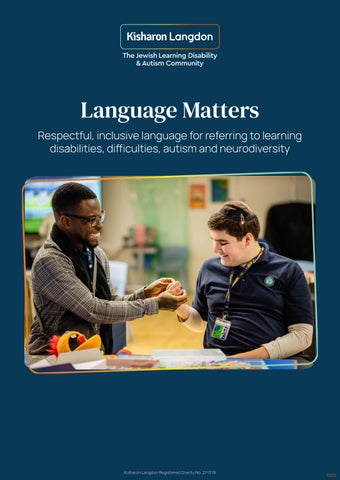
Language Matters Respectful, inclusive language for referring to learning disabilities, difficulties, autism and neurodiversity
1
Kisharon Langdon Registered Charity No. 271519
0925
Contents Key terms & usage Purpose Of This Guide
3
Learning Disability
4
Learning Difficulty
5
Autism
6
Neurodiverse / Neurodivergent / Neurodiversity
7
General Guidelines for Inclusive Language
8
Examples Of Preferred Phrasing
9-10
For More Information
11
2
Key terms & usage Purpose Of This Guide This guide is to ensure that all written and spoken communication across Kisharon Langdon reflects dignity, respect and inclusivity for the people we support, their families and our community. The guidance is rooted in best practice, aligns with UK standards (e.g. NHS, Mencap, National Autistic Society) and is regularly reviewed for relevance and cultural sensitivity.
Learning Disability Definition A learning disability is a reduced intellectual ability and difficulty with everyday activities, for example, household tasks, socialising or managing money, which affects someone for their whole life. APPROPRIATE USE Person with a learning disability People with learning disabilities Adults with learning disabilities
AVOID Learning difficulties (when you mean a learning disability- they are different) Mentally handicapped, slow, retarded - these are outdated and offensive The learning disabled - this depersonalises and is not inclusive Note: In the UK, learning disability is a recognised clinical and social term, unlike in the US where it may mean something different.
4
Learning Difficulty Definition A learning difficulty refers to a condition like dyslexia, ADHD or dyspraxia that affects how a person learns in a specific way but does not affect overall intelligence. APPROPRIATE USE Person with a learning difficulty such as dyslexia Young people with learning difficulties
AVOID Using this term when you mean learning disability
Important distinction: A learning disability is lifelong and impacts multiple areas of functioning; a learning difficulty is usually specific to certain areas like reading, writing or coordination.
5
Autism Definition Autism is a lifelong developmental condition that affects how people perceive the world and interact with others.
BOTH IDENTITY-FIRST AND PERSON FIRST ARE ACCEPTABLE Autistic person (identity-first language) Person on the autism spectrum (person-first language) KISHARON LANGDON GUIDANCE Use what the individual prefers wherever possible Default to neutral descriptions in formal writing: e.g. people on the autism spectrum
AVOID Suffers from autism or afflicted with autism Autistic disorder (unless referring to specific diagnostic categories in a clinical context) Low-functioning / high-functioning - these oversimplify a complex condition Person with autism
6
Neurodiverse / Neurodivergent / Neurodiversity Definition These terms refer to the diversity of human brains and cognition. Neurodivergent people include those with autism, ADHD, dyslexia and others.
USE Neurodivergent person (refers to someone whose brain functions differently from what is considered typical) Neurodiverse group (a group containing both neurodivergent and neurotypical people) Neurodiversity (the concept or movement)
AVOID Calling an individual neurodiverse- use neurodivergent instead Using these terms if the audience or context requires more specific language (e.g. health or legal settings)
7
General Guidelines for Inclusive Language • Use person-first language, unless the individual states a preference for identity-first (e.g. person with a learning disability vs. disabled person). •
Respect preferences: Always ask how someone prefers to be described if you are unsure.
• Avoid deficit-based language: Don’t describe people in terms of what they lack or cannot do. Focus on strengths and support needs.
“Needs support with daily living”
AVOID “Can’t live independently”
•
teer clear of euphemisms that obscure meaning: Be clear and respectful rather than S overly cautious (e.g. say autism not special needs unless the context requires it).
8
Examples Of Preferred Phrasing Please see below for our quick reference table which gives examples of phrases to avoid and which phrases are preferred:
USE INSTEAD
AVOID • Suffers from autism
• Autistic person
• The disabled
•D isabled people / People with disabilities
• Learning difficulties (when meant as disability)
• Learning disabilities
• Handicapped
•P erson with a learning disability
• Low functioning
•P erson with high support needs
• Special needs person
•P erson with a learning disability (if appropriate)
Tone and Context • Keep tone respectful, positive, and empowering. • In promotional or public-facing material, focus on the individual first, their goals, achievements and contributions, not only their condition.
9
Examples Of Preferred Phrasing Please see below for our quick reference table which gives examples of phrases to avoid and which phrases are preferred:
TERM
DEFINITION
CORRECT USAGE
Learning Disability
Lifelong condition affecting intellectual ability and everyday life
Person with a learning disability
Learning Difficulty
Specific difficulty (e.g. dyslexia) not affecting general intellect
Person with a learning difficulty
Autism
Developmental difference affecting communication and interaction
Autistic person/person on the autism spectrum
Neurodivergent
Describes a person whose brain functions differently
Neurodivergent individual
Neurodiverse
Describes a group, not a person
Neurodiverse team or population
10
For More Information This style guide is a living document. Language evolves and so do individual preferences. Always aim for empathy, clarity, and inclusion. For questions or further training on language and inclusivity, contact the Kisharon Langdon Marketing and Communications team or Learning & Development team. Email comms@kisharonlangdon.org.uk or call us on 020 3209 1180.
11
Kisharon Langdon Registered Charity No. 271519