THE ALMANACK OF NAVAL RAVIKANT
THE NAVAL CHEAT SHEET 20 useful lessons on wealth, judgment, happiness and freedom - with a practical way to apply each one.
Build wealth by becoming uniquely valuable. Build happiness by needing less.
The core idea The book brings together Naval Ravikant's thinking from interviews, podcasts and online writing. Its two halves are complementary: one explains how to create financial freedom; the other asks how to use that freedom without becoming trapped by desire, status or comparison.
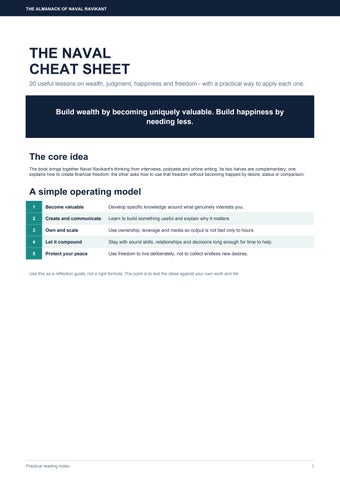
A simple operating model 1
Become valuable
Develop specific knowledge around what genuinely interests you.
2
Create and communicate
Learn to build something useful and explain why it matters.
3
Own and scale
Use ownership, leverage and media so output is not tied only to hours.
4
Let it compound
Stay with sound skills, relationships and decisions long enough for time to help.
5
Protect your peace
Use freedom to live deliberately, not to collect endless new desires.
Use this as a reflection guide, not a rigid formula. The point is to test the ideas against your own work and life.
Practical reading notes
1
THE ALMANACK OF NAVAL RAVIKANT
WEALTH & JUDGMENT Create value, gain ownership and let leverage and time multiply sound decisions. 1. Build wealth, not just income Income is earned by selling time. Wealth is ownership of assets that keep creating value without your constant involvement. Apply it: List one asset you could begin building this year: equity, a reusable campaign system, intellectual property, a product or an audience.
2. Find your specific knowledge Your most defensible advantage sits where natural ability, genuine curiosity and lived experience overlap. It is hard to train for and difficult to copy. Apply it: Write down three things that feel unusually easy or enjoyable to you but valuable to other people. Look for the overlap.
3. Learn to build and learn to sell Builders create value; sellers help others understand and adopt it. Marketing, communication, leadership and persuasion all count as selling. Apply it: Strengthen whichever side is weaker. Pair creative or technical output with the ability to explain its business value clearly.
4. Use leverage Labour, capital, code and media multiply the effect of a decision. Code and media are especially powerful because one piece of work can reach many people repeatedly. Apply it: Before repeating a task, ask whether it can become a template, guide, automation, recording or reusable asset.
5. Seek ownership A salary generally rewards effort once. Ownership lets you participate in the continuing upside of what you help create. Apply it: Where possible, negotiate for equity, performance-linked upside, royalties or ownership of a scalable side project.
6. Play long-term games Knowledge, trust, relationships and reputation all compound. Constantly restarting prevents the benefits of time from accumulating. Apply it: Choose one skill, relationship and professional area worth investing in for the next five years.
7. Choose long-term people The best partnerships combine intelligence, energy and integrity. Trust reduces friction and makes larger opportunities possible over time. Apply it: Notice who consistently keeps promises, shares credit and acts well when incentives become difficult.
8. Create your own luck Activity creates opportunities; expertise helps you recognise them; a distinctive reputation eventually causes opportunities to seek you out. Apply it: Publish useful work, meet people in your field and become known for one valuable, specific capability.
9. Improve judgment With leverage, the quality of your decisions matters more than the volume of your effort. Choosing the right problem can outweigh working harder on the wrong one. Apply it: For important decisions, write down assumptions, likely second-order effects and what would prove you wrong.
10. Value your time Time is the scarcest resource. Busyness can feel productive while crowding out the work that creates real progress. Apply it: Set an aspirational hourly value. Delegate, automate or decline low-value tasks when the trade-off makes sense.
Practical reading notes
2
THE ALMANACK OF NAVAL RAVIKANT
HAPPINESS & FREEDOM Build the inner habits that make success useful rather than endlessly demanding. 11. Treat happiness as a skill Happiness is shaped by attention and habits, not only circumstances. What can be practised can be improved. Apply it: Choose one small daily practice - walking, meditation, sunlight or gratitude - and keep it for 30 days.
12. Return to the present Regret lives in the past and anxiety lives in the future. Peace becomes more available when attention returns to what is happening now. Apply it: When your mind spirals, name five things you can see, hear or feel and return to the next concrete action.
13. Choose desires carefully A strong desire can become an agreement to remain unhappy until a condition is met. Too many desires fragment attention. Apply it: Pick one major desire to pursue. Downgrade the rest from requirements to preferences.
14. Do not expect success to supply peace Money can buy freedom and remove certain problems, but achievement cannot permanently resolve insecurity or the need for approval. Apply it: Define what 'enough' means before reaching the next milestone, then protect it from moving goalposts.
15. Stop selective comparison Envy compares the most attractive slice of someone else's life with the whole of your own, while ignoring hidden costs. Apply it: When envy appears, ask whether you would exchange your entire life - not just one visible advantage - for theirs.
16. Prefer peace over constant excitement Excitement rises and falls. Peace is a steadier foundation and often comes from removing needless disturbance rather than adding stimulation. Apply it: Identify one recurring source of noise, obligation or conflict you can reduce this month.
17. Protect your health A calm mind is easier to cultivate in a cared-for body. Sleep, movement, nutrition and sunlight support every other ambition. Apply it: Schedule exercise and sleep as non-negotiable appointments rather than leftover activities.
18. Read to build foundations Reading exposes you to high-quality thinking across time. Understanding a few foundational ideas deeply is more useful than racing through many books. Apply it: Read for curiosity, abandon books that do not hold value, and revisit the few that change how you think.
19. Be yourself with intensity Competition becomes less relevant when your work reflects a rare combination of strengths, tastes and experiences no one else can reproduce exactly. Apply it: Remove one borrowed goal from your plan and replace it with work that genuinely fits your temperament.
20. Make freedom the objective The wealth and happiness sections ultimately point to the same destination: control of your time and freedom from compulsive comparison and craving. Apply it: Define freedom in practical terms: how you spend a normal Tuesday, who you work with and what you no longer tolerate.
PART I: Learn how to get what you want. PART II: Learn how to stop needing so much. Source note: Based on The Almanack of Naval Ravikant, compiled by Eric Jorgenson from Naval Ravikant's public interviews, podcasts and writing. This guide is an original summary for personal reflection.
Practical reading notes
3