SEPTEMBER 1, 2026 | VOL. XCIV, NO. 17
FEATURING 339 Industry-First Reviews of Fiction, Nonfiction, Children’s, Young Adult, and Audiobooks
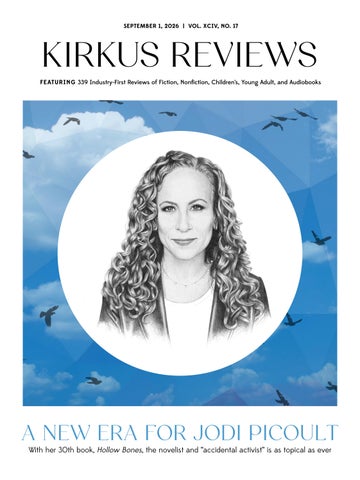
A NEW ERA FOR JODI PICOULT With her 30th book, Hollow Bones, the novelist and “accidental activist” is as topical as ever
ANTICHRIST HIS ORIGIN, RISE, REIGN, AND FALL
They all praised his Christ Clone Trilogy...
A gri�y, scholarly apocalyp�c epic woven from scripture, science, and real-world poli�cs
“...inventive...dizzyingly well described... Astoundingly intelligent.” —Kirkus Reviews (starred review) ★ for Birth of an Age, Vol. II
You can clone a man, but you can't clone a man's soul.
“BeauSeigneur knows how to write,
Is there anything so holy that Satan will not seek to corrupt it?
James BeauSeigneur
an NSA and DIA analyst with more than forty years living and working at the intersec�on of scripture, science, and real-world poli�cs
ISBN 978-0-9656948-8-9 [Hardcover]
ISBN 978-0-9656948-0-3 [Paperback] ISBN 978-0-9656948-9-6 [eBook] Audiobook available from Audible, Amazon, & Apple Books
deploying a tough, driving style in perfect cadence...The paranoia he evokes is a perfect fit for these times.” —Booklist (starred review) ★ for In His Image, Vol. I “Undeniably riveting...daring... wonderfully creepy...Readers will be enthralled by the author's sciencefortified vision of the Apocalypse.” —Publishers Weekly for Birth of an Age, Vol. II
Now he's back with the WHOLE story. “...fans of apocalyptic fiction are in for an unrelenting, epic journey. A studied, compelling, and unapologetically lengthy depiction of the end of days.” —Kirkus Reviews for ANTICHRIST
Film, Television, and Foreign Rights Available Contact Ray@Selec�veHouse.com
Ma�hew 10:16
Contents 2 From the Editor’s Desk FICT ION 4
Editor’s Note
5
Reviews & News
14 On the Cover: Jodi Picoult 39 On the Podcast: Colson Whitehead NONFICT ION 42 Editor’s Note 43
Reviews & News
One of the most coveted designations in the book industry, the Kirkus Star marks books of exceptional merit.
OUR FRESH PICK A lesser-known story by the Goodnight Moon author is freshly illustrated for a new audience.
Read the review on p. 82 PURCHASE BOOKS ONLINE AT KIRKUS .COM
77
Reviews & News
87
Booklist: School’s In!
YOUNG ADULT 118
Editor’s Note
119
Reviews & News
127 Booklist: Our Working Lives: Labor Day Reads INDIE 134
Editor’s Note
135
Reviews
AUDIOBOOKS
53 On the Podcast: Rosebud Baker
158
Editor’s Note
67
159
Reviews
Booklist: City Stories
CHILDREN ’ S 76
Editor’s Note
ON THE COVER: Illustration of Jodi Picoult by Oriana Fenwick, based on a photograph by Jesse Dittmar. Background illustrations by scenery1, Unchalee, and Thierry via Adobe Stock. Interested in reprints, permissions, licensing, or a framed review? Please contact The YGS Group at 800.290.5460 or email Kirkus@theygsgroup.com. KIRKUS REVIEWS (ISSN 1948-7428) is published semimonthly by Kirkus Media LLC, 1140 Broadway, Suite 802, New York, NY 10001. Subscription prices are: Print and digital subscription (U.S.) 3-month ($49), 12-month ($179) | International subscriptions are $79 quarterly and $229 annually. All other rates on request. Periodicals Postage Paid at Austin, TX 78710 and at additional mailing offices. POSTMASTER: Send address changes to Kirkus Reviews, 6411 Burleson Road, Austin, TX 78744
K IR KU S R E V IE W S
SEPTEMBER 1, 2026
1
FROM THE EDITOR’S DESK
COULD 9/11 REALLY be a quarter of a century in the past? Although the world has changed dramatically in the years since, the events of that day retain a kind of shocking immediacy. If we’re old enough, we remember where we were when we learned of the attacks on the World Trade Center and the Pentagon, an inflection point in U.S. history—and in our personal lives. It didn’t take long for 9/11 to show up in fiction, in novels as diverse as Jonathan Safran Foer’s Extremely Loud and Incredibly Close (2005), Claire Messud’s The Emperor’s Children (2006), and Moshin Hamid’s The Reluctant Fundamentalist (2007). It still figures in contemporary fiction, such as Jodi Picoult’s new novel, Hollow Bones (Ballantine, Sept. 15), in which Molly
reflects on growing up as “The Girl Who’d Lost Her Mom on 9/11”; she was less than 3 months old when her mom went to a doctor’s appointment in the South Tower on September 11, 2001, and never returned. Molly has been shaped by an event of which she has no actual memory. At a media luncheon in New York this spring, I heard Picoult talk about the inspiration for the novel. A friend, she said, had told her about an anonymous handwritten postcard sent to the art project PostSecret: “Everyone who knew me before 9/11 thinks I’m dead.” That message got the wheels of her plot turning. (Coincidentally, that same message turns up in Emily St. John Mandel’s Exit Party [Knopf, Sept. 15], where the characters are
Subscriptions: www.kirkusreviews.com/magazine/subscription Advertising Opportunities: www.kirkusreviews.com/book-marketing Submission Guidelines: www.kirkusreviews.com/about/publisher-submission-guidelines Frequently Asked Questions: www.kirkusreviews.com/about/faq For customer service or subscription questions, please email customercare@kirkus.com or call 800-316-9361.
2
SEPTEMBER 1, 2026
speculating about the unexplained disappearance of a friend who had sometimes referred to it.) For more about Hollow Bones, don’t miss our profile of Picoult on p. 14. Other new books continue to grapple with the legacy of 9/11. Here are a few we’ve reviewed at Kirkus in recent issues: 150,000 Trees: Growing a Memorial for 9/11’s Flight 93 by Rebecca E. Hirsch, illustrated by Jacqueline Tam (Tilbury House, June 9): This informational picture book introduces young readers to the 200-acre Pennsylvania forest planted by volunteers over the course of 10 years in remembrance of the passengers who were on the flight brought down near Shanksville to thwart its use as a terror weapon. Our review calls it a “sensitive treatment that honors sorrowful memories while showing that healing is possible.” Forgiveness at Ground Zero: A Journey of Service, Loss, and Redemption After 9/11 by Lyndon Fitzgerald Harris (Bloomsbury
Academic, July 23): St. Paul’s Chapel in lower Manhattan survived the collapse of the World Trade Center and emerged as a makeshift sanctuary for volunteer workers at Ground Zero. The author, a former Episcopal priest, writes about that recovery effort as well as his subsequent loss of faith and challenging journey to healing. Our starred review calls it an “affecting memoir about moving beyond blame.” All the Presidents’ Wars: Twenty-Five Years of America’s War on Terror by Peter Bergen (Norton, Sept. 8): A national security expert examines the U.S. response to the 9/11 terrorist attacks in the realm of foreign policy—namely the wars in Afghanistan and Iraq, which cost roughly $6 trillion and 7,000 American lives. Our review calls it a “profoundly insightful account of why we’re mired in forever wars, and likely will be long into the future.”
TOM BEER K IR KU S R E V IE W S
Illustration by Eric Scot t Ander son
REMEMBERING 9/11
Co-Founders, Kirkus Media LLC HERBERT SIMON MARC WINKELMAN Publisher, CEO & Partner MEG LABORDE KUEHN mkuehn@kirkus.com
Editor-in-Chief TOM BEER tbeer@kirkus.com
Chief Marketing Officer SARAH KALINA skalina@kirkus.com
President of Kirkus Indie CHAYA SCHECHNER cschechner@kirkus.com
Enterprise Advertising Director MICHELE COBB mcobb@kirkus.com
Fiction Editor LAURIE MUCHNICK lmuchnick@kirkus.com
Indie Advertising & Promotions AMY BAIRD abaird@kirkus.com Author Consultant KEELIN FERDINANDSEN kferdinandsen@kirkus.com Controller & Operations Manager KRISTI DAUGHERTY kdaugherty@kirkus.com Lead Designer KY NOVAK knovak@kirkus.com Magazine Compositor NIKKI RICHARDSON nrichardson@kirkus.com Director of Kirkus Editorial ROBIN O’DELL rodell@kirkus.com
Nonfiction Editor JOHN McMURTRIE jmcmurtrie@kirkus.com Young Readers’ Editor LAURA SIMEON lsimeon@kirkus.com Young Readers’ Editor MAHNAZ DAR mdar@kirkus.com Audiobooks Editor JENNIFER DOWELL jdowell@kirkus.com Editor at Large MEGAN LABRISE mlabrise@kirkus.com Senior Indie Editor DAVID RAPP drapp@kirkus.com Indie Editor ARTHUR SMITH asmith@kirkus.com
Kirkus Editorial Senior Production Editor MARINNA CASTILLEJA mcastilleja@kirkus.com
Senior Editorial Assistant NINA PALATTELLA npalattella@kirkus.com
Kirkus Editorial Production Editor ASHLEY LITTLE alittle@kirkus.com
Senior Indie Editorial Assistant DAN NOLAN dnolan@kirkus.com
Indie Editorial Assistant KATARINA YERGER kyerger@kirkus.com
Mysteries Editor THOMAS LEITCH
Contributing Writers GREGORY McNAMEE MICHAEL SCHAUB
Copy Editors JONATHAN BOWERS NATALIA HOLTZMAN NANCY MANDEL BILL SIEVER
Founder, Kirkus Reviews VIRGINIA KIRKUS (1893-1980)
K IR KU S R E V IE W S
Contributors
Alana Abbott, Colleen Abel, Reina Luz Alegre, Autumn Allen, Paul Allen, Jenny Arch, Kent Armstrong, Mark Athitakis, Julian Axelrod, Kit Ballenger, Audrey Barbakoff, Carole Bell, Nell Beram, Victoria Biggs, Elizabeth Bird, Christopher A. Biss-Brown, Marc Bona, Elissa Bongiorno, Agnes Broome, Anna Broome, Jennifer Brough, Jessica Hoptay Brown, Kelsey Callahan, Kevin Canfield, Tobias Carroll, Sandie Angulo Chen, Ann Childs, Alec B. Chunn, Carin Clevidence, Rachael Conrad, Stephen Cummings, Sara Davis, Lisa De Bode, Cathy DeCampli, Dave DeChristopher, Lisa Dennis, Amanda Diehl, Fiona Dolce, Steve Donoghue, Anna Drake, Eamon Drumm, Madison Ellingsworth, Lisa Elliott, Phoebe English, Chelsea Ennen, Joshua Farrington, Brooke Faulkner, Katie Flanagan, Catherine Foster, Jenna Friebel, Jean Gazis, William Giwertz, Amy Goldschlager, Diana Granger, Melinda Greenblatt, Sara Grimm, Vicky Gudelot, David Harris, Lynne Heffley, Karen Henck, Mara Henderson, Sandi Henschel, Boze Herrington, Rebecca Herwatic Leonhard, Terry Hong, Julie Hubble, Christoph Irmscher, Jessica Jernigan, Danielle Jones, Marcelle Karp, Lavanya Karthik, Stephanie Katz, Maggie Knapp, Jennie Knuppel, Andrea Kreidler, Carly Lane, Christopher Lassen, Tom Lavoie, Maya Lekach, Elsbeth Lindner, Barbara London, Patricia Lothrop, Sawyer Lovett, Wendy Lukehart, Dylan Mabe, Michael Magras, Joan Malewitz, Mitu Malhotra, Thomas Maluck, Natalie Marshall, Jodi Martin, Michelle H Martin, Nancy McCarty, Kirby McCurtis, Breanna McDaniel, Jeanne McDermott, Tate McFadden, Dale McGarrigle, Van McGary, Isla McKetta, Zoe McLaughlin, Cari Meister, Kathie Meizner, Ana Menchaca, Emily Mernin, J. Elizabeth Mills, Alan Minskoff, Andrea Moran, Molly Muldoon, Jennifer Nabers, Christopher Navratil, Ari Nussbaum, Katrina Nye, Erin O’Brien, Tori Ann Ogawa, Mike Oppenheim, Emilia Packard, Nina Palattella, Joy Pasin, George Pate, Crystal Patenaude, Hal Patnott, Bethanne Patrick, John Edward Peters, Jim Piechota, Christofer Pierson, William E. Pike, Shira Pilarski, Cathy Poland, Remy Poore, Brian Price, Margaret Quamme, Carolyn Quimby, Ellen Quint, Kristy Raffensberger, Mohana Rajakumar, Kristen Rasmussen, Darryn Reams, Peter Richardson, Alexandria Richey, Amy Robinson, Soumi Roy, Lloyd Sachs, Bob Sanchez, Michael Sangiacomo, Caitlin Savage, Christine Scheper, Aurelia Scott, Gene Seymour, Lorraine Shanley, Sara Shreve, Linda Simon, Wendy Smith, Margot E. Spangenberg, Allison Staley, Sydney Stensland, Richard Stim, Mathangi Subramanian, Bill Thompson, Lenora Todaro, Chris Turner-Neal, Jenna Varden, Gnesis Villar, Francesca Vultaggio, David Walton, Katie Weeks, Susie Wilde, Laura H. Wimberley, Kerry Winfrey, Marion Winik, Simona Zaretsky, Audrey Zheng
SEPTEMBER 1, 2026
3
LAURIE MUCHNICK
AN ELIN HILDERBRAND
book used to be a reliable indicator of summer, but now it means…back to school? As a fan of campus novels from David Lodge’s Small World (1985) to Leigh Bardugo’s Ninth House (2019) and Hell Bent (2023), I was thrilled to hear that Hilder brand was starting a series set at a Massachusetts boarding school, using inside informa tion supplied by her daugh ter and co-author, Shelby Cunningham. The first novel, The Academy, came out last year, and this year’s installment, The Thoroughbreds (Little, Brown, Sept. 15), follows the adventures of several members of the new senior class, including a scholarship boy from Queens whose mother is dating the billionaire president of the board of directors. Our starred review says, “The campus series scratches this author’s proprietary itch as effectively 4
SEPTEMBER 1, 2026
as the island set did. We’ll follow her anywhere.” Meanwhile, Bardugo has completed her Alex Stern series, and Dead Beat will be published on Sept. 15 by Flatiron. As I’m writing, the book is still embargoed, but you’ll be able to find our review online by the pub date. R.F. Kuang’s last novel, Katabasis (2025), was set in the world of magical academia, but with Taipei Story (Morrow/HarperCollins, Sept. 8), she examines a Chinese American college student’s strictly nonf antastical summer abroad in Taiwan studying the language. “Lily’s experiences and emotional journey are deeply real and often uncomfort able,” says our review. “Her narrative flits between rumination on the nuances of language and what’s lost in translation, worries about how others perceive her, and where to go for lunch.”
After a series of speculative novels, Cadwell Turnbull has produced his first story collection, All the Hidden Places (Blackstone, Sept. 1), and he uses horror, SF, and fantasy to examine intimate relationships between parents and children, siblings, and couples—people who have trouble communicating whether they have one soul or many, live on Earth or a faraway space colony. Our starred review says it’s “rich and strange, while going straight to the heart.” Kate Atkinson publishes a lot of books, but her last two have been a Jackson Brodie mystery and a story collection, so we haven’t had a new standalone novel since 2022. Fans of her historical fiction will be excited to see what she does with a post–World War II setting in Our Noble Selves (Doubleday, Sept. 15): It’s 1951, and in Britain, the trauma of the war is still fresh while the sense of common
purpose has faded—so the government decides to launch the Festival of Britain, where Harry Flynn will get a job that leads to his becoming a murder suspect. “Another exquisitely humane novel from one of contemporary fiction’s finest writers,” according to our starred review. Ingeborg Bachmann was a renowned Austrian writer who died in 1973 at age 47; The Complete Stories (New Directions, Sept. 29) is a wonderful opportunity to discover her multifaceted work in a new translation by Philip Boehm and Tess Lewis. “Themes of class tensions, borders, displacement, and homesickness recur,” according to our starred review. “One of the great pleasures of this excellent collection is the chance to watch her talent develop and her originality come into its own.” Laurie Muchnick is the fiction editor. K IR KU S R E V IE W S
Illustration by Eric Scot t Ander son
BACK TO THE BOOKS
FICTION
EDITOR’S PICK for his serial liaisons with women, four of whom are suspects in his murder. Though Lally, Georgette, Sophronia, and Vivianne are as different as the seasons, they all have a claim, not necessarily legal, to be his spouse. More to the point, they each have a reason to be exasperated enough to kill him, or to scare some sense, however unlikely, into his raucous deportment. The problem, if it can even be called a problem, is that even after Rich has been killed, he doesn’t appear to be quite dead, even as the four women meet, as one of them says, to “discuss [their] options” for disposing of his body. The truth of how Rich Milford died proves far harder to nail down than Newville’s shared knowledge that no one in town is either surprised or especially distressed by his
A bizarre comedy of errors and manners playing out in an all-Black town smack-dab in the middle of the Jazz Age. Newville is a determinedly self-sufficient Black township in a predominantly white 1920s Oklahoma that, by the time this story begins in 1925, has exhibited its disapproval with such communities given the massacre of Black men, women, and children four years earlier in Tulsa. Only the faintest shadow of that horror, however, stalks Newville, whose citizenry is perplexed by the violent, mysterious death of one of its leading citizens: Richard Aloysiuis Milford, born with a “misshapen head,” a family curse, and an alarming temper. Rich, as he’s known throughout the region, is a wantonly sybaritic force of nature notorious for bootlegging and
These Titles Earned the Kirkus Star
6
The Stager By Matthew Aquilone
6
The Complete Stories By Ingeborg Bachmann; trans. by Philip Boehm & Tess Lewis
Thompson-Spires, Nafissa | Scribner | 176 pp. $26 | October 6, 2026 | 9781501168048
passage. What is also unavoid able is the droll characterization, wry humor, and storytelling chops displayed by the talented Thompson-Spires in this debut novel, an impressive follow-up to her short story collection, Heads of the Colored People, a finalist for the 2018 Kirkus Prize. Reminiscent of T.C. Boyle, another master of the
7
On the Calculation of Volume By Solvej Balle; trans. by Sophia Hersi Smith & Jennifer Russell
35
Once in a Timeline By Iman Hariri-Kia
32
Wildflower By Becky Jenkinson
K IR KU S R E V IE W S
The Four Wives and Five Deaths of Richard Milford
36
The Santa Claus Con By Lauren Kung Jessen
10
Whale Harbor By Mary Beth Keane
36
From Beijing, With Love By Bei Lin
darkly whimsical short story, Thompson-Spires packs a sharp, caustic wit that yields plenty of compassion for even someone as mean and misbegotten as her title character. Is this a whodunit or a “how- they-did-it”? However you define Thompson-Spires’ novel, it’s shrewd, audacious, and funny.
37
Unapologetic Love Story By Elle McNicoll
13
D By Neal Stephenson
13
Tom Clancy Pressure Depth By Jack Stewart
5
The Four Wives and Five Deaths of Richard Milford By Nafissa Thompson-Spires
33
All the Hidden Places By Cadwell Turnbull
SEPTEMBER 1, 2026
5
FICTION
A Very Special Episode Acker, Camille | Random House (304 pp.) $28 | August 18, 2026 | 9780593597507
Could nostalgia for sitcoms like The Fresh Prince of Bel-Air and The Jeffersons be the cure for a fictional version of dementia called Blacktimer’s? A treatment for dementia is one of many hot topics Acker circles in this crazy salad of a novel, combining social satire with an edge of dark fantasy in her follow-up to the story collection Training School for Negro Girls (2018). It opens at a Juneteenth celebration held by an elite Washington, D.C., social club called The Tenth, referring to Du Bois’ Talented Tenth. Taking over the reins of the organization from her ultraconservative mother, Nina Johnson plans to reinvent it for changing times. Arriving on the arm of her boyfriend, Booker T. Bruce, the favorite in an upcoming mayoral election, it looks like Nina has her ambitious dreams on lock. But then her mother insists she participate in a wildly politically incorrect stage re-enactment of the events of 1865 in which Nina is forced to darken her light skin with bronzer and sing a jazzy version of “We Shall Overcome”—a performance referred to by her activist sister, Bett, as “coonery” and “a minstrel show.” Acker has just begun to unleash the gale force of this edgy satire, which is about to take a sharp turn into a second major plotline, this one verging on the surreal. After the event, Nina is approached by a white woman offering a huge donation to The Tenth if Nina commits the group to supporting the woman’s experimental mental health facility. After receiving the first in a promised series of $50,000 donations, Nina arrives with her sister and two best friends for a one-week visit, only to find that the place revolves around the recreated set of a fictional 1990s sitcom called Coolin’ Out With the Johnsons. They are relieved of their car keys, given matching ’90s wardrobes, and shown to a room with bunk beds 6
SEPTEMBER 1, 2026
and a Janet Jackson poster. The patients all wear headphones that loop the show’s soundtrack. Is this really supposed to cure dementia? Or is something more malevolent going on? Acker is fearless in her skewering of Black respectability politics, white philanthropy, and the price of ambition.
Kirkus Star
The Stager Aquilone, Matthew | Delphinium (268 pp.) $27 | November 10, 2026 | 9781953002822
It’s tough enough being a hapless 20-something without having a global pandemic tempt you into becoming a luxury- apartment squatter in Manhattan. Twenty-six- year-old Maya works as a stager for a beautiful, slightly oblivious designer named Athena. In an opening worthy of the movie Bridesmaids, Maya leaves a mess in a showcase penthouse. “Soaps are my forte,” says Maya, but her heart’s not in the high-rise game. Flashbacks to art school and her friendship with fellow student Clarissa take up more real estate in her head than her actual job. Athena has chosen one of Clarissa’s stunning paintings for the place, a painting so accomplished it makes everyone else’s work look lackluster in comparison— including, alas, Maya’s. Maya’s own medium turns out to be not paint, but puppets, which she makes from found materials and for which she creates distinct identities and voices: “My instructors called them puppets. Yes, they were human-like figures that I held on my hand and made speak in funny voices, but they were more. They were themselves avatars of the universal forces of transformation…in meta-territory, crafting dynamic sculptural reflections on Self.” After avoiding Clarissa’s first gallery show, she boxes up her creations and shoves the box in the bedroom closet of her Queens apartment, convinced she’s not meant to be an artist or an
artist’s friend. She satisfies herself with the staging gig, booty calls with a nice enough fellow former art student named Craig, and admiring Clarissa’s superb work from afar. However, it’s late 2019 and then early 2020, and more and more conversations are revolving around a “big bad virus”; Maya decides there’s no harm in staying in the penthouse to ride out the Covid-19 quarantine. Before she manages to eat and drink all the supplies, Craig, then others—including her unhappily married sister—have joined her in a somewhat madcap but totally interesting ménage à many. Yes, that friendship with Clarissa, as well as Maya’s creative spark, will re-emerge, but the joy of this novel lies in its back-andforth between aspects of Maya’s life and all her penthouse mates. A snappy first-person voice, charming chaos, and plenty of Manhattan atmosphere make this debut a standout.
Kirkus Star
The Complete Stories Bachmann, Ingeborg | Trans. by Philip Boehm & Tess Lewis | New Directions (512 pp.) $29.95 | September 29, 2026 | 9780811238793
This new transla tion of early, uncollected, and previously published stories by Bachmann, the renowned Austrian author of essays, poetry, and fiction, spans 27 years of her work. Opening with a story written in 1945 when she was 19, and ending with one completed the year before her death in 1973 at 47, this collection showcases the breadth of Bachmann’s interests and the deepening of her central themes. In “The Welder,” a working-class man discovers reading and ruins his life. In “The Commandant,” a man attempting to cross a border without documenta tion becomes caught in a Kafkaesque nightmare of confused identity. Themes of class tensions, borders, displacement, K IR KU S R E V IE W S
FICTION
A multifaceted collection by a brilliant writer who died too young. THE COMPLETE STORIES
and homesickness recur. From “I Too Lived in Arcadia”: “I reached the border at night...my homeland had no currency exchange agreements with other countries, so my money was worthless.” Bachmann moves easily between male and female points of view—often in the same story—and power dynamics between the sexes is a recurrent concern. In “One Step Towards Gomorrah,” a musician imagines leaving her husband for a female admirer, escaping the restrictions of her role as wife and foisting them onto the other woman. World War II casts a long shadow, as do questions of guilt and victimhood. Many of the characters are Austrians living abroad. “I’ve figured out that I don’t belong anywhere anymore, there’s no place I long for,” a man tells his lover in “Three Paths to the Lake.” “At one point I thought I had a heart and that I belonged in Austria. But everything eventually comes to an end...something inside me is bleeding away, but I don’t know what it is.” Elusiveness— of happiness, of belonging—extends to truth itself, as in “A Wildermuth,” about a disillusioned judge. Bach mann writes with quicksilver intelligence and intensity. One of the great pleasures of this excellent collection is the chance to watch her talent develop and her originality come into its own. A multifaceted collection by a brilliant writer who died too young.
For more by Ingeborg Bachmann, visit Kirkus online.
K IR KU S R E V IE W S
Kirkus Star
On the Calculation of Volume: Book V Balle, Solvej | Trans. by Sophia Hersi Smith & Jennifer Russell | New Directions (208 pp.) | $16.95 paper | November 17, 2026 9780811240383
In the latest installment of Balle’s septology, the old life grows increasingly abstract for those locked in time. Across the first four volumes of Balle’s ingenious novel, in which a bookseller named Tara Selter inexplicably repeats Nov. 18, her predicament never seemed like a condemnation. An existential problem, yes: How many people are similarly stuck, and why? How can they create more resources, or at least not drain them? What does community look like? But as Tara’s diary progresses from its 4,541st to its 10,455th day in this volume, frustrations and fractures are increasing. A large collective of the time-trapped has gathered in Belgium, and a splinter group has convinced itself that there’s an escape hatch. Others travel the planet together, chasing changing seasons. One of the group’s leaders argues that they’re “trapped in a privilege,” an opportunity to explore new freedoms. But many, including Tara, are skeptical. People are still aging and, inevitably, dying, and her old life with her husband in France feels increasingly foggy and distant. To pass the time, she serves as the commu nity archivist, collecting and organizing reports that people give her about Nov. 18–related phenomena, a task that brings her physically and emotionally closer with
Milas Garth, the community librarian. This is the most sociologically focused entry in Balle’s series, and in some ways the fussiest, with longueurs about the structure of the community’s “plenary session” and copious details about Tara’s approach to preserving materials. But it has some of the series’ most deeply melancholy passages as well, particularly as Tara pays what feels like a farewell visit to her husband and, in the series’ typical cliffhanger fashion, plots her next move. A richer, more complex snapshot of Balle’s peculiar world.
American Crow Burruss, Ryan | Counterpoint (320 pp.) $28 | October 6, 2026 | 9781640097827
Built for World War II veterans and families victimized by the war, a Maryland suburb is shaken up by the arrival of an odd stranger known only as the bookbinder. Given that name because he makes books by hand and leaves them on people’s doorsteps, the long-haired, tattooed man is haunted by the horrors of the Okinawa campaign, which have taken up residence inside him in the form of a winged beast. He’s not the only soldier in town with trauma that “slept and readied itself in the wounds.” Set mainly in 1952, the novel opens with a flashback to 1944, when Guadalcanal hero Paul Dyson is found shot in the head—possible payback for having drunkenly beaten and raped his pregnant wife, Charlotte. Jump ahead eight years to the all-American town of Brookshire, when another drunken veteran, Sam St. Pierre, abuses his wife, Rebecca, and mistreats his young daughter, Ava. Then there’s mourning war widow Miriam Hollanger, whose withdrawn 12-year-old son, Joe Jr., finds a friend and mentor in the bookbinder. Both Rebecca and Miriam overcome their unease with the man to find solace in his presence—and in Rebecca’s case, his bed. But darkened and flooded by SEPTEMBER 1, 2026
7
FICTION
torrential rains—to which the town’s corrupt builder left homes vulnerable— all kinds of hell break loose. “The only way to protect the good from the evil is to become blacker than the evil itself,” says the bookbinder, who is up for the challenge. Charged with poetic intensity, this debut novel is at its best in the setup stage, before the beast metaphor becomes overworked and the plot a bit scattered. But it’s a solid effort that promises good things ahead. An entertaining horror novel with a streak of nostalgia for post-WWII domestic dramas.
Sanctuary Disher, Garry | Mysterious Press (368 pp.) $17.95 paper | September 15, 2026 9781613168080
A dense network of expert criminals crisscrosses eastern Australia in search of precious antiques, long- standing nemeses, and a place to call home. A nauseating wannabe influencer in the toxic manosphere, Brodie Hendren uses the money he makes from credit card fraud and selling Nazi memorabilia to stalk his ex-wife. Meanwhile, two thieves who became the closest thing to sister and brother in a foster family turn into adversaries of peak criminal acumen, executing competing heists for pricey collectible stamps. The sister, now calling herself Grace Latimore, made it out of foster care by learning high-end robbery skills from her older boyfriend, a corrupt cop. Years ago, she extracted an especially valuable watch from a theft to cover the share that boyfriend took from her—the same watch her brother, Adam Garrett, was sent by his own crime boss to seize. Now Adam pays off his underworld debts by working surveillance for an unlicensed private eye: sometimes on honest investigations, sometimes on scams. Motivated by a mix of vengeance and family ties, Adam launches a search for Grace. This forlorn history adds a 8
SEPTEMBER 1, 2026
A richer, more complex snapshot of Balle’s peculiar world. O N T H E C A L C U L AT I O N O F VO L U M E
depth of motivation rarely seen in such precise heists. Grace, hoping to have finally found a safe place to land, works as the assistant in an antique shop, putting to legitimate use all the valuation skills she learned in cat burglary. But the antiques dealer has her own fears and secrets. As all the expertly detailed crimes converge, there are high stakes in cash and human lives on the line. An intricate thriller with a surprisingly sympathetic search for security and family by master thieves.
Kiss Slay Replay Harrison, Rachel | Berkley (336 pp.) | $30 September 8, 2026 | 9798217188574
A fresh voice in horror takes on a new trope. “What if it sucks forever?” This is the question Willa asks as she surveys her moderately crappy studio apartment in Jersey City and obsesses about seeing the guy who was until quite recently her fiancé at her friends’ wedding. What she can’t know is that she’s about to get a sense of what “sucks forever” feels like as she experiences her own death and those of her closest friends over and over and over again. With books like So Thirsty (2024) and Such Sharp Teeth (2022), Harrison has reinvented classic baddies like vampires and werewolves in ways that feel new and just a little bit feminist. Her haunted house novel, Play Nice (2025), went a bit deeper than those earlier works in using the conventions of horror to express experiences and emotional states that are impossible to
speak about in everyday language. Her latest feels like a bit of a retreat, which is not to say that it isn’t enjoyable. Willa is going to encounter her ex at a Hudson Valley locale that “transitioned from silver spoon summer camp to dreamy wedding venue.” This is a perfect spot for indie-rustic nuptials and—as any slasher fan knows—a masked murderer. Willa dies along with her besties…only to wake up in her own bed in Jersey City, about to start the whole thing over again. Each time she relives the wedding weekend, she develops new strategies for surviving, saving her friends, and processing her feelings about her breakup. This is, of course, exactly what’s supposed to happen in a time-loop narrative, and Harrison adds some nifty twists. But the repetition begins to feel repetitive as the horrors start to become a bit silly. Not exactly fulfilling, but still pretty fun.
Operation Icebreaker Hawksley, Humphrey | Severn House (272 pp.) $29.99 | October 6, 2026 | 9781448320417
A trip to promote solidarity between Greenland and his home of Little Diomede Island blows up in the face of Major Raymond Ozenna, of the Alaska National Guard. The charge Rake’s friend and mentor Harry Lucas laid on him is routine: Visit the Pituffik Space Base—an American base in the north of Greenland—and the frigid area around it to show solidarity between Greenland and the Arctic region of the U.S. in his native Alaska. K IR KU S R E V IE W S
FICTION
While he’s there, Rake has arranged a face-to-face meeting between his unofficial kid brother, ivory carver Jessie, and Bruno, a Greenlandic artist Jessie’s been following online. But someone has other plans that explode into violence the moment Jessie and Rake are out of each other’s sight. By the time Rake makes his way out of Greenland, six people are dead, and Dr. Brett Laine, of the Pentagon’s Office of Arctic Planning, has laid the blame on Bruno’s cousin, Inughuit independence activist Marco Kannuck. Even given his long experience and his own comfort with violence, Rake will have his hands full defending Greenland’s Danish ties against a cadre of highly placed Americans determined to maneuver slow-witted President Robert Stratton into sending in troops to annex the place in order to prevent China from seizing its trove of rare industrial minerals. As usual, Hawksley ladles out punchy action sequences that provide a series of well-earned interludes from his generously detailed accounts of tradecraft, freelance black ops, and diplomatic maneuvering—though following Rake as he prowls around an armory methodically picking out weapons for the climactic personal counterassault he’s planning is some thing of a treat on its own. Forgotten about the plan to annex Greenland in your fretting over the war with Iran? Hawksley’s got you covered.
The Strongest Woman in the World Helgadóttir, Steinunn G. | Trans. by Larissa Kyzer | Open Letter (200 pp.) | $18.95 paper September 22, 2026 | 9781960385567
Two siblings must contend with who they are and who they present themselves to be. As Icelandic author Helgadót tir’s novel opens, the “strongest woman in the world” is attempting an impossible feat: breaking out of a prison cell while K IR KU S R E V IE W S
shackled. The novel then moves sharply back in time to show that woman, Gunnhildur, as a baby breaking free of her mother’s body. When she’s brought home to a place of emotional extremes, her older brother, Eiður, attempts to soothe her. She grabs his fingers with an unfathomable strength, and the siblings immediately “became powerless comrades in a place where nothing could ever be changed.” Then their mother dies, and their father separates the siblings. Living with their father, Eiður searches for connection and community through the world of activism, protests, and the desire for social change. Meanwhile, Gunnhildur is sent to live with her uncle and cousin on a farm—and learns to harness a quiet inner strength in addition to her physical prowess. Eiður struggles with his public persona as a human rights activist, chef, and environmentalist—and his interior truth, that he may not have the passion to continue trying to change the world. While Gunnhildur’s life seems more aimless than Eiður’s, she finds purpose in both motherhood and her work as a sought-after mortuary cosmetologist. The novel alternates between chapters focused on Eiður, Gunnhildur, and the lives of Gunnhildur’s clients. Though they initially feel out of place, the cosmetology chapters offer lovely glimpses into humankind more generally, and reveal the immense care Gunnhildur puts into the world. As the novel brings itself back to where it opened, the juxtaposition of Eiður’s flashier energy and Gunnhildur’s understated fortitude brings each sibling—and their relationship with each other—into sharper focus. Helgadóttir’s novel quietly reveals the power that comes from finding your place even if it’s not where you expected. A restrained novel about discovering and wielding one’s innate powers.
For more fiction in translation, visit Kirkus online.
Body Language Howrey, Meg | Doubleday (304 pp.) | $30 September 1, 2026 | 9780385551755
Three adult sisters return to the Midwest to deal with their mother’s advancing cognitive decline. Sloane is 50. Recently divorced and trying to start a new career as a therapist, the former actress is also going through the upheaval of perimenopause. Her younger sister, Laurel, 45, is the hypercompetent mother of two teens: one a daughter and the other nonbinary (assigned female at birth). When she finds a woman’s hairpin among her husband’s clothes, though, she wonders if her home life is as stable as she thinks. And then there’s Nanette, 35, or Sister Nanette Teresa, the “odd little duckling” of the family, who’s a few years into her novitiate at a convent. Just before Sloane, Laurel, and Nanette reunite, Nanette goes viral on social media for a dramatic public act of religious fervor. When their mother, Barbara, is seemingly abandoned by her live-in caretaker, the three sisters converge in Indiana to assess whether it’s time to carry out her final wishes: Barbara, having seen her own sister and mother succumb to dementia, has expressed the wish to orchestrate her own end of life. Three grown women each dealing with her own domestic, emotional, physical, and existential crises now facing an elderly mother who “didn’t like being helped and… hated being handled”? Drama ensues. Howrey is a reliably beautiful stylist, and her slyly funny prose and blade-sharp insights into human behavior really should put her in the same conversation as writers like Ann Patchett and Barbara Kingsolver. Though this novel hits some familiar beats, Howrey manages to haul in plenty of shimmering pearls on the perils and joys of womanhood— whatever that means. A comfort meal of a novel: poignant and prismatic.
SEPTEMBER 1, 2026
9
FICTION
Kirkus Star
Whale Harbor Keane, Mary Beth | Scribner (352 pp.) | $29 November 3, 2026 | 9781668224632
Based in part on her own family’s history, Keane’s latest novel tracks the lives of the 11 Joyce brothers, many of them departing a remote corner of Connemara, Ireland, for the United States. With his oldest brother, Sean, working in England, it falls to second-oldest son Macdara, 16, to take on a leadership role when their mother dies shortly after giving birth to her last child, Vincent, in 1963. The boys’ obstinate father, Cathal, is often and unpredictably absent, so Mac does his best to hold things together until Cathal reappears with some hasty solutions—a new wife, Nuala; 14-yearold Barry to join Sean; Vincent to stay permanently with a cousin; and two other sons sent to a seminary school. The remaining boys respond differently to Nuala, the young ones clingy, but 9-year-old Rian rebellious. When Mac decides to accept an opportunity to work in Montana, he must break the promise he’d made to Rian—“I won’t leave you here alone”—consoling himself that he’ll earn enough money to send for Rian later. But the promise remains unful filled, haunting Mac through the coming years as his U.S. life expands, and Rian runs away at age 13 and disappears. Keane’s outstanding ability to encompass family feeling in fluid, translucent prose—as she did in Ask Again, Yes (2019)—shines once more in this saga of immigration and lifelong emotional bonds. Her opening portrait of existence in an obscure, impoverished outpost of the old country is lit with memorable detail: “There was a bowl of eggs on the table, and next to it a pile of dried seaweed.” The boys are unaccus tomed to shoes and cutlery; a whale carcass washed up on the beach comes to symbolize, among other things, what will endure among the Joyces. Decades 10
SEPTEMBER 1, 2026
will pass and new generations arrive, but those blood connections, even when long neglected, are ineradicable. Epic yet intimate, with a long, satisfying afterecho.
Die Famous Koryta, Michael | Little, Brown (416 pp.) | $30 September 22, 2026 | 9780316535991
Not only is Depression-era getaway driver Eddie “Nickel” Terhune on the FBI’s Most Wanted list: His headstrong lover Savannah Cody is out to kill him—literally—for running out on her. For Savannah, it’s a no-brainer to take Alford—her 12-year-old son by Nickel—on the road with her. Raised by his recently deceased grandmother, the boy barely knows his mother and has never met his father. A botched jewelry store robbery in Ohio that leads to a dead cop and Nickel wounded and locked up in Indiana puts a crimp in Savannah’s homicidal plan. She hatches a new scheme to save Nickel from the electric chair by marrying him—and claiming him for herself. But after he’s busted out of jail by fellow members of the Brady Gang, led by the temperamental, trigger- happy Al Brady, a John Dillinger wannabe, her feelings soften. An expert in cars, maps, and weapons who’s previously served time, Nickel isn’t a bad guy. But after Nickel flees on his own to Maine, with both Savannah and the law in pursuit, he’s joined by Brady and agrees to do a bank job with the gang. For Alford, who grew up seeing himself as “the bastard son of a criminal,” all of this is difficult to process, especially since Toland, the FBI agent on the case, seems like a character straight out of his favorite book, Dan Hyland, Police Reporter. Recurring sections from Toland’s questioning of the humor ously hard-wired Savannah are entertaining but slow the pace. And
Savannah’s bookish nature and designs on becoming a famous writer stretch credibility. But Koryta, a crime writer who’s thrived on genre departures, does so again in lively fashion. How can you not dig a femme fatale who digs Thoreau?
A fresh, sometimes offbeat take on the 1930s gangster novel.
Taipei Story Kuang, R.F. | Morrow/HarperCollins (288 pp.) $32 | September 8, 2026 | 9780063473744
A Chinese American college student heads to Taiwan for a summer abroad. Lily Chen’s Chinese has always been an embarrassment— good enough that she can order in restaurants, but not fluent enough for talking to her grandparents in a meaningful way. In a bid to feel more confident, Lily has signed up for a summer of intensive language study in Taiwan, where she’ll finally learn to speak, fit in, and be Chinese enough. Things do not go according to plan, of course, because— as Lily is about to find out—identity is much more complicated than a list of vocabulary words. Once again, Kuang uses a deeply flawed protagonist to examine a larger issue, in this case the uncertainty of the Chinese diaspora as it searches for a motherland that can’t be found. Lily’s brash narration takes up this case easily enough, laying out how different the Chinese American experience is from one community to another and how impossible identity is to pin down—Kuang is arguing that there’s no single Chinese American way of being, no archetypal Chinese American story. Lily’s experiences and emotional journey are deeply real and often uncomfortable; her narrative flits between rumination on the nuances of language and what’s lost in translation, worries about how others perceive her, and where to go for lunch. Her long-held issues with her identity K IR KU S R E V IE W S
FICTION
aren’t going to be transformed in just one summer, but they’re very real and relatable. As ever, Kuang raises uncomfortable questions about history, ethnicity, and identity and leaves it for readers to determine whether Lily has come to the right conclusions and how much growing up she still has left to do. A visceral exploration of language as a bridge and a barrier.
A Date With Santa Macomber, Debbie | Ballantine (256 pp.) $27 | October 13, 2026 | 9798217091706
A career-minded marketing professional who’s up for a promotion finds herself taking care of her nephew for the month of December. Sage Madison has been working toward a promotion to manager of Park Marketing in Seattle as long as she’s been an employee there. Now retiring manager Stanley Mowrey has said that whoever wins the Hudson Group account for their new healthy soda, Buzz, will be named branch manager. But then Sage’s widowed sister, Saffron, is deployed to help Florida hurricane victims with her Army Reserve unit, and with their parents setting off on a monthlong cruise for their 40th anniversary, there’s no one except Sage to take care of 5-year-old Ricky, Saffron’s son. So Sage starts learning how to take care of a child and support his belief in Santa at the same time that she’s trying to win the Hudson account and distinguish herself from the other two employees in the running for the promotion: Troy Whitehall, her marketing nemesis, and Ethan Cornwell, the accounting department lead with whom she’s been on a few dates. As Christmas approaches, Sage’s values are reset as she sees the delight she finds in Ricky and the help that her friends and their families are willing to offer. This is a cozy love story in the same vein as K IR KU S R E V IE W S
Macomber’s other books. Christian readers looking for a quick read amid the chaos of modern life will enjoy the predictable, sweet unrolling of a story where Christmas is celebrated, church is portrayed warmly as a community and balm, and love is easy even though life often brings challenges. Others may find it veering to the saccharine, despite the deft hand with which Macomber creates her characters. Family, honesty, and helpfulness are celebrated in this cozy, religious Christmas love story.
Thrilling Tales of Modern Men McBride, Danny | Random House (368 pp.) $30 | June 23, 2026 | 9780593594759
An actor takes on modern mascu linity in this debut story collection. Actor and writer McBride is known for playing macho and frequently misguided charac ters in shows such as The Righteous Gemstones, so it’s fitting that he’d focus on that brand of man in his debut story collection. The book opens with “The Illusionist,” about Greg, who’s deter mined to gain the respect of his family and community by staying in a glass box suspended in the air in a shopping mall for a month; the apathy with which his stunt is greeted breaks his heart: “He’d like a drink of some sort, too, like a Frappuccino or something. How nice would it be if somebody who supposedly cared about him came by and brought him something special?” The story is imperfect, but McBride does show some
insight into modern-day male loneliness. It also proves that McBride is on better footing when he keeps his stories at least somewhat realistic, in contrast to “Mr. Liptrapp’s Sword,” in which a teacher discovers that the titular weapon he found near a Civil War battlefield has magical powers; though McBride seems to be trying to make a point about weapons and masculinity, the story is distractingly lurid. The best tale in the collection is “The Vicious Kind,” which follows Seth, a smart-home installer who endures a series of affronts, some minor and some not so much, before he snaps and takes an axe to a boat parked in his neighborhood, unaware that it belongs to someone he actually likes. The story is an effective look at repressed emotions and explosive anger in men, and it’s done well. There are some memorable scenes in these stories, and the dialogue is mostly quite good, but McBride doesn’t seem fully comfortable with the short story form. Nonetheless, his fans will likely find something to like here. It has its moments—just not very many of them.
The Rhyl Poster McCarthy, Tom | New York Review Books (200 pp.) | $17.95 paper | October 6, 2026 9798896230915
A legal expert loses his bearings in an increasingly threatening world. On paper, the plot of this novel sounds like the stuff of a thriller, following a one-time soldier through a world of
A visceral exploration of language as a bridge and a barrier. TA I P E I S T O RY
SEPTEMBER 1, 2026
11
FICTION
international legal intrigue. Like many of McCarthy’s other novels, however, this is a work in which familiar tropes are upended or cast aside. Protagonist Benjamin Stanton is a veteran of the Iraq War who now moves in European legal circles. Initially, this seems to be the setup for a satirical view of courtroom dramas: McCarthy’s discussions about legalese take on some of the wordiness of their subject matter, and Stanton’s stutter tends to temporally fragment his statements. But there’s also an air of menace present: The novel’s first paragraph, as Stanton arrives at Paris’ Gare du Nord, reveals that “within eight hours, two of the passengers who’d passed him would be dead.” This isn’t the only thing amiss in Stanton’s world: There’s also an investigation into wrongdoing in his office and his own consumption of a mysterious drug that sends him cascading through his own memo ries. One possible way to interpret all this emerges from a conversation between Stanton and one of his lover’s sons, who are playing a Grand Theft Auto–like video game. One of them explains an alternate way to play: “Free roam. It’s like playing for normal, but the story line’s suspended, so you can chill out and just explore the gameworld.” Stanton is reckoning with big questions—career, trauma, and addiction among them—but McCarthy also describes a figure so alienated as to be divorced from most of life’s emotional connections. For readers on the book’s wave length, it’s a rewarding combination of big ideas and intrigue. This deconstructed existential thriller memorably upends genre conventions.
Look What the Cat Dragged In Rekulak, Jason | Illus. by Doogie Horner & Will Staehle | Flatiron Books (352 pp.) | $29.99 October 13, 2026 | 9781250895875
A comic-strip artist loses first her cat and then, possibly, her mind. Working with artists Horner and Staehle, as he did for Hidden Pictures (2022), Rekulak uses illustrations to support a paranor mal thriller plot. Penny Padgett, a 27-year-old cartoonist living in Philadelphia, has published three beloved graphic novels about her life with her cat, Popcorn, and is working on a fourth when Popcorn darts out the window during a snowstorm and disappears. When all efforts to locate him fail, Penny spirals into unproduc tive despair. Her live-in boyfriend, Dean Everhardt, who works in finance, insists she accompany him to a cocktail party at the Brandywine Valley estate of his most important client, Evelyn Bruehl. At the party, Penny hears mewing that at first she’s sure must be Popcorn, but which turns out to be a very different cat named Godfrey. Godfrey immediately attaches himself to Penny, and when Evelyn—who’s about to take an extended trip to Europe—asks her to cat-sit, Dean pressures her to agree. Though at first Godfrey’s presence helps Penny break through her writer’s block, she’s completely disgusted by his custom- made food, which is delivered by his equally repugnant private veterinarian. And then something very strange starts happening to her artwork, which is
For readers who like their fun laced with skin-crawling weirdness. L O O K W H AT T H E C AT D R AG G E D I N
12
SEPTEMBER 1, 2026
suddenly filled with macabre and demonic imagery she can’t remember producing. Also, she’s losing weight and something terrible is happening to her skin. At this point the plot pivots into full-on horror, with a disgusting infestation of giant beetles and revolting odors taking over Penny’s house and a horrific murder next door. Penny finds some clues about what’s happening in a biography of Evelyn Bruehl’s grandfa ther, illustrator Barnabas Godfrey—the cat’s namesake. The 80-plus pages of illustrations include both Penny’s comic panels and Barnabas’ 19th-century images, the latter also filled with hints of what will emerge in the dramatic, screamworthy climax. For readers who like their fun laced with skin-crawling weirdness.
Dancing at the End of the World: Novel-in-Stories Sacks, Michelle | Red Hen Press (280 pp.) $18.95 paper | September 15, 2026 9781636285092
Connected short stories touching on the life of one formidable woman span the history of Germany— specifically Berlin— from the 1930s up to today. Nearly a century of German political and social shifts are translated into human experience in Sacks’ new novel, starting with a 1933 prologue introducing young Klara von Arnsberg—“Narrow all over, sharp at the edges. Hard, a little cruel”—the daughter of a wealthy industrialist family. Klara’s betrayal of Max, her “clever and kind” Jewish friend, is just the first in a parade of horrors and harshnesses that will characterize this and subsequent generations featured in the ensuing 10 linked stories. “Rubble and Ruin” introduces Dorothea and Elsa, a pair of hungry and poor sisters in postwar Berlin, taking care of Dorothea’s baby, Oskar, the product of rape by Russian soldiers. Klara and Max reappear here too, revealing details of K IR KU S R E V IE W S
FICTION
Max’s survival and Klara’s marriage to a brutish Nazi officer. Oskar’s adult life alongside a Turkish guest worker is explored in “Two Lives,” and in “Children of the Revolution,” Armin, one of Klara’s grandchildren, endures a miserable childhood in the 1970s, his feckless parents dabbling in drugs and subversive politics. There’s a pattern of unhappy children and unfeeling parents, like Ingo in “New Skins,” whose East German Stasi officer father denounced his own brother, and Ursula, a wartime friend of Klara’s in “The Fire,” whose father showed her no warmth while fondly recalling his time as a concentra tion camp guard. Klara’s “stone-cold heart” and reprehensible, murderous past recur frequently, her shadow falling over later stories featuring immigrants and the return of right-wing politics. Klara’s personification of the ills of the past and Sacks’ tendency toward the simple binary in her characters diminish the book’s impact, while Berlin is evoked as a flawed melting pot. Ambitious in reach, two-dimensional in execution.
Kirkus Star
D: Heavy Water Stephenson, Neal | Morrow/HarperCollins (448 pp.) | $32 | October 13, 2026 9780062839732 | Series: Bomb Light, 2
Two intrepid spies navigate the early years of Nazi aggression and the looming threat of the atomic bomb. While Polostan (2024), the first book in Stephen son’s Bomb Light series, followed Dawn Rae Bjornberg/ Aurora Maximovna Artemyeva, an American cowgirl turned Soviet spy, the second installment follows Owen Crisp-Upjohn, the British journalist she meets playing polo in Russia. When Aurora reveals to Owen that Russia has assigned her to seduce him, and asks him to help her escape the country by appearing to fall in love with her so the K IR KU S R E V IE W S
spy agency will send her out after him, he’s only too happy to oblige. After he leaves the USSR, he embarks on his own wild adventure on assignment to find a wayward earl in Australia, and doesn’t meet up with Aurora again until they both arrive in Barcelona just in time to be swept up in the Spanish Civil War. After managing to survive Spain, they meet back up with the Earl of Suffolk in Paris, and quickly dive into the efforts of the French and the British to obtain precious “heavy water”: a strange new invention that has something to do with nuclear “fission,” which the scientific community seems to think will change everything about modern warfare and world politics. Owen and Aurora are fictional characters, but they interact with many real-world figures—like the rather incredible Earl of Suffolk, who made enormous contributions to the early efforts to prevent the Nazis from obtaining nuclear capabilities, which are little-enough known that the average reader will be on the edge of their seats. There is plenty of history and science to be learned in these pages, and Owen’s lack of technical knowledge makes him the perfect point-of-view character to make the chemistry lessons serve the story and keep the plot moving. Stephenson gives his readers credit for being smart enough to follow his robust prose style and, as always, those readers are in for something truly remarkable. A rich historical thriller that makes chemistry as exciting as espionage.
Kirkus Star
Tom Clancy Pressure Depth Stewart, Jack | Putnam (416 pp.) | $32 September 1, 2026 | 9798217183166
Jack Ryan Jr. and company race to stop a killer wave in this Tom Clancy thriller. The ship Meridian Star departs eastern Russia unknow ingly carrying a pair of containers with radioactive
cesium chloride. The vessel is hijacked and scuttled in Micronesia near the Mariana Trench, and the crew is murdered. A huge insurance claim results, and Jack, an accom plished deep-sea diver who works for Hendley Associates, is there to investigate. The hostile Chinese learn it’s there and want that illicit cargo. Meanwhile, the Naval Undersea Warfare Center discovers a huge, mysterious object in 600 feet of water. At that depth, the pressure is unsurvivable without complex special equipment, which is vintage Tom Clancy. Whatever the strange object is, it’s “not a ship…not a submarine…not an aircraft.” On the side is a faded hammer and sickle and Cyrillic letters that spell Siren. Ryan teams up with Navy divers, and they look for a way to safely enter and explore the object. They discover that the underwater contraption has thermonuclear warheads attached, left and long forgotten by the USSR. If the warheads explode, they could still achieve their apparent purpose—to trigger a tsunami and destroy Guam, which is strategically important to the U.S. The Chinese know it too, and the race is on to take control. The result is plenty of high-stakes undersea action, where death can come from a bullet, a knife, or a sliced air hose. But there’s action on land, too. Navy master diver Carla Bennett and Jack take on a surprise assault in a hotel where Carla shows off stellar fighting skills—better than Jack’s. These two aren’t the only heroes here, as there’s a well-balanced cast of characters, all brave and likable. And of course—of course—where there’s a bomb, there’s a ticking clock. Nail-biting and pressure-packed.
For more Tom Clancy thrillers, visit Kirkus online.
SEPTEMBER 1, 2026
13
ON THE COVER
JODI PICOULT This year, the bestselling novelist turned 60 and is set to publish her 30th book. It may be her best era yet. BY MEGAN LABRISE
Hollow Bones Picoult, Jodi
Ballantine | 464 pp. | $34 Sept. 15, 2026 | 9780593726259
14
SEPTEMBER 1, 2026
Jodi Picoult has flour on her shirt. Her hair is braided back. She’s poised for action. It’s a bright summer day, and she’s expecting a crowd for the weekend. There are two potpies in the oven, with plans for a chocolate-zucchini cake and lemon-ricotta pie to follow. “You didn’t know I’d be cooking 80 things today,” says Picoult, who will have to dash downstairs in 45 minutes when the kitchen timer dings. I catch her by Zoom, in her purple-walled attic office. This is where the magic hap pens—where she researches and writes such wildly beloved bestselling books as The Pact, The Storyteller, and Small Great Things. She lives in the kind of small New Hampshire town where the police department places a personal call if you’re overdue to renew your dogs’ licenses. (They leave a message.) She has a landline, with an answering machine, because cell service isn’t good in this part of the state. She’ll call the police back after our interview, after the pies are baked. “You don’t get to this point without some multitasking, right?” she says with a smile. This point, for Picoult, means more than 60 million copies of nearly 30 books in print. She’s globally famous for riveting fiction that tackles social issues and current events. In a 30-year career, she’s received multiple awards and honors, as well as the distinction of being one of the most frequently banned authors in the U.S. (Her most banned novel, 2007’s Nineteen Minutes, was also the first of her books to debut at No. 1 on The New York Times bestseller list). This year, she turned 60. Her children are grown. She is a grandmother. She became, in her words, an “accidental activist” on behalf of gender and racial equality, and LGBTQ+ and reproductive rights, as well as against censorship. And she has no intention of paring back or slowing down. “Sixty hit me in a way that I was not expecting at all,” Picoult confides. “I didn’t care about turning 50, but I turned 60, and I was in grief. I felt like I was going through all the stages of grief, and I couldn’t figure out why. Several therapy sessions later…I think that, for me—I don’t feel finished. And I think society tries to make women of a certain age feel finished.” She asserts: “I negate that. I deny that.” The protagonist of her latest novel, Hollow Bones, is a highly competent multitasker who wears her hair in braids, and a woman of a certain age: 25. Molly Fitzgerald is chief of the Center for Emergency Preparedness and Response at the Rhode Island Depart ment of Health. It’s a big job at any age, to be sure, but Molly is a prodigy, up for any challenge. That’s a good thing, because life’s about to get even more challenging: She and her husband, polygraphy expert Jesse Fitzgerald (the delinquent brother from 2004’s My Sister’s Keeper), are expecting their first child together. Molly doesn’t know what kind of mother she’ll make. She was only 2 months old when she lost her own mother, who never returned from a doctor’s appointment at the World Trade Center on the morning of Sept. 11, 2001. She bears the terrible sadness of her mother’s death, and the weight of so many unanswered questions. For her, the tragedy of 9/11 was a defining loss. As Picoult writes in Hollow Bones, “In one little human life, there are so many moments that shatter and remake you. The cracks become so ubiquitous, it’s hard to imagine that once, there was a whole, unbroken version of you.” “Her whole life is built around keeping people from experiencing the kind of catastrophes that she did when she was growing up,” Picoult says of Molly. “But disasters have a way of happening, and when one hits a little close to home, she realizes K IR KU S R E V IE W S
FICTION
that you can prepare for anything except for what you never see coming.” She continues, “To me, this is a story about motherhood. It’s a story about the lies that we tell to keep our loved ones safe, and it’s also a story about gender discrimination in health care—without giving anything away.” The timer dings—the pies are done. I take it as a warning to go no further, plotwise. One of the deep joys of reading Picoult is experiencing the expertly placed twists and turns for yourself. And Hollow Bones numbers among her twistiest, most satisfying tales. “The queen of social activist novels has done it again,” Kirkus writes in a starred review of a novel that offers readers the holy trifecta of fiction: “impressive, important, and fun to read.” What’s fun to read is fun to write: Picoult loves her work. She relishes research. (She’d especially like to tell me about her research for her 2028 book; but alas, I am a journalist, and the topic is top secret.) She’s always chosen her subjects by following her current interests, which have evolved over time. “I’ve said for many years I write about the things that keep me up at night,” she
Jesse Dit tmar
I feel duty-bound to be loud and raise my voice in support of someone who can’t use theirs.
K IR KU S R E V IE W S
says, “but the things that keep me up at night have changed as I’ve gotten older. When I first started writing, it was really about my relationship with my parents. Then I got married, and it was about what a marriage is like. Then I had kids, and I had a whole run of ‘what are all the terrifying, bad things that can happen to your children?’ Then, lo and behold! They made it to 18. They became adults, they survived. And I started to think a little bigger. I started to think about the nature of good and evil. I started to think about abortion rights. I started to think about racism. That’s the era I’m in right now.” I’m going to go ahead and call it her Eminent Era. And, I wonder, what advice would she give to her younger self—or an author today, early in their career, facing a book ban or otherwise called out on a national stage for the first time. “That’s really hard,” Picoult admits. “One of the reasons I’ve been able to be so vocal is because my livelihood does not come from school libraries. I write for adults, mostly, and I think that’s one of the reasons why I feel duty-bound to
be loud and raise my voice in support of someone who can’t use theirs.” She continues, “There are some people who feel more comfortable speaking out, particularly during an administration where speaking out can get your passport pulled, or you can maybe not get into the country, or you get a visit from Homeland Security. There are a lot of people who are afraid of that. One of the reasons I’m not is my age and the level I’m at in my career. For someone new, I would encourage them to use their voice, I really would. As scary as it is, and as much as you already feel canceled and marginalized, if you silence yourself, you’re conceding. You’re giving them exactly what they want.” Picoult, in her Eminent Era, doesn’t have time for the haters. She’s too busy satisfying readers, returning phone calls, feeding housefuls of people, and providing reporters with opening lines. “The first line should be, ‘Jodi Picoult has flour on her shirt,’” she jokes. She’s right, of course. Editor at large Megan Labrise hosts the Fully Booked podcast.
F I C T I O N // S E E N A N D H E A R D
New Novel by Taylor Jenkins Reid Coming in 2027 Atria will publish The Last Days of Vic & Coco next March. Taylor Jenkins Reid is headed back to the 1970s with her next novel. Atria will publish Reid’s The Last Days of Vic & Coco next year, the author revealed in an interview with Elle. The novel will follow Victoria Lucchese and Colette Wilson, two pool
Taylor Jenkins Reid
Christopher Polk / W WD v ia Get t y Images
SEEN AND HEARD
hustlers in Arizona in 1974 who hatch a plan they hope will lead to a massive payday. Reid made her literary debut in 2013 with Forever, Interrupted and scored a massive bestseller four years later with The Seven Husbands of Evelyn Hugo. Another hit book, Daisy Jones & the Six, followed in 2019; the novel, about a 1970s rock band, was adapted into a miniseries starring Riley Keough, Sam Claflin, and Camila Morrone. Her most recent novel, Atmosphere, was published last year. Reid told Elle that she was tapped out creatively after writing Atmosphere until she came up with the idea for her new novel in the shower. “I recognize this is going to sound cheesy: On some level, I do feel like these stories choose me,” she said. “I don’t have a choice. The pool hustlers idea comes to me, I go, ‘I have to write it. Whether anybody likes it or not, I have to write it.’” The Last Days of Vic & Coco is slated for publication on March 2, 2027. —MICHAEL SCHAUB
For a review of Atmosphere, visit Kirkus online.
K IR KU S R E V IE W S
I N T H E N E W S // F I C T I O N
IN THE NEWS
Stephen King Collection Banned From Utah Schools The author’s Different Seasons is the 36th book banned in the state.
Tracey Biel/ Variet y v ia Get t y Images
A collection of novellas by Stephen King has become the 36th book banned in all Utah schools, KUTV reports. The state has banned King’s Different Seasons, originally published in 1982 by Viking. The book contains four novellas, three of which have been adapted for the big screen: Rita Hayworth and the Shawshank Redemption the basis for the movie The Shawshank Redemption; The Body, which was adapted into the film Stand by Me; and Apt Pupil, which was made into a movie of the same name. The collection was banned under the Utah law H.B. 29, which went into effect in 2024. Under the law, FOX 13 reports, a book is automatically removed from all Utah schools if it is banned
K IR KU S R E V IE W S
Stephen King
by three of the state’s more than 40 public school districts or by two of the districts as well as five charter schools. The ban of Different Seasons comes less than five months after Utah banned King’s Bag of Bones. Since then, the state has removed 13 more books, including John Green’s Looking for Alaska, Toni Morrison’s The Bluest Eye, and Alice Sebold’s Lucky. Aaron Welcher of the group Let Utah Read called the ban “unfortunate” and pointed out that King’s book explores themes of “youth and…adolescence and childhood and self-discovery.” He added, “These aren’t things that we should shy away from.”—M.S.
For a review of Different Seasons, visit Kirkus online.
SEPTEMBER 1, 2026
17
A W A R D S // F I C T I O N
Kir st y O’Connor/PA Images v ia Get t y Image
AWARDS
Winner of the 2026 Gabe Hudson Prize Revealed
annually to “a writer’s second book-length work of fiction that embodies the spirit of Gabe’s work and showcases humor, pathos, and a deep understanding of contemporary America.” This year’s winner is Patricia Lockwood for Will There Ever Be Another You, her novel about a young woman trying to keep her life
Patricia Lockwood took home the $10,000 award for Will There Ever Be Another You. The publisher McSweeney’s has announced the winner of the 2026 Gabe Hudson Prize, awarded
K IR KU S R E V IE W S
Patricia Lockwood
together after becoming ill during a global pandemic. In a starred review, a critic for Kirkus wrote of the book, “There is only one Patricia Lockwood, and this surreal, silly, and sneakily profound book could only be hers.” In an Instagram post, McSweeney’s shared a citation from the prize jury, chaired by novelist Akhil Sharma: “Sentences and passages flash us with beauty or leave us reeling with laughter. There is so much pain in the book and yet there is no self-pity, instead there is a marvelous self-awareness as to how ridiculous it is to be human.”
The Gabe Hudson Prize, which comes with a $10,000 cash award, is named after the McSweeney’s editor and author who died in 2023 at age 52. The previous winners are Ayana Mathis for The Unsettled and Kate Greathead for The Book of George.—M.S. For a review of Will There Ever Be Another You, visit Kirkus online.
SEPTEMBER 1, 2026
19
F I C T I O N // M Y S T E R Y
The Liars’ Book Club Adams, Ellery | Kensington (320 pp.) | $27 October 27, 2026 | 9781496743855
A North Carolina town survives a flood, a theft, and two murders thanks to the heart and soul of the local book store owner and her gal pals. Miracle Springs is home to Nora Pennington and her charming bookstore, full of comfy chairs and “the best cup of coffee in the state.” Miracle Books gathers all kinds of readers for book clubs, including the Blind Date Book Club, where members Ravi Singh and Jess Girard fell in love. On the day of their wedding, the groom doesn’t show, and the guests are left stranded by an incoming storm. No one knows whether Ravi got cold feet or has gone missing, and a flood that sweeps the town prevents anyone from searching for him. Nora appeals to her romantic partner, Sheriff Grant McCabe, to start a missing persons investigation. As he deals with the weather emergency, McCabe manages to subject the police force to Nora’s gossip-based insights and keep her informed of every finding. With the town still flooded, police discover a break-in at Jess’ home. The burglar stole the most valuable thing there: a medieval manuscript Jess had just professionally restored to its original illuminated beauty. Then Ravi’s corpse washes up. No, he didn’t drown in the flood; he was shot. Was the killer a member of the Blind Date Book Club, who knew about Jess’ work on precious art? Perhaps the Gen Z readers had the strongest financial motives. Helped by the other three members of the Secret, Book, and Scone Society, Nora, using nothing but feminine intuition and two spontaneous, voluntary confes sions, solves the crimes and restores the loving community. More a reassuring response to climate catastrophe than an exercise in puzzle solving, this is neither cozy nor a mystery.
20
SEPTEMBER 1, 2026
Then Ravi’s corpse washes up. No, he didn’t drown in the flood; he was shot. THE LIARS’ BOOK CLUB
Jay to the World Andrews, Donna | Minotaur (288 pp.) | $28 October 13, 2026 | 9781250407382
Havoc rules over the annual Garden Club fundraiser in Andrews’ fictional town of Caerphilly, Virginia. Havoc, but not murder. That’s not for lack of trying. Having already received a series of nasty anonymous emails, blacksmith Meg Langslow’s mother, decorator Margaret Holling sworth Langslow, narrowly escapes getting brained by a booby trap activated when she opens the door of the playhouse her family has been preparing for her two-year-old granddaughter, Brynn. When Meg walks around the house to see if she can find a trace of the Wanda her mother mentioned as she was being loaded into the ambulance, she discovers another woman lying on the kitchen floor, beaten by a rolling pin. But Wanda Brown, Margaret’s widowed long-ago bridesmaid, isn’t dead either. Although Meg naturally wants to know who attacked her mother and the friend she hadn’t seen for many years, the central mystery here is who’s undermining the fundraiser by replanting the pollinator beds with invasive species and stealing material from the room Margaret is decorating in the big Victorian house on Lafayette Street where the Montclair family has invited the Garden Club to stage its annual decorating gala again this year. Rival decorator Vivian Bledwell, ousted Garden Club president Laurette Morris, and abusive Jasper Jenkins— whose wife, Thea, has sought refuge in the Caerphilly Women’s Shelter—are all prime candidates. The unmasking of the
“environmental saboteur” may well surprise readers who haven’t been caught up in the family dramas, Christmas festivities, and endless items on Meg’s to-do list of this low-stakes whodunit. Yes, there is a blue jay, and yes, what happens to it is pitiable. But still not fatal.
Midnight at the Savoy Base, Ron | Douglas & McIntyre (288 pp.) $16.95 paper | October 13, 2026 9781771624732
A corpse in a Rolls-Royce spells trouble for the chief press officer of London’s premier 1960s hotel. Bored with life in Toronto, attractive young Priscilla Tempest left Canada for London, where she’s serving as press officer at the famed Savoy Hotel. Her title might as well be Miss Fix-it, since she’s the one who’s called to deal with all sorts of problems, from hungover guests to temperamental actors who refuse to rehearse. Her current emergency, however, literally has her name on it, since a dead man has been found in a car in front of the hotel clutching a note to “my darling Priscilla.” Author Base treats Priscilla like Agatha Christie’s indispens able Lucy Eyelesbarrow in 4:50 From Paddington, a comparison encouraged by the key supporting role Dame Agatha plays in the press officer’s adventure. Priscilla deals competently with random inquiries from members of the public and props up the fragile egos of stars like Rex Harrison and Marlene Dietrich, who are currently squabbling their way K IR KU S R E V IE W S
M Y S T E R Y // F I C T I O N
through the Savoy Theatre’s production of Witness for the Prosecution. But despite Base’s frequent reminders of Priscilla’s comeliness, his protagonist is not especially appealing. Her attitude toward the wives of the many men she beds is dismissive. She’s contemptuous of Phoebe, her plain-Jane sister, whose sole sexual conquest is a lowly car salesman and Priscilla’s ex-fiancé to boot. She isn’t particularly effective as a press officer, since she’s ignorant of basic journalistic customs, like the need to fact-check information before publishing it. And as a sleuth, she’s extremely gullible, accepting suspects’ stories at face value. She does manage to solve the case, although most readers won’t be able to, since the solution to the mystery is in The Red Umbrella, a book that doesn’t exist. A tempest not quite teapot-size, but definitely not worth 47 chapters.
Death Down the Aisle Cambridge, Colleen | Kensington (304 pp.) $27 | October 27, 2026 | 9781496756800
A wedding at neighboring Coatesworth Manor spells trouble for several participants and another opportu nity for Phyllida Bright to display her self-vaunted
sleuthing skills. Since 1932 finds her employers— author Agatha Christie and archaeologist Max Mallowan—off on another trip, Phyllida, the housekeeper at Mallowan Hall, is free to respond to an urgent call on behalf of Emily Hartparker, whose wedding dress no longer fits properly because her Indian nuptials two months ago to Dr. John Bhatt were swiftly followed by another family development that’s welcome but awkwardly premature. Finding some material to insert in the seams of Emily’s dress calms the newlywed’s fears and prepares her for the obligatory English ceremony, which goes off without a hitch despite the presence of actor Heath Blanton, the great-nephew of Emily’s widowed aunt, Lady Artemis K IR KU S R E V IE W S
Coatesworth, along with both Lily Wentworth and Tibby Blanton, Heath’s first and second wives. It’s not until several hours after the final vows that Lily’s beau, overbearing Lincoln Yates, is clubbed to death by a candlestick in the Coatesworth chapel. Serenely confident in her detecting chops, Phyllida ignores Scotland Yard’s Inspector Cork and circulates among the guests, plying them with questions under the dubious authority of Lady Artemis, who’d sighed, “If only there’d be a murder that I could investigate!” Though Phyllida’s efforts aren’t enough to prevent a second murder, her famous boss, kept offstage for most of the story, turns up just in time to provide some helpful insights, help rescue a third intended victim, and announce that one of her own finest whodunits, whose title Cambridge’s own broadly hints at, will be based on the case. The protagonist’s transparent lack of modesty is almost touching. The author’s, not so much.
The Dying Light Cleeves, Ann | Minotaur (384 pp.) | $29 September 29, 2026 | 9781250836809
The murders of two well- connected young women in Devon, England, have Det. Matthew Venn struggling for the right perspective. The fringe religion embraced by his parents left Venn with plenty of lingering issues, especially after they rejected him when he came out. His outgoing, artistic husband, Jonathan, is just what he needs, but Jonathan is currently occupied with a search for his birth mother. A call from Venn’s sergeant, Jen Rafferty, about a body and a missing person, gets the ball rolling. The missing girl is Hannah Armstrong, the 17-year-old daughter of Paul Armstrong, an up-and-coming politician. She and her friend Charlotte Cauldwell had driven to Tide House, her parents’ vacation home in Devon, a few days before the rest of the family was due
to arrive. After Lottie’s body is found in the pool, a search is organized for the missing Hannah, while Rafferty has a long talk with Cath Armstrong about what her daughter and Lottie were like. Hannah is in love with Jacob Brennan, who works with his parents on their nearby dairy farm. They rent out glamping cottages and have just hosted a music festival. Jacob tells Venn that Hannah had stayed overnight with him, but now she’s gone. A text from Rafferty informs him that Hannah’s body has been found bludgeoned, like Lottie’s. It’s possible that this was a political murder, and MI5 may get involved. Bold, sly Lottie and shy Hannah were both involved in the suspicious injury of Elizabeth Kinzalow, an American schoolmate no one wants to discuss. Oddly, Elizabeth’s parents are renting one of the Brennans’ cottages. Is the motive something from the girls’ past or a sinister political plot? A surprising denouement and profoundly interesting characters add up to a superior read.
Webs of Ink Connolly, Rebecca | Shadow Mountain (304 pp.) | $28.99 | November 3, 2026 9781639935710
A female detective and a budding mystery writer join forces in 1920s London. Private investiga tor Maud West, who’s enjoyed moderate success in a field dominated by men, is engaged by Flossie Jones, a frightened young woman who believes she’s being followed. Meanwhile, Agatha Christie is on the cusp of literary fame, awaiting the publication of The Mysterious Affair at Styles in England after its warm reception in the U.S. West’s assistant’s American cousin has read the book and declares Christie a genius, so naturally the detective summons the author to her office for a meetup. Connolly employs the most florid language to demonstrate how captivated each woman is by the other. SEPTEMBER 1, 2026
21
F I C T I O N // M Y S T E R Y
But the results of their collaboration are more prosaic. Flossie gives descriptions of her stalker and some of his associates to a sketch artist. The police recognize the men from their pictures and supply names. West and Christie break into the warehouse where the crimes are planned and executed, and in a car chase worthy of The Rockford Files, the crooks are gunned down and killed or apprehended on Hampstead Heath. When there’s a body, West and Christie examine it CSI–style and dutifully report their findings to the authorities. There are no little gray cells, no butcher’s cousin’s husband who provides the vital clue— none of the hallmarks the real Agatha Christie uses to keep readers mystified until the final chapter. Worst of all, even though the bad guys are exposed and all meet the fate they deserve, nobody ever figures out why they were stalking poor Flossie in the first place.
Connolly’s epilogue teases further adventures for her detectives. No thanks.
Home for the Homicides Cosimano, Elle & Hannah Morrissey Minotaur (336 pp.) | $29 | October 13, 2026 9781250413352
Murder comes to Christmas. That is, to the adorable little town of Christmas in a painstakingly unnamed state. When news comes to the State Bureau of Investigation (see?) that an unidentified woman has been found stabbed to death by an ornamental icicle and propped against a manger, Big City Commander Davenport orders Special Agent Mark Shepherd to investigate. Instead of sending Shepherd’s regular partner to accompany him, Davenport, who’s something of a grinch, assigns the task to SA Holly Frost as punishment for her consumption of a marijuana-laced brownie while on the clock. Davenport would probably cackle even louder if she knew that Shepherd and Frost had hooked up in a maintenance closet 22
SEPTEMBER 1, 2026
during the last Christmas SBI holiday party and then instantly parted ways. They haven’t spoken since then, and the six-hour drive to Christmas seems longer than Advent. The pair has exactly 12 days to solve the murder of visiting Big City native Anna Olaf (not her real name) in order to clear the books before the town’s famous Christmas Jubilee suffers the fallout. Everything that follows—from Shepherd and Frost’s realization that they make great partners to their growing desire for a hotter kind of partnership to the hints that one of them is hiding a whole bunch of secrets that imperil their burgeoning romance—is so predictable that the periodic wiseguy interruptions by an omniscient narrator are almost equally easy to see coming. But the authors, joining forces for the first time, plant such a remarkable variety of suspects in the innocent landscape that readers are likely to be puzzled, or at least bemused.
ghostly presence—gives Pen a super natural hand when she needs it, as she does when librarian Dory McKenna dies suddenly at the book launch party Pen is hosting for her. Returning the favor, Pen travels back in time to help solve the 1940s murder of a young woman on a Long Island estate, clearing a young busboy who’s unjustly accused. Coyle improves the well-worn ghost-detective formula with several ingenious tweaks. Jack, who has no corporeal presence in the present, manifests as a voice in Pen’s head. Pen thinks to Jack, rather than speaking to him, so no one needs to worry about who can see or hear whom. The 1940s events unfold in a series of exception ally vivid dreams Jack sends to Pen. This two-pronged approach lets Jack and Pen, along with a host of colorful characters, solve an assortment of crimes in a variety of places across nearly a century.
The Ghost and the Dead Librarian
Murder at the Toy Soldier
Think of it as the 12 days of pre- Christmas. Not that that’s any big surprise, either.
Coyle, Cleo | Kensington (320 pp.) | $27 September 29, 2026 | 9781496749338
A Schrödinger’s cat duo solves multiple crimes in this relaunch of Coyle’s Haunted Bookshop series. In many ways, Jack Shepard and Penelope ThorntonMcClure are an odd couple. Jack is a mouthy, whiskey- swilling tough guy who calls women “doll” and thinks every investigator should carry a gun. Pen is an indepen dent-minded widow who works hard to raise her preteen son and is more likely to seek answers in a book, like the ones she sells in her family book shop in Quindicott, Rhode Island. But the greatest difference between Pen and Jack is that Jack is dead, killed in that shop in 1949, while Pen is gloriously alive. Still, Jack—or his
A pretty good trick for a team that’s not completely dead, but not altogether alive.
Day, Maddie | Kensington (288 pp.) | $9.99 paper | August 25, 2026 | 9781496759429
The owner of a Cape Cod bike store searches for the killer of a fellow shop keeper’s assistant. Looking for gifts for Ella and Luca, her newly adopted children, Macken zie Almeida goes down the street in Westham to the Toy Soldier, owned by her friend June Jenkins. Shop assistant Zia Carven offers to wrap her purchase for an end-of-day pickup, but when Mac returns to the store at closing time, she finds Zia slumped over the counter, dead. Mac knows and trusts local police detective Lincoln Haskins to do his job, but she can’t shake the feeling that finding Zia’s body somehow obliges her to identify the girl’s killer. The demands of suddenly becoming a parent to the K IR KU S R E V IE W S
M Y S T E R Y // F I C T I O N
two children of her husband Tim’s late sister gives Mac a compelling way to connect with readers as she shares her hopes and fears about negotiating her instant parenthood. But her determi nation to establish firm bonds with Ella and Luca makes her investigation sputter along endlessly, interrupted not only by the needs of the children but by a constant stream of customers who seem to think late February an ideal time to rent bicycles for tooling around Cape Cod in the snow. It’s halfway through the book before Mac even finds out who Zia Carven is and how she came to be working for June. Even her network of amateur sleuths, the Cozy Capers Book Group, provides only on-again, off-again support, unearthing clues in fits and starts and sharing them at sporadic meetings. Her molasses-in-February investigation makes you wonder if maybe Mac should just leave the detection to Det. Haskins after all. Here’s hoping that adjusting to motherhood will allow Day’s protagonist a brisker pace in future outings.
‘Tis the Season To Be Scary Delany, Vicki | Crooked Lane (304 pp.) | $29.99 September 8, 2026 | 9798892426633
Murder turns a fundraiser into a disaster. The inhabitants of Rudolph, New York, who celebrate Christ mas all year round, are currently focusing on Halloween. The busiest time of the year is fast approaching for Merry
Wilkinson, who owns Mrs. Claus’s Treasures, and her boyfriend, woodworker Alan Anderson, but Merry is concentrating on promoting the cookbook of her dear friend Vicky Casey. The talk of the town is a hospital fundraising gala at the Yuletide Inn, whose pricey tickets have been promoted by Eleanor Hammond, a wealthy widow who’s moved in from New York City. Merry attends wearing her usual Mrs. Claus costume, and Alan is dressed as Santa’s toymaker. The other residents—including Merry’s mother, retired opera diva Aline Steiner Wilkinson—wear masks and cos tumes ranging from homemade to costly. There’s endless food and drink, but after talking to many of the guests, Merry realizes that very few of them actually paid for their tickets. Another problem is the appearance of Cynthia Eglington, who wrote a vicious review of Vicky’s book and is attending the gala with her friend Renee Pollard. Then there’s the bickering between Shannon and Zack, Vicky’s publishing house representa tives. Merry and Alan’s heavy Christmas costumes drive them to spend time outdoors, where Merry gets a chill when she spots a mysteri ous man in an old-fashioned costume. Shortly after she sees him again while they’re dancing, Merry looks over to the dessert table and notices a pale Cynthia, who collapses and later dies in the hospital. Cynthia’s been poisoned, and Renee insists it was from eating Vicky’s cake pops. Merry, who’s solved many murders, gets help this time from the mystery man, who just might be a ghost. The clever sleuth has a full lineup of suspects, plus help from the spirit world.
The clever sleuth has a full lineup of suspects, plus help from the spirit world. ‘TIS THE SEASON TO BE SCARY
K IR KU S R E V IE W S
Where the Road Ends Freeman, Brian | Blackstone (375 pp.) $29.99 | October 6, 2026 | 9798228368439
Six years after a Minnesota father found his wife and son shot to death and his teenage daughter gone, a series of unlikely leads reopens a case Lt. Jonathan Stride, of the Duluth Police, had mostly given up on. The trail to Emma Strong is remarkably twisty even by Freeman’s standards. It begins when Lt. Margaret Bei, on her tipsy way home from a Halloween party, responds to a call to the home of Judge Gordon Hartwick, where a neighbor heard shots fired. Moments after Maggie finds the judge and his wife, high school English teacher Tracy Hartwick, dead in their bed, she’s attacked from behind. Pursuing her assailant, she ends up shooting him to death and learning only afterwards that although Jordan Waite was clearly a thief who’d already targeted several other homes, he wasn’t armed. Who really did kill the Hartwicks? The brass are eager to pin their deaths on Craig Wexler, a schizophrenic alien watcher who seems to have died by suicide after going off his meds one time too many. Maggie refuses to buy this story, but nobody cares, since she’s taken off the case and presumably headed to prison. Along the way, Cat Mateo, a young woman rescued and befriended by Stride and his wife, discovers that although Deacon Grove, a student of Tracy Hartwick’s who disappeared six months ago, remains missing, Loring Struck, another student who’s clearly on the spectrum, is very much present and can be coaxed to talk with Cat even though he prefers the company of an imaginary friend named Emma. Any questions? No? Well, there’s more, much more, all of it at once unlikely and gripping. The perfect hunker-down read for a cold winter’s night when you hope the road never ends. SEPTEMBER 1, 2026
23
F I C T I O N // M Y S T E R Y
A Classic Case of Murder Gerber, Daryl Wood | Kensington (336 pp.) $27 | October 27, 2026 | 9781496748232
What the Dickens! A caterer who specializes in literary-themed parties finds murder added to her menu. Allie Catt creates specialty items for custom ers both on and off her normal delivery schedule. Since Bramblewood, North Carolina, normally doesn’t get much snow, she hopes the approaching storm will add to the Christmas spirit at the Amber Lantern Inn, run by her best friend Tegan’s mother, Noeline Merriweather, where she and her friends will cater a dinner with a Christmas Carol theme. The event promises to be even more special because curmud geonly businessman Erwin Scroggie has given Noeline permission to put his valuable first edition of A Christmas Carol on display. Guests for the special event eagerly await the arrival of Scroggie with the book, along with Gilbert Quackenbush, who authenti cated it, and the guard Noeline has hired to keep it safe. After a delicious but intermittently contentious dinner buffet, everyone gets to see the book before heading off to bed. Early the next morning, a piercing scream awakens Allie and the other guests, and they gather downstairs to see the guard apparently asleep, the book missing, and Gilbert dead on the floor. The guard was evidently drugged, and though an outside killer is possible, it seems more likely that the thief is someone at the inn. The police arrive in the form of Allie’s boyfriend, Det. Zach
Armstrong, and his partner. Allie has helped solve crimes before, and Zach’s fears for her safety don’t discourage her from investigating the diverse group, many of whom seem to have a motive for stealing the book. Literary tidbits add interest to a Christmas murder, and the appended recipes could be a boon for your holiday party.
Split Screen Goldberg, Lee | Thomas & Mercer (301 pp.) $28.99 | October 20, 2026 | 9781662533624
There’s a new sheriff in town— and that makes all the difference to Det. Eve Ronin, of the Los Angeles Sheriff’s Department. Very few people are sorry, or even all that surprised, when Juliette Winter is found naked and dead in her bathroom. The former child star had been on the skids for years, and it was only a matter of time before her addiction to drink and drugs caught up with her. It’s much more surprising when Dr. Ryan Massey, of Calabasas Oaks Health Partners, is bashed to death with a baseball bat, though this time a pair of obvious suspects—his prickly ex-wife, Mira Jurek, and Toby Keeling, her boyfriend, who’s basically still a boy—are seen fleeing the scene. When Eve unwisely drops in to the wrap party for the first season of the TV show based on her exploits, her estranged father, Vince Nyby, asks her to find out where another one of his daughters—Lauren Robinson, a daughter Eve hadn’t even known
A four-course banquet that strikes just the right balance. SPLIT SCREEN
24
SEPTEMBER 1, 2026
about—has gotten all the money she’s been flaunting. Worst of all, Sheriff Waylon Gifford, the LASD’s new head, forces Eve to publicly endorse his leadership and to allow Erin Casey, who plays her on Ronin, to follow her around, even to murder scenes. The caseload is so varied and so generous that the whole menu sounds like J.J. Marric’s early George Gideon procedurals relocated to Southern California—except that every one of Eve’s tasks comes with unexpected twists, from complications that claim new murder victims to the surprising ways some of them turn out to be connected to each other.
A four-course banquet that strikes just the right balance between closure and open-endedness.
Find Me Nowhere Klavan, Andrew | Mysterious Press (336 pp.) $26.95 | October 20, 2026 | 9781613168257
English professor Cameron Winter’s past as a contract killer for a shadowy government agency just won’t leave him alone as long as there are bad actors with good memories. The Recruiter, the nameless public servant who served as Winter’s old chief and mentor, comes to him with a request that’s more like a demand. Winter needs to leave Chicago and travel to Kinne combe, Pennsylvania, to investigate the fatal stabbing of feisty store manager Kenneth Tubman. The powers that be seem less interested in who killed Tubman than in why, and part of the reason becomes clear as soon as the victim is identified as the father of Cpl. Geoffrey Tubman, an Army sniper who was blown up in a tunnel beneath the gorge of Ibram Kalay in a high-energy prologue. Winter’s not eager to leave either Gwendolyn Lord, his girlfriend, or Margaret Whitaker, his therapist, but his first trip to Kinnecombe unearths a highly suggestive clue: Shortly before his death, Kenneth Tubman insisted to his K IR KU S R E V IE W S
M Y S T E R Y // F I C T I O N
wife, Kathleen, that he saw their late son among the spectators at a televised baseball game. If Geoff Tubman really is still alive, there are all sorts of reasons a crowd of local mobsters, government agents, blackmail victims, and highly placed politicians—groups that overlap in disconcerting ways—might have wanted him dead. And the same goes for Winter, whose every visit to Kinne combe flushes out more powerful enemies whose days will be ruined if they don’t kill him. As usual, Klavan is less interested in tying all the subplots together with a neat bow than in creating characters who are at once memorable, engaging, and ruthless. Don’t worry about the hero. The fade-out finds him back home, presumably to grade another batch of papers till next time.
Murder at the Movies Malone, Alicia | Running Press (304 pp.) $18.99 paper | October 6, 2026 9798894143606
Veteran film author Malone ventures into fiction without leaving her first love behind in this Maine cozy. Los Angeles movie publicist Audrey Sullivan’s grandmother Doris Sullivan has died and left Audrey her entire estate, which includes a cottage on Pine Island (population: 503) and the Starlight Movie Palace, which has been in the family since 1923. Seizing the chance to escape the West Coast, Audrey’s spent two months plowing her meager savings into restoring the Starlight. But the Palace’s opening isn’t what she’d like, partly because only half a dozen locals come to her screening of Alfred Hitch cock’s thriller Suspicion, partly because only five of them depart. Capitalist sleazebag Liam Ross, who arrives with a heavy cough, leaves in a body bag after he’s found bashed to death inside the locked projection booth. The question of whodunit is much less mysterious than K IR KU S R E V IE W S
A journalist faces the challenges that come with the season, and then some. COUNTDOWN TO CHRISTMAS MURDER
the question of why a bigger crowd didn’t turn out for the event, since Doris clearly wasn’t the only resident with movies on the brain. Audrey’s assistant, Sophia Chase, also works in a bookstore called The Shop Around the Corner; Hazel Adams’ general store is called The General; James Lang’s diner is the Double R; Henry Pike’s more upscale restaurant is the Codfather; Charlotte Page’s bakery is Loaf Affair; and Olive Murphy’s flower shop is Days of Wine and Roses. The only person on Pine Island who doesn’t come to the annual Halloween party dressed as a movie star or character is Audrey’s buddy Mia Marallo, who comes as Raymond Chandler because she hasn’t seen the Philip Marlowe movies. Less for mystery mavens than fans of vintage Hollywood, who’ll glow whenever another nostalgic allusion drops.
Countdown to Christmas Murder Meier, Leslie | Kensington (288 pp.) | $27 September 29, 2026 | 9781496749277
A journalist faces the challenges that come with the season, and then some. With Hallow een still a week away, Tinker’s Cove, Maine, is already gearing up for its Merrie Olde Christmas extravaganza. Undeterred by a nasty doxxing incident, Chamber of Commerce Chair Corney Clark is teeing up costumes, carolers, and contests, capped by a plum pudding
bake-off. But visions of sugarplums don’t have sweet associations for all residents. Bank manager Bert Cos grove remembers his early days working in Cleveland as a buyer for Bag ’o’ Bargains, when he procured a contaminated shipment of plum puddings that caused several deaths. Bert, too, becomes the target of internet harassment and is ultimately found dead of a gunshot wound. The police rule his death a suicide, but Courier reporter Lucy Stone isn’t sure. She worries not only about the harassment that led to Bert’s death, but about social media misuse in general. She also finds herself at a crossroads. All of her children are living on their own, some far away from Maine. As she faces the possibil ity of spending Christmas alone with her husband, she considers the drawbacks and opportunities of her empty nest. Meier weaves her multiple plot strands skillfully, and in the 63 days leading up to Christmas, she shows that the holiday season can be a multifaceted gift to those who celebrate it. Her references to Dickens’ classic A Christmas Carol remind readers that some people struggle financially, and the exploits of a teenage hacker showcase the dangers of modern technology. Lucy’s current Christmas adventure has humor, heart, and just enough sleuthing to satisfy. An extended holiday season is a bonus for Meier fans.
For more by Leslie Meier, visit Kirkus online.
SEPTEMBER 1, 2026
25
F I C T I O N // M Y S T E R Y
The Christmas Stocking Murders Meyrick, Denzil | Poisoned Pen (416 pp.) $17.99 paper | October 6, 2026 9781464257902
Multiple maritime murders are recounted with a flourish by the retired inspector who solved them. The discovery of an unidentified corpse washed ashore near a small fishing boat in 1953 sends bombastic Yorkshire Superintendent Arthur Juggers and hapless Inspector Frank Grasby to remote Uthley Bay on the North Sea to investigate. Foul play is indicated by a Christmas stocking wrapped around the victim’s neck. Meyrick’s second mystery is framed as a reminiscence from the diaries of the ebullient law enforce ment veteran Grasby, long on merry yarn-spinning and short on detect ing. Grasby’s plummy prose is sprinkled with juicy Briticisms like “tough cheddar” and “he hasn’t got a patch on F. Grasby, you know.” The plot rattles reliably along with multiple genre components, from a second similarly murdered victim to a mysterious message consisting of newspaper cutouts. The duo poses unconvincingly as ornithologists, one of many examples of Juggers’ grandiose self-delusion, reliably pricked in Grasby’s asides to the reader. Larger-than-life Uthley Bay residents who emerge as suspects are depicted with satiric glee. They’re suspicious of the two bumbling detectives and involved in personal squabbles that are folded into the
chugging mystery plot. A notable additional character is the frigid setting. Superintendent Juggers’ deep affection for the sea—he revels in naked swims in the freezing water— leads to a hilariously harrowing episode summarized by Grasby: “I’ve survived a world war, only to die in the Battle of the Stocking.” A lively, rambling whodunit, full of vintage British charm.
Bury the Wren O’Connor, Carlene | Kensington (304 pp.) $27 | October 27, 2026 | 9781496755353
In the Irish town of Dingle, murder ruins the festivities at the St. Stephen’s Day parade. Though veterinarian Dimpna Wilde is on call on Christmas, she joyfully spends the next day with her partner, DI Cormac O’Brien, at the laboriously explained St. Stephen’s Day parade, with marches by the Wren Boys, traditional music troupes. The parade goes awry when a dog discovers a dead Wren Boy in a float with a rope around his neck along with a taxidermic wren, a grim nod to the holiday, which is also known as Wren Day. The victim is Rory Bell, 18, who had just started university following a series of scandals. After Rory had been found sleeping with 16-year-old Dervla Sweeney, her father, lobsterman Lorcan Sweeney, made a scene in the Bell family restaurant over his daughter’s virtue. Later, Lorcan took a tumble off his boat that he swore was the result of an attack by
A lively, rambling whodunit, full of vintage British charm. THE CHRISTMAS STOCKING MURDERS
26
SEPTEMBER 1, 2026
Rory. But Lorcan, now paralyzed, couldn’t have taken his revenge. Dimpna takes the dog home to find both another taxidermic wren and another corpse, that of the dog’s owner, Paul Byrne, retired detective, commu nity center stalwart, and Dimpna’s first love. As a wildly unlikely blizzard blankets the town, Cormac questions Rory’s mates and parents and the leader of the community center, uncovering drug deals, blackmail, and a possible link to a string of burglaries. When he learns that a shed full of old taxidermy was torn apart, the shed’s owner ascribes that destruction to a wild wolf or coyote, neither of which actually exists in Ireland. Dimpna’s small-town connections are inseparable from the investigation, putting her at risk but leading to a confession from the killer just in time for New Year’s. Ham-handed cultural lectures and inauthentic dialogue: Ireland as seen by an American for an American audience.
Bark Humbug Rosenfelt, David | Minotaur (320 pp.) $28 | October 13, 2026 | 9781250427830
The expert assassination of the mayor of Paterson, New Jersey, drags reluctant lawyer Andy Carpenter into his toughest case yet. The authorities are convinced that the person who pulled the trigger on mayor Craig Henley, who was running for governor, and Steven Tiller, one of his leading donors, as they emerged from a reception was Jon Lowery, a person of interest who’s gone on the run. Lowery, a sniper trained by the Marines, is a perfect fit for the role of marksman from afar. It’s exactly the sort of situation Andy would normally run a mile from, though with Lowery that might not be far enough. But reporter Sharon Michaels, who’s actually Lowery’s sister, approaches him with a dog her brother had adopted from K IR KU S R E V IE W S
M Y S T E R Y // F I C T I O N
Andy and Willie Miller’s Tara Founda tion, and before you know it, Andy has been maneuvered into persuading Lowery to surrender to the cops and then into representing him. Prosecutor Richard Wallace has a strong case, but Andy fights back tooth and nail, digging into the private lives of Henley and Tiller, looking for both alternative suspects and ways to undermine the prosecution’s evidence and unearthing along the way a monstrous criminal conspiracy. Despite his best efforts, he eventually finds himself facing every lawyer’s worst nightmare. Rosenfelt unpacks each twist with his trademark panache, and his snarky wit, which had faded over the past few install ments, is back in full force, as when Andy, in a metafictional touch, refers to Rosenfelt—his wife’s favorite novelist—as “the Ambien of authors.” Most satisfying of all, though, is the strategy Andy hits on to navigate the horns of his dilemma and produce what he rightly labels “a win-win.” The only thing that’s missing: Despite its title, this installment has precious little to do with Christmas.
Angel Ross, LJ | Poisoned Pen (352 pp.) | $18.99 paper | September 1, 2026 | 9781464273292
Another high- casualty season in northern England with DCI Maxwell Finley-Ryan and a rapidly dimin ishing cast. Gravedigger Keith Wilson is astonished to find a corpse already waiting for him in Newcastle’s West Road Cemetery. Arriving at the scene, Ryan and DS Frank Phillips see that Kristina Ogilvy-Matthews has been strangled and arrayed in a shallow grave in a dancelike pose that makes her look like a red-haired angel. Within a short time, she’s followed by Karen Dobbs, a sex worker with a drug addiction whose last client drops her off in Heaton Cemetery. At the same K IR KU S R E V IE W S
Is the rescued young woman a victim or a player in a sinister crime syndicate? GUNS ACROSS THE RIVER
time, Ryan’s colleagues DI Denise MacKenzie and DC Jack Lowerson are investigating the death of Barbara Hewitt, a sharp-tongued retired nurse raised Catholic who seems to be missed by no one but the cleaning lady who found her body. Do the two cases have anything to do with each other? It’s not obvious, but as Ryan’s case develops a longer and longer tail with the murders of several other redheads and then one of the leading suspects, the balance Ross has established between the two inquiries tilts more and more heavily toward those red-haired women, as the Graveyard Killer, who considers himself “God’s holy vessel,” leaves with their bodies notes in Latin assuring them that they’re now absolved of all their sins. Once again, Ross provides a mordant tour of Northumbria, though the dead are in some ways more memorable than the living. The payoff isn’t especially rewarding, but it arrives with a logic that will give you the shivers. A revenge-served-cold tale that’s especially likely to appeal to ex-Catholics.
Guns Across the River Wiebe, Sam | Harbour Publishing (304 pp.) $18.95 paper | October 13, 2026 9781998526550
Is the rescued young woman a victim or a player in a sinister crime syndicate? Tightly imprisoned in a box and bound with plastic ties, the woman summons every last ounce of resolve
to bust free and lands in Vancouver’s False Creek. Meanwhile, in “the lost hours before daybreak,” the sound of a body breaking the water rocks gritty shamus Dave Wakeland out of a mellow post-poker conversation with Jeff Chen, his partner and closest friend. They come to her rescue. Wakeland & Chen have recently expanded their private investigation business into interna tional security but can’t turn their backs on a lady in distress. After they inform police and get her moved into a hospital, it’s several chapters before they learn her name is Nicola. Her last name is revealed even later, along with her connection to a major crime figure. Just when Wakeland thinks he’s gained Nicola’s trust, her escape from the hospital complicates things significantly. The plot of Wakeland’s sixth case moves in baby steps and through dozens of characters, anchored in the sleuth’s dry wit and the author’s rhythmic dialogue. Wiebe creates an immer sive world, with Vancouver a crime capital that rivals Detroit or Baltimore. It’s not the pace of the novel or the complexity of the plot but this dark milieu and the flavor of vintage noir that makes the Wake land oeuvre so readable. There’s also a strong love interest, Eden Laing, with whom Wakeland is slowly building a relationship. A prime example of Canadian noir.
For more by Sam Wiebe, visit Kirkus online.
SEPTEMBER 1, 2026
27
S E E N A N D H E A R D // F I C T I O N
New Book by Rebecca Yarros Coming This Fall
Joy Malone/Get t y Images
Threshing Day will bring back some popular characters, both human and dragon. Rebecca Yarros will return readers to the Empyrean world with a story collection coming later this year. Entangled will publish Threshing Day in the fall,
K IR KU S R E V IE W S
the author announced on Instagram. While the stories are set in the same world as her massively popular Empyrean series of romantasy novels, the book is not the fourth installment. The Empyrean series kicked off in 2023 with Fourth Wing, which follows Violet Sorrengail, a 20-year-old woman studying to become a dragon rider at Basgiath War College. The book became a massive bestseller, as did the next two installments in the series, Iron Flame and Onyx Storm. Threshing Day is, technically, already a bestseller. In April, a book with no title or cover image, listed only as “Untitled Empyrean (Not Book Four),” shot up Amazon’s charts.
Yarros reacted to the news on Instagram, writing, “Okay, so I had this little idea about a year ago to drop a surprise for you guys. But then you not only found it as soon as my publisher put it on preorder, but shot it straight to number one on Amazon without a cover, title, or even a vague idea of what might be coming your way!?!? You’ve rendered me speechless.” Rebecca Yarros
SEEN AND HEARD The Amazon page for “Untitled Empyrean” now lists the book in question as Threshing Day, set for publication on Sept. 29.—M.S. For reviews of the Empyrean series, visit Kirkus online.
SEPTEMBER 1, 2026
31
F I C T I O N // S C I E N C E F I C T I O N A N D F A N T A S Y
Eyes of Kings
Scion
Gong, Chloe | Saga/Simon & Schuster (400 pp.) $29 | August 4, 2026 | 9781668000298 Series: Flesh & False Gods, 3
Islington, James | Saga/Simon & Schuster (240 pp.) | $28 | September 1, 2026 9781668239247
In the final installment of Gong’s ambitious Flesh & False Gods trilogy about the kingdom of Talin, it’s the last fight for the throne and the game board is set. Or is it? In Vilest Things (2024), Calla Tuoleimi, accompanied by Anton Makusa, managed a coup, dethroning the prince August Shenzhi and forcing him out of his beloved capital, San-Er. While August lurks in the provinces, waiting and scheming to gain back his birthright, Calla holds the crown, with the promise of power and complete rule over Talin. But it’s not just August or the Weisanna guards she has to fend off in her attempts to usher in a new reign. The Crescent Society takes on a new role in the city, always at Calla’s back and in her business. The very old and legendary Sinoa Tuoleimi now steps onto the stage, in Otta Avia’s body, and shakes up the game board. No one knows what actions she’ll take, only that her endgame is complete control of Talin. The war across the crumbling empire makes way for the rumored return of the old gods, the rise of heretics, and a great release of qi, tilting the game board off its axis. With very little trust to go around, characters are left wondering if there are sides to pick, or if the gods’ return challenges the power of the crown altogether. The war for the throne sets all the characters on paths that cross with allies, enemies, lovers, and old friends. While the world expands in this volume, and Gong incorporates new points of view from the capital, the provinces, and the gods, relation ships between the existing characters are somewhat neglected.
Like a truck with no brakes speeding down a steep mountain road, Islington’s latest is an adrenaline-fueled SF thrill ride that follows a biomechanically enhanced assassin as he tries to understand his mysterious origins. The chaotic opening scene gives readers a clear indication of what they’re in for: Contract killer Azure, attempting to complete a mission, is involved in a life-or-death battle with a multieyed biomachine called an Argos. “The thing’s bipedal but has six gorilla-like arms that end in half-metre-long claws,” he com plains. After Azure barely dispatches the monster and kills his target, his AI assistant, Atti, informs him of his next job: protecting an elderly—and incredibly rich—woman living in a sprawling underground bunker in the middle of nowhere. “Old Woman,” as Azure calls her, isn’t forthcoming with personal details; all Azure can suss out is that she may be the target of a powerful organized crime syndicate—the same organization that employs him! Is Azure’s ultimate goal to save her or kill her? Although the world building could’ve been more comprehensive, Islington’s editing choices are brilliant—he strips away the insignificant narrative content to create a streamlined, action-packed adventure with seemingly one goal: to keep the reader furiously turning pages. The various mysteries— Azure’s murky beginnings, the tragic death of his best friend years earlier, Old Woman’s true identity, etc.— maintain the momentum and intensity. The takeaway here is the narrative potential of the characters as well as the plethora of subjects that could be explored more deeply,
With no solid ground and endless twists of the knife, Gong delivers epic chaos.
32
SEPTEMBER 1, 2026
like immortality for the rich, cloning, and the potential to create bioengineered nightmares for “security.” Islington leaves the conclusion tantalizingly ambiguous. This novel could be the jumping-off point for a memorable series. Buckle up—fans of page-turning SF may find themselves binge-reading this novel in one butt-numbing marathon session.
Kirkus Star
Wildflower Jenkinson, Becky | Del Rey (352 pp.) $29.99 | June 16, 2026 | 9798217095216
A magic-wielding florist must track down mysterious blooms, leading her to uncover secrets about the world and her own past. Felicity “Fliss” Farrow is known around the citadel for three things: She’s able to magically enhance the properties of flowers; she’s best friends with Cardamine, who’s about to marry Crown Prince Bastion; and she’s cursed to speak only the truth, making her generally unpopular. In the run-up to the royal wedding, she begins receiving anonymous requests for flowers she’s never heard of, and her quests to find these blooms bring her into the acquaintance of the sorcerer Willoh Vane. Once a dear friend of Bastion’s, Will now lives as an outcast; he’s rumored to have blighted the country with dark magic five years earlier. He’s also annoyingly charming. As Fliss and Willoh track down the curious flowers, years’ worth of half-truths and hidden agendas begin to unravel in ways that threaten both the upcoming wedding and the kingdom as a whole. Despite an abundance of characters and all kinds of magical things happening, Jenkin son’s novel never gets bogged down or confusing; the story dances along at a swift pace, the reader swept along in the mystery. Fliss is a lovable heroine and K IR KU S R E V IE W S
S C I E N C E F I C T I O N A N D F A N T A S Y // F I C T I O N
it’s easy to relate to her frustration with her curse and her longing to be truly understood by both society at large and her closest friends. While there’s danger in this world, the book itself is full of comfort. There’s conflict between people but the world as a whole is incredibly tolerant, with characters of different skin colors, sexualities, and gender identities all playing equally important roles. Love in all forms— familial, platonic, and romantic—is a driving force of the action, even if at times it’s misguided or destructive. This is a tale with heart. This debut novel is a cozy, magical breath of fresh air.
Mothsblood Jung, Lynn D. | Bloomsbury (352 pp.) | $32 October 13, 2026 | 9798260200438
In modern-day Paris, a woman navigates a secret and prestigious school for alchemy that simmers with dangerous bids for power. Larkspur Lee, a first-year American student on scholarship, is well aware of the precariousness of her situation at Université Meurdrac. Without social standing or family connections, Lark must use her fierce ambition and hard-earned knowledge of alchemy to survive. When the opportunity arises for a coveted apprenticeship with the immortal Petronelle Flamel, she grabs the chance to access the hidden web of alchemists that thrums beneath society; it offers a pipeline to immor tality and a chance to outrun the devious mentor she left behind in California. The school descends into chaos with Flamel’s murder, as a dangerous sect, the Promethean Genesis, threatens Lark’s world once again. As an official investigation into Flamel’s death unfolds, Lark is haunted by bloody memories and the sight of moths constantly flickering in her vision. The past seems to be K IR KU S R E V IE W S
Rich and strange, while going straight to the heart. ALL THE HIDDEN PLACES
nipping at Lark’s heels; her compli cated relationships with her Korean mother and grandmother leave her isolated emotionally; and with alchemy, outward appearances often belie the textured truths beneath. Author Jung’s lush prose conveys the depths of Lark’s ambition as it wars with her sense of despair and self-destructive impulses that flare up as she struggles for independence from her mentor. While Lark deliberates about working with Knight Violaine, a brusque woman who serves the immortals and captivates her, she’s forced to reckon with dangers past and present. Questions that Lark can easily answer in the opening chapters lose their clear-cut edges as she traverses the reality behind the glamorous facades of Paris, Meurdrac, and alchemist society: What is the cost of innova tion and progress? Who decides? A mesmerizing exploration of power and progress.
Kirkus Star
All the Hidden Places Turnbull, Cadwell | Blackstone (288 pp.) $29.99 | September 1, 2026 | 9798228018105
As his novels do, the stories in Turnbull’s first collection use big ideas in speculative fiction to examine inti mate relationships. These horror, science fiction, and fantasy tales include many encounters with the divine and demonic, as well as parallel worlds where
people have multiple souls or can grant part of their life span to their loved ones. A recognizably twisted version of our own government and a faraway space colony face crises. There are people who accidentally travel somewhere they never quite intended to go or slip out of their ordinary life into a stranger life, or even a stranger’s life. There are near future stories about AI that suggest Turnbull might have a more positive view on the technology’s potential than many of his creative contemporaries; somewhere between today’s chatbots and the self-aware beings of classic SF, these AI creations actually provide needed assistance and psychological support in moments of crisis. But overall, these are stories about couples, siblings, and parents and children who have trouble communicating, generally because one of them fundamentally can’t understand the importance of something that the other person considers vital, and the other person feels unsure how to balance the importance of that thing with the importance of maintaining the relation ship. Whether on a distant planet or high mountain peak, or in a crowded urban setting or abandoned rural home, people struggle to cling to something larger than themselves. But, Turnbull suggests, perhaps what they really need sometimes is to narrow their focus rather than broaden it, to love someone, talk honestly with them, and be understood. Rich and strange, while going straight to the heart.
For more by Cadwell Turnbull, visit Kirkus online.
SEPTEMBER 1, 2026
33
F I C T I O N // R O M A N C E
The Holiday House Swap Appelbaum, Lauren | Forever (320 pp.) | $18.99 paper | October 20, 2026 | 9781538784518
Two women swap houses for a week in this modern retelling of a holiday classic. Phoebe Keller has never failed at anything in her life—that is, until she gets fired from her marketing gig right before her family’s annual Hanukkah party. All too aware of how nosy her parents and four siblings can be, Phoebe is desperate to avoid their prying questions. Then, while doomscrolling on Instagram, Phoebe finds the answer to her prayers in an ad for Live Bravely, a home-swapping service that offers her the perfect escape. Some time in a quaint cottage in High Springs, Florida, is just the vacation Phoebe needs, and luckily, its inhabitant is willing to swap immediately for Phoebe’s swanky Seattle apartment. Arden Torres, a kindergarten teacher and owner of the Flamingo Cottage, needs to get as far away from Florida as possible. More specifically, away from her unrequited crush and co-worker, principal Peter Blake. When Phoebe reaches out to swap houses for the week, Arden jumps at the chance to embark on a solo trip somewhere far enough away that Peter won’t ask her to schedule his dinners or share updates about getting back together with his ex-wife. When she arrives in rainy Seattle, though, Arden is unsure if she’s made the right decision… until she meets Phoebe’s handsome younger brother, Sam. Meanwhile, Phoebe serendipitously bumps into her former best friend, Jonathan Lee, at a Christmas festival, bringing years-old feelings back to the surface. Appelbaum’s latest romance offers a new take on the Nancy Meyers movie The Holiday, following two down-on-their-luck women in search of change. Appelbaum nods to several beloved moments from the film, including Arden’s long driveway, a cute brother, and of course, the obligatory grand gesture finale. The protagonists are easy to root for, though 34
SEPTEMBER 1, 2026
neither of them experiences any real, groundbreaking self-discovery. Regard less, readers in search of an easy and cozy holiday romance will find just that. A straightforward romance that will resonate with holiday movie enthusiasts.
Written in Starlight Brooks, Sloane | Atria (384 pp.) | $19 paper October 13, 2026 | 9781668081310
Opposites attract when a magical book brings together an intergalactic bounty hunter and a fairy-tale chamber maid in this portal fantasy romance. Della Farley embodies the classic fairy-tale heroine of a working-class woman whose dreams stretch far beyond her responsibilities of scrubbing floors and dusting shelves. When she discovers a mysterious book lying in the street, she’s captured by the tale of an intergalactic bounty hunter named Ansel Tulzok. In the next chapter, Ansel himself finds a slightly different book: The story within its pages is Della’s. They both quickly become aware that this isn’t an ordinary book. Della is reading about Ansel who is reading about Della and events that have just taken place. As they learn more about each other, they use the book to begin communicating directly. Com pared to Ansel’s adventures, the drudgery of Della’s life becomes even more apparent. A wild idea takes shape. What if Della could write herself into Ansel’s story? To her surprise, it works, and the maid finds herself aboard a ship with a man who has slowly progressed from imaginative pen pal to friend in the flesh. Blending science fiction and fantasy, this is a fun and inventive setup, though perhaps a bit too ambitious when trying to juggle romance as well. Some aspects work well, while others feel cobbled together. The epistolary elements are tender, and the way Ansel and Della slowly reveal their vulnerabilities through the book is full of tension and yearning. The cast of characters is lively,
and the secondary characters feel especially distinct and memorable. Once the narrative switches to Della and Ansel being together in the same physical space, the focus shifts toward more action and external conflict. Both halves of the book work well separately, but don’t fit seamlessly together. A unique genre-blending romance.
Once, Again, Always Gayle, Amanda | Avon/HarperCollins (384 pp.) | $18.99 paper | October 6, 2026 9780063488359
A woman wakes up with amnesia and discovers she’s married to her high school nemesis. Molly Graham wakes up one morning when she’s 27 and realizes she can’t remember anything— including why she’s in bed with her detested boarding school rival, Aster Bishop. A stay in the hospital determines that Molly suffered two small strokes following a mishap with some falling books. Molly feels like she’s 21, com pletely unable to remember the last six years of her life. Although Molly would like nothing better than to move out of her apartment and pretend her marriage to Aster doesn’t exist, her best friend challenges her to be brave and embrace the adult life she’s made for herself. She goes home to their apartment, but Aster is determined to follow the doctor’s strict instructions not to overwhelm her with too much information about her past. He’s redacted information from her phone and locked the spare bedroom, insisting that Molly should trust him to reveal more about their life together once she’s had time to recover some of her memories. From there, Molly begins the long and slow process of rebuilding her life: reconnecting with her father, catching up with her job as co-owner of an independent bookstore, and discover ing how seamlessly her own and Aster’s disparate high school friend groups have merged. Slowly, Aster begins to reveal K IR KU S R E V IE W S
R O M A N C E // F I C T I O N
the joyful and painful memories of their relationship and the way it was formed. The poignant, emotional core of the novel is watching Molly give herself permission to fall back in love with Aster, even as doctors warn that her memory loss might be permanent. Gayle’s novel treats amnesia as more than just a trope; the book is a richly layered and rewarding exploration of how relationships are built on the shared bond of mutual memories. A romantic debut explores themes of change and memory.
Thank You for Remembering Harding, Emily | Gallery Books/Simon & Schuster (336 pp.) | $19 paper September 15, 2026 | 9781668225202
A 30-something woman with amnesia enlists the aid of her neighbor to connect the dots of the past year. When Marnie Stephens wakes up in a hospital room with Overboard playing on the TV, she has no idea just how much the 1980s Goldie Hawn flick reflects her current situation. Though she can’t remember how she hit her head, Marnie suffered a brain injury that rendered her uncon scious, leaving her with a condition the doctors call “retrograde amnesia.” Marnie can’t recall the entirety of the last year, including moving across the country from Malibu, California, to Boston; breaking up with her long-term boyfriend, Matt; and, most shocking of all, getting bangs. When the hospital discharges Marnie with a clean bill of health, she returns to her unfamiliar third-floor walk-up and tries to piece together the last 365 days. Marnie hopes to trigger her memory by decoding some tokens she finds around her apartment, like movie ticket stubs and a metal Monopoly dog, but to no avail. Luckily, her neighbor, a handsome carpenter named Ben Morgan, seems willing to help Marnie recover her memory. He K IR KU S R E V IE W S
Sharp observations and swoony romance meld in this captivating tale. ONCE IN A TIMELINE
offers to bring her to all the places she kept mementos from, including a bakery, a bookstore, and the Isabella Stewart Gardner Museum. Before long, Marnie begins to feel a sense of comfort with Ben, but she can’t quite place how or why when she barely knows him. And as they spend more time together, Marnie realizes that even if she can’t remember the past, the present is looking pretty nice with Ben by her side. Harding’s latest romance is an ode to movies like Overboard and The Vow, sprinkled with humor, heat, and heart. Harding sticks to the basics of the time-honored amnesia trope, utilizing all the corner stones of a romance that everyone but the main character can see coming. With a slow burn that sizzles and a cozy autumnal Boston backdrop, this is a breezy and charming romance.
Kirkus Star
Once in a Timeline Hariri-Kia, Iman | Cosmo Reads (400 pp.) $17.99 paper | October 13, 2026 9781464260803
An influencer gets trapped in a time loop of her “day in the life” video. Laia Grace Shirzan lives a perfect, happy life in beautiful New York City with a daily routine involving meditation and manifesta tions, makeup and skin care (whale semen for the faceful of multivitamins!), the most delicious lattes, Pilates (where she never sweats), and content creation for her moderately successful profile. Tonight there’s an important brand
event where she hopes to secure a yearlong contract as an ambassador. When her predictable routine starts going awry, she tries to ignore it and maintain her positive outlook, but then she meets Noah Davis, a lawyer who looks like a lumberjack, who helps Laia realize that maybe her day, and her life, aren’t as impeccable as they seem. Noah explains that somehow, the two of them got stuck in her algorithm; now the unlikely pair are reliving the same day over and over—and developing feelings for each other in the process. The only way to break out is for Laia to change her content by facing the truth and embracing vulnerability and imperfec tion. Hariri-Kia lovingly pokes fun at the beauty industry and influencer lifestyle in a way that shows great respect for women and each individu al’s complexities while also making a legit critique of the impossible standards society upholds. She deftly explores universal themes of connec tion, longing, and self-doubt through the culturally specific lens of an Iranian American woman. Laia is the star, but Noah has a moving plotline as well as he faces his grief and mental health struggles. It’s an ambitious story, but even if the logic is a bit messy at times, the emotions always feel authentic, and the humorous, heartfelt narrative flows effortlessly. Sharp observations and swoony romance meld in this unique and captivating tale.
For more by Iman Hariri-Kia, visit Kirkus online.
SEPTEMBER 1, 2026
35
F I C T I O N // R O M A N C E
Dina Gets Lucky Jalaluddin, Uzma | Lake Union Publishing (285 pp.) | $28.99 | October 27, 2026 9781662543982
A thoroughly modern desi romance for the influencer age. As third-year law students at the University of Toronto, Dina Haq and Luqman “Lucky” Latif pined for each other but were both too shy to show it. They entrusted their deepest desires to their mutual friend, the ambitious Arshad Mehmood, who secretly resented feeling like the odd man out. Arshad’s plans didn’t include having his childhood friend and the well-connected woman his future depended on riding off into the sunset together, so he lied. He told Dina and Lucky that each had rejected the other. Lucky abruptly left school soon after and tried not to look back. He and Dina nursed resentment for the grand love each thought had been rejected, and their paths haven’t crossed since. Six years later, Dina is secretly divorced from the crafty Arshad, who cheated on her for most of their five-year marriage—she hasn’t told her family yet—and the heartbroken Lucky remains single, still rebuilding his life and career in the U.S. But when Dina’s flamboyant younger sister, Hania, a social media influencer, gets engaged to Lucky’s wealthy best friend, Dina and Lucky put a good face on things throughout a spectacular eight days of festivities that span Toronto, Chicago, and their respective environs. Though the plot strains credulity to some extent with coincidences, miscommunications, and extreme choices that could have been avoided with honesty, the delightfully detest able and Machiavellian antagonist, complex family dynamics, and a richly drawn cultural milieu—as well as humor—make this romance sing. Arshad makes an especially effective foil. He’s preening, duplicitous, and motivated by competitiveness and 36
SEPTEMBER 1, 2026
money in a way that’s almost Shake spearean. It’s as if Dina had married Iago. Their tightknit community elevates the stakes and tension. The story deftly balances the heavier elements with comic relief as Hania’s girlboss ambitions and family obliga tions push Lucky and Dina out of their comfort zones and closer together. This savvy romance is propelled by a winning combination of deep pining and frothy shenanigans.
Kirkus Star
The Santa Claus Con Jessen, Lauren Kung | Forever (384 pp.) $18.99 paper | October 27, 2026 9781538779071
Two rival FBI agents are forced to team up when someone claiming to be Santa Claus threatens to sabotage New York’s famous SantaCon. Confined to desk work and going stir-crazy, FBI agent Scarlett Payne thinks she might have finally caught a break when someone claiming to be Santa Claus sends a cryptic riddle to her office and the star atop the tree at Rockefeller Center explodes. When a second letter addressed to Scarlett arrives and threatens the well-being of attendees at New York’s biggest holiday to-do, Santa Claus Con, she realizes they’re mere days away from a national disaster. Worse still, the only person who can help is her former rival—and love interest— Nathan Lambros. Nathan has spent years undercover and is ready to turn in his badge when Scarlett convinces him to attend Santa Claus Con disguised as the big man himself. While Scarlett and Nathan’s romance plays second fiddle to the mystery they’re trying to solve (which is delightfully reminiscent of the Sandra Bullock movie Miss Congeniality), the chemistry between
them is undeniable. Flashback scenes are interspersed throughout, helping to flesh out their relationship and clue readers in on what drove them apart in the first place. Scarlett and Nathan might both claim to hate Christmas, but the holiday cheer is unavoidable and begins to rub off on them as old feelings are rekindled as the agents work together to catch the Santa Claus Con culprit before they strike again. Scarlett and Nathan’s interplay is particularly delightful, driving home the point that some times absence really does make the heart grow fonder. Jessen’s writing gets stronger with every novel, and this time she’s created a charming romance that can be read at any time of year, despite its wintry setting.
A festive and emotional holiday romance.
Kirkus Star
From Beijing, With Love Lin, Bei | Alcove Press (336 pp.) | $19.99 paper September 29, 2026 | 9798892426602
Daniel Wu likes order. When he gets dumped on the same day a mistake threatens to get him fired from his IT job, his life explodes into chaos. That’s when he does something out of character by booking a last-minute flight from Amsterdam, where he lives, to see his friend Poppy in Beijing. And when Poppy turns out to be off traveling, he ends up alone in a country he’s never visited, though it’s where his late father grew up. To apologize, Poppy books him a tour of Mutianyu—a well-preserved section of the Great Wall. Enter Yang Li, a Ph.D. student in biophysics moon lighting as a tour guide, who’s annoyed by how high-maintenance his client is. When Daniel leaves his wallet in Yang’s car, the grumpy tour guide drops it off, in the process learning that Daniel is exactly the K IR KU S R E V IE W S
R O M A N C E // F I C T I O N
right person to help him with a programming issue for a paper he’s writing. They’re thrown together again when Poppy books another tour to force Daniel out of the comfort of the hotel. What follows is a whirlwind romance with an expiration date since Daniel will be returning to Amsterdam. The two men forge ahead anyway. The backdrop of Chinese history and cuisine is beautifully rendered, and the differences in how same-sex attraction is treated in China and the Netherlands give these dynamic characters very different relation ships to queerness. Daniel’s obsessive-c ompulsive disorder is present without becoming the only thing that defines him. The two men’s growing attraction is evident early on, and the wait as they work through obstacles is rewarded with some really hot sex scenes. There are a few supporting characters, but none as present as Poppy, who deserves her own sequel. For a romance that takes place in a short period of time, the setting makes it feel sprawling and epic. Readers should prepare to be swept off their feet.
Kirkus Star
Unapologetic Love Story McNicoll, Elle | Saturday Books (400 pp.) | $19 paper | October 13, 2026 | 9781250450319
When an investiga tive journalist falls for a disability podcaster, he has to convince her that his interest isn’t just professional. In London, Tom Branimir’s reputation as a journalist precedes him. Over the years, he’s increasingly devoted his career to writing exposés about fraudsters who push bogus health remedies and scam their followers. His cynical outlook and ruthless coverage have even earned him the nickname “King of Cancel Culture.” K IR KU S R E V IE W S
So he’s not expecting to find inspiration for his next investigative piece in someone who’s completely genuine. Raina Lewis has become a rising star courtesy of her smash-hit podcast, The Disability Track, using her lived experience as an autistic woman to shine a spotlight on neurodivergence. Not only has she made it her mission to correct some of the biggest misconcep tions about the condition, but she also wants her podcast to make women like her feel seen. When Tom first notices Raina at a party they’ve both been dragged to, he immediately decides that she’s the most incredible woman he’s ever met, but she’s understandably skeptical about his intentions. To save face after a disastrous first conversation, Tom offers to make Raina the subject of his next profile, and she reluctantly agrees so long as it isn’t an attempt to smear her name. The truth is that Tom has no real plan to write about Raina; he just wants to spend enough time with her to convince her that his feelings are genuine. McNicoll’s adult debut is effervescently funny and wonderfully sincere, with perfectly fizzy banter between its leads and a throughline of clear lived experience that makes Raina’s journey both compelling and illuminat ing. Tom’s dedication to winning her over is immensely charming, while Raina’s sparkling personality will leave you rooting for her to find the love story she’s always believed is out of reach. An unapologetically candid romance that advocates for everyone’s right to their own love story.
Cut to the Ending Millage, Maria | Little, Brown (384 pp.) | $18.99 paper | November 3, 2026 | 9780316605977
An aspiring screenwriter enlists a nerdy assistant to help her write the much-anticipated final installment of a hit film series. Delaney Webber has big dreams of being a Hollywood
screenwriter, but she’s stuck in an assistant role after her last script was shot down. Luckily, her boss—Lee Cooke, half of the brother duo that created the ultrapopular Magician’s Gambit film series—sees how talented she is. The studio and his fans are begging him to write the final film in the series, but after his brother’s death, Lee swore off the Magician’s Gambit universe. He wants Delaney to write the film, but there’s one problem. Delaney didn’t grow up watching his movies and doesn’t have the familiarity she needs to write the last film without disappoint ing his rabid fans. So she enlists Max Sullivan, a nerd at heart who did grow up on the Magician’s Gambit films. He’s Delaney’s former boss’ new assistant, and he also has dreams of doing something bigger than assistant work. If Max can teach Delaney the finer points of the series, they just might be able to create the perfect final installment and help both their careers. What they don’t count on, however, is the instant attraction they feel for one another. Delaney initially resists her feelings for Max because previous paramours didn’t like her devotion to her job, while Max has low self-esteem and can’t believe a woman like Delaney would ever choose him. Soon they can’t ignore their sizzling chemistry, even if Delaney worries that focusing on love might be impossible for someone with her work ethic. In her debut, Millage creates a world that feels so real it’s occasionally hard to remember that Magician’s Gambit isn’t an actual franchise. The story is peppered with news articles, emails, script excerpts, and online commentary that add to the realism. Delaney and Max make for a likable couple and readers will root for them to work it out. A smart, immersive romance with delightfully quirky Hollywood details.
For more romance, visit Kirkus online.
SEPTEMBER 1, 2026
37
P O D C A S T // F I C T I O N
Fully Booked
You won’t want to miss the dazzling conclusion to Colson Whitehead’s Harlem Trilogy. BY MEGAN LABRISE
EPISODE 486: COLSON WHITEHEAD
On the joys of writing Ray Carney: “I liked having someone who could outwit his tormentors, succeed, triumph despite all the terrors and enemies arrayed against him. So that was invigorating; and then, also, being able to tell jokes again, and just have fun with the world.” —Colson Whitehead THANKS TO OUR SPONSORS:
Finding Our Voice by Adam Castillo American Gyro by Jim Zervanos The Needs of the Heart by Phillip Anderson Fully Booked is produced by Jessica Lockhart and Megan Labrise.
Chris Close
To listen to the episode, visit Kirkus online.
K IR KU S R E V IE W S
On this episode of Fully Booked, No. 1 New York Times bestselling author Colson Whitehead joins us to discuss his new novel, Cool Machine (Doubleday, July 21), the eagerly anticipated final installment in his celebrated Harlem Trilogy. Cool Machine finds Harlem furniture salesman and part-time criminal Ray Carney and company navigating the 1980s, a “time of starkly mixed blessings for a New York City galvanized by reckless real estate development, plagued with widespread homelessness, and immersed in crime and corruption of gaudy proportions,” Kirkus writes in a starred review, calling Whitehead “a master novelist in full command of his powers as a storyteller, prose stylist, and social observer.” Whitehead is the author of 12 works of fiction and nonfiction. He is a two-time winner of the Pulitzer Prize, for The Nickel Boys (2019), which also won the Kirkus Prize, and The Underground Railroad (2016), which also won the National Book Award. A recipient of MacArthur and Guggenheim fellowships, he lives in New York City. Here’s a bit more from our review of Cool Machine: “As with its two predecessors, Harlem Shuffle (2021) and Crook Manifesto (2023), this installment carves its historic period into three self-contained but inter woven stories set in three different years.…[Its riveting capstone caper is] as improbable as packing three page-turning thrillers into one book that’s sustained throughout by rich, engaging characterizations and lucid, provocative reflections on a commu nity, a city, and a people that it presents as both exasperating and captivating with equal intensity.”
Cool Machine
Whitehead, Colson
Doubleday | 368 pp. | $30.00 July 21, 2026 | 9780385550505
In a delightful conversation, Whitehead shares his abiding love for heist novels. He tells me why Harlem Shuffle wasn’t announced as the start of a trilogy and what made him want to continue Carney’s story through the ’80s. We talk about Carney’s associate, Pepper, as a low-affect foil for the protagonist. Then we discuss family ties, metrics of success, the criminal underworld, mafia memoirs, and why he decided to dedicate the book to “New York Fuckin’ City.” We explore unique New York language, cultural references from the ’80s, the story behind the title, and much more. SEPTEMBER 1, 2026
39
Dave Benet t/Get t y Images for The House of KOKO
S E E N A N D H E A R D // F I C T I O N
Author Matt Haig To Open Bookstore in the UK The Midnight Library author says the Golden Bookshop will open its doors later this year. Matt Haig is embarking on a new kind of literary adventure. The bestselling novelist is opening a
K IR KU S R E V IE W S
bookstore and coffee shop in Brighton, England, The Bookseller reports. Haig made his literary debut in 2004 with The Last Family in England, published in the U.S. in 2008 under the title The Labrador Pact. His 2014 memoir Reasons To Stay Alive, about his struggle with mental illness, became a bestseller, as did his 2020 novel, The Midnight Library. His most recent book, The Midnight Train, was published in May; a critic for Kirkus wrote of the novel, “A shaky balance between saccharine and sage will nevertheless appeal to the author’s fans and readers seeking balm.”
Haig told The Bookseller that the Golden Bookshop will be “an inclusive and welcoming space. For all humans and dogs. A place where people can sit and have a coffee and where there is no pressure to buy anything.” On Instagram, Haig wrote, “This bookshop will be about freedom. We won’t be pushing things we don’t want to push. Just good
SEEN AND HEARD books. Curated by me and people I trust.” The Golden Bookshop, Haig says, is scheduled to open its doors in December.—M.S.
Matt Haig For a review of The Midnight Library, visit Kirkus online.
SEPTEMBER 1, 2026
41
Nonfiction
JOHN McMURTRIE
I’VE LONG THOUGHT that if a neighborhood has a coffee shop, a movie theater, and a bookstore, it has a lot going for it. I can’t speak to the coffee culture and moviegoing options in Lytham St Annes, England, but, from Katie Clapham’s delightful new book, I get a sense that the roots of a literary community, however modest, are taking hold there. In Receipts From the Bookshop: A Bookseller’s Year in an English Seaside Town (Morrow/Harper Collins, Sept. 8), Clapham shares her daily experiences running an independent bookstore in Lancashire. She owns the shop with her mother, whom she refers to as Business Mum; regular patrons include her daughter (Bookwormlet) and grandmother (Retire ment Gran). “A lady comes heaving into the book shop to pick up her order before I close,” she writes on a January day. “‘Oh, you’re amazing!’ she says to me, a simple prawn [a fool] in a bookshop. ‘You’ve really saved my bacon!’ she exclaims as she buys a paperback. Which shows that, sometimes, there really is a book emergency.” 42
SEPTEMBER 1, 2026
Clapham’s memoir is one of a batch of spirited new books about the world of books. Several thousand miles away from her shop is the Oakland Public Library, the Northern California institution where Dorothy Lazard worked for two decades. She chronicles her experi ences in Behind the Desk at the Main: A Librarian’s Memoir (Heyday, Aug. 18). As our reviewer writes, the book blends “memoir and institutional history to make a compelling case for the crucial importance of the public library as ‘our country’s last truly democratic institution.’… [The library] offers to the city’s economically, racially, and ethnically diverse populations a ‘tutoring center, drop-in day center, accessible public restroom, tax prep center, cafeteria, computer
lab, recreation center, day care, and, not coinciden tally, information center.’” Lazard reminds readers that the Oakland library is where a “young, voracious reader” fell in love with books long ago. His name: Jack London. In Why You Should Read Children’s Books, Even Though You Are So Old and Wise (Knopf, Sept. 1), Katherine Rundell offers “a rousing, essay-length defense of children’s fiction,” according to our review. Kid lit, the review contin ues, can offer adults “a sense of imagination, of play, but also…a keen realization of what it feels like to be vulnerable; she perceptively notes that kid lit is aimed at members of society devoid of political power.” Rebecca Lee is a senior editorial manager at Penguin Random House, and she celebrates words
themselves in Rogues, Widows and Orphans: Mischief and Misadventures in the World of Books (Brandeis Univ., Sept. 8). “As someone who loves books, it might seem counter-intuitive that I’m writing one dedicated to all the ways words can go wrong,” she writes. “But as anyone who has glee fully spotted a typo in a prestigious publication, felt a flicker of schaden freude at a pompous critic’s downfall, or secretly enjoyed a literary scandal knows, it is possible to love books while delighting in their disasters. In fact, a love of books is profoundly enhanced by the stories behind the stories.” Here’s to that sentiment— provided you don’t find any typos in the above words. John McMurtrie is the nonfiction editor. K IR KU S R E V IE W S
Illustration by Eric Scot t Ander son
BIBLIOPHILE’S DELIGHT
NONFICTION
EDITOR’S PICK An intelligent, deeply felt memoir for readers of The Yellow House, Paper Girl, and Keeper of My Kin. Fleetwood, a MacArthur Fellow, follows three works of nonfiction—including National Book Critics Circle award winner Marking Time: Art in the Age of Mass Incarceration (2020)—with this search ing, honest, and engaging personal narrative. The book is buttressed by meticulous research into the history of the Second Ward of Hamilton, Ohio, a Black neighborhood created by redlining and exclusion. Born there in 1973 into a family with roots stretching back generations, Fleetwood illuminates, among other things, the divide between the experience of Black men and Black women. “The lore of our ancestral line is of unrealizable dreams and
These Titles Earned the Kirkus Star
K IR KU S R E V IE W S
tragic outcomes for our men and boys,” she writes. But despite the comforts of a “women-centered household [built] on comfort, humor, music, and storytelling,” her intellectual and political coming of age revolves around the realization that “the curse of the Fleetwood men was the curse of us women, too.” As the author’s childhood and adolescence unfold, gun violence, mass incarcera tion, crack addiction, alcoholism, mental illness, and the decline of the Midwestern manufacturing economy cast deep shadows over her extended family— but, at the same time, their lives are greatly enriched by the Ohio funk scene of the 1970s and ’80s. Her maternal uncles, including legendary frontman Roger Troutman, formed the band Zapp, mentored by Bootsy
43
Between the River and the Railroad Tracks By Nicole R. Fleetwood
Between the River and the Railroad Tracks Fleetwood, Nicole R. | Little, Brown | 320 pp. $30 | November 17, 2026 | 9780316564304
Collins and George Clinton. The author’s own exceptionalism, intellectual star power, and drive served as her ticket out of the Second Ward and into a life of extraordinary achieve ment—yet contributed to a sense of isolation. For example, in the early 2000s, the author shot dozens of hours of footage for a planned documentary about her grandmother, the
51
The Only Thing There Is To Want By Sarah Hepola
58
Aristocracy, American Style By Nancy Isenberg
59
60
59
71
Bimbo Agitprop By Raquelle Jac Castles By Dan Jones
family’s beloved matriarch. But after being interviewed, the great-aunts who had participated withdrew from the project, “suspicious of my intention and perspective.” Thankfully, with the current volume, she has returned to the project of documenting her complex and fascinating family history. A brilliant counternarrative to the Hillbilly Elegy version of southwestern Ohio.
The Co-Creation By Olivia Judson The Bookshop By Andrew Pettegree
SEPTEMBER 1, 2026
43
NONFICTION
Crossing the Red Line: Biden, His Advisors, and Israel’s War in Gaza Ahmed, Akbar Shahid | Norton (384 pp.) $31.99 | September 22, 2026 | 9781324118190
How Washington “enabled” humanitarian catastrophe. Ahmed’s robustly reported first book scrutinizes the Biden administra tion’s response to the war in Gaza, offering abundant evidence that the White House could have done more to limit civilian suffering. Ahmed, a former HuffPost correspondent now with the political news site NOTUS, interviews Demo cratic insiders, Biden aides, policy wonks, and even Hamas members. Biden’s “failure” to compel Israel to change military targeting methods and allow more aid deliveries was, “choice by choice, a moral and strategic disaster.” Ahmed argues that Biden’s team short-circuited one of the processes for probing alleged Israeli attacks on Palestinian civilians, exaggerated the success of a high-profile aid-delivery effort, and “effectively censor[ed]” Vice President Kamala Harris when she planned to criticize Israel. Memorably, Ben Rhodes, a Barack Obama adviser, tells Ahmed that Biden “folded like a tent” when he could have stood up to Israel, which receives billions of dollars in U.S. aid. After Israel’s military killed aid workers in April 2024, Biden administration officials obliged the country to ease aid restrictions. But “the number of Israeli-approved” aid deliveries soon decreased, and “Biden never again seriously used American leverage” on the matter. “Many State Department officials” regarded Israel’s actions as ethnic cleansing, and polls indicate the crisis damaged Harris’ campaign. The author’s substantive reporting is accompanied by a few shaky claims, however. In a rather credulous account of his interviews with Hamas members, he says their comments “had holes and obfuscations” but include 44
SEPTEMBER 1, 2026
“arguments that might appeal to American ears,” specifically their purported acceptance of “a division of historic Palestine.” And it’s naive to contend a lame-duck Biden could have meaningfully charted “a new course on policy” in the small window after Harris lost to Donald Trump. A detailed, damning assessment of President Biden’s response to the war in Gaza.
Brady: An American Story and the Price of Greatness Anderson, Lars | Celadon Books (432 pp.) $32.99 | September 29, 2026 | 9781250360304
The making of a champion. Tom Brady might well be the greatest quarter back ever, but his record-breaking career, extending into his 40s, also took a toll on his personal life. That’s the gist of this sweeping biography, which has the steady and satisfying pace of a downfield drive. Going back to Brady’s childhood, Anderson, a prolific author and a former Sports Illustrated journalist, paints a portrait of a “well-mannered” altar boy who, along with his three sisters, was drawn to sports. Tom Brady Sr., an insurance salesman, played catch with young Tommy and took him to San Francisco 49ers games at nearby Candlestick Park. And yet, writes Anderson, “When older boys were team captains in neighborhood football games, Tommy often would be the last kid picked, his slight stature and slow-motion movements relegating him to the perpetually unchosen.” Others would sell him short, too, as when Brady was selected as the 199th pick in the sixth round of the 2000 NFL draft. What many didn’t see in him was his “athletic weapon”—a right arm “capable of throwing a ball with spooky exact ness,” Anderson writes. Paired with it was his coolness under pressure, his “fascination with preparation,” and “a brain built for processing and recalling
information.” The athlete’s “obsession with football perfection” helped him to win six Super Bowls with the New England Patriots and one with the Tampa Bay Buccaneers, but the author ably shows how it fueled the dissolution of his marriage to model Gisele Bündchen. Anderson’s prose can sometimes be breathless (“The game was still his seductive mistress—one who refused to be denied”), but he’s good at recapping dramatic games and revisiting scandals (notably the infamous Deflate gate). He couldn’t get access to Brady, making the man seem distant at times; the book does, however, include telling details from interviews with many others, including coaches and players. It’s an admiring portrayal, yes, but there’s a lot to admire about its unrivaled subject. Patriots fans will eat this up. Others might also learn a thing or two about a gridiron great who humbled their teams.
Bird Men: The Rise of American Airpower and the Machine That Ended World War II Baime, A.J. | Mariner Books (432 pp.) $32.99 | October 20, 2026 | 9780063411760
How the “flying battleship”—the B-29—was born. Baime, author of The Accidental President: Harry S. Truman and the Four Months That Changed the World (2017), builds his story around Henry “Hap” Arnold (1886-1950), who was taught flying by the Wright brothers and rose to command the Army Air Force in 1938 as it greatly expanded. He writes, “Few of the eight billion people on earth today have any sense of the degree to which airpower—in peace and war—has shaped our modern geopolitical world and our quotidian lives, and the narrative of how this came to be can best be told through the story of one man and one air plane.” U.S. air power did not distinguish itself in World War I, and K IR KU S R E V IE W S
NONFICTION
it suffered, along with all armed forces, during the interwar years. Many agreed that bombers were an unstop pable terror weapon that would decide future wars. Baime emphasizes the belief that precision bombing that could destroy an enemy’s industrial war-making capacity remained an American monopoly. Well before the World War II buildup began in 1934, Arnold supported development of the Boeing B-17 Flying Fortress and, in 1939, its successor, the B-29 Super fortress—a massive aircraft whose development cost more than the Manhattan Project. By the time the B-29 entered service in 1944, there were more than enough B-17s to deal with Germany, but the B-29’s longer range was essential for attacking Japan. High-altitude precision bombing never lived up to predictions, and the climate at high altitudes over Japan proved unsolvable from the beginning. Baine writes that the change to low-altitude firebombing in early 1945 was devastat ing, but it did not persuade Japan to surrender. By summer, Japan was helpless to fend off the B-29s, yet it took the atom bombs and the Soviet invasion to deliver the coup de grâce. Arnold died a few years after retiring in 1946, soon after achieving his life ambition of an independent U.S. Air Force equal to the Army and Navy. A solid account of how the U.S. took command of the skies.
Courage Can Save Us: Ten Extraordinary Americans and the Fight for Our Future Barcott, Rye | Bloomsbury (368 pp.) $32 | June 9, 2026 | 9798260200575
A call to elevate moral courage as a prime value in national politics. Barcott, a Marine Corps veteran and social entrepreneur, profiles 10 leaders in his book: 9 are military veterans, and one is a former FBI agent who played a role in the Iraq K IR KU S R E V IE W S
A daring mountain climber looks back at a life of highs points—and close calls. THE ECHO
War; two are governors, and the rest have served in Congress. Five are Democrats, and five are Republicans. All share a background that called upon personal stores of physical courage, including flying jets through enemy fire over Iraq, surviving injuries from an incendiary explosive device in Afghanistan, or doing multiple tours in both countries. And, according to Barcott, co-founder with David Gergen and Peter Dixon of the “cross-partisan” political recruitment group With Honor, all share three characteristics necessary for turning around the nation’s impossibly partisan politics: courage, commitment, and integrity. Barcott makes his argument by presenting mini-biographies of each subject. He looks at their parentage, childhoods, and the key events and influences leading to their service, as well as their political careers, with a sharp focus on issues that distinguish them from the career politicians they find themselves in conflict with, including those from their own party. The approach could have bored readers with repetitive or formulaic chapters; instead, the author’s accounts high light the warts-and-all humanity of his subjects. Readers can’t help but admire these “mavericks”—for the strength they summon against pressure from peers (and media figures and constitu ents) who put party first and prolong congressional dysfunction. “The other day I asked a chairman to stop referring to [a conversation about energy policy] as a war,” Jared Golden, Democrat of Maine, tells the author. “Someone else compared something to a fatwa. I was like, ‘you sound militant, but we’re talking about energy policy. Listen to your damn selves.’” A refreshingly constructive view of what Congress could be.
The Echo: Stories From the Edge of Survival Blanchard, Barry | Patagonia (352 pp.) | $30 September 22, 2026 | 9781952338397
New heights. Blanchard earned praise for The Calling: A Life Rocked by Mountains (2014), which told how he rose from a hardscrabble upbringing in Alberta to become one of the world’s most daring mountain climbers in the 1970s and ’80s. His new memoir relates the details of his life since, again by focusing on major ascent attempts of peaks on four continents, including Everest and K2, beginning in 1988. A fanatical reader of men’s adventure stories by the likes of Ernest Hemingway, Norman Maclean, Charles Bukowski, and Cormac McCarthy, Blanchard writes in prose that is taut, lean, action-packed, and occasionally raunchy, spiced with casual sex and sudden flare-ups of violence, as well as shocking intrusions of accidental death. He himself comes in for a few close calls: developing dangerous lung and brain embolisms that ended an attempt on Everest, breaking a knee during the collapse of a “snow mushroom” in the Canadian Rockies, and suffering a traumatic brain injury falling down a flight of stairs. With each escapade, the reader gets a close-up view of the comradely competitiveness among Blanchard’s fellow climbers. Time affords him the luxury of becoming philosophical about the impulse to risk life and limb for the sake of blazing new trails to the top. “By age forty-seven, my reflexes SEPTEMBER 1, 2026
45
NONFICTION
had slowed by milliseconds,” he observes. “Less testosterone left me less willing and able to take risks. My lungs couldn’t pull as much oxygen, or as quickly; nor could my heart maintain the workload of two decades earlier….Love [of two daughters] made me more wary of the ways I could get hurt or killed up there.” A playlist, suggested reading, and stunning photos are added bonuses.
Vicariously thrilling for armchair— and actual—alpinists.
The Last Free Women: A Daring Escape From Afghanistan and Coming of Age in America Blumenstein, Rebecca & Diana Kapp Grand Central Publishing (368 pp.) | $30 September 8, 2026 | 9781538779002
Coming to America. When the Taliban took Kabul in 2021, Blumenstein, a former deputy managing editor of The New York Times (and now the president of NBC News, Editorial), rallied her colleagues to help more than 200 people relocate from Afghanistan. One hundred and twenty-four of them were Times employees and their families, brought back to the U.S. “in what is believed to be the largest private sponsorship in modern American history.” Over dinner, Blumenstein and Kapp, a friend and fellow writer, decided to follow the journey of four of those 124 individuals—resulting in “thirty- some individual trips, hundreds of hours on their college campuses and in their homes, observing their lives, hearing their self-reflections, their fears and hopes, and learning from them as much as about them.” But before readers hear about Marwa, Maryam, Mursal, and Samira, they find how Blumenstein pulled off their rescue from a country where even storefront mannequin heads needed to be hidden. It’s an absorbing tale involving foreign dignitaries, 46
SEPTEMBER 1, 2026
diplomatic finagling, and negotiations with the Taliban. This staging also serves another goal: highlighting “a truth that has been largely overlooked: the single biggest achievement of the US occupa tion may well have been the liberation and opening of opportunities for women and girls.” Journalists and scholars have for years decried the ways the U.S. has used the image of women wearing burqas as justification for war. Blumen stein, for her part, carefully balances opposing feminist views, describing Marwa’s decision to appear without a headscarf in a Times portrait and posting it on Instagram, while her sister Mursal enjoys wearing hers. Blumenstein says she became “obsessed” with helping the women. Along the way, she and fellow Times staffers founded the nonprofit Journalism Refugees Education Fund. It’s a reminder, like this book, of the priceless work that exiled journalists do to keep the rest of the world safe. A gripping account of how refugees found peace in a new land.
Day One: 2024 Was 1984 FAFO Chuck D | Enemy Books/Akashic (320 pp.) $100 | November 10, 2026 | 9781636143033
A hip-hop pioneer takes a look at one year (and a little more) in the world. Public Enemy rapper Chuck D has made another career for himself as a creator of graphic nonfiction (STEWdio, 2023), and his latest book proves he’s just as comfort able in the medium as he is in hip-hop. The book contains his daily sketches from 2024 (and a few from 2025), a year he compares to 1984, when he read George Orwell’s famous novel for the first time. “Fast-forward to 2024—the year after Hip Hop 50. A year of celebration on the surface…but underneath, something else was brewing. Contradictions. Pushback. Strange energy in the air. History echoing louder than headlines.” The sketches vary wildly in subject—there’s politics, of course, with Chuck D musing about Vladimir Putin (“They sayin the Kremlins control
over media is now absolute like the vodka”) and the infamous Biden-Trump debate (“I think the POTUS cap on age should be 65, hell Im tired even writing this”). But he also takes on pop culture, writing about the Kendrick LamarDrake feud, Southwest Airlines moving to assigned seating, and even Mountain Dew returning to its original logo. He also pays tribute to notable people who died in 2024, including Carl Weathers, Bill Walton, Bob Newhart, and Nikki Giovanni. The book ends with an entry from Aug. 1, 2025, Chuck D’s 65th birthday, and 10 days before the 52nd anniversary of hip-hop: “A better culture is part of a better answer,” he writes, closing on a note of hope. He doesn’t quite convincingly connect 2024 to 1984 (the year or the book), but it doesn’t matter—his observations are pithy and frequently funny, and his scratchy sketches are offbeat and delightful. “In a time where AI smooths everything out, this work keeps the scars,” he writes. “Keeps the rough edges. Keeps the human hand visible.” That’s what makes this such an unusual, and unusually powerful, book. Brings the noise, plus a lot of heart.
Devil on My Shoulder: A Memoir Cooper, Alice with Daniel Richler | Da Capo (448 pp.) | $32.50 | October 6, 2026 9780306838026
The godfather of shock rock gives readers a look behind the black curtain. Born Vincent Damon Furnier in 1948, Cooper spent his earliest years in the Detroit suburbs in a supportive, reasonably middle-class family, with God and TV at its center. The family moved a lot (“Without knowing it, I was in training for a life on the road”), and, at Phoenix’s Cortez High, where Cooper was a popular kid with jokester tendencies, he had an art class with Dennis Dunaway, another rock-music K IR KU S R E V IE W S
NONFICTION
enthusiast, who suggested they start a band. Their inability to play any instruments was no deterrent. This alliance, with Cooper at the mic, would eventually lead to the formation of Alice Cooper, an aurally unsparing rebuke to the day’s hippie-dippie fare. The success of the band’s 1970 single “I’m Eighteen” set them up to finance lavish, controversy-courting, horror- themed stage shows, complete with prop guillotine and electric chair. The surprise for readers who aren’t already Alice Cooper know-it-alls is that the cartoonishness of his stage shtick, which he carried over to his solo career, fights with his off-stage persona: born-again Christian, family man in a 50-year marriage, reliable supporter of charities, and golf evangelist—“I only started taking it really seriously after I gave up alcohol because I had to find an addiction that wasn’t going to kill me.” It’s the clash between the two charac ters—self-aware, regular-guy Vince and his sinister, egotistical alter ego, Alice, who chimes in now and then in a different font—that gives this memoir its tension, as well as its juice. Readers can expect the customary rock-star rehab story, but Cooper opts for a careful consideration of his lyrics and stagecraft rather than the traditional celebrity memoir’s score settling. Mr. Nice Guy takes a hard-earned victory lap in this well-told tale.
The Nerd Reich: Silicon Valley Fascism and the War on Democracy Durán, Gil | Avid Reader Press (352 pp.) $30 | August 18, 2026 | 9781668221402
A report from the trenches on Silicon Valley’s totalitar ian yearnings. No one elected Elon Musk. The Constitution forbids him from becoming president. Yet, writes longtime San Francisco tech reporter Durán, he “found a work around,” contributing almost $300 K IR KU S R E V IE W S
million to Donald Trump’s 2024 campaign to “buy himself a kind of co-presidency.” The effects of his DOGE rampage were immediate, dismantling regulatory agencies that monitored Musk and his fortunes—as well as those of Sam Altman, Marc Andreessen, Peter Thiel, and other exponents of a kind of libertarianism that has morphed, Durán writes, into “tech fascism.” The first tenet, as Thiel—the sponsor of JD Vance and many other Trump lieutenants—once proclaimed, is that democracy is the enemy of freedom, which is to say, the kind of unregulated, laissez-faire capitalism that Silicon Valley’s oligarchs wish to enshrine. The oligarchs have a theoretician in Curtis Yarvin, who proposes that the president be replaced by a monarchical CEO (with a tech pedigree)—just one of his “radically unhinged ideas [that] evolved from a blogger’s musings into a serious effort to undo democracy that would be adopted by a presidential administration.” Other antidemocratic projects include Balaji Srinivasan’s exhortation that those with the means “‘exit’ American democracy for life in privatized micro-nations called network states,” an idea that aligns with efforts to create “freedom cities” in easily bought-off countries, such as Honduras. Other gains in the second Trump administration are the direct results of Silicon Valley’s right-wing radicalization, thanks to big-ticket players “who had used crypto to capture the election, AI to seize government.” In doing so, they have gained immense power without any checks. Durán closes by proposing reforms that include ending the reign of the billionaires by expropriating their wealth through taxation: “We can have billionaires, or we can have democracy.” A detailed guidebook for understanding why Big Tech now seeks not just wealth but political domination. For more on big tech, visit Kirkus online.
Life Is a Cabaret: The Amazing Story of the Real Lives Who Inspired the Iconic Musical Fairbanks, Brian | Da Capo (400 pp.) | $30 November 3, 2026 | 9780306836282
The true stories of the people Christopher Isherwood fictionalized in his famous novels of Weimar-era Berlin. Real-life characters Isherwood altered for literary purposes in Mr. Norris Changes Trains (1935) and Goodbye to Berlin (1939) were further simplified in the postwar play and film I Am a Camera and the stage and movie musical Cabaret. His friends were more complicated, as Fairbanks details in his account of their lives before, during, and after the writer’s 1929-33 sojourn. That period comes to life in vivid depictions of seedy night clubs, decrepit lodgings, and oodles of sex, both hetero- and homo-. Jean Ross, the model for Sally Bowles, embraced this wide-open atmosphere, but she grew beyond the party girl Isherwood limned to become a dedicated communist who reported from the front lines of the Spanish Civil War and later protested nuclear proliferation. Gerald Hamilton, the original of the shape-shifting Mr. Norris, was an even sleazier character in the flesh: He “only affected to be a communist, and could be bought by any opposition force at clearance sale prices,” in Fairbanks’ pithy assessment. The author isn’t much kinder to Isherwood, whom he judges as sexually exploitive of young German men and politically naive about the Nazi threat—the second charge, to be fair, echoed by Isherwood himself in later years. Among his other fictional creations whose real-life counterparts Fairbanks portrays are Jewish Berliners Gisa Soloweitchik and department store magnate Wilfrid Israel, tougher and more resilient than Natalia Landauer and her cousin Bernhard in Goodbye to Berlin. Soloweitchik married a Frenchman and survived the Nazi occupation of Paris despite being targeted SEPTEMBER 1, 2026
47
NONFICTION
as a Jew; Israel spent his own money to help his Jewish employees get out of Germany and created the Kindertrans port that saved thousands of Jewish children. Fairbanks’ narrative occasion ally rambles, but there’s enough intelligent analysis—and some decidedly sordid personal behavior—to keep readers engaged. A nice example of life being more interesting than art.
Bytes and Bullets: Global Rivalries, Big Tech, and the New Shape of Modern Warfare Feldstein, Steve | St. Martin’s (400 pp.) $30 | September 8, 2026 | 9781250394088
On high-tech battlefields and the race to dominate them. The year 2024 marked the highest number of international conflicts since 1946, and, with them, “the world appears headed toward greater fragmentation and a wider dispersion of power.” So writes Feldstein, senior fellow at the Carnegie Endow ment for International Peace whose subject is war and the technology of war. American power, he observes, has declined in recent years, partly by isolationist design, partly because nations, such as China, are asserting themselves more forcefully on the international stage. This doesn’t necessarily mean, he adds, that China will overtake the United States as a global power. It does mean that the idea of America as the world’s sole super power has to be revised to take into account regional powers, such as Brazil and South Africa, as well as larger players, like Russia. A notable rising example is Turkey, which has been increasingly influential in the Middle East (and has been quite public about arming Ukraine). In some ways, the major powers are becoming alike; President Trump’s intrusion in the private sector, Feldstein argues, “shares 48
SEPTEMBER 1, 2026
similarities with Beijing’s economic strategy.” But in other ways, the international scene is diversifying in unpredictable ways, with Iran a leader in drone technology, France and Saudi Arabia vying to win “AI sovereignty,” and old alliances crumbling. This volatility, and the way in which Trump has attempted to press the world into compliance, puts the world in ever more danger of war, the author says. And that war, or those many wars, are likely to be driven by advanced technology, which the nations of the world are scrambling both to develop and to withhold from other nations. One thing seems almost certain, by Feldstein’s account: Current American policies all but guarantee American failure, even as “the prospect of an international agreement limiting the uses of these dangerous technologies is vanishingly small.”
For policy wonks, but with scenarios that ought to frighten just about everyone.
Sleuth-Hound: The Case of the Real Sherlock Holmes Fitzharris, Lindsey | Farrar, Straus and Giroux (320 pp.) | $30 | October 20, 2026 9780374609498
The real-life model for Arthur Conan Doyle’s famous detective. Joseph Bell, senior surgeon at the Royal Infirmary of Edinburgh, “transformed the business of diagnosis into electrifying theater,” writes Fitzharris. Bell could identify a man as a soldier in a Highland regiment by his height and his walk or as a sufferer from corns by the slits cut in his shoes. Taking copious notes on these dramatic demonstrations was an impoverished medical student who, when he failed to make an adequate living as a doctor, found commercial success by giving Bell’s methods of observation and deduction to a fictional “consulting detective.” Sherlock Holmes made Conan Doyle famous, and Bell was a legend in his own day, but Bell’s
reputation did not outlive him. “The time has come to place Bell and his extraordinary abilities at the center of his own tale,” avows Fitzharris. Since Bell was both a forward-thinking innovator in hospital practices and a frequent collaborator with police surgeon Henry Duncan Littlejohn on criminal cases that required medical knowledge, this gives the author a reason to retell various murder cases and intersperse a brisk survey of progress in the fields of medicine and forensics over the course of Bell’s life (1837- 1911). Conan Doyle and Littlejohn get biographical sketches as well, but the emphasis is on crimes solved and perpetrators nabbed thanks to the scientific detective work of Bell and Littlejohn. This makes for an episodic, not especially focused, narrative, but true-crime aficionados will enjoy Fitzharris’ lively accounts of some decidedly grisly misdeeds, including detailed descriptions of several executions. She has written two previous books on medical men aimed at general readers (The Butchering Art, 2017, and The Facemaker, 2022), and her prose is equally engaging here. Unlike the chilly Holmes, Bell comes across as a warm, caring family man bemused by the unwanted publicity when he was revealed as Conan Doyle’s inspiration. Sketchy as a biography, but an enjoyable dip into the linked fields of scientific developments and criminal investigations.
An American Girl: How a Billion-Dollar Doll and Its Unlikely Founder Changed Girlhood Forever FitzSimons, Amanda | Atria (320 pp.) | $30 October 13, 2026 | 9781668060384
The un-Barbie. Journalist and podcaster FitzSimons makes an entertaining book debut with a look at the creation and impact of the American Girl doll. In 1986, some 30 years after K IR KU S R E V IE W S
NONFICTION
Barbie, the American Girl doll debuted, the brainchild of teacher, reporter, and entrepreneur Pleasant Rowland. Aimed at 9-year-old girls, the dolls represented specific historical time periods, wore meticulously detailed clothing, and came with a six-book series narrating their back story, so a girl could “consider experiences or cultures or time periods that she’d had no personal contact with.” The original three dolls were Kirsten, whose Swedish immigrant family settled in mid-19th century Minnesota; Samantha, who grew up in Gilded Age wealth; and Molly, who witnessed World War II from her suburban home. Each doll (with a book) was expensive ($68), and each was crafted to Rowland’s exacting specifications and sold through an enticing catalogue. Although some scoffed at the business model, Pleasant Company’s revenue grew exponen tially, rising to $48 million in 1990. A thousand phone orders came in every day. FitzSimons examines each new doll offered: Felicity, in 1991, repre sented a girl in colonial New England; Addy Walker, in 1993, was a Black runaway slave. Responding to calls for diversity, Rowland added “Hispanic,” Native American, and Asian dolls. She expanded her panoply of pricey products and added a self-help book for soon-to-be tweens: The Care and Keeping of You. Although Rowland was difficult and controlling, the author writes, she also proved to be nimble: In 1998, she sold her company to arch-rival Mattel—Barbie’s home— for $700 million. FitzSimons admires Rowland for creating something “revolutionary—and lasting”: a doll that mirrored and responded to shifting changes in girls’ lives for more than 40 years. A lively contribution to the history of business and girlhood.
A Mansion of Her Own: The Mysterious Life of Heiress Alice Delamar Footz, Nona with Audrey Clare Farley Grand Central Publishing (272 pp.) $32.50 | October 6, 2026 | 9781538772072
Uncovering an heiress’ secrets. Making her book debut, Footz, an executive recruiter, teams with writer Farley to recount the life of arts patron Alice Delamar (1895-1983), who, when her father died in 1918, became the richest unmarried woman in the world. Society pages linked her to one man or another, but her attraction was to women: Russian emigré and ballet dancer Lucia Davidova, for one, and British-born actress Eva Le Gallienne. Delamar built one of her four homes in Weston, Connecticut, to be near the home of the latter. Although she hobnobbed among the likes of choreographer George Balanchine and painter Pavel Tchelitchew and threw extravagant parties, Delamar was emotionally circumspect. “She yearned to go undiscovered,” Footz writes, “as a patron of the arts, as a queer woman, even as a human being with ordinary vulnerabilities.” In search of the hidden woman, Footz became intrigued when she heard rumors of Delamar’s unpublished memoir. Her quest for the manuscript put her in contact with two women who had known Delamar—both aging and, she found, manipulative. Woven into her narrative about Alice, she relates episodes of her frustrating research encounters. Besides hoping to rescue Delamar “from the dustbin of history,” Footz admits that she sees herself
Chronicling the life of the world’s richest unmarried woman. A MANSION OF HER OWN
K IR KU S R E V IE W S
“somehow entwined” with her: “If I was going to understand my own life, I had to know hers.” What Footz tries to understand especially are several traumatic events: encountering armed burglars in her parents’ home and fearing she would be killed; being groped by a senior partner at a holiday party; and hearing her ex-husband announce that he wanted a divorce. In Delamar’s life, Footz sees “a story of feminine self-determination.” But Delamar, who was elitist, racist, and antisemitic, is a troubling model. An admiring biography of an elusive woman.
Endings: Encounters With Extinction Griffin, Neil | House of Anansi Press (280 pp.) $24.99 | September 22, 2026 | 9781487014261
Imagining “a world where summer nights are silenced of frog song, where the oceans are empty of life, and the forests felled.” Naturalist and poet Griffin’s planet-spanning account explores the recurrent processes of extinction—in myth as well as in science and natural history—from the catastrophic die-offs of primordial times to the present day. He also examines the fates of contemporary endangered species, those that have survived the epochs, and how mass extinctions transpire, reconfiguring planetary life. Trained as a wildlife biologist, he disputes the prevailing notions that extinction is either inevitable or an inexorable outcome of progress. While striving to be factual, the author freely admits his book is neither a work of scientific analysis nor of journalism. It is highly personal and anecdotal, often poetic in tone, with rapturous descriptive passages and metaphors (though he can overdo the latter). One applauds his thoroughness and his assertion that science must not be solely about numbers. “The contemporary scientist is Nature’s actuary,” he writes. “Their job is to reduce SEPTEMBER 1, 2026
49
NONFICTION
the world to a series of numbers that can be punched into increasingly complex statistical equations and published in esoteric journals with high barriers to entry and minuscule readerships.” But in critiquing the failure of mainstream environmentalism or casting doubt on the purity of human motives, he can succumb to overheated cynicism. In blaming North America for most of the world’s ills—its exploitation and destruction—he tends to romanticize Indigenous peoples. The book is filled with beauty and wonder but also sorrow and dismay. Ultimately, he tenders a familiar, sadly unlikely solution: “We must live differently. There is no other answer.” A sober elegy for the withering tree of life.
American Socialist: The Life and Legacy of Eugene V. Debs Gude, Shawn | Simon & Schuster (416 pp.) $30 | October 13, 2026 | 9781668056738
Life of Eugene Debs, stalwart of labor-union socialism. Born in 1855, Eugene Debs came of age early in what Mark Twain dubbed the Gilded Age, a time that, writes former Jacobin editor Gude, “rewarded the merciless.” Newly concen trated after the Civil War, capital steered the government as it converted artisans into “wage earners who had to depend on others for employment.” Much of this capital was concentrated in manufacturing and transportation, sectors in which a young Debs began to organize. He also held positions in local, small-town Indiana government, shocking some constituents by refusing to fine sex workers, saying he “refused to be strict with women who already had enough worries.” For all that,
Gude writes, Dubs was at first cautious and conservative, gradually becoming more radicalized as the federal government and corporations took up arms against labor agitators. Eventually, he became a leader in the budding American socialist movement, which he helped build to a mass organiza tion. Imprisoned under the terms of the Espionage Act during World War I, which he held was “an unconstitutional attack on the First Amendment,” a right-leaning Supreme Court disagreed, unanimously upholding his conviction. Debs could only watch at a distance as the Socialist Party began to splinter into factions, with some members going to the Communist Party, others going into “the existing grooves of the party system” or abandoning politics altogether. For his part, Debs, who had declared himself a Bolshevik, ran for president from prison—netting 915,000 votes. The author argues that Debs was fundamentally a moralist, challenging the status quo on both idealistic and practical grounds. Gude closes by noting some of the parallels between Debs’ past and our present, with shocking levels of inequality and the repression of workers and left organizers. In closing, he asks, “Is it really a surprise that people are becoming interested again in democratic socialism?” An admiring but not uncritical life of a working-class hero.
Everyman: The Untold Story of Economics Haldar, Antara | Avid Reader Press (432 pp.) $32 | September 8, 2026 | 9781982179113
A novel—and novelistic— approach to recounting the emergence of modern economics. Haldar, whose scholarly qualifica tions are in philosophy and law as well as economics, intends her
He ran for president from prison.
employment of fiction (and poetry, here and there) to speak to something she says economics is without: “moral imagina tion.” As she writes, after all, the paterfamilias of the economic pantheon, Adam Smith, was as well known for his work on moral sentiments as he was for his more technical work. But, scholarly history aside, her real subject is the rise of capitalism and ideas that all too often seem to be fixed laws of the universe rather than socially agreed upon arrangements. At the center of her tale is Neo—“Like in The Matrix,” remarks real-life behavioral economist Richard Thaler, though we’re really meant to hear “neoliberalism.” Neo is the “universal model” that consumers around the world—Everyman, that is—are meant to emulate: “His every trait, even his idiosyncrasies, were reified as the laws of economics for everyone else.” Yet, for all his domination, Neo is a hard-drinking, often depressed, fearful, embattled avatar. He’s certainly gloomier than Tek, who harbors dreams of “establishing a spacefaring civilization” while cooking up ways to “capitalize on self-attention,” having cornered the attention economy with gee-whiz gadgets that Neo doesn’t quite grok. Haldar brightly explores other possible ways of organizing the worlds of trade, commerce, and money, populating her fictions with other real-world figures, including John Maynard Keynes, Friedrich von Hayek, and Milton Friedman. The most attractive of her creations, as against greed-is-good Neo, are characters such as the idealistic Eve and the activist Tara, who conjure up Pope Francis and Greta Thunberg to imagine an alternative economy based on social justice and love—or at least, as Haldar concludes, with the reunion of “Sympathy and Self-Interest, separated for centuries.” A lively short course in economic history, and a subtle critique of its eternal verities.
For more on business and economics, visit Kirkus online.
AMERICAN SOCIALIST
50
SEPTEMBER 1, 2026
K IR KU S R E V IE W S
NONFICTION
Kirkus Star
The Only Thing There Is To Want: A Memoir of Three Loves Hepola, Sarah | Dial Press (320 pp.) | $29 September 29, 2026 | 9781984820334
Hepola’s second memoir is a story of three love affairs, all of them doomed. The author, who entranced readers with her candor in Blackout (2015), a memoir of her years of alcoholism, brings the same unsparing honesty to her search for true love. She explains that in her 20s, she chose a big, unconventional life: adventure, a career, and the things unavailable to her mother, whose “small radius” existence Hepola semi-pitied, always assuming this path “would double back at some point and deliver” her to a husband and a child. Instead, at 45, in a therapist’s office, chronically single, she looks back at the three loves that “haunted” her: “a detective in New Orleans, a married man, a younger man,” each of whom “roamed just beyond her fingertips.” The book unfolds in three parts, one per man. First comes the married man, a friend turned something more, who proves surprisingly the steadiest and most emotionally present of the three until it becomes clear that he and his wife define the flexibility in their marriage differently. Part two belongs to the younger man, 29 to Hepola’s 44, met on Tinder; once she gets past her disbelief that he wants her, she falls hard for his movie-star looks and his life on a locomotive-factory line, so unlike her own. Part three revisits the great love of her 20s, the detective, who dumped her unceremoniously and resurfaces decades later. She still finds him magnetic, though her sobriety now casts his drinking in a stark light. It’s he who hands her the book’s title, in a line that becomes its thesis: Desire feeds only on distance. Fans of Blackout will recognize the same fearless honesty and propulsive readability. The tone is so K IR KU S R E V IE W S
casual, so conversational, that it’s easy to miss just how good a writer Hepola is: The prose is precise even when it’s taking risks, unexpected turns of phrase landing with the ease of a friend talking you through her worst nights. A brilliant autopsy of loves lost.
A Shadow Over the World: Franklin D. Roosevelt, the Rise of Fascism, and the Making of America’s World War II Hitchcock, William I. | Simon & Schuster (720 pp.) | $35 | September 15, 2026 9781982157722
How Franklin D. Roosevelt “came only slowly and quite grudg ingly to the realization that fascism and American democracy could not coexist in the world.” Hitchcock, author of The Bitter Road to Freedom: A New History of the Liberation of Europe (2008), concentrates on Europe and the U.S. between the wars. He stresses that the 1918 Armistice left Germany and Italy impoverished, poorly governed, and violent. Italy discarded its democracy in favor of fascism and Mussolini in 1922; Germany pulled itself together for a decade, but the Depression proved a disaster, bringing Hitler and the Nazis to power. Readers will be shocked to learn that American media outlets fawned over Mussolini as a handsome, charismatic, leader who made the trains run on time and returned his nation to greatness. Hitler’s rhetoric was off-putting, but American diplomats, the author writes, “tended to see Hitler and the Nazis as a second-tier threat to the German Republic when compared with the militant left. They socialized with the Nazi leaders, spoke with them in regular interviews, and found them compelling, in a way.” Hitler took office in early 1933. Almost immediately, members of the American Berlin diplomatic corps, as well as a minority of advisers, peppered him
with denunciations of Nazi behavior, but he seemed to ignore them. Only one government proclaimed hatred of fascism. Unfortunately, that was Russia, a pariah among nations. Scholars still scratch their heads over Roosevelt’s recognition of the USSR eight months after taking office. Hitchcock maintains that Roosevelt hated fascism and understood the democracies, including his own, were dithering but that Russia was a possible ally. FDR, he writes, “feared that his New Deal coalition would be rent apart by any adventures overseas, and he remained neutral and passive on the world stage because he was so active at home.” That approach ended in the summer of 1941, after the German invasion of the USSR, when the U.S. finally offered material support to those fighting the Axis. A gripping account of FDR’s maddeningly hands-off policy toward fascism.
Animals Taught Me Everything Houston, Pam | Torrey House Press (210 pp.) $18.95 paper | October 13, 2026 9798890920485
Fifteen essays in praise of the author’s many fulfilling interspe cies relationships. In essays that take her from her ranch in Colorado to Iceland, southern Africa, Northern California, the Gila Wilderness of New Mexico, and beyond, Houston explores the beauty, wisdom, and solace she finds in her dogs, sheep, horses, chickens, donkey, and an assortment of wild animals, many of them beauti fully catalogued in the chapter “A is for Aardwolf: A Sub-Saharan Prose Abecedarian.” Among the less familiar: “F is for francolin, the terrestrial (though not flightless) bird who looks like the love child of a threesome between a partridge, a quail, and a sage grouse, ubiquitously found either running directly in front of the safari vehicle’s tires or posed, as if for his portrait, amidst the bare branches of dead trees.” Throughout the collection, SEPTEMBER 1, 2026
51
P O D C A S T // N O N F I C T I O N
Fully Booked
So good, it burns: Rosebud Baker’s blisteringly funny debut memoir, Fully Baked. BY MEGAN LABRISE
EPISODE 480: ROSEBUD BAKER
On growing up WASP: “WASPs will never admit that someone is dying. But once they’re dead, they have the open casket, and they’re like, Go look at it! We weren’t even talking about this when it was happening, but now we all stare death in the face.” —Rosebud Baker
THANKS TO OUR SPONSORS:
Queen of the Styx by Buell Hollister Diamonds and Roses, Vipers and Toads by Clark Thomas Carlton
Mind y Tucker
To listen to the episode, visit Kirkus online.
K IR KU S R E V IE W S
On this episode of Fully Booked, stand-up comedian and veteran SNL writer Rosebud Baker joins us to discuss Fully Baked: A Messy Memoir (Gallery Books, June 9), which Kirkus calls “a scathingly funny memoir about a late-bloomer’s wild ride from debauched youth to motherhood and comedy success.” Baker is a comedian, actor, and Emmy-nominated writer who wrote for Saturday Night Live from 2022 to 2025. She has written and performed on That Damn Michael Che and Inside Amy Schumer, for which she won a WGA Award. Her debut stand-up special, Whiskey Fists, premiered on YouTube in 2021, and her Netflix special, The Mother Lode, dropped in 2025. She’s based in New York, where she lives and works (when she’s not on a plane to go live and work some where else). Here’s a bit more from our review of Fully Baked: “It’s a good thing Baker is deft at mining the humor in dark moments. Otherwise, her story could read as tragic. The granddaughter of former White House Chief of Staff James Baker, she defies her upper-crust pedigree to become a standup comic and writer for Saturday Night Live and Inside Amy Schumer. The journey is anything but easy.…She spends years pursuing a career as a dramatic actress in New York City but doesn’t find success until she turns to comedy…Along the way, she meets future husband and fellow comic Andy ‘I Pay My Taxes on Time’ Haynes, whose normcore family values help Baker heal her rifts with family members and start a family of her own. Don’t be fooled by the
Fully Baked: A Messy Memoir Baker, Rosebud
Gallery Books/Simon & Schuster | 256 pp. $29.00 | June 9, 2026 | 9781668016220
Hallmark ending, though. Baker never loses her sarcastic edge, despite living happily ever after.” Baker shares the reason for the “messy” subtitle, the story of confirming her pregnancy while working at 30 Rock, and growing up as the granddaughter of James Baker. We delve into WASP culture, including but not limited to funerary rites. We discuss comedy and tragedy, the editing process, and the harrowing prospect of having family members read the book. SEPTEMBER 1, 2026
53
N O N F I C T I O N // S E E N A N D H E A R D
Haruki Murakami To Publish Memoir This Fall Abandoning a Cat is expanded from a 2019 essay in The New Yorker. Haruki Murakami will explore his relationship with his father in a memoir coming later this year. Knopf announced that it will publish Abandoning a Cat: A Personal Story, translated by Philip Gabriel, in the fall. It calls
Richard A . Brooks/AFP v ia Get t y Images
SEEN AND HEARD
the book “a moving reflection on the author’s father—plus a cat!” and “a beautiful short work of family history from one of our most beloved, iconic writers.” Murakami, among Japan’s best known novelists, made his literary debut in 1979 with Hear the Wind Sing. More than a dozen novels followed, including Hard-Boiled Wonderland and the End of the World, The Wind-Up Bird Chronicle, 1Q84, and The City and Its Uncertain Walls. His latest novel, The Tale of KAHO, was published in Japan this year. Abandoning a Cat expands upon an essay that Murakami published in The New Yorker in 2019. The book, Knopf says, “is a reflection on what it means to be a father and what it means to be a son—on what it means to be loved and to be abandoned—and also on a particular moment of Japanese history, through the aftermath of the Second World War on into the present.” Abandoning a Cat is slated for publication on Oct. 20.—M.S.
Haruki Murakami
For more nonfiction by Murakami, visit Kirkus online.
K IR KU S R E V IE W S
I N T H E N E W S // N O N F I C T I O N
IN THE NEWS
Walt Odets
Author Walt Odets Dies at 79 The psychologist was was known for his books about the lives of gay men.
Jemal Countess/Get t y Images
Walt Odets, the psychologist and author whose work focused on gay men in the era of HIV/AIDS, has died at 79, according to The Bay Area Reporter. Odets was born in Los Angeles, the son of playwright Clifford Odets and actor Bette Grayson. He was educated at Wesleyan University and the Professional School of Psychology in San Francisco. He began practicing psychology in the Bay Area in 1987. He published his first full-length book, In the Shadow of the Epidemic: Being HIV-Negative in the Age of AIDS, in 1995; it focused on the psychological impact of remaining HIV negative at a time when so many gay men were sick and dying of AIDS. In 2019, he published his second
K IR KU S R E V IE W S
book, Out of the Shadows: Reimagining Gay Men’s Lives, exploring how gay men form their identities in the HIV/AIDS era. “This is an encouraging and deeply compelling study of how gay men can build meaningful identities,” wrote a Kirkus critic. It was a finalist for the National Book Critics Circle Award for nonfiction. Odets talked about Out of the Shadows in a 2019 interview with Kirkus, saying, “I wasn’t very keen on writing another book. When I see stigmatized people and see the roots of that stigma.… [it’s] painful to see, but it’s something I would like to help.” —M.S.
For a review of Out of the Shadows, visit Kirkus online.
SEPTEMBER 1, 2026
55
B O O K T O S C R E E N // N O N F I C T I O N
Moore: Ian L angsdon/AFP v ia Get t y Images; Fanning: Cind y Ord/ WireImage
Book to Screen
Film About Goodnight Moon Author in the Works Elle Fanning and Julianne Moore will star in the biopic Moonsong. A film about the author of the children’s classic Goodnight Moon is in the works, Deadline reports.
K IR KU S R E V IE W S
Elle Fanning and Julianne Moore will star in Moonsong, an adaptation of Leonard S. Marcus’ 1992 biography, Margaret Wise Brown: Awakened by the Moon. A critic for Kirkus wrote of the book, “If Marcus doesn’t bring Brown to scintillating life, he does give an honest and informative account…and he does it
without the sanctimonious reverence so endemic in his field.” Brown, a Brooklyn native, made her literary debut in 1937 with the children’s book When the Wind Blew, illustrated by Geoffrey Hayes. She went on to publish more than 20 books before writing Goodnight Moon, illustrated by Clement Hurd, in 1947. The picture book, about a bunny wishing a good night to the objects in its bedroom,
Elle Fanning, left, and Julianne Moore
was not an instant hit, and it was initially excluded from the New York Public Library because the children’s librarian, Anne Carroll Moore, hated it. But Goodnight Moon became a beloved bestseller in the years after Brown’s death in 1952. Moonsong will be written and directed by Rebecca Miller, whose previous films include Angela, The Ballad of Jack and Rose, and She Came to Me. Fanning and Moore are the only actors attached to the film at present. Martin Scorsese is among the executive producers.—M.S. For a review of Margaret Wise Brown, visit Kirkus online.
SEPTEMBER 1, 2026
57
NONFICTION
her wry humor and animated-prose style balance her frequently expressed sorrow and anger about the current state of the world and U.S. politics. She reports receiving death threats via social media and recounts an incident where she was run off the road by “three meth heads in a monster truck” flying a giant Trump flag; she also recovered from a nearly fatal bout of long Covid. She ponders her writing and teaching careers and possible retirement (seems unlikely), reliably circling back to the importance of spending time outdoors and the guiding principle that “when I prioritize a dog’s wishes, my life improves immeasurably.” She confesses in one of multiple essays about horseback riding in Iceland that she is in love with the country “the same way a teenage girl is in love with a boy band.” In “The Bunnies, an Owl, and One Coyote That Comes Closer to the House Than All the Others,” she describes contacting an “animal communicator” named Nikki to help her determine whether or not her aging, ailing dog Henry would like to go to Albuquerque for heart surgery. “He doesn’t really want to talk about his illness,” Nikki reports, “he just wants to keep showing me things, the things he loves.” Hence the title of the essay. “Henry loves a lot of things.” As does his owner. A delightful, inspiring read for any animal lover.
Idle in Provence: A Brief History of Thyme Idle, Eric | Harper Select/HarperCollins (256 pp.) | $29.99 | September 8, 2026 9781400256761
Chez Eric. Idle and his then-wife, Lyn, were visiting Provence in 1971 when they first saw a decrepit shack on a remote hillside. “Shanty was too grand a word for the ruin that we gazed at,” writes the Monty Python cast member and author of the memoir Always Look on the Bright Side of 58
SEPTEMBER 1, 2026
Life (2018). “It had no bedroom, no kitchen, no bathroom.” Nor did it have other extravagances, such as running water and electricity. Pas de problème. “We bought it immedi ately”—thus becoming “the proud owners of a dream wreck in the middle of nowhere.” Idle’s very droll memoir is a tribute to that humble pile of stones—and how it evolved from “a shack to a shackeau” over 50 years. As the author recounts, the “total disaster” of a residence that he bought for a song—along with its six acres of land—is about five kilometers from the village of Cotignac, named for its quince, once sold as jam. Far from gray London, the property is surrounded by olive and fig trees, the air scented by fennel, rosemary, and thyme. Not that it has always been Edenic: “La Loi de Murphy” (Mur phy’s Law) means that many things have gone wrong, including burst sewage lines, rat invasions, and, more seriously, destructive wildfires. Overall, though, the property has been a paradise of leisure and creativity for Idle and Tania, his wife since 1981. He plays guitar, wades in his pool, and gets to know neighbors. He wrote “The Galaxy Song”—which inspired the movie The Meaning of Life—while gazing at the stars above Provence. And he has hosted friends, among them Penny Marshall on a motorbike with Art Garfunkel; Robin Williams reveling in anonymity; and George Harrison, a “lifesaver” who helped him through his divorce: “He cheered me up by telling me I was going to die.” About that cheery subject, Idle concludes: “I’d like to be buried in Cotignac. Well, after I’m dead, I mean.” A sunny celebration of a life well lived in the South of France—except for the bloody plumbing.
For more by Eric Idle, visit Kirkus online.
Kirkus Star
Aristocracy, American Style: Class Privilege and the Persistence of Elite Power Isenberg, Nancy | Viking (528 pp.) | $36 November 10, 2026 | 9780593494042
On the often obscured and yet powerful persistence of aristocracy in the United States. The word aristocracy stands in stuffy contrast to supposedly American ideals, chief among them meritocracy and democracy. However, argues American history professor and author Isenberg (White Trash: The Untold 400-Year History of Class in America, 2016, etc.), American society embodied aristocratic principles since its very inception and continues to do so today. The growth and accumulated power of banks and corporations, enriched rather than curtailed by the federal government and aided by scores of lobbyists, crowned elites, such as Cornelius Vanderbilt and J. Pierpont Morgan, whose vast corporate empires and those of others were structured to exist in perpetuity. The purpose of esteemed colleges and universities, disproportionately populated by the offspring of the wealthy and well-connected, is “thepreservation and training of America’s future elite.” Contrary to the notion of success as a ladder thatanyone with enough talent might ascend, connections, wealth, and biases go a long way toward determining a favorable outcome; as the author puts it, “preferment has always been a more reliable way to understand social mobility than merit.” The rare member of the “worthy” poor who breaks into the ranks of the elite is expected to “realign their interests upward, forging an identification with the upper classes,” reinforcing the aristocratic structure rather than threatening it. For the American class of aristocrats, “the public good was never the goal….Expansion was their ruling ambition.” Isenberg’s astute examination K IR KU S R E V IE W S
NONFICTION
illuminates how the craving for not solely wealth but status-driven power and far-reaching influence have shaped our contemporary society. In thorough and accessible prose, she conveys how what we understand as the “natural” courses of business, politics, and the distribution of wealth are anything but—a valuable realization if there is to be any hope of creating a more equitable future. A richly detailed analysis of class systems with as much relevance to today as at the time of our nation’s founding.
Kirkus Star
Bimbo Agitprop Jac, Raquelle | Fantagraphics (360 pp.) | $34.99 paper | August 4, 2026 | 9798875002212
A woman contends creatively with her difficult past. This graphic novel presents within its very title an intriguing provocation, reflected powerfully in the book’s cover. A woman lingers in a pose somewhere between spiritual possession and magazine pin-up, her eyes an empty white, a dragon reflected in a hand mirror that she holds. It’s beyond compelling before the spine is even cracked. Jac’s feverishly full debut is a fractured confessional of her complicated youth. She spends a substantial amount of the volume on her mother, shown with a trucker cap, bared teeth, and straw-like hair, irrefutably ugly inside and out. Jac takes the reader on a grand tour of her mother’s mental instability, depicting religious fanaticism, dangerous quack medicine, emotional manipulation, and physical abuse. Jac’s corpulent, crass father and her stepmother don’t get a pass—the step mother is portrayed as openly goading Jac to suicidality at every opportunity, with her father refusing to intervene. As Jac grows older and gains a degree of indepen dence, she turns to visceral vignettes of teenage self-endangerment and articulates an acid-fueled epiphany about the nature of creativity in a capitalistic context, experi enced while watching a Miley Cyrus DJ set. K IR KU S R E V IE W S
A graphic novel embraces the gritty aesthetic of ’70s comix. BIMBO AGITPROP
The brutal honesty and unresolved fury with which she recounts the particulars of life-altering abuse is deeply uncomfortable but utterly riveting, in no small part because of Jac’s wildly expressive artwork. Embrac ing the gritty, grotesque aesthetic of 1970s underground comix, her swirling, intensely cross-hatched visions of violence, chaos, and substance abuse underline, highlight, and circle in red ink her psychic pain. The book feels forcefully expelled from the depths of Jac’s psyche, gruesome and glorious at once. A cathartic, discomfiting, and intimately infinite compilation of one creator’s interior chaos.
Back: Essays on the Soul and Spine of America Jackson, Lauren Michele | Amistad/ HarperCollins (240 pp.) | $26.99 October 13, 2026 | 9780063043909
Back pains and other musings. Cultural critic and literary scholar Jackson offers seven wide-ranging, digressive essays on the back as structure and symbol. “As character work,” she writes, “the back acquires a familiar duality, invoked in terms both mechanical and metaphorical.” Among weightlifters and bodybuilders, for example, the width, thickness, and leanness of a competitor’s back factors into a judge’s evaluation. In “Spinal Articula tions,” Jackson considers the Russian athlete Maryana Naumova, who set the juvenile world record as the strongest girl in the world, in 2012, when she was 13. Despite her prowess in bench-pressing 198.4 pounds, the petite athlete came in for derision because of the arch of her back. More pronounced than the expected a gentle curve, her form seemed to some
viewers “completely disturbing.” “Lifters strive for what they call ‘good form,’” she writes, “though what form the good takes says much about what they value.” Form and value emerge also as themes in essays on ballet, horse racing, and art. The author considers the physical structure of the back as a template of history, with the brutality of slavery revealed in the welts striating scarred backs. In slave narratives and in the movies about slavery that Jackson examines, such as Quentin Tarantino’s Django Unchained, the ravaged back does the work of establishing a character’s personhood stripped by violence. Jackson also muses about idiomatic uses of the term back—as in comeback, flashback, and even backyard. She devotes one essay, “A Good Party,” to the presidential campaign that saw Kamala Harris pitted against Donald Trump. Its mantra, “repeated at every opportunity,” was “Not going back!” But refusing to look back at the party’s embarrassing past, Jackson asserts, means refusing to learn from “the good stuff too.” A sharp perspective informs an eclectic collection.
Kirkus Star
Castles: A Fortified History of the World From the Bronze Age to the Nuclear Age Jones, Dan | Viking (416 pp.) | $35 November 3, 2026 | 9798217060306
How castles and other fortified buildings have helped shape history for thousands of years. Jones draws from his work as an author (Powers and Thrones, 2021, etc.) and podcaster (This is History: A Dynasty to Die For) for this SEPTEMBER 1, 2026
59
NONFICTION
Focusing on film music, once a “poor relative” among cinematic achievements. T H E G R E AT E S T O R I G I N A L F I L M S C O R E S
entertaining, fact-filled history of fortifications. As he writes, the book “takes a broad view on what a castle was—and is. At its core is a series of chapters about the castles of Western Europe during the Middle Ages. But it also examines the castle’s origins in the fortified cities that emerged during the Bronze Age in the eastern Mediterra nean.” He describes the work as “a personal tour of castles I have encoun tered.” It’s an expansive tour, beginning with King Priam’s impenetrable community of Troy—until it was penetrated by Greeks who entered the citadel hidden in a certain horse. The walls of Jericho (“for thousands of years…the tallest structure on Earth”), the Iron Age hillforts of Britannia, the Viking Ring fortresses of Denmark, the Tower of London, the Great Wall of the Ming dynasty—these and more are vividly described in a breezy, absorbing writing style that’s buttressed by meticulous research. Jones also includes some “fantasy castles”—buildings that helped inspire works of fiction, including The Castle of Otranto, considered the first gothic novel. A chapter on American castles details Biltmore House, a 250-room mansion built by a scion of the Vanderbilt family, and publisher William Randolph Hearst’s San Simeon castle. Writing about the “nuclear age,” the author cites Meta founder Mark Zuckerberg’s underground shelter in Hawaii as an example of “doom-prepping.” For those less monetarily endowed, there are bunkers for sale—at $55,000 a pop—on the former Black Hills Army Base in South Dakota. “You can create a very chic glamping bunker on a barebones budget,” reads the spot’s marketing literature. “Think of it like you’re preparing for a long camping trip, albeit under a concrete and steel 60
SEPTEMBER 1, 2026
structure that will protect you from everything outside.”
A fascinating look at the human impulse to protect and defend homes, communities, and nations.
The Greatest Original Film Scores: An Illustrated History of the Music of Movies Jousse, Thierry | Running Press (288 pp.) $45 | November 3, 2026 | 9798894143620
A French critic presents 100 years of film music. According to Jousse, film music was once “considered a poor relative or, at best, a distant cousin” among cine matic achievements. Over time, “a history has emerged that is divided into periods and styles, full of lineage and transformations, with a series of great composers who have left their mark on each era.” No film music books, Jousse writes, “traverse the decades to cover all this rich history.” This colorful volume—amply illus trated with photographs of film composers, the directors they worked with, and stills from their projects—is his attempt to correct the imbalance. The result is a fun if sometimes overwritten history. He begins with the orchestral scores of the 1930s and the composers who “pioneered the first golden age of film music,” from Max Steiner (Casablanca) to Miklós Rózsa (Double Indemnity) and Dimitri Tiomkin (High Noon). From there, he covers the jazz-infused film scores of the 1950s, the French composers who became prominent during the French New Wave, and the introduction of
rock in such films as Easy Rider and The Rocky Horror Picture Show. He mentions celebrated pairings of directors and composers: Alfred Hitchcock and Bernard Herrmann (The Trouble With Harry, Psycho); Federico Fellini and Nino Rota, including the “dizzying farandole” in 8½; and more. A special chapter is devoted to John Williams, “one of the few film score composers everyone knows by name.” He concludes with composers who have gained promi nence since the 2000s, among them Alexandre Desplat (The Curious Case of Benjamin Button, several Wes Ander son films) and Radiohead’s Jonny Greenwood. Some of the prose is a bit much, as when he writes that James Bond scores are “guaranteed to sweep you into a dangerous and seductive world that matches your desires.” But cinephiles who value cinema, music, and coffee-table books in equal measure will find much to appreciate. A pleasant introduction to the underappreciated art of film music.
Kirkus Star
The Co-Creation: How Earth Made Life and Life Made Earth Judson, Olivia | Penguin Press (560 pp.) $35 | October 13, 2026 | 9780593831045
How the presence of life has shaped the Earth. The satisfyingly sprawling latest by evolutionary biologist Judson (Dr. Tatiana’s Sex Advice to All Creation, 2002) goes back to the time of Earth’s creation and forward to the present to argue that biology and geology are inextricably connected—and that the Earth of the past bears little resemblance to that of today. She makes the case that our planet has gone through five significant “epocha” (a term she uses to avoid the familiar epochs into which geological history is divided): Rock, Light, Oxygen, K IR KU S R E V IE W S
NONFICTION
Flesh, and Fire. She traces how the planet transformed from a “young, wet, rocky world,” through one to where cyanobacteria capable of photosynthesis evolved, and onto the emergence of eukaryotes, followed by “tiny but ferocious predators” and then by creatures capable of harnessing fire and of harnessing energy to transform the Earth in ways both benign and not. Along the way, she takes the reader on frequent, vividly sensuous time-traveling trips to various points in pre-history, where, for example, the Moon is farther from the Earth, days are shorter, and “the planet remains a matworld, a place of colorful slicks and scums.” Though Judson occasionally falls into the trap of writing a history of everything, taking long detours into speculating about just what it means to be alive or rehashing Darwin’s theory of natural selection, and her appetite for detail can be overwhelm ing, her central thesis is a provocative one. She provides ample evidence of the many ways in which lifeforms and the planet have evolved, and continue to evolve, together, creating an ozone layer and mineral deposits as well as shaping and reshaping rivers. Even at its most dense and demanding, her work conveys a giddy sense of wonder that sweeps the reader along in its wake. A captivating synthesis of earth science, chemistry, and biology.
Not Tiger Moms: Reimagining Asian American Motherhood Kang, Miliann | Univ. of California (320 pp.) $29.95 paper | September 8, 2026 9780520356290
An academic analysis of the ways in which Asian American mothers are misunderstood. “When setting out to write a book about Asian American mothering, I did not intend to write about tiger mothering,” writes Kang, a professor of Women, K IR KU S R E V IE W S
Gender, and Sexuality Studies at the University of Massachusetts, Amherst. “I wanted to tell stories of progress and celebration—look how far we have come!” And yet, she adds, “I kept hearing an incessant whisper that turned into a hiss and then an exhortation: ‘Tell the truth.’ We are not there yet.” The tough-loving “tiger mom”—a term that entered the cultural conversa tion with Amy Chua’s Battle Hymn of the Tiger Mother (2011)—“is just the latest figure in a long line of unsavory gendered and racialized stereotypes of Asian women,” writes Kang. The tiger mother, she argues, “has solidified as a matritrope, a widespread representation of a group of mothers that imbues them with characteristics based largely but not solely on race.” Matritropes about Asian American motherhood, she says, reinforce the historically entrenched treatment of Asian Americans as “other.” She writes, “Heated debates about the tiger mother have revealed and height ened the perception of Asian American mothers as foreign threats.” Interviewing more than 100 second-generation Asian American mothers for the book, Kang makes the case that under standing Asian American motherhood is key to understanding the experience of being Asian American, regardless of parenting status or gender. Her thesis is insightful and trenchantly argued, and her interrogation of the ways in which narratives about motherhood have been overlooked in other scholarship ring true. Sudha, an Indian American professor who is among the mothers interviewed, says, “The Asian American women I know are a bunch of badasses. We joke about being failed tiger mothers. We’re like slackers who drink wine in front of our kids, and if they don’t want to brush their teeth one night that’s OK….It’s more important that [my daughter] be a good social citizen.” A necessary book about how motherhood narratives shape racial ones.
When America Roared: How the 1980s Saved, Then Broke, the Country— and Led Us to Today Kaufman, Jonathan | Viking (320 pp.) | $35 September 15, 2026 | 9780593300206
Four decades on, layoffs, deregulation, and activism have durable consequences. Trying to understand the 2020s? Look closely at the variety of American experience amid the 1980s economic boom. So argues journalist-professor Kaufman in this brisk portrait of executives, investors, and political crusaders whose influence remains strong. Two of his subjects leveraged President Reagan’s free-market policies to remake the workplace and the media. GE’s Jack Welch slashed jobs, “emphasized profits over everything,” and instilled a culture of “conflict and fear.” His tenure has been exhaustively chronicled, but Kaufman’s scrutiny of its malign impact on one GE-dependent community adds memorable details. As a fawning press made Welch a “rock star CEO,” Federal Communications Commission Chairman Mark Fowler “methodically dismantled” government restrictions on the airwaves, boosting Rush Limbaugh and other conservatives. Meanwhile, activists of very different kinds pursued long-term goals. The Federalist Society pushed the judicial system ever further to the right. Evan Wolfson’s marriage-equality campaign bolstered LGBTQ+ rights. Kaufman’s book is a useful guide to the ’80s impact on today, though not a notably novel one. Readers already familiar with the foregrounded people and trends will notice that he doesn’t find a plethora of original angles. He includes profiles of somewhat lesser-known figures, such as Karen Nussbaum, whose advocacy improved conditions for working women, and John Rogers, a Black banker and Republican-turned-Barack Obama backer. These are solid, but even a quick glance at the dispiriting SEPTEMBER 1, 2026
61
NONFICTION
headlines of the Trump era undercuts Kaufman’s contention that they “led us to today.” He covered the fall of the Berlin Wall and upheaval in Beijing. His detailed accounts of encounters with Czech police and interviewing Chinese workers are interesting—and an odd fit in a book on domestic life.
A mostly crisp, occasionally choppy history of a moment shaped by celebrity CEOs and disciplined politicos.
Ethel Kennedy: The Extraordinary Life and Bold Legacy Kennedy, Kerry | HarperOne (416 pp.) $36 | October 13, 2026 | 9780063454958
One happy family. Human rights activist Kennedy, with the assistance of Maryanne Vollers, creates a “Valentine” to her mother Ethel Kennedy (19282024), celebrating “the meaningful life she chose to live in the face of devastating loss, and how faith, hope, and family sustained her.” Drawing in part on family letters and her mother’s unpublished memoir, Kennedy portrays Ethel as indomitable, juggling 11 kids, a sprawling household, and energetic involvement in public life with apparent calm and good humor. Their home, Hickory Hill in McLean, Virginia, was always bubbling with activity. It was a place, Kennedy writes, “where Mum and Daddy created their own world of ideas, fun, faith, duty, and hijinks with a revolving cast of characters and a menagerie of pets”: eight horses, various reptiles, roosters and hens, and, at one point, 16 dogs. Although Ethel was pregnant for 99 months during her married life, with ample household help, she was on the road, at her husband’s side, or speaking out for justice and equality, sometimes right until her water broke. When Robert was assassinated in 1968, his pregnant widow coped by diving into relentless activity and daily prayer. Although the children were “traumatized,” Ethel never addressed 62
SEPTEMBER 1, 2026
their pain. “We didn’t discuss the circumstances of Daddy’s death,” Kennedy writes, “or how we felt about the immense emptiness in our lives, or the nightmares that filled our sleep—if we were able to sleep at all.” She reprises national events from the time her father and uncle entered politics, including their various campaigns and the crises they encountered at home (racial conflicts) and abroad (the Bay of Pigs, Vietnam). This well-trodden narrative reads quite differently when the protagonists are Daddy, Uncle Jack, Aunt Jackie, and Mum: American history sounds like a family affair. A daughter’s tender homage to a consequential woman.
No Land To Stand On: Notes From Detention Khalil, Mahmoud | Metropolitan/Henry Holt (208 pp.) | $27.99 | September 29, 2026 9781250462015
A target of the Trump adminis tration offers a memoir that is part prison narrative, part humanizing reclamation, part advocate’s roar. Khalil was born a Palestinian in exile in Syria and came to the United States for a graduate school, where his role in campus protests against Columbia University’s entanglement with Israel led to his three-month detention by U.S. Immigration and Customs Enforcement (ICE). During that time, he was separated from his pregnant wife and threatened with deportation. Yet even as media attention to his case attracted broad support, sympathy, and powerful allies, it also served to flatten him into, he writes, “public property...a principle.” His memoir asserts the fullness of his story, showing how his Palestinian identity, with its inherited loss, instability, and fear, shaped his response to and recovery from his arrest and detainment. The book jumps between his adolescence in Syria—within shouting distance of his ancestral homeland—and his detention
in Jena, Louisiana. As the grave injustices and smaller slights pile up—a furtive and confusing transfer across state lines, phone calls allegedly denied, bond prohibited, and “the absurdity” of the government’s claims against him—the author watches his notoriety build and comes to understand President Trump’s personal investment in his case: “I was not just a case, I was an experiment, I realized. The government was testing what it could get away with….If they succeeded with me, a permanent resident with no criminal history, imagine what they could do to others.” Khalil and his story—both of his detention and his life trajectory more broadly—expose many of the tensest points of current policy and discourse on foreign affairs, immigration and detention methods, the justice system, and free speech. Being detained, he writes, opened his eyes: “I had come to detention thinking my case was the most egregious: a man abducted from his home without a warrant, father-to-be, shipped across the country without having committed any crime. Soon I learned that my story was just a drop in an ocean. Every week brought worse cases.” A searing, uncompromising account of the deep, personal impacts of an “unjust system.”
The Game King, Peter | Norton (576 pp.) | $39.99 October 13, 2026 | 9781324123637
Four decades of football, as chronicled by a well-known sportswriter. Longtime Sports Illustrated gridiron reporter King takes a maximalist approach, devoting one chapter to each year from 1984, when he started writing about the NFL, to 2023, the last season he covered the league full-time. This lengthy profes sional memoir features anecdotes and commentary, an argument-starting list of names for his “Mount Rushmore of Pro Football,” a crossword puzzle, and informative tidbits on tactics and K IR KU S R E V IE W S
NONFICTION
playcalling, as well as profiles of singular players and warranted criticism of league bosses’ handling of player health and sports gambling. King skillfully charts the NFL’s inexorable growth. When he started, snail-mail newsletters were must-reads. In today’s media landscape, streaming networks have spent $4.3 billion to broadcast 58 games. As the author illustrates, Paul Tagliabue, a relatively unheralded league commis sioner, engineered the year-round fan experience, with “tentpole events like a draft with more fanfare, free agency, and a new TV channel.” Polls showed that baseball and football were equally popular in the ’80s, but, by 2024, football had four times as many fans. Yet King’s kitchen-sink approach results in some bloat. Nobody yearns for a minute-by-minute rehash of the Cowboys’ 1991 draft or a rundown of the “quotes of 2002.” But amid the overabundance, there’s ample charm. In his best chapters, King catches up with guys he wrote about years ago. An 80-something Hall of Fame coach sketches Xs and Os on a notepad. A retired player known for his creative trash-talking shares tricks of the trade. In a powerful chapter, King visits a lab and looks at the damaged brain of a player he voted for in Hall of Fame balloting. This dovetails with King’s number-crunching on per-game hits sustained by players, important analysis as the league considers expanding its schedule. An overstuffed, enjoyable jaunt through the NFL’s recent past.
Pretend You Believe: How To Enter Religion Kushner, Noa | Schocken (144 pp.) $28 October 13, 2026 | 9798217207800
An invitation to the religious life for the unconvinced. Rabbi Kushner provides an apologetic work for Jewish life in community and in worship. Though not exclusively written for nonreligious K IR KU S R E V IE W S
ethnic Jews, this is nevertheless her main audience. She describes multiple encounters with people who describe themselves as spiritual, ethical, etc., yet express nonbelief as well as distrust or trepidation regarding organized religion. The author is sympathetic to these views, and her aim here falls short of full conversion. Instead, she simply encour ages her readers to approach Judaism emotionally rather than rationally. Only by placing cold logic aside temporarily, she suggests, can one see the importance and even the necessity of a personal relationship with a higher power. Further, according to Kushner, the key to finding this relationship is through communal religious practice. “The way to gain religious faith…is to do religious things,” she explains. “This means postponing knowing in advance, actively choosing a kind of naïveté.” The author makes heavy use of rabbinical midrashic texts to bring a somewhat mystical feel to her argument. By exploring this tradition’s approach to scripture, she notes that religion can be open to interpretation, allowing those with questions and doubts the needed space to explore. She also stresses a faith tradition, and a God, who is, in her view, extraordinarily open to the individual. The community and the divinity espoused by Kushner are centered in love and acceptance, devoid of judgment or demands for personal change. “This covenant is about love,” she declares, “love that allows for confusion, impasses, confrontation, and mistakes.” Her prose can be touching, thoughtful, witty, and even wise. However, her approach is so nebulous and defensive that she is not entirely convincing. At times, the author’s own faith seems to be more in the practice of religion than in the object of religion. Thoughtful and compassionate approach, but a thesis that tends to fizzle.
For more on religion, visit Kirkus online.
Sound Tracks: An Archaeological Journey Through Our Musical Past Lawson, Graeme | Knopf (416 pp.) | $35 October 27, 2026 | 9780593320365
In search of lost sounds. In several dozen short chapters set in reverse chrono logical order, Lawson—an archaeologist, historian, and musician—offers a catalog of notable discoveries in musical archaeology. Jumping from the British Isles to Egypt, from Scandinavia to Pre-Columbian South America, and from Civil War battlefields to the steppes of Central Asia, he introduces readers to instruments dating back to the Stone Age. He lovingly describes the harps, horns, fiddles, flutes, lyres, pipes, whistles, and bells pulled from rivers, bogs, sunken ships, tombs, graves, construction sites, and caves. He also details how these instruments were used at celebrations and formal occasions, as well as on ships and battlefields. “Despite the passage of twenty-five hundred years,” he writes at one point, “the magnificence and near-perfect preservation of the chimes from the tomb on Marquis Yi in China will leave us open-mouthed at the sheer audacity of their engineering and the splendor of the music and drama that they served.” Along the way, he also summarizes what these relics indicate about scales, tones, intervals, and octaves. Alphabetic characters were used to describe notes from A to G as far back as late antiquity, and the oldest written song has been dated to 3,500 B.C.E. (Inscribed on soft, leathery clay, the Syrian hymn includes lyrics and a code that turns out to be musical notation.) At the end of the book, the author writes about musical bone pipes fashioned 40,000 years ago out of mammoth ivory and vulture bone. Although he offers tantalizing possibilities about the varieties of musical experience, his empirical outlook tethers him to the evidence and what can be teased out of it. The prose is pitched to general audiences, but some readers will tire of the march SEPTEMBER 1, 2026
63
NONFICTION
through the case studies. Others might be intrigued by the intersection of two fields, each complex in its own way: the fabrication of musical instruments and the methods, techniques, and detective work of modern archaeology. An expert overview of our musical roots.
Ladies’ Man: The Careless Heart of John F. Kennedy Leamer, Laurence | Putnam (320 pp.) | $32 October 20, 2026 | 9798217048403
Exploring the “sexual obses sions” of the 35th president. Author of The Kennedy Women (1994), Capote’s Women (2021), and Hitchcock’s Blondes (2023), Leamer offers a biography that concen trates on Kennedy’s personal qualities. Raised in a wealthy family with dysfunctional parents—a passive, religious mother and a fiercely ambitious, licentious father—it’s a wonder that Kennedy turned out as well as he did. Handsome and charming and with his father as an example, he became sexually predacious from boarding school on. “Sexual addiction,” Leamer writes, “precisely defined what his condition had become.” Scholars have not ignored the women who have been forthcoming about their experiences with JFK. From Hollywood stars to naive college students, they often accompanied his entourage and “service[d] his desires” in the White House and various homes. Reporters and aides kept quiet, and marriage did not change matters. Knowledge of these affairs would have destroyed his political career, and he was careless—but also lucky. The author also ably chronicles Kennedy’s health woes. As an adult, he endured crippling back pain, underwent failed back operations, and often depended on crutches. He also suffered from colitis and Addison’s disease, a hormonal disorder causing weakness and weight loss, and he took powerful drugs—including cortisone 64
SEPTEMBER 1, 2026
and amphetamine—from several doctors who were considered shady even at the time. There’s no prurience in Leamer’s accounts, and the women often deliver perceptive accounts of their experience. There is also no denying that Kennedy treated them shamefully, despite a few instances when he seems to have fallen in love. One of Leamer’s interviewees, Suki Hanfling, founder and director of the Institute for Sexuality and Intimacy, says about Kennedy: “For him, as for many patients with compulsive sexual behavior, sex appears to have to have helped him avoid other feelings.” An insightful history of a president’s tawdry private life.
The Time Tax: How the Government Wastes Our Time—And How To Fix It Lowrey, Annie | Ecco/HarperCollins (352 pp.) $32 | August 25, 2026 | 9780063442559
A full-bore denunciation of the American way of working for The Man for free. If we live in an attention economy, as some say, then a big chunk of our attention is hijacked by the federal government in the form of what Atlantic economics writer Lowrey calls a “time tax.” Any exercise of rights and responsi bilities involves a mountain of paperwork, sent to understaffed agencies with two-hour call wait times. “We work as our own health-care administrators,” she writes. “Our own tax professionals. Our own social workers. Our own legal advocates, long-term-care policy brokers, and permit expediters.” We are, in short, our own bureaucrats in a lumbering bureaucracy—Lowrey brightly calls it “kudzu”—that is badly in need of modernizing and overhauling so that, as she notes, civil servants can “work in operational agencies, not procedural ones.” A needy person applying for social services, such as SNAP (food stamp) benefits, must invest scores of hours filling out forms dozens of pages long and
gathering supporting evidence; even filling out a short federal income tax form takes an average of eight hours—time that is, of course, unpaid. By Lowrey’s account, this is by design: “Poverty is a social construct, not just a material state of being, and the time tax is part of its construction”—an instrument of punishment for the sin of being poor. These “deliberate tools of social control” are punitive and undemocratic—and things don’t have to be this way, as effective agencies (the Postal Service, to name one of her examples) prove. Lowrey closes with a reasoned set of proposed reforms, including upgrading the civil service and “the elimination of paperwork traps and policy delays.” Her argument is repetitious in spots but all to the end of citizens reclaiming stolen time. A persuasive work of advocacy journalism that warrants attention—and phone calls to one’s congresspeople.
Prince: A Sign o’ the Times McKie, John | Diversion Books (544 pp.) $29.99 | September 29, 2026 | 9781785121968
Dig, if you will, a portrait of an enig matic musician. There are difficult subjects for biographers, and then there’s Prince. As debut author McKie observes in his biography of the iconic musician, “As any music writer knows from the paucity of interviews, or the half-truths and evasions he uttered in the rare ones he did, Prince’s music had mystery at the heart of it. This was very much by design.” That makes McKie’s job hard—how do you get readers to know someone who did his best to remain unknown? He chooses as his angle Prince’s 1987 double album Sign o’ the Times, but he also focuses on the ensuing years, marked by “some of his most erratic decisions which would have derailed other careers.” The book isn’t organized chronologically, and McKie takes detours in sections that explore aspects of the musician’s life and career, K IR KU S R E V IE W S
NONFICTION
sometimes tying them back to the album and sometimes not. There are passages about Prince’s relationships with other musicians, with women, with food, even with perfume; the portrait the biographer paints is of an elusive, mercurial man whose interpersonal skills were questionable at best, even if his genius was unquestionable. (One of his childhood friends claims that “a lot of people in the community referred to him as Little Hitler.”) The reader gets the sense that McKie has left no anecdote unrelated, no quote unused—and while there’s good information here, the lack of a cohesive narrative structure means the reader has to wade through some irrelevant stuff to get there. His writing has its charms, and his enthusiasm is palpable, but the biography suffers from its disorganization. Overstuffed and scattered.
United States of Oligarchy: How America’s Wealthiest Ally With Dictators, Weaken the U.S., and Destroy Democracy Michel, Casey | St. Martin’s (384 pp.) $31 | August 4, 2026 | 9781250430113
In which the rich get richer— and ever more powerful. There was a time when the bottom 90 percent of American earners held more wealth than the richest 1 percent. That time, investigative journalist and policy analyst Michel writes, ran from 1946 to 2005. It’s been the other way around ever since, even as (and because) the tax rates on the rich have been steadily lowered. Naturally, that’s been at the behest of the rich themselves, who, by his account, command the government just as they do the economy. “If you live in a nation ruled by the wealthiest,” he bluntly observes, “then you live in an oligarchy, full stop.” Under such a system, that rule need not be overt or even formal, but it hinges on several premises, including the K IR KU S R E V IE W S
fact that the richest Americans, if threatened with higher taxes, “would have no problem seizing a country’s democracy by the throat, strangling it until it goes their way.” So it is in this new Gilded Age—the old one, Michel writes pointedly, having been marked by far less inequality than its current incarnation. For all that, his narrative gathers steam in that earlier era, when robber barons, such as Sanford Dole, engineered the American conquest of Hawaii and Andrew Carnegie sum moned the military to break strikes at his factories. Some of those excesses were curbed when Theodore Roosevelt instituted anti-oligarchical measures, including raising income and inheritance taxes that eventually reached rates of 60 percent. Ronald Reagan undid all that, and, from there on, as Michel chronicles, the wealthiest have captured ever greater wealth while normalizing dark money in politics, relaxing regulations on commerce, and rewarding themselves with numerous other political and economic privileges that they no longer bother to conceal. We can put an end to that inequality, Michel concludes, by instituting a wealth tax, which “would be as American as apple pie or baseball.” A damning account of an unaccountable caste.
How To Be Hopeful: A Year of Attempting To Feel Less Awful About the World Moran, Caitlin | Harper Perennial/ HarperCollins (352 pp.) | $21.99 paper November 10, 2026 | 9780062893789
The feminist cultural critic and novelist recounts her year of living aspirationally. The latest from Moran (How To Be a Woman, 2011, etc.) combines memoir and self-help, this time focusing on the universal modern miseries of anxiety and despair, taking the reader through a year the author spent trying different approaches to feeling better. The title of
Chapter One, “I Feel Fucking Terrible,” has a classic Moran vibe, but almost everything that follows is a complaint you’ve heard before, followed by solutions that are also familiar. The enemies of our well-being include addictions to phones and earbuds, immersion in social media and the 24/7 news cycle, seasonal affective disorder, lack of connection to the natural world, the failure of activism, insomnia, and poor sleep habits. The book’s conclusion is “once you decide that how you feel about the world isn’t going to be dictated by your phone—but where you go and what you do and what you can change, right on your doorstep— you can fall back in love with the world.” All the storytelling on the way to this secondhand epiphany has an equally well-worn quality. Moran’s first brainstorm was to sell her house in London and move to the remote countryside, possibly finding a hare or a hawk to foster, because “this is how middle-aged white people cope with feeling sad. They do something really dramatic, in a beautiful natural location. They sit on a cliff-top, and hold a pebble. They swim naked. They do yoga. And then, eventually, they write a book about it. So that will all be perfect for me.” When that turned out to be unaffordable, she took a cue from a different middle-aged white person, i.e. David Sedaris, and spent long days picking up trash in her neighborhood. Later, she visited British conservationist Isabella Tree and learned how to return her manicured, sterile back garden to its Edenic natural state of wild plants, birds, and bugs. And, once winter set in, she tried cold-plunge swimming and read Wintering, Katherine May’s inspirational book about embracing frigid weather. In other words: nothing too new for readers. Recycled wisdom.
For more by Caitlin Moran, visit Kirkus online.
SEPTEMBER 1, 2026
65
B O O K L I S T // N O N F I C T I O N
1
3
2
For more booklists, visit Kirkus online.
4
5
City Stories 1 They Stole a City
2 Babylon
An urgent work of reportage and historical research that lays bare structural racism past and present.
An authoritative examination of “the Mother of All Cities.”
By Lauren Collins
K IR KU S R E V IE W S
By Lloyd Llewellyn-Jones
3 London Falling By Patrick Radden Keefe
An exemplary account of naïveté, wealth, and menace, impeccably told by a top-notch journalist.
4 Torched
By Jonathan Vigliotti
A fittingly fiery exposé of a disaster that could have been avoided, or at least mitigated.
5 City on the Edge
By Jonathan Weber
A welcome history of Bay Area Big Tech, brought up to date and with plenty of object lessons.
SEPTEMBER 1, 2026
67
Jamie McCar thy/Get t y Images for Accessories Council
S E E N A N D H E A R D // N O N F I C T I O N
Memoir by Tamron Hall Coming in 2027 The journalist and talk show host’s Bet on Yourself will be published by Crown. Tamron Hall will tell the story of her life and career in a new memoir, People magazine reports. Crown will publish the journalist and talk show
K IR KU S R E V IE W S
host’s Bet on Yourself: Why Faith and Fierceness Are All You Need next year. It calls the book “a candid and deeply personal memoir that shares hard-earned lessons about faith, fierceness, and how you can transform life’s greatest challenges into unexpected opportunities.” Hall began her career in journalism as a television news reporter in Bryan, Texas,
Tamron Hall
before moving to stations in Fort Worth, Texas, and Chicago. She joined MSNBC in 2007, and, in 2014, she became a co-host of the Today show. In 2019, she began hosting a syndicated talk show, Tamron Hall. Hall’s previous books include two mystery novels and a children’s book, Harlem Honey: The Adventures of a Curious Kid, illustrated by Ebony Glenn. In her memoir, Crown says, Hall “draws on a lifetime of personal stories—from her childhood in Texas to early years in Chicago’s newsrooms, to heartbreak and fertility challenges, to growing Tamron Hall into the second longest-running
SEEN AND HEARD solo syndicated talk show in ABC Disney history. Bet on Yourself is slated for publication on Jan. 26, 2027.—M.S. For a review of Harlem Honey, visit Kirkus online.
SEPTEMBER 1, 2026
69
NONFICTION
Save a Seat for Me: Notes on American Fatherhood Neal, Mark Anthony | Simon & Schuster (240 pp.) $28 | August 4, 2026 | 9781668054246
A Black father navigates childrearing and family. Neal, a culture professor at Duke University, reflects on his childhood to shape and redress how he raises his own adoptive daughters and conducts himself as a dad. Raised in the South Bronx, where fear and anxiety vexed him daily, he wanted more from his Scotch-drinking, hardworking grill chef of a father who loved his young son but wasn’t around enough in his life to make a lasting impact on it. As an adult, the author vowed to be present in his own children’s lives, sharing regular “I love yous” and not appropriating the missteps and glaring absences of his father. In 2008, in his early 40s, Neal was a self-described “girl dad” with two diametrically opposed young daughters when he suffered a nervous breakdown during his wife’s birthday weekend. As his youngest daughter, Camille, struggled with body image and issues surrounding her adoptive circumstances, he urgently sought out a therapist and diligently began restructuring the way he co- parented, disciplined, and supported his daughters, as well as how he managed his life, his academic career, and his overall visibility and accountability as a Black dad. The author effectively references the Black manhood legacies of historical figures, like Malcolm X, Martin Luther King Jr., and Nat King Cole, as well as classic family-structured television shows, like The Cosby Show, to reiterate the Black fatherhood experience across eras. Neal brings aspects of Black masculinity, the importance of commitment, and consistent self-analysis into the discussion when he reveals he began seeing a psychotherapist when realizing that the “room filled with [closed] doors” in his mind was connected to his sense of sanity. In confronting his deepest fears and inherent need to protect his family, 70
SEPTEMBER 1, 2026
he was able to exorcise the anxiety and self-doubt plaguing him for years. With wit, candor, and an admirable amount of self-reflection and pride, Neal exposes the true struggle of a Black father in contemporary America while acknowl edging the success stories of his daughters and his longtime marriage. A heartfelt journey into Black parenthood fortified with history, memories, and lessons learned.
Kennedy’s Only Hero: How JFK’s Obsession With Winston Churchill Defined His Presidency Nelson, Joel | PublicAffairs (352 pp.) | $32 November 3, 2026 | 9781541705432
An overseas role model. John F. Kennedy remains an attractive figure, as Nelson shows in his fine biography. He was the second (and initially neglected) son of a wealthy and pugnacious businessman who initially supported Franklin D. Roosevelt. Appointed ambassador to Britain in 1938, Joseph Kennedy was recalled in disgrace after two years of insisting that the U.S. should stay out of a war that Britain would certainly lose. Largely ignored, John was a mediocre student at Harvard but finished with a bang as he grew fascinated with interna tional affairs and wrote a senior thesis on British appeasement, published as Why England Slept, that became a bestseller. After his older brother Joseph’s death in 1944, JFK became the focus of his father’s ambition, so family money and influence played a major role in his election to the House in 1946, the Senate in 1952, and the presidency in 1960. Fascinated by Winston Churchill, JFK read and reread everything written by the British statesman; Nelson argues this vastly improved his oratory, persuaded him to reject his father’s isolationism, and exerted a powerful influence on his policies as president. Churchill earned immortality by warning against dealing with a tyrant
from a position of weakness and then, as prime minister, fending off Hitler until his opponents got their act together. By the late 1940s, the tyrant was Stalin, and Kennedy, never much interested in domestic affairs, focused on anticommu nism. Like his hero, he emphasized negotiation and summits but also worked to strengthen the military. Churchill was “the greatest man he ever met,” Kennedy once said; Churchill also admired the American president. The former prime minister’s granddaughter recalled watching TV with him one night in 1963: “Tears poured down Grandpapa’s cheeks as news came in that the young President had died….He left the table and spent a long time sitting before the fire, staring into it.” A compelling case that Churchill passed the baton across the ocean.
I Think My Therapist Hates Me: A Memoir Olsen, Chris | Simon Element (320 pp.) | $28 September 1, 2026 | 9781668094297
A social media star looks back on 28 bumpy years. Olsen, best known for his considerable presence on TikTok and Instagram, frames his memoir as a series of tearful Zoom sessions with a therapist. “Lizzie,” his therapist during a stint in a Florida rehab center when Olsen was in his late teens, actually shows no sign of “hating” her client. She appears only in brief interludes between the passages of Olsen’s memories, saying things like “Sometimes it’s ok not to have answers.” Most of the memoir consists of polished set pieces about his childhood and youth as well as his relationship to alcohol and drugs. He grew up “very financially comfortable” in Chevy Chase, Maryland, attending an all-boys prep school during the year and theater camp in the summer. Things went downhill during his teenage years, when his mother spent a lot of time in rehab for alcohol use, his parents separated, and he K IR KU S R E V IE W S
NONFICTION
A historian calls bookselling “one of the most consequential of all industries.” THE BOOKSHOP
started being bullied for being gay— before transferring to a performing arts boarding school in Massachusetts. There, he started drinking, drugging, and skipping class, habits he continued with vigor once he enrolled at Boston Conservatory at Berklee. An intervention and a long stay at rehab, both described in brutal detail, followed before Olsen started to make his mark in social media in 2020. Those first couple years of TikTok success were done in collabora tion with his older then-boyfriend, Ian Paget, with whom he has since broken up and about whom he devotes a good number of pages of the memoir to settling scores. It’s possible that Olsen’s fans will benefit from his experience and learn to accept themselves and avoid overuse of alcohol and drugs. It’s easy to believe that the experience of writing the memoir was “cathartic,” but the memoir has little new to say. A bland addition to the literature of addiction and recovery.
Kirkus Star
The Bookshop: A History of Bookselling From the Dawn of Print to the Twenty-First Century Pettegree, Andrew | Basic Books (320 pp.) $32 | October 13, 2026 | 9781541607279
A sweeping view of the book business. Award-winning Scottish historian Pettegree offers an abundantly detailed history of bookselling, spanning the past 600 years. As far back as Greek and K IR KU S R E V IE W S
Roman times, there was a market for handwritten texts, and, even before the invention of printing, doctors, lawyers, and clergymen collected relevant tomes. Gutenberg’s invention, though, fueled the start of a book industry that involved printers, typefounders, binders, publishers, and sellers. France, Germany, and Italy emerged as the most important book markets, with London, Cambridge, and Oxford the center of trade in England. Bookselling, in shops, at fairs, and by itinerant salesmen proved to be a viable business venture. In 18th-century England, 316 towns more than 20 miles from London had a bookshop, with some promoting books of local interest; in the early 19th century, printing offices and bookshops proliferated in rural America. Developments in print technology (machine printing, for one, adopted by British publishers only as late as the 1840s) and transportation allowed the industry to expand. Circulating libraries became popular with readers especially eager for novels. Pettegree considers the challenges facing book sellers from censorship “by religious opponents or the guardians of social orthodoxy.” Although these monitors of morality focused primarily on authors and publishers, printers and sellers also faced legal strictures. Among many facets of the book trade, Pettegree includes the growth of the antiquarian book market, the distribution of books for troops and prisoners of war, and the rise of specialized bookshops—serving, for example, Black, women’s, radical, Christian, and college communities. He notes with satisfaction the waning popularity of the e-reader and the easy access to books on Amazon. Book selling, he proves convincingly, is “one of the most consequential of all industries.” Prodigious research informs a lively history.
Cancel Me if You Can Portnoy, Dave | Gallery Books/Simon & Schuster (320 pp.) | $32.99 | June 30, 2026 9781668222027
The controversial Barstool Sports founder speaks his mind. Love him or loathe him, Barstool Sports founder Portnoy has built one of the most influential— and polarizing—sports media brands of the digital age. Readers will likely approach his memoir with opinions already firmly in place. Fans will relish his blunt unapologetic voice; detractors may at least come away respecting the relentless drive behind his success. Although framed around Portnoy’s many public controversies, ultimately, this is less a grievance narrative than an entrepre neurial memoir in which nearly every business triumph is accompanied by another public feud that only amplifies his brand. He casts himself as perpetually at war with journalists, business rivals, and critics determined to cancel him. His fiercest attacks are reserved for agents and reporters. The strongest chapters chronicle Barstool’s unlikely beginnings as a free, Boston sports-gambling newspaper he launched in 2003. Beneath his swagger, Portnoy delivers a surpris ingly grounded, even inspiring, account of building a business from scratch: cold-calling advertisers before the paper existed, writing nearly every article himself, delivering copies throughout Boston, inventing marketing schemes on the fly, and refusing to quit despite repeated setbacks. He vividly captures the obsessive work ethic and improvisational instincts that transformed a one-man operation into a multimedia empire spanning sports media, gambling, podcasts, merchandising, and internet personalities. Portnoy’s guiding principle is simple: trust in his instincts, no matter the backlash. That certainty fuels both his greatest successes and his most divisive moments, including his unwavering political opinions and repeated clashes with the press. Refreshingly free of the SEPTEMBER 1, 2026
71
NONFICTION
ghostwritten slickness that flattens so many celebrity memoirs, he proves a natural storyteller. His prose is unfiltered, profane, combative, and consistently entertaining. Even readers at odds with his worldview may better appreciate how the same unshakable convictions that repeatedly landed him in controversy also powered Barstool’s remarkable rise. A brash entrepreneurial memoir driven by ambition and resilience if sometimes sidetracked by repeated score-settling.
The Distance Between Our Names: The Untold History of America’s War on Japanese Immigrants Richter, Paul | Simon & Schuster (288 pp.) $30 | September 1, 2026 | 9781668031186
Searching history of the decades of anti-Japanese discrimination that preceded internment during World War II. In 1885, the government of Meiji-era Japan allowed Japanese to emigrate. As a result, thousands of Japanese moved to places with better economic prospects: Hawaii, for one, and then California. However, they met prejudice and discrimination at every level. San Francisco’s mayor, James D. Phelan, declared that “the Japanese are not the stuff of which Americans can be made,” while a spokesman for a racist exclusion movement declared California “the chosen land of the Aryan race.” Onetime Los Angeles Times journalist Richter observes that anti-Japanese regulation was even more virulent than anti-Chinese and other anti-Asian campaigns, in part, he suggests, because of fear that Japan was growing as a Pacific power and was infiltrating the U.S. with an eye to conquest. As president, Theodore Roosevelt privately voiced such worries, but he worried more that the “infernal fools in California, and especially in San Francisco” would insult the Japanese to the point that war would ensue. Indeed, Richter suggests 72
SEPTEMBER 1, 2026
Many Japanese left the U.S. for Mexico and Brazil between 1925 and 1940. T H E D I S TA N C E B E T W E E N O U R N A M E S
that this history of oppression, which included a total ban on immigration that lasted 28 years, was “one of the reasons the countries finally went to war in 1941.” Japanese immigrants already in the country were denied citizenship, though their children would be protected by birthright. Much of this owed to the Japanese being seen as economic competition, which played out in Oregon when the legislature, in 1923, “adopted a law banning the ownership or long-term leasing of land by the Japanese.” Many Japanese left for Mexico, Brazil, or other countries between 1925 and 1940, while many who stayed were imprisoned during World War II. All this, Richter pointedly notes, has echoes in President Trump’s call for an end to birthright citizenship and resurgent anti-immigrant racism. A lucid exposé of a shameful episode in U.S. history that reverberates today.
The Innocents: The Untold True Story of My Family in the Holocaust Ring, Sharon | Harper Perennial/HarperCollins (336 pp.) | $19.99 paper | October 6, 2026 9780063492820
What it was like to have mixed ancestry in Nazi Germany. Ring, a British journalist, had “no idea of the incredible story hidden within my own family”— until, one day, she found a “yellowing manuscript hidden away in a box in my mum’s home in Norfolk, where it had lain unopened and unread for decades.” She adds: “My mum and uncle’s
dramatic and deeply moving story was almost never told—and I certainly never heard it—because they found their past too full of horror and pain to talk about.” Written by her uncle Heini, the memoir that Ring found tells of his wartime experiences. Heini was 9, and his sister, Edie, was 5 when Hitler took power in 1933. Their parents were Sigi, a Jewish upholsterer whose parents disowned him when he married Erna, a Christian. The family celebrated Christmas along with their working- class neighbors, unconcerned that the Nazis classified their children as “Mischlinge”—meaning “mongrels,” individuals with one or two Jewish grandparents. In 1935, Nazi Nuremburg laws stripped Jews of citizenship and legal rights. Erna was harassed for refusing to divorce her husband and thus became the family’s breadwinner. Sigi hid in a friend’s basement in 1941 but was betrayed and sent to Auschwitz, where he escaped gassing and survived. As Mischlinge, the children were expelled from school and lost many friends. Designated a slave laborer, Edie cleared bomb rubble throughout the war—a backbreaking job. Hand some and charming, Heini subsisted through the black market but was arrested in 1943. Sent to Buchenwald, he barely survived. After liberation, Edie married a British soldier, moved to England, and enjoyed a good life. The others saw no future in Germany and moved to Palestine. Ironically, since they were never observant, Jewish culture felt foreign, and they returned after a few years. The author’s grandparents settled in West Berlin, and Heini lived in East Berlin, where he was trapped behind the wall after 1961 but lived long enough to see it torn down. A stirring account of surviving wartime atrocities.
K IR KU S R E V IE W S
NONFICTION
Weimar Germany: The Death of a Democracy Sebestyen, Victor | Pantheon (480 pp.) | $38 October 6, 2026 | 9780593701287
The Weimar Republic didn’t fail. “It was deliberately killed.” “Nothing in history is inevita ble,” declares historian Sebestyen (Revolution 1989, 2010; Lenin, 2017; Budapest, 2023) in this revisionist account of the first true attempt at democracy on German soil, from 1918 to 1933. Contradicting earlier histories representing the republic’s downfall as preordained, Sebestyen highlights the “disastrous” mistakes made by well-in tentioned politicians in over their heads. Notably, the “woefully underprepared” President Friedrich Ebert underesti mated the danger from the right and kept the former empire’s conservative judiciary. Even Finance Minister Gustav Stresemann, who ended hyperinflation and stabilized the currency, later could not undo the persistent right-wing lie that the German military had been “stabbed in the back” rather than defeated. Missteps by Allied forces, such as the ill-starred French occupation of the Ruhr district, only fanned the flames. The Weimar Republic was, in fact, the Berlin Republic, and, in Sebestyen’s account, the unsleeping metropolis—both glitzy and gritty, tolerant of all manner of eccentricities— becomes a character in its own right: the feverish habitat of artists and addicts, writers and shysters, sexual experiment ers and prostitutes, political activists and assassins. Harnessing the city’s chaotic energies, the rising Nazi propagandist Joseph Goebbel staged brawls between his stormtroopers and communist workers. Inspired by the brilliant diaries of Count Harry Kessler, a storyteller rather than a dry chronicler, Sebestyen is a charmingly gossipy writer. An added benefit is his sharply drawn portraits of the republic’s leaders: of the septua genarian President von Hindenburg, for example, whose signature “hangdog K IR KU S R E V IE W S
countenance” contemporaries misread as competence. Some of the book’s most delicious material is hidden in footnotes or asides: Rosa Luxemburg’s cat Mimi “snarled” at the visiting Lenin, and the freshly deposed Bavarian king’s Rolls-Royce, speeding away from revolutionaries, got stuck in a potato field. And there’s a memorable anecdote of cabaret dancer Anita Berber, who, displeased that a customer “had not been paying enough attention to her show,” whacked him over the head with a bottle of champagne. A mesmerizing postmortem of a short-lived republic.
An Unexpected Life: A Memoir Steinem, Gloria | Random House (256 pp.) $30 | September 22, 2026 | 9780593978177
Vignettes from a life of activism, writing, speaking, and service, mined for insights and advice. Steinem’s second memoir, following My Life on the Road (2015), is a mostly grateful, sometimes rueful accounting of the people and places that have shaped her 92 years on earth. A chapter titled “Bad Things I’m Glad Happened to Me” includes a moving section called “A Small Person Looking After a Bigger Person,” about her experience as the caretaker of her mentally ill mother after her parents divorced. For a while, the two lived in a condemned farmhouse in East Toledo, Ohio, where Gloria was bitten by a rat in her sleep. Despite these vicissitudes, she finds humor where she can, explaining that, according to her upbringing, you weren’t allowed to be unhappy unless a disaster had befallen you. But in her undergrad years at Smith College, “I discovered that a mood was a prerogative one could exercise from time to time and no one would think worse of you. I was delighted. I immediately began to have moods.” She traces the experiences that shaped her political consciousness, including a racially mixed dance club her
father owned on a lake in southern Michigan, years spent in India on a fellowship after college, and obstacles she faced as a beginning journalist, public speaker, and organizer. A chapter on key influences includes interesting stories about James Baldwin, Wilma Mankiller, and Simone de Beauvoir, along with few characters she despises, including Andy Warhol and Hugh Hefner. She can get a little preachy with lines like “When we look at history this way, we live a more fulfilled present” and “It’s fun to take the stones of our lives and make stone soup that nourishes all of us.” But sometimes, the moral of the story does resound: “There is nothing more basic or radical than telling the truth and listening to other people do so.” This beloved principle led to decades of hosting “talking circles” from those who led to the founding of Ms. magazine in 1972 to a 2025 gathering to talk about artificial intelligence. Numerous photos and artifacts add charm and interest. Down to earth, heartfelt, and illuminated by a lifelong commitment to principles.
Tower Hill: A Plantation on the Edge of Rebellion Taylor, Alan | Norton (416 pp.) | $35 September 8, 2026 | 9781324117346
A window into an evil institution. In this gem of a book, two-time Pulitzer Prize winning historian Taylor recounts in vivid detail the history of Tower Hill, a 2,000-acre slave plantation in Virginia. He draws on the correspondence of the Blow family, which owned the plantation, to unearth the story of the place. An illustrated book by William Nivison Blow Jr. also serves as a source. In 1809, young George Blow and his new wife moved to Tower Hill. He was, Taylor writes, “attentive to every detail and driven to maximum labor efficiency.” George’s father, Richard, eventually gave him full ownership. “George’s financial records depict a SEPTEMBER 1, 2026
73
NONFICTION
plantation that sustained a genteel way of life but at an immense labor cost” due to the large number of enslaved people. At one point, he owned 123 enslaved people. Taylor recounts the fascinating story of a slave “possessing charm and pathos” whose defiant exploits inspired other enslaved people, like the Blows’ “charis matic, resolute and strong” Simon, also known as General Sampson. His legend grew as he dodged evening slave patrols—“paddyrollers”—but he was eventually caught. The author also explores the considerable role of fugitive gangs, or “maroons,” who found refuge in the Great Dismal Swamp. He movingly describes the plight of enslaved children growing up with the master’s children. In the fall of 1831, Richard Blow’s writings record that significant information about preacher Nat Turner’s bloody revolt—just before a meteor that Taylor believes Turner saw in nearby Southhampton County—was inspired by Revelations. Turner was caught, tried and hanged, and “minimizing Turner’s revolt helped to preserve slavery, which increased the prospects of an eventual civil war within the Union.” Richard died in 1833, with his property going to George. “At some deep pyschological level,” writes Taylor, “George regretted his addiction to a slave system that was ruining him and the land. But for this he blamed enslaved people rather than himself and fellow masters.” An astute account of plantation life before the Civil War.
Rome and the Rise of the West Terpstra, Taco | Princeton Univ. (312 pp.) $35 | October 6, 2026 | 9780691291345
Rome’s imperial legacy enabled the rise of the West. Terpstra, a professor of classics and history at Northwestern University, makes a complex but cohesive argument in this work of economic history, marshaling statistics and a sweeping 74
SEPTEMBER 1, 2026
breadth of reference. Thanks to clear—and even eloquent—language and explanations of technical terms, this academic text will be accessible to dedicated non-specialists. Examining numerous studies of the rise of the West (Mesopotamia to the Atlantic), Terpstra proposes filling a “long-existing gap” by starting much further back than historians’ usual 1100-1500—in fact, back to the Early Bronze Age. The book aims “to write the period preceding the Middle Ages back into the economic history of the rise of the West.” Adapting the mechanical “ratchet effect” metaphor to describe unidirectional social development, he replaces GDP measurements with Social Development Index data, parsed into four “history-shaping” domains: energy capture, war-making capacity, social organization, and information technology. Population growth and “unique human mental capabilities,” he writes, are the drivers of ever-upward social development, produc ing “long-term material accumulation” surpluses that in the West traces back to Roman occupation. Many pages are devoted to the abstract general parameters of the argument, spanning lengthy stretches of time and geography. Rome dominates only in Chapter 3; subsequent chapters proceed to the Middle Ages, the early modern “emergence of the idea of progress,” and, in the conclusion, the present. Terpstra demonstrates how the Roman Empire and the “counterintuitive” and “anomalous” centrality of Italy was a necessary—though not sufficient— condition for the unlikely movement of development from the southeast Mediter ranean to the northwest, after 1400. Maps, diagrams, and tables offer visual evidence; there are no equations to deter non- economists. He judiciously incorporates counterfactual hypotheses and alternative- history projections. Pulling evidentiary support from law, coinage, writing and literacy, astronomy, monumental
architecture, epigraphy, weaponry, pre-Roman archaeology, political, military, and religious history, and more, Terpstra constructs a surprising but plausible case, making this book essential reading for historians.
A convincing case that the “shock” of Roman imperial occupation contributed to Western development.
True North: On the Road in Canada Theroux, Paul | Mariner Books (448 pp.) | $32 September 22, 2026 | 9780358451303
A plaintive swan song—so he threatens, anyway—from the prolific travel writer and novelist. Theroux’s travel narratives have long been full of dissatisfactions, but he outdoes himself here. “As for books of travel these days, a certain number are earnest and illuminat ing, the rest are a lazy and imitative,” he writes. “The worst of them indulge in humble-bragging, recounting miles traveled, annoyances endured, or the bliss of quasi-mystical experiences— all of it flapdoodle.” Later, he rails against the Canadian border police who dared search his car and hold him to account for not declaring possession of a weapon, albeit a pocketknife. “Canadians insist they’re different, and in many respects they are,” he writes. “But the blank booby face of Canadian officialdom is no different from the blank booby face of officialdom the world over.” His narrative gets off to a slow start with an extended history of his Gascon immigrant ancestors and their Quebecois descendants. Things pick up a
Theroux’s travel narratives have long been full of dissatisfactions, but he outdoes himself here. TRUE NORTH
K IR KU S R E V IE W S
NONFICTION
bit when he wanders among the striking MAGA-adjacent truckers’ convoy back in the days of the Covid-19 pandemic. He rambles eastward and westward along the Trans-Canada Highway, portions of which, he notes, are barely country lanes. He stops to visit First Nations reserva tions, tourist spots, rust-belt backwaters (in one of which, he grouses, he found “a reminder that bird-watchers tend to be monotonous list-makers, hoarding names”), and provincial capitals, finally arriving in Vancouver. One theme that emerges late in his narrative hits home: President Trump’s remarks about making Canada the 51st state serve to unify Canadians in opposition. “By attacking us, your president guaranteed that the Liberals will win the election,” one interlocutor tells him. Even so, Theroux’s frequent carping make reading this less pleasant than one would wish. An overlong, undercooked close to Theroux’s chronicles of the North American road.
The Age of Cures: How American Scientists Saved Your Life Werth, Barry | Simon & Schuster (400 pp.) $32 | September 22, 2026 | 9781668067833
America’s rise to pharmaceutical powerhouse. Werth, whose books include The Billion-Dollar Molecule (1994), opens with the 1918 Spanish flu pandemic, which did not spare the U.S., whose doctors wrote millions of prescriptions that cured no one. He then delivers an eye-opening history of the American pharmaceutical industry featuring little-known geniuses (James Conant, Max Tishler, Selman Waksman), as well as commercial labs—“like wildcatters in the vicinity of an oil strike”— that include Merck, Squibb, and Eli Lilly. World War I produced a bonanza, as the U.S. seized American branches of Germany’s chemical industry—then the world’s best. Until the 1930s, profit leaders were newly discovered vitamins. Penicillin K IR KU S R E V IE W S
changed everything. Although discovered in Britain, it required a vast American industrial program to produce commercial quantities. Penicillin was not patented, so any company could make it, and profits were minimal. In any case, making money from prescription medicines was consid ered disreputable at the time. This changed after World War II. Government funding had given companies a massive infrastruc ture—mostly huge vats of bacteria already producing antibiotics besides penicillin, a “miracle drug” that enraptured the general public no less than the medical profession. This cured pharmaceutical companies of their objection to profits. They established research departments, hired chemists, patented discoveries, and recruited sales personnel to promote products to doctors. The result was more miracle drugs and profits. Werth ends with 1962 Senate hearings that revealed a great deal of shady behavior and overcharging and resulted in a strong reform bill that, after vigorous lobbying, was gutted—and then rescued by the thalidomide disaster; a morning-sickness pill popular in Europe, thalidomide produced thousands of babies with birth defects. An engrossing read, the book is occasionally interrupted by digressions, such as a long account of the spread of nuclear weapons and a chapter recounting one patient’s unusual psychiatric side effect to cortisone. An excellent account of exciting pharmaceutical triumphs.
The Everywhere Millionaire: Who Is Really Rich in America and How They Got There Zidar, Owen & Eric Zwick | Henry Holt (368 pp.) | $32.99 | September 15, 2026 9781250378507
The rich are everywhere, hiding in plain sight. Economists Zidar (Princeton) and Zwick (Chicago) gained early insight into the little-explored world of “Main Street Millionaires”
when they built a database for the Treasury Department to document how much business owners were paying in taxes. They discovered that, thanks to “pass-through” affordances in the tax code, the number was less than one might think. These pass-through provisions allow business owners to file profits and losses as individual income, at a rate lower than corporate taxes. Billionaires like Elon Musk and Bill Gates may make the news, but, as the authors put it, “we’ve missed the vast forest of American entrepreneurs for a few redwoods in Silicon Valley.” Indeed, as they document, at the top of the scale, private business owners earn half again as much as the CEOs of publicly owned corporations. “Put another way: There are 25 ultra-rich auto dealers for every member of the Forbes 400.” Among the wealthiest are the founders of travel stops such as Loves, Sheetz, and Buc-ee’s, the first of which reportedly earned $26.5 billion in 2023. An entrepreneur who built an empire of bakeries that made ham burger buns for McDonald’s ended his life with a fortune of a quarter-billion. What distinguished him from many other 1 percenters was that he lived simply, saying, “I’m just a little Greek baker that got lucky.” Others live higher on the hog: Zidar and Zwick’s opening anecdote concerns married car dealers who spent $60 million on their daughter’s wedding. Not surprisingly, as the authors quantify, ethnic minorities are underrepresented in the ranks of the privately wealthy, which, they argue, can be remedied by “providing more labor market experience in entrepreneurial sectors.” They also call for higher tax rates, health-insurance reforms, raising the minimum wage, and other measures to level the playing field. An eye-opening account of a nearly invisible economy.
For more nonfiction reviews, visit Kirkus online.
SEPTEMBER 1, 2026
75
Children's
MAHNAZ DAR
MOVE OVER, Christopher Nolan—there’s a new adaptation of Homer’s epic poem headed our way. Nicolás Schuff ’s The Adventures of Odysseus: A Graphic Novel of the Odyssey (Eerdmans, Oct. 27) follows the man of twists and turns as he outsmarts the terrifying but dimwitted cyclops Polyphemus, rescues his men from the sorceress Circe, and evades the sea monsters Scylla and Charybdis before returning home to oust the suitors vying for his wife Penelope’s hand. Translated from Spanish by Lawrence Schimel, Schuff ’s prose is pared down and fast-moving but eloquent; Mariana Ruiz Johnson’s graceful illustrations evoke the figures on Greek vases while imbuing the characters—gods and mortals alike—with intensely human traits. The result is a retelling certain to beguile middle graders and leave them hungry for more stories inspired by Greek mythology. Sadly, they’ll have to wait to see the Nolan film (this one’s rated R, kids). But children’s authors have outdone themselves this year. In Erin Bow’s Witchward Bound: A 76
SEPTEMBER 1, 2026
Butter and Owl Adventure (Disney-Hyperion, Sept. 1), illustrated by Kelly Murphy, a calico cat named Butter and a raven who calls herself Owl (“She liked the sound of it”) go sailing on the wine-dark sea in search of their missing owner, a kindly witch named Penelope. These two make unlikely heroes: Pompous Butter’s far more adept at delivering long speeches than outwitting monsters; childlike Owl is easily distracted by “shiny shiny SHINY!” things. But they persist—and even prove themselves daring and resourceful. Threading the narrative with clever asides and inventive mythological references (here the Sirens are a flock of bullying seabirds; the messenger god Hermes is a sleek, mischievous otter), Bow has crafted a deliciously playful tale best described as creative homage to the Odyssey, or perhaps even as Homeric fanfiction.
From the wine-dark sea to the rivers Styx, Lethe, and Acheron! Gary D. Schmidt and Ron Koertge’s Styx and Stones (Clarion/ HarperCollins, May 5) centers on Simon, an Athenian killed by Spartans at age 13, who’s spent millennia in the Underworld serving Queen Persephone (and learning from the likes of Socrates, Shakespeare, and other great thinkers). Upon escaping, he somehow finds himself in a school in present-day Minnesota. Beautifully juxtaposing the horrors of the Underworld with Simon’s delight in the land of the living, the authors stay faithful to the original mythology while nevertheless making the characters their own (their Persephone, in particular, contains multitudes). Mythology is woven more subtly through Matthew Fox’s The Lovely Dark (Union
Square Kids, April 21). Follow ing days of heavy rain, Eleanor and her best friend, Justin, are visiting a newly uncovered Roman mosaic of Orpheus and Eurydice in the London Bridge Tube station when a wall gives way and the station is flooded. After drowning, the children become separated in the afterlife but are determined to find each other. Justin is no Orpheus (indeed, he’s frustrated by what he sees as the man’s stupidity), but the book still contains parallels with the original myth. Fox trusts his readers to make those connections for themselves; his characters often debate their interpretations of myth and folklore, and those who pick up this quietly mesmerizing, thought-provoking novel will emerge eager to follow suit. Mahnaz Dar is a young readers’ editor. K IR KU S R E V IE W S
Illustration by Eric Scot t Ander son
ADVENTURES ON THE WINE-DARK SEA
CHILDREN'S
EDITOR’S PICK A young girl in Tripoli cooks up a solution to a baking problem. Misah loves preparing challah with her mother, who sings special wishes and prayers for their family—including her unborn child—as she kneads and stretches the dough. Like most families in their Jewish community, they bring their unbaked loaves to a communal oven. Unfortunately, Hassan the baker often mixes up the challahs. One day, while watching women embroider, Misah has a realization. Just as each woman stitches a special pattern, each family could shape and decorate their
These Titles Earned the Kirkus Star
challah in a unique way. In a concluding note, Hadad Siegel explains that family challah designs are a real tradition passed down to her own family; she also provides ideas for readers who want to design their own. Her story offers much-needed representation of Mizrahi (Middle Eastern and North African) Jewish customs and culture. Hadad Siegel brings to life the experiences of long-ago Libyan Jewish women with vivid sensory details: the “clink, plink, tink” of their golden bracelets, the birdsong- like beauty of their songs and prayers, and the aromas of rose and citrus
82
The Dark Wood of the Golden Birds By Margaret Wise Brown; illus. by Ofra Amit
77
Mixed-Up Challahs By Rinat Hadad Siegel; illus. by Stacy Innerst
95
The Snow Loves By Kirsten Hall; illus. by Marc Martin
K IR KU S R E V IE W S
Mixed-Up Challahs Hadad Siegel, Rinat | Illus. by Stacy Innerst Levine Querido | 32 pp. | November 3, 2026 $18.99 | 9781646147120
water filling their homes. Like the poetic language, Innerst’s art is exceptional. His warmly earthy illustrations are filled with light. The women’s songs and prayers swirl like steam off a hot loaf of
95
100
97
101
Words That Go Ooo By Jess Hannigan 100 Things You Love To Draw By John Hendrix
97
Our Starry Starry Night By Jimmy Liao Tales From Cabin 23 By Darcie Little Badger
Golem, Golem, Golem By Richard Ho; illus. by Carmel Ben Ami
104
97
106
Love Is a Shape By Kate Hoefler; illus. by Audrey Day
The Accidental World-Slip of Astrid Verity By Jaclyn Moriarty Snowfall By Park Sun-jung
bread, infused with symbolic leaves, fish, flowers and birds.
A perfectly baked blend of lyrical writing, stunning art, and much-needed Mizrahi Jewish representation. (Picture book. 4-8)
107
111
Mooz / Moose By Mangeshig Pawis-Steckley; trans. by Mary Ann Corbiere
Gifts From Crows By Gideon Sterer; illus. by Shadra Strickland
111
108
What Marcel Found By Cedar Pruitt; illus. by David Litchfield
Rainbows, Stars, and Apples By Mariahadessa Ekere Tallie; illus. by Mirlande Jean-Gilles
108
117
Aaniin By Dawn Quigley; illus. by Nanibah Chacon
Little Tractor’s Year By Ashley Wolff
117
Good Bear, Bad Bear By Hyewon Yum
SEPTEMBER 1, 2026
77
CHILDREN'S
May well spur youngsters to put down their tablets— at least for now. BRAIN VS. SCREEN
The Blackout Amavisca, Luis | Illus. by Francesc Rovira Trans. by Cecilia Ross | NubeOcho (40 pp.) $18.99 | October 6, 2026 | 9791388132001 Series: Somos8
For one youngster, a blackout ends up being more of an adventure than an inconvenience. “It all happened on an afternoon like any other.” In this tale translated from Spanish, narrator Paula (pale-skinned, with chubby cheeks and pigtails), who lives with Dad and their dog, describes the day the power went out in their four-unit, five-story apartment building, home to a small, ethnically diverse assortment of kids, parents, and seniors. Amavisca’s dainty illustrations are centered on a building—“the prettiest one” in Paula’s unnamed city—whose improbable narrowness reinforces the story’s cozy, small-island-of-humanity vibe. Residents typically help one another out (“Sometimes, when my dad is really busy with work, Felipe’s grandpa picks us up from school”); during the blackout, neighbors lend a hand in new ways, as when elderly Mrs. Antonia, who lives on the top floor and sometimes needs assistance with her grocery shopping, hosts everyone for dinner because she’s the only one with a gas stove. For Paula and the other youngsters of the building, the blackout is thrilling, and when the lights come back on, “Saida, Felipe, and I shrugged at each other sadly.” There’s also a poignant thread about another upside to the power outage: It makes Paula’s father, who is often on the phone for work, more available. Of course, what happened during the blackout was partly internal: 78
SEPTEMBER 1, 2026
For Paula and others, it stoked feelings of belonging, gratitude, and comfort. A marvelous meditation on community and makeshift family. (Picture book. 4-8)
Mixed Signals Amini, Sara | Illus. by Shadia Amin | Colors by George Williams | Graphix/Scholastic (240 pp.) $14.99 paper | October 6, 2026 | 9781338797459 Series: Mixed Feelings, 2
In the second installment in a graphic novel series inspired by her own life, Amini explores puberty, self- image, and the pressures of growing up. At the beginning of seventh grade, Sara is surprised to find that every girl except her seems to have gotten their periods and grown breasts over the summer. Disappointingly, the only sign of puberty for her is acne. But breakouts aren’t the only change in Sara’s life: She joins the volleyball team and finds herself struggling to juggle the sport with her beloved drama club—not to mention facing unrealistic beauty standards, trying to impress new crush Hector, and dealing with the expectations of her Persian and Colombian immigrant parents. Sara is used to feeling caught between cultures, but suddenly she also feels pulled between being an actor and an athlete and stuck between being a child and an adult. With the pressure mounting, Sara will have to find a way to be true to herself. Amini continues to delve into the themes established in Mixed Feelings (2026). This relatable story is complemented by Amin’s delightful, expressive art. Nostalgic
technology and other details cue the Y2K setting. Readers who are familiar with the series opener will get the most out of this follow-up, though newcomers will also find much to enjoy. Farsi and Spanish words are woven into the dialogue, each differentiated by colored text. An authentic and entertaining sequel that will leave readers eager for more. (Spanish and Farsi glossary) (Graphic fiction. 9-13)
Home Builder Hazel Ashman, Linda | Illus. by Nancy Carpenter Astra Young Readers (32 pp.) | $18.99 November 10, 2026 | 9781662620829
In this companion to Fire Chief Fran (2022), a woman oversees the construction of a house, from breaking ground to handing over the keys to its new residents. “Home Builder Hazel turns off Main. / Meets her team on Maple Lane. / ‘The house goes here—a perfect spot! / But first we have to clear this lot.’” Hazel, a tan-skinned woman with straight dark hair, manages a multiracial crew of men and women who bulldoze, pour cement, cut wood, and so on to create, over a period of months, a modest-size yellow-and-green suburban house. Ashman dramatizes ordinary snags (busted equipment, a rainstorm, a paint shortage), but through it all, Hazel keeps things moving, often reassuring her team with the same phrase: “‘Whatever the problem,’ she says to her crew. / ‘We’ll figure it out—we always do!’” Ashman’s rhymes are snappy and economical, just right for a tale centered on people who prize efficiency. Carpenter’s mixed-media art clearly documents Hazel’s workers’ individual tasks without skimping on their humanity: Facial expressions reveal feelings like anxiety over a tilting scaffold and pain from a banged-up thumb. Together with Fire Chief Fran, this book is the logical place for readers to turn after they’ve outgrown the Big Jobs, Bold Women series and before they’re ready to wield hammers of their own. K IR KU S R E V IE W S
CHILDREN'S
This solid introduction to the wonderful world of construction work should also speak to young truck and fix-it obsessives. (facts about home construction, glossary) (Picture book. 4-8)
Tasting Words Azaad, Dezh & Nelly Buchet | Illus. by Sara Palacios | Nancy Paulsen Books (32 pp.) $18.99 | September 29, 2026 | 9780593700051
A child facilitates friendship between a relative and another older woman, neither of whom speaks the other’s language. Narrator Ava’s family has recently emigrated to an English-speaking country, and Ava finds learning the language difficult. Ava eventually becomes bilingual (as do the child’s parents), but Bibi (the youngster’s grandmother) doesn’t, and Ava worries that “without the new language, she will be lonely.” At school, Ava makes a new friend, Lucie, whose French grandmother Mémé is the chef at the family’s restaurant, and she gives Ava some food to take home to “your grand-mère.” Bibi is appreciative but knows that she can’t write Mémé a thank-you note that the other woman could understand. So she reciprocates by sharing some of her own cooking with Mémé, with Ava as go-between; the elders eventually meet and become fast friends. Azaad and Buchet’s story is as rich as one of Bibi’s (or Mémé’s) dishes: It touches on the challenges and rewards of learning a new language, the excitement of making a new friend, the importance of showing gratitude, and the satisfaction of facilitating someone else’s happiness. Palacios’ illustrations are glorious, capturing the narrative’s emotional subtleties in cut-paper and Photoshop art dominated by harvest reds, browns, and yellows. Most characters are brown-skinned; an authors’ note suggests that Ava’s family is of Persian descent.
A bighearted, nuanced, and original tale about assimilation and the universal language of food. (Picture book. 4-8) K IR KU S R E V IE W S
Bunns Rabbit II: The Return of the Spirit Rabbit Barillaro, Alan | Candlewick (320 pp.) $19.99 | October 6, 2026 | 9781536214680 Series: Bunns Rabbit, 2
A small brown rabbit confronts her destiny. Bunns continues her hero’s journey, begun in Bunns Rabbit (2025). A prologue summarizes her backstory, bringing new readers up to speed: Bunns went on a quest for longer ears that would bring acceptance from the rabbits who cast her out of her warren. Along the way, she met the Spirit Fox, one of the elemental Spirits. Now, briefly reunited with her family, Bunns has dreams about the Fox that presage a war that she, as the new Spirit Rabbit, the Land Spirit, must try to stop. A story Bunns’ father tells her about an ancient encounter between the Spirit Rabbit and the Spirit Albatross helps to explain the current hostilities among the animals. Sea animals, aligned with the ailing Spirit Walrus, and birds of the air, who have sided with the angry Spirit Albatross, are determined to prevail against Spirit Fox and the land-dwelling creatures in revenge for long-standing resentment and to acquire the resources they need. Bunns’ friends Loon and Bee the hummingbird bravely ally themselves with her. Bunns is a compassionate, if reluctant, hero. Barillaro portrays war as a product of long-held grudges and desire for power, conveying the fragility of all creatures in their vulnera bility to famine and sickness. Handsome nature art provides needed—and appealing—breaks in this ambitious epic narrative, which would have benefited from being tightened.
Brain vs. Screen: How Screen Time Affects Our Brains Barton, Bethany | Viking (40 pp.) | $18.99 November 3, 2026 | 9780593693803
What is dopamine, and why do brains like it? Barton opens by celebrating the brain, noting that it’s responsible for temperature regulation, memory, and breathing. Above all, it keeps us alive, thanks to a “special brain chemical” known as dopamine that produces positive feelings; we pursue activities—eating, drinking, socializing, learning—that provide more dopamine. So why don’t we simply maximize dopamine production? “Well, brains don’t work that way.” Just as too much water can harm a plant (or too much junk food can impact our health), too much dopamine can hurt our brains. Lots of screen time can result in “dopamine overload,” Barton asserts; it can also desensitize us to “the good feelings we get from real-life activities,” like reading or playing with friends. She explains how to recognize “junk tech” and makes some sound suggestions, such as limiting screen time and waiting a few years to start using phones and tablets. Barton’s clear, sensible, moderate approach will widen her audience: The cute vignettes will appeal to younger readers, while the lucid, accessible observations about science will reach older ones. Her whimsical art and narration (rife with personal asides and inspired metaphors) keep the book from verging on preachy; Barton appears on the page (a photo of her face perched atop a stick figure–like body), alongside a smiling, bespectacled brain. Cogent and well argued; may well spur youngsters to put down their tablets—at least for now. (author’s note, bibliography) (Informational picture book. 6-9) For more by Bethany Barton, visit Kirkus online.
A sprawling but beautifully illustrated animal fantasy. (Animal adventure. 8-12) SEPTEMBER 1, 2026
79
CHILDREN'S
Mac & Cheese: The Origin Story
Too Loose, Too Tight, Just Right
Sofia’s Journey: A Migration Story
Benner, Michael L. | Illus. by Alison Hawkins | Orchard/Scholastic (32 pp.) $19.99 | July 14, 2026 | 9781546140764 Series: Delicious Duos
Berenstain, Stan & Jan Berenstain with Mike Berenstain | Random House (48 pp.) $17.99 | October 6, 2026 | 9798217227815 Series: Berenstain Bears
Berger, Carin | Neal Porter/Holiday House (40 pp.) | $18.99 | September 22, 2026 9780823461011
A piece of elbow macaroni and a big cheese team up in this stirring saga. Welcome to Pastaland, home to “Rigga Tony’s,” the “Angel Hair Salon,” and the “Penne & Dime Store.” Though Mac “rub[s] elbows with everyone,” he doesn’t have a friend; futile attempts to conform leave him feeling “hollow inside.” Following rejection by “a very sour patch of kids” and even “the jolliest ranchers,” he sets out on his own, climbing Mt. Cheddar. On the other side of the mountain, readers are introduced to Cheese, a “provolonely” youngster who’s recently been crowned king of Quesoland. Trying to make friends, he lets his subjects do whatever they want; maturing, he becomes firm, but his law-making “grate[s] on the Quesos,” and he bemoans “aging.” When Mac arrives, the Quesos suspect he’s “an impasta.” But his well-fermented Dad jokes win them over, and as the king melts for him, the pair bond, taking in blues concerts and watching movies featuring “muensters and gorgonzillas.” The characters have stick figure–like limbs and googly eyes; Day-Glo backgrounds enliven the depictions of pale pastas and flat fromage. Benner doesn’t noodle around when it comes to vocabulary, including words like suave and pungent. Quoted here is only a fraction of the fractured linguini- stics dished up in this nourishing, wholesome competitor to Jory John’s The Bad Seed (2017). This one should inspire requests for second helpings all around.
A cub learns about opposites in this beginning-reader book based on newly unearthed sketches by the Berenstain Bears’ creators. It’s snowing, and a bear who looks an awful lot like Stan and Jan Berenstain’s Brother Bear must get suited up before he can leave his tree house home to play outside. He tries on a comically large yellow sweater (“Too loose”) and then a comically small green one (“Too tight”) before slipping into a red one: “Just right!” Minimal text proceeds to capture other comparisons, including among three sleds (“Too long, “Too short,” “Just right!”) and, finally, among three mugs of cocoa (“Too hot,” “Too cold,” “Just right”), which Brother Bear samples indoors as Mama and Papa Bear look on, sipping from their own mugs. Mike Berenstain, who has carried on his parents’ mission following their deaths, discovered the sketches that became this book among their papers, and the illustrations, revamped by Mike, have a light-handed faithfulness to the elder Berenstains’ work. Of special interest to adults will be Mike’s letter to readers, which doesn’t just cover this book’s genesis; it also looks at the Berenstains’ early days spent trying to please exacting editor Ted Geisel (aka Dr. Seuss), who gave the Berenstain Bears their start. This recovered manuscript should be appreciated for more than its historical value. It’s a sweet and diverting intro to opposites with a loving family at its center.
A satisfying scoop of a friendship story. (Picture book. 6-8)
To borrow a line from this book: “Just right.” (Picture book. 3-7)
To borrow a line from this book: “Just right.”
A cloud shaped like a dove becomes a steady source of comfort for a girl as she migrates on foot. “It was early morning when Sofia’s family slipped away from their home and all that they knew. Home was no longer safe.” (The country they are leaving goes unnamed.) As she walks with what appear to be her parents, Sofia, who’s tan-skinned with floppy, chestnut-colored braids, looks up and notices that one cloud resembles “a silvery dove,” and she hopes it will travel with her. Sure enough, as the family proceeds through the woods and desert, up mountains, and so on, Sofia’s cloud accompanies her, arriving with her at the modest, tree-flanked house that is her new home. While Sofia is lying in the grass and looking at the sky, a girl who lives next door greets her; Sofia introduces the girl to “my dove,” and the new neighbors become friends. While the symbolism is heavy-handed and the writing a touch precious, the story is moving, and Berger’s mixed-media art is breathtaking. Delicate images are set on lushly textured expanses, including parquetlike green grass and snowy ground resembling written-on white paper. A showstopping scene depicts a spot where Sofia and her family briefly rest: A mosaic of hundreds of sharp-angled little structures in color-coordinated groups constitutes what seems to be a migrant encampment. A touching tale of migration whose calling card is its art. (Picture book. 4-8) For more immigration tales, visit Kirkus online.
T O O L O O S E , T O O T I G H T, J U S T R I G H T
80
SEPTEMBER 1, 2026
K IR KU S R E V IE W S
CHILDREN'S
Should inspire requests for second helpings all around. MAC & CHEESE
The Little Polka Dot
Hooves of Death: Vol. 2
Berger, Cassandra | Ten Speed Press (40 pp.) $18.99 | October 6, 2026 | 9780593839065
Bragg, Sam | HarperAlley (368 pp.) $24.99 | October 6, 2026 | 9780063448278 Series: Hooves of Death, 2
What if the ugly duckling’s nest hosted many similarly unidentified eggs, who just needed to discover “who they really were”? Berger’s picture book could easily be described as such a “nest.” Pages of uniform, entirely orange, green, purple, or yellow smiley-face dots grin blissfully, while the text confirms that they “were happy” and “did everything together.” (“Everything” just means changing hue and size.) “Except for Little Polka,” whom sharp-eyed readers will have spotted already. That dot, literally marginalized, is visibly out of sync with the others; he’s always a different shade from the others. Feeling out of place, he strikes out on his own. Freed from societal conformity, he muses, “If I could do anything, BE anything, what would I be?” “What makes me happy?” he wonders. He seems to express astonishment as a bright yellow petal shoots out from his purple head: “POP!” Eight more follow, until, as a flower, he feels “just right.” The herd of dots come looking for him; they take note and, “inspired,” they think about “who they really were,” instantly transforming until they are each a different circle-based thing: light bulb, acorn, egg yolk, planet, cookie, lollipop, etc. Are they happier? Who knows, but certainly “it was beautiful.” And the message is transparent. Pairing concise text with equally pared-down but elegant illustrations, this clever, lovely transformation will please individualists. A simple yet vibrant ode to non conformity. (Picture book. 3-7) K IR KU S R E V IE W S
The zombie apocalypse is in full swing, and this time Kate and her unicorn pals are galloping straight into the chaos. Kate and her fiercely loyal unicorn companions return in the second installment of this action-packed, zombie-filled, rainbow-glittered graphic novel. Kate is coming to terms with her role as the fifth Horseman of the Apocalypse—a responsibility she doesn’t want to assume. But she’s the only one capable of stopping the devastation and helping the world “heal from the undead infection.” With her steadfast unicorn sidekick, Glitter, and a rotating cast of magical cronies, Kate is led headfirst into one peril after another. Mysterious fae offer assistance, but every bargain comes with a price. A dragon encounter reveals a hidden community of human survivors—including, to Kate’s delight, other teens (and even books!). Meanwhile, Grim, Kate’s ominous hellhound, blurs the line between friend and foe before a shocking turn of events. The pages race by with cinematic battles, monstrous creatures, and plenty of action. The story is pulled in too many directions, however, tugging readers between plotlines with abandon. Newcomers will almost certainly need to read the first volume before diving in. Still, the amusing juxtaposition of an adorable unicorn love triangle with gruesome zombie carnage gives this fantasy adventure an offbeat charm that readers will sink their teeth into. Kate and other human characters present white. Glitter, guts, and galloping adventure. (Graphic fantasy. 10-13)
Cat Takes Queen Bray, Ilona & Stephen Soong Feiwel & Friends (224 pp.) | $18.99 October 13, 2026 | 9781250433664
A cat’s world is upended when his human best friend has a stroke. Narrator Morphy, named by Mr. Edgar Cheswick for the chess master Paul Morphy, is a black cat with secrets. He can read, type, and even play chess. Abandoned as a kitten, he values his freedom: “I spit at the idea of being owned.” Edgar’s son and family, including grandchild Calla, all of whom present white, come to stay, and Calla (Morphy privately calls her “Calamity”) discovers Morphy’s secret abilities and proves to be a surprisingly competent chess opponent. Morphy’s fall from the car window while the family drives to visit Edgar in a care home leads him to meet a boy named Diego, who’s playing pickup chess in the city. Diego welcomes the presence of “Gatito,” who with purrs and gentle application of claws guides his play. Morphy’s reunion with Calla forges a friendship between the children. A library chess tournament provides climactic excitement, with Calla and Diego facing weaselly and unscrupulous opponents. The inscription above the doorway to Edgar’s chess garden, “Summum Bonum” (or “the highest good”), anchors the themes of honesty and kindness, and Morphy’s attachment to his human friends is funny and sweet. The inclusion of players of all ages and backgrounds in the tournament celebrates the game’s broad appeal. Pictures of boards in progress help clarify descriptions of matches. An entertaining, upbeat story of friendship with an appealing cat protagonist that highlights the allure of chess. (chess basics) (Fiction. 9-13)
SEPTEMBER 1, 2026
81
CHILDREN'S
Cheery Christmas correspondence bound to get kids in the holiday spirit. L E T T E R S T O S A N TA
Letters to Santa Breisacher, Cathy | Illus. by Hannah Battermann | Reycraft Books (40 pp.) | $18.95 September 8, 2026 | 9781478891888
A time-honored ritual practiced around the world occupies kids as they anticipate Yuletide. In Western Cape, South Africa, Jabari writes “Father Christmas” a note requesting a model boat or car; Marcelo in Salvador, Brazil, asks “Papai Noel” for new books. And Emma in Germany asks “Weihnachtsmann” for a teddy bear and perfume for her mother (“I think I’m on your Good Kid List / I’ve helped my baby brother”). Tennessee’s snow-capped mountains provide the sole landscape detail; every other note to pale-skinned Santa is produced indoors in windowless rooms—a missed opportunity to provide readers with a sense of these geographic regions. Still, Breisacher’s rhymes bounce along handily, and Santa’s house and workshop are pleasingly imagined, with tiny elves amid mountains of bow-tied boxes. The children’s rooms are charming, filled with books, toys, food, accessories, lovely objects, and sometimes a cute cat (felines appear at the North Pole, too). Against subtly patterned textured-paper backgrounds, Battermann’s stylized art evokes Scandinavian or Deco design (see the pair of elegant blue reindeer). The words and pictures are so delightful that kids with access to a globe or map might be motivated to find each of the named towns or countries. The youngsters are an earnest, kindhearted lot, too, sending personal notes and requesting gifts for loved ones; at book’s end they shout their gratitude (words for thank you in different 82
SEPTEMBER 1, 2026
languages are appended). Jabari appears to be the sole brown-skinned child.
Cheery Christmas correspondence bound to get kids in the holiday spirit. (Picture book. 5-8)
of trees. In an afterword, Marginalian Editions founder Maria Popova, who rediscovered this obscure tale (long out of print), discusses its origins as a love letter to Brown’s difficult lover Michael Strange as she was dying of leukemia. Calling it “this crepuscular story aglow with love and longing,” Popova gives the book its long-delayed due. This is storytelling given free rein to turn up the weirdness, lyricism, and power of the written word to maximum effect. Characters are pale-skinned. Mesmerizing. (Picture book. 7-adult)
Kirkus Star
The Dark Wood of the Golden Birds Brown, Margaret Wise | Illus. by Ofra Amit Marginalian Editions (64 pp.) | $19.99 October 20, 2026 | 9781961341630
A lesser-known story by the Goodnight Moon author is freshly illustrated for a new audience. Even those most familiar with Brown’s beautiful and unsettling picture books will find themselves floored by this, arguably her most evocative, tale. At the edge of a mysterious woods, an old man sells honey and asparagus. The forest is home to golden birds whose lovely song can just be heard from its edges, but rumors say that those who enter never return, and when two children come to live with the elder, he warns them away from the woods. Yet when the old man grows gravely ill, the boy disobeys, entering the forest to bring back “the magic of the golden birds.” Brown’s exquisitely lyrical writing is that of an author at the top of her form; she infuses her narrative with enigmas as she grapples with themes of loss and death. An eerie, blue-infused half-light suffuses Amit’s art, ensnaring characters in the shadows
The Returnus Camp, Joaquín | Berbay Publishing (40 pp.) $18.99 | November 10, 2026 | 9781763571860
In this quirky Australian import, four sentient statues leave the museum where they have been on display and return home to Rome. The statues have ways of entertaining themselves, but they are bored and homesick. So they bid their fellow statue friends from the ancient Egyptian exhibit farewell and don clothing from the lost and found in order to “blend in without attracting too much attention.” Dressed as a ballerina, a dinosaur, a businessman, and a baby (which generates much of the visual humor), they make their way back to Rome by boat and are disappointed to find it much changed. Rebuffed by their esteemed leader, a statue of Julius Caesar, they wander the countryside until a pink-skinned old woman takes them in. Freshly bathed and comfortably ensconced in her garden, they at last feel at home. The wry first-person narrative includes faux Latin words created by occasionally adding -us or -um (i.e., boring-um, returnus). The deadpan delivery contrasts amusingly with the outlandish but ultimately anticlimactic action. Camp’s illustrations have a K IR KU S R E V IE W S
CHILDREN'S
childlike charm with simple, sometimes lumpy outlines and unexpected, occasionally blotchy hues. That childlike tone doesn’t quite mesh with the sophisticated humor, however, which relies on a grasp of history and culture many young readers may lack. Though eccentric and original, this offbeat journey may struggle to find an appreciative audience. (Picture book. 5-8)
The Box in the Woods Carbone, Elisa | Illus. by Kate Herbert Reycraft Books (104 pp.) | $17.95 September 8, 2026 | 9781478880509 Series: Ari and Cricket, 1
A solo science geek and an assertive math nerd team up for a STEM mission. Pale-skinned, redheaded Ari is looking for crawdads in the creek behind his new house when brown-skinned, dark-haired Cricket arrives, pointing out that he’s in her backyard. The two initially clash but soon discover they have plenty in common. As Ari realizes, “It’s not easy to find a girl who is interested in talking about rotting guts and dead animals.” And in online research! After they notice a mysterious red flag in the dirt and begin digging, they discover a box with a note inside: “Find out why Mr. Krishnaswami’s goldfish are dying.” As the kids try to figure out what’s plaguing their neighbor’s fish, their various science-minded family members weigh in, among them Cricket’s computer programmer father, who tells them to leave the box alone; her grandmother, a former NASA computer whose refusal to wear her hearing aid now results in comic misunderstandings; and Ari’s scientist mother, who puts the kids to work doing experiments involving photosynthesis and carbon dioxide. These experiments help them as they at last discover what’s wrong with the fish. K IR KU S R E V IE W S
Carbone’s straightforward prose offers accessible explanations of the science along with engaging characterizations of the protagonists and their family members; Herbert’s colorful cartoon art breaks up the text. A promising debut for a series with brainy kids, painless STEM learning, and a puzzle to solve. (Fiction. 8-11)
Blanket Saves the Day Cassidy, Sara | Illus. by Brady Sato Orca (32 pp.) | $21.95 | October 13, 2026 9781459840836
A grandparent who mends and washes a grandchild’s security blanket means well…. A biracial toddler (one parent is paleskinned, the other brown-skinned) has a special blanket—pink with yellow stars. It serves as a hat, a kite, and much more. Soon the kid’s grandparent (pale-skinned with gray hair) comes to babysit. The elder notices that the blanket is ripped and stained and decides to clean and repair it while the child naps. Upon waking, the kid is appalled by the result and, in a snit, flings the reconstituted blankie away during a stroller ride; it ends up draped over a fence in what looks like the town center. The child is shaky without the blanket. Fortunately, the following day, Grandma thinks up a distraction designed to teach the kid independence. But when the child gets disoriented in the town center, it’s blankie to the rescue! Cassidy’s narrative is almost entirely wordless, with well-chosen exceptions made for onomatopoeic emphasis, like the “SQUISH!” of jelly seeping out of a sandwich and onto the blanket and the fateful “RUMBLE” of the clothes dryer. Sato’s cartoony digital art is on the precipice of garishness, perhaps out of concern that readers will need semaphore-blunt visuals to compensate for the absence of text. The book’s creators needn’t have worried. The use of comic book–like panels is effective;
this is a resourceful story about a realistically resilient kid.
Invites reflection on self-reliance. (Picture book. 3-6)
My Name Castanha, Marilda | Trans. by Jane Springer Groundwood (48 pp.) | $19.99 September 22, 2026 | 9781779461650
Names hold power, and one child holds on to his for dear life. A curious child asks about his name: “What does it mean? Is there a motive behind it? A reason?” Insights from family members reveal deep connections between the child’s name and the history he carries. As his parents and grandfather reminisce about lullabies and an afternoon spent harvesting olives, the tawny-skinned boy seems comforted and empowered. He is bolstered by memories of scent, place, and pastimes. “That’s why many of my friends and I write out our names…all over our bodies. Because we know that the names we were given are much more than sounds and letters.” Scenes of visible hardship, alongside subtle visual cues—a four-colored kite, a watermelon, a keffiyeh—place the story in war-torn Palestine but don’t explain that names are often scrawled on children’s limbs to identify them in the event of death. Translated from Portuguese, the minimal first-person text delivers a fairly gut-wrenching tale with respectful, calm reflection. Arabic script and names are sprinkled through mixed-media illustrations featuring accents of rust and poppy red, with the boy’s parents depicted in exaggerated proportions within canted artwork that conveys his precarious sense of equilibrium. This dignified and stirring narrative pairs well with Hannah Moushabeck’s Homeland (2023) and should resonate with readers from many diasporas. A sensitive refugee story rooted in identity. (author’s note) (Picture book. 5-8)
SEPTEMBER 1, 2026
83
CHILDREN'S
My Reflection Castillo, Azahara | Illus. by Maite García Lliso Trans. by Jon Brokenbrow | Cuento de Luz (32 pp.) | $19.95 | October 20, 2026 9788410438354
A child struggles with disordered eating. A girl with light-brown skin and curly brown hair smiles at her reflection; when our protagonist was young, the girl in the mirror helped her feel less alone. But as the child grows, her perception changes. In a particularly powerful spread, she stands on a scale, head bowed, with her shadow looming large before her. The girl sees her reflection in a variety of surfaces: a rainy windowpane, a body of water, and, most telling, an untouched plate of food. But her reflection isn’t her friend anymore. “We began to bother each other with our presence. She would show me her worst flaws, and I hid all of my strengths from her.” Readers can also interpret the narrative voice as coming from the reflection instead of the girl—that is how intertwined they are. Longing to smile again (or see her reflection smile), the girl musters the strength to ask for help. García Lliso relies on a softened palette and characters with incredibly expressive eyes, giving readers a gentle glimpse into a complicated topic. Subtle details in this Spanish import—a scene depicting emotional eating, a fashion magazine with unrealistic beauty images—hint at an eating disorder, but nothing is named until Castillo’s author’s note. Sensitively rendered and potent. (Picture book. 6-9)
For more by Azahara Castillo, visit Kirkus online.
84
SEPTEMBER 1, 2026
Sensitively rendered and potent. MY REFLECTION
I Am Wishing Every Minute for Christmas Child, Lauren | Candlewick (40 pp.) | $18.99 September 22, 2026 | 9781536251715 Series: Charlie & Lola
In this Charlie and Lola vehicle, the latter has some big feelings about Christmas as she impatiently awaits its arrival. “I have this little sister, Lola. She is small and very funny,” reports young narrator Charlie—and not for the first time. (Fans of this series—book and TV—will know that this is Charlie’s regular opener.) Although it’s only September, Lola is eagerly awaiting Christmas. Charlie tries to instill patience in Lola, but there’s no putting her off her mission: She writes her Christmas cards in October and decorates the house in November. The siblings (pale-skinned with, as ever, chicly floppy blond wisps of hair) have a rapport right out of a classic-comedy script, with Charlie as straight man to adorably prone-to-misunderstandings Lola. (Charlie on Advent-calendar doors: “If you don’t open them ALL, Christmas can’t come.” Lola: “So if I open all of the doors…AT ONCE, will Christmas come then?”) Readers will likely share Charlie’s bemusement with his sister’s shtick and idiosyncratic reasoning (typical Lola logic: “Double 5 is 55”), which is key, as the story doesn’t have much of an arc. As always, Child’s unmistakable and innovative mixed-media art finds the book’s paper doll–esque human figures alongside paper- and photo-collage elements, cartoonishly simple renderings of objects, and a font that slants, arches, and loops, making it another essential graphic feature. Another laid-back, eye-snaring, and droll consideration of a precocious tot by her loving older brother. (Picture book. 4-8)
Juana Fanta Needs a Hero Chu, Kyle Casey | Quill Tree Books/ HarperCollins (256 pp.) | $18.99 October 20, 2026 | 9780063327009
In Chu’s sophomore outing following 2025’s The Queen Bees of Tybee County, eighth grade basketball player Derrick Chan is traveling with his teammates to Atlanta for the state championship game. His performance could affect his high school choices: If he does well, he might receive a scholarship from one of the private schools scouting the event. Derrick’s teammates include his best friend and crush, JJ, who’s also hoping for a scholarship, and bully Chris, who gave Derrick, who’s queer and Chinese American, the derisive nickname “Twinkle Toes.” After volunteering to help with the team’s travel arrangements, Derrick selected their hotel because it’s hosting the South’s largest comic con that same weekend. Derrick’s idol, Latiné teen drag influencer Juana Fanta, who’s into robotics, will be speaking on a panel called “Femme in STEM.” Derrick was called out on social media by the young queen last summer when his secret alter ego, Bee Daring, performed in a beauty pageant in rural Georgia. When Juana goes missing, Derrick’s passions for drag and basketball seem set to collide as he works to discover what happened to her. Adding another challenge is the tension arising from JJ’s friendship with Chris. Fans of the first outing will likely enjoy this companion novel, although astute readers may be frustrated by storytelling elements that feel perfunctory, too-easy resolutions, and a two-dimensional protagonist.
Light and breezy but more of a double dribble than a slam dunk. (Fiction. 9-12) K IR KU S R E V IE W S
CHILDREN'S
The Miracle Menorah of Mariupol
Trucks, Boots, and Bells: Firehouse Poems
The Danger Files: True Survival Stories
Churnin, Nancy | Illus. by Marissa Moss Creston (32 pp.) | $19.99 | September 1, 2026 9781954354487
Cronin, Mary E. | Illus. by Aaron Marin Holiday House (40 pp.) | $19.99 October 6, 2026 | 9780823456598
Crowley Redding, Anna | Illus. by Robbie Cathro | Candlewick (224 pp.) | $19.99 October 20, 2026 | 9781536213423 Series: The Danger Files, 2
The true story of how a menorah brought a displaced Jewish community back together. For years, Jewish families in Mariupol, eastern Ukraine, celebrated Hanukkah with their synagogue’s large, ornate menorah. But in 2022, Russian bombing destroyed the building and scattered the population. Andrei Zherenko, the synagogue’s caretaker, remained in the city. While walking through the rubble one day, he discovered what felt like a miracle—the menorah, completely unscathed. He contacted the rabbi, Mendel Cohen, who shared the news with congregants around the world. Though the few Jews left in the city were hungry and scared, they joined Andrei to light the menorah in secret, bringing light and hope to loved ones near and far. Churnin repeatedly connects this modern-day experience to the original Hanukkah miracle through a lyrical question: “Was this how it felt, in ancient times?” Her poignant prose sheds light on an inspiring story. Moss’ rather minimalist art, however, detracts from the work. Hazy, abstract backgrounds keep the destruction of war at a safe distance without erasing it, but in doing so omit any meaningful representation of Ukraine’s geography or culture. The characters have flat, oddly proportioned faces and nondescript clothing. Long, dense blocks of text are sometimes layered onto textured backgrounds in ways that diminish legibility.
Verse conjures up the clang of the alarm and the smell of smoke as a firefighting unit saves the day. “Neighbors point, shout. / Hook up hoses, open valves— / let’s put this fire out!” A series of poems follow a crew of firefighters as they answer an alarm, rescue a puppy, and douse fires before returning to their firehouse for a much-deserved meal at day’s end. Cronin’s poems are paired with Marin’s illustrations, set against brightly colored backgrounds. The text is immediate and exciting, relying on a variety of forms, from acrostics to free verse, as Cronin describes these true heroes in action. “Attack Hose,” for example, is filled with thrilling descriptions (“You knock down flames / in a mighty rush”). The accompanying image, though, depicts a firefighter gazing placidly at the side of the truck, no hose in sight. The firefighters are laudably diverse in terms of race and gender, but the digital artwork comes off as static, devoid of the drama or energy of the verse. The backmatter doesn’t name the poetic forms, limiting the book’s use in classrooms, but does include further info on firefighting tools and methods.
A heartwarming tale dimmed by off-putting visuals. (author’s note, note from Rabbi Mendel Cohen) (Informational picture book. 5-9) K IR KU S R E V IE W S
Lost opportunities in the artwork dog an otherwise pleasing collection of poetry heroics. (author’s note, further reading) (Picture book/poetry. 3-6)
Analytical studies of the causes, courses, and aftermaths of five disasters, from the story of the sole survivor of an Arctic expedition to direct experiences of Hurricane Katrina and the eruption of Mount St. Helens. Drawn largely from accounts of eyewitnesses or survivors, each of journalist Crowley Redding’s thoroughly researched cases features a dramatic recap of events supplemented by thumbnail profiles of significant figures, “Danger Clue!” text boxes that heighten suspense, and “Fact File” side notes on, for instance, the Saffir-Simpson hurricane scale or the topography of the Montana wilderness area where 11 smoke jumpers died in a wildfire in 1949. Each account closes with an analysis of changes that came about following the events—mostly improvements to forecasting, preparation, and rescue procedures. The author leads off with the ordeal of Ada Delutuk Blackjack, a young Iñupiaq seamstress hired to look after four ill-prepared, ill-fated white adventurers sent to explore and occupy remote Wrangel Island in 1921. The book continues throughout to highlight women and Indigenous residents of the locales where the episodes took place, and Cathro’s illustrations reflect that >>> diversity as well as accentuating
Another droll consideration of a precocious tot by her loving older brother. I AM WISHING EVERY MINUTE FOR CHRISTMAS
SEPTEMBER 1, 2026
85
B O O K L I S T // C H I L D R E N ' S
School’s In! 3 1 4
2
5
1 All the Ways We Learn
6
By Chloe Ito Ward; illus. by Yaroslava Apollonova
Sweetly empowering.
2 I Will Not Walk to School By Naseem Hrab; illus. by Kelly Collier
Hop, skip, and “GINORMOUS JUMP” into this amusing expedition.
3 Mi Escuela Is My School By Laurenne Sala; illus. by Zara González Hoang
A cheery first glimpse at school.
K IR KU S R E V IE W S
4 Ms. Bernice to the Rescue!
By Chelsea Lin Wallace; illus. by Thyra Heder
A loving, long-overdue tribute to custodians and the work that they do.
5 Teachers in the Wild
By Brad Davidson; illus. by Rachel Más Davidson
A funny, canny spoof with a message.
6 What Do We Do in Preschool?
For more back-to-school picture books, visit Kirkus online.
By Kathryn Wanless
Whether kids are anticipating school with anxiety or excitement, this one’s a must-have.
SEPTEMBER 1, 2026
87
C H I L D R E N ' S // S E E N A N D H E A R D
Middle-Grade Novel by Viola Davis Coming in 2027 The actor is co-writing Girl, I Think My Grandma’s a Spy with a longtime friend. Viola Davis is co-writing a middle-grade novel with her friend Lavaille Lavette, People magazine reports. Henry Holt and Co. will publish the duo’s Girl, I Think My Grandma’s a Spy next year. The press says it will be the first installment of “an action-packed series filled with humor, heart, and undercover hijinks!” Davis, the celebrated actor known for her roles in films including Doubt, Fences, and Ma Rainey’s
Gar y Ger shof f/Get t y Images
SEEN AND HEARD
Black Bottom, is the author of three previous titles: the children’s book Corduroy Takes a Bow, co-written with B.G. Hennessy and illustrated by Jody Wheeler; the memoir Finding Me; and the thriller Judge Stone, co-written with James Patterson. Lavette is an editor and the author of the Adventures of Roopster Roux series of children’s books. Girl, I Think My Grandma’s a Spy will follow Jazzlyn, a 13-year-old girl who is initially annoyed that her grandmother, Mae, is moving in with the family. Jazzlyn soon discovers that Mae has a secret life and gets caught up in it herself. Davis and Lavaille said in a statement, “From imagining the world of Jazz and Grandma Mae to shaping every twist and surprise, Girl, I Think My Grandma’s a Spy has been a joyful creative journey. We hope young readers are swept up in the adventure, embrace their imaginations and fall in love with these characters as much as we have.” Girl, I Think My Grandma’s a Spy is slated for publication on March 2, 2027.—M.S.
Viola Davis For a review of Corduroy Takes a Bow, visit Kirkus online.
88
SEPTEMBER 1, 2026
K IR KU S R E V IE W S
S E E N A N D H E A R D // C H I L D R E N ' S
SEEN AND HEARD Picture Book by Shins Frontman Coming in 2027 James Mercer’s Book of Dreams was inspired by conversations with his daughters.
GNUS FLASH! FAKE GNUS is ...
“AN ENTERTAINING TUTORIAL ON HOW TO DISTINGUISH BETWEEN REAL AND FAKE NEWS.” Tim Mosenfelder/Get t y Images
— BOOKLIST
@GROUNDWOODBOOKS
K IR KU S R E V IE W S
GROUNDWOODBOOKS.COM
The leader of indie-rock band the Shins is making his literary debut with a children’s book scheduled for next year. Random House Studio will publish James Mercer’s Book of Dreams, illustrated by Jacob Escobedo, the press announced in a news release. It calls the book a “celebration of dreams as powerful, imaginative stories that help kids understand their feelings, fears, and inner lives.” Mercer founded the Shins in 1996 as a side project to his band Flake Music. The Shins released their first album, Oh, Inverted World, in 2001; the singles “New Slang” and “Caring Is Creepy” became indie-rock hits. They went on to release albums including Chutes Too Narrow, Port of Morrow, and Heartworms. Book of Dreams, says Random House Studio, is “a lyrical exploration of the magical,
mysterious, and emotionally rich worlds children enter while they sleep. Told in rhyming verse and paired with Escobedo’s surreal and immersive artwork…the book journeys through dreams in all their emotional color, from the silly and surreal to the frightening and profound.” Mercer said in a statement, “I wanted this book to capture the feeling of moving through those strange nighttime worlds where anything can happen and emotions feel larger than life.” Mercer plans to release a new lullaby inspired by the book, which is slated for publication on March 2, 2027.—M.S. For another children’s book by an indie-rock star, visit Kirkus online.
James Mercer
CHILDREN'S
the drama. And though some of the accompanying ideas for hands-on activities, such as one for the Montana tragedy that suggests lining up kitchen matches at different intervals and lighting them to show how far fires can jump, could lead to painful or at least messy results, they do add interactive elements. Absorbing fare for young history detectives. (author’s note, source notes, bibliography, index) (Nonfiction. 8-12)
Tula the Turtle Cuento Contigo | Illus. by María Paniagua Trans. by Jon Brokenbrow | Cuento de Luz (32 pp.) | $19.95 | October 13, 2026 9788410438439
Thanks to the kindness of friends, Tula realizes her goals. Tula, a gentle, upbeat elderly turtle, has a big heart and bigger dreams: She longs to fly all over the world. She grows sad, missing her far-away parents, whom she hasn’t seen in years, so her friends Hugo the mouse and Arnold the eagle come up with a plan. They secretly weave a basket and place Tula inside as she sleeps; Arnold then flies her off. The adventure begins: Tula rides a train, watches dolphins from a boat, attends a live performance, and visits the beach, all thanks to her friends. A concluding note explains that Tula’s story was written by six people with intellectual disabilities who took part in Cuento Contigo, a literary workshop based in Spain. Readers may wonder why Tula never visits her parents, but it’s a small point; the devotion of Tula’s friends is a reminder to readers of the transformative power of close relationships. Powerful and tender emotions are on display: Tula’s yearning for faraway relatives, as well as her ultimate relief and joy. Paniagua’s detailed illustrations add texture and depth, like the realistic, almost touchable doily on the shelf or the shadows that Hugo and Arnold cast as they pull off their plan while Tula slumbers. Carefully placed blurring in the foreground gives a 90
SEPTEMBER 1, 2026
cinematic flair to the artwork. This is a lovely, simple tale that invites readers to pore over its rich illustrations. A beautiful journey and ode to friendship. (Picture book. 4-8)
Flight of the G.E.M.S.: Genetically Engineered Mice in Space Dealy, Marian | Illus. by Pablo Ballesteros Roaring Brook Press (192 pp.) | $22.99 | $14.99 paper | September 22, 2026 | 9781250798374 9781250850379 paper | Series: G.E.M.S., 2
Mice stuck in space chart a course back to Earth. Imbued by scientists with genetic mutations, the rodents were sent to the International Space Station. Along with their strange new skill sets, the mice have developed more intelligence than originally planned. Under the direction of ringleader Theo, the mice commandeer a space shuttle in hopes of returning to Earth and evading further experimentation. But the shuttle’s fuel stores won’t quite get them back through Earth’s atmosphere. After heated debate, they decide to obtain fuel reserves from spacecraft left on the moon. Lunar exploration, for these decidedly lightweight critters, turns out to be something of a mess. Ultimately unsuccessful and still seeking rocket fuel, the mice return to the Space Station to surreptitiously siphon some via spacewalk. The rigors of space travel take on a highly humorous, delightfully improbable tone (at one point, the mice use a windshield wiper to brush off the racially diverse human astronauts who spot them stealing fuel). Between bursts of action, the mice debate relevant issues such as living in captivity versus relying on instinct and acting alone versus working with a team. Dealy’s special blend of physical comedy, space exploration, and ethical dilemmas
creates a kooky, compelling read, while Ballesteros’ playful illustrations of fluffy mice navigating cosmic conundrums are hard to resist.
A series entry that expands smartly upon its initial premise and continues to up its marvelously ridiculous stakes. (Graphic science fiction. 7-10)
Prince Bedhead Diggs, Taye & Shannon Stoeke | Illus. by Paul Kellam | Feiwel & Friends (32 pp.) | $18.99 October 20, 2026 | 9781250831309
In this latest from actor Diggs and longtime collaborator Stoeke (an educator, producer, and former actor), a prince seeks a crown that fits atop his unruly head of hair. The young prince tries everything, but he cannot get his hair to lie down or a crown to stay on, which frustrates his father, the king. The prince decides to go see the town tinker with ideas sketched out, and they spend hours making model after model. When he finally has two crowns that fit, he runs off to show his father, with some trepidation about his creations. But when he enters the palace, he realizes he forgot about the royal ball taking place. He’s embarrassed to enter—what will people think?—but his dad warmly welcomes him, and the other guests follow suit. Acknowledging and honoring what set him apart, the prince has created something truly beautiful—a lovely message that doesn’t quite feel earned, since his pride is ultimately rooted in others’ approval. Diggs and Stoeke’s verse is joyful, but often clunky and forced. Kellam’s jewel-toned, cartoonish art is energetic, matching the story’s tone, and should keep listeners entertained. The prince, the king, and the tinker are brown-skinned; the guests are diverse in skin tone. A muddled tale of self-acceptance, aided somewhat by appealing visuals. (Picture book. 4-8)
K IR KU S R E V IE W S
CHILDREN'S
Then a House Fell on Her Head . . .
Keeper Chance and the Pigeon Predicament
Dowell, Frances O’Roark | Caitlyn Dlouhy/ Atheneum (288 pp.) | $17.99 | October 20, 2026 9781534452879
Evanovich, Alex | Simon & Schuster (336 pp.) $18.99 | September 22, 2026 | 9781665960106 Series: Evil Villains International League, 3
Life isn’t going the way Sarah hoped—but amid upheaval and uncertainty comes a time-travel adventure that changes everything. Sixth grader Sarah’s dad and his new wife, who left for Atlanta, have a new baby. Her mom moved Sarah and her sister to a new neighborhood. Her best friend seems to be growing up quickly, leaving her feeling like a “dumb little kid.” One afternoon, Sarah follows two curious squirrels up a hidden driveway that feels like it’s straight out of a folktale, never expecting it to take her into the past. But that was before a house mysteriously pops up around her. Sarah joins forces with new kid Albie, whom she finds in her secret place, dazed from having had the same experience. Albie believes there’s a rational explanation for why the house seems to transport them back in time, and he’s determined to use the scientific method to figure it out—and determine exactly when they’re traveling to. Sarah, who hasn’t entirely stopped believing in magic, remembers something her dad told her about ancient Celtic beliefs surrounding thin places between our world and the spirit world. Through Sarah’s conversational and inviting first-person narration, Dowell adeptly depicts shifting relationships and emotional growth. The short chapters often end with cliffhangers, building suspense and keeping the plot moving briskly. Sarah and Albie are cued white.
As heroes and villains struggle to work together against a common threat, a tougher challenge remains: Will teen hero Whylene “Y” Love finally get Keeper Chance to invite her to the prom? This trilogy closer sends Keeper, sidekick Toby Boggs, and distracted (if ever resourceful) associate Y into a series of misadventures after they agree to help recover an important but fragmented message. Though returning fans of the series might find the joke has worn a bit thin, they’ll still enjoy seeing what offbeat powers the author can concoct for the members of her rival but not very different organizations: H.E.R.O. and E.V.I.L. (for example, Y’s mom turns out to be Vogue, a superhero with fashion powers). Readers also see supposed villain Keeper, whose developing skill is perfectly evident to everyone except him, save the day again and again. Meanwhile, narrow escapes, high-speed chases, and other potentially hazardous situations lead to a violent, if nonfatal, fracas with some ominous new players—one with a chilling ability to authoritatively spout incorrect facts (“the capital of Vermont is Burlington”). Y’s laudably persistent efforts to corner Keeper into a prom invite provide material for soul searching, personal sacrifice, real suspense and, at last, an upbeat epilogue. The cast largely presents white.
A poignant, well-paced story exploring the turbulent changes of middle school. (Mystery. 8-12)
A wild ride, played for laughs and sure to get plenty. (Superhero adventure. 10-14)
A wild ride, played for laughs and sure to get plenty.
The Warm Fuzzies Farrell, Darren | Illus. by Alexandra Finkeldey Knopf (40 pp.) | $18.99 | December 15, 2026 9780593480540
What happens when the warm fuzzies take over a town? This book’s young narrator (pale-skinned, with white glasses and an ever-present bucket hat) reflects on what happened during a fateful forest stroll: “When I heard that unusual purr, I certainly shouldn’t have reached my hand way down deep inside the hollow of that sugar pine tree.” The child extracts something odd: a “little puff.” Fluffy and yellow, with black antennae and googly eyes, it makes “me feel warm and fuzzy all over.” The problem: The puff multiplies, and pretty soon, puffs have taken over the kid’s bedroom and then the town. The racially diverse towns people feel as the narrator does: “Everyone had the warm fuzzies”— that is, everyone except a light-skinned kid known as Greedy Steve. Giving off serious schoolyard-bully energy, he starts grabbing the puffs, which sets off similar behavior in others. How does the narrator restore the peace? Farrell takes the “warm fuzzies” concept as far as it can go, and the result is a rewardingly strange parable (“Sharing made the warm fuzzies multiply faster than ever”) with a Spielbergian vibe (the narrator calls to mind Elliott lovingly protecting E.T.). Finkeldey’s mixed-media art runs with the book’s cinematic aspect: At their most abundant, the warm fuzzies, who come in an explosive range of colors, light up the sky like a fireworks display. An original, community-minded fable that’s likely to give readers the titular feelings. (Picture book. 4-8) For more by Darren Farrell, visit Kirkus online.
KEEPER CHANCE AND THE PIGEON PREDICAMENT
K IR KU S R E V IE W S
SEPTEMBER 1, 2026
91
CHILDREN'S
How (NOT) To Survive in the Desert
Factology: Castles: Open Up a World of Information!
Giron, Pavonis | Henry Holt (40 pp.) | $18.99 November 10, 2026 | 9781250888051
GMC Editors | Illus. by GMC Designers Button Books (96 pp.) | $19.99 November 3, 2026 | 9781787081901 Series: Factology
A donkey with terrible judgment takes readers on a walk through the desert. The donkey begins the book by addressing youngsters from a trailhead: “I see you’re here to explore the desert….If you want to survive this hike, trust me to be your guide.” Our narrator has some rather unorthodox ideas: “Toss your map into the wind! Discard your GPS and compass. Those are unnecessary things.” The donkey’s advice gets increasingly absurd—e.g., “When exploring off the trail, pretend the place is yours. Coyotes will tremble when you’re near, and Gila monsters are no cause for concern.” By the time the donkey, who is sweating something fierce, says, “I left my canteen safe at home so I could carry a lighter load,” readers may well be giddily face-palming at such shortsightedness. Giron has contrived a cleverly inverted way to serve up a commonsense message about respecting nature. Chunky art in an arresting South western palette offers sightings of desert creatures whose presence the donkey is too dunderheaded to sense, although readers won’t miss them. The critters include a hulking purple mountain lion who ultimately takes over the narrative, dispensing the book’s only sound advice to the donkey and by extension to prospective young desert explorers: “Drink some water, study the map....Treat my home kindly as we head back.” A funny comeuppance tale with an ecological mission. (Picture book. 4-8)
All the romance of castles, balanced with down-toearth data. Offering an immersive tour through iconic late medieval buildings, this book also provides an introduction to their inhabitants, high and low, animal and human. Who were they and what did they do? How did they dress, eat, play, fight, and entertain themselves? A very abbreviated overview starts in the Roman Republic, covering the Byzantine Greeks, Vikings, and Normans, until reaching the first stone-built English castles in the 11th century. The following pages flesh out the history up through Henry VIII’s castle-building frenzy. A second section explains castle anatomy and building practices. U.K. castles are most often featured, but examples elsewhere in other regions get some attention as well. The lengthiest section describes castle life, including that of child residents. Many specific details— about food, clothing, and methods of attacking castles—make for vivid reading. Worst job in the castle? The gong farmer, who cleared out pits full of excrement. A final section singles out notable castles, among them Windsor, Himeji Castle in Japan, Bhangarh Fort in India, and France’s Guédelon Castle, a work of “experimental archaeology” that began in 1995 and is still under construction. Brilliant illustrations include both dynamic action shots and lively compositions, including banners, sidebars, maps, and photos. There are occasional inconsistencies, but the brief text is often
A funny comeuppance tale with an ecological mission.
funny, and the pace is brisk, with multiple tidbits offered on every page. An enthralling look at a bygone way of life: exciting, smelly, and dangerous. (glossary, index) (Nonfiction. 8-12)
Goat Maa-th: An Addition Story Gonzalez, Kari Ann | Illus. by Bonnie Kelso Gnome Road Publishing (32 pp.) | $19.95 September 8, 2026 | 9781957655697
Ten goats, a goatherd, and a pair of bridge trolls provide pun-tastic opportunities aplenty to group, count, and add. Following their brown-skinned goatherd’s general headcount, nine happy goats + one “grumpy Gus”—all dressed in sweaters, onesies, or other brightly colored items in Kelso’s cartoon illustrations—form a numbered line over a bridge, make a “ewe” turn to avoid a herd of sheep, and scramble in various combinations up a steep mountain to look over the top. Along the way, their goatherd enjoys three cheese crackers and three salami crackers (“That’s sum snack!”) and shows a diagrammatic number bond in action to see if “$10 and $5 more” will be enough to pay a $15 “troll toll.” Gonzalez closes with a summary of the surprising number of operations and special terms that have been so effortlessly incorporated into the whole outing and then adds to the fun with a (numbered, of course) list of further suggestions for counting, tallying, and practicing newfound numeracy skills. Count on creating large numbers of budding maa-thematicians with this breezy excursion. (QR code link to further resources) (Informational picture book. 4-6)
For more math tales, visit Kirkus online.
HOW (NOT) TO SURVIVE IN THE DESERT
92
SEPTEMBER 1, 2026
K IR KU S R E V IE W S
CHILDREN'S
Count on creating budding maa-thematicians with this breezy excursion. G O AT M A A -T H
Mr. Lemoncello’s Wondermous Christmas Gift Grabenstein, Chris | Random House (192 pp.) $14.99 | October 13, 2026 | 9798217117895 Series: Mr. Lemoncello’s Library
With help from an apprentice angel, a budding writer saves Christmas from being edited out of existence by a Grinchy grown-up. Dishing up a lighter-than-air confection replete with homages to classic holiday tales, Grabenstein pits bookish 12-year-old Eloise Dobyns against spiteful failed author Roger Scobeenzee—who, having gained access to the source code for all the Christmas stories in existence, aims to overwrite them with his own dour vision of a Christmas Eve Martian invasion. Fortunately, Eloise has on her side an odd but helpful new schoolmate named (with shades of a certain well-known Christmas film) Clarence. She’s also helped by giddy bazillionaire Luigi L. Lemoncello, whose awesometastic library includes a Fictionasium where stories come to life (and where most of this one is set). The author tucks in nods to Hanukkah, Kwanzaa, the Dongzhi Festival, Yalda Night, Chawmos, and Bodhi Day, but (the presence of Clarence notwithstanding) sticks to a secular version of the meaning of Christmas that doesn’t go beyond the wondermous rewards of exchanging gifts. And, of course, saving all the Christmas stories—even sad ones like The Little Match Girl—while solving a Yuletide rebus and bringing Scobeenzee around to a change of heart and a jolly “God bless us every one!” Characters K IR KU S R E V IE W S
largely read white. Sparse stock art is scattered through the interior.
A sparkly minidrama with an ending that’s suitably merry and bright. (Holiday adventure. 8-12)
Ms. Pennypickle’s Remarkable Road Race Grabenstein, Chris | Illus. by Julian Callos Random House (288 pp.) | $17.99 October 13, 2026 | 9798217120871 Series: Ms. Pennypickle’s Puzzlers, 2
Jigsaw puzzle billionaire Penelope Pennypickle sponsors another race down Route 66 that’s replete with both visits to roadside attractions and riddles and ciphers to solve in this second series entry. Twelve-year-old Jackson finds himself competing in a reality TV show race even though he can’t, according to the rules, claim a share of the $1,000,000 prize because his widowed advertising executive dad works for the reclusive sponsor. As the Chicago-to-Santa Monica race pauses at attractions from the Gateway Arch in St. Louis to a famous “corner in Winslow, Arizona,” Jackson and Hope, his preteen teammate, quickly bond over a shared love for solving the not-too-difficult brain teasers that lead to each stop. And as if many references to jigsaw pieces fitting together aren’t broad enough hints, even while Jackson is coming to realize that Hope’s single mom, Faith, who does the driving, is so perfectly momlike that she fills a gap left in his life since the death of his own mother, he conveniently overhears a telling conversation that catches him (but possibly not readers) unawares.
Grabenstein leaves readers with glimpses of some faded Americana and a fund of dad jokes, but like the previous road trip, this outing too ends with a string of telegraphed, anticlimactic revelations about the cast, the contest’s real purpose, and even the supposed prize. Callos contributes occasional spot art puzzles. The cast presents white. A disappointing attempt to engage puzzle-loving readers. (Fiction. 8-12)
Game On Grace, Sina | Random House Graphic (208 pp.) $21.99 | October 6, 2026 | 9780593566237
A young gamer realizes that he contains multitudes. There are only six Persian students at racially diverse Roosevelt Middle School, and Sasan Rad is one of them (his mother is Iranian, while his father is white; the two are divorced). He and his best friend, Jon Ho, first bonded “because we both have last names that people like to make fun of”; both also adore video games, which makes the new RadBox console a must-have. Sasan’s mom will buy Sasan a RadBox if he agrees to learn Farsi. Along the way, Sasan tackles a long-term “Who Am I?” school project, which forces him to consider his identity more seriously as he balances his expensive, time-consuming gaming hobby with an appreciation of his Persian heritage. And though he stumbles along the way, exhibiting realistically selfish behavior, he soon comes into his own. Behold, a middle school protagonist who can confidently state, “I’ve always been Persian” to a well-meaning classmate who tells him that taking Farsi lessons means he’s “finally Persian”—and who can, with equal enthusiasm, defend the rich storytelling of his beloved video games. The voices of Sasan and his classmates ring true as they navigate the space between awkwardness and self-discovery among family and friends. The artwork is serviceable, though at times hampered by SEPTEMBER 1, 2026
93
CHILDREN'S
pages with blank backgrounds and low detail in characters’ faces.
A thoughtful, authentic exploration of tween identity. (Graphic fiction. 8-12)
The Fantastic Floating Mr. Finnegan Gugger, Rebecca & Simon Röthlisberger Trans. by Tammi Reichel | NorthSouth (48 pp.) $19.95 | September 22, 2026 | 9780735846319
Let go and enjoy life! Ever since he was a baby, Mr. Finnegan has known how to float through the air with the greatest of ease, gliding carefree among the clouds and stars. Onlookers are fascinated; some are worried: “What if he floated away and never came back?” As concerns grow, he decides to make people happy and forces himself to stay firmly on the ground. Years later, now an old man, he encounters a young child named Matilda casually floating in the air, sparking happy memories of the past. With a little help and some determination, Finnegan, who’s forgotten how to fly, finally regains the ability, to his utter delight. This is a joyful story about living life authentically, free of the boundaries imposed by others. Gugger and Rothlisberger’s third- person text, translated from German by Reichel, has a casually matter-offact tone that gives it a fablelike quality. The illustrations, with their askew angles, rounded lines, and subdued palette, create a whimsical, fantastical backdrop for this relatable human story. While some of the metaphors may be a bit on the nose (to get Finnegan to stop floating, well-meaning people load him down with literal baggage), young readers will be inspired to live their lives authentically, despite what others say or think. Finnegan has tan skin; Matilda is lighter-skinned; other humans vary in skin tone. A whimsical look at pushing back against norms. (Picture book. 4-8) 94
SEPTEMBER 1, 2026
A winning read-aloud for scaredy cats of all ages. I THINK THERE IS A MONSTER UNDER MY BED
I Think There Is a Monster Under My Bed Gustavsson, Per | Ten Speed Press (40 pp.) $18.99 | November 17, 2026 | 9798217273898
This monster- under-the-bed story has a hilarious twist. When a whisperlike sound jolts young Noah awake, he reasons that it must have come from under the bed. He braves the dark hallway to get to his parents’ room—25 steps to safety. Soon, Mom and Dad are both wide awake. But they seem more alarmed than Noah! They seek help from a neighbor, who joins in the panic as well. Even the police officer they summon becomes frightened and calls for his mommy. As more and more characters shake in their boots, their imaginations run wild as they conjure up an image of the supposed monster. Does it really have fiery-red eyes? Or tentacles? Or a tail shaped like an axe? As the narrative comes to a climax, Noah’s parents’ room is in complete disarray. Noah decides to take matters into his own hands. Back in his room, he peers under the bed. The culprit? Nothing but an old sock. Therein lies the new challenge: How can Noah convince the grown-ups none of it was real? This Swedish import adeptly subverts expectations about adults having all the answers. The cartoon illustrations will show well to a group; they rely on a mix of fullpage spreads and panels to add drama (and slapstick humor) to the limited setting. Noah and his parents are brown-skinned; the buffoonish adults are diverse in skin tone. The open-ended conclusion—
which includes a dramatic panoramic shot of the neighborhood—will sow doubt in readers’ minds all over again.
A winning read-aloud for scaredy cats of all ages. (Picture book. 3-7)
Teeny Tiny Science: I See a Tree Gwinn, Saskia | Illus. by Daniela Sosa | Nosy Crow (32 pp.) | $14.99 | December 1, 2026 9798887773070 | Series: Teeny Tiny Science
Two teeny tiny children hang around an oak as it grows from acorn to maturity. The two young nature lovers—one dark-skinned, one pale-skinned—hide behind a blade of grass to watch a mouse bury an acorn, tunnel down to see the acorn send roots down and seedling leaves up, and then join a veritable host of wildlife perching in the tree’s branches as it grows tall and robust. (At times, they’re depicted as tiny, almost mouse-size; in other scenes, they return to normal size.) Sharp-eyed viewers can pick out unlabeled but identifiable residents ranging from birds and squirrels to honeybees, butterflies, and even fungi. In spring, leaves and flowers burst out, and in autumn leaves and nuts turn color and fall. Gwinn’s very simply phrased narrative ends there, but in a closing picture that silently completes the tree’s life cycle, a huge hollow log looms behind the children, the mouse, and other For more science stories, visit Kirkus online.
K IR KU S R E V IE W S
CHILDREN'S
wildlife busily gathering newly fallen acorns to spur the next generation of oaks. Words in boldface serve as vocabulary builders while highlighting important terms and concepts in this lively primary level science lesson. A bright invitation to peer more closely at natural cycles. (Inform ational picture book. 5-7)
Moonleapers: Tangled in Time Haddix, Margaret Peterson | Quill Tree Books/ HarperCollins (352 pp.) | $19.99 | October 6, 2026 | 9780063392618 | Series: Moonleapers, 2
The devastating loss of her mentor, Great-Aunt Hazel, leaves young time traveler Maisie McGraw floundering amid hints of impending disaster affecting the entire time stream. Readers not closely familiar with the series opener are also likely to flounder as Haddix closes this duology with continuing underdeveloped plotlines that are made harder to follow by time-travel rules of Byzantine complexity. There’s also some distracting hand-wringing over tangential issues— namely, children’s addiction to smartphones and the pitfalls of AI. Stuck in an increasingly fragmentary reality in which only she notices that characters and items are continually changing, vanishing, and reappearing, seventh grader Maisie meets young people who turn out to be from equally dystopian past and future times—and who themselves repeatedly vanish just as they’re about to tell her something important. Meanwhile, the author gins up both an AI Club to serve as a discussion forum and a strict no- cellphones policy at home and school that hampers Maisie’s efforts to communicate with a mysterious caller who sounds like a strangely unemotional version of her beloved great-aunt. The events move slowly toward a sudden climax that logically resolves little but at least leaves her with new time-traveling K IR KU S R E V IE W S
friends. Excepting two Black classmates, the central cast presents white. A muddled, bewildering closer. (Science fiction. 8-12)
Kirkus Star
The Snow Loves Hall, Kirsten | Illus. by Marc Martin Random House Studio (40 pp.) | $18.99 November 10, 2026 | 9780593904312
Poetically personified snow divulges the stealthy ways it supports and loves nature. Hall opens by sharing that Lewis Carroll once pondered whether “‘snow loves the trees and fields…’ More than 150 years later, this is my answer.” And answer she does, with snow dramatically extolling the majesty of animals like the “regal stag” and “sly red fox” who revel in the chill. A consistent meter drives the verse narrative while internal rhymes add zip. Facts are sprinkled throughout, explaining how snow provides shelter and camouflage and serves as a spring water source. Hall switches gears, describing a summer spent longing for winter; she then wraps up cyclically by welcoming back first flakes. Because the language is so grand, readers might benefit from perusing the straightforward backmatter, which gives concrete examples of how snow can be a “home” or “blanket.” Earthy, expansive and astonishing, Martin’s winterscapes stun. His watercolors, pencil drawings, and digital collages have gravitas, from a realistically feathery snowy owl staring out unflinchingly to a fearsome father wolf carrying food for his offspring. Elegantly flowy trees and branches and dynamically perched, slightly hazy animals contrast gorgeously with the snow-speckled indigo skies. Even the snow is eye-catching. Rich with mottled layers of lustrous color, it’s an ideal base for the humming forest. A snowy ode that will take your breath away. (Picture book. 4-8)
Kirkus Star
Words That Go Ooo Hannigan, Jess | Stonefruit Studio/ Sourcebooks (22 pp.) | $12.99 October 6, 2026 | 9781464262951 Series: Words That Go
What words make the “ooo” sound? Sometimes the title says it all! Alongside her signature flamboyant illustrations, Hannigan compiles a rollicking series of rhyming words. She starts with clear instructions: “Let’s say some words that go ooo!” and then includes one “ooo” term per spread, among them expected choices like a “choo choo” train bumping along the tracks and a “moo” cow. But she also incorporates more esoteric selections, including verbs. Preschoolers will relish theatrically joining in as a brownskinned child sneezes (“achoo!”) and forcefully demanding that two french fry–loving seagulls “shoo.” Fly-surrounded “poo” might inspire scandalized giggles. The book aptly wraps up with a staring owl questioning “Who?” followed by a dark-skinned youngster, owl on head, answering “YOU!” Featuring comprehensible, stylized images set against bright backgrounds with dashes of Day-Glo orange, this is a particularly versatile selection. The high-contrast visuals will attract the infant set, while older tots will love guessing and yelling out answers. Hannigan’s blocky collaged pictures have serious panache. An incredulous black cat judges the sneezer. A blobby ghost, mouth agape, appears to be haunting the book. A witch with “brew” veritably cackles. Useful for speech development, the book opens on a tan-skinned child whose mouth is open in an “O” shape, the facial formation that makes the “ooo” sound. Humans are diverse in skin color. Woohoo! Be sure to CHOOSE this gleeful book about first sounds! (Board book. 0-6)
SEPTEMBER 1, 2026
95
CHILDREN'S
My Word, Theodore!: How Books, Writing, and Reading Saved Theodore Roosevelt Hannigan, Kate | Illus. by Stacy Innerst Calkins Creek/Astra Books for Young Readers (40 pp.) | $19.99 | November 24, 2026 9781662680618
Theodore Roosevelt may be remembered as an outdoorsman today, but above all, he was a bibliophile. For young, asthmatic “Teedie” Roosevelt, books offered a lifeline outside his bedroom and into the natural world. The more he read, the more he wanted to see wildlife for himself, so he began strengthening his body. Literature continued to sustain him in adulthood. Researching and writing The Naval War of 1812 kept Roosevelt going in the wake of his father’s death. And after the deaths of his mother and his wife, he went west to the Dakota Territory, hunting by day and reading and writing by night. He returned to New York, to politics (he was elected governor in 1898), to a new wife, and to writing; he published biographies of statesmen as well as his accounts of ranch life. Writing arguably even saved Roosevelt’s life; while campaigning for president in 1912, he was shot, but the bullet was slowed by a copy of his 50-page speech. Interspersing the narrative with quotes from her subject, Hannigan keeps up a peppy tone (“Theodore always had something more to say!”) while offering readers a potentially new angle on Roosevelt. Innerst’s acrylic, ink, and digital illustrations lend a dreamy, earthy joie de vivre to Roosevelt’s love affair with words. In-depth backmatter includes a timeline, bibliography, a list of books written by Roosevelt, and a thoughtful essay on why reading and writing matter. An illuminating ode to the robust literary life of Theodore Roosevelt. (author’s note, photos) (Informational picture book. 7-10)
96
SEPTEMBER 1, 2026
So intriguing, readers will want to try this at home. 10 0 THING S YOU LOVE TO DR AW
The Shadow on the Wreck Hatcher-Smith, Claire | Illus. by Lester Magoogan | Tundra Books (272 pp.) $17.99 | August 25, 2026 | 9781774885147 Series: The Mizzy Mysteries, 2
Mizzy the Marvelous undertakes another case during a seaside holiday. Two months after the previous novel’s events, 13-year-old English girl Mizzy Maypole is keen to “find another really tricky mystery to investigate.” This time, she’ll “show the whole world how brilliant” she is. A week away from London at St. Jude’s on Sea with cousin Oli and his Greek Cypriot maternal relatives—Auntie M, twin cousins Mazza and Zor, and Papou, his grandfather—provides a perfect opportunity. Mizzy glimpses a shadowy figure on Papou’s rundown boat—and then Papou receives anonymous postcards with photos of his boat and cryptic messages. Auntie M is a lawyer whose work involves helping refugees, and when her client’s son, Nikita, goes missing, Mizzy is determined to investigate. But Oli is too busy hanging with Mazza and Zor to be the Watson to her Holmes; a dog and a donkey are her only sidekicks. The more Mizzy sleuths, the more she fears the culprits are close to home. While one mystery element slightly stretches credulity, some of the characterizations shine. Mizzy’s relationship with Papou, a cantankerous war hero, is particularly touching, as is Papou’s backstory. Mizzy’s desire to be seen as more than her Down syndrome is sympathetic, and readers will enjoy her straightforward, occasionally witty narration and appreciate her realization that people
aren’t always what they seem. A subplot involving the bullying of refugees is sensitively explored. Final art not seen. Nuanced and heartwarming. (family tree, case notes) (Mystery. 8-12)
Stop That Cupid! Heim, Alastair | Illus. by Migy Blanco | Tiger Tales (32 pp.) | $10.99 | November 3, 2026 9781664301030 | Series: Stop That!
Having run afoul of the Easter Bunny, Santa, and a witch, Inspector Cluehound and Sergeant Squirrel now face off against Cupid. This Valentine’s Day celebration is set—naturally—in Paris, where animals pair off in couples and Inspector Cluehound sports a beret. Swooping Cupid snags the Inspector’s box of chocolates. Outraged, Cluehound pursues. As usual, the detective is on the wrong track, causing minor courtship disruptions, while faithful (but ignored) sidekick Sergeant Squirrel almost captures the cherub. The apparently endless trail of chocolates leads the detecting duo through several diverting attractions: a patisserie, where Cluehound is distracted by dessert, and the Seine, complete with rowers in the river and artists on the bank. The Louvre is next (the masterpieces within feature cats and dogs rather than humans). Cluehound and Sergeant Squirrel leap inside a hot-air balloon to pursue Cupid; Cupid’s arrow deflates the balloon, draping it over the Eiffel Tower. Sans chocolates, in the rain, the discouraged pair follow heart petals to a restaurant, Le Petit Amour. There all ends with hearts, candy, and flowers—a gift from Cupid! Cluehound isn’t quite as goofy as in the past (could our hero be honing some skills?), but the main attractions here are the vicarious trip to K IR KU S R E V IE W S
CHILDREN'S
Paris, the more-than-competent couplets, and the reader’s sweet satisfaction at being a better sleuth than the protagonist. A delightful chase through the City of Love. (Picture book. 3-7)
Kirkus Star
100 Things You Love To Draw: Creating Your Artistic Voice Hendrix, John | Abrams (160 pp.) | $22.99 October 20, 2026 | 9781419776168
With this companion to Drawing Is Magic (2015), Hendrix (author, illustrator, and founding chair of the MFA in Illustration and Visual Culture program at Washington University in St. Louis) digs deeper into the creative process. The title refers to lists readers are encouraged to make, which become the basis for the stimulating exercises, games, and prompts, organized in six chapters. Hendrix approaches the topic with a rare mixture of wit, sound advice, and philosophical musings, building to a work that’s far more than the sum of its parts. He establishes a dialogue with an imagined student—represented via forest green speech bubbles—then dispels myths such as “Your first drawing will always be the best one.” Vintage etchings, the author’s art, and his signature dimensional lettering are composed in green, black, and white, with room for reader art. Interspersed are illuminating quotes from other mentors: Madeleine L’Engle, Plato, Yoda. Asterisks signal artistic vocabulary, defined further in a glossary. The role of expected elements like line, shape, and observation are covered, as are the more surprising notions of play, memory, and how limits can, seemingly counterintuitively, lead to more creativity. Particularly fascinating are Hendrix’s ruminations on the symbiosis between writing and drawing—and the conclusion in which he urges his audience to consider the K IR KU S R E V IE W S
“why” of art: “What will you help the world see?”
This sketchbook comes with a built-in tutor and muse—and page designs so intriguing, readers will want to try this at home. (glossary, second list of things, author’s note) (Nonfiction. 10-18)
Kirkus Star
Golem, Golem, Golem (Or How Chanukah Was Saved) Ho, Richard | Illus. by Carmel Ben Ami Roaring Brook Press (48 pp.) | $19.99 September 1, 2026 | 9781250834164
Chanukah chaos ensues when a child bored with playing dreidel does something different this year. Instead of shaping the clay into a dreidel, the brown-skinned young protagonist decides to create a palm-sized golem, a guardian from Jewish folklore. The creature awakens wanting nothing more than to help celebrate the holiday. “Built to obey but a dreidel at heart,” it expresses its enthusiasm by spinning. Its zany zigzagging accidentally scatters the gelt, spills the platters of festive food, and even breaks the menorah. The family’s shouts of dismay reflect the letters on the dreidel (for instance, “hay” becomes “Hey!”). Staring at the mess, the boy is regretful. He realizes he can’t undo what’s been done, but there is a way forward: The golem transforms into a new base for the menorah, where it can proudly fulfill its celebratory purpose. Ben Ami’s cheerful, delicately scribbly art features a diverse community of Jewish families with varying skin tones and hair colors and textures; the illustrator beautifully balances a sense of mischief with holiday warmth. Ho’s writing is masterful; his seemingly simple text weaves in layers of humor and heart through sensory language, parallel structure, delicious wordplay, and inspired golem-themed song refrains.
A touching Chanukah must-read that offers a truly original spin on the festivities. (author’s note) (Picture book. 4-8)
Kirkus Star
Love Is a Shape Hoefler, Kate | Illus. by Audrey Day | Knopf (40 pp.) | $18.99 | December 22, 2026 9780593898666
Rhymes initially about physical shapes turn into declarations of love. “Sun is a sphere. / Arches are wings. / Love is the shape of a blanket and swing.” This rhyme corresponds with an illustration of what looks like a parent and child, both with tawny skin and dark hair, sitting on a swing as faraway birds (“arches”) fly before the sun (“sphere”). The words “Square is a dock. / Wavy is lake. / Love is the shape of the stories we make” are paired with an illustration of the parent and child enjoying a summer day with extended family and friends. As pages turn, the rhymes reference increasingly intricate geometric shapes, all of which readers should delight in hunting for. Characters recur in different combinations, and while most scenes find them appreciating one another’s company in the country, two members are shown celebrating over ice cream at a sweet shop (“City is rectangles. / Oval: balloons. / Love is the shape of a treat: ‘And two spoons’”). Hoefler’s rhymes capture many different moods and make clear that while not every moment in life is blissful (one image finds the mom and two kids mourning a pet bird), any day with love is a good one. Day’s digitally tweaked art has a chalky, carefully worked-at serenity—a sublime vehicle for the emotions this book is chasing. This singular offering is a twofer: It’s a seek-and-find also harboring a love poem. (Picture book. 4-8)
For more by Kate Hoefler, visit Kirkus online.
SEPTEMBER 1, 2026
97
CHILDREN'S
It’s Possible: The Story of Ronald McNair Hubbard, Rita Lorraine | Illus. by Chase Walker Literary Safari (34 pp.) | $29.99 | $19.99 paper January 28, 2026 | 9798999723130 9798999723147 paper
A profile of one of the astronauts killed in the Challenger explosion. Pushing mention of Ronald McNair’s death and most other historical details into a small-print note at the end, Hubbard introduces her subject as a “rock star” in school who eventually “made it to space.” Growing up in a small, segregated Southern town, he “did not see poverty; he saw only possibilities.” At 9, he confronted injustice: Because he was Black, he wasn’t allowed to check out books from the library, and he staged a successful protest. In general, though, the author keeps her descriptions on the vague side. To achieve his dream of becoming an astronaut, for instance, McNair needed but to do three things: “He had to study hard. He had to believe in himself. And he had to set his sights on the stars.” He’s described as occasionally having doubts, but the author doesn’t elaborate (“When that happened, he welcomed encouragement”). Walker, whose figures all sport oversize heads, fills in a few of the blanks with glimpses of McNair’s wife and fellow astronauts but never shows him either at work or playing the saxophone that he famously took into space and also stretches fact by depicting him floating outside the shuttle, which he never did. In the backmatter, Hubbard notes that McNair received a posthumous Congressional Space Medal of Honor in 2004. Inspiring in tone but insubstantial when it comes to the facts. (Picture-book biography. 7-9)
Poh Poh’s Sword Hune-Brown, Julia | Illus. by Hayley Lowe Second Story Press (32 pp.) | $21.95 September 15, 2026 | 9781772604672
Julie’s grandmother reveals the courageous history associated with her sword. Julie wakes one morning to the “BANG / CRASH / BOOOOM” of the Chinese opera “thundering from the TV” while Poh Poh practices her sword dancing. Julie has so many questions. Over egg tarts in Chinatown, Poh Poh spins stories of growing up in China, where Cantonese opera performers frequented her father’s tea house. When her father stopped paying her school fees—“There’s no use educating a girl. You’ll be married off soon enough”—she found nurturing teachers among the performers. At last, she joined them on stage after intensive training with her sword; she recalls how as a performer she could be “commanding, brave, and bold—things I could not be in my real life.” But bold she was, eventually traveling to the other side of the world and escaping the “sky demons dropping bombs.” Safe from war, she built a life in Gun San (as many Cantonese people referred to North America) that eventually allowed Julie to “learn to read and write and dance and sing and dream.” Hune-Brown’s upbeat, affectionate picture-book debut is rooted in a CBC Radio documentary she made about her grandmother. Lowe’s vibrant illustrations, rendered in pencil, watercolor, and Procreate, extend the text with enticing details: family photos, favorite ducks both plushy and real, and identifiable Toronto. A radiant, resonating homage to an immigrant grandmother’s bravery and enduring legacy. (Picture book. 6-10)
A unique celebration of the many gifts of reading. STORIES BY SEA
98
SEPTEMBER 1, 2026
Stories by Sea: A Lighthouse Library’s Journey Iwanski, Jessica | Illus. by Angela C. Hawkins Gnome Road Publishing (40 pp.) | $20.95 September 22, 2026 | 9781957655703
A ship delivers books to lighthouse keepers. A sailor checks a supply list as the vessel floats through fog, guided by a lighthouse’s bright beacon. Inside the tower, a family with six children awaits. A substantial wooden case filled with volumes is delivered, and the tan-skinned youngsters, dressed in Victorian clothing, devour tales of “pyramids and mummies, knights and kings, and one mischievous fairy.” But “all too soon,” the case must be returned to travel on to its next destination. Another lighthouse keeper, brown-skinned and bearded, dives into Shakespeare. Next, a tan-skinned, slightly disheveled fellow uses a repair manual to fix his lighthouse’s clockwork mechanism. A logbook accompanying the case lets the lighthouse keepers record impressions of daily life—and the books. The case travels through stormy seas and “dimpled waves,” “through every rise and fall of the tides.” It brings scripture and novels, books about puffins and coastal instruction guides. Iwanski’s succinct, admiring verse celebrates the diversity of books, their readers’ breadth of interest, the lighthouse keepers’ noble vocation, and the meaningful work of connecting every book with its reader. Hawkins’ inviting, subtly colored illustrations capture the changing moods of the big blue sea and the intriguing isolation of lighthouse life. An author’s note enumerates the historical legacy of lighthouse library cases, but the story feels fully realized even without this annotation. A unique celebration of the many gifts of reading, great for bibliophiles of all ages. (bibliography, lighthouse facts) (Picture book. 4-8)
K IR KU S R E V IE W S
CHILDREN'S
The Broom Room Detective Agency: The Muffin Mystery Jones, Noah Z. | Candlewick (112 pp.) $14.99 | January 5, 2027 | 9780763636739 Series: The Broom Room Detective Agency
A kid wants to join a detective agency. Fred Sassafras wants to be a sleuth. He’s ready, he’s willing, he’s even brought the flyer that Piper Corduroy pasted in one of Nosedive Junior High’s bathrooms to prove it. He tromps right into the “Broom Room,” an unused janitor’s closet, where Piper sits behind her desk, eyeing him skeptically. “My office is small but tall. You’re tall…but tall.” Amid their tense negotiations, Belly Buttons, the school’s prankster, bursts in, claiming that someone has turned the tables on him by stuffing muffins in his pockets! Reluctantly, Piper allows Fred to join her on the case. They interrogate suspects, scope out Belly’s locker from inside a nearby trashcan, and make a million-dollar bet with the school’s security guard to see who can crack the case first. Jones deliberately centers the comedic rapport between overeager, outsize Fred and deadpan, tiny Piper as they navigate the captivating chaos of crowded school hallways. By the time the case is closed, the Broom Room Detective Agency has become quite the promising operation. Jones’ illustrations of roundeyed, wide-mouthed middle schoolers reacting to each other with excitement and suspicion further amplify the story’s kooky tone. Characters have skin slightly darker than the white of the page. This playful silly series starter capably captures the witty, endearing rapport of classic detective fare. (Mystery. 7-10)
For more middlegrade mysteries, visit Kirkus online.
K IR KU S R E V IE W S
Always by Your Side Lambert, Jonny | Tiger Tales (32 pp.) | $18.99 September 15, 2026 | 9781664300989
A young polar bear learns to be brave. When the cub first peeks out of her den, the world outside feels overwhelming. But with her mother’s gentle encouragement, she swims in icy water, dives below the surface, evades killer whales, and even briefly ventures out on her own. All along the way, the mother polar bear reminds her cub, “You can do anything....I’m right here beside you.” Theirs is a world of wintry white, making all colors appear especially vibrant and bright by contrast. Tiny bits of grass and flowers are a visual surprise; another scene depicts the northern lights, spectacular across the night sky. The off-white color of the bears helps them stand out from the snow. Lambert makes excellent use of viewpoint, shadow, and layering, from a lovely bird’s-eye view of the narrow waterways to the appearance of depth in the water. These compelling images will keep readers turning pages, following along with the polar bear cub’s journey. The story’s theme—that a parent’s love is safe and empowering—is familiar but deeply reassuring and heartfelt, to little ones and their caregivers alike. Captivating images carry a sweet and loving message. (Picture book. 3-5)
Vibhi and the Voice LaRocca, Rajani | Illus. by Cindy Derby | Candlewick (32 pp.) | $18.99 November 10, 2026 | 9781536238518
Can friendship dispel a child’s nyctophobia? It isn’t as though Vibhi hasn’t dealt with fears before. She’s overcome terrors of everything from mushrooms to cactuses and Swiss cheese, but the dark is different.
Her fear is almost existential, making her feel “small and helpless, like she might shrink away to nothing.” One evening she awakens to find an ethereal, transparent child named Layla in her room. While Vibhi is afraid of the dark, Layla is scared of the light—for exactly the same reasons. And as Vibhi extols the delights of daylight and sun, Layla speaks just as eloquently about the wonders of night. Inspired by her new friend, Vibhi introduces her to the more positive aspects of light. And as Layla grows in confidence, so does Vibhi. Relying on straightforward prose, LaRocca eases her characters into a mutual acceptance of their opposite worlds, bringing along child readers who may be grappling with similar anxieties. Aiding her in this endeavor are Derby’s evocative watercolors and pastels. Brown-skinned Vibhi and see-through Layla play together against undulating landscapes that writhe with hues one moment and dreamlike twists of shade the next. Common fears stand no chance against this reassuring tale with its visual explosions of color. (Picture book. 3-6)
We Are the Light: A Story of Diwali LaRocca, Rajani | Illus. by Sayani Mukherjee Quill Tree Books/HarperCollins (32 pp.) $19.99 | September 22, 2026 | 9780063290037
Three South Asian families observe Diwali. A Sikh child wearing a patka helps the family tidy their house as this Hindu festival approaches. There’s plenty to do: “sweeping and scrubbing until all is spotless and shining,” purchasing “clothes new in silk and cotton,” and cooking “for days and days, making rainbows of glistening sweets.” Soon the story spotlights other families performing their own rituals: making rangolis, taking oil baths, stringing marigold and jasmine, and arranging diyas in honor of the goddess Lakshmi. Prefaced by the phrase “after we,” each stanza resonates with use of the rhetorical SEPTEMBER 1, 2026
99
CHILDREN'S
device anaphora and the collective voice. Mukherjee’s lush, eye-catching art evokes warmth and movement: a dupatta rippling across the page, a family member wielding a broom with joyful abandon. A vibrant double-page spread of the families in their finery lighting sparklers is followed by an illustration of the children gazing at Diwali lamps. “We find that we are the light— / the light of good that defeats evil, / the light of knowledge that illuminates ignorance.” With its philosophical message, this spread will invite contemplation and conversation about the true meaning of this festival. LaRocca relies on rhythmic pacing, wrapping up with the coda: “We are the light, at Diwali and always.” Visual cues, including dress, suggest one family is from the northern region of India, while another is from a southern region. Vividly enticing festivities. (Picture book. 4-8)
I Am Human Lee, Laura G. | Little, Brown (48 pp.) | $18.99 November 3, 2026 | 9781523528349
A child explains to a robot toy what makes someone human. Even before the title page, Lee cleverly introduces the premise for her timely picture book. A parent and child are at the store purchasing “Aimi,” marketed as “your new best friend!” At home, the youngster follows the set-up instructions, and Aimi says, “I’m a bot. What are you?” The child’s answer, “I Am Human,” appears on the title page. What follows are the young protagonist’s responses to Aimi’s next question, “What is it like to be human?” The child was “born,” “unlike…a ball, a slide, a swing, and many other things.” But being born isn’t unique to humans; butterflies, for example, are also born. Being human means can the child can “SHOUT” and “LEAP”; Aimi can measure the little one’s 5.71-foot jump. But Aimi can’t compute how “the smell of magnolias means I am home” (“A flower means 100
SEPTEMBER 1, 2026
home?”) or why combining favorite breakfast foods into a single pancake is “ew.” Humans communicate in words and gestures, have generations of family, make friends, and wonder about things far and near. “Bots do not imagine,” Aimi admits, and learning about humans is no exact science. Lee presents colorfully dynamic spreads capturing contagious energy; she assures us her illustrations are human-made in watercolors on paper. The protagonist appears to be of Korean descent, using Korean words for Mom and Dad. Lee’s thoughtful introduction of AI to youngest readers highlights human individuality and autonomy—that outlast bots. (author’s note, topics to ponder, activities) (Picture book. 6-8)
Kirkus Star
Our Starry Starry Night Liao, Jimmy | Chronicle Books (144 pp.) $22.99 | October 20, 2026 | 9781797238081
A shy child makes a friend. The book’s young narrator misses Grandpa, who lives on a mountain, and Grandma, who’s in heaven (the child lived with them until age 6). At home, Mama and Papa’s hushed arguments leave the youngster feeling isolated. When a solitary boy moves in nearby, the protagonist recognizes something familiar in him. Both are targets of school bullies; both carry a loneliness they struggle to name. Grandpa falls ill and dies; as the protagonist grieves his loss, the two children grow closer and embark on a transformative journey to Grandpa’s mountain home. Their friendship toggles between reality and fantasy, marked by stunning moments such as the protagonist’s triumphant transformation into a dragon and a dreamlike bus ride through an impossible landscape. Translated from Chinese, Liao’s remarkably understated story pairs contemplative prose with lush illustrations. Richly textured artwork weaves
distinctly surrealist imagery and homages to famous works of art. Repeating visual motifs permeate the narrative, resurfacing in new forms across the pages. Each recurrence deepens symbolic weight, rewarding careful reading and rereading. Sweet, melancholy, and deeply compassionate, this is a tale that trusts readers of all ages to look inward as they pore over the visual delights on display. The protagonist’s straight hair is so dark it reads blue, and the boy’s is light brown. Both have tan skin. Unforgettable. (Fiction. 6-12)
You Are the Boss of This Book! Lieb, Josh | Illus. by Kevin Cornell Dial Books (56 pp.) | $19.99 November 3, 2026 | 9780593529119
Readers are prompted to make choices that lead to a variety of different fates, some desirable and others…. Lieb’s second- person narration sets the scene: “It is a dark and stormy night. You go inside a mysterious castle to get out of the rain. A very old man is there.” That man is tan-skinned, white-bearded Melvin the Magician, who is holding a slice of pizza in one hand and a huge hairy tarantula in the other. Melvin informs readers that they have a choice: “If you eat the pizza, go to page 4,” and “if you hug the Tarantula, go to page 31.” Those who turn to page 4 get Melvin’s approval and the choice of a topping (pepperoni, extra cheese, or cat food), each of which will direct readers to a different page announcing a different fate. (And what of readers who opt for page 31? Melvin gives them a chance to make a better choice.) The book is like a funhouse Choose Your Own Adventure story: It’s so meta that even Melvin’s remarks to readers are accompanied by notes from the author. The interactivity will likely give readers a workout, especially as they will probably want to explore the outcome of every possible choice the book offers. K IR KU S R E V IE W S
CHILDREN'S
Facilitating the madcap fun is Cornell’s antic art, which includes reliable kid-pleasers like supervillains and a hairy spider who may or may not want a hug. Funny, over-the-top meta silliness. (Picture book. 5-9)
Wide Eye Liss, Jennifer | Pushkin Children’s Books (192 pp.) | $13.95 paper | October 6, 2026 9781782695400
An introspective, spirited 10-yearold comes of age. Meridian Cunningham- Frank loves predictable summers at Wide Eye Lake. She’ll be on her own, mostly free of parental supervision, in the months before fifth grade, helping her grandpa Frank run his museum, which collects artifacts related to a monster said to haunt the lake. Meridian also relishes time away from her classmates; she dismisses many of the girls as “gossipy” and the boys as “dumb.” Before leaving, she’s unsettled to overhear a cryptic conversation between her parents. Meridian knows when to back off, but she’s curious about family secrets, like the uncle she only recently learned about. At the lake, while working on an exhibit displaying correspondence from museum visitors, she discovers a cassette tape and a mysterious envelope with her uncle’s name written on it. In this contemplative tale, Liss convincingly portrays a tween adept at entertaining herself and using her imagination yet poised to step into a world of cell phone cameras and uncomfortable family secrets. Her parents and grandpa offer wisdom and support, and at least one annoying peer turns out to have friendship potential after all. It suits the story that not every plot twist comes to a tidy conclusion. Primary characters present white; names cue diversity in the community. Grandpa Frank occasionally uses Yiddish words. A low-key, thoughtful, character- driven summer adventure. (map) (Fiction. 9-12) K IR KU S R E V IE W S
Kirkus Star
Tales From Cabin 23: The Sinking House Little Badger, Darcie | Clarion/HarperCollins (240 pp.) | $15.99 | August 4, 2026 9780063298262 | Series: Tales From Cabin 23
Unhappy about being at summer camp instead of getting to stay home with his desperately ill brother, a 12-year-old boy follows a mysterious fog and meets the infamous witch of Cabin 23. Vernon’s brother had told him about the witch, but he’s surprised by how much the witch knows about him. Reluctant to talk about his own life, he settles in instead to hear “the scariest story ever told.” In it, a sixth grade Lipan Apache boy named Sean leaves Texas to stay with his cousin, Zeke, in Massachusetts after his mother’s cancer treatment led to bankruptcy. One day, Sean and Zeke find a missing cat and her kittens in an abandoned cliffside house. A girl named Jenny appears, warning of danger—just before the ground collapses, plunging the house to the shoreline below. Trapped by rising tides on an upper floor, the kids encounter a lurking monster. The ocean creature, angry over humans’ destructive, wasteful ways, offers them a deal: If they can guess one of its names, it will return them safely to land, and Sean is reminded of the monster in the Rio Grande from one of his mother’s stories. The cousins’ heritage is integral to this stand-alone series entry that weaves environmental themes into a
layered, high-stakes survival story. The characters are caringly developed, adding emotional depth, and genuine tension and scares propel the story. Expertly crafted chills and thrills in a rich tale that’s so much more than the sum of its parts. (Horror. 8-12)
Now That We Don’t Talk Liu, Sylvia | Scholastic (224 pp.) | $8.99 paper October 6, 2026 | 9781546179429
For two best friends and their dogs, middle school brings a lot of unexpec ted changes. Grace Lo and her pug, Penny, do everything with Mia Lamonte and her French bulldog, Otis. The girls are relieved when they both get into Sandpiper, a magnet middle school. Grace is especially excited to continue their softball domination, anticipating that they’ll be “the best pitcher- catcher team the school has ever seen.” But things get off to a rocky start when their schedules—even lunch periods—are completely different. Mia resolves to be “bolder and brighter”: She makes new friends and runs for student council president; she’s also not sure if she wants to play softball anymore. The friction between the besties inevitably builds as Mia avoids being honest with Grace to spare her feelings, and Grace takes Mia’s silence as rejection. The narration rotates among the girls’ first-person voices and Penny’s and Otis’ third- person perspectives, which add a
A boy follows a mysterious fog and meets the infamous witch of Cabin 23. TA L E S F R O M C A B I N 2 3
SEPTEMBER 1, 2026
101
CHILDREN'S
lighthearted touch. When they’re not distracted by squirrels, the dogs, who are sensitive to their girls’ feelings, plot to get them to go on walks (“going outside will cure any sadness”) and meet up more outside of school. Liu sensitively and realistically addresses shifting relationship dynamics and adjusting to and grieving difficult changes. While there are a few heated moments, the girls resolve most of their miscommunications fairly quickly. Grace is cued Asian, while Mia presents white.
A gentle exploration of shifting friendship and the emotional upheaval of middle school. (Fiction. 8-12)
Dog Circus Block Party Lobenstine, Lori | Illus. by Il Sung Na | Levine Querido (216 pp.) | $16.99 | October 6, 2026 9781646146338 | Series: The Barking Puppy, 2
People (and puppies) united will never be defeated. It’s been six months since 11-year-old Sophie moved from Vermont (where she was “the only brown kid” in her school) to Boston. Now she has a new neighbor, Mr. O’Connor. Unfortunately, with some humorously unsubtle foreshadowing, Sophie’s dog Ollie Baba creates a bad first impression by pooping in his fastidiously kept yard. Though Mr. O’Connor, a wealthy older white man, is outwardly pleasant, it’s clear he has many gripes about the neighborhood. He weaponizes them in the form of an anonymous letter to the principal of Sophie’s school—which is at risk of being closed by a committee he leads. Although they’re angry, Principal Omland and the students admit that the kids do litter and are often rude to one another and their teachers. Of course, the letter doesn’t explore the myriad socioeconomic factors at play, but the kids and Sophie’s teacher Mrs. Najma get it. Instead of being 102
SEPTEMBER 1, 2026
defeated, they look for things to appreciate and mobilize to make improvements. Sophie’s street’s block party is already in the works—Sophie and her friend Juno are going to put on a dog circus. The party also offers an opportunity to join the school’s pancake breakfast to raise awareness and work together. Through thoughtful descriptions and creative dog analogies, Lobenstine synthesizes complex issues like gentrification, prejudice, and economic injustice into digestible, kid-friendly scenarios. Na’s illustrations add humor and context to this gently empowering read. A joyful, community-centered ode to collective action. (photos) (Fiction. 7-11)
June’s Solar Oven Malia, Jen | Illus. by Rachael Corcutt & Phillippa Corcutt | Charlesbridge (40 pp.) $17.99 | October 13, 2026 | 9781623547455 Series: Steamworks
A science club competition gives young experimenters opportunities aplenty to design, assemble, and test a simple but effective project. June’s upset when her science teacher announces that the competition will be held in the park rather than at school; June doesn’t like new places. But after pausing to take a breath and get some extra encouragement from her big sister, she regains her equilibrium—and goes on to work with teammates Eli and Sofia to construct, with some realistic trial and error, a solar oven from cardboard and aluminum foil. Now the question is: Would it be better to layer the pepperoni on top of the cheese to make the best pizza cracker, or vice versa? June displays subtle but recognizable signs of neurodivergence while working comfortably with neurotypical classmates, adding nuance to this simple demonstration of science and the scientific method in action. Rather than declaring a winner, the author leaves her characters
building on their success by planning to bake s’mores. Motivated readers need only turn the page to find even more extension activities, plus an explanation of how solar ovens work and instructions for building one of their own. June is pale-skinned, while Sofia’s brown-skinned and Eli is tan-skinned; the Corcutts’ sunny cartoon illustrations depict several racially diverse groups of competitors at work on adjacent picnic tables.
Dishes up a delicious result, combining multiple thematic ingredients. (glossary) (Picture book. 6-8)
The Nose: Ready-To-Read Pre-Level 1 McMullin, David | Illus. by Lauren Stohler Simon Spotlight (32 pp.) | $18.99 September 15, 2026 | 9798347106363 Series: Percy & Speck
A dog’s nose causes trouble for a little bug…and vice versa. “Hi, I am Percy,” says a pooch in a dapper purple sweater who is smelling some yellow flowers with an outsize schnoz. “Today is a good day until…a bug flies up my nose!” The facing pages show the exact same actions from someone else’s point of view: A yellow-and-blue-striped bug wearing shades, enjoying a pink drink, and lounging on a yellow flower says, “Hi, I’m Speck. Today is a good day until…I get lost in a dark, damp cave!” (That “cave” is, of course, Percy’s nose: The dog has accidentally snorted Speck.) The narrative continues, showing the action from both characters’ perspectives (at one point, facing illustrations show Percy and Speck simultaneously concluding about their predicament, “This is a very bad thing. Yuck!”). Each loudly cartoonish illustration is packed with humor, some of it perhaps unavoidably but amusingly gross (Percy’s nasal cavity is full of sticky slime-green snot). Will Speck ever get free? The story is a riot and K IR KU S R E V IE W S
CHILDREN'S
A salient portrait of the civic commitment made by aspiring U.S. citizens. SO MANY QUESTIONS
concludes with a zinger of a twist, but the book’s silliness has a sneakily serious unspoken point at its core about the value of considering matters from someone else’s point of view. Beginning readers should be absorbed by the frantic drama, and their elders will likely marvel at how far early-reader books have come—in terms of both plot and laughs—in recent decades. A clever, rib-tickling early reader with a subtle it’s-all-in-how-you- look-at-it message. (Early reader. 3-7)
So Many Questions Medina, Belen | Illus. by Heidi Moreno Quill Tree Books/HarperCollins (32 pp.) $19.99 | August 4, 2026 | 9780063258952
A Latine grandmother studies for her citizenship exam. For as long as Anita can remember, her Abuela has had a big dream. She’s lived in the United States for 50 years, and she wants to become a citizen. Anita, a young girl with pigtails, rosy cheeks, and tan skin, quizzes her lighter-skinned, white-haired grandmother on the questions required for the big test. All 128 questions that may be asked on the citizenship exam are printed on the book’s front flyleaf (with answers included in the back!), underscoring the vastness of Abuela’s task. Medina’s text emphasizes the Spanish-speaking environments that grandmother and granddaughter enjoy together. They visit an open mercado while discussing the rights guaranteed by the Declaration of Independence; over pastries at La Mejor Panadería, they consider the head of the executive branch. Anita’s pride in her K IR KU S R E V IE W S
grandmother resounds on every page. As she waits for Abuela to complete her exam, “Anita’s heart pounds so hard it drowns out the ticking clock.” Moreno’s sweet illustrations capture the easy affection between a grandparent and grandchild as the pair move through their world together, cooking, cuddling, and bravely clasping hands. With this smart approach to taking civic education seriously and an appreciative consideration of an older generation’s multifaceted experience, Medina beautifully walks the line between specific and universal in an exceptionally American way. A simple, salient portrait of the civic commitment made by aspiring United States citizens. (author’s note) (Picture book. 4-8)
Little Bear and Abby Merlán, Paula | Illus. by Cecilia Varela | Trans. by Jon Brokenbrow | Cuento de Luz (32 pp.) $19.95 | October 27, 2026 | 9788410438392
Friends make every day special. Abby, a lively bird with a brown comb and gray-and-white tail feathers, is excited. Today is her birthday! Her friends are coming from all over the forest. Abby has hung leafy streamers and prepared a delicious berry cake, and BFF Little Bear has a special surprise. Everything goes well…right up until the moment dark clouds appear, the wind picks up, and rain begins to fall. The animals scatter to find shelter, and the party breaks up. Despondent, Abby heads to Little Bear’s cozy cave, where they sip hot cocoa, but not even a tasty treat can make Abby feel better. When the rain
stops, Abby and Little Bear take a walk and notice a young hare—the daughter of their friend Momma Hare—clinging to a tree branch over the river. They perform a daring rescue and are thrilled when the other animals return to re-create the party: After all, with good friends, special events can happen any day. Merlán’s simple, gently expressive prose, translated from Spanish, carefully traces Abby’s emotional journey, helping young readers understand how to handle moments of disappointment and fear. Varéla’s muted, earth-tone palette lends a classic, even retro feel to the story, despite slightly flat and stiff depictions of the often anthropomorphic animals. A toucan seems an odd addition to what appears to be a temperate forest, but readers won’t mind; this story charms. A quiet delight. (Picture book. 2-4)
The Witch at Bittersweet End Military, Talia | Simon & Schuster (336 pp.) $17.99 | October 13, 2026 | 9798347102587
A 12-year-old gets mixed up in her new town’s supernatural family dramas in this debut. Olive Lewis already lacked enthusiasm over leaving New York City for tiny Sapwood Coombe, Vermont, before learning that the town’s local legend, the ghost of the Wicker Witch, is linked to the woods behind her new home. On her first day at school, she has a bad run-in with the son of her mother’s new boss. He’s a bully, but in this town, being a member of the Foxglove family gives you carte blanche. One night Olive follows silver-eyed Tamsin into the woods. The girl is a mysterious witch, who makes a deal to help Olive with her bullying problem. Olive also befriends intrepid student journalist Jacob, who’s investigating the Foxgloves and the strange disappearances linked to them. His accountant brother vanished after being SEPTEMBER 1, 2026
103
CHILDREN'S
accused of embezzling funds—and now Olive’s mother holds that position, providing additional urgency. While the exposition around the witch cleverly seeds plot threads, Olive’s characterization initially feels somewhat twee—her interest in old music more gimmick than well-developed personality trait—and some of the wink-wink humor breaks from the story’s overall tone. The friendship between the girls provides a lovely emotional anchor, however, and the magical stakes culminate in delicious, non-graphic body horror. The climax is slightly undermined by having the most threatening villain fold easily in service to story themes. Characters largely present white. Despite some unevenness, a spooky story with heart. (Supernatural. 8-12)
The Barbary Chronicles: The Lost Prince Miller, Bobbi | Charlesbridge Moves (224 pp.) $17.99 | October 6, 2026 | 9781623546281
An 11-year-old pickpocket finds her next mark— the nob disguised as a ruffian outside a saloon—but she doesn’t realize that the watch she steals from him belongs to the richest, most dangerous man in San Francisco. When Jack London returns home to the Family, the group of orphaned and abandoned children taken in by Lady Jane, she discovers that the watch she took belongs to wealthy, ruthless George Hearst, whose son, William Randolph, is missing. Possessing it puts them all in danger. And then she happens upon and rescues William, who’s being held captive in one of the tunnels beneath the city that are used for smuggling. With help from William and her former best friend, Charlie, Jack tries to piece together details of a conspiracy that threatens everyone she cares about. The period-appropriate language transports readers to the gritty streets of San Francisco’s Barbary Coast neighborhood in the 1870s. The third-person narration 104
SEPTEMBER 1, 2026
A fetching invitation to learn while moving alongside some young wrigglers. A KNOT OF FROGS, A PASSEL OF HOGS
mostly unfolds through Jack’s perspective, but some chapters fill in backstories from the points of view of William and Charlie. The beginning, which establishes the worldbuilding, moves a bit slowly, but the pace soon picks up. Miller thoughtfully explores themes of finding belonging and the ups and downs of friendship. Jack is cued white, and there’s racial diversity in the wider cast. An atmospheric tale of intrigue and corruption grounded by the love of chosen family. (map, cast of characters, author’s note) (Historical adventure. 9-13)
Kirkus Star
The Accidental World-Slip of Astrid Verity Moriarty, Jaclyn | Levine Querido (384 pp.) $19.99 | November 3, 2026 | 9781646147625 Series: Kingdoms and Empires, 6
Echo McGarretty of Sydney, Australia, rescues a lost girl who’s been flung between worlds. A spell intended to remove 10-year-old Astrid Verity from the Tournament of Pinnacles at the start of the competition accidentally sends her entirely out of her universe and into a suburb of Sydney. Moriarty gathers multiple strands of her Kingdoms and Empires universe to weave a new, stand-alone tale of magical intersection with our World. Eleven-year-old Echo narrates the chapters set there. She provides Astrid, who has “sun-brown skin,” with shelter in the newly wealthy household she shares with her Irish
father and eight siblings (her Fijian mum died). Astrid can’t find a way to communicate with her family or get home, and her unlikely story is treated as a fantasy by everyone, including Echo. Astrid’s gift of deep empathy allows her to recognize the unspoken sorrow at the heart of Echo’s family. Meanwhile, in Kingdoms and Empires, Astrid’s sister Esther and schoolmates are themselves trapped in a wilderness challenge that’s gone frighteningly wrong. They’ve been assigned to keep a collaborative journal, and the multiple viewpoints shared via their entries offer an introduction to the magic in Moriarty’s deftly constructed world as well as to individual personalities and relationships among the characters. The page-turning adventure itself is completely satisfying, with plenty of humorous moments and all loose ends addressed. The graceful incorporation of themes of loss and grief, remembering and forgetting, and growth and connection renders it spectacular. A stellar work: enchanting and uplifting. (Fantasy. 9-13)
Backyard Stew Morris, Heather C. | Illus. by Deborah Schreiber | Gnome Road Publishing (32 pp.) $19.95 | September 15, 2026 | 9781957655710
A child engages in creative nature play. Boredom can yield surprising, silly results. Something special can come from seemingly nothing, like a stew skillfully assembled from backyard miscellany. A second-person narrator recounts a set of instructions, spurring a pale-skinned, blond-haired kid in overalls to gather ingredients and stir something up. The K IR KU S R E V IE W S
CHILDREN'S
child seeks high, atop a treehouse with a telescope, and low, crouched to the ground with a magnifying glass observing ants. “The wide world whispers: Run. Jump. Explore. A bundle of adventure is what’s in store.” Readers are urged to interact with ingredients— to “wiggle the page to jiggle the onions out of the ground,” to blow a dandelion across the page (“poof!”), to extract nectar from a honeysuckle bloom. The interactive elements blend smoothly into the narrative, occasionally so much so that they risk being missed as calls to action. But participation hits its peak when it’s time to dump out the contents of the stew pot. The illustration turns upside down, requiring a gleeful inversion of the physical book. Bright, soft-edged imagery encourages a resourceful response to boredom, with colorful flora, cute fauna in the form of a helpful raccoon, and the timely arrival of a diverse group of feast-ready friends. A friendly, fun read-aloud for small, silly children and caregivers seeking to inspire a creative spark. (Picture book. 3-6)
A Knot of Frogs, a Passel of Hogs: Recess With Collective Nouns Noland, Claire Annette | Illus. by Susie Oh Gnome Road Publishing (32 pp.) | $19.95 September 8, 2026 | 9781957655727
A romp through vivacious verbs and uncommon collective nouns. Fifteen children, let out for recess, engage in energetic animal action. They “roll like a passel of hogs,” “kick like a mob of wallabies,” “leap like a flock of lambs,” “march like an army of busy ants,” and more. (After these very lively and specific action verbs, the last one, “play,” seems a bit weak.) The collective names for various animals are marvels. Many are likely to be unfamiliar, like “a chime of wrens,” “a shiver of sharks,” and “a walk of snails.” As for the kids? They’re just “a group,” though adding “of friends” somewhat redeems the generic collective. The relevant animals appear as K IR KU S R E V IE W S
ghostly gold or silver outlines, joining in as the youngsters imitate them. The children are all different in appearance, with a spectrum of skin tones, a couple wearing spectacles. One brown-skinned tot has close-cropped, very blond hair; one child’s hair is completely covered by a snug knit hat. Their bright clothes pop against the mostly flat backgrounds. This combination of solid rhymes, unusual words, and action encourages participation, making for an engaging read-aloud. A fetching invitation to learn while moving alongside some young wrigglers. (table of collective nouns) (Picture book. 3-6)
The Dreamcrafter Orgil, Zolboo | Trans. by Bujinlkham Erdenebaatar | Enchanted Lion Books (48 pp.) $18.99 | November 3, 2026 | 9781592704989
When dreams spill into everyday life, it’s up to their maker to set things right. The Dreamcrafter, clad in a long full skirt and red tennis shoes, with hair as tall and pointy as a witch’s hat, crafts reveries tailor-made for each recipient. Alas, one morning she awakens to discover that a slew of dreams have fluttered away in the night. With all the trappings of a contemporary fairy tale, this Mongolian import follows the Dreamcrafter as she hunts down the naughty escapees. As our protagonist locates them, Orgil meticulously recounts what each dream is and who its chosen recipient will be. The final dream, belonging to a pink cat, proves the most elusive, taking the Dreamcrafter on a merry search. Many of these sequences mimic the otherworldly feel and f lavor of dreams, all culminating in a breathtaking sequence in which stars churn and circle like escapees from Van Gogh’s Starry Night. In spite of the serene Chagall-like images, the story’s stakes, such as they are, come across as pretty low, even as the art steals the show
with dazzlements on every page. Like the Dreamcrafter, human characters are pale-skinned. Light on storytelling, this dreamlike title still makes its gentle surrealism palatable to readers young and old. (Picture book. 3-6)
Melanie and the Wheelie Friends Save the Day Palmer, Dorothy Ellen | Illus. by Maria Sweeney Groundwood (32 pp.) | $19.99 October 6, 2026 | 9781779460578
A child who uses a mobility scooter advocates for accessibility in this follow-up to The Scooter Twins (2024). When Bevington’s Bakery opens, Melanie, twin brother Melvin, and their grandmother are first in line! But then Melanie’s scooter hits a step—“only as tall as her hand. But any step might as well have been Mount Kilimanjaro.” Mr. Bevington chooses cookies for the scooter-using twins, but Melanie wants more. When Melanie requests a ramp, Mr. Bevington cheerfully shows her to the alley, where he’s made one “to roll out the garbage bins.” Melanie protests: “I’m a girl, not garbage. I need a ramp at the front door.” But Mr. Bevington says permanent ramps are expensive. Undaunted, Melanie and the Wheelie Friends, a “small army of disabled kids,” propose raising half the cost (Mr. Bevington agrees to pay the rest). By September, they succeed, and Mr. Bevington stages an accessible “grand re-opening opening” in November. Refreshingly, Palmer doesn’t sugarcoat the attitudinal barriers disabled people face, from enduring well-intentioned but ignorant attitudes to being treated “as if they didn’t exist.” Victory is realistically bittersweet: Though she’s happy everyone can use the new ramp, Melanie firmly reminds a reporter that “the Wheelie Friends shouldn’t have had to work all summer for one.” Sweeney’s expressive illustrations depict a diverse community. Disabled readers will feel especially seen. All will agree: “We all deserve to choose SEPTEMBER 1, 2026
105
CHILDREN'S
our own cookies.” Melanie, Melvin, and Grandma have light-brown skin; Mr. Bevington has darker skin. Deliciously empowering. (Picture book. 5-8)
Muriel and the Mystery Parent, Charlotte | Tundra Books (56 pp.) $18.99 | September 1, 2026 | 9781774889152
Shrews aren’t much for mysteries, but what happens when the mysteries are persistent? Decked out in a blue patterned sundress, Muriel spends each morning searching the forest she knows so well for delicious snails. On the hunt one day, she comes across a mystery, portrayed as a pure black, featureless, fuzzy object. She promptly forgets about the encounter, but when she finds yet another one the next morning, she realizes that mysteries are abundant, and they’ve even started appearing in her house. Thoroughly peeved, Muriel storms out of her home only to discover the entrance to a tunnel: “This must be the mystery’s burrow,” she whispers. Does she go in, or does she attempt to ignore the mysteries around her? No overblown metaphors at work here—Parent’s quiet, self-sufficient hero’s tale is one of latent curiosity and the rewards of trying something new. Against a palette of primarily blues, greens, and browns, Muriel’s cozy world is small and safe, allowing only the faintest whiff of threat when things become strange. The storytelling is gentle, with quiet truths for those set in their ways and routines.
Beautifully embodies the truism that everyone needs a little mystery in their life from time to time. (Picture book. 4-8)
For another tale of a mystery- solving shrew, visit Kirkus online.
106
SEPTEMBER 1, 2026
Star Light, Star Bright Parker-Rees, Guy | Odd Dot (32 pp.) | $15.99 November 10, 2026 | 9781250482204
Little Mouse learns the power of wishing on a star. Each night, a tiny brown mouse lies down beside a bigger one in the cozy grass, and they wait for the first star; whoever sees it gets to make a wish. When adventurous Little Mouse glimpses the first star one night, he wishes to “sail the sea, climb to the top of a mountain, and dig deep down for buried treasure.” But when he opens his eyes and sees the overwhelmingly vast dark sky, he quickly adds, “And I wish that you’ll always be with me.” Big Mouse murmurs that their love will always connect them. Little Mouse still worries. “But what if a stormy sea sinks my boat?” “‘Well,’ said Big Mouse, ‘let my love be the hope that keeps you afloat.’” Each time Little Mouse poses a fretful possibility, Big Mouse has a calm, loving response. Parker-Rees’ deeply saturated illustrations show glowing stars leading the way out of danger and shining a bright light to illuminate the correct path to follow. Little Mouse and Big Mouse whisper the nursery rhyme phrase one more time before bed, reminding each other of their love: “Star light, star bright, first star I see tonight....” A reassuringly sweet bedtime tale. (Picture book. 3-6)
Kirkus Star
Snowfall Park Sun-jung | Floris (40 pp.) | $18.99 September 1, 2026 | 9781835750049
A wordless depiction of a nocturnal snowstorm, first published in South Korea. Park’s snowflakes are translucent, blobby beings drifting down to Earth. These cuddly white
figures have stubby arms and legs; black eyes with different expressions are their only facial feature. As the narrative opens, the perspective is aerial, the city a necklace of glimmering lights below. The viewpoint shifts to head-on views of two glowing streetlamps and bare trees silhouetted against a background of skyscrapers. The drifting creatures (surrounded by the white dots that represent the rest of the falling snow) turn pale yellow in the illumination; one lands on the tip of a delighted dog’s nose. The characters skate across ice, perform acrobatics on power lines, cavort on a teddy bear, form a pyramid on a parking meter, and float to rest on a windowsill framing a Christmas tree. As the sun rises, the sky and street turn blizzard- white, a dramatic contrast to the blue backdrops of night. Children will be captivated by this magical portrayal of snow; what fun to imagine flakes as athletes, entertainers, and playmates! Park relies on acrylic paints, pastels, and digital tools to create a world that youngsters will return to again and again, inventing their own stories as they pore over the snowscapes. An enchanting vision of a natural wonder. (Picture book. 2-6)
If Trucks Said I Love You Paul, Ann Whitford | Illus. by David Walker Farrar, Straus and Giroux (32 pp.) | $18.99 November 3, 2026 | 9780374394042
In the latest from the creators of If Animals Kissed Good Night (2008), a group of vehicles express their devotion for their little ones. If trucks said “I love you,” how would they convey their affection? “Dump Truck would beep-beep her horn to say, / ‘Wake up my love. We’ve a busy day.’” “Trash Truck would grind smashity- smash / his daughter a breakfast of tasty trash.” The vehicles do their work in tandem with a smaller version of themselves. Everyone—even the sun—wears a smile in Walker’s bright, K IR KU S R E V IE W S
CHILDREN'S
soft-edged landscapes as amusing scenes play out: A dog dives into a trash can, a cat needs rescue from a tree, a pooch leaves paw prints in a freshly poured sidewalk. Paul’s verses are lively, and if rhymes are sometimes at a premium (“nuzzle” rhymes with…“nuzzle” and “waaa-iiils” with “waaa-iiils”), sound effects (presented in colorful italics) that accompany each declaration will make this a fun read-aloud, from “vroomvroom-roar” to “rumble-rumble” and finally the familiar “ring-a-ding-ding!” of the ice cream truck. Now Dump Truck’s son will enjoy a vanilla cone topped with—yum!—gasoline before night brings “sleep, sleep, sleep,” slotting this book into the bedtime roster. Deep blues and greens dominate Walker’s art, the trucks’ headlight eyes, grille noses, and bumper mouths standing in for human faces. Emphasizing teamwork between parent and child, this latest addition adds luster to a winning series. A celebration of familial closeness sure to please truck fans. (Picture book. 2-5)
Kirkus Star
Mooz / Moose Pawis-Steckley, Mangeshig | Trans. by Mary Ann Corbiere | Groundwood (32 pp.) | $19.99 September 1, 2026 | 9781779460820
Mooz the cat is named for the Anishinaabemowin word for moose. Don’t be fooled by the moniker; this feline doesn’t have all that much in common with her namesake. She’s nowhere near as towering as a moose; she’s “as small as a marten.” “Sometimes she lopes like a moose, but usually she races like a hare.” And she “can wiggle her tail like a moose, but she mostly swings it like a horse.” Mooz also clambers up trees like a raccoon, surreptitiously makes her way through the grass like a snake, and “caws like a blue jay.” After making all these comparisons, the book’s unseen narrator reflects: “Now that I think about it, she’s not much like a moose at all. She’s K IR KU S R E V IE W S
just Mooz!” Anishinaabe author/ illustrator Pawis-Steckley’s stunning, brightly colored artwork features black-outlined images of Mooz in various action shots: perched like a toad, prowling through the grass, or gazing at readers, tail swinging. She’s both adorable and utterly self-assured no matter the situation—traits that ring true, as any cat lover knows. The simple, matter-offact animal comparisons are wholly accessible for young readers while still capturing this feline’s essence entirely. Text is presented in both English and Anishinaabemowin; in an appended note, Nishnaabe translator Corbiere considers the nuance of her work. In his author’s note, Pawis-Steckley describes the real-life Mooz who inspired this book. Mooz is seen briefly playing with a brown-skinned child. A pitch-purrfect portrait of cat-itude. (Picture book. 2-4)
Blues With a Butter Knife: The Unstoppable Music of CeDell Davis Peterson, Jason | Illus. by R. Gregory Christie Calkins Creek/Astra Books for Young Readers (40 pp.) | $19.99 | September 8, 2026 9781662681011
A musical prodigy adapted to setbacks with innovation. Music surrounded young CeDell Davis. Not just any old music, but the “deepdown, stir-your-heart, rattle-your-bones blues,” the kind that “cuts like a knife.” First on a harmonica, then “a homemade diddley bow,” and finally on “a genuine six-string beauty” (a Silvertone acoustic
guitar), Davis strummed and blew and poured music from his soul at every opportunity. Laid up at 10 with a long bout of polio, he ached to play his beloved blues again. When his recovery left his hands too weak to play guitar the usual way, Davis improvised. Clutching one of his mother’s butter knives, he plucked with his left hand and used the knife to fret the guitar. His newfound technique allowed him to continue his impassioned, anytime-anywhere blues playing, which evolved into a storied career for an unstoppable genius “with a sound like no other.” Peterson’s copy is cleanly set in blank spaces among Christie’s soulful illustrations. The visuals frequently capture Davis in profiled portraiture with a solemn, downward gaze, the African American musician mostly rendered in cool turquoise amid textured cherry red acrylic gouache. An author’s note (with photos) further contextualizes the lyrical, fittingly rhythmic text about this Delta blues pioneer. Many readers will likely be unfamiliar with Davis; this story offers a deeply empathetic portrayal of his disability experience and his adaptations. A moving biography of a resourceful and resilient blues musician. (bibliography, picture credits) (Picture-book biography. 4-8)
I Love Everything! Pink, Rosie | Little, Brown (40 pp.) | $12.99 November 24, 2026 | 9780316601573 Series: Daisy Sunshine, 1
Choosing a favorite is tricky when you like so many things. Daisy Sunshine, a personified flower with a whorl of white petals around a yellow face, skips
Embodies the truism that everyone needs a little mystery in their life. MURIEL AND THE MYSTERY
SEPTEMBER 1, 2026
107
CHILDREN'S
outside (on two legs) to explore the beautiful day. Daisy is excited to see a field of red and pink tulips on the hill. “Tulips are my favorite! The sun is bright, the sky is blue, my heart is happy, and yes, it’s true…I LOVE TULIPS!” But what about roses? Or daffodils? Suddenly, Daisy sees some strawberries. Daisy’s tune changes. “Strawberries are my favorite! The sun is bright, the sky is blue, my heart is happy, and yes, it’s true…I LOVE STRAWBERIES!” Oh no. But what about blueberries, or raspberries? Daisy is distraught. “HOW WILL I DECIDE WHICH ONE I LOVE THE MOST?” Luckily, Daisy’s friends help the budding blossom realize that there is enough love to encompass everything; no favorites are needed. Rainbow colors, thin black lines, and simple shapes create a cheerful world, waiting for Daisy to discover more. The singsong refrain, ending in a joyful shout, amplifies the whimsy; readers will enjoy looking for a hidden bee on each spread. A fanciful delight for the youngest set. (Picture book. 1-3)
Kirkus Star
What Marcel Found: The Incredible Discovery of the Lascaux Cave Paintings Pruitt, Cedar | Illus. by David Litchfield Beach Lane/Simon & Schuster (40 pp.) $19.99 | October 13, 2026 | 9781665941419
How the ancient paintings in the Lascaux caves were discovered by a French teenager. Evoking the excitement of discovery in his illustrations, Litchfield illuminates events both above ground and below with sparkles and broad beams of light. Walking through the woods to get away from the increasingly troubling war news in 1940, young Marcel Ravidat finds some unusual holes—which, as he learns when he returns with three friends to explore, lead to a subterranean wonderland of caves covered in painted animal images. “Arch of a neck,” Pruitt writes in 108
SEPTEMBER 1, 2026
enticing, breathless prose. “Flash of an eye.” “Elk, bison, a Great Black Bull. Horses. So many horses.” The wondering observers, the friends they later let in for a small charge, and then the experts who learned of the discovery asked questions that are still seeking answers: “Who made these paintings? What tools did they use? How did they learn to paint like this?” The illustrator brings the wall creatures to incredibly vivid life: Some make eye contact with visitors; we see shadowy prehistoric artists creating others. The paintings are estimated to be about 20,000 years old, the author explains in a detailed afterword that accompanies photos of select originals and of Marcel and his friends, too. Much about them remains tantalizingly mysterious, though. A thrilling tale, poetically told and luminously illustrated. (sources) (Informational picture book. 7-10)
Kirkus Star
the natural environment. “Aaniin, I hear more song in you than noise. I see wisdom when you listen, though others chatter. You build knowledge, like Beaver.” Page by peaceful page, more introspective human characteristics are praised through analogous, collectively beneficial animal behaviors, such as the bravery of a bear, the humility of a wolf, and the confident, nonjudgmental nature of Sabe, or Sasquatch. Pinpoints, stars, and radiant circles of light connect each child with their corresponding creature; the finely detailed artwork often melds the two images in glowing and immersive acrylic full-page spreads. This luminously illustrated and wonderfully affirming tale should read aloud equally well in group storytimes and on laps, making it a welcome and instructive addition to any collection.
Validating, illuminating, and respectfully rooted in Ojibwe culture. (author’s note, the Seven Grandfather Teachings, editor’s note) (Picture book. 4-8)
Aaniin: I See Your Light
Three Lights
Quigley, Dawn | Illus. by Nanibah Chacon Heartdrum (32 pp.) | $19.99 | January 27, 2026 9780063088634
Ramos, Maria | Trans. by Lawrence Schimel Enchanted Lion Books (152 pp.) | $19.99 September 15, 2026 | 9781592704996
Indigenous teachings paralleling the animal kingdom encourage children’s inner lights to shine brightly. The Seven Grandfather teachings, each of which “is traditionally associated with an animal,” model guiding life principles for members of the Ojibwe community. Quigley (Turtle Mountain Band of Ojibwe) draws supportive comparisons between the actions of children and those seven animals’ instinctive behaviors; quieter readers who “might feel invisible” will instead feel seen and affirmed. Playing on the dual interpretation of aaniin, which means both “hello” and “I see your light,” Quigley’s gentle first-person text pairs with Chacon’s (Diné) golden-skinned acrylic portraiture to celebrate close connections among children, their community, and
“If problems are unpredictable…nature is even more so.” Mole’s life may be mostly solitary, but to his mind he has everything one might need. At night he forages for food—taking care to avoid a hungry owl—and occasionally visits his earthworm friends (since befriending them, he’s taken earthworm off the menu). One evening, three elfin, pink-skinned little children with an otherworldly glow fall from the sky and into a friendly spider’s nest. The spider passes them on to a caterpillar, who hands them over to the earthworms, who in turn give them to Mole. A lovely friendship begins as Mole houses, feeds, and clothes the mysterious new strangers, in time trusting them to venture out on their own despite the world’s many K IR KU S R E V IE W S
CHILDREN'S
predators. Only when Mole realizes that the three visitors may be stars fallen from the sky does he grasp the importance of restoring them to their heavenly home. This Spanish import adeptly traces Mole’s slow and subtle journey toward granting the lights measures of independence—a wondrous encapsulation of the experiences that contemporary parents go through every day. Meanwhile, Ramos’ delicate art is both simple and sublime, accompanying the action without ever overplaying the emotions of a given scene. A marvelous story of chosen families and an ode to the beauty of parenthood. (Chapter book. 5-8)
ship is torpedoed near the island, and Eilidh accidentally discovers that she comes from a long line of Nightkeepers, who help usher on the souls of the drowned. The cousins set out on an increasingly dangerous and frantic search for the lost seaglass horn of the mystical aquatic Finfolk, which has the power to recall the souls of everyone who’s ever drowned at sea, including their own fathers and Cam, the ghost of a boy from the sunken ship who’s been left stranded on Mirk Skerry. Together, they face down stormy seas, German bombers, sheer cliffs, underwater caves, loss, grief, and even the Finfolk themselves, in a briskly told adventure that delightfully interweaves Scottish and Norse mythical and linguistic elements. A fast-paced, atmospheric story with a strong emotional core. (glossary) (Historical mystery. 10-14)
The Nightkeeper’s Apprentice Reid, Jude | Kelpies (224 pp.) | $11.99 paper September 22, 2026 | 9781782509899
In Reid’s children’s debut, World War II brings a Scottish girl back to her family’s mystical roots in the Orkney Islands. After German bombs level Eilidh Flett’s neighborhood on the outskirts of Glasgow, mum sends her to stay with her Aunt Rhona and cousin Magnus on tiny, rocky Mirk Skerry. Eilidh misses her dad, who’s been lost at sea, resents her grumpy cousin, and doesn’t know how to fill her days. Why does Aunt Rhona spend so much time alone in the tower of the island’s defunct lighthouse, which Eilidh isn’t allowed to enter? And why do Magnus and his mum speak a mysterious language called Norn? One night, a
The Void Dragons Reintgen, Scott | Aladdin (464 pp.) $18.99 | October 6, 2026 | 9781665982016 Series: The Dragonships, 3
Lunar Jones joins other planetary guardians to unravel clues from Proteus and save the solar system in this third series entry. Lunar, a 15-year-old dragoon, is known far and wide and regarded as a hero on Mars, but his personal life contains tension. He’s bonded for life with Dread, the savvy war strategist King-Dragon of Mars, but the Dread Knights are leaving one by one to pursue other opportunities. Though he’s unhappy about this, Lunar
Breathtaking dragon battles peppered with musings on forgiveness and love. THE VOID DRAGONS
K IR KU S R E V IE W S
doesn’t try to hold them back. Sorting out his feelings for Rose Proctor is another can of worms. Plus he’s preparing for the upcoming Solar Summit, which is held by the planetary dragons once every 500 years. Reminiscent of a dragon family reunion, the summit includes equal measures of information exchange, camaraderie, and squabbles, but the appearance of a shape-shifting Fear Dragon brings everyone to laser-focused attention as they rally against a monstrous unseen enemy. Lunar’s first-person narration presents him variously as an awkward teen, pep-talking mentor, and battle- savvy commander. The dragon battles rock, innovations abound, and the Proteus messages tantalizingly reveal themselves right up until the cliffhanger ending. Names and skin tones cue some ethnic and racial diversity among the smart, strong teenage crew members surrounding the white-presenting Lunar. Knowledge of the previous books is essential to fully appreciate this volume, which explores characters and situations from earlier entries; a prologue introduces the formidable new characters Doom and Gloom.
Breathtaking dragon battles peppered with musings on forgiveness, teamwork, and love. (Fantasy. 10-14)
Maddie McDowell and the Missing Mustangs Rod, LuAnn M. | Illus. by Mattia Lo Russo Chicken Scratch Books (248 pp.) | $12.99 paper | October 6, 2026 | 9781953743633 Series: Maddie McDowell Mysteries, 2
A 12-year-old rodeo star and amateur detective tries to solve a mystery in post–World War I Montana. On the way to her good friend Bertha’s town for a Fourth of July rodeo, Maddie and her bulldog, Ivan, find a gravely ill palomino foal. As a ranch child, she’s aware of the newborn horse’s precarious condition, and her concern is linked to her recent loss of her SEPTEMBER 1, 2026
109
CHILDREN'S
own mother to consumption. Convinced his mother is one of the local mustangs from the Ghost Mountain herd, which has disappeared, she becomes determined to find them. Maddie, who presents white, loves reading Pinkerton detective stories, and she uses the knowledge she’s gleaned from them to solve this mystery. The shocking return of her brother, Robert, who served in France during the war and abruptly stopped communicating with the family, offers a new lead as Maddie suspects he might be involved in stealing the mustangs: “The thought curled around in my brain like a bull snake about to devour a trapped gopher.” Some readers will enjoy Maddie’s folksy narration, which evokes old-timey Westerns— “thunderation!” is one of her favorite exclamations (she also refers to “Indian braves”). Maddie frequently references her earlier adventures, which becomes repetitive, but the animal-centered mystery is satisfyingly resolved, and her drive, bravery, and astounding rodeo stunts will entice readers into this traditional story. Russo’s spot art adorns chapter headings. A solid mystery about a cowgirl who exhibits courage, smarts, and loyalty to animals and people. (Historical mystery. 8-12)
Live Like an Ancient Greek: Discovering the Secrets of the Ancient Greeks Saunders, Claire | Illus. by Wesley Robins Button Books (56 pp.) | $19.99 September 2, 2026 | 9781787081895 Series: Live Like A
A quick overview of life in ancient Athens, with rare glances further afield. Saunders acknowledges that Athens was part of a larger world but largely confines herself to the city in surveying “Greek” art and thought, political institutions, home life, and social customs. The picture she draws isn’t entirely idyllic, as she points to sharp class divisions 110
SEPTEMBER 1, 2026
and repeatedly contrasts the very different lives boys and men could expect with those of girls, women, and enslaved people in general. While sending Pentathlos, a fictive 9-year-old who introduces himself as an Athenian from 440 BCE, to school and then to Olympia for exciting glimpses of the original Olympic Games, she also adds bits of color by, for instance, noting that athletes competed naked— glimpsed from afar in Robins’ austere, static illustrations—or explaining that ancient Greeks did not have toilet paper (they “used pieces of pottery”). Inserted sans safety precautions, recipes for fried or baked goods and instructions for a homemade open flame oil lamp and a drinking cup with “paint” in its list of ingredients may put hands-on sorts at risk. Still, readers should come away with glimmers of this civilization’s enduring legacy. Figures in the illustrations are mostly light- or tan-skinned. Brief but lucidly presented snapshots of ancient Greece. (glossary) (Nonfiction. 8-11)
The Deep Dark Ocean Scales, Helen | Illus. by Ana Miminoshvili Thames & Hudson (48 pp.) | $24.95 October 13, 2026 | 9780500653937
An eye-opening dive into the sunless but not lifeless deeps. Setting her tone with the opening header “Weirdness All the Way Down,” marine biologist Scales highlights a select menagerie of strange-looking ocean fauna, from giant and colossal squid (which are actually different species) to bubblegum corals, E.T. sponges, and jellies called “larvaceans” enveloped in floating “snot palaces.” Beginning at the bottom, where in places the mud can run six miles thick, she works her way upward to an open “world with no edges” and finally to the nighttime surface, where trillions of copepods and related creatures serve as “climate champions” by drawing
carbon dioxide out of the atmosphere. Oceans contain more than 90% of our planet’s entire biosphere, she notes, and just to demonstrate how much remains to be explored and discovered, she closes with introductions to seven marine denizens first seen as recently as 2022. Taking her cue from a claim that three-quarters of all deep-sea creatures are bioluminescent, Miminoshvili’s wildlife portraits glow in every scene—so brightly that reflections often give skin surfaces a plastic sheen. Still, “weirdness” definitely comes through in full finny, toothy, writhing intensity, while glimpses of the submersibles and remotely operated vehicles that researchers employ and cutaway views of hydrothermal vents add helpful background detail. A tantalizing invitation to learn more about the least explored parts of our planet. (glossary, index) (Informational picture book. 7-10)
The Shabbat Flood: A Texas-Sized Tall Tale Schwaid, Jan | Illus. by Evelline Andrya Kar-Ben (32 pp.) | $19.99 | October 6, 2026 9798765649848
Maya and Ethan beg their grand mother for a story from her childhood— and she delivers, with a thoroughly entertaining tall tale. Bubbe’s family’s bakery makes “the best and biggest challahs in Texas” (“One loaf could feed a family of six for three months”). One day, their town is hit by a huge storm, followed by an “extra-large, colossally giant, Texas-sized flood.” Bubbe’s papa is determined to provide the neighbors with challahs in time for Shabbat, so he and Bubbe paddle out in an empty flour barrel loaded with challahs and with baking tools that end up helping their friends in unexpected ways (Mrs. Silva bails out her house using a baker’s bowl; at the Zimmers’ house, a baking sheet blocks water). But who will put things right when Papa, young Bubbe, and the baked K IR KU S R E V IE W S
CHILDREN'S
A brilliant tribute to the intelligence of a much-maligned bird. GIFTS FROM CROWS
goods all tumble into the water? Everyone! The neighbors come together for a truly special Shabbat. Bubbe’s grandchildren are enthralled, though they often interject with skeptical questions. Schwaid gives her deliciously exaggerated Texas-style tall tale a uniquely Jewish flavor (“Thunder shook the bakery like gefilte fish jelly”) while also speaking to the importance of community. Andrya’s vivid illustrations extend the text, with charming surprises: Mice in a basket, a bird with a boot on its head, and a frog on a lily pad all float by as Papa and young Bubbe make their rounds. Most characters have tan skin. Altogether delightful. (author’s note, photograph) (Picture book. 4-9)
Kirkus Star
Gifts From Crows Sterer, Gideon | Illus. by Shadra Strickland Clarion/HarperCollins (40 pp.) | $19.99 August 18, 2026 | 9780063237582
A true story about a girl, a flock of crows, and the treasures that pass between them. When paleskinned young Gabi leaves snacks outside her Puget Sound home, the clever crows take notice—and begin leaving gifts in return, from earrings and buttons to a “pearl-colored heart.” Sterer braids two threads with real skill: the friendship that unfolds between Gabi and the crows and richly researched interludes about these birds. Strickland reflects this dual structure with two distinct visual registers. Depicting red rain boots, blossoming trees, and more, spreads glow in airy watercolor and K IR KU S R E V IE W S
gouache, channeling the spirit of Winnie-the-Pooh illustrator E.H. Shepard, whom Strickland cites as inspiration. The fact-based pages shift to a sepia-toned palette rendered in ink linework that evokes a field notebook. One standout is a double-page family tree: a single spreading tree marked with more than a dozen crows, its branches threaded with hand-lettered banners about their complex habits, which include serving as lookouts for one another, observing funerals, and forging lifelong bonds. This page’s design makes abundantly clear the book’s central idea: “To be a crow is to be part of a great family.” Story and science illuminate each other so that by the final spreads, when we see the gifts raining from the sky, wonder and information have become the same thing. Author’s and illustrator’s notes offer more information on the real-life Gabi Mann, a young Seattle girl who in 2011 began befriending crows in her neighborhood. A brilliant tribute to curiosity, kindness, and the intelligence of a much-maligned bird. (bibliography) (Informational picture book. 4-8)
Love, Grumble Swenson, Katrina | Illus. by Charles Santoso | Little, Brown (40 pp.) | $18.99 November 24, 2026 | 9780316574709
In Swenson’s picture-book debut, a troll reserves his scowliest scowl for Valentine’s Day. “Outside a village called Sweetbriar Ridge, / along the stone pathway and under the bridge, / you’ll find an old troll, full of
gristle and gall. / He answers to Grumble, if he answers at all.” Grumble Grumble does, especially when holidays roll around—and Valentine’s Day is the worst offender. Grumble even erects a “love-free zone” around his home, but what’s this? The villagers have hung a sign from the bridge that reads “ENJOY YOUR ALONE TIME!” Grumble is initially thrilled to have some space, but can it be that alone time isn’t all it’s cracked up to be? Grumble’s Grinch-like epiphany (“Love isn’t awful!”) impels him to make a Valentine’s gift for the people of Sweetbriar Ridge, but it doesn’t get the reception he’s expecting: “‘Fish heads and beetles?’ the villagers hiss. / ‘We gave you your space—and you give us…THIS?’” But, as both troll and villagers realize, “love can be shown in a whole bunch of ways.” The different- strokes message and peaceable resolution are built on faultlessly percussive rhymes enhanced by Santoso’s feisty and funny digital art. The visuals center on big blue Grumble, who resembles a Muppet with a polka-dotted nose, and multiracial villagers who are all, in a wry touch, the same age as this book’s target readership. A droll, affirming tale revolving around a troll who could best Oscar the Grouch in a foul-temperament contest. (Picture book. 4-8)
Kirkus Star
Rainbows, Stars, and Apples Tallie, Mariahadessa Ekere | Illus. by Mirlande Jean-Gilles | Enchanted Lion Books (44 pp.) $18.99 | October 13, 2026 | 9781592704965
Dr. Maya Jones is called many things by many people, but the name she hears the most? Mommy. Mommy juggles plenty of responsibilities: teaching classes, grading papers, and raising young Rosa. When Daddy goes out of town on business, Mommy’s plate is fuller than ever. As Rosa attempts to prolong bedtime one night, Mommy at last reaches her SEPTEMBER 1, 2026
111
CHILDREN'S
breaking point, and tears begin rolling down her cheeks. Like countless parents before her, though, she takes a deep breath and soldiers on, singing a song for Rosa about the things that bring her calm: rainbows, the stars she loves to observe from the beach, and the apples the family enjoys picking in fall. Eventually mother and child snuggle up, falling asleep together. Working parents the world over will rejoice in this deeply empathetic story of the struggles— and joys—of balancing family life with a demanding career while also making time for self-care. Tallie’s text blends a winsome, folktale-esque flair (“Once upon a time there was a Mommy”) with frank acknowledgment of the realities of childcare. Her prose pairs beautifully with Jean- Gilles’ stunning cut-paper collage art, showcasing the deep love between mother and child. The visuals have a naïve look (the families’ facial expressions are conveyed with simple dots and rounded lines), with images set against textured backgrounds that vary in hue. The protagonists present Black.
A true balm for overscheduled parents and their children. (Picture book. 4-8)
Kind Little Bao Tanumihardja, Patricia | Illus. by Camey Yeh Abrams (40 pp.) | $18.99 | November 10, 2026 9781419785634
A middle child’s longing for recognition inspires good deeds. Bao and his family—all adorably anthro pomorphized dumplings—prepare for the
imminent Lunar New Year. Bao is particularly excited about the lion dances, the fireworks, and his favorite part, hong bao (red envelopes filled with money that convey good wishes for luck and prosperity). When the guests arrive for New Year’s Eve celebrations, they generously compliment big sister Crystal’s musical talents and baby brother Wonton’s irresistible cuteness. “Poor Bao. He feels left out.” He decides collecting more hong bao than Crystal and Wonton combined will make him stand out. On New Year’s Day, he visits everyone he knows in Chinatown with good fortune wishes, hoping to receive more envelopes. With every stop he makes, he also provides help, from watering Mrs. Egg Tart’s plants to walking Mr. Soy Sauce’s dog. When his return home is barely acknowledged by his distracted parents, Bao explodes in frustration (Yeh’s corresponding spread cleverly demands a literal change in perspective; readers must reorient the book)—until the neighbors arrive to share their gratitude. Yeh uses yellows, pinks, reds, and greens for her energetic, riotous images; various font sizes highlight onomatopoeic exclamations and excited conversations. Details in the art ground Bao’s family in San Francisco. Bao’s plight will resonate with middle children the world over; however, the tale seems to imply his happiness is rooted in others’ approval rather than his own sense of self (Bao is soothed only when the neighbors show up to praise him). A sweet tale, blunted by a potentially disquieting takeaway. (Picture book. 4-8)
Reminds readers that new experiences can feel joyful and liberating.
The Tiny Thing Tarlow, Ellen | Illus. by Lauren Stringer Beach Lane/Simon & Schuster (40 pp.) $19.99 | October 6, 2026 | 9781534498136
A little seed serves as silent support for a mole whose self-assurance slowly grows. On an autumn walk, small and quiet Mole discovers a “tiny thing”: a dandelion seed that dances across his path. With careful excitement, Mole brings the seed to his underground home, where he decorates it with a smiling face and treats it as his special guest. Fall turns to winter, and as he spends more time with his silent friend, Mole “[finds] he had a lot to say.” The tiny thing listens when he shares secrets (“I’m afraid of loud noises”), tells stories using silly voices, or sings loudly and out of tune. When the pair emerge in spring, Mole finds the confidence to explore and express himself in fresh ways and among new friends. The protagonist’s transformation is warm, uplifting, and organic, leading to an almost magical ending that emphasizes gratitude and growth. Stringer’s illustrations feature bright, welcoming colors that naturally highlight sweet moments, like Mole’s adorable kitchen concert. The tiny thing’s steadfast presence reminds readers that new experiences can feel joyful, comfortable, and liberating, especially with a patient companion who is eager to listen. A cheerful tale of growth, starring an endearing and unique pair of friends. (Picture book. 4-8)
For more by Ellen Tarlow, visit Kirkus online.
THE TINY THING
112
SEPTEMBER 1, 2026
K IR KU S R E V IE W S
CHILDREN'S
An ideal hangout for tween loners, doodlers, and lovers of ghost stories. HAUNTED COMIC CLUB
Alice Éclair, Spy Extraordinaire: A Dash of Daring Taylor, Sarah Todd | Nosy Crow (224 pp.) $9.99 paper | July 7, 2026 | 9798887772653 Series: Alice Éclair, 4
Young French spy and pâtissière Alice investigates the disappearance of a cipher machine and its inventor. In the final Alice Éclair book, our young hero works two jobs in the French Olympic training camp: baking marvelous creations (“Even athletes like sugar and butter”) and spying on cyclist Adele and her artistic twin brother, Hugo, who sometimes uses a wheelchair. Their Polish father, a top agent, created a cipher machine and then disappeared, and spymaster Claude is worried that he and the machine have fallen into German hands. But the device won’t work without a special medallion, which Alice’s traitorous Uncle Robert, who pops up at every turn, is searching for. Alice is aided by clever engineer and pilot Sophie, a friend from a previous mission. Adele receives anonymous threatening notes, and the twins’ father sends them an odd message; Alice, in between creating cakes, works to crack the codes the messages contain. Sophie’s flying skills and Hugo’s trained pigeon, Columba, also later prove key to their mission. Alice relies on her own experience, her friends, and her mother’s kitchen wisdom—which is, fortunately and conveniently, also applicable in sticky spying situations—to solve the case and foil Uncle Robert. Alice has grown K IR KU S R E V IE W S
in confidence since her first mission on the Sapphire Express, and this fastpaced adventure is a satisfying conclusion to the series. Au revoir, Alice, and bonne chance! (glossary) (Historical mystery. 9-13)
Haunted Comic Club Tierney, Josh | Illus. by Caitlin Soliman Oni Press (240 pp.) | $16.99 paper October 6, 2026 | 9798894883335 Series: Haunted Comic Club, 1
Two budding comics creators find shared purpose while concocting a ghost story in this series opener. Anita is skilled at sketching others, like her dog or beloved grandmother, but she feels anxious that everyone secretly hates her art. When Ama passes, Anita is left without a cheerleader for her creativity and is stymied by self-doubt. Meanwhile, Will wants to write the greatest comic ever but has trouble getting past the concept phase. His single mom is nearly broke, and he’s used to being by himself, to the point where his characters appear alongside him like ghostly imaginary friends. Naturally, sparks of creativity and friendship fly when their story threads finally intertwine, both at school and through Squigglz, an art-sharing app. The new friends hang out at the spacious and delightfully enriched Tween Zone club and draw inspiration from rumors of a girl who died in the swimming pool and now haunts the building. Depictions of Anita and
Will’s black-and-white illustrations, including a flashback of Anita’s done entirely in pencil, feel true to the characters’ internal selves and contrast nicely with the rest of the book’s full-color artwork. Will and his family appear white, and Anita and her family are cued Chinese American. Both come across as authentic middle schoolers, from feeling social awkwardness at the bus stop to watching a horror movie while wrapped in a blanket. An ideal hangout for all tweenage loners, doodlers, and lovers of ghost stories. (make your own comic, character designs) (Graphic paranormal. 8-13)
The Perfect Spot Torrubiano, Susana | Illus. by Luisa Vera Trans. by Cecilia Ross | NubeOcho (32 pp.) $17.99 | September 8, 2026 | 9791387834920 Series: Somos8
This urban, and urbane, pink pooch is on the hunt. Sparky’s no mutt; as his young owner tells us, he’s the “perfect mix of French bulldog, German poodle, and Andalusian rat terrier.” “His style and elegance, without a doubt, come from his French side.” (The accompanying illustrations show a chuckle-worthy parade of extravagantly modish canines.) His “loud bark” and “curly fur” are from his poodle side. What does he get from his Andalusian rat terrier side? A desire to find the “perfect spot.” Mom and Dad each take him on walks, to no avail. The protagonist hopes he won’t find it in the house; later, the child and a sibling take him on a walk, and amid the rocks in the park, Sparky locates it: the perfect poop spot. But he’s mortified to realize that the rock he chose to do his business on is in fact an annoyed tortoise’s shell, and the kids laugh uproariously. The language, conceit, and loud, scribbly, cartoonish art are droll. Winking, grinning, uber-expressive Sparky is irresistible, whether loudly caterwauling on the piano (to the family’s dismay) or scanning the night sky with SEPTEMBER 1, 2026
113
CHILDREN'S
binoculars for the perfect spot. Vera adds panache with scenes featuring dotted lines tracing Sparky’s circuitous path. The protagonist of this Spanish import is brown-skinned; the family is multiracial. Bathroom humor sure to hit the spot among young readers. (Picture book. 3-7)
A Very Cranky Christmas Tran, Phuc | Illus. by Pete Oswald Harper/HarperCollins (32 pp.) | $19.99 September 15, 2026 | 9780063256323 Series: Cranky and Friends
Stand aside, Grinch and Scrooge, and meet the new crab of Christmastime. Last seen discovering the wonders of friendship in Cranky Makes a Friend (2025), everyone’s favorite disgruntled crane comes head-to-head with a new series of frustrations. It’s the day before Christmas, and all the vehicles are busy. Though readers will notice Cranky’s customary scowl, our hero starts the tale feeling fine. But Cranky’s mood begins to sour, and the out-of-sorts crane tries several times to confide in the others, only to be continually interrupted. After hanging lights, assisting Jacques Hammer with the “chug nog,” and untangling some ribbon, this crane is done. Petulant, Cranky heads to the gravel pile; when the others show up, Cranky finally opens up. The book’s occasional in-jokes are sometimes launched above young readers’ heads (as with a signed poster of a favorite singer, “Trailer Swift”). The final gag also doesn’t make a load of sense (yes, kids hate getting socks for Christmas, but why would a vehicle receive them?). Still, few young readers will fail to recognize the legitimacy of Cranky’s anger, as well as its talk-based solution. As with other books in the series, the story’s strength lies in its social and emotional learning connections, paired 114
SEPTEMBER 1, 2026
with art that pops with primary colors on every page.
An enjoyable Christmas tale that’s at its peak when it taps into its own emotional core. (Picture book. 3-6)
Quest of the Drowned Lands Trinh, Linda | Illus. by Quynh Anh Nguyen Annick Press (172 pp.) | $19.99 September 22, 2026 | 9781834021096 Series: Legendary Allies, 2
As flooding threatens the rice harvest and raises fears of widespread hunger, a group of young people search for a solution. The first in Trinh’s fantasy series introduced readers to the Legendary Allies Team, which consists of three tweens and their magical animal companions as they seek to defeat the bong toi, the problems that linger from the Dark Times. This tale focuses on Cam and their ally, the turtle Emerald (both of whom use they/them pronouns). Having known hunger firsthand, Cam is determined to put things right, but tensions between fellow teammates Mai, the Healer, and Lieu, the Protector, escalate, echoed by their squabbling Legendary animal allies, a phoenix and a lan. Vivid images frequently pop up in Cam’s mind, helping the child make connections, but this ability becomes overwhelmed as the rains worsen. Emerald offers guidance and cryptic clues as the children race to harness their powers. While the tale is richly grounded in Vietnamese cultural elements, the fusion of mythology, invented geography, and modern touches such as social media, high speed trains, and airports can feel disorienting. At times, magic is used almost as convenience, resulting in moments that feel underdeveloped. Still, the novel adeptly maintains its emotional stakes through a unique cultural lens, sympathetic characters, and the resonant theme of kids
working to save the world. Nguyen’s manga-style illustrations brim with warmth and color.
Sure to keep fans reading on to learn about the further exploits of this tightknit team. (author’s note, map) (Fantasy. 7-10)
The Water Princess Builds a Well Verde, Susan & Georgie Badiel | Illus. by Peter H. Reynolds | Putnam (40 pp.) | $18.99 October 6, 2026 | 9798217238958 Series: The Water Princess
One African girl grows up to change the world in this tale inspired by the real-life experiences of co-author Badiel, a fashion model and philanthropist. Georgie, or Princess Gie Gie— introduced in 2016’s The Water Princess—has a fire in her belly. Her kingdom? “The black velvet sky. The dusty earth. My magnificent African village.” But the women and girls of her Burkina Faso community must walk miles each day to obtain water—a time-consuming task that keeps the girls from attending school. Gie Gie grows “tall and lovely, brave and wise”; she enters beauty pageants, eventually becoming Miss Burkina Faso. She travels to Paris, where water is plentiful, and begins speaking out about her village and connecting with others who built wells in their own homelands. At last, her hopes become reality as builders come to her village to build a well. Gie Gie narrates with a mixture of optimism, courage, and occasional uncertainty; backmatter includes information on her foundation, created in 2015 to bring water to communities in need. Reynolds’ signature whimsical, fluid illustrations clearly contrast the orange, red, and brown palette of the dry Burkina Faso landscape against the lush blues and greens of Paris. When the well brings water, the colors shifts to blues, greens, and yellows. Reynolds also strategically depicts characters in silhouette, as when Gie Gie grows from K IR KU S R E V IE W S
CHILDREN'S
child to woman and when adult Georgie pumps water for another little girl; the effect is striking and cinematic. A vibrantly illustrated story of determination and grit. (Picture book. 4-9)
Little Volcano: The Science of Earth’s Eruptions Wagstaffe, Johanna | Illus. by Julie McLaughlin Orca (32 pp.) | $21.95 | October 13, 2026 9781459844216 | Series: Little World, Big Science
Smiling and waving, a new volcano named Stevie who resides on the ocean floor leads off an account of her diverse relatives around the world. In distinct contrast to the general run of introductions to volcanoes, which tend to be full of melodramatic images and tales of widespread disaster, this survey goes for cute. Wagstaffe does acknowledge the perils of being anywhere near an erupting volcano’s gigantic emissions of gas and flows of lava and ash, pyroclastic or otherwise, but Stevie turns out to be more lonely than dangerous, and her fiery Hawaiian neighbors throw her a welcome party when she emerges from the ocean at last. And given that McLaughlin has put dot-eyed faces—some showing strained expressions, but most smiling—on every cone in sight, topped the active ones with rubbery blobs of magma, and surrounded marine volcanoes with brightly colored sea life, readers are likely to take any narrative warnings lightly. Still, between multiple cutaway views of deep volcanic structures and lucid
explanations of calderas, hydro thermal vents, differences between immense shield volcanoes and those that form cinder and composite cones, and other characteristics of volcanoes and volcanic eruptions, there is a good fund of solid information to take away. The author closes by observing that the effects of volcanic eruptions on climate patterns actually pale next to those caused by humans. Human figures in the art are rare but racially diverse. A cheery blast of facts and fun. (additional facts, glossary) (Informational picture book. 6-8)
Between Walker, Anna | Scribble (32 pp.) | $19.95 September 8, 2026 | 9781964992433
An unlikely pair of arthropods discovers friendship while exploring the liminal spaces of nature’s light and rhythms. “Between day / and night,” a moth flies by, flutteringly releasing a contrail of magical dust. “Between near / and far,” a cricket rests on a leaf, watching a waning crescent moon amid a galaxy of stars. Sometime during “hide / and seek” and “between question / and answer,” the nocturnal insects meet and quickly commence a game, with the cricket hiding “under” the foliage, the moth seeking a spot somewhere “over.” But perhaps they venture out a bit too broadly, caught between “sound // and silence.” Luckily, their moment of “lost” is brief, quickly becoming “found” and transforming them into
An illuminating look at friendship—and how it heightens every moment. BETWEEN
K IR KU S R E V IE W S
playmates, “you and me” joyfully dancing and twirling, “now // and forever.” Walker enhances her clever, spare text with evocative illustrations presented in an overlapping tri-color palette—blue, peach, and in-between gray, softened with dotted white. Her meticulous pointillism creates invitingly soft spreads that suggest a dreamy wonderland ripe for slow exploration. Her insect protagonists are anthropomorphized just enough to capture curious, questioning, welcoming emotions they shyly, gently reveal to each other. An illuminating look at friendship— and how it heightens each and every moment. (Picture book. 4-8)
Hippo Beach Bash Wallmark, Laurie | Illus. by Kyle Beckett Reycraft Books (32 pp.) | $18.95 October 6, 2026 | 9781478892816
Herds of hippos descend upon the shore. This is no solitary seacoast: Bulbous-nosed, stout-bodied hippos crowd the scene, arriving via bikes, wagons, and low-slung open vehicles. The animals dive deep, collecting shells from the ocean floor; a huge sand-excavation effort produces an elaborate, very sturdy sand castle; a waterskiing hippo’s shorts fly off; out-of-control surf boarders head for a nose-to-nose collision but emerge unscathed. Snappish crabs drive off one pair, seagulls flap away with flavored ice treats, and a hippo takes a tumble during a volleyball game, but none of these events detracts from the fun. As the sun sets, a “cracking sound” draws attention: It’s a bonfire, and the hippos gather to toast marshmallows until one of the seagulls steals the whole bag. In the darkness, hippos head home, bidding an amicable farewell to a smiling gull and crab pair, promising to return. Minor mishaps are no bar to hippo happiness in this delightfully rhymed, quick-moving catalog of SEPTEMBER 1, 2026
115
CHILDREN'S
shore activities and near-calamities. The artwork is crammed with neon-colorful wacky characters, absurdly disproportionate, tiny eyes perched atop their skulls. The visuals often extend the simple, to-the-point language, to humorous effect (“Hippos fly their kites up high, swooping, soaring, in the sky” is paired with an image of a hippo being lifted off its feet by a sudden gust of wind).
Silly seaside scenarios sure to please. (Picture book. 4-8)
Bravepaw and the Clawstone of Rotwood Mire Wilkinson, L.M. | Illus. by Lavanya Naidu Simon & Schuster (192 pp.) | $13.99 September 22, 2026 | 9781665986618 Series: Bravepaw, 2
A rodent on a quest faces great challenges. When we last left mouseling Titch, she had just escaped a crew of grabbers—greedy forest scavengers—with the help of an eaglebear, a massive creature the Grabbers also held captive. As this story begins, Titch, her homebody rodent pal Huckleberry, and pocket-size puffling Dollop are lost in Rotwood Mire. A gruesome creature arises from the mud—a Bogbungler! Titch tries to subdue it with her magical staff, but fails. A brave warrior arrives— a self-assured, sword-sporting squirrel who introduces herself as Briar Nettlebrush. Briar insists she’s a loner, but before long, she reveals
that she needs Titch’s help. The squirrels of her village are under the mind control of a turtle wizard, Lord Muskeg, who wears a dark green gem around his neck. Having previously introduced the Bravepaw prophecy that Titch must strive to fulfill (“When the sky fills with shadow / And all is turned to gray, / Bravepaw will come…”), Wilkinson adds an important wrinkle. The squirrels know an extra verse: “When gems unite in harmony / …Bravepaw will come.” In this fanciful, absorbing tale of teamwork, it certainly seems that Titch will not be fulfilling her destiny alone. Naidu’s illustrations of forest creatures remain insistently adorable, with the brilliant exceptions of the gloopy, gross Bogbungler and “mucky scoundrel” Muskeg. A fun, fantastical story that celebrates both personal courage and the importance of a strong team. (Animal fantasy. 7-10)
Bawk to the Future: A Star Chapter Book Windness, Kaz | Simon Spotlight (112 pp.) $18.99 | August 25, 2026 | 9781665982863 Series: Time-Traveling Chickens
Funky chickens futz with the universe. One night, while giving chickens Nugget and Tenders their Super-Big Serum, slightly mad scientist Dr. Dipping-Sauce accidentally administers a Super-Smart Serum instead. Suddenly conscious, the pair escape their cage to explore the Super-Secret Lab. They discover
A whirlwind of weirdness that portends more peculiar fun to come. BAWK TO THE FUTURE
116
SEPTEMBER 1, 2026
that the doctor is in league with Big Chicken to create a “mindless edible chicken army”; soon after, they happen upon the Time-Travel Lab and are transported to the late Cretaceous. Their guide to the past is a Triceratops who’s on the run from a hungry T. rex. Broad-chested, bighearted Tenders wants to return home to save the chicks still in captivity at the Super-Secret Lab, but savvy Nugget realizes their timetravel craft might allow them to alter history in chickenkind’s favor (“We went from king of the dinosaurs…to dino nuggies”). Between these feisty fowls, dinos, info on the arc of avian evolution, and Dr. Dipping-Sauce’s self-assembled Super Suction Time Toilet, there’s more than enough here to make one’s head spin. Young readers hungry for humor will giggle at sight gags and revel in the duo’s absurd escapades. Windness’ illustrations play an essential role: The adorable animal heroes clash visually with a handful of off-kilter humans of various skin tones, and the bold red of the chickens’ beaks, wattles, and combs adds a dramatic dash of color to detailed grayscale cartooning. A whirlwind of weirdness that portends more peculiar fun in series installments to come. (Graphic science fiction. 6-10)
Hilo: The Holiday Special Winick, Judd | Colors by Maarta Laiho Random House Graphic | (224 pp.) | $14.99 October 6, 2026 | 9780593807170 | Series: Hilo
Super-powered Hilo and friends have work to do after a construction crew frees a long-buried monster just as everyone’s gearing up for the winter holidays. After putting in a personal appearance to introduce his racially diverse central cast and explain where this episode falls in the popular series (between Books 3 and K IR KU S R E V IE W S
CHILDREN'S
Celebrates both personal courage and the importance of a strong team.
owners have pale skin; a diverse group of people attend a Fourth of July parade. Tractor enthusiasts will want to put this book in gear over and over again. (Picture book. 3-7)
BR AVEPAW AND THE CL AWSTONE OF ROT WOOD MIRE
Kirkus Star 4), Winick dishes up an entry that, despite some religious and cultural symbols in the art (including crosses and Christmas trees, Stars of David and menorahs, crescent moons with stars, and kinaras for Kwanzaa) focuses on gaudy decorations, celebrating together, and giving gifts both tangible and intangible. There’s a frantic, goofy scramble after a roaring monster rears up from a construction pit to occupy the balloon figure of a giant maneki neko, or Japanese beckoning cat, along with a mix of daring wintry exploits, snarky dialogue, and frantic food prep that culminates in a festive get-together for the town. Warm feelings carry the story to the cozy, closing scene proclaiming, “Happy Holidays!” Laiho’s bright color palette is the ideal complement for Winick’s cheery illustrations. Some readers may feel uncomfortable when Japanese American Buddhists who don’t celebrate Christmas but own a tree farm explain that “lots of people get our trees. Some even if Christmas isn’t their holiday,” before a panel showing three families: the possibly Jewish Shaimans, the Muslim- presenting Mokris, and the brown-skinned Coopers. A bright seasonal offering, with action and humor enough to carry the earnest messaging. (Graphic science fiction. 7-10)
For more by Judd Winick, visit Kirkus online.
K IR KU S R E V IE W S
Kirkus Star
Little Tractor’s Year Wolff, Ashley | Beach Lane/Simon & Schuster (40 pp.) | $19.99 | December 8, 2026 9781665971133
A helpful vehicle supports a family through a busy farming year. Whether plowing snow, transporting apples, or delivering animal feed, Little Tractor is indispensable in every season! Starting in January, our hero has a new chore and farm implement to use each month. There’s plenty of educational potential as a supremely competent farmer and child tap maple trees to collect sap in March and “load pumpkins till my bucket’s full!” in October. A reference guide in the backmatter identifying the equipment, especially lesser-known tools such as the baler and the wood splitter, will definitely pique machinery lovers’ interest. Wolff relies on rhyming couplets that chug along as proficiently as Little Tractor; her verse is comfortably paced, with just the right amount of information. Her tranquil, darkly outlined lino-block and ink illustrations capture the idyllic essence of a New England farming community. Wolff leverages the agrarian setting brilliantly, creating a picturesque scene of a verdant orchard dripping with ruby apples; another page depicts the kite-flying child, diminutive against expansive chartreuse fields. The month names are cleverly incorporated into the spacious double-page spreads. Some readers might find Little Tractor’s anthropomorphized cartoon face, which switches between grill and dashboard, a bit oddly superimposed onto the otherwise realistic art. Little Tractor’s
Good Bear, Bad Bear Yum, Hyewon | Neal Porter/Holiday House (40 pp.) | $18.99 | November 3, 2026 9780823460540
A little sister has a big inferi ority complex. “My sister can read. I can’t. And I never will,” grouses the story’s narrator, who appears to be the younger sib. “My sister brushes her hair every day. My hair can’t be tamed.” When the girls’ mom, who remains physically absent from these pages (subtext: Sometimes kids can solve their own problems), gives them identical teddy bears, the narrator’s sister names hers—what else?—Good Bear. The narrator knows “exactly what to name mine.” Bad Bear becomes her alter ego: He torments the family dog and helps the narrator knock down her sister’s block house. When Bad Bear loses an eye in the washing machine, the narrator no longer wants him. But leave it to her sister to trade her Good Bear for Bad Bear, which sparks more (hilarious) resentment from the narrator. Although there’s no adult perspective to decode the sisters’ psychology for readers, they’ll totally get it: When the narrator’s sister says that “Bad Bear is funny, brave, and interesting,” she’s reminding her sib of her positive attributes, and the sisters soon make peace. In Yum’s mixed-media art, featuring invitingly plain-as-day colored-pencil shadings, the sisters, who appear to be of East Asian descent, resemble their personalities: One is unkempt, the other tidy. In the story’s wonderful wordless closer, Good Bear reveals her other side while the sisters sleep. A funny, feelings-front tale with a light touch. (Picture book. 4-8) SEPTEMBER 1, 2026
117
Young Adult
LAURA SIMEON
RECENTLY I HAD a conver sation with a thoughtful person in the book world on the topic of how we imagine characters and thus feel connected to their stories: Do fewer details make them blank slates who can be imagined however we wish? The catalyst was a book by an author who wrote a character with few defined characteristics beyond age and gender. Still, this character moved through a specific, real-world setting. And while our imaginations may be limitless, we all automatically (often subconsciously) fill in gaps in ways that reflect prior exposure and conditioning. Our discussion got me thinking: Do overt differences act as a barrier to identification—or does the very act of imagining yourself in the shoes of a character unlike you enhance empathy and expand your world? In real life, identity shapes what we can ignore and what we must pay attention to. In constructed fictional worlds, skillful authors make deliberate choices about what to mention and what to elide. Erasing particularities 118
SEPTEMBER 1, 2026
about characters reduces the chances of finding surprising, delightful points of commonality across differences and, worryingly, positions difference as something negative. A generic person simply doesn’t exist. If you try to write one, whose ways of navigating the world are you situating as “the standard”? I once heard an educator (whose speech was regionally neutral in a U.S. context) say she believed in spelling reform—w riting English words as they’re pro nounced. But, I wondered, according to whose accent? Children’s literature legend David Almond, who’s from Tyneside in the north of England, wrote this delightful phonetically spelled opinion piece: “ye hav to knaa the words the world thinks is rite and ye have to knaa how to spel them rite an speek them rite. Othawize sum misgiyded folk mite think yor just a dope.” The quest to write a “universal” character feels to me as impossible (and sterile) as the spelling proposal. The texture of our lives is what makes them interesting. In that vein, the following
beautifully executed books stand out for their distinct voices and their protagonists, who are richly grounded in specificity. The authors introduce us to characters who feel tremendously relatable precisely because they’re so well fleshed out. Medicine Wheels by Byron Graves (Heartdrum, June 2): Desperately in need of stability, an Ojibwe boy goes to stay in his late father’s room at his grandparents’ house on Wolf Creek Reservation. He grapples with grief and mental health and, through skateboarding, finds belonging, discipline, emotional self-regulation, and sense of direction. The Lovers, the Liars, and Me by DeAndra Davis (Atheneum, June
23): A Florida teen spends the summer before college with relatives in Jamaica, hoping to locate her long- missing mom. Her search leads to stronger selfconfidence that allows her to courageously forge deeper personal and cultural connections—a nd even open up to unexpected love. Radio Free Texas by Libba Bray (Scholastic, Oct. 6): In a small town in Texas in 1980, a 17-year- old white boy impulsively takes the fall for his crush when she lights a firecracker at school. His resulting community service hours at a local radio station lead to unexpected growth and newfound purpose. Laura Simeon is a young readers’ editor. K IR KU S R E V IE W S
Illustration by Eric Scot t Ander son
WHO’S RELATABLE?
Y O U N G A D U LT
EDITOR’S PICK Forbidden love blooms between young royals against a backdrop of war and magic. Prince Zayd of Dakaria doesn’t have time to grieve his dying father or savor a hard-won battle before he’s thrust into assuming a throne he isn’t ready for. Between fending off silver-hungry pirates, trying to avoid an unwanted engagement, and concealing a wound from a deadly poisoned arrow that’s curable only by a rare antidote, Zayd, who has warm brown skin and dark hair, is stretched thinner than his depleted army. Seventeen-year-old, dark-haired, amber-eyed Princess Layla of Sawan
These Titles Earned the Kirkus Star
K IR KU S R E V IE W S
arrives in Dakaria reeling from the loss of her father, the shock of her mother’s forcing her betrothal to a prince from Fallowmere (the empire that once colonized and nearly exterminated her people), and the weight of keeping a dangerous secret. She finds an unlikely confidante in the equally overburdened Zayd. As their wary bond deepens into something neither can dare to entertain, whispers of long-suppressed magic resurface, and old prophe cies stir, Zayd and Layla must decide if they’re willing to risk their hearts. In her YA debut, Hafiza balances palace machina tions, battlefield tension,
120
White Mountain By Ruby Jean Cottle
119
The Silver Kingdom By Radiya Hafiza
The Silver Kingdom Hafiza, Radiya | Salaam Reads/Simon & Schuster | 400 pp. | $21.99 | November 3, 2026 9798347116126 | Series: The Silver Kingdom, 1
and a slow-burn romance with confidence, grounding her South Asian–inspired fantasy in the geopolitics of trade, colonization, and resource scarcity that give the plot real stakes. Zayd’s voice—weary and self-
124
Spellwright By Heather Kassner
eprecating—carries the d narrative well, while Layla’s sharper, more guarded affect and clipped retorts mask her real vulnerability. Swashbuckling, swoony, and filled with intrigue. (map) (Romantasy. 13-18)
For more fantasy novels, visit Kirkus online.
SEPTEMBER 1, 2026
119
Y O U N G A D U LT
This cheeky story features a gay romance that’s pleasing and relatable. JUST THE GOOD PART S
I’ve Got Plans for You Clarke, Roselyn | Sourcebooks Fire (368 pp.) $13.99 paper | October 6, 2026 | 9781464223518
A group of teens takes a trip to the Outer Banks to celebrate their high school graduation and become embroiled in a closed circle– style mystery. Rory, the class salutatorian, narrates this tale of a vacation turned nightmare in the first person, interspersing glimpses at the long history she has with Celeste, the valedictorian with whom she’s been engaged in fierce competition since middle school. The two young women, who read white, have been concealing secrets about each other and hiding most of their animosity from their racially diverse group of friends: Gabrielle, Sophia, Blaire, Anthony, Nathan, and Parker. But as secrets and betrayal come to light during their alcohol-fueled trip to Celeste’s family’s beach house, it soon becomes clear that the two frenemies are locked in a battle of wills that’s turning danger ous. An intricate, if at times overwrought and exhausting, drama unfolds, replete with hookups, unexplained injuries and accidents, and a storm that knocks out the power. Through the various twists and turns, the friends’ loyalties are repeatedly tested. Rory and Celeste are the two most fleshed-out characters, and though Rory isn’t entirely unsympa thetic, readers may struggle to really connect with her due to a lack of clarity around the motivation behind her feelings and actions. Engrossing enough, but light 120
SEPTEMBER 1, 2026
characterization renders this not entirely successful as a psychological thriller. (Thriller. 14-18)
Kirkus Star
White Mountain Cottle, Ruby Jean | Henry Holt (368 pp.) $20.99 | October 13, 2026 | 9781250451767 Series: Black River, 2
More mysteries arise and new romances bloom among the teens first featured in Black River (2026). It’s been several months since Opi Silver went through the change that her older sister, Dusty, experienced: A mysterious phenomenon on White Mountain altered their bodies’ chemistry, heightening their senses and making them crave blood. While Dusty and her friend Eli Blake (whom Opi is drawn to despite herself) acquired special abilities with their changes, Opi hasn’t—and she mourns the girl she was before. Once passionate about gardening and being an herbalist, now she desires only the smell and taste of blood—a hunger that’s never satiated. When Dusty has a premonition that Opi is in danger, a detective starts sniffing around, and a menacing shadow appears, it becomes more imperative than ever to learn how everything is connected and what it all means. While the series opener focused on Dusty, Opi gets the spotlight in this lush, wintry sequel, which is a close character study with a similarly intimate feel. Opi and Eli’s slow-burn romance is delicious and sensual, and its development comple ments Opi’s personal growth. The
broader plot advances as more questions arise and danger looms; just when it starts to feel impossible that all these threads can be wrapped up, Cottle throws in unexpected twists and ties a neat, deeply satisfying bow around the story. The leads are cued white; there’s some racial diversity among secondary characters. A rewarding finish to an inventive, emotionally charged duology. (map) (Paranormal. 14-18)
Just the Good Parts Couch, Robbie | Simon & Schuster (272 pp.) $19.99 | September 29, 2026 | 9781665935333
A gay 16-year-old with a missing father discovers that he can travel into other people’s memories via the candles sold at his family’s shop, Coolsby Candle Company. On the eve of his parents’ divorce, Caspen Coolsby’s father mysteriously went missing. Now, just six months later, no one seems to care. Amid the bustle of Red Fest, his Michigan town’s popular annual event (and the store’s biggest candle sales weekend of the year), Caspen befriends the new upstairs neighbors, college students his mom is renting an apartment to. When he realizes that he can enter their memories when they light candles, he starts to wonder whether this phenomenon offers an opportunity to learn what happened to his father. And then there’s Lars, the mysterious and very alluring “lumberjack-snowman boy,” who keeps appearing in memories. They strike up something that’s more than just a friendship. This cheeky, charming story explores family dynamics and divorce and features a gay romance that’s pleasing and relatable. The internal logic of the story’s magic is lightly developed; readers should suspend disbelief and enjoy the fun. The autumnal atmosphere (“knitted scarves, cinnamon donuts”) and cute candle names (Maple Hayride, Berry Blaze, Not Sleepy in Seattle) add to the K IR KU S R E V IE W S
Y O U N G A D U LT
charming atmosphere. Most characters are cued white. A breezy gay romance that exudes the feeling of fall and unfolds within a light magical mystery. (Speculative romance. 12-18)
Careers for People Who Learn by Doing Currie-McGhee, Leanne | ReferencePoint Press (64 pp.) | $33.95 | September 1, 2026 9781678213305
Hands-on, or kinesthetic, learners will be reassured by this guide, which includes stories about and quotes from an array of successful people, all of whom report that they prefer learning by doing and working with their hands. The subjects range from an automo tive technician to an engineer for NASA and a veterinary assistant, among others. In the early chapters, the author explains different learning styles, explaining that students may discover they prefer to use a mix of styles. The range of occupations mentioned provides readers with much to consider, as does the variety of career and technical education programs and apprenticeships—and even some universities with learning- by-doing philosophies—that can help them achieve their dreams. The third chapter, “Career Considerations,” offers brief overviews of a few broad areas to explore: the skilled trades, culinary arts, renewable energy installation and maintenance, and health care. Each of the final three chapters focuses on a specific job— plumber, pastry chef, and wind turbine technician—describing typical salaries, required education, work settings, beneficial personal qualities, and more. Given the number of quotes from educators, the information Currie-McGhee presents is as useful to parents and counselors as it is to teens. Ample stock photos showing a diverse K IR KU S R E V IE W S
range of people, colorful page designs, and numerous text boxes add to the accessibility and appeal.
This brief, highly readable introduction will leave teens feeling encouraged about alternate career paths. (source notes, resources, index, picture credits) (Nonfiction. 13-18)
Oathbound Deonn, Tracy | Simon & Schuster (672 pp.) $15.99 paper | March 31, 2026 | 9781665951913 Series: The Legendborn Cycle, 3
Seventeen-yearold Briana Matthews, descendant and Scion of Arthur Pen dragon, will do anything to avoid being possessed by him again…even if that means making a deal with a demon. After the horrors she unleashed when Arthur was Awakened in her, Bree goes to unprecedented lengths within the realms of her lineage as a Rootcrafter and a Legendborn to ensure that she never causes that sort of destruction again. As a result, she becomes ensnared in a bargain with constantly changing rules with the lord of demonkind, the Shadow King, inadvertently becoming a tremendous weapon in his quest to regain the power taken from him by Arthur and the original Round Table. Sacrificing precious memories of loved ones to gain control over her growing powers, Bree takes on a perilous mission in which she confronts the conse quences to her well-being, and that of those she’s forgotten, of being severed from her past. This third book in the Legendborn Cycle, following Bloodmarked (2022), delivers chapters from the perspectives of Bree and some supporting characters, providing direction for some of the plot’s twists and turns. Scenes that showcase well-written critical reflections on social inequity, like a conversation between Bree and Zoelle, who’s also Black, are succinct, but elsewhere, important arguments become
confused by overlong, sometimes circular, exposition.
More perspectives help move the action and plot in the latest volume of an exciting fantasy saga. (lineage chart) (Fantasy. 14-18)
The Things We Swore We’d Never Do Dodd, Jillian | Bloom Books (368 pp.) | $15.99 paper | October 6, 2026 | 9781464295454
A Texas teenager learns to live with the loss of someone import ant to her. Take-charge McKenna and good listener Addie grew up together, attending the same elementary school and even going on summer vacation to see Addie’s grandma in Florida. As the years passed and they faced the challenges of growing up, the best friends added to their list of things they’d never do, including “lie to our parents,” “date boys,” “smoke ciga rettes,” and “wear a frilly dress to prom.” When McKenna dies in 10th grade, Addie finds herself at a loss. After McKenna’s older brother, Callum, discovers the list, he offers to help Addie do all 15 things on it. Despite her initial hesitation (“It’s a list we created of things we didn’t want to do”), Addie agrees in hopes that it might lead to healing. Once readers get past the slow start, the narrative takes off. The early chapters follow the girls from fourth grade to high school, establishing the background for building emotional depth and development. Callum also grows through his grief. Dodd shares an authentic teenager’s perspective while also exploring the impact of loss on other family members. The book provides a space for investigating a sensitive theme, reaching beyond the pages into the hearts of readers. Central characters are cued white.
An emotional, conversation-provoking narrative about grief. (Fiction. 14-18) SEPTEMBER 1, 2026
121
Y O U N G A D U LT
False Face Galarza, Josh | Henry Holt (432 pp.) | $20.99 October 20, 2026 | 9781250424266
Genres collide in an epic ’90s takedown of conversion therapy. In “cornstalk nowhere” Iowa, classmates Russell “Rusty” Car rington, who’s white, and Burt Espinoza, who’s white and Mayan, couldn’t be more different. Aspiring writer Rusty is so far in the closet due to his religious upbringing that he’s crafted an alter ego, Todd, who literally (and embarrassingly) turns life into a musical; the book includes some of the lyrics he loves to belt out. Meanwhile, Burt (who has two adoptive moms) is not only an openly gay athlete but a secret operative for an organization that rescues queer kids. Rusty’s and Burt’s stories intersect when Rusty ends up in a conversion therapy camp after being sexually assaulted. Burt locates Rusty in Texas and heads out to help him. The two boys eventually escape—but can they stop the evil Pastor Pastor and save more queer kids? Part action-adventure, part memoir, and part musical, Galarza’s latest is a unique romp with a whole lotta heart. The leads’ alternating points of view provide necessary comedic relief given the intensity of the subject matter. Beyond the religious content and trauma, Galarza expertly weaves in conversations about toxic masculinity, internalized homophobia, and transgen der identities, along with a few sprinkles of queer history. The time period is delightfully rendered via references to AOL, My So-Called Life, and more. A resources section provides important
context about real-world accounts of conversion therapy. A fever dream of feelings and self-acceptance. (content note, author’s note) (Fiction. 14-18)
Metamorphosis: Girls Write Now’s 2026 Anthology Ed. by Girls Write Now | Girls Write Now (250 pp.) | $20 paper | September 8, 2026 9798990046214
The latest anthology from a nonprofit that works to uplift the voices of young people from historically marginalized communities through the power of stories. The editors worked with writers at the “chrysalis stage,” helping the butterflies within them emerge. The pieces included here vary in length and form and include poems (some that incorporate Spanish), short stories, scripts, personal essays, visual art, and some unusual forms, like unsent voicemails. The mentors’ and mentees’ names appear before each piece, and each person provides a laudatory anecdote about their shared endeavor. Brief headnotes help readers place the entries, positioning them as social commentary (“This is a social com mentary poem written for those that feel their voice isn’t heard”), personal reflection (“A poem about the difficulty of letting go”), political statement (“As consumers, where we invest our money and energy has the power to change our future”), or something else. Occasionally there is a content warning. Because the young people are writing what they
Part memoir and part musical, Galarza’s latest is a unique romp. FALSE FACE
122
SEPTEMBER 1, 2026
know, relationships and emotions dominate: The pieces celebrate friend ship, describe family struggles, and delve into sensitive topics like disordered eating, mental illness, and grief. A few entries are especially accomplished, but the collection is markedly uneven in quality; occasionally a piece seems unfinished or still in process, but overall, these are worthwhile evocations of growth and struggle, oriented toward girls’ expression and agency. Sincere engagement and effort that will encourage emerging writers. (Anthology. 14-18)
A Darker Act Goldsmith, Amy | Delacorte (368 pp.) | $12.99 paper | October 13, 2026 | 9780593814383
As her school’s head girl, Hazel Fletcher was always used to feeling in control. That was, until last year, when she joined her school’s theatrical group and fell for their mysterious star, Roman Cavalero. Now, the British teen’s Type A skills are being put to the test as the Edgemoor Players venture out on an unchaperoned extra credit orienteering trip on their local moor. Faced with dangerous snowy conditions, the young actors become trapped in a creepy old aban doned church as they await rescue. While waiting, they discover the church is connected to Winter’s Harsh Huntsman—last year’s play, their sole performance and one that ended in tragedy. The book is structured in three parts: the first and third sections describe the present-day events of the moors trip, separated by a lengthy flashback detailing the previous year’s work on the play. This unfortunately makes for a frustrating read as the first part hints at mysterious events of the past without sufficient context, and the second part feels like an excessively long break from the action of the moor trip. The character and plot development lacks depth, and the central romance is rife K IR KU S R E V IE W S
Y O U N G A D U LT
with red flags. Hazel and Roman present white, and names cue ethnic diversity in the supporting cast. Interesting worldbuilding stymied by shaky execution. (Horror. 14-18)
Devoured Gray, Jordan Stephanie | Little, Brown (400 pp.) $19.99 | October 6, 2026 | 9780316584579 Series: Bitten, 2
A new werewolf clings to her humanity as she thirsts for vengeance in the second volume of the Bitten duology. There’s a new Wolf Queen of the North American court, Cora Severi, and her reign is even deadlier than her predecessor’s. In the three months since Vanessa’s been Bitten, everyone she cared about has been killed by Queen Cora’s werewolves. Vanessa, who presents white, is even more consumed with revenge after the slaughter, despite being engaged to Sinclair Severi, the Crown Prince—who bit as well as betrayed her. The other survivors include Evelyn Lee, Alchemist and princess of the Asian Court, and Calix Severi, Cora’s light brown–skinned nephew who murdered Vanessa’s best friend. Inconveniently, Vanessa is wildly attracted to him. She knows that in order to kill everyone she’s out to get, she must be cunning and gain control over her inconsistent Truthseer powers. What Vanessa doesn’t know is that Cora has a plan for her—and it doesn’t involve becoming her loving mother-in-law. It’s a plan that can and will destroy everyone who stands in the Wolf Queen’s path. Told primarily from Vanessa’s first-person perspective but supplemented by other well-developed points of view, the story moves at a brisk pace. Tantalizing and filled with twists, magic, and vacillating alliances, it will delight fans of the genre. There’s diversity in race and sexual orientation among the supporting cast. An outstanding conclusion to a classic werewolf romantasy. (family tree) (Paranormal. 14-18) K IR KU S R E V IE W S
Sincerely, Your Murderer
A Lake With No Bottom
Guron, Ravena | Sourcebooks Fire (432 pp.) | $13.99 paper | October 13, 2026 9781464277924
Hunter, H.D. | Farrar, Straus and Giroux (384 pp.) | $20.99 | October 20, 2026 9780374390006
A pacy thriller, first released in the U.K. in 2025 as Mondays Are Murder, about a group of teens trying to catch a mysterious killer. Seventeen-yearold Kavya “Kay” Gill, who presents as British Indian, reluctantly returns for a weeklong visit to Longrove, the town her family moved away from after her beloved aunt’s demise from cancer a year ago. Soon after arriving, she finds a sinister message warning her she has a week to live, with each day until Monday marked by danger of some kind. Sure enough, disasters follow: a dead rat in her bed, a car crash, a fire…and then the dead bodies begin to pile up as Kay races against time to uncover the mysterious writer’s identity before they make good on their promise to kill her. Joining Kay are her cousin Nikki and their old friends, all with secrets of their own—and each haunted by the allegedly accidental death of their mutual friend Ivy, shortly before Kay’s aunt’s passing. As the teens begin to acknowledge the toxic hold Ivy had on them, they also begin to realize there may have been more to her death and that it might be connected to the threats Kay received. With an intrigu ing premise and robust cast, the book gets off to a strong start, only to be let down by a weak second half and a denouement that’s overly dependent on coincidence. Those who appreciate classic young adult mystery tropes will find them aplenty here.
A white teen tries to achieve justice for a Black town in Georgia that was submerged in the human-made Lake Lanier. Sidney Cromwell’s first week of high school didn’t go well. As a recent transplant from Atlanta, navigating his new rural town and school left him feeling confused and lonely. Sidney joins classmate Amy Jade and her friends for a weekend boat trip, but his excitement over making new friends is dashed when he falls into the cold, turbulent waters of Lake Lanier and nearly drowns. The other students failed to mention that the lake, the site of frequent strange accidents, is allegedly haunted. In the 1950s, the U.S. Army Corps of Engineers flooded the area, where the Black residents of Oscarville (and before them, Cherokee people) once lived—and were terrorized. While some of the kids deny the town ever existed, Amy Jade, who’s Black, learned about the forced displace ments from her mom. Following his accident, Sidney has nightmares about a mysterious Black teen around his age and hears voices calling him back to the water. Returning to investigate, he discovers the increas ingly unhappy spirits of Oscarville residents who demand the living make amends. Despite this powerful setup exploring displacement and racism, the novel suffers from slow pacing and confusing transitions. Light explana tions of the spirits’ backstories and magical elements leave the historical trauma of the real-life flooded town feeling underdeveloped.
Enjoyable but uneven. (Mystery. 14-18) For more mysteries inspired by genre classics, visit Kirkus online.
A compelling premise that ultimately fails to deliver. (content warning, author’s note, afterword) (Supernatural thriller. 13-18) SEPTEMBER 1, 2026
123
Y O U N G A D U LT
Weird Science: Bizarre Experiments and Strange Discoveries Kallen, Stuart A. | ReferencePoint Press (64 pp.) $33.95 | August 1, 2026 | 9781678213824
Reports from the margins of reputable science, where seemingly wacky ideas can turn into prizewinners for their inventors. Drawing much of his material from the annals of both the Nobel Prize and its real (much funnier) offspring, the Ig Nobel Prizes, Kallen dishes up a lively, if sometimes also revolting, smorgasbord of scientific highs and lows. Some of the latter are down right disturbing—such as 1950s CIA experiments that involved adminis tering LSD to unwitting volunteers and a 2014 Harvard research project in which students chose to give themselves electric shocks rather than sit alone without sources of entertain ment for 15 minutes. Still, the general drift tends toward amusing and occasionally world-changing discov eries, like 19th-century physician Ignaz Semmelweis’ then-bizarre notion that doctors should wash their hands between patients and a 2010 trial that showed the remarkable efficacy of the placebo effect in subjects who knew they were taking sugar pills. Readers will be enter tained by a study (helpful to prospective cannibals) of a human body’s caloric content, as well as one confirming the pizza preferences of Togo’s rainbow lizards. Researchers studying slime molds, fatbergs, and whale snot explain the surprisingly broad goals and implications of their work. The stock photos are more decorative than illuminating, but the work is entertaining enough to persuade skeptical readers to engage with the sciences. Strong evidence that science can be scary and silly as well as serious. (source notes, resources, index, picture credits) (Nonfiction. 12-18)
124
SEPTEMBER 1, 2026
Lennon’s hard-won growth culminates in a thought-provoking ending. EVERY THING COMES BACK TO YOU
Kirkus Star
Spellwright Kassner, Heather | Atheneum (384 pp.) $22.99 paper | October 27, 2026 9781665989985
A lonely 18-year-old spellwright becomes embroiled in scandal when she endeavors to find her mother’s spellbook and ends up the main suspect in the case of a stolen grimoire. Fia Ives’ magic is “rather fickle,” and ever since her mother’s death, their spellshop has gone quiet, much like Fia’s life. Until the night she breaks into the Thistledown archives seeking a spell strong enough to lead her to her mother’s missing spellbook. Unfortunately, Fia is accused of stealing a powerful grimoire from the archives and using it to unleash curses all over town. Needing time to clear her name, she advertises for a helper at the shop, and Penbrook, a cursed young man around her age from the wealthy Madbury family, applies. Thanks to magician Penbrook’s presence, the spellshop draws in customers—and Fia doesn’t feel alone anymore. But she’s determined to find the grimoire and use it both to prove her innocence and save Penbrook from his curse. Along the way, Fia discovers that people aren’t always who they seem, and sometimes ordinary moments are the most magical. This beautifully written coming-of-age story with leads who are cued white poignantly explores loss and self-discovery. Quirky, lovable Fia is filled with grit and determination, while handsome Penbrook is clever and amusing; their relationship will steal hearts. The quick pacing and
intricate narrative puzzle with its web of connections will keep readers turning pages. A well-wrought story that skillfully blends magic, mystery, and the spellbinding power of love. (Fantasy. 14-18)
Star Trek: The Last Starship, Vol. 1 Kelly, Collin & Jackson Lanzing | Illus. by Adrián Bonilla | IDW Publishing (176 pp.) | $24.99 paper | September 8, 2026 | 9798887245041
After the Burn destroys 96% of Starfleet, the United Federation of Planets faces the threat of collapse, and their only chance for survival may lie with an unlikely ally: the Federation’s oldest enemy. When a devastating explosion tears through most of its bases, leaving only a handful intact, the Federation, desperate following the near-total destruction of its fleet, struggles to hold itself together. To ensure that the Federation can go on, its leaders must forge an alliance with the Borg, their oldest enemies. Although the original Borg Collective was destroyed years ago, a new cooperative has emerged. In exchange for access to the desolate Daystrom Station, Agnes, the leader of the new collective, promises to resurrect Captain James T. Kirk. Once he’s back, Kirk must figure out how to help save the galaxy. For readers new to the Star Trek universe, this graphic novel offers an intriguing introduction to its expansive lore. Some familiarity with the franchise is helpful, however, as certain plot points rely on established backstory that’s only briefly explained. The artwork K IR KU S R E V IE W S
Y O U N G A D U LT
is one of the book’s greatest strengths, embracing a bold comic book style that enhances the story’s tone without overshadowing the narrative. Both the human and nonhuman characters display an array of skin tones.
An engaging graphic novel with strong artwork with special appeal for existing Star Trek fans. (additional art and designs) (Graphic science fiction. 12-18)
Everything Comes Back to You Khalilieh, Jackie | Tundra Books (416 pp.) $19.99 | August 4, 2026 | 9781774884782
An autistic Palestinian Canadian teen grapples with parental expecta tions and romantic dilemmas. Fourteen-yearold Lennon Hadid knows she’s her strict father’s favorite. Unlike her rebellious older sister, Georgie, Lennon doesn’t challenge his rules. When Georgie falls pregnant at 17 and becomes the target of family shame and criticism, Lennon feels doubly pressured to be her father’s “sweet angel.” Unfortunately, lately all she thinks about is “Boys. Kissing. More than kissing.” And when she meets John Brody, a white-presenting boy from a working- class background, she can’t stop thinking about him. But John keeps pushing her away. Maybe she’d be safer dating Theo Petropolis, a boy from church who’s of Greek and Lebanese descent. He’s growing on her—and her dad seems to be setting them up. How can she choose without hurting someone, herself included? The book is divided into four parts, one for each year of high school, as Lennon confronts myriad issues, including emotional abuse, class privilege, sexual desire, and gendered double standards. Readers will particularly appreciate the frank, sensitive portrayal of how intimacy with different partners can vary physically and emotionally and the importance of asserting boundaries. Khalilieh’s depiction of how autism complicates Lennon’s K IR KU S R E V IE W S
relationships feels painfully authentic, as does Lennon’s frustration when she recognizes how much of her true self she suppresses to earn her dad’s approval. Lennon’s gradual understanding of her immigrant parents’ traumatic experiences adds nuance, and her hard-won growth culminates in a thought-provoking ending.
Poignant and insightful. (content note) (Fiction. 14-18)
Mark of the Warrior Lee, Shannon & Fonda Lee | Wednesday Books (352 pp.) | $21 | October 27, 2026 9781250902702 | Series: Breathmarked, 2
A teen continues his journey of self-discovery as he and his brother stand on opposite sides of impend ing war in this follow-up to 2025’s Breath of the Dragon. After he’s framed for the theft of the Scroll of Heaven, Li Jun, along with his former Iron Core school rival, Yin Yue, and the two Eastern Aspects, Water and Lure, vow to recover it and prevent a war between East and West Longhan. As they follow the thief’s trail, Jun experiences the reality of existing in the shadow of his identical twin, Sai, who’s now the respected High Keeper and Guardian of the Scroll of Earth. Jun’s introspection is grounding and realistic as he analyzes his failures as Guardian, his struggles with emotional maturity, and his sense of self-worth—in contrast to his brother’s success. While the plot is fairly straightforward, the explorations of destiny, true strength, and the power of using one’s voice to persuade others are gripping. Similarly, the depiction of competing ideologies, which could bring about a devastating war between the East and West or, conversely, a peaceful reunification, is humanized through the twins and older adult characters, General Cobu and Tether. The romance plotline takes a backseat to a focus on Jun’s bond with Sai, as well as his friendships with Yin Yue and Ren, for whom he still harbors tender feelings. If the wrap-up is
a bit too tidy, returning fans will nevertheless be pleased.
A satisfying duology closer. (map) (Fantasy. 12-18)
Death in Verse Lew, Julie | Union Square & Co. (336 pp.) $19.99 | September 22, 2026 | 9781454966715
In 1920, a 17- year-old becomes determined to uncover the truth behind her mother’s disappearance— and avoid being killed in the process. After her mother, Sappho, goes missing, Bronte Cade—whose relation ship with her was strained—finds an invitation to an exclusive winter break gathering for faculty and alumni at the Radley School for “magic-wielding poets.” Posing as Sappho, she boards a boat for remote Baron Rock in the stormy Atlantic. The other invitees are Percy Barrett, Ambrose Hurst, Freya Blake, siblings Eliot and Marlowe Fang, and “quintessential grandma” Agatha Plath (Freya is Black and the Fangs are Chinese American; other characters present white). Alone, trapped on the island, and unsure who invited them, the group members are startled to hear a message delivered via a record on the gramophone: They must write a poem that produces the spell their mysterious kidnapper desires; they have six days and only the first line to work with. For Bronte, a “non-magical normie,” this is a particularly difficult challenge. And then people start dying. The ensemble cast members are unevenly developed, and the worldbuilding introduces concepts without much initial explanation, expecting readers to piece together the context as the story unfolds. Still, this is a suspenseful, twist-filled mystery with a touch of magic that will keep readers engaged and eager to uncover the truth. A secluded island provides an atmospheric backdrop for a deadly magical mystery. (content warning, poetry list) (Fantasy mystery. 14-18) SEPTEMBER 1, 2026
125
Y O U N G A D U LT // S E E N A N D H E A R D
SEEN AND HEARD New YA Novel by Nicola Yoon Coming in 2027 Delacorte Press will publish the author’s Always One More Time.
undergo surgery for the same heart condition that took the life of her mother. “Tallie and Owen’s relationship has been building in my head for a couple of years,” Yoon told People, “and I’m so excited to finally share their epic love story with readers.” Always One More Time is scheduled for publication on Feb. 2, 2027.—M.S. For a review of The Sun Is Also a Star, visit Kirkus online.
Nicola Yoon
Stewar t Cook /Get t y Images
Nicola Yoon’s next book will be a young adult romance novel, People magazine reports.
Delacorte Press will publish Always One More Time next year. The press calls the book “a once-in-a-lifetime romance about the magic of a perfect almost and the miracle of an accidental always.” Yoon made her literary debut in 2015 with the young adult romance Everything, Everything; the book was adapted into a 2017 film starring Amandla Stenberg and Nick Robinson. It was a No. 1 New York Times
bestseller, as was Yoon’s second book, The Sun Is Also a Star, which was shortlisted for a National Book Award and adapted for a movie starring Yara Shahidi and Charles Melton. Yoon has co-written three YA novels; her latest solo book, the adult novel One of Our Kind, was published in 2024. Always One More Time, Delacorte says, will follow Tallie, a girl scheduled to
126
SEPTEMBER 1, 2026
K IR KU S R E V IE W S
B O O K L I S T // Y O U N G A D U LT
Our Working Lives: Labor Day Reads 1 Second Generation Blues
By Julio Anta; illus. by Red Dryer
1
Refreshingly sincere.
2 What If You Could
2
3
By Jacinda Ardern; adapt. by Ruby Shamir
Candid insights from a role model for kindness in government.
3 The Healers of Harlem By Nina Chhita
Bright and bracing narrative nonfiction, effectively weaving together medical, Civil Rights, and Harlem history.
4 Few Blue Skies
By Carolina Ixta
Strong writing and a layered, evocative exploration of hope make this a standout.
K IR KU S R E V IE W S
5 Fight To Win! By Kim Kelly
Fiercely partisan, rich in role models.
6 Meet Me at the Picket Line
4 For more booklists, visit Kirkus online.
5
By Jasper Sanchez
An entertaining and engaging read that also builds faith in the power of the collective.
6
SEPTEMBER 1, 2026
127
Y O U N G A D U LT
Mortal Things Lu, Marie | Farrar, Straus and Giroux (368 pp.) $20.99 | October 27, 2026 | 9781250381590
Even though she doesn’t believe in him, Rose Lin Fairchild is chosen by the god of Death to serve him. Abandoned as an infant in New York City, pale, brown-haired Rose battled loneliness until she met Laine, who became her first true friend. When a robber stabs Laine, a desperate Rose strikes a deal: She’ll pledge herself to Raven, the god of Death, as a Harbinger, or mortal assistant, in exchange for Laine’s life. Although Rose hates claiming souls, she continues to obey her patron’s orders because it keeps Laine alive. Life takes an even darker turn when Raven’s Regent, his foremost Harbinger, is murdered—and Raven nominates Rose as his successor. In order to be confirmed, Rose must pass three deadly tests from Thorn, the god of Lies. Each obstacle forces her to examine her relationship with Raven as well her complicated feelings for her rival, Thorn’s handsome Harbinger, Étienne Beauchard, who’s from Paris. But as they begin to develop feelings for each other, Rose must decide whether she’s willing to follow Raven’s orders if that means harming Étienne. Lu weaves an intricate universe in which immortals throughout history have secretly lived among humans, using an atmospheric London setting to highlight the gods’ desperate reliance on mortal energy. While the vast cast of characters can be difficult to track, the book’s vivid imagery and striking emotional beats deliver a compelling narrative. A richly crafted fantasy that explores the sacrifices one is willing to make for love. (Fantasy. 14-18)
For another fantasy with gods and mortals, visit Kirkus online.
128
SEPTEMBER 1, 2026
Two mysteries that include misdirection and red herrings keep readers guessing. THE WORST IS YET TO COME
The Worst Is Yet To Come Lundy, Trish | Henry Holt (384 pp.) | $20.99 October 6, 2026 | 9781250407085
After surviving an attack and learning that her best friend was killed that same night, a teenage goth near Rochester, New York, investigates whether the crimes are linked to another girl’s long-ago disappearance. In the summer of 2009, a pretty blond teen named Abigail walked into Birch Woods wearing only a hoodie and socks and was never seen again. In the present day, recent high school graduate Rose argues with her best friend, Kennedy, at their senior send-off party. She leaves the alcohol- fueled celebration to scrounge for jewelry-making materials at the abandoned housing development Autumn Birch, where the trees of Birch Woods were cleared for con struction. Rose is brutally attacked, but she narrowly escapes death thanks to Jake, her school’s star quarterback, who happens to be driving by. At the hospital—a renowned medical center that seems to be a major employer in their little town—Rose is treated by her doctor parents’ colleagues and discovers that Kennedy has been murdered. Heartbroken that their last conversation ended in anger, Rose, with Jake’s help, sets out to solve the crime. The author skillfully makes both timelines, with their white- presenting leads, equally compelling, weaving together two mysteries that include misdirection and red herrings to keep readers guessing about motives and culpability. Throughout, Lundy
thoughtfully handles questions of healthcare, parental expectations, consent, and sexuality.
A twisty dual-timeline thriller that will satisfy whodunit and true-crime fans. (Thriller. 14-18)
Quick Guide to Financial Literacy Mooney, Carla | ReferencePoint Press (64 pp.) $33.95 | September 1, 2026 | 9781678213503
Learning to make smart money decisions could start here. Mooney cites a 2024 survey revealing that fewer than half of American adults are financially literate, risking monetary struggles and even bankruptcy. Her purpose is clear: “Learning about money early helps people feel more confident and in control of their financial future.” Brief real-life testimonies about experiences with money, both positive and negative, from professionals and ordinary teens and adults help readers relate to the content. Chapter 1 explains the basics: what money is and how earning and spending work. The discussion of cryptocurrency includes a warning about its volatile value. Explanations of earned, passive, and investment income lead to coverage of income tax. Chapter 2 gives clear, specific, practical budget advice (including charitable giving). Three more chapters cover building wealth (e.g., through stocks, bonds, and mutual funds), credit and debt (including credit reports and borrowing risks), and planning for the future (health, home, auto, and life insurance, digital security, retirement planning, K IR KU S R E V IE W S
Y O U N G A D U LT
and inflation). Sidebars provide extra information, clarifying concepts like employee vs. independent contractor, net worth, compound interest, savings bonds, and identity theft. Color photos portray a diverse array of people. Some redundancy means that chapters can be read in isolation. This book provides a basic but valuable resource for class room and individual use. A sensible introduction that can help rising generations avoid financial stress. (source notes, resources, index, picture credits) (Nonfiction. 12-18)
Revenge of the Final Girl Mosqueda, Andrea | Feiwel & Friends (320 pp.) | $20.99 | October 13, 2026 9781250895639
One year on, the sole survivor of a murder spree investigates a copycat killer in her small Texas hometown. Eighteen-yearold Liliana Garza was branded the “Gatzville Final Girl” after surviving a vicious attack at a graduation party that claimed the lives of her closest senior friends—Jocelyn, Cesar, and Estela— and fellow junior Gabriel. They were ambushed by classmate Elijah, a white athlete and the sheriff’s son. Thankfully, Lili’s loving mother and sister have helped her through, but as her own graduation draws near, she’s traumatized by her memories of what really happened the night of the murders, alongside feeling angsty about her unrequited crush on former best friend Evie. Seemingly out of the blue, another teen is found murdered at this year’s graduation party with exactly the same wound on her neck that almost ended Lili’s life. Now, as the body count mounts again, Lili teams up with Evie to catch the new killer; she’s acutely aware that it “wouldn’t be the first time a Brown girl was framed for a white boy’s crimes.” Third-person flashbacks to the events of the previous year are inter spersed with Lili’s first-person present-day narrative. Mosqueda’s portrait of a young K IR KU S R E V IE W S
woman navigating traumatic losses and the resurgence of painful memories tugs at the heartstrings. This is a story for readers of both strong heart and stomach—the violent scenes are gory; they’ll be rewarded with a satisfying conclusion that wraps up all loose ends. Poignant and suspenseful. (Horror. 14-18)
Trust Fall Painter, Lynn | Simon & Schuster (416 pp.) $21.99 | September 29, 2026 | 9798347100217
A surprise inheritance thrusts a smalltown Nebraska teen into Manhat tan’s elite society— and the orbit of a boy who’s deter mined to prove she doesn’t belong. Julia Lowell’s life changes overnight when the 80-something man they know as Lou leaves his fortune to her family instead of his New York City relatives. Lou, who lived in a fishing cabin, was a regular customer of the Lowells’ small grocery store and became a family friend. To inherit, they must live in his Upper West Side home for at least six months, and Julia and her twin brother must attend Gardenwood Academy, a Gossip Girl–esque private school. Julia struggles to navigate her rude, privileged classmates—like Damion Rutledge. Unbeknownst to her, Lou—whose real name was Remington—was Damion’s beloved great-uncle. When a teacher assigns Damion to be Julia’s math tutor, he seizes the opportunity to search Uncle Remi’s house, which he believes is his by right, for evidence of the Lowells’ deceit. But as suspicion gives way to genuine feelings, Julia and Damion, who are cued white, question their assumptions about one another. Painter delivers her signature blend of banter, slow-burn chemistry, and emotionally grounded characters. Told in the leads’ alternating points of view, the familiar enemies-to-lovers setup is complicated by Damion’s secret and Julia’s past heartbreak. While the story follows a predictable path and
resolution, the central relationship feels earned and heartfelt.
A classic rags-to-riches romantic comedy with irresistible chemistry and heart. (soundtrack) (Romance. 14-18)
Ellen Poe: For Evermore Peterfreund, Diana | Running Press Kids (336 pp.) | $12.99 paper | October 6, 2026 9798894141701 | Series: Ellen Poe, 2
In this entertaining sequel to Ellen Poe: The Forgotten Lore (2026), more delightfully macabre adven ture awaits. Still living with her Aunt Marie at Raven’s Rest, her Baltimore coffee shop and Edgar Allan Poe–themed B&B, Ellen Poe Reynolds continues to be haunted by the ghost of the legendary writer. Eddy, as he prefers to be called, is visible only to 16-year-old Ellen. Ellen’s charming friend, Gus Davenport, also 16, lives across the hall and is the emcee for Raven’s Rest’s open mic nights, bringing in much-needed business. Following one such evening, Ellen discovers that Eddy’s journal—which is tied to his ability to appear to her—has gone missing from its case in the living room. Librarian Sara Rice, who had a keen interest in acquiring the journal, attended that open mic and left Ellen a cryptic note. Unable to connect with Eddy, Ellen has hallucinations about him and nightmares in which he dies horribly. Aunt Marie connects the dots: The nightmares are showing her the “fictional deaths” Poe meted out to the characters he created. Suspecting Rice, who’s gone missing, of stealing the journal, Gus and Ellen attempt to decipher the note, which leads them on a treasure hunt. Using only verified Poe quotations for the ghost’s dialogue, Peterfreund makes him feel vividly alive in his entertaining conversa tions with Ellen. The relationship between Ellen and Gus, who read white, continues to evolve pleasantly, complementing their exciting exploits. Both thrilling and endearing: another success. (author’s note) (Paranormal mystery. 12-18) SEPTEMBER 1, 2026
129
Y O U N G A D U LT
The End of Us
The Blood Queen
The Queen’s Command
Proudman, Sandra | Joy Revolution (368 pp.) $19.99 | October 13, 2026 | 9798217118199
Raasch, Sara & Beth Revis | Sourcebooks Fire (304 pp.) | $19.99 | October 6, 2026 9781464236174 | Series: Spy and Guardian, 2
Raughley, Sarah | Harper/HarperCollins (384 pp.) | $19.99 | October 20, 2026 9780063344433
The second installment in the Spy and Guardian duology, which is set in an alternate 16th- century Scotland, plunges readers straight back into the action. Running from the bloodthirsty Red Cap army and their leader, the High Blade, Alyth and Samson escape to the fae realm to warn Alyth’s father and the other fae princes of the coming threat. Accustomed to working in the shadows, Alyth must now step into a leadership role and rally allies if there’s to be any hope of defeating their enemy. But when Samson’s Red Cap heritage is discovered, they’re driven from the realm, back to Scotland and Queen Mary’s court. Facing a battle against the High Blade, Alyth and Samson must decide how much they’re willing to sacrifice to save Scotland and the fae realm. While the novel delivers plenty of thrilling battle field action, its greatest strength lies in the characters’ emotional growth. Alyth grows from a guardian to a commander, while Samson confronts his fraught relationship with his father and his Red Cap urges, in the process discovering his own value. Readers will savor their sweet, supportive romance, which is steamy yet keeps the action off the page. Fans of Tudor and Stuart history should note that it plays a smaller role here than in the first book, with the focus shifting more toward the fantasy conflict and the protagonists’ personal journeys.
In this compan ion to The Queen’s Spade (2025), the daughter of famed African princess Sarah Forbes Bonetta attempts to thrive in 1880s England. In the wake of her mother’s death and her father’s bankruptcy, 17-year-old Victoria Davies petitions her godmother, Queen Victoria, for support. The queen arranges her placement at Cheltenham, but the school’s prestige masks a sinister reality. Vicky is invited to join the secret Philosophers’ Club, where students play the high-stakes game Questions and Commands. Determined to be bold and fearless, Vicky strives to tame Euphemia Pelham-Clinton, the “dragon” in charge, but she quickly finds out that nothing is as it seems. When her kind roommate Leah Manning suffers severe consequences for opting out, Vicky vows to expose the game and dismantle its cruel hierarchy. Vicky is a complicated protagonist, oscillating between astute awareness and naïve self-centeredness. While facing racism—she’s Black—she also grapples with the school’s rigid social struc tures. She and other students endure relentless bullying, which is conveyed in heartbreaking detail. Like its predecessor, the narrative blends history with fiction, but this volume feels less focused; the plot is heavily layered with twists, often to the detriment of the story’s progression. Despite pacing issues, including a rushed ending, the book successfully explores the long-ranging effects of colonization and the complex nature of identity, especially when one tries to survive in a foreign land.
Two teens who have struggled to stay alive during the New Epoch finally reach the promised safety of the Oasis— only to discover new dangers. Jules and Rico have survived the unbearable heat in the Wasteland of the old San Francisco for years. When people venture into the open from their underground homes to scavenge, they wear protective suits and oxygen tanks against the scorching heat and ash. Fresh water is scarce, and a lottery offers the only hope of being chosen to live in the “lavish mountainous haven” of the Oasis. When 18-year-old Rico’s number is chosen, he gives his spot to his girlfriend, Jules. Rico was involved with the revolutionary group Mictlān, which was founded by his Tía Linda. He blames himself for her death in a botched attempt to overtake the Oasis and assumes this history would keep him from being admitted. But Sheriff Ramos orders Rico to enter the Oasis and retrieve his granddaughter, who’s being held captive— Jules’ safety is his bargaining chip. Inside the Oasis’ protective dome, the pair uncover layers to the Sheriff’s story and how the community really runs. This easy-to-follow story that’s reminiscent of genre classics centers on Latiné characters and explores themes of wealth, power, and economic inequality. The text frequently spells the characters’ emotions out rather than challenging readers to interpret nuance, and savvy teens will spot the twists coming, but Jules and Rico are appealing protagonists—sweet and smart. A swift, accessible read. (Dystopian. 12-18)
An emotional and rewarding conclusion. (historical note) (Historical fantasy. 14-18)
Delivers plenty of thrilling battlefield action. THE BLOOD QUEEN
130
SEPTEMBER 1, 2026
An ambitious portrayal of the true cost of privilege, ambition, and the burden of inherited trauma. (Historical thriller. 14-18)
K IR KU S R E V IE W S
Y O U N G A D U LT
Engrossing tension builds. A L L T H E WAY H O M E
All the Way Home Ritany, Alex | Norton Young Readers (384 pp.) $18.99 | September 22, 2026 | 9781324083658
With their flight to Toronto grounded by a blizzard, four travelers trapped in the Calgary airport right before Christmas contend with baggage they can no longer ignore. Eighteen-year-old Zach would rather take all his exams again than board a plane for the first time, but despite his certainty of impending disaster, he’s desperate to get home to see his family after a semester at the University of Calgary. Amid mishaps—a cracked phone, a stolen bag—Zach stumbles into a scenario he never could have imagined: He encounters a handsome, charming stranger who seems intent, for unfathomable reasons, on getting to know him. College sophomore Rena, who’s cued neurodivergent, had meticulous plans for the day that fell apart even before she, her boyfriend, Lucas, and her twin brother, Kieran, reached the airport. An unexpected fight with Lucas weighs on her mind, along with ever-present worries about Kieran, who (in typical Kieran fashion) has found a boy to flirt with. Engrossing tension builds as the chapters alternate between the perspectives of Zach, who’s swept up in a romantic misadventure with the alluring and restless Kieran, and Rena, who’s stuck in a storm of emotions beyond her control. The novel carefully unpacks heavy topics of mental health, suicidality, breakups, identity, and family. Zach and Lucas read white, while Kieran and Rena, who are adopted, are biracial (Vietnamese and presumed white). Thrilling with emotional turbulence. (Romance. 14-18) K IR KU S R E V IE W S
We’re Here, We’re Queer!: A History of LGBTQ+ Activism Roberts, David | Candlewick Studio (224 pp.) $29.99 | October 6, 2026 | 9781536255041
A look at LGBTQ+ history in the U.S. and the U.K. in the latter half of the 20th century. In sections divided by decade, beginning with the 1950s, author- illustrator Roberts details landmark protests, noteworthy historical figures, and significant activist organizations, all accompanied by striking watercolor, ink, and graphite pencil illustrations. Each segment contains a timeline of global events related to queer rights— for example, “Thailand decriminalizes homosexual acts” in 1956 and “the first African Pride takes place in Johannes burg, South Africa” in 1990. The book encompasses a broad scope of topics, including ones that readers will likely be familiar with, such as the Stonewall uprising and the HIV/AIDS pandemic, as well as ones that are less well-known, such as the Mattachine Society and the Rad Femmes. Roberts includes a diverse range of sexualities and gender identities and takes care to highlight the unique experiences of Black, Latinx, Native, and Asian people within the fight for queer rights. He also notes how other social issues, like feminism and racial justice, have often intersected with these movements. The short chapters and elegant artwork make this well- researched work accessible and inviting. The volume closes with a gallery of portraits paired with short paragraphs introducing a diverse range of contem porary figures and a hopeful afterword by Juno Dawson.
An approachable and informative look at queer activism, adorned with exceptional illustrations. (author’s note, bibliography) (Nonfiction. 14-18)
The Solar System: New Discoveries, New Insights Roland, James | ReferencePoint Press (64 pp.) $33.95 | September 1, 2026 | 9781678213565
Who would have guessed that there’s ice on Mercury, that Saturn’s rings are shrinking, and that the basic materials for life are abundantly available throughout our solar system? It may be over 50 years since anyone landed on the Moon, but as Roland demonstrates here, the pace of space exploration has never let up—or failed to deliver stimulating findings. He begins on Mars, where the Perseverance rover, using the innovative technology that made our tiny smartphone cameras possible, found tantalizing evidence of possible microbial life. The author goes on to highlight significant missions from New Horizons’ flybys of Pluto (and later, the weird Kuiper Belt object dubbed “Arrokoth”) to the Parker Solar Probe, sent in 2018 to “touch the Sun.” Using probes like these, as well as orbiting and earthbound telescopes, astronomers have not only learned more about the history and composition of our planet and its fellows, but also found the solar system to be a populous neighborhood, strewn with chondrules, distinctive droplets from the solar system’s formative stages; dark comets, which may contain water and could have helped life develop on Earth; and hundreds of previously unseen moons. The stingy assortment of stock photos is a weak feature, but the straightforward text and intriguing selection of facts in this overview will tantalize readers and encourage further exploration.
Stimulating updates from the astronomical front. (source notes, resources, index, picture credits) (Nonfiction. 12-18)
For more nonfiction about space, visit Kirkus online.
SEPTEMBER 1, 2026
131
Y O U N G A D U LT
Jem and the Holograms: Vol. 1 Thompson, Kelly | Illus. by Sophie Campbell, Emma Vieceli, Corin Howell, et al. BOOM! Box (320 pp.) | $14.99 paper October 6, 2026 | 9798892159029 Series: Jem and the Holograms, 1
An up-and-coming band finds early success and rivalry after a science- fiction assist in this graphic novel set in the world of a franchise that origi nated with a 1980s animated series. Jerrica’s band with her sisters, Kimber, Shana, and Aja, isn’t doing so hot. She’s the lead vocalist, but she chokes during a music video shoot, leading the group to bicker and feel uncertain about their prospects. Enter Synergy, a holographic computer built by Jerrica’s late father that helps her find high-tech earrings—a birthday present from her dad. The earrings can project holograms that allow Jerrica to circumvent her stage fright by assuming a new identity. And so, Jem and the Holograms are born. Their audience votes rival those of the Misfits, an established girl group who have a sponsored battle of the bands, but the real consequence of their ascension is all the ensuing romance, both straight and Sapphic. Jerrica dates music journalist Rio while concealing her double identity, and Kimber develops a mutual crush on Misfit member Stormer. The vibe that emerges as the story expands across both bands’ storylines is simultaneously high concept and slice of life. The musical scenes take on a visual life of their own, looking more like collages than a set of panels.
The story is as colorful and playful as the multiracial bands’ rainbow assortment of hair, costumes, and makeup. Readers will become roadies for the lively concerts that act as backdrops for behind-the-scenes dramedy romance. (bonus stories) (Graphic fiction. 13-16)
Marionetta: Vol. 1 Tur, Míriam Bonastre | Ink Pop/Random House Graphic (336 pp.) | $24.99 | October 6, 2026 9798217032853 | Series: Marionetta, 1
A magical circus holds deadly secrets, and two friends must find their place amid its ranks in this first volume collecting entries from a WEB TOON series. Kamille Bernaud and Julia Lazarrett are close friends on the verge of adult hood. They’re hoping to have fun before Kamille turns 22 and must choose a husband. It’s the law in Kalgratt—a custom Julia (who appears white) accepts but Kamille (who presents Black) detests. While visiting a traveling circus, the pair become separated. Kamille sees something odd—a pretty, pink-haired performer holding her own decapitated head. The next day, when Julia realizes Kamille is missing, she returns, frantically seeking her, but the massive tanklike circus is on the move—and she accidentally falls off her bike, right into its path. Julia awakens among the performers, where she’s greeted by the pink-haired pixie, who gleefully declares, “here at the Anthonn Gremminger Traveling Troupe…we’re all dead!” Julia, who makes a shady deal in order to join the troupe, struggles with reconciling her
A delightful love story grounded in a robust, well-developed setting. THE MUSEUM OF MODERN LOVE
132
SEPTEMBER 1, 2026
support for Kamille and her prejudices toward some members. Kamille, meanwhile, is eager to discover herself within this strange, new, racially diverse community. Tur explores discrimination, desire, and duplicity while utilizing the expansive nature of the webcomic format to build a richly textured world full of alluring characters. The manga-style artwork gleefully captures characters’ emotional interactions and delights in the aesthetics of the circus setting. A whimsical dream world provides an intriguing setting for a suspenseful, scintillating plot. (bonus story) (Graphic fantasy. 14-18)
The Museum of Modern Love Turk, Mariko | Henry Holt (304 pp.) | $20.99 October 13, 2026 | 9781250421289
A teen’s plan to make her best friend fall in love with her falls apart when her ex appears. Miki Kawamura developed a huge crush on her best friend, Auden Peck, in middle school. When she left Pittsburgh for Gainesville following her parents’ divorce, Miki relied on Auden’s continued friendship as they exchanged texts, emails, and videos about their shared passion for art. The summer before senior year, the teens reunite in New York for a summer internship at the Metropolitan Museum of Art. Miki has a plan for their final night, when they’ll be allowed to stay in the museum after hours: She’ll confess her feelings and win over Auden by recreating her grandparents’ love story. In 1965, Hana Ito and Kenshin Kawamura accidentally got locked in the Met overnight and fell in love while exploring the art. But Miki’s plan gets derailed when Auden gets called away, and she’s stuck with the aggravating Lou McSweeney, with whom she had a situationship. Cynical Lou and earnest Miki can’t stop bickering—and while Miki tries to salvage her original plans, the museum is a place of endless possibilities. As Miki’s understanding of love is challenged, she K IR KU S R E V IE W S
Y O U N G A D U LT
makes surprising new discoveries. In her beautiful ode to the inspiring, life-changing power of art, Turk weaves in information about history, museums, exhibits, and artworks to support the characters’ growth. Miki is Japanese American and white, and Auden is cued white. A delightful love story grounded in a robust, well-developed setting. (Romance. 13-18)
Ghosted Van Draanen, Wendelin | Holiday House (256 pp.) | $19.99 | October 6, 2026 9780823460397
A 15-year-old finds herself impossibly in love with the ghost of an English boy who’s trapped in her town’s graveyard. Ever since she was small, Gemma Carroll has spent time in quaint Dove Crossing’s cemetery. As a Seer, Gemma is able to interact with the Ethereals—the five ghosts who have been trapped in the graveyard since their deaths, inexplicably unable to move on. They include Jimmy Waterford, who died 100 years ago at age 15. Now he and Gemma are the same age, they develop feelings for each other, although a real relationship seems impossible. Gemma’s frenemy, Lexy Volkee, is determined to make her miserable, spreading rumors that she’s sacrificing animals and conducting satanic rituals, which leads Gemma to stay away from the cemetery for a time. But Gemma, who promised to free the Ethereals, decides to deal with Lexy’s lies while investigating the case of a ghost who was able to rise from the graveyard and confronting her feelings for Jimmy. Her new friendship with fellow violinist Mae Wu turns out to be the book’s most tender relationship; Gemma and Jimmy, who read white, don’t have enough tension-filled scenes to convey a bond that transcends the divide between a human and a spirit. The chapters alternate between Gemma’s and Jimmy’s first-person voices, providing useful insights into their perspectives. K IR KU S R E V IE W S
Without enough depth to make it compelling, this romance falls flat. (Paranormal romance. 13-16)
Falling Like Snow Wilson, Misty | McElderry (352 pp.) $12.99 paper | October 6, 2026 9781665989824 | Series: Bramble Falls, 2
After her town’s wildly successful fall festival and a busy drama club season, Sloane Sullivan is ready for winter break in New York City with her cousin, Ellis—but life has other things in store for her. This stand-alone follow-up to Falling Like Leaves (2025), which centered on Ellis, follows Sloane, who loves winter time but tries to avoid painful memories of her late father, who shared her enthusiasm for Christmas. Sloane’s mom, the mayor of Bramble Falls, surprises everyone by deciding to capitalize on the town’s popularity—videos of the Falling Leaves Festival have gone viral—and throw a Falling Snow Festival. When Mom pressures Sloane to help with the frantic, last-minute plans—dooming the New York getaway—she teams up with her best friend, the unconditionally supportive constant in her life, Asher Yoshida. After a meet-cute in which Sloane sleds into hockey star Micah Cook, her feelings for both boys complicate the festive season. Romance fans will swoon over the thoughtful and elaborate lengths Asher goes to in expressing his feelings for Sloane. Sloane’s fear of ruining their friendship and her grief over the loss of her father are palpable. The loving, joking interac tions among Sloane’s friend group add dimension to the story, and readers will delight in the movie references woven throughout. They’ll also cheer Sloane as she figures out her feelings. Most central characters are cued white, and Asher is white and Japanese American.
Journey to the West: The Beginning Wu, Cheng’en | Adapt. by Char A & Jim Zub Illus. by Julien Choy | Manga Classics (256 pp.) $19.99 paper | September 15, 2026 9781947808331 | Series: Manga Classics
The Chinese legend of the Monkey King goes full manga in the latest entry in the Manga Classics series. This graphic retelling presents one episode from the multivolume source material. Tang San-Zang, the monk tasked by Buddha to go on a long journey to obtain sacred scrolls, confronts a puzzle involving cups of tea. He realizes that Buddha wants him to contemplate them and find his “own answers to enlightenment.” The monk sets off with his traveling companions: Sha Wu-Jing (“the sand monk who was not always an oni”), Bai Long-Ma (the “faithful steed who was not always a horse”), and Zhu Ba-Jie (“the pig monk, who was not always a hog”). They’re soon joined by Sun Wu-Kong—“the Monkey King who was always a monkey!” When Tang meets a village boy who’s been scapegoated for an extreme drought, he has flashbacks to his own past, when he was regarded as bad luck. The travelers use magic to restore water to the village’s dry well; later, readers learn of a source of the drought connected to Monkey’s complicated past and the celestial realm. The characters’ cultural and religious backstories are vast, and readers new to the legend may miss the full impact of certain moments. But the story’s entertainment value is high, igniting interest in sequels. The striking panels feature intricate details, bold colors, comedic expressions, and compelling composition. An action-packed and visually alluring Monkey King adventure. (character designs) (Manga. 12-16) For more from the Manga Classics series, visit Kirkus online.
A heartfelt holiday-themed story that rom-com fans will delight in. (Romance. 14-18)
SEPTEMBER 1, 2026
133
Indie WHETHER WE’RE TALKING
about Katniss and Rue Everdeen, Jaime and Cersei Lannister, or King Claudius and Hamlet’s father, the portrayal of sibling loyalty or jealousy (or both) provides great dramatic ROI. In the following editors’ picks about families enduring loss, false accusations, and war, the focus is primarily on the type of relative who’s the ultimate ride-or-die. In these novels, a brother searches for a sister who’s flailing in the wake of their mother’s suicide, a sister hunts for her kidnapped sib, and two African American brothers enlist to fight in World War II. Mitch Wieland’s novel The Ghosts of Okuma travels throughout a lively, lit-up Tokyo as Wyatt Roth and his father search for Wyatt’s sister. Wyatt and Erin lost their mother to suicide about a year ago, and the surviving family members have all upended their lives in different ways: Their father doesn’t want to leave the house, Wyatt self-medicates with cannabis, and Erin fled their home in San Diego without leaving a forwarding address. Wyatt’s determined hunt for his 134
SEPTEMBER 1, 2026
older sister pulls him in different directions, taking him from packed commuter trains to underground rock concerts as he traverses Japan’s capital. Our starred review notes, “Filled with rich detail and lovable characters, the novel feels focused even as it takes a surprising turn into the world of activism, forging a link between Japan’s nuclear past and the characters’ more personal longings for answers. Whether depicting the memories of a mother and son in California or staging an eerie conclusion set against a ‘rain-drenched radioactive forest,’ Wieland finds something fascinating and engrossing in every twist of the tale.” Set in 1925 Hong Kong during a rash of child
kidnappings, Chasing Moonflowers stars teenager Ling Shaw, who’s trying to find her brothers and rescue her uncle, who’s been accused of murder. The Canton labor strikes and other historical details flesh out this starred paranormal thriller. Ling knows her beloved uncle didn’t kill anyone because she witnessed the grisly crime herself—a vampire-esque creature ripped out its victim’s eyes and stuffed her mouth with flower petals. Twinned with Ling’s search is another grim tale of a community beset by a “blood disease.” Author Pauline Chow’s blood-filled story is “part supernatural tale, part historical drama,” notes our reviewer. “She deftly moves from the intricacies of real events (like the Canton labor strikes)—and their effects on different characters—to graphic horror scenes that
would feel at home in a Stephen King novel.” In Steven A. Holmes’ Black Messiahs, Sammie and Amos Johnson enlist to fight in World War II for different reasons. One brother wants adventure; the other wants to build leadership skills after long being thwarted by white foremen. The historical novel follows the pair, who are Black; another Black solider, who’s gay; and a Jewish boy stuck in a Polish ghetto. “What emerges is a plea for tolerance that strikes an impressive contrast with the evils the characters experience on the front lines,” our reviewer observes. “Overall, Holmes has done a yeoman’s job of weaving all of these themes into a truly engaging, richly crafted narrative, maintaining a high standard for modern war fiction.” Chaya Schechner is the president of Kirkus Indie.
Illustration by Eric Scot t Ander son
HE AIN’T HEAVY
CHAYA SCHECHNER
K IR KU S R E V IE W S
INDIE
EDITOR’S PICK A captive girl is forced to shepherd plague-stricken men through healing psychedelic trips in Losada’s novel. For centuries, a deadly disease of unknown origins has “changed the course of history” and perpetuated the sale, kidnapping, and enslavement of countless girls. The disease only infects men, who are then called Blights, but it can be passed on to their HalfBlight children. While its full effects are only lightly sketched in the novel, it causes a pseudo-avian metamorphosis before death—beak and hind toes included. Only the Sonagachi tree’s bark, distilled into psychoactive SonaDrops, slows its progression. Distributed via the House Syndicate system and administered
These Titles Earned the Kirkus Star
K IR KU S R E V IE W S
by “captive and caged” House Girls, the treatment causes the Blight and attendant Girl to fall into the same dream. Once connected, weeks or months of the Girl’s life are transferred to the Blight. The novel focuses on Ink, a “Top Floor Girl” who reads to Blights as they enter their dreams and has “abandoned pity somewhere beyond the walls of this place.” Resigned and weakening after years of House service, she schemes to blunt her fellow Girls’ suffering, scratches interesting words into her walls, and waits for the next man to pay “for [her] to read from a fat book of military history while he reaped the Sona’s benefits and stole months off [her] life.” One night, her world is turned upside down due to a strange artifact; instead
139
Everything Is Peachy Keen By Trevor Crafts & Aaron Burakoff; illus. by Mister Hope
135
Ink Honey Blossom By Liza Losada
Ink Honey Blossom Losada, Liza | Sibylline Press | 416 pp. | $22 paper | September 1, 2026 | 9798897400249
of simply observing, she’s pulled into a Blight’s dream and takes his life force for her own. This tale of trauma, survival, and the choices people make under duress is stunningly written and deeply felt. The spare, effective worldbuilding is all the more effective for its slow unfolding. Losada’s poetic, erudite prose can be gorgeous in its own right, and it powerfully delivers
153
Enheduanna’s Song From the Sands By Ellen Rachlin
the novel’s many emotional gut punches. Across the board, the characterization is mas terful, with antiheroes and villains alike sket ched with dexterity and depth. Impressively, even off-page characters become fully realized in others’ recollections. An original, dark, and finely wrought debut fantasy novel.
154
All the Hidden Pieces By Dana Ridenour
156
The Warhead By Jeffrey E. Stern
SEPTEMBER 1, 2026
135
INDIE
A well-edited, useful introductory guidebook. T H E P R O D U C T M A N AG E M E N T P L AY B O O K
Country X Al-Shakhly, Ayad | Self (161 pp.) | $9.99 paper March 18, 2026 | 9798243701358
In Al-Shakhly’s novella, a restless graffiti artist from a dead-end town chases danger all the way to a foreign dictatorship. A character named Danny narrates this brief story, recounting how he drifted from teenage delinquency into a rockier adulthood. Readers first encounter him in the town of Clover, Wisconsin, in his “sanctuary,” the garage that he and his charismatic friend Ricky use as a home base in between vandalizing rival gang murals. Danny is in the process of breaking up with his girlfriend, Jade; Ricky is fixated on Sullivius, the former dictator of an island nation called Country X, whose trial and botched (and unsuccessful) execution are broadcast live. (“Sullivius, with his signature mustache, stood in court like he was afraid of nothing. It was like watching a spy movie without the hero in it.”) After one too many clashes with rival gangs, Danny enlists in the military. When he returns six years later, Ricky is in jail and Clover has taken a turn for the worse. After Danny gets a job working for his local senator, he’s funneled (half willingly) toward Country X. Danny, Ricky, and a YouTuber named Abdul end up going there together. Danny is jailed, then interviewed on the radio; he finally finds himself seated across from Sullivius himself for an interview that goes viral and leads to real-world consequences. Al-Shakhly moves briskly between barroom banter and 136
SEPTEMBER 1, 2026
geopolitical menace without losing Danny’s plainspoken, slightly numb voice, recalling that of the main character in David Szalay’s Booker Prize–winning Flesh (2025). Abdul’s omnipresent camera allows the story to comment on the ways in which modern lives get narrated for an audience before they’re even understood by the people living them. The small-town pinball machines, water tower graffiti, and jealous exes feel specific and lived in, contrasting effectively with the outlandish dictator and viral interview. The closing chapters resolve a bit too neatly, but the abrupt transition from Danny’s military career to life back home in a changed world affectingly evokes the dislocation felt by those getting older and moving on (or being unable to). A sly, unsettling coming-of-age story that intriguingly ties small-town anomie to a big-time autocrat.
The Product Management Playbook Barham, Julia | Rosenfeld Media (304 pp.) $59.99 paper | July 14, 2026 | 9781959029076
A veteran product executive provides practical advice for current and aspiring product managers in Barham’s debut. Like most product managers (PMs), Barham was brought into a high-stakes position without any formal training. Most PMs, she argues, “were thrown into the deep end with minimal coaching and forced to piecemeal lessons from podcasts, articles, books, and Reddit threads.”
And, Barham says, while a plethora of books have been written on the topic, most are too theoretical or focus on a specific niche area. Hoping to fill the void in the literature and training surrounding product management, Barham offers those in the field a comprehensive primer that draws on real-world examples and scenarios. Because a central theme of the volume is that there’s no single methodology that PMs can universally apply, Barham instead offers a full spectrum of strategies that PMs can adapt for individual use based on company size, product maturity, and organizational culture. The work similarly focuses on cutting-edge technology, with the author devoting significant attention to the increasingly prominent role of artificial intelligence in PM. While embracing the beneficial uses of AI, Barham emphasizes that it should be used to supplement, not replace, product thinkers and builders; she notes the uniquely human capability of navigating organizational politics and keeping teams unified behind a shared vision. The book is an effective “one-stop reference guide” that provides a host of assessments, tool kits, step-bystep methods, and reusable templates in its 12 chapters. The work is designed to not just be read and put away but to be continually referred to at various stages of product management. The book’s emphasis on accessibility is evident both in its informative and engaging writing style and in its ample inclusion of full-color tables, charts, and graphs. In addition to pulling from Barham’s personal experience as a PM leader for multiple Fortune 100 companies, the book features eight textbox interviews with industry leaders like Nationwide’s chief innovation and digital officer, Chetan Kandhari. A well-edited, useful introductory guidebook to the fundamentals of product management. For more Indie content, visit Kirkus online.
K IR KU S R E V IE W S
INDIE
The Price of Union: Race, Power, and the Making of American Democracy Burton, Kelly | Amplify Publishing (368 pp.) $29.99 | September 15, 2026 | 9798900260990
A debut author challenges prevailing narratives of U.S. history in this sweeping nonfiction book. Racial caste, argues Burton in her provocative introduction, “not liberty, equality, justice, or any…other democratic ideals,” is what “functions as the true shadow foundation of American democracy.” This racial caste system, per the author, is defined by a cross-class alliance based on white racial privilege and is the common thread running throughout U.S. history, from the nation’s founding to the present day. Arranged chronologically, the text charts the role of racial castes from the establishment of Jamestown, Virginia, in 1607 through the rise of modern American conservatism in the 1960s and beyond. Burton’s historical analysis concludes that the racial caste system has worked hand-in-hand with American capitalism; in other words, “Everything that we are stems from a place of profit maximalization.” Even the Constitution itself, long heralded as a beacon of America’s revolutionary democracy, was shaped by the intersection of capitalism and racial caste, the author argues. In her view, the Constitution doesn’t represent an idealistic commitment to equality but rather an alliance between the divergent economies of the slaveholding South and industrial North. The book’s broad history of American racism is well- trodden terrain—what stands out is Burton’s emphasis on the proposition that liberalism and democracy themselves (at least in their Americanized forms) are part of the problem. She writes that “racial caste is not democracy’s failure but its infrastructure, designed to…channel popular control toward the protection of capital.” While Burton’s bleak view of American ideals (or, rather, lack thereof) may not appeal K IR KU S R E V IE W S
to readers looking for a more celebratory version of U.S. history, this is a well-researched work backed by over 750 endnote citations of scholarly sources. With a doctorate in political science from Emory University, Burton approaches the topic with the erudite methodology of a seasoned academic; as the CEO of the nonprofit Black Innovation Alliance, she writes in an engaging style that is as accessible and concise as it is searing. A compelling, if persistently cynical, revisionist history of the origins and legacy of American democracy.
Learning To Breathe Again Cam, Tonya | Hammock Oak Publishing (310 pp.) $13.99 paper | May 5, 2026 | 9798994442500 Series: The Work of Becoming Trilogy, 1
In Cam’s historical novel, a casual interaction at the 1933 Chicago World’s Fair leads to significant life changes for two couples. Mary and Edward Simons live in Miami, Florida. It’s March 1933 as Mary tends to her 1-year-old daughter, Janie, who suffers from severe asthma. Despite the best efforts of Mary and her daughter’s doctor, little Janie dies; shortly after, Mary’s ailing mother also dies, sinking Mary into a deep depression. (“Edward was all Mary had left. But he was healthy and strong…He didn’t need her the way Mama and Janie had.”) Edward works with the local government to prepare Florida’s agricultural exhibit for the upcoming September World’s Fair in Chicago. Meanwhile, up in New York City, Elena and William Wagner have begun to drift apart: He’s preoccupied with worry over how the Great Depression is decreasing his ability to provide Elena with their luxurious lifestyle; she is feeling neglected. She convinces him to join her for a romantic night on the town. Unfortunately for Elena, the night’s frivolity leads to an unwanted
pregnancy—William is ecstatic over the unexpected news, but Elena is devastated. In October, William and a seven-months pregnant Elena encounter Mary at the Florida exhibit of the World’s Fair, where she’s extolling Edward’s knowledge of orange farming. William buys land in Florida and asks Edward to manage his new sugar grove in Clewiston, a swampy area 100 miles north of Miami. Cam’s character-driven drama is a touching tale of love, loss, friendship, and the painful search for new beginnings. The first volume of a trilogy, this compelling historical narrative follows the lives of two women who are forced to put aside their personal dreams to follow their husbands. (Elena and Mary struggle within the confines of the vividly depicted small-town misogyny and suffer from the oppressive, lung-damaging air from the annual burning of the sugar stalks.) Although the storyline occasionally veers close to melodrama, the two memorable female protagonists are fully three-dimensional and are sensitively drawn. Dramatically engaging and evocative of time and place.
In the Dew of Little Things Carro, Melissa Norton | NCC Press (366 pp.) $16.95 paper | July 20, 2026 | 9798995966609
In Carro’s novel, four friends navigate life’s extraordinary highs and mundane lows— only to face one challenge that none of them have expected. On a Tuesday morning in 2024, three Atlanta-based women receive the unfathomable news that the fourth member of their close-knit friend group is missing. From that devastating moment, various flashbacks reveal significant moments from the years and months leading up to the tragic revelation, uncovering the fractures in each woman’s SEPTEMBER 1, 2026
137
INDIE
seemingly ideal life: Stephanie Summer Rapputo was a Juilliard hopeful who struggles to find satisfaction in her roles as a wife and mother; Andrea Raznick Duncan tamps down her frustration at being overlooked again and again, despite her advanced degrees and expertise, for a promotion at the investment firm where she works; Molly Kimbrough Milford is recovering from chemotherapy while struggling to connect with her teenage daughter; and Catherine “Cat” Martin Wray has finally opened her dream bookstore, but she does so alone after one terrible decision results in her husband moving out with their daughters. Congregating for book club meetings at Cat’s bookstore, the four women share vulnerable truths about themselves as they unknowingly hurtle toward that fateful Tuesday morning. From the opening line, Carro’s poetic prose invites readers to slow down and examine the quieter moments of life: “That early in the morning, a ringing phone can only mean that someone or something is lost or left—that some calamity, be it mundane or monumental, has occurred, spiraling the day off-kilter.” While the pacing sags a bit in places, the nonlinear timeline helps keep things lively by adding a touch of suspense to an otherwise straightforward emotional drama. The result is a quietly devastating look at the roles that women often assign themselves at the expense of their own desires. Carro’s thoughtful musings on friendship, loss, and the unexpected directions life can take are almost certain to stay with readers long after the last page. A meditative exploration of friendship and loss that excels in probing life’s quieter moments.
What Happened at Tassajara: Stories of the First Zen Buddhist Monastery in the West, 1968-1971 Chadwick, David | Monkfish Book Publishing (380 pp.) | $25.95 paper | September 15, 2026 9781966608455
A Buddhist priest recalls his time at America’s first Zen monastery. In 1967, Shunryū Suzuki founded Tassajara Zen Mountain Center in California, the first Zen monastery in the Western world. Chadwick, ordained a priest shortly before Suzuki’s death in 1971, was present at the monastery’s inception, and in this book he chronicles his years there, beginning in early 1968 and ending, three years later, with its founder’s funeral. The unconventional living arrangements—children, couples, and people of both sexes were welcome during the guest season—resulted in considerable sexual tension and drama, leading to some of the book’s most memorable anecdotes: Suzuki had to intervene to end mixed nude bathing; the author fled his room one night after a naked stranger attempted to enter his sleeping bag; an earnest young man named Barry lured a woman off campus and sexually assaulted her (Chadwick learned that he had done the same to another woman the year before). The group came under fire from those who considered it a cult; a man named E.L., who wore robes and behaved so strangely that he was given tranquilizers, was asked to leave after he made
A funny, original look at modern marriage. T H E B I G DAY
138
SEPTEMBER 1, 2026
others uncomfortable. In this volume (his second book about Tassajara), Chadwick pulls off a feat rare in the crowded field of memoirs: He makes now-distant events centering on largely unknown people compelling for general readers. A gifted storyteller, the author incorporates potentially esoteric concepts (zazen, the study of the eko, the philosophical musings of Alan Watts) into the narrative in a manner that never feels alienating; this is ultimately a book about people and how they operate in community. To his credit, Chadwick refuses to render Suzuki hagiographically—rather, he takes a warts-and-all approach, painting him as prickly, inscrutable, and occasionally insensitive. This approach makes the man all the more fascinating (speaking about the moon landing, Suzuki stated, “I’m not interested in anyone who’s interested in going to the moon”). An honest and engrossing account of communal life.
The Big Day: Saying “I Do” Only To Discover I Didn’t Cheek, Lisa | She Writes Press (256 pp.) $18.99 paper | September 22, 2026 9798896363064
A blogger takes a meandering look at the many relationships that led to her wedding day. Cheek, a longtime resident of Los Angeles, wasn’t sure she’d ever make it to the altar: “I never saw myself doing fifty years with anyone,” she admits. After all, she’d watched her parents split up and her father remarry and divorce twice. Her stepfather and her maternal grandfather each had three wives, too. By the time she was in her early 20s, she “didn’t know of any marriages that had worked out.” In short chapters, the author charts her shift from cynic to romantic to wife. The passages, largely drawn from her blog, move between scenes from her wedding day and glimpses of old flames, family stories, and cheeky memories of her K IR KU S R E V IE W S
INDIE
courtship with her now-husband, Big Johnson. Despite the various emotional fallouts found in many of these vignettes, most often in the form of heartbreak, they are pithy tales told from a place of happiness and gratitude. With levity, she recalls childhood memories of confusion and pain. She recounts decades of alternately sweet and painful flings with figures like “the Musician,” “the Actor,” “the Ghoster,” all the way back to “the High School Boyfriend.” She delves into Big Johnson’s first two marriages to “Tammy #1” and “Tammy #2.” At times, the book does indeed read more like a lighthearted blog than an insightful memoir, but what it lacks in narrative structure, it makes up for in voice. Even her sometimes harsh descriptions of Big Johnson—that “he weighs too much” and that she “was noticeably uncomfortable with his size”—come off as quirks of hers, instead of flaws of his. Throughout, she returns to their discovery on their wedding day that the judge hadn’t signed their marriage license. “Had I just been given a sign?” she wonders. “Should I make a run for it?” This minor detail, which somehow makes its way into the subtitle, is far less symbolic than she attempts to paint it. Looking past this distraction, readers will find a delightful story about commitment, patience, and self-trust. A funny, original look at modern marriage for any reader who’s thought twice about taking a trip down the aisle.
Where Gods Whisper Colapietro, Mike | Paradigm (264 pp.) | $16.99 paper | July 8, 2026 | 9798995064503
In Colapietro’s novel, a woman who’s been imprisoned since she was abducted as a young girl learns about the destructive political and technological forces that have laid waste to America. When the shadowy Chaplain Davis visits abductee Mencken Barnes in the K IR KU S R E V IE W S
Kestral, where she and many others are jailed, he asks a question: “What is your desire in life?” Mencken, in dirty scrubs and with only powder for food, is resolute: “Freedom.” Vague memories of her parents, Olivia and Ashwyn Barnes, drive her grim instinct for survival, as does a mantra she learned from her mother: “Scientia potentia est,” or “Knowledge is power.” She finds a mysterious text, titled Where Gods Whisper, which details political tortures and disappearances. In this book, author Frederick R. Ewing collates the “Chambers documents,” which trace Henry Chambers’ role as a “Tolson Homebot specialist at a Devol Technologies workshop in Youngstown.” Among other things, she reads that Tolson Homebots are present in more than 70% of American homes while perusing a series of newspaper clippings and transcripts of conversations between U.S. President Marcel Douglas and Devol Technologies founder and CEO James McHenry from February 2051. The robots, which are powered by artificial intelligence and “free of sin or waste,” are constructed by workers in poor conditions. A whistle- blowing dissident organization, Libertas, strives to stop production and publicize the dangers of these devices. When Mencken finally escapes to search for her parents, a desolate landscape awaits her, where she sees pamphlets describing “where to go in the event of a nuclear strike” and wonders, “Was she the last person alive?” To survive, she must untangle all that she has read and find the disturbing truth. Colapietro cleverly aligns the reader with Mencken; both must piece together what’s happened to the nation by using the titular text-within-a-text. The story is well plotted, balancing the protagonist’s escape from the Kestral with the intriguing information found in the Chambers documents. The account of the knotty alliance between a tech company and the government acts as a dark, modern parable on the real-life consequences and ethics of AI usage. Mencken meets the sympathetic Oslo Arguello, who teaches her how to survive; he also offers much-needed hope and possibility amid the gloom, with a “booming laugh that whittled into a wheeze.” Her aphorism, “scientia potential est,” is tested
when she eventually reunites with her father. Mencken’s initial resistance to him is, perhaps, too readily suppressed by her deep desire to be part of a family. However, her characterization deepens as she remembers her desire for freedom, which she eventually feels is “being taken from her again.” In the book’s second half, the narrative briskly details U.S. Sen. Arthur Timms’ role in history and his rise to power, driven by a desire to break “the systems that broke his mother”; the two halves feel slightly disjointed, although the Barnes family’s involvement in the overarching drama binds the narrative together. Ridley’s eerie and colorful pen-and-ink drawings lend increasingly dark visual layers to the plot. A haunting dystopian thriller that’s underpinned by a compelling political mystery.
Kirkus Star
Everything Is Peachy Keen Crafts, Trevor & Aaron Burakoff | Illus. by Mister Hope | Genius Cat Books (32 pp.) $18.99 | September 1, 2026 | 9781962447522
Crafts and Burakoff’s picture book critiques perfection and encourages young readers to go with the flow. An unnamed peach wearing a fanny pack holds forth on finding everything around her peachy keen. The peach describes how her orchard is in perfect order and recounts planning a grand opening for a family member’s store and organizing a STEM competition. These successes have given the peach confidence; she reckons she could pull off an even bigger event with the Peach Party Jamboree, but it’s soon evident that the best-laid plans can go astray. The peach gets injured in the volleyball game, struggles with too many cars driving in for pit stops at the same time during a race, and can’t believe it when the grape band shrivels. The peach admits that she’s not so peachy keen after all, and with some help from the orchard residents, she learns that sometimes not having a plan makes things SEPTEMBER 1, 2026
139
INDIE
less perfect, but more fun. Crafts and Burakoff liberally pepper their prose with orchard-based humor and fruity plays on words. The message that it’s OK not to be perfect comes through clearly, assuring young readers that perfection isn’t necessary as long as everyone’s having fun. Hope’s vibrant illustrations depict a diverse harvest of fruit characters, their personalities shining through in their deftly rendered expressions. A comforting lesson for anxious little perfectionists.
Across the Endless Night Crooke, Robert | Unsolicited Press (438 pp.) $24.95 paper | August 4, 2026 9781963115789
In Crooke’s novel, a writer faces his own mortality while navigating increasingly strained family dynamics and emerging secrets. At 74, Richard Morris seems to be in a generally good place. The successful author lives on Long Island surrounded by family and friends. His bestselling novels and subsequent Netflix deals have afforded him a comfortable life. Much of his wealth has been devoted to the Grace Marie Morris Center for Creative Writing, a new philanthropic endeavor established in the name of his late sister. A sudden uptick in heart and memory problems threatens to interfere with all that Richard has built in recent years, including the opening of the writing center; it also exacerbates the lingering grief that his entire family feels over the death of his ex-wife, Irene—whose illness was the subject of Crooke’s previous novel, Letting the House Go (2022). Penned in clean, cleareyed prose, this sequel is shaped by Richard’s visits to (and calls from) his doctors over the course of a few weeks. Between these medical interludes, he tries to be a pillar of support for his children and grandchildren—when the story begins, he’s paying particularly careful attention to his daughter, Lucy, whose husband, Tim, has joined a 140
SEPTEMBER 1, 2026
conservative militia upstate. He’s also concerned about the well-being of his son Henry’s wife, Wendy, who’s unearthed some dark secrets about her parentage. Despite the stress that this concern engenders, Richard strives to honor Irene’s parting parenting advice: “Embrace their sorrows and hopes as your own.” Crooke expertly applies tension to the complex narrative—as the opening of the writing center nears, the family members are plunged deeper into their respective and elegantly intertwined tragedies. From place names to descriptions of the breeze coming in off Long Island Sound, resonant details ground this moving story of scars, old and new. While undergoing a CT scan, Richard poignantly wonders, “Can they tell when a heart has been broken?” A lyrical family saga steeped in anxiety that explores the risks and rewards of building a life around the ones you love.
Walking With Care Cruz, Idalsy | Self (80 pp.) January 21, 2026 | 9798244909203
Compassion, good communication, and lots of persistence are musts for getting marginalized sick people back on track, according to this canny social-work guide. Cruz, a certified Community Health Worker in Massachusetts, offers tips to newbies in the profession assisting people coping with poverty, mental illness, homelessness, addictions, an inability to speak English, or other issues with navigating an often-bewildering health care system. Their tasks include helping patients to connect with government services and charities, make and keep doctor’s appointments, obtain medicines, understand their treatment plans, sign up for insurance, receive food stamps, and find housing. The author focuses on hands-on skills that aren’t always covered in academic social-work courses. She devotes much space to communication skills like the “teach-back” method: “After explaining something to a patient, ask,
‘Can you tell me in your own words what you will do when you get home?’” Cruz investigates the knotty injustices imposed by “social determinants of health” on the disadvantaged, describing a man who misses his medical appointments because his two jobs leave him no time off and a single mother of three whose asthma meds are pointless because the only apartment she can afford is full of mold. The author looks at several extended case studies, including that of an 83-year-old woman whose financially secure life spiraled downward when her husband needed a lung transplant; eventually, she found herself widowed, unhoused, and terrified of being separated from her son, who had an intellectual disability. Later chapters cover professional development—a master’s in the field opens many doors, she notes—and resources, from SNAP benefits to Massachusetts transportation services. Cruz provides a smart, concise introduction to the daunting field of health care social work, replete with concrete advice written in lucid, down-to-earth prose. She also plumbs the emotional side of the work in plangent scenes of self-doubt: “I remember lying awake in bed, stomach knotted, thinking, ‘I can’t fix this. Am I even helping?’” Readers considering a social-work career will find much nourishing food for thought here. An informative and sometimes heart-wrenching guide to one of the toughest of the caring professions.
The Inner Fire Made Visible: The Mastery of Motivating Yourself and Others in Practice Czagler, Zsuzsa | Illus. by Nelli Czagler | Self (296 pp.) | $29.9 paper | December 8, 2025 9786150252728
An executive coach guides leaders in applying the Motivational Maps method in the workplace. Czagler is a former media agency executive and leadership coach who’s certified in K IR KU S R E V IE W S
INDIE
motivational author and poet James Sale’s Motivational Maps methodology. Her book on motivating leaders and employees in the workplace was named the 2024 Coaching Book of the Year in her native Hungary, and she’s now translated it for English-speaking readers. Starting with her definition of motivation as “the energy initiated by an internal impulse, which is the answer to why a person begins to do something for their own joy,” the author traces her own career journey, highlighting her motivating factors. She then introduces the basic Motivational Maps framework, which combines elements of Abraham Maslow’s psychological ideas, Career Anchors (a theory related to workplace satisfaction), and the Enneagram personality typing system into nine motivator types divided across three themes: Growth, Achievement, and Relationships. The author discusses several topics, including motivation’s importance in the workplace and its underlying factors, the limits of money as a motivator, the high cost of demotivation, and dealing with conflicts and managing teams, providing a variety of examples and scenarios to illustrate the practical applications of core concepts. Cute cartoon icons highlight key lessons and reflection questions, and numerous charts, diagrams, illustrations, and sidebars enhance the text. The author also provides a summary of important takeaways, a list of materials for further reading, and a free downloadable workbook. Czagler’s style is enthusiastic, personal, and direct, at times verging on oversimplification—she asserts that one can tell people are motivated when their “eyes sparkle.” Her explanations are clear, using simple analogies like comparing regular motivation check-ins to routine maintenance on a vehicle. Some advice, such as providing regular feedback, is hardly new, but the quantifiable results on reducing employee turnover and increasing client satisfaction are compelling. The author occasionally repeats points, and some material, such as famous quotations and “Fun Fictional Case Studies” of Santa and the Easter Bunny, seems like unnecessary filler. Still, the book presents engaging ideas in an accessible format. An intriguing and accessible framework for motivating oneself and others. K IR KU S R E V IE W S
Crossings Ferejohn, Laurel | Silent Clamor Press (320 pp.) | $19.99 paper | December 8, 2026 9781971238142
Ferejohn’s novel explores the separate struggles of two members of Hawaii’s U.S. Marine Corps community in the 1960s. Although Tom B. “Tomby” Dylan Jr. and Valetta Lee live in a tropical paradise, both are experiencing their own private hells. He’s a recently enlisted Marine who lives in dread of the inevitable orders that will ship him out to Vietnam, and she’s married to Tomby’s fellow soldier Dixon Lee, who, not long after their wedding, stopped treating her with respect. Tomby is gay, Valetta is exploring her bisexuality, and neither of them feel welcome in their social circles: “He thought, stop trying to fit in, stop trying to evade suspicion by being one of them. As if joining in their bullshit could somehow protect him instead of turning everything to more shit.” Ferejohn carefully crafts scenes in which Tomby experiences harassment and Valetta deals with loneliness. Each is clearly unhappy in their own way—and they’re worried about the future, too. When Tomby and Valetta first meet at a picnic, they recognize each other as kindred spirits: “We should start a club,” Tomby says; “The Get Me Off This Island Club,” Valetta replies. He invites her out to lunch at an out-of-the-way place that serves excellent lobster and delicious vodka and pineapple juice— and readers will find it sad but realistic to see the measures that she takes to meet another man for a purely platonic meal. Even sadder is Dixon’s reaction when he discovers that she’s been slipping out regularly, which demonstrates his misogyny and rage. Valetta finds a new friend and source of strength in her landlady, Miss Mori, but her problems escalate when she realizes she’s pregnant. Soon, Tomby learns that his and Dixon’s unit has been called up, and the two close friends know that they have
difficult choices to make. Overall, this is a remarkably assured debut that occasionally suffers from problems of pacing, but not enough to keep readers from turning the pages. A fresh and authentic novel that captures the difficulty of being true to oneself.
The Other Side of Fear: A Novella About the XK9s Gephardt, Jan S. | Weird Sisters Publishing (100 pp.) | $8.99 paper | April 9, 2020 9781950748020
In Gephardt’s SF prequel novella, an anxious police officer shoots for the stars during an exclusive canine-unit training program. Pam Gómez is seeking a promotion from Patrol to Detective First Level, but she can only succeed if she’s selected by one of the XK9s—part of a crime-fighting unit of genetically modified and cybernetically enhanced police dogs—during a weekslong training in Solara City, capital of the Republic of Transmondia on Planet Chayko. Pam struggles with self-esteem issues, the bitter voice of her controlling mother in the back of her mind (“Love is an illusion. It’s a trap”), and a boyfriend, Balchu, back home who wants to keep her close. Despite her trepidation, the other trainees and the XK9s warm to her quickly, but Gephardt ably portrays the longing and loneliness of a closed-off life. This prequel to What’s Bred in the Bone (2019), the first volume of the author’s SF trilogy, effectively details the training process before the XK9s and their partners are put in the field. (The first chapter of the novel is included for newcomers to the pack’s adventures.) Overall, the story focuses on human-canine relationships in a well-developed SF setting, complete with detailed descriptions of modes of transit, otherworldly climates, and the complex ities of communication between Solara City and Rana Habitat Space Station, where Pam is from. Readers who respect SEPTEMBER 1, 2026
141
INDIE
the wisdom of animals are sure to appreciate the clear insights that emanate from the dogs’ vocalizers and the power that the XK9s have over their own destinies. Ultimately, Pam must decide if she’s as unlikely to succeed as her initial Tier Three ranking suggests, or if she’s worthy of the opportunities, and relationships, that open up to her. A compelling and poignant portrayal of a woman finding her way to self- confidence with the help of new friends.
Eve and Me: The Shadow That Spans 3,000 Years Gilden, Karen | Artha One Publishing (272 pp.) $18.99 paper | March 23, 2026 | 9781886922099
Gilden blends history with memoir in this work that explores patriarchal myths of women. In this work of history, Gilden explains how early patriarchies evolved from myths about female figures such as Eve and Pandora. The author illustrates the powerful ways that these stories, which equate women with evil, have served to limit both ancient and modern women to domestic roles. While Gilden’s own story provides a personal level to this book, it also allows her to demonstrate the pernicious effect of rhetoric about women in American culture on her self-development and her ability to envision possibilities for herself outside of the expected domestic sphere. Divided into two sections, the book first relates the evolution of women’s roles from ancient Israel and Rome through their participation in the revolutionary era of the late 1700s. In Part II, Gilden considers women’s struggle for enfranchisement both in the U.S. and overseas and describes how women gradually carved out a larger space for themselves in the workforce. This section takes readers up to the start of the second Trump administration, a time when, Gilden writes, “I feel [Eve’s shadow’s] darkness weighing heavily.” Noting “the omnipresent nature of misogyny and its far reaching influence on American society,” 142
SEPTEMBER 1, 2026
she sees the current president as “firmly in the patriarchal/misogyny camp.” Despite this bleak depiction of current affairs, she concludes on a hopeful note, though she locates that hope in a post-Trump era. In that time, Gilden imagines women taking leadership roles in the rebuilding of a democracy without gender limitations that recognizes “diversity” as “one of humanity’s greatest strengths.” A well- researched and readable feminist history, the book focuses mostly on Western and Middle Eastern women’s lives, though it does include a chapter on “Women in the World.” An insightful 3,000-year history of patriarchy that shows optimistic hope for the future.
The Harlot of St. Cecelia’s Graves, Darcy | Self (306 pp.) | $24.99 May 3, 2026 | 9798195332266 Series: The Inspector Garrett Mysteries, 1
In Graves’ historical mystery, a librarian in post-WWI London investigates a murder. Eden Brior works as a librarian on the edge of a London that’s rapidly expanding in the years after World War I. She’s having a rough day, forced to stay late to close up after her colleagues have left—her frustration is compounded when she’s locked in the rare books vault overnight with Simon Cross, the rich, handsome, hard-living veteran who insisted on helping her on his way out. When Eden and Cross emerge the next morning, they find the police present, since a corpse has been discovered. Isabelle Jalbert, an actress and former paramour of Cross’s—and a Frenchwoman, no less—has been strangled, and her fancy, beaded dressed has been turned inside out and replaced on the body. Eden is convinced that the timeline proves Cross couldn’t have killed Jalbert, but the police are less certain, even speculating that the pretty, bookish Eden might have been in on it with Cross. To the annoyance of
Inspector William Garrett, Eden teams up with Cross’ sister, Margaret Drake, to plumb the depths of Jalbert’s personal and professional entanglements. Man- mad Jalbert had been set to star in a financially precarious production of The Duchess of Malfi, in which the titular duchess is also strangled; was the assassin Jalbert’s fame-hungry (and catty) understudy? Or the victim’s producer and husband, counting pennies and hoping for an inheritance? It could be any of the many men linked to Jalbert—perhaps the admirer who sends her anonymous flowers. This novel consistently delights, from the spicy title to the last page. Graves excels at throwing in small details (especially regarding apparel) to ground readers in 1923, vividly rendering feathered headbands and cunning silver bugle beads while observing that England is really not the ideal climate for the new, sleeveless fashions. While not written as a gut- busting comedy, the book’s laugh lines land well, as in the description of a disapproving woman who has a face “so filled with Edwardian displeasure, it appeared to be folding in on itself.” A particular treat is the description of the late-Victorian drawing room Eden and Margaret briefly visit while on the trail of a suspect, lumbered with the trappings of an empire at its peak. Most relevant for a mystery, the novel plays fair with the solution—none of the tampered-with clocks or improbable disguises of Agatha Christie at her worst. The motive is credible and the answer clear, with no need to flip back, brow furrowed, to try to understand a convoluted solution. Readers are likely to clock the killer just before the characters do, which is just fine: They’ll get to feel clever while watching the pennies drop for the sleuths. A few minor plot points read as setups for a sequel or series, and if this novel gets the readership it deserves, those follow-ups will surely come. The denouement is perfectly timed, hinting at the possibility of happy endings for the innocent survivors without overselling them. Cozy mystery fans and those eager for an escape to interwar London will find just what they’re looking for in these pages. An excellent 1920s-set whodunit with not a (cropped) hair out of place.
K IR KU S R E V IE W S
INDIE
We the Presidents Gruner, Ronald | Libratum Press (772 pp.) $55 | July 4, 2026 | 9798994439234
In this history, retired tech- company CEO Gruner presents a look at the last century of presidential administrations to create a complete picture of America in the twentieth century and today. Gruner walks readers through the biographies of all the presidents of the last century, with particular interest in their economic policies, starting with President Warren G. Harding. The author makes connections between each president’s acts in office and the precedents they set, which nicely illustrates that nothing in American history happens in a vacuum. The author’s stated goal in the book is to write a presidential history “devoid of political discussion.” It’s unsuccessful on that score, as any discussion of presidents’ ideas, good or bad, is necessarily political discussion. The biographies themselves are mostly recitations of facts, focusing on what each man did as president and what he set in motion, without dwelling much on the presidents’ personal lives. Overall, the narrative hops around in time a bit, getting into the history of taxation to explain Coolidge’s tax policy, for example, and making it clear that a straight line can be drawn from economic policy of the 1920s (supply- side economics) through President Ronald Reagan’s administration to the current GOP enthusiasm for tax cuts. The book frames the actions of Presidents Franklin D. Roosevelt and Harry Truman, who presided over World War II and the beginning of the Cold War, through an economic lens as well. Some of the lengthy text is a bit dry—it includes a lot of granular economic detail and graphs—which bogs down a book that could have easily been streamlined. But as an explanation of how 20th-century presidencies led to the current era, the book largely works, K IR KU S R E V IE W S
making useful connections between policy, outcomes, and lessons that contemporary politicos learned—or failed to learn—from their forebears.
A detailed and often insightful look at the last century of presidential economics.
Six Weeks: A Literary Memoir Ledbetter, William | Buswell Press (248 pp.) $28.99 | $16.67 paper | June 24, 2026 9798995830917 | 9798995830900 paper
A New Jersey– based former CPA and executive recounts stepping up as a caregiver for his beloved older sister after she received a terminal diagnosis. In his debut memoir, Ledbetter chronicles the final six weeks of his older sister Nancy’s life. Nancy had already spent years fighting breast cancer; her remission ended when the cancer metastasized to her brain. The author helped Nancy and her daughter, Chelsea, to make the soul-wrenching decision to forgo additional treatment and take Nancy to Chelsea’s home for hospice care. He discovered there wasn’t “a person who would arrive to do the work…The work was ours.” With the careful attention to detail his career had instilled in him, Ledbetter tracked his sister’s medications and attended to her physical needs until she was finally at peace. While dealing with a deeply sorrowful topic, Ledbetter infuses warmth into the text with his richly textured writing and thoughtful anecdotes, such as a story about setting a Christmas tree by Nancy’s hospice bed. Nancy’s humor shines through in the narrative; when her hospital bed wouldn’t fit in the bedroom, she calmy quipped, “put me in the living room like Grandpap, just don’t drop me this time.” Her strong Christian faith is evident throughout the book, as is her lifelong devotion to caring for others. Ledbetter recalls his and Nancy’s shared hardships as the weeks passed, such as their parents’ divorce, but he repeatedly circles back to the happiness both siblings felt throughout their lives
thanks to a large group of relatives and friends. Just as a good CPA would be honest about an imperfect balance sheet, the author is candid about his family and various personal challenges in a way that’s not harsh but rather is indicative of integrity. The memoir affectingly demonstrates how one can truly show up for loved ones throughout their entire lives, including the end. A touching tribute to the author’s sister and a testament to the power of family, friendship, and faith.
Time To Shine: A Filipino American Family Story Lehmann, Stephanie Vivit | Illus. by Geraldine Martinez-Benz | Pamilya Press (40 pp.) $24.99 | October 25, 2025 | 9798992444414
A young Filipina girl learns about her cultural inheritance in Lehmann’s picture book. On her first trip to the Philippines, Tala, a girl with “cinnamon-colored skin” and “shiny black hair,” is struck by how many people resemble her. Tala then spots a traditional Christmas star lantern, or parol, which sparks her mother’s explanation of what childhood was like for her as the daughter of an immigrant who’d had to abandon her language and traditions. Tala realizes that, for her American-born mother, growing up “different” and feeling neither White nor Filipina meant never fitting in—even being a high achiever wasn’t enough. Back in the U.S., Tala’s grandmother resists displaying the parol they brought back; her goal is to blend transparently into American society, not stand out. Third-generation Tala, however, revels in being both “Filipino AND American,” or, just “me.” Magically, the grandmother quickly begins to recover and embrace her girlhood memories, and after an evening of her sharing, Tala’s mother becomes more connected to her mother and to Tala, too. This story’s soft-edged art is intensely colorful but realistic, helping to convey the grandmother’s nostalgia and Tala’s enchantment. Nothing prepares readers SEPTEMBER 1, 2026
143
INDIE
An enjoyably tense thriller. ECHOES OF FORTUNE
for the grandmother’s sudden conversion from a lifelong aim, but Tala’s acceptance of her two-culture identity is uplifting. A warm, if overly simple, story of multicultural enrichment.
Echoes of Fortune: The Knights of the Golden Circle Leng, David R. | White Publishing (462 pp.) August 18, 2026 | 9798991093170 Series: Echoes of Fortune, 3
In Leng’s third thriller in a series, a Civil War– era conspiracy threatens to topple the United States, more than 150 years after the war’s conclusion. In the winter of 1864, President Jefferson Davis makes plans for the looming defeat of his Confederate States of America. Warned by a mysterious visitor that the CSA’s “treasury could fund armies that die in months or endeavors that outlive you,” he arranges for shipments of weapons and gold to be stored in secret locations, known only to a select few, to be used in future centuries to help restore the CSA to its former glory. In 2017, historian Jack Sullivan begins to fear that the Knights of the Golden Circle, the organization that the CSA built to advance these aims, is still active. Approached by a man named Zeke Cater, who claims to be in possession of a code leading to “small caches of Confederate coins,” Sullivan soon finds himself attempting to recover the Phantom, an “advanced stealth prototype,” after that boat is stolen by a shadowy group that seems to have the backing of people working within the U.S. government. Meanwhile, U.S. Senate Majority Leader Evelyn Monroe, a populist Democrat whose antigovernment rhetoric 144
SEPTEMBER 1, 2026
has recently won national acclaim, seeks to engineer a crisis, and Sullivan and his band of comrades (among them his fiancée, Emma) seek to prevent it. To make matters worse, the nation is shaken by a series of “coordinated cyberattacks” resulting in deadly air crashes, and a boat bearing an electromagnetic-pulse device threatens to erase all the technological advances of the past 150 years. Sullivan is one part Jack Reacher, one part Indiana Jones (he’s even nicknamed “Indy” by his colleagues). He returns in an impressively entertaining action thriller from an author who delights in employing all the pleasing tropes of the genre; at one point, for instance, a captured suspect bites down on a cyanide capsule to cut short an interrogation. Long-buried boxes are opened to reveal parchment bearing clues written in rhyming poetry. Late in the book, a woman says, “Please tell me they didn’t bring an entire SEAL team to our wedding,” to which her fiancé replies, “Not the whole team.” Although the novel feels slightly overlong, it never falters in its momentum, and the tone is a deft balance of levity and suspense. Leng knows that a story of this nature mustn’t take itself too seriously, so he provides plenty of quips and winkingly deploys cliches. Scenes of cabinet officials discussing previously depicted events feel redundant, and there’s an excess of characters’ voices “cracking” in anguish or terror. Yet Jack’s adventures are lent thematic unity by the timely, if shopworn, reminder that governments can manufacture or exploit crises to expand their power, which can lead to tyranny, if left unchecked: “Power centralizes during emergencies,” says Jack. “But it never decentralizes when the emergency ends.” Leng anchors the book in an understanding that civic freedoms are hard won but easily lost. An enjoyably tense thriller that grapples with the notion that many people are willing to surrender freedom for security.
Dark Ugly Places Mansour, Ashley | Monikher (384 pp.) $18.99 paper | September 15, 2026 9798994814918
In Mansour’s thriller, a woman seeks vengeance against a Hollywood actor who committed a hit-and-run— even if it means making her own difficult life worse. Nicola Holiday is struggling from a recent car accident that killed her husband, Ben, and left her and her teenage daughter, Emmy, physically and emotionally scarred. Nicola’s injured leg resulted in her losing her high-paying job, also putting the family in financial straits. By contrast, Bambi Redfern’s life seems idyllic: She’s a model who’s married to a famous movie actor, Jason Redfern, and lives in a large, beautiful house in Beverly Hills. But Bambi’s career and marriage are foundering. She’s emaciated from extreme dieting, and her volatile husband frequently has affairs with his co-stars. Like Nicola, Bambi takes pills to help her cope, but something more salient may connect the two women; Nicola is convinced that Jason was behind the wheel of the white Rolls-Royce that plowed into her family and drove away, apparently unconcerned by the destruction he’d wrought. She’s determined to get revenge, even if it means enlisting the help of a dark, shadowy figure who’s gone too far in the past—one who resides deep within herself. Mansour has created a grim, claustrophobic world, populated by people struggling against their bonds, and these battles give the characters an unexpected depth. Bambi could easily have been portrayed as a smug caricature, like her nepo-baby friend Whitney, but she’s effectively shown to be wrestling with aging and weakened by loneliness; indeed, Bambi finds that “most things don’t register as happiness within her.” Nicola and Emmy both contend with tangible physical pain, but they also suffer in subtler ways, as when Nicola’s past childhood traumas resurface. The sunny skies of Los Angeles also mask an >>> K IR KU S R E V IE W S
SPONSORED CONTENT
28 Indies Worth
FA L L
2026
K IR KU S R E V IE W S
SEPTEMBER 1, 2026
Ripped paper : Raul Or tin
Kirkus presents Indies Worth Discovering, a sponsored feature spotlighting an array of fiction and nonfiction works recommended by Indie editors. Here readers can find a useful sampler that shows the excellence and breadth of Indie titles. Find pulse-pounding thrillers, revealing memoirs, twisty mysteries, fiery romances, thoughtful business books, problem-solving self-help guides, and incisive poetry collections, among many other works. Searching for something new and exciting? Read on. 145
SPONSORED CONTENT
The Incident at Terlingua
Don’t Quit Your Day Job
A fascinating blend of action and personal drama set in the boiling Texas landscape.
Personable and specific advice offering real help for writers struggling to find a practical path forward.
The Danbury Chronicles
Transforming the Shame Triangle
By HW Ryan
By Timothy Schmand A funny, thoughtful, and inventive portrait of teen angst.
By Vincent J. DeVito
By Jessica Fern & David Cooley
A fresh, insightful take on one of our slipperiest emotions that offers readers workable pathways forward.
Knights Without Ceremony
How Not To Go Missing!
A page-turning and thought-provoking adventure that insightfully explores a range of important issues affecting young people’s lives.
A clear-eyed safety manual that effectively urges vigilance without fear.
Grabtown
By Sarah P. Blanchard
Conquer the Planet
A dark, satisfying thriller perfect for readers who love family drama and scandalous secrets.
A scathing satire of contemporary society.
By Ari Magnusson
By Marian Hoy
By Lawrence McAlister
SPONSORED CONTENT
Racing Against Time
A World Turned Upside Down
An engaging and reflective life journey that captures the grit, grace, and quiet triumphs of endurance sports.
A formidable rumination on the impact of childhood trauma into adulthood.
Born To Ride
Kindred Schemes
By Jeffrey Weiss
By Gail O’Bannon; illus. by Qatrun Faiz
By Amy Sosne
By R.K. Harrington
A sweet and sunny slice-of-life story about childhood contentment.
An entertaining period love story, nicely balancing breathless lust with social satire and high-mindedness.
The Prophecy
Ghost Bones
A lush setting and memorable characters lift this novel a notch above most tales of romance.
An engrossing read sure to delight lovers of murder mysteries and legal drama.
Asher’s Christmas Wish
Keep Talking
By Kim Sakwa
By Cindy J. Vanous; illus. by William “Bubba” Flint A sweet holiday tale that emphasizes love and acceptance all year round.
By Helen Currie Foster
By Jen Shoemaker Davidson A practical compilation of right-to-the-point advice that may help parents to better connect with their kids.
SPONSORED CONTENT
Willow Rose
By M. Kevin Hayden A well-executed tale of terrifying possibilities set in the freezing middle of nowhere.
Black Swan Shock By Helen Hynson Vettori
An intense, futuristic thriller that recalls the best of 1970s disaster cinema.
Stressed Little Bun Bun Takes a Deep Breath By Stefanie Jubert; illus. by Amber Orozco
A Clan Chief’s Daughter
By Sarah V. Barnes Resolute women energize a remarkable, ongoing coming-of-age story.
Familiarist By T.J. Lantz
A creative and somewhat offbeat blend of fantasy and SF.
The Prince of Ileria
By Daniel N. Fite A consistently engaging character-driven otherworldly adventure.
Essential reading to comfort and empower anxious young readers.
Unpacking the Attic
By Ann Mracek A heartfelt remembrance that presents a tender reckoning with the past.
My Only
By Brookelyn Mosley An emotionally moving love story that shows marriage takes work— and that it’s worth it.
SPONSORED CONTENT
Caught in a Cat Romance
By Airie McCready; photos by Airie McCready & Jeff Bray
Kirkus Star
One Beautiful Year of Normal
By Sandra K. Griffith
A personal, vulnerable volume of poems about loving cats.
A standout Southern family mystery filled with lush settings, dazzling characters, and chilling surprises.
Rapid
Dear Laura, A Lost Chapter of WWII
By Randall Rogers A dark, invitingly whimsical tale that grows more mysterious as the pages go by.
By Laura Elliott
An evocative tale of history and family.
INDIE
underlying spiritual bleakness; Emmy, for instance, loves watching a Hollywood- based YouTube channel that lets viewers virtually stalk celebrities. In one scene, after a photo shoot on a tawdry, drug- infested stretch of Venice Beach, Bambi smells the sublime fragrance of jasmine— but such brief moments of lightness soon disappear in the waves of darkness that pummel the characters. A suspenseful and relentless tale of troubled Californians.
Resonance: Why Music Moves Us Miller, Ron K. | Open Channel Press (298 pp.) $39.99 | July 28, 2026 | 9798995656234
Miller uses scientific, historical, and personal examples to explore our complex relationship with music in this nonfiction work. Music is one of the most omnipresent and inscrutable elements of human existence. It’s an inescapable part of our life, but most of us—including the people who create it—don’t understand the details of how it affects our psyches. The author’s experiences as a musician, father, and omnivorous listener inform his debut, a deep dive into the ways we engage with songs both physically and emotionally. The result is a fascinating mix of scientific theory, musical analysis, and personal history that never feels dry or didactic. One highlight is Miller’s explanation of synesthesia, a neurological condition that allows him to see colors when he hears music. While the author often uses this gift to describe sounds in vivid visual terms, he takes care not to position himself as an expert: “I have to
be mindful not to confuse [having] a fuller sensory picture with a fuller understanding. Synesthesia hasn’t made me a better listener, just a different kind of witness.” His humility and curiosity make the book feel more like a shared reflection than a lecture, even as the studies he cites indicate a clear understanding of the science behind sound. Miller references a variety of artists he loves (and hates) to illustrate audio’s effect on the audience, from Beethoven to Dolly Parton to John Mayer. One of the most affecting details is the way in which the author’s son, Anderson, who has Down syndrome and is mostly nonverbal, engages with heavy metal musician Andrew W.K.’s work: “I saw it on his face before I could name it,” Miller writes. “The connection lands. He knows the message got through.” This moving, incisive book is a great reminder of music’s power as a universal connector. An emotional and informative ode to the sonic connections we form throughout our lives.
The Conclusion of the American Experiment Morrow, Jonathan P. | Sextant House Publishing (350 pp.) | $28.95 | $18.95 paper | July 14, 2026 | 9798995917205 9798995917212 paper
In this brief history of the United States, Morrow argues that the American experiment has ended. The USA was founded by flawed men who created a flawed system; such is the premise of this volume, which delves into the history of the country as an experiment launched by the founders. The author summarizes
A great reminder of music’s power as a universal connector.
events that will be familiar to anyone who listened during history class in school, covering the Boston Massacre, the Intolerable Acts, the Boston Tea Party, and so on. Throughout, Morrow emphasizes that individual freedom— including freedom regarding religion—is a core tenet of the nation. The author examines the grievances expressed within the Declaration of Independence and makes some pointed arguments about the modern U.S. government doing some of the very things the founders objected to. He walks readers through the creation of the Constitution, from the Articles of Confederation to the Bill of Rights, emphasizing that there were always flaws in these documents as well as problems the country would have to contend with that the founders didn’t anticipate. The author discusses threats to the experiment, including slavery and the Civil War, the development of the U.S. as a global superpower, race relations, the Red Scare, and the Great Depression. The section of the book titled “The Experiment Concludes” begins with the Cold War; the latter half of the 20th century was, per the author, a time when the dynamics of the country were in tension (liberty vs. safety, progress vs. economic growth). Morrow insightfully analyzes the growth of the religious right, the Tea Party, and the cult of personality around Donald Trump, convincingly arguing that these developments are in direct opposition to the freedom the founders envisioned (“The MAGA movement can be dispassionately defined as a cult”). The author comes to the conclusion that the U.S. is now a country that would seem utterly foreign to its founders, sounding the pessimistic note that the experiment is over. The text is well researched and well argued, if sometimes lacking in nuance. A well-argued polemic that charts the unfortunate trajectory of the United States. For more Indie content, visit Kirkus online.
RESONANCE
150
SEPTEMBER 1, 2026
K IR KU S R E V IE W S
INDIE
One of My Patients Is a Vampire Moyer, Abigail | Visage Media (326 pp.) $32.99 | October 26, 2026 | 9781734553468
Romantic longing becomes entwined with suspenseful intrigue in Moyer’s surprising yet accessible mashup of a love story and a speculative thriller. It’s frankly amazing that Ian Greyson is alive at all. A chemical accident in his former life as a renowned forensic psychologist could easily have killed him, but he somehow survived. Now he ekes out a living as a small-time counselor operating out of an office in a strip mall next to a Walmart in Hershey, Pennsylvania. Instead of serial killers and sociopaths, he deals with petty family squabbles and a man in love with his cat, all the while constantly eating chocolates to cope with the physical and psychological pain of his own trauma. Into his malaise steps Alexandra Abrams, a brilliant, enigmatic, and mercurial former neurosurgeon who was put on trial for the murder of her own daughter; she was acquitted by a jury but convicted in the court of public opinion. She also stirs Ian’s memories of his deceased fiancée, Christine. The situation becomes more complicated when a series of exsanguinated bodies start turning up; all of them were people with connections to Ian. As Ian falls for Alexandra, their association draws suspicion from his patients, the police, and other members of the community. Moyer weaves together disparate timelines with impressive aplomb, especially for a debut novel. Overall, the book delivers an experience that’s less campy than the title suggests and is better for it, since it plays its weirdness straight; the approach allows Moyer to successfully combine a gripping love story with delightfully strange B-movie tropes. Due to the setting, chocolate also plays a significant role in the story, K IR KU S R E V IE W S
effectively draping everything in a surreal coating. Moyer’s ability to marry gonzo oddities with an unironically sexy, tragic, and romantic plot is best expressed in Alexandra’s repeated question to Ian: “Do you think I’m dangerous?” A uniquely dark and decadent confection.
Quiet Valor: What Lies Between Us Nouvel, Larry | Book Publishing Wizards (189 pp.) | $18.99 | June 6, 2026 9798950677106
Nouvel presents stories of meaningful connections between humans and their pets. The author, a longtime developer of flea-control measures and calming products for cats and dogs, reverses the normal pattern of his Quiet Valor books, focusing this time not on humans’ compassionate or courageous actions, but on dogs and cats who have offered support to humans. Nouvel accompanies these stories with scientific data explaining the chemical and biological underpinnings of these encounters. There’s the story of Sophie, a Yorkshire terrier who acted as a therapy dog; she made bedside visits in a pediatric ward in Wichita, Kansas, where she interacted with children who’d been taken out of their comforting home routines: “A human visitor, however warm, arrives carrying the full complexity of human presence,” Nouvel writes, including “the particular discomfort that well-meaning adult attention can produce….A small dog in a basket carries none of that.” He notes various clinical studies that have measured the swift, cortisol-lowering calming effects dogs have on kids in such situations. Other examples come from other books, as when he devotes a chapter to a story author Nancy Balbirer relates in her memoir A Marriage in Dog
Years (2018), in which she lost her aging, ailing beagle to kidney failure: “What [the beagle] leaves behind is harder to describe than what he was,” Nouvel writes. “The bowl is still on the floor. The leash is still by the door.” Nouvel presents various case studies in terse but evocative prose (which he edited with the assistance of AI tools, according to a prefatory note) that walks a line between dispassion and sentimentality. He intersperses his stories with factual observations about the cases in question. For instance, when writing about Gunnar, a French bulldog with ref lex-biting issues, the author summarizes the slow and careful aggression therapy needed to change Gunnar’s habits; he adds, “Most bites are not the first signal a dog gives. They are the last one.” The book also effectively describes the humans involved, such as a woman named Drina who adopted a standoffish cat named Ghost. Drina adopted a long-term pattern of patience, steadily reducing Ghost’s chronic stress by providing him with the predictable environment he needed to relax and allow affection. Throughout, Nouvel intriguingly attempts to relate animals’ instinctive thought processes, and particularly the ways in which they choose whom to trust: “These decisions were not made the way humans make decisions,” he writes. “They were made in the body, through systems far older than thought.” These passages combine seamlessly with the book’s scientific information (with extensive references for further reading at the end), although Nouvel is at his strongest when narrating stories of human-pet connection, as in the case of a young woman in London who adopted a 27-year-old cat: “The relationship has deepened alongside the awareness that it will end.” The overall result of all these stories is an uplifting narrative for pet owners. A series of touching tales of what it means to be chosen by an animal, and how to help them in return. SEPTEMBER 1, 2026
151
INDIE
People Ruin Everything Parrish, Anne Leigh | Unsolicited Press (232 pp.) | $21.95 paper | October 20, 2026 9781969421099
Parrish’s collection of short stories delineates the highs and lows of human behavior. This selection of short stories features characters who face up to what they’ve done, right or wrong. These people don’t shy away from their faults or regrets, instead facing them for what they are while acknowledging what they can’t change about themselves or the people around them. Most of the stories involve a character confessing things to other people that they were unaware of previously. The news is sometimes a shock to the other person, such as a pregnancy announcement to a partner, knowledge of a parent’s affair with a neighbor, or a recently deceased person not being a man’s biological father. While the title of the collection sounds dark and antisocial, as the stories unfold, the title provides an insightful explanation for each entry’s conflict: “Things could be perfect if it weren’t for people. People ruin everything.” The prose is stark while still effectively conveying all the details required to deliver exceptionally poignant tales that will fill the reader’s heart with longing, sorrow, or regret: “Truth was supposed to be bigger than lies, and it wasn’t. Truth was small and rare, like the rocks she longed to find and own. How was she supposed to live, knowing that? How was she supposed to go on?” The characters are people one might meet anywhere, like the interior designer who decorates a
daughter’s bedroom in “Amour Fou” or the married couple who own the shop that sells stone monuments for gardens in “A Spare Virgin Mary.” Some stories deliver surprising plot twists—in “Amour Fou,” a woman confesses to a former lover that she once helped her dad hide a dead body. Vivid reflections of life and the relentless march of time, the stories will catapult the reader into the thoughts of each story’s protagonist with a flair that’s rarely matched elsewhere. A profound rendering of life’s foibles conveyed in sharp, personal fragments.
The Hazard Trade: A Novel of Occupied Newport, 1778 Picard, Eric | Dragon House (400 pp.) | $19.99 paper | May 1, 2026 | 9798234022301
In Picard’s historical novel, an occupied colonial city becomes the stage for an intricate tale of espionage and civilian resistance during the American Revolution. The city of Newport in the Rhode Island colony was once celebrated for its cosmopolitan wealth, but now it’s a shell of its former self. A British blockade has strangled trade, soldiers have dismantled homes for firewood, and families have scattered into exile. On Benjamin Hazard’s 14th birthday, he sees a British sentry surveilling the family. His parents, William and Mary, are merchants who’ve long sacrificed prosperity for principle, rejecting involvement with enslavers and aiding the vulnerable. After
A profound rendering of life’s foibles.
British soldiers raid their shop, the family abandons any hope of remaining outside the conflict. Mary assembles an intelligence network of women, while William uses leverage and deception to deal with the British authorities. Their daughter, Bridget, has secretly charted enemy patrols for years, and Benjamin becomes entangled in a perilous deal with a British counterintelligence officer. Beyond the Hazard household, the novel offers an expansive portrait of occupied Newport. Duchess Quamino, an enslaved caterer, gathers information on the British officers she serves, at the risk of separation from her children. Her husband, John, a free Black sailor, works as a privateer to earn enough money to save his family from enslavement; he works for Capt. Harry Sherman, whose campaign against British shipping is fueled by patriotism and personal loss. As a French fleet approaches, British defenses tighten, and a devastating hurricane tears across the Atlantic. Over the course of this historical novel, Picard’s greatest achievement is his complex depiction of espionage: Mary’s intelligence network, Bridget’s coded ledgers, and William’s cautious maneuvering all possess an operational realism that effectively distinguishes the novel from more conventional Revolutionary War fiction. The large ensemble cast can be overwhelming at times, though, and the prose tends to stay on the surface of the action, instead of delving into the characters’ interiority. Still, Duchess and John, who are based on real historical figures and have more to lose than the rest of the cast, are the most engaging characters by a wide margin. A well-plotted Revolutionary War thriller with a high-stakes plot.
For more Indie content, visit Kirkus online.
PEOPLE RUIN EVERYTHING
152
SEPTEMBER 1, 2026
K IR KU S R E V IE W S
INDIE
Such Were the Conditions: The Kahnplay Incident Quist, Ronald E. | Self (437 pp.) November 2, 2023 | 9789988367237
A Ghanaian businessman revisits his experiences with the corruption, cronyism, lawlessness, and violence that have impoverished his homeland in this searching memoir. Quist grew up in Ghana’s capital of Accra, earned a graduate degree in physics in Canada, and started his career at the Liberia Electricity Corporation in Monrovia, where he proposed building a hydroelectric plant that would generate cheap electricity to power new industries. Unfortunately, hidebound executives frowned on the plan, and it was upended by the 1980 Liberian coup headed by Samuel Doe, who ordered the execution of a government official who supported it. The author almost lost his own life: While driving through the town of Kahnplay (also spelled Karnplay and Kahnple), he was arrested by a soldier who accused him of being a CIA agent and then was repeatedly flogged; he was summarily sentenced to death by an illiterate military tribunal before higher-ups dropped the charges. Quist then moved to Boston, where he weathered a period of homelessness and an attack by a mob of racist white teenagers before building a computer services company that he took back to Ghana. His efforts to grow his computer and real estate businesses in Ghana and Nigeria often ran afoul of the region’s endemic corruption, which is so pervasive that it’s become its own perverse form of morality (one cabal of managers told him that if he didn’t give them a 10% kickback from his invoices to their company, he would be stealing money from them). The author returned to Monrovia at the end of the first Liberian Civil War in 1997 to help rebuild the shattered K IR KU S R E V IE W S
A hair-raising insider’s account of African economic life. SUCH WERE THE CONDITIONS
country at the behest of the new president, Charles Taylor, an acquaintance of his (and now a convicted war criminal), but he was denied payment for refurbishing a government building. Later chapters cover more adventures in Ghana, where increasing land values have led to people being driven out of their houses by gangs waving fraudulent deeds validated by corrupt judges. Quist’s memoir is a riveting picaresque of business at its edgiest, conducted in places where few people can be trusted, contracts mean nothing, property rights are never secure, and the lawful authorities are often the shadiest criminals. The author also provides a richly detailed analysis of how legal and institutional failures translate into poverty and backwardness; African economies, he contends, are run by well-connected incompetents who parasitize productive workers while skilled professionals f lee abroad. (Quist writes that getting “a job was simply a chance to sit at the trough of opportunity to steal and extort.”) The author conveys all of this in elegant prose that mixes evocative imagery with mordant humor, even in the direst straits: “As I sat on the floor of the pitch-black dungeon [in Kahnplay], I tried to figure out what the purpose of my short life had been. Why did God put me on this earth? Most puzzling of all, why did God make me suffer through that course in Advanced Quantum Electrodynamics if he knew I was going to just end up dead deep in a Liberian forest?” The result is a page-turner for casual readers and development economists alike. A hair-raising insider’s account of African economic life, trenchantly observed and vividly written.
Kirkus Star
Enheduanna’s Song From the Sands Rachlin, Ellen | Histria Fiction (272 pp.) | $19.99 paper | August 25, 2026 | 9781592117543
A high priestess of ancient Mesopotamia rises to power in a patriarchal society in Rachlin’s historical novel. The tale opens with a background history of King Sargon’s rise to power before shifting to Enheduanna’s first-person introspective point of view. Enheduanna, the 15-yearold daughter of the former King Sargon, has become a high priestess. Her brother Rimush, the new king, sends her to serve in the temple of Ur, where Sumerian rebels threaten Akkadian colonial rule. “You need to grow up quickly now,” her mentor, Enarshaka, tells her. “You have to enter Ur from a position of strength, not hide in the shadows.” Despite only being a teenager, she must manage accounts for the temple, advise on trade contracts for the city, and please both Nanna, her god-husband, and the goddess Inanna, the “supreme warrior and lover.” If she does her job well, prosperity will come to Ur, and the family can buy the loyalty of the Southern Sumerians. Soon, Enheduanna realizes that the unreliable Rimush won’t protect her; she’s on her own. In true patriarchal fashion, Rimush uses her as a “pawn” and a “convenient excuse… to stamp out insurrection” in the family’s dangerous political games; another brother, Manishtushu, actively conspires against her. Later on she reflects, “My older brothers, whom my father entrusted to protect me, never did.” SEPTEMBER 1, 2026
153
INDIE
The perspectives of different villains in the story, interspersed with Enheduanna’s reflective monologues, further highlight misogyny-related themes. In one scene, a Sumerian rebel thinks that Enheduanna would make an excellent “bargaining chip for the rebel cause.” Enheduanna’s high status and proto-feminist views can’t protect her against sexual violence or traitors. And can her savvy leadership outlast the machinations of her enemies? Meanwhile, contextual tolerance for sexual preferences, participation in religious fertility rituals, and the composition of original songs of worship accurately mark her tolerant legacy throughout the book.
A historically accurate and well-drawn portrait of a fascinating female historical protagonist.
Kirkus Star
All the Hidden Pieces Ridenour, Dana | Koehler Books (340 pp.) $23.95 paper | August 25, 2026 9798897472048
A grieving widow embarks on the journey of a lifetime in this novel. When Julia is awakened by a call from an ER doctor in the middle of the night, she can’t believe what she hears: Her husband, James, has died from severe injuries sustained in a high-speed car accident. Returning alone to an empty beach house, Julia struggles to make sense of the night’s events and realizes that he must have been with one of his many girlfriends. Julia’s heartbroken not only by James’s death and their broken marriage, but also by the distance that’s grown between her and her two sons. And so, when her lifelong best friends show up to help her through the funeral, Julia proposes an outlandish idea: She wants to thru-hike the Appalachian Trail, 2,000-plus miles of mountainous terrain. Not wanting to let her go alone, Mary Margaret, Casey, and Nate join Julia for a 154
SEPTEMBER 1, 2026
journey that will test their physical and mental limits and the bounds of their friendship, revealing more than a few secrets along the way. Though a departure from Ridenour’s trademark police thriller, the novel retains a touch of her signature style through Casey, a tough-as-nails retired homicide detective. The rest of the characters are equally distinctive, all bringing their own emotional baggage and perspectives to the journey. Along the trail, the friends come face to face with their personal demons, yet they find strength in one another’s support. At the same time, all of the characters tend to reinforce their defining qualities at different points in the novel, making them archetypes rather than fully realized individuals. This impression is reinforced by dialogue that feels overly earnest, leaving little room for emotion to surface naturally and making some exchanges feel performative. Even so, the Appalachian Trail provides a compelling backdrop for the group’s emotional journey, revealing how friendship can sustain us through life’s most difficult seasons. A heartfelt exploration of grief, friendship, and second chances.
Rising Waters Romig, Aleatha | Romig Works (498 pp.) $15.99 paper | June 15, 2026 | 9781965984475 Series: Crime Daily Podcast, 2
The second installment in Romig’s Crime Daily Podcast series follows a young woman seeking clarity who returns to the hometown where she experienced soul-crushing trauma. It’s been nearly six years since Jillian Thorne has been in Blue Gil, a small town in southern Michigan known for its bustling summer tourist trade and its state championship high school football team. When Jillian, who now lives in California and works as a visual-effects researcher on numerous acclaimed crime dramas, discovers that Craig Gilbert, Blue Gil’s
popular football coach, has died in an apparent accident, she decides to return to her hometown in the hope of dealing with the trauma that made her leave in the first place. Returning to the place where she grew up unearths several secrets, including the sexually predatory nature of the (now deceased) married football coach and the “game” the local teenage girls (including Thorne’s younger sister, Julie) are playing with the town’s married men. (“It’s like those girls had no limit to what they’d do. It was a game to them—probably, still is. Life is a game.”) When Julie is found brutalized in an old farm shed after going missing from a graduation party, Jillian realizes that her own trauma may be connected to a darkness that’s haunted the town for years. This is an impeccably plotted and page-turning read that requires a warning for sensitive readers. Romig pulls no punches when describing the crimes and crime scenes—they’re unapologetically violent and may disturb even the most jaded crime fiction fan. For those who can stomach the horror, the narrative is a satisfying fusion of amateur sleuth mystery and psychological thriller. While this novel is part of a series, it’s essentially a standalone read—the Crime Daily Podcast novels are only loosely connected by their stories being covered on the popular fictional podcast. Mystery fans who love jaw-dropping plot twists will applaud at novel’s end—it’s a shocker.
The Only One Rosenthal, Lorraine Zago | Tribeca Press (297 pp.) | November 10, 2026 | 9798993150307
In Rosenthal’s YA novel, a teenage girl must figure out how to navigate her relationships with her loved ones, who don’t like each other very much. Eden Russo, an Italian American 17-year-old living in Brooklyn, has a bit of a complicated family. Her mother died when she was a baby, leaving her with her father, Marty, the owner of a popular Italian restaurant, and her older half brother, Drew, K IR KU S R E V IE W S
INDIE
an aspiring lawyer. Although she has a good relationship with both, little affection is lost between Marty and Drew, so Eden is often caught in the middle of their bitter hatred. Her only real confidant? Fellow student Libnah “Libby” King, her feisty best friend, who has a bit of a temper. One day, Libby announces that family friend Shea Dwyer is about to be released from prison after serving time for car theft. She asks Eden to put in a good word for him with her father, hoping that Marty will give Shea a job. Eden is initially reluctant to do so, fearful that Shea’s background as an ex-con could put her father and his business at risk. But when Marty agrees to hire him, she gets to know the attractive Shea and slowly realizes that her stereotypical assumptions have no basis in reality. As he becomes a more important part of her life, she finds herself forced to reckon with her complicated family relationships. Overall, Rosenthal has crafted a story with rich character interactions and an emotional messiness that’s sure to remind readers of their own family members and friends. Although this story isn’t all sunshine and rainbows, a deep sense of hope and a certain faith in the goodness of humanity underlies everything: “Sometimes, people veer off the right path. That doesn’t mean they can’t get back on it.” Readers will enjoy this book’s acknowledgment that love can be complex and can come in many different forms. A grounded and bittersweet tale with well-developed characters.
A Good Man
her fireman spouse. The 9/11 attack brings these women together after Fancy’s husband dies as a first responder at the Twin Towers and Elizabeth decides to rehabilitate her own fading career by writing about the experience of survivors. Although the two women’s circumstances are different in many ways, they find common ground in their shared despair at the hands of supposedly “good” men: “Was Frank a good man?” muses Elizabeth. “For all public accounts of his life, he was. Only Fancy and I knew the truth.” Both women struggle with their knowledge of their husbands’ violent natures. At the same time, Elizabeth and Fancy both mourn the men they once loved and think carefully about how they want the unsuspecting world to think of their spouses. Slevin structures the story around Elizabeth’s first-person narration, interspersing transcripts of her interviews with Fancy and members of her extended family and friends. Although Fancy’s experience of domestic abuse ends with her husband’s death, Slevin effectively maintains the narrative momentum with the ongoing story of Elizabeth’s traumatic marriage, which continues for a year after the attacks. Her arc notably mirrors the city’s own journey from despair to hope as she suffers a final, brutal attack, recovers, and experiences a new life as part of a larger community, including Fancy and her family. A moving novel about tragedy and recovery.
Horse Thieves
Slevin, Debbie | Red Creek Works (318 pp.) $16.95 paper | July 15, 2026 | 9798234124029
Smith, Cole | Illus. by Alex Alford Warren Publishing (242 pp.) | $25.95 August 5, 2025 | 9781966343516
Slevin delivers a riveting novel about two abused women in New York City in the wake of the 9/11 attacks. As the story opens in 2001, journalist Elizabeth Allen drags herself up off the floor after her husband, a disgraced rock star, has brutally beaten her in their Upper West Side apartment before leaving. Across the city, Fancy Maguire showers after being raped by
In Smith’s historical middle-grade novel, three kids are tasked with transporting important legal documents far from their home, all while avoiding potentially dangerous pursuers. Thirteen-year-old Cody Smith, his slightly older female friend Misha Ray, and Cody’s younger brother, Indy Blue Smith, are from a place called Rocky Point in the southeastern United States, where the Smith family raises horses.
K IR KU S R E V IE W S
As the story opens, the three tweens, unaccompanied by adults, are in the midst of an urgent journey on horseback to Hot Springs, the county seat. There, they must deliver some crucial bills of sale to the county courthouse; the reputation of a very good friend of theirs depends on their success. But it’s a more difficult proposition than they expected—particularly because trackers Evans Ballard, Pete Kenny, and Jim Parker, who’ve been hired to get those papers back, are hot on their trail. Fortunately, the kids get help from strangers they meet along the way, as well as from their Cherokee friends Joshua Hightower and Tom Blackfeather, who track them (and their pursuers) from afar. Smith delivers a fine coming-of-age story, set in a relatively new nation that’s full of contradictions and built on ancient lands. Over the course of their journey, the three main characters grow up faster than they ever could have imagined. It’s a relatively short novel that initially wastes little time, beginning in the midst of the young trio’s mission. That said, readers may wish that the author had provided more action in the first 100 pages or so, but the narrative’s steady trot becomes an all-out gallop toward the end. The book is also bolstered by Alford’s stunning grayscale illustrations, which open each chapter and complement the vivid story with a strong, but not overpowering, suggestion of a beautiful frontier-style setting. An adventure tale with engaging illustrations that effectively gains momentum as it goes.
The Alphabet Lovers Smith, Darran | Seven Twelve Books (406 pp.) $15.99 paper | June 1, 2026 | 9798994655702
A university student begins a relationship with his roommate’s closeted football player friend in Smith’s coming of age novel. In 2008, when young Brazilian American Marcos Ferreira moves from Boston to Georgetown University in Washington, D.C., he doesn’t know that his life is about to change. He’s hesitant SEPTEMBER 1, 2026
155
INDIE
Important and eye-opening. THE WARHEAD
about coming out as gay to his fellow students, including his freshman roommate, Jake Sullivan, a carefree jock. The two quickly form an easygoing friendship, and Jake invites Marcos into his football team friend group. Marcos soon meets Adam Powell, who’s just as handsome as the rest of the players, but he has the heart and mind of an artist: “Adam. The first man,” thinks Marcos. “It would have taken more than an apple and snake to get me out of there. Just saying.” Marcos and Adam soon bond, and, one day in Marcos’ dorm room, Adam offers to pose nude when he learns that Marcos is a photographer. Soon, Marcos’ wildest dreams seem to be coming true, but they come crashing down when he realizes that Adam isn’t willing to come out for him. Marcos begins to see other men, but later, he ends up working as a magazine photographer for Adam’s publishing company. Their relationship is tense but workable until Marcos is confronted with his new boss—Adam’s first public boyfriend, Michael—years later. Disturbed by the emotions this situation brings up, Marcos later embarks on what he hopes will be a new life in Colorado. Over the course of this steamy novel of LGBTQ+ relationships, Smith tells a story that gets across all the beauty and anxiety of the search for Mr. Right. It’s an appealing mix of sweet romance and engaging erotica that also presents readers with a tenderly crafted coming-of-age story as Marcos seeks to experience a new sense of freedom. Overall, it’s a beautifully written book about exploring one’s desires that many readers may find relatable. A queer love story that compellingly relates a whirlwind of complicated relationships. For more Indie content, visit Kirkus online.
156
SEPTEMBER 1, 2026
The Narrows Smithmier, Don | Feather Moon (324 pp.) $27.70 | $12.99 paper | May 15, 2026 9798994947739 | 9798994947715 paper
After a series of misfortunes, a middle-aged man attempts to find solace by changing his ways in Smithmier’s novel. As the story opens, readers are plunged into a blurry recounting of a horrifying event that will define Calhoun “Cal” Dunn’s life; then, just as suddenly, they’re transported back to the story’s present in 2018. Cal is divorced and grieving the absence of his children. He lives a life of solitude in a cabin in frigid northern Wisconsin and spends his days operating his handyman service, Dunn Right, and meeting up with old friends, who’ve stuck with him through good times and bad. His friends urge him to face the traumatic memories that he’s tried to repress for years: “How are you ever really gonna love somebody,” one friend asks him, “when you still can’t stand yourself?” He slowly gains the courage to sustain sobriety and begin a new romantic relationship—and the confidence he gains as a result propels him to pursue reconnection with his family. Through various time skips, beginning from Cal’s childhood, readers learn of his love for the open water, the ups and downs and eventual disintegration of his marriage, and the aftermath of an incident that may not be all it appears. Much of Cal’s life is constructed around escape and distortion, and readers will wonder whether he’ll ever resurface from these depths or sink down for good. Smithmier brings his characters to life with vivid description and engaging quirks, balanced with a focus on Cal’s interiority. Readers will find themselves hooked by Cal’s subtle but evident desire to keep going, and
anyone who enjoys a slow but steady character study will find it here.
A tender look at the brutal and bright reality of one troubled man’s life.
Kirkus Star
The Warhead: The Quest to Build the Perfect Weapon in the Age of Modern Warfare Stern, Jeffrey E. | Dutton (416 pp.) | $35 January 20, 2026 | 9781524746421
Stern’s book shows how precision-guided bombs have shaped warfare in the modern age. Inspired by encounters with people whose lives have been upended by American bombing campaigns, Stern— author of 2023’s The Mercenary: A Story of Brotherhood and Terror in the Afghanistan War—delves into the development of precision-guided bombs. His research reveals how the evolution of bombs has shaped American foreign policy and determined how and where America goes to war. Tasked with developing a weapon to aid pilots in destroying bridges in Vietnam, Texas Instruments engineer Weldon Word led the team that created the first Paveway, a laser-guided bomb equipped with one of TI’s silicon semiconductor chips. TI’s investment in these chips would revolutionize personal computing and ensure steady funding for the development of future weapons, “building a virtuous cycle in which American schoolkids and office workers were, unbeknownst to them, helping to realize the dream of a perfect, affordable precision bomb.” After the Paveway’s success in Vietnam, Word spearheaded efforts to continue its improvement. The results were Paveways that could adjust direction and reorient themselves after deployment, leading to the “bunker busters” used in Operations Desert Storm and Iraqi Freedom. Stern demonstrates how presidents reluctant to commit ground troops in combat have increasingly K IR KU S R E V IE W S
INDIE
opted for the Paveway’s quick, pinpoint airstrikes, minimizing risks to American forces. But the stories Stern shares of those directly affected by the bombs reveal the long-term results of campaigns in Iraq, Libya, and the Balkans: societal collapse, displaced families, radicalized youth, and retributive violence. What makes Stern’s book particularly powerful is how he juxtaposes these narratives with those of the weapons engineers and politicians who, remaining at a comfortable distance from the carnage, fail to fully appreciate the complexities of any conflict and conflate success with the number of targets eliminated. The Air Force pilot whom Stern profiles deems the Paveway a weapon that’s “beginning to bend war planners to its will,” a chilling assessment at the heart of Stern’s thesis. This book should be required reading for all Americans. An important and eye-opening examination of the U.S. military- industrial complex.
Luna the Cat Thomin, Mike & Nicole Grinnan | Self (93 pp.) $19.99 | July 4, 2025 | 9798291051009 Series: Tales from the Trowel, 1
In Thomin and Grinnan’s middle-grade adventure, a contented house cat inadvertently sails into a historic natural disaster. Luna, a lazy house cat in 16th-century Veracruz, Mexico, dislikes change and is terrified of water, so he’s unhappy when his human family packs him up with their belongings and tries to carry him aboard a huge ship. Panicky Luna escapes, only to have his unfortunate perch on a cargo net lift him aboard a different ship. There, amid the chaos of departure and his distress at losing his family, Luna is befriended by the ship’s carpenter and earns his keep as a rat-catcher (he’s humorously aghast at the prospect). Luna (alongside the middle- grade target audience) learns historic facts from the kind carpenter and a veteran ship’s cat. The ship is “a type of K IR KU S R E V IE W S
sailing ship called a galleon,” the 600-ton “vice flagship of [the] fleet,” the carpenter informs Luna. (A simple diagram of a 16th-century Spanish galleon is included.) The account of this one-time scaredy cat surviving the natural disaster that destroys the ship and eventually finding his way back to his family is a sometimes- harrowing tale set against a true, tragic event, and it’s conveyed without any sense of didacticism. The authors, historian Thomin and underwater archaeologist Grinnan, explain that Luna’s adventure is inspired by the 1559 sinking of 12 Spanish galleons in a hurricane shortly after the ships arrived at their settlement site in the then-Spanish territory of Pensacola, Florida. Through Luna’s eyes, the authors give readers details about a galleon’s construction, life aboard the ship, preparation for the doomed Pensacola settlement, and, with vivid intensity, the catastrophic hurricane and its aftermath. Luna’s experience going overboard in the storm—complete with powerful wind, pounding waves, uprooted trees, and broken ships—is memorably depicted. The substantial supplementary material includes a tribute to a fellow archae ologist’s role in the 1992 discovery of the sunken wreck of one of the vanished galleons, an epilogue, a section titled “Learning About the Past Through Archaeology,” a glossary of terms, and a QR code for “Exploring the Arrival of Domestic Cats in the Americas.” A lazy indoor cat’s courage in overcoming life-threatening adversity engages readers in real-world history.
The Withers Upton, Lee | Regal House Publishing (218 pp.) $19.95 paper | June 23, 2026 | 9781646037322
In Upton’s novel, an epidemic survivor slowly recovers while surrounded by terrifying secrets. Riatta was one of the victims of “the collapse,” a catastrophic outbreak, mostly in the northeastern
United States, of inexplicable organ failure. Many victims received synthetic organs as transplants, but others, like Riatta, received a “diseased” organ; the latter group developed a “scalded- looking” skin condition called withers. Post-surgery, Riatta is staying with Dwight and Elizabeth Thomason in a housing development where many medical professionals live; Dwight, in fact, is the doctor who performed Riatta’s transplant. She’s grateful and helps the couple out by walking their dog and occasionally watching their toddler son. But it’s not all sunshine; a meddling neighbor unnerves Riatta, and strangers stare at her skin in public. Dwight seems standoffish, but Elizabeth, a professional therapist, is affectionate and friendly, and when it turns out that Elizabeth is pregnant, Riatta wants to stay by her side and support her. Elsewhere in the country, horrors unfold: Someone is killing expectant mothers (natural-born babies are rare in this technologically advanced future), and people with withers are targets of violence as well—even from the families of those who have provided transplant organs. There’s a great deal to unpack in Upton’s short but sinuous tale. The character development is rich and complex; Riatta, for example, struggles with the loss of her own baby daughter to the collapse, which heightens the dramatic stakes surrounding Elizabeth’s pregnancy, and the Thomasons’ new hire to help around the house could be trouble. The story ably tackles themes of grief, isolation, and ostracism. Characters are grounded and frequently relatable in a relentlessly tense narrative that has the feel of an unexplainable dread that won’t go away. All the while, the author’s crisp, edgy prose makes even a simple trip to a multimedia art exhibit an emotionally draining experience; Riatta wonders if the art piece is meant to pay tribute to the collapse’s many victims: “The faces swelled and floated before growing smaller and disappearing and welling up again in smoky coils, each face regenerating and blooming before once again dissolving.” A haunting psychological thriller that fascinates as much as it frightens. SEPTEMBER 1, 2026
157
Audiobooks LISTENING TOGETHER THERE’S SOMETHING
house for the summer and, as they tend to the garden and make herb-filled mojo bags together, learns about her African ancestors. According to our review, “Janina Edwards conveys Grandma’s wisdom with an earthy and relaxed narration, expressing a clear connection with the natural world, a refuge for both of them.” Bad Badger: A Family Story by Maryrose Wood (Dreamscape, May 5): This sequel to Bad Badger: A Love Story (Dreamscape, 2025) is full of silly family fun. It follows the further adventures of Septimus, an operaloving badger, and Gully, a seagull, as they raise their three chicks. Narrator Chris Devon goes all in with his engaging performance, immersing listeners in the quirky chaos. Most crucially, as our review notes, “Gully’s dialogue consists exclusively of ‘Caw,’ and Devon injects impressive
variation and emotion into each utterance.” Both Bad Badger audiobooks will inspire lots of laughs. Found Sound by Meg Wolitzer & Charlie Panek (Listening Library, April 21): Go on an audio treasure hunt with this adventure in which 11-year-old Felix and his neighbor, Marigold, find a mysterious box that sends them on a sound-filled scavenger hunt around their town. Jeff Ebner narrates in a youthful, engaging voice, and our review enthuses, “The inclusion of actual sound effects—an ice cream truck’s jingle, a barking dog, bird song, and more—throughout the audiobook enhances the listening experience.” Wombat Waiting by Katherine Applegate (Harper Audio, May 5): This novel about Wombat, a stray dog, and Henry, a frightened boy, tackles some heavy topics, including fear, loss, grief,
and uncertainty. Still, as our review assures, “Even the darkest moments hold notes of hope and encouragement.” Mara Wilson narrates in “a comforting, inviting tone, whether she’s voicing Wombat or Henry,” and will have “listeners rooting for two lost souls, dog and human, to find each other amid great loss.” Orris and Timble: Star Stories by Kate DiCamillo (Listening Library, April 7): Narrator Mark Bramhall wraps up the Orris and Timble series with this final audiobook. A rat and an owl share an unlikely friendship, and, in this installment, Timble tries to convince Orris to fly with him. It’s a gentle exploration of fear, trust, and working through feelings. Our review praises Bramhall’s performance, saying that his narration “shows his deep understanding of the characters” and that he “embraces the storytelling tone that has built this series.” Jennifer Dowell is the audiobooks editor. Illustration by Eric Scot t Ander son
special about hearing an audiobook together as a family. Whether it’s during cozy time at home or while on a road trip, listening together lets everyone experience the storytelling magic and creates opportunities to discuss the story and performance. Think of it as your own family book club. These recent children’s audiobooks about family and friendship ensure that everyone, kids and caregivers alike, will be thoroughly entertained. Several of these titles are illustrated, so consider following along with the print books while listening. Magick Hoodoo Child by Amber McBride (Dreamscape, April 7): Hold onto summer a little bit longer with this magical audiobook that will surely inspire an excursion to the garden, backyard, or park. Juniper visits her grandmother’s
JENNIFER DOWELL
158
SEPTEMBER 1, 2026
K IR KU S R E V IE W S
AUDIOBOOKS
EDITOR’S PICK Marin Ireland bolsters the individuality in this story with her absorbing narration. She introduces listeners to Caroline, a young writer who has eschewed her life in New York City for a residency in the New England town of Greenhead. Caroline has found unexpected love in a local, Van, and her new world is full of possibility. But everything changes when Caroline meets the other women in Van’s orbit.
Cycling through a cast of four characters, Ireland makes them recognizable through voice alone: Caroline’s hopeful naïveté; Bailey’s flirtatious air; Augusta’s commanding tone; and Fran’s fly-by-theseat-of-her-pants ease. Ireland also perfectly portrays their families—she even gives a unique intonation to each child.
The Shampoo Effect Jackson, Jenny | Read by Marin Ireland Penguin Audio | 9 hrs, 57 mins | $22 June 30, 2026 | 9798217338658
Ireland truly shines in this performance, bringing the residents of Greenhead to life.
Kirkus awards Earphones to truly exceptional presentations that excel in the following criteria: narrative voice and style, vocal characterizations, appropriateness for the audio format, and enhancement of the text.
These Titles Earned the Earphones Award
160
161
163
165
A Pair of Aces By Marie Benedict & Victoria Christopher Murray; read by Robin Miles & Barrie Kreinik
161
159
165
160
162
Redbelly Crossing By Candice Fox; read by Heath Miller
164
1873 By Liaquat Ahamed; read by George Newbern
160
Eva to the Max By Rebecca Caprara; read by Mehr Dudeja
K IR KU S R E V IE W S
Gowanus Crossing By Vincent Coppola; read by Paul Bellantoni Unsayable By Michael Cunningham; read by Michael Cunningham
This Is Also a Love Story By Sally Hayden; read by Aoife McMahon The Shampoo Effect By Jenny Jackson; read by Marin Ireland Leave and Come Back By Lavanya Lakshmi; read by Priya Ayyar & Raoul Bhaneja
Dissection of a Murder By Jo Murray; read by Joanne Froggatt It Will Come Back to You By Sigrid Nunez; read by Rebecca Lowman, Hillary Huber, Gabra Zackman & Catherine Ho
167
Children of Strife By Adrian Tchaikovsky; read by Mel Hudson
168
Questions 27 & 28 By Karen Tei Yamashita; read by Brian Nishii, Ren Hanami, Scott Keiji Takeda, Andrew Kishino & Traci Kato-Kiriyama
SEPTEMBER 1, 2026
159
AUDIOBOOKS
Earphones Award
1873: The Rothschilds, the First Great Depression, and the Making of the Modern World Ahamed, Liaquat | Read by George Newbern Penguin Audio | 9 hrs, 40 mins | $22 June 2, 2026 | 9798217336623
Narrator George Newbern makes every word count in this compelling, richly satisfying history. Author Ahamed won a Pulitzer Prize for Lords of Finance (2009), which focused on the men behind the 1929 stock market crash. The equally catastrophic 1873 crash hit both more broadly and more sporadically: It affected Austria but not France or Great Britain, halted transcontinental railway building in the western U.S., and overthrew the sultan in Istanbul. What a story. And what a cast of characters—President Grant, Cornelius Vanderbilt, assorted Rothschilds. Newbern, an accomplished voice actor, resists any urge to embellish as he faithfully and expertly delivers the author’s fluent prose. With a panoramic narrative, a colorful cast of characters, and a gifted narrator, this is popular history at its best.
Asad’s Secret Attaallah, Najlaa | Trans. by Sawad Hussain Read by Fajer Al-Kaisi | Recorded Books Inc. 3 hrs, 27 mins | $14.69 | June 16, 2026 9798898852153
Seventeen-yearold Asad is the eldest of seven children living and working in a Gazan refugee camp. Asad’s father is in prison, and the family lives in poverty with no possibility of relief. This audiobook’s power lies in Asad’s poignant inner monologues. Fajer Al-Kaisi’s narration immerses listeners in Asad’s desolation and overwhelming 160
SEPTEMBER 1, 2026
This is popular history at its best. 1873
sense of responsibility. Al-Kaisi’s renderings of Asad’s conversations with Um Fawzi, a frank and wise elderly woman, depict both her caring and the vividness of her journeys beyond Gaza. Houriya is an erudite young woman who expands Asad’s worldview with well-chosen books. Al-Kaisi’s performance reflects Asad’s gradual transformation, making his growth and his hopeful next steps believable. (Fiction. 12-18)
The Yahoo Boys: Love, Deception, and the Real Lives of Nigeria’s Romance Scammers Barragán, Carlos | Read by Nathan Luwa Macmillan Audio | 9 hrs, 4 mins | $26.24 June 9, 2026 | 9781250459060
Nathan Luwa’s mastery of Nigerian accents lends authen ticity to his narration and humanizes the four digital scammers profiled in this nonfiction exposé. Flush with wired money and gift cards, these youths (nicknamed Yahoo Boys) spend their nights trolling lonely Americans on the internet and their days living off hotel room service, buying Gucci for girlfriends and watered-down champagne for friends. They share backstories of extreme poverty and an inability to envision a future; Yahoo Boys don’t save or plan ahead, living from one romance scam to the next. The author has a personal stake in all this—his mother gave thousands of dollars to a Yahoo Boy posing as a U.S. soldier—and he spent months embedded among Yahoo Boys in Lagos. The road to online romance has victims on both sides of the ocean.
Earphones Award
A Pair of Aces Benedict, Marie & Victoria Christopher Murray Read by Robin Miles & Barrie Kreinik Penguin Audio | 12 hrs, 30 mins $26 | June 2, 2026 | 9798217336401
Benedict and Murray bring to life another forgotten chapter of women’s history. Barrie Kreinik, with a trace of an accent, is the voice of Polly, sharing the story of her life’s journey from 12-yearold Russian Jewish immigrant to the madam of a high-class brothel. Listeners hear Polly’s strength and commitment to her girls’ safety. Robin Miles portrays Eunice Carter, Manhattan’s first Black female assistant DA and a member of Thomas Dewy’s team, which, in the 1930s, went after the Mafia. Miles conveys her determination and frustration as she fights for her rightful place on the team. Authors’ notes eloquently distinguish fact from fiction. Kreinik and Miles bring these characters vibrantly to life as alternating chapters tell of their trailblazing lives.
Earphones Award
Eva to the Max Caprara, Rebecca | Read by Mehr Dudeja Listening Library | 5 hrs, 20 mins | $15 May 19, 2026 | 9798217342266
Mehr Dudeja brings 12-year- old motocross daredevil Eva to life with thrilling verve. Wearing the helmet, she’s Eva Knievel, fearlessly K IR KU S R E V IE W S
AUDIOBOOKS
tearing up dirt tracks; at middle school, she hides behind a mask of quiet anonymity, keeping her racing life secret after brutal bullying forces her into hiding. When a new moto girl arrives at school, Eva’s careful wall between her two selves starts to crack, just as a bad crash exposes the financial, physical, and emotional costs of her dirt-biking dreams. Dudeja voices the bike’s roars and revs with gleeful precision, and her performance captures a tween spitfire who’s always bursting with energy or bracing for the next fall. A gutsy coming-of-age story that never runs out of gas. (Verse fiction. 10-13)
Earphones Award
Gowanus Crossing: A Brooklyn Boyhood Coppola, Vincent | Read by Paul Bellantoni Macmillan Audio | 7 hrs, 10 mins | $24.14 | June 9, 2026 | 9781250470652
Paul Bellan toni’s rich tone and authentic recreation of Italian accents and lively 1960s street life make this evocative memoir extraordinary. Now a Superfund site, Brooklyn’s Gowanus Canal is remembered here at its toxic worst: sewage-strewn, where industrial waste is emptied and boys fish for used condoms. Journalist Coppola’s memoir also acknowledges the darkness—abusive priests and sadistic nuns—of an Italian American boyhood. Coppola gets a job working for the mob but also scores high enough to get into all the Catholic high schools he applies to. This is also a family portrait: His mother is saintly; his father is a Jekyll-and-Hyde character; one of his brothers dies of AIDS. A compelling listening experience that feels like being placed in a Brooklyn time capsule. K IR KU S R E V IE W S
Earphones Award
Unsayable: A Life in Writing Cunningham, Michael | Read by Michael Cunningham | Random House Audio | 7 hrs, 34 mins | $20 | July 21, 2026 | 9798217278169
Cunningham is a careful writer— he even discusses his revision of a few passages of this audiobook— but his reading comes across as casual, as though he is sitting around with some old friends and a bottle of bourbon and the subject of the writing life happened to arise. Starting with his earliest memory of language, an encounter with the word Tupperware, he leads listeners along the path he took to become a writer, then a better writer, and finally a teacher of writers. Along the way we learn how he became a man capable of deep emotional attachments and how that contributed to his writing.
The story of an interesting life well considered.
Storm Tide Doiron, Paul | Read by Henry Leyva Macmillan Audio | 10 hrs, 35 mins $28.34 | June 30, 2026 | 9781250445926 Series: Mike Bowditch Mysteries, 16
Author Doiron and narrator Henry Leyva have teamed up for much of the Mike Bowditch series. So it’s little wonder that Leyva can take up the embattled Maine game warden like he’s slipping into a broken-in pair of L.L.Bean boots. This 16th volume finds Mike facing the potential loss of his career at the same time that he’s about to become a father, all while trying to solve a series of brutal murders off book. Thanks to Leyva's skill, listeners can hear the gears turning in Mike’s head as he struggles to make the right choices. Leyva knows how to bring Mainers to life,
whether a drunkard scallop diver or a jaded cop transplanted from Massachusetts. The result is another thrilling adventure featuring a man on edge. A maturing investigator continues to learn the hard way in this gripping tale.
Double Happiness Eng, Heather | Read by Jen Zhao | Penguin Audio | 9 hrs, 47 mins | $22 | May 19, 2026 9798217285457
Narrator Jen Zhao charms listeners in this contemporary romance, which explores ambition, burnout, and the search for fulfillment. Mei Li is a workaholic marketing professional in bustling New York City, fully committed to her career and engaged to her fiancé, Joey DiGiacomo. But after she gets to know her sister’s brother-in-law, college professor Alexandre Brodeur, Mei begins to question the life she has built. As their connection deepens, both Mei and Alexandre find themselves re- examining their priorities and imagining a life beyond the rat race. Zhao’s gentle, breathy delivery enhances the story’s slow-burn romance with emotional depth.
A relatable and reflective romance about navigating hustle culture and redefining what it means to live a fulfilling life.
Rasputin Swims the Potomac Fountain, Ben | Read by Ron Butler | Macmillan Audio | 12 hrs, 55 mins | $30.44 | June 9, 2026 9781250459053
Narrator Ron Butler finds the ideal booming Russian accent for this laugh-outloud, politically outrageous sendup of everything Trump (who is referred to throughout the audiobook as “bleep”). SEPTEMBER 1, 2026
161
AUDIOBOOKS
When the president decides to run for a constitutionally dubious third term, he seemingly discovers the perfect running mate—a professional wrestler who believes he’s Grigori Rasputin, mystic to the last czar of Russia. There’s only one problem: Rasputin decides to run for president himself. Butler sounds like he’s having a wonderful time giving voice to a menagerie of political hacks and hangers-on, but he finds the emotional core of the story in the voices of a road-weary journalist and an operative who can’t take any more dirty tricks. “Sanity is for suckers” in this wild satire.
Earphones Award
Redbelly Crossing Fox, Candice | Read by Heath Miller Spotify Audiobooks | 11 hrs, 40 mins $22.99 | April 28, 2026 | 9798318116896
Narrator Heath Miller rises to the challenge of voicing two very different brothers in this intense Australian thriller. Old and new secrets are revealed as the brothers, both police detectives, work to solve the murder of a young female journalist. Russell, intensely angry, obnoxiously rude, and recently out as gay, is working to heal his relationship with his teenage daughter, animal-loving Birdie. Evan, the younger brother, is haunted by a mistake that has derailed his police career. Both brothers have been deeply damaged by their father. Miller ratchets up the tension with pace and tone as the violent backstory is revealed. He also earnestly shares the author’s note. The quick-moving plot will keep listeners engaged until the dramatic conclusion.
For more audiobooks narrated by Heath Miller, visit Kirkus online.
162
SEPTEMBER 1, 2026
Killer Vibes Friday, Jack | Read by Max Meyers | Macmillan Audio | 10 hrs, 47 mins | $28.34 | July 14, 2026 9781250446541
Max Meyers’ sparkling performance introduces listeners to PI Peter Key in this first entry in a new series. Bisexual, weed smoking, and almost homeless, Peter inherits a broken-down property in a high-rent district in Austin, Texas. Even though the house is dilapidated and filled with junk, Peter receives million-dollar offers to sell. However, he decides to stay, and what follows is a wild ride as Peter thwarts numerous bad guys, from gamblers to hit men. Meyers makes the most of the humorous, often deadly situations. Their attitude is just right for the “laziest private investigator in Texas,” who’s trying to figure out why people are trying to kill him.
Meyers makes each moment crackle with excitement in this original, fast-paced, and highly entertaining mystery.
Muñeca Gómez, Cynthia | Read by Elena Rey & Frankie Corzo | Penguin Audio | 5 hrs, 9 mins | $15 June 2, 2026 | 9798217338108
In her debut novel, GÓmez bewitches listeners with this gothic horror tale centered on two women. Narrators Elena Rey and Frankie Corzo enliven the story while conveying its emotional depth. Set in Oakland, California, in 1968, the story follows Natalia Fuentes, a caretaker who hopes to free heiress Violeta Miramontes from a spell that has left her incapacitated. Despite herself, Natalia begins to develop feelings for Violeta. As she grows increasingly desperate to break the spell, Natalia confronts her past and the powerful magical forces at a devastating cost. Rey
and Corzo ground the narrative by skillfully using pacing and tone to capture the characters’ emotions. The story is delightfully gripping and chilling, and Rey and Corzo’s warm voices deepen listeners’ emotional investment.
The Kindness of Strangers Garman, Emma | Read by Olivia Dowd Simon & Schuster Audio | 9 hrs, 42 mins $27.29 | May 12, 2026 | 9781668157114
Numerous intriguing suspects in this entertaining whodunit allow narrator Olivia Dowd to display her wide range of voices. A diverse group of residents call Honor Wilson’s boardinghouse home. Robbie, a writer; Mina, a teenage girl; Saul, a Holocaust survivor; and George, a gorgeous model, live in relatively anonymous harmony until a stranger moves in. Jimmy Sullivan’s arrival causes unease among the boarders, while Mrs. Wilson seems unusually distressed. Dowd’s grasp of nuance is just right as she delivers each resident’s backstory, revealing secrets each would prefer were left hidden. When Sullivan is murdered, the characters join together to hide the truth. Dowd is outstanding delivering this intricately plotted mystery rife with characters who may or may not be telling the truth.
Our Marriage Is Murder Goodman, Carol | Read by Marni Penning Harper Audio | 9 hrs, 58 mins | $30.44 July 21, 2026 | 9780063398801
Marni Penning delivers this whodunit at an assured pace that keeps the mystery moving through a layered cast of suspects. When dynamic K IR KU S R E V IE W S
AUDIOBOOKS
writing duo Fred and Thea Morgan- Lane travel to Italy for a conference, a series of deaths raises many questions—especially since they mirror the murders the couple described in their first novel. Penning gives Fred and Thea distinct vocal identities, which helps keep listeners engaged throughout. She amplifies the strain on Fred and Thea’s creative and personal relationships as the threat increases. Was the poisoned drink that kills another guest intended for Thea? Planted by Fred? Penning builds on shifting alliances and mounting suspicions, expertly guiding listeners through the investigation. A unique blend of wit, intrigue, and interpersonal tension.
Love Wells Kept Hannah, Bailey | Read by James Cassidy & Samantha Brentmoor | Random House Audio | 11 hrs, 8 mins | $23 | July 7, 2026 9798217342785 | Series: The Wells Ranch Series, 5
Samantha Brentmoor and James Cassidy pull at listeners’ heartstrings in this emotional, second-chance cowboy romance. Kate and Jackson are married with two beautiful kids and have been ridiculously in love for more than 10 years when tragedy strikes. Jackson suffers a head injury that puts him in a coma and erases years of memories. As he recovers and slowly regains pieces of his memory, his and Kate’s love grows even stronger. Brentmoor’s poignant and expressive performance of Kate’s heartache and strength evokes much
emotion, leaving a lasting impression, while Cassidy’s deep, soothing timbre conveys Jackson’s struggles and his hope to become an even better partner and father than he once was.
An audiobook that will take listeners on a memorable, sentimental journey.
Earphones Award
This Is Also a Love Story: A Reporter’s Search for Goodness in a Cruel World Hayden, Sally | Read by Aoife McMahon Simon & Schuster Audio | 9 hrs, 41 mins $28.34 | June 16, 2026 | 9781797198644
Journalists are trained to look for and deliver facts, and Irish reporter Hayden did that, but she also did something more: She looked for love amid war. Narrator Aoife McMahon, with her delightful Irish accent, brings us the stories Hayden found while reporting the news. She explores war’s impact on people and their relationships. She tells stories of the courageous soldier in Ukraine who confesses discomfort during his home visits and queer people in Ghana, where their love could have deadly consequences. From battle- scarred countries the world over, including Uganda, Iraq, and Rwanda, McMahon relates these stories with a beautiful dignity. They reveal terror and horror but also unexpected love, compassion, and survival. A brilliant piece of work that proves love can survive war.
McMahon relates these stories with a beautiful dignity. THIS IS ALSO A LOVE STORY
K IR KU S R E V IE W S
The Top of the World Joella, Ethan | Read by Ryan Do & Mia Hutchinson-Shaw | Simon & Schuster Audio 8 hrs, 10 mins | $25.19 | June 30, 2026 9781797198491
In 1974, Chip is finishing his senior year of high school when he is diagnosed with leukemia. After graduation, he leaves home in search of adventures and finds a job at the Red Maple Inn, a resort in the Poconos. One year later, his sister, Maggie, arrives at the inn looking for answers as to how Chip spent his last summer. The chapters alternate between the siblings, and the dual narration of Mia Hutchinson- Shaw and Ryan Do is seamless. As Chip, Do is intentional, making every word count. Hutchinson-Shaw captures Maggie’s heartache and kindness as she struggles with the loss of her brother while finding peace in his legacy.
Emotional and honest, this nostalgic summer listen explores love, loss, and the value of community.
The Capitol: The Surprising Biography of an American Building Jones, Brian Jay | Read by Robert Petkoff Penguin Audio | 14 hrs, 45 mins | $26 June 2, 2026 | 9798217285631
Jones, a former congressional staffer, offers a detailed, articulate, and engaging examination of the history of the iconic U.S. Capitol building. With crisp, precise pacing and tone, narrator Robert Petkoff exhibits enthusiasm, erudition, and confidence. The contemporary style of the narration contrasts with the nearly 300-year history of the building. Little-known facts and trivia abound—such as the unused basement crypt intended for George Washington’s remains. SEPTEMBER 1, 2026
163
AUDIOBOOKS
Washington preferred his Mount Vernon home for that purpose. The work is organized by each major era in American history from 1790 to the present, with an emphasis on the architectural and cultural significance of the building’s evolution and its philosophical underpinnings. There’s petty, vicious, and occasionally violent fighting between personalities, including our Founding Fathers.
An exhaustive and, indeed, sometimes surprising history.
How To Date a Fanatic Kashyap, Aruni | Read by Vikas Adam Harper Audio | 10 hrs, 55 mins | $30.44 July 14, 2026 | 9780063443754
Vikas Adam performs the studious and sensitive Rohit in an attentive, conversational style that suits the novel’s emotional and political currents. Rohit’s unrequited love for his male best friend takes him on a journey of self-denial and longing, even as tensions on the campus where he teaches mirror those building across India. Adam delivers Rohit with measured pacing, creating a thoughtful persona that makes listeners empathize with Rohit’s curiosity, longing, and uncertainty. He distinguishes the supporting cast, including possible new love interest Sayan, with subtle changes in cadence and tone. His performance accommodates both reflective passages and scenes of growing civic unrest, allowing each thread to develop with clarity.
Adam’s performance supports the story’s examination of intimacy, belonging, and personal conviction.
Frida Slattery As Herself Kinsella, Ana | Read by Jessica Regan & Darragh Hand | Harper Audio | 11 hrs, 17 mins $30.44 | May 5, 2026 | 9780063465244
Jessica Regan and Darragh Hand navigate the lives of Dublin playwright/ director John Reddan and actress Frida Slattery as their relationship and careers unfold. Frida is “addicted” to acting. At 23, she hasn’t had many roles, but she’s full of life and ever hopeful. Redden, at 28, is a somber, introspective man who has had some small successes. Eventually, their lives become entangled. Regan’s upbeat delivery of Frida is spot-on, and her snarky energy keeps Frida interesting. As Redden, Hand portrays the dark side of an insecure playwright. His intimate voice brings out Redden’s conflicted personality. While it’s a bit slow at times, the character- driven plot is ultimately satisfying.
The unusual characters in Kinsella’s compelling novel are thoroughly developed by credible performances.
Earphones Award
Leave and Come Back Lakshmi, Lavanya | Read by Priya Ayyar & Raoul Bhaneja | Penguin Audio | 9 hrs, 47 mins $22 | June 16, 2026 | 9798217338665
Priya Ayyar and Raoul Bhaneja share this narration with an easy rapport. When Simran attends a family wedding, she brings along her partner, Leo—but, with the help of her cousins, hides the fact that he’s her boyfriend.
An appealing blend of humor and romance.
Ayyar gives Simran a lively, expressive voice that captures the moods that shift throughout the festivities. Bhaneja lends warmth and sincerity to Leo, highlighting his efforts to navigate unfamiliar customs and complicated family dynamics. Together, they maintain a buoyant rhythm that carries the story through cultural misunderstandings, heartfelt conversations, and evolving relationships. Ayyar and Bhaneja are the perfect combination to present listeners with long-buried tensions, unresolved grief, and fresh revelations. An appealing blend of humor and romance.
Casting April Lu, Wendy | Read by Sunny Lu | Listening Library | 7 hrs, 19 mins | $23 | June 16, 2026 9798217295906
Sunny Lu’s soft and youthful voice is perfect for April, a 12-year-old theater geek who happens to need a tracheostomy tube to help her breathe. April believes that her audition for the school play went so well that she’s sure to get the lead, so she’s devastated when she is confined to a backstage role because of her disability. Lu adapts her tone to each supporting character—April’s Chinese American parents; her best friend, Ruby, who lives by tarot cards; school bully Graham; and Zahra, whose activist mother wants to see more Muslims on the stage. April’s underhanded strategy to grab back the lead role sows discord until she finds a solution.
Together, author and narrator create a three-dimensional character to root for. (Fiction. 8-12)
For more audiobooks narrated by Sunny Lu, visit Kirkus online.
LE AVE AND COME BACK
164
SEPTEMBER 1, 2026
K IR KU S R E V IE W S
AUDIOBOOKS
The Shark Prince Maunakea, Malia | Read by Noah Keawekane & Malia Maunakea | Listening Library | 8 hrs, 57 mins | $25 | May 5, 2026 | 9798217341986
Noah Keawekane’s warm narration makes this tale of 13-year-old Nohea Alapaʻi, a Hawaiian boy who’s descended on his absent father’s side from the shark king Kāmohoaliʻi, feel grounded and utterly believable. Thanks to his mom’s and grandmother’s perpetual fear of his “sharking out”—going berserk and chomping on someone—Nohea is growing up home-schooled and vegetarian. A surfing contest with a desperately needed cash prize launches him on a journey of connection and self-discovery. Keawekane’s smooth delivery shifts easily through different emotional registers, amplifying Nohea’s struggles with sharklike physical changes that mirror the chaos of puberty, exciting Hawaiian mythology, and touching scenes among family and friends.
An engaging, emotionally intelligent coming-of-age adventure rendered with authenticity. (Fantasy. 10-14)
Kestrel Takes Flight McCullough, Joy | Read by Mirai Simon & Schuster Audio | 2 hrs, 42 mins $15.74 | May 26, 2026 | 9781668175507
Kestrel and her mother leave the home in California they share with Kestrel’s grandfather, a pastor, to stay at a wildlife conservation institute in Montana. Narrator Mirai’s youthful voice is a natural fit for this story of a young girl who at first resents being tricked into leaving California, but who later comes to realize that moving away from their strict home life was the right choice. Mirai employs distinctive voices for the adults, like Kestrel’s stern grandfather and her uncertain mother, who begins gaining confidence. An K IR KU S R E V IE W S
author’s note at the end discusses emotional abuse and how to find help.
Mirai’s renderings of Kestrel, her family, and fellow workers at the institute thoughtfully depict the protagonists’ growth. (Verse fiction. 9-14)
Earphones Award
Dissection of a Murder Murray, Jo | Read by Joanne Froggatt Penguin Audio | 11 hrs, 41 mins | $22 May 19, 2026 | 9798217406302
Actor Joanne Froggatt’s commanding performance propels the listener through the twists and turns of this clever legal thriller set in northern England. The story opens shortly after Leila Reynolds, a young barrister, is assigned to defend Jack Millman, the prime suspect in the bludgeoning death of a judge. Millman insists that Leila—who once represented him in an assault case—take on his defense, a demand that complicates her life when her husband, Julian Kessler, is named prosecutor. Froggatt’s assured narration captures the mounting tensions as Leila navigates a case that Julian is determined to win at any cost. But the stakes soon prove far higher, and the motivations far murkier, than a straightforward murder trial. The question of who will prevail—and at what price—keeps listeners riveted.
The verdict: a thriller that delivers.
The Sweetest of Lemons Nayeri, Daniel | Read by Fajer Al-Kaisi Recorded Books Inc. | 18 mins | $8.39 June 2, 2026 | 9798898851163
Fajer Al-Kaisi’s performance embodies the emotions of a young boy who travels across the desert to visit his grandfather’s orchard. Al-Kaisi’s
initial narration is drawn out, evoking the interminable wait before leaving and the hot “forever-long” drive. The audio’s centerpiece comes as the family visits Abbas, an elder family friend who, in deep tones, tells the story of a courageous princess who aids a family’s youngest son in thwarting the giant who has been stealing the family’s prized lemons. As the boy asks questions, Al-Kaisi’s narration reflects his wonderment. The heartfelt artist’s note will have listeners seeking out the print book to see the illustrations. An enchanting tribute to the sweetness of family travels, storytelling, and Persian heritage. (Picture book. 4-8)
Earphones Award
It Will Come Back to You: Collected Stories Nunez, Sigrid | Read by Rebecca Lowman, Hillary Huber, Gabra Zackman & Catherine Ho Penguin Audio | 6 hrs, 12 mins | $18 July 14, 2026 | 9798217336777
Nunez’s collection of short stories featuring thoughtful protagonists is well paired with a cast of four talented narrators: Hillary Huber, Rebecca Lowman, Catherine Ho, and Gabra Zackman. The stories are witty, smart, and somewhat cynical. Standout stories include “Philosophers,” drolly narrated by Huber, in which the protagonist remembers a Vietnam- era boyfriend; “Greensleeves,” in which a woman relates her thoughts to her therapist, with narrator Lowman employing an intriguing cadence and rhythm; “The Balloon,” in which the lead character remembers a lover, with narrator Zackman sounding mature, direct, and rational; and “The Naked Juror,” read by Ho, about a woman who wants to be a juror. All four narrators bring a smart edge to these stories. SEPTEMBER 1, 2026
165
AUDIOBOOKS
The Someday Garden Poston, Ashley | Read by Patti Murin Penguin Audio | 11 hrs, 27 mins | $23 June 16, 2026 | 9798217336418
Narrator Patti Murin charms listeners throughout this whimsical tale of a secret garden stranded in time and the past mistakes that created it. When tasked with wrangling the legendary gardens of the Lilymoor Estate for an upcoming bicentennial party, horticulturist Sophie Drear discovers a man sleeping in a part of the gardens she has never seen before. Sophie soon learns that the man is magically trapped in the gardens, and it’s up to her to rescue him—while also keeping a promise to a dear friend who has died. Murin’s character work skillfully captures the enigmatic and eccentric characters who populate the Lilymoor Estate.
Murin’s performance as Sophie strikes the perfect balance between grief and the hopeful defiance of new love.
Sports Heaven: The Birth of ESPN Rasmussen, Bill, Mike Soltys & Garrett Sutton | Read by Chris Berman, Garrett Sutton, Mike Soltys & Will Damron Hachette Audio | 7 hrs, 7 mins | $26.24 April 7, 2026 | 9781668658123
The sports network born in the late 1970s as a germ of an idea is now a juggernaut with multiple channels and platforms. ESPN founder Rasmussen details the process and sometimes bumpy steps along the way to creating this sports mecca on the airwaves. Narrator Will Damron makes sure that the personalities of each of the many individuals involved come across through his subtle intonations. Chris Berman narrates his foreword, and snippets of recorded interviews with 166
SEPTEMBER 1, 2026
people close to the genesis of the network, including Bob Ley, Mary Walton, and others, are dropped in. Chapters end with business advice from Rasmussen.
An enjoyable history of the beginnings of an influential television network.
This Changes Everything Scottoline, Lisa | Read by Maria Marquis, Kate Burton, Soneela Nankani, Stacy Carolan & Max Meyers | Hachette Audio | 9 hrs, 50 mins $29.39 | July 14, 2026 | 9781668655610
Listeners are treated to a full- cast performance of the second audiobook feat uring reluctant psychic Julia Pritzker, who returns to Pennsylvania to help her bereaved best friend. Five narrators take on multiple characters and interact with each other throughout this complex thriller. Listeners follow Julia, skillfully voiced by Maria Marquis, as she struggles to help her friend discover who murdered her beloved grandmother. Max Meyers, with his velvety accent, stands out for his portrayal of Julia’s Italian husband. Kate Burton is a welcome voice as the tough, smart attorney Bennie Rosato, who will be familiar to fans of Scottoline’s legal series.
Listeners may find that the twists and turns stretch credulity, but the ride is engaging nonetheless.
After Hours at Dooryard Books Sebastian, Cat | Read by Joel Leslie & JJ Hawkins | Dreamscape | 9 hrs, 3 mins $22.04 | April 7, 2026 | 9798349169014
JJ Hawkins and Joel Leslie narrate this gay historical romance set during the Vietnam War. Patrick, voiced by Hawkins, is surprised when his folk singer sister-in-law and her newborn baby
show up on his bookstore’s doorstep after his brother dies in the war. Nathaniel, voiced by Leslie, is full of secrets and laying low working at Patrick’s bookstore. As both men warm to the newborn, and eventually to each other, both narrators adopt a leisurely pace that suits the slowly unfolding story and gentle romance. Leslie’s deeper, breathy voice suits Nathaniel’s maturity, and in scenes of passion, Hawkins’ intensity deliciously sharpens. A tenderly narrated story about found family and second chances.
Ransom Silva, Daniel | Read by Edoardo Ballerini Harper Audio | 9 hrs, 48 mins | $28.99 July 14, 2026 | 9780063384316
Narrator Edoardo Ballerini returns to deliver the further adventures of retired legendary spy Gabriel Allon, alongside both familiar and new characters. Allon, now a full-time art restorer, devoted husband, and father of young twins, takes on the ransom negotiations for kidnapped social media celebrity Alice Winter, at the behest of her wealthy husband. While self-absorbed Alice might be challenging for listeners to relate to, the story eventually takes on international significance worthy of an Allon intervention. Ballerini masterfully differentiates the full cast of characters and ratchets up the tension. Listeners will be glued to their earphones as drones threaten world order. With his colorful palette of accents, Ballerini makes this fast-paced listen a treat.
For more by Daniel Silva, visit Kirkus online.
K IR KU S R E V IE W S
AUDIOBOOKS
Earphones Award
Children of Strife Tchaikovsky, Adrian | Read by Mel Hudson Hachette Audio | 20 hrs, 10 mins | $47.24 March 17, 2026 | 9781668655245 Series: Children of Time, 4
English actress Mel Hudson brings her many performance skills to this, the fourth audiobook in Tchaikovsky’s Children of Time series, all of which she has narrated. Her warm, midrange voice and exquisite diction keep listeners engaged throughout the complex tale. The plot, which involves characters in multiple eras, is mostly set in the period after ark ships have left a fallen Earth. Alis, a human aboard a ship captained by a mantis shrimp, discovers that the crew has descended to a terraformed planet that hosts a new species. Hudson imbues the many human and alien characters with distinct personalities and paces her excellent performance to highlight Tchaikovsky’s imagination and humor. A story that is as philosophical and witty as all of the author’s other books.
The Lost Voices of Pompeii: Life and Death on Pompeii’s Final Day Venner, Jess | Read by Jess Venner Harper Audio | 9 hrs, 53 mins | $30.44 May 12, 2026 | 9780063460577
Here is a glimpse into the lives of Pompeiian citizens a day before the eruption of Mount Vesuvius. The recreations of people and events are based on evidence, when it exists. Author Venner tells the story in her own confident, vivacious British voice, K IR KU S R E V IE W S
Werb's narration is pleasantly informative. OUR WILD FAMILIARS
and while she may lack the polished resonance of a seasoned performer, her knowledge and enthusiasm shine through. Her descriptions make listeners feel like they’re there, almost hearing the cries of vendors hawking wares, feeling the rattle of carts on the uneven paving stones, smelling the aromas from the nearby taverna’s cooking pots, and watching craftsmen at work in the factories that line the busy streets. A must-listen for anyone interested in Pompeii or planning an excursion there.
The Return of the Oystercatcher: Saving Birds To Save the Planet Weidensaul, Scott | Read by Joel Richards HighBridge | 13 hrs, 39 mins | $26.24 April 21, 2026 | 9781696622981
While the general outlook for many of the world’s birds may be grim, Weidensaul argues that bird populations can still bounce back if appropriate actions are undertaken to preserve the broader environment. Joel Richards is a low-key, conversational guide on numerous journeys, including the well-known recovery of the bald eagle after the ban of certain chemicals, the restoration of an entire breeding colony of puffins on Maine’s Eastern Egg Rock Island, and the large-scale conservation efforts in England known as “rewilding.” Richards never sounds too excited, but he quietly
expresses the joys of success and wary optimism. There is frustration, too—the continuation of grouse hunting parties on Scottish estates despite plunging bird numbers is a reality check. A call for conservation and citizen participation delivered without any pretension.
Our Wild Familiars: How Animals Are Adapting to Cities and Reshaping the Natural World Werb, Dan | Read by Dan Werb | Random House Audio | 11 hrs, 23 mins | $24 July 14, 2026 | 9798217340521
Social epidemiologist Werb narrates his extensive exploration into modern urban ecology. As population centers worldwide have increased and expanded, so has the growth of synanthropes: wild animals (and occasionally plants) that adapt to survive and thrive within human-built communities. Werb divides this deep dive into three sections: successful communal relationships, unsuccessful or hazardous ones, and the potential for future harmonious living between humans and the urban wilderness. Werb’s narration is pleasantly informative, maintaining a steady flow of relatable detail in his case studies without overwhelming the listener. His enthusiasm for his subject shines through in his dedication to discussing the whole range of positive and SEPTEMBER 1, 2026
167
AUDIOBOOKS
negative outcomes when people and wild animals coexist. High-interest, socially relevant science delivered in a friendly, conversational tone.
I Wanna Be Loved by You: Marilyn Monroe: A Life in 100 Takes Wilson, Andrew | Read by Kelly Burke Hachette Audio | 14 hrs, 46 mins | $33.59 June 2, 2026 | 9781668656501
This audiobook is a richly detailed account of the life of Hollywood icon Marilyn Monroe. Wilson has drawn on published biographies, unpublished archives, letters, notes from Monroe’s former psychoanalysts, diaries, press releases, and reminiscences of contemporaries to write an illuminating portrait of Monroe’s life in 100 short, vignette-style chapters. Narrator Kelly Burke’s warm, clear voice recounts Marilyn’s unhappy childhood, her fixation with stardom, her desire to break through the “dumb blonde” stereotype, her need for love and stability, and the conspiracy theories surrounding her death. Burke adopts Monroe’s familiar soft, sugary, breathy voice when she quotes the actress’ words.
An intriguing listen that illustrates how Hollywood’s hottest femme fatale found Hollywood itself fatal.
Earphones Award
Questions 27 & 28 Yamashita, Karen Tei | Read by Brian Nishii, Ren Hanami, Scott Keiji Takeda, Andrew Kishino & Traci Kato-Kiriyama | Brilliance Audio | 17 hrs, 48 mins | $44.99 June 30, 2026 | 9781522616191
Expertly performed by a full cast that allows individual voices to tell their unique stories, this novel lends itself well to audio. It 168
SEPTEMBER 1, 2026
Expertly performed by a full cast. QUESTIONS 27 & 28
weaves the often fraught narratives of many disparate Japanese Americans, both those born in Japan and those born in the U.S., and recreates the time before, during, and after the incarceration (1942–45), when Japanese people were imprisoned in internment camps in Arkansas, Arizona, Colorado, Idaho, Utah, and Wyoming. The title refers to two questions used to determine whether they would be unconditionally loyal, and whether they would fight for the U.S. Based in part on archival materials and a famous University of California relocation study, Yamashita’s novel mingles fact and fiction. This is an audio marvel.
The Jellyfish Problem Yang, Tessa | Read by Erin Lin | Penguin Audio 9 hrs, 50 mins | $22 | June 2, 2026 9798217297955
Erin Lin takes listeners on the underwater dive of a lifetime with her performance of this magical realist tale. Reeling from the tragic loss of her best friend and fellow researcher, Aldo, Dr. Jo Ness takes a long-lost college friend up on her offer to explore what might be a monster jellyfish that’s been spotted off the coast of Maine. When Jo arrives, she finds that her friend is missing and that the jellyfish in question is stranger than anything she could have imagined. Erin Lin’s thoughtful narration is soft-spoken and focused, leaning into Jo’s studious and focused nature. Jo’s life changes
with unexpected human connection and a beautiful, mysterious creature. Lin’s performance pops with just the right emotional beats.
Treat Them as Buffalo Yoxall, Blair Palmer | Read by Izzy Bull Bear Hachette Audio | 7 hrs, 43 mins | $26.24 May 5, 2026 | 9781668650394
Izzy Bull Bear’s performance here is clear and free of f lourish. Their voice cuts to the point, conveying the ache and suspense found in this wrenching tale of vengeance. When a young Indigenous boy goes missing, it becomes clear his disappearance is part of a pattern. After local law enforcement proves unhelpful, rancher Kate McCannon steps in to help, leading a coalition seeking justice. Bull Bear acquits themself well delivering violent passages, sometimes embodying a child’s point of view. Dubbed an “anti-Western,” this riveting revenge story f lips the cowboy trope entirely, and Bull Bear’s no-frills style punctuates the approach.
An uncompromising take on a violent coming-of-age tale, efficiently performed.
For another novel on the Indigenous experience, visit Kirkus online.
K IR KU S R E V IE W S