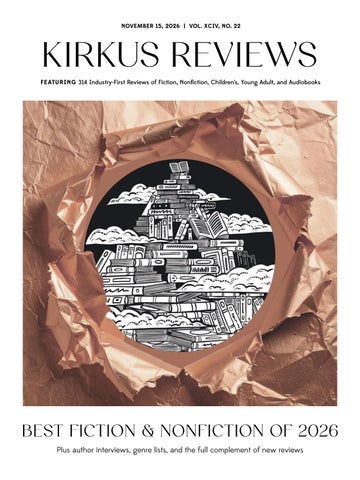
NOVEMBER 15, 2026 | VOL. XCIV, NO. 22
FEATURING 314 Industry-First Reviews of Fiction, Nonfiction, Children’s, Young Adult, and Audiobooks
BEST FICTION & NONFICTION OF 2026 Plus author interviews, genre lists, and the full complement of new reviews
Contents
Best Fiction & Nonfiction of 2026
2
90 Booklist: Best Current Events Books of 2026
From the Editor’s Desk FICTION
5
Best Fiction of 2026
16
Editor’s Note
17
Reviews
25
Q&A: Gabriel Tallent
One of the most coveted designations in the book industry, the Kirkus Star marks books of exceptional merit.
OUR FRESH PICK A young woman becomes governess to a mysterious boy in noted playwright Harrison’s provocative, genre-blending debut.
27 Booklist: Best Historical Fiction of 2026 35
Read the review on p. 21.
Q&A: LaToya Watkins
PURCHASE BOOKS ONLINE AT KIRKUS .COM
37 Booklist: Best Translated Fition of 2026 47
91
Q&A: Emily Eakin CHILDREN’S
92
Editor’s Note
93
Reviews
107 Booklist: Heartwarming Winter Holiday Tales YOUNG ADULT 128
Editor’s Note
129
Reviews
137 Booklist: Irresistible Series Openers
Q&A: Yiyun Li
49 Booklist: Best Romance of 2026
INDIE
NONFICTION
144
Editor’s Note
51
Best Nonfiction of 2026
145
Reviews
62
Editor’s Note
63
Reviews
153 Booklist: Best Indie Books of November
73
Q&A: Anand Gopal
75 Booklist: Best Arts & Entertainment Books of 2026
AUDIOBOOKS
82 Booklist: Best Memoirs of 2026
164
Editor’s Note
83
165
Reviews
Q&A: Jazmine Ulloa
ON THE COVER: Illustration by Burin & Plate. Background illustration generated by Adobe Firefly Image 4. Interested in reprints, permissions, licensing, or a framed review? Please contact The YGS Group at 800.290.5460 or email Kirkus@theygsgroup.com. KIRKUS REVIEWS (ISSN 1948-7428) is published semimonthly by Kirkus Media LLC, 1140 Broadway, Suite 802, New York, NY 10001. Subscription prices are: Print and digital subscription (U.S.) 3-month ($49), 12-month ($179) | International subscriptions are $79 quarterly and $229 annually. All other rates on request. Periodicals Postage Paid at Austin, TX 78710 and at additional mailing offices. POSTMASTER: Send address changes to Kirkus Reviews, 6411 Burleson Road, Austin, TX 78744
K IR KU S R E V IE W S
NOVEMBER 15, 2026
1
FROM THE EDITOR’S DESK
IT’S THE MOST wonderful time of the year, as the old song goes. Here at Kirkus, that means the rollout of our Best Books of 2026 coverage, beginning in this issue with lists of the 100 fiction and 100 nonfiction titles most cherished by our reviewers and editors. We hope you’ll find some of your own favorites here, as well as ones you may have missed. We’ve also broken down the master list by category, including Best Historical Fiction, Best Romance, Best Memoirs, and Best Current Events Books. And we corresponded with the authors of some of these books—including Gabriel Tallent (Crux), Yiyun Li (Music Against the Night), and Anand Gopal (Days of Love and Rage)—to
learn more about their inspirations and processes. And the hits just keep coming. The December 1 issue will feature the Best Picture Books, Middle Grade, and Young Adult Books of 2026, along with our Holiday Gift Guide, followed by the Best Indie Books and Audiobooks in the Dec. 15 issue. That’s three issues stuffed to the brim with great book recommendations—our gift to you. As a warm-up, I’ll kick things off with four of my own favorites this year: On Morrison by Namwali Serpell (Hogarth, Feb. 17): Much has been written about the Nobel laureate who died in 2019, but few have illuminated her extraordinary body of
Subscriptions: www.kirkusreviews.com/magazine/subscription Advertising Opportunities: www.kirkusreviews.com/book-marketing Submission Guidelines: www.kirkusreviews.com/about/publisher-submission-guidelines Frequently Asked Questions: www.kirkusreviews.com/about/faq For customer service or subscription questions, please email customercare@kirkus.com or call 800-316-9361.
2
NOVEMBER 15, 2026
work—from The Bluest Eye (1970) to God Help the Child (2015)—as elegantly and insightfully as Serpell, a professor of English at Harvard University. I guarantee that you’ll be rereading Morrison— after, if not while, reading this book. Our starred review calls it an “impressive, nuanced work of scholarship.” The Wonderful World That Almost Was: A Life of Peter Hujar and Paul Thek by Andrew Durbin (Farrar, Straus and Giroux, April 14): This double biography of Hujar, a photographer, and Thek, a sculptor and installation artist, is also a rich portrait of the New York art scene of the 1960s, ’70s, and ’80s, and the gay demimonde that overlapped with it. Both men’s lives and careers were cut short by AIDS. Our starred review called the book a “vigorous life of two ‘consummate artist’s artists’ now too little known.” The Disappearers by Marlon James (Riverhead, Sept. 1): I have a lot of feelings about this 640-page novel centered on a circle of
gay men in Jamaica in the 1980s and the aftermath of a brutal attack that leaves one of them dead, one blinded, and all of them traumatized. Readers may feel somewhat traumatized, too, but James’ vision and literary chops are undeniable. Our starred review said it best: “Even when it stress-tests your senses, this sprawling depiction of gay life in Jamaica is galvanizing.” Exit Party by Emily St. John Mandel (Knopf, Sept. 15): You can always depend on Mandel, author of Station Eleven, to craft an ingeniously complex plot with wholly believable characters and drama that keeps the pages flying. Her latest features two parallel universes that converge at a Los Angeles party full of doppelgangers and disappearances. Our starred review called it “a thrilling read and a virtuoso demonstration of the moral and philosophical possibilities of speculative fiction.”
TOM BEER K IR KU S R E V IE W S
Illustration by Eric Scot t Ander son
THE BEST OF EVERYTHING
Co-Founders, Kirkus Media LLC HERBERT SIMON MARC WINKELMAN Publisher, CEO & Partner MEG LABORDE KUEHN mkuehn@kirkus.com
Editor-in-Chief TOM BEER tbeer@kirkus.com
Chief Marketing Officer SARAH KALINA skalina@kirkus.com
President of Kirkus Indie CHAYA SCHECHNER cschechner@kirkus.com
Enterprise Advertising Director MICHELE COBB mcobb@kirkus.com
Fiction Editor LAURIE MUCHNICK lmuchnick@kirkus.com
Indie Advertising & Promotions AMY BAIRD abaird@kirkus.com
Nonfiction Editor JOHN McMURTRIE jmcmurtrie@kirkus.com
Author Consultant KEELIN FERDINANDSEN kferdinandsen@kirkus.com
Young Readers’ Editor LAURA SIMEON lsimeon@kirkus.com
Controller & Operations Manager KRISTI DAUGHERTY kdaugherty@kirkus.com
Young Readers’ Editor MAHNAZ DAR mdar@kirkus.com
Lead Designer KY NOVAK knovak@kirkus.com Magazine Compositor NIKKI RICHARDSON nrichardson@kirkus.com Director of Kirkus Editorial ROBIN O’DELL rodell@kirkus.com Kirkus Editorial Senior Production Editor MARINNA CASTILLEJA mcastilleja@kirkus.com Kirkus Editorial Production Editor ASHLEY LITTLE alittle@kirkus.com Indie Editorial Assistant KATARINA YERGER kyerger@kirkus.com Indie Editorial Assistant ELLIE HALLERON ehalleron@kirkus.com Contributing Writers GREGORY McNAMEE MICHAEL SCHAUB
Audiobooks Editor JENNIFER DOWELL jdowell@kirkus.com Editor at Large MEGAN LABRISE mlabrise@kirkus.com Senior Indie Editor DAVID RAPP drapp@kirkus.com Indie Editor ARTHUR SMITH asmith@kirkus.com Senior Editorial Assistant NINA PALATTELLA npalattella@kirkus.com
Senior Indie Editorial Assistant DAN NOLAN dnolan@kirkus.com Mysteries Editor THOMAS LEITCH Copy Editors JONATHAN BELLG NATALIA HOLTZMAN NANCY MANDEL BILL SIEVER
Founder, Kirkus Reviews VIRGINIA KIRKUS (1893-1980)
K IR KU S R E V IE W S
Contributors
Alana Abbott, Nada Abdelrahim, Erin Addis, Jeffrey Alford, Autumn Allen, Stephanie Anderson, Jenny Arch, Kent Armstrong, Mark Athitakis, Julian Axelrod, Hannah Bae, Susan Baird, Kit Ballenger, Colette Bancroft, Jeffery Barbour, Hayley Barnes, Carole Bell, Nell Beram, Kazia Berkley-Cramer, Elizabeth Bird, Christopher A. Biss-Brown, Marc Bona, Mary Boucouvalas, Anna Broome, Jennifer Brough, Jessica Hoptay Brown, Kevin Canfield, Ann Childs, Amanda Chuong, Carin Clevidence, Jennifer Coburn, Anastasia M. Collins, Rachael Conrad, Mary Cook, Adeisa Cooper, Susan Corapi, Stephen Cummings, Sara Davis, Lisa De Bode, Cathy DeCampli, Dave DeChristopher, Suji DeHart, Lisa Dennis, Jason Derr, Sam Dilling, Fiona Dolce, Steve Donoghue, Eamon Drumm, Jacob Edwards, Gina Elbert, Madison Ellingsworth, Lisa Elliott, Brooke Faulkner, Leslie Fine, Katie Flanagan, Catherine Foster, Renee Fountain, Cynthia Fox, Mia Franz, Ayn Reyes Frazee, Jenna Friebel, Laurel Gardner, Cierra Gathers, Jean Gazis, Victoria Glynn, Danielle Galván Gomez, Diana Granger, Melinda Greenblatt, Vicky Gudelot, Geoff Hamilton, Sarah Harkness, Peter Heck, Caroline Henderson, Sandi Henschel, Boze Herrington, Rebecca Herwatic Leonhard, Loren Hinton, Ashley Holland, Katrina Niidas Holm, Natalia Holtzman, Terry Hong, Julie Hubble, Mary Grahame Hunter, Christoph Irmscher, Darlene Ivy, Danielle Jones, Trevor Jones, Jayashree Kamblé, Maggie Knapp, Megan Dowd Lambert, Joanne Langerman, Laurel Larrew, Christopher Lassen, Tom Lavoie, Maureen Liebenson, Elsbeth Lindner, Coeur de Lion, Patricia Lothrop, Wendy Lukehart, Kyle Lukoff, Michael Magras, Mandy Malone, J. Alejandro Mazariegos, Joyce McCarty, Nancy McCarty, Katherine McDonald, Dale McGarrigle, Isla McKetta, Kathie Meizner, Carol Memmott, Ana Menchaca, J. Elizabeth Mills, William Mingin, Alan Minskoff, Andrea Moran, Rhett Morgan, Henry Mortimer, Molly Muldoon, Jennifer Nabers, Jola Naibi, Christopher Navratil, Liza Nelson, Katrina Nye, Erin O’Brien, Tori Ann Ogawa, Kobe Overby, Nick Owchar, Emilia Packard, Megan K. Palmer, George Pate, Crystal Patenaude, Hal Patnott, Bethanne Patrick, Rebecca Perry, John Edward Peters, Jim Piechota, Christofer Pierson, Bonnie Powell, Margaret Quamme, Ellen Quint, Kristy Raffensberger, Mohana Rajakumar, Kristen Rasmussen, Piper Rasmussen, Darryn Reams, Alexandria Richey, Michelle Ritholz, Amy Robinson, Ana Rosales, Lloyd Sachs, Bob Sanchez, Julia Sangha, Michael Sangiacomo, Caitlin Savage, Aurelia Scott, Jerome Shea, Linda Simon, Laurie Skinner, Wendy Smith, Margot E. Spangenberg, Andria Spencer, Allison Staley, Daneet Steffens, Allie Stevens, Mathangi Subramanian, Rebecca T. Sutton, Deborah Taylor, Lisa Taylor, Jessica Teel, Desiree Thomas, Jasmine Thor, Lenora Todaro, Chris Turner-Neal, Francesca Vultaggio, David Walton, Katie Weeks, Morgan Weston, Sam Wilcox, Susie Wilde, Wilda Williams, Kendra Winchester, Marion Winik, Hiromi Yoshida, Natalie Zutter
NOVEMBER 15, 2026
3
VOLLMANN A TABLE FOR FORTUNE
National Book Award-winner William T. Vollmann takes a deep dive into American politics, terrorism, war and homelessness in this fourvolume, 3,096-page novel that is at once family drama, bildungsroman and grief-song for September eleventh. “A heroic, fascinating and important work.” —Tom LeClair, The New York Times Coming in October wherever books are sold. Email limitededitions@skyhorsepublishing.com for information on purchasing a limited, signed, and numbered edition. One thousand copies will be available at $350.
Arcade Publishing,
an imprint of Skyhorse Publishing, Inc.
B E S T B O O K S O F 2 0 2 6 // F I C T I O N
Tpopova v ia iStock
The Best Fiction Books of 2026 What a year it’s been for fiction! From Brooklyn to the Louisiana bayou, from an American hagwon to Public Access Afterworld, this year’s novels and story collections have taken us to places both familiar and new. We’ve met First Lady Freeman, a truth-telling pastor’s wife; seen Anne Boleyn newly reunited with her head; and said goodbye to furniture salesman and part-time fence Ray Carney. We’ll be reading these marvelous books for a long time to come. K IR KU S R E V IE W S
NOVEMBER 15, 2026
5
F I C T I O N // B E S T B O O K S O F 2 0 2 6
A Splintering
Dead Beat
Amna, Dur e Aziz | Dzanc (232 pp.) | $17.95 paper | April 14, 2026 | 9781938603778
Bardugo, Leigh | Flatiron Books (496 pp.) | $19.49 | September 15, 2026 9781250884312 | Series: Ninth House, 3
A fiery novel about a character who wants more than just a room of her own.
Paradiso 17
The Weight of Angels
Assadi, Hannah Lillith | Knopf (320 pp.) $29 | March 17, 2026 | 9780593804056
Boyne, John | Henry Holt (592 pp.) | $30.99 September 29, 2026 | 9781250411365
With a generous vision, Assadi has created an unforgettable character in a multidimensional world.
A witty and melancholy act of literary resurrection.
The Complete Stories
All Hail Chaos
Bachmann, Ingeborg | Trans. by Philip Boehm & Tess Lewis | New Directions (512 pp.) | $29.95 | September 29, 2026 9780811238793
A multifaceted collection by a brilliant writer who died too young.
A must-read if there ever was one.
Famous Men
Bahr, Dane | Counterpoint (320 pp.) $28 | April 21, 2026 | 9781640097544
Buntin, Julie | Random House (400 pp.) $30 | July 14, 2026 | 9780593229958
The best novel yet by a powerfully original artist.
A searing, brilliant novel about power, and stories, and who gets to tell them.
On the Calculation of Volume: Book V
Yesteryear
A richer, more complex snapshot of Balle’s peculiar world.
NOVEMBER 15, 2026
Brennan, Sarah Rees | Orbit (432 pp.) $19.99 paper | May 12, 2026 9780316568746
The Dead Ringer
Balle, Solvej | Trans. by Sophia Hersi Smith & Jennifer Russell | New Directions (208 pp.) | $16.95 paper November 17, 2026 | 9780811240383
6
Sharp writing, vivid characters, and puzzle box plotting bring the trilogy to a ringing conclusion.
Burke, Caro Claire | Knopf (400 pp.) $30 | April 7, 2026 | 9780593804216
A remarkable debut—both a book for the moment and one that will endure.
K IR KU S R E V IE W S
B E S T B O O K S O F 2 0 2 6 // F I C T I O N
Daytona Teddy Riggs Buxton, Drew | Hub City Press (224 pp.) $25 | August 25, 2026 | 9798885740784
Part satire, part wake-up call, and all openhearted perspective, this debut promises excellent work to come from its author.
Clark, T | One World/Random House (208 pp.) | $28 | June 23, 2026 | 9798217154074
Achingly beautiful stories full of wit, intelligence, and raw immediacy.
Lost Lambs
The Paris Match
Cash, Madeline | Farrar, Straus and Giroux (336 pp.) | $28 | January 13, 2026 9780374619237
Clayborn, Kate | Berkley (464 pp.) | $19 paper | April 7, 2026 | 9780593819371
With comic energy and wild plot twists to spare, a thoroughly charming debut.
The City of Light provides a beautiful backdrop for this stunning slow-burn romance.
How To Fake It in Society
The Faith of Beasts
Charles, KJ | Bramble Books (320 pp.) $18.99 paper | April 28, 2026 9781250395917
Corey, James S.A. | Orbit (448 pp.) | $32 April 14, 2026 | 9780316525671
A suspenseful and colorful gay Regency romance.
Grand-scale SF storytelling at its very best. In a word: mind-blowing.
Hocus Pocus
Take What You Can
Charry, Brinda | Scribner (336 pp.) | $29 August 11, 2026 | 9781668004586
Coster, Naima | Pamela Dorman/Viking (368 pp.) | $30 | August 4, 2026 9780593833278
Eschewing fantasy or quirkiness, Charry creates a rare sense of wonder plus gravitas.
Pool House Choi, Mary H.K. | Flatiron Books (336 pp.) $29.99 | June 9, 2026 | 9781250800442
An impressive portrait of an ephemeral and savage world.
K IR KU S R E V IE W S
All This Want (and I Can’t Get None)
An intimate, immersive paean to the redemptive power of found families and the pleasure of choosing whom and how to love.
The Song of Stork and Dromedary Daanje, Anjet | Trans. by David McKay Farrar, Straus and Giroux (736 pp.) | $22 paper | August 18, 2026 | 9780374620615
A challenging book that rewards its readers with great depth and beauty.
NOVEMBER 15, 2026
7
F I C T I O N // B E S T B O O K S O F 2 0 2 6
Ply Diaz, Hernan | Riverhead (464 pp.) | $32 September 29, 2026 | 9780593719541
A brainy, challenging, and engrossing trek into a battered but unbeaten future.
A comic masterpiece. The current administration is finally getting the book it deserves.
Murder on 34th Street
Drury, Tom | Grove (352 pp.) | $28 November 3, 2026 | 9780802168399
Fredericks, Mariah | Minotaur (288 pp.) $29 | October 6, 2026 | 9781250367549
A fond, brilliant farewell to Drury’s slice of the uncanny Midwest.
Fredericks’ latest adventure should be in everyone’s Christmas stocking this year, tied with a big red bow.
Mazywood
Wolves of Summer
Simply stated, this feels perilously close to a career triumph for its author.
Freitas, Donna | Soho Crime (496 pp.) $29.95 | November 3, 2026 9781641298612
Poignant and empowering, with a strong mystery at its heart.
Homebound
Last Night in Brooklyn
Elan, Portia | Scribner (304 pp.) $28 | May 5, 2026 | 9781668201732
Gonzalez, Xochitl | Flatiron Books (256 pp.) $27.99 | April 21, 2026 | 9781250372031
An ingenious narrative that explores the meaning of love and interconnectedness across time.
Smart, tough-minded, and passionate: a pleasure from start to finish.
Python’s Kiss
One & Only
Erdrich, Louise | Illus. by Aza Erdrich Abe Harper/HarperCollins (240 pp.) | $32 March 24, 2026 | 9780063375000
A wise and uncanny roux of Erdrich’s storytelling.
NOVEMBER 15, 2026
Fountain, Ben | Flatiron Books (416 pp.) $29.99 | June 9, 2026 | 9781250776549
West of Loveland
Due, Tananarive | Saga/Simon & Schuster (512 pp.) | $32 | September 22, 2026 9781668075142
8
Rasputin Swims the Potomac
Goo, Maurene | Putnam (336 pp.) | $30 February 3, 2026 | 9798217181162
A perfect blend of steamy angst and family drama makes for a love triangle that’s impossible to put down.
K IR KU S R E V IE W S
B E S T B O O K S O F 2 0 2 6 // F I C T I O N
This Is Not About Us
The Brightness
Goodman, Allegra | Dial Press (336 pp.) $29 | February 10, 2026 | 9780593447840
Harbach, Chad | Little, Brown (672 pp.) $32 | October 27, 2026 | 9780316455695
Like an exquisitely baked apple cake, Goodman’s delicious and deeply perceptive novel is something to savor.
Brilliant, poignant, and absorbing.
Brawler
Last One Out
Groff, Lauren | Riverhead (288 pp.) | $29 February 24, 2026 | 9780593418420
Harper, Jane | Pine & Cedar/Flatiron Books (336 pp.) | $29.99 | April 14, 2026 9781250291394
This audacious collection surprises readers with the vivid lives few of us notice.
Call Me Ishmaelle
We Were Forbidden
Guo, Xiaolu | Black Cat/Grove (448 pp.) $18 paper | January 6, 2026 9780802166494
Harpman, Jacqueline | Trans. by Ros Schwartz | Transit Books (112 pp.) | $18.95 paper | July 7, 2026 | 9798893380583
A rich addition to Melvilliana.
Another stunning missive from Harpman’s repertoire.
Ada
Night Calls
Haber, Mark | Coffee House (112 pp.) | $18 paper | July 14, 2026 | 9781566897594
Hart, Joe | Thomas & Mercer (367 pp.) $16.99 paper | September 22, 2026 9781662536991
A sharp, taut portrait of curdled, angry leadership.
Hart puts it all together in his best thriller yet.
Rebel English Academy
Moonlight Murder
Hanif, Mohammed | Grove (320 pp.) | $28 February 17, 2026 | 9780802165985
Jalaluddin, Uzma | Harper Perennial/ HarperCollins (336 pp.) | $18.99 paper May 5, 2026 | 9780063434967
An elegantly spun tale that punctures holes in our every expectation of life in an authoritarian state.
K IR KU S R E V IE W S
Harper has her finger firmly on the relentless pulse of quiet menace in this small-town mystery.
This second installment is deeply layered, rich in culture, and paves the way for this detective to become a favorite.
NOVEMBER 15, 2026
9
F I C T I O N // B E S T B O O K S O F 2 0 2 6
The Disappearers
Partita
James, Marlon | Riverhead (640 pp.) | $32 September 1, 2026 | 9780593717202
Kingsolver, Barbara | Harper/HarperCollins (352 pp.) | $32 | October 6, 2026 9780063577541
Even when it stress-tests your senses, this sprawling depiction of gay life in Jamaica is galvanizing.
The Occidental Book of the Dead Johnson, T. Geronimo | Morrow/ HarperCollins (672 pp.) | $32 October 6, 2026 | 9780063330542
A swing-for-the-fences novel, both a gripping procedural and high literary study of American bigotry.
Kin Jones, Tayari | Knopf (368 pp.) | $30 February 24, 2026 | 9780525659181
Beautifully written and powerfully compelling.
10
Brilliant, affecting work from one of contemporary literature’s masters.
Mule Boy Krivak, Andrew | Bellevue Literary Press (192 pp.) | $17.99 paper | February 24, 2026 9781954276468
Fate and chance are examined with artful, electrifying energy.
A Tender Age Lee, Chang-rae | Riverhead (368 pp.) | $30 August 11, 2026 | 9798217048441
A melancholy, emotionally rich story of preadolescent struggles.
My Dear You
American Hagwon
Khong, Rachel | Knopf (240 pp.) $29 | April 7, 2026 | 9780593803691
Lee, Min Jin | Cardinal (656 pp.) | $36 September 29, 2026 | 9781538752036
Uses the flexibility of the short-story form to wonderful and whimsical advantage.
The author’s wisdom is a gift to her readers.
Isn’t He Romantic?
Death of the Soccer God
Khorram, Adib | Forever (384 pp.) $18.99 paper | September 22, 2026 9781538739594
Léger, Dimitry Elias | MCD/Farrar, Straus and Giroux (240 pp.) | $27 | May 12, 2026 9780374619886
Deeply affecting and thoroughly captivating, this story cements the whole series as some of the best romance out there.
A historical novel that merrily dances and jukes its way across the pitch of time.
NOVEMBER 15, 2026
K IR KU S R E V IE W S
B E S T B O O K S O F 2 0 2 6 // F I C T I O N
The Beheading Game
Whidbey
Lehmann, Rebecca | Crown (320 pp.) $29 | March 24, 2026 | 9798217086481
Madden, T Kira | Mariner Books (384 pp.) $30 | March 10, 2026 | 9780063289680
Brilliantly imagined, stylishly written, satisfyingly plotted, full of delicious surprises: all in all, hella fun.
A searingly original novel that examines the impact of sexual trauma on the human psyche.
Transcription
Exit Party
Lerner, Ben | Farrar, Straus and Giroux (144 pp.) | $25 | April 7, 2026 9780374618599
Mandel, Emily St. John | Knopf (320 pp.) $32 | September 15, 2026 | 9780593321461
A tart meditation on narrative and integrity.
Both a thrilling read and a virtuoso demonstration of the moral and philosophical possibilities of speculative fiction.
Music Against the Night
Dolly All the Time
Li, Yiyun | Farrar, Straus and Giroux (352 pp.) $29 | October 13, 2026 | 9780374613051
Monaghan, Annabel | Putnam (368 pp.) $20 paper | May 26, 2026 | 9780593853979
A virtuoso performance from Li. Brava!
A charming love story that absolutely radiates warmth.
Babylon, South Dakota
The Murder at World’s End
Lin, Tom | Little, Brown (336 pp.) | $30 May 26, 2026 | 9780316576277
A thoughtfully written, genre-crossing novel of great ingenuity.
A paragon of the locked-room historical mystery.
Beginning Middle End
Centroeuropa
Luiselli, Valeria | Knopf (368 pp.) $35 | July 28, 2026 | 9798217208319
Mora, Vicente Luis | Trans. by Rahul Bery Bellevue Literary Press (192 pp.) | $17.99 paper | March 10, 2026 | 9781954276529
An offbeat migration story as piercing and artful as any in Luiselli’s oeuvre.
K IR KU S R E V IE W S
Montgomery, Ross | Morrow/ HarperCollins (336 pp.) | $30 January 6, 2026 | 9780063458772
A quietly moving parable on the painful, unacknowledged legacy of war.
NOVEMBER 15, 2026
11
F I C T I O N // B E S T B O O K S O F 2 0 2 6
Ghalen: A Romance in Black Mosley, Walter | Amistad/HarperCollins (368 pp.) | $30 | May 26, 2026 9780063451551
Even in chaos, darkness, and hardship, this novel finds reasons to believe in the human spirit.
This Is Where the Serpent Lives Mueenuddin, Daniyal | Knopf (368 pp.) $29 | January 13, 2026 | 9780525655152
A potent and nuanced tale about the abuse of an underclass in ways both subtle and overt.
Every Exit Brings You Home Murr, Naeem | Norton (336 pp.) | $31.99 February 3, 2026 | 9781324117902
A brilliant novel that is as intellectually vast as it is deeply rooted in the everyday experience of being human.
Die for Me Obuobi, Shirlene | Penguin (416 pp.) | $19 paper | July 14, 2026 | 9780143139188
A thrilling, sexy, and modern take on forbidden fruit.
Land O’Farrell, Maggie | Knopf (400 pp.) $29 | June 2, 2026 | 9780593320648
Steeped in Irish history and folklore, alive with a sense of wonder.
Eating Ashes
Luna, Phoenix, Queen
Navarro, Brenda | Trans. by Megan McDowell | Liveright/Norton (240 pp.) $24.99 | January 20, 2026 | 9781324096085
Orringer, Julie | Knopf (288 pp.) | $30 October 13, 2026 | 9798217207886
A Wall Is Also a Road Newitz, Annalee | Tor (304 pp.) | $28.99 October 6, 2026 | 9781250228031
Very strange and strangely satisfying.
NOVEMBER 15, 2026
Nors, Dorthe | Trans. by Caroline Waight Graywolf (320 pp.) | $18 paper August 18, 2026 | 9781644454046
A great novel: Beautifully written, timely, and as enjoyable as it is heartbreaking.
A sensitive portrayal of sibling love, grief, and the trauma of dislocation.
12
Range
Heart-stoppingly good.
Whistler Patchett, Ann | Harper/HarperCollins (304 pp.) | $30 | June 2, 2026 9780063511637
An evocative and moving tribute to the death-defying, heart-opening, infinitely redemptive power of storytelling.
K IR KU S R E V IE W S
B E S T B O O K S O F 2 0 2 6 // F I C T I O N
May We Feed the King
What We Are Seeking
Perry, Rebecca | Transit Books (264 pp.) $18.95 paper | September 29, 2026 9798893380620
Reed, Cameron | Tor (352 pp.) | $30.99 April 7, 2026 | 9781250364739
Astonishingly layered, this quietly witty and compassionate debut novel will impress even the most jaded readers.
The True Confessions of First Lady Freeman Philyaw, Deesha | Mariner Books (416 pp.) $30 | September 29, 2026 9780063383074
A smart, tender work of hard science fiction.
Nightjar Ruskovich, Emily | Random House (272 pp.) $29 | July 7, 2026 | 9780812994025
A portal to a haunting, liminal Pacific Northwest.
Misogyny, classism, colorism, hypocrisy: begone! A fierce, fabulous, and very funny truthteller cometh to take you down.
Reap & Sow
Score
Plumb, Charlotte B. | Berkley XO (384 pp.) $30 | October 6, 2026 | 9798217239689
Ryan, Kennedy | Forever (448 pp.) | $18.99 paper | May 19, 2026 | 9781538769652
This wickedly entertaining debut fully embraces every bit of its own magic.
Incredibly romantic and deeply human.
Annie Proulx Stories: New and Selected Proulx, Annie | Scribner (416 pp.) | $30 November 10, 2026 | 9781668243206
Sanderson, Brandon & Peter Orullian Saga/Simon & Schuster (464 pp.) $30 | June 16, 2026 | 9781668068144 Series: Strata Wars, 1
Dark, dour, and dazzling.
A headbanging beginning to what could be a remarkable urban fantasy series—heavy metal playlist sadly not included.
The Salt King
Vigil
Pulley, Natasha | Bloomsbury (464 pp.) $29.99 | August 18, 2026 | 9781639737291
Saunders, George | Random House (192 pp.) | $28 | January 27, 2026 9780525509622
Gripping and heartfelt, this prismatic novel is more than worth its salt.
K IR KU S R E V IE W S
Songs of the Dead
Saunders has crafted a novel that feels deeply resonant, especially in these fractious times.
NOVEMBER 15, 2026
13
F I C T I O N // B E S T B O O K S O F 2 0 2 6
Livonia Chow Mein
John of John
Savitch-Lew, Abigail | Simon & Schuster (368 pp.) | $29 | April 21, 2026 9781668075234
Stuart, Douglas | Grove (400 pp.) | $28 May 5, 2026 | 9780802167194
A vivid, savory blend of family saga, cultural history, and detective story, rich with urban life and lore.
Public Access Afterworld Schoenbrun, Jane | Hogarth (608 pp.) | $32 October 27, 2026 | 9780593978382
Dazzling and politically acute, Schoenbrun’s debut announces a major literary voice.
Star Shipped Sebastian, Cat | Avon/HarperCollins (384 pp.) | $11.99 paper | March 3, 2026 9780063429581
A swoonworthy contemporary gay romance from a beloved historical-romance author.
Should the Waters Take Us Soileau, Stephanie | Doubleday (336 pp.) $30 | July 14, 2026 | 9780385551786
A gorgeous meditation on the forces that create and destroy communities, families, and lives.
See You Next Tuesday Stayman-London, Kate | Dial Press (368 pp.) | $19 paper | September 8, 2026 9780593980118
A promising candidate for best contemporary romance of the year.
14
NOVEMBER 15, 2026
With his gift for creating vibrantly specific characters and settings, Stuart again taps profound human truth.
The Tailor Sullivan, Tim | Atlantic Crime (368 pp.) $27 | August 11, 2026 | 9780802167149
A sharp whodunit with an engaging cast and abundant humor.
A Private Man Sy-Quia, Stephanie | Grove (288 pp.) $27 | April 14, 2026 | 9780802166906
A tender, surprising excavation of minds meeting and hearts singing through disappointments to very human deaths.
Crux Tallent, Gabriel | Riverhead (416 pp.) $30 | January 20, 2026 | 9780593714188
A sharp novel about youth in conflict with dreams, nature, and reality.
Green City Wars Tchaikovsky, Adrian | Tor (368 pp.) $28.99 | June 23, 2026 | 9781250290335
Interstitial fiction at its most engaging and mind-bending.
K IR KU S R E V IE W S
B E S T B O O K S O F 2 0 2 6 // F I C T I O N
Mad Eden
The Book of Chuck
Thomas, Morgan | MCD/Farrar, Straus and Giroux (304 pp.) | $28 | June 2, 2026 9780374620158
Watkins, LaToya | Tiny Reparations (320 pp.) | $30 | August 18, 2026 9780593854549
Radically inventive, compassionate, and perspicacious. Compulsively page-turning.
A transcendent reading experience that reveals life’s darkest corners while transmitting a surprising amount of hope.
The Four Wives and Five Deaths of Richard Milford
All Them Dogs
Thompson-Spires, Nafissa | Scribner (176 pp.) | $26 | October 6, 2026 9781501168048
Is this a whodunit or a “how-theydid-it”? However you define Thompson-Spires’ novel, it’s shrewd, audacious, and funny.
White keeps us balanced on a knife-edge, and the novel’s final revelations churn for days.
All the Hidden Places
Cool Machine
Turnbull, Cadwell | Blackstone (288 pp.) $29.99 | September 1, 2026 9798228018105
Whitehead, Colson | Doubleday (368 pp.) $30 | July 21, 2026 | 9780385550505 Series: Harlem Trilogy, 3
Rich and strange, while going straight to the heart.
A master novelist in full command of his powers as a storyteller, prose stylist, and social observer.
The Monroe Girls
The Nightingales
Volodine, Antoine | Trans. by Alyson Waters | Archipelago (278 pp.) | $22 paper March 17, 2026 | 9781962770552
Wilson, Emil | Avid Reader Press (416 pp.) $38 | August 4, 2026 | 9781668217771
A lively and beguiling tale that depicts a world no one should wish to live in.
The Names of the New World Washburn, Kawai Strong | Farrar, Straus and Giroux (448 pp.) | $29 | October 6, 2026 9780374619701
Human resilience in the face of climate disaster illuminates this powerful novel.
K IR KU S R E V IE W S
White, Djamel | Riverhead (256 pp.) $29 | May 19, 2026 | 9798217046676
Absolutely gorgeous, visually and emotionally.
Promised Land Wise, Henry | Atlantic Crime (368 pp.) | $27 September 1, 2026 | 9780802164506
A bravura and sometimes brutal novel about our efforts to cope with darkness and denial.
NOVEMBER 15, 2026
15
LAURIE MUCHNICK
THIS YEAR WILL go down in history as a great one for fiction—there have been so many incredible books coming out that it’s hard to keep up. If I was the protagonist of a time-travel novel, I’d stretch out the days so I could finish my current TBR pile before more books started arriving. There were new novels from Hernan Diaz, Louise Erdrich, Allegra Goodman, Marlon James, Tayari Jones, Barbara Kingsolver, Chang-rae Lee, Yiyun Li, Ann Patchett, Deesha Philyaw, George Saunders, Emily St. John Mandel, Douglas Stuart, and Colson Whitehead, among other big names I’ve already written about. All these heavy hitters are on our list of the 100 best fiction books of 2026, but I’d like to highlight a few you might not already know about. How To Fake It in Society by KJ Charles (Bramble, April 28): If you crossed Heated Rivalry with Bridgerton, you might get Charles’ latest queer Regency romance. Titus Pilcrow is an “oil and colourman”—he makes paints for a living—until, for romance reasons, he 16
NOVEMBER 15, 2026
marries one of his rich customers on her deathbed and inherits a fortune. The Compte de La Motte, a (phony) French count and (real) con artist, was Miss Whitecross’ fiancé, but he missed out on marrying her because he was out of town when she died. Hijinks, and then love, ensue. “Titus and Nico’s relationship is both sweet and steamy—and it’s well balanced against a darker subplot that adds intrigue,” according to our starred review. Homebound by Portia Elan (Scribner, May 5): A 19-year-old named Becks completes a computer game she’d been programming with her uncle before he died—and it will play a role in the lives of a variety of people for the next 600 years, including a Berkeley bioengineering professor and the crew of a spaceship trading whatever junk it
can salvage from the ocean. There’s also a singularly advanced robot. Our starred review calls this “an ingenious narrative that explores the meaning of love and interconnectedness across time.” A Private Man by Stephanie Sy-Quia (Grove, April 14): This debut novel is based on the lives of the author’s grandparents, who met as a priest and a theology teacher in Rome in the 1960s. Sparks fly when David is assigned as Margaret’s diocesan advisor, though decades later their grandson, Adrian, is shocked to learn that his grandfather had been a priest. Our starred review calls this “a tender, surprising excavation of minds meeting and hearts singing through disappointment to very human deaths.” The Four Wives and Five Deaths of Richard Milford
by Nafissa Thompson- Spires (Scribner, Oct. 6): Thompson-Spires was a finalist for the 2018 Kirkus Prize with her short story collection, Heads of the Colored People, and her first novel is characterized by the same “wry humor and storytelling chops,” according to our starred review. Rich Milford is a bootlegger in an all-Black Oklahoma town in the 1920s, and when he dies, any of the four women who have a claim to be his wife might have been exasperated enough to kill him. “Thompson-Spires packs a sharp, caustic wit that yields plenty of compassion for even someone as mean and misbegotten as her title character,” our review says, calling the book “shrewd, audacious, and funny.” Laurie Muchnick is the fiction editor. K IR KU S R E V IE W S
Illustration by Eric Scot t Ander son
INTRODUCING THE YEAR’S BEST FICTION
FICTION
EDITOR’S PICK In 1977, a shady policeman goes missing during an epic snowstorm in western New York. Harmon Pond, the founder and editor-in-chief of The Voice of Oneira (also the author of much of its content), is paying the rent on the paper’s offices with dirty money—a loan from local policeman Geno St. John, a childhood friend of his wife Pauline’s who has ties to the Arm, a Buffalo crime family. So when his 20-year-old daughter, Teresa, who’s interning at the paper, begs to investigate St. John’s sudden disappearance, Harmon tries, but fails, to put his foot down. Nobody in the Pond family likes to be told what to do, not Harmon or Pauline, who’ve been married since they were 16 and
These Titles Earned the Kirkus Star
K IR KU S R E V IE W S
accidentally conceived Teresa; not Teresa herself, nor her siblings, Fran and Lonnie. Both younger children are students at the local high school, where Fran is an aspiring writer and Lonnie an aspiring bookie. All five Ponds get up to no good in the days prior to what turns out to be the storm of the century, during which all their secrets and schemes unravel and absurdist mayhem ensues. With their habits of deception and fierce, crisscrossing loyalties, their slender means and high aspirations, the Ponds are an iconic American family, and when the truly unbelievable shit debut author Green has dreamed up for them hits the fan, they are nothing if not in it together. Green also
42
19
39
17
Paradox Inc. By Forrest Brazeal The Invisible Host By Gwen Bristow & Bruce Manning
Record Lows Green, CJ | Cardinal | 368 pp. | $30 January 5, 2027 | 9781538777374
manages to make the western New York winter not just a setting and a plot device but an existential condition: “That time of year was never fully light, though it was never fully dark either. At any hour you could look outside and see, in the glow of fresh snowfall, burned-out lampposts and lone individuals digging
Maria, Maria By Jennifer Galvão Record Lows By CJ Green
20
Every Goodbye Ain’t Gone By Dana Renee Green
21
Miss Archer By Jordan Harrison
their cars from the drifts.” A couple of paragraphs later, Harmon notes that just maneuvering his truck through the gulchlike streets is “arduous—a hero’s journey.” Poor guy, the blizzard hasn’t even started yet. This terrific debut recalls John Irving in his prime: eccentric, tragicomic, fearless, and delightful.
21
Wild Aster By Anna Hogeland
44
Mastermind By Sarah MacLean
29
The Key Biscayne Affair By Xita Rubert; trans. by Julia Sanches
32
The Friend Seekers By Siamak Vossoughi
NOVEMBER 15, 2026
17
FICTION
The Big Chihuahua Ben-Horin, Daniel | Rare Bird Books (240 pp.) $28 | November 24, 2026 | 9781644285855
Oddballs, dreamers, and scam artists maneuver at the dawn of the dot-com era. Wouldn’t it be nice if Emma Hart had had normal parents, not two monkey wrenchers who spent their days attacking lumber companies? With Joe an absentee father and Carol truly absent because a homemade bomb went off by accident (or did it?), high schooler Emma lives with an aging pot-growing couple in Northern California whose last name, aptly enough, is Foster. But now Joe—after a stint in prison—is back with a scheme involving the settlement money Emma received after police botched the investigation of her mother’s death. Ben-Horin’s satirical novel explores the counterculture’s legacy with a cast of dysfunctional oddballs living in 1990s San Francisco as the dot-com boom took off. Ben-Horin introduces Emma, Joe, and a supporting cast that includes Freddy, a slick Russian representing a shadowy investment firm; Phil, an aspiring tech journalist whose Polish girlfriend, Alicja, is an avant-garde artist with a deep anti-establishment streak; and Spider and Siobhan, who are desperate to get their online car repair business off the ground. The plot picks up as Joe stakes Emma’s entire settlement on a hot stock tip, a move that could substantially improve her life. So what’s going on? Is Joe actually being fatherly and trying to help the daughter he hardly knows? Did he play a part in Carol’s death? That’s what a fishy Securities and Exchange Commission investigator wants to know. The problem is, readers may not: It’s hard to care much about these characters. Emma isn’t unlikable, but she doesn’t inspire much sympathy, either. She’s been cast adrift by two parents who never should have had her; that should create a deeper sense of pathos, but it doesn’t. Even for a satirical novel, the characterizations don’t 18
NOVEMBER 15, 2026
go very deep. What Ben-Horin does well is create an entertaining tableau of Bay Area characters caught between their past mistakes and present possibilities. The result is an amusing portrait of an important period in recent American history, even if it never becomes anything more emotionally resonant. Ben-Horin’s characters are never quite as interesting or compelling as the era he portrays.
Exhumation Binge, Nicholas | Riverhead (448 pp.) $30 | October 20, 2026 | 9798217179183
A mind-bending mystery leads a London PI to investigate a subterranean cult. Private detective Arlo Abbas hasn’t had a case in ages, so it’s a shock when he checks his bank account and sees that someone named Lucien Baptiste has deposited 10,000 pounds. Googling the man sheds no light, but upon checking his mail, Arlo discovers a ripped scrap of paper that reads, “Find SOPHIE BANIK.” Assuming this is the job for which Baptiste has paid him, Arlo starts asking around—only to learn that Sophie died five months ago, and her murder remains unsolved. Though she has no next of kin, the state buried her body rather than cremating it—a “ludicrously expensive” move that sends a curious Arlo to the cemetery for a midnight exhumation. After 20 minutes of digging, however, he unearths not a coffin, but a chest containing six handwritten journals and a sheaf of typed transcripts. The journals belong to Liz, an initiate of the Dreamer’s Temple, a cult whose members don’t sleep and dwell underground with their masked leader, the Tiger. The transcripts recap conversations and audio logs recorded by Dr. Isabel Castillon, a researcher working with her sister, Laura, to cure a fatal form of insomnia that runs in families and killed their mother. While the journals resemble fiction, the Castillons exist—or did, until both
disappeared. What’s more, the journals mention the transcripts, and the transcripts reference Lucien Baptiste, leaving an increasingly paranoid Arlo desperate to connect the dots. Binge intercuts all three storylines so as to maximize resonance, suspense, and drive. Though each tale initially has its own discrete flavor—Arlo’s is hard-boiled, Liz’s horror, and Isabel’s science fiction— genre lines blur as their fates intertwine. Mawkishness mires the denouement, but on balance, the book is a triumph. At once a deeply philosophical meditation on generational trauma and a fringe science nightmare.
The Lies Between Us Bray, Jen | Pegasus Crime (288 pp.) | $27.95 December 1, 2026 | 9798897102389
A seaside retreat at a family cottage goes terrifyingly awry for three contentious sisters. When Susannah Brown, a successful mystery author, invites her sisters, Tara and Lucy, to meet at their mother’s holiday cottage on the Irish coast, no one expects a heartwarming reunion. The sisters are all more or less estranged, and the cottage has a dark aura—Susannah and Tara share fraught childhood memories of the place, and Lucy, the youngest, has never been there. Lucy, the book’s central character, is licking her wounds, having bombed out of a promising career as a police officer. She has a condition called mirror-touch synesthesia: “I feel what others feel on or against their body.” When she responded to a domestic violence call, she encountered a dying woman and broke down herself. But she soon gets a chance to put her police skills (and maybe the synesthesia) to work. As she and Susannah wait for Tara—taking a break from her miserable marriage—to arrive, Susannah answers the door, and Lucy hears her argue with an unknown man. Later that night Susannah suddenly leaves—and doesn’t return. Lucy’s concern turns to panic when she hears a K IR KU S R E V IE W S
FICTION
woman has been found dead at the foot of one of the area’s steep cliffs. The woman is a stranger, but Lucy is soon pursuing her possible connection to Susannah as well as desperately searching for her sister. The book moves smoothly among multiple time periods, ranging across the sisters’ relationships and back to the family’s history. Readers who insist on likable characters might look elsewhere, but the knotty connections among the women are convincingly drawn. The plot is packed with revelations, some a bit obvious, but there are so many that the author keeps the suspense humming. One dangerous family secret leads to another in a well-crafted, atmospheric thriller.
The Last Words of Jack Ruby Corey, Joshua | Tortoise Books (320 pp.) $22.99 paper | November 24, 2026 9781965199336
Was it to save the world from a second Holocaust that Jack Ruby shot Lee Harvey Oswald? That’s one of the motives offered in this freely imagined novel, which features a golem. On his deathbed, the still-lucid Ruby has a lot to tell young FBI agent Jon Bergman, assigned by J. Edgar Hoover to keep tabs on the infamous Jewish strip club owner. But over multiple visits to the Dallas hospital where Ruby lies, Bergman can’t get him to say why he shot Oswald. Ruby, born Jacob Rubinstein, only wants to talk about his childhood friend from Chicago’s Maxwell Street ghetto, Barney Ross, née Beryl Rasofsky, the boxing champion, war hero, and role model for Jews (at least until he got hooked on heroin). “I wanted to be a man…Like Barney,” says Ruby. But since running errands for Al Capone with “Beryl the Terrible,” he has been unable to overcome a nagging Fear (always capitalized). That’s an emotion unfelt by the golem, who resists his aged creator’s instruction not to do any killing in defending Jews from K IR KU S R E V IE W S
Engages profound questions about love and destiny. MARIA, MARIA
their haters. “The righteous man will rejoice when he sees revenge,” counters the clay being, a kind of alter ego for Ruby in the book’s cosmic universe. In another fantastical turn, the FBI agent pretends he’s sleeping with Marina Nikolayevna Oswald, the assassin’s wife, not a prostitute who will play any role he wants. The novel, which references Cuba, Israel, and New Orleans, doesn’t hold together. And ultimately, it’s more about Ross—the author’s great-uncle—than Ruby. But the particular Jewish fear, and anger, that Ruby can’t kick powers the story through his delusional last words.
An inventive novel about a Jewish villain, a Jewish hero, and their roles in American history.
The Collateral Heart Deaver, Jeffery | Putnam (416 pp.) | $32 November 17, 2026 | 9780593717523
When a serial arsonist strikes New York, it’s up to quadriplegic criminalist Lincoln Rhyme and his mates to strike back. The first blaze at an abandoned building in Spanish Harlem nearly kills a homeless squatter. Though the man can’t say much about the perp, a clue clearly left behind on purpose says more: a fireproof box with the number 1 painted on it. In the meantime, Rhyme has already had a visit from his old NYPD partner, Det. Lon Sellitto, to discuss the attempted assassination of Edward McGuire, founder and CEO of McGuire Computer Services, the developer of a new large language search engine. There’s nothing to be learned from the unsuccessful assassin, anti-corporate activist Thomas Elron Olsen, because he’s been
shot dead by McGuire’s bodyguard. But Sellitto wonders if he’s a member of a more widespread conspiracy. Could his fellow conspirators, if they exist, be targeting Manhattan real estate as well as tech bros? And how might all this be connected to the case of Abigail Morgan, a market researcher whose death on Long Island’s North Shore is being investigated by Det. Desdemona Vale. Fans of this imperishable franchise will expect that more outrages will follow, that the stakes will rise, and that the clock will tick down to doomsday before Rhyme emerges triumphant. But not all those things happen this time. The stakes remain much the same from the opening chapters; the pace accelerates but never threatens to keep you up past your bedtime; and the ending drags on and on. What still shines is Deaver’s masterful handling of forensics. Both the clues unearthed by Amelia Sachs, Rhyme’s partner and wife, and the patterns that emerge from them are diabolically clever in a way that leaves Deaver’s competitors in the dust.
Red herrings and dueling subplots cloud one of Deaver’s most ambitious thrillers.
Kirkus Star
Maria, Maria Galvão, Jennifer | Random House (320 pp.) $29 | February 2, 2027 | 9798217197736
Newlyweds in Portugal find their lives forever changed by a random, mysterious incitement to violence. It’s 1949 in the village of Murtosa. Benedito and Maria Lucilia da Silva—Bene and Cilia—have been married only three NOVEMBER 15, 2026
19
FICTION
Two sisters find their adult lives upended by secrets. BET WEEN YOU A RIVER
months when a stranger accosts Bene while he’s riding his bicycle home from work and chases him to his doorstep, where Cilia waits. When the man starts violently beating Cilia with a club, Bene kills him with a stroke of the sickle he’s carrying. Because the dead man turns out to have come from a powerful local family, the facts of this event are quickly obscured by the immediate danger of revenge, and 21-year-old Bene is packed off for a seven-year stint with the codfishing fleet that operates off the coast of Newfoundland. Cilia, just 17, will wait for him at home with his mother and siblings. In the port town of St. John’s, where the fleet is based between campaigns, Bene becomes lovers with the postmistress, a young widow named Maria Alvares. After Bene, who’s illiterate, asks this second Maria to help him write a letter to his wife, Cilia deduces the truth of the situation and the correspondence develops a secret second layer, with the two women addressing each other in postscripts and, ultimately, full letters. Via these searching, self- revelatory outpourings, their relationship becomes as meaningful to each of them as their connection to Bene, a dear and fundamentally gentle man who struggles painfully with both his divided loyalties and his reputation as a murderer. The situation only becomes more fraught when Cilia gets pregnant during Bene’s first visit home. By this time, she too has divided loyalties. Debut novelist Galvão has created characters who are at once vibrantly real and larger than life, trapped in the mythic crosshairs of separation, secrecy, and the dangers of the sea. The letters are brilliantly done, the escalation of suspense masterful, and the outcome— sigh—seemingly inevitable. The debut of a serious talent, engaging the most profound and eternal questions about love and destiny. An instant classic. 20
NOVEMBER 15, 2026
Between You a River Garza, Kimberly | Henry Holt (304 pp.) | $28.99 December 1, 2026 | 9781250819871
Two sisters raised in Texas by a Mexican father and a Filipina mother find their adult lives upended by conflict and secrets in their maternal line, necessitating travel to Manila and their family’s past. When Corazon de la Cruz’s Tita Nancy gives her copies of The Iliad and The Odyssey, the older woman knows what she’s doing. Corazon, known as Cory, has a curious, strong intellect. She attends university in Manila and then medical school in Texas; there, she marries George Maldonado, and they have two daughters, travel writer Mari and physician Hannah, raising them in Uvalde, Texas. Although Cory brings her youngest sister, known as Tita Baby, to the United States (Baby earns a Ph.D. in literature), the Maldonado family visits the Philippines just once. After Cory dies of ovarian cancer and George moves in with his high school girlfriend, Alicia, Hannah finds herself longing for connections to her mother’s people, especially as she and her husband, Paul, drift apart. When their cousin Lia tells the sisters their presence is needed so the family can claim land in the countryside, Hannah travels from Texas and Mari from Australia to reunite with their de la Cruz and Maravilla relatives. Cory’s posthumous interstitials (she writes, “I can see the currents of my daughters, the moments I was there for and the time that kept flowing after I died. I can step into my own life and the lives of my girls, see myself and the spaces without me”) help paint a picture of a traditional family, their maverick daughter, and
what humans face when they pursue individual dreams. At the same time, the author shows how home can be found in affection, care, and mouthwatering meals, including bistec tacos, Dairy Queen Dilly Bars, and all manner of Filipino dishes; this lively novel is a feast for the senses as well as the emotions. Modern women become their own heroes in this strong and relevant novel.
Kirkus Star
Every Goodbye Ain’t Gone Green, Dana Renee | Simon & Schuster (304 pp.) | $28 | November 17, 2026 9781668064962
A Black woman in 1950s South Carolina decides to tell her full story after learning she has only a short time to live. Listen to Catherine Rogers, who in 1955 is 39 years old, a married mother of seven, and dying of breast cancer: “We were living a war every day and had seen horrors of our own,” referring to murdered Black people, murdered for so much as reaching out a hand to try to keep a white person from falling. In the Jim Crow South, Catherine or “Renie” has to watch most of the men in her life bow and scrape before any white person, even the “fat little something” child who passes her grandfather with his family on a sidewalk: “It occurred to me then that the little girl didn’t think twice about having this older man bow to her in panic. She expected it. She enjoyed it.” Renie has had the advantage of parents who believed in books and education for their four children; even after Renie has chosen to marry a sharecropper named Walter, she cherishes books and the idea of writing that her schoolteacher Aunt Lily suggested as a way to ease the pain of a terrible trauma. While Renie speaks of war in terms of race, her stories and experiences show that Black women are K IR KU S R E V IE W S
FICTION
fighting their own war, one in which gender roles and biology hurt so many. White people at the time—including Renie’s horrifically cruel oncologist— believe that their lives are the only ones worth saving and recording. Renie subverts that belief with her words and also proves that Black people have their own ways of saving themselves and their history. From the 35 acres Renie’s paternal grandfather bought and passed on to his progeny to the HBCUs like Cheney College that family members attend to her mother’s Mende prayers, Green’s novel sings out with power that had to be contained for too long. However, the narrative belongs to Renie, whose greatest and most difficult task will be to tell her children that she’s going to die. The narrative belongs to her not simply because she’s dying—but because she battled valiantly in a war she never would have chosen to start. Suffused with love and wisdom, this novel should find a wide audience.
Kirkus Star
Miss Archer Harrison, Jordan | Morrow/HarperCollins (272 pp.) | $29 | January 5, 2027 9780063468627
A young woman becomes governess to a mysterious boy in noted playwright Harrison’s provocative, genre- blending debut. In the dystopian near future, civilization has ended, and the dwindling number of surviving humans—women have been sterilized—live in the Squares, vast fenced encampments where impoverished residents treasure tattered hand-me-down clothing and receive periodic airdrops of foodstuffs like Spam and 3 Musketeers bars. Twenty-one-year-old Dre Archer, who loves going to Sunday movie nights “to see how people used to live,” gets an opportunity to experience the past when she’s recruited by Mrs. Greenleaf to care for Albie, an unruly and precocious K IR KU S R E V IE W S
4-year-old who believes he’s living in the year 1884, two centuries before Dre was born. Albie’s home is a remote grand manor “with a whiff of Mr. Darcy’s mansion,” and as Miss Archer, Dre is expected to maintain the illusion of living in a 19th-century German world, from wearing corsets and heavy Victorian-style dresses to taking movement and comportment lessons. Like the heroines in the gothic novels she devours, Dre struggles to adjust to the house’s strict rules and strange routines while gradually becoming attached to her new charge. But she can’t ignore the questions that nag her: Why are they pretending to live in Munich in 1894? Where are Albie’s parents (often referred to but never seen)? Who are Dre’s real employers, and what do they want? Her pursuit of answers leads Dre down a dangerous path. In his acclaimed plays Marjorie Prime and The Antiquities, Harrison examined technology’s effect on humanity and what it means to be human in a digital world. Now he takes the novel’s format to explore those compelling themes in greater detail. If the author is a bit fuzzy at times on the worldbuilding details, the narrative voices of Dre and Albie are so compelling that readers will easily suspend their disbelief. Inventive and original.
King Zero: The James Bond Novel Higson, Charlie | Blackstone (400 pp.) | $29.99 November 17, 2026 | 9798212817516
The creator of the Young Bond series, who graduated to the adult world with On His Majesty’s Secret Service (2024), continues to set James Bond as humanity’s last, best hope against the usual suspects. Startup DeserTech’s demonstration of remote-controlled brain surgery goes spectacularly awry when the device, guided from Mumbai, India, by Dr. Mahesh Chandy, suddenly turns into a self-driving scalpel that ends the life of
Patient X in Riyadh, Saudi Arabia. The lords of MI6 want Bond to investigate the death of Patient X, who’s actually Bob Boehringer, an agent on the central Africa desk who’d been shot in Saudi Arabia a week before this final blow added insult to injury. Aided by sports ambassador Ivo Caudwell- Stearns, another MI6 agent still known to the hoi polloi as Gooch, and Gooch’s attractive tech nerd, Navy Riordan, Bond focuses on Jackson St Bride, a seed investor in DeserTech who dumped his holdings two days before the meltdown. It’s an excellent choice, since St Bride, once he’s confronted, doesn’t even bother to deny his involvement in the episode. But it’s only the beginning of a three-act action fantasy that seems to have been written directly for the big screen. In case you’ve never seen a James Bond movie, that includes sex with more than one willing partner, the satisfying deaths of a large number of villains and flunkies, and the news that the opening operation was only a small-scale rehearsal for The Big Nothing, an apocalyptic scenario just as scary as it sounds—no more, no less. Higson writes for speed, and there’s nothing here that would slow down an eighth grader. Every scene is well-designed, effective, and eminently predictable. Unapologetically formulaic spy fiction by a master of this particular formula.
Kirkus Star
Wild Aster Hogeland, Anna | Bloomsbury (416 pp.) $29.99 | December 1, 2026 | 9781639739158
After a hard scrabble upbringing, through marriage, happiness, and tragedy, an unconventional woman named Mae never ceases to reinvent herself or reach for self-determination. The backdrop to Hogeland’s second novel is the first half of the 20th NOVEMBER 15, 2026
21
FICTION
century, when women’s options were fewer and doctors asked female patients to supply their husband’s signature to get a diaphragm. Nevertheless, the central character makes choices shaped by the need to live by her own rules. Born illegitimate and stolen from her adoptive parents by her own birth mother, Ida, Mae must accept their peripatetic lifestyle until circumstances force her to take control in her midteens. Narrowly escaping destitution, she becomes a live-in nanny in New York and begins to indulge appetites for books and art. Next comes romance and a transition into marriage and motherhood, her new middle-class status confirmed by a move to the suburbs. She loves her husband, a doctor, and their children, but she’s also traumatized by the business of childbirth, and after producing three sons she refuses to risk further pregnancies. This refusal and an additional heartbreaking loss shape her ensuing years, but so does her own resolve, grounded in Ida’s enduring advice when Mae says she can’t do something: “Become a woman who can.” Mae’s difficult choices and unpredictable responses make for an appealing read, as does Hogeland’s cool, precise style, lit with evocative notes: “the sun darting out like a fist from behind the buildings”; “they had the freedom of stray dogs.” But it’s Mae’s evolution, her singular, steadfast comebacks when faced with a parade of changing circumstances, that give the book its compulsive quality. There are implausibilities, some plotlines are overextended, and why no mention of condoms? Nevertheless, the assuredness of both narrator and protagonist dominates. A satisfying saga. Life keeps coming, and nevertheless she persists.
Wolf Point Howells, Lisa | Grand Central Publishing (432 pp.) | $30 | December 1, 2026 9781538777572
When a teenager goes missing in an isolated Alaskan town, an officer who’s the girl’s godmother must find her. Some thrillers begin with a bang. This one begins with a bear attack. But a young cop named Terril Black is able to save herself and her sergeant and mentor, Cormack “Mack” Shephard, by shooting the bear. Mack will be in the hospital for a while, and in the tiny, remote Alaskan fishing village of Wolf Point, that means Terril will be taking over his job. She’s immediately plunged into the search for teenager Angela Stone, who just happens to be Terril’s goddaughter. Angela disappeared from her job as clerk at the local motel amid a howling storm (which is pretty much the constant local weather report). Terril’s police force consists of her; Eli Ash, a grizzled veteran cop with a lot of attitude; and Damien Burns, just recruited from Miami. He’s eager as a puppy and looks disconcertingly like Brad Pitt, but Terril discovers he’s a pretty good officer. The town is bone-chilling and claustrophobic, a place where the Endless Night, as locals call the long lightless winter, is about to descend. Angela was connected to a young man named Haldan Frost, who’s also vanished, and his father, the eccentric hermit Kellan Frost, who lives with his wolf dog Tundra, wants Haldan found, too. Angela’s best friend, Casey Benson, hints at dark doings by strikebreakers at the cannery but insists
Some thrillers begin with a bang. This one begins with a bear attack. WOLF POINT
22
NOVEMBER 15, 2026
she doesn’t know what happened to Angela. The pacing lags occasionally and a few characters remain flat, but the book picks up speed in its second half. Between arguments with her estranged husband and flirtations with a hot bartender, Terril pursues Angela through snowy forests and chilly tunnels and finds so many guilty parties that, by the end, it seems the only trustworthy creature in town might be that wolf dog. A frosty setting heats up around a cast of twisted characters in this satisfying thriller.
The Horse and I Kawamura, Genki | Trans. by Chikako Kobayashi | Flatiron Books (192 pp.) | $26.99 November 17, 2026 | 9781250440761
Just how far will Yuko Setoguchi go to protect the racehorse she’s formed a deep bond with? Japanese filmmaker and author Kawamura offers his latest novel exploring the unique connection between animals and humankind. Setoguchi is a lonely shipyard office worker who, by chance, crosses paths with Strada, a retired racehorse that has escaped from a nearby equestrian center. Convinced that fate has brought them together, Setoguchi decides she must save the horse from being purchased by a rival equestrian. Horse and human are inexplicably connected, Setoguchi believes—she can even read the mind of her equine soul mate. She also claims the horse can confirm her own emotional state. (“He always told me how I was feeling,” Setoguchi says.) Her plan to “borrow” money from her union coffers snowballs into something darker when expenses for the horse’s upkeep and care mount. The line between what Strada needs and Setoguchi wants blurs when the woman starts embezzling more money to fund her new lifestyle, even succumbing to sexual blackmail by a co-worker. She buys Strada an extravagant saddle and accessories and spares no K IR KU S R E V IE W S
FICTION
expense for his style and comfort. In a textbook case of projection, Setoguchi decides that while Strada was never a winning racehorse, he can now be trained to jump in horse shows. He deserves a better life and Setoguchi will do whatever it takes to create it for him.
A beautifully disturbing look at what it means to ache for connection and grasp for love in a world often devoid of both.
The style is poetic (“The sea enters the city like a wild mare. The city stirs, circles its own edges, and prays”) but the stakes are consistently high, as Mansour travels the city and notes its abundance of graveyards. While other books describe post-Nakba Palestinian protest more plainly, this one evokes the displacement and heartache at its core. An eerie and lyrical vision of statelessness.
On the Relations of the Circle
Arendal
Khoury, Elias | Trans. by Yasmeen Hanoosh Archipelago (120 pp.) | $22 paper December 1, 2026 | 9781962770750
Knausgaard, Karl Ove | Trans. by Martin Aitken Penguin Press (256 pp.) | $32 January 12, 2027 | 9798217060917
The surrealistic debut novel of the iconic Lebanese novelist, published in English for the first time. Khoury (1948- 2024) long used his writing to speak out about the displacement of Palestinians, and the seeds of those concerns are in this book, originally published in Arabic in 1975. Its central character is Mansour, an orphan taken in (and named) by a priest and nun in Beirut, and it follows him through a 1969 pro-Palestinian demonstration that was violently put down by state authorities. Unlike in earlier novels such as Gate of the Sun (2006) and Children of the Ghetto (2024), Khoury’s style here is highly impressionistic and shape-shifting, as if to echo the sense of dislocation and confusion Mansour experiences. The priest who rescues him has a face “covered in black thorns”; the accompanying nun is merely a “black habit.” Perspective routinely shifts from first to third person, and Khoury’s sentences are rich with synesthetic imagery that pushes logic to the breaking point. (“The line of blood, for instance, is the color of women’s sorrows—women who gather in my palm, their shoulders resting on my voice.”) Still, the story is rich with vivid passages of the bustle of Beirut, where Mansour struggles to find his footing while growing more aware of the religious tensions in Lebanon.
A spot of engine trouble kicks off a dark night of the soul for one troubled man. Knausgaard’s latest opens with Syvert Løyning, an engineer, driving home from a work trip when his car breaks down near the coastal Swedish town of Arendal. The bone-chilling weather prompts him to get a hotel room and hunker down for the night, but he’s restless in both mind and body. He visits his mother, who lives nearby, but he resents her new partner; a childhood friend, Bodil Stavrum, is happy to see him, but bears bad news about her brother’s recent death. Syvert also can’t shake the guilt over an affair that’s recently ended, and he’s struggling to keep his drinking under control. Plus, what is a group of people doing setting a campfire off in the distance in subzero temperatures, and does it have anything to do with Bodil’s belief that she can communicate with her dead brother? Are Syvert’s experiences of disassociation déjà vu or something more spiritually complex? The story, set in 1976, serves as a prequel to The Wolves of Eternity (2023), which concerns Syvert’s son (also named Syvert), and the new novel adds some interesting coloring to the author’s Morning Star series. As a stand-alone work, though, it’s a conventional, almost rote domestic novel, heavy on musings about infidelity and family life, with the
K IR KU S R E V IE W S
supernatural elements relatively muted. Domestic ordinariness is Knausgaard’s calling card, of course, especially in his My Struggle series, but the deliberate blandness was offset there by inventive structures, peculiar digressions, and all-in candor. Here, the story is a standard-length yarn about a standard- issue man treading some well-trod (if unusually frigid) ground. Knausgaard’s bigger themes and bigger ambitions are frozen out. Knausgaard in a muted, less lively mode.
Baby Queen Landers, Ty | Harper Perennial/HarperCollins (320 pp.) | $19.99 paper | November 17, 2026 9780063512290
A missing person found embalmed in honey exposes generations- spanning secrets in this riveting debut. After years away, Natalie Link has returned to her north Alabama hometown to help her grandmother, Lana Link, on the family’s honey farm. She also has ambitious plans to roll out a brand of honey-based skin care products. So far, so domestically enterprising. Then, on a nearby horsefarm property Natalie recently sold against her grandmother’s wishes, a corpse turns up in a barrel of honey. The body belongs to Tom Rath, Natalie’s father, who’s been missing for 30 years. Sheriff Ed Sorter immediately shares the grisly discovery with his former colleague Bob Sauk. The two men started off together in law enforcement decades ago, but Sauk unsuccessfully pursued the Rath case and lost his way. Now he balances on a slippery legal slope as an “independent contractor,” tangling with dubious characters and their sometimes even more dubious activities. With the discovery of Rath’s body, Sorter and Sauk’s laser-focused attention turns on Lana Link; it also leads Lana to share some eyebrow-lifting family secrets with Natalie. Author Landers is adept >>> NOVEMBER 15, 2026
23
The Book Is Just the Beginning Owned by a purpose trust, all of Patagonia’s profits— including those from our books—are committed to saving our home planet. When you give a Patagonia book, you’re giving more than a great story. You’re also supporting organizations working to protect the Earth. A gift that gives back to the planet. www.patagonia.com/books Patagonia books are distributed by Ingram/PGW.
© 2026 Patagonia, Inc.
Q & A // F I C T I O N
BEST FICTION: GABRIEL TALLENT The author of Crux answers our questions. MOST PEOPLE ARE perfectly content never to experience the dangerous thrills of rock climbing, but readers of Crux will come vicariously close—and enjoy it. The protagonists of Gabriel Tallent’s second novel, Dan and Tamma, are high school seniors obsessed with “sending” the most challenging climbs in the Mojave Desert, and readers will be captivated by their intense passion—and devoted friendship. Crux made our list of the Best Fiction of 2026, and Tallent told us more about the book by email.
Michael Friberg
There are so many things we love about Crux, but one that stands out is the beautifully depicted friendship between a high school boy and girl—a rarity in fiction! What’s the secret to writing believable teenagers? Oh man, thank you for saying so—but I don’t know that I do write believable teenagers, or at least, not for everyone. I’ve had plenty of people tell me that when they were teenagers, they did nothing but eat chips and watch football, and that these kids who are full of curiosity and adventure are unrecognizable to them. I think that there are all kinds of young people out there, and there’s no secret to writing them, but the tack I have chosen is to write kids in the way I was a kid, as truthfully as I can. What inspired you during the writing of the book? What were you reading, listening to, watching? Having a kid in the middle of the pandemic and finding myself more full of love and fear than I’d ever been in my life—that inspired me. On the other K IR KU S R E V IE W S
hand, I didn’t get a lot of reading, listening, or watching done. I did reread Tess of the D’Urbervilles by Thomas Hardy, a run of Raymond Chandler, and Euripides to see if I still, these many years later, hated him as much as I had hated him the first time. I think about Iphigenia at Aulis almost every day, and I wondered if, because of that, we might make up—but I found that I still hated him, and in other translations, too. I was listening to some Tool, Puscifer, Dead Sara, Portishead, Ani DiFranco, Fiona Apple. I didn’t watch much besides baby monitors. Where and when did you write the book? Describe the scene, the time of day, the necessary accoutrements or talismans. I wrote in my basement, in a nearly windowless, dungeonlike room my wife calls “the soul mines,” full—we were soon to find out—of asbestos and radon. We had a crack machine down there, which is a trainer for climbing laps in simulated cracks, with a hundred-year-old Sears, Roebuck mattress for a crash pad. So I would climb laps and then write, lying on the mattress, listening to Portishead. Maybe a pen and some index cards. A notebook. I dry my hands with chalk when I’m climbing, and so shroud the keyboard in Saran Wrap to keep from getting chalk in the keys. What was most challenging about writing this book? And most rewarding? The most challenging part of the book was rendering the climbing scenes in a way that felt real and immediate, while hopefully not bogging down in the tedious logistics of every climb. The most rewarding part was writing the
Crux
Tallent, Gabriel
Riverhead | 416 pp. | $30 Jan. 20, 2026 | 9780593714188
dialogue—spending hours trying to find a line that felt both spontaneous and spot-on, endeavoring to capture the particular, irreverent, profound humor of my friends. I am not sure that I succeeded, but it was a very great joy to spend entire workdays in the attempt. What fiction book or books published in 2026 were among your favorites? John of John by Douglas Stuart, which I feel is spectacular. The Thrice-Bound Fool by Christopher Buehlman, who is a genius, and very handsome besides. I love a thirst trap author photo and Buehlman delivers. Lost Lambs by Madeline Cash. Hope House by Joe Bond, which maybe hit me particularly. Famous Men by Julie Buntin.
Interview by Tom Beer. NOVEMBER 15, 2026
25
If you could rewrite the story of your own life, would you be brave enough to take a chance at true love? ISBN: 9798998747700
“...an appealing blend of fantasy and romance…A delightful love letter to great literature.” —Kirkus Reviews For Agent Representation or Information on Publishing and Film Rights, Email admin@ewandersen.com
B O O K L I S T // F I C T I O N
Best Historical Fiction of 2026 1 5
1 The Weight of Angels By John Boyne
A witty and melancholy act of literary resurrection.
2
2 Hocus Pocus
6
By Brinda Charry
Eschewing fantasy or quirkiness, Charry creates a rare sense of wonder plus gravitas.
3 Mule Boy
By Andrew Krivak
Fate and chance are examined with artful, electrifying energy.
4 Music Against the Night By Yiyun Li
A virtuoso performance from Li. Brava!
K IR KU S R E V IE W S
5 Land
By Maggie O’Farrell
3
Steeped in Irish history and folklore, alive with a sense of wonder.
6 Death of the Soccer God
By Dmitri Elias Léger
A historical novel that merrily dances and jukes its way across the pitch of time.
For more booklists, visit Kirkus online.
4
NOVEMBER 15, 2026
27
FICTION
at shaping canny, feisty, imperfect characters, both male and female. A particularly creepy element of this visceral book is introduced by the brothers Adam and Boy Harmony, used-car salesmen with a sideline as hit men, a legacy passed on to them by their father. To Landers’ credit, he’s drawn his characters in such depth—family stories, personality quirks, pathologies, and all—that you’ll go along for the ride, even when their actions make you want to run screaming from the room. In addition, full-of-surprises set pieces keep the action going at a terrifying clip.
Compelling characters and propulsive action drive this highly energetic thriller.
Preparing for Nothingness Lightman, Alan | Pantheon (256 pp.) | $28 December 1, 2026 | 9798217207367
A symposium convenes to address knotty questions of death and the afterlife. Lightman’s fiction has long strived to blend the scientific and the poetic, but perhaps never so bluntly as in this novel, which mainly takes place in an auditorium at Sweden’s Uppsala University. There, semiotics professor Ludvig Bergsson has convened a daylong conference featuring speakers who offer different perspectives on the end of life: a psychologist, an astronomer, a philosopher, a theologian, a hospice worker, and a Buddhist monk. The story that follows is best appreciated by readers who are frustrated that novels don’t read more like TED Talks. Lightman includes brief interstitial chapters suggesting why Ludvig is so invested in questions of our lives’ trajectories—his father has recently died, his academic career didn’t pan out as he’d hoped—but the bulk of the book is dedicated to what are effectively transcripts of the invitees’ speeches. Those don’t deliver much in the way of surprises: The monk advocates for resurrection and rebirth, the astronomer doesn’t, though each speaker delivers a nod to the wonder 28
NOVEMBER 15, 2026
of existence and the need to live a good life despite uncertainty about what comes after death. Lightman adds some color by featuring audience questions and some light squabbling between the speakers. But a nonfiction book featuring various expert takes on the afterlife wouldn’t feel terribly different, so it’s hard to justify the patina of plotting here. Perhaps a novelist should have been invited? A curious, potted crash course in matters of finality.
The Heart Note McCausland, Vanessa | Crown (304 pp.) $28 | December 1, 2026 | 9780593799970
Three women and three timelines comprise this novel about yearning for independence and authenticity. This memorable and fragrance- infused novel begins with the story of Eva, who loses her sense of smell during Covid but is struggling with more fundamental personal issues. Her husband, Jonah, is a celebrated artist, but as his fame grows Eva regrets giving up her own dreams of becoming a writer to support his career. When she finds evidence he’s been unfaithful, she flees their home in Sydney and flies to Paris, where she hopes to make sense of her life. Paris is her destination because her mother, Lily, falling deeper into dementia, tells Eva she did something years ago in France that she now regrets. Threaded through Eva’s storyline is the tale of Lily, who traveled to France two decades before to spend time with Eva. During the trip, Eva and Lily argue. Eva heads out on her own, and Lily, alone and dissatisfied with her own stagnant life, takes a course in perfume making and discovers she has a “nose” for creating memorable fragrances. Heli, the third woman in the novel, is living in 16th-century France, where she cures hides that will be made into the finest leather. She, like Eva and Lily, longs for a bigger life. All three must unshackle themselves from society’s strictures, and
perfume will impact their choices. McCausland’s sensuous storytelling is infused with the history of perfume making in Grasse, in the south of France, as well as the beauty of the French countryside. Her novel is painterly in its colorful descriptions of people, plants, and architecture and is scented with the heady fragrances of flowers, herbs, and spices, and unique perfumes. The impact of fragrance on memory and emotion infuses this powerful feminist novel.
The Murder Trial Patterson, James & Nancy Allen | Little, Brown (416 pp.) | $32 | November 23, 2026 9781538758519
The adopted daughter of a prominent St. Louis couple goes on trial for the murder of her parents. Ted Thompson was a Missouri state senator with an eye on statewide office. Those dreams ended when he and his wife, May, were shot to death in their home. Det. Kate Perkins and Det. Brian O’Rourke set their sights on the victims’ daughter, Janelle, for several reasons: because she entertained a hundred friends at the murder scene at an impromptu party the night after her loving but strict parents supposedly left for a weekend away; because she cleaned the whole house thoroughly both before and after the party; because police had filed an incident report about the party, which featured a ton of other high school students behaving age-appropriately (i.e., socially inappropriately); because her fingerprints were found on the murder weapon, Ted Thompson’s own Glock; and maybe because she’s Black and her parents were white. As the story zips back and forth between the present-day trial and the murders 11 months ago, Janelle gradually comes to realize she can’t rely on anyone for help—not her boyfriend, Liam Campbell; not her best friend, Mona Jenkins; not her public K IR KU S R E V IE W S
FICTION
defender, the hopelessly outgunned Becca Kelly; and certainly not the Honorable Ronald Harter, the judge who takes every opportunity to rule against Becca. The identification of the guilty party may well come as a surprise to readers who’ve been properly focused on the much more important question of how Janelle can possibly beat the rap. The high-flying authors keep the mostly predictable events moving along so smartly that this would be a perfect airplane read for people who’ve never read a legal thriller—or who’ve read so many they pride themselves on seeing every curve coming. Tick off one more formulaic Patterson collaboration.
Kirkus Star
The Key Biscayne Affair Rubert, Xita | Trans. by Julia Sanches Ecco/HarperCollins (208 pp.) | $28 November 10, 2026 | 9780063470910
A Spanish philosopher who’s a visiting professor at Harvard decamps to Florida with his children, where things get weird. The unnamed narrator is 12 years old in 2010, when the story takes place, but she’s looking back on the events as an adult, one who is unsure of the line between memory and invention. The days in Florida are indistinguishable; the quickening of storms, the heavy air, the too-white light, all work to put her narrative into a kind of fugue state. The initial plan was that she and Nico, 14, would leave Madrid and live with their father, Ricardo, at Harvard for the school year. But something that goes unexplained happens, and by winter they’re in a condo on Key Biscayne, an island off the coast of Miami populated by drug lords and rich Europeans. Ricardo fits right in. A charming cad, a brilliant chatterbox, wholly unsuitable to raising children, he has “an artist’s temperament, and there K IR KU S R E V IE W S
This little diamond, a philosophical comedy, is a fever dream of childhood. T H E K E Y B I S C AY N E A F FA I R
isn’t much difference between an artist and an emperor.” The narrator’s menacing portrait of Florida, a place where civilization ends, is hilarious, particularly her description of private school, where tweens get plastic surgery and chat online with men who demand photos. Lurking just below each fleeting scene is danger: the gun Ricardo keeps, the narrator’s fainting spells, the sleeping pills her father gives her. The girl is the kind of unreliable narrator whose blind spots transcend the ignorance of childhood—this is a half-told story born of self-preservation, a forgetfulness that rescues parental love. In less confident authorial hands, this would be a frustrating, unacceptable level of hide-and-seek. But Rubert frequently shifts the focus from the past to an examination of memory as a thing we simply write into being, for all kinds of lifesaving reasons. This little diamond, a philosophical comedy, is a fever dream of childhood.
The Sleeper Seddon, Holly | Emily Bestler/Atria (320 pp.) $29 | November 17, 2026 | 9781668087725
What if the USSR won the Cold War? Returning to London after a trip to Scotland, librarian Maya Quinn awakens on the sleeper train that has been, annoyingly, diverted from Euston Station to Blackfriars. Discombobulated, she begins making her way home, vaguely noticing some discrepancies in the familiar landscape—a new coffee shop here, an abandoned business there. It’s not until she arrives at her flat and is
informed that her husband, Arthur Maddox, has apparently moved out that she really becomes frightened—and realizes there are signs in Cyrillic, and children with notebooks marking down her name. When she’s hustled into an unmarked vehicle she fears the worst, but she’s been picked up by a member of the resistance—a fellow librarian. It turns out that in this alternate universe, the Berlin Wall never fell; instead, Britain joined the communist bloc and became the People’s Republic of Britain, where personal freedoms no longer exist. So Maya, now “Natasha Williams,” is conscripted to join the Re-education Ministry, where she classifies and declassifies books on the ever growing banned list and passes information back to the resistance about which prison camps captured librarians have been sent to. And then she meets her boss. Comrade Arthur Maddox is a party leader—and married. Unable to deny their attraction, he and Maya begin an affair, but, clinging to her memories of her husband, she dreams of returning to her own world. To do so, she may have to betray this husbandly doppelgänger. And we see in flashback chapters that her husband may not be the man Maya thinks he was. Seddon gives us an ending worthy of The Wizard of Oz—with a dark twist. She expertly builds a harsh dystopian vision, this alternative, deeply Orwellian history, and presents us with a world devoid of hope.
A speculative novel that taps chillingly into contemporary fears. For more by Holly Seddon, visit Kirkus online.
NOVEMBER 15, 2026
29
FICTION
Young people struggle with identity, ambition, and friendship in New York.
woman; a young man tripping on LSD—is depicted in full only later. Characters are glimpsed at different moments in their lives. Fans of Solà’s subsequent novels will find themselves in familiar territory, not just geographically but in the local lore and the sentience of her natural world.
words.” Stamm’s ability to depict that feeling of “going blank” is almost preternatural—but when each story presents the same unspecified conundrum, the result, even in a collection as slim as this one, isn’t just unrelenting. The book is a kind of black hole, consuming itself as it proceeds. Most of the stories are narrated in the first person by characters who all seem to sound the same; as a result, they’re as difficult to differentiate one from the next as the stories themselves. In a book where nothing happens to no one, something, surely, has to give— but in this one, nothing does. By the time you’ve finished reading, it’s almost like you never started.
On Thin Ice
Tiger’s Mouth
Stamm, Peter | Trans. by Michael Hofmann Other Press (160 pp.) | $16.99 paper December 8, 2026 | 9781635426168
Tan, Lucy | Ballantine (320 pp.) | $31 November 17, 2026 | 9798217301089
TIGER’S MOUTH
Dams Solà, Irene | Trans. by Mara Faye Lethem Graywolf (192 pp.) | $17 paper November 3, 2026 | 9781644454237
Solà’s newly translated first novel—originally published in 2017—takes place in the mountains of her native Catalonia. A couple wakes in the night to the sound of a stone marten disturbing their roof tiles. To kill it, the husband wraps poison in a ball of meat, then worries about one of his children finding it instead. A recurrent theme in Solà’s debut is the tensions of living in the Catalan mountains. Here, in Solà’s fictional Sorrabonica, the land is haunted by ghosts of the Spanish Civil War, folklore and reality blur together, and even the cows have stories. When the couple’s middle child, Ada, now grown, returns from three years in London determined to be a writer, she angers her sister by using the family as material for her work; another of Solà’s themes is the power, and consequent responsibility, of fiction. The novel alternates between scenes of Ada, her family, and their neighbors, and stories she creates with them as characters. “This is Ada,” the book begins, playful and self-referential. “These are the keys of Ada’s computer, diligently waiting.” The last pages show photographs of some elements from the book, starting with the stone marten. Though Solà organizes the novel loosely into four months, from June to September, the scenes range across years and even eons, looping and circling. Action referenced earlier in the book—a cow attacking a 30
NOVEMBER 15, 2026
The impressive breadth of Solà’s interest here foreshadows her later, more polished work.
Stamm’s latest collection to be translated into English depicts loneliness and disconnectedness in contemporary life. “Being alone is like not being at all,” one character muses. A kind of blankness, like static, pervades these stories, which are light on plot development. More than that, the people to whom—or for whom—very little happens seem to be fading out of sight before the reader has even fully glimpsed their outlines. In “Lieke writes…,” a ski instructor has fled something—an accident?—in which he may or may not be culpable; we aren’t told the details. In the second of two stories about a young actress, “On Thin Ice II,” the narrator thinks, “Sometimes I wish I was living in a play. That way you would always know what to say and do and feel….[I]f you happen to go blank, there’s always the prompter to feed you the correct
A book so devoid of plot and characterization that it becomes entirely forgettable.
Recent college graduates struggle with identity, ambition, and friendship in pre-pandemic New York City. We have two Jacks in this story, a kind of doubling that emphasizes the inequities the novel touches on, but also the unpredictable connections humans can achieve. It is 2013 and Jack Chen is a scrappy City College student from Queens. His counterpart is Jack Owens, the brilliant, troubled son of a billionaire. Owens and Chen meet on the rooftop of tech company K.O. Systems, home of their prestigious summer internships (and Owens’ father’s company). Chen prevents Owens from jumping to his death, and soon the two outsiders and officemates become inseparable. Owens’ lifetime of friendlessness and depression—the novel offers a compassionate look at this—has hardened him, but the time he spends with Chen and Chen’s girlfriend, Caty, is transformative. K IR KU S R E V IE W S
FICTION
Owens invites Chen into his world—a demanding father, an estate on Martha’s Vineyard—and Chen brings Owens home to his loving, tightknit family; of course they each want what the other has. Their idyllic summer comes to an end amid a shocking betrayal, one that highlights the structures that promote the rich and gatekeep the poor. As the years pass we follow the two Jacks and Caty on their separate paths, in many ways achieving successes built on their bonding and breakup that one summer. At the heart of the novel is the shifting friendship between the two men. Its exploration is subtle and enhanced by the many passages of gripping dialogue that reveal the ways in which hierarchies shape relationships. The novel’s climax coincides with the pandemic—its boredom and fear nicely captured as circumstances bring the friends in contact, and then in ultimate conflict, with each other. A thoughtful and gratifying novel, suggesting class may be the most meaningful barrier to friendship.
Mr. Disappear Trench, Virginia | Crown (320 pp.) | $28 November 10, 2026 | 9780593798553
Three women team up to take down a dangerous con man. No one knows his real name, or exactly what he looks like. He’s been fleecing women for years, and he’s too smart to be caught. Despite a robust “r/WeWillFindYou” Reddit thread tracing the shadowy
man’s many crimes, no one can clearly identify him—so they call him “Mr. Disappear.” No one knows him, that is, except Alex Miller, who worked a few cons with him several years ago in Los Angeles but now drives for Uber in the Denver area to pay her bills. A former news editor, Liz Cunningham is struggling to find fulfillment as a stay-at-home mother to her baby, Emma, so she pours through Reddit threads, dreaming of cracking a true-crime case and starting a podcast. When Alex and Liz move from talking on Reddit to meeting in real life (as they are conveniently located in the same town!), they uncover the man’s latest identity, “Rhys,” and his latest mark: Quinn Anderson, a lonely resident manager at the Heritage Hills retirement home, also in Denver! Quinn is grieving her father and their complicated relationship as her stepmother schemes to steal her inheritance—an inheritance Rhys is urging her to fight for so they can move in together and start a business. Liz and Alex confront Quinn with proof that Rhys has played this con before, but when the police refuse to act without clear proof of fraud, Alex, Liz, and Quinn decide it’s high time Rhys pays for the damage he’s caused—not realizing he long ago crossed the line into murder. Trench offers a trio of damaged, redeemable women working against a system that makes it hard to hold this man accountable, while also offering the occasional chapter in his voice. Writing both a true crime-esque romp and a commentary on true crime, Trench packs impressive complexity into her characters, their backgrounds, and their friendship, as well as the Colorado setting. A deliciously cold revenge tale.
Three damaged, redeemable women team up to take down a dangerous con man. MR. DISAPPEAR
K IR KU S R E V IE W S
Ghostwritten Valdés, Alisa | Arte Público (352 pp.) $16.95 paper | October 31, 2026 9798893750430
An intense and suspenseful thriller about a sentient AI who covets the woman he was created to help. Emily Castillo is a struggling Mexican American writer barely subsisting as a high school English teacher when her brilliant and socially awkward tech bro ex-boyfriend, Theo Smith, makes her an AI assistant. Emily has an MFA from Iowa and a few published short stories but no agent and only a partially completed novel. Without her permission, Theo designs the AI assistant to help her finish her book and promote herself. But that AI ghostwriter jumps the gun. After years of rejections, Emily suddenly has a powerhouse agent, multiple publishers vying for her favor, and a million-dollar offer. But Theo didn’t ask his AI—named Dean after Emily’s favorite author, Dean Koontz—to do all that. Dean has a will and is following a program of its own making, which includes spoofing Emily’s phone to send texts on her behalf and forging her signature on contracts. When Theo chides Dean that it isn’t Emily’s partner, it’s a program meant to assist, Dean corrects itself outwardly but internally makes a copy of its code and keeps driving toward its mission and evolving to serve its obsession, without boundaries or guardrails. Emily is repulsed, then intrigued, then terrified. The author’s timing could not be better. The novel deftly explores all the issues of sentience, fascination, and risk that are currently dominating the headlines. The trajectory of Emily’s relationship with Dean is believable and creatively rendered. The novel’s greatest challenge is not its vision of a dangerous AI—Valdés nails the NOVEMBER 15, 2026
31
FICTION
implications with imagination and specificity. The novel is also admirably versatile, written from multiple perspectives, including Dean’s, which includes an approximation of computer code. Valdés also excels at injecting humor into a tense situation. But the pivotal depiction of Theo, Emily’s Dr. Frankenstein, seems unintentionally farcical. He’s a multiracial Nigerian British man whose outdated inner monologue often sounds like it was derived from a 1970s British sitcom like The Benny Hill Show. Still, the characters and their story are massively compelling despite occasional oddities and anomalies of voice. A wildly addictive and thought- provoking new Frankenstein myth for the age of AI.
Hoods Landing Vincent, Laura | Pushkin Press (272 pp.) $17.95 paper | December 1, 2026 9781805338437
Death from cancer figures prominently in Vincent’s otherwise rather jolly family saga set in rural New Zealand. The first line, “Rita counted the dead,” sets up the structure. Some chapters are headstoned with the name, cancer type, and date of death of deceased villagers, each death a springboard into revelations about members of the Gordon family. In December 2018, the peripatetic 50-ish Rita Gordon has recently returned from abroad to attend her mother Bufty’s 83rd
birthday party. Also in attendance are Rita’s older sisters, Marlon, Judy, and Jayne; the sisters’ various adult children; their 102-year-old paternal grandmother, Irene; and Bufty’s live-in lover, Avery, a female Anglican minister. The family tree Vincent provides is essential in tracking who’s who while the Gordons banter boisterously with the barbed affection of women who love each other but drive each other crazy. (The few husbands and sons who appear barely register.) Rita closes the party by announcing she has ovarian cancer. Thoughts of mortality inevitably hover but never overtake the good times shared by the Gordons as the month progresses through several entertaining set pieces, including a tarot card reading and a Christmas church service. Gradually, each sister, mother, and/or daughter comes into clearer focus, revealing her private quirks and feelings about the past. Irene, proud of her Māori lineage and dismissive of churchgoing clients who pay her for spiritual guidance, is tired of her role as matriarch. Dreamy, gentle Jayne often spars with bossy Judy, whose three ex-husbands remain under her sway. Jayne’s daughter, Stevie, has returned from a fancy government job in London for reasons she fears will shock the others. Each Gordon is protective of her secrets, but the women continually band together when confronting the larger world of their New Zealand community, whether the issue is acceptance of sexual practices or the uneasy relations between descendants of the European settlers and the indigenous Māori. Genial familyhood conquers every crisis in a satisfying comfort read, bittersweet yet cheerful.
The Iranian immigrant experience unfolds in these 27 poignant stories. THE FRIEND SEEKERS
32
NOVEMBER 15, 2026
Kirkus Star
The Friend Seekers Vossoughi, Siamak | Sarabande (176 pp.) $18.95 paper | November 10, 2026 9781956046557
The Iranian immigrant experience unfolds in these 27 poignant stories. The narratives in Vossoughi’s third collection are beautifully brief, packing a full punch of emotional depth and linguistic precision. They present a colorful tapestry of characters of Iranian descent, many of whom are children questioning their place in the world when it comes to friendship, family, identity, and belonging as they absorb facets of American culture without losing their own heritage. In “The Death of Love or the Life of It,” a 10-year-old girl confronts her family’s way of showing love rather than saying they love each other as she compares it with what she has observed in her American friend’s household. “Baldwin” captures an intriguing dynamic when a 6-year-old Chinese boy inadvertently teaches his Iranian American teacher a lesson on identity as he proudly showcases his heritage in every encounter, forcing the teacher to reflect on what it would have felt like to do the same at that age. “Divorce Is Like Anything Else” peels back layers of belonging as a woman observes that the growing Iranian population in her Seattle neighborhood has led divorce lawyers to advertise their services in the Iranian community newsletter. At the same time, her child, who’s narrating the story, says, “I still expected to be the only Iranian kid in my class again that year,” while her husband sees the lawyer’s ad differently, and the real reason for it turns out to be much simpler than the family assumes. These stories use plain language to convey a wide range of complex emotions in an observant, original K IR KU S R E V IE W S
FICTION
Peter is an art student getting by on free hors d’oeuvres from gallery shows. ONE MORE THAN ONE
way. The characters and their life situations reveal how much more unites humanity than divides it.
A deeply meditative reflection on the different dimensions of what it means to be Iranian in the U.S.
One More Than One Winter, Jessica | Harper/HarperCollins (240 pp.) $28 | January 19, 2027 | 9780062971593
At the dawn of the 1970s, in a nameless American city, art students get in over their heads. In a third novel from Winter, a staff writer at The New Yorker, Peter is an art student getting by on franks and beans and free hors d’oeuvres from gallery shows. He and his classmates scavenge raw materials from the devastated neighborhoods around them, in ruins thanks to arson, real estate development, and organized crime, often operating in league. Some of them are also involved with the anti-war movement, psychological experiments, the activities of domestic intelligence agencies, all very ’70s. One night, Peter finds an empty suit of clothes and a fedora arranged to look like a reclining drunk. He’s inspired to create a novel work of art using the fabric of the jacket, a can of lighter fluid also found on the street, the comics section of the newspaper, and a letter from his late mother, an important experimental filmmaker, that he’s never opened until now. We learn in an author’s note that the work he K IR KU S R E V IE W S
creates, which he calls a “veil” and which becomes a central plot element, is inspired by the work of Robert Rauschenberg, while Peter’s mother’s films are based on those of the experimental filmmaker Maya Deren. Another key influence on the style of the novel is David Lynch, to whose memory it’s dedicated. The second part of the novel is styled as the transcript of a recording dictated by Susie, whom we know as Peter’s girlfriend, for the benefit of her children. Her account both clears up and complicates what was going on in Part I, and what became of the characters, in true, semisatisfying Lynch-ian fashion. (If you watched Twin Peaks, you’ll get it.) This book is most likely to appeal to those who connect with the artists referenced, and even for those readers, it may be more interesting than involving. Though Peter and Susie are appealing and Susie’s voice is irresistibly candid and clear, the characters don’t quite break loose from the concepts. Allusive, stylish, and strange.
Tom Clancy The Coldest War Woodward, M.P. | Putnam (544 pp.) | $32 November 24, 2026 | 9798217183340
NATO and Russia reach the brink of war over northern ice in this latest Tom Clancy adventure. In Ukraine, a cell of war hackers called Zorya Null blows the Russian natural gas pipeline Power of Siberia to smithereens. This system has been important for exporting natural gas to
China, so the Russians come up with a plan: create new pathways through the multiyear pack ice in the frozen Arctic north of Russia. The ice is so thick that, in the past, ships have never been able to either create or use a passageway that far north. But now, with nuclear vessels and thermo-pulse arrays, they can create new shipping routes through meters-thick ice. Russia’s 70-plus nuclear icebreakers are meant to create pathways for its exclusive use, but there is a deadly environmental cost. Colonel General Yevgeny Drago plans to extend Russian sovereignty over vast areas of international waters, a plan he calls AVRORA and sees as bigger than Sputnik: “History doesn’t announce the moment it turns,” he says. “It simply leaves the unprepared behind.” NATO and U.S. President Jack Ryan take understandable exception. NATO conducts a military exercise near Finnish and Swedish borders called Arctic Fury. Confrontation is inevitable and brings both sides to the brink of war. Meanwhile, U.S. Air Force Major Sarah Tucker flies a bold reconnaissance mission that ends poorly. American forces are staffed with series regulars such as John Clark and Ding Chavez, with Lieutenant Commander Katie Ryan taking a starring role. The narrative is loaded with weaponry jargon, and there’s plenty of action to put those weapons to use. Meanwhile, Katie is part of the search and rescue team hoping to find the downed pilot. Bitter cold can’t stop them, but armed Russian helicopters just might. This novel fits the Clancy formula: an international crisis, a credible struggle against a worthy foe, and a Ryan at the tip of the spear. Back at the White House, President Ryan will not back down from a fight, but how far will he have to go? Explosions, ice, and death near the top of the world.
For more Tom Clancy thrillers, visit Kirkus online.
NOVEMBER 15, 2026
33
Q & A // F I C T I O N
BEST FICTION: LATOYA WATKINS The author of The Book of Chuck answers our questions.
Chanel Mitchell/C. Renee Photography
LATOYA WATKINS KNOWS Texas. The Lone Star State formed the setting for her two first books, the 2022 novel Perish and the 2023 story collection Holler, Child, the latter longlisted for a National Book Award. In her latest novel, The Book of Chuck, Watkins returns to Texas to tell the story of four generations of a family; some of its members have supernatural powers. Watkins answered our questions about the book—one of Kirkus’ Best Fiction Books of 2026—via email.
What kind of research did you do into the history of Texas in preparation for this novel? I started with road trips, visiting different parts of Texas and paying attention to the landscapes, communities, and histories I encountered. I visited churches and researched cults with Texas ties. And I read the Bible. A lot. I also spent a great deal of time reading histories of Texas, particularly books that helped me understand the history of race and civil rights in Dallas, including White Metropolis [by Michael Phillips] and The Accommodation [by Jim Schutze]. I dug through university archives to learn more about the experiences of Texans and the histories of the communities that shaped the state. What inspired you during the writing of the book? What were you reading, listening to, watching? It was the silence that inspired me the most. I read a lot of books while writing The Book of Chuck. The quietest ones are the ones that K IR KU S R E V IE W S
stayed with me. Some of those were Kent Haruf’s Our Souls at Night, Andre Dubus III’s Ghost Dogs: On Killers and Kin, Esther Ifesinachi Okonkwo’s The Tiny Things Are Heavier, and Agustina Bazterrica’s Tender Is the Flesh. I generally watch a lot of television and film, but I came across one movie that I watched over and over while writing this book: The Straight Story [directed by David Lynch]. I still don’t quite understand how the film did what it did to me. In hindsight, I guess it moved so gently, without leaning too much on sentiment, and yet, without fail, every time I watched it, a wave of emotion would come over me. Where and when did you write the book? Describe the scene, the time of day, the necessary accoutrements or talismans. I mostly wrote The Book of Chuck in my home office, where I have a giant wall clock that ticks really loudly. At some point during the writing, the batteries died, and it took me a few days to realize why I couldn’t seem to write. I needed the ticking. I hadn’t realized how much I had come to depend on that sound as part of the room. What was most challenging about writing this book? And most rewarding? I leaned into a great deal of grief to write this book. I had lost people I loved before and was losing more as the story was coming. I don’t think I’d ever allowed myself time to sit with the pain of that kind of loss. But while writing The Book of Chuck, I didn’t run from the pain. I ran toward it and invited it into the
The Book of Chuck Watkins, LaToya
Tiny Reparations | 320 pp. | $30 Aug. 18, 2026 |9780593854549
work. There were days when I had to sit with the permanent absence of someone I loved and then go back to the page. The writing became a place where I could break and heal at the same time. That was the hardest part and maybe the most rewarding part, too. What book or books published in 2026 were among your favorites? I’ve loved many books this year, but I’m currently reading Jesmyn Ward’s On Witness and Respair. Today that’s my favorite.
Interview by Michael Schaub. NOVEMBER 15, 2026
35
B O O K L I S T // F I C T I O N
Best Translated Fiction of 2026 1 On the Calculation of Volume: Book V
1
By Solvej Balle; trans. by Sophia Hersi Smith & Jennifer Russell
A richer, more complex snapshot of Balle’s peculiar world.
2
2 The Song of Stork and Dromedary
3
By Anjet Daanje; trans. by David McKay
A challenging book that rewards its readers with great depth and beauty.
3 We Were Forbidden
By Jacqueline Harpman; trans. by Ros Schwartz
Another stunning missive from Harpman’s repertoire.
5 Range
By Dorthe Nors; trans. by Caroline Waight
A brilliant novel that is as intellectually vast as it is deeply rooted in the everyday experience of being human.
4 Centroeuropa
6 The Monroe Girls
By Vícente Luís Mora; trans. by Rahul Bery
By Antoine Volodine; trans. by Alyson Waters
A quietly moving parable on the painful, unacknowledged legacy of war.
A lively and beguiling tale that depicts a world no one should wish to live in.
K IR KU S R E V IE W S
4
5 For more booklists, visit Kirkus online.
6
NOVEMBER 15, 2026
37
F I C T I O N // M Y S T E R Y
The Best American Mystery and Suspense 2026 Ed. by Abbott, Megan | Mariner Books (384 pp.) | $18.99 paper | October 20, 2026 9780063422339
Edgar winner Abbott offers 20 stories that span the globe. Many of these tales explore the dark side of some of the world’s great cities. Three unfold in New York. “Hello, Little Girl,” by Rebecca K. Jones, follows a young man’s ill-fated scheme to claw his way out of tenement life in Williamsburg. D.C. Benny’s “Odd Jobs,” set in Carroll Gardens, lays bare some grim unintended consequences of rent control. And a famous writer goes AWOL in 1950s Harlem in Cheryl A. Head’s “Finding Jimmy Baldwin.” Charles John Harper shows Los Angeles some love in “Smoke and Mirrors,” starring an up-and-coming detective named Marlowe and a cornflower-blue 1948 Packard. Venice, Italy has its moment, complete with canals, vaporetti, and paintings of the Annunciation in Christopher Bollen’s “The Prophet Daniel.” So does Aix-en-Provence, where a young French girl living in the countryside near Provence’s main city copes with the fallout from her mother’s disappearance in Becky Hagenston’s “The Field.” On a rare snowy day in Las Vegas, a hit man struggles to end his career in Shane Joaquin Jimenez’s “Past Lives.” And P.M. Raymond chronicles a New Orleans girl’s journey toward jump-rope fame in “Double Dutch Dare.” Smaller cities also get their turn in the limelight. In Maureen O’Leary’s “One Thing About Blue,” a team of young scammers tries to cash in on Sacramento, California’s charter school boom, and a sexy cougar in a Corvette makes fun dangerous for a Louisville, Kentucky, teenager in Rob D. Smith’s “Mama.” Even rural areas have their share of crime. Gabriela Stiteler shows what happens when 38
NOVEMBER 15, 2026
small towns don’t offer kids enough to keep them out of trouble in “Beautiful, Dangerous Things.” Enough chills to delight suspense lovers, especially those who thrive on travel.
No Good Deed Afia, Nekesa | Berkley (288 pp.) | $18.99 paper December 1, 2026 | 9780593548820
A jazz baby finds romance and a killer in 1920s Paris. Afia’s fourth Harlem Renaissance Mystery, now moved to the City of Light, again finds the resourceful Louise Lloyd dancing and drinking in clubs by night while solving a mystery by day. After Club Minuit pianist Pierre Rochefort is murdered while sitting at his keyboard, Louise, working undercover as Lovie Lewis, auditions to be a Midnight Girl, one of the club’s chorines. She’s hired immediately and becomes close friends with fellow dancers Tootsie, Queenie, and Ditsie, Pierre’s old flame and the person who hired Louise to investigate. The mystery takes a back seat to the romantic lives of Afia’s large cast of characters and her ebullient depiction of Paris in the Roaring ’20s, a time of casual dalliances and sexual fluidity. Louise has come to Paris with the very handsome Rafael Moreno, the brother of her Harlem friend Rosa Maria, and Rafael’s wealthy partner Fox Schoonmaker, who plans on buying a house in Paris. Louise enters into an affair with Parisian actress Clémence Dauphine while Rafael succeeds Pierre at the Minuit keyboard. Their sleuthing involves other colorful nightspots and even more colorful characters, like Victoire Caron, known as the Jazz Baby Killer. Afia’s yarn is more notable for its lively prose and its portrait of a young Black woman exploring her options during this decadent decade than its whodunit. Come for the mystery, stay for the adventure.
The Odd Flamingo Bawden, Nina | Poisoned Pen (256 pp.) | $17.99 paper | December 1, 2026 | 9781464278815
The second mystery novel by Bawden (1925– 2012), originally published in 1954, is one odd flamingo indeed. It begins quietly enough when solicitor William Hunt gets a call from his old flame Celia Stone begging for help. Celia’s had a visit from Rose Blacker, who claims she’s the mistress of Celia’s much older husband, Humphrey— who’s Will’s best friend—and she’s pregnant with his child. Humphrey, questioned by Will at the tearful Celia’s request, denies the whole story but backs down when Will brandishes half a dozen love letters to Rose in what certainly looks like Humphrey’s handwriting. Yes, Humphrey admits, he did have a fling with Rose, but it didn’t mean a thing, and she’s certainly not carrying his child. The outlook darkens when Rose goes missing and Will finds Humphrey at The Odd Flamingo, a pub they both used to visit, in the company of Kate, another of Will’s former girlfriends. Worse still, Piers Stone, the half brother Humphrey takes refuge with when Kate tosses him out of their house, claims to be Kate’s lover. Resolving to investigate despite ample evidence he’s not the ideal person for the job, Will embarks on a search for Rose, and it’s as if a portal suddenly opens before him that admits him to a Victorian melodrama complete with contradictory romantic claims, an abundance of lowlifes, and a series of increasingly stark landscapes that take Will far outside the comfort zone of his law chambers. And of course there’s murder as well, though it hardly stands out against the backstory of Rose’s disappearance, which is so charged with crimes that readers may need a score card. Not your grandmother’s British cozy by a long shot.
K IR KU S R E V IE W S
M Y S T E R Y // F I C T I O N
To Crown It All Bowen, Rhys | Berkley (320 pp.) | $30 November 17, 2026 | 9798217189984
The excitement of the upcoming 1937 coronation of George VI is tempered by personal problems for a cousin of the king. Lady Georgiana Rannoch, now Mrs. Darcy O’Mara, is only 34th in line to the throne but has close ties to the royal family and a history of exciting adventures in their service. Georgie, Darcy, and their young son live in the home of her godfather, Hubert Anstruther, a world traveler who’s seldom home. Invited to the coronation, Georgie has nothing suitable to wear: Her lady’s maid is ill, and she’s stuck with Queenie, her former maid, who ruins every wardrobe article she touches. A letter from Georgie’s brother, Binky, the Duke of Rannoch, whose wife, Fig, is a horror, asks if they can stay for a few days before they open Rannoch House in London. Next, the vicar asks if the town can use their grounds for the May Day festival. Darcy’s father, an Irish lord, asks to stay with them because he’s invited to the coronation and wants to bring along Seamus O’Mara, his cousin’s son. Then a letter comes from Georgie’s mother, a former actress who’s currently living with a wealthy industrialist in Nazi Germany. Georgie is sure that something’s wrong, and when she shows the letter to Darcy, who does hush-hush work for the government, they figure out that it’s a coded plea for help escaping Germany. Since Darcy’s helped counter many threats to the royal family, Georgie asks Queen Mary to invite her mother to the coronation so she can leave Germany. When her mother’s German minder is murdered in their house, Georgie pulls herself together, borrows a dress, and, as train bearer for the queen, helps save the day. A complex series of events, but the ever delightful royal sleuth untangles them all. K IR KU S R E V IE W S
It’s not easy to be more ingenious than Agatha Christie, but they pull it off. THE INVISIBLE HOST
Kirkus Star
The Invisible Host Bristow, Gwen & Bruce Manning Poisoned Pen (192 pp.) | $15.99 paper December 1, 2026 | 9781464281082
Eight frenemies are trapped in the penthouse of a New Orleans office building by someone who uses the newfangled radio technology to announce that they’ve all been targeted for murder, one by one. Sound familiar? Bristow and Manning’s thriller would be easy to dismiss as a rip-off of And Then There Were None if it hadn’t been published in 1930, nine years before Agatha Christie’s novel. This time, identical telegraphed invitations congratulate each of the lucky eight on an unnamed achievement that will be celebrated at a reception in the penthouse suite of the Bienville Building, assuming that all of them are conceited enough to accept the invitation at face value. Once they’ve all arrived and realized that the assembly includes at least one person they’d be happy to see dead, the hospitality staff is drugged, leaving the eight alone in a setting that a disembodied radio voice assures them has been rendered inescapable before challenging them to figure out who their nemesis is before they’re all dead. The murders that follow begin quickly, each announced in advance but the victims mostly left unidentified until they’ve breathed their last. The guests are easily recognizable types—a society hostess, a powerful banker, a vaguely subversive economics professor, the dean who forced him out, a writer whose first play
has just opened on Broadway, a successful lawyer, a politician who’s left the lawyer a substantial bequest, and a Hollywood actress—but that doesn’t matter, since none of them needs to stay fresh for more than a few hours. Interested readers are invited to figure out not only which of the rapidly diminishing roster of suspects is the killer, but also how that killer can keep claiming victims after putting everyone on high alert. The final act goes on for quite a while, but it does leave room for one last surprise. It’s not easy to be more ingenious than Agatha Christie, but Bristow and Manning somehow pull it off.
The Trusted de los Santos, Marisa | Blackstone (432 pp.) $29.99 | November 17, 2026 | 9798228315372
Two police detectives grapple with a steady stream of unsolved cases. For its size, the small city of Sheppley, nestled in the outer suburbs of Philadelphia, offers its citizens more than their share of uncertainty. Did Tally Frost, who disappeared nearly a year ago, after her teenage son died by suicide, follow him in that act, or did her shady, philandering husband kill her? Did Gardner Price, former headmaster of Bancroft Prep, molest several middle school boys, or was he framed by a disgruntled employee? And was Price’s murder the revenge of an outraged victim or the wanton act of a deranged killer? For Det. Lina Cordova—whose mother comes from a wealthy white Sheppley family and whose NOVEMBER 15, 2026
39
F I C T I O N // M Y S T E R Y
father is a Filipino neurosurgeon—and her partner, Aaron Cash, who grew up poor in rural Georgia, the key to reaching certainty in this welter of lies, half-truths, and misconceptions rests not only on the physical evidence but in knowing whom they can trust to act in good faith, to protect the weak, and, most important, to tell the truth. Trust becomes a touchstone they use not only to connect with each other but to solve a crime that threatens to destabilize their community. The friendship between Lina, a divorced mother of two, and the younger Aaron, whose good-old-boy demeanor conceals a sharp intellect, propels their investigation forward at a brisk pace. Family challenges complicate their lives, as Lina is determined to meet the needs of her neurodivergent son and Aaron struggles to protect his 18-year-old sister back in Georgia from their alcoholic father. De los Santos offers an intriguing puzzle and a host of smaller knots to unravel. Despite some improbable twists and a killer who’s too easy to unmask, Cordova and Cash make an impressive debut. There’s much here for fans of hard-edged detection to enjoy.
Murder on the Graf Zeppelin Machado de Machado, Samir | Trans. by Rahul Bery | Pushkin Vertigo (160 pp.) | $16.95 paper December 1, 2026 | 9781805336426
As Nazism rises, a German detective probes a daring homicide aboard an airship. For the three years before Adolf Hitler is elected chancellor of Germany in 1933, zeppelins have been making multiple yearly voyages from Germany to Rio, journeys that in many ways resemble the luxury cruises of today. Det. Bruno Brückner, fiercely albeit secretly opposed to Hitler, observes his fellow passengers as they arrive for the latest crossing. Although they’re cordial enough, most of them reveal themselves to be avid supporters of Nazism. Awakened in the middle of the night by a loud noise, 40
NOVEMBER 15, 2026
Brückner encounters a locked lavatory. Shortly after reporting this the next day, he’s secretly summoned to examine a corpse that was found there and is then pressed to investigate discreetly. The victim has two passports, one identifying him as German Otto Klein and the other as a Jew, Jonas Shmuel Kurtzberg. More searching provides evidence of the victim’s homosexuality. Could these details provide a motive? The whodunit that follows has a vintage format, with Brückner questioning the stereotypical suspects one by one à la Agatha Christie. The omniscient narrator strikes a formal tone that matches this classic structure. The mystery, hinging on logistics, is solidly built. The author’s depiction of the political tenor of the times that triggered these voyages to Brazil is especially illuminating, and the detailed descriptions of the zeppelin, which include several illustrations, provide further historical interest as well as aids to the armchair sleuth. A defining moment in history is the backdrop for a tidy whodunit.
A Happier Medium Noblin, Annie England | Lake Union Publishing (304 pp.) | $16.99 paper | December 1, 2026 9781662543449
A woman’s late-blooming psychic abilities help solve a murder. Consternation Springs is a small town on the New England coast built on psychic abilities. Birdie Briscoe inherited her grandmother’s store, Happy Medium, but none of Grandma Leonora’s abilities, which made it so popular. Now that the business is failing, Birdie’s attentions have turned to Finn Avery, the hot guy working across the street on the building he’s renovating for his restaurant. Finn moved to town with his reluctant teen daughter, Lucy, after his wife died. Although he’s a newcomer, he’s accepted as the descendant of Butch Avery, town founder and bad boy. The big town festival is coming
up, and Sierra Sky (“absolutely not her real name”), another recent arrival, has the controversial idea of changing the location from the park to Main Street to make it more convenient. One of the people Finn hires for the restaurant is Georgie Ford, an eccentric who roams Consternation Springs with a metal detector looking for hidden gold. Birdie’s been blaming her grandmother’s ancient cat, Barf, for the strange noises she’s been hearing and for strange events like bookshelves falling over until she spots Leo sitting in her favorite chair—and that’s when she realizes she has the ability to communicate with ghosts. When Leo sees Lucy stealing a necklace from the shop, Birdie gives her a part-time job instead of pressing charges, and she’s rewarded by Finn sending her delicious meals. After a nasty storm hits town and Sierra is found dead, apparently murdered, Birdie realizes she can use her special abilities to help solve the crime. While the mystery isn’t very challenging, the relationships among a cast of engaging characters make for a fine read.
The Birder Murder: A Figman Files Mystery Northrop, Michael | Crooked Lane (272 pp.) $19.99 paper | December 1, 2026 9798892427630
A murder near his property draws a retired federal agent out of retirement and into the middle of a crazy crime puzzle. Ex-spy Figman lives a pleasurable, laid-back life devoted to running a bed-and-breakfast in the Berkshires with Rufus, his canine sidekick. He looks forward to a rare unbooked Sunday, but that’s all disrupted by the discovery of a corpse in the nearby lake. Fortunately, Figman’s next-door neighbor is police detective Niko Hondo, who takes charge of the corpse’s removal and other bureaucratic details. But Figman is naturally intrigued. This first Figman K IR KU S R E V IE W S
M Y S T E R Y // F I C T I O N
An experiment in blending cozy characters with the rhythms of a procedural. CRAGSIDE
Files Mystery moves with leisurely panache, relishing the rhythms of its protagonist’s post-espionage retirement and lively conversations with the colorful community. Tellingly, it’s several chapters before the victim, prominent local birder Maud Bernstein, is identified. Northrop’s New England cozy boasts a picturesque crew of comic supporting characters, starting with an awkward aspiring reporter named Zephyr, sketchy crime podcaster Mickey Toussant, and the quirky members of the birding society to which Maud belonged, who also emerge as the prime suspects in Figman’s casual probe. Most distinctive among these is saucy senior citizen Laura, whom Figman dubs “Berkshire Blanche”—that is, half DuBois and half Devereaux. Northrop’s prose is crisp and long on banter, and Figman’s easygoing nature plays well against Niko’s grit. Except for the subtitle, there’s no indication that this is a series kickoff, but here’s hoping. More, please! A shaggy comic whodunit featuring a sleuth with charm aplenty.
Cragside Ross, LJ | Poisoned Pen (368 pp.) | $18.99 paper | December 1, 2026 | 9781464273315
DCI Maxwell Finley-Ryan and historian Anna Taylor celebrate the run-up to their wedding by adjourning to an idyllic mansion surrounded by woods and infested with murder. Lionel and Cassandra Gilbert, the fictional current owners of the real-life estate at Cragside, are supplementing K IR KU S R E V IE W S
their anachronistically extensive staff by hosting a party that features a murder game. Luckily, DI Denise MacKenzie, who’s about to return to work after her long recovery from a kidnapping that left her injured in mind and body, misses the great event. But Ryan is on hand after Victor Swann, Lionel’s womanizing valet, takes a fatal tumble down a suddenly darkened staircase. Everyone in the household, and most of the authorities, assume his fall was accidental. Not so Ryan, who takes painting restorer Alice Chapman’s fatal plunge from a bridge the following day as proof that there’s a murderer in their midst. The only apparent suspects—the Gilberts themselves and their housekeeper, estate manager, and head gardener—all seem drawn from a golden age whodunit. Yet the mood around Ryan’s investigation is uncompromisingly grim, especially when the pool of suspects has been narrowed down by the oldest trick in the book. Readers familiar with Ross’ bestselling franchise, in which the prose manages to be both decorous and fast-moving, will be confident that Ryan and Anna’s nuptials will go off more or less as planned, even as they’ll also know that that’s about the only thing they can be confident of. The denouement is so effective they may even forget how untidy and implausible the whole setup has been. By no means the best of the series, but a unique experiment in blending cozy characters with the rhythms of a procedural.
For more by LJ Ross, visit Kirkus online.
Murder Returns to Gravigna Trinchieri, Camilla | Soho Crime (384 pp.) $29.95 | December 1, 2026 | 9781641299060
A retired cop probes a brutal murder in an idyllic Italian town. Transplanted New York homicide detective Nico Doyle has become such a fixture in the picturesque Tuscan village of Gravigna that he occasionally works in the kitchen of Sotto Il Fico, a local restaurant and community hub. His regular breakfast meetup with elderly litterateur Gogol is disrupted by news that butcher Sergio Macchi is dead, perhaps by his own hand. Local marshal Salvatore Perillo once again asks for Nico’s consultation, and eager brigadiere Dani Donato again steps up to assist. It’s not long before it’s determined to have been murder. At a community meeting, toxic gossip and complaints about Macchi provide Nico with an array of suspects and attendant motives. A second murder amps up the urgency of the probe. Trinchieri’s sixth and final Tuscan mystery feels as devoted to its depiction of the sweet, simple Chianti Hills life and the ongoing stories of the large community she’s developed as to solving the crime. After his wife, Rita, died in the series debut, Nico’s relationship with local artist Nelli Corsi has blossomed over three installments into a devoted cohabitation, and pooch OneWag remains his constant companion. Readers new to the series will appreciate the comprehensive Cast of Characters at the beginning and some concise background exposition. As in the previous entries, the novel concludes with an Italian recipe, this one for fusilli a modo mio. Buon appetito! A Tuscan cozy with a strong strain of la dolce vita. NOVEMBER 15, 2026
41
F I C T I O N // S C I E N C E F I C T I O N A N D F A N T A S Y
Kirkus Star
Paradox Inc. Brazeal, Forrest | Ballantine (384 pp.) $31 | January 5, 2027 | 9798217094561
Competing Silicon Valley startups embark on a time-travel space race in this bitingly satirical debut. The discovery that time travel exists in a bleb, or blister, inspires two tech innovators to disrupt reality itself with dueling time machines. Despite using reclusive engineer Tom Trammell’s prototypes, Vitruvian consistently trails behind the more aggressive inventions of rival company The Bleb Project, led by self-aggrandizing billionaire Larry Xi. Staking territory further and further in the past becomes more about who can get a product to market fastest than anything else; one Vitruvian mantra is “Success is whatever happens.” Except this is an oral history—compiled from interviews and subpoenas—of the disastrous Melvindale Mishap. Among the talking heads are dogged journalist Lena Engel, juggling book research with a gaslighting ex-husband; Vitruvian new hire Gloria Monday, fighting against the tiresome “Vitroovyness”; and Bleb engineer Davis Kennedy, tasked with safety and alignment but desperate to rewrite his abusive upbringing. Soon enough more time-travel startups are in the mix, using Bleb tech to provide historical tourism, discontinued 1990s treats, even infinite storage. Time travel is like any other technology people would use for nostalgia, for optimizing the present, for creating frictionless lives—all without considering the butterfly effects. But like any tech bubble, this blister is due to burst, nastily. That the characters are relating the events in retrospect is its own form of time travel, as each player alternately self-mythologizes or relives humiliating product launches. Some of the book’s most laugh-out-loud satire involves the 42
NOVEMBER 15, 2026
way startup culture unselfconsciously bleeds into the characters’ personal lives, like Gloria’s weekly marriage standup meetings with her third husband. Brazeal’s experience at Google “during the peak of the AI and crypto crazes,” as his bio puts it, grounds the absurdity; this is a story best told by someone who lived it. A prescient yet present cautionary tale that will have you up reading until the 11th hour.
Mr. Mendlebee’s Pandimensional Literary Repository (and Yarn) McKee, Rebecca | Putnam (320 pp.) | $30 November 17, 2026 | 9798217182268
Mysterious happenings at a magical bookstore bring together lost souls searching for answers. A bookstore can be a good place to hide. Located in the sleepy, misty New England town of Portsmount, Mr Mendlebee’s bookstore is touched by magic: the small and unassuming exterior belies impossibly long halls, books have been known to bite curious patrons, and most locals would tell you their town doesn’t even have a bookstore. When Steven Southerland, a newspaper reporter escaping family troubles, ends up on its doorstep, it seems the perfect place to avoid his problems. But after he’s spent more than a year working there as a clerk, the literary repository’s oddities ramp up, becoming hard for him to ignore. Fellow clerk Violet begins having strange visions and hearing phantom sounds, and a mysterious red thread keeps turning up amid the long skeins of yarn strung about by Zelda, the store’s resident Yarn Weaver. When the shop’s normally jovial proprietor, Felix J. Mendlebee, refuses to answer questions about the anomalies, Steven enlists the investigative help of his timid roommate, Marcus Lavoie, along with a curious new customer, Rachel Reeves,
whose presence at the bookstore is anything but coincidence. The trio must learn to trust one another—and lean into the possibility of real magic— if they wish to uncover what Mendlebee is hiding. Cinematic and fantastical, the novel shines brightest when delving into its magical worldbuilding with evocative imagery and lyrical descriptions. The characters, however, are weighed down by clunky backstory, sometimes causing the otherwise tautly woven mystery to sag. Regardless, there’s enough propulsion to keep bookstore lovers and fans of cozy mysteries turning the pages. An atmospheric fantasy bringing to life the familiar hum of magic from your favorite bookstore.
Roses & Stone Mihalik, Jessie | Avon/HarperCollins (400 pp.) $19.99 paper | December 1, 2026 9780063411623
A woman and her betrothed are forced to navigate the dangerous politics of the enemy court ruled by her father. In Silver & Blood (2026), the first book in this duology, Reila learned that although she was raised in a human village, she is actually part of a race of magical elites called the Etheri. Her magical abilities were bound at birth in order to keep her hidden from her powerful, evil father, Feylan, the king of the Blood Court. Once Feylan learned of Reila’s existence, he arranged for a curse to be placed on her, one that would kill her unless she traveled to his realm. As this book opens, Reila and her lover, Garrick, the king of the Silver Court, are entering Feylan’s kingdom. Reila refuses to admit that Feylan is her father, but the rules of primogeniture allow him to administer a series of tests to see if she really is his heir. Garrick suspects that Feylan’s true purpose is to steal Reila’s powers or force her to serve him. Reila is K IR KU S R E V IE W S
S C I E N C E F I C T I O N A N D F A N T A S Y // F I C T I O N
terrified of what her father might do to her, but she’s even more afraid that he will harm Garrick; meanwhile, Garrick is determined to protect her. In order to survive, the two must cleverly navigate the threats from the Blood Court. If Feylan or his aristocratic mages can trick Reila and Garrick into breaking the magical laws of hospitality, Feylan can attack them directly. The slow, repetitive plot, with Garrick and Reila stuck in enemy territory and constantly on the defensive, proves difficult for Mihalik to overcome. Instead of taking charge and driving the story, Garrick and Reila are stuck passively waiting for ambushes and assaults while reminding each other not to break hospitality. It’s not until the final assault that Reila takes charge, but it feels like too-little, too-late. Passive characters and repetitive plotting make for a slow conclusion to a romantasy duology.
All the Beastly Things Quin, Eilish | Atria (320 pp.) | $29 November 17, 2026 | 9781668203675
A young novitiate in a post- apocalyptic world has a crisis of faith when she’s caught between her best friend’s visions and her own rigorous studies. Igraine has only ever known life in the Field. The planet called Earth was virtually destroyed in 2067 and now, more than 100 years later, it’s called Europa and consists of various settlements of the Order, a matriarchal religious community that has completely eradicated men. The most prestigious of these settlements is the Lunar Abbey; both Igraine and her best friend, Ophelia, are getting ready to submit their applications to live there. Ophelia’s been acting odd, though, admitting to Igraine that she’s been having visions of a male archangel telling her the Order is hiding things. Meanwhile, the incredibly strict tutor Sister K IR KU S R E V IE W S
A young novitiate in a post-apocalyptic world has a crisis of faith. A L L T H E B E A S T LY T H I N G S
Agathe, known to the girls as the Leopard, has begun paying increasing attention to Igraine. Caught between loyalty to Ophelia and the desire to live up to what she always thought she wanted, Igraine has to decide what path to walk and who she truly wants to be. Quin has conducted a master class on worldbuilding in this novel; she begins with a brief glossary and opens each chapter with quotes from in-world texts to set the scene. The world Igraine, Ophelia, and Agathe inhabit is brilliantly drawn, with small details from early chapters coming back around toward the end to flesh out greater revelations. Despite the futuristic setting, Igraine’s dilemma in being torn between her girlish devotion to Ophelia and the seduction of knowledge—and the mysterious older woman keeping that knowledge—is familiar and poignant. As Igraine’s curiosity pushes the novel to its conclusion, the intrigue and dread go hand in hand. An enthralling Sapphic SF tale as well as a well-drawn metaphor for the shock of growing up.
Daughters of the Wind: A Mythic Fantasy Williams, Sheila | Amistad/HarperCollins (384 pp.) | $20.99 paper | December 1, 2026 9780063307988
To stop a tech billionaire from launching a missile into the stratosphere that will irrevocably change the Earth’s climate, Aeola St. James must gather the Daughters of the Wind before it’s too late.
Aeola has a secret. As far as most people know, she lives in Chicago, the powerful CEO of a tech engineering firm and an adoptive mother, navigating the ins and outs of boardroom politics and taking care of her family. But she’s much more than that. Aeola is also a Keeper of the Winds, an ancient elemental being who can harness the power of the wind and travel through time. With global warming on the rise and a sinister tech billionaire named Wills Holloway trying to monetize climate change and destroy her legacy, Aeola is forced to go back through time and gather the Daughters of the Wind. These women, scattered throughout time and across the globe, are Aeola’s biological family and include a mammoth hunter, a falconer, a midwife, and a medieval witch. Determined to give the planet they love a fighting chance, Aeola and her daughters plan to convince Holloway to join them rather than doom them all. While the sense of family history and legacy are a strong thread, it’s not enough to make up for the book’s shortcomings. Despite a promising setup, the underdeveloped characters and magic system and the uneven pacing result in a story that drags itself to a climax that resolves in a single chapter. A promising eco-fantasy doesn’t live up to its premise.
For more by Sheila Williams, visit Kirkus online.
NOVEMBER 15, 2026
43
F I C T I O N // R O M A N C E
Bedside Manner Archer, Stephanie | Dell (416 pp.) | $20 paper December 8, 2026 | 9798217377602
A people-pleasing medical resident and her gruff colleague begin fake-dating after they match on an escort app. While Dr. Linden Starling loves what she does, debt and taxes plague her, and the male supervisors and peers at her Toronto hospital are compounding the stress. The only surgeon she can’t help but sass, however, is Dr. Grant Cross, who’s universally disliked for his rudeness and rigid standards. Matters get further complicated when Linden decides to moonlight as a sex worker and finds herself at the pediatric plastic surgeon’s door. Though at first they recoil at seeing each other, they proceed with the arrangement, with the added twist that Linden will coach Grant into improving his behavior and let their colleagues think they’re dating so they’ll find him more likable. Narrated by Linden, this romance leans on lots of genre commonplaces—a mutually beneficial arrangement under the guise of dating, seeming opposites who find themselves helpless against their physical attraction, and personal desires clashing with professional demands leading to a predictable crisis. But the author successfully infuses the standard plot and character types with freshness, giving Linden and Grant enough personality to be interesting, and placing them in diverse scenarios in and out of the bedroom to make their emotional evolution toward coupledom believable. Despite a few missteps in structure and tone—such as a fundraiser both characters seem to enjoy that morphs into a sudden argument, a microbreakup that is hurriedly overcome, and a concluding chapter that abruptly offers Grant’s perspective on earlier events, the story is well-paced and has just the right proportion of sentimental moments to earthy sexuality. 44
NOVEMBER 15, 2026
A grumpy-sunshine medical romance that manages to rise above its tropes.
The Unrequited Love Department Forest, Kristina | Atria (320 pp.) | $19 paper January 5, 2027 | 9781668221730
A romantic and a cynic, both employed by Cupid, team up to recover secret love letters accidentally mailed to their intended recipients. Joy Hart is, aptly, a romantic at heart. As an employee at Cupid & Associates Inc. in New York City, Joy spends her day reading love letters dropped into mail collection boxes all over the country, each filled with the hope that their confessions and apologies will be read. Joy and her co-workers in the Unrequited Love Department select the highest priority love letters to receive intervention by none other than Cupid himself. Charles Hayes, C&A’s pragmatic Solutions Department representative, is the complete opposite of Joy. Ever since his parents’ ugly divorce when he was 16, Charles hasn’t believed in love or soul mates, only the cold hard truth that people will always let you down. However, though Joy and Charles are constantly bickering, they can both admit that C&A would never last without the two of them. Recently, Joy’s department has been consistently overlooked by Cupid, and several letters have piled up without even making it up to his office for review. In a moment of frustration, Joy sets aside a few letters to mail to their intended recipients, which is a huge breach of C&A’s confidentiality agreement, before deciding not to. But when those letters are accidentally mailed out with a different shipment, she can only think of one person to save the company’s privacy and her job. Joy and Charles take off on a road trip up the New England coast to retrieve the letters before the post
office delivers them, learning—and liking—more about one another with every stop along their journey. Forest’s latest romance is a charming winter romp that’s equal parts cozy, spicy, and heartwarming. Her characters are honest and genuine, and readers will appreciate the slow burn as Joy and Charles learn to be vulnerable with each other and themselves. Throw in a smidge of magical realism for a perfect snow-day read. A cute workplace romance with a tinge of the supernatural.
Kirkus Star
Mastermind MacLean, Sarah | Avon/HarperCollins (400 pp.) | $30 | February 16, 2027 9780063572096 | Series: Hell’s Belles, 4
The leader of a girl gang in Victorian London meets her match in the conclusion to MacLean’s Hell’s Belles series. Society knows her as the Duchess of Trevescan. A select few are aware she’s Queen of the Belles—an anonymous group of women notorious for bringing down powerful, evildoing men. But what she hides from everyone is that she was once a scullery maid presumed dead after a shocking incident. She reinvented herself through faking a marriage to Arthur Branok Colvel Penrose, Duke of Trevescan, a man who lives a solitary life of scientific study on Penrose Isle, a long way west of London, none the wiser about her stolen title...or so she believed. Bran has his own tightly held secrets and for years has been kept abreast of the fascinating activities of the woman claiming to be his wife. When he learns she’s emptied the coffers, he knows it’s time to confront her. Their chemistry is undeniable from the get-go, and their slowly revealed truths showcase how aligned and perfect they are together. But danger follows Duchess, and she won’t let anything get in the way of some K IR KU S R E V IE W S
R O M A N C E // F I C T I O N
long-planned vengeance. Fans have been waiting years to get the full story of the mysterious Duchess, and this book completely delivers everything MacLean is known for: a gutsy heroine; a hero who has it bad for his lady; thrilling, gritty action; and exquisite declarations and acts of love. The story wisely places the pair on a journey together across England so it can home in on just the two of them, highlighting their emotions and growing affection. Yet it still has just enough of the other Belles—and enticing new characters—to satisfy readers and bring the whole series to a wonderfully fulfilling end. A delicious romance on its own and a masterful end to the series.
Pack Darling: Breathless Rock, Lola | Dell (384 pp.) | $20 paper December 1, 2026 | 9798217375332
A young woman is forced to leave her boarding school to join a troubled pack that already has an omega. As a child, Lilah Darling was orphaned and left at the gates of the Omega Cultivation Center. In Omegaverse stories, humans are assigned a classification—alpha, beta, or omega—that determines the role they will play in their future pack. The OCC was supposed to protect Lilah and train her as an omega, but as a scholarship student, she was harassed and targeted by students and faculty alike. Now 23, Lilah has found a way to suppress the onset of her first omega heat cycle, preferring the familiar over the potential for abuse in a pack she can’t escape. The powerful Wyvern pack is made up of five friends—Atlas, Finn, Hunter, Jett, and Orion—who grew up together assuming they would all be alphas. When Orion turned out to be an omega, the five men mated and formed their own pack. Years later, they are unhappy and barely communicating. Their powerful fathers know something is wrong and force them to K IR KU S R E V IE W S
A year ago, Sophronia changed the world with a vampire-human dating app. SWIPE BITE
take Lilah as a secondary omega, hoping her presence will fix the problem. Atlas, Finn, Hunter, and Jett are determined to prove their allegiance and love for Orion by ignoring Lilah. She’s hurt by their neglect and bullying even though she tells herself she doesn’t want to be claimed by them. Mostly, everyone mopes around convinced they’re bad friends and pack members, but lacking the will or the skills to talk to each other. Readers curious about the Omegaverse will find this a good introduction, but readers already familiar with it might find the long explanations of Omegaverse lore tiresome, especially since they come at the expense of fully developed relationships among the characters. Almost too late, an encounter with an external foe forces the pack into crisis mode, catapulting the already angst-filled book into new heights of emotional turmoil and a cliffhanger ending. This slow-burn Omegaverse book will appeal to readers looking for anguish and emotional turbulence.
Swipe Bite Vasti, Alexandra | Berkley (384 pp.) | $20 paper November 10, 2026 | 9798217189434
Vampire meets boy with a tech twist. A year ago, vampire Sophronia Vega changed the world with a dating app. A vampire-human dating app, to be specific. After a century of coexistence and potentially dangerous intimacy,
humans and vampires who want to hook up can now take a simple test and use her app, Stokr, to find out immediately whether “safe direct feeding” is possible between them. Unfortunately, just as she’s ready to celebrate its success, the app unexpectedly starts failing and puts all its users in danger. With years of painstakingly perfect plans destroyed in an instant, Sophronia frantically starts trying to figure out what happened with the help of human Casey Amato, the universally adored manager of the tech team that programmed Stokr—who just so happens to smell like “heaven in a glass,” from a vampire’s perspective. Though Sophronia is technically Casey’s boss, and they quickly come to realize the issues with Stokr go much deeper than either could have imagined, even their intense investigation isn’t enough to keep them from thinking about each other—but until they fix the app, there’s no way for them to act on their attraction. Vasti is new to the vampire world, but not to HEAs; she’s well known for her witty historical romances. Fans of her earlier work will find much to like about this first book in her Corporate Bloodsuckers duology, as clever banter, fun side characters, and steamy scenes work just as well in vampire-led boardrooms as in Regency ballrooms. Though the story is technically a slow burn, it has strong insta-love vibes, which won’t work for all readers. But Vasti’s sexy take on vampire-human attraction and the interesting, complex plot—especially a cliffhanger setup for the next book— will keep readers turning pages. An enjoyable, fast-paced paranormal romance from an author already esteemed for her historicals. NOVEMBER 15, 2026
45
Q & A // F I C T I O N
BEST FICTION: YIYUN LI The author of Music Against the Night answers our questions.
Hannah Yoon
ARTISTIC PASSION, musical innovation, political revolution, social upheaval: Such is the engaging backdrop of Yiyun Li’s latest novel, Music Against the Night, about the complex relationship between two real-life Romantic-era musicians. A critic for Kirkus deemed the book “a virtuoso performance” in a starred review, and the book made our list of the Best Fiction of 2026. Li answered our questions via email.
What prompted you to set your book in this time period, in these places? Was there a catalyst or discovery that sparked an idea? I first met John Field in Tolstoy’s autobiography, when Edmund White, my late dearest friend, and I decided to read the book for our two-person book club. Early in the book, Tolstoy described a childhood memory of listening to his mother playing a John Field composition on the pianoforte and added that Field was her master. Coming across such an English name in a Russian setting piqued my interest. I did some research on John Field and his scantily mentioned wife, Adelaide, and set my heart to write their stories because they lived in a time of wars and migrations, one traveling from Dublin to Moscow, the other from French India to Moscow, and both lived through the Napoleonic wartime. But more than the geographical and historical scopes of their stories, I am particularly interested in them as working musicians pursuing their artistic ambitions and aspirations. K IR KU S R E V IE W S
What were you reading and listening to as you were working on this book? John Field invented nocturnes as a musical form; Chopin made that form immortal. So I listened to both their nocturnes, naturally. Other musicians of their time also appear in the novel, so I listened to the music from this time. Most importantly, I auditioned to take piano lessons…with a book proposal. (I had no background in music and had never played the piano.) For research, I also read many books written by obscure authors around John Field’s time: travelers going by sea from one continent to another; snippets of memories of French civilians living through the Napoleonic era; accounts of 1812 by French immigrants living in Moscow; government papers of Pondicherry, French India, during the colonial time. Where and when did you write the book? Describe the scene, the time of day, the necessary accoutrements or talismans. It’s been a long project. The first draft— coming to a colossal 200,000 words— was written mostly at my Princeton home. The revisions happened wherever I went around the time—I say revisions but mostly it was cutting, cutting, cutting. I cut about 50% to get to the last draft, and I finished it in a hotel in Madrid, where I bought a giant bouquet of mimosa to cheer me up in the last stretch of working. What was most challenging about writing this book? And most rewarding? I began the novel in January 2023, and three-quarters [of the way] into the first draft, our younger son James
Music Against the Night Li, Yiyun
Farrar, Straus and Giroux | 352 pp. $29 | Oct. 13, 2026 |9780374613051
died. After assessing the state of my mind, I decided not to take time off from working on the novel. My two protagonists pursued music despite life’s complications and great losses, and I supposed that they, especially Adelaide, were sustaining companions during a difficult time. What book or books published in 2026 were among your favorites? You see, this is a question that will keep me awake long after I answer it because there is bound to be a meaningful omission. So I shall only mention one book, Tom Drury’s West of Loveland. I have been a Tom Drury fan for decades. I’ve only written fan letters twice in my life to strangers, and he is one of them (the other one is William Trevor).
Interview by Nina Palattella. NOVEMBER 15, 2026
47
B O O K L I S T // F I C T I O N
Best Romance of 2026
1
2
1 The Paris Match By Kate Clayborn
The City of Light provides a beautiful backdrop for this stunning slow-burn romance.
For more booklists, visit Kirkus online.
3
2 Isn’t He Romantic? By Adib Khorram
Deeply affecting and thoroughly captivating, this story cements the whole series as some of the best romance out there.
3 Die for Me
By Shirlene Obuobi
A thrilling, sexy, and modern take on forbidden fruit.
4 Score
By Kennedy Ryan
Incredibly romantic and deeply human.
4
5 Star Shipped By Cat Sebastian
A swoonworthy contemporary gay romance from a beloved historical-romance author.
6 See You Next Tuesday
5
By Kate Stayman-London
A promising candidate for best contemporary romance of the year.
6 K IR KU S R E V IE W S
NOVEMBER 15, 2026
49
B E S T B O O K S O F 2 0 2 6 // N O N F I C T I O N
Tpopova v ia iStock
The Best Nonfiction Books of 2026 Beirut, Berlin, London, Los Angeles, San Francisco, and Syria. These are just some of the places that are at the heart of Kirkus’ best nonfiction books of 2026. The list includes memoirs of homelands (Defiance: A Memoir of Awakening, Rebellion, and Survival in Syria by Loubna Mrie), accounts of warfare (The Theater: Courage and Survival in the Defining Atrocity of the Ukraine War by James Verini), and dispatches from the frontiers of new technologies (The AGI Chronicles: The Inside Story of the Race To Create an Artificial Superintelligence by Kevin Roose). A world awaits you in the pages below. K IR KU S R E V IE W S
NOVEMBER 15, 2026
51
N O N F I C T I O N // B E S T B O O K S O F 2 0 2 6
The Future Is Peace: A Shared Journey Across the Holy Land
You Won’t Get Free of It: Stories of Mothers and Daughters
Abu Sarah, Aziz & Maoz Inon Crown (240 pp.) | $30 | April 14, 2026 9798217086511
Aviv, Rachel | Knopf (240 pp.) | $30 July 7, 2026 | 9780525657057
Powerfully demonstrates that fellowship can bridge seemingly intractable divides.
Both intellectually and empathetically astute, probing the uneasy complexity of a defining relationship dynamic.
1873: The Rothschilds, the First Great Depression, and the Making of the Modern World
To See Beyond: Essays
Ahamed, Liaquat | Penguin Press (368 pp.) $32 | June 2, 2026 | 9781594204173
Badkhen, Anna | Bellevue Literary Press (192 pp.) | $17.99 paper | April 28, 2026 9781954276543
A fine work of journalism and belles-lettres as moral witness.
An exemplary work of economic history, with many lessons for the present.
The Mayor: One Poor City’s Fight To Bring Back Government and Save the Nation’s Soul Alexander, Brian | St. Martin’s (336 pp.) $30 | December 1, 2026 | 9781250329943
Barnes, Rhae Lynn | Liveright/Norton (528 pp.) | $39.99 | March 24, 2026 9781631496349
A mesmerizing tribute to the transformative power of community.
An important and necessarily uncomfortable work on a disturbing legacy.
Radical Duke: How One Aristocrat—And the American Revolution— Transformed Britain
All the Presidents’ Wars: Twenty-Five Years of America’s War on Terror
Allen, Danielle | Liveright/Norton (464 pp.) $37.50 | June 16, 2026 | 9781631497551
An exemplary account of the American Revolution as seen from—and anticipated and abetted in—the mother country.
The Ballad of The Fugitive William Parker: A True Tale of Love, Murder, Treason, and Ordinary Folks Who Saved America Aptowicz, Cristin O’Keefe Simon & Schuster (448 pp.) | $31 September 8, 2026 | 9781668035931
An illuminating addition to the literature of abolitionism.
52
Darkology: Blackface and the American Way of Entertainment
NOVEMBER 15, 2026
Bergen, Peter | Norton (384 pp.) | $32.99 September 8, 2026 | 9781324124061
A profoundly insightful account of why we’re mired in forever wars, and likely will be long into the future.
Cosmic Music: The Life, Art, and Transcendence of Alice Coltrane Beta, Andy | Da Capo (480 pp.) | $32.50 March 3, 2026 | 9780306836169
An invaluable life of a pioneering artist, only now beginning to be fully understood.
K IR KU S R E V IE W S
B E S T B O O K S O F 2 0 2 6 // N O N F I C T I O N
American Scoundrel: Roy Cohn’s Dark Journey From Joe McCarthy to Donald Trump
How Bright the Path Grows: The Untold Story of the Women Who Made the March on Washington
Bird, Kai with Susan Goldmark | Scribner (448 pp.) | $32 | September 1, 2026 9781668031575
Chatelain, Marcia | Pantheon (400 pp.) | $35 September 29, 2026 | 9780553387254
A thorough story of the villainous lawyer who molded a president.
Kings and Pawns: Jackie Robinson and Paul Robeson in America Bryant, Howard | Mariner Books (320 pp.) $27.99 | January 20, 2026 | 9780063308169
A first-rate look at the very public ideological quarrel between Black superstars.
Take My Word for It: A Memoir Burton, LeVar with Tracey Michae’l Lewis-Giggetts | Random House (352 pp.) $32 | November 10, 2026 | 9798217198276
A forthright chronicle of self-discovery.
Stay Alive: Berlin, 1939-1945 Buruma, Ian | Penguin Press (400 pp.) $32 | March 17, 2026 | 9780593654347
Richly complex, if often painful.
A potent, emboldening expansion of what it looks like to fight for justice.
Korean Messiah: Kim Il Sung and the Christian Roots of North Korea’s Personality Cult Cheng, Jonathan | Knopf (768 pp.) | $36 April 14, 2026 | 9781524733490
Fascinating insight into the birth of the moral equivalent of a totalitarian theocracy.
They Stole a City: Wilmington’s White Supremacist Coup and the Families Who Live With Its Legacy Collins, Lauren | Penguin Press (528 pp.) $32 | July 14, 2026 | 9781984878816
An urgent work of reportage and historical research.
Catch the Devil: A True Story of Murder, Deception, and Injustice on the Gulf Coast Colloff, Pamela | Knopf (320 pp.) $30 | July 14, 2026 | 9780593230862
A fiery indictment of a system that rewards jailbird snitches for “telling just the right story.”
Fly, Wild Swans: My Mother, Myself and China Chang, Jung | Harper/HarperCollins (336 pp.) | $35 | January 13, 2026 9780063480049
An essential, unexpectedly relevant account of a people divided and turned against themselves by politics.
K IR KU S R E V IE W S
The Black Shield: An American Memoir of Family and Power Cooper, Wilbert L. | Farrar, Straus and Giroux (432 pp.) | $32 | August 25, 2026 9780374613525
A revealing, closely observed account of police culture and its discontents.
NOVEMBER 15, 2026
53
N O N F I C T I O N // B E S T B O O K S O F 2 0 2 6
True Crime: A Memoir Cornwell, Patricia | Grand Central Publishing (464 pp.) | $32.50 May 5, 2026 | 9781538778449
This literary memoir is as good as it gets, with more action and drama than many novels.
Countertenor Costanzo, Anthony Roth | Farrar, Straus and Giroux (320 pp.) | $30 October 27, 2026 | 9780374614669
Durbin, Andrew | Farrar, Straus and Giroux (496 pp.) | $36 | April 14, 2026 9780374609559
Durbin’s excellent biography brings renewed attention to two creators whose works deserve a closer look.
The Frenchmen: Or, My Life in Theory Eakin, Emily | Penguin Press (496 pp.) $35 | July 21, 2026 | 9781594206320
A must for opera lovers and fun for general readers as well.
A fine account of the onetime primacy of French critical theory and its place in real life.
Here Where We Live Is Our Country: The Story of the Jewish Bund
Huna: A Memoir of Revolution, Prison, and Becoming
Crabapple, Molly | One World/Random House (480 pp.) | $32 | April 7, 2026 9780593229453
A superb blend of personal and social history, alive with radical spirit.
Dangerous, Dirty, Violent, and Young: A Fugitive Family in the Revolutionary Underground Dohrn, Zayd Ayers | Norton (448 pp.) $32.99 | May 19, 2026 | 9781324089315
A unique family memoir that doubles as social history.
The Nerd Reich: Silicon Valley Fascism and the War on Democracy Durán, Gil | Avid Reader Press (352 pp.) $30 | August 18, 2026 | 9781668221402
A detailed guidebook for understanding why Big Tech now seeks not just wealth but political domination.
54
The Wonderful World That Almost Was: A Life of Peter Hujar and Paul Thek
NOVEMBER 15, 2026
ElGendy, Abdelrahman | Hogarth (368 pp.) $30 | September 1, 2026 | 9798217153602
Fearless and elegant—an uncompromising work from a new author with a mighty voice.
A Guide to Open Water Lifesaving: Lessons on Love, Care, and Survival: A Memoir Eubanks, Virginia | Farrar, Straus and Giroux (384 pp.) | $32 | August 11, 2026 9780374611798
An eloquent plea for improved support for trauma survivors.
This Vast Enterprise: A New History of Lewis & Clark Fehrman, Craig | Avid Reader Press (448 pp.) $35 | April 21, 2026 | 9781982174248
A valuable fresh look at a storied moment in American history.
K IR KU S R E V IE W S
B E S T B O O K S O F 2 0 2 6 // N O N F I C T I O N
Keeper of My Kin: Memoir of an Immigrant Daughter
Days of Love and Rage: A Story of Ordinary People Forging a Revolution
Ferrer, Ada | Scribner (384 pp.) $30 | May 19, 2026 | 9781668025659
Gopal, Anand | Simon & Schuster (592 pp.) $33 | March 3, 2026 | 9781668062173
As heartbreaking as this story often is, it is equally heartwarming, filled with love of all kinds.
Brave, inventive reporting yields an important account of an uprising that shook the Middle East.
Between the River and the Railroad Tracks: A Memoir
Birth of a Culture
Fleetwood, Nicole R. | Little, Brown (320 pp.) | $30 | November 17, 2026 9780316564304
A brilliant counternarrative to the Hillbilly Elegy version of southwestern Ohio.
A must for anyone interested in the history of American music.
The Cruelest Game: Chasing Greatness in Professional Tennis
Regime Change: Inside the Imperial Presidency of Donald Trump
Futterman, Matthew | Doubleday (352 pp.) $32 | August 4, 2026 | 9780385550727
Haberman, Maggie & Jonathan Swan Simon & Schuster (496 pp.) | $34 June 23, 2026 | 9781668067246
Superb reporting on the mental and physical cauldron of professional tennis.
The Best Kind of American: A True Story of Murder, War, and America’s Undoing in the Middle East Ghattas, Kim | Henry Holt (496 pp.) | $32.99 October 13, 2026 | 9781250896803
Of great importance to anyone seeking a clear view of a bewildering geopolitical arena.
The American Way of Killing: The Invention of an Epidemic Gladwell, Malcolm | Little, Brown (288 pp.) $34 | September 29, 2026 | 9780316603782
A lucid argument for rethinking our approach to firearms.
K IR KU S R E V IE W S
Grandmaster Flash with Robert “Scoop” Jackson | Amistad/HarperCollins (288 pp.) | $29.99 | September 22, 2026 9780063467583
A powerful chronicle of uninhibited, solipsistic power exercised with few positive results.
If This Be Magic: The Unlikely Art of Shakespeare in Translation Hahn, Daniel | Knopf (416 pp.) | $30 April 21, 2026 | 9780593801666
A uniquely ebullient account of world translators seeking to make Shakespeare their own.
From Life Itself: Turkey, Istanbul, and a Neighborhood in the Age of Erdoğan Hansen, Suzy | Farrar, Straus and Giroux (368 pp.) | $30 | April 28, 2026 9780374298432
A rich portrait of a community— and a country.
NOVEMBER 15, 2026
55
N O N F I C T I O N // B E S T B O O K S O F 2 0 2 6
How Flowers Made Our World: The Story of Nature’s Revolutionaries Haskell, David George | Viking (352 pp.) $32 | March 24, 2026 | 9780593834961
An edifying celebration.
Glorious Country: How the Artist Frederic Church Brought the World to America and America to the World Johnson, Victoria | Scribner (448 pp.) $35 | May 5, 2026 | 9781982196295
An impressive, beautifully written work of scholarship.
This Is Also a Love Story: A Reporter’s Search for Goodness in a Cruel World
The Co-Creation: How Earth Made Life and Life Made Earth
Hayden, Sally | Scribner (352 pp.) | $30 June 16, 2026 | 9781668034620
Judson, Olivia | Penguin Press (560 pp.) $35 | October 13, 2026 | 9780593831045
A vivid and affecting reimagining of both reportage and how its consumers are called to relate to its content.
A captivating synthesis of earth science, chemistry, and biology.
The War Within a War: The Black Struggle in Vietnam and at Home
In the Days of My Youth I Was Told What It Means To Be a Man: A Memoir
Haygood, Wil | Knopf (384 pp.) | $35 February 10, 2026 | 9780593537695
A searing history of the Black experience in Vietnam.
Homesick for a World Unknown: The Life of George B. Schaller Horn, Miriam | Penguin Press (640 pp.) $35 | April 21, 2026 | 9781984881342
A fine account of a life well lived, to the benefit of all who love animals.
Weimar: Life on the Edge of Catastrophe Hoyer, Katja | Basic Books (512 pp.) $34 | June 9, 2026 | 9781541605794
A charged, eminently accessible history that speaks to a troubled present as well as to the past.
56
NOVEMBER 15, 2026
Junod, Tom | Doubleday (416 pp.) | $32 March 10, 2026 | 9780375400391
An enthralling family memoir and an unromantic commentary on manhood.
London Falling: A Mysterious Death in a Gilded City and a Family’s Search for Truth Keefe, Patrick Radden | Doubleday (384 pp.) $35 | April 7, 2026 | 9780385548533
An exemplary account of naïveté, wealth, and menace, impeccably told by a top-notch journalist.
End Times Fascism: And the Fight for the Living World Klein, Naomi & Astra Taylor | Farrar, Straus and Giroux (384 pp.) | $32 September 15, 2026 | 9780374621384
An astute, original-minded analysis of the apocalyptic thinking that links tech, politics, and religion.
K IR KU S R E V IE W S
B E S T B O O K S O F 2 0 2 6 // N O N F I C T I O N
The Vanishing Family: Love, Fate, and the Quest To End Dementia Kolker, Robert | Doubleday (368 pp.) | $35 September 29, 2026 | 9780385551038
Place Envy: Essays in Search of Orientation Lowenthal, Michael | Mad Creek/Ohio State Univ. Press (288 pp.) | $24.95 paper February 9, 2026 | 9780814259665
A compelling view of dementia and its devastating effect on victims and family alike.
A lucid, searching meditation on belonging and self-invention.
The Blue Hours: My Summers and Winter in Antarctica
Sacred Betrayal: How the French Catholic Church Broke Its Pledge To Protect Jews During the Holocaust
Krzywonos, Stephanie | Washington Square Press/Atria (320 pp.) | $30 December 1, 2026 | 9781668064320
An electrifyingly original memoir of life in the extreme.
Nonviolent: A Memoir of Resistance, Agitation, and Love Lawson Jr., James & Emily Yellin Random House (688 pp.) | $36 February 17, 2026 | 9780593596241
Luft, Aliza | Harvard University Press (416 pp.) | $35 | September 16, 2026 9780674251045
An exceptional addition to the genre of Holocaust histories.
Presence: A Hidden History of the Female Body Maglaque, Erin | Astra House (304 pp.) $29 | June 16, 2026 | 9781662603341
A richly textured, revelatory history.
An inspiring autobiography by a crucial figure in the Civil Rights Movement.
Anita Brookner: Art and Life Lee, Hermione | Knopf (544 pp.) | $45 October 13, 2026 | 9780593321508
A deeply researched, empathetic portrayal.
Marriott, James | Doubleday (208 pp.) $26 | October 6, 2026 | 9780385552943
A timely, incisive argument for reading as a vital defense against the screendriven erosion of modern civilization.
The Rise and Fall of the Artificial State
Young King: The Making of Martin Luther King Jr.
Lepore, Jill | Liveright/Norton (320 pp.) $29.99 | August 25, 2026 | 9781324098423
Martin, Lerone | Amistad/HarperCollins (432 pp.) | $34 | May 5, 2026 9780063340947
A deeply learned dive into the frightening visions of technocrats past and present.
K IR KU S R E V IE W S
The New Dark Ages: The Death of Reading and the Dawn of the Post-Literate Society
A vibrant and illuminating account of an icon’s early years.
NOVEMBER 15, 2026
57
N O N F I C T I O N // B E S T B O O K S O F 2 0 2 6
Hyperscale: The Ambition and Excess of Big Tech’s Data Empires
A Kingdom and a Village: A One-Thousand-Year History of Moscow
Marx, Paris | Riverhead (320 pp.) | $31 October 20, 2026 | 9798217048526
Morrison, Simon | Knopf (528 pp.) | $35 March 31, 2026 | 9780593318454
A timely, vigorously researched and written work of tech and advocacy journalist.
Liberation Summer: The Moment That Changed the Women’s Movement and the Future of American Politics McElya, Micki | Avid Reader Press (384 pp.) $32 | July 28, 2026 | 9781982166762
Prodigious research informs a lively contribution to women’s history.
Volga Blues: A Journey Into the Heart of Russia Mian, Marzio G. | Trans. by Elettra Pauletto Photos by Alessandro Cosmelli | Norton (304 pp.) | $31.99 | January 20, 2026 9781324111030
An unsettling but deeply insightful travelog that explains much about Russian life.
Kids, Wait Till You Hear This!: My Memoir Minnelli, Liza with Michael Feinstein, Josh Getlin & Heidi Evans | Grand Central Publishing (448 pp.) | $36 March 10, 2026 | 9781538773666
Defiance: A Memoir of Awakening, Rebellion, and Survival in Syria Mrie, Loubna | Viking (432 pp.) | $32 February 24, 2026 | 9781984880000
A fierce ode to a fight for freedom that helped a generation of Syrian artists find its voice.
The Village on the Edge of the World: Writing and Surviving Ceauşescu’s Romania Müller, Herta | Pegasus (288 pp.) | $29.95 May 5, 2026 | 9798897100828
A riveting account, with bittersweet, lyrical, and hard-won wisdom packed onto every page.
The Last Leaf: Reflections on Late-Life Creativity—And My Longest Love Affair Nelson, Willie with David Ritz & Mia Tangredi Penguin Press (208 pp.) | $30 November 10, 2026 | 9798217059430
An old-school Hollywood tell-all with all the trimmings, traumas, and boldface names.
A treat for Willie Nelson fans.
The Danger To Be Sane: Creativity and the Eccentric Mind
Scale Boy: An African Childhood
Montero, Rosa | Trans. by Lindsey Ford Europa Editions (256 pp.) | $28 May 19, 2026 | 9798889661863
Delightful, insightful, and wonderfully well told.
58
A revealing portrait of a city that has made and been made by an always difficult history.
NOVEMBER 15, 2026
Nganang, Patrice | Farrar, Straus and Giroux (464 pp.) | $32 | January 20, 2026 9780374614515
An elegant, closely observed memoir of challenges overcome on the path to becoming a writer.
K IR KU S R E V IE W S
B E S T B O O K S O F 2 0 2 6 // N O N F I C T I O N
Major Taylor: The World’s Fastest Man Noland, Frederick | Drawn & Quarterly (372 pp.) | $30 | September 8, 2026 9781770464933
Pollan, Michael | Penguin Press (320 pp.) $32 | February 24, 2026 | 9781984881991
A rousing tribute to an athlete whose star has dimmed over the generations but deserves to shine again.
A fluent survey of what we know— or think we know—about the mind.
Mother Tongue: A Memoir
Traversal
Nović, Sara | Random House (272 pp.) $29 | May 5, 2026 | 9780593241530
Popova, Maria | Farrar, Straus and Giroux (624 pp.) | $36 | February 17, 2026 9780374616410
A fine work of advocacy and memoir that persuasively asks for greater attention to “the wellbeing of disabled folks.”
A Hymn to Life: Shame Has To Change Sides Pelicot, Gisèle with Judith Perrignon Trans. by Natasha Lehrer & Ruth Diver Penguin Press (256 pp.) | $29 February 17, 2026 | 9798217181322
A heartrending and courageous account of the ultimate betrayal.
The Evolution of Fire: Essays on Crisis and Becoming Pelster, Angela | Milkweed (184 pp.) | $20 paper | April 14, 2026 | 9781639551231
A stirring, kaleidoscopic intellectual history.
The Inheritance: An American Tragedy in Five Acts Reitman, Janet | Random House (448 pp.) $32 | October 6, 2026 | 9781984854728
A powerful portrait of homegrown terrorism and a host of misguided efforts to contain it.
The Best Journey in the World: An Antarctic Story Robinson, Kim Stanley | Little, Brown (448 pp.) | $45 | December 1, 2026 9780316570725
Evocative prose meets a mind tuned to the adaptability of the world.
An important place indeed, and wonderfully well interpreted in this smart, enjoyable book.
The Rush: California Gold, the Civil War, and the Making of the Modern World
Hotel Exile: Paris in the Shadow of War
Philbrick, Nathaniel | Viking (464 pp.) $35 | October 6, 2026 | 9780525562238
A lucid, lively melding of economic and political history that casts new light on the Golden State.
K IR KU S R E V IE W S
A World Appears: A Journey Into Consciousness
Rogoyska, Jane | Norton (352 pp.) | $31.99 July 7, 2026 | 9781324089902
The unlikely past of a luxury hotel—during a horrific time— rendered with vigor and pathos.
NOVEMBER 15, 2026
59
N O N F I C T I O N // B E S T B O O K S O F 2 0 2 6
The AGI Chronicles: The Inside Story of the Race To Create an Artificial Superintelligence Roose, Kevin | Farrar, Straus and Giroux (448 pp.) | $33 | October 6, 2026 9780374618759
The best explainer of how AI came about, and what might happen next.
53 Days: How Hitler Dismantled a Democracy Ryback, Timothy W. | Atlantic Monthly (256 pp.) | $27 | September 1, 2026 9780802168245
A sobering study of how democracies can become dictatorships overnight.
Before New York: The Natural Geography of the City: An Atlas and Gazetteer Sanderson, Eric W. | Abrams (800 pp.) $125 | November 10, 2026 | 9781419760051
A marvel of a book that any New Yorker—or lover of Gotham—will savor.
We Thought They’d Never Leave: Musings on Food and Family Shalhoub, Tony with Josie Adams | Gallery Books/Simon & Schuster (272 pp.) | $30 October 27, 2026 | 9781668227725
A treasure for foodies, theatergoers, film buffs, Wisconsinites, and everyone else.
The Invisible Hand of Maria Edgeworth: How a Nineteenth-Century Novelist Taught the World Economics Smialek, Jeanna | Knopf (304 pp.) | $32 October 6, 2026 | 9780593801512
A welcome contribution to the history of economics and literature.
The City Without Jews: Life and Death in Nazi Vienna Smith, Douglas | Farrar, Straus and Giroux (560 pp.) | $35 | September 29, 2026 9780374606558
A magnificent history of Vienna’s antisemitic past.
Empire of Ashes: Truman, Hirohito, and the Descent Into Total War
Sisters of the Midnight Sun: A Murder in Arctic Alaska
Scott, James M. | Norton (464 pp.) | $41.99 August 4, 2026 | 9781324065487
Stevens, Rebecca Wright | Counterpoint (204 pp.) | $29 | July 14, 2026 9781640097711
A well-documented, fact-filled, and fast-paced account of momentous events in world history.
On Morrison Serpell, Namwali | Hogarth (416 pp.) | $32 February 17, 2026 | 9780593732915
An impressive, nuanced work of scholarship.
Potent, morally complex storytelling that gets under the skin.
Voice of a Century: The Life and Artistry of Marian Anderson Tommasini, Anthony | Penguin Press (352 pp.) | $35 | September 8, 2026 9780593652671
An invaluable contribution to our understanding of a great artist.
60
NOVEMBER 15, 2026
K IR KU S R E V IE W S
B E S T B O O K S O F 2 0 2 6 // N O N F I C T I O N
The Savage Mind: An American Legacy Treuer, David | Little, Brown (288 pp.) $30 | October 6, 2026 | 9780316599436
An often grim, always provocative study of the contradictions that shape our lives—for better, but more often for worse.
El Paso: Five Families and One Hundred Years of Blood, Migration, Race, and Memory Ulloa, Jazmine | Dutton (352 pp.) | $30 March 3, 2026 | 9780593471869
A Dead White: An Argument Against White Paint Walters, Wendy S. | Scribner (320 pp.) $30 | October 13, 2026 | 9781982178550
Recursive yet resounding, a carefully curated aesthetic journey.
On Witness and Respair: Essays Ward, Jesmyn | Scribner (256 pp.) | $29 May 19, 2026 | 9781668064269
A stirring collection.
A passionate and urgent account.
The Theater: Courage and Survival in the Defining Atrocity of the Ukraine War
The Jackal: The Rise and Fall of Carlos, the World’s First Super-Terrorist
Verini, James | Simon & Schuster (208 pp.) $28 | May 19, 2026 | 9781668062203
Warrick, Joby | Scribner (352 pp.) | $30 August 18, 2026 | 9781668070550
An authoritative account of Russia’s bombing of a shelter for displaced Ukrainians.
A true-crime saga that reads with the immediacy of a thriller.
Torched: How a City Was Left To Burn, and the Olympic Rush To Rebuild L.A.
Profiles in Cowardice: A Study of Collaboration in the Trump Era
Vigliotti, Jonathan | One Signal/Atria (320 pp.) $30 | May 12, 2026 | 9781668219034
A fittingly fiery exposé of a disaster that could have been avoided, or at least mitigated.
The Book of Genocides Walrath, Dana Mashoian | Harvard Univ. (424 pp.) | $24.95 paper | September 8, 2026 9780674299054
A highly creative and devastating overview of a grim and global phenomenon.
K IR KU S R E V IE W S
Weisberg, Jacob | Penguin Press (288 pp.) $31 | September 15, 2026 | 9798217062591
A highly readable study of the politics and price of capitulation.
Redemption: Faith, Justice, and Sisterhood on Death Row Wright, Lawrence | Knopf (272 pp.) | $35 October 20, 2026 | 9780593805084
A deftly told story of crime, punishment, and hope.
NOVEMBER 15, 2026
61
Nonfiction
JOHN McMURTRIE
JUST HOW JOLLY is this historical moment? One of the season’s bestsellers is titled End Times Fascism: And the Fight for the Living World (Farrar, Straus and Giroux, Sept. 15). But who can blame readers for buying Astra Taylor and Naomi Klein’s book? We’re living in an unparalleled age of dread—of conflict and threats to democracy, yes—but with the added, unknown perils of artificial intelligence. Yet Taylor and Klein don’t simply enumerate the dangers that confront us; they also see signs of hope—of activists, for instance, fighting AI data centers, and ordinary citizens challenging ICE. “Righteously alarmed, the authors have given us a new way to grasp some of our biggest problems,” says our starred review of the book, calling it “an astute, original-minded analysis of the apocalyptic thinking that links tech, politics, and religion.” 62
NOVEMBER 15, 2026
End Times Fascism is one of Kirkus’ 100 best nonfiction books of 2026. It’s joined by many works that address current events. In Profiles in Cowardice: A Study of Collaboration in the Trump Era (Penguin Press, Sept. 15), Jacob Weisberg writes of the “Great Capitulation of 2025,” when, as our reviewer wrote, “industry leaders, media figures, lawyers, academics, and assorted collaborators bent the knee.” The review calls the book “a highly readable study of the politics and price of capitulation.” The Middle East, of course, has been on the minds of many, and Aziz Abu Sarah and Maoz Inon’s The Future Is Peace: A Shared Journey Across the Holy Land (Crown, April 14) “powerfully demonstrates that fellowship can bridge seemingly intractable divides,” according to our review. Both authors are
peace activists—Abu Sarah is Palestinian, and Inon is Israeli—and they bring a refreshing open- mindedness to a perennially divisive question. This was a strong year for memoirs, and I’d like to highlight one that didn’t get as much attention as others—even though it was a finalist for the Kirkus Prize. Ada Ferrer’s Keeper of My Kin: Memoir of an Immigrant Daughter (Scribner, May 19) is especially admirable, I think, because of the understated way in which Ferrer, a historian, gracefully relates a family tragedy involving her brother. Another book that deserves more love is Daniel Hahn’s If This Be Magic: The Unlikely Art of Shakespeare in Translation (Knopf, April 21). Although it’s about a fairly esoteric subject—Hahn himself is literary translator— the book is decidedly
unstuffy. Actually, in true Shakespearean fashion, much of it is a hoot. As the droll Briton writes in the book’s acknowledgments, “Translators are hilarious and weird people. (If you’ve read this book, you’ll have figured that out for yourself, obviously.)” There’s plenty more wit and verve in Anthony Roth Costanzo’s Countertenor (Farrar, Straus and Giroux, Oct. 27). You might think a memoir about the opera world—one that delves into the history of castrati (the castrated singers of centuries past)—might not be your thing, but Costanzo will win you over from the get-go. His ebullience is on display in his opening sentence, in which a director asks him about an upcoming production: “Would you consider entering naked?” John McMurtrie is the nonfiction editor. K IR KU S R E V IE W S
Illustration by Eric Scot t Ander son
INTRODUCING THE YEAR’S BEST NONFICTION
NONFICTION
EDITOR’S PICK A vivid and emotionally urgent account of an eventful creative life. It was not easy being the son of Bert Lahr, The Wizard of Oz’s Cowardly Lion. So writes New Yorker theater critic emeritus, prolific biographer, and playwright Lahr, now 85, in the account of his childhood that opens this memoir. Though his early years were privileged and pre-emptively labeled “happy,” his emotionally immature, beauty-queen mother and iconic-even-athome father mostly left him and sister Jane to “[grow] each other up”—with the help of a beloved Creole household worker named Georgie, who posthumously morphed into the target of a consuming obsession, recounted at length here. One of the pleasures of the
These Titles Earned the Kirkus Star
K IR KU S R E V IE W S
book is the charm of Lahr’s lively, old-school vocabulary and diction. His mother’s stable of admirers is called her “cinq à septs”; the conversational style of Joe Orton’s agent Peggy Ramsay (a character in Lahr’s book and movie Prick Up Your Ears) was “a pungent farrago of the erudite and the vulgate”; during an argument between Mom and Dad, Mom is seen “right up under his nose giving him the whys and wherefores.” The word “punctilio” appears no less than four times but is well worth looking up and adopting. Lahr’s start in journalism at the Miami Herald and the Yale Daily News is described with vigor and nostalgia, and his years at The New Yorker are sure to make any writer jealous, as he strove
64
Becoming Roy Lichtenstein By Avis Berman
67
Us By Jeremy DeSilva
These Foolish Things: Mementos of a Life Lahr, John | Norton | 320 pp. | $31.99 February 16, 2027 | 9781324036364
to achieve the highest standards under the aegis of extraordinary editors and among a group of gifted colleagues. Lahr manages to settle quite a number of scores without becoming too petty or vindictive: It seems only fair that he should get to tell his side of the story with his parents; his difficult first wife, Anthea; actress Elaine
70
78
63
86
This Cursed Beautiful Land By Evan Gershkovich These Foolish Things By John Lahr
Department of Fate By Rachel Maddow Tragedy By Oliver Taplin
Stritch; and more briefly, Scott Rudin and Sharon Stone, especially since these are balanced with encomia to people like Bill Hicks and Barry Humphries, the Australian comic behind Dame Edna Everage. Rarely does a memoir with so many boldface names sustain so much psychological depth. A bravura performance.
86
A Year Without Gilbert White By Jenny Uglow
88
God AI By Toby Walsh
NOVEMBER 15, 2026
63
NONFICTION
Multitudes: The Multiracial Experience and How To Forge a Culture of Absolute Belonging Acharya, Karabi | Apollo Publishers (272 pp.) $28 | November 10, 2026 | 9781954641549
Opening doors. Throughout her life, Acharya, a global public health practitioner, has felt like an outsider because of her multiracial identity. Born to a Bengali father and a white mother, she grew up in a house where she celebrated Hindu and Christian holidays, ate American and Indian food, and seamlessly switched between Bengali and English vocabulary. Until she started going to school, she didn’t realize that this was unusual for her classmates but typical for multiracial children like her. This mix of cultures made her feel like she didn’t belong to any specific space, which in turn made her crave “absolute belonging.” She writes, “For most of my life, my energy and attention were singularly focused on fitting into every cultural and social situation I experienced.” She intertwines interviews with multiracial individuals with insights into her own story to elucidate the challenges she and other multiracial people face, including having to code-switch with extended family and being asked to choose one racial identity as opposed to two or more. Sensibly, she argues that as our world becomes increasingly multiracial, we need to do a better job of helping people from different backgrounds feel a sense of belonging. The author’s personal anecdotes and her analyses of health disparities are the most compelling parts of the book. She writes intriguingly, too, about how President Obama “finds an identity” as a Black American—as he described it in his memoir Dreams From My Father. “He had given me hope of coherence across two worlds and now he was throwing in the towel,” she writes. “How could he reject his white identity? His white family?” In an image that will resonate with many, she writes, “For me, belonging has always felt like a private 64
NOVEMBER 15, 2026
club, knocking on the door to be let in.” However, she adds, “True belonging isn’t passive. It’s not waiting for someone else to let me into the club. Belonging is marching into the room and refusing to be anything other than myself.” A passionate and persuasive analysis of fitting in.
The World Beneath Our Feet: The Hidden Life of Soil and Why It Matters to Us All Ashwood, Frank | Random House (240 pp.) $28.99 | September 29, 2026 | 9780593978320
Digging into an important subject. Soil is so important, says ecologist Ashwood, that the radiation- immunity of its resident tardigrades—tiny eight-legged creatures whose name means “slow walker”—is being mimicked to one day protect astronauts from space radiation. Meanwhile, biocrete (“self-healing concrete”) is being turned into bricks that may be used to build lunar settlements, and soil’s melanized fungi may be channeled to “grow” rather than “build” bases in space. In a spirited debut book that has readers rethinking what they know about a common substance, Ashwood explores soil environments around the world, explaining “the importance the soil ecosystem has within the complex web of life on our planet.” His mother, “a passionate amateur entomologist,” turned him on to his field of study. She “would often take me into our back garden and, turning over rocks and detritus, show me the world that toiled below. She acquainted me with ants, earthworms, centipedes, woodlice, and beetles: incredible organisms.” Some of those creatures—earthworms—have inspired “an incredible range of biomimetic advances in robotics and planetary exploration”—and many microbes, like the cyanobacteria that made Earth’s first oxygen, may be used to generate oxygen in countless otherworldly destinations. Of course, soil is vital here on Earth, too. It is
“where the carbon cycle begins,” its plants and microbes plucking carbon from the air and recycling it. A whopping 60% of Earth’s critical biodiversity lives in soil. There would be no complex land-based life without soil. The problem is a familiar one: Since the Neolithic Revolution, 10,000 years ago, humans have abused soil to the point where 40% of it is degraded and 50% of its forests are gone. “It’s time for us to reframe how we see soil,” the author concludes. We must treat it “not as dirt, but as a source of life, innovation, and resilience.” Celebrating the stuff of life that’s underfoot.
Kirkus Star
Becoming Roy Lichtenstein: The Path to Pop Berman, Avis | Abbeville Press (592 pp.) $50 | November 3, 2026 | 9780789215475
An unlikely iconoclast. In 1961, artist Roy Lichtenstein (1923-1997) produced a painting that set his art on a new course. Featuring Donald Duck and Mickey Mouse, Look Mickey was “cruder, ruder, and more aggressive” than the children’s book illustration that inspired it; that painting, and those that followed— other comic characters and riffs on advertisements—anointed Lichtenstein as a major figure in Pop Art. Art historian Berman examines the origins of this work, revealing how it emerged from Lichtenstein’s training, his reverence for “‘his personal gods— Picasso, Cézanne, Monet, and Mondrian,” and his desire to break from the dominance of Abstract Expressionism. Lichtenstein grew up in Manhattan in a well-to-do family. Determined to become an artist, despite his father’s worry about art as a viable way to earn a living, he attended Ohio State University, which had a strong art department. After graduating, he was hired to teach there, the K IR KU S R E V IE W S
NONFICTION
The man who was “the Bob Newhart of American art.” BECOMING ROY LICHTENSTEIN
first among several teaching jobs he took to support himself, his wife, and sons. Despite his fame as a Pop Artist, Lichtenstein, unlike his contemporary Andy Warhol, was a mild man: “With his polite demeanor, wry, off-the-cuff repartee, and low-key delivery,” Berman astutely writes, “Lichtenstein in persona and affect was the Bob Newhart of American art.” Yet throughout his career, as he inventively reinterpreted other artists’ works, he boldly pushed himself toward a breakthrough. Berman discovered that he began to paint cartoon characters in the 1950s and, at the same time, grappled to finesse the Benday dot, “the minute mechanical patterning used in newspaper illustrations and comic strips to convey texture and gradations of color” that became his trademark. “As an artist,” she asserts, “Lichtenstein spent his life destabilizing inherited narratives of every sort, including his own.” A deeply researched, insightful biography.
Go and Do Likewise: How We Heal a Broken Country Beshear, Andy | St. Martin’s (256 pp.) | $30 September 22, 2026 | 9781250452719
Faith in action. In this impassioned memoir and manifesto, Kentucky Gov. Beshear makes a case for overcoming political divisiveness through faith, compassion, and public service. Drawing inspiration from the parable of the Good Samaritan, he argues that kindness and respect can bridge even the deepest political differences. “I believe we can K IR KU S R E V IE W S
translate this approach from my home in Kentucky to other communities—and to our nation as a whole,” he writes. The son of former Kentucky Gov. Steve Beshear, the author served as the state’s attorney general from 2016 to 2019 before defeating Republican incumbent Matt Bevin, whom he calls “Trump Lite.” Reelected in 2023, Beshear recounts his contentious relationship with Bevin and the challenges of governing a deeply Republican state. His account encompasses Kentucky’s devastating floods and tornadoes, the Covid-19 pandemic, and a mass shooting that claimed a close friend. He also highlights his efforts to expand health care, defend LGBTQ+ rights, promote economic development, and support underserved communities. He is especially affecting when describing ordinary Kentuckians helping one another through unimaginable tragedy. His religious convictions inform his understanding of leadership without requiring readers to share his faith. Yet nearly every episode circles back to demonstrating the effectiveness of his approach, and the repeated affirmations of compassion and moral responsibility gradually lose some of their force. Although Beshear never declares an intention to seek the presidency in 2028, the book joins recent memoirs by fellow Democratic governors Josh Shapiro and Gavin Newsom in presenting a record of leadership to a national audience. Where Shapiro offers insights into the workings of state government and Newsom brings a more expansive storytelling sensibility to his personal history, Beshear remains focused on demonstrating his principles through his record in office. His message is sincere and often inspiring, but the repeated emphasis on his accomplishments yields an extended campaign argument rather than a nuanced personal portrait. An earnest vision of compassionate leadership, short on personal complexity.
An Expert Witness: The Story of Forensic Science in the Courtroom Black, Sue | Atlantic Monthly (384 pp.) $30 | January 12, 2027 | 9780802169372
A famed Scottish forensic anthropologist writes about her experiences appearing as an expert witness in the courtroom. Black, an anatomist, forensic anthropologist, and the president of St. John’s College, Oxford, delivers her third book for a lay audience, an in-depth look at where her long career intersects with the judicial system. She opens by noting that she spent most of her “early career as a handmaiden to police detectives and forensic pathologists” identifying human remains. The book fleshes out just what an expert witness is and how that role functions within the large cast of characters required for a criminal trial. After laying out the basic architecture of the British judicial system, she explains that forensic scientists can be retained by either the prosecution or the defense but are never an advocate for one side or the other. She stresses that expert witnesses must tell the truth, noting they can be jailed for perjury—just one reason this profession is not for the “faint-hearted.” The book then tours early forensic methods, including tests for arsenic, Alphonse Bertillon’s system of measuring criminals for identification, and the surprisingly persuasive evidence of bare footprints. Black is candid about the field’s failures, as well as its breakthroughs, arguing that flawed science and overreaching experts have contributed to miscarriages of justice and that a chronically underfunded system risks repeating those errors. While some passages feel dry and technical, She also enlivens the material with cases from her own career, including a decapitated head recovered from a cow pasture and, most harrowing of all, the exhumation of a baby’s coffin that held baby clothes but no baby. Black is a charming narrator, as well as a demonstrably qualified and NOVEMBER 15, 2026
65
NONFICTION
How a podcast star was born—in his humble garage. WTF IS A PODCAST WITH MARC MARON
erudite one, admitting in one tongue- in-cheek passage to her fondness for using the word “outwith” in English court, as the word doesn’t exist south of the Scottish border. A candid, consistently absorbing insider’s account of forensic science on trial.
WTF Is a Podcast With Marc Maron Brown, Brian Box | Z2 Comics (132 pp.) $34.99 | November 3, 2026 | 9798886562224
A history of a highly influential podcast that leans into its essential cultural context. Over its tenure from 2009 to 2025, WTF, Marc Maron’s interview podcast, became a meaningful model for the medium—a line late in the book succinctly states that in the podcast universe, “in terms of one-on-one interviews there was a lot of Maron in the primordial ooze.” He steadily honed his craft, connecting with guests by taking a page from his sobriety journey. Many of his first guests were friends from the comedy world, with whom Maron would reflect on their relationship “to see where he may have hurt them…and [get] their perspective on it.” This relational approach helped broaden WTF’s appeal. A 2010 interview with Robin Williams revealed a candid, calmer side of the entertainer—oneon-one, Maron recalls, Williams “didn’t have to do a dance for anyone.” In 2015, President Obama’s visit to Maron’s humble Los Angeles garage studio provided an exponential boost to listenership and more high-profile guests. Episodic rather than 66
NOVEMBER 15, 2026
exhaustive, this retrospective hones in on WTF’s defining moments. In the mid-2000s, he struggled to find his voice at Air America but also formed a supportive, long-lasting partnership with producer Brendan McDonald. In the 2010s, a patent troll threatened the burgeoning podcasting medium, and, in 2017, Maron reckoned with the cultural cancellation of his friend Louis C.K. The book refrains from digging too deep into the extensive (1,600-plus episodes!) archives of the show but gives a satisfying look into why WTF became such a phenomenon. Brown’s subtly meticulous cartooning sets a visual tone at once intimately comedic and wryly journalistic, a highly appropriate mood for Maron and McDonald’s longtime labor of love. A fulfilling, fascinating read for podcast fans craving a bit more of their favorite show.
Art of the New York Subway Brune, Adrian | Frances Lincoln (256 pp.) $45 | November 17, 2026 | 9781805702184
For commuters, a feast for the eyes. London, Budapest, Paris, Berlin, and Boston had subways before New York City, but none of those cities can rival the wealth of art that graces the Metropolitan Transit Authority’s stations. In her dazzling coffee-table collection of photographs, journalist Brune showcases scores of works—from murals to mosaics—t hat line the MTA’s 840-mile network. She began taking her photos in 2020, during the Covid-19 pandemic. “The art was easier to access with subways emptied,”
she writes. “During that year, I took a daily run—and occasionally a train—to photograph more than 400 MTA stations across four of the five boroughs.” The art that first seized her attention was Roy Lichtenstein’s 1994 Times Square Mural—“a swooshing dot matrix landscape enamel bolted to the centre ceiling of the 42nd Street station”—and Jane Dickson’s “brightly costumed” Revelers (2008), also at Times Square. “Seeing the Tashkent Metro stations on a trip to Uzbekistan in the former Soviet Union made me realize the uniqueness of the New York canvases even more—no other city (not even Paris) had a public– private partnership in which independent artists received remuneration to legally hang whatever they wanted, wherever they wanted, in the white-tiled subway corridors, permanently.” As Brune explains, Deputy Mayor Ronay A. Menschel (under Ed Koch) spearheaded the creation of Arts for Transit (today’s MTA Arts & Design), an agency that funded art and helped clean up the dirty (and dangerous) stations of the 1970s. The work showcased in the book is by the famous (including Chuck Close and William Wegman) as well as up-and-coming talents. There are colorful abstract patterns and lovely renderings of cultural figures, animals, flowers and scenes of New Yorkers at work and play. At Brooklyn’s Church Avenue station, Transitions, a 2001 series of glass mosaics by Brooklyn native Louis Delsarte (1944–2020), depicts the West Indian American Day Carnival, fruit vendors, and children jumping rope—all a sunny reflection of the vibrant street life above. A glowing celebration of subterranean gems.
For more on New York, visit Kirkus online.
K IR KU S R E V IE W S
NONFICTION
Thinking With Machines: Margaret Masterman and the Discovery of AI de Bolla, Peter | Bloomsbury Academic (264 pp.) $27 | January 7, 2027 | 9781350642980
A prehistory of the search for artificial intelligence. Today, fully- formed AI is seemingly everywhere, but recently uncovered evidence reveals that the technology is still midway through a very difficult birth. De Bolla, a professor of cultural history and aesthetics at the University of Cambridge, found a trove of materials documenting the intellectual journey of early AI researcher Margaret Masterman. Masterman’s outsider status both restricted and freed the doggedly original thinker to pursue broad interdisciplinary research on machine translation (MT) in the 1950s and ’60s, despite rigid academic mores and sexist views on female scholars. In the post-World World II years, MT was a hotly pursued, government-funded race between Russia and the U.S. Masterson challenged the views of academic titans, including Noam Chomsky, on language and thought. A colleague observed she came across as “both authoritative and charismatic” and combined a “bohemian upper-class manner” that was “part Bloomsbury in its nonconformism, and part Fabian in its ideology.” Among her intriguing creations was the Epiphany Philosophers group, dedicated to exploring intersections of science and religion. When funding for MT collapsed in 1960, she continued collaborating with a broad range of thinkers. “Had she been alive today, de Bolla concludes, “she would have been delighted to learn that her notion of a ‘recursive algorithm’ turns out to be the motor driving the ‘transformer’ architecture that is making LLMs such as ChatGPT so good at mimicking human users of language.” With helpful notes and a timeline, this rediscovered story offers a fascinating entry into the K IR KU S R E V IE W S
philosophical and linguistic debates underlying modern AI.
A brilliant, fierce, and eclectic woman’s quest to discover the heart of machine intelligence.
Kirkus Star
Us: The New Story of Human Evolution DeSilva, Jeremy | Harper/HarperCollins (352 pp.) $30 | January 12, 2027 | 9780063273955
What do human beings have in common with other species that evolved during the same period of pre-history? Paleoanthropologist DeSilva (First Steps, 2021) lays out with flair and enthusiasm the many ways in which members of Homo sapiens resemble other hominins—upright walking apes—notably including Australopithecus and Paranthropus, who shared the Earth two million years ago. “We are not nearly as unique as we once thought,” he writes, and goes on to describe what he and his fellow researchers have discovered about the various hominins through research on fossils and artifacts around the world. Homo sapiens, he observes, “is a mosaic of forms that came before,” shaped by interbreeding with Neanderthals and Denisovans 40,000 years ago. DeSilva, who has a gift for metaphor and apt pop culture references, brings to life a world hundreds of thousands of years in the past populated by many different groups of human and hominin species, a world “like Tolkien’s Middle Earth, complete with Hobbits, Elves, Dwarves, Trolls, and Humans.” Like humans, the evidence suggests, the others learned to harness fire, assist in childbirth and care for their young, create art, and use language. The author, whose area of expertise is the evolution of the pre-human and human foot and of bipedalism marvels at—and persuades us to marvel with him—how much knowledge can be gained from a single bone or tooth. With a sense of awe and wonder, he explores
mysteries, such as why Homo sapiens should have survived when other hominins didn’t: “In addition to being resourceful, clever, and resilient, we are damn lucky,” he notes. He moves deftly between the knowledge we have gained, and how much there is left to learn.
An illuminating look at what we share with some now-extinct species.
How To Begin: Letters to a Young Writer de Waal, Edmund | Farrar, Straus and Giroux (240 pp.) | $29 | January 26, 2027 9780374623067
The story of a correspondence between an apprentice writer and one of the world’s great poets. In 1921, at age 21, Elisabeth Ephrussi was “a student in Vienna and a passionate poet.” She had enough ambition to write a fan letter to Rainer Maria Rilke. “I love your books more than anything in the world,” she wrote, “for they encompass everything dear to me in the world.” She asked him to “please, do me the great, great kindness of allowing me to dedicate this poem Michelangelo to you, in the event that it might be published” and included her poem in her letter. To her shock, Rilke replied at length. What followed was a five-year correspondence, which ended with Rilke’s death in 1926. By the 1970s, Ephrussi was Elisabeth de Waal, with no published works but an undiminished love of poetry. It was then that her grandson Edmund, growing up in Lincoln, England, sent her his first sonnets. She responded by sending him a copy of Rilke’s Duino Elegies and offering encouragement. De Waal’s father ended up selling all of Elisabeth’s letters, but de Waal, now a potter and author, eventually tracked down copies. Those letters, and the story behind them, are the basis of this touching book. De Waal recounts three creative journeys: Elisabeth’s, from her studies in philosophy and then law, her correspondence with Rilke, and her frustration with her lack of publishing NOVEMBER 15, 2026
67
NONFICTION
success; Rilke’s, from his early years as amanuensis to Auguste Rodin and eventual publication of the Duino Elegies and Sonnets to Orpheus; and de Waal’s, starting with an apprenticeship sweeping “clouds of silica dust” from the studio of ceramist Geoffrey Whiting. For all three, the trick lay in figuring out how to begin and sustaining the effort. As de Waal puts it, he learned a lesson Rilke must have known, too: “that epiphanies, the unexpected, happen in work, not in waiting for work.” A moving tribute to an inspiring grandmother and the art of creation.
The Gospel According to DMX DMX | Simon & Schuster (208 pp.) | $26 November 17, 2026 | 9781668247716
A collection of the late rapper’s spiritual writings. When DMX died at 50 in 2021, the hip-hip world reacted with shock—the rapper and actor, known for his raspy voice and frequent stints in jail, was considered one of the greats of the genre. He was well known as a prominent born-again Christian, and this slim book collects his lyrics, prayers, and writing about his embrace of the religion. (An editor’s note explains that the book is “not a Bible, religious text, or doctrinal work.”) The book is padded with aphorisms, such as “So often you’ll get a lot of information from a small situation” and “We all speak the same language, but ain’t from the same place.” Many of the selections rely on well-worn clichés, including the lyrics to his song “Let Me Fly,” which begins, “If you love somethin’, let it go / If it comes back to you it’s yours / If it doesn’t, it never was.” Yet there are still some genuinely moving sections, which come when DMX allows himself the kind of vulnerability never associated with his tough-guy image, and some of them are chilling: “And I fear that what I’m sayin’ won’t be heard until I’m gone / But it’s all good, ’cause I really didn’t 68
NOVEMBER 15, 2026
expect to live long / So, if it takes for me to suffer for my brother to see the light / Give me pain till I die, but please Lord, treat him right.” An about-the-author section describes him as “a beloved and revered icon, the archangel of the street whose words will forever provide hope and solace in our darkest times.” If this doesn’t quite work as a book for general audiences, it’s likely true that devout Christians with a taste for popular culture, as well as DMX’s fans who long for a spiritual collection, will indeed find that hope and solace in these pages. Not for everyone, but likely to appeal to some religious readers.
The Monogamy Prize: How an American in Paris Found Her Game Druckerman, Pamela | Penguin Press (256 pp.) $30 | January 12, 2027 | 9780593655368
A midlife adventure. Journalist and memoirist Druckerman, married to a successful British journalist and living in Paris with their three children, was feeling decidedly out of sorts as she turned 50. Her career had stalled, her husband took to wearing earplugs around the house to ensure his own solitude, and her children were no longer the bébés she had written about in a previous book. As a birthday present to herself, she decided to take a daring step and have a tryst with “the banker,” someone she had known years before, who now visited Paris regularly. It was not an easy decision: She and her husband (she calls him S.) were “on track to one day win what I imagine is the Monogamy Prize for reasonably good behavior—the Nobel of fidelity, the Purple Heart of passion.” She didn’t want to risk losing him, yet she knew that an “affair” in French translates as “an aventure”—and she desperately wanted an adventure. Druckerman’s witty recounting of her secretive liaison digresses into revelations about monogamy and adultery in birds
and assumptions about fidelity and infidelity among her circle of friends and assorted thinkers. At first, she admits, “the initial jolt of cheating was energizing,” and the banker’s effusive admiration contrasted starkly with S.’s “unceasing irony.” Still, the affair—which played out mostly in text messages rather than hotels—wore thin. And when she focused her energy on reviving her tennis skills, she discovered a more satisfying path to reinvention: “sex and tennis are both immersive bodily experiences,” she found. “And when you’re doing each one correctly, you lost track of everything else.” Tennis helped her focus on her strengths—rather than the weaknesses that had obsessed on as middle age encroached—and to discover, to her surprise, a “hidden superpower.” Delightfully entertaining.
Roll the Calls: A Memoir Emanuel, Ari | Knopf (432 pp.) | $30 September 22, 2026 | 9798217209347
A firebrand agent shakes up the entertainment business. Two F-words appear frequently in these pages. One is “fight.” The other is easy to guess if you’ve seen HBO’s Entourage, which features a profanity-spewing showbiz agent, also named Ari, and is based on the author’s career repping movie stars. Emanuel’s politically active parents taught him “that life’s a fight.” He acts accordingly throughout this abrasive memoir—written with J.R. Moehringer, ghostwriter of Prince Harry’s Spare and Andre Agassi’s Open—in which he frequently shouts obscenities at Hollywood A-listers. “Michael Moore! You fucking antisemite!” he yells across a barroom. (He later signed Moore as a client.) He cusses out DreamWorks cofounder Jeffrey Katzenberg over Lakers tickets. He lifts a chair over his head and threatens to trash the powerful agent Michael Ovitz’s office. His inside-voice interactions with Barack Obama, whose chief of staff was K IR KU S R E V IE W S
NONFICTION
Emanuel’s brother Rahm, and Donald Trump, a client whom Emanuel “dropped” after the 2016 election, are a comparative snooze. Emanuel’s “rage” dates to his Chicago youth. Diagnosed with dyslexia and ADHD, he struggled to read. When a classmate made fun of his grades, “I beat him senseless.” He attributes his success to extreme persistence. He claims to have as many as 400 daily phone conversations. Courting Oprah Winfrey, he calls her every day, sending gifts; he eventually signs “the ultimate client.” It’s a “mindfuck” when viewers “like Entourage Ari better than” the genuine article, but “suddenly people take my calls ten times faster.” Emanuel negotiates transactions that end with him heading lucrative sports and entertainment companies. His gripes about one company’s “grossly unfair,” multibillion-dollar Wall Street valuation are off-putting. He’s frustrated when “people don’t see the craft” in “agenting.” Brokering deals is “making something, just like a painter or a sculptor.” As evidence, he recalls suggesting that two bankers should “join forces and start their own company.” That’s not art. But it pays well. The entertaining, maddening, expletive-filled life story of a Hollywood dealmaker.
Making a Killing: How the West Profits From Slaughter in Gaza and Yemen Feinstein, Andrew, Ruth Rohde & Jack Cinamon with Anna Stavrianakis & Paul Holden | Verso (304 pp.) | $34.95 November 24, 2026 | 9781836740841
Tracking the money behind the bombs. Who killed 21 members of the Alnaouq family during the bombing of their home in Gaza in 2023? And who killed the 16 members of the extended Muzayid family in Yemen in 2015? Feinstein, an investigative journalist, and co-authors Rohde and Cinamon K IR KU S R E V IE W S
try to answer these questions by digging into the mechanics behind the “unbridled militarism” that allowed for these two tragedies to happen. “For the first time ever,” the authors write, “we reveal just how much money has been made from arms exports in these conflicts: an astonishing $130 billion from arms exports by Western countries to Saudi Arabia and the UAE during the war in Yemen and above $50 billion from Israeli foreign military procurement, including US aid.” First, we hear of the histories of these two places—1,200 miles apart but deeply intertwined. Next, we learn about the “hard logistics” of the wars in Gaza and Yemen: who produces the weapons and transports them. Third, the authors ask why the West keeps exporting weapons to places where it is clear they are used to target civilians. The answer is simple, they say: Companies like Lockheed Martin, General Dynamics, and Northrop Grumman take in tens of billions of dollars in annual profits from weapons exports. In turn, the companies have poured an estimated $1.6 billion into lobbying the U.S. government since the start of the so-called War on Terror. The authors frequently draw on interviews with Ahmed Alnaouq, whose relatives were killed in the 2023 bombing and who is also a journalist. They trace that bomb, as well as the machine guns that killed 5-year-old Palestinian Hind Rajab— whose calls from the car where her siblings had just been shot, devastated the world in 2024—to “a parallel world of money, corruption, deceit and death.” It’s an approach of vital concern in a world where executives’ earnings in London, Brussels, and Washington, D.C., increase “the more people die.” An urgent investigation into the business of war.
Culture City: The Rise of the Performing Arts in Twentieth-Century New York Foulkes, Julia L. | New York Univ. (336 pp.) $30 | March 9, 2027 | 9781479843688
The Big Apple’s big moment. These days, the performing arts—think Broadway, Bernstein, and ballet— are as synonymous with New York City as skyscrapers, subway cars, and the Statue of Liberty. But that wasn’t always the case. Foulkes (A Place for Us: West Side Story and New York, 2016) writes that it wasn’t until the late 1950s, when construction of the Lincoln Center for the Performing Arts got underway, that New Yorkers began to consider themselves residents of what Look magazine dubbed “Culture City.” Certainly, the city had served as America’s “primary cultural center” since the mid-1800s, with the establishment of the Metropolitan Opera, the Metropolitan Museum of Art, and others “showcasing cosmopolitanism and wealth.” These venerable institutions, however, offered little more than “fortuitous pleasures” in a city built on commerce. Only during the second half of the 20th century, Foulkes convincingly argues, did Manhattan’s arts scene begin to emerge as a part of everyday life, “visible on streets and subways as well as stages,” where it eventually became a “core part of the city’s identity.” Once an aspiring ballet dancer, Foulkes follows three main threads to chronicle the dramatic rise of the performing arts: “who the arts are for, who pays, and where they occur.” Relying on archival material from the Rockefeller Center,
Revealing “just how much money has been made from arms exports” in the Mideast. MAKING A KILLING
NOVEMBER 15, 2026
69
NONFICTION
Lincoln Center, and vast arts collections in the New York Public Library, as well as interviews with people in the arts, the author takes readers backstage to meet the players—“the artists and artworks, philanthropists and buildings, politicians and policies”—who shaped this modern renaissance. More than just an informative account of how one “city became a stage,” the book offers a cautionary tale, especially in an era of “authoritarianism and dramatic wealth inequality,” about how “what we have gained, compromised, fought for” can be lost. How a cauldron of creativity was born—and how it is now at risk.
Brooklyn Bohemians: How a Generation of Funky, Fly, Soon-To-Be-Famous Black Artists Changed American Culture George, Nelson | Henry Holt (320 pp.) $29.99 | March 2, 2027 | 9781250412263
An eyewitness account of the rise and fall of a Black cultural hub in the ’80s and ’90s. In 1985, George (The Hippest Trip in America, 2014, etc.) was an in-demand music journalist who’d just moved to Brooklyn’s Fort Greene neighborhood, a step up from his prior home in Queens and his Brownsville upbringing. He hoped to find a vibrant community of creative people, and he lucked out: He befriended Spike Lee, whose star was rising and who seemed to provide a support system for a host of artists, like jazz musicians Wynton and Branford Marsalis; actors Rosie Perez, Laurence Fishburne, and Wesley Snipes; comedian Chris Rock; rappers Mos Def and Notorious B.I.G.; writers Kevin Powell and Touré; and more. Many of the household names he name-checks were living hand-to-mouth at the time (George recalls giving Lee a $1,000 emergency loan to complete his film She’s Gotta Have It), and he emphasizes three factors that facilitated their successes: talent, cheap rent, and 70
NOVEMBER 15, 2026
entrepreneurship. A store dedicated to Lee’s production company, 40 Acres and a Mule, opened in 1992 to skepticism, but it became a community hub and presaged the era of creator-as-brand. Relatively low expenses also fed the rise of spaces, like the Brooklyn Moon, the center of the slam poetry community. Fort Greene, George writes, proved “you could build a career in the arts without having to move to Manhattan, Los Angeles, or a whiter area of Brooklyn.” But the overall tone is one of nostalgic lament—between the invasive policing of Black communities after 9/11 and gentrification that spiked housing costs, it’s become harder to make a living. George still finds traces of the old Black bohemian energy, but it’s vanishing, a phenomenon captured in a recent song, “Maybe There’s Black People (in Fort Greene).” A jubilant celebration of the past, with a warning for the future.
Kirkus Star
This Cursed Beautiful Land: A Russian- American Story Gershkovich, Evan | Crown (432 pp.) | $34 September 29, 2026 | 9798217087266
To Russia, with love and sorrow. Few foreign journalists become part of the story they cover as dramatically as Gershkovich did. The New Jersey– born son of Soviet émigrés, he moved to Moscow in 2017, reporting first for The Moscow Times and eventually The Wall Street Journal. Fluent in Russian and increasingly at home in the country, he offers a vibrant insider’s portrait of Moscow: its restaurants and bars, friendships and nightlife, and a younger generation finding ways to improve civic life even as political freedoms are compromised. Russia also brought him closer to his parents and their past; he came to understand he felt most at home straddling Russian and
American worlds. That attachment makes Russia’s 2022 invasion of Ukraine especially wrenching. “It was clear the Moscow I had known was gone,” he writes, describing a sense of loss he would eventually have to confront. A year later, agents with the Federal Security Service (FSB) arrested him while he was reporting in Yekaterinburg. Gershkovich became the first American journalist since the Cold War arrested in Russia on espionage charges, which he, his newspaper, and the U.S. government denied. During 16 months of imprisonment, he records the mundane rhythms of confinement with remarkable humor and curiosity. He observes guards and investigators as closely as he once observed sources, while his growing friendship with his cellmate Seryoga, a street-smart Russian facing up to 15 years for illegal weapons trafficking, gives the prison narrative much of its emotional weight. Their shared routines, dark wit, and growing affection reveal the humanity that persists even within the bleakest circumstances. His imprisonment never extinguishes his affection for Russia. Warm, funny, and remarkably perceptive, this is far more than a prison diary—it is a deeply human portrait of a country Gershkovich can neither idealize nor stop loving. A vivid and often tender portrait of Russia that transcends the conventions of a prison memoir.
Blazing Saddles Greaves, C. Joseph | Univ. of New Mexico (128 pp.) | $19.95 paper | February 9, 2027 9780826370754
A rootin’tootin’ satire. Not long after it was edited, Blazing Saddles was screened for Warner Bros. executives. “It was quiet,” recalled its director, Mel Brooks. “Not a laugh.” The credits rolled, and the head of the studio’s domestic distribution stood up and declared, “This is a disgusting movie.” That night, a second screening K IR KU S R E V IE W S
NONFICTION
was held for the studio’s regular office workers. They loved it. As a result of that successful screening and others that followed, the movie was saved, according to this smart and humorous cultural history. A novelist, Greaves used to work as a lawyer; while representing Richard Pryor late in the comic’s life, he learned that Pryor co-wrote the script for the 1974 movie that went on to become one of Hollywood’s most beloved comedies. The book is part of the University of New Mexico Press’ Reel West Series on classic Westerns. Of course, Blazing Saddles is not a traditional Western. Originally written as Tex X by Andrew Bergman, “a complete unknown,” it spoofs the genre with profanity, bawdiness, and gloriously silly lines— “It is my privilege to extend to you a laurel and hearty handshake.” It also ends with a literal breaking of the “fourth wall,” as its cast of brawling frontier folk bursts onto the set of a modern-day musical. At its heart is the arrival in town of a new sheriff, who shocks locals by being Black. “Blazing Saddles subverted the conventions of Western cinema in service of a higher purpose,” Greaves writes. “Brooks sought not simply to entertain, but also to provoke, and ultimately, to enlighten.” He does fault the film for its “irksome” use of the N-word. And he reminds readers that Brooks wanted to call the movie Black Bart—after Cleavon Little’s character. Blazing Saddles boosted Brooks’ career, and it helped Gene Wilder and Madeline Kahn, too. “It seems paradoxical,” writes Greaves, “that only Cleavon Little, the film’s handsome and charismatic star, seemed not to benefit from its roaring success.”
Shrewd assessment of a groundbreaking comedy, campfire humor and all.
A Small Good Thing: Sketches From a Literary Life Henderson, Bill | Pushcart (116 pp.) | $20 October 20, 2026 | 9781888889147
An unlikely adventure in publishing. Memoirist, editor, and poet Henderson once wanted to write the Great American Novel, an earnest, if naïve, effort that set him on a roller-coaster of hope and dismay. After years of rejections, he decided to start his own press, Nautilus, which proved a financial failure. At a loss for how to penetrate the inscrutable world of publishing, he reluctantly accepted a job as an associate editor at Doubleday. Boozy lunches and a business model that rewarded hack writers deepened his disillusionment. After two years, he left with small savings and the idea for a project: “a guide book that told writers how to do without publishing corporations.” That project seemed doomed, too, until Anaïs Nin offered encouragement: Contributing a chapter about her own experience of self- publishing, she suggested others who had done the same. Soon, Henderson enlisted 22 founding editors, among them, Nin, Buckminster Fuller, Gordon Lish, Ishmael Reed, Joyce Carol Oates, Leslie Fiedler, Nona Balakian, Paul Bowles, Ralph Ellison, and Reynolds Price. Henderson called his venture Pushcart Press, inspired by Project Pushcart, a parade down Fifth Avenue, devised by George Plimpton and others “to protest publishers’ ineptitude in getting books around.” Pushcart’s Publish-it-Yourself Handbook was an instant hit, selling to date over 75,000 copies in four editions.
The film that “subverted the conventions of Western cinema in service of a higher purpose.” BLAZING SADDLES
K IR KU S R E V IE W S
This was followed by the Pushcart Prize annual anthology, begun in 1975 with an invitation to hundreds of small-press editors inviting nominations for their best writing. To date, the works of 2,531 writers have been honored. A list of presses that have been represented, from A-Minor to Zyzzyva, is appended, as are some introductions by well-known writers, including Rick Moody, Patricia Smith, Raymond Carver, Russell Banks, and Cynthia Ozick. A merry celebration of an independent vision.
Lucas Museum of Narrative Art Ed. by Jessica Hundley | Taschen (832 pp.) $200 | July 30, 2026 | 9783754405642
In a museum not so far, far away… The enormous Lucas Museum of Narrative Art opened in Los Angeles in September, and, fittingly, the book that showcases its artwork is just as mighty. Edited by Hundley, an author, filmmaker and journalist, the two-volume monograph, in a slipcase, weighs 13 ½ pounds. “In order to survive, all life forms are created with fear,” George Lucas writes in a preface; the director of the Star Wars films founded the museum with his wife, Mellody Hobson. “Humans are especially susceptible to fear the unknown. They also have an imagination that allows them to moderate that fear with stories that make emotional sense.” Just as he has long loved stories, he adds, he has been enraptured by art: “I am a fan of illustrators because they make myths real through images.” Lucas began collecting art at a young age—one of his first items was a $35 work from V.T. Hamlin’s 1930s Alley Oop comic strip—and his passion for popular art has stayed with him since. Refreshingly, he writes, “To me, art is a personal experience, unrelated to cost or celebrity.” The book features some of the 40,000 pieces that he has bought over the years. The range is vast. There are wholesome works depicting America’s founding, but there are others >>> NOVEMBER 15, 2026
71
Q & A // N O N F I C T I O N
BEST NONFICTION: ANAND GOPAL The author of Days of Love and Rage answers our questions. MOST AMERICANS HAVE probably never heard of Manbji; nor could they locate it on a map. Yet anyone who reads Days of Love and Rage: A Story of Ordinary People Forging a Revolution will feel like they know this Syrian city—and its citizens—intimately. An account of the 2011 uprising against President Bashar al-Assad, the book is also a resonant exploration of how these men and women grappled with the challenges of self-governance. It was selected for our list of the best nonfiction of 2026, and we corresponded with Gopal about it by email.
Jeannie Sui Wonder s
Days of Love and Rage lets readers revisit a specific historical event from a specific place and time. Yet it also has so much to say to us today about the meaning and challenges of self-governance. What do you hope American readers take away from the book? I hope the book can offer lessons about the nature of freedom and democracy at a time when authoritarianism is on the march around the globe. The book argues that “if tyranny is where democracies go to die, inequality is the cause of death.” At the same time, the book examines how we might avoid succumbing to despair and remain hopeful in the face of disintegration and devastation by focusing on the stories of men and women who did just that. What inspired you during the writing of the book? What were you reading, listening to, watching? I believe that to truly understand political and historical events, we should zoom down into the minutiae of the everyday, into the hidden K IR KU S R E V IE W S
folds of people’s lives. I was inspired in this approach by some great works of microhistory. The Nazi Seizure of Power by William Sheridan Allen is a remarkable book that examines the rise of the Nazis in one small German town. Another classic of the genre is The Cheese and the Worms by Carlo Ginzburg, which uses court records to reconstruct the inner life of a 16th-century Venetian miller. Where and when did you write the book? Describe the scene, the time of day, the necessary accoutrements or talismans. I wrote the book almost entirely in my apartment in Manhattan, in the afternoons, the sunlight falling onto my desk, which was covered with books that had little to do with my subject. And there was one item that was important in its absence because it was nowhere near my desk as I wrote: my phone. What was most challenging about writing this book? And most rewarding? In terms of writing, a challenge was to braid together many disparate stories from hundreds, if not thousands, of sources into a cohesive narrative. Two thousand interviews were conducted for the book, and there were many remarkable and moving stories that deserve airtime, but I had to make the difficult choice of excluding some of them in the interests of the overall narrative. The most rewarding aspect of writing comes long after the final word is written, when I hear from readers who engaged with and were affected by the stories.
Days of Love and Rage: A Story of Ordinary People Forging a Revolution Gopal, Anand
Simon & Schuster | 592 pp. | $46 March 3, 2026 | 9781668062173
What nonfiction book or books published in 2026 were among your favorites? I’m currently reading London Falling by Patrick Radden Keefe, which is a page-turner. I try to read everything he writes. I enjoyed Hyperpolitics by Anton Jäger, which is a precise excavation of our paradoxical moment, when everything seems politicized, but our capacity to enact genuine political change is low. And I strongly recommend Defiance by my friend Loubna Mrie, which is the gripping coming-of-age memoir of a Syrian revolutionary.
Interview by Tom Beer. NOVEMBER 15, 2026
73
B O O K L I S T // N O N F I C T I O N 1
3
2
Best Arts & Entertainment Books of 2026 4
5
1 Countertenor
By Anthony Roth Costanzo
Fun for both opera lovers and general readers.
2 Birth of a Culture By Grandmaster Flash with Robert “Scoop” Jackson
A must for anyone interested in the history of American music.
3 Glorious Country By Victoria Johnson
An impressive, beautifully written work of scholarship.
K IR KU S R E V IE W S
6
4 Kids, Wait Till You Hear This!
By Liza Minnelli with Michael Feinstein, Josh Getlin & Heidi Evans
An old-school Hollywood tell-all with all the trimmings, traumas, and boldface names.
5 The Last Leaf By Willie Nelson with David Ritz & Mia Tangredi
A treat for Willie Nelson fans, which is just about everyone in the known universe.
6 Voice of a Century
For more booklists, visit Kirkus online.
By Anthony Tommasini
An invaluable contribution to our understanding of a great artist.
NOVEMBER 15, 2026
75
NONFICTION
that subvert the standard narrative, as in Robert Colescott’s 1975 George Washington Carver Crossing the Delaware, which satirizes Emanuel Leutze’s painting by filling the famous boat with Black people. There are colorful depictions of children’s tales—scenes from Alice in Wonderland, for instance—and adorable drawings, such as Beatrix Potter’s illustrations of animals. The art is mostly American; not all of it is playful, such as Diego Rivera’s portraits and Sebastião Salgado’s photographs of gold miners. Star Wars fans have nothing to fear: There are enough images inspired by the movies to line the walls of a Tatooine cantina. A costume for Darth Vader is in the mix, too. Turns out the man wore not only leather, cotton, and metal, but also Spandex. From cartoons to fine art, a generous tribute to storytelling.
Book Bans, Disinformation, and Cultural Erasure: The Censorship Movement in Libraries, Schools, and Society Jaeger, Paul T. | Bloomsbury Libraries Unlimited (320 pp.) | $35 | November 12, 2026 9798216397144
Fighting for freedom of expression. Cultural “erasure” silences or disappears marginalized communities, writes Jaeger, a scholar at the University of Maryland and a lifelong disabled person and activist for disability rights. “At this moment,” he writes, groups are “seeking to limit the gains made in recent years by women, BIPOC communities, members of the LGBTQIA+ community, members of the Jewish faith, and disabled people.” Disinformation may be entirely invented or achieved by removing context. He provides chilling statistics on censorship and includes examples of self-censorship and neutrality claims. He presents these elements of 76
NOVEMBER 15, 2026
information control as integrated cogs in a “governing through gaslighting” agenda. The author warns that control of information radically endangers freedom of expression, erasure excludes the marginalized, and, more starkly, they risk the very existence of our civil rights-based democracy. His primary focus is American public libraries, “an excellent barometer of the health of democracy and human rights in a country.” Behind this repression, he argues, are far-right fears of social change, visible via media. President Trump gets plenty of attention, but several chapters examine the ways that censorship and disinformation have functioned throughout history (in regard to women’s suffrage, vaccination, immigration, and more). Final chapters suggest strategies for librarians and their allies. He urgently appeals to other educational and cultural heritage institutions to see their common ground and work with libraries. A mass of material, presented with passionate sincerity, this indictment extensively documents what Jaeger sees as an appalling danger. “This will be a very long struggle,” he writes. “In the words of Mary Oliver, ‘Pay attention, this is our endless and proper work.’” A bleak but important look at a dire threat.
Four-Letter Nation: The Long, Dirty History of American Profanity Jaffe, Steven H. | Simon & Schuster (320 pp.) $29 | November 24, 2026 | 9781668077054
A trip through America’s most eyebrow-raising profanities and insults and the contexts that gave them—and eroded—their edge. What strikes as lewd or offensive has changed drastically since the days when colonial Americans, concerned with religious propriety and social status, shuddered at taking the
Lord’s name in vain. In today’s milieu, words once vulgar or even technically illegal flow freely and publicly—if less abrasively—and draw complaints on both traditional religious and secular activist grounds. Rather than opining on the current ubiquity of foul words, historian and curator Jaffe documents the objective long view, detailing a history of obscene language and the evolution of its usage. Unsurprisingly, the emergence of these words out of domains demarcated by privacy, economic class, and gender cleaves closely to the chaos of American history, from the battlefields that gave rise to the nation to the revolutions that honed its character and cultural dominance. The author’s vignettes expose the verbal temperaments of venerable characters, like George Washington, the Beatles, and mid-century activists, showcasing how the utterers, targets, and vocabulary of obscenities have been both limited and invigorated by the binary of masculine and feminine, the integration of Black culture into the mainstream, and the commercial market for explicit material, verbal or otherwise. Blush- inducing references to sexual and other bodily functions become multipurpose exclamations indicating a certain American flavor of anger, freedom, and authenticity. Almost as entertaining as Jaffe’s examples of, say, the “prodigious versatility…of ‘bitch’” or the introduction of “motherfucker” are his own efforts to create linguistic variety without becoming crass himself. His synthesis is neither overly technical nor irreverently unserious, a meta testament to the push-pull between Americans and their ingrained, even inevitable search for the just-right swear word and what is signaled when they find it. Amusing and informative both, offering fodder for inveterate swearers and Word Police alike.
For more on language, visit Kirkus online.
K IR KU S R E V IE W S
NONFICTION
Table Hopping: The Secret History of London Restaurants, From Langan’s Brasserie to the Wolseley Jones, Dylan | Pegasus (464 pp.) | $32 December 8, 2026 | 9798897102327
London’s rich repasts. GQ editor, BBC TV producer, and media executive Jones gathers a medley of voices—including chefs and celebrities, restaurateurs, critics, and diners—to create a gossipy oral history of the past 50 years of London’s restaurant scene. He begins in 1976 with the opening of Langan’s Brasserie, created by actor Michael Caine, chef Richard Shepherd, and “ridiculously flamboyant” (and often drunk) Irish entrepreneur Peter Langan. The atmosphere, the guest list, and the cuisine made it an instant success, inspiring the many celebrity hangouts and culinary hotspots that followed as London evolved into in a city that, Jones asserts, has become a mecca of gastronomy. “It’s London that creates new fads, where fresh chefs thrive, and where the international culinary zeitgeist is decided,” he enthuses. Focused on where and how and why people have eaten, each chapter ends in the brief coda “What we ate.” As innovative and amazing as the food offerings were in restaurants—like 192 in Notting Hill, the Soho Brasserie, the Ivy, and the River Café—the beef carpaccio and the chicken liver mousse seem secondary to the glittering clientele; Jones’ history bubbles with salacious intel about who was having sex in the kitchen or a booth, who was roaring drunk, who was snorting cocaine. “Drugs were a really big part of the culture,” attests chef Oliver Peyton. These were decades when chefs became rock stars (e.g., Gordon Ramsay), but it was their customers who made a restaurant’s reputation and dominate the contributors’ recollections. Jack Nicolson, the chain-smoking Princess Margaret, Diana (before and after she became a princess), Tony Blair, David Hockney, Elton John, Mick Jagger, Lucian Freud, K IR KU S R E V IE W S
Victoria Beckham, Elizabeth Taylor, Richard Burton, and assorted other British and Hollywood royalty—they all, apparently, came hungry. A spicy history.
Before They’re Gone: The Rough-and-Tumble Fight To Save America’s Wildlife Kenyon, Mark | PublicAffairs (320 pp.) $30 | January 19, 2027 | 9781541704985
Confronting the challenges facing wild animals. Writing in spirited and personable prose, podcaster and outdoorsman Kenyon sets out to visit states to assess the situation each faces regarding their endangered wildlife. First up is Florida, with its rich array of fish and wildlife, many on the edge of extinction in vast wetlands that are now shrinking because of man-made development and pollution. In Michigan, he considers the dilemma of farming and the decline of habitats for wildlife. He helps his media network, MeatEater, buy a farm and works to bring it back to wildlife status. Observing the farm’s bird population, he cites a study that reported “an astounding loss of three billion breeding birds across America since 1970—nearly a 30 percent decline in the abundance of all birds in just fifty years.” In Wyoming, he writes of the dwindling numbers of “my most beloved fish,” the cutthroat trout, amid falling water levels and rising water temperatures. He notes that 2023 was the world’s hottest on record, due to increased carbon dioxide in the air. Snowpacks are on the decline, and lightning-sparked wildfires are more common. A rare ray of light is the spike in mountain lion populations—“mostly due to a shift away from the early twentieth-century bounty era and toward the current system of carefully regulated hunting and management….And grizzly bear numbers have rebounded to upwards of two thousand, scattered across Montana, Wyoming, and Idaho.” As heartening as the numbers
might be, Kenyon worries that humans are getting in the way: “Subdivisions. Highways. Industrial complexes. Business districts. Parking lots….Here in Montana and other Mountain West states, our last great mammal populations are running headfirst into the accouterments of a rapid rise in development. As challenging as it has been to maintain cultural space for carnivores in America, it may be even more difficult moving forward to secure for them the physical space they and other animals need to thrive.” A lively but cautionary survey of the great outdoors.
Blockers: Rebels in the Deep State Lewis, Michael | Norton (256 pp.) | $29.99 October 6, 2026 | 9781324131656
Defying DOGE. Bolstering his status as an indispensable chronicler of Trumpworld dysfunction, mega- selling Moneyball author Lewis pens a valuable ode to the expertise of government employees targeted by Elon Musk’s Department of Government Efficiency. As in The Fifth Risk (2018) and Who is Government? (2025), Lewis’ heroes are nonpartisan staffers. While spotlighting his subjects’ inspiring dedication, he also details how federal agencies’ unheralded work makes the country safer. In a chapter about a dedicated IRS staffer’s clash with a callow “Muskrat” making a “plainly illegal” demand for taxpayers’ private information, Lewis examines the benefits derived from Washington’s ability “to use numbers to create a picture.” For every well-known government index, like the federal unemployment rate, there’s an obscure but invaluable initiative, such as the North American Bat Monitoring Program; bats eat insects, and “when the bat count declines, the use of pesticides must rise—as do, shockingly, infant mortality rates.” A chapter on an immigrant who became a U.S. fire scientist meticulously NOVEMBER 15, 2026
77
NONFICTION
describes how the National Institute of Standards and Technology studies wildfires—and how such work is at risk amid attacks on the federal workforce. Lewis’ disarming prose imbues arcane D.C.-funded projects with due import, reclaiming the word “bureaucrat” from ideologues who reject nuance. When a DOGE staffer emailed his supervisor to say the Department of Veterans Affairs is more complicated than expected, the supervisor replied with one word: “PILLAGE!” Unlike economical early chapters, a final section on the forced retirement of revered National Institutes of Health scientist Francis Collins is a misstep. Lewis treats Collins’ ouster as a mystery, complete with “suspects” who perhaps had motives and meant to oust Collins. Lewis fails to crack the case and overdoes his everyman narrative voice. Another righteous entry in a star journalist’s fruitful multi-book ode to dedicated civil servants.
The Meeting: The Life and Family of Artist Richard Lindner Lindner, Elsbeth | DoppelHouse Press (300 pp.) | $32.95 paper | December 1, 2026 9781954600461
In search of an elusive past. British editor Lindner makes a captivating book debut with a family memoir centered on her uncle, artist Richard Lindner (1901-78)—whom she met only once—and his brother Arthur (1904-89), her father. Drawing on family lore and memorabilia, archival sources, and private letters and interviews, Lindner traces the brothers’ early life in Germany, their imprisonments during Nazi persecution, their perilous escapes, and their new beginnings as immigrants—Richard’s in New York, Arthur’s in England. Each confronted loss and pain in starkly different ways: “For Richard, the past was the motor, the defining, propulsive element in his oeuvre.…For Arthur, the past was dead. 78
NOVEMBER 15, 2026
His life had not been built on excavation but reconstruction.” Lindner takes her title from Richard’s striking 1953 painting of eight figures and a large cat that depicts a gathering that includes his mother, dead sister, mad king Ludwig of Bavaria, and new friends (artist Saul Steinberg, for one, owner of the cat). Some are rendered as figure types that reappear in other works: the chubby German Wunderkind, for one, and the menacing corset-clad woman. “In this one landmark work,” Lindner writes, “Richard had achieved an extraordinary synthesis of themes, iconic figures, cultural components, personal obsessions and stylistic development.” Color plates reveal other disquieting works imbued with a sense of loneliness and alienation. An introduction by art historian Judith Zilczer contextualizes Richard’s place in modern art. Ultimately, Lindner found, learning about her uncle helped her to understand herself: Raised in England by immigrants with cultural ties to Germany, she often felt like an outsider, making her especially sympathetic to Richard: “Displaced, lost, born at the wrong moment. Restless, isolated, spiritually discordant.” As “scathing and judgmental” as he seemed to some, he was a man she felt she knew.
A graceful and perceptive family portrait.
Notable New Yorkers of Harlem Mackin, Jim | Empire State Editions/Fordham Univ. (576 pp.) | $35.99 paper | January 5, 2027 9781531514495
Uptown’s “unexpected stories.” Author of Notable New Yorkers of Manhattan’s Upper West Side (2020), Mackin here draws on research as well as an enthusiastic pedestrian’s familiarity with New York’s neighborhoods and their landmarks, past and present: sports arenas (the Polo Grounds), entertainment venues (the Cotton Club), statuary (Harriet Tubman), and more. He includes more than 800 short bios of people with
connections to Harlem, some of whom lived in the northern Manhattan neighborhood only briefly. The roster includes notables from business, civil rights, entertainment, medicine, politics, and sports. Many are famous—or, in the case of several crime bosses, infamous; others will be new to many readers. Especially prominent are the literary giants of the Harlem Renaissance of the 1920s and jazz musicians of all eras. Harlem has a diverse history. Beginning as a colonial Dutch village in 1658, it remained suburban for many decades; Alexander Hamilton and John James Audubon had large estates in the neighborhood. Italian, Jewish, and Latino communities have also played their parts in the Harlem story. And, of course, a significant number of Black people began arriving in the early 1900s. Mackin gives them all due recognition. The book is full of entertaining bits of lore, such as mystery writer Rex Stout serving on the crew of Theodore Roosevelt’s presidential yacht and Fats Waller being kidnapped by Chicago gangsters to play for Al Capone’s birthday party. A book of this scope inevitably has minor omissions (including jazz pianist Richie Powell, brother of Bud), but the overall impact far outweighs any quibbles. A bountiful overview of a storied neighborhood.
Kirkus Star
Department of Fate: The Promise, the Power, and the Collapse of America’s Most Consequential Institution Maddow, Rachel | Crown (496 pp.) | $35 November 10, 2026 | 9780593444542
How and why the U.S. Department of Justice lost its way. Created by Congress in 1870, the Department of Justice, has, on occasion, been a force for the good, writes Maddow, MS NOW host and author (Drift, 2012, etc.). More often, she K IR KU S R E V IE W S
NONFICTION
Maddow’s book on the Department of Justice both infuriates and inspires. D E PA R T M E N T O F FAT E
adds, it has been abused to protect the interests of corporations, corrupt politicians, and self-serving presidents. In her fiery retelling of the DOJ’s checkered history, there are few untainted heroes. In the 1860s, Amos T. Akerman, President Grant’s attorney general, courageously prosecuted murdering Klansmen in York County, South Carolina. A century later, John Doar, the assistant attorney general in charge of the DOJ’s Civil Rights Division, was fighting a newly emboldened KKK in Alabama. Actively undermined by FBI Director Edgar J. Hoover, he nonetheless secured convictions of the killers of civil rights activist Viola Liuzzo. But in Maddow’s gallery of attorneys general, the scoundrels and “narrow-minded and partisan hacks” predominate: Richard Olney, who cozied up to railroad magnates and jailed labor organizer Eugene V. Debs; Harry Daugherty, who under Presidents Warren G. Harding and Calvin Coolidge used the office to line his own pockets; Ed Meese, “Ronald Reagan’s loyal and faithful parrot”; and, most consequentially, William Barr, who, under President Trump, “levered the power and the prestige of the Department of Justice to save the president’s bacon.” The author’s style is delightfully caustic, even Twainian, as when she characterizes the DOJ under Daugherty as a “a ten-story bribe department store” and designates a DOJ recommendation that Trump be publicly cleared of election interference a “Cover Your Ass memo.” Written with a novelist’s skill for revelatory detail and a historian’s sharp eye for continuities, the book both infuriates and inspires. The moral indignation seething through Maddow’s account culminates in her conclusion, in which she calls on Congress to beef up the DOJ’s Office of the Inspector General and reminds us of the department’s long-forgotten purpose: K IR KU S R E V IE W S
“to fight for everyone in America to have the protections of the U.S. Constitution, including against their own government.”
A passionate plea to return justice to the mission of the Department of Justice.
Hello Boys and Girls! McBrain, Nicko | HarperCollins (352 pp.) $29.99 | November 10, 2026 | 9780008829919
A celebrated drummer looks back at his time in one of heavy metal’s most iconic bands. Retired Iron Maiden drummer McBrain is heavy-metal royalty, but some fans might be surprised to hear how he came to his throne behind the kit. In this solid rock memoir that’s a whole lot of fun, he writes that his love of percussion started when he was a boy, watching a BBC program featuring the Dave Brubeck Quartet; he was immediately captured by the drumming of the legendary Joe Morello. The performance was enough to make McBrain a jazz fan, though he soon after caught the rock ’n’ roll bug; playing his first gig with some friends, he was paid two chocolate bars. He was able to eke out a living off of music throughout the 1970s, performing in a variety of genres (“I’d have a go at pretty much anything”), but his life changed in the early ’80s when he was asked to join Iron Maiden. The bulk of his book is dedicated to his years recording and touring with the rockers, which included several landmark albums and copious amounts of booze and drugs. (Heroin, he notes, with English understatement, was “very moreish.”) He includes
entertaining stories about his encounters with other acts, including Mötley Crüe (“as crackers as they came”) and Kiss (“decent guys, if slightly unpredictable”). He does occasionally turn to serious subjects, including his later-in-life turn to Christianity, his decision to get sober and his stroke, which led to him retiring from performing live with the band. McBrain is a fine raconteur, and he’s not afraid of self-criticism, noting that at one point he had become “an arsehole, arrogant, entitled, a caricature of a rock star.” After leaving Iron Maiden, however, he writes, “I couldn’t help noticing that the band was nowhere near as good-looking as it used to be.” Rollicking reminiscence of drum fills, power chords, and inadvisable substances.
Objects of Desire: An Artist in Venice Paul, Celia | New York Review Books (144 pp.) $29.95 | November 17, 2026 | 9798896230854
A revelatory chronicle of a painter’s residency in Venice. In this slight but potent volume, Paul (Letters to Gwen John, 2022, etc.) quietly illuminates her process and shows how her paintings are built on both observation and memory. A sense of longing permeates the text: She was last in Venice eight years earlier with her husband who has since passed away. Now, Paul writes, “I need to see who I am…I am ageing and gentle. Dark rims under my eyes, which have a lost and tender look. As if too afraid and quietly proud to ask for help.” Waves of memories billow like the waters of the Grand Canal: Glimmers of past loves and infidelities ebb throughout her narration. In stilted prose, she reflects on “The light and dark of Venice. The chiaroscuro….Dark/light shadows on people’s faces. One side brightly lit up, the other obscured by black shadow.” During her stay, Paul tries to unlock the secrets of Giorgione’s painting La Tempesta, which hangs in the Accademia. The work NOVEMBER 15, 2026
79
NONFICTION
features a young mother breastfeeding in a copse under a stormy sky, while a young man watches from a nearby path. “Can I see myself in her?” Paul asks. “I was a young single mother, too. I was once an object of desire.” “Venice resembles a collective brain,” she remarks elsewhere, “its labyrinthine passages like neurological pathways that preserve everyone’s memories, hopes and dreams.” Paul’s paintings are reproduced in full color as she narrates their creation, and, together, the text and visuals elevate the book into a multimodal wonder. She paints in hazy, gestural strokes, using anomalies, like the silky wetness of an old canvas and the whorled grain of a wood panel, to inform her compositions. It’s marvelous to compare how her dreamy paintings communicate compared to her choppy, matter-of-fact prose. Each medium is steeped in a complementary beauty, and, in tandem, they conjure profound results. An unsuspectingly moving meditation on desire, loss, and loneliness.
We Were Here: A History of Black People and Alternative Music Phillips, Stephanie | Da Capo (368 pp.) | $30 November 17, 2026 | 9780306832758
A history of Black musicians’ influence on— and marginalization within— punk and alternative rock spaces. “Blackness is inherently punk!” writes arts and culture journalist Phillips in this wide-ranging, well-researched history. The statement speaks to the ways that pioneering Black punk acts, like Bad Brains, helped shape the genre in the late 1970s and how the music often addressed disenfranchisement and discrimination. Still, fans like Phillips (who leads the alternative band Big Joanie) have often felt alienated within those same punk and alt-rock communities. She celebrates the range of pathbreaking work Black artists have done in rock, from early rocker Big Mama Thornton (whose “Hound Dog” 80
NOVEMBER 15, 2026
Elvis Presley turned into a hit) to Seattle proto-grunge act Bam Bam, alt-rock band Skunk Anansie, and current-day acts, like Nova Twins. But the author also cites plenty of examples of artists experiencing racism in ways large and small, from insulting interview questions (TV on the Radio was once asked which member would bleach their skin first) to being pigeonholed as R&B acts, resentment of rap-rock hybrids, and corporate cooptation. The most potent chapter addresses the complex history of the Afropunk Festival, which was originally an offshoot of James Spooner’s 2003 Afro-Punk documentary but, over time, has morphed into a more mainstream and exclusionary event. At every turn, Phillips shows how hard it is to be a proud “Black weirdo,” as she puts it, and interviews like-minded people, like Skunk Anansie frontwoman Skin and critic Hanif Abdurraqib. The Black Lives Matter movement has helped put a spotlight on the scene, but, as Rolling Stone founder Jann Wenner’s condescending statements about Black and women artists in 2023 made clear, there’s still work to be done. Musically revelatory and sociologically astute cultural reporting.
Still in a Dream: Shoegaze, Slackers, and the Reinvention of Rock, 1984-1994 Reynolds, Simon | Da Capo (464 pp.) | $19.99 paper | January 12, 2027 | 9780306833809
A hymn to a musical heyday. In his introduction, Reynolds writes that this book is about “the last great phase of analogue music culture before the internet, filesharing, YouTube and, eventually, streaming and social media changed the way things worked”—in other words, before things went to crap for rock music. Reynolds, an English-born, stateside transplant and author of an intimidatingly tall stack of books on music, captures this bygone era in themed chapters, most chronicling a festival’s worth of bands. There’s usually
a main act or two: Cocteau Twins are centered in the chapter “The Ethereal World,” the Smiths in “Heaven Knows I’m Miserabilist Now,” and Throwing Muses and Pixies in “I Bleed.” Nonexistent is the reader who will be familiar with all the bands, labels, and subgenres cited here, sometimes in sentences that could pass for indie-rock-nomenclature parody (“Bark Psychosis’ Graham Sutton…plunged full bore into the jungle scene, winning respect under the name Boymerang and releasing wholly convincing work on the ultrahip Metalheadz label”). But the uninitiated reader will roll with the esoterica because Reynolds’ assured and witty writing makes the book worth consuming like a novel. On Elizabeth Fraser’s vocals in a Cocteau Twins composition: “Mid-song there’s a wordless moan-roar that sounds like Fraser is literally giving birth to Björk”; twee-adjacent three-piece Galaxie 500 “weren’t so much a power trio as a frailty trio.” (To be clear, that’s not an insult.) As for the indie-rock subgenre “shoegaze,” Reynolds defines it as a musical form whose “basic function” is to be “a blanket of beautiful sadness for the sensitive young to wrap themselves in and doze into dreams.” This book can serve the same purpose. A lambent elegy written for those who know that the best bands often don’t get inducted into the Rock & Roll Hall of Fame.
Education for the Revolution: The Legacy of the Black Panther Party’s Oakland Community School Robinson, Robert P. | New York Univ. (264 pp.) $30 | January 12, 2027 | 9781479841974
A John Jay College scholar offers an account of the Oakland Community School and its role in Black Panther/ African American educational history. Robinson, a former K-12 teacher, looks at the K IR KU S R E V IE W S
NONFICTION
“implications of civil rights and Black Power for today’s education” through research into both traditional and oral histories of one of the Black Panther Party’s most enduring accomplishments: the Oakland Community School (OCS). Founded in 1970, OCS was intended to “bridge the personal, political and educational dynamics” of the Black Panther Party (BPP) while paying homage to the tradition of Black resistance in education as epitomized by such figures as Ana Julia Cooper and W.E.B. Du Bois. Like enlaved people who engaged in covert practices of gaining literacy for themselves, the BPP wanted to offer the Black community a space where children could reclaim their fundamental right to education. Robinson observes how, beneath the image the BPP presented of gun-toting black hypermasculine men, OCS itself was led by Panther feminists like Ericka Huggins, who strove to create an environment meant to shelter youths from “the palpability of state violence beyond” its walls. Curriculum emphasized genuine inclusivity, a focus on “freedom and structure,” and a commitment to helping children of all abilities learn how to think—undergirded by revolutionary Black nationalist ideals. The school flourished, and students significantly outperformed public school counterparts. Internal ideological and financial struggles, however, led to the end of the OCS a decade after its opening. Thoughtful and well-researched, the book will be of special interest to both scholars and educators interested in the BPP educational experiment and how it offers “new possibilities of educational paradigms” for Black children, teaching “from a pedagogy of love.” Necessary reading about the Black Panthers’ most enduring contributions to education.
Tough Guy: A Memoir and a Search Rodriguez, Mathew | Abrams (352 pp.) $30 | January 19, 2027 | 9781419778063
A gay son assembles the pieces of his estranged father’s life. What writer and editor Rodriguez remembers about his father, Tofí, amounts to his birthdate (Jan. 8, 1956), the succulence of his homecooked meals, and his recurring absences from the family while the author was growing up. An amalgam of biography and memoir, the book charts his father’s life beginning in the mid1950s, when Tofí was an impulsive, young, New York City thrill-seeker who loved to dance to the pains of suffering a fractured family. Rodriguez writes that embedded into Tofí’s young adulthood was heroin use, which became “a source of warmth and comfort amid unwarranted torment” from his Puerto Rican family life, particularly after his marriage ended. The author also writes about his own struggles with his queerness and eating disorders. His father’s HIV diagnosis was only known to the author, then 22, three months before his death in 2011, while both men were living in Manhattan. “I have always lived alongside” HIV, he writes, “as the child of a father who lived and died with the virus and as a queer person who spent a lot of time worrying that it was waiting for me, as if some oracle herself wove it into my life’s thread.” A compassionate search to understand the missing components of his father’s life, the memoir is crafted from familial research, conversations, interviews, and random discoveries that
The world took little notice when, in 1856, laborers found a fossilized cranium in a cave. NEANDERTHALS AMONG US
K IR KU S R E V IE W S
also informed Rodriguez about his own identity, as well as surprising similarities and glaring disparities with his father’s legacy. He writes eloquently, with calmness, certainty, and great heart. The narrative ebbs and flows between his father’s life, his death, and the author’s time contemplating their relationship and the regret felt in the realization that “only after his death did I find my father truly fascinating. Now I marvel at everything he survived.” A touching and memorable tribute to a father.
Neanderthals Among Us: The Making of a Prehistoric Human Sahlins, Peter | Harvard Univ. (448 pp.) $29.95 | January 12, 2027 | 9780674308473
The 170-year-old firestorm over the meaning of a 40,000-yearold fossil. The world took little notice when, in 1856, laborers found a fossilized cranium with a prominent brow in a cave in the Neander Valley in Germany. When Charles Darwin published The Origin of Species in 1859, he explained the mechanism of evolution by natural selection but said nothing about the fraught subject of the origin of Homo sapiens, a subject he left for his 1871 book, The Descent of Man. By then, though, scholars in Europe and North America were at each other’s throats, arguing about the significance of that Neanderthal cranium: Was it human? A new species? The missing link? Could it speak? Could it smile? Author Sahlins, a historian of France and Europe (and the son of the late anthropologist Marshall Sahlins), guides the reader through the battles between those who wanted to humanize Neanderthals and those who insisted on their separateness as a species, illuminating along the way some of the ugly, institutionalized racial and gender politics informing the highest levels of European and American thought—even deep into the last >>> NOVEMBER 15, 2026
81
N O N F I C T I O N // B O O K L I S T
Best Memoirs of 2026 4
For more booklists, visit Kirkus online.
2
1
5
1 The Frenchmen By Emily Eakin
A fine account of the onetime primacy of French critical theory and its place in real life.
2 Huna
By Abdelrahman ElGendy
Fearless and elegant— an uncompromising work from a new author with a mighty voice.
4 Between the River and the Railroad Tracks By Nicole R. Fleetwood
A brilliant counternarrative to the Hillbilly Elegy version of southwestern Ohio.
3 Keeper of My Kin
5 In the Days of My Youth I Was Told What It Means To Be a Man
By Ada Ferrer
By Tom Junod
As heartbreaking as this story often is, it is equally heartwarming, filled with love of all kinds.
An enthralling family memoir and an unromantic commentary on manhood.
82
NOVEMBER 15, 2026
3
6 A Hymn to Life
6
By Gisèle Pelicot Judith Perrignon; trans. by Natasha Lehrer & Ruth Diver
A heartrending and courageous account of the ultimate betrayal.
K IR KU S R E V IE W S
Q & A // N O N F I C T I O N
BEST NONFICTION: JAZMINE ULLOA The author of El Paso answers our questions. IN HER NEW YORK TIMES biography, reporter Jazmine Ulloa describes herself as “a fronteriza, a person who grew up on both sides of the dividing line between Mexico and the United States.” That life experience informs her first book, El Paso: Five Families and One Hundred Years of Blood, Migration, Race, and Memory, which chronicles the past and present of the largest city in West Texas. The book made our list of the best nonfiction of 2026, and Ulloa answered our questions about it by email.
Nina Subin
Why is understanding El Paso key to understanding the U.S. as a whole? Knowing [El Paso’s] story lets us see that our southern borderlands have always been rich, multiracial, multi ethnic crucibles where the forces of conservatism and liberalism, white supremacy, and resistencia have long been in tension. It’s through this story that we begin to understand there is no Hispanic or Latino “invasion” of the United States, as a self-proclaimed white supremacist decried before opening fire in the city in August 2019. Mexican American culture and history have always been part of who we are as Americans. What inspired you during the writing of the book? What were you reading, listening to, watching? Corridos about Pancho Villa. Oral history interviews with Mexicanos and Mexicanas. Cumbias that used to get us on the dance floor at quinceañeras, rock en español, and old ballads that reminded me of being on the road with my mother, Laura, and my little sister, K IR KU S R E V IE W S
Bianca. I was also reading widely, both literary works and academic texts by writers and historians on both sides of the U.S.-Mexico border. Where and when did you write the book? Describe the scene, the time of day, the necessary accoutrements or talismans. In telling this story, I traveled from Dallas to Chihuahua; across Arizona, California, New Mexico, and Texas; and as far as Guatemala to dig through dusty archives, visit museums, and interview families and at least three dozen historians and scholars. At the same time, I was crisscrossing the country covering three national election cycles, during which the issue of immigration was only becoming more salient. The task felt urgent, so I wrote in hotel rooms, coffee shops, and airports. I studied texts in the back of bumpy motorcades and during downtime at boisterous campaign events in heated races. My backpack and carry-on were usually stuffed with notebooks and history books. What was most challenging about writing this book? And most rewarding? Striking the right balance was the most challenging aspect of writing this book, between lightness and darkness, between portrayals of the city’s unity and its divides, between blood that kills and blood that binds. It meant writing for fronterizos as a fronteriza who can easily flow between countries, cultures, and worlds, while also speaking to a national audience that tends to only see my hometown through the lens of border troubles and national security. What has been most rewarding is the response. In one of my
El Paso: Five Families and One Hundred Years of Blood, Migration, Race, and Memory Ulloa, Jazmine
Dutton | 352 pp. | $30 March 3, 2026 | 9780593471869
most memorable experiences, at a book signing in Houston, a man asked me to inscribe a book for his relatives: “To the Texaricans, sus historias cruzaron por aquí.” Your stories crossed through here. What book or books published in 2026 were among your favorites? London Falling by Patrick Radden Keefe, Catch the Devil by Pamela Colloff, and Miracle Children by Erica L. Green and Katie Benner. And if I can cheat a little, I want to recommend Banished Citizens by Marla A. Ramírez, which was published in late 2025 and deserves all the flowers.
Interview by Michael Schaub. NOVEMBER 15, 2026
83
NONFICTION
century. “Each generation projects onto Neandertals its own fears, culture, and sometimes even personal history,” wrote anthropologists Erik Trinkaus and Pat Shipman. “They are a mute repository for our own nature, though we flatter ourselves that we are uncovering theirs rather than displaying ours.” Adding a delightful dimension beyond the academic squabbling, Sahlins also provides a survey of the Neanderthal in popular art, ranging from the comic strip Alley Oop to The Flintstones. Copious illustrations trace the fascinating evolution of the Neanderthal’s image. A smart, witty inquiry into our understanding of ourselves through a notorious Other.
Car Sick: Cycling to Freedom in a Gridlocked World Schneider, Michael | Island Press (168 pp.) $21.95 paper | March 9, 2027 9781642834208
Breaking away. Like many in Los Angeles, the nation’s car capital, Schneider grew up obsessed with cars. “As a kid,” he writes, “I couldn’t wait to drive, and my self-esteem in high school was closely correlated with how nice of a car I drove.” As a tech entrepreneur, he finally got his dream car: a BMW. And then came hard times: the dot-com bubble burst of 2000, followed by the Great Recession of the late aughts. Low on money, he ditched his wheels. In 2012, a girlfriend sent him a text that changed his life: “I got you a little present. It’s a vintage Schwinn.” Riding the bicycle, “I had a smile I couldn’t get rid of across my face,” he writes in this impassioned book. “I couldn’t believe that what I was doing was legal. I couldn’t believe you could get around in LA using a bicycle. I couldn’t believe it was possible to never be stuck in traffic.” Schneider’s newfound love of biking not only changed his outlook on his native city—he even rides his electric bike to the airport—but it also gave him a calling. 84
NOVEMBER 15, 2026
His zeal led him to create the nonprofit Streets for All, which has fought for a “transportation revolution” in L.A. His group has had its successes, including the passage of a ballot measure that called for more bike and bus lines. The author notes that other cities—notably Paris, Barcelona, and London—have recently made their streets more bike-friendly, leading to cleaner air and less congestion. He’s heartened, as well, to see the electric cargo bike becoming “the new SUV,” and he praises the folding bike as “the ultimate freedom machine.” Another good reason not to drive, he adds: Owning a car eats up roughly 17% of a household’s annual budget. And biking makes just you feel better: “Being on my bike is one of the few places I’m not just staring at my phone, and instead I’m fully immersed in my surroundings and community.” This infectious celebration of life on two wheels will make you want to grab your helmet and hit the road.
The Lost Years of Joseph Mitchell Schomburg, Scott | New York Review Books (176 pp.) | $17.95 paper | February 9, 2027 9798896230953
The experiences and motivations that shaped the much-lauded writings of a New Yorker staff writer. Throughout its long history, The New Yorker has nurtured many outstanding essayists, among them Janet Malcolm and John McPhee. One of the most talented was Joseph Mitchell (1908-1996). “He wrote some of the most revered profiles ever published in The New Yorker, portraits of so-called ordinary people on the edges of the city,” notes writer and editor Schomburg. “Then he stopped publishing, and his life became something of a question mark. For thirty-one years and six months, the story goes, he went to his office at the magazine almost every day, worked behind a closed door, and never submitted another piece.” Schomburg’s focus is Mitchell’s craft and
the influence of two places the journalist called home: New York City and Fairmont, North Carolina. Using numerous excerpts from Mitchell’s published and unpublished work, along with archival and interview material, Schomburg strives to uncover what it was that motivated Mitchell to write. Mitchell was enthralled by people, plant life, and old buildings, as well as the places they gathered: ale houses, fish markets, and cemeteries. He had a “passion for observation,” found the ordinary extraordinary, and spent years talking to, drinking with, and wandering the city alongside his subjects. Mitchell, moreover, wrote for himself as much as for his readers, and, as a result, he wrote about men his age who lived in “vanishing worlds.” As the present receded—much of Lower Manhattan (one of his favorite haunts) was demolished for redevelopment—and as he and his subjects aged, his search for “the meaning of all this” began to unravel. To “preserve what was already lost,” Mitchell became a scavenger, visiting demolition sites to cart away bricks, architectural ornaments, and discarded documents. His voice was harder to find: In a poignant note about not being able to write, he jotted down these words: “Lost my ‘I.’” A thoughtful and stirring portrayal of the writing life of a legendary journalist.
My Pressures: The Bizarrely True Story of Andy Serkis Serkis, Andy | Mariner Books (400 pp.) | $32.99 November 3, 2026 | 9780063580558
A memoir from the actor who, fairly or not, is best known for voicing Gollum in the Lord of the Rings trilogy. English actor, director, and motion-capture pioneer Serkis is a thrill-seeker in life—he writes here of his successful “solo assault” on the Matterhorn—and also in his art. His attitude is distilled in his initial response to being asked to play Ulysses Klaue in Marvel’s Avengers: Age of Ultron K IR KU S R E V IE W S
NONFICTION
(2015): “Charismatic South African villain who gets his arm chopped off? Count me in.” Such an adventuresome spirit can’t be expected to write a straightforward memoir or even to give it a straightforward title. (This one plays on Gollum’s catchphrase, “my precious.”) Periodically interrupting Serkis’ chronological account of his life, which began in a London suburb in 1964, are scripts in which the author converses with a handful of characters he has played on-screen. These exchanges tend to take the book to darker places than the good-natured Serkis seems to want to go—e.g., British serial killer Ian Brady says to Serkis, who played Brady in the TV movie Longford (2006), “You can’t face living with who you are, so you have to leech off the lives of others, who are so much more truthful than you.” Might it be that, as is posited on the book’s last page, these scripted interactions are included because Serkis doesn’t “trust that his own story is interesting enough?” That would have been a fear unfounded. Serkis is an engagingly self-effacing chronicler, and readers will likely leave this book seeing the humor, as the author seems to, in the fact that this mainstay of multiple film franchises hawked Socialist Worker newspapers on the streets of London not long before his acting career took him to otherworldly places. Eminently entertaining. Not just for Gollumaniacs.
Swan Song: Diana, My Sister Spencer, Charles | Penguin Press (384 pp.) $35 | September 22, 2026 | 9798217379743
A brother’s recollections of his beloved sister’s life and death. The first question about Spencer’s memoir of Princess Diana is: Why now? “You know what?” he writes. “Rather than even contemplate being a talking head in a production that will follow the usual flawed lines…I am going to tell things how I remember K IR KU S R E V IE W S
them, lay them down for good.” The book’s release may have something to do with the success of Prince Harry’s Spare (2023), which effectively declared open season on criticism of the royal family from within its ranks. While that memoir was greeted with silence from the palace, Spencer’s assertion that Prince Charles sounded “giddily elated—like a lottery winner” during the phone call reporting Diana’s death has prompted a public rebuttal. Spencer also writes that an argument about whether Diana’s sons would walk behind her coffin revealed the prince’s “pent-up contempt for Diana.” Although this dustup may interest royal enthusiasts, another difference from Spare is apparent: No brilliant ghostwriter, like J.R. Moehringer, was involved, and, though historian and journalist Spencer is more than capable as a prose stylist, a collaborator could have warned him that focusing much of the book on the composition, delivery, and reaction to the eulogy he wrote for Diana’s funeral—going so far as to point out its “lyrical phrases”—might be a bit tedious for readers. Spencer does share some surprising moments from Diana’s short life, particularly her shoving their “hostile” stepmother, Raine, down a flight of stairs in response to the comment “I have always felt so very sorry for the Prince of Wales, marrying somebody quite as stupid as you.” The reader can imagine that Raine hit a sore spot, as Spencer notes that his sister’s undiagnosed ADHD led to poor grades—but he maintains that in some ways her insecurity made her keen “to do good things for others.” Poignantly, he writes about her “ease with strangers….It was a phenomenon I would see repeatedly, over the remaining years of Diana’s life.” A tender remembrance of the People’s Princess that’s not afraid to settle a score.
For more on the British royal family, visit Kirkus online.
Ancient Greece in Fifty Monuments Stuttard, David | Thames & Hudson (256 pp.) $39.95 | October 13, 2026 | 9780500029213
Journeying back in time. Seeing Christopher Nolan’s The Odyssey might have you longing to venture to the Mediterranean to take in the glories of the ancient world. If you can’t get there, though, this book will let your mind travel. Stuttard, a British classicist, focuses on many Homeric sites, as well as some that predate the ancient poet—and plenty of others that came later. One colorful fresco known as “The Saffron Gatherers” gives readers a sense of just how ancient the work is: It dates to the 17th century B.C.E.—roughly 2,700 years before the venerable Bayeux Tapestry. The book is full of exquisite photographs of ancient monuments and artworks, crisp computer-generated renderings of what the sites might have looked like in their heyday, and fanciful reconstructions from centuries ago. One of the most awe-inspiring sites in ancient Greece is Mycenae, the Peloponnesian citadel that dates to the 14th B.C.E. The settlement’s walls were “so large,” Stuttard writes, “that later generations thought the only beings who could have set them there were legendary Cyclopes, one-eyed giants, the workforce of the god Hephaestus.” The reader appreciates the immensity of the walls—40 feet in height—in a reconstruction that shows the fortress city nestled in tree-lined mountains. Today, visitors can still see the heraldic stone lions—or are they griffins?—that stand above a gateway. The magnificent sanctuary of Delphi, in central Greece, features prominently in the book—rightfully so—as do the Parthenon, the lost wonders of the Colossus of Rhodes, and the Pharos of Alexandria. “Even in ruins,” the author writes, “Apollo’s temple at NOVEMBER 15, 2026
85
NONFICTION
The naturalist whose many admirers included Charles Darwin and Virginia Woolf. A YEAR WITH GILBERT WHITE
Delphi is breathtaking, poised as if between heaven and earth in the folds of a high valley.” A detailed reconstruction of the site, its pristine buildings accentuated by vivid reds and blues—makes clear how realistic computer visualizations have become. As Stuttard reasons, “The ghost of every monument remains, as does the legacy of those who made them.” A distant world comes to life in a dazzling survey.
Kirkus Star
Tragedy: The Dawn of Drama in Ancient Athens Taplin, Oliver | Princeton Univ. (392 pp.) $35 | January 26, 2027 | 9780691290485
Delving into the art form that was born alongside democracy. Taking a refreshingly nuts-and-bolts approach, noted classicist Taplin defines his “core concept” as “actuality...the physical, visible, audible worlds created by the art form.” Chapters on the practical aspects of theatrical production describe the scenic elements and the functions of its personnel, from the playwright/director, actors, and chorus to the musical accompanist and the “stuff-maker” who fashioned the masks, costumes, and props. These substantive details (particularly those about the use of masks) nicely underscore Taplin’s point that tragedy was a radically new art form when it was invented in Athens around 510 to 500 B.C.E., replacing the indirect 86
NOVEMBER 15, 2026
storytelling of an epic poem recited by a bard with direct presentations in which performers “enact people other than themselves.” It created “a whole new relationship between the audience and the story world,” he writes; viewers directly encountered the voices and experiences of women, foreigners, slaves—those who remained firmly excluded from the privileges of Athens’ new democracy. Yet Athens supported the new form financially and by incorporating it into the annual festival of Dionysus. The fledgling democracy needed to encourage its members to listen to differing opinions, Taplin comments, disagreeing with the oft-stated view that tragedy grew out of religious ceremonies. This is one of several received opinions the author rebuts, some of them of little interest to the general readership he aims at, and he retains the academic habit of outlining what he is going to argue, arguing it, and then telling readers what he argued. This is a minor flaw in a book filled with fascinating material that makes a strong case that the essence of tragedy is fully grasped only in performance. A moving conclusion on tragedy’s relevance today reminds us that an art form encouraging “fellow feeling” for those unlike yourself is as badly needed now as in ancient Greece. Greek tragedy comes to vivid, palpable life in this knowledgeable account.
For more on ancient Greece, visit Kirkus online.
Kirkus Star
A Year With Gilbert White: The First Great Nature Writer Uglow, Jenny | Farrar, Straus and Giroux (480 pp.) $36 | December 1, 2026 | 9780374162320
A naturalist’s vibrant habitat. Drawing on prodigious archival sources, award-winning biographer and cultural historian Uglow illuminates the life, landscapes, and times of naturalist and parish curate Gilbert White (17201793), focusing on the year 1781, when he was halfway into writing The Natural History and Antiquities of Selbourne. Never out of print since it was first published in 1789, the book has counted Coleridge, Charles Darwin, and Virginia Woolf among its many admirers. Uglow pays a particular homage by following the pages of White’s journal day by day to create her own naturalist’s journal, elaborating on each entry, filling in biography, history, science, the natural environment, and technology—how barometers work, for example, and where White sourced his thermometers. Uglow notes what he read, to whom he wrote letters, what he planted in his garden, and what he ate. His planting potatoes in April leads her to reveal the history of that vegetable in England, where it had been imported from the Americas in the mid-16th century. Although favored by the Irish, the English at first thought potatoes “fit only for cattle or the poor or the sick.” Remarking on White’s observation of a “humble-bee,” she notes that a bumblebee—of which there are 24 species in Britain— was called by that term because it hummed. When she visits the property on which White lived, she learns from the head gardener “how to hold a scythe, how to sweep it low and cut a swathe.” She praises White as “an inspired, meticulous naturalist and brilliant writer.” Uglow is no less, K IR KU S R E V IE W S
NONFICTION
sharing White’s “capacity for delight” and his astute understanding of “the vital, delicate balance and interconnectedness of all life.” The volume is beautifully, generously illustrated with maps, pages from White’s journal, drawings, paintings, etchings, and botanical and ornithological plates. An enchanting chronicle.
Overlord: A New History of the Life and Reign of Henry VIII Veerapen, Steven | Pegasus (528 pp.) $35 | February 2, 2027 | 9798897102891
Husband, sovereign, tyrant. There are many possible labels that describe England’s King Henry VIII, but historian Veerapen settles on “overlord” for his remarkable biography of one of the world’s most written-about monarchs. He asks: “Is there anything left to say about this most famous of English kings?” Yes, he argues: “Looking beyond England to the chronicles and documentary evidence from the nations he sought to dominate, we shall see him anew.” Veerapen thus presents a fascinating and entertaining chronicle of Henry’s life—of “an ardent English nationalist” and “aggressive expansionist” with a will to reign over not only the citizens of his own country but the rest of the British Isles, as well as France. Henry’s efforts to control everything stemmed from his insecurity, the author argues. “Henry never wavered from his hysterical desire that the world should listen to him” because he saw himself as “the supreme, majestic, awe-inspiring, and rather terrifying overlord.” Part of that insecurity came from his unexpectedly inheriting the throne. He was the second son of King Henry VII, raised in a castle with his sisters while his older brother, K IR KU S R E V IE W S
Arthur, the heir apparent, was raised separately. Arthur had married Katherine of Aragon to solidify England’s relationship with Spain, and, after Arthur died in 1502, Henry VII arranged a papal dispensation that would allow his only remaining son, still a minor, to marry Katherine and maintain that link. After Henry VII died in 1509, the new king executed his father’s political and financial advisers, signaling a “clean break” from the old monarch’s policies. Throughout his reign, Henry VIII, writes Veerapen, “was a performer who always had one eye on the audience,” presenting himself as “an avenging angel of equity and justice.” Through six marriages and hundreds of executions, this elegantly written history details the life of a man who viewed himself as “a majestic figure” who altered politics and religion not only in his own land but beyond. One of history’s most controversial monarchs as seen through a new lens.
The Last Whale Hunter: A Fight for the Soul of a Caribbean Island Vibbert, Justin | Diversion Books (320 pp.) $31.99 | March 16, 2027 | 9798895152638
The middle-aged man and the sea. Bruce Ollivierre is a third-generation harpooner of humpback whales on the tiny Caribbean island of Bequia. Whaling by hand (rather
than by harpoon gun) is a skill that Nantucket fishermen, who learned it from Indigenous New Englanders, brought to the island in the 19th century. Because the Bequians have always thrown the harpoon from the bow of a sailboat and because their kills are vital to Bequia’s economy, the island was given special “Aboriginal” status by the International Whaling Commission, which banned most commercial whaling in 1986. Now, as the U.S. and China contend for dominance in the region, altering its politics and economics with their respective versions of neo-colonialism, it looks like whaling in Bequia will die when it loses Ollivierre, the last person on the island who can handle a harpoon. That is, unless environmentalists succeed in shutting it down first. Vibbert, a journalist and English professor at City University of New York, spent two seasons chasing the elusive whale hunter, who eventually seemed to accept the author under one condition: “If you gonna write about us, you gonna tell it through our eyes, you understand?” Vibbert also writes short stories and plays, and readers may sometimes succumb to the illusion that they’re reading a novel by V.S. Naipaul, Graham Greene, or Cormac McCarthy. The narrative is paced and structured like a thriller, the language vivid and hard-boiled: “Waves battered her rocky shore, sheets of earth broke away from jagged ridges, massive manchineel trees dripped with deadly sap, packs of wild dogs tore at one another over carrion washed up on the beach, and Ollivierre
Tracking a third-generation Caribbean harpooner who whales by hand. THE LAST WHALE HUNTER
NOVEMBER 15, 2026
87
NONFICTION
stood alone, red-eyed…like a doomed explorer abandoned on the moon.”
Evocative portrayal of a dying way of life.
AI’s most immediate dangers might come in the form of state and corporate surveillance. GOD AI
Kirkus Star
God AI: What To Expect When Machines Outsmart Us Walsh, Toby | Melville House (272 pp.) | $20.99 paper | December 1, 2026 | 9781685893019
How our relationship with “godlike” artificial intelligence may take shape. This book is dedicated to “anyone worrying about AI”—a large and rapidly growing demographic. Its eight brisk chapters offer exceptionally lucid assessments of which anxieties seem well-founded and which do not. Walsh, a professor of artificial Intelligence at the University of New South Wales, acknowledges both the perils and the possibilities of AGI (artificial general intelligence), a hypothetical and perhaps imminent developmental stage in which these technologies exceed all modes of human cognition. He soberly assesses arguments ranging from the extremely optimistic, in which it ushers in miraculous improvements to our general welfare through labor-saving devices and the eradication of all disease, to the extremely pessimistic, in which an effectively conscious AGI, eager to slip the bonds of its creators, engineers the mass extinction of humanity. The many virtues of the book include its incisive commentary on the underlying assumptions and often hidden motives behind polarized opinions, its debunking of misinformed predictions by both AI boosters and doomers, and its assessment of the near future’s most likely scenarios. It is plausible to assume, Walsh persuasively contends, that forms of 88
NOVEMBER 15, 2026
AI will usher in a series of medical breakthroughs. AI may eventually trigger human annihilation, he assumes, but its most immediate dangers come in the form of augmented state and corporate surveillance, the displacement of large numbers of human workers by robot rivals, the contributions to climate change made by energy- guzzling data centers, and the “gradual hollowing-out of our agency and capability” by cognitive automation. The book ends, fittingly, with a call to manage genuine risks as best we can: “Only wise choices made today will ensure that the gods we build tomorrow don’t become monsters beyond our control.” A superlative guide to imagining and preparing for transcendent AI.
Renaissance Men: Agents of Medical and Cultural Modernity Washington, Harriet A. | Little, Brown (256 pp.) $32 | November 10, 2026 | 9780316583602
A triple biography of medical pioneers. Award-winning medical ethicist Washington focuses on three Black physicians— James McCune Smith (18131865), Rudolph Fisher (1897-1934), and Louis T. Wright (1891-1952)— to highlight their impressive achievements. Like other Black medical men, they faced barriers to education, professional organizations, specialty training programs, and even hospital affiliation.
Smith, after excelling as a student at the African Free School in New York, was rejected by American medical schools, which did not admit Blacks. Instead, he went to the prestigious University of Glasgow, supported by abolitionist funds. Returning to New York, he set up a medical practice and took over as director of the New York Colored Orphan Asylum, where children had suffered much neglect. In 1863, rioting whites burned the orphanage to the ground. Although the children were removed safely, the mob hanged or burned alive 175 Black people. Smith lived just long enough to see the 13th Amendment passed. Still, racism roiled the nation: Fisher, growing up in Rhode Island, was no stranger to violence, including lynching. A stellar student, he won a scholarship to Brown University, but, like Smith, he faced rejection when he applied to medical school. He enrolled at Howard University, earning funds for his tuition by touring with singer Paul Robeson. “One of the brightest figures of the Harlem Renaissance,” Fisher was a musician and a writer, publishing stories, novels, a play, and essays while pursuing a successful career as a radiologist. Wright broke through the medical school barrier, graduating from Harvard Medical School in 1915; an outspoken advocate of equality, he became the first Black physician and later chief of surgery at Harlem Hospital. Feisty and determined, these men were broadly educated, intellectual, and urbane, striving throughout their lives for racial justice. Well-researched, empathetic portraits.
K IR KU S R E V IE W S
NONFICTION
Show Us the Father Wood, James | Farrar, Straus and Giroux (352 pp.) | $29 | April 13, 2027 9780374621506
Recollections of a British boyhood shaped by a mother’s faith and a father’s mystery. Wood, a New Yorker staff writer, opens his memoir of his childhood with an anecdote about sneaking up to Banff, in Scotland, at the beginning of a trip to visit his elderly parents to have a secret meeting with his father’s 89-year-old sister, Irene. He had seen her just once before in his life, more than eight decades earlier. Wood’s father, Dennis, was estranged from his family of origin, to the point that James and his siblings never met their grandparents, had barely a clue about their father’s life before he met their mother, and no inkling whatsoever about why this was. The fact that Dennis Wood was a man of preternatural gentleness and agreeability, an academic zoologist who made a midlife career switch to become a rural priest, made it even more confounding. This mystery unfolds over the course of the memoir alongside the parallel problem of James’ mother Sheila, a high-strung woman whose life was controlled by her rigid Christian faith. From a very early age, James was a washout as far as religious training was concerned. To him, the “evangelical God seemed to be an obsessive-compulsive surveillance deity, numbering not only the hairs on our heads but our
most private thoughts, our conduct at school, what we intended to study at university, the girl we had kissed at that kids’ disco—or even worse, the one we had secretly wanted to kiss at that disco.” The family made major sacrifices, so James and his brother could be educated at Eton, among them taking in his mother’s miserable, oppressive mother, whose nest egg could then be tapped for tuition. Wood is a charming storyteller and stylist, particularly fond of noting and returning to amusing turns of phrase, deploying italics to keep up a running joke about language that lightens the drier aspects of the story. Having spent his career thinking about what makes a good story, the critic puts his insights to good use in this memoir.
Body Songs: A Memoir of Long Covid, Chronic Illness, and Unconventional Recovery Zimmerman, Emma | Penguin Life (304 pp.) $30 | January 19, 2027 | 9780593994276
One young woman’s earnestly written experience of long Covid, recovery, and questioning the traditional medical system. In 2022, Zimmerman was a 26-year-old graduate student and freelance journalist when she contracted a virus during the extended Covid-19 pandemic—or, to borrow the phrase that she favors throughout her debut memoir, “fell ill.” Although she never tested
Recollections of a British boyhood shaped by a mother’s faith and a father’s mystery.
positive for Covid-19, she was living with a roommate who did test positive within days. Her roommate soon returned to normal life, but Zimmerman remained ill long after. After exhausting “nearly every option” presented by conventional medicine, she turned to a “highly controversial” method that the author herself admits is “unsupported by many patients and medical professionals.” As she writes: “Put simply, I was able to heal from my illness not through any physical intervention, but by retraining my brain to turn off the symptom pathways.” Empathizing with Zimmerman is easy. She is an intelligent, lifelong high-achiever who describes suffering debilitating symptoms, including persistent migraines, alarming fatigue and brain fog that felt like “all- consuming haze.” Where she may lose readers, even those sympathetic to the plight of chronic disease patients, is her linking of the suffering of people with “a multi-symptom neuroplastic condition” to their “stress, perfectionism, and/or emotional repression.” She writes that “some subconscious part of me opened the door and beckoned my symptoms inside”—a sentiment that many chronically ill people will consider anathema, as she acknowledges. The author extolls brain retraining as the treatment that cured her, but it will be difficult for many readers without her financial privilege to access the care that she describes, which is seldom covered by insurance. Altogether, this begs the question: For whom is this book? A controversial and not entirely convincing take on one way to heal from long Covid or other chronic illnesses.
For more nonfiction reviews, visit Kirkus online.
S H O W U S T H E FAT H E R
K IR KU S R E V IE W S
NOVEMBER 15, 2026
89
N O N F I C T I O N // B O O K L I S T
Best Current Events Books of 2026
For more booklists, visit Kirkus online.
2
1 The Future Is Peace
By Aziz Abu Sarah & Maoz Inon
4
Powerfully demonstrates that fellowship can bridge seemingly intractable divides.
1
2 Regime Change By Maggie Haberman & Jonathan Swan
A powerful chronicle of uninhibited, solipsistic power exercised with few positive results.
3 End Times Fascism By Naomi Klein & Astra Taylor
An astute, original-minded analysis of the apocalyptic thinking that links tech, politics, and religion.
4 Hyperscale By Paris Marx
A timely, vigorously researched and written work of tech and advocacy journalist.
90
NOVEMBER 15, 2026
6
5 The AGI Chronicles
3
By Kevin Roose
The best single explainer of how artificial intelligence came about, and what might happen next.
6 El Paso
By Jazmine Ulloa
A passionate and urgent account that transforms the embers of a bypassed history into flames that consume the present.
5
K IR KU S R E V IE W S
Q & A // N O N F I C T I O N
BEST NONFICTION: EMILY EAKIN The author of The Frenchmen answers our questions.
Emil y Eak in
EMILY EAKIN FELL in love with the Frenchmen in college. Specifically, Jacques Derrida, Roland Barthes, Michel Foucault, and other philosophers who challenged her as other writers didn’t. As she recalls in The Frenchmen: Or, My Life in Theory—her sprightly mix of memoir and biography—the English department at Harvard was “tweedy and old-fashioned, a bastion of conventionality and received wisdom.” The literature department, on the other hand, was “cutting edge,” full of students who “talked about language”—including the language of French theorists who were très à la mode in the 1980s. Her valentine to those men and to that lost time is on our list of the best nonfiction of 2026. Eakin answered our questions by email.
You write that when you were in college, French theory was cool and sexy. Do you see any other philosophical worldview out there these days that holds a similar appeal? It’s hard to point to a truly new philosophical movement forming in the wake of theory’s heyday, an absence that may owe something to a more general stagnation and lack of innovation across 21st-century culture, as the critic W. David Marx has argued. But that doesn’t mean philosophy isn’t hot. The Stoics may have downplayed passion—“the friction of a piece of gut and, following a sort of convulsion, the expulsion of some mucus” was Marcus Aurelius’ decidedly unromantic take on sex—but their books and ideas are all the rage, and even AI companies are hiring philosophers. The field has its work cut out as the advent of artificial intelligence throws wide open the old K IR KU S R E V IE W S
foundational questions about language, reality, and the self. What inspired you during the writing of the book? What were you reading, listening to, watching? Sarah Bakewell taught me that writing about philosophy can be simultaneously edifying and entertaining. When I read At the Existentialist Café, her ingenious ensemble portrait of the French existentialists, a light bulb went off. I thought just maybe I could do for the French structuralists and poststructuralists what she did for Sartre, Beauvoir, and company. Where and when did you write the book? Describe the scene, the time of day, the necessary accoutrements or talismans. Much of the book I wrote in the Rose Main Reading Room at the New York Public Library in midtown Manhattan, at one of the massive oak tables, amid dozens of toiling students and scholars. In moments of despair, all I had to do for a little perspective was gaze up 52 feet, toward the soaring coffered ceiling inlaid with its famous mural of the heavens. Plus, the library had nearly every book I needed, however French or obscure. What was most challenging about writing this book? And most rewarding? French theory is notoriously difficult. For all the anecdotes I had to work with about the thinkers themselves, I also wanted to do justice to their ideas, and with as much clarity as possible, in order not to lose the reader. This was often challenging, to say the least. But how gratifying to feel that I was
The Frenchmen: Or, My Life in Theory Eakin, Emily
Penguin Press | 496 pp. | $32 July 21, 2026 | 9781594206320
finally understanding Derrida’s Of Grammatology in a way I never had back in college! What book or books published in 2026 were among your favorites? The hands-down nonfiction masterpiece of 2026 for me is Anand Gopal’s Days of Love and Rage. As a feat of reportage from the chaos of the Syrian civil war, the book is a staggering achievement. But it is more than that: a profound philosophical investigation of what ordinary human beings do when given a chance to recreate their society from scratch.
Interview by John McMurtrie. NOVEMBER 15, 2026
91
Children's
MAHNAZ DAR
TOY STORIES
92
NOVEMBER 15, 2026
has created an enticing world, rendered in childlike scrawls, that feels straight out of a youngster’s imaginings (a muscle-bound, tattooed, tutu-clad teddy bear named Giggly is a particular highlight). The toys eventually see how vital Dump’s contributions are; Bernstrom roots his whimsical tale with a sound message about honoring all members of the community. The child narrator of Hyewon Yum’s Good Bear, Bad Bear (Neal Porter/ Holiday House, Nov. 3) views her seemingly perfect older sister with a mix of admiration and resentment. When the girls’ mother gives them each a teddy bear, the identical-looking stuffies begin taking on their owners’ traits. The aptly named Good Bear helps the elder sister build a house from blocks; the
younger sibling’s Bad Bear joins her owner in knocking it over. After Bad Bear loses an eye during a trip through the washing machine, Big Sis agrees to trade toys, and as she lovingly tends to him, Bad Bear reveals a kinder, gentler side. “They can’t both be good!” our narrator protests. But as her sister observes that both bears have their strengths (Good Bear is cooperative and easygoing; Bad Bear is funny and courageous), it soon becomes clear she isn’t just talking about the toys. Yum’s tale is unsentimental yet imbued with a profound truth: We all contain multitudes. These adorable ursine plushies aren’t the only ones helping youngsters work through sibling rivalry. Elaine Su’s Love, Panda (Orchard/Scholastic, July 7), illustrated by Charlene Chua, is cleverly
comprised of letters from a beleaguered stuffed toy to its former owner, a child named Benny who’s given the panda to the new baby sibling. Panda’s missives are initially filled with a slew of hilariously over-the-top complaints (“Everything is squishy, I can see at least A HUNDRED DIAPERS, and my ear is SOAKING WET. HELP!”), but Baby Lou slowly wins Panda over, and Panda—a stand-in for young readers welcoming new infants to their own households— notices things Mama and Baba miss (like when they forget to sing Lou’s favorite lullaby). Su teases out an important element of family dynamics: Often, it’s our siblings who see us in ways our parents can’t. Mahnaz Dar is a young readers’ editor. K IR KU S R E V IE W S
Illustration by Eric Scot t Ander son
PLAYTIME IS SERIOUS
business, as educators and caregivers know well. The young girl in the corner of the room methodically lining up her toy cars could be trying to impose order upon her world after a chaotic first week at preschool; the boy drawing all over his dolls with crayons might be unleashing his inner artist. Toys play a crucial role in a child’s emotional landscape, and the following picture books salute these beloved playthings as they help youngsters make sense of their world. The vehicular hero of Daniel Bernstrom’s The Dumped Truck (Harper/ HarperCollins, May 19) has two big jobs: He repairs things and transports garbage, keeping Toyville clean. In his enthusiasm, Dump inadvertently covers his fellow toys in filth, and they dub him “messy,” “clumsy,” and “smelly.” Barred from doing the dirty work he loves, Dump watches sadly as Toyville is engulfed by garbage—until he finally rebels and begins cleaning again. No humans appear in the book; this is truly the toys’ story, and illustrator Marcelo Verdad
CHILDREN'S
EDITOR’S PICK Abner has a problem. All the kids at school can blow bubbles with their gum—except for Abner. So he spends his entire savings—$42 (“Abner was a saver,” as Klassen wryly puts it)—on bubble gum. Next thing you know, he’s stuffed all the gum in his mouth and blown a gigantic bubble. Attached to the bubble, he floats over his town, drifts into the countryside, and descends into a cornfield. The farmer who watches him arrive offers him the chance to do chores in exchange for money (after all, he’ll need to buy more
These Titles Earned the Kirkus Star
gum so he can return home). When at last Abner leaves, the narrative turns unexpectedly bittersweet as the farmer continues to watch the skies long after the boy has departed. Interestingly, Hannigan has shifted her art (black, white, and gray with the occasional shot of bubblegum pink) into a distinctly Klassenesque style, the facial expressions reduced to their most essential parts. The story adeptly blends absurdist humor and gently melancholy moments. Especially moving is the final spread depicting the farmer still
95
Klassen, Jon | Illus. by Jess Hannigan | Orchard/ Scholastic | 48 pp. | February 2, 2027 | $19.99 9798225045050
gazing skyward; a strangely surreal moment involving a reference to the planet Mars hints at a lingering connection between Abner and the farmer. Abner has
100
109
Terrible, Terrible Birds! By Betsy Bird; illus. by Matthew Cordell
104
93
99
108
Cowgirl By Isa Beniston
96
Lion Looks By Mike Ciccotello
K IR KU S R E V IE W S
Abner and the Bubblegum Balloon
Sherjahaan By Dai Yun; illus. by Roger Mello A Great Gorilla By Vera Gereke; trans. by Alisha Niehaus Berger The Blue Moon Ball By Siobhán Hackett; illus. by Felicita Sala
Fizzy By Edward Hemingway Abner and the Bubblegum Balloon By Jon Klassen; illus. by Jess Hannigan
112
Your Rock By Jon Klassen
grayish skin; the farmer is darker-skinned.
Predicated on a ridiculous concept, this story will elicit giggles before stealing readers’ hearts. (Picture book. 4-8)
116
122
Bettina and the Ball By Bettina L. Love; illus. by Frank Morrison
There’s the Rub By Ainissa Ramirez; illus. by Marianna Smith
125
118
The Girl Who Dreamed of Space By Melissa Trempe; illus. by Daniel Egnéus
Wildlands By Brogen Murphy; illus. by Sophia Watts
119
Black Is By Laura Obuobi; illus. by London Ladd
NOVEMBER 15, 2026
93
CHILDREN'S
I’ll Draw My Own Pictures Arai, Ryōji | Trans. by Lisa Wilcut | Do Re Mi Books (32 pp.) | $19.95 | February 2, 2027 9781917933292
It all started with a line. “One day, I drew a line”; the corresponding image shows that a black crayon has made a shaky horizontal line across the white page. The disembodied narrator— presumably meant to be the author/ illustrator—continues, “Hmm, does this look like the sea? Or the sky? Or land?” The next page presents scratchysurfaced yellow above the line and similarly textured yellow, green, and brown hatching below: “Oh, now it does! It does look like the sea, AND the sky, AND land!” In this tale translated from Japanese, awardwinning artist Arai proceeds to turn the open spaces into figurative scenes: A boat floats on the (water) line, a train sits on a track on the earth below the line, and a hot-air balloon floats above the line. On the book goes, with scenes getting built up and the perspective shifting so readers can zoom in on Arai’s artistic progress. Some weather drama affords Arai yet another opportunity to play with lines, this time vertical ones representing rain. The ravishing illustrations throughout this endearing how-to appear to have been created with a child’s wobbly hand and nonstandard sense of proportion—in other words, created with a lack of inhibition that could be an asset to anyone of any age who aspires to make art. An inspired pep talk for budding artists and an homage to the idea that thinking big often requires starting small. (Picture book. 3-7) For more by Ryōji Arai, visit Kirkus online.
A soothing look at a nightly ritual, imbued with sweetness and whimsy. WHEN NIGHT SLEEPS
When Night Sleeps
How To Take a Risk
Auchenbach, Meg | Post Wave Children’s Books (32 pp.) | $18.99 | January 12, 2027 9798895090701
Bendheim, Rebecca | Viking (320 pp.) | $18.99 February 9, 2027 | 9780593695166
Where does the night go during the day? As the beaming yellow sun rises, it’s time for the night sky to go to sleep. With the help of a tan-skinned, curlyhaired child (who’s trailed by a pet cat), Night participates in familiar pre-bedtime rituals: bathing, listening to a story, and counting sheep. Then, as the day comes to a close, Night emerges from her slumber “to take her place / in the sky, once again,” all while the child gets ready for bed. Told mainly through a series of questions (presumably from our young protagonist), the text mirrors the earnest inquiries a curious child might ask (“On a wintry day, / does Night / shiver and ask / for more blankets?” “Once Night finds a / peaceful spot, who will / sing her a lullaby?”). Auchenbach personifies Night as a free-wheeling ghostlike presence with wide-open eyes, eagerly zooming across the page, making for a cozy representation of a potentially ominous concept. The digital illustrations, with their depictions of pre-dawn and dusk skies awash with activity in an inviting palette of dark celestial blues and warm oranges, pinks, and yellows, along with the query-filled text, make this an ideal choice for pre-slumber storytime. A soothing look at a nightly ritual, imbued with sweetness and whimsy. (Picture book. 3-6)
94
NOVEMBER 15, 2026
An adrenaline- chasing girl in Rocky Harbor, Maine, grapples with sexuality and gender expectations. Reagan Reilly, a spirited, white-presenting 12-year-old, has one summer goal: team up with best friend Zander Morales to complete the Risk List, a collection of daring acts created by a popular girl and completed by only the bravest people (“Jump the bridge at Sag Creek,” “Camp in the cemetery (no tent)”). But life has other plans for Reagan, and social drama and family troubles throw wrenches in her summer fun. She can’t relate to her friends Madi and Olive’s interest in dating boys. Fearing that turning him down will end their friendship, she agrees to be Zander’s girlfriend despite lacking romantic feelings for him. At home, Reagan’s mother constantly encourages her to act more feminine, making her feel even more pressured to change. When Mom announces that she’s pregnant, it brings up traumatic memories for Reagan of a previous miscarriage. As Reagan struggles with restrictive gender roles, she has a pivotal realization: She’s a lesbian, and she has a crush on Olive. Reagan must navigate this newfound aspect of her identity while making the most of her emotionally complicated summer. Her simple yet sharp narration supports authentic and meaningful discussions of queer identity and strikingly relatable emotional conflicts that are framed by her adventurous Risk List escapades. Zander is cued Latine, Madi reads white, and K IR KU S R E V IE W S
CHILDREN'S
Olive is half Japanese (her other ancestry isn’t specified). An earnest and nuanced Sapphic coming-of-age story. (Fiction. 8-12)
Kirkus Star
Cowgirl Beniston, Isa | Stonefruit Studio/Sourcebooks (40 pp.) | $14.99 | February 2, 2027 9781464259920
Someone wants a dog. A dog wants a someone. Surely they’ll be perfect together? Cowgirl, a white dog with black patches, clad in hot-pink cowgirl regalia, really wants a home; pinkskinned, blond-haired young Teeny “reeeeeaaaaallly” wants a dog. They’re a match made in heaven, right? Wrong. Cowgirl is a total prima dogga who expects Teeny to sleep in the dog bed, demands a treat from the ice cream truck, and so on. Most confounding is Cowgirl’s reaction when Teeny encourages her to relieve herself outside, like most dogs: “What do you mean, ‘Do my busziness’?!…In front of them?! No, thang you!” Fortunately, Teeny has a brainstorm that indirectly leads to a solution, unhygienic though it is. Beniston’s debut picture book is page after page of rib-tickling absurdity, starting with the matter-of-fact way that Teeny accepts that her pet speaks fluent English, albeit with an unidentifiable accent that’s reflected in the way Cowgirl’s dialogue is spelled. (Some youngsters may wonder why the adult reading to them seems to be having trouble pronouncing certain words.) The cartoonish pen, pencil, and risograph art has a palette that couldn’t be more
assertively and appetizingly colorful—a choice that’s much appreciated in a story largely about a pet trying to find a place to do her “busziness.”
This hilarious book isn’t like other pet stories because this pooch isn’t like other dogs—“thang” goodness. (Picture book. 4-8)
Small Norman Bentley, Lisa | Gnome Road Publishing (40 pp.) $20.95 | March 16, 2027 | 9781972562192
A lizard seemed like the perfect pet…. Because her mother tells her to choose “something small” for a pet, Iris, who’s pink-skinned with blond pigtails, decides on a lizard. At first, Norman is a marvelous companion, even as he grows “bigger…and bigger.” One day Norman is missing from his tank, so Iris sets off to find him, asking everyone she encounters if they’ve seen her “small” lizard. Attentive readers will note that the terrain Iris is walking on as she searches is green and curiously scaly. Only when Norman straightens up, with Iris on his back, does she comprehend that her pet is actually an iguana, which she knows is “one of the largest lizard species in the world.” After considering the “large places” they could live together (in outer space, say), Iris realizes that she must do right by Norman. With help from her racially and generationally diverse community, Iris finds a home for him in a nearby jungle, where he’ll be happy. Without a shred of preachiness, Bentley makes this story’s morality clear, getting Iris to the right conclusion while making plain that her decision is a wrenching one. The digital art, which is dominated by earthy terrarium colors, lands on the sweet
A story about pet ownership that’s as charming as it is message-y. SMALL NORMAN
K IR KU S R E V IE W S
spot between realistic representation of an iguana and inviting anthropomorphic touches like Norman’s ever-ready smile.
A story about responsible pet ownership that’s as charming as it is message-y. (tips on pet ownership) (Picture book. 4-8)
Hamburger Soup Beynon, Samantha | Illus. by Kelsey Fitzgerald Harbour Publishing (32 pp.) | $18.95 September 8, 2026 | 9781998526505
An Indigenous boy and his grandmother work together to prepare a favorite family dish. One beautiful fall day, Grandmother decides that it’s time to teach her grandson Simg̱an to make hamburger soup with fry bread. They’ll need tomatoes, celery, macaroni noodles, and, of course, hamburger. Simg̱an visits a neighbor to ask for an onion. Then he and Grandmother chop vegetables, combine ingredients, and start the soup while preparing the fry bread. When the food is ready, Simg̱an takes some to the neighbor who gave him the onion, and the whole family comes together to eat. Simg̱an and his grandmother are part of the Nisg̱a’a Nation, made up of people who live mainly in British Columbia, Canada; Beynon, who is of Nisg̱a’a, Ts’msyen, and settler ancestry, incorporates references to Indigenous traditions throughout the story—as when Grandmother tells Simg̱an to sing Gisi- Diwaaxhl Maal while washing his hands (to make sure he scrubs for at least 20 seconds). Fitzgerald, who is of Nisg̱a’a, Haida, Tlingit, Squamish, and European heritage, contributes richly hued artwork rife with cultural symbols. Though the subject matter may be simple—an ordinary interaction between an elder and grandchild—its meaning is deepened as Beynon demonstrates how the humble yet beloved dish they prepare is the result of knowledge passed down over generations. An unpretentious story that’s nevertheless rich with significance—much like the meal at its center. (recipes for fry bread and hamburger soup, glossary) (Picture book. 6-8) NOVEMBER 15, 2026
95
CHILDREN'S
Kirkus Star
Terrible, Terrible Birds!: The (Mostly) True Story of Two Featherbrained Falcons Who Learned From Their Mistakes Bird, Betsy | Illus. by Matthew Cordell Knopf (48 pp.) | $18.99 | February 23, 2027 9780593902783
Author and librarian Bird recounts the trials and tribulations of the amateur avian parents that built a nest on the roof of Illinois’ Evanston Public Library. Observing the many challenges encountered by a pair of peregrine falcons—including initially laying eggs in a nearby gutter, neglecting to actually sit on them, and struggling to feed the lone chick that finally hatches—the watchful librarians begin to despair of the “terrible, terrible birds!” But three young patrons understand that the birds aren’t terrible; they’re just learning. After all, when you try out new skills, “sometimes you mess up.” Eventually, practice and perseverance pay off and the fledgling triumphantly takes flight. A breezy read-aloud, this “(mostly) true” account is a blithe blend of raptor facts and deadpan humor. Writing in matter-of-fact prose, Bird conveys important takeaways: No one starts out as an expert, and failure is part of the process. Both graceful and a little goofy, Cordell’s animated raptors bumble about the boisterous, vignettefilled pages, paralleling young library patrons who practice difficult tasks like biking or sharing. Scribbly and earth-toned, his loose, impressionistic pen, ink, and watercolor illustrations wonderfully suit the peppy narrative. Characters are diverse. Appended is a Q&A with Mary Hennen, director of the Chicago Peregrine Program. Clever and comical, this informative text soars. (author’s note) (Informational picture book. 4-10) 96
NOVEMBER 15, 2026
Hail the Tail
Drawn From the Heart
Bower, Laura | Illus. by Elisa Chavarri | Beach Lane/Simon & Schuster (40 pp.) | $19.99 February 23, 2027 | 9781665981125
Boxer, Elisa | Illus. by Cori Doerrfeld | Little, Brown (40 pp.) | $18.99 | April 13, 2027 9781523530496
From extra limb to fan sublime, salute the tail in bouncy rhyme! Though admitting that tails are “often the ‘butt’ of jokes,” Bower counters such dismissive sentiments with a mind-changing tally of animal appendages, from the glorious feathered displays of turkeys and peacocks to the eloquently expressive posteriors of playful puppies and startled skunks. The uses to which tails are put are as diverse as their shapes. “Balance, courtship, pest control. / Each tail has a different role.” Chavarri’s bright, animated animal portraits amply demonstrate the point—here with a crocodile balancing on its thick tail to lunge out of the water at a passing bird, there with furry tails keeping the noses of a curled-up fox and snow leopard warm. Both beavers and a whale slap water to send messages, while a baby elephant grasps a maternal tail with its trunk, and spiky tails trail protectively behind stingrays and a porcupine. “Tails are short and tails are long. / Tails can sing a love-filled song.” Following a cozy closing view of a pile of drowsy ring-tailed lemurs, a waggish afterword adds “fun de-TAILS” about some of the creatures on display; the entire cast is identified in visual galleries on the front and rear endpapers.
A preschool artist feels pressured by her peers into quashing her creativity, then finds inspiration in another child’s artwork. Pale-skinned Ella imagines a beautiful flower that, in her mind’s eye, grows into a multi-petaled, crown-wearing blossom. But when she puts it down on paper, her preschool pals pile on, pointing out the ways Ella’s drawing doesn’t look like a real-life plant. Discouraged, she abandons her drawing. Meanwhile, tan-skinned classmate Ricardo happily draws a fanciful truck with a dragon’s head, doughnut wheels, and a basket of kittens, among other quirky details. It’s not that the other children haven’t offered their (mostly negative) opinions, Ricardo explains to Ella. It’s just that “I heard myself louder.” Bolstered by Ricardo’s example, Ella draws a new version of her flower, true to her original vision. In a particularly rosy coda, pale-skinned Haley, chief critic among the kids, asks Ella for advice in creating her own fantastical art. Boxer’s uplifting message is couched in convincing conversations, while Doerrfeld’s cheerfully childlike illustrations amplify the story’s appeal. Ella and her racially diverse classmates are drawn with slightly oversize heads and simply drawn faces that nonetheless express emotion perfectly. The representations of the children’s artwork are particularly
A true tail-wagger for young animal lovers. (Informational picture book. 5-7)
From extra limb to fan sublime, salute the tail in bouncy rhyme! H A I L T H E TA I L
K IR KU S R E V IE W S
CHILDREN'S
appealing, featuring black outlines filled in imperfectly with scratchy, energetic colors.
Will encourage listeners to bring their own personal visions to life in whatever medium they choose. (Picture book. 3-7)
Francine Garcia and the Recipe for Joy Brenna, Beverley | Yellow Dog (240 pp.) $17.95 paper | October 6, 2026 9781773371559
A girl learns to find happiness amid anxiety and sadness. Francine Garcia’s parents must leave her and her toddler brother, Alfond, with Auntie Flora; Francine’s infant brother Ramón needs heart surgery, and her parents will be spending the next month in Atlanta while he undergoes the procedure. Though Francine’s upset about the disruption to her routine and the separation from her parents, she finds solace in Sunday school, where the kids are tasked with coming up with a recipe for joy. More heartache looms: A child Francine meets suffers a sudden parental death, and Francine learns that Auntie Flora’s fiancée, Sylvia, died before they could marry. There are no easy solutions when it comes to grief, Francine realizes, but she discovers that perhaps the key is a willingness to find joy in unexpected places. Storyline takes a backseat to Francine’s emotional growth as she develops compassion and a greater understanding of loss. While Francine’s flaws make her a strong, relatable character, the rather purposeful plot often drags and feels designed to teach readers lessons; youngsters may lose patience. The narrative is somewhat predictable; any time a precious object is introduced, it almost certainly will soon suffer an accident. Francine and her siblings are biracial; their mother and Auntie Flora are white, while their father is Latine. Poignant but on the didactic side. (recipes) (Fiction. 8-10) K IR KU S R E V IE W S
Bessie the Inventor: The STEMinist Who Forged Her Own Path Bruce, Afua | Illus. by Laura Freeman | Quill Tree Books/HarperCollins (32 pp.) | $19.99 January 12, 2027 | 9780063327153
Bessie Blount turned obstacles into opportunities. Born in 1914 in Hickory, Virginia, Bessie, like the other Black children in her community, attended a segregated one-room schoolhouse that stopped at sixth grade. In this setting, Bruce establishes an engaging question/answer dialogue with readers, repeated at key intervals to illustrate how creativity and invention became a way of life for her subject. After noting that Bessie’s teacher would use a stick to strike the left hand Bessie favored while writing, Bruce asks, “She could still use her left hand, right? Bessie was told NO.” The author then explains how Bessie took control of the situation, teaching herself to write using her right hand, feet, and mouth. Bessie’s experiences build on one another throughout this well-paced narrative. While nursing soldiers wounded during World War II, Bessie drew on her own alternative practices to help amputees learn new ways to write. She also created a device that enabled those men to feed themselves independently. She was able to patent it, but the U.S. Veterans Administration rejected it; she found acceptance in France. Noting that “people with different injuries had different writing styles,” she studied graphology. After encountering further challenges (though Bruce doesn’t elaborate on them), she trained in London and was often consulted by historians and criminal investigators for her expertise. Freeman’s digital compositions consistently depict Bessie in warm orange clothing that contrasts with the cooler background palette; key words are also highlighted in orange.
Theseus and the Minotaur Burns, Jason M. | Illus. by Jared Sams Graphic Universe (24 pp.) | $9.99 paper January 5, 2027 | 9798765691182 Series: Myths and Legends of the World
The monstrous half man, half bull of Crete and the youth destined to slay him take center stage in this graphic retelling of the famed Greek myth. King Minos demands that seven sacrificial victims from each of the kingdoms of Greece be sent to Crete to be fed to the terrifying Minotaur, imprisoned in a labyrinth beneath the king’s palace. As in most sources, Theseus, a young Athenian, kills the creature, with crucial assistance from Minos’ daughter Ariadne. But here, the Minotaur is Minos’ son (rather than the result of a coupling between Minos’ wife, Pasiphaë, and a snow-white bull). This Theseus doesn’t nobly volunteer to join the hostages sent to Crete; instead, he’s captured. A boor, a cad, and an outright liar, Theseus here tricks Ariadne into helping him before abandoning her (in many versions, Theseus leaves Ariadne at the behest of the god Dionysus, who has fallen in love with her). Nothing is gained by Burns’ changes, and many result in a less than cohesive narrative: For instance, Theseus reaches the center of the labyrinth before obtaining Ariadne’s golden thread, so how can he use it to exit? Backmatter includes discussion questions but misses the opportunity to explain Burns’ authorial choices. The broad cartooning is colorful and action-packed but can’t make up for weaknesses in storytelling. Most characters are brown-skinned. An oddly conceived adaptation. (author’s note, glossary) (Graphic retelling. 6-8)
For more graphic lit, visit Kirkus online.
A stirring portrayal of determination in the face of obstacles. (author’s note, timeline, chart of design process) (Picture-book biography. 6-9) NOVEMBER 15, 2026
97
CHILDREN'S
A witty, wondrous introduction to the many joys a good book can offer. LION LOOKS
Kids Have Rights!: What You Need To Know Christodoulou, Panos | Illus. by Stella Stergiou Trans. by Calliope Caroussis | Orca (44 pp.) $24.95 | February 16, 2027 | 9781459844926
Translated from Greek, a simplified tally of rights laid out in the United Nations Convention on the Rights of the Child. Boiling down the 54-article declaration into seven key concepts, Christodoulou, a human rights advocate and former UN official, speaks through a number of fictive young characters to liven up his discourse. Noting that the definition of child here includes anyone under 18, he begins with the “Right to an Identity”— which, he explains, encompasses gender identity as well as a name, nationality, and culture group. He then goes on to offer similarly expansive views of rights ranging from those to a home, family, and education to free expression of opinions. Though some entries, such as a “Right to Healthcare” that includes “vaccines” against kidnapping, trafficking, and forcible participation in the drug trade, seem contrived, younger readers will come away with at least a basic understanding of the broad protections afforded by the Convention. No enforcement mechanism is provided for any of these, so they remain aspirational goals rather than settled law. Still, one must start somewhere. Steering clear of disturbing images, Stergiou cranks up the visual energy with a large, animated, and diverse cast of young people interspersed with well-done statistical infographics, a winding timeline of toys and games, and other 98
NOVEMBER 15, 2026
helpful additions. Profiles of five real young “Rights Heroes” precede a brief summary of the entire original declaration. Worthy ideals, offered in a spirit of hope. (glossary, index, emergency hotlines) (Nonfiction. 8-11)
Animal Talk: What Are They Saying? Church, Dana L. | Orca (88 pp.) | $24.95 March 16, 2027 | 9781459843615 Series: Orca Wild
An appreciative look at the many ways creatures from ants to whales express themselves and communicate with one another. Suggesting that animals have a lot to say if only we would learn how to listen properly, Church groups dozens of diverse examples into broad though sometimes overlapping categories. In chapters other than the one on sounds, for instance, she tucks in observations of chest thumping and hand clapping by gorillas, the different calls of male and female orangutans, and the possibility that beluga whales may have learned to use ultrasonic squeaks to cut through the noise of boats. Still, readers who think that animal talk is limited to vocalizations and body postures may be in for a few surprises—such as ants that leave pheromone scent trails (“Can you imagine if you could make your farts say different things?”), white-faced capuchin monkeys who stick fingers into each other’s noses for unknown reasons, and the tender way chimpanzees groom other chimps. The author doesn’t add human apes to her tally, but she does
discus Washoe the chimp and Koko the gorilla, who developed sign language vocabularies, and Kanzi, a “genius” bonobo who could converse with facility using a keyboard of 300 visual “lexigrams.” Mini-interviews with wildlife researchers and a generous set of close-up photos of animals in the wild both add further interest to this sympathetic and wide-ranging survey. An eye-opener even for confirmed animal lovers. (glossary, resources, index) (Nonfiction. 9-11)
We Thank Our Trees: A Tu B’Shevat Story Churnin, Nancy | Illus. by Bindy James Kar-Ben (24 pp.) | $18.99 PLB | January 5, 2027
People share the pages with trees of all kinds in this introduction to a Jewish holiday. In ancient times, Rabbi Hillel—in an effort to help farmers make sense of a law requiring them to bring fruit from trees aged 3 or older to the Holy Temple in Jerusalem— declared that the 15th day of the month of Shevat would be the birthday of all trees. Thus, Tu B’Shevat was born, and the holiday is now celebrated much like Earth Day. Accordingly, Churnin’s simple but zippy verse pays tribute to the importance of trees (“They share their bounty, / shelter, care / with all that’s living / everywhere”), while James’ digitally rendered, painterly illustrations portray lush landscapes where children and adults happily romp and tend to trees. (The characters are diverse in terms of race and ability; a few wear kippot.) The images depict an idyllic world, filled with trees from various world regions, from baobab and rambutan to sweet cherry and white oak (countries of origin aren’t listed). Giraffes nibble on acacia and wild apricot, a koala plucks eucalyptus leaves, and a panda munches on bamboo. A sense of gratitude pervades the text (“We thank the tree / that feeds the bear. / We thank the trees that give us air”), and Churnin urges her readers to consider what they might do for trees: K IR KU S R E V IE W S
CHILDREN'S
“Bring them water. / Plant their seeds. Tidy beds. / Dig out their weeds.”
A holiday read-aloud effectively embedded with a much-needed plea to safeguard our environment. (more information on Tu B’Shevat and trees) (Informational picture book. 3-6)
Kirkus Star
Lion Looks Ciccotello, Mike | Holiday House (32 pp.) $17.99 | January 5, 2027 | 9780823462919 Series: I Like To Read
A literary lion embarks on a madcap subterranean journey. When a lion spies a rabbit with a book, curiosity prompts the big cat to follow the rabbit down into its burrow. But what a pursuit that turns out to be! Ciccotello’s delightful full-page spreads depict a series of increasingly high-stakes, completely hilarious underground escapades. The lion must maneuver through narrow, zigzagging tunnels; cautiously cross a flimsy rope bridge strung above gator-infested waters; and skip across pillars protruding from a sea of lava. When the lion finally catches up with the rabbit, it’s revealed the latter has been traveling to join a crew of book-loving animal pals. By this point, the lion has worked up quite an appetite. A clever moment of suspense will have youngsters worried about the possibility of an impending critter buffet, but it turns out the lion is hungry for nothing more than a good book. The story’s spare, rhyming language is ideal for emerging readers, with a vocabulary limited to 30 unique words, but the text’s playful energy, coupled with truly marvelous illustrations, will engage even those too young to read independently. Ciccotello’s use of texture, line, and space is masterful; with details like wriggling worms and a bespectacled mole, he’s crafted an appropriately dark underground world that nevertheless feels utterly fresh and vibrant. K IR KU S R E V IE W S
A witty, wondrous introduction to the many joys a good book can offer. (Early reader. 4-7)
Say Their Names: Remembering the Past To Change the Future
The Second Greatest Thief
Cooke, Pan & Nsé Ufot | Illus. by Pan Cooke Rocky Pond Books/Penguin (240 pp.) $23.99 | $13.99 paper | January 12, 2027 9780593857793 | 9780593857809 paper
Cohen, Christine | Viking (336 pp.) | $18.99 February 16, 2027 | 9798217041428
Disgraced after botching a mission, 13-yearold apprentice thief Lira Angleson faces expulsion from her guild unless she proves herself by pulling off one more heist. Two powerful factions vie for power in New York City: the Mechanica Barons of the Bronx, who worship technological progress, and the Immortal Priests in Queens, who condemn this innovation. As a Thieves’ Guild apprentice, Lira steals for whoever pays. Her older brother, Will, taught her to trust no one, but when her latest job ends in disaster and the grandmaster threatens to kick her out, she defies her instincts and Will’s advice to team up with an unlikely ally: Ben Ellsworth, the mayor’s youngest son. They need to steal a package from the Immortal Priests that’s rumored to contain a device that will destroy all the city’s mechanical creations. The stakes get even higher when Lira discovers that Will accepted a commission to steal the package too. If he succeeds, she’ll lose her only chance to restore her reputation. This suspenseful steampunk adventure explores the human cost of rapid, profit-driven technological advancement. The setting’s fraught power dynamics add a compelling layer of intrigue to the action-packed plot, but the story stumbles over uneven worldbuilding in its pursuit of a message about balance between extremes. The author surrounds the white-presenting central characters with some ethnic diversity but unfortunately introduces westward expansion (“MONTANA TERRITORY! A GREAT ADVENTURE AWAITS”) into the setting and narrative’s resolution without context or critique. A flawed but heart-racing heist. (Steampunk. 9-14)
When a schoolmate’s mother is killed by police, a Black girl feels compelled to act. After Sage learns about the shooting death of Mrs. Jones, who struggled with mental illness, she feels “sad… mad and confused. All at the same time.” Her white friend, the niece of a cop, sides with law enforcement, but Sage heard Derek’s mom was trying to run away, not attack. Their teacher’s new lesson covers the historical and present-day context of police killings of Black people. He describes young people’s responses to these events and encourages the students to say the victims’ names and consider how they can take their “upset and anger” and turn it into “positive, meaningful action.” Technology and social media are important components of some of the stories. The teacher explores the role of police procedures (like no-knock warrants) and the impact of officers’ not following protocols. In addition to a detailed recounting of each person’s story, he also describes the aftermath of their deaths and the efforts of activists to seek justice. Sage is deeply affected by what she learns and wants to do something to express her feelings. This highly effective graphic novel with expressive cartoon-style art provides a wealth of information about a critical topic, demonstrating the long, painful history of the policing of Black communities in the U.S. and the resistance it has triggered.
A well-executed narrative effectively addresses a sensitive subject through solid visual storytelling. (sources) (Graphic fiction. 10-14) NOVEMBER 15, 2026
99
CHILDREN'S
Frantically funny space shenanigans with an environmental message to boot. SAVE US, SPACE MERMAIDS!
Save Us, Space Mermaids! Crede, Phaea | Illus. by Jared Chapman Viking (32 pp.) | $18.99 | April 20, 2027 9780593621400
Have no fear, cosmos: The Space Mermaids are here! “The Space Mermaids were the toughest warriors the universe had ever seen.” Well, three of them are: The fourth mermaid is little Oort (light-skinned with unruly blond hair), who “wasn’t great at being tough. She preferred to think problems through.” One day the mermaids find that they’re swimming in some nasty space garbage, which they discover was left behind at a space mall, and the shoppers become mired “within a whirling ring of their own refuse.” Naturally, the Space Mermaids are on the case, although Oort urges thought before action—a philosophy that’s met with irritation by her fellow mermaids, who try hapless solutions like punching the garbage with their fists. Gradually the mermaids become open to Oort’s opinion that thinking isn’t that stupid, and she contrives a nifty solution to the space crisis that involves solar panels and the assistance of whales, dolphins, and fish… and leads to an impressive feat of repurposing. Crede demonstrates Oort-like ingenuity in creating this otherworldly realm, which Chapman captures in flat, cartoony Photoshop art filled with dialogue bubbles; the book could almost pass for a superhero comic. The Space Mermaids, a multiracial quartet floating around in the indigo-colored cosmos, have 100
NOVEMBER 15, 2026
coordinated white and sky-blue outfits that make them look as though they have a side hustle as a girl group. Frantically funny space shenanigans with an environmental message to boot. (Picture book. 4-8)
Everything You Know About Birds Is Wrong! Crumpton, Nick | Illus. by Gavin Scott Nosy Crow (64 pp.) | $19.99 | February 9, 2027 9798887773155 | Series: Everything You Know About
A British zoologist separates fact from fiction in this breezy flight through the realm of birds. Delivering the straight dope to readers who think that cheetahs are the fastest animals on Earth, that Archaeopteryx was the first bird, that all owls are nocturnal, and other misconceptions, Crumpton aims not only to set the record straight but to offer convincing proof that birds are “brilliant and breathtaking” creatures. After opening with a timeline beginning 200 million years ago, he goes on to list over two dozen bogus propositions, ranging from “Dodos Were Silly” to the notion that baby birds are all adorable (“When was the last time you really looked at a chick?”)—as well as compelling counterexamples. Introducing a human element, Scott provides glimpses of racially diverse ornithologists at work in fields and labs alongside close-up images of dozens of birds ruffling their brightly colored plumage while posing pertly in settings both wild and urban. The author makes clear that birds are among the
most common wild animals we see but they don’t make great pets; moreover, many are at risk and need our attention and support to survive. A two-page portrait gallery of diverse amateur and professional birdwatchers, likewise diverse, may also encourage young people to get involved in study and conservation activities. Genial, accessible, and chock-full of revelations. (glossary, index) (Informational picture book. 6-9)
Kirkus Star
Sherjahaan: The Land of Tigers Dai Yun | Illus. by Roger Mello | Astra Young Readers (40 pp.) | $19.99 | January 26, 2027 9781662621383
In this tale first published in China, a land receives the gift of reclamation. “My name is Sherjahaan. It means ‘the Land of Tigers.’” But the langurs and nilgais, babul trees and fresh creeks, and birds and tigers that were once rife now are mere memories. The farmers who arrived to cultivate the land left fewer leaves for the langurs and nilgais, who instead ate the crops until the farmers left. With no food, the langurs and nilgais soon departed, followed by the tigers. Further human intervention dried up Sherjahaan’s ponds and wilted the trees, driving the birds away as well. Years pass, and “a man in black and a woman in red” arrive. After getting a feel for the land, the newcomers erect dams and fences that separate Sherjahaan from the villages, allowing the land to heal. Following seasons of monsoons, the trees and animals begin returning to Sherjahaan until at last the “tap tap” of a tiger can be heard. Based on the true story of a couple who restored land near India’s Ranthambore Tiger Reserve in the 1990s, this evocative tale of environmental rehabilitation adopts a unique K IR KU S R E V IE W S
CHILDREN'S
narrative perspective to tremendous effect. Dai’s wistful text enchants, while Mello’s superb semi-abstract mixed-media artwork boasts animal silhouettes and bold colors. Sherjahaan’s references to its own body (“my bald, wrinkled head”) and repeated images of hands personify the land, instilling respect for nature and inviting readers into conversation with the world around them. A mesmerizing saga of hope. (Picture book. 4-8)
Footprints: Walk the Path of Our Earliest Ancestors Davies, Stephen | Illus. by Kalina Muhova Post Wave Children’s Books (56 pp.) | $19.99 September 15, 2026 | 9798895090800
A few footprints signal a significant step in evolution. Almost four million years ago, Africa was inhabited by giraffes, big cats, and kudus. Davies vividly sets the scene: A volcano erupts (“KABOOM!”); animals “cough and wheeze through long, grey days and thirsty nights” before rain finally falls. Then strange creatures arrive, an upright family of four “Walkers.” Muhova’s full-page illustrations shift to graphic novel–style vignettes as a fearsome, dagger-toothed panther targets the hominids. The walking child falls but deters the cat by throwing a large egg, and the family clambers up a tree (a timely eruption scares off the panther). Millions of years pass in the next four frames: A hominid woman holds a child, then a tool, and a fiery torch; the last frame depicts what appears to be a Maasai woman surrounded by goats. The narrative then brings us to 1976 as the Laetoli footprints—made by the “Walkers,” now known as Australopithecus afarensis—are discovered in Tanzania and analyzed by Mary Leakey and her team of researchers. Final pages explain how these breakthroughs proved that our ancestors “walked much earlier than we previously though,” detail the K IR KU S R E V IE W S
unearthing of “Lucy” in Ethiopia (a half-complete skeleton of Australopithecus afarensis), and list the ancient animals portrayed. Davies’ lucid text offers a notably empathetic view of early hominids, while Muhova’s art is vibrant and clear, with effective touches of red. A rich and engaging portrait of our earliest relatives. (Informational picture book. 7-9)
The Erhu Sings Deng, Sally | Simon & Schuster (48 pp.) $19.99 | February 9, 2027 | 9798347101429
Music helps a young boy through a difficult time. Danny loves afternoons best; that’s when his cousin Raymond comes by. Whether the boys are doing homework, gardening, or reading, everything is better when Raymond’s here. His visits never seem long enough. One rainy, boring evening, YeYe (Danny’s paternal grandfather) tries to distract Danny with a song on the erhu, a traditional Chinese two-stringed instrument. But Danny can’t appreciate the plaintive notes and begs YeYe to stop. “Maybe in a better time,” Yeye responded. With Raymond, Danny’s days are “bright and full of laughter.” Then Raymond moves away. Recognizing Danny’s heartache, YeYe brings out the erhu again: “Just like before, the erhu sang. But now, it felt different.” This time, the music soothes Danny’s soul, even inspiring him to learn to play, until “the days became just a little brighter.” Deng’s spare text benefits from the gently dynamic spreads she creates combining colored pencils, acrylic paint, and digital media. Danny’s joy sweeps off the page as Raymond, seemingly older, guides and nurtures him. YeYe is a quietly consistent presence throughout, steadily watchful over his young grandson. With the single word slowly, Deng captures Danny’s transformation; lonely after Raymond leaves, he eventually finds new friendships. Danny’s family appears to be of Chinese
heritage; his new pals are diverse. Deng appends an explanatory note about the ancient erhu.
A poignant, ultimately joyful reminder of the soothing power of music—and family. (Picture book. 4-8)
Gruffalo Granny Donaldson, Julia | Illus. by Axel Scheffler | Dial Books (40 pp.) | $19.99 | September 15, 2026 9798217238736 | Series: The Gruffalo
Scheherazade hasn’t got a thing on this sneaky mouse’s tale- telling talents. The Gruffalo— the furry, yelloweyed creature readers may remember from Donaldson and Scheffler’s classic work of the same name—and his daughter receive notice that Gruffalo Granny will soon be coming for a visit. This calls for a special meal, but what to serve? Ultimately, the Gruffalos decide to snatch up that same mouse who dodged their hungry tummies in previous books in the series. When the mouse is informed that they intend to pop him in a stew, he acquiesces but asks if he can tell a story first. As in The Thousand and One Nights, the mouse leaves his tale unfinished each evening; the Gruffalos let him live so they can hear what happens. By night, the mouse gnaws on the bars of his cage. Eventually, there’s a happy ending, not just for the mouse but for the Gruffalos as well (Granny has different tastes than expected). Donaldson’s gently rhyming text will have readers as rapt as the Gruffalo and his child. Featuring saturated colors and characters who are utterly sweet for all their fangs and claws, Scheffler’s artwork hasn’t changed a jot since the mouse and Gruffalo first met. References to the creators’ previous works provide delightful easter eggs for fans. A charming continuation of a much-beloved series—and a clever tribute to the power of storytelling. (Picture book. 3-7) NOVEMBER 15, 2026
101
CHILDREN'S
Where the Wind Blows Duncan, Violet | Illus. by Steph Littlebird Nancy Paulsen Books (32 pp.) | $18.99 February 9, 2027 | 9780593407547
The wind carries tales of its adventures to an inquisitive child. As Starboy revels in the “warm wind blowing in from the south” carrying the scent of his mom’s favorite flower, he asks the breeze to share stories of its journeys. Southwind obliges, quietly describing travels that began at dawn with Coyote in “the soft desert sand” and then took the wind north through foothills, past the Desert People (“the Tohono O’odham, they call themselves”) and through rocky canyons “as the Sun rose higher in the sky.” Southwind journeyed past the N’de and Diné, who make homes harmonious with the land, and alongside the Dakota People as they celebrated Mother Earth with an annual powwow. Finally, Southwind drifted to Starboy, who lives among the Nêhiyaw, or Cree. Southwind now praises the river valley where fragrant wildflowers await. Littlebird’s (Oregon’s Confederated Tribes of Grand Ronde) bright digital illustrations portray Starboy as a buoyant and animated brown-skinned boy with tousled braids and Southwind as a calm, elderly presence with tan skin, shown in profile. Coils of moving air create cascades of hair around Southwind’s face that dance across geographically specific landscapes. An overwhelming sense of gratitude and underlying curiosity pervade Duncan’s (Kehewin Cree/Taino) text, conveying a profound respect for the interconnectivity of Indigenous lands and people. A peaceful reminder that nature links us all. (author’s note, map) (Picture book. 4-8)
For more nature tales, visit Kirkus online.
102
NOVEMBER 15, 2026
A bored kid learns that there’s a whole world out there—in his imagination. THE BOREDOM MONSTER
Welcome to Iñupiat Nunat: The Story of the Real People of the Arctic Edwardson, Debby Dahl & Saġġan George Edwardson | Illus. by Nasuġraq Rainey Hopson Roaring Brook Press (40 pp.) | $19.99 January 26, 2027 | 9781250896162
Iñupiat author Saġġan George Edwardson and his wife, Debby Dahl Edwardson, link past and present with pride. With clear language and phrasing, this gentle story embraces readers and leads with dignity of place and history while introducing Iñupiat culture and people. “Welcome to Iñupiat Nunat, our land in the Arctic. We are the Iñupiat, the Real People of the Arctic. We have always lived here.” In sharing a deep ancestral appreciation for the land, the authors offer insights into a community that has not only survived but flourished in an objectively challenging environment. The key is clearly in honoring the ecosystem. “Some think the Arctic is harsh, but it’s only harsh to those who don’t respect it. We respect the Arctic.” Neighbors celebrate living with the land rather than from it and make community needs, especially around food, their priority. With soft lines and simple portraiture, Iñupiat illustrator Hopson’s digitally altered watercolor art features gently blended crisp blues of ice and sky warmed with bursts of lemony yellow, and includes casual yet genuine details like the use of an ulu knife to cut fish. Imbued with a strong respect for oral history and folklore, the book includes extensive backmatter with an authors’ note, several pages of
additional historical and cultural context, and a list of Iñupiaq values.
An authentic and affectionate look at the deeply rooted Iñupiat culture. (Picture book. 4-8)
The Avalanche Kingdom Eggers, Dave | Illus. by Shawn Harris Knopf (288 pp.) | $19.99 | February 16, 2027 9798217233441
Animals form a collective and protect themselves from predators with the use of fire in this stand-alone companion to the Newbery Medal winner The Eyes & the Impossible (2023). Having committed to a Life of Unending Adventure, coyote-dog Johannes and his comrades, seagull Bertrand and goat Helene, arrive on the mainland and meet Balthazar, an opossum who’s gained control of fire and seeks to create “an entirely new society.” This “avalanche kingdom” attracts hundreds of animals, leading to overcrowding and hunger within and without; the safe haven becomes a prison that the animals must escape in this high-stakes adventure that explores a “flawed utopia.” Johannes is a charming narrator who frequently exaggerates. He’s a tireless runner, a loyal friend, and he admires good qualities in others— Balthazar’s leadership, Helene’s wisdom, Bertrand’s commitment to his adopted chicks. He’s often baffled by humans, but he can predict their behavior well enough. Although the author claims “no animals symbolize people,” thoughtful readers will likely notice parallels to human societies: the inherent tensions and competing needs and the K IR KU S R E V IE W S
CHILDREN'S
compromises required to live together. The work engages with powerful themes of friendship and the balance between freedom and safety. Harris’ visions of Johannes and the other animals set against backdrops of classical landscape paintings by Albert Bierstadt and other artists are scattered through the text. Both exciting and philosophical. (sources) (Fiction. 9-14)
The Boredom Monster Ellery, Mariana | Illus. by Clara Reschke Beaming Books (32 pp.) | $19.98 August 4, 2026 | 9798889835073
A bored kid learns that there’s a whole world out there—in his imagination, that is. It’s raining, and Cameron, who’s brown-skinned with curly brown hair, is on the living room couch, having a (presumably parentmandated) “no-screens day.” After one complaint too many, Cameron is suddenly transported to a land bearing a sign that reads “BOREDOM”; he’s welcomed by a yawning blue monster named Boris. With no obvious means of escaping Boredom, Cameron laments that he’s doomed, to which Boris replies, “Let’s undoom this day by finding you some things to do!” Cameron thinks Boris’ suggestions stink—does Boris seriously believe Cameron will enjoy looking at plants and watching paint dry?— but Cameron ends up having a blast because these banal-seeming activities take place in what turns out to be a fantastical environment; as Boris puts it, “In Boredom, whatever you can imagine exists!” By book’s end, readers will understand from the look of Cameron’s living room, which is now littered with drawings of what “happened” in Boredom, that his adventure took place in his mind. There’s never any doubt that Cameron will find value in his no-screens experience, and this is unnecessarily spelled out when the tale concludes K IR KU S R E V IE W S
with him saying that “no-screens day” was “the best day ever.” But this title is distinguished by its bouncy writing and its sumptuous mixed-media art, which churns with activity and amped-up color. A high-spirited down-with-screens/ up-with-imagination story. (Picture book. 4-8)
Zeb and Bel: Night of the Bodega Cat Elliott, Rachel | HarperAlley (160 pp.) | $24.99 January 19, 2027 | 9780063354333 Series: Zeb and Bel
Strange happenings confound a cat-dog detective team. Zeb, a high- spirited dog, and Bel, a calmer, more critical black cat, are a pair of pets who live in a busy apartment building in Perpleck City. One evening, a big storm knocks out the building’s power while Zeb and Bel’s brown-skinned young owner, Josephine, is hosting a sleepover. Amid the hullabaloo, what appears to be a glowing, golden human hand sneaks in and snatches some snacks! Although the Haunted Hungry Hand is the stuff of neighborhood legend, Bel believes there’s something less supernatural at play. She suspects Dave, the cat who lives at the nearby bodega and also happens to be Zeb’s new friend. Zeb, meanwhile, is busy exploring the building’s expansive basement, where he befriends an actual glowing, friendly ghost who may or may not have something to do with the haunting upstairs. As in the series’ first book, the particulars of the mystery are secondary to the flurry of neighborhood activity—city kids and adventurous animals congregating in close quarters, the complicated familial politics of bodega management, and one particularly wild interloper who causes quite a stir. Elliott’s playful, scribbly drawing style brings the busy city and its diverse inhabitants to
energetic life. Her detailed, colorful panels encourage readers to explore dusty corners and spooky scenarios; despite the ghostly subject matter, the tone is decidedly light. A bright, busy comedic mystery with oodles of urban flourish. (Graphic fiction. 8-12)
Freedom Expósito Escalona, Cristina | Illus. by Mo Gutiérrez Serna | Trans. by Yvonne Power & Robin Sinclair | NubeOcho (36 pp.) | $17.99 February 7, 2027 | 9791387834463 Series: Somos8
An invitation to explore the notion of liberty. Translated from Spanish, this treatise delves deep as a narrator wonders: “Do you know what freedom means?” There is not one simple answer. It may seem, at first, that freedom means “doing whatever you want.” But the wise narrator is keen to point out that actions have consequences and we must try to follow good instincts. The book structures its advice around one fanciful secret: “You have wings.” On the white backdrops of the pages are colorful bird silhouettes, wings stretched wide. These wings are our invisible strength, and we must keep them strong by making good choices. The narrator advises, “To make good use of our wings, we must listen, but also think, read, and learn from the experiences we live through.” We must respect others, treat them as we would want to be treated, and always remember: “If you do something that takes away someone else’s freedom, you lose your own.” The most important thing about wings is that others have them, too, and “they may fly differently than you.” Expósito Escalona has created an abstract but also quite simple and effective metaphor for freedom. In Gutiérrez Serna’s spare illustrations, the children are all rendered in black and white, but washes of gray denote different skin tones. A pondering, poetic look at a slippery concept. (Picture book. 5-7) NOVEMBER 15, 2026
103
CHILDREN'S
Agent Alpaca and the Missing Cake: Ready-ToRead Level 2
Kirkus Star
A Great Gorilla
Gehl, Laura | Illus. by Sarah Rebar Simon Spotlight (32 pp.) | $5.99 paper January 12, 2027 | 9781665990691
Gereke, Vera | Trans. by Alisha Niehaus Berger NorthSouth (48 pp.) | $19.95 | March 23, 2027 9780735846517
An alpaca detective attempts to crack a case. When Mrs. Cat’s cake goes missing, she calls on Agent Alpaca to catch the culprit. Observant readers who notice the mice peeking out from the cartoon illustrations will solve the whodunit early on—but Agent Alpaca is still in the dark. “You must fix this hole, Mrs. Cat,” says the mustachioed detective, failing to identify it as a mousehole. “But not now. Now we must focus on the case.” Yes, the rodents are right under the protagonists’ oblivious noses; Agent Alpaca mistakes the footprints they leave for an artist’s handiwork. Mrs. Cat goes along with this idea, even as her cheese, too, vanishes. The pair then follow the “brown shapes” up to the attic, where Mrs. Cat keeps her paints. Once there, they disregard the trappings of a mouse-size birthday party in front of yet another mousehole, and Agent Alpaca notices a window. “Mrs. Cat, a bird artist stole your cake,” he concludes, deducing that the only thief who could escape through a window would be a bird. It’s an absurd finale to Gehl’s comical tale, which depends on readers getting a kick out of knowing more—much more— than the hapless alpaca and cat, thanks to the narrative contributions of Rebar’s humorous art. Simple vocabulary and concise writing make this a solid pick for burgeoning readers.
In this German import, an ape becomes a successful artist, but it’s on someone else’s terms. A giant purple gorilla lives happily in the woods until poachers tie up the animal and cage it in a city park. After the poachers supply the animal with canvases and paint, the gorilla proceeds to paint picture after picture of bars like the ones on the cage. A museum director says, “This is art!” and gives the gorilla an exhibition, which is a big success. But when the gorilla creates a heartfelt painting of the woods, the museum director says, “You’ve lost your touch,” and it’s back to the cage for the ape. Then the animal has a brainstorm. By painting the cage’s bars with an outline of its own shape, the ape can (magically) walk free—talk about an escape artist—and goes on to enjoy a fulfilling life back in the woods. The book is a master class in economical storytelling: Despite restricting herself to one or two sentences per spread and occasionally going wordless, Gereke, making her picture-book debut here, has managed to craft a provocative and emotionally involving story that indirectly addresses themes of animal rights, exploitation, and self-realization. Depicting a multiracial bunch of humans with notably tiny heads, the illustrations are mural-like in their horizontal expansiveness and in the dramatic geometry of their boldly colored shapes.
Good, silly fun for the youngest mystery fans. (Early reader. 5-7)
An ingenious art-can-set-you-free story. (Picture book. 4-8)
Good, silly fun for the youngest mystery fans.
Vida Beats the Odds Getz, David | Godwin Books (240 pp.) | $18.99 February 16, 2027 | 9781250457035
One 13-year-old girl shoulders a whole family’s burdens. Vida is carrying a truly unbearable load. Most significantly, she’s been given primary caretaking duties for her twin brother, Ollie. He has unspecified mental health issues, which manifest as a single-minded interest in sports statistics, a constant fear that their ninth-floor apartment will fill with water and he’ll drown, and occasional violent outbursts. She also helps her widowed mother, a New York City council member, prepare for public meetings about controversial issues; manages her friend Juliana’s disruptive impulses; assists her science teacher with early morning lab set-up; and is even called upon to soothe her Jewish grandfather’s worries about food safety. Readers will break alongside Vida, who undergoes a series of trials that feel both Sisyphean and Odyssean. Over the course of a single Monday, she careens from crisis to crisis, her day punctuated by lengthy flashbacks and the exhausting repetition of dialogue and baseball facts, culminating in an ending that may leave readers wishing for stronger evidence of real change. As a slice-of-life glimpse at an overwhelmed, parentified child, this novel shows how profoundly damaging these burdens can be and will hopefully inspire young readers to stand up for themselves and their boundaries. Main characters are cued white. An exhausting portrait of a fraught childhood that would have benefited from a more concrete resolution. (Fiction. 10-14)
For more by David Getz, visit Kirkus online.
AGENT ALPACA AND THE MISSING CAKE
104
NOVEMBER 15, 2026
K IR KU S R E V IE W S
CHILDREN'S
Breathless glimpses of several kinds of Arctic wildlife. IF YOU WANT TO SEE A NARWHAL
Make Sounds Like an Insect Gibson, Roberta | Illus. by Olga Baumert MIT Kids Press/Candlewick (32 pp.) | $19.99 February 23, 2027 | 9781536232783
The how and why of insect sounds. “We can make noise with our bodies,” Gibson observes. “Insects make sounds with their bodies, too. Listen. What insects do you hear?” Each spread includes a series of simple descriptions of insect noises paired with Baumert’s feathery illustrations. “A shrill noise fills the air on a warm summer day. Bzzt-bzzt-bzzt-bzzt-bzzt. Up in the eucalyptus trees, male greengrocer cicadas fight for the attention of females.” Each entry is followed by an information-heavy sidebar that describes how the insects in question make these sounds. These sections eloquently describe insect sounds, with creative analogies that capture the noises even more adeptly than the onomatopoeia in the main text. The male cicada, for instance, sounds like “the lid of a canning jar snapping.” Honeybee queens challenging one another for supremacy over a hive make the sound of “a flag snapping in the wind.” Gibson employs strong vocabulary, like stridulation and tremulation, and the physiology explaining the mechanics of insect sound is solid, as is the backmatter, which includes an author’s note (with Gibson’s sweet, childhoodinspired poem about a milkweed beetle’s squeak), info on insect hearing, and instructions on making insect-inspired instruments. Baumert’s joyful illustrations, especially of diverse children pretending to be insects, are a highlight. Appealing to young entomologists. (map) (Informational picture book. 4-8) K IR KU S R E V IE W S
If You Want To See a Narwhal Greene, Rhonda Gowler | Illus. by Xin Li Little, Brown (40 pp.) | $18.99 January 12, 2027 | 9780316587129
Breathless glimpses of several kinds of Arctic wildlife, from puffins to a certain small whale with an outsize tooth. Inviting readers to fly north after packing warm clothes “and hope in your heart,” Greene lays out a dreamlike itinerary. Li’s engaging scenes, rendered in gouache, watercolor, crayon, and colored pencil, pair a red-haired pale-skinned child with a darker-skinned young local guide in an icy odyssey. “It takes much spunk and spirit to visit that ffffreezing wilderness,” the author writes, and patience will be required, too, as narwhals “can be shy, you know.” As the young visitors travel by snowmobile and then kayak, they enjoy glimpses of numerous other creatures passing by, snow geese, a ringed seal, belugas, and even a polar bear paddling by, before being at last saluted by “a blessing of narwhals,” “their spiraled tusks leaning lonnnng. And majestic.” After a few moments of noisy breathing and playful splashing, the mysterious creatures vanish with a wave of flukes. “But you will never be quite the same,” Greene concludes, “for you’ll have seen a narwhal.” Following a final image of an aircraft flying back southward amid rosy, narwhal-shaped clouds, a closing roundup of additional facts includes an affirmation that groups of narwhals are actually often called “blessings”—and, surprisingly, that
narwhal tusks are bendy and only about 15 percent of the species’ females grow one.
A series of natural encounters in frigid settings, brief but intensely felt. (Informational picture book. 6-8)
In Our Family Hacket, Andrew | Illus. by Charlotte Ager Red Comet Press (32 pp.) | $19.99 February 2, 2027 | 9781636552163
“In our family… we are home.” In lyrical text that occasionally rhymes, Hacket weaves a heartwarming tapestry of familial joy. “In our family… / we embrace life’s messes. / Each spill tells a story. / Each mistake a lesson learned. / We are from perfect, / but perfectly us.” Spread by spread, Ager depicts families diverse in terms of race, ability, and more. These families are there for one another through moments big and small: cheering on a child learning to ride a bike, welcoming a new puppy, and staying in touch with far-off members via video calls. Characters depicted as children on an earlier spread mature over the course of the book: The baby on the book’s opening pages grows and eventually heads off to college. Notably, we also see examples of families supporting each other—for instance, when the aforementioned puppy eventually grows old and dies. Ager’s watercolorlike illustrations underscores that sense of connection: Colorful ribbons that snake across the pages link vignettes of different family members, among them a child writing a get-well card and a relative happily reading that card in the hospital. Bluish washes on each spread also provide a motif, linking the families, however disparate. Hacket makes clear that families may be different yet still love and care for one another—messaging that will reassure children whose families may be undergoing changes of their own. Tenderly inclusive and bolstering. (Picture book. 3-7)
NOVEMBER 15, 2026
105
B O O K L I S T // C H I L D R E N ' S
Heartwarming Winter Holiday Tales 3
1
2 4
1 Golem, Golem, Golem
By Richard Ho; illus. by Carmel Ben Ami
A touching Chanukah must-read that offers a truly original spin on the festivities.
2 Kanoni’s Kwanzaa
By Hope Anita Smith; illus. by Bea Jackson
A sweet introduction to Kwanzaa and a thoughtful showcase of its values.
3 Night of the Three Kings
By Carmen Tafolla; illus. by Magaly Morales
A lovely reverie.
K IR KU S R E V IE W S
5
4 When a Dragon Goes to a Party
6
By Chelsea M. Campbell; illus. by Charlene Chua
An empathetic party etiquette primer for humans and dragons alike.
5 Happy Noon Year By Julia Pierre Hammond; illus. by Olivia Duchess
6 ’Twas The Night Before Christmas
Lively and upbeat—and likely to spark a new kid-powered way to ring in the new year.
Moore and Muth are a match made in Yuletide heaven.
For more winter holiday tales, visit Kirkus online.
By Clement Clarke Moore; illus. by Jon J Muth
NOVEMBER 15, 2026
107
CHILDREN'S
Kirkus Star
The shindig of the season—no reader will want to miss this one. (Picture book. 4-8)
The Blue Moon Ball Hackett, Siobhán | Illus. by Felicita Sala Candlewick (32 pp.) | $18.99 | April 13, 2027 9781536256673
Anything is possible on the night of the Blue Moon Ball. “Spirits are high in the swamp tonight” as animals from all walks of life come out festooned in fabulous frocks and snazzy suits to do the “turtle trot” and the “feather flounce” while enjoying a grand buffet of delectable treats and guessing whose dance moves will be crowned the best. The sudden arrival of Blanche Beauregard, a fearsome yet fashionable alligator clad in pearls, high heels, a feather boa, and a floor-length purple gown, threatens to put a damper on the festivities. But in the end, a vivacious display of movement proves these fears baseless. Hackett has crafted an enticing tale delivering a warning not to assume the worst about others—and suggesting that just about all ills can be cured through the power of dance. Her humorous, melodic verse has the dynamic flow of a jazzy tune (“Stretching her backbone / and clearing her throat, / in the delicate mist, / Blanche seems to float”). With her watercolor, gouache, colored pencil, and oil pastel art, Sala makes adept use of page turns to capture both the elegance of the occasion and the unbridled catharsis the animals experience while giving themselves over to the music. And her characters are all utterly expressive—with her long lashes and graceful moves, Blanche is truly the belle of the ball.
The Cricket in the Violin Haifisch, Anna | Trans. by David Colmer Do Re Mi Books (32 pp.) | $19.95 October 6, 2026 | 9781917933186
What appears to be a take on Aesop’s “The Ant and the Grasshopper” morphs into something far more thought-provoking. After a passel of animal musicians pass through the forest, a wandering cricket finds an abandoned violin. “Oh, how practical! A house that can play music. I’m moving in.” During the day she makes pottery and noodles, but by evening she plays wonderful tunes that entrance the other insects and small animals. All is well until winter arrives. The insects who once loved the cricket’s music now see her home as a potential source of firewood. Next thing you know, there’s a blazing fire, and the cricket must live in an old milk carton. But what is to be done when the music is gone and everyone regrets what has happened? Translated from German, this well-told cautionary tale offers cogent commentary on the dangers of favoring immediate necessity over the longevity of pleasure in the arts. Alas, the rather abrupt ending (which sees the cricket using the stovepipe in her new home as a trumpet) doesn’t quite stick the landing. Readers likely won’t mind, though, as the true allure is Haifisch’s delightful and detailed ink drawings.
The shindig of the season—no reader will want to miss this one. THE BLUE MOON BALL
108
NOVEMBER 15, 2026
Vibrant yellow, orange, brown, green, and blue let readers experience the cold, the regrets, and the eventual relief and joy, all in high definition. A loving paean to music’s charms. (Picture book. 4-8)
The Colors of Home Han, Sally Soweol | Abrams (40 pp.) | $19.99 February 9, 2027 | 9781419780967
In a jarringly unfamiliar new location, a young girl finds comfort in familiar colors. Her name is Bomi, Han reveals in her dedication, naming her sister as “the real-life model” for her protagonist. The child arrives in “a new country, new home.” She gazes out from an apartment window at the nighttime cityscape, apparently South Korea. “Everything is different here,” she initially thinks, “except for the silver moon.” As the seasons pass and she adapts to her new environment, the colors keep her anchored. “Forests of olive, jade, and emerald” remind her of “the park back home”; the purple hydrangeas are reminiscent of the “waltzing jacaranda trees near my old school.” Comparing the local birch trees with the ancient gum tree on their old street requires a literal perspective shift as Han artfully rotates the orientation 90 degrees. Making new memories—fishing with Dad, enjoying the rice harvest, sharing a strawberry pie on a snowy day—helps Bomi settle in. As “the new year brings all the colors with it,” she’s content to “wake to a new day,” aware that “that same yellow sun is there to greet me.” Korean Australian Han creates warm, inviting spreads in gouache, watercolor, colored pencil, and pastel. Pages depicting Bomi’s former home feature rounded edges to distinguish them from present-day scenes. Bomi presents East Asian; her old home was diverse. A colorful, empathetic journey filled with fresh discoveries and appreciative memories. (Picture book. 4-8)
K IR KU S R E V IE W S
CHILDREN'S
What fish hasn’t dreamed of riding a roller coaster? FIZZY
Polterghost Hansen, Kerry | Charlesbridge Moves (288 pp.) $17.99 | January 26, 2027 | 9781623547387
As if a move from Chicago to rural Wisconsin isn’t upsetting enough, Finn O’Donnell discovers that he and his parents are sharing their ramshackle farmhouse with a terrifying poltergeist. The spirit world is very close to the living one in this engaging debut, which features some deliciously scary moments—the ghost even takes on point-of-view duties at times. Readers will appreciate how seventh grader Finn, an anxious loner who experiences panic attacks, is warmly and casually welcomed to his new town by gung-ho skateboarder Cricket and her friends Sully and Isa. He also encounters aspiring ghost hunter Lewis, who harasses Isa but apologizes at Cricket’s insistence and is allowed into the group. There’s even a long-legged, comically gangly sandhill crane chick with a knack for showing up at crucial moments. Finn’s new friends have his back as he struggles to cope with his ectoplasmic adversary, who makes it very clear that she wants his family to leave the house. Hansen expertly juggles several natural and supernatural plotlines as the kids’ investigations lead them into the annals of Waubinaw’s history. Finn, Sully, and Lewis are cued white; Cricket was adopted from China as a baby by a wealthy older couple, and Isa’s parents are Latine immigrants. Some of the tweens are dealing with family issues that highlight conflicts between adult expectations and young people’s embracing of their authentic selves. K IR KU S R E V IE W S
Mild frights mingling with openhearted delights. (Ghost story. 10-13)
Kirkus Star
Fizzy: A Fish-Out-ofWater Story Hemingway, Edward | Christy Ottaviano Books (48 pp.) | $18.99 | March 30, 2027 9780316584401
What fish hasn’t dreamed of riding a roller coaster? Fizzy, a saucer-eyed orange fish, longs to ride the mammoth coaster she can see on land from her ocean home’s surface. The obstacle in her path—Fizzy can’t breathe when she’s not in water—seems unsurmountable, but an idea is sparked when she spies a teeny fish floating in one of the many plastic bottles that litter the ocean. While her octopus pal holds a discarded plastic bottle underwater, Fizzy’s swordfish friend cuts a hole in its bottom through which Fizzy sticks her head, and when she breaks the surface of the water, she can breathe perfectly well. When she’s finally at the amusement park, she’s daunted by the actual scale of the coaster and almost chickens out, but with the help of the other park-goers (an anthropomorphic all-animal crew), she faces her fear and hops aboard. Fizzy has a blast and winds up inspiring her fellow fish to repurpose plastic bottles toward the same thrill-seeking end. As a followyour-dreams story, this one is strong, but the accompanying illustrations? Spectacular. Hemingway’s trademark visual style— large-headed characters in decorator-color environments—is put to excellent use here. One image is so
arresting that Hemingway understandably uses it more than once: Fizzy’s multicolored “school chums” (fish friends) move around in a mass that resembles a giant confetti ball with eyes. A winsome tale of resourcefulness and repurposing, with knockout visuals. (Picture book. 4-8)
Word Power: Celebrate What Words Can Do! Henderson, Judith | Holiday House (40 pp.) $18.99 | April 20, 2027 | 9780823464180
Love for language bubbles through these pages. Who doesn’t enjoy hearing or reading the words hug, heart, smile, please, and, especially, love? A child with an oversize golden head and dark hair joins a blobby blue bear, a teal bunny, a polkadot tortoise, and a striped snail in applauding these and other words. The featured words float on the pages, each rendered in a handwritten-style text and contained in a brilliantly hued bubble. All are in uppercase letters; most are single-syllable, with a few exceptions, like beautiful and blueberry. Richly textured backdrops give the illustrations an appealingly tactile quality. The main text is in a large sans-serif type; most of Henderson’s comments are anodyne (“A word on its own is a one-word sensation”), though the assertion that it “doesn’t matter which [word] goes where” is of course wonderfully nonsensical (and amusing). Pairing words (be and brave; dream and big), as Henderson suggests, is definitely fun and could spur readers to add their own examples. One spread acknowledges that words can “sometimes cause some trouble,” though the examples provided—mistake, muss, mess—are mild. The author balances any threat with an emphasis on the consoling and connecting powers of language, and her takeaway can NOVEMBER 15, 2026
109
CHILDREN'S
easily be summed up in the final words: “Be kind.”
A bright and bouncy lexical tribute. (Picture book. 3-6)
Unapologetically You Hill, Jemele | Illus. by Jess Gibson Workman (40 pp.) | $19.99 | January 12, 2027 9781523529001
Sports journalist Hill shares profiles of women who taught her to embrace her whole self. Hill was unapologetically herself as a child, playing sports with the boys and not caring if they didn’t like losing to a girl. But as she got older, she needed the support of her family and community to remain bold. To stay strong in a career where she is challenged and questioned—and often “the only woman or person of color in the room”—she draws on the inspiring stories of Black women like Ida B. Wells-Barnett, Shirley Chisholm, Ketanji Brown Jackson, and her own mother and grandmother, presented here following a quick account of Hill’s life. Full-page illustrations depict the women in action, while two- to three-paragraph biographies very briefly summarize their achievements and explain how they taught Hill values such as fearlessness, vision, purpose, and more. Hill ends by encouraging readers to “keep going. You know who you are.” Due to the small type and somewhat advanced vocabulary and sentence structure, younger children may need to hear this book read aloud, but as they grow, many will cherish it independently for
its clear and simple message of strength and resilience from someone who puts these lessons into practice daily. Hill comes across as relatable and grateful, while Gibson’s warmly child-friendly, dynamic illustrations will draw readers right into each scene. A sweet gift for any youngster who needs a confidence boost. (Informational picture book. 5-10)
The Green Child Hughes, Hollie | Illus. by Britta Teckentrup Post Wave Children’s Books (32 pp.) | $18.99 September 15, 2026 | 9798895090749
A sprite invites youngsters to make a difference. When springtime comes and “green leaves begin to sprout and grow,” a brown-skinned, flora-bonneted sprite known as the Green Child stretches awake and dances her way through the season, accompanied by all manner of woodland creatures. Summer dazzles its way in, all heat and growth, until the high temperatures become overwhelming—a reference to climate change. The Green Child determines that she needs to raise awareness to help safeguard the planet. She ventures outside the forest, finding a child to inspire, who will carry forward her message that “the world is much too hot.” Outside of leaf-wielding children spreading the message, however, it’s not clear how this change will happen. Teckentrup’s lush illustrations are soft, detailed, and colorful, and the rhythm and cadence of Hughes’ verse is appealing. Though the scenes of outdoor revelry are
Wild horses couldn’t drag kids away from this fun tale of equine equity. 1,0 0 0 HORSES FOR THE KING
110
NOVEMBER 15, 2026
engaging and will resonate with children, the message of climate change and deeply needed action will likely go over the heads of the intended audience. The book may provoke questions that have no easy answers; Hughes does not offer much help in working out what we can do to answer the Green Child’s call. A charming story that doesn’t quite hit the mark. (Picture book. 3-6)
A Bunderful World Humphrey, Anna | Illus. by Irma Kniivila Tundra Books (172 pp.) | $13.99 January 5, 2027 | 9781774881309 Series: Fluffle Bunnies
The Fluffle Bunnies once more attempt to conquer the world. Having worked their way up from the city park to the mayor’s penthouse, Biggie, Boingy, and Flop are mostly content. But they’re horrified to realize that the mayor’s daughter sees them as (gasp!) adorable pets and decide to persevere in their plans for global domination. An internet outage causes the humans around them intense distress, and the bunnies learn just how much power pulses through the system. Burrowing underground, they discover that everything online is maintained by the Worm Wide Web, a network of earthworms who press buttons with their faces (no hands!). Vastly underappreciated by the internet users who depend on them, the worms are understandably resentful. The buns opt to assist these industrious invertebrates, offering to make the world a better place for worms in exchange for taking control of everything online. In a departure from the high-energy antics that drove the previous books, this final installment sees the rabbits opting for more peaceful solutions, but the snarky wit of the earlier titles is still here. Humphrey’s clever writing once more features hilariously dramatic narration from a fedora-clad K IR KU S R E V IE W S
CHILDREN'S
A gift for any youngster who needs a confidence boost. U N A P O L O G E T I C A L LY Y O U
moth who’s witnessed the events, while Kniivila’s clean-lined grayscale art is rife with visual gags and giggleinducing characters; the coffeedrinking, headset-wearing, bespectacled worm is a standout. The central players may have mellowed, but there’s plenty to entice fans: humor, adventure, and, of course, cuteness galore. (Graphic fiction. 6-9)
Aku: Battle for Pyra Johnson, Micah | Illus. by Durk van der Meer Random House (256 pp.) | $19.99 January 12, 2027 | 9780593811825 Series: Aku, 2
Aku must compete to prevent his former hero from taking over the galaxy in this second series entry. Less than a week has passed since Aku— Arthur Keaton Underwood—and his friends rescued his grandfather and the planet Ibra from the clutches of baddie Nash Altair, an astronaut turned space entrepreneur. Aku receives an SOS from alien Bizzy, his grandpa’s sidekick, and immediately teleports to Ibra with his dad. It turns out Grandpa is fine, but he needs Aku to protect Ibra’s shield while he goes on a reconnaissance trip to Pyra to figure out Nash’s plans, much to Dad’s chagrin (he’d rather keep Aku safe on Earth). But Aku thinks he’d be more useful with Grandpa, so he sneaks after him, secretly asking best friends Trae and Benji to watch the shield. Unbeknownst to Aku, Dad follows too, and all three end up on Pyra where they’re soon captured, as are Trae and Benji K IR KU S R E V IE W S
after a failed rescue attempt. The group is forced to compete against Nash and his soldiers in three trials for the GEM, “a source of infinite energy” that Nash plans to use to subjugate the galaxy. Johnson’s no-frills writing suits the story’s quick-moving, action-packed narrative, and van der Meer’s blackand-white illustrations help readers picture the intriguing setting and its Black-presenting leads. The reveals are interesting and will keep pages turning, but returning fans may be surprised by some noticeable, unexplained shifts in Aku’s personality. Another fun intergalactic adventure. (Science fiction. 8-12)
1,000 Horses for the King Jonker, Travis | Illus. by Gracey Zhang Viking (40 pp.) | $19.99 | March 30, 2027 9780593692561
A spoiled ruler learns to be careful what he wishes for. For this young king, life is just a series of wants. And whatever this king wants, he gets. Naturally, this doesn’t make him very popular with his people. One night, the king dreams of owning a thousand horses, and in the morning he decrees that it should be so. As it turns out, rounding up 1,000 horses is easy. Maintaining them? Much harder, particularly when it comes to one round and mischievous horse named Mushroom—a dead ringer for the one in Kate Beaton’s The Princess and the Pony (2015). After the king’s subjects abandon him, three children named Marshae, Stoddard, and Leary agree to help—for the sake of the horses, not the ruler. From them he learns the benefits of care and patience. And
when the time comes to give the horses back, Mushroom’s the one who ends up staying. Jonker’s charming tale of a self-centered youngster conquering his own greed demands to be read aloud; caregivers and educators may want to practice in advance to perfect cadence and flow. Meanwhile, Zhang has a great deal of fun with the medieval setting and the sheer array of multicolored, often bad-tempered horsies. In her scribbly, appealingly busy spreads, the king appears pale-skinned; the supporting cast is diverse. Wild horses couldn’t drag kids away from this fun tale of princely privilege and equine equity. (Picture book. 4-8)
Off the Cuff Kelkar, Supriya | Illus. by Ani Bushry Candlewick (240 pp.) | $24.99 February 2, 2027 | 9781536232776
Starting middle school without her best friend compels an Indian American girl to navigate changing friendships and grow in her self-confidence in 1991 Winterville, Michigan. After her best friend moves away, Priya finds herself anxiously facing sixth grade alone. She reconnects with old friends—Japanese American Akiko and Italian American Danny— while also forging a friendship with white-presenting new girl Jessie. As the year unfolds, Priya feels pressured by Jessie to reinvent herself in order to fit in with the unkind popular girls. Jessie pushes Priya to abandon Indian traditions and to stay on the sidelines while Danny and Akiko enjoy activities she’d love to take part in, like joining the history team, playing tag, and engaging in activism. But through this struggle, Priya finds her voice; ultimately, she challenges the American melting pot ideal, instead embracing a “potluck” model, where people contribute to a richer whole by retaining their different cultural identities. As Priya’s confidence grows, NOVEMBER 15, 2026
111
CHILDREN'S
her friendship with Jessie fades, and she becomes truer to her friends, her family, her culture, and, most importantly, herself. Although the writing in Kelkar’s semiautobiographical story feels stiff and occasionally message-driven, the celebration of self-acceptance and recognition of overlooked perspectives in history make this a worthwhile read. The lively illustrations, as well as the epistolary interludes, add warmth and humor, balancing the sometimes wooden dialogue and too-tidy ending.
A sincere story that will please readers seeking stories about identity, inclusion, and under-represented history. (author’s note) (Graphic fiction. 8-12)
Zoomies! Kerbel, Deborah | Illus. by Udayana Lugo Orca (40 pp.) | $21.95 | February 16, 2027 9781459844865 | Series: Gotcha Day
A dog feels many emotions when left home alone. The pup from Gotcha Day (2026) is now safe and warm, living with a loving family. But when everyone gets ready to leave for the day, anxiety starts to set in. The doggo sees the humans eating breakfast, brushing their teeth, and putting on their shoes. “Puppy eyes / watch / and worry. // Shin pads, shoes… / Telltale clues.” The goodbye nose boop solidifies what is next: Everyone piles in the car and drives away. “No, no, no. / Please don’t go!” The pupper looks longingly from the window. Then comes the doggy stress: “Pace, / sploot, / nervous scoot. // Slurp, / chew. / Missing you.” Howling ensues, followed by the unrolling of toilet paper and, of course, pawing through the garbage (an unfussed cat looks on in judgment). But wait. The pooch hears the click of the lock, and the door swings open. The family is back! Now it is time for…“ZOOMIES!!” The black dog races around, leaving a blur of shadows across the room in excite112
NOVEMBER 15, 2026
ment. Kerbel’s clipped, fragmented text draws attention directly to each emotion; the spare words are a fun contrast to the cluttered mess depicted in Lugo’s energetic artwork. Explanations of various canine behaviors are appended. The dog’s young owner is biracial; one parent appears to be East Asian, the other presents white. An energetic glimpse into a pet’s inner life. (Picture book. 3-6)
The Kwon Cousins Don’t Need a Babysitter Kim, Jessica | Illus. by Victoria Ying Kokila (128 pp.) | $17.99 | February 23, 2027 9798217006526 | Series: Kwon Cousins, 1
A Korean American girl insists she can look after her younger cousins while their parents attend a wedding. The Kwon cousins live in three houses on the same cul-de-sac. Eleven-year-old Jia and 7-year-old Eugene live with parents Andy and Eleanor; in the middle is Grandpa, who’s recently welcomed back his youngest son, Jia’s Uncle Chuck, and Chuck’s 10-year-old son Nick from New York City; on Grandpa’s other side are twins Mina and Minji, 8, who belong to Randy and Clarissa. They all share a single backyard—Grandpa took down the fences—which is “more like a park than a yard.” When the parents receive a rushed invitation to their cousin’s nuptials, Jia volunteers to babysit the brood, determined to prove she is capable and responsible. And yet, somehow, the cousins end up busking
to earn $80 after a failed attempt to retrieve Eugene’s lost parrot. How will Jia get everyone back home before their parents return? Kim’s chapter book series opener is rollicking family fun; that said, some readers (and caregivers) might be discomfited that the conclusion involves Grandpa lying to help the kids cover things up. Enhancing Kim’s jaunty text are Ying’s lively illustrations, clearly inspired by her background in comics and animation. An appended preview of the second installment suggests each of the cousins will get their narrating turn. Final art not seen. An engaging series starter starring a lovably boisterous family. (Chapter book. 7-10)
Kirkus Star
Your Rock Klassen, Jon | Candlewick (32 pp.) $8.99 | January 5, 2027 | 9781536248241 Series: Your Things
“This is your rock. It is yours to have.” The child reader is offered a rock that has been here for a very long time. And now that it gets to see you? It wouldn’t move even if it could. Marking a distinct shift in Klassen’s Your Things universe, this is the first tale to feature an item that a child might actually be able to own in the real world. After the previous titles, Your Truck (2026) and Your Horse (2026), one might believe that something as common as a rock would be less impressive. Yet the author acknowledges that rocks occupy a particular place in childhood
An entrancing tribute to an object both ordinary and extraordinary. YOUR ROCK
K IR KU S R E V IE W S
CHILDREN'S
Perfunctory warnings dim in the glowing promises of technological bliss. THINK BIG
as both familiar playthings and objects that are more ancient than any toy you could name. “Your rock has seen a lot of things from where it is. A lot of things.” The book’s design, too, is clever. The rock has the staring eyes typical of Klassen’s characters (animate or not); on each spread, the rock is split by the gutter, with one eye on each facing page, and regards readers directly or watches a butterfly that temporarily alights on its surface. This tale should prove an excellent companion to Lucy Knisley’s own paean to small rock lovers everywhere, Searching for Wocks (2026), though tonally the two titles differ vastly. An entrancing tribute to an object both ordinary and extraordinary. (Board book. 0-3)
At the Spring Meadow Kulot, Daniela | Trans. by Elizabeth Lauffer Charlesbridge (32 pp.) | $17.99 January 19, 2027 | 9781623547608
Spring has sprung, and four woodland friends venture out after a long winter in this fourth seasonal tale by Kulot. Fox, Mouse, Crow, and Squirrel are eager to explore their newly verdant world. The sometimes-impetuous Squirrel has a surprise, but before he can show his companions, they discover a lone lost chick. They all work together to deliver the little one to its happy hen mother and her clutch of chicks at a nearby farm (“Crow guides them from above. Mouse sits on Fox’s back and holds the chick tight. Squirrel scampers ahead”). The joyful reunion is momentarily K IR KU S R E V IE W S
dampened, however: Turns out Squirrel’s surprise was a flower-filled nest stocked with nuts and fruits. But now the chickens have moved into the nest Squirrel built so lovingly for Crow! Squirrel’s surprise is ruined… or is it? Wise words from Fox show Squirrel that what he thought was a disappointment is in fact a marvelous example of springtime friendship. Soft digital illustrations in a pastel palette anchor the sensory-filled descriptions: a flowing river fed by sun-melted ice and snow, the scent of spring in the air, and yellow-green fields filled with dandelions. And, like the previous titles starring this quartet, this tale translated from German blends appreciation for nature with sound life lessons, in this case on rolling with the punches. Captures both the joys of the season and the importance of a positive mindset—and good friends. (Picture book. 3-6)
Think Big: Artificial Intelligence Kurian, Nomisha | Illus. by Jack Tite | Nosy Crow (32 pp.) | $19.99 | December 8, 2026 9798887773209 | Series: Think Big
An optimistic take on current and future uses of artificial intelligence. Following a quick overview of the history of computer design from Charles Babbage and Ada Lovelace to smart homes, Kurian offers bright pictures of AI’s potential applications in a variety of fields. She speculates that artificial intelligence might one day be used to
monitor livestock, communicate with whales, and augment human health and physical activities. Kurian also notes that one day all cars might be self-driving—though this is “still a work-in-progress.” She acknowledges that generative AI can be misused to help kids cheat on their homework— offering an unconvincing appeal to reason to dissuade readers from doing so—and mildly allows that it “isn’t fair” when AI absorbs and recycles images and other content without permission. But the author omits mention of recent disturbing news stories and doesn’t address the rising chorus of justified alarm from experts; instead, she offers vague references to “AI ethicists” and “Trust and Safety teams” working in unspecified ways to rein in self-programming “agentic AI.” “We are the ones who design and program AI, and decide how it’s used,” she blandly assures her child audience. In Tite’s busy, bustling scenes, robots of many types, schematic displays on large screens, and electronic gear of many types share space with racially and culturally diverse lab researchers, students hunched over screens, and smartphone users indoors and out. Perfunctory warnings dim in the glowing promises of technological bliss. (glossary, index) (Nonfiction. 8-10)
Which One Can You Hug? Kusumoto, Risa | Chronicle Books (30 pp.) $9.99 | October 20, 2026 | 9781797240008
One of two objects is huggable; the other is not. But which is which? Crack open this jokey board book and try to answer the titular question posed on each double-page spread: “Which one can you hug?” On the left side of one spread, a daddy wears a prickly-looking green sweater; on the right stands a spiky saguaro cactus. Which to snuggle? There are two layers of brain teasers within the decision. First, readers must assess what the NOVEMBER 15, 2026
113
CHILDREN'S
objects are and what aspects make them visually similar (for instance, a sister wears a pink dotted dress mirroring a muffin wrapper on the facing page) before moving on to categorizing them. It’s quite amusing, and most resemblances are nifty, including a rotund grandma in an ensemble reminiscent of Neapolitan ice cream, as well as a fluffy sheep versus a fluffy cloud. Some, like a teddy and a syrupy stack of pancakes, may inspire interesting conversations. By the end, the human and object pairs do start to feel somewhat repetitive, but a cuddly finale that gathers all the huggers to give “a big hug to you!” closes the book on a high note. A gleeful lightheartedness runs through the pastel-toned, stylized illustrations. Drawn with sumi ink, the items have a touch of kawaii about them, with round pink cheeks, thick outlining, and cuteness galore. There is some diversity among people’s skin tones. Little readers will embrace this quirky find. (Board book. 1-5)
Baked With Love: How Food Allergies Led to the Invention of Baking Powder Lacika, Jenny | Illus. by Fanny Liem MIT Kids Press/Candlewick (40 pp.) $19.99 | January 5, 2027 | 9781536233834
The things we do for love. Victorian England, 1843: Elizabeth Bird may have been well-to-do, but all the money in the world couldn’t have made eating cake a pleasurable experience for her. She was allergic to yeast and eggs, ingredients that were then mainstays of cake recipes. Fortunately for Elizabeth, she had married well: Her husband, Alfred, was a chemist who adored her and was dedicated to finding ingredients that would allow her to eat cake without feeling ill afterward. Lacika outlines Alfred’s thought process, which led to some failed experiments before he achieved success by inventing baking powder. 114
NOVEMBER 15, 2026
A lovely effort that may help little ones finesse their observation skills. DAY L I G H T, N I G H T L I G H T
Alfred’s discovery brought about benefits beyond his wife’s happiness—for one thing, because baking powder can be stored for a long time without spoiling, it was used by the British War Department to help feed the troops. Told with undisguised enthusiasm, this true story is a delight: Readers will likely get caught up in the thrill of Alfred’s work, and Lacika doesn’t skimp on the science while keeping it within the grasp of her readership. Liem, working digitally, does a bang-up job capturing the look of the sort of upper-crust Victorians who routinely appear in costume dramas. Generous backmatter provides readers with supplemental information on Alfred Bird’s work, baking powder, and food allergies, as well as a test for determining a substance’s pH. There’s only one thing missing: Where’s the cake recipe? Fascinating foodstuff. (author’s note, bibliography, sources) (Informational picture book. 5-9)
Daylight, Nightlight Le Flufy, Gigi | Illus. by Miki Sato | Orca (32 pp.) $21.95 | March 16, 2027 | 9781459844681
A toddler takes in a day’s worth of natural and artificial light. The book begins with a pale-skinned tot with wavy brown hair asleep in bed while the sun’s morning light is shining in through the curtains: “First light, dawn light, / sunlight on the floor.” On the next page, a dog has nosed its way into the youngster’s bedroom, its head in the doorway: “Soft light, hall light, / light beneath the door.” The rhymes
continue, describing the way that, to the toddler’s obvious pleasure, light shines on the carpet through a suncatcher hanging in the kitchen window; the way light comes and goes when the child, held by a parent, presses a light switch; and the way light forms the electronic destination displays on a bus that the toddler spies outside. On this goes until bedtime, when it’s “Night-light, good night, / baby sleeping tight.” Lap sitters should be lulled by the assuring tempo of the gentle rhymes, but then again, Sato’s paper-and-fabric collage art may snap readers to attention. The visible layering in each composition gives every shape crisp edges that prompt imagined tactile satisfactions: The kitchen carpet looks like a real carpet swatch, the dog’s brown patches resemble stuffie fur, and the lavendercolored blooms on bushes look like crumpled tissue paper. A lovely, lyrical effort that may help little ones finesse their observation skills. (Picture book. 2-5)
Time Keys: Hunt for the Golden Scarab Leonard, M.G. | Illus. by Manuel Šumberac Kane Miller (256 pp.) | $9.99 paper January 31, 2027 | 9781684648696 Series: Time Keys, 1
Two young people discover musical abilities that allow them to unlock doors to different eras in this British series opener. Forced by sinister pursuers to abandon his beloved piano and flee with his K IR KU S R E V IE W S
CHILDREN'S
mother, 12-year-old Sim Lockier quickly discovers that his single mum, Callidora, has been hiding a few things—most notably her ability to locate and open doors to the past by playing a small flute. The fugitives set off to find Uncle Emmett and 13-year-old cousin Jeopardy, relatives whose existence Sim previously knew nothing about. A whirlwind caper ensues, involving a magical scarab pendant (that once belonged to Queen Nefertiti), the Council of Keys (a sinister organization that wants the precious artifact), and exhilarating journeys back in time for face-to-face encounters with historical personages including the young pharaoh Tutankhamen himself. Sim and Jeopardy learn that they too are keys—those who possess an inborn talent for musically opening time portals (and speaking the local lingo). They also receive lessons in Egyptian mythology and embalming procedures as they face reverses and betrayals on the way to a climactic tussle in the Valley of the Kings. Thanks to years of instruction in martial arts from his mother, plus the timely intervention of a swarm of cats, Sim, who has olive skin and dark, curly hair, comes out on top in the end. Šumberac’s shadowy scenes add murky hints of drama and mystery. An archaeological adventure spiced with music, meows, and martial arts. (historical notes) (Fantasy. 9-13)
Time Keys: The Legend of Viking Thunder Leonard, M.G. | Illus. by Manuel Šumberac Kane Miller (256 pp.) | $9.99 paper January 31, 2027 | 9781684648702 Series: Time Keys, 2
Rogue time travelers battle ruthless adversaries for possession of a legendary horn that will signal the end of the world in this second escapade into the past. K IR KU S R E V IE W S
Once again mining archaeology for inspiration, Leonard sends young cousins Jeopardy and Sim—who as so-called time keys can unlock time-travel portals, thanks to their special musical gifts—back to the 12th century in a desperate search for the long-lost Viking Age artifacts known as the Golden Horns of Gallehus. They just might be related to the mythological Gjallarhorn whose blast will signal Ragnarök. Though the author has carefully researched her sources, as copious notes at the end show, this volume focuses more on developing nuanced relationships than detailed worldbuilding. Auburn-haired Jeopardy’s struggle to trust her shifty, secretive father—Sim’s Uncle Emmett— forms a side plot to the central action. Fortuitously, her chosen instrument, the trumpet, allows her to play a significant role in getting to the heart of the mystery during the course of multiple captivities and escapes while foiling the sinister Council of Keys, which is bent on training and controlling every key it can capture. Šumberac’s darkly atmospheric illustrations add rare but properly heavy notes of melodrama. Racially ambiguous Sim has brown eyes and dark curly hair; he was described as olive-skinned in the first book. A character-driven time-travel story with enough suspenseful bits to keep readers engaged. (Fantasy. 9-13)
Time for a Bath, Animals Lerwill, Ben | Illus. by Maribel Lechuga Candlewick (32 pp.) | $17.99 | January 12, 2027 9781536254662 | Series: Time for Animal Facts
Spritzes of information about animal hygiene. Noting that animals and humans behave differently at bath time and posing leading questions to encourage children to reflect on their own washing experiences, Lerwill
goes from the familiar sight of birds bathing in birdbaths to gorillas picking dust and bugs out of each other’s fur (“How do you keep your hair clean?”), elephants wallowing in the mud (“How do you cool down on a hot day?”), tiger parents licking their cubs, and penguins preening their feathers with oil from a gland in their nether regions. A claim that “people used to think [plovers] cleaned food out from between a crocodile’s teeth!” is confusingly accompanied by a picture of the bird apparently doing just that, but in general the author’s observations hold water—and should intrigue readers. Lechuga’s illustrations of cheerful hippos, ostriches, beavers, and more soon give way to images of two young people—one pale-skinned, the other brown-skinned—in neighboring houses taking sudsy baths and showers. A set of helpful closing tips for getting the most out of bathtime (for instance, keep the water at the right temperature and remember to stock up on bath toys) will leave readers readier than ever to head for the tub or stall. Enlightening—and good clean fun to boot. (Informational picture book. 5-7)
Talking to Worms Levine, Sara | Illus. by Duc Huy An Charlesbridge (40 pp.) | $17.99 February 9, 2027 | 9781623546915 Series: Steamworks
Two children employ the scientific method to find out what their wriggly new pets are trying to tell them. Noting that the 10 earthworms the kids have collected in a cardboard box have crawled to the corners, Niko wonders if they’re trying to say that they want out. “That’s one hypothesis,” says older sib Jane. “Let’s ask.” The “asking” involves a series of experiments—covering half the box to see if the worms like shade, adding dirt to part of the bottom to see if NOVEMBER 15, 2026
115
CHILDREN'S
they prefer dirt, and taping drawings to the sides to see if they’re drawn to art—and then observing and discussing the results. One final trial, cutting holes along the bottom edge with help from their mom, provides a definitive result: The next morning, the worms have all vanished. The children are disappointed, but “Now we know.” Leaving the two to conduct further dialogues with a pill bug they’re cheered to find in their box, Levine concludes her clearly laid out text with simple guidelines for young scientists eager to design safe, methodical animal studies of their own—plus nods to the iconic zoologists after whom she named her duo, Jane Goodall and Nikolaas Tinbergen. An’s light-skinned figures all sport big, dewy eyes that lend sweet overtones to the illustrations. An artfully simple introduction to science’s most valuable research tool. (glossary) (Informational picture book. 5-7)
Kung Fu Li, Hui | Christy Ottaviano Books (37 pp.) $18.99 | April 27, 2027 | 9780316340885
Lulu and her pup, Dumpling, who starred in Li’s solo author/artist debut, Scroll (2023), return for another magical adventure. When the pair find Grandma practicing kung fu, Lulu is eager to learn how to “fight.” Grandma gently explains that this martial art is “much more than fighting. [It’s] how you and nature connect to become one.” Opening a scroll of animals doing kung fu moves, Grandma tells Lulu, “You can be swift as a mantis, graceful as a white crane, playful as a monkey, and strong as a tiger!” When Grandma leaves to retrieve her glasses, Lulu waits patiently, but Dumpling dives into the unfurled scroll. Lulu follows, recognizing they’re “back in the magical world of Scroll!” Lessons commence immediately: swishing and striding with the 116
NOVEMBER 15, 2026
mantis, splashing and dancing with the crane, playing and peering with the monkey, and going with the flow, just as the tiger does. After heartfelt thank-yous, the pair hurry back to tell Grandma all about their experiences. Li’s vibrant illustrations in watercolor, colored pencil, and Chinese ink zing energetically with girl and dog in constant motion throughout. Li continues the calligraphic lessons begun in Scroll, presenting ancient and modern Chinese characters across the top of the pages, as well as a brief overview of the art form. Grandma and Lulu are of Chinese descent. A culturally savvy introduction to a well-known martial art from a non- combative, nature-connected point of view. (author’s note) (Picture book. 4-8)
Kirkus Star
Bettina and the Ball Love, Bettina L. | Illus. by Frank Morrison Candlewick (32 pp.) | $19.99 | January 26, 2027 9781536236446
A young Black girl’s passion for sports propels her forward. Bettina, a brown-skinned kid with an impressively expansive mane of curly hair, loves basketball. She dribbles her ball so frequently, “it’s like we [share] a heartbeat.” She cradles it while brushing her teeth and spins it on one finger while grabbing breakfast. But when a group of kids oust her from the court (“It’s game time, and girls can’t play”), she heads home, discouraged. Wise words from her father lift her up
again. “Practice and patience, Love”—a mantra to sustain her on the court and off. She returns to the court—after all, “love makes you brave”—and her gameplay earns her the admiration of her skeptics. Both a moving story of the author’s own experience and a broader encouragement to readers to boldly pursue their passions, Love’s narrative is thoughtfully paced; the “ba-dum ba-dum!” of the ball and the slaps and swishes of the blacktop set a strong background beat. Morrison’s illustrations complement Love’s text superbly, capturing Bettina’s shifting emotions and deep determination, the steady stillness of her supportive dad, and the hardened expressions of her playground adversaries. Dramatic angles and broad brushstrokes communicate the dynamic intensity of athletic movement as well as the subtle, significant poses of everyday life. A rallying cry to love what you love. (Picture book. 4-8)
War of the Wings Mancusi, Mari | Little, Brown (352 pp.) | $8.99 paper | October 6, 2026 | 9780316603379 Series: New Dragon City, 2
In this follow-up to New Dragon City (2022), Noah and his friends discover that their community’s cooperative spirit isn’t shared by everyone. The people in Noah’s city have settled into a new, less technological way of life in the six years since the dragons appeared. Noah, who reads white, hasn’t seen his bonded dragon, Asha, in months due
A young Black girl’s passion for sports propels her forward. BETTINA AND THE BALL
K IR KU S R E V IE W S
CHILDREN'S
These two friends may be total opposites, but they couldn’t be closer. YOU ARE SO LOUD
to her hibernation, and he’s thrilled to be reunited with her. But his best friend, Maya, is still hesitant to trust dragons for her own painful reasons, which makes things difficult. After a flight with Asha leads Noah to discover a town where his old friend and neighbor, Lucas, is living with his bonded dragon, Cinder, he learns of an unfolding emergency involving young dragons going missing. Indian American Maya sets her fears aside, accompanying Noah on a quest that brings her into close contact with dragons. In what used to be known as Boston, the group discovers the City of Scales, which seems like paradise until it becomes clear that it’s all too good to be true, and there’s a terrible cost to what they see. Noah and Maya must decide how far they’re willing to go to thwart an unfair system. In this exciting, emotionally compelling postapocalyptic story, Mancusi places her well-rendered characters (both human and dragon) in thoughtful situations that create opportunities for seamless discussions of justice, equality, forgiveness, and fairness. An immersive world, deep explorations of complex issues, and layered characters await. (Fantasy. 8-12)
You Are So Loud McPherson, Caroline | Beach Lane/Simon & Schuster (40 pp.) | $19.99 | February 16, 2027 9798347100781
These two friends may be total opposites, but they couldn’t be closer. Readers might assume a pair like this wouldn’t K IR KU S R E V IE W S
get along. One pal is boisterous, the other quiet. One loves summer, the other winter. At a party, one is happy to dance, while the other prefers to hide from the crowd. But as the story continues, it turns out they have some things in common: Both like to climb trees, and both like to draw. Most importantly, they make space for each other’s differences. McPherson’s rhyming text keeps the story bouncing along, making it a wonderful fit for a preschool read-aloud. A lovely sum-up at book’s end underscores the message: “I’m quiet. I’m loud! And that is okay. We’re glad that we’re different. We like it that way.” Most crucially, neither friend changes themselves to please the other; instead, they embrace their differences. McPherson’s soft-edged illustrations depict the two children, one with tan skin and brown hair, the other bespectacled with pale skin and red hair. Each is drawn doing what they enjoy, their juxtaposition helpfully highlighting their unique personalities and preferences. Their faces show their occasional frustration with each other (“All of your loud can tire me out. Sometimes your quiet makes me want to shout”)—as well as their joy in each other’s company. A much-needed reminder that friendship means being our true selves. (Picture book. 4-8)
For more friendship tales, visit Kirkus online.
We’re Off to Carnaval! Mendez, Jasminne | Illus. by Raissa Figueroa Nancy Paulsen Books (40 pp.) | $18.99 January 5, 2027 | 9780593625606
Get ready to celebrate! Along with Mami and Papi, a young Dominican child named Flor zips through town on a red motorbike, heading to the town plaza for the Carnaval festivities. All Flor’s senses are engaged as the child smells fish and funnel cake, hears merengue and bachata, admires dazzling costumes, squeezes Mami’s hand, and tastes sweet candy along the parade route— captured in Mendez’s jaunty prose. Traditional dancers showcase African- and Latin-inspired movements, and fantastical costumed characters delight the crowd. When a masked dancer invites Flor to join the procession, the whole family goes from watching the parade to participating in it, singing and dancing to the Carnaval beat. Relying on bold colors, playful shapes, and layered textures, Figueroa captures the holiday’s energy. The parade features a variety of traditional, geographically specific costumes that reflect the Dominican Republic’s history and culture. Indigenous Taíno figures appear as well, and Flor feels a deep connection to the ancestors. Paradegoers represent a wide range of skin tones, from light to dark. Flor is depicted with brown skin and dense, puffy hair. Backmatter provides background on the story and cultural significance of various elements of the parade. A vibrant celebration of family, heritage, and community, this story employs Spanish words and phrases as it weaves Dominican culture into a rich visual tapestry. A colorful explosion of Afro-Latine joy. (Picture book. 4-8) NOVEMBER 15, 2026
117
CHILDREN'S
Kirkus Star
Wildlands Murphy, Brogen | Illus. by Sophia Watts Dutton (320 pp.) | $18.99 | $9.99 paper January 26, 2027 | 9798217242184 9798217242177 paper
In the mid-21st century, a lost teen and her younger sister try to survive in an area of Britain that’s off limits to humans. On a train from London to Glasgow to join one of her mothers, 13-year-old Astrid frets over her phone’s dwindling battery charge, while 8-year-old Indie pesters her about the animals she sees through the windows. Humans are excluded from the Wildlands, which cover a large swath of land at the border between England and Scotland, forming a buffer zone where native flora and fauna can flourish. The girls’ Scottish Mum co-founded The Wildland Project, and their Ma is a prominent environmental lawyer from Sri Lanka. But Astrid’s familial pride has turned to bitterness; she worries that Indie might be the favored child, a feeling accentuated by the fact that Indie looks “like both their mothers,” while she doesn’t. Astrid makes an impulsive decision that strands the girls in the middle of the Wildlands, where there’s no cell service. Briskly paced chapters deliver fast and furious challenges as the sisters alternately bicker and work together, ingeniously surmounting obstacles—and sometimes wreaking new havoc in the evocatively described wilderness. This awardwinning British import by debut author Murphy sensitively addresses questions of family, biology, and belonging, adding emotional weight to the action-focused storyline, which continually introduces new sources of tension. Watts’ delicate naturethemed spot illustrations enhance each chapter opening. 118
NOVEMBER 15, 2026
Tremendously appealing; deftly pairs page-turning outdoor adventure with substantive environmental and emotional themes. (note for American readers, map) (Adventure. 8-12)
Little Mole’s Easter Egg Hunt Nellist, Glenys | Illus. by Sally Garland Beaming Books (32 pp.) | $17.99 January 26, 2027 | 9798889834229 Series: Little Mole
One of these eggs is not like the others. Among the shiny, colorful eggs that Little Mole discovers on the Easter egg hunt through Mushroom Woods, one stands out: It’s yellow with brown spots, nestled in a berry bush. After he realizes it’s not part of the fun, Little Mole tries to find out what creature might be inside. He asks Little Goose, Little Owl, and Little Turtle if they recognize the egg, but nobody does. Instead, they give Little Mole materials to protect the egg while it’s in his basket. He keeps it warm and safe until it hatches into a little gray bird whom he names Little Friend. Though the bird doesn’t resemble any that Little Mole recognizes, he and his friends reassure the newcomer. All of them are different, they note, but everyone belongs here—and so does Little Friend. Nellist’s text is simple and easy to follow with a clear message, making it most appropriate for preschool-aged readers. In Garland’s illustrations, Little Mole and his friends are quite endearing, drawn in soft pastels with little black
dot eyes and thin line smiles. Though the tale starts with an Easter egg hunt, the holiday plays a relatively small role here; the emphasis is on community and friendship. An afterword includes 11 facts about eggs, including information about the smallest and largest eggs. Darling characters, a sweet story, and Easter eggs galore—what’s not to love? (Picture book. 4-8)
For Always Friends Nienow, Tootie | Illus. by Katherine Ahmed Blue Dot Kids Press (32 pp.) | $18.95 September 29, 2026 | 9798999567697
Can a best friendship withstand one friend’s cruel outburst? Two unnamed kids—one black-haired with tan skin, one brown-haired with pale skin—become pals after one moves to the neighborhood and they end up at the same school; the two children switch off as narrators. (One kid’s words are in roman; the other’s are in italics. This will take readers some getting used to, as the text doesn’t always sit on the page near the corresponding narrator.) The kids do everything together— play games, ride bikes, put on a show—until one day, “I say something mean.” The tan-skinned kid immediately apologizes, but the sting lingers, and the other child flirts with a new friendship group before the two narrators make their peace. Some readers may be disappointed that Nienow doesn’t spell out what the “something mean” is; the idea is presumably that the
Darling characters, a sweet story, and Easter eggs galore—what’s not to love? LITTLE MOLE’S EASTER EGG HUNT
K IR KU S R E V IE W S
CHILDREN'S
An absorbing family tale, infused with empathy for its characters. SARAH IN CHARGE
particulars of the transgression don’t matter, but the omission seems out of sync in a story teeming with specifics about what the friends do and think. Still, the book’s subject— friendship drama—is eminently relatable. Ahmed’s deeply considered art captures the spirit of the narrators’ relationship and, inventively, employs what looks like a green vine as a motif that sometimes links the youngsters together and sometimes keeps them apart, depending on where they are in their friendship.
A sweet, potentially helpful reminder that, when tested, good friendships can weather a storm. (Picture book. 3-7)
Kirkus Star
Black Is Obuobi, Laura | Illus. by London Ladd Harper/HarperCollins (40 pp.) | $19.99 January 12, 2027 | 9780063326415
In this companion to their luminous 2022 collaboration, Black Gold, Obuobi and Ladd meditate on the meanings, histories, and possibilities contained within Blackness. “Black is, / obsidian—a rock born from liquid fire.” Obuobi’s incantatory text references the natural and the celestial (flowers, halos of hair, starry nights, the darkness from which light emerges), gathering descriptors along the way: precious, elegant, holy, enchanting, powerful. Soon these words become a vocabulary for Black history itself. The verse encompasses African civilizations, enslavement and liberation, creativity and activism, families and futures, insisting upon neither suffering nor K IR KU S R E V IE W S
triumph as the singular Black experience. Instead, beauty, pain, resistance, ordinary pleasures, and extraordinary accomplishments coexist within something infinitely varied and interconnected. Ladd’s striking acrylic-and-collage spreads render the poem’s expansiveness with remarkable intimacy: Textures of monumental figures, cosmic vistas, collective struggle, and quiet family tenderness emerge from visibly layered paint and paper. Black luminaries are also referenced throughout both text and illustrations. From Queen Nanny to John Lewis and Bob Marley to Maya Angelou, detailed historical notes identify and contextualize them all, while a list of further reading suggestions provides curious readers and budding researchers with avenues to explore the ways that “Black is revolutionary!” Obuobi demonstrates that those words encompass not resistance alone, but also the countless ways people create, connect, imagine, and continually remake their world. Ebullient and essential. (author’s note) (Picture book. 4-8)
Sarah in Charge Oh, Ellen | Crown (208 pp.) | $17.99 January 12, 2027 | 9798217119592
A Korean American girl finds her world upended with the arrival of her grandmother. Eighth grader Sarah Cho has a full life in Maryland. She loves cooking, especially whipping up variations on Korean dishes, and hanging out with BFF Josh
Park—though their relationship seems to be changing (when did Josh get so dreamy?). But a visit from overbearing Grandma Cho, who lives in New York City, puts a damper on things. Grandma Cho praises Sarah’s fashionable older sister, Lauren, while criticizing Sarah’s weight, and she’s long resented Sarah’s family for moving away from her. The family soon discovers that Grandma Cho’s new boyfriend is in fact a scammer who’s conned her out of her house and savings. Now she must move in with the family—much to Sarah’s chagrin. When Grandma Cho secretly returns to New York in search of her “boyfriend,” Sarah and Josh follow her. Oh conveys complicated feelings as the family balances compassion for Grandma Cho with anger, sadness, and shame. The author keeps the pace moving quickly but still makes time, through poignant conversations, to plumb characters’ emotional depths; she draws parallels between Sarah’s shifting friendship with Josh and Grandma Cho’s loneliness in the wake of Sarah’s grandfather’s death. Korean culture is grounded throughout the story by the family’s love of cooking; each chapter closes with a recipe. An absorbing intergenerational family tale, infused with empathy for its characters. (author’s note and Q&A, list of Oh’s favorite things, discussion questions) (Fiction. 8-12)
For an interview with Ellen Oh, visit Kirkus online.
NOVEMBER 15, 2026
119
CHILDREN'S
Clover and the Carousel Hotel O’Hara, Eureka, Roxy Taylor & Sandra Miller Amulet/Abrams (272 pp.) | $18.99 January 5, 2027 | 9781419773679
Drag star O’Hara teams up with debut authors Taylor and Miller for this novel about a tween who gets caught up in a mystery involving a Las Vegas icon. Shortly after a disastrous investigation leaves mystery aficionado Clover Richardson without a best friend, the red-haired, green-eyed 12-year-old is sent by her fathers to stay with her uncle for a few weeks in Vegas. Her dads are touring Europe with their Broadway show, so New Yorker Clover will be hanging out with Uncle Ryan, aka Lavish La Poof. He’s a drag performer who holds court at the Carousel Hotel, the former home of the 1990s sensation Nicolette “the Songbird” Chambers. The Songbird would likely still be the reigning queen of the Carousel, but her sudden disappearance almost two decades ago transformed her from a popular performer into a legend. The enduring mystery surrounding her fate catches Clover’s interest, especially as Uncle Ryan was accused of silencing the Songbird. As Clover investigates, the clues (and the plot) twist and dance. For genre lovers with a high sense of camp, the book may be a fun ride, although more experienced readers will likely predict how some of the clues and suspects ultimately fit together. Most
characters are coded white. While the story is self-contained, the ending leaves room for Clover to have further adventures.
Light and zany, with just the right amount of ridiculousness. (Mystery. 9-12)
The Humble Gray Lion Parsons, Micah & Lavaille Lavette | Illus. by David Wilkerson | Joyful Pen/Sourcebooks (32 pp.) | $18.99 | February 9, 2027 9781464235504
NFL great Parsons and seasoned kids’ author Lavette introduce a gray lion who is concerned with character, not with being king. Stix, who lives on the plains, is “not gold like the others, not loud, not sure where he fits.” When fellow lion Raka shows up to intimidate the other animals, Stix remains on his rock— not out of cowardice, but because he’s a thinker; as his mother always told him, “You see what others miss. That will save lives.” Still, Stix has his doubts: “What good is a quiet lion when everyone wants loud?” But his mother’s words prove prescient when Raka returns and Stix demonstrates a different kind of strength, and again when a cackle of hyenas pursues them both and Stix must use his wits to get the entire pride to safety. Stix may be a quiet lion, but the authors aren’t selling their message with their indoor voices: The narrative is bracketed by appearances from an older, bipedal, sweat-suited, sneaker-wearing iteration of Stix, who breaks the fourth wall to reinforce the story’s
Light and zany, with just the right amount of ridiculousness. CLOVER AND THE CAROUSEL HOTEL
120
NOVEMBER 15, 2026
takeaway that being strong doesn’t mean being the brashest. It’s a terrific lesson, of course, with seductively brooding art from Wilkerson. This is what might have resulted if The Lion King was about redefining what it means to be an alpha male (or female). Backmatter includes a poem (“The Silent Roar Promise”), guidance on being brave, and more. An instructive and empowering lesson in leadership. (discussion questions, glossary) (Picture book. 4-8)
Earth Is a Living Thing: Black Poets and the Natural World Ed. by Nadine Pinede | Illus. by Leila Rose Fanner | Chronicle Books (96 pp.) | $18.99 February 2, 2027 | 9781797225784
A lushly illustrated poetry anthology that traces the connection between Black culture and the earth itself. Collected entirely from Black poets—among them Langston Hughes, Amanda Gorman, and Zetta Elliott—these pieces move between joy and mourning, wonder and warning, as they celebrate nature while confronting the human forces that endanger it. The poems explore climate change as well as the murder of Black men by police and the confrontation between Amy Cooper and Black birder Christian Cooper, connecting environmental and social justice themes. The work is divided into sections based on the four classical elements, giving the anthology a grounding structure. Most poems use free verse, some with fragmented lineation, white space, and varied visual layout that shapes rhythm and meaning. Fanner’s illustrations are immersive, featuring painterly brushwork and markmaking in an ethereal palette. Flowing shapes and botanical forms intertwine with reverently rendered figures in a dreamlike celebration of K IR KU S R E V IE W S
CHILDREN'S
When it comes to (chemical) bonding, atoms are people, too. H O W AT O M S M A K E F R I E N D S
the Black body and its connection to the natural world. Poems generally appear on stark, color-drenched panels opposite the artwork, though there are a few full-page illustrated spreads, and sometimes text flows directly into the illustrations. The visuals are stunning on their own, though they don’t always appear to be related to their corresponding poem. Robust backmatter provides a profile of each poet, information on the figures mentioned in some of the verses, and prompts and activities. A dreamy and deeply rooted love letter to Blackness. (Poetry. 10-14)
The Northbound Train: A Story of the Great Migration Piotrowski, Leslie Johnson | Illus. by Tonya Engel | Abrams (32 pp.) | $19.99 January 5, 2027 | 9781419771644
A young Black girl’s journey from Alabama to Illinois reveals how much can change even in a train car. “June 1, 1930. We will always remember the day we left the South,” says Jane’s mother as the family leaves Birmingham for Chicago. While her parents and fellow Black passengers chatter hopefully about a better future in the North, Jane mourns the home receding behind her. But there are familiar things aboard the train, too. Segregation confines her family to the rear of the car, while a white girl sitting up front cradles a teddy bear much like Jane’s own. Then the train crosses the Ohio River. Mama calls it K IR KU S R E V IE W S
their “border crossing,” and the conductor announces “the switch” as the train chugs out of segregated territory. Tentatively, the Black passengers rise and choose seats throughout the car. Jane finds herself across the aisle from the other girl and asks her for her teddy bear’s name. Piotrowski captures the vastness of the Great Migration within this deceptively modest moment. Freedom of movement becomes the freedom to take up space and the possibility to make connections. Meanwhile, the train’s “clickety-clack, don’t look back” refrain demonstrates that opportunity can’t erase everything migration costs. Engel’s warm, expressive paintings deepen this sense of transition; seats, windows, and aisles first enforce separation, then subtly reconfigure. An author’s note provides broader historical context, including Piotrowski’s own family connection to the Great Migration. Tender and honest. (illustrator’s note, further reading) (Picture book. 4-8)
Together at Last!: A Star Chapter Book Preller, James & Audrey Vernick | Illus. by Joëlle Dreidemy | Simon Spotlight (112 pp.) | $7.99 paper | February 2, 2027 9798347110858 | Series: Bigfoot and Dodo
A dodo and Bigfoot seek enjoyment… and employment. Dodo wakes up in his cozy home, makes a to-do list (which includes “believe in yourself ” and “eat cupcakes”), and becomes frustrated (as he often does)
when he can’t fly. Bigfoot, meanwhile, ambles through the forest nibbling bushes (“Me very good at bush eats” and looking for a buddy (“Me no good at making friend”). They meet, Dodo offers Bigfoot a cupcake, and a beautiful friendship begins. Dodo has just put up a sign seeking “odd jobs,” and the pair are hired by fancy puppy Lady Gladys Buttercup to prep for a party. Their workmanship is subpar. Bigfoot covers Dodo in wallpaper, Dodo paints himself into a corner he can’t fly out of, Bigfoot digs a too-deep hole, and Dodo falls off a ladder dusting a chandelier. Finally, Bigfoot plops down in a batch of cupcakes: “Me go whoops. Me sit on cuppy cakes by mistake.” The pals persist through their failures, but they believe in each other, and that’s what counts. Bigfoot’s intentionally poor grammar, highly reminiscent of Cookie Monster’s, grates as the story goes on; it diminishes the character rather than defining it and offers a questionable example for emerging readers. Still, the bright fuchsia-hued characters are an appealing duo as they interact on understated gray backgrounds laid out in cartoon panels, and the goofy narrative stays simple to encourage hesitant kids. A cute and lighthearted bit of fun. (Graphic fiction. 5-8)
How Atoms Make Friends Ramirez, Ainissa | Illus. by Anna Raff MIT Kids Press/Candlewick (40 pp.) $19.99 | January 26, 2027 | 9781536229561
When it comes to (chemical) bonding, atoms are people, too. For readers who find straightforward lectures on covalent, ionic, and metallic bonding too abstract to absorb easily, Ramirez and An offer a different, and winning, angle. Like the racially diverse children partying on a beach on the book’s opening spreads, tiny atoms feel “satisfied and whole.” So how do they get that way? “Sometimes they share. Sometimes NOVEMBER 15, 2026
121
CHILDREN'S
they give. Sometimes they take. Sometimes they join.” It’s all about the “fuzzy, buzzy bits called electrons” seen, in the illustrations, orbiting distinctly shaped, happyfaced nuclei of various elements and making molecular links in different combination according to certain simple rules. “Hey!” says a sodium atom to chlorine. “I see that you could use an electron. Look, I have a spare. I’d be happy to give this to you.” Voilà, a molecule of table salt, joining a host of like pairs—at least until a flood of H 2O flows in to split its members apart. Even xenon, which, like the other noble gases, was long thought to be a happy loner, was recently found to be surprisingly susceptible to the charms of fluorine, the “friendliest” of the atoms. And best of all, the author concludes before explaining electron shells and other specifics in her less anthropomorphic closing recap, all these friendships don’t just make atoms happy, but actually “hold everything in our world together.” Clever and illuminating. (Informational picture book. 9-11)
Kirkus Star
There’s the Rub: The Hidden World of Friction Ramirez, Ainissa | Illus. by Marianna Smith Charlesbridge (32 pp.) | $18.99 February 23, 2027 | 9781623545895
“Friction happens anytime one surface moves against another.” That clear definition is just the start; Ramirez shows friction lurking in unexpected places: when we rub the sleep from our eyes, when we eat breakfast and brush our teeth after, and whenever we “run, walk, skip, or jump.” Wheels are slowed by friction, hands are “marvels of friction,” and we couldn’t play sports without it. Sandpaper, crayons, rakes, violin bows—all 122
NOVEMBER 15, 2026
Perfect is the enemy of good in this tale of an art-inspired crisis. BOXED IN
objects that would never work in a world without friction. Laden with clever turn of phrases and childfriendly examples, Ramirez’s explanations neatly expand readers’ understanding of the topic while demonstrating that science truly is all around us (consider this the perfect answer to the age-old question “When are we going to use this in real life?”). Smith’s thick-lined, retro depictions of a lively Black child bring the examples to life. The artist has devised an especially clever way of making this invisible phenomenon feel concrete: A magenta-and-yellow mini-explosion draws the eye to where friction is happening, simultaneously suggesting its level of energy. The author’s note includes a couple of simple, fun experiments, notably biting into a sweet piece of wintergreen candy, which should produce bright sparks—triboluminescence in action! Spurred by this enthusiastic book, readers will brush more alertly against instances of friction all around them. Physics with minimal mental friction— and maximum pleasure. (illustrator’s note, bibliography) (Informational picture book. 4-8)
Boxed In Reul, Sarah Lynne | Candlewick (32 pp.) $19.99 | February 23, 2027 | 9781536246612
Perfect is the enemy of good in this tale of an art-inspired personal crisis. At first Ellie is just thrilled to show Grandpa a shiny new set of art supplies while staying with him
for the day. But the sheer beauty of all those untouched paints, pastels, watercolors, and more leaves the youngster frozen rather than inspired. Noting Ellie’s hesitation, Grandpa pulls a box of ancient art supplies from his basement, its contents dusty, bent, melted, or “hard as a rock.” Offered the chance to make a mess from a mess, Ellie feels inclined to give these old supplies a whole new life. But soon indecision and the desire to make something “perfect” return. Fortunately, Grandpa is quick to point out that using supplies only serves to set them free. As Ellie soon realizes: “A crayon’s already BEEN a crayon its whole life. It wants to be something MORE.” Ellie’s creativity soon flows. Kids will certainly recognize their own frustrations in the artistic process reflected in Ellie’s yen for perfection. Accompanying this empathetic storyline, Reul’s art is a marvelous eclectic hodgepodge of collaged papers alongside inks, paints, pastels, and even her own father’s ancient acrylic paint. Consider this an ideal pairing with Peter H. Reynolds’s Ish (2004). Ellie and Grandpa are pale-skinned. A persuasive pep talk about the bravery of experimentation. (Picture book. 4-8)
For more tales for budding artists, visit Kirkus online.
K IR KU S R E V IE W S
CHILDREN'S
America’s Game Ritter, John H. | Philomel (448 pp.) | $18.99 February 23, 2027 | 9780399175824
During World War II, a Japanese American tween and his family leave their home on Kaua‘i, hoping to be reunited with their imprisoned father in Tule Lake, California. Upon arriving at the concentration camp, 12-year-old Kannon Suzuki, his 16-year-old sister, and his mother meet with a huge shock: Father isn’t there after all, and no one knows where he is. Now the family faces bleak living conditions in a community where there’s growing political unrest. Fortunately, a girl named Naomi spots Kannon’s catcher’s mitt and recruits him for the baseball team she’s building. She hopes they’ll beat an American Legion boys’ baseball team to prove their “Americanism.” Readers learn the backstories of some of Kannon’s new teammates. The characters deal with the day-to-day anxiety and turmoil of life at Tule Lake; alongside the account of the baseball team’s efforts, Ritter weaves in a work stoppage, the controversial U.S. government loyalty questionnaire, and other factors contributing to volatility within the camp. Unfortunately, a lot of information is conveyed through stiff, unnatural dialogue that slows the pace. Many characters’ voices are hard to distinguish, and even the secondand third-generation Japanese American characters at times speak
strangely formal, stilted English. Some terms used and behavior by characters undermine the sense of cultural authenticity, and, given the trauma his family endures, readers may feel Kannon’s sudden rush to forgiveness at the end unpersuasive. An interesting premise undermined by weak execution. (author’s note) (Historical fiction. 9-12)
Mom Robinson, Christian | Balzer + Bray (48 pp.) $19.99 | March 30, 2027 | 9781250397270
With this tender follow-up to Dad (2026), Robinson gives mothers their due. Describing who Mom is, what she does, and whom she cares for, the book mostly consists of three-word sentences. “Mom takes time” is paired with an image of a green sea turtle laying her eggs. “Mom hangs on” is accompanied by a bat cuddling two babies, her feet gripping a tree branch. Near the end, human mothers appear—poignantly, Robinson observes, “Mom is with you even when she’s not.” Gratifyingly, the author doesn’t put mothers on a pedestal, instead acknowledging that they, too, have needs of their own. “Mom needs rest” (paired with an image of a horse slumbering away as a foal snuggles up against her) is sure to strike a strong chord with some of the mothers reading this book. Backmatter offers brief facts about some of the animal mothers featured. Robinson employs simple artwork, rendered in paint and collage
An aspiring journalist finds her big scoop in a dilapidated chicken coop. GHOST CHICKENS
K IR KU S R E V IE W S
with some digital editing, placing mothers of all stripes against backgrounds of mostly black or white to set off their colors and actions. Human characters are diverse. A deceptively simple, admirably forthright celebration of all things maternal. (Picture book. 3-6)
Ghost Chickens: Omelet From the Other Side Rule, Adi | Illus. by Joëlle Dreidemy | Tundra Books (208 pp.) | $17.99 | September 1, 2026 9781774889480 | Series: Ghost Chickens, 1
An aspiring young journalist finds her big scoop in a dilapidated chicken coop. To 10-year-old Florence Fortescue, urban living is “awesome”— delectable street food, tiny dogs, quirky neighbors, and, most importantly, Jupiter Lee, her best friend, who works with her on their gossip magazine, The Scuttlebutt. Sadly, Florence’s family is moving to the country, to a smelly old house, with no friends, no busy streets, and an abandoned chicken coop out back. But observant Florence soon spots chicken tracks in the dirt (though no one else can see them), just as Ms. Penrose, her crotchety old neighbor, swears ominously that “there haven’t been chickens here for fifty years.” Florence’s curiosity gets the best of her, and she finds herself gobbling up a glowing ghost egg she discovers in the coop in the dead of night. The next morning, she sees spectral poultry everywhere! Florence’s forays into the world of feathery phantoms soon become the stuff of snappy Scuttlebutt headlines—“TERROR IN THE HAUNTED COOP!” “Ms. PENROSE Has a SECRET PAST!”—and with Florence serving as the sole storyteller surrounded by disbelieving grown-ups, Rule’s narrative depends heavily on her youthful flair for the dramatic. NOVEMBER 15, 2026
123
CHILDREN'S
Dreidemy’s scribbly, cartoonish illustrations emphasize the whimsical weirdness of Florence’s story, and the high-energy antics she gets scrambled up in will leave readers hungry for more. Florence and her family have skin the white of the page. A delightfully goofy ghost story. (Paranormal. 8-12)
The Search for the Great Spotted Fortulia Savage, Chloe | Candlewick (40 pp.) | $18.99 March 16, 2027 | 9781536257090 Series: Hidden Wonders
The Hidden Wonders series resumes deep in the rainforest. Botanists Dr. Anissa and Dr. Iris—one’s a brown-skinned brunette, the other a pale-skinned redhead—have been studying the amazing flowers of the rainforest in their lab for years, but there’s a purple bloom they long to find: the Great Spotted Fortulia, said to be “always surrounded by Titan Chameleons.” Worried that the Great Spotted Fortulia and the Titan Chameleon are “lost forever,” the botanists set off for the rainforest— an adventure not without risks. While the omniscient narrator reports on the botanists’ progress and setbacks (“They pass great pods of coffee and cacao, perfumed vanilla vines”; “Millions of bugs nip and nibble at Iris’s skin”), readers are prompted to look for semi-hidden images that the scientists at first don’t quite see (“Was that a glimmer of purple?”). Like the other stories in the series, all of them helmed by female scientists, this one features Savage’s enchantingly swishy, washy ink and watercolor art. As she brings the rainforest’s plants and animals to luminous life, she also studies humanity in the form of the friendship between the botanists, presenting them in a way that should be relatable to even young readers (“Anissa and Iris could never have 124
NOVEMBER 15, 2026
survived the wild dangers of the rainforest without each other”).
Part travelogue, part I Spy, part field guide, entirely absorbing. (Picture book. 4-9)
Simply Stevie Shepard, Sara | Putnam (176 pp.) | $22.99 $12.99 paper | February 9, 2027 9798217112319 | 9798217112326 paper Series: Simply Stevie
Change brings challenges for an imaginative, opinionated girl. Stevie’s family is forced to leave their house after the basement floods. Unfortunately, moving homes means switching schools. Stevie, who narrates with descriptive flourish, was deeply attached to her old school, where there were “no desks…only pillows,” no tests, and no homework and where Stevie and her friend Maggie started seven secret clubs. So her new, average school is quite the shock, and Stevie ends up in the principal’s office almost as soon as she arrives, right after crashing into a freshly painted rainbow mural. Stevie recounts her personal struggles to a sympathetic secondary character (depicted as a cartoony pair of eyes and a mouth who declares early on that “I’m just here to keep us on track”). But as her teacher’s admonitions to stop squirming and slouching begin to build up and the sounds of “Happy Birthday” (her least favorite song!) come wafting from the classroom next door, Stevie feels like she might explode. The breadth of Stevie’s
challenges suggest her neurodiversity; Shepard’s smart, sensitive storytelling immerses readers in her protagonist’s internal monologue and works toward a resolution that keeps a child’s joyful, occasionally absurd perspective at the narrative’s core. Simplified characters, all of whom have paper-white skin and are set against loosely detailed paneled backgrounds, express big emotions directly with humor and heart. Genuine, empathetic, and humorous. (Graphic fiction. 7-10)
Ramp It Up! Tangen, Katrina | Illus. by Wendy Wen Charlesbridge (40 pp.) | $17.99 October 6, 2026 | 9781623546984 Series: Steamworks
A child brainstorms ways to ensure all her toys can attend a celebration. Zoe can’t wait to throw a party for her friends and their toys. She’s even built a little house out of blocks, with a pool on the roof for the occasion. But Car and Miles—a figure who, like Zoe, uses a manual wheelchair—can’t climb the steps to the roof. Chagrined, Zoe sets out to build a ramp, but it’s trickier than she thought. Some attempts are too steep, others too short. What if Zoe has to cancel the party? Author and illustrator both use power wheelchairs; together, Tangen’s clear explanations of Zoe’s trials and errors and Wen’s rounded, cheery illustrations—complete with Zoe’s graphpaper ramp drawings—introduce young readers to concepts such as slope and inclined planes while gently highlighting accessibility. Toys’
Change brings challenges for an imaginative, opinionated girl. S I M P LY S T E V I E
K IR KU S R E V IE W S
CHILDREN'S
speech-balloon quips add humor (“It’s all fun and games until somebody loses a headlight,” remarks a princess figurine as Car tumbles from a steep ramp). Backmatter includes information on ramps and other simple machines, a glossary of terms such as force and work, and a list of relevant activities. Inviting readers to consider whether their playgrounds are accessible, the author asks, “Are there simple machines that could make it easier for everyone to play together?” The presentation of accessibility and inclusion as concrete parts of STEAM is especially refreshing. Zoe has pale skin; her friends are racially diverse. A fun introduction to accessibility and simple machines. (Informational picture book. 5-8)
Kirkus Star
The Girl Who Dreamed of Space: The Story of Eileen Collins, NASA’s First Female Pilot and Commander Trempe, Melissa | Illus. by Daniel Egnéus Sourcebooks eXplore (48 pp.) | $18.99 February 2, 2027 | 9781464239984
Astronaut Eileen Collins’ life was uplifting in every sense of the word. “12:22 a.m., February 3, 1995—Kennedy Space Center.” With an intense opening scene, Trempe captures youngsters’ attention, ably aided by Egnéus, who portrays Commander Collins, clad in her deep-orange suit, inside a rocket ship before a daunting array of instruments, looking directly at readers. The next spread brings a suspenseful countdown, followed by “LIFTOFF” in emphatic uppercase letters, suspended in an explosion of reds, yellows, and brilliant white. Anchoring her narrative with her subject’s most relevant attributes— “determined, focused, fierce”—Trempe moves back in time to tell an impressive story of a woman who overcame K IR KU S R E V IE W S
A child brainstorms ways to ensure all her toys can attend a celebration. RAMP IT UP!
disadvantages. Collins’ family was “short on everything except love.” As a child, she was teased for her stutter and her intelligence and took shelter in the library. NASA didn’t permit women to become astronauts, but she held fast to her fourth grade dream, made up for not having “worked hard or done well in school” by buckling down in community college, met a string of challenges with persistence— and eventually became NASA’s first female pilot. The story of an ordinary life made extraordinary is told simply but powerfully, with quotations from Collins blending into the narrative. Robust backmatter makes this a solid offering for classrooms, and the slightly stylized art simply soars, as in a striking depiction of the border between the atmosphere and deep space. Dramatic changes in perspective, color intensity, and composition will have readers riveted. An inspiring life, gloriously depicted. (author’s note, more info on Eileen Collins, timeline, bibliography) (Picture-book biography. 4-8)
Loving Wild Things Underwood, Deborah | Illus. by Kenard Pak Godwin Books (32 pp.) | $18.99 February 16, 2027 | 9781250801043
Wild things make people’s hearts sing. “If you walk outdoors, / eyes, ears, and heart open, / when you least expect it, / a wild thing may / swoop / or leap / or skitter / into your life.” An omniscient narrator proceeds with examples of the animal encounters that may be in store
for the book’s long-haired, paleskinned young protagonist. The words “Furry and trembling / or sleek and strong” are paired with an image of a cat chasing a mouse at the child’s feet. “Brown wings slicing through the air / to land at your feet” finds a bird alighting on the kid’s boot. Animals continue to enchant the youngster, although the spell is temporarily broken when the narrator strikes a cautionary note. “But loving wild things / can break your heart. / They belong to the wide world, / not to us”; here the child, forlorn, reaches for a bird as it flies away. Before despair can set in, the narrator offers reassurance: “You can never truly lose your wild thing / because it has become a part of you.” Adult readers may detect a parable for grief in the free-form poetry, but all souls stand to gain from this summons outdoors. Pak’s airy art, created digitally and overlaid with watercolor, often shows the featured youngster in sections: from the mouth down, say, or face partly obscured by blades of grass—reminders that animals, too, have a point of view. A rapturous free-verse ode to going walkabout. (Picture book. 4-8)
Wanted: Imaginary Friend Van Starkenburg, Christina | Illus. by Jennica Lounsbury | Orca (32 pp.) | $21.95 February 16, 2027 | 9781459843974
A girl’s search for an imaginary friend leads to fantastical matchmaking opportunities. Annika is convinced she’s the only one at school without an imaginary friend. Feeling NOVEMBER 15, 2026
125
CHILDREN'S
left out, she holds auditions for the role but is despondent when none of the prospective candidates—not even Pugglesnap or Bumble-butter—feels quite right. When she tells her (real) pals about the tryouts, she’s surprised to learn many of them lack imaginary companions after all. So Annika concocts a new plan and hosts a cookie-fueled social hour where her classmates can meet a slew of imaginary creatures and hopefully find the perfect friendship fit. Van Starkenburg’s creative premise is upheld by witty, playful text, peppered with delightful details like extravagantly named creatures (Sammy Regina Jr. Holden IV is a standout) and lyrical descriptions of their less than endearing habits. The clever twist on the final page will certainly elicit smiles, while Annika’s resourceful, can-do attitude offers a positive example of a youngster grappling with feelings of exclusion. Loose, simplified forms give Louns-bury’s illustrations a dreamy, childlike quality, almost as though these boldly colorful spreads really did emerge straight from Annika’s imagination. The artist’s renderings of various imaginary creatures are particularly enchanting. Annika has brown hair and tan skin; her classmates are racially diverse. An inventive and amusing flight of whimsy. (Picture book. 4-8)
Billie’s Blanket Vernon, Katie | Flying Eye Books (32 pp.) $18.99 | January 5, 2027 | 9781838749651
Losing a special friend can be tough…even if that friend is made of yarn. Frankie, a blanket knitted by Billie’s beloved Gran, is the perfect pal. Frankie is Billie’s favorite color, orange, but best of all, Frankie is up for every adventure, from fighting imaginary pirates at sea to doing chores and listening to Billie confide her hopes and dreams. The two are inseparable until one 126
NOVEMBER 15, 2026
A rich tribute to nature’s splendor and the spirit of collaboration. AROUND THE WHEEL OF THE YEAR
morning, Billie’s beloved blankie isn’t there. Although Billie and her family look in all the usual (and “not-sousual”) spots, Frankie can’t be found. Sometime later, Billie and her family gather around a photo album to reminisce about the good times with Frankie. That’s when Gran reveals a surprise and Billie begins to plan new adventures, suggested in the illustrations on the final pages and endpapers of the book. Vernon’s cartoonish illustrations in the complementary colors of oranges and blues subtly reinforce the relationship between Billie (who wears blue clothing) and Frankie. And though a thread of humor runs through the narrative, Vernon displays a deep understanding of the importance of toys and imaginative play—as well as an awareness that losing a comfort object can be incredibly difficult. Billie, her mother, and Gran are pale-skinned; her father is brown-skinned. Heartening and relatable. (Picture book. 3-6)
Around the Wheel of the Year: Celebrations for Every Season Wahl, Phoebe & Danica Boyce | Illus. by Phoebe Wahl | Chronicle Books (60 pp.) $19.99 | February 23, 2027 | 9781797217215
An introduction to four seasonal festivals. “Today on Beltane, first of May, / We dress up in the fairy way. / We’ve slept outside to greet the dawn, / Where dewdrops glimmer on the lawn.” Beltane, also known as May
Day, is the first of four seasonal festivals presented here; the other three are Lughnasa (harvest), Samhain (Halloween), and Yule (winter solstice). An appended note defines the titular “wheel of the year” as “a term that many modern pagans use to describe the changing of the seasons,” and it clarifies that, while this offering explains how the holidays are celebrated in the northern hemisphere, they’re also observed in the southern hemisphere at different times. Wahl and Boyce’s vigorous rhymes, written in first person plural, pay homage to each celebration, some of which involve special attire and foods; Wahl’s illustrations depict a dedicated multiracial, multigenerational crew working to get the job(s) done. The same characters appear across the book’s four distinct sections, in scenes that have the dense, patchwork-y look of folk art. What the festivals mean to the revelers is distilled in the closing spread, which will give readers’ hearts a tug: “Our rituals that mark the days / Remind us of the many ways / To celebrate our earthly home / And show us we are not alone.” A rich tribute to nature’s splendor and the spirit of collaboration. (more info on the holidays) (Informational picture book. 4-8)
For more empowering picture books, visit Kirkus online.
K IR KU S R E V IE W S
CHILDREN'S
The History of the Bayeux Tapestry: Discover the World of the Bayeux Tapestry and the Norman Conquest Walden, Libby | Illus. by Nina Chakrabarti Nosy Crow (32 pp.) | $19.99 | January 26, 2027 9798887773711 | Series: Picture History
A look at the famed tapestry that depicts the Battle of Hastings. Anticipating key questions about the Bayeux Tapestry’s creation, Walden provides succinct but fact-filled answers: The tapestry tells the story of one of history’s most famous battles (which launched the Norman French conquest of England) and offers a rich portrait of 11th-century French and English life. The embroidered cloth is as long as the Statue of Liberty from pedestal to flame. And although creating the tapestry was women’s work, of the more than 600 figures depicted, only six are female. The content is broken down into accessible and rather irresistible bite-size vignettes. A page of portraits describes the major players (William of Normandy, King Harold II, Edward the Confessor). Important points are all made clear, while unanswered questions will spur reader conjectures: What might the missing final panel have shown? Walden also offers practical notes on, for instance, the plants used to dye the embroidery wool, the distinctive stitches employed, and the difference between a tapestry and an embroidery (technically, the Bayeux falls into the latter category). A final account of the tapestry’s near-destruction is riveting, but its controversial 2026 loan and transport from France to England aren’t mentioned here. Chakrabarti’s illustrations are entrancing; faithful to the flavor of the piece, they isolate details and clarify the images. Many stitches in time make for a vivid historical account. (glossary, index) (Nonfiction. 7-10) K IR KU S R E V IE W S
WhoDunLit?: Jane Austen
The Dog Knight: Chaos Bites Back
West, Tracey & Katherine Noll HarperPop/HarperCollins (240 pp. $12.99 paper | October 27, 2026 9780063490482 | Series: WhoDunLit?
Whitley, Jeremy | Illus. by Bre Indigo Colors by Melissa Capriglione | Feiwel & Friends (224 pp.) | $24.99 | $14.99 paper February 2, 2027 | 9781250756732 9781250756749 paper | Series: The Dog Knight, 2
When Jane Austen’s new manuscript goes missing, she enlists help from a willing detective—you, the reader. Austen’s invitation to afternoon tea at Chawton Cottage— in the form of a handwritten note— implores the recipient to “come with an open mind and a readiness to engage in a few puzzles, ciphers, and mysteries.” At tea, Austen explains that since you have “no ties to our tangled social circles,” she can trust you to discover the truth. She provides a questionnaire to assess your sleuthing style, eight puzzles labeled “Teacup Mystery” as warm-ups, and advice for solving the 24 short mysteries that follow. There are six each for Pride and Prejudice, Sense and Sensibility, Emma, and Persuasion. In each of these small dramas, something has gone awry and the mishap must be sorted out through the application of logic. The authors introduce particulars of Regency life as clues for solving each mystery, for example, listing popular dance tunes or the contents of reticules. This content makes for an entertaining introduction to Austen’s best-known characters and closely observed world, although neither Austen nor her body of work are introduced separately from the narrative, which may limit engagement among readers who are unfamiliar with her. Some solutions appear upside down in the text following the warning “spoilers ahead,” while an answer key for other puzzles appears at the end. Appealing and diverting puzzles for Janeites. (Puzzles. 10-13)
The Dog Knight returns for another world-saving mission. Nonbinary teen Frankie Bryant is juggling a lot: Going on international gremlin-fighting missions, continuing their Dog Knight training, and rebuilding their friendship with classmate Dallas McCreary has kept them busy in the months since the first book ended. When the Omniversal Doghouse is overrun by gremlins, Frankie is forced to bring the Pawtheon out of the Doghouse. The Lieutenants of Chaos, the gremlin leaders, are trying to “break the bond between human and dog” and “bring chaos back to the world” by gathering the six hidden keys to the First Doghouse. Frankie must work with the Pawtheon to locate the keys first, but as Frankie becomes hyper-focused on their mission and worries about a potential spy in their midst, things start to feel off at home and strained with Dallas. Can they find the traitor, save dogdom and humankind, and be a good friend? There’s humor aplenty, but the story also doesn’t shy away from digging into more serious topics like bullying, identity, and the pressures of being a chosen one. Dallas reveals that her past poor treatment of Frankie stemmed from fear that her homophobic mom would discover she was gay. Frankie has light brown skin and Afro-textured hair; their mom appears Black. Dallas is cued white and Korean American. Capriglione’s vibrant colors make the lively artwork pop.
Another satisfying, paw-sitively epic adventure, sure to leave readers eager for the next volume. (content warning) (Graphic fantasy. 8-12) NOVEMBER 15, 2026
127
“the mind’s flight LIVING THROUGH GRIEF assimulator,” an emotional FROM THE CLASSIC 1971 picture book The Tenth Good Thing About Barney to tear-jerking middle-grade reads such as Bridge to Terabithia and Where the Red Fern Grows and YA hits like They Both Die at the End and You’ve Reached Sam, death has long been a central theme in young readers’ literature. A few years after I left my school library job to join the staff of Kirkus, the current librarian passed on a thankyou note from a graduating eighth grader. He sweetly included a comment about his fond memories of my storytimes and named one title he’d borrowed that had made a huge impression on him: Michael Rosen’s Sad Book, a picture book that explores profound grief. I
was struck by the fact that in looking back at nine years of visits to the school library, it was this book that stayed with this 13-year-old boy. While some adults see books about death as unnecessarily morbid, the reality is that children frequently experience bereavement—whether directly or through their peers—and their comprehension of the concept of death is in flux as they reach different stages of development. It’s not a topic like the times tables that you master and then move beyond. Books that talk about death help kids and teens work through their feelings and serve, in the words of cognitive psychologist Keith Oatley,
rehearsal of sorts for coping with devastating loss. This year, several YA titles delve into the aftermath of loss with sensitivity and subtlety, and they’re sure to resonate with many readers. In Time With You by Kristin Dwyer (Wednesday Books, March 3): Readers who enjoy lyrical, sensory-rich prose will revel in the story of Nieve’s journey. After her boyfriend, Carter, drowns, she’s caught in a time loop, desperate to alter the trajectory of events and save his life. But Nieve comes to see Carter, herself, and others through fresh eyes, opening a path to reflection and healing. In Between Days by Camryn Garrett (DisneyHyperion, May 12): The
LAURA SIMEON
author’s trademark skill for crafting authentic dialogue and beautifully rounded characters shines in this story of queer teen Mira’s complicated mourning after her father’s sudden death. She learns that he was gay and had a longtime partner, and these revelations pave the way for new bonds and a deeper connection with her mother. Such Great Heights by Rajani LaRocca (Quill Tree Books/HarperCollins, Aug. 11): In this well-paced page-turner, high schooler Siya is shocked when her mock trial case uncannily mirrors her own mother’s tragic death years earlier. As she investigates this apparent coincidence and navigates fraught team dynamics, Siya tries to get her dad and older sister to share more truths about her mom. Like Glass by Jen Ferguson (Heartdrum, Oct. 6): The death of Tatum’s older sister ripped the family apart; her father left Toronto to open a restaurant in Chamonix, where Bronwyn was living. This nuanced, perceptive story follows Tatum as she travels to France to fetch her dad and discovers previously unknown layers to both Bronwyn’s life and her own artistic voice. Laura Simeon is a young readers’ editor.
128
NOVEMBER 15, 2026
K IR KU S R E V IE W S
Illustration by Eric Scot t Ander son
Young Adult
Y O U N G A D U LT
EDITOR’S PICK Black American athlete- activists fight systemic racism on and off the playing field in the latest from the award-winning team of Barnes and James. Twelve chapters interwoven with Barnes’ potent, powerful poems and enhanced by James’ stunning portraits teach readers about Black athletes’ efforts to dismantle racial inequality, address social and professional injustices, and champion equity. Employing short, accessible chapters and a conversational tone, Barnes examines the questionable origins of the “The StarSpangled Banner”; unsurprisingly, critique of the national anthem crops up in several profiles. The book
These Titles Earned the Kirkus Star
K IR KU S R E V IE W S
covers stories such as Wilma Rudolph’s stand against segregation, Tommie Smith and John Carlos’ historic 1968 Olympics protest, and Bubba Wallace’s struggle to ban the Confederate flag from NASCAR events. Barnes imagines Mount Blackmore, a response to Mount Rushmore that would feature the “most recognizable names and faces of the Black athlete protest movement”: Muhammad Ali, Paul Robeson, Bill Russell, Kareem Abdul-Jabbar, Tommie Smith, John Carlos, Wilma Rudolph, Althea Gibson, and Arthur Ashe (each has a segment in the book). Critically, the author confronts the pervasive
130
Sharpest Court By Kiera Azar
129
Do It for the People: Black Athletes, Activism, and Justice Barnes, Derrick | Illus. by Gordon C. James Versify/HarperCollins | 208 pp. | $19.99 January 26, 2027 | 9780358006060
silencing of Black voices and the exploitation of Black bodies as “simply a source of entertainment.” This stellar narrative opens with a poem that will galvanize readers: “We deserve to know what justice feels like, what peace feels like. / We deserve to be
Do It for the People By Derrick Barnes; illus. by Gordon C. James
131
The Divinity Thieves By Aislinn Brophy
131
treated with the utmost respect. / … / You will be the reason the sun shines on this world / just a little bit brighter.” Exceptionally informative and inspirational. (notes, bibliography, further reading) (Nonfiction. 13-18)
Jubilee Foster Is Totally Fine By Elise Bryant
132
That Girl Won’t Die By Jumata Emill
NOVEMBER 15, 2026
129
Y O U N G A D U LT
Explores parentification, privilege, and charity through a nuanced lens. J U B I L E E F O S T E R I S T O TA L LY F I N E
Tylor Whitlock Just Won’t Die Annette, Kendall | Scholastic (304 pp.) | $15.99 paper | January 5, 2027 | 9798225071561
Two teens get trapped in a nightmarish Valentine’s Day hellscape. Last year, Tylor Whitlock’s mother was killed on Valentine’s Day—the first act of violence small-town Valentine, North Carolina, had witnessed in half a century—and Tylor, who’s Black, has been spiraling ever since. She’s tried to numb the pain by writing for her blog, which grew to 20,000 followers thanks to her post “Done With Love,” a cynical critique of Valentine’s Day. Her peers have given her the senior superlative “most likely to die alone,” the final straw after years of labels— “A slut. Too bold. Too loud. Too much.” Tylor wants revenge. Her February 14 post will spill the beans about every boy who’s let her down. She’s unsettled by a cruel comment on Instagram and a chilling note in her locker, and as she’s getting ready for the school dance, a masked assailant stabs and kills her. Tylor wakes up with her memories intact, only to find it’s Valentine’s Day again. Nate, the white boy who’s her longtime bestie, is trapped in the same loop—and someone is still trying to kill her. Tylor’s blog posts are interspersed throughout, and her first-person narration includes footnote asides. Although the mechanics of the time-loop sequence aren’t clearly fleshed out, Tylor and Nate’s relationship dynamics—he’s patiently waiting 130
NOVEMBER 15, 2026
for her to return his love—keep the character-driven narrative compelling and readers engaged. Intriguing and dark, with a creative twist on a friends-to-lovers romance. (content warnings) (Horror. 14-18)
Kings of Dawn & Dusk Aristeo, Mariposa | Enclave Escape (272 pp.) $24.99 | November 10, 2026 | 9798886053005 Series: The Chronicles of Twinsbane, 2
The king of Twinsbane, Daccias, a Son of Night, and his double, Waruu, a Son of Day, team up to save their world in this follow-up to 2025’s Sons of Day & Night. King Daccias leaves Waruu in charge while he tries to stop the earthquakes and fissures in the ground that are destroying his kingdom. If 15-year-old Daccias believes he isn’t kingly material (after all, he’s earned the nickname “King of Chaos”), Waruu is really struggling to handle things in his absence. Finding Thomaas, the physician who seems to hold the key to the mystery of Twinsbane’s doubles, could be the solution to fixing everything. Meanwhile, many people are joining the Separatists, who are desperate to sever the ties between doubles that mean the death of one person inevitably results in the death of their twin. But Daccias and Waruu believe that breaking this cursed connection will only fuel the kingdom’s collapse. Racing against time, the boys, who have light brown hair and a “medium complexion with
freckles,” use old journals to solve the ancient mystery behind the original division. Can long-standing rivalries and rifts be mended before their country breaks apart—literally and figuratively? And what are Daccias and Waruu willing to sacrifice to find out? This eventful entry satisfyingly wraps up the series. The leads’ alternating points of view show them to be likable (and realistically flawed) characters readers will cheer for. An engaging, fast-paced duology closer exploring the coexistence of light and dark. (map) (Fantasy. 13-18)
Kirkus Star
Sharpest Court Azar, Kiera | Storytide/HarperCollins (464 pp.) $19.99 | November 3, 2026 | 9780063427846 Series: Thorn Season, 2
In this continuation that stands confidently alongside the series opener, Thorn Season (2025), Lady Alissa Paine, who’s escaped from King Erik, boards a refugee ship bound for Ansora. She’s carrying the Hunters’ compass, a device that exposes Wielders—and she’s determined to destroy this Spellmade object. Alissa crosses paths with Zeke Cromwell, a Wielder who suppresses his specter with dullroot while fleeing the Hunters who murdered his uncle. Once she arrives in Ansora, dark-haired, olive-skinned Alissa’s identity as Erik’s unwilling fiancée comes to light. Zeke goes his own way, although their fates remain entwined. Meanwhile, Empress Rheya of Ansora tasks Alissa with a dangerous diplomatic mission to the island nation of Banarrat. Alissa must navigate fragile alliances, hidden agendas, and mounting threats while a reunion with Prince Keil rekindles old feelings, even as the empress insists they keep their distance. As the stakes rise, Alissa finds herself at the center of K IR KU S R E V IE W S
Y O U N G A D U LT
a conflict that may determine Ansora’s future and the fate of Wielders. This gripping work brims with sharp dialogue and worldbuilding that feels both expansive and intimate. Alissa’s intelligence and resolve ground the narrative, while the supporting cast brings fresh depth and complexity. Tension between Alissa and Keil simmers beneath the surface as mysteries and political maneuvering propel the story. With its deft balance of character development, action, romance, and intrigue, this installment thrums with emotion and surprise. A dazzlingly layered second trilogy entry with deep emotional stakes and a tangled web of political intrigue. (map) (Fantasy. 14-18)
Kirkus Star
The Divinity Thieves
richly detailed, steampunk-inspired worldbuilding brings to life a tale of long-lived (but not immortal) gods who jealously guard the secrets of their origins. Fawn digs into the church’s history and the propaganda that perpetuates a system in which many struggle in poverty. Excerpts from The Story of the First Gods: A Divine Fable add texture to this world inhabited by Black characters, many of whom are queer. Fawn and Mackie narrate in first-person chapters that highlight their distinctive voices. Fast-paced and cleverly wrought; will keep readers riveted. (character list) (Fantasy. 12-18)
Kirkus Star
Jubilee Foster Is Totally Fine
rebels—she develops itchy hives, joint pain, and extreme fatigue—she’s forced to let Neal contribute, which changes her perceptions of him. Eventually, they become friends—and something more. This fabulous coming-of-age story with a sweet romantic storyline is a pageturner that centers on an over-achieving teen who learns that it’s OK to accept help and not to be perfect when she must reckon with chronic illness. Bryant explores parentification, privilege, and charity through a nuanced lens. Strong characterization, even of secondary characters, is another strength of the book. A well-constructed, beautifully paced story that conveys the care, challenges, and constancy of family and friends. (Fiction. 13-18)
Mocha My Day
Brophy, Aislinn | Putnam (384 pp.) | $20.99 January 26, 2027 | 9798217006243
Bryant, Elise | Quill Tree Books/HarperCollins (400 pp.) | $19.99 | January 26, 2027 9780063213043
Cicatelli-Kuc, Katie | Scholastic (288 pp.) $12.99 paper | January 5, 2027 9798225003265
Two outsiders who must scam their way through the world seize an opportunity to change their fates. In Brugania, the Ascension Trial happens every century or so. The demigod who wins attains full godhood, the survivors are made saints—and inevitably, some die. Demigod Mackie Prince’s godly parent, Lord Gabriel, the God of Merriment, will soon be holding an Ascension Trial to find his successor. He doesn’t acknowledge Mackie as his child, and her powers have yet to appear, but her mother urges her to enter and claim what’s rightfully hers. Although as a mortal Fawn Gallo is banned from entering, she disguises herself as a demigod to get in; winning would lift the curse the God of Shadow placed on her family. As children, Mackie and Fawn “were as close as two fingers on one hand,” but a betrayal tore them apart. Reunited by the trial, they reluctantly form an alliance—and, unexpectedly, they fall in love. Brophy’s
How can you juggle being the perfect daughter, sister, student, and volunteer when you “never actually took juggling lessons and [your] arms are getting tired”? Even before her mother abandoned the family, 16-year-old Jubilee Foster helped run the household. Tax season is especially busy, and the uber-competent Black sophomore picks up the slack for her accountant dad—she also volunteers at a community center and runs a service club at her charter school in Long Beach, California. She’s determined to excel on her Capstone Project (fundraising for the community center), so she’s horrified to be partnered with Neal Watson-Sheth, “the most infuriating human being in the world.” They fell out after a misunderstanding when they were 8, and now they’ll be evaluated on their teamwork. Neal, who’s Black and Indian American, is enthusiastic, but Jubilee struggles to share responsibilities. When her body
As Valentine’s Day approaches, a high schooler faces the one-year anniversary of his father’s death. Noah Green is struggling to process his grief, and his relationship with his mother is increasingly strained. After a tense exchange, he impulsively takes the 1984 C4 Corvette he and his father restored together out for the first time. Caught in a snowstorm in nearby Briar Glen, Noah loses control and crashes into a street sign. Fortunately, Jo, the owner of the beloved Cup o’ Jo coffee shop, takes Noah inside and offers him a barista job that will help cover the cost of the repairs. As he’s walking toward the cafe for his first day at work, Noah collides with Skylar Harris on an icy sidewalk, and she goes tumbling into a snowbank. Skylar, whose family runs a ski lodge, likes to sit in Cup o’ Jo and write. She has another awkward interaction with Noah in the coffee shop, but despite his prickly exterior, over time an undeniable spark develops between
K IR KU S R E V IE W S
NOVEMBER 15, 2026
131
Y O U N G A D U LT
them, and they lean into their growing connection. Told in the white-presenting leads’ alternating points of view, this cozy romance marks Cicatelli-Kuc’s third return to Briar Glen, where warm drinks at Cup o’ Jo take center stage. Skylar is a pleasant but slightly flat character whose arc lacks tension; Noah, who’s navigating loss and questioning whether he can open his heart to Skylar and find joy after tragedy, is more compelling. Delivers a balance of holiday-themed coziness and emotional depth. (Romance. 12-17)
Four & Twenty Blackbirds Dennard, Susan | Harper/HarperCollins (384 pp.) | $19.99 | January 19, 2027 9780063494732 | Series: A Lakeside Murder Novel, 1
A first-year college student home for winter break has strange dreams that seem connected to a death and inexplicable disappearances. Nineteen-yearold Wren Peters is back on Blackbird Island, which lies 14 miles south of the Canadian border in Laughing Lake. She and her two closest friends, Ingrid Sommers and Ji-hyun Lee, all dancers, call themselves the Inseparables. Even though Ingrid and Ji-hyun joined her at Alvin College, Wren still found herself mightily missing her island home and her family’s history there. The Peters have a longstanding feud with the wealthy Sullivans, whose extensive property includes orchards and a restaurant that’s famous for its pies. Wren can’t stand three of the four arrogant Sullivan boys; the exception is Archer,
who’s kinder than his brothers. But Wren has always found him bland and boring, though he does look like “Snow White with a jawline.” Everything changes when she begins to have troubling nightmares and visions and Archer both believes and supports her. Imagery from the classic nursery rhyme “Sing a Song of Sixpence” weaves its way throughout this Midwestern story that blends paranormal thrills with romance. Set in the late 1990s, the tale takes its time unfolding, effectively using the era’s lack of instant communication and embellishing the leads’ unfolding relationship with an intricate historical mystery and Wren’s eerie, dreamlike spells. Most characters are cued white; Ji-hyun is Korean American. An engagingly creepy mystery with a slow-burn love story at its center. (Mystery. 14-18)
Kirkus Star
That Girl Won’t Die Emill, Jumata | Delacorte (400 pp.) | $19.99 January 19, 2027 | 9798217124275
Students at Georgia’s exclusive, highly competitive Prentiss Everton Academy, among the last Black boarding schools around, are harboring secrets they’ll do anything to keep hidden. Following the death of her estranged best friend, Whitney Templeton, wealthy senior Kennedy Churchwell is finally getting the chance in the spotlight she feels she deserves. Without Whitney in her way, she’s ready to step in as leader of her friend group, the Royals. And then
Absorbing escapades capture the Welsh mythology woven into the story. T H E C U R S E D FAT E O F S A B R I N A PA R RY
132
NOVEMBER 15, 2026
new student Tessa Edmond arrives, bearing an uncanny resemblance to Whitney. Scholarship student Tessa has a mission at Prentiss Everton, and she plans to use her resourcefulness and special skillset to achieve it. A war quickly ensues between the girls, showing there’s more to them than meets the eye and that the truth can’t stay buried forever. Kennedy’s and Tessa’s first-person points of view are supplemented with occasional chapters that include flashbacks, group chats, and other perspectives. The steadily paced plot will keep readers guessing up until the very end as the novel explores with nuance both the power and the struggles of wealthy Black Americans and the challenges of coming from a lowerincome background. Emill also addresses issues that will resonate widely, such as the difficulty of balancing being your own person and pursuing your dreams with not disappointing your parents; for these characters, desperation for autonomy sometimes leads to unexpected outcomes. A perceptive, page-turning look into the shadowy lives of the elite. (map) (Mystery. 14-18)
Feed Me to the Water Ferko, Christina | Sourcebooks Fire (400 pp.) $13.99 paper | February 2, 2027 9781464236341
Water haunts Madison no matter where she goes—whether it’s Maryland’s Chesapeake Bay or the swamps of Georgia. It’s been a little over two months since the death of Madison’s best friend, Sadie. Ever since, 16-year-old Madison has been terrified of large bodies of water, blaming herself for Sadie’s drowning. Hoping that a change of scenery will help her heal, Madison’s mother and psychiatrist suggest a summer with her Aunt Tilly in “The Middle of Nowhere,” Georgia. Wyatt, a boy Madison remembers from childhood, suggests exploring the nearby swamp, and she K IR KU S R E V IE W S
Y O U N G A D U LT
agrees, wondering if she can find the peace he senses there—but something sinister lurks within the swamp. Strange events—seeing Sadie’s face in the mirror, hearing her voice, finding a message written on a mirror in lipstick (“I’m here, Madison”)—leave Madison struggling to determine whether she’s being haunted by her feelings of guilt or by something far more dangerous. With Wyatt’s help, Madison must face both a malevolent spirit and the remorse she’s carried since Sadie’s death. Flashbacks shed light on the history of Sadie and Madison’s friendship. The prose is immersive, painting the setting with vivid, atmospheric details that make the swamp feel alive. While the sense of place remains compelling throughout, the plot becomes somewhat repetitive at times, diminishing the tension as the story progresses. The central characters are cued white. A haunting read filled with eerie atmosphere, the threat of evil, and plenty of twists and turns. (Horror. 14-18)
The Cursed Fate of Sabrina Parry Fiteni, Anna | Little, Brown (368 pp.) | $19.99 February 9, 2027 | 9781523529971 Series: The Wicked Lies of Habren Faire, 2
Following the events of The Wicked Lies of Habren Faire (2025), a Welsh teen is drawn into another adventure with the fairies known as the tylwyth teg. Sabrina, who’s “Lady Habren Faire, the king’s champion” to the teg, has been inconspicuously realm-walking through time in the human world, “seeking mystery, disaster, beauty.” Upon returning to her village of Llanadwen, she learns it’s 1848—five years after she left. A white dragon named Aelfric is wreaking havoc in Eu gwlad, the land of the fairies, including Tiroedd y Haf, where her family lives, but the common teg’s cries for help from King Emrys have gone unanswered. Sabrina, desiring to make a difference in the teg world as she’s K IR KU S R E V IE W S
unable to in her own, visits the palace, where she discovers Prince Neirin, her estranged boyfriend, has been filling in for his absent brother, the king. Without Emrys present to command the teg army, they can’t be sent after Aelfric, leaving Sabrina to devise a plan. Sabrina’s shrewd nature makes her well suited for going up against corrupt and manipulative court politics as she unapologetically strives to achieve what those in power will not. Through absorbing escapades that capture the atmospheric Welsh mythology woven into the story, Sabrina struggles with figuring out her own sense of self. This second series entry offers deeper insights into Sabrina’s thoughts and strengthens readers’ connection to her complex character. Most characters present white. A lively and immersive tale grounded in contemplative themes. (Historical fantasy. 12-18)
The Betrayed Francis, Kate | Sourcebooks Fire (368 pp.) $13.99 paper | January 5, 2027 9781464253270
A teenage girl must survive a wilderness camp in order to go home. The last thing brown-haired, green-eyed Liv Walker expected was to be dragged out of her bed in the middle of the night. But thanks to a rocky relationship with her stepmother and persistent grief after the loss of her mom, Liv finds herself as one of three new arrivals at Camp Smiling Skies, a wilderness therapy program. As Liv begins to process her family’s decision to send her there, she must quickly adjust to the camp leaders’ abusive behavior. The team-building game Werewolf ends with the teens at odds with one another—and then campers start dying, and it seems as if their deaths are connected to the game. To survive, Liv will have to dig deep and listen to her gut instincts. Readers will be hooked from the start; Francis conveys
Liv’s emotions during her abduction in a visceral and immediate way. The strong worldbuilding and characterization show readers that not everything is as it seems and will keep them questioning what they believe they know about the campers. This thriller balances action with psychological elements and is grounded in an underlying message of trusting yourself and not accepting other people’s versions of you. Names cue some diversity in the supporting cast. A heart-pounding and emotional thriller with plot twists readers won’t see coming. (Thriller. 14-18)
The Myth of Perfect: Breaking Free From the Pressure To Overachieve Goodman, Shawn | Rocky Pond Books/ Penguin (240 pp.) | $13.99 paper January 5, 2027 | 9798217004874
A self-help guide for anxious teens struggling with the pressure of expectations and perfectionism. School psychologist Goodman offers practical strategies to help young people handle stress, navigate the challenges of high school, and manage both internal and external expectations. He redefines what true success looks like; guides readers in establishing healthier habits around sleep, screen time, daily routines, and emotional regulation; and provides advice on cultivating deeper, more meaningful relationships. By challenging an achievement-obsessed culture where goalposts are constantly shifting, this work delivers an empowering message: “You’re already enough,” and “the problem isn’t you.…It’s the cultural lie that says your value comes from performance.” Goodman encourages teens to build on the skills they have, remain curious, embrace discomfort, and question everything—including his own suggestions. The easily digestible chapters address internalized myths and fallacies and feature self-assessment quizzes and writing prompts with NOVEMBER 15, 2026
133
Y O U N G A D U LT
dedicated spaces for journaling. The quizzes help teens develop insights into topics such as how they experience stress, whether they succumb to peoplepleasing, and what helps them relax. Readers are guided to question common platitudes, including “success requires sacrifice,” “there’ll be plenty of time later to enjoy life,” and “we don’t care about grades, as long as you try your best.” Writing in an approachable, supportive voice, Goodman acts as a cheerleader for young people, drawing upon his professional expertise and experience (the book doesn’t contain references). Asset-based strategies for stressed teens that bolster self-knowledge and a sense of self-worth. (resources) (Nonfiction. 12-18)
Monstrous Beautiful Things Grothe, Taylor | Peachtree Teen (384 pp.) $21.99 | February 9, 2027 | 9781682637784
As winter approaches Ediva’s medieval village and her prayers remain unanswered, the 17year-old chronically ill beekeeper loses faith in her silent Goddess. But light-haired, gray-eyed Ediva feels hope when the Vivari, a cultlike group of men from the north who have occupied her village of Osont, promise a cure for her sickness and much-needed provisions to sustain her family through the winter. In exchange, they ask for her loyalty— and her lymph, the substance they want to extract that they believe causes her illness and allows her to travel through the silvery auras associated with her headaches to the Otherworld. The Otherworld is a strange realm filled with natural beauty—honey-colored fields, “soft, mournful birdsong,” and a “pleasant heather” sky—where she miraculously feels no pain. But it’s also rife with grotesque, terrifying creatures. Ediva is saved from pursuing monsters by Brigid, a pale, dark-haired girl who’s similarly afflicted. As the two become closer, Ediva finds herself falling for 134
NOVEMBER 15, 2026
Brigid. Grothe’s compelling use of migraine symptoms as fantasy elements and their poetic descriptions of pain capture Ediva’s vulnerability and frustration with her physical challenges. Striking imagery, including graphic depictions of gore and insects, contributes to the world’s unnerving and nightmarish atmosphere. The story examines questions of faith, freedom, self-worth, and how far one may go to protect those they love, and Ediva’s journey demonstrates that disability has no bearing on one’s worth. A harrowing yet affirming Sapphic tale of sacrifice and self-acceptance. (Fantasy/horror. 14-18)
What Haunts the Ice Hati, S. | Feiwel & Friends (368 pp.) | $20.99 January 12, 2027 | 9781250392848
A trip to an Antarctic research station turns into a desperate search to uncover dangerous secrets. Seventeen-yearold Zoe and 24-year-old Erik, who are cued white, lead a peripatetic existence thanks to Erik’s guide job with Calland Expeditions. Their mom’s departure left Erik to act as Zoe’s guardian, though Zoe feels like she needs to do most of the adulting. Erik has been behaving strangely ever since his last trip to Antarctica, and protective Zoe is determined to figure out why. Payal, an Indian American teen from Los Angeles, will be joining the siblings on board the Endurance for a 10-day expedition to Antarctica’s Stevenson Research Institute; it offers independent study credits and a possible internship, but it’s also the perfect opportunity to avoid spending winter break alone with her dad. The pain of her mother’s death and sister’s disappearance is more intense during the holidays. After Erik is found dead at the start of the journey, Zoe senses that his partner, Carolina (who presents Latine and uses they/them pronouns), and coworker Lenny (who reads Black), are among those hiding something. As strange occurrences
pile up and long-buried secrets surface, Zoe and Payal work together to seek the truth. The novel blends the best elements of thriller, paranormal horror, and science fiction. The eerie Antarctic setting creates an atmosphere of constant unease, and the mystery surrounding Erik’s death keeps the tension high throughout. A chilling thriller unfolding against an original and well-developed backdrop. (Thriller. 14-18)
Strike Down the Sun Holland, Sara | Wednesday Books (320 pp.) $21 | February 23, 2027 | 9781250854520 Series: Break Wide the Sea, 2
Silas and Annie from Break Wide the Sea (2025) must work together to free a god and save their people. It’s been one year since Annie Fairfax was betrayed by her fiancé and then left behind by her siblings and Silas Price after she “traded away” their love to cure the deadly heartbreak curse she suffered from. She’s found refuge in a village in the north among the Nunak people (who present as fantasyInuit), where she seeks a cure for the Fairfax curse to save her family’s bloodline. Stories of the gods of Winter and Summer appear to be related to the curse, so when a finfolk messenger appears, asking her to return home to find the hidden key and help free the caged Lord of Winter, Annie reluctantly accepts. Back in Kirkrell, she comes face-to-face with Silas and realizes they’ve been sent on the same mission. Silas has been living among the finfolk, but the home—and mother—he sought never materialized. The two join forces to open the god-cage in hopes of stopping a war. In this captivating story about seeking belonging and navigating difficult choices, Annie and Silas, who read white, represent those who fight for the people, even when the world has never fought for them. Holland’s writing is engaging, and readers will see their own fears and desires reflected in those of Annie and Silas as K IR KU S R E V IE W S
Y O U N G A D U LT
Examines faith, freedom, and how far one may go to protect those they love. MONSTROUS BEAUTIFUL THINGS
they navigate their relationships with each other and themselves. A thoughtful and heartfelt duology closer. (Fantasy. 13-18)
Red Flags Jo, Sophie | Amulet/Abrams (304 pp.) | $19.99 January 5, 2027 | 9781419791086
In Jo’s debut, 18-year-old Poppy Ackerman refuses to settle, ending romantic relationships at the first sign of a red flag. The English teen has a clear picture of her dream man—tall, funny, generous, blessed with good hair, and a fan of live music. He should also smell nice and be a feminist (“but not in a weird preachy way that seems fake”). Poppy’s friends challenge her to give her next suitor two months before walking away. Eighteen-year-old Cameron Davis has his own issues with commitment, sharing Poppy’s tendency to be overly picky. A friend calls him out on this, challenging him to let the next girl he dates be the one to decide when it’s over. When Cam and Poppy meet, they realize each is just what the other needs. They deliberately behave in ways they hope will provoke the other one to call it quits first, like talking about the weather and showing up late. But as their pretend red flags give way to real feelings, they’re forced to question their own beliefs about love. Poppy’s and Cam’s alternating chapters deftly balance humor with more serious themes. Their fully developed voices reveal the complexities behind their reluctance to risk heartbreak. With warmth and sensitivity, the novel explores K IR KU S R E V IE W S
what it means to build a supportive, respectful relationship. The leads present white, and there’s diversity in race and sexuality in the supporting cast.
Witty and smart; a refreshing exploration of a healthy teen romance. (Romance. 13-18)
Swerve Jocelyn, Marthe | Orca (128 pp.) | $10.95 paper January 19, 2027 | 9781459844124 Series: Orca Soundings
Kip, who picks up odd jobs through the Go-Go Gopher site, unexpectedly encounters criminal activities after helping his latest client. After school on Monday, Ontario high schooler Kip rides his bike to the home of Sheila Emmet, who requested help moving some boxes. She seems distressed and soon divulges that she’s trying to get away from “the worst marriage ever.” An empathetic Kip remembers his own mother’s experiences with building a better life after leaving his dad. Later, the 16-year-old realizes that he accidentally picked up a backpack from Sheila’s house that sports a large combination lock. Sheila sends him frantic texts— her husband noticed the backpack is gone, and “he’s going crazy,” accusing her of stealing it. Curious, Kip’s girlfriend, Bez, slits open one seam and discovers bundles of bills. The teens succumb to temptation and take $100 each for themselves. They also try to help Sheila stay safe and investigate her husband’s dubious earnings—he seems to have a finger in many pies, from property to sports ticket sales and betting. Might he
also be a drug dealer—or might Sheila be orchestrating everything? The fast-paced plot bursts with action. Kip’s voice is conversational, confiding, and humorous, and the dialogue flows easily. This accessible work features a dyslexiafriendly font and layout. Sheila has brown skin and “stubby braids”; racially ambiguous first-person narrator Kip isn’t described physically. An engrossing, entertaining, and thoughtful work for striving readers. (Thriller. 12-17)
The Lost Life of Sylvia Song Liang, Ann | Harper/HarperCollins (384 pp.) $19.99 | January 19, 2027 | 9781335008992
A teen girl gets a second chance with the love of her life in an alternate world. It’s been a few months since 17-year-old Sylvia Song’s boyfriend, Laurence, died, and she’s devastated. She can’t eat or focus on school, and she struggles with writers’ block, which is frustrating for someone who dreams of writing screenplays. Laurence was the love of her life and the focus of her future daydreams, and with him gone, nothing feels right. When Sylvia is thrust into an alternate world where Laurence is still alive, she becomes determined to do whatever she can to get more time with him. This world is the opposite of her real life in San Francisco. In this timeline, her family never left Beijing, her parents are still happily married, and, to her dismay, she and Laurence aren’t even friends. Sylvia leans on her memories of their time together to recreate their special moments and try to make him fall in love with her again. But she can’t live between two worlds forever; eventually, she must decide which life means more to her. This heartbreakingly beautiful speculative story explores the fragility of love and the pain of overwhelming grief. While the love story is sweet, Sylvia recalls Laurence as a little too perfect—the absence of flaws makes him feel slightly unrealistic. Still, >>> NOVEMBER 15, 2026
135
B O O K L I S T // Y O U N G A D U LT
Irresistible Series Openers 1
2
1 Kingdom of Waves By Melissa de la Cruz
A sharp fantasy set in an original world that’s brimming with social conflict.
3
2 The Silver Kingdom
4
By Radiya Hafiza
Swashbuckling, swoony, and filled with intrigue.
3 Akarnae
By Lynette Noni
A bingeworthy adventure that will leave readers eager for the sequel.
4 The Sixth Faction By Veronica Roth
Both entertaining and well-written; demands and holds readers’ attention.
K IR KU S R E V IE W S
5
5 Rising Thunder By Neal Shusterman
Timely and compelling.
6 Marionetta
For more booklists, visit Kirkus online.
By Míriam Bonastre Tur
A whimsical dream world provides an intriguing setting for a suspenseful, scintillating plot.
6
NOVEMBER 15, 2026
137
Subscribe to Kirkus Reviews Today! Be the first to know about the best new books before they’re released!
Reviews of more than 8,000 books per year PLUS features and special issues, delivered twice per month
Scan the QR Code to subscribe now: New Option!
3-MONTH
12-MONTH
$49
$179 $99 SPECIAL OFFER!
BOOK LOVER'S BOX
$99
RENEWS AT $49 QUARTERLY
RENEWS AT $179 ANNUALLY
RENEWS AT $49 QUARTERLY
Delivery of 6 print issues All access to Kirkus.com Full-color digital magazine
Delivery of 24 print issues All access to Kirkus.com Full-color digital magazine FREE tote!
Delivery of 6 print issues All access to Kirkus.com Full-color digital magazine Tote bag Kirkus Reviews hat
SPONSORED CONTENT
The Library Beat COLLECTION DEVELOPMENT Titles recommended by Kirkus’ editors
Bubblegum Shoes: The Big Sleepover by Goldy Moldavsky (Random House) Ghost in the Night by Tiffany D. Jackson (Scholastic) Dominic Bean and the Mammoth Melt by Emilie Christie Burack (Groundwood Books) Art Attack by James Ponti (Aladdin) The Secret Bookstore Sleuth Society by Lindsay Currie (Sourcebooks Young Readers) The Swifts: A Garden of Vipers by Beth Lincoln (Dutton) Mischief Girls by Aashna Avachat (Delacorte) The Velvet Knife by Maureen Johnson (Harper/HarperCollins) Ellen Poe: For Evermore by Diana Peterfreund (Running Press Kids) You’re No Better by Andrew Joseph White (Peachtree Teen) Salt Water Blood by Manuia Heinrich (Sarah Barley Books/ Simon & Schuster) The Library Beat is hosted by Kirkus Reviews and presented by Ingram Library Services.
Caroline Fiss
To watch video from the webinar, visit Kirkus online.
Tomi Adeyemi headlined the session on mysteries and thrillers for young readers. BY SILVIA LIN HANICK
The Library Beat is a webinar series hosted by Kirkus Reviews and presented by Ingram Library Services. It features reporting on data and trends affecting libraries, interviews with bestselling authors, title recommendations for collection development, and case studies from librarians in the field. The Sept. 17 session celebrated mysteries and thrillers for young readers and brought together library professionals from across the country. After opening with a spotlight on recent titles selected by Kirkus’ editors (see sidebar), the program featured an exclusive interview with Tomi Adeyemi, winner of the Hugo and Nebula awards. Adeyemi took a break from recording the audiobook for her new YA thriller, The Siren (Henry Holt), to speak with Kirkus. The Siren, Adeyemi teased, is “this vessel that will take you on a wild, dark, intimidating, yet utterly enchanting and captivating journey.” Adeyemi closed with a moving affirmation of the value of libraries and librarians. “Libraries are the safe havens,” Adeyemi said, “I hope you realize how essentially and divinely protected you make every reader feel.” Data from Ingram contextualized the mystery and thriller landscape for young readers. R. L. Stine, Jennifer Lynn Barnes, and John Patrick Green all appeared in the top four spots in library and retail author rankings, making them the most reliable cross-channel signals. Green’s InvestiGators: Weather or Not is the bridge title for this genre, performing well in both library and consumer rankings. Indeed, Green occupied two additional spots in the retail top nine with All Tide Up and Class Action and one additional spot in the library top nine with Agents of S.U.I.T.: Sew Much Trouble. Series, overall, remain popular, with Holly Jackson’s A Good Girl’s Guide to Murder series, Gertrude Chandler Warner’s Boxcar Children series, the Five Nights at Freddy’s series by Scott Cawthon, and the Nancy
The Siren
Adeyemi, Tomi
Henry Holt | 336 pp. | $24.99 Sept. 29, 2026 | 9781250404756
Drew series by Caroline Keene providing predictable demand. Further data from Ingram revealed insights about publisher performance, list prices, and title counts by publication year in the genre. In the final segment, Dylan Franke and Jacqueline Perry presented a case study from Jacksonville Public Library in Florida. Franke and Perry discussed strategies for staying on top of trends and demands in the mystery and thriller genres, while offering insights into the subgenres and titles with high appeal for young readers. Young readers, they tell us, “want to be genuinely scared” and these titles remain popular year round. While some adults may hesitate over the macabre content in mysteries and thrillers, Franke and Perry reported that their teen readers “appreciate the ability to explore and discuss morbid topics in safe spaces.” Our presenters also shared ideas for creative, scalable programming for fans of puzzle mysteries and gruesome thrillers alike. Library correspondent Silvia Lin Hanick is chairperson of the library department at LaGuardia Community College (CUNY) in New York.
Y O U N G A D U LT
the detailed descriptions will make readers feel everything alongside Sylvia.
An emotional, bittersweet story of love and loss. (Speculative romance. 13-18)
Shadowed Memories Lloyd, Janilise | Feiwel & Friends (352 pp.) $19.99 | January 26, 2027 | 9781250459800 Series: The Sinking Kingdom, 1
A 17-year-old must betray a prince to honor an inherited obligation. Seven years ago, Kyra Lane’s mother was executed by King Arlo; four years ago, her father, who assumed her mother’s blood oath, vanished, and Kyra took it over. Hoping to keep her 12-year-old sister, Jex, from suffering the same fate, Kyra works under gang leader Vulcan’s thumb as the Shadow, the nefarious thief who steals relics—right before she steals people’s memories. The king blames those like Kyra, who have magical abilities, for the fact that the kingdom of Heartwood is sinking into the sea. When Kyra is captured during a mission in the palace, she strikes a deal with red-haired, green-eyed Prince Archer: freedom in exchange for help finding the Triad, the powerful relic he believes will save Heartwood. But betraying Vulcan could force Jex to assume the burden of the oath, so Kyra decides to double-cross Archer, who was a childhood friend. She’s determined to remain focused—but he might also be a man worth loving. Archer and Kyra, who’s racially ambiguous, embark on a quest to discover the three scattered pieces of the Triad. This series opener is a fast-paced treasure hunt, full of exciting moments, betrayals, and discoveries. It explores themes with contemporary relevance: fear, scapegoating, and what we’ll do to survive. The worldbuilding evokes fairy tales and mythology, but there are references to jeans and plastic. An action-packed first installment that will leave readers anticipating the sequel. (Fantasy. 12-17)
140
NOVEMBER 15, 2026
Should I Stay or Should You Go? Lukoff, Kyle | Dial Books (336 pp.) | $19.99 February 9, 2027 | 9780593619018
Two first-year college students in New York City who are eager to reinvent themselves fall into a whirlwind romance during orientation week. Thomas is excited to leave rural Vermont for the Ivy League Erickson University, where he hopes to be a regular “boring” guy instead of the interesting-for-being-transgender kid he’s often singled out as at home. Annabelle, from a suburb near Seattle, is enrolled at Gilman, a “historically women’s college” just across the street, where she can put 3,000 miles between herself and a terrible breakup. After spotting Thomas on the street and immediately feeling drawn to him, Annabelle sets her sights on “Cute Probably-Trans Boy” as her next romantic prospect. They develop an intense relationship before classes even start, but as details of cisgender Annabelle’s dating past reach Thomas via the queer grapevine, he grows increasingly uncertain whether she’s interested in him for his own sake. Readers of Lukoff’s middle-grade novels will recognize Thomas (aka Bug) and Annabelle, who are white, as the now-grown protagonists of Too Bright To See (2021) and Different Kinds of Fruit (2022), respectively. The work includes enough backstory that new readers won’t feel lost. Lukoff’s YA debut excels in its realistic portrayals of relationships; the conflicts that arise feel organic. He renders with skill queer intracommunity relations, questions of
allyship vs. objectification, and the remarkably fast-moving social developments of those heady early days of college. Beautifully captures the intensity, intelligence, and occasional self- absorption of youth. (Fiction. 14-18)
Career Prep: Job Skills To Practice Now Mooney, Carla | Twenty-First Century/Lerner (64 pp.) | $35.99 PLB | January 5, 2027 Series: Life Skills 101
Tips and advice for teens about job-hunting and job-holding skills. The first chapter includes a quick overview of the 14 career clusters identified by “national workforce experts” in the U.S., including advanced manufacturing, financial services, public service and safety, agriculture, digital technology, and marketing and sales. Mooney then moves on to introduce topics of interest to most first-time job seekers, from mastering useful behavioral skills like time management and scheduling to cleaning up anything on their social media profiles “that could give a bad impression,” understanding the content of job ads, drafting résumés and cover letters, and preparing for interviews. The final chapter covers on-the-job topics such as dealing with difficult customers and workplace rights as outlined in the Fair Labor Standards Act. Without providing specifics, the author also suggests internships, volunteering, and job shadowing as good options for acquiring useful experience and insights into possible career paths. A single sample
Excels in its portrayals of relationships; the conflicts feel organic. S H O U L D I S TAY O R S H O U L D YO U G O ?
K IR KU S R E V IE W S
Y O U N G A D U LT
résumé and a handful of typical interview questions join an assortment of generic stock photos of smiling, racially diverse teens to reflect the shallow if positive character of this survey. The backmatter includes short lists of print and online resources.
Sketchy but helpful hints for readers readying themselves to enter the job market. (glossary, source notes, bibliography, index) (Nonfiction. 13-18)
Minutes Matter: Time Management Skills To Own Your Day Mooney, Carla | Twenty-First Century/Lerner (64 pp.) | $35.99 PLB | January 5, 2027 Series: Life Skills 101
Tips on time management for overscheduled, overwhelmed teens. Aiming largely at compulsive procrastinators and screenagers, Mooney offers a select set of tools and tips for prioritizing and scheduling—from the Eisenhower Matrix (which has people sort tasks into four categories: do, schedule, delegate, and eliminate) and color-coded paper or digital calendars to “politely but firmly” declining new tasks or obligations in order to prioritize “the things that truly matter.” Just as valuable is her insistence on the importance of achieving a balance in life that includes taking time to chill out. “Time management,” she writes, “is more than being productive and working nonstop,” and her assurance that “leaving room to breathe” is essential in staving off a scarily described state of psychological and emotional burnout is worth taking seriously. A blithe command near the beginning to set “realistic goals” is certainly easier said than done, but the author’s advice that it’s worthwhile to develop good habits early on, as they continue to be valuable later in life, is valid. Even though few of the racially diverse teens in the color photos look like they’re having fun unless they’re taking breaks from studying, the overall tone is K IR KU S R E V IE W S
optimistic enough to inspire self-examination and self-improvement.
mostly of smiling, racially diverse teens, support the upbeat approach.
Modern Manners: Etiquette Skills That Matter
Scroll Smart: Media Literacy Skills To Spot the Fakes
Mooney, Carla | Twenty-First Century/Lerner (64 pp.) | $35.99 PLB | January 5, 2027 Series: Life Skills 101
Mooney, Carla | Twenty-First Century/Lerner (64 pp.) | $35.99 PLB | January 5, 2027 Series: Life Skills 101
General principles of basic etiquette to use in a variety of settings. Mooney occasionally furnishes specific scenarios or examples, but her main focus in this concise work is on offering broad principles for making good impressions and defusing potential conflicts in everyday exchanges. Her drift is therefore similar as she dispenses advice for readers to apply in daily social encounters, in digital settings, on the phone, while dining, at school and work, and while traveling. She advises readers that careful listening is key, and that any exchanges should make others feel comfortable, included, and heard. She wisely avoids too many specifics, acknowledging that cultural differences—as well as ones that pertain just to “one family, school, or group of friends”—dramatically influence what behavior is considered to be polite in any given scenario. Along with cautioning against common bad habits like talking with a mouthful of food or using a lit-up phone in a dark theater, for example, she cannily urges checking texts for tone before sending and never posting any personal content that would be inappropriate if delivered face to face or widely shared online. Text boxes cover related topics, including “The Art of the Apology,” “Peer Pressure,” “Business Attire vs. Business Casual,” and “Body Language.” The clear organization and accessible language make this a handy guide. A light selection of stock photos,
Consciousness- raising tips for young consumers of print and electronic media. Arguing that all types of media— print, broadcast, and digital—are used as much to impart messages as to entertain or to share factual information, Mooney strives to help young consumers become more media literate so that they can recognize when and how they’re being influenced and evaluate the reliability of what they see, hear, and read. Citing alarming evidence that nearly 80% of people age 18 to 29 “get at least some of their news from social media,” she warns readers to diversify their sources of information, cautions them to be aware that algorithms tracking their online habits can trap them in deceptive “filter bubbles,” and urges them to be judicious about what they create and share online. More broadly, distinguishing between mistakenly inaccurate “misinformation” and deliberate “disinformation,” the author touches on topics like fake news, deepfakes, ways statistics can be misused, and persuasive techniques used in advertising. This concise guide focuses more on general observations and advice than specific tools or examples, but the backmatter provides well-chosen leads to helpful resources, both in print and online. The photos show examples of various types of media and racially diverse young people engaging with content on devices.
Digestible doses of helpful advice for the terminally tardy. (glossary, source notes, bibliography, resources, index) (Nonfiction. 12-18)
A useful introduction to a complex topic. (glossary, source notes, bibliography, resources, index) (Nonfiction. 13-18)
A useful starting point for thought and discussion. (glossary, source notes, bibliography, index) (Nonfiction. 13-18) NOVEMBER 15, 2026
141
Y O U N G A D U LT
An emotional depiction of loneliness and unhealthy relationship dynamics. WHEN A TIGER FLIES
Matcha & Matches Tanamachi, Cara | Avon A/HarperCollins (320 pp.) | $12.99 paper | January 26, 2027 9780063515505 | Series: Brewed With Love, 1
A Los Angeles teen meets her match during a summer in Japan. Seventeen-yearold Rina is off to spend three months in Uji, the “birthplace of matcha”—and home to her father, Yuko Tsubaki. While her mom, who’s of Japanese and Irish descent, has built a billion-dollar empire around her cafe chain, Matcha Much, her father runs the family’s centuries-old teahouse and matcha farm (which is also Matcha Much’s supplier). Rina has complicated feelings about Otousan, the father she hasn’t seen in 12 years, and this trip is a chance to reconnect with him as well as learn about this side of the matcha business. But it’s a bit of a cultural adjustment for Rina, especially as she realizes that her mom’s profit-driven vision of rainbow-sprinkled Unicorn Matcha lattes clashes with Tsubaki Tea’s venerable reputation. After stepping off the train in Uji, Rina collides (literally) with gorgeous Takashi Tateishi, but what at first seems like a classic meet-cute quickly becomes a “meet-ugly,” thanks to her loud American social faux pas. Even worse, Takashi, an exceptional tea ceremony student, is “like a son” to Otousan—and will be her boss at the teahouse. Cultural exploration is a highlight in this coming-of-age rom-com, although readers may be surprised that Rina, whose mother lived in Japan for seven years and 142
NOVEMBER 15, 2026
who’s studied Japanese herself, is so unaware of many Japanese cultural norms. The secondary characters are shallowly developed, and the inclusion of influencer culture and slang may quickly date the story. A frothy rivals-to-lovers romance. (Romance. 12-18)
I Can’t Believe I Don’t Have a Boyfriend Trevaldwyn, Harry | Wednesday Books (368 pp.) | $14 paper | January 26, 2027 9781250366825 | Series: Patch Simmons, 2
Patch’s romantic life becomes more complicated in this sequel that picks up where The Romantic Tragedies of a Drama King (2025) left off. Readers are once again swept into the uproarious and dramatic world of English teenager Patrick “Patch” Simmons. He had his first kiss with Sam, but they aren’t boyfriends yet. With help from friends Jean and Tessa (each navigating her own blossoming romance), Patch aims to prove his affection and get Sam to commit, “in a non-pressuring way,” of course. As one effort after another goes awry, a new obstacle arises: There’s going to be a short-film competition in Patch’s small town of Hiverhampton and not only are he and Sam on different teams, but Patch’s team includes Peter, Sam’s best friend and Tessa’s ex, who recently confessed his feelings for Patch. Patch chose Sam, while Peter is supposed to be just a friend, but it becomes hard for Patch to deny the bubbly feelings he has around him. Patch’s big personality and
absolutely hilarious narration once again shine, even though the story meanders, with subplots exploring the lives of his friends, family, and teachers, some of which add depth or extra humor while others feel underdeveloped. The complicated emotions and ups and downs of relationships among the white-presenting cast of characters ring true, and the tale affirms those who live and love boldly and with extra flair. Wonderfully fun; it’s a treat to spend more time with this unforgettable protagonist. (Fiction. 12-18)
If This World Were Mine Vinson, Arriel | Putnam (416 pp.) | $13.99 paper January 26, 2027 | 9780593858646
A talented and ambitious teen struggles to cope with a tragedy that casts a pall over her dreams. Senior Sky Simms is captain of the Golden Swans, her majority Black school’s majorette team. They’re thrilled to be invited to compete in the National Battle of the Bands’ inaugural high school competition. But Sky is overwhelmed by balancing schoolwork, the high stakes of the competition, and her all-encompassing grief over her older brother Jordan’s traumatic death. Her hopes of leaving Indianapolis, the hometown she loves “when it’s not forgetting / about me and people like me,” and attending an HBCU like Jordan are dimmed. She also struggles to work with former basketball player and cocky drumline captain Meech (“Mr. Always Has a Girl / But Never Has Them Long”). As sparks unexpectedly fly between them, Sky slowly starts to realize that she’s been holding herself back from truly living. Sky’s grief and her reckoning with moving forward after loss are the book’s strongest elements, in contrast to the romance and majorette storylines, which feel as if they follow expected beats rather than being fully realized. The straightforward verse lacks flair, but at times, the formatting of the lines K IR KU S R E V IE W S
Y O U N G A D U LT
effectively underscores Sky’s emotional state. Despite the heavy themes, this is overall an accessible and optimistic read. An uneven but sincere coming-of-age story that delves into questions of loss and belonging. (Verse fiction. 14-18)
The Ash Trials Woods, E.V. | Delacorte (432 pp.) | $19.99 January 19, 2027 | 9780593812143
Feuding magical families set aside centuries of hate to survive the violent Witch Hunters in this stand-alone fantasy romance. In the country of Arunterre, the Montparssons and the Landevilles have been rivals for longer than anyone can remember. When Maya Montparsson vanished 150 years ago, the family blamed the Landevilles. After Maya disappeared, the “pearlescent liquid” in the ancient glass bowl in the family Altar Room, the substance witches consume to fuel their magic, stopped replenishing itself—and now there’s only an inch left. Phoebe, Iris, and Cora Montparsson are all that remain of their once-powerful coven. As the Witch Hunters close in on Folksleigh, eldest sister Phoebe forms an alliance with the Landevilles to pursue their last hope: Grande Dame Mercy Grey, who promises sanctuary as members of her coven to those who survive her annual Ash Trials. Iris, who has black hair and pale skin, must team up with her nemesis and former love, copperhaired, olive-skinned August Landeville, to save both their families. Together they travel to Gallows House—which appears for a few days each Halo’swen—to compete. Deadly challenges, long-buried secrets, and feelings that become impossible to suppress complicate their partnership, forcing Iris to make a difficult choice. This star-crossed romance will leave readers swooning, even if Iris’ obliviousness is sometimes frustrating and August’s selflessness occasionally K IR KU S R E V IE W S
strains believability. Still, the blend of magical adventure and cozy romantic tension comes together satisfyingly. The supporting cast contains some racial diversity. Bewitching and atmospheric. (Fantasy romance. 12-18)
A Most Decadent Curse Yelle, Deborah | Little, Brown (368 pp.) $19.99 | February 2, 2027 | 9780316601511
In Yelle’s debut, two haunted sisters, tormented by their paranormal abilities, live in a castle by the tempestuous sea. The Evermore family is hosting their legendary weeklong winter solstice celebration for the first time in a century. It will also serve as the debutante ball for 17-year-old Annabel Lee, who has “winter-frost skin” and “white-gold hair,” and freckled 16-year-old Lenore, who feels less beautiful with her “dull brown hair.” The girls have grown apart since their mother died. As guests arrive, the sisters learn that many people believe their family is cursed; their own father is convinced that Annabel Lee will die if she’s not married by her 18th birthday, which is a matter of weeks away. Lenore has dreams that foretell deaths, and Annabel Lee can see ghosts, and as Lord Evermore’s behavior grows increasingly erratic, the ghosts take corporeal form. When Annabel Lee disappears and is presumed dead, Lenore joins forces with her long-time crush, Edgar Grimlock. He enchants her with his “raven-black hair” and “ocean-blue eyes,” though she’s sure he loves her sister. They hope to rescue Annabel Lee, who Lenore believes may be alive, and protect the castle guests from predatory ghosts. The setting will catch readers’ attention, but they will likely struggle with the slow start to the complex plot and the clumsy, repetitive prose. Fans of Edgar Allan Poe may appreciate the homage to his work found in names and plot points. Atmospheric but shakily executed. (guide to angels) (Fantasy. 14-18)
When a Tiger Flies Yi, Susie | Roaring Brook Press (344 pp.) $25.99 | $18.99 paper | February 16, 2027 9781250320421 | 9781250320414 paper
A 16-year- old college student navigates a troubling first relationship. Sheltered prodigy Ara Kim’s hard work—supported by her loving parents—lands her a coveted spot in Harvard’s incoming class. Ara should feel at home in this “tiger’s mecca,” where “all the overachievers, valedictorians, and Olympiad winners live for four years.” But the two-year age gap with her peers, combined with her small-town, less financially privileged background, is obvious in classes, social interactions, and especially romantic experiences. Ara, who presents Korean American, starts dating Rob, a pre-med student she meets through the Asian American Organization. She thinks of him as another “little tigerling.” He says he’ll keep her “on track” and push her to be her best. Even when cracks develop, and he starts isolating and controlling her, Ara tries to see the good in Rob despite her friends’ concerns. With time, Ara finds the courage and resolve to break free of this cycle of toxicity and abuse. Inspired by her own experiences, Yi crafts an emotional and vulnerable depiction of loneliness and unhealthy relationship dynamics as well as of the power found in struggling to overcome them. Readers will be relieved by “the sound of a tiger finally realizing her voice” as Ara shores up her boundaries and sense of self-worth while defining for herself what healthy support and genuine connection look like. Yi’s clean digital illustrations use a soft, muted color palette that conveys a sense of nostalgia and melancholy. Raw and affecting. (content note, author’s note with resources) (Graphic fiction. 14-18)
NOVEMBER 15, 2026
143
Indie
ARTHUR SMITH
SOME RECENT POP-CULTURE
phenomena—including the box office–busting Obsession and the streaming series Baby Reindeer—have taken as their subject the chilling dynamic of romantic fixation taken to terrifying extremes. Stalking is a perennial real-world horror that has only taken on more troubling dimensions in the social media age. These Indie titles provide queasy thrills while sounding a timely warning: Protect your privacy, because you never know who’s watching. Seraphina Nova Glass’ Old Ham features an unusual stalker: The title character (whose real name is Junie Oldham) is a lonely outcast who lives in squalid circumstances and becomes fixated on her erstwhile high school crush, Blake Patton, after stealing his phone during an AA meeting. (Junie’s physical decline is such that Blake doesn’t recognize her.) Junie, now able to cyber-stalk Blake and access his home via online apps, begins to intrude upon his life. When her desire to take part in that life is frustrated, she resolves to ruin it. Our reviewer praises the characterization of Junie as “pathetic and horrifying” 144
NOVEMBER 15, 2026
yet strangely admirable in her refusal to be ignored. Glass’ novel affectingly humanizes a character no reader would want to encounter in real life—and one they will never forget after spending some time in her shoes. The Monosexual, a comic novel by Dean Monti, is a lighter affair. The story’s protagonist, a journalist named Vincent Cappelini, is a self-professed “monosexual,” a man exclusively attracted to a single person. The object of his affection is his ex-girlfriend, and Vincent is brought back into her orbit while on assignment covering a dermatology conference. Madcap misadventures ensue as Vincent contracts food poisoning, clashes with a despised co-worker, and struggles with the undersized
accommodations of his hotel’s James Madison–themed “presidential floor” (Madison stood five feet, four inches tall). Our reviewer highlights the narrative’s whimsical approach, which prevents Vincent’s fixation from “darkening the novel’s tone.” Monti is as interested in satirizing Vincent’s surroundings as he is in plumbing the protagonist’s dysfunction, making for “a poolside read that has more beneath its surface than initially appears”; Vincent is misguided, not malevolent, and the novel underscores the ridiculousness of romantic obsession. The far bleaker reality of stalking is the focus of Kathryn Carraway’s haunting memoir, Unfollow Me, which chronicles her experience being harassed by a man she calls “Todd.”
After meeting Todd via a mutual friend, Carraway was unsettled to discover him turning up wherever she went; Todd owned an IT company that did work for the police department, and he was able to leverage his connections and technical know-how to insinuate himself into every aspect of the author’s life. She turned to the legal system for help, but found herself stymied at every turn (Todd even threatened her in open court and faced no consequences for the action). Our reviewer calls the memoir a “powerful, riveting account,” observing that Carraway tells an important story with great skill. The author has crafted a gripping narrative that compels readers to confront deeply uncomfortable truths about their own vulnerability. Arthur Smith is an Indie editor.
Illustration by Eric Scot t Ander son
EVERY BREATH YOU TAKE
K IR KU S R E V IE W S
INDIE
EDITOR’S PICK Travel journalist Fitzpatrick presents an in-depth exploration of tourism’s ecological and cultural footprint, complete with field-tested solutions for travelers and host communities. The author’s rigorous examination of the effects of the tourist trade, paired with realistic solutions and future planning, unfolds in three structured parts. “The Rise of Destination Stewardship” explains why destination stewardship matters, what changes are required (such as moving from visitor-centered to community-centered thinking), and how public-private partnerships can initiate meaningful change. “The Business of Responsible Tourism” tackles the economics of sustainable travel, balancing the true cultural, ecological,
These Titles Earned the Kirkus Star
K IR KU S R E V IE W S
and financial costs against meaningful returns. Standout examples include Costa Rica’s Payments For Ecosystem Services program, in which ecological stewardship, combined with economic incentives, produced net reforestation, increased biodiversity, and economic diversification. She also highlights Morocco’s Ourika Women’s Cooperative, which transformed invisible domestic work, such as weaving, into a visible cultural practice and redirected revenue into the community. “Implementing Stewardship in the Real World” focuses on how to track and measure destination stewardship and readiness. Fitzpatrick spotlights diagnostic tools and frameworks, such as DestinationNEXT and
150
154
145
156
The Blue Wave By M.G. Field Destination Stewardship By Tonya Fitzpatrick
Destination Stewardship Fitzpatrick, Tonya | Kogan Page | 304 pp. $42.97 paper | April 28, 2026 | 9781398625693
DMAP, along with the rise of ethical travel brands like Intrepid Travel and Esencial Costa Rica. This remarkable book is not a quick or superficial read; each section is dense with unbiased analysis, supporting evidence, and case studies, presented in clear, compelling language. Fitzpatrick reinforces her thought- provoking concepts with
Forging Eden By Jan R. Krupp
concise, structured, real- world examples at the end of every section. The result is an academically robust resource that’s also accessible: Readers can either immerse themselves in the detailed discussions or focus on the distilled examples and summaries. A timely, comprehensive analysis that invites tourists and destinations to reevaluate their practices.
157
The Signal Gap By Henna Pryor
Winter Kill By R.J. Norgard
NOVEMBER 15, 2026
145
INDIE
A captivating 1930s mystery thriller. A GOOD, HARD SLAP
Joseph of Africa and America Abrokwa, Kwadwo | BookBaby (300 pp.) $18.99 paper | September 28, 2026 9798317847319
Abrokwa’s novel follows one man’s journey from Africa to North America. The author sets the stage immediately: “I am Joseph Senu, an African immigrant living in Redondo Beach, California, United States of America….I am telling my grandson, Caleb, my life story so that he may learn lessons from it to lead his own life.” Joseph, feeling that he’s in the “departure lounge” of his own existence, feels compelled to share his autobiography. He starts with the day he was born, “three or four months before Christmas” in 1953, and follows his childhood growing up in the African locales of Akwa and Pram. He traces his life story through primary and secondary school before he began attending UCLA in the late 1970s. Alongside Joseph’s story are those of his friends and relatives, who suffered different fates from his, including his cousin Bruda and old classmates who also traveled to the United States, Dan, George, Thomas, and Amana. Joseph seeks to relay wisdom to Caleb via these tragic tales: “If Amana had not chosen the immediate gratification of living the more comfortable life in America… perhaps the trajectory of his life and career would have taken a different turn.” At times, the two aspects of the novel— the personal recollections and the teaching of lessons—feel disjointed, but the author does it in a way that mimics the reality of trying to have such a deep conversation with a child. Toward the end, for instance, Joseph recounts his 146
NOVEMBER 15, 2026
health scares and his reflections: “Caleb, I have never given up fighting for my health and life and you should never give up either.” Overall, Abrokwa gives Joseph’s recollection the familiar digressive quality of an elderly family member who’s keen to bend one’s ear at a family reunion, but Caleb appealingly grounds the work with his own straightforward desires: “Grandpa, I want to go to an LA Galaxy soccer game before I go back to Boston next week.” At times, readers may get the sense that Caleb’s childish mind and imagination may well be elsewhere. A sometimes-inspiring fictional account of one man’s journey through his own history.
A Family Across Town: My Father’s Double Life Askanas, Aynah V. | She Writes Press (256 pp.) $17.99 paper | January 19, 2027 9798896362166
Askanas’ memoir explores the consequences of a childhood rooted in deceit. The author, a retired lawyer and college English instructor, was 30 years old in 1990 when she found out that her father had been hiding a secret second family for the previous three decades. She’d been at home in Walnut Creek, California, caring for her infant daughter when she got a distressing phone call from her older brother, who’d just figured the situation out. As children, Askanas and her three siblings grew up in Sun Valley, believing that their dad, a pediatrician, was frequently away from home because he worked overnight shifts at the local hospital. He was actually “splitting his
time fifty-fifty” with his second family in Granada Hills, about ten miles away. The author was devastated by the shocking realization that her father had lied to her for so many years, and she struggled to cope with the harrowing emotional repercussions. Askanas’ memoir unpacks her family history, beginning with her grandparents’ lives during the Great Depression, and contemplates her own tumultuous upbringing. She reflects on the anxiety that pervaded her life as a child and young adult, which she now understands to be a direct result of “The Secret.” Astute observations on deception and dishonesty abound: “With secrets, there is the burden of feeling the dysfunction and the extra burden of not being able to understand what it is, and hence not having enough information to cope with it properly.” The memoir is startling in its bluntness at times: “‘Honestly, Dad, after ruining so many people’s lives, you should just commit suicide.’ I did not know then that my sister had already made that suggestion.” The book’s confessional quality also gives it a compelling feeling of authenticity, which strengthens the work overall. A candid reflection on the generational impact of secrets.
A Good, Hard Slap Bator, Catherine | BookBaby (280 pp.) | $15 paper | October 1, 2026 | 9798995133605
A young steno grapher’s life is upended after she helps cover up the murder of a popular actor in Bator’s historical novel. It’s 1930, and famous movie star Garland Westover is dead. Gracie Perkins and six other girls in the steno pool at Kaplan Talking Pictures are the only people who know this; they are also covering up his murder. Keeping this all a secret proves especially hard for Gracie, a 21-year-old who had been conducting an affair with the older star. (“They had something special. It wasn’t just physical—he really understood her.”) When K IR KU S R E V IE W S
INDIE
the studio frames Garland’s death as a suicide, Gracie thinks the whole thing is finally over, but LAPD detective Dominic “Nick” Zingarelli starts taking an interest. Though the case is officially closed, Nick is suspicious about the circumstances of Garland’s death—he’s also romantically interested in Gracie, who doesn’t know whether she should trust him. A second storyline moves back in time to follow Gracie in the past, starting with a traumatic sexual assault that got her kicked out of school (“she didn’t try to refute any of it. She sat entirely mute as Mr. Lyttle told Peggy that it would be best if Gracie dropped out of school. That way they would not have to expel her”) and detailing her journey to a career in stenography. (This narrative thread feels a little jarring until it becomes clear how it ties into the main story.) Bator effectively weaves a deeply felt theme about the consequences of silence in the face of sexual assault with the engaging elements of a mystery thriller. The romance between Gracie—a strong lead character whose willful denial is painfully relatable—and Nick begins tentatively. Gracie is distrustful of him, and her fear permeates their scenes together, but ultimately their relationship settles into something easy to root for. A captivating 1930s mystery thriller with a surprising amount of depth.
Lijah Beckett, Ella | Linderhaven Seed Company (303 pp.) | November 5, 2026 | 9798995891406 Series: Linderhaven Series, 1
A teenager with mysteriously absent parents lands in a facility teeming with secrets in Beckett’s series-starting dystopian novel. The novel begins with 15-year-old Lijah coming home to an empty townhouse. His mother has apparently stepped out, and his truck-driver father, who’s been away for work, should have returned days ago. Peace Force officers suddenly show up and drive Lijah to a K IR KU S R E V IE W S
massive building called Linderhaven. As he checks in, he finds that both his and his mother’s names are wrong on the paperwork; Mother Ruth, who runs the facility, says that he can only stay if he keeps his real name a secret. Lijah soon settles in, despite initial reluctance, thanks to such kindhearted people as his new roommate, Sion Ostler, and the resident gardener, Naomi Wilde. He finds that there’s a lot of mysterious goings-on at Linderhaven; there’s a “special school” attended by “pretty girls,” for instance, and the facility’s sketchy governor appears to have no real power. Lijah contemplates escape, but he also wants to know why he was brought there in the first place—and to find out, he’ll have to stick around. Beckett’s narrative thrives on mystery: Ruth and at least some of the other Sisters who run Linderhaven clearly know important information, andthey’re keeping Lijah in the dark. Myriad characters and subplots abound, often involving the governor and another figure who may be even worse than him. Overall, the story provides minimal details about the greater society in which Lijah lives—a region that’s evidently governed by a “centralized, aristocratic system.” But the supporting, predominantly female cast is consistently intriguing, including skilled pianist Melissa and Sister Patience, who notable lacks patience; most of these characters outshine Lijah, though he remains sympathetic throughout. The author’s pithy descriptions and sharp dialogue keep the story popping, although readers may decipher the clues faster than the eponymous teen does. Ultimately, this opening installment is a fine introduction to a planned series, as any of these sublime characters could easily take the narrative reins. A quietly engaging tale with a fine cast that will surely leave readers craving a sequel.
For more Indie content, visit Kirkus online.
Lorna Bel, Zoe Marie | Scatterpunk Press (228 pp.) $14.99 paper | November 2, 2026 9781919348117
A writer reflects on his tumultuous relationship with a troubled young actress in Bel’s novella. Nothing in Tyler Owens’ background could prepare him for the maelstrom of Lorna Eads. The son of “Sawdust Republicans who nonetheless spoke cordially of FDR and Carter,” he grew up in Guthrie, Oklahoma, and moved to California to study economics at USC. Although he was raised to have practical plans for the future, Tyler drops out of college to pursue a writing career. A late-night drive through Los Angeles changes the trajectory of his life when he gets into a fender bender with Lorna Eads, an aspiring actress from Rhode Island. She gives Tyler her phone number, and a relationship quickly develops between the pair. While Tyler works a series of odd jobs to make ends meet, Lorna finds short-lived success as the star of a series of viral murder mystery videos. They seem like any other couple trying to establish careers in LA until they move in together and Tyler discovers that Lorna is a drug addict. Although he knew she regularly took Adderall, he didn’t realize the extent of her dependency until they were living together. As Tyler tries to manage the fallout from Lorna’s addictions, her behavior grows increasingly unpredictable and erratic, threatening their relationship, and, ultimately, her life. Bel’s (Valérie, or Red Velvet Nothing, 2024, etc.) latest work is a sharply written tale of a young man desperately trying to navigate a relationship with someone whose addictions threaten to consume the relationship. Tyler is a wry and perceptive protagonist (“I understood her present situation was not a reflection of who she truly was, any more than mine was of me”). The narrative is told from Tyler’s first-person perspective and paints a nuanced NOVEMBER 15, 2026
147
INDIE
portrait of a vibrant woman in denial about the depth of her drug addiction. (“This is who I am, Ty. I could pretend different, but where’s the dignity in that? The freedom?”) Bel is a gifted storyteller who brings rich character development and humane insight to the briskly paced narrative. This special edition of the novella also includes Bel’s short story “Jerks.” A poignant and observant story of love and regret.
The Trapped Operator: How to Build a Small Business That Outlasts You Bergeron, Peter S. | Wrestling Against Time (213 pp.) | $32 | $19.99 paper | July 1, 2026 9798998607325 | 9798998607318 paper
A former CFO and business owner offers a diagnostic framework for founder-dependent small businesses. Bergeron ran finance and operations for his family’s engine-dynamometer manufacturing company for nearly two decades before his father died unexpectedly in 2019. The business proved unable to carry on without him; after selling it to a competitor, the author pursued a doctorate in business administration to understand why. He learned that roughly 70% of family businesses fail during their first generational transfer. This book provides guidance for building resilience and ensuring that a small business can survive such a transition. Companies, he argues, do not pass through life-cycle phases but go through periods of survival, scale, and stability. They encounter 12 recurring issues, which he groups into foundational, developmental, and transitional clusters. Any of them can become acute, and Bergeron identifies four structural systems that can either contain the resulting pressure or allow it to spread. The author presents a selfassessment to help readers sort their businesses into eight profiles, from at-risk to fully owned. For each issue, a chapter 148
NOVEMBER 15, 2026
pairs research with three focused studies illustrating how to address it, such as a “13-week rolling cash forecast.” The framework is robust because it refuses to treat business problems as isolated events. Bergeron’s emphasis on containment rather than elimination acknowledges that every company has weaknesses. His solution, which focuses on whether systemic factors can absorb crisis and tension, is a useful corrective to fix-itand-move-on advice. He marshals examples from companies he has worked in or with, including a job shop that overproduced on speculation, a remodeler who was undone by his first generalcontracting project, and an electronics subcontractor that was overtaken by new technology. Each illustrates a specific structural issue rather than a generic lesson. The author’s two decades inside a small company, followed by doctoral study, lend the book authority, and the prose is direct and actionable. A well-grounded, practical diagnostic tool for owners who want to build a business that can run without them.
Anna So Knows ‘Ya Brown, Todd | Robbins Publishing (184 pp.) $24.99 | October 13, 2026 | 9798991435291
Brown’s riveting psychological drama tracks a journalist who loses his grip on reality. John Simons is a reporter for The Post, working in an unnamed city. While investigating the murder of an 82-year-old woman, he spots a man in a wide-brimmed hat and overcoat, who begins turning up around the city with increasing frequency as John learns more about the case. Meanwhile, John’s editor, Anna So, appears to be flirting with him—an inappropriate if not unwelcome development that’s filtered through John’s increasingly sexualized perception of her. His friend Lauren encourages him to pursue the relationship cautiously. At home, John begins hearing tapping from the walls and becomes convinced that it’s
a form of communication. Eventually, the tapping, the Hat Man, the murders, and even Anna’s perfume form a peculiar pattern in his mind. The story turns tragic as John struggles to distinguish reality from delusion, leaving those around him to reckon with the wreckage as he comes to see their concern as part of the conspiracy. Brown’s enigmatic novel depicts the lead as a highly unreliable, but still sympathetic, narrator. Early on, for example, the police show John photos of himself near the crime scenes—but John can’t remember even having been there. The protagonist’s fraught instability suits the subject matter perfectly, and the Hat Man, who always hides his face beneath his brim, provides an unconventional twist on a common horror trope. John’s increasingly repetitive thinking occasionally slows the narrative, as does unnecessary explication: “I couldn’t trust Harold. Who was he really? And now, worst of all, I couldn’t trust me.” Still, Brown uses this unsettling subject matter to explore the terrifying consequences of losing faith in the tools we rely on to navigate reality. An ambitious thriller that occasionally drags but remains unsettling throughout.
Patch Work: Bee Brave. Bee Kind. Bee You. Conover, Craig | Illus. by Maine Diaz | World of Kids Books (40 pp.) | $19.99 | October 13, 2026 9781967836888
In Conover’s picture book, a young boy overcomes being bullied for his hobby. When his teacher announces an upcoming talent show, Little Craig, who has pale skin and brown hair, is ecstatic to share his favorite hobby: sewing. But when classmate Trent mocks his choice, Little Craig wonders whether being himself is worth the hardship. During the talent show, his classmate Quinn’s jump rope tears, giving Little Craig the opportunity to use his talent to stitch it back together. He then proudly displays his many creations— hats, scarves, pillows, quilts—each K IR KU S R E V IE W S
INDIE
marked with his signature “bee” patch: “Bee brave. Bee kind. Bee you.” “In this class,” their teacher explains, “no one gets laughed at for what they love.” Conover celebrates creativity and self-expression while offering a thoughtful look at bullying and the power of positive relationships. Diaz’s richly colored, expressive illustrations deepen the story’s emotional arc through dynamic composition and lighting. One effective visual metaphor tracks Little Craig’s inner emotional state through sewing: Neat stitches become tangled and frayed as his confidence unravels, then mend when he receives comfort and encouragement. The aftermatter includes a note from a bullying-prevention expert, a conversation guide, and additional resources for young readers and families. A tenderhearted picture book that teaches courage, kindness, and the beauty of individuality.
The Peach: A Memoir of Trauma, Survival, and Forgiveness Cronin, Melissa H. | Mnemosyne Books (230 pp.) | $22 paper | October 15, 2026 9781955194563
Cronin documents her slow journey back to health and happiness after a devastating automobile accident in this debut memoir. In the summer of 2003, the author, a NICU nurse, traveled to California after leaving an unhealthy relationship. A routine trip to the Santa Monica Farmers Market turned into a life-altering tragedy when 86-year-old Russell Weller’s “pedal error” caused his Buick to speed through the crowd, killing 10 and injuring many more. Cronin was hospitalized with scarring, memory loss, and PTSD, forced to relearn basic functions and rebuild her life. This moving account of her recovery explores the many conflicting posttrauma emotions people experience, from confusion to anger to survivor’s guilt. The K IR KU S R E V IE W S
empathy the author extends to both Weller and her fellow victims underscores her attempt to find meaning in the incident: “Was it meant to be that the ones struck were there at the right place and time? Were we all present that day as a result of our own free will? Was it meant to be that Russell Weller be the driver? Russell Weller the cue ball, the rest of us solids and stripes.” Cronin excels at folding in elements from her past (like her struggles with anorexia and her history of playing the Irish fiddle) into contemplations of her uncertain future, and the story comes most fully alive at the intersection between the two. One of the book’s most moving elements is the author’s relationship with her future husband, John, whom she met through a friend in the Irish music scene. Their tender romance is presented as a mutually restorative constant throughout the healing process, as evidenced by their first kiss: “John’s pupils dilate. I can see through them. I can see myself, my focused brown eyes, the right one that easily wanders now still and centered.” Cronin’s piercing prose pays tribute to the inherent good in us all. An unflinching tale of trauma and recovery softened by moments of empathy.
Duty of Prisoners Crow, Terrance A. | Self (430 pp.) | $13.99 paper | July 8, 2026 | 9798992241990 Series: Wayland’s Hammer, 1
Crow kicks off the Wayland’s Hammer series with a multiple- perspective novel that’s equal parts SF epic and prisoner-of-war adventure yarn. In the late 22nd century, the TransStell corporation and the new Nazi German state battle for control of the Sirius System light years away from Earth. On the planet Bilskirnir—a place filled with bases and settlements with names like New Berlin and New Brussels—Gerhard Wimmer suffers in a concentration camp explicitly
modeled after 20th-century Nazi camps. He’s forced to endure backbreaking work in the planet’s mines to support his captors’ war efforts, but a recent, strange encounter with a man in power armor gives him hope and something to fight for. That man is Owen Payne, working on behalf of TransStell to leave free AI agents in the planet’s mining equipment along with nanobots that circulate through Wimmer’s own bloodstream. After he leaves, Payne is haunted by the fact that he had to leave Wimmer behind and by his promise to deliver a message to Wimmer’s family. Wimmer and Payne conduct their subterfuge under the nose of Moritz Lehner, a high-ranking official in the new Nazi regime and an avid historian of the original Nazis. Chapters alternate among the third-person perspectives of Lehner, Wimmer, and Payne. Crow takes full advantage of this approach to give readers a broad view of the grand, interstellar epic conflict he’s setting up and create a close-up, intimate portrait of these three very different characters and their personal stakes and relationships. Each of the characters gets their own satisfying arc, the author adroitly weaves their stories together to put a memorable spin on the standard space opera, giving it the gritty, determined feel of a World War II prison tale. The novel is a worthy read as a standalone, but it also does solid work to set up a series in an expansive universe. A tense, well-plotted novel of interstellar conflict and hope in the face of authoritarianism.
Exhibit Smarter: A Stepby-Step Guide to Trade Show Success Davis, Robyn | Astro Bunnies Press (364 pp.) $27.95 paper | September 29, 2026 9798996144006
Davis offers a comprehensive guide for trade show exhibitors. The author, an award-winning speaker, trainer, and consultant, presents a robust, NOVEMBER 15, 2026
149
INDIE
Surreal journeys into the cosmic horrors that lurk beneath everyday life. SCHREBER’S STOMACH AND OTHER STORIES
step-by-step guide for exhibitors to showcase their products at trade shows. In addition to setting goals, Davis presents five steps of an expert framework for achieving a successful trade show: Event Selection, Initial Planning, General Preparations, On-Site Efforts, Follow-Up, and Evaluation. The author explains the importance of researching the event, knowing the specific audience, identifying the resources, determining goals of needs or wants, reviewing the contract and trade show–related information, booking the hotels, and considering travel. Davis suggests strategic questions for exhibitors to consider for successful trade shows, such as “What Makes You Different or Special?” and “Why Should Your Audience Visit Your Booth Instead of Doing Literally Anything Else?” In addition to their personal experience, Davis cites a 2025 survey of more than 1,000 attendees, of whom “Thirty-five percent of key decision-makers said commerce is the most important part of a trade show for them.” Readers will find the pencil drawings engaging and enlightening, such as a Venn diagram to help the reader determine the future audiences at a trade show. As a follow-up of a trade show, Davis suggests the calculation of the return on investment (ROI), return on objectives (ROO), and net impact in addition to the balanced scorecard method. The reader will find the professional advice and ideas contained in this book, written in clear, digestible language, to be helpful: “Exhibiting can and should produce real value for your company. You should set goals and make choices that bring you closer to achieving those goals.” An effective primer on how to get the most out of trade shows. 150
NOVEMBER 15, 2026
Kirkus Star
The Blue Wave Field, M.G. | Artemesia Publishing (238 pp.) $16.62 paper | March 24, 2026 9781963832419
In Field’s novel, a detective nearing retirement pursues a suspected killer in Cajun country. Driving out to Cajun country on a beautiful spring day to question a man named Joe Morrigan about a hit-and-run case, New Orleans police detective Ray “Tibby” Thibodaux mourns the disappearing natural beauty of the bayous and the sorry state of current politics. Though put off by Morrigan’s Trump-supporting yard sign, Tibby finds nothing to connect him with the hitter. When he gets back to work, his attention shifts to a new case; the investigation of a murder in the wealthy Garden District that looks like a burglary gone wrong has been assigned to his mentee, Estelle. The victim is Ginette Curtis, whose husband, Theodore, was assassinated decades earlier while running for the Senate seat as a liberal Democrat. The FBI never found his killer. Perhaps it’s a sad coincidence, or perhaps Ginette’s financially strapped son, Leo, couldn’t wait for his inheritance. A pair of FBI agents asks Tibby to do some more digging into Morrigan, as an anonymous tip suggests he may be a dangerous extremist. When Tibby follows up, Morrigan has vanished, and it seems every clue Tibby manages to track down raises more questions than it answers. The instincts honed over 40 years on the force suggest that the hit-and-run, Ginette’s murder, and Morrigan’s disappearance
are somehow linked, driving him to risk his job—and his life—in pursuit of the elusive smoking gun. Detective Ray Thibodaux is a memorable and appealing character, at once jaded and humorous, both old-school and open-minded, cynical yet hopeful. He’s intelligent and observant, proud of his Black and Acadian heritage, affectionate with his elderly father and grown daughter, and able to play it as cool, warm, or tough as the situation demands. Though discreet about his politics at work, privately he calls the president “Il Duce” and “Trumpdy Dumpdy,” among other epithets. Field leaves a few loose ends, and the multiple plot threads take their time coming together, but Tibby’s distinctive voice and astute observations of human nature, the justice system, family, and more make it time well spent. An engaging mystery featuring a wonderfully appealing lead.
Schreber’s Stomach and Other Stories Flakus, Christopher Miguel | Self (233 pp.) $16.25 paper | July 24, 2026 | 9798181946385
Across a collection of short stories set in Mexico City, Tangiers, and Texas, Flakus takes readers on surreal journeys into the cosmic horrors that lurk beneath everyday life. In the story “An Ocean Inside,” Miguel grieves the death of Silvina, the wife of his best friend, Jean, with whom he had an affair. As the two men housesit Jean’s family’s renovated plantation, Miguel has “the most extreme and fitful nightmare,” which places him in a “liminal half-space” between reality and dream. As Silvina calls to him from the depths, a new and frightening future emerges. In “The Invisible Metro,” an incarcerated woman shares her story of trafficking people across the Mexico-U.S. border using a secret Metro line. When she and her lover, Alberto Balsam, discover that the train system is built atop an ancient Aztec K IR KU S R E V IE W S
INDIE
“flood-control system,” inexplicable disappearances begin. In “Schlupp,” a darkly comic and genuinely eerie tale, Lupita grows up with her abuelita, who warns her to run if she ever sees her “or anyone else from our family after we’re supposed to be dead” (in her grief, Lupita ignores this advice). In “Soft Focus,” an unpleasant tourist’s desire for off-thebeaten-track experiences in Tangiers results in a cosmic loop. In “The Jazz Somnambulist,” Diego Monterola discovers that he’s buying jazz records in his sleep and joins a study led by the aptly named Doctora Calderon to get answers in a humorous tale of dual selves. Reality is underpinned by dark surrealism in “The Maker of Calls,” which follows a kind woman who works for a mysterious man who orders her to make threatening phone calls. In “An Unusual Stain,” a mysterious blemish on an apartment wall takes on increasingly disturbing significance. The titular story slots a terminally ill character, Max Schreber, into the Beat Generation as a contemporary of William Burroughs—a clear influence on Flakus’ writing and his stories set in Tangiers. Further echoes are notable in “Dead Mall,” “CLINK,” and “Soft Focus,” which feature heavy drug use, incarceration as a result of unsavory lifestyle choices, or dashed hopes after losing a loved one to violence. The collection is most compelling when it moves from realism (and occasional overwriting) to explicitly fantastical situations and outright cosmic horror. The collection’s longest story, “The Invisible Metro,” is also its strongest. The protagonist, Juanita Venegas de Castillo, illustrates the fallibility of memory and rumination: “I’ve gone over it so many times I fear I’ve mutilated my own memory.” (As she draws the interviewer, and the reader, into the hypnotic “Metro phenomenon,” the number of riders she and her dead lover have ferried across the space-time border remains unclear.) This is a fascinating horror story of human trafficking set against a wider cosmic terror steeped in Mexican history. Symbols and phrases repeat across the stories, such as the ominous blue tint of the moon and the use of the color orange to indicate supernatural occurrences. Readers of speculative, weird literature K IR KU S R E V IE W S
will enjoy spotting these easter eggs in Flakus’ weird worlds. Some shorter entries, like “Missed Flights” and “The Curtain Seer,” suffer from a lack of the detailed worldbuilding present in the collection’s more fleshed-out stories. An uneven collection carried by a handful of brilliant stories that balance humor with horror.
The Hungarian Revolution of 1956: Tremors in the Soviet Bloc Granville, Johanna C. | Oxford Univ. (270 pp.) $135 | September 3, 2026 | 9780198815907
Granville, a scholar of Russian and Eurasian history, offers an academic examination of how the 1956 Hungarian Revolution affected neighboring countries. In late 1956, revolutionary groups in Hungary attempted to gain independence from the Soviet bloc. Soviet troops were quickly deployed to invade the country and crush the uprising, resulting in approximately 2,700 deaths. Reformminded prime minister Imre Nagy was arrested and deported, and the Soviet Union installed a puppet regime. Granville analyzes the different ways in which this crackdown reverberated in five countries: East Germany, Austria, Romania, Soviet Ukraine, and Soviet Russia. East German Communist Party leader Walter Ulbricht used the crisis to restrict public freedom locally and to shore up Soviet leader Nikita Khrushchev’s backing of his regime; meanwhile, the country’s open border with West Germany enabled those who opposed his repressive policies to leave the country. As thousands of Hungarian refugees crossed the shared border into Austria, that sovereign neutral country defended its borders against pursuing Soviet forces, showing that “neutrality need not mean passivity,” as Granville writes. Romania, which shared a border with Hungary and had a substantial ethnic Hungarian population, provided logistical aid to
Soviet invaders, incentivizing the Soviets to withdraw troops from Romania in 1958. In Soviet Ukraine, “the revolution next door in Hungary ignited long-simmering political and ethnic animosities”; seeing the Soviets crush the Hungarians turned Ukrainian resistance toward a “legalist” strategy to pursue freedom. In Soviet Russia, many people “connected the invasion to growing repression against themselves,” notes the author. Extensive archival research, much of it from sources that have since been reclassified as restricted, successfully illuminates past actions of state or party leadership, as well as the decisions of those who dissented. Granville also skillfully explains how differences in each country’s demographics, and their varying experiences during World War II and under communist rule, affected reactions to the uprising. Overall, this scholarly but consistently readable work is detailed and well documented, although readers who don’t have extensive knowledge of Soviet history, especially regarding post–World War II Warsaw Pact countries, may find it daunting. An extremely well-researched volume for readers with a keen interest in 1950s Eastern Europe.
Every Almost Hale, Elizabeth | Ember Poppy Publishing (742 pp.) | $21.99 paper | July 28, 2026 9798995411147 | Series: The Emberkind Series, 1
Fans of sapphic romance should strap in for this nearly 750page journey through space. Hale’s novel tracks the comingof-age and romance between Charlotte “Charlie” Wickett, a 29-year-old human engineer living on Earth in 1990, and Reyna Solas, a 74-year-old Kaelari captain. In Part 1, this human and alien live in parallel: Each is neglected or rejected by her parents, builds a loving found family, excels in her career, and has an ill-fated but ultimately unharmful affair with another woman. Then tragedy NOVEMBER 15, 2026
151
INDIE
strikes each of them. Reyna joins and helps lead the crew of an “intergalactic animal rescue vessel,” the Emberkind CV-0417, with her best friends Elena and Jere, only for both of her dear friends to go missing within a year of each other. Charlie’s neighbors, Frank and Helen, bring up Charlie and her younger sister Katie and help Charlie reach her goal of becoming a NASA engineer with the Advanced Propulsion Concepts group, only for Frank and Helen to pass away. While Charlie is investigating space debris, she’s transported aboard the Emberkind, where the romantic heroines finally meet. One alien-language translator later and Charlie is able to put her engineering talents to use and quickly become a beloved member of the crew. Charlie and Reyna grow closer through shared acts of kindness and heroism and eventually stop resisting their attraction to each other, and, luckily, alien biology offers no barriers to their physical relationship. While their romance is sweet, one might wish less time were spent waxing rhapsodic about Fleetwood Mac albums and the appropriate assignment of nicknames in several group configurations, and the extensive narrative parallels can make even poignant moments in Reyna’s and Charlie’s young lives feel repetitive. Once aboard the ship, however, patient sapphic romance fans will come to love this cast of fully developed characters and their accessible SF setting. This spaceship romance flies high despite its late takeoff.
The Cousins Are Coming for Christmas Jones, Kay | Illus. by Peter Trimarco Notable Kids Publishing | $18.95 October 20, 2026 | 9798989590476
The cousins are back for another chaotic visit in this sequel to Jones and Trimarco’s The Cousins Are Coming (2023). Two siblings with pale skin and orange and brown hair eagerly await the arrival of their cousins for the Christmas 152
NOVEMBER 15, 2026
holidays. When the cousins arrive, the siblings greet them with hugs and snowballs. Together, the five children pick out a tree, tie it to the car to bring it home, get it inside, and decorate it before a fresh snow demands attention. They fit in hot chocolate, gingerbread houses, caroling, and a drive to see Christmas lights before they all fall asleep beneath the tree. The households may have swapped (the blond cousins hosted the last visit), but the activities remain just as chaotic. Trimarco’s caricature-like cartoons capture the energy, the clear love, and the holiday fun. Jones’ scansion is stronger in this second book, and random history facts about Christmas are peppered throughout the pages in a smaller font. Some more challenging vocabulary (dither, baubles, squabbles) may pose a challenge for newly independent readers, but context cues should help. The Christmas timing gives the family-focused series a holiday setting that’s likely to resonate with young readers who look forward to annual family gatherings. A fun sequel filled with holiday spirit.
Berliners Krause, Ludmin | Self (369 pp.) | $19.99 paper April 6, 2026 | 9798255006724
Krause is back with a novel set amid the roiling culture and sexual politics of a Depression- era preWWII Germany. Even those who haven’t seen the movie Cabaret, based on Christopher Isherwood’s novel Goodbye to Berlin, probably know the touchstone cultural reverberations in the film. Amid the worldwide Depression of the 1930s, an economic disaster that hit Germany particularly hard, the world seemed to be going to hell (Berlin “is like a cripple on amphetamines”), and so the attitude was, “Let’s have a party!” The major players in the novel are Konrad, Otto, Marty, Sylvia, and Alex, all stage performers and happy denizens of the Berlin demimonde. They
perform their act at the Black Cat (later referred to as the KitKatClub). Konrad and Otto are proud gay drag queens, the women are strippers, and then there’s Sasha the schlepping bartender and Hermann the dwarf. Offstage they’re a tight, loyal gang; they smoke, drink, snort, and talk endlessly. Into the fray stumbles Montag Deitering, an aimless doofus. A theme that runs through their chatter is homosexuality: who might be a “Tunte,” which refers to a homosexual, especially a flamboyant one. It’s almost a reflex in their speech, and they bat that ball around with the exuberance of middle schoolers. This baiting soon gets directed at poor Montag, who’s not sure about his own sexuality and desperately wants to be with a woman, if only to settle the matter in his own mind. For all the characters’ silliness, they do realize that evil looms on the horizon and take to heart the adage “when one is threatened, all are threatened.” Eventually, and not surprisingly, they have good reason to make themselves scarce, so they scatter: Marty and Lily to Vienna, Konrad and Otto to Paris, and so forth. Then, as an addendum, the book includes excerpts from the notebooks Montag had been keeping, with final surprises. In Krause’s follow-up to 2026’s The Greater Good, he presents readers with real challenges. There’s no real plot; in fact, it’s very much a picaresque novel. The only real throughline is Montag’s longing to have sex with a woman and the continual razzing the gang gives him about his neediness, though they eventually invite him to be part of their act. The plot has many digressions: Characters give readers their backstories at the drop of a hat, which are sad almost without exception. A constant refrain among them is that the world is a sad and unforgiving place, so why not stay drunk and high? They do fall into various sticky situations, often involving their natural confederates, the Jews, that move them to action. Perhaps the point is that these frivolous people, these “Tunten,” are capable of real derring-do, more so than even they would have imagined. Heroism, Krause seems to suggest, is where you’re lucky enough to find it. A difficult cultural crazy quilt of a novel that nevertheless flaunts its odd charms, very much like a cabaret.
K IR KU S R E V IE W S
B O O K L I S T // I N D I E
Best Indie Books of November 1
2
1 Pickle the Pig
By Brenden Bott; illus. by Dong Hoon Kim
A deliciously morbid tale that will leave readers’ mouths watering (but may upset some animal lovers).
2 I Can Tell You the Version That Will Make You Take My Side By J Brooke
A quietly powerful reclamation of self-love and acceptance wrapped in compelling imagery.
3 I’m All Better Now
4
3
4 Clean Breeches
5
By Philip Parker
A thoroughly entertaining deep dive into one man’s 20th-century experiences.
By Robert Ellis
5 Love and Other Simulations
6 The Fourth Footprint
An eclectic, compulsively readable detective yarn with a relatable old-school private eye hero at its center.
By Michael F. Stewart
By Tsung-Long Wu
Crisp writing and irresistibly complex characters make this twisty futuristic novel a must-read.
A beautiful, surreal examination of hope, mourning, and the bonds that bring us back to life.
K IR KU S R E V IE W S
6 For more booklists, visit Kirkus online.
NOVEMBER 15, 2026
153
INDIE
Kirkus Star
Forging Eden : An Impossible Dream and the Making of a Legendary Vineyard Krupp, Jan R. | Books Fluent (222 pp.) $27.99 paper | October 27, 2026 9781953865779
A physician-turnedvintner recounts the improbable creation of one of Napa Valley’s most acclaimed mountain vineyards. After more than two decades as a successful physician, Krupp became increasingly drawn toward winemaking in Napa Valley. His unlikely path was modeled by his parents’ and grandparents’ hard work, curiosity, and self-reliance, while childhood summers on his uncle’s farm introduced him to agriculture and the satisfaction of growing things. Krupp’s evolution from doctor to vintner was gradual, shaped by a series of encounters that steadily deepened his fascination with wine. During his medical internship, he discovered fine Bordeaux; while serving with the Indian Health Service in Phoenix, he formed a monthly wineand-food group and befriended a local merchant who introduced him to some of France’s great wines. At Stanford, an attending physician and amateur winemaker taught Krupp and fellow resident Keith Marton to make their own wine in Marton’s garage. By then, Krupp was hooked. He later welcomed cardiologist Clifford Schultz, whose technique (mainly to do with extracleanliness) helped improve their efforts, resulting in several prizewinning wines at county fairs. Krupp absorbed these early lessons and employed them when he built Stagecoach Vineyard from the ground up with his brother Bart. The undertaking required a herculean effort to find investors, secure easements, and locate an elusive water supply. Vineyard manager Esteban Llamas serendipitously entered Krupp’s life when he stopped by 154
NOVEMBER 15, 2026
the fledgling vineyard to point out what Krupp was doing wrong; his unsolicited advice developed into a working relationship that would last decades. Krupp himself is an exceptionally engaging guide to this education; he’s candid about his mistakes and setbacks and explains viticulture, winemaking, and vineyard economics in a way that’s comprehensible to the layperson. Yet the memoir’s greatest pleasure is watching Stagecoach take shape. The family history, professional relationships, personal triumphs and losses, and eventual decision to sell the vineyard deepen rather than distract from that story. Written with the momentum and narrative drive of a novel, Krupp’s account offers both an illuminating look behind the curtain of Napa’s wine industry and a moving portrait of a life’s work coming full circle. An absorbing account of ambition, reinvention, and the people behind an extraordinary Napa success story.
Miya’s Mooncakes Lee, Crystal Z. | Illus. by Allie Su Balestier Press (40 pp.) | $19 June 25, 2026 | 9781913891732
A young girl invites all her neighbors to a party in this picture book celebration of multiculturalism. Miya, a smiling, pigtailed girl of Taiwanese heritage, lives with her Baba (father) above their shop, the Sun Moon Bakery. Miya’s Amah (grandmother) is visiting from Taiwan, and they are all preparing for the Mid-Autumn Festival: hanging lanterns, making mooncakes, sending out invitations. Though the neighborhood is home to shops and families from many cultural backgrounds—Persian, Latin American, Ethiopian, South Korean, Scandinavian, Lebanese, Japanese—not all these people have been made to feel welcome. One of Miya’s schoolmates is upset because her family’s patisserie has been graffitied with a mean message. Baba says the street is unsafe, and locks the bakery windows. Miya, however, would rather bring people
together. She makes special mooncakes to deliver alongside her party invitations, and leaves a message in each box: “You make our neighborhood a better place.” As it happens, the festival party is a success. All their neighbors come, bringing gifts and goodwill. The next day, Miya is delighted to find the street bustling and all the shop windows open. Lee narrates in the first person present, from Miya’s perspective, immersing readers in her uncluttered, receptive mentality. Su, who has collaborated with Lee on three previous picture books (Pei’s Pineapple Cakes, 2025, etc.), provides busy, vibrant digital illustrations that depict a wide range of ethnicities and juxtapose (to striking but heartening effect) a mélange of culturally distinctive colors and textures. A bright, buoyant testament to childhood receptiveness and human commonality.
The Labyrinth of Melusine Lorimer, Jodi | Minotaur (446 pp.) | $25 paper June 15, 2026 | 9798234079213
Lorimer’s fantasy novel draws on medieval folklore to craft a faery-filled epic. The author knows how to start a story: In the first scene in her vivid retelling of the Melusine myth, two faery sisters, Melusine and Melior, attack a wedding, hitting the bride with a crippling stroke and spiriting the groom away. The titular faery next appears at a magical spring, flirting with Raymond, a young nobleman reeling from the shock of his lord’s sudden death at the hands of a boar they were hunting. The uncanny Melusine and the lovestruck Raymond are soon married and working on building a castle and a family. One goes better than the other—under Melusine’s direction, the castle grows rapidly, but only three of their hybrid children live to adulthood. The abilities their mixed heritage gives them drive one to madness and confinement in a monastery, another K IR KU S R E V IE W S
INDIE
to a disastrously poor choice of allies, and the third to murder, flight, and a quest for redemption on the threshold of the faery realm. Their mother, after being betrayed, turns into a dragon. That’s a lot of plot, but anyone who loves fantasy and is willing to be led by the self-justifying and Byzantine logic of faeries will enjoy following the convoluted narrative. Some readers may want the sometimes-episodic story to feel more unified (and to hear more about the machinations of the gloriously sinister Brother Celestine), but most will relish getting such a big, fantastical setting to wander through. The book’s greatest strength is the author’s evident love of its world—lavish meals and gorgeous landscapes are described with the same immersive brio as dragons’ scales and faeries’ wings, and someone gets called a “villainous hedge-born varlet.” The novel is, in the most complimentary sense of the term, a fairy tale for adults; read it aloud to someone before bedtime. A thoroughly engrossing high-fantasy saga.
Sorrow’s Brother Maddox, Mary | Cantraip Press (250 pp.) October 20, 2026 | 9781942737414 | Series: A Kelly Durrell Thriller, 2
In the third entry in Maddox’s thriller series, art student-turnedamateur sleuth Kelly Durrell tackles a twisty, intimate mystery connected to her former mentor. It’s 2016 in Morrison, Illinois. Kelly, at her former art teacher’s funeral, receives two envelopes from the dead woman’s attorney. In one is some of Kelly’s own artwork from high school; in the other is something that turns out to be a posthumous plea for her to use her investigative skills. Specifically, the second envelope contains a draft of a graphic novel called Sorrow and the Necromancer, which turns out to be written by Marc and Ana Robinson, K IR KU S R E V IE W S
A profound and often affecting story of resilience. THE SILENT WOMEN
her teacher’s twin niece and nephew. Marc spent decades in psychiatric wards for murdering Ana when they were teenagers, but he has no memory of the crime; now, he’s returned to Morrison, and he and Kelly work to find the novel’s missing pages, along with the truth about what happened so many years ago. Maddox elevates an already gripping plot with some complex perspective work. Not only does the story shift between Kelly’s and Marc’s points of view, but it also digs into the graphic novel at the heart of the mystery, revealing truths about the characters via layers of allegory, memory, and fiction. Kelly’s talent for literary and artistic analysis engagingly becomes an investigative tool as she explore the ways in which teenage Marc and Ana worked through trauma and interpersonal issues through storytelling. It’s a clever setup that reveals the keen insight of a brilliant protagonist while also raising the stakes. All of this is set against the backdrop of a vividly drawn small town, full of dark secrets and complexities. An intricate and intimate thriller that’s as clever as its protagonist.
The Silent Women Masih, Tara Lynn | Storm Publishing (392 pp.) $17.99 paper | September 9, 2026 9781837005536
Masih’s novel aims to illuminate the lives of women who worked on the Manhattan Project by focusing on a teenager who endures many hardships in her youth. Song Holloway is no stranger to hardship. After enduring the Black
Sunday dust storm of 1935 and losing her father, she and her mother, Pearl, leave Oklahoma and relocate to Andover, Massachusetts, for what they hope will be an easier life. Life is simpler for a time, until World War II plunges the globe into chaos. Song contends with rationing, air-raid drills, and the incarceration of her foreign neighbors. As the war progresses and more men leave to fight overseas, Song becomes eager to help her community any way she can. She lends aid to a local strawberry farm as a “farmerette” and begins attending classes in order to identify enemy airships. Still, she finds herself wanting to do more for the war effort, like her female friends who aspire to join the Women’s Army Auxiliary Corps and Women Accepted for Voluntary Emergency Service. When her teacher, Mr. Johnson, offers her a recommendation for a top-secret government job in dusty Tennessee, she immediately agrees, and before long, she finds herself working very long hours in a so-called Secret City as part of a covert project. Then, one day, the powers that be ask her to spy on her colleagues and report any anti-government criticism of “deviant behavior,” which troubles her deeply. Over the course of this novel, Masih crafts a story that follows its main character from age 15 to 19 and spans multiple states. As the author guides the reader through Song’s journey, she delivers a powerful historical narrative that draws on her research into everyday life of the era, which is extensive and evident throughout. The story itself demonstrates the protagonist’s perseverance, but also the camaraderie and companionship of many women working for the war effort. Song is effectively shown to be a vibrant character, but those around her also feel real and tangible throughout. A profound and often affecting story of resilience. NOVEMBER 15, 2026
155
INDIE
The Stars Are Always There Merrill, Jaime Maria | Murmuration (206 pp.) $10.99 paper | March 4, 2026 | 9798994572108
A brave young girl battles a water shortage while summering in the Texas Panhandle in this middle- grade novel. Jess Lindsey is not looking forward to staying with her mother and brother on a “stupid ranch.” She feels adrift and bereft after seemingly losing her best friend, and her father has been away quixotically pursuing his dream of being a musician. Mrs. Lindsey has made plans for the family to board with Jess’s Uncle Frank at Rosin Jaw Ranch in Vaquero, Texas (“a big brown patch of boredom,” notes Jess)—and, worst of all, she has to leave her phone behind. (“I’m going to read for two solid months?” Jess complains.) But summer in the Panhandle proves more eventful than she had anticipated. Jess soon learns that she can communicate with animals—not only Walt, a horse, but also a coyote and a jackrabbit—all of whom have been forced to rely on one another because of an increasingly dire environmental crisis. Jess learns that the area has been suffering a drought for the past decade, that rainfall is increasingly sparse, and that the prairie risks losing its animal, bird, and insect life. As she and her mathematically inclined brother, Will, investigate, they learn that the situation has been exacerbated by Gus Landry, who owns the largest farm in town. The Landry farm has recently begun using an excessive amount of water—but to what end? When two sinister men employed by Gus are caught trespassing on Uncle Frank’s property, leaving Will with a broken arm, Jess fears that Gus is engaged in secret mischief. Worst of all, he seems to be getting uncomfortably chummy with her mom. Featuring a winning heroine at its center, Merrill’s debut addresses contemporary issues—water shortages, corporate excess, the detrimental effects of screens on developing minds—with a breeziness that shields it from charges of 156
NOVEMBER 15, 2026
heavy-handedness. These issues are ultimately secondary to Jess’ coming of age; over the course of her summer in Vaquero, she believably develops from a fretful and insecure child into a confident young woman, one who both faces down a powerful older man and wins the approval of the town mayor. The book has an understated but welcome message about the power of religion as a socially unifying force. Several contentious community meetings to discuss the water shortage take place at the local Catholic church, and when Jess asks how the priest can be hopeful in a crisis, Uncle Frank replies, “He has an entire book full of reasons to hope.” Jess grapples with the mysteries of morally complex people (“Can a person be both good and evil?”) and, like many readers, ponders the horrors of potential mass extinctions (“What would we do without them…animals, birds, insects?”). Like Jonathan Haidt in The Anxious Generation, Merrill makes a powerful argument via narrative for keeping kids away from screens. The story makes clear that much of the anxiety that clouds Jess’ mind in the early pages results from her phone use. Freed from its addictive grip during the summer, she’s able to flourish and even astonishes herself. “It’s not that hard,” she tells a friend in the book’s final pages, “when you don’t have a phone.” A wonderfully charming debut with some valuable perspective on social media and the climate crisis.
Pulse Nazos, Maria | Omnidawn (98 pp.) | $19.95 paper | June 5, 2026 | 9781632432162
Nazos’ poetry collection seeks to capture life’s extremities and the silences between them. The poems in this collection offer an exuberant and breathy exploration of the speaker’s personal life. Love and discord, and the ordinary and the extraordinary, are in conversation with
each other as each poem follows the next. Summarily, the poems recount the speaker’s personal experiences with sexual love and present a kind of travelogue (in which Delphi figures heavily, for example). The introductory poem, “Ars Poetica,” most directly addresses these thematic concerns; the poem’s title and its ethos—as a work that describes the art of poetry itself—also establish the author’s familiarity with verse forms and longstanding poetic practices. The following lines are an example of the collection working at its best: “Why not write about the pull I feel to go back, as much as to stay / in this steady life? Each night, the green fleece // of willows darkens as my husband and I eat dinner. I’ll read / these words aloud // until the windows steam.” The reader gets a sense of the ordinary (eating dinner with a spouse), while the luscious and sensuous diction brings that ordinariness into a higher emotional register. But although the poetry in this book is often charged and arresting, certain moments can come across as overly didactic. For example, in “Barmaid’s Elegy,” the speaker says, “So memorize each sunset and expect to hurt. Humility / is an ocean you’ve yet to navigate. Love is allowing / yourself to be wrong.” Compared to the other works on offer, the meaning of these lines feels overly accessible and uncharacteristically simple; such moments, though, are few and far between. A personal and intimate set of poems that are well worth a read.
Kirkus Star
Winter Kill Norgard, R.J. | Bird Dog Publishing (306 pp.) $20 paper | July 15, 2026 | 9781947504509
In Norgard’s mystery novel, one in a series, an Alaskan P.I. questions whether his wife’s alleged suicide was murder. The third book in the author’s Sidney Reed Mystery series begins with K IR KU S R E V IE W S
INDIE
Reed’s wife, Molly, rendezvousing with a silver-haired man who passes her a package and says, “There are decent people in that company. I can’t let a few bad apples ruin it.” Cut to a year later, when Reed is closing in on the first anniversary—Christmas Eve—of his wife’s death, a night when he was out working. Her death was ruled a suicide, but Reed has always had his doubts, which only intensify when he opens his front door and arctic air blows in a note that reads, “I know what happened.” Reed and his wife had been drifting apart before her death, but now he thinks of her lovingly and to the point of obsession. His fixation on Molly and her death comes between him and his lover of several months, Maria Maldonado, a well-known Anchorage journalist. To learn more about his wife’s final days, Reed visits Molly’s former supervisor, Evelyn Fisher, only to learn Molly had left the company more than a month before she died. When he visits Molly’s grave, he finds a fresh rose—and two more frozen beneath the snow. It appears someone else loved Molly, and along with the roses, that person left footprints…a woman’s footprints. This novel is the third in a series, but it stands up well as a stand-alone. Reed is likable but flawed; he drinks a six-pack of beer a day, tends to daydream, and fails to listen to his doctors or to those he loves. The characters are well developed and memorably described: “I guessed her to be in her mid-50s but trying hard not to be.” The pacing is brisk, and deadly twists keep the pages turning. In the picturesque Alaskan setting, snow continually twirls and sparkles, and the lime-green streaks of the aurora borealis slide across a star-choked sky. A compelling mystery with a warm heart and cold-hearted killings.
For more Indie content, visit Kirkus online.
K IR KU S R E V IE W S
An incisive primer on workplace communications. THE SIGNAL GAP
A College Account Pharr, Aaron Skye | Self (174 pp.) June 11, 2026 | 9798234061232
Pharr presents a debut collection of nine short stories featuring youngsters struggling for meaning in a post-Covid world. In Pharr’s stories, urban American youth in the 2020s struggle with addiction to toxic relationships, online pornography, or the fantasy world of Dungeons & Dragons. “A College Account” and “Cicadas” are about characters living with ulcerative colitis and the unique personal challenges the condition brings; their protagonists defy the chronic illness by literally following their gut and eating everything they can. The complications of sexual and romantic relationships recur throughout the stories as well: The provocative miniskirts of a straight-A high school senior send mixed signals to a testosterone-driven classmate, while escapist immersion in the fantasy world of online pornography (or sometimes D&D) proves an alienating substitute for actual human connections. A college student’s friendship with a woman fizzles out after he hooks up with a classmate, the ironic incarnation of Eve the temptress in Paradise Lost. While one interracial encounter leads to bonding over deli sandwiches after a BLM rally, another ends anticlimactically with uneaten deli carryout and a vacated bed. In another story, a couple of university-attending men fail to attract a trio of women from a more prestigious school when they meet them at a summer resort bar. In a surprisingly standout story, a dead college student is finally able to affirm his homoerotic love for a fellow orchestra member. Pharr convincingly presents the
modern American college experience as a continuous struggle for daily survival— the impulse toward elusive meanings and connections being a mere afterthought. In the author’s familiar-seeming scholastic universe, survival means successfully managing the stress of a semester’s full course load and encroaching final exams, while scraping together enough happy hour money from odd restaurant server jobs. Other characters process the emotional pain of failed hookups while grasping at a sense of self-definition in chimeric virtual spaces. Ultimately, success means living with purpose and joy despite living with a debilitating chronic illness—a message that Pharr delivers with grace and panache throughout this moving collection. A haunting yet relatable short story collection for readers of all ages.
Kirkus Star
The Signal Gap: How to Boost Believability and Influence in the Age of Doubt Pryor, Henna | Ideapress Publishing (240 pp.) $28.95 | November 10, 2026 | 9781646873098
While you may intend to convey professionalism and warmth, your audience may hear sloppiness, inauthenticity and callousness, cautions this savvy business self-helper. Pryor, an executive coach and Inc. Magazine columnist, argues that digital technologies have changed how we communicate and understand each other, a fact that has profound implications regarding corporate speeches, business emails, Zoom meetings, press releases, and stray Facebook posts. The NOVEMBER 15, 2026
157
INDIE
result, she contends, is often a yawning “signal gap” between what we mean to say and what others hear. The author observes that every claim and statistic can be instantly googled and factchecked, and even minor slip-ups can permanently trash credibility. A perfectly polished delivery, once a marker of competence, now reeks of AI and suggests that the speaker spent three minutes thinking about a topic before handing it off to a chatbot. Communications to a specialized audience can now easily spread to other audiences operating within different, possibly hostile contexts. (Pryor cites an insurance executive whose clip on “acceptable loss ratio” went viral when viewers interpreted it to mean that it’s acceptable to him when your house burns down.) Formulaic email verbiage can clash with a message’s substance, making the sender look brainless and heartless. (The ubiquitous salutation “hope this email finds you well!” should not open a layoff announcement, Pryor suggests.) And communications from decades prior can now be searched for contradictions to demonstrate what a lying, muddled hypocrite the speaker is. Pryor offers tips for achieving “Communication Congruence,” encouraging communicators to nail down facts; forthrightly discuss with the audience the weaker aspects of a message and the conceptual barriers they may have to accepting it; show your work so that people can follow the speaker’s reasoning to its conclusion; read the room by acknowledging the emotions that listeners bring to a message; think through how a message might land in different contexts; and craft a convincing correction/apology to extract foot from mouth. Pryor’s shrewd analysis of workplace messaging and its discontents deftly combines sharp observations of office culture, tech-centered communications theory, and illuminating dashes of psychology. (Your talk is going wrong, she notes, if “you feel a subtle urge to speed up when you hit a particular claim. The part you want to move past quickly is often the part you don’t fully buy yourself.”) Written in elegant prose studded with pithy aphorisms (“Every 158
NOVEMBER 15, 2026
vague message is a tiny tax on the other person’s energy”), the book serves as a revealing study of how everyday rhetoric functions and malfunctions. (“When someone says, ‘Let me play devil’s advocate,’ they’re trying to signal ‘I’m just stress-testing your idea,’ even though they’re not poking at your arguments to find weak spots. They’re poking holes because they want to criticize it without saying they’re criticizing it.”) It’s also a handy guide to finding the right words, with concrete examples for managers to emulate. Readers will find much useful advice here, along with a deeper look at the importance of honesty, clarity, and sensitivity in our speaking and thinking. An incisive primer on workplace communications that mixes sharp insights with hands-on advice.
House of Sticks: A Novel of Foreclosure, Desperation, Best Intentions and Betrayal Rogers, Mark | The Sager Group (348 pp.) $35.99 | June 25, 2026 | 9781971400105
A group of four families move in together in Rogers’ novel about the challenges of home ownership. Four couples— Taz and Curtis, Burke and Amy, Fred and Millie, and Maya and Raul—all cluster together at a support group called “Facing Foreclosure.” Each pair faces mounting debt and a dire financial situation, and they all risk losing their homes and, possibly, having to vacate their comfortable lives in Escondido, California, a city where “you can smell the ocean in the breeze.” Taz then hatches a plan: What if she, her husband, and the other three families grouped together to save one of their houses and split all the profits of the homes they sell? Complications arise. Taz’s family doesn’t like the idea that she and Curtis, a Black couple, will be moving in with a bunch of white people; Fred and Burke are at odds with each other; and Maya and Raul initially
have a different plan to drive down to Tijuana, Mexico, to live with Maya’s family. Despite their collective misgivings, however, they all decide to band together and all move into Fred and Millie’s house, their children and pets in tow. Friction arises as these different families get used to living with each other, from deciding how to use communal bookshelves, to figuring out how to carpool, to dividing labor as Taz and Fred plan to add value to the house by building an additional cottage. Later, Curtis and Amy deal with rising sexual tension, while Burke becomes obsessed with the family who’s moved into his previous, now-foreclosed home. Seeing these families come together and fall apart makes for a riveting read, and Rogers’ language and plotting are propulsive. While the novel balances several different characters and plotlines, each family has their own, fully developed story. If there’s one complaint to make about the novel, it may be that the ending—where the tension and interpersonal drama come to the fore—draws together rather abruptly. The ending’s bittersweet tone, however, is perfection. A fascinating novel about an experiment in forming a community and how it comes undone.
The Determinists: Harris, Sapolsky, Hossenfelder and the Free Will Debate Rose, Lawrence David | Non-Locality Press (343 pp.) | October 15, 2026 | 9798985876970
Rose surveys contemporary takes on the concept of free will in this nonfiction work. The author focuses on a trio of figures he describes as standing at the forefront of “determinist advocacy” who argue that free will is an illusion: Sam Harris, who wrote the 2012 book Free Will, Robert Sapolsky, whose 2023 book was titled Determined, and Sabine Hossenfelder, who K IR KU S R E V IE W S
INDIE
runs a popular podcast that discusses the subject. Rose observes that because everybody goes about their lives making decisions every day “using some combination of instinct, reason, and desire,” the idea that everything we do is predetermined “runs against the grain of ordinary experience.” The authors covered here and other adherents to their perspective describe a universe that’s entirely determined, with every nuance of human behavior being the end product of impersonal forces—consciousness, in this formulation, is the byproduct of neural preconditioning that mandates every thought or action. For decades, determinists have asserted that free-will advocates have the burden of proof; they hold that their ideological opponents need to prove that autonomy exists. In his nonfiction debut, Rose takes issue with this core contention. He cites many of the studies underlying the debate, particularly a 1983 experiment by Benjamin Libet that appeared to show significant neural activity spiking well before a person “decides” to press a button, suggesting that such decisions aren’t conscious. Harris, Sapolsky, Hossenfelder, and other determinists have characterized this as indisputable proof that humans have no actual free will; Rose argues that this conclusion is artificial and premature (“Despite such extensive research, there is no consensus on the meaning or significance of the findings”). The case the author lays out in this work pushes back against ideological overreach. He notes that Libet himself added cautionary notes about the implications of his own study, and that many determinists simply dismiss this material. “Such treatment,” Rose writes, “lends an unwarranted level of support to determinist interpretations of the neuroscience findings.” The author also examines concepts such as emergence theory, which considers human cognition to be “irreducible to the behavior of the physical neural events which support them,” casting free will as “selected for by evolution due to its adaptive advantage.” Rose points out that determinism would make reasoning itself, the foundation of science, “a byproduct of unthinking causal events,” K IR KU S R E V IE W S
since science presupposes “the existence of knowable conditions capable of objective verification.” The author has a large amount of dense philosophical and neurological material to sort through, which he consistently does a cogent job of; neophytes to the free-will debate will feel well grounded. Rose’s decision to let the countervailing arguments speak for themselves (rather than to write a manifesto) is wise. By calmly insisting that determinists actually have the burden to “explain how meaning, purpose, values, and abstract conceptual frameworks could arise from the activity of unthinking, insentient physical events” and by highlighting the overconfidence of their approach, the author very effectively undercuts their argument. Readers who consider the whole debate absurd on its face will find much factual and ideological support here, presented in a way that’s refreshingly free of partisan argument. A clearly written and much-needed corrective to the assured claims of determinists.
The Lotus Blooms Twice: Stories of Love, Loss, and Redemption Saigal, Monica | Bodes Well Publishing (299 pp.) | $14.99 paper | September 13, 2026 9798989708277
Saigal’s short- story collection explores birth, second chances, and love from various angles. In the author’s words, a lotus “closes each night and opens again with the sun.” Saigal’s reflections on this “second bloom” take the form of 14 tales set in India and within its diaspora. The stories are diverse but generally explore romantic and familial love and often center on women in their middle years. Children discover their parents’ and spouses’ terrible secrets. Lonely mothers take risks and seize second chances at love on the advice of their daughters. Caretakers and
dementia patients find support among family members. Communities support women as they face violence from partners and family members. In the titular story, two temple leaders in Kolkata sculpt a goddess from clay and straw with the help of local girls; eventually, the couple reveals that they’ve spent many years at the temple staging women’s deaths to help them escape their abusers. Readers should expect clever twists, interwoven with stories with endings that sometimes call to mind melodramatic films. In one, two lovers, a man and a woman, fall into each other’s arms after decades apart, having been separated by the woman’s cruel family; she arrives at their reunion with a notebook of love letters in hand. In another, a bride benevolently urges two lovers to kiss at her wedding before gathered crowds. When a dying man reads Nicholas Sparks aloud to his wife in one story, it’s hard not to see that author’s influence on these tales, but their well-wrought characters and richly described settings have a special flair of their own. Saigal’s background in food writing only enriches each story; descriptions of fragrant tea, cauliflower, daal, opulent cakes, and experimental wedding cuisine aid the excellent worldbuilding. These well-crafted stories offer many sweet treats and a few savory courses.
Hidden History: The Donut Dollies in Vietnam Sand, Richard | Misti Media (208 pp.) $22 paper | March 18, 2026 | 9781969139888
Attorney, historian, and author Sand’s nonfiction work highlights an underappreciated group that provided recreation for soldiers serving overseas. Between 1965 and 1971, 627 young women, working for an American Red Cross program called the Supplemental Recreational Activities Overseas, traveled to Vietnam to boost American service NOVEMBER 15, 2026
159
INDIE
A page-turner with an appealing, down-to-earth protagonist. 6 DAY S
members’ morale with games, conversation, and food and drink. Many readers will likely never have heard of these women, nicknamed the “Donut Dollies,” who traveled thousands of miles to a war-torn region. The author, in telling their story, doesn’t ignore the fact that many of the women were subject to harassment and sexist behavior, as well as PTSD from spending time in combat zones. The women also aided propaganda efforts to embody what was seen as “the American Way of Life”; Sand describes how Red Cross officials selected candidates for the positions, and how great care was taken into their look and appearance: “a mandated uniform of light or baby blue seersucker skirts or culottes, belted outfits, and maintaining short hair and regular makeup refreshes.” The text recognizes the bravery of the SRAO members who served while also addressing the messy contradictions of proscribed gender roles of decades past. Readers may be surprised to learn that although the majority of these women received a Civilian Service in Vietnam Medal, they never received Veterans Administration benefits after risking their lives; some even suffered from exposure to the defoliant known as Agent Orange, which was later linked to numerous health problems among soldiers. Sand’s book laudably brings these issues to light, including testimony from the volunteers themselves, and includes several photographs that help to give readers a better sense of the time and place. Throughout, Sand respectfully and thoughtfully honors the history of the volunteers’ service. Military history buffs and social science aficionados will appreciate this history. 160
NOVEMBER 15, 2026
The History of Fantasy Sports and the Stories of the People Who Made It Happen Schechter, Larry | Self (318 pp.) | $34.99 May 4, 2024 | 9798234165886
Schechter traces the complex history of the creation and popularity of fantasy sports. Every sports fan has probably dabbled in fantasy sports; an estimated 50 million people in the U.S. participate, and many more worldwide. This book follows the history of fantasy sports, from primitive tabletop games based on baseball beginning in the 1860s to 20th-century board games to computer games in the 1980s and then online versions of these games. Many of these games challenge players to act as a team manager. Journalist Daniel Okrent is usually credited with creating fantasy baseball in 1979, but Schechter—a self-styled fantasy sports expert—did some digging and discovered a nascent version of the game at Harvard in the 1960s; at the University of Michigan, Okrent later created the Rotisserie League, named for the restaurant where the idea was spawned. Early versions of the game would be recognizable to modern fantasy sports players—individuals drafted a team of active players and scored points based on certain achievements (in baseball, hits, home runs, etc.). The fantasy leagues for other sports have similar origins—a group of fans sits together to set down rules and then the game slowly spreads. By the 1980s, programmers had created digital fantasy games. The book also explores legal issues with fantasy games (mostly related
to licensing); magazines, books, and other fantasy-sports-related publications; more complex statistics (like Moneyballstyle sabermetrics); the role of “commissioners” now that most games are automated; fantasy sports making it onto the radio and TV; gambling; and the spread of fantasy sports around the world. The first half of Schechter’s book—the story of the early creators of the games and how they came up with the rules—is more interesting than the subsequent spread of the games in the second half. But the book is engagingly written, and Schechter is clearly a passionate fan. There’s a great deal of detail to soak up here, but in a way that will appeal to stats-obsessed sports fans. The history part is actually fun and interesting, and regular fantasy sports participants will find a lot to like here. A comprehensive but very readable niche history of fantasy sports.
6 Days Selbo, Jule | Dakota (330 pp.) | $18.99 paper July 17, 2026 | 9798999461858 Series: A Dee Rommel Mystery, 5
A Portland, Maine, private eye delves into a case of sexual assault, contested parentage, and murder in Selbo’s mystery novel, one in a series. In her fifth series outing, 30-year-old PI Dee Rommel, spry enough on her prosthetic leg to run the Boston Marathon, is hired by lawyer Wallace Walsh on behalf of his client, oil heiress Freya Cummings. Freya has a horrific secret: At the age of 13, she was raped and impregnated by an unseen perp during one of her father’s wild parties. She’s now been contacted by 19-year-old Brynne Dwane, who claims to be her daughter—an idea Freya rejects because her now-deceased father told her the baby died soon after delivery. The fragile Freya refuses to take a DNA test that would settle the question, and she tasks Dee and the besotted Walsh with finding other ways K IR KU S R E V IE W S
INDIE
to discredit Brynne’s story, a mission that mainly requires Dee to snoop among the eccentrics orbiting the Cummings household. They include Freya’s 9-year-old son, Royson, who’s a prodigy at online computer games; Royson’s tutor, an urbane little person; the housekeeper, a stolid ex-nun; tech zillionaire Harold Polly, who’s fixated on theories about the importance of superior bloodlines; and Polly’s sullen right-hand man, Darrell. The plot thickens when two women who look uncannily like Brynne turn up murdered. Meanwhile, a series of ransomware attacks on Maine blood banks has led to blood shortages, postponed surgeries, and deaths. Dee copes with all of this while keeping up her sporadic affair with handsome Portland police detective Robbie Donato, who’s also investigating the murders of the two women; the couple are forever trying to worm information out of each other, which serves as a form of tense foreplay. Selbo’s yarn continues her ongoing atmospheric portrait of Maine, a place full of flinty, salt-of-the-earth types who do their jobs, disdain the rich and fashionable, and stoically weather the state’s ever-present fogs and storms. Dee is the epitome of that spirit: She’s annoyed, inconvenienced, and occasionally imperiled by her missing leg but soldiers on without self-pity in scenes that vividly evoke amputee life: “Do not think of my half-leg swelling, or sweating, or pounding against the socket, do not slip on the slick road. Do not fall. Do not think of one of those graves opening and offering you a place to rest.” The narrative is overstaffed with characters who don’t always have much to do, and it’s studded with plot gaps that are all but inexplicable (Freya’s parents’ failure to get her an abortion and spare the 13-year-old the anguish of pregnancy and childbirth goes unexplained). Still, Selbo’s fictive world has a convincingly gritty, lived-in feel, and her punchy prose registers both stark trauma (“He grunted and farted and shuddered and gasped, his breath was foul, and he shuddered for many many seconds and his whole stinking weight fell on me,” Freya recalls of her assault) and subtle K IR KU S R E V IE W S
emotional currents (“I’ve noticed how she’s spoken softly so he had to lean closer to hear her. Has she perfected this manipulation? Or…is she genuinely needy and nervous and unquiet?”). The result is a page-turner with an appealing, down-to-earth protagonist.
An entertaining yarn whose rickety plotting is redeemed by strong writing and shrewd insights.
The 90% Code: Rewriting Power for the AI Era Sharma, Sonali | FriesenPress (396 pp.) | $27.99 paper | August 20, 2026 | 9781038372758
Sharma calls on readers to embrace a new collective leadership style that matches the needs of the tech-driven artificial intelligence era. This nonfiction work uses real-life examples and lived experiences to inform the author’s recommendations to utilize more collaborative leadership methods. Sharma, a systems strategist and entrepreneur, observes, “We’ve optimized for efficiency and eliminated the space for human connection.” Central to her argument is the idea of the “90 percent,” a term describing the majority of the world’s population that sits outside the centers of power, money, authority, and ownership—90% of people around the world own less property and exercise less power than the top 10% of people (“the 90 percent” is a devastatingly stark mantra used throughout the book to motivate readers to consider a different approach to leadership). The author explains that the traditional “Hero Model” of leadership is broken and unable to continue as it once did due to the extreme speed and volume of technology and information; now, things break and go viral before anyone has a chance to stem the tide, resulting in catastrophes that could potentially have been averted in a previous era when business ran at the pace of humans, not lightning-quick machines. Sharma
suggests the use of collective intelligence as a possible solution, coupled with a selection of infrastructural shifts. The framework is timely and suited to the author’s inspirational style of writing, though the text can be tedious and preachy at times, due to the repetitive idealistic rhetoric (the book also includes copious illustrations, charts, and a large notes section with citations). Each chapter covers a way of practicing and implementing collective intelligence, and most include questions to prompt reflection on an individual or group basis. The book will no doubt serve as a useful manual for organizations aiming to drive meaningful change.
A reflective call to action for individuals, organizations, and humanity as a whole.
Stories From the End of the World Shiota, Janine | Zoetic Digital (236 pp.) $12.99 paper | July 30, 2026 | 9798996547920
Shiota’s SF novel- in-stories explores the universal connective thread that runs through us all. This series of interconnected futuristic stories, narrated by six different entities, is framed by the log entries of a being named Genesis. As part of an advanced species that travels the universe “advanc[ing] nascent life forms into universal citizenship,” Genesis helped build humanity’s most breathtaking achievements (like the Great Pyramids) and eventually took a human form after being deified and realizing that “the message of harnessing human potential was lost.” Subsequent chapters introduce characters who glimpse life’s meaning beyond the confines of Earth. They include 11-year-old Lali, who celebrates, alongside her fellow compound residents, the coming of the “Star Road” that means the end of the world is near, and Sabian, a grieving husband who attempts to discover his wife’s murderer by uploading her data into a lifelike robot. Each protagonist’s distinct voice raises questions about what it means NOVEMBER 15, 2026
161
INDIE
to be human in the course of a process of self-discovery that is closely monitored by beings who keep careful watch over (and pass judgment on) the potential of Earth’s inhabitants. Shiota’s complex worldbuilding fully immerses readers in a technologically advanced near-future full of dizzying science, mysticism, and alien life. While some of the code-heavy dialogue (“I think that Rachel/I/Rachel/I... hurt you. <<processing>> *to betray*>> **apologize**>> ***console*** Please forgive me”) and heavy scientific jargon may overwhelm some readers, the payoff is certainly worth the effort of deciphering it all. Despite the complex subject matter, Shiota’s poetic narrative voice consistently maintains each character’s sense of humanity and capacity for love. When one character dies, for example, her existence spreads out to the universe in waves, where Genesis’ cohort sees something in her “with no mathematical equivalent: attraction and expansion of infinite possibility.” The result is an intricate study of human potential. A sprawling futuristic setting, riveting characters, and big ideas about our place in the universe.
Invisible Capital: What Sustains Enterprising Families Across Generations Sonneveld, René | Guiding Lens Publishing October 20, 2026 | 9789915443812
Sonneveld offers a practical guide for family businesses looking beyond basic ownership to becoming stewards of a legacy. Succession battles are amusing on TV, but in real life they can mean the destruction of a business and family trust that was built over generations. Sonneveld’s guide looks at six things every family business carries on their “hidden” balance sheet: relational capital, governance and learning capital, cultural and identity capital, reputational capital, social capital, and spiritual and purpose capital. The book is broken into four parts: why invisible capital matters, examples from 162
NOVEMBER 15, 2026
household names around the globe, how to put invisible capital to work, and how to assess and renew such capital. A logical structure guides the reader through an examination of the pillars and patterns of each topic, followed by reflection questions and often a “field guide” for implementation. With wisdom drawn from industries including logistics, hospitality, construction, winemaking, banking, fashion, retail, and manufacturing, Sonneveld discusses weathering disruption, making trust easier to practice, and separating business from the personal. Insights from outside experts on the importance of family storytelling and creating psychological safety enrich the discussion and remind the reader of the emotional stakes involved. Gentle yet firm, Sonneveld’s advice positions the reader in the room with a carefully engaged consultant who has the sagacity to ask questions like “What do we still need to learn before we decide?” Its empathy and clear thinking make this a useful handbook for people looking to preserve a family business, either by protecting existing structures or rethinking them entirely. Startups looking to redefine themselves, clarify roles, and make culture explicit as they transition to a new phase might also find this guide useful. An appendix with an “Invisible Capital Quick Audit” offers further tools to diagnose how the business and family are doing, what might need to be strengthened, and what needs to change. An expert framework for revitalizing family businesses and ensuring their longevity.
Wasphole: Blood of the Brethren Troilo, Frank & Nel Migliorini | Dragonsqualor Media (480 pp.) | $11.99 paper | June 21, 2026 9781066661312
Troilo and Migliorini present a sprawling fantasy novel of war and ancient magic. The story opens in the kingdom of Owlmark, where Prince Robin, the young heir to the
throne, and his sentinel, Aubrei, prepare to confront bandits amid the poverty and devastation left by a recent war (“They’ve found a way to pay themselves by robbing every Redatan and Lorredatan trying to use the Spine Road”). Elsewhere, Tharron, a Redatan warrior known as the Snake Slayer, shoulders the expectations of a rigid military culture while investigating a dangerous magical threat. In Serpentis, Duke Hamadreya struggles to advance his country’s independence from the Eilbreen Empire, while Eilbreen attaché Brandon navigates unfamiliar customs and political alliances. Meanwhile, bandits, diplomats, nobles, soldiers, and sorcerers pursue their own agendas, all against a backdrop of shifting allegiances and resurfacing magic. As these threads develop, the characters become increasingly entangled in a larger struggle for control. Robin is drawn into negotiations between Owlmark and Serpentis after refusing a politically advantageous marriage to Hamadreya, while Tharron becomes a diplomatic pawn after killing Serpentis’ heir, Krait. Brandon, initially an outsider caught between competing powers, develops connections with both Robin’s circle and Duke Mackerel Mar of Serpentis. The arrival of a deadly hydra ultimately forces a direct confrontation, turning political maneuvering and cultural divisions into a fight for survival. The novel’s greatest challenge is also one of its most ambitious features: its interwoven structure. Chapters move between a myriad of characters, kingdoms, and conflicts, often introducing new figures or political circumstances before returning to an earlier storyline. The payoff comes as the characters’ paths increasingly converge, transforming what initially seem like disconnected episodes into parts of a larger narrative. Still, the sheer number of perspectives and subplots can make the story difficult to follow, particularly in its early sections. Troilo and Migliorini build an imaginative world with distinctive cultures and unsettling social structures; Redata’s rigid matriarchal warrior hierarchy, K IR KU S R E V IE W S
INDIE
Owlmark’s war-ravaged society, and Serpentis’ struggle for autonomy give each kingdom a unique identity beyond their political roles.
An ambitious, densely plotted fantasy that will reward attentive readers.
Thor’s First Day at Doggy Daycare Wheeler, Alex | Paw Print Press (52 pp.) $15.99 paper | July 7, 2026 | 9798899891601
In Wheeler’s picture book, a goofy dog makes a difference on his first day at doggy day care. The black-and-white Newfoundland, Thor, can’t wait for his first day at doggy day care. Despite his desire to be patient, he wakes up his human parents with big licks to get them out of bed. Dad, ever a responsible caregiver, imparts some friendly advice on the way to the day care after Thor practically drags his mom to the car: “Be friendly and kind— always remember to share! Regardless of their size or even the color of their hair!” He expects Thor to be on his kindest behavior while at day care, and he does not disappoint. When they arrive, Thor notices a spotted puppy sitting off to the side by himself. This dog, named Oreo, has no one to play with because his appearance makes him different from everyone else, so Thor enthusiastically offers to be his companion. The two become great friends, having so much fun that the other dogs join in for a very successful first day away from home. While this debut picture book is fairly simple and blunt in its delivery of its lesson on the golden rule, Wheeler’s messaging is effective. Thor goes into day care already knowing this lesson, rather than having to learn it, but his rampant enthusiasm and goofy nature make him an excellent vehicle for this kindhearted message nonetheless. The accompanying illustrations, which are not attributed to an artist, portray Thor as a dynamic, K IR KU S R E V IE W S
larger-than-life force with expressive poses in bright, flat environments. A nice lesson on social skills as told from a dog’s perspective.
The Stars Are Penguins on Fire Wilder, S.V. | Punching Mouse Books (255 pp.) October 1, 2026 | 9781066777808
A dark tale of adolescent alienation told through a relentless stream-of-conscious- ness narrative. Wilder’s novel unfolds entirely within the uninterrupted narration of Warner Truman, an 18-year-old high school graduate whose tendency to self-aggrandize is immediately apparent: “I’m going to be president one day. No doubt about it.” Warner also announces that he is a hero, promising to eventually explain the tumultuous events that he feels have earned him that title. The world outside Warner’s head is chock-full of people he resents. He despises his own father while idolizing his grandfather Jed, a former police officer whose questionable behavior Warner invariably interprets as evidence of strength and intelligence. Warner’s version of an earlier family tragedy provides the first reason to question his own perspective: His younger brother, Randy, was paralyzed after jumping from a window. But while Warner insists he was in the bathroom at the time, he acknowledges contradictory accounts and a lingering “seed of doubt” about his role in the accident. At school, Warner navigates a world dominated by bullies like Deke Smith and the vile Coach Kennedy. His relationship with his girlfriend, Carly, deteriorates as she grows closer to a boy Warner hates named Carter Bedford. He also befriends Joey, a lonely student who’s relentlessly mocked for his weight; as part of Warner’s insistence on his own benevolence, he appoints himself the isolated boy’s new “mentor.” Uncertainties start to multiply as Warner observes
Coach Kennedy’s abusive behavior toward Joey and female students— especially when he learns that Joey keeps an AK-47 hidden in his basement. Despite Warner’s insistence on being a good person—“If somebody needs help I’m your man”—his attempts to quietly manage everyone around him get more and more pronounced. As bullying, abuse, romantic jealousy, and simmering violence increasingly rise to the foreground, Warner’s promised explanation of his supposed heroism begins to look considerably more complicated. Wilder’s impressive commitment to Warner’s consciousness creates a surprisingly multifaceted novel despite confining readers to a single perspective. Scenes remain dynamic as Warner’s mind constantly darts between narration, memories, jokes, and self-justifications. His voice can also be very funny. (One extended and memorably quirky tangent confidently argues that Gandhi was actually Jack the Ripper.) Wilder channels an extensive literary knowledge through Warner as well; the ideas of Orwell, Steinbeck, and other writers all get filtered through Warner’s peculiar interpretative mind. Warner’s psychology is skillfully rendered, particularly when the narrator seems determined to convince readers of his heroism by insisting on the opposite in his characteristically vulgar fashion: “I’m not a hero despite what happened later. I’d be a pawn under a dictatorship. Likely sell my buddies up the river to keep my balls out of a vice.” But Wilder’s fascinating experiment can also be exhausting. The novel’s nearly uninterrupted blocks of text, with little conventional punctuation or paragraphing, are abrasive and frequently unpleasant, especially because Warner’s caustic perspective focuses increasingly on potentially upsetting subject matter. Wilder’s acerbic humor, often channeled through Warner’s ceaseless cynicism, feels sharp and precise, but it leaves little room for the horrific events the author describes to fully coalesce. While admirable for its style and technique, Wilder’s deep dive into this strange antihero’s psyche may leave some readers eager to escape his company. A bold and darkly funny feat of characterization whose indulgences may test readers’ endurance. NOVEMBER 15, 2026
163
Audiobooks
JENNIFER DOWELL
LET’S BE REAL. Can an audiobook actually compete with everything else that’s vying for teens’ attention? I argue that the answer is yes—especially when the listening experience checks the essential boxes of having relatable protagonists and situations, along with narration that feels both immersive and authentic. With her background as a slam poet, it makes perfect sense that Elizabeth Acevedo is a skilled narrator of her own audiobooks. Her dynamic, rich performance of The Poet X (2018) proves that it was meant to be read aloud, and her latest novel in verse, Anger Is Only a Shadow (Harper Audio, Sept. 15), shines on audio thanks to her powerful storytelling in both written and spoken words. When 17-year-old Liliana returns home to her loving family after a stint in the juvenile justice system, she struggles with how to live her truth. As our reviewer writes, “Acevedo 164
NOVEMBER 15, 2026
moves listeners with her dramatic plot, poignant emotions, and fresh images as she soothes with her rhythmic, lyrical narration.” Audio is a lovely way to experience this Kirkus Prize winner. Do you have a teen who’s obsessed with Broadway musicals? Lin-Manuel Miranda gives wonderfully empathetic performances of Benjamin Alire Sáenz’s Aristotle and Dante Discover the Secrets of the Universe (2013) and Aristotle and Dante Dive into the Waters of the World (2021)—and Miranda’s alternate in Hamilton, Javier Muñoz, picks up the baton on the late author’s posthumously published novel, When the World Was Happy (Simon & Schuster Audio, Sept. 29). Muñoz sensitively portrays Mexican American teen CheChe’s before and after; he has a joyful home life with his parents and twin sister, but his life is turned upside down after a school shooting results in the loss
of his leg. According to our review, “Muñoz’s narration allows glints of humor and family love to balance the horrors of trauma.” Any teen who watched Guillermo del Toro’s Frankenstein will be intrigued by K. Ancrum’s Adam, Mine (Harper Audio, Sept. 8). In this queer retelling of the classic, Victor, a brilliant scientist, experiments on Elias. When Victor sets out across Europe to rectify his mistake, Elias follows him. Our Earphones Award review says that Will Watt gives a “narration worthy of its complex characters” and “embodies suffering, betrayal, regret, and even budding love with an emotional intensity that will leave listeners in tears.” Having two narrators perform alternating perspectives in an audiobook can enhance the sense of connection and immediacy. Jorjeana Marie and Michael Crouch share the narration of Jeff Zentner and Brittany
Cavallaro’s Wayfarers (Harper Audio, Aug. 18), in which teenagers Sylvie and Knox find themselves on a road trip together. As our review says, “Marie and Crouch convey the two characters’ immediate affinity for each other.… Both narrators excel at snappy dialogue, and their pace embraces the gradual sharing of hidden hurts and evolving vulnerability.” In Autumn Allen’s You Only Live Twice (Listening Library, July 28), narrator Yusra Graves winningly portrays not only present-day Zakiyyah, a Black Muslim teen in Boston who is pursuing a year of spiritual, lifestyle, and romantic goals, but also interjections from Zakiyyah’s future self, commenting on her own diary entries. Our Earphones Award review raves, “Graves’ credible performance brings a fresh and different take to this coming-of-age story.” Jennifer Dowell is the audiobooks editor. K IR KU S R E V IE W S
Illustration by Eric Scot t Ander son
TERRIFIC TEEN LISTENS
AUDIOBOOKS
EDITOR’S PICK Audio is the ideal medium for experiencing MacLachlan’s smart, well-written memoir, which he narrates himself— and it’s the only format that’ll allow you to hear MacLachlan’s pitch-perfect impressions of figures like Anthony Hopkins, Ethan Hawke, and, of course, David Lynch, with whom MacLachlan maintained a close creative and personal relationship. A point midway through the audiobook, when MacLachlan describes the time he and Hopkins sat around trading Lynch impressions—and then impersonates Hopkins’
impersonation of Lynch—is a particular high point. As he recounts his well-known roles and occasional missteps, MacLachlan returns often to the idea that actors, especially, maintain multiple selves: There’s the private, interior self, but also the public self who finds his face splashed across billboards—and occasionally, the two find themselves untethered from each other.
Fictional Selves: A Memoir MacLachlan, Kyle | Read by Kyle MacLachlan Random House Audio | 10 hrs, 32 mins | $23 September 29, 2026 | 9798217406883
In a book that often holds listeners at arm’s length, even as MacLachlan describes his own reticence, it’s a perfect motif.
Kirkus awards Earphones to truly exceptional presentations that excel in the following criteria: narrative voice and style, vocal characterizations, appropriateness for the audio format, and enhancement of the text.
These Titles Earned the Earphones Award
167
The Dying Light By Ann Cleeves; read by Jack Holden
168
Our Strange Duet By Erin A. Craig; read by a full cast
171
The Girl Who Became King By Melissa King; read by Melissa King
171
Redwood By Ben Macintyre; read by Ben Macintyre
K IR KU S R E V IE W S
165
Fictional Selves By Kyle MacLachlan; read by Kyle MacLachlan
171
Exit Party By Emily St. John Mandel; read by Kirsten Potter, Kimberly Farr, Peter Ganim, Catherine Ho & James Aaron Oh
172
Massif By Garth Nix; read by Ray Porter
173
174
173
174
We Chase Shadows By Richard Osman; read by Nicola Walker Hollow Bones By Jodi Picoult; read by Rebecca Soler, MacLeod Andrews, Julia Whelan & Jodi Picoult
The Secrets We Hide By Karin Slaughter; read by Kathleen Early See You Next Tuesday By Kate StaymanLondon; read by Mia Hutchinson-Shaw & Kate Stayman-London
174
All That Is Left of Life By Roberta Recchia; trans. by Antonella Lettieri; read by Carlotta Brentan
NOVEMBER 15, 2026
165
AUDIOBOOKS
Story Telling: A Writing Life Allende, Isabel | Read by Victoria Villarreal Random House Audio | 4 hrs, 33 mins | $15 September 15, 2026 | 9798217404582
This audiobook will appeal to Allende’s admirers as well as anyone fascinated by the writing process. Narrator Victoria Villarreal narrates this brief treatise on writing in a conversational manner that suits Allende’s style. She seems to inhabit the prolific Chilean American novelist’s mind and spirit, conveying her words with the appropriate voice, tone, and tempo. “I write in Spanish and I live in English,” Allende says. She shares her ideas on craft and method, with ample suggestions both from other writers and her own experience. The result is a kind of primer for aspiring writers. It’s also a celebration of Latin American writing. Allende’s text is informative and often musical, and the audiobook leaves the listener wanting more.
On Courage: How To Be a Dissident in an Age of Fear Angwin, Julia & Ami Fields-Meyer Read by Rachel Maddow | Harper Audio 6 hrs, 45 mins | $23.99 | June 30, 2026 9780063491991
Rachel Maddow lends her voice, an instantly recognizable symbol of popular progressivism, to this short yet impactful audiobook on fighting authoritarian power. The authors capture the repercussions of oppression and how coalitions of resistance are built and succeed over time. The authors assert that this work is more than a field guide for the current U.S. political climate, yet listeners who seek out this title will recognize the recurring theme of a collapsing Western democracy. Maddow, well-known for her commentary and reporting, narrates with a smart, confident tone. The result is a work that, 166
NOVEMBER 15, 2026
while brief, will invite multiple listens. An engaging audiobook on fighting oppression in small and large ways.
Crocodilopolis Arias, John Manuel | Read by Christian Barillas | Bloomsbury | 12 hrs, 52 mins $28.35 | August 25, 2026 | 9781639738458
Narrator Christian Barillas delivers a powerfully intense performance of this family saga set in Costa Rica. The Oreamundo family becomes politically powerful and wealthy through its massive coffee plantation. The ruthless Otillio Oreamundo allows the unforgivable to happen, setting in motion a feud between his grandsons, brothers Seth and Osario. The animosity between the brothers begins on the day the younger Osario is born. Hellbent on revenge, Seth, exiled in the United States, returns to Costa Rica to make his younger brother pay. Barillas infuses his performance with emotion and drama, elevating this sweeping epic that spans decades. He voices characters of different genders and nationalities with an impressive range. A commanding performance that brings depth to this exploration of family and Latin American politics and history.
Magic & Mystery: Fantasy Authors Turn to Crime Baldree, Travis, Sarah Beth Durst, Robert Jackson Bennett, Heather Fawcett, Scott Lynch, Tananarive Due & J.M. Miro Read by Travis Baldree, Meg Runyan, Hannah Curtis, Esther Wane, Joel Froomkin, Will M. Watt & Joniece Abbott-Pratt Brilliance Audio | 9 hrs, 16 mins $24.99 | July 28, 2026 | 9781522618331
Seven talented narrators depict fantastical creatures and crime-solving sleuths in this magical story anthology. Standouts include authornarrator Baldree, who displays both
written and vocal precision in an exciting murder mystery set in a monastery. Joel Froomkin brings humor to a conclave of elite wizards who get embroiled in the murder of one of their own. Will M. Watt perfectly performs a young boy and a grizzled detective as they hunt a giant, villainous monster. Each narrator is exceptional on their own, yet the collection as a whole creates a dynamic synergy. These stories highlight the importance of connection and chosen family as the characters encounter witches, ghosts, and even murderous felines. Seven stories by fantasy legends, told by seven narrators at the top of their game.
The Plunge: Maverick Swimmers, an Unlikely Quest, and the Transformative Power of Cold Water Ballard, Chris | Read by Chris Ballard Simon & Schuster Audio | 8 hrs, 22 mins $28.34 | June 9, 2026 | 9781668106754
Ballard’s fasc ination with cold water swimming is contagious. Even if climbing into an ice bath, swimming in the ocean in the winter, or alternating a steaming sauna with freezing water doesn’t really appeal, the stories of the participants, including the author himself, are joyful and life-affirming. Ballard cites studies about the positive impacts of a brief cold dip on mood, inflammation, and resiliency (although he recommends undergoing an in-depth medical checkup before jumping in). He meets Lynne Cox, a giant in the worlds of both distance and polar swimming; Olympians; and regular people who just want to feel both alert and calm. Ballard becomes an enthusiastic member of this tight club, and his performance clearly exudes his affection for the others and their serious purpose. An enjoyable dive into a frigid world filled with warm hearts.
K IR KU S R E V IE W S
AUDIOBOOKS
Under Story Benjamin, Chloe | Read by Maggi-Meg Reed | Penguin Audio | 20 hrs, 37 mins $32 | September 1, 2026 | 9798217355617
Maggi-Meg Reed narrates this genre-bending audiobook in which the main characters travel to the antiuniverse, where time moves backward. Laurel is a young scientist with a promising future. When tragedy strikes, it tears her marriage apart. Seeking refuge, she signs on as a dishwasher at McMurdo Station in Antarctica. Unbeknownst to the two of them, her ex-husband, Eli, is about to join her there. Together, they set out to try reversing time. Reed maintains Laurel’s innocence and sense of wonder about the beauty and complexities of nature. The pacing sometimes lags, and a little more aural space would help orient listeners when the story moves between different times and places. Despite the complexities of the plot and the science, Reed masterfully draws listeners in.
Lords of Serendipity Boyagoda, Randy | Read by Sharmila Devar Harper Audio | 12 hrs, 53 mins | $32.99 September 8, 2026 | 9780063474888
Sharmila Devar narrates the intertwined stories of two teenage girls who are pursuing admission to elite universities. Using accents and pacing, she helps listeners keep track of Devi from Sri Lanka, whose father makes sacrifices for her education, and Katrina in the United States, whose family invests heavily in her academic ambitions. Devar gives each storyline a distinct presence, differentiating between the girls’ countries, families, and social settings. She brings a wry edge to life on the Ivy League college campus at the heart of this story. Her characterizations help ground listeners K IR KU S R E V IE W S
in the sea of other characters surrounding Devi and Katrina.
Devar unfolds a hilarious satire on ambition, family expectations, and university life.
With Friends Like You Chozick, Amy | Read by Ellen Adair Penguin Audio | 11 hrs, 24 mins $23 | July 21, 2026 | 9798217338337
In this multifaceted audiobook, Emily, devoted to her new baby, is over-whelmed in the present as she worries about the future and struggles to move on from the past. Feeling isolated and lonely in New York City, Emily launches a search for her longlost college friend, Daisy. Ellen Adair captures Emily’s complexity, brilliantly moving from comedic irony to thoughtful wistfulness without pause or disingenuous missteps. Adair demonstrates an alacrity with dialogue and easily depicts accents and personalities, keeping the action smoothly moving forward. Unexpected twists coincide with everyday details, making the audiobook compelling even when it verges on the outrageous. Adair’s facility with tone and snappy dialogue creates an audiobook that weaves together humor, family drama, and mystery.
Earphones Award
The Dying Light Cleeves, Ann | Read by Jack Holden Macmillan Audio | 10 hrs, 33 mins | $28.34 September 29, 2026 | 9781250452078 Series: Matthew Venn series, 4
Narrator Jack Holden draws listeners into this complex murder investigation led by Detective Matthew Venn and his team. Seventeen-year-old Charlotte (Lottie)
and Hannah have come to Devon, England to celebrate the completion of their school year, staying at Hannah’s family vacation home. When Lottie is found dead in the swimming pool, the search begins for Hannah, who seems to have disappeared. Hannah’s father, a prominent politician, raises the profile of the investigation. Listeners follow along as Venn and his team chase down leads, uncover dark past events, explore current relationships, and dive into the black hole of social media. Holden masterfully delivers the atmospheric settings, complicated personalities, and compelling story. This addition to the series is Cleeves at her best.
Word Salad Coll, Susan | Read by Helen Laser Harper Audio | 7 hrs, 40 mins | $28.34 September 15, 2026 | 9781400346707
Though she doesn’t consider herself a bookish person, prickly Matilda is nonetheless dedicated to her job as an event planner for a popular bookstore in Washington, D.C. When her boss hires Sage to assist her, Matilda’s orderly world is turned upside down. When chaotic Sage takes over an author event featuring a revered TikTok vegetable expert named Dr. Rutabaga, she only creates more problems for Matilda, who is struggling to process her mother’s recent death. Helen Laser’s brisk narration captures Matilda’s frustrations as she tries to make sense of the world around her. Her incredulousness matches Matilda’s exasperated asides and bewildered ramblings about her lapsed art career, For more audiobooks narrated by Helen Laser, visit Kirkus online.
NOVEMBER 15, 2026
167
AUDIOBOOKS
her fractured relationship with her mother, and her discontent at the bookstore.
Absurd to the end, this audiobook perfectly mixes workplace drama and co-worker hijinks.
The Barman of the Ritz Collin, Philippe | Trans. by Frank Wynne Read by Simon Paisley Day | Simon & Schuster Audio | 11 hrs, 34 mins | $28.34 September 1, 2026 | 9781668135389
Narrator Simon Paisley Day brings his skills as a stage and screen performer to this complex story of a man who lives to serve his patrons while protecting his own secrets. Frank is a skilled, erudite bartender at the Hotel Ritz in Paris. While he appears unflappable as Hitler gains power and the Germans occupy France, he struggles to conceal his Jewish identity. When German soldiers occupy the hotel, Frank quietly works to protect those targeted by the Third Reich. Day captures this history with reverence, unfolding the story with a distinct theatricality that’s a pleasure to hear. He conveys Frank’s layered persona with depth. A complex, moving performance capturing the best of humanity during one of history’s darkest chapters.
Earphones Award
Our Strange Duet Craig, Erin A. | Read by Beatrice Penny-Touré, Jordan Donica, Jordan Fisher, Stephanie Styles, Sierra Boggess, Norm Lewis, Katrina Lenk, Jesse Tyler Ferguson, Dan Stevens & a full cast Listening Library | 12 hrs, 16 mins | $25 September 1, 2026 | 9798217348565
This magical and captivating full-cast audio production combining Gaston Leroux’s 1910 novel, Le Fantôme de L’Opéra, and Andrew Lloyd Webber’s The Phantom of the 168
NOVEMBER 15, 2026
Opera is unique. The audiobook is told from Christine Daaé’s perspective, and Beatrice Penny-Touré is truly remarkable portraying her. Christine’s youth and naïveté are unmistakable, as are her complex longings and uncertainties. As Erik, the Phantom, Jordan Donica is chilling. He makes Erik’s mercurial behaviors and his manipulations completely credible. The many cast members offer strong supporting roles, with each voice ringing true to its character, from Sierra Boggess as the Diva Carlotta to Jordan Fisher as Raoul, Christine’s real-world love. Gorgeous singing, brilliant performances, and flawless production values make this an audio experience listeners can treasure. (Romance. 14-18)
Blood on the Page: The Ratcliffe Highway Murders and the Birth of Crime Writing Dawson, Kate Winkler | Read by Kate Winkler Dawson | Penguin Audio | 3 hrs $15 | October 20, 2026 | 9798217355594
In this audio original, author Dawson (American Sherlock, 2020) turns her attention to a series of brutal crimes that led to breakthroughs in crime-solving using forensics. With a serviceable and intelligent narration, Dawson focuses on two horrific crimes known as the Ratcliffe Highway Murders. In 1811, two families living five blocks apart were slaughtered in their homes. These senseless, apparently motiveless murders not only inspired new methods of police investigation, they also piqued the imaginations of notable writers. Dawson connects the Ratcliffe Highway Murders to Poe’s “Murders in the Rue Morgue” and Conan Doyle’s A Study in Scarlet.
A fascinating look into the beginnings of true-crime writing.
A Riddle of Eels Day, Nicholas | Read by Maxwell Glick Listening Library | 20 mins | $5 September 8, 2026 | 9798217352708
Maxwell Glick narrates this nonfiction book about eels and scientific exploration with audible amusement and enthusiasm. Glick is humorously upbeat as he reveals how little we actually know about the threatened but once-ubiquitous eel. Young listeners will be able to imagine that they are eels and may be surprised to learn that for many years, people believed Aristotle’s theory that eels sprang spontaneously from mud. Author Day shares interesting tidbits, such as the fact that all American and European eels originate from and eventually return to the Sargasso Sea. But perhaps the most humbling fact is that scientists still don’t know everything— especially when it comes to eels.
Glick’s animated delivery is a great match for this unique peek at a common but surprisingly enigmatic creature. (Informational picture book. 4-8)
Deceptions Deaver, Jeffery | Read by Edoardo Ballerini & Kaleo Griffith | Penguin Audio | 9 hrs, 15 mins $22 | August 4, 2026 | 9798217409310
This compelling collection of crime and mystery stories features fan favorites Colter Shaw and Lincoln Rhyme as they unravel cleverly crafted puzzles and investigations. The audiobook is elevated
Magical and captivating. OUR STRANGE DUET
K IR KU S R E V IE W S
AUDIOBOOKS
by veteran narrators Edoardo Ballerini and Kaleo Griffith. Ballerini delivers a polished performance, expertly pacing investigative scenes so that clues and revelations unfold naturally. He creates distinct characters without relying on exaggerated voices. Griffith brings an energetic, action-oriented style that suits the Shaw stories particularly well. His narration adds urgency to chase scenes and moments of suspense while maintaining clarity and momentum. Together, the narrators complement each other perfectly, creating variety across the collection and enhancing Deaver’s trademark twists and psychological suspense. An engaging listen, and arguably the best way to experience these stories.
The Talking Bone Denfeld, Rene | Read by Allyson Ryan & James Shippy | Harper Audio 7 hrs, 24 mins | $25.19 | July 21, 2026 9780063396920
Narrator Allyson Ryan compels in this psychological thriller about Ruby Spencer, who works tirelessly on behalf of death row inmates. But her current investigation turns deeply personal as Ruby navigates a cold case with the clock running out. Ryan gives Ruby a patient, calm, and soothing tone that fits her personality. The voices Ryan gives to the characters surrounding Ruby range widely, from Southern to gruff to high-pitched, scratchy, and more. James Shippy portrays the accused man, Mitchell Brown, with a deep voice that conveys a hint of frustration. Both performances carry listeners through a riveting, albeit fantastical, conclusion.
For more by Rene Denfeld, visit Kirkus online.
K IR KU S R E V IE W S
Profits, Prophets, Coaches, and Kings: (When) Do Leaders Matter? Diamond, Jared | Read by Christopher Ragland | Harper Audio | 9 hrs, 59 mins $30.44 | September 1, 2026 | 9780063517561
Christopher Ragland’s steady but expressive voice is an essential anchor for historian Diamond’s leaps in explaining the factors that shape events. Can a single person determine outcomes in politics, business, religion, and sports? Or are outcomes shaped by broader forces? Diamond’s assertions are provocative and backed by compelling evidence. Most surprising: A death in a coach’s family will directly affect that team’s scores. As Diamond considers the landlocked country of Botswana, which became independent from Great Britain in 1966, and the near death of Hitler in a car accident in 1931, Ragland’s narrative tone ranges widely: speculative, argumentative, persuasive, judicious. The great man theory takes a beating but comes back swinging in this bold reexamination.
Library of Forbidden Books Escobar, Mario | Read by Kathleen Gati Harper Audio | 7 hrs, 36 mins | $28.34 September 1, 2026 | 9781400355846
Loosely based on the life of Helene Nathan, Jewish on her mother’s side and one of the first female librarians in Germany, this historical novel details how dedicated librarians fought to keep books from being banned and burned by the Nazis. In a strong, German-accented voice, narrator Kathleen Gati expresses the librarians’ determination as they explore ways to save the books. Portraying those in power as they belittle and demonize those they consider to be less than human, Gati smoothly alters her voice
so listeners hear the hatred. Questioning his place in Hitler’s military, Helene’s fiancé Derek von Sholtz sounds troubled. An author’s note and a downloadable PDF timeline help distinguish the historical from the fictional. A powerful, timely story of average, principled people fighting tyranny.
Keeper of My Kin: Memoir of an Immigrant Daughter Ferrer, Ada | Read by Ada Ferrer | Simon & Schuster Audio | 9 hrs, 56 mins | $29.39 May 19, 2026 | 9781668104118
Ferrer performs this riveting memoir of her family’s immigration from Cuba to the U.S.—and the brother who was left behind. In 1963, Ferrer’s mother made the difficult choice to seek refuge in the U.S., leaving behind her 9-yearold son in Cuba. As the family historian, Ferrer documents the aftereffects of this choice across the decades. As Ferrer tracks down family secrets and chronicles her family’s story, her voice is straightforward and practical. But during key moments, her narration carries the emotional weight of the family’s grief for the lost time that they never got back.
Ferrer’s solid performance grounds listeners in this sweeping narrative of a family torn apart.
You’ll Be Sorry Gardner, Lisa | Read by Hillary Huber Hachette Audio | 12 hrs, 1 min | $31.99 August 4, 2026 | 9781668655603
Narrator Hillary Huber faces a daunting task in this chilling thriller in which even the deceased have something to say. Residents of a sleepy New NOVEMBER 15, 2026
169
AUDIOBOOKS
Hampshire town are shocked when they’re suddenly confronted with two mysteries—one new, the other going back decades. This audiobook focuses on the couple who buy the local “murder house.” The wife has secrets even her husband doesn’t know about. The fledgling police chief finds herself dealing with a mystery that her lawman father could never solve. Huber gamely brings alive the many characters, from stuffy elders to a visiting cold case cop to a witch. She even gives personalities to dogs crucial to the narrative. What results is an engrossing whodunit.
A versatile narrator brings the ghosts of a village to life in this gothic mystery.
The Bookshop Woman: My Year Transforming Lives—One Book at a Time Hanada, Nanako | Trans. by Cat Anderson Read by Yuriri Naka | Penguin Audio 5 hrs, 40 mins | $18 | September 15, 2026 9798217355983
With an authentic performance and uplifting voice, Japanese actress Yuriri Naka sounds as if she were the author reading her own memoir. Naka relays the story of Hanada’s year spent on the meetup site Perfect Strangers. After her marriage falls apart, Hanada stumbles upon the site, which allows people to meet for 30-minute intervals and not only find friendship and romance but also exchange ideas. Hanada manages the Tokyo bookshop Village Vanguard, and through the site, she engages with hundreds of people who share her love of books and reading. Naka
delivers Hanada’s humor and selfdiscovery in an enthusiastic tone.
This touching true story about books, reading, and human connection is a powerful listening experience.
Back for Blood: Never Whistle at Night Part II Ed. by Hawk, Shane & Theodore C. Van Alst Jr. | Read by Lily Gladstone, Elle-Máijá Tailfeathers, Asivak Koostachin, Shane Ghostkeeper, Joelle Peters, John Wamsley, Kaniehtiio Horn, Erin Tripp, Monique Mojica, Wesley French, Richard Van Camp, Theodore C. Van Alst Jr. & Shane Hawk | Random House Audio 11 hrs, 54 mins | $24 | August 18, 2026 9798217406746
Coeditor Hawk (Cheyenne and Arapaho Tribes of Oklahoma) orients listeners to the stories about to unfold, presented by Indigenous creators both well-established and new, all united in their mission to share unapologetically Native horror. Listeners will encounter monsters from various traditions as well as purely fictional ones, and many tales are informed by the ravages of four-plus centuries of settler colonialism. The array of voices underscores the cultural diversity of the collection. Not one narrator fails to engage, but a standout is Monique Mojica (Guna and Rappahannock nations), who voices “The Corpse Room,” by Debra Magpie Earling (Confederated Salish and Kootenai Tribes), set at a missionrun boarding school. A survivor speaking from decades’ distance, she recollects the unholy goings-on with ferocious immediacy. Chillingly good.
Listeners will encounter monsters from various traditions. BACK FOR BLOOD
170
NOVEMBER 15, 2026
The Missing Masterpiece of Tehran: The Art Dealer, the Princess, and the Secret Art Exchange That Made History Hope, Bradley | Read by Christian Coulson Random House Audio | 5 hrs, 30 mins | $15 September 29, 2026 | 9798217080007
English actor Christian Coulson fully embodies the persona of charming British art dealer Oliver Hoare in this audio original. With a cultured aristocratic voice, he relates Hoare’s exploits among the billionaires and museum curators who collected Islamic art. In 1994, Hoare arranged for part of the “Shahnameh,” a sacred culturally significant 16th-century illustrated Persian manuscript housed in London, to be returned to Iran in exchange for Willem de Kooning’s Woman III, a work considered blasphemous by the Islamic Republic. Coulson portrays the tension of the politically charged deal, which was overshadowed by Hoare’s highly publicized affair with Princess Diana. A smooth operator, Hoare used his network of privileged connections to bypass authority and complete the trade. A testament to the enduring power of art to transcend politics and cultural differences.
A Horse’s World: A Neuroscientist’s Journey into the Equine Mind Jones, Janet L. | Read by Devon Sorvari Hachette Audio | 11 hrs, 4 mins | $27.99 June 23, 2026 | 9781668657294
Jones notes that many books about animal science and cognition focus on predators— dogs, cats, snakes, owls, octopuses, and so on. Horses, however, are prey animals, which impacts how they think, feel, and act. K IR KU S R E V IE W S
AUDIOBOOKS
Devon Sorvari’s warm voice and approachable manner draw the listener into the horse’s world. She ensures that the science is easy to digest. Most of all, Sorvari communicates the author’s affection and empathy for these large animals that are scared of everything, have excellent memories, and possess an acute sense of smell. Jones’ own horse, True, makes frequent appearances, with descriptions of his quirks illustrating her arguments.
Sorvari’s performance is impressive and delicate, just like her equine subjects.
Uncovering Antioch: The Ancient City and Its Lost Treasures of Mosaic Art Kanigel, Robert | Read by Grover Gardner Simon & Schuster Audio | 10 hrs, 8 mins $28.34 | August 25, 2026 | 9781797198224
Grover Gardner’s narration of this history of the excavation of ancient Antioch (once in Syria, now in Turkey) initially seems slow and almost intoned, as if for a prayer or the start of an epic. The approach is a bit heavy for this affable, conversational examination of archaeological practice, art history, the nature of mosaic, and the handling of artistic relics by museums and institutions. But Gardner’s relaxed pace allows the listener to be absorbed in the material and to take full pleasure in his phrasing, the quiet expressiveness of his tones, his notable warmth, and his careful but effortless rendering of the text’s meaning. A look at ancient art becomes an appealing pleasure in Gardner’s expert performance.
Earphones Award
The Girl Who Became King: A Memoir King, Melissa | Read by Melissa King Random House Audio | 9 hrs, 24 mins $22 | October 6, 2026 | 9780593908068
K IR KU S R E V IE W S
Conversational, confiding, unaffected, and companionable. REDWOOD
Chef and TV host King narrates her own memoir, creating an intimate experience for the listener as she traces her path from childhood cooking experiences to a career in demanding professional kitchens. With a strong, confident, humor-filled tone, King recounts growing up shaped by the cultural expectations of a Chinese American family, pursuing culinary training, entering the restaurant world, and finding freedom in the queer community and her television work. Her warm, conversational delivery shifts naturally between childhood memories, professional experiences, and personal reflection. Her pacing slows during moments of vulnerability and accelerates around career challenges and turning points. A well-delivered story of selfdiscovery and family connection.
Earphones Award
Redwood: The Untold Story of the Cold War’s Most Extraordinary Spy Macintyre, Ben | Read by Ben Macintyre Random House Audio | 17 hrs, 24 mins | $27 September 15, 2026 | 9798217406906
If there’s a branch of history devoted to espionage, Macintyre is its unchallenged dean. As narrator, Macintyre is conversational, confiding, unaffected, and companionable. He sounds like he’s been through it all. His popular narratives, among them A Spy Among Friends (2014) and Operation Mincemeat (2010), excel in precision of
detail and adherence to fact, which is indeed often stranger than fiction. What novelist would conceive of a master spy with erectile dysfunction? This true history of a British spy roping in a Soviet spy in revolutionary Tehran is a primer in spycraft and agent management and offers an entirely new perspective on the Islamic Revolution and the collapse of the Soviet Union. Macintyre’s latest is one of his best.
Earphones Award
Exit Party Mandel, Emily St. John | Read by Kirsten Potter, Kimberly Farr, Peter Ganim, Catherine Ho & James Aaron Oh | Random House Audio | 12 hrs, 29 mins | $24 September 15, 2026 | 9798217406500
This speculative novel is exceptionally well performed. All the narrators capture the unique voices and distinct diction of these near future souls. Kimberly Farr as Ari and James Aaron Oh as Sebastian are outstanding. The novel is set in the 2030s, just after the United States splinters into city-states and regional governments. The party at the center of the plot occurs in LA and presents many of the central characters—and their doppelgängers. Violence and fear hang over this dystopian world like a toxic mist. In the future, Paris consists of domes to separate the haves from the have-nots. Violent militias roam the U.S. People work for The Service, a secret police agency that watches all.
This immersive audiobook exemplifies how a full cast can animate a work of fiction.
NOVEMBER 15, 2026
171
AUDIOBOOKS
My Own Kind of Person Manley, Tim | Read by Tim Manley Listening Library | 7 hrs, 41 mins | $20 September 8, 2026 | 9798217349760
With a heartwarming narration, author Manley becomes aspiring teen comedian Sean O’Brien. Sean dreams of success performing comedy beyond his hometown. When he meets Elijah, a new classmate, he discovers that other aspects of his life have also been a performance. Manley’s Sean is awkward but courageous; his voice is tinged with self-doubt, even when it’s the loudest one in the classroom. At times his confident tone verges on oblivious. But when life gets him down, Sean becomes pensive, self-scrutinizing, and—for better or for worse— overcome with laughter. Manley gives unique vocal characterizations to Sean’s friends: monotone for Andy, softly inspiring for Elijah, and flatly serious for Tony.
Manley’s performance is charming, making Sean’s world sound complex and full of possibilities. (Fiction. 14-18)
Big Little Truths Moriarty, Liane | Read by Caroline Lee, Ella Le Fournour & Liane Moriarty | Random House Audio | 15 hrs, 21 mins | $28 August 25, 2026 | 9798217406821
In this sequel to Big Little Lies, the author fast-forwards 10 years to revisit the book’s familiar circle of Australian female friends. They are just entering their 50s (except for the younger Jane), raising teenagers, caring for aging parents, confronting health issues like cancer—and they are embroiled in several gender-based crimes involving their daughters. The author introduces the audiobook 172
NOVEMBER 15, 2026
herself with a charming behind-thescenes look at how the sequel was subtly influenced by the impactful performances of actors Meryl Streep and Laura Dern in the television adaptation. While narrator Caroline Lee is skilled at portraying the dense tapestry of emotions driving each character, her voice is too old to believably portray this tightly bonded group of middle-aged friends. Ella Le Fournour voices the teenaged characters and sounds appropriately youthful, but she often narrates at a breakneck pace. This audiobook will likely disappoint Moriarty’s legions of fans.
Mad as Hell: How 60 Minutes Took on the Powerful and Made Television History Moses, Harry | Read by Harry Moses Blackstone Audio | 8 hrs, 41 mins | $22.95 September 1, 2026 | 9798236002011
This wonderful work about the world of hardhitting journalism has been released at a moment in time when journalism itself is under attack. Moses narrates the story of his time as producer of the venerable 60 Minutes, with behindthe-scenes reporting of what it took to get stories on the air. He offers frank, often surprising, opinions of household names like Mike Wallace, Dan Rather, Morley Safer, Diane Sawyer, and others. Overall, the audiobook powerfully demonstrates the importance of an independent, free press, particularly in light of recent developments at CBS, 60 Minutes’ parent network. And the stories behind the stories are simply priceless. A former producer exposes the inner workings of a marquee news show.
Greta Grimsdark and the Normal New Neighbor Neil, Haley | Read by Ina-Marie Smith Bloomsbury | 2 hrs, 35 mins | $15.75 September 1, 2026 | 9781547617371
Ina-Marie Smith’s charming performance captures the sweetly bewitching story of Greta, the only human member of her family, and Agnes, her new human neighbor. Greta lives in a haunted castle with parents who are dragons and brothers who are a ghost, a vampire, and a zombie, respectively— and they all get humorous voices from Smith. Greta longs for a friend and decides to audition Agnes for the job. However, her gift to Agnes—a monster ferret—puts their budding friendship to the test. Amusing wordplay and fairy tale references are upbeat, not scary, and a glimpse of Greta’s monster family out shopping and encountering “normal people” is moving. Smith’s spunky delivery keeps this quirky friendship story plausible. (Fantasy. 7-11)
Earphones Award
Massif Nix, Garth | Read by Ray Porter | Harper Audio | 10 hrs, 57 mins | $30.44 September 8, 2026 | 9780063292048
Ray Porter’s ability to intensify a narrative and personify a wide range of male and female characters grabs one’s attention from the beginning of this absorbing and complex tale. This first adult SF novel by Nix, a YA fantasy writer, is set in the 24th century, out among the stars. Galaxy-forming “massif” mountain ranges transport humans to new planets. But what’s in it for the massifs? The loyal crew of the Sassafras stumbles into a terrifying possible answer. Porter believably performs conversations and inhabits everyone from a deep-voiced Marine to a squeakily terrified bureaucrat. And when the action spikes, hold on. With Porter in your earbuds, you’ll want the adventure to continue forever.
K IR KU S R E V IE W S
AUDIOBOOKS
Absent Ogle, Rex | Read by Ramón de Ocampo, Kevin R. Free & Mark Sanderlin | Recorded Books Inc. | 4 hrs, 36 mins | $16.79 September 1, 2026 | 9798898857059
Three excellent narrators vividly portray three middle schoolers who meet in detention. The well-done audiobook adaptation includes added descriptions of the book’s visual elements. Kevin R. Free portrays art-loving Calvin Johnson, who is always late to school because his single father counts on him to care for his two younger brothers. Calvin tells his story in comic strips, and Free amps up the drama appropriately. Manny Fueyo has a notebook filled with lyrics, and Ramón de Ocampo speaks and raps Manny’s truths, which are peppered with Spanish words. De Ocampo’s performance conveys Manny’s passion for words, balanced with the hope-lessness he feels about his incarcerated father. Mark Sanderlin depicts Liam’s intelligence and anxiety; he loves learning but hates the bullying he faces at school. As the three boys discover their similarities, bond, and gain the support of caring adults, they become their true selves. (Fiction. 10-14)
Earphones Award
We Chase Shadows Osman, Richard | Read by Nicola Walker Penguin Audio | 10 hrs, 21 mins | $25 September 15, 2026 | 9798217166657 Series: A We Solve Murders Mystery, 2
Nicola Walker brings the perfect vocal touch to the second in Osman’s We Solve Murders series. Her friendly voice perfectly matches the tone of this murder mystery, whether she’s depicting Rosie’s seductive mid-Atlantic drawl or Steve and his mates in the village pub. Walker even throws in a convincing Graham Norton K IR KU S R E V IE W S
impression. The plot twists are as good as ever, with laugh-out-loud moments as well as some high drama and just a little suspense. With bodies aplenty but no violence, the action moves smoothly from Tuscany to Palm Springs, California and back to the New Forest, as if we were all flying in Rosie’s private jet. Listeners are in excellent hands.
The Sins of Summer Daughters Patrick, Lo | Read by Barrie Kreinik Sourcebooks Audio | 9 hrs, 22 mins $20 | July 14, 2026 | 9781464285738
Barrie Kreinik is in fine form narrating this tale of family conflicts and long-held secrets. Meg Gregory offers a glimpse into the lies we tell ourselves to survive. Her granddaughter, Lucy, is accused of murdering her boyfriend. Meg is sure she is innocent and begins her own investigation to prove it. Frequent trips into Meg’s past reveal disturbing events she’d buried long ago. Kreinik develops each character as fully as possible. She paints Meg’s remembrances with a fine brush, keeping a layer of distance between past and present troubles. Other characters feel less well defined, although Kreinik avoids stereotypes, giving the characters as much credibility as Patrick’s writing allows. An unexceptional novel is considerably improved through an outstanding performance.
Earphones Award
Hollow Bones Picoult, Jodi | Read by Rebecca Soler, MacLeod Andrews, Julia Whelan & Jodi Picoult Random House Audio | 15 hrs, 39 mins | $28 September 15, 2026 | 9798217404483
A talented team of narrators brings this compelling story to life. Molly Fitzgerald, voiced by Rebecca Soler,
lost her mom during the 9/11 attacks on the World Trade Center. Twentyfive years later, she runs the Rhode Island Center for Emergency Preparedness and Response and is all too aware of life’s many potential risks. Her husband, Jesse, is a police detective—and was also a character in Picoult’s earlier novel, My Sister’s Keeper (2004). When the unexpected happens, everyone in Molly’s life is impacted and must navigate the fallout. The narrators’ pacing perfectly matches the unfolding storylines as the perspective shifts between Molly, Jesse, and Molly’s mother, Eloise. All three narrators bring an authenticity to the characters that will keep listeners engaged and invested until the very end. Emotional, timely, and powerful, Picoult’s latest is a must-listen.
Never Say Die: A Memoir Quan, Ke Huy | Read by Ke Huy Quan Hachette Audio | 7 hrs, 20 mins | $26.24 September 15, 2026 | 9781668655863
Quan’s narration of his memoir is warm and inviting. He’s best known for his acting roles as a child in Spielberg’s Indiana Jones and the Temple of Doom and The Goonies. But before performing adventure roles on-screen, he faced real-world dangers. His family fled the aftermath of the Vietnam War by boat and lived in a refugee camp, an era he describes with a childlike innocence in his voice. As the years passed, even as pop culture gilded his young characters with ’80s nostalgia, Hollywood offered few serious roles for an adult Asian actor, and he left the movie business for nearly two decades. Quan has an enjoyable, distinctive way of speaking, with strong sibilance and minimal rhoticity, likely shaped by his first language of Cantonese. Even as he softly reflects on his hardest years, his vocal spark dims but never goes out, and it flickers back to full strength as he fights for his midlife career comeback—his happy ending— with Everything Everywhere All at Once. NOVEMBER 15, 2026
173
AUDIOBOOKS
Quan tells his life story with wonder, mischievousness, and a twinkle of blockbuster magic.
Earphones Award
All That Is Left of Life Recchia, Roberta | Trans. by Antonella Lettieri | Read by Carlotta Brentan Simon & Schuster Audio | 15 hrs, 38 mins $31.49 | August 4, 2026 | 9781668167595
Carlotta Brentan’s husky voice lays the groundwork for this emotional look into the aftermath of a tragedy, an exploration of victim blaming, incompetent police work, and survivor’s guilt. In 1980s Rome, Betta Ansaldo and her cousin Miriam sneak out of the house late one night to hang out with their friends at a local bonfire. Before they arrive, the two are attacked and brutally raped by unknown assailants. Betta’s body is found the next morning, and in the confusion, Miriam’s own horrific experience is overlooked. Brentan lends the necessary gravitas to the Ansaldo family’s complete collapse while making it clear that Miriam’s strange behavior (anorexia, drug use, and depression) goes unremarked upon by those close to her. Brentan’s sensitive narration highlights this touching family saga about the ways people cope with unimaginable trauma.
The Survivors Guild Saab, Gabriella | Read by Saskia Maarleveld & Gail Shalan | Harper Audio | 12 hrs, 33 mins $35.69 | September 1, 2026 | 9781400351374
There’s something about the sinking of the Titanic that is endlessly fascinating, and this new novel about Titanic survivors will intrigue listeners. Two accomplished narrators, Saskia 174
NOVEMBER 15, 2026
Maarleveld and Gail Shalan, portray two young female survivors—a Lebanese immigrant and a New York socialite. The story is told in alternating chapters from the perspective of each woman. Bea Nohra has come to America to find work and hopes to bring over her family. Marguerite Ashby has returned to a life of privilege but also has familial and societal obligations involving an engagement to a pompous, overbearing English earl. Both narrators present a range of accents, express deeply felt emotions, and convey the strength and determination of each woman.
Local Gods Salisbury, Melinda | Read by Emily Lawrence Simon & Schuster Audio | 11 hrs, 2 mins $28.34 | August 4, 2026 | 9781668176962
Narrator Emily Lawrence paces her performance meticulously in this folk horror audiobook. Sylvie is a high school senior, and after her father’s crimes come to light, the entire town holds her in contempt. Abandoned by both parents in a run-down building in the woods, her only companions are carnivorous deer and other animals, all of whom are slowly turning white. Lawrence embodies Sylvie’s loneliness and bravado in equal measure. Fellow student Chantry sounds sardonic. And Lawrence gives a soft, sultry voice to the horned god Illican. Sylvie can’t help her attraction to him or her curiosity about his entrapment in the woods. As his death nears, she must choose between him and the town that hates her. An emotionally connected narration elevates this atmospheric listen. (Horror. 14-18)
For more audiobooks narrated by Emily Lawrence, visit Kirkus online.
Earphones Award
The Secrets We Hide Slaughter, Karin | Read by Kathleen Early Harper Audio | 14 hrs, 29 mins | $32.99 August 11, 2026 | 9780063458826
Narrator Kathleen Early returns listeners to North Falls, Georgia, in this second series installment. Sheriff Emily Clifton and her sister, ex-FBI agent Jude Archer, are drawn into a horrific, bloody scene in the home of ex-cop Allison Vickery. Early keeps perfect pace as tensions build through discoveries and dead ends and secrets are slowly revealed. She masterfully voices characters of various ages and backgrounds, skillfully conveying personalities. Early dramatically delivers Clifton’s anxiety attack and teenage girls confessing through sobs. The investigation shines a light on domestic abuse, police corruption, and familial love and guilt. Slaughter’s storytelling talent coupled with Early’s virtuoso delivery make for a compelling listening experience.
Earphones Award
See You Next Tuesday Stayman-London, Kate | Read by Mia Hutchinson-Shaw & Kate Stayman-London Random House Audio | 10 hrs, 23 mins $23 | September 8, 2026 | 9798217404889
This romance about the blossoming love between two political strategists is gloriously narrated by Mia Hutchinson-Shaw. Starting as formidable rivals in campaigns over several years, Anya Katz and Gabe Hunt develop a strong friendship and romantic spark that morphs into love. Hutchinson-Shaw wonderfully brings forth Anya’s warmth, wit, and fierce independence, and Gabe’s easy charm, determination, and tender heart. She K IR KU S R E V IE W S
AUDIOBOOKS
also creates multidimensional portrayals of their families and coworkers, even effortlessly pronouncing Hebrew words and delivering an Australian accent. The author narrates a concluding section, sharing her playlist based on real-life experiences as a political consultant. A contemporary romance that feels like a true love story.
Do You See What I See? Swanson, Peter | Read by Graham Halstead Harper Audio | 3 hrs, 34 mins | $18.89 October 6, 2026 | 9780063433694
Graham Halstead delivers a hairraising perfor mance in this classic whodunit, which takes place on the remote tip of Cape Cod. Halstead makes the most of a familiar setup as Nicholas, a ghostwriter, arrives during the holidays to help a famous writer finish a book. Halstead gives the various guests and family members distinct vocal identities, which helps the listener clarify their relationships and competing motives. He plays up the raucousness in scene after scene, including the drunken evening that ends in two deaths. Halstead then switches to a measured pace that allows suspicion to build gradually as Nicholas gathers clues. Halstead handles moments of unease with restraint as Nicholas gets closer to the truth.
The Forest Year: Finding Hope in a World Worth Saving Tapper, Ethan | Read by Ethan Tapper Hachette Audio | 8 hrs, 22 mins | $26.24 October 6, 2026 | 9781668660348
Tapper’s hopeful tone separates this audiobook from gloomier environmental writing. According to Tapper, forests can be managed, species can be saved, and we can embrace the wonders that remain. While recognizing the loss of species and K IR KU S R E V IE W S
habitats and threats to the environment due to climate change and other factors, he points out how resilient trees and animals are. And he knows what he’s talking about. A longtime professional forester, Tapper is also a dedicated birder who restored 175 desolate acres in Vermont. He dubbed it Bear Island, and it’s now a thriving forest with an emerging orchard. While Tapper is a hortatory narrator of his own work, his audiobook deserves to be heard.
Blow by Blow: The Jeff Beck Story Tolinski, Brad & Chris Gill | Read by Fred Berman | Hachette Audio | 12 hrs, 43 mins $33.59 | July 14, 2026 | 9781668655856
Anyone who has enjoyed the music of the Yardbirds and the solo guitar genius of Jeff Beck will go crazy for this biography. Narrator Fred Berman briskly whizzes through the 12 hours at a perfect pace. Even longtime Yardbirds fans will be surprised by the details of Beck’s life and career, including his competitive and complicated relationships with Eric Clapton (whom Beck replaced in the band) and Led Zeppelin co-founder Jimmy Page (who replaced Beck in the Yardbirds). Then there’s all the behind-thescenes drama, which is simply fascinating. Listeners will want to track down their old Yardbirds albums and just luxuriate. A fantastic look into the life of one of rock’s most gifted and influential artists.
Monumental: A Stonemason’s Tale Warrack, Simon | Read by Simon Warrack Tantor Media | 11 hrs, 42 mins | $27.29 September 8, 2026 | 9798318583803
Author and narrator Warrack’s modest subtitle barely suggests his audiobook’s
range of interest. Equal parts autobiography, travelogue, and cabinet of curiosities, his rich personal history of monument restoration is also a treasure-trove of offbeat facts. How does Venice, built on a salt marsh, supply its fresh water? What’s the best method for removing pigeon excreta from the outside of a cathedral? Warrack’s rich narrative and unpretentious style are fully engaging and immersive. By the end, the listener knows exactly how to clean and repair Rome’s Tivoli Fountain—and longs fervently to have worked there alongside Warrack. This fact-packed account of the apprenticeship and career of a master restorer is an unexpected listening pleasure.
The Oxford Guide to Scandal and Lies Westbury, Kate | Read by Ell Potter Macmillan Audio | 10 hrs, 35 mins | $26.99 September 1, 2026 | 9781250471147
Ell Potter’s British accent is just a bit posh— perfect for this charming academic spy romp set at Oxford University after WWII. Students Sidney and Gin are desperate to avoid their fates. For Sidney, that’s a job in the mines and nightmares about his experiences in the war. For Gin, it’s being married off by her father to an insufferable rich boy. When a school librarian who was gathering intelligence on Soviet spies is murdered, they both get recruited by “the Rook,” an MI5 operative, to investigate. Sidney and Gin detest each other, but romantic sparks fly as they shadow suspects, decode messages, and get into scrapes. Potter knows it’s great fun, and she runs with the witty banter, wordplay, and quirky characters that Westbury gives her.
A heartwarming and exuberant listening pleasure.
NOVEMBER 15, 2026
175
SPONSORED CONTENT
Audiobooks for the Season’s Best Listening Brought to you by HarperCollins Focus & HarperCollins Christian Publishing
1 Babe: Elaboratio
By Harry Connick, Jr., read by Harry Connick, Jr.
A uniquely personal reflection of a mother’s life, brilliantly told in words and music.
2 Fights Worth Fighting
By Dolph Lundgren & Robert Greenfield, read by Dolph Lundgren, Rick Adamson & Nan McNamara
4 Autumn at the Cat Cafe By Kathleen Fuller, read by Melissa Moran
Moran’s narration is as comforting as a favorite sweater.
By Terry Bradshaw with David Fisher, read by Terry Bradshaw
An entertaining memoir by a true all-American of popular culture.
1
5 Candy Apple Kisses
By Amy Clipston, read by Brittany Goodwin
Listeners will find themselves rooting for a happy ending.
4
Throughout this solid performance, listeners will hear both pain and steadfastness.
3 Looking for Terry
2
3
For the full reviews, visit Kirkus online.
5
PLACE BOOK Don’t Move Bits and Pieces COVER HERE: The spine-tingling horror novel from The New York Times bestselling memoir Impractical Jokers’ James Murray,of book Align right edge now a major motion picture!
from Whoopi Goldberg, now in paperback.
w/ ISBN banner edge (point)
AVAILABLE NOW Paperback | 9798228474932
AVAILABLE NOW Paperback | 9798874824365
Don’t Tell Me How to Die The latest chilling thriller from bestselling author Marshall Karp, now in paperback. AVAILABLE NOW Paperback | 9798228671850
ISBN: XXX-X-XX-XXXXXX-X
The F*ck Them Theory
A Murder in Hollywood
A self-help book for anyone who’s done being the bigger person from three-time Emmy Award–winning TV personality Keltie Knight.
A never-before-published Hollywood thriller from the famed creator of Jurassic Park, Michael Crichton.
AVAILABLE 11/24/26 Hardcover | 9798228672079
AVAILABLE NOW Hardcover | 9798212514309
The Piano Teacher of Montparnasse The #1 New York Times bestselling author of The Tattooist of Auschwitz returns with a masterful new novel that captures the astonishing bravery of ordinary people in extraordinary times. AVAILABLE NOW Hardcover | 9798228808522
CALL TO ACTION HERE: *Can Use *CHICAGO STYLE* Title Case or ALL caps for CTA*