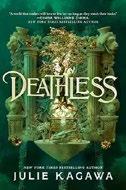
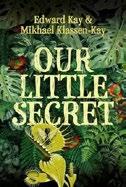
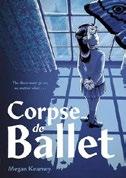
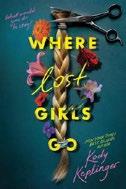
FEATURING 342 Industry-First Reviews of Fiction, Nonfiction, Children’s, Young Adult, and Audiobooks
The creator of the Cosmere universe headlines a special Science Fiction & Fantasy Issue
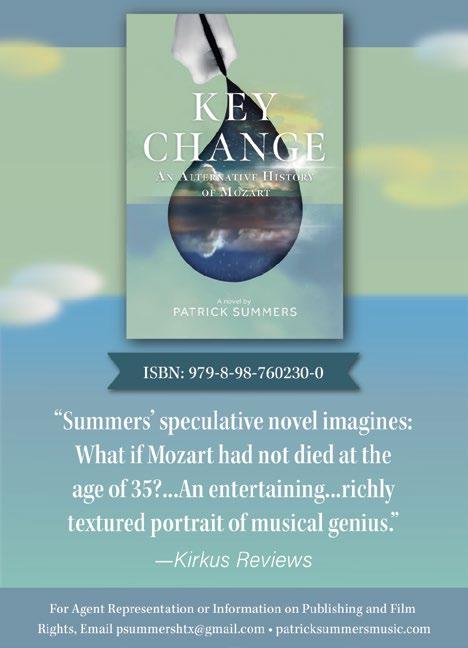
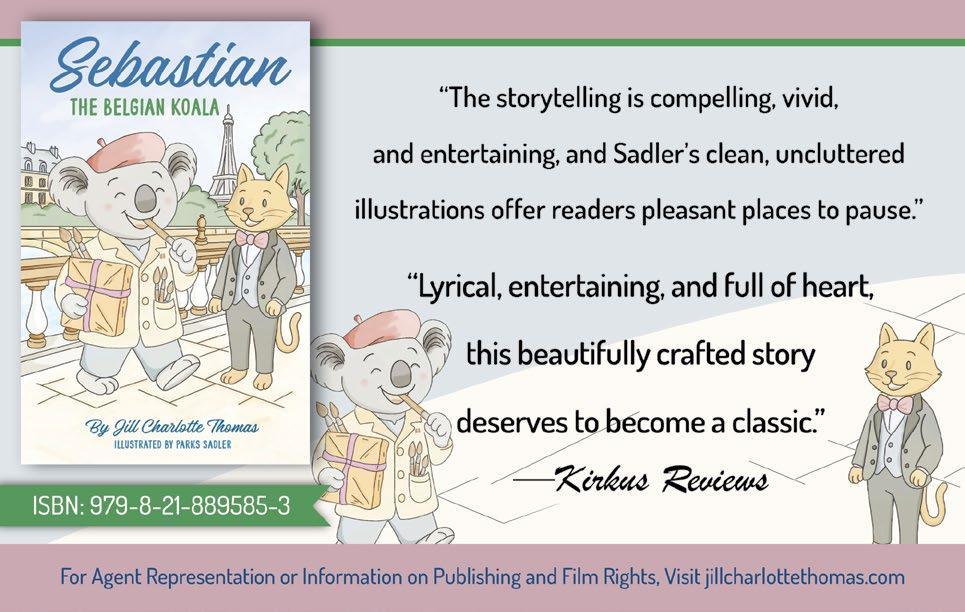
ISBN: 979-8-89565-118-6
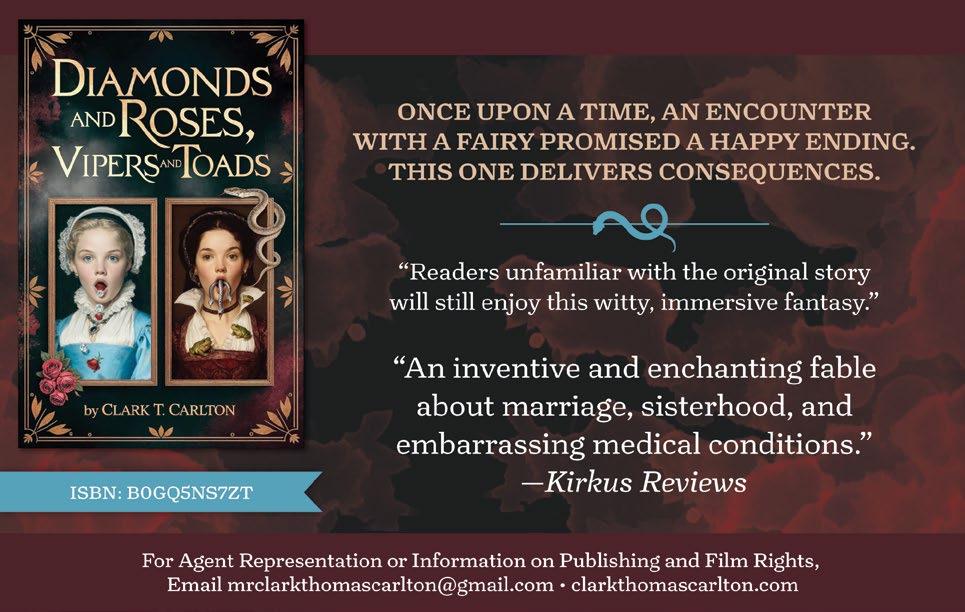
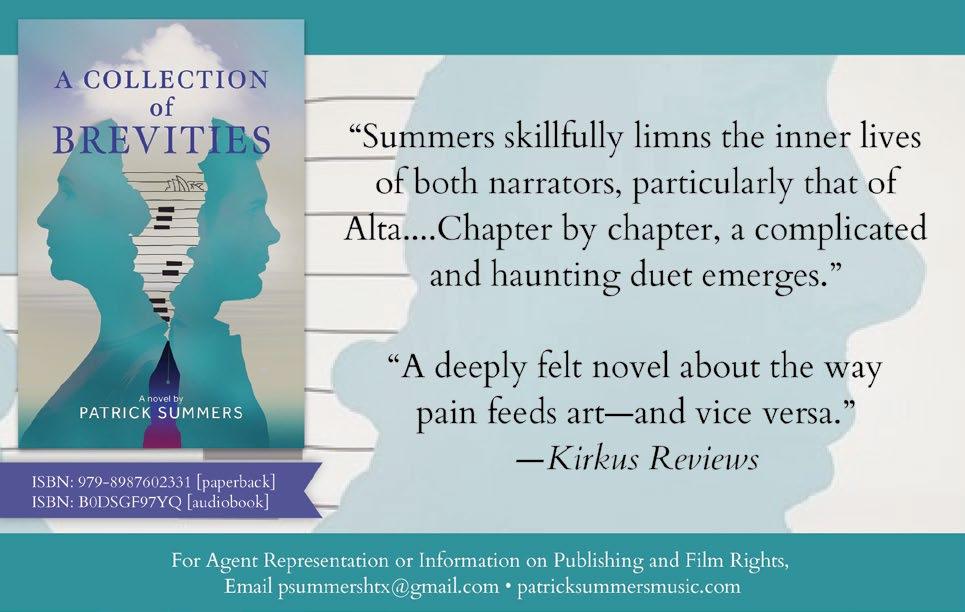
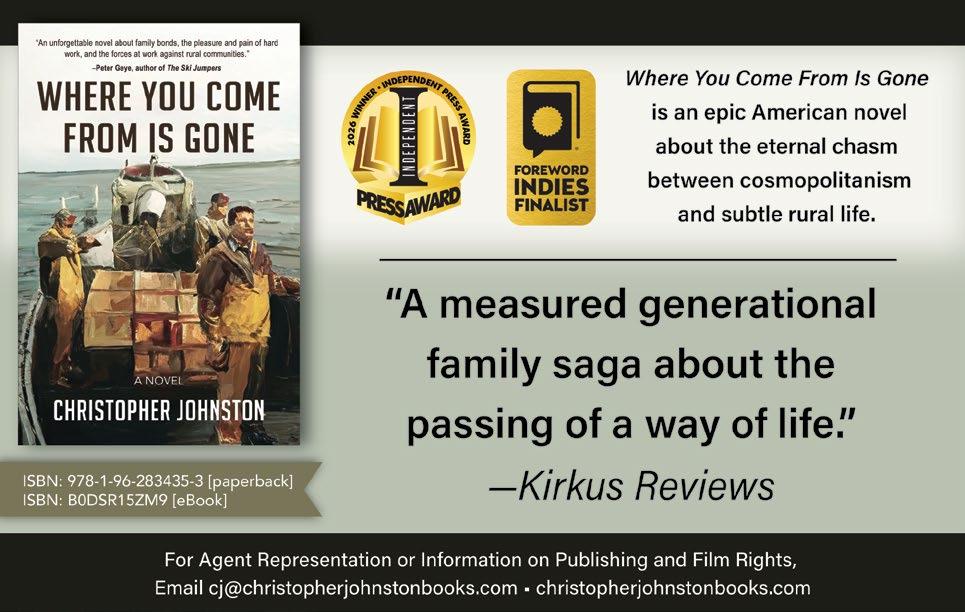
"Heckenlively hooks the readers with romance and keeps them riveted with countless thrills in between." –Independent Book Review
“...readers will love the main characters, the ever-present suspense, and the unanswered questions that invite conversation about what is real and what is not.”
–Blue Ink Review, Starred Review
“...a spy-thriller-like plan worthy of an Ian Fleming novel...”
“Heckenlively keeps the pages turning with brisk pacing and clever spins on hard-boiled dialogue...”
“Entertainingly lurid...” —Kirkus Reviews
For Agent Representation and Information on Film Rights, Email kheckenlively@hotmail.com • www.kentheckenlivelybooks.com
Science Fiction & Fantasy Issue
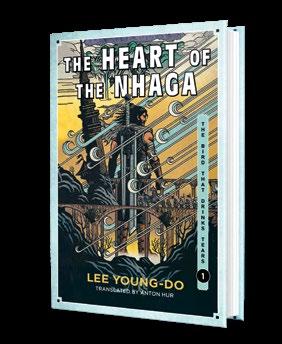
OUR FRESH PICK
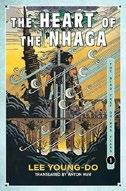
The inaugural volume of an inventive swords-andsorcery series by a skilled Korean novelist. Read the review on p. 40
FROM THE EDITOR’S DESK
STRANGE NEW WORLDS
I’M CONSTANTLY AMAZED by the prodigious imagination required of a novelist. Coming up with the fully realized plot, characters, and world of even one novel feels beyond me. So how does a fantasy writer like our cover subject, Brandon Sanderson, dream up an entire literary cosmos, as he’s done in Mistborn and The Stormlight Archive, two separate series both set in his Cosmere universe? That’s not to mention the standalone novels, plus titles for young adults and children, that he’s written—more than 70 books in all. I seriously wonder if the guy ever sleeps.
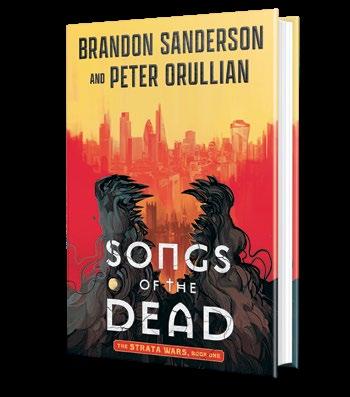
As you’ll learn from our interview with Sanderson on p. 14, he’s embarking on yet another series, this time with a little help from a friend, author and musician Peter Orullian. Songs of the
Dead (Saga/Simon & Schuster, June 16) is set in a recognizable contemporary London—but one that happens to be guarded by a secret society of magicians and that rests upon multiple strata of the city’s history (hence the series title, The Strata Wars). Our reviewer calls it a “headbanging beginning to what could be a remarkable urban fantasy series.” Did I mention that the protagonist is a heavy metal rocker? Sanderson plays in a very different key here, one that’s sure to delight old fans and bring him some new ones.
While all genre fiction lends itself to series storytelling, science fiction and fantasy narratives really benefit from the expansive worldbuilding that a series allows— after all, SFF writers are
creating whole universes from scratch. Here are some recent SFF titles in series that offer readers the pleasure of exploring strange new worlds at length:
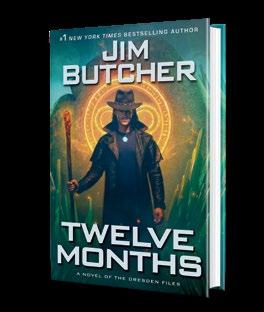
Novelist Jim Butcher launched his career in 2000 with Storm Front , about a Chicago PI who happens to be a wizard and is called in to investigate cases with a supernatural twist. Harry Dresden has returned in 17 more novels (and some stories) collectively known as the Dresden Files, a tantalizing blend of hardboiled crime fiction and fantasy. The most recent installment is Twelve Months (Ace/Berkley, Jan. 20). “The series’ snarky noir vibe might be dwindling, but there’s something of substance in its place,” says our starred review.
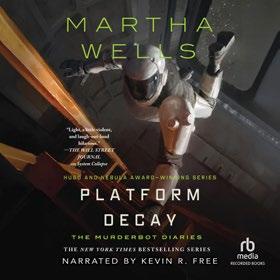
sarcastic narrator of its own adventures. The series kicked off in 2017 with All Systems Red ; the eighth installment, Platform Decay (Tor), landed last month. The series is also a lot of fun on audiobook, where it’s engagingly read by Kevin R. Free. “Long live Murderbot,” says our Earphones Award review.
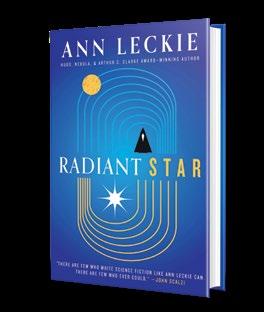
For an unnerving SF glimpse into a society distorted by artificial intelligence, check out Ann Leckie’s Imperial Radch series, in which a warmongering empire uses AI to control human bodies and crew its spaceships. The original trilogy began with Ancillary Justice in 2013; Leckie has extended the universe she created in standalone novels, including, most recently, Radiant Star (Orbit, May 12). Our starred review calls it a “skillfully rendered, thoughtful offshoot of the original story.” Are you ready to explore?
For customer service or subscription questions, please email customercare@kirkus.com or call 800-316-9361.
The Apple TV+ show Murderbot , starring Alexander Skarsgård, brought a whole new cohort of fans to Martha Wells’ awardwinning Murderbot Diaries, about a lethal security cyborg that hacks its “governor module” and becomes the
Illustration by Eric Scott Anderson TOM
Co-Founders, Kirkus Media LLC
HERBERT SIMON MARC WINKELMAN
Publisher, CEO & Partner
MEG LABORDE KUEHN mkuehn@kirkus.com
Chief Marketing Officer
SARAH KALINA skalina@kirkus.com
Enterprise Advertising Director
MICHELE COBB mcobb@kirkus.com
Indie Advertising & Promotions
AMY BAIRD abaird@kirkus.com
Author Consultant
KEELIN FERDINANDSEN kferdinandsen@kirkus.com
Controller & Operations Manager
KRISTI DAUGHERTY kdaugherty@kirkus.com
Lead Designer KY NOVAK knovak@kirkus.com
Magazine Compositor
NIKKI RICHARDSON nrichardson@kirkus.com
Director of Kirkus Editorial ROBIN O’DELL rodell@kirkus.com
Kirkus Editorial Senior Production Editor
MARINNA CASTILLEJA mcastilleja@kirkus.com
Kirkus Editorial
Production Editor
ASHLEY LITTLE alittle@kirkus.com
Indie Editorial Assistant
KATARINA YERGER kyerger@kirkus.com
Contributing Writers
GREGORY McNAMEE MICHAEL SCHAUB
Editor-in-Chief
TOM BEER tbeer@kirkus.com
President of Kirkus Indie CHAYA SCHECHNER cschechner@kirkus.com
Fiction Editor
LAURIE MUCHNICK lmuchnick@kirkus.com
Nonfiction Editor
JOHN McMURTRIE jmcmurtrie@kirkus.com
Young Readers’ Editor LAURA SIMEON lsimeon@kirkus.com
Young Readers’ Editor MAHNAZ DAR mdar@kirkus.com
Audiobooks Editor JENNIFER DOWELL jdowell@kirkus.com
Founder, Kirkus Reviews VIRGINIA KIRKUS (1893-1980)
Contributors
Colleen Abel, Dan Accardi, Reina Luz Alegre, Jeffrey Alford, Paul Allen, Stephanie Anderson, Jenny Arch, Kent Armstrong, Mark Athitakis, Kit Ballenger, Colette Bancroft, Audrey Barbakoff, Hayley Barnes, Carole Bell, Nell Beram, Elizabeth Bird, Christopher A. Biss-Brown, Marc Bona, Elissa Bongiorno, Kimberly Brubaker Bradley, Jessica Hoptay Brown, Abby Bussen, Kevin Canfield, Tobias Carroll, Charles Cassady, Ann Childs, Alec B. Chunn, Amanda Chuong, Carin Clevidence, Adeisa Cooper, Susan Corapi, Amanda Costello, Jeannie Coutant, Stephen Cummings, Michael Deagler, Lisa De Bode, Dave DeChristopher, Elise DeGuiseppi, Suji DeHart, Amanda Diehl, Maria Dietrich, Fiona Dolce, Steve Donoghue, Anna Drake, Jacob Edwards, Lisa Elliott, Chelsea Ennen, Joshua Farrington, Cat Fithian, Katie Flanagan, Maya Fleischmann, Cynthia Fox, Ayn Reyes Frazee, Jenna Friebel, Jackie Friedland, Jean Gazis, William Giwertz, Amy Goldschlager, Danielle Galván Gomez, Diana Granger, Michael Griffith, Lisa Grimaldi, Sara Grimm, Vicky Gudelot, Tobi Haberstroh, Sean Hammer, Sarah Harkness, Peter Heck, Ralph Heibutzki, Courtney Heidorn, Caroline Henderson, Mara Henderson, S.J. Henschel, Boze Herrington, Aaron Hicklin, Loren Hinton, Emma Hodgson, Ash Holland, Natalia Holtzman, Terry Hong, Darlene Ivy, Kristen Jacobson, Wesley Jacques, Jessica Jernigan, Danielle Jones, Jayashree Kamblé, Deborah Kaplan, Marcelle Karp, Lavanya Karthik, Colleen King, Katherine King, Maggie Knapp, Jennie Knuppel, Andrea Kreidler, Susan Kusel, Alexis Lacman, Megan Dowd Lambert, Joanne Langerman, Chelsea Langford, Christopher Lassen, River Lee, Maya Lekach, Elsbeth Lindner, Barbara London, Karen Long, Patricia Lothrop, Kyle Lukoff, Michael Magras, Thomas Maluck, Joe Maniscalco, Collin Marchiando, Natalie Marshall, Jodi Martin, J. Alejandro Mazariegos, Nancy McCarty, Kirby McCurtis, Breanna McDaniel, Katherine McDonald, Tate McFadden, Dale McGarrigle, Don McLeese, Cari Meister, Kathie Meizner, Carol Memmott, Ana Menchaca, Flor Meurinne, Rebecca Michelson-Ziegler, Steve Mirsky, Jennifer Miskec, Andrea Moran, Rhett Morgan, Rachael Nevins, Therese Purcell Nielsen, Dan Nolan, Ari Nussbaum, Katrina Nye, Tori Ann Ogawa, Milo Ono, Mike Oppenheim, Nick Owchar, Emilia Packard, Nina Palattella, Costa Pappas, Hal Patnott, Bethanne Patrick, Rebecca Perry, John Edward Peters, Jim Piechota, Christofer Pierson, Vicki Pietrus, Brian Price, Margaret Quamme, Carolyn Quimby, Ellen Quint, Kristy Raffensberger, Kristen Rasmussen, Sarah Rettger, Alexandria Richey, Amy Robinson, Gia Ruiz, Lloyd Sachs, Bob Sanchez, Aurelia C. Scott, Gene Seymour, Linda Simon, Margot E. Spangenberg, Allison Staley, Sydney Stensland, Allie Stevens, Richard Stim, Rebecca T. Sutton, Deborah Taylor, Lisa Taylor, Jessica Teel, Ella Teevan, Defne Tekin, Eva Thaler-Sroussi, Desiree Thomas, Julie Thompson, Francesca Vultaggio, David Walton, Katie Weeks, Susie Wilde, Wilda Williams, Kerry Winfrey, Marion Winik, Hiromi Yoshida, Jean-Louise Zancanella, Natalie Zutter
SFF IS WHERE YOU FIND IT
AS GENRE BOUNDARIES
become increasingly blurred, elements of science fiction and fantasy have been showing up everywhere from literary fiction to cozy mysteries to—of course— romantasy. It feels like many readers want to escape reality right now, whether into space, the future, or a different world altogether. Here are some of the most engaging SFF books that have come out this year.
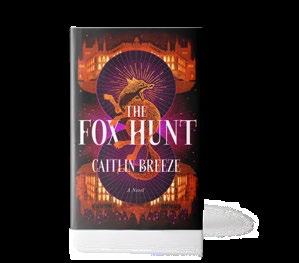
The Fox Hunt by Caitlin Breeze (Little, Brown, Feb. 24): Fans of campus novels like Leigh Bardugo’s Ninth House will enjoy this one, set at a British university like Oxford. When Emma Curran attracts the attention of an ancient all-male secret society, she finds herself taking part in a human “fox hunt”— and transported to the Night City, a domain that only sometimes intersects with her own. “Smart, propulsive, and multilayered, this deftly crafted fantasy thriller immerses readers in a narrative that recalls the wonder—and horror—of Grimms’ fairy tales in a darkly elegant academic setting,” according to our starred review.
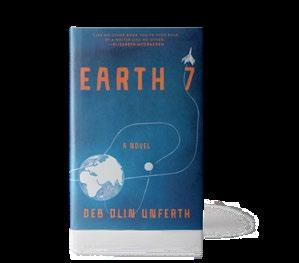
Earth 7 by Deb Olin Unferth (Graywolf, June 9):
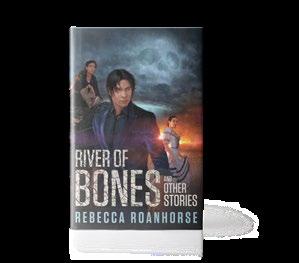
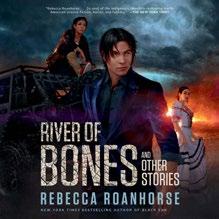
In Unferth’s “quirky, bold, and endearing masterpiece of climate fiction,” as our starred review calls it, people live, among other places, under the sea in acrylic pods, on Mars, and encoded on microchips. There’s a girl whose mother named her XY but whose friends call her Dylan; she grows up to fall in love with Melanie, who resembles a robot after having spent too many seasons on a bodymodification reality show called Celebrity Plastics The story “unfolds over vast vistas of time and space, profound, funny, alarming, and imbued with love and sorrow for our lost world,” according to our review. River of Bones and Other Stories by Rebecca Roanhorse (Saga/Simon & Schuster, March 3):
Roanhorse uses the tools of both SF and fantasy in these stories from the past eight years, which include vampires, imperialist aliens, and existential horror. Our starred review calls her “one of the sharpest writers publishing today,” saying “she plays with readers’ expectations but is always one step ahead, pivoting before you can guess what she’ll do next.”
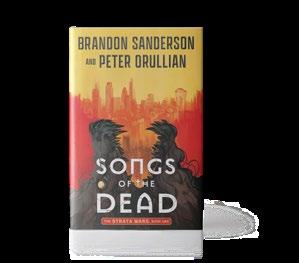
Songs of the Dead by Brandon Sanderson and Peter Orullian (Saga/Simon & Schuster, June 16): The opener of this new collaboration between Sanderson and Orullian introduces the Strata, layers of London’s past living underneath the modern city, inhabited by all sorts of gruesome creatures and memories—and the entrance lies inside a music hall. With the authors’ “exceptional worldbuilding,” our review calls this “a
headbanging beginning to what could be a remarkable urban fantasy series.” (Read a feature about it on p. 14.)
Green City Wars by Adrian Tchaikovsky (Tor, June 23): What a delight: an SF noir thriller featuring a world of service workers who are genetically modified animals. They’re supposed to remain unobtrusive but they’ve created a whole society, and our guide is Skotch, a raccoon trash collector turned private eye who’s been hired to find a missing mouse who happens to be a genius chemist. “This novel works because Tchaikovsky takes his world so seriously,” says our starred review. “These characters are real; the stakes are real.…engaging and mind-bending.”
Laurie Muchnick is the fiction editor.
LAURIE MUCHNICK
Illustration by Eric Scott Anderson
EDITOR’S PICK
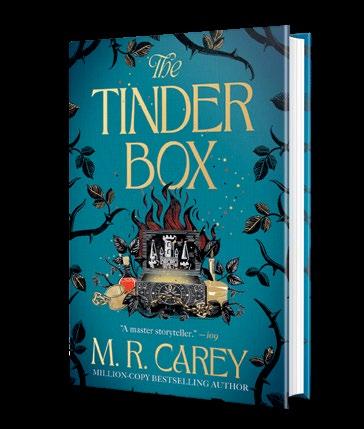
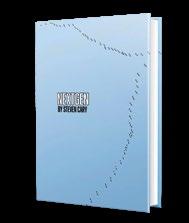
A soldier and a witch fumble their way through a sea of misfortune in hopes of a better future in this upending of the Hans Christian Andersen tale of the same name.
After Magnus Tresti’s wound forces him to leave the army, no one will employ him except the reclusive widow and secret witch Jannae Mirchella. After several weeks as her handyman, Mag is assigned the unusual task of looting the body of a dead demon they’ve seen fall from the sky. Resentful that Jannae hasn’t paid him for any of his work, he steals one of the demon’s possessions, a battered tinderbox, and runs off. He’s soon arrested, and in an effort to warm up the cell where he’s imprisoned, he strikes the flint of the tinderbox and discovers
that it summons three demons who must obey his commands. He’s deeply troubled by his power over these beings, but his situation is such that he constantly requires their help to extricate himself from trouble. As he wrestles with this dilemma, he’s pursued by the witch and the king’s warlock advisor, both seeking the tinderbox for themselves. Carey replaces one of the most memorable aspects of the original tale: Andersen’s tinderbox summoned enormous-eyed dogs, not humanlike demons; the switch highlights how unethical it is to keep magical servants forced to obey one’s orders. In addition, Carey excises the most obviously unsavory aspect of the story, in which the soldier uses the dogs to
The Tinder Box
kidnap the virginal princess on several nights, and marries her after the king is disposed of. Here, Mag is gay—and attracted to one of the demons. Nor does he wish to rule anyone. This version also lends sympathy and dimension to the witch, the abused daughter of an innkeeper who unintentionally causes her beloved mentor to be condemned to
death. The typical story of a poor man triumphing over a cruel king and an evil witch is thus transformed into a compelling exploration of the brutality of the social divide, the hypocrisy of rulers, and the futility of war.
Surprising and redemptive; Carey masters yet another subgenre of speculative fiction.
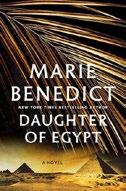
Daughter of Egypt
Benedict, Marie | St. Martin’s (352 pp.) $29 | March 24, 2026 | 9781250280732
T he question of who should own a country’s artifacts and history fuels this novel about colonialism and erasure.
Lady Evelyn Herbert was the first person to enter the burial chamber of Egyptian pharaoh Tutankhamen after its discovery in 1922. She is one of many brilliant women to feature in Benedict’s superb novel, in which women’s impact on history is brought into the light. The history books have credited the discovery of Tutankhamen’s tomb to the famous Egyptologist Howard Carter and to Britain’s Lord Carnarvon, the avid financial supporter of Carter’s hunt for ancient tombs and treasures. At their side, though, was Evelyn, Carnarvon’s daughter, whose name many of us have never heard. She’s also the conscience in this story, as she rails against Britain and other countries unearthing treasure-filled tombs and taking their priceless artifacts out of Egypt, placing them in Western museums or selling them to collectors. Evelyn’s contributions to archaeology are not widely recognized, nor does history tell us much of the women who rose to the rank of Pharaoh thousands of years ago. In alternating cinematic chapters, Benedict imagines the story of Pharaoh Hatshepsut, who ruled circa 1400 B.C.E. She’s credited with opening new trade routes and initiating huge building projects. And yet, why was her name removed from numerous monuments and temples after her death? Benedict imagines Evelyn, in full Agatha Christie mode, making it her mission to solve that mystery and find Hatshepsut’s tomb. Channeling the adventurous spirit of Indiana Jones and the detective skills of Miss Marple, Evelyn pursues the story of Hatshepsut against a fiery backdrop of unrest as Egyptians fight for independence from Britain and Britain struggles to heal from the damage to its national psyche in the aftermath of World War I.
An idealistic archaeologist challenges tomb raiders in this spirited tale of cementing women’s rightful place in history.
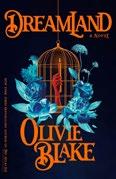
Dreamland
Blake, Olivie | Tor (368 pp.) | $29.99 Aug. 11, 2026 | 9781250368935
A young actress is thrust by ambition into the orbit of old money Hollywood and discovers, unsurprisingly, the dark side to fame and fortune.
“In retrospect, if a man says run, you should listen. I didn’t, of course.” And so the ominous tone of this modern gothic is set from the start, as Blake’s heroine, struggling actress Anya Morris, puts her wheels in motion toward a predetermined demise. Surrounded by the billowing heat and existential threat of the Santa Ana winds, Anya is itching to land a part, any part, that will move her out of the apartment complex owned by her Filipino mother, away from disapproving eyes and the guilt of wanting more than to work at the family store. Fate comes swirling through the door in the form of Teddy Finch, a high school acquaintance and Hollywood nepo baby who harbors a social media obsession with Anya. She’s quick to fit into whatever role necessary to get what she needs from him—“A prayer: If this dream goes unrealized, it won’t be because of anything I didn’t do”—and soon finds herself on his arm at a charity gala. There she meets the charmingly cynical Emmanuelle de Witt, who offers what Anya’s always dreamed of, namely access and opportunity. Anya visits the de Witt mansion and finds herself thrown into a scene of debauchery and opulence, with Emmanuelle whispering promises in her ear, as long as she does “[her] job,” one yet to be defined, but which now holds the key to her future. She must watch someone named Julian and make sure he’s never out of sight. “Severe epilepsy,” according to whispers, but the truth is much darker. Blake is fantastic at
creating a foreboding atmosphere à la Megan Abbott, using the California weather, the constant hum of traffic, and the toxicity of ambition to produce a cloying, suffocating environment that matches the sickness consuming everyone in the de Witt mansion. While the gothic undertones are a fun nod to the likes of Jane Eyre, the grotesque secrets of Hollywood’s finest are neither very original nor surprising, as we’re set up to expect the worst from Page 1. Dripping in satire and all-consuming desire, this is more about the atmosphere and less about the drama that unfolds.
Kirkus Star
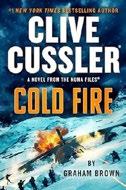
Clive Cussler Cold Fire
Brown, Graham | Putnam (400 pp.) $32 | June 2, 2026 | 9798217184972
A hijacked laser weapon threatens to ignite World War III. The U.S. is testing the EAGL, or Enhanced Aerial Gunnery Laser, an airborne defense system that annihilates anything it hits. It’s so fast it “can shoot down a hundred ballistic missiles before they leave enemy territory,” it never runs out of ammunition, and it will “make ballistic missiles obsolete.” But a traitor named Ridley Wiles hijacks the plane that carries it, and he kills the crew. Radar contact is lost, and National Underwater and Marine Agency (NUMA) salvage experts Kurt Austin and Joe Zavala undertake an urgent mission to find or destroy the EAGL before Russia or China lay their hands on it. Meanwhile, a smuggler named Ahab who specializes in dumping toxic waste is dying. He blames Kurt and Gushan, an officer in China’s People’s Liberation Army (PLA), and would like nothing better than to cause World War III before he dies. The action and excitement are damn near constant. The U.S. and China have
begun joint operations on certain projects, and Kurt and Joe save Gushan’s life—barely—in the prologue. But Gushan’s superiors may later order him to hunt Americans down and kill them. He knows he owes his saviors a debt, but he is also loyal to his country and to the PLA, so he has a dilemma. The heroes are all that NUMA series readers have come to expect—smart, honorable, and resourceful under life-and-death pressure. They face attacks on the NUMA vessel Lyra , try to save a sinking ship, commandeer a cargo plane—Joe can fly it, but isn’t so sure about landing it—and hope Ahab doesn’t blow it out of the sky. As always in this series, the story is a high-stakes, brace-yourself adventure with admirable heroes who don’t shy away from the next challenge. Fast-moving fun from start to finish.
Kirkus Star
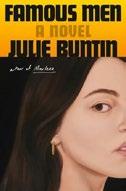
Famous Men
Buntin, Julie | Random House (400 pp.) $30 | July 14, 2026 | 9780593229958
A personal and professional entanglement with an acclaimed writer shapes a young woman’s life. When Wilhelmina Miles first discovers Nathaniel Fellow, through his poetry, she feels drawn to him. They’re both from Greening, Michigan, which the now-lauded Nathaniel long ago escaped but where teenage Will still lives; her mother works in the cafeteria at Rosendale Academy, the private school Nathaniel attended. In 2010, Will, a budding writer herself, gains acceptance to a college in New York City that’s “mediocre” but, crucially, is located “one crosstown bus away from the famous university where Nathaniel Fellow taught in a small but prestigious MFA program.” When she meets 62-year-old Nathaniel, he is rude and cruel, but he
A searing, brilliant novel about power, and stories, and who gets to tell them.
FAMOUS MEN
offers her a position as his literary assistant, a job that soon outgrows its already nebulous bounds into a far more personal and, yes, sexual relationship. Nathaniel’s students become Will’s rivals and friends, but he is her life’s center. Will and Nathaniel’s arrangement endures, in shifting permutations, for many years, recounted by the future, wiser Will, with whom the novel eventually catches up. Men’s misdeeds stalk the book—before Nathaniel, Will had already endured sexual assault and humiliation at the hands of her high school peers and unwanted attention from her mother’s creepy boyfriend— but she fervently dispels any claim to victimhood: “Hadn’t I left the curtains open, day after day after day…?” This insistence on denial proves extremely difficult for Will when retribution inevitably comes for Nathaniel. Buntin’s premise may be familiar, but the novel pays masterful attention to complexity, presenting events and relationships in all their strangeness and contradictions. Her language is superb; for all Will’s self-assuredness, the precarity of her situation, tied so inextricably to Nathaniel, is rendered in such exacting and heartrending detail as to make the reader’s teeth ache. The structure of the novel allows for heightened poignancy as Will reflects on the consequences of the choices she made over the years, as well as the ones she didn’t.
A searing, brilliant novel about power, and stories, and who gets to tell them.
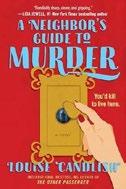
A Neighbor’s Guide to Murder
Candlish, Louise | Grand Central Publishing (336 pp.) | $18.99 paper | July 7, 2026 9781538778111
Apartmentbuilding tensions lead to death.
The latest by the author of Our House (2018) returns to the territory of upscale London real estate for a meandering tale of class, gender, generational, and financial conflict. Elderly, opinionated Gwen Healy lives with her unemployed son in one of 32 apartments at Columbia Mansions. Gwen, whose “unburdening” makes up the body of the novel, insists she’s not a busybody, but the evidence contradicts her. Her favorite form of exercise is jumping to conclusions, and it gets her, and those around her, into trouble again and again. Much of that conclusion-jumping has to do with her despised next-door neighbor, one-hit wonder rock star Alec Pedley, who makes a habit of renting out his second bedroom to young women. When Gwen takes a particular liking to one of them, the fey Pixie, she gets in over her head making accusations against Alec, and finds herself deep in a libel case.
Candlish uses the fact that Gwen is an inexperienced writer (“I’m not a skilled storyteller, as you will have gathered. I have little control over the pace of this thing”) as an excuse for the novel’s leisurely structure and frequent digressions, but that’s little comfort for the reader looking for action and consistency. The novel has a lot to say about sexual exploitation, journalistic overstepping, the British housing crisis, and
For more by Julie Buntin, visit Kirkus online.
disregard for those getting on in years. It offers welcome touches of comic relief, mostly in the form of Gwen’s acid critiques of phenomena like “luridcolored juice,” and Candlish is a master of late-in-the-narrative twists. But the overall tone is depressingly sour, and as a narrator, Gwen evokes a queasy mixture of pity and distaste. A lesser but still diverting effort from a socially concerned suspense novelist.
After giving birth, a disillusioned woman makes wild choices as she tries to rediscover the person she used to be.
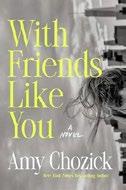
Fifteen years past college, Emily finds herself horribly unsatisfied. She’s on maternity leave from her ho-hum job, recovering slowly from a difficult childbirth, and feeling increasingly isolated from her husband and friends. She remembers her college roommate, Daisy, as her one true soul mate but, unfortunately, the women lost touch after freshman year, when Daisy got involved with drugs, stripping, and other unsavory activities. Now, Emily’s desperate to track her down. After sleuthing at out-of-town strip clubs and visiting Daisy’s grandmother in a nursing home, Emily discovers that Daisy’s been living nearby for years, with a mysterious man providing a life of luxury. Daisy brings Emily into her strange and extravagant life, which includes a vacant Park Avenue building where the women decide to create a high-end club for new mothers. The privileges Daisy shares with Emily get progressively murkier, until Emily begins to wonder whether Daisy is who she thought at all. Narrated by Emily, the book gets off to a slow start as her quest to find Daisy drags on, and the plot feels like a low-stakes search for an old friend. After the two reconnect a third of the way through, the story takes on more life, and
the oddities of the world they build together effectively increase the tale’s dark humor and suspense. Chozick does an admirable job of creating a strange microcosm of intense, image-conscious Manhattan, where the self-doubt, loneliness, and pressure of new motherhood are juxtaposed with the excess and superficiality of high society. While certain aspects of Emily’s life, like her relationship with her husband, lack detail, Chozick provides extensive, graphic descriptions in other areas, such as the physical trauma Emily suffered during the baby’s difficult delivery and her ongoing pain and follow-up treatments. A surprising tale about motherhood, friendship, and reawakening after life’s transitions.
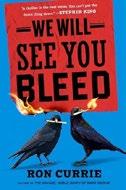
We Will See You Bleed
Currie, Ron | Putnam (384 pp.)
$30 | July 7, 2026 | 9780593851692
A hard-charging woman becomes a Maine town’s de facto leader in this prequel to The Savage, Noble Death of Babs Dionne (2025). The first novel about Babs was set in 2016, documenting her rule over Little Canada, a Francophone parcel of a Maine town. This follow-up, set in 1984, reveals how she gained her perch. It turns on an ongoing strike at a paper plant, which has put her husband, Rheal (among others), out of work, replaced by scabs trucked in from Virginia. Getting locals back in the plant means dealing both with the mill owners and with Harold Aucoin, a drug dealer who provides security for the scabs. Babs also has to persuade law enforcement and religious authorities to do their bit, which involves funding a kidney transplant for a striker’s ailing wife and exposing the Catholic Church’s protection of pedophile priests. (An extensive subplot involves a Boston Globe reporter’s efforts to uncover the scandal decades before it actually came
to light.) There’s more than a little of Don Corleone’s ruthless amorality in Babs, who remains admirable in her desire to protect a working-class community even while she engages in criminal, sometimes bloody, activities. And much like The Godfather, the novel serves as allegory for a crumbling American infrastructure where citizens are victimized by rapacious capitalism. As Currie flintily notes, New Canada is beneath most people’s concern: “These kinds of shenanigans, properly contained, would fly under the radar of polite society, as they had from time immemorial, so long as blue blood wasn’t spilled.” Though the plot can get tangled, Currie’s passion for the underclass is clear, and Babs’ role as their Robin Hood–ish benefactor makes her an appealing antihero. A dark and lively modern-day outlaw tale.
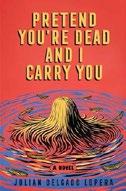
A fierce Colom bian comingof-age story shaped by grief and secrecy. A daughter grows up in the shadow of her father’s unraveling, piecing together a family history shaped by violence, repressed desire, and Colombia’s Magdalena River in this haunting, nonlinear novel. Moving between the rural past and contemporary Bogotá, Delgado Lopera traces Valentina’s coming-of-age alongside the story of her father, Ignacio, whose life has been marked by repression and withdrawal. After the death of Valentina’s mother, found in a river that feeds into the Magdalena, the two live in a cramped apartment thick with neglect. Ignacio drifts through his days in a state of exhaustion while Valentina clings to TV fantasies, friendships, and
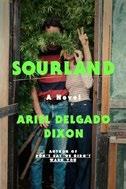
A hidden marijuana farm
is fertile ground for desire, secrets, and lies.
SOURLAND
whatever fragments of memory help her make sense of what has been lost. The novel gains force as it turns backward toward Ignacio’s youth, where masculinity is enforced through brutality and tenderness is treated as weakness to be beaten out. Delgado Lopera handles these early scenes with an unflinching eye, particularly a brutal lesson in what it means to be a man in Ignacio’s world, which involves the slaughter of his beloved pig. Later, in underground queer spaces, Ignacio glimpses another life, one defined by transformation and possibility, but which he is too afraid to inhabit. That reluctance shapes the life of his daughter in ways at once intimate and devastating. Throughout, the Magdalena is more than backdrop. It is a national artery that doubles as a graveyard, a place where Colombia’s history of violence has quite literally accumulated. As the story weaves between memory and myth, the river gathers these lives into its current, linking personal loss to a broader collective reckoning.
A stark portrait of the damage passed from parent to child.
Sourland
Dixon, Ariel Delgado | Random House (304 pp.) $29 | June 23, 2026 | 9780593243534
In pre-legalization
California, a hidden marijuana farm is fertile ground for desire, betrayal, secrets, lies, and the settling of old scores.
“On the inhale, Greyhound Buddha tasted of pine and
diesel, the classic flavors, but there was a leavening twist of orange blossom too, and a blooming buttercream sweetness you could sniff when the buds were ground up for packing into a bowl or rolling into a joint.” One can easily imagine that cloud of pine and diesel wafting up from the pages of Dixon’s gritty neo-Western, complete with double crosses, shootouts, rattletrap pickup trucks, a herd of cattle, and a dog named Pistol. Sourland, named for its acidic soil, is the property of a charismatic older woman named Sapphire and home to a seasonal crowd of latter-day hippie farmworkers as well as the boss’ two lovers: Frankie, a former ballerina, and Fizz, a young man Sapphire has known since he was 8 and who has since had a long run as a drug smuggler and distributor. As Frankie explains in one of her first-person sections, “When Sapphire and I met, I was 21 and she was 46, a perfectly torrid gap. She had eked past 50 since then, but I was still lan guishing in my mid-20s, and Fizz was two years older, at 29.” Unhappy with Fizz’s new role in their lives, Frankie bolts—and then, not long after, Sapphire herself disappears. After she’s been gone long enough for Fizz to throw a memorial service, Frankie returns to Sourland, though whether to share control or wrest it away is not immediately clear. In interwoven flashback chapters, a snake pit of complications is revealed, deals gone bad and unpaid debts now coming due. Is Sapphire really dead or will she reappear? Dixon’s wealth of knowledge about both legal and illegal farming practices and her feel for the texture of rural queer living infuse this sweaty, smoky thriller with vibrant realism.
Skunky, in the best possible way.
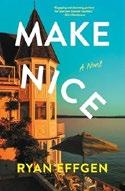
Make Nice
Effgen, Ryan | Knopf (336 pp.)
$30 | July 14, 2026 | 9798217208128
Invasive snails, stolen drugs, a gay husband, romance, and long-held secrets color the Pickford family’s return to their old holiday island in Lake Michigan for one last get-together.
Effgen’s likable novel ticks several of the boxes for a summer read—waterside resort location, diverse assembly of personalities, not-too-ponderous discussion of midlife issues, and a wry comic touch. His subject is a family’s psychologies and dynamics as the three adult siblings, their father, and one teenage daughter gather at the Grand Hotel in tribute to their recently deceased mother. Viv is coming to terms with her husband’s revelation of his homosexuality, a fact that her daughter, Ash, has long known. Pete, a dorky child grown into a respected expert on gastropods, remains “polite and thoughtful and childless.” And ne’er-do-well Corey, smoothtongued but penniless, is quietly trying to find a buyer for the block of cocaine he happens to have just stolen. The island holds memories for all the adults and is a background for who they have become. Pete indulged his passion for biology here, Viv lost her virginity in a rowboat one July Fourth, and Corey, at 12, found opportunities to develop his morally dubious career. In addition, there’s the lingering question of why their summer cottage was sold so suddenly, the arrival of a creepy man in pursuit of Corey’s drugs, and the attractive woman and child Pete encounters living in the new house built on the site of the Pickfords’ old cottage. Effgen stirs this busy pot with a capable hand. His characters are persuasive and his plot strands, even if they range between predictable and inappropriately violent, are deftly woven. Compared to, say, Catherine Newman’s Sandwich (2024), this novel offers less crackling wit but greater narrative breadth. And the author
lands the story successfully, in a positive place for most concerned. Family problems are not exactly solved but are entertainingly re-engineered in an appealing escapist read.
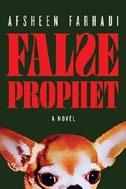
False Prophet
Farhadi, Afsheen | Melville House (288 pp.) | $19.99 paper | July 7, 2026 9781685892418
An actor’s pivot to writing creates tension in his family. Jal Persad is at a personal and professional crossroads when this ambitious novel begins. He’s a working actor who has taken time off following the death of his mother, Rita, a year earlier. While he seems to have a good professional bond with his manager, Justin, his closest relationship is with his dog, Teddy, who brings him “the love [he’d] long been missing.” Jal’s family is Indo-Guyanese, and his mother grew up at a time that overlapped with Jim Jones relocating the Peoples Temple to Guyana, and the tragedy that followed. Jal begins work on a memoir about his mother’s life in her native country—including an imagined encounter with Jones—teaming up with Kate, a more experienced writer, on the project. As Jal revisits his mother’s life, Kate is a divorced mother, so there are several windows on parenting here. Sections of their collaboration appear alongside the tale of its genesis; what was intended as a true story becomes more and more fictionalized, with tense scenes reminiscent of a spy novel and unflattering descriptions of Jones: “[Rita’s] hand disappeared in his moist, fleshy palm, and up close, she could see that his skin was covered in beads of sweat.” Buzz about Jal’s book causes members of his mother’s family to contact him, and eventually to bring up inaccuracies they’ve been hearing about. In one conversation, Jal’s uncle Ramesh invokes “all the Persads who will have
to live alongside a lie.” The irony of this project connecting Jal to family overseas is effective, but other elements don’t work as well, such as the way Jal’s work in progress elevates his status as a celebrity speaking truth to power. Farhadi is dealing with thematically rich material, but it often needs more space to breathe.
A complex yet sometimes rushed character study.
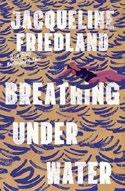
Breathing Under Water
Friedland, Jacqueline | Harper Muse (384 pp.) | $18.99 paper | Aug. 4, 2026 9781400347339
The mother of an autistic high school student forms a bond with a college swimmer as they deal with varied challenges. Berry Selinger is the vice principal at a prestigious private school where she’s hoping to be promoted to principal now that her boss is retiring. But at home, things are strained. She’s a fierce advocate for her autistic son, Leo Becker, but as he gets older and his needs change, she’s not sure she’s making the right decisions. Also, Berry worries about her husband’s secrecy and no longer feels they’re on the same page about Leo’s care. When she learns about an opportunity for Leo to be a teacher’s assistant at a swim class for autistic kids, she’s hopeful that it will help him come out of his shell and learn to swim at the same time. It’s there that Leo meets McKenna Jamison, a college student on a swim scholarship who’s teaching the class. Between spending long hours in the pool and working hard in class to meet the requirements of her scholarship, McKenna is at her breaking point—and then her grandmother, her only family member, moves into a memory care facility. McKenna’s taken the teaching gig as a way to get community service hours for her scholarship, but she soon finds that she likes working with kids. She even forms a friendship with Leo,
who otherwise struggles to connect with people outside his family. But when McKenna runs into difficulties with school and her job, their connection—as well as her financial stability—is threatened. Although the story is told from Berry’s and McKenna’s perspectives, Leo is the character bringing them together. His growth and change are paramount, and he feels like a real person, not a token. In her author’s note, Friedland writes that her interest in autism came from her mother, who was a pioneer in autism teaching and research. As Friedland puts it, “Every child deserves to be seen, to be challenged, and most of all, to be respected and understood.”
A touching novel about unexpected connections and found family.
Kirkus Star
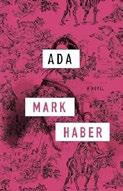
Ada
Haber, Mark | Coffee House (112 pp.) | $18 paper | July 14, 2026 | 9781566897594
The ruler of a central European backwater awaits a romantic visitor. Haber specializes in wry, taut, intellectual historical fiction featuring accomplished if deeply flawed male narrators. Here, that’s Gerard Desacroux IV, the son of a dead French nobleman who’s been exiled to Berchtesgaden, “a lump of land tottering between Bavaria and Saxony.” Gerard’s opinion regarding his geographical location is just the start of his bottomless apathy and contempt. Leadership largely means keeping the locals at bay (a bell-ringing sequence informs him if an uprising is in the offing), and the perks of royalty are clouded by paranoia. (He has a series of food tasters ready to monitor potential poisonings.) Where is the joy for a man stationed in a place where winter is “greedily devouring ten months of the year with the remaining two left for mud and disease”? A
woman, Ada, with whom he once had a brief fling in Paris. He believes she is coming to visit—alas, with a husband, inheritor of a fortune in the paisleydesign business. Though the setting is the 18th century, on the last legs of the Holy Roman Empire, Gerard’s character is amusingly, thoroughly applicable to any era—he is the quintessential failson, incompetent yet constantly fuming at everybody else’s inability to measure up. Though this is a short novel, his ignorance seems bottomless: He respects books for their aesthetic value, not their contents, and scoffs at the idea of a musket when it’s described to him. The novel is formatted as one paragraph, which accentuates the constrained, frustrated tone, with Gerard condemned to jabbering about his romantic desperation and life in a “bleak morass with generations of unrest due to plague, famine, and vague religious feuds.” His ignorance is comic, but Haber tunes the humor carefully; after all, his narcissist narrator is a man in power. A sharp, taut portrait of curdled, angry leadership.
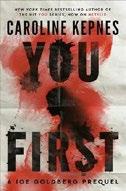
You First
Kepnes, Caroline | Random House (416 pp.) $30 | June 9, 2026 | 9780399591464
What makes a serial killer a serial killer?
Here’s the rom-com version.
This is Kepnes’ fifth novel about murderer, hopeless romantic, and colossally unreliable narrator Joe Goldberg, but it’s the first prequel, recounting Joe’s
experiences as a 17-year-old in New York City not long after 9/11. Even at that tender age he sees books and sex as inextricably linked—he calls his penis “Portnoy.” Like the other books (which became a five-season Netflix series), this one takes us inside Joe’s head, where he addresses a running commentary to a “you” that’s not the reader but a woman he’s fallen madly in love with, which in Joe’s case means he’s stalking her. This time it’s Vail Gunderson, a classic Manic Pixie Dream Girl with the most early2000s job ever: She’s a production assistant on Sex and the City. She’s obsessed with the show and with rom-coms in general, and Joe, who practices obsession as an art, follows right along. Their relationship plays out amid a cast of sometimes wacky, sometimes disturbing characters, including Mr. Mooney, the bookstore owner who employs Joe and occasionally locks him in the basement; Angus Kaplan, a wealthy Mooney client and frustrated writer who buys pricey signed volumes by authors he envies and then desecrates them, often with Joe as an audience; and the aptly named Dick, a barista friend of Vail’s who offers Joe lots of bro-style advice. Kepnes’ trademark dark humor peppers the book, and there are some surprising twists. But the true twisted charm of the earlier installments was Joe’s unrestrained interior monologue. This time around it too often falls flat; maybe it’s because young Joe seems not quite as ferocious as the fully formed version, or maybe it’s that we’ve entered an era when narcissistic, amoral rambling seems overdone. This prequel offers entertainment for fans, but killer Joe Goldberg might have overstayed his welcome.
A mother-daughter trip to Sicily becomes a journey into history and myth.
Kirkus Star
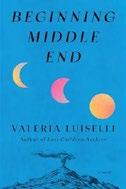
Beginning Middle End
Luiselli, Valeria | Knopf (368 pp.)
$35 | July 28, 2026 | 9798217208319
A mother-daughter trip to Sicily becomes a journey into history, myth, and human nature.
Luiselli’s fourth novel is mostly narrated by Ella Camposanto, a divorced writer, who’s joined by her 12-year-old daughter, Manuela, on a trip to the island while she works on a novel. Precociously, Manuela asks if mom’s next book could have a straightforward beginningmiddle-end structure. Given how the (very Luiselli-esque) writer’s novels tend to be pastiches of poetry, photography, history, and other assorted material, it seems a tall order. But this book largely, cleverly obliges: The two undertake a journey to return a small mosaic of the god Proteus to the ancient villa where Ella’s grandmother may have pilfered it; meanwhile, Mount Etna is erupting, threatening wildfires. But a clear quest and a clear danger doesn’t lock Luiselli into a stock structure, and the storytelling weaves in ancient Greek and Roman texts to explore how fluid and changeable we are. (Proteus, representing ever shifting seas, is a key figure; so too is Ovid’s Metamorphoses and Pliny the Elder’s writings, concerned with weather patterns and the eruption of Mount Vesuvius.) The drama in the novel is relatively minor—Ella’s relationship with her new lover, a concert pianist, is frosty, and Manuela is stung by a jellyfish. Still, the story feels like it has the force of centuries behind it, from Manuela’s obsession with tides, myth, and history to glimpses of the Middle Eastern refugees who’ve arrived at the island (to the scorn of many locals). Luiselli, a Mexican American writer who’s focused on borderlands immigration in previous fiction and nonfiction, has made displacement her great theme. The change of scenery doesn’t shift her focus; rather, it intensifies her argument
that global migration is a prompt to reconsider our identities and relationships.
An offbeat migration story as piercing and artful as any in Luiselli’s oeuvre.
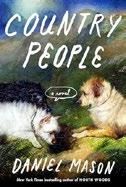
Country People
Mason, Daniel | Random House (320 pp.) $30 | July 7, 2026 | 9798217197453
A California family is transplanted to rural Vermont.
For as long as urbanites have been decamping to the countryside, there have been satires of their antics; recent standouts include Gary Shteyngart’s Our Country Friends (2021) and Brian Schaefer’s Town & Country (2025). Now the author of The Piano Tuner (2002) and The Winter Soldier (2018), known for his richly imagined historical fiction, serves up his own contribution to the genre. Miles Krzelewski-Petrosian has been at work on his Ph.D. dissertation for 14 years, cycling through subjects such as Tolstoy’s peasants and Russian folktales. His more successful wife, Kate, a Milton and Blake specialist, has been offered a one-year visiting professorship at a prestigious Vermont college, so this family of “simple city people”—son Wesley, age 12; daughter Olive, 9; and dog Giuseppe—leave for fictional Greensbury. There they’ll housesit for an economics professor on sabbatical, with instructions to “watch for leaks, to keep the animals away.” Not unlike Miles with his dissertation, the author meanders through a series of eccentric character sketches and humorous
episodes, including a snowflake photographer who gets around on a motorized scooter and a radio call-in show, The Miscellaneous Minute, whose daily themes are continually scuttled by callers. It’s funny if a bit aimless; the novel clicks into gear when Miles is invited, via an anonymous postcard, to attend a secret meeting of the Jeremiah Wylkes Society, named for a 19th-century pastor believed to have discovered a glorious underground kingdom after wandering deep into a local cave. Can this misfit group, bursting with historical research and oddball theories, locate the storied portal? At last, we’re in the uncanny terrain of Mason’s previous novel, North Woods (2023), where the supernatural brushes up against the natural world, reminding us that we’re not so far removed from the superstitions of our forebears. A cosmic riddle underlies this mischievous comic ramble.
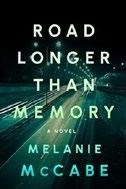
Road Longer Than Memory
McCabe, Melanie | Oceanview Publishing (384 pp.) | $19.99 paper | June 2, 2026 9781608096527
Not only can you go home again, you can solve a murder. Shortly before her 10-year high school reunion in June 1986, Sara Barlow moves back home to Arlington, Virginia, to apply for a teaching job at that same high school. A flood of memories washes over her, from her brief romance with Devlin Barrie to the still-unsolved murder of classmate Nina Farley. While riding in Devlin’s Camaro back in 1976, the two witnessed the
A cosmic riddle underlies
Daniel Mason’s mischievous comic ramble.
assault of a young woman but failed to call the police. After Nina’s parents reported her missing the next morning, Sara assumed the victim they saw was Nina. A further sadness is the death of Sara’s younger sister, Suzanne, in a car accident at around the same time— another impetus to move home and live with her widowed mother, Marian. Three men figure prominently in the story: Sara reunites with the charming Devlin, whose wife’s pregnancy does nothing to dampen their mutual flirtation. Another high school beau, Henry Truett, is now a teacher at the school as well. Popular but sketchy basketball coach Mark Raleigh emerges as the primary target of Sara’s suspicions. While mainly a tale of romantic suspense, McCabe’s crisply written story is most successful in charting Sara’s uncomfortable return home, as she confronts challenges in the classroom, awkward interactions with judgmental faculty members who used to be her teachers, and the task of rebuilding her relationship with her mother. A sleek romantic suspenser with a resourceful, relatable heroine.
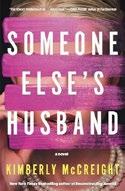
One woman’s death upends another woman’s world. When Gretchen Falk and her husband, Richard, are awakened in the wee hours by police officers pounding on the door of their Upper East Side apartment, neither knows anything about why an up-and-coming artist named Frankie Callahan is dead—but it turns out that Richard knew Frankie fairly well, the two having met on a climbing expedition of Mount Kilimanjaro. The narration switches between Gretchen as her family copes with Richard’s arrest on murder charges and Frankie in the week before her death as she’s concerned about a man from her past; there are also
scenes from the Kilimanjaro trip, which involved a tragic fall, as well as several interstitial musings from the point of view of an unidentified stalker. Much of what connects these characters has to do with American social class distinctions that are often played down; a good example would be the scene when the well-bred and wealthy Gretchen meets the poor-but-ambitious Richard at Dartmouth. There, they and their friends formed lifelong relationships, the kind where four guys wind up booking an expedition to climb a mountain together, trading jibes about past trips to places like the Dolomites and Patagonia. Richard, in his 50s, is co-head of investment banking at Goldman Sachs. His pals are Scotty (an attorney), Brooks (chief executive of his family’s firm), and Van (an entrepreneur). As the younger and less-privileged Frankie listens to them on Kilimanjaro, she becomes infatuated with Richard, who’s strikingly handsome and once harbored his own hopes of a life as an artist. Their bond grows during the ascent, especially after the aforementioned fall and their return to everyday life. That bond might have been more intriguing to examine than the reactions of the three Falk children to their father’s arrest, especially since the book’s denouement hinges on the darkest aspects of class consciousness. The bestselling McCreight focuses on class tensions in a plot that doesn’t quite rise to the heights of her previous books.
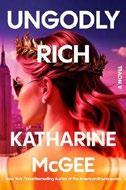
A modern-day Greek god falls for a mortal woman who has to fight for her place in the pantheon. When Julia Dodds meets Harry Adams throwing darts in a dive bar in New Zealand, the two hit it off, quickly fall in love, and move in together. But while out celebrating their second anniversary,
a chance run-in with Harry’s cousin reveals a shocking truth: Julia’s scrappy, adventure-guide boyfriend is actually a member of the billionaire Ellene family. Unbeknownst to Julia, that’s not the only secret Harry has been keeping: The Ellenes also happen to be Greek gods. “Harry” is actually Ares, son of Zeus (here the CEO of a powerful family-run conglomerate) and Hera. At the yearly family reunion on Olympus, Julia—who studied Greek pottery at Harvard— notices some family idiosyncrasies, but she chalks the weirdness up to their extreme wealth. Besides, she’s got bigger worries—namely, fitting in and impressing Harry’s parents and siblings. Though outwardly helping plan the couple’s lavish wedding, several family members are actively working against her assimilation. When the disapproving Hera and spurned Aphrodite (wife of Harry’s brother, Hephaestus) join forces to kick Julia to the curb once and for all, it seems they might get their wish. With chapters told from the perspectives of nearly half a dozen characters and a timeline that often skips ahead right in the middle of a juicy conflict, the novel can sometimes feel unmoored. But readers looking for a bright, self-assured protagonist, lush depictions of wealth, and a not-too-steamy romance will find McGee’s novel hitting all the right notes. An engrossing tale with clever references to Greek myth and a winking portrait of how gods might behave in the modern day.
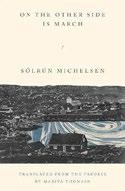
On the Other Side Is March
Michelsen, Sólrún | Trans. by Marita Thomsen | Transit Books (121 pp.) | $18.95 paper | June 16, 2026 | 9798893380491
A woman in her early 60s reflects on life while caring for both grandchildren and an aging mother in this novel, the first by a Faroese woman to be translated into English.
“When you throw a pebble in a pond, the ripples spread outwards. For the old
it goes in the opposite direction. The world contracts in steadily shrinking circles,” the unnamed narrator muses. Her elderly mother is struggling to recall the word butter, and while her mother still lives independently, the daughter has noticed a worrying decline. Meanwhile, there are no spaces in the nursing home, and her own daughter needs help with child care. Sandwiched between the needs of the very young and the very old, our protagonist reflects on the caretaking that falls to women in this and every other generation: “Oh, you daughters of Eve! You silent heroines through the ages! You wiped off tears and sweat. No books detailing your exploits are crowding the bookshelves.” She misses the mother she knew and counted on, though on good days the two still reminisce together. Sorting through her mother’s photographs and handwritten letters, she relives moments like peat cutting, or filling the coal bucket. The writing is meditative, the sentences often fragmentary. “One day I too shall be but a photo,” she thinks. “Stopped in time.” At its most interesting, the book affords glimpses into a vanished way of life in the Faroe Islands, as when the mother, confused, “complains that someone has taken the barrel of salted pilot whale meat.” Elsewhere the story is a more general, familiar one about the caretaker’s role and the “immense strength” it takes “to remain dignified and eventempered as your body so utterly betrays you. As your head slowly empties.”
A moving and honest portrayal of familial love and dependency.
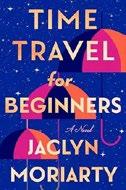
Time Travel for Beginners
Moriarty, Jaclyn | Berkley (544 pp.)
$30 | Aug. 4, 2026 | 9780593820339
An SF-adjacent cappuccino: Frothy on top, good hearty brew beneath. By the time you discover how the characters who narrate different chapters of this novel are connected, you’ll have
BRANDON SANDERSON
A master of fantasy storytelling, with dozens of bestsellers to his name, launches a new series and a new collaboration.
BY GREGORY MCNAMEE
THE SETTING: A London street. Jack Solomon has recently moved from Los Angeles to front a heavy metal band called Hounds of Winter, scheduled to open at Wembley for Black Sabbath. But Jack has two problems. The first is that the band, pressured by management, has booted him in favor of another singer. The second is that after leaving a bar owned by a friend and mentor named Henry, he’s been shot to death by a stranger.
Bands come and go, but death is permanent. Or is it? Following a visit to “an enormous mountain of fire” surrounded by tens of thousands of infernally tortured statues, Jack, himself a tormented soul, finds himself back on this mortal plane, now blessed—or perhaps cursed—with psychic and magical gifts befitting his new role as a “thanatist,” a sort of dead whisperer.
Welcome to the richly imagined world of Brandon Sanderson’s latest novel, Songs of the Dead, the inaugural volume, co-written with Peter Orullian, in the new Strata Wars series. The strata in question are the many layers of history, much of it dark, that define the great cities of the world. Henry’s club, where Led Zeppelin once played, is a portal to each of those layers, fiercely desired by at least one unhinged master of the damned and doomed.
Sanderson, whose 70-odd books have sold more than 50 million copies worldwide to date, is celebrated by legions of fantasy readers for two things: one, a talent for worldbuilding that is both believable and suitably fantastic,
I have so many dreams, so many stories in my head.
and two, systems of magic that are coherent and self-contained, guided by maxims such as “Always err on the side of what’s awesome.” His London is recognizable, if ever stranger with each stratum. And the magic is, yes, awesome.
Sanderson is also a stickler for authenticity, and here’s where the collaboration with Orullian comes into play. Speaking with Kirkus while at a fantasy convention in Atlanta, Sanderson gladly admits to knowing little about Jack Solomon’s métier. “I was very interested in metal music culture,” he says. “When I get into an idea, I go to the forums, I go read people’s blogs, I go read people’s social media who are really into something. And I was surprised by what I found because I had this picture in my head of what metalhead culture was— kind of brain-dead rage machines. Instead, I found a community [that] had deep appreciation for music, a kind of fraternity [that takes] people as they are. And I thought a story with someone from that culture would be really interesting.”
Still, apart from having once attended a Winger concert as a kid growing up in Nebraska, Sanderson didn’t have much firsthand experience of metaldom. Enter Orullian, a fantasy writer with several books under his belt who also happens to sing in a metal band. The two agreed on a division of labor: Sanderson would write a detailed outline—Orullian calls it a “world bible,” and it has grown to more than 50,000 words—in which he would spell out the main lines of the story, including those worldbuilding and magic-making rules, while Orullian would flesh out the details.
“I had the structure of the story,” Sanderson tells Kirkus, “but the details really became Peter’s as he worked on it. The most interesting thing, and the thing that’s best for the book, is that he steered it away from the comedic tone that I had had into something more epic and more sincere.”
Speaking from his home in Seattle, Orullian elaborates. “Brandon had had this idea, and the moniker he used was ‘death by pizza.’ It was very tongue-incheek: There was this American rock singer living in London, delivering pizzas while he was trying to make it as a musician, and he delivers a pizza and gets
shot, dies, and wakes up as a necromancer. But a couple of things happened. The more we got into it, the more we decided we wanted to play it straight, if you will. We also gave Jack a real internal arc.”
“Peter’s so good at that bittersweet musicality of a plot,” adds Sanderson. And musicality is certainly a keyword: Much of the struggle in Songs of the Dead between good and evil, roughly speaking, involves resisting Brach, a fellow of formidable magical powers who has very strong opinions about heavy metal. Says Brach to Jack, “Start in your circle of influence by reining in the decadent and historically ill-informed music that plagues your topside world,” adding that “it isn’t only the music you make, but all the music that isn’t made while you’re composing your rubbish, which ultimately means your world isn’t hearing the right songs.”
Spurred by Brach’s demands for symphonies instead of headbanging anthems, the inhabitants of the Strata are getting restless, and they’re amped up to clamp down on what the kids up above are listening to. Brach means what he says, too: A bunch of once-mortal musicians are snuffed out in the afterlife for their sins, including the wondrous Marianne Faithfull and Marc Bolan of T. Rex fame, who is unceremoniously zapped: “A moment later the notes ceased, and only remnant embers of Bolan drifted on the air like fireflies winking out.”
“I was looking for a metaphor for stripping identity and culture from people,” says Sanderson. “The machine of the world sometimes says, You’ve got to all be the same now. That thievery of identity feels like a thing that’s happening in our society in ways that are both mindboggling and heart-wrenching.”
“Part of the fun for me is giving a little airtime to great musicians I love who may go underappreciated by modern audiences,” adds Orullian. “Some of the readers will not recognize, say, Marianne’s name and will go look her up. Many of Brandon’s readers are younger, even teenagers, and they probably have no idea who that person is.”
Keep an eye out for John Lennon in a future volume, then, to be written by Orullian alone. Orullian isn’t daunted by the prospect: Thanks to that world bible
Songs of the Dead
Sanderson, Brandon & Peter Orullian
Saga/Simon & Schuster | 464 pp. | $30 June 16, 2026 | 9781668068144
Series: Strata Wars, 1
and his own abundant imagination, he foresees the series running to a dozen volumes, three for each of four cities, with “a bespoke villain for each one.”
Orullian is flying solo because, as he puts it, Sanderson “just entered into a monster deal with Apple TV” and is going to be busy writing and producing screenplays along with his novels. Those scripts will be built on his immensely popular Cosmere books, an elaborately crafted fictional universe that unites several of his multivolume series, such as the bestselling Mistborn trilogy and his ongoing Stormlight Archive, slated to be adapted as films and a television series, respectively.
Given an unprecedented amount of creative control over the Apple productions, Sanderson readily accepts the challenge of adding more tasks to his already daunting workload. “I have so many dreams, so many stories in my head,” he says. “And if I don’t make good on them, I’ll feel like I’m letting down all the people who want to be in my seat.”
Gregory McNamee is a contributing writer.
Unavailable Novel by Octavia E. Butler To Be Reissued
The SF legend allowed Survivor to go out of print in her lifetime.
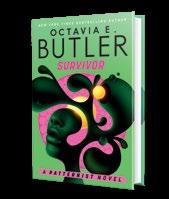
A long-out-of-print novel by science fiction novelist Octavia E. Butler will be reissued later this year. Grand Central will republish Butler’s Survivor
in the summer, the press announced in a news release. The book has been unavailable for almost 50 years.
Butler, who died in 2006, is considered one of the country’s most significant SF authors, best known for the duology that consists of Parable of the Sower and Parable of the Talents. She published her debut novel, Patternmaster, in 1976; it was the first installment in the Patternist series, which
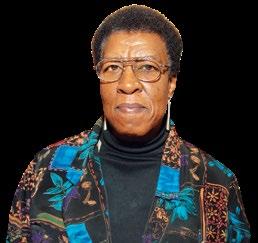
Octavia Butler in 2005
continued with Mind of My Mind, Survivor, Wild Seed, and Clay’s Ark Butler disliked Survivor and let it fall out of print, and older editions of the book have fetched high sums online.
The new edition, Grand Central says, “will include the short story ‘A Necessary Being,’ set in the Patternist universe, as well as contextual material from scholar Alyssa Collins,” a California State University, Northridge, professor.
Jules Jackson, managing director of Butler’s estate, said in a statement, “Together we have revisited the author’s well-known decision to leave Survivor out of print, coming to the joint agreement that to deprive readers of the ability
AWARDS
Finalists for the 2026 Hugo Awards Revealed
The prizes recognize outstanding works of science fiction.
The finalists for the Hugo Awards, given annually to outstanding works of science fiction, have been revealed.
Nnedi Okorafor made the best novel shortlist for Death of the Author, alongside Robert Jackson Bennett for A Drop of Corruption, Adrian Tchaikovsky for Shroud, Alix E. Harrow
for The Everlasting, Emily Tesh for The Incandescent, and Antonia Hodgson for The Raven Scholar.
The finalists for the best novella award are Automatic Noodle by Annalee Newitz, Cinder House by Freya Marske, Murder by Memory by Olivia Waite, The River Has Roots by Amal El-Mohtar, The Summer War by Naomi Novik, and What Stalks the Deep by T. Kingfisher.
Making the shortlist for the Lodestar Award for best YA book were Among Ghosts by Rachel Hartman, Coffeeshop in an Alternate Universe by C.B. Lee, Holy
Terrors by Margaret Owen, Oathbound by Tracy Deonn, Sunrise on the Reaping by Suzanne Collins, and They Bloom at Night by Trang Thanh Tran.
The Hugo Awards were established in 1953. Previous winners include Frank Herbert for Dune; Ursula K. Le Guin for The Left Hand of Darkness and The Dispossessed; and N.K. Jemisin for
SEEN AND HEARD
to read any of Butler’s works would simply be unjust and unfair.”
The new edition of Survivor is scheduled for publication on Sept. 1.
—MICHAEL SCHAUB
The Fifth Season, The Obelisk Gate, and The Stone Sky. The winners of this year’s awards will be announced at the convention LAcon V in Anaheim, California, on Aug. 30. A full list of finalists is available at the Hugo Awards website.
—M.S.
For more book awards news, visit Kirkus online.
For a review of Survivor, visit Kirkus online.
From left, Nnedi Okorafor, Adrian Tchaikovsky, and Suzanne Collins
A mother attempts to make her last day of maternity leave a perfect one.
NATURAL DISASTER
long willingly suspended any disbelief about how the Sydney-based Time Travel Agency operates. Proprietor Dr. Katya Nastevski is a physicist who seems more interested in baking cakes than in refining the software she claims allows people to visit any time, any place, from last week in a nearby suburb to Mesopotamia. She hired Anna Salone, a somewhat hapless single mom to 13-year-old Nicola, following the briefest of interviews, and readers are tossed into a delicious stew of mothers, teenage daughters, eligible men, and Anna’s sweet colleagues at the Agency. Author Moriarty is clearly even less invested in physics than her Dr. Nastevski. Although there’s a massive choice of (mainly) authentic garb for historical cosplay and the staff spend loads of time researching eras of their choice (for Joon, Iron Age Mongolia and the golden age of cricket; for Anna, the Ming Dynasty and Latin American literature—she even develops “tours” of famous authors’ lives, like Frances Hodgson Burnett and Jane Austen), the real workings of the time-travel booths remain a mystery. That makes the author’s big game, the mysteries of the psyche, more obvious, despite the sometimes-madcap action. Anna longs for a partner, Nicola has mean-girl troubles, a man named Teddy has lost his wife to his brother, and a local woman, Jade, mourns her dead sister. When a software glitch brings about some resolution for the main characters, it feels as sugary as a batch of the doctor’s brownies—yet also as carefully baked, a treat for anyone who needs a reminder that time can heal anything, even the human heart.
More steampunk than SF, this gently eccentric tale of familial challenges will delight fans of Matt Haig and TJ Klune.
There’s Only One Sin in Hollywood
Newson, Rasheed | Flatiron Books (304 pp.)
$28.99 | June 2, 2026 | 9781250406149
An unflinching drama about queer Black history in the guise of a glittering, slow-burn mystery about a closeted actor in Hollywood’s golden age.
In Newson’s second novel, Aaron Toussaint, a Black Hollywood insider, tells the story of two men who were his friends and lovers before one of them died under suspicious circumstances. Aaron is an intriguing and unusual character: a married Navy man turned studio fixer—investigator/ muscle/private relations specialist—who’s gay and deeply closeted. In 1971, he decides to seek justice for his friends by chronicling their fabulous lives and tragic deaths in the 1950s and ’60s in a letter to a renowned gay journalist who’s created an archive of queer history. Within that frame, real history and debates over identity play a prominent role in this sexy and political novel. Aaron and his lovers represent divergent approaches to masculinity and queerness in the mid-20th century. Brutalized by his father and brother as a child, Aaron is guarded and conservative as a means of self-preservation. His ambivalence about his own sexuality and his passionate relationship with the fiercely closeted and self-consciously macho war hero Lt. Horace “the Hornet” Dixon, whom he served under and fell in love with in the Navy, set key events in motion. Rising star Xavier C. Barlow is Aaron’s other lover. When Xavier is cast as Horace in a Hollywood biopic, he’s determined to
strike a blow against the celluloid closet by surfacing the hidden romantic connection between Aaron and Horace as subtext in the movie. As Aaron chronicles Xavier’s rise and fall, the three men mingle with real, boldfaced names like Sidney Poitier, Dorothy Dandridge, and Diahann Carroll. They love, protest, and debate with passion. Blending the sensationalism of James Ellroy and the social awareness of Walter Mosley (though not his elegance), Aaron vividly demonstrates why Xavier’s grand life and likely murder needs to be part of the historical record. It’s fascinating, and yet while Xavier’s violent death looms over the proceedings, the vast majority of the novel focuses on how the men lived—so much so that it’s easy to forget the mystery and investigation, which only come into focus at the very end. Though more saga than mystery, this ambitious novel takes big swings and mostly succeeds.
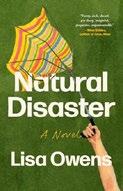
Natural Disaster
Owens, Lisa | Little, Brown (208 pp.)
$19.99 paper | July 7, 2026 | 9780316596411
A comedy of errors in which a British mother attempts to make her last day of maternity leave a perfect one. The unnamed narrator of Owens’ second novel is trying to have one last “special day” with her children before she heads back to her job at a heart-health nonprofit, where she works as a content manager. (Trigger warning for American readers: She’s had a year off.) She imagines the day as a kind of “farewell tour” to the places familiar from her daily routine with her 1-year-old, Rudy, and Felix, her headstrong 4-year-old. The mother realizes this may be her last maternity leave; she and her health-tech executive husband haven’t decided whether they’re done having kids, but she suspects they are. Their relationship, she says, has “taken on the reliable, municipal sturdiness of something like a town
hall.” On this day, her husband is away at a conference and as the morning begins, the narrator finds a tampon—a kind she never buys or uses—in his travel bag. Is he having an affair? The question plagues her as the long day with her kids stretches ahead. The trio’s morning features meltdowns, cross librarians, and a stroller that has to be publicly greased to get through a shop doorway—and that’s just before lunch. As the day goes from bad to downright alarming, Owens tackles everything from working-mom guilt to breastfeeding, from postpartum bodies to the nature of time itself. The novel is at once wryly funny and analytical, dissecting 21st-century middle-class motherhood with aplomb. It’s not exactly groundbreaking, but maybe that’s the point. Moms are all in this together. The neuroses of motherhood are laid bare in this witty and poignant novel.
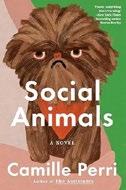
Dogs in dresses meet espionage in an affluent suburb of Washington, D.C. Valerie Caruso isn’t fond of dogs, especially not the Muppet-like Brussels griffon (a so-called “Velcro dog”) that’s now permanently attached to her side. She is, however, fond of the dog’s namesake: cash. She’s a private investigator, and she’s been hired by Environmental Protection Agency toxicity expert Silas Kennerson to spy on his wife, June, because he thinks she’s having an affair. June and her golden retriever mix, Willow, frequent the Hamilton Dog Park in Bethesda, Maryland, and Silas thinks this would be the perfect place for Val to gather intel on June—thus Val’s new pet. Val thinks it’ll be an easy job, but then she notices someone else who seems to have set her sights on June. Alex Miller has begun frequenting the park by herself,
claiming she lost her dog in a divorce. June, eager for connection outside her strained marriage, makes it her mission to befriend the two newcomers, neither of whom are who they seem. Perri maintains a playful tone, and her attention to the absurdities of dog park culture feels truly affectionate. The story is occasionally weighed down by heavy-handed foreshadowing—we are repeatedly reminded that “someone here is going to end up dead”—and the final twist feels like an afterthought. But though the novel is full of aliases, stakeouts, and white-collar crime, it’s no loss that the mystery takes a back seat. It’s the bonds that develop among the three women— and, for Val and Alex, between them and their new pets—along with the ragtag group’s resolute quest for justice, that gives the novel its heavy dose of charm.
A feel-good comedy for people who want to make the world a better place for everyone—including furry friends.
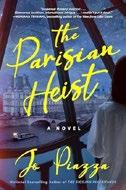
The Parisian Heist
Piazza, Jo | Dutton (384 pp.) | $30 July 14, 2026 | 9798217046492
A dual storyline connected by van Gogh’s legacy, the woman who first championed his art, and the women now fighting to protect it.
Before Vincent van Gogh was a household name, he died having sold barely any of his work: This is a familiar tale, and yet the name “Jo van Gogh” is rarely part of it. In 1996 Paris, Stella Swanson, an elderly woman married into a family of art dealers, reveals her connection to Jo in confidence to her housekeeper, Emma, an American art student struggling to make ends meet. Stella’s grandmother Claire was the longtime companion to Vincent van Gogh’s sister-in-law, Jo. Through Claire’s storyline in the 1890s, we learn that after her husband Theo’s death, Jo took it
upon herself to continue his work of introducing Vincent’s art to the world—and Claire was vital to Jo’s success. Back in 1996, as Emma spends more time with Stella, she begins to share Stella’s sentiment that she was wronged by the Swanson family after her husband died. After devoting her life to the Swanson legacy, she’s been completely shut out, the precious art lining her salon walls now returned to the company collection. Stella introduces Emma to her step-grandson, Matthew, who works at the helm of the Swanson empire along with his sister, Caroline. Unlike Caroline, Matthew is sympathetic toward Stella and reveals some less-than-favorable information about Swanson’s business practices. Emma finds herself neck-deep in a plot with her roommates, emboldened to help Stella and unravel a massive art fraud in the process. “Every artist or art lover has thought at some point about how they would steal a painting from a famous museum,” she thinks. Well, if that’s true, it might explain why the plot to break in to the Musée d’Orsay is overly simple (Ocean’s 8 this is not). The modern storyline is fast-paced and cinematic, sacrificing character development for action. It’s easiest to root for Claire, whose perspective brings Jo van Gogh and her contributions to life in full color. Billed as a thriller but more satisfying as historical fiction; the rich story behind van Gogh’s success earns the spotlight.
Kirkus Star
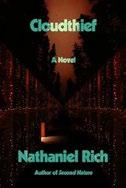
Cloudthief
Rich, Nathaniel | MCD/Farrar, Straus and Giroux (304 pp.) | $28 | July 21, 2026 9780374619794
A sharp, smart meditation on humanity’s bent toward eco- suicide wrapped inside a clever, propulsive heist novel. Our narrator is a dispirited climate journalist in Manhattan
with an ailing sister and a dwindling bank account. One night, uncomfortably accompanying a con artist friend who’s plundering people’s excess stuff from storage units, he encounters a mysterious woman who’s found a clever way to disappear in the midst of the city. Intrigued, he starts interviewing her, and before long the relationship turns obsessive, romantic. Soon— once it turns out that her “paranoia” is actually, in these times, due diligence—they flee the city and embark on an elaborate and ingenious scheme to steal both nothing and everything. They will penetrate a gigantic exurban data center near Tulsa, Oklahoma, that contains much of what we call the Cloud—a repository of everyone’s terabytes of accumulated dross and data—and steal servers, which they’ll then trawl for secrets. This meticulously plotted, philosophically compelling caper takes up the book’s first two-thirds, and it’s excellent. What comes after, when the intense, volatile, distrustful relationship unravels, is almost equally engrossing. The next section centers on data mining, the rather tricky matter of how to commodify secrets (and according to what theory of value), and eventually on the emerging field of genetic editing. The narrative, told in long retrospect, is part apologia, part techno-jeremiad, part intensely personal epistolary plea, part self-cannibalizing “autophagiography”…and that strategy works well until the final pages, where the direct address gets a little too earnest and explicit.
Genuine intellectual heft and fastpaced, nimbly plotted action can coexist, after all. Top-notch.
An affectionate fictionalized account of Helen Gurley Brown’s life and career.
SINGLE GIRLS
Kirkus Star
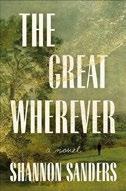
The Great Wherever
Sanders, Shannon | Henry Holt (416 pp.)
$29.99 | July 7, 2026 | 9781250421678
A hapless woman reconnects with her family in this debut novel. Aubrey Lamb is having a hard time. Aside from the fact that she’s something of a bad-decision machine, the 32-year-old Washington, D.C., woman has been dogged by a string of bad luck: On the very day she thought her longtime boyfriend was going to propose, she first lost her wallet, cutting off access to her meager funds, and then said boyfriend dumped her. Then her luck changes: When she gets to one of her three jobs, she finds an email from a relative she’s never heard of telling her there’s an offer to buy the Tennessee farm that was part of her inheritance from her father—Aubrey owns a share of the land along with three cousins, which she vaguely knew about but hadn’t given any thought to since her father’s recent death. Considering that she’s in desperate financial straits, she agrees to travel down to Tennessee to discuss the offer. Watching over all of this is the narrator, unnamed until late in the book, a late relative who lives in the titular land, an afterlife populated by Lamb family members who were in line to inherit the property but died before they could: “Without even trying, we see what happens here, overhear all sorts of conversations, from banal to explosive. Better than the best reality TV.” The narrator
intersperses Aubrey’s story with the history of the farm and the Lamb family, a long line of Black Tennesseans who endured racism over the course of the 20th century. Sanders plots the story so intricately and powerfully that it’s hard to believe this is a first novel, following the 2023 story collection Company ; it has a sprawling cast of characters, and the author has obviously put real care into crafting each one. She imbues the book with imagination and wit, and the narrator’s voice, cheeky and charming, is perfectly rendered. This is a truly magnificent novel from a uniquely powerful voice. A bighearted triumph.
Single Girls
Searles, John | Mariner Books (384 pp.) $30 | July 7, 2026 | 9780063485631
A fictionalized account of Helen Gurley Brown’s life and career. Searles, who worked at Cosmopolitan for 23 years and became friends with its founding editor at the end of her career, opens his novel with a chilling scene in which he has 10-yearold Helen and her sister, Mary Eloine, witness their father’s grisly death in an elevator accident. (In an author’s note, he explains that though Helen wasn’t actually present when this occurred, she felt she “may as well have been,” as it haunted her entire life.) Interleaving exuberantly imagined episodes from Brown’s childhood and coming-of-age in Los Angeles with scenes from her rise to power in the magazine world of New
For more by Nathaniel Rich, visit Kirkus online.
York, Searles has great fun with cliffhanger moments and the literary version of match cuts, where dialogue from one scene bleeds into the next. Helen was working as a copywriter for Max Factor when she met and married film producer David Brown, who was instrumental in encouraging her to write and publish Sex and the Single Girl, a 1962 advice book that sold two million copies in three weeks, a fact he relays to the chauvinist Hearst executive Helen petitions to let her start a magazine. Once installed as the new editor of a long-lived but floundering title, Cosmopolitan, she surrounded herself with a group of creative women and reinvented the publication, pioneering what might be thought of as the earliest version of click-bait with cover stories like “How To Unleash Your Secret Inner Sex Kitten,” “When Husbands Fail as Lovers: A Young Wife’s Frank Report,” and “Anatomy of the Other Woman.” Other real characters in the story include Liz Smith, who was an editor at Cosmo before she started her syndicated gossip column in the mid-1970s, and the photographer Francesco Scavullo, who did the covers of the magazine for decades. Searles’ affection for the period and his characters infuses the novel with the bright energy of a twirly vintage sundress.
Daughters of the Sun and Moon
See, Lisa | Scribner (384 pp.) | $29 June 9, 2026 | 9781982117054
See’s latest novel exposes a forgotten, ugly chapter in LA history—the brutal 1871 massacre of 18 Chinese immigrant men and boys. In July 1870, two Chinese women arrive in Lo Sang, a dusty frontier town known by its white and Hispanic residents as Los Angeles. Seventeen-year-old Dove, the bound-footed daughter of an imperial scholar fallen on hard times, is the new second wife of Old Man Sing, a merchant in the tiny Chinese
community on Calle de los Negros. Barefoot, dark-skinned Petal, sold into servitude to a Gold Mountain tong by her desperately poor peasant father, is destined for the Midnight Garden, a bawdy house owned by Headman Sam. Witnessing the newcomers’ arrival is Moon, the wife of a successful doctor of traditional Chinese medicine. Unlike Petal and Dove, she speaks English, and she assists her husband in his clinic. The three alternating narratives—Petal tells her story as she lives it in 1870; an elderly Moon recalls past events from 1926; and Dove’s tale is recounted in a distant third-person voice—create a portrait of a tiny immigrant community surrounded by a hostile culture and ruled by rival tongs. It’s a shootout between these disputing factions that sets off the horrifying events of Oct. 24, 1871, when a mob of about 500 white and Latine residents torture and lynch their Chinese victims. Although meticulously researched, See’s novel feels curiously flat. Despite continual descriptions of gunfights breaking out, Los Angeles never fully comes to life as a rough-andtumble Wild West town. While the author’s female protagonists, inspired by historical figures, are well drawn (kudos to the feisty and determined Petal), most of her male characters—Chinese, Anglo, and Mexican—are as flat and indistinguishable as cardboard. Another drawback is See’s stilted and stylized dialogue, typical of historical fiction but wearying to the modern reader. A flawed but necessary read about a dark moment in American history.
In a Las Vegas gated community, love and marriage are often at odds, with money doing its share to gum up the works. Singer’s very funny, latter-day Jane Austenesque debut revolves around a pair of
characters with a distinctive meetcute in their distant past. In 1979, 9-year-old Kurt Richter’s older half brother showed up to babysit with a teenage girlfriend named Eugenie Zepp in tow. Eugenie is quickly revealed to be the love of young Kurt’s life, but destiny is never on their side. By 2024, Eugenie is the No. 1 realtor in an elite Vegas exurb called Alluvian, now divorced and living with her adult son, Austin. Kurt, the developer of Alluvian, has two ex-wives and the most constant figure in his children’s lives is their nanny, Janelle Borshowa, a hardy Canadian girl Kurt met on a hunting trip. Some locals believe he killed his first wife and buried her on the erstwhile golf course of which their homes once had verdant views; it’s now an arid wasteland where Kurt is trying to get permits to build condominium towers. Much other drama surrounds these characters, their neighbors, and their offspring, maybe a little too much: Singer’s appetite for inventing hilarious complications runs at top speed right into the final pages, and her more-is-more sensibility manifests even at the sentence level, where the throughline zooms around like a silver ball released in a pinball machine. For example: “Eugenie Zepp wasn’t stupid or even naïve, but when it came to picking suitable dudes, it was like she said Hold my beer to her adult brain and let the high school girl in her take the wheel. Eugenie Zepp’s type was the eighties-style toxic male too afraid to face his own mortality, whereas Austin’s generation had learned to live with doom after their first active-shooter drill in preschool.” Overstuffed, yes. Gaudy, even. And totally Las Vegan, if you think about it—the capital of more is more; surely the author agrees with the sentiment she gives to Eugenie: “There wasn’t a thing she didn’t love about Las Vegas.”
A promising—if somewhat exhausting—debut by a writer with energetic comic gifts.
The Secrets We Hide
Slaughter, Karin | Morrow/HarperCollins (416 pp.) | $32 | Aug. 11, 2026
9780063458789
Slaughter returns to North Falls, Georgia, for another 15 horrifying rounds of domestic violence.
If everyone in Clifton County knows everyone else, that may be because half the people in North Falls, one of the county’s four cities, are named Clifton. Det. Allison Vickery doesn’t turn up for the funeral of acting sheriff Emmy Clifton’s mother, Myrna Joy Clifton, first because she’s fleeing her abusive husband, Bill Garrison, then because she’s shot dead. Her murder pulls Emmy, who inherited her job and all its headaches when her father, veteran sheriff Gerald Clifton, was killed six weeks ago, and retired FBI agent Jude Archer, the much older sister who ran off to San Francisco 40 years back, away from the funeral rites and into another of Slaughter’s matchless webs of intrigue inside and outside the Clifton clan. Allison wasn’t the only person shot in the house she was frantic to leave, and the evidence suggests that the shooter had also been targeting her teenage daughter, Mandy, all along. Working closely together even though their troubled family history puts them constantly at odds, Emmy and Jude thrash through a thicket of wrongdoing, from a thriving drug ring to a corrupt cop who’s rumored to have buried some crucial
evidence, before they link Allison’s killing to an ancient murder trial that took a 180-degree turn after one of the jurors died. Every twist in the path to the truth is riveting— especially the final revelation, which puts all the others in the shade—but the most important relationship is between the two investigators, one of whom harbors a secret the other can’t imagine.
Just like politics, all the crime in this corner of Georgia turns out to be painfully local.
Lidie: The Further Travels and Adventures of Lidie Newton
Smiley, Jane | Knopf (336 pp.) | $30 April 21, 2026 | 9780593802298
After the heartbreak of her earlier experiences, a 19thcentury American woman heads across the Atlantic Ocean.
When Lidie Newton returns to her hometown of Quincy, Illinois, from the Kansas Territory in 1857, having lost her abolitionist husband, her stillborn baby, her beloved horse, and an enslaved woman she hoped to guide to freedom, her dull older half sisters offer little comfort. Then her niece, Annie, just a year younger than Lidie and usually so busy with household chores that she’s practically a servant, lands a part in a play as well as an out-of-town patron who wants to support her acting career. Soon she’s proposing that Lidie join her in running away from home. In this sequel to The All-True Travels and Adventures of
A 19th-century American woman heads across the Atlantic Ocean.
LIDIE
Lidie Newton (1998), Smiley moves the troubles of 1850s America into the background as this unlikely pair board a ship, change their names, and start new lives in the Liverpool home of Mr. and Mrs. Mallory Cunningham. Lidie is now Helen Longbourn, lady’s maid to Anne Revere, the latter quickly recognized as a fresh new face in local theater. “Helen” is not always able to outrun the sorrows that haunt her, but Smiley gives her lots of avenues to try. She forms strong friendships with the Cunninghams’ butler and consumptive daughter, as well as with a local gardener and a handsome Irish fellow she meets on the street. But since this is Jane Smiley, her most effective healing will be delivered on hooves, at the racetrack: Mr. Cunningham purchases a horse named Toffee, whom Helen helps train and travels regionally to watch compete. She enjoys helping Anne prepare for parts in Macbeth and other plays; she reads Austen, Trollope, and Thackeray; she toys with falling in love again. Then Smiley swoops in with a twist that puts an abrupt end to the Helen Longbourn role. Perhaps Lidie, like the reader, can sense that none of her present plot arcs is really going anywhere very interesting. Except, perhaps, Volume 3. The charm of Lidie’s thoughtful, curious, witty narration keeps our attention on a less cataclysmic round of adventures.
Drayton and Mackenzie
Starritt, Alexander | Atlantic Monthly (512 pp.) $30 | June 2, 2026 | 9780802168641
Fresh out of Oxford, two temperamentally opposed classmates become high-rolling players in the field of green energy. James Drayton is a boy genius who swiftly rises to the top of his class at Oxford, viewing the untold hours he spends on mundane business assignments as tickets to success and fame. Unlike the
outgoing but helplessly slacking Roland Mackenzie, James has negative social skills. He lives with his parents, bohemian academics who scoff at his conservatism. Though the privileged boys barely knew each other at university, they develop an ever-deepening love-hate partnership as newbies at McKinsey, a management consulting firm in London where more soul-sucking tasks await them. The worst involve “restructuring” companies in Scotland—firing most of their workers. Driven by James’ vision, they partner with one of the purge victims, an oil company engineer who has the patents for a pioneering underwater turbine, and quit McKinsey with dreams of conquering global warming. As James sees it, they’ll first convert Britain to running on tidal power and then share the technology with the rest of the world. Their path to success is lined with obstacles: Initial underwater experiments in the Orkney islands fail, the 2008 banking scandal puts their fundraising at risk, and Covid-19 rears its head. At its foundation, Starritt’s novel is a throwback to the classic bildungsroman, but the 500-page epic also unfolds as a nuanced satire on the contemporary financial world, with extended appearances from PayPal co-founder Peter Thiel and Federal Reserve chairman Ben Bernanke. Starritt also stirs in a bit of soap opera by having both protagonists fall for the same woman. While stretches of the book are slightly chilled by a feeling of detachment, the complexities of human relationships in the early 21st century come through in entertaining fashion. A sweeping novel featuring a pair of memorable protagonists.
Kirkus Star
The Heart of Man
Stefánsson, Jón Kalman | Trans. by Philip Roughton | Biblioasis (285 pp.) | $18.95 paper | June 16, 2026 | 9781771967143 Series: Trilogy About the Boy, 3
A trilogy about a youth’s search for belonging finds its completion in a moody, lyrical, deeply life-affirming final installment.
In his Trilogy About the Boy, Stefánsson follows an unnamed teenage orphan—poetically gifted and deeply sensitive—through trauma and loss, toward a fragile sense of safety and belonging. In the earlier volumes, Heaven and Hell (2025) and The Sorrow of Angels (2025), the boy witnesses his best friend’s death in a fishing accident and nearly dies while accompanying a postman across Iceland’s harsh west fjords. The last we saw them, they were tumbling down a snowy mountain with a coffin in tow. In this final installment, they survive—just barely—and recover under the care of locals before returning to the Village, a remote Icelandic port town where passions and prejudices collide in a landscape “scorched by volcanic fire and blasted by wind but with green valleys like dreams…” The book starts slowly, meandering through the pair’s recovery but gaining momentum in its second half. Still mourning, the boy begins to thaw, like the land around him, drawn to a fiery redheaded woman who helps nurse him and, back home, to Ragnheiður, daughter of the petty merchant Friðrik, who feels contempt for the boy’s lower social status even as she’s drawn to him. Torn between grief and desire, he realizes his heart is “divided into two compartments, one called happiness, the other despair.” Stefánsson excels at capturing the rhythms of village life—the gossip, grief, and constant threat of sea and storm—while offering moody reflections on life and death in a place shaped by the forces of nature. What’s also forceful is the power of language. Words surround
the poetry-struck boy like fog creeping in from the sea. “Words are not lifeless rock or gnawed, wind-whitened bones up in the mountains,” writes Stefánsson. They “can grow distant over time and be transformed into museums that house the past, what is gone and will never return”—something not just true of the books the boy reads, but of this one, too. An engrossing tale as brooding, unpredictable, and invigorating as the sea and storms affecting the characters’ lives.
End-times environmentalists tangle with the life force imperative. The propulsively intelligent and reckless women who drive Watkins’ fiction arrive at middle age in Yellow Pine, Nevada, and the years are registering, for good and for ill. For her fourth book, Watkins names her chief protagonist Rose of Sharon after the character in The Grapes of Wrath. The story begins with Rose receiving a surprise call from Miles, a charismatic dude from two decades past, “who’d once poured salt on the slug of her heart.” Watkins uses the word “horny” in the first paragraph, and indeed this novel is enjoyably raunchy, with the midlife go-for-broke twist that the possibility of conception makes the sex hotter. Before the reader arrives there, however, a lot of “dry streams,” “drained lakes,” and “blasted valleys” must be crossed. Rose and a clutch of environmentalist friends are holding vigil for the once-public desert designated Yellow Pine, where the yucca and creosote are being pulped and the tortoises slaughtered for a 5,000-acre solar array. (This place, did, in fact, open in 2023 in the Mojave Desert outside Las Vegas.) Watkins marinates her novel in so much eco-dread, “like a penny dipped in some awful forever chemical,” that it becomes tough going, even though she
For more by Alexander Starritt, visit Kirkus online.
writes exquisite, often funny prose. By midbook, when Miles is relentlessly schooled by the Yellow Pine protestors, it becomes close to unbearable—for him, and for the reader. It borders on histrionic, hammering home Watkins’ assertion that we are living “in a low-key failed state on a dying planet.” Still, those who persevere will be rewarded with a story that matches the growing maturity of its characters. Each has a wild list called “No Early Exits Mental Health Action Plan.” While Rose proclaims that “hope [is] for idiots and tourists,” this bracing book ends on a definite updraft. The whirlwind isn’t quite reaped yet. The psychic impact of place—and its loss—goes deep in this blister of a novel.
Men in Love
Welsh, Irvine | Pegasus (544 pp.)
$28.95 | July 7, 2026 | 9798897101504
Welsh’s infamous crew of reprobates have shaken off junk, but not their bad habits.
This novel, the latest in a series featuring a group of heroin addicts in Edinburgh, Scotland, is set in the late 1980s and early ’90s, immediately after the events of Trainspotting (1993). Mark Renton, the smartest and savviest of the bunch, has absconded to Amsterdam with money from a busted drug deal. His friends are understandably furious, but don’t know his whereabouts. Chapters shift focus among all members of the group, but Welsh trains his lens most often on Mark, who falls for a young hotel staffer named Monique Van Beekhof while he integrates himself into Amsterdam’s dance club scene, and Simon “Sick Boy” Williamson, who’s smitten with Amanda Coningsby, the daughter of a wealthy, well-connected family, whom he meets in a recovery support group. When Amanda gets pregnant, Simon is initially moved to press for an abortion, but a nesting urge kicks in and they decide instead to marry. Domesticity is dodgy with this crowd, though; Simon’s idea of
settling down is launching a career as a porn director, and hotheaded Francis Begbie is clean but still pugnacious. Welsh’s Trainspotting series has some common elements—thick Scottish burrs, overindulgence, comically ill-thoughtthrough moneymaking schemes. Here, Welsh’s treatment feels at once exhausted and overextended, with the main plot pushing to Simon’s wedding, the inevitable culture clash at Amanda’s tony Surrey manse, and a comic attempt to find Mark. Those cliched, overlong plotlines overwhelm a more sophisticated one involving Mark’s frustration with Monique’s polyamory, and his determination to succeed while laying low. Welsh’s affection for his characters is clear, and his grasp of boyish humor remains intact, but five novels in, he’s drained this series of novelty. A logorrheic recycling of bad-boy tropes.
W hitehead’s justly celebrated Harlem Trilogy comes to a triumphant, satisfying conclusion.
The two-time Pulitzer Prize winner has brought his decades-long saga of furniture retailer and part-time criminal fence Ray Carney into the 1980s, a time of starkly mixed blessings for a New York City galvanized by reckless real estate development, plagued with widespread homelessness, and immersed in crime and corruption of gaudy proportions. As with its two predecessors, Harlem Shuffle (2021) and Crook Manifesto (2023), this installment carves its historic period into three selfcontained but interwoven stories set in three different years. The first takes place in 1981, when Ray, flush with pride over being named Sterling Furniture’s “Northeast Regional Dealer of the Month,” is confounded when wife
Elizabeth is denied a loan for her travel business. So, to get her the money she needs, he joins a crew led by the redoubtable Uncle Rich, a legendary thief, embarking on a near-impossible heist at the Waldorf Astoria. Elizabeth also spearheads the second installment, which takes place two years later, when she recruits the dyspeptic Pepper, Ray’s friend and sometime coconspirator, as bodyguard for a jittery art dealer carrying a valuable African mask. When that object goes missing, Pepper and a hip young woman bearing a mohawk haircut and combat boots wander the seedier streets of Manhattan to locate it, crossing paths with a “Melancholy Hitman” also frantically pursuing the mask and leaving mutilated corpses in his wake. In the final section, taking place in 1986, Ray struggles to fulfill a posthumous obligation to his ill-fated cousin, Freddie, by using all his hard-earned wiles as salesman and felon to save Freddie’s son, Robert, from being framed (or worse) in the murder of a bent Queens lawyer. It’s as improbable as packing three page-turning thrillers into one book that’s sustained throughout by rich, engaging characterizations and lucid, provocative reflections on a community, a city, and a people which it presents as both exasperating and captivating with equal intensity. A master novelist in full command of his powers as a storyteller, prose stylist, and social observer.
A Year of Marvelous Ways
Winman, Sarah | Putnam (288 pp.) $30 | June 16, 2026 | 9798217181117
A n elderly woman finds a serendipitous connection with a soldier in post–World War II Cornwall, England.
The 89-year-old Marvelous Ways is waiting for something, but she doesn’t know what. A woman guided by visions and dreams, she lives in the village of St. Ophere, where people have names like “Peace” and “Gladly” (and “Marvelous”). It’s 1947 and
the village is slowly dying as people move away, but Marvelous remains, waiting. Francis Drake is a young solider who’s been traumatized by his experiences fighting in the war. He promised a dying comrade that he’d hand-deliver a letter to the man’s father in Cornwall, but it’s taken him nearly three years to find his way there. When Drake finally arrives, he’s almost immediately taken in by Marvelous Ways, who nurses him back to health after his long journey. Although Marvelous and Drake don’t have much in common on the surface, they develop a sweet friendship that’s largely based on Marvelous sharing stories from her eventful life. In her first novel since the bestselling Still Life (2021), Winman creates a magical world where Marvelous relies on intuition to guide her. The village of St. Ophere is beautifully described—readers can almost hear the waves and smell the mud and foliage that Marvelous frequently describes. While Marvelous’ life is full of heartbreaking beauty, Drake’s has more violence. The horrors he experienced in WWII leap off the page in their brutality. Winman’s prose is descriptive in a way that often feels lush, but can also be frustratingly opaque—at times, it’s difficult to understand what’s happening (the lack of quotation marks doesn’t help). But for readers who crave poetic language and plenty of metaphors, this dreamlike story may be just what they’re looking for.
A heartbreaking but redemptive story about an unlikely friendship.
Kirkus Star
The Fervent Whites
Winslow, De’Shawn Charles | One World/ Random House (208 pp.) | $28 June 9, 2026 | 9780593977910
T he all-tooAmerican complexities of race, class, and sexuality inflict tension and tragedy on a Hudson Valley community. It’s 1982, just before the dawn of Reagan’s “Morning in America.” In the upstate
New York village of Fervent, James and Ella White are coming home from an 18-month stretch in prison after having their convictions for murder overturned when someone else confessed to the crime. Though the couple is happy to have been exonerated, they share with the rest of their neighbors a disquieting wariness about their release from custody. No one is warier than Sylvia Upshaw, a divorcing mother, and her best friend Lafayette “Fate” Jolly, a social studies teacher at the local high school. Both these Black residents have reasons to be skittish around James and Ella, among the few white people living in Fervent. It was Fate’s testimony in court that led to the couple’s conviction, while Syl believes James and Ella blame her for the death of their adopted Black son, Morgan, whom Syl loved as much (and, she believed, more) than the Whites did. The narrative refers throughout to a “secret” Syl somehow disclosed to Morgan, which somehow led to his death while his parents were in prison. The couple also believed Fate’s damning testimony was provoked by James’ harassment of Fate because of his homosexuality. The apprehensive mood prevailing over the community is further agitated when a white supremacist serial killer is reported to be at large, threatening and targeting Black families in town. This thriller is constructed more tautly than Winslow’s previous novels, In West Mills (2019) and Decent People (2023), while retaining the author’s shrewd sense of sociocultural interactions and his active empathy even for those characters who deserve it the least. This work, tightly wound in the best sense, solidifies Winslow’s reputation as a masterful storyteller.
Kirkus Star
Conviction
Winthrop, Elizabeth H. | Grove (280 pp.) $28 | July 14, 2026 | 9780802167217
Good intentions pave the way to devastating results for a youthful believer (and those she loves).
Maggie, a young girl from Maine, initially reacts to the events of 9/11 with hatred for Islam. After her parents bring her to an open house at a mosque in Orono, hatred for becomes interest in, and then adherence to, the religion. Gradually, Maggie becomes an ardent practitioner of the version of Islam to which she’s been introduced, though she prays in private and doesn’t wear the hijab. Upon moving to New York City and becoming more aware of the atrocities faced by fellow Muslims at the hands of the Assad regime in Syria, Maggie becomes romantically involved with Ahmet, an idealistic young Muslim engineering student and son of Sirvan, an Iraqi Kurd who owns the bakery where she works. Despite a warning from Sirvan about allowing Ahmet’s passions to lead her into “trouble,” Maggie eventually follows Ahmet across the globe to Syria, and to a growing and horrified realization that ISIS, the group to which Ahmet has idealistically attached himself, subscribes to a very different version of Islam than the one she believes in.
For more by De’Shawn Charles Winslow, visit Kirkus online.
Winthrop interweaves Maggie’s experiences with those of her widowed mother, Ann, in a taut narrative of fear and loss. Limited communication between the two heightens the sense of Ann’s terror and frustration over her daughter’s self-created exile to a war-torn and violent region. Maggie’s recalculation of the factors leading her to Syria in anticipation of a coming utopian caliphate is painful and introduces challenges to her relationship with Ahmet. Winthrop has created a virtual world of intense emotional—and, often, physical—pain for her characters. Demonstrating that the personal is the political, Winthrop’s narrative conveys domestic as well as global suffering with equal gravitas. Eminently discussable and brutally revelatory.
By Amy Coombe
Fantasy Novels
By Veronica Roth
By Richard Swan
Nahoko Uehashi
SECOND LOOK
This review originally ran in the Oct. 1, 2025, issue.
Two young brothers square off against predators both human and unearthly in Carlton’s supernatural thriller-series starter.
Ten-year-old Nick Emerson and his 5-year-old brother, Frank, feel like it’s them against the world. Dick Pickerd, their mother Lisa’s boyfriend and boss, regularly molests Nick, who vows never to allow Frank to be victimized. Frank, meanwhile, is harassed by bullies who like to toss him in the school dumpster. The boys are also beset by “schades”: ghastly, pale beings who skulk in shadows, shriek at light, and sometimes attack; two years ago, Nick and Frank saw their dad, Nick Sr., get killed by one
of them. Things look up when school janitor Harry Armstrong gives Nick a pendant watch that catalyzes his ability to stop time for several minutes—which he uses to defeat Frank’s bullies— and a doctor and Lisa spot the sexual abuse and have Pickerd arrested. Nick and Frank reconnect with Nana Emerson and Uncle Howie, who reveal that people with the Emerson bloodline have used paranormal powers in a 5,000-year war against the schades, and they also help Nick develop his time-stopping ability and assist Frank with his burgeoning telepathic talent. Then Pickerd gets out of jail and aims to abduct the two brothers, closing in on them with the help of
The Coming of Schades: Heroes of the Line Book 1: Nick of Time
Carlton, J.A. Self | 228 pp. | $12.99 paper July 6, 2023 | 9798338496428
schades. This first book in Carlton’s Heroes of the Line series features monsters of several kinds, grounded in a compelling portrait of an abused child trying desperately to avoid his tormentor; Nick also has a psychic premonition that Lisa will die if she learns about the molestation. Carlton’s prose is eerie and atmospheric, with the schades a pervasive, macabre presence that heightens the boys’ panic and despair: “He dared a peek into the dim light
just in time to see the gray peeling face fade back into shadows. It raised its dusty looking hand and waggled its fingers at him, but it was the sinister smile still hovering in the air while the rest of it disappeared that left him with shivers on the inside.” The result is an imaginative page-turner in which magic augments a tense psychological drama.
A frightening fantasy tale that mixes cosmic dangers with domestic terror.
INDIE AUTHOR SPOTLIGHT
JOSEPH MASON
Author of Borrowed Fantasy
Please tell us a little about yourself and your work.
My book may have never been written. Before I wrote Borrowed Fantasy, I landed a really good job. Pay was great, there was the chance of travel, I had the opportunity to move to an engineering job, etc. Well, I sucked at the job and found myself on the chopping block. I knew I could either be down and depressed about the loss, or I could do something that I could not do with the job. That’s when I started writing my first book.
Which do you prioritize and why— storytelling or worldbuilding?
With Borrowed Fantasy, I focused on storytelling. My book is very dialogue-driven. Being an inexperienced writer, I was a little hesitant to dip into worldbuilding. I hope to immerse [readers] in the world with my next three-book series, It’s Always the Red Dragon.
Did you choose to create a heroic lead? Why or why not?
Yes and no. For my lead heroine, I wanted her to be unstoppable to a point. I love, love, love strong female characters. I think it goes against the usual motif of the damsel in destress. I do not like women portrayed that way. For my lead hero, I wanted to make him more uncertain and doubtful. I kind of based him off of me. He always wants to do the right thing, but in
this world of gray, it’s not always clear what the right thing to do is.
Was your storyline something that you envisioned from the beginning, or did you build/ change it as you wrote?
The large points of the story were written in stone. I’ve had this story since my 20s. I’m now in my 40s. How the story arrived at those main points was an ever-changing process. For instance, my decision to make my lead hero, Abram, magical was not planned. Where I introduced the characters of my story, not planned. There was so much that simply evolved in the process of writing my book.
How have you built your audience? I’m still trying to find my audience! In a world of Martins, Tolkiens, and Sandersons, grabbing an audience is very difficult. My background probably [doesn’t] help me, either. I spent some time in the military, where writing is short and succinct. My chapters are no different. My chapters’ lengths are more of a Don Quixote style. However, my book is trying to be found. As of now, google my book, and Google AI pulls up a synopsis of my book.…I’m not sure when this will change, but I cross my fingers that I’m found before these [things] stop working.
Portions of this Q&A were edited for clarity.
Coben and Box have an eagle eye for a good story.
BIRDS OF PREY
Murder in Blackfriars
Ashley, Jennifer | Berkley (320 pp.) | $20 paper | Aug. 11, 2026 | 9798217187058
The year 1884 brings the promise, and threat, of serious changes to the life of Mayfair cook Katharine Holloway. The first change is good news for Kat’s friend Joanna Millburn: A Basingstoke solicitor has offered Joanna’s husband, Sam, a much better job—but one that will require his family to move 50 miles from London along with Grace, Kat’s beloved 14-yearold daughter, whom they’ve taken in. The second, the opportunity ex-maid Hannah Dunnett presses on Kat to open a bakery stall on Portobello Road, also comes with downsides: Mrs. Bywater, the mistress of the Mount Street house where Kat works, would surely toss her out if she knew about her side hustle, and a well-entrenched competitor on Portobello Road loses no time in threatening her with exposure. The third is the most urgent. Kat’s fiancé, former Special Branch undercover operator Daniel McAdam, learns from roughhewn Zachariah Grimes, who’s already saved the lives of Daniel and Kat, that he’s been approached by builder Howard Banks, who claims to know something about Daniel’s parentage. Since Daniel’s a foundling who doesn’t even know his birth name, this is exciting news indeed. But when Daniel and Kat accompany Grimes to his meeting with Howard, they find the informant stabbed to death and surrounded by police eager to take Daniel into custody. The clues to his death eventually lead the sleuths to a grand smuggling scheme and an utterly unsurprising villain. So in the end, one of those other changes turns out to be
more consequential than the actual murder.
The mixture as before, best suited to readers already invested in the franchise heroine or in Victorian London.
The Shadow Step
Billingham, Mark | Atlantic Crime (416 pp.)
$28 | July 21, 2026 | 9780802167354
Readers shocked by the downbeat ending of What the Night Brings (2025) will be happy to know things are brighter in DS Declan Miller’s Blackpool than in DI Tom Thorne’s London. Brighter, of course, is a relative term. Shortly after Barry Cheshire’s dachshund, Ruby, is threatened by a stranger’s bulldog in Claremont Park, the stranger is fished out of the park’s pond and identified as Ezra Simmons. Everyone assumes the drowning was accidental except for Miller, who’s intrigued by a gaping wound to the man’s head. While everyone argues about whether Simmons, a drug dealer seriously in debt to another dealer, was murdered, someone knocks on Barry Cheshire’s door and fatally stabs Darren Grant, the lover who’d moved in with Stacey Cheshire, while her estranged husband sleeps through it all in the basement. Now that he has at least one incontestable homicide to deal with, Miller finds time in between his relentlessly snarky comments to his partner, DS Sara Xiu; their boss, DI Tim Sullivan; and every potential witness to focus on the crime family run by Jacqui Cutler while her husband, Wayne, languishes in prison, sent there largely by his wife’s testimony. Jacqui is so brutal at
running JMC Ltd. and its affiliated tentacles that readers might be tempted to cheer when her son, Justin, is kidnapped—if Justin hadn’t been so consistently critical of the family business. The quest to recover Justin Cutler in return for an unexpected ransom draws all the major players into high-stakes, multilayered conflicts before an epilogue shines the spotlight on Finn, the hero’s seriously addicted stepdaughter. Not as powerful as Tom Thorne’s caseload, but it goes down a lot easier.
Kirkus Star
Birds of Prey: New Crime Stories
Ed. by Coben, Harlan & C.J. Box Mysterious Press (320 pp.) | $17.95 paper | June 23, 2026 | 9781613167946
Birds of a feather flock together in this collection celebrating predators, both airborne and earthbound. Not all of the 11 stories in this volume feature literal birds: In addition to seagulls, owls, buzzards, and goshawks, there’s a Ford Falcon and, of course, Dashiell Hammett’s fabled falcon. But a common thread of predation links these tales. From daring Derrick Moldvar, who plots to steal peregrine falcon eggs in editor Box’s “Precious Cargo,” to Robyn and Jay, ex-con nursing home workers who plan to steal from a resident in Hank Phillippi Ryan’s “Jailbirds,” the tales shine a spotlight on people who don’t hesitate to take advantage of those more vulnerable. Some of the victims are truly innocent, like condor rescuer Haley McCray in Heather Graham’s “Predator or Prey?”; others, like those in Tess Gerritsen’s atmospheric “The Coffin Bearer,” are little better than their tormentors. In many of the stories, as befits their avian theme, nature is a force to be reckoned with, not so much a predator as an underlying threat. A gratifying number of the tales allow
those who prey on innocents to get what they deserve. But sometimes there’s no real villain; it’s just a predatory system that’s at fault, as in Ace Atkins’ “Kudzu.”
Throughout, however, the battle lines are clear: There are predators and there are prey, and these stories make it easy to root for the victims.
Coben and Box have an eagle eye for what makes a good story.
Murder at the Grand Alpine Hotel: The New Miss Marple Mystery
Foley, Lucy & Agatha Christie
Morrow/HarperCollins (304 pp.)
$30 | Sept. 22, 2026 | 9780063376694
The year 1950 finds Miss Jane Marple, everyone’s favorite spinster, vacationing in the Swiss Alps. Murder soon follows. And why not? After all, Agatha Christie already took Miss Marple from the village of Much Benham to London and the Caribbean and staged mysterious deaths for her to solve. But Foley complicates this sequel in several ways that will leave Christie fans gaping. It’s hard to believe Miss Marple and her recently widowed friend Dolly Bantry, who memorably discovered the body in the library back in 1942, would seek pleasure on a chilly mountaintop, even if the destination were suggested by Diana Glass, Mrs. Bantry’s companion. In addition, Foley parcels out the story among four narrators: Catherine Narracott, the much younger wife of ambitious Tory Member of Parliament Anthony Narracott; Bruno Crane, Anthony’s wartime comrade in arms, who pops up out of nowhere bent on mischief; Hollywood star Sylvia Sinclair, who establishes her American credentials by calling everyone sweetheart, honey, or baby; and Diana herself. The rapid shifts among the leading suspects when Anthony Narracott is predictably killed, along with an accident that even more predictably cuts off the Grand Alpine
Hotel from the authorities and the rest of the world, sadly upstage Miss Marple, who’d be the first to note she’s not one to take charge. Readers who persevere to the big reveal will discover that the mystery has been adroitly plotted and intricately clued, with a solution that will surprise many of them—providing compelling evidence against Raymond Chandler’s famous dictum that the ideal mystery is one you’d read even if the end were missing.
The principal takeaway: It’s a lot harder to bring Miss Marple back to life than the higher-profile Hercule Poirot.
A famous author seeks Sunny Randall’s help in Gaylin’s third Robert B. Parker outing. Melanie Joan Hall, bestselling romance author, approaches her friend Sunny, who is “one of Boston’s premier private detectives.” Melanie has recently received a vicious one-star review of her upcoming memoir, Stronger Alone, by someone called Book Babe on the website ReadAnon. The anonymous reviewer is prolific and powerful, having posted 530 reviews. Only one—this one—receives a single star. Not only is the book trashed, but Melanie Joan is “brutalize[d]” as a human being. Deeply hurt, Melanie Joan posts a nasty, profane reply. Phew, the language. She promptly deletes it, but screen shots circulate immediately, and the world knows what she wrote. “Plenty of harm,” she admits. “And completely foul.” So now she wants Sunny to identify the reviewer so she can apologize in person. “If you don’t dox Book Babe…my career is over,” she pleads. Indeed, her publisher, Scepter, not only pulls her memoir but cancels her contract for future novels. There is more to this than a bad review, though. Who is Book Babe, anyway? Sunny intends to find out. Longtime Parker fans will
recognize Melanie Joan as a recurring background figure who evolves into a major character with serious issues that require Sunny’s investigative chops. Gaylin builds the tension as Melanie Joan’s career crumbles and readers begin to wonder where the physical danger lurks. There are allusions to Sunny’s love life, past and present—she’s “engaged to be engaged” to her ex-husband—and to Melanie Joan’s past troubles with an abuser. The author takes her time dropping a dead body into the story, but then more violence follows, so Sunny doesn’t pack heat for nothing. In fact, the ending is intense. The plot is entertaining if a wee bit thin, hinging on the devastating repercussions of a single snarky review. Would that a reviewer had such power!
A restaurant owner serves the best soul food in Chicago—with a side of murder. Savvy Summers mostly uses her great-aunt’s recipes at Essie’s Place, and she’s recently added some creole dishes to the menu, but she’s having no luck with New Orleans king cake, a favorite of her ex-husband, Fanon Franklin, a cop. When Savvy’s sous-chef, Penny Lopés, tells her that Jimmy Blue, an unhoused man, and his dog, Sergeant Stubby, have been enjoying her ruined king cake from the trash, Savvy gets to know Jimmy and Stubby—who’s learning to talk using a board with buttons he can push for spoken words. Meanwhile, the cafe gets visits from a mysterious stranger who hides their identity in a big hoodie while ordering breakfast at the counter. When Dorita Holloway, a regular, asks Savvy to put together an affordable luncheon reception for her lefthanded tool design firm, the menu features po’boys. There’s
an odd vibe at Lefty Lucy, which Dori runs with chief executive Kaden Boudreaux, intern Marge Roderick, and ever hungry community engagement coordinator Minerva Sanderson—all the women seem to be in thrall to Kaden. Dori loves hot sauce, and after Minerva, who steals other people’s food, eats Dori’s well-sauced sandwich, she collapses and dies, evidently poisoned by beach apple. Though Savvy’s known Dori a long time, she never knew that Dori was after her second husband, Francis Summers, and now has her eye on Fanon. Still, she doesn’t think Dori killed Minerva, and she tries to help. The stranger at the counter, a once-famous singer, is probably the daughter of Jimmy Blue, who’s next on the list to die. An enjoyably snarky mystery mixing some history of the Great Migration, recipes, and a lovable dog who solves the case.
Indie Darling
Nossett, Lauren | Flatiron Books (304 pp.)
$28.99 | July 28, 2026 | 9781250413826
The author of The Professor (2023) and The Resemblance (2022) takes readers on a tour of Nashville.
Kelly Williams has big blond hair. She wears tight pencil skirts and heels. She loves Dolly Parton. And there’s something lurking in her past that motivates her desire to help other women. When the lead singer for Seraph and the Garden Snakes reaches out to Kelly, the private eye will do anything to protect this charismatic—and controversial—rising star from a stalker. But Sarah Owens has her own dark history, and Kelly can’t always be sure this haunted young woman is telling her the full truth. Set in Nashville’s music scene, this novel has all the basic elements of a fresh, intriguing mystery. Unfortunately, Nossett’s flat prose never brings the story to life. Consider this sentence about Kelly’s new client, Sarah: “This Friday, her band is headlining the River
Amphitheater stage at NashFest—one of about two dozen music festivals the city will welcome this summer.” Nashville is a vibrant, glamorous town, and this reads as if it was lifted from Wikipedia or a particularly bland tourism brochure. Kelly herself is tedious company, self-satisfied and self-righteous. Her success as an investigator is built primarily on lucky guesses and a knowledge of forensics equivalent to that of anyone with a passing interest in true-crime podcasts or police procedurals. But even this hapless PI knows more than the cops working Sarah’s case. In one bit of dialogue, a detective sounds like he’s never seen gunshot wounds before, though he’s supposed to be a grizzled veteran. There’s a bit of flirtation between Kelly and the cute songwriter who becomes her sidekick, but this subplot goes nowhere and does nothing to liven up the narrative. Music City’s glamour is dimmed by dull prose and an incompetent protagonist.
In this Victorianera novel, a female thief wants to leave the game, but the only way out risks jail time—or worse. It’s 1879 London, and the Society for the Suppression of Vice would surely have something to say about this novel’s narrator, 20-year-old Kit Jimeson, a member of an all-female thieving ring. The parentless Kit is obliged to look out for her 14-year-old sister, Sarah, who has recently begun working as a scullery maid. Sarah’s job isn’t far from a house where two servants are murdered in the course of a burglary; when Sarah admits to Kit that she spotted two men—the likely culprits—as she was walking past the house on the night of the murders, Kit becomes consumed with worry that the killers saw Sarah and will stop her from talking—permanently. So when
Kit gets a chance to participate in a “special dodge”—it involves counterfeit jewels—that can indirectly ensure Sarah’s safety, Kit takes the job, knowing full well that “women thieves were sentenced to years in prison if the judge was feeling charitable and were hanged if the judge was not.” The plot doesn’t stray too far outside the bounds of reader expectations, putting the book in cozy-historical-crime-novel territory. In an author’s note, Odden, whose specialty is Victorian-era crime fiction, reports that the thieving ring was inspired by a real London girl gang formed in the 1870s, and Kit’s descriptions of her experiences inside and outside the ring are rife with punctilious period specifics, from restaurant decor to the method for hand-sewing buttonholes. Readers who begin the novel unconvinced they’ll soon be cheering on a protagonist who makes her living through wrongdoing won’t be riding their moral high horses for long. Historical crime fiction at its most authentic.
Codebreakers
Sands, Stella | Harper Perennial/ HarperCollins (320 pp.) | $18.99 paper Aug. 11, 2026 | 9780063475359
The two new partners in the S and M Detective Agency untangle a trio of unrelated cases. Awakening from a coma to find that he’s been shot four times and is no longer an active member of the Olemeda (Florida) Police Department, Silas Jackson joins forces with Maggie Moore, a linguistic genius whose consultation with the department played a key role in identifying the pedophile who shot him, to open a private agency. Their first client, a guy named Mitch whose last name might as well be Bashful, isn’t eager to talk about anything, but eventually they prod him into telling the story of how a pickup at a local drag ball took him back to his hotel room, had his way with him, and vanished, taking his
clothes but leaving him with a fresh tattoo on his butt. Naturally, Mitch won’t show them the tattoo, but he does share a selfie, and the shape looks just as inexplicable as he described—with one unusual feature they soon discover: Mitch hasn’t been tattooed but branded, along with three other guys in his online chat room. For a time, Mitch’s case distracts Maggie from her search for her best friend, Lucy, who vanished after leaving behind a cryptic clue Maggie hopes will help locate her. And since she’s otherwise unengaged, her success in uncovering an unsuspected cousin through a commercial DNA match makes her decide to hunt for the biological father who raped her late mother and moved on. If this sounds like quite the breakfast buffet, it is, and the three cases are constantly competing for the time and attention of Maggie, Silas, and the bemused reader.
The down-home setting and rat-a-tat dialogue help compensate for three cases that add up to one hot mess.
City of Promises
Thompson, Victoria with Ellen Thompson Berkley (336 pp.) | $30 | July 28, 2026 9780593816516
Combining two of her popular series, Gaslight Mysteries and Counterfeit
Lady Novels, produces a fitting valedictory for Victoria Thompson, who died in 2024. Her daughter Ellen finished writing the book for her. Frank Malloy is a former New York City detective who inherited money and formed his own agency. His wife, Sarah, is from an old money family who went her own way to become a midwife and now runs a women’s clinic. They approach upper-crust lawyer Gideon Bates—whose wife, Elizabeth, comes from a much different background—to help them with a difficult personal problem. After she lost her first love in World War I, Frank and Sarah’s adopted daughter, Catherine, a
Combining two of her series creates a fitting valedictory for Thompson.
CITY OF PROMISES
well-known actress with money of her own, is set on marrying a man she hasn’t known for long. Malloy has operatives tracking Sebastian Talbot and digging into his background, but so far they’ve found nothing on the man. Though Frank and Sarah hope Gideon knows of a way to legally protect Catherine’s money, he has to disappoint them. Instead, Gideon discusses the matter with his mother and Elizabeth, whose father is the supreme con artist of New York. Elizabeth recognizes a con when she sees one, as she’s run a few herself, and she and Gideon visit the Malloys to discuss the problem. The Malloys suggest they all meet in Catherine’s dressing room after her performance the next night; they can go out for dinner afterwards and get to know Catherine and Talbot. Convinced that Talbot is indeed a con artist, Elizabeth decides they must run a con of their own to unmask him, and they all pitch in to help.
A delightfully amusing story of competing cons with some socially relevant historical tidbits adding depth.
A Murder in Springtime
Walker, Martin | Knopf (288 pp.)
$30 | June 16, 2026 | 9798217207961
Vézère Valley police chief Bruno Courrèges tries multitasking, with mixed results.
When his good friend Pamela Nelson finds her lodger, Josette Quirit, bludgeoned to death on the patio, Bruno knows that his friendship with Pamela requires him to recuse himself from
the investigation. He’s OK with his self-imposed exclusion, since he has other things to occupy him. Like Brittany’s Commissaire Dupin and Provence’s Chief Magistrate Antoine Verlaque, he enjoys cooking elegant meals for his love interest, although the elusive Laura Segret repeatedly ditches Bruno’s dinners for work. He also hatches an ingenious scheme to revitalize St. Denis’ shrinking farmers market, which earns him a combination of compliments and complaints from the actual farmers. And when Pamela is cleared as a suspect, he’s able to join the hunt for Josette’s killer. That’s where Walker seems to lose the plot, quite literally. The police are sure that “Josette Quirit” is not the dead woman’s real name. But instead of running her fingerprints, which would have exposed her true identity immediately, or asking the senior citizen who claims to be her cousin by marriage for help identifying her, they begin a convoluted process of triangulating pings from cellphone towers and interviewing members of a Netflix TV crew filming in a neighboring village. Even when they get a confession, they’re not sure they have the right culprit. The wild-goose chase, which is long enough to produce a ton of foie gras, ends up yielding a tablespoon of chopped liver.
Walker’s police chief, a good fellow with a kind heart and decent detective instincts, deserves better than this.
On writing sex scenes: “The scary thing is that you don’t want to make yourself seem bad at sex. I still continue to fear that there will be reviews that say, I don’t think she knows how to do this.”
—Rainbow Rowell
THANKS TO OUR SPONSORS:
Stitchcraft by Jonna Carter
Don’t Stop the Presses by Mike Stetz
Almost Island by Terrence Murphy
Employment Ethics by Travis Schachtner
Fully Booked is produced by Jessica Lockhart and Megan Labrise.
Fully Booked
EPISODE 470: RAINBOW ROWELL
On this week’s episode, No. 1 New York Times bestselling author Rainbow Rowell joins us to discuss her eagerly anticipated new novel, Cherry Baby (William Morrow, April 14), a bittersweet pageturner the Times calls “sexy, messy, funny, and raw.”
Rowell is the author of Slow Dance , Eleanor & Park , and the Simon Snow trilogy, as well as several other award-winning novels, short stories, and comics—including Runaways , Pumpkinheads , and Lois and Clark . She lives with her family in Omaha, Nebraska.
A film adaptation threatens marital bliss in Rainbow Rowell’s Cherry Baby BY MEGAN LABRISE Cherry Baby Rowell, Rainbow Penguin Life | 416 pp. | $32.00 April 14, 2026 | 9780063380264
Cherry of Cherry Baby is a woman whose world is coming apart: A Hollywood movie based on her husband Tom’s wildly popular, semiautobiographical comic strip, Thursday, is about to be released— and their marriage is on the rocks. While Tom’s away in Los Angeles, Cherry’s at home, managing her high-level job, their house, and the big shaggy dog Tom always wanted (whose hair gets all over her cute clothes). Meanwhile, the Thursday movie is all anyone in Omaha seems to want to talk about. It features an exaggerated version of Cherry that’s too close for comfort. So close that people she meets call her by the character’s name: Baby.
To listen to the episode, visit Kirkus online.
In an attempt to jolt herself out of her funk, Cherry buys a ticket to see her favorite band play her favorite album, and runs into an old crush at the concert. Sparks fly. Will this rekindled connection lead to something more? Will Tom’s move to LA be a permanent one? Will her loud, loving sisters stop roasting her in the group chat? Let Rowell take you on a bumpy, beautiful ride.
In a delightful conversation, Rowell and I discuss the challenges of writing sex scenes and action scenes, and what it takes to write relatable, welldeveloped characters. We talk all about Cherry: where she comes from, where she’s going, her relationships with others (her husband, sisters, and an old flame), and her relationship with her own body. We dive into the complexities of genre, character development, and the importance of gaining the reader’s trust.
Editor at large Megan Labrise hosts the Fully Booked podcast.
For a review
of Cherry Baby, visit Kirkus online.
SECOND LOOK
This review originally ran online Nov. 26, 2024.
Long’s historical novel combines fanciful, romantic adventure with occult themes.
The tale begins in 1940 with a young couple, English heiress Marian Graves and Montenegrin scholar Stevan Romanov, setting out in a hand-built flying boat to support Stevan’s relatives against the Axis powers. On the way, they encounter Festus Griveaux, a minor despot who harbors demonic servants and plans for nothing less than world domination. The narrative shifts to Egypt in 1945, where Amon-Ra and Dodi, two poor brothers, find a mysterious cache of books while searching for ancient artifacts they can sell. The books are sacred Gnostic texts from the lost Nag
Hammadi Library, and are sought after by many, including Stevan and Festus. The story then jumps forward to California in 1973, where Claremont professor of antiquities Griffin MacRobbin is fascinated by a new grad student, the brilliant, beautiful heiress Anastasia Romanov, who has provocative ideas about Gnosticism and the mystical content of the texts. Griffin and Anastasia set off on a globetrotting adventure through New York City, Yugoslavia, England, and Ireland in search of a sacred object. Aided by friends and relatives, they face hair-raising challenges and bizarre mystical experiences together and separately. The narrative’s
The Moon and the Gryphon Long, T.F.
North House Creative Arts | 502 pp. $34.99 | $25.99 paper | Nov. 20, 2023 9798988817604 | 9798988817611 paper
opening sections are told in the third person; the characters aren’t well-rounded, and the dialogue often feels artificial (“Stevan said, ‘It seems, Marian, your little exploration underground will be of benefit. You say the passage is adjacent to this garage?’”) For the rest of the novel, the point of view shifts to first person in the quirky voice of Griffin, who combines matter-of-factness with whimsy and snark. The other characters, including Griffin’s colleague Dr. Moe Littlejohn, Anastasia’s aunt
and uncle, a Wagner-loving spelunker, and Dick McBride, an Irish mechanic and bishop, are eccentric and colorful. The story fancifully combines elements such as ancient standing stones, runes and hieroglyphs, shapeshifting demons, snippets of poetry and song, antique and modern aircraft, and psychedelic experiments into an implausible but entertaining saga. A farfetched but entertaining blend of mysticism, romance, and adventure.
H. Thomas
John
INDIE AUTHOR SPOTLIGHT
JOHN H. THOMAS
Author of The Terminal Gene
Please tell us a little about yourself and your work.
I came to fiction through an unconventional path, with decades as a health care executive culminating in a leadership role at Amazon Business, where I developed innovative, globally recognized health care solutions. In semi-retirement, I turned that lens toward storytelling, writing technoconspiracy thrillers rooted in how institutions function under pressure.
My Maxx King trilogy—Thunderbird Rising, Masters of War, and Falling Angels—is an alternate-history espionage series built around alien technology and geopolitical tensions. My latest novel, The Terminal Gene, follows geneticist Dr. Emily Harper as she uncovers a biological sequence that predicts the precise moment of death, drawing the attention of actors willing to control or suppress it. A sequel to The Terminal Gene is in development, alongside a fourth Maxx King novel that expands the geopolitical scope of the series.
Why did you choose to write science fiction and fantasy?
I didn’t set out to write science fiction. I was drawn to techno-conspiracy thrillers as a way to examine real-world technological advances—AI, surveillance, genetic data, corporate power—through narrative. The questions that interest me most sit just beyond current capability.
The Terminal Gene begins with a simple premise: What if the moment of death could be predicted or engineered? That idea requires a speculative
scientific framework, but the stakes are grounded in recognizable systems and technology. The speculative element is not decorative; it creates pressure on characters and exposes ethical fault lines that are harder to isolate in strictly realistic fiction.
How did you construct the world within your novel?
The world of The Terminal Gene is built by extrapolation. The core technologies, including consumer DNA testing, predictive health analytics, and AI-enabled surveillance, already exist. The key decision was not what to invent, but how far to extend what is already plausible, and who would act on it first.
I focused on constraint. The science had to remain within reach, and the institutions had to behave in ways consistent with real incentives such as risk mitigation, data control, and competitive advantage. For the Maxx King series, the approach is similar but applied to history: layering speculative elements over real geopolitical events while keeping human motivations consistent and verifiable. The goal is not scale, but credibility.
Which do you prioritize and why—storytelling or worldbuilding?
Thematic storytelling. While worldbuilding sets the context, it doesn’t generate widespread engagement. A system means little without characters and organizations making decisions within it.
The Terminal Gene Thomas, John H. Self | 311 pp. | $24.99 | $15.99 paper Dec. 1, 2025 | 9798999838650 9798999838643 paper
In The Terminal Gene, the science provides the threat, but the narrative depends on how characters respond to it, what they choose to protect, and what they are willing to sacrifice. Emily Harper’s arc makes the abstract threat personal; without it, the extinction-level stakes would stay intellectually interesting but emotionally distant. The world exists to apply pressure. The story emerges from how people handle that pressure, often with limited information and conflicting motivations.
An infernal blend of science fiction, dark fantasy, and horror, Aragon’s debut novel follows a group of unlikely heroes who fight to stop a brutal religious ritual that has killed countless innocents over the centuries.
Brother Jacen Kheris, Priest of the Black Sun, has lost his faith. As a high-level telepath, talented exorcist, and raging alcoholic, he’s found the fervor for his vaunted religious mission—to aid the gods in waging war against demons and preserve the peace of his people—has been lost at the bottom of a bottle. But when he’s given a new novitiate to train, he’s forced to reevaluate everything he was ever taught about the Church and its hierarchy of gods. A crisis of faith ensues. Ysira Naktis was sacrificed to the gods during an annual eclipse. Inexplicably, she wasn’t “Harvested” and survived. But now, unbeknownst to anyone else, there’s a creature living in her brain stem that gives her incredible abilities. Is it a godsend or a curse? Both Jacen and Ysira set out on their own respective spiritual journeys of self-discovery—and what they find will turn their worlds upside down. The genre hybridization—particularly the utilization of horror elements—is an undeniable selling point. Comparable to John Meaney’s cult classic Bone Song (2008) in terms of hellish descriptions and stygian atmospherics, Aragon’s prose creates a highly immersive reading experience: “Even in the twilight he appeared out of place, as if he belonged somewhere that hadn’t seen sunlight in a thousand years. There was no flush of red blood beneath his larva-pale skin and greyish lips. He was tall and narrow, utterly hairless, with disproportionately long, four-fingered hands and pointed ears.” Another noteworthy element is the exploration of the power of faith and the malleability of truth—particularly powerful themes when considering our own landscape.
The grand-scale storyline, however, gets overly complicated, especially in the later chapters, making the book less readable. Excellent worldbuilding laid low by a convoluted storyline.
A Trade of Blood
Bennett, Robert Jackson | Del Rey (400 pp.) $32 | Aug. 11, 2026 | 9780593723852
Imperial snoops
Ana Dolabra and Dinios Kol are back on the job, digging into a feud on the edge of the realm. One way to get ahead in the bureaucracy of the Imperial Iudex, Ana tells her ever patient sidekick, Din, is to solve the murder of a young girl, “that very specific death, which is a mere fraction of all unlawful activity across all the Empire.” They’ve landed just such a case: a young woman who’s been butchered most expertly, complete with “a bundle of dark, gleaming innards [that] had slipped out to pool upon the floor beside her.” The frontier is the turf of two families, the Buravs and Armentas, who dominate the cattle business on one side and the feed business on the other and who are thus intertwined, like it or not. When young Castus Armenta is arrested for murdering the unfortunate young woman, Zansay Burav, he can’t remember anything—though, unfortunately, he’s known to be a master of “the gutting of the cows.” The discovery of a weird fungus complicates the present and adds intrigue to a past that involves not just Din’s familial backstory but also the origins of the Empire itself. Bennett spins an ambitious tale, packing a lot into a book that’s a touch shorter than others in the series, including nonetoo-subtle hints that maybe eating cows isn’t so good and that the food industry has an interest in developing additives to “condition and control any population of animals,” humans included. As ever, Din is stolid and
hardworking, Ana irrepressibly obscene (“Might this tawdry shit have a faint whiff of something fascinating?”). But she’s also smart and philosophically bent, instructing Din on that bloody ground, as they draw closer to the solution, that “what we do to the beasts in the field we may still one day do to our very kin.”
Fantasy meets procedural with a side of veganism, and it’s good merry mayhem.
Kirkus Star
All Hail Chaos
Brennan, Sarah Rees | Orbit (432 pp.)
$19.99 paper | May 12, 2026
9780316568746
After the bloody finale of Long Live Evil (2024), Rachel Parilla must set Key’s story to rights before she can go back to her own life.
Rae—or, as she’s known to the people of Eyam, Lady Rahela Domitia— has failed in her mission to steal the Flower of Life and Death, which she was promised would cure her “true” body of cancer. Her patchy memory of the fantasy series into which a mysterious stranger offered her escape helped her play the part of a mystic prophet to great success. But she forgot how her favorite character, the villainous Emperor, got that title in the first place. And now her beloved guard, Key, has returned from a violent death and claimed his power as a god-ruler at the wrong moment—before he can learn kindness and mercy from the rightful heroine. Rahela, the sexy villainess who died early in the books before Rae took over her part, betrayed Key at the moment of his death, lost the Flower of Life and Death, and, worst of all, fears that she’s destroyed Key’s chance at his happy ending. As if the loss of Rae’s path home weren’t bad enough, she’s certain she’ll lose her life in Eyam, too; Key claims he wants to marry her and make her his evil queen, but Rae knows from the books about the
A collection that defies categorization, but is alive on every page.
SEASONS OF GLASS AND IRON
Emperor’s vengeance toward those who wronged him, and she knows she needs to move fast before she gets her heart ripped out—literally. Brennan’s fantastic sequel deepens and complicates themes from the first book, with explorations of the way ill and disabled people are treated by society, who is deemed worthy of love in fiction, and what it means to mark someone as a hero or villain. The world of Eyam is a loving homage to fantasy romance all the way down to the purple prose—which, in Brennan’s hands, makes any other style of writing seem dull gray by comparison. Between the brilliant character work, thrilling adventure sequences, devious political intrigue among the ministers of Eyam, and laugh-out-loud humor, it’s hard to imagine anyone not enjoying this series. A must-read if there ever was one.
The Traveler
Eckert, Joseph | Tor (384 pp.) | $28.99 June 9, 2026 | 9781250428554
With neither warning nor explanation, an ordinary man finds himself slipping forward through time, away from his family and into the distant future.
One April morning, Scott Treder’s car disappears while he’s driving to work. He tumbles along the pavement, and when he takes out his phone, which is exploding with angry, confused messages from his employer and his wife, he discovers that it’s the next day. The next morning, he’s in his office cubicle when time slips again, this time for two days. The following morning, a Saturday, his
wife and son see him disappear—for four days. So begins this ambitious tale of time travel, in which Scott and his son, Lyle—who in Scott’s perception grows in a matter of days from a 7-year-old boy to an aging theoretical physicist, and who is finally transformed into an “artificial sentient construct”—hurtle 24 hours at a time over exponentially increasing gaps in history toward the heat death of the universe. At first, the story focuses on Scott’s bewilderment with what’s happening to him, especially its destruction of his family grouping and his concern that attempts to save him will take over Lyle’s life. Eventually, it turns into a speed run through a variety of science fiction tropes, as Scott slips forward from technological utopias to post-apocalyptic dystopias; he sometimes drops into a war; sometimes he’s greeted by people—or intelligences—who anticipate his arrival and, as in Edward Bellamy’s Looking Backward, serve as a guide to their own society. The constraints of the premise, in which Scott lives only one day in each time frame before slipping to the next, ultimately leave him with little agency other than to accept his fate, which is simply to experience the unfolding and, finally, unceasing of life over eons. That experience, though wide-ranging, is limited, given the brevity of his encounter with each future.
Provocative and unsettling, with both the scope and the constraints of an SF serial.
Seasons of Glass and Iron
El-Mohtar, Amal | Tordotcom (208 pp.)
$24.99 | March 24, 2026 | 9781250341006
El-Mohtar is in a category of her own with a compilation of work spanning nearly two decades and including several awardwinning pieces. While the pieces here may not adhere to a central style, genre, or theme, El-Mohtar earmarks the connective tissue— women engaging with each other— in a self-aware author’s note. This collection brings together more than a dozen stories and poems that showcase her fluency in the preternatural, mythological, and immense possibilities of women talking. The title story, “Seasons of Glass and Iron”—which won Nebula, Hugo, and Locus awards for best short story—is about two women trapped in their own harsh fairy tales and their shared pursuit of freedom. “Madeleine” explores memories: their origins, their realities, and their futures. “The Lonely Sea in the Sky” turns our own culture’s obsession with diamonds into a journal chronicling a 56-year-old woman’s descent into a diseased fixation on extraterrestrial diamonds. “And Their Lips Rang With the Sun” plays with a folktale about the sun, telling the story of the women who call and dance for “her” to rise every day. “Qahr” will remind readers how language can fall short in its efforts to represent the immensity of human emotions. “To Follow the Waves,” set in a medieval SF world, tells the story of a dream crafter with a creative block who becomes obsessed with her muse. El-Mohtar writes beautifully of ancestry, culture, and the natural world—particularly birds and gemstones—and wades thoughtfully through the depths of sorrow, isolation, and otherness. She is a tender wordsmith, able to play with the form of folktales and letters, reference materials and lyrical prose. In a few
For more by Amal El-Mohtar, visit Kirkus online.
cases, it would be useful to have an understanding of her literary and mythological references to appreciate some of the nuances, though it’s certainly not a requirement to find meaning in her stories.
A collection that defies categorization, but is alive on every page.
The Sixth Nik
Kraus, Daniel | Saga/Simon & Schuster (464 pp.) | $30
June 23, 2026 | 9781668079478
A girl on an interstellar intelligence mission faces a series of peculiar and grotesque dangers.
Sisilla, the narrator of Kraus’ first foray into SF, is a Niffakoq, one in a line of golden children selected for special missions, their brains enhanced with six “niks,” small implants that bestow deeper reserves of intelligence and empathy. These are effectively suicide missions—Niffakoqs traditionally die before their teens. But of course Sisilla isn’t traditional, starting with her deliberate (and gory) removal of one nik from her eye socket to quell a headache. Whether she’s strengthened or weakened by one fewer nik is the open question this brash, if overlong, novel strives to answer.
Sisilla is tasked with heading to the planet Fém on behalf of a “trigov” to learn why it’s gone incommunicado.
Assisting her is a literal motley crew that hews to space-opera type: A security guard named Murder 005, a buxom engineer named Jayne Mae Marilyn Bardot, and a captain who may be Sisilla’s father. But Kraus, who’s cut his teeth on horror novels, lets the ickiness abound: Their ship, The Sickness, is made of a squishily organic material, deaths tend to arrive in spectacularly bloody fashion, and the internet is so trollinfested that even a moment’s search means exposure to violent, traumatizing imagery. Kraus seems to have borrowed heavily from both Ender’s Game and the Alien franchise for worldbuilding
purposes, though he adds a few of his own peculiarities—his vision of Fém, a “metal planet” where the waters resemble oceans of chains, is inspired. Still, much of the (convoluted) story alternates between the gross-out and the whizbang, obscuring the deeper themes of parentage, womanhood, and mythology that Kraus explores. Le Guin covered similar territory more smoothly, with less need for stomach-churning digressions. A hybrid novel that messily blends the uncanny and the otherworldly.
The Heart of the Nhaga
Lee Young-do | Trans. by Anton Hur Harper Voyager (448 pp.) | $32 June 2, 2026 | 9780063349896
The inaugural volume of an inventive swordsand-sorcery series by a skilled Korean novelist.
Lee, South Korea’s leading fantasy writer, is a skilled worldbuilder in the Tolkien vein. Certainly this story has Tolkien-esque moments, framed by a shared journey in dangerous territory by very different characters. These represent each of the world’s four races, as exemplified by the steely human Kagan Draca, who patrols a desolate area looking for Nhaga who’ve strayed beyond the bounds of their tropical world, there to dispatch them with an extremely unusual sword, then “eating them without much fuss.” The Nhaga are half reptile, half human, with a strange coming-of-age custom of removing their hearts for collective storage. Plus, to judge by one hungry Nhaga, Ryun Pei, in a slightly yucky moment, they’re capable of swallowing an anteater whole. The goblinlike Tokkebi “do not like war. Unless they see it as some interesting plaything.” They’re pretty tough all the same, if also mischievous. And the Rekon are birdlike giants who wield blades most vorpal. What’s a bad guy to do in the face of this company? Well, we don’t really know at the start who or what poses the gravest challenge to their
quest to escort a Nhaga envoy to a Zen temple, despite dragons and skyborne tigers (and that Nhaga-eating Kagan, for that matter). Lee draws on a range of references that will likely be unfamiliar to non-Korean readers—for instance, Buddhist iconography and ancient legends from the kingdom of Silla, the latter woven in to nicely poetic effect (“They say the bird that drinks tears sings the most beautiful song in the world”). It’s not always easy connecting to the characters, who aren’t quite as cuddly as hobbits, but it’s interesting to see how they overcome their prejudices to form their own fellowship.
A pleasure for readers of fantasy outside the Western tradition.
A Jesuit and a nuclear inspector are polar-opposite pillars of (dis) belief in a biblical apocalypse hastened and hindered by social media.
The Vatican sends Father Avelyn Brocken back home to Hreodwater, a remote salt-mining town in England, to investigate the supposed miracle of another priest turning into a pillar of salt. Twelve years ago, young Avelyn left Hreodwater for the church, hiding his distinctive violet eyes behind contact lenses and lasering off his intricate tattoos, inked in tribute to the Hreoda’s slumbering cult idol, the Salt King. At the Dead Sea, Dr. Tallis Osho, a nuclear safety inspector accustomed to epileptic hallucinations, investigates phenomena similar to what’s happening in Hreodwater, particularly the eerie “salt light” shorting out electronics and eventually infecting humans with something akin to radiation poisoning. These two compelling, complicated figures anchor an end-of-days plot that
is both global and intensely personal, as salt light spreads across the planet while Avelyn is drawn back into the dark thrall of the Salt King and his imminent waking. Having jumped among an alt-history 19th century, far future Mars, and the Bronze Age in her previous books, Pulley now transports us to a wholly recognizable 2030, where everyone has a persistent Covid cough and monks and doctors need likes and subscriptions so they can join in the cultural conversation. Drawing on some of her favorite narrative elements—time jumps, perspective shifts, mammoths— Pulley cleverly reckons with thorny questions of truth versus belief, faith versus institutions, and whether it’s better to navigate the unimaginable alone or with a companion whose very presence you doubt. Seeing is believing—or perhaps believing is seeing. Though the novel deals in prophecy and cataclysm, it champions free will down to its very last moments.
Gripping and heartfelt, this prismatic novel is more than worth its salt.
The Infinite State
Swan, Richard | Tor (416 pp.) | $29.99 Aug. 4, 2026 | 9781250386229
In the midst of a fantasy trilogy about a quasiRoman empire (Steel Gods, 2026), Swan takes a break to launch an SF series about a quasiRoman empire. The autocratic and patriarchal Decurion Empire, ruled by Pater Aeternus, values fertility and obedience, enforcing order via constant surveillance in an obvious nod to 1984 —the author even references the famous line about a boot stamping on a human face. Katherine Fuller, the wife of a powerful Party member, is therefore left in a precarious position after her tank-grown baby and her husband die within a day of each other under suspicious circumstances. What she does have, at least, is
money, and a growing sense that there must be an alternative to the life she’s living. She therefore takes a substantial chunk of her newly inherited wealth and uses it to buy a planet, where she intends to explore an unusual form of government called democracy. Meanwhile, Julian Yashego, a successful hypersled racer from outside the Empire, is lured by a fat paycheck into leading the Empire’s premiere racing team. He soon discovers he’s a pawn in a deadly conflict between rival government officials, one determined for Julian to win at all costs, the other bent upon his failure. Also trapped in the same conflict is disgraced, burnt-out investigator Cyprian Reis, who’s being pressured by one side into closing the case of a murdered engineer from Julian’s racing team and by the other into keeping it open. Are all these incidents signs that cracks are beginning to form in the previously unassailable Empire, or are they just blips before a brutal crackdown? This political thriller—in which everyone is predictably keeping secrets either to gain power or to preserve themselves and the people they love—manages to provide some interesting shocks and twists. Swan’s recent fiction directly engages our current political climate; this novel’s attempt to construct a plausible defeat of a Big Brother–analog government is both interesting and hopeful.
An intriguing, if not subtle, new iteration of the author’s concerns.
Misery’s Wife
Tierney, Joan | Flatiron Books (272 pp.) $28.99 | July 14, 2026 | 9781250421791
novel. In a village stuck between the intruding ocean, sky, and forest, four sisters find themselves in the middle of a queer retelling of a Portuguese folktale. Elixane, the youngest and the daughter of luck and fortune, only remembers her older sisters in “faded scraps of memory.” Years earlier, they were stolen by their future husbands: Adelina, child of the night and sea, married the king of the ocean; Borboleta, child of the day and sky, married the king of the air; and Dores, child of the wind and rain, married the king of Misery. Their lives and marriages are a blend of beauty and horror, joy and fear, fulfillment and longing. When a plea for help reaches her from Dores, Elixane sets off on a hero’s journey full of adventure, danger, and anthropomorphic animals. With a little help from her previously unknown lifelong companions—Marquês Boaventura, known as Luck, the clever and foolish lord of good luck, and his mischievous and gorgeous sister, Marquesa Másorte, or Jinx, the marquesa of misfortune—Elixane tries to break magical curses, stop an unending war, and save her sister from the king beyond death. Tierney renders Elixane’s transness and queerness in beautifully understated ways. Describing how Elixane was at first mistakenly believed to be a boy, the narrator says, “These things happen, and are remedied easily enough once the child can put a voice to the truth.” And Elixane lives her truth unapologetically, if a little nervously, especially around Jinx. If the repetitive nature of the narrative device leaves little space for suspense, Tierney’s poetic prose consistently elevates the tale. The novel particularly shines when exploring sisterhood, grief, trauma, and the process of stepping confidently into one’s power.
A young trans girl traverses the sky, sea, and the edge of death to save her sisters.
“What must be understood about tales like this one is that hardly any story has a true beginning”: So begins Tierney’s debut
A beautifully written reimagined folktale.
Mutual Discord
De la Rosa, Liana | Berkley (384 pp.) | $20 paper | Aug. 18, 2026 | 9798217188307
An accidental content creator falls for the one man she can’t have.
Sofia Mendoza doesn’t intend to become TikTok famous—after she’s fired for calling out a male co-worker, gets drunk, and records a video about physicist Jocelyn Bell Burnell, whose advisers won the Nobel Prize for her observations, it just happens. When Sofia wakes up, she’s gone viral. Though she’s happy to lean into the unexpected fame and make some money, she’s too anxious to tell her friends about the series of videos, and won’t tell her family she lost her job. The only person she can talk to about her sudden notoriety is the anonymous User16892, a man who leaves supportive comments on her videos, and who, she discovers on a video chat, is “really, really hot.” Her attraction comes to a halt, though, when she learns that his name is Alex—and they’re introduced by Sofia’s best friend, Caitlin, who’d flown to Phoenix to see him. Since Alex just moved to Phoenix, where Sofia lives, for a new job, Caitlin asks Sofia to show him around, and they connect instantly over their shared Puerto Rican heritage, among other things. As they keep getting closer, their chemistry is obvious, and becomes agonizing to Sofia. Thanks to Sofia’s strong, complex character and pride in her heritage, De la Rosa’s contemporary debut will appeal to readers of her historical romances, and the many references to the inspiring real-life women Sofia centers in her videos bring a historical flavor to the story as well. Unfortunately, on several occasions the novel veers into a nearly didactic tone, which disrupts the slow burn developing between Sofia and Alex. In addition, the plot, which is told almost entirely from Sofia’s first-person perspective, rests heavily on a continued misunderstanding that readers may find hard to believe. Still, though it doesn’t quite live up to the standard set by De la Rosa’s excellent
Luna Sisters trilogy, Sofia’s journey will resonate with many readers. A TikTok-centered romance that’s uneven but still compelling.
The Princess Trap
Hibbert, Talia | Sourcebooks Casablanca (320 pp.) | $18.99 paper | July 21, 2026 9781464235412
This reissue of a self-published 2018 novel pairs royal romance and fake dating. On her 30th birthday, Cherry Neita, a Black British woman, meets a handsome white stranger who introduces himself as Ruben Ambjørn. Attraction sizzles immediately, and they wind up in a passionate embrace outside her flat when the paparazzi show up, cameras flashing. Cherry had no idea the man she was about to hook up with is actually the Prince of Helgmøre, a tiny Scandinavian island. Having recently weathered one scandal over his “sexual proclivities” (kink and bisexuality), Ruben can’t bear another and announces that she’s his fiancée. Cherry feels she has to go along with the ruse, especially when Ruben offers a financial incentive that will help her provide for her beloved, chronically ill sister. The pair agree to spend one year in Helgmøre, pretending to be engaged. For Ruben, being back home means facing his cruel half brother, the king, but he soon realizes that everything is better with Cherry by his side. Hibbert’s signature charming characters and scorchingly sexy scenes are on bright display here and make for a delightful, engrossing read. The royal angle gives extra appeal but the heart of the story is the distinct leads and their desires as they find emotional and sexual fulfillment. The drama gets turned all the way up near the end in a way that doesn’t entirely fit with the more intimate and introspective tone of the rest of the book, but the happily-ever-after still satisfies. Ruben has trauma in his past and Cherry puts on a persona for most people, so it’s gratifying
to witness them love each other for their full, authentic selves. Come for the royal shenanigans, stay for the appealingly nuanced characters.
Just a Highland Fling
Kumar, Naina | Dell (352 pp.) | $20 paper July 21, 2026 | 9798217094660
A Scottish road trip brings new love and heals old wounds.
Neelam Pillai is a Tamil Indian American reality TV producer who’s in Aberdeen for her estranged father’s wedding. A one-night stand with a hot Malayali Indian Scottish stranger before meeting up with her father and his fiancée seems like a harmless idea. To her surprise—though not any romance reader’s—the stranger turns out to be in the wedding party. Jacob Cherian, a bespectacled, bagpipe-playing literature professor, is a close acquaintance of both bride and groom. Startled, and grappling with unresolved feelings about her father’s seeming years of neglect, a tipsy Neelu says something unwise to his fiancée, triggering her flight. This begins a road trip across Scotland in pursuit of the runaway bride, with Neelu, her dad, and Jacob sorting through long-standing griefs and false assumptions and trying to grow past them into loving bonds. The chemistry between the romantic protagonists leaps off the page, though their parental losses—hers involving her parents’ divorce and his resulting from his parents’ deaths—compete significantly with the romantic plot. Neelu is also at a professional crossroads, having tired of the formulaic dating show she’s been producing for years. Jacob is somewhat risk averse, thanks to his best friend’s untimely death, complicating a potential future with Neelu—but the forced proximity of driving across the country is starting to change his outlook. The road-trip stops around Scotland are a bit twee, with sex scenes and parental confrontations bookended by funerals and weddings, bagpiping
A thrilling, sexy, and modern take on forbidden fruit.
DIE FOR ME
and heather bouquets. An epilogue neatly brings all of Neelu’s personal and professional hopes together after a seemingly mandatory crisis of faith about a long-distance relationship with Jacob. The combination produces a story that is less in the strict romance mode, edging more into women’s romantic fiction. The characters are clearly etched and memorable, though the original poetry written by both protagonists is best forgotten.
An enjoyable jaunt with Indian American and Indian Scottish protagonists that bridges their pasts and new horizons.
Kirkus Star
Die for Me
Obuobi, Shirlene | Penguin (416 pp.) | $19 paper | July 14, 2026 | 9780143139188
A cardiologist falls for an enigmatic stranger in Obuobi’s seductive paranormal romance. When it comes to matters of the heart, Sean Sullivan prefers operating tables over heartbreak. Her job as an interventional cardiologist in Chicago keeps her busy enough, and at 38, she doesn’t feel any burning desire to find “the one.” Almost all her male colleagues are on their second or third wives, anyway—including her best friend Winny’s ex, Brandon—which leaves Sean with little faith in the existence of true love. But at Brandon’s wedding to his new, much younger wife, Leila, the bride’s man of honor piques Sean’s interest. Julian Conrad is younger, ethnically ambiguous, and devastatingly handsome, and he
appears to have taken an interest in Sean as well. After they share a heated moment at the wedding, Sean can’t get Julian out of her head—and then he starts showing up in her dreams. Even after going over all the reasons she should avoid dating a man 11 years her junior, she feels an undeniable urge to give in to him. When they’re together, Sean can’t get enough of Julian, to the point that she starts exhibiting flulike symptoms when they’re apart. The withdrawal she feels is slightly terrifying, and the ever-present air of mystery and sadness surrounding Julian soon makes Sean question whether she really knows the man she’s fallen in love with. Obuobi’s latest is a sleek and gripping tale of temptation and seduction that begs to be finished in one sitting. Obuobi puts her own twist on a classic monster romance, with an older, more formidable heroine who is neither clumsy nor simpering but entirely relatable. She dedicates her book to “Black girls who squinted at the pages of the paranormal romances of the early aughts, wishing to see themselves there,” breathing new life into a well-trodden genre.
A thrilling, sexy, and modern take on forbidden fruit.
Extracurricular
Solomon, Rachel Lynn | Berkley (400 pp.) $20 paper | July 14, 2026 | 9798217188284
A former pop star heads back to college, where sparks fly with her psychology professor. Ramona Wilder has been a celebrity all her life. She was the star of a popular children’s TV show,
which launched her singing career. She quickly became a global sensation, but now, at 26, she’s ready to retire. Having spent years in the spotlight, Ramona longs for normalcy, whatever that may mean, and decides to attend UCLA. Aside from getting an education, Ramona wants to focus on all the things fame never left her time for—figuring out what she wants in life, building relationships (both romantic and platonic) not meant for the public eye, and coming to terms with her own past trauma. Recently divorced psychology professor Nick Navarro, 36, has been briefed that Ramona will be in one of his classes. Though he’s an optimist and someone who can roll with the punches, he isn’t quite prepared for the stir she causes the second she walks into the room, both with her peers and with him. He immediately realizes there’s something about her that challenges his easybreezy existence. Ramona can’t help but needle him, and her buttonpushing lays the groundwork for friendship and then something more. Nick and Ramona both experience the fear and vulnerability that comes with having to make decisions about the next phase of their lives, Ramona with her career and Nick with starting a new relationship after his divorce. Sadly, the romance is the weakest element here; the couple’s chemistry never rises above a simmer, and despite Ramona’s fame, the power dynamic between teacher and student feels questionable. The focus of the story is less on the romance, however, and more on Ramona coping with her own arrested development and on deeper themes like child exploitation and the lack of privacy cultivated by social media. A compassionate story of navigating changes in identity, with a middling romance attached.
For more by Rachel Lynn Solomon, visit Kirkus online.
INDIE AUTHOR SPOTLIGHT
LILI K. BUCKLEY
Author of Gates of Thiros
Please tell us a little about yourself and Gates of Thiros. I write epic fantasy where war, memory, and identity shape everything. In Gates of Thiros, I’m interested in what power costs, what it takes to lead, to love, and to hold on to yourself when the world tries to strip that away. A lot of my work is influenced by history, especially Armenian history. There’s a weight to it—endurance, cultural memory, survival through loss—that stayed with me. That sense of identity carrying through generations shaped how I write lineage, legacy, and conflict. To me, history isn’t past. It lingers in blood, land, and language.
I’m also interested in how power intersects with gender. Waenia is not written as a conventional heroine; she is politically aware, emotionally direct, and often deliberately defiant in spaces where women are expected to be restrained. She speaks, challenges, and acts without waiting for permission. That’s intentional. Her dynamic with the king reflects another dimension of that idea. His support isn’t just paternal; it’s structural. It signals a world where authority can choose to empower rather than contain. I was interested in that tension: how much of strength is innate, and how much of it is permitted or nurtured.
Why did you choose to write science fiction and fantasy?
Fantasy lets me make internal truths visible. It gives form to inheritance, to trauma, to power, turning them into
systems, forces, even weapons. In many ways, fantasy is closer to historical truth than realism, because history itself often feels mythic in scale. I did not choose fantasy as an escape, but as a means of confrontation. It allows me to ask questions about destiny, sovereignty, and human cost without the constraints of a single time or place, while still being anchored in the emotional truths found in real histories.
How did you construct the world within your novel?
I start with a core idea and build outward—in this case, power tied to memory and emotional cost. That shaped the magic, the politics, even how characters relate to each other. From there, I layered in historical influence: kingdoms that feel old, shaped by past wars, pride, and long memory. I wanted the world to feel like it existed long before the story begins.
Which do you prioritize and why—storytelling or worldbuilding?
Storytelling. Worldbuilding matters, but it should support the story, not compete with it. If it’s done well, the reader feels the depth without being pulled out of the moment. The story is what carries everything forward.
How did you research your book? I focused more on patterns than direct references: how kingdoms
Gates of Thiros Buckley, Lili K. Self | 488 pp. | $24.99 | $17.99 paper Sept. 6, 2025 | 9798264183522 9798264464683 paper
rise and fall, how power shifts, how people hold on to identity through conflict. Armenian history was a major influence in that sense. I wasn’t trying to re-create history, but to capture its weight, how it shapes people, and how it stays with them long after the moment has passed.
Portions of this Q&A were edited for clarity.
For a review of the book, visit Kirkus online.
Nonfiction
JOHN McMURTRIE
EYES ON THE BALL
YES, THE BASEBALL season is in full swing, and the NBA playoffs are drawing to a close, but most eyes in the sporting world are now focused, of course, on one thing: “UFC Freedom 250,” a mixedmartial arts event that will take place on June 14— President Trump’s 80th birthday—on the South Lawn of the White House. Some other people—give or take a few billion viewers— will also be watching the World Cup, the quadrennial men’s soccer championship that is being held this year in Canada, Mexico, and a notquite-yet-soccer-mad nation known as the United States.
Naturally, a lot has been written about the World Cup—and soccer in general—in recent months. Some of the best of it is in book form. Roger Bennett, the rabid football fan and founder of the Men in Blazers media company, has a book
out titled We Are the World (Cup): A Personal History of the World’s Greatest Sporting Event (Dey Street/HarperCollins, March 3). Bennett is now an American citizen, but he hasn’t lost his droll English sense of humor. It shines throughout the book, as when he writes about the world’s greatest soccer player: “Standing a diminutive 5’7”, squat and thick-necked and illogically pale, sporting a scruffy beard that went only so far toward obscuring the softness of his jawline and a hairstyle that can only be described as Supercuts, Lionel Messi gave off normal guy blessed with the football skills of god.” Our critic wrote, “This book has much to offer die-hards and bandwagon-jumpers alike.”
Mexican writer Juan Villoro tackles the sport in a delightful essay collection translated by Francisco Cantú: The Game at the End
of the World: Villainous Referees, Communist Bakers, the Secret Women’s World Cup, and a Goalkeeper’s Last Stand (Restless Books, May 5). Villoro, too, is witty, as this description of long-suffering Mexican fans shows: “Accustomed to adversity, we Mexicans consider the scoreline a suggestion we can ignore.” Our reviewer praised the book as an “entertaining, perceptive analysis of soccer in the Americas and beyond.”
Will Mexico’s neighbor to the north fare any better on the pitch? Soccer writer Leander Schaerlaeckens considers the question in The Long Game: U.S. Men’s Soccer and Its Savage, Four-Decade Journey to the Top, or Thereabouts (Viking, May 12). Our review calls it “an authoritative, strenuously timely history of America’s efforts to compete with traditional soccer powerhouses.”
Further north, in Canada, journalist Chris Jones writes of how soccer—and a new passion for the English team of Burnley—helped him cope with personal hardship. Our critic summed up the memoir Legs Hearts Minds: Loss and Its Remedies (Random House, June 2) as “charming, but with plenty of rough edges, and a book every soccer/football fan might well take to heart.”
Soccer boasts many flashy personalities, and the ball itself has a colorful history, as is revealed in The Football: The Amazing Mathematics of the World’s Most Watched Object (Princeton Univ., 2025) by Étienne Ghys and translated by Teresa Lavender Fagan. The slim book playfully examines the designs—and physics—of soccer balls over time. Our critic applauded it as “a kick for fans and nonfans alike.”
John McMurtrie is the nonfiction editor.
Illustration by Eric Scott Anderson
EDITOR’S PICK
New Yorker staff writer Collins delivers a scathing history of an infamous act of racial violence.
The year 1898 saw a one-sided victory of U.S. military forces against Spain. In Wilmington, North Carolina, when troops returned that summer, led by a former Confederate and current Klansman, they were on hand to reinforce a whitesupremacist movement that would erupt in horrific violence in the fall. Among the perpetrators were paramilitary vigilantes who, having gotten hold of a machine gun, murdered Black civilians, especially targeting community leaders among the city’s thenextensive Black middle class, and seized control of the city’s government, “completing what is thought to be
the only successful coup d’état on American soil.”
David Zucchino’s Wilmington’s Lie (2020) helped resurface a story that many white North Carolinians have since tried to downplay or forget. Collins’ narrative takes that bloody historical event, with “dozens and perhaps hundreds of Black citizens” killed, and extends it to a larger legacy of racial oppression. The first Black officeholders of the time, she writes, served with “an awareness that almost anything they did could incite resentment and even violence from their white constituents”; those who followed faced challenges of their own. Meanwhile, the city’s white power elite committed themselves to exclusion and segregation well into the time of the Civil Rights Movement of
They Stole a City: Wilmington’s White Supremacist Coup and the Families Who Live With Its Legacy
Collins, Lauren | Penguin Press | 528 pp. $32 | July 14, 2026 | 9781984878816
the 1960s, which white North Carolinians resisted in outsize numbers, and on to the present. (“North Carolina is by far the most active state for the United Klans of America,” a Congressional committee held in 1965.) Collins concludes by recounting the difficult effort both to raise awareness of the 1898 massacre in curricula and
public monuments as well as to secure some kind of belated justice, including possible reparations, in a time of a revanchist whitesupremacist movement “spoiling to…bypass the democratic process with brute force.”
An urgent work of reportage and historical research that lays bare structural racism past and present.
Musings on the craft and discipline of writing from the venerable Chilean American author. There aren’t too many surprises in this guide for storytellers, but one of them is a shout-out to Ken Follett, one of whose doorstopper historical novels was the cause of the only time in her life that Allende missed a plane. She attributes Follett’s spellbinding magic to the power of his first few sentences and turns to her own work to see if she passes the test. Her 2017 novel In the Midst of Winter is found wanting, while her early masterpiece, In the House of the Spirits (1982), is quoted at approving length. She didn’t write these sentences first, she notes; they turned up later in the process and were moved. Unlike Follett, who works with detailed outlines, Allende is often hundreds of pages in before she knows what her book is about. She is unpretentious and often self-deprecating, offering in one endearing passage that “My beloved son treats me with the kind of condescension we usually bestow on other people’s pets.” Each chapter is followed by a summary of its tips. Some are familiar—test dialogue by reading it aloud—but the reader might not have thought of listening to audiobooks to analyze how other authors convey mood and tone. Allende writes in Spanish and comments interestingly on the vagaries of translation. One of her translators told her that the dialogue she’d written for a love scene had to be toned down, as “no decent man would say that rubbish.” Actually, comments Allende, “in Spanish they do.” Furthermore, humor doesn’t always translate; what’s funny in Chile is often “simply rude” in Venezuela. She also deals with the response of family members to the representations of themselves they see in fiction. Some of her relatives didn’t speak to her for years after In the House
of the Spirits was published. But when the movie adaptation came out in 1993, a portrait of Meryl Streep and Jeremy Irons replaced the picture of her grandparents on the mantelpiece. A companionable and encouraging presentation of tried-and-true advice.
Outcast: A History of Leprosy,
Humanity, and the Modern
World
Basciano, Oliver | Graywolf (312 pp.) | $19 paper | July 7, 2026 | 9781644454060
A philosophically charged journey through the little-known world of leprosy and its victims. Basciano is a journalist based in both São Paolo and London, and fittingly, for in this narrative, he recounts the travels and fortunes of leprosy in both the northern world, where it raged for centuries, and tropical Brazil, an epicenter for the disease today. Medieval Europe, with its leprous monks “dead to the earthly world,” once saw untold thousands of cases, a rebuke to the “racist idea of leprosy as a ‘tropical disease.’” Nonetheless, Basciano writes, it is the outsider from the Global South who is depicted by populist politicians elsewhere as a “walking pathogen.”
Caused by a bacillus and related to tuberculosis, leprosy can indeed be contagious, though transmittal usually requires extensive contact and the mechanisms are poorly understood. Leprosy has thus acquired both mystique and stigma, with the afflicted suspected of immoral behavior and the conclusion that “only the dirty became diseased.” Basciano’s wide-lens approach takes in numerous historical episodes, such as the introduction of numerous diseases to native Siberian populations by Russian explorers and that motif of the “walking pathogen” as a powerful driver to help the Nazis demonize Jews as “dirty and a corrosive influence.” Other outlandish approaches to the disease involved forced abortions and sterilizing not just the
afflicted person but whole families in the mistaken belief that leprosy was hereditary. In Brazil, Basciano notes, while leprosy is “not simply a disease of poverty,” poverty is certainly a dimension, with an outsize representation in the country’s poor northeast. While leprosy is almost absent in the temperate world and is declining in the tropics, hundreds of thousands of people still harbor the bacillus, serving, as Basciano writes empathetically, as “receptacles to hold all society’s ills, living litmus tests for discrimination.”
A multifaceted portrait of a disease whose victims, like so many others, are unjustly blamed for their suffering.
Affecting memoir of growing up an “inadequate son.” Professional storyteller Branch puts his skills to good use in this thoughtful memoir, which takes its title from a climacteric childhood memory— namely, his father’s revulsion in the boy’s jumping rope with girls in the schoolyard. “Not being able to catch a football to his liking paled in comparison. I was indeed a fag.” Under threat of beating, Branch continued to jump in, protected by the girls surrounding him. Childhood verges into adolescence and adulthood, marked by self-discovery: of his fears, of his sexuality, of how to negotiate a household where silence reigned—“all silence unless it was shouting.” In a wonderful moment, when he decides to come out to friends, their responses range from “That’s it?” to “Congratulations!” to “I don’t give a fuck”—proof that the anticipation is all too often much worse than the reality. Branch goes off to Hollywood, seeking fame in the film business but finding work as a receptionist (“My title was front office manager, although I didn’t manage a
One of the nation’s “most shocking and horrific tales of environmental desecration.”
THUNDERING WATERS
damn thing”). Later, he works as a writer for a supermarket tabloid, then a factotum for an aging actor, stretching pennies, receiving the occasional word of encouragement (once from Stevie Wonder, no less), and doing grunt film work. In a moment of good fortune, he’s hired to teach screenwriting at an HBCU, where, unhappily, the provost calls him on the carpet for discussing his sexuality at a public forum: “As I continued to offer context about how hard it is to just exist as someone who is questioning and growing into themselves, she rolled her eyes.” Branch survives, going on both to reconcile with his father and to win an Emmy, with a word of encouragement of his own in closing: “Keep jumping.”
A well-crafted coming of age story marked by constant trials—but, happily, success as well.
Kirkus Star
Never Tell a Black Girl How To Black Girl
Brown, Amena | Tiny Reparations (320 pp.)
$30 | June 16, 2026 | 9798217044689
An essay collection reflects on Black womanhood as a verb rather than a noun.
Brown’s third book draws on her roots in spoken word to examine Black culture and personal memories, from pool parties and bikinis to the journey of finding a therapist. Throughout these moments and recollections of personal breakthroughs and triumphs, the collection circles around the central idea: “Black
Girl” not as a singular identity but as a varied and layered experience. One particularly insightful passage stems from an early lesson on beauty and conformity, such as with the “straight hair evangelist” on the playground, and then using this moment to explore her relationship and connection with her hair. The strongest expression of this celebration of Black womanhood arrives in the titular essay, a poem and ode to Black women: “We practice yoga / We meditate / We call on Jesus / We pray to Allah / We wear hijab / Some of us prefer not to call on a god at all.”
Brown’s prose is consistently conversational and yet balances between succinct humor (“In fifth grade I started to notice them: breasts. Not mine because I had a chest as flat as the notebooks I loved to write my poems in”) and vulnerability (“Sometimes my therapy experience has been a comedy of errors, but finding the right therapist where I could be myself and bring my full self to session was worth it. Therapy is for those people who have those problems, and therapy is for you and your problems too.”). The collection succeeds in creating a space for celebrating various experiences. Black women are not a monolith, and Brown writes from this space—to herself, to her Black therapist, and to the women before her for the wisdom, vulnerability, and advice offered.
A rich love letter to Black women and their multitudes.
Thundering Waters: The Toxic Legacy of Niagara Falls
Civiletto, Christen E. | Island Press (344 pp.) $35 | June 30, 2026 | 9781642834161
A Niagara Falls native paints a sobering picture of the harm the chemical industry has caused to the people and environment of her city.
Civiletto, an environmental lawyer, describes her story as “one of the most shocking and horrific tales of environmental desecration of the past 130 years.” Access to plentiful hydroelectric power from the falls and a large pool of immigrant workers made Niagara Falls an ideal site for the growing American chemical industry in the late-19th century.
Among the first there were the Acker brothers, who by 1899 were producing tens of tons of caustic soda and bleaching powder on a daily basis. The byproduct, chlorine gas, was vented into the neighborhood air. Faced with lawsuits, the Acker company argued that chlorine was perfectly safe and that a taller smokestack would abate the nuisance. This became the pattern for subsequent efforts to make chemical manufacturers pay for damage to the air and water. Local and state officials turned a blind eye in light of the companies’ economic impact. As bad as the emissions were, the companies’ disposal of solid waste was even worse. That story emerged in the 1970s with the Love Canal disaster, in which an elementary school and a housing development were found settled atop a toxic waste dump.
For more on Black womanhood, visit Kirkus online.
“Love Canal is merely one of at least eighty-nine Superfund or hazardous waste sites” in Niagara Falls, writes Civiletto. Not surprisingly, Niagara County rates of cancer, birth defects, and other ailments linked to chemical exposure were then and continue to be off the charts—often double statewide rates. Civiletto concludes with a call for reparations from
“chemical giants.” She writes, “Simply put, they must pay.”
A fierce indictment of the chemical industry’s long-term pollution of Niagara Falls.
The suppressed desires and critical reassessment of a great painter. For decades after his death, the American painter John Singer Sargent (18561925) wasn’t held in high regard. Virginia Woolf and D.H. Lawrence disliked his work, and others dismissed him as “a society portraitist whose paintings smacked of Gilded Age opulence and excess.” The 21st century, however, has seen a reappraisal. According to Cox, a historian living in London, recent scholarship has challenged the impression of Sargent as “a straitlaced, stolid character.” Cox conducted his own research and discovered an artist who, contrary to his reputation, had “a daring rebel spirit and antiestablishment sentiments.” Moreover, “one of the biggest mysteries of his life was the issue of his sexual orientation, which remains one of the biggest (pink) elephants in the room of Sargent studies.” Evidence of Sargent’s homosexuality, Cox writes, has thus far been secondhand, including speculation regarding his relationship with Thomas McKeller, the Black bellman and elevator operator whom Sargent hired as a model for a famous nude portrait and for muscular Greek gods depicted in the lunettes above the doorways of Boston’s Museum of Fine Arts. With this biography, Cox attempts to offer a more nuanced depiction. He covers a lot of ground, from Sargent’s peripatetic European upbringing; to his being accepted by Paris’ prestigious École des Beaux-Arts; to his association with such figures as Albert de Belleroche, a handsome young art student who
became “the catalyst of a sexual awakening, igniting latent feelings and desires”; and much more. Cox’s approach to this material is dry. He enumerates Sargent’s many commissions without delving deeply into any one of them. But those unfamiliar with Sargent’s work will have a better sense of his life and achievement after reading this book, and Cox offers charming episodes, as when he notes that Sargent got the two young girls to pose for him for Carnation, Lily, Lily, Rose (1885-86) by bribing them with sweets. A thorough if occasionally dull biography of a tormented genius.
A philosopher addresses the quandary over problematic art. What is one to do upon discovering that a favorite artist is a monster? That’s one of the questions that Dixon, an assistant professor of philosophy at Cardiff University, grapples with in this provocative work. Her goal is “to take you on a journey through the history of immoral art, exploring some of the most controversial and volatile works humanity has ever produced,” from “erotic literature that has inspired murderers” to “beautiful paintings created by paedophiles.” Dixon compares the concept of depraved art to a “Hydra of five screeching heads” and identifies five areas of closer investigation: the varying definitions throughout history of what constitutes obscenity; art that incites, or is believed to have incited, criminal behavior; cultural products that “prop up systems of oppression” by objectifying women as in Édouard Manet’s Le déjeuner sur l’herbe (1863) or suggesting the inferiority of people of color; immoral artists whose works are meant to malign or demean, as when Paul Gauguin, a predator who “used his colonial privilege to sexually abuse girls
as young as thirteen,” painted Spirit of the Dead Watching (1892), “the depiction of a dark-skinned girl in an abusive relationship with an older white man”; and the question of works in which acts of cruelty are part of their creation, from “the problematic use of ivory in medieval sculpture across the world to twentieth-century conceptual art that involves setting live animals on fire.”
She concludes with a timely chapter on authoritarian attempts to manipulate culture by “not only targeting the art of persecuted groups, but driving out any cultural products which threaten their totalitarian power,” from Nazi book burnings to President Trump’s “Orwellian” attacks on American museums. Whatever one’s opinion on the question of whether one can or should separate the art from the artist, readers will find much to ponder in this well-researched effort. A nuanced, impassioned treatise on depraved art and its creators.
The Reverse Centaur’s Guide to Life After AI: How To Think About Artificial Intelligence— Before It’s Too Late
Doctorow, Cory | MCD/Farrar, Straus and Giroux (240 pp.) | $18 paper | June 23, 2026 9780374621568
An eye-opening take on AI.
Doctorow, a science fiction author and opensource advocate (Enshittification, 2025) warns that we are misled by advocates claiming AI will replace much of human labor. In this brisk, slightly profane account, he argues AI companies are spinning self-serving narratives. Claims that AI will transform work are actually a coded message to investors, signaling that mature companies should be viewed as “early stage” innovators—a far more enticing model. A union member in a creative field, Doctorow is a forceful advocate for labor rights. With numerous examples, he reveals how AI hype shapes public opinion, warning, “science fiction
“Getting sick is not all that different than getting more famous,” writes Lena Dunham.
FAMESICK
tells us that the most important aspect of a new technology isn’t what the machine does, it’s who it does it for and who it does it to.” He invokes the mythical centaur: a human-led fusion of person and machine. AI companies promote a reverse centaur, “a ‘human in the loop,’ charged with confirming the judgments the AIs make at a superhuman clip.” Denied breaks, delivery drivers, Amazon warehouse workers, and programmers hammering out endless code serve the machines. Workers’ job worries are real, but Doctorow insists the main audience for AI hype is investors: “For AI companies to make back the hundreds of billions their investors have entrusted them with, they will have to displace a hell of a lot of high-waged labor” and lure new investment. Although Doctorow says AI’s potential for medicine, data analysis, and creative work is promising, AI scientists “haven’t invented an intelligent being. … They haven’t even invented a tool that can do your job for you.”
A sharply worded, irreverent, and deadly serious call to see through the sleightof-hand performance of AI promoters.
Famesick: A Memoir
Dunham, Lena | Random House (416 pp.) $32 | April 14, 2026 | 9780593129326
Getting behind the scenes. When, in the last pages of her forthright and affecting memoir, Dunham meets her husband (she married Luis Felber in 2021), she quickly informs him of what she
considers the two essential facts of her existence: “I was sick, and people did not like me.” The reader of Dunham’s fascinating (and at times dishy) account of her personal, public, and artistic life will, like him, not be tempted to argue these points. But even if the reader starts off as a member of those disapproving masses—the writer, actor, and director surely means both people in her immediate circle and people in general—it’s well worth getting her take on both the high points and the sadly numerous low ones of her life so far. The former include the mostly thrilling story of how Tiny Furniture, a near–home movie made when she was “freshly twenty,” kicked off the groundbreaking, award-winning six-season success of the HBO series Girls ; the early years of her love affair with singer-songwriter and music producer Jack Antonoff; and her fiercely close though sometimesfraught relationship with her artist parents. Her health problems were compounded by the attitude of those around her who said she was imagining it all. There were physical collapses, hospitalizations, and surgeries, including a hysterectomy—it would be more surprising if she hadn’t ended up with a prescription drug addiction than that she did. It’s also poignant to see the complexities of her own personality interact with the corrosive effects of fame to destroy many of her closest personal and working relationships. “Getting sick,” Dunham writes, “is not all that different than getting more famous. It has a maddening circularity, and it’s also very hard to explain, even to the people closest to you.” In this book, she explains it very well. A moving and candid look at an overexposed and misunderstood life.
Lifeguard: A Love Story
Fash, Janet with Clio Chang | Simon & Schuster (240 pp.) | $28 | June 23, 2026
9781668206614
Decades of life on the beach.
Fash, who grew up in a large Scottish Irish family in Brooklyn, became a lifeguard on Rockaway Beach in Queens when she was a teenager in the late 1970s and is still active on the force there today. By 1986, she was the first female chief lifeguard in the New York City system, a promotion that she modestly attributes to the fact that her supervisors “just wanted a ‘first female chief’ to trot around.” Unlike most lifeguards in the system, she worked full time on the beach during the summer and in the New York City school system during the school year. She writes in a down-to-earth style about falling into working in a career that started out as a fun way to pass the time—since “if you were a teen who loved drinking and the ocean, Rockaway was where you wanted to be”—and ended up “doing something both mundane and extraordinary.” Her account touches on her personal life, which included an enduring marriage to a city firefighter and two children, whom she toted along to the job almost as soon as they were born, and on her emotional responses to the drownings that sometimes came along with the job, as well as on the hard-partying lifestyle of the lifeguards. But she devotes a substantial part of the book to her decades-long struggles with what appears to have been a corrupt and mismanaged union and to the settling of old scores with the higher-ups who refused to require adequate training for the lifeguards, played favorites, didn’t provide adequate coverage for the beaches, and sexually harassed female lifeguards. It’s a distinctly unglamorous but realistic portrait of both the obvious and hidden stresses faced by those attempting to keep life safe for beachgoers.
A peek behind the scenes of a challenging career.
Kirkus Star
Nobody Broke Your Heart: An Intimate Biography of Elliott Smith
It’s tempting to say that success was the worst thing that could have happened to Elliott Smith (1969–2003), but in first-time author Fisher’s telling, it was the second-worst thing: Smith grew up middle class in Duncanville, Texas, with his mother and authoritarian stepfather, whose abuse would shadow Smith long after he left Texas for Portland, Oregon, at 14 to live with his father. Smith had a band in high school, and after he graduated from Hampshire College (his thesis was on poststructuralist feminist jurisprudence), he returned to Portland and formed the noisy Heatmiser, which would lead to his quieter solo work, its commercial pinnacle an Oscar nomination in 1998 for a song in Good Will Hunting. It’s a familiar enough story—sensitive artist crumbles under the weight of his own accomplishment, seeks solace in drugs—but not as Fisher tells it. For this undertaking, she interviewed 140 of Smith’s friends, collaborators, and relatives whose recollections give the book the contours and colors of an oral history. (Fisher deals herself in, too—e.g., “What happened to Elliott as a child isn’t something I can explain.”) Fisher is liberal with excerpts from Smith’s personal writings (she had terrific access
through her interview subjects), which sometimes reflect the preoccupation with suicide that speckled Smith’s conversations and lyrics. The author recounts his stabbing death at age 34 with the fair-mindedness with which she covers other aspects of his turbulent life. (There’s a lingering question about whether the death was a suicide or murder; as of Fisher’s writing, the case is still open.)
Readers of this book will be left with the impression of a poet who spent his short life in a state of disheveled sweetness, rapturous silliness, and inexhaustible pain.
The bighearted biography that Smith and his acolytes deserve.
Esther’s Army: The Christian Women Who Power the American Right
A sociologist adds dimension and depth to six conservative female archetypes.
A pastor’s daughter, Gaddini grew up in a suburban, religiously bounded conservative community before leaving both her church and political beliefs. The author’s upbringing and academic interest fuse in a nagging curiosity that lays the foundation for a thoughtful alternative to the judgment and dismissal with which many left-leaning pundits treat conservative women. As she explains, the loyalty of and growth among women in the Republican
An appreciative portrait of the indie-rock singer-songwriter Elliott Smith.
Party, from maternally driven activists to influential politicos and media personalities, stems from strategic outreach of the GOP, the reinforcing intimacy of Christian communities divided along lines of gender, and political activation spurred by the Covid-19 pandemic. Rather than characterizing Christian women as “brainwashed handmaidens,” the author travels deep into their ecosystems—the churches and universities that have incubated them, the events they attend, their friends and role models—in order to understand both their self-perception and political beliefs. She considers both their reasonable demands to see their values acknowledged and appreciated and their more menacing propagation of false claims and conspiracy theories. Along the way, the author identifies inconsistencies both in her subjects’ positions and in common assumptions of the left, like a proprietary claim to feminism, or the presupposition of Black voters’ support. At times, an effort to connect pet issues and gripes with the wider Republican platform leads to rushed summaries that hang together loosely. But the propelling tension in Gaddini’s desire to make sense of the sometimes bewildering world from which she came is both familiar and provocative in a secularizing and polarizing country. Her distinct combination of experience, sensitivity, and scholarly approach sidesteps easy scapegoats and trending sensations to discern an explanation of President Trump’s— and the Republican Party’s—gains among a surprisingly diverse group of female voters.
A respectful and essential perspective on the realignment and entrenchment of conservative Christian women.
A comedian reflects on his evolution into a queer social outcast.
Glazer opens his autobiographical essay collection with a comically exhaustive detailing of all the part-time jobs he’d had as a youth. From surviving as a 13-year-old go-getter yanking weeds out of his mom’s aesthetician’s garden to a teenager juggling a fast-food drive-thru, DJing, or cleaning toilets, he’d do anything except retail clothing sales with what he calls its inherent gay connotations: “It was the 1990s, so gay still meant “bad.” Eventually, as he began to accept his burgeoning queerness, Glazer worked at Talbots, then fully embraced his love of theater acting despite rampant anxiety and being inconceivably closeted throughout high school from a paralyzing fear of societal homophobia. Influenced by LGBTQ+-aligned programs like Queer Eye for the Straight Guy, which helped him feel “normalized” and less alienated, the grand challenge of actually fitting in with the gay lifestyle becomes fodder for some of the best pieces in the collection. A suggestion that a faux-hawk hairstyle renaissance is imminent leads into his abhorrence at being labeled a gay “bear,” the exclusivities of queer spaces, and Glazer’s interpretations of “queer joy.” Throughout, he remains true to his uniquely rebellious identity and his sharp, perhaps marginally unpopular perspectives that buck the preset trends and desires of an arguably insular community. The author is most hilarious when his blunt truth-telling and soul-baring confessions challenge both the queer
and homonormative mainstays of modern gay culture. He writes that early on, he’d come to learn that being gay was a “shit show,” and he supports that theory with personal impressions of Pride Month, hook-up apps, and how an escape to Fire Island with his then-boyfriend exacerbated the “twisted priorities to which gay men fall prey,” until he met someone just like him. All of this nonconformity is delivered with personality and charm, amid an earnest search for community, making it easy to chuckle right along with this witty, culturally rebellious “anthropologist of nonsense.”
Hilarious, playful assessments from an antihero living on the fringes of the gay community.
Kirkus Star
When We See You Again
Goldberg-Polin, Rachel | Random House (288 pp.) | $30 | April 21, 2026 | 9798217198009
Remembering “Hershy.”
Three hundred and twenty-eight days. That’s how long Hersh Goldberg-Polin was held in captivity— tortured and starved by his captors in underground tunnels—before he was executed. He was 23 years old. In this unvarnished and heartrending account, Goldberg-Polin’s mother, Rachel, writes of the unending torment that she and her husband, Jon, endured after learning that their son had been kidnapped by Hamas terrorists during the attacks of October 7, 2023. Like so many other young people on that day, Hersh was attending a music festival in Israel—a celebration of love and unity. As Goldberg-Polin writes, her son was “the only American citizen kidnapped alive on October 7th who did not return alive.” In direct, plainspoken language that steers clear of politics, the author, a
Jewish educator, recounts “being in a daze of the most indescribably sickening horror and fear, like nothing I had ever felt in my life. I remember my heart racing and feeling like I was in a permanent state of someone scaring me.” In addition to “shovel[ing] out my pain in the form of words,” she shares reminiscences of her son, as well as details that only a parent could notice. “His eyes were cookies,” she says of her “Hershy.” “I couldn’t find the pupils within the dark chocolate-brown irises.…He had a raspy voice, even when he was a baby.” And: “I thought he was hilarious; his sarcasm and humor were similar to mine.” Hersh and his sisters, Leebie and Orly, adapted well to life in Israel after the family moved from Richmond, Virginia. (Hersh was born in the Bay Area.) After being discharged from his service in the Israeli army as a combat medic, he was planning to journey around the world—a longtime dream of his. “So many people have come to love you, Hersh,” Jon Polin writes in the book’s afterword. And with one simple word that has the power to touch any heart, he signs off: “Dada.” Suffering unfathomable anguish, a mother memorializes her murdered son with great tenderness.
Kirkus Star
Monster of a Land: On the Road in Search of Modern America
A lively, thoughtful memoir of being a stranger in a strange land. Hough (Leaving Isn’t the Hardest Thing , 2021) cuts quite a figure at the outset: “a six-foot-tall lesbian with a haircut that had grown out a little from ‘lesbian going through some shit,’ but not enough,”
wandering into the decidedly unhip confines of Shamrock, Texas, a little burg on the way to Amarillo. The people are nice, regardless of her unwonted appearance, she allows; but, back home in Austin, it’s getting ever harder to live in the old, weird ways the city was known for, now a place where a “murder shack” goes for a million bucks. Buying a van that “looked like it might belong to a retiree or a meth cook,” Hough hits the road in an approximation of the route John Steinbeck followed in Travels With Charley (1962), complete with a dog of her own named Woody Guthrie. Helpful Texas friends offered her guns for the trip, which she declines, though there are a few fraught moments awaiting her. More common are the simple puzzles of our time: why it should be, for instance, that Confederate flags should be flying in New Hampshire and at Plymouth Rock. Hough is cheerfully obscene: Describing the giant box-store-cum-gas-station that is Buc-ee’s, a staple of the South, she pegs it as “what might happen if a 7-Eleven fucked a Cracker Barrel.” But more, she is an astute observer, commiserating with the forgotten and left-behind people of the Ozarks and the Appalachians, their psychic wounds salved with opioids, and with the fieldworkers of Washington, paid barely enough to live and hounded by ICE. Concludes Hough, “I’m just one person who took a road trip with my dog. If I’ve got anything to say, it’s only this— I’m tired of blaming those with no power for all that’s gone wrong with our world.”
A politically charged meander down highways and byways, and just right for our time.
Kirkus Star
A Horse’s World: A Neuroscientist’s Journey Into the Equine Mind
Jones, Janet L. | Little, Brown (352 pp.) $30 | June 23, 2026 | 9780316582582
Better understanding a “titanic beast.”
The horse has been humanity’s ally in transportation, farming, war, and peace for more than 4,000 years. The intimate relationship is unusual, as the horse evolved to have a very different experience of life to our own. Horses can hit speeds of 55 miles per hour. They can detect scents as well as a dog. They can recognize a person after more than two decades. And weighing well more than a half-ton, an adult horse’s sheer size makes them perilous partners. The human-horse collaboration is so extraordinary because we come from predator ancestors while horses descend from prey. Their instinct is to avoid and fear us—and virtually everything else. Jones, a neuroscientist and longtime horse trainer, quotes an old adage: “Horses are scared by 1) things that move, and 2) things that don’t move.” Yet, about 2200 B.C.E., human began learning how to figuratively and then literally harness these megafauna. Now, with an ever-expanding knowledge of the horse brain and the animal’s behavior, Jones explains how our seemingly antagonistic minds can both be trained to work in unison. “With years of daily training,” Jones writes,
Horses can detect scents as well as dogs—and can recognize a person after two decades.
A HORSE’S WORLD
“horse-and-human teams can form what has been hailed as the ‘neurobiological miracle’ of direct brain-tobrain communication. We are the only cross-species pair known to share neural activation between brains in real time.” That’s according to EEG studies, with the horses doing most of the brain-wave moderation. The human rider benefits from the horse’s 340-degree horizontal visual field. The horse gains the human’s farbetter depth perception. This simple example illustrates Jones’ point that “this conjoined mind operates well not because the two brains are similar to each other, but because they are so different.…It is a partnership like no other.”
A deep and delightful exploration of the magnificent animal that has helped make our civilization possible.
Uncovering Antioch: The Ancient City and Its Lost Treasures of Mosaic Art
Kanigel, Robert | Simon & Schuster (320 pp.) | $30 | August 25, 2026 9781668006252
The art of craft. Award-winning biographer, historian, memoirist, and “sometime mosaicist,” Kanigel brings his long- standing interest in craft to an examination of “The Dig of the Century”: the discovery, in 1932, of ancient mosaics on the floors of public baths and private villas in Antioch, Syria. Dating to the early Christian era, the huge, intricate works had been buried for a thousand years when a team of archaeologists embarked on a search for Roman remains. Kanigel recounts tireless efforts to find financial support for the excavations, the challenges of an eight-year project, and the high-stakes negotiations over the division of the finds. Princeton classicist and art historian Charles Rufus Morey was the central figure in
making the project a reality, working to identify museums that would agree to fund the project in hopes of receiving a portion of the findings. Only five rose to the occasion: Princeton; museums in Baltimore and Worcester, Mass.; the Louvre; and a planned Antioch museum. With Morey leading the project from Princeton, field director Clarence Fisher, an experienced, if eccentric, archeologist, took charge of the dig, leading a team that included French representative Jean Lassus, American Robert Schirmer, and 420 local men. After 23 mosaics were unearthed in the dig’s first year and 31 in the second, interest from the art world grew. Today, portions of the find are housed in more than 20 museums. Along with chronicling the project, Kanigel introduces two art historians—Doro Levi and Christine Kondoleon— whose influence shaped how the mosaics have been interpreted. Composed of “tens or hundreds of thousands of small square-cut tiles,” representing a wide range of subjects, they surely were works of art; but they also afford insights into Antioch life. A richly detailed history of a grand treasure hunt.
The Love Producer: My Unscripted Journey From a Reality TV Career to My Own Happily Ever After
LaPlaca, Julie | BenBella (272 pp.) | $21.95 paper | July 7, 2026 | 9781637748862
A veteran reality TV producer details her tumultuous tenure working on The Bachelor. With more than two decades of behind-thescenes television production work under her belt, LaPlaca candidly admits to sacrificing her own search for love in favor of guiding others. In delightfully conversational prose, she chronicles her boy-crazy early years in
rural Connecticut spent “dreaming about princes, faraway lands, and my happily ever after,” enduring mismatched crushes and a few early love affairs. Career motivations soon took center stage, and a crew position at the VMA Awards made “the wild world of creating TV” a perfect fit. After several production assistant jobs, LaPlaca joined The Bachelor franchise in 2014 as a date producer. The author shares lots of insider details about the raw and messy inner workings of the franchise, including chapters on her alleged affair with United airline pilot Peter Weber, a Bachelor contestant on season 24. The author divulges that while encouraging Weber to open up about himself to her (and the contestants) as his show producer, the pair instantly “clicked on a personal level,” and as the weeks progressed, their connection became complicated as LaPlaca shared more than her professional insights with Weber. Stepping back, she then experienced a soul-searching moment in her late 30s, when she began to critically view her life, her alignment with The Bachelor, and the general direction her career and her own stagnant search for love were going. Resurfacing from that self-assessment, the author made some hard decisions, one being to quit the show in 2020 and refocus her energies in a more personal direction. She writes that after quitting, while she still carried strong feelings for Weber and despite having a boyfriend at the time, she declined to act on her attraction when the pair reunited months later. Acknowledging that in matters of love, “when you step into the unknown and lead with your heart, true transformation begins,” LaPlaca’s own love story is just beginning to unfold.
A glossy glimpse into the business and personal lives of a television show creator.
Cleanup on Aisle Five: Essential Work, Poverty Wages, and the View From Behind the Supermarket Register
Larson, Ann | One Signal/Atria (272 pp.) $29 | June 9, 2026 | 9781668094501
Don’t take supermarket employees for granted. This insider account persuasively argues that cashiers, stockers, baggers, and other grocery store workers deserve more money, rights, and respect for their “skilled and socially necessary” labors. At the Utah supermarket where she worked for a year, Larson’s fellow staffers suffered repetitive-stress injuries and struggled to pay bills. An 80-year-old employee collapsed on the job and later died in the hospital. As documented in frightening passages, staffers regularly dealt with unreasonable customers. One shopper tried to headbutt Larson; another announced he’d been drinking and was carrying a gun. Larson, a supervisor, earned more than some others, but rent consumed half of her modest paycheck. A debt-forgiveness activist, she tried to foster team spirit, streamlining new employee training sessions and giving staffers opportunities to impress executives. But her attempt “to be a one-woman solidarity machine” faltered amid “exhaustion and pain” caused by the job. Her amiable, firstperson voice seamlessly integrates capsule histories of labor unions in the retail industry, the rise of chain stores, and employee-displacing technology. This compassionate book will make some shoppers think twice about using self-checkout machines, which reduce “social connection” between shoppers and workers. A few of the quotes attributed to workers feel overly tidy, perhaps because “in certain instances,” she uses composite characters. Few people, in any profession, are as reliably pithy and perceptive as some of her colleagues. In a forwardthinking conclusion, Larson offers ideas for addressing “economic precarity” >>>
For more on reality TV, visit Kirkus online.
Fully Booked
Truth is as riveting as fiction in Patricia Cornwell’s stunning memoir, True Crime BY MEGAN LABRISE
EPISODE 475: PATRICIA CORNWELL
ON THIS EPISODE of Fully Booked , No. 1 New York Times bestselling crime novelist Patricia Cornwell joins us to discuss True Crime: A Memoir (Grand Central Publishing, May 5), a literary memoir Kirkus calls “as good as it gets, with more action and drama than many novels.”
On working at the OCME, before her big break: “The elevator was outside my office, so all the smells came up from the morgue. If you walked in to say hi to me, I always kept a big can of Lysol on the desk, in my little cinder- block cave.”
—Patricia Cornwell
THANKS TO OUR SPONSORS:
Dear Laura, A Lost Chapter of WWII by Laura Elliott
Mahatma Among the Revolutionaries by Vivek Verma
To listen to the episode, visit Kirkus online.
“With her blockbuster series featuring forensic medical examiner Kay Scarpetta finally making its way to the screen this spring in a series starring Nicole Kidman and Jamie Lee Curtis, Cornwell’s 43rd book tells the story behind it all,” Kirkus writes in a starred review. “There are plenty of boldface names in this excellent account of hardwon success, with candor about the failures as well as the wins.”
Born in Miami, Cornwell grew up in Montreat, North Carolina, and now lives and works in Boston. She sold her first crime novel, Postmortem , while working at the Office of the Chief Medical Examiner (OCME) in Richmond, Virginia. It became the first book ever to win the Edgar, Creasey, Anthony, and Macavity awards in a single year, and it launched the Scarpetta series, an international phenomenon with 29 books and counting. Cornwell has written the definitive account of Jack the Ripper’s true identity, two cookbooks, a children’s book, and a biography of Ruth Graham.
In a scintillating conversation, Cornwell says she surprised herself in deciding to write a memoir after turning in the 29th Scarpetta book five months early. We discuss a traumatic childhood memory of her mother’s psychotic break and the life-changing kindness of Ruth Graham, who helped Cornwell’s
True Crime: A Memoir
Cornwell, Patricia Grand Central Publishing | 464 pp. $32.50 | May 5, 2026 | 9781538778449
family get back on their feet. She reflects on her early years of writing: from weathering many rejections to the stunning success of Postmortem We talk about her years working as a journalist and in the OCME, as well as the importance of basing her fiction in fact. We touch on the challenges of adapting the Scarpetta series for the screen, the impacts of AI in law enforcement and storytelling, and much more.
For a review of True Crime, visit Kirkus online.
SECOND LOOK
This review originally ran online March 26, 2026.
Loveman combines various SF tropes of a soulless, technocratic corporate world with serious reflections on faith and theology in the age of the megachurch.
Caleb Wright arrives at Synergy Church looking for a new beginning. As the associate pastor at the hottest new Midwest megachurch, he’s become concerned about the overly performative joy he witnesses from the identically teal-clad congregants. Caleb soon learns that everything at Synergy is monitored and governed by the Pastoral Optimization Logic-matrix (P.O.L), an advanced AI system that collects endless amounts of
data on congregants, including high-tech Prayer Pods with real-time suggestions based on biometric data they collect during prayer. After discovering that the church uses this data to push congregants toward personalized seminars, programs, or sermon series at a premium cost, Caleb is forced to choose between optimizing his sermons for the board of directors and genuinely trying to help his congregants. Loveman’s novella hews close to contemporary technology and real-world evangelizing tropes, giving the reader just enough distance to laugh but not so much to allow the
“A stirring collection
of
far-flung adventure stories.”
KIRKUS REVIEWS (starred review)
To purchase the book: Fern-Press.com/Adventure
Also available on Amazon and Barnes & Noble.
The Gospel According to P.O.L. Loveman, C.J.
Breaking Light Press | 91 pp. | $5.99 e-book | May 5, 2026 | 9798999417671
comfort of dismissing any of it as ridiculous or impossible. The satire takes all the worst data-mining and social engineering aspects of AI and combines them with the insidious isolation tactics of egregiously profit- and power-driven religious movements, such as when the head pastor responds to a prompt in his earpiece to shift topics mid-sermon based on biometric data collected from worshipers listening to his sermon, or the church’s attempts to capitalize on
trends, as in the youth pastor’s “sneaker-unboxing sermons.” Loveman’s prose is tight and engaging, such as when Caleb becomes aware of the church’s ulterior motives: “He wasn’t in a church that worshipped God, but a corporation that worshipped an upward-trending graph. The awareness stole the air from his lungs and made him forget about his aching neck.”
A tight, biting SF satire that takes on AI invasiveness and prosperity-gospel profiteering in equal measure.
An Adventure Log
by Jim Doti
includes articles that describe:
• Climbing all “7 summits” including Mt. Everest •
My experience as a former international journalist shapes my writing of fiction. I’ve spent much of my career trying to understand how people and institutions behave under pressure, whether in conflict zones, economic crises, or moments of rapid change. My Sci-Fi Galaxy series builds on that perspective, exploring how those same dynamics might play out as humanity moves off Earth. The third book, Space Shield: The Wrath of the Sun, releasing in June, expands that lens to a planetary scale— where the stakes are not just political or personal, but existential.
Why did you choose to write science fiction?
Science fiction lets me interrogate real-world systems—corporate power, governance, technology, genetics, and artificial intelligence— without being constrained by the present. It’s not escapism for me; it’s extrapolation. In Space Shield, I take current debates about climate intervention and privatized infrastructure and push them forward into a future where a solar defense system can literally decide which parts of Earth are protected. That framing allows difficult ethical questions to emerge more clearly.
What can readers expect from Space Shield: The Wrath of the Sun?
This is the most expansive and high-stakes book in the series so far. Earth faces a once-in-centuries solar event, and humanity’s survival depends on a vast orbital shield controlled by a private consortium. The tension comes not just from the physics of the threat but from who controls the solution. Readers will see familiar characters pushed into impossible decisions—scientists, engineers, and family members caught between duty, loyalty, and survival. It’s both a disaster narrative and a story about governance under extreme pressure.
How did you construct the world of the novel?
The worldbuilding grows out of plausible extensions of current science and geopolitics. I anchor the story in real orbital mechanics— Lagrange points, solar weather, distributed systems—and then layer on institutional behavior: how corporations, cities, and governments would actually respond under stress. The lunar industrial base, the assembly of the shield, and the economics behind access to protection all follow a logic I wanted to feel uncomfortably real.
Which do you prioritize—storytelling or worldbuilding?
Storytelling always comes first. The systems matter but only insofar as they shape human choices. In Space Shield, the technology is
Space Shield:
The Wrath of the Sun Clift, Jeremy ElleWon Press | 320 pp. | $32 July 3, 2026 | 9798990010796
immense, but the core remains intimate—family bonds, moral fracture, and the question of who gets to decide humanity’s future. If readers care about those decisions, the world around them will feel real by extension.
Portions of this Q&A were edited for clarity.
For a review of Jeremy Clift’s previous novel, visit Kirkus online.
SEEN AND HEARD
Sales of Gavin Newsom Book Driven by Donor Gifts
The California governor’s PAC bought about 67,000 copies of Young Man in a Hurry.
California Gov. Gavin Newsom’s memoir, Young Man in a Hurry, shot up the bestseller lists shortly after its release in February, selling 100,000 print copies. But about two thirds of those can be attributed to a bulk purchase made by the Democrat’s political action committee, The New York Times reports. Newsom’s memoir, published by Penguin
Press, tells the story of his early life and career, including his tenure as mayor of San Francisco as well as lieutenant governor and governor of California. A critic for Kirkus called the book “an engaging portrait of resilience and drive, complicated by proximity to wealth and influence.”
Newsom’s PAC, the Campaign for Democracy Committee, purchased approximately 67,000 copies of the book under a promotion that sent the memoir to all donors, no matter the size of their contribution. The PAC spent $1,561,875 on the promotion, the Times reports. Newsom, who is prohibited by term limits from seeking reelection this year, is widely considered a potential candidate for the Democratic nomination for president in 2028.
Nathan Click, a spokesperson for Newsom, told the Times that the promotion was profitable, generating more money than the cost of the books. Click said that Newsom did not receive royalties for the copies bought in the promotion.
“We were thrilled with the response,” he said.
—M.S.
Tayfun Coskun/Anadolu via Getty Images
For a review of Young Man in a Hurry, visit Kirkus online.
Gavin Newsom
IN THE NEWS
Desmond Morris Dies at 98
The zoologist gained renown for his 1967 bestseller, The Naked Ape.
Desmond Morris, the scientist and author best known for his popular book The Naked Ape , has died at 98, The New York Times reports.
Morris, a native of Purton, England, was educated at the University of Birmingham and the University of Oxford, where he studied zoology. He hosted Zoo Time , a British television documentary series, before publishing his first book, Curious Creatures , in 1961; he followed that up a year later with The Biology of Art .
In 1967, he published The Naked Ape, which looked at human beings as just another variety of primate.
“There is every expectation that it will do very well,” a critic for Kirkus predicted in a contemporary review. Indeed, the book became a
bestseller and was later (very loosely) adapted into a 1973 film starring Johnny Crawford and Victoria Principal.
Desmond’s other books include Intimate Behavior, Animal Days , Horsewatching , and The Naked Man . An accomplished surrealist painter, he wrote about the movement in The Lives of the Surrealists and 101 Surrealists . His son, Jason Morris, paid tribute to him, saying, “His was a lifetime of exploration, curiosity and creativity. A zoologist, manwatcher, author and artist, he was still writing and painting right up until his death. He was a great man and an even better father and grandfather.”—M.S.
Desmond Morris
For a review of The Naked Ape, visit Kirkus online.
among grocery workers. These fixes range from familiar—a higher minimum wage—to industry-specific. Improved medical insurance and retirement benefits would boost workers “health and dignity.” Shoppers can help, too, by pushing lawmakers to ax anti-union laws and enforce those meant to reduce retail monopolies. In a thoughtful memoir, a former grocery store worker calls for industry reform.
The Nazi Ghost Train: Evasion, Betrayal, and Escape During World War II
Resistance in occupied Europe. Documentary producer Lewis, co-author of Defying Hitler (2019), has turned up a little-known but dramatic story of opposition to Nazi occupation. It took place in Belgium, quickly conquered in 1940. Most civilians kept quiet, but a few chose active resistance, which, in popular accounts, emphasizes sabotage and information gathering. Lewis does not ignore these but concentrates on organizations that rescued thousands of downed allied airmen and guided them toward Britain. He recounts the anecdotes of fliers, Belgian resisters, and their Nazi opponents. He emphasizes that Nazi occupation forces were efficient. They recruited Belgian sympathizers who joined resistance groups and betrayed them. A few fake fliers were English-speaking Germans who betrayed their rescuers. Most unsettling, Lewis turns up a Belgian career criminal who offered his services to the Nazis, formed his own rescue organization that employed many genuine Belgian resisters, and sent a steady stream of fliers and patriots directly into captivity. Fliers out of uniform lost Geneva Convention protection and were tortured as brutally as resisters; prison conditions were awful, and many were sent to German
concentration camps. During the Reich’s collapse, Hitler continued to divert transportation from the battlefield to carry victims to Germany. The climax occurred in September 1944. Even as German units fled Brussels, others were packing another train. To their frustration, engineers were slow to arrive and then reported that the engine was wrong. The correct engine turned out to need repairs, but, once underway, it moved onto the wrong tracks. Delays continued until the Germans fled approaching Allies, and the train never left.
An expert account of heroic Belgian resistance.
Kirkus Star
The Earth Said Remember Me: How To Revive Our Memories and Restore the Planet
Mark, Jason Dove | Norton (208 pp.)
$24.99 | July 14, 2026 | 9781324117889
An urgent manifesto about what it takes to hold onto memories of a livelier world. When monarch butterflies started disappearing from the famed Monarch Grove Sanctuary in Pacific Grove, California, Mia Monroe, a park ranger at Muir Woods National Monument, co-founded a census to track the butterflies’ decline, from 1.2 million in 1997 to 0 in 2020. But when they reappeared the next year, she felt too much joy at their miraculous return was misplaced. Their numbers weren’t nearly what they’d once been. This “shifting baseline syndrome” acts like a modern malady that’s come to limit our views of the natural world. “Even a fire-orange sky can glow with the warmth of childhood,” writes Mark, the former editor-in-chief of Sierra magazine. The vignette serves as an example of the kind of community science for which he advocates. His prescription, or antidote against such environmental amnesia, is simple: Go
outside, bear witness, make a record, pass it on. All you need is a pair of eyes, a calendar, and a pen. Read aloud, his instruction sounds like an incantation, to help us remember what it takes to keep the work going. It involves constructing glacier memorials, totem poles, and salmon ceremonies and keeping a record of when the lake ices over each year, like a “low-key vigil.” But his greatest tool against forgetting is language. Mark doesn’t hold back: Monarchs hang off trees like “coppery Christmas-tree decorations,” only to become “orangeand-black bangles,” then “a tangerine explosion.” Readers learn of an “orange cloud” and a “breath of butterflies.”
Mark’s devotion to getting it right is what convinces the reader to turn our own quests into art. So we might become, each in our own way—be it fisherfolk, butterfly “czars” like Monroe, suburban homesteaders like the author, or just people enjoying walks—the ecological memoirists devoted to saving our world. A passionate cry of resistance to bear witness to the natural world and remember its abundance.
Empire and Frontier: Colonel Peter Schuyler and the Valiant Iroquois in King William’s War: 1689-1701
Marquis, Samuel | Pegasus (376 pp.)
$29.95 | August 4, 2026 | 9798897101542
A little-known colonial conflict.
Marquis, the author of Captain Kidd (2025), writes that in 1688, largely Protestant Britain expelled its Catholic king, James II, who fled to France; he was replaced with James’ son-in-law, the Prince of Orange, from Protestant Holland, who became William III and immediately declared war on France. Britain’s American colonies went along in what became known as King William’s War, obscure even to history buffs. Marquis emphasizes that this was a period when Indigenous tribes vastly outnumbered settlers but, enraptured by
European goods, were already obsessed with trading. The French, earlier arrivals in Canada, traded with local tribes and disliked the competition. Seventeenth-century colonists would not dream of going to war without Native American allies who, eager for goods including firearms and powder, usually signed up. Some tribes allied with the French, some with the English. The war itself was small potatoes by European standards, with armies rarely numbering beyond the hundreds. Marquis writes of Peter Schuyler, (1657-1724), the Dutch American mayor of Albany, militia leader, and Indian Affairs commissioner “respected and beloved by the Five Iroquois Nations”; Mohawk war leader Lawrence [cq]; and the devious Count de Frontenac, the governor general of New France. This was the frontier, so battles were less common than raids that destroyed crops and settlements and massacred civilians. During this period, settlements and farms were largely occupied by Native Americans, so it was they who suffered most. The 1697 Treaty of Ryswick ended a war that historians consider a draw. Perhaps its most significant influence in the colonies was an agreement that the Iroquois nation would remain neutral in future wars. Exceptions occurred, but one likely consequence is that the tribe still exists. A solid history revives a largely forgotten war.
The Fix: Saving America From the Corruption of a Mob-Style Government
McQuade, Barbara | Seven Stories (384 pp.) $35 | June 2, 2026 | 9781644215555
In which the Donald is recast as the don— as in Gotti, Corleone, et al. Former U.S. attorney McQuade knows corruption: She successfully prosecuted former Detroit Mayor Kwame Kilpatrick for racketeering, earning him a 28-year prison term. In office, President Trump
commuted the sentence. What favor Trump earned for that, we don’t know, but McQuade assures us that the transactional president doesn’t do anything for anyone without expecting something in return. When he granted clemency for the convicted Texas Congressman Henry Cuellar, for instance, he expected Cuellar to switch parties to the Republican side—tearing into Cuellar’s decision not to run and his “lack of LOYALTY.” In this, as in the opening of The Godfather, McQuade writes, Trump demands payback, maybe now, maybe later. By her account, Trump has made a specialty of using his office for his own enrichment: “And just like John Gotti, he was doing it in broad daylight. Trump seemed to know that, like a mob boss, the more he got away with, the more untouchable he appeared to be.” A president covers a lot more territory than a mafioso, of course: Trump’s dismantling of federal departments, razing DEI standards, and waging war without congressional approval are far beyond the purview of organized crime. Yet the cruelty and corruption that McQuade chronicles are of a piece, speaking to mob-style governance that leverages “public power for personal benefit.” To battle the lawlessness she perceives, she offers a multifaceted program of resistance, from turning out in number at events such as “No Kings” rallies to waging satire (“Laughing at a tyrant, of course, undermines his authority”), and, most important of all, voting and otherwise refusing to acquiesce. All of these are useful, but McQuade also suggests that the mobocracy will collapse under its own weight, brought down by corruption and sycophancy.
A smart assessment of a presidency marked, the author argues, by blatant disregard for law, custom, and democracy.
Hannah Arendt: A Life of the Mind
Meyer, Thomas | Trans. by Shelley Frisch Penguin Press (560 pp.) | $35 August 11, 2026 | 9781984878434
A sweeping exploration of political theorist Hannah Arendt’s life and work.
Arendt (19061975) upended the study of philosophy by allowing space for social injustice and contemporary politics to percolate through what was once a field primarily associated with the past. “Was she first and foremost a Jew, a socialist, a conservative, a reactionary, a feminist, a racist, a self-hating Jew, or perhaps also a Zionist and survivor?” asks German scholar Meyer. “Only multiple attributions could come close to capturing her essence.” She studied under Martin Heidegger and recognized that “her personal identity, now facing an utterly altered public sphere, needed to be grasped in a radically different manner; it needed to come to the fore in her practical work itself.” During World War II, she helped relocate children to safety in Palestine and was interned in a camp before emigrating to the United States in 1941. Major postwar publications include The Origins of Totalitarianism (1951) and Eichmann in Jerusalem (1963), which controversially illuminated in the Nazi Eichmann not an innate monstrousness but what she famously called “the banality of evil.” In this biography, Meyer aims to evaluate “previously unknown archival material and other documents that have been overlooked” and treats readers to a dizzying array of details that piece together Arendt’s storied life. Every contact in her network is rigorously fleshed out with a modicum of well-researched background info. While impressive, this exhaustive approach highlights a torrent of extraneous names and comes at the cost of the book’s pacing. Short biographies of various journal editors—or noting how one of Heidegger’s students wrote “an elaborate write-up of the [Arendt]
For more on the Trump administration, visit Kirkus online.
collection [Sechs Essays] on May 15, 1948, in the Whitsuntide edition of the Badische Neueste Nachrichten in Karlsruhe”—add little to our understanding of Arendt as a whole. While her work remains vital and is increasingly relevant today, Meyer’s biography is weighed down by its own overexertion.
An ambitious history held back by too much information.
The Louisiana Purchase:
The Grand Bargain and the Making of America
Mikaberidze, Alexander | Oxford Univ. (616 pp.)
$29.99 | July 3, 2026 | 9780197548141
When the U.S. bought “this huge swath of land.”
Mikaberidze, professor of history at Louisiana State University, writes that Spain claimed North America in the centuries after Columbus but gave it a low priority. In 1682, La Salle sailed from Canada down the Mississippi and claimed all of North America for France. France’s priorities, however, remained local, leaving its colonies under-resourced and politically marginalized. In 1763, after the disastrous Seven Years’ War, Britain acquired America east of the Mississippi, while France, in a futile effort to persuade Spain to enter the war, had ceded her the west. By 1799, Spanish America faced pressures from American expansion and Napoleon, who, determined to match Britain’s empire, wanted Louisiana back. A reluctant Spain returned it in 1803. By then, Napoleon had changed his mind. War with Britain was about to resume. Colonies seemed a waste of money, and, in any case, Britain’s huge navy made them indefensible. Only months after the handover, Napoleon offered it to America. Mikaberidze continues his narrative into familiar territory in the final 200 pages. The cost (over $25 million with fees and extras) was a burden to a nation whose 1803 federal budget was less than five million, and there was a surprising amount of
opposition. White Francophile Louisianans adapted, but the Purchase heralded catastrophe for Indigenous tribes and Black people. Slavery was somewhat less nasty in Spanish America, and freed enslaved people enjoyed modest rights; American hegemony ended that. Few deny that the Purchase was our greatest bargain and the strategy behind America’s explosive expansion. And, writes Mikaberidze, “The Louisiana Purchase has taken on renewed relevance as discussions of US territorial expansion resurface in modern politics. President Donald J. Trump’s remarks about acquiring Greenland have reignited debates over how America asserts its influence and navigates international diplomacy.…They reveal how the idea of territorial expansion has remained a persistent element in American political imagination, reflecting a belief in its strategic and economic value.”
A lively account of the mammoth acquisition that forever transformed the United States.
Newcomers: The Story of Anthony and Grietje and the Founding of New York
Mikhail, Alan | Liveright/Norton (240 pp.)
$29.95 | May 12, 2026 | 9781324095835
Defying labels in the New World. Mikhail, author of the Ottoman Empire history God’s Shadow (2020), offers a nuanced portrait of a notable couple whose boundarybreaking lives in 17th-century New York elude pat categorization. Amid encounters with the legal system and gossip about their pasts, Grietje and Anthony Jansen van Salee transformed themselves from outsiders to “landed elite.” Longterm residents and “defenders” of Dutch colonial holdings, they should be counted among “the true founders of New York,” the Yale University historian writes in a book that dives deep into 400-year-old documents. A widower in her 20s, Grietje was a maid and sex worker. Anthony
might have been born in Spain and enslaved by a Dutch sailor who took him captive in North Africa. Thus was he “perceived” as Muslim; though almost certainly false, this led to malicious accusations informed by widespread anti-Islam bigotry. They joined “countless socially and economically precarious couples” who left Amsterdam in search of “upward mobility” in North America. To neighbors with whom they argued, Grietje and Anthony were viewed through prevailing stereotypes of “Islam and female sexuality: infidel and whore.” After Dutch officials eventually banished them from Manhattan, the couple was among the first nonindigenous settlers on Long Island. There, as they “helped to capture Native land,” Anthony became the contractual “master” of men forced into “bondage akin to indentured servitude.” Mikhail is duly transparent about his findings, allowing that some facts are forever unknowable. He divides the action into four sections, which, along with maps, illustrations, and a couple of unremarkable contemporary photos, bulks up a short book. His stalwart archival work points out the shortcomings of histories that overlook “the hustlers, sexually open, racially ambiguous, and otherwise in-between figures.”
Mining centuries-old records for fascinating details about diversity and subjugation in Dutch colonial North America.
How We Disappear: A Personal History of Information
Mullaney, Thomas S. | Norton (240 pp.)
$26.99 | June 23, 2026 | 9781324020783
What we leave behind. Mullaney, a Stanford scholar who has written four books on Chinese history and technology, describes himself as “a historian interested in how things disappear.” Jolted by his father’s death, he seeks
understanding with a historian’s tools, peering through an archival lens. In the process, he takes us on a deeply moving philosophical journey, exploring the physical evidence we leave behind as we transit through our lives. Short, quickly flowing chapters are packed with closely observed details on human traces drawn from broad swaths of research in photography, biology, physics, and cultural studies. The connecting thread is entropy, in all its forms, throughout history. Wax cylinders from Thomas Edison’s day can’t be played on a phonograph, which would ruin them. New techniques to digitize their surfaces recover the sounds, yet digital files are also on a path to entropy. Mullaney explores the many forms of information objects orbiting our lives—birth and death certificates, sonograms, family photos freezing a moment in time, genetic profiles—all reflections of aspects of experience, yet are frozen, limited, and partial views that fail to capture most of the intimate human experience. Simply digitizing physical archives, a monumental task, will not prevent their entropy. Mullaney invokes Internet pioneer Vint Cerf, who believes much of the contemporary record is housed in “destined-to-disappear platforms such as Slack, Gmail, Facebook DM, and more.” Some analogies may strike readers as a stretch—comparing airbrushing someone out of a photo to ghosting them on social media, for example—but most are memorable, even visceral, visualizations of the many forms of disintegration. Mullaney’s archival explorations are ultimately comforting, reconnecting him to his family and the world. A fascinating tour of the unexpected traces of our passage through the world, and the persistent forces that erase them.
The Others: UFOs, AI, and the Secret Forces Guiding Human Destiny
Pasulka, D.W. | St. Martin’s Essentials (288 pp.) $28 | July 28, 2026 | 9781250394866
For more history books, visit Kirkus online.
A scholar of religion and UFO encounters seeks a unifying theory of “superhuman” intelligence. A professor of religion at the University of North Carolina, Wilmington, Pasulka grounds her explorations on deep readings in her Catholic faith and in philosophy, religion, the paranormal, science fiction, consciousness, and technology, as well as her interviews with UFO experiencers. All of this erudition leads her to see the similarities among gods, demons, angels, aliens from outer space, and ChatGPT, for starters. She lays side by side for contrast and comparison the cosmic schemes of a range of thinkers, including philosopher René Girard, sci-fi author Arthur C. Clarke, media theorist Marshall McLuhan, paleoanthropologist and priest Pierre Teilhard de Chardin, and LSD evangelist Timothy Leary, to name the betterknown sources. Some, like Clarke and McLuhan, are techno-pessimists, while others like Chardin and Leary are optimists—but they all theorize about where humans fit into the most likely cosmic scheme, one in which, far from being the best and brightest, we lie in the shadow of nonhuman superintelligence, whether supernatural, biological, or “post-biological” (i.e., machine). “If religion arose as…an organic set of strategies for negotiating contact with what we can hardly comprehend, omniscient nonhuman intelligence, and as new forms of machine intelligence confront us,” Pasulka writes, “perhaps religion may prove to be the most efficient structure resilient enough to make sense of them.” Those of a decidedly secular humanist bent might be tempted to view this book’s acceptance of “esoteric knowledge” as a lack of critical acuity. But it’s worth
sticking with it for the provocative ideas of astrobiologist Steven J. Dick, which bring it all together.
A free-wheeling but never out-ofcontrol rumination.
Dad, Love, Me: A Memoir
Quick, Matthew | Avid Reader Press (320 pp.) $30 | July 21, 2026 | 9781668091753
A memoir of difficult reconciliation. Novelist Quick (The Silver Linings Playbook, 2008) grapples with a fraught relationship with his father, who now suffers from dementia. In chapters that alternate between letters directed to that father and more objective scenes from his life, both from the last few years and earlier, Quick wrestles with feelings of “rage and shame” and with the sense that he wants to make peace with his father before it’s too late. He describes with raw intensity the experience of cutting radically back on alcohol and taking up running, only to find himself afflicted by writer’s block, a stalled career, the sense that “the screaming inside of me just kept getting louder and louder,” and the feeling that ending his life might be the only solution. What saved him, according to his account, was 700 hours and counting of Zoom-based Jungian analysis with a man he calls Zeus. Several of the chapters recount their sessions in fascinating detail. Rather than taking a chronological approach to his subject, Quick moves back and forth in time, using a novelist’s skill to home in on particular scenes and to explore their implications, for better or worse. One chapter delves into his despair about losing a beloved hat at a movie theater; another, into his mixed emotions about watching with his “sundowning” father as their beloved Philadelphia Eagles win the Super Bowl. Warning the reader of what’s to come, he alternates between grueling evocations of his past and more measured ones of more recent years. For all its heavy subject matter, the book
has a remarkably light touch and sense of grace. In addition to recounting his own experience, Quick draws inspiration from helping those men who might have the same sort of struggles with their own fathers.
A poignant account of not-quitefinished business.
Pérez Prado:
King of the Mambo
Radanovich, John | Bloomsbury Academic (288 pp.) | $35 | June 11, 2026 | 9798216368687
The man behind “Mambo No. 5.” “It is still not widely known in the United States just how deeply mambo and Cuban son seeped into American popular music,” writes Radanovich Wildman of Rhythm: The Life and Music of Benny Moré (2015). In this biography of bandleader, composer, and “King of the Mambo” Pérez Prado, Radanovich seeks to remedy this by using Prado as a focal point in a cultural history of the mambo. From Prado’s birth in East Matanzas, Cuba, in 1917, to his death in 1989 and beyond, the author traces the mambo’s evolution from the slower danzón to Prado’s greatest successes, such as his numerous film roles or his Billboard #1 song, “Cherry Pink Apple Blossom White.” The book is most compelling when delving into Prado’s character, such as when the author cites Margo Su, a staple of 1940s Mexican nightlife, in describing Prado as a “diva” who “bought a Cadillac and had the seats covered with tiger skin, wore heavy shiny gold chains adorning his neck and wrists.” Unfortunately, these insights are rare—Radanovich didn’t use many interviews, correspondence, or other primary materials; so much of the book reads like an informational guide to mambo. Still, he succeeds in conveying how radical this music was, from the “strident violence of his saxophones and trumpets” to threats of Prado being excommunicated from the Catholic Church because he was “the true
incarnation of the devil.” The author also deftly notes the mambo’s underappreciated influence: “If you took away syncopated Cuban rhythm from early R&B and rock and roll, we would have a very different musical heritage.” It’s a perfect introduction to this style of music, though readers interested in the music theory of mambo or insight into Prado’s compositional process might want to look elsewhere.
An apt cultural history for both mamboniks and the mambo-curious that doesn’t quite work as a biography.
The Hero Next Door: Stories of Patriotism and Purpose
L ongtime ABC news correspondent Raddatz chronicles ordinary people in extraordinary circumstances. Heroes, it’s said, are the people who run toward danger instead of away from it. To this Raddatz rejoins, “The one sure way to spot a hero may be to look for the ones who insist they are not.” In this series of portraits of such heroes, most connected to the “forever wars” in Iraq and Afghanistan, she finds plenty to admire, even as those men and women protest that “I was just doing my job” and “It wasn’t me alone.” One of her subjects, for instance, is a veteran of a “pararescue jumper” unit whose job it was to evacuate wounded soldiers from the battlefield, “often under the most dangerous conditions imaginable.” Each operation in the field put him at terrible risk, and perhaps none more so than the rescue of an officer who had suffered a bullet to the head and a fall from a cliff—just one of 13 missions the team ran that day. Later, the rescuer sought out the rescued to check on his progress, and a great friendship formed. Friendship and comradeship is a constant theme: In another portrait, four survivors of a bloody ambush in Iraq form a lifelong bond after having all
experienced the bewildering transition from military to civilian life: “I’m just another dude walking down the street, trying to pay his fucking bills.” Not all of Raddatz’s heroes are combatants: One is a neurosurgeon who, after three decades of treating head wounds in field hospitals, is now volunteering his services in Ukraine. Heroic in their own way, too, are the mothers of soldiers grievously wounded in battle, doing their best to help their children recover, and the ordinary people who volunteer their time and resources to staff suicide hotlines, donate medical supplies, and counsel other veterans on the road to recovery.
Inspiring profiles in courage for our time.
Where the Green Light Shines: A Fifty-Year Odyssey From the Boundary Waters to the Far North
Rodgers, Ryan | Univ. of Minnesota (304 pp.) | $29.95 | July 28, 2026 | 9781517915810
A latter-day explorer paddling into the wilds of northern Canada. As a teenage Boy Scout living in the Minneapolis suburbs, Bob O’Hara caught the bug for exploring when he heard a talk by an adventurer and author whose new book about canoe trips in the Canadian Arctic the young Scout would devour. “O’Hara didn’t realize people could travel this way—for weeks through deep wilds by canoe—and the notion excited him,” writes Rodgers in this highly readable account of O’Hara’s most memorable excursions. O’Hara may not be anyone’s idea of a typical explorer: a crotchety, asthmatic, working-class Baby Boomer who paid for his annual expeditions himself (he adamantly rejected corporate sponsorship) by living frugally (and alone) on a high school teacher’s salary, so he could keep his summers free. O’Hara would eventually be invited to join the world-famous Explorer’s Club in New York City for his numerous adventures to parts of the world witnessed by few
Stories far from the “safe, sanitized…version of the past.”
A RESISTANCE HISTORY OF THE UNITED STATES
or no others. Rodgers gleaned his information from interviews and O’Hara’s and others’ journals, as well as from a library of books on the history of Northwest Territory exploration. Canoe and outdoors enthusiasts will enjoy this book’s generous passages describing O’Hara and his various companions’ navigation and survival skills in the era before GPS and cell phones arrived to track people virtually anywhere on the planet. It’s when they’re not moving—when they stop to observe wildlife like bears, belugas, and musk oxen, and when they encounter the First Nations people who permanently reside in the territory now known as Nunavut—that we can start to see why the adventurous Minnesotan kept returning to these cold, desolate, dangerously remote landscapes. A fascinating history of a vanishing era and a climate-threatened area of exploration.
A Resistance History of the United States
Stoermer, Tad | Steerforth (368 pp.) | $19.95 paper | June 2, 2026 | 9781586424367
A spirited history of homegrown noncompliance. There’s the history we know, and then, below that iceberg’s tip, all that we don’t. Stoermer, a public historian and teacher, does yeoman work in digging up stories that are far from the “safe, sanitized, often nationalistic version of the past.” Early on in his narrative, for example, come complex events out of early colonial New England. First is the revolt of Indigenous peoples led by the sachem Metacomet, a revolt that blossomed into “proportionally, the deadliest war in American history for
the colonials,” one that textbooks would prefer to forget in favor of rosy stories of the first Thanksgiving. A decade later follows the not-unconnected Salem witchcraft trials, met by dissenters called the Unconfessed, who refused to accept the inquisitors’ assertions of heresy and sorcery, rebuking “a state that demanded its citizens validate its lies.” Given the flood of lies that inundates the country today, their resistance is a particularly valuable lesson. Almost unknown outside specialist circles is Stoermer’s account of the so-called Six, abolitionists who, prosperous and influential, “had accepted that tactical violence was necessary” in resisting slavery, financing, and otherwise supporting John Brown’s rebellion. Their story does not end happily; when the bullets flew, most of them withdrew. Throughout, Stoermer draws lessons to offer by way of a primer for today’s dissenters—for instance, “When systematic oppression operates at scale, resistance needs people who can build sophisticated infrastructure,” and, in doing so, who can contribute to a machinery of resistance to combat the machinery of the state. Usefully, he also reminds readers that even in defeat can come victory of sorts, as with the anti-Federalists who demanded that the Constitution contain amendments that “would later be used to challenge Jim Crow, expand civil rights, and protect individual liberty against state power.”
An inspiration for those fighting for democratic rights in the face of authoritarianism.
The Everest Mystery: Sandy Irvine, George Mallory, and the Truth Still Buried on Everest
Summers, Julie & Jochen Hemmleb | St. Martin’s (368 pp.) | $30 | August 25, 2026 9781250460820
Filling in the blanks of a tragic Everest expedition.
Historian Summers, author of Fearless on Everest: The Quest for Sandy Irvine (2000), and mountaineering historian Hemmleb know that climbing aficionados are aware of the 1924 disappearance of British climber George Mallory. The discovery of his body in 1999 made headlines, and stories rarely fail to mention that his partner, Sandy Irvine, also disappeared. Summers, Irvine’s grand-niece, takes up the subject again in her latest book. Becoming an elite mountaineer in Britain—perhaps the world leader in that sport at that time—required years of experience, and Irvine did not come close. Age 22 when chosen for the third attempt on Mount Everest, he overcame considerable opposition from older veterans through his enthusiasm, superb physical condition, and, perhaps most important, dazzling skill in designing and repairing equipment. After 1924, every Everest expedition kept an eye out for the two missing climbers’ remains. Irvine’s ice ax was discovered in 1933. There was no progress until 1960, when a Chinese climber discovered the body of a European but was killed before he could give more information. In 1999, a specialized expedition discovered Mallory, and, in 2024, a National Geographic team found a detached foot with a sock labeled “A.C. Irvine.” Summers writes, “The remarkable discovery was the first piece of evidence that proved beyond doubt that Sandy Irvine’s remains are still on the mountain.” The authors assume more knowledge of climbing jargon and the geography of Everest than the average
For more on resistance, visit Kirkus online.
reader possesses, but they tell an arresting story.
An expert update on mountaineering’s never-ending saga.
The Ghost of the Mountains: Unraveling the Secrets of the Snow Leopard
Suryawanshi, Kulbhushansingh
Riverhead (336 pp.) | $32 | August 25, 2026 9798217043736
On the trail of “one of the most elusive wildcats in the world.”
Suryawanshi, an ecologist and conservationist, decided as a child in India to devote his life to studying snow leopards. He knew this would help lead him out of his isolated village. He also chose the field because intriguingly little was known about the animals, given that their “silvery-brown-and-white coats” and “rosette markings” blended in so well with the frozen Himalayan landscape that human eyes couldn’t make the animals out—even when looking straight at them. This book is about the 20 years that followed in the life of that boy, as he dedicated his schoolwork, PhD thesis, and career to tracking and studying the shy creatures. He discovered that fossils indicate snow leopards have occupied every mountain range from Portugal to Siberia since the last ice age. “Their silvery-brown-and-white coats, marked with dark rosettes, work like magic cloaks, offering such good camouflage that they can disappear in plain sight,” the author writes. “They have long, furry tails—the longest of any cat in the world—which they wrap around their bodies like mufflers on cold nights. As they maneuver around exposed cliffs, their tails also work like the balancing poles of tightrope walkers. Their thick, wide paws, lined with fur, act like snowshoes, helping them walk on snow like elves. They are silent predators, unable to roar.” Suryawanshi is one of the few people who truly understands these ghostly cats, which are increasingly endangered by mining,
commerce, and glacier-melting climate change. His research has helped draw the attention of world governments to the import of the animals, which act as the Himalayas’ “ecosystem engineers,” digging wells into mountainsides that keep whole mountain communities alive. The book meanders a bit as the author tracks his ever-migrating subject. But it reaches its key goal: to help us see, at last, the elusive creatures that have been haunting Earth’s highest peaks for as long as we’ve been hunting its plains below.
An affecting book about an animal that was “shaped to perfection by evolution” but that now needs human help to survive.
Blow by Blow: The Jeff Beck Story
Tolinski, Brad & Chris Gill | Da Capo (400 pp.)
$32.50 | July 14, 2026 | 9780306836589
T he blazing virtuosity and career missteps of the most galvanizing of British bluesrock guitarists. Nobody played guitar quite like Jeff Beck (1944-2023), and fans say no rock guitarist has ever played better. After sharing a stage with him, his onetime rival Eric Clapton said, “I began to think of Jeff as probably being the finest guitar player I’d ever seen. … I still think that way. … There’s something cool and mean about Becky that beats everyone else.” Beck, Clapton, and Led Zeppelin’s Jimmy Page will forever be linked as guitarists who achieved early acclaim in the mid-’60s with the Yardbirds, but Beck on his own never achieved their level of commercial success. He didn’t develop into much of a singer or songwriter, had trouble keeping his bands together, and had a reputation for being difficult and unreliable. He changed direction often, on impulse, zigzagging through hard rock, rockabilly, funk, fusion, and electronica, while doing guest-star sessions with a range of stars. This biography by music journalists Tolinski and Gill balances an appreciation for Beck’s talents with a recognition that he
was often his own worst enemy. He did one thing well: He played guitar. But he had trouble communicating with bandmates, articulating what he wanted, and where he was aiming. He needed strong collaborators, material, management, producers; he often didn’t get them. After being fired by the Yardbirds, he formed the first iteration of the Jeff Beck Group, teaming with the then-little-known Rod Stewart and establishing a blueprint that heavy metal and Led Zeppelin in particular would follow. While Zeppelin soared, Beck’s group splintered, largely over finances and credit. From there, the options he bypassed as recounted in the biography are more fascinating than the ones he took—more creative collaboration with Stevie Wonder (who wrote “Superstition” for Beck), the possibility of joining the Rolling Stones or Elton John’s band, a session with Motown studio stalwarts that sent nowhere, a teaming with Sly Stone as producer, and so many others.
A well-researched and critically incisive biography of a guitar great.
An influential iconoclast labors in his famous forebears’ shadow.
Robert F. Kennedy Jr.’s capacity for “overcoming great adversity” lends him an air of heroism, contends Vincent, a New York Post reporter. But this biography frequently casts the Health and Human Services secretary in a rather different light. Her account is partially based on Kennedy’s diaries, which his second wife, Mary Richardson Kennedy, who died by suicide in 2012, had “seized” during marital troubles. Along with ruminations on his father’s assassination and the pressures of being a Kennedy, the diaries record his extramarital trysts. The book’s main theme is “Kennedy privilege and entitlement.” We read of a young Kennedy taking his pet lion (a gift from a
TV personality) to boarding school; reportedly introducing his brother, David, to heroin; and selling cocaine to a fellow Harvard student—says the journalist Kurt Andersen, who was the student in question. As a teenager, Kennedy learns that he can earn “serious cash by trading on his last name” when his late uncle John F. Kennedy’s best friend secures him a lucrative publishing deal. Some who knew him as an environmental lawyer decades ago describe Kennedy as self-aggrandizing, “arrogant and nasty”—primarily useful because his fame netted big donations. When Kennedy pivoted to outspoken vaccine skepticism, he wrote a factually unsound article that was published in two well-known publications. As Vincent insightfully notes, the article’s retraction fueled suspicions among antivaxxers “that there was a media conspiracy to keep the truth” hidden. Though she adds little to what’s known about Kennedy’s record at HHS, Vincent finds room to characterize Kennedy family members’ opposition to his appointment as “unhinged” and “hysterical.”
A none-too-flattering portrait of a Kennedy scion scrutinizes his eventful personal life and divisive activism.
Up All Night: A World History of Nightlife
Willetts, Imogen | Grove (320 pp.)
$28 | July 14, 2026 | 9780802167392
A grand tour of nightlife culture, from medieval Japan to modern raves. Historian Willetts’ first book has an appealing premise and some surprising insights, the first of which is that the idea of going out at night for fun is a relatively new concept—matters of safety and public morality often proscribed the idea. In the 1650s, the Yoshiwara district of Edo, Japan, was a kind of state-sanctioned party center she describes as an “Orwellian Coachella of feudal Japan.” More often, though, nightspots have been
private enterprises. A century later, Vauxhall Gardens in London provided a host of amusements to coax crime-wary citizens from their homes; Montmartre did much the same for Paris at the time. By the 20th century, major cities had established districts for music, dancing, and carousing: Storyville in New Orleans, Lenox Avenue in Harlem, casinos in Las Vegas and Havana. In nearly all cases, nightlife culture was in an awkward dance with moral authorities (who prohibited dancing), police (which cracked down on infamously louche Weimar Berlin), and/or organized crime, which shaped Las Vegas and 1970s New York hotspot Studio 54. From stop to stop, Willetts is an entertaining guide, and she laments how various forces have eroded nightlife. Blame the smartphone: “Our obsession with documentation combined with the knowledge that any misdemeanour could be captured, shared and posted (and worse, go viral) is the death of chaos and spontaneity.” Still, even allowing that the book of this scope will inevitably miss some important places and movements (Vaudeville, Chicago house), the book feels curiously decentered. Willetts offers little in the way of a unifying theme about what makes nightlife valuable, how it has shaped social values, and what might preserve it.
An informed if scattershot study of a global good time.
Fires in the Night: The Earth Liberation Front, the FBI, and a Secret History of Eco-Sabotage
Wolfe, Matthew | Viking (368 pp.) $32 | June 23, 2026 | 9780593654552
A searching history of a group of saboteurs whom the FBI once deemed “the country’s foremost domestic terrorism threat.” Call it premature apocalypticism, if you like: In the 1990s, a group calling itself the Earth Liberation Front,
with little apparent hierarchy or leadership, began to set fires to things like ski resorts and auto dealerships, implicating these businesses and their consumers in climate change, dying forests, and other signs of environmental woe. The group, writes journalist Wolfe, was born in a “a bustling salmagundi of hardcore activists, mutinous students, moth-eaten hippies, utopian techno-futurists, guerrilla gardeners…vagabonds, and almost every stripe and shade of political leftist.” Its ideology, such as it was, reflected that topsy-turvy milieu— save for one point, which was the notion that anyone who polluted Earth should be, to quote one missive, visited by “the most destructive eco-sabotage and criminal damage ever seen.” ELF wasn’t as choosy as it might have been in targeting victims; it burned down, for instance, a Forest Service station, which drew down the FBI and proved, as Wolfe writes, to be “the costliest attack on federal property in the United States since the militia bombing of the Oklahoma City federal building the year before.” Still, it took the FBI years to track down the perpetrators, who in the meantime had evolved into making explosive and incendiary devices that would make a Weatherman envious. “Catching members of the ELF was like trying to grab smoke,” writes the author, channeling a frustrated agent. But in the end, even disciplined terrorists get sloppy, and ELF’s undisciplined excesses—bouncing checks, shoplifting, using needle drugs—began to turn the public mood against them. It was a recipe for dissolution helped along by informants, plea deals, and imprisonment, even as, Wolfe notes ironically, the planet was busily burning, with “more orange skies in the offing.”
A solid work of investigative journalism that shows how quixotic intentions can quickly become evil.
SECOND LOOK
This review originally ran online Feb. 24, 2026.
Cary’s dystopian SF novel is rife with music and revolution.
The story is set in the year 2050, in the aftermath of an event the characters call the Great Transition, when U.S. President Kendall Walsh and the all-seeing LEVI government system ushered in their “grand vision,” a promise of ease and freedom from work in which artificially generated “autogens” took on all the jobs not uniquely suited to humans. This promise quickly turned dystopian, splitting the human population into “anchorites,” whose lavish lifestyles are protected by the new reality, and “libertines,” whose freedom from work has left them in poverty and socially ostracized,
prompting many to find escape in life-threatening narcotics like Se7ens. The world in which 18-year-old Henry Simon, the libertine protagonist, has grown up is roiled by simmering tensions—between libertine and anchorite, between autogens and the more organic “biogens,” and between LEVI and the terrorist movements continuously cropping up against it. Against the backdrop of these tensions, Henry gains an unexpected ally: autogen Helene Shock, the blue-haired lead singer of a popular band called Castle Clock. She’s “an amalgamation of aesthetics, quite literally, yet still somehow incapable of anything but modest approachability.” With
her music, Helene attempts to ease the libertines’ suffering. “We have everything we need,” she assures them; “we have each other, and we have the music that keeps us dancing, and dreaming, and smiling, and remembering all the things that make this world a beautiful place.” But dark forces are gathering among Castle Clock’s audiences that threaten any possible beautiful future, and Henry and Helene must risk everything to head off disaster. Cary’s worldbuilding is intricate and very patiently deployed;
NextGen
Cary, Steven Self | 509 pp. | $11.85 paper Dec. 6, 2025 | 9798901191637
instead of the author dictating the book’s reality, the characters seem to bring it to life by existing in it. The social parallels with the present day are deftly handled, with libertines being warned that “maybe your lives will one day get a little better, maybe a little worse, maybe a lot worse.” Likewise, the initially promising autogens echo warnings about AI threatening humans’ jobs. It’s all smartly and entertainingly done. A taut and insightful dystopian novel.
INDIE AUTHOR SPOTLIGHT
EVELYN M. EXLEY
Author of Red
Please tell us a little about yourself and Red. My passion for mythic fantasy began as early as the age of 5, when my minister father had me tested and found I was reading over 200 words a minute. He quickly saw the need to feed my thirsty young mind and placed epic fantasy books (most beyond my comprehension) in my tiny hands. I’m pretty sure I’ve lived most of my life seeing the world through a Coke-bottle-thick lens of metaphor and imagination.
I also appear to have an absorption with stories of redemption, which I’d have to say comes from the need for it in my own life. That need has shaped me and shaped my writing. In all my artistic endeavors, I purpose to use imagery very intentionally, knowing that art can teach the heart without preaching, inspire and heal the soul without patronizing—ultimately changing culture with the divine work that happens within.
What does writing science fiction and fantasy allow you to do that other genres don’t?
Mythic fantasy, which is largely what I write, allows me to use allegory and metaphor and to describe those unseen battles we deal with every day without always having language for them. This particular genre lets me spend more time developing my underlying message and using my imagination. I get more freedom in my worldbuilding, rather than applying myself to the kind of deep
research needed for genres that require more precision.
What was your editing process like for Red ?
For all of my books, I utilize a small editorial team that works closely with me to ensure quality. After I’ve written and rewritten scenes dozens of times, with my mind full of details, timelines, and plans, having multiple pairs of eyes on the structure of the story is a relief in my pursuit of excellence. Most importantly, my team ensures that my vision for the novel—and my voice as an author—are not impeded by the editing. I’d say their collaboration with me is an encouraging and vital element in bringing my vision to life.
Which do you prioritize and why—storytelling or worldbuilding?
That is such a tough question because I really love worldbuilding. However, what is a great world but a hollow frame without the stories that fill it? I’m of the belief that stories are a vehicle for the writer’s voice and message, so I’m going to have to go with storytelling on this one.
What can readers expect that might be different from your previous body of work?
I’m always developing my skill— always. I like to think I grow sharper and more refined with each novel I
Red Exley, Evelyn M. Self | 322 pp. | $11.99 paper October 6, 2025 | 9781954448162
write. My ideas and imagination feel like a bottomless well at this point, which I wasn’t expecting after writing as many novels as I have. So I think readers can expect that they’ve only just begun to see the beginning of what I will produce.
By Albert Camus and Maria Casarès; trans. by Sandra Smith and Cory Stockwell A dazzling correspondence from long ago, revived in ardent English.
Citron
Schmidt
Allyson Nadia Field
Druckman
INDIE AUTHOR SPOTLIGHT
K.I.S.
Author of The Assays of Ata
Please tell us a little about yourself and your work.
I’m an English teacher by trade (as well as a closet sociolinguist) and avid reader by choice, though I’ve recently somehow found myself writing books as well. Reading (and writing) can be a solitary endeavor while simultaneously building community and friendship through the shared appreciation of storytelling, which I absolutely love and want to contribute to as much as possible. I self-published my debut novel, The Assays of Ata, the first book in an epic fantasy trilogy, in 2024, and then its prequel novella, The Separation of Briin, in 2025.
How did you construct the world within your novel?
In Assays, the world I envisioned is a historical replica of our own (though perhaps in an adjacent reality/ universe because it’s familiar but not too similar). One of my pet peeves as a reader is when I cannot suspend my disbelief because of apparent inconsistencies or incongruities in a book’s setting. I believe worldbuilding is key to the reading experience and is seated in grand-scale overviews as well as the apparent minutiae of the everyday, which can be balanced and crafted together in such a way as to engage readers with [the story’s] uniqueness while still appealing to their sense of order and logic.
Did you use other science fiction and fantasy novels to help frame or
develop yours?
My favorite genre as a reader is fantasy—epic/high fantasy in particular. Thus, though I didn’t model my books on a particular author’s work, my favorites have inevitably informed and influenced my writing. These include Trudi Canavan’s Magician’s Apprentice, Robin Hobb’s Farseer trilogy, Mary E. Pearson’s Remnant Chronicles, Tamora Pierce’s Song of the Lioness, and Christopher Paolini’s Inheritance Cycle.
What are you working on now? I’m currently working on the sequel to Assays (The Trials of Ata), as well as an anthology of short stories about cats and a murder mystery novella. Because I’ve decided to rerelease The Assays of Ata with She Writes Press at the end of 2027, I’m taking my time with Trials, as there’s no rush to publish it in the meantime.
What can readers expect that might be different from your previous body of work?
I have plotted the outline of three murder mystery novellas (they might become short novels, depending on how much self-control I can muster) and have completed the first draft of a collection of nine short stories. The latter I started writing in 2021 during Covid lockdowns, but I left them to rest while I wrote Assays. Now, because there isn’t as much pressure to finish Trials soon, I can return to these projects. Also, in a completely
The Assays of Ata
K.I.S.
Self | 620 pp. | $21.60 paper March 2, 2024 | 9798878185288
unrelated field, I’m very excited because I’ve co-authored a chapter on South African English in The New Cambridge History of the English Language with my master’s supervisor, Professor Ian Bekker, and the particular volume our chapter appears in will be published later this year.
Portions of this Q&A were edited for clarity.
For a review of the book, visit Kirkus online.
Children's
UNLIKELY BUT INTREPID HEROES
CHILDREN’S FANTASY AND science fiction are positively overrun with rodents, from Brian Jacques’ Redwall books and Robert C. O’Brien’s Rats of NIMH series to Kate DiCamillo’s The Tale of Despereaux. My theory: Kids love an unlikely hero. After all, if a physically unimposing protagonist can rise to the occasion, just about anyone can. And who’s more vulnerable than a tiny mouse?
So let’s welcome another murine hero: Titch, the winsome star of L.M. Wilkinson’s chapter book, Bravepaw and the Heartstone of Alluria, illustrated by Lavanya Naidu (Simon & Schuster, March 17). Titch longs to become a mighty warrior like the legendary Bravepaw, who generations ago saved the land of Alluria from frightening beasts. But monsters were long ago vanquished; warriors are no longer needed, and even if they were, few would look to Titch, the littlest mouse in her community. When a royal hare arrives on the scene, dogged by terrifying curseworms, Titch rescues the newcomer—and soon learns she’s destined for greatness. Wilkinson and Naidu blend cozy details with thrills; this is just the tale to make lifelong fantasy fans out of readers.
Plenty of other recent SFF stories feature hapless, uncertain, or otherwise vulnerable protagonists (of the nonrodent variety) who persevere, like the title character of E.M. and David Elliott’s Bonebag (Astra Young Readers, May 26). Upon learning that the grotesque couple he once called Modor and Faeder (Mother and Father) are actually child-eating monsters, Bonebag flees in search of his real family. The authors’ prose is haunting and their worldbuilding mesmerizing, with cruelly Dickensian characters and a woodsy setting that suggests an even more nightmarish “Hansel and Gretel.”
Tracey Baptiste’s Kid X (Little, Brown; Feb. 24) follows Coal, a Black middle
schooler who can make himself invisible; but there are some things even this superpower can’t protect him from. Shuttled in and out of foster homes his whole life, he’s recently drawn the attention of a biometrics firm. The author entwines her gripping narrative with rich historical context (she draws parallels between the corporate interest in Coal’s gift and both the Tuskegee study and the case of Henrietta Lacks). In Coal, Baptiste has created a realistically flawed adolescent grappling with what it means to be a superhero: Can you use your powers for personal gain? And how do you save the day when you’re plagued with self-doubt?
When Zuzu Santos’ father, laid off by the Lockwood Corporation, receives an automaton as severance pay,
Zuzu is initially hostile—her teacher has warned her that the company uses drones to spy on the population—but friendship grows between girl and robot. Erin Entrada Kelly’s The Second Life of Snap, illustrated by Erwin Madrid (Greenwillow Books, May 12), portrays a grim dystopian setting beset by climate change, where the privileged control access to resources and AI has “infected everything beautiful.” In other words, a world startlingly similar to our own. But this narrative is imbued with tenderness, led by a seemingly powerless protagonist who bravely comes to the aid of her loved ones, human and robot alike.
Mahnaz Dar is a young readers’ editor.
Illustration by Eric Scott Anderson
EDITOR’S PICK
The landscape of dreams sparks friendship between two boys, one living with anxiety and the other with depression.
Eleven-year-old Gustavo dreads his upcoming move from Puerto Rico to Yellowstone, thanks to his Ma’s new job at the national park: “Any rational human being would be scared to live in a forest full of wild animals!” His uberrealistic nightmares don’t alleviate his anxiety. But Pa, who’s staying behind (it’s a trial separation for Gustavo’s parents), believes that Yellowstone will help his son become a Machustavo—a macho Gustavo. Gustavo’s new
life proves nerve-wracking at first. A mysterious boy starts appearing in his dreams; on the way to school one day, Gustavo realizes that “the only Black kid on the whole bus” is his dreamscape visitor in the flesh. A tentative friendship blossoms between Gustavo and the boy, who’s named Kordell. Gustavo is stunned by Kordell’s frankness about his depression and his parents’ divorce. As Gustavo tries to adjust to being away from his home island and everyone there, Kordell helps him take control of his dreams, bringing the dreamers together in unexpected ways. Centered on Gustavo’s
No Place on Earth
Arango, Andrea Beatriz | Random House | 256 pp. August 25, 2026 | $17.99 | 9798217119431
burgeoning self-reflection and biting self-awareness, Arango’s latest explores boyhood with compassion. In a particularly inspired move, chapters in verse denoting scenes in the boys’ dreamscapes vividly contrast with the prose of
the rest of the work. This nuanced look at mental health challenges and the bittersweet exhilaration of being vulnerable packs emotional wallops in spades. Profoundly, sincerely heartfelt. (author’s note) (Magical realism. 10-14)
Who Knows the Way to Mr. Grimly’s Classroom?
illus. by Mariachiara
Garton Scanlon & Audrey Vernick; illus. by Daniel Miyares 113 Faraway Family By Padma Venkatraman; illus. by Nicole Wong
CHILDREN'S
Transforms a challenging situation into a festive community celebration.
THE YELLOW POSTCARD
The Yellow Postcard: A Story About Food and Community
A food-insecure family anticipates the joy of picking up their community box and discovering the delicious surprises inside.
Three siblings look ahead to a long weekend, with older sister ’Tea in charge while Momma is working. Middle child Taylor is delighted that morning to find the titular postcard in the kitchen. Indeed, the whole neighborhood is abuzz with excitement over the opportunity to exchange their postcards for a surprise box “filled to the brim with wonder and possibility.”
Taylor’s particularly excited about the possibility of finding “fancy little macaroni” in her box, and she declares, “This time I’m going to be the first in line!” As ’Tea holds their baby sister, Taylor takes the lead to the pick-up point, gleefully greeting and kindly helping others along the way while recalling memories of boxes past. When Taylor’s family finally receives their box, Taylor’s initial disappointment at the lack of macaroni is quickly rectified by generous Ms. Penny, who hands over a package of the pasta. Momma, already home, is ready to create “magic... and macaroni!” Allen’s pages are vivid with colorful energy, her contagiously expressive characters thoroughly diverse in skin tone (Taylor is brown-skinned, ’Tea beige-skinned, and their baby sister pale-skinned). Her thoughtful author’s note highlights the “great shame around food insecurity” and reveals she was once one of those hungry children. She
poignantly dedicates the book to her younger self.
Invitingly transforms a challenging situation into an inclusive, festive community celebration. (food insecurity resources) (Picture book. 4-8)
Perla and the Princess
Allende, Isabel | Illus. by Sandy Rodríguez Philomel (32 pp.) | $18.99 | August 18, 2026 9780593623657
Perla the dog returns for a third adventure, this time involving a game of hide-andseek gone awry. Right off the bat, narrator Perla—who describes herself as “Nico Rico’s guard dog and best friend”— informs readers that she has two superpowers. “Number one: I can make anybody love me. Number two: I can roar like a lion.” Naturally, both qualities will be put to use in this story, which centers on Zorro-loving young Nico’s mad crush on a girl whom Perla refers to as “the Princess,” although readers will see that she’s just a regular kid who enjoys dressing like royalty. Everyone is having fun at a Cinco de Mayo block party when the Princess falls through a trapdoor in the sidewalk during a game of hide-and-seek. Nico tries to rescue her, but it turns out that this is a job for Perla (remember her superpowers?). The story treads familiar territory, and the book’s target readership may not understand Nico’s preoccupation with the Princess. Nevertheless, best-selling Peruvian novelist Allende has created an appealingly wry, confiding, and easygoing storyteller in Perla. Rodríguez’s watercolor and ink illustrations are
similarly breezy, sometimes to the point of being proportionally shaky, but the art sure doesn’t lack for festive colors or community spirit. The Princess presents as East Asian. As for Nico, Perla informs readers that “our dad”—meaning hers and Nico’s—is Mexican. Good dog—and good book. (author’s note) (Picture book. 4-8)
Kirkus Star
Maud and the Very Eventful Week
Anchin, Lisa | Candlewick (64 pp.)
$14.99 | July 28, 2026 | 9781536239300
Series: The Adventures of Maud the Vampire
A young vampire’s week goes gloriously, chaotically sideways. Satisfying bite-size chapters organized by days of the week
(“Tuesday: Spiders and Juice,” “Thursday: The Dollhouse”) see Maud navigating a series of colorful escapades: a spectacular tooth discovery, a ghostly infestation. Meanwhile, her desire for the perfect teapot anchors the narrative. The comedy is both verbal and visual and laced with just enough creep: When Maud’s possessed teapot sprouts hairy legs and goes rogue through the house, the illustrations capture the absurdity and the genuine menace—steam hissing, Maud and her friends fleeing—before the whole situation resolves in the most wonderfully ridiculous fashion. Anchin’s pencil, ink, gouache, and digital color illustrations produce rich compositions—cluttered shelves of curiosities, a dollhouse overrun with dozens of tiny shrieking ghosts— rendered in warm sepia tones punctuated by mossy greens and dusty pinks. The humor is never mean-spirited; Maud is genuinely lovable, and when her best friend, Agnes the witch, appears on Friday to make catastrophically explosive soup together, their friendship radiates an easy, lived-in warmth. The worldbuilding feels effortless; though populated with mummies, wolves, and other supernatural
creatures, this neighborhood is as loving as any real-life community. Maud and her family have paper-white skin; Agnes is darker-skinned.
Cozy, witty, and brimming with charm—a perfect introduction to chapter books for spooky-loving young readers. (Chapter book. 5-8)
My Imaginary Duck
Annable, Graham | HarperAlley (32 pp.)
$18.99 | July 28, 2026 | 9780063414181
Series: I Can Read! Comics
A child plays with her duck bestie.
Mavis, a red-headed, pale-skinned, freckled youngster, waves to readers from atop a rock. She introduces herself and Duck, claiming that the two are best friends. Duck doesn’t respond; instead, he stares straight ahead. Mavis claims that, while others think Duck is imaginary, he’s just shy. This may be true, as Duck later leaves just before brown-skinned Daniel approaches to invite Mavis to play soccer. Mavis declines, saying Duck will “be back any minute.” Lo and behold, Duck returns as soon as Daniel leaves. Duck and Mavis are “Two peas in a pod,” says Mavis. They adore rain, jam sandwiches, and two-player board games. Duck even sleeps in Mavis’ bed. The next day at the park, however, Duck doesn’t seem to be interested in anything Mavis is doing. The mood shifts when Duck spots Daniel playing soccer with an imaginary goose (though Mavis can also see the bird). They join in the fun. Turns out Mavis isn’t the only one with a “bird buddy!” Annable’s latest graphic novel turns imaginary friendship into a relatable experience. With at most six panels per double-page spread, the layout supports emerging readers new to the comics medium. Neither “bird buddy” speaks aside from sounds, letting Annable’s humorous character design and playful art shine. As silly as a goose—and sweet too. (Graphic early reader. 4-8)
Kirkus Star
Reading the Bones: Homo Naledi and the Mysteries of Human Evolution
Aronson, Marc & John S. Mead
Illus. by Tim Foley | Farrar, Straus and Giroux (192 pp.) |
9780374392314
$20.99 | August 4, 2026
Close focus on a spectacular set of 2013 fossil finds in South Africa leads to a comprehensive overview of Homo sapiens’ extinct cousins and progenitors.
The actual discovery of Homo naledi skeletons—parts of more than 15 individuals, the largest trove of hominid fossils yet found in Africa— in the narrow and tortuous Rising Star cave makes an exhilarating tale. Both of the authors being educators, though, that’s only their starting point as they draw readers in by addressing them directly, slip in questions to consider, and lace their narrative with mysteries to ponder. They also describe how women and Black South African scientists and students were recruited into the project and how, through videos and social media, even schoolchildren in other countries (including Mead’s sixth grade class) were able to follow its progress. What the authors characterize as a “story-in-motion” gains further nuance from detailed introductions to 19 (and counting, if anything comes of a 2025 find in China) more human predecessors. Foley offers a nifty cross-section of the cave system, as well as portraits of racially diverse workers in engaging poses. Lucid sidebar explanations of the difference between “hominid” and “hominin” and other fine points of paleontology, along with a generous capping set of annotated resources, further strengthen this enticing invitation to witness science in action. A big, multistranded discovery story. (map, endnotes, index) (Nonfiction. 11-14)
Pumpkin Patch Panic!
Avery, Sean E | Walker Books Australia (176 pp.) | $15.99 paper | August 15, 2026
9781761603655 | Series: Ducky the Spy
A duck and a donkey struggle to retrieve an invention from a criminal cat crew.
Ducky the Spy, clad in trench coat and trilby hat, is back on the beat, accompanied by the fabulously flatulent Donny Donkey. As the story begins, there’s no particular case to solve, but Ducky and Donny have no problem creating one. Easily irritated farm boss Mr. Pig, against his better judgment, asks the pair to keep an eye on his prize pumpkin in anticipation of its entry into the Big Veggie Contest. Donny gets too close, taking a huge bite out of the gigantic pumpkin, and Ducky must scramble to find a suitably humongous replacement before Mr. Pig discovers what’s happened. Gretta, a giant chicken (and Mr. Pig’s daughter), has an ideal invention primed to solve their problem: a Veg-big-inator Ray. Unfortunately, it’s been purloined by the meddling Cat Gang. And so Ducky and Donny’s mission begins, with plenty of donkey farts and suspicious glances from the fiendish felines, as well as a few delightfully destructive moments of dramatic action. Once more depicting a broadly sketched, offbeat cast and matching the previous volume in outlandish plot and jokey outbursts, this latest installment is in peak form and ideally suited for fans of Bad Guys or Dog Man. Strong use of paneling, pacing, and half-tone backgrounds adds a delightful air of comic strip–style lightness.
An energetic, enjoyably ridiculous romp. (Graphic fiction. 6-9)
For more in the Ducky the Spy series, visit Kirkus online.
All About the Gut
Bannister, Liz | Illus. by Beck Feiner Berbay Publishing (40 pp.) | $18.99 September 22, 2026 | 9781922610973
Series: All About the Body
A gastroenterologist from Down Under traces food’s “amazing journey” from pizza to poo. Kitting out her anthropomorphic depiction of the digestive system with brown limbs, dark shades, and a startling “KBAM!” sound effect emanating from the anus, Feiner uses flights of fancy, not to mention loud colors and the odd glimpse of a koala or kangaroo, to inject Bannister’s broad and buoyant tour with even more energy. Younger readers are in for a solid info dump; the author covers the functions of relevant fluids such as saliva, explains peristalsis and what different parts of the intestines do, and what causes tummy rumbles, burps, and farts. Unlike most similar introductions to digestion’s basics, this one goes well beyond simple anatomy to discuss nutrition, allergic reactions (described as an immune system “glitch”), and even how that neurological “superhighway” known as the vagus nerve justifies thinking of the gut as a “second brain”— with butterflies in the tummy and other signs of emotion being manifestations of what she calls the “mind-gut connection.” “Feed the beast!” she thunders at the close, and the work that it does to keep the whole body performing at its best will “make you thrive, superstar.” Human figures in the illustrations vary in skin tone; one uses a wheelchair.
A trio of orphaned sun bear cubs travel from poachers’ cages to Borneo’s wild rainforest. Barr traces the journey of Tan-Tan—a sun bear cub stolen from her mother by poachers—alongside Boboi and Kitud, two cubs rescued from a villager’s yard where they had been kept as pets, through their rehabilitation at Dr. Wong Siew Te’s Bornean Sun Bear Conservation Center and eventual release into the Tabin Wildlife Reserve in Malaysia. The writing is imbued with genuine urgency; short, punchy sentences (“Bears are in trouble”) alternate with lyrical passages that give the narrative an almost cinematic sweep. Brief “Fact File” sections weave in ecosystem science without disrupting the emotional throughline, though several spreads grow noticeably text-heavy, which may test younger readers’ attention. Hobday’s colorful illustrations are a triumph. Her palette shifts expressively with the story’s mood—warm reds and burnt oranges balance with exuberant yellows and teals. The “Becoming Best Bear Friends” spread showcases her compositional boldness, with tumbling black cubs arcing across a sweeping, curling orange path, while “The Sun Sets on a Secret” deploys a breathtaking aerial perspective over jungle canopy to convey both beauty
Heartening proof that happily-ever-afters can come to weird kids too.
and threat. Together, word and image make a compelling case for conservation. An emotionally resonant wildlife rescue story.
(Informational picture book. 5-8)
Airrelle of the Maroon Witches
Beck, Sumayyah | Holiday House (304 pp.) $18.99 | July 14, 2026 | 9780823460472
Twelve-year-old Airrelle Bookman is finally called by magic and starts her journey to becoming a witch. In the secret Southern California community of Missen Dessalin, people are free to choose whether to go through the initiation rites that will allow them to become full maroon witches. It’s a tough process—and not everyone makes it—but Airrelle is determined to complete every challenge and be confirmed, just like her parents and four older siblings. The first step is a soljourney, “a sojourn for the soul and a journey you [undertake] solo,” and even though Airrelle completes the task successfully, it results in her realizing for the first time that her home isn’t impenetrable. Still, the threats from the Overside, the world outside of the witch communities, are tempered by the allure of new companions and the wonder of novel feelings, making Airrelle’s process of becoming a witch full of more adventures than she bargained for. Although the characters come from diverse religious and diasporic backgrounds (and the book includes fantastic queer representation), many of them, including Airrelle, present as Black descendants of enslaved people. The linear plot is overcrowded with internal and external conflicts among the characters that can be hard to track, confusing the main narrative, but Airrelle is likable, and it’s easy to invest in her well-being. Debut novelist Beck offers a strong portrayal of a bold, curious, helpful, and caring witch-in-training. An appealing young hero helps this fantasy take flight. (Fantasy. 8-12)
The Sweetest Rosh Hashanah: Festivals of the World
Bergman, Mara | Illus. by Aura Lewis Candlewick (32 pp.) | $18.99 August 4, 2026 | 9781536244717
Series: Festivals of the World
A young girl learns the importance of forgiveness in time for the Jewish High Holidays. As Ellie bakes challah with Mom and prepares honey cake with Dad, she happily anticipates Rosh Hashanah, the start of the Jewish new year—until she discovers that cousin Lara will be coming with her family to celebrate. Ellie’s close relationship with Lara soured during her last visit, when Lara bossed Ellie around and took her paint set. But Ellie is surprised when Lara arrives and apologizes for previous misdeeds—and even returns the paint set. Ellie forgives her and looks forward to celebrating the holiday with her whole family, Lara included. Dotted with onomatopoeia, Bergman’s text will make a good read-aloud, though the two girls make amends unrealistically quickly. And while the book portrays Rosh Hashanah as a holiday of forgiveness and atonement, those concepts are more traditionally associated with Yom Kippur. Still, Lewis’ bright and festive illustrations are enticing, with small details of Jewish observance (a menorah on the shelf, a character wearing a kippah) lending authenticity. Text and art set a gently encouraging tone. Backmatter includes a challah recipe and a New Year’s craft project, though no further explanations of Rosh Hashanah. Ellie is pale-skinned; other members of her extended family vary in skin tone. Gentle meditations on forgiveness seen through the lens of a prominent Jewish holiday. (Picture book. 4-8)
Kevin the Vampire: A Most Mysterious Monster
Brown, Matt | Illus. by Flavia Sorrentino
Nosy Crow (208 pp.) | $7.99 paper
July 7, 2026 | 9798887771502
Series: Kevin the Vampire, 1
A vampire and a human forge a friendship while bringing joy to a gloomy village.
Ten-year-old Kevin Aurelius and his two siblings travel with their
vampire parents and a slew of creatures including an ogre, werewolves, and trolls—all members of a traveling circus known as the Carnival Monstromo. When a wrong turn strands them in the quiet human town of Lower Drudging, the carnival delays travel to the Festival of Fear and instead advertises a performance for the townsfolk. Kevin has never met a human, but he’s heard his Uncle Dax’s stories and is quite nervous, despite his mother’s reassurance. He soon encounters Lower Drudging resident Susie Cabbage, who each day toils away at a nearendless list of chores for her cruel aunts, Vileous and Dingy Cabbage, who took her in years ago. Susie isn’t missing much, though, since village leaders have forbidden fun to appease the “You-Know-What” living in nearby Cold Mountain. Kevin and Susie team up to save both the Carnival Monstromo and Lower Drudging, along the way finding friendship and personal growth as monsters and humans alike learn not to make snap judgments about one another. Sorrentino’s energetic blackand-white illustrations depict human and monster life (both varied in skin tone); Brown’s occasional potty humor (farts, a dragon’s toilet), tween-friendly ick (nose hair, toe jam), and creative names will tickle funny bones.
A light paranormal adventure with themes of friendship and respect. (map, the Lower Drudging Elementary School Alphabet) (Paranormal. 7-10)
The Weirdies Get Weirder
Buckley, Michael | Illus. by Forrest Burdett Little, Brown (208 pp.) | $15.99 paper
August 25, 2026 | 9780316572729
Series: The Weirdies, 2
Ghosts, awful parents, rollerboogie contests, an army of angry groundhogs, and a climactic non-wedding all figure prominently in this follow-up to a decidedly unfortunate series of events. Based on the final two volumes in a set of audiobook originals, this two-part sequel leads to an improbably happy ending. A long road trip from Hammertoe, Massachusetts (“a hateful little place”), to California provides multiple opportunities for the decidedly odd 10-year-old Weirdie triplets, Barnacle, Melancholy, and Garlic, to sweep up a corps of similar young misfits along with thousands of outraged rodeo clowns, Civil War reenactors, librarians, and other supposed grown-ups. Meanwhile, flashbacks track the children’s thoroughly evil birth parents after they fall into a huge sinkhole and also establish a troubled past for the trio’s sweet adoptive mother, Miss Emily, as she follows her entirely perfect beau (“a snack,” according to her confidante, Tammy) to Los Angeles after initially rejecting his marriage proposal. Though the adult characters and their storylines duel for center stage, and some pop-culture references will quickly age the book, the mildly transgressive brand of humor will draw howls from younger audiences too (“Oh, the shenanigans we got into. Do you remember when we robbed that Girl Scout troop in Salt Lake City? I still have a case of Samoas in the freezer. Those were good times!”). Characters largely present white. Final art not seen. Heartening proof that happily-everafters can come to weird kids too.
(Fiction. 8-12)
For more by Mara Bergman, visit Kirkus online.
Sweet fare for young readers with their eyes on the skies.
EARTH AND MOONIE
Box Tales: Brave the Wild!
Burks, James | First Second (128 pp.) $13.99 | August 11, 2026 | 9781250341976
Series: Box Tales, 3
Intrepid pals take an excursion into the woods.
Bea, a curious kid, and BFF Box (an aptly named sentient cardboard container) are always eager to explore the world around them. So it’s no surprise that the third book in their smart, silly series finds them researching at the library. While the two are comparing the largest things that ever lived, Bea pinpoints a contender that’s surprisingly close by! It’s a 379-foot-tall giant redwood, the Titan, and Bea’s determined to see it in person. Bea happily plans a camping trip; reluctant Box worries (the woods are rife with perils for a cardboard box, from bark beetles to wildfires). But together they organize a “Survival School” as they gather supplies, practice using a compass, and prepare for possible encounters with bears and Bigfoot. Then it’s time to camp (accompanied by Bea’s mother). The woods hold many wonders: unblocked views of the Milky Way, a rushing waterfall, and, of course, the glorious giant redwood. But challenges arise when Mom twists her ankle and Bea and Box must put their survival skills to work. The series’ recurrent theme of trying new things with humor and intention is perfectly realized here, and Burk’s affable, bright cartooning deftly takes the duo on a field trip well beyond Bea’s backyard. Bea and Mom have brown hair and skin. An entertaining and engaging forest adventure. (Graphic informational fiction. 5-9)
Sabrina Sue: The Epic Adventure
Burris, Priscilla | Simon Spotlight (56 pp.)
$19.99 | August 25, 2026 | 9798347103287
Series: Sabrina Sue
A spunky chicken with a history of wanderlust is joined by a new cast of travelers. Although Sabrina Sue loves her life on the farm, she also craves adventure, which completely mystifies her barnyard companions. Burris’ early-reader series focused on the chicken’s explorations of places such as the big city and even the moon (referenced in a scene where Sabrina fondly gazes at an assortment of images depicting her travels). Now, in Sabrina Sue’s picturebook debut, the other farm animals finally summon the courage to step outside their comfort zones and come along for the ride. With an amusing litany of nervous commentary and complaints, the friends set off in a hot air balloon, trek a twisting path, and ultimately find themselves in a bejeweled cave of glittering stalactites and stalagmites. Despite several mishaps, including the balloon crashing, a rainstorm, and shadowy cave monsters, the animals are enthralled by their journey and eager for another escapade. Familiarity with earlier Sabrina Sue books isn’t necessary, although fans will better appreciate the momentousness of the farm animals overcoming their fears and hesitations. Cheery colors and cartoonish illustrations keep the book upbeat and humorous; Burris makes clever use of horizontally and vertically oriented spreads to capture the animals’ sprawling odyssey. While venturing into the unknown can be frightening, Burris proves it can also be a whole lot of fun. An entertaining adventure worth joining. (Picture book. 4-8)
The Princess Diaries: The Graphic Novel
Cabot, Meg | Illus. by Bethany Crandall HarperAlley (224 pp.) | $15.99 paper
June 30, 2026 | 9780063459175
Series: The Princess Diaries, 1
M ia Thermopolis, princess of Genovia and hero of the Princess Diaries series, appears in a graphic adaptation. Mia’s got a brand-new diary—and a dream: joining Greenpeace “to save the baby seals.” But her mom is dating her algebra teacher, her crush barely knows she exists, and her dad’s just informed her that she must move to Genovia to learn to be a princess. It’s been decades since the 2000 release of The Princess Diaries and the 2001 Disney film adaptation, and the story’s late 1990s setting shines through. Illustrator Crandall depicts the fashions, the landline phones, and the chunky desktop PCs—with no social media or celebrity gossip blogs in sight. Yet the fairy tale doesn’t feel dated—or no more so than any story wherein the protagonist discovers she’s the hereditary princess of a small European country. The full-color, mangainfluenced art depicts an abbreviated version of Mia’s torments as her Grandmère attempts to mold her into a stylized, femme ideal of a princess. Mia’s best friend, Lilly Moscovitz, wholly disapproves of her new aesthetic on social and political grounds. Mia takes the opportunity to befriend classmate Tina Hakim Baba (one of the few characters who isn’t white). She also grows much closer to Lilly’s brother, Michael, who “knows HTML” and “looks really good without a shirt.” This graphic novel adds nothing new but still solidly communicates the charm and humor of the original. A lighthearted, bubbly reintroduction to a franchise with enduring popularity. (Graphic fiction. 11-14)
Feeling Good!
Campbell, Scott | Tundra Books (88 pp.)
$13.99 | August 4, 2026 | 9781774885086
Series: Cabin Head and Tree Head, 2
Everyone’s favorite cranium crew returns with more tales of utterly strange sweetness. As in Campbell’s Cabin Head and Tree Head (2025), the title characters—denizens of a universe filled with creatures sporting various objects on their noggins—appear in six brief stories and three supplemental minitales. “Alone Times” may remind readers of an old Frog and Toad tale: Cabin Head needs solitude, despite Tree Head’s wishes. “Workouts” sees the friends becoming buff through exercise, then deciding to “practice being gentle” for a “healthy balance.” The sole fly in the ointment may be “Trophies,” in which Tree Head discovers Cabin Head’s cabinet of self-awarded prizes, bestowed for a variety of “accomplishments” such as eating a sandwich and whistling. Alas, the tale peters out without revealing much of a point, but it doesn’t detract from this otherwise sterling collection that replicates the magic of the first book. Once again, Campbell employs colorful, highly detailed, watercolors; happily, he’s devised several inventive new “heads,” among them the Wave Heads, who threaten the Sandcastle Heads; the Cloud Heads, whom our heroes observe in the sky; and Piñata Head, who is understandably reluctant to attend parties.
A head-y mix of old-fashioned charm and unpredictable creativity results in a wonderful return to a wholly unique world. (Graphic fiction. 6-9)
Hooray for the Treeborhood: A Work It Out Wombats Story
Candlewick Press | Illus. by WGBH Enterprises | MIT Kids Press/Candlewick (32 pp.) | $18.99 | September 15, 2026 9781536243062
In this tie-in with the animated PBS Kids series Work It Out Wombats!, the animals must solve JunJun’s confidence problem.
Young Zadie, one of the TV show’s regulars (and presumably a wombat), has a job to do: “I’m off to help Kaya and JunJun make a video called ‘Hooray for the Treeborhood,’” she tells her grandmother. “We’re going to ask everyone what they love about living here.” Unfortunately, JunJun panics when he’s supposed to be conducting an interview; “I couldn’t get the words out,” he tells Kaya afterward. (Kaya and JunJun are birds.) JunJun tries “belly breathing” (Zadie’s suggestion) and a “power pose” (Kaya’s idea) to calm his nerves, but he keeps flubbing the interviews. As soon as JunJun grabs a guitar and warbles, “Why, oh why / can’t I ask the question? / Why, oh why do I freeze?,” readers will, like Zadie, spot the solution: JunJun can sing the interview questions! The text is mainly bland dialogue linked by exposition (e.g., “Next, JunJun sings the question to Malik”), but the cartoony digital art, which resembles screen grabs from the PBS series, conveys the allure of the show, in which various anthropomorphized critters live in houses that, in something out of a kid’s fantasy, sit on the branches of an outsize tree. Sure to be manna to fans of the source material. (Picture book. 4-8)
A spunky chicken with wanderlust is joined by a new cast of travelers.
SABRINA SUE
Earth and Moonie
Colmenares, Andrés J. | Simon & Schuster (144 pp.) | $14.99 | September 1, 2026
9781665981507 | Series: Earth and Moonie
Celestial siblings at play in the solar system. Outfitting all his figures with stick limbs and expressive, dot-eyed faces, Colombian cartoonist Colmenares goes for cute in these three graphic mini-tales. “I don’t like being small. Not one bit at all,” complains little crescent Moonie to round, larger sib Earth after vain efforts to net passing meteors. Not even friendly greetings from two outer planets, glimpsed through Earth’s telescope, lighten Moonie’s mood—they’re even bigger! But when Earth trips (“Ow, I think I hurt my America”) and breaks the telescope, it’s Moonie who finds the tiny missing screw that fixes it. “Something small…can make a…big difference,” comments Earth affectionately. Later, when the siblings’ bright orange Mom (the sun) decides they’ve had enough screen time and sends them outside, they discover that a lonely black hole named Boredom can actually be fun and exciting to play with. There’s an equally simple lesson embedded in the finale, too, as Earth falls ill and wonders what the “C” stands for in “Vitamin C.” Clouds? Cake? Color? It’s Mom at last who supplies the best answer: “It’s CARING!”
Sweet, tongue-in-cheek fare for young readers with their eyes on the skies. (Graphic fiction. 6-8)
Thought-provoking takes on familiar platitudes.
DID YOUR MOTHER EVER TELL YOU?
Did Your Mother Ever Tell You?: Words of Wisdom, Wit, and Love
Costello, Barbara | Illus. by Margeaux Lucas Zonderkidz (32 pp.) | $19.99 | April 7, 2026 9780310167662
Costello reconsiders a series of maxims. Didn’t your mother ever tell you? Sometimes you don’t need to hold your horses. Excitement is a wonderful part of life, and impatience is understandable. Still, the author adds, remember to practice patience from time to time, too. If you’re unhappy, you can cry over spilled milk, but in order to rebound, please share those sad feelings. Honey will indeed catch more flies…“but who wants flies? Being kind is important, but so is standing up for yourself.” They say that birds of a feather flock together, but if you stick to your own kind, you’ll miss out on meeting people “with interesting stories and FABULOUS FACES.” For the final maxim (when it rains, it pours), the author reminds young people that no matter how bad things may seem, rainbows are always around the corner—and everything’s better with the support of your loving, wise mother. Most of the text is in verse, rephrasing the adages’ advice and acknowledging and adapting their age-old acumen. The largely realistic, colorful illustrations show diverse kids acting on the axioms, with some fantasy touches: horses meditating, a cow sharing milk and cookies with a youngster, and huge flies playing basketball. The encouraging tone affirms the cultural knowledge packed into these proverbs. And the book potentially
poses a question about passed-down precepts: Does contemporary revising weaken or enrich them?
Cutler, Marcus | Putnam (32 pp.) | $18.99 June 23, 2026 | 9798217113552
Cutler proves he’s an absolute picture-book baller in this playful title. The first few pages establish the title’s premise, as an anthropomorphic raccoon and rabbit appear to be suspended by their feet from the top of the page, with a directional sign standing upright at the bottom of the page. After the pair open a box at their feet, the basketball within falls and bounces over to the sign. Next, they drop a banana peel that lands on the ground, too. The characters then deduce what readers will have realized all along. “I THINK WE’RE UPSIDE DOWN!” they declare on the title page, their joint exclamation cleverly doubling as display type for the title. The rabbit soon bravely decides to descend to the bottom of the page, turning upright to stand by the sign. The raccoon, though eager to do the same, remains suspended, batlike, from the top. “‘Could you please give us a hand?’” the rabbit asks, breaking the fourth wall to speak directly to readers, who are then prompted to “turn the book UPSIDE DOWN” at the page turn. Text and art on ensuing pages prompt continual book manipulation to view illustrations right-side up while holding the physical book at varying positions, culminating with a slam-dunk of a visual punchline. Cutler relies on a subdued palette with
plenty of white space and color-coded speech bubbles, making for an efficient, clever reading experience.
Picture-book metafiction for the win! (Picture book. 3-8)
Danny Go’s Volcano Adventure!
Danny Go! | Illus. by Aleksandar Zolotic Abrams (48 pp.) | $19.99 | March 31, 2026 9781419786105
YouTube star
Danny Go! invites readers to help him escape a series of thrilling threats. Pale-skinned
Danny sets out to secure “magical ice gems” inside an active volcano. Readers are asked to assist him by tracing a route “over the safest rocks” with their fingers, but then lava begins to fall. “HOLD ON TIGHT!” Luckily a lava river leads right into the volcano’s heart—where we must go. Danny hops aboard a small boat; readers must move the book left and right to steer the vessel clear of hulking rocks. Up ahead—a small island with a locked chest containing the ice gems! Tracing the lock opens the chest. Uh-oh…a rumble announces the advent of a “VOLCANIC SLUG!” that unfortunately has the ability to throw “flaming-hot FIREBALLS.”
Readers must breathe on them to cool them down. Another wave of lava means youngsters must help steer again as the giant stalk-eyed slug closes in. But readers must tap the ice gem quickly so it will burst, deflecting both lava and gastropod. Hooray! We have the gems, and a chance to get “BLASTED out of the volcano!” As the book closes, Danny exclaims gratefully, “I couldn’t have done it without you!” Filled with capitalized words and exclamation marks, the fast-paced narrative will keep youngsters engaged. Zolotic’s dramatic, semi-realistic illustrations exploit intense colors and varied perspectives to maximize the sense of active reader participation (an appended see-and-find activity ensures repeat readings are likely).
DiPucchio, Kelly | Illus. by Jennifer Harney Little, Brown
(40 pp.) | $18.99
September 1, 2026 | 9780316579391
The dog toys belonging to one very chaotic canine discover that rescuing their beloved, slobbery owner is harder than it looks.
When Moose— an 85-pound, drool-soaked disaster of a dog—bolts through an open door, his ragtag collection of squeaky toys, led by the indefatigable Captain Bananas, must venture into the wider world to bring him home. DiPucchio’s comic timing is reliable if familiar. A series of “operations” (Operation Crayon Bait and Switch, Operation Ding-Dong Doorbell) delivers steady laughs, and the toys’ running commentary—speech bubbles full of complaints, asides, and one-liners—adds a pleasingly chaotic layer to the already busy spreads. The concept is clever, though the emotional pivot toward genuine affection in the final pages feels slightly abrupt after so many pages of gleeful mayhem. Harney’s illustrations are the book’s engine: Thick, energetic linework fills every spread with a kinetic charge, figures mid-tumble and mid-splat conveying pure physical comedy. In one spread, the entire toy crew goes flying as Moose charges through the door—bodies arcing in every direction, white motion lines radiating outward like an explosion. Moose himself is rendered in explosive reddish-orange and white, a force of nature against the toys’ yellows, greens, and browns, while scratch marks and swirl lines suggest speed and chaos on nearly every page.
A boisterous tribute to big, goofy dogs and the toys that survive them. (Picture book. 4-8)
Big Thoughts: Catch and Release Your Worries
Dockrill, Laura | Illus. by Ashling Lindsay Candlewick (32 pp.) | $18.99 August 18, 2026 | 9781536247787
A child learns to manage his intrusive thoughts. When Sonny feels like himself, his head is full of his favorite things: “a flock of pink birds in the sky. Jelly beans in a jar. A sharpened pencil.” Other days, though, Sonny wakes up with Big Thoughts that leave him with a racing heart and unsettled stomach. Depicted as a dark, growing blob full of scary scribbles, these loud, overwhelming worries follow Sonny like a shadow. The Big Thoughts can be about past or future worries; Dockrill describes them in a gentle, clear, and affirming way. When Sonny can no longer hold it all in, big sister Sky tells him that talking things out can quiet the Big Thoughts. Sonny realizes others struggle with similar anxieties, and with a friend, he catches and releases his worries like a fish in a net. The final pages are saturated in soft purples and blues, creating a sense of safety and peace, and although the Big Thoughts might not be gone for good, Sonny feels calm knowing how to shrink them. Dockrill doesn’t list specific examples of anxieties, making it easy for a young reader to recognize themselves in this book. Intrusive thoughts are challenging at any age, and through Sonny’s story, children will not only feel seen but also empowered to take control. Backmatter is packed with child-appropriate activities and tips. Sonny and Sky have tan skin and light-colored hair; Sonny’s friend has brown skin and dark hair.
A child learns to manage his intrusive thoughts.
Validation for youngsters grappling with complicated emotions. (Picture book. 3-7)
Middle School Monsters
Easter, Robin | Little, Brown Ink (224 pp.)
$13.99 paper | August 4, 2026
9780316580250
Fan fiction imitates reality when a would-be werewolf and vampire become fast friends.
Jamie Rose McKenzie, a seventh grader who likes to pretend to be a werewolf, has moved to Godwin Bay. Classmates Aimee, Jazmin, and Olivia help her get her bearings, but Jamie doesn’t gel with their ideas of fun or their beauty standards. Meanwhile, goth outcast Vera shares a favorite TV show with Jamie and has an affinity for vampires. Away from prying eyes and rumor mills, they bond while chatting on an online site called Wyvern. Vera even introduces Jamie to a couple of creative, like-minded online pals, Peyton and Danny. When classmates accidentally discover—and mock—Jamie and Vera’s shared writing project, Jamie must choose between standing up for a genuine friend or playing along with the in crowd. The pleasing illustrations, which are rendered in soft jewel tones and accentuate the human figures, convey layers of meaning, such as when Jamie metaphorically transforms into a wolf while exerting herself during PE. Fantasy flourishes indicate when Jamie and Vera are role-playing as their paranormal identities with one another. These middle schoolers might have some trouble fitting in with a mainstream crowd, but their longing for friends with whom to share passions and creativity is genuine. Jamie, Vera, and Olivia present white, while Aimee and Jazmin are brown-skinned.
A heartfelt glimpse into tweens’ role-playing of different selves and a lifeline for anyone who’s ever felt different. (Graphic fiction. 8-12)
SECOND LOOK
This review originally ran in the May 15, 2026, issue.
In Sommer’s middle-grade novel, a thoughtful cat helps out when a kingdom is afflicted by fairy mischief and enchantments.
What should a queen do when she gives birth to an eighth daughter, but her royal husband wants a male heir? In this clever and humorous fairy-tale pastiche, Queen Eglantine bargains with Oona, Queen of the Fairies, to secretly exchange her baby princess with a peasant couple’s baby boy. The tiny princess becomes an enchanted flower in Oona’s garden; the stolen baby, Malachy, is diverted into the clutches of wicked fairy Carabosse, who holds a
long-standing grudge against the king. Carabosse, unaware that Malachy is not the real royal heir, magically entraps the infant at the bottom of a lake. The author enjoyably incorporates numerous fairy-tale elements in her narrative, including a grumpy but helpful leprechaun, a handsome prince, a book of spells, and taleswithin-tales. Throughout, a cat named Smokey draws readers in as the story’s first-person narrator, wry observer, active participant, and believable feline (the author clearly knows cats). Smokey’s descriptions of the fairy-tale world around him are satisfyingly picturesque and occasionally poetic (he looks up
to see “the last eye wink of the waning moon greet the rising sun”). The comedy arises organically from the story: Peasant mother Maeve (one of several strong female characters in addition to the eldest princess, Rose) doesn’t realize that her baby has been replaced with a changeling—an unsavory prankster fairy known as a “wagwit” who comically enjoys Maeve’s
The Changeling
Sommer, Jennifer Braughler Books | 216 pp. $19.99 paper | January 26, 2026 9798893900989
pampering while taunting Smokey behind her back. Carabosse makes the king’s servants invisible but for their white gloves and turns members of the court into cats. Things look dire for the future of the kingdom, but readers can be assured of an inclusive happily-ever-after.
An entertaining patchwork of classic fairy-tale lore conveyed by an engaging feline narrator.
Charles R. Smith Jr.
Kicking Off the World Cup
Heather Camlot; illus. by Drew Shannon
Angela Quezada Padron; illus. by Christina Barragan Forshay
By Angela Cervantes
Kirkus Star
Boarding Schools and the Indigenous Story
Fairbanks, Ashley | Crown (240 pp.)
$8.99 paper | August 18, 2026
9780593811399 | Series: Race to the Truth Fairbanks (Anishinaabe) skillfully narrates the complex history of the treatment of Indigenous people in the present-day U.S. from the precolonization era to contemporary cultural revitalization. Although this book is focused on boarding schools, the author begins the narrative long before their creation, offering crucial background knowledge by introducing readers to cultural values that guided daily life and intertribal relations in the Americas before the arrival of European colonizers. She carefully outlines the frameworks that affected the relationships between tribes and early explorers, settlers, and the federal government, such as the Doctrine of Discovery and Manifest Destiny. Next, breaking down the treatment of Indigenous peoples into seven eras from the 1770s through today, she discusses the many shifts in attitudes, treaties, and laws, including harsh efforts to “civilize” Native children. Written in a conversational style, the substantive narrative helps readers comprehend the policies that led to the establishment of boarding schools and understand how they were run. While Fairbanks doesn’t shy away from describing children’s mistreatment in the schools, she includes stories of survivors who went on to excel in their careers despite these experiences. The narrative is interspersed with occasional historical photographs, vignettes, and poems that add to an understanding of the boarding school experience. Each chapter ends with engaging questions that support deeper discussions. Text boxes furnish definitions of terms like
Indigenous , genocide, treaties , assimilation , and self-determination . A balanced, well-written, and compelling survey of broad significance and usefulness. (author’s note, list of boarding schools, resources, bibliography) (Nonfiction. 10-14)
Ticket to Mars
Fanning, Kieran | Our Street Books (200 pp.) | $18.95 paper | August 4, 2026
9781917704496
Dreams of both escape and vengeance come true for 13-year-old Veon when he wins a free trip to Mars. That free ticket isn’t the only major contrivance to which Irish writer Fanning must resort as, flashing back and forward in alternate chapters, he hashes out a tale that lacks energy, imagination, appealing characters, valid science, or a plot that makes even the least bit of sense. Chasing after the con man who had stolen the cash his mom had been hoarding for years beneath the floor of their flooded, overpopulated high-rise in dystopian “Newer York,” Veon discovers by chance that the villain’s headed for the Red Planet. How to follow? Just fill out an entry form, offering children a chance at an all-expenses-paid trip to the Martian settlement of “Harmonia.” (Nothing suspicious about that!) As it turns out, the colony, intended to be a utopia, has become an oligarchic police state complete with “Red Guards” and needs children because most of its own kids have snuck off to a secret second city to form a rebel army. Cue the revolution!— though by that time, the author himself
seems to have lost interest in his story as he rushes on to a tidy close and a tossed-off family reunion a few pages later. Names and references to dark skin suggest some racial diversity in the cast. A sparkless flop. (Dystopian SF. 10-13)
Kirkus Star
I Really Want To See An Elephant
Farley, Brianne | Candlewick (32 pp.)
$18.99 | September 8, 2026
9780763690854
A fanciful mouse demonstrates how our deepest wishes can influence our perceptions. Our rodent narrator wants to see an elephant so desperately that it begins to visualize pachyderms wherever it looks. There’s one on the table, on the counter, on the rug…everywhere! But every page turn reveals the true nature of these figments of the imagination: a teapot, Steve the sleeping cat, a toaster, an extra-large ice cream, an eggbeater, the Eiffel Tower. Farley has created a clever, captivating take on the concept of perspective. Although the mouse is disappointed that it never does see an elephant, this strikingly original book proves that imagination can make the search for what we want as extraordinary and entertaining as actually reaching our goals. The final surprise is pure delight. Farley’s enchanting illustrations mix delicate sketches with bold pops of pattern and muted blocks of color, bringing a soft quality to the work. The skillful use of negative space keeps the focus squarely on the mouse’s pachyderm dreams and helps build anticipation for every reveal; children
A sweet (pun absolutely intended) celebration of Halloween candy and love.
I LOVE YOU, BOO!
will love guessing what objects the illusory elephants might really be. Witty and engaging, a brilliant gem of a book. (Picture book. 4-8)
I Love You, Boo!
Forester, J.D. | Illus. by Charlotte Love
Grosset & Dunlap (32 pp.) | $9.99
July 14, 2026 | 9798217141050
A sweet (pun absolutely intended) celebration of Halloween candy and love. An unseen narrator professes adoration for a presumed little one. “You’re my sugar, my spice, and everything sweet! / I’ll share all the reasons while we trick-or-treat.” Images of sugary candies, complete with tiny eyes and smiles, are laid out across the page. Then, the puns begin. “This may sound corny, / but you always make me smile…” (pieces of candy corn peer at readers, each one grinning) “because you’re a rainbow of happiness for miles and miles!” (multicolored candies form an arch across the page). Two chocolate-drizzled candy bars make the narrator “snicker,” while two cups with peanut butter inside are “the perfect mix of sweet and nutty. / That’s why you’re my forever buddy.” Love’s anthropomorphized food radiates joy, with a touch of mischief. Kids will delight in naming the treats on each page and pointing out their favorites. Throughout, Forester sustains an affectionate tone while referencing specific candies; at times the rhymes are a bit stilted, but overall, the adorable treats make up for any missteps. Break out the sticker eyes this Halloween; perhaps kids will be inspired to create their own sugary scenes. A not-so-spooky holiday treat. (Picture book. 2-5)
Spy Grandma
Frenn, Celina | Illus. by Lucas Elliott
Aladdin (224 pp.) | $23.99
August 18, 2026 | 9781665959643
A middle-grade graphic novel proves spy stories never get old.
All Jamie wants is a stable life, one where her mother doesn’t lie, break promises, or constantly relocate their white-presenting family. When Mom ships Jamie and younger brother Ben off for the summer to a tart-tongued grandmother they barely know, it feels like the final straw. But Jamie soon realizes this is no ordinary grandma (the walker that shoots tennis balls is a tip-off). Their sweatsuit-loving relative, who sports a towering beehive, is actually a retired spy from the Spies Helping Humanity Agency…and someone from her past is out for vengeance. As orangehaired Jamie processes this, Ben is kidnapped by an evil mastermind, and Jamie convinces Grandma to train her and Nolan, a chubby Black-presenting 13-year-old tech prodigy whose dad heads SHH’s IT department, in the art of espionage. The trio embarks on a mission to find Ben, thwarting villains with projectile balls of yarn, spaghetti and meatballs, and even barf. In the process, Jamie slowly repairs fractured family relationships. Gags that play with and undercut senior citizen stereotypes abound in this zany caper, while Jamie’s inner turmoil balances the humor with sincerity. The more action-heavy panels are occasionally busy and hard to follow, but the expressive illustrations enhance the kookiness and deftly capture the characters’ personalities and emotional shading. Equal parts touching and totally off the wall, this is a welcome addition for any spy story fan. Fresh, funny, and filled with heart. (Graphic adventure. 8-12)
Vampire Girl Conquers the Night
González, Betina | Illus. by Mariana Ruiz
Johnson | Trans. by Antonio Gonzalez Cerna Levine Querido (32 pp.) | $18.99
August 4, 2026 | 9781646147267
Ayoung vampire who fears the Night (read: the dark) tries to do something about it.
Vampire Girl— who has ivory skin, a black topknot, and Mr. Spock–like ears—“dreams of conquering the Night,” depicted as a crescentmoon-faced shape- shifting figure. Vampire Girl sees the Night outside her window and calls out to her, but it’s fruitless, as “the Night is everywhere. / She hides in the barking of a dog, / at the bottom of a glass, / in the scribbles of a sleepless young man.” The Night is a trickster who “sheds small bits of herself” that Vampire Girl goes about collecting in a sack: There’s “a pillow sprouting fangs, two unanswered questions,” and so on. Eventually, Vampire Girl meets the Creatures of the Night, who could pass for middle-school-aged trick-or-treaters and who say that her “Dark Night of the Soul is missing,” but by this point readers will have come to understand that this is neither a Halloween story nor a traditional fear-of-the-dark tale but something far more unusual. Sticking with blacks, whites, somber purples, and soft oranges, Ruiz Johnson gamely and gracefully captures everything that González throws at her, including Vampire Girl’s effort to “catch” the Dark Night of the Soul after it springs from her mouth (it resembles a fuzzy black tadpole).
Originally published in Spanish, this surreal story will resonate with mature kids and adults.
Strangely beautiful fare for precocious nyctophobes and -philes. (Picture book. 6-10)
Milton Makes a Move
Graziano, Jonathan | Illus. by Dan Tavis McElderry (32 pp.) | $19.99
August 4, 2026 | 9798347108947
Series: Noodle and Jonathan
A pug has mixed feelings about getting a new home.
Milton, who lives “in a house with a big yard and a lot of other dogs,” has reservations when he learns that he’s being adopted: “What if his new home didn’t have trees to sniff, tasty food to eat, or friends to play with?” He boards a plane and, upon arriving, is met by a slim, bearded, pale-skinned man named Jonathan. (The character shares the author’s first name and appearance.) Jonathan’s home is Milton’s dream house: There are “comfy beds, stinky stinks, and pictures of other dogs everywhere!”
Milton detects that, like him, Jonathan is nervous about their new life together, and there’s an off-the-page reason for this: Graziano’s TikTok-famous pug, Noodle, who is the subject of the author’s two previous picture books, died in 2022. (Is the real Jonathan opening his heart to a new, Miltonlike dog?) Milton has some shaky moments—a scary thunderstorm, a close call with a skunk—but Jonathan is always there for him. Although readers are told that “adventure after adventure, Milton and Jonathan did everything together,” none of these escapades are dramatized—which may disappoint some. But this is primarily a feelings book, and many youngsters will be sufficiently won over by the small, loving moments in Tavis’ digitally painted, hand-drawn illustrations, which capture a beguiling world in which animals and
humans have the same cognitive abilities (e.g., a penguin pilots Milton’s airplane). Lowkey and sweet. (Picture book. 3-7)
Fall: A Seasons Story
Gross, Kelsey E. | Illus. by Renata Liwska Beach Lane/Simon & Schuster (36 pp.)
$19.99 | August 25, 2026 | 9781665970303
Series: Solstice & Seasons
A butterfly flies south, aided by animals she meets on her journey. Owl notices Monarch resting on her long trip. So Owl sets out to call upon the forest animals to help care for the exhausted butterfly. Mouse, Duck, Rabbit, Squirrel, Chickadee, and Raccoon make a cozy shelter for Monarch and provide her food. Finally, on a warm day, the sun shines on Monarch’s wings, and she tells the others that she’s ready to make her flight. Owl takes her to the top of an oak tree, and the friends wave her off. Gross’ text is gentle and concise, with short rhymes sprinkled throughout. The trappings of autumn—shivery winds, glowing orange pumpkins, and the plip-plop of falling acorns— immerse readers in the feelings of the season. Every bit a match for the text, Liwska’s warm and wispy illustrations, dominated by oranges, golds, and earthen browns, depict animals soft enough to pet. Little readers will fall for these woodland creatures and will enjoy learning about each character’s place in the narrative. An underlying thread emphasizes the importance of drawing on friends for strength and support. Though books about the changing seasons abound, this one
A butterfly flies south, aided by animals she meets on her journey. FALL
stands out for its lush illustrations and sweet story.
An autumnal tale that youngsters are sure to fall for. (Picture book. 3-5)
One Person
Hae-June, Wee | Illus. by Yael Frankel
Trans. by Paige Aniyah Morris
Blue Dot Kids Press (40 pp.) | $19.95 August 18, 2026 | 9781736226421
W hat to do when we feel lonely, rejected, and isolated? It’s easy to feel shut out, “though you haven’t done anything wrong.”
Our narrator worries that “more and more people turn away, whisper, ignore me.” Happily, even in this harsh situation, it takes just “one person to stand by your side,” “look you in the eyes,” and “hold your hand” to make a difference. Translated from Korean, Hae-June’s text asks readers to consider being that one person; after all, “any of us can be.” He stresses that “the more courage one person can gather, the more things will change.”
This encouraging, inspiring text is paired with incongruous illustrations. Though they appear to be drawn in Frankel’s signature style, with a fine-tipped pen, the images here, in contrast to her earlier work, are unappealing. She depicts small people with ungainly proportions, their stumpy bodies topped by outsize, neckless, distorted heads and beady eyes. Almost all their helmetlike hair is colorless, with touches of pigment on objects nearby, in settings bare of anything but Frankel’s balloonish blobs, and later, an odd-looking tree. An austere typeface reinforces the gravity of this severely restrained design. Though readers might appreciate the uplifting text, the art will likely put off most. An important message of sensitivity and compassion, hampered by disconcerting visuals. (author’s and illustrator’s notes) (Picture book. 4-8)
My Distraction Troll Won’t Let Me Focus!
Haraštová, Helena | Illus. by Lucia Derčalíková | Trans. by Andrew Oakland Albatros Media (32 pp.) | $16.95
July 14, 2026 | 9788000078342
Series: Keep Your Rascals Under Control
This Czech import, the second in an ongoing series, follows a youngster dealing with concentration challenges and time-blindness.
In the first Rascals book, Haraštová described how the memory goblin wreaked havoc on young Hugo, resulting in misplaced belongings, neglected schedules and commitments, wandering thoughts, and missed responsibilities. Here, brown-haired, tan-skinned Hannah has similar troubles, all rooted in a lack of focus: unfinished work, careless mistakes, a messy room. She also finds herself swiftly switching hobbies and interests, leaping from topic to topic while conversing with others, and losing track of time. Her problems take concrete form in the distraction troll, a goofy, snaggletoothed creature with yellow fur, stick limbs, and polka-dotted wings that resemble Hannah’s hairbows. In need of help, Hannah imagines the focus fairy, a hip-looking, beige-skinned, purple-haired winged creature rocking knee-length boots and a minidress. With assistance from her new friend, Hannah relies on brain-strengthening games (word searches, mazes) to hone her concentration and learns to assess new hobbies before jumping in. Haraštová includes plenty of other useful, well-explained suggestions: organizing tasks into steps and doing the dull ones first, taking breaks, accepting help, confiding in adults, and practicing self-care. Derčalíková’s amusing, colorful illustrations are attention-grabbing, and the addition of new tactics and strategies will expand the audience for the series. Fun and practical. (Picture book. 6-9)
Roi and Me and the Double V: A WWII Story
Headen, Sandra W. | Holiday House (224 pp.) | $17.99 | August 25, 2026 9780823453795
Two African American tweens cope with disruption as the U.S. enters World War II. Marvel and Roi are growing up in the bustling port city of Wilmington, North Carolina. Marvel aspires to be an Olympic gold medalist like her hero, Jesse Owens. Papa supports her dream, but he’s gone to New York to build airplanes. Marvel suffers more setbacks when her coach joins the Merchant Marines and the demand for housing for shipyard workers encroaches on the running track. Roi, Marvel’s best friend, has a mother in the sanitarium with tuberculosis. His dad left years ago, and when his older brother goes to Jacksonville to enlist with the Marines, Roi is left to care for his little sister. Substitute teacher Mr. Peterson gets the students involved in President Roosevelt’s Victory Garden initiative, and when Roi witnesses someone destroying their hard work, his teacher helps him discover his talent for journalism, which he uses to expose the crime. Mr. Peterson also introduces the children to James Thompson’s letter to the editor of the Pittsburgh Courier, “Should I Sacrifice To Live ‘Half American?’”, arguing for the Double V: victory at home and abroad for African Americans. This story told in the leads’ believable first-person voices is rich in period details, introducing lesser-known aspects of history. The cohesion of the neighborhood is striking, and the intergenerational interactions greatly enrich the narrative.
A strong story highlighting Black communities’ wartime contributions despite the discrimination they faced at home. (author’s note, historical notes) (Historical fiction. 8-12)
Level Up
Hermon, Daka | Scholastic (256 pp.)
$18.99 | August 4, 2026 | 9781338775846
K eenan Reed has just moved to Tennessee from California with his mom and his best friend, Leo the Dane Shepherd, leaving behind his abusive father. The African American 13-year-old is hoping they’ll have a fresh start with his grandmother, who has a complicated relationship with his mom. Keenan uses running as an outlet to manage his emotions—it’s his “happy place.” Not long after he arrives, Grandma’s neighbor stops by: Energetic Maxine, who dresses eccentrically and has “a big Afro puff on top of her head,” immediately tries to befriend him, but Keenan isn’t ready to open up. At Central Tree Middle School, educational games allow students to earn extra credit; no one knows Keenan has red-green colorblindness, which prevents him from playing them successfully. Keenan soon notices that the other students are addicted to the app and behave strangely, showing heightened aggression or staring eerily into the distance. He finds himself in a race against time to try to figure out what’s happening before it’s too late and he loses everything again. The story moves quickly but still gives readers insights into Keenan’s insecurities about his colorblindness and his difficulty with trusting others after experiencing trauma. Hermon also explores the challenges of breaking free from abuse through his mother’s struggle to maintain distance from his father. Fastpaced and unsettling, this story skillfully blends emotional depth with mounting tension. A creepy, haunting look at monsters, both literal and figurative. (Horror. 8-12)
A warmly genuine and accurate rural environmental story.
HEARTLAND
HeartLand
Hoffmann, Jilanne | Little, Brown (432 pp.)
$17.99 | July 7, 2026 | 9780316580052
A n environmental mystery unfolds alongside a personal one on a family farm in Iowa.
Twelve-yearold Xyla, a keen horologist, much prefers to be at the library or with her collection of clocks instead of doing daily chores on the farm where five generations of her white family before her have lived. Unfortunately, her single mother’s demands never seem to end. With no information about her father, not even his name, Xyla’s questions gnaw at her, and she’s desperate for answers. The arrival of bubbly Alegría DeSoto, the daughter of Mexican immigrants who are renting a house on the farm, brings a fresh perspective to Xyla’s search. Xyla’s mother’s interspersed journal entries, mostly from the 1980s, appear in verse and chronicle an unfolding crisis. Hoffmann strikes a strong balance between history, science, and contemporary environmental concerns. The characters’ emotions echo across the dual timelines. Without overwhelming readers, the story makes space for multiple complex issues, including an authentically portrayed neurodiverse main character who’s prone to amusing exclamations (“Gagging hagfish!”, “Tasmanian turd-twizzlers!”, “Backstabbing botflies!”). Along with the storylines following Xyla and her mom as a young person, this creative novel includes interludes from the perspective of time, the weather, and the land, giving readers a multidimensional perspective on the farm
and the intergenerational struggle for understanding.
A warmly genuine and starkly accurate rural environmental story. (maps, author’s note) (Fiction. 8-12)
Kirkus Star
A Is for…a Rabbit’s Tale
Hosking, Jackie | Illus. by
Lucinda Gifford
Walker Books Australia (32 pp.) | $19.99 August 4, 2026 | 9781761603549
After one kid gets a pet rabbit, another youngster feels covetous. Just when it seemed the world was out of interesting ideas for alphabet books, along comes this corker, which offers a lesson in the ABCs while telling a compelling, immensely funny story. “A is for A rabbit”—in this case, a gray and white bunny that’s for sale at a pet store. “B is for Buy a rabbit” appears above an illustration of a jubilant, pink-skinned child pointing at the rabbit and holding out money. “C is for Cuddle your rabbit”—well, that one’s self-explanatory. The rest of the book is a hoot. “E is for Everyone loves rabbits” introduces a brown-skinned child in a tiger-striped shirt who’s excited about the other kid’s rabbit—a little too excited. Both children play with the animal until the kid in the tiger-striped shirt makes a move for the pet: “M is for My rabbit!” By “P is for Please give me back my rabbit,” there’s a real problem. How to resolve it? As it turns out, “Y is for Your guinea pig.” (The kid in the tiger stripes gets a guinea pig from the pet store.) Working digitally, Gifford sets the children and the rabbit against flat, eye-popping, single-color backdrops. The text is minimal; all three characters’ facial
expressions are storytelling tools, with the rabbit’s eyes offering hilarious running commentary.
A winning threefer: an alphabet book, a conflict-resolution story, and a rib-tickler. (Picture book. 3-7)
Kirkus Star
Howliday Inn: The Graphic Novel
Howe, James & Andrew Donkin | Illus. by Stephen Gilpin | Atheneum (128 pp.)
$22.99 | July 14, 2026 | 9781534421646
Series: Bunnicula the Graphic Novels, 2
Mystery is afoot in this comics reworking of the 1982 sequel to Bunnicula. The Monroe family is preparing for a vacation, which means boarding their pets: Harold, the tale’s gentle canine narrator; paranoid Chester the cat; and Bunnicula the rabbit, whom Chester suspects of being a vampire. The colorful cast of animal residents at the facility, Château Bow-Wow, and their human caretakers vary in personality, and everyone’s a suspect when French poodle Louise goes missing. The mystery takes place over the course of several dark and stormy nights, complete with disconcerting howling noises that Chester ascribes to werewolves drawn to Bunnicula. Set against this backdrop of fourlegged intrigue, the narrative finds plenty of room for visual invention and clever fourth-wall breaks, with Harold and Chester addressing readers in a humorously self-aware prologue, calling their attention to conventions of the format, and even interacting with illustrator Gilpin himself. And, like the original, the story opens with Harold delivering a manuscript (this very book) to his editor (apparently author Howe)—a fantastic bit of metafiction. Homages to pop culture, often the result of Chester’s wild imagination, transform the setting
into scenes out of Star Wars or Sherlock Holmes, lending extra flourish to frequently witty and playful dialog. This is a case of clues, punchlines, and artwork working in tandem to produce something greater than the sum of its parts. Most human characters present white. By turns chilling and funny—an adaptation that truly does its source material proud. (bonus comic) (Graphic fiction. 8-12)
Sparrow’s Blue Christmas
Hutchison, Roger | Illus. by Ag Jatkowska Beaming Books (32 pp.) | $18.99
September 8, 2026 | 9798889834816
Series: Sparrow Stories, 3
Sparrow learns to hold space for others’ mixed feelings at Christmastime. While Sparrow joyfully anticipates the upcoming holiday, encounters with those who feel sad, lonely, or anxious about Christmas give him pause. But instead of truly listening to friends Owl, Rabbit, and Hedgehog, Sparrow points out the highlights of the season or invites them to take part in fun activities with him. A turning point arrives when Sparrow faces out toward readers, surrounded not by the winter wonderland settings of prior spreads but instead a backdrop of blue festooned with starlike snowflakes to evoke a contemplative state. “Maybe it’s okay to not always be jolly on Christmas,” Sparrow observes. “We can make room for both joy and sadness. All feelings are welcome at Christmas.” While the theme of holidays being fraught with mixed emotions may strike some as more relevant to adults than children, it is handled with sensitivity and balanced by the playful illustrations. In a transitional wordless spread, Sparrow gives notes to each of the struggling characters, who then all join together for a Christmas gathering with conversation, songs, hymns, and
prayers. “Knowing they are not alone in feeling blue makes Christmas seem a little bit brighter”—as does “knowing God is with them.” Warm acknowledgment that Yuletide isn’t always a holly, jolly time. (Picture book. 4-8)
Mac Wears a Hat
Johnson, Vicki | Illus. by Gillian Reid
Little Bee Books (32 pp.) | $19.99
April 28, 2026 | 9781499817720
How many hats are in your toy chest?
Mac’s world is filled with caps: a rain hat, a sleuth’s deerstalker, a makeshift crown, and an astronaut’s helmet, among others. Hats make Mac’s “heart go zing,” and the child has a chapeau for every occasion. There are hats for imaginative play, troublemaking, moments of introspection, and even times when Mac feels out of sorts—like when overbearing adults try to police what Mac wears (“then, my hat is an all-day head hug”). But compliments about a day’s style choice can turn Mac’s mood around, leaving the child feeling “like I can do anything!” Later, hats give Mac the confidence to make new friends and even join them on stage for a neighborhood performance complete with costumes and, of course, appropriate headgear. Though low on dramatic tension, this slice-of-life tale, narrated in zippy first-person prose, is high on affirmation, demonstrating how treasured objects can provide a sense of security while also empowering people to try new things. In Reid’s energetic illustrations, Mac is tan-skinned and dark-haired; one parent is lighter-skinned, while the other is brown-skinned. Children who adore dressing up will find a kindred spirit in Mac, and, after a compliment or two, those new to dressing up might “feel the zing / and a little bit of zip”
and join in the fun. Perhaps they’ll even follow the appended instructions for making a folded paper sailor’s hat. A playful confidence booster. (Picture book. 4-8)
Magic, menstruation, and hockey form an unlikely triumvirate. Under normal circumstances, getting your first period doesn’t make the news. Alas, Hayley Rilko isn’t a typical 14-year-old. Thanks to a well-known sports curse invoked when her great-grandfather, a legendary hockey player, died in a plane crash, everyone in Hayley’s family must quit the sport after adolescence sets in—any team they play for is doomed to losing streaks. But Hayley resolves to do the impossible, with the help of her cousins: raise the spirit of their departed ancestor, find his bones in the Northern Ontario woods, and break their curse at last. Johnston plays off sports fans’ natural inclinations toward superstition by creating a world where sports curses are documented and dangerous. Marvelous little “intermissions” weave famous real-world curses that some kids may recognize into the tale. Snappy dialogue moves the narrative along at a fast clip, though some of it (“Sexual dimorphism is stupid”), along with undefined terms like muskeg, may confound younger readers; others, however, will be drawn in. A family tree will help readers navigate the large cast of family members. The occasional use of profanity suggests that this is, perhaps, a better choice for slightly older readers. Characters present white. A witty and fun tale for sophisticated readers unafraid of a little challenge. (Fiction. 11-14)
Bright and quirky; offers an affectionate portrayal of adolescent change.
KIKI AND THE NEW MAGIC
Kiki and the New Magic
Kadono, Eiko | Illus. by Yuta Onoda | Trans. by Emily Balistrieri | Delacorte (288 pp.) |
$19.99 | August 25, 2026 | 9798217227105 |
Series: Kiki’s Delivery Service, 2
A teenage witch learns and grows in this first English translation of the second entry in the popular Japanese series that inspired the Studio Ghibli movie Kiki’s Delivery Service. Kiki the witch is now 14, wiser from lessons learned in her first year as a delivery girl but still seeking a fuller sense of her role in the seaside town of Koriko. Jiji, her black cat, continues to perch beside her as she soars high on her broom, making his snarky comments. After a visit home, Kiki returns to her room above Osono’s bakery; the cheerful baker is now the mother of a toddler. The episodic story structure, which is well-suited for read-alouds, loosely follows the arc of a year in Kiki’s life. The distinctive, detailed storytelling contains depth and humor and is punctuated with lyrics of curious songs. A number of Kiki’s errands involve elderly customers seeking to revisit idyllic memories, but she also unwittingly aids someone who has a questionable quest. Kiki experiences gentle struggles—her broom gets damaged, she admires a floral dress and wonders why witches wear black, and she experiments with going beyond the bounds of her daily routine to make witch medicine. Kiki’s character is refreshingly childlike and nuanced: She possesses at once a playful heart, a burgeoning awareness of her personal power, and a mind that can see the complexities of adulthood without entirely comprehending how to parse them.
Bright and quirky; offers an affectionate portrayal of adolescent change. (Fantasy. 7-12)
Kirkus Star
Go,
Crow
Kamphuis, Tjitske | Random House Studio (40 pp.) | $18.99 | August 18, 2026 9798217024605
A clever crow flies through a busy day. The book opens on a brightening morning sky; observant readers will spot a crow’s nest nestled amid pointillist-inspired foliage. Youngsters travel alongside this magnificent corvid in an adventure told through single, rhyming word exclamations. As the sun rises, the bird sets out (“Crow. Go!”), ascending through clouds and gliding above swaying trees and verdant fields (“Blow. Flow. Grow”). Kamphuis offers a literal bird’s-eye view of the landscape below before Crow spots its quarry, a tempting seed peeking out from a newly planted field (“Sow”). Swooping in, the crow skillfully evades its “foe,” an indignant, pale-skinned farmer. With hazy dusk falling, the crow retreats with its prize, where— “Oh!”—a nest full of hungry young chicks awaits! While this one-wordper-page format could feel gimmicky, the scant but cohesive story that results is proof that simplicity and a willingness to fully commit to an idea can create a startlingly rich tale. Sumptuous illustrations that seem to glow
provide a maximalist counterpoint to the concise narrative. The digitally created visuals have a folk-art vibe, with an unexpected intertwining of bold graphic shapes and swirling, fluid lines. Spiraling plowed fields and forests composed of delicate dots delight the eye. Conversely, the contoured crow, resplendent in sooty feathers and emotive, pointy beak, feels appropriately conspicuous on the double-page spreads.
A graceful book that will leave readers crowing. (Picture book. 3-8)
Clara the Cucuy Rescuer
Kemp, Laekan Zea | Illus. by Sara Palacios Harper/HarperCollins (32 pp.) | $18.99
June 16, 2026 | 9780063371002
Series: Clara the Cucuy Rescuer
A different kind of monster-underthe-bed story. As soon as brown-skinned Clara awakens, she cheerfully greets the cucuy (defined in the Spanish-language glossary as a monster) beneath her bed. Though most people are terrified of these creatures, Clara and her parents rescue and care for them. Today, for the first time, Clara will be joining Papi on a mission to rescue a cucuy from a woman’s basement. The woman is frightened of the monster, but Clara knows what to do. “You have to be fast… You have to be strong. You have to be observant,” she tells her parents before she and Papi set out. Although she feels prepared, the big purple cucuy is intimidating, and after Papi twists his ankle trying to wrap the cucuy in a blanket, Clara must step up to help. Her quick thinking ultimately soothes the cucuy. The creature accompanies Clara and Papi to their house, where it suddenly seems a lot smaller and where Clara adds another rule to her list: “Be kind.” Palacios’ cartoon-style
illustrations will help readers decode the text while adding humor, especially in their characterizations of the sweetly strange cucuys. Fans of stories like Pixar’s Monsters Inc. or Mo Willems’ Leonardo the Terrible Monster will recognize familiar ground in how this offbeat but gentle story unfolds. Spanish is interspersed throughout, and Clara and her family are cued Latine. Monstrously fun. (Early reader. 5-7)
The Ginghams
Kemper, T.C. | Henry Holt (240 pp.)
$18.99 | July 21, 2026 | 9781250404152
Brainwashing and conformity follow in the wake of the arrival of a new family in Olive Springs in this debut that’s a tween homage to The Stepford Wives Artist Joni, rocker May, and theater kid Tyler are normally inseparable, but a dirt bike accident prevented May from joining them for their usual summer at Camp Rebel Arts. When Joni and Tyler return home, they find May behaving strangely— “her wild, rock-and-roll curls” are in a tidy bun, and she no longer carries her drumsticks everywhere. May has been spending time with Charlotte Ann Gingham, her “polished” new neighbor who’s a vision of 1950s girlhood. May isn’t the only one undergoing radical personality changes: Soon, adults who attend Mr. and Mrs. Gingham’s book club are following regressive gender roles too. Wanting their old friend back, rising eighth graders Joni and Tyler investigate the book club; what they find is, of course, sinister. Mr. Gingham’s rapid rise to power in Olive Springs, part of his widereaching schemes, provides high stakes, while Joni’s emotional turmoil over losing May’s friendship (and her worries and self-reproach over going away to summer camp
and leaving her behind) provides more personal, grounding tension. The plot itself is popcorn science fiction; more adults fall under Gingham’s sway, leaving the last kids standing for an action-packed set piece of a finale. Main characters present white, and names signal diversity in the supporting cast. Fast-moving and fun, with easy-toroot-for heroes and a delightfully despicable villain. (Thriller. 8-12)
Merpig
Kordesh, Katie | Rocky Pond
Books/Penguin (32 pp.) | $18.99 September 15, 2026 | 9780593620502
A unique sea creature lands himself a new role. Marlon, a half-pig, halfmermaid, is accustomed to being the star of the show. Whether he’s playing the lead role in the school play or performing tricks at recess, he loves the spotlight. So when Marlon is cast as a nonspeaking piece of seaweed in Little Reef Elementary’s latest production, he throws a minor hissy fit. His teacher, Ms. Melody, isn’t interested in seaweed that steals the show by playing piano or making balloon animals. Marlon’s job is to stay quietly in the background. Undeterred, Marlon rebrands himself as the show’s number one cheerleader, building sets, running lines with fellow performers, and baking cookies for the cast. It’s a different, more generous way to lead, and Marlon discovers this supporting role is one he actually enjoys. The whimsical, candy-colored illustrations are charming; Kordesh’s depictions of Marlon’s antics and larger-than-life personality will certainly elicit smiles. But the art can’t revive a rather lackluster text, particularly during the book’s second half. While the book’s messaging on teamwork is important, there are plenty of missed opportunities to add texture and humor through the
undersea setting and Marlon’s unique merpig configuration.
Lovely illustrations hindered by ho-hum text. (Picture book. 3-7)
The Invisibles
Kowitt, Holly | Feiwel & Friends (208 pp.)
$18.99 | August 18, 2026 | 9781250091383
Reluctant hero Jimmy Stern finds an unlikely route to friendship. The new kid in his third school in four years, seventh grader Jimmy’s already run afoul of cool, athletic Kyle after accidentally dropping Kyle’s phone into a urinal. All Jimmy wants is to immerse himself in Weird Walt comics and to create his own cartoon art. But a mysterious series of events soon has the school believing he’s a prankster hero—and looking at him in awe. Who’s behind all this? The self-described Invisibles, a quartet of pariahs whose shared status as outcasts has brought them together for mutual survival. They persuade Jimmy to run for election as Student Art Week Secretary-Treasurer, a role that involves “real power”—hiring the school’s Visiting Artist. The resulting contest pits Jimmy against Kyle and so-called losers against those who possess popularity, privilege, and power. Howitt’s lively depiction of middle- school politics, schemes, and bullying is outlandishly funny, and Jimmy’s narrative includes an excellent mix of broad humor and perceptive but comedic observations. Some diversity is indicated by names; Jimmy reads white. The resolution is a bit unrealistic but satisfying, with both Jimmy and Kyle emerging as winners. A great combination of satire and sincerity with a warm nod to outsiders. (Fiction. 9-12)
Have You Ever Seen a Ghost?
Kwan, Daniel & Julia Pott | Illus. by Sean Lewis | Atheneum (48 pp.) | $19.99
August 25, 2026 | 9781665956925
Anxiety nearly derails a spectral relationship. In a neat, apparently empty pink bedroom, an unseen narrator insists, “There is a ghost in this room.” A pointed hat floats before the window, and readers are invited to comment: “Do you like their hat? Do you like the way it brings out their eyes?” As the book progresses, it becomes clear that Ghost is fretting about an upcoming party; they try on makeup, practice small talk, and ask for advice on a gift to bring the host. Ghost stumbles while going to get the present, which unleashes feelings of panic, conveyed in a series of “what if” statements swirling across a doublepage spread. But after sharing these thoughts—and a cup of tea—with readers, Ghost feels much better. Turns out Ghost is worried about making a good impression on the party’s host, Martha (a fellow ghost). Will readers come, too? Please? Inside Martha’s home, the narrator reports that Ghost and Martha are happily chatting. “She’s laughing! She’s touching Ghost’s arm!” Though some of the social situations may not resonate with younger readers (worries about small talk, Ghost’s anxieties stemming from a romantic interest in Martha), this nervous, needy protagonist elicits plenty of empathy, and the happy ending is a satisfying one. The detail-rich art cleverly suggests the spirit presence, with glowing spots of light and empty space, gradually
showing more conventional white blobs with pink cheeks. A pleasing pre-party pep talk. (Picture book. 4-8)
Gentle: Hope and Healing at an Animal Sanctuary
Laks, Ellie | Illus. by Jennifer A. Bell Farrar, Straus and Giroux (32 pp.)
$18.99 | August 11, 2026 | 9780374393861
Series: A Gentle Barn Story
A picture book born from a real animal sanctuary captures the journey of a sick baby calf toward healing, wholeness, and belonging.
Laks, founder of the Gentle Barn, draws inspiration from the true story of John Lewis Thunderheart, a sick orphaned calf nursed back to health through love and round-the-clock care. Her text is a kind of incantation—spare two-word phrases, nearly every one beginning with “gentle” or “gently,” that accumulate like a lullaby: “Gentle voice. / Gentle words. // Gentle trust.” The repetition is meditative, mimicking the patient rhythms of caregiving itself. Bell’s illustrations in acrylic paint and colored pencil are the perfect vessel for this tale. The book moves from intimate indoor scenes of the calf being tended in a home—temperature taken, blanketed, bottle-fed—to the welcoming barnyard family. Bell’s characters—rosy-cheeked, paleskinned children with tiny dot eyes and rounded limbs—exist in a world of soft warmth: blush pinks, dusty blues, sage greens, and honeyed browns, all outlined in a fine rose line that gives every figure a glow of quiet life. The
A parable driven by enjoyable absurdity, with an unmissable point at its heart.
calf is all big ears and wobbly legs. On one especially sweet page— “Gentle strangers. / Gentle greeting”—the little creature is led on a purple rope leash to the open barn doors, where a cluster of white sheep, their dot eyes wide and curious, lean out to meet him; the pink barn walls frame the scene like a welcome embrace.
A hushed, lovely gem. (author’s note) (Picture book. 3-6)
Kiki and the Can
Leguizamo, John | Illus. by John “Crash” Matos & Liz Casal | Orchard/Scholastic (48 pp.)
$19.99 | August 4, 2026 | 9781338785692
Award-winning actor Leguizamo, celebrated graffiti artist Matos, and illustrator Casal shake things up with an homage to venerated Latin American leaders in the arts and sciences.
Kiki and his friends gather at the playground and pore over biographies of their heroes; they’re quick to point out favorites who share their own ethnic heritage. But brownskinned Kiki draws a blank. So Mom calls relatives and stacks up books to remind Kiki that “[Latine people] didn’t just show up from nothing, nene….We’ve had the greatest civilizations the world has ever seen.” As part of a community art project, Kiki sets out to “color in our history.” With a “shake-shake-shake” of a spray can, he celebrates the talented Latin diaspora by painting black-and-white portraits around town. In their frontmatter, lifelong friends Leguizamo and Matos note that they were motivated to fill what they saw as a lack of kid lit with Latine representation. The appreciative text relies heavily on lists—of names, accomplishments, foods— that squeeze facts into a story that’s scant on enriching details but colorful and peppy all the same. Digital artwork overlays photographs
capturing urban streetscapes and interiors, featuring Kiki among vibrant splashes of graffitied walls capturing brightly hued murals curated from Matos’ own work. Closing notes from the creators speak further to the book’s mission. Loud and proud, a solid offering that should spark creative expression and further inquiry. (Picture book. 4-8)
My Exciting Europe
Lerwill, Ben | Illus. by Sandra de la Prada Candlewick (80 pp.) | $21.99
August 18, 2026 | 9781536250107
Series: My Amazing Adventures
An upbeat, country-bycountry tour of European sights and sites.
Beginning with the U.K. and circling around counterclockwise to end up in Iceland, Lerwill maintains an upbeat tone that only rarely falters as he squires young armchair tourists through five geographically based itineraries. If his facts aren’t always up to snuff—no, the telephone and TV were not born in Scotland, though their inventors were—and his chatty prose doesn’t always sparkle, he does manage to give each country a distinctive character by finding different combinations of food, festivals, historical figures, and natural features to highlight. He mentions the current war in Ukraine, but other references to past or present conflicts and contentious issues are rare and generally oblique. De la Prada provides stylized regional maps and small images of wildlife and notable physical and architectural marvels; she also gives depictions of residents and visitors alike a notably diverse quality: Alexander the Great and Alexandre Dumas, for example, join many other dark-skinned figures placed in settings ranging from a Shakespearean stage to an annual Serbian trumpet festival. “So grab your
passport,” writes the author, “and let’s get exploring!”
An effervescent first flyover. (flags, index) (Informational picture book. 6-9)
I Guess I’ll Go Eat Worms
Liu, Linda | Henry Holt (40 pp.) | $18.99 August 18, 2026 | 9781250359506
The traditional kids’ gross-out song gets an appetizing makeover.
“Nobody loves me,” says a miserable-looking yellow duck who is wearing a party hat and sitting alone before a birthday cake. This opening salvo is followed by an equally gloomy lament from a gray sheep who is eating solo while four other sheep enjoy a picnic: “Everybody hates me.” The duck and the sheep, neither of whom knows the other exists, feel so sorry for themselves that each comes to the same grim decision: “I guess I’ll go eat / worms.” Independently, they imagine that ingesting worms (the “free range,” “organic-dirt fed,” fruity-colored kind that come from a can) will lead to great things: The duck will become a dance-floor dynamo with worm dance partners, and the sheep will become a gourmand (or perhaps a chef) surrounded by worm-based delicacies. But in the real world, they still have a problem to solve: loneliness. If only each animal could find a friend. The book works because the text doesn’t depend on readers’ familiarity with the original song and also because Liu’s homespun lines are catchy and snappy (“Worms roasted, worms filleted, / worms toasted, worms sautéed— / I’ll have worms three meals a day!”). The art, rendered in watercolor and digital tools, has the crisp, blocky look of cut-paper collage and is powered by the most delicious of palettes: candy pinks, chocolate browns, and the full gamut of gummy-worm colors.
A funny spin on a classic song and emotion: loneliness. (recipe for Worms in Dirt) (Picture book. 4-8)
It Started With a Book Ban
Lodding, Linda Ravin | Illus. by Aaron Cushley | Whitman (32 pp.) | $18.99
April 9, 2026 | 9780807536810
What are the consequences of censorship run amok?
Edwin’s week seems to be off to a typical start, but everything lurches off track when he arrives at school to find the library shelves completely bare. Ms. Paige tries to explain the reasoning behind banning books about space (“They promote anti-gravity ideas”), but Edwin thinks the rationale is silly. He fears that there might be no limit to what is prohibited (triple-fudge sundaes?), and indeed, in town everything green has already disappeared (including traffic lights). Birdsong is banned on Tuesday, the letter S on Wednesday, then Mr. Jericho’s jokes, the number 5, and unicorn books. Banning the sun makes everything gray and everyone miserable. But Edwin has an idea, and his friends jump on board. They stage a demonstration calling for un-banning. Just like that, everyone agrees, colors return, the sun shines, and Edwin can do his favorite thing: “read a book.” The resolution is a tad pat, but kids will revel in the exaggerated examples; an entire page is devoted to posters of things the townspeople wish to ban, from “robot dancing” to roller blading in a dinosaur outfit. An author’s note explains book challenges and argues for their abolition. Cushley’s art blends realism, expressionism, and cartoon stylization, using neon colors to grab readers’ attention and alternating between vignettes and double spreads to effectively underscore the message. A parable driven by enjoyable absurdity, with an unmissable point at its heart. (Picture book. 4-8)
Please Pass the Tamales!
López, Silvia | Illus. by Mirelle Ortega Crown (32 pp.) | $18.99 | August 18, 2026
9780593482148
Food brings people together in a celebration of culture. As the book opens, Liliana and her grandmother, who is from Mexico, are working side by side in the kitchen to prepare for a tamalada, a lively family tamale-making gathering. In another kitchen, Yasmany and his Cuban father prepare tamales filled with pork and vegetables. The story follows other Latine families, including those with roots in Venezuela, Nicaragua, Ecuador, and Colombia, each with their own distinctive approach to this beloved dish. Though ingredients and techniques vary, the care and pride behind each delicious recipe remain constant. The narrative culminates in the shared tamalada, where families gather to enjoy their tamales and one another. This joyful conclusion reinforces the book’s central message: Food is both a cultural expression and a means of connection. Along the way, readers learn a variety of facts: Mexican tamales can be sweet or savory; masa, the Spanish word for dough, is made from cornmeal, water, and broth. Spanish vocabulary is woven throughout the text. Created in collaboration with the Smithsonian’s National Museum of the American Latino (further information on this institution is appended), the book thoughtfully celebrates the richness of the Latine diaspora. Vibrant illustrations reflect a range of skin tones and hair textures, honoring the diversity within Latine communities and the enduring importance of family and heritage. Mouthwatering and informative. (more on tamales, activity) (Picture book. 4-8)
Our Spectacular Sukkah
Ludwig, Sidura | Illus. by Sophia Vincent Guy | Candlewick (32 pp.) | $18.99
August 18, 2026 | 9781536235104
After things go awry for a family preparing for Sukkot, neighbors come together to help them regroup.
As the family builds their sukkah in the backyard, a child excitedly describes how they will use the small hut during this Jewish harvest holiday: eating meals, sleeping there and counting the stars, and adjusting to shifts in weather. Then a blast of wind scatters the greenery and decorations across the neighborhood. The child is sad until a diverse group of neighbors helps the family gather the pieces and rebuild. They all share a meal in a “warm and welcoming sukkah… that’s big enough for everyone to share.” Ludwig’s spare text, written in first person plural narrated by the family’s older child, leaves the heavy lifting to Guy’s illustrations, which depict the steps of building a sukkah: constructing a wooden frame, attaching canvas walls, adding s’chach (covering for the roof, usually made from twigs or branches), and hanging paper decorations. Backmatter explains more about the holiday and includes a sukkah diorama craft. Though the windy day is off-putting for the family, the narrative is low-key and gentle in tone; this is a slice-of-life tale primarily focused on the sukkah, and newcomers to Sukkot will come away enlightened. The primary driver of the page-turns is the joyfully colorful art, with bold pops of yellow, red, pink, and green giving the visuals a celebratory feel. The narrator and two other family members are pale-skinned; one parent is brown-skinned.
A quiet, loving introduction to a key Jewish holiday. (Picture book. 3-7)
A quiet, loving introduction to a key Jewish holiday.
OUR SPECTACULAR SUKKAH
Cactus Home
Madan, Vikram | Holiday House (32 pp.)
$15.99 | June 16, 2026 | 9780823461653
Series: I Like To Read
New neighbors bring new experiences. A vibrant community of animals resides in a nondescript cactus in the desert. Birds, squirrels, and bats break bread, play games, and make music. Looking to join the fun, a snazzily coiffed family of spiders moves into the center hole of the cactus, to the curiosity of others. Some are puzzled by their new neighbors’ habits (building webs, lassoing flies), while others are more open to the new members of their cactus coterie. When a violent storm hits, causing serious damage to the cactus (portrayed in a dramatic spread full of deep purples and flashes of light), everyone, spiders included, bands together to fix their beloved home and form stronger bonds. This is a humorous look at the importance of cooperation, especially during times of crisis. Geisel Honor winner Madan’s early reader text uses controlled vocabulary (home, fun , help, look) and short sentences, free of contractions, paired with bustling, detailed digital illustrations set against a faded blue background, making this an ideal early reading experience. Madan evokes the challenges and joys of communal living, depicting a group of neighbors who look out for one another despite differing backgrounds; young readers who live in apartment buildings will find particular resonance. A spirited look at the comfort of community. (Early reader. 4-8)
Crimes Through Time: Mischief, Missteps & Dastardly Deeds
McCormick, Rosie | Illus. by Diego Otero Charlesbridge (80 pp.) | $19.99 August 18, 2026 | 9781580898461
A call for young crime fans to spot misdeeds as they happen on the streets of great cities of the past. In a nifty premise marred by overly cautious execution, McCormick invites readers to imagine themselves as visitors to 11 urban locales worldwide, from 18th-century BCE Babylon to seventh-century CE Chang’an under Empress Wu Zetian and the 1851 “Wild West” town of Sacramento. For each, she describes select crimes, policing and jurisprudence practices, and typical punishments—frequently maiming or death, sometimes in gruesomely particular ways—and then delivers a challenge to spot those crimes being committed in a populous street scene. Details of dress and locale appear accurate, or at least evocative, in these images. Unfortunately, Otero has taken such a safe, unimaginative route for his depictions that most of the misfeasance supposedly on display in the improbably clean streets and markets has to be indicated in dialogue balloons or explained later: “Hiccup!!” “Disgraceful! She’s a priestess!” “The Pharaoh must die!” “But how?” “Didn’t I see you selling figs outside Athens?” “Who me? Never!” For all the author’s frequent references to violence there is none to be seen; a Mesopotamian surgeon’s “Whooops!” and a murder victim, likewise bloodless, in Mansa Musa’s
Timbuktu are the only corpses anywhere, and trials and punishments all occur offstage. Commendable for topic and scope, but too sanitized to accept as reliable history. (bibliography, index) (Graphic nonfiction. 10-13)
Sama Crushes the Code
Mehta, Samaira with Brin Stevens Illus. by Jenny Alvarado | MIT Kids Press/ Candlewick (160 pp.) | $24.99 July 14, 2026 | 9781536233612
An anxious new student continues to hone her programming skills while connecting with her classmates. In a clever combination of fiction and outright coding instruction with inset vocabulary and snatches of actual samples, high schooler and tech entrepreneur Mehta and co-author Stevens pitch fretful Sama into middle school. There, while forming new friendships and seeing old ones change, Sama also struggles for acceptance in Tech Club after finding herself odd girl out. But after she maps a quicker route for her beleaguered school bus driver, she figures out a way to optimize bus routes for her whole district and town and even pitches in to improve an underwhelming amusement park ride. Along the way, she and readers painlessly absorb coding techniques (the creation of stacks and arrays) and learn definitions of, for instance, “conditional statements” and “functions.” By the end, Sama has not only invented an instructional board game (with a name similar to one that Mehta herself peddles), but also earned
A sweetly supernatural story for those frightful tantrum moments.
her way back into the Tech Club. Joining a racially diverse student body in Alvarado’s cleanly drawn panels, this brown-skinned go-getter displays lively intelligence, a vivid personality, and strong emotions.
At once an engaging school story and a testimonial to the social and scientific value of coding. (Graphic informational fiction. 10-13)
Bubblegum Shoes: The Big Sleepover
Moldavsky, Goldy | Random House (240 pp.) | $17.99 | July 14, 2026 9780593813805 | Series: Bubblegum Shoes, 2
Maya, the sharp-witted Latina narrator and self-proclaimed “best detective in all of Hillside, New Jersey,” returns with her Bubblegum Shoes Detective Agency in this second series entry. Seventh grader Maya Mendoza, best friend Jordan Freedman, “pint-size brainiac” Ava Agarwal, and theatrical new kid Clementine Steffin-Paller are back for more noir-inspired mayhem. Marlowe Middle School’s annual sleepover quickly turns into a case for the quartet when classmate Hunter Holloway, whose YouTube videos of himself singing are growing in popularity, is blackmailed into dropping out of the Battle of the Bands. This tangled mystery in the tradition of The Big Sleep leans into confusion and madcap energy. The story is packed with absurd twists, including an underground pillowfighting ring, candy-fueled chaos, overblown rivalries, and suspicious schemes. Moldavsky excels at balancing humor with momentum. The stakes feel appropriately scaled for middle-grade readers, yet the narrative never talks down to its audience. Maya’s confident, humorous voice grounds the story, while the diverse ensemble cast’s chemistry keeps the
VLAD IS MAD!
pages turning as hidden talents within the group come to light. Each character contributes meaningfully: Ava’s intellect, Clementine’s flair for drama, and Jordan’s steady loyalty balance Maya’s leadership skills. The rich supporting cast, including Maya’s crush, Seth Levin, and local kid gangster and wrestler Arnie “Papercut” Arancielo, adds texture to the lively school setting. Though the plot occasionally prioritizes spectacle over coherence, the fast pace and humor make it an engaging ride. A spirited, twisty caper with plenty of personality. (Mystery. 8-12)
Kirkus Star
The Chime Seekers
Montgomery, Ross | Illus. by David Dean Candlewick (353 pp.) | $9.99 paper July 7, 2026 | 9781536254778
Chasing faeries can be more dangerous than you think.
When 11-yearold Yanni left his flat in town and first arrived with his English mum and Greek dad at their new home in the country, he was horrified. The house “stuck out from the earth like it wasn’t meant to be there. The front door was the color of a rotten tooth.” Things don’t improve from these first impressions: The new school year has already begun, and he dreads being behind; the nearby village, Fallow Hall, is disappointing; and his baby sister, Ari, who’s always screaming, takes up so much time and energy that Mum and Dad bicker constantly, leaving Yanni feeling frustrated and ignored. Living closer to “weird” second cousin Amy isn’t much consolation. And it only gets worse. The family accidentally brings a malevolent faerie into their home, and he tricks Yanni into trading Ari for a changeling. With mere hours to spare before All Hallows’ Day, when the doorway between worlds closes, it’s up to Yanni and Amy to track down the faerie and
A haunting condemnation of bullying that unfurls to reveal pain—and love.
INVISIBLE
attempt to beat him at his own game. Can they trick a trickster? And if they can’t, what will happen to Ari? Part Susan Cooper, part Diana Wynne Jones, and part Labyrinth, Montgomery’s latest is a perfect treat with enough twists and turns to keep even the most astute readers on their toes. The British folklore elements, accentuated by Dean’s spot art, add to the rich atmosphere.
Fantasy lovers, rejoice! (Fantasy. 9-12)
Vlad Is Mad!
Moon, Su | Balzer + Bray (40 pp.) | $18.99 August 4, 2026 | 9781250436450
A young vampire learns how to regulate his emotions. With a deep scowl (one sharp fang sticking out) and arms crossed in defiance, Vlad is decidedly mad. No one knows why, probably not even Vlad. Using sharp, staccato text, Moon describes how Vlad expresses his emotions. “Vlad hit! He bit! (Poor Dust Bunny.) Vlad tore! He swore!” (Not to fret, his swears are innocuous.) Vlad is working himself into quite the state. Until— “POOF!”—he turns into a bat. Luckily, Dad steps in and suggests they hang out (upside down) for a while. After some deep breaths, Vlad feels much better. He then does all of the same previous actions but makes better choices. He hits a drum, bites into a watermelon slice, tears up the mean picture he drew, and swears: “I’ll use my words, not my hands.” Vlad is all smiles once again. In a shadowy, purple-hued house with pops of yellow and pink, complete with spiders and dust bunnies, the vegetarian cues (tofu
positive poster, a broccoli toy, and fruit bowls galore) are delightful additions. Vlad and Dad both have grayish skin. A sweetly supernatural story for those frightful tantrum moments. (Picture book. 2-5)
Kirkus Star
Invisible
Moreno, Eloy | Trans. by Cristina Gahan Sourcebooks Young Readers (336 pp.) $8.99 paper | August 4, 2026
9781464240911
In this translated work from Spain, interwoven storylines tell of a boy’s journey to invisibility and back. The unnamed protagonist, who’s in his first year of junior high, wakes up in a hospital bed, panicked that he no longer has his superpower of invisibility. Elsewhere in the city, Kiri is filled with rage and impotence: “It’s been five days since she began seeing life in a blur, as though she were wearing glasses covered in tears she can’t wipe away.” These past five days, a boy named Zaro has been feeling remorseful, and another child, MM, “is more afraid than ever before in his entire life, but he won’t admit it.” The narrative tightens, circling around months of relentless cruelty at school that led to a breaking point. When friends looked away and adults failed to address his plight, the boy at the heart of the story truly began to believe he was invisible: The thought that others could see his pain yet did nothing to
help him was unbearable. The only person who’s always seen him is his 6-year-old sister, Luna; her steadfast recognition makes a crucial difference. This beautifully written, psychologically astute tale has a cryptic opening that draws readers in while the mysterious storytelling holds them rapt. Moreno avoids any hint of preachiness while untangling the strings of this deeply touching story. A haunting and intricate condemnation of bullying that unfurls to reveal pain—and love. (Fiction. 10-13)
Depicting scenes set in diverse communities both rural and urban, Neil looks at one of Earth’s most essential forces of nature. Readers will learn about both the jet stream that carries geese, planes, and clouds that “rumble and pour out their lifegiving rains” and the local wind that carries dandelion fluff and spider webs. Neil’s idyllic text is rife with straightforward imagery (“Gossamer winds carry butterflies south. / They float on wide wings, as they fly their routes”). Each spread features a stanza ending with the simple phrase “there is a river of…in the sky” (silk , geese, fluff, etc.), making this a natural choice for a STEM-themed read-aloud. Cozy watercolor art, rendered in blues, oranges, and browns, depicts wind as alternately soothing and destructive (a scene of a gust blowing the leaves of an autumnal tree is particularly effective). No matter what, wind is ever present, depicted as translucent white swirls in the background of each spread. Backmatter includes a chart highlighting varied creatures and objects, all of which appear in the story, and how far they can potentially travel on the wind, as
well as a simple experiment mimicking the effects of a floating seed in the air.
A lyrical glimpse at a natural phenomenon and its essential functions.
(Informational picture book. 5-8)
’Twas the Night Before Shinny: A Pond Hockey Tale
Nicholson, Lorna Schultz | Illus. by Erica J. Chen | Sleeping Bear Press (32 pp.)
$18.99 | August 1, 2026 | 9781534113725
In this tale modeled after Clement C. Moore’s famous Yuletide poem, woodland animals gather overnight for a game of outdoor ice hockey known as shinny.
“’Twas the night before shinny and all through the woods, / not a maple leaf fluttered, so all was still good.”
While several pale-skinned human youngsters are “nestled and snug in their beds,” the animal hockey players gather on the ice, readying themselves for a game of shinny. A blue jay serves as referee, while the chipmunk announcers offer running commentary. But the game proves stressful (“No one is scoring—this is no fun at all!”) until real-life hockey legend Gordie Howe descends on the ice—as magical and mystical as St. Nick himself—and imparts his wisdom. Nicholson’s rhymes mostly work, though there are some clunky and forced pairings that make reading aloud slightly awkward. The story will appeal to hockey fans, with its inclusion of sport-specific terms, but those outside the fandom may not understand or appreciate it as much (particularly the cameo from Howe). Chen’s illustrations, complete with gear-wearing animals, do an excellent job of conveying movement and action. A page featuring a series of overlapping shots puts readers right on the ice. The anthropomorphized animals have expressive faces that convey their frustration and elation alike. The final page includes
a brief glossary of hockey terms, more information on Howe, and a checklist of basic equipment. An exuberant ode to hockey carried by delightful illustrations. (Picture book. 4-8)
Owl by Myself
Oswald, Pete | Random House Studio (40 pp.) $18.99 | August 4, 2026 | 9780593303603
Series: An Owl by Myself Story
A young owl does a day’s worth of independent deeds. The anthropomorphized youngster who narrates this charmer has a goal: Today “I’m going to do everything…OWL BY MYSELF.” First up: some bedroom cleaning. (Readers will spot overlooked crayons and clothes on the floor.) Next, the owl gets dressed without help, makes “my favorite breakfast,” and pours some juice. (Readers will note that the juice glass is overflowing.) Selfsufficiency is also the order of the school day: The owl observes that when the students, who comprise a range of animals, paint and read, “we’re on our own, but owl together.” By now readers can guess that the owl will be getting ready for bed independently, but they may not guess the “one thing I need to go to sleep owl by myself”: It’s a visit from “you”—the owl’s parents, to whom the adorable saucer-eyed bird has apparently been addressing this narrative. As a play on words, the titular refrain never gets old; Oswald’s dainty, dapper Photoshop art harbors many wry visuals. Top honors go to the illustration of the owl attempting to “tie my shoelaces owl by myself”: The unperturbed owl looks like the victim of a renegade yo-yo string. It’s a good sight gag that encapsulates the book’s main point: Readers can expect bumps along the road to independence, but it’s a road worth traveling. Owl kinds of empowering fun. (Picture book. 4-8)
No Ordinary Women: How Progressive Era Reformers Reshaped America
Pearson, P. O’Connell | Atheneum (288 pp.) $17.99 | June 23, 2026 | 9781665956222
A quiet revolution unfolded in the U.S. in the late 1800s, led by women who refused to wait for permission to make change. Before even gaining the right to vote, 19th-century American women—most of them “white and Protestant”—built grassroots movements that reshaped the nation’s social and political landscape. Now known as progressives, they were determined reformers acting from conviction. Lillian Wald championed nurses in New York City schools. Albion Fellows Bacon, who described her upbringing as “sheltered,” pushed for tenement reform in Indiana. Lugenia Burns Hope founded Atlanta’s Neighborhood Union, delivering vital services to Black communities. Together, these women—and many others—left a lasting imprint on public health, housing, and social welfare. Pearson touches on the end of the Progressive Era in 1920, tracing how these grassroots efforts began to wane as priorities shifted and new political structures took hold. She also describes what followed, showing how these women paved the way for modern movements; textboxes describe the work of contemporary trailblazers like disability rights activist Alice Wong and Andrea Vidaurre, co-founder of the People’s Collective for Environmental Justice. This well-researched book highlights remarkable accomplishments, but the dense, often dry prose may limit the appeal for younger readers. While some chapters connect to one another, others stand alone, creating a somewhat unfocused structure. Historical photographs throughout add helpful context and much-needed visual interest. Thorough portraits of women who were anything but ordinary. (bibliography, endnotes, photo credits) (Nonfiction. 10-14)
A sweet tale about seeking out community where you least expect it.
LANDING IN A NEW POND
Kirkus Star
Who Knows the Way To Mr. Grimly’s Classroom?
Priestley, Chris | Illus. by Mariachiara Di Giorgio | Candlewick (32 pp.) | $18.99
August 4, 2026 | 9781536245011
C orridors and classrooms abound with secrets as a mundane errand turns epic journey. Grace isn’t sure why she volunteered to return her teacher’s book to a “Mr. Grimly” in her school. It’s only her first week, and she doesn’t even know who Mr. Grimly is or where to find him. Even so, she sets off, plunging into hallways that become a darkened, ever-shifting dreamscape. Indeed, Di Giorgio fills this school with an overwhelming sense of wonder, tiny details snuggled into the margins for sharp-eyed spotters to find. The trials of a small child wandering the halls of a new school are broadened to their logical extreme as Grace traverses mysterious classrooms with their even more mysterious faculty, with names like Miss Flytrap, Miss Endpaper, and Mrs. Nightshade. Grace traipses through fog and steam, past a performance of A Midsummer’s Night’s Dream, and, at last, into Grimly’s classroom, where she’s met with a surprise. Though Priestley’s older titles have reveled in terror, the tone of this book is far more questing and curious than scary, in the vein of Edward Gorey’s work. Young readers will be rapt, poring over Grace’s paths, determined to find clues in the cobwebby corners. While Grace presents white, her classmates are racially diverse. Ambience practically becomes its own character in this spellbinding, near infinite search. (Picture book. 6-9)
The Last Leaf
Pye, Ali | Flamingo Books (40 pp.) | $18.99 August 25, 2026 | 9798217319237
When doomsayers dictate disaster, what’s a panicky pup to do? As the first autumn leaf floats onto his nose, Parker treats it like a toy to chase. But more and more drift down, and he begins to fret: “What if the trees ran out of leaves altogether?” He consults the big dogs, who have no answers and seem unconcerned, but the leaves keep dropping. Unnerved, Parker follows the trees “out of the city…and into the forest,” where looking up makes him so dizzy that he keels over. Thoroughly unsettled, he meets a know-it-all squirrel who amplifies his anxiety, followed by more of the same from a bird and a fox. A sudden loud noise makes him sure that everyone was right: “The SKY IS FALLING DOWN!” But it was just a “ground-trembling” yawn, and the source, a kindly bear, helps Parker survive the final lovely leaf fall. They play together as new friends before bedding down in their respective homes, looking forward happily to spring.
Well-chosen, often witty words channel Parker’s fears and the other animals’ voices, while an effectively paced arc delivers a sweet ending. Pye’s art, warmed by golden highlights, with noteworthy changes of perspective, successfully blends realism and abstraction. Poignant and funny, this splendid seasonal story conveys reassurance as gently as a falling leaf. (Picture book. 4-8)
Kirkus Star
The Only Way To Dance
Quintero, Cristina | Illus. by Eugenia Mello Tundra Books (40 pp.) | $18.99 August 18, 2026 | 9780735271784
On a gray, rain-soaked street, a glowing dance studio doorway pulls a child into a world alive with rhythm and color. Inside, the studio hums with motion as the youngster wanders from room to room, each spread revealing a new style: ballet at the barre, swirling hula, the powerful unity of the haka, and more. As the journey continues, Mello’s illustrations grow more abstract and electric: Technicolored breakdancers explode across pop-art panels of bold color and looping shapes, with figures that blur into their surroundings, making movement, music, and space feel inseparable. Layered panels, cinematic perspective, and repeated motifs create a mural-like quality, evoking both street art and a vibrant, citywide pulse. Shifting layouts—from full-bleed scenes to crisp panels—showcase global traditions like the Chinese dragon dance, the First Nations round dance, and Brazilian capoeira. Quintero’s celebratory prose details what dancers need—a beat, a space, and music—and what dance can be: ritual, joy, connection. Backmatter adds depth with cultural context to the many featured dance types and a how-to for dancing the Colombian cumbia. Our protagonist has brown skin and braids, and the performers are refreshingly diverse in skin tone, body shape, ability, and dress, grounding the book’s central message: The only right way to dance is your way. Bold, bright, and twirling with heart. (Picture book. 3-7)
Landing in a New Pond
Ramel, Marisa | Illus. by Jennifer Doehring
Charlesbridge (32 pp.) | $17.99
August 11, 2026 | 9781623545680
After relocating, a child befriends a flock of ducks. Moving somewhere new means making new pals—but “I’ve already made forty-one friends,” our young narrator points out. While visiting a nearby park with Mama and little sister, the protagonist bonds with a group of ducks: “Their quacks are hellos. Their waddles are waves. Their nibbles are noisy thank-yous.” The child brings the ducks healthy snacks and pays special attention to Buttercup (who’s lost many feathers) and Hoppity, who has an injured foot. Doehring’s immersive illustrations, often spilling across spreads, show a park full of colors that change with the seasons. All the while, the child’s confidence and attachment to these new friends strengthen. Little sister tries to help but “is too little to do it right.” Mama warns, “Soon, the ducks will move, like we did.” Even after the child makes them a feast of all their favorite treats, the flock disappears one snowy morning, heading south for the winter. “Moving is hard,” says Mama. “For ducks, for kids, even for grownups.” But the narrator’s little sister turns out to be a willing playmate as Ramel and Doehring bring the narrative to a conclusion imbued with themes of resilience and friendship among those in one’s own flock. Backmatter provides information on the story’s inspiration, as well as information on what ducks can and can’t eat. Human characters are beige-skinned. A sweet tale about seeking out community where you least expect it. (Picture book. 4-8)
Kirkus Star
Shook
Randall, Julian | Illus. by Nathan Walker Henry Holt (256 pp.) | $18.99
August 4, 2026 | 9781250882059
A 12-year-old basketball player has his hopes of making the varsity team in eighth grade shaken. Malik “Shake” Page has honed his basketball skills, never missing morning shooting sessions in Marshall Grove, a lower-income Chicago neighborhood. He inherited his love of basketball from his father, “a legend / in Philly street ball” who played for Loyola and is now a coach but not his coach: “Mom won’t let him. / Too much pressure / for him to be just like you.” Shake believes he has what it takes for the NBA. Everything revolves around improving his game and showing up for his team—but their last game of the season stretches him in unexpected ways when he fractures his ankle and has to stop playing ball for the rest of the summer. Shake isolates himself, turning down invitations and ignoring texts. He even distances himself from best friend Kyla, and he doesn’t know how to repair what he broke between them. As his anxiety grows and he struggles with panic attacks, Shake enters therapy. Randall’s creative use of layout, fonts, and other visual effects adds flair to this engaging narrative. The team and friendship dynamics in this story centering on Black characters are well written and feel genuine, and readers will connect with the clever word play and Shake’s appealing voice. Final art not seen.
Vividly explores the complexities of being vulnerable and different ways of showing up in relationships. (Verse fiction. 9-14)
Conveys reassurance as gently as a falling leaf.
For more by Cristina Quintero, visit Kirkus online.
Borders: Understanding the Lines That Unite and Separate Us
Ressouni-Demigneux, Karim | Illus. by Karine Maincent | Trans. by Johanna McCalmont | Blue Dot Kids Press (72 pp.)
$21.95 | August 11, 2026 | 9798985849493
An expansive look at borders that traces how humans have divided and defined our world.
To its earliest inhabitants, the Earth looked vastly different from today, with shifting tectonic plates, ice ages, and other factors shaping the way humans moved from place to place. From there, this informational deep dive examines the wide range of borders that exist for humans: natural, like mountains and bodies of water, as well as those more arbitrarily drawn via politics and power. Historical examples, including the Berlin Wall and the Korean demilitarized zone, sit alongside discussions of feudalism and colonialism, helping contextualize many of today’s global boundaries. Ressouni-Demigneux clearly explains concepts using accessible language, supported by paragraphs offering historical anecdotes and real-world context. Translated from French, the book does briefly address the displacement of Indigenous communities but leaves plenty of space for further exploration—particularly for American readers. Topics like passports, migration, and even space travel broaden the scope, connecting borders to both daily life and future possibilities. Maincent’s warm, softly textured illustrations add a storybook charm, with layered washes and delicate linework that create depth and movement. While inviting close
visual attention, the youthful tone of the artwork may feel slightly at odds with the book’s intended older audience. The illustrations depict people who vary in terms of skin color and ethnicity. Timely, hopeful, and informative. (glossary, learn more, index, sources) (Nonfiction. 8-12)
Yarn Is Everything!
Reynolds, Aaron | Illus. by Peter Brown Simon & Schuster (104 pp.) | $13.99
July 14, 2026 | 9781665961141
Series: Jasper Rabbit’s Creepy Tales!
Obsession claims an unlikely victim when a young mole gives absolutely everything for a chance at glitz and glory.
Nine-year-old Winona Mole is passionate about crocheting. Her favorite television program is an Is It Cake? –like show called Yarn Is Everything!, in which contestants create realistic replicas of objects through stitch alone. After a trip to a woolen arts museum, Winona sees the mysterious Spirit Hook, rumored to bestow powers “upon those willing to pay the price.” Later, Winona finds a seeming replica of that same crochet hook in her bag. Suddenly, her skills accelerate fantastically. Yet when she gets a chance to compete on Yarn Is Everything!, what starts as a passion turns into something darker. Reynolds walks that thin line between kid-appropriate and chilling with an aplomb worthy of his Twilight Zone influences. Winona’s descent into unhealthy fixation is matched by Brown’s telltale yarn fragments, trailing eerily from objects
Unnerving artistry and reality TV mix and meld in this cautionary tale.
YARN IS EVERYTHING!
that should not be yarn-based. Crafters may find it odd that Reynolds opted for crocheting, not the more common knitting, as Winona’s métier. Even so, this lends the usual homey arts an effective creepiness, even as the increasing ridiculousness of the crocheted objects makes it sublimely silly as well. Fiber artists beware! Unnerving artistry and reality TV mix and meld in this fantastic cautionary tale. (Chapter book. 6-9)
My Kentucky Moonlight School
Richardson, Kim Michele | Illus. by Chloe M. Giroux | Norton Young Readers (48 pp.)
$18.99 | August 11, 2026 | 9781324054085
A young girl guides her grandparents toward literacy in this fictionalized account of Cora Wilson Stewart’s early 20th-century Moonlight Schools in Appalachian Kentucky.
Narrated by Jewel, a third grader who has spent weeks tutoring her Mamaw and Papaw in anticipation of graduation night, the story follows the family’s moonlit walk to the one-room schoolhouse and the spelling bee and diploma ceremony that await. Neighbors and kinfolk join the procession: elderly Mr. Webb with his hickory stick and violin, parents carrying babes, farmers and coal miners clutching their primers. Richardson brings a solid sensibility to the Appalachian dialect (“I’ve got the all-overs,” “littler extras”) that lends regional texture. The emotional beats are earnest: Mamaw wins the spelling match, the students receive their diplomas, and Jewel is invited to become a teaching assistant for the summer. Giroux works in a muted palette of deep purples, dusty mauves, and warm ochres, weaving a few reds throughout—including Jewel’s coat—that pulse warmly against the cool night palette. The night scenes—crowds of Moonlighters moving beneath a swirling, luminous moon across rolling hills—have an atmospheric sweep, while interior schoolhouse scenes shift to
warmer creams and tawny browns. An author’s note adds context about Stewart, founder of the adult literacy movement. All characters present white. Brings light to a little-known piece of history. (Picture book. 4-8)
Two brothers find their way out of the woods and back to each other. Ryan Ramirez has just about had it with his little brother. Teddy often waits for Ryan at his after-school practices, and the 12-yearold feels self-conscious in front of his track teammates: Teddy carries a stuffed bear everywhere, which Ryan thinks is embarrassing for an 8-year-old, and once even wandered away in the middle of practice, forcing Ryan to go find him. Teddy also has an unhealthy fixation on the missing locals their dad, who died not too long ago and was a search and rescue volunteer, collected information on. The boys, whose father was a Spanish- speaking immigrant and mother is implied white, live in rural South Carolina, in a town bordered by the Hungry Forest, “a missing persons black hole.” One day they’re tricked into entering the creepy woods when they hear Dad’s voice calling to them. They’re immediately plunged into a pocket dimension inhabited by inhuman Curses, whose faces are concealed behind magical masks. All of them are linked to Dad’s newspaper clippings. Aided by Perdida, a girl who’s been trapped in the forest looking for her own family for decades, the brothers gain insights into the real curses that are keeping everyone bound. The spot art contributes to the eerie atmosphere of this work that moves at a swift pace while exploring meaningful coming-of-age themes.
Melds scary thrills with heartfelt emotional insights. (map) (Horror. 9-13)
The Fire Serpent Legacy
Rodriguez, Cindy L. | Harper/HarperCollins (304 pp.) | $19.99 | July 28, 2026
9780063276857
A girl and a giant fire-breathing serpent take on the challenge of protecting the Amazon rainforest.
Eleven-year-old Aurelia Braga lives with her older sister, Julia, and her overprotective grandmother, Avó. Originally from Manaus, Brazil, but raised in Astoria, Queens, brownskinned Auri believes she’s a “mix of European, African, and Indigenous.” She wonders about her environmentalist parents, who died years ago, but Avó is too grief-stricken to say much about them. One day, Auri discovers a hollowed-out book with photos of her Tia Célia with a Boitatá, creatures from Brazilian folklore that are said to protect the Amazon. She also finds pages from Avó’s journal that reveal that her parents were guardians of the Boitat á s who died protecting the last surviving Boitat á egg—an egg that now sits in a hutch in Auri’s living room. The sisters convince Avó to let them visit family in Brazil, and Auri smuggles the egg in her luggage. When the Boitat á hatches, she names him Sérgio and sets to work training him with the help of her cousin Marcos, who loves wrestling and martial arts. When the family property is threatened by developers, the cousins and Sérgio step up. Auri’s voice in her first-person narration is fresh and engaging. She speaks little Portuguese, and Rodriguez effectively conveys the experience of communicating across language barriers. This swiftly moving story honors environmental activism,
accessibly weaving in information about deforestation.
An absorbing page-turner infused with Brazilian folklore. (Fantasy. 8-12)
A Place To Dance: How Richard Lamberty Brought Change to the Ballroom
Rosswood, Eric & Richard Lamberty | Illus. by Vincent Chen | Charlesbridge (32 pp.)
$17.99 | August 4, 2026 | 9781623546489
For more by Cindy L. Rodriguez, visit Kirkus online.
Under studio lights and strict rules, a young dancer refuses to stay in step. This picturebook biography, co-authored by its subject, focuses on the life of dancer Lamberty (b. 1959). As a teen, he falls for ballroom—jive, rumba, cha-cha— but bristles at the rigid roles that reserve all the fun flair for girls. Though his teachers shut him down, he practices both parts in private, twirling and dipping on his own. That determination sharpens his skill and leads to a job teaching dance, yet he still longs to perform freely. Years later, he spots a flyer for the Gay Games in Amsterdam. Finding a partner proves difficult at a time when many fear being openly themselves, but Richard persists. When he finally competes, he and his partner Tom place third in the world. The experience affirms what Richard already knows: If a true space of belonging doesn’t exist for him, he must build it from the ground up. He leans into queer advocacy and creates April Follies, an inclusive competition that welcomes dancers as they are. Chen’s digital illustrations feature fluid shapes and luminous gradients that convey motion and joy. Ribbonlike color sweeps guide the eye, while Richard seems to glow brighter than all those around him, capturing his spark. Richard is white, and the book’s ensemble visually reflects a wide range of identities.
A poignant reflection on joyful resistance. (more info, author’s note from Lamberty, resources) (Picture-book biography. 4-8)
A Night for the Rice Carriers
Rubin, Carmen | Illus. by Matt Williams
Rise x Penguin Workshop (32 pp.)
$18.99 | August 4, 2026 | 9780593890974
Under a full moon with the firelight flickering, a young Black girl prepares to carry her ancestors’ story forward. Mae treasures time in the garden with her grandmother Coco, listening to stories rooted in family and history. Each full moon, the community gathers in Coco’s garden, and this time Mae is invited to share one of those stories. Before the celebration, Coco braids Mae’s hair, tucking grains of rice into each section. When the party begins, Mae stomps, spins, and finds her rhythm, mirroring the “bum-bump, bumbump, bum-bump” of the drum to her own nervous heart. The repeated rhythm is a grounding motif throughout the narrative. Mae tells the story of her ancestors, Yaya and Paanza, who hid rice in their hair when they were forcibly taken from West Africa to the Caribbean. Their courage and ingenuity sustained them through enslavement and helped them build new lives as they fled, planting the rice that would nourish them and many others who followed. Williams’ digital illustrations glow with saturated color, lending richness to the story’s celebratory atmosphere. Figures are sweet and softly stylized, though somewhat stiff. Engaging backmatter bolsters the winding prose, telling of the real Yaya and Paanza and showing photographic examples of how rice grains can be braided into
hair. Celebration attendees are diverse in skin tone. An uplifting story of courage, culture, and connection. (Picture book. 4-8)
What Makes a Family: Celebrating the Filipino Day of the Dead
Ruiz Roxas, Eric | Illus. by Aldy C. Aguirre Lantana (32 pp.) | $19.99 | August 4, 2026
9781836290339
A pair of siblings in the Philippines explore what different families look like as they observe the Day of the Dead.
Pedrito explains to younger sister Pipay that they’re going to celebrate Undas, “when families visit the cemetery and gather around their dead loved ones’ tombs.” This is typically celebrated on the first and second day of November during All Saints’ Day and All Souls’ Day. Pipay innocently asks if they’re still a family without their nanay and tatay (Tagalog for mother and father), prompting Pedrito to point out the different families they encounter as they walk. The candle sellers are an example of a “BIG AND LOUD” family; the flower sellers are “small and quiet.” The dialogue-heavy narrative flows naturally as they enter the cemetery. Soft, borderless hues bleed into one another, artfully textured with simple lines. Dreamy, impressionistic scenes enhance Pedrito’s gentle observations of families: Some include members living apart—an acknowledgment of overseas Filipino workers. Others are headed by
same-sex parents. “Some families have babies born in the tummy. Some have babies born in the heart.” A satisfying climax is reached as the pair visit their parents’ graves with their grandparents and Pedrito assures Pipay that they’ll always be a family, “as long as our love for each other remains.” Tagalog words are interspersed throughout, with a helpful glossary and backmatter providing more insight into the celebration. A lovely glimpse into a lesser-known Filipino holiday. (Picture book. 4-8)
Mi Escuela Is My School
Sala, Laurenne | Illus. by Zara González Hoang | Candlewick (32 pp.) | $18.99
July 14, 2026 | 9781536236538
Series: Mi Mundo Is My World
Tour a school full of art, music, and friendship in Sala and Hoang’s beguiling picture book.
“¡Hola! Soy Ramón.” A brown-skinned Latine child stands in front of la escuelita, which is adorned with a rainbow calling for peace. Our young narrator is here to guide readers through this little school, with its gran árbol (big tree) where Ramón and the other kids start the day, and their salón de clases (classroom), where the students learn arts and crafts, numbers, and kindness. Starring alongside the pint-size chaperone is a class diverse in skin color, culture, and ability. In the library, Señora Martinez reads aloud during storytime to a chorus of “¡Uno más!¡Uno más!” before the students disperse to find books of their own for the week. Music class provides opportunities to bang on the bongos and practice merengue under the tutelage of Señor Suarez, while recess offers moments of elated screams and impressive cartwheels as a shout of “¡Tamales!” comes from the street outside. In place of a formal glossary, Sala’s cozy Spanglish text relies on its accompanying illustrations (with differing levels of success)
for contextual translation, pulling readers along on an idyllic school day through Ramón’s affable narration. At its core, Ramón’s little school showcases a much-needed appreciation for educators. Hoang’s scrappy artwork, meanwhile, boasts focal points of color and smiles galore among predominantly white backdrops.
A cheery first glimpse at school. (Picture book. 3-7)
You Only Spy Twice
Sanders, Ben | Kane Miller (64 pp.) $14.99 | June 1, 2026 | 9781684646838
Series: Agent Harrier
Canine superspy Harrier’s latest mission gives new meaning to the term double agent. Summoned to BARK Headquarters’ “labradoratory” to find out who is stealing secret agency files, the dapper dog proceeds to make a bad impression…literally. A spray of windshield wiper fluid from his new spy car makes his ink run, and a second, more faded version of Harrier appears on the facing page. From there he goes on to accuse Patsy, an anthropomorphic fish colleague code-named “Red Herring,” of stealing the files, but she soon sets him straight: “Oh, sure, suspect the red herring. Typical!” A high-speed car chase pursuing Harrier’s fainter but identical self almost leads to disaster when a cannon shooting correction fluid begins painting over the duotone illustrations. That same cannon ultimately comes in handy later, though, during a climactic confrontation with the real culprits. Even young readers who aren’t familiar with “correction fluid” will be heartily amused to see characters suffering from déjà vu after finding themselves on deliberately duplicated pages and other comically surreal elements—leading to a denouement featuring villainous Doctor Doppel
and the flock of offset minions she gleefully dubs her “Doppel Gäng.” (“Clever, eh?”)
Another tail-wagger featuring much graphic and typographic foolery. (Graphic fiction. 6-9)
Kirkus Star
Homesick
Scanlon, Liz Garton & Audrey Vernick Illus. by Daniel Miyares | Neal Porter/ Holiday House (40 pp.) | $18.99 August 25, 2026 | 9780823457144
Poppy is tickled that it’s time for her first night sleeping away from home, but her house has other feelings. It’s Poppy’s first sleepover at Mimi and G-pa’s house, and she can’t wait. Her bag is packed, her outfit’s perfect: “She was ready.” Poppy may be ready, but Home? “Home…wasn’t.” Home “started missing Poppy right away.” Even with others present, “Home felt hollow and echoey” without Poppy. “Home felt almost a little…sick.” Meanwhile, Poppy, enjoying the comforts and novelty of her new surroundings, is fine—until she isn’t. But Poppy and Home are both comforted by the realization that big adventures can be enjoyed when there’s “a good home waiting.” Scanlon and Vernick’s omniscient narration shifts focus between Poppy and Home, the contrast of their emotional arcs impeccably captured through emphatic page turns and tone. Miyares’ ink and gouache art depicts kinetic Poppy in warm hues, while Home, bereft, is cast in bruised blacks and blues, often floating on white expanses, with text tucked neatly on solid spaces. This reassuring blend of Adam Rex and Christian Robinson’s School’s First Day of School (2016) and Janet Costa Bates and AG Ford’s Time for Bed, Old House (2021) perfectly evokes the push-pull emotions of a significant childhood milestone. Characters have skin the shifting colors of the pages. Cozy and relatable—Home is definitely where the heart is. (Picture book. 4-8)
The family that cooks together stays together. Poppy and Granddad’s Sunday tradition involves whipping up recipes from scratch. Not only does Granddad cook, he also collects memories and recipes from the whole family, which he documents in a scrapbook. Poppy loves hearing his stories about the rest of the family—and is especially excited to try making Great-Great-Granddad’s famous sweet potato pie. So this Sunday, Poppy and Granddad head to the farmers market for the necessary ingredients. Semmer’s warm, flat, digitally rendered illustrations let the colorful patterned pages of the family recipe book and Poppy’s hand-drawn shopping list pop off the page. And the farmers market—with its large sunflowers and freshly baked breads—offers a delightful detour. Back in the kitchen, Poppy sports a green-and-white polka-dotted apron and Granddad a cream-colored one as they begin baking. Characters in this loving Black family differ in hairstyle and skin tone; shifts from closeup spot illustrations of Granddad and Poppy prepping the meal to an overhead full-page spread of the dinner table make for a visually dynamic depiction of family. Appended are two recipes (sweet potato pie and a perhaps much easier sweet apple heart).
Delectable family fun. (author’s note) (Picture book. 4-8)
For more food books, visit Kirkus online.
A werewolf learns she’s not the only one with an embarrassing secret.
SPOOKY SCOUTS
Absolutely No Body Parts
Sherrard, Valerie | DCB Young Readers (212 pp.) | $14.95 paper | June 13, 2026 9781770868335
Cleaning up after others might just bring your own messes into the light. Fourteen-yearold friends Nick Yarrowby and Khenan Kimetto are looking for a way to earn enough money to fly to Boston to see the Bruins hockey team play, since their single parents can’t afford to send them. A crime-scene cleanup TV show gives Khenan an idea—and Gross Busters is born. The boys’ “no job too foul” cleaning business goes so well that they hire Florrie Birdwhistle, a quirky 12-year-old girl with a passion for science who seems impervious to the disgusting things they have to clean up, making her perfect for the team. Their one rule is “absolutely no body parts,” a hard line they find themselves crossing during one of their jobs. Working together leads the trio to discover revelations about one another even as they uncover mysteries hiding in their small town of Glummingford. First-person narrator Nick’s coming of age is relatable: He’s thoughtful and kind yet goofy enough to be believable. The flowing narrative, realistic characters whose lives have been touched by grief and the ravages of addiction, and a satisfying (and not-too-tidy) ending make this book a great choice for readers who appreciate a gentle approach to tender topics. Nick and Florrie read white, and Khenan is Black. A heartfelt and bittersweet yet lightly comic tale about friendship, secrets, and self-discovery. (Fiction. 10-14)
Spooky Scouts
Shrack, Kimberly | McElderry (40 pp.)
$19.99 | August 25, 2026 | 9798347101184
A little werewolf learns she’s not the only one with an embarrassing secret. Luna, a sweet, doglike creature who wears a bow in her hair, a proud member of a Spooky Scouts troop (#13, naturally) that includes a zombie, a ghost, a skeleton, and a monster and is led by a yeti. They sell “Ghouly Graham” cookies and earn badges in “tombstone carving” and “undead pet care,” and Luna’s very favorite activity is their annual campout in Darkenscary National Forest. But this year the trip coincides with a full moon. Luna panics: Under a full moon she changes into “something…strange.” What if her friends find out?! She has a tube of “moonscreen,” but it isn’t waterproof, and she’s drenched when her canoe overturns. In an attempt to shade herself from the moon, Luna fashions a fantastic hat from forest ingredients; she’s enjoying the best part of camping (the s’mores) when a gust exposes her to the moonbeams, and she changes— oh, horrors—into a pale-skinned, redheaded human. She’s mortified, but the other scouts soon divulge their own peculiarities, and Luna realizes that being a Spooky Scout means being herself. Funny, fantastic, cartoon-style pictures give the book graphic-novel vibes and enhance the engaging story. The wind scene includes a loose eyeball and a skull flying off the skeleton, and older readers will appreciate the puns and eerie details. A fast-paced plot and sympathetic character make Luna’s adventure especially absorbing.
A winning combination of Halloween and summer-camp story with a message of acceptance. (Picture book. 4-8)
Dinosaurs to Dragons: The Lore and Science of Mythical Creatures
Shreeve, Elizabeth | Illus. by Violeta Encarnación | Atheneum (96 pp.)
$21.99 | July 21, 2026 | 9781665941006
Wide-ranging reflections on the legends and possible real origins of fantastical beasts and beings. Encarnación’s page-filling views of swooping dragons, leaping bunyips, and other mythological creatures add dramatic notes to Shreeve’s profiles and speculations, while accompanying arrays of smaller photos, paleontological reconstructions, and old works of art provide unusual depth of field. Her first entry, for example, focuses on griffins: The author starts out by inviting readers to imagine an ancient Scythian horsewoman coming upon a big, beaked skull on a central Asian ridge; her attempts to make sense of the fossil might have given rise to the myth of a half-lion, half-eagle creature. From there, the author goes on to describe modern dinosaur discoveries in the Gobi, griffins in legend as well as art and literature up to Alice’s Adventures in Wonderland, whether griffins could hypothetically fly (considering their weight-to-wingspan ratios), and what we know from archaeological remains about the place of women (“The real Amazons”) in Scythian culture. Other entries offer similarly wide-angled overviews for subjects ranging from various cultures’ versions of mermaids and fairies to the “ship-sinking, sailor-munching” kraken. “Could there be grains of truth at the hearts of these legends?” The rare mix of lore and science will certainly leave readers in a thoughtful mood. STEAM-y fare for both students of science and fans of myth. (maps, author’s note, glossary, source list) (Nonfiction. 10-13)
A girl who frets every time the weekend wraps up finds ways to cope.
It’s Friday, school is out, and Josie is psyched to begin her weekend. But on Sunday afternoon, she gets a pit in her stomach that can mean only one thing: “Monday is coming.” So one Sunday afternoon, she makes some desperate attempts to get out of school the next day (for instance, clutching her belly and saying, “Mom, call 911. I think it’s my APPENDA-SOMETHING”). Finally, Josie confesses her worries about Monday to her parents: “WHAT IF MY TEACHER’S SICK? WHAT IF I FORGET MY LIBRARY BOOK AGAIN?” and so on. Not only does talking about her problem make Josie feel better, but it turns out that her parents get the Sunday Scaries too; comparing notes with them empowers Josie to face the school week. This story is all message and light on storytelling beats, but for readers who share Josie’s particular anxiety, it may be just what the mental-health professional ordered. While the text strains to inject levity, Naidu finds an inventive way to convey Josie’s jitters with her caricaturish art: A giant, hairy-looking green “MONDAY” appears on the wall of her bedroom and follows her around the house, the ends of the letters becoming vine-like arms that reach for her. Josie and Mom are brown-skinned; Dad is beige-skinned. May very well help children who share the protagonist’s anxieties. (more on the Sunday Scaries, note to caregivers) (Picture book. 4-8)
Wanda the Warthog
Who Worried
Stickley, Frances | Illus. by Chris Chatterton Beach Lane/Simon & Schuster (32 pp.)
$19.99 | July 28, 2026 | 9798347102297
A warthog learns the key to a satisfying life. Deep in the jungle resides exuberant Wanda, who is uniquely herself: “hairsprouting, rule-flouting, / treasured and tusked.” Her animal friends marvel at her generosity, humor, and upbeat nature: She’s a true “one in a million.”
But early one morning, a flock of macaws flies across the sky as the awe-inspired jungle residents watch. Eager to make a good impression, Wanda rolls around in the mud and excitedly greets the new arrivals with treats, much to the indifference of the macaws. Disappointed, Wanda makes the fatal error of comparing herself to others (“Why do they sing while I snuffle and grunt? / Why do they soar while I stumble and trot?”), spurring an existential crisis. After a string of humorous attempts to mimic the macaws, Wanda’s true friends remind her that she’s perfect just the way she is. Young readers will relate to Wanda’s spectrum of emotions, from confidence to inadequacy and back to pride. Stickley’s lengthy rhyming text borders on the verbose, at times creating a busy, cramped look on the page. But Chatterton’s expressive, scribbly art is the true draw; whether beaming or wallowing in a funk, unibrowed Wanda’s a scene-stealer. While the ending is slightly didactic, adults seeking a way to encourage young people to be themselves will find the book useful.
An enthusiastic reminder to embrace one’s true self wholeheartedly. (Picture book. 4-8)
The feathers of the mycteria lumen, or glow stork, pulse with a light that not everyone can see—and it’s up to those who can to save this species that’s believed to be extinct.
Polish American Frano is a dreamy kid with a father who’s been laid off and is battling depression. His family recently moved to Ruby Beach, on Florida’s east coast. Red-haired Cordelia, who presents white, is all about facts— although the statistics about how many marriages end in divorce were little comfort when her mom moved away to New York. Though they’re dissimilar in some ways, the two Marshwood Middle students have both seen a large white bird with “an eerie glow.” She’s injured and in distress, and the kids are committed to protecting the three chicks in her nest in the marsh before the impending Category Five hurricane arrives. Frano and Cordelia are themselves much like the vulnerable baby birds, with parents who can’t be there for them. What brings them together is mostly Frano’s one-sided quest to make friends with the prickly Cordelia, who reminds him of the “fierce and determined” bird. Although the leads’ internal growth doesn’t feel entirely organic, the approaching hurricane and communication mishaps work to create a level of urgency that moves the story along at a steady clip. The third-person omniscient narration alternates between Frano’s and Cordelia’s perspectives. A fast-paced story that balances a dash of magic with serious science. (Fabulism. 8-12)
STEAM-y fare for students of science and fans of myth.
For more by Debra Kempf Shumaker, visit Kirkus online.
A boy on vacation shares highlights and lowlights
with his grandmother.
RING RING
Ring Ring
Straub, Susan | Illus. by Anait Semirdzhyan
Rocky Pond Books/Penguin (32 pp.)
$18.99 | August 25, 2026 | 9780593857472
A boy on vacation with his parents shares highlights and lowlights with his grandmother by video chat. Mimi: “Hello, my love.” Boy: “Mimi! See my loose tooth?” So begins this story, whose entire text is made up of video chitchat between a grandmother and a grandson. The youngster phones Mimi to show her what he’s up to (“The beach is GREAT!”), to relay setbacks (“Mimi, want to see my cut?...I ran into a rock”), and to share newly gleaned revelations (“Lions don’t eat donuts”). While the boy does routinely report on the status of his loose tooth, the conversations are episodic rather than cumulative; still, good money says that readers will be too entertained by the kid’s observations to mind the tale’s lack of an arc. The book ends perfectly, with the boy, one tooth lighter, surprising Mimi at her house shortly after his return flight lands. Straub keeps everything bubbly and schmaltzfree, trusting readers to intuit the deep love that binds the narrative’s two chatterboxes. Working in Procreate and favoring unfussy vignettes and a temperate palette, Semirdzhyan presents a kid living out his vacation dream and a well-turned-out grandmother as she shops for groceries, hangs out at a library, and otherwise lives an active and fulfilling life. Both protagonists have pale skin. An energetic and original spin on the grandkid-grandparent bond. (Picture book. 4-8)
Tiny T. Rex Tries Soccer: A Tiny T. Rex Book
Stutzman, Jonathan | Illus. by Jay Fleck Chronicle Books (36 pp.) | $12.99
May 19, 2026 | 9781797233857
Series: Tiny T. Rex
The latest book in this characterbuilding series finds Tiny T. Rex determined to become a better soccer player. If there was ever a sport for which having short arms is no disadvantage, it’s soccer. Even so, stubby-armed, pint-size cutie-pie narrator Tiny T. Rex, who is finally old enough to play on a soccer team, just doesn’t seem to have the chops. At practice, “when I try to dribble…the ball dribbles me instead.” Tiny’s cousin and older siblings have what it takes on the pitch, which demoralizes Tiny. But after plenty of practice, Tiny finds a way to shine: “I am ready to use MY special skill…being TINY!”—meaning small enough to zip between a hulking dino opponent’s legs and bash the ball into the net. This sturdy tale of perseverance will work for a general audience of littles, but the book’s specificity—there’s stuff on passing, shooting, juggling, and soccer gear and a concluding spread titled “Tiny’s Tips for Soccer Success!”—suggests that the target readership’s interest in the sport is presumed. The entire story is set on or beside a soccer field, but Fleck’s chunky, digitally colored pencil art skirts the problem of monotonous visuals by alternating among close-ups, wide shots, and views from on high and by rendering the dino cast in the bold colors of sports mascots. Good for kids who need a nudge about perseverance. Extra good for budding soccer players. (tips for drawing Tiny) (Picture book. 3-6)
Sugar Glider Lights a Way
Tatsukawa, Maya | Henry Holt (40 pp.)
$18.99 | August 25, 2026 | 9781250903945
W hen the ultimate night light is nowhere to be seen, a small mammal seeks an adequate replacement.
Eager to finish a beloved book, Sugar Glider discovers that the moon—our hero’s reliable nighttime light source— has disappeared entirely. Where did it go?
A tawny owl informs Sugar Glider that the lunar entity has simply cycled into its new moon phase, but that explanation goes over Sugar Glider’s head. Undaunted and still in search of light, the protagonist turns to a variety of nocturnal creatures, including the Nighttime Knitters (an assortment of craft-loving mammals), some glowing mushrooms, and a flitting gleam that turns out to be a firefly. Soon, Sugar Glider discovers a mass of even more lightning bugs interested in sharing in the story. Sugar Glider never does locate the moon but settles on a goal kids will identify with: trying to finish a favorite story. The text is entirely made up of dialogue; much of the art is steeped in deep purples, blues, and greens, Sugar Glider moving sequentially across the pages, speech balloons peppering the page. Indeed, the tale feels like an introduction to comics. Consider pairing this with Sebastian Meschenmoser’s Mr. Squirrel and the Moon (2015), another tale of a celestial search.
Deft and sweet, this is bedtime fare where reading is the greatest prize of all. (Picture book. 3-5)
The quartet introduced in Thomas’ Rhyming Dust Bunnies (2009) make a riotous return. Giddy Ned, Ed, and Ted announce that they love to
rhyme; subdued Bob’s the odd one out (“Well, actually, I don’t rhyme”). When they encounter an electric fan, Ned, Ed, and Ted are quick to supply rhymes (“tan,” “can”), but Bob responds with a nervous “Oh no.” It’s an appropriate response—the fan blows the dust bunnies high into the air. “What rhymes with high?” “Bye.” “Tie.” “Sky.” Once more, Bob’s seemingly out-of-sync reply (“web”) is spot-on; the foursome land in a spider’s web. While the others ponder rhymes for stuck, Bob screams, “THERE’S PROBABLY SOMETHING HAIRY AND SCARY AROUND HERE.” Ned, Ed, and Ted remain oblivious as Bob implores them to look up; readers will notice eight fuzzy legs and a sliver of a body descending. A frowning snaggle-tooth spider appears at last, but the arachnid actually offers them an assist (the spider’s “hairy” but not “scary”—and named Larry!). Use of a bold, clear typeface, with the rhyming words in bright red, encourages beginning readers’ word recognition. Thomas builds suspense effectively, and her simple, thick-lined depictions of her big-nosed, buck-toothed, fuzzy characters, set against colorful but minimalist backdrops, steal the show. Alert readers will feel superior to the ditzy dusties and will enjoy adding their own rhymes. Ridiculous fun for a new generation of rhymers. (Picture book. 4-8)
C Is for Christmas
Thurman, Brittany J. | Illus. by Derick Brooks Farrar, Straus and Giroux (32 pp.) | $18.99 September 1, 2026 | 9780374394530 Series: Quentin and Alfie’s ABC Adventures
A last-minute holiday worry bothers young Alfie, but of course his beloved babysitter, Quentin, is here to help. Mom, Dad, and Alfie are deep in Christmas Eve preparations when Quentin arrives to take Alfie to the outdoor market. Once there, Alfie confides his problem: He still hasn’t sent Santa his wish list! Quentin reassures him: Santa is central, but the letters in the word Christmas will help him see that
there’s more to this holiday. Through the market they go, spotting holiday activities, images, and accessories: cookies, holly, reindeer, ice skates, sleds, trees, music, an angel, and finally, Santa. Alfie lines up with the other kids and presents jolly-looking store Santa his list in person. And before the two part ways, Quentin gives Alfie an early gift of reindeer antlers to wear. Adults hoping that Alfie will learn that the holiday means “peace” and “brotherhood” or that the youngster will think of giving gifts as well as receiving them will have to extend the story on their own. Nevertheless, this tale, based on the popular podcast Quentin and Alfie’s ABC Adventures, exudes holiday joy, and each page is filled with examples of words beginning with the target letter (for H, signs reading “Happy Holidays” and “Henry’s Houseplants”; for R, a storefront reading “Reed’s Radiant Headwear”). The firmly outlined illustrations are colorful and clear, and each target letter gets a bold initial. Alfie, Quentin, and Santa are Black; background characters are diverse. A Yuletide tale brimming with good tidings, cheer, and interactive fun galore. (Picture book. 4-8)
We Can Play Anything!
Törnqvist, Marit | Trans. by Polly Lawson Floris (28 pp.) | $18.99 | April 21, 2026 9781782509554
A youngster pitches a playdate to a friend.
This charming picture book translated from Dutch has a very simple premise: One kid invites another over and speculates about the kinds of games they might play. The text is spare, with just one or two simply structured sentences per spread, which
will appeal to newly independent readers. The focus here is on the painterly illustrations, each a frame-worthy work of art. Through rich use of color and texture, Törnqvist captures an enchanting mix of a child’s imagination (a whimsical “rainbow-bird tree”) and reality (the kids playing with an elaborate farm toy set). One fetching scene blends the two as the children race through a meadow with actual farm animals and a plush zebra tagging along. Indeed, attentive readers will notice several stuffed toys (including the aforementioned zebra and a penguin) who come to life and accompany the children on their adventures, whether leading a train made up of cardboard boxes or sitting in the audience as the youngsters perform a play. Toward the end, the children lounge in a kiddie pool with penguin and zebra floaties while the plushies lie in the nearby grass. The book’s narrator is brown-skinned with short dark hair; the friend is pale-skinned with blond pigtails.
As endlessly immersive as a child’s imaginings. (Picture book. 3-8)
There’s a Crocodile on This Train!
Trainin, Amit | Trans. by Ilana Kurshan Kalaniot Books (40 pp.) | $19.99 August 25, 2026 | 9781962011204
A ll the animals on the train are too scared to ask a giant crocodile to move aside—except for a brave chick.
Everyone is enjoying their usual morning commute when an unfamiliar passenger—the crocodile— climbs on board. Though he seems friendly
A Yuletide tale brimming with good tidings and cheer. C IS
enough and quickly falls asleep, his great size forces all the other animals to pack into the limited remaining space. They complain but are too afraid to do anything about it. To their surprise, a tiny chick named Peep approaches the crocodile with a polite and friendly introduction, explains the problem respectfully, and asks for more space. Peep discovers that the crocodile (who introduces himself as Victor) isn’t dangerous at all but simply shy and unaware he was taking up too much room. He invites all the animals to sit on his belly, and everyone enjoys the rest of the ride together. Bright-green Victor pops nicely against loosely drawn line art made up of simple, bold colors and depicting stylized wildlife. The rhyme scheme results in some stilted phrasing and dialogue, and the meter is awkward in places. A concluding author’s note explains that the story is rooted in a rabbinic teaching to “value the honor of others as much as you value your own”—a connection that seems to have little to do with the narrative.
A clunky ride. (Picture book. 4-8)
Happy Birthday, America!
Troup, Roxanne | Illus. by Jennifer Doehring Whitman (32 pp.) | $9.99 paper May 7, 2026 | 9780807531778
A family celebrates the Fourth of July. With a full picnic basket and a packed car, a family with a baby and a young child (who narrates) gets ready for a birthday party of sorts—it’s July 4. At a bustling
park, the protagonist finds a playmate, eats watermelon and a cupcake, then settles in for the fireworks display. Returning home, the child learns why America has a birthday and drifts off to sleep reflecting on a most memorable day. Dad’s explanation (“Today we remember our history and celebrate freedom”) goes over the youngster’s head. The focus here is on concrete, sensory details: the crowded park, the crying little sibling, and the fireworks. Troup explores their sounds and even how they smell, a useful introduction for young children new to the experience. Doehring’s illustrations provide all the expected hallmarks of the Fourth. The fireworks are incredibly well drawn, from a solo standout explosion to the sky filled with light. The family at the center of the tale is beige-skinned; their community is diverse. A “Timeline of Freedom” appears at the end, highlighting key pieces of U.S. history like the addition of the Bill of Rights, women achieving the right to vote, the Civil Rights Movement, and the passing of the Individuals with Disabilities Education Act— though these descriptions are above the level of the narrator and young readers. An effective introduction to a major U.S. holiday. (Picture book. 4-6)
When I Thank God
Turner, Matthew Paul | Illus. by David Catrow | Convergent (48 pp.) | $16.99 August 18, 2026 | 9780525654162
The author/ illustrator duo behind When God Made Light (2018) return for another consideration of the divine, this time musing on gratitude.
A riotous think-outside-thebox lesson disguised as a how-to-draw book.
Turner’s verse begins with affirma tions on how one can show their thanks—“with words on a card / Or however I want to”—and quickly progresses into the narrator yearning for something more (“So I’ll ask God to help me see / What being thankful really means”).
Turner then muses on reasons why it’s important to show gratitude and how to thank God. What follows are things a child might be thankful for: art, birthdays, holidays, and family. The author briefly acknowledges that life can be challenging, but the book’s focus is on the positive: “’Cause when I thank God / It means I choose to believe / That every day is a gift / I can give and receive.” While pleasing, the cerebral text feels somewhat rambling, cycling back over similar thoughts. It’s also disconnected from the illustrations, which depict a Black-presenting child with Afro hair embracing a parent, dreaming, or taking a fanciful trip down a river on an enlarged leaf, often accompanied by a youngster with light brown skin who uses leg braces. Frogs feature prominently. Catrow’s watercolor drawings can be lovely, especially in their rich use of color, but they vary in style, sometimes Seussian, other times reminiscent of 1940s cartoons, occasionally dipping into the uncanny. Affirming but disjointed. (Picture book. 3-7)
Of Thee I Sing: Poems That Celebrate Our American Spirit
Ed. by Van Cleave, Ryan G. | Moonshower/ Bushel & Peck Books (96 pp.) | $21.99
April 28, 2026 | 9781638192350
Series: Classic Poems
A collection of 30-some poems by a variety of 19th- and early 20th-century American authors, focusing on patriotic ideals.
A heartwarming, gorgeous story of family bonding.
FARAWAY FAMILY
Loosely organizing the poems into four thematic sections, editor Van Cleave has chosen many selections embodying an idealized view of American expansion.
Starting with Henry Wadsworth Longfellow’s adulatory account of Paul Revere’s legendary ride, the collection includes such well-known offerings as Francis Scott Key’s “Defence of Fort M’Henry” (aka our national anthem), Julia Ward Howe’s “Battle Hymn of the Republic,” and Katharine Lee Bates’ “America the Beautiful.” Stylistically, poems range from the purple verse of Arthur Chapman and Henry van Dyke to Walt Whitman’s full-throated celebrations of individual expression to the strikingly modern voices of Emily Dickinson, Langston Hughes, and Carl Sandburg. Van Cleave includes Black and female poets whose work as abolitionists and in women’s suffrage infuses their poetry with ideals of equality, peace, and justice. Disappointingly, no poems consider the perspectives of Indigenous peoples, however; William Cullen Bryant’s “The Prairies” characterizes Native people as former residents of the land now traipsed by the opining narrator. Each poem includes a sidebar with an overview, a suggested activity, and a glossary of unfamiliar words, boldfaced in the poem. A glaring miscalculation here is in the illustrations. Culled from public domain and licensed sources, the poorly chosen reproductions, sometimes oddly collaged with oversized flowers, clash with each other, stylistically and thematically. Heavy on romanticized notions of America, with some significant flaws. (poets’ biographies, websites) (Poetry. 8-12)
Kirkus Star
Faraway Family
Venkatraman, Padma | Illus. by Nicole Wong
Nancy Paulsen Books (32 pp.) | $18.99
August 25, 2026 | 9780593698860
A young child, initially excited about traveling, becomes understandably anxious about visiting extended family.
As the plane lands after a long trip across the ocean, Mom is thrilled to be “home again,” while Dad sighs a “home at last.” Their child, whose last visit to this country (unnamed in the text but cued as a South Asian nation) was as a baby, is nervously thinking, “The place I call home is far, far away.” At the airport, the “old couple” are unrecognizable: “I know they’re family, but they feel like strangers to me.” After an uncomfortable drive and meal, Grandma finally helps the exhausted grandchild to bed, but the fan and the nightlight both turn off following a power outage. Grandma soon appears with a flashlight and an entire menagerie of animals—cleverly created with hand shadows—that entertain and soothe the child until they can “understand each other perfectly.” In the morning, delicious cooking smells welcome a brand-new day—and outlook: “We aren’t just family, forced to be together. We’re friends too.” Wong transforms Venkatraman’s sweet debut picture book into a magnificent visual feast of inviting spreads, notably enhanced with intricate details and textures. Her various points of view—zoomed-out crowded airport, distanced snapshot of the dense city, overview of the laden dinner table, final multigenerational close-up—underscore the stages of family reunion. A heartwarming story—gorgeously, vibrantly illustrated—of family bonding. (Picture book. 3-7)
How To Draw a Zombie
Wagner, August Jeffrey & Zoey Abbott
Caitlyn Dlouhy/Atheneum (40 pp.)
$19.99 | July 7, 2026 | 9781665990899
A bbott and Wagner take a decidedly different approach to teaching young people to draw.
“So you want to learn how to draw a zombie, huh? *Sigh.* Well, it’s really not that hard…” Our unseen narrator has lots of drawing advice to go along with this attitude. Regarding the pupils in a zombie’s eyes: “Make them askew and oddly shaped. Like this.” Abbott and Wagner furnish examples of two different-size eyeballs, under which is written “YES! YES!”; on the facing page, we see two same-size eyes over the words “NO NO!” The narrator’s strong opinions and hilariously unconventional suggestions continue (“Instead of putting the hair on the head, you could put the hair on the teeth”), and before long, readers who follow these instructions will have made what looks like a comically unrefined drawing of a zombie. The book’s message seems to be to eschew perfectionism, but it could also be that one should follow one’s own artistic vision rather than obediently following an instructor’s. Abbott and Wagner use ink, pencil, and construction paper (there are intermittent highlighter-bright color backdrops and accents) to illustrate the book, which concludes with a zombie driving a fancy car (its arm having flown off).
A riotous think-outside-the-box lesson disguised as a how-todraw book. (Picture book. 4-8)
For more by Zoey Abbott, visit Kirkus online.
Once again, Yamada dispenses words of wisdom for readers young and old.
LIVING BRAVE
The Boxcar Children Graphic Novel
Dev. by Warner, Gertrude Chandler | Adapt. by Meika Hashimoto | Illus. by Giovanni Abeille | Colors by Whitney Cogar | Random House (176 pp.) | $21.99 | August 25, 2026 9798217117345 | Series: The Boxcar Children Graphic Novels
In this comics adaptation of Warner’s beloved novel, siblings make a home in an abandoned train car.
The orphaned Alden children— responsible elders Henry and Jessie and cute, curious Violet and Benny—are worried about their future. They know little about their grandfather (their one living relative), and they’re afraid of meddling grown-ups splitting them up. Deciding to set out on their own, they discover an old red boxcar in the woods and move in, bathing in a stream, eating wild blueberries, and befriending a dog whom Benny dubs Watch. Resilient and resourceful, they seek odd jobs in town, helping an old woman with her vegetable patch, picking cherries, and mowing lawns. But when Violet falls ill, the need to seek medical care from reliable adults in town may disrupt their hardscrabble, happy life. Depicting clothing reminiscent of the 1920s, this refreshingly low-tech tale sees the Alden siblings eking out a spare but satisfying existence through a combination of wits and willpower. That simplicity, aptly, extends to both text and illustrations; Hashimoto imbues the children’s speech with politeness and confidence that evoke the prose in
the 1942 edition of Warner’s original book. Abeille’s cheerful artwork distinguishes keenly between town, farm, and forest settings, enlivening familiar corners of this time-tested tale. Characters appear white. An ideal introduction to a classic kid lit work. (Graphic fiction. 6-10)
Monsters Are the Worst!
Willan, Alex | Simon & Schuster (40 pp.)
$19.99 | July 14, 2026 | 9781665988599
Series: The Worst!
The Worst! series resumes with Gilbert grudgingly caring for a monster.
In previous books, fussy mint-green goblin Gilbert had to contend with elves, mermaids, and other creatures. This time around, a cute little pink-and-purple monster has made his way into Gilbert’s house. Directly addressing readers, Gilbert opens up about the situation via dialogue bubbles and a chalkboard presentation (e.g., “He might try to eat my tacos”); the monster proceeds to eat the chalkboard, essentially proving Gilbert’s anti-monster point. Some period of monster-minding agitation later, Gilbert sees a flyer in the woods asking for the monster’s return. To Gilbert’s surprise, doing the right thing—relinquishing the creature—is difficult: Gilbert has grown fond of the scamp. There’s something sweet here about how beneath someone’s annoying qualities, there may lie some good ones, but Willan doesn’t stoop to spelling this out. His cartoony digital art, in which the monster and his
family resemble Kool-Aid–colored plush toys, does a lot of the talking. The book’s best visual gag takes place during one of Gilbert and the monster’s pickle-roast reunions: As the monster, who has gotten larger throughout the course of the book, is pinning a supine Gilbert to the forest floor, the gratified goblin notes that “he still insists on sitting on my lap.” Many books into this series, Willan has the funny/adorable/ touching balancing act down pat. (Picture book. 4-8)
Kirkus Star
I Am Murphy and I Am Waiting
Yaccarino, Dan | Henry Holt (40 pp.)
$18.99 | August 25, 2026 | 9781250424280
A pooch whose young owner has left for the day opens up while awaiting the lad’s return.
“I am Murphy. I am watching the big yellow thing take my boy away.” (Readers will observe that the “big yellow thing” out Murphy’s window is a school bus.) The book’s conceit—that French bulldog Murphy is utterly clueless about how the world works—is put to terrific use here. “I am thirsty” finds Murphy drinking from a toilet. “I am exercising” sees the pup unspooling a roll of toilet paper, among other activities that irk the boy’s parents. Yaccarino’s flat, uncomplicated digital art, rendered in a handful of well-chosen colors, is a natural fit for the pared-down quality of Murphy’s thoughts. Though spare, Yaccarino’s words are by turns funny and poignant; even the hearts of dog-indifferent readers will melt when Murphy reports, “I am growling at that dog who lives in the mirror. ‘You can’t have my boy!’ I say every day. ‘He is mine!’” Readers can expect a touching dog–boy reunion at book’s end and perhaps the realization that Murphy is likely to relive this ordeal the next time the boy climbs aboard the big yellow thing. It’s all so diverting that
young readers likely won’t be aware that they’re on the receiving end of an empathy lesson. Humans have pale skin the color of the page.
A hilarious, heart-tugging dog’s-eye view of life. (Picture book. 4-8)
Living Brave: How To Add More Confidence to Your Courage
Yamada, Kobi | Illus. by Charles Santoso Compendium (48 pp.) | $14.95
July 28, 2026 | 9781957891644
Once again, Yamada dispenses words of wisdom for readers young and old.
The principles for living that the author describes could suitably inspire anyone older than 6, and many suggestions will be familiar to older readers, who have probably been instructed already to face their fears, trade complaints for gratitude, “embrace making mistakes,” “stay curious,” “challenge yourself,” and “live bravely.” Courage is “a life skill you can develop and strengthen,” Yamada notes. To hone this ability, the author supplies some more incontrovertible, frequently expressed, but still valuable maxims: “be open to new things,” “lean in,” “risk failure.” Other pages expand more precisely on the admonitions: “be brave in your pursuits. Limits and fears can often be confused with one another.” “Efforts and skills are cumulative, and every little bit helps you grow.” Pithy ones are more memorable: “Trying times are for trying.” Sensible steps, like taking care of one’s own needs and accepting help, alternate with more subtle psychological counsel: “It’s okay to believe and still doubt, to hope while also feeling discouraged.”
Similar in vein to Yamada’s other books, this one benefits from Santoso’s fine-line grayscale drawings with lavender accents, featuring childlike antics by a darling small hedgehog. More gnomic guidance from a popular sage. (Picture book. 6-12)
Where Do Possibilities Live?
Yamada, Kobi | Illus. by Juan Pablo Neira Zúñiga | Compendium (52 pp.) | $18.95 July 21, 2026 | 9781957891774
The possibilities are endless. Yamada finds the fertile soil of imagination everywhere—in our experiences, our dreams, and our hopes but especially in our questions. Questions “are magic portals that can turn what is into what can be.” The author urges us to “see the smells. Taste the sounds. Feel the colors. Listen to the flavors.” Empathy is key; “possibilities blossom with each act of kindness,” and there is a moral payoff when we “choose what’s right instead of what’s easy.” Yamada’s text is earnest if a bit lofty; much of the book’s appeal rests on Neira Zúñiga’s extravagant, richly hued illustrations, which bring to life a fantastical world. A tan-skinned child with long dark hair carrying a cello inhabits landscapes ranging from desert to polar, lunar, and marine. Music is key to this youngster’s imaginings: The child rides in a cello-shaped carriage pulled by a huge chinchilla; later, the cello morphs into a pirate ship. As the youngster performs in a museum, figures emerge from the paintings to dance; the child also conducts an orchestra of Easter Island moai. A tiny chinchilla serves as a constant companion as the youngster encounters Ent-like trees, Dutch fields with zebra stripes (and zebra heads protruding), and tortoises carrying cities atop their backs. In many scenes, brilliant butterfly wings suggest the flight of the imagination, the central concern of this delightful book. A rousing celebration of the mind’s creativity. (Picture book. 7-12)
Kpop Demon Hunters: The Official Deluxe Junior Novelization: The Official Retelling
Yoon, Jessica | Random House (144 pp.) $14.99 | March 31, 2026 | 9798217234288
A trio of pop stars protects the world from evil spirits in this novel based on the popular Netflix film. Since time immemorial, humanity has spun stories of heroes who vanquish evil and free us from our greatest fears. The heroes of this tale are three members of fictional Korean pop group HUNTR/X: Rumi, the lead singer with a big secret; Mira, the black sheep; and Zoey, the high-energy young optimist. Offstage, they moonlight as demon hunters, vanquishing underworld threats sent by fiery pink demon lord Gwi-Ma and strengthening the Honmoon, the world’s invisible anti-demon shield. The conflict between good and evil rises to a fever pitch when Gwi-Ma sends the Saja Boys, a swoonworthy K-pop quintet who threaten HUNTR/X’s success on the pop charts as well as in the spiritual realm. This novelization competently recounts the film’s suspenseful, action-packed plot, though it reads more like a lightly embellished script than a fully realized prose narrative. The story could have benefitted from the deeper character analysis a novel allows, especially when it comes to Rumi’s internal struggles—a missed opportunity. Furthermore, Korean cultural terms, easily understood in a visual context, are frequently employed here with insufficient explanation. Still, lovers of the film will find many moments of happy recognition, both silly and jaw-droppingly dramatic (an airplane being split in two, for instance).
A solid retelling of the movie that fans are sure to savor. (Fiction. 9-13)
For more by Kobi Yamada, visit Kirkus online.
Young Adult
FANTASIES THAT WILL FLY OFF THE SHELVES
FANTASY IS AN incredibly diverse body of literature that goes far beyond tales with detailed maps and invented languages or classic subgenres like sword and sorcery. If you’re seeking irresistible storytelling that breaks the bounds of what’s possible in the real world, you can’t go wrong with the following, transportive books with broad appeal that even readers who don’t typically gravitate to fantasy will snap up. Each of these stories blends magical elements with relatable human emotions, centering on the family relationships that lie at the core of our psyches.
Gods & Comics by Kat Cho and illustrated by Robin Har (Nancy Paulsen Books, April 21) opens with panels from Sun God , Grace Bak’s popular webcomic. No one knows that the anxious, socially isolated 17-year-old is its creator. She’s inspired by stories of Korean gods that she heard from her beloved halmeoni, whose death she’s grieving. In this entertaining, accessible story, fans’ passion for Grace’s characters brings
them to life: Sun god Haemosu and goddess Yuhwa (daughter of vengeful water god Habaek) materialize as Grace’s new classmates, sparking disaster—and romance.
The page-turner Seconds To Spare by Rachel Reiss (Wednesday Books, May 12) takes travel nightmares to the next level: Evelyn Werth, 18, flies to Hawai‘i to collect her father’s ashes. Their relationship was rocky even before he left the family. During her flight home to California, she gets stuck in a 28minute time loop that resets just as the plane is about to plunge into the Pacific. Then she awakens Rion James, a basketballplaying boy with a serious heart condition who’s the only other passenger to experience the loops.
In The Ocean Would Paint Me Blue by Zoulfa Katouh (Little, Brown,
June 2), readers meet 17-year-old Jihad Dabbagh, who has inherited ancestral magic from Syria. As a child, she realized the gift manifested in her when she “could taste the colors” that “whispered their stories” and “pulsed and breathed.” But ever since her mother’s death from cancer, Jihad, who longs to attend art school, has seen everything in gray. Inspired by the discovery of a mysterious sketchbook, she finds her art miraculously appearing on murals around New York City.
Ama Ofosua Lieb’s fast-paced debut, Goldenborn (Scholastic, June 2), which is infused with Ghanaian cultural elements, unfolds in an alternate near-future San Francisco where 17-year-old Akoma Addo goes undercover in AfricaTown as an investigator for the International Magical Crime
Alliance Group. This vibrant neighborhood was the only one to survive the Great Quake intact, but now someone is wreaking havoc; an attack has left Akoma’s father in a coma. When the trickster god Anansi appears and offers to work with her, Akoma must decide whether he can be trusted.
A teen who believes she’s lost everyone rebuilds a found family and attempts the impossible in Hell To Pay by Lora Beth Johnson (Putnam, July 28), a nailbiting, darkly humorous story. Elle, who’s from a Boston crime family, grew up going on jobs in the Afterlife. Now that her parents are gone, Elle, who “kind of lost it” when her brother died, is determined to retrieve his soul. Her old crew reunites to try to pull off the heist of a lifetime.
Laura Simeon is a young readers’ editor.
LAURA SIMEON
Illustration by Eric Scott Anderson
EDITOR’S PICK
A fiercely independent teen races against time to discover a hidden cure and change fate.
Headstrong senior Norah Sullivan is accepted into the elite Academy of Navigation, where students learn how to enter flickerstate, the place “where the future comes from. The space between nothingness and the real.” The 17-year-old plans to find a cure for the flickerbeast bite on her bicep that she’s hiding from everyone—and the multiple bites her father suffered the day her rare gift manifested. Flickerbeasts feed on futures, increasing the likelihood of victims’ premature deaths. As Dad’s time runs out, Norah trains
with her roommates, Candace Yang and Bree Allen, to win an Archive assistantship and access to information that might provide a solution. Desperate for any edge in the competition, whitepresenting Norah asks her frustratingly handsome school-assigned mentor, Vikram Souza, who reads South Asian, to help her experiment with an unorthodox navigation technique. They grow closer—and more powerful—during early morning training sessions. But Norah’s fear of endangering others and revealing her bite makes it hard for her to let anyone in, including Vikram; her fallibility
Flickerstate
Davidson, F.A. | Sourcebooks Fire | 400 pp. $18.99 | July 28, 2026 | 9781464266195
makes her an appealingly well-rounded protagonist. The inventive premise of flickerstate, a new and creative type of fantasyworld power, becomes increasingly clear as the plot unfolds. This singular work includes an enjoyable
enemies-to-lovers romance and dynamic characters who explore morally gray areas.
Full of originality, this high-stakes fantasy with complex characters is a memorable read. (Fantasy. 14-18)
Conveys the important message that past choices don’t define a person.
WE BECAME WILD
Frostbite
Boothby, Ian | Illus. by Pia Guerra
Graphix/Scholastic (208 pp.) | $16.99 paper | August 4, 2026 | 9781546111177
Influencer siblings are stranded on a frozen mountain, where survival depends on making it through something far more dangerous than the cold.
Follow Jen and Dante as they attempt their latest “Dare of the Day” with their team: photographers Bev and Tom and helicopter pilot Kyle. They head out snowboarding, but after Dante injures his foot on what appears to be a branch, the siblings and Bev decide to regroup at the landing site where Kyle and Tom are supposed to be waiting. But they arrive to find the men missing. Their search leads them to a nearby store, where a local named Tyler steals their snowboarding equipment. Joined by shop employees Callum and Amber, the trio follow Tyler’s snowmobile tracks into a forbidden area, where they encounter the thief, who warns of “nightmares, man, in the snow! Teeth like sharks!” While the premise blends social media culture, extreme sports, and horror in an intriguing way, the execution falters. Guerra’s blue, white, and gray color palette effectively conveys the cold, eerie atmosphere but doesn’t create clear visual distinctions among the characters, making it difficult to follow the dialogue and action. This confusion disrupts the pacing and undercuts the story’s tension, often requiring readers to pause and reread key moments. The lightskinned characters are racially ambiguous; Jen appears to have
Afro-textured hair, and Callum may be cued as Indigenous. A chilling concept weakened by confusing visuals that make it hard to stay immersed. (Graphic paranormal. 14-18)
Wings of Reverie
Bright, Anna | Disney/Random House (384 pp.) | $20.99 | August 4, 2026
9780736447362 | Series: Wings of Pixie Hollow, 2
The Pixie Dust Root is in danger, and one fairy is determined to save it—and the Pixie Dust Tree that all of Pixie Hollow depends upon. In this standalone story set in the same world as Allison Saft’s Wings of Starlight (2025), Periwinkle, a frost-talent who has a gift for finding things—or maybe they have a way of finding her?—discovers a lost thread of magic that grants her the ability to dream. But not all dreams are as sparkly as Periwinkle. One night, she awakens from a nightmare to find herself in the Winter Woods with a fairy she’s never met, a sparrow man named Weaver, who claims to be a rare dream-talent. Disconcertingly, Weaver knows her—he calls her “perfect Periwinkle” and for some reason doesn’t seem to like her very much. Nevertheless, Periwinkle finds herself drawn to Weaver. When he tells her he can save the Pixie Dust Root by spinning her dreams into thread if she helps him find the magic tools he needs, Periwinkle agrees. Their journey leads the pair, who are pale-skinned, to discover things they like about each other, too. This is an opposites-attract adventure
with romantic tension, a high-stakes quest, personal discovery, and betrayal. The characters struggle with inner turmoil while also adjusting their understanding of each other. Bright balances the fun with explorations of themes of snap judgments, labels, and weaponizing fear.
A sweet, romantic visit to the iconic Disney Fairies world. (Fantasy. 12-18)
We Became Wild
Carver, H.D. | Norton Young Readers (384 pp.) $18.99 | June 23, 2026 | 9781324124979
Two hopelessly unprepared teens, processing their grief after the mysterious death of their best friend, set out to hike the Pacific Crest Trail. Lottie and Messina have both survived difficult home lives—Lottie with an indifferent grandmother and Messina with an abusive stepfather. Val’s death, a fall from a mountain after a party, is widely speculated to have been suicide following her breakup with a cheating boyfriend. When a customer drops off hiking gear Val wanted to borrow at the ice cream shop where she and Lottie worked, Lottie learns that Val had a secret plan: to hike the PCT after graduation. Lottie, who recently slept with Val’s brother, Gabe, decides to undertake the hike with Messina. The two steal supplies, Val’s ashes, and her cherished copy of Cheryl Strayed’s Wild and venture into the high desert, escaping their homes and past decisions. The story unfolds through multiple third-person viewpoints, primarily Lottie’s and Messina’s (with occasional appearances by Gabe), showcasing the girls’ characterization and transformation. Gabe functions more as a foil for Lottie, and he lacks the same agency and depth of development. Carver’s debut effectively illustrates that while nature can be harsh, for Lottie and Messina, growing up in the forgotten margins, home can be even more perilous. The book also conveys the
important message that past choices don’t permanently define a person. Val and Gabe are of Mexican descent, and Messina and Lottie present white. Visceral, healing, and transformative. (Fiction. 14-18)
The Vacation Shift
Chu, Lily | Quill Tree Books/HarperCollins (320 pp.) | $19.99 | $15.99 paper | June 23, 2026 9780063430631 | 9780063430624 paper
Two teens team up to prevent their parents from getting together.
Sixteen-year-old Ivy Brown Yu thought she’d be spending the summer before 11th grade winning over her crush, Connor. Instead, Ivy’s Chinese Canadian mom, Lillian, has booked them a two-week summer vacation in Japan. Ivy knows that getting out of Toronto for a bit could spark some positive changes—maybe Connor will miss her while she’s gone?—but she’s never imagined a family trip without her dad, who’s white. Ivy’s parents separated recently, but she’s convinced it’s only temporary. Traveling with a tour group of white strangers who are mostly “way older than Mom,” including several who are loud and obnoxious, isn’t her idea of a fun time, however. First, the nosy travelers keep pairing her up with the only other teen, Matteo Robertson, who’s been forced to come on the trip with his single dad, Keith. But soon the meddlers inflict their matchmaking schemes on Ivy’s and Matteo’s parents instead. As the pair try to keep their parents apart, they discover that they might actually be the ones who are catching feelings. Chu’s young adult debut features an engaging romance that gradually builds through shared struggles with challenging family dynamics and expectations. Ivy also grows in how she navigates her mental health challenges and in the ways she speaks to her family, friends, romantic partner—and herself.
An affecting, character-focused slow-burn. (Romance. 13-18)
Kirkus Star
Queen of the Gods
Corr, Katharine & Elizabeth Corr Candlewick (448 pp.) | $19.99 August 4, 2026 | 9781536244540
Series: House of Shadows, 2
A demigod comes to terms with her identity in this duology closer.
Harnessing Greek mythology, the authors build a world in which the Theodesmioi, or “god-marked servants,” are enslaved in the Houses of Zeus, Poseidon, Hades, and Hephaestus. In the Underworld, Deina reckons with her half human–half god identity. She escapes with the help of gorgeous Thanatos, the god of death, and eventually gathers her Theodesmioi crew from the House of Hades: Theron, Dendris, and Aster. They seek the pieces of a special torc—a powerful neckpiece—that have been scattered and hidden by Tyche, the goddess of luck, and that could allow the Theodesmioi to break free. But Deina’s dual heritage creates unforeseen dilemmas, adding nuance to her characterization. Her lust for power leads her friends to fear her shrinking compassion, a shift that may suit a god but not the mortal they know. Graphic violence lends the book an edginess that suits the gory inspiration of Greek mythology. Can Deina become a hero like the other demigods before her? The intricate plot creates a surprisingly plausible resolution to a seemingly impossible problem. The cast, which is diverse in appearance, includes gender-bending gods who add to the texture of this dark fantasy. Although a brief prologue recaps the events of Daughter of the Underworld (2025), readers will best appreciate this one if they first read the earlier volume. A powerful, complex woman dominates a riveting hero’s journey. (The Four Orders of Theodesmioi, cast list, bonus story) (Fantasy. 14-18)
Survival Show
Dawson, Juno | Simon & Schuster (368 pp.) $20.99 | August 4, 2026 | 9798347110568
Hoping to save her brother, a 17-year-old refugee enters Starmaker, a deadly idol competition that’s televised globally. Seven years ago, when the sea swallowed Exeter, Taryn Beck resettled in the Scottish Border Camps. Illness took her mother’s life. Her family survives on rations and meager pay from Laborforce jobs, but her brother Jenson’s health depends on scarce, expensive medication or an unlikely liver transplant. With Jenson’s prescription running low, Taryn plans to drop out of school and start working—until she receives an incredible opportunity. Every year, about 250,000 people worldwide apply for Starmaker, around 1,000 get callbacks, 10 make it onto the show, and five, chosen by audience votes and a panel of judges, win a spot in the band. This time Taryn will be one of the lucky contestants living in the Dreamhouse in Media City, Michigan. Once the show begins, the stakes get even higher—each week, an eliminated contestant forfeits their life to Project Population, the show’s sponsor. Fast-paced and heart-wrenchingly suspenseful, this work combines the glitter, drama, and cutthroat competition of the pop music industry with the looming threat of death. Beneath the sparkle, the story explores the pervasive, violent impact of capitalism. Alongside Taryn, who’s white and queer, the cast includes a racially diverse international cast, as well as fat and transgender characters. Unfortunately, the shallow characterization veers into harmful tropes, diminishing the story’s appeal and impact.
A catchy premise but an off-key performance. (Dystopian. 14-18)
My Tokyo Summer
Denson, Abby | Illus. by Utomaru Graphix/Scholastic (208 pp.)
$25.99 | $16.99 paper | July 7, 2026 9781546111283 | 9781339006536 paper
An American art student spends a summer exploring Tokyo and collaborating on a comic with her Japanese pen pal in this work based on the author’s life. In suburban America in 1986, young Abby discovers a passion for Japanese culture and cuisine, while an ocean away in Japan, a little girl named Yuuko falls in love with American music. As they enter their teens, they both become talented artists who enjoy making their own comics. Years later, Abby goes to art school in Manhattan, where a music shop accepts some of her minicomics on consignment—and Yuuko, who’s visiting New York with her older sister, finds and buys one. Yuuko sends Abby a letter of admiration, sharing some of her own work, and they become pen pals, bonding over their common interests. In the summer of 1997, Abby, who’s white, attends a college summer program in Japan, and the two young women explore Tokyo and its art scene. They even work together, creating their own comic to sell at Comiket, a large annual convention. This work inspired by Denson’s experiences is an ode to artistic passion and self-published comics, manga, and zines. It encapsulates an international connection and a relationship that grew despite distance, language barriers, and cultural differences. Utomaru’s bright, full-color illustrations are cute and fun, adding historical and cultural context. Notes and photographs from the author, the
illustrator, and Yuuko add context and a personal touch.
A sweet story celebrating creativity, culture, and true friendship. (Graphic fiction. 12-18)
A series of bear attacks forces three teen girls to reckon with misogyny in their small town. Meet the three Meg(h)ans of Riverside, Montana: Megan Deloria, half of Riverside’s power couple along with her boyfriend, Kevin Johnson; Megan’s best friend, star athlete Megan “Outlaw” Lawless; and new girl Meghan “Bee” Bach. But their names aren’t the only thing these high school students have in common: Each of them has been affected by Kevin’s sexual violence. The three bond over a plot to get back at Kevin, and their connection is further solidified when a grizzly bear begins killing known sexual predators, one by one. As the men of Riverside organize a hunting party to track down the bear, strange occurrences prompt Megan, Outlaw, and Bee to question their own links to the attacks. As they try to piece together the truth, the three girls must confront the misogyny that’s rife in their community. Edge’s YA debut is a riveting, darkly thrilling novel that keeps readers in suspense while unflinchingly examining rape culture, internalized misogyny, and complicity within communities. Despite sharing the same first name, the three protagonists (who are cued white) feel wholly distinct, and each has a satisfying character arc; a
budding Sapphic romance between Outlaw and Bee offers a note of hope in an otherwise dark novel.
A gripping feminist revenge story about girls who aren’t afraid to bare their claws. (author’s note, resources, content warnings) (Thriller. 14-18)
Left on Read
Eller, Marissa | Holiday House (304 pp.) $19.99 | August 4, 2026 | 9780823460564
Two rivals team up in their senior year. High-achieving 17-year-old Nova Carter attends Endeavour High, an early college program hosted on a North Carolina university campus. Being a senior means aspiring English professor Nova can finally take English 231: American Literature, the college-level class she’s been dying to enroll in. Unfortunately, Hayes Collins, her infuriatingly perfect (and “stupidly handsome”) rival in absolutely everything, is taking the course, too. Even more disappointingly, the class and the professor aren’t what she expected. After partnering up for their midterm project on Edgar Allan Poe and sharing their mutual dissatisfaction with the class, Nova and Hayes start to bond. Nova begins to consider the possibility “that there might be another explanation for all these big feelings” she has toward him. In this sweet rivals-to-lovers novel, Eller explores academic stress and mental health. Through her first-person narration, readers are brought into Nova’s experiences with chronic migraines, self-described neuroses, anxiety, social awkwardness, and sensory and emotional processing. Over the course of the novel, Nova and her peers navigate ways of advocating for themselves and being open to receiving help; the story culminates with Nova’s school campaign to focus on adolescent mental health. Nova and Hayes read white. A satisfying romance that centers on academic pressures and the power of accepting support. (Romance. 14-18)
Funerals Are for the Living
Ellis, Sami | Amulet/Abrams (320 pp.)
$19.99 | July 21, 2026 | 9781419784736
Junie Daniels just wants her sister to rest in peace. Junie, a North Carolina high school senior and adept MMA fighter, can’t remember much about the night Jay, her one-year-younger sister, died, but she knows Jay deserves the best funeral plot. Unfortunately, all they can afford is a plot in Williamsville, a gloomy nearby town on the white side of the county, known as “the place for sneak-based racism.” With her mother in a near-catatonic state of grief, Junie, who’s Black and queer, feels obligated to do something to honor her sister. While performing a small graveside service with her best friend, Omari, Junie notices that her sister’s plot isn’t as well maintained as the others, and she and Omari start investigating who might be tampering with it and whether their actions might be racially motivated. They soon find themselves embroiled in dark secrets and a racist legacy honoring a former enslaver. In this Southern gothic novel, the ominous setting and resurfaced history take center stage and create an unsettling ambience. Although the book loses some expositional steam in the final third, making it hard to keep track of all the moving parts, there are some deliciously disgusting scenes that verge on the comical in their outlandishness, reminiscent of the deliberately self-aware grossness in some horror movies. The humor between Junie and Omari creates nice reprieves from the story’s more serious elements.
An atmospheric, socially conscious horror novel that will please genre fans. (Horror. 14-18)
Kirkus Star
Evamar
Engle, Margarita | Atheneum (272 pp.)
$19.99 | July 28, 2026 | 9781665988070
In 2024, a 17-year-old New Jersey girl travels to Cuba to honor her abuela’s deathbed wishes. Third-generation Cuban American Evamar adored her mysterious, folklorist grandmother so much that she overcomes her fear of visiting Cuba, with all its suffering and instability. She travels with her brother, Cedro, to spread sunflower seeds nourished by their grandmother’s ashes in her homeland. Eighteen-year-old musician Río was raised in Florida, but at age 16, after being wrongly accused of drug smuggling, he was deported alone back to his birth country of Cuba. Initially forced to do his military service—hard labor just like that endured by his “enslaved / Taíno / and Yoruba / ancestors,” talented drummer Río now suffers extreme poverty under the oppressive dictatorship. He resists misleadingly lucrative Russian army recruitment offers that involve “spreading death all over Ukraine.” When Cedro hires him and his cousin as guides, Río and Evamar meet. Written in beautifully emotive verse, the story alternates between the pair’s perspectives as they fall passionately in love, despite the looming challenges of a long-distance romance complicated by international politics. Río is by Evamar’s side as she fulfills her abuela’s final wishes, including reading her diaries and embracing her Taíno heritage and the Taíno language, awakening “the words / that have waited so patiently for so long.” Readers will root for the young couple and, after a deeply buried secret is revealed, they’ll hope for a sequel to explore its possibilities. Captivating and heartfelt. (author’s note, references) (Verse fiction. 12-18)
Gates of Erin
Gabel, Elizabeth | Flare Books/Catalyst Press (220 pp.) | $19.95 paper
July 28, 2026 | 9781963511413
Two Irish teenagers are drawn into an ancient battle. In post–World War I Ireland, Virginia is sent from Dublin to live in County Meath with relatives after her mother dies and her grieving father can no longer care for her. There, she meets Connell, a local boy, and while they’re exploring the surrounding countryside, they encounter a terrifying beast: an aggressive stallion with a black coat and red eyes that seems intent on attacking them. They manage to escape, but days later, lured from her cottage by strange voices in the night, Virginia wanders into a strange realm inhabited by unusual creatures, including Giants, Leprechauns, and Fairies. She soon learns that she’s crossed into the Otherworld, where once-powerful gods and beings are bound by ancient magical covenants that prevent them from harming humans in her world. Meanwhile, Connell, who’s searching for Virginia after her disappearance, encounters and does battle with the horse they met before. He also encounters an Otherworld being who draws him into the growing unrest between the two realms. As events unfold, Virginia and Connell become increasingly entangled in a conflict that’s far larger than they anticipated, and they discover that their roles in it may be more significant than they realized. Despite an intriguing plot and some vividly described action scenes, the novel ultimately falls flat due to an overlarge, difficult-to -track cast of characters and worldbuilding that feels overly complex and not fully realized.
An interesting premise that unfortunately doesn’t deliver. (glossary) (Fantasy. 13-18)
For more thoughtprovoking horror, visit Kirkus online.
A poignant portrayal of family, disability, and sibling love.
HEARTBREAK AND OTHER ORGAN FAILURES
Heartbreak and Other Organ Failures
Hobbs, Taylor | Norton Young Readers (352 pp.) | $18.99 | August 4, 2026 9781324124832
A family road trip leads to misadventures and revelations.
Seventeen-yearold Kaley Larssen would do anything for her older sister, Zoey, who has developmental disabilities and needs a kidney transplant. But Kaley has her own plans, too—like leaving Idaho to join her boyfriend, Blake, at the University of Oregon next year, when Zoey will hopefully have a new kidney. Unfortunately, Mom isn’t a match as a donor for Zoey, and she’s desperate to hear whether her ex-husband, the girls’ dad, is. Unable to reach him, Mom suggests they all drive to Oregon to ask him in person. It seems like the perfect opportunity for Kaley to detour and visit Blake. But roadblocks abound, from a freak deer encounter to arguing parents—and when Kaley discovers that Mom’s considering group homes for Zoey, her outrage threatens to wreck everything. Through Kaley’s frank, snarky narration, debut novelist Hobbs sensitively explores a variety of complex issues, including caregiving, divorce, and parental estrangement. The portrayals of the pros and cons of group homes are particularly enlightening. The story’s core, however, is the heartwarming bond between the sisters, who are cued white. While the author doesn’t sugarcoat the stress involved in caring for Zoey, her characterization is refreshingly multifaceted. Alongside her occasionally violent meltdowns readers see her sense of humor and touching acts of compassion
that make it clear that she loves Kaley as much as Kaley loves her. A realistically messy, poignant portrayal of family, disability, and sibling love. (Fiction. 14-18)
How (Not) To Renovate a Haunted House
Howe, Jenny L. | Delacorte Romance (384 pp.) | $12.99 paper | July 21, 2026 9780593809129
In this charming small-town romance with plenty of frights, a teen and her mother embark on a messy renovation project. Amity Callaway’s parents have just finalized their divorce, and Amity’s mom has found a higher-paying job at Rehoboth College in the picturesque town of Harlow’s Rest, Massachusetts. This move upends “history nerd” Amity’s plan of staying in California and studying Colonial America at the small college where her mother worked—not to mention experiencing college life with her best friend, Taylor, who’ll be attending nearby UC Santa Barbara. Thanks to a YouTube channel run by an earnest, good-looking ghost hunter named Theo Hargrave, Amity discovers that their new house, the Harlow Homestead, is in disrepair thanks to its sinister history and reputation for being haunted. Theo’s contractor dad agrees to fix up the house, but things keep going wrong. Amity and Theo collaborate to research the mysterious deaths that occurred there back in the 1600s—and hopefully rid the house of its unwanted guests once and for all. Amity and Theo’s chemistry is palpable, and he patiently supports her through her inexperience with dating and intimacy.
Amity’s heartbreaking anxiety stemming from past bullying for her weight and social awkwardness is assuaged when she befriends Matt, Theo’s fellow YouTube ghost hunter, and Arden, a nonbinary Rehoboth student with an interest in design. The book, which covers a breadth of serious topics, wraps up with a chilling and effective climax. The main characters present white.
A Summerween-esque romance to remember. (Romance. 14-18)
Kirkus Star
Deathless
Kagawa, Julie | Harper/HarperCollins (384 pp.)
$19.99 | July 7, 2026 | 9781335008466
Sparrow struggles with her newly recognized identity as the Fateless—someone who can “unravel the fates and destinies of everyone they [touch]” but who has no fate or destiny of her own— and faces an impossible mission. Former thief Sparrow suffers nightmares stemming from the events in series opener Fateless (2025), and the Deathless King continues to pose a threat throughout the lands. For people to have any chance of fighting back, Sparrow must find an artifact that may bestow upon her the powers of Maederyss, the goddess of Fate. This object is hidden within the dangerous lava-covered World Scar, where even the air is poisonous. Sparrow’s companions—Scarab Clan warrior Kysa and Halek the Fatechaser—swear to see the mission through with her, and they set off riding on their giant flying rock beetles. Raithe, the assassin who’s in a budding romantic relationship with Sparrow, joins them, but things grow complicated after they visit his mystic homeland of Irrikah. As the group traverses the Dead Lands, encountering foes and allies, deftly placed twists keep the pace engaging. Kagawa seamlessly incorporates plot points from the earlier book, making this entry accessible to new
readers. The rich narrative is balanced, encompassing strong worldbuilding while developing each character’s emotional arc. The skillful weaving together of all these components results in a universe populated with fantasy-diverse characters that’s easy to get lost in. The cliffhanger ending will leave readers eagerly anticipating the next entry. Captivating. (Fantasy. 14-18)
Our Little Secret
Kay, Edward & Mikhael Klassen-Kay DCB Young Readers (300 pp.) | $16.95 paper | May 16, 2026 | 9781770868366
A true villain gets his comeuppance in this revenge thriller. One Monday morning, the students of Toronto’s Ridgeview Alternative School (“an oasis of acceptance” for kids interested in the arts) arrive to discover their greenhouse blocked off with yellow crime scene tape. Few are upset that the body inside is English teacher Clifford “call me Cliff” Lowell—a rumored sexual predator, known for grooming underage girls and giving popular boys unfairly bad grades. Earlier in the semester, seniors and best friends Jordan Byrne and Nick Moretti entered Lowell’s class. The teacher acted very differently toward autistic Jordan before his transition; now, both boys’ low grades jeopardize their college acceptances and scholarships. New senior transfer Chloe Underwood, on the other hand, at first welcomes Cliff’s attentions and falls under his spell, a process described in explicit scenes of grooming and sexual abuse, but she quickly realizes how manipulative he is. What starts as a silly game among Jordan, Nick, and Chloe, who all present white, becomes an actual plan to commit murder. Lowell is such a horrendous human being that readers will easily root for his demise at the hands of these understandably frustrated teenagers. At times darkly humorous, this story offers meaningful representation of the powerless taking
back control within a system that’s set against them. The authors include a fun thematic parallel as talented actor Chloe plays Lady Macbeth in a school production while Nick writes and performs the music, and Jordan works tech. Utterly satisfying. (Thriller. 15-18)
Corpse de Ballet
Kearney, Megan | First Second (336 pp.) $25.99 | $19.99 paper | July 7, 2026 9781250824585 | 9781250824592 paper
Dark academia meets Black Swan in this twisted tale. Senior Rosamund Hammond arrives at Saint Anselmus, a top-notch dance academy where it always seems to be raining. Her late transfer makes the other girls whisper about her. When Rosamund finds tacks inside her pointe shoes, her roommate, Eugenie, stands up for her, and the two become fast friends. Rosamund learns that Eugenie’s former roommate, Giovanna, recently left without saying goodbye, and she agrees to help Eugenie investigate. When Rosamund starts seeing lurking ghosts and moths swarming around her, she’s persuaded that Eugenie is correct in believing that a murdered Giovanna is haunting them. This year’s senior performance is Coppélia, a comic ballet about Swanhilda’s jealousy of Coppélia, the doll her fiancé, Franz, has fallen in love with. Rosamund grapples with her own jealousy when she’s cast as understudy to Eugenie’s Swanhilda. The roommates’ relationship grows more complicated when Headmistress Lindhorst takes Rosamund under her wing, pushing her to achieve immortality—like a butterfly pinned under glass—through dance. As Rosamund begins practicing late into the night and struggles with nightmares, she experiences a departure from reality. Some of the mature themes would have benefited from being further contextualized or unpacked. With its masterfully detailed and textured blue-hued illustrations, this
darkly thrilling page-turner paints a disturbing picture of the ballet industry. The spooky visuals are enhanced by onomatopoeia. Most characters present white. A moody, intense graphic novel about sacrifice and the dangers of ambition. (author’s note) (Graphic paranormal. 15-18)
Where Lost Girls Go
Keplinger, Kody | Scholastic (336 pp.)
$19.99 | July 7, 2026 | 9781338685077
A teen girl from Ohio realizes that her new rustic life might not be as idyllic as it initially seemed. Life is good for 16-year-old Caela Conroy, who has the unconditional support of her young artist dad. But when tragedy strikes, Caela stumbles into a new world: a cabin in rural Kentucky that’s home to five other girls who’ve given up their phones and their old names. They’re led by a blond, bearded man named Sol. Some of the third-person chapters follow Caela as she first moves in with her distant mother in Kentucky, then gets kicked out and finds her way into Sol’s orbit. Other chapters follow Iris, one of the cabin’s residents, as she feels the warmth of family, falls for mysterious newcomer Rose, and comes to believe the outside world is dangerous. But as Sol demands she pass increasingly dangerous tests to prove her loyalty, Iris must decide whether living authentically is worth risking her new life. Keplinger’s storytelling is strongest when describing the girls’ reactions to a cult leader–like father figure, from basking in the glow of validation to experiencing self-doubt and isolation. Caela experiences trauma, including homophobic bullying, run-ins with the police, and homelessness. She grows from being someone who’s initially motivated by a need for external approval to developing a healthier and more independent sense of self. Central characters are cued white, and
SECOND LOOK
This review originally ran in the November 15, 2025, issue.
Vastly powerful space aliens hijack Earth and abduct and imprison humans.
Following a power outage, our adolescent narrator, Lauren, her younger brother, Matthew, and their mother are among the masses of humanity literally swept up by powerful, godlike space aliens and jailed in rather conveniently available hangars in town. Deadly energy barriers keep people contained, and troublemakers die hideously. Eventually, the Invaders show themselves. The gaunt, robed, elongated humanoids declare that humankind’s endless ravaging of Earth’s environment must end immediately. The planet will be rehabilitated whether they like it or
not. Earth’s inhabitants, meanwhile, will suffer an indefinite period of “atonement...and…enlightenment.”
Small liberties are soon granted to the prisoners. Ultimately, Lauren finds herself corralled with the other children separated from their families, and she’s trained by a pair of Invaders (one female and kindly, the other male and harsh). The aliens seem to have other ET species working in subservient positions, and as long as Lauren cooperates, she’s permitted access to the Invaders’ impressive technology, which allows for the revival of extinct animals and restoration of Earth as a biodiverse paradise. But cruel mistreatment of humans persists, and Lauren
SECOND LOOK
This review originally ran in the June 1, 2025, issue.
Rite of Passage
Bailey, John FriesenPress | 372 pp. | $39.13 | $28.99 paper Jan. 10, 2025 | 9781038311061 | 9781038311054 paper
Bailey offers a YA fantasy novel set in a world of clashing destinies and deep-seated prejudice.
Élan is an 18-year-old burdened by his dual heritage— half Eldridge, half Castalian— which makes him an outcast in his own society, as he may have frightening magical powers as a
result. His life is shattered when he witnesses the brutal murder of his parents by the evil Satyr forces. Afterward, he’s grudgingly taken in by his uncle, the DragonLord Leavenstar—an act that’s portrayed as a nearrefusal. Élan’s existence, in fact, is marked by constant fear and rejection, which has the effect of
Eco Reign: Warning: The Barriers Burn
Galuppo, L. River Grove Books | 326 pp. | $19.95 March 18, 2025 | 9781632999528
wonders if the Invaders have a more selfish, sinister agenda. Galuppo’s YA debut is akin to The War of the Worlds and not unlike recent bestsellers, like Rick Yancey’s The 5th Wave. But rather than spectacular destruction and action, the novel emphasizes stifling confinement and slow, crafty indoctrination. A hostage-style narrative of deprivation, reward systems, and Orwellian mind-conditioning that might have succumbed to tedium and
predictability is actually provocative and suspenseful. Invaders are allowed to remain nonhuman enough that their overwhelming menace does not feel merely like a nasty caricature of Homo sapiens’ “green” movements. An open ending and fertile story threads indicate Galuppo has more than a few seedlings for a sequel in the girl-vs-Goliath mode. Vicious alien conquest and oppression drive this provocative YA/SF thriller.
fueling his desires for revenge against the Satyr Nations of the Phar Empire.The pair’s relationship is a complex one, as Leavenstar’s internal conflicts about raising Élan clash with the young man’s search for understanding and acceptance. The journey upon which they embark is fraught with peril, including encounters with birdlike creatures called grypis and the looming threat of the Satyr invasion. Adding to Élan’s turmoil is his forbidden love for the king’s niece, which only adds to his emotional burdens. As his Eldridge/Castalian powers awaken, he finds a crucial ally in a dragon, Moonshadow. His journey becomes a battle to prove his worth, forcing him to question his own agency. Over the course of this fantasy tale, Bailey masterfully creates a world where political intrigue,
racial tensions, and personal struggles intertwine. The narrative is rich in detail, painting a vivid picture of the world’s creatures, cultures, and landscapes: “The binary Suns were setting as man and beast walked out into the green-tinged and fading light of the early evening and emerged onto a wide ledge set into a cliff face overlooking the foaming waves of the sea thousands of feet below.” Bailey never shies away from exploring the darker aspects of his characters’ natures, including prejudice, hatred, and abuse of power. Élan’s journey is effectively shown to be a dangerous one, not only due to external threats but also internal conflicts, as he tries to find a place in a world that won’t accept his existence. A well-told story of devastating loss and forbidden love.
INDIE AUTHOR SPOTLIGHT
LINDA PATRICIA CLEARY
Author of The Dreamer
Please tell us a little about yourself and The Dreamer. I grew up on U.S. military bases across Asia with my single father, who worked in intelligence, so my sense of home was always shifting. That definitely shaped the kinds of stories I tell.
I’m now based in the Bay Area with my husband, daughter, and our dogs, and I write character-driven science fiction and fantasy about identity, belonging, and found family. My debut novel, The Dreamer, is the first book in The Black Stone Cycle. It follows a grieving teen who discovers her dreams are real when they connect her to a blue alien boy and a mysterious stone that could save the future—or change it forever.
Why did you choose to write science fiction and fantasy?
I grew up watching Star Trek , David Lynch’s Dune, Blade Runner, Conan the Barbarian, and other SFF. I’ve always been drawn to the future and the idea of escaping the real world. As a teen, I read [Frank Herbert’s] Dune and [Isaac Asimov’s] Foundation and wished there were more stories with younger characters I could relate to without losing the depth and complexity of adult sci-fi. I was also a proud theater kid who became slightly obsessed with learning Klingon, so turning to sci-fi writing felt pretty inevitable.
How did you construct the world within your novel?
I’m heavy on worldbuilding. I’ve created multiple alien races, languages, histories, and cultures, but I also wanted the story to feel easy to read and accessible to a broad audience. Sci-fi can sometimes get so heady or science-focused that it loses the emotional core, and that’s the part I care about most. At its heart, this is a story about teens who happen to be in space…messy, emotional, figuring things out. I wanted to center a group of misfits, normalize the marginalized, and let them carry something as big as the fate of the galaxy while still worrying about first kisses, jealousy, and getting on each other’s nerves. There’s a lot of background to the universe that only I know, but it shapes everything on the page.
How did you create/acquire the cover art?
I had been following [artist] Mario Robert on Facebook for years. A close friend I went to high school with in Seoul, South Korea, had told me to check out his art, and it always stuck with me. I’m an artist and graphic designer, so I initially set out to design my own book. The designs were fine, but I wanted to feel thrilled. One day, while looking at one of Mario’s posts, it clicked! He was the perfect person to design my cover. It worked out
The Dreamer Cleary, Linda Patricia BookBaby | 328 pp. | $16.80 paper Jan. 7, 2026 | 9798317820916
wonderfully, and he’s now creating character art, book scenes, and the cover for Book 2, The Divide, which is due out later this year.
Portions of this Q&A were edited for clarity.
For a review of the book, visit Kirkus online.
there’s some racial diversity in the background cast. A story of survival and maintaining empathy despite dire circumstances. (Fiction. 12-16)
See It To Be It: Eleven Champions Leading Women’s Sports Today
King, Billie Jean with Liz Robbins | Calkins Creek/Astra Books for Young Readers (288 pp.)
$24.99 | August 11, 2026 | 9781662681448
Revered professional tennis player King and sports journalist and author Robbins highlight a new generation of women athletes. King interviewed 11 elite athletes and their caregivers and coaches, showing curious readers what drives the pros. A catchy, easily remembered phrase distills each woman’s work ethic: Caitlin Clark (“Pressure Is a Privilege”), Diana Flores (“You Have To See It To Be It”), Kendall Coyne Schofield (“Ask for What You Want and What You Need”), Midge Purce (“Relationships Are Everything”), Asjia O’Neal (“Perspective is Priceless”), Kelsie Whitmore (“You Define Yourself”), Amit Elor (“Be a Problem Solver”), McKenzie Coan (“Celebrate Our Differences”), Nikki Hiltz (“Champions Adjust”), Chelsea Gray (“Starts with Integrity”), and Naomi Osaka (“Know Your History”). These women excel in a broad range of sports, such as basketball, ice hockey, volleyball, wrestling, swimming, and tennis, and the challenges they’ve faced include physical disability (Paralympic gold medalist in swimming Coan has osteogenesis imperfecta) and racial marginalization (soccer star Purce established the Black Women’s Player Collective, and Japanese world champion tennis player Osaka, whose father is Haitian, spoke out about systemic racism). Ample quotations and photographs add appeal to the warm profiles, which show the caring relationships King built with her subjects and demonstrate their fortitude and the
beauty of their characters. King offers her own unique insights into professional athletes’ psyches, and the interviews show how critical early support is to their success.
A winning tribute to remarkable achievements. (bibliography and source notes, picture credits) (Nonfiction. 12-18)
Hallie’s Rules for a Recovering Romantic
Lewis, Jessica | Harper/HarperCollins (384 pp.)
$19.99 | July 7, 2026 | 9781335008473
A lovesick teen tries to remake herself at summer camp. Hallie Griffin is a romantic at heart, but after “six failed relationships and probably a few new insecurities,” she’s done with love—at least for the summer. She arrives at the Carnegie Camp for Young Scholars ready to dedicate herself to reinvention: “absolutely no romance / get a 1550+ on the SAT / let go of old Hallie / get first place at Carnegie Camp and win the medal.” Things get off to a rocky start when she meets her cabinmate Julia Brown, who’s standoffish but gorgeous. Still, she’s focused on becoming Hallie 2.0 and determined to stick to her rules, certain that they’ll help her be positive, get over her exes, and stop feeling jealous of her best friend Nav Hampton’s new relationship with Gia Flores (a girl Hallie went on a date with). When the camp’s sponsor—Gia’s mom—announces some changes to the usual activities and structure, Hallie finds herself getting closer to Julia while they navigate the new system together despite her best intentions. While this work is a companion novel to Nav’s Foolproof Guide to Falling in Love (2025), readers can enjoy it as a stand-alone. Lewis tackles heavy topics—depression, self-esteem, and parental pressure—in a lighthearted and accessible way. Hallie and Julia are both Black, and their delightfully different personalities make
their slowly blossoming grumpy/ sunshine romance even more enjoyable. A sweet Sapphic oppositesattract rom-com. (Romance. 12-18)
Kirkus Star
Honor
Mariichyn, Nataliia, Leon Buchwald & Susan McClelland | Astra Young Readers (240 pp.) $19.99 | June 9, 2026 | 9781662621086
A remarkable creative nonfiction story of courage and survival that satisfyingly comes together like a jigsaw puzzle. The book opens near the Carpathian Mountains in 1943 with a vignette from the life of Eliezer “Leizer” Buchwald, a young Jewish teenage boy, as Nazis threaten the family of a farmer who’s suspected of hiding Jews. Next comes a timeline of the history of Ukraine from 1915 to the present, followed by a chapter set in 2013 following then-16-year-old co-author Mariichyn, who was living in post-Soviet Ukraine with her parents and grandmother. She enjoyed stories and dreamed of being a writer. When her father’s stroke and bullying at school sent her into a tailspin, her grandmother gave her a pile of old letters to read. The letters continue Leizer’s narrative, starting with his dramatic escape from the Nazis. Under Soviet rule, students learned little about the Holocaust, and Nataliia wasn’t aware of stories like his. She starts to realize that Leizer is somehow connected to her own family and begins researching—hoping she won’t discover that her beloved relatives collaborated with the Nazis. McClelland, known for collaborating with survivors of conflicts, worked with Mariichyn (now a refugee in Canada) and consulted members of Mariichyn’s and Buchwald’s families. The meticulous storytelling, occasionally supplemented with sections of straightforward historical content, unfurls slowly in mesmerizing detail before a
fascinating conclusion. The afterword offers additional context and includes illuminating photos of the book’s subjects and Leizer’s correspondence. Powerful, heroic, and inspiring. (Nonfiction. 12-18)
Kirkus Star Trapped
McKenzie, Sophie | Illus. by Melania Badosa Union Square & Co. (72 pp.) | $8.99 paper | July 14, 2026 | 9781454962861
Series: Everyone Can Be a Reader
A bus ride home turns into a life-ordeath situation. This story for striving readers from acclaimed British novelist McKenzie is a fast-paced thrill ride. Hailey Jones, who has light skin, freckles, and pink hair, is a member of the Hightop Youth Singers, teens who perform numbers from musicals. As they leave their latest gig at a clifftop retirement home, an ominous storm is brewing. Even though their worried teacher is rushing them onto the bus, Hailey is distracted—brooding over her crush, a cute blond boy named Kit who’s taken with new girl Bex. Everyone seems fascinated with beautiful, talented Bex, who has glossy black hair and tan skin. Hailey takes a seat at the end of the bus, far from her friends Rosie and Samira, and her mood sinks even lower when Kit and Bex choose seats right in front of her and start eagerly chatting. Then, disaster strikes: A tree crashes through the roof of the bus, trapping Hailey, Kit, and Bex. They don’t know whether the others can hear their cries for help—and the back of the bus is teetering on the edge of a cliff overlooking the rocks and sea. In the ensuing series of nail-biting events, relationships shift among the trio as Hailey grows in her understanding of their social dynamics. Badosa’s stylish, dramatic illustrations appear throughout, greatly enhancing the emotional stakes of this
page-turner, which is printed in a dyslexia-friendly font. An exciting, exceptionally wellexecuted edge-of-the-seat read. (Thriller. 13-18)
In a Heartbeat
Novak, Ali | Sourcebooks Fire (352 pp.) | $13.99 paper | August 25, 2026 | 9781464230059 Series: The Heartbreak Chronicles, 4
Another member of the boy band the Heartbreakers looks for love in this fourth and final installment in Novak’s series. Cara Samuel is stuck. She’s finally in remission from non-Hodgkin’s lymphoma, but Cara, who’s nearly 20, is having a hard time restarting her life. At her sister Stella’s (annoying) urging, Cara cleans out her room and discovers an old bucket list that she created in a cancer support group but didn’t get to start working on thanks to a recurrence of her cancer. Stella is dating the lead singer of the Heartbreakers, Cara’s favorite band, and when they come to town, Cara meets their drummer, JJ Morris. Soon he’s helping her cross items off her list, and she’s posing as his girlfriend to help him fend off a jealous ex. As genuine feelings begin to grow between them, Cara must face her fears about her illness returning if she hopes to live life to its fullest. Readers should prepare to have their heartstrings plucked in this emotion-laden romance starring two flawed, lovable characters. Cara’s fears are easy to sympathize with, and following her journey to braving the world once again is enjoyable. JJ is a swoonworthy hero, courteous but flirtatious. Novak artfully and deftly employs the fake-dating and bucket list
tropes, creating an entertaining tale with emotional depth. The leads are white. A heartwarming and endearing love story for readers to savor. (Romance. 14-18)
Kloud 9: The Star Soldier
O. Mason, AJ & Dominic Bustamante Illus. by Dominic Bustamante | Colors by Leonardo Ito | Top Shelf Productions (272 pp.) $19.99 paper | July 7, 2026 | 9781603095945
Series: Kloud 9, 1
A boy whose life has been marked by instability finds that everything changes when he meets a cute boy from space in this trilogy opener. Kal, a teen who’s bounced around among foster homes most of his life, has run away from his most recent placement. He thinks he can make it on his own, but he isn’t prepared for Cosmo, a mysterious, intriguing, handsome alien who seems delighted by everything Earth has to offer. After a few blissful days together, Kal learns that Cosmo is on the run from an abusive parental figure with high expectations on a cosmic scale. Soon, they must take off on an adventure that will teach them both about love, found family, and identifying your own kind of strength. Although some story beats feel weak, as if they’re simply pushing the plot forward, the narrative moves along at a good pace, covering a lot of ground without feeling overstuffed. The ending wraps up the story satisfyingly while still setting up for sequels. The art is brightly colored and dynamic, seeming to draw inspiration from science fiction and science fantasy as diverse as Flash Gordon, Steven Universe, and space Westerns. Brown-skinned, black-haired Kal is Filipino. Cosmo, while not from
Tackles heavy topics in a lighthearted and accessible way.
HALLIE’S RULES FOR A RECOVERING ROMANTIC
Earth, presents as East Asian, and the supporting cast is racially diverse. A colorful, exciting, and romantic space fantasy. (concept art) (Graphic science fiction. 12-16)
Us Deadly Few
Patton, Alexis | Bloom Books (352 pp.)
$21.99 | July 14, 2026 | 9781464278129
Series: Us Dark Few, 2
Will-they, won’tthey couple Khalani and Takeshi return in this second series entry, having broken out of Braderhelm Prison in order to save humanity’s future. To do so, they and the friends who escaped with them will have to travel across the Death-Zone, a post-apocalyptic desert in the Southwest of the “old United States,” to the underground city of Hermes, encountering new enemies along the way. The plot meanders along with the wanderers’ journey, save for some steamy carnal scenes between the leads, until they and their crew are abducted by the Desert Spring, a fringe religious society whose members live in a walled compound. Cornered, the gang agrees to the demand of the Desert Springs’ leaders, who want information from Hermes that will help them beat their enemies, the Sinners. Following the first, drawn-out part of the story, the rest of the novel feels overly stuffed with information and plot points, introducing new civilizations, communities, rebels, gadgets, and evils at such a rapid clip that readers scarcely have time to catch their breath before a harsh, abrupt ending that sets up the trilogy closer. Fans here for the sexually charged romance will be satisfied by electric erotic scenes, and the emotional growth of the two leads will keep some readers engaged with a book that otherwise feels clunky. The first entry described Khalani and Takeshi as “Hispanic” and “East Asian,” respectively. An ode to continuing to fight in dark times that struggles with uneven pacing. (Dystopian. 16-adult)
Kirkus Star
Nest of Tongues
Ribay, Randy | Random House (384 pp.) $19.99 | August 11, 2026 | 9798217024346
Siblings with a supernatural secret and a hunter on their trail must fight to survive.
Living in the fictional town of San Salvador in the San Francisco Bay area, mixed-race Filipino American siblings Lily and Caleb Abadiano have a secret: They’re manananggals, or Filipino vampires, who transform into winged creatures and hunt by night. Fiery Lily feels most at home in her manananggal form, while timid Caleb feels uncomfortable with this supernatural side of himself—he’s always secretly feared the Bayani, a fabled Filipino monster hunter that Lily assures him isn’t real. But when the Bayani shows up and marks Caleb as his next victim, the siblings must race against the clock to save Caleb’s life. As they investigate the Bayani’s powers and seek a way to defeat him, Lily grapples with her role as an older sister— and therefore, Caleb’s protector—while Caleb confronts his own insecurities. Together, the siblings navigate the complexities of family and strengthen their own bond. Told in Lily’s and Caleb’s distinct alternating voices, the novel’s fast pace and the mystery surrounding the Bayani will keep readers engaged, leading up to the action-packed conclusion. The Abadiano siblings’ relationship and a generous dose of sardonic banter anchor the story, with Filipino folklore and culture masterfully woven in.
A riveting, unputdownable contemporary take on Filipino folklore with a deliciously sharp bite. (author’s note) (Paranormal. 14-18)
Mortal and fae chess champions play for high stakes in a tale that’s infused with Irish folklore.
A chess sensation since the age of 8, Shea Fury, who’s now 19, has long coveted an invitation to the chess tournament of Midir of Bri Leith, the High King of the Irish Otherworld, held at his imposing castle in lush Tír nAill once every century (in mortal time). A victory would satisfy Shea’s competitive drive and allow her to free her older sister Aideen, who’s been married to Midir ever since Shea challenged the king to a chess match six years earlier. Shea’s rivals include brilliant Russian Daniil Tsoi; Princess Ciara, Midir’s younger sister; and Lily, a mortal who maneuvered her way in despite lacking the title of grandmaster. Midir will grant a wish to the player who defeats him (something that’s never happened). When Shea and Ciara are paired for partner chess in the second round, Shea experiences a spark of attraction to the freckled, copper-haired princess, a feeling that may be mutual. Lush descriptions of faerie landscapes, sumptuous garments, and moss-covered stone bolster a magical atmosphere that’s balanced by chess terminology, strategies, and plays. The sheer size of the cast of human and fae characters (who present white) leaves some storylines feeling thinly developed, but Shea and Ciara are a well-matched and satisfying pair.
Calculated chess logic entwined with a heady dose of fae intrigue, magic, and romance. (Fantasy. 14-18)
Bursting with action, romance, and political intrigue. A CLASH OF CARNIVORES
Local Gods
Salisbury, Melinda | Sarah Barley Books/ Simon & Schuster (384 pp.) | $19.99
August 4, 2026 | 9798347101450
High school senior Sylvie Singer lived a charmed life, complete with a pool, credit card, and wealthy, influential father—until everything was upended. When Sylvie’s father is caught stealing on a massive scale from the residents of her remote, economically depleted New Hampshire town, she abruptly finds herself an outcast— loathed by her community, exiled by her friends, financially insecure, and living in a dilapidated railway station in the woods. But these extraordinary woods are home to more than their notoriously ominous, uncanny white wildlife with red eyes: namely, the mysterious monster to which, despite her initial terror, she feels an inexplicable attraction. As the bond between Sylvie and the monster strengthens, she faces increasing hostility from locals. Sylvie, who presents white, must unravel the town’s dark secrets and confront her own family’s legacy to prevent a disaster far more devastating than economic collapse before it’s too late. She might be the only one with the power to save the community that has so thoroughly rejected and betrayed her. This fast-paced work’s vivid prose and creative incorporation of horror elements effectively convey the high stakes and illustrate the complexity of Sylvie’s developing connection to the woods. While the delayed reveal of some expository details creates some confusion early in the narrative, the
mystery is captivating and culminates in a satisfying ending.
A highly suspenseful, darkly romantic exploration of redemption, hope, and belonging. (Horror. 14-18)
Kirkus Star
A Clash of Carnivores
Sambury, Liselle | McElderry (608 pp.)
$24.99 | August 4, 2026 | 9781665957397
Series: Mastery of Monsters Trilogy, 2
T his follow-up to A Mastery of Monsters (2025) returns to a ruthless underground world of monsters, magic, and secret societies. The story alternates between the points of view of returning characters Riley and August, Black women who are seeking to prove themselves in hostile environments. Sophomore Riley Townsend ascends to the rank of president of Queen’s University’s Black Student Society, an organization whose members clandestinely protect humans from monsters. Some believe she isn’t up to the task: She must find an artifact—a powerful weapon that could help in their rivalry with the Learners’ Society. Meanwhile, August Black, who’s entrenched in the factional and hierarchical Learners’ Society, studies and trains to compete in the brutal Monster’s Ball to achieve the rank of Master. Failing would endanger her bond with Virgil, her Monster partner and almost-lover (they’re resisting, knowing “it’s a bad idea to couple up with someone who you’re bound to for life”). If she doesn’t succeed, he’ll be remanded for life to the Kingston Penitentiary with other Monsters who don’t have Masters. An unexpected twist complicates August’s life irrevocably, while bringing her closer to finding answers about her murdered mother. This middle volume is full of spectacle and a careful examination of social issues. Sambury thoroughly renders Riley’s and August’s inner lives; readers
will care deeply about each of these refreshingly complex, imperfect, and vividly realized young women.
A thrilling, high-stakes sequel that’s bursting with action, romance, and political intrigue. (author’s note, content warning, map) (Fantasy. 14-18)
Death Card
Smith, Jasmine | Putnam (304 pp.) | $13.99 paper | August 11, 2026 | 9780593858295
The newly appointed head of her coven must uncover the culprit who’s killing off its members before she dies at the hand of her new crush. Since her grandmother’s death a year ago, 17-year-old witch Mikaela Broussard has felt trapped by grief. Though she inherited Gran’s gift of divination, she’s not nearly as skilled at magic as she was—or as her twin brother, Orion. So when a magic-stealing illness infects her coven of Black witches, and Gramps announces she’ll be the new Witch Queen, nobody, including Mikaela herself, believes she’s ready. Then she meets Joelle Murphy, an incoming first year at Tulane University, the most beautiful girl she’s ever seen, and the person destined to kill her under the next full moon. The pressure to protect her coven intensifies after the magiceating illness claims a new victim. Now Mikaela must investigate a dangerous rival coven while also trying to avoid being killed. Smith’s debut is a wellpaced and engaging story about a girl growing past her grief and into her own power. The various subplots are well-balanced, save one that’s underdeveloped due to the one-dimensional antagonists whose motives feel tonally dissonant with the book as a whole. Still, fans of queer-friendly witchy stories with light romantic drama and those looking for quick paranormal reads will likely enjoy this. A largely satisfying addition to the genre. (Fantasy. 13-18)
For more smalltown horror, visit Kirkus online.
There’s an ominous, suffocating atmosphere surrounding the central mystery.
THE HARROW HOME FOR WAYWARD GIRLS
The Harrow Home for Wayward Girls
Spotswood, Jessica | Henry Holt (400 pp.)
$20.99 | August 25, 2026 | 9781250432292
A building that’s seen its share of traumatized inhabitants has secrets waiting to be revealed. For many years, the Harrow Home on Maryland’s Eastern Shore housed unwed pregnant girls, but now it’s owned by the Thorpes, who are turning it into the White Heron Hotel. Though the building’s purpose is changing, the girls’ emotional pain continues to haunt the halls. It’s June 1947, and twins Grace and Cooper Harrow have moved from the main house to the caretaker’s cottage, where they live and work beside their parents and the last wayward girl, Magnolia Sutton. While her family members have adjusted to the change, something stalks Grace at every turn. When she looks in mirrors, blond Grace sees a strange woman with “bobbed black hair, her lipsticked mouth stretched wide.” Then the Thorpe girls arrive—Rose, Ella, and Lou—and Rose is soon haunted by the same vision. Together, Grace and Rose try to uncover who this woman was and how to free her from her past. The story gets off to a leisurely start, taking the time to carefully set up the characters. There’s an ominous, suffocating atmosphere surrounding the central mystery and a sense of dread that comes from the constraints placed on each of the characters—the rigid expectations, lack of autonomy, and quiet ways they’re forced into roles they didn’t choose. Main characters are cued white.
A haunting, slowly building mystery that finds horror not in what is seen but in what cannot be escaped.
(Horror. 14-18)
Mystery Guest
Stoffels, Maren | Trans. by Laura Watkinson Delacorte (272 pp.) | $12.99 paper July 7, 2026 | 9798217122165
After a teen is murdered, three people confess to the crime in this work translated from Dutch. The search for the truth about who killed Maria is complicated by her own secrets. Back in July, Maria wasn’t looking forward to a summer with her brother, Ferris, who would be home on probation. And then there was Mike, also back in their small town for the summer, although Maria desperately hoped to avoid him after “all that trouble.” When a terse text message—“Bored?”—arrives from an unknown number bearing the name “Mystery Guest,” Maria’s curiosity gets the better of her, and she engages, agreeing to play a game that ends up revealing secrets and setting Maria at odds with her family and her girlfriend, Pip. After Maria’s death, the truth finally comes to light—not only about the past, but the present, too. This intense, fast-paced narrative will capture readers’ attention from the outset, although a secondary, unresolved storyline feels distracting. Despite a lack of complexity and character depth, the intricate plot twists and use of multiple perspectives create addictive intrigue as the stakes rise for Maria while she tries to figure out who the Mystery Guest is. Even with the
absence of dynamic characterization, the novel’s thrills make for a quick read that wraps up in a satisfying ending. The cast presents white.
A heart-pounding mystery that drops readers into the action from the first page. (Mystery. 14-18)
Golden Boy
Symon, A.J. | Simon & Schuster (288 pp.) $19.99 | August 25, 2026 | 9781665985529
A 15-year-old science genius makes a serum to prolong her beloved dog’s life but accidentally turns him into a human—and a football star. When Emma Branch’s best friend, golden retriever Hudson, who was a gift from her late mother, is diagnosed with early-onset heart failure, she’s desperate to save his life. She uses an “activator” she developed for the science project she did on extending the lifespan of fruit flies, and it works in an unexpected way: Hudson is transformed into a teenage boy “with long golden hair encircling his head like a halo.” Emma’s football coach dad adds “Bud Golden” to the roster, and Sparta Prep’s losing team starts winning. But as time goes by, Emma believes her father is putting football before family, despite his “family first” philosophy. Dad also puts rigid gender roles before his kids’ wishes: Brainy, empathetic Emma wants to be a vet; kind older brother Chip wants to be a chef—but knows he must keep this dream from his father. Coach Branch also insists that Emma do all the cooking and cleaning. Even within the bounds of a speculative world, high school sophomore Emma’s targeted gene therapy and her early acceptance to UC Davis strain believability. The shallow characterization overall also disappoints. School headmistress Dixie Majors is cartoonishly villainous, and Gullah lab director Ms. Wanda comes across as all-knowing. The central cast largely presents white. An interesting premise that suffers from clumsy execution. (Speculative fiction. 12-15)
Neverlanders: Get Lost
Taylor, Tom | Illus. by Jon Sommariva Colors by Ander Valadez & Jon Sommariva
Putnam (208 pp.) | $24.99 | $17.99 paper
August 11, 2026 | 9780593351796 9780593351802 paper | Series: Neverlanders, 2
In this second series entry, a fungus is slowly killing the tree that keeps Neverland alive. Bee, the Black girl who’s Neverland’s new Pan, knows of an ancient text that could tell them how to stop the rot, but these “books of knowledge held in the roots of the tree” were “written by a people long gone” from the island, and only the archivist can read the text. The archivist, Wendy Darling, is now an adult—a buxom, light-skinned woman with a shock of white hair. Normally, her age would prevent her from visiting Neverland, but the blight is weakening the walls. Bee uses her super suit’s hive mind powers to share Wendy’s ability to read the mysterious script of the “missing race” with others. They discover that these long-ago inhabitants left, heading into the Foreverlands with plans to create a new Neverland. Bee, Wendy, and some of the gang head out on the quest; Captain Hook lets them borrow the Jolly Roger, and he and Paco stay back to look after Neverland. The story, which incorporates themes of mental health, forgiveness, and community, strikes a strong balance between humor, action, and self-reflection. Eye-catching illustrations and varied panel layouts keep readers engaged. The use of bright colors for action sequences and warm sepia-toned spreads to denote chapter divisions provides effective visual breaks. The cast is diverse in skin tone and body type.
A thrilling adventure tale grounded in relationships. (character sketches) (Graphic fantasy. 12-15)
My Killer Family Reunion
Thiru, Dinesh | Atheneum (384 pp.)
$19.99 | August 11, 2026 | 9781665990967
All Jayshree wants is to attend the Naval Academy, have a romantic encounter with “someone older, someone confident, someone hot,” and, perhaps, be more visible to her boisterous, multigenerational Irish and Indian American family.
During the annual family reunion, the socially awkward 16-year-old from Virginia finds herself playing detective when a speeding truck almost kills Devi clan matriarch Grand Mom, who owns properties worth millions in Bengaluru. As Grand Mom fights for her life, Jayshree joins her cousins in a race to find the people responsible for hurting her beloved grandmother and determine whether it was bad luck or a deliberate attempt to kill Grand Mom and take control of her wealth before she changed her will. Is there more than just morbid humor to the Devi family’s penchant for thinking up ways to kill Grand Mom? And is Hernando, the very cute college freshman from Spain who’s serendipitously visiting cousin Nirmal, merely a guest or up to something nefarious? Told from Jayshree’s perspective, this whodunit is brimming with humor, energy, and an abundance of Tamil cultural elements. As Jayshree negotiates a fake engagement, a suspicious cash drop, and a second death scare for Grand Mom, she unveils secrets, including long-overlooked dark family history. Along the way, she also learns to stand up for herself, address unresolved issues, and even find love. Witty banter, plenty of
Appealing characters make this a brisk and engrossing read.
MY KILLER FAMILY REUNION
red herrings, and a cast of appealing characters make this a brisk, twisty, and engrossing read.
Killer fun. (family tree) (Mystery. 14-18)
Kirkus Star
A (Dead) Thing Like Me
Young, E.G. | Holiday House (352 pp.)
$19.99 | August 18, 2026 | 9780823461066
Five teenage girls and a Ouija board are all it takes to summon Hot Dog to Florida from the place she haunts: a hot dog cart in front of the Metropolitan Museum of Art. When Hot Dog appears, 18-yearold Logan—the girl with the silver nose ring who’s hosting the party— asks, “Did she send you?” Hot Dog has no idea who she’s talking about; she has no memories from before she died, but she’s thrilled by the interaction because she’s a ghost, “a thing crabs like to look at and people can’t see.” Hot Dog has 14 stitches sewing her mouth shut, so uses the Ouija board to communicate with Logan, who’s grieving her best friend, Avery. A friendship develops between the white-presenting girls, something deep and complicated. Hot Dog is more than just a friendly ghost—she wants to be a normal living teen, to do the things best friends do. What Hot Dog and Logan don’t at first realize is that Logan’s house is haunted, and Hot Dog may be the only one who can protect her. This spectacular story straddles a surreal, almost mystical, line before dropping readers into the terrifying challenges of facing the ghost-eaters that can rip people’s souls from their bodies. The throughline anchoring this highly original narrative is the fierce power of love.
A gorgeously creative debut, weaving life, grief, and the spirit of friendship into a tour-de-force. (Paranormal. 14-18)
SECOND LOOK
This review originally ran in the November 15, 2024, issue.
In Barnes’ debut YA novel, a Mexican teenager takes up witchcraft in an attempt to lift a curse placed on her grandmother.
Lucinda Eco, 15, lives in modern-day Punta Colonet, a small town with dirt roads and no streetlights in Baja California North, Mexico. The people of Punta Colonet live in fear of local gang boss El Jaguar, a self-styled brujo, or witch, who practices dark magic. During an altercation between Lucinda and her grandmother and El Jaguar, the boss’s Rottweiler attacks Lucinda. Abuelita, a bruja herself, transforms into a puma and kills El Jaguar. She then falls under a magic curse that takes away her memories and starts draining her of life. The doctors assume she’s suffered a stroke, but Lucinda knows better. Teaming up with her fashion-conscious best friend, Eva Navarro, and their classmate Mateo Morales (El Jaguar’s abused son), the teenager gains access to another realm from which they can enter Abuelita’s fading memories. Back in 1967, Abuelita was a teen herself—17-year-old Herminia—working as a maid in Santa Rosalía, Baja California South. Bored with her regular job, she takes a one-off commission guiding American tourists to see Cochimí Indian cave paintings in the nearby mountains. Here she encounters Don Esteban Ríos, an unpleasant shaman who instructs her on the three types of “allies” (animal spiritual guardians) would-be brujos may bond with to
regain power stripped from humanity ages ago. Herminia also meets, and begins a tumultuous courtship with, Don Esteban’s moody apprentice, Faustino Arce, a revolutionary. When this relationship sours, Herminia puts her powers to good use in a clinic for abused women and abandoned children, one of whom is the young El Jaguar. Can Herminia find the witch who’s been experimenting on local children? Can Lucinda uncover who cursed her Abuelita?
Barnes alternates chapters between Lucinda’s present-day perspective and Abuelita Herminia’s POV in the 1960s. The plot threads wind through an overarching mystery, which itself is artfully revealed. These dual narratives deliver plenty of revelations, not only in terms of plot twists or character development, but also through unexpected slants of perspective—such as when a chapter about Abuelita is interrupted by the sudden arrival of Lucinda, Eva, and Mateo. Barnes’ polished prose engages throughout, shading its minor characters and capably portraying Lucinda’s and Herminia’s two distinct teen personalities, as well as the familial culture of Mexico and the disquieting spiritual magic of brujería. Lucinda’s home life feels very natural (at odds with her relatives, though always respectful of them), as does Herminia’s coming-of-age in a Mexico influenced by both U.S. hippie culture and exploitative business interests. From the moment Herminia encounters
Memories of Lucinda Eco
Barnes, Scott T.
New Myths Publishing | 394 pp. | $24.99 | $16.99 paper
Sept. 17, 2024 | 9781939354242 | 9781939354266 paper
lizards with their mouths and eyes sewn shut, the Latin American–flavored magic makes its presence felt. The result is an ominous, dreamy tale that grabs readers and pulls them into the multidecade story. The denouement,
perhaps inevitably, does a slight injustice to the buildup, but readers will nonetheless happily immerse themselves in the journey.
A resonant and unsettling fantasy steeped in smalltown Mexican culture.
INDIE AUTHOR SPOTLIGHT
SCOTT T. BARNES
Author of Chaos Woods
What does writing science fiction and fantasy allow you to do that other genres don’t?
Science fiction and fantasy, in particular what I might call the “golden age” works from authors such as Tolkien, Le Guin, Card, Herbert, and their modern equivalents like V.E. Schwab or Laini Taylor, tackle big, existential questions, “good versus evil” being the most obvious. Chaos Woods deals with this issue in what I think is a unique way, by focusing on truth versus lies.
Did you use other science fiction and fantasy novels to help frame or develop yours?
One subplot of the Chronicles of the Ever-Guise (Chaos Woods is Book I) involves a thief’s revenge. After watching [the 2024 film] Monkey Man on a flight, I thought that its structure might serve as a guide. I outlined that film scene by scene. When I tried to fit my thief’s tale into the Monkey Man outline, the structure didn’t fit very well, but it was a fun process and did inspire me to rethink my try-fail cycles. Studying movies, novels, and short stories definitely builds the mind’s “leaf mold” for growing original tales, as J.R.R. Tolkien would say.
Which do you prioritize and why— storytelling or worldbuilding?
Chaos Woods contains autobiographical elements: I grew up in the mountains, surrounded by forests and wilderness, in a small town where everyone knew everyone
else’s business. I love the wild places—and the feeling of being lost—which definitely shows through in the novel. That said, I never begin a story unless several “brainstorm” elements seem to come together. In this case, it was the forest, the town, the feisty and stubborn protagonist, and the Spring Sale, where magical artifacts from the woods are traded. They all popped into my imagination as separate elements but felt like they belonged to the same tale. That’s how I knew I could begin writing.
Did you choose to create a heroic lead? Why or why not?
I do love heroes such as Ethan Hunt from the Mission Impossible franchise. Watching Hunt do mind-boggling stunts gives us all inspiration to do what seems impossible—such as get up at 6 a.m. to work out, work long hours at a boring job, or endure chemotherapy. However, I didn’t go that route. Telyn Brower has fewer strengths than Hunt and far more flaws. She definitely has a moral core, and by the end of the series she’ll act heroically, but she’d much rather avoid all that hard work and trouble if at all possible. Naturally, hard work avoidance tends to get her into further trouble.
What are you working on now? I recently finished the draft of Chaos Empire, Book II of the series. I’m
Barnes, Scott T. New Myths Publishing | 730 pp. $30 | $24 paper | Nov. 14, 2025 9781939354341 | 9781939354334 paper
hard at work polishing it for an October 2026 release, while simultaneously outlining Book III, which will conclude the series—unless it’s exceptionally long, in which case I might have to split it into two volumes. The story takes our heroes from the wilderness into a sprawling city, and even deeper into danger…
Portions of this Q&A were edited for clarity.
For a review of the book, visit Kirkus online.
Chaos Woods
Indie
THE BODY ELECTRIC
THE BEAUTY OF science fiction is that you can shoehorn a lot of other genres into it—adventure, mystery, history, romance, noir, horror—while flooring readers with cinematic worldbuilding, like the sandscapes of Arrakis or the ice world of Hoth or a far-future, hardly recognizable Earth. But the physical transmogrifications that may happen along the way are just as much fun as the parti- colored planets. Whether it’s a piece of body-improving gadgetry or alien eggs that hatch in a human crew, planned and unplanned corporal developments are an entertaining if sometimes underappreciated part of SF storytelling. Here are some Indieland faves that tackle twists on the out-of-body experience.
Steve R. Fleming’s Adventures and Missions During Astral Projection is an exquisitely illustrated tale of possibilities. While sleeping, the hero, Steve, accrues powers that enable him to leave his comfy bed and astrally project, timetravel, inhabit other beings, and embark on an entire catalog of adventures big and small. Steve sometimes merges
with fantastical creatures, like a murderous entity he calls “Rage,” and sometimes he simply ends up giving someone a lift in an SUV. “Charmingly, many of these highly charged fantasy encounters end with Steve snapping out of his experience and simply stating, ‘I was back in bed,’” observes our reviewer. It’s a “fascinating and visually striking series of extradimensional adventures” with 100-plus full-color illustrations.
Flight of the Chicxulub, an exercise in originality and high-octane exploits, borrows from Star Wars, Dune, Do Androids Dream of Electric Sheep?, and The Last of Us . Christopher Flakus’ “latinopunk” novella stars a cybernetically enhanced maverick careening through a dangerous, distant galaxy.
Ryu Ruiz, a Han Solo–esque transporter, deals Starflesh, a hallucinogenic fungus that alters users both psychologically and physically, sometimes leaving them hairless and golden-colored. Ruiz, with no other job prospects, traverses a grimy cityscape to ply the fungus and be close to Starflesh kingpin
Miriam, his one true love. “As the story bounces deftly from SF to actionoriented thrills and eventually to a kind of transcendent mysticism,” our reviewer says, “Flakus maintains a strong narrative voice and a clear vision, and shows deep care for these characters and their relationships along the way.” Our overall take: “Readers who enjoy exciting actioners set in unique but still recognizable futuristic settings will find a lot to like here. A thrilling SF tale driven by likable outlaw heroes.”
Iskar Awakening, the first installment of the Under the Alien Veil series, has a doozy of an out-of-body morph scene. Good-guy Joel Tremblay, newly out of prison after getting framed by a human trafficking
ring he was about to take down, doesn’t wait long to find fresh trouble: “He discovers a gravely injured huge being in the middle of a road, cloaked in golden mist; next to him is a glass tube with what looks like a blue-skinned female being trapped inside,” explains our review. “After losing consciousness, Tremblay awakes and discovers that he’s somehow become a hybrid—half human and half alien, with untapped abilities.” In depicting Tremblay’s dramatic enhancement, author A.K. Algabi sets the scene for a debut that’s a “unique fusion of science fiction, dark fantasy, and detective fiction.”
Chaya Schechner is the president of Kirkus Indie.
Illustration by Eric Scott Anderson
CHAYA SCHECHNER
EDITOR’S PICK
In Schultz’s SF novel, a high-tech athlete finds herself caught in power plays between political elites and would-be usurpers in a world ruled by cryptocurrency and deadly sports gambling. Teenage Miranda was unwilling to accept a life as a downtrodden factory worker, as her parents had, so she left home and, over a 10-year span, reinvented herself as “Arrow,” a rising star in the hugely popular game BreakPoint, which involves one-on-one, sometimes-fatal gladiatorial battles, assisted by high technology. Practically everyone gambles on BreakPoint bouts (as well as on random street duels, officiated by patrol drone-robots), which sometimes affect the fates of billions. (“BreakPoint was so lucrative that nations regularly adjusted their election dates to
accommodate major tournaments.”) Meanwhile, the island-state Char is an international hub, thanks to its control of the CIN token, a universal crypto-coinage; BreakPoint is a key source of CIN’s value. Arrow owes much of her success to a mysterious longtime patron, Sage, who reveals herself as a political exile and long-lost sister of Char’s “First Citizen” despot, Violet. Sage and her cohorts are determined to reform, or at least overthrow, the establishment with a strategy that partially requires Arrow, via BreakPoint, to manipulate the CIN market. But as the would-be coup unfolds, Arrow realizes that her role as a symbolic girl-of-the-people may be enabling a system that seemingly victimizes everyone. Schultz evokes an Earthlike world of the
Win Condition
future with such recognizable dystopian touches as rising sea levels and massive wealth gaps. Economics has often lurked in the background of SF worldbuilding—as in Frank Herbert’s Dune books—but here, such financial matters come to the fore. With its large ensemble cast (including a memorable AI), this lengthy, complex saga takes a while to get readers invested—but once it does,
the material takes the kinds of transfixing twists and turns that money can’t buy. BreakPoint itself remains semi-abstruse; perhaps it’s best imagined as a computer-assisted battlefield-chess simulation—with the occasional option to try to physically kill one’s opponent. A richly imagined SF novel of gaming, economics, and attempted coups that offers a good return on readers’ investment.
An Italian Summer: Gender Identity. Puberty. Italia ’90. Memoir.
Amman, Gaia B | Kuki Publishing (234 pp.) May 5, 2026 | 9781971429014
Series: Italian Saga, 2
Amman continues to explore the emotions and tensions involved in growing up female in a patriarchal society in this second book of a series.
Picking up where An Italian Adventure (2026) left off, this installment charts the dreaded onset of middle school for Leda Balni in 1989, but the 11-year-old clings to hope. Though the strict teachers and the breakup of her friend group “[suck] balls,” at least frenemy and sometime crush Nico Salisi is in section A with her. But in this hothouse of raging hormones, Nico denigrates the confused Leda as a “nun.” Eschewing romance, she hangs out with an entertaining new pal named Sonia while trying to navigate unpleasant changes that only happen to girls, like menstruation and boob-growing pains. Acting as boy-crazy Sonia’s “wingperson,” Leda meets the Gang during summer vacation. Despite misgivings about dating, Leda notices Gang member Gio and his “sculpted Baywatch body.” Like Leda, he enjoys reading and using big words, but he’s also older: 16 going on 17. Leda distracts herself from love (and the fear of moving to Milan) with Italy’s World Cup and summer camp. But at camp, she finds that, actually, “kissing [is] the shit,” and life becomes even more mystifying. Amman captures a formative slice of young life in all its ecstatic joy and horror, using vivid language, a comedic tone, and memorable characters. Narrator Leda embodies youth’s uneven, outsized emotional terrain, veering from “liquid, red, and hot” embarrassment to a goose bump–inducing feeling of unity while scream-singing with others to the World Cup theme music. Yet unlike Laura the Gorgeous or Sonia, both of whom accept their developing bodies and serial crushes, Leda observes her friends’ behavior “like
an ornithologist during mating season.” Amman travels into the boys’ minds, too, as well as making peripheral adults interesting: like unlucky-in-love but smart mom Starry and simpering Cleopatra, an easily duped teacher. Male-centered Italy looms large in this book; for example, Italian TV objectifies women, with a trickle-down effect on the kids. Yet rural Arese, with its swimming pool, hide-andseek-friendly parking lot, and numerous trees, is like one big playground, delighting the still-childish and untamable Leda. Luminously messy, fun, and awkward, just like adolescence itself.
From Shōgun to Godzilla: A Graphic Gameboard History of Modern Japan
Brosterman, Norman | Kaleidograph Design (99 pp.) | $29.95 paper | October 25, 2024 9781930349339
Brosterman charts the cultural, social, and political events of modern Japan against the evolution of sugoroku, a centuriesold traditional board game.
This collection features sugoroku boards published between the years 1870 and 1960, each elaborately illustrated along themes (from sports and exploration to folk tales and politics) that reflect its era. Alongside the colorful reprints, the author lists each game’s details (title, year, size, publisher, editor) and provides an in-depth explanation of the visuals. Discussing particularly elaborate boards that have multiple elements—such as “Developing Fortune for the Country,” a board that shows a “highly abbreviated political/military history of Japan in the Western-influenced era from 1858 until its printing in 1931”—Brosterman helpfully breaks them down into separate parts. (“Lower right corner—1858, Commodore Perry and a representative from the Japanese Shogunate sign the Harris treaty allowing commerce between the nations.”) Themes and rules vary wildly between boards, but they always relate to the events of the time. “Student’s Allowance,” for example, depicts a
shopping street in Tokyo where players decide what to spend or save; it was published after the economic destruction wreaked by the Great Kantō Earthquake of 1923. The sugoroku prints are colorful, frenetic, and gorgeously detailed, with a constant sense of movement evoked by the colors and image placements. Brosterman’s explanatory text, despite a few typos, provides useful context that transforms the brilliant images into visual slices of history. A particularly compelling aspect of the book is the discovery that each era has its own unique style and emphasis—an 1899 sugoroku, for example, portrays the noble aim of the Japanese Red Cross, while a 1950s print features plenty of aliens, monsters, and spaceships representing a chaotic new world in the wake of Japan’s nuclear devastation. The interplay between art and functionality transforms these dazzling pictures into captivating cultural touchstones.
Lush pictures paired with fascinating facts make for a gorgeous and informative display of an enduring Japanese art form.
Poor Farm Meadow: A True Ghost Story
Centerbar, Cynthia | Outskirts Press (38 pp.) $19.95 paper | January 28, 2026 | 9781977201195
A group of young trick-ortreaters meet real ghosts in this atmospheric picture book from author/illustrator Centerbar. Six costumed school friends head out for candy on October 31: “A boat, a lion, a witch, a clown, a Dalmatian, and a tube of toothpaste—our gang—out on this Halloween night.” They go from house to house, collect treats, and decide who will ring each doorbell. Suddenly, they hear a “THUD THUD THUD” growing louder from across a hayfield, then a “CLOP CLOP CLOP.” Creatures lurk, snorting, unseen in the mist beyond the streetlights. Then ghostly horses with caped, ethereal phantom riders rear up, scaring the children out of their wits; the animals gallop across the road and
Spiritual readers are likely to find great inspiration and value in this novel.
EVERY INCH A SAINT
disappear into the woods, and the trick-or-treaters wonder at what they’ve just seen. Centerbar writes in the first-person, present tense, from the kids’ collective perspective. The unrhymed text is presented in a ghostly white typeface, with occasional text-free pages designed to build anticipation and lay the groundwork for the jump-scare. The author’s two-pagespread illustrations offer a truly dark backdrop, mirroring the main characters’ sense of unease and exhibiting the subdued, nighttime colors of scratch art or chalk on a blackboard, which seems apt. The title’s meaning only becomes clear at the end in an informative addendum regarding “poor farms” in Vermont. A moody, tense, and thrilling Halloween read.
Every Inch a Saint: A Novel About Eileen O’Connor, Australia’s Second Saint-in-Waiting
Clinch, Kate | Monkfish (312 pp.) | $29.95 paper | April 7, 2026 | 9781966608417
Clinch offers a novel that weaves multiple stories through an account of the real-life
Eileen O’Connor (1892-1921), the Australian founder of Our Lady’s Nurses for the Poor.
In 2019, cousins Alex and Caitlin are recovering in Adelaide from a car accident when they come to possess long-lost tapes recorded by their great-great-grandmother, Kathleen O’Brien. Intrigued, the cousins decide to slowly unwind their ancestors’ stories. They hear a highly spiritual and deeply human account that begins in 1903, the year the O’Connors moved down the street from Kathleen, in Sydney, Australia. With them was their daughter,
Eileen, who, at the age of 3, fell and broke her back. Her later health problems were eventually understood as complications of transverse myelitis, due to tuberculosis. As an adult, Eileen was less than four feet tall, unable to walk without assistance; she was also paralyzed in her right arm and had vision problems. Yet she refused to let her physical state keep her from her religious calling to care for poor sick people in their own homes. Kathleen narrates this transformation of her childhood friend into the matron of Our Lady’s Nurses for the Poor, documenting the difficulties Eileen faced as she pursued her work outside of regular ecclesiastical channels. Meanwhile, Kathleen’s secular life contrasts greatly with Eileen’s, and it forever changes after her husband, George, enlists to fight in World War I, later returning traumatized. Clinch effectively shows how the synergy of each of these women’s stories is found in the present-day narratives of Alex and Caitlin, who come to see their own trials and tribulations as the continuation of a generational cycle. Spiritual readers are likely to find great inspiration and value in this novel, which consistently illustrates Eileen’s grace and the strength of her conviction; in real life, she’s long been considered for possible sainthood. However, they may also find that the frequent shifts in perspective between Kathleen’s story and those of her descendants often break the flow of an otherwise remarkable and sometimestranscendent narrative.
An often engaging story that shows how the past can both haunt and illuminate the present.
Who Gets To Adapt?:
Environmental Elites, Blue Collar Communities and the Growing Climate Divide
Collin, Robert | Self (315 pp.) | $14.99 paper April 6, 2026 | 9798248798254
An expert on environmental policy explores the social implications of climate change in this nonfiction work, the third in a series.
For more Indie content, visit Kirkus online.
“This book will make those with privilege feel uncomfortable,” declares Collin in the book’s opening lines, observing that “environmental elite individuals and organizations” have the privilege to adapt to climate change in ways that blue-collar and marginalized communities can’t. Central to the author’s underlying argument is the assertion that the growing “climate divide” between elite and blue-collar communities is not “inevitable” but the result of policies, systems, and deliberate decisions made by people—and, thus, the divide “can be changed by people.” Collin emphasizes the difference between resilience—which he defines as a system’s ability to “absorb shocks and return to baseline”—and flourishing, which describes social adaptations that markedly improve people’s lives, health, and sense of dignity. While the author is well versed in the nuances of contemporary environmental justice, what stands out is his ability to contextualize America’s current moment of “environmental elitism” within a framework that connects the 21st century to a history of colonial abuses. As he notes, “Climate adaptation now brings these long-standing dynamics into sharper relief.” (Even early conservationists embraced a worldview that left the urban poor with a degraded infrastructure while providing wealthier communities with parks, tree canopies, and wilderness escapes.) The final volume in a threebook series on climate change, this work powerfully reframes conversations on climate change to include the broader implications of our current socioeconomic system, asking “whether we can flourish
together in a warming world.” The author of more than a half dozen books on climate change and environmental justice, Collin effectively blends his deep understanding of the topic (the text is supported by scholarly references) with the passion of an activist and the logical precision of a lawyer. Rather than just criticizing preexisting systems, Collin provides pragmatic solutions. A well-argued analysis of climate adaptation in contemporary America.
The Ups and Downs of Running a Small Business: Lessons on Life, Family, and Entrepreneurship
Comley, James F. with Jason R. Rich | Broad Book Studio (180 pp.) | $22.99 paper March 31, 2026 | 9781963549386
In Comley’s debut business book, the 95-year-old author tells the story of his decades-long career as the head of Embree Elevator, now in the hands of its second generation. The book presents elements of the author’s professional history, offering lessons for future entrepreneurs and young members of the workforce and providing insight into how he was able to successfully combine work and family over many years. Comley explains how he came to make elevator maintenance his life’s work, offering plenty of fascinating details that will surprise readers unfamiliar with the wide variety of elevators in existence. He also engagingly discusses the values at the core of his professional and personal life. The book explores key business themes, such as risk management, sustainable growth, proper hiring efforts, and effective managerial policies. Comley is forthright and charmingly self-deprecating at times, making the text an enjoyable read. (“Yes, even at my age, I know who Wiz Khalifa is.”) The specific circumstances of his career provide fine fodder for reflection, as in his acknowledgment that, as the owner of a service company who came up through the
trade, he learned to interact effectively with both his largely blue-collar employees and the college-educated executives of corporate clients. The book acts as a welcome antidote to many contemporary win-at-all-costs tales of running businesses; Comley explains why employee safety is one of his company’s main values, how he chose to turn down expansion opportunities that might have put the family-run business at risk, and clarifies the importance of work-life boundaries. He accomplishes all this and offers advice to a new generation without talking down to readers, bringing a welcome tone to a story of personal and professional success.
A heartfelt and engaging retrospective on a long and successful career.
Comedy Is a Grim Business: The Making of It’s a Mad, Mad, Mad, Mad World
Curtis, James | Emmarac Editions (412 pp.) $33.25 | June 30, 2026 | 9798990372160
Curtis goes behind the scenes of one of the least likely cinematic success stories of the 1960s.
The audacity of It’s a Mad, Mad, Mad, Mad World the 1963 feature film featuring an all-star cast of comic actors—has been obscured by time. The initial idea, conceived by husband-andwife screenwriters William and Tania Rose and producer-director Stanley Kramer, was a comedy on a grand scale: a four-hour, two-intermission epic featuring every significant comedy figure then alive. As Curtis writes in his prologue, the film was meant to be “the comedy to end all comedies…the Ben-Hur of slapstick, the Gone With the Wind of frantic chase adventures.” Though shrunk down somewhat from its initial design, the movie succeeded in its aim, marking the apotheosis of the slapstick genre just before cinematic comedy turned toward the new ironic mode exemplified by Dr. Strangelove (released the next year). With this
definitive history, the author tells the unlikely story of how such a monumental project came to be. Readers will meet Kramer, an unlikely choice to helm such a movie, given his reputation for the dramatic “message picture,” as well as the remarkable Tania Rose, who served in Britain’s Ministry of Information during the Second World War and was the perfect writing partner for her depressionprone husband, Bill. Their quest to juggle the greatest comedy cast of all time proved as madcap and messy as anything that made it on screen. “All together, I find them a little indigestible,” quipped cast member Terry-Thomas of his co-stars. “One at a time they’re delicious.” In addition to the production of the film, Curtis covers, among other topics, the film’s controversial editing—United Artists cut the movie down against Kramer’s wishes—and its premiere at Hollywood’s brand-new Cinerama Dome on the same day as the assassination of John F. Kennedy. Rich in detail and behind-the-scenes color, the book offers a look at the making of a singular movie and a film industry caught in the midst of a generational transition. A deeply researched and reliably entertaining making-of book about a comedy classic.
Second Nature
Drago, Thomas | Self (416 pp.) | $14.99 paper | March 3, 2026 | 9798275961027
Drago’s panoramic tale follows the survivors of a series of alien abductions. The town of Squirrel Kills, New York, is similar to the average upstate New York burg in most regards. The community is neither tiny nor huge, and its small-town feel connects its citizens to each other through a shared sense of identity and place. But despite the idyllic setting, a vein of uneasy strangeness has been running through the town ever since repeated reports of alien abductions surfaced two years earlier. Several people claim to have been abducted, and each
alleged abduction seems to have ended the same way, with the abductee, rattled but alive and seemingly physically unharmed, waking up alone in a field, only to be discovered (or not) by a passing townsperson. The narrative shifts perspective from one abductee to another, beginning with Loretta Jans, a semiretired Walmart cashier contemplating murdering her husband while she unravels; then it’s on to Bryan Ellicott, a former FDNY member whose heroism on 9/11 has left him with lingering psychological fallout. There’s also Anthony Travis, both an abductee and one of the townsfolk who routinely returns to the drop-off site (now known as Ellicott Farms, a retail business venture started by Bryan Ellicott after receiving a considerable inheritance) in an attempt to piece together what’s happened to him and his town. (“He’d been driving his tow truck out there regularly because it helped him cope with the horrors of his own abduction. Some nights, he’d park along the grass and walk around, studying the stars and hoping for a sign.”) Each of these characters suffers physical maladies— whether it’s hair falling out in clumps, sudden seizures, or gushing nosebleeds— as well as the skepticism of many of the other townsfolk. As the grand opening of Ellicott Farms nears, Bryan ignores all warning signs and disregards the fact that the site is located on what was once sacred land; the town soon discovers that the forces behind the abductions are not finished with them yet. As is the case with many novels that employ multiple perspective characters, some moments in Drago’s novel feel less immediate or propulsive than others, but the characters who leap off the page carry the weight of the less compelling figures. One standout is Loretta Jans, whose palpable breakdown seems less insane as the events of the novel unfold. “Wishing more than ever that she could kill her husband, Loretta drove her 24-HP V-twin John Deere over the lush grass toward the steep incline behind her backyard where her property met Blue Jay Mountain,” the author writes. She sits astride the mower contemplating her newly bald head: “She might as well have shaved her head with her husband’s Gillette Mach-3. Or slit his throat with it.” Alien abductions and small-town intrigue may not be anything new in the
horror and SF genres—this novel falls somewhere between the two—but Drago’s smooth prose style and his masterful depiction of the community of Squirrel Kills together make for an enjoyable read. Horror and SF commingle effectively in this multifaceted alien-abduction tale.
Birthing the Symbiotic Age: An Ancient Blueprint To Unite Humanity
Flyer, Richard | Symbiotic Culture (676 pp.)
$24.99 paper | January 26, 2026
9798992855012
A debut author posits that ancient spirituality can heal modern divisions in this genredefying work.
“At the age of twelve, something happened to me that changed my life forever,” writes Flyer in the book’s opening lines. As he lay in bed “in the liminal space before sleep,” the author found himself immersed in the overwhelming transcendence of “something sacred.” While transcendent visions are not typically associated with adolescent Jewish boys growing up in the suburbs of 1960s Washington, D.C., what makes Flyer’s vision even more remarkable is his later conviction that the divine being he encountered was Jesus Christ. This would not be the only visitation the author had with Jesus—Flyer also reports encountering him in the 1990s in Mexico. Part memoir, part social and spiritual commentary, this work blends the author’s personal spiritual journey with broader reflections on how to spiritually revive global communities. Central to the book’s underlying thesis is the idea that we live in a “Culture of Separation” plagued by isolation, loneliness, and fear of others.
These negative attributes feed desires to compete for resources, control others, and overconsume. While survival of the fittest may seem the natural state of humanity, Flyer argues that an “Ancient Blueprint” is imbedded inside us that’s been revealed to him—both through his interactions with Jesus and subsequent explorations of world religions and humanitarian work around the globe. His blueprint is not a “new religion to be imposed,” but rather one that’s been reflected in a host of spiritual systems across human history and is perhaps best described as “Love made visible.” In this interdisciplinary work, which combines spiritual insights with real-world applications, the author asserts that Abraham Maslow’s Hierarchy of Needs is incomplete; self-actualization, per Flyer, is not the pinnacle of human satisfaction, but rather the base that community actualization should be built on. This emphasis on communal care and welfare—a notion central to many Indigenous spiritual systems—prioritizes loving one’s neighbor, providing economic self-determination to the poor, and fostering meaningful community networks of care.
While the figure of Jesus plays a central role in Flyer’s visions, he describes his belief as “a universal operating system known by different names across cultures and religions.” Thus, the work draws not only on Christian traditions—with occasional citations of Bible verses—but also on the teachings of spiritual thinkers and activists, from the Hindu Mahatma Gandhi to the Buddhist A.T. Ariyaratne. Flyer also provides examples of the ways in which people (e.g., activists from San Diego’s Sherman Heights neighborhood and villagers from Sri Lanka) have striven to create “a sustainable, symbiotic community” in areas plagued by violence and oppression. While the text is occasionally repetitive and could use some tighter editing, the book offers a welcoming, nondogmatic approach to spirituality. The accessible text is
A potent reminder of the power of love.
supplemented by a wealth of photographs, diagrams, and illustrations. While not all readers will be swayed by the author’s personal visions, his call to move from “love as sentiment” to “love as structure” is an important reminder that meaningful change happens at the grassroots level, one community at a time. A potent reminder of the power of love to unite across divisions.
Peacemaking With Preschoolers: Supporting Children at Play To Enhance Conflict Resolution Skills and Emotional Mastery
Gnaulati, Enrico, Susan North & Heather Malley | Self (269 pp.) | $19.99 paper January 15, 2026 | 9798999825711
Psychologist Gnaulati and educators North and Malley present a comprehensive guide to helping small children solve problems and initiate self-control. In their debut nonfiction collaboration, the authors note that many parents are divided on what the nature of preschool should be for their kids. Some think it should function as an early preparation for the academic experience children will have in future grades, while others believe preschool should be a safe haven from the stress and competition of future academic venues. As the authors note, abundant research indicates that early childhood may be seen as a “unique educational phase” in which kids can be encouraged, through free play opportunities, to learn about social interactions and emotional regulation. This stage is when children first learn about staying productive during long-term tasks, maintaining control over self-expression while developing the vocabulary to express their personal feelings, and so on. The authors seek to provide readers with a positive framework for facilitating these goals, always reminding them of the fundamental challenges involved: “Children’s conflicts can be sudden, noisy and
Certain to help a great many parents and teachers.
PEACEMAKING WITH PRESCHOOLERS
passionate,” they write. “And because young children have limited self-control, a conflict can quickly lead to unsafe and unacceptable behavior, such as hitting.” They offer wide-ranging advice on how caregivers and educators can be effective mediators, rather than mere arbitrators; mediators, they point out, don’t take sides, make decisions, or offer advice, instead providing guidance to children on how to do all of these things themselves.
Gnaulati, North, and Malley offer scenarios that effectively illustrate typical preschool interactions that can lead to common difficulties. Over the course of the book, their prose style sometimes has the impersonal tone of academic prose (“Difficulty in choosing emotion words and inability to modulate intensity of feelings are both sources of interpersonal friction between preschoolers,” and so on), but their passion for advocacy is never far away. The latter aspect gives all their advice and insight a bracing edge, as when they somberly note that many preschools tend to prioritize costeffectiveness over children’s best interests. They’re also consistent in reminding readers that conflict resolution is not a matter of simply putting out flare-ups; instead, it should be grounded in an educational ethos: “Technique alone cannot flourish in a vacuum,” they write. Their hypothetical examples are exceptionally helpful at showing their principles in action; they break down what a child is doing or saying (in one case, a youngster is so upset at being excluded from somebody else’s game that she initially can’t speak) before showing how an effective mediator should respond in order to help the child resolve the situation while learning from it. The wisdom and common sense on display in these
hypotheticals, and the advice they offer, are certain to help a great many parents and teachers to clarify what they should do when their young charges start shouting and pouting. A measured but determined program of teaching kids the fundamentals of problem-solving.
In Gregorsdóttir’s debut fantasy, a woman hopes to reunite with her love after decades of imprisonment. A century in the shadowlands of the Duskhold is a grueling sentence.
A woman there has forgotten her birth name and also can’t recall what transgression begat this punishment—just that she, a human, had fallen in love with a Fae. She’s finally so distraught that she walks into the Whispering Sea, convinced that a fatal drowning is her only chance at reprieve. Instead of dying, she’s somehow “remade,” and, amazingly, she travels to another realm altogether. There, a couple shows her kindness and gives her the name Lyra. But she wastes little time before heading east to the Fae realm, where she’s certain her lost love resides, and she auditions to be a performer at the Amber Palace. Lyra can manipulate shadows and can even turn them into forceful energy, courtesy of “lingering traces of Fae enchantment” in the Whispering Sea. She passes herself off as a mere illusionist, however, and quickly befriends Lysara, the court historian. But
it’s the prince who truly captures Lyra’s attention—and she captures his as well. Is he the Fae whom she loved so long ago? She’ll have to be cautious if she wants answers, or a chance at rekindling the romance, because Prince Torian is currently betrothed. And, as Lyra soon discovers, something is hunting her—a daunting presence that may have the inclination and the power to pull her right back into the shadowlands.
Gregorsdóttir’s tale, which kicks off a prospective series, boasts a consistently compelling protagonist. She begins as a tortured soul with a curiously murky past before she bravely travels to an unknown (or possibly forgotten) destination despite the danger involved. As the story continues, readers learn much more about Lyra, including details about her family. The supporting cast also shines, including Lysara and the seemingly conflicted Torian, as well as Tomas and Elidra, who “monitor crossings between realms.” There’s a pleasing variety among the characters, including smaller winged faeries, an antlered forest spirit, and nods to the godly Four Pillars. (Lyra apparently resembles most Fae, although references to her distinguishing human feature of “curved ears” are abundant.) Lyra’s journey in this first installment effectively fuses genre elements of romance and suspense. She longs for what she once had, and she does, on occasion, find herself in intimate situations—including a few moments that outright sizzle. At the same time, she perpetually fears that someone from the court might recognize her Fae magic, or that the aforementioned ominous presence will make itself known to her. Gregorsdóttir’s prose is pleasingly poetic, whether describing scenes of love or magic-wielding: “I opened my hand again, skin still stinging. Red crescents bit into my flesh, encircling tiny scorches, perfect black pinpricks edged in feverish pink. The stars had left their mark before dying, branding me with their last betrayed sigh.” A twist of fate near the end will most certainly leave some readers shaken—and hoping for a sequel. Vivid characters animate a faraway world featuring romance, magic, and tangled pasts.
The Death of a Maven: A Small-Town Cozy Mystery
Johnson, Kathryn | Oliver-Heber Books (372 pp.)
$18.99 paper | November 18, 2025
9798900430294 | Series: The Haunted Farmhouse Mysteries, 1
A grieving widow and her friends investigate a murder with the help of some helpful ghosts in Johnson’s supernatural mystery. In this first installment of her Haunted Farmhouse Mystery series, the author introduces Verity Cade, a city girl turned farmer now navigating life in the quaint Vermont town of Evansfield after the tragic death of her husband, Mark. On the anniversary of his death, Verity is surrounded by a loyal, if occasionally bickering, group of friends—among them a cafe owner, a chocolate shop proprietor, a schoolteacher, and the acerbic Elvira Evans, a real estate diva who’s been pressuring Verity to sell her late husband’s family farm. The morning after their gathering, news spreads that Elvira has apparently died by suicide by throwing herself into the local quarry. “Was it possible Elvira had been deeply, secretly unhappy?” Verity wonders. The story doesn’t sit right, and as gossip ripples through the village—“Everyone had secrets. But in a small town like theirs, they were always discovered. Eventually”—Verity and her friends begin to informally piece together Elvira’s final hours, her relationships, and the possibly homicidal motives of those close to her. Their curiosity quickly evolves into something more organized, launching an amateur investigation that draws the group deeper into the tensions at Elvira’s home. At the same time, Verity makes a startling discovery at the farmhouse: The sources of the faint, comforting whispers she’s heard ever since Mark’s death suddenly take visible form as two Civil War–era spirits, Lt. Percy Putnam and his wife, Anna Louise; Percy describes himself as “recently of President Lincoln’s Army
of the North.” Bound to the property for reasons they don’t fully understand, the ghosts are determined to keep Verity from selling the farm and prove unexpectedly helpful as her investigation intensifies—especially after a nighttime intruder suggests that her questions may have put her in real danger. With both her living friends and spectral allies at her side, Verity edges closer to the truth behind Elvira’s death.
Johnson has created an immediately appealing protagonist in Verity, whose sweetness, loyalty, and mild fondness for gossip make her easy to root for. There’s a light, slightly morbid humor to her voice—“pure heaven,” she thinks while eating a croissant before catching herself taking pleasure during a discussion of her friend’s death—that keeps the tone buoyant. At times, her earnestness tips into gentle comedy, as when she chases a burglar from her home and can only manage the imprecation “stealing isn’t…nice!” The ensemble of women is similarly well drawn, and their varied backgrounds and personalities contribute to a convincing camaraderie. The novel’s most unusual element, however, proves less seamlessly integrated. The Civil War–era ghosts, with their slightly archaic speech and eagerness to assist, are amusing and inventive, but their presence feels somewhat out of sync with the otherwise grounded mix of female friendship and amateur sleuthing. Still, Johnson’s willingness to play with the conventions of cozy mystery— recalling the communal sleuthing of Alexander McCall Smith’s The No. 1 Ladies’ Detective Agency series—results in a story that’s both familiar and refreshingly offbeat. The surprising final reveal promises a series with plenty of charm and staying power. A cozy mystery with an almost-toostrange paranormal thread, redeemed by its warmth and appeal.
The Kaiut Yoga Method: Restore Joint Function. Reduce Chronic Pain.
Move Better at Every Age.
Kaiut, Ravi | Kaiut Publishing (250 pp.) May 1, 2026 | 9786588595701
A practitioner’s guide to a yoga alternative focused on the nervous system. Kaiut, strategic director of the Kaiut Yoga Institute, approaches holistic wellness with the Kaiut yoga method, which works specifically at the “intersection of movement, neuroscience, and longevity” and, most importantly, how the nervous system affects pain and overall health. The author begins, unsurprisingly, with the origins of yoga: The agricultural revolution lowered diversity of movement due to specialized labor. Believing that mobility is the backbone of health, Kaiut explains how “Kaiut Yoga restores the office worker.” Organized into three parts, this guide covers the core principles behind the Kaiut method. Part I discusses the key indicators of physical health: strength, flexibility, and balance. Debunking common notions of these aspects of health, the book preaches diversity in movement, not performance. Most compelling is the author’s view of pain, or “blockages”: Not only is pain systemic, relating to the whole body through the nervous system, but the key to healing pain is training the nervous system to feel safe again across diverse movements. Part II discusses joints, where the center of the body’s adaptability lives. The author claims that students with joint pain or stiffness not only find relief from the Kaiut method, but also experience “improved focus, calmer thinking, deeper sleep, and renewed energy,” which are all signs that the nervous system is well regulated. Part III interrogates traditional yoga practices that reward perfection and performance, whereas in Kaiut yoga, “If you stayed in a pose long enough to feel something new, or found a way to feel the edges of what scares you, this is success.”
In addition to the author’s impressive bibliography and helpful poses in the appendices, the text includes “From the Mat” stories, where real Kaiut students candidly share their positive experiences with the method.
An approachable and intriguing yoga method for those seeking an alternative route to wellness.
It Happened at the Palace: A History of New York’s Iconic Broadway Theater
Lane, Stewart F. | Broad Book Press (200 pp.) $65 | December 10, 2024 | 9781737517894
T he owner of a legendary New York City theater explores the history of Broadway and its buildings. Lane, a coowner of the Palace Theatre in Times Square, begins his history of the legendary space by returning to 1962, when he first fell in love with Broadway—a formative encounter that would eventually lead him to partner with James Nederlander to purchase the Palace in 1980. From there, Lane rewinds to early-20th-century New York, evoking a bustling entertainment scene of nickelodeons and the bawdy energy of vaudeville, when the Palace was “a potpourri of crowd-pleasing performers.” By 1935, the Palace had shifted to film, but Judy Garland’s legendary 1951 stage performances there briefly restored its live-theater magic. Renovated under new ownership, the Palace reemerged with the musical Sweet Charity in 1966, later hosting the Tony Awards and enduring the turbulence of Times Square in the ’70s. It stood firm as neighboring theaters fell, buoyed by such hits as La Cage aux Folles. In the decades that followed, it housed family-friendly blockbuster spectacles, including Beauty and the Beast, Aida, and SpongeBob SquarePants: The Broadway Musical, before reaching an extraordinary modern feat of preservation and progress: When a new building was to be built on the site, engineers lifted the entire theater 30 feet to secure it within the new structure, cementing its place
in a reimagined Times Square. Lane’s prose is straightforward but assured, guiding readers clearly through more than a century of Broadway history while showcasing careful attention to design, layout, and a wealth of vivid archival images. Indeed, the book is as visually engaging as it is informative, filled with delightful asides—from period pricing details to such fascinating memorabilia as an “I saw Bette at the Palace” button celebrating Bette Midler—alongside affectionate nods to lesser-known vaudeville performers. Flashy inserts, including notes on the theater’s reputed ghosts, add further texture sure to thrill Broadway aficionados.
A handsome, immersive tribute featuring intimate theatrical lore.
I’m a Loong, Not a Dragon
Li, Cynthia X. | Illus. by Arthur Lin Comma Books (33 pp.) | $11.99 paper January 23, 2026 | 9781968048051
In Li’s picture book, a lucky Loong teaches kids the truth about his often-misunderstood kind.
A bright red Loong (the Chinese word for dragon) with pointy teeth and flowing blue whiskers wakes among a group of young children and their teacher. While all are confused as to how Loong traveled all the way from the East China Sea to an American classroom, the students quickly deduce that their spirited celebrations of the Lunar New Year must have summoned him to them (just as “the Christmas spirit makes Santa’s sleigh fly!”). When Loong mentions that he is beloved the world over, a girl points out that many stories paint dragons in a bad light. Loong then sets them straight, noting how dragons are considered lucky in China before mysteriously disappearing. In defense of Loongs, the kids write letters to the authors of evil dragon stories to correct the narrative. Li’s story, despite some stilted prose, does a superb job of weaving together cross-cultural references and providing information about Asian
traditions in an entertaining way. The real standout, however, is Lin’s artwork; every page is awash in reds and oranges, with small pops of color (Loong’s purple eyes, a student’s lime green skirt) delighting the eye. (The images themselves are simple and vaguely reminiscent of the Schoolhouse Rock! TV shorts of the 1970s.) The compelling facts and captivating pictures make for a worthwhile read.
A fun, richly illustrated story that explores the multilayered traditions of Loongs in Asian culture.
In Lute’s novel, a young woman returns to her hometown for work and uncovers secrets about her family.
Atlas Whitaker was a baby when she was left on the porch of a farmhouse in Willow Creek, West Virginia. She never knew her mother and was raised instead by Zola Whitaker and Celia Jones, two compassionate and strong women who took her in as their own. In 1995, Atlas is now a college dropout plagued by aimlessness and an empty checking account; Zola has died, and the elderly Celia is at risk of losing the farmhouse. Guilt-ridden and wanting to help, Atlas takes a job at an asylum-turned-museum, where she assists an uppity curator with an exhibit showcasing Appalachian art. The job posting neglected to mention that Atlas would see ghosts in the hallway or get trapped in the creepy basement. The narrative jumps back to 1970, when 17-year-old Garnet Whitaker is desperate to get away from her abusive father. After Zola and Celia rescue her, she’s hired as the phone operator at the asylum, where she befriends a Deaf patient named Esther and develops a crush on one of the doctors, Eddie James. Garnet settles into her new routine and is excited for her future: “All Garnet could think of was a life of beauty, away from work
and toil and dirt.” But things are not perfect—Eddie wants to keep their relationship secret, and Esther is afraid of one of the doctors. Garnet is thrown into the middle of unexpected horrors; decades later, Atlas contends with the institution’s hauntings and her family’s connection to the misdeeds that took place there 25 years earlier. Lute’s story starts strong and remains riveting throughout. The book has a few minor flaws, like the subplot of the curator’s possible sabotage, which frustratingly remains a loose thread. Still, the blending of Appalachian heritage and culture with genuine, edge-of-your-seat thrills is thoroughly engaging. Lute doesn’t rely solely on dramatic, spooky gimmicks—the heart of the novel is the celebration of found family and the astounding resilience of women, a story worth telling and a story definitely worth reading.
A compelling and refreshing premise delivers emotionally layered thrills.
The Broken Harp
Mathers, Milico | Illus. by Lily Hildebrand EA Books Publishing (204 pp.) | $16 paper February 11, 2026 | 9781966382690
Mathers’ middlegrade novel, set during the early years of World War II, explores divided loyalties among Irish people.
It’s a cold March night in 1941, and 12-year-old Brian McGrath is sitting by his father, Seán McGrath, a stonemason, enjoying after-dinner music provided by Brian’s older sister Nan, strumming her Irish harp. There’s a fierce banging on the door before it bursts open. Standing there are members of the Irish police, who unjustly accuse Seán of being a member of the Irish Republican Army; they arrest him and smash Nan’s harp in the process. Before leaving, Seán tells his distraught son Brian, “There’s more than one way to fight, son….Building, it’s another way. Build, the both of you lads.” World War II is raging, which the
Irish refer to as “the Emergency,” and many in the village side with Germany because its government sold them arms during their battle against the British. Brian and his older brother Patrick are performing their daily task of collecting rocks for their father to use to build walls and arches when he returns. They also happen upon a seriously injured parachuter in a Royal Air Force uniform: John Curran, an American who fled to Canada to join the British effort against Germany. Patrick tells Brian that they must show compassion toward John, but Brian isn’t so sure. Brian narrates this tale about his own precipitous introduction into maturity. Mathers’ easygoing prose effectively reflects Brian’s naïveté as he stands on the precipice of adult understanding and perception. After the brothers bring John to the cottage of an older, outcast woman whom the townsfolk refer to as “Ole Mary the banshee,” Brian learns that people are not always who they’re reputed to be, and that the world is far more complex than he imagined. This tender and poignant narrative follows Brian’s psychological and intellectual growth as he and Patrick help Mary with her chores and find out her secrets, and it all ends with a heartwarming surprise. Occasional line drawings by Hildebrand depict key characters and objects, including the titular harp.
A historically informative tale with positive messaging for young readers.
Wanted Boys
McPherson, S.E. | Metaltail Press (296 pp.) $18.99 paper | June 23, 2026 | 9798992254372
In McPherson’s speculative novel, two teenage boys struggle with romantic feelings while living under a repressive regime. Logan Cardot, a boy with a keen interest in languages and literature, is raised in secret in the city-state of Hallsburg, by parents who were not licensed to reproduce. They educate him at home and hide his
existence from the chancellor-run authoritarian government. When their home is raided, Logan’s books are seized and his parents are sent to Shalecrest, a work and reeducation camp where many others have died. Logan is moved to Childers Coast Home, a school for children born to unlicensed parents that houses nearly 4,000 boys; there, he develops an instant camaraderie with the charismatic and headstrong Jace Evans. They and their circle of friends—Squints, Bails, and three boys named Ben—play rugby and engage in typical boarding school shenanigans, such as breaking into a chemistry lab. Logan resists his growing attraction to Jace until the object of his affection unexpectedly reveals that the attraction is mutual. Obliged to keep their relationship a secret, they find an unlikely ally in Ms. Lowell, the dean of Eagle Hold dormitory, who reveals that she, too, has a secret partner. As the two boys’ relationship becomes more physical, their feelings for each other deepen. However, when agents of the regime, known as Black Lapels, visit the school seeking recruits, Logan must make difficult choices. McPherson’s detailed characterization and a distinct lack of melodrama enhance this story of two boys learning what it means to be human in inhuman conditions. Jace is a wonderfully nuanced character; like Steerforth in Charles Dickens’ David Copperfield, his brashness, casual disregard for rules, and devotion make him ambiguous, unpredictable, and compelling. McPherson wisely foregrounds the central relationship, revealing enough about the dystopian regime and its history to underscore its danger to the boys, but refusing to let it eclipse the romantic drama. The author’s meticulous attention to character development is rewarded in the poignant final chapters. A skillfully constructed and refreshingly grounded coming-of-age story.
The Washashore
Mirabile, Christopher | Slack Tide Press (430 pp.) | $19.99 paper | April 6, 2026 9798899891151
Provincetown’s new police chief must whip the local force into shape while tackling a fatal hit-and-run case in Mirabile’s vivid series opener.
Silas Lopez has just settled into his new role as chief of police in Provincetown, Massachusetts, when a fatal late-night hit-and-run accident lands him in the middle of a big case during one of the busiest times of the year. (“This wasn’t just a traffic crash. He could feel it. Something was off.”) For Silas, the event is a chance to prove himself as a detective and a leader, a trial by fire in which Silas must simultaneously win the trust of both his new police force and the community while training a mostly inexperienced squad in real police work. Clues are hard to come by in this quiet small town, but those he finds hint at a darker crime that could make or break Silas’ career. Silas remains undeterred and uses a combination of unconventional police methods and the grit he’s developed as a rancher in the American Southwest to crack the case, bring his force together, and maybe find love in the process. Silas is a looming physical presence with a folksy charm that will endear him to readers. While many detectives in crime thrillers are hardboiled and jaded, Silas projects a quiet determination; his emphasis on fairness and providing service to the whole community stands in welcome contrast to standard action-packed thriller fare in which criminals are simply evil and must be punished. Moments of introspection are expertly sprinkled throughout, giving the socially awkward protagonist opportunities to outline his reasoning and provide commentary on the action. Mirabile’s prose is clean and clear and lovingly paints an eclectic, vibrant community in a way that suggests the expertise of a Provincetown local. Such fine detail, however, can become
laborious when whole chapters depict workaday scenarios that serve as interludes during the main action. Still, this series opener is a worthwhile read and will make a fine addition to any mysterythriller collection.
A quiet but engrossing fish-out-ofwater story / crime thriller with vibrant details and memorable characters.
Stories in Rhyme for Besties of Mine
Monaco, Gail W | Illus. by Alejandro Echavez & Janet Liz | IngramSpark (68 pp.) | $25.99 | December 31, 2025 9798218892548
Monaco’s collection of children’s poems celebrates friendship in all of its joyous and eclectic beauty. A testament to the power of enduring friendship in all its forms, this colorful assortment of poetry focuses on the joy that comes with different friend relationships—whether with fellow humans or something entirely different (like a banjo or one’s own imaginary creation). Some of the poems go beyond the central idea of friendship, such as “Lilies and Weeds,” in which the speaker confesses to loving her weeds even more than the lilies that grow beside them, and “My Name Is Moon,” in which a mother explains the meaning behind her child’s unusual name. All of the poems center around feelings of love, acceptance, and being true to oneself. The illustrations alternate between bright, 2D cartoons and more detailed, ruminative images (landscapes, star-filled skies)—probably due to the fact that there are two illustrators, Echavez and Liz—which unfortunately results in a lack of visual continuity. Monaco’s verses, largely following an AABB rhyme scheme, make it easy for young readers to follow along, and some funny and truly unexpected moments are sure to provoke laughter: “Let me buzz, and sometimes rest / And never push against my nest // So,
28 Indies Worth
SUMMER 2026
Kirkus presents Indies Worth Discovering , a sponsored feature spotlighting an array of fiction and nonfiction works recommended by Indie editors. Here readers can find a useful sampler that shows the excellence and breadth of Indie titles. Find pulse-pounding thrillers, revealing memoirs, twisty mysteries, fiery romances, thoughtful business books, problem-solving self-help guides, and incisive poetry collections, among many other works. Searching for something new and exciting? Read on.
Ripped paper: Raul Ortin
The Pond
Beyond the Forest
by
Shigeko Ito
A compelling, honest, and ultimately victorious memoir.
Kirkus Star
Fox Creek by M.E. Torrey
A rich, engrossing tale about the antebellum South that delivers indelible characters.
Chasing Shadows
by A.C. Adams
Secrets and lies collide in this sinisterly effective thriller.
Dispatches From
the
Couch
by Stacey Hettes
A moving recollection filled with wisdom and unabashed emotion.
Folk-Spelled by Forthright; illus. by Mart Lett
This delightful opening installment introduces an eccentric, magical world.
2042: Artemis
Rising by M.A. Mitchell
A nuanced, captivating examination of what the near future might have in store.
Chimera by Lisa Stathoplos
An impressive and heartfelt collection of memories.
Camshaft 10 by Chad McComber; illus. by Annie Ruygt
A captivating, boldly conceived miscellany, rendered in haunting prose.
The
Mollys B. by Joann Howeth; illus. by Rupert Van Wyk
A charmingly illustrated, fact-filled journey that teaches children the power of perseverance.
Singing the Forge by G.H. Mosson
An expansive, if sometimes-dense, meditation on beauty.
The Threads Remain by Glenn Shapiro
An intricately woven story of tragedy and hope.
Scorpions Ascent by Hollisa Alewine
A powerful and compelling work that’s packed with action and intrigue.
Rewilding by Lisa Gerlits; illus. by Savanna Durr
This uplifting story tackles domestic troubles with consideration and a whole lot of heart.
Rite of Passage by John Bailey
A well-told story of devastating loss and forbidden love.
Amica Helps Zoe by Sherry Roberts; illus. by Dylan Hale
A well-wrought lesson in patience and perseverance.
Where You Come From Is Gone by Christopher Johnston
A measured generational family saga about the passing of a way of life.
The Voyage of the Evangelist
by
Harry Gandy
A skillfully written tale that effectively dramatizes an unusual historical episode.
Flirting With Extinction
by
Joanna Kadish
An ambitious, if sometimes-overwhelming, collection that remains engaging throughout.
The Long Shadow of Murder
by
Eleanor Kuhns
This well-researched mystery series entry will please fans and newcomers alike.
A Friend of Dorothy’s by Richard Willett
A captivating tragicomedy that celebrates the lives lost to AIDS.
Words Make a Way Through Fire
by
Cyra Sweet Dumitru
An elegiac and beautifully written work of poetry and prose.
Get Gribnitz by Howard
Gimple
A colorful and entertaining crime story with a memorable protagonist.
My City of Dreams by Lisa Gruenberg
An insightful remembrance and a formidable contribution to Holocaust literature.
Return to Hawaii by Daniel J. Voelker
Fitfully delivers on its license to thrill but may not leave readers shaken and stirred.
Kirkus Star
Kirkus Star
The Privilege of Aging
by Kamla K. Kapur
A moving celebration of life before death, balanced between plangent reflection and exuberant affirmation.
The Golden Deficit by
Joni Parker
Fast-paced and entertaining, a satisfying installment of the series.
Legacy of Power
by C.C.
Bolick
An intriguing protagonist makes this novel soar.
Whiz Kid by Joel Burcat & David S. Burcat
A fresh, heartfelt take on the American dream and the golden era of the national pastime.
that is how I learned to be / A friend to someone not like me / And my little bee learned to be my friend / By promising never to sting me again.” While some of the friendships referenced may strike readers as a bit of a stretch (a child makes friends with a talking spinning toy top, for example), they always promote a positive message, such as embracing people’s differences. The result is a lighthearted yet thoughtful acknowledgment of the importance of true friendship.
A clever introduction to poetry, whimsically reminding readers that best friends can come in many different forms.
Kirkus Star
Gödel and the Incomplete Proof: Conversations on Truth, Mystery, and the
Answers Beyond Reason
Navarro, Samuel E. | Amplify Publishing (208 pp.) | $28 | May 5, 2026 | 9798891389588
Navarro offers a fantasy in which famed philosopher Kurt Gödel seeks answers in the afterlife.
The narrative focuses on the “brilliant, eccentric, unsettlingly precise” Gödel, a figure whom the author, in an introduction, compares to Albert Einstein and Charles Darwin and describes as not only a mathematician, but also a “philosopher of mystery” who found new puzzles in settled certainties. “In any system that’s powerful enough to talk about arithmetic,” Navarro writes, “there will always be true statements that the system can never prove.” As a way to pursue these questions further, the author imagines Gödel journeying to a series of afterworld locations to have conversations with a wide variety of famous artists and thinkers from the past. Gödel talks with fellow philosophers, of course, but he also chats with such figures as painter Jackson Pollock (“‘Logic and paint,’ Pollock mused, ‘both dance around the
unknown’”) and even Jesus, whom he asks about the incompleteness at the heart of mathematics: “If I left no room for doubt, then there would be no true faith,” Jesus tells him. “Faith must be chosen.” In each encounter, Gödel doggedly inquires about the nature of belief and certainty and looks into the possibility of quantifying morality and doubt. It’s a familiar but inspired storytelling device, and Navarro uses it skillfully, delicately navigating the dramatics of presenting each conversation and his indefatigable main character’s overarching philosophical quest. Socrates, for instance, asks the protagonist whether one can ever fully grasp truth, and readers are told that Gödel “had always admired [mathematician Blaise] Pascal’s mind, not only for his rigorous approach to mathematical truth but for his willingness to engage with the ineffable.” Philosophical discussion dominates the narrative; as a result, some historical figures end up sounding more alike than they probably would have in real life. This slight shortcoming is a result of the book’s pedagogical nature, but it never entirely blunts the fun. An entertaining meta-philosophical romp in which great minds mull over life’s deepest questions.
Connective Tissue: Finding Your Path Through Mentorship and Resilience
Normandeau, Ryan | ForbesBooks (168 pp.)
$29.99 | May 12, 2026 | 9798887503585
A n experienced medical device salesman, entrepreneur, and philanthropist explains his field and offers a broader philosophy for professional and personal success.
Normandeau spins an all-American rags-to-riches tale while drawing on his experience in a highly specific career: ensuring that high-tech medical devices for spinal surgeons get from manufacturers to operating rooms. The author grew up poor in Concord, New Hampshire, in the 1990s, leaning heavily on his
adoptive grandfather, Ron, and stepfather, Jeff, for paternal support. Jeff, in particular, cultivated Normandeau’s love of sports, and he credits his early athletic career, playing hockey and lacrosse, with teaching him the values of determination and teamwork. Although Normandeau initially dreamed of becoming a surgeon, a family friend suggested that he go into the medical device industry instead. The author frequently likens people in this career to caddies in professional golf, since they bear a great deal of behind-the-scenes responsibility for the success of surgical procedures. The text’s middle section gives readers a sense of the medical device industry itself. As in other sales industries, it can be fast-paced and even cutthroat; sabotage of a competitor’s tools is infrequent, the author says, but not unknown. At its core, however, the field is an industry of care, where success allows patients to live longer, healthier, happier lives; Normandeau also extols the virtues of giving back through mentorship and philanthropy. While the author’s final lessons are simple and self-evident (“Show up, do your homework, and build real relationships”), readers will find that his mastery of his field of study is compelling. Chapters often begin with a description of surgical preparation, rendered with vivid sensory detail, as when the author notes the antiseptic smells of the operating room or the uncomfortably hot spotlight that’s directly over the patient. Medical devices may seem like a niche interest, but Normandeau draws out the field’s most engaging aspects, as when he describes a situation in which a patient’s 30-year-old spinal hardware from a prior surgery must mesh seamlessly with modern tech. Such exceptional, practical knowledge enlivens a fairly straightforward narrative. A clear, brisk, and satisfying reflection on an underdiscussed industry.
For more Indie content, visit Kirkus online.
Mother Tongue: A Memoir of Taiwan
Petrucelli, Linda | Koehler Books (178 pp.)
$16.95 paper | June 9, 2026 | 9798897471195
Petrucelli presents a memoir, set in 1980s Taiwan, about language, faith, and learning to connect in ways beyond words. In 1984, the Bloomington, Indiana–based author and her artist husband, Gary, were eager to begin their missionary work with the Presbyterian Church in Taiwan. They prepared to spend four years abroad in a place of political uncertainty, living under the rule of the right-wing Kuomintang, or Chinese Nationalist Party. Initially, Petrucelli expected to study Mandarin, as she was told it was the best way to communicate effectively in Taiwan, especially with the younger population. However, she learned that she and her husband were to study Taiwanese instead. She initially resisted this decision, partly because of the latter language’s difficulty; it uses eight tones, compared to Mandarin’s four. Her perspective shifted, though, as she began to understand the cultural and political significance of Taiwanese and its history as a suppressed language. She became determined to master it, and the author recounts moments of frustration, humor, and miscommunication with a self-aware vulnerability as she recalls her first year of study with her strict teacher. As she began working with the local Fishermen’s Service Center, she gained confidence while helping others. Throughout this memoir, Petrucelli connects her Taiwan experiences to her own upbringing as the second-generation descendant of Italian immigrants, and her journey into progressive ministry. The book also features her spouse’s drawings and political cartoons and includes explanations of Taiwanese tones, along with Romanized phrases and their English translations, immersing readers in the language. Petrucelli’s highly descriptive prose vividly captures the sometimes-
overwhelming environment of Taiwan, as in a recollection of a bus ride in Kaohsiung City: “Every time the rumbling bus took a quick turn, slammed on the brakes, or swerved to avoid a pedestrian, I became a fish dangling from a hook, surrounded by a sea of bodies.” Overall, the memoir offers an engaging and thoughtful account that readers interested in travel, culture, and immersive language learning will appreciate. A slice-of-life remembrance by a woman who found her place in a culture far from her home.
Death and All That Follows
Piñol Serra, Javier | Atmosphere Press (248 pp.) | $17.99 paper | April 14, 2026 9798901741252
Piñol Serra’s novel, set in 1997, offers a tale of grief and secrecy in a California family. When Sara and Nico (a lawyer and an aspiring musician, respectively) return to their small Southern California hometown of Santa Magdalena for the funeral of their mother, Raquel, they unearth a host of secrets about their town and their extended family. Before long, the twin Guatemalan American siblings begin to suspect that their mother’s suicide may have been murder, but Sara quickly becomes distracted by a tense, erotic relationship with Zoe, a local photographer, and several of her artist friends. These attractions begin to tempt her away from her controlled life as a law partner in New York and toward a much sweeter but far more turbulent world of desire. But things become more complicated when she sees a photograph that reveals that someone close to her is having a torrid affair. Meanwhile, Nico’s traumatic past comes to light as he becomes entangled in the schemes of Christian, an independent journalist looking into the darker aspects of his small town. Piñol Serra’s novel presents readers with a vivid exploration of sexuality, race, and class in California, woven into a complex family mystery.
The Santa Magdalena community simmers with discontent; the wealthy live side by side with the impoverished, and neither group trusts the other. Although the novel is notably dark in tone and has all the tension of a good thriller, the greatest strength of Piñol Serra’s work lies in his exploration of the interiority of his characters. His portrayal of loss, in particular, is impressively nuanced: “Her expression was unreadable, carved into something cooler and quieter than grief—but it was grief, still. Just in a language only she understood.” Overall, it’s a novel that weaves together a diverse tapestry of emotions, including threads of anger and eroticism, and it’s one that readers will find hard to put down.
An emotionally complex mystery that hums with passion.
Religion Unburdened by Belief
Pritikin, Joshua N. | Jpritikin Industries (461 pp.) | June 15, 2026 | 9781972228029
A psychologist offers a unique approach to spiritual fulfillment in this nonfiction work. The book opens with a counterintuitive premise: The “less we believe, the closer we get to religion.” While doctrines, creeds, and articles of faith are ubiquitous across the world’s largest religions, from the Abrahamic faiths to Buddhism, Pritikin argues that those seeking genuine spiritual fulfillment should learn from mystics rather than strictly adhere to a set of scripted beliefs. “Mystics empty the mind, surrender certainty, and embrace mystery,” he notes, adding that rigid belief systems tend to accomplish the opposite. Building on the research of the American academic James Carse, the author argues that while belief systems may provide explanations and create internal dynamics that reinforce one’s religious identity, they also lead to authoritarian abuses and strife among those who have differing beliefs. In this interdisciplinary work, Pritikin blends his
background in psychology (he embraces, for instance, Richard Schwartz’s Internal Family Systems model) with insights from anthropology, history, and biology, including explorations of Paleolithic spirituality, shamanic practices, and contemporary neuroscience. The work’s theoretical underpinnings are balanced by practical discussions about the ways in which disinvesting from religious beliefs can lead to greater spiritual clarity. The author also outlines his belief in the power of meditation and the potential effectiveness of drugs like cannabis, psilocybin, and ayahuasca. The book’s pragmatic advice is supplemented with reflective self-evaluation exams and additional online materials linked in the appendix. While the tome’s theoretical material can be dense, it’s made accessible via Pritikin’s engaging writing style and his ample use of visual elements, such as illustrations, charts, diagrams, and text box sidebars. The grandson of the late bestselling nutritionist Nathan Pritikin, the author places particular emphasis on the connection between spiritual inquiry (not just rote adherence to orthodox beliefs) and overall health and wellness. A counterintuitive yet compelling case for religious exploration divested from belief systems.
Kirkus Star
Eat the Donkey: Why Great Companies Embrace Discomfort
Reeves, Anthony | Cordurouy Books (230 pp.)
$17.99 paper | March 15, 2026 | 9798988742456
Reeves delivers a persuasive manifesto against complacency in business and life. The author grew up roughing it in the Australian Outback with his adventurous parents and siblings; one particularly noxious culinary mishap gives his book its title and key symbol. Reeves convincingly argues
that discomfort drives creativity and growth, while playing it safe paves the way to inevitable decline. The author provides case studies from his impressive career leading marketing and strategy for global brands such as LVMH and Amazon. He asserts that “optimization leads every industry toward sameness and identical mediocrity,” and that AI is only going to accelerate that trend. Reeves proposes a three-part “Foundation Theory” for remaining distinctive, relevant, and successful. First is Foundation, “your company’s soul,” the unchanging core defined early on that guides every later decision (for example, “belonging” for Airbnb, “mobility” for Michelin, and “convenience” at Amazon). Next, “Principles” are the company’s conscience—nonnegotiable rules for behavior. Finally, Characteristics create the company’s “personality,” or “how your brand shows up in the world.” Reeves posits that “every company, every team, and every person exists in one of two states,” Explorer or Static, discovering the next thing or optimizing what already exists. It’s essential to balance these states, as either alone is unsustainable— too much exploring induces burnout, but too little means stagnation. The book also includes the author’s insights on executive leadership, the transcendence of mediocrity, stumbling blocks, organizational structure, innovation facilitation, and the importance of rest (and even boredom). Though the book is aimed at corporate managers, much of Reeves’ wisdom (“this isn’t failure—it’s learning” or “don’t wait for perfect conditions; instead, make progress with what’s available”) is equally effective as everyday life advice. His analysis of well-known companies’ successes and failures rings true, and he writes with refreshing directness, using clear examples, vivid analogies (“the energy of a used-car lot on the last day of the month”), and relatable personal anecdotes. This is a rare example of a business book that’s both useful and entertaining. Insightful and inspiring business guidance that doubles as life advice.
Kirkus Star
Surviving Bully Culture: A Career Spent Navigating Workplace Bullying and a Guide for Healing
Regal, Andrew | Amplify Publishing (424 pp.)
$34.95 | April 28, 2026 | 9798891389472
Regal recalls weathering insults, tantrums, and conspiracies in the cutthroat TV news business in this stinging memoir and self-help work. The author recaps four fraught decades working as a media producer, starting with his 1980s stint on The Morton Downey Jr. Show, where he endured the host’s belittling nicknames (“Weasel”) and rages, which also targeted on-air guests. (“Mort walked right over to the seated anti-smoking guest, puffing on his always-lit cigarette, turned his back to him, bent over from the waist, and screamed, ‘If you don’t like my butt, you can kiss my ass!’”) Regal developed successful legal news shows for Court TV while getting nothing but venomous threats (“one more script like this, I cancel the show”) from CEO Steve Brill. He even received nasty put-downs (“You can’t even work the fucking cue cards”) from the avowedly empathetic psychiatrist hosting The Dr. Keith Ablow Show. But the worst bullying was the quiet isolation Regal experienced at The Wall Street Journal, where bosses ignored him and canceled meetings as they gradually shoved him out, an ordeal that made him almost suicidal from anxiety. The author combines this chronicle of mistreatment with commentary from anti-bullying experts and advice on coping. (Don’t bother with human resources—“Do you really think the HR department will support you over the boss when the boss signs the checks?”— but keep up positive self-talk and support anti-bullying legislation). Regal vividly depicts the psychic turmoil that bullying engenders in gripping, evocative prose; about a meeting where no one talked to him, he writes, “I scribbled feverishly
on my pad, just trying to occupy my mind…. How did it come to this?…What have I done?…Why do these people hate me? ” The book is also a brilliant portrait of the bizarre world of TV talk shows, where the seemingly spontaneous melodrama is meticulously scripted after careful recruitment and vetting. Anyone who’s had a bad job will find Regal’s saga fascinating. An appalling—and often hilarious— account of terrible behavior in an infernally high-pressure industry.
Sir Pronghorn Academy and Other Stories
Sciarra, Tony | Self (84 pp.) | $5.77 paper | April 9, 2026 | 9781067542405
Sciarra delivers a quirky, well-crafted collection of surreal short stories, delivered with economy and wit. This debut compilation of 15 tales, often driven by unlikely premises, works hard to upend readers’ assumptions. “My Son, David,” for example, centers on a young boy’s unsettling plea to leave his bedroom window open—and allow access to monsters that only he can see: “They need to come back or they can’t go home.” Many tales’ premises carry stark consequences, including the risk of damnation, as when an alluring hitchhiker tells the overeager buyer of “Jeremy’s New Car,” “Well, you make nothing in hell, right? So, to make that money, you’ve gotta work a pretty long time.” In other cases, the price doesn’t mean risking life or limb, but continuing to carry the weight of an unrealized dream—a fate that ensnares an obsessive hunter in “The Majestic, but Elusive, Rhino-Elephant” and an overly ambitious couple scrambling for an unobstructed view of Lake Ontario in “The Views Are Wonderful”: “Being underwater is a terrible thing, whether in the lake, or on dry land seven stories up.” The overall effect, in the best of these tales, is a deft blend of Twilight
Zone –style irony and Ernest Hemingway–like economy, as in “Rachel,” whose final twist brings down the curtain on a story within a story. Other works seem closer to sketches, although they’re still served up with economical flair. “The Hand That Claps Last, Claps Loudest,” for instance, seems like a setup to the dirty joke about “opportunities that are presented and taken away” during a torrid sexual encounter, yet it only takes 250 words to make its point. The stories’ lessons would be lost or muddled in lesser hands, but they’re clearly imprinted with the author’s style and raise expectations for future offerings. A promising, playful, and often darkly absurdist set of tales that confounds expectations with style and grace.
The Best of All Possible Planets
Shvartsman, Alex | Illus. by Anna Butova, Adam Cvijanovic & Zishan Liu UFO Publishing (324 pp.) | $34.99 $17.99 paper | July 28, 2026 9781951064068 | 9781951064082 paper
Members of the last human settlement on Earth blast off on a quest to save the planet in Shvartsman’s SF novel. Dhawan is just your average earthling living in post-apocalyptic times; he’s trying to enjoy the sunrise with the hottest girl in town when they both realize said sunrise has begun to go awry. Enter Airvolt, harebrained author of The Gathered Wisdom of the Human Species. (As seen in the accompanying black-and-white illustrations by Butova, Cvijanovic, and Liu, Airvolt is a dead ringer for Ben Franklin by way of Hobbiton.) Airvolt quickly realizes that the protective barrier shielding what’s left of the Earth is breaking down rapidly and is in need of immediate replacement. The search for that replacement constitutes the bulk of Shvartsman’s irreverently quirky space odyssey—it’s a narrative that can be affectionately described as interstellar
idiocy. Clear nods to everything from Idiocracy to The Hitchhiker’s Guide to the Galaxy abound, and they’re all part of the breezy fun. The title, of course, references Voltaire’s classic Candide; somewhere between the fourth and fifth dimensions, Dr. Pangloss is winking at Airvolt and company. Media-literate readers already know that a MacGuffin is a time-honored storytelling device that authors use to spur their adventures into motion— Shvartsman explicitly dubs the protective device his intrepid earthlings are seeking the “MacGuffin mark XII force barrier.” If only they had enough credits to wrangle one from the space bazaar! Along the wacky way, Dhawan—accompanied by his vapid crush, Rada, and the aforementioned Airvolt—encounter more goofball aliens than George Lucas could pack into the Mos Eisley cantina on ladies’ night. “All of this had occurred a very long time ago,” readers learn. “Before the Mafia took over Mexico, and before New York came to be known as Old York.” If that puts a smile on your face, the crew of the Theseus (another literary joke) have plenty more where that came from. But in space, can anyone hear you scream with laughter? All ahead warp factor 2 to lighthearted fun.
Isaac Bashevis Singer: Writings on Yiddish and Yiddishkayt: A Final Reckoning, 1956-1973
Singer, Isaac Bashevis | Trans. and ed. by David Stromberg | White Goat Press (234 pp.) | $18.95 paper | June 16, 2026 9798998779824
Stromberg presents newly translated and collected essays by Isaac Bashevis Singer on the Yiddish language and the Jewish community. In this third volume of selected Yiddish essays by Singer, translator/ editor Stromberg focuses on the period between 1956 and 1973, when the Polish American author’s stature was
An enlightening collection of essays.
growing among the English-speaking public. (He would be awarded the Nobel Prize in Literature in 1978.) Included in this volume are essays on Yiddish literature on the world stage and its uses, as in “The Claim That Yiddish Literature Is Provincial,” as well as Singer’s complex feelings on the Torah, other religious writings, and their interpretations, as in “Torah—Yesterday and Today.”
Through it all, Stromberg highlights the division in Singer’s work and his focus on the concept of the Jewish exile as opposed to the Jewish diaspora, an idea that was central to his writing in this period. As translator, Stromberg works within the untranslatable, including those words in Yiddish that have no equivalent in English (or, in some cases, have multiple equivalents), and he does so deftly while keeping Singer’s brash and forceful voice intact. For example, Stromberg opted to translate the Yiddish word “gayst” as “spiritual” instead of “mind,” but he also notes that “when the words ‘mind’ or ‘intellect’ or ‘genuine intellects’ appear, their deeper sense points not just to a mental quality but to a spiritual quality as well.” As editor, he provides useful context for each essay, though this context could have been expanded for readers who are not as familiar with Jewish intellectual life, particularly in the United States, during this time period. In “Yiddish and Yiddish Literature,” Singer reflects on the Ashkenazi Yiddish writer Hillel Zeitlin, but extra information about Zeitlin would have been useful to understand how Singer was influenced by him. But this volume is effective at continuing Stromberg’s efforts to both render Singer readable to an English-speaking audience and situate him within and as vanguard of the larger Jewish literary and philosophical community. A well-crafted anthology of a literary giant’s complicated and assertive thoughts.
The Weight of Dreams
Sorrell, Nicole | Mindstir Media Self (416 pp.)
$36.99 | October 27, 2025 | 9781968485382
In Sorrell’s novel, set in the fourth millennium
B.C.E., a spiritual teenage girl flees into nature to escape an arranged marriage. Etana lives in an ancient North African culture in which patriarchs rule the household. When her father informs her that she’s to marry a man named Mogas, she’s not at all pleased with the prospect. Not only is Mogas much older than her, but Etana would be his third wife—and she’d likely be forced to endure a lifetime of cruel treatment from her husband and his other spouses. Etana has always felt connected to the spirit world, so when a ghost encourages her to flee her home, she listens. She makes her way into the harsh world of the wilderness beyond. The place is full of dangers, and not only from wildlife, such as lions; the threat of simply running out of water soon becomes a serious consideration. After Etana comes across a herd of elephants, she winds up befriending and taking care of them; eventually, she builds a hut and settles down among the animals. But her newfound freedom is soon interrupted by armed men led by Capt. Tuli, the son of King Apedemak, the ruler of Nubiin. Tuli has arrived to ask Etana if she’ll work for the king, who has a penchant for using elephants in his battle plans. He wants someone like Etana to assist him, particularly in bringing about the recuperation of a wounded bull elephant. “Even though you are a woman,” Tuli says, “if you save the elephant and train him, great rewards await you.” She knows the risks of working for the king, but she agrees to serve as an elephant whisperer in a
milieu that’s starkly different from the animals she’s known.
The novel takes place in an era that’s rarely depicted in historical fiction, a time before the rise of the ancient Egyptian civilization; as Sorrell informs readers in an afterword, “Specific information surrounding Nubian religion ca. 3300 B.C.E. is largely unknown.” In the skilled author’s hands, it’s a world where a large river flows “to the end of the world and into the stars” and a daughter can be married off for the price of five pelts (although in Etana’s case, her father thinks he might be able to get six pelts, if he plays his cards right). The text also incorporates such beliefs as Etana’s devotion to a figure called the Beastgod, whom she sees as responsible for the “creation of animals, from lowly worm to great elephant.” It’s a multifaceted and likely unfamiliar environment that readers will be happy to explore, just as Etana herself does. To add to the intrigue, Etana faces troubles that go beyond simply controlling the king’s elephants. Not all of King Apedemak’s men are happy about her presence—one, in particular, even wants her dead. Everything comes to a head in a tense showdown. An imaginative, adventure-filled quest in an intriguing setting.
Comics: The Call and the Cost
Standal, CJ | CJ Standal Productions (212 pp.)
$49.99 | July 1, 2026 | 9798986905068
In this collection of essays, Standal discusses the pressures that money and politics have exerted on the world of comics. Did you know that the first union in the comic book industry to ratify a contract—Comic Book Workers United—only did so in 2023, over seven decades after the first group of comic workers attempted to organize? The long, winding labor struggles of the industry are just one of the underexplored areas of comics history that Standal addresses in this essay collection. Another is the proto-feminism of Little Lulu, the curly-haired character created by Marge
Buell who “impishly fought against anything she deemed unfair, particularly boys’ treatment of girls,” first in the pages of the Saturday Evening Post and then as a cartoon character on the silver screen. Standal writes about Héctor Oesterheld, the celebrated Argentinian author of The Eternaut, whose political activity led to him being disappeared by his own government in 1977, and David Mazzucchelli, the illustrator of celebrated 1980s runs of Batman and Daredevil who turned away from the big publishers at the height of his success to make and publish more personal stories for far less money. The book’s longest essay is a fascinating study of how three of the comics world’s most successful creators—Charles Schulz, Jim Davis, and Bill Watterson—navigated the hazards of stewarding characters popular enough to be turned into merchandisable products. “Calvin and Hobbes has remained a crown jewel, despite Watterson ending the strip almost three decades ago,” writes Standal in his plainspoken prose. “More impressive, this popularity manifested even though there [haven’t] been balloons, animated specials, or toys to keep the characters in the public eye.” The effect of the book is a bit like if Mike Davis wrote a history of comics, approaching the field through the lens of economic power structures. For those who only think of comics in terms of DC and Marvel superheroes, Standal’s essays offer insight into the myriad systemic difficulties faced by artists attempting to make a living.
An enlightening collection of essays on the economic and social realities of making comics.
The First Fruits Festival of Kwanzaa: A Zulu Celebration
Thedford, Steven C. | Illus. by Khosi Pholosa New World Press (35 pp.) | $12.99 paper March 15, 2025 | 9798303101722
Shaka Thomas, a Black American boy wearing a ceremonial Zulu headband, flies with his mother and sister from Charlotte, North Carolina, to Atlanta, Georgia, for the annual family dinner hosted by his Ugogo (grandmother) before traveling on to South Africa to attend the First Fruits Festival of Kwanzaa. Shaka missed the previous year’s dinner and festival, as he was recovering from sickle cell anemia; he’s now uncertain about singing the ngoma for his ancestors. With encouragement from his cousin Lincoln and Zulu founder Shaka Zulu (appearing in a dream), Shaka performs with the other boys. Thedford’s straightforward prose effectively describes the action but leaves several questions unanswered—such as why Lincoln isn’t expected to sing. The frequently mentioned “First Fruits Festival of Kwanzaa” is an African American celebration dating from the 1960s, but Shaka and his family attend the event in South Africa. Thedford notes in the introduction that Kwanzaa is largely based on the traditional Zulu festival Umkhosi Woselwa, though the two events are quite distinct. While their conflation remains unaddressed here, Pholosa’s vibrant, mostly two-page-spread illustrations succeed admirably in capturing the joy and spectacle of Zulu culture. A colorful if at times confusing introduction to Zulu customs.
The Discovered Universe: Where Science Meets the Supernatural
Weller, D.L. | Self (112 pp.) | $7.99 paper November 15, 2025 | 9798274148641
In Thedford’s picture book, the Zulu king’s great-grandson flies to South Africa to sing a praise song at the annual Kwanzaa festival.
According to this insightful case for intelligent design, scientists have gone astray by insisting on purely materialistic explanations of the cosmos, life, and consciousness.
Weller, a retired patent attorney, challenges the now-standard scientific view that “reality consists only of matter, energy, and physical laws,” arguing that this conception leads to dogmatic and unprovable answers to deep questions. He
starts with a far-reaching critique of the Big Bang theory, which posits that the universe and time itself began as a microscopic, infinitely hot and dense “singularity” that expanded faster than light, arguing that it makes assumptions about undetectable “dark matter” and “dark energy” to cope with contradictions. He notes that cosmologists dodge the notable fact that physical laws and constants seem miraculously fine-tuned to make life possible—as if deliberately designed for that purpose— and instead theorize about multiple universes that can’t be observed. Weller moves on to attack the materialist account of consciousness and Darwinian theory, with its reliance on vague ideas like “emergent properties” to explain the stupefying complexity of life. Later chapters advance Christianity as a philosophical foundation for science and discuss theories that the Earth is just a few thousand years old (in line with Biblical chronologies). Weller mounts an incisive attack on the ideological underpinnings of scientific materialism with lucid, elegant prose: “Believing in unobservable, undetectable universes to avoid the appearance of design is no more scientific than proposing invisible, dimension-hopping unicorns to explain hoofprints in the dirt.” His arguments are especially compelling with respect to cosmology and consciousness, less so regarding biology—he ignores scientific research on the mechanisms by which RNA molecules might have spontaneously brought life into existence without supernatural assistance—or the planet’s age, as the young-earth theory defies a mountain of real-world evidence, from tree-ring studies to radioisotope dating. Readers may still discern holes in the divine-creation alternative to scientific materialism, but Weller delivers one of the best explications of the intelligent design perspective in print.
A provocative and trenchant assault on scientific certitudes, well written and shrewdly argued.
Kirkus Star
The History We Carry: A Daughter’s Memoir
Whitford, Margaret | She Writes Press (256 pp.) | $17.99 paper | June 2, 2026 9798896363224
In Whitford’s memoir, a grieving daughter deconstructs a difficult relationship with her mother. Although the author was away in Paris when her mother died, that didn’t stop her from feeling an overwhelming sense of grief. Indeed, she seems haunted by regret throughout this memoir—for choosing not to be there when her mother needed her most, and for not having a stronger relationship with her. Yet she recognizes that there’s a reason for their distance, most notably her own unhappiness as an eldest child caught between warring parents. Whitford further attributes their troubled relationship to her mother’s past as a Latvian immigrant and survivor of wartime displacement, which she has dutifully recorded and recounts here. As a young Latvian woman living through World War II, Whitford’s mother survived both Soviet and German occupations, not to mention the troubled relationship between her own parents. Having come of age during the war, she suffered from both physical and emotional trauma, experiences that likely affected her ability to bond with her children later on. Whitford’s account of her mother’s life and the relationship they shared is as insightful as it is tragic, yet readers will still find an undeniable closeness between mother and daughter in these pages. These memories make up a large portion of the memoir, but Whitford also focuses on her own recollections, allowing the narrative to move fluidly through personal memory and historical reflection. While occasionally meandering, Whitford’s narrative voice manages to invite readers into this odd mother-daughter relationship, creating a nuanced portrait of grief, memory, and reconciliation. Ultimately, the memoir presents a loving but often troubled
relationship, littered with scars from the past, but one that many readers will likely resonate with and understand: particularly those who have grappled with complicated family histories of their own.
An unflinching, well-rendered memoir that generously encompasses love, trauma, and the fraught relationship between a mother and daughter.
Echoes of Cabrini-Green: Letters to My Mother
Willis, Rudolph Elliot | Southern Illinois Univ. Press (214 pp.) | $19.95 paper April 21, 2026 | 9780809339914
A merican oncologist Willis reflects on how growing up in Chicago’s Cabrini-Green housing project shaped his life. “I had left my home, but it had not left me,” writes the author, whose faith and resilience took him from the concrete towers of Cabrini-Green to the halls of the National Institutes of Health. Written in the form of letters addressed to his mother, Willis’ creative memoir honors her legacy. According to the author, his mother was an anchor for his family, carrying them through periods of adversity in Chicago.
At a young age, Willis experienced extreme poverty, gang violence, and the deaths of family members: “Poverty and defeat were as much a part of the heritage of the children of Cabrini as the color of their skin,” he writes, highlighting the complexities of systemic inequality, which ensured that the children of color in CabriniGreen, however talented or gifted they might be, would face hardship when trying to achieve greater success. He notes, “Our history promised failure. But my task was to uplift our history.” Willis attended Northwestern University and then the Washington University School of Medicine in St. Louis, earning his medical degree and becoming a successful doctor and researcher. Throughout this epistolary work, Willis’ vivid prose mixes detailed scene-building and dialogue with careful reflection. The format also lends
immediacy and emotional depth to the book; his voice is earnest, and his story stands as a testament to the enduring influence of family and faith in transcending seemingly impassible societal and economic barriers. He points to his Baptist religion as one thing that kept him striving for more: “Cabrini-Green was a dangerous place, and like all dangerous places, it was best to cling tight to faith in something.” An inspiring tale of adversity and success.
Drowning the Flames
Wyss, A.L. | Carnelian & Quills (264 pp.) $12.99 paper | January 31, 2023
9781960479051 | Series: The Phoenix Rising Trilogy, 2
In Wyss’ YA fantasy novel, a high school girl with phoenix powers must capture a powerful magical object. In this second installment in the author’s The Phoenix Rising trilogy, Vivian Carmine is about to move full time to the secret magical academy known as RISE (Regulation for the Integration of the Special and Extraordinary) for the upcoming year. She has (sort of) gotten her phoenix powers under control, but she still suffers from major trust issues, in part due to her seeming abandonment by her good friend Sam. Everything begins to unravel when Sam unexpectedly reappears at RISE with the location of the Key of Light—a powerful object that Vivian inadvertently helped bring into the mortal realm that can turn the tide in the ongoing battle between gods and mortals. The key is hidden underwater, and Poseidon himself is hunting for it. Now, Vivian and her magical allies must join forces with the mermaids (led by the merman Adrian) to stop Poseidon from getting the key. Vivian will have to overcome resentful mermaids, violent battles, and a shocking double-cross if she is to save the planet from complete destruction. Once again, Wyss brings readers into an immersive world that incorporates a playful mix of figures from
various religious and folkloric traditions (Mulan and the dragon known as Sui-Ryu make appearances). Vivian’s ongoing physical and emotional journey to save the world / grow up is reminiscent (in the best way possible) of Rick Riordan’s Percy Jackson series—complete with plenty of witty comebacks. For example, when Poseidon sarcastically asks Sam (the son of Hades) what he thinks the villains might possibly want from his father, Sam retorts: “It wouldn’t be an all-expenses paid trip to the Underworld, would it?” This YA novel brilliantly captures the emotional turbulence of navigating the teen years and unspools a breathtakingly epic adventure that will leave readers wanting more. An action-fueled sequel that expertly navigates the challenges of adolescence and saving the world.
Dear Dead Husband
Young, Carla | Tangent Ideas (346 pp.) $24.99 | $16.99 paper | April 23, 2026 9781067533021 | 9781067533014 paper
Young’s debut novel offers a humorous record of one woman’s unconventional journey through loss, grief, and self-reconciliation.
After five happy years of marriage, Eliza Talbot suddenly becomes a widow in her 30s. She’s coerced into therapy by Virginia, her annoyingly impeccable mother-in-law. Eliza becomes increasingly vexed by Virginia’s meddlesome antics, which include uninvited appearances at the cottage that Eliza shared with her deceased husband, Joseph, in the village of Dunsbury, England. She’s also irritated by Virginia’s self-appointed role as makeover coordinator for Joseph’s rose garden. The unsavory contributions of the Casserole Brigade, headed by nosy neighbor Mrs. Clark, intensify Eliza’s frustration—and complicate her digestion. Her therapist, Dr. Joyce, seems just as unhelpful when she advises her to write letters addressed to Joseph. But soon, Eliza writes: “Since you died, I have become a collector of platitudes.” She
A humorous record of one woman’s unconventional journey.
DEAR DEAD HUSBAND
manages her animosity toward everyone in her life through an imagined connection with Hilda, a spider, and her actual friendship with Eleanor, a fellow support-group dropout. As Eliza’s “Dear Dead Husband” letters accumulate, she moves toward reconciliation with her high school best friend Caz and a possible romance with Eleanor’s adult son, David. Although the cause of Eliza’s sudden character growth toward the end of Young’s novel remains ambiguous, her achievement of emotional equilibrium is effectively foreshadowed in her letters’ evolving language: “No one wants witnesses when they’re gathering the sad, pathetic remains of their life off a heap on the floor. That is private.” Eliza’s pursuit of self-reliance as she struggles to evade Virginia and the Casserole Brigade makes for a rapid page-turner. While a few awkwardly coined polysyllabic words ( platitudiest, fakeiarrhea, Halloweenafication) slacken the pace, the upbeat, humorous tone promises a satisfying conclusion.
A compelling novel with rom-com elements that alternates between pathos and humor.
Why Jackie Scowled
Zeigler, Stephen F. | Spines (348 pp.) $14.99 paper | February 26, 2025 9798896910527
Zeigler discusses underexplored forensic evidence and alternative motivations behind the JFK assassination. The book opens with an intriguing premise: Lee Harvey Oswald was indeed “a lone gunman,” but his intended target was Texas governor John Connally, not President
John F. Kennedy. As someone on the far left, per the author, Oswald directed his vitriol not at the liberal Kennedy (who was becoming increasingly willing to move to the left on civil rights and other issues by 1963), but at the far-right, pro-segregationist Connally, who represented the conservative wing of the Democratic Party and posed a threat to Kennedy’s reelection. An engineer with a doctorate in “the study of low-level brain operations,” Zeigler breaks down the famous Zapruder film of the assassination frame by frame, paying particular attention to when the passengers in Kennedy’s limousine heard the shots. The author uses this information to map “who reacted as the sound reached them,” which he suggests proves that only a person near Oswald’s location could have fired the shots. Jackie Kennedy’s titular “scowl,” Zeigler argues, not only “inadvertently told us who shot John Kennedy,” but also indicates that his true target was Connally. Given the myriad theories about conspiracies surrounding JFK’s assassination, this book is unlikely to shift the narrative on Oswald’s motives; it does, however, offer a well-argued case that the infamous assassin worked alone. (Zeigler also states unequivocally that it was Lyndon Johnson who was responsible for the public’s declining trust in the American government, given his actions in Vietnam, underfunded Great Society programs, and underenforced civil rights legislation.) Delving into complicated science, the book’s text is made accessible via the inclusion of maps, graphs, and color photographic stills. While the bulk of the book is devoted to the author’s novel theory, the final chapters offer a politicized commentary on how Kennedy’s death continues to reverberate into the present; by inadvertently killing Kennedy, Zeigler posits, Oswald set the stage for a “self-aggrandizing egomaniac” to become president. A fascinating exploration of alternative explanations for JFK’s assassination.
Audiobooks
TOUR GUIDES TO THE FANTASTIC
EMBARKING ON AN otherworldly adventure? Let a skilled narrator help guide your way. A good narration gets to the heart of the characters in even the most imaginative scenarios, connecting their struggles to our own right here on regular old Earth. Featuring vivid performances, these new science fiction and fantasy audiobooks are worth hearing.
Two narrators perform the stories in Rebecca Roanhorse’s new speculative fiction collection River of Bones and Other Stories (Simon & Schuster Audio, March 3). As our reviewer writes, Shaun Taylor-Corbett and Kamali Minter “capture listeners from the jump, conveying a range of Indigenous identities and experiences and spotlighting mixed-race and queer characters as they navigate an oppressive world.”
If Roanhorse is new to you, then her story collection is a
great jumping-off point to explore more of her work. The title story, “River of Bones,” features Kai, a charming and mysterious young healer. It’s set in the universe of the Sixth World series, which begins with Trail of Lightning (Audible Studios, 2018) and continues with Storm of Locusts (Audible Studios, 2019), both narrated by Tanis Parenteau. Taylor-Corbett was also part of the ensemble cast on all three volumes of Roanhorse’s Between Earth and Sky trilogy, which won a Hugo Award for best series. This epic fantasy about gods and humans, inspired by preColumbian civilizations, begins with Black Sun (Simon & Schuster Audio, 2020).
In Cameron Sullivan’s debut, The Red Winter (Macmillan Audio, Feb. 24), Rory Barnett aptly balances dread with dry humor as he delivers the first-person
narration of a monsterhunting professor—as well as that of his literal inner demon—while Imogen Church narrates addendum chapters from the point of view of a succubus. Our review raves, “Together, they elevate the supernatural intrigue and psychological tension, keeping listeners fully engaged.”
Narrator Nina Yndis maintains protagonist Gerta’s sweet nature as she faces magical challenges in T. Kingfisher’s The Raven and the Reindeer (Podium Audio, March 3), a retelling of the Snow Queen fairy tale. This new recording of Kingfisher’s 2016 novel earned an Earphones Award thanks to the way “the Nordic cadence of Yndis’ narration enhances the charm of this fairy tale.” And Yndis’ animal characters, especially the Raven, ooze with personality.
Author John Chu is a Nebula and Hugo Award–winning writer of short stories and novelettes. His debut novel, The Subtle Art of Folding Space (Macmillan Audio, April 7), is a mind-bending blend of physics and family drama. The plot involves the “skunkworks” that keeps our universe functioning and the people who help to maintain it. But the core of the story is the relationship between Ellie and her older sister, Chris. Narrator Katharine Chin guides listeners through their prickly, painful interactions, which dredge up family trauma as they each grieve their mother’s death in very different ways. Chin also nails Chris’ accent, a product of having grown up in Taipei and then Buffalo, which Chu describes as sounding “like a panhandler in 1930s New York.” You could try to imagine that accent if you were reading the book in print, but Chin’s performance lifts it right off the page.
Jennifer Dowell is the audiobooks editor.
JENNIFER DOWELL
Illustration by Eric Scott Anderson
EDITOR’S PICK
Kevin R. Free drops listeners into the middle of a rescue mission aboard an enormous space station. In a defining performance, Free masterfully conveys Murderbot’s sardonic running commentary, deadpan and endearingly world-weary. Murderbot has installed a mental health module since its last adventure, so there are frequent “emotion checks.” The mission, of course, runs into several complications,
and Murderbot finds itself with a growing party of humans to keep safe. As the sometimes perilous, sometimes zany rescue operation progresses, Free employs subtle accents to distinguish the human characters; Nanna Naja especially is a hoot. But it’s his Murderbot, who has grown and changed over eight installments, that will have listeners rapt. Emotion check: Long live Murderbot.
Platform Decay
Wells, Martha | Read by Kevin R. Free Recorded Books Inc. | 5 hrs, 45 mins
$22.04 | May 5, 2026 | 9781705041031
Series: Murderbot Diaries, 8
Kirkus awards Earphones to truly exceptional presentations that excel in the following criteria: narrative voice and style, vocal characterizations, appropriateness for the audio format, and enhancement of the text.
These Titles Earned the Earphones Award
160
How To Kill Your Biggest Fan By Helen Blair, read by Susie Riddell 161
Upward Bound By Woody Brown, read by T.R. Knight, Pete Holmes, Midori Francis, Carlos Miranda, Brandon Flynn, Nikki M. James, Alex Edelman & Daphne Rubin-Vega
162
Orris and Timble: Star Stories By Kate DiCamillo, read by Mark Bramhall 162
Love by the Book By Jessica George, read by Isabel Adomakoh Young 164
In the Days of My Youth I Was Told What It Means To Be a Man By Tom Junod, read by Tom Junod
165 Ghalen By Walter Mosley, read by Dion Graham
166 Mutiny By Noam Scheiber, read by André Santana
166
Patrick Stewart Performs the Complete Sonnets of William Shakespeare By William Shakespeare & Patrick Stewart, read by Patrick Stewart
166
The Selfish Sister By David Sedaris, read by David Sedaris
166
When the Forest Breathes By Suzanne Simard, read by Suzanne Simard
167
The Things We Never Say By Elizabeth Strout, read by Robert Petkoff
168 Angry Girls Will Get Us Through By Rebecca Traister, read by Cynthia Farrell
159
Platform Decay By Martha Wells, read by Kevin R. Free
Riddell is the ideal conduit for this audiobook.
HOW TO KILL YOUR BIGGEST FAN
We Are the World (Cup):
A Personal History of the World’s Greatest Sporting Event
Bennett, Roger | Read by Roger Bennett Harper Audio | 11 hrs, 12 mins | $28.99
March 3, 2026 | 9780063320802
The host of the soccer podcast Men in Blazers narrates with a high-energy, animated style that immediately draws listeners in. Author Bennett details his recollections of each World Cup since he was a boy in this wonderful memoir that is at times laugh-out-loud funny. Every sentence of this audiobook is infused with his Liverpudlian accent, and his storytelling alternates between selfdeprecating and uproariously funny as he chronicles the highs and lows of being a soccer fan. Soccer aficionados, whether they’re die-hards or casual fans, will appreciate Bennett’s work and his passion for the sport he loves. Bennett’s narration elevates an already entertaining audiobook.
My Gardening Life
Berry, Mary | Read by Patricia Hodge DK Publishing | 6 hrs, 5 mins | $15 March 10, 2026 | 9798217303137
British actress Patricia Hodge’s narration of Berry’s reflections is high-toned, crisp, and professional. Berry, now 91, offers her first book about gardening after dozens of cookbooks. Berry is a familiar face to BBC and PBS
viewers, and here she enthusiastically shares the meaning gardening has for her. In this lightly sketched family memoir, she details the plants she loves to grow and identifies the people who have inspired her. Hodge’s performance is particularly keen when Berry discusses being named a Dame of the British Empire and focuses on her charitable efforts, which include opening her personal gardens for events and tours. Thanks to Hodge’s most enjoyable narration, this is a tasty treat.
Cosmic Music: The Life, Art, and Transcendence of Alice Coltrane
Beta, Andy | Read by Adenrele Ojo Hachette Audio | 16 hrs | $38.99 March 3, 2026 | 9781668654163
Adenrele Ojo’s calm narration of this musical biography provides credibility for an artist once vilified in the jazz press. Alice Coltrane was a spiritual seeker who, along with her husband and collaborator John Coltrane, reshaped modern jazz. She was not only an arranger, composer, and gifted, in-demand pianist, but also one of the late-20th-century musicians who mastered bebop only to abandon it for free-form improvisation. However, it was her spiritual explorations—including autoprojection and cosmic bliss—as well as her stewardship of the Coltrane archives that led some to cast her as a manipulative figure in John Coltrane’s career. Ojo’s nuanced presence and grounded performance provide an emotional balance that discounts these criticisms as misdirected and often
misogynistic. Alice Coltrane’s discography has, as author Beta reveals, stood the test of time.
An overdue bio of one of jazz’s most misunderstood masters.
Narrator Susie Riddell is the ideal conduit for this audiobook, which satirizes both rom-com and mystery/thriller tropes at the same time as it masterfully executes them. As protagonist Hazel Witt, a bestselling but just slightly past her prime romance author, Riddell delivers a sardonic, world-weary misanthrope who prefers the company of her dog and The Great British Bake Off to that of the human variety. As Margo Martin, an obsessive fan who spent years sending Hazel letters about her life before abruptly disappearing, Riddell presents what at first appears to be a sweet, naïve girl before gradually revealing a more sinister—and utterly delusional—figure. Minor characters, like Hazel’s agent and assistant, are rendered with equal aplomb. The result is an absolutely delicious listen: witty, suspenseful, and endearingly grumpy.
The Light Under the Shadow Wing
Bouchet, Amanda | Read by Samantha Brentmoor & Ryan West | Recorded Books Inc. | 13 hrs, 30 mins | $29.99 | Feb. 24, 2026 9798899734038
Narrators Samantha Brentmoor and Ryan West truly elevate this listening experience. Set in the magical world of Ellonrift, the story
follows Idallia, a warrior in the Dragon King’s Elite Wing who is searching for answers about her mysterious origins. She’s also navigating her growing feelings for King Bale Cinderheart as tensions between kingdoms rise. Brentmoor brings strength, emotion, and subtle vulnerability to Idallia, making her internal conflict feel authentic and compelling. West gives Bale a commanding, confident presence while still conveying depth and restraint. Brentmoor and West’s voices complement each other, and the chemistry evident in their delivery of dialogue enhances the story’s slowburn tension.
Expressive delivery and emotional nuance make this audiobook an especially immersive and enjoyable listen.
Earphones Award
Upward Bound
Brown, Woody | Read by T.R. Knight, Pete Holmes, Midori Francis, Carlos Miranda, Brandon Flynn, Nikki M. James, Alex Edelman & Daphne Rubin-Vega Random House Audio | 4 hrs, 50 mins
$18 | March 31, 2026 | 9798217278176
T.R. Knight leads the excellent performances that make up this moving audiobook, capturing the intimate challenges of operating an underfunded and low-paying center for neurodiverse adults. Knight performs the eloquent inner monologue of an autistic man who struggles to fully express himself within the world he inhabits. Midori Francis is another standout as college student Ann, who seeks a different summer job opportunity and connects with the adults as a pool lifeguard. Pete Holmes is gently humorous yet affecting as the center’s director, a man with big dreams who often finds himself hiding in his office. Empathetic and heartbreaking performances embrace the messy, beautiful lives of people surviving despite a broken system.
The Lost Empire of Emanuel Nobel: Romanovs, Revolutionaries, and the Forgotten Titan Who Fueled the World
Brunt, Douglas | Read by Douglas Brunt
Simon & Schuster Audio | 9 hrs, 55 mins
$29.39 | May 19, 2026 | 9781668117088
Author and narrator Brunt builds unexpected suspense in this lively biography of Emanuel Nobel, Alfred Nobel’s forgotten nephew, who built and owned Russia’s oil industry prior to 1917. Brunt casts Emanuel Nobel’s story against the hapless final reign of the Romanovs and the tumult of war, revolution, and the Bolshevik coup that replaced it. Rising in the new government was a former oil worker and labor agitator with a particular hatred of Emmanuel Nobel— Josef Stalin. Nobel maneuvers to stay on Russian ground but outside Communist territory, and to keep control of Russia’s oil while resisting the Bolsheviks’ invitation to come to Moscow. Listeners will be caught up in this cat-and-mouse game between a leading Russian capitalist and young Stalin.
Queso, Just in Time
Cisneros, Ernesto | Read by Gary Tiedemann | Harper Audio | 4 hrs, 57 mins
$20.99 | March 10, 2026 | 9780063092273
Narrator Gary Tiedemann creates a youthful voice for 12-year-old Queso, who, after making a wish to see his deceased dad one more time, travels back in time to 1985. He meets his dad, Pancho (also 12 years old), whose easygoing voice matches his friendly personality, and they become fast friends. As Queso learns more about his dad’s childhood, he becomes determined to help him with school to alleviate some of the struggles Pancho will face later in life. Then Queso must make the difficult decision to leave
his father behind and return to his own time—if that’s even possible. Tiedemann perfectly captures Queso’s emotions as he deals with family and loss in this time-travel adventure. (Science fiction. 8-12)
Anna-Jane and the Endless Summer
Classey, Paige | Read by Rioghnach Robinson | Listening Library | 5 hrs, 21 mins $15 | April 28, 2026 | 9798217172788
Rioghnach
Robinson channels middle school energy to narrate this story of Anna-Jane, who is excited to be returning to summer camp with friends. But this year will be different: News of a rapidly spreading virus is reported right before people outside camp start disappearing and mutated animals start appearing. The campers soon realize that no rescue is coming, and they must work together to survive while waiting out the virus. Robinson beautifully captures the emotional arc of the tweens, from delighted campers to terrified children to determined survivors. She conveys the thrill of young love and the volatility of friendship and believably characterizes both bullies and a science nerd. Robinson makes listeners squirm with her performance of young campers facing a dystopian future. (Verse apocalyptic adventure. 9-13)
Making Art and Making a Living: Adventures in Funding a Creative Life
Currey, Mason | Read by Adam Verner Macmillan Audio | 7 hrs, 24 mins | $24.99 March 31, 2026 | 9781250432490
Adam Verner’s breezy narration keeps this unusual take on the lives of artists moving at a brisk pace. His resonant voice and matter-of-fact style
encourage listeners to engage with a varied group of creative people, including painters, writers, poets, filmmakers, and musicians from across history, who persisted against all odds. Such well-known personages as Cézanne, Kafka, Hayden, van Gogh, and Godard found financial support in many ways, ranging from inheritance, allowance from a relative, day jobs and odd jobs, teaching, rich patrons, government grants, and even theft. Incongruous as it may seem, day jobs and unrelated life experiences may actually provide inspiration for the creative spirit.
Listeners will be inspired to let nothing as mundane as money stand in the way of pursuing one’s artistic talent.
Earphones Award
Orris and Timble: Star Stories
DiCamillo, Kate | Read by Mark Bramhall Listening Library | 18 mins | $6 | April 7, 2026 9780593861905 | Series: Orris and Timble
Mark Bramhall, who read the first two audiobooks in this series, now brings listeners the final installment in a satisfying conclusion. His narration shows his deep understanding of the characters—Orris, a rat, and Timble, an owl—as well as their unlikely friendship. He excellently executes grouchy Orris’ outward crabbiness and his more vulnerable interiority. Bramhall portrays young, patient Timble’s affection for the owl and his desire for Orris to experience the joy of flight with him. By the audiobook’s end, both flight and trust are achieved and the pair shares a new level of happiness. The final scene celebrates the magic these tales have brought to devoted fans. Bramhall embraces the storytelling tone that has built this series. (Early chapter book. 7-9)
Operation Bounce House
Dinniman, Matt | Read by Travis Baldree & Jeff Hays | Penguin Audio | 15 hrs $27 | Feb. 10, 2026 | 9798217017270
Dinniman’s humor and SF acumen are represented well by Travis Baldree and Jeff Hays’ narration. As gamers from Earth pay to create and operate war machines in their favorite game, Operation Bounce House, Oliver must find a way to defend his planet from real-life destruction. In a book rife with sarcasm and intense video game drama, Baldree and Hays bring excitement and fluid voices. Both narrators provide listeners with an energetic and dynamic performance, nailing the accents, tonal variety, and comic timing. Robots, inventors, space colonization, and gaming combine to create a fascinating world. A funny, creative SF adventure with poignant insights.
Billy on Billy: An Audio Memoir
Eichner, Billy | Read by Billy Eichner Macmillan Audio | 12 hrs | $26.99 May 19, 2026 | 9781250439642
Eichner’s delightful audioonly memoir is full of the qualities that make his on-screen performances fun to watch, including his trademark verve and passion for pop culture. Listeners familiar with Eichner’s urgent and energetic style of asking questions on his series Billy on the Street will recognize this persona as he revisits the show’s development and its impact on his life and career. The heart of Eichner’s memoir, however, is a genuine, heartfelt remembrance of growing up in Queens, warmly supported by his parents. The production blends extra audio elements into the memoir, giving it additional layers: audio clips from
both Billy on the Street and Eichner’s film, Bros; show tune renditions; and the author’s Alan Arkin–esque vocal characterization of his father. An immensely entertaining tribute to love and resilience.
Earphones Award
Love by the Book
George, Jessica | Read by Isabel Adomakoh Young | Macmillan Audio | 12 hrs, 5 mins
$26.99 | April 7, 2026 | 9781250433800
Remy is an author with a bestselling debut and no idea how to write her second novel; Simone is a primary school teacher with a less-than-kid-friendly side hustle. When Remy and Simone meet amid a series of personal crises, their unlikely friendship is exactly what they need to start their journeys back to happiness. Narrator Isabel Adomakoh Young conjures a pair of delightfully distinct voices for the women at the heart of this audiobook. Remy’s brash confidence masks deep insecurities about herself, while Simone’s quiet certainty covers her pain at her estrangement from her family. Young expertly peppers the background characters with authentic London and West African accents. A striking exploration of friendship between women and its power to heal a broken heart.
Medicine Wheels
Graves, Byron | Read by Meegwun Fairbrother | Harper Audio | 8 hrs, 20 mins
$28.99 | June 2, 2026 | 9780063160453
Fifteen-year-old Bryce was born on the Ojibwe Wolf Creek reservation and lived there happily until his father’s death. Now he lives far away, surviving in a shadowy existence
with his drug-addicted mother and her abusive boyfriend. Narrator Meegwun Fairbrother effectively expresses Bryce’s fear and anger. When Bryce’s mother is imprisoned, he returns to Wolf Creek to live with his grandmother and dying grandfather. Fairbrother uses accents judiciously and evocatively to ground listeners in the strength and caring of Bryce’s grandparents and other elders. Similarly, Fairbrother conveys the support of Bryce’s old friends, who introduce him to skateboarding, a passion his father also shared. A unique portrait of a teen who finds himself by embracing the love, grief, and activism that surround him. (Fiction. 13-18)
Hell’s Heart
Hall, Alexis | Read by Charli Anne Delores Macmillan Audio | 14 hrs, 18 mins | $32.99 March 10, 2026 | 9781250411624
Charli Anne Delores manifests a nameless narrator with a selfdestructive streak in this SF reimagining of Moby-Dick. This narrator isn’t particularly great at anything: She’s impulsive, selfdamaging, and resistant to love, and her path has inexplicably landed her aboard the Pequod . As she and her shipmates hunt down an enormous leviathan swimming around the planet Jupiter, the narrator grows closer to a harpooner named Q and the ship’s captain, who’s obsessed with hunting the white whale. The story is as much about the horrors of space-monster hunting as it is a rumination on religion, sex, and connection. Delores brings an entire interstellar melting pot to life, sharply voicing characters who represent a range of genders, cultures, and species. While the story stifles at times, Delores keeps listeners on the edge.
A queer fever dream made real by committed narration.
Mad Mabel
Hepworth, Sally | Read by Hannah Fredericksen & Jenny Seedsman
Macmillan Audio | 9 hrs, 20 mins
$26.99 | April 21, 2026 | 9781250433824
Death has shadowed Mabel all her life. With impressive range, Jenny Seedsman brings 81-yearold Mabel to life. Seedsman transitions effortlessly between Mabel’s harsh retorts and sarcastic banter and her hopeful inner thoughts. She shares heartfelt moments with her persistent young neighbor, Persephone, who interrupts Mabel’s quiet Melbourne existence. Persephone’s arrival coincides with anonymous threats tied to Mabel’s mysterious past. Hannah Fredericksen portrays young Mabel in flashbacks to the 1950s; her bright, youthful voice is perfectly suited to the character’s warmth as the tragic events that earned her the nickname “Mad Mabel” are revealed. Vivid performances emphasize resilience and the power of friendship in this endearing audiobook.
A Deadly Episode
Horowitz, Anthony | Read by Rory Kinnear Harper Audio | 8 hrs, 4 mins | $28.99 April 28, 2026 | 9780063305779 | Series: A Hawthorne and Horowitz Mystery, 6
Narrator Rory Kinnear returns to deliver private investigator Daniel Hawthorne, author Horowitz, and a host of new characters in the sixth addition to this metafictional series. A struggling production company is adapting the
first Hawthorne/Horowitz novel for film, offering listeners an entertaining behind-the-scenes view of the challenges of translating from page to screen. Horowitz’s mounting frustration is palpable as a young eco-warrior screenwriter reshapes his work. When the egotistical actor cast as Hawthorne is murdered, Hawthorne and Horowitz are pulled into investigative mode. Kinnear skillfully differentiates male voices through accent, tone, and pacing, though his voices for female characters are less credible.
Listeners new to the series will have no trouble stepping in and keeping pace with this engaging listen.
Antihero
Hurwitz, Gregg | Read by Scott Brick Macmillan Audio | 14 hrs, 15 mins $26.99 | Feb. 10, 2026 | 9781250429698
Author Hurwitz and narrator Scott Brick have enjoyed a longtime partnership on the Orphan X series. In this 11th installment, the alwaysdependable Brick has something new to work with: a protagonist who doubts himself. Evan Smoak is summoned by an unstable billionaire to locate Anca, a woman who was kidnapped on the subway. Once she’s been rescued, Anca insists that Evan temper his vengeance with mercy, something not in his usual playbook. In addition to playing a conflicted Evan, Brick also gets to resurrect supporting characters from previous books, including Evan’s surrogate daughter, Joey, who is a hacker. Brick’s sterling efforts add to a novel that is both a fast-paced thriller and a gripping character study.
Delores keeps listeners on the edge.
HELL’S HEART
A fast-paced galactic teen romance.
RED STAR REBELS
Earphones Award
In the Days of My Youth I Was Told What It Means To Be a Man: A Memoir
Junod, Tom | Read by Tom Junod
Random House Audio | 18 hrs, 24 mins
$27 | March 10, 2026 | 9798217174065
In a voice brimming with sensitivity and urgency, the author invites listeners to come to know his father, Big Lou Junod, a tough, one-of-a-kind, self-made, sharply dressed husband, father, salesman par excellence—above all, a modern-day Lothario. Drawing from genealogical charts, archives, newspaper clippings, scores of interviews, and DNA analysis, Junod paints a picture of a man who bridged the classic Frank Sinatra days of the 1940s and the swinging 1960-70s. As the text careens between the sensibilities of true crime and Finding Your Roots, the author’s voice only intensifies as he discovers an extended family of broken homes, broken promises, buried secrets, and half siblings. Keenly observed and achingly heartfelt, the story of Junod’s father is, in the end, the story of America.
Save the Date
Kass, Mallory | Read by Nikki Massoud, Gilli Messer & Allyson Ryan | Simon & Schuster
Audio | 8 hrs, 54 mins | $26.24 | April 14, 2026 9781668154830
Narrators Nikki Massoud, Gilli Messer, and Allyson Ryan delight listeners in this hilarious and heartfelt rom-com about a wedding that ends up being all
kinds of messy. Marigold is excited to marry the man of her dreams, but first, she must deal with a shocking secret from her past. Natalie, the maid of honor, is ready to support Marigold even though she’s been in love with the groom forever. Then there’s Olivia, Marigold’s sister, who has always been there to clean up Marigold’s messes. Massoud captures Natalie’s pining while Messer conveys Marigold’s vulnerabilities, and Ryan embodies Olivia’s dedication. Laugh-outloud moments go hand in hand with emotional realizations. All three narrators deliver lighthearted, expressive, and nuanced performances.
Red Star Rebels
Kaufman, Amie | Read by Max Meyers, Jessica Almasy, Pete Bradbury, Lisa Flanagan, James Fouhey, Sean Patrick Hopkins, Amy Landon, Samara Naeymi, Jeremy Carlisle Parker & Gail Shalan | Listening Library | 8 hrs $23 | Feb. 10, 2026 | 9798217171989
Set on Mars in 2067, this full-cast immersive audiobook delivers a fast-paced galactic teen romance. Cleo, a fugitive stowaway, and Hunter, heir to the corporation that colonized Mars, are left behind after an evacuation with only eight hours to devise an escape plan. As they fight to survive, they uncover a sinister plot unfolding around them. Strong performances by leads Max Meyers and Jessica Almasy enhance the opposites-attract dynamic. Sound effects of running water, original astral music, intercom noises, and more are effective in the intense, action-filled sequences. The mix can feel crowded, and the music may occasionally overshadow the dialogue, but overall, the sound production choices match the campy adventure, which is more about relationships and corporate greed than SF.
A satisfying aural experience featuring a futuristic love story with twisty suspense. (Science fiction. 13-18)
Wolf Worm
Kingfisher, T. | Read by Mary Robinette Kowal | Macmillan Audio | 9 hrs, 14 mins $26.99 | March 24, 2026 | 9781250436153
Mary Robinette Kowal narrates this historical horror audiobook about a woman tasked with illustrating parasitic insects. Sonia, a scientific illustrator in 1899 North Carolina, has taken the job of assisting entomologist Dr. Halder in completing his book. Several mysteries surround her new assignment—the local woods are rumored to be full of “blood thieves,” and the animals around Halder’s estate act strangely. Plus, Halder’s previous illustrator was also his wife, whose current whereabouts are unknown. Kowal’s mature voice and precise pacing maintain a creepy atmosphere as Sonia slowly unravels the doctor’s secrets and how they connect to the insects he’s studying. She skillfully uses an American Southern accent and adjusts her cadence to enliven portrayals of the estate’s other workers. Kowal’s performance enhances this gothic horror audiobook.
Break Room
Lee, Miye | Trans. by Sandy Joosun Lee Read by Chan Woo Lim | Bloomsbury 2 hrs, 34 mins | $15.75 | April 28, 2026 9781639739097
Chan Woo Lim’s understated performance adds intrigue to this novel of misconceptions and social expectations, set in Korea. Eight office workers are secretly nominated for a
reality show in which they search for clues in a shared break room to find the producer’s planted mole. Ironically, bad behavior is rewarded with clues about themselves and one another. Through subtle shifts in pitch and accent, Lim gives each character a distinct presence. His grounded delivery also lends empathy to these well-intended office “villains,” revealing the gap between their intentions and how their actions are perceived by others.
Textured and steady, Lim’s restrained narration brings depth to each subtle, unfolding revelation.
The Star From Calcutta
Massey, Sujata | Read by Sneha Mathan Recorded Books Inc. | 14 hrs | $27.29 |March 3, 2026 | 9798899746116 Series: Perveen Mistry, 5
Sneha Mathan, who has narrated several books in the Perveen Mistry detective series, sets a deliberate pace in the female lawyer’s latest adventure in 1920s Bombay. This time, Perveen acquires a film studio as a client, only to find a murdered guest at a movie screening. Mathan, who has a soothing, midrange voice, honors the author’s formal language with exquisite diction and an unrushed reading. While some may wish to increase the playback speed a bit, the pace gives listeners time to follow the complex plot. A few of the female characters sound confusingly similar, but that’s a quibble. In general, the international cast and disparate personalities are vivid.
Fans will be pleased with this colorful and fun addition to a popular series.
Earphones Award
Ghalen: A Romance in Black
Mosley, Walter | Read by Dion Graham Harper Audio | 10 hrs, 5 mins | $28.99 May 26, 2026 | 9780063451582
With equal parts emotional expressiveness and vocal precision, Dion Graham masterfully narrates Mosley’s latest—an unlikely love story. Robert Horton, a vegan chef, falls in love with the brilliant scientist Jamilah Fenestra; few can understand the depth of their connection. Graham sensitively portrays Robert’s neurodivergence and highlights his wisdom and kindness. The story follows their son, Ghalen, as he makes sense of the world around him. It soon becomes apparent that Ghalen is exceptionally intelligent, and his childhood is marked by a deep loss. Graham gives each character a unique voice while conveying the complexity of each individual.
Listeners will lose themselves in this beautiful, heartfelt story.
Sister Svangerd and the Not Quite Dead
Parker, K.J. | Read by Oliver Hembrough Hachette Audio | 11 hrs, 30 mins | $27.99 Jan. 27, 2026 | 9781668642269
Oliver Hembrough voices an array of fascinating characters in this fantasy audiobook, the first in a planned trilogy. Sister Svangerd, a nun/assassin, and Brother Desiderius, an expert forger/atheist
Graham masterfully narrates Mosley’s latest.
GHALEN
monk, are sent to the Ecumenical Council to assassinate a princess with troublesome views. What follows? The hunters become the hunted; the undead “walkers” formulate their own assassination plans; many deaths ensue. Hembrough’s performance is true to the characters he portrays, from steel-spined nuns and questioning clerics to ragefilled walkers; his narration is replete with dry humor, sarcasm, and a penchant for scoffs and growls in bringing these characters to life. Hembrough ratchets up the tension while leading listeners through this exploration of belief.
The Moonlight Runner
Robards, Karen | Read by Alana Kerr Collins Harlequin Audio | 12 hrs, 2 mins | $28.99 March 24, 2026 | 9781488237218
This exciting audiobook chronicles the period in Irish history, just after the Great War, when the people of Ireland began organizing their resistance to British rule. The heroine of this story is a young Irish nurse, Rynn Carmichael, who is drawn into the struggle for freedom. Narrator Alana Kerr Collins tells Rynn’s story and gives voice to her many challenges, romances, and acts of incredible bravery. Collins has a wonderful fluency with accents, and she creates voices for English lords, cockney ruffians, and swashbuckling Irish ship captains, as well as for common folk. The action in this story is nonstop, the atmosphere is brilliantly conveyed, and the characters are wholly believable. Historical fiction filled with romance and daring.
For more audiobooks narrated by Alana Kerr Collins, visit Kirkus online.
Earphones Award
Mutiny: The Rise and Revolt of the CollegeEducated Working Class
Scheiber, Noam | Read by André Santana
Macmillan Audio | 10 hrs, 18 mins
$26.99 | April 7, 2026 | 9781250436139
André Santana’s performance succinctly conveys the spirit of this audiobook about modern-day organizing and unionizing. Listeners experience a boots-on-the-ground view via firsthand accounts from employees depicting their shared struggle at several globally recognized companies. The staffers represent the modern face of employment: college-educated baristas, technology representatives, and video game designers, all carrying heavy loads of college debt. Meanwhile, they face dwindling commitment from their employers who, more and more, communicate to workers that what they do has no value. Santana’s voice embodies the anger and desire for change that motivates workers to come together. Listeners interested in the rise of powerhouse corporate brands like Starbucks and Apple shouldn’t miss this audiobook.
A must-listen capturing the current labor crisis and the rapidly changing demographic makeup of those who seek to unionize.
Styx and Stones
Schmidt, Gary D. & Ron Koertge
Read by Mark Sanderlin | Harper Audio 6 hrs, 3 mins | $23.99 | May 5, 2026 9780063381001
Mark Sanderlin’s magnificent narration shifts seamlessly between many characters, some in Hades and others in modern-day Minnesota. Thirteen-year-old Simon of Athens
was slain with his family in a Spartan attack and is now a shade in Hades. Sanderlin portrays Simon’s cleverness, determination, and kindness, all of which aid his escape from Hades after 90,000 attempts. Simon is delighted to have a human form again—until he realizes that he’s naked in a school bathroom stall. Sanderlin introduces timid, bullied Zeke Tripp, who shepherds Simon through the overwhelming transition to modern life. As Simon avoids recapture, Sanderlin highlights the story’s action and humor.
A winning intermingling of myth and middle school. (Fantasy. 11-13)
Earphones Award
The Selfish Sister
Sedaris, David | Read by David Sedaris Recorded Books Inc. | 3 mins | $8.39 March 17, 2026 | 9798898852559
The incomparable Sedaris is always a pleasure to listen to. In a departure from his usual humorous writing for adults, here he narrates his children’s picture book about a selfish sister who claims everything—from the stove to her granddad to her brother’s kidney—for herself. Sedaris’ narration is dramatic and fun, and he adds a slight quaver to his voice for effect. With its rhymes and cadence, the writing is reminiscent of Dr. Seuss’. There are both tantrums and pathos, and the ending invites listeners to consider the consequences of the sister’s greediness.
An audiobook that’s sure to spark chuckles of recognition in children and adults alike. (Picture book. 4-8)
Earphones Award
Patrick Stewart Performs the Complete Sonnets of William Shakespeare: With Original Commentary by Patrick Stewart
Shakespeare, William & Patrick Stewart
Read by Patrick Stewart | Simon & Schuster
Audio | 3 hrs, 47 mins | $15.74
April 7, 2026 | 9781668108444
L istening to the full set of Shakespeare’s sublime sonnets, read in the glorious, mellow tones of the great Shakespearian actor Patrick Stewart, is a treat. Begun as a podcast during lockdown, the idea to immortalize 83-year-old Stewart’s renditions of these poems, interspersed with his reflections on his own dramatic process and his relationship with the bard, including his time with the Royal Shakespeare Company, is genius. Listen to them, as he suggests, just a few at a time, perhaps while following along with the text. All the sonnets, whether familiar or more obscure, are beautifully delivered by an actor with a passion for his work. A perfect treasury of classic verse read by a true artist, this is a collection to cherish.
Earphones Award
When the Forest Breathes: Renewal and Resilience in the Natural World
Simard, Suzanne | Read by Suzanne Simard
Random House Audio | 8 hrs, 51 mins
$22 | March 31, 2026 | 9798217174287
Revolutionary ecologist Simard follows up her 2021 bestseller with an equally mind-altering memoir on the restorative powers of forests. Giving a standout performance as narrator, Simard successfully weaves depictions
For more by David Sedaris, visit Kirkus online.
of her adventures in the wilderness conducting scientific research with reflections on her personal and professional lives. Simard’s soft, lyrical, western Canadian lilt adds rich emotional dimensions to her audiobook, in which she grapples with the difficult yet regenerative effects of death. As she witnesses the clearcutting of nearly every old-growth forest in her beloved province, Simard faces the dispiriting losses of her mother and a brilliant colleague. Importantly, the author inspires action through vivid descriptions of her environmental activism and experiences learning the forestry practices of various Indigenous cultures. A subtle, powerful performance makes this science memoir heartbreakingly beautiful.
A Potion, a Powder, a Little Bit of Magic: Or, Like Lightning in an Umbrella Storm
Stead, Philip C. | Read by Daniel Henning Recorded Books Inc. | 6 hrs, 35 mins
$22.04 | April 7, 2026 | 9798899737732
Daniel Henning narrates this middle-grade fantasy with a dose of zaniness.
Henning creates individualized voices for a cast that includes Adelbert, the forgetful magician; an irritable king; a host of royal attendants; a curmudgeonly, wish-granting tree; and the heroine, Bernadette the Brave. Bernadette is a kind, soft-spoken girl who is “hired” (kidnapped) to serve as keeper of the 24 goats upon which the king’s castle improbably rests. As the story’s narrator, Henning is humorous and conversational, recounting Bernadette and Adelbert’s quest to rescue the turtle, Perseverance. This fun romp is completely out of order, beginning in Chapter 13, and dotted with morals, Latin, and the bleating of goats. Listeners can expect fantasy at its silliest, with humorous voices to match. (Fantasy. 9-13)
Earphones Award
The Things We Never Say
Strout, Elizabeth | Read by Robert Petkoff Random House Audio | 6 hrs, 35 mins $22 | May 5, 2026 | 9798217343355
Robert Petkoff is the perfect narrator for this tender story of a thoughtful, caring man whose life is unmoored by a startling revelation. Artie Dam is a beloved high school history teacher. He’s a caring husband and father. Neighbors like him. Yet Artie feels a profound sense of aloneness. Petkoff brings out all the poignancy of Artie’s loneliness without becoming maudlin. Through flashbacks and remembrances, troubled by a world that would reelect a “lunatic” and believing that “his country was committing suicide,” Artie is deeply disillusioned. Petkoff’s emotional restraint adds even more layers to Strout’s complex investigation into the lives of ordinary people coming to grips with their world. The combination of Strout’s storytelling and Petkoff’s intelligent performance makes this a must-listen.
Alibi by Accident
Suggett, Kayleigh | Read by Carlotta Brentan | Recorded Books Inc. | 10 hrs, 10 mins | $27.29 | March 10, 2026 9798899736841
Verona is a foulmouthed private detective who loves to call herself a “private dick,” and her latest investigation is anything but straightforward.
Narrator Carlotta Brentan skillfully brings to life a vibrant cast of characters spanning various ages, backgrounds, and social classes as Verona works to provide her client, Miami, with proof that her much older husband, Javier, is unfaithful. The case takes a dramatic turn when Javier is found dead in Greece. Verona’s challenge becomes twofold: Not only must she demonstrate that ditzy Miami couldn’t have committed premeditated murder—she also needs to uncover alternative suspects. The surprising final twist is sure to satisfy listeners. Brentan’s engaging delivery, paired with witty authorial asides, adds charm and humor to this offbeat mystery.
The Iron Garden Sutra
Sui, A.D. | Read by T. Ryder Smith
Recorded Books Inc. | 12 hrs, 15 mins
$27.29 | Feb. 24, 2026 | 9798897560196
T. Ryder Smith’s interesting narration is true to the many emotional tensions in the newest SF adventure by Nebula Award-winning author Sui. A blend of mystery and philosophy with a touch of horror, the story takes us aboard an ancient spaceship in the company of researchers and Vessel Iris, a death monk with an AI implant. Although Iris’s foggy voice and neutral affect match the character, they grow monotonous over long stretches of listening. Nonetheless, it’s a considered choice, and other characters’ personalities—spiky, sincere, acidic—offer enough variation to keep one involved.
Henning narrates this middle-grade fantasy with a dose of zaniness.
POTION, A POWDER, A LITTLE BIT OF MAGIC
When it comes, the terrifying action is rendered with gripping, staccato pacing. And the insidious tone that Smith gives the enemy sentience is truly shiver-inducing. This thoughtful, satisfying performance delivers an engaging listen.
The Body in the Kitchen Garden
Sutton, Paula | Read by Jane Ajia | Recorded Books Inc. | 7 hrs, 3 mins | $22.04 May 26, 2026 | 9798899741579 | Series: Hill House Vintage Murder Mysteries, 2
Narrator Jane Ajia returns listeners to the village of Pudding Corner, where Daphne Brewster and her mixed-race family are continuing to settle into their new home. Ajia subtly adjusts her accent, effortlessly conveying personalities and interactions between the villagers and various newcomers. Thanks to her vintage shop and her knack for unraveling mysteries, the curious and observant Daphne quickly finds her niche in the village. Sisters Nancy, with her judgmental, no-nonsense interactions, and Patsy, with her more emotional approach, have their fingers on the pulse of the local goings-on. After years away, the mysterious Lord Hugh Darlington returns to Pudding Corner with his friendly fiancée, Helena, to restore the ancestral home. Then the bodies start appearing.
Fans of cozy British mysteries will enjoy this listen.
Earphones Award
Angry Girls Will Get Us Through
Traister, Rebecca | Read by Cynthia Farrell
Simon & Schuster Audio | 6 hrs, 52 mins
$20.99 | Feb. 17, 2026 | 9781668156506
Narrator Cynthia Farrell channels author Traister’s conviction, passion, and sense of urgency. Engaging from the start, the audiobook is part history lesson and part personal reflection, providing listeners with a wide-ranging survey of how women’s anger has powered social justice movements from the French Revolution to the Civil Rights Movement to the 2017 Women’s March on Washington. With well-researched examples, Traister chronicles the many ways that women’s rage is ignored, dismissed, and ridiculed, even though it is often the thing that spurs change. This audiobook will stay with listeners and will prompt awareness, reflection, and conversation.
A powerful contemplation of the impact of women’s anger and a call to action. (Nonfiction. 10-16)
Nobody’s Baby
Waite, Olivia | Read by Blair Baker
Macmillan Audio | 3 hrs, 27 mins
$15.99 | March 10, 2026 | 9781250436047
Series: Dorothy Gentleman, 2
Blair Baker returns to narrate the second novella in the Dorothy Gentleman series. Ship’s detective Dorothy is tasked
Farrell channels author
Traister’s conviction, passion, and sense of urgency.
ANGRY GIRLS WILL GET US THROUGH
with solving the mystery of a baby abandoned aboard the HMS Fairweather —an inconceivable presence on a ship where fertility has, supposedly, been suspended. Baker’s mature voice suits semiretired Dorothy, and her warm narration perfectly fits the cozy atmosphere, especially as Dorothy’s nephew, Ruthie, lovingly cares for the baby. Baker voices shipmind Ferry, the spaceship’s AI, with a tone of charming wonder that is sure to endear it to listeners as it tries to assist Dorothy in uncovering the baby’s parentage. But solving that piece of the mystery only leads to more questions.
Baker’s warm voice is an excellent companion to this SF mystery series.
Annie Knows Everything
Wood, Rachel | Read by Christine Lakin, Alex C. Stewart & Connor Crais
Random House Audio | 10 hrs, 7 mins
$22 | April 7, 2026 | 9798217278145
Narrator Christine Lakin brings this heartfelt and hilarious techworld romance to life. Annie is on top of the world, working at her dream job in New York City, until she gets fired. When Annie finds an opening with the data strategy team at the same company, she is determined to make it work even if she’s never coded anything before. Connor, the department head, is unconvinced, but that soon changes. Lakin’s expressive, nuanced performance captures Annie’s vibrant and ambitious persona as she navigates her new position. Connor Crais and Alex C. Stewart add their voices to the bonus epilogue, giving listeners a glimpse of Connor and his friend, Ben. Lakin’s distinct character voices make this an entertaining listen.
For more audiobooks narrated by Christine Lakin, visit Kirkus online.
Hearing the Classics Anew
“An
indelible portrait of family.” —People
“A thoughtful and carefully constructed novel. A debut that clearly depicts both the rewards and the deep losses of American immigration.”
—Kirkus Reviews
“Lakhani’s debut is perfect for fans of Min Jin Lee or Fatima Farheen Mirza.”
—Library Journal
“An aching examination of longing and loss, wanting and suppressing, searching and reckoning.”