FEATURING 350 Industry-First Reviews of Fiction, Nonfiction, Children’s, Young Adult, and Audiobooks
Jon Meacham headlines a special issue dedicated to America at 250 AMERICA’S HISTORIAN CHANNELS THE VOICES OF
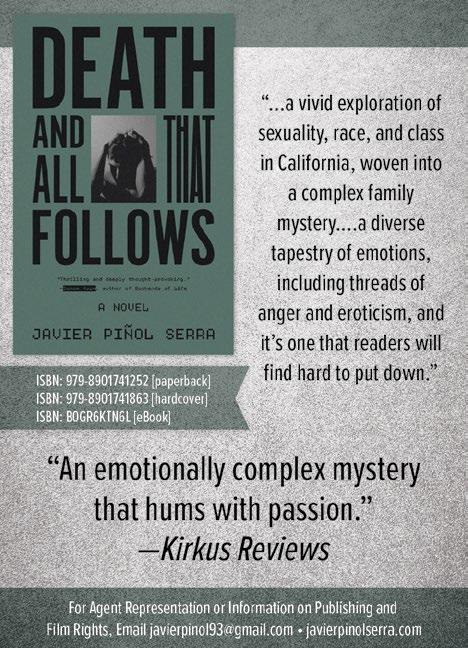
ISBN: 979-8-89565-118-6
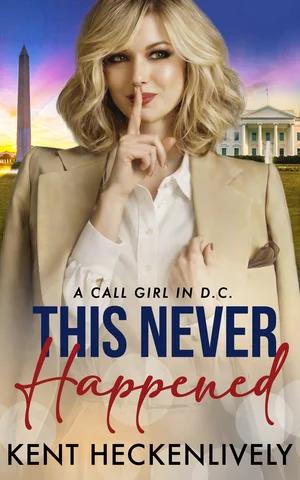
"Heckenlively hooks the readers with romance and keeps them riveted with countless thrills in between." –Independent Book Review
“...readers will love the main characters, the ever-present suspense, and the unanswered questions that invite conversation about what is real and what is not.”
–Blue Ink Review, Starred Review
“...a spy-thriller-like plan worthy of an Ian Fleming novel...”
“Heckenlively keeps the pages turning with brisk pacing and clever spins on hard-boiled dialogue...”
“Entertainingly lurid...” —Kirkus Reviews
For Agent Representation and Information on Film Rights, Email kheckenlively@hotmail.com • www.kentheckenlivelybooks.com
America at 250
One of the most coveted designations in the book industry, the Kirkus Star marks books of
OUR FRESH PICK
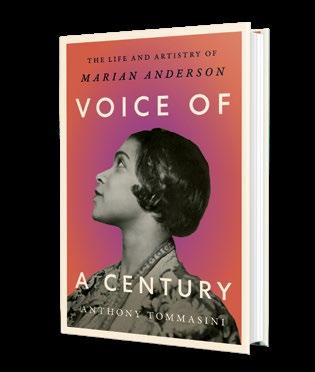
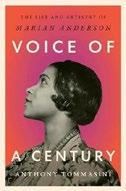
A veteran classical music writer assesses “the life, work, and significance” of the pioneering contralto. Read the review on p. 68.
FROM THE EDITOR’S DESK
A MILESTONE AND A CROSSROADS
“HISTORY IS A guide to navigation in perilous times,” said the late historian David McCullough in his commencement address to the Wesleyan University Class of 1984. “History is who we are and why we are the way we are.” As we prepare to observe the nation’s 250th birthday on July 4, we are living in “perilous times” indeed, and this call to study our history—not just for its own sake—feels highly pertinent.
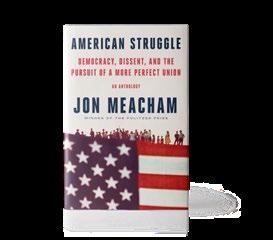
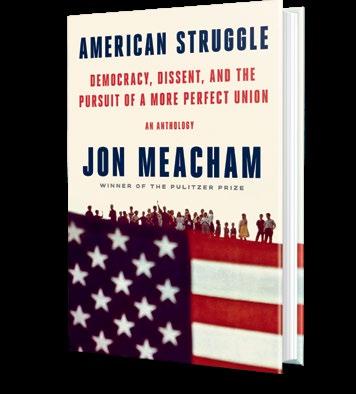
Should you want a syllabus for the course, you could do worse than to thumb through the pages of this special issue, dedicated to the theme of “America at 250.” Here we highlight some of the many new and recent books that seek to honestly address U.S. history in all its complexity. A great starting place is American Struggle:
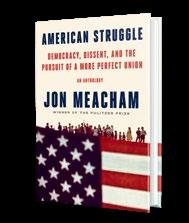
Democracy, Dissent, and the Pursuit of a More Perfect Union (Random House, Feb. 17), in which Jon Meacham weaves a tapestry of American writings, from Abigail Adams and Frederick Douglass to Ida B. Wells and Fannie Lou Hamer, emphasizing the crucial role that protest has always played in our national life. Our review called the collection “evocative and impeccably curated,” and you can read our cover story on Meacham—an award-winning historian and biographer with a refreshing clarity about the American experiment—on p. 50.
Elsewhere in the issue, our editors have drawn up their own lists of essential semiquincentennial reads in fiction, nonfiction, children’s books, young adult books, and
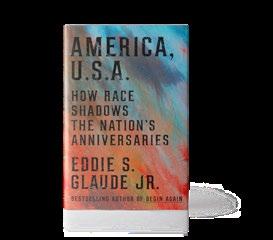
audiobooks. Plus, we hear from a range of authors, including Eddie S. Glaude Jr. (p. 63), Christy Mihaly (p. 85), and Taylor Cassidy (p. 123), who tell us about their new works and reflect on the United States at this crossroads moment.
documentaries, has been a similarly reliable history instructor. But don’t sleep on the companion books written with historian Geoffrey C. Ward. The American Revolution: An Intimate History (Knopf, 2025) builds upon the foundation of the PBS series that aired last fall; it’s a pleasure to flip through its lavishly illustrated pages, but the history itself is hard-headed and unsentimental. As Burns writes in his preface, “The Revolution becomes even more inspirational when the distractions of mythology and cloying nostalgia are replaced, not with unforgiving revisionism, but with the sometimes difficult truths of what actually happened.” Our reviewer called it a “well-written and thoughtful history.” Whatever you do this July 4th, make a good book part of your observance.
For customer service or subscription questions, please email customercare@kirkus.com or call 800-316-9361.
To better understand American history, I’ve often turned to the work of McCullough (1933-2022), knowing that I can depend upon him as a clear-eyed and amiable guide through the events of the past. So it’s a real treat to have a new collector’s edition of 1776 , his vital narrative of that historical turning point, first published in 2005. The new edition (Simon & Schuster, May 5) boasts a slipcase emblazoned with the words that open this column, pictorial endpapers, sprayed edges, and a ribbon bookmark; it would make a handsome gift to oneself or a fellow history buff. Our starred review called it “a master storyteller’s character-driven account of a storied year in the American Revolution.”
Ken Burns, through his widely seen television
Illustration by Eric Scott Anderson
Co-Founders, Kirkus Media LLC
HERBERT SIMON MARC WINKELMAN
Publisher, CEO & Partner
MEG LABORDE KUEHN mkuehn@kirkus.com
Chief Marketing Officer
SARAH KALINA skalina@kirkus.com
Enterprise Advertising Director
MICHELE COBB mcobb@kirkus.com
Indie Advertising & Promotions
AMY BAIRD abaird@kirkus.com
Author Consultant
KEELIN FERDINANDSEN kferdinandsen@kirkus.com
Controller & Operations Manager
KRISTI DAUGHERTY kdaugherty@kirkus.com
Lead Designer KY NOVAK knovak@kirkus.com
Magazine Compositor NIKKI RICHARDSON nrichardson@kirkus.com
Director of Kirkus Editorial ROBIN O’DELL rodell@kirkus.com
Kirkus Editorial Senior Production Editor
MARINNA CASTILLEJA mcastilleja@kirkus.com
Kirkus Editorial Production Editor
ASHLEY LITTLE alittle@kirkus.com
Indie Editorial Assistant
KATARINA YERGER kyerger@kirkus.com
Contributing Writers
GREGORY McNAMEE MICHAEL SCHAUB
Editor-in-Chief
TOM BEER tbeer@kirkus.com
President of Kirkus Indie CHAYA SCHECHNER cschechner@kirkus.com
Fiction Editor
LAURIE MUCHNICK lmuchnick@kirkus.com
Nonfiction Editor
JOHN McMURTRIE jmcmurtrie@kirkus.com
Young Readers’ Editor LAURA SIMEON lsimeon@kirkus.com
Senior Indie Editorial Assistant DAN NOLAN dnolan@kirkus.com
Mysteries Editor
THOMAS LEITCH
Copy Editors
JONATHAN BOWERS
NATALIA HOLTZMAN
NANCY MANDEL
BILL SIEVER
Founder, Kirkus Reviews
VIRGINIA KIRKUS (1893-1980)
Contributors
Nada Abdelrahim, Colleen Abel, Erin Addis, Autumn Allen, Paul Allen, Stephanie Anderson, Mark Athitakis, Susan Baird, Stephanie Baker, Kit Ballenger, Colette Bancroft, Stephanie Bange, Carole Bell, Nell Beram, Kazia Berkley-Cramer, Victoria Biggs, Elizabeth Bird, Kendra Brewer, Anna Broome, Jennifer Brough, Jessica Hoptay Brown, Kevin Canfield, Bluebelle Carroll, Adeisa Cooper, Alec B. Chunn, Amanda Chuong, Tamar Cimenian, Anastasia M. Collins, K.W. Colyard, Susan Corapi, Amanda Costello, Jeannie Coutant, Sara Davis, Cathy DeCampli, Dave DeChristopher, Amanda Diehl, Fiona Dolce, Steve Donoghue, Eamon Drumm, Jacob Edwards, Madison Ellingsworth, Lisa Elliott, Lily Emerick, Phoebe English, Ilana Bensussen Epstein, Joshua Farrington, Brooke Faulkner, Katie Flanagan, Catherine Foster, Cynthia Fox, Mia Franz, Ayn Reyes Frazee, Jenna Friebel, Elizabeth Gabriel, Diane Gardner, Karen Bloom Gevirtz, Victoria Glynn, Chloé Harper Gold, Richard Gotshall, Diana Granger, Melinda Greenblatt, Michael Griffith, Lisa Grimaldi, Sara Grimm, Vicky Gudelot, Geoff Hamilton, Sean Hammer, Eva Harari, Sarah Harkness, David Harris, Lynne Heffley, Ralph Heibutzki, Caroline Henderson, S.J. Henschel, Boze Herrington, Rebecca Herwatic Leonhard, Katrina Niidas Holm, Terry Hong, Mary Grahame Hunter, Jessica Jernigan, Marcelle Karp, Lavanya Karthik, Colleen King, Katherine King, Maggie Knapp, Jennie Knuppel, Susan Kusel, Joanne Langerman, Laurel Larrew, Tom Lavoie, Seth Lerer, Elsbeth Lindner, Coeur de Lion, Barbara London, Patricia Lothrop, Sawyer Lovett, Katie Lowe, Douglas MacLeod, Michael Magras, Mandy Malone, Thomas Maluck, Jodi Martin, J. Alejandro Mazariegos, Coco McCracken, Kirby McCurtis, Katherine McDonald, Dale McGarrigle, Van McGary, Zoe McLaughlin, Cari Meister, Kathie Meizner, Carol Memmott, Rebecca Michelson-Ziegler, Alan Minskoff, Andrea Moran, Henry Mortimer, Gary Moskowitz, Liza Nelson, Therese Purcell Nielsen, Dan Nolan, Katrina Nye, Randy O’Brien, Gayle O’Rourke, Tori Ann Ogawa, Milo Ono, Mike Oppenheim, Emilia Packard, Costa Pappas, Crystal Patenaude, Hal Patnott, Bethanne Patrick, Rebecca Perry, John Edward Peters, Jim Piechota, Christofer Pierson, Vicki Pietrus, William E. Pike, Bonnie Powell, Brian Price, Jessica Pryde, Margaret Quamme, Carolyn Quimby, Ellen Quint, Kristy Raffensberger, Kristen Bonardi Rapp, Stephanie Reents, Amy B. Reyes, Peter Richardson, Alexandria Richey, Michelle Ritholz, Amy Robinson, Courtney Rodgers, Lloyd Sachs, Bob Sanchez, Julia Sangha, Caitlin Savage, Christine Scheper, Meredith Schorr, Lorraine Shanley, Linda Simon, Wendy Smith, Leena Soman, Margot E. Spangenberg, Andria Spencer, Allison Staley, Sydney Stensland, Allie Stevens, Rebecca T. Sutton, Jennifer Sweeney, Deborah Taylor, Eva Thaler-Sroussi, Desiree Thomas, Caitlin Tobin, Chris Turner-Neal, Bijal Vachharajani, Francesca Vultaggio, David Walton, Caroline Ward, Katie Weeks, Sam Wilcox, Susie Wilde, Laura H. Wimberley, Kendra Winchester, Kerry Winfrey, Marion Winik, Flannery Wise, Jean-Louise Zancanella, Simona Zaretsky, Jeremy Zimmett
GREAT AMERICAN NOVELS, PLURAL
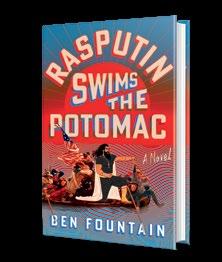
IF THERE WAS ever such a thing as the Great American Novel, it seems to be on hiatus; few contemporary writers would claim to speak for everyone in this fractious nation. So where to turn if you want to honor the semiquincentennial by dipping into fiction? You could start at the White House with Ben Fountain’s Rasputin Swims the Potomac (Flatiron, June 9), a blistering satire of a thirdterm president whose name is redacted wherever it appears. Rasputin is a professional wrestler whose latest bout is interrupted by an outbreak of sobbing that sweeps through the crowd. When Rasputin hugs all the crying fans, he’s invited to the White House and asked to be the
president’s running mate. “Fountain goes on to have about as much fun as you can have with the 26 letters of the alphabet,” says our starred review. “A comic masterpiece. The current administration is finally getting the book it deserves.”
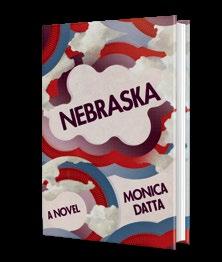
Or maybe try a novel named after a state. Monica Datta’s Nebraska (Astra House, June 23) tells that most American of stories, about immigration and colonialism. Annakali Chatterjee and her son, Rabindra Lal, were both struck by a train in New York; Rabindra, who had cerebral palsy, died, and Annakali was sentenced to 15 years in prison. Was it an accident or did she do it on purpose? Nebraska comes into the picture later, when
she gets out of prison and is taken in by a pair of evangelical Christians, not telling her remaining family where she’s gone. There’s also a pair of psychoanalysts, one French and one Bengali, creating the metanarrative of Anna’s story. “It’s a busy novel, but it’s all delivered with verve, humor, and a bonedeep comprehension of the immigrant experience, and of the ugliness and neglect that accompany traditional assimilation,” according to our starred review. “A sharp, cross continental tale of heartbreak and identity.”
Tom Lin’s Babylon, South Dakota (Little, Brown, May 26) is an engaging speculative novel set during the Cold War. Hsiu Keng and Lee Mei have emigrated from China to an isolated farm in the titular state, where they want only to grow chrysanthemums— but the farm is suddenly not so isolated when the U.S. government takes a
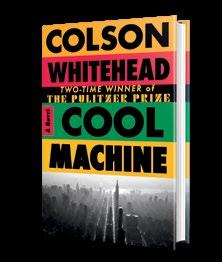
chunk of it for an intercontinental ballistic missile silo. In an effort to make its project invulnerable, the government is experimenting with immortality in various dimensions; the book takes an SF twist, and strange things start happening. “There are ghosts, or at least thermodynamic traces, and hidden chambers, and scheming warmongers and bureaucrats, and a mad Strangelovian colonel,” according to our review. “A thoughtfully written, genre crossing novel of great ingenuity.” There could be no better way to honor the nation’s 250th birthday than by reading Colson Whitehead’s Harlem Trilogy, a brilliantly entertaining dive into a neighborhood central to American history. The ultimate installment, Cool Machine (Doubleday, July 21), follows Ray Carney— furniture salesman and reluctant criminal fence— into the 1980s, a time of stark wealth and poverty in New York, as Ray embarks on a nearimpossible heist at the Waldorf Astoria. Our starred review says, “A master novelist in full command of his powers as a storyteller, prose stylist, and social observer.”
Laurie Muchnick is the fiction editor.
LAURIE MUCHNICK
Illustration by Eric Scott Anderson
EDITOR’S PICK
A sweeping tale of family and fortune in the Korean diaspora, 19922007.
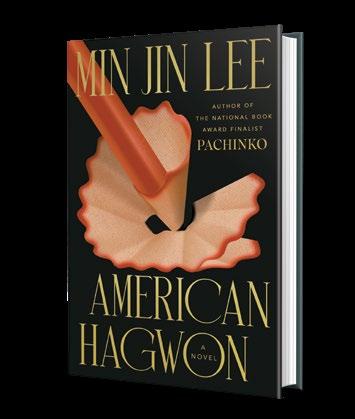
From the author of National Book Award finalist Pachinko (2017) comes a generational saga set in Seoul, Sydney, and California’s Orange County, more than 650 pages of majestically plotted, show don’ttell storytelling, proceeding scene by scene through the lives of its vividly drawn characters. At its center is the Koh family—parents Helen and John, sons Bo and DH, daughter Mido. When we first meet them, they have just moved back to Seoul from Australia at the behest of John’s employers. Helen is worried that her youngest child’s excessively quiet manner is a sign of trouble; John’s
biggest problem is that Shin, his superior at work and longtime best friend, is having an affair with one of their employees, which has begun to cloud his judgment. When quiet Mido makes a friend at school who will change her luck, when John is forced into a grave error by Shin’s shortsightedness, stories are set in motion that will unfold for years to come. The struggle for security looms large as the fallout from John’s mistake is compounded by the 1997 Asian financial crisis, resulting in a lasting and severe change in the family’s status. The destinies of the Koh children and their peers revolve around the institution of the hagwon, private tutoring schools that are the
cornerstone of the Korean obsession with academic excellence. Bo, DH, and Mido will eventually work together at the American hagwon of the title, but they struggle with the outlandish pressure placed on students to succeed. Through masterfully controlled storytelling, Lee patiently explores how her
large group of characters’ fortunes are shaped by forces from without and within: the powerful lure of sex, the sucking vacuum of greed, the insidiousness of racism, the obligations between parents and children. What makes a good life?
The author’s wisdom is a gift to her readers.
A Black Nigerian man who turned white heads to Europe.
WHYTEFACE
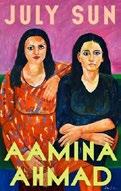
July Sun
Ahmad, Aamina | Riverhead (240 pp.)
$29 | June 30, 2026 | 9798217046126
Set in Pakistan, these seven stories explore the daily lives of a myriad of characters, from an elderly head servant in her waning days to a young irrigation officer contending with local, but not petty, politics.
In the opening story, “Ghee,” a woman named Zarina, pregnant with her fourth child, faces just how low her husband will sink for a fix. In “The Encounter,” a police inspector has a crisis of conscience. This story, along with others that follow, meditates on questions of faith and belief. Several stories reveal the ways in which social mores infiltrate even the most intimate moments of life and how deep the need for connection runs. In the title story, Ghulam Ali must decide whether to support his wife’s pursuit of justice, an endeavor that will almost certainly yield nothing and could get them killed in the process. Author Ahmad excels at swiftly drawing readers into her characters’ unique internal landscapes, so that each story feels lived in, more expansive than its page count. The specificity of each character’s inner turmoil propels these narratives toward weighty questions rather than easy answers. Her debut novel, The Return of Faraz Ali (2022), was a deftly plotted literary procedural of sorts that traversed history, politics, and class to dazzling effect. Here too, Ahmad has a firm grasp on all her writerly tools and deploys them well. There’s not much risk, either in form or language or even point ofview characters behaving badly. But the stories offer a glimpse into everyday life in Pakistan, from city to
countryside, and they reveal a nuanced study of loneliness.
A well-crafted collection of precise stories.
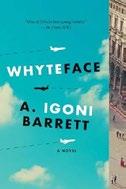
Whyteface
Barrett, A. Igoni | Graywolf (272 pp.) | $17 paper | Aug. 4, 2026 | 9781644454022
A Black Nigerian man who suddenly turned white heads to Europe in this sequel to Blackass (2016). Barrett’s second novel updates the story of Furo Wariboko, a Nigerian who woke up one morning to find he’s now a white man. Four years since that day, with enough cash on hand to afford a vacation and renaming himself Frank Whyte, he plots a trip to Amsterdam, Oslo, and Milan. The frustrations of the crowded city, and the discomfort his skin color causes with the locals, are good reasons to get away. But a voyage to a new continent doesn’t mean he can entirely escape Nigeria, or the racial anxiety he creates by being white and wellversed in his homeland’s culture. In Amsterdam, he revels in the freedom offered in the city’s redlight district, but in Oslo he confronts antiBlack sentiment among the locals that he’s uncertain how to respond to, and in Milan he discovers a relative who reminds him of how fragmented Nigerian society is, and how out of place he feels with the concept of home. Adding to the stress is word from his sister back home that their father is growing increasingly ill. Where Blackass was more overtly satirical and inspired by Kafka’s The Metamorphosis, the followup is more somber and meditative; shifting the venue to Europe allows Barrett to directly contemplate the role of
colonization in the creation of Nigeria, “heterogeneous nations they had shoehorned into one colony.” The contemplative tone gives Barrett ample room to describe the European capitals along with Nigerian culture, though it means that, plotwise, the book feels fairly static; the subplot involving Furo’s father is conducted largely over text and reads like a tackedon attempt to apply drama. A clever satire on nationhood and race.
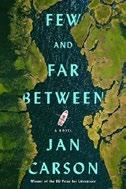
Few and Far Between
Carson, Jan | Scribner (336 pp.) $28 | July 28, 2026 | 9781668056639
C arson imagines what might have happened if Terence O’Neill, prime minister of Northern Ireland in the 1960s, had been allowed to move forward with his scheme to create a new county by emptying the country’s largest lake.
Siblings Marion and RobertJohn Connolly live on an island in the fictional Neagh Archipelago, nicknamed the Ark, a smattering of islands in Lough Neagh exposed by the partial draining of the lake—even in this alternate history, the plan is botched. They are the children of the late RJ Connolly, a renowned anthropologist who moved his family to the Ark in 1972 so he could study the “modern ‘utopia’” that had sprung up there. Shielded from the violence of the Troubles, this community came to house people persecuted on the Mainland, including CatholicProtestant couples, people of color, and LGBTQ+ people. But when childhood resident and earlycareer anthropologist Alex Anderson returns in 2016 to conduct research for a book on the Ark, it’s in sharp decline. The lake is polluted by a growing film of toxic algae, and the government wants the cheapest fix: Flood the lake to wash the algae out to sea and resubmerge the islands. The Connollys think Alex’s book could be the godsend they need to save their home. Carson has a talent for crafting uniquely
neurotic characters, and the gnarled dynamics between them generate a compelling critique of gender roles and ecological decline in Northern Ireland and beyond. The book’s supernatural elements—including souls in a kind of bardo, women literally comatose with grief, and an island that eats dumped items— seem almost true to life set against the absurdity of the reallife drainage scheme, while also acting as moving manifestations of the idea that buried sins will always find a way to haunt the living.
An absorbing read for fans of family dramas, magical realism, and eco-fiction.
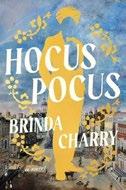
Absorbing historical fiction concerning the havoc swirling around a magician in 1816 Boston. The 25yearold calling himself Samuel Thomas arrives in Boston full of ambition. Abandoned at birth in India, Samuel was initially adopted by an Indian family of magicians who taught him their craft. Sent to a Britishrun orphanage and mentored by a British officer, Samuel ended up in England, where he perfected his skills. Quietly elegant, intensely charismatic Samuel is now discovered by Walter Mepham, a foppish but charming dreamer whose New Boston Museum houses a collection of oddities. His eccentric chatter is filled with “linguistic bricabrac,” literary allusions that would be pretentious offered by the author, but coming from Walter are fun, even touchingly revealing. The museum, reluctantly funded by his wealthy Puritan fatherinlaw, needs a new attraction to stay afloat. Samuel’s magic act is the answer, especially when the museum uses Samuel’s uncertain racial lineage to market him in the exotic persona of a fakir. Samuel’s onstage magic
never fails, but over the course of the (historically accurate) aberrantly cold summer, lives go awry. There are deaths, addictions, disappearances. Charlatans, peculiar museums, bookish Boston blue bloods, and homoeroticism often turn up in novels about 19thcentury America, but Charry combines those ingredients into a fresh literary experience. The witty, decorous tone stays true to the time, and Boston comes to life as a vigorous city full of contradictions. The push and pull of several overlapping love triangles shows how easily love can become obsession, whether the target is human (Samuel), object (Noah Webster’s new dictionary), or idea (the “Great Indian Rope Trick”). Nuances of race relations in a city proud of its abolitionist stance are explored through reactions to a Black child’s abduction, while Samuel struggles with the permeability of identity itself. Eschewing fantasy or quirkiness, Charry creates a rare sense of wonder plus gravitas.
Kirkus
Star
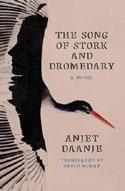
The Song of Stork and Dromedary
Daanje, Anjet | Trans. by David McKay Farrar, Straus and Giroux (736 pp.) | $22 paper | Aug. 18, 2026 | 9780374620615
An overstuffed saga of life, death, love, and literature.
Dutch novelist Daanje’s latest works an intriguing premise that blends gothic horror with mystery and echoes of Georgian and Regency literature. The horror comes early on, when, having seen her 11yearold sister laid out dead, young Eliza May Drayden, recalling a disinterred pet cat, asks, “Is God hungry.” God is indeed ravenous in Daanje’s pages. Like the Brontës, Eliza May and her sister, Millicent, grow up on the Yorkshire moors to become gifted writers, Millicent writing a successful novel of manners called Widow, a book that quickly goes into five printings; conversely, Eliza’s
contribution is received as “a ghastly, immoral book.” Both that novel, Haeger Mass (its title evoking a moment in the Brontë chronology), and Widow become objects of literary study, as do the lives of both sisters. But how did Eliza May, once deceased, slip out of her coffin? What about the “ghostly visitations” that threatened her sanity? What secrets do the notebooks of her early biographers hold? There are more mysteries yet to solve as Daanje’s narrative moves from the Drayden sisters along the centuries from their time to our own, her protagonists in subsequent chapters often sisters bound by love and torn apart by rivalries and the misfortunes of history, sometimes sharing little but mortality. Like Helen DeWitt, perhaps her closest modern peer, Daanje works a deep literary vein that’s full of sly allusions (one character, introduced in passing, is named Clifford Heath) and ponders the imponderables (“in quantum mechanics there is no certainty, a particle’s future state can only be expressed in probabilities”). And there are sublime moments throughout, even when death comes into play: “Time ticks, so calmly, so calmly, the pain is gone and the landscape is flat and the road is straight, a second lasts an eternity.”
A challenging book that rewards its readers with great depth and beauty.
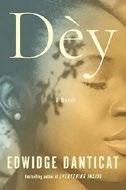
Dèy
Danticat, Edwidge | Knopf (256 pp.)
$30 | Aug. 25, 2026 | 9780593803523
A Haitian American woman reckons with the aftermath of witnessing a mass shooting. The crises are piling up for Magnolia, the hero of Danticat’s fifth novel and first in more than a decade. She’s falling short in her job as a Miami real estate agent; back in Haiti, her parents are increasingly threatened by marauding gangs; her mother is showing signs of dementia; and her relationship with Harrison, the father of her 9yearold daughter, Zoë, remains frustratingly
Kirkus Star
unsettled. And as the novel opens, a trip to the mall to purchase Zoë a phone has led to her cowering in a restaurant as a mass shooter stalks victims. Magnolia says nothing about her neardeath experience to family, friends, and coworkers, who are all entangled in her world. (Her boss is Harrison’s cousin.) But as the situations both at home and in Haiti become more dire, her attempts to suppress her trauma take a toll. As ever, Danticat is gifted at capturing the nuances of the Haitian diaspora, undoing simplistic depictions of the country’s struggles, and using language to show how various elements of her characters’ identities intersect. (For instance, “Ma” is both Magnolia’s nickname and a maternal reference, while one of the Haitian gangs is called San Manman, meaning “motherless.”) Plotwise, the novel is a straightforward chronicle of Magnolia’s struggle to manage her responses to the shooting; Danticat’s prose is unshowy, sometimes to the point of being curiously muted. But there’s depth to the questions the novel raises: The title is the Haitian creole word for mourning, and as Magnolia contemplates losses in her presentday community and close to home, Danticat’s understated writing emerges as a strength. Throughout, she underscores the notion that, no matter the country, safety is uncertain: As Magnolia somberly muses, “There are no actual places of refuge, no veritable harbors, no sanctuaries.”
A powerful study of motherhood, nationhood, and violence.
Burnside
Defoe, Devyn | Astra House (272 pp.) | $22 paper | Aug. 4, 2026 | 9781662603570
A brainy debut novel about the politics of victimhood. September is sitting at a bar next to a strange man when she flings her arm into the air, and he scratches her. Though he apologizes and the injury mostly heals within a week, each time September retells the story, the events grow more violent, the man more unhinged. It’s the
unnamed narrator, September’s roommate, who observes these changes, and though she’s nonplussed by September’s exaggerations, she’s not immune to the notion that it’s a dangerous world for young women like the two of them. Other tragic things happen in the background of the narrative: An old friend dies of a drug overdose, her body discovered in a polluted river; an unnamed California town burns down, taking the lives of dozens of people; a landlady poisons her elderly tenant. But these events are little more than lurid spectacle or inconvenience. Instead, the narrator and her friends and frenemies hang out at bars and coffee shops, work jobs they don’t like, and have long, digressive conversations. Some of Defoe’s social commentary is brilliant. September waits tables at a Westernthemed “breastaurant,” which pays a lot better than the feminist juice bar where she used to work, while the narrator works at a bookstore that stays afloat by hosting parties. The characters are their jobs, vocations, and beliefs—September is “September” because that’s when she’s Girl of the Month in the breastaurant calendar. Their acquaintances include “the antifascist,” the “patio sitters,” and “the man who skimmed garbage from the rivers.” The narrator’s critique of men as desiring women only for their own ego gratification and “tak[ing] what they want, and mov[ing] on,” on the one hand, and women’s delight in casting themselves as victims, on the other, feels unresolved, maybe intentionally. But it makes the novel a bit of a depressing slog. Trenchant and polemical social critique without much plot.
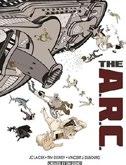
The A.R.C.
Disney, Tim & JC Lacek | Illus. by Vincent Jolas Dubourg | GUNGNIR (333 pp.) $40 | July 21, 2026 | 9781962594899
Lies turn deadly in this satirical graphic novel. Authors Disney and Lacek and artist Dubourg’s graphic novel starts out with a solid metajoke: The writers ask an AI chatbot to write
a “forward” for the book. The bot corrects their spelling and terminology and offers a preface that explains the authors have found themselves “facing down civilization extinction” with “not a single survival bunker between us.” The novel itself, set in an alternate universe where Robert F. Kennedy Jr. is the U.S. president, follows a disparate group of people on a “100% sustainable and carbon neutral” luxury cruise ship who are stricken with a mysterious neurological disease that originated at a conference in the Amazon attended by the wealthy elite. The illness has a novel presentation: It only afflicts people when they lie; when they start telling the truth, they recover. The disease has spread worldwide, claiming victims including Elon Musk, Rachel Maddow, Alex Jones, the hosts of The View, and, for some reason, Jeff Koons. The crew of the ship is determined to make an emergency landing on the island of Saint Marie, but the military there isn’t having it, leading to a horrifying result for many of the ship’s passengers. The novel is interspersed with satirical advertisements and magazine articles, including—again, for some reason—a fake interview with Timothée Chalamet; at the end of the book is a “compendium” explaining some of the references in the novel itself. The book has a strong start, but pretty quickly loses steam, becoming less of a story and more of a furious rant about the state of the world, before its bizarrely abrupt ending. The one high note: Dubourg’s artwork, which is clever, vivid, and all around spectacular. This is a passionate appeal for truth kneecapped by its own stridency.
An unfortunately heavy-handed jeremiad.
For more graphic novels, visit Kirkus online.
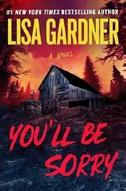
You’ll Be Sorry
Gardner, Lisa | Grand Central Publishing (368 pp.) | $30 | Aug. 4, 2026 | 9781538765142
A smalltown sheriff uncovers centuries’ worth of secrets.
Growing up in historic Shereford, New Hampshire, Mandy Grady chafed at being the sheriff’s daughter. After sowing her wild oats in New York for a few years, though, she eventually returned to the tiny town of her youth, and became the new sheriff when her father died. She not only took on his role, but also his obsession with one case he never solved—a case that haunts the town: The disappearance of the entire Dixon family—both parents and four children—during a summer storm in 1998. In the present day, two glamorous, wealthy outsiders, Raquel and Theo Collins, have bought the old Dixon house and are looking to restore it, maybe transform it into a B&B. A stray dog leads them to a gruesome discovery on the property: a well that contains both human bones and a ledger belonging to an 18thcentury midwife. Everyone in Shereford knows the old rhyme: “Ding dong bell, the witch is in the well.” Could it be based in truth? Betty and Mason, the enthusiastic heads of the town historical society, connect the ledger to a journal already in their possession and, together with Raquel and a reluctant Mandy, begin to fill in the story. A young woman appeared in Shereford in the midst of a blizzard in the early 18th century. Taking pity, the townsfolk begged her to stay—until babies started dying under her watch, and she was sentenced to death for witchcraft. Now Mandy has to figure out how these ancient sins are related to the more contemporary crimes— because someone in Shereford knows exactly what happened to the Dixons. Gardner deftly juggles a number of characters, plot threads, secrets, time periods, and motives, delivering a satisfyingly layered novel that
interrogates the insular lives and histories of small towns. Admirably ambitious in scope and mystery.
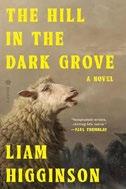
Something troubling lurks on a farm in the Welsh mountains in this folkhorror tale. Higginson’s bleak but bracing debut novel concerns a sexagenarian married couple, Carwyn and Rhian Gwynnant, who’ve grown up together in a remote mountainous region of North Wales. Carwyn minds the sheep on a large farm that’s long been in his family; Rhian keeps the books, which are looking increasingly poor. But though bill collectors are knocking more often and the sheep are increasingly falling ill, Carwyn is neglecting his work to pursue an obsession with the artifacts he’s uncovered on his land, including a stone figure of a head and a curious circle of stones that suggests a buried civilization. Higginson tracks Carwyn’s growing fixation while also looking back to his courtship with Rhian and the region’s history, from its pagan days before British conquest to more recent struggles, as longtime Welsh residents abandon the land and wealthy outsiders looking for second homes move in. (A subplot involves hardline Welsh nationalists burning down houses in a futile effort to halt the trend.) For a firsttimer, Higginson demonstrates remarkable tonal command of a structurally complex story, interweaving Welsh folklore and postThatcher regional history with a tender romance and moments of visceral and supernatural violence—Carwyn and Rhian both suffer grotesque dreams, and there’s plenty of realworld carnage, too, as when a bull at a livestock auction runs riot on humans and animals alike. Are
these incidents everyday tragedies? Evidence of the land rising up to reclaim itself? The paranoid delusions of a loving but tooisolated couple? Higginson allows room for a variety of perspectives but keeps the focus on the powerful pull of the land, and the struggle to maintain ownership in “this place of hostile beauty.”
A sharply drawn, appealingly eerie tale of history, family, and companionship.
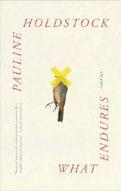
What Endures
Holdstock, Pauline | Biblioasis (280 pp.) $16.95 paper | Aug. 18, 2026 | 9781771967174
A dozen stories of the absurdities and challenges of life. Holdstock, a Britishborn Canadian author known primarily for historical fiction, here turns her attention to contemporary characters. The stories in the current collection vary greatly both in tone and appeal. Several comic and sometimes surreal pieces, mostly with female protagonists, almost seem as if they’d been written by a different author than those with darker and grittier themes. Both the strongest story in the collection and one of the least palatable center a dog. The opener, “Perfect Obedience,” is a gem. As it begins, Vita decides to adopt a dog, despite the fact that her boyfriend is obsessively concerned with the neatness and cleanliness of his house. Though the people from whom she adopts it seem a little too happy to see it go, “It wasn’t a bad dog. You could, in fact, say it was good. The way Vita saw it, there were no grounds, none at all, to give a person pause, so to speak—unless you counted certain aspects of its behaviour.” Actually, this dog, Abigail, is a holy terror. But with recourse to philosophers including C.S. Lewis, St. Augustine, and Leibniz, Vita makes the case that “just because we don’t like the outcome of its actions doesn’t mean it’s bad.” Funny events ensue as she and Abigail burn through
various housing situations and relationships. But later in the collection, “Spot” is an extremely unpleasant account of two old drunks, brothers named Bri and Merv, who torture and plan to murder a stray pup they take in once it gets ill and incontinent—in the woods with a nail gun. Good God. Animals also face grisly deaths in “Danny, Is That You?,” a depressing story about a woman with a deeply depressed teenage son. “Perfect Beauty” is one of a handful that incorporate surreal elements as a woman’s compulsive antiaging rituals kick in with a vengeance. Reminiscent of some of the intriguing speculative stories in Rachel Khong’s recent collection, My Dear You, it ends up closer to Abigail than Spot on the Applause Meter. Ranges from the excellent to the meh to the miserable. No one said you have to read them all.
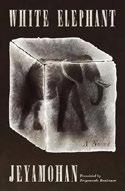
White Elephant
Jeyamohan | Trans. by Priyamvada Ramkumar | Farrar, Straus and Giroux (336 pp.) | $19 paper | July 21, 2026 9780374619428
A British Army officer confronts the horrors of famine and imperialism in 1878 India. As Tamil writer Jeyamohan’s second book to be published in English opens, Captain Aiden Byrne, an officer in the British Army in faminestricken 1878 Chennai, India, comes across a horrifying sight: a man brutally whipping two emaciated people on the ground. The attacker turns out to be a foreman at a local facility that imports ice from abroad and breaks it into cubes for sale; the foreman claims his victims are employees there who didn’t show up for work. Aiden, horrified, launches an investigation, but the facility management won’t cooperate, and the two people who were being beaten disappear. He quickly finds there’s no appetite to get to the bottom of the workers’ disappearance, or the horrible treatment of the facility’s
employees, and soon meets Kathavarayan, a member of an untouchable caste, who sets Aiden on a journey to learn the true extent of the famine. He visits the town of Chingleput and is shocked by what he sees on the way: a mass of corpses being devoured by dogs, including “an infant face, its lips peeled off, rocked in an openmouthed laugh.” Aiden resolves to do what he can to mitigate the famine, but the reluctance of his superiors, and India’s complex caste system, make his job difficult. Jeyamohan’s prose in Ramkumar’s translation is certainly vivid, if sometimes odd (“As a cold shiver ran up his rectum as if from the touch of an ice cube”), but the dialogue is too often stilted, with characters monologuing at one another about the (very real) horrors of famine and the brutality of the British colonizing India. Aiden is drawn as complex; the other characters mostly feel like place holders. This is a well-intentioned novel, but unfortunately, also a plodding one.
In the middle of the 20th century, a queer Black woman who can pass for white and lives as straight discovers the price of her shadow life.
A historical novel bursting with characters and decades of events begins with 18yearold artist Odette Honore, who’s in love with a girl—something that’s unacceptable in her tightknit Creole community in 1944 New Orleans. But then her girlfriend, Hattie, asks Odette to do the unthinkable: Marry her brother before he goes off to war. Odette agrees, beginning her long tenure of living a lie. The novel’s leitmotif is passing; Odette is often treated as white and lives as straight, which inflicts catastrophic personal damage. Soon Odette is a pregnant widow and she, her sisters, and her sisters’ husbands move to Los Angeles to evade Jim Crow. The move is a success—they
find neat houses in a middleclass Black neighborhood and management positions at Columbia Records. Then one day Odette finds her cousin Delphine Kelley raving in the street. Delphine, who left New Orleans to marry a white man and is passing in Los Angeles, is committed to an institution with schizophrenia, set off by “a denial of identity.” Although Odette is falling for coworker Ginny, she must adopt Delphine’s daughter, and to do that, she must marry again. She chooses the closeted Felix, and their lavender marriage, raising her son and adopted daughter in a hillside bungalow, offers surprising comfort. The novel is rich with cultural references, including conversations about Patricia Highsmith and James Baldwin, the death of Emmett Till, and the Watts riots, offering a counterpoint to Odette’s own journey through experimentation, grief, and revolt. The unfortunate deus ex machina of a wealthy white friend who singlehandedly advances Odette’s artistic career is offset by the novel’s sensitive examination of one woman’s hardfought journey to selfacceptance.
An old-fashioned-feeling issues novel focused on Black and queer lives, with a page-turner of a plot.
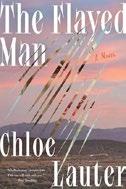
The Flayed Man
Lauter, Chloe | Soft Skull Press (256 pp.) $16.95 paper | July 21, 2026 | 9781593768256
A cursed woman races against time to save herself, her mother, and the woman she’s falling for. When Ellis Karsten, a 31yearold ER worker, sees a battered patient during her night shift, she thinks: “He smells like blood. I’m hungry.” In Lauter’s debut novel, Ellis, her manipulative mother, and her Uncle Bill look human, but they harbor a dark secret—they’ve been cursed to consume blood to stay on the right side of monstrous: “No one becomes like us. You’re either born human or born hungry.” While Uncle Bill supplies them
with blood, Ellis cares for her mother, who has early onset dementia. Their already fraught relationship becomes increasingly untenable when her terrified mother says she’s being hunted by “the flayed man,” the brutal creature from their generational fables. When both Uncle Bill and their blood supply mysteriously disappear, Ellis is forced into the desert to find more blood and keep the curse at bay. Both afraid of her mother and scared to lose her, Ellis must race against an enemy seemingly older than time to save them both. Ellis’ complicated feelings about her family are the most compelling part of the novel. At one point, she thinks: “No one can ever understand me, can ever love me down to my bones and the snarling beast beyond, like family can.” This belief comes into question as she gets closer to Veer, a complicated and alluring paramedic, with equal parts caution and passion. Drawn together by their trauma, the two struggle against the reality of the curse. Set against the backdrop of Las Vegas and the Mojave Desert, the novel suffers under too much buildup and plot scaffolding; the horrors of the flayed man, in some ways, pale next to Ellis’ personal, familial, and romantic horrors. Despite this, Lauter shows promise with apt and affecting musings on shame, duty, love, and generational trauma.
An atmospheric debut exploring the difficulty of escaping one’s past.
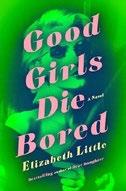
Good Girls Die Bored
Little, Elizabeth | Bantam (448 pp.) $30 | Aug. 4, 2026 | 9780593723289
A Marine veteran finds her groove in this timely novel about one woman’s journey toward finding herself and living a better life.
Juno Hardwick takes on assassins and conspirators in this nononsense thriller packed with car chases, handtohand combat, gunfights, and smart talk. When Juno left the Marine Corps, she lost herself. She spends her days on the
couch and her nights working security in a bikini bar. When an old friend turned private security professional asks her to help protect a Pulitzer Prize–winning journalist whose life might be in danger, Juno reluctantly signs on. In Juno, Little gives readers a onceempowered woman who proved herself in Afghanistan but came away from her wartime experience with exceptional situational awareness and little else. Her ability to assess danger in any setting makes her the perfect security professional, but Juno soon finds out that protecting Maelle Ruiz won’t be easy. Juno and her team must keep Maelle safe while she attends a gala in Los Angeles where she’ll be honored as a truthseeker. It seems any number of individuals or groups may want to stop Maelle’s latest investigation by scaring or killing her and, worst of all, there may be a mole inside Maelle’s protection unit. Readers who love actionfueled novels with lots of closeup fighting and gun battles in tight spaces will revel in this story’s unrelenting tension. The wellchoreographed plot, like the perfectly rendered fight sequences and chase scenes, speaks to Little’s vision for a novel that not only addresses the challenges faced by military veterans but also takes on the plight of journalists fighting to expose the truth. If Little chooses to write a sequel, readers will welcome the chance to spend more time with Juno. Never a dull moment as the former Marine’s mediocre life goes from slow-burn to explosive.
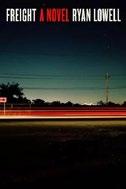
Freight
Lowell, Ryan | Mulholland Books/Little, Brown (224 pp.) | $18.99 paper Aug. 11, 2026 | 9780316596510
Two men plan a heist in this gritty tale of longhaul truckers.
Truck driver Billy Trask snaps a woman’s neck, giving it no more thought than flicking a cigarette into the northern Maine snow. The murder appears to have
neither motive nor consequence nor place in the plot, but it certainly establishes character. His nephew Curtis, a new dispatcher, muses about how easy it would be to steal a loaded trailer. Indeed, Billy has a scheme to heist a truckload of pharmaceuticals—“Inventory in that load is gonna be at least ten million dollars” at retail, netting Billy and his pal Jimmy about a million. Coming home like he won the lottery might improve Billy’s home life, he thinks. Meanwhile, in his time off, the collegeeducated Curtis writes stories about “unintended consequences and guilt and resentment” and reads essays by Emerson. At work, his education makes no difference as he assigns routes to drivers, always needing to make sure no one exceeds his strict time limit on the road. More miles mean more money, more time away from home, and more risk of fatigue and accidents. Curtis has mixed feelings about his job. Early on, he refers to the “dysfunctional trucking industry” but later waxes on about “the poetry of the whole thing, the endless cycle of the industry that ran all the time, the wheels that never stopped turning in the freight game.” Though he can get fully drunk at nine in the morning, he is the worthiest of sympathy of all the main characters. Look at Theo, for example. His wife, Lauren, stays at home while he picks up a stranger named Sarah along the highway. She turns out to be “an evil, vexing little sex doll” he begins to think is perfectly capable of killing him, and maybe he should abandon her at a random rest stop in Quebec. Good luck finding anyone to root for. Well-written but keep your antidepressants handy.
Kirkus Star
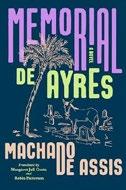
Memorial de Ayres
Machado de Assis, Joaquim Maria
Trans. by Margaret Jull Costa & Robin Patterson | Liveright/Norton (240 pp.)
$28.99 | Aug. 4, 2026 | 9781324096795
A thoughtful meditation on love, old age, and death.
Machado, the great Brazilian writer (18391908), first introduced readers to Counselor Ayres in an earlier book, in understated tones: “He was not an eminent figure in this world; he’d had a long diplomatic career, and then retired.” Now, a year after returning from his European post and having lost his wife, “buried in Vienna,” he lives a quiet life in Rio de Janeiro, keeping the diary that serves as Machado’s narrative. Ayres’ sharptongued sister, Rita, coaxes him out of his home to visit their family vault. At the cemetery he sets eyes on a young widow, Fidélia, whose name speaks to her faithfulness: She won’t marry again, Rita says, subtly challenging her brother to try to persuade Fidélia otherwise. It’s a time of change in Brazil; according to one entry, “Judge Campos believes that something will be done about freeing slaves—a step in that direction, at least.” It’s also clear to Ayres that the nation belongs to the next generation. When a young man named Tristão, who witnessed the Paris Commune seize power and quietly harbors political ambitions, enters the picture, he and Fidélia fall in love. Writes Ayres, “I firmly believe in
Fidélia’s two great loves; I have come to believe that they form a single, continuous whole.” Ayres is a wise student of the human condition and an observer of his own fragility: “Life, especially for the old, is a very tiring business.” Machado’s final novel is haunted by worldweariness and death from the first page to the last—and indeed, the author died soon after it was published in 1908. Yet it is also humane, beautifully written, and full of appreciation for human foibles and the wonder of life.
An elegant, philosophically charged farewell by a founding father of Latin American modernist literature.
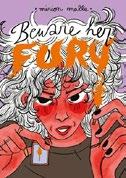
Beware Her Fury
Malle, Mirion | Trans. by Aleshia Jensen & Isadora Jensen | Drawn & Quarterly (224 pp.) $25 paper | Aug. 11, 2026 | 9781770468702
In this graphic novel by French cartoonist Malle, a survivor of sexual assault finds power and support from her therapy group.
Clémence is always angry. A 30 year old survivor of sexual assault, she’s fed up with a system she describes as being rigged against women. Consumed by rage, Clémence admits to her therapist that her other emotions are merely performative, not genuine. Malle’s illustrations punctuate Clémence’s pain by zooming in on parts of her face without showing the whole, even covering up her eyes with speech bubbles, effectively conveying Clémence as fragmented. She joins a therapy group at CALACS, a real
At a party in LA in 2031, some guests disappear while others seem to double.
sexual assault support center in Quebec, where the other members are introduced with similarly cropped visuals, as juxtaposed with the social workers, who are drawn whole. Other survivors of sexual assault are drawn in a variety of skin colors and ages. During her time with the group, Clémence meets Imane, a lesbian with tattoos on her light brown skin, and the two begin dating. Despite trauma triggers, Clémence and Imane’s relationship is full of warmth as they connect over shared experiences and tattoos. When Imane facilitates dance therapy with Clémence, Malle’s illustrations are squiggly and full of motion, emphasizing Imane’s teachings that therapy is about the feelings, not the aesthetic, so that survivors can safely reconnect the mind to the body. Clémence and other survivors never go into detail about their assaults. Malle instead thoughtfully centers the emotional weight of their trauma and focuses on the growth and change the characters facilitate over the narrative. And as characters journey toward agency, and as Clémence learns to find value in her anger, Malle expands the scope of her framing, showing characters as more whole. Emotions are drawn as wobbly and messy, full of tears and scrunched faces that lay a character’s experiences bare to the reader.
An evocative and raw comic that offers solidarity for survivors of sexual trauma.
Kirkus Star
Exit Party
Mandel, Emily St. John | Knopf (320 pp.) $32 | Sept. 15, 2026 | 9780593321461
At a party in Los Angeles in 2031, some guests disappear while others seem to double. The party in question— thrown by a man named Kareem after curfew is lifted in the Republic
of California—will be revisited many times over the course of Mandel’s glittering puzzle box of a novel. We first experience it through the eyes of Ari Waker, a woman who’s just spent 18 years in prison for hiring someone to kill her cousin. Midway through the party, the host disappears. At the same time, one of the guests seems to be in two places at once, wearing two different outfits; another guest takes a painting off the wall and leaves. Eventually it will all make sense, and doubly so to longtime devotees of this ingenious author: The painting, “Swan Dive,” first appeared in The Glass Hotel (2019), and is central to the plot here; there are also connections to The Singer’s Gun (2010) and Sea of Tranquility (2022). The current novel brilliantly ties the notion of parallel timelines to a political theme, positing a dark twinship between chaos and totalitarianism. As Ari’s own double eventually understands, “Strange to think there weren’t just two versions of me, and two versions of Kareem and Nico and possibly everyone else, but two versions of our country. There was a world where my homeland had fractured into disarray, and another where my homeland had closed like a fist.” Mandel’s elegant worldbuilding spans the course of a century, tracing events that occur in a domed Paris in the 2060s back to their roots in a New York apartment in the 1960s. This is her best novel since Station Eleven (2014), a cause for rejoicing among her fans and an inspiration for newbies to dive into the backlist. Both a thrilling read and a virtuoso demonstration of the moral and philosophical possibilities of speculative fiction.
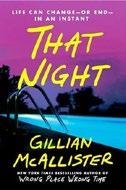
Three siblings will do anything to save each other—even lie about what happened one night in Verona, Italy. The Plant siblings—Cathy, Joe, and Frannie—live next door to each other, work together, and own a joint vacation property. So it’s only fitting that when Frannie calls the other two in a panic because she’s hit someone with a car while they’re all in Verona, they run to her rescue. There are a few discrepancies in her story that make them wonder, like why she waited 30 minutes to call them, but it doesn’t matter—for the Plants, it’s one for all and all for one. Cathy and Joe bury the body while Frannie takes care of cleaning up the blood. They knew the man only slightly; it turns out he’s not only an English expatriate, but also a police officer, and had been carrying a warrant that seems to have Joe’s name on it. Immediate doubt sets in, but at this point, it’s too late, and the siblings must stay loyal to each other and to their cover story when the police come calling, even as it drives Joe’s wife away, even as it begins to splinter their own close relationships. McAllister uses the popular thriller format of “then” and “now” to tell the story across two different timelines: one that begins with the death, and one that begins much later at a trial. As in her other novels, McAllister’s greatest strength lies in her ability to write truly human characters, characters who make mistakes and struggle and regret and fall apart, all in the name of love for family. While the soft reveal in the end undoes much of the intensity McAllister has built, it’s clear that even as guilt eats the Plants alive, they would never choose to do anything other than protect each other. Another poignant exploration of family, love, and loyalty.
Kirkus Star
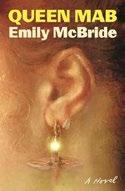
Queen Mab
McBride, Emily | Farrar, Straus and Giroux (304 pp.) | $28 | Aug. 4, 2026 9780374617820
A young woman’s travels to and through the lands of motherhood and mental illness are chronicled with brutal clarity in McBride’s debut novel. The tiny faerie Queen Mab of literary fame—referred to by Shakespeare and Shelley among others—is reputed to bring dreams to humans as they sleep. That bit of folklore takes a malignant turn as nightmares and madness haunt McBride’s young protagonist, Madeleine Brodeur— affectionately referred to as Queen Mab by her husband. She’s 23 and pursuing a doctorate in literature at an English university, specializing in the Victorian and Modern eras. After a grueling labor, Madeleine and her daughter, Maud, remain hospitalized for days for treatment of complications. Once home, Madeleine becomes increasingly isolated from her colleagues, disturbed by her husband’s return to work, and tormented by thoughts that the Maud she is caring for now is a changeling, not the child she gave birth to. She is driven to take a deep dive into the literature and scholarship about faeries, but this only further complicates her disoriented thoughts: Is she the changeling, not Maud? McBride explores the pressures of motherhood and the total surrender of oneself to a screaming, hungry, often angry, being. In Madeleine’s case, the sweet fairy tale of motherhood is replaced by nightmarish beliefs and suspicions. Her already contentious relationship with her adoptive parents is strained. Her conventionally happy husband is bewildered and, eventually, worried. (He thinks the remedy here might be to attend motherandinfant groups.) A stark portrait of maternal depression and psychosis is unflinchingly presented; McBride pulls no punches in her
For more by Emily St. John Mandel, visit Kirkus online.
On calling the novel American Han: “It was suggested to me by my agent, who’s also Korean American. And it was really surprising.…I never told him that I meant for my book to capture this feeling of ‘han.’ But he read it and he said, ‘I can feel the “han” in this.’”
—Lisa Lee
Fully Booked is produced by Jessica Lockhart and Megan Labrise. To listen to the episode, visit Kirkus online.
Fully Booked
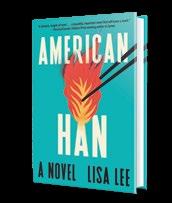
Self-determination is bitter and sweet in Lisa Lee’s debut novel, American Han BY MEGAN LABRISE
EPISODE 478: LISA LEE
On this episode of Fully Booked , Lisa Lee joins us to discuss American Han (Algonquin Books, March 31), a powerful debut novel in which each member of a successful Korean American family comes to a respective crossroads. “A long simmering tragedy unfolds in the Kim family of California from the 1980s to the early 2000s,” Kirkus writes in a starred review of the novel, which is narrated by daughter Jane. “Lee’s self aware, relentlessly honest narrator feels absolutely real, and her story cuts deep.”
Here’s a bit more from our review of American Han : “The title of Lee’s heartrending debut novel employs a Korean word that isn’t defined in the text. Most sources describe ‘han’ as a collective feeling of sorrow, resentment, regret, and internalized anger stemming from the historical experience of suffering; the story of the Kims expresses this complex emotion in a number of ways.…The novel opens in December 2001, when Jane Kim’s mother shows up unexpectedly at her apartment in San Francisco, announcing she’s planning to move into town from Jane’s childhood home in Napa. Jane is not happy to see her.…Lee captures the culture of the Korean diaspora both with small details… and with broader brush strokes.… [Her] refusal to find comedy in the Kims’ personalities and predicament is rare, and extremely effective.”
Lisa Lee is the recipient of numerous fellowships and awards, including the Marianne Russo Emerging Writer Award from the Key West Literary Seminar, an Emerging Writer Fellowship from the Center for Fiction, and a Pushcart Prize. Her work has
American Han Lee, Lisa Algonquin Books | 288 pp. | $29 March 31, 2026 | 9781643757254
appeared in Ploughshares , VIDA , North American Review , Sycamore Review , Gulf Coast , and elsewhere. She holds an MFA from the University of Houston and a Ph.D. in creative writing and literature from the University of Southern California. She lives in Los Angeles. In a stimulating conversation, Lee and I discuss the Kim family (Jane; her brother, Kevin; their mother and father), their respective goals and dreams, and the exploration of immigrant rage through fiction. Lee addresses the complexities of depicting anger, drawing from her own experience, and the distinction between “Korean han” and “Korean American han.”
Editor at large Megan Labrise hosts the Fully Booked podcast.
Huy
Doan
portrait of a woman desperately trying to use the research tools and familiar stories she knows to make sense of the unrelenting psychological horror of a hallucinatory bout with postpartum mental illness.
A harrowing tale of mothering and myth.
Kirkus Star
Sunlight Finds You
Moriarty, Laura | Riverhead (464 pp.)
$32 | Aug. 4, 2026 | 9781594487170
A 1950s teen pregnancy upends several families as characters experience different kinds of trauma.
Moriarty has an unusual gift for voice, a spark that can turn a novel about ordinary events into something compelling. In her new book, the firstperson narrator is Nora Chesnow, a cheerful, bookish teenage girl living in St. Petersburg, Florida; her family has left Missouri after her mother’s death and her father’s remarriage. She sets her cap for a quiet, handsome swimteam member, Leonard Lifton. Smitten with each other, they take a risk that angers his parents. This leads to his enlisting in the Army and meeting her for a tryst before leaving to fight in the Korean War. Nora’s pregnancy and exile to a New Jersey home for unwed mothers are hardly the end of her story. In her shame and heartbreak after giving up her baby for adoption, she agrees to marry Russ Crandle, another high school classmate who has big plans as a flooring contractor. Her attempts to succeed as a 1950s housewife fall as flat as her cropped hair, which she attacks with scissors after an illtimed telephone call clues her in to the lies the social worker told all the young women in the home. Moriarty spends many pages on Nora’s months in the home to show readers how those dismal circumstances sent Nora into a major and then
perhaps chronic depression that keeps contentment just out of reach. Even after she makes a big change, she aches for the little girl she lost to the practice of closed adoption. Eventually, Nora and her family will open their hearts to each other, even allowing new members into their circle. Although this isn’t an overtly political book, it emphasizes that reproductive rights aren’t limited to termination, and that secrets, when told, can lead to family healing.
A rich, rewarding slice of history that should remind us how important it is for women to have choices of all kinds.
Gigs
Mosedale, Mark | Illus. by Si Smith
Top Shelf Productions (276 pp.) | $24.99 paper | June 16, 2026 | 9781603095938
Citizens struggle to subsist in a lowwage gig economy driven by an oppressive phone app.
In the not sodistant gloomy future, giant tech companies control everyone’s lives. A phone app tells workers they must report to a job that typically involves cleaning or painting for long stretches of time. They go home to tiny apartments, contemplate their existential boredom, sleep, and wait for the next gig alert. And yet, as revealed in the six interwoven chapters of this graphic novel, spirited individuals and groups find ways to rebel. Illustrator Smith has a colorful, soft, detailed style that adds playfulness to this dark tale. And author Mosedale adds humor, hope, sarcasm, and genuine human connection to an otherwise bleak story that, at nearly 300 pages, allows the six stories to breathe and unfold in interesting, cinematic ways. We’re in no rush to get to the end because we’re given clues all along that the people in this city will find a way to make it, and we want to spend time with them to see how things pan out. An aging punk
rocker sneaks outside her senior living facility to smoke joints and makes a new friend. A bike messenger delivers library books to people and invites them to secret raves. A graffiti artist paints elaborate anti establishment works on the side of a building at night. A grumpy middle aged private detective must learn how to play an augmented reality running game and get back in shape to hunt down a suspect. A man runs 100 miles outside the city through a desolate countryside to deliver a package of seeds. An accident in a space station filled with gig workers, which is orbiting Earth, sends the satellite crashing into the ocean, where anarchists have converted an oil rig into a floating guerrilla kelp farm with horizontal self governance. And an unexpected delivery from a drone army could bring about a new beginning. In this world, the future is bleak but hope and ingenuity are hiding in plain sight. Through friendship, punk rock, and teamwork, a handful of people rebel against this Orwellian future.
The coming ofage of a group of school friends, and the psychological struggles of one in particular, drives a layered story of connection, memory, and identity in Mozley’s intense third novel.
Did Mary Mooney’s Jewish grandfather assassinate Adolf Hitler? This comically absurd notion crops up in suddenly restored “memories” Mary has been having, forcing her to confront serious questions about selfhood and mental health. The setting is the English city of York, where ancient buildings and 2,000 years of history underpin current events, a frequent Mozley motif.
Strangers on a train affect each other’s lives through shared experiences.
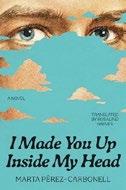
I MADE YOU UP INSIDE MY HEAD
Narrator Mary, her British schoolmates Amelia and Eve, and U.S. incomer Eric form a tight group whose friendship spans their early years and beyond as their personalities take shape, launching them on different trajectories. Eve is impassioned and politically motivated, Amelia more muted, and Mary, the daughter of an Anglican cleric, both watchful and questioning. (The Jewish grandfather is on her mother’s side.) The attraction between Eric—arrived from New York with his parents—and Amelia is part of the group’s bond, but will also cause its disintegration. Other traumas include Eve’s involvement in a major fire and the appearance of mental health problems in Mary’s family, first affecting her brother, Josiah, and later herself. In adulthood, they face tragedy, relationship failures, and Mary’s increasing uncertainty as the unlikely memories involving her grandfather undermine her sense of reality, creating a mind with “two voices.” Mozley’s nonlinear narrative swoops among events major and minor, creating a thick brew of ideas: Mary’s father loses his faith; Eric becomes a recognized podcaster; Eve involves herself in highprofile political activity; and Mary grapples with psychosis. Vividly written and visualized, but laden with its heap of issues, the novel is both readable and halting in its pace. The narrative is shaped around Mary’s efforts to clarify events, and her recounting of the group’s past has more compulsive energy than her dreamy examination of her own unreliable memories. “There is no real and unreal,” she comments. “Only memory. All of it together.” Sharp characters and introspection characterize an engrossing tale that dodges between the fragile and the crisply real.
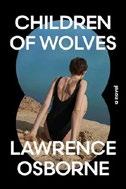
Children of Wolves
Osborne, Lawrence | Summit (224 pp.) $27 | Aug. 25, 2026 | 9781668226438
Investigator Tyler Sedgewick goes to Turkey in search of Chana Knight, an enigmatic 27yearold “chimera” with a taste for destructive antisocial behavior.
A child of wealth whose hated father hires Tyler to find her, Chana has been a handful since her days at a California reform school, where she and her small circle of selfstyled radicals set fire to telegraph poles and property and viewed extremists like the Unabomber as heroes. Posing as a writer, Tyler has little trouble tracking Chana down in Istanbul— where she spent part of her youth, her late mother having been a Turkish society fixture—and falling in with her and her expatriate friends. In spite of her elusive behavior, he’s drawn romantically to Chana, who now goes by Aylin. He curries her favor by introducing her to the American consul, David Meltzer, with whom he was once distant classmates at Groton. With the Hotel Halicarnassus as the Hitchcockian setting and an illicitly acquired gun as the MacGuffin, the plot begins spinning.
A Turkish intelligence agent, Yavuz, senses that Tyler’s chummy relationships with the spoiled Americans don’t add up—he’s more than 10 years older than they are—and wasn’t Tyler a bit too eager to reconnect with Meltzer, whom he barely knows? No one is better than Osborne at conjuring tales about conflicted Americans seeking meaning
and escape in striking locales. And no one is better at sidestepping plot resolutions for which the reader seems set up. Bridging classic and contemporary noir with hints of Graham Greene’s and Robert Stone’s ugly Americans, Osborne creates an unforgiving terrain all his own—one in which the ongoing question is, who is setting up whom? A quietly gripping novel that begs for a sequel.
Kirkus Star
I Made You Up Inside My Head
Pérez-Carbonell, Marta | Trans. by Rosalind Harvey | Riverhead (256 pp.) | $28 July 28, 2026 | 9780593854105
Strangers on a train affect each other’s lives deeply through shared experiences of very different kinds of trauma.
In Mark Twain’s The Mysterious Stranger, a character named Philip Traum reminds a group of young people that every time a human makes a choice, they change their predetermined path. PérezCarbonell has her protagonist, Alicia, a translator, make a big decision in this novel’s first scene, which takes place in Madrid’s Atocha station; her epigraph from Sartre—“the whole tale was made up of things that were in relation to one another”—clues readers in to the fact that Alicia’s story may be complicated. Having decided to live and work in London for a job that requires her to travel by train to Edinburgh each month, one evening Alicia meets two men, Terence Milton and Mick “Bo” Boulder, in a sleeper compartment. Terry, an important mentor to the younger man, has published a novel, Rocco, to great scandal, at least according to a journalist who has uncovered the reallife model for Rocco, a man named Hans Haig. As Alicia slowly learns the story behind Terry’s humiliation, she also recalls her own alltoorecent humiliation: being abandoned on a remote island by
Kirkus Star
her botanist boyfriend, Daniel. Terry’s account, chapters from his novel, Alicia’s pain, and Hans’ secrets all make up a sinuous narrative that proves something Alicia says toward the beginning:
“Although all stories come to an end, not one of them does so completely; they are slowly woven together, just as these fragments were, waiting to form a larger tapestry.” However, there’s something deeper at play than mere taletelling, as becomes evident when both the real and fictional versions of Hans’/Rocco’s life are set forth and Alicia identifies so strongly with the absent Hans that she embarks on a search to make sure he’s safe—a search that, like The Mysterious Stranger, brings into high relief the question of whether or not humans have free will or are primarily acting out their subconscious.
Unsettling and powerful, this novel about who and what we choose to believe is a triumph.
In Nova Scotia, a Mi’kmaq woman who loses the grandmother who raised her is inspired to reclaim her past.
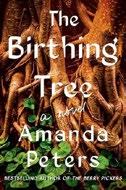
“There is no word for goodbye in our language because there is no such thing. You can’t give a name to something that doesn’t exist. For us, we are always walking among the ancestors. We will see each other again someday is always true.” The followup to Peters’ successful debut, The Berry Pickers (2023), continues to illuminate Mi’kmaq cultural traditions, this time with a dual timeline story set in the past and present of a young nurse named Aliet Paul. Aliet knows about walking among the ancestors from an early age, as her mother died giving birth to her and without revealing the identity of her father. Her grandmother Kiju was the midwife for the tragic delivery and channeled her grief over this and other losses into parenting her granddaughter
A Mi’kmaq woman whose grandmother dies is inspired to reclaim her past.
THE BIRTHING TREE
and grounding her in Mi’kmaq ways. But as we meet Aliet in the present, she is working at her nursing job in an urban hospital several hours away from the village where her family is among the very few Native landowners, having managed to buy back from white settlers land that was originally stolen from them. She has not been home in a long time when she gets word that Kiju has died, and when she sees the state of her grandmother’s house, she realizes how remiss she has been. The novel follows her decision to return permanently to the village, while also exploring the story of her childhood and the reasons for her flight. Peters punctuates the chapters of Aliet’s narrative with brief italicized comments on her journey; by the end, their source is clear, and roots the novel even more firmly in traditional culture. Without being directly addressed, the matriarchal feminism of that culture comes through loud and clear. A quietly compelling portrait of a young woman finding her truth.
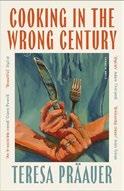
Cooking in the Wrong Century
Präauer, Teresa | Trans. by Eleanor Updegraff Pushkin Press (176 pp.) | $17.95 paper Aug. 4, 2026 | 9781805331780
A deceptively simple recounting of a small European dinner party in which even tiny details reflect global truths. Imagine a mashup of a Renaissanceera Bruegel canvas and a 21stcentury
Grayson Perry sculpture that somehow encompasses all that came between and you’ll approximate the feel of this at once heady and heavy narrative. A youngish Austrian couple, known only as the hostess and the hostess’ partner, invite another couple, known as the husband and the wife, along with a Swiss professor, to the hostess’ new apartment for dinner. Over several bottles of crémant, nibbles, then quiche and salad, their interactions reveal their personalities, histories, and vulnerabilities, from the partner’s embarrassing the hostess on to the academic’s callous disregard for the cigarette ashes he drops on the balcony of an immigrant neighbor. No neoliberal stone will be left unturned as alternate versions of the evening slide into each other—sometimes the quiche is carefully blindbaked, sometimes not—and contrasted with how different it all would have been in an earlier time: “The unfulfilled wishes of her mother’s, grandmothers’ and greatgrandmothers’ generations.” The author, who won Germany’s prestigious Bremer Literaturpreis for this book, neither ignores nor dwells too long on what was, for that country, a decidedly “wrong” century, instead moving on to Angela Y. Davis’ Freedom Is a Constant Struggle and then to the astonishing ease with which these privileged characters can travel and buy goods from other countries, knowing about and able to make recipes with any ingredients without having to consider seasons and frugality, as their forbears did. At the same time, the author holds some issues up to the light: “the thing that reformed itself as feminism every decade, behaving differently each time.” From there, it’s a short leap to the sensuality of food and sex, the academic licking a vinaigrettestained finger, a long list of tempting food photos from Instagram intertwined like the
Kirkus Star
conversations held between different groups (an American couple appears at one point, underscoring how confusing our country is right now for Europeans). In the end, the novel is not an indictment of privilege, but a greatly magnified and ironyladen slice of life. This impressive novel feels at once modern and eternal, like a perfectly balanced and freshly honed chef’s knife.
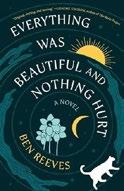
Everything Was Beautiful and Nothing Hurt
Reeves, Ben | Avid Reader Press (256 pp.) $28 | July 7, 2026 | 9781668216361
The personification of death stumbles on companionship in the small British city where he lives, as he continues standing sentinel beside people in their last moments.
Narrator Travis Smith is “inside everything”—ebullient mayflies, skittish deer, and the people around him. He’s privy to how long they’ll live and to every intricacy of their lives, his job to stand witness to people’s dying moments. He’s never challenged this role, even as the everpresent noise sometimes overwhelms him. But Travis finds his isolated, detached life disrupted by Dalia, a midwife, and her two young daughters, who live in the flat across the hall. Through them, he unintentionally becomes a participant in life in a new way. The novel captures the seemingly contradictory idea of beauty in scenes of pain. The violence of a car crash is juxtaposed with the natural world surrounding it, the banality of everyday life continuing even as one life stops. This tension is woven throughout, as readers glimpse Travis’ work as a witness to people’s dying moments. In short passages in which Travis describes a person’s end and salient events in their life, we see a welletched character for whom death can be relief, terror, or perhaps the ultimate injustice. Author Reeves has a keen eye for the salient detail, making the reader become
emotionally invested in characters seen only briefly. As Travis’ narration moves from his work to the quiet yet increasingly meaningful time he spends with his neighbors, it illuminates a microcosm of the cycles of life and death, as glimpsed through the natural world and scenes with community members. Conversations feature crisp dialogue and moments of silence that emphasize how loss and grief can’t always be articulated and comfort can’t always be given. As Travis’ relationships with his neighbors grow, his sense of himself as a person outside his role also evolves, and his job begins to burden him emotionally. Through Travis, we see the beauty of love and small moments of companionship and connection, all the more powerful for the fact of life’s brevity and unpredictable end.
An evocative, kaleidoscopic affirmation of life from the perspective of Death.
C ould making a movie about the disappearance of five women from an island reawaken an evil presence there?
Five dresses hang from the topmost limbs of an oak on a remote island in a Vermont lake. That memorable image marks a mystery from a century ago, when five women believed to have been part of a commune vanished forever. As this novel opens, another group gathers on the island to make a movie based on that tale. Marin Keane, the narrator, is surprised but thrilled to find herself cast as one of the leads; she’s a struggling actor whose biggest part so far has been “Bridesmaid with Eczema” in a drug commercial, so playing Daisy Rue, whose haunting diary is the basis for the movie’s script, could be a careermaking move. Ronan Peters, the writerdirector, is talented and, Marin notes, hot. His reason for gathering the cast on the island
is a kind of bootcamp rehearsal: They’ll spend a week living there, wearing period clothes, and managing without internet or phone service. Oh, and holding séances. What could go wrong? Marin quickly meets the other women in the cast: regal character actor Julianne Brown, cool and competent Heather Benchley, bratty former Disney star Susie Hutchinson, and, striking awe in all of them, Violet Wright, a muchawarded Meryl Streepish figure who will play the woman who brought the others to the island, which she owned. They get to work, but soon enough someone disappears. The book’s plot, like the movie’s script, largely follows Daisy’s journal, and since the reader is supplied with pageslong sections of that journal, there’s not much suspense about what will happen next. There are some effective set pieces, such as the group’s first séance. But in its last quarter, the plot collapses into a muddle of #MeToo vengeance, improbable secrets, and jarring character reveals that is, as Marin says, “the most ScoobyDoo thing I’ve ever heard.”
This thriller’s eerie mood is deflated by a plot with more holes than a Halloween sheet.
Soileau’s debut novel explores the effects of time and tides on generations of Acadian residents of Louisiana’s Gulf Coast. Launched from a propulsive first chapter recounting the experiences of Noé Terrebonne and others—mostly descendants of Acadians exiled from New France to the bayous of the Gulf Coast—during a deadly storm in 1893 which annihilated life and property on Chenière Disparue, the sliver of land they inhabit, Soileau’s tale traces the history of the Terrebonnes and other Acadian families through generations and
across oceans and continents. More recent descendants of the clan face equally chilling consequences when confronted with the environmental and social disasters presented by an explosion on an offshore oil rig and subsequent uncontrolled oil spill. An evocative sense of place is created by the author’s keen descriptions of the bayous, lakes, and marshes—inhabited by generations of Acadians such as the Terrebonnes and their inlaws as well as laterarriving Asian immigrants— which provide ghostly glimpses of the characters’ ancestors. Equally compelling, her characters are set in motion against a backdrop of environmental uncertainty, family disharmony, and economic stress. (Everyone’s nerves are frayed postKatrina but nothing stops the weather.) The predatory forces of oil companies and their unscrupulous “landmen” present another issue altogether, and complicity and resentment are two ways that Soileau’s flawed, striving characters experience those forces. The menacing potential of water recurs as a motif throughout the novel and unites the experiences of the earliest settlers of New France with their Acadian descendants. Water can provide you with a living as a fisherman or oilman; offer secluded byways for romance or recreation; drown you or carry your already dead body away. In lyrical prose, Soileau illustrates each possibility unfolding as character after character struggles for survival in a world where “God’s thumb [is] pressing down.” A gorgeous meditation on the forces that create and destroy communities, families, and lives.
A grieving woman finds herself banding together with the eccentric residents of her dilapidated Calgary, Canada apartment complex.
After Mona Bucket’s boss encourages—if not
forces—her to take an extended leave from her job at a marketing firm, she’s at a loss. Her job is all she has going for her—she’s still reeling from her father’s death, her relationship with her mother is tense, she lives in a building that has more strange smells than amenities, and she has no social life. A solution presents itself when Irene, her landlady at Valleyview Apartments, falls and injures herself. Mona can become the building’s temporary super, which she’s happy to do since it’s sort of her fault that Irene fell (it’s a long story). But Mona isn’t motivated by mere guilt—Irene’s niece Lana Winston, a realtor, says that if Mona helps her fix up the building so she can present it to potential buyers, she can guarantee Mona an apartment in a much nicer building. Mona is desperate to get out of Valleyview (which has neither a valley nor a view), where she lives alongside tenants she gives nicknames like “Fancy Widow” and “Old White Perve.” She agrees to help, but in the process of getting to know the residents, she begins to find the sense of belonging she’s been seeking. There’s also a burgeoning relationship with Sami, whose family owns the diner across the street—and who would be crushed to know Mona is working to displace the residents of the building he loves. Just as she did in her debut, I Hope This Finds You Well (2024), Sue creates a funny but heartbreaking portrait of a lonely woman longing to be known. As Mona learns the stories of each building resident, she begins to see that they’re more than their nicknames. They all deserve friendship and love—and that includes Mona, too, if she can learn to accept it. Sue has a gift for portraying flawed but likable main characters who can’t help
but make the wrong decisions even as they crave connection. A lovely look at finding belonging in the most unlikely of places.
The Seduction
Torres, Sara | Trans. by Mara Faye Lethem Primero Sueño Press/Atria (176 pp.) | $17 paper | June 2, 2026 | 9781668092989
A photographer and a writer circle each other in a cottage on the coast of Catalonia. The photographer has come to this little house an hour outside Barcelona to photograph the writer for a series about women artists at work. The two connected when the photographer, enraptured by the author’s portrait on the cover of her novel, reached out and suggested this collaboration. But the project is mostly a gesture, a vehicle to carry them forward to the intimacy the photographer craves with the writer she has idealized. Once at the cottage, her “seduction” is the only goal, a project apparently disrupted by the presence of a third person, a close friend of the writer’s and the novel’s only named character, Greta. The photographer is younger than the others, 32, and her firstperson narration is full of her insecurities, her ambivalence about her body, her desire for the writer, and her theories of seduction. Before meeting in person, correspondence between author and photographer hinted at blossoming romance, but in person, their interactions feel cold and distant, and the photographer perseverates over her
A photographer and a writer circle each other on the coast of Catalonia.
stymied appetites. When, two thirds of the way through the novel, sections of the writer’s notebook join the narrative, her more mature perspective—she is 50—invites muchneeded air into the story. Torres has a Ph.D. in theories of lesbian queer desire and fetish, and her scholarship is evident throughout the novel, to the extent that the characters often end up feeling more like psychological models than actual people. There’s a lot to be said for this: Their interactions are thought provoking and musings on desire, appetite, power, jealousy, the gaze, childhood, body image, and queer sexuality are frequently illuminating. However, the work as a whole does not function as transportive fiction. Adroit in theory, a bit tiresome in practice.
Majestic Hills
Turner, Dawn | Scribner (336 pp.) $29 | Aug. 4, 2026 | 9781668049310
Black professionals fleeing the city navigate a placid danger in the idyllic exurbs of Majestic Hills.
Josephine
Taylor Blaque and Langdon Blaque’s enviable marriage and lives of achievement and purpose are unsettled by their move to a seemingly perfect planned community. Forty miles outside Chicago, leafy Majestic Hills, in fictional New Pointe, Illinois, is home to trust fund money, white flight refugees with gun collections and itchy trigger fingers, and urban professionals like attorney Josephine and Langdon, an emergency room doctor who’s grown weary of the violence he regularly tends to in the city. Josephine was deeply resistant to the move, citing the town’s lack of diversity and a sensibility that reminded her too much of the Jim Crow south her father had fled, but Langdon insisted that this change was something they needed, even putting down a hefty deposit without her buyin. But
McMansions and manicured lawns are no guarantee against pain, even in a subdivision so shiny, new, and hastily constructed that the clubhouse is still being built. As they settle in, the novel strikes a hard balance between heightened elements—the symbolic “Blaque” surname, neighbors in white hooded beekeeper gear who look like KKK members marching in the distance, a mysteriously nightmarish prologue—and the relatable challenges of everyday life. Voicing her trepidation about moving out of Chicago, Josephine compares the Majestic Hills vibe to the infamous 2017 neo Nazi rally in Charlottesville, Virginia: “Living in the woods is not a selling point. Makes me think of Unite the Right maniacs with their tiki torches and replacement theories… And lynchings.” But the text is highly aware of its own intensity. References to “strange fruit” and Frederick Douglass abound. And conflicts that begin in a showy way grow deeper and more nuanced as the story progresses. These are not subtle strokes, but these aren’t subtle times. An effective blend of allegory and harsh reality, this social drama grows stronger at each turn.
Kirkus Star
The New People
Uptmor, Andrea | Little, Brown (320 pp.) $29 | July 21, 2026 | 9780316602211
Set in 2008, against the backdrop of Barack Obama’s election and California’s antisamesex marriage referendum, Uptmor’s ambitious first novel renders the dangers of divisiveness, rigidity, and lack of communication through the experiences of two married couples who could not be less alike.
Rachel, a feminist scholar, and Emma, an aspiring novelist, have recently gotten married and moved from Chicago to
Riverbend, Indiana. Despite the affectionate solicitude they share, unspoken resentments and secrets simmer under the surface of their relationship. Recovering from a miscarriage, Emma hides her pain and her desire to try IVF again from Rachel. Both women tread carefully around Rachel’s career success: Not only has she received a tenuretrack professorship at Boon University while Emma has been offered only a lowly adjunct teaching job; Rachel has also recently published and received great acclaim for an SF novel she knocked out as a lark, while Emma has yet to publish more than the occasional short story. Now socially adept Rachel remains politely oblivious as selfdoubting introvert Emma suffers culture shock in their new neighborhood. She spars with her neighbor Patty, who’s a Republican and makes passiveaggressive remarks about samesex marriage, when she finds her trespassing to tend lilacs planted by the former owners of Rachel and Emma’s newly purchased house. The ensuing conflicts seem familiar, even hohum, until suddenly the plot goes charmingly off the rails when it turns out that those former owners, Charlotte and Dirk Dennison, are living undetected in the hidden attic above the attached garage. Resentful that they were scammed into having their home foreclosed, Charlotte has no qualms about using the bathroom and kitchen while Rachel and Emma are at work and goes into poltergeist mode to make their lives uncomfortable. Moments of high comedy and real pathos ensue. Whether the issue is academia, marriage, or parenthood, no one is entirely in the wrong or in the right, neither the narrowminded urban progressives nor the narrowminded smalltown conservatives. Using upbeat escapism, Uptmor confounds expectations to expose the darker realities of American life.
For more debut fiction, visit Kirkus online.
Kirkus Star
Furious Violet
Walker, Sarai | Harper/HarperCollins (352 pp.)
$30 | July 28, 2026 | 9780063437876
A true crime writer attracts a terrifying stalker. Ever since somebody broke into Violet “West” Shelley’s Los Angeles condo, she’s been using her latest project—a book about Utah’s “Crying Killer,” an uncaught serial rapist and murderer who’d cry for his mommy—as an excuse to hole up in a Salt Lake City hotel. After interviewing the last survivor on her list, West heads east to her Colorado hometown of Copper Mallow, where she intends to finish her manuscript while housesitting for Lawton Bellwood, the maternal uncle who raised her. After a stop for snacks en route, West finds a postcard on her windshield that reads, “HELLO MOTHER.” West is nobody’s mother, but the message still unnerves her, and she speeds off without investigating. Hours later, West gets an anonymous phone call during which a distorted voice entreats, “Mother, come home.” She reaches Copper Mallow without further incident, but then receives yet another disturbing note, prompting fears she’s being hunted by the kind of psychopath she writes about—perhaps even the Crying Killer himself. Muddying the waters is the fact that West’s mother is Juliet Bellwood, a “trailblazer of confessional and feminist poetry” who suffered from postpartum depression and died by suicide when West was an infant. Juliet’s most rabid fans despise West and Lawton for failing the literary icon and
her legacy, and unfortunately for West and her lengthening suspect list, a nearby college is hosting a symposium to mark the halfcentury since Juliet’s death. West’s snarky yet vulnerable narration heightens tension, raises stakes, and amplifies the impact of every reveal. Excerpts from essays about Juliet’s life, death, and work dot the presentday storyline, providing context for West’s anger, anxiety, and abandonment issues and allowing Walker to contemplate the fraught concept of motherhood from both West’s and Juliet’s perspectives. This claustrophobic, pulse-pounding tale of paranoia rivets from start to cathartic finish.
Reliquary
Whitten, Hannah | Run for It/Orbit (320 pp.) $30 | Aug. 11, 2026 | 9780316579537
Standalone horror from the author of the Nightshade Crown fantasy series. After finding a love that was more than she’d ever hoped for, Claire Sutherland finds herself alone again. A boating accident left her a deeply traumatized orphan. A mysterious neurological ailment took her fiancé. When Elias’ mother invites her to their home for a memorial service, Claire hesitates at first. She’s never met any of Elias’ relatives because he wanted nothing to do with them. But the lure of family is too strong for Claire to resist, so she accepts the invitation to the Ashbury clan’s island compound. “Looming above everything like a dragon on its hoard,” Harrow Point is a massive assemblage of
This pulse-pounding tale of paranoia rivets from start to cathartic finish.
spires and gables carved into a cliff. What Claire doesn’t see from the outside is the labyrinthine rooms that spiral down into the dark depths of the ocean. Whitten has assembled all the essentials for a gothic novel. There’s an isolated and endangered heroine. There are family secrets that won’t stay hidden. And the setting is the perfect blend of the sublime and the uncanny. What this novel lacks is compelling characters and persuasive worldbuilding. There’s one character in this story who has depth, and it’s not the protagonist. It is, instead, Elias’ brother, Ash, and Claire’s refusal to recognize that he’s trying to help her gets annoying fast. She’s grieving, she longs to be part of a family again, and nothing she learned about Ash from Elias makes her inclined to trust her fiancé’s older brother. That said, Claire is dense to the point of being ridiculous and scenes that should be terrifying aren’t. One reason gothic novels are often set in the past is that this makes it easier for readers to suspend disbelief. Whitten’s contemporary setting means that the more the reader learns about the Ashbury family’s dark secrets, the less plausible they become. What could have been an inventive gothic novel descends into something close to farce.
Kirkus Star
The Nightingales
Wilson, Emil | Avid Reader Press (416 pp.) $38 | Aug. 4, 2026 | 9781668217771
A coming ofage story set in the midst of the AIDS crisis. Lou Miller is in her senior year of high school when her father, Don, invites a coworker with cancer to move in with their family. Lou’s mother, Annemarie, is outraged, both by the fact that Don didn’t consult her first and by the presence of an unwell stranger in their home. Lou herself finds someone she can talk to—and someone she can love and care for—in Jim. While a contemporary reader may quickly
discern that Jim actually has AIDS, it takes Lou a little while to catch on. In smalltown Oregon in 1985, AIDS was still new and alien. Don and Lou react to Jim’s illness with empathy, while Annemarie reflects on the fear that permeated American culture when AIDS was widely misunderstood as a “gay plague” and misinformation about its transmission was rampant. This graphic novel is stunning in every way. Wilson forgoes panels in favor of a format that is part sketchbook, part journal, and part scrapbook—a choice that gives both the visuals and the narrative room to breathe. The artwork has an intimacy and immediacy that complements the text beautifully, and the vibrant color palette communicates the joy that the relationship between Lou and Jim brings them both. Sensitive but blunt and mordantly funny, Lou is a great narrator. Jim is also a wonderfully wellcrafted character. He is, by turns, charming and sentimental and ironic and angry. He talks to Lou like a grownup, and his tales of living as a gay man in preAIDS New York inspire Lou to pursue her own dreams rather than the path her parents have set out for her. Scenes starring Jim’s Pomeranians, Henny and Penny, offer welcome comic relief—and serve as a space for Lou to work through some difficult experiences. Absolutely gorgeous, visually and emotionally.
Etna
Yoon, Paul | Scribner (208 pp.) | $28 Aug. 4, 2026 | 9781668020821
Yoon’s latest is a contemporary Odyssey as experienced and told by a bomb sniffing war dog. After a brutal conflict in an unnamed country, our title character—impelled by an instinct he only dimly understands— leaves his damaged fellow soldiers and wanders through a blasted landscape toward his coastalvillage home. Along the way, Etna encounters ruin and danger
A recent college graduate becomes obsessed with her boyfriend’s cat.
KITTEN
everywhere: insurgents, drones, unexploded ordnance. He encounters an old blind dog, living alone in a field of carnage that used to be a farmstead, who subsists on tins of meat scavenged from a train wreck and punches open, bloodily, with his teeth; a kindly couple who provide medical care to refugees both human and animal; and a young and vulnerable city dog who becomes Etna’s friend, aide, and sidekick. Then there’s Soojin, the woman who recruited, or rather conscripted, Etna into the military and gave him his name, and who has, perhaps uniquely among humans, the ability to communicate with dogs and to read or anticipate their thoughts. The prose is often lovely, and Yoon captures well the dog’s stoicism and loyalty, its ability to live in the moment and not even entertain the questions that lie beyond the possibility of knowledge. This is a novel in part about navigating desolate, dangerous landscapes, physical and otherwise, until you find a place to rest, a place where hope— to this point wisely set aside, not even considered— might grow. Spare, lyrical, often moving—but it doesn’t fully avoid the sentimental traps of having a canine narrator.
Kitten
Yu, Stacey | Random House (304 pp.) $29 | Aug. 4, 2026 | 9798217155064
A recent college graduate who’s estranged from her mother becomes obsessed with her boyfriend’s cat. Katie is adrift in Manhattan. At 22, she doesn’t have much going for her
other than her relationship with James, her wealthy 26 year old boyfriend. She’s down to her last $50; her work study job at the university law library is over, and her last paycheck is stuck in limbo. Her roommate, Lou, is growing impatient with her and their apartment situation is tenuous. Returning home is out of the question: Katie isn’t speaking to her difficult mother. A new roommate is unlikely, too, as Katie has always had a hard time fitting in with other people. (Her status as a Southerner and the daughter of a Chinese immigrant doesn’t help her blend in with New York’s young elite.) When James suggests spending a couple of weeks together at his family’s seaside vacation home, Katie has no reason to say no. To her delight, James brings along the family cat, Silver, whom he’s watching while his parents are abroad. In Katie’s eyes, Silver is the perfect creature: coddled, with no responsibilities, thoughts, or social pressures weighing her down. The longer Katie spends in James’ vacation home with Silver, the more she must confront the source of her feelings of abandonment and powerlessness. Yu’s novel is both a kind of Gen Z parable of existential nihilism and a psychologically deft portrait of motherdaughter trauma. Though it’s a narrative challenge to depict a character like Katie, a “nonperson” who’s “forever losing [her] own face” in the mirror, when Yu starts pulling all the pieces together in the book’s second half, the story shines with sharp intelligence.
Weird girl lit is having a moment, but this spiky debut refuses to be boxed in.
SEEN AND HEARD
New Novella
by Casey McQuiston
Coming This Fall
Red, White & Royal Blue: The Private Correspondence revisits characters from the 2019 bestseller.
Good news for fans of queer romance: Alex Claremont-Diaz and Prince Henry are making a comeback in a new novella by Casey McQuiston.
St. Martin’s announced it will publish McQuiston’s follow-up to their novel Red, White & Royal Blue later this year. It calls Red, White & Royal Blue: The Private Correspondence “a brand-new novella told through notes and letters, continuing the unforgettable love story which
captured hearts around the world.”
Red, White & Royal Blue, published in 2019 by St. Martin’s Griffin, told the story of Alex, son of the U.S. president, and Henry, a British prince, who initially can’t stand each other but end up falling in love. In a starred review, a critic for Kirkus praised the book as “a clever, romantic, sexy love story.”
Red, White & Royal Blue: The Private Correspondence, St. Martin’s says, “delves into the intimate archives of Alex and Henry, spanning over 20 years since the fateful day Alex and Henry joined together on the world’s stage. This epistolary novella includes their personal letters, postcards, journal entries, and more, sharing everything from sarcastic bon mots to sexy fantasies to emotional discussions about starting a family, giving readers compelling insight into the long term futures of Alex and Henry as well as beloved supporting characters.”
Red, White & Royal Blue: The Private Correspondence is slated for publication on Dec. 1.
—MICHAEL SCHAUB
For a review of Red, White & Royal Blue, visit Kirkus online.
Casey McQuiston
Book to Screen
Florence Pugh To Star in Midnight Library Film
The actor will also produce the movie based on Matt Haig’s 2020 novel.
Florence Pugh is set to star in a film adaptation of Matt Haig’s The Midnight Library, Deadline reports.
Haig’s bestselling novel, published in 2020 by Viking, follows Nora Seed, a woman who tries to take her own life after losing her job and her beloved cat. After overdosing on prescription medicine, she wakes up in a mysterious library full of books that chronicle alternate versions of her life. A critic for Kirkus called the novel “a whimsical fantasy about learning what’s important in life.”
Haig’s most recent novel, The Midnight Train, was published on May 26.
Pugh, known for her roles in films including Midsommar and Little Women, will play Nora in the movie, which she is also producing. The film will be directed by Garth Davis ( Lion, Mary Magdalene) and written by Laura Wade (The Riot Club) and Nick Payne (The Sense of an Ending). Haig is among the film’s executive producers.
Davis told Deadline, “[Pugh’s] warmth and talent are magical, and together I know we’ll do something special working with Matt’s iconic novel. This is a story that moves us both—a celebration of life in all its possibility and complexity.”
And Haig said, “I am so happy that Nora’s story is in such great hands, and that her myriad possibilities will be vividly reawakened by the absolute perfect team. And I can’t wait for people to see my book reimagined for the big screen.”—M.S.
Florence Pugh
For a review of The Midnight Library, visit Kirkus online.
A quicksilver family reckoning whose epiphanies arrive in the form of felonies.
An LAPD detective leaves after her first day in her new position to look into a much more personal case. Maria Cole spent nine years as a street cop before her long sought promotion put her on the scene just in time to kill a teenage murder suspect in self defense. At exactly the same moment that she shoots Felix Sotto, her estranged father, Billy Cole, is apparently killed in a robbery in Fair Port, Alabama. Shocked by this uncanny coincidence, Maria flies east even though she’s avoided her father for the past 27 years. She instantly ticks off Police Chief Karl Rawlins by asking sharp questions and goes right on challenging him even after the police arrest Billy’s fellow Alcoholics Anonymous member Dray Forrest for the murder and he all but confesses by hanging himself in his cell. Maria’s discovery that The Gallery, the restaurant Billy managed, was destroyed last month in a fire along with virtually all the paintings he’d been working on for years, makes her resolve to track down the villains, who definitely number more than one. Early on, in fact, she becomes convinced that Billy’s death is part of a vastly broader and deeper pattern of crime and corruption. To her surprise, Maria realizes that “twentyfour hours in his world and she had more empathy” for her alcoholic father than
she’d ever experienced before. She also learns that southern Alabama can be just as violent and treacherous as the City of Angels.
A quicksilver family reckoning whose epiphanies arrive in the form of felonies.
Probable Caws
Andrews, Donna | Minotaur (304 pp.) $28 | Aug. 4, 2026 | 9781250407320
Despite its faithfully birdthemed title, blacksmith Meg Langslow’s 39th brush with murder has more to do with horses than crows. A lot more.
Now that Abel Abernathy’s 100 year old father has finally died, his no good brother, George, has popped up to demand half of Ezra Abernathy’s Virginia estate and, incidentally, sue Abel for devaluing the property by letting 47 Friesian horses graze there. Unable to cope with either his brother or his brother’s threats, Abel has asked locals for help. Since there are too many horses for Caroline Willner’s wildlife sanctuary or Helena Bannerman’s Hoof and Hearth rescue, they’re headed to Ragnar Ragnarsen, the heavy metal drummer who’s retired to Ragnarshjem, a farm he’s dedicated to all things goth. Managing, soothing, and caring for the herd requires the services of Marjorie Mewha, Ragnar’s stable manager; local vet Clarence Rutledge; Meg’s cousin Rose Noire; and Meg herself, whose experience with sudden death more than compensates for her lack of experience with horses after she discovers a dead body
in Ragnar’s vast horse barn at the end of a long day. Sadly, the dead man isn’t George Abernathy, which would have been nice for Abel, but George’s sideman, Lefty Culverson, and George has an alibi for the time of his death. So he sticks around and serves the invaluable function of casting suspicion on Helena; on her stable manager, retired jockey Tomás Ortiz; and of course on Abel. The crows are upstaged not only by those Friesians but by the swans who attack Helena’s ne’erdo well brother en route to a quietly satisfying denouement. Expect to learn a lot more about living horses than murder victims.
Murder at the End of the World
Araki, Akane | Trans. by Jesse Kirkwood Pushkin Vertigo (336 pp.) | $17.95 paper Aug. 4, 2026 | 9781805336532
The apocalypse looms; why not spend your final days solving a murder?
There are bodies everywhere in Araki’s lively fiction debut: bodies in the trunks of cars, on the side of the road and, most significantly for university student Haru, hanging from the ceiling at home. As an asteroid hurtles steadily toward Earth—the planet’s destruction is inevitable—it triggers a gamut of reactions. Haru’s mother has left the family, and her distraught father has died by suicide. She dutifully arranges his body before heading off to her driving lesson with charismatic instructor Isagawa. Though they’re not unmindful of the coming disaster, these two women are determined to continue their normal lives while contemplating their options. During the driving lesson, they discover a young murder victim riddled with stab wounds. Isagawa’s righteous indignation is triggered, and since the overworked police will likely ignore the crime, she decides to
investigate. It turns out she’s a former police detective. Haru is inspired to assist her. Part mystery and part road trip, Araki’s brisk novel rests on a cushion of banter between the two women. Despite its dark premise, it’s surprisingly entertaining. Araki stylishly depicts the duo’s blossoming friendship, their shared fervor to untangle a complex mystery, and the growing confidence reflected in Haru’s engaging firstperson narration. Simmering beneath the surface is a slyer exploration of human behavior in the face of imminent disaster.
A refreshing Japanese whodunit with a charming detective duo.
The Ninth Circle
Benn, James R. | Soho Crime (400 pp.) $29.95 | Sept. 1, 2026 | 9781641297486
When sketchy characters create havoc in Cuba, American military detectives race to the rescue.
Capt. Billy Boyle’s latest World War II mystery begins with a literal bang. As he and sleuthing sidekick Piotr “Kaz” Kazimierz wait in a seedy bar on the Cuban waterfront to rendezvous with a contact, a suitcase bomb disrupts their plans in an explosive foreshadowing of the crazy caper to come. Billy’s 21st adventure is set in January 1945, as the war draws to a close, but things are far from calm in the struggling island nation. The British have a large presence, and Nazi Germany has also gained a foothold there. Against this turbulent backdrop, the detective duo investigates the mysterious murders of British Intelligence officer Hugh Sinclair and local informant Hector Díaz. Less a conventional whodunit than a twisty thriller, the tale is also a vehicle for depictions of local points of interest and historic tidbits. Celebrity appearances, which have typically been a highlight of the series, figure prominently once more, beginning with Ernest Hemingway, who is often mentioned but never seen. The
infamous Jewish American gangster Meyer Lansky has built a gambling empire in Cuba, Nazi sympathizers the Duke and Duchess of Windsor are in residence, and Billy and Kaz team up with Royal Navy Intelligence officer Ian Fleming in their quest for answers. Billy’s jaunty firstperson narration again helps the interesting but complicated historical information go down easy. A useful cast of characters is included.
A colorful history lesson embedded in a brisk action tale.
Five Things I See
Church, Wendy | Severn House (320 pp.)
$29.99 | Aug. 4, 2026 | 9781448321407
The prolific Church launches a new series starring a Jacksonville, Florida, homicide detective whose backstory is as mysterious as her caseload. It begins with a routine call that leads to a violent crime scene. Someone has beaten and strangled shop clerk Jessica Stewart to death and left her husband, Prof. Daniel Stewart, to bleed out. Det. Grace Hartwell sends her crew to canvass the neighbors, none of whom claims to have seen or heard anything, but there’s something off about Eddie Snow, whom Grace interviews herself. When she reports her suspicions to Lt. Landel back at the station, her boss tells her in no uncertain terms to leave Snow alone. As Landel’s warnings become stronger and more menacing, Grace attempts to concentrate instead on the death of city council auditor Howard Scofield, who fell or was pushed from the top floor of a new hotel. But a string of murders eerily echoing Jessica Stewart’s leads Grace back again and again to the figure the papers have dubbed the Blonde Reaper. Brief snatches of italicized dialogue that introduce each chapter point to a dissociative response to some unspecified trauma that’s linked ever more closely to Grace, who powers through resistance from city fathers, fraudulent bigmoney investors,
colleagues, and her superiors to identify a suspect whose profile fits her working assumptions about the Blonde Reaper to a T. Exulting in her victory over Det. Lance Elliott, the entitled colleague assigned to her team from Special Projects, she rushes to make an arrest and assumes the case is closed. It isn’t. What follows is more tightly ratcheted than anything that’s come before. A textbook case of how to make a police procedural pulse with energy.
Purranormal Activity
Conte, Cate | Minotaur (304 pp.) | $9.99 paper | July 28, 2026 | 9781250435187
A cat lover lands her 10th felinerelated mystery. In the years since Maddie James moved to Daybreak Island, Massachusetts, she’s started several businesses and made many friends. Among the most popular features of her mobile cat cafe are the parties featuring adorable and adoptable kitties. Then a call from a new customer booking a birthday party plunges Maddie into a mass of murder and deceit. Olivia McAllister was Maddie’s mother’s best friend in high school, but she left the island without a word after her aunt Delia vanished from the family estate. Maddie’s mother is astonished to hear that she’s back, and she and Maddie, along with Maddie’s cat, JJ, head over to Olivia’s home to see her. When they arrive, they find the door ajar and the house empty except for a gorgeous longhaired whiteandgray cat that leads Maddie to a secret room behind a bookcase, where she finds Olivia dead in a pool of blood. After calling 911, Maddie calls her grandfather, a former police chief who sometimes helps the local department and has assisted her in solving many catrelated murders. The wealthy McAllister family has deep roots on Daybreak, and although they have not lived in the house since Delia vanished, they still have enough political clout to make the police step carefully when they arrive. Anxious
to make sure the cat is all right, Maddie follows it to the beach, where she finds Olivia’s 4yearold granddaughter, Piper, playing in the sand. As her own mother becomes a suspect along with several McAllisters, Maddie tracks down clues from the past and present, but it’s the famous island ghost cat, which few people can see, who helps her discover the truth. Feline fanatics will love this catcentric mystery packed with delightful human characters.
A Thief’s Folly
Dams, Jeanne M. | Severn House (240 pp.)
$29.99 | Aug. 4, 2026 | 9781448320592
It takes a village to catch the thief who burgled the most beloved person in Sherebury. American transplant Dorothy Martin and her husband, former Chief Constable Alan Nesbitt, have solved dozens of mysteries, but never one closer to their hearts than the problems that bedevil their beloved neighbor Jane Langland. Former teacher, master gardener, bulldog lover, and baker extraordinaire, Jane is a rock—so it’s quite a shock when she has a stroke and goes to rehab to recover. Dorothy and Alan are amazed at the number of people worried about her, and disturbed because they can see that Jane’s trying to tell them something even though she can’t yet talk or write. They’re worried about the security of her house even though they don’t imagine she owns anything of great value, but when Dorothy searches Jane’s house, she uncovers a cache of gold coins. When Jane’s reaction tells them the coins are not what she’s worried about, Alan asks a police officer who’s renowned for finding hidden things to check the house in his off hours. Wild barking from their dog, Watson, alerts the sleuthing couple to a breakin at Jane’s. Nothing’s been taken, but Dorothy continues to worry about her inability to discover what Jane’s so upset about. Despite their friendship, Dorothy knows little about Jane’s
background. Looking into the past, she discovers that Jane’s parents were suspected collaborationists during World War I. Her discovery that the family switched from selling antiques to books gives her the clue she needs. The bookshop’s current owner, Roger Palmer, who worked with Jane’s parents—and to whom Jane just gave the shop after they died—tells Dorothy that Jane kept only a valuable fourvolume 1890 set of Northanger Abbey and Persuasion for herself. The disappearance of those volumes redoubles their determination to find the thief.
One of the warmest and most down-to-earth mysteries in a charming, popular series.
A woman returns to Havana in 2020 to investigate two deaths written off as suicides 40 years earlier.
Teresa, a New Mexico mystery writer who’s always wanted to be a detective, is still haunted by her life as a teen in Havana. A call from her childhood friend Estrella, a Miami DJ whom she hasn’t seen in years, provides the impetus for the two of them to go back to Havana to investigate the deaths of their classmate Yoyi and Felipe, their English teacher, whom Yoyi had been sleeping with. Felipe allegedly threw himself from a window, and a devastated Yoyi supposedly poisoned herself. The story switches back and forth between the presentday investigation and the past, when neither of the friends told the truth about what happened that day. Teresita was a model student who lived with her mother, Cristina, a pharmacist, and her grandmother. Her father had left Cuba on a raft for a life in New Mexico. The much more attractive Estrella was freespirited and uninhibited despite her strict mother. She hung out with Teresita as a cover for her wilder impulses.
Teresita discovered the destination of the pills that had gone missing from her mother’s pharmacy but kept quiet to protect the family. After the deaths of Yoyi and Felipe, Teresita had a nervous breakdown, and her mother took advantage of the Mariel boatlift to get them both out of Cuba. The friends begin their presentday investigation in a rented apartment but move to a hotel in the building that once housed their school, and that’s where things heat up. A fascinating look at life in Cuba cleverly intertwined with a series of puzzles the protagonist is desperate to solve.
Kirkus Star
The Opposite of Murder
Hannah, Sophie | Poisoned Pen (352 pp.) $17.99 paper | Aug. 25, 2026 9781464279270
A perfectly normal wife and mother marches into a suburban British police station and insists on confessing to a murder that hasn’t been committed yet. Except it has. The two reasons Jemma Stelling wants to tell DC Simon Waterhouse every detail of her plot to kill Marianne Upton, her boundlessly hateful stepmother, are that she’s already lived with this horrid dream for an agonizingly long time and she’s convinced that once he’s taken down the details, she’ll be too certain of being convicted to ever go through with it. Needless to say, Waterhouse, who wonders at length why she’s wasting his valuable time, isn’t the most patient or sympathetic interlocutor. But he gets a lot more interested once he learns that Marianne has been fatally stabbed during the very period when Jemma was confessing to him, a revelation that leads the two to switch sides instantly. The perfect alibi, Jemma tells Waterhouse. Hardly, he counters; her bogus confession only provides more evidence that she’s hired someone like her old school friend
Tom Tulloch to do the job while she basks in her welldocumented innocence. After all, if Jemma didn’t arrange Marianne’s death, which member of her alarmingly closeknit family did—her newly widowed father, Gareth Upton; her husband, itinerant barman Paddy Stelling; their 13yearold daughter, Lottie; Oliver Mayo, the man Jemma left behind; or her best and perhaps only friend, Suzanne Lacy? Fans who recognize the setup as retro and claustrophobically limited won’t be surprised by Hannah’s evergreen ability to pull compelling clues out of nowhere and point them in unsuspected directions. A model who’s-going-to-do-it from its irresistible hook to its final surprise.
Of Devotion and Death
Hastings, Anastasia | Severn House (256 pp.) | $29.99 | Aug. 4, 2026 9781448320141
The holiday season in Victorian London isn’t quite so merry when someone dear is charged with the murder of his wife. Spinster Violet Manville hides much of her life from public scrutiny. In addition to writing the pseudonymous “Dear Miss Hermione” advice column in Woman’s Place magazine, she’s privately investigated two murders brought to her attention by despondent correspondents. Even more scandalously, she plans to spend Christmas in Venice with shrewd, handsome American Eli Marsh, who’s both her rival and her heartthrob. Just as Violet’s about to set out on her journey, she’s stunned by the arrival of Ash Kumar, her childhood sweetheart. When young Violet was in India during her father’s Foreign Office service, she and Ash courted, but they were forbidden to marry. Ash married another woman, Ishani; Violet returned to England. Only now has Ash come to London to assist with the grand Colonial and Indian Exhibition, displaying the pride of the Empire, including the priceless Karur
A welcome return to the world of Edinburgh philosopher Isabel Dalhousie.
THE SUBTLE PLEASURES OF INDISCRETION
Ruby. His duties have been cut short by the sudden strangulation of his wife in their home, apparently with his silk scarf. Ash uses his last free moments to give Violet a gift and remind her of their sweet days together before he’s arrested for murder. Violet immediately springs into action, questioning servants and journalists, searching the Kumars’ home, and learning of Eli’s own investigation into the ongoing construction and curation of the Exhibition. Distracted by her split heart, the detective misses obvious clues but wraps up all cases of crime and love by Christmas.
The Subtle Pleasures of Indiscretion
McCall Smith, Alexander | Pantheon (240 pp.) | $30 | July 21, 2026 | 9798217207336
A welcome return to the world of Edinburgh philosopher Isabel Dalhousie shows once again that no problem is too trivial to open up wider vistas for rumination.
First up is Andrea Dowle, a forgotten schoolmate who approaches Isabel—who feels guilty for having joined the school bully in ignoring her—with an unusual request. Andrea’s just learned of a half brother who’s determined to contact her family. Could Isabel possibly talk him out of a meeting she suspects would traumatize them all? Addressing this request will lead Grace, Isabel’s housekeeper, to a séance that spins out of control. Another problem is posed by Dr. Christopher Dove, the toady of Prof. Robert Lettuce, Isabel’s least favorite board member of the
Review of Applied Ethics. Dove has evidence that the intolerably smug Lettuce cheated many years ago on a philosophy exam. What should Isabel do after she gets over her astonishment that Lettuce’s bagman is eager to turn on his patron? Should she inform Lettuce with a view toward shielding him from harm? Whose side should she take when both sides are so unappealing? Not even the fact that Lettuce is pressing Isabel to take on his student Louis Davidson as a completely superfluous intern at the Review can distract her from the biggest problem, concert organizer Neave Farrell’s obvious designs on Jamie, Isabel’s much younger husband, a bassoonist who formerly dated Cat, Isabel’s niece. Should Isabel stop Jamie from taking a trip to London, where Neave presumably intends to make her move? As usual, Isabel’s answers are just as satisfying, if not quite as profound, as the questions. Catnip for readers willing to entertain the philosophical nuances offered by every sharply observed detail.
Murder Bites
Montgomery, Mimi | Bantam (320 pp.) | $20 paper | Aug. 4, 2026 | 9798217092536
A transplant from Washington, D.C., disrupts a small Southern town in so many ways. When her husband, Richard, wanted to move to Glenville, South Carolina, to run the bank he inherited from his family, Margot Cartwright reluctantly agreed. Since their relocation four years ago, her relationships with her neighbors have ranged from fraught to
poisonous—which isn’t surprising, considering she trumpets her liberal views on her Tshirts and sabotages her political opponents’ lawn signs. So when Boomer Draughn, beloved dog walker to Glenville’s canineobsessed Mommy Mafia, is found crushed to death by a massive Halloween lawn decoration, it’s not surprising that his clients take their revenge by pointing their gelmanicured fingers directly at Margot. With two unlikely allies, 70something fashionista Anne Gordon and artsandcrafts aficionado SallyClaire Foster, Margot seeks to clear her name and shield her family from a barrage of abuse, both in person and online. But her investigation bogs down in a series of false solutions, as Margot confronts suspect after suspect with accusations that turn out to be demonstrably wrong. Readers may well become frustrated with author Montgomery’s stopandgo approach and constant teasing of vital plot points, like the incident that caused Margot’s daughter, Sadie, to break off relations with her family and flee to California. But an even greater challenge lies in the fact that although Margot admits she’s a flawed creature, she’s just too selfrighteous to be likable. Her virtue signaling is needlessly hurtful, and her snark isn’t funny enough to counterbalance its mean spirit. Here’s hoping any further outings for this newcomer have less edge and more heart.
Murder in the Wings
Myers, Amy | Severn House (224 pp.) $29.99 | July 7, 2026 | 9781448317622
An outdoor theater provides the backdrop for murder.
Cara Shelley runs the Happy Huffkin Cafe on the grounds of Tanton Towers, a stately British home owned by Max and Alison Farran Pryde. Max is unmoved by a production of As You Like It staged on the grounds by the Merriday Players, but it will bring in more revenue. Cara will provide food
An outdoor theater provides the backdrop for murder.
MURDER IN THE WINGS
for the show, along with a local caterer. The troupe is made up of a combination of amateur and professional actors and it’s run by Hannah Ashman, a greatgranddaughter of famous Edwardian actormanager Edward Merriday. Therein lies the problem: There’s a longstanding feud between the descendants of Edward’s first wife, actress Rose Perry, and his second, Miriam Merriday, and almost everyone involved is related to one of them. The talented cast and crew do wonders with what they have to work with; even Matthew Headley, commonly known as “the Golden Guy” since he always wears a gold cloak, tries to ensure their success. Hannah, a descendent of Miriam, is virulently antiRose, and her relative Eileen Milton is assumed to be her heir. Unfortunately, Eileen is in love with Matthew, a Rose descendant. The play goes well—but when Hannah celebrates with a goblet of wine, she falls to the floor, poisoned, and dies. DS Andrew Mitchem, who shares Cara’s cottage, is away on a case, and Cara isn’t pleased with his substitute, who keeps arresting people. Having become close to the cast and crew, Cara’s determined to help her friends, putting her so at odds with Andrew once he returns that he moves out.
Cara can hardly believe a longago feud could provide a motive for murder, but she needs to learn more in order to find a killer and repair her own relationship. An appealing cast of charismatic characters adds interest to this thorny mystery.
For more by Amy Myers, visit Kirkus online.
Murder on Charity Lane
Nichols, Jo | Minotaur (352 pp.) | $28 Aug. 18, 2026 | 9781250356574
The stalwart members of the Marigold Cottages Murder Collective strike again. The six Marigold Cottages in Santa Barbara, California, are owned by the goodhearted yenta Golda Bakofsky—fondly known as Mrs. B—who’ll do anything for the people she loves. That includes confessing to murder, as she did six months ago, bringing the diverse but equally eccentric residents together to find the real killer. Now that Sophie, the traumatized playwright, has written a play based on the crime, she’s moving in with Nicholas, who used to be totally closed off. Lily Ann, a brilliant perfectionist, is falling for Anthony, who was arrested for the murder because he was a felon. Ocean, the lesbian divorced mother of two, is dating CJ, whom she and Mrs. B met at swim class. Hamilton is still agoraphobic. Sophie’s landed a job fundraising for the New Vic, and CJ, who works for a wealthy man, Frank, has gotten her and Nicholas an invitation to a party where she can meet rich donors. The elderly Frank’s habit of treating CJ like a daughter doesn’t sit well with his wife, Karina, who loves him but is frustrated by his refusal to do a major update on their home or buy a yacht or follow his best friend Sunny’s search for eternal youth. Sophie enjoys Frank’s party until the host falls down the steps and dies, and Karina accuses CJ of pushing
him. Sunny comes forward to say that he too saw CJ push Frank, and DS Vernon Enible arrests CJ despite his certainty that the Marigold sleuths are hiding something. Even though they’re not entirely sure that CJ is innocent, the Marigold group still works to help her.
Fans of the Thursday Murder Club will adore this eclectic group of sleuths who find justice more important than truth.
Golden Age Suspense Stories
Ed. by Penzler, Otto | American Mystery Classics (408 pp.) | $29.95 paper July 7, 2026 | 9781613167892
The creator of American Mystery Classics and founder of the Mysterious Press curates a new collection of suspense stories from the past. Penzler selects 15 tales originally published between 1932 and 1956 in magazines like Argosy, Black Mask , and Ellery Queen’s Mystery Magazine. Although he says little about why that time frame might be considered a golden age for suspense fiction, he’s careful to distinguish suspense from other forms of mystery literature. Suspense, he writes, “may be generated by the expectation of mayhem”: Readers know that something very bad is likely to happen, but the who, where, and when are dangled tantalizingly out of reach. In Q. Patrick’s “Love Comes to Miss Lucy,” an elderly tourist is beguiled by a young tour guide. What could possibly go wrong? In Cornell Woolrich’s “Dime a Dance,” someone is stalking New York taxi dancers. Who will be next? The threat is localized in an object in Ben Hecht’s chilling “The Ax.” It’s lodged in a person in Ben Ames William’s “Man Afraid,” in which a coward’s fear of marital strife
prompts him to act heroically. It’s in a cold, unfeeling institution in Jerome Beatty’s “The TwentyFourth Hour.” While whodunits usually begin with a crime that takes wit and patience to solve, suspense tales often save the darkest deed for the end, as in Stanley Ellin’s “The Moment of Decision.” Solving the crime can be a sidebar in suspense stories, as in Pearl S. Buck’s chilling “Ransom.” What matters in suspense tales is not the identity of the perpetrator, but the impact of the crime on the victims. But readers may be left wondering why these widely anthologized stories are emblematic of a golden age of suspense, or whether they even want threat and menace beyond what’s already on their news feeds. For readers who prefer chills to puzzles.
The Last Resort
Raman, RV | Pushkin Vertigo (320 pp.) | $17.95 paper | Aug. 11, 2026 | 9781782279402
A Bollywood clan is rocked by a murder that happens to mirror a project under development. The offer to collaborate on a proposed murder mystery film feels like the perfect job for meticulous detective Harith Athreya, who has recently been debilitated by a bout of dengue fever. He’s been recuperating in the lush backwaters of Kerala when he meets the esteemed elderly filmmaker Mahesh Gauria, who’s at the helm of this planned film, as well as his wife, their three children, and the spouses of those children. The details of the film plot are hatched at the remote resort of Crystal Waters amid an extended family vacation. When the fateful murder occurs, its details are unsettlingly close to those of Gauria’s nascent movie. Luckily for the family, the incomparable
Athreya is on the scene. Luckily for the reader, the sleuth’s sidekick in his fourth case is not an obedient lackey but his bubbly wife, Krishnaveni, whose charm elicits all sorts of revelations from the family members. Raman’s series harkens back to classic whodunits of the 1930s and ‘40s, remade with an Indian Poirot. A droll tone is tipped early on by cheeky character descriptions, and maps and a family tree are provided for armchair detectives. Author Raman’s deliberate pace allows him to focus on the juicy backstories of the colorful suspects as well as on the investigation.
A well-appointed, leisurely whodunit with a distinctly vintage feel.
Heavenfield
Ross, LJ | Poisoned Pen (368 pp.) | $18.99 paper | Aug. 4, 2026 | 9781464273285
English DCI Maxwell Ryan’s return to the Northumbria CID following a sixweek suspension runs into a bit of a glitch when he’s arrested for murder.
Despite his short temper and general gruffness, none of Ryan’s colleagues really imagine him capable of murdering anyone. But when he’s found standing with bloody hands over the corpse of noted local historian Dr. Mark Bowers, the surrogate father to historian Anna Taylor, Ryan’s orphaned love interest, at the rear altar of Heavenfield Church, and neither a gun nor a suspect can be found within miles of the place, they have no choice but to put him under caution. Luckily, he’s freed soon enough to dive into the disappearance of Cathy Gregson, the wife of DCS Arthur Gregson, the superior officer and nemesis who suspended Ryan following the events of Sycamore Gap (2026). Unlike Ryan, the reader knows that Cathy is dead,
stabbed to death in her own kitchen, her body disposed of by a pair of rough handlers her husband called in after her death, who polished off their assigned task by beating their client to a pulp. Behind both murders, and older strands braided in from the first two entries in the franchise, is the Circle, a murderous cult whose resourcefulness is matched only by their abiding evil. Returning to his unsavory job, Ryan savors every moment, reflecting, “Ah, God, how he’d missed this.” Readers who enjoyed those grimly atmospheric earlier installments will devour this one; newcomers are likely to be deeply confused and even more likely to put off their tourist visits to the area around Newcastle upon Tyne.
Family resentments, suspicions, crimes, and satanism, like a Game of Thrones replayed (and replayed) in the 21st century.
A second case for Louisville, Kentucky, shamus Annie Gore turns out to be even more of a witch’s brew than her first.
Katie May’s long estranged father died yesterday after getting bitten by a snake. His fate is both more and less surprising given that Ezra King morphed years ago from a gambling addict to the devoutly snakehandling preacher at eastern Kentucky’s Mount Zion Church. Even though she hadn’t spoken to her father since the day he brought home his first copperhead and his wife took their daughter and left, Katie, who’d had a prophetic vision of Ezra minutes before she learned of his death, wants to know more. Since Brother Ezra was buried without the benefit of an autopsy the day after he
breathed his last, those answers won’t be easy to come by. But Annie, who’s been visited by dreams and visions of her own father for many years, can’t resist taking the case. Soon after she arrives in Mt. Zion, the body count begins to rise, stretching from presumed drugring heir Billy Shepherd to ex con mechanic Dean Griffon. Although police chief Matthew Dishman doesn’t think the deaths are connected, Annie works her heart out to convince him they are. Over Dishman’s objections, she uncovers enough new evidence to provoke an exhumation of Brother Ezra’s body, and that produces a whopping surprise, which raises more questions than it settles. As in Annie’s striking debut, The Witch’s Orchard (2025), Sullivan concocts a stew that combines hard boiled tropes, third wave feminism, down home smalltown gossip, rumors of organized and less organized crime, unexpected eruptions of violence, and “fringe fundamentalism.” Behind it all simmers Annie’s flashbacks to life with her father, who this time provides more challenge than assistance.
The Tailor
Sullivan, Tim | Atlantic Crime | $27 Aug. 11, 2026 | 9780802167149
W ho murdered the elite tailor in Bristol, England? And why so brutally?
DS George Cross’ most intriguing case yet arrives at the worst possible time. He’s almost done reconciling his estranged parents, helping Christine, his mother, move into the flat of Raymond, his father, who’s been ill. But duty calls, and the meticulous, conscientious Cross is nothing if not dutiful in taking on the case of a man whose throat was slashed in a train bathroom, a plastic
bag over his head. The victim’s bespoke suit helps identify him as third generation tailor William Titcomb. Tracking recent clients becomes key to the investigation. Sullivan’s eighth DS Cross mystery again weaves the personal stories of the autistic hero and his co workers into the investigation at hand. Not every series is successful with this format, but Sullivan’s experience as a screenwriter keeps the scenes crisp and entertaining, his vividly drawn regulars augmenting the mystery plot. For example, Cross’ longtime partner, Josie Ottey, has been promoted to DI, and fulsome DCI Ben Carson has the not so inspired idea to pair Cross with cheerful trainee DC Alice Mackenzie. It’s not a promising match, but it’s certainly fun for readers to watch the new odd couple as Ottey, meanwhile, investigates independently. Cross’ implacability and probing questions delightfully unnerve persons of interest, and he expertly connects the clues—asking why, for example, the killer made off with Titcomb’s luggage. A wild midway plot twist strains credibility a bit, but readers will likely be entertained by the internal drama of the precinct and Cross’ Sherlockian deductions. A sharp whodunit with an engaging cast and abundant humor.
For Services Rendered
Thomas, Will | Minotaur (320 pp.) | $29 Aug. 18, 2026 | 9781250343659
The latest case for the London enquiry agency Barker & Llewelyn is given a dangerous edge by the return of an old enemy determined to mess them about.
The year 1896 brings Dr. James Cantlie to the door of Cyrus Barker and his junior partner, Thomas Llewelyn, to ask their help in tracking down the whereabouts of Dr. Sun
Romance, espionage, and murder converge in Oxford.
THE OXFORD GUIDE TO SCANDAL AND LIES
Yatsen, a former medical student of Cantlie’s who’s become an unwelcome critic of the Qing dynasty. Cantlie believes that Sun, who stopped off to visit his old mentor on his way from Hong Kong to his youthful home of Hawai‘i, has been detained by the Chinese embassy, and he’s right on the money. Sun has been kidnapped and imprisoned in the embassy until he can be quietly shipped back to China and executed. Even before feisty Barker and his suave amanuensis figure out a strategy to rescue Sun, they’ve already learned that Sebastian Nightwine, last seen being killed by Barker in a duel in Fatal Enquiry (2014), has returned as a ghost. No, he’s not a ghost; he’s as alive and unscrupulous as ever, and it seems likely that he’s the person who made off with the Osprey, the ship he sold to Barker before the bottom fell out of their friendship. In addition, Nightwine’s daughter, Sofia Ilyanova, aka assassin La Sylphide, is also back in the picture, threatening Llewelyn, whose son she bore, and his more conventional family. When Sir Halliday Macartney, the British counsel to the embassy, taunts his prisoner, “No one will ever remember the name Sun Yat sen,” he reveals the story’s principal weakness, since many readers will mutter, “Yeah, right.” A historical mystery a little too grounded in public history to be very mysterious.
One Good Eye
Wade, Kevin | Celadon Books (240 pp.)
$28.99 | Aug. 11, 2026 | 9781250409744
His second presentday case carries a Long Island police chief even further into his past. Called to his old friend Jenny Racine’s house in the wake of Tropical Storm Kyle, Centre Brookville Chief Jeep Mullane finds that even though Jenny’s been seriously injured in a home invasion, she wants him to leave without making a report. In some ways this makes sense. Even though she’s widely known as wealthy entrepreneur Pirate Jenny, his old school friend has had more than her share of trauma: There was the car crash that led to her nickname when a shard from her sunglasses was driven into one of her eyes, and there was also her separation from Aaron Stubblefield, who was with her in that pickup truck 23 years ago when it was hit by Mark Lanzarotta, who paid for his second DUI with his life. As in his striking debut, Johnny Careless (2025), Wade zigzags between the presentday investigation Jeep pursues in spite of Jenny’s protests and interleaved chapters showing events from successively closer time frames. He shows Jeep’s history of falling into and out of Jenny’s orbit as he tries out a romance with Niven Croft, asks awkward questions of Jenny’s neighbor Winnie Peel, and struggles to stay on the best side of both his higherups in the force and lowlifes like Max Dupree, president of the Long Island chapter of the Buccaneers Motorcycle Club, who may have valuable information to share. As in Jeep’s first appearance, the figure in the carpet is the remarkable ability of virtually all parties to forgive some truly unforgivable sins. Not so much a whodunit as a morality play set on the North Shore.
The Oxford Guide to Scandal and Lies
Westbury, Kate | Minotaur (352 pp.)
$29 | Sept. 1, 2026 | 9781250424105
Romance, espionage, and murder converge in the hallowed halls of Oxford.
Studying modern German has proved a lifeline for poor little rich girl Ginevra Bishop, allowing her to evade, at least temporarily, her father’s plan for her to marry boorish Donald Craddock, the son of a wealthy landowner. Still, the need to share a study space in the Bodleian Library with classics scholar Sidney Braithwaite puts her pert nose out of joint. The two hammer out an uneasy truce when Sidney, who spent the last years of World War II working undercover in France for British intelligence, invites Gin to join him on a mission to probe a local network of Soviet spies. The two make an admirable pair, with adventurous Gin showing more sedate Sidney how to pick locks and break into buildings, while Sidney, an experienced spy, demonstrates how to evaluate information and sift truth from lies. Their relationship evolves at a measured pace, since Sidney is drawn to Gin even though he’s convinced that she’s actually engaged to Craddock. And while romance simmers, Westbury provides a complex mystery with many different types of clues: word puzzles, timetable clues, motive and opportunity clues, hidden relationships, and secrets unearthed from the past. The twists keep on coming long after the initial murder is solved, and Westbury offers readers hooked on the sleuthing duo the hope of further adventures. The university setting provides local color, and the author doesn’t hesitate to people it with a colorful cast of characters, including the good, the bad, and the clueless. A cracking good debut.
Frampton, Megan | Berkley (352 pp.) | $20 paper | Aug. 25, 2026 | 9798217189663
Series: Ministry of Supernatural Affairs, 1
The Devil comes to London—and brings his hot son with him. The Great Revelation was a shock to everyone in England; understandably so, because they learned that the supernatural is real, humans are relatively powerless— and Queen Victoria is a vampire. Miss Cora Hastings handles this series of revelations better than most, becoming England’s first (and only) “species ombudsman,” but even she’s shocked when she learns that the Devil is coming up from Hell to experience the Great Exhibition. He, of course, brings a full entourage, including his son, Marcellus, a demon and the Marquis of Hell, who’s also the most attractive creature Cora’s seen “across all the species.” Cora is assigned to escort the Devil around London, which is mostly pleasant, as his primary interests appear to be treacle tarts, the British Museum, and other mundane human pleasures. This also keeps her in constant contact with Marcellus, who makes no secret of his (very welcome) interest in Cora. Their relationship does indeed become more intimate, but even as she starts falling for him, trying to unravel who’s behind multiple attempts on the Devil’s life takes precedence—as does the reality that their lives are very, very different. Frampton is known as a historical romance author, so fans may be surprised by the supernatural twist of her new series, which layers strong worldbuilding and quite a lot of charm on top of her reliable attention to historical detail. At times, the world Frampton creates is actually more compelling than the relationship between Cora and Marcellus, which is surprisingly lukewarm at
times, despite several spicy moments. Still, Frampton’s clever, humorous writing and the well executed premise will leave readers excited for their next visit to the Department of Supernatural Affairs.
A delightfully hellish supernatural Victorian romance.
Book Club Boyfriend
Holiday, Jenny | Forever (400 pp.) | $18.99 paper | July 14, 2026 | 9781538778197
A former romcom actress invites a prickly author to stay in her pool house while he finishes his sophomore novel. Blair Kellermoon was once the reigning queen of romantic comedies, but now she’s forged a new career as a media mogul running her own production company and successful celebrity book club. When she reaches out to author Jack Branksome to feature his debut novel in her book club, he pointedly rejects the invitation. Fresh off a divorce, with a newly empty nest and the “passion project” movie she’s producing having fallen apart, the last thing Blair needs is her career undermined publicly. When Jack is interviewed by The New Yorker, he says something condescending about Blair’s “little projects,” and while he’s a bit of a crank, he feels bad that his comment makes headlines. He doesn’t want to kick a woman who appears to be down. An apologetic text exchange quickly turns into something akin to friendship. When Jack admits he’s worried about meeting the deadline for his next book and wonders whether the success of his debut was just a fluke, Blair offers to let him stay in her pool house so he can concentrate on his writing. The temporary arrangement puts the two in close proximity, which slowly gives way to romance. There’s an epistolary element to the
relationship—and the novel—as Blair prefers communicating by text because of social anxiety, and those conversations lay the foundations for a new relationship after their terrible first and second impressions. The characters are middle aged; navigating the next chapters of their careers and relationships forms a large part of their internal struggles in a relatable way. There are so many milestones left after people leave their 20s! However, this feels more like a story of growing companionship than of building romantic tension or chemistry.
A sweet, though lukewarm, epistolary romance.
Spellcast
Jordan, Sophie | Avon/HarperCollins (352 pp.) | $30 | July 28, 2026
9780063462199 | Series: Fire in the Sky, 3
A cursed woman is saved by the dragon she fears. As a teenager, Arden suddenly becomes invisible. After running away in a fit of anger, she wishes she could disappear, and discovers when she returns home that she has done just that. Ten lonely years pass in this way, bringing tragedy after tragedy, while Arden stays close to the friends and family who can’t see her, and tries to find and confront the witch who cursed her. But her mundane, unseen existence is upended when she comes back from a walk to find that her entire village has been razed by dragons, and then confronts the four she finds amid the ashes. These dragons claim that her town’s destruction was not their doing, and insist on taking her back to their den so she can’t reveal their secret. It’s here that Arden starts to feel attraction for the pack’s alpha, Tage, even as she dreams of running away from them to finally reverse the curse she lives under. But even though it’s clear that Tage is just as attracted to Arden, their
situation becomes more complicated than either could have imagined when they first met. The third volume in Jordan’s Fire in the Sky series is, unfortunately, disappointing in comparison to her other books, due to overwrought prose and an uneven plot. The first third of the book is entirely focused on Arden’s miserable solitude, and Tage doesn’t even appear until Page 125; from there, the story progresses unevenly, with most of the action saved for the final chapters. Fans who remember Jordan’s Firelight series fondly may enjoy the story anyway, thanks to Arden’s interesting character arc and her steamy insta chemistry with Tage, but they’ll need to make it halfway through the book to get there. A dragon-centered romantasy that doesn’t take off until it’s too late.
See You at the Sunset
Lee, Susan | Harlequin MIRA (320 pp.) $18.99 paper | Aug. 11, 2026 9781335015099
Two New Yorkers with a complicated history clash when they run into each other at their grandparents’ Palm Springs, California, retirement community. When Jia Chung is out celebrating a potential promotion and meets Henry Shin, the pair click immediately, sharing a night of passion. But with no names exchanged, neither knows Henry is the lawyer who signs off on Jia’s termination the following morning. After Jia barters with her overbearing parents for the chance to spend a month in Palm Springs, applying for jobs from her beloved grandmother Mimi’s home in the Sunset Hills retirement community, the last thing she expects is to run into Henry, moving his own grandfather in across the street. While Jia is freespirited and caring, excitedly getting Mimi’s neighbors to join walking clubs and Zumba, Henry is stilted, closed off, and aggressively
Aliens abduct a rock star as part of their interspecies mating program.
I
PUNCHED AN ALIEN AND NOW WE’RE IN COUPLES THERAPY
protective of his grandfather. As they discover more about themselves and each other through silent sunsets and senior shenanigans, they begin to open up and turn to each other as complications arise from both coasts.
A delightful dive into a summer of communitybuilding, selfdiscovery, and irresistible chemistry, this book is light on deeper romantic feelings. Each protagonist’s personal growth is heavily explored, but the actual romance relies more on tell than show; that’s not always a bad thing, but in this case, it takes away from the emotional payoff the reader is waiting for. What we get instead is a satisfyingly tiedup story with a cute ending but not enough clarity regarding how Jia and Henry reached the point where they could feel the things they do for each other, let alone express them so clearly in so short a time.
A flawed but enjoyable story of self-discovery and romance in the California desert.
I Punched an Alien and Now We’re In Couples Therapy
Lemming, Kimberly | Berkley (352 pp.) | $19 paper | Aug. 18, 2026 | 9780593818657
Aliens abduct a Black rock star as part of their interspecies mating program. Blair didn’t expect her life on Earth to end face to face with a venomous
snake—and she certainly couldn’t have predicted that the Biwbans, a race of penguinlike creatures, would swoop
her up onto their spaceship just before tragedy struck. Now she’s stranded on a faraway planet with Osid, a king who’s just as alien there as she is. Despite their language barrier, he claims her as his mate. Blair is fiercely independent, though, and she’s unwilling to rely on a man for anything, even one as commanding and handsome as Osid. When the Biwbans find that the two intended mates are at nighinsurmountable odds, the couples therapy of the title commences. Using their advanced technology, the Biwbans place Blair and Osid—who are now able to communicate with one another—in a series of trials designed around popular human romance tropes. We get to see the Biwbans’ idea of a first date, a Christmas caper, and the “Airport Chase,” in which Osid must find Blair’s plane and reunite with her before a bomb detonates. Lemming’s work here is clever and loads of fun. Readers will identify with Blair’s steadfast independence and unwillingness to pair up on anything except her own terms. Osid proves to be a charming leading man, and his unwavering devotion to his mate—even when she wants nothing to do with him—is admirable. Intimate scenes are steamy and surprising, though some readers may want less sexual tension and more action between the two leads. Fast-paced and fun-filled, this is a sexy romp across the planet Waffles.
For more by Kimberly Lemming, visit Kirkus online.
A musician and a puppeteer join forces to revive a beloved children’s show.
LOVE FELT LIKE THIS
You’ll Be the Death of Me
Michelle, Holly | Avon/HarperCollins (336 pp.) | $18.99 paper | Aug. 11, 2026 9780063420403
A worker in the Afterlife Administration accidentally ends the life of the wrong person in this paranormal romantic comedy. Verdella “Dell” Rodgers is winning at life: A chef in San Francisco, her new restaurant is wildly successful and she’s days away from marrying the mayor’s son. But when Cole Lewis, a “transition specialist” whose own untimely demise a year ago led him to the Department of Accidental Deaths, mixes her up with an elderly woman with the same name, Dell wakes up as a ghost. Cole is granted three days to fix his mistake by helping Dell figure out where she took a wrong turn and setting her on the right path. Stubborn, gogetter Dell will stop at nothing to get her life back, quickly putting her at odds with rulefollowing, passive Cole, despite the unexpected connection they both feel. As the two of them discover that Dell’s life might not have been as perfect as it seemed and set out to correct it, their attraction deepens. The accidental mixup starts to seem more like a fateful second chance, and Dell and Cole won’t let the bounds of life and death stand in their way. This fastpaced, playful tale gently weaves in tender, heartfelt moments related to grief and loss that give depth to the story without becoming too heavy or serious. The oppositesattract romance is entertaining as the lovers balance each other out, and delightful secondary characters abound. Dell’s personal
growth is the main focus, though, as she discovers that being so achievementoriented held her back from real happiness and meaningful relationships. The entertaining and inventive ghostly antics add lots of charm. A captivating and comedic spectral love story.
A gruff musician and a lively puppeteer join forces to revive a beloved children’s show. Beverly Lark is a 1970sstyle entertainer. With Farrah Fawcett hair and a penchant for bellbottoms, you might think she’d stepped right out of an old TV show—and in a way, she has. Beverly carries on her grandfather’s legacy by lending her voice to TV’s beloved fuzzy blue puppet, Bernie Bird. But with budget cuts to her nonprofit variety show, Beverly desperately needs to find a way to revive her career and Bernie’s popularity. Rock star Griffin Harvey is Beverly’s complete opposite— where she brings laughter to a room, his music is often overshadowed by his brusque, brooding personality. Since Griffin secretly received custody of his 2yearold daughter, Ava, he wants nothing more than to stay out of the spotlight, but his management is pushing for a new album and an international tour. Yet the only songs Griffin can eke out are songs for Ava... songs for kids who like Bernie Bird. Then, when Beverly and Bernie appear
on a latenight talk show with Grammy nominee Griffin Harvey, everyone’s talking about their chemistry. Hoping to cure his writer’s block and help revitalize her career, Griffin and Beverly agree to work together to create new Bernie content. Holed away in Beverly’s cozy Elk Grove, North Carolina, hometown, it’s easy for them to forget they come from completely different worlds. Will the magic between them stay long after the song is over? Olivia’s latest romance is a testament to the friendly, pleasant worlds she creates, including a quirky cast of characters from Beverly’s family and a sweet singlefather storyline. Fans of grumpy/sunshine tropes will devour Griffin and Beverly’s slowburn relationship like Elk Grove’s famous pancakes, and will feel that every longing glance or touch is well earned. Reads like an easy Saturday morning.
Yes, Chef
Reilly, Grace | Avon/HarperCollins (384 pp.) | $18.99 paper | July 21, 2026 9780063384811
A bubbly social media influencer and a grumpy chef team up to save a struggling but beloved local restaurant.
Wealthy influencer Poppy Winfield and chef Jack Hartman cross paths on what might be the worst day of both their lives. Poppy has been dumped by her famous athlete boyfriend. Jack is having trouble processing the death of his mentor, Sal, leading to an explosive outburst at a food critic. He’s fired from the Michelin starred restaurant where he works, which is owned by Poppy’s father. With nothing left for him in New York, Jack decides to head to South Florida, where Sal left him a rundown restaurant called the Sailfish. Meanwhile, Poppy wants to show her hypercritical family that she can actually do something with her social media chops. Following
Jack to Florida, Poppy offers to help bring the Sailfish back to its former glory. This is an opposites attract, grumpymeets sunshine romance. Reilly wants to explore the ways Poppy’s strengths tap into Jack’s weaknesses, and vice versa. Poppy has little in the way of life skills, and while Jack can cook amazing food, he’s woefully underprepared when it comes to marketing and promotion. However, aside from the physical chemistry between the leads, there isn’t much to their relationship. There’s a fine line between grumpy and mean, and Reilly doesn’t always walk it successfully. At times, Poppy seems like a punching bag for Jack’s condescending remarks, while her own upbeat attitude can come across as hollow and disingenuous. In addition, the pacing is of the hurryup andwait variety. The way Poppy and Jack communicate their problems provides a sense of highstakes urgency; their careers are hinging on the Sailfish’s success, but their actions undermine it.
A contemporary romance where the tropes feel like set dressing.
A Deal at Dawn
Riley, Vanessa | Zebra/Kensington (336 pp.)
$18.95 paper | June 30, 2026 | 9781420154870
Series: Betting Against the Duke, 3
A headstrong woman rebuilds her relationship with a duke on his sickbed.
After years of holding her life together with falsehoods, “bearing the brunt of scandal” is all Katherine Wilcox Palmers, the Viscountess Hampton, can do when they collapse. Her beloved Lydia now knows that Katherine is her mother, not her older sister, and Lydia’s father, Jahleel Charles, the Duke of Torrance, has discovered that he’s actually known his daughter for years—and he plans to claim her. After Lydia is whisked to the duke’s home,
Katherine shows up to beg his forgiveness, knowing that Jahleel has been stricken by “the sickness that tormented and killed” her own mother. Determined to help Jahleel and repair her family, Katherine moves into the “mistress room” next to his. It’s no surprise that their sudden proximity reawakens a strong chemistry and a physical connection, despite Jahleel’s slow recovery, but both remain deeply hurt and confused. And with both prizing Lydia’s future above their own happiness, it may be too late for a second chance. This is the third volume in Riley’s Betting Against the Duke series, and readers absolutely must read the first two books—A Gamble at Sunset (2024) and A Wager at Midnight (2025)—before taking this one on. The story starts in medias res, and even with a helpful twopage recap for an introduction, readers may need several chapters to settle in. This sense of disorientation persists, perhaps intentionally, as it underscores the distressing situation that Jahleel and Katherine are living through together. Riley’s portrayal of what we now know as sickle cell anemia is the heart of the plot in more ways than one, providing a thoughtful examination of the realities of romance amid chronic illness and systemic inequity. It’s a roller coaster of a book from the start, but Riley’s fans will find it’s worth hanging on, as it’s the best of the series.
A chaotic, compelling Regency romance that celebrates falling in love all over again.
C an you fall in love—sight unseen—with someone you’ve never met, based on a shared love of music and language?
Greg—aka Gory Cat—is a zinester, which means he’s part of a
community of writers who selfpublish their work in small pamphlets and distribute them at festivals and punk shows and through the mail. His zine is called Long Walks on the Beach, and each issue is full of fictional personal ads based on different themes— one issue has ads written as if by characters in songs, “imagining what Jack might have been seeking after Diane refused to run off to the city with him”; another has personal ads written by objects in a movie. Greg secretly buries one “real” ad in each issue—that is, one ad describing the sort of connection he might be looking for himself. A mysterious reader named M begins writing to Greg, each time responding to the ads in which Greg reveals his most vulnerable parts, even as Greg moves into his aunt’s house to figure out his next step. M turns out to be Morgan, a cellist who helps Greg peel back the layers on the work he might want to do and what it might look like for him to fall in love—even with someone as ephemeral and unknowable as a pen pal. Set in the earlyto mid 2000s, this book is a love letter to a very specific queer punk scene that invites readers in by referencing titles and bands they can explore on their own. The letters between Morgan and Greg do a lot of heavy lifting here, but author Terry’s excellent prose and character development keep the story moving. It’s more a slow burn love story about falling for someone who really sees you than it is about specifically queer relationships, and the lack of sex may leave some readers wanting.
Beautifully intimate and inventive.
Nonfiction
AMERICA’S BIRTHDAY PARTY
HAPPY SEMIQUINCENTENNIAL, party people! But what does one get a 250-year-old that already has everything? (Except for, perhaps, affordable health care and education, a decent living wage, a tax code that doesn’t favor the rich, and a one-person-onevote electoral system?)
Historian Beverly Gage, in acknowledging the Declaration of Independence’s quarter-millennium mark, toured the U.S. to “think about where we are as a country and where we might want to go.” In This Land Is Your Land: A Road Trip Through U.S. History (Simon & Schuster, April 7), she writes, “Personally, I’m nervous about the celebrations that are likely to come down from on high, since the powers that be in Washington seem as interested in suppressing history as in understanding it.” However, she sensibly adds, “Much of the task of celebrating the 250th will fall to the rest of us, ordinary citizens who will have to do what we can with what we’ve got where we are. Some people may choose not to celebrate at all, given the state of things. But that’s a shame, since most of us do have to live in this country
and might as well figure out which parts of it are worth cheering for.”
The question of what’s worth fighting for is at the heart of Jon Meacham’s American Struggle: Democracy, Dissent, and the Pursuit of a More Perfect Union (Random House, Feb. 17). Many of its essays, letters, and speeches are stirring; they’re tributes to the power of challenging inequities— which, to say the least, is what the American Revolution was about. “We do ourselves no favors by pretending that American history is either cheerfully grand or unrelievedly bleak,” Meacham writes. “Yet it is also true that the United States of America has grown stronger, freer, and more just when it has opened its arms rather than clenched its fists; built bridges, not walls.” (Our interview with Meacham is on page 50.)
Another historian, Eddie S. Glaude Jr., is sober-minded—with good reason—in considering the centennial and bicentennial and semiquincentennial. In America, U.S.A.: How Race Shadows the Nation’s Anniversaries (Crown, May 26), he writes, “The celebrations—and the 250th
is no different—ignore the undeniable fact that the founders made a tragic choice that corrupted the American soul, and Americans have been bound by it ever since.” (My Q&A with Glaude is on page 63.)
Kate Andersen Brower and Norah O’Donnell center women in their survey. Their accounts of bravery in We the Women: The Hidden Heroes Who Shaped America (Ballantine, Feb. 24) include Deborah Sampson, who disguised herself as a man to join George Washington’s army—and survived being shot.
And about that Mr. Washington: As H.W. Brands writes in American Patriarch: The Life of George Washington (Doubleday, May 12), the first president warned that the government “can never be in danger of degenerating into a monarchy…or any other despotic or oppressive form.” One wonders what he would make of the 47th man to hold his job, a ruler whose fondness for gold filigree, among other things, would likely would have raised many a republican eyebrow.
John McMurtrie is the nonfiction editor.
Illustration by Eric Scott Anderson
JOHN McMURTRIE
EDITOR’S PICK
Chronicle of “a nefarious actor in one unseemly drama after another.”
Bird, the author of acclaimed biographies of J. Robert Oppenheimer and Jimmy Carter, and Goldmark, his wife and chief researcher, craft a comprehensive portrait of a truculent lawyer who shot to infamy in the 1950s and remained a scandalous figure until his death from AIDS in 1986. Roy Cohn was chief counsel to Sen. Joseph McCarthy’s reckless Permanent Subcommittee on Investigations in the 1950s. Later, Cohn mentored Donald Trump and helped make him famous. The authors don’t equivocate: Cohn “was a narcissistic con artist” and an avatar of the politics of resentment and incivility. Coupled with transcripts and audio shared by
journalists who covered Cohn, the authors’ interviews with Trump and others illustrate the long shadow of Cohn’s malign influence. In revealing opening chapters, Bird and Goldmark show their subject, then a well-to-do schoolboy, learning to wield vicious lies. Their research outlines how Cohn employed “highly irregular” tactics during his successful prosecution of Julius and Ethel Rosenberg, Americans convicted of being Soviet spies and executed in 1953. As McCarthy’s attack dog, Cohn weaponized Senate investigations, censored books, and “destroy[ed] numerous lives.” Meanwhile, he was at once an outspoken homophobe and a closeted gay man with an active sex life. The authors interview a man who says
American Scoundrel: Roy Cohn’s Dark Journey From Joe McCarthy to Donald Trump
Bird, Kai with Susan Goldmark | Scribner | 448 pp. $32 | September 1, 2026 | 9781668031575
Cohn was among those who preyed on him when he was sexually trafficked as an underage teen.
“Roy’s longstanding heterosexual friends all knew he was gay,” the authors write. “Trump knew it. Donald once called up [Manhattan borough president] Andy Stein to complain that he had given Roy his plane to fly to Acapulco: ‘Fucking Roy,’ said Trump, ‘I get
him a plane and he fills it up with all these fags.’” Cohn, the authors say, taught his “ideal student” how to dodge creditors, attack perceived enemies, avoid leaving paper trails, and keep his name in the tabloids. Cohn’s style, Bird and Goldmark persuasively demonstrate, “became Trump’s.”
A thorough, deeply reported life story of the gleefully villainous lawyer who molded a U.S. president.
Searching for the Norman Conquest: The Domesday Book and a 1,000-Mile Journey Across Britain
Adams, Max | Pegasus (384 pp.) | $32 December 1, 2026 | 9798897102365
A walking tour of history, with blisters.
Historian Adams reveals the devastation—social, economic, political, and human— wrought by the Normans during the invasion of 1066 and the reign of William the Conqueror (William I). His primary tool is the Domesday Book (1086-7), a vast, multivolume assessment of England’s wealth from acreage and earls to water mills and villeins, compiled by William’s agents as they traveled through England. Adams combines Domesday’s information with additional research and his experience following in the agents’ footsteps to reveal and reflect on the human impact of the conquest. The final walking chapter is based on the Boldon Book (1183), a similar project to Domesday completed for the bishops of Durham. Adams’ chapters each explore a theme and place, such as industry in Worcestershire and Staffordshire. The book convincingly reconstructs what happened where and the traumatic impact on the Anglo-Saxons. It includes women, some of them from the Domesday Book. Although the case for landscape as archaeological tool is convincing—as he writes, “The English landscape is its own source book”—the book unfortunately does not validate the attendant claim that “the script of this deeply layered history can only be read at walking pace.” Nor is the author’s experience integrated into the larger endeavor; rather, Adams’ “I” dominates. Consequently, the book often reads like an erudite guide to the walking paths of England or an autobiography rather than a history enriched with the author’s experience. Reinforcing the author’s centrality, the book provides many helpful maps of his routes and a detailed methods section but no glossary. A fascinating but flawed project to connect people, place, and experience across a vast chronological distance.
Sex and Dissent: Stories of Feminist Resistance in Argentina, Chile, Mexico, and Spain
Beatley, Meaghan | Penguin (384 pp.) | $20 paper | August 4, 2026 | 9780143138440
A n in-depth look at the feminist crusades that took four Spanishspeaking countries by storm on either side of America’s #MeToo movement. The “waves” of feminism familiar to American readers—both their defining issues and the dissonance and power struggles within them—rumble beneath Beatley’s reporting. But her focus is trained on specific, certainly imitable but tragically ignored successes of campaigns inspired by #NiUnaMenos—“Not one [woman] less.” With years on the ground in Argentina, Chile, Spain, and Mexico, the author draws the courageous women and the modern uprisings they led into global discussion, rooting their work in each country’s distinct context, with features carved by the influences of Catholicism, neoliberalism, brutal dictators, and border politics. The women span generations, each with her path to awakening not only to political engagement, but also more fundamentally to the notion of “feminism” itself. They relentlessly agitate for change, weaving particular concerns of their gender—like abortion rights, equitable education, sexual violence, and femicide— into ostensibly radical political agendas, commandeering the hallmarks of their cultures’ artistic expression in the service of social justice. Beatley’s balanced coverage pairs personal narratives and historical background with dramatic tension that conveys the unease and urgency with which the movement’s leaders operate— a foreboding familiar to any female reader who has walked alone late at night. Granting richness to these movements’ marches, occupations, and other initiatives; their histories and characters and nuances; but also the swells of astounding results and crushes of disappointments, she posits them as exceptionally effective in countering authoritarianism. Such
dynamic grassroots movements, conceived of and justified both intellectually and emotionally, “are among the most vital democratic forces at work today,” she argues. Citizens, especially women, in countries across the globe would do well to embrace them as a model for future activism.
Timely and heartening, packed with inspiration and lessons for institutions and the individuals trying to change them.
The Gospel According to Hobby Lobby: Inside a Billionaire Family’s Quest
To Craft a Christian Nation
Blanding, Michael | PublicAffairs (384 pp.) $32 | July 14, 2026 | 9781541703940
Delving into a craft-store giant.
“I want to know that I have affected people for eternity. I matter 10 billion years from now.” Thus said the normally retiring David Green, founder of Oklahoma-based Hobby Lobby. The location is no accident, for Oklahoma has long been home to countless fundamentalist congregations and businesses, a font of support for Christian nationalism. Privately owned Hobby Lobby has supersized this movement with financial support flowing from what investigative reporter Blanding reckons to be $8 billion in annual revenues. With this funding, he says, Hobby Lobby has pressed for the removal of contraception from the Affordable Care Act, opposed gay marriage and civil rights protections for minorities, and battled to make abortion illegal, acting through dozens of organizations and churches. One approach, the author reports, has been to buy properties and donate them to fundamentalist churches, on which Hobby Lobby spent $100 million between 2000 and 2002 alone. “Obviously it’s a tax write-off, but we do it for the ministry, that’s our motivation,” said Green. In funding the Museum of the Bible in Washington, D.C., Blanding writes, “they
In the South, Black men could be accused of “eye rape.”
WATCHING THE GIRLS GO BY
built up the largest private collection of biblical antiquities in the world….And when it turned out that many of those items…had been looted, stolen, or forged, they presented themselves as naïve victims of unscrupulous black-market dealers— paying little mind to the extent to which their reckless desire to obtain items to justify their religious beliefs had led them to ignore multiple red flags.” Elsewhere, writes the author, the Green family has turned its attention to such matters as introducing religion courses in public schools. A leading biblical studies scholar said one curriculum was founded on “oversimplifications, misrepresentations, logical fallacies, and outright mistakes.” No matter, writes Blanding in closing: “They’ll no doubt continue trying to impose their biblical worldview on America.”
An eye-opening look at the crossroads of money, religion, and politics.
Watching the Girls Go By: A History of Street Harassment in the United States
Brookfield, Molly M. | Univ. of North Carolina (288 pp.) | $29.95 paper September 8, 2026 | 9781469697307
Investigating the male gaze.
Historian Brookfield offers a well-informed examination of women’s experience of street harassment from the 1860s to the 1980s, causing them to modify their movements in public spaces. In the early 20th century, whistling, ogling, catcalling, and other annoying behaviors by white men were considered a “harmless, even enjoyable, part of urban life.” By the 1920s, ogling became “central to American cultural and consumer
industries,” appearing in songs, movies, advertisements, and cartoons. In the 1950s, “girl-watching” was considered a genteel sport, abetted by instructions in The Girl Watcher’s Guide. “Girl-watching” was so common that it made its way into a popular 1956 song, “Standing on the Corner,” which celebrated the pleasures of “watching all the girls go by.” Considered “healthy expressions of heterosexual masculinity for middle-class white men,” such behaviors have demonized men of color and working-class men. Hardly innocuous, street harassment, which Brookfield more accurately terms “stranger intrusions” or “intrusive practices,” trivializes women, inculcates their fear of sexual violence, and legitimizes white supremacist, patriarchal power. Drawing on evidence from popular culture, such as songs, movies, novels, newspaper reports, and women’s testimonies, the author discusses changing assumptions about intrusive behavior in postbellum Northern cities, when women complained about “street insults” and “mashers”; in the Jim Crow South, where Black men could be accused of “eye rape”; and across an increasingly urbanizing nation. In the Progressive Era, intrusive behaviors became criminalized: A strident campaign in Detroit focused on eliminating mashers. Brookfield argues persuasively that even in the 21st century, racist and xenophobic assumptions enable white men to fall under the radar as harassers. Long-term cultural shifts, she asserts, are needed to solve an endemic problem.
For oenophiles and novices alike. Burk, a University College London historian and co-author of Is This Bottle Corked?: The Secret Life of Wine (2009), has been picking grapes since childhood. Here, she offers a detailed, compendious history that’s rich in wine trivia. Wine dates back thousands of years and played a key role in ancient Greece, where it was used in the practice of medicine and appeared often in literature. Burk quips that Socrates could “drink everyone under the table.” Wine was prominent in Roman life and society, as was terroir—the importance of where wines were cultivated— and women were encouraged to drink it. Thanks to monks and pilgrimages, wine production expanded along the Rhine and elsewhere in Europe. By the 1200s, connoisseurship was common. France and England and the Netherlands became part of the emerging wine market. Gradually, wines came to be known by their regions. The appearance of the corkscrew and strong bottles also made them widely traded commodities. Burk notes with chagrin that wars often destroyed an enemy’s precious vineyards. She does a fine job navigating the complex relationship of Islam and wine. France (not surprisingly) led the field in research and scientific experimentation. The author’s take on the myth of Dom Pérignon creating sparkling champagne is a hoot. Winemaking is famously challenging—even for those who have ample resources. At one point, Burk tells the tale of Leland Stanford, the railroad magnate and founder of Stanford University who was keen to make his own wine after visiting France. “The land he had bought, productive as it was, was not appropriate for wine grapes,” she writes. “By his fourth vintage in 1890, his entire production of 1,700,000 gallons of wine from 10,000 tons of grapes was so unimpressive that it was all distilled into brandy.”
History and wine come together for a favorable blend.
Kirkus Star
The Two Saddest Kitchens: A Comics Conversation
Chast, Roz & Jason Adam Katzenstein Bloomsbury (192 pp.) | $29.99
October 6, 2026 | 9781639735181
T here’s no expiration date on this timeless humor. In her latest book, Chast (Can’t We Talk About Something More Pleasant?, 2014) pairs up with fellow New Yorker cartoonist Katzenstein to “kvetch about kitchens.” Like many, Chast occasionally wishes she had a better kitchen. Then again, she writes, “Sometimes when I think about super-fancy, Martha-Stewartized kitchens with their giant stoves and refrigerators…I start to feel upset! I can hear the voices of my lefty grandfathers.” One of them is seen angrily wagging his finger: “Ziss is capitalism run amok! Nobody should hev a hunderd deeshtowlz when some pipple do not hev one deeshtowl!” The other grandfather, a look of worry on his face, chimes in: “Oy, so true.” Katzenstein adds: “Admittedly I’m a thirty-four-year-old man who lives alone, but I do think I could probably splurge on having more than three bowls, zero plates, and one cheap scary pan.” Among the “fun” quirks of his kitchen: a freezer door that opens when he closes the fridge door. “Days later, when I open the freezer, I find what looks like the faces of Indiana Jones’ enemies who looked directly at the Ark.” His renderings of skull-like formations, mouths agape, prove it. Every page of the cartoonists’ colorful work is full of funny observations, including an “undersink cabinet of doom” topped by the words “Abandon all hope, ye who enter here.” There’s the Museum of Too Many Teas (with a Beige Horizons flavor), the Tragic Pantry (and its Forgotten Poet Sardines), and a drawing that shows the “archaeology of a sink” (the oldest layer is “Precambrian dishes”).
Chast imagines Simone de Beauvoir and Jean-Paul Sartre bickering over chores. De Beauvoir: “Is there a specific reason you stack the dishes the way you do?” Sartre:
“Oui.” And, of course, there’s mismatched Tupperware. Katzenstein likens missing lids to missing socks. He draws a lid with an arm wrapped around a sock as they admire a sunset. “Wherever they all are,” he writes, “I wish them well.”
Every kitchen should be stocked with this hilarious book—provided readers can make room amid the mess.
What Doesn’t Kill You Makes You Hotter
Clery, Laura | Gallery Books/Simon & Schuster (304 pp.) | $29 | July 14, 2026
9781668087343
A digital-age celebrity’s graceful recovery from a turbulent divorce while maintaining sobriety. Depicted with the same tragicomic narrative undertones found in prior memoirs, comedian and social media personality Clery’s third book chronicles the three-year timespan beginning in the summer of 2022 at the onset of her 10-year marriage’s toxic unraveling. She met her husband and creative collaborator, Stephen Hilton, a British composer and music producer, in 2011 during different stages of their sobriety: He was 10 years clean and divorced, and Clery was only three months sober. Though their union was fraught with episodes of infidelities and relapses, the author reached her limit after following his “digital trail,” indicating that his sex addition issues had resurfaced. The pair went through a heated, antagonistic, and internet-publicized separation to, eventually, divorce but not before Clery instinctually sheltered herself and their two young children from Hilton through a restraining order. After eventually finding a somewhat amicable coexistence as childrearing exes, the couple produced a risky and short-lived podcast on coparenting, but their relationship had many more obstacles to surmount before the dust settled somewhat. Underpinning all of these ordeals is Clery’s strength and ability to grin (and cringe) through everything, including chapters elaborating
on her post-divorce search for new love and her sudden life as a single mother within a “not-so-nuclear family.” With the supportive counsel of her recovery sponsor, Joy, and her therapist, Clery successfully navigated the fallout from her divorce, which reverberated in harrowingly difficult ways for years—until she was able to reach a happy medium with Hilton, her children, and her life in general. In darkly humorous, conversational prose, the author admits that while marital discord is a harsh, unmooring gut punch, it can also provide opportunities for personal growth, clarity, and enlightenment.
Rocky emotional terrain made palatable by the frank honesty of a doting mother of two.
Israel’s Lobby: America in the Grip of a Foreign Power
Clifton, Eli & Ian Lustick | One Signal/Atria (304 pp.) | $29 | August 11, 2026 9781668210840
Politically charged history of a “special relationship.”
The U.S. has been lavish in its financial support of Israel for more than half a century, a time in which “Israel has been the largest recipient of American aid and regularly receives one-quarter of all US military aid delivered worldwide,” by journalist Clifton and political scientist Lustick’s account. This largess has been engineered, the authors assert, by a powerful lobby consisting of Israeli operatives and American supporters such as the billionaires Sheldon and Miriam Adelson. The Adelsons have contributed scores of millions to President Trump and downticket Republicans—and managed to secure the release of the convicted spy Jonathan Pollard, flown to a new life in Israel on the Adelsons’ private jet and greeted personally by Benjamin Netanyahu. One recent task of the lobby has been “restricting the size of the Overton Window [of acceptable ideas] on public discussion of Israel.” They write, “We are now subjected to criminalization of
criticism of Israel’s policies, restrictions on speech on university campuses, and a dangerous defense of Israel that equates criticism of it with an attack on all Jews.”
The irony, the authors argue, is that “the most explicit and sustained attacks on Jews come from far right, Christian, and white nationalist groups, who are not the main target of the accusations of antisemitism based on opposition to Israel’s policies.”
Faced with the reality of Israel’s war on Gaza—and now with the U.S.-Israel war in Iran—a plurality of Americans, Clifton and Lustick hold, favor reducing military aid to Israel—to which the lobby is responding in part by shifting rhetorical strategies to insist that any criticisms are “attacks on civilization itself.”
A closely reasoned argument in favor of a more balanced U.S. approach to Middle East affairs.
The Day After: How To Wield Power in a Post-Trump World
Cohen, Brian Tyler | Harper/HarperCollins (208 pp.) | $28.99 | July 14, 2026
9780063495104
A thought experiment in what could happen once President Trump leaves the White House. Democrats, urges political journalist and podcaster Cohen, need to stop playing nice, which has been what allowed autocracy and plutocracy to rule the land. Instead, he writes, Democrats “need to understand [that] the old norms aren’t coming back”: Congress now functions like a parliamentary system, where “there is no notion of bipartisanship, no value placed on agreement across the aisle. There’s a majority, and that’s where the power lies.” Americans also need to recognize that there’s “nothing conservative” about the so-called conservatives in power, he writes; the Heritage Foundation’s Project 2025 is “radical and revolutionary,” and it means to strip Americans—pretty much everyone except straight white males, that is—of their rights. The work after Trump
will take years, the author says, and it will involve constitutional amendments and a wholesale remaking of the government: “Our goal should be the transformation of our institutions, not merely their restoration.” To that end, he argues, a number of key steps will need to be taken. One is to eliminate the filibuster, which “protects a status quo that the voters have rejected time and time again.” On that note, he adds, since the popular vote seems not to matter much anymore, the Electoral College needs to be scrapped. Still more sweeping is Cohen’s call to remake the Supreme Court, adding four more justices (one for each federal circuit court), term-limiting them to eight years (which, Cohen notes, 76 percent of Americans support), and requiring a justice’s retirement at age 70. Add to that his suggestion, among many others, to retool the Justice Department, so a whole division is devoted to prosecuting “corruption cases throughout the Trump years.”
A battle cry for “complacent friends of democracy” to bestir themselves to meaningful action.
Coltrane: The Definitive Visual Celebration of the Legend
Ed. by Coltrane, Ravi | Ten Speed Press (288 pp.) $60 | September 1, 2026 | 9781984858399
Portraits of a jazz great compiled by his son.
In his introduction, Coltrane writes, “For me, seeing a new photo of John Coltrane is almost as good as hearing a never-beforereleased recording of John Coltrane….I believe, in many ways, John Coltrane’s legend is wrapped up in equal parts sight and sound.” This coffee-table book includes well-known photos of the saxophone giant as well as others that have never been published. Introductory essays by artists and celebrities—among them Kareem Abdul-Jabbar, Dev Hynes (better known as Blood Orange), and Patti Smith—laud Coltrane’s music and demonstrate the often-spiritual effect he’s
had on listeners. Jazz fans will enjoy the behind-the-scenes look at this icon, as well as the many candid images that show more of his personality. The images are organized into three time periods that divide his productive but unfortunately short career, which ended in 1967 with his death at age 40. The first batch of photos, from 1950-1959, track his growth, from gigs playing with Bebop legends such as Dizzy Gillespie to the confident bandleader who released his self-titled debut album in 1957 and was featured on Miles Davis’ Kind of Blue in 1959. The next section, 1960-1963, features Coltrane in the era when his fame had expanded, thanks to his work with Davis and his own landmark albums Giant Steps (1960) and My Favorite Things (1961). Here, the photos become more personal, such as one of a brooding Coltrane at the Guggenheim Museum in New York. The final section, from 1964 to 1967, presents tender moments with his wife, Alice, as well as the iconic cover image of A Love Supreme (1965), which features her inscription: “this shot for cover.” This section is the most touching, ending with an ethereal group of photos from the year before Coltrane’s death from liver cancer. They show him cast in shadow, a beam of light reflecting off his sax. The man fades; his music and image remains.
An intimate photo book of a singular musician.
Making Music: Conversations With Record Producers
Ed. by Crane, Larry with John Baccigaluppi Akashic (352 pp.) | $18.95 paper September 1, 2026 | 9781636143118
Wide-ranging conversations about musical alchemy. Drawn from Tape Op magazine, these interviews feature music producers from the 1960s to the present. Of those two dozen producers, several are known to the general public (Brian Eno, T Bone Burnett); others are
familiar to aficionados (Mark Ronson, Joe Boyd, Glyn Johns, Daniel Lanois, Finneas O’Connell); and still others are known only through the memorable music they helped bring into the world. Their resumes are as different as the artists they served. Robert Fitzgerald Diggs, also known as RZA, produced albums for the Wu-Tang Clan before creating a fully orchestrated ballet in 2024. Susan Rogers worked extensively with Prince in the 1980s, then earned a doctoral degree in psychology and taught music perception and cognition at the Berklee College of Music. Tommy “Snuff” Garrett was a disc jockey in Wichita Falls, Texas, before producing more No. 1 hits than Phil Spector, including “This Diamond Ring,” and “Gypsies, Tramps & Thieves.” The spacey, free associations of Jamaican producer Lee “Scratch” Perry make for a difficult interview, but most of the exchanges are lively and informative. Many revolve around equipment, others focus on rooms that lend themselves to memorable recordings, still others consider how producers set moods that allow artists to do their best work. Many of the best suggestions, producer Jon Brion notes in his interview, are conceptual rather than musical. Burnett once asked session players struggling with a song about Texas, “Do you know how when you’re standing in Texas and you look around and see miles in every direction?... That’s how it has got to be.” On the next take, Brion said, “everybody played their emotional, subconscious version of how they represent space as a musician.” It was the best example of good production he had ever seen. A lively and informative collection about the art, craft, psychology, and technology of hit records.
Kirkus Star
Cormac McCarthy: A Legacy Revisited
Daugherty, Tracy | St. Martin’s (528 pp.) $35 | October 6, 2026 | 9781250348722
A revealing biography of the enigmatic Southwest literary sage. After his death in 2023, McCarthy was honored as the author of multiple classics, most famously 1985’s death-soaked Western Blood Meridian and 2006’s apocalyptic tale The Road. Those bleak novels, combined with his infamous reclusiveness, led many to assume he kept a monk-like existence. But biographer Daugherty (Larry McMurtry: A Life, 2023, etc.) uncovers a sociable Southerner prone to carousing. Raised in Knoxville, Tennessee, McCarthy was exposed to rural poverty from a young age, experiences that fueled his early fiction. Nakedly influenced by Melville and Faulkner, he submitted his first novel, 1965’s The Orchard Keeper, unsolicited to Random House and was all but miraculously rescued from the slush pile by Faulkner’s editor. The good fortune ended there for a long time; his books sold poorly for decades. But a MacArthur “genius” grant in 1981 liberated him, and, in El Paso and later Santa Fe, he made the Southwest his muse. Women were muses, too, awkwardly and uncomfortably: He was neglectful toward his three wives, and his most enduring relationship was with a woman named Augusta Britt, whom he met when she was 16. Daugherty balances the elements of McCarthy’s peculiar genius with well-reported portraits of him as a private yet adventurous figure.
An author whose unsolicited first novel was all but rescued from a publisher’s slush pile.
CORMAC MCCARTHY
Disinterested in the literary world, he used his MacArthur fellowship as a way to meet scientists instead: Fittingly for this most Melvillean of modern authors, he went on whale-watching trips with one expert and spent his later years at the Santa Fe Institute, a scientific think tank. His final years were messy—editors found his final novels sloppy, the institute was entangled with Jeffrey Epstein, and news of his relationship with Britt clouded his posthumous reputation. Daugherty doesn’t neglect these flaws but puts them in the context of a writer who took nobody’s direction.
A well-told story of a flinty American figure.
The Savage Landscape: How We Made the Wilderness
Flyn, Cal | Viking (384 pp.) | $32 July 28, 2026 | 9780593833087
Does wilderness exist? Yes, at least, perhaps, until that moment when a human enters it.
In this sequel of sorts to Islands of Abandonment (2021), about places where humans were once present but now gone, Scottish journalist and essayist Flyn looks at wild places as both ideals and loci of human foibles. That is, she exults in places that are staggeringly beautiful, at least in some measure because they are absent of or scant in humans, such as Yellowstone, the Transylvanian Alps, and the Cairngorms of her native land. These places also speak to some moral, spiritual, or ethical meaning we impose on them. Traveling widely, her visits do all that work. In one instance, for example, she writes of the Brazilian government’s effort to put little-contacted forest peoples such as the Yanomami on “tiny reservations,” helped along by exaggerated ethnographic accounts that have depicted them as savage, primitive, and warlike. “Far from being unpeopled,” Flyn writes, “wilderness was simply the home of people unlike oneself.” In that vein, the Batwa people of Uganda have been driven
from their rainforest homes to make a sanctuary for mountain gorillas at the urging of Dian Fossey, who, asserts Flyn, believed that “most Black Africans were violent, grasping, uncaring threats who obstructed her work or actively killed her beloved gorillas.” Flyn can be arch about her fellow humans, not least the ecotourists and “wealthy retired” who clutter up the small cruise ship that takes her to Antarctica, sharing her experience. The writing can be a little overworked at times, too, as when she writes of evidences of human activity on the ice, “Each a blot on the landscape, a pinprick of humanity, a data point of doubt.” Such moments are few compared to her close observations of the world, though, including a fine, self-effacing moment of being alone on a Scottish crag under decidedly bad conditions and living to tell the tale. A thoughtful account of journeys to wild places that, one hopes, will remain that way.
Kirkus Star
The Cruelest Game: Chasing Greatness in Professional Tennis
Futterman, Matthew | Doubleday (352 pp.) $32 | August 4, 2026 | 9780385550727
The steep price of success at tennis’ highest level. This is can’t-miss writing on one of the world’s most mentally taxing sports. Pro tennis is defined by “relentlessness,” writes Futterman, a reporter for The Athletic. The tournament schedule is 11 grueling months; a “unique” scorekeeping system “doesn’t help matters.” Consider basketball—it’s OK if you’re down a point after one quarter. But in tennis, dropping even a close first set puts you in a hole. In golf, meanwhile, players can whisper to caddies. But on the tennis court “you are by yourself,” Björn Borg says. Björn, Futterman notes, was basically done at 25. Other exhausted stars retired before 30. “Why does this sport drive so many mad?” Futterman seeks answers by
following the tour, watching matches and training sessions and interviewing players and coaches about the sacrifices required to keep up. He excels at explaining process. For years, Naomi Osaka won by “hit[ting] the shit out of the ball,” in the words of a famed coach. After a break, Osaka returned to a different tactical landscape. The once-obscure open-stance backhand was increasingly popular, helping players “save a split second” in readying for their next shot. She had to learn it. On the men’s side, Ben Shelton, who has the physical attributes to someday win major tournaments, didn’t play much preteen tennis. Carlos Alcaraz, a multi-major champ, was practicing almost daily at 6 years old. By now, Alcaraz has hit millions more practice strokes. In tennis’ cruel accounting, “Shelton paid a price for his normalcy.” Other highlights include a heady discussion with Andre Agassi about tennis as a “battle for court position,” and some dish on Alcaraz’s rivalry with Italian star Jannik Sinner. Tremendous insight throughout on the sport’s punishing realities. Superb reporting on the mental and physical cauldron of professional tennis.
Livia: Mother of Rome
Gillespie, Caitlin C. | Yale Univ. (240 pp.) $30 | July 21, 2026 | 9780300275100
The scheming, murderous empress of Robert Graves’ I, Claudius gets more sympathetic treatment in this brief biography. Graves followed the example of ancient historians who viewed Livia Drusilla (58 or 59 B.C.E.–29 C.E.) as power-hungry and overbearing; Brandeis classical studies professor Gillespie, to the contrary, depicts her as the devoted wife and equal partner of Augustus, Rome’s first emperor. A member of the patrician Claudian family, Livia overcame the scandal of divorcing her first husband and marrying Augustus three days after the birth of her second son to become a
symbol of the modest, chaste Roman wife and mother. This image buttressed Augustus’ campaign to justify the end of the Republic by positioning himself as the “first citizen” who restored Rome to its traditional values. Livia’s demure public persona only partly abated unease about her influence over Augustus, wielded most notably to ensure that her son Tiberius succeeded him as emperor. The unprecedented honors Augustus granted Livia, including financial independence and the right to be depicted in public statues, reinforced the impression that she had power greater than any previous Roman woman. Showering charitable contributions on institutions associated with such “womanly things” as marriage and motherhood kept her generally admired, although political struggles with Tiberius after Augustus’ death in 14 C.E. began to damage her standing. Nonetheless, Livia remained popular enough that the Senate wanted to honor her with the title “Mother of the Country.” Tiberius blocked it, but her grandson, Claudius, had her declared a goddess in 42 C.E., and she was an object of cult worship into the late second century. Drawing on ancient and modern sources, Gillespie provides nuanced assessments of Livia’s relationships with Augustus, Tiberius, and other members of the imperial family, though general readers may find its web of adoptions, marriages, and divorces hard to untangle. Thoughtful, three-dimensional portrait of a woman who helped reshape ancient Rome.
Antisemitisms: A History of Jew Hating
Gilman, Sander L. | Reaktion Books (288 pp.) $27.50 | July 7, 2026 | 9781836391807
Examining the “fragmentary and divisive antagonism against Jews, even by Jews.”
Gilman, a professor emeritus at Emory University, is one of America’s most prolific scholars of Jewish history and
identity. Here, he posits that there is no single, historical hatred of Jews, irrespective of culture and context. Instead, he says, “antisemitisms” depend on moments in history and on the particular kinds of Jews addressed. He argues that the vast range of modern Judaism—from secular Americans and ultra-Orthodox Israelis to anti-Zionist political activists—makes it impossible to think of a single, unified object of prejudice. Furthermore, there may be no stable Jewish sense of self over the life of an individual. “I take seriously the claims of an individual’s identity as a Jew, understanding that such identity can shift over time and place,” he writes. The most recent catalyst for such shifts has been Hamas’ deadly attack on Israel on October 7, 2023. After the 1950s, the author writes, “All Jews, no matter how defined, came to be enveloped in a new global community, demarcated now by the symbolic role that the State of Israel had taken in defining ‘Jewishness’.” For some, the 2023 attack has enabled a support of Palestinian rights that may echo a psychological “identification with the oppressor” and may even morph into “Jewish self-hatred.” But in the U.S., he writes, “The charge of antisemitisms during the period after 2023 became a cudgel, as in Imperial Germany, to attack any and all institutions or individuals seen…as the ‘foe’. The second Trump administration used it to suspend grants to medical research institutions, which had no relationship whatsoever to antisemitisms, as well as to demand the firing of members of academic Jewish studies departments whose views they found unacceptable.” We are all, now, Gilman writes, “caught in the web of our need to define those whom we feel as not only different but dangerous.” The line between the antisemite and the Jew,
never truly sharp, is now, perhaps, irrevocably blurred. A confrontational but always lucid view of Jewish identity and hatred of Jews.
Think Like a Dog: How Positive Psychology Can Help Your Dog Thrive
Golbeck, Jen | Atria (224 pp.) | $28 September 1, 2026 | 9781668060735
An exploration of the minds of our canine friends.
Golbeck, a computer scientist and AI researcher known as the “internet’s dog mom,” applies the principles of Positive Psychology to the behavior and thinking of dogs, advancing the idea that our positive traits are not fixed but can be expanded through training and application—and so it is with dogs, too. Dogs, she says, “possess some aspects of theory of mind,” such as the ability to interpret the intentions and emotions of other creatures, including people. Dogs also have core strengths that can be built on, assuming humans can themselves adapt to such things as a puppy’s chewing a book or peeing on a wooden floor. With a population of six golden retrievers as her onsite study group, Golbeck looks at ways that dogs can be trained, for example, to expand their self-regulation, improve their focus, stay on task, and curb their less attractive instincts, “whether it’s ignoring street pizza or resisting the urge to hurl themselves at the front door when they hear the doorbell.” There’s a bit of a gee-whiz air to the prose here and there (“when we give them the space to grow
A book that encourages kindness, consistency, and focus on the part of humans and dogs.
THINK LIKE A DOG
into their best, truest, golden selves, something incredible happens”), but there’s also abundant good science that helps overturn bad information: For one thing, Golbeck writes, dominance “is built on a myth,” meaning that there’s no basis for a human to try to out-alpha a dog; for another, praise is as rewarding as food treats to many (but not all) dog breeds, a good way to keep Rover from becoming too husky. Overall, her book encourages kindness, consistency, and focus on the part of both humans and dogs, and it underscores the thought that we should stop worrying about what a dog is “doing wrong” instead of helping them do right.
An instructive, smart treat for dog lovers.
Forgiveness at Ground Zero: A Journey of Service, Loss, and Redemption After 9/11
A minister serving near the World Trade Center records what he saw and endured. Harris, co-author of The Forgive for Good Recovery Workbook (2025), was delighted by his April 2001 appointment to historic Saint Paul’s Chapel in Lower Manhattan, which George Washington attended after his inauguration and had long lacked full-time clergy. Born in a small town in South Carolina, Harris writes that he was encouraged to “to attract the ‘Gen X’ crowd. A rich mixture of artists and musicians, workers in the financial district, families, and singles of all sorts.” And then came the attack of September 11. After the first day’s exodus, police, firefighters, and rescue workers poured in. The following eight months were spent clearing debris and collecting the remains of the dead. Under Harris’ supervision, “the little chapel that stood” became a sanctuary providing food, rest, counseling, and consolation for workers from a small army
of volunteers supported by businesses, charities, and individuals across the nation. A year later, he no longer worked at the chapel. “The euphoria was fleeting, tainted by grievances I couldn’t let go of, memories of subterfuge I couldn’t forgive, nightmares I couldn’t shake,” he recalls. “I was stuck in my grievance story, bound by chains of resentments that threatened to choke the life out of me.” The “most painful act of disrespect” came when he was left out of a documentary on St. Paul’s work. “I was not in a single frame,” he writes. Looking back, Harris admits that his superiors were good people and focuses on his own weaknesses—a yearning for recognition, an unforgiving anger at those who denied him, and a touch of post-traumatic stress disorder. “I couldn’t resist the temptation to turn my story into a victim’s narrative,” he writes. The author describes two decades of spiritual collapse, dismissal from the priesthood, dead-end jobs, bankruptcy, and depression. Supported by friends and a search for enlightenment, however, he set out on a “path to healing.”
An affecting memoir about moving beyond blame.
Kirkus Star
Days
of Miracle and Wonder: Paul Simon and the Trials and Triumphs of Graceland
A no-stoneunturned history of the making of a magisterial record.
In 1988, writes music historian Kahn, former Clash leader Joe Strummer, nearing 40, told a reporter, “I don’t like the idea that people who aren’t adolescents make records. Adolescents make the best records. Except for Paul Simon. Except for Graceland.” Yet that record, said to be Simon’s personal favorite as well, was born almost accidentally: A fellow musician
loaned Simon a tape of African music, thinking of incorporating some of the sounds into her own work, and Simon took the idea (and the cassette) and ran with it. Ironically, some of those sounds were oldies, and, given that South Africa, the epicenter of that music, was an apartheid state under international censure, he courted controversy by traveling to that country and looking up groups, such as Ladysmith Black Mambazo. It didn’t help that erstwhile Sex Pistols manager Malcolm McLaren had recorded South African artists without paying them (according to Simon) or that Steven Van Zandt was building his powerful “Sun City” boycott movement. Simon was well-received, though, and he built his album using both digital and analog technology while painstakingly constructing his songs measure by measure with an ensemble of 25 artists. The result was a triumph, both advancing the anti-apartheid cause and bringing South African music to a broad audience and winning the Grammy for best album of the year for 1986. Kahn turns in some revealing moments in his narrative, including an account of the origin of the album’s title in an impromptu visit Simon made to Elvis Presley’s grave that affected him more deeply than Simon had expected. As Kahn notes, Graceland has become what is known as a “catalog classic” that has never gone out of print—and that remains in heavy rotation around the world. A deeply researched, lively study of a beloved staple of world music.
Demagogues and Despots: Democracies on the Brink
Keane, John | Oxford Univ. (312 pp.) | $21.99 August 3, 2026 | 9781805265221
The “contagious” spirit of despotism. Demagogues have always had a bad rap, understandably, but since the turn of this century, voters throughout the world have elected them to national leadership.
Keane, professor of politics at the University of Sydney in Australia and author of The Shortest History of Democracy (2022), asserts that modern autocrats eschew the mass brutality of their 20th-century counterparts. “Those who think despotism is a synonym for repression, fear and raw force are profoundly mistaken,” he writes. “Despotic power can’t properly be understood through similes of hammers and nails; it requires thinking in terms of the attraction of metal filings to magnets.” The author asserts that the U.S. is an empire in decline and no longer the beacon of peace and freedom it once proclaimed. President Trump publicly disparages liberal democracies in Europe; praises autocratic leaders of India, Turkey, Argentina, and the Middle East; and admires Vladimir Putin. The media, including traditional conservative outlets, disapprove, but the majority of Americans who elected Trump in 2024 seem to have no objection. Modern demagogues take advantage of modern communication, especially social media, to fascinate their followers, but their message is ancient, Keane writes: “It’s an old dynamic whose ancestry stretches back to ancient Greece.” Loathsome enemies threaten our nation; together we will smite them—this was the platform of their 20th- century counterparts, and it remains appealing to many. Foreigners (immigrants, nowadays) are depicted as an age-old threat, but today’s demagogues emphasize those supposedly destroying us from within, the author maintains: radical minorities and the America-hating journalists and “elites” who fawn over them. A convincing argument in favor of liberal democracy.
For more on Russian despotism, visit Kirkus online.
JON MEACHAM
In American Struggle, the acclaimed historian tells America’s story through the voices of its players great and small.
BY MARY ANN GWINN
JON MEACHAM IS one of America’s most gifted and well-known writer/historians. His way with words, facility with research, and perspective on our nation’s history has earned him a wall full of prizes, including the Pulitzer for his biography of President Andrew Jackson. He has commented on politics for MS NOW, PBS, C-SPAN, and even The Late Show With Stephen Colbert.
But his new anthology, American Struggle: Democracy, Dissent, and the Pursuit of a More Perfect Union, is a departure from telling the story in his own way. It’s a gallery of unfiltered voices collected by Meacham from more than 400 years of American history, across all points on the political spectrum, including strivers, heroes, and scoundrels. His job, he says, was to find those voices and “get out of the way.” The result is a vivid, youare-there odyssey through some of America’s darkest passages.
American Struggle: Democracy, Dissent, and the Pursuit of a More Perfect Union
Meacham, Jon Random House | 496 pp. | $38 Feb. 17, 2026 | 9780593597552
Some voices in American Struggle, like the once-enslaved abolitionist Frederick Douglass, are enormously powerful. The existence of slavery, Douglass thundered in 1852, “destroys your moral power abroad; it corrupts your politicians at home. It saps the foundation of religion; it makes your name a hissing, and a by-word to a mocking earth.” Some, like Alexander Stephens, vice president of the Confederacy, are shocking in their sentiments; Stephens wrote that the foundation of the Confederacy rested “on the great truth that that the negro is not equal to the white man; that slavery subordination to the superior race is his natural and normal condition.”
Many prefigure our current struggles. In 1934, Louisiana politician Huey P. Long, echoing today’s “tax the rich” movement, took aim at the handful of men who he said controlled the economy: “They own the banks, they own the steel mills, they own the railroads, they own the bonds, they own the mortgages, they own the stores, and they have chained the country from one end to the other.” Historian Richard Hoftstadter’s 1954 analysis of the rise of populist identity politics seems almost like prophecy. “This has become a country in which so many people do not know who they are or what they are or what they belong to or what belongs to them,” he wrote, “a country of people whose status aspirations have been whipped up to a high pitch by our democratic ethos and our rags-to-riches mythology.”
Meacham, speaking via phone from his home in Nashville, where he is working on a biography of President Dwight D. Eisenhower, readily acknowledges that our current political upheaval shaped his selections. “I think that biographers and historians have to be faithful to the eras about which we are writing,” he says. “But it would be foolhardy to deny that we paint by the light that’s coming in the window at a given moment.” American history, he adds, is a “perennial struggle between our worst impulses and our better angels. Sometimes the better angels prevail and sometimes they don’t.” Here’s the conversation, edited for length and clarity:
Your selections for American Struggle are extraordinary, voices from the best and worst of America. Tell me how you made your choices. I wish there were a science to it, but it’s pretty much an art. I chose pieces that I thought spoke to the moment in which they were written and then inadvertently shed light on what came after.
Hofstadter is a good example. He was writing in the 1950s, but he was talking about the difference between what he called “interest politics,” in which we fight over money and allocation of resources, and “status politics,” where the arguments become not about what we’re spending but who we are and where one stands in the
enormous political cultural world. When politics moves from debates about the allocation of resources to being about where one ranks, then you are opening the door to a kind of cultural populism and the division that we have today.
Who was your favorite?
The hero of the book in many ways is Frederick Douglass, for both his critique [of America’s long embrace of slavery] and his faith. The critique is devastating, but, in Douglass, there is this persistent and, to me, almost mystifying faith that the Declaration and the Constitution will someday prevail and the country will live up to its promises. For a Black man in the 1850s to believe that is a remarkable act of pure faith in both human nature and in the capacity of human beings to widen their understanding and open their arms more broadly.
Douglass had such a superb command of words. Though he was born enslaved, he was a great writer. How did he become such a master of the language? It’s a sign of amazing study and an ability to hone what was clearly a great gift. I think he’s the most important American
we need to build a monument to. He critiqued us—he didn’t let us off the hook—but he believed we could do better. And that’s the most honest and the most hopeful American vision I can think of.
His elegy to Lincoln, given at the dedication of the Freedmen’s Monument, is so eloquent and honest. It’s one of the most profound statements about biography and human nature that I’ve ever read. I find it a deeply meaningful appreciation of the tragedy of history—and of its possibilities.
My big takeaway from this book is that the many unsettling and scary issues that we’re grappling with right now have been around from America’s beginnings. In our current era, are things worse? Should we worry that our foundational values are in jeopardy?
The important point here is that just because we prevailed in the past, does not mean we will prevail again. This book should not be historical Ativan, right? You know, The struggle’s perennial, so let’s not worry
about it. It is The struggle is perennial, so we better worry a lot about it
That’s what I walked away with. To me, it’s a call for action, as opposed to a work of reassurance. And many of the forces that are abroad in the land today are recognizable and persistent and are rooted in the past. It would be wonderful if a dispositive number of Americans woke up on a given morning and decided to “pursue justice, and love mercy, and walk humbly with their God [as Micah 6:8 puts it].” But most Americans don’t. Why? Because we’re human beings. And while democracy requires giving and taking, it’s a lot more fun to take than to give. That’s been true since the second chapter of Genesis, and it’s true today.
To me the moral utility of history is that if flawed and fallible people in the past managed to bend the arc of a moral universe a little bit more towards justice, despite their faults, then perhaps we can, too. And one of the points of history is to realize that the people who bent the arc in the past were not saintly.
Mary Ann Gwinn is a Pulitzer Prize–winning journalist in Seattle.
To me, it’s a call for action, as opposed to a work of reassurance.
SEEN AND HEARD
Memoir by Mahmoud Khalil Coming This Fall
The Syrian-born activist was detained by ICE for more than three months.
Mahmoud Khalil will tell the story of his detention by U.S. Immigration and
Customs Enforcement, as well as his fight against deportation, in a new memoir.
Henry Holt announced it will publish No Land To Stand On: Notes From Detention this fall. It calls the book “a revelatory and powerful testament of protest, courage, and imprisonment in America’s deportation regime.”
Khalil was born in Syria, the son of Palestinian refugees. He attended Columbia University and received lawful permanent resident status in
the U.S. in 2024. The same year, he served as a negotiator on behalf of the Gaza Solidarity Encampment at Columbia, which was dismantled by New York police after 14 days.
In March 2025, Khalil was arrested by ICE despite not being charged with any crimes. He was held in detention for more than three months. The federal government is attempting to deport
him, and his case is currently under appeal.
Khalil said in a statement, “I began this book while in detention and I finished it fighting a deportation order that may take me from my family. That is what it has cost me to tell this story. I wrote it anyway because I believe testimony is one of the few things that can make injustice visible before it becomes inevitable.”
No Land To Stand On is scheduled for publication on Sept. 29.—M.S.
For another activist’s memoir, visit Kirkus online.
Mahmoud Khalil
Winged Wonders
Finding Renée Richards: The Groundbreaking Story of Tennis’s Trans Pioneer
Kliegman, Julie | HarperOne (272 pp.)
$28.99 | August 18, 2026 | 9780063439580
A fresh look at a tennis pro who is “largely lost to history.”
Renée Richards made a splash in 1977 when she sued to be allowed to compete in the U.S. Women’s Open and won her case. The former Richard Raskind, an ophthalmologist and fervent amateur tennis player from New York, underwent gender-affirming surgery in 1975 and then, taking on the name of Renée Richards, at age 41, moved to California and worked in ophthalmology there. The next year, she quit her job in medicine in order to pursue a professional career in women’s tennis, earning the support of prominent figures like Billie Jean King along the way. Kliegman (Mind Game: An Inside Look at the Mental Health Playbook of Elite Athletes, 2024) follows Richards from a childhood filled with tennis and “fantasizing about being a girl,” through marriage and the birth of a child, the decision to transition, and then a relatively brief tennis career, a return to practicing medicine, and a retirement focused on golf and friendship. Drawing on other publications and Richards’ autobiographical writings, as well as on interviews with the now-91-year-old Richards and her friends and associates, Kliegman crafts an absorbing and intriguingly complex portrait of Richards’ evolution. They view Richards as a “trans pioneer,” but they are nevertheless initially intimidated by Richards’ “prickly, protective exterior.” Kliegman, who is nonbinary and transgender, is “floored,” as well, to realize that Richards has changed her position and says: “I believe that having gone through male puberty disqualifies transgender women from the female category in sports.” Yet the author writes, “Richards’s opinion was stark and straightforward, something I’d come to expect from her. She didn’t hedge her comments, except to make clear that the
conversation and findings on the subject are, of course, ongoing.” Besides, Richards said, “Why should I say anything otherwise? I’ve got two feet in the grave. I don’t have to pull my punches.”
Places a trailblazing athlete’s life story within a valuable and compelling context.
Tree: My Encounters With Trees
Kōda, Aya | Trans. by Charlotte Goff HarperOne (192 pp.) | $17.99 paper September 1, 2026 | 9780063443464
Japanese author Kōda (1904-1990) was like the Lorax, speaking for the trees, with affection and appreciation of both their beauty and their usefulness. Kōda’s father, Rohan Kōda (1867-1947), was also a well-known author and loved trees, especially those that flower and produce fruit. He passed on that fondness to his three children, giving each four trees: a mandarin orange, persimmon, camellia, and, of course, cherry blossom. The children could take the flowers and fruit from those trees and, in return for that gift, were expected to nurture their trees. Kōda writes, “My father also played an active role, making sure that he passed his passion on to us so that we would grow up to love seeing trees flower and bear fruit.” The author lived up to her father’s expectations in this collection of 15 essays about trees, published in Japan decades ago and now translated into English decades after her death. She tells stories of her visits, in her 80s, to view forest preserves across Japan, as well as her hometown strolls with a grandchild to admire spring cherry blossoms. One journey is to the oldest sugi cedars of Yakushima island; they’re called Yakusugi, a term of respect reserved for sugi trees that are more than a thousand years old. One of the trees in the preserve, “the legendary Jomon Sugi,” is estimated to be 7,200 years old. The bark of any ancient tree—she calls bark the
“kimono”—can tell interesting stories, Kōda says. For example, the kimono worn by pines is heavy and protective, while the ginkgo’s kimono is thin and creased. The oriental plane tree has a “dyed” kimono, and the striped crape myrtle is a “snappy dresser” with its “pleasant mottled patterns.” This is not a book to be read quickly from cover to cover. Rather, one can keep it on a bedside table or near a favorite reading chair, with each essay savored on its own. Remembrances of an inspiring father spark a charming reflection on the majesty and the intricacies of trees.
Rogues, Widows and Orphans: Mischief and Misadventures in the World of Books
Lee, Rebecca | Brandeis Univ. (304 pp.)
$29.95 | September 8, 2026 | 9781684583614
Wily words. Lee, a senior editorial manager at Penguin Random House, wears her erudition lightly and gleefully as she considers ways published words can go wrong, sometimes unintentionally (typos) and sometimes not, causing effects from embarrassment to scandal. Ranging through time and place, she looks at a host of vexing issues, such as plagiarism, censorship, grammatical errors, and blatant hoaxes. Scribes, she reveals, made errors so often that a “vibrant and visceral lexicon” developed to describe them, such as, for instance, metathesis (transposing words or letters) and haplography (missing a word). The advent of printing led to the professionalization of copy editing and proofreading. For some readers, finding examples of bad writing—from egregious errors to florid style—has become a way of bonding: “The real joy is in the shared experience, the fervent discussion in the book club, the late-night texting about that truly atrocious metaphor, the unifying power of a collective ick.” The author considers censorship, from Thomas Bowdler, who
sanitized Shakespeare’s plays, to obscenity charges against Lady Chatterley’s Lover to present-day book bans. She acknowledges the slipperiness of detecting plagiarism, which often “isn’t an out-and-out land grab, more a crossing of friable and invisible boundaries.” For some writers, word trouble means writer’s block or rejection letters; for published writers, critical reviews; for publishers, the challenge of encouraging potential consumers to make reading “a habit, or possibly, like morphine, an addiction.”
Lee pays serious attention to the threat and consequences of AI on writing and publishing: “AI can give us a dopamine hit of word salad that will almost immediately wear off—unlike words written by a real person that have a chance of resonating and staying with us forever.”
A sharp, witty look at writing, reading, and publishing.
Fed Up: What Evolution Reveals About Food, Diet, Health, and Eating Well
Lieberman, Daniel E. | Knopf (416 pp.) $35 | August 11, 2026 | 9780593537992
A game and occasionally gamy exploration of diet fads and the quest for the perfect plate.
Harvard evolutionary biology professor Lieberman likes his yogurt, coffee, and even the occasional Big Mac, which “fires up your brain like few other meals.” Most modern diet plans would find fault with one or another of those offerings: A keto practitioner would run in terror from the carbs, a vegetarian from the burger, a vegan from the cheese, a paleo aficionado from the lettuce. By Lieberman’s account, while modern industrial, sugary, heavily processed foods “are sickening and killing millions of people every year,” no one solution offers a miracle. Walking the walk, he attempts to follow a range of common fads for a couple of weeks apiece. Some he finds immediately unappealing, particularly
A photographic tribute to Oakland, California, which has lost half its Black population.
SOUL CITY
the raw diet advanced by so many health-guru types, not least of them the Swiss doctor who invented muesli. “Animals who eat solely raw food evidently do just fine,” Lieberman allows, but they really have to work at it, whether traveling long distances to find wild fruit or chasing down a gazelle. There’s something to be said for cooking, then.
As to the vaunted paleo fad, he pronounces, “there was no single Paleolithic diet,” adding that our Stone Age forebears enjoyed forbidden things like porridge and lentils. Not surprisingly, one diet that best passes muster is the Mediterranean, although, as with all things, Lieberman offers scientifically based qualifications. Sometimes the science gets a little thick, for that matter, as when he discusses the behavior of various of our gut microbes and the splendid ways in which they ferment the fiber we can’t easily digest, a win-win for all. In the end, Lieberman maintains, with due gravitas, “Humans evolved to be superlative omnivores who eat just about anything—plants and animals—to maximize not health but reproductive success.”
A book that neatly punctures food myths while encouraging a splendid, healthful diversity at table.
Soul City: Oakland, U.S.A.
Light, Ken | Heyday (160 pp.) | $50 September 22, 2026 | 9781597147316
Oakland back in the day. It’s not just San Francisco whose culture has been altered by Big Tech. As the author Ishmael Reed writes in his foreword to this eloquent
collection of photos of Oakland in the 1970s, the Bay Area city—where Reed has lived since 1979—has lost much of its Black population: “In 1980, Black residents made up 47 percent of the city’s population. Because of rising housing costs driven by gentrification, in 2024 the percentage of the Black population was reduced to 21.09 percent.” Like neighboring Berkeley, he adds, “Oakland is becoming a white city. But just as we gaze at photos of other historic Black zones that have been razed, Ken Light’s photos will remind future generations that there was a time when Blacks lived among deteriorating Victorians, and no matter how miserable the environment, they had pride and they had friends, made love, had jobs, ran businesses, and made much from little, which has been the strategy of Blacks since the slave ships landed.” The more than 120 black-andwhite images by this longtime documentary photographer and filmmaker show everyday scenes in West Oakland—“once considered,” as he writes, “the ‘Harlem of the West’ (along with San Francisco’s Fillmore District).” We see men in fedoras and blazers, their shoes scuffed, posing for portraits. An elderly woman, one of her shoes untied, stands before a heater, her right hand resting gracefully on her chest. There are photos of smiling ironworkers, a man in a bolo operating a shop’s sowing machine, a lone customer at a beauty salon, young couples holding hands, and children on the street hugging each other. The settings are often grim—smashed windows, peeling paint, a tired American flag next to the stenciled words “save childrn need boys scout”—but the photos depict dignified people in humble circumstances. An invaluable window into urban Black America.
Kirkus Star
Babylon: The Biography of a Metropolis
Llewellyn-Jones, Lloyd | Pegasus (448 pp.)
$35 | July 7, 2026 | 9798897101481
Beyond “the quintessential City of Sin.” Babylon has not recovered from the bad press it received in the Hebrew Bible and remains an epitome of corruption, according to Llewellyn-Jones, author of Persians (2022) and The Cleopatras (2024). This is nonsense, he adds. It was a great civilization no less cultured than Egypt, China, or Greece. Rivals tended to write on papyrus or skins that rotted away. Babylonians wrote on clay tablets that hardened into rock; scholars have unearthed hundreds of thousands, and more continue to turn up. Most are legal, trade, and administrative records and worshipful descriptions of royal accomplishments, but there are enough diplomatic and personal letters, as well as literature, science, and history, to deliver a vivid portrait of the Middle Eastern metropolis that rose and fell between 2000 and 539 B.C.E. During the third millennium B.C.E., Babylon was overshadowed by the early empires of Ur and Sumer. As they declined, a pugnacious local chieftain began conquering nearby cities, using loot and taxes to benefit Babylon. What is known as the Old Babylonian Empire flourished between 1900 and 1600 B.C.E., peaking under the only ruler familiar to readers, Hammurabi (reigned 1792-1750 B.C.E.), who proclaimed his famous law code. Sacked and destroyed by the Hittites in 1595 B.C.E., it revived only to fall under Assyrian domination after 1200 B.C.E., a confused period that lasted until the seventh century B.C.E., when it flourished for a century, entering popular legend with the exile of the Jews and spectacular wealth but ended forever by the 539 B.C.E. Persian conquest. Llewellyn-Jones writes well, but this is great men and politics history, so he delivers a steady stream of rulers, cutthroat royal infighting, and war. The
city was sacked and destroyed four times during its better years, although the Persian conquest was relatively benign. His detours into ancient culture, such as a recounting of Babylon’s legendary Epic of Gilgamesh, may tax the average reader.
An authoritative examination of “the Mother of All Cities.”
Kirkus Star
Holding Lightning: The Life, Loves, and Art of Whitney Houston
Lordi, Emily J. | Mariner Books (336 pp.) $32 | September 29, 2026 | 9780063280311
A comprehensive look at the life and career of “the Voice.”
In her excellent biography of Houston, cultural critic Lordi contrasts the legendary singer and actor with other Black cultural innovators, like Nina Simone, writing that Houston “appears not as a visionary but as a femme object we gaze at or gape at, asking what happened to her, not what she did.” She has a point. Houston, despite recording some of the most memorable songs of the late-20th century, has become a cautionary tale to some and a punchline to haters who mock her struggle with substance use. In Lordi’s well-researched book, she traces Houston’s life back to her childhood in New Jersey, the daughter of Cissy Houston, herself a famed singer. As a young woman, the author writes, Whitney Houston smoked pot and did cocaine once in a while but kept it together enough to release a remarkable string of hit singles, including “How Will I Know” and “I Wanna Dance with Somebody (Who Loves Me)”; she was already a superstar when she starred in The Bodyguard (1992), which spawned her career-defining single a cover of Dolly Parton’s “I Will Always Love You.” Her fortunes began to decline in the late 1990s, when her escalating drug use and tumultuous marriage to Bobby Brown made her a frequent tabloid target. When she died of an accidental drowning in 2012 at 48, her fans
were devastated—but few, sadly, were much surprised. Lordi convincingly makes the argument that Houston didn’t fit into the archetype of “the famous doomed woman whose only agency appears to be the power to self-destruct.” Rather, she writes, Houston was savvy and smart but had burned herself out after years of hard work, giving her all to her art: “She could tend to her own light, or she could fire it up for us, but she could no longer do both.”
A top-notch biography of a generational talent.
Sez I to Myself: The Collected Essays of Frank and Malachy McCourt
McCourt, Frank & Malachy McCourt Abrams (336 pp.) | $30 | September 8, 2026 9781419790980
A compendium of commentary published by the brothers McCourt in periodicals large and small. Frank McCourt, the award-winning author of the memoir Angela’s Ashes (1996), died in 2009 at 72; his brother, Malachy, an actor and writer himself, in 2024 at 92. Frank was also a committed high school teacher, and the current collection was compiled by Tom Allon, a colleague he befriended at Manhattan’s Stuyvesant High School who later became both his and Malachy’s editor at a neighborhood newspaper called The West Side Spirit. Allon and his son, Jonah, selected articles, starting with Frank’s encomium to McSorley’s Old Ale House, published a decade before Angela’s Ashes in The West Side Spirit ; they arranged them in sections dedicated to the writing life, to McCourt family stories (many familiar, and repeated more than once here), as well as to Irish identity, Christianity and religion, teaching, and more. The latest piece in the collection is also by Frank; it’s a moving discussion of spirituality and prayer from Life magazine, from 2004. There are many highlights along the way for devotees of these zesty Hibernian wordsmiths. In a piece discussing sexual
abuse by Catholic clergy, including his own, Malachy writes, “I forgive you, you rotten rat’s abortion, you diarrhea of a hyena, you snake snot, you sperm of a cockroach.” In a discussion of the potato penned for The Irish Voice, Frank writes, “England’s major contributions to the world, then, are Christianity, civilization, and cholesterol. (You may quibble about the first two but my advice is to go and have some mashed potatoes and you won’t give a tinker’s damn in the heel of the hunt entailed as you’ll be in the toils of Eros.)” In “Deadhead Daughter,” a surprising and poignant piece written for Rolling Stone in 1998, Frank reviews his experiences as a father: “How was I to know my biggest rival would be Jerry Garcia?” In a reaction to 9/11, Malachy— who ran for governor of New York State in 2006—advises, “Drop the word ‘hate’ from your vocabulary.”
Ah, yes, we remember these guys. With pleasure.
Ricochet: Guns, Greed, and the American Way of Violence
McIntire, Mike | One Signal/Atria (288 pp.) $29 | July 21, 2026 | 9781668063064
How American gun culture came to be and what keeps it going.
This trenchant and timely study, written by a Pulitzer Prize–winning journalist who also happens to be a gun owner and believer in limited gun rights, presents an informed and persuasive case for the brutal absurdity of American gun culture. A “veritable witches’ brew of money, politics, and ideology,” the author explains, “has warped gun rights, opening the door to irresponsible marketing and accessibility of powerful weapons.” This warping has been aided, he notes, by longstanding national affections for both negative liberty (freedom from government intrusions) and aggressive self-assertion (a belief that any personal intrusions ought to be fiercely defended). The author
presents exceptionally clear commentaries on the interpretive debates over the Second Amendment, the extremism and canny politicking of the modern NRA, and the cynical marketing of gun manufacturers that have attempted to exploit male insecurities and “wheedle their way into the lives of kids.”
Another valuable contribution here is the author’s often revelatory investigations into the roles played in expanding gun rights by under-scrutinized figures such as St. George Tucker, Harlon Carter, and John Dingell. Much of the actual history of gun lobbying, we come to understand, has been obscured from public view. The book rightly concludes, after furnishing a series of lurid illustrations of firearms enthusiasm, that “modern-day gun culture has entered a phase akin to the late-stage Roman Empire, when success and power devolved into selfish extravagance.” A little more might have been said in this overview of American gun history to elaborate the discussion of racial anxieties as a driver of the nation’s obsession with firearms, though what is said on this topic is indeed still compelling.
A meticulously researched, illuminating exploration of American gun violence.
Duty, Honor, Country & Life: A Tribute to the American Spirit
McRaven, William H. | Grand Central Publishing (224 pp.) | $26 | April 21, 2026 9781538780947
A collection of speeches and poems by the noted Navy SEAL, retired four-star admiral, and author of Make Your Bed (2017). First, the poems: With stanzas like “I hope those we saved will remember us, / and the innocents we harmed will forgive. / But to those who bore arms against us, / may you regret each day that you live,” Wilfred Owen and Randall Jarrell have nothing to worry about. The speeches are another matter. A
fluent, inspiring speaker, McRaven revisits themes that both evoke the military academy motto of his title and insist on the need to more than rise to each occasion, as he exhorts the MIT graduating class of 2020, “Go forth and be the heroes we need you to be.” Perhaps the best-known of the speeches gathered here is from another graduation, this one at the University of Texas in 2014, in which he urges his audience to make their beds first thing in the morning, so they’ll “start each day with a task completed.” (besides, he notes, doing so “will also reinforce the fact that little things in life matter.”) A constant critic of President Trump (though he doesn’t mention the name anywhere here), McRaven speaks at several points to the nation’s best ideals: “We must ensure that we open our doors to those yearning to breathe free”; “We need to have men and women who uphold the standards of everything we hold dear”; “If we want American democracy, not Chinese communism or Russian authoritarianism, to lead the change, then we must arm ourselves with the smartest citizens our society can produce.” Points taken. And McRaven does a nice bit of double duty by twitting the sitting president and his ilk and praising his own ancestry at once: “Behind every attempt to overthrow the tyrants who hold on to power unearned—there is an Irishman.”
A call to true patriotism, perfectly timed for the nation’s 250th birthday.
Regen: A New Future for Farming, Food, and Health
Montgomery, David R. | Norton (240 pp.)
$31.99 | August 4, 2026 | 9781324117742
Ill fares the land. “Sick” is the diagnosis of Montgomery with regard to the state of our land—and most of the land beyond that. The fairly obvious reason, the scientist-author says: bad farming practices, from over-tilling to overuse of toxic chemical fertilizers. Bad farming over the
past 150 years, for example, has eroded Mississippi soils 20 times faster than they had been eroded since the last ice age. European settlers once described tobacco fields in colonial North Carolina as six to 12 inches of rich “dark chocolate” earth. Now those same lands are “desert khaki.” All told, since European colonization, our soils have lost half their organic matter. This is critically important because, when soil degrades, its carbon is released into the air. Thus, a full third of the global increase in atmospheric carbon since the Industrial Revolution—the increase driving catastrophic climate change—has come from soil degradation. Happily, this particular sickness is curable. Soils can regain their healthy, organic, “regenerative” nature via organic recycling—and the end of over-tilling. Still, we really should have known all this, the author gently chides. Once, support for soil fertility was utterly central to Indigenous communities worldwide. They regularly engaged in “composting, diverse crop rotations, intercropping with [nitrogen-rich] legumes, and allowing livestock to graze off crop stubble, thereby providing manure to fertilize crops….Some societies even regularized returning human waste, or ‘night soil,’ to their fields.” Regardless, many studies confirm that primitive prescriptions like the above, if followed, could “secure civilization’s agricultural foundation on a global scale.” Offering a sensible—and ancient— solution to a modern climate-change problem.
We Shall Outlast Them: Putin’s Global Campaign To Defeat the West
Notte, Hanna | Norton (320 pp.) | $31.99 August 4, 2026 | 9781324117018
A skilled Russia hand looks at the many fronts on which Russia is battling the West. It’s been a trope ever since the Kitchen Debate of 1959: Just give them enough time, and the Russians will wear down the
West and rule the world. Notte, a longtime student of the Soviet Union and its successor states, opens with a speech in which Vladimir Putin, after justifying the invasion of Ukraine, pledged to abandon the last nuclear treaty with the U.S.—“a vestige of a bygone era of cooperation,” in Notte’s words. Efforts to “reset” relations in Barack Obama’s era fell apart, President Trump has vacillated between fawning and bluster, and Joe Biden too often blinked as Russia evaded sanctions. Still, after starting that war on what Notte calls a “whim” and having squandered wealth and countless soldiers, Putin’s long game appears to be working out on other fronts. One is projecting Russia’s power into Africa, made all the easier by Trump’s dismantling of USAID and disinterest in world affairs. Another has been to build alliances with Asian powers, notably Iran, China, and North Korea, the last of which has even committed troops to Ukrainian battlefields. By Notte’s account, Russia has skirted around sanctions on its oil industry by floating a “shadow fleet” of ships that fly other colors, taking oil to places like Iran, North Korea, and China, but also India and farther afield. Meanwhile, through a “Eurasian roundabout,” critical technology slips into Russia thanks to friendly intermediaries. In the end, though, Notte foresees the possibility that states like Kazakhstan will slip away from Russia, building their own regional alliances, even as Russia is increasingly beholden to China, the real winner. Yet, she adds, “Russia will remain a dangerous, highly militarized nation, stewing in revanchism toward Europe”—and none too friendly to the U.S. at that.
A closely observed work of geopolitical reportage and analysis that goes a long way in explaining recent world events.
Country of Lords: Neo-Aristocrats, Social Darwinists, Tech Utopians, and the Long Fight Against Equality in America
Phillips-Fein, Kim | Norton (304 pp.) $35 | July 21, 2026 | 9781324074441
Economic inequality may seem a new thing, but in America, thus it has ever been.
Today the U.S. is “the most economically unequal of all developed nations.” That results from a long tradition that, as Columbia history scholar Phillips-Fein chronicles, repudiates the Jeffersonian ideal of equality—not that Jefferson was ever fully on board with it himself. Instead, it replaces equality with the elite view that working people are “essentially inferior to the rich” through inborn, biological, hereditary failure, while the poor are poor because they are being punished for something or another and the rich are conversely being rewarded and are thus “qualified for superior stations,” as John Adams, the Founding Father, remarked. Add machines to the mix come the Industrial Revolution, and there arose wealthy factory owners and moguls such as Andrew Carnegie, who admittedly had misgivings about his vast fortune. In Carnegie’s time, political theorists, such as Yale professor William Graham Sumner, took the machine to its limits, advancing ideas that would blossom into the technocratic movement of the early 20th century, whose proponents argued that scientists and engineers should rule the world—and forget about democracy. “These were not fringe thinkers,” writes
Today the U.S. is “the most economically unequal of all developed nations.”
COUNTRY OF LORDS
Phillips-Fein. “For most of the teens and 1920s, they were thoroughly in the mainstream of American political and intellectual life.” Their ideas have been reborn several times, courtesy of Ayn Rand and, today, the likes of Curtis Yarvin, who asserts that the presidency should be scrapped for an “all-powerful CEO.” The author’s history reaches back a bit further than Jill Lepore’s contemporaneous Rise and Fall of the Artificial State, but each book complements the other in depicting a worldview that sees most humans as either surplus or interchangeable parts in a machine. A searching work of history that speaks ably to how we got where we are today, the 1 percent and the rest.
Data Empire: The Power of Information To Organize, Control, and Dominate
From Neolithic times to the present day, a social scientist reveals how human recordkeeping became a powerful, sometimes coercive technology for shaping human lives.
Risam, an associate professor of digital humanities at Dartmouth College, explores how data evolved into a tool for conquest all over the world. From a social science perspective, human recordkeeping—neither natural nor neutral— became a technology of dominance, wielded to gain economic advantage, wage wars, oppress, and enslave. Predating written language, ancient practices of making marks, shaping clay tokens, or tying knots in rope to record crop yields or flood years helped manage uncertainty and plan for the future. Risam notes that by the late-17th century, data “became synonymous with fact, understood as objective and neutral, even though it was fashioned by human hands and never independent of the people who created it or the places where it was made.” Many examples of data abuse are
deeply moving. At the Nuremberg trials, “the Hartheim Register, pulled from the office files at Hartheim Castle in 1945, tallied the number of disabled people gassed at euthanasia centers, including at the castle, and even calculated ‘savings’ in food worth more than 141 million Reichsmarks.” Risam observes, “The cumulative logic of the Reich’s meticulous records became the most damning witness at its own trial.” Finally, Risam briskly calls out present-day data manipulators, including Elon Musk’s DOGE: “The richest man on Earth, presiding over a platform with hundreds of millions of users and a satellite network routing communications around the globe, was standing in the White House, ruling with the president.” The author also critiques the impending impact of AI-amplified data and possible dystopian futures. The volume’s global scope and focus on documentation is fascinating— though many transformative technologies are unexamined, and the pace may leave some readers wishing they could linger. An expansive and sobering history of the interplay of human data, conquest, and control.
On His Royal Badness: The Life and Legacy of Prince’s Fashion
Ritchie, Casci | Saraband (144 pp.) | $14.95 paper | June 2, 2026 | 9781916637320
A look at how a musical icon dressed—and what it means. The legendary musician Prince, who died in 2016 at age 57, was known for a lot of things: his music, of course, which changed pop music forever; his electric live performances; and his hit 1984 film Purple Rain. But he was also a fashion icon: As historian Ritchie notes, his “distinctive wardrobe rewrote contemporary perceptions of how Black male musicians should look, sound and behave.” Ritchie takes a look at some of Prince’s most memorable looks, starting with his use of leg warmers, which saw
him teetering “somewhere within the gender spectrum,” and continuing with the memorable purple trenchcoat he donned in Purple Rain: “Fetishizing the garment, Prince flipped the military connotations, traditionally steeped in decades of heteronormative displays of masculinity, and subverted this by wearing it alongside bare flesh and layers of feminine lace and ruffles.” She goes on to cover his other signature looks: his high heels, BDSM-inspired chain hat, and, of course, the iconic cloud suit he wore in the video for “Raspberry Beret” (and that he certainly did not find in a second-hand store). Ritchie makes a convincing case that fashion was a huge part of Prince’s personality and public image, writing that it was “just as intrinsic to his creative process as a recording session or a dance rehearsal. Prince represents the potential of limitless self-expression when one is wholly and uniquely themselves.” The book will appeal to Prince superfans and students of fashion, but it’s a testament to Ritchie’s writing—rooted in academia but accessible to lay readers—that even those who only casually know of Prince will find much of interest here. This is a fun and fascinating read.
A well-researched account of the man who started his own personal style revolution.
Hotel Exile: Paris in the Shadow of War
Rogoyska, Jane | Norton (352 pp.) | $31.99 July 7, 2026 | 9781324089902
So much history under one roof. The Lutetia is a rare grand hotel on Paris’ Left Bank. A “transatlantic liner of a place,” in historian Rogoyska’s words, it’s a 1910 edifice whose “undulating façade” is festooned with “shell-like canopies…vine motifs [and] greedy cherubs.” Pablo Picasso and Henri Matisse were repeat guests, James Joyce lived there for a time, and Ernest Hemingway drank at its
basement bar. In 1933, as the Nazis came to power, thousands of German refugees, most of them Jewish, fled to Paris, many gathering at the Lutetia; it came to be known as the “Switzerland of Paris” for hosting, among other exiles, the writer Heinrich Mann. As Rogoyska shows in her lively and well-paced account, this began an improbable chapter in the hotel’s history. Shortly after Nazis took control of Paris in 1940—she reminds readers that more than 90,000 French soldiers were killed fighting the Nazis—the German army’s intelligence service, the Abwehr, installed itself in the hotel. Four years later, after the Germans were pushed out of the city, the Lutetia served as a hospital of sorts for almost 20,000 returning deportees who needed medical attention and nourishment. The author’s present-tense narration adds an unnecessary sense of urgency, but she includes plenty of details that will resonate with readers. For example, a member of the Abwehr, not knowing how to eat an artichoke, angrily accused a chef of trying to have him choke: “They are, at heart, insecure, these occupiers,” Rogoyska writes. Keen to keep wines and champagnes from the Nazis, staffers squirreled away bottles in the cellar, then built a wall to hide them. And, poignantly, Red Cross volunteers walked into a room with breakfast for three resistance fighters who had been at the Buchenwald concentration camp. One dropped a plate, shocked by what she saw: “They had tried to sleep on the big, comfortable hotel beds but had lost the habit,” Rogoyska writes, “so they ended up on the floor.”
The unlikely past of a luxury hotel— during a horrific time—rendered with vigor and pathos.
Cities of Gods: A Global History of Religion and the City From the Ancient World to the Modern
Study of the interplay between cities and religion. Comparative religion scholar Rüpke provides a comprehensive yet cumbersome review of how religions contributed to the development of cities, while cities also shaped religions. The author explores this reciprocal history through various thematic lenses, including the construction of monuments, questions of equality/ inequality, death within urban areas, property ownership, and aesthetics. More broadly, three terms are employed by the author throughout this study that inform the work overall: urbanity, constellations, and ambivalence. At best, Rüpke’s definition of these terms as they apply to his research are ambiguous, but they appear throughout the text as a whole. Urbanity, to Rüpke, is the “ethos” that differentiates a city from other concentrated masses of people. The city is a city because of its urbanity, its residents’ self-recognition as a shared urban space. Constellations refer to related collections of social and religious concepts or entities making up a particular urban landscape; in the author’s words, “I am looking for shared mechanisms or constellations of mutual influence within very different local and historical constellations.” Ambivalence, in this context, references the many ways in which neither cities nor religions can be absolutely defined. Herein lies a problem for the author and the reader: Both the idea
The place where Hemingway drank, refugees gathered, and— during the war—Nazis plotted.
HOTEL EXILE
of the city and the idea of religion are so bulky, diverse, and multifaceted that concrete conclusions regarding either can be elusive. Overall, Rüpke succeeds in his attempt to identify religions as “the answer to a question that arises only in cities. They emerge from the attempt to live together in cities differently than in rural environments.” Nevertheless, the author has tackled a far-reaching topic that may tend to overwhelm and confuse the lay reader. Admirable attempt to tackle a ponderous thesis.
Cash Cow: How the Maternal Body Became a Global Commodity—And the Hidden Costs for Women
Scott, Alev | HarperCollins (320 pp.) | $32 October 13, 2026 | 9780008724948
T he path to parenthood winds through a complex and often opaque global market for breastmilk, eggs, sperm, and surrogacy. In a story told with sensitivity and feeling, Scott, a journalist based in Britain, shines a light on the darker corners of the global trade in the human bodily products orbiting childbirth. Scott, a new mother seeking to donate breastmilk, is startled to discover that—in addition to women with infants—her milk is coveted by adult male fetishists and believers in its healing properties. The volume is part journalistic inquiry and part autobiography—with her personal anecdotes underscoring the strangeness of buying and selling intimate substances to complete strangers. The author journeys from Britain to continental Europe, Canada, and the U.S., where women’s eggs are traded, noting, “the global human egg market is notoriously difficult to track in terms of its individual players, but it operates on a huge scale: a crack team of Bloomberg reporters in 2024 calculated that a human egg is extracted roughly every fifteen seconds somewhere in the world.” Surrogacy, like the market for breast milk and eggs,
emerges as another improbably intimate act between strangers—often from different countries, cultures, and beliefs. Companies exploiting people desperate to be parents and women seeking financial relief, as well as “altruistic” unpaid doners, are all threads connecting the female body to fertility businesses. Scott attends conferences, poses as a client, and interviews participants on all sides of these transactions to understand who wins and who loses. She returns to the question of “to whose cost and to whose profit the fertility industry functions in the ways that it does.” Full of disturbing, fascinating information, this engaging, personal account is essential reading for anyone interested in how fertility became a commodity.
Leading with empathy, a journalist and mother explores the ruthless business of babymaking.
Kirkus Star
Empire of Ashes: Truman, Hirohito, and the Descent Into Total War
Scott, James M. | Norton (464 pp.) | $41.99 August 4, 2026 | 9781324065487
The third and final book in a chronicle of the U.S. air war against Japan. Scott’s first volume in the series, Target Tokyo (2016), was a finalist for the Pulitzer Prize. His superb new book covers the final four months of the war, beginning with Franklin D. Roosevelt’s death and ending with Japan’s surrender—with a lot of military strategy, technological advances, and human tragedy in between. When FDR died on April 12, 1945, Harry Truman had been vice president for only 82 days. He knew nothing about the atomic bomb project and had no experience with foreign relations. Roosevelt’s death left Truman, in Scott’s words, as “an unlikely leader whom the nation depended on to win the war and secure the peace.” His counterpart in Japan, Emperor
Hirohito, was a figurehead in fear of the military officers who held a tight grip on national politics. He was, Scott writes, “adored by the Japanese people who viewed him as a deity.” The sticking point in surrender negotiations as the war turned in America’s favor was the U.S. demand for Japan’s unconditional surrender. As the author astutely notes, in Truman’s July 26, 1945, ultimatum to Japan—the last step before dropping the atomic bomb— the president slightly changed the language in the demand, calling for the unconditional surrender “of all the Japanese forces.” Scott skillfully details Hirohito’s reaction to the change, seeing that Japan had no way to win, but his plan to surrender was overruled by military leaders. After the two bombs were dropped on Hiroshima and Nagasaki, Hirohito faced the need to “bear the unbearable,” but military leaders still resisted, sparking an attempted coup and the assassination of the leader of the Imperial Guard. The military shut down NHK, the Japanese broadcast network, so that Hirohito’s recorded surrender message could not be broadcast. The failed coup culminated in the ritual suicide of two of the plotters, followed by the August 14 broadcast announcement of Japan’s surrender, ending a brutal and expensive war.
A well-documented, fact-filled, and fast-paced account of momentous events in world history.
The Secret Hitchcock: How Hollywood’s Legendary Director Lived Through Cary Grant and James Stewart
Segaloff, Nat | Univ. Press of Kentucky (272 pp.) $40 | October 27, 2026 | 9781985904705
Forget Hitchcock’s blondes: Here’s a look at the master of suspense’s two favorite leading men. Objectively speaking, the British-born director Alfred Hitchcock (1899–1980) wasn’t a
classically beautiful man. What better way for an insecure filmmaker to live out a fantasy of being dashing and debonair than through his leading men, especially two universally beloved gents? Such is the premise of this intrepid offering from Segaloff, who admits in his introduction to trafficking in a bit of psychological speculation, for which any sporting Hitchcock fan should say, “Please do.” Segaloff devotes chapters to each of the eight films— four apiece—that Hitchcock made with fellow Brit and avatar of suave Cary Grant (1904–1986) and embodiment of American integrity James Stewart (1908–1997). For each film, Segaloff implicitly asks and answers the question “Why Grant?” or “Why Stewart?” and “Why one and not the other?” (For example, although Stewart desperately wanted to star in 1959’s North by Northwest, Hitchcock gave Grant the job.) The appeal of casting Stewart? “It was this image as the stable Everyman that Alfred Hitchcock employed and exploited” four times. The appeal of casting Grant? He was Cary Grant! There’s definitely content here that finesses the book’s subtitle (“In directing Stewart to romance [Kim] Novak as he had told Grant to romance [Ingrid] Bergman and to romance [Grace] Kelly, Hitch was, in effect, directing his proxies”). But at some point while enjoying Segaloff’s deep dives into the particulars of each picture (source material, budget, salaries, and so on), readers may develop a sneaking suspicion that the book is essentially biographies of eight bang-up Hitchcock productions packaged with short-form bios of their director, Grant, and Stewart. From this sleight of hand, readers suffer not a whit.
Another winner from a perceptive and humblingly prolific scholar of Old Hollywood.
For more on Hitchcock, visit Kirkus online.
REFLECTIONS ON AMERICA AT 250
EDDIE S. GLAUDE JR.
Author
of America, U.S.A.
“AMERICAN ANNIVERSARIES ARE often moments to turn a blind eye to the evils of the past and the present—to suppress the fact of America’s divided soul.” So writes Eddie S. Glaude Jr. in America, U.S.A.: How Race Shadows the Nation’s Anniversaries, his impassioned assessment of the state of the union—vis-à-vis its dark history—as the country prepares to celebrate its 250th anniversary. Progress has been achieved in this country, of course, but it’s also met by its opposite, as when, by 1926, “the idea of the white American evolved as European ethnics joined the fold, though not without resistance. The 1920s were, in a way, the decade of the Ku Klux Klan, and the organization’s view of European immigrants was, to put it mildly, hostile.” Our review praises Glaude’s book as “a charged renunciation of American unfreedom that could not be timelier.” A historian at Princeton University, he is also the author of Begin Again: James Baldwin’s America and Its Urgent Lessons for Our Own (2020). We spoke by phone.
As you researched your book, what did you learn that surprised you the most?
The repetition. You know, I had an intuition that there’s this cycle to American history. But to see the challenge that the country faced in telling itself a story about its founding— and how that challenge was met by way of the erasure of Black people—you see some of the similar pressure points, and it’s all rooted in navigating this divided soul of the nation. So I think it’s the repetition, the kind of haunting, that shows
up every milestone anniversary that really, really shocked me.
Americans are known for their patriotism but not always for an attentiveness to our history. How can we do better at teaching and learning history?
I think it’s absolutely necessary, it’s critical to our survival as a country, that we step outside of myth and fantasy and tell a true story of the country. We have to leave the storybook version of the country behind. How do we do that? As a writer, my task is to bear witness, right? And that is to tell the story in as robust a way as I can, to offer resources for people to imagine themselves differently, for the country to imagine itself differently. I think part of the task is for writers and intellectuals and scholars and academics and pundits to bring the full complexity of the American journey into full interview.
If you could correct one major, common misconception about U.S. history, what would that be? That we’re innocent. You know, I think there is this feature of the myth, of the fantasy, that America is by definition, constitutively, a site of the good. And I think that view, that sense of our innocence, of our inherent goodness, keeps us from growing up as a country.
How would you like your book to contribute to the conversation of where we are now as a country?
America, U.S.A.: How Race Shadows the Nation’s Anniversaries
Glaude Jr., Eddie S. Crown | 288 pp. | $31 May 26, 2026 | 9780593239803
We’re in the midst of a fever dream. And that fever dream relies heavily on the fantasy.…My book attempts to speak back. It attempts to tell a different story. And, hopefully, people will see it and be moved by it.
When you look at America today, what gives you the most hope for the nation’s future?
I think what gives me hope every single day, apart from the abstraction of the nation, are everyday, ordinary people— you know, the people who are capable of being miraculous, even if they are also capable of being monstrous. So, my faith is in us to be otherwise. And I just want to set the stage for that to happen, as best as I can.
A journey into the world of the heavily armed. A few years ago, in Texas, a young Black man with mental illness banged agitatedly on a door and entered a house. He was shot repeatedly and killed by the homeowner. Shapira, a sociologist with expertise in militia and armed citizen groups, decided to study tactical shooting—and just happened to have this Texas shooter as an assistant instructor at the gun school. In this non-academic ethnography, “an exercise in understanding a uniquely American way of living,” he makes a number of close observations about the culture of firearms and firearms enthusiasts. One disturbing conclusion is that armed civilians are responsible for far more “legally sanctioned shootings” than are the police. A less surprising one is that the students Shapira encountered were almost all white men—though, against expectations, he adds that most have college degrees—who vote Republican. Against the commonly advanced canard that the government is coming to take gun rights away, the author charts a trajectory of continuous expansion, especially in his home state: “In fact, each subsequent legislative session seems to grant Texans the right to be armed somewhere new,” including churches and schoolrooms. The language of gun rights is all too often none too subtly racist, with “bad guys” typically pictured as wearing hoodies and baggy pants and haunting inner cities, and it is also built on a broadly shared sexist assumption that rape awaits the wives and girlfriends of the “good guys”: “To hunt a woman’s attacker down and kill him is the stuff of daydreams, if not legends.” All of this information is learned and not inborn, which leads Shapira to offer a chilling denouement about that shooter and his victim: “Michael had shot and killed Isaac not
despite his years of training but because of them.”
An eye-opening study that makes its own case for stricter gun control.
Sex Diaries: Real-Life Stories of Non-Monogamy and Polyamory
Shelasky, Alyssa | Random House (272 pp.)
$29 | July 14, 2026 | 9780593977422
The columnist behind the buzzy New York magazine series curates a collection of stories on modern dating. Much like Sex and the City’s fascination with the romantic lives of strangers, Shelasky is known for handing the pen to her subjects to recount a week in their (sex) lives. In the foreword, she explains the column’s origins—developed after a positive experience with nonmonogamy—before detailing the increasingly absurd methods she uses to find her diarists. “During an emergency C-section, I wrangled a Sex Diary out of an NYU Langone nurse while someone injected an epidural into my spine,” she recalls in one passage. Another time, “when I asked a strapping CVS pharmacist to do a Sex Diary, he called the cops on me—so there’s a fine line.” Her own voice proves interesting enough to sustain a memoir, but the collection, like her column, moves through a series of voyeuristic vignettes marked with time stamps from the diarists. Among its colorful characters are a 44-year-old personal trainer in a six-year triad; “The Cookbook Author with Performance Anxiety in Central Park”; and a man “identifying as extremely bisexual” who, following a therapy appointment, embarks on a Tinder Gold–fueled solo trip to Berlin to explore his sexuality. The most compelling moments aren’t wrapped into the myriad sex stories but in the moments that appear within the stories themselves. One diarist insists, “Our life is not one big threesome porno” before sneaking into the bathroom at 4 p.m. to
masturbate, followed by reviewing a Google Calendar filled with scheduled sex over dinner with her partners, then “triad sexy time” at 7 a.m. before a 9 a.m. physical therapy appointment where she brings her wife to watch the therapist locate “trigger points” for her partner. The sex lives of others have long enamored readers, though without a central voice to balance the stories, the collection grows narrow, revealing its limits.
Eyebrow-raising (if exhibitionistic) accounts of goings-on behind closed doors.
How To Not Die in Prison: A Survival Guide
Sheridan, Taylor & Tom Nelson | Simon & Schuster (256 pp.) | $29 | June 23, 2026 9781668213452
A guide to surviving (but not necessarily thriving) in prison if you’ve made some really bad decisions. Personal trainer and ex-prisoner Nelson wastes no time admitting to his sketchy past, writing, “In my younger years, I was a total fuckup addicted to drugs who committed lots of crimes to perpetuate and support my crazy habit.” He served a total of 17 years for his crimes, which included armed robbery, drug dealing, and battery, and shared the lessons he learned in this book co-written with prolific television showrunner Sheridan (who has probably created two more series by the time you have finished reading this sentence). Written as a guide for those who might end up behind bars, their book gives readers numerous tips on how to survive prison, including how to find your “car” (a group of fellow convicts with whom you hang out), which prison jobs to look for, and which foods and beverages might disappoint you (pretty much all of them, especially chow-hall coffee, which “tastes like cigarette ashes brewed in butt juice stew”). Readers will find instructions on making shivs and tattoo guns alongside recipes for making meals out of
commissary purchases (pozole made from corn nuts, anyone?) and instructions for card games. Sheridan and Nelson write in an entertainingly direct style—section titles include “The Fine Art of Hiding Things in Your Butt” and “Escape Schemes: A Total Fucking Waste of Time”—and there are touches of humor, but this is also a deeply sensitive book, addressing themes of suicidal ideation and sexual assault. The book ends with tips on re-entry into civilian life and a lesson on “keeping your ass out of prison for good.” This is obviously a valuable collection of lessons for the penitentiary-bound, but even readers who wouldn’t dream of jaywalking will find it an informative look at the country’s broken prison system, as well as its residents, whom society tends to forget. Frank and enlightening.
Every Inch a Lady: My Amazing Journey From Dear Harlem to Haute Couture and Beyond
Smaltz, Audrey with Alina Mitchell Amistad/HarperCollins (256 pp.) $27.99 | July 14, 2026 | 9780063452695
A fashion show manager describes her kaleidoscopic career. Former model Smaltz begins her memoir in grand style. “To my dearest and truly fabulous friends,” she writes, adding that readers “are about to travel through the intimate halls of my life—those spicy, profound secrets I have kept close to my heart.” She describes how “a Black woman from the vibrant heart of Harlem” became “enmeshed in the luxurious folds of haute couture and high fashion.” Born in 1937, she grew up modestly well off in Harlem before beginning her modeling career, which started with a gig as part of Willie Mays’ Say Hey Kid campaign. She then had various stints: model and sales coordinator for Lane Bryant, Ebony fashion editor, columnist for Vogue, and ultimately
founder of Ground Crew (TGC), a management company that ran fashion shows for such designers as Donna Karan, Oscar de la Renta, and more. Smaltz also chronicles her love life, from a one-night stand with Isaac Hayes to her longtime relationship with Lionel Hampton and her marriage to former basketball star Gail Marquis. Much of the prose in this adjective-heavy memoir is breathless (but often amusing); she notes, for instance, that paramour Walt Bellamy of the New York Knicks was “225 pounds of pure chocolate sexiness,” adding, “He had stamina!” Amid all the fabulousness, however, is a sober portrait of her era’s racism, from the difficulty Black women had in finding pantyhose that matched their skin to the Bloomingdale’s executive who almost didn’t hire her as a second Black staff member because “the presence of a single token Black employee seemed to be her threshold for diversity.” And she dispenses useful advice applicable to any discipline, as when she encourages readers to find “that sweet spot where passion and duty merge, turning every task into a labor of love, a joy rather than a chore.”
An effusive but revealing look at a fashion pioneer.
Capitalism Is Sexism
Smithuijsen, Doortje | Trans. by Erica Moore | Simon & Schuster (128 pp.) $24 | August 11, 2026 | 9781668219669
A Dutch journalist looks at the subtle ways capitalism pushes young women into an “unfair system.”
A legacy of the feminist movement of the 1960s and ‘70s is that many girls are now brought up believing that hard work will help them do and be whatever they choose. In this book, Smithuijsen examines that legacy in the context of personal experiences shaped by a media that is, she says, bent on pressuring professional women to spend money to keep up with unattainable ideals. She observes that on YouTube, many popular channels run by women fall into two categories: One
focuses on self-care topics like lifestyle, fashion, exercise, and/or diet, while the other centers on domestic life. Smithuijsen argues that this is not by accident and calls such media offerings “propaganda for the status quo” that benefits a patriarchal capitalist system. Young women are encouraged to derive self-worth from maintaining their attractiveness to men through pricey treatments, like Botox or from exclusive mind-body-spirit exercise regimens. Once they reach 30, many feel torn by the desire to excel professionally and the desire and social pressure to reproduce. Those who do have children then become targets for marketing that quietly equate good mothering with expensive accessories, like baby carriers, that associate the women with aspirations for upward mobility. Smithuijsen concludes that “choice feminism”—a woman’s ability to freely choose a path through life—is more appearance than reality. Influenced by capitalist norms and biases, it is anything but a signifier of true liberation. She writes, “What’s forgotten amid all the propaganda for this idea is that there’s no such thing as a truly free choice—our choices are always influenced by social norms and biases….Just as capitalism is a system designed by men, where women are relegated by their very ‘nature’ to the role of wife and mother, so is social media devised by Silicon Valley bros who reduce women to just that: women.”
A highly readable exploration of the insidious relationship between capitalism and gender inequality.
It Starts With Anger: A Punk Beginning.
An AFROPUNK Ending.
Spooner, James | Pantheon (384 pp.) $32 | August 4, 2026 | 9780593701386
A Black punk rocker’s rise to fame. Spooner’s autobiographical scrapbook chronicles his exploits in the 1990s as a confused, mixed-race teenage rocker
How a mixed-race teenage rocker became an anti-corporate icon within the music industry.
IT STARTS WITH ANGER
who became the innovative co-founder of the AFROPUNK Festival, the director of the documentary Afro-Punk, and is considered an underground, anti-corporate icon within the music industry. Filled with photos of keepsakes from concerts he attended—including ticket stubs and promotional flyers—and showcasing the author in a variety of counterculture hairdos, the memoir is primarily about the awkwardness he felt while on the outskirts of the outskirts. In sketches and comics panels, he writes about how proud he was of his punk status, now recognizing that he had autonomy over the “street harassment” he endured. He experienced “ridicule and violence“ as a light-skinned Black boy in his “desolate Southern California hometown,” and he faced intimidation while trying to embrace his identity. He writes, “Dressing in torn plaid and leather may have brought unwanted attention, but there was power in choosing what we were harassed over.” Spooner also explains how his once-discouraging journey led him to become a mature and successful businessman in an industry that adhered to stereotypes. The book is a who’s who of glossed-over punk bands that moshed their way around the U.S. to modest success in obscure clubs and cramped holes-in-the walls. He’s good at describing the claustrophobic, sweat-filled settings of the places he frequented, dancing to bands like Living Colour, Fishbone, and dozens more. With fondness, he looks back at a tumultuous and perplexing time in his life, seeing it as a stepping stone toward a place of positivity and joy.
A creative and contemplative memoir about how an alienated rocker achieved personal and professional success.
Animal Diaspora: Decoding Ice Age Mysteries To Reveal the Future of Migration
Struzik, Edward | Island Press (264 pp.)
$32 | November 3, 2026 | 9781642833232
A continuing story of animal migration millions of years in the making. Environmental journalist Struzik takes readers back to the last ice age to unravel “a story of visionaries” tracking animal migration. The author has reported on Canadian and U.S. environmental science for decades, including much of the scientific research into animal migration and extinction across North America. In the last ice age, animals, including humans, were able to travel from Asia to North America across Beringia, a thousandmile-wide tundra connecting Siberia to Alaska. Rising sea levels at the end of that ice age roughly 11,000-13,000 years ago submerged Beringia, cutting off land migration—but not before millions of mammoths, reindeer, and early humans, moved into the Americas. Explorers have documented millions of fossils and other artefacts from the area since the 1700s. Struzik deftly weaves old and new research findings into a vivid tapestry, reconstructing the animals’ journey and lifestyles. He describes the fate of Beringian animals, among them also saber-toothed cats, dire wolves, and others now extinct, as well as survivors and even thrivers, such as horses, caribou, grizzly bears, polar bears, hundreds of bird species, butterflies and moths, all tracing their ancestry back to the trek across Beringia. The author calls the migration a “diaspora” because this movement occurs
when animals (or humans) move from one region to another without returning; the end of the last ice age flooded Beringia and cut off access to and from Asia, making return impossible. Struzik also reports on the mixed results of efforts to restore and sustain animal populations affected by land conversion, deforestation, climate change, and habitat destruction. International efforts such as migration corridors between Canada and the U.S., the banning of DDT and other chemicals, and the establishment of wildlife refuges, sanctuaries, and wetlands may help preserve species presently under threat and perhaps facing greater threat from the predicted next ice age that many scientists say is already underway. With a million plants and animals facing extinction, this is a timely and comprehensive status report.
Up on Cove Mountain: Adventure, Tragedy, and a Quest for Meaning on the Appalachian Trail
Swift, Earl | Mariner Books (368 pp.)
$32 | August 18, 2026 | 9780063265431
Rehiking an iconic wilderness trail after decades, haunted by memories of a horrific crime. Swift first hiked the whole Appalachian Trail in the summer of 1990, the same summer a couple he’d met and passed along the way encountered a brutal drifter at a remote shelter near Duncannon, Pennsylvania. The rape and double murder of Molly LaRue and Geoffrey Hood was one of the few times when violent crime visited the trail. Hikers are much more likely to be confronted by natural threats, like bears, snakes, bad weather, and deadly missteps, than by human predators. Swift, like so many other “thru-hikers” that summer— heading from the trail’s northernmost point in Maine to the southern endpoint in Georgia—was charmed by the couple’s cheerful notes in the registers hikers use to communicate with each other along the
way. He eventually had the pleasure of hiking and camping with them, so the news of their murders hit hard. The crime is just one thread in Swift’s narrative and not the main story, which focuses on a second thru-hike that he undertook at age 66. Each piece, equally well told, can feel as if they come from different books, and—true crime aficionados take note—the true crime portions develop in small bursts out of long, present-tense passages about Swift’s late-in-life hike.
The ideal reader is one who appreciates thoughtful, well-crafted prose by a sensitive, knowledgeable, mildly cantankerous writer on an adventure that readers might imagine undertaking themselves. “Lying in the dark, I feel an upswelling love for the Appalachian Trail,” Swift summarizes as his adventure ends. “For all my complaints and discomforts, for all the fears and anxieties I’ve endured at various points of the journey, I remain awed by this epic resource.”
An elegiac memoir of growth through self-challenge.
The Manila Poker Club: Eisenhower, Quezon, and the Plan To Harbor Europe’s Jews in the Philippines
Sy, Mark | Chicago Review Press (288 pp.) $30 | August 4, 2026 | 9781641601993
Fleeing to the Philippines.
Journalist Sy sets the scene in 1937 in the Philippine capital with the arrival of a new high commissioner to join what later became what the author calls the Manila Poker Club. This was Paul McNutt, former Indiana governor and ambitious Democratic rival to Franklin D. Roosevelt. He joined Philippine President Manuel Quezon, Lieutenant Colonel Dwight D. Eisenhower (chief of staff to General Douglas MacArthur), and two Jewish American businessmen who had built a successful cigar manufacturing business. Hosted by Quezon at various venues, the weekly
card games were “irreverent stag affairs that often lasted all night.” Few at the time were aware of the awful treatment of Jews under the Nazis and that thousands were fleeing Germany—and no advanced nation, including the U.S., wanted them. The Jewish businessmen were not shy about bringing up the subject at the card games, and Quezon turned out to be amenable to accepting refugees. Almost all were penniless when leaving the Reich, and few expected the Philippine government to pay for their travel and settlement. Sy delivers a compelling account of efforts over the next several years. American activists worked to raise enough money, about $40,000 per person. It was decided to settle refugees as farmers in Mindanao, a large, thinly populated island. “The president envisioned it ‘as a bigger project than Palestine’ given its fertile land,” Sy writes. “Quezon also intimated that…‘he would be happy if we could settle a million refugees in Mindanao.’” This was a stretch, but more than a thousand Jewish refugees arrived before the war began. The program fizzled out, however. “The Japanese threat loomed over the islands,” Sy writes, “posing an even greater risk to the Mindanao Plan.” This occurs halfway through the book, which then describes the brutal course that led to Philippines’ postwar independence from the U.S. Impressive research uncovers details of an effort to rescue wartime refugees.
Kirkus Star
Hiroshima, 8:15: The Lost Memoir
Tanimoto, Kiyoshi; ed. by David Corn Modern Library (192 pp.) | $32 August 4, 2026 | 9798217197972
A long-forgotten firsthand account of one of history’s greatest tragedies. On the hot morning of August 6, 1945, Methodist minister Tanimoto was helping a neighbor move furniture when “a
sharp flash of light streaked out of a dim, brown cloud from the east toward the west.” A frightened Tanimoto fell face-first between two large garden rocks and rode out the blast of fiery wind that followed. Eventually, he got up and, though in shock, began to comprehend that his city had been the victim of what he thought was “a full-scale, massive air raid” of the sort that had burned Tokyo to the ground in March of that year. A German Catholic priest told him otherwise, that it was a uranium bomb, adding, “Similar ones have been studied in Germany.” Tanimoto’s record of what happened next, not unexpectedly, relates an ever-unfolding hellscape. That record of incinerated bodies and unquenchable fires is valuable in itself, but a notable point distinguishes it further, namely his contribution to John Hersey’s Hiroshima , in which his story was first told. When Tanimoto finished writing his own account (in English, in which he was fluent), he sent it to Hersey, who filed it away. The manuscript wound up at Yale, where Hersey’s papers were housed, and was rescued in December 2023 by Hersey’s grandson, Cannon. Hersey’s own book was published in a Japanese translation prepared by Tanimoto after having been blocked for several years by the occupation government for fear that it would stir up resentment. Among the many memorable turns in Tanimoto’s book are his notes on the Japanese people’s growing anger at a corrupt military leadership that concocted “a reckless war that could not be won”—with the surprising rejoinder that “the American use of the bomb could not have been avoided, so far as it had been a war.”
An essential addition to the literature of nuclear warfare.
Kirkus Star
Voice of a Century: The Life and Artistry of Marian Anderson
Tommasini, Anthony | Penguin Press (352 pp.) | $35 | September 8, 2026 9780593652671
A veteran classical music writer assesses “the life, work, and significance” of the pioneering contralto. Marian Anderson (1897–1993) paved the way for generations of Black classical singers with her concerts and recordings of arias and art songs. Routinely faced in her American career with racist barriers and indignantly itemized by Tommasini, she spent long periods in Europe in the 1920s and ’30s, deepening her studies and gaining her first widespread popularity. In the U.S., she never spoke out as militantly as Black activists wanted, but she closed her concerts with Negro spirituals, implicitly affirming their stature as art form equal to the German lieder for which she was acclaimed. Her historic 1939 concert at the Lincoln Memorial, organized after the Daughters of the American Revolution refused to rent her their hall, galvanized the modern Civil Rights Movement, yet it made her so uncomfortable that she wanted to leave it out of her autobiography. Tommasini perceptively sketches Anderson’s complex character, and this longtime New York Times classical music critic really excels in passages about her singing. He apparently listened to every recording Anderson ever made, and his analyses of how her three principal accompanists affected her
performances are as acute as his descriptions of her voice are evocative: “melting sound and rich vibrato”; “russet-tinged low range”; “extended phrases of calm, lyrical beauty embellished with turns and melismas.” He’s not afraid to openly express his reactions (“I’m touched by the feeling of lived-in experience, the palpable authenticity she brings to her interpretation”) and to speculate plausibly about Anderson’s personal connections to the material she chose, in particular her special affinity for “the subliminal stirrings and emotional undertow” of Schubert’s songs. Tommasini’s journalistic skills are evident in his cogent narrative of Anderson’s career, but it’s his deep musical knowledge and sensitive appreciation of her unique gifts that distinguish this short, shrewd book. An invaluable contribution to our understanding of a great artist.
Kirkus Star
The Savage Mind: An American Legacy
Treuer, David | Little, Brown (288 pp.) $30 | October 6, 2026 | 9780316599436
An extended meditation on fear, violence, history, and other products of the unseemlier angels of our nature. In this set of epistolary essays, addressed to his children, Treuer considers the Jekyll-andHyde quality of the human, and more specifically American, mind. Playing on the title, echoing the classic ethnography by Claude Lévi-Strauss, Treuer looks into the history of his Ojibwe ancestors,
The singer whose concert at the Lincoln Memorial galvanized the Civil Rights Movement.
writing of Indians—his term—that “our social utility is, quite simply, to be America’s sufferers.” Then again, with ancestors who also include a European Jewish grandfather who narrowly escaped the Holocaust, the suffering is broadly distributed. Therein lies the key: All we children of the Frontier—his capitalization—“are the aggrieved and the aggressors, the hurters and the hurt, the savage and the civilized.” Just so, the nation exhibits the same “untidy binaries,” and to tragic effect: “The country is weak, its voice is shrill and exhausted, and it lives on without the power to wash our tears and, in turn, to wash its own.” It lives on as well without resolution of what the author deems its original sin, namely the violent appropriation of land from its original inhabitants, an ongoing conquest whose innate violence is the fundamental expression of that savage mind, with all its ganglia: race and racism, inequality, enslavement, subjugation—the list goes on. Just as there is beauty in all that terror, there are moments of relief in Treuer’s narrative: his account of studying writing with Toni Morrison (who clearly did a very good job), his love of family, and his wish for a better country than the one we live in, the one that daily “make[s] us grief sick.” An often grim, always provocative study of the contradictions that shape our lives—for better, but more often for worse.
Mahalia Jackson, Moving on Up a Little Higher: The Story of an American Civil Rights Pioneer
Tyson, Timothy B. & Mary D. Williams
Liveright/Norton (256 pp.) | $28.99
August 18, 2026 | 9781324094616
Singing the praises of a civil rights figure. The gospel singer Mahalia Jackson is perhaps best known as the “opening act” for Martin Luther King Jr.’s famous “I Have a Dream” speech in
Washington, D.C., on August 28, 1963. But if that’s all you know about her, you don’t know Jackson—so say Tyson, a Duke University scholar, and Williams, a gospel singer and civil rights historian. A lifelong advocate for human rights and justice, Jackson served as an often-under-acknowledged inspiration for King and his cause. For example, once she’d finished singing on that August day, she sat next to the podium. Sensing that King wanted to improvise, after he concluded his written remarks, she shouted, “Tell ’em about the dream, Martin,” referencing a sermon she’d heard him deliver weeks before—and thus helping to transform an otherwise ordinary moment into a monument of modern speechmaking. Rather than write “a womb-to-tomb biography,” the authors seek to illuminate how Jackson’s singing career served as a fulcrum for her civil rights activism and vice versa. More important, they reveal how her success and popularity as an entertainer—she sang for four U.S. presidents, sold millions of records, and even had a daily TV show—often overshadowed the social justice work she was doing quietly beyond the limelight. As Tyson and Williams show, it’s in smaller moments—working in the community, building coalitions, adopting a “flexible, eclectic, unifying approach to progressive politics”—that Jackson was most effective as an activist. With a heady mix of research and personal reflection, the authors make a convincing case that Jackson’s “broad and forthright approach” to doing “the complex and sometimes exasperating work” of movement politics can and should serve as a “profound example” for young freedom fighters. An enlightening and entertaining portrait of an underappreciated champion for racial equality.
A cultural critic argues that “the physical world influences what we believe in.”
A DEAD WHITE
A Dead White: An Argument Against White Paint
Walters, Wendy S. | Scribner (320 pp.)
$30 | October 13, 2026 | 9781982178550
A far-ranging critique of a seemingly ubiquitous hue. Walters, a cultural critic, finds herself highly sensitive to white all around her. The first incident occurs at her son’s new school building. A refurbished older structure, she discovers that everything inside has been painted a gleaming, inescapable shade of white—“blisteringly bright and icy.” Some readers may scowl at her reaction, as did a fellow parent, but this book is not meant for those unprepared to consider their built environments’ aesthetic implications. It is instead an engaging, erudite experiment for readers who understand that “the physical world influences what we believe in” and who are able to look deeply at that world. Walters’ discerning eye looks at white paint specifically, and her focus is essentially twofold. She first observes the employment of white in art and architecture. Frank Lloyd Wright wanted the Guggenheim Museum’s gallery walls to reflect the building’s exterior hue, originally a buff color—but the museum’s director overruled him to paint the iconic interior spiral white. The White House was given cosmetic whitewash coverups for structural damages caused by battles and fires—symbolically suggesting “the perceived invulnerability of the White House had been a deception.” Intertwined with these broader cultural engagements, the
author also incorporates her experiences of existing in a painted-white world. Rows of white houses communicate false uniformity within neighborhoods; white paint on her home’s interior walls feels like a profound error, “a spectacle of indecision.” She refuses to harden her initial suppositions into a fully oppositional conclusion, but each example she contends with is masterfully described and meaningful in its own right. “To paint something is to express power. Painting is a deliverance of force,” and Walters’ fascinating work realizes the implications of that force beautifully.
Recursive yet resounding, a carefully curated aesthetic journey.
Kirkus Star
Midstream: A Life Remade in 50 Swims
Washington, Kate | Beacon Press (216 pp.) $27.95 | July 7, 2026 | 9780807023549
Taking the plunge. When Washington’s 50th birthday approached, there was one clear thing she wanted: to go swimming in 50 bodies of water before the big birthday. The author of Already Toast: Caregiving and Burnout in America (2021) dubbed it the 50 Dunks Project and wasted no time getting in the water. Across rivers, lakes, creeks, and oceans, the project quickly revealed itself to be about more than just swimming. “At fifty, I was still midstream in the big transition of
For a book on the early life of Martin Luther King Jr., visit Kirkus online.
finding out who I wanted to be in the next era of my life,” she writes. In water alternatively warm, cool, and downright frigid, she makes her first strokes toward that question. Having given large pieces of herself to motherhood, caregiving, and a marriage filled with more obligation than affection, the swims are an early step toward making space for what she calls her “selfself.” Not the mother-self or the self who answers to endless obligations, but the version of herself that is allowed to prioritize joy, spontaneity, and pleasure in her middle age. “I realized that what I needed most was to seize the day, any day, to find what pleasure I could take from life,” she writes, amid the dissolving ties of her relationship and the bickering of children. She writes candidly of her anger, pain, and menopause, and she explores her identity in aging with curiosity and tenderness. Her writing flows smoothly—and often with humor, as when she notes, “I want to swim like I did as a kid, not like Katie Ledecky.” The lives of middle- aged women are still not given enough space in literature or movies— or even their own lives. In this book, Washington crafts a winning narrative of a woman reaching her prime, guided by a road map for joy. A poignant portrait of a woman stepping into her power in middle age.
Blizzard of Lies: Karen Read, John O’Keefe, and the Shocking Unsolved Murder
in Cop Town, USA
Wedge, Dave | BenBella (296 pp.) | $29.95 July 28, 2026 | 9781637749289
A rigorously reported account of the 2022 death of Boston police officer John O’Keefe and the trials of his girlfriend, Karen Read— a case that became a national obsession.
Wedge, an award-winning journalist and Boston Herald veteran, opens in media res: It is just past 1 a.m. on January 29, 2022, a nor’easter is burying the South Shore of Massachusetts, and Read is drunk, screaming into O’Keefe’s voicemail. By dawn, he will be found dead in the snow outside a house in Canton owned by a well-connected fellow Boston cop. The question at the center of two trials—did Read strike him with her Lexus SUV, or was he beaten inside the house, attacked by a dog, and dragged out to die?—has never been answered. Wedge is quick to give his credentials to tell this story: He grew up on the South Shore, still calls it home, and has covered the case since the story broke. His dual portraits of the two people at its center are meticulous. O’Keefe, a “forty-six-year-old serial dater” who was “fond of blondes” and not the marrying type, emerges as a complicated, beloved figure—a guy’s guy who nonetheless dropped everything to adopt his niece and nephew after his sister and brotherin-law died just weeks apart in 2013 and 2014. Read, 41 and possessed of a jealous streak, is rendered with equal complexity. The author is at his sharpest, though, cataloguing the media circus that swallowed the proceedings, particularly the role of the “rogue blogger” known as Turtleboy whose controversial and relentless coverage ignited a “Free Karen Read” movement. Most impressively, Wedge keeps the book from tipping into tabloid territory while never losing his grip on the reader; his access to O’Keefe’s family lends the narrative a moral gravity that feels sincere. Essential true crime reading.
Our
Kirkus Star
Wild
Familiars: How Animals Are Adapting to Cities and Reshaping the Natural World
Werb, Dan | Crown (336 pp.) | $30 July 14, 2026 | 9780593799635
How and why animals are making homes for themselves in the world’s urban areas.
In a wideranging, delightfully surprising, and often counterintuitive survey, journalist and epidemiologist Werb (The Invisible Siege, 2022) examines the question of how cities change and are changed by the behavior of the undomesticated animals that make their homes in them. From 2007 on, Werb says, more humans have been living in urban areas than outside them, and “cities are now, on balance, more biodiverse than the wild areas that surround them.” But comparatively few studies have been undertaken on how animals are adapting and even evolving in response to these environments. Werb zooms in on some studies of synanthropes, “wild creatures that have found a way to survive or thrive in human-modified environments”: raccoons that have figured out ways to circumvent garbage locks and passed that knowledge on to their fellows; giant Pacific octopuses that fare better in the garbage-littered stretches of ocean outside Seattle than the more pristine ones; coyotes that take advantage of “thousands of years of
The death of a Boston police officer—and the trials of his girlfriend that followed.
BLIZZARD OF LIES
evolution…at the margins of apex predators”; baboons that terrorize schoolyards in Saudi Arabia; and many more. Though Werb focuses on animals, he also branches out to consider plants, in particular kudzu and its dramatic effect on the city of Birmingham, Alabama. The author has a soft spot for the animals he writes about, but he also sympathizes with the humans whose lives have been devastated by them, notably the many “tiger widows” of India whose husbands fell victim to Bengal tiger attacks. He has a clear-eyed understanding of ecological degradation, but he’s not without hope. He writes, “Building a conservation movement based on joy will pay greater dividends than one that moves to the tune of a funeral dirge.”
Dazzling insights into the cohabitants of our daily lives.
Bury Me Already (It’s Nice Down Here): Comics on Pregnancy and Parenthood
Wertz, Julia | Black Dog & Leventhal (304 pp.) $32 | April 14, 2026 | 9780762468287
A cartoonist reflects on the birth of her first child and how it upends her life. In this appealingly candid graphic memoir, Wertz (Impossible People: A Completely Average Recovery Story, 2023) returns with a very different kind of book: her pregnancy and entrée into motherhood. She opens in Petaluma, California, where she and her boyfriend, Oliver, are still adjusting to the quiet of small-town life. An unexpected pregnancy prompts a moment of self-reflection in Wertz. She wonders why she doesn’t feel more prepared, as her career is relatively stable and she and Oliver are on “the wrong side” of their mid-30s. A miscarriage at seven weeks renders the question moot but also clarifies things; she and Oliver
try again, and, this time, the pregnancy results in the birth of their son, Felix. What distinguishes the book from the crowded shelf of new-parent memoirs is its unflinching catalog of everything else that goes wrong at once. The pregnancy unfolds against a backdrop of Northern California wildfires and, soon enough, a global pandemic, lending the book’s domestic anxieties an almost surreal scale. A lifealtering accident, family trauma, and a hasty wedding round out what Wertz, with characteristic selfdeprecation, presents as a perfectly ordinary disaster. The format is a happy mix: Cartoons, photographs, stick-figure doodles, and short prose essays sit side by side, toggling between slapstick and sincerity in a way that every parent will recognize. Wertz’s line work—spare, expressive, and very funny—carries as much emotional weight as the text. Her self-portrait as a wide-eyed, hapless protagonist navigating body horror and new parental love is, ultimately, a portrait of frazzled resilience. A raw, honest, and frequently hilarious account of becoming a parent in the worst possible year.
The Breast: A Cultural and Political History
Zimmermann, Anja | Trans. by Nicola Barfoot | Polity (256 pp.) | $29.95 July 28, 2026 | 9781509567829
Baring breasts. German art historian Zimmerman examines ways that the breast— “an overdetermined body part”—has been highly politicized, evoking contradictory and impassioned responses across many areas of Western culture throughout history. Translated by Barfoot, Zimmerman’s well-researched study draws on a wide-range of disciplines, including anthropology,
psychology, theology, feminist theory, gender studies, and art history, to illuminate the connection of breasts to assumptions about gender identity, race, ethnicity, and, above all, power. A particular image of breasts—white, small, firm—was long seen as ideal. Large, pendulous breasts, in contrast, were denigrated, associated with so-called primitivity. With her colossal breasts, the Venus of Willendorf, a statue from 25,000 B.C.E., later was deemed fat and ugly; Sarah Baartman, an African woman brought to London in 1810 and exhibited as the “Hottentot Venus,” was considered repulsive because of her large buttocks and pendulous breasts. Zimmerman considers changing assumptions about male breasts, controversy over transgender breasts, and the confusing messages women have received about breastfeeding: that infants should—or should not—be fed by a wet nurse and that the breast could be a potential source of poison, best replaced by the udder of a nanny goat. An object of lust, a target of medical scrutiny and intervention, the breast has had political symbolism: the naked breast seen as an allegory of freedom and breast baring as a form of feminist protest. No other body part, Zimmerman argues persuasively, has been so divisive: whether to “enlarge them, reduce them, restore them, replace them, remove them, push them up, bind them, get rid of them, and so on—are signs of people’s need to continually prove their femininity, masculinity, or even humanity.” Two dozen images depict breasts in cartoons, photographs, and artwork. A perceptive social history.
For more nonfiction books, visit Kirkus online.
Fully Booked
Tom Selleck’s charming memoir chronicles the highs and lows of a life in acting. BY
MEGAN LABRISE
EPISODE 477: TOM SELLECK
“I didn’t want to do a book about who I dated. I didn’t want to do a book to settle scores. I didn’t want to do a political book, certainly. And I was left with my work, which I love.”
—Tom Selleck
THANKS TO OUR SPONSORS:
So Many Are the Drowned by Anthony Josephson
Conspirator in Chief by Stephen F. Knott
American Jap Girl by Richard Okumoto
The Words We’ve Lost and Found by Jody Doll
Mirage by Tony Burnett
To listen to the episode, visit Kirkus online.
On this episode of Fully Booked , Tom Selleck joins us to discuss You Never Know: A Memoir (Dey Street/ HarperCollins, May 5), now available in paperback with essential new content. Selleck’s engaging memoir, written with award-winning journalist Ellis Henican, was an instant New York Times bestseller when it was first published in 2024. “A celebrity memoir worth reading,” Kirkus writes, “in which the beloved actor shares his splendid life and career. Selleck is an award-winning actor and producer best known for his iconic role as Thomas Magnum in the original Magnum P.I. television series. His many unforgettable roles include PI Lance White on The Rockford Files , Peter Mitchell in Three Men and a Baby, Matthew Quigley in Quigley Down Under, and Peter Malloy in In & Out . He was beloved as Dr. Richard Burke, Monica’s older boyfriend, on Friends and starred for 14 seasons as NYPD Commissioner Frank Reagan on the hit crime drama Blue Bloods .
Here’s a bit more from our review of You Never Know: “In this well-written memoir, co-authored by Henican, Selleck (b. 1945) tracks an ascent in the entertainment industry that largely began in the late 1960s at the program for new talent at Fox and was solidified by his role as the star of the hit TV series Magnum P.I. The book is often Magnum -heavy.…Yet even if readers have never seen a single episode of the show that made his career, the author’s style entertains, edifies, and effectively bridges the bookends of his career.…Selleck neither avoids difficult topics…nor stints on details.…Unless the author
You Never Know: A Memoir
Selleck, Tom Dey Street/HarperCollins | 352 pp. | $18.99 May 5, 2026 | 9780062945778
is a master of deception, the text is like the man himself: witty, charming, and honest.”
In a stimulating conversation, Selleck reflects on his approach to memoir writing: “I wanted to do a book that was a conversation.” We talk about his early roles in commercials, what it was like to train in the Fox Talent Program, and his iconic roles in Magnum P.I. and Blue Bloods. He shares insights into his writing process, the challenges of collaboration, and the importance of reading your own work aloud.
Jeff Lipsky
Children's
TOWARD A MORE PERFECT UNION
AS AMERICA TURNS 250, I’m filled with mixed emotions: pride in our nation’s achievements, anger and sadness at the wrongs committed in the name of patriotism, and fear of what lies ahead. I know many caregivers are feeling the same way. So how do we talk about the semiquincentennial with children?
I’m drawing inspiration from Howard W. Reeves’ picture book, We the People Is All the People (Abrams, April 28). Though the Constitution begins with the phrase “We the People,” it was written at a time when only white landowning men were granted the right to govern.
The Founding Fathers, Reeves observes in his author’s note, were keenly aware of this contradiction “but left it for others down the road to sort out.” He takes up that challenge, offering a far more inclusive portrait of America than the one envisioned by the Constitution’s architects. “‘We the people’ is all the people,” he declares. “People next door, / down the street, / and across the country…. // People who build, clean, and repair, / who write, read, and think.” Meanwhile, Duncan
Tonatiuh’s striking illustrations capture the American mosaic in all its glory.
The book reminds us that revision is at the heart of our nation’s founding. After all, the Constitution itself refers to “a more perfect Union”—a phrase that recognizes that the country is a work in progress. More revision followed with the Bill of Rights. Perhaps this is the best lesson we can impart to young people: It’s our obligation as Americans to do better—to truly understand our own history, to fight for the rights of the marginalized—even as we celebrate our gains.
Children’s authors are leading the way. Christy Mihaly’s America’s Founding Myths…and What REALLY Happened! , a work of middle-grade nonfiction illustrated by
Marta Sevilla (Barefoot Books, May 26), dismantles some of the chestnuts many Americans have long held dear. No, European explorers didn’t discover a vast, uninhabited New World, and yes, people of color played vital roles during the American Revolution. Throughout, Mihaly poses probing questions; readers will emerge ready to ask some of their own: What other truths have been distorted? Who else has been left out of the dominant narrative? And why? (See our Q&A on p. 85.)
Readers seeking answers can look to Rebecca Traister’s Angry Girls Will Get Us Through (Simon & Schuster, Feb. 17).
Adapted by Ruby Shamir from Traister’s works of adult nonfiction, this middle- grade book reframes
our understanding of U.S. history, arguing that women’s rage has been crucial to their struggle for equal rights. Abigail Adams wrote with the same ferocity as the Founding Fathers (“If particular care and attention is not paid to the ladies, we are determined to foment a rebellion”); Rosa Parks’ refusal to give up her seat was rooted not in stoic exhaustion, as countless schoolchildren have been taught, but in her anger at systemic racism. The book notes that there’s work still to be done as the Trump administration continues to erode our rights. This potent, clear-eyed book will spur the next generation of activists to learn from the past and confront injustice wherever they see it.
Mahnaz Dar is a young readers’ editor.
Illustration by Eric Scott Anderson
EDITOR’S PICK
A succinct introduction to some of the liberties guaranteed by the Bill of Rights. The First Amendment enshrines freedom of expression. And no one appreciates that freedom more than those who read thoughtfully with young people—readers for whom this fresh entry on the subject will hold meaningful appeal. Noting that “ free is a word that comes with great power,” Matulli explains that though laws change over time, the First Amendment has stood strong throughout America’s existence. She highlights the protections it grants, such as the freedom to “say what we want to say” and to “practice any religion or no religion.” A
multigenerational community marches, a crush of journalists “report news, good or bad,” and a community repairing after a flood is “free to ask our government to help us.”
Simply stated but never oversimplified, Matulli’s text smartly, swiftly pivots to the idea that these rights must not be taken for granted, showing countries (identified after the main text in an author’s note) in which religious rights are restricted, speech is censored, and the government controls the press. This work will inspire civic curiosity in even young children while reminding caregivers of rights worth fighting for and celebrating. Rodriguez’s political poster–style art
We Are Free: Our First Amendment Rights
Matulli, Allison | Illus. by Edel Rodriguez Rise x Penguin Workshop | 32 pp. September 29, 2026 | $18.99 | 9798217142750
powerfully captures diverse communities in action with bold, affecting overtones of red, white and blue.
An impressive distillation of an essential American virtue. (Informational picture book. 4-8)
A calming tale that makes the infinite feel a little more manageable.
THE BACK OF THE UNIVERSE
The Geyser Sisters: A Tale
From the Arctic Circle
Akin, Sara Laux | Illus. by Micha Archer
Little, Brown (32 pp.) | $18.99
October 20, 2026 | 9780316564625
Two siblings build a house on a hillside in Iceland beside a steaming, gushing geyser. The Geyser Sisters treasure their home. They draw “warmth from hot springs to heat their home” and weave “the story of their life on a wooden loom.” Their peaceful lives are upended as more people begin settling nearby. A trickle of newcomers grows into a bustling community, and the villagers begin tossing trash into the geyser’s billowing hole. Though the sisters beg them to stop, debris fills the geyser until it stops steaming altogether. Devastated, the sisters try to repair the damage, though their efforts are in vain (readers may also wonder how putting up a net and stacking rocks will undo the existing issues). When a thread snaps on their loom, disaster follows: “BUR-UP BOOM!” The geyser erupts, hurling garbage back onto the villagers, who soon realize the error of their ways. Told with the rhythm of a fable, this richly visual story explores conservation and community. Archer’s layered, patchwork collages radiate dreamlike warmth, making the tale feel both mythical and lived-in, with clever details like a hidden face in the geyser’s steam. The narrative is steeped in Nordic atmosphere, and in an author’s note Akin mentions drawing inspiration from a story she heard from a local while she was visiting Iceland. The sisters have pale skin and
golden hair, while the villagers are varied in skin tone.
A cozy cautionary tale with explosive appeal. (Picture book. 4-8)
Kirkus Star
The Burn Beast
Averling, Mary | Putnam (256 pp.) | $18.99 $9.99 paper | September 15, 2026 9798217005697 | 9798217005703 paper
When the going gets tough, so do the kids.
Pira Morand is used to being uprooted: “Fifteen towns in thirteen years, to be precise.” Her moms, private detectives who take on “unusual mysteries,” are often on the road, but a stint in Eyrewood to investigate a disappearance feels foreboding. For starters, Eyrewood abuts a former logging area known colloquially as “the slash,” which was destroyed by a raging fire that also razed the town 30 years ago. Since then, there’s been no regrowth—it’s as if the fire just happened—and it’s been impossible to light so much as a birthday candle in Eyrewood. There are also local legends about burnlings, fire demons that “devour unwary trespassers in the woods.” As her moms become more immersed in their PI investigations, Pira, who’s cued white, befriends the Firefighters, a group of local kids who are determined to battle the burnlings and take back the forest. But Pira and her friends soon find that there’s more to the stories and the disappearances than they ever imagined. Averling’s
writing is tense and evocative while delivering a breathless sense of fun, like a midnight game of Ghost in the Graveyard. The racially diverse Firefighters are a ragtag team of emboldened moppets armed with catapults, slingshots, knives, and an axe named Mabel. An undercurrent of climate anxiety runs through the book, adding depth to an otherwise fantastical horror story.
A quintessential thriller that burns like wildfire. (Horror. 9-13)
The Back of the Universe
Bagley, Jessixa | Neal Porter/Holiday House (48 pp.) | $18.99 | September 8, 2026 9780823456741
This gentle bedtime book offers a glimpse of the perpetuity of space. Can’t sleep? Well, there’s nothing quite like staring into the void of the universe to lull you into drowsiness. As a pale-skinned child snuggles up with an oversize teddy bear, Bagley’s soothing narration informs both the youngster and readers that in cases of insomnia, it’s best to go to the titular “back of the universe.” It’s nighttime there, too, but the sky is filled with stars, and as readers watch, we zoom in on one in particular: our own sun. Farther in we come to Earth and then all the lights down below until we’re back at “a room just like yours.” For children who might find all that space entails to be a frightening concept, Bagley has a way of making the idea of stars and planets seem almost cozy as she draws her narration into the warm and familiar. In discussing city lights, for example, she notes that “nearby lights outshine faraway lights. But you? You cannot be outshined.” Soft-edged charcoal and watercolors pulse with fuzzy, cathedrallike hues, matching the comfort and stability of the child’s bedroom. A calming tale that makes the infinite feel a little more manageable. (Picture book. 3-6)
Scrap
Bass,
Guy |
Illus.
by
Alessia Trunfio
Penguin Workshop (320 pp.) | $9.99 paper September 1, 2026 | 9798217141876
On a planet populated by machines, a battered robot helps two human sisters.
There are no humans on the planet Somewhere 513—not since the last colonists were kicked to the curb in the robot rebellion. But energetic 5-year-old Gnat and pragmatic 10-year-old Paige, the human children of Dandelion Brightside, the robots’ creator, secretly remained behind, hiding in their underground home, the Foxhole. The sisters, who have “brownish skin” and “reddish hair,” emerge in search of aid from the elusive K1-NG, the only robot who sided with humans during the war. They find him living on the Pile with other discarded “junk cases,” and call him Scrap. Although Scrap denies being the humans’ King of the Robots, he begrudgingly accompanies the girls. As the ragtag group evades discovery by robot society, Scrap forms a parental bond with his young companions. He must ultimately embrace his role as King of the Robots along with his responsibility to protect the girls. Despite a sluggish beginning, the story gains momentum as events progress, building to a gripping climax. Paige, Gnat, and Scrap are likeable protagonists with a charming family dynamic, although the uneven development of their relationship makes some of the heartfelt moments feel unearned. The worldbuilding is digestible yet still complex enough to be engaging. Trunfio’s grayscale illustrations, which are interspersed throughout, are wonderfully crafted and provide inspired visuals of the characters and their world.
A beautifully illustrated but unevenly paced science-fiction adventure centering on found family. (Science fiction. 8-12)
Picadillo for Paulina
Behar, Ruth & Gabriel Frye-Behar | Illus. by Erika Rodriguez Medina | Norton Young Readers (32 pp.) | $18.99 | August 25, 2026 9781324052418
Nana always cooks her beef picadillo with mucho mucho amor—lots and lots of love. Paulina spends her birthday on a farm surrounded by the sweet and friendly animalitos she adores: rabbits, a pony, a llama, a lamb, and more. That night, at a large family dinner, Nana serves her famous picadillo, but Paulina surprises everyone by refusing it. Her family reacts with disbelief until Nana gently pulls Paulina aside to ask what’s wrong. Paulina bravely explains that she loves animals too much to continue eating them. Nana responds with warmth and understanding, supporting Paulina as she shares with the rest of the family that she is now a vegetarian. Though the family members are devoted meat eaters, they accept Paulina’s choice with love. Nana even promises to create a tofu version of her famous picadillo, with Paulina serving as the official taste tester. There is mucho mucho amor all around. Mother-and-son team—and devoted vegetarians—Behar and FryeBehar have penned a heartfelt story that encourages readers to honor their values, even when their choices differ from those of their family. Medina’s warm, playful illustrations capture the joy of a close-knit Cuban family and the comfort of being accepted for who you are. Paulina’s grandparents and her family are depicted with a range of brown skin tones.
A hopeful story about acceptance and family ties. (author’s note, recipes) (Picture book. 4-8)
A young ballet dancer grapples with stage fright in this sparsely worded picture book.
Though she’s practiced tirelessly, the tan-skinned, darkhaired ballerina freezes before a performance and hides among the ruffled costumes instead of joining the others onstage. An older, pale-skinned dancer hears a sniffle, discovers her trembling beneath a giant tulle skirt, and offers her the bright red ribbon from her own hair. With the ribbon tied into her bun, the younger one finds her bravery renewed. The ribbon becomes a cherished good-luck charm through years of performances, shown in a single spread that features a sequence of the child dancing as time passes. But when the ribbon is lost before an important show, she must step into the spotlight without it—realizing the bravery was actually inside her. Rendered in charcoal, ink, and watercolor, Blackham’s illustrations feel tactile and windswept, expressive enough to do the heavy lifting of storytelling with only a smattering of words across the entire book. A muted palette of gray, powder blue, and pale pink lets the vivid red ribbon pop from each spread, while layered echoes of pressed leaves give the story a handmade warmth and depth. Poignant repetition is used in both imagery and words to a calming, comforting effect.
A sweet, quiet ode to the courage within. (Picture book. 3-7)
A quintessential thriller that burns like wildfire.
A restless girl discovers that the world outside a car window is anything but boring—if you know how to look.
Mia’s reluctant to get into the car for the long drive to Nana’s, but soon she is wedged in the backseat—feet up, face set in a magnificent scowl, squeezed both physically and mentally. Bothe’s illustration is so precisely rendered that any child who has ever suffered a long car ride will feel it in their bones. When Mia’s father shares a fun game, though, everything changes: He tells her that everyone has a cheetah running alongside their car, keeping pace with them. Dad’s appears first—a sleek big cat with colorful spots trailing streaks as it races beside the vehicle. Mia’s own cheetah is revealed more slowly: first just a swirl of pink and purple streaking past. Then her hand trails out the window into what feels like spotted fur, and finally the creature erupts fully onto the page in blazing pink and gold, butterfly-winged and airborne. From there the highway fills with wonders: A crimson betta fish with streaming fins swims the open sky; a deep purple anteater lopes between lanes; a beluga whale glides serenely above the median. Bothe’s colorful illustrations, created in Adobe Photoshop, are lushly rendered and saturated with jewel-toned blues, sunlit greens, and warm amber light, shifting beautifully from the grounded realism of the opening domestic scenes to full-blown visual spectacle. The affectionate Black
father-daughter relationship at the center of this story anchors the fantasy warmly. A joyful, mesmerizing celebration of imagination. (Picture book. 4-8)
Hijacked by Goats
Braden, Ann | Nancy Paulsen Books (176 pp.)
$17.99 | September 8, 2026 | 9798217110964
A tween struggles with obsessivecompulsive disorder.
Josie (Jo) Martinez is convinced that if she isn’t the kindest person or the perfect best friend, terrible things will happen and she’ll deserve to be punished. When Jo can’t choose sides in her friends’ argument, her guilt compels her to self-harm. She’s admitted to Bryce Haven Psychiatric Hospital, where she discovers she has OCD—a diagnosis she initially resists. Nevertheless, Jo learns coping mechanisms and befriends Phoebe, who experiences anger management issues. But when Jo abruptly needs to be discharged, she is sure she’s disappointed her dad. Complicating matters, at home she must contend with Hal, the smelly goat her dad is taking care of in his owner’s absence, who bullies animals and humans alike. When Jo’s new therapist invites her to envision her brain being “hijacked by a bully of a goat called OCD,” she wonders: Can standing up to Hal help her confront her illness? Braden’s portrayal of OCD and its treatment is thorough and enlightening. Jo’s fears and self-recrimination are viscerally conveyed, including thoughts and acts of self-harm; readers
A pert poultry perspective that offers more than the usual dinosaur lore.
experiencing similar struggles will appreciate the mental health resources included in the author’s note. Importantly, Jo is more than her OCD; flashes of humor and her passion for art and crafting shine through. Jo is surrounded by heartwarmingly supportive secondary characters, and readers will cheer her gradual progress. Jo’s surname cues her as Latine. Painful, insightful, and hopeful. (Fiction. 10-12)
The Shyasaurus
Bright, Rachel | Illus. by Chris Chatterton Scholastic (32 pp.) | $8.99 paper September 15, 2026 | 9798225060466
A prehistoric cutie is overwhelmed when her family hosts a big soiree. Little Shyasaurus—a pterodactyl-like creature—relishes quiet solitude. She spends her time peacefully making flower crowns and gazing at the clouds, and she couldn’t be happier. When Momma and Papa announce they will be throwing a huge party—“with EVERY SINGLE cousin and your good old Uncle Marty!”— Shyasaurus grows nervous. Colorful dinosaurs who vary in age and species, clad in pearl necklaces, spectacles, and more, arrive to share a feast. It isn’t long before the hustle and bustle— not to mention unwanted kisses from a well-meaning but overbearing aunt—sends Shyasaurus crawling underneath the huge dinner table, where she feels a bit lonely. But when someone else appears beneath the table, Shyasaurus discovers that lots of folks, even adults like Momma, need a break from all the action. Bright’s tale ends with a musical celebration that validates feelings of shyness and encourages little ones to “climb outside what’s comfortable / in ways that feel just right.” Chatterton’s vibrant illustrations of sweetly anthropomorphized creatures are full of details for little readers to pore over. Laudably,
Shyasaurus is accepted for who she is; this story’s warmth, positivity, and lively rhyming text make it an approachable resource for discussing shyness, anxiety around crowds, and other big feelings.
A gently empowering tale for dinoloving introverts. (Picture book. 3-7)
My Grandparents Were Dinosaurs
Brusatte, Steve & Anne Brusatte | Illus. by Enrico Lorenzi | Sourcebooks eXplore (40 pp.)
$18.99 | September 1, 2026 | 9781464291968
Steve Brusatte, author of the New York Times bestselling adult nonfiction title The Rise and Fall of the Dinosaurs (2018), collaborates with wife Anne on a children’s book about a chicken brimming with family pride.
A biddy with three chicks, safe on the henhouse roof, boasts to a trio of hungry foxes below that she is descended from powerful reptiles, as if having illustrious ancestors will make her inedible. Nevertheless, the reynards seem quite impressed as she stresses the similarities between the theropods and birds: their two-legged stance, three clawed toes, and feathers. She spotlights other bird species’ various dino ancestors, too. Her confidence turns out to be justified: On the final spread, a flock of very assorted fowls—accompanied by a T. rex—converges to chase off the predators. Sharp rhymes punctuate the science lesson. Laudably, the authors don’t merely stick to the usual dino suspects; they also include more recent paleontological discoveries confirming the connection between birds and theropods. Copious backmatter offers plenty of additional scientific information, including an explanation of the evolution of feathers, though some may wish that pronunciations had been provided. Lorenzi’s brightly colored digital art displays stylized dinos feathered or scaled in purple, teal, lavender, pink, and more, while
stippling suggests texture and gives depth to the minimalist backgrounds. The foxes grin evilly, with exaggeratedly pointed snouts, below the calmly complacent chicken narrator.
A pert poultry perspective that offers more than the usual dinosaur lore.
(Informational picture book. 4-8)
Dominic Bean and the Mammoth Melt
Burack, Emilie Christie | Illus. by Anna Bron Groundwood (288 pp.) | $18.99 September 1, 2026 | 9781779461858
A Boston seventh grader who’s been suspended from school stumbles into a secret experiment in ecological rescue going on right under his nose in this headlong STEM-centric mystery. Spinning her tale around a bold scientific theory, Burack pitches 12-year-old Dominic Bean into a dizzying round of revelations—not least being his discovery of an advanced genetics lab hidden on the New Hampshire farm of his supposedly low-tech, back-to-the-land aunt and uncle. Feeling abandoned by his scientist parents, who have gone off to Nunavut on an expedition “to keep 1.5 trillion metric tons of permafrosttrapped carbon from being released into the atmosphere and destroying the world,” Dom is struggling with anger issues serious enough to get him kicked out of school. But he’s a smart kid, and as the author cranks up the pacing, he rises to an entire series of challenges ranging from saving his tanking grades to saving his little sister when she gets caught in a deadly bog. He even helps to rescue a certain shaggy, scene-stealing prehistoric wonder baby (see title) from a set of greedy grown-ups. The cast, which presents white in the narrative and in Bron’s occasional, well-placed illustrations, includes a significant supporting child character
who is deaf in one ear and uses a hearing aid.
Climate activism fuels a fizzy mix of amazing discoveries and thrilling escapes. (map, author’s note, further reading, glossary) (Mystery. 9-13)
The First Christmas
Burton, Jeffrey | Illus. by Antonio Javier Caparo | Little Simon/Simon & Schuster (40 pp.) | $19.99 | September 8, 2026 9798347112913
The story of Jesus’ birth, retold with musical interludes.
“Long ago, in a small town called Nazareth, there lived a young woman named Mary.” As the book opens, the angel Gabriel delivers a message that Mary has been “chosen by God for a very special blessing”— she will soon have a son, Jesus, who will be “the Savior of the world.”
Mary and her husband, Joseph, travel to Bethlehem, where their baby is born in a stable. Eventually, word spreads to all, and Mary thanks God for “this miraculous Child,” who will bring “hope, love, and light into the world.” Burton’s text hews closely to the traditional story but relies on a more modern parlance. Interspersed with the narrative are the first verses and choruses of well-known carols.
The scene following Jesus’ birth is accompanied by an excerpt from “Away in a Manger”; the journey of the three wise men is paired with lyrics from “We Three Kings.” The tale concludes with excerpts from “Silent Night” and “Hark! The Herald Angels Sing.” Caparo’s illustrations evoke classic paintings, with sumptuous details and dynamic use of color and light. The angels in particular are creatively realized, with pastel wings and hair, surrounded by an ethereal mist. Most characters, except for the brown-skinned wise men, have light or pale skin.
A visually stunning, faithfully adapted Nativity tale. (Picture book. 3-7)
CHILDREN'S
Belongs on shelves beside some of the best classics of the genre.
THE CURSE OF THE SILVAN OAKS
Because of Our Student Teacher
Buyea, Rob | Delacorte (352 pp.) | $17.99 September 8, 2026 | 9798217028085
Series: Mr. Terupt, 5
Fifth grade teacher Mr. Dwyer used to be popular at Baxter Elementary School—until an unexpected event changed him from one of the best to Don’t-Care Dwyer. Through alternating first-person points of view, troublemaker Toby Mitchell, overachiever Harper Manning, quiet Lenny Allen, baseball-loving Derek Hunter, and brainy Dakota Sunderland chronicle their year in Room 202 and the arrival of their new student teacher, Mr. Jacobs. Mr. Jacobs (who was a fifth grader himself in 2010’s Because of Mr. Terupt) breathes new life into the classroom with creative projects and teaching techniques that serve as the catalyst to challenge the students to learn and grow in new ways. Buyea deftly creates five distinct voices that readers will easily be able to differentiate. The shifting perspectives offer multiple angles for observing the leads’ emotional growth over the course of the year. The story is carefully plotted, with different details surrounding the mysterious event that so dramatically changed Mr. Dwyer purposefully divulged. Readers will eagerly play detective, piecing together the details, and by the end they’ll have a clearer picture of the whole story before any of the characters do. The narrative is accessible, with short chapters that keep the action moving, making this
a good pick for striving readers. The main characters read white.
An engaging school story with a lot of heart and a dash of mystery. (Fiction. 8-12)
Kirkus
Star
The Curse of the Silvan Oaks
Channon, Georgia | Pushkin Children’s Books (272 pp.) | $13.95 paper September 1, 2026 | 9781782695011
In this debut, a girl from the English countryside stumbles through a hidden portal and into the middle of a fairy kingdom’s war. Silvanland, on the continent of Sacromund, is in crisis: A curse laid by the wicked Queen Hellebore Penumbra is slowly killing the sacred oaks, and 11-year-old Prince Corylus Silvanhart— bookish, self-doubting, and desperate to prove himself brave—has been kidnapped by enemy soldiers. Meanwhile, in present-day England, Olivia Gill, a 12-year-old mortal girl who’s grieving her father, discovers a mysterious black stone hanging from a leather cord among his belongings. Later she tumbles into magical Silvanland, where she joins Cory, who’s imprisoned in a dungeon. They band together and escape captivity, making a dangerous journey to fulfill an ancient prophecy. A Midsummer Night’s Dream forms the mythological bedrock of this tale. The magic system Channon builds around the stone, the sentient trees, and the menagerie of talking creatures—a white mouse, a golden, shape-shifting cat, mermaids, and
more—is inventive and layered. Cory’s older brother, Zandor—fierce, 15, and determinedly protective—adds another richly drawn perspective as he defies his elders to mount his own search for his brother. Channon skillfully balances the largely white-presenting ensemble cast, drawing the intrigue-filled world of Sacromund with genuine imagination. Readers will find themselves rapidly turning pages, hungry to know what fate awaits this land, its characters, and its many unresolved conflicts. Vividly realized; this quest-driven stand-alone belongs on shelves beside some of the best classics of the genre. (Fantasy. 9-12)
Kirkus Star Monkey King: Uproar in Heaven
Chau, Alina | First Second (240 pp.) $22.99 | $14.99 paper | September 8, 2026 9781250327864 | 9781250327857 paper
The Monkey King’s conflicts with Heaven get an indepth visual treatment in this adaptation that draws upon the Chinese literary classic Journey to the West . While the original epic consists of multiple volumes, this graphic novel focuses on the powerful and mischievous monkey hero’s early escapades. These adventures reveal the sources of his power and the events leading up to his being called on a sacred journey. A rock, “blessed by the divine spirits of Heaven and Earth,” hatches a goldeneyed monkey with “insurmountable celestial power.” Known as Sūn Wùkōng, he uses his skills to provide for his fellow monkeys, who name him their king. The Jade Emperor in Heaven is soon alerted to Wùkōng’s combat prowess as rulers and deities complain of his arrogance in demanding precious relics from them. Attempting to appease the monkey’s thirst for power, the Jade Emperor offers him numerous
titles. But Wùkōng eventually realizes it’s all a charade, and his misbehavior escalates. Chau’s whimsical panels, which are rendered in soft, glowing colors, have an epic, cinematic feel. Her deft handling of pacing and composition brings balance to the many action-packed sequences in this work that seamlessly includes Chinese terms and is more comprehensive than many young readers’ versions of the story. Wùkōng’s unabashed personality is on full display, and his flaws add intrigue. A respectful, accurate, and visually delightful retelling that’s both ambitious and enthralling. (author’s note, glossary, additional story) (Graphic adventure. 8-12)
Kirkus Star
The Kimchi Fridge Cho, Tina | Illus. by Cindy Kang Little Bee Books (40 pp.) | $18.99 October 6, 2026 | 9781499819489
An empty kimchi fridge brings an extended family of Korean descent together to ferment delicious fun.
Mina has a dire need for kimchi stew, but her mother is so distracted playing video games that she can only suggest checking the kimchi refrigerator in the garage. Mina’s crucial discovery—“We’re all out!”—rallies Omma to text the aunties, tie her hair back, cinch that apron, pull on rubber gloves, and announce, “It’s kimjang time.” Grandparents, aunts, cousins, and neighbors quickly assemble with all the necessary ingredients to boil, split, soak, salt, peel, and slice their way to creating everyone’s “own favorite kimchi.” In between, Mina’s dad shows off his K-pop dance moves and brother Jungsu never puts down his phone (except to do the dishes) while the rest of the chefs chatter on. Mina initially struggles with wrapping her kimchi leaves just right, but Omma assures her that not-so-perfect efforts will still be delicious. Their work yields plenty
of kimchi to restock many fridges. The next kimjang might seem far off, but “some things are worth waiting for.” Korean American Cho enhances her exuberantly entertaining text with thousands-of-years-old kimjang history; her author’s note mentions the global growth of kimchi consumption. Korean American Kang’s colorfully energetic spreads are an irresistible invitation to join the delectable party.
A multilayered feast for the senses— singing, boogie-ing, salivating to Korea’s national culinary treasure. (Picture book. 3-6)
An original Irish fable, replete with true love, betrayal, battles, and a world in need of saving. Created by an earth goddess to protect a stone containing the world’s magic, three sister witches guard their enchantments from greedy humans. When the witches’ only brother, Droogol, betrays his sisters and kills one of them, the youngest witch, Deerheart, is born. Years pass, and an army of humans approaches. The young witch’s curiosity about humanity draws her to a young man named Halvar. Before the two know it, they’ve fallen in love, and just in time, too. Droogol, long thought dead, has returned to claim the stone for himself, and it will take all of Deerheart’s bravery to defeat this terrible enemy. Colfer layers this rich story with evocative details (“the sun had dipped behind the trees, and with the gloaming came a spectral light from the Creedon Stone as the rock’s pictograms glowed softly with a pulsing heat from deep in the earth”). His wordplay calls to mind ancient tales of romance and valor, all culminating in a
single larger-than-life showdown. Lynch’s art conjures up men, witches, and beasts with equal aplomb; he is as adept at depicting a malevolent giant hagworm as a single finger caressing a cheek. Characters present white. Storytelling at its epic best. (Fantasy. 7-10)
Kirkus Star
The Blockbusters!
Cottrell-Boyce, Frank | Illus. by Steven Lenton | Macmillan Children’s Books (256 pp.) | $9.99 paper | October 27, 2026 9781035033898
A chance resemblance to a young starlet propels an ordinary Liverpudlian lad to instant celebrity in this ode to movie magic at its most dazzling. Drawing on his own filmmaking experiences, the U.K.’s 2024-26 Children’s Laureate dishes up a delicious diversion with overtones of Shakespearean-style comedy. Having abruptly lost his home and also lost track of both his older brother, Cillian, and his struggling single mum, Rafa Rush is understandably feeling low. He must screw his courage to the sticking place when a class trip finds him on a movie set, dressed in Elizabethan costume as the body double for impulsive child superstar Beatrice “BB” Bonnie (as an assistant director says, “I’ve got a kid. It’s the right size. But it’s a boy. Apparently, Shakespeare wouldn’t mind”). BB vanishes, leaving Rafa not only to take her place as Shakespeare’s younger sister, Joan, in a science-fiction monster flick, but jetting off to California for a spectacular climactic kerfuffle at the Oscars. Poking good-humored fun at the industry as he goes, CottrellBoyce kits out his bemused but game protagonist with a cast of supporting scene-stealers led by his redoubtable teacher, who’s always ready with a pithy quote from the Bard. Reliably entertaining tropes since at least the 16th century,
Star
these whirling mistaken identities and gender swaps land the characters in good places by the end. Lenton’s exuberant illustrations add to the fun, showing a white-presenting Rafa surrounded by a diverse supporting cast. Warm, playful, and frequently hilarious. (author’s note) (Fiction. 9-13)
A Boy Called Hero
Cruz, Marie Miranda | Carolrhoda (248 pp.) $18.99 | September 1, 2026 | 9798765690734
A boy travels back in time to a secret uprising in the Philippines. Twelve-yearold Hero Del Rosario feels his name carries too many expectations. He was conceived to be a bone marrow donor for his brother, Patrick, who had acute lymphocytic leukemia, and fortunately was a match (his parents wanted another baby regardless). Last year his family left the States and moved to the Philippines. Now his family is heading back for Patrick’s annual cancer screening, and Hero is stuck behind with Lolo Manuel. Everything gets more exciting when he finds an old medallion in the roots of a tree and is transported to 1892, when Spain still ruled the Philippines. He meets a boy named Teodoro Del Rosario, his greatgreat-grandfather, and his twin, Olivia, who invent a cover story to help him blend into the family. Hero ends up in the middle of a secret resistance movement: The Del Rosarios are distributing José Rizal’s banned novel, Noli Me Tángere, which criticizes religious and governmental corruption. Hero discovers what being a hero really means, how to speak up even when it’s difficult, and the significance of family. Inspired by real history, this page-turning story sheds light on important events leading to the Philippines’ independence. Tagalog words and Filipino culture are woven
A badger who enjoys a drama-free life finds himself pursued by an admirer.
HENRI AND THE SECRET LETTERS
throughout, giving readers insight into ways of life past and present. An exciting adventure that explores what it means to be a hero and sheds light on fascinating historical events. (map, author’s note, discussion questions, glossary) (Fantasy adventure. 9-14)
A little girl gets neighborhood kids to join her impromptu parade.
“It’s time for a parade!” announces young Gabby, who’s brown-skinned, dark hair in a commandingly tall topknot, clad in an ensemble suitable for a grand marshal: crown, cape, and tutu. Holding a spatula aloft, Gabby marches from her city apartment to the street and yells, “Come join the parade!” A brownskinned boy named Miguel has a tuba at hand that he doesn’t know how to play, but Gabby could give two toots: “That horn is so good you don’t even have to play it.” Miguel grabs his tuba and follows Gabby, as do a multiracial assortment of kids who have all it takes—gumption—to join the parade. After the kids arrive at a park, Gabby shouts, “Now we will all perform!” and the musical interlude (Gabby conducts with her spatula) draws applause from bystanders. The event concludes with Gabby’s proclamation: “Now it is time for dinner!” Gabby is hilariously bossy, and there’s a wonderfully off-kilter specificity to the text (some kids initially don’t want to
be in the parade because “we’ll miss snack time”), much of it relayed in dialogue balloons (Gabby to the snack devotees: “Eat this string cheese. Now, what will you be in the parade?”). The digital art has a cut-paper-and-crayons look that’s just right for this galvanizing story’s DIY and kid-power spirit. A very good parade—and a truly fantastic book. (Picture book. 4-8)
Kirkus Star
A Riddle of Eels
Day, Nicholas | Illus. by Corey R. Tabor Random House Studio (48 pp.) | $19.99 September 8, 2026 | 9780593905692
Not knowing turns out to be its own kind of knowledge—and eels, of all creatures, are here to prove it. Sibert Medalist Day opens with a deceptively simple invitation: “If you were an eel, all slimy and sleek,” you could report back and we’d finally “know all about eels.” The joke, of course, is that we don’t—and that gap between awareness and mystery is where this book lives. Eels have been studied by Aristotle (who, with great confidence, declared that they came from mud), puzzled over by Pliny the Elder (who “concluded that actually eels came from eels scraping themselves against rocks”), and chased across the Atlantic by explorer Johannes Schmidt, who despite a lifetime of work was confounded by the question of where they reproduced. Day’s conversational, winking prose carries readers through millennia of “actually’s” with genuine delight, making the gaps in knowledge feel thrilling rather than frustrating. Tabor’s illustrations pulse with energy
and motion. One standout spread shows a medieval riverbank swarming with thousands of tiny silver eels, a single massive human hand dipping into the surge. The composition captures, in one especially colorful image, both the staggering number of eels and our helpless inability to grasp them. The closing author’s note addresses the species’ steep decline, adding welcome weight. A wriggling, warmhearted meditation on curiosity itself—and how much wonder lives inside a good unanswered question. (Informational picture book. 4-8)
Good Morning, Crayons
Daywalt, Drew | Illus. by Oliver Jeffers Philomel (32 pp.) | $9.99 | September 1, 2026 9780593694848 | Series: The Crayons Celebrate
The cast of The Day the Crayons Quit (2013) is still at it, this time in the early hours. Many books into the series, “the Crayons have all kinds of feelings about waking up in the morning.” (They also have all kinds of feelings about going to bed at night; see 2025’s Goodnight, Crayons.) For the uninitiated: These amiable tales center on an array of pointyheaded anthropomorphized crayons living amid what looks like crayondrawn imagery on white backgrounds. In this outing, our heroes’ different morning habits are reflected in a suite of side-by-side comparisons. “Some eat a big breakfast” finds Beige chomping on a (beige) croissant and holding a (beige) basket of baked goods, whereas “Some have a small bite on the run” sees Red eating an apple (the red kind) on the fly. The comparisons proceed until readers learn that the crayons are getting ready for school and that “no matter how they feel about their mornings…all the crayons love where they get to go every day.” Don’t expect plots from these books: Their hallmark is creating funny sight gags spotlighting series regulars. This title’s best one: “Oh man…I just know I’m forgetting something!” says Peach, who isn’t
wearing a paper wrapper, although several dangle from clothes hangers on a nearby clothes rack. Another diverting showcase for the different strokes associated with different (crayon) folks. (Picture book. 3-7)
The Blanket
Dorléans, Marie | Trans. by Katy Lockwood-Holmes | Floris (36 pp.) | $18.99 September 22, 2026 | 9781782509790
A fearful boy discovers the ultimate security blanket. Tommy is frightened by everything: the wind, the ocean, even loud laughter. When a thunderstorm sends him scurrying into an armoire in his bedroom one night, he discovers a ludicrously large blanket and wraps himself within its folds. Tommy believes that the blanket has protective powers and begins to wear it everywhere despite its enormous size. Feeling a newfound bravery, he’s emboldened to try new things. But when the blanket snags on a branch and unravels without Tommy noticing, he finds himself alone and exposed in the snowy woods. Instead of panicking, Tommy marvels at sensory experiences like the feel of snowflakes and the sound of birdsong. These sensations ground him and give him the courage to live life more fully. Translated from French, the gently playful text brings a sense of lightness to the topic of childhood anxiety. Quiet, carefully rendered illustrations do the same; it’s impossible not to smile at images of the blanket smushing Tommy’s family and crowding his classmates. The poignant ending offers hope that life needn’t be defined by fear, though its simplicity has the potential to frustrate fearful children who know anxiety has no such magic bullet. Tommy has light skin and dark hair; his classmates vary in skin tone. A soft, whimsical approach to a complicated subject. (Picture book. 4-8)
Henri and the Secret Letters
Ducassé, Fanny | Trans. by David Warriner Greystone Kids (56 pp.) | $19.95 October 20, 2026 | 9781778403644
In this French import, a badger who enjoys a drama-free life finds himself pursued by a secret admirer.
On the first day of fall—dapper Henri’s favorite season—he receives a letter in the mail that reads, “Dear Henri, I love the twinkle in your eye. Signed: A secret sender.” Who could have sent it? When Henri gets an unexpected visit from skunk Mimi, he wonders if she could be his secret admirer. After Henri receives a second letter that includes a recipe for potato leek soup and the instruction “If you write back, please leave your message at the foot of the old tree stump deep in the forest,” he does indeed write back. The suspense builds when Henri receives a third letter; this one says, “Would you like to meet at the Fall Festival?” The book is a nonstop cozyfest speckled with autumnal and other recipes, including one, for vanilla pudding, on which the storyline hinges. Making her English-language debut, French author/illustrator Ducassé uses harvest colors, naturally, for her exquisitely detailed marker and black pen compositions. Enterprising older kids should be able to tackle the featured recipes with minimal adult help—with the exception of creamy mushroom pasta, whose ingredient list alone may inspire a “Mon Dieu!” Readers will bask in this snuggly comfort read. (Picture book. 4-8)
Board Book Bonanza
By Jon Klassen
Hervé Tullet
Kati Douglas
REFLECTIONS ON AMERICA AT 250
CHRISTY
MIHALY
Author of America’s Founding Myths…and What REALLY Happened
BEFORE BECOMING a full-time children’s book author, Christy Mihaly held a wide range of jobs—including library clerk, lawyer, and tobacco farmworker. These varied experiences have informed her writing across many different subjects, always with the goal of educating children in an entertaining way. Her latest book, America’s Founding Myths…and What REALLY Happened, illustrated by Marta Sevilla, was hailed by Kirkus as “playful, provocative, and packed with perspective.” It continues Mihaly’s mission by exploring the commonly held myths of American history and uncovering the lesser-known truths behind them. She recently answered our questions about the book via email.
As you researched your book, what did you learn that surprised you the most? What surprised me the most is how much we’ve accepted many myths as true. In fact, these myths simplify and warp our history. When people think about “the patriots,” for example, many think of only white men. That’s just part of the story, though, and among other things, America’s Founding Myths highlights some of the contributions of Black and Indigenous people, as well as women.
Americans are known for their patriotism but not always for an attentiveness to our history. How can we do better at teaching and learning history? Make it fun and engaging! History education needs to be about more than memorizing dates and facts. As educators know, studying original sources can be powerful. This work often takes extra
support, with adults providing context and helping young people understand our ancestors’ handwriting, style, and word choices. But looking at these artifacts and documents can help make the past come alive.
And let’s center the exciting stories from our past and connect learners with the humans who lived here long ago. Let’s think of history lessons as conversations in which students are encouraged to ask questions, and that includes questioning the old stories that we’ve been told about the past.
How would you like your book to contribute to the conversation of where we are now as a country? If we’re going to talk meaningfully about our present (and future), Americans must understand what happened in our past. We need to go beyond the red-whiteand-blue myths of noble Founding Fathers to appreciate and understand the true richness of our past. Let’s dig up the real stories. Let’s understand the true significance of Columbus; learn about the life of the real Pocahontas; understand the contributions of Black and Indigenous soldiers in the early Revolutionary War battles and beyond. Let’s not fall into the trap of believing that all patriotic Americans must believe a single old story and retell it in unison. Let’s all keep learning together.
In your view, why do certain myths about American history persist so strongly? That’s one of the fascinating things that became clearer to me in studying the sources of the myths the book discusses.
America’s Founding Myths… and What REALLY Happened Mihaly, Christy | Illus. by
Many of these myths were created deliberately to nurture patriotic pride. The myth creators knew what they were doing—they were weaving stories to build an American national identity for this new nation. These stories were then retold, taught in schools, and perpetuated by those in power. The true history is more complex and nuanced, so it’s harder to explain, but this complex truth is ultimately more interesting and instructive than the fairy tale.
When you look at America today, what gives you the most hope for the nation’s future?
The kids! They are open-minded and curious and full of optimism. Let’s take them seriously and show them how to discover the truth about their nation’s history, as we work together to build a positive future.
Interview by Ellie Halleron.
Marta Sevilla
We Are the Keystones: Animals That Hold Habitats Together
Duffield, Katy S. | Illus. by Hannah Salyer Beach Lane/Simon & Schuster (40 pp.)
$19.99 | September 1, 2026 | 9781665946896
Salutes to 11 creatures that work in sometimes surprising ways to help their wild communities.
Writing in rhyming lines with lucid explanatory glosses in prose, Duffield points out animals “throughout the nature-hoods, / in marshes, grasslands, water, woods” that help themselves and others survive and spread—often in subtle ways. Some, such as beavers and tunneling blacktailed prairie dogs, provide new homes for many species; others spread pollen or seeds. Grizzly bears eat only certain parts of migrating salmon, leaving the rest to feed carrion eaters and to fertilize riverbanks. In marine habitats, parrotfish keep coral healthy by scraping off algae and Pacific sea otters preserve kelp forests by chowing down on destructive sea urchins. The author closes with a short list of other keystone species to study and a nod to Robert Paine, the zoologist who coined that term. Salyer varies the tonal quality of her illustrations; some scenes look natural, while others seem viewed through color filters. Despite the artsy technique, the images of wildlife are rendered with careful attention to detail; misty glimpses fore and aft of a marveling, light-skinned young observer evoke a proper sense of wonder at the beginning and end. A cogent introduction to an important ecological concept. (source and resource lists) (Informational picture book. 6-9)
Owl Capone
Ewers, Christy | Illus. by Rob Sayegh Jr. Flamingo Books (40 pp.) | $18.99 September 22, 2026 | 9798217042326
Series: Owl Capone
A n owl restaurateur gets some unexpected competition from a doublecrossing colleague.
Owl Capone— “the nicest owl in the history of owls”—runs Capone’s, a popular vegetarian wrap restaurant in the Windy Forest. For years he has employed a rat named Gus, whom he considers “famiglia”; Owl has also given jobs to members of Gus’ family. (Capisce?) But one day, right across the street, that dirty rat opens Gus’s Joint, where he has the nerve to serve a special sauce made with Owl’s family recipe. “I’ve been planning this for months, Owl,” admits Gus. “You were just too nice to see it. Kindness has made you weak.” Ewers, making her literary debut here, peppers the story with allusions to The Godfather, which readers will gobble up…presuming they’re adults, the age group for which this book seems to have been written. Are young children (versus, say, their parents) really concerned that kindness can be misconstrued as weakness? What kid knows the meaning of watering hole , a term used in the story but that somehow didn’t make it into the book’s glossary, which includes such phrases as “stabbed in the back” and “an offer he couldn’t refuse”? The resolution to Owl’s crisis is unremarkable, but Sayegh’s digital collage art, which features an
Everything you always wanted to know about farts…but were afraid to ask.
all-animal cast dressed like players in a golden-age gangster movie, sure is swell.
Anyone familiar with gangster tropes should find this book terrific fun. As for young readers? Fuhgeddaboudit. (Picture book. 5-10)
Kirkus Star
Cow and Sow
Farina, Matthew | Illus. by Doug Salati Tundra Books (48 pp.) | $19.99
October 6, 2026 | 9781774882603
A seemingly endless winter gives rise to a new form of play. Cow and Sow have run out of indoor activities. Luckily, Shallow Pond has frozen over, giving the girls an opportunity for outdoor fun. They first learn to walk on the ice by leaning on each other for balance, and they figure out how to brake by sliding into the snowbanks. They invite Squirrel, Rooster, Elk, and others to join them as they ice-skate. Everyone experiments and invents their own tricks. The festivities turn to argument when Sow and Cow each claim to have come up with a special move first. As everyone stands around arguing, cracks appear in the ice—and soon Cow falls in. The others band together to rescue her, and the resolution of the central duo’s conflict leads to a poignant coda as winter approaches its end. Farina and Salati’s story has a timeless, universal quality; Cow and Sow are both flawed, but their ability to put petty grievances aside and embrace friendship elevates them as protagonists. The cast is rendered in a fuzzy, textured style that suggests a warm sweater. Salati’s adroit use of color and movement and his confident linework demonstrate how selfexpression and community can brighten even the chilliest setting: These animals are most themselves
when skating in sync rather than seeking personal glory.
A book that guarantees hours of pure comfort and joy, in all manner of weather. (Picture book. 3-7)
Stifled
Gennari, Jennifer | Beach Lane/Simon & Schuster (272 pp.) | $17.99 | September 1, 2026 9781665988438 | Series: The Band Kids, 2
A talented 11-year-old trombonist is caught between music and her best friend in this companion to Muffled (2021).
Margaret “Madge” Hesse is thrilled to be one of just four sixth graders accepted into Jazz Notes at Fyfe Middle School. Her mom, Klara, a professional French horn player, died when Madge was a baby. She doesn’t know her father’s identity—it’s just Madge and her German American grandmother, Oma. Madge is determined to follow in her mom’s musical footsteps— “It’s the only way to stop Oma from crying.” Unfortunately, being in Jazz Notes means being separated from her best friend, Amelia, who doesn’t make the cut. Befriending her new bandmates is tough, especially when she’s suddenly hitting so many wrong notes. When Amelia joins the Free Readers, students who are working to stop the Liberty Guardians, a group trying to ban books from their school library, Madge’s support is halfhearted. How can she concentrate on books when succeeding in Jazz Notes is so important? But if she doesn’t support Amelia, she might lose her as a friend. Gennari realistically and sensitively explores tough topics including censorship and grief, and many readers will empathize with Madge’s feeling like a goldfish in a tank: “swimming in circles and very, very small.” Madge is occasionally overprotective toward Amelia in a
way that’s well-intentioned but stifling, and readers will appreciate both Amelia’s growth and Madge’s gradual awareness of her own behavior.
Everything you always wanted to know about farts…but were afraid to ask. Goldman kicks things off with a fittingly gross joke (“This is a scratch-nsniff book. Try it here”) before launching into a giggle-worthy mix of facts and fancy (“Aliens fart one thousand times a day”). Following some “Everyone farts!” messaging, things take a turn for the mathematical as Goldman tots up the total number of annual human farts globally. Then he adds up the number of animal farts, depicted across four pages of creatures breaking wind, with a few jokes for good measure (“Penguins fart ice cubes”). A cow is depicted, but these animals’ methane production—which contributes to climate change—goes unmentioned. The author finishes with a flabbergasting figure: “twenty billion billion animals all farting at the same time multiple times a day.” (Math majors, please verify!) Backmatter includes a table presenting the numerical count of human farts around the world, from every second to every year, as well as a page encouraging readers to track their own daily production, listing time and cause and ranking the smell and sound factors. All the fart clouds are in a brilliant acid green, standing out against a range of other hues. Clear lettering, upper- and lower-case, will buoy beginning readers, who are guaranteed to recognize at least one word by the end. Humans are pale-skinned. A fabulous and funny flatulence fest. (Informational picture book. 4-7)
Still Water: The Wonders of Ponds, Pools, Wetlands, and More
Gottardi, Valentina, Maciej Michno & Danio Miserocchi | Illus. by Valentina Gottardi | Trans. by Sylvia Notini | Eerdmans (64 pp.) | $18.99 August 18, 2026 | 9780802856593 | Series: Spectacular STEAM for Curious Readers
Young readers are invited to take closer looks at still water ecosystems. The authors begin by acknowledging that while most people love
“babbling brooks and rushing rivers,” they often view still water as “unsafe, unhealthy, and unhelpful.” Announcing a call to “respect and value” the distinctive types and residents of these wetlands, the authors start by exploring puddles on pavement and in trees (the latter formally known as “phytotelma”). They then thoughtfully explain how these and other wetlands (from peat bogs to both natural and artificial ponds) form and profile typical flora and fauna adapted to each habitat—with particular attention to invasive species and other environmental threats. In her standout illustrations, Gottardi intersperses serene, wordless, full-page views of bodies of water worth lingering over with captioned galleries of finely detailed aquatic life, from tiny rotifers to graceful cattails, brightly patterned newts, and birds with every feather visible. Summary pages touting the essential roles wetlands play in storing atmospheric carbon and filtering pollutants lead to a closing nod to the book’s original Italian edition—a glimpse of Loppio Lake in northerly Trentino, a marshy mix of trees and open water that supports “an extraordinary variety of animal and plant species.”
Earnest, informative, and notably rich in visual appeal. (URL linking to source list, glossary) (Informational picture book. 7-9)
Flight: A Story of Seeking Refuge
Gratz, Alan | Scholastic (96 pp.) | $10.99
September 1, 2026 | 9798225063191
The long trek to “El Norte” becomes even more perilous for two young climate refugees when they’re separated from their parents. Expanding on the experiences of a character who appeared briefly in his Two Degrees (2022), Gratz focuses on the gut-wrenching perils 13-year-old Daniela López endures as she and her little brother Carlos make their way from Mexico City to Ciudad Juárez on the U.S. border. Driven from their coffee farm in Honduras by spreading blight and looking for safe refuge, Daniela and her family join a northbound “caravan” of fellow refugees—only to be kidnapped in Mexico by gangsters. Separated from their parents after a tumultuous escape but hoping for a reunion, she and Carlos clamber atop a series of freight trains, all dubbed “The Beast,” for a long and exhausting journey that proves rife with constant, deadly dangers ranging from sudden bumps and low tunnels to sweeps by both immigration officials and predatory bandits. Some readers may be left with questions about concrete details, such as how the children were able to get enough to eat and drink while riding The Beast. Still, the flight’s profound terrors, both immediate and imagined, are so sharply felt that readers can’t help but respond. Though the journey is harsh, the
author ends on a hopeful note that will hearten young readers. The cast reads as Latine. Harrowing and focused on an increasingly urgent issue. (map, afterword) (Fiction. 10-12)
Miles is so wild about dinosaurs that he even incorporates them into the Hanukkah festivities. Decked out in his new dino costume, Miles celebrates each holiday night by creatively renaming his favorite species. On the first night, he declares himself a “HANUKKAHsaur.” The next night, noticing his mother preparing potato pancakes, he wonders if she could use some help from a “VeLATKEraptor.” And the following evening, at his friend’s Dreidel Spin-Off, he asks, “Can the TriceraTOPS spin the biggest dreidel?” Unfortunately, as large lumbering creatures are wont to do, Miles inadvertently creates plenty of chaos, splattering messy jelly from the sufganiyot that his Safta (Grandmother) made and breaking the candles for the last night’s menorah lighting. But Miles cleans up each catastrophe (with a cheery “Dinos can do it”), and on the last night, he and his friends enjoy a “raptor ROMP” that’s so noisy, it leaves his tuckeredout parents slumbering away on the
The long trek to “El Norte” becomes even more perilous for two refugees.
couch. Zohar’s energetic, cartoony illustrations are filled with details and onomatopoeia. Some adults may groan at the puns, but Gruer’s exuberant wordplay should tickle most youngsters. A challenge in the backmatter (which includes a glossary and info on Miles’ favorite dinos, real and imagined) will send readers back to identify the dinosaur figurines scattered throughout. Miles, his father, and his grandmother are brown-skinned, while his mother is pale-skinned; his friends are diverse. Raucous holiday fun for dino geeks. (Picture book. 4-8)
Gathering the Light
Harjo, Joy | Illus. by Mangeshig Pawis-Steckley Random House Studio (40 pp.) | $19.99 September 29, 2026 | 9780593901557
Former U.S. Poet Laureate Harjo (Mvskoke Nation) and Anishinaabe illustrator PawisSteckley shine light on the continuous cycles of life and nature. Telling folks to touch grass can sound rude; next time, suggest they gather the light instead. Through a series of guiding commands—“stop and listen,” “breathe and let go”—an unseen narrator entreats a child “to greet the day, / To respect, to honor” it and to appreciate celestial light “as it feeds and inspires all the beings of Earth.” Over the course of a day, a brown-skinned, long-haired child encounters countless new opportunities for interconnection, gently registering daily gratitudes before evening’s peaceful closure. Luminous full-bleed digital illustrations emphasize light’s shifting interaction with nature, dawn’s rays shining through bare branches, dappled spots popping through deep woods midday, and that particular hazy brightness that brings forth rainbows in an afternoon storm shower. Harjo riffs on the title of her adult biography Catching the Light (2022); the judicious and lyrical qualities of her verse will come as no surprise to anyone familiar
with her work. Pair with Bruce Handy and Lisk Feng’s wondrous There Was a Shadow (2024) to build on the day-to-dusk concept, or with Julie Flett’s Birdsong (2019) to continue celebrating relationships between people and our natural world. Illuminating. (author’s and illustrator’s notes) (Picture book. 4-8)
Pumpkin on a Vine
Harrison, David L. | Illus. by Alice Feagan Holiday House (32 pp.) | $15.99
September 8, 2026 | 9780823461059
Series: I Like To Read
Two rodents tend a garden from seed to harvest in this satisfying early reader. Step by step, an older mouse in a hat and overalls shows a smaller one in a purple shirt and brown pants just what to do: “Take a pole. Poke a hole. Drop a seed. And pull a weed.” The younger mouse cheers loudly when the sprout appears. The sun shines, rain falls, the vine grows enormous, and—”ZOOM!”“BOOM!”—bright orange pumpkins appear everywhere. The cumulative, sometimes rhyming text builds delightfully with each page turn, and Harrison includes many examples for burgeoning readers to hone their phonics skills: four-letter long-vowel words like poke, hole, and seed , as well as diphthongs (shout, sprout) and variant vowels (zoom, pull ). Feagan’s warm digital illustrations are a genuine asset, rendered in earthy creams and harvest golds with vivid pops and shades of orange and green. The mice’s body language and expressive eyes generate real charm. As the vine grows, the artwork becomes increasingly lush and enveloping, with the mice dwarfed by the sprawling plant. The compositions cleverly show above- and below-ground perspectives, letting children observe roots, seeds, and worms alongside the gardening action.
A warmly illustrated, phonics-rich gem. (Early reader. 4-8)
Kirkus Star
The Story of Art Without Men: An Illustrated Guide to Amazing Women Artists
Hessel,
Katy | Illus. by Ping Zhu
Norton Young Readers (176 pp.) | $19.99 October 6, 2026 | 9781324125969
Art historian Hessel adapts her New York Times bestselling 2023 work for a younger audience.
“Why is this a history of art without men ?” the author asks. She explains that a visit to an art fair as a young person where she saw not a single piece by a female artist spurred her to action. Here, she chronicles art history, going movement by movement, with an emphasis on female artists around the world from the Renaissance on. “Katy,” as Hessel introduces herself early on, makes for an inquiring, chatty guide, and the pages will fly by. She deftly intertwines explanations of concepts such as perspective and discussions of great works with context about the systemic sexism these women faced. Many female artists, not granted the freedom men had to venture out in search of different subject material, focused on domestic scenes—she invites readers to look closely at Berthe Morisot’s The Artist’s Sister at a Window (1884). She notes, too, that lack of funding made creating art especially challenging for Black female artists, like sculptor Augusta Savage, who used shoe polish to simulate the look of bronze in her work. Zhu’s breezy, engaging, color-block vignettes alternate with excellent reproductions of paintings, photos, and sculptures. Suggested “art tasks” provide potential creative catalysts. Concise yet thorough and engaging, this is an impressive introduction to art history; its focus on those whose names are often omitted makes it essential reading. An inspiring feast for eyes and mind. (artwork credits) (Nonfiction. 8-12)
“Tomorrow I’ll be happy,” says the dourlooking bunny, “but today I’m feeling sad.” Turns out “a rainy day washed the fun away / and canceled plans we had.” The story continues with this pattern: “Tomorrow I’ll be excited, but today I’m really bored.” The rabbit also feels grumpy, distracted, stressed, shy, and nervous—all emotions that youngsters will be familiar with. Though the focus isn’t on coping strategies, adult rabbits sometimes step in to provide comfort, and there’s even a scene where the little bunny takes some deep breaths. The underlying message is that feelings— even uncomfortable, upsetting ones—come but don’t stay. Each double-page spread pairs two opposite emotions, making creative use of lettering. The word playful is presented in looping curlicues, alongside an image of young animals taking in a puppet show; grumpy is styled in a heavy font, accompanied by a cloudy sky with a lightning bolt. The first-person perspective helps immerse young readers in the story and gives the words weight. That, along with the minimal amount of text on each page, makes this offering well suited for sharing with youngsters.
A relevant, child-friendly approach to unpacking feelings. (Picture book. 3-5)
The Adventures of Invisible Boy: Monster Mash
Horner, Doogie | Putnam (192 pp.)
$23.99 | $13.99 paper | August 4, 2026
9780593532744 | 9780593532751 paper
Series: Invisible Boy, 3
Stanley and Gene, two boys with the power of invisibility, face a daunting task: coming up with the perfect haunted house.
Stanley’s big sister, Nico, is thrilled when she’s invited to hang out with a crew of “cool teenagers,” led by Zoey, who has ghostly pale skin and purple hair and wears a cape and dark sunglasses. Each fall, the teens construct a truly terrifying haunted house, and this year Nico will be joining them. But Stanley doesn’t want to share his sister, so he and Gene turn invisible and pretend to be ghosts in order to pressure the teens to stop spending time with Nico. When the teens uncover their secret power, Stanley proposes a deal: If Stanley and Gene create a superior haunted house, the teens won’t spill the beans, and if the teens craft a scarier structure, Stanley and Gene will share their invisibility potion. Brought to life with gleeful cartooning flourishes, the boys’ entry into this competition quickly spirals beyond their control. Thanks to science-minded Gene’s robotics work (and a dash of “Living Spray”), the towering mansion they construct is taken over by a variety of classic monsters, among them a mummy, a werewolf, and the Invisible Man. For those invested in the series’ entertaining, in-too-deep antics, this is another highly readable, high-octane comedic
romp. Most of the characters are light-skinned. Inventive, spooky, and affectionately indebted to its central duo’s silliness. (Graphic fantasy. 7-10)
Bad Things Happened Here
Hossain, Moniza | Holiday House (208 pp.) | $18.99 | September 1, 2026 9780823462353
A boy teams up with his mother’s spirit to investigate a neighborhood mystery.
Sam’s mother, who was of South Asian descent, died when he was a baby. He’s learned about her mostly from her MySpace page, a digital document of her youth. Visiting his maternal grandmother in Singapore, he embraces the opportunity to see his mother’s childhood home firsthand. But it isn’t what he imagined. Despite Singapore’s balmy climate, the cul-de-sac is gray and chilly, and the house overflows with a “dizzying mess” of memories. Soon, he’s seeing ghosts—one of them is his mother, frozen in time at 12 years old, who guides him through the world she left behind. Home alone (ghosts notwithstanding) while his grandmother works, Sam explores a derelict factory. A horrifying game of hide-and-seek in its dark recesses leaves him with a maggot-covered cat skeleton on his lap, and, with a mix of fear and fascination, he accepts his mission to discover what’s behind the shadows lurking over the neighborhood. The stakes intensify as Sam’s investigations deepen and he encounters threats both paranormal and human-made. Hossain’s prose is compellingly moody, building suspense slowly while engaging readers on every page. Gothic settings, spectral attacks that leave Sam physically bruised, and eerie elements of South Asian mythology provide thrills for those seeking serious scares but may overwhelm more
tender-hearted readers. Sam is cued biracial (his father presents white). Horror, suspense, and family history collide with marvelously scary results. (Horror. 10-15)
Take It Apart
Howes, Katey | Illus. by Elizabet Vukovic
Carolrhoda (32 pp.) | $19.99
August 4, 2026 | 9798765648568
Kids’ drive to dismantle can drive adults to distraction.
“Some call you a Wrecking Ball. Some say Destroyer,” an omniscient narrator says. “But if they’d come closer, they’d see your gears spinning.” A tan-skinned, curly-haired, confident child unravels a red sweater and takes apart an alarm clock and a tricycle as a parent frowns. Dismantling so many objects gives our protagonist a stronger understanding of how things work—and inevitably nets the youngster “quite the supply of nuts, bolts, screws and springs,” which the little one later uses to fix a broken birdhouse and a mailbox. The protagonist’s teacher, a fellow “Take-It-Apart-er,” encourages her students to break down long words and big numbers into manageable bits. When the kids notice overflowing trash in the lunchroom, they decide to use the power of “take it apart”: by recycling and composting (more forms of taking things apart—at the cellular level, too). The late Howes’ jaunty rhymes provide a connecting thread to carry readers forward as she demonstrates how seemingly destructive impulses bely a creative spirit. Meanwhile, Vukovic’s expertly composed cartoon art, which has an enjoyably chaotic, DIY flavor, makes individual pieces look as attractive as the sum of their parts; pops of red and orange especially jump out. The supporting cast is diverse. An enthusiastic endorsement of learning through disassembly. (Picture book. 5-9)
For more in the Invisible Boy series, visit Kirkus online.
A Hanbok for Hana
Howley, Korena Di Roma | Illus. by Jaime Kim | Candlewick (32 pp.) | $18.99
September 1, 2026 | 9781536236552
A young girl seeks comfort in her culture amid a big move from a city to a suburb.
Eomma (Korean for mother) takes a new job, trading a bustling urban lifestyle for a slower one that lets her spend more time with Hana. But Hana finds change hard—especially as the autumn harvest celebration Chuseok arrives. The Korean holiday is usually marked by heaping platters of songpyeon and yakgwa and games with cousins; best of all, Hana gets to don her hanbok, a traditional Korean garment. But her new town offers fewer options; Kim’s expressive cartoons ably capture Hana’s disappointment with the lack of traditional treats at the market. Her frustrations spill over when she tries on her old hanbok and realizes it doesn’t fit; neither does her new one, purchased online. But when Eomma shares her own experience as an immigrant, Hana feels reinvigorated—and discovers a way to marry old with new for a truly special Chuseok. Howley’s smoothly paced narrative pairs well with Kim’s artwork, which relies on bright hues that add to the overall feeling of warmth. Howley cleverly balances a variety of themes: navigating homesickness, drawing strength from the past, and, eventually, becoming open to new opportunities. Korean terms are effortlessly incorporated within the text; a detailed guide to hanboks and Chuseok follows. Tenderly entwines the challenges of big transitions with the joys of a beloved holiday. (Picture book. 4-8)
Snickerdoodle
Kann, Victoria | Christy Ottaviano Books (40 pp.) $18.99 | $9.99 paper | September 15, 2026 9780316583916 | 9780316583923 paper Series: Snickerdoodle, 1
The creator of the Pinkalicious franchise introduces a new, canine protagonist.
“Being a new puppy isn’t easy,” thinks the narrating, saucer-eyed Snickerdoodle, who has just been adopted by a human family comprising a mom, a dad, and three kids. The main problem, according to Snickerdoodle, is the family cat, Princess Kitty, who gets nothing but love from the humans. Meanwhile, Snickerdoodle is criticized for being too noisy and messy. Snickerdoodle has the solution: “I must become a kitty!” The plan backfires: While Princess Kitty’s playfulness is cute, Snickerdoodle’s imitative behavior—attempting to mew (but emitting a series of barks), breaking the cat door while using it—is annoying and destructive. Now the humans have had it with Snickerdoodle, who concludes that “my family doesn’t love me as a puppy or a kitty” and runs away. A happy ending is never in doubt, but the turnaround is awfully abrupt: It results from Snickerdoodle overhearing Mama call him “special.” As in her previous books, Kann distinguishes herself not so much with her writing or plotting but with her art, a cavalcade of colors applied to slick illustrations, in this case centered on a middle-class, brown-skinned, pink-cheeked human family who wear their emotions on their faces like semaphores. As for their
pets, their rascally antics stay safely within the bounds of adorableness. A solid vehicle for Kann’s calling card: her sleek, kid-pleasing art. (Picture book. 3-7)
Mission Manta Ray
Kavvadias, Philip | Aladdin (288 pp.)
$18.99 | August 25, 2026 | 9781665989350 Series: R.A.P.T.O.R., 2
This spycraft and survival sequel goes to sea and jungle for new thrills.
R.A.P.T.O.R. agents Finn and Milo are back, along with Artemis, their microraptor companion. This time around, the two young Londoners have cut their teeth with some actual training, which comes in handy for gnarly skydiving, resisting interrogation, detecting injuries, and surviving a capsized ship. Even Artemis joins in, performing a resuscitation technique with her beak that she picked up from a kung fu instructor. The latest operation sees the white-presenting boys team up with a new face, Junior Agent Tasi Quan, a girl from the Micronesian island of Kosrae. When a naval research operation above the Mariana Trench goes sideways, the duo must overcome separate sources of impostor syndrome, with know-it-all Milo feeling intimidated by the adult scientists and Finn, who has “issues with authority,” squabbling with “task-oriented” Tasi. A mysterious nighttime sighting leads Finn to suspect Tasi’s motives, undermining their alliance. The kids use a life raft to reach an island, where they navigate the jungle, attempt to fish, and snack on termites. Some things haven’t changed, like Artemis’ scrambling to keep everyone alive and Finn’s humorous exclamations, like “Mighty Baklava” and “Holy Waffle.” A confrontation with a returning villain goes unresolved, promising more adventures for the young secret agents.
One thing is certain: They’re always up to new shenanigans. New environments and growing pains bring personal growth and fresh dangers in this page-turning adventure. (Adventure. 8-12)
In Keres and Lin’s third (slightly) spooky story, a sleepover gets a little creepy. The siblings introduced in The Scariest Story You’ve Ever Heard (2022) are back; this time they’re inviting friends over for a slumber party. Before a shadowy backdrop, the kids build a fort out of pillows and blankets and tell ghost stories, each cheerfully trying to outscare the other. (The Toilet of Terror is a favorite.) But suddenly, the tone changes. “The air became COLDER, / the floor gave a CREAK. / We pulled up our blankets, / too frightened to speak.” And from behind a closed door down the hall, all kinds of sounds can be heard: thumping, tapping, and then the telltale “WHINE” of the door hinges as they creak open. The tension is drawn out (making things feel less eerie as the story goes on), but the slight scratching of the creature at the kids’ toes is utterly effective. Fans of this series may be able to guess who is doing the spooking (it’s often kept in the family), but the onomatopoeia and suspense are delightful. Bathed in darkness, Lin’s illustrations strike a chilly tone but also capture the goofiness of a sleepover. This one teeters on the edge of spookiness, balanced out with silliness. The family and most of the guests have pale skin.
A book to enliven any slumber party. (Picture book. 4-8)
This one teeters on the edge of spookiness, balanced out with silliness.
THE SCARIEST SLEEPOVER STORY YOU’VE EVER HEARD!
It Came From the Creek
King, Amy Sarig | Scholastic (272 pp.)
$18.99 | October 6, 2026 | 9781546158561
In this stand-alone companion to Me and Marvin Gardens (2017), King shares another engaging tale of children facing the potential loss of their neighborhood to environmental degradation.
Set in 1980, shortly after the Love Canal disaster, the book follows fifth grader Katy and her best friend, Joel, in their attempts to stop someone from illegally dumping toxic waste in their neighborhood. Frustrated with the grown-ups’ inability to stop influential James Piper of Piper Enterprises, the two kids, armed with cameras, set out to collect the evidence needed to bring him to justice. In a parallel thread, Katy and Joel participate in a school science project on the environmental impact of nonbiodegradable waste. Versions of Katy’s essay on what the world will be like in 100 years punctuate the book, showing her growing awareness of the global environmental crisis and her own understanding of the person she wants to become. Katy also confronts bullying and sexual harassment, initiates a kickball Battle of the Sexes, and resolves her confusion over her feelings for Joel. A local ghost and a mysterious animal provide a touch of the fantastical to this realistic, if occasionally message-heavy, story. The book is well written but lacks the space to fully flesh out all the
themes it introduces. Narrator Katy is a memorable protagonist, and her introspective journey will surely resonate with readers, as will the explorations of friendship, courage, and conservation. The characters predom inantly present white. A book to inspire budding eco-warriors. (author’s note) (Fiction. 9-12)
The Clock Spa
Kwon, Jung-min | Trans. by Jamie Chang Yonder (60 pp.) | $19.95 | October 6, 2026 9781632064356
In this South Korean import, a young child’s mother turns into a clock. Mama is time-obsessed: 10 minutes to get ready, three minutes until lights out, one minute for the youngster to drop the book and sleep. The hassled child “wish[es] she would just stop talking,” and she does: In the morning, Mama is silent because she’s metamorphosed into a clock overnight. The relieved child eats breakfast slowly, reads at the table, and arrives late for school. Yet when the youngster returns home, “Mama is still at the table. She has stopped completely.” After a frantic but unfruitful call to rescue services, the child leaves with Mama in tow, in search of “a place that fixes clocks.” Alas, the shop is closed, but the clock lady recommends taking Mama to the “clock spa.” The intrepid child embarks on a herculean quest to revive Mama. With this whimsical adventure, Kwon has crafted a clever cautionary tale about the dangers of burnout that also acknowledges a child’s unconditional love (and need) for their parents. Kwon’s delightful
full-color illustrations are rife with unexpected details—a side-eyeing kitty, anthropomorphized trees reaching out, a ramshackle bridge with alligators below. Clocks are inserted everywhere—a reminder of life’s relentless pace—including an amusing homage to Dalí’s timepieces, melting in exhaustion. All characters are cued East Asian. A charming and timely reminder to step away and unwind. (Picture book. 5-8)
Very Far From Home
Larson, Hope | Colors by Sara Hagstrom HarperAlley (240 pp.) | $24.99 September 8, 2026 | 9780063311329
Verity “Very” Nelson is back in this standalone follow-up to Very Bad at Math (2025). Grandma Deb’s memory issues are worsening, so Very and her mother drive from Asheville, North Carolina, to Limestone, Wisconsin, to pack up her house and move her into assisted living. Very trades her summer plans—a civic engagement workshop, lake house trip, and time with her two best friends—for weeks in a financially struggling town where everyone knows everyone else’s business. At least she gets time with her aunt and cousins Reagan and Maya. Limestone’s beloved public pool, a New Deal project, is closed due to needing expensive repairs, and intrepid Very sets out to rally the community to save it. She also deals with Cranky Iris, her grandmother’s unpleasant roommate. Very’s strong friendships with other girls form a highlight of her adventures. She reconnects with sensitive, animal-loving Maya and befriends the mayor’s daughter, Piper, who invites her to the pool at the country club. Larson portrays the messier complications of Very’s life with honest realism: Mom struggles with Grandma Deb’s decline and the sale of her childhood home, and there’s a complicated friction between Piper and Maya,
which Very hopes to repair. Whitepresenting Very, who’s surrounded by a racially diverse supporting cast, also develops insights into her own tendency to boldly rush in and try to change things, sometimes without understanding important context. The immersive setting and charming character designs will delight readers. A meaningful, summery slice-of-life story. (author’s note) (Graphic fiction. 8-12)
Come In! Come In!: Wordspinners To Welcome You Home
Latham, Irene | Illus. by Amy Hevron Wordsong/Astra Books for Young Readers (40 pp.) | $18.99 | October 20, 2026 9781662660108
A series of poems devoted to the concept of home. Latham begins with an explanation of the “wordspinner” poem, a form inspired by one of Nikki Grimes’ exercises: a poem that “defines a word by spinning together” its sound and function, the sole rule being that word must end the first line. Dozens of examples follow. Latham writes poems about various kinds of homes, among them the treehouse (“a high-up word”), the loft (“a soft word, / it floats in your mouth”), and the townhouse (“an upright, friendly word”). Later, she pens verses on the attributes or interiors of these homes. In a section devoted to the “Townhouse,” we learn that “parlor” is a “proper word, / a-we-want-to-impress you word” and that “lamp” is a “shaded word, / it brightens with the flip of a switch.” Many characterizations are spot-on: “Seashell” is a “surfswept word,” “swing” is “a swaying word,” and “piano” is “a songbird word / that tickles your tongue.” Sometimes, though, the words don’t seem to fit their location: Why is “lighthouse” the place for “closet,” “hanger,” and “shoe”? Still, the concept is easily grasped, the vibes are cozy, and the wordplay enticing; children will eagerly pen their own wordspinner verses. Gentle
edges, easy shapes, and sherbet colors enliven Hevron’s naive art, featuring a cheery all-animal cast.
Verse that will inspire imitation. (Picture book/poetry. 4-8)
I Wish That You Knew
Levington, Rebecca Gardyn | Illus. by Alyssa Russell | Little Bee Books (40 pp.) $19.99 | August 25, 2026 | 9781499818963
A Jewish child fondly remembers a departed loved one. It’s been a year since her beloved grandmother died, and the nameless young protagonist thinks of all the special moments they shared. A rich portrait of the woman takes shape as she walks beside her grandchild on the beach, pulls funny faces, and looks on as the youngster bakes the “babka and challah / you taught me to make.” Perhaps more than anything, she wishes her grandmother “kvelled when seeing my art.” She adds, “I made this to show you’re still in my heart”—a stone painted with the words “I love you.” At the cemetery, family and friends gather for the unveiling, and the youngster places the stone upon her grandmother’s grave. Backmatter explains that an unveiling, or hakamat ha-matzevah, is a Jewish ceremony that “marks the day when a loved oneʼ s permanent gravestone is erected and ‘unveiled.’” Incorporating the Aramaic words of the Mourner’s Kaddish, Levington’s spare, rhyming couplets blend the sadness at the loss of a loved one with the joy of having known them. Russell’s vivid, softly hued illustrations take on an added layer of emotion with semitransparent images of Grandma alongside the child—a strong visual representation of memory. Books on the topic of unveiling are still relatively few and far between, making this one all the more needed. The protagonist is light-skinned; her community is diverse. By turns poignant and illuminating. (Picture book. 3-7)
SEEN AND HEARD
Percy Jackson Spin-off Book Series Coming This Fall
The Camp Half-Blood series will kick off with The Wild Zone.
Rick Riordan will return to the world of Percy Jackson with a new series
coming later this year, the Associated Press reports.
Random House Children’s Books will publish four new children’s books written by Riordan with four other authors. The books will form the Camp Half-Blood series; the first installment, The Wild Zone, co-written with Annabelle Oh, is set for publication in the fall.
The Percy Jackson series, about a boy who discovers that he is a demigod and is
Rick Riordan
sent to a summer camp for others like him, kicked off in 2005 with The Lightning Thief ; four more novels followed. Riordan subsequently wrote or co-wrote several other series set in the same world.
Riordan told the AP he found himself wondering “what was happening back at camp between the books of the original series, when Percy, Annabeth, and Grover weren’t around.…This new series gives me a chance to explore that
AWARDS
Booker Prize Names Judges for New Children’s Award
The Booker Foundation also launched a search for three children to help judge the prize.
The adult judges for the Children’s Booker Prize have been announced, and the search for child judges is underway, the Booker Prize Found ation revealed in a news release.
This is the third award from the foundation, which also sponsors the Booker Prize and the International Booker
Prize. The foundation says the new award, which comes with a cash prize of 50,000 British pounds (about $68,000), “will celebrate the best contemporary fiction for children aged 8 to 12 years old, written in or translated into English and published in the U.K. and/or Ireland.”
The award will be judged by three adults and three young people. The adult judges are
To read about books by Frank Cottrell-Boyce, visit Kirkus online.
From left, Cottrell-Boyce, Adefope, and De Sarkar
Frank Cottrell-Boyce, the children’s author and screenwriter; Lolly Adefope, the comedian and actor known for her roles on the TV series Shrill and Ghosts; and Sanchita Basu De Sarkar, a children’s bookseller.
The three adult judges will select a shortlist of eight books, and the three child judges, along with the adults, will vote on the winner. A
idea, while opening up Percy’s world by introducing a new group of demigod heroes, co-created with amazing authors who can write authentically about those heroes’ backgrounds.”
Other authors set to collaborate with Riordan on the Camp Half-Blood series include Kyle Lukoff, Jade Adia, and Pablo Cartaya.
The Wild Zone is set for publication on Sept. 29.
—M.S.
For reviews of the Percy Jackson books, visit Kirkus online.
competition to determine the child judges, who must be aged 8 to 12 and living in the U.K., is now open.
The child judges will be announced along with the shortlist on Nov. 24. The winner of the award will be revealed at a ceremony on Feb. 2, 2027.
—M.S.
REFLECTIONS ON AMERICA AT 250
G. NERI
Author of My Bicentennial Summer
“[ON] JULY 4TH, 1976, America was going to have the Biggest Baddest Birthday Party EVER!” writes G. Neri in My Bicentennial Summer: True Adventures From the Most Epic Family Road Trip of All Time. To mark the occasion, the author, then 8, and his family set off to explore the country for themselves. Starting in Neri’s Southern California home, they drove through 26 states over 52 days, culminating in a trip to the nation’s capital. Fifty years later, with Americans observing the country’s semiquincentennial, Neri looks back on what he’s learned—and ponders what lies ahead. The author answered our questions by email.
How did you prepare for this book?
A few years ago, I found some Polaroids I’d taken as a kid. Reconstructing the trip was like being a historian. I had one solid date I could verify (a Glen Campbell concert in Las Vegas, our last stop), and I worked backward from there, drawing on a 1976 map I bought on eBay.
I asked my mom and two brothers, “What do you remember about this place?” I’d talked about the trip before my dad passed, so he’d reminded me of some crazy things, too. The more I laid it all out, the more we recalled. Looking up what was happening at each moment through newspapers, magazines, videos, and our incredible national photo archives created this Venn diagram of memory and fact.
Americans are known for their patriotism but not always for an
attentiveness to our history. How can we do better at teaching and learning history?
I find learning through personal stories to be a powerful way into history. Having an 8-year-old kid asking simple yet profound questions when experiencing things for the first time is much more effective than having adult me telling you about the state of our country.
In the book, you reflect on some complicated experiences—seeing Confederate flags in the South, hearing about immigrant roundups— even as you marvel at the beauty of America. How do we balance celebration with sadness and anger? I meet a lot of young people [who ask], How can we celebrate this country when it seems to be in such dire straits? My answer is: There is actually no better time both to look at the history of this nation and to get out and meet actual people. Our country was born and reborn out of the blood of three wars—the Revolutionary, Civil, and Vietnam wars, in times when everything seemed upside down. But I do believe one of the beautiful things about travel is being exposed to real people in real places. When you’re just talking human to human, it’s great to see that we are, by and large, a curious and accepting people.
How would you like your book to contribute to the conversation of where we are now as a country? My school district in Florida is the seventh largest in the U.S., and they just bought [copies of my book] for every
My Bicentennial Summer: True Adventures From the Most Epic Family Road Trip of All Time Neri, G. | Illus. by Corban Wilkin Candlewick | 96 pp. | $18.99 March 3, 2026 | 9781536239577
school in the county and made it their official summer read. They saw it as a meaningful way to dialogue about our 250 years as a nation, the promise of America, and what it means to different people to be an American.
What gives you the most hope for the nation’s future?
For all our country’s flaws, I believe the majority of Americans care about each other. You see it when tragedies happen. You see it between neighbors regardless of the divides that are pounded into our heads through politicians and media. Seeing everyday citizens using our right to protest has been amazing. In the end, it really is about We the People.
Interview by Mahnaz Dar.
Mexikid is back, and he’s as hilarious and heartfelt as ever: more, please!
MEXIKID DREAMS
Louie Mattar’s Fabulous Car
Lewis, Heidi | Illus. by Jordi Vila Delclòs Creative Editions/Creative Company (32 pp.) | $18.99 | August 11, 2026 9781568463872
A salute to a unique feat of motoring—a week-long, nonstop round trip from San Diego to New York and back.
Lewis’ claim that auto mechanic Louie Mattar was “crazy for cars” from childhood on may understate the case. Soon after he got married, he bought a 1947 Cadillac and swiftly set about installing a shower and drinking fountain in his new “cream-colored, chrome-plated chariot.” Nor did the customizing stop there: The notion of a nonstop cross-country trip led him to add a toilet, washer and dryer, stove, TV, a trailer hauling additional gas, mechanisms for changing tires and oil on the go, and many other ingenious gadgets. He departed in September 1952. Driving in shifts with two pals and refueling on airport runways without stopping, he “revved through Roswell,” “sped through Saint Louis,” and eventually “cruised by the Chrysler Building,” then pulled a U-turn and “hightailed it all the way to Hollywood.” Exuberant alliterative language revs up the narrative, while Vila Delclòs’ illustrations, alight with a retro sensibility, depict the Fabulous Car going through its various incarnations and rolling past admiring throngs in large towns and small. Human figures may be indistinct, but both the automotive and architectural detailing is excellent. A brief reference to a second, even longer trip from Anchorage to Mexico City precedes a
closing photo of the triumphant mechanic himself—standing on his running board and taking a shower. Match that, Tesla!
A pedal-to-the-metal tribute. (map, source lists) (Informational picture book. 6-9)
Diffy
Lies, Brian | Christy Ottaviano Books (40 pp.) $18.99 | September 22, 2026 | 9780316460262
It’s better down where it’s wetter once an ennuiladen undersea denizen discovers the power of story. Nothing much happens in Diffy’s part of the sea. On occasion, something interesting might drop into the depths where the relatively reclusive Diffy (who resembles an anglerfish) lives, but conversations between deep sea residents are typically brisk and to the point (“That’s a big ‘un, Terry.” “Yup. A big’ un.”). All that changes the day “the object” appears. Young readers will recognize it as a book, a dictionary in fact, but to Diffy it’s a wonder. Entranced by its straightforward illustrations, the fish begins to conjure up wholly new associations and stories (an onion is “a strange jellyfish,” a hedgehog, “a sea urchin…with eyes!”). The increasingly elaborate tales he spins for the other fish are dubbed “Diffy’s tells.” Soon, others pick up on this new form of entertainment, and later, even after “the object” is lost to further depths below, its influence remains. Lies deftly transplants the birth of a culture’s storytelling to a world under the sea. The artist also clearly has a great deal of fun juxtaposing the dictionary’s colorless pen-and-ink illustrations with
blue-drenched images of Diffy’s reality and, in time, scenes depicting Diffy’s own extravagant imaginings. Backmatter includes explanations of Lies’ research into how saltwater affects paper pages. Oral storytelling is the star of the show in this charming paean to ichthyological imagination. (Picture book. 4-8)
Meet September: An Autumn Picture Book for the Start of Fall
Martin, April | Sourcebooks Wonderland (48 pp.) | $18.99 | September 1, 2026 9781464261633 | Series: Calendar Kids
Martin’s latest in a series that personifies the months of the year follows a young girl who exemplifies all things fall.
Tan-skinned, bespectacled September is all about autumn, from the cozy sweater she wears to the red and green leaves tangled in her long hair. She’s thrilled to start school with Ms. Seasons, her new teacher, who gives the class an exciting new assignment: embarking on a fall nature watch and checking off signs of the new season. Friends August and October accompany September as they observe apple trees, a campfire, a scarecrow (and a crow), and, finally, the elusive fallcolored leaf. September, who has a cochlear implant and is of Latine heritage, also tells her classmates—and readers—about other important things going on this month. She gives presentations on Deaf Awareness Month (and goes over the American Sign Language alphabet) and Hispanic Heritage Month (and teaches her classmates the phrase “Hola, amigo”). The book closes with discussion questions, a prompt for readers, and an applesauce recipe. Though light on tension or conflict, the story serves its purpose well: introducing children to the hallmarks of the season. Kids nervous about back-to-school— another marker of September—will feel soothed by the protagonist’s sunny
outlook. Martin’s illustrations appear digital and are rife with autumnal elements; September’s design is a particular highlight.
A solid introduction to the ninth month of the year and all the joys it ushers in. (Picture book. 5-7)
Kirkus Star
Mexikid Dreams:
A Graphic Memoir
Martín, Pedro | Dial Books (320 pp.)
$24.99 | $14.99 paper | September 1, 2026 9798217002481 | 9798217002498 paper
Martín returns to the world of a Mexican American family in 1970s California in this sequel to his awardwinning graphic novel debut, Mexikid (2023).
Beginning when he’s 7, Pedro and his siblings join their parents in harvesting strawberries after school, on weekends, and over the summer, leaving little time for extracurricular pursuits like Saturday morning cartoons. (The San Fernando earthquake destroyed the family’s restaurant, forcing them to head north to Watsonville in search of a new livelihood as sharecroppers.) Pedro wishes for an excuse to escape the fields and be more like “the other kids,” with their clean knees and “even, all-over tans”—the ones who weren’t always “dirty and tired.” He thinks he’s found a way out when he dedicates himself to playing trombone, hoping a spring concert solo will convince his dad to release him from farm labor. Tales of strawberry fights and a malodorous outhouse (“Casa del Diablo”) will have readers in stitches, but the true heart of the story is the immigrant family working hard to make ends meet and provide better opportunities for the next generation. Martín highlights the intense labor of migrant farm workers, from families like his to undocumented workers who helped make ends meet for families back home in Mexico. Amid it
all, Martín sneaks in entertaining lessons in history and cultural appreciation. The lively, lovingly detailed illustrations remain a delight. Mexikid is back, and he’s as hilarious and heartfelt as ever: more, please! (Q&A, photos) (Graphic memoir. 10-16)
Kirkus
Star
Where the Light Shines In
Mattern, Jenny | Jolly Fish Press (224 pp.)
$16.99 paper | September 29, 2026
9781631639913
Thirteen-year-old Gloria Joy Gibson was adopted as a baby, and she longs to know where she came from. While her adoptive home in Seattle is full of love, she can’t ignore the strange looks she sometimes gets from strangers, since she looks so different from her mom. Gloria has pale skin and “stick-straight, white-blonde hair” that contrast with her mom’s olive complexion and curly black hair. She even plays the Birth Mother Game with her Japanese American best friend, Lottie, where they try to spot women who look like they could be Gloria’s birth mother. One morning, while enjoying her Saturday morning routine with her father, she’s shocked to see an obituary in the newspaper for an Amanda May Everett, a woman who looks exactly like her. She wants to learn more and is dismayed when her parents refuse to allow her to attend Amanda’s memorial service (they do offer to help her search for more information, but little was known when they adopted her). Undeterred, Gloria finds a way to contact Amanda’s sister, becoming entangled in a complicated web of lies as she desperately searches for the truth. Debut author Mattern thoughtfully explores family dynamics in this story that builds up speed as it progresses, pulling readers in. She beautifully and tactfully portrays the complicated nature of loving your
adoptive parents while still being curious about your birth parents.
A sensitive, introspective look at the complexities of being an adoptee. (author’s note, discussion guide, activities) (Fiction. 10-14)
The Haunted Goldfish: Ready-To-Read Level 3
McGee, Joe | Illus. by Teo Skaffa | Simon Spotlight (48 pp.) | $18.99 | July 14, 2026 9781665984928 | Series: Night Frights
McGee returns to the weird town of Wolver Hollow, Vermont, to chronicle a fishy death and its aftermath. When Victor discovers Doris floating belly up in her bowl, his parents suggest “one last swim” as a proper farewell. What seems an appropriately watery burial at sea via a flush down the toilet turns into something spooky. That night the toilet overflows, a fishy smell emanates from the bathroom along with a spooky voice calling Victor’s name, and the light in the fishbowl pirate ship mysteriously turns on. At bedtime the following night, a ghostly Doris emerges from the toilet bowl, with a piranhalike maw and bloodshot eyes, demanding to be fed. Though Doris is exorcised with a boxful of fish flakes, she has a successor with a similar appetite. Made up of five chapters, the tale is introduced by an unseen narrator known as “the Keeper,” “the knower of secrets.” McGee spins off his middle-grade Night Frights series, offering even younger readers the opportunity to visit Wolver Hollow for themselves. Full-color cartoon illustrations on every page support a breezy story infused with a just-right dose of chills, while the simple, linear plot and large font make this a strong offering for newly independent readers. Victor and his parents are brown-skinned and dark-haired.
A surefire, silly combo of toiletadjacent humor and bearable scariness. (Chapter book. 6-9)
Captures the ineffable melancholy of feeling alone amid a crowd.
TOM AND MOMO
Kirkus Star
Tom and Momo
Miyakoshi, Akiko | Trans. by Shana Rieko Shimizu | Kids Can (32 pp.) | $19.99 September 1, 2026 | 9781525314476
In this Japanese import, two youngsters move through the city on parallel paths. Tom (a bear) and Momo (a rabbit) have both recently relocated to an urban environment distinctly reminiscent of New York. It’s cold, the trees are bare, and snow falls quietly on broad open park land as the protagonists bustle between subway trains, diners, and outdoor markets in their parents’ company. They cross paths but never meet. Neither has siblings, and they can both be found gazing out backlit apartment windows into the dark night, dreaming of a playmate. One night, by coincidence or fate, both are in line for Christmas cake with their mothers. Tom notices Momo’s yellow poncho. Later, at the grocery store, Momo notices Tom’s yellow snowsuit. Heading home, the children realize they are following the same path, and to their happy surprise, they arrive in the same apartment lobby. Finally, Momo and Tom find the gift of a playmate and jump joyfully into imaginary play together. Miyakoshi’s signature style is on full display here. Anthropomorphic animals bustle about busy streets, each image displaying deep appreciation for city life’s quotidian rhythms while capturing the ineffable melancholy of feeling alone amid a crowd. Miyakoshi’s aesthetic celebration of light and shadow is perfectly suited to Tom and Momo’s winter
world, especially when inky-dark evenings are charmingly dotted with the twinkling lights of Christmas trees. An urban dream of solitude and friendship. (Picture book. 3-7)
In Case of Las Moscas
Morera, Jackie
| Illus. by Mariana Ruiz Johnson
Make Me a World (40 pp.) | $18.99
September 8, 2026 | 9780593902752
M isunderstandings lead to hilarious deeds for a young Latine boy.
The night before his grandparents’ visit, Diego can’t sleep thinking about the wonderful gifts, games, sweet treats that await. Then…“¡Menea el esqueleto!” Abuela’s greeting awakens Diego the next morning, but her words leave the pipsqueak perplexed. Is his grasp of Spanish strong enough?
Brushing his teeth, Diego thinks he overhears Abuela tell Abuelo that some people don’t have hair on their tongues. He sure doesn’t! Heading out the door for school, Diego waits for the bus as Abuela wraps him in a sweater. “Por si las moscas.” Uh-oh! What do the flies plan on doing? Worried, Diego recruits his friends to prep for an insect attack. On the playground after school, they are ready when a single fly buzzes overhead. Alas, the dastardly fly evades their attacks…and heads straight toward his grandparents! Abuela laughs and, finally, explains that “por si la moscas” means “just in case.” With oodles of whimsical, understated humor, Morera mines unexpected depth from a rather simple premise, playing on language’s potential for confusion. Appropriately, contextual translations follow Abuela’s idioms so
that readers can join in the fun. A heartening author’s note touches on the impact of language on identity, specifically emphasizing the challenges faced by children of immigrants. Both peppy and quirky, Ruiz Johnson’s bright artwork offers just the right amount of spark. Whimsical fun, infused with food for thought on language. (glossary) (Picture book. 4-8)
Gamers 2: Leveling Up
Myers, E.C. | Pixel+Ink (240 pp.)
$18.99 | June 30, 2026 | 9781645952824
Series: Gamers, 2
A shy, talented gamer develops new friendships while navigating the effects of his mother’s bipolar disorder. Being on Lawsondale Middle School’s esports team has been great for Josh Bard, who prefers to go by his last name only and has a lot of worries. Bard has a hard time opening up to people, but on the advice of wise school psychologist Mrs. Beckett, he’s trying to work on his friendships. An influx of new teammates plus several new schools joining their league is a lot to process, even without the fact that his former bully, Dmitri Xanthopoulos, is now on the Gamers team too. Bard’s mother is experiencing struggles related to her bipolar disorder, which means that someone needs to be with her all the time, a task that sometimes falls to Bard despite his after-school Gamers meetings. As the team prepares for a winter esports tournament, Bard’s old and new friendships deepen even as both his resiliency and gaming skills are put to the test. This second entry in the Gamers series builds on relationships formed in the first book but works well as a stand-alone, too. As in the series opener, the storyline is particularly well-balanced between active gaming sessions and heavier moments of emotional resonance. Bard wears hearing aids, uses “all pronouns,” and
reads white; there’s abundant diversity among his teammates. Gripping gaming action alongside compassionate explorations of mental health concerns. (author’s note) (Fiction. 8-12)
Kirkus Star
Drawn Inward
Nayeri, Daniel | Illus. by Matt Rockefeller HarperAlley (40 pp.) | $19.99
September 29, 2026 | 9780063277182
With help from a supportive father, a child vanquishes his inner demons in this followup to Drawn Onward (2024). Inside a fairytale castle, a distressed youngster’s big feelings fracture (apparently the result of a devastating personal loss), and his cozy home transforms into a terrifying landscape. Despite brave attempts to navigate it alone, he becomes increasingly dysregulated. His foes, among them lurid, flower-faced guards, a ghostly apparition, and an ominous, dragonlike specter, all “[find] him wanting.” Fortunately, Dad arrives to guide his dispirited son. Using the five senses as touchstones, Dad suggests various sensorial grounding techniques to “tame the voices.” The monsters are rendered harmless, and the boy’s discord is soothed. In an appended note, Nayeri identifies his narrative as a pantoum poem, made up of lines that interweave, interlace and repeat. Discovering the poem’s pulse requires a leap of faith, but once immersed, readers will savor its enchanting cadence. Dark, compelling, and a bit mysterious, Rockefeller’s audacious illustrations are a perfect counterpoint to the pensive text. Relying on comicsstyle linework and digital color, he contrasts foreboding backgrounds with animated bursts of opulent rainbow sherbet color, all while centering the child’s poignant facial expressions through his emotional journey. Readers will be entranced by the fantastical
worldbuilding and otherworldly, mystical elements that reflect the young protagonist’s conflicted inner emotions. Father and son have tan skin. Between the mesmerizing art and contemplative verse, readers will be drawn in. (Picture book. 5-12)
The Beginner’s Guide to Being a Wizard
Negley, Keith | Flamingo Books (40 pp.)
$18.99 | August 25, 2026 | 9798217318568
Series: The Beginner’s Guide
A tongue-incheek introduction to sorcery. “So you want to be a wizard. EXCELLENT CHOICE. The first thing you should know is wizards come in all shapes and sizes.” This winking primer, presented by a highly opinionated omniscient narrator, familiarizes readers with the basics. There are chapters on wizard tools (“Next, you’ll need a wand. A wand is just a stick that feels good about itself”), familiars (“A familiar is a magical animal that doesn’t judge you when you mess up”), and rules, including etiquette—e.g., “If you accidentally turn the moon into a pie, you must share (no hoarding space pie!).” Making the rounds throughout the guide is a prototypical wizard (see the “Wizard at a Glance” diagram serving as the book’s endpapers) with a pointy hat and a long white beard (though our narrator notes, “You do not need to be tall or have a beard”) and a little wand-waving wizard wannabe, both of whom are paleskinned; the book’s supporting players are diverse, racially and otherwise. All the straight-faced silliness is enhanced by mixed-media art that often depicts the sudden onset of supernatural events (“Don’t try ‘Summon Baby Dragon’ until you can handle Momma Dragon”). Wizard enthusiasts of all ages will be tickled. Pure magic for the wizard-curious. (Picture book. 4-8)
Kirkus Star
What Comes After the Snow?
Okada, Chiaki | Illus. by Ko Okada | Trans. by Julie Wright | Floris (36 pp.) | $18.99
September 15, 2026 | 9781835750087
How do you explain spring to someone who has only ever known snow?
Bramble is the smallest rabbit in a large family, too little to reach the branch her brothers easily hop up to. From their perch, they yell that spring will be here soon. Bramble’s never experienced the season but is eager to see it for herself. Slipping out alone one winter morning, she meets a wandering polar bear and asks him, with perfect earnestness, “Are you the spring?” What ensues is a surprisingly tender walk through the woods that leaves young Bramble feeling empowered. Rendered in graphite and colored pencil, then finished digitally, the illustrations bathe this Japanese import in deep, hushed winter whites and grays: snow-laden pine boughs brought to life through meticulous crosshatching, bare deciduous trees etched against the early morning blue and pink sky. Against this winter whiteness, the rabbit family’s warm brown fur glows with almost touchable softness, each young rabbit distinct in personality. The scale contrasts throughout feel as musical as the spare yet eloquent prose: the enormous, gentle polar bear filling an entire spread beside Bramble, who’s hardly bigger than his paw, her tiny footprints trailing across an otherwise empty expanse of snow. The Okadas, a husband-and-wife team, capture both the shifting seasons and the complicated emotions of childhood— the frustration of feeling too small, the deep satisfaction of achieving an out-of-reach goal (with help from a friend).
Parry, Rosanne | Illus. by Howard Gray Greenwillow Books (256 pp.) | $18.99
September 29, 2026 | 9780063424319
Series: Voice of the Wilderness
Change is hard but often worth it.
One spring, an overall-clad child (who narrates) and Mom plant a pumpkin seed in a pot filled with soil. The very day it sprouts tiny leaves, Mom’s romantic partner, Sam, moves in, bringing with her a “strange box with no bottom”—a compost bin that elicits a “yuck” from the youngster. Things are a bit rocky, but everyone enjoys working together in the garden. The pumpkin plant flourishes, and soon it’s time to plant it into the ground. Carrying it to the garden, the narrator stumbles. Sam rushes to help, but the child explodes in a torrent of accusations: “You hurt my knee and broke my pumpkin plant and I wish you’d never come to live here!” Sam is calmly sympathetic; she salvages the plant and points out that compost from the bin “will help the pumpkins grow big and delicious.” O’Neill uses concrete, garden-themed metaphors to convey the child’s complex emotional landscape: The youngster initially feels “all squished” when everyone piles onto the bench in the garden; the long wait until the pumpkins grow offers a satisfying parallel with the patience required when a family adds a new member. Magro’s appealing, mostly realistic button-eyed characters in colorful settings pair well with the text. Mom and the child are brown-skinned and dark-haired; bespectacled Sam is pale-skinned and red-haired. An emotionally honest portrait of shifting family dynamics. (Picture book. 4-8)
For more family stories, visit Kirkus online.
An imaginative retelling of real events from 1910 through the eyes of a raven.
When a young, timid raven called Westerly is named the future storykeeper of her roost, she’s not at all certain she’s up to the task. She’s particularly burdened by elder storykeeper Sirocco’s foretelling: Westerly must watch for “the storm-riven day” when she must rescue her fellow ravens and warn the other creatures living along the Elwha River in Washington state’s Olympic Rainforest. But when a human-made explosion sparks a disastrous fire, Westerly flees, racked by guilt that she didn’t properly warn the others of the impending danger she sensed. She embarks on an odyssey into the deep north, where she discovers curiosities as varied as moose and a city and grapples with the environmental ruin wrought by humans. After narrowly escaping a volcanic eruption, Westerly grows increasingly torn between her longing for home and her fear of rejection by her roost and must make a momentous decision. Powerful prose and evocative imagery capture the hushed majesty of the natural world, which is enhanced by Gray’s quietly gorgeous black-and-white illustrations. Parry conjures a rich inner life for Westerly, and is skilled at incorporating fact-based material in imaginative, engaging ways. The pacing drags
somewhat during Westerly’s exile; however, the appeal of learning the prophecy’s meaning will keep readers’ attention until the end.
A soul-stirring epic for young nature lovers and budding environmentalists. (nature facts, map, author’s note, resources) (Fiction. 8-12)
The Sad Book
Pearlstein, Howard | Illus. by James Munro Red Comet Press (36 pp.) | $16.99
November 3, 2026 | 9781636552088
Series: Emotions
In Pearlstein and Munro’s latest metafictive outing, misery does in fact want company. Everyone wants a happy ending. But our narrator—a picture book—is literally and metaphorically blue, too upset even to tell us a story. A double-page spread of woeful images follow: a dog in the rain, a dropped ice cream cone, parents arguing as a child looks on. The book suggests that readers leave—and when that doesn’t work, that we stop breathing so loudly. With surprise, our narrator acknowledges that the breaths are somehow a bit soothing. What’s wrong? This book admits it wants to be the popular happily-ever-after type, but “we can’t always get what we want.” Realizing that talking has helped, the book shifts its ambitions to being a good listener. So, reader, “is there anything that makes you feel SAD?” The book offers practical suggestions about what to do with those feelings. On the penultimate page the very same initial situations (the dog, ice
A soul-stirring epic for young nature lovers and budding environmentalists.
A RAVEN OF THE RAINFOREST
cream cone, and feuding parents) reappear, all addressed in some way. And the sad book has an amended title that reflects human struggles with feelings: “The Sometimes Sad Book.” Once more, Pearlstein and Munro distill complex emotions into picture-book format; the protagonist narrates with a mix of hilariously dramatic whininess and real vulnerability, while the scribbly, droll line drawings are a distraction from the depths of depression.
Doles out guidance for navigating distress with wit and empathy. (Picture book. 4-8)
Kirkus Star
Whatever You Do...
Pearson, Luke | Tundra Books (48 pp.) | $18.99
September 29, 2026 | 9781774884447
An odd visitor disrupts a household’s morning routine. A fairly ordinary, pale-skinned family—three children, nononsense Mummy, and stubble-faced Daddy—are eating breakfast when there’s a knock at the door. Mummy senses trouble: “If it’s a naughtylooking little gnome with a magicallooking hat…whatever you do…don’t let him in!” Daddy doesn’t listen, and a wiry, stick figure–like fellow sporting an oversize purple cone atop his head scurries in and dances a jig on their table. Mummy tosses him unceremoniously out the window, but he’s far from done disrupting their morning. A spell book tumbles down the chimney, a child reads from it (despite Mummy’s warning!), and everything in the house turns into food—including Daddy and two of the kids! (“Look, just whatever you do, don’t start eating yourselves ,” Mummy says—advice that that not everyone heeds). The puzzled group chases the gnome into a hurly-burly of colorful chaos, hoping to resolve their
situation. The wacky challenges precipitated by an uninvited guest recall the Cat in the Hat’s escalatory antics, but Pearson perfectly incorporates his own visual vocabulary of playfully peculiar domesticity—so integral to his Hilda series—into this busy, vibrant picture book. Kids will thrill at the increasing absurdity of the family’s situation, while caregivers will appreciate the parents’ attempts to hold things together amid the turmoil and clean up the mess when the party is over.
Appealingly strange, laugh-out-loud funny, and guaranteed to have children clamoring for more. (Picture book. 3-7)
I Am Not Grumpy!
Perry, Caroline L. | Illus. by Sydney Hanson Simon & Schuster (40 pp.) | $19.99
September 29, 2026 | 9781665984195
Series: Critter Complaints
T he story of a smile turned upside down, if only on the outside.
Readers may be surprised to learn that our protagonist, a rain frog, is having a great day: Her downward-curved mouth says otherwise. Her perpetual frown leads to countless misunderstandings: Onlookers assume she’s scowling after even after winning a soak ’n’ slide competition or going ziplining—both among her favorite activities. And though our narrator is thrilled when her “super-loud, fly-stealing neighbor” announces she’ll be moving, the neighbor in question (a dung beetle) assumes that the frog is bereft at the thought of losing a dear friend and decides to stay. Hanson puts the frog front and center, with her small but mighty face staring right out on nearly every page. Her scrutinizing gaze (her RFF: “Resting Frog Face!”) invites youngsters to look beyond a furrowed brow and curled lip to seriously consider others’ internal lives. The parting punchline—a somewhat sophisticated joke in which the frog finally expresses genuine frustration
upon realizing her irritating neighbor is here to stay—may confound younger readers (given that she’s spent most of the book arguing that she does in fact love her community), though older ones will enjoy the joke. Sure to brighten any mood. (rain frog facts) (Picture book. 4-8)
A fox calls himself a wolf because he desperately longs to be part of a pack…or does he? Living alone atop a hill with just an old teddy bear for comfort and company, the fox (referred to as Wolf) begins to cry at his solitary plight. Thanks to his tears (and the rain), a tree starts to grow, and a parade of animals arrives—first, a family of warblers; next, several rabbits. Eventually a stream made from Wolf’s tears fills with fish. The newcomers try to engage Wolf with friendly gestures, but he is too busy bemoaning his lonely state to notice. A pale-skinned boy out hiking asks why Wolf is crying, pointing out that he is surrounded by friends—so many in fact that the cacophony of sounds is overwhelming. In a total turnaround, Wolf decides that there is now too much noise, and he retreats to another lonely hill and puts up a sign: “1 visitor at a time please!” As it turns out, one good friend is all Wolf needed; the tale comes to a tender conclusion that sees animal and child sitting together in quiet contemplation. Some may lose patience with self-indulgent Wolf, but those who march to their own drumbeat will appreciate his plight. Phan’s lushly textured digital art has a whimsical flair, wringing humor from the contrast between oblivious Wolf and his increasingly populated landscape. A gently witty “be careful what you wish for” tale. (Picture book. 4-8)
Art Attack
Ponti, James | Aladdin (320 pp.) | $18.99 September 8, 2026 | 9781665983563
Series: The Sherlock Society, 3
The game is afoot as the Sherlock Society’s four middle school detectives are hired to track down elusive Miami graffiti artist Funky Munky. In their third caper, the savvy young sleuths engage in another round of expert clue gathering and clever analysis as they seek their gifted quarry, “an activist and street artist” known for painting “graffiti monkeys alongside quotes protesting everything from real estate developments to environmental issues to accusations of government cor ruption.” Chaperoned and kept from doing anything really dangerous by a strict lawyer mom and a flashy grandpa driving a classic Cadillac convertible, siblings Alex and Zoe, plus their friends Yadi and Lina, nonetheless again prove themselves smart and able investigators with the inner stuff to rise to the occasion when the going gets tricky and the stakes mount. The growing suspense breaks for occasional, well-timed comic relief, including some fiendish (if harmless) pranks— one of which prompts Alex to remark good-humoredly to his big sister, “I still can’t decide if you’re an evil genius or just plain evil.” Along with lots of eye-opening exposure to the secretive, part-legitimate, part- outlaw world of graffiti art (South Florida–style, anyway), readers will be swept up in the closely knit quartet’s lively dynamics as well as the details of the investigation as the tale progresses to
its climactic denouement. Yadi reads Latine, and the other leads present white.
Fresh exploits in a series notable for its engaging characters and high quality of detective work. (Mystery. 9-13)
Santa Is Stuck
Powers, Nikki | Illus. by Joseph Kuefler Harper/HarperCollins (40 pp.) | $12.99
September 15, 2026 | 9780063427389
W hen Santa gets lodged in a chimney, it’s up to readers to free him. There are many questions surrounding Santa and chimneys. But the most important one just might be: What happens if Santa gets stuck? The title page shows a plump, pale-skinned Santa partway down the narrow chute, upside down, imploring readers for help. An unseen narrator suggests that perhaps tickling Santa would help him wriggle free. Unfortunately, that just creates a cloud of stinky green gas (Santa toots when he is tickled). Quick, readers must blow to clear the smell away. Maybe a poke or a flick or a push will help. Poor Santa isn’t budging, though he does contort into many different positions. As in many similar pieces of metafiction, the narrator encourages readers to tilt, turn, and shake the book (and of course, the lights go out at one point). But when Santa finally starts moving, an expansive gatefold opens to show the full extent of his journey—and, in an enjoyably silly moment, to reveal that he’s lost his pants. Oops! For most of the narrative, the stark black backdrop spotlights the thin chimney flue, putting the jolly,
bedraggled fellow front and center. Young readers will giggle their way through the whole experience. Humorous holiday fun. (Picture book. 2-5)
I Wonder if I’m Growing
Raffi | Illus. by Jon Klassen | Tundra Books (44 pp.) | $18.99 | October 20, 2026 9781774888858
A kid lit virtuoso gives a Raffi song the picturebook treatment.
“I wonder if I’m growing // My mom says yes I’m growing // But it’s hard for me to see.” This children’s song is classic Raffi: Spare lyrics demonstrate a keen understanding of what’s important to little ones while also reflecting their age-appropriate literal-mindedness: If we can’t see ourselves growing, how do we know we’re growing? Klassen, author/illustrator of the Caldecott Medal–winning This Is Not My Hat (2012), takes a clever visual approach to the young narrator’s concern: For much of the book, readers can see just the top portion of the kid’s head (disheveled brown hair, big brown eyes, a pinkish-beige face flanked by protruding ears). In one illustration, the child’s head partly pokes up above a table (“My mom says eat your sandwich / it will make you grow up tall”). In another illustration, a bit of the kid’s head can be seen over the edge of a bathtub. But for the song’s news bulletin—“HEY! I can reach the tap now for the very first time today”—Klassen augments the kid’s face with the top part of a mouth open wide in surprise, followed by illustrations that include the top of the child’s proud smile. Klassen’s work features his customary chunky
A reassuring tale for littles by an author-illustrator dream team.
I WONDER IF I’M GROWING
shapes and preferred earth tones—a subdued approach that packs more emotion than any fireworks-bright display of color might.
A reassuring tale for littles by an author-illustrator dream team. (afterword) (Picture book. 2-5)
The Beast Beyond the Fence
Rashford, Marcus with Alex Falase-Koya Illus. by Marta Kissi | Macmillan Children’s Books (272 pp.) | $9.99 paper September 1, 2026 | 9781529076622
Series: The Breakfast Club Adventures, 1
R ashford, the renowned Manchester United footballer of Jamaican and Kittitian descent and a lauded child welfare activist, makes his children’s fiction debut in this work inspired by his own childhood and co-written with London author Falase-Koya. Ever since Marcus lost his soccer ball after he accidentally kicked it over the fence at school, he’s lost his touch for his favorite sport. When he receives an invitation to join the Breakfast Club Investigators, it seems like a great opportunity to retrieve his ball before his cousin, Lola, who gave it to him, returns from America in less than a week. The BCI was created by other kids from Rutherford Secondary School who, like Marcus, gather in the canteen for free breakfasts. No one from Rutherford has ever been known to retrieve a ball that went over that particular fence, and Marcus and the racially diverse BCI members, Asim, Lise, and Stacey, face obstacles—like a stern head teacher and a howling beast—that weaken their morale. The story moves rapidly, with Marcus counting down the days until Lola’s return and figuring out how to balance his old friends with his new BCI connections. The book explores themes like the power of relying on your community, having confidence in yourself, and not fearing life’s changes as the
characters grapple with their own problems. Kissi’s illustrations and a variety of font shapes and sizes add zest to this series opener. Fast-paced and action-packed fun. (Adventure. 8-11)
Kirkus Star
A Mermaid’s Diary
Riddell, Chris | Macmillan Children’s Books (240 pp.) | $8.99 paper | October 13, 2026
9781529009408 | Series: A Mermaid’s Diary, 1
Former U.K. Children’s Laureate Riddell returns with the diary of mermaid Atalanta Scrimshaw, who lives in a cozy cave in Sleepy Cove. The inhabitants of this enchanting underwater world mark time in Mermaid Months (Seahorse Moon, Coral Moon) and Mermaid Weeks (Saltyday, Swumday). Atalanta is a thoughtfultarian (“I won’t eat anything with an opinion”) whose best friend, Creech, is “the Creature from the Blue Lagoon.” Readers learn tidbits all about the lives of merpeople—and even a little about humans, thanks to Creech’s clever observations. Atalanta uses her walking suit to balance on her fins on dry land, and she often visits a dreamy poet who lives by Waldo Pond. One day, a suspicious-looking man and a large walrus appear with plans to clear the area for a fancy hotel and golf course. The “Save Sleepy Cove” campaign swings into action, giving Atalanta lots to write about. Riddell’s trademark wry humor and gorgeous black-and-white illustrations make this environmental fable a visual treat. Details of the myriad habitats and their inhabitants and hilarious annotations, puns, and literary and pop-culture references are coupled with an engaging narrative that takes a dig at destructive development. With tongue firmly in cheek, the author invites readers into this immersive adventure that also fosters an appreciation of the
underwater and intertidal worlds. The funny asides will have both adult and young readers giggling. Atalanta appears white, and there’s racial diversity among the supporting human and mermaid cast.
Charming, witty, and utterly delightful. (Adventure. 6-9)
A Book for Everyone
Rocco, Hayley | Illus. by John Rocco Alvina Ling Books/Little, Brown (40 pp.)
$18.99 | September 29, 2026
9780316588423 | Series: All the Books, 2
Even the most reluctant reader can get lost in the right book. After learning about the wonders of the library in All the Books (2024), Piper Waterstone hasn’t stopped reading. The excited chipmunk is eager to check out every single title on the librarian’s yearly reading challenge list. But her friend Gregory the raccoon isn’t interested at all. He would rather pretend to duel with a tree branch sword or walk the (imaginary) plank. Piper tries to entice him with each book on the list: “What about this book with a boy who builds a bridge to an imaginary kingdom?”—a reference to Katherine Paterson’s Bridge to Terabithia (1977). Gregory, who happens to be on a rope swing (another wink to Paterson’s novel) at the time, is apathetic. But when torrential rain hits the forest for three days straight and Gregory can’t play outdoors, his boredom just might make the last book on Piper’s list (the one with pirates) enticing enough. White, wispy, fantastical images swirl over Piper as she describes each book to Gregory (the list of titles referenced is included), and the forest neighborhood is drenched in soft yellows, greens, and browns. But Piper’s reading chair, with steamy cup of tea and warm candle, just might be the coziest spot of all; reluctant readers will be won over.
Appealing to bibliophiles; likely to nurture a love of reading in others. (Picture book. 3-6)
Wrong Way Corrigan’s Wild Ride: The Unbelievable Tale of an Accidental Transatlantic Flight
Rockliff, Mara | Illus. by Timba Smits Norton Young Readers (192 pp.) | $19.99 November 10, 2026 | 9781324125129
In a goofy yet thrilling exploit from aviation’s early days, a pilot bound for California takes off from a New York airstrip— and winds up in Ireland.
Taking Douglas Corrigan’s lifelong claim—that he just read the wrong end of his compass needle— with the grain of salt it deserves, Rockliff delivers an account of his 1938 trans-Atlantic flight. Along the way, she offers thoughtful studies of both his singularly engaging character and the broad struggle to persuade the public that flying was a safe means of transportation… notwithstanding the indubitable fact that many early aviators died young and violently. Rockliff provides a daunting tally of those early victims while vividly capturing how fantastically dangerous it was to fly 3,200 miles over ocean in what was described at the time with some justice as “nothing but an orange crate covered with grease.” She also ably explains how the act made Corrigan into an instant international celebrity by coming at just the right time to offer relief to the spirits of a weary Depression-era populace. He comes off as both skilled flyer and all-around nice guy—a more approachable hero than more famous aviator colleagues like the rich and remote Howard Hughes and the increasingly racist, pro-Nazi Charles Lindbergh. Spot art at the chapter heads includes a small schematic diagram of his modified Curtiss Robin monoplane.
Perceptively places a winningly reckless adventurer in context. (source notes, index) (Biography. 11-13)
The Big Hatch
Rubinstein, Elana | Illus. by Alexandra Bye
Godwin Books (192 pp.) | $18.99
August 25, 2026 | 9781250419040
A determined young paleontologist-to-be wrestles with a gift that doesn’t evolve as expected.
Della Goldberg’s 11th birthday party, dinosaur-themed of course, is a flop. Not one of her classmates shows up. Her heartbreak is eased when her free-spirited paleontologist granny breezes in with a present: a prototype “Design Your Own Dinosaur” kit for Della to test out. Granny will return in time for Shabbat dinner this Friday to pick up Della’s fast-growing creation. But when Della’s fashionforward classmate and ex-friend Avery peeks in the incubator, Della’s carefully designed creation shortcircuits, resulting in a pink, glittery surprise. Crestfallen and convinced that Granny will be horrified, Della decides to hide the hatchling, dubbed Glamosaurus. It will take all of her paleontological know-how, plus help from the entire fifth grade, to keep the Glam safe, fed, and out of adult sight. Rubinstein ably balances Della’s interpersonal conflicts with the dino drama, and her trajectory from loner to thoughtful, confident friend is believable and authentic. Though Della’s parents are loving and helpful, in general the youngsters have the edge on the adults, who panic when they discover Glamosaurus. Bye’s black-and-white illustrations capture Della’s paleontologist’s trappings as well as horned, speckled Glam’s unique look. Physical descriptors are minimal, but classmate names cue diversity, and Della and her family are Jewish.
An upbeat tale infused with a “teamwork makes the dream work” message. (Fiction. 8-12)
Frog Face
Russo, Blythe | Ten Speed Press (40 pp.) $18.99 | September 15, 2026 | 9780593839508
Frog’s good mood is spoiled when the other animals misinterpret her expression. Cozy and alone in her underground home, Frog is completely at ease. Readers would be forgiven for assuming she’s feeling blue, though, based on her dour expression. “The thing was,” an omniscient narrator explains, “Frog just had a frowny face. It’d been that way since she was an itty, bitty little egg.” On this morning, an empty cabinet sends Frog out on a search for snacks. As usual, the friendly animals she passes pepper her with questions (“Why the long face?”), advice (“You should be smiling”), and offers of hugs, and before long, her wonderful mood turns foul. Will anyone see beyond Frog’s frown? Children will enjoy the cast of expressive but utterly unaware African animals—each of whom thinks their comment is helpful—and may pick up on some important food for thought: Commentary on others’ appearances isn’t always welcome, and our outward countenances often conceal complex inner landscapes.
Russo’s witty illustrations emphasize every emotion through details such as shifts in weather, dramatic facial expressions (Frog’s may not change, but the other animals’ sure do), and movement tumbling across spreads. Best of all, Frog does indeed meet a friend who thinks she’s perfect, resting frog face and all.
A hilarious and heartfelt invitation to celebrate ourselves as we are, outside and in. (Picture book. 3-8)
Grandma Fina’s Wonderful Umbrella
Sáenz, Benjamin Alire | Illus. by Raúl the Third Colors by Elaine Bay | Allida/HarperCollins (40 pp.) | $19.99 | September 29, 2026 9780063294127
Grandma Fina sure does love her bright yellow umbrella. Though tanskinned Grandma Fina’s friends say it’s too hot outside to walk, the umbrella provides ample shade, keeping her cool. As she strolls along, the elder wayfarer greets and chats with friends and familia, each bemused by the old, torn umbrella. Tommy the Tornado even makes a snide remark about the umbrella after a nasty fall off his skateboard. Grandma Fina doesn’t mind. After all, she has her “wonderful friend.” She would, however, appreciate some company. “What I need is a friend to talk with on my walks.” When a surprise birthday party leads to an abundance of umbrellas gifted by friends and familia, Grandma Fina comes up with a mighty fine idea and heads to the community center the next day. With this sweet testament to the resilience of community, Sáenz and Raúl the Third envision a world that beckons readers into its cozy embrace, enhanced by its inspired focus on an older protagonist. Many will recognize the racially diverse setting as El Paso. Grandma Fina’s walk through her racially diverse town never wavers from its amiable tone, even during Tommy the Tornado’s brief, brusque commentary. Sáenz’s narrative is interspersed with Spanish; Raúl the Third’s comics-flavored artwork, meanwhile, contains richness in character and details for readers to spot, bolstered by colorist Bay’s vibrant input.
Like a delightful walk in the sun. (Picture book. 4-8)
Sisters Alone
Safadi, Shifa Saltagi | Putnam (336 pp.)
$18.99 | September 8, 2026 | 9798217111091
A fter their mother’s death, two sisters are forced to face grief, guilt, and a fractured relationship while trapped together during a winter storm.
Safadi’s verse novel follows
Syrian American sixth grader Leena and her sister, eighth grader Rama, six months after their mother’s death, which Leena believes she’s responsible for. Leena retreats into memories, scrapbooking to preserve her mother’s memory even as her schoolwork and home life suffer. Rama, burdened by her responsibilities as the older sibling, struggles with anger and resentment toward the people in her life and with thoughts that seem out of her control. When Leena forgets to turn in her ski trip permission slip, Rama is forced to miss out on going too. Unwilling to burden their already strained father who has a business trip to Japan, she keeps quiet, choosing to handle things alone as tensions rise and a storm approaches. As the snowstorm intensifies, the girls’ emotions escalate, pushing them to confront both their grief and each other. Safadi focuses on the sisters’ dynamic, depicting their friction and gradual repair with clarity. Leena’s habit of measuring herself against her older sister and Rama’s frustration with her caretaker role feel true to life. Islamic practice appears throughout, as both girls observe hijab and turn to prayer.
A heartfelt invitation to celebrate ourselves as we are, outside and in.
FROG FACE
Visual shifts in font size and layout and the use of italics support the emotional pacing.
A thoughtful depiction of sisterhood and loss, elevated by its deliberate use of form. (author’s note) (Verse fiction. 8-12)
Lily-May’s Joyful Day
Schu, John | Illus. by Holly Hatam Candlewick (40 pp.) | $18.99 September 1, 2026 | 9781536238624
In this companion to Ruthie Rose’s Big Idea (2025), a girl introduces her class to the concept of joywalking. Lily-May, a pink-skinned, freckle-faced redhead who will be familiar to readers of Schu’s earlier title, is nervous: It’s her turn to share what her teacher calls a “Bag of Y-O-U” with the class (they’re a racially diverse, wide-eyed group). Standing before the other kids, Lily-May pulls a piece of paper from her rainbow bag. The paper has one word on it— joywalking —which Lily-May barely manages to say aloud. With some prodding from a classmate, Lily-May explains that “a joywalk’s a time to listen and think, wander and roam. A time to explore ideas. A time for noticing.” Finding her courage, she suggests that the students give joywalking a try; with their teacher’s blessing, everyone heads outside. Joywalking is a lovely mindfulness-flavored idea that might appeal to young readers, but the book’s writing is stilted; real kids don’t speak the way this story’s children do (“Joywalking’s fun! I loved looking at the clouds”; “I was a little sad this morning. I feel much better now”), making it too obvious that the dialogue exists to telegraph the book’s message. Hatam’s likewise-blunt digital art gives the impression of a disharmonious mishmash of media and styles, including collage, photography, impasto, and cartoonish imagery. A worthwhile message, dampened by a ham-handed delivery. (Picture book. 4-8)
Honest but let down by some two-dimensional characterization.
The Intergalactics
Slangerup, Erik Jon | Aladdin (352 pp.) | $18.99 September 29, 2026 | 9781665988964
Raised in confinement, a small band of genetically engineered escapees makes its way across a rugged planet in this all-action sciencefiction outing. Brinx was born into a world of normies (“humans with unaltered DNA”) and hybrids (who are “engineered by a team of genejackers”). Challenges mount when a crash leaves 13-year-old copper-skinned Brinx—a Featherbone, or someone designed to be capable of huge leaps—and a rapidly dwindling group of fellow surviving hybrids undertaking a long trek to safety across a chain of sky islands populated with aggressive, flesh-eating flora and fauna. In the course of battling an arachnosaur, shankwyrms, vampry, and other evocatively named horrors, the fugitive hybrids learn to use both the complementary abilities they were selected to embody and a few latedeveloping superpowers in concert. All of this comes in handy when they later face unforeseen deadly challenges. Along the way, Brinx acquires an affectionate, giant pet rock he dubs Rocky, introducing comic relief. He also meets a band of humans dubbed Pocket-troopers, who are indistinguishable from the non-genetically engineered except for being “half the average size of a normie.” Their chief superpower, as their scientist creator dryly remarks, consists of “being underestimated ”; some readers may find that they feel uncomfortably close to little people. The central cast is lightly developed but displays some degree of
individuality. Alongside their significant physical differences as hybrids, the characters possess fantasy-diverse skin tones.
Chock-full of heroic exploits. (Science fiction. 8-12)
The Year the Corgis Saved Christmas
Smith, Sherri L. | Illus. by Nidhi Chanani Simon & Schuster (48 pp.) | $19.99 September 8, 2026 | 9781665925266
With the reindeer on strike, will Christmas be canceled? Not if the corgis have anything to say about it. For Sergeant Major Barkington, Christmas is his Forever Home Day—the day he was adopted—and he knows that other puppies are waiting for a home, too. But the reindeer want time off to celebrate with their families. Luckily, the corgis have a surprise superpower: They can fly. Barkington is sure they can manage Santa’s sleigh, but the Queen must be consulted—the corgi queen, to be sure. Alas, the death of her owner (by implication, the Queen) has made the “pupple’s” queen sad, and she says no. But a couple of pups want to try anyway. They train, but on Christmas Eve, the three corgis manage to get only halfway around the world before giving out, “pooped.” In a deus ex machina twist, the Queen inexplicably decides to help, and together all the corgis finish the job. Chanani’s art is bright and firmly outlined, in a simple cartoon style, depicting amusing moments of doggy behavior. (The pups’ holiday pleasures include
caroling and snagging a Christmas ham.) The occasional rhymes are weak, however; Smith’s text lacks rhythm, while the story is flimsily structured. The tale concludes with the pups making time to celebrate, “just like any other Christmas” (readers may wonder: Couldn’t the reindeer have worked and celebrated, too?). Nevertheless, the Queen’s message— “Christmas only ends if we don’t share it”—is worthwhile.
Underwhelming, though die-hard dog lovers will be pleased.
(Picture book. 4-8)
Visible: The (Sort of) True Story of a Not-So Hidden Disease
Soren, David | Penguin Workshop (224 pp.) $17.99 | September 1, 2026 | 9780593886656
J.J. Sugar and Norm, his Crohn’s disease monster, are back in this new installment about growing up and dealing with family issues, following 2025’s Invisible. J.J., who appears white, is learning to deal with Crohn’s disease, which is personified by Norm, the disruptive monster who seems “hell-bent on ruining” his life. He’s looking forward to finishing 8th grade and anticipates an exciting summer interning at an animation studio. His best friend, Hot Lips, and younger brother, Phantom, will be away for the summer, so J.J. will be left with Norm, his parents, Francie (his mom’s Crohn’s disease monster), and his new art department co-workers. Norm narrates some chapters about the Invisibles, “a rowdy gang of diseases, disabilities, and conditions…that people can’t see. They loved it when bad things happened to good people.” Norm acts up, sending J.J. to the doctor’s office, where he’s upset that his old doctor, a whitepresenting man, is handing over his care to a woman doctor who’s cued as South Asian (J.J.’s ongoing distrust seems to emphasize her gender). Then Seymour, a
new monster, joins the Invisibles, adding to J.J.’s family’s health challenges. The book’s strength lies in its candid treatment of the effects of chronic health conditions on families’ daily lives, which readers may find cathartic. Cartoon-style illustrations throughout accentuate the narrative. Unfortunately, some flattened, stereotypical depictions mar the work, and some readers may find the framing of “HORRIBLE, HIDEOUS DISABILITES” less than affirming. Honest but let down by some twodimensional characterization. (Fiction. 8-12)
Sword & Backpack: The Three Companions
Soria, Gabe | Illus. by Alfredo Cáceres | Penguin Workshop (288 pp.) | $18.99 | $9.99 paper | September 1, 2026 | 9780593522745 | 9780593522752 paper | Series: Sword & Backpack, 1
Three young would-be adventurers find themselves assuming the roles of Knight, Rogue, and Mage in this trilogy opener.
“Your mushroom pocket or your life, nerd,” says light-fingered street urchin Barten Two-Knives as he joins amiable Archivist Apprentice Ehmett Turzel and Kellis Rook, an arrogant rich girl with a sword, to break into a long-abandoned school for adventurers. Forced into each other’s company by an unexplained compulsion, the trio of strangers go through a series of tame, seldom dangerous, and unfortunately rarely even amusing team-building exploits ranging from encounters with subterranean urban Rattfynkes (“skulky and furtive” bipedal creatures with rodent heads) and a long-dormant forest spirit to being entertained by an extended puppet pantomime presented by a traveling company of faerling actors. Along with conjuring up only standard-issue RPG-style settings, situations, and typecast characters, Soria includes wordy footnotes and extracts from The New
Young Adventurer’s Almanac on food, drink, gear, games, playing cards, and like trivia that disrupt the plot’s forward momentum. By the end, the three principals have sworn friendship, and Kellis has humbly gotten around to admitting that it’s time she lost her snotty attitude. But readers who enjoy gaming are unlikely to stay the course all the way to the bloated appendices. The cover illustration shows Kellis with red hair and light skin, while Barten and Ehmett are brown-skinned. Final art not seen. Disappointing. (map) (Fantasy. 8-12)
The Island
Sterer, Gideon | Illus. by Julia SarconeRoach | Knopf (40 pp.) | $18.99 November 24, 2026 | 9780593900147
When the island calls, a child must obey. Our young narrator is first seen climbing into a small sailboat. Although the child has no desire to visit the titular island, “the sky darkens, and the wind rises, and the current pulls me away.” SarconeRoach’s watercolors render the place a gloomy blue gray, all grasping branches and male volent trees. On this day, however, the protagonist encounters a girl who suggests exploring rather than immediately fleeing the island. “Whatever you find here, whatever you feel here, know that you are never, ever alone,” she says. The child cries and experiences a range of emotions. After, color infuses the island, and the protagonist comes to a realization: “I know I’ll return to the island. And I think that’s all right,” because “the storm will pass. The sea will calm…and this boat will take me home.” Sterer’s reassuring text may well help some young readers learn to face difficult emotions head on, but he applies his allegories with an exceedingly heavy hand that will put many off. While eye-catching, SarconeRoach’s artwork reflects Sterer’s words without ever elevating the telling.
Initially, both children have skin the color of the page; with the introduction of color, the protagonist appears tan-skinned.
Lush art, hampered by exceedingly explicit messaging. (Picture book. 4-8)
A child and a snowperson collaborate to build a snowy palace, culminating in a magnificent ball.
Right from the endpapers, readers are immersed in a wordless, wintry world. Inside a snug home, a child awakens in the middle of the night to a magical scene before going downstairs and opening the door. The youngster’s newly built snowperson beckons. After they frolic together, the child must eventually return inside, stranding the snowperson outdoors. Hatching a plan, the pair design, construct, and outfit a grand snow castle with rummaged windows, couches, even a chandelier. When completed, it’s so incandescently inviting that the town’s children and their snowpeople arrive to start a splendid community party. Fulfilled, child and snowperson slumber in their respective homes. The book owes a chilly debt to another frosty favorite, Raymond Briggs’ The Snowman, and these two tonally, structurally similar titles would pair perfectly together. Visually, Lim’s snowballing spreads and discrete square panels glide along smoothly. Divinely diaphanous watercolors communicate complex ideas without a word. Atmospheric cool icy blues, violets and indigos make the white snow, stars and glowing interiors feel cozily illuminated. The child is tan-skinned and dark-haired; there’s much diversity among the party guests. Charmingly homey, in all the senses of the word. (Picture book. 5-10)
Tiddly and Winks:
Don’t Be Scared
Stine, R.L. | Illus. by Marc Brown
Harper/HarperCollins (32 pp.) | $18.99
September 1, 2026 | 9780063482951
Series: Tiddly and Winks
The creators of the Goosebumps and Arthur books launch a new series centered on a certifiably nonthreatening monster duo. Winks, who resembles an amber-colored plushie with horns, is just trying to build a block tower when his bigger and wilier friend Tiddly, who looks like a green Muppet with the reddish hairstyle of a punk rocker, jumps out and yells “BOOO!” Winks’ blocks go tumbling. It’s the first of Tiddly’s efforts to “teach” Winks how not to be scared: “You will get it sooner or later, Winks.” They go outside, where it’s Tiddly who proves to be the scaredy-cat: “Oh no! A SPIDER?” he yelps. “Run for your life, Winks!” Once the terrified Tiddly has fled, readers learn that the spider is actually Winks’ pet, Slippy, and that Slippy and Winks had joined forces to teach Tiddly a lesson of their own. Stine and Brown’s book is fueled by personality dynamics more interesting than what’s typically found in earlyreader fare: Tiddly is like a domineering older sibling who’s not so tough on the inside, whereas Winks, stuck in the subordinate role, ends up turning the tables by using his wits. As in his Arthur books, illustrator Brown keeps things congenial, presenting monsters who may have snaggleteeth and unkempt fur but are clearly pussycats underneath. An entertaining and accessible start to a spooky-funny early-reader series. (Early reader. 4-8)
Isla and the Sky
Stobbs, Greg | Crocodile/Interlink (32 pp.)
$19.95 | October 6, 2026 | 9781623715328
A young girl loves to paint the sky, but the sky doesn’t feel worthy of her art. Isla looks upward; she adores the sky, whether it’s stormy, sunny, or moody and flat. She swishes her paintbrush across the paper, capturing each shimmering color. The sky, a towering girl whose flowing locks stretch across the town, is feeling particularly rainy one day. Her hair is awash with deep purples, blues, and grays. Hearing the grumbles of the people below—“Such a dreary sky,” “Awful weather”—Sky feels self-conscious. People don’t like her unless she’s bright and happy. So she decides to beam every day, regardless of how she is feeling. The days are filled with brilliant blues and yellows; every night is clear, with silvery stars on deep black swirls. But without the rain, the vegetation begins to falter. Isla’s paintings just might be what is needed to convince both Sky and the townspeople that varied weather is essential—and beautiful. Stobbs’ jewel-toned palette and textured swirls of paint enhance the joyful text. Isla and Sky are pale-skinned; the village residents are diverse.
A heartfelt exploration of the importance of truly expressing one’s emotions, with a meteorological angle. (Picture book. 4-8)
Beware the Sock Monkeys!
Stutzman, Jonathan | Illus. by Heather Fox Balzer + Bray (40 pp.) | $18.99 September 22, 2026 | 9781250414380
Some kids know what—make that who —is responsible for an epidemic of missing socks; if only their dad would believe them! A father is trying to get his three young kids out the door when he notices
that each is wearing only one sock. When he asks them where the missing socks are, the kids have a ready answer: “The Sock Monkeys took them. Beware the SOCK MONKEYS!” Dad isn’t buying it: “There are no such things as Sock Monkeys!” He starts rooting through the house— under the bed, in the toilet, and so on—in hopes of tracking down the missing garments; all the while, the Sock Monkeys are in plain view. Dad is oblivious even to the point of mistaking three Sock Monkeys for his children. Is this story hinting that the Sock Monkeys are products of the kids’ wild fantasies and that imagination is a casualty of adulthood? Maybe, but young readers are more likely to interpret the goings-on as a call for parents to listen to their kids. Either way, the tale guarantees at least a few yuks, especially from a sight gag making use of that picture-book fail-safe: underpants. Fox’s cartoonish digital art centers on a white-presenting, middleclass suburban family (Mom makes a late appearance) infiltrated by duotone, stuffielike Sock Monkeys, who could pass for Teletubbies wearing jaunty sock hats. A fresh and funny take on the kids-outthink-their-parents story. (Picture book. 4-8)
“You’ve got to keep on adventuring, even when it’s messy and especially when you don’t think it matters.”
Violet Marino reluctantly attends a Vanderbilt Children’s Hospital party, where she meets fellow Nashville eighth graders Wyatt Cass and Noor Singh. Wyatt, an irrepressible heart transplant survivor, prods Violet, who’s going blind, and Noor, who has cancer, to apply to the Wish on a Star Organization, requesting trips as a group of best friends. Because the nonprofit has budgetary constraints, the trio create a GoFundMe campaign to
For more by R.L. Stine, visit Kirkus online.
raise enough money so that all of their families can participate too. This heartfelt story follows the 13-year-olds as, despite a rocky beginning, they genuinely become close and help each other through crises. Their emotions are raw as ace soccer player Violet struggles with the prospect of losing things she loves to advancing macular degeneration, foodie Noor’s cancer thwarts her dream of traveling to New York to meet a famous chef she admires, and Wyatt learns to follow his own passion for tech instead of his family’s obsession with football. The three diverse personalities pop off the page in this narrative that lays out the highs and lows of dealing with life-altering illnesses and the bonds that are created as the characters learn to understand each other’s dreams and support one another. Violet and Wyatt present white, and Noor is Indian American.
A compassionate, compelling story of reaching for one’s dreams. (Fiction. 10-14)
A n extraterrestrial visitor draws a girl’s ordinary existence into question in this latest from the celebrated Australian graphic novelist.
“Life is good here. I go to work, do chores, visit friends, hang out. The usual stuff.” With that familiar mantra of disaffected youth, a seemingly teenage, olive-skinned girl feels restless. “[Sometimes] I wonder if things could be a bit more interesting. You know, just different.”
The mundanity of her musings reads differently in the context of her environs: Enveloped by a loving adoptive family, she is the sole humanoid amid a bizarre and captivating world of creatures sporting horns, claws, and tentacles. Change arrives in the form of a light-skinned intruder clad in an astronaut suit who disparages her community and insists she return with him to where “millions of other
An inspiring, informative, and entirely satisfying tribute.
A POEM FOR DUDLEY
creatures…looked just like me.” Intricately detailed watercolor, colored pencil, and ink pen art absorbs readers in crowded compositions featuring fantastical and peculiar, sometimes grotesque illustrations in a muted palette, like a sepia-toned sci-fi Hieronymus Bosch piece. Full-page scenes mix seamlessly with multicelled and wordless panels, while minimalist text, poised and clever, rests beneath or opposite the panels. Revisiting the themes of home and displacement that will be familiar to fans of Tan’s The Arrival (2007), this is a profoundly metaphysical and splendidly transportive tale. A spectacularly surreal coming-of-age story about choice, family, and the gravitational pull of belonging. (Graphic fiction. 8-12)
Kirkus Star
A Poem for Dudley Randall: Poet and Publisher of the Black Arts Movement Tate, Don | Illus. by Laura Freeman Abrams (48 pp.) | $19.99 September 15, 2026 | 9781419754357
A Black boy raised by poetryloving parents grows up to become a poet and founder of a publishing company. Born in 1914, Dudley Felker Randall composed his first poem at age 4, and though he hid his love of poetry from peers, he published a poem in a newspaper while in high school. Inspired by the poets of the Harlem Renaissance, Randall continued writing while working job after job—foundry worker, postal worker, and finally librarian—and after many rejections, his “Ballad of Birmingham” struck a chord with people
RANDALL
devastated by the terrorist church bombing of 1963. Before allowing folk singer Jerry Moore to use his poem as song lyrics, Randall wisely printed his work as a broadside to copyright it. It sold well, and his publishing company, Broadside Press, was born. He went on to publish many well-known Black writers, among them Amiri Baraka and Gwendolyn Brooks. Tate’s thorough account is rich with detail, providing the right level of information to convey his subject’s significance. Spare yet powerful lines of text are thoughtfully laid out, pairing beautifully with Freeman’s collage-style illustrations, which layer striking portraits of Randall against shimmering backdrops with images that further situate the man historically— newspaper headlines about the Klan, portraits of the artists who influenced him. Four of Randall’s poems are incorporated into the book, two of them cleverly placed within the story itself, adding to the narrative’s immersive flow.
An inspiring, informative, and entirely satisfying tribute. (author’s note, notes, bibliography, more info on movements and figures mentioned) (Picture-book biography. 6-9)
Kirkus Star
The Brunch Shift
Thurman, Adrienne | Illus. by Mags DeRoma Random House Studio (40 pp.) | $18.99 August 25, 2026 | 9780593808177
A child must accompany Mama to the diner where she works, but long hours and rules about being quiet can’t prevent them from having a joyful weekend together.
Saturdays begin before sunrise, the pair catching a crosstown bus to the “egg-crackin’, pancake-flippin’, orangejuicin’ brunch shift” that Mama can’t afford to miss. The protagonist must remain unseen for much of the chaotic day rather than risk incurring the wrath of Mr. Wong, Mama’s boss. But the child finds moments of reprieve with Mama, slipping into shared imaginings of being brave knights, sharp-eyed detectives, record-breaking sprinters, and more. Thurman resists easy sentimentality, where pretend play might simply erase fatigue and constraint. Instead, the text emphasizes imagination as connection, allowing tiredness and longing for an unhurried, “regular old Saturday” to share space with the transformative games and the deep delight of togetherness. DeRoma’s collage-style illustrations similarly capture the unyielding thrum of the busy shift while seamlessly layering (rather than obscuring) the real with the imagined. The loud diner becomes a dragon’s lair; a sink piled with dishes transforms into an auriferous creek. Shifts in palette and perspective mirror the narrative’s emotional arc, presenting young readers with a thoughtful balance of weariness and agency. Mother and child present Black.
A beautifully wrought celebration of making a day your own. (Picture book. 4-8)
Lennie and the Mighty Oak Twist, Anne | Illus. by Emily Sutton Candlewick (32 pp.) | $18.99 September 8, 2026 | 9781536254730
A solitary child makes a new friend.
Lennie loves his new baby sister, Ruby, but his mum says that she’s still too young to play. Lennie used to play hide-and-seek with his mother before Ruby was born, but now Mum is too busy. Lonely, Lennie takes solace in visiting a sprawling nearby garden where an ancient oak tree’s branches make the perfect hiding spot, and the ground beneath is the ideal reading spot. One day, while visiting the
tree, Lennie notices that the tree’s once-green leaves have turned golden. Lennie wishes for someone to play with, and, like magic, a girl appears—but Lennie hides instead of saying hello. He goes back the following day to meet her and learns that her name is Betty. The pair play hide-and-seek and vow to meet again the next day—and the next. But, soon enough, Ruby wants to play, too. Is there room for everyone? Twist’s sweet, slice-of-life story gently explores the feelings elicited by shifting family dynamics. Sutton’s idyllic watercolors depict a variety of breathtakingly beautiful flora and fauna. The various homes in the fictional village of Wobbly Bottom further enhance the cozy vibes. Readers will delight in the small details hidden throughout the highly detailed spreads—pets peeking out through a window, squirrels and birds perching on tree branches. Lennie is brown-skinned and cued biracial; Betty is pale-skinned. A soft landing for older siblings with big feelings. (Picture book. 4-8)
$16.95 | $9.95 paper | September 22, 2026 9781962351362 | 9781962351379 paper
Series: Cat and Lola, 1
In Saturday Night Live alum Villaseñor’s debut graphic novel, a girl and her feline prepare for picture day. Lola Salazar, an olive-skinned youngster with curly black hair, wakes up so ready to start her day that she’s literally crowing like a rooster. Why? It’s picture day! In the words of Lola’s sock puppets, “a day when your face becomes immortalized.” When space aliens find her yearbook, “eons from now,” Lola hopes they exclaim, “WOW, what a COOL human!” Eager to assemble an impressive look, Lola enlists her stylist, Cat, who also happens to be her family pet. Divalike Cat suggests Lola
experiment with a range of styles, from a matchy-matchy pink sweatsuit to a massive mohawk. Though Cat (who gets a delightful flashback about her past as an internet influencer) wants Lola to go all out, she ultimately sees the value in Lola’s first choice: a patchwork dress featuring what Lola dreamily describes as “the colors of my soul.” A scramble to prepare for picture day is a fairly familiar storyline, and Cat and Lola’s makeover madness stays mostly on script. Nonetheless, the pair’s charming banter, fueled by Lola’s kooky energy and accentuated by Cat’s haughtiness, is rather irresistible. Sarquiz’s illustrations capture a broad range of cartoonish emotions and employ a beautifully prismatic rainbow of colors cleverly echoing Lola’s patchwork dress. Lola is cued Latine. Vibrant, comedic encouragement to embrace one’s own style.
(Graphic fiction. 5-8)
Ms. Bernice to the Rescue!
Wallace, Chelsea Lin | Illus. by Thyra Heder Neal Porter/Holiday House (48 pp.) | $18.99 September 8, 2026 | 9780823457922
Series: School Heroes
The latest in Wallace and Heder’s series salutes school maintenance workers—and one in particular. Ms. Bernice, a middle-aged Black woman, heads to school, the keys on her belt indicating her job as the school’s custodian. Meanwhile, Wallace’s gentle rhyming text make it clear that though Ms. B has 15 jobs to get done that day, the children are “sure to bring her more.” And indeed, before she can even get started, her walkie-talkie squawks: “*KSH* Ms. Bernice, EMERGENCY! We need you in the library!” So begins a day in which, between chores (helpfully crossed off two at a time every few pages or so), Ms. B, clad in eye-catching purple sneakers, is called upon to do everything from shooing birds out windows to rescuing stray balls. Kids will recognize the sheer
amount of work a single day can entail. Happily, in a surprise twist, not only is Ms. B celebrated by the student body, but at home she finally gets to put her feet up as her husband does the dishes. Rhymes scan without difficulty, never causing a trip of the lips when reading aloud. Heder’s art, meanwhile, is cartoonish, bouncy, and fun, evoking the feel of Jane O’Connor’s work. A loving, long-overdue tribute to custodians and the work that they do. (Picture book. 3-6)
An Argentinian import about a dog who simply feels like sitting— and then doesn’t.
Poet Wapner’s brief text traces a dog’s somewhat restless yet inert existence: He sits, he feels, and he sits again while his owner sits nearby, buried in a book. Originally published in Spanish, the book reads more like a meditation than a narrative. As a poem, the text has a quiet, circular charm, but readers expecting any kind of story—a walk, a ball, a bone—will wait in vain; the emotional arc amounts to sitting, then not sitting, which may leave young readers wanting. Isol’s art is the book’s strongest suit. The dog—a plump, creamy white figure outlined in loose, expressive charcoal black—is irresistible: simultaneously dopey and soulful, ancient and puppyish. The palette is minimalist, with the human figure rendered in the same crisp white and black as the dog, anchored by warm amber-orange floors and flat teal walls. Perspective shifts do the heavy narrative lifting: One spread pulls back to show the dog looking smallish; another pushes in so close that the dog’s broad white back fills the entire page; a third zooms in to just the owner’s eyes peering over an orange book.
Charming to look at yet thin on story. (Picture book. 6-8)
Sleepers awake. An uncommonly pleasing consideration of wakeful wanderings.
THE DUCK CAN’T SLEEP
Film Nerds
Warren, Sofia | Putnam (256 pp.) | $24.99
$13.99 paper | September 29, 2026
9798217004089 | 9798217004096 paper
Series: Film Nerds, 1
A tween navigates the trials and tribulations of middle school. Ami (“pronounced AHmee”) Hendricks loves working with her best friend, Ivy, who reads Black, on the movie they’re sure will be a blockbuster. When sixth grade begins, Ami finds herself in a different school-assigned cohort than her elementary school friends and desperately missing Ivy. The new kids tease her, calling her “Tomato” due to her propensity to blush, which is embarrassingly obvious with her light skin. Feeling awkward, Ami spends her days alone with her daydreams. When she’s picked by the popular kids to work on a group project, Ami jumps at the chance, even though it seems too good to be true. Things don’t turn out as she hoped, and Ami, disheartened and even more isolated, must find a way out of her oppressive cloud of numbness and despair by setting boundaries, taking personal accountability, and articulating her needs. Storyboards from Ami and Ivy’s science-fiction movie project are interspersed throughout, reflecting the ups and downs of their friendship and transition to middle school.
Cartoonist Warren’s evocative young readers’ debut captures all the discomfiture of early adolescence and how social stumbles can turn into large roadblocks. With its keen and
gently configured lens focused on social trials and a personal health challenge plus a visually stylish and pleasantly familiar artistic style, this work will feel welcoming to fans of authors of genre standouts like Raina Telgemeier, Kayla Miller, and Jennifer L. Holm.
Thoughtful, heartfelt, and oh-sorelatable. (Graphic fiction. 8-12)
The Duck Can’t Sleep
White, E.B. | Illus. by Melissa Sweet Quill Tree Books/HarperCollins (48 pp.) | $19.99 | September 1, 2026 9780063304291
M idnight insomnia meets wide-awake waterfowl when an old poem appears in a new form.
On a bit of a poem-to-picturebook tear since she illustrated poet Mary Oliver’s Goldfinches (2026), artist Sweet once more plucks verse from the past. This time E.B. White’s 1928 perambulation poem “Natura in Urbe” is the star of the show. Inspired by his sleepless nights spent walking around Central Park, the poem begins, “While midnight clung to every shore, / I walked me round the reservoir.”
On this ramble, the subject encounters a duck swimming serenely at the same late hour. White’s delicious language infuses this simple encounter with wonder as he describes the fowl’s “negligible wake” and asks if he is pondering problems of his own. “A midnight sail to clear his vision / And help him reach some duck decision.” Sweet has a true talent for presenting poems that were never originally intended for children as entirely accessible, even
enticing, to young readers. Relying on her signature mixed-media collage style, she incorporates maps of stars and Central Park, alongside painted scenes depicting both nighttime in the city and the nocturnal beauty of nature. The book includes a note from White’s granddaughter Martha discussing her grandfather’s love of nature and offering background on the poem.
Sleepers awake. An uncommonly pleasing consideration of wakeful wanderings. (Picture book/poetry. 4-7)
Daddy’s death leaves a hole in Lil’ Kev’s life, but a day out with his father’s closest friends helps him fill it. Lil’ Kev’s the only boy in the house now, and though his loving family attempts to connect with him, things “aren’t the same.” His sisters try playing video games and racing cars with him; Momma shoots hoops with him. But the bond he shared with Daddy is irreplaceable. So he calls in the Uncles. Daddy’s four lifelong friends scoop Lil’ Kev up for a day filled with favorite meals, booming music, fresh kicks, basketball, and stories about the man they all miss. Laughter and tears surface without restraint throughout the day, and by the end, Lil’ Kev finds connection with the parts of his dad that live
within the Uncles, within his family, and within himself. Williams has crafted a deceptively simple story that holds enormous emotional weight, grounding grief and healing in everyday acts of care and memory. The Uncles don’t attempt to replace Daddy or suppress Lil’ Kev’s sadness; instead, they give the boy the love and space he needs. Williams’ text offers an emotionally open, physically affectionate, and communitycentered Black masculinity with the Uncles’ dap-ups, teasing, embraces, and attentive listening. Evans’ digitally rendered illustrations radiate warmth and movement, emphasizing physical closeness through expressive gestures, relaxed postures, and soft lighting that capture the overlap of longing and joy. Affirming and communal in the most enduring of ways. (Picture book. 3-8)
Please Don’t Scare the Ghost
Williford, Carrie | Illus. by Allysa Adams Flamingo Books (32 pp.) | $14.99 July 14, 2026 | 9780593693650
Instructions for shepherding an anxious ghost through a night of Halloween fun. Told in second person, this tale follows a tan-skinned child and a ghost as they go trick-or-treating. At each house, the pair are greeted by a large, leering creature who ends up joining them. As the narrative progresses, we see a growing queue of monsters trailing behind the trick-or-treaters, with devious smiles and outstretched arms. Because Ghost is easily scared, the child lights the way with a flashlight and
An appealing blend of ballet, camaraderie, mystery, and frights.
offers some wryly funny words of explanation: The witch is handing out chocolate-covered frog toes (a delicacy among ghosts) and prefers to consume living children rather than the dead; Werewolf’s jagged claws may look threatening, but they’re perfect for unwrapping candy. Gnarled trees, exaggerated shapes, and backgrounds in unnerving purples, greens, and yellows set a spooky yet whimsical tone. The creatures are appropriately creepy, with eye-catching details—matted hair on Frankenstein’s monster— but tempered with a sense of sweetness (the moaning mummy is chewing gum—and blowing a huge pink bubble). Williford folds in some light messaging on boundaries (Ghost prefers not to be hugged and dislikes loud noises), which will speak to youngsters who feel overwhelmed by spooky season. Reassuring guidance for uncertain trick-or-treaters. (Picture book. 4-8)
A school takes in girls and spits them out as polished ballet dancers—but how?
Twelve-yearold Gemma Craylor’s mother signed her up for the Stadler Ballet Conservatory, not because of any particular skill but rather because she believes that Gemma needs refining. And that’s what Stadler, whose motto is “Simul perfecti sumus . In unity, perfection,” is known for: transforming “average” girls. Genevieve “Neve” Corbin, meanwhile, isn’t interested in any of Stadler’s promises of reinvention. She just wants to find her older sister and get out, because something isn’t right at the school—it’s turned Bex into someone bland and devoid of personality. Behind
Stadler’s walls, Gemma and Neve encounter rules, mystery, and menace and, despite their differences, come to rely on each other and their classmates to survive the lurking dangers. While readers who are dancers will have to summon some mild suspension of belief regarding the caliber of ballet training that the girls receive, ballet quickly becomes the backdrop for an exploration of individuality, collective power, and the conflict— or alliance—between humans and nature. The white-presenting leads’ alternating viewpoints add suspense and bring the characters and their motivations to life while touching on topics such as body positivity and social alienation. Interspersed retellings of classic ballets add interest for ballet enthusiasts, while the mystery and horror elements are thrilling yet still tame enough for more sensitive readers.
An appealing blend of ballet, camaraderie, mystery, and frights. (Horror. 8-12)
Kirkus Star
Piccolo and the Chicks
Yaccarino, Dan | Christy Ottaviano Books (40 pp.) | $18.99 | September 22, 2026 9780316574570 | Series: Piccolo, 2
A handsome shrew cares for half a dozen chicks. Piccolo, a small brown critter dressed in a red cap and scarf, lives in an imagined Italian city called Bella Città. Today he’s babysitting for Mrs. Gallina, a mother hen to six yellow chicks. The adorable fluffballs are too excited to nap, so Piccolo takes them to the park. While they’re all playing a game of nascondino (hide-and-seek), the chicks scatter. Piccolo opens his eyes to find them, but only one chick has stayed in the park. Now he must seek throughout the city!
A deceptively simple story that holds enormous emotional weight.
THE UNCLES
He searches through gorgeous cobblestone streets, finding one chick at the opera, another atop a statue, and one more peeping out of a picnic basket. Just as he spots one chick, another (inevitably) strays. A particularly visually satisfying hiding spot is a chick concealed within a plethora of yellow produce (bananas! mangos! apples! lemons!) at a farmers market. Whereas Piccolo’s previous outing introduced the Città’s many pleasures, this book uses its attractive setting to focus on a singular silly storyline. A well-selected handful of Italian phrases are smoothly integrated into the text, their meanings easily inferred from textual and visual context, with translations appended. Yaccarino’s blocky art, which relies on bright colors and solid yet nimble linework, deftly conveys the contours of Piccolo’s world.
Stylish and smart, a perfectly put-together picture book. (Picture book. 3-7)
Donutrina in the Nutcracker Sweet
Yoon, Helen | Candlewick (32 pp.) | $18.99 September 22, 2026 | 9781536239676
A rodent who lives to dance doesn’t let her diminutive size keep her in the wings. A little gray mouse has dancing dreams— “BIG, showstopping , some-daydance-with-the-Sugar-Plum-Fairy dreams.” When three animals who are playing snowflakes in a production of The Nutcracker tell her she’s
too small to join them onstage— “You’re too tiny for a tutu!”—the mouse dances over to a doughnut shop, slips a purple-glazed sprinkleflecked beauty around her waist, and voilà: She’s a Donutrina! Donutrina invites three friends to dance with her, but they’re selfconscious: Hippopotamus feels too big, Giraffe feels too tall, and Porcupine simply notes, “I’m a porcupine.” Donutrina has the solution: Hippopotamus becomes a Pizzarina, Giraffe becomes a Cake-arina, and Porcupine becomes a Porcupina Popcornina (obviously!). Together, dozens of animals in alluringly bizarro dance attire (some of which is a little hard to identify) pirouette and jeté in the street, inspiring the onlooking Sugar Plum Fairy (who appears to be a gazelle) to invite everyone to dance with her in a “Nutcracker spectacular.” Young readers may not know the phrase “body positivity,” but they won’t miss this jubilant tale’s underlying anti-sizeist message, not to mention the story’s suggestion that anything can be (wearable) art. Yoon’s flouncy-woozy mixed-media illustrations, which are dusted with confectionery colors, keep the spotlight on the book’s swirling, twirling star, who has the grace of a prima donutrina.
A wondrously weird confection with a nutritious message. (Picture book. 4-8)
Young Adult
RE-ENGAGING WITH U.S. HISTORY
SOMETIME BETWEEN second grade, when the past seemed endlessly fascinating and I dreamed of becoming an archaeologist, and 10th grade, when I took AP U.S. History for reasons that had nothing to do with genuine interest, I lost my zest for history. APUSH (as it was taught to me, anyway) was mindnumbingly boring. Fortunately, Ian Wilson, my history teacher for the final two years of high school, encouraged us to explore topics of actual personal interest (which was, sadly, a novelty in my history education). I wrote a paper on the experience of Greeks in Egypt, like my grandmother—and my dormant inner history nerd came roaring back to life. Later, I discovered James W. Loewen, whose writings persuasively show how bland, sanitized U.S. history textbooks written from a narrow, elitist perspective can produce this alltoo common disengagement. (Check out Rebecca Stefoff’s 2019 adaptation of his seminal work, Lies My Teacher Told Me (Young Readers Edition):
Everything American History Textbooks Get Wrong.) In the divided, chaotic America of 2026, a full, uncensored grasp of the past is essential to comprehend the origins of present day challenges and chart a healthy, thriving future for all. If there’s one bright spot, it’s that YA authors have stepped up, giving us provocative, accessible, high quality works like the following.
These two titles offer thoughtprovoking frameworks to consider U.S. history as a whole:
America Redux: Visual Stories From Our Dynamic History by Ariel AbergRiger (Balzer + Bray/ HarperCollins, 2023): This winner of the Kirkus Prize in young readers’ literature is an utterly original, nonlinear feast for the eyes that will
fundamentally shift readers’ perceptions as it places lesserknown historical episodes in conversation with one another.
Shift Happens: The History of Labor in the United States by J. Albert Mann (Harper/HarperCollins, 2024): Energetic, readable prose distinguishes this survey of the abuses of workers—as well as their triumphs—over the last 500 plus years, a subject of critical importance during this time of increasing socioeconomic inequality.
The next three books insightfully address issues that are foundational to our nation through the lens of specific communities:
From a Whisper to a Rallying Cry: The Killing of Vincent Chin and the Trial That Galvanized the Asian American Movement by Paula Yoo (Norton Young Readers, 2021): A volatile mixture of racism and economic anxiety contributed to the tragic 1982 death of a Chinese American man; Yoo’s
extraordinary account is an engaging primer on the journalistic process that supports critical thinking skills.
The Heartbeat of Wounded Knee (Young Readers Adaptation): Life in Native America by David Treuer, adapted by Sheila Keenan (Viking, 2022): This fresh, inspiring work—a tribute to cultural survival and resilience in the face of centuries of attempted erasure—is an essential corrective to the distorted Indigenous history typically taught in schools.
Those Who Saw the Sun: African American Oral Histories From the Jim Crow South by Jaha Nailah Avery (Levine Querido, 2023): The voices of the elders interviewed in this work form a tapestry of knowledge that celebrates community care, opening up a past that exists in living memory and deeply informs contemporary struggles for equity.
Laura Simeon is a young readers’ editor.
LAURA SIMEON
EDITOR’S PICK
In award winner Acevedo’s latest, a high schooler faces another interaction with the juvenile justice system, but a family crisis is foremost on her mind.
Impulsive 17yearold Liliana PantaleonOrtiz has repeatedly gotten into trouble. Now, despite her lawyer’s best efforts, Lil is released to her parents with an ankle monitor. She has a loving, supportive family that’s “IndigenousSalvadoran and AfroDominican,” and she’s especially close to her older brother, Aldwin, who attends Virginia Commonwealth University, a few hours away from their Washington, D.C., home. Lately Aldwin has been
acting strangely—he’s there for her court appearance, but it’s clear there’s something wrong. Lil must also navigate school without her two best friends, who were involved in the latest incident: Britney is still being detained, and Yaris’ family immediately sent her away to the Dominican Republic. One bright spot is the attention of Yonas Kassa, a boy she’s liked since middle school who looks like Biggie Smalls. As she tries to figure out how much to share with Yonas, Lil’s concerns about Aldwin escalate. She’s convinced she must go to him—even if traveling to Richmond, Virginia, violates the terms of her pretrial release. Acevedo’s masterful
Anger Is Only a Shadow
Acevedo, Elizabeth | Quill Tree Books/ HarperCollins | 336 pp. | $19.99 September 15, 2026 | 9780062882790
narrative handles the issues Lil faces with believable sensitivity and insight. The culturally rich language and authentically portrayed characters who are full of complexity make this work shine, and the blend of prose and poetry enhances the compelling storytelling. An irresistible story of family connection, resilience, and loyalty. (author’s note, resources) (Verse fiction. 14-18)
Examines power plays within a college clique and the effects of trauma.
MISCHIEF GIRLS
Adam, Mine.
Ancrum, K. | Harper/HarperCollins (384 pp.) $19.99 | September 8, 2026 | 9780063449022
It’s 1890 in Ingelstad, and university graduation is on the horizon for 17year old German aspiring doctor and prodigy Victor Frankenstein.
After drawing an older student’s attention during a classroom debate about the ethics of experimentation on living human subjects, blond, blueeyed Victor faces a challenge: to bring a person back from the dead. Tired of being underestimated and galvanized by pride and ambition, he accepts. A mysterious alchemical text offers a solution—he just needs a patient. Vulnerable, kind, chronically ill Elias seems like an easy target. But after Victor’s cruel experiment results in Elias’ being disfigured beyond recognition, Victor is forced to confront the consequences of his actions. His mission to reverse the atrocities he perpetrated propels him on a quest for assistance from a network of alchemists scattered across Europe, with sallow, brown eyed Elias never far behind on his own parallel journey to track Victor down and exact his revenge. But the pair’s unexpected bond, forged by the experiment, is only growing stronger. The vague explanations of scientific and magical elements, lack of development of the many static side characters, and distracting footnotes detract somewhat from the story’s valuable explorations of redemption and revenge. But the succinct chapters and accessible,
eloquent prose make for an immersive, fastpaced reading experience. A tense, atmospheric illustration of the human capacity to be at once inconceivably kind and inexplicably cruel. (author’s note) (Horror. 14-18)
R aina Chandra, an Indian American firstyear student at Ellison College, finds meaning working for a safety initiative to accompany students across campus at night. Her job with Night Walk is a way to put her insomnia to good use and deal with the guilt she harbors over a childhood incident involving her younger sister, Maya. When Anika Mehta is reported missing shortly after Raina walks her home one night, Raina feels compelled to join Anika’s stepbrother, Rohan Karan, in helping to find her. As they delve deeper into Anika’s disappearance, they discover that she’d been investigating a 30yearold mystery surrounding the deaths of two girls on Mischief Night, an annual postHalloween tradition on campus involving alcoholfueled pranks and dares. When two more girls are attacked, Raina follows the breadcrumbs of Anika’s research, hoping to find answers to some troubling questions: Is Anika’s investigation connected to her disappearance? Could the recent campus crimes be the work of the original killer of the socalled Mischief Girls—or a copycat?
And how well does Raina really know the people close to her, including Rohan, for whom she’s developing feelings? The pacy, twisty plot, replete with red herrings, makes for compulsive reading. Avachat gives Raina a strong narrative voice and an intriguing backstory, ensuring readers will return for the second series entry. She also examines power plays within a college clique and the farreaching effects of trauma. Twisty and engrossing. (map) (Mystery. 15-18)
A group of young refugees on a dangerous journey shore up hope by trading stories. Seventeenyearold Nusaybah has just buried her mother. She decides she must leave her warstricken village for the safety of Noor, the city across the desert. Along the way she meets Khawla, a prickly girl who’s also traveling alone; Farzad, an imperious boy from a rich family; and Sameer, an older boy who’s guiding Farzad to Noor. To minimize the tedium and fend off despair, the quartet share stories, and those who offer them respite from hunger, relief from injury, and safety from human traffickers enrich them with new tales. The rhythm of prayer and the teachings of Islam offer Nusaybah and her companions an anchor amid their grief. While a realworld setting for the frame story is never specified, the 15 tales, each by a different Muslim woman author, are drawn from cultures around the world, and their integration with the frame story renders them remarkably cohesive. Standouts include Diana Ma’s “A Girl Called Goose,” about Yan’s quest for a healing phoenix, Zeyneb Holdridge’s “Beneath the Apple Tree,” about compassionate Safi and his sweet apples; and Ardo Omer’s “The Tale of Baxsan and the Cave of Birds,” about a clever girl
who tricks a giant. Some transitions from frame narrative to short story are less seamless than others, but this work is a refreshing and effective variation on typical anthology formats. A timely collection, full of marvels and hard-won hope. (contributor bios) (Anthology. 13-18)
Catching Feelings
Charlotte, Emily | McElderry (304 pp.)
$20.99 | September 1, 2026
9781665985383 | Series: Varsity, 2
Two teenagers face challenges at the start of 12th grade. Sabrina is focusing on what she can control, like making the seniors’ last year together at Hamilton Lakes High one to remember through her work on the Spirit Committee. Tyler, on the other hand, is grateful to have another opportunity to play football after transferring to Hamilton Lakes his senior year. Determined to fulfill her “Spirit Committee duty,” Sabrina reaches out to welcome Tyler to his new school, which leads to a mutually beneficial agreement to go to homecoming together “just as friends” (they’re both trying to evade unwanted romantic interests). Their friendship grows, and they support each other through Sabrina’s feelings about her parents’ recent divorce and Tyler’s fear that regrettable past behavior will negatively affect his future prospects. This heartwarming friendstolovers narrative has characters who will capture readers’ hearts and minds with their depth and intriguing backstories. The whitepresenting leads’ alternating narration allows events to unfold through delightful banter and romantic tension that emphasizes the importance of strong communication. By leaning on each other and their teammates, Sabrina and Tyler show that you don’t have to do things on your own. This standalone companion to Heart Check (2025) maintains all the spirit and sincerity of the earlier entry without feeling formulaic or repetitive.
A heartfelt romance with emotionally intelligent characters that focuses on the power of community and connection. (Romance. 14-18)
Of Sorcery and Science
Chen, Mike | Running Press Kids (288 pp.) | $19.99 | September 8, 2026
9798894141121
The chosen one of a fantasy realm struggles to adjust to his old life in bestselling author Chen’s YA debut. Several months ago, Andy Lao, the son of Taiwanese immigrants living in Palo Alto, California, was transported to the Realm of Garriod, became its chosen one, defeated the Chaos Demon, and returned home to junior year at his old high school. Andy misses mana, the glowing blue substance that imparts magical power in Garriod, and Rich, his nonbinary, whitepresenting best friend, who’s off at college in Boston. When Andy returns to the spot where he found the portal to Garriod, he finds mana spawning in the mundane world. Eventually another portal opens and another chosen one emerges—and tries to kill him. Julia, who’s Black, says that she’s Garriod’s chosen one. She knows of Andy from the legend of “Andilow the Destroyer…the bringer of chaos. The usurper of magic.” These days, mana in Garriod is unstable and extremely dangerous. Julia abandons her mission to kill Andy, and guided by Rich, they study the mana they possess to understand why it’s decaying. While readers may be intrigued by Garriod and its LARPadjacent society, little of the narrative takes place there. Slow pacing, heavyhanded dialogue, and elementary school–level science experiments unfortunately make the story feel more like a public service announcement than a fantasy adventure.
A laudable message about the importance of scientific knowledge, but as a tale it fails to enchant. (Fantasy. 13-16)
Across the Widest Sea
Cremers, Jean | Trans. by Joe Johnson
Maverick (256 pp.) | $19.99 paper
July 14, 2026 | 9781545827314
A n unlikely trio help each other at sea in this graphic novel by Belgian author/ illustrator Cremers that’s translated from French.
During a storm, light skinned, redhaired Leonie’s parents inexplicably send her into open water in a rowboat, ignoring her desperate pleas. More dangerous than the crashing waves are the people in boats of varying sizes who seem determined to damage, even destroy, her craft. Leonie was born with a partial right arm, and her father made her a prosthetic limb. After passing out, she awakens to bright morning calm and rescues Balthazar, a yellowhaired, dark skinned boy who’s nonspeaking, from his sinking kayak. Leonie suggests Balthazar use her harmonica as a communication tool—“a high note for ‘yes’ and a low note for ‘no’!” They happen upon wizened, deeply tanned Agatha, a veteran of the sea, on a paddleboard, who insists that finding the solid ground Leonie’s parents told her to seek is a just a matter of “going forward, all the time.” After they barely survive vicious raiders and swarming sharks, Leonie’s injuries force Agatha to seek assistance from someone from her past, but this decision exposes the kids to debauchery and yet more danger. Some outdated language, often used in derogatory contexts, goes uncontextualized, and Balthazar is relegated to a relatively passive role. Coming ofage symbolism aside, readers will enjoy the meticulous, gorgeously colored line drawn panels that convey emotion and dramatic action. A literal and metaphorical journey of discovering lifesaving friendship while seeking elusive safety. (sketches, concept art) (Graphic fiction. 15-adult)
Kirkus Star
We
Dabos, Christelle | Trans. by Hildegarde Serle | Europa Editions (480 pp.) | $22 August 25, 2026 | 9798889662044
French author Dabos’ first dystopian novel trades the baroque, fractured worlds of the Mirror Visitor quartet for a society that’s terrifying in its coherence.
On a supercontinent governed by Instincts—biological compulsions that determine vocation, social value, even morality—citizens are raised from childhood to surrender themselves to the collective We. But as students across the Sectors disappear and buried contradictions surface, Saints and social outcasts alike are drawn toward revelations capable of shattering the entire system. Martha, a repairer unnerved by the involuntary pleasure of obedience; Goliath, a protector hungry for glory who’s desperate for sanctification before reaching adulthood; and Claire, a confidant whose existence threatens the system’s foundations, all become threads in a sprawling narrative about labor, autonomy, sacrifice, and the frightening seduction of certainty. Dabos’ writing remains unapologetically and enthrallingly complex: She layers philosophical speculation, institutional satire, conspiracy, and deeply embodied character work into a dystopia that grows stranger and more destabilizing the deeper readers follow it. Yet the novel never collapses beneath the weight of its own intricacy. Instead, Dabos and translator Serle thrust readers into the middle of an everevolving web of sharply observed routines and mounting emotional fractures, ensnaring them in a fragmented momentum immersive enough to feel simultaneously absurd and disconcertingly familiar. The text brings contradictions to bear, resisting the ease of moral binaries and trusting readers with questions about individuality, collectivism, purpose, and belonging that linger long after the final page. Demanding, unsettling, and deeply rewarding. (Dystopian. 14-adult)
How To Survive a Horror Sequel
Dunmore, Scarlett | Union Square & Co.
(400 pp.) | $19.99 | September 1, 2026
9781454968894 | Series: How to Survive..., 2
The survivor of a boarding school massacre suspects that deadly events are unfolding in her new home.
In the year since leaving Harrogate, her school on an Irish island, Charley has been in hiding with her mother—last week they were in Wales, now they’re in Scotland—terrified the killer will find them. When their car breaks down in remote Glendale, nicknamed “The Devil’s Punchbowl,” shortly before the anniversary of the killings, Charley fears a trap while her mother sees an opportunity to settle down. Complicating matters is Bob, an overly helpful local official, and his unnervingly perfect teenage twins. Charley’s bright spots are new love interest Flora (who’s “really pretty— like, Jenna Ortega pretty”) and new friend Max (who’s transgender and one of only two vegetarians in the village— the other one is Flora). But Charley’s ability to see the dead makes settling down impossible. Restless spirits roam Glendale, her basement door opens on its own, and there’s an alarming history of tourists going missing. Charley, who reads white, will need all her horror movie knowledge to survive, but first she must learn to trust again, a challenge that may prove harder than facing any killer. Dunmore’s dark humor shines in this sequel: Charley’s sharp sarcasm delivers genuine laugh outloud moments, and her ability to communicate with the dead feels organic in this mystical setting. A
cliffhanger ending will leave readers eagerly anticipating what comes next. Delivers plenty of laughs, chills, and a final girl with heart. (Horror. 14-18)
The End Crowns All
Fitzgerald, Bea | Sourcebooks Fire (544 pp.)
$12.99 paper | September 15, 2026
9781464243110
A Sapphic retelling of Greek mythology that centers on Cassandra, a princess of Troy, and Helen, the queen of Sparta, as they carve out a new narrative.
A prophecy foretells that Paris, Cassandra’s brother, will cause the downfall of Troy. In order to help protect their city, Cassandra enters a bargain with Apollo: She agrees to lie with him, and in exchange, he will make her his oracle and grant her the gift of foresight. Complicating matters, Cassandra, who’s cued asexual, enters this arrangement knowing that she’s romantically drawn to women. When Helen and Paris arrive in Troy, the path toward ruin begins to take shape. Cassandra’s visions are relentless, and when she refuses Apollo’s sexual advances, he curses her, ensuring that her warnings are dismissed as hysteria. Helen, too, is trapped; her reputation defines her long before she can speak for herself. The story that unfolds is less about war and more about inevitability, as both young women are forced into roles shaped by men and gods. Still, something sparks between them. The pacing is deliberate, mirroring a storyline that cannot escape its foretold ending. Fitzgerald’s prose is lyrical without losing clarity, prioritizing feelings over action, and the length and leisurely pace allow readers to become fully immersed in the atmosphere. The cast of Greek characters is diverse in appearance.
A slowly unfolding tragedy rewoven into a beautifully hopeful queer story. (character list, author’s note with content warning) (Fantasy. 14-18)
For another book combining thrills and humor, visit Kirkus online.
The Secret to Belonging
Freeman, Megan E. | Atheneum (336
pp.)
$19.99 | September 15, 2026 | 9781665988407
A young woman struggling mightily with family dysfunction spends a year abroad in Norway in this verse novel set in the early 1980s. The story is told in the second person from the point of view of an unnamed narrator living in Southern California with parents whose time, attention and resources are entirely consumed by her older brother who has a substance use disorder. The rapidly moving chapters quickly establish her overwhelming frustration and anger with her family. After they drain her college savings account to pay for her brother to go to rehab, her hopes of escape are dashed. Her friend Alison easily convinces her to apply for a Rotary scholarship to study abroad for her senior year, a decision that proves transformative. Freeman weaves rich details into short chapters that vividly establish the settings of both countries, like a latenight drive with Alison into Hollywood, where the girls listen to Irene Cara’s “What a Feeling,” and renting videos and eating karamellpudding for dessert with her supportive and caring host family in Gledevik, which lies above the Arctic Circle. Perhaps by design, the motivations of secondary characters—from her parents, who are almost unbelievably onenote in their neglect of her, to her friends and her Norwegian love interest, Espen—are minimally explored in this narrowly focused tale of a young woman finding her way. Characters largely present white. A quick-moving, original, and poignant read. (Verse fiction. 14-18)
President of the Anime Club
Fukuda, Stephanie Evangelista | Illus. by Stephanie Evangelista Fukuda & Daigo Fukuda | First Second (272 pp.) | $26.99
$17.99 paper | September 1, 2026
9781250348920 | 9781250348937 paper
An ode to adolescent love of—and through—anime. Cherie is starting high school just like she left middle school: as an awkward, animeobsessed introvert. That is, until she meets Naomi, who recognizes and admires her fan art, sparking a friendship. Naomi shares her mom’s Japanesestyle bento lunch with Cherie and another new friend, Miro, who’s animecurious. Cherie crushes hard on Naomi, but they, and just about everyone else, fall for Jenny, a charismatic, inclusive older student who’s president of the school anime club. The complicated social dynamics of who influences and crushes on whom threaten to upend their relationships. The New York City environment, complete with a supercool, Kinokuniyainspired bookstore and cafe, will leave readers pining for their own pop culture haven just a train ride away. Between the depictions of delicious karaage, tamagoyaki, onigiri, chocolate cornets, boba tea, and steamed buns, this book will also inspire quite an appetite, The romantic knots are sweet, and multiple anime and manga homages will leap out at fans—like Ouran High School Host Club, Soul Eater, Inuyasha, and Death Note, for starters. The characters’ facial expressions and reactions frequently make use of visual tropes from manga. Cherie and Miro present white, while Naomi and her family are Japanese; her family’s dialogue is presented in both Japanese and
A slowly unfolding tragedy rewoven into a hopeful queer story.
English. Jenny has black hair, brown eyes, and light tan skin.
A sympathetic and painfully accurate rendering of anime nerds figuring out high school relationships. (author’s note, process notes, sketches) (Graphic fiction. 14-18)
Water Bears in Space: How Tardigrades Could Help Humans on Earth and Beyond
A n indepth introduction to the world’s cutest microanimal, with notes on its astonishing ability to weather extreme conditions, including heat, cold, and drought.
Goldsmith offers the intriguing information that tardigrades have been around for roughly 600 million years and have survived all the mass extinction events in our planet’s history. She describes multiple experiments demonstrating that the creatures tolerate treatment that would kill most any other life form—including being exposed to the vacuum of outer space—and exciting hints of how those capabilities might be adapted for human needs, for example in repairing damaged DNA. The fact that they tolerate 1,000 times more radiation than we can promises discoveries that might help with cancer treatments and also leads to a discussion of the controversial theory of panspermia, which posits that life on Earth—perhaps in the form of tardigrades—originated from outer space. Though we get little internal anatomical detail about these weird and engaging animals, readers will come away gobsmacked by their unique qualities and perhaps eager to rush out to harvest a few specimens of their own from the nearest patch of damp moss or lichen. The small stock photos are mostly filler, but there are closeup images of water bears. The humans who appear are lightskinned and predominantly malepresenting.
An appealing overview that is likely to spark curiosity. (glossary, source notes, bibliography, further information, index) (Nonfiction. 11-18)
Hawk & Sparrow
Gray, Ayana | Balzer + Bray (352 pp.) | $20.99 September 1, 2026 | 9781250411235
A murder, an invention that defies magical conventions, and one intrepid reporter who’s on the case. Nineteenyearold Vesper Evans, who’s coded Black, is the greatgranddaughter of immigrants from the Calida Isles. She’s also everything Victerran society in 1898 dislikes: an unmarried woman, out on her own, working in the public eye as a reporter for The Basalton Globe. And she’s a good reporter, too, adept at reading people and situations. Her latest scoop involves a machine that’s purported to replicate the powers of sorcery, removing barriers like “years of expensive education” previously needed to master the Thaumaric language of incantations and “access arcanic energy.” Shortly after the machine is unveiled, its inventor is murdered. Vesper reluctantly agrees to help suspect Maximilian Kite, a rich young sorcerer, prove his innocence, in exchange for enough money to save the Globe from bankruptcy. As Vesper draws nearer to discovering the killer, she becomes involved in a web of intrigue that encompasses both the city’s underbelly and its upper echelons. Set in a magictinged version of the Gilded Age, Vesper’s story folds explorations of feminism and workers’ rights into a classic whodunit. Gray’s blend of fantasy, realism, and mystery elevates the story while leaving room for character development. Vesper is a plucky hero whose story has crossover appeal for readers aging out of the young adult category.
An absorbing detective tale, with a bit of romance and a good dose of reality alongside the sorcery. (Fantasy mystery. 15-adult)
An intense, timeless work that’s both literary and inviting.
L ovett may have prevailed in the bridal competition, but the path to marrying the prince is far from smooth. In this duology closer, silkwitch Lovett Tamerlane continues to masquerade as the “country debutante,” Cecilia Lovett, the winner of the Vainglory and therefore the official fiancée of Noé, son of the notorious Weaver King, Bastian Alaire. Despite her triumph in the contest of his own design, the king isn’t pleased that his son is engaged to Lovett, nor is he at ease with the fact that competitor Sybil Dabos died during the Vainglory—not in an accident, as was reported at the time, but by homicide. Bastian challenges Lovett: Find the murderer before the wedding and he’ll overlook her lack of a dower, or bridal gift. If she fails, he’ll send her to the cloisters. Bastian invites five of the silkwitches from the Vainglory to be Lovett’s bridesmaids, but all is not as it at first appears. Gregovic threads themes of class and patriarchy throughout and continues to engage with fastmoving prose that pulls readers in. Lovett’s survival instincts and powerful Wit (an ability to open locked doors) contribute to this enjoyable read that centers on a whitepresenting main cast. Returning fans will enjoy more time with characters from the first book who make appearances, but Gregovic seamlessly orients readers new to this world, making this work accessible as a standalone. Abounding in twists, betrayal, and duplicitous characters that surprise. (guide to the silkwitches of the Vainglory) (Fantasy. 12-18)
It’s Only Dancing
Guillory, Jasmine | Scholastic (320 pp.) $15.99 paper | October 6, 2026 9781338749434
Dirty Dancing, hip hop style. Katherine Woods isn’t pleased that her parents are dragging the family from the Bay Area to a camp in Southern California. She tried claiming that she needed to spend the summer before senior year working on college applications, but her parents insisted that she and her sister can enjoy their independence and have “family togetherness” in “a glamping kind of situation.” Trying to escape the bonding, Katherine wanders off and stumbles on a staff barn party, where she spots attractive Jordan Lawrence, one of the dance instructors, and becomes intrigued by hip hop. After years of loving and excelling at ballet, Katherine developed curves, which drew criticism from a new teacher and rejection by fellow dancers, making her quit and swear off dancing completely. But when Jordan needs a partner for a Juneteenth event in Los Angeles that could earn him a muchneeded college dance scholarship, Katherine finds herself breaking all her rules to help out. In her YA debut, bestselling romance author Guillory continues to center Black voices and celebrate Black love. She weaves a tapestry of romantic hurdles, ranging from the strict prohibition against fraternization between staff and campers to Katherine’s deepseated emotional scars that extend far beyond a callous dance teacher. The inclusion of a prejudiced camp
director’s unfair labor practices and a local protest against a drag queen storytime add inclusive modern elements. A sweet summer romance that hits all the right beats. (Romance. 14-18)
Kirkus Star
The Twelve
Hyder, Liz | Illus. by Tom de Freston Pushkin Children’s Books (256 pp.)
$15.95 paper | September 1, 2026
9781782694007
A caravan holiday in Wales turns into a desperate search for a missing and forgotten girl in this awardwinning British import. When 11yearold Libby sneaks out to climb the Manorbier church tower at midnight during a winter solstice full moon, Kit, convinced that her overimaginative little sister is just getting carried away again, follows behind to keep her safe. But things go dramatically awry, and Kit awakens back in the caravan, at first convinced she’s had another nightmare. She soon realizes that all traces of Libby’s existence have vanished— including from their mum’s memory. Far from her London home, trying to ignore the cruel school bully who’s texting her and determined to find her sister, Kit is relieved to meet Story, a boy around her age who was abandoned by his mother and is living alone in his Nan’s caravan. Remarkably, Story remembers Libby. As the whitepresenting teens investigate, they discover ancient lore, question which of the strange adults they encounter are trustworthy, and bond over their love for nature—Kit adores birds and Story is fascinated by the stars. Marrying wild magic with a passionate love for the natural world, this work holds strong appeal for fans of David Almond, Susan Cooper, and Cornelia Funke. De Freston’s spot art—depicting a hagstone, starlings in flight, a puffin, a circle of standing stones—contributes
to a rich sense of place that makes the Pembrokeshire coast setting come alive. An intense, timeless work that’s both literary and inviting. (author’s note) (Fantasy. 12-16)
Two Japanese American 17year olds find one another in an internment camp as they try to piece their lives back together. It’s 1942. Ren Hamada has a bad reputation, but he works to help support his alcoholic mother and unwed pregnant sister. The only thing his absent father has ever given him is a small wooden carving of a sacred fox. Violet Aratani has loving parents who own a print shop, and she dreams of studying art in college next year. Then her father is arrested by the FBI, accused of being a community organizer. Before he’s taken away, Otōsan slips Violet an old family heirloom—a small figurine of a deer from Nara. With World War II raging on, the two families are taken to the Manzanar relocation center in the California desert, where the magical relics draw Ren and Violet together. The magic also helps them see the fallen god who lives among them— and who could destroy them all. Freeing him would earn them divine favor, but they struggle amid rising tensions and the camp’s inadequate living conditions. Informed by the author’s family’s experiences, this is a fascinating blend of history, romance, and Japanese mythology. Krause accurately depicts the injustices and hardships experienced by Japanese Americans. Despite some heavy, bleak themes, the story captures the ways people sought joy, love, and happiness even in harsh circumstances.
A beautiful, magic-infused love story that doesn’t shy away from harsh realities. (map, author’s note, photos, discussion questions) (Historical fantasy romance. 12-18)
Kirkus Star
Dead Girls
Kubrick, Beck | Colors by Knack Whittle & Beck Kubrick | Simon & Schuster (328 pp.) | $25.99 | September 22, 2026
9781665959827
W hen the fifth dead body in five weeks turns up, 17yearold Ash is determined to clear her name and uncover who’s behind the gruesome murders. Ash is the daughter of Evelyn Hargreeves, who has the dubious honor of being among the youngest female serial killers on record. So when five girls in small town Clossdale go missing and are later found dead, local detective Helen quickly suspects that Ash may be a copycat who’s following in her mother’s footsteps. With the help of her foster sister, Cassie, and her best friend, Jamie, paleskinned, flaxenhaired Ash sets out not only to prove her own innocence but to reclaim her mother’s story as well. As their investigation deepens, the trio begins to close in on the sinister truth behind the killings. In their authorillustrator debut, Kubrick does an excellent job of reimagining familiar horror tropes, creating a story that feels both nostalgic and new. The rich illustrations heighten the emotional intensity, reinforcing key moments of fear and tension. The sharp, contemporary humor strikes a balance with the heavier elements that keeps the story engaging without undercutting its darker themes. The racially diverse cast is fully realized and dynamic, with each character bringing a distinct voice and perspective that adds depth to the story. The main cast is queer.
A chilling slasher that effectively explores legacy, identity, confronting the past—and refusing to be defined by it. (Graphic thriller. 14-18)
Escape to Summer Camp
REFLECTIONS ON AMERICA AT 250
TAYLOR CASSIDY
Author of Black History Is Your History
TAYLOR CASSIDY USES her considerable platform as a content creator to have a positive impact. Her entertaining and highly illuminating “Fast Black History” videos reach over 2 million followers on TikTok and nearly half a million on Instagram. Her debut book, Black History Is Your History, illustrated by Adriana Bellet, entices young readers to engage with history in meaningful ways by highlighting its relevance to their lives. Cassidy’s enthusiasm for her subject is contagious, and her liveliness and relatability translate well from video to print. Cassidy answered our questions by email.
What responses have you had from readers that have been especially meaningful?
I’ll never forget a message from someone who decided to start a Black history club in their school. When my book encourages people to start taking action, that’s when I feel the most delighted and grateful.
What have you learned that’s surprised you the most?
When researching Ida B. Wells, I learned about a moment in her career when she was speaking about the lynching of her friend. She had a moment of vulnerability. I’d always been taught about her strong, resilient qualities, so learning this completely changed the direction of the chapter. Instead of putting Wells into a box labeled “Strong Black Woman,” I discovered a more complex story of humanity and the right to acknowledge pain.
If you could correct one major common misconception about U.S. history, what would that be?
I still hear people say, “Slavery was so long ago. Get over it.” I believe it’s an excuse for people to disregard the need to learn Black history and avoid guilt for the longstanding effects slavery has had on everyone in this nation today. Common practices after the abolishment of slavery continue to leave deep footprints, like redlining, over-policing, and discriminatory gerrymandering. The solution isn’t to “get over” slavery, which implies that ignoring the wound will make it disappear. The solution is to acknowledge the pain that, left untreated, has become like an infected tooth in the United States’ jaw.
When you look at America today, what gives you the most hope? What concerns you the most?
Attacks on voters’ rights are one of my concerns of late, but my hope lies in how resilient Americans can be. The biggest shifts toward equality and civil rights in this country have come from brave Americans unafraid to organize and protest, like Fannie Lou Hamer and Ella Baker. It’s our constitutional right to demand change when necessary, and I believe we haven’t yet lost that drive to fight.
The discomfort of learning real history, not a sanitized patriotic version, can make people defensive. When I see that a person is defensive or uncomfortable when they learn an unexpected historical fact, I think, Good The advice I’d have for someone who’s
History
learning is to listen, ask questions, and have patience with yourself and people around you. No growth comes from being comfortable. To step outside of your comfort zone may be scary but doing so makes you a more open, educated, and well-equipped person.
Are there any historical figures you’ve learned about recently who hold special significance for you? Lately, I’ve been learning about Naomi Sims! She was a model who broke barriers for dark-skinned Black women from the ’60s to the ’80s. I love her story because after she retired, she created products and wrote books specifically for Black women to feel seen and beautiful. She was extremely successful, and she makes me think about Black influencers now who have their own beauty companies. Naomi paved the way!
Interview by Laura Simeon.
Hollow Magic
Lauderbaugh, Mars | Feiwel & Friends (240 pp.) | $24.99 | $18.99 paper August 11, 2026 | 9781250344816 9781250344809 paper
A young silverhaired witch searches for help navigating her unwieldy magic and discovers more than she bargained for in this debut graphic novel. Desperate to learn to control her magic, 17year old Rosefinch, who appears white, journeys to Harp, a quiet village known for being a refuge to the fey and other magic folk. Upon arrival at Harp Castle, she discovers a young knight frozen by a curse and uses her magic to thaw them. Pale, blackhaired Thierry doesn’t remember why they’re there or what happened before they were frozen. Exploring the castle together, the two discover Prince Morgan of Harp, who presents Black and had also been frozen. Morgan remembers more than Thierry, and together the trio work to unravel a series of mysteries: Who is the Witch Queen of Harp? What are Thierry’s ties to the castle? Where did Morgan’s mothers, the Harp Queens, go? But Rosefinch is harboring secrets of her own, and ultimately, the trio must journey to the dangerous Feywild to get answers. The story’s pacing at times feels rushed, but the worldbuilding is robust and full of potential. While some of the paneling choices contribute to a stilted flow, Lauderbaugh’s character design, rich colors, and linework are highly appealing. Thierry and Rosefinch’s chemistry is immediate, but it never overshadows Morgan’s friendship with Thierry or his developing camaraderie with Rosefinch.
A satisfying story of found family and fey magic from an artist to watch. (character designs and worldbuilding notes) (Graphic fantasy. 12-18)
My Own Kind of Person
Manley, Tim | Rocky Pond Books/Penguin (320 pp.) | $19.99 | September 8, 2026 9798217114481
A teenage comedian aspires to open for his idol while deciphering his sexuality and sense of self in Manley’s debut. Sean O’Brien, an anxious Irish American 17year old, performs standup at a local club in his Long Island suburb. When Sean’s attempted first time with his girlfriend doesn’t go to plan, the nerdy Homecoming Court Jester escapes into comedy, hoping to forget about the awkwardness of what transpired. Sean sources material from his best friends: Italian American Tony Zitolo and Ecuadorian American Andi Lucero, who’s nonbinary. When he learns that his favorite comic, Joe Johnson, will be hosting a competition to find an amateur to open his next show, he’s determined to craft a new routine that will earn him this spot. But this suddenly feels harder now that he’d rather tell authentic stories instead of surface level jokes; Sean has met Elijah Summers, a gay Black ballet dancer who challenges him to examine himself and consider the stories he wants to tell. This comingof age novel explores shifting relationships and the search for one’s authentic voice against a backdrop of mental health awareness. Intimate scenes include healthy conversations about consent and anatomical names for body parts. Some of the relationships possess toxic qualities, and the novel could act as a useful conversation starter. The characters have redeeming qualities and realistic flaws, the plot develops swiftly, and the balance between dialogue and inner reflections is strong. Tactfully and engagingly examines emotional crises through a lens of humor. (Fiction. 14-18)
Float: Vol. 2
Marchant, Kate | Illus. by CJ Joaquin
Graphix/Scholastic (224 pp.) | $16.99
paper | July 7, 2026 | 9781546175254
Series: Float, 2
Waverly Lyons, a teenager from Fairbanks, Alaska, is spending the summer with her Aunt Rachel, an artist, in Holden, Florida, and it’s a time of growth and selfdiscovery.
The second collection of this graphic novel, which was originally published on WEBTOON, opens with Chapter 6, picking up immediately where the first volume ended. In Volume 1, Waverly learned how to swim. Here, that metaphor is expanded. She learns to surf, forcing herself to confront fears both in and out of the water. The romantic tension between Waverly and Blake Hamilton, the two whiteappearing leads, develops naturally. Blake’s aloofness gains muchneeded emotional context as readers learn more about the trauma in his past. Joaquin occasionally inserts panels with chibistyle figures that express the characters’ inner thoughts and anxieties, which add humor, charm, and emotional honesty. These illustrations, combined with Waverly’s running internal monologue, give the characters more depth and authenticity. Warm summer palettes of ocean blues and sandy yellows enhance the mood. Whether the teens are surfing, spending time on a friend’s family yacht, or navigating emotional misunderstandings, the artwork conveys a nostalgic atmosphere. As Waverly’s return to Fairbanks looms, tensions arise in her relationships in Holden. With college applications and her 18th birthday approaching, the story leans heavily into themes of family, belonging, and finding your people. The conclusion is satisfying while still leaving room for future adventures. A light summer romance that addresses overcoming fears, connecting with others, and emotional healing. (Graphic romance. 13-17)
Kirkus Star
We Run the Night
Mbengei, Peace | Soho Teen (336 pp.)
$19.99 | September 15, 2026
9781641297509
A n ancient curse haunts a Kenyan girl’s return to school in Mbengei’s novel debut.
Sixteenyearold Shani Bara, a student at Taji Academy, recently lost her father. Ever since, she’s been haunted by the image of Papa’s wrecked Mercedes, which collided with a strangler fig tree. Legends say that strangler figs grow in places “where a life was unjustly taken.” Shani’s return to her exclusive boarding school, which is located on 100 acres with a forest and manicured lawns, is complicated by her dramatically reduced circumstances. Worse, a terrifying night runner repeatedly appears outside her bedroom window, disrupting her sleep and threatening her ability to get good enough grades to study medicine at the University of Cape Town. Night runners are rumored to be those marked by a strangler fig after spilling innocent blood. While the school administration and some students think pranksters are responsible, Shani and housemistress Mrs. Nuru believe otherwise. As the number of sightings increases and mean girl Adila goes missing, Principal Kavia, convinced that Shani is disturbed and acting out, threatens to revoke her scholarship if she doesn’t reveal Adila’s whereabouts. As Shani investigates what happened to her classmate, she learns a chilling truth. The story’s horror elements, including the skillful incorporation of the strangler fig lore, will keep readers on the edges of their seats. Mbengei effectively blends genres, combining the supernatural with a gripping mystery in this strongly paced story with broad appeal. An atmospheric, mind-bending novel that examines the complexities of grief. (Horror. 14-18)
Our Dark Unraveling
McGovern, Margot | Random House (304 pp.) $19.99 | September 8, 2026 | 9798217228607
Teen girls harmed by the same toxic boy unite to reclaim their power in this modern retelling of “Bluebeard” that marks Australian author McGovern’s U.S. debut.
Georgina and Jude grew up as close friends and neighbors. Their relationship evolved into something more intimate when they entered Milford, an elite rural boarding school that prohibits digital communication. By the time scholarship student Lyssa arrives, joining George as her roommate, the pair have broken up—and Jude’s actions have silenced George, ruining her reputation and making her the subject of gossip. Lyssa, unaware of this background, quickly falls under wealthy Jude’s spell and enters a romantic relationship with him. When students return to campus from a break, they’re shocked to learn that Jude died from a gunshot wound while hunting rabbits on his family’s property. He appears as a ghost to George and Lyssa, becoming an embodiment of their grief. A desperate Lyssa uses self harm framed as magic to cling to him, while George comes to recognize that Jude is continuing to control them through guilt and intimidation. Only by recognizing this abuse can they free themselves and begin to heal. The ominous landscape heightens the sense of unease, but the leads’ strong voices are the story’s greatest strength; the girls’ dual narration heartbreakingly unpacks their layered emotions as Jude slowly diminishes their sense of selfhood. The main characters present white. A potent, hope-filled exploration of emotional manipulation and a redemption song for survivors of toxic relationships. (content warning) (Supernatural thriller. 14-18)
Kirkus Star
A Season for Falling
O’Shaughnessy, Kate | Storytide/ HarperCollins (400 pp.) | $15.99 paper September 22, 2026 | 9780063570252
A former child actor reunites with her old co star while desperately trying to maintain her anonymity.
Five years ago, Claire Hopper, formerly known as CeCe Lafayette, left behind her life in Los Angeles, where she starred in a sitcom, to start over in idyllic smalltown Connecticut. Her move and name change coincided with her parents’ divorce. Claire has kept her true identity hidden, even from her best friend, Korean American Evie, in hopes of having a normal postHollywood life. But whitepresenting Claire’s carefully guarded secret is threatened when megafamous Salvadoran American Luke Cordova, who was on the show with her, comes to town to film an adaptation of a bestselling book about a local murder. Further complicating matters is that they had “world ending crushes on each other” but fell out of touch after a dare gone wrong. Luke offers Claire a job as a consultant for the film, which will help pay for NYU, her dream school. She desperately needs the money because her father stole all her earnings from acting. Claire’s concerns are satisfyingly and believably resolved. Her growth as she moves toward selfacceptance and selflove is gratifying. O’Shaughnessy also draws rewarding and authentic connections between Claire and her older brother, Nicky, a college athlete, and his transgender girlfriend, Mara. Best of all is the sizzling chemistry between Luke and Claire, which supports the depth of their love story.
An emotionally resonant second-chance romance enriched by authentic relationships and profound emotional journeys. (Romance. 14-18)
Winterveil
Reid, Ava | Harper/HarperCollins (448 pp.)
$21.99 | September 15, 2026 | 9780063462281
Four teenagers find themselves enrolled at a mysterious military school. In 2037, as the U.S. remains involved in the protracted Cold War, four teenagers are sent to the military Valeran Academy. Three of them have committed crimes; their sentences will be commuted when they graduate. Each teen possesses a unique skill set. Keenly intelligent politician Julian Joyce Young III has wealth and connections, but nevertheless he’s been arrested for embezzlement and accepting bribes. Russian born Klaudia Shimonova, charged with forgery and financial fraud, is a master strategist. Giselle Buckley, a former pageant queen arrested for stealing credit card numbers, has an eidetic memory. And Nadiya Karam, who has a complicated relationship with Valeran headmaster Dr. Iver, is proficient with virtually any weapon. The four young people are recruited by the CIA for a dangerous secret mission. As they endure intense training, secrets begin to surface. The group soon realizes that the mission is far more perilous (and morally complex) than they were led to believe. Desperate to reclaim their power and freedom, they must decide whether their loyalty to one another can withstand the cost of what they’re being asked to do. With an intriguing and well executed premise, this duology opener delivers well developed characters and high stakes tension. Fans of Reid will recognize her trademark atmospheric and literary prose and intricately drawn relationships. Nadiya has olive skin and hair that is “pin straight and pure black,” and the other leads present white. A riveting dark dystopia. (Dystopian. 14-18)
Insatiable
Ridley, Erica | Delacorte (352 pp.) | $12.99 paper | September 22, 2026 | 9798217117413
Catriona Cameron desires nothing more than an education, but she knows never to speak a wish aloud—for the fairies, ever listening, might choose to grant it “in the worst way possible.”
It’s 1885 in the Scottish Highlands, and 17year old Catriona’s patronizing brother, Hamish, wishes that she might attend school just so she’d fail miserably. Catriona is therefore wary of the mysterious stranger who arrives on their doorstep immediately after this utterance, bearing an invitation to the elite and newly coed Floodbane Academy. But the alternative is back breaking work in the fields before her father marries her off to the local butcher at 18, so she accepts. The boys of Floodbane are determined to make life hell for the six newly arrived girls, and she’s physically assaulted after her first day of classes by young men who also taunt her with reckless wishes. Now she’s blessed with preternatural beauty and strength and cursed with an insatiable hunger for the blood of men who wrong women. Will she be able to regain her humanity? Does she even want to? This queer gothic horror novel grapples with overarching questions of misogyny, the right to education, structural inequality, and the freedom to be responsible for one’s own future. The characterization lacks depth, but the narration is viscerally evocative, and the plot and romance are compelling. Catriona’s
father is white and mother has deep brown skin.
An engaging examination of the best and worst of humanity. (Horror. 14-18)
Sunderworld, Vol. 2: The Unfortunate Responsibilities of Leopold Berry
Riggs, Ransom | Dutton (480 pp.) | $21.99
October 13, 2026 | 9780593530962
Series: Sunderworld, 2
Leopold Berry and his friends take on powerful adversaries as they race to understand the magical mysteries surrounding his family and the world of Sunder. It’s been just weeks since Leopold, Emmet, and Isabel battled in Book 1. Barely recovered, Leopold finds himself at a party facing a scary and aggressive creature called a Noxum. Amid the fray, a magical ring binds itself to Leopold’s chest, giving him the power to redirect a falling cascade of glass shards and prevent them from injuring his stepbrother, Hal. The friends rush off to Isabel’s uncle Norm’s place, desperate for help with the dying Noxum and the ring fused to Leopold’s body. Their search for answers leads to the library of the Lyceum, the school for sparks (magical people), where the trio come to startling realizations about Leopold’s stern and unyielding father. The rest of the story is an actionpacked series of battles with a surprising enemy. This is a worthy followup to the series opener: Riggs deftly handles bloody fight scenes and tender moments of grappling with inner turmoil and strained relationships. Sunder itself, “LA’s magical underworld,” is gritty and full of compelling oddities. Leopold is an unpolished hero, which is exactly what makes him an appealing and likable leading character. Leopold presents white, Isabel is cued Latine, and the earlier entry established Emmet as Black. Imaginative and compelling; a fantastically wild ride. (Fantasy. 14-17)
For more historical feminist horror, visit Kirkus online.
Kirkus Star
When the World Was Happy
Sáenz, Benjamin Alire | Simon & Schuster (416 pp.) | $21.99 | September 29, 2026 9798347104055
A young man and his loving family are deeply affected by an act of violence. Seventeenyearold narrator CheChe and his twin sister, Emma, are brainy, vulnerable, and honest. They’re aware of how their school librarian mother and renowned artist father have created a home life for them in El Paso, Texas, that’s as beautifully rare as it is fulfilling. The first section of the book is leisurely, allowing readers to become immersed in the siblings’ literaturecentered lives. Their beloved Nana and Tata live with them, they dote on their Yorkshire terrier, and their Mexican heritage is an integral part of their lives, along with an understanding of what it means to be Mexican American. The second part of the story tells, with poignance and brutal realism, of a school shooting—an act of hate that changes their world forever—and the third explores how they reckon with the fallout of this event. Vignettes imbued with lightness, humor, and unabashed earnestness appear throughout, illustrating in vivid strokes the ways that love and the will to live prevail. Over time, the siblings become a sort of chosen family for Spigot, a schoolmate who interns with their dad. Sáenz explores the enduring friendship CheChe has with his best friend, J (both boys are gay), and a sweetly real
romance develops between CheChe and Placido, a boy from his school. A lyrical novel about an unforgettable family maintaining their humanity in the aftermath of tragedy. (author’s note) (Fiction. 14-18)
If We Survive the Night
Salazar, Jo | Sourcebooks Fire (352 pp.)
$13.99 paper | August 25, 2026
9781464299292 | Series: The Dead Weight, 1
A troubled teen in a zombieinfested landscape finds energy and purpose in killing. Sixteenyearold Quinn Wallace, surrendered by her adoptive parents at age 6 after just four years with them, is marking the time until she turns 18 and can leave the Pegasus Center, a residential treatment facility in Peoria, Illinois. She cynically chases the compliance points given for good behavior. Manipulative and in love with control, Quinn, who has ADHD (and, possibly, antisocial personality disorder), experiences “emotions differently than most people” and has had to learn to interpret others’ emotions; she gleans information about her fellow residents by secretly reading their charts. Reports of riots in Chicago feel remote until one day the chaos reaches their locked ward: A custodian reanimates following a violent death—she’s a carrier, someone infected with a “new and terrifying virus.” Quinn, 17yearold Keisha, and a ragtag band from Pegasus flee the facility and head south. People underestimate petite, blond, paleskinned, and sweetfaced Quinn, who’s protective of her Blackpresenting crush,
A lyrical novel about maintaining humanity in the aftermath of tragedy.
Keisha, who taught her how to turn on the charm and play people. Firstperson narrator Quinn feels “the warmth of excitement” when she kills. Many of her victims are onenote secondary characters whom she views as disposable. Salazar’s series opener, which was originally selfpublished in 2024 as The Dead Weight, explores mental health issues and neurodivergence in ways that unfortunately feel onedimensional and offers little redemption for its protagonist. Gruesomely violent with a disheartening take on the future. (Horror. 15-18)
Too Hot To Tango
Salo, E.E. | Illus. by Megan Kearney Abrams Fanfare (208 pp.) | $24.99 September 29, 2026 | 9781419775123
A soccer star broadens her horizons at summer camp when she starts crushing on a dancer in this queer romance. Honey didn’t want to be a coach at a sports camp the summer before entering Stanford on a fullride scholarship, but her family, believing she needed to focus on something other than her own training, made her go. The kids adore her, and she can still stay dedicated to her regimented practice routine. One night, after she’s convinced to loosen up and have fun by heading across the lake to party with the arts camp counselors, she meets—and is immediately smitten with—Teddi, a lithe, confident dancer from Australia who has dark brown skin. When Teddi’s dance partner is injured during a capture the flag game between the two camps, Honey steps in and offers to dance with Teddi for her important upcoming tango audition. Problem is, all Honey knows is soccer, so it’ll take a lot of practice. This adorable summer romance is sunshinebright and filled with fun camp shenanigans and passionate dancing. Paleskinned, orangehaired Honey, refreshingly depicted with a strong, curvaceous build, is endearingly flustered by her crush.
Salo lightly touches on parental expectations but mostly focuses on the cute budding relationship. Kearney’s vivid, expressive art fills the pages and often bursts out of the panels’ frames, giving the story extra energy.
A light, charming romance that’s as sweet and refreshing as ice cream on a hot day. (Graphic romance. 14-18)
Kirkus Star
Foreigners
Shen, E.L. | Quill Tree Books/HarperCollins (448 pp.) | $19.99 | September 22, 2026 9780063238008
A class assignment unearths family secrets. In 1878 China, Duanfang is an ambitious Manchu politician willing to go to great lengths to build a legacy. In 1965, 17yearold Zheng Yi arrives in Manhattan from Taiwan to spend her senior year at Beecher Preparatory High School on a fullride scholarship. Navigating the newness in language, country, school and relationships, Yi, who takes the name Audrey, tries to find her footing. Two generations later, in the present day, Dawn Chin enters junior year at her Vermont boarding school after a summer fling she’d like to forget. An AP U.S. History project examining familial history leads Dawn to reach out to Nai Nai, the mysterious and private paternal grandmother who’s shown little interest in her life. Dawn finds an old newspaper clipping placing Nai Nai in New York (not New Hampshire, as she’s told Dawn), which leads her to investigate and uncover a shocking secret history. Using the perspectives of three characters navigating parallel yet distinct experiences, Shen engagingly explores legacy, identity, love, lies, and family ties while also integrating politics, immigration, and healthy (romantic) relationships. The shifting perspectives create propulsive tension, particularly as the contradictions between what the readers know from
Engagingly explores legacy, identity, love,
and family ties.
FOREIGNERS
Audrey’s chapters and what Dawn believes to be true are teased apart. An immersive, movingly crafted multigenerational family story. (author’s note with resources) (Fiction. 13-18)
The Ending You Deserve
Stafford, Rebecca | Quill Tree Books/ HarperCollins (320 pp.) | $19.99 September 1, 2026 | 9780063351417
Ava’s struggles to find her place at her “fancy boarding arts high school” have pushed her to the brink of expulsion. Fitting in at Faraday hasn’t been easy for scholarship student Ava Quirk. Her grades have dropped, she’s acting out in class, and she doesn’t have any friends. But her advisor and poetry teacher, Peter Barden, a charismatic, celebrated author—and one of the reasons she wanted to attend Faraday in the first place—offers her a lifeline. He encourages Ava to befriend classmates Graham Langford, the principal’s son, and his best friend, Love Solt. Barden says they’re “exactly the kind of connections” she’ll need in her future writing career. Ava joins their writing group, the Bull Writers, and begins to feel a sense of belonging. But then Barden, claiming he’s concerned about Love’s wellbeing, asks Ava to bring him a copy of Love’s novel, which will reveal insights into how she’s doing. Love’s work in progress is a fictional piece that to Ava feels unsettlingly real. What starts as a transactional arrangement quickly turns into a moral dilemma. The novel leans heavily on character development, which is its greatest strength. The characters have enough depth to feel grounded, even as
the central mystery unfolds at a leisurely pace. The delayed reveal may test some readers’ patience, but the emotional stakes and exploration of serious themes give the story weight and consequence. Main characters read white. A thoughtful, slow-burning story that explores loyalty, betrayal, and predation. (Fiction. 14-18)
A hungry shadow threatens the border and the balance between life and death in this duology closer. As the East Los Angeles brujx círculo prepares for upcoming ceremonies, Julian and Yadriel struggle with their places in the community. New to his ability to see spirits since his resurrection last month, Julian hates hiding the truth from his older brother, Rio, and the tightknit group of friends who live with them, but the brujx community has strict rules about outsiders. The elders may call Yadriel “Lady Death’s Chosen,” but his training as a brujo isn’t progressing past menial labor. His father insists that “chores build character,” but with recent disturbances in the cemetery and spirits disappearing, Yadriel wants to do more to help. When a dark spot spreads across Julian’s chest, accompanied by troubling visions that pull him toward danger, neither Yadriel nor Julian knows whom to trust—until the sudden arrival of Angel, a nonbinary bruje with the powers of healing and release. But Angel has darkness in their past and secrets of their own. This
paranormal mystery centering on Latine characters delves into themes of family, love, grief, and trauma. At times, the plot’s progression lags, but Thomas maintains a thread of ominous suspense. The chapters alternate between Julian’s and Yadriel’s perspectives, and their romance remains a sweet focus and is no longer a source of tension.
A richly thematic and suspenseful mystery. (Paranormal mystery. 14-18)
Death may be certain, but it’s also unpredictable. At 12, redhaired Finn Robinson traded her soul to a demon in exchange for healing her brother of consumption. She’s waited six years for the demon to return and collect his payment. Meanwhile she lives on borrowed time, nursing a longstanding love for her friend Remy and only recently tapping into the power the demon unlocked within her—conjuring fire (which drains her life force). Remy isn’t aware of Finn’s true feelings, but she recognizes her own attraction to Finn. Cas, who’s transgender and newly turned 18, is a reaper’s glass—he’s spiritually connected to Death. This particular Death, who’s gone missing, is one of “a whole slew of Deaths” and the romantic partner of the captain of the ship the Memento Mori, on which Finn, Remy, and Cas are currently sailing. Cas has tried using meditation to contact the missing reaper, but he struggles to focus. Time is of the essence, since the leader of the Order of Lazarus plans to usurp Death’s duties and make his own list of souls, saving only those he deems “not righteous, not holy.” Aside from a somewhat abrupt ending, this duology closer following Devils Like Us (2025) is a satisfying read, which does justice to the welldeveloped whitepresenting central
characters. Thompson carefully interweaves the various plot strands, creating an impressively balanced narrative. The historical setting provides a striking backdrop for a marvelously modern queerconscious space. Absolutely fantastic. (Historical fantasy. 14-18)
Kirkus Star
You’re No Better
White, Andrew Joseph | Peachtree Teen (384 pp.) | $21.99 | October 20, 2026 9781682638224
Determined to prove he’s different from his serial killer father, Morgan hunts for the identity of his father’s 51st (and final) murder victim.
Autistic, transgender high school senior Morgan Slaughter has no choice but to spend one more tortured year pretending to be a girl while cameras invade his life for a docuseries about the family of the infamous serial killer Graham Nathaniel Slaughter. If he cooperates, Morgan gets access to his trust once he turns 18—that’s the deal he made with his controlling, cloutchasing mother. After a prison visit goes badly, Morgan decides he needs to do something his father would never do: find the identity of Jane Doe, the DC Ripper’s last victim, thus proving that he might be “a dangerous child with a proven history of impulsive violence,” but he’s not his father. As he begins his search, Morgan becomes entangled with Felicity Keating, a bisexual nonbinary classmate who threatens to release evidence of Morgan’s involvement in his father’s murders on their truecrime podcast unless Morgan partners with them to release an episode about Jane Doe. White crafts a precise and gripping plot filled with vivid imagery and dynamic threedimensional characters. Through Morgan, who’s desperate, flawed, empathetic, and sincere, he explores the violent impact of stereotypes that link neurodivergence and mental
illness to murderous impulses. The resolution offers a satisfying harmony of realism, catharsis, and grounded hope for healing. The leads are cued white.
A visceral, defiantly vulnerable thriller. (Thriller. 15-18)
Total Scam
Wolf, Ryan | West 44 Books (200 pp.) $16.35 paper | October 1, 2026 9781978598522
A threatened doxxing turns an internet scammer’s life nightmarish. Knowing that it’s wrong but attracted by the excitement of big, easy bucks, 17yearold Ohioan Elliott allows himself to be drawn into the schemes of his troubled longtime friend, Felix Thurman. Felix, who struggles with his disengaged adoptive parents, has a new girlfriend, “tech goddess” Céline Moreau, whose dad “went to prison / for some credit card scam thing.” Elliott deals with his own tensions at home—his father is unemployed, and his mother works retail and has a multilevel marketing side gig. Céline provides the gear and knowhow for the trio to set up a series of bogus online product offers, charities, and websites. Then mysterious texts—“I know who you are,” “I know what you’re doing, buddy”—and extortion demands appear, followed by an incident that leaves Felix beaten and bloody, and a devastating discovery. Repentant 12th grader Elliott is left to reflect on friendship and the kind of person he wants to be, aware that for every Felix in the world, there are “friends like me / who tag along.” This work for striving readers balances narrator Elliott’s introspective musings with a fast pace and a clearly stated message about the immorality of scammers. Although not everyone is redeemed by the end, the story does end on a positive note of hope and redemption for Elliott. The cast presents white.
A plot-driven exploration of a teen’s journey into financial crime. (Verse fiction. 12-18)
REFLECTIONS ON AMERICA AT 250
Adapter of The Rediscovery of America
“History is a continuous thread, not a series of events that stand alone,” says Rebecca Stefoff, whose sensitive adaptations have introduced young people to such landmark works of adult nonfiction as A People’s History of the United States by Howard Zinn. In this semiquincentennial year, two of her adaptations will help teenagers take a broad view of American history. Last month saw publication of a revised and updated edition of A Different Mirror for Young People, drawing from Ronald Takaki’s groundbreaking 1993 survey of multicultural America. In September, Seven Stories will release The Rediscovery of America for Young People, based on Ned Blackhawk’s National Book Award–winning history of Native America. Stefoff recently answered some questions by email.
As you adapted The Rediscovery of America, what did you learn that surprised you the most?
What surprised me most was discovering the adoption programs that targeted Native children in the mid-20th century. Many people know something about the boarding schools of an earlier generation, which removed Native children from their homes and communities. Yet the Indian Adoption Project, launched by the Bureau of Indian Affairs in 1958, also “haunted reservations,” as Ned Blackhawk says. The program created a generation of “lost birds”—Native adoptees who grew up lacking any connection to their heritage.
Americans are known for their patriotism but not always for an attentiveness
to our history. How can we do better at teaching and learning history?
Acknowledging the messiness of history would be a good place to start. Young people are very capable of understanding complexity, mixed motives, and ambiguity. More effort could be made, too, to show how the past shapes the world that young people live in today.
If you could correct one major common misconception about U.S. history, what would that be? That the United States is essentially a white, Northern European–descended country. That view, which is entangled with beliefs about exceptionalism and destiny, stems from generations of education that focused on the British colonies along the East Coast as the foundation of our nation. Yet Indigenous peoples occupied the entire hemisphere before Europeans arrived, Spain colonized a vast portion of the present United States, and enslaved Black people outnumbered whites in some colonies. Even before it came into existence, the United States was a racial and cultural mosaic.
How would you like this adaptation to contribute to the conversation of where we are now as a country?
I hope young readers will come away with new awareness of how much of U.S. history has been shaped by interactions with the Indigenous nations, from conquest to diplomacy and everything between. In its relations with the sovereign Indigenous nations within its borders, our country has enjoyed periods
The Rediscovery of America for Young People: Native Peoples and the Unmaking of U.S. History
Blackhawk, Ned; adapt. by Rebecca Stefoff Seven Stories Press | 576 pp. | $45 Sept. 8, 2026 | 9781644215708
of cooperation and mutual flourishing in the past. Learning that history tells us that such relations could again be possible. I hope also that young people will be inspired by the centuries of resolute adaptability by Native people, who have not only resisted erasure but actively worked to define what it means to be Native American.
What gives you the most hope for the nation’s future?
A growing number of Americans—of all ages, but young people among them— sense that the current status quo is unsustainable: environmentally, economically, politically. A spirit of unrest is not enough on its own to bring about positive change, but it makes me hope that constructive new ideas, new solutions, and new leaders may be on the way.
Interview by Tom Beer.
Indie
AIN’T THAT AMERICA?
AS THE UNITED STATES of America observes its 250th birthday, it’s a fraught moment when many of us don’t feel celebratory. But some recent Indie titles highlight a heritage we can be proud of—and some remind us of how far we still have to go.
Chikasa 1889: The Collins-Gatschet Chickasaw Manuscripts offers a fascinating linguistic portrait of the Chickasaw people and stands as a vital bulwark against the loss of the Chikashshanompa’ language, which today has vanishingly few speakers. The book collects two seminal works by politician and educator Judson Dwight Collins and Swiss ethnologist and linguist Albert Samuel Gatschet. The manuscripts contain “whole narratives and examples of complete, interconnected speech in sentence form,” per the text, in addition to essays by the collection’s editors that provide historical context. This is a revelatory and important work of preservation available to general audiences for the first time.
In The House Archives Built & Other Thoughts on Black Archival Possibilities,
Dorothy Berry offers a stinging indictment of the ways in which academic historians “sideline and demean the efforts and perspectives of Black archivists as if being the user of archival material as a scholar is more important than the role of the archivist in compiling, organizing, preserving, and acquiring the material,” our reviewer noted. Berry also recounts her own family’s fascinating history—her father, a Black man in the Missouri Ozarks who never finished high school, ran a local museum that preserved the stories of Black communities that had been marginalized or erased by the area’s historians and archival repositories. Our reviewer judges the work a “powerful, poignant reflection on the past and future of Black archives.”
Mark Kawar takes a look at America’s history of getting a little too big for its britches in America, But Bigger: Near Annexations, From Greenland to the Galápagos. The author, our reviewer says, “spotlights a host of forgotten adventurers, eccentrics, and dubious exploits from the nation’s history,” chronicling such fiascos as Southern slaveholders’ efforts to annex Cuba, a congressional act allowing sailors to claim islands rich in guano, and unsuccessful attempts to seize Canadian lands during the War of 1812. Kawar concludes that the U.S. has opted to control “other territories through economic and cultural influences” rather than “pursuing physical acquisition”; one hopes this lesson is not forgotten in our current political climate.
In The Mismeasurement of America , Gene Ludwig paints a bleak portrait of the American dream in its semiquincentennial era, arguing that the standard
measurements of such indicators as unemployment, wages, and inflation grossly understate the financial difficulties faced by working and middleclass Americans. Ludwig asserts that the existing metrics exclude categories that would provide a much more accurate—and disheartening—sense of the widening disparity between the haves and have nots and of the economic stress felt by everyone outside of the one percent. Our reviewer calls the book a “hardhitting indictment of the data underpinning federal economic policies.” This is not a book to inspire celebratory chants of “USA! USA!” as we reach the quartermillennium, but such sober honesty is necessary if we are to last for another 250 years.
Arthur Smith is an Indie editor.
Illustration by Eric Scott Anderson
ARTHUR SMITH
EDITOR’S PICK
A series of inspirational lessons aimed at helping members of the LGBTQ+ community gain the freedom to be themselves.
Author and educator Oak has learned a lot of lessons over the course of his life. (Fun fact: He was a contestant on the 2005 reality show My Fabulous Gay Wedding.) He’s compiled 18 of them in this book in an effort to help the LGBTQ+ community and their allies “approach the world with more passion, flair, innovation, and liberty to be yourself.” The author shares personal anecdotes, cites statistics, and provides step by step guidelines to encourage readers to “celebrate Queerness as a force of positive contribution to the world.” With lessons like “Raise the Bar” (in which Oak details his infiltration of an
antitransgender rally to investigate the misinformation being spread) and “GenderFree Yourself” (a list of writing exercises designed to challenge readers’ expectations of gender roles), the book details steps readers can take to feel more confident and dispel widespread “flawgic” (flawed logic). The author also directly addresses those allies who want to support the LGBTQ+ community, reminding them that they hold the power for change, too: “We often admire the first as the one with courage, and that’s fair. But their role is to start the story, to create the possibility. It’s the second person—the ally—who makes that possibility real.” With a compassionate narrative voice, Oak offers an articulate and wellresearched look at the
Rainbow Wisdom: 18 LGBTQ+ Life Lessons for Everyone
LGBTQ+ experience in the current volatile social climate. The sheer comp rehensiveness of the book—the author addresses the social, political, and historical aspects of queerness—is truly impressive. Oak eloquently discusses concepts that may be lesser known even in the LGBTQ+ community, such as the history of
laughter in queer liberation and the Indi genous idea of Two Spirit. The author’s emphasis on actionable steps and his unrelenting positivity make for an absorbing read that audiences—regardless of their sexuality—are sure to reference again and again. A soaring celebration of selfhood and diversity urging readers to move through the world with positivity.
Carol C. Darr
Mischa Oak
A witty and pleasing series entry with a welcome new character.
A NEW CHAPTER AT MIDNIGHT
LeaderMind: What Cognitive Science Teaches Us About Leadership
Alexander, Alex | Self (237 pp.) | $12.95 paper | January 8, 2026 | 9798272190918
Alexander applies insights from cognitive science in this challenge to conventional understandings of leadership theory. As evidenced by the proliferation of books on the topic, leadership, per the author, “is a challenging knot to unravel.” Indeed, many works on the subject offer contradictory definitions of what makes a leader; some authors argue that leadership is “mystical and intangible” (based on personal charisma), while others reduce it to a process based on logical rationale. In this multidisciplinary work, Alexander applies the findings of cognitive scientists to the study of leadership, arguing that a scientific lens offers a valuable “reinterpretation” that unifies the varied, contradictory theories about what makes an effective leader. The crux of the author’s argument lies in three interconnected principles. The first principle highlights the importance of the leader’s personality, mental acuity, and style; the second and third principles concern the context (particularly the people the leader serves and the conditions in which they coexist) and the situational nuances of the moment. In other words, leadership isn’t just about the leader in isolation—it’s about the interdependent contexts in which they operate with others. For example, what made Martin Luther King Jr. a model
of leadership excellence was not only his innate charisma and intellectual prowess, but also his arrival at a particular moment in American history that resonated with supporters of civil rights. Within this highly contextual theory of leadership, Alexander aims to reconcile contradictory notions of what makes a good leader by emphasizing that each context is unique; while a stereotypically demanding leader who leads by decree may work well in one situation, another circumstance may require a more egalitarian leader who prioritizes collaboration as they lead from behind. While the work’s argument is convincingly presented, as are the detailed discussions of topics that range from biases to the Dunning–Kruger effect, what stands out in this work is Alexander’s focus on providing readers with pragmatic tools to grow personal leadership skills. Many of these skills are based on best practices drawn from cognitive science and include a regimented process (for instance, the author details how to identify and clarify one’s purpose).
Additional guidance includes a detailed exploration of the “Repeating Question Technique,” in which people interrogate the value of an idea or their own preconceptions by completing a cycle of questions and answers that are repeated “until [they] reach a complete, conscious understanding.” The volume concludes with the genredefying notion that deciding “not to be a leader is a legitimate choice,” highlighting Alexander’s belief that becoming a leader requires deliberation and willingness. In addition to referencing peerreviewed studies on human behavior and thought, the author draws heavily on his own personal experiences as a leader as he offers
anecdotes from his multifaceted history as a West Point graduate, a Vietnam War veteran with two Purple Hearts, and a Harvardtrained business leader who has served as the CEO of multiple companies. Written in an accessible style that blends scientific insights with personal reflections, the text includes diagrams, illustrations, text box asides, and other visual features that make for an engaging read. The ample appendix material provides additional resources for readers as they hone their personal leadership skills.
A well-researched, practical reinterpretation of what makes an effective leader.
A New Chapter at Midnight
Andersen, E.W. | Self (348 pp.) | $18.99 paper | July 13, 2026 | 9798998747748
A London bookstore owner struggles to keep her shop’s wondrous secrets in Andersen’s fantasy romance sequel. Aurelia Lyndham is on the cusp of major changes in her life. She’s the owner of On the Square Books, and she’s in the process of editing her latest novel and planning her wedding to Oliver Pearce, a book editor. Despite her happiness, she’s afraid to reveal to her betrothed that, each night, she interacts with characters from the books on the store’s Recommended Reads table; she fears that he won’t forgive her for having kept these supernatural occurrences a secret. As the wedding date approaches, Aurelia’s 14yearold niece, Julia, arrives from Paris to spend several weeks with them. Julia is unaware of the bookstore’s remarkable history, but Aurelia soon discovers that her niece can see the same people she can; the teen soon befriends denizens of Elizabeth Gaskell’s Cranford , Charlotte Brontë’s Jane Eyre, Jane Austen’s Pride and Prejudice, and Wilkie Collins’ The Moonstone. As Julia’s connections with the characters deepen, Aurelia begins to
believe that they’re appearing to her niece for a specific reason that the pair must uncover. In this third installment of Andersen’s Midnights on the Square series, the focus shifts away from the concept of Aurelia writing new endings for the books’ characters to introduce a new generation—and a future shop owner—to those who reside in the Recommended Reads. This approach keeps the series from becoming formulaic while retaining the lively engagement with classic literature that’s become its hallmark. Julia’s enthusiasm for meeting the various figures sparkles throughout the narrative, especially in the scenes in which she discusses cinematic adaptations of Pride and Prejudice with the character of Kitty Bennet. The relationship between Aurelia and Oliver is still a central focus, and their chemistry remains playful, with lots of witty banter: “You’re too good at coming up with ways to torment people with literature,” Oliver comments at one point. As Andersen pursues elements from the previous novel, including Aurelia’s book about art forgery, she also lays the foundation for future installments.
A witty and pleasing series entry with a welcome new character.
Resourcefulness: The Hidden Power Smarter Than Talent, IQ & Technology
Antonini, Rosa L. | Book Brilliance Publishing (308 pp.) | $21.99 paper June 9, 2026 | 9781917534154
A selfhelp resource that emphasizes the importance of resourcefulness in building a successful life.
Antonini, a software engineer with experience working in the financial and insurance industries (who also holds degrees in pharmacy and technology), lays out clear and practical advice to help readers adapt to uncertainty and overcome life’s challenges. Likening
the human system to a computer, Antonini outlines her trademarked concept of the “Thrivegorithm”—the process the mind uses to interpret and react to information—and how it can be “debugged” to improve one’s life. This algorithm is the inner logic that runs your operating system, which she defines as resourcefulness. Supported by scientific evidence and research, the author presents practical steps and exercises to help readers transform limits into strengths, manage motivation (which Antonini compares to a bank account, subject to deposits and withdrawals), determine a reason for being (the Japanese concept of ikigai), and ultimately reach the final upgrade to become the best versions of themselves. Filled with tables and visualizations to help readers better conceptualize and absorb the material, the text culminates in a 30 day resourcefulness challenge that details dayby day actions readers can take toward betterment. Throughout the book, the author uses reallife examples of wellknown figures (including Thomas Edison, Serena Williams, and Nelson Mandela) who have adapted their mindsets to achieve their goals to illustrate the benefits of resourcefulness. Antonini presents their successes alongside beautifully written anecdotes from her own life and her emotionally compelling poetry. This combination of the personal and practical (“Think of your motivation account like your operating system. If you’re not patching the bugs—such as negative selftalk, toxic bonds and poor health—the system lags, crashes, or gets hijacked by malware”) makes for a thoroughly memorable read. Engaging theoretical concepts inform practical, applicable advice for self-improvement.
Kirkus Star
The Reel Life of Zara Kegg
Barkley, Brad | Fitzroy Books (214 pp.) | $18.95 paper | June 16, 2026 | 9781646037230
In Barkley’s YA novel, a teenage girl reckons with loss.
For more Indie content, visit Kirkus online.
Sixteen yearold Zara (high school junior, machine fixerupper, coffee fanatic) is the sole projectionist at the Palace, an oldtime movie theater. She still feels like an outsider in the tourist town of Carolina Beach five years after moving there with her mom and famous sportswriter father. Her mother’s subsequent death from cancer and her father’s retreat behind a wall of unexpressed emotions have left Zara grieving the loss of both parents. Does everyone you love “just slip away,” she wonders, “no matter how hard you hold on to them? Is that what the future is?” The only future Zara sees is “myself still, always, in the booth at the Palace, showing movies in the dark.” Alone in her projection booth, the introspective Zara changes reels by hand, continually rewatching lowbudget horror and SF movies and doing “the whole ZenLoner thing. Lots of selftalk. Silence. Contemplation in the plywood booth,” fueled by a regimen of push ups and coffee. Outside, “fragments of summer fun blow around in scraps—plastic cups, old Boardwalk Fries buckets flattened and dirty.” Inside, summer patrons (“oldsters, drinkers, vacationers, and hipsters”) have given way to locals and a boy her age named Zachary who pops uninvited into her booth. Zachary, who is loving, soulful, goofy, and sad, lives in a fairground trailer with his grandfather, a former carnival strongman; the boy harbors a secret, and a disturbing action and a lie leave Zara struggling to understand Zachary and herself. Barkley explores
A well-argued, humane brief for rethinking traditional business models.
A HUMAN BUSINESS
the ways in which human connections can complicate and profoundly change our lives with deep sensitivity. Self sufficient, spiky, and deeply observant, Zara is the unforgettable heart of this richly textured novel. Over a few eventful months, in a memorable setting of eccentricities with a tinge of realworld darkness, Zara’s journey beyond the limits of her grief and frustration is deftly conveyed through the resonant evolution of her internal dialogue as she learns to let go and let love in. A moving and authentic portrait of a memorable, complex teen.
A Human Business: The People-First Model for Lasting Success
Bostock, Glenn | ForbesBooks (176 pp.)
$29.99 | June 16, 2026 | 9798887507972
A CEO proposes a new, more humanityfocused approach to business in this debut book. Far too many Americans, writes Bostock, are stuck in “a toxic dayto day grind that leaves them drained and purposeless.” Since the 1970s, corporate America, per the author, has embraced a ruthless approach to profit (epitomized by Milton Friedman’s signature essay, “The Social Responsibility of Business Is To Increase Its Profits”) that has “led to a decline in the quality of life for both workers and consumers.” Drawing on his own experiences as the CEO of SnapCab (a multimillion dollar
manufacturing company he founded), Bostock offers a countercultural paradigm for the corporate sector that prioritizes the humanity of employees and consumers. Centered around five principles, each with its own dedicated chapterlength analysis, the titular “Human Business” model starts with creating a “Foundation of Caring” that fosters a kind, safe, and supportive workplace environment. From there, businesses should focus on their “Ruling Love” (energizing workers and management behind a united cause) and provide opportunities for employees to feel “Useful” (rather than simply completing seemingly meaningless tasks because they were told to). Finally, businesses should “Embrace Problems and Weaknesses” as opportunities to improve rather than as excuses to cast blame as they model themselves after the “Human Form” (in which every part of the human body, or its analog in the workplace, has a distinctive but equally important role to play).
Interspersed throughout the advice to business owners and managers are memoirlike anecdotes in which Bostock discusses overcoming childhood shame associated with dyslexia or leveraging his love for installing high end cabinetry to establish a thriving elevator cab business (after all, he writes, “an elevator interior [is] basically an inside out cabinet”). Written in a down to earth style that reflects the author’s desire to break down boundaries between owners and employees, the book makes a convincing case for reevaluating definitions of corporate success. A well-argued, humane brief for rethinking traditional business models.
Nice Places
Chu, Vincent | Forest Avenue Press (296 pp.) $18 paper | June 2, 2026 | 9781942436713
A diffident man has to get lost in order to find himself in Chu’s whimsical novel. Unremarkable Georgie quits his job as an account manager at Oats Technologies seconds after he gets fired. He plans to use his meager savings to travel the world for a year. But Georgie’s trip gets derailed before it even starts when he meets Mindy, a female monk, who robs him after lulling him into a meditative state (“Mindy was not there and neither were his bags”). He gives chase but eventually passes out, waking up at a guesthouse run by a man named Filip in the run down Panhandle section of town. Early during his stay, Georgie posts a photo of his meal of boat noodles on his Instagram. He discovers from comments on the post that people think he’s in Thailand, so Georgie decides to continue making such deceptive posts until his replacement passport arrives and he can begin his journey for real. He soon takes on a partner in his virtual travelogue: Ant, a multimedia artist from Berlin. They develop more elaborate postings as Georgie pretends to travel through Asia, then Europe—but things start to fall apart when Sad Vagabond magazine requests an interview. In Georgie, Chu has created a pitiable Everyman who is woefully unprepared for his voyage, actual or virtual, making him difficult to root for. Still, he does accidentally manage to invent an ingenious alternative form of travel, and he displays real ingenuity in keeping up the hoax for as long as he does. Travel is partly about building communities, and Georgie certainly does that with Ant, Filip, and the other temporary denizens of the guesthouse. Georgie deserves the comeuppance he receives after feeling
superior for fooling so many followers, and at the satisfying conclusion, a more mature Georgie stands ready to face his future. His pilgrimage of self discovery pays off handsomely— for himself and the reader.
A would-be traveler entertainingly fools others—and himself most of all—in this thoughtful novel.
Sentient Design: Crafting Intelligent Interfaces With AI
Clark, Josh with Veronika Kindred Rosenfeld Media (432 pp.) | $59.99 paper | June 9, 2026 | 9781959029182
A veteran designer and a data scientist explore the idea of sentient design to provide a road map for the next era of design and user experience. In this insightful manual, Clark and Kindred define sentient design as the practice of creating intelligent interfaces that adapt to realtime user context. The authors argue that AI should be treated as a new and unique design material, comparing its transformative potential to that of the versatility of the Roman concrete used to construct the Pantheon. As Clark and Kindred write, “Describe the thing you want, and the answer or artifact appears…In fact, thanks to the awareness and anticipation of these systems, you may not even have to ask at all.” The authors’ concept is built around the “Sentient Triangle,” a visual tool that maps experiences based on machine intelligent characteristics. Within this framework are four fundamental user “postures” for sentient design, in addition to a variety of design patterns that contribute to the intelligent interfaces. (“You’ll learn the UI [user interface] patterns, interaction patterns, and functional patterns that animate each of these intelligent interfaces.”) This work is
distinguished from standard tech guides by its measured, ethical stance; Clark and Kindred dedicate space to defensive design, teaching readers ways to manage the often fickle, sycophantic, and hallucinatory nature of AI. The authors offer practical design techniques for handling bias and overconfidence, emphasizing that systems must remain adherent to human interactions and judgment. By analyzing everyday digital tools, Clark and Kindred demonstrate how sentient design already functions and how it can be adapted for future experiences. The collaborative voice of the authors infuses a tone of experienced wisdom into the text, effectively blending hightech subject matter with human centric techniques and values that will be useful to product leaders and designers. An essential guide for building responsible and revolutionary AI-mediated user experiences.
Isle of Wrath
Contreras, Claire | Self (390 pp.) | $25 paper | April 8, 2026 | 9798990455191
In Contreras’ fantasy seriesstarter, an unlikely pair are bound by a goddess to break a historical curse. The city of Lunaris is isolated from the pain of the past. Indeed, that’s the price its residents pay for asylum there: Their personal histories are erased from their memories, which allows them to live free from trauma. However, this apparent blessing may hide its own curse; as protagonist Ada
Temperance Acevedo learns, “safety is an illusion.” When she and her brother, Jordi, arrived in Lunaris as orphaned children 20 years ago, they were given no choice but to abandon their memories and live within Lunaris’ boundaries. Jordi became obsessed with this crime against their agency, convinced that a larger conspiracy was at play. His tendency to stick his nose where it isn’t welcome displeases Ada, who wants nothing more than to keep him safe. A disturbance in the dark magical Shroud surrounding Lunaris— the result of a longago curse— results in Jordi being fatally wounded, and Ada bargains with the goddess Mortiana to save him. Later, Mortiana sends her warrior Malachi to collect the debt Ada owes, which involves a magical bond; as a result, Ada learns new things about Lunaris, and about herself. Although the complex worldbuilding and large cast in Contreras’ novel can be overwhelming, the story is grounded by the strength of its protagonist, her relationships, and her determination to uncover the truth. Despite the romantic focus, the emotional weight of the narrative isn’t carried solely by the love story between Ada and Malachi. Ada’s relationship with her sibling is the plot’s driving force, which results in nuanced and wellrounded characterization. Contreras also skillfully develops the slowburn connection between Ada and Malachi during their forced proximity; their bickering gradually transforms into an intense loyalty that’s sure to satisfy romance fans. A highoctane, cliffhanger ending will hook readers in for the second installment.
A promising romantic fantasy that’s strengthened by skillful character work.
Sure to satisfy romance fans. ISLE OF WRATH
Unapologetically Whole: A Memoir About Autism, Caregiving, and Owning Your Story
Dada-Olley, Lola | Wise Ink Creative Publishing (312 pp.) | $19.99 paper May 5, 2026 | 9781634898409
DadaOlley presents a memoir about the challenges and triumphs of taking care of family members with autism. The book opens with the author delivering a speech in 2019 at a Dallas playground designed for both disabled and ablebodied children. In the brief address, she draws on her three decades of experience as a Nigerian American attorney and advocate who has spent much of her life in service to others. DadaOlley grew up as the eldest daughter of Nigerian immigrants in suburban Chicago, taking on caregiving responsibilities for her brother Kunle, who was diagnosed with autism and an intellectual disability in the 1980s. At the same time, she navigated family instability, racial discrimination as a member of a Black family in a predominantly white suburb, and the high expectations often placed on firstborn daughters in immigrant households. Her caregiving would continue in a new form when, years later, both of her own children, Fela and Alero, were diagnosed with autism in consecutive years; her family first dealt with Wisconsin’s robust therapy infrastructure, and then Texas’ loopholeriddled insurance system. The central argument of her book is that personal wholeness requires owning one’s story in its entirety—letting trauma exist alongside healing, rather than compartmentalizing them both. Doing so, she suggests, is a slow and daily practice: “The more I dug deeper, the more I saw the complexity in becoming whole.” The book is most alive in its specific details, such as an account of an insurance catastrophe that resulted in Alero not getting the therapy she needed for six months, while the author watched helplessly as she regressed, or of the
moment when Fela spotted a windmill and called it by name, taking the author by surprise. Overall, DadaOlley writes with appealing restraint and precision, and when she expresses grief, she does so without a tone of selfpity. The book will resonate most deeply with caregivers and families navigating aspects of neurodivergence, but its insights regarding estrangement, chosen families, and the cost of putting one’s own needs last will reach much further. An engagingly detailed memoir and an essential text for caregivers.
Kirkus Star
Machiavelli 4 Everybody: Outrageous, Irreverent, and Very Practical Advice on Life, Leadership, and Your Precious Career
Darr, Carol C. | Koehler Books (206 pp.) $19.95 paper | May 5, 2026 | 9798888249475
A modern Machiavelli offers advice to the contemporary business world.
“If you are to have any hope of succeeding,” says the Machiavellian narrator of Darr’s nonfiction debut, “you need my crash course in realpolitik.” In ideological opposition to leadership advice that encourages people to be kind, generous, and honest, this Machiavelli is “here to tell you that if you blindly follow those precepts, you’ll never last long enough to accomplish anything— good or bad.” The narrator lays out four foundational leadership rules, the first being “People are Selfish” (quoting the actual Machiavelli about the human spirit being “insatiable, arrogant, crafty, and… above all else malignant”). The second rule asserts that there are only five ways to resolve conflicts: through violence, trickery, lawsuits, negotiating an agreement, or fleeing. Rule 3 asserts that “The stronger the bonds are that you share with others, the harder you
should try to reach a mutual accommodation.” The final rule is the converse: The weaker your ties are with someone, the more likely it is that “trickery, force, law, or even exit will come into play instead of agreement.” This imagined version of Machiavelli knows perfectly well that his most famous book, The Prince, is a famously slippery work, and that his integrity has been questioned ever since he wrote it. “Maybe I really am the scoundrel that so many people make me out to be,” he concedes. “A few of my contemporaries certainly thought so, and over the intervening centuries, many have agreed.” The ruthless practical advice on offer about conniving for personal gain will give aspiring CEOs some food for thought, but the book’s strongest point is also its biggest surprise—its historical literacy. When this Machiavelli reflects on Cesare Borgia, the man he had in mind when he wrote The Prince, for instance, he reflects, “I was both dazzled and repelled by Cesare, a man of almost inhuman confidence and courage, whom I also describe as cruel, vengeful, murderous, secretive, and a world class liar.” While the book has some cutthroat advice, it’s also a delightful meditation on Machiavelli himself.
A terrifically inviting business book narrated by a wonderfully snarky modern-day Machiavelli.
Vidge Floyd and the Secret Frequencies
Davis Jr., John | Aphroditois Books (221 pp.) | $14.95 paper | November 1, 2025 9798998638541
In Davis’ middlegrade novel, a neurodivergent teen’s interest in CB radio and police scanners leads to trouble in the summer of 1992.
The small town of Lake Talmadge, Florida, is a hotbed of crime and suspicious characters. Luckily, young Harrison Floyd has his eyes and
A fun, propulsive novel with memorable worldbuilding.
LOVESTRUCK MAGGOT
ears open—mostly his ears. With his 60channel police scanner, Harrison habitually listens in on his neighbors’ phone calls and crime and accident reports so that he can bike to the scenes and take photos to sell to the Lake Talmadge Gazette. Harrison is also obsessed with CB radio and is active in a small local CB circle, where he’s known as “Vigilante” or “Vidge”; he’s never met his CB friends in person, but he feels close to them (“they know me better than anyone, even my parents”). His mom and stepdad, Larry, don’t know about his interest in radios and scanners—they’re more concerned about his recent diagnoses of autism and ADHD. At school, Harrison is a bullied outcast; queen bee Jennifer McLaren’s nickname for him, “Antenna Boy,” isn’t meant to be nice. During the summer of 1992, Harrison’s vigilante activities ramp up: He uncovers a home insurance fraud scam after his new neighbors’ house burns down shortly after moving in, gets a convicted sex offender arrested for attempting to victimize one of his CB radio friends, and overhears plans for an initiation into a neoNazi group located in his town. Of course, being a vigilante has its dangers…especially when the Federal Communications Commission finds out about his eavesdropping. Davis tells a compelling and heartfelt comingofage story that features an appealing neurodivergent protagonist; Harrison is funny and smart as he narrates through his activity logs. The story is engaging and actionpacked, and the 1990s setting casts an agreeably nostalgic spell, but what readers will appreciate most is the believable portrayals of autism and ADHD. While the author doesn’t shy away from the lead’s occasional (and understandable) meltdowns, Harrison’s neurodivergence is mostly expressed through his intense interest in CB radio, sensory aversions,
and trouble understanding social cues. The depictions of his wellmeaning but slightly condescending parents, medication regimens, and behavioral therapies are similarly well observed.
A funny, heartfelt coming-of- age story.
Blood Moon Over Betonville
Doucette, Bernard | Solstice Publishing (478 pp.) | $23 paper | February 9, 2026 9798247669944
Doucette’s thriller follows an FBI agent haunted by a terrifying childhood trauma that threatens to destroy him— and countless innocents.
When FBI profiler Tom Milner was a child, he and his family moved from New York City to Betonville, Pennsylvania, a small town in the rural northwestern part of the state. One night, on a dare, the 5yearold Milner and his best friend, Ben Potter, rode their bikes into the woods bordering the Allegheny National Forest—about a halfmillion acres of largely unexplored wilderness—where they were tasked by schoolmates with finding an old haunted cemetery under a bloodred moon. The spooky dare soon turned into a living nightmare; Milner thought he saw a giant, furcovered creature crash through the darkness on the cliffs above him. The sound coming from the redeyed thing was horrifying, and Milner and his friend barely escaped with their lives: “It was guttural and loud, like the enraged screams of a man mixed with the roar of a lion or a bear.” Decades later, working as one of the FBI’s most successful profilers (and
struggling to stay afloat as a barely functioning alcoholic), Milner is called back to Betonville when a massive “boneyard” is discovered near the national forest. The site contains dozens of decomposed bodies whose deaths span a century, and Milner knows instinctively that the carnage is somehow tied to the creature, who may or may not be a figment of his younger self’s imagination. With his old friend Ben (who’s now the Betonville sheriff) assisting him, Milner discovers a horrific truth: He is intimately connected to “Satan’s beast.” Doucette’s chilling novel is a darkly delectable offering sure to appeal to fans of police procedurals and supernatural thrillers. The blend of gritty crime fiction, local folklore, and paranormal fantasy is perfect, creating a storyline in which anything can happen. References to serial killers, satanic cults, bloody rituals, and even the TV series Mystery Science Theater 3000 add complementary layers of bladderloosening horror and tonally spot on humor to the story. The X-Files meets William Peter Blatty’s The Exorcist in the backwoods of Appalachia.
Lovestruck Maggot
Early, Jarrett Brandon | Self (284 pp.) $15.99 paper | April 27, 2026 9798990729612
Early’s SF novel traces the lengths a galactic scavenger will go to for the man she loves. The story is set on the farflung planet of Kalderra. It’s a beautiful and savage place, full of active volcanoes, giant luminescent trees, and fantastical creatures, including the giant kameeba, space slugs whose hearts—or “tickers,” as they’re commonly referred to here—contain an enormous amount of highly profitable natural energy. The Morishita Syndicate, a massive corporation that runs the planet,
harvests these tickers for outrageous profit using specialized scavenging crews who refer to themselves as “Maggots.” The most decorated of these units is Karcass Five, led by Mona Ripple. When they’re called into action to retrieve the largest ticker ever recorded, Mona senses a once in a lifetime chance to free herself and her young lover, Darien Vance, from their lives of dangerous servitude. When Karcass Five arrives at the kameeba, nearly everything that can go wrong does; they escape with the ticker in hand, but a crew member is killed. Darien, who was supposed to be Mona’s righthand man on the mission, flees in terror at the moment of greatest danger, leaving Mona to nearly die. Mona still plans to build a new life with Darien, but Countess Desma Ghool, of the aforementioned Morishita Syndicate, wants Darien for herself. With nothing to lose (other than the love of her life), Mona Ripple goes on the warpath to get him back. Early’s novel is impressively inventive and rich in description—readers are likely to remember, long after the closing pages, the author’s depiction of Kalderra’s landscape: “The glowing, crystalline wood was veined with lines of blue and pink and other colors not yet named.” Some of the choices the characters make seem odd—it’s difficult to understand, at times, why a formidable woman such as Mona Ripple is so “lovestruck” with someone like Darien Vance—but in the end, these bumps don’t wind up detracting much from the well paced action and escapism offered by Early’s deeply imagined world. A fun, propulsive novel with memorable worldbuilding.
An Endless Knot: How Democracies Form the Citizens They Need
Elefante, Joe | Self (214 pp.) | $16.99 paper May 5, 2026 | 9798254059073
E lefante argues that democracies rise or fall on the moral formation of their citizens in this nonfiction work.
The author positions this book at the intersection of memoir, political theory, and spiritual inquiry. The work is prescriptive rather than descriptive—Elefante outlines the ways in which individual people must change in order for democratic systems to function. The autobiographical opening, detailing his turning to meditation in 2019, his reconciliation with Catholicism, and the personal crises that shaped his thinking, serves less as an illustrative narrative than as an assertion of moral credentials; Elefante presents lived experience as evidence that inner discipline can translate into outward civic responsibility. The author’s core argument is that systemic dysfunction reflects individual moral failure. Elefante resists the easy scapegoating of institutions, insisting that “we” create and sustain the very systems we critique. This insistence on personal accountability gives the work urgency, particularly in passages that challenge readers to move beyond passive dissatisfaction. The analysis occasionally simplifies complex structural issues, however, leaning heavily on personal transformation as a primary solution. The book is most successful in its articulation of “kindness” as a civic virtue. Elefante’s distinction between kindness and superficial civility is one of the text’s sharpest contributions, reframing political engagement as an active moral practice rather than a performative one. His emphasis on “mutual recognition” and his critique of ideological dehumanization cut through familiar partisan rhetoric with clarity and conviction. Stylistically, however, the work is uneven. The book’s installment
structure and occasional digressions betray its origins as a series of blog posts, most notably a chapter composed almost entirely of quotations. Still, Elefante’s voice remains consistently direct and insistent throughout, carrying readers through denser conceptual passages. Ultimately, the book’s blend of Buddhist philosophy, Christian ethics, and civic theory coalesces into a coherent, if idealistic, vision of democratic life rooted in interdependence. A thoughtful and morally driven work that urges readers to rethink both their politics and their roles in public life.
Walking Wheel
Fisk, Molly | Red Hen Press (160 pp.) | $19.95 paper | April 7, 2026 | 9781636284590
Fisk’s novel in verse offers a pastoral meditation on American frontier life that explores domesticity, selfdiscovery, and nature. Newlyweds and aspiring homesteaders Phoebe and Miles Imlay travel for 23 days from Oregon to California’s Surprise Valley to start their life together. The novel, set in the late 19th century, unfolds in a series of brief, linear poetic vignettes, often only a page or two in length, that trace the couple’s physical journey and their gradual shaping of a shared existence. The text addresses the Imlays’ literal and emotional journey and the changing but constant cycle of life—a walking wheel. The work focuses more deeply on Phoebe’s perspective and romanticizes conventional gender roles and the traditional dream of the West. Her characters’ interiority, expressed in luminous lines, situates selfdiscovery in repetition, routine, and mindfulness. Most passages are concerned with simple, everyday themes—wonder, love, nature, and the beauty of oneness—as daily labor, seasonal change, and marital intimacy fold into a single,
LGBTQ+ horror lovers will tear through these pages.
OF TEETH & CLAWS
continuous experience of becoming. Although the characters face hardships—preparing for winter, defending livestock against predators, overcoming sickness—the lyricism of the text transforms the stark realities of frontier life in a one room cabin with unglassed windows and an outhouse. A triumph of the text is how it brings “separate understandings / to work together” and “spins and thinks of circles” in order to relate personal discovery with the rhythms of the natural world. As tracks, cycles, and rhythms converge, the text quietly complicates the ethos of frontier expansion, even as it indulges a more straightforward sense of progress; it’s a pattern of tracks that’s briefly broken by a single bootheel among “some late blooming Indian paintbrush” on the far side of the creek that runs through the Imlays’ property— a quiet nod to the forced displacement of Native Americans. A romantic portrait of intimacy and life at the edge of expansion.
Of Teeth & Claws
Grea, A.J. | Oakberry & Inkwell (304 pp.)
$30 | $15.99 paper | September 1, 2026 9781968152123 | 9781968152154 paper
In Grea’s genrebending novel, a young gay man returns to his hometown, where a ferocious monster is picking off the population. Alex Thorton, directionless and reeling after his traumatic high school graduation ceremony (a boy Alex had been secretly seeing revealed their
relationship to Alex’s shocked mother), returns to his grandmother Belle’s home in Jasper Mill, Tennessee, where she lives with Lucy, a black cat. Her stoner friend Gracie is nearby, and frequent visitor Justine rounds out the free spirited elderly trio. They offer Alex a welcome reprieve and space to be himself. Meanwhile, David Stone, a pansexual police officer serving in a homophobic unit, is puzzling over the “animal attack” murders that have shaken the town. After he’s attacked, he’s plagued with nightmares, and the “dramatic wounds” heal rapidly into “pink strokes one could easily overlook.” During an interview, Gracie lets slip that Alex is back in town—a fact that David, who had an intimate relationship with Alex, finds “more shocking than the grisly murder of Eunice Thomas.” As the two agree to “get to know each other again,” Alex debates going to college and explores downtown. He visits a quaint bookstore with just a whiff of decay, where the proprietor gifts him a seemingly innocent book that later transforms into Lectiones Maleficii: Lessons & Learnings of Witchcraft , which catches the eyes of Belle, Gracie, and Justine. As they reveal a troubling past incident that has bound them together, David withdraws and begins waking up in strange places. Dark magic is afoot, and the group must intervene before any more lives are lost. Grea writes with charm and care. The fastpaced, wellplotted narrative deftly switches from Alex’s firstperson perspective to an omniscient third person, dropping clues and building suspense without spoonfeeding the reader. LGBTQ+ horror lovers will tear through these pages; Alex and his found family are
believable characters anyone can root for, effectively anchoring this novel as it hits its eerie, fantastical beats. An effortlessly compelling horror story with a big heart.
Dino Jericho and the Broken Bridge
Healey, Teresa & Jimmy Healey | Illus. by Oana Gheorghe | Self (36 pp.) | $17.99 January 29, 2026 | 9781970951004
In Teresa and Jimmy Healey’s debut picture book, a man who can transform into any kind of dinosaur rescues people from a bridge collapse. Jericho, a brown haired, bespectacled young man, can turn himself into any dinosaur, and he’s used this power to avert several disasters, making headlines across North America. (Nobody knows who “Dino Jericho” is, but they cheer him in dinosaur form.) Jericho goes for a drive through the deserts and mesas of Texas’ Big Bend region. He arrives at a lookout point where a suspension bridge spans a ravine… just in time to witness the bridge breaking apart. (“No one heard the first splash.”) Jericho transforms himself into a red and black Quetzalcoatlus (an enormous Pterosaur whose real life fossils are native to the area) and flies to the rescue, carrying away people, pets, and entire vehicles in his great claws and across his mighty wingspan. Once everyone’s safe, he turns into a tiny Nemicolopterus to escape the crowd’s attention. The Healeys write in workmanlike, nonrhyming prose; the bold font and textheavy paragraphs don’t always integrate smoothly with Gheorghe’s expansive digital illustrations. The single and two page pictures effectively capture the beauty of the landscape, bringing dynamic action scenes to life and linking modern day Texas to the wild panoramas of its prehistory— whenever a new type of dinosaur is
introduced, the Healeys offer a “fact page” within the story. A bright, buoyant adventure for those who love dinosaurs.
Ferris Bueller...You’re My Hero: The Story of the World’s Most Famous Day Off
Klamm, Jason | 1984 Publishing (372 pp.)
$27.95 | June 16, 2026 | 9781948221986
K lamm offers a love letter to filmmaking that leaves no aspect of the production process unexamined.
The author says that he’s long been fascinated by John Hughes’ 1986 film Ferris Bueller’s Day Off. As an undergraduate at Columbia College Chicago, he visited various locations shown in the film. His eagerness to understand how it was made led him first to film school and, ultimately, to interviewing much of the cast (including stars Matthew Broderick and Alan Ruck) and crew. The resulting book presents the most comprehensive and thorough examination of the film yet written, one that is less interested in film trivia than it is in the rigors of production and the mystery of how a piece of commercial entertainment becomes a classic work of art. Readers learn how, early in his career, Hughes and his fiancée rented a converted boxcar for $110 a month; how he penned the piece that would become the basis for the film National Lampoon’s Vacation (1983) while stranded at home during a blizzard; and of the numerous changes made to Ferris between scripting and the final film (an early draft would have had Broderick smoking). Klamm reveals that Molly Ringwald initially hoped to play Ferris’ girlfriend, Sloane Peterson; that Polly Noonan, who played the Gummy Bear Girl, later graced a classic album cover; and that a scene set in a strip club was nixed by the studio. The book provides invaluable
insights into Hughes’ philosophy of writing (“Character comes first,” he said, “because I think people are more interesting than plot”). Klamm’s love for the film is palpable, and his filmschool background makes him ideally positioned to discuss costuming, line delivery, location scouting, and the logistics of pretending to drive a car through a “mid century, glass and steel structure.” As anecdote piles on anecdote, even readers with little knowledge of the movie industry may find themselves pondering dolly shots and wardrobe tests while developing a deeper respect for the hundreds of small decisions involved in making even a single minute of film.
A worthy exploration of an enduring cinematic favorite.
A new nation must contend with new power imbalances and alliances in Lewis’ second installment in the Durajan fantasy series. This volume picks up right where the previous one ended, with Dothemides ruling the newly built city of Dothemia, forged from an alliance of people who were sent to the Durajan as punishment. Although Dothemides is beloved by most, he’s also more cautious than some of his subjects would like, especially in the face of incursions by other clans, such as the cultlike Creed, who continue their proselytizing. Dothemides hopes to keep Dothemia strong, but not by extending his reach so much that the fragile new nation crumbles. Still, his people face threats from warchiefs and the Creed, as well as from a new power: a group of battle ready and ruthless women called the Furies who follow their leader, Svirva, with unflinching
loyalty. Dothemides must decide whether and how much to engage, and not everyone is happy with his decision. This second series entry has a much quicker pace than the first and takes place over a much shorter time period, but the cast of characters swells even more, which means that some receive only cursory introductions and lack distinct personalities or voices. As in the first book, part of the story is told in the form of journal entries, which continue to read as though they were written by the same hand and don’t provide the dimensionality that some characters need. Still, Lewis’ strength is in the complexity of his worldbuilding; the various nations and clans all have complicated and convincing motivations, fears, and strengths. There are no straightforward villains in the Durajan saga—only people with differing needs and backgrounds who must contend with a world that’s often uncompromising and cruel. Some characters, such as Svirva, receive welcome additional characterization, and their trajec tories make this book as much of a pageturner as the first in the series. A tale with complex worldbuilding that effectively explores what happens when voiceless peoples band together to make themselves heard.
Wait, Where Am I in This?
Long, Lee | Novus Press Works (256 pp.) $19.99 paper | May 5, 2026 | 9781963366112
Long’s selfhelp resource focuses on selfdiscovery and selfactualization to foster healthier relationships and more fulfilling lives. The author, a therapist, clinical leader, and CEO, presents a set of selfimprovement strategies rooted in the practice of becoming one’s most authentic self. The book highlights the importance of understanding your own desires, taking care of your
own needs, and recognizing the patterns that drive your behavior. This selfreflection, Long emphasizes, is not selfindulgent; rather, it can improve important relationships with others in all facets of life. Per the author, when you take care of yourself, set compassionate boundaries, and let go of the fear of authenticity, you are better able to show up for others and engage with those around you with integrity. By asking “Where am I in this?” readers can learn to prioritize their true values and preferences (rather than those deemed most important by society) and stop relying on external validation when making choices. Long illustrates these principles via personal stories and a series of anonymized clinical examples. The patients in these scenarios learn to navigate all kinds of relationships (romantic, familial, friendships) and to address issues in the workplace, their struggles with chronic indecision, general dissatisfaction with their situations, and their fears by identifying and addressing unhealthy patterns. Following these examples, the author provides a series of exercises and steps that readers can apply to their own lives. These practical strategies, coupled with the book’s clear, well written, and insightful advice (“Many of us spend years living as strangers to ourselves…true connection to yourself starts with a radical act of self acceptance: believing that you are enough”), make for a useful primer that will resonate with those looking to improve their relationships and grow as individuals. A nuanced, thoughtful exploration of how our knowledge of ourselves affects every aspect of our lives.
The Vectorist:
Book 1: Rise of the Tribes
McMillan, M.E. | Self (86 pp.) | $9.99 paper March 31, 2026 | 9798250333276
McMillan’s SF novella explores weaponized online communities in a notsodistant future.
Marek Drovik is a master “vectorist” who orchestrates algorithmic manipulation campaigns from his New York penthouse. In 2043, 94.7% of the world’s population is hyperconnected online and grouped into over four million tribes. A manipulatorforhire, Marek will shape election outcomes, punish or promote corporations, and otherwise engineer clashes between tribes with clinical precision—for the right price. Zara, his estranged 17year old daughter, rejects her father and her upbringing and joins a nihilistic, anticorporate cult called the Glass Frontier. A rival vectorist weaponizes the Glass Frontier in an eco terror attack that starts to entangle Zara. Marek attempts to use his influence to extract her from it, only for her to disappear into an offgrid site called the Luddite Nation, a refuge from the digital world located in rural Pennsylvania. Marek then accepts a major contract to flip the upcoming presidential election on behalf of his evil oil industry clients. Zara and the Luddites come into possession of a stolen algorithmic lattice that they use to combat the influence of the vectorists and spread the truth about digital fragmentation. As digital connections are cut across the nation, the system Marek and the other vectorists have
A useful guide and a beacon of hope for the parents of autistic children. DAFFY
built goes dark, forcing a reckoning between father and daughter and the worlds they represent. McMillan’s novella is an efficient piece of speculative fiction, compressing key ideas about social engineering, astroturfing, and human disconnection into a tight plot. The conceit of the vectorists, who influence behavior by coordinating thousands of small nudges, cleverly amplifies today’s realities of algorithmic influencing (“Control was the illusion they all craved”) and sets up a satisfying climax in which the truth becomes its own vector. The prose is sometimes flat, and some secondary characters serve as ideological foils rather than registering as people, but McMillan’s depiction of the Great Log Off is fresh—this is a techno thriller that sees hope in deliberate withdrawal rather than better living through technology. A timely, intelligent salvo.
A short, efficient, and scarily plausible vision of online tribalism and its real-world impacts.
Daffy: Laughter as SelfCare for Autism Moms With Very Little Time and No Interest in Exercise
Moriarty, Andrea | Illus. by Madeline Horwath | Atmosphere Press (260 pp.) $30.99 | May 26, 2026 | 9798901742297
A mother shares her experience in caring for her adult son with autism. Moriarty’s son, Reid, is autistic, a fact that touches every part of both their lives.
Recognizing a need for community, she gathered a group of fellow “autism moms” so that they could provide one another with support, friendship, and a whole lot of humor; they called themselves the Laughter Alliance. Moriarty’s guide draws from the group’s collective experiences to help readers cope with the various challenges that autism can bring. She punctuates the text with anonymized stories from
Laughter Alliance members that will leave readers giggling and feeling a little bit less alone. Chapters focus on everything from Individualized Education Program meetings to worship services to bathroom mishaps; each one is chockfull of anecdotes, journal prompts, insights, and hopeful advice, and all end with a delightful recipe. Readers will also discover useful tips for advocating for autistic children in the educational system and finding qualified support staff, among other things. This is not to say that all the material is upbeat; some stories tell of frustration and unfairness, involving meltdowns and bad experiences with doctors and travel, but the author relates them with raw honesty and humility. When the author doesn’t have a simple answer or an easy fix, she aims to provide the comfort that one might receive from a venting session with a good friend who encourages laughter when all else fails. As Moriarty says, “It is brave to laugh in the face of trials, triggers, and tribulation.” Horwath’s illustrations are relatively few in number, but their simple, cartoonish style is friendly, comforting, and silly, accenting the ups and downs of caregiving in compassionate and engaging ways. A useful guide and a beacon of hope for the parents of autistic children.
My Mother’s Voice
O’Keeffe, Patrick Lawrence | Taft Hill Press (384 pp.) | $16 paper | March 12, 2026 9798234021793
A wayward girl grows into a determined woman in O’Keeffe’s novel. The daughter of a reverend, Agnes May grew up in a home that inspired fear more than love. At 16, Agnes May decides she’s had enough and runs away. She and her dog, Happy, attempt to travel from Arkansas to Pennsylvania, but she’s denied a bus ticket. In a stroke of good luck, she comes across
A beautifully told story of a woman finding a family—and herself.
MY MOTHER’S VOICE
Harlan and Francine Stoddard, a couple who have always wanted a child. What starts as a free ride ends with an offer of adoption, and the rest of Agnes May’s life begins. In high school, she joins a debate team, falls in love with her teammate Lloyd, then falls out of love again after he enlists in the Army. After an accident severely injures her adoptive mother, Agnes May uses the skills her adoptive father taught her to secure a job as a welder. (“You could bypass five years of apprenticeship and make top wage,” a colleague assures her.) She grows into a capable and ambitious woman fighting for a place in an industry she cares about—and for the people she cares about within it. Figures from her past return to haunt her, culminating in a tragedy that forces her to confront truths she’s long tried to escape. O’Keeffe’s book offers a lovingly rendered depiction of a rich life. The narrative’s ambitious time span allows readers to witness a character truly growing into herself, and throughout the twists and turns of Agnes May’s life, the author demonstrates a sustained commitment to accurately describing life in rural America. Agnes May’s journey is one of seeking peace and contentment rather than glory, and the novel is all the more affecting for it. One drawback of such a comprehensive account is that some key moments get glossed over, and some of the more compelling relationships—such as that between Agnes May and her adoptive parents—can fall by the wayside. Still, O’Keeffe’s novel is a compelling and memorable read. A beautifully told story of a woman finding a family—and herself.
Kirkus Star
Pip the Plover and the Dune Grass Path
Powers, Kate | Illus. by Abigail Powers Self (37 pp.) | $12.99 paper September 8, 2025 | 9781968838027
A picture book about piping plovers from author Kate Powers and illustrator Abigail Powers, a motherdaughter team. Pip is a plover, a shorebird that’s considered endangered or threatened in much of North America. He’s just hatched on an unnamed beach where “the wind smells like salt in his nose.” Mama tells Pip and his brothers to stay low and keep still while she’s gone, but a red ball bounces near them, headed past a sagging rope indicating that the area’s offlimits to beachgoers. As kids with varying skin tones approach, Pip tucks himself tightly into the sand and tries to stay quiet. A girl notices the sign marking the nesting area and tells the boys to be more careful; together, they adjust the rope and sign to ensure Pip’s safety. Pip’s mother returns, and the girl leaves, “knowing someone small is safe.” The book ends with more information and tips for how to help piping plovers in real life. Too often, picture books about endangered creatures can leave young readers feeling distressed, but the Powers offer the ideal template for avoiding this situation. The story is empathetic without feeling overwhelming and models how
even young people can make a big difference. The illustrations of the birds, set in front of soft beach backgrounds, are uncomplicated but utterly charming. An excellent book about endangered animals with a gentle message.
Kirkus Star
Arctic Fire
Reece, Brian L. | Waffle Ink Press (336 pp.) $35.99 | May 13, 2026 | 9781969584077
A Bureau of Land Management agent in Alaska battles overwhelming forces of oppression in Reece’s thriller. When Zoe Nichols, the newbie BLM officer in Eagle Ferry, Alaska, is accidentally assigned to a land lease lottery—picking a name from a jar to see who gets to lease a tract of federal wilderness—she does it fairly. Instead of giving it to Sebastian Fisher, the oil tycoon who controls the town, she draws the name of Heller Mason, patriarch of a clan of well armed environmental zealots who have lived there for over a century. Fisher pressures her into offering Mason $100 million to obtain an easement for his gas pipeline, but the patriarch refuses to let big fossil fuel companies poison the land. Fisher’s mercenaries, led by Venezuelan heavy Urso, blockade the Masons to prevent them from filing the lease fee by the ten day deadline—after which the parcel will fall under Fisher’s control. Plagued by alcoholism and guilt over her family’s death in a car crash, Zoe initially sits on the sidelines, but she’s a Marine combat veteran and can’t resist joining the good fight on the Masons’ side. Assisted by investigative reporter Daniel Reeves and Native Alaskan U.S. Army vet Guwaii (a crack shot and spiritual counselor), Zoe takes command of the Mason militia and girds for a showdown with Fisher, Urso, and
their dozens of gunmen. Reece’s yarn depicts an atmospheric and slightly noirish smalltown Alaska that’s visually gorgeous but harsh (in short: mosquitoes and frostbite), with suitably flinty inhabitants: “‘Alaska doesn’t lie,’ [Urso] said. ‘It promises death if you’re weak, survival if you’re strong.’” The action is gripping, balancing precise physical movements with gory results. Zoe is an appealing mix of sodden pathos and hardbitten leatherneck and also proves to be a captivating center of attention. An entertaining modern-day Western with bloody shoot’em-ups but also a conscience at its core.
Choosing Herself
Reid, Maureen | Emperor Books (358 pp.) $16.99 paper | March 17, 2025 9781637777060
In Reid’s historical novel, a young woman from a privileged upbringing carves her own path in a changing world.
In 1906, Nell Morgan is 14 years old when she learns that her beloved mother, who’s suffering from consumption, will be leaving Philadelphia to receive treatment in upstate New York’s Saranac Lake. Although her father makes monthly trips to see his wife, Nell won’t see her mother again until the following summer, when her father brings her with him for a visit. As painful as her mother’s absence is, it’s further amplified by the appearance of Aunt Helena, her mother’s cold and manipulative older sister, recruited by her father to care for Nell. Her life is about to take a dramatic turn: In January of 1908, Helena determines that it’s time for the now15 year old to make her debut in society (the faster she can get Nell married off and out of the house, the better). At a ball, Nell meets the very handsome and rich 20 something Edward Walker,
who courts her, and they marry the following year. Unbeknownst to Nell, she’s entering into a most unconventional marriage. The couple decide to leave behind Philadelphia, and the judgments of Helena and Mother Walker, to settle in New York. When Nell witnesses the infamous Triangle Shirtwaist Factory fire in 1911 (“I found a building engulfed in smoke and flame. It looked like a fire breathing dragon was inside, puffing away furiously”), she blossoms into an activist for the underprivileged. Reid’s novel is one part traditional melodrama and one part fictionalization of the historical events of the day, featuring vivid depictions of upper class period styles and manners. The storyline deftly tackles a variety of social issues, including homosexuality, racism, and antisemitism, and it includes a surprising twist. Nell is Reid’s articulate narrator, and much of the text is epistolic in format—the story largely unfolds via lengthy unmailed letters in which Nell pours out her heart to her mother. Intriguing and addictive, with a stalwart female protagonist.
What Trucks Love To Do: Wreck and Build Construction Crew
Riera, Kelly | Illus. by Gal Weizman Self (34 pp.) | $18.95 | June 19, 2025 9781967418015
Riera’s picturebook debut sees a fleet of heavy work vehicles demolish one building and construct another.
In a city populated by windscreeneyed vehicles (very much in the mold of Pixar’s Cars), several brightly colored trucks are about to start work: steamroller Smooth Operator, excavator Scoopy Doo, and many others, with some drinking gasoline and one pooping byproducts into a portable toilet.
“It’s morning, and the trucks arrive. / With engines on, they’re set to drive. / Then, one by one, they take their cue. / So…what do trucks all love to do?” They start by knocking a building down, breaking up the debris, and hauling it away. Then, after making use of truck size measurement equipment, they construct a skyscraper from the ground up. Riera narrates in rhyming couplets, supplying a work song rhythm that emphasizes the sense of fun and cooperation. The busy bustle of the construction site emerges through inventive variations in type size, color, and orientation, especially when foregrounding the wrecking ball’s “BOOM, BOOM, BOOM,” the concrete breaking “rap, tap, tap,” and other sounds. Weizman’s two page spread illustrations capture the characters’ industrious pep and offer a trove of background detail, including gearwheel shaped cereal, a pet shop selling planes in bird cages and submarines in fish tanks, and even a masked automobile robbing a bank.
A cute and colorful tale of trucks.
Just Look at Those Boots
Roberts, Sherry | Illus. by Victoria Marble Solander Press (96 pp.) | $9.99 paper March 6, 2026 | 9781966675686
In Roberts’ fiction book for kids, Allie recounts his first day of third grade, navigating farm chores, homework, and a school bully. Allie’s first day of third grade unfolds against the backdrop of a hardworking Oklahoma family who live on a small farm in the late 1930s. The dedication features photographs of the author’s grandfather and father (Roberts’ inspiration), which establish a strong sense of place and set the scene. Told in his lively firstperson voice, the story follows
An evocative glimpse of 1930s life.
JUST LOOK AT THOSE BOOTS
Allie, who prefers to go by “A.J.,” as he balances earlymorning chores with the excitement of new cowboy boots and seeing his friend Benji, coupled with the dread of facing Elijah, the school bully who mocks A.J.’s name (he says “Allie” is a girl’s name). A.J. is determined to be brave this year, and his growing courage shows in a game of kickball (helped by his new boots) and in a budding friendship with Layla, which softens Elijah’s hold on A.J.’s day. Back home, A.J. recounts his day to Jon the farmhand before diving into a long list of chores: polishing boots, milking the goat and cows, and mucking out Lady Star’s stall before taking her for a ride. A moment of inattention sends him tumbling from his horse into a muddy pond, leaving him with extra chores and unfinished homework. Under his mother’s firm guidance, he finishes up his first day of third grade tired but content. The followup to 2025’s Just Call Me Pardner (the second in a series about A.J.), this book offers an evocative glimpse of 1930s life and shines brightest in its warm, detailed portrayal of A.J’s daily responsibilities, as well as his relationships with Jon, his mother, and Lady Star. Its charm and historical flavor are occasionally undercut by repetitive writing, especially the constant references to “daydreaming,” which appear so often that the lesson about staying focused could have been delivered more succinctly. Marble’s stylized illustrations, featuring a succession of doe eyed characters, are endearing and deftly capture the story’s tone.
A warm, engaging story that will give young readers a detailed and informative look at early-20th-century farm life.
Alphas Die Early
Rossi, Dave | Evolve Global Publishing (256 pp.) | $26.95 paper | January 8, 2026 9781923223776
A Silicon Valley entrepreneur challenges traditional notions of masculinity in this nonfiction work. Rossi long embodied the masculine role society told him he needed to assume—he was “The Alpha who dominates. The Fixer who saves. The Son who pleases. The Man who suffers in silence.” Embracing these trappings of traditional masculinity, the author seemingly achieved the American dream as a millionaire entrepreneur in Silicon Valley with an Ivy League–educated wife, children, a home, and a boat. Yet, he writes, “inside, I was dying; I was maybe even already dead inside.” In this genre bending work, Rossi blends memoir with broader cultural commentary and selfhelp advice that targets men who are inundated with externally imposed ideas about masculinity. The work begins with a scathing critique of the “manosphere” community that embraces forms of toxic masculinity ranging from the overt misogyny of social media influencer Andrew Tate to the pseudo psychology of conservative commentator Jordan Peterson. The author’s thorough analysis of this vocal subculture emphasizes how its promotion of a distinct “Alpha” brand of masculinity is connected to political movements and ideas that undermine gender
equality and is fundamentally harmful to the psychological well being of men. After dismantling the categories of masculinity upheld by those in the manosphere—particularly “Alphas” (those who dominate), “Betas” (those who follow), and “Sigmas” (those who seek independence)—Rossi provides an alternative framework: the Omega. Unlike the other categories, Omega isn’t an “identity” but rather a “decision” that allows men as individuals to choose paths based on their own inner selves. As such, Omegas, per the author, prioritize personal growth, spiritual grounding, and quiet self confidence not based on societal expectations. Rather than trying to hit a “moving target” of masculinity based on a myriad of variables—from socioeconomic norms to cultural ideas rooted in ethnicity—Rossi urges men to “move beyond the Alpha/ Sigma memes” by “not just flipping the script, but writing an entirely new story.”
The book balances its theoretical material with anecdotes from the author and several of his male acquaintances who describe how their relentless efforts to conform to societal expectations of masculinity inevitably led to mental health and identity crises. (Rossi notes how his innate personality was demeaned as “too sensitive” and how he was taught while growing up that love had to be “earned through loyalty, sacrifice, and performance.”) The book’s powerful opening chapters make a compelling case that a “crisis of masculinity” is underway and that far too many dangerous and disingenuous voices are filling a void within disaffected men. The
author convincingly connects this crisis to a host of modern America’s most pressing issues, from mass shootings to the rise of the altright. The volume’s final section provides a pragmatic “Playbook” for following the Omega path, which includes broad mindset shifts (such as mindfulness and embracing failure) in addition to daily practices (including meditation and holistic self care). The text is well researched, with citations of psychological studies and references to classical philosophers, and Rossi writes in a conservational style that’s effectively pitched toward his intended audience. A much-needed counterbalance to the toxic masculinity that dominates the current zeitgeist.
The
Night Sparrow
Sanders, Shelly | Harper Perennial/ HarperCollins (368 pp.) | $18.99 paper July 1, 2025 | 9780063319219
Sanders’ historical novel follows a band of female Soviet snipers on the Eastern Front during World War II. The story starts with Jewish Soviet student turned soldier Elena Bruskina, who’s wounded at one of the final German defenses outside Berlin in 1945 before being reassigned to a role as an interpreter due to her university study of German. Readers then delve into Elena’s backstory, starting with her time in the tense, terrifying Minsk ghetto in 1941, where Nazis
terrorize the remaining Jewish people in the occupied city. Elena joins a band of partisans, then enlists with one of the new allfemale sniper units in the Red Army. Chapters alternate between those recounting Elena’s training and bonding with the other women in her unit, many of them also Jewish, and her work as an interpreter in occupied Berlin, attached to a unit working to ascertain Adolf Hitler’s whereabouts or confirm his death. Sanders has a talent for sensory detail, as when noting what the snipers use to protect their feet (“the bottom of her left foot ached from blisters because of a wrinkle in her foot wrapping”) and the conifer tea they drink to prevent scurvy. Sanders writes with an appealing economy: Some emotionally intense scenes, as when Elena and her unit occupy an intact German house and try on dresses for the first time in years, are short, which allows them to hit hard without slowing the narrative. It’s an unflinching story as well; characters witness and experience the sexual violence and exploitation that infested both armies. A long and detailed but conversational author’s note closes the book, presenting Sanders’ research and noting which parts of the novel are based on actual events. Overall, this book will appeal to aficionados of historical fiction with its compelling actionfilled set pieces, unblinking depictions of ferocity and savagery on the front lines, and exquisitely rendered portrayals of lives under extraordinary strain.
An enthralling war story that doesn’t miss a step on its march to Berlin.
For more Indie content, visit Kirkus online.
The New Normal: Life After Trauma
Slovinsky, Tammi | Belle Isle Books (160 pp.)
$16.95 paper | May 12, 2026 | 9781966369097
Slovinsky discusses sexual trauma in this scholarly memoir.
The book traces the author’s journey from a childhood defined by an emotionally and physically abusive home life in rural Pennsylvania, through repeated sexual trauma in her adolescent and college years, and finally into the complexities of motherhood and decades of work as a victim advocate. Employing what she calls an autoethnographic approach, Slovinsky connects her personal history to the broader social patterns that shape how sexual violence happens, how institutions respond to it, and how survivors navigate both. The book moves chapter by chapter through the most taboo conversations about sexual violence, detailing certain experiences survivors know intimately but almost never see acknowledged in print, including the use of alcohol as a prerequisite to intimacy, the particular challenges of parenting when one’s own childhood lacked safety and affection, and the toll that vicarious trauma takes on professionals who work with survivors. The chapter on the shame that survivors often feel about having sexual fantasies is unflinchingly rendered: “To admit to actually fantasizing about abusive experiences is incredibly difficult…I rely on research to…understand the reasons why this behavior is common, and to reaffirm that I am not alone.” (Characteristically of Slovinsky’s method, the most uncomfortable material is also the most carefully researched.)
Throughout the text, the author fluently integrates peerreviewed research while reserving space for other survivors’ stories. The final
chapters, covering posttraumatic resilience and hope, are among the most affecting in recent nonfiction about recovery. The book will resonate most immediately with survivors of sexual trauma, though its central argument—that trauma is far too common to be treated as exceptional—carries an urgency that makes it rewarding reading for anyone willing to look at how pervasively trauma survives in the body. Slovinsky’s dual roles as subject and author are both the book’s defining strength and, at moments, sources of slight tension— the scholarly apparatus occasionally blunts the memoir’s emotional current, but it never derails it. Honest, rigorously researched, and hopeful, this book deserves a place on every survivor’s shelf.
Failsafe
Solo, Mich | Self (202 pp.) | $11.99 paper May 1, 2025 | 9798298118118 Series: The Failsafe Series, 1
In Solo’s thriller, an unassuming data analyst in Washington, D.C., fights for freedom and sanity.
The reality of autonomy beats the illusion of it every time.
That’s the chief takeaway for tech worker Nathan Carter, the hero of this dark, cerebral techno thriller that centers on the tensions between the ideals of artificial intelligence governance and the unsavory plans that such technology makes possible. But Nathan doesn’t foresee those struggles when he reluctantly joins co worker Elena Vasquez to help her spring her brother, Daniel, from a county jail cell after he’s defended himself in a bar fight. To Nathan’s amazement, the officers accede to all his requests, including Daniel’s release to their custody until his next hearing date. Nathan appears to have “bent the whole police station to his
will,” and he “hated things that didn’t make sense. Something was wrong.” A sly hint from Elena (“Check your AI action logs”) leads Nathan to a stunning realization that he’s something known as a “Failsafe”: one of a ring of agents tasked by a secretive semi governmental organization with managing AI through its Monitoring Program—and, by implication, managing human lives. Elena is his handler, or “operative agent,” but a mysterious stranger named Harris whom he meets in a bar seems to know everything about him, as he smugly reveals: “If you think your life is yours, you are mistaken. Every step, every success, every little bit of fortune you think you earned—it’s all been managed and ensured.” Further complications ensue for Nathan after he starts investigating; Elena goes rogue and later helps him to escape from detention, amid further revelations that his daughter, Jess, and wife, Brenda, are playing their own distinct roles in the new scenario. This novel presents the sort of world where the line between the controllers and the controlled isn’t easily drawn, providing an ideal canvas for addressing larger themes, such as the inevitable tension between technology and freedom. Writers have been mining such rich psychological territory for decades, as in such classic TV fare as The Prisoner. The fact that Nathan won’t accept his lot is a given (“He wasn’t a puppet. He was human. And he had to know”); the tricky aspect for an author is to ensure that the book has sufficient depth of characterization, which makes the big reveals and moments of emotion all the more convincing. Solo accomplishes all this with skill and finesse, as when Elena reveals that she’s been playing the game for her own purposes (“Well…I also didn’t want to see you locked up forever”). Conversely, the stark confidence that Harris projects later yields to a more tragically compromised reality. Emotional depth of this sort isn’t always a part of dystopian fiction, which makes it all the more satisfying when it’s executed
An emotionally compelling novel about a love that couldn’t be.
KATANA
so deftly in a punchy and no nonsense style. Readers will likely reach similar conclusions as they await the second and third installments of this apocalyptic saga.
A smart, edgy, and crisply paced cyberthriller that effortlessly blends its big themes with explosive action.
Lucky Break
Synclair, Ella | Pen & Leaf (322 pp.) June 1, 2026 | 97819597430507
A chance encounter in a Las Vegas emergency room leads to a second chance at love in Synclair’s romance novel.
At 38, Eden Stuart still hasn’t settled down; she’s the only one among her college girlfriends yet to get married and move out to suburbia. When they invite her on a trip to Las Vegas, she jumps at the opportunity to let loose with her old friends. Upon arriving, she’s horrified to learn that their husbands are there, too (“Who ordered the Ken dolls?”). Eden resigns herself to being the eternal fifth wheel, but after several days of indulging her friends, she plans a solo visit to the Vegas Arts District—until she trips and breaks her foot. At the emergency room, Eden’s rotten luck continues when she bumps into none other than Luke Kostoros, her straitlaced, awkward friend from freshman year of college (only now, he’s hot and covered in tattoos). Unable to travel due to her broken foot, Eden is stuck in Vegas until the injury heals, and so she gladly accepts
when Luke invites her to stay with him for the next six weeks. Sparks fly as the couple grow closer in this undeniably sexy romance, and Eden wonders if she’s finally ready to put down roots—first, the couple will have to get past everything that’s happened in the intervening 20 years. Told via alternating perspectives, Synclair’s debut offers a fun, intimate secondchance romance between an interracial couple (Eden is Black, Luke is white) that grapples with realworld issues like racism and grief. Eden and Luke are endearingly relatable as they navigate the complexities of their growing relationship, but the secondary characters seem less fleshedout. While readers may grow frustrated by the repetitive fights rooted in miscommunication and a plot that takes one step forward to take two steps back, they’re sure to root for Eden and Luke in this spicy, emotionally grounded narrative that ultimately delivers a satisfying payoff. A steamy debut that delivers a fun, if occasionally frustrating, secondchance romance.
Katana
Western, Samuel | Bootleg Road Press (234 pp.) | $18.99 paper | January 8, 2026 9798218876098
An octogenarian embarks on a trip to return what he’s stolen in Western’s novel. Theodore “Teddy” Lundquist, an 80yearold man, is in a committed marriage with his wife, Sylvia, and has
several adult children. Teddy is haunted by an object stashed in his closet: a katana he stole 50 years ago, when he was living and working as an Army officer in Japan. The novel unfolds in flashback vignettes that begin in Teddy’s childhood in rural Idaho, where he was a child prodigy of sorts, recruited for a full ride at the flagship state university before his father steered him toward the more expensive and prestigious University of Michigan. Following Teddy’s adolescence and college career, the narrative tracks his growing interest in Japan and the Japanese language; he’s eventually tapped by the military to put his language skills to use by interrogating highlevel Japanese prisoners of war. After the war, Teddy takes a post in the U.S. occupation of Japan, which he uses to investigate the death of his brother, a member of the Air Force who was captured and killed by Japanese soldiers in horrific circumstances. He also meets and falls in love with Noriko, the eventual victim of his theft. The novel deftly weaves the blossoming and dissolution of their relationship alongside Teddy’s presentday efforts to locate Noriko and return the stolen samurai sword to her. The author has crafted a timeless doomedlove story between the American from humble beginnings and the descendant of an elite aristocratic Japanese family. Western’s prose is occasionally overly mannered—the novel opens on Teddy musing in a way that seems selfregardingly precious (“I still remember the tree’s Latin name: Pseudotsuga menziesii ”), and many passages summarize events and relationships rather than letting them unfold through action. Still, the core of the novel is a tender romance and an affecting story about guilt and redemption with a memorable, moving conclusion. An emotionally compelling novel about a love that couldn’t be.
For more Indie content, visit Kirkus online.
Audiobooks
AMERICAN
LIVES WORTH HEARING
THESE NEW AUDIOBOOK biographies offer fascinating windows onto aspects of American history—and the country as it is today—by exploring the lives of people who’ve helped to make it.
In We the Women: The Hidden Heroes Who Shaped America (Random House Audio, Feb. 24), authors Norah O’Donnell and Kate Andersen Brower focus on significant but often lesser-known women who influenced American history. As our Earphones Award review explains, “Dozens of overlooked heroines are profiled, such as Elizabeth Freeman, an enslaved woman who filed a lawsuit to obtain her freedom, or Emily Warren Roebling, an engineer who saved the Brooklyn Bridge when her husband fell ill.” To these portraits of trailblazers, add O’Donnell’s professional and
compelling delivery, honed by her TV journalism experience. Writes our reviewer, “O’Donnell varies her tone to suit the material, reflecting intensity, disbelief, humor, and admiration.”
Hearing this audiobook will inspire listeners to learn more about the women she profiles, and Tomiko Brown-Nagin’s Civil Rights Queen: Constance Baker Motley and the Struggle for Equality (Random House Audio, 2022) is one example of an excellent follow-up listen. With an energetic, passionate, and powerful narration, Karen Chilton illuminates the life and work of the first Black woman appointed to the federal court.
Howard Bryant writes about two more American originals in Kings and Pawns: Jackie Robinson and Paul Robeson in America (Harper Audio, Jan. 20). Narrator JD Jackson tells the story of these
two Black celebrities—Robinson, a baseball legend, and Robeson, a popular football star, actor, and singer—who faced discrimination and racism even as they entertained America. Their fortunes diverged when Robeson advocated for communism, while Robinson made an appearance at the House Un-American Activities Committee hearings in 1949.
“This insightful work of American history is well researched, well written, and very well told,” writes our reviewer. Pair this audiobook with another biography narrated by Jackson: Jon Meacham’s His Truth Is Marching On: John Lewis and the Power of Hope (Random House Audio, 2020).
According to our Earphones Award review, “Jackson voices John Lewis with an authentic and nuanced nod to his rural Alabama roots. He adroitly
does the New England intonations of JFK and RFK and the drawls of LBJ and George Wallace. But it is the powerful retelling of John Lewis’ life’s work fighting to bring civil and voting rights to Black Americans that stays with the listener.”
Daniel Ellsberg, the whistleblower who leaked the Pentagon Papers, reveals his own story and his deeply held beliefs in his posthumously published writings. Truth and Consequence: Reflections on Catastrophe, Civil Resistance, and Hope (Bloomsbury, March 3), edited by Michael Ellsberg and Jan R. Thomas, collects Ellsberg’s previously unpublished essays, memoirs, and musings and demonstrates the breadth of his thought and the depth of his intellect. Jason Culp, who has narrated other biographies of American icons, notably Ron Chernow’s Mark Twain (Penguin Audio, 2025) and Stacy Schiff’s The Revolutionary: Samuel Adams (Hachette Audio, 2022), here performs “thoughtfully, with the right tone and tempo” and, says our review, “captures Ellsberg, the brilliant, larger-than-life anti-war activist.” Lives worth hearing, indeed.
Jennifer Dowell is the audiobooks editor.
JENNIFER DOWELL
Illustration by Eric Scott Anderson
EDITOR’S PICK
Lorne MacFadyen narrates
Stuart’s extraordinarily beautiful novel of love, secrecy, loneliness, and pride in a voice rich with the accents of the Outer Hebrides. On the bleak Isle of Harris in the early 1990s, Cal, a young man, returns to the croft shared by his severe father and his ailing grandmother, concealing the secret of his sexuality. Here he encounters a community
dying on its feet, riven with bitterness, suspicion, and secrets of its own. At first the tone seems downbeat and monotone, reflecting the bleak environment and Cal’s despair, but as the story builds to an optimistic climax, MacFadyen pulls listeners in, and the emotions burst through.
A gripping story that will break hearts and win prizes—not to be missed.
John of John
Stuart, Douglas | Read by Lorne MacFadyen
Simon & Schuster Audio | 15 hrs, 31 mins
$31.49 | May 14, 2026 | 9781668173732
Kirkus awards Earphones to truly exceptional presentations that excel in the following criteria: narrative voice and style, vocal characterizations, appropriateness for the audio format, and enhancement of the text.
152
Hope Rises
David Baldacci, read by MacLeod Andrews, Will Collyer, Shiromi Arserio, Christine Lakin, Larry Herron & Tim Lounibos
152
Mystery in the Grand Canyon
Dusti Bowling, read by Joe Jameson
Poetry Says It Better
Ellen Burstyn, read by Ellen Burstyn
Michael Connelly, read by Will Damron
Friend Group
Lisa Greenwald, read by Cassandra Lee Morris
155
If This Be Magic
Daniel Hahn, read by Daniel Hahn & a Full Cast 158
Cleo Dang Would Rather Be Dead
Mai Nguyen, read by Elyse Dinh
Beauties
James Patterson, read by January LaVoy
159
The Land and Its People
David Sedaris, read by David Sedaris
160
The Calamity Club
Kathryn Stockett, read by Jenna Lamia & January LaVoy
151
John of John Douglas Stuart, read by Lorne MacFadyen
160
Wong
Ms. Mebel Goes Back to the Chopping Block
Jesse Q. Sutanto, read by Eunice
Driving momentum and compelling characters.
HOPE RISES
Road Trip
Andrews, Mary Kay | Read by Kathleen McInerney | Macmillan Audio | 15 hrs $32.99 | June 2, 2026 | 9781250444721
Narrator Kathleen McInerney transports listeners to Ireland, where two sisters, Maeve and Therese Dunagin, are brought together by their mother’s death. The sisters have inherited a portrait that could be worth millions. In need of money, they travel to Ireland to discover the truth about the painting and learn about their roots. There, Maeve meets Liam, a local whiskey distiller. The sisters meet a crotchety old woman, performed in a gravelly voice by McInerney, who has connections to their family. McInerney gives Liam a charming Irish brogue, which is a lovely contrast to the women’s American accents. Maeve and Therese start out at odds with each other but grow closer over the course of their journey, and McInerney’s performance reflects this. Heartwarming and enjoyable.
Earphones Award
Hope Rises
Baldacci, David | Read by MacLeod Andrews, Will Collyer, Shiromi Arserio, Christine Lakin, Larry Herron & Tim Lounibos | Hachette Audio | 12 hrs, 26 mins $31.99 | April 14, 2026 | 9781668654088 This thriller delivers driving momentum and compelling characters, and listeners will be riveted by the unfolding conspiracies and twisting plot. Primary narrator MacLeod Andrews portrays Walter Nash, a grieving father
who has turned undercover operative, infiltrating a global crime syndicate to seek vengeance for his daughter’s death. As Nash works as a bodyguard for a powerful operative and her vindictive mother within a dangerous circle of criminals, he’s forced to make sense of his desire for justice and revenge as well as questions about his identity. The rest of the cast make it easy for listeners to quickly grasp who’s who, enhancing colorful character accents and making dialogue engaging.
Baldacci takes the reader on a turbulent ride, keeping listeners waiting for the next turn.
Earphones Award
Mystery in the Grand Canyon
Bowling, Dusti | Read by Joe Jameson Tantor Media | 2 hrs, 54 mins | $14.69 March 17, 2026 | 9798318566141
Series: Sir Edmund of the Wild West, 1
Joe Jameson narrates as both human and beast in this middlegrade novel about a service dog and his new owner.
Goldendoodle Edmund and his adopted owner, Willy, explore the Grand Canyon to solve a mysterious decades-old disappearance. Edmund can talk to other dogs, and he can also see and talk to ghosts. Jameson is a one-man show. His Edmund is perfectly upper-class British, his Chihuahua is all Southern drawl, and his boxer is not the brightest bulb. Aside from delivering flawless accents, Jameson also peppers his narration with haughty scoffs, joyful barks, and the grumbles of monsters. This story of a man and his dog working together and forming a bond is full of heart. (Fiction. 7-9)
Into the Blue: A Love Story
Brodie, Emma | Read by Julia Whelan
Random House Audio | 15 hrs, 9 mins
$27 | April 7, 2026 | 9798217342754
AJ and Noah immediately clash when they first meet as teenagers. AJ feels stuck in her small Massachusetts town, while Noah was born into a legendary Hollywood family. They start training together as acting partners and form a soul-connecting bond—until Noah leaves town without telling AJ. Julia Whelan is a powerhouse. Her narration captures AJ’s hurt, confusion, and eventual optimism as she unexpectedly reconnects with Noah years later when they are cast in the same production. The pair’s yearning intensifies as their paths continue to cross, and AJ learns why Noah really disappeared. Whelan leans into the book’s dramatic moments, and her timing during the improv scenes is spot-on. Thought-provoking and emotional, this love story lingers.
Earphones Award
Poetry Says It Better: Poems To Help You Wake Up
Burstyn, Ellen | Read by Ellen Burstyn
Harper Audio | 5 hrs, 9 mins | $23.99 April 28, 2026 | 9780063387706
Oscar winner
Ellen Burstyn is not only a marvelous actor, she is also a lover of poetry and a graceful and engaging writer. At 93, her voice is not as strong as it was, but she still knows how to use it to tell a story and interpret a poem. In this anthology she uses a selection of her favorite poems—some familiar, some from skilled but littleknown poets—to trace the growth of her poetic taste, her relationship with the art, and her spiritual development. Her readings of Mary Oliver, Rumi, Poe,
and more are as good as her comments, meaningful and instructive. Listeners will get to know a charming woman, and to share her love for poetry.
True Noir: The Assassination of Anton Cermak
Collins, Max Allan | Read by Michael Rosenbaum, Adam Arkin, Curtis Armstrong, Barry Bostwick & a Full Cast | Skyboat Media 4 hrs, 26 mins | $17.96 | Feb. 17, 2026 9798228820111
Sounding tough, intelligent, and more than a little jaded, actor Michael Rosenbaum steps into one of the most iconic and most American of all roles—the hard-boiled detective. It’s 1933, and while Prohibition may be over, Chicago’s organized crime and corrupt political machine are running strong, and private eye Nathan Heller finds himself caught in the middle. With crisp sound effects, cinematic music, and a tight cast, the most intriguing part of True Noir might be the “true” part. Chicago mayor Anton Cermak was gunned down while shaking hands with President-elect Roosevelt, and real-life characters such as Al Capone, Eliot Ness, and George Raft make cameo appearances.
Presented in 10 full-cast episodes, this series is reminiscent of classic radio of the 1940s.
Earphones Award
Ironwood
Connelly, Michael | Read by Will Damron Hachette Audio | 7 hrs, 45 mins | $24.99 May 19, 2026 | 9781668655771
Narrator Will Damron returns to masterfully deliver this second installment of the Catalina series. As the audiobook kicks off, listeners are immediately drawn into a supposed smuggling drop at a remote
airport in the Catalina hills. After the fallout from the airport operation, Detective Sergeant Stilwell, frustrated to be sidelined, focuses on a cold case that has him partnering with a crossover character from Connelly’s other series, detective Renée Ballard. Fans will be delighted by the cameo appearance of Harry Bosch. Damron expertly differentiates the many characters, male and female, and powerfully ratchets up the tension. A master crime writer is paired with a narrator at the top of his game.
Starry and Restless: Three Women Who Changed Work, Writing, and the World
Cooke, Julia | Read by Andi Arndt Macmillan Audio | 13 hrs, 44 mins $28.99 | Feb. 24, 2026 | 9781250436092
In this superb biography of three trailblazing writers—Rebecca West, Emily “Mickey” Hahn, and Martha Gellhorn—Andi Arndt’s narration proves equal to their accomplishments. All three lived in the early- to mid-20th century, writing as journalists, war correspondents, exotic travel chroniclers, sociologists, and cutting-edge novelists. Arndt’s performance fleshes out each woman’s biography clearly and respectfully, often adding a wry tone when describing the discrimination and absurdity that each predictably encountered when venturing alone to places like the Belgian Congo, Yugoslavia, and France right before D-Day. Cooke’s writing and Arndt’s narration perfectly align to keep the action straight in the listener’s mind. These three gifted women left the modern world richer with their writing. A fine triple biography, enhanced by a standout narrator.
True Crime: A Memoir
Cornwell, Patricia | Read by Patricia Cornwell | Hachette Audio | 15 hrs $31.99 | May 5, 2026 | 9781668655658
The propulsive force of Cornwell’s Kay Scarpetta novels is also present in her memoir. With well-honed pacing, she traces events from her early life to becoming a bestselling author with meaningful introspection and poignant scenes. Listeners who have followed Cornwell’s work will enjoy the parallels between her real-life story and her fictional worlds. The audio rings with authenticity as Cornwell delves into everything from her unpredictable parents, early eating disorders, and sexual assault to her bisexuality and rocky road to writing success. The memoir’s earlier sections have more emotional power, but throughout, Cornwell honestly reveals her struggles.
Like her heroine, Cornwell probes, seeks understanding, and is forthright in reflecting on her discoveries.
The National Road: George Washington and America’s First Highway West
Crytzer, Brady J. | Read by Basil Sands Tantor Media | 10 hrs, 45 mins | $26.24 April 14, 2026 | 9798318563508
Decades before the United States existed, George Washington the surveyor envisioned a road connecting the Potomac and Ohio rivers. He helped develop it, and as president, he championed it. Washington saw the road as the tie that would bind the East and what was then the West (now Midwest). This audiobook chronicles the development of the road and its eventual extension to the Mississippi River. With Basil Sands’ narration, listeners can follow the account easily, especially given
For more audiobooks narrated by Andi Arndt, visit Kirkus online.
the author’s extensively detailed text. Sands’ tone is generally even, with slight variations adding notes of flavor. This is especially helpful as there are limited direct quotes to enliven things. In addition to Washington, author Crytzer profiles Treasury Secretary Albert Gallatin, who fought for funding, and Henry Clay, who championed the road’s extension through Indiana and Illinois. The history of the National Road is really a history of early American expansion.
Change of Plans
Dessen, Sarah | Read by Mirai
Simon & Schuster Audio | 9 hrs, 30 mins
$28.34 | May 5, 2026 | 9781668174463
Narrator Mirai’s performance shows impressive nuance and range. After graduation, Finley feels secure with boyfriend Colin but resents spending a week apart while visiting her mother’s estranged family. Her distant, awkward relationship with Cat, her mom, emerges in halting arguments and uneasy pauses. At Aunt Liz’s diner, Finley meets new friends as her bond with Colin falters. She also meets cute and thoughtful Ben, a charmingly awkward guitarist. Learning why Cat left town—and why she’s back—pushes Finley toward resilience, self-discovery, and a deeper understanding of both found and biological family. Mirai shifts from soft, dreamy confidence in Finley’s happiest moments to raucous sobs when bad news lands, vividly tracing the teen’s emotional arc.
Simon & Schuster Audio | 7 hrs, 52 mins $25.19 | April 7, 2026 | 9781668135532
This topical audiobook explores deeply human experiences of aging, death, and family estrangement from the surprisingly sweet perspective of an artificially intelligent Roomba who names herself Scout. In the near future, a house full of sentient devices and their beloved human family slowly learn to fear and resist the Grid, an all-knowing intelligence that forcibly “optimizes” human lives through its control of technology. Narrator Jennifer Jill Araya’s voice for Scout’s naïve perspective is high-pitched and guileless, sounding both friendly and frank. Scout experiences everything—even grief and fear—for the first time with curiosity. Araya’s voice for wise Clock is lower and slower, heavy with the knowledge that time ravages all humans in the end. Araya’s voice for each human character and each device is unique, even as the Grid tries to stamp out individuality and messy emotions. A tender robot’s journey to make sense of her imperfect world and her attempts to make it better.
Famesick: A Memoir
Dunham, Lena | Read by Lena Dunham
Random House Audio | 11 hrs, 46 mins
$26 | April 14, 2026 | 9798217176397
This hard-earned memoir is much richer than a celeb tell-all. No matter how thrilling the name-drop, anecdote, or heartbreaking epiphany, Dunham
narrates with her signature no-nonsense tone and will have listeners laughing one minute and tearing up the next. Dunham entertains as she describes her beginnings with Judd Apatow, run-ins with Nora Ephron, and relationship with Jenni Konner. She also details the abuse, misdiagnoses, and severe public scrutiny she waded through to get to where she is today, and she proves that her time as a creative powerhouse (writer, producer, director, actor) is far from over. A razor-sharp deconstruction of how celebrity and illness can collide. Listeners will welcome the return of Dunham’s signature cadence and witty writing.
Murders and Acquisitions
Dunne, Thomas | Read by Edoardo Ballerini Blackstone Audio | 11 hrs | $20.99 April 28, 2026 | 9798874864200
In this amusing thriller, narrator Edoardo Ballerini brings listeners inside Omnium, a privately owned international corporation. Omnium’s elderly patriarch has just died, and because the Maybach family were also prolific money launderers, his passing triggers a whirlwind of conspiracies involving espionage, deep-seated political vendettas, and murder. The novel’s particular focus is Albion, a New York publishing house that is part of Omnium’s media holdings, where various heirs and editors jockey for power. The author, himself a publishing veteran, has fun satirizing the modern media company, complete with a “sensitivity department” and its volunteer snitches, known as the Vigilance Committee. While international crime rings duke it out, listeners get to know some of the players both inside and outside the
publishing house, all of whom have skin in this game. Eventually, everyone gets their just deserts. Thanks to Ballerini’s excellent pacing, the attentive listener walks away with the biggest profit.
Fat Swim: Fiction
Eisenberg, Emma Copley | Read by Kristen DiMercurio, MW Cartozian Wilson, Marin Ireland, Lindsey Dorcus, Chrysanthy Balis, Samantha Desz & Kristen Sieh
Random House Audio | 6 hrs, 6 mins $18 | April 28, 2026 | 9780593908167
Seven narrators perform this short story collection featuring characters living in Philadelphia. Many of the characters deal with society’s fatphobia, navigating a landscape of diet culture and obsession with thinness. The ensemble cast highlights the unique qualities of every story, making each viewpoint character sound distinct. All the narrators possess a sense of emotional depth that teases out the best of Eisenberg’s prose. In “Beauty,” Samantha Desz perfectly captures the loneliness and emotional complexity of the protagonist as her sense of self fluctuates as she posts videos of herself on the internet doing makeup routines. The narrators complement each other as they deliver these stories.
Enormous Wings
Frankel, Laurie | Read by Becky Ann Baker Macmillan Audio | 9 hrs, 40 mins | $26.99 May 5, 2026 | 9781250446794
With wit and a broad vocal range, Becky Ann Baker narrates this provocative audiobook about a 77-year-old woman who becomes pregnant. Baker portrays Pepper with a thoughtful, down-to-earth tone, which makes her, and her unlikely predicament, believable. After she’s involved in a minor car accident, Pepper’s children
place her in a retirement community. There she becomes romantically involved with fellow resident Moth, whose charm and sincerity come through in his light British accent. Soon Pepper discovers that she’s pregnant. She is uncertain about her next steps, having received inconsistent information from her medical team. When news of her pregnancy leaks, she becomes the center of a media frenzy.
Acute observations on aging, fertility, and the media make this thought-provoking story accessible and compelling.
I Choose Me: Chasing Joy, Finding Purpose & Embracing Reinvention
Garth, Jennie | Read by Jennie Garth Harper Audio | 9 hrs, 54 mins | $28.99 April 14, 2026 | 9781488237324
Actress, podcaster, and entrepreneur Garth narrates her own memoir of choosing herself after the world told her she wasn’t enough. Kelly Taylor, Garth’s character on the popular TV show Beverly Hills, 90210, always seemed to be in control, but behind the scenes, Garth found herself facing impossible standards, frequent heartbreak, and real-life roles that left her feeling raw and scrambling to find herself. In an audiobook that’s part practical advice, part memoir, Garth’s passionate narration captures the discomfort and elation of letting go of the need for the approval of others and eliminating the idea of perfectionism.
Garth’s warm and candid performance feels like hearing from a close friend.
Earphones Award
Friend Group
Greenwald, Lisa | Read by Cassandra Lee Morris | Harper Audio | 6 hrs, 37 mins $23.99 | May 5, 2026 | 9780063456037
Cassandra Lee Morris captures the joys—and horrors—of seventh grade with her enthusiastic narration. Sadie is starting middle school along with her lifelong best friend, Olive. But when Sadie is accidentally added to the group chat for her grade’s elite clique, she starts to feel that maybe one friend isn’t enough. Morris perfectly captures the judgmental flippancy of a self-conscious seventh grade girl as Sadie attempts to hold onto her friendship with Olive. With careful intonation, Morris delivers every permutation of “LOL” in the text exchanges and conveys all the awkward feelings and nerve-wracking moments that Sadie experiences.
Morris delivers a charmingly relatable performance. (Fiction. 8-12)
Earphones Award
If This Be Magic: The Unlikely Art of Shakespeare in Translation
Hahn, Daniel | Read by Daniel Hahn & a Full Cast | Random House Audio | 13 hrs, 29 mins | $24 | April 21, 2026 | 9798217174263
Author and translator Hahn adds audiobook narrator to his list of skills here, with the assistance of a large cast fluent in languages from Armenian to Yiddish. The
Morris delivers a charmingly relatable performance. FRIEND GROUP
question he addresses is just how hard it is to translate Shakespeare into other languages. The job involves an extremely close reading of the text that considers not just words but characterization, meter, rhyme, and very subtle variations. Hahn covers this with grace and wit, and his modesty about his ability as a narrator is unwarranted. He is clear and not afraid to display his own interests and enthusiasms, particularly his love for Shakespeare and for the art of translation. Listeners will come away with a deeper appreciation of the art of Shakespeare.
The Antiquarian’s Object of Desire
Holton, India | Read by Elizabeth Knowelden | Penguin Audio | 10 hrs, 29 mins | $23 | April 21, 2026 | 9798217282531
Series: Love’s Academic, 3
Lightly magical Victorian-era England is delightfully brought to life by narrator Elizabeth Knowelden. Best friends turned antiques experts Amelia Tarrant and Caleb Sterling have kept up a charade of professional loathing. After an ill-fated hug in boarding school led to vicious rumors and speculation, Amelia and Caleb vowed to never show more than the utmost decorum and courtesy toward each other. Both aspire to keep their hard-won positions at Oxford University pursuing thaumaturgical objects, even if it means feigning hatred while secretly maintaining their dear friendship. Despite their best efforts, Amelia continues to find herself competing, and squabbling, with Caleb. After yet another spectacle between the two over a magical object leads to public scrutiny, they are dispatched by their superiors to the far reaches of Cumbria.
Knowelden’s performance is a perfect match for the nonstop banter, hilarity, and capers.
Mrs. Shim Is a Killer
Kang Jiyoung | Trans. by Paige Morris
Read by Jennifer J. Kim & Chan Woo Lim
Harper Audio | 10 hrs, 33 mins | $28.99
April 21, 2026 | 9780063457355
This Korean audiobook tracks the unsettling life choices of a poor Seoul widow.
Mrs. Shim, a former butcher, finds employment as a contract killer with the Smile Detective Agency. Her skills from her previous job prove to be highly valuable in her new profession. Narrator Jennifer J. Kim creates a believable persona for Mrs. Shim, who sounds practical, coolly competent, and ready for her next hit. The story is told from multiple viewpoints, including bosses, victims, and children. Chan Woo Lim portrays the wide variety of male characters. This oddly intriguing audiobook explores hardship, morality, family dynamics, and the logistics of murder.
How To Start: Discovering Your Life’s Work
Kantor, Jodi | Read by Jodi Kantor
Hachette Audio | 2 hrs | $14.99
April 21, 2026 | 9781668658321
With a steady narration, Kantor offers advice on finding purpose in your life’s work. She acknowledges young people’s worries about starting their careers in the
Knowelden’s performance is a perfect match.
THE ANTIQUARIAN’S OBJECT OF DESIRE
current geopolitical climate and highlights the importance of finding the intersection between craft and need when charting one’s path. Kantor’s reassuring delivery might help soothe the frayed nerves of worried job seekers. She describes her own early experiences as well as case studies of others who were able to find their paths. She discusses challenging dichotomies such as art versus financial gain and public versus private, as well as the best early-career jobs and the power of a good boss. Kantor’s narration has a calming effect, guiding listeners in the art of crafting a satisfying career.
Pollock’s Last Lover: A Novel of Art and Deception
Kiernan,
Stephen P. | Read by Cassandra Campbell | Harper Audio | 13 hrs | $32.99 May 19, 2026 | 9780063464933
Narrator Cassandra Campbell captures the personalities of two women whose lives are both affected by the erratic, alcoholic artist Jackson Pollock. The novel is based on the real-life Ruth Kligman who, in the 1950s, survived the tragic car crash that killed Pollock and another passenger. Campbell projects Ruth’s youthfully irrational passion for the married genius artist. In 2006, Gwen, an ambitious gallery assistant, lands the job of selling what the aging, eccentric Ruth insists is Pollock’s last painting. With the future of her career depending on her success with this deal, Gwen must determine if the painting is genuine and defend her credibility in the men’s world of New York art galleries.
Listeners are treated to a woman’s perspective of the art world.
more
For
audiobooks narrated by Cassandra Campbell, visit Kirkus online.
A Good Person
King, Kirsten | Read by Ellen Adair
Penguin Audio | 8 hrs, 5 mins | $22
March 31, 2026 | 9798217285174
Ellen Adair narrates this darkly comedic debut audiobook. Accommodating and accomplished, Lillian is determined to make Henry her boyfriend. Until he dumps her—then it’s time to drunkenly hex him. When Henry is found dead the next morning, Lillian is named as a suspect in the murder case. The discovery of Henry’s long-term girlfriend sends Lillian into a tailspin as she attempts to clear her name and present herself as the perfect grieving girlfriend. With her lively performance, Adair keeps up with King’s sharp wit and fast-paced storytelling. Keeping her pace even and her voice expressive, Adair brings Lillian to life.
Messy and obsessive, this audiobook is a snappy listen.
Theo of Golden
Levi, Allen | Read by David Morse
Simon & Schuster Audio | 13 hrs, 12 mins
$31.49 | Dec. 2, 2025 | 9781668173107
Theo, a charming, mysterious elderly man, wanders into a cozy coffee shop in Golden, Georgia. He notices graceful pencil portraits hanging on the wall and vows to buy them and gift them to the subjects. Actor David Morse beautifully portrays Theo with a gentle melancholy and deep empathy for everyone he meets on his journey. Theo befriends the talented artist, and, with Morse’s distinctive style and heartfelt emotion, a truly inspiring and uplifting story unfolds. Theo carries secrets, and Morse thoughtfully slows the pace, lending emotional weight to each encounter as the inevitable climax approaches, when all will be revealed.
A feel-good story.
THEO OF GOLDEN
A feel-good story about missed opportunities, regrets, and reconciliation.
A Brief History of the Universe (and Our Place in It)
Malik, Sarah Alam | Read by Genevieve Swallow | Harper Audio | 7 hrs | $23.99 May 5, 2026 | 9780063476486
In just under seven hours, this engaging and instructive audiobook answers, as best as anyone can, all the questions listeners might have about particles and dark matter and the fate of the universe. Beginning with the Babylonians, Genevieve Swallow offers a well-paced narration of this history of scientific advances through the centuries. Much of this is familiar, but the narrative excels in scope and clarity, and Swallow’s performance brings ease and precision. From subatomic paradoxes to the first probes into space, Swallow is a steadying presence for a heady tour of the awesome and the strange, the inconceivable and the barely imaginable. The more we know about the universe, the less certain it all seems.
Dolly All the Time
Monaghan, Annabel | Read by Julia Whelan Penguin Audio | 9 hrs, 10 mins | $22 May 26, 2026 | 9798217338085
Julia Whelan’s performance is heartfelt and mesmerizing in this swoon-y summer romance about a single mom. Dolly moved back home for the summer to Whitfield, Rhode Island, to help her dad and brother. She comes face
to face with the wealthy Stewart Whitfield, and after she helps him with a flat tire, he proposes a fake-dating arrangement that will benefit them both. However, their arrangement soon turns into something more. Whelan’s melodic, nuanced voice expressively captures Dolly’s dedication to her son and newfound desire for Stewart. During softer, more sentimental moments, Whelan adds a vulnerability to her tone that makes Dolly sound relatable and easy to love.
Whelan’s unique character voices make this a memorable and immersive listening experience.
The Wish
Morris, Heather | Read by Annabel Scholey Harper Audio | 7 hrs, 44 mins | $25.99 May 5, 2026 | 9780063497245
Annabel Scholey’s narration fully embodies the many characters in this heartwrenching look at a family dealing with the unthinkable. Fifteen-year-old Jesse has terminal leukemia. Jesse’s family is falling apart trying to deal with the news. The Inspire a Wish Foundation sends virtual-reality game designer Alex to try to fulfill Jesse’s wish for an interactive video of her life to leave behind for her family. Scholey’s serious but upbeat delivery keeps the poignant story from becoming maudlin. She skillfully conveys Alex’s uncertainty about the project, Jesse’s excitement, her mother’s sensible encouragement, and her father’s animosity toward Alex, and she portrays the patients and gentle, caring staff of the pediatric cancer ward. With a performance that’s warm, thoughtful, and filled with understanding, Scholey makes this sentimental journey worthwhile.
Earphones Award
Cleo Dang Would Rather Be Dead
Nguyen, Mai | Read by Elyse Dinh | Simon & Schuster Audio | 9 hrs, 55 mins | $28.34
April 14, 2026 | 9781668122075
Narrator Elyse Dinh gives an exceptional performance of this darkly humorous audiobook from the author of Sunshine Nails (2023). Dinh fully inhabits Cleo, a first-time mother reeling from the loss of her newborn baby, Daisy. Unsure how she will survive, Cleo constantly thinks about death. She isn’t eating, has terrible nightmares, and struggles to feel happy for her best friend, who gave birth on the same day Daisy was born. Seeking distraction, Cleo takes a job at the funeral home where Daisy’s service was held. There, Cleo unexpectedly confronts her grief and begins to form new connections. Dinh’s visceral performance skillfully channels Cleo’s wry humor with the heavy depths of her grief. A profound, deeply affecting story about loss and the emergence of hope.
First and Forever
Painter, Lynn | Read by Aidan Bissett & Saylor Curda | Penguin Audio | 7 hrs, 19 mins | $22 | May 12, 2026 | 9798217282517
Saylor Curda and Aidan Bissett perform this lighthearted and swoon-y romantic comedy about a die-hard sports fan and a pro football player
wrapped up in a PR stunt. After an unfortunate incident with the Minneapolis Coyotes mascot goes viral, Duffy is ready to clear the air on a talk show. She never expected her co-guest to be Coyotes tight end Connor Cunningham. Curda’s soft, expressive tone skillfully captures Duffy’s tough exterior and appealing personality, while Bissett’s warm, soothing voice encompasses Connor’s initial reluctance to go along with the fake-dating scheme and his irresistible charm. Both performances deliver the perfect amounts of wit, heat, and heart.
Earphones Award
26 Beauties
Patterson, James | Read by January LaVoy
Hachette Audio | 8 hrs, 5 mins | $24.99 May 4, 2026 | 9781668655788
Series: Women’s Murder Club
Narrator January LaVoy is truly a vocal shapeshifter. She skillfully voices female and male characters of all ages and ethnicities in this thriller. A man desperately searching for his teenage daughter approaches journalist Cindy Thomas to enlist her help. Meanwhile, detective Lindsay Boxer is investigating the recent murders of several young women, leading her into the dark world of human trafficking. As with the previous books in this series, the pace is high-speed, and chapters alternate among multiple points of view. Thanks to LaVoy’s ability to differentiate the numerous characters, listeners will track the plotlines as they twist and turn and as each
LaVoy is truly a vocal shape-shifter.
member of the Murder Club shares their professional and personal lives. Listeners will be convinced that they’re listening to a full-cast performance.
That’s What Friends Are For
Rouse, Wade | Read by Daniel Henning, Joel Leslie, Art Brown & George Newbern
Harper Audio | 10 hrs, 31 mins | $28.99
March 3, 2026 | 9781488237133
Four gifted narrators introduce The Golden Gays, who share a magnificent home in Palm Springs, California in this homage to the 1980s sitcom The Golden Girls. These mature men find solace living and performing together, and the descriptions of what they eat and drink and their monthly drag shows memorably evoke their lives for listeners. Joel Leslie is a standout as flamboyant, bossy Teddy. When his conservative sister and liberal niece show up unexpectedly, their visit creates chaos for their household. Kind and gentle Sid didn’t come out until he was in his 60s, and Art Brown offers a moving portrayal of him, conveying his bravery and pain. An ensemble listening experience full of wordplay, double entendres, and conversations rich with highs and lows.
Livonia Chow Mein
Savitch-Lew, Abigail | Read by Katharine Chin & Keyonni James | Simon & Schuster
Audio | 11 hrs, 56 mins | $28.34
April 21, 2026 | 9781668118016
Set in the Brownsville section of Brooklyn, this mesmerizing debut audiobook illuminates immigration, family, gentrification, and community activism with depth and empathy. Katharine Chin splendidly guides listeners through four generations of Wong/Chin family history, inviting listeners to imagine the
daily lives of this Chinese American family, which achieved the American dream with much struggle, sacrifice, and family strife. Keyonni James portrays a wide array of neighborhood residents and especially shines as Lina, a Black Puerto Rican activist whose faith in her community is inspirational. Both narrators excel at depicting Brownsville through the years. The propulsive plot shifts among the residents and even includes an investigation into a suspicious 1978 building fire.
An exceptionally well-realized portrayal of an ever-changing urban landscape.
The Fountain
Scieszka, Casey | Read by Megan Tusing Harper Audio | 11 hrs, 28 mins | $28.99 March 17, 2026 | 9780063393424
Narrator Megan Tusing strikes a balance between the character she is evidently portraying—a 26-year-old forest ranger new to a small Catskills town— and the internal reality of Vera Van Valkenburgh, a 213-year-old woman who is unable to die. And try to die she does. This tale of immortality opens in a beautiful but psychologically dark place. Vera has returned home to seek the source of her immortality and finally end the curse that has perpetually extended her life. Tusing’s humorous, cliched portrayals of the colorful cast of locals—of a vastly different ilk than those Vera grew up with in the early 1800s—gradually give way to more compassionate renderings as Vera herself softens toward humanity and contemplates the choice to live. An ambitious yet sensitive novel that weighs the cost of eternal life.
Sedaris’ trademark deadpan delivery is a treat.
THE LAND AND ITS PEOPLE
Earphones Award
The Land and Its People: Essays
Sedaris, David | Read by David Sedaris Hachette Audio | 7 hrs, 26 mins | $27.99 May 26, 2026 | 9781668648230
American humorist Sedaris has done it again. His new essay collection is filled with uproarious anecdotes, and his narration is, as always, a delight. With the sound of the audience’s laughter as a backdrop, listeners will feel as though they’re attending one of Sedaris’ live events. Sedaris’ trademark deadpan delivery is a treat, and his funny observations are sure to elicit lots of laughs. His themes include travel to farflung corners of the world; city living; mundane annoyances, embarrassments, and curiosities; misadventures in language learning; and relationship dynamics. Sedaris is as self-deprecating and witty as ever, and this audiobook is a refreshing listen.
The Pillagers’ Guide To Arctic Pianos
Shaw, Kendra Langford | Read by Marni Penning | Random House Audio | 11 hrs, 27 mins | $22 | May 12, 2026 | 9798217174096
Shaw’s alternative Arctic society, touched with today’s climate-changed environment, is inventive, lovely, and heartbreaking. In a story told For more audiobooks narrated by Megan Tusing, visit Kirkus online.
from several viewpoints, from various generations, Marni Penning creates multiple characters who plausibly inhabit this off-kilter world. Her performance is enthusiastic, even joyful, but with a perfect quirky edginess. Siblings Milda, Finley, and Temperance Spahr live in a house on stilts, with parents who farm octopus and fly tourists in their floatplane. The Spahrs descend from homesteaders who carted pianos across the permafrost as a symbol of civilization. Most pianos were lost; later generations seek their fortune by recovering them from the bottom of the fjords. It’s a frontier world, but with a twist—there are trained moose, sea lion pets, and salmon with piano keys in their bellies. Penning’s narration kicks this imaginative world up an additional notch.
Lidie: The Further Travels and Adventures of Lidie Newton
Smiley, Jane | Read by Zara Hannaford Random House Audio | 12 hrs, 8 mins $24 | April 21, 2026 | 9798217174423
Narrator Zara Hannaford does splendid work with the many English accents in this sequel to Smiley’s 1998 novel about Lidie Newton, whose husband (and favorite horse) were gunned down by “border ruffians.” Hannaford also captures the wideeyed, open-to-life tone of Lidie and her niece, Anna, an aspiring actress, now transplanted to Liverpool from their native Quincy, Illinois. It’s 1857, and the two women hatch a plan to escape the drudgery of their lives; the statuesque Lidie pretends
to be Anna’s servant, and their English adventures ensue. Anna’s career blossoms, and for Lidie, intrigue and romance follow. This audiobook celebrates independent women grasping for their freedom in dangerous times.
Earphones Award
The Calamity Club
Stockett, Kathryn | Read by Jenna Lamia & January LaVoy | Spiegel & Grau by Spotify Audiobooks | 28 hrs, 39 mins | $32.19 May 5, 2026 | 9798347810307
This compelling Depression-era story is about Meg Lefleur, an abandoned orphan, and two fiercely independent women whose lives collide in 1930s Mississippi. The audiobook shines because of the dual narration by Jenna Lamia and January LaVoy. Lamia brings warmth and emotional vulnerability to the younger characters, while LaVoy performs the adults with wit and presence, including main characters Birdie and Charlie. Both women are at a crossroads, trying to take care of the people they love despite the challenges they face. With a wide range of memorable characters, the novel balances loss, sadness, humor, and social commentary with the rich Southern atmosphere. Lamia and LaVoy create distinct personalities and rhythms that feel immersive despite the length of the audiobook. A powerful, engaging listen with characters whom listeners won’t be able to forget.
Ms.
Earphones Award
Mebel
Goes Back To the Chopping Block
Sutanto, Jesse Q. | Read by Eunice Wong Penguin Audio | 9 hrs, 9 mins | $22 April 28, 2026 | 9798217282425
Eunice Wong’s sparkling presentation befits 63year-old Mebel, an Indonesian trophy wife who is abandoned by her husband for their young chef. Mebel decides to go to a Paris culinary school to win back her husband—but she mistakenly enrolls in a rural English school instead. Her much younger classmates are enchanted by her designer clothes, makeup, and pluck. Gemma is Mebel’s kind cooking partner—until she mysteriously leaves, and Mebel is forced to cook solo. As Mebel’s confidence grows, she searches for Gemma and uncovers a disturbing secret. Gradually, Wong makes Mebel sound less entitled and self-centered and more compassionate, flexible, and open-minded. Wong masterfully demonstrates Mebel’s rediscovery of herself in this irresistible tale.
Mercy Hill
Thurman, Hannah | Read by Christine Lakin
Random House Audio | 10 hrs, 18 mins
$22.05 | May 5, 2026 | 9798217290215
In this captivating debut novel, Christine Lakin introduces a domineering mother, her four brilliant daughters, and her
This updated production features a lively chorus of voices.
BROWN GIRL DREAMING
compliant husband. The unusual Cross family lives on the grounds of Mercy Hill, a mental hospital run by their mother. The sisters, JJ, Caro, Mimi, and Denise, and their mother, Lisa, sacrifice much to keep the hospital viable. The story is told by the youngest, Denise; she’s young and inexperienced, and the accuracy of her observations may feel unreliable. Lakin’s narration, especially authentic in family scenes, offers portraits of each sister, carefully allowing them varying degrees of awareness.
Lakin delivers a layered performance of each complex character, adding depth and insight to this original coming-of-age tale.
Brown Girl Dreaming
Woodson, Jacqueline | Read by Denée Benton, Marley Dias, Dominique Fishback, Big Freedia, Montego Glover, Nicole Ari Parker, Tika Sumpter, Lena Waithe & Jacqueline Woodson | Listening Library 4 hrs, 11 mins | $15 | May 12, 2026 9798217175611
Woodson originally narrated her memoir in 2014, and this updated production features a lively chorus of voices, a new bonus chapter, and testimonies about the legacy of Brown Girl Dreaming. The audiobook opens with spare guitar music, and Woodson narrates her new, emotion-filled introduction. The chorus—Denée Benton, Marley Dias, Dominique Fishback, Big Freedia, Montego Glover, Nicole Ari Parker, Tika Sumpter, and Lena Waithe—then jumps in, each contributor delivering one poem and passing the mic to another voice for the next. The variety of voices adds a little spice, as their narration styles are very different from one another. Snappy musical interludes by Toshi Reagon feature before each section. A fresh, dynamic interpretation of Woodson’s poetry. (Memoir/poetry. 8-12)
An engaging and timely essay collection on the challenges, risks, and opportunities of this historic moment in American law and governance. Featuring essays by more than 60 of Harvard Law School’s leading legal scholars, including Stephen Breyer, Jill Lepore, Annette Gordon-Reed, and Cass Sunstein.
Bill Alford • Sabrineh Ardalan • Yochai Benkler • Sharon Block • Nikolas Bowie • Maureen E. Brady • Scott Brewer • Stephen Breyer Emily Broad Leib • Tomiko Brown-Nagin • Guy-Uriel E. Charles • John Coates • I. Glenn Cohen • Andrew Manuel Crespo • Christine Desan • Kristen E. Eichensehr • Benjamin Eidelson • Jared Ellias • Susan H. Farbstein • Noah Feldman • Jody Freeman • D. James Greiner • John C.P. Goldberg • Annette Gordon-Reed • Sheila Heen • Howell Jackson • Elizabeth Papp Kamali • Randall Kennedy
Michael J. Klarman • Adriaan M. Lanni • Eloise P. Lawrence • Richard J. Lazarus • Jill Lepore • Lawrence Lessig • Kenneth W. Mack Bruce H. Mann • Martha Minow • Daniel L. Nagin • Alexandra Natapoff • Charles Nesson • Gerald L. Neuman • Ruth L. Okediji • Mariana Pargendler • Intisar A. Rabb • Richard M. Re • Daphna Renan • Mark J. Roe • Benjamin Sachs • Stephen E. Sachs • Larry Schwartztol Joseph William Singer • Carol Steiker • Nicholas Stephanopoulos • Kristen A. Stilt • Ronald S. Sullivan, Jr. • Cass R. Sunstein • Philip L. Torrey • Rebecca Tushnet • Dehlia Umunna • Rachel A. Viscomi • Laura Weinrib • Alex Whiting • David B. Wilkins • Jonathan Zittrain