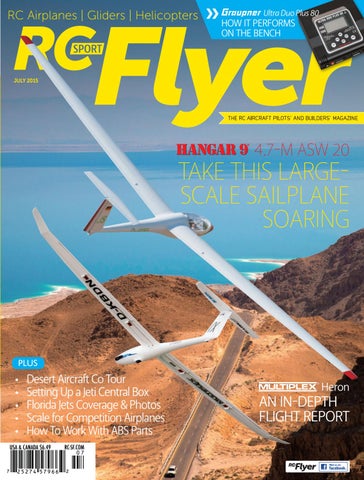
RC Airplanes | Gliders | Helicopters
Ultra Duo Plus 80
HOW IT PERFORMS ON THE BENCH
JULY 2015
4.7-M ASW 20
TAKE THIS LARGESCALE SAILPLANE SOARING
PLUS
• • • • •
Desert Aircraft Co Tour Setting Up a Jeti Central Box Florida Jets Coverage & Photos Scale for Competition Airplanes How To Work With ABS Parts
USA & CANADA $6.49
RC-SF.COM
Heron
AN IN-DEPTH FLIGHT REPORT
TABLE OF CONTENTS DEPARTMENTS
10 LEADING EDGE 12 HOT PRODUCTS 80 AD INDEX 81 MYSTERY PLANE
LEARN WHAT IT TAKES TO BUILD SCALE MODELS FOR COMPETITION.
PG 48
EVENT
FEATURE
HOW TO
26
34
48
FLORIDA JETS 2015 SEE HOW AND WHY JETS ARE GETTING BIGGER AND BETTER. By Barry Vaught
DESERT AIRCAFT CO GET AN EXCLUSIVE FACTORY TOUR OF A TWO-CYCLE ENGINE MAKER. By Wil Byers
52
BUILD FOR COMPETITION
CENTRAL BOX 200 RX
TOM SHOWS YOU WHAT IT TAKES TO BUILD MODELS FOR SCALE COMPS. By Tom Wolf
WE PROGRAM THIS 15-CHANNEL RECEIVER STEP BY STEP FOR YOU. By Wil Byrs 7380 (Prototyp 7230)
F
F
1580
2250
G
E
D
B
A
FLORIDA JETS 2015 8-PAGE REPORT
C
G
RBE Ø 200 Ø 365 7055 (Prototyp 6905)
Oberkante 0° V-Stellung
F-F A-A G-G
B-B L-L
RBE
H
K
K
3400 (Prototyp 3160)
13 980
658
C-C
PG 26
L
L
K-K
D-D
Achtung! Flügel-und Leitwerksschnitte Maßstab x 2
Schnitt H - H
I
I
1305
E-E
4065
Schnitt I - I
3-VIEW FOX GLIDER 38 MDM A TWO-SEATER FOR AEROBATICS
Schnitt J - J 465
J
J
PG 56
MDM-1 Fox
Zeichnung
ER
By Hans-Jürgen Fischer 6
RC SPORT FLYER . JULY 2015
twitter.com/rcsportflyer
JULY 2015
DISCOVER WHY THIS LMR/ALES GLIDER IS THE PERFECT PICK FOR RC PILOTS FROM BEGINNER TO EXPERT.
PG 64
BUILD
REVIEWS
ABS 42 PREPARING ACCESSORIES
DUO 60 ULTRA PLUS 80
LEARN HOW TO WORK WITH AND PREPARE ABS PLASTIC PARTS FOR GLUE AND PAINT IN THIS DETAILED FINISHING ARTICLE FROM ONE OF OUR TOP-NOTCH PROFESSIONAL BUILDERS. By Jeff Troy
SEE HOW EASY THIS GRAUPNER CHARGER IS TO PROGRAM AND USE FOR ALL TYPES OF BATTERIES. By Max Keppler
64 MULTPLEX HERON GLIDER CHECK OUT OUR REPORT OF ONE OF THE BEST FOAMY GLIDERS WE’VE EVER TESTED AND FLOWN. By Wil Byers
9 70 HANGAR ASW 20 RC-SF DOES AN EXTENSIVE REPORT ON HANGAR 9’S NEW 1/3.14-SCALE SAILPLANE. By Wil Byers
TAKE A TOUR WITH US INSIDE THE DESERT AIRCRAFT COMPANY TO SEE WHAT IT TAKES TO DESIGN, ENGINEER, AND MAKE TWO-STROKE GASPOWERED RC ENGINES.
PG 34
PG 70 YOU GET AN IN-DEPTH FLIGHT TEST ON THE NEW HANGAR 9 ASW-20 LARGE- SCALE SAILPLANE IN THIS REPORT. rc-sportflyer.tumblr.com
RC-SF.COM
7
HOT PRODUCTS ESPRIT EMCOTEC POWERSMOKE PUMP
E
sprit Models’ new Emcotec PowerSmoke pump is designed to streamline and simplify the pumping process of your model’s smoke liquid. It provides for a fully enclosed, clean design that utilizes metal-gears for durability and long life. The PowerSmoke pump is easy to install inside of most models’ fuselages or engine cowlings. The PowerSmoke 740 HV (Head Valve) smoke power pump comes with an integrated back pressure valve. This smoke pump feature makes the Emcotec pump 100 percent leak proof, so your model will not be inadvertently filled with smoke liquid. The pump is designed to reliability and performance. Features • Programmable Control Management • Fully Enclosed Design with Metal Gears
for Durability • Capable of Handling 7.4V(2S) or 11.1V (3S) Battery Pack • Integrated Self Purging Head Valve • Ready for Electromagnetic Cut-Off Valve • Included: Retaining Clamps, T-Adapter, Installation Hardware Price
$189.00 (#EMCA90052)
Specifications Range Current draw Flow rate 4.8 volts Flow Rate 7.4 volts Flow Rate 11.1 volts Weight Dimensions
4.8 – 12 volts 1 – 2.3 amps @ 3.7 – 11.1 volts 400 ml/min @ 1.2 amps 650 ml/min @ 1.6 amps 1000 ml/min @ 2.3 amps 95 g (pump only) 67 x 45 x 27 mm
Distributor ESPRIT MODEL 1240 Clearmont St NE, Unit 12 Palm Bay, FL 32905 Phone: 321-729-4287 espritmodel.com
HITEC FLASH 8
H
itec just announced that their radio line continues to grow with the introduction of their new Flash 8 transmitter package. Complementing the popular Hitec Flash 7, their latest radio delivers commanding reliability through its expanded performance features and outstanding quick response times. Hitec’s built-in Advanced Frequency Hopping Spread Spectrum (AFHSS) technology provides ultra-low latency, precise 4096 resolution and Secure Link compatibility. The Flash 8 let’s you store up to 30 models in its memory, enjoy full telemetry functions, and customize your flights with programming options only found on much more expensive radios. Take a good long look at the Flash 8 today. You’ll be glad you did! Features • Built-in Generation 2 AFHSS / SLT flexibility • Precise 4096 resolution • Ultra-low latency • Fast 7-ms frame rate with Maxima receivers
12
RC SPORT FLYER . JULY 2015
Distributor • Five 3-position and two 2-position switches • 30 model memory built in • 10-character model naming • Acro / glider / helicopter programming • Digital push button power wwitch • Push button and jog dial programming interface • Telemetry capabilities • Easy-to-read, graphic backlit LCD screen • Easy-to-change stick modes
HITEC RCD 12115 Paine Street Poway, CA 92064 Phone: 858-748-6948 hitecrcd.com
Flash 8 w/ Maxima 9 receiver $279.99 (#176258) Flash 8 w/ Optima 9 Receiver $299.99 (#176259) Flash 8 Transmitter Only $259.99 (#176240) twitter.com/rcsportflyer
Specifications
360 CFX 3 BNF BASIC
B
lade’s new 360 CFX Bind-n-Fly Basic, is designed around the optimized servo geometry platform, with a matched high-voltage power system to deliver performance plus incredible synergy of precision and power. The 360 CFX delivers a mini-class helicopter that gives you the feeling of flying an unlimited 3D helicopter that’s much larger. Complexity and parts count are low on this machine, which makes maintenance simple. Plus you get Blade helicopter innovation with Spektrum™ DSMX® control, plus BeastX® flybarless technology that is renowned. It has been designed to be an advanced pilot’s grab-n-go machine. Features • Optimized servo geometry • Advanced, high-voltage 6S LiPo battery setup • Oversized hardened main shaft with
triple ball-bearing support • CNC aluminum head and frame members • Castle Creations Talon 35 ESC • Single-stack carbon fiber side frames • Spektrum digital high-speed metal gear servos • Spektrum AR7200BX flybarless control system • High-torque, brushless outrunner motor • Includes 360-mm carbon fiber main blades • Dependable belt-driven tail with aluminum tail boom • Carbon fiber tail boom supports • Airbrushed fiberglass canopy with highgloss finish Price
$499.99 (#BLH4750)
Distributor HORIZON HOBBY 4105 Fieldstone Road Champaign, IL 61822 Phone: 217-352-1913 horizonhobby.com
Type Collective pitch flybarless electric helicopter Kit/ARF/RTF Bind-N-Fly Basic Construction Carbon fiber frame with aluminum mechanics Canopy Fiberglass with high-gloss airbrush finish Main rotor diameter 31.0 in. (790 mm) Tail rotor diameter 6.89 in. (175 mm) Height 8.47 in. (215 mm) Length 26.38 in. (670 mm) Width 4.33 in. (110 mm) Weight 30.0 oz (850 g) Main blade length 14.17 in. (360 mm) Tail blade length 2.56 in. (65 mm) Swashplate type 120 degree Motor pinion 12-tooth helical Main gear 135-tooh helical Main gear ratio 11.25 Motor brushless outrunner, 1800 Kv Receiver/Gyro Spektrum™ AR7200BX w/ DSMX® and BeastX Servos Spektrum digital highspeed metal gear ESC Castle Creations Talon 35 Tail drive Belt Control system 120-degree CCPM Battery E-flite® 1300-mAh 6S 22.2V 30C LiPo Experience Level Expert Assembly Required None ≈Flight times Four minutes
JR OPTICALLY ISOLATED KILL SWITCH Distributor JR AMERICAS PO Box 8757 Champaign, IL 61826-8757 Phone: 217-352-7959 jramericas.com
J
R America has just announced their new kill switch, which is designed to control an RC airplane’s engine on/off safety. Electronic kill switches are an extremely useful piece of safety equipment in a giantscale model, and are typically required at AMA sanctioned airfield or events. This new JR switch weighs less than a half ounce. It provides a safe and quick rc-sportflyer.tumblr.com
way to kill a model’s engine remotely via the transmitter. Additionally, the JR switch is special in that it provides rpm telemetry data when it is mated to the engine’s ignition pickup. The TLS1-ISW also supports dual-ignition inputs — such as on a DA200 — so controlling two separate ignition modules is a breeze. A programmable RF link delay will prevents engine shut downs
due to a momentary hold too, which eliminates forced off-field landings. The switch includes a status condition LED that can be installed in the model. Features • Internal voltage regulator for up 12.6 volts • DC power input — 3S LiPo • Jumper selectable 6.0- or 7.4-volt • Dual ignition support for four-cylinder engines • Compatible with XBus and PWM inputs • Rpm monitoring through a DMSS transmitter • Remote control on/off switch • Programmable delay prevents engine kill due momentary RF hold • Status LED shows ignition power on or off Price
$84.99 (#JRP03497)
RC-SF.COM
13
EVENT
FLORIDA JETS 2015 JET-POWERED FUN IN THE SUN AT PARADISE FIELD!
BY BARRY VAUGHT PHOTOS BY BARRY VAUGHT
T
he UPS DC-10 is on final approach and turns to line up with the runway for landing. As soon as it taxies to the flight station, an F-104 is given the green paddle to take off, roaring down the runway into the clear blue skies of Central Florida. You are at Paradise Field, Lakeland Linder Regional Airport, except the F-104 is 177 inches long, and the UPS DC-10 is 124 inches in length. Florida Jets-Jet Together is a fun, exciting, relaxing event for RC model jet enthusiasts the world over. Frank Tiano and everyone involved run a polished four-day Jet-Together for all
26
RC SPORT FLYER . JULY 2015
twitter.com/rcsportflyer
Ali Machinchy’s Airworld F-104 was built by Trond Hammersted. It is 1/4-scale, with a 177-in. wingspan and is powered by a B300F turbine. Ali and Trond took home Best Military Jet and Critics Choice awards.
attendees, with motor home parking, tents, fresh hot food, restrooms, jet products vendors, and home-made ice cream available. Florida Jets brings back fond memories of the movie Top Gun, so you will hear Top Gun music playing in the background. You may even see some of the scale airplanes from the movie and that time period shown and flown. Yes, some of the jets are monster size, and the builders and pilots may take years to complete their masterpieces. The details in the scale airplanes are modeled after full-scale
Robert Pannell’s scratch built DC-10 is 1/18 scale and is 124 in. long. It has a 112-in. wingspan and weighs 41 lb. Power comes from two Schubeler DS-94 HDT ducted fans, with electrons from a two 12S in parallel LiPo Packs. Control is by a Futaba 14MZ transmitter, with the model using 12 channels and 24 servos. It has scale outboard and inboard leading edge slats. Robert took home Best Electric Jet Performance award
rc-sportflyer.tumblr.com
RC-SF.COM
27
FEATURE
DESERT AIRCRAFT AN INSIDE LOOK AT MADE IN AMERICA GAS POWER
BY WIL BYERS
A
The inline DA-100 is an example of the high quality design, engineering, and manufacturing that exemplifies the gaspowered engines made by the Desert Aircraft Company.
34
RC SPORT FLYER . JULY 2015
s I departed the Desert Aircraft company in Tucson, Arizona, I was struck by the realization that even the guy in shipping and receiving department knows more about gas-powered two-stroke engines than I do. Further, it certainly seemed Desert Aircraft’s entire staff is seriously immersed in the designing, manufacturing, assembling, and shipping super high-quality RC and drone/UAV engines to customers all over the world. While it may be their day-to-day job, the people at DA truly appeared totally and completely dedicated to making certain you get a superb running and performing engine for your RC aircraft. So when I entered DA’s lobby I was greeted by the DA staff members. I was also taken aback by a historic 1959 Harley Davidson 165 that belonged to Dave Johnson’s father. Seeing it gave me a sense of just how much Dave loves machines, and especially engines. Then Dave met me in the lobby. He and I started to chat, and he twitter.com/rcsportflyer
Dave Johnson is the owner of Desert Aircraft. He has made it DA’s ongoing mission to produce superior engines, even from the startup, garage operation days.
began to explain the history of the company and how DA became an engine manufacture. He detailed how he had been a stone cutter in the jewelry making business, but also an RC pilot. He had been heavily involved in the Madera, CA giant-scale racer scene, and had become a 3W brand engine dealer in 1998. As sometimes happens, the business relationship with the 3W Company soured over time — a long story says Dave. As a result, Dave opted to start a company to manufacture competitive two-cycle RC engines. As such, he wanted to build high-quality engines for his would-be customers that were flying Tournament of Champions (TOC) type aircraft. Because of Dave’s involvement in the TOC he had met Dave von Linsowe (DL). Dave von Linsowe was a Tournament of Champions competitor, but he was also an engineer from General Motors’ Dephi division. DL had designed and campaigned world-class pattern airplanes as well as TOC aircraft. Consequently, DL knew internal combustion engine design well, how to build them, and how to make them run properly. Also, Dave Johnson had become acquainted with Ian Howard from Australia. Ian was an “electronics wizard” as Dave tells it. Ian offered to make an ignition system if Desert Aircraft needed them. So with Dave Johnson knowing where to get engine parts cast and machined, Dave von Linsowe knowing how to design and build engines, and Ian making good ignition modules, the new Desert Aircraft company would be launched from Dave Johnson’s rc-sportflyer.tumblr.com
Dave von Linsowe is a legend when it comes to engine design and engineering. His history is long in the Tournament of Champions and in desigining contest-winning engines.
garage/house and backyard. Interestingly, the first engine to be made by Desert Aircraft was the DA-150, a twin-cylinder, two-cycle engine. Dave says they made the 150 as a way to immerse the new company’s product in the TOC competition scene quickly, and with a high-powered engine. So it was that in 1999 the DA-150 engine powered the third place winning airplane. This was followed by a 150 powering the winning airplane in 2000. Now of course, DA engines are used in most of the top International Miniature Aircraft Club (IMAC) competitors’ airplanes as well as their 3D, freestyle aircraft. After Dave’s quite enjoyable history lesson, we began our tour of the factory. Our first stop was in DL’s office. There I was shown some of the historic photos of contest-winning airplanes and their pilots. Of course Chip Hyde, Mark Leseberg, and
Quique Somenzini were but a few of the pilots mentioned, as were Gernot Buckmann and Andrew Jeskey. The list of winners that use(d) DA engines in their airplanes is, however, long and deep, so it was fun just to see the photos and hear a few of the stories behind them. Dave von Linsowe also showed me some of his CAD drawings for the engines that he has engineered and designed. Let me tell you this guy must be a genius because every detail of the engineer is included in his drawings. Moreover they are done in 3D, which is to say he is wrapping his brain around the X, Y, and Z coordinates to create the complete engine line — this includes many of the tooling drawings as well. Think of it, one engineer has designed nearly all the engines in the Desert Aircraft product line, which runs the gamut from the DA-35 to the DA-200, and in their future a four-stroke, turbocharged engine. How Its Done Cylinder heads are an extremely important part of DA engines, as Dave and Dave explained to me. This is because DA’s cylinder heads are optimized for air-to-fuel mix coming into the combustion chamber and for purging the exhaust gases flowing out. It is worth noting that in a twocycle engine the incoming air helps purge the cylinder of the spent gases. It is very important, therefore, to have optimized intake and exhaust ports that can accelerate the air/fuel mixture coming into and the exhaust
When you enter Desert Aircraft you’ll immediately realize that Dave is into engines, as is attested by his father’s restored 1959 Harley Davidson 165 that is showcased in the lobby. RC-SF.COM
35
BUILD
PREPARING ABS ACCESSORIES
THE ABCS OF MAKING ABS FIT PROPERLY BY JEFF TROY
T
he woodwork for my Dynaflite Super Decathlon has been completed, and the model’s individual airframe components are now ready to be covered with 21st Century Fabric by Coverite. This readiness, however, has not included anything about preparing the ABS cowl and wheel pants that come with this fun-to-build kit.
1 42
Because I like to keep my finishing procedures grouped for each model in this series, these ABS accessories will be addressed now, so they may be painted within the same general time frame I’ve set aside for the Decathlon’s fabric covering. I use Bob Smith Industries (BSI) Insta-Cure + medium CA for most of my models’ basic construction. Insta-
Use sturdy scissors to cut away the excess plastic from ABS parts. Keep the cuts approximately 1/16-in. outside of the molded-in parting lines, and never let the blades snap closed. RC SPORT FLYER . JULY 2015
2
Cure thin CA and Maxi-Cure thick CA are also used where needed. When epoxy is called for, BSI Quik-Cure (5 minute), Mid-Cure (15 minute), and Slow-Cure (30 minute) epoxy are my choices. For filling seams in ABS parts or creating fillets, Pacer Industries ZAP Finishing Resin mixed with microballoons or milled fiberglass is another excellent choice because it’s so much
Use a flat Perma-Grit tool or an Easy-Touch Bar Sander to bring the straight-line scissor cuts up to the parting lines. Use files or Perma-Grit shapes for any curved areas. twitter.com/rcsportflyer
3
Check the fit of the cowl parts and tape them together. Check the fit over the fuselage, then use medium CA to glue the cowl parts together from the inside.
4
A sanding drum with coarse paper in a rotary tool is ideal for removing unwanted plastic in the cowl. Get close to the edges, but save some meat for hand-sanding.
5
Files, Perm-Grit tools (dual angle sander shown here), and sandpaper sticks in various shapes are all useful for finishing the edges of the cutouts. Use 320-grit sandpaper to clean edges.
6
Use a few drops of medium CA to tack-glue three or four 3/32- to 1/8-in. scrap-balsa spacers behind the spinner backplate. These ensure that the cowl-to-spinner clearance is perfectly spaced.
easier to sand than epoxy. Thin sheets of ABS plastic are heated and pulled over a plug to create the different pieces of the cowl and pants, so before these parts can be assembled, the excess plastic must be trimmed away from the usable sections. I do this with a sturdy pair of scissors, cutting slightly outside of the molded-in parting line on each piece. When you cut the excess away, care must be taken to prevent the scissors from closing completely at the tips of the blades, especially near any corners or sharp bends in the parts. Snapping the blades closed could result in a nasty split in the plastic, and you won’t like that at all. Hobbico makes a pair of small, curved scissors intended for trimming excess plastic away from RC car bodies, and the curved blades are rc-sportflyer.tumblr.com
extremely handy for cutting into the tight corners of ABS airplane parts. After the parts have been scissorcut to approximately 1/16-in. from the parting lines, I use coarse sandpaper on a Great Planes Easy-Touch Bar Sander to bring the cut edges up to the lines. Coarse sandpaper will leave a slightly fuzzy edge on the plastic, and this can be cleaned up with the 120-grit side of a Sanding Pad Dual Grit 120/240 from Stevens AeroModel or a small piece of 220- or 320-grit wet-or-dry sandpaper held in your hand. Three parts form the cowl: top, chin, and nose. Trial fit the three together to see how they join, making any adjustments in their edges to achieve the neatest and tightest fit. Tape the parts together
and apply beads of medium CA to the joints inside of the cowl. Make the necessary primary cutouts in the cowl—air intakes, air outlet, crankshaft clearance—with a coarse sanding drum on a rotary tool, and clean the edges with any combination of sanding sticks, files, and PermaGrit shapes. Bolt the engine onto its mounting rails with the muffler removed, then slip the cowl over the forward fuselage. If necessary, open the hole in the nosepiece to clear the crankshaft. Before any final cutouts can be made in the cowl, it must be in the correct position. I have found the spinner backplate to be the best tool for getting the cowl in perfect alignment, and here’s how I do it. Use a few drops of medium CA to tackRC-SF.COM
43
HOW TO
BUILDING SCALE FOR COMPETITION — PART I PLANNING AND GOOD RESEARCH WILL ENSURE SUCCESS BY TOM WOLF
M
any of you have probably looked in awe at some of the really excellent scale airplanes that are featured in coverage of scale competition events such as the AMA Nationals, US Scale Masters Championships, and Top Gun. I have had numerous modelers approach me and ask what it takes to build a scale airplane for competition. Since I am about to embark upon my next
48
RC SPORT FLYER . JULY 2015
scale project, I thought it would be instructive to document the process in multiple installments over the course of the project. The following are the steps that I go through whenever I tackle a new project. Other modelers may do things in a slightly different order, or have other steps that they go through, but I have found that this process works well for me. twitter.com/rcsportflyer
John Cole’s well executed DeHavilland DH-1A is an excellent example of a WWI era aircraft. He placed third in Expert at the 2013 US Scale Masters.
• Select aircraft type • Select a specific airplane to model (serial or registration number) • Determine the scale for the model (what size should it be?) • Collect documentation and generate a draft documentation package • Determine basis for build: Kit, purchased plans or “scratch” • Planning * Engine selection * Establish servo requirements and installation location * Quality check plans or kit for scale accuracy and identify discrepancies * Develop corrective measures for any scale discrepancies • Build and detail to match the aircraft being modeled This first installment will cover the process of selecting the airplane that I will be building for my next competition airplane. The second installment will cover how to collect scale documentation and generate a draft documentation package. Future installments will cover the remaining topics through project completion.
Ron Peterka built this very fine Stinson SR-5 high-wing monoplane. He has entered Team Scale at multiple Scale Masters events with Curtis Kitteringham as his pilot.
This well done Bellanca Super Viking was built by Dave Lovitt. It is a model of the full-scale airplane Dave owned. It includes a nicely detailed cockpit interior.
that one has always held a particular fondness for, it may be of special sentimental value (i.e. a plane that one’s father flew in the military), or the subject catches one’s attention because it is obscure or rarely modeled. To ensure a rewarding build it is important that the builder be excited about the project. Selecting an airplane that is personally exciting reduces the chance of burn-out
during the build process and thus it is more likely that a high-quality, thorough job is done while finishing and detailing the airplane. Other considerations, of equal importance, include the anticipated flying qualities and complexity of the construction or mechanics. It is important to make sure that the subject is compatible with the building and flying skills of the
AIRCRAFT SELECTION Deciding on an aircraft type to model is driven by a number of considerations. In some cases, the desired subject might be an airplane This F-100F Super Saber is owned by Jack Diaz. It is worth examining the weathering, and the ordinance Jack has added to make this airplane a contest winner. rc-sportflyer.tumblr.com
RC-SF.COM
49
3-VIEW
MDM-1 FOX DRAWINGS BY HANS-JÜRGEN FISCHER
T
he MDM-1 Fox is a Polish design. It was designed by Edward Margański — also the designer of the Swift. The MDM abbreviation stands for the production team Margański, Dunowski, Makula. Work on the Fox began in 1990, in parallel to the Swift’s development. The Fox’s maiden flight was on July 9, 1993. Just one month later it was flown at the 1993 World Glider Aerobatic Championships in Venlo, Netherlands. There, Jerzy Makula flew it to win the World Championship — his fifth World’s win. The MDM-1 Fox is composite, midwing, two-seater aerobatic glider with fixed undercarriage and conventional
56
RC SPORT FLYER . JULY 2015
twitter.com/rcsportflyer
7380 (Prototyp 7230)
E
F
F
1580
G
2250
D
C
B
A
G
RBE Ø 200 Ø 365 7055 (Prototyp 6905)
Oberkante 0° V-Stellung
F-F A-A G-G
B-B L-L
RBE
L
L
K-K
H
C-C
K
K
3400 (Prototyp 3160)
13 980
658
D-D
Achtung! Flügel-und Leitwerksschnitte Maßstab x 2
Schnitt H - H
I
I
1305
E-E
4065
Schnitt I - I
Schnitt J - J 465
J
J
MDM-1 Fox
Zeichnung
ER
rc-sportflyer.tumblr.com
RC-SF.COM
57
REVIEW
ULTRA DUO PLUS 80 IT’S TWO BIG PORTS OF POWER BY MAX KEPPLER
T
here are numerous good RC battery chargers on the market for airplane, helicopter, glider enthusiasts. It can, however, be quite a serious challenge trying to pick one that will charge different pack chemistries well and that uses a direct current (DC) source for field charging. Many chargers are made with lightweight materials so they are not well suited to an outdoor working environment such as that a typical RC charger will be exposed to at airfields. Further, many are quite honestly The Ultra Duo Plus 80 is a well-made and engineered charger. It has two 20-amp charge ports and can be powered by an 11 – 28-volt DC source.
You get everything you need to start charging batteries in the pack. It comes with two XH balancing boards, so you may want to buy a TP board for packs of that type.
60
RC SPORT FLYER . JULY 2015
twitter.com/rcsportflyer
overpowered when it comes to their user interface and the less-thanfriendly, complex programming logic. Graupner’s Ultra Duo Plus 80 seems to have found a niche in the RC market with its easy-to-use programming interface, 11- to 28-volt DC input, and the rugged durability of charger that you might find on professional technicians workbench or in their toolbox. FEATURES • Multi channel (2 channels for 1000 watts) • 20 memories per output • High-contrast LCD screens (128 x 64) with blue backlighting • Delta-peak cutoff detector for NiMH and NiCd cells with adjustable delta peak scanning • Internal battery resistance display • Protective circuit technology (lowinput voltage, over-current voltage, over-temperature, short-circuit, etc) • Optimized software for charging and discharging • Durable metal case INCLUDED • ULTRA DUO PLUS 80 charger • EH to XH 7S adapter board • 2 adapter cables • DC input cable • 2 charging cables
This is the welcome screen that you’ll get when you turn the Ultra Duo Plus 80 on. Notice you can enter a user name, so your friends will know who they borrowed it from! rc-sportflyer.tumblr.com
The connections to the battery are extremely straightforward. For the ElectriFly® 3S 2200-mAh pack I built a charge lead with the Multiplex type connector.
• 2 temp sensor • 2 alligator clips • Manual HOW TO At first glance I found the Ultra Duo Plus 80 to be somewhat different from Graupner’s other chargers, but then I’d gotten pretty used to using their Polaren, which uses a touchscreen input system. The 80 uses a more basic interface with six buttons doing all the programming
work rather than a touch screen. As an example of its buttondriven interface, you need only hold the MODE button when you power the unit to navigate to the System menu where you can set the LCD contrast, LCD backlighting, and the user name. The LCD contrast can be adjusted from 01 to 30, and the LCD
You will toggle through the different programming screens by toggling the ESC button. Cycle view shows the charge data for the last battery cycled on the output.
Memory Set is used to set up the charge and discharge parameters for a pack. You set the current and the pack voltage for a full charged and for the discharge value. RC-SF.COM
61
REVIEW
HERON A GLIDER THAT WILL ABSOLUTELY TAKE YOU TO NEW HEIGHTS
BY WIL BYERS
The folding propeller fairs in neatly against the fuselage to reduce the model’s motor-off drag to the absolute minimum for thermal soaring.
A
After many years in this great hobby, I can remember quite a number of outstanding models that simply stood out as particularly mention worthy. The new Multiplex Heron 95-in. wingspan, electricpowered, foam glider is just such an airplane/glider. While you may have read the ads and thought to yourself that this is just another Elapor foam glider with
64
RC SPORT FLYER . JULY 2015
detachable wings and horizontal tail, you should think again. This is anything but the typical foamy. The Heron is a very capable soarer, either with electric power in the nose or as a pure glider. However, as I assembled it in my shop I couldn’t help but wondering if this machine would really deliver on the manufacturers claims as an “high performance” electric-powered glider. twitter.com/rcsportflyer
Motor-on performance will let you climb the Heron at about a 70-degree angle without stalling. You’ll get multiple climbs too from the 2200-mAh LiPo pack.
While it looked great in my shop, T-tail, flaps and all, I wanted to really wring this machine out to see if it had the performance that I would want from an affordable, foam glider — one that could be assembled in 30 minutes or less. I planned to fly it both in windy, slope lift and in flat-land thermal conditions, where it would need to indicate lift well. So... rc-sportflyer.tumblr.com
FEATURES • Elapor foam construction with detachable wing and tail sections. • CFRP/aluminum tubular spars in the wings, with flaps and ailerons. • Detachable wings and stabilizer for ease of transport. • GRP “M” space technology designed fuselage for rigidity. • Brushless outrunner motor that is factory installed.
• Ailerons, rudder, elevator, flaps, and motor controls • 12 x 6 MPX folding propeller • Clear canopy with detailed cockpit • Main wheel and tailwheel INCLUDES • 2.4-meter wingspan glider RR • 300- to 400-watt 36-mm outrunner motor • Multiplex servos with extensions RC-SF.COM
65
REVIEW
ASW 20 IT’S A WINNER, COPIED AFTER A WINNER! BY GENE COPE / WIL BYERS
70
RC SPORT FLYER . JULY 2015
twitter.com/rcsportflyer
The ASW 20 is a joy to fly! It controls are extremely well coordinated and it is not overly sensitive to elevator inputs. Also, the model has a fairly wide speed range.
T
he full-scale ASW 20 is an FAI 15-meter class sailplane. It was designed by Gerhard Waibel and was manufactured by the German company Alexander Schleicher GmbH. It was an evolution machine, with a fuselage nearly identical to its predecessor, the ASW 19, but with a new wing design that incorporated a
rc-sportflyer.tumblr.com
You’ll discover this model indicates thermals very well, so you’ll be able to soar it for hours on end — to date we’ve logged more than five hours of soaring on the ASW 20.
new airfoil and flaps. The prototype was maidened in 1977. It was an immediate success, with it winning multiple World Championships. To date, 765 have been built by Schleicher (until 1990) and another 140 were built under license by the Centrair company in France. The ASW 20 was eventually
superseded by the formidable ASW 27 15-meter class sailplane. The 20 was the first 15-meter wingspan glider to have a recorded lift-over-drag (L/D) ratio of 40-to-1. It was used by pilots to win the world triangle distance record of 892 miles, which was done in 1994 in a B model. While many 20s have been used to
RC-SF.COM
71