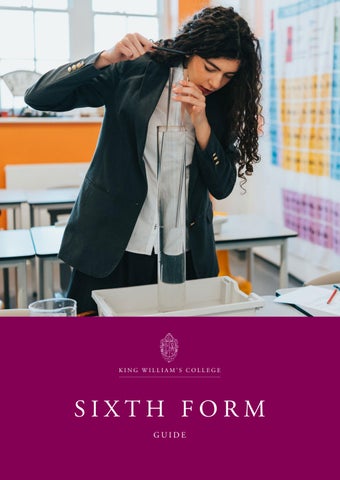
SIXTH FORM GUIDE
KING WILLIAM’S COLLEGE SIXTH FORM GUIDE
T H E SI X T H F O R M T E A M ANYA MORGANS HEAD of SIXTH FORM & CONCIERGE f o r B L E N D E D A - L E V E L PAT H WAY Email: anya.morgans@kwc.im
SOPHIE HARRINGTON DEPUTY HEAD of SIXTH FORM Email: anya.morgans@kwc.im
J O C E LY N D AY H E A D o f H I G H E R E D U C AT I O N Email: jocelyn.day@kwc.im
JO BUSUTTIL I B C O O R D I N AT O R Email: kwcibcoordinator@kwc.im
2
KING WILLIAM’S COLLEGE SIXTH FORM GUIDE
THE
SI X T H F O R M
Sixth Form students at King William’s College enter into a lively and supportive environment. Nearly a third of the Sixth Form are from overseas countries, including South Africa, Russia, Serbia, Germany, Spain, Slovakia, Austria, Macedonia and the Caribbean. Our students have the unique opportunity to engage with a multicultural environment, thus broadening their outlook and complementing the international ethos of the IB. The students are split into small tutor groups, consisting typically of around 10 students, and their tutor remains with the group throughout the two years of the Sixth Form. With such small groups, the tutors are able to track the academic progress of each individual student, ensuring that they realise their potential. Each student completes a Personal Development Plan during weekly tutorials, which allows for reflection upon subjects and areas of strength or weakness, including individual target setting, and focuses on strategies to maximise their achievements. The Head and Deputy Head of Sixth Form work closely with the tutors to ensure that each student is fully informed about what the School has to offer to give the students the best preparation for the wider world.
3
KING WILLIAM’S COLLEGE SIXTH FORM GUIDE
SI X T H F O R M
AC A D E M IC PAT H WAYS
At King William’s College, our three Sixth Form pathways offer flexibility, choice and academic challenge, allowing pupils to select the route that best suits their strengths, interests and future ambitions. Whether progressing to university or preparing for another career path, pupils can choose from the International Baccalaureate (IB) Diploma, IB Courses or our Blended A-Level Pathway. All three pathways are taught over two years and help pupils develop the knowledge, skills and confidence to take their next steps. Across our programmes, pupils develop independent learning, critical thinking, problem-solving and communication skills, alongside an international outlook and the ability to engage with an increasingly connected world. P A T H WA Y 1 : I N T E R N AT I O N A L B A C C A L A U R E AT E ( I B ) D I P L O M A King William’s College has offered the IB Diploma since 2002, with more than 1,000 pupils having studied the qualification at the College. The IB Diploma is a broad and challenging programme that combines academic depth with breadth of study, encouraging pupils to think critically, work independently and take responsibility for their learning. Pupils study six academic subjects, normally three at Higher Level (HL) and three at Standard Level (SL). Subject choices span languages, humanities, sciences, mathematics and the arts, allowing pupils to develop a balanced programme suited to their interests and future plans. Alongside their six subjects, pupils complete three core components that enrich their learning and encourage them to apply their knowledge beyond individual subjects: Extended Essay: An independent research project of up to 4,000 words, developing research, analytical and academic writing skills in preparation for university. Theory of Knowledge (TOK): Encourages pupils to question how knowledge is acquired and understood across different disciplines and perspectives. Creativity, Activity and Service (CAS): Encourages pupils to learn through creative pursuits, physical activity and meaningful service beyond the classroom. The IB Diploma provides a well-rounded academic experience, developing intellectual curiosity, independence and international-mindedness. The published entry requirement is six (I)GCSEs at grade C or above, or equivalent.
4
KING WILLIAM’S COLLEGE SIXTH FORM GUIDE
P A T H WA Y 2 : I N T E R N AT I O N A L B A C C A L A U R E AT E ( I B ) C O U R S E S IB Courses offer an alternative for pupils who wish to study selected IB subjects without completing the full Diploma. Pupils can choose between three and six courses at their preferred levels, allowing them to focus on areas of particular interest or academic strength. This pathway provides greater flexibility and more time for independent study, while retaining the academic challenge and international perspective associated with the IB. Pupils may also take part in aspects of the IB core and benefit from the College’s wider activities and cocurricular programme. Depending on their subject choices and results, IB Courses can contribute towards UCAS points and provide a route to university, subject to individual university and course entry requirements. P A T H WA Y 3 : B L E N D E D A - L E V E L PAT H WAY The Blended A-Level Pathway combines specialist online teaching from King’s InterHigh with the pastoral care and co-curricular opportunities of King William’s College. Through live, supported online lessons in a dedicated learning hub on campus, pupils study A-Levels within a structured environment while remaining fully involved in School life. With more than 22 subjects available, pupils can choose between one and five A-Levels, tailoring their studies to their interests and future university or career aspirations. They may also combine A-Levels with selected IB subjects, offering further flexibility in how they build their Sixth Form programme. Pupils benefit from dedicated support with their learning, access to the College’s pastoral and co-curricular provision, and the option to board full or part-time. This pathway offers the flexibility of online specialist teaching alongside the community, structure and opportunities of an in-person Sixth Form experience.
5
KING WILLIAM’S COLLEGE SIXTH FORM GUIDE
H IG H E R
E DU C AT IO N ( H E )
YEAR 1 2 The College offers a high quality and distinctive package to prepare students for life beyond its walls, recognising and meeting their individual needs. The Head of Higher Education offers guidance and preparation, and meets all students individually, and regularly, to discuss their HE plans and applications. They will also offer specific advice to help guide Oxbridge candidates and applications to US and Canadian universities, including assisting students with their preparation for the SATs and other admission tests. Further assistance is offered for applications to other overseas universities, particularly throughout Europe. The HE process begins early in the Year 12 by ensuring that appropriate subject choices are made by each student to meet the requirements for their future applications. Wider reading and relevant work experience is discussed and encouraged with an annual careers and work experience fair making use of College’s wealth of contacts within the Island’s employers. Potential Oxbridge applicants, as well as those applying for medicine, dentistry, veterinary medicine and law, are identified early in order to make their applications as strong as possible. We make extensive use of the Unifrog platform which gives students access to a wealth of information about degree courses, apprenticeships, employment and gap year opportunities as well as a vast array of resources for wider reading and other supercurricular activities. Psychometric tests and profiling quizzes help students to identify possible avenues which may suit their strengths and interests and they discuss these with their tutors at regular intervals throughout their time in the Sixth Form. By the Summer term, we ensure that all students know what they want to apply for the following year. This is then confirmed through the HE fair, visits to universities and visits from university admissions tutors. Higher Education Day at the very end of term signals the start of the application process: Each student receives a comprehensive KWC UCAS booklet, as well as a US and/or Irish universities booklet where appropriate, detailing the application procedure and containing extensive guidance, and workshops focus on completing the online application form, writing their personal statement and furthering university/course research.
YEAR 13 By the start of the Year 13 each student is ready to make the finishing touches to their applications, which are submitted throughout the Autumn Term. This is well ahead of the national deadline (late January), but conditional offers will start streaming in throughout the Autumn term. For those students who are called to interview, a series of ‘mock’ interviews are arranged with subject experts, as well as the Principal, to give the best preparation possible. Throughout the Year 13 Spring term, students are advised over firm and insurance choices, and the majority of overseas applications are submitted. All students are briefed on the results day procedure before they leave College, and those applications, mainly German, which are done post results in the Summer holiday, have the Head of Overseas Students to offer advice and guidance. The Head of Higher Education is available after results to help with any queries regarding university places. This support is also provided for those who have decided to defer their applications.
6
KING WILLIAM’S COLLEGE SIXTH FORM GUIDE
AC A D E M IC
E N R IC H M E N T & SU P P O RT
In the Sixth Form we offer an enormous range of activities to support and expand the learning opportunities available.
LECTURE SERIES Every half term we host a Sixth Form Lecture, which is given by a guest speaker usually from outside of College, on a diverse range of topics. Recent speakers have included lawyers, adventurers and academics, with presentations ranging from ‘The Brain and the Paranormal’ to ‘Human Remains in Archaeology’ to ‘Making Donald Trump’s America’. These talks give an opportunity to expand the students’ outlook and give them a taste of university-style lectures.
G LO B A L I S S U E S F O RU M New for this academic year, Global Issues Forum (GIF) encourages the Sixth Form community to discuss a variety of topics of political, environmental, social, economic, cultural and religious significance. GIF strengthens the IB ethos of ‘International Mindedness’ and enables students to reflect/build upon their academic studies. The students have the opportunity (and are encouraged) to suggest topics and questions for discussion by the entirety of the Sixth form cohort (we are aiming for at least two GIF sessions over the course of the academic year). Additionaly, in some years the students will also have the opportunity to take part in a mock COP (Conference of the Parties) Climate Convention or Model United Nations (MUN).
AC A D E M I C S U P P O RT All departments offer subject tutorials, which provide academic support and opportunities for students to consolidate their understanding and to ask questions which go beyond the scope of their syllabus. Some academic departments organise trips and excursions which enable students to see the wider context of the work they are studying in the classroom.
“The teachers were wonderful in helping me decide and prepare my university choices. Their help was invaluable” Sixth Form Student
“The IB is the best curriculum in the world right now. It combines academic rigour with real world skills in a global context” Lord Knight, Former Minister of State for Schools & Learning
7
“The lectures are very informative and interesting even if they are not your preferred subjects they give you an insight into wider subjects and perspectives” Sixth Form Student
KING WILLIAM’S COLLEGE SIXTH FORM GUIDE
EXTRACURRICULAR
O P P O RT U N I T I E S
GA M E S & SP O RT Pupils have an average of two hours of compulsory Games each week, with opportunities to take part in additional practice and extracurricular sports clubs. Games afternoons take place on Thursdays for pupils in Years 11, 12 & 13 (Seniors). These days are chosen to align with other Island schools, helping to facilitate inter-school fixtures. Competitive team sports are at the heart of our Games programme, encouraging pupils to develop their skills, teamwork and sportsmanship. The main sports vary by term: •
Autumn Term: Rugby, hockey, basketball and football
•
Spring Term: Football and netball
•
Summer Term: Cricket and rounders
King Wiliam’s College has a strong sporting presence on the Island, with senior teams competing in rugby, football, hockey and netball. Regular fixtures against schools in the UK, particularly across the North West, provide pupils with opportunities to test themselves against a wider range of competition and build valuable sporting connections. Team captains and vice-captains develop leadership skills, while pupils also have opportunities to support the coaching and development of younger teams across the School.
T H E D U K E O F E D I N BU RG H ’ S AWA R D Students are encouraged to participate in The Duke of Edinburgh’s Award (DofE) scheme, which emphasises personal and social development by completing various activities and undertaking an adventurous expedition. The DofE Gold Award is highly regarded by universities and employers, as it demonstrates commitment, responsibility, initiative and time management.
CCF The Combined Cadet Force (CCF) programme has been developed to promote and nurture leadership, teamwork, responsibility, self-reliance, self-discipline, resourcefulness, endurance and perseverance through military themed activities. Membership in one of the three sections, Army, Royal Navy and Royal Air Force, can lead to vocational qualifications, participation in summer camps, expeditions, sailing, flying and adventurous activities. This is a fantastic opportunity for students to step out of their comfort zone and develop themselves as young leaders.
8
KING WILLIAM’S COLLEGE SIXTH FORM GUIDE
MU SI C & D R A M A College has a thriving Music and Drama Department which offers individual music and drama lessons, as well as the opportunity to get involved in groups, such as the Chapel Choir, Orchestra and other ensembles. These all help to foster teamwork and selfconfidence, as well as improving technical ability and overall musicianship. Musicians regularly take ABRSM exams and LAMDA exams are available for speaking and acting. There are opportunities for students to perform in recitals, concerts and the annual whole School production. Some students will choose to develop their leadership skills through roles such as Head of Choir, gaining responsibility for encouraging younger students and helping to organise rehearsals, while many others choose to offer their services behind the scenes in our many performances and productions.
H O U S E AC T I V I T I E S Through the House system, Sixth Form students prepare and rehearse younger students for the annual House Music competition, taking charge of the repertoire and selection of soloists. Other House competitions include House Drama, which is entirely organised and directed by the students, a House Debating tournament, as well as a wide variety of House sporting events. The House system provides an invaluable opportunity to get involved and build confidence and experience in managing others, as well as having a thoroughly enjoyable time.
OT H E R AC T I V I T I E S The annual Island-wide Charity Challenge provides opportunities for students to develop strong public-speaking skills, as well as an increased awareness into a variety of global development issues and the work of charitable and aid organisations. The College Share Race involves groups of Sixth Form students investing on the stock market with virtual money. Teams present their portfolio results to the judges and other competitors, explaining their investment strategy. This activity encourages calculated risk-taking, effective teamwork and confident presentation skills. Every year, through an application and interview process, a number of Sixth Form students are selected to act as Peer Mentors for students in the Year 7 and 8. Peer Mentors are given training in leadership, pastoral skills and safeguarding knowledge. They provide valuable assistance to tutors in Year 7 and 8, acting as a listening ear and role model to younger students. Peer Mentors are also involved in the planning and implementation of certain aspects of the PSHE programme. Many students volunteer to help organise events or projects such as School social events and the Upper Sixth yearbook. They enjoy the opportunity to develop their teamwork, creative and organisational skills, and it is particularly rewarding to see their innovative ideas come to fruition.
9
KING WILLIAM’S COLLEGE SIXTH FORM GUIDE
E XCH A N G E P RO G RAMME Year 11 and Year 12 students have the possibility to go on a cultural or sport exchange to schools in South-Africa during their summer break. They integrate fully at their host school (both in lessons and extracurricular activities), spend time with a host family, and also have the opportunity to go on a variety of exciting trips to experience more of the country. Students learn to be more independent and it gives them a new perspective on a different culture. This unforgettable experience also fosters life-long friendships.
SOCIALS Throughout the two years in the Sixth Form we encourage various social events, beginning with the Welcome BBQ in the Autumn term. Other events include, the annual Epiphany Black Tie Dinner, as well as the Sixth Form Ball and Valedictory Dinner. These events have always been a great success and it is testament to the closeness of our Sixth Form to see how well the College community comes together.
B OA R D I N G Boarding is especially beneficial in the Sixth Form and each year many of the cohort choose to board, from overseas as full boarders, and locally on a weekly or flexible basis. The structured routine and close supervision by house tutors fosters a strong support system for those students who need extra assistance and motivation for their studies. In addition, the boarding house has an extremely friendly and lively social atmosphere, allowing the students to have a healthy balance between their academic work, other commitments and socialising with their fellow students. The international environment of the boarding house means that students leave College with life-long friends scattered around the globe.
10
KING WILLIAM’S COLLEGE SIXTH FORM GUIDE
“The exchange programme was the best six weeks of my life”
“Charity Challenge inspired me to participate in projects abroad”
Sixth Form Student
Sixth Form Student
11
KING WILLIAM’S COLLEGE SIXTH FORM GUIDE
12
KING WILLIAM’S COLLEGE SIXTH FORM GUIDE
U N I V E R SI T Y D E S T I NAT IO N S 2026 University of Amsterdam
Dutch & International Law
ArtEZ University of the Arts
Product Design
University of Bath
Management (with placement year)
Bath Spa University
Music (with foundation year)
Queen’s University, Belfast
Law
University of Chester
Law with Criminal Justice
Durham University
Biological Sciences (Biochemistry)
Durham University
Finance (with placement year)
Durham University
Geography
Durham University
History
Durham University
Music
Edinburgh University
Biological Sciences (Biochemistry)
Edinburgh University
Fine Art
Edge Hill University
Business Management
Exeter University
Physics (with study abroad)
3IS International School of Creative Arts, Paris
Sound Engineering
University of Kyiv
Maths
Lancaster University
Engineering (with foundation year)
Leeds Beckett University
Counselling & Mental Health
Liverpool University
Geology with Physical Geography
Loughborough University
Geography & Management (with placement year)
Loughborough University
Sport & Exercise Science (with placement year)
Manchester University
Management (with placement year)
Manchester University
Modern Language and Business & Management (Spanish)
Newcastle University
Music
Ontario College of Art & Design, Toronto
Photography
Oxford Brookes University
Engineering Foundation
Royal Holloway, University of London
Law (with foundation year)
University of Southampton
Physiotherapy
University of Twente, The Netherlands
Mechanical Engineering
13
KING WILLIAM’S COLLEGE SIXTH FORM GUIDE
King William’s College and The Buchan School, Castletown, Isle of Man, IM9 1TP Tel: +44 (0) 1624 820110 | Email: admissions@kwc.im | www.kwc.im
14