Spring 2022 | Issue no. 2 | KWC
The RAGLAN REVIEW
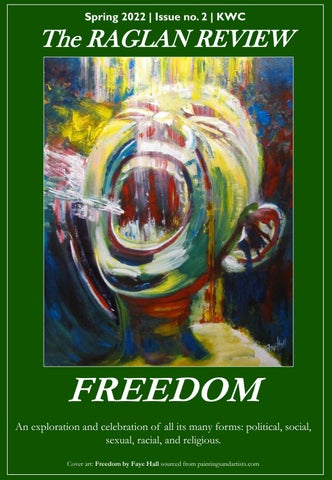
FREEDOM An exploration and celebration of all its many forms: political, social, sexual, racial, and religious. Cover art: Freedom by Faye Hall sourced from paintingsandartists.com
Editorial This Spring issue of the Raglan Review seeks to encapsulate our selected theme of ‘Freedom’, in all its many qualities. Whether this be in terms of freedom of speech, expression, sexuality, thought, and so forth. In the midst of the magazine’s production, this topic of freedom has also become extremely politically relevant, with the recent events of Russia’s war on Ukraine, further emphasizing its urgency. Though it appears incredibly vast subject matter to attempt to condense into one edition, consisting of only so many pages, and created collaboratively online, we’ve tried our best to capture its essence in a heterogeneous assortment of music, literature, film, and art. We hope you enjoy! RIANA COLLISTER
Inside … 1. Freedom Playlist 2. Amicus – Defense against the Death Penalty 3. Review of Willy Russel’s Blood
Brothers 4. Sappho; her 94th Fragment 5. Subject Specific Teacher Recommendations
6. Free as a Bird 7. The Shawshank Redemption 8. Literature in Translation
9. Four Freedoms - reimagined 10. Freedom' in a Globalised Word 11. Travel – hearing from the Principal
12. The Ballad of Reading Gaol – Oscar Wilde 13. Review of Things a Bright Girl Can Do 14. The New Colossus & the Power of Literature 15. Physics – What if? 16. Maths – The Nothing That Is 17. Freedom and Faith 18. Freedom in Ukraine
https://open.spotify.com/playlist/1jZ7ErwXNjdj4yx3aFPWYK?si=6eb48fb575414659&nd=1
Freedom is a feeling, a state and a right belonging to us all. With this playlist we have tried to encapsulate this state, boiling it down to a mix of tracks that both represent and induce freedom in the listener. Containing songs from a number of different eras and artists, there’s something here for everyone. I think not tying this playlist to one specific genre nor taste allows us to experience freedom to a further extent. We are privileged to be able to dip in and out of such a variety of music. This microcosm is demonstrative of all that we, as young people, have at our fingertips. So listen to our ‘freedom’ mix, it was made for us, explore an artist you might not know about yet, or one you already love. We hope that you will love this playlist; that it will make you both feel free, and remind you of the freedoms we already have.
Amicus - Defence against the Death Penalty Did you know that in California, the state which holds 25% of the US death row population, more people on death row die each year from suicide than execution? On Tuesday 15th of March, the Sixth Form were privileged to have Mark George QC come and talk to them about his work in the USA, and the work that the extraordinary charity Amicus does there. I was lucky enough to be invited and was both fascinated and shocked by what he said. 41% of the people on death row are Black. Nearly half. But only 12% of the USA's population is Black. This horrifying statistic shows clearly the systemic racism abundant in the USA, and how the death penalty only fuels this. We did not hear specifically about the abolition of the death penalty, but rather the many flaws, such as this racist approach, in the way it is administered in the US. There are 4 key issues with the death penalty: innocence, arbitrariness, ineffective access to counsel, and how it discriminates mercilessly against the poor, Black people, and those with serious mental health issues. Innocence is the topic which I found most impactful, and I will share what I learned about this in my closing paragraph. Arbitrariness means that different people will not have the same chances of ending up on death row. Only 2% of people on trial for murder end up on death row. Why one person and not another? On top of this, there are the jury's preconceived prejudices, particularly concerning race and gender, and the fact that in different states and counties within them, some people are much more likely to avoid death row, simple because their county can't afford to go through with the process. According to US law, each defendant is entitled to a fair trial and competent attorney. However, Mr George shared with us stories of lawyers falling asleep when allegedly defending their client for their lives. How is this fair? This leads onto my final point, discrimination: Those in poverty can't afford good lawyers, those who are mentally ill can legally be drugged for their trail, allowing them to be sentenced when they can't even understand the potential consequences, while the blatant racism rife in American politics leaves no room for equality. Mark George QC has been fighting this corruption through educating people like us, as a lawyer himself. Meanwhile, as a trustee of Amicus over the last ten years, he shared with us what this small but mighty charity does to help save lives every year. Amicus started with Jane, an English teacher who became a pen pal with Andrew Lee Jones, a man on death row in Louisiana, in the 1990s. He had an amazing lawyer, but that still wasn't enough to save him. Jane desperately wanted to help Andrew and the many others like him, so she asked what she could do, and the response she received was to “send more lawyers". So, she did. She set up Amicus, a small UK based charity which recruits lawyers to assist attorneys in the US who do death penalty cases either at the trail stage or during appeals. Since 1992 they have sent hundreds of volunteers doing essential work to 17 different affiliate offices in 11 key states, including Florida, Texas, and Georgia. Although small, this charity has literally saved lives, and it was such an honour to learn about its work. I want to leave you with one final chilling number, which stayed with me for many weeks after the lecture. Since 1973, more than 10% of death row prisoners have been exonerated. On average, one in every ten people is innocent. They are sitting there right now, locked up, for the most part, alone. Waiting. Waiting for death. And we call that justice? BETHANY MCGREEVY
BLOOD BROTHERS On the week of the 7th of March, King’s Court Theatre was filled with atmosphere as the Whole School Production of Blood Brothers was performed. There were some outstanding performances from Lower Fourth all the way up to the seniors of the school. The production was the product of months of hard work from the Directors, Mrs Singleton and Mr Dawson, the cast members, the providers of the costume, the set makers, L6 theatre class for set painting, and Zlata Matveenko for working the lighting and sound effects.
During the rehearsal process there were many absences due to Covid, so there were moments of panic; it seemed that we would have to recast. However, luckily, none of the amazing actors were ill on the night, so we were able to experience the full potential of the show and see the full range of their acting abilities.
For this production the main roles of Eddie, Mickey, The Mother and Mrs Lyons were split between the age groups, so we had three different actors playing one character (in case any of the actors were ill). One of the main pieces of feedback from the members of the audience was ‘that the casting choices were immaculate, especially for the brothers.’ The audience especially enjoyed seeing how the characters grow throughout the play and with the different actors. It also provided a chance for the younger actors to have the main part. When casting, Mrs Singleton and Mr Dawson choses to use gender flexible casting, meaning despite the fact that Eddie and Mickey are boys, they were played by Ciaran Dougherty, Darcey Bateson, Joseph Quinn (Mickey), and Rebecca Bloch, Amy Bloch, Tomas Gantous (Eddie.)
Many audience members have said that the play was “enthralling” and that they were “sucked in from the very beginning”. One of the main reasons for this was the 5 narrators who guided the audience through the experience by informing them of the time period, by bringing on/off the set, and most importantly constantly engaging with the action of the story. A star moment in the play was Young Mickey’s monologue “Nearly 8”, starring Ciaran Dougherty. This moment captured the attention of the audience due its hilarious comedy, and of course due to his amazing acting abilities, and killer scouse accent.
Personally, as a member of the cast (Older Mrs Lyons,) this was one of the most enjoyable productions I have been a part of since I’ve been at school. For me the most fun part of the process of rehearsing was watching the other cast members struggle with the scouse accents, (my character didn’t have to!) However, it was astounding to see everyone with perfected accents by the time of the show. As someone who has been in every school show since I arrived, it's always interesting to meet and interact with students you don’t normally talk to, especially getting to know the younger students.
Overall this was one of the best school plays King William's College has ever staged and it's such a shame that it won’t be previewed on YouTube like other year’s performances, but it just makes it more special for those who were there to watch and take part in the performances. In the words of one audience member; “It was an emotive, intense, powerful performance” and to quote another “It was incredible”. I couldn’t agree more.
We hope you enjoyed watching as much as we enjoyed performing in our Whole School Production of Blood Brothers 2022 SOPHIE SHEPHERD
94 - Sappho
Not to be a stereotype, but Sappho is truly amazing. I hope to write a long piece on her next year, but for now I’ll share a couple of paragraphs on my favourite of her poems, and some facts about this incredible poet. Sappho was an ancient Greek poet from the island of Lesbos. She was born around 630 BC and wrote around 10,000 lines, most of which are now lost, with only fragments remaining. The English words “Sapphic” and “lesbian” come from her influence on society and her romantic poetry. Most of what we know about her is second hand from various scholars and sources and has often been influenced by their attempts to squeeze her into heteronormative standards. One of my favourite examples of this is how many historians love to mention that she had a husband
called “Kerkylas” from the island of Andros, which literally means “Penis-Man from Man Island”, obviously a joke-name. Sappho was incredibly popular and respected; called the “Tenth Muse” by Plato. Her lyric poetry was intended to be sung solo by a lyre, which means much of it would not have been written down and instead memorised for banquets. She is famous for her own style of poetry, which is infamously hard to write in English, but beautiful and interesting nonetheless. In Aeolic Greek, her poetry sounds soft and sad, beautiful and melodic, loving and lamenting, like the scenes she describes. My favourite poem of hers so far is poem 94, with my favourite translation pictured above. It’s famous, but worth its reputation. It's beautiful. As this is the only poem of Sappho’s explicitly describing a gay relationship, historians have tried in every way they can to offer an alternate interpretation, even going as far as to suggest that the girl in this stanza in fact “would satisfy all her longing” for sleep on “beds of soft luxury.” Whilst I know I should find this blatant homophobia offensive; I find it hilarious. The beginning has been lost, so we are unsure of whether the first dialogue is spoken by Sappho or her lover, and the middle is lost as well, so we cannot know what memories Sappho is reminiscing over. Some may find this frustrating, but I believe that it adds to the dreamy mood of the poem. The ambiguity seems perfect, retaining some privacy for the couple and their lost memories, while sharing with us their overwhelming emotions and bittersweet feelings. The poem, especially in Greek, flows between tenses and memories in a swirling flow of emotion. The imagery of violets is delicate and is the reason why violets and purple are now associated with sapphic love. It's beautiful.
Personally, the poem and Sappho herself mean so much to me. It helped me change how I view myself. Look at how beautiful these two purple and green pages have become, how soft and delicate, how dreamy. The imagery Sappho uses has since become a symbol of lesbian love everywhere. Love that isn't ugly, isn't used as an insult, isn't gross. Love that is beautiful, pure. Not to be whispered or hidden away, nothing weird. Just love, like any other love. Just love. BETHANY MCGREEVY
Subject Specific Recommendations… Humanities Subjects: The New Silk Roads by Peter Frankopan – a weighty
read both physically and mentally, but well worth the effort for serious academics. It centres on the potential shift in the balance of economic power towards the east, but there is some wonderful history and geography tied up in the telling too.
Prisoners of Geography by Tim Marshall - not just for
geographers! Seeks to explain the impact of geography on economic and geopolitical events such as Russia’s annexation of Crimea. Tim Marshall has also published two other novels of note; ‘Power of Geography’ and ‘Worth dying for; the power and politics of flags’. Both are available in the library and are largely about geopolitics and international relations, with chapters that are easy to dip in and out of.
The Nanny State Made Me by Stuart Maconie “In this timely and provocative book, Stuart Maconie tells Britain’s Welfare State story through his own history of growing up as a northern working class boy. What was so bad about properly funded hospitals, decent working conditions and affordable houses? And what was so wrong about student grants, free eye tests and council houses? And where did it all go so wrong? Stuart looks toward Britain’s future, making an emotional case for believing in more than profit and loss; and championing a just, fairer society.” Miss PAULA HOWELL-EVANS Miss AMY CLARK
AVA SOLLY
“Free as a Bird” After seeing this submission for the Rag. I was reminded of this phrase, and wanted to write a little about what I think it signifies, especially in relation to Ava’s painting.
The harsh silhouette of the bird and hills against the sky and vibrancy of colour choice in the sky behind creates an imposing image, intense and powerful, instilling in the viewer the same sense of immense freedom the bird must feel as it sheds its shackles and flies free. Another element of particular note is the chains themselves which are painted with such delicacy and fragility in comparison to the land mass that occupies the bottom third of the painting. It is ironic to see shackles, which restrain and imprison the bird, painted in such a fine way. It highlights the idea that imprisonment is futile and that freedom will triumph over all. DARCEY BATESON
The Shawshank Redemption (1994) Upon hearing the theme of this term’s issue of The Raglan Review, it seemed only appropriate to compose a review on perhaps the greatest story of freedom the world of cinema has to offer. The Shawshank Redemption offers the story of Andy Dufresne (Tim Robbins), a man who is wrongly convicted of murdering his wife and her lover and is given two life-sentences at the infamous ‘Shawshank’ prison. It is in Shawshank where Dufresne meets fellow lifer Ellis ‘Red’ Redding (Morgan Freeman), and the bond which the two build forms the storyline of Dufresne’s 27-year sentence, before he, along with Red, eventually find their freedom.
Inspired by Stephen King’s novella Rita Hayworth and Shawshank Redemption, director Frank Darabont took the initiative to put this tailored story on to the big screen. Darabont takes credit for the screenwriting of the film as well as its direction, buying the rights to King’s novella in 1987, and eventually securing a $25 million budget from Castle Rock Entertainment to craft his film. The project drew a lot of attention, however Darabont’s name was relatively unknown in Hollywood at the time, and hence there was trouble in casting a suitable lead actor to star as Andy Dufresne. The likes of Kevin Costner and Tom Cruise turned down the role, whilst Tom Hanks saw more potential in the character of Forrest Gump. The role finally landed at the feet of Tim Robbins, and thus the film was ready to be made. Both Robbins and Freeman led the cast effectively, however despite their performances the film proved to be an initial box-office disappointment, with it falling well short of the popularity of Pulp Fiction and Forrest Gump, both also ’94 releases. Fortunately, the film earned itself seven Academy Award nominations, which along with a theatrical re-release, put it into its place as one of the all-time greats of cinema. At the time, the ‘prison genre’ of film was beginning to become far too generic, and many thought that ‘Shawshank’ would just be a reincarnation of previous prison flicks. Frank Darabont ensured it was anything but, and one of the ways in which he did this was through the life, aura, and atmosphere which he created within this seemingly heartless prison. He shows how in a place where prisoners are beaten to within an inch of their lives whilst other in-mates place bets on them, the feeling of joy and happiness can still be found, one must potentially just search harder for it.
Dufresne enters as almost a light into darkness, opening a library within the prison, helping the guards with their tax returns, and even injecting music into prison life. Darabont’s precision in pacing out these events is unmatchable, giving every minute of screenplay its own merit in this work of art. In an industry moving increasingly towards rapidly paced blockbuster films, it will always be refreshing to appreciate the delicate pacing of Shawshank, and the appreciation of freedom and life which comes with it. To quote Shawshank in-mate Brooks on his release: “The world went and got itself in a big damn hurry,” so it is a welcome change to partake in Darabont’s withdrawal from this ‘hurry’ in his film. It is, ultimately the characters which make the atmosphere in Shawshank exactly what it is, and hence the acting must not go unappreciated. Freeman’s ‘Red’ narrates the story, giving the audience further insight into how protagonist Andy Dufresne is viewed by the other characters. Bob Gunton plays a chillingly hostile antagonist; the corrupt Prison Warden Norton, whilst William Sandler, Gil Bellows and James Whitmore play other in-mates, all with their own individual troubles and stories. It is the individuality of these characters which makes this film so emotionally touching, and therefore when that iconic scene comes - Dufresne ripping off his shirt, kneeling whilst gazing triumphantly into the pouring rain, finally free of Shawshank, - it resonates with its audience on such a human level. It gives off the message that optimism can be found even in the darkest of times, and that along with some friendship, freedom is always achievable. It is perhaps this emotional message which is the reason for Shawshank’s rightful ranking amongst the heavyweights of the cinema world, and why it will always undoubtedly be viewed as an all-time classic. TOBY POOLE-WILSON
Rolling Stone: Peter Travers “It's the no-bull performances that hold back the flood of banalities. Robbins and Freeman connect with the bruised souls of Andy
and Red to create something undeniably powerful and moving.” St Louis Post-Dispatch: Harper Barnes “A tough, complex story [told] with clarity,
compassion and considerable dramatic force.” Times UK: Kevin Maher “A beloved, incessantly revisited, stone-cold classic.” San Francisco Chronicle: Peter Stack “Some of "The Shawshank Redemption''
comes across as outrageously improbable. Yet the film keeps pulling you back with its sense of striving humanity slowly turning the tables against evil.”
Literature in Translation… German Literature
French Literature
written text in Old High German.
Olivier Adam
Death in Venice by Thomas
Antigone by Jean Anouilh
Hildebrandslied – earliest extant Je vais bien, ne t’en fais pas by
Mann – “My favourite novella” Mr Jeffers
Une Si Longe Lettre by Mauriama Bâ
Minnesang – Middle High
L’Élégance du Hérisson by Muriel German lyric poetry. On the subject of Barbéry courtly love and longing in the Entre les Murs by François 12th century. Bégaudeau Perfume by Patrick Suesskind – Les Justes by Albert Camus An extraordinary novel about scent and the pursuit of the unattainable. La Petite Fille de Monsieur Linh by Philippe Claudel All Quiet on the Western
Front by Erich Maria Remarque – A La Tresse by Laëtitia Colombani First World War classic written from the German side.
Réparer les Vivants by Maylis de Karangal
Der Erlkoenig by Johann W von La Première Gorgée de Bière et
Goethe – Probably the most famous poem in the German language. Set to music brilliantly by Schubert.
Autres Plaisirs Minuscules by Philippe Delerm
Bricks and Mortar by Clemens
No et Moi by Delphine de Vigan
Meyer – A tale of prostitution and drugs set in Leipzig following the fall of the Berlin Wall.
Metamorphosis by Franz Kafka –
One of the greatest opening lines in world literature: “As Gregor Samsa awoke one morning from uneasy dreams, he found himself transformed in his bed into a gigantic insect-like creature...” Mr ED JEFFERS
Zone by Marcel Dubé La Place by Annie Ernaux La Délicatesse by David Foenkinos Petit Pays by Gael Faye
La Vie Devant Soi by Romain Gary L’Homme qui Plantait des Arbes by Jean Giono Un Secret by Philippe Grimbert Kiffe Kiffe Demain by Faïze Guène Fables by Jean de la Fontaine Mme FRANCE HECKEL
Literature in Translation… Spanish Literature Choosing a selection of Spanish literary works is quite an onerous task, considering that Spanish is the native language for over 460 million people. Likewise, the extension of the Spanish speaking world goes from the bottom tip of Patagonia in South America to Spain in Europe, or Guinea in Africa or the Philippines in Asia… therefore, may I apologise for probably ignoring or overlooking a lot of important texts and authors in the Spanish or Castilian language. Here is my personal selection, a mixture of classics across the centuries and a couple of more contemporary authors:
La Celestina or Tragicomedia de Calisto y Melibea by Fernando de Rojas (1499).
El Lazarillo de Tormes Anonymous (1554). El ingenioso hidalgo Don Quijote de la Mancha by Miguel de Cervantes (1615).
La vida es sueño by Pedro Calderón de la Barca (1635)
Don Juan Tenorio by José Zorrilla (1844). El árbol de la ciencia by Pío Baroja (1911). Campos de Castilla by Antonio Machado (1912). La casa de Bernarda Alba de Federico García Lorca (1936). Cien años de soledad de Gabriel García Márquez (1967). Crónica de una muerte anunciada by Gabriel García Márquez (1981).
El corazón helado by Almudena Grandes (2007) El tiempo entre costuras by María Dueñas (2009) ¡Buena lectura! Sra GANZO-PEREZ
Four Freedoms
- reimagined
By Norman Rockwell Images credit: Galerie Magazine [Colleen Curry 2018,]and the New York Times
In 1942-43 an artist by the name of Norman Rockwell painted 4 oil paintings he entitled the “Four Freedoms” in which he used art to interpret what he thought were the freedoms every man, woman, and child should be entitled to. These were: Freedom of Speech, Freedom of Worship and Belief, Freedom from Want, and Freedom from Fear,. Rockwell’s paintings, and subsequently the freedoms he depicted, were created in direct response to Franklin D. Roosevelt's 1941 State of the Union Address, and as the Second World War raged on, Rockwell’s paintings illustrated the ideals that Americans were fighting to protect. They became wildly popular when they were printed in the Saturday Evening Post in 1943. The U.S. Department of Treasury even co-curated a traveling exhibition of the original paintings and printed four million posters emblazoned with the paintings as part of a war bond drive. However, Rockwell's paintings were mostly targeted at the white middle class people, this meant that his paintings had a major flaw in their message. So, in 2018, photographers Hank Willis Thomas and Emily Shur took this as a challenge and decided to recreate the iconic images from a more modern perspective and included those of all genders, races, sexualities and cultures, bringing the images closer to their original intent. Mr Thomas has even said “we want to shine a light on the fact that artists’ work is often political and shapes culture and society.” Using Rockwell’s paintings as a starting point, Mr Thomas has reimagined the illustrator’s vision by recreating scenes that include faces that reflect this country’s complexity and diversity. Mr Thomas — whose previous projects have examined race, commerce, and advertising — enlisted the photographer Emily Shur, the video artist and activist Eric Gottesman, and the photographer Wyatt Gallery to produce the work exhibited in “Four Freedoms: Where do we go from here?” now at the International Centre of Photography Museum. For each of the four original paintings the photographers created two final photos and they are shown here as follows:
[Rockwell’s originals]
[Reinterpreted by Hank Willis Thomas and Emily Shur]
Freedom of Speech
Freedom of Worship and Belief
Freedom from Want
Freedom from Fear
These images each show the viewer how much ‘freedom’ means to every person and shows that people from all backgrounds are worthy of it. They show how the perception of who deserves freedom has changed, as Rockwell’s images were created prior to the Civil Rights Movements of the 1950’s. I fell in love with the images on sight. Both photographers stated that they wanted to make the images look like the paintings and include every single face. This meant they had to use ladders and creative angles and visual tricks to pull off the images. However, the final product was worth the effort, and I hope you enjoy them as much as I do. GAVIN DAVIDSON-WORSLEY
‘Freedom’ in a Globalised World Freedom within politics and society
Centralised power has historically oppressed our rights and limited our freedoms. In this day and age, where our knowledge has become dependent on elitist sources of mainstream media, we are losing our right to freedom. We live in the age of the mobile phone and social media; due to this, a firm majority of people read their news from social media platforms like Facebook, Twitter and more. In many cases, this is a good thing, as it makes more people around the world more aware of current issues and furthers our access to people’s personal experiences from varying countries affected by these news stories. Nonetheless, our dependence on media has its negatives. Because of censorship, the lack of control on media platforms, the verification of facts being led by unknown powers, and the rights to free speech being ignored, it is difficult to trust what we hear. Governments are also involved, as seen in Russia where there has been a ban on the use of the word “war” on social media sites in recent times, or in China where all social media and news platforms are banned except for the government owned “Wechat.” To us this is scary, having large populations vastly unaware of other points of view and access to more information. Media censorship, such as Trump’s censorship from Twitter, or big businesses owning media sources like The Washington Post (owned by Amazon) are infringements of our freedom to the access of information. The verification of information on media sources or “fact checking”, allows only for a biased representation of facts, and even censorship, which inevitably limits our understanding and development of critical thinking. This new narrative contributes to the access we have to knowledge and influences the creation of our opinions. Opinions being pushed upon us by a global agenda is unethical and dangerous. Therefore, introducing arguments and making individual judgements are by far the most important way to present facts. We deserve to protect our freedoms exclusive of political influence, whether it be mainstream media, politicians, or alleged experts, who force our perception of global issues, as it is important for us to have the knowledge and skills to build our own conclusions. JOSEPH QUINN
TOMAS GANTOUS
TRAVEL
Our freedoms have been taken away from us as the boarders have closed and reopened irregularly over the last two years. We have all become more and more enticed by the idea of travel and its ability to provide us with freedom in our daily lives. In this, we turn to literature to give us this release in one form or another.
Over Christmas I read ‘The Amur River’ by Colin Thubron. Thubron is one of the great travel writers. In the 1980s, before the fall of communism, he learnt Russian so that he could travel independently around the Soviet Union. Later that decade he then learnt Chinese so that he could go ‘Behind the Wall’ (as his book was titled) and visit China just as it started its economic reforms and began to open up to the West. He has now used his knowledge of both languages to travel down the Amur River, the tenth longest river in the world, and the river that marks the tense border between Russia and China for over 1,000 miles. On one level this is a classic travelogue – and its publication could not be more timely when none of us have been able to travel for at least two years. It is an arduous journey full of risk and Thubron is the epitome of the intrepid traveller not least as he is now in his eighties. Within a week of starting he falls off a horse in Mongolia and for the rest of his journey he has to battle against pain having broken both an ankle and two ribs. It is a story of endurance and perseverance and repeatedly Thubron questions his own motives and wonders whether the trip has any purpose. But the book also explores the complicated relationship between these two great powers. On the northern bank of the river is Russia’s Siberia, sparsely populated and both economically and socially still reminiscent of the old Soviet Union, whilst to the south is the resurgent and increasingly nationalistic People’s Republic. At the start of the Winter Olympics Presidents Putin and Xi held a summit in Beijing to celebrate their friendship. The reality on the ground, however, is more complicated and through numerous conversations Thubron explores the miscomprehension, suspicion and rivalry that exists on the extended Russian-Chinese border. As the West struggles to decide how to meet the challenge of both nations Thubron’s book is timely indeed. Mr JOSS BUCHANAN
The Ballad of Reading Gaol by Oscar Wilde (abridged) This poem was written by Wilde in 1897, published one year after the poet served a two year sentence of hard labour in Reading Gaol (jail) for ‘gross indecency.’ Laws surrounding homosexuality in the late 19 th century were oppressive to say the least, the mere fact that a natural aspect of a person’s character, such as their sexuality, should be controlled by legislation is wrong in itself. We chose to include this poem, abridged quite extensively (highly recommended reading in its entirety,) as our theme for this issue is ‘ FREEDOM’ therefore we thought it apposite to include this work of literature for a number of reasons; it demonstrates the way that art is freeing in its ability to express Wilde uses his poetry to tell his reader of his experience, albeit only one facet of it, in Reading Gaol, as well as the right that every person is entitled to love freely. And its context of course demonstrates the oppression of these freedoms, serving as a warning to us all to embrace and respect them now we posses them. It is a wonderfully constructed and lavishly written piece of poetry, whose structure and rhyme scheme are so enticing, it would be a crime not to share with you….
I He did not wear his scarlet coat, For blood and wine are red, And blood and wine were on his hands When they found him with the dead, The poor dead woman whom he loved, And murdered in her bed. He walked amongst the Trial Men In a suit of shabby grey; A cricket cap was on his head, And his step seemed light and gay; But I never saw a man who looked So wistfully at the day.
Some love too little, some too long, Some sell, and others buy; Some do the deed with many tears, And some without a sigh: For each man kills the thing he loves, Yet each man does not die. He does not die a death of shame On a day of dark disgrace, Nor have a noose about his neck, Nor a cloth upon his face, Nor drop feet foremost through the floor Into an empty place
II
I never saw a man who looked With such a wistful eye Upon that little tent of blue Which prisoners call the sky, And at every drifting cloud that went With sails of silver by.
And I and all the souls in pain, Who tramped the other ring, Forgot if we ourselves had done A great or little thing, And watched with gaze of dull amaze The man who had to swing.
I walked, with other souls in pain, Within another ring, And was wondering if the man had done A great or little thing, When a voice behind me whispered low, "That fellow's got to swing.“
And strange it was to see him pass With a step so light and gay, And strange it was to see him look So wistfully at the day, And strange it was to think that he Had such a debt to pay.
I only knew what hunted thought Quickened his step, and why He looked upon the garish day With such a wistful eye; The man had killed the thing he loved And so he had to die.
For oak and elm have pleasant leaves That in the spring-time shoot: But grim to see is the gallows-tree, With its adder-bitten root, And, green or dry, a man must die Before it bears its fruit!
Yet each man kills the thing he loves By each let this be heard, Some do it with a bitter look, Some with a flattering word, The coward does it with a kiss, The brave man with a sword!
The loftiest place is that seat of grace For which all worldlings try: But who would stand in hempen band Upon a scaffold high, And through a murderer's collar take His last look at the sky?
III With slouch and swing around the ring We trod the Fool's Parade! We did not care: we knew we were The Devil's Own Brigade: And shaven head and feet of lead Make a merry masquerade. We sewed the sacks, we broke the stones, We turned the dusty drill: We banged the tins, and bawled the hymns, And sweated on the mill: But in the heart of every man Terror was lying still. So still it lay that every day Crawled like a weed-clogged wave: And we forgot the bitter lot That waits for fool and knave, Till once, as we tramped in from work, We passed an open grave.
We were as men who through a fen Of filthy darkness grope: We did not dare to breathe a prayer, Or give our anguish scope: Something was dead in each of us, And what was dead was Hope. And as one sees most fearful things In the crystal of a dream, We saw the greasy hempen rope Hooked to the blackened beam, And heard the prayer the hangman's snare Strangled into a scream. And all the woe that moved him so That he gave that bitter cry, And the wild regrets, and the bloody sweats, None knew so well as I: For he who lives more lives than one More deaths than one must die.
IV
With yawning mouth the yellow hole Gaped for a living thing; The very mud cried out for blood To the thirsty asphalte ring: And we knew that ere one dawn grew fair Some prisoner had to swing.
There is no chapel on the day On which they hang a man: The Chaplain's heart is far too sick, Or his face is far too wan, Or there is that written in his eyes Which none should look upon.
Right in we went, with soul intent On Death and Dread and Doom: The hangman, with his little bag, Went shuffling through the gloom And each man trembled as he crept Into his numbered tomb.
Out into God's sweet air we went, But not in wonted way, For this man's face was white with fear, And that man's face was grey, And I never saw sad men who looked So wistfully at the day.
Alas! it is a fearful thing To feel another's guilt! For, right within, the sword of Sin Pierced to its poisoned hilt, And as molten lead were the tears we shed For the blood we had not spilt.
I never saw sad men who looked With such a wistful eye Upon that little tent of blue We prisoners called the sky, And at every careless cloud that passed In happy freedom by.
At six o'clock we cleaned our cells, At seven all was still, But the sough and swing of a mighty wing The prison seemed to fill, For the Lord of Death with icy breath Had entered in to kill.
But there were those amongst us all Who walked with downcast head, And knew that, had each got his due, They should have died instead: He had but killed a thing that lived Whilst they had killed the dead.
He did not pass in purple pomp, Nor ride a moon-white steed. Three yards of cord and a sliding board Are all the gallows' need: So with rope of shame the Herald came To do the secret deed.
For he who sins a second time Wakes a dead soul to pain, And draws it from its spotted shroud, And makes it bleed again, And makes it bleed great gouts of blood And makes it bleed in vain!
They hanged him as a beast is hanged: They did not even toll A reguiem that might have brought Rest to his startled soul, But hurriedly they took him out, And hid him in a hole.
And every human heart that breaks, In prison-cell or yard, Is as that broken box that gave Its treasure to the Lord, And filled the unclean leper's house With the scent of costliest nard.
They stripped him of his canvas clothes, And gave him to the flies; They mocked the swollen purple throat And the stark and staring eyes: And with laughter loud they heaped the shroud In which their convict lies.
Ah! happy day they whose hearts can break And peace of pardon win! How else may man make straight his plan And cleanse his soul from Sin? How else but through a broken heart May Lord Christ enter in?
Yet all is well; he has but passed To Life's appointed bourne: And alien tears will fill for him Pity's long-broken urn, For his mourner will be outcast men, And outcasts always mourn.
The man in red who reads the Law Gave him three weeks of life, Three little weeks in which to heal His soul of his soul's strife, And cleanse from every blot of blood The hand that held the knife.
V
And with tears of blood he cleansed the hand, The hand that held the steel: For only blood can wipe out blood, And only tears can heal: And the crimson stain that was of Cain Became Christ's snow-white seal.
I know not whether Laws be right, Or whether Laws be wrong; All that we know who lie in gaol Is that the wall is strong; And that each day is like a year, A year whose days are long.
VI
But this I know, that every Law That men have made for Man, Since first Man took his brother's life, And the sad world began, But straws the wheat and saves the chaff With a most evil fan.
In Reading gaol by Reading town There is a pit of shame, And in it lies a wretched man Eaten by teeth of flame, In burning winding-sheet he lies, And his grave has got no name.
This too I know—and wise it were If each could know the same— That every prison that men build Is built with bricks of shame, And bound with bars lest Christ should see How men their brothers maim.
And there, till Christ call forth the dead, In silence let him lie: No need to waste the foolish tear, Or heave the windy sigh: The man had killed the thing he loved, And so he had to die.
With bars they blur the gracious moon, And blind the goodly sun: And they do well to hide their Hell, For in it things are done That Son of God nor son of Man Ever should look upon!
And all men kill the thing they love, By all let this be heard, Some do it with a bitter look, Some with a flattering word, The coward does it with a kiss, The brave man with a sword!
Each narrow cell in which we dwell Is foul and dark latrine, And the fetid breath of living Death Chokes up each grated screen, And all, but Lust, is turned to dust In Humanity's machine.
THINGS A BRIGHT GIRL CAN DO by Sally Nicholls I remember one summer afternoon a few years ago seeing the bright colours of this book out of the corner of my eye, forgotten on an old bookshelf. My Mum had asked me to go and clean my room, but as usual, I had quickly become distracted by something else entirely. This time, it was with this gem of a book. A family member had gifted a beautiful, signed hardback copy a couple of Christmases before, but somehow it had been forgotten in the sea of books that lined my bedroom walls. Reading the blurb, I was instantly intrigued and immediately fell into the fascinating world. My Mum eventually found me hidden in the corner a few hours later. I read it all that day and told everyone I possibly could about it for the next few years. The book is a historical fiction novel following the stories of three young women involved in the suffrage movement just before the beginning of the First World War. The novel switches perspectives between the characters each chapter, allowing you to see the story from each character’s point of view. My favourite thing about this magical novel is how it presents many different points of view and challenges you to consider each of them. It’s incredibly thoughtprovoking, whilst still being dramatic, interesting, and subtly romantic. This underrated masterpiece follows fifteen-year-old May, brought up by an eccentric Socialist mother who is utterly devoted to the Suffragist movement and her new girlfriend Nell, also fifteen and working every day in a jam factory in the East End of London. She heartily fights for the Suffragettes is shocked when she meets the beautiful and forward May with her whirlwind of emotions and questions. Finally, there is brave and privileged Evelyn, a seventeen-year-old engaged to her best friend Teddie and longing for the university education her older brother takes for granted. No longer able to cope with the injustices in society, she commits fully to the Suffragette movement, throwing all caution in the wind to spite her parents and desperately try to win her dreams. In the middle of this, all the characters are thrown into inner turmoil as the First World War begins, challenging beliefs, relationships, and ripping hearts and families apart. It’s as thrilling, beautiful, and interesting as it sounds. The relationship between Nell and May is fascinating, as they are binary opposites, but the reader ends up being, simultaneously, immensely frustrated by and in love with them both. Nell is boastful, mature, and tough; May is naïve, stubborn, and passionate. Their love warmed my heart, before dashing it to pieces. There are various points of view about suffrage, from Suffragists, Suffragettes, people opposed to suffrage entirely, and people who believe it is important but not worth endangering yourself for. The characters range from the struggling working class to the upper middle class, giving further range to the perspectives of the characters The plot is split into two loosely entangled storylines, one following Evelyn and her family, and the other focusing on Nell and May. This is one of the things which annoyed me throughout the book. I was waiting for the two stories to link together, but only resulted in feeling disappointed. Like many others who have read this book, I think the stories would have worked better as a duology, allowing room to develop the characters more and let each story independently thrive. In this way, the few overlaps between the narratives would have been an exciting gem rather than an unsatisfactory link. One thing I appreciated re-reading this book to review it was the many interesting references that are sprinkled throughout the pages. It’s incredibly exciting to understand the time better and provides springboards for further research. The few times I understood a reference already, it made me feel like I shared a secret to a hidden world, as I could relate to the characters in a deeper way.
I have always had a passion for historical fiction. I love to drift away into worlds that could have been mine if I had been born into a different time. This way, you can learn more about history whilst also enjoying the story. One thing that was great about this book was how the language varied between characters and was slightly different to modern day. As well as being exciting, this allows you to picture vivid personalities for each character and hear their voices in your head, letting you easily slip into the world. I don’t want to make representation a large part of this review, as the book is remarkable and you should read it for that. I had no idea there was a queer romance when I picked up the book, although it was a welcome surprise. Nell and May’s relationship is beautiful and detailed, and the book talks briefly about Sapphic history and literature. It was refreshing to see this at the centre of the book, but not made into a big deal. I found the book incredibly comforting, as May frequently validates Nell and her feelings about sexuality and gender. It’s debated as two whether their romance can be considered sapphic, as although May is clearly a lesbian, Nell’s gender is very ambiguous. In modern day society, she would almost certainly be a trans guy. Although the inevitable confusion this creates, I loved how Nicholls didn’t force modern standards onto Nell, and let her be who she was, and live as she would have in that time. Many people wish that the novel had incorporated racism and POC’s contribution and struggles with early feminism, especially since the cover depicts a figure with a cryptic skin tone. While I agree that it would have been interesting to include this, I think it may have been overly complicated unless the book was split into two parts, as earlier suggested. My main issue with this book was the ending. The entire book was enthralling and beautiful, but I felt that the ending was devastating. To call it anticlimactic would be an understatement. After such gorgeous and deep storylines and characters, the ending left so many loose ends. It felt like there was so much promise and I could imagine so many wonderful alternate endings to this masterpiece, but the one included in the published copy seemed genuinely thoughtless. Endings are so important, and it’s lucky that this disappointment didn’t ruin the book altogether. I challenge to write your own short epilogue over summer. I'd love to read it! Pick up a copy from the school library or borrow mine, I’d love to lend a copy and share my love for this mesmerising work. Please tell me what you think! BETHANY McGREEVY
The New Colossus & the Power of Literature Not like the brazen giant of Greek fame, With conquering limbs astride from land to land; Here at our sea-washed, sunset gates shall stand A mighty woman with a torch, whose flame Is the imprisoned lightning, and her name Mother of Exiles. From her beacon-hand Glows world-wide welcome; her mild eyes command The air-bridged harbor that twin cities frame. “Keep, ancient lands, your storied pomp!” cries she With silent lips. “Give me your tired, your poor, Your huddled masses yearning to breathe free, The wretched refuse of your teeming shore. Send these, the homeless, tempest-tost to me, I lift my lamp beside the golden door!” EMMA LAZARUS She is possibly the most dazzling symbol of freedom in the world: Lady Liberty, the Statue of Liberty, Liberty Enlightening the World. Whatever you call her, the ideals she stands for are clear: liberty, freedom, welcome...right? But the history behind this incredible monument shows this has not always been the case: she has, throughout her time in New York Harbour, been the focus of political discord that has led to activism, but also xenophobia. I want to take this opportunity to delve into that rich history, using Emma Lazarus' beautiful Italian sonnet, The New Colossus, as a spring-board. To start, some context: it was in 1865 that the great French (strongly pro-American) politician Edouard de Laboulaye proposed the idea of a monumental gift from France to America to celebrate the centennial of the Declaration of Independence and also to celebrate the friendly relations between France and America at this time. The sculptor Frédéric Auguste Bartholdi then took this idea up, The Statue under construction. designing La Liberté éclairant le monde ("Liberty Enlightening the World," in English – commonly known as the "Statue of Liberty"). France was to be responsible for creating and assembling the Statue, while America would fund and build her pedestal. So, the Americans set about raising money for this immense project in various ways: this is where our poem and the Statue cross paths. Emma Lazarus, a well-respected poet, was asked to write a poem to donate to an auction raising money for the pedestal. While reluctant at first, she eventually decided to create a poem advocating for a cause near to her heart: the plight of the recent Jewish immigrants who had come to America fleeing persecution in Czarist Russia.
The imagery of this can be seen throughout her poem. She starts off by stating that this Statue of Liberty will not be like "the brazen giant of Greek fame, / With conquering limbs astride from land to land" - an allusion to the Colossus of Rhodes, one of the Seven Wonders of the Ancient World (pictured below). This monument was a symbol of military strength and violent domination in the ancient Greek world.
The Colossus of Rhodes
The contrast shown between the Statue of Liberty and this statue is powerful: Lazarus presents the Statue of Liberty as "The New Colossus." But there are some key differences: the New Colossus will be a symbol of maternal strength ("Mother of Exiles"), not male dominance; she will exude "world-wide welcome," not violent power; and the "cry" from her "silent lips" is one of empathy, not judgement. She, in Emma Lazarus' eyes, represents what the modern world should be like – seeking peace through empathy not violence. She was, therefore, presenting Lady Liberty as a pro-immigration monument. But, after its auction, her poem practically faded into oblivion. It didn't even feature at the Statue's dedication. Fortunately, in 1901, a friend of Lazarus', Georgina Schuyler, successfully lobbied for the poem to be placed on a plaque in the Statue's pedestal.
Newly-arrived immigrants view New York from Ellis Island
U.S. immigration has always been a contentious issue, with some wanting to fully open borders to refugees and immigrants, and some demanding tighter restrictions. The late 19th century and early 20th century was a time when this was at the forefront of many people's minds. Between 1880 and 1920, there were more than 20 million immigrants to the United States: most were from Central, Eastern and Southern Europe, including more than 4 million Italians and over 2 million Jews fleeing religious persecution. To deal with this vast number of people, Ellis Island was opened as the U.S.A.'s first federal immigration station in 1892. As they arrived on Ellis Island, immigrants were met with the grand Statue of Liberty, and many of them began to associate her symbolic "liberty" with hope, freedom and welcome – a sign that America would be their "golden door" to a better life. The New Colossus strengthened this symbolism.
This was, ironically, not what her symbolism was originally intended to be. Bartholdi created her with a crown resembling the sun in order to portray freedom as extending outwards from America to lead to the same "American" democracy world-wide. He did not intend this to mean that people should seek lives in America because of that lack of freedom in their countries.
Nevertheless, The New Colossus continues to remain in the public's mind as the "true" meaning of the Statue of Liberty. The line, "Give me your tired, your poor, / Your huddled masses yearning to breathe free" is often used by pro-immigration activists whenever attempts are made to introduce tighter immigration restrictions. Ken Cuccinelli
One recent example was during Trump's presidency, when he attempted to pass what was known as the "Public Charge" rule that aimed to deny green cards (which allow foreigners to permanently live in the U.S.) to people who would need to rely on public assistance once they arrived (food stamps, medical aid etc.). When those opposed to the rule quoted The New Colossus to Ken Cuccinelli (the Director of the Citizenship and Immigration Services), he responded by re-quoting the poem back to them in the phrase: "Give me your tired and your poor who can stand on their own two feet and who will not become a public charge." Emma Lazarus' poem has obviously firmly endowed the Statue with connotations of immigration. It is incredible how one poem can change the symbolism of such an important monument as the Statue of Liberty. The famous American poet James Russell Lowell wrote to Lazarus when he read the poem, saying, "Your sonnet gives its subject a raison d'être" (a reason for existence). I am utterly struck by the power of literature that this beautiful poem so wonderfully exemplifies. Its legacy, and the immigration debate, continues. AMY BLOCH
PHYSICS What if ?: Serious Scientific Answers to Absurd Hypothetical Questions.
By Randall Munroe This is not just one of my favourite books in the world but, in my view, one of the most important. I first came across Randall Munroe when a friend introduced me to his webcomic, xkcd.com, which is also well worth a read! Having graduated with a degree in Physics, Munroe worked for NASA as a programmer and roboticist, and now works full-time as a cartoonist and author. His webcomic combines his love of describing and evaluating our universe with his talent for drawing stick figure comics. He describes it as a webcomic of romance, sarcasm, math and language and takes a satirical look at the way we live our lives, challenges accepted norms and uses the doctrines of mathematics, science and computing to hold a mirror up to society. As xkcd became more popular, winning awards and generating millions of hits per month, friends, family and the world wide web began to submit suggestions. Munroe noticed that many of these requests took a similar form: “What if…?”. Many of these questions were bizarre and yet, as is the author’s nature, he answered them in incredible detail using well researched, relevant science. For a while, he posted these answers online using a similar format to his webcomic. You can still visit the domain and find Munroe’s answers to “How many fireflies would it take to match the brightness of the sun?” or “How long would it take to slide down a fireman’s pole from the Moon to the Earth?”. After a positive response, Munroe decided to collate these answers into a book, and the result is hundreds of pages of wittily written, amusingly annotated, scientifically sound answers to questions you always wanted to ask but were too afraid to do so. I mean, who doesn’t want to know how close you’d have to be to a supernova to receive a lethal dose of neutrinos, or what would happen to us if the Earth stopped spinning but the atmosphere didn’t. My personal favourite question (and answer) is one that should resonate with anyone who has sat through GCSE Chemistry: “What would happen if I had a mole of moles?”. The answer is surprisingly meaty, and not in a good way. I just love the way Munroe writes; he has the talent of making complex things seem simple. This is why I think this book is so important – this way of thinking is what I encourage in all my students. It doesn’t matter how weird the situation is, the laws of physics are universal. Simply consider which laws apply here, make some sensible assumptions, state said laws and assumptions and run with it. I don’t think you need to be a scientist or mathematician to enjoy this book, although occasional access to a search engine might help. It’s also not a book that you have to read cover to cover, you can pick it up, read one answer, have a little smirk to yourself and put it down again. That said, I’d advise you not to flick the page over to the next question if you’ve got a busy day. Once the idea of a baseball travelling at 90% the speed of light is in your head, you’re going to want to know What if? Mr NIALL HOWELL-EVANS
MATHS The Nothing That Is By Robert Kaplan This was the first book I read that made me think I might want to study Maths at university. I had such a wide range of interests that choosing my A Level options was really tough, and even by the end of my Lower Sixth year I was still contemplating going down the Graphic Art route, or perhaps Accountancy/Actuarial Science and was still regretting not having taken English Literature as one of my A Levels. Reading Kaplan’s book, along with several others, helped me to realise just how much I enjoyed Maths and how I wanted to spend the next few years of my life delving into it in much more detail. The book was recommended by one of my A Level Maths teachers and has stuck with me ever since. The author’s chosen subheading of “a natural history of zero” may not seem particularly inspiring, but perhaps the Guardian’s review which described it as “a story of fear, subterfuge and great mathematics” would make it more appealing (to some, at least!) The concept of zero seems such a basic, trivial one, and one that we absolutely take for granted, so reading this was a real eye-opener for me. I’d never really considered that there would have been a time when it didn’t even exist, a time when no-one ever thought about zero as a number, or a time when it was “invented”. Don’t even get me started on the whole “is maths discovered or invented?” debate – that’s a whole other rabbit hole that we so could easily get sucked into. It fascinated me that the idea of zero cropped up in so many different locations around the world at pretty much the same time. Kaplan talks about the Greeks, the Mayans, the Sumerians and so many others. It also opened up so many new branches of Maths that no-one had considered before. Kaplan writes in a really accessible manner and he manages to weave in history, politics, literature and philosophy. This is definitely much more than just a book about a number. There’s an entire section devoted to the mind-blowing question of what 00 is – if you’re the kind of person that needs things to have a resolution that chapter definitely isn’t for you. Spoiler: we just don’t know what it is! That was the first time I realised that Maths doesn’t always have the answers, that not everything is as definite as we think it is.
It’s 21 years since I’ve read this book, but I’ve just taken it back off the shelf and I’m intending to read it again. It’ll be interesting to see what new insights I take from it now. Back then, I was just starting my Sixth Form education and in that time I’ve completed my Maths degree, taught the subject for 15 years and spent the last 6 teaching Theory of Knowledge which has also opened my eyes to totally new ways of thinking about things. Miss CLARE BROADBENT
FREEDOM AND FAITH Freedom is a very subjective thing. When I first think of freedom, I think of personal freedoms as well as freedom from the clutches of exams (apt, right, as I’m about to take mine?). This, however, is a very narrow-minded view of the word and I discovered this watching the news yesterday. It was a piece on the war in Ukraine and behind the reporter one could see the remnants of what was a hospital before it was struck down by the relentless bombing campaign and reduced to rubble. This was a maternity hospital. It was the idea of mothers and new-born babies being forced to flee and find shelter and people giving birth in dangerous conditions that really made me think about this word again. I think that here in the Isle of Man we take freedom for granted. I don’t think before writing this piece that freedom was ever or will ever be one of my worries in life for myself or my family, and I don’t think that I would ever have appreciated this privilege to the full without it having been brought to my attention in this way. I believe that I should be the last person sat writing this article given my naive, experienceless outlook on the word. I am not writing this whilst being bombarded by bombs. I have never been forced into doing something or not doing something, or had my personal freedom limited beyond what is reasonably necessary. Closer to home, there are people who have had their freedoms wrongly limited in some way, due to race, sexuality or another absurd and meaningless reason. These are people who deserve the right to write about this over someone with such little experience. However, I would like to do these people justice by highlighting just a few prominent examples that exist in our world today. There are currently 71 countries where being homosexual is illegal and in 7 of those countries, you would receive the death penalty for simply loving another human being. An example of this is Qatar which sparked controversy as the world was willing to hold a major international football in this country, yet being gay is illegal. How could you tell a player that they will have ‘to sit this one out’ because they are considered ‘indecent’ in the host country? I chose this example as it highlights one of the main issues with freedom. We may have many freedoms in our own country, but if we don’t say anything or take action in those countries where this is not the case, we normalise the actions of that country by not only involving it in, but allowing it to host events such as international football matches. In this way we are reducing the freedoms of others.
I realised this thanks to the decorations on a friend’s laptop. On the back of it there are a number of different phrases, one which particularly drew my attention. It said “If you don't fight oppressive systems you're contributing.” In this case, that couldn’t be more right. Recently, I wrote a speech on religion in which I discussed how religion and faith are two separate things and that actually we all have faith in common, and religion is simply how we choose to express it. This, again, I feel fits perfectly with the topic of freedom, as over the entire history of religion, conflict and repression has often been brought between the various different religions. This I believe highlights the other important aspect of freedom: faith. Faith is the basic foundation of each of the religions and is being overlooked; religion is taking precedence. This has caused devastation over the years due to our fixation on it. This example demonstrates how mankind restricts its own freedom, unnecessarily in many instances. I want to highlight this word: unnecessarily. Is it necessary that we fight over religion and whether others are practising their faith in the same way as us? Isn’t the point of life that we are all different? In Ukraine, is it necessary to kill civilians and the vulnerable in bombing campaigns? Is it necessary that we restrict each others’ freedoms daily without stopping to imagine what it would be like to be in their shoes? The answers are obvious. In my eyes, we have become so numb to the loss of freedom that exists in this world that we are no longer bothered by it. Since the original focus on the war in Ukraine, how many of you have slowly stopped talking about it now that we have become used to the idea? That is the problem. ISSY CUTTS
Freedom in Ukraine When we elected the theme for this issue we did not realize how appropriate it would become. On the 24th February 2022 Russia invaded Ukraine. What I did not realize, at the time, is that this conflict is part of a much larger war. The flame of the Russo-Ukrainian war has been burning since 2014 and the annexation of Crimea. On the 20th February 2014 Russia invaded Crimea. Crimea was a part of Ukraine since 1992 according to the constitution of the Autonomous Republic of Crimea, which established the state as a part of Ukraine, but ruled by its own government. After the seizure of crucial sites across Crimea and the installation of pro-Russian politicians in Crimean government, Russia managed to hold a status referendum as to the preference of Crimean citizens to remain a part of Ukraine or become a federal state of Russia. The 97% result cemented the Russian annexation of Crimea on the 26th of March 2014. The history of the Crimean Peninsula must extend to clarify its transfer of 1954. Before the fall of the Soviet Union in 1991, Crimea was a part of the USSR. However, in 1954 after Stalin’s death just one year previously, the First Secretary of the Communist Party of the Soviet Union, Nikita Khrushchev, gifted the Peninsula to Ukraine, another member of the USSR, as a peace offering for times past. At the fall of the Soviet Union in 1991, Russia agreed to extend Ukraine’s ‘lease’ on Crimea until 2042. So, Putin’s actions in 2014, 28 years before this ‘lease’ runs out, were a grand breach of the freedoms of the people of Crimea and of Ukraine. Just as in 2014, the war in Ukraine is an oppression of freedom to say the least. Putin’s forces have bombed indiscriminately, killed and displaced citizens, uprooted lives and fractured families. It is abhorrent. So what can we do? As a school we have collected in Chapel, and donated through Mr Jeffers’ busking appeal as ways to support Ukraine’s defences. It feels awful being here and knowing what is going on but not being able to do more. Even though it is a small effort, we should, nonetheless, educate ourselves. In this issue you have read about the censorship of media and control over our intellectual resources, so as a way to practise this, to not fall prey to fake news, or false speculation, educate yourselves on the history, motivation, progress, and attitudes of both Russia and Ukraine. We must do all that we can to help because people are suffering and it is our world and our right to fix it. DARCEY BATESON