Sixth Form
PROSPECTUS
Bene Agere ac Laetari
Your future doesn’t just happen–it starts here, in the KGS Sixth Form.
Bene Agere ac Laetari
The Sixth Form at KGS is where you will begin to shape your future.
Your future doesn’t just happen–it starts here, in the KGS Sixth Form.
The Sixth Form at KGS is where you will begin to shape your future.
Sixth Form is a time of change, and at KGS, it’s a change you’ll feel from your very first day.
You will have more independence and flexibility in how you work. Your timetable is structured to give you space: space to think, to study and to explore your interests in greater depth. Alongside your lessons, you will have time for independent study, enrichment and the opportunities that sit beyond the classroom.
With that independence comes responsibility. You will learn to manage your time, balance your commitments and take ownership of your progress –skills that will stay with you long after you leave school.
You will also have access to a dedicated Sixth Form Building, where you can study, work with friends and socialise between lessons. It quickly becomes a hub of Sixth Form life, reflecting the balance of independence and community that defines your experience.
Teaching is more collaborative and more exploratory. Lessons are shaped by discussion, debate and a willingness to think differently. You will be encouraged to question ideas, test arguments and develop your own perspective, building both confidence and intellectual curiosity.
You will also be supported throughout your time at KGS. Your teachers will offer guidance, challenge and encouragement, while your tutor will help you stay focused and balanced as you navigate the demands of Sixth Form life.
Just as importantly, this is a community. Whether you are joining KGS or continuing from the Upper School, you will quickly find your place – through your subjects, your interests and the friendships you build along the way.
By the time you leave, you will not only have achieved strong results, but developed the independence, confidence and clarity to take your next steps with purpose.
Work Well and Be Happy

Lessons feel more like conversations - you’re encouraged to think for yourself.
Sixth Form student
Starting in Lower Sixth, you’ll follow one of three academic pathways. Each is rigorous, flexible and designed to give you a strong foundation for university, apprenticeships or the world of work. Whether you want to specialise, keep your options open or pursue additional qualifications, we’ll help you build a route that suits your strengths and ambitions. PATHWAY THREE PATHWAY TWO PATHWAY ONE
3 A LEVELS ACADEMIC ENRICHMENT
3 A LEVELS AS MATHEMATICS (exam in Upper Sixth)
A AS AE
3 A LEVELS (to include Maths) A / AS LEVEL FURTHER MATHEMATICS Work Well and Be Happy
Best for students wanting to focus on three subjects while developing independent academic skills
ACADEMIC ENRICHMENT
Best for some degree courses which benefit from Maths beyond GCSE but not a full A Level
requirements
To ensure you’re ready for the demands of Sixth Form study, all students must meet two key criteria:
1. You must achieve at least grade 7 in four separate GCSE or IGCSE subjects.
2. You must also achieve a minimum of grade 6 in both English and Mathematics.
In addition:
You’ll need a minimum of grade 7 in any subject (or closely related subject) you wish to study at A Level.
For Mathematics A Level, a grade 8 in Mathematics is required.
For Further Mathematics, a grade 9 in Mathematics is required.
If you’re applying to a university that requires proof of English or Mathematics (especially if not studied at A Level), you may need to provide a recent qualification such as GCSE, IELTS or TOEFL. Please note that IELTS and TOEFL scores expire after two years and may need to be retaken to meet university requirements.
ACADEMIC ENRICHMENT (optional)
Best for students aiming for highly mathematical or quantitative degrees (eg Engineering, Physics, Computer Science)
Whatever your interests, strengths or ambitions, we’ll help you build a subject combination that works for you - whether you’re already set on your path or still exploring the possibilities.
If you have an artistic flair and a passion for drawing, painting and being creative, A Level Art & Design could be for you. The work covered will help you to improve your technical skills, build your confidence and develop a deeper understanding of the subject. You will be encouraged to create ambitious work, with your pictures going on display in the Baxter Gallery. The final exhibition is one of the highlights of the KGS calendar and a fantastic achievement for everyone involved.
Further information: Mr J Dyson, Head of Art
jdyson@kgs.org.uk
Examination board: AQA – Fine Art Syllabus
Entry requirements: GCSE grade 7 in Art
+ Ideal if you’re thinking about... Architecture, graphic design, fashion, illustration, fine art, animation, or any creative industry role that values visual thinking and expression.
+ This subject combines well with...
Combines well with DT for building a creative portfolio. Physics and Maths also go well with Art & Design if you are thinking of Architecture as a career.
Many students have enjoyed the Drama, English or History combination too.
The A Level qualification is awarded on the basis of two components.
The first of these is a Personal Investigation, which gives you the opportunity to explore themes that are of particular interest to you in practical ways and will include a written piece of about 3,000 words.
Component 2 is also a practical unit that may include processes such as drawing, painting, ceramics and photography based on one of several themes offered by the exam board and which culminates in a 15-hour practical exam.
Following A Level Art & Design, many students carry on to art schools to take Art & Design foundation courses or go directly on to undergraduate studies in anything from Graphic Design, Film and Photography to Fine Art Painting, Architecture and History of Art.
Each year a number of students progress to studying subjects such as English, History or Drama, with their A Level Art & Design studies equipping them with valuable study skills and contextual knowledge.
A successful A Level Art & Design student will be hard-working, independently minded and keen to work tenaciously on ideas to find the best visual solutions. In preparation for starting the course we would like you to visit two or three museums or galleries. Take your sketchbook and make notes and drawings about some of the art that interests you.
Some background reading about current exhibitions, such as reviews in the Sunday papers, would be very helpful too.
A Level Art & Design is a demanding and deeply rewarding course that challenges you to think creatively, work independently and push your ideas further than you ever thought possible. You’ll enjoy an exciting variety of projects and techniques, with the freedom to explore what genuinely inspires you. Along the way, you’ll develop resilience, problem solving, time management and communication skills that are highly valued in the world of work, whatever career you choose. Above all, it’s a stimulating, hands on course that is fun, motivating and immensely satisfying.
Every single one of us is an example of the wonders of biology. There is not one aspect of your life in which biology does not play a part and to understand the subject is to understand oneself at the most basic level. There is always some part of biology that has a direct influence on each of our lives.
A Level Biology helps to foster and develop transferable problem-solving, analytical and evaluative skills that are highly regarded by university admissions tutors and employers alike. It provides you with an opportunity to stretch yourself and to open your mind to a greater understanding of how every living thing around us comes to exist and interact with its environment.
Further information: Mr M Rodgers Head of Biology
mrodgers@kgs.org.uk
Examination board: AQA Entry requirements: GCSE grade 7 in Biology
+ Ideal if you’re thinking about...
Medicine, dentistry, veterinary science, biomedical sciences, environmental work, or roles in healthcare and scientific research.
+ This subject combines well with...
Chemistry, Psychology, Mathematics or Geography –especially for science or health-related university courses.
A Level Biology introduces you to areas that you will not have experienced before. Some of the topics covered include biochemistry, cell biology, immunology, human physiology, epidemiology, ecology, neurobiology and genetics.
All exams will take place at the end of the Upper Sixth year and there is no coursework or practical examination component. Instead, students will complete a number of required practical assessments (six in the Lower Sixth and six in the Upper Sixth) which will be assessed on a pass or fail basis by classroom teachers. This endorsement of practical skills will be separate to the A Level award.
A Level Biology is a ‘hands on’ learning adventure that addresses many of the questions you’ve always wanted to know the answers to.
Students are encouraged to synthesise plausible explanations for some of life’s more puzzling questions such as: How exactly does the human heart keep beating for up to 3 billion times in a lifetime? Why do I seem to catch a cold every winter? How on earth can humans share 98% of their genes with apes?
You will be expected to work hard, to work independently, to write essays, to calculate and interpret statistics, to formulate your own ideas, to challenge accepted thought and achieve to the best of your ability.
Biology is a difficult A Level subject and should never be considered the easy science…just the exciting one!
Biology ties in well with many other subjects, the obvious ones being Chemistry, Physics, Psychology and Geography as well as Mathematics and Sports Science – but Biology can also fit well with contrasting subjects such as Religion & Philosophy. Our subject opens up many different avenues for future study and careers. Doctors, dentists, nurses, dieticians, sports coaches, research scientists, teachers, oceanographers, pharmacologists, geneticists and conservationists all have an educational background in Biology.
An enquiring mind and the ability to link ideas together is necessary to achieve the highest grades as well as regularly reading additional materials such as the Biological Sciences Review, New Scientist, Nature and the BMJ. A sound knowledge and understanding of all the topics covered at GCSE is important to fully access the course content at A Level.
Students must learn to be self-reliant and be willing to take the initiative when studying A Level Biology. Literacy, numeracy and problemsolving skills will all develop through the study of the subject at this level and a significant emphasis on independent learning will prepare students effectively for the demands of university education. The Biology Department runs a biomedical extension class that seeks to broaden students’ experience beyond the syllabus and to consider some of the current ideas in the field.
Students are introduced to the core concepts of business and develop an understanding of how organisations operate, compete and grow within an increasingly dynamic global economy. The course encourages students to investigate, analyse and evaluate real business opportunities and challenges, making supported decisions using both qualitative and quantitative evidence.
Teaching makes extensive use of contemporary case studies and current business issues, helping students connect theory to real-world practice. We explore businesses ranging from entrepreneurial start-ups to multinational corporations, while developing critical thinking, commercial awareness and analytical confidence. The study of A Level Business requires the ability to interpret data, apply numerical techniques and evaluate strategic decision-making within a range of business contexts.
Further information:
Mr W Bohanna Head of Economics & Business
wbohanna@kgs.org.uk
Examination board: OCR
+ Ideal if you’re thinking about...
Entrepreneurship, marketing, finance, management, consultancy, or working in business-related sectors from start-ups to multinationals.
+ This subject combines well with...
Economics, Mathematics, Politics – useful for business, finance, and management pathways.
The first part of the course introduces students to the foundations of business activity, including why businesses exist, how they meet customer needs and the environments in which they operate. Students explore marketing and market research, customer behaviour, market positioning and the marketing mix, alongside leadership, motivation, organisational structures and the management of people within organisations.
Students also develop an understanding of operations and finance, including productivity, quality management, financial performance and the interpretation of financial data. External influences on business are investigated, including economic conditions, technology, ethics, sustainability and social change.
During the second year, students focus on strategy, risk and managing change. They examine how businesses make long-term strategic decisions, respond to uncertainty and adapt to changing markets and competitive pressures. Students investigate forecasting, decision-making and how organisations implement change effectively in response to developments in technology, consumer behaviour and the wider economy.
The course is assessed entirely through final examination across three two-hour papers.
Paper 1: Business Activity, Marketing and People
This paper accounts for 33.3% of the total grade.
Paper 2: Operations, Finance and External Influences
This paper accounts for 33.3% of the total grade.
Paper 3: Strategy, Risk and Managing Change
This paper accounts for 33.3% of the total grade.
Most universities offer degree courses in Business and Business Management. The subject can also be combined with related disciplines such as Economics, Politics, Geography, Mathematics, Art & Design and languages. Career opportunities for students with a background in Business include accountancy, banking, consultancy, entrepreneurship, journalism, management and marketing. Business-related undergraduate courses continue to be extremely popular choices for KGS Sixth Form students.
The subject develops analytical, numerical and evaluative skills and requires confidence in both written communication and mathematical reasoning. Students would normally be expected to achieve at least a Grade 6 in GCSE Mathematics and English Language. A Level Economics and A Level Business can be studied alongside one another.
Students will develop a range of valuable academic and transferable skills throughout the course. By the end of the programme, students will be able to analyse information critically, evaluate issues from different stakeholder perspectives and present balanced, evidence-based arguments. They will also strengthen their problem-solving, research and decision-making skills, while developing the commercial awareness and independent thinking valued by universities and employers alike.
A KGS Sixth Form education extends far beyond your academic subjects.
You will be encouraged to get involved, to take responsibility and to make your mark on the wider life of the school.
There is a wide range of opportunities to allow you to explore your interests, from sport and music to drama, debating and academic societies. Many students take on leadership roles - running clubs, mentoring younger students or contributing to the wider life of the school.
The Service and Volunteering Programme is an important part of Sixth Form life at KGS. Whether working with local primary schools or supporting partnership initiatives, you will have the opportunity to make a meaningful contribution to the lives of others.
Sport continues to play a central role for many students, with opportunities to train, compete and develop at a high level. There is also the chance to get involved in a wide variety of sports, whether you are looking to continue a passion or try something new.
Experiences beyond the classroom - from trips and lectures to partnerships with universities and industry - help to bring your learning to life and broaden your perspective.
Whatever your interests, KGS Sixth Form gives you the space, and the encouragement, to pursue them fully.

There’s a real balance between working hard and enjoying everything else on offer.
Sixth Form student
Chemistry is the science of substances – their behaviour, their properties and their transformations. It is the central scientific discipline, applying physical laws to explain the diverse properties of materials and unlocks the secrets of life in the molecular workings of the cell.
Studying Chemistry will give you a deeper understanding of the natural world and open the door to further study of a range of traditional pure subjects as well as many newly emerging interdisciplinary fields.
Further information: Dr LH Winning Head of Chemistry
lwinning@kgs.org.uk
Examination board: Edexcel
Entry requirements: GCSE grade 7 in Chemistry
+ Ideal if you’re thinking about... Medicine, pharmacology, chemical engineering, environmental science, or careers in scientific research and development.
+ This subject combines well with...
Biology, Physics, Mathematics –essential for science, engineering, or medical careers.
The assessment for Edexcel A Level Chemistry comprises three written papers taken at the end of the Upper Sixth year. Paper 1 is based around inorganic and physical chemistry, whilst Paper 2 is based around organic and physical chemistry. Paper 3 is fully synoptic and may include questions from all parts of the course, but it will additionally contain questions that focus on conceptual and theoretical understanding of experimental methods.
Papers 1 and 2 are both 105 minutes (90 marks), each representing 30% of the overall qualification. Paper 3 is 150 minutes (120 marks) and is worth 40% of the total qualification. Across the three papers 20% of the marks will depend upon the use of mathematics of GCSE or higher standard.
There is no coursework or practical examination but students will be required to complete 16 core practicals.
These provide opportunities to demonstrate competency in 12 skill areas which will be required to pass the practical competency component of the qualification. This will not form part of the grading process but will be reported independently as pass or fail alongside the grade. Completion of the core practicals is essential for the course and any students who are absent when these practicals are carried out will need to attend in their own time to complete them.
Universities make passing the practical component a requirement for admission.
A Chemistry degree offers a wealth of opportunities in academia or industrial research, both in Chemistry and in allied disciplines, such as Biochemistry, Materials Science and Nanotechnology. Chemistry graduates are in high demand in the financial sector because of their numerical and analytical skills. The 2019/20 HESA survey found that 89% of 2019 Chemistry graduates were in employment or undertaking further study within 15 months of graduating.
Researchers holding a Master’s or doctoral degree in the physical sciences typically earn in the region of £25–35k, with higher salaries in more senior positions. Chemical Engineers have graduate starting salaries in the region of £29k, and median salaries for chartered chemical engineers are around £78k. (source: www.prospects.ac.uk) Chemistry is also a fundamental requirement for the study of medical, biochemical, pharmaceutical and pharmacological degrees as well as being an excellent support for the further study of Biology, Physics and Geology.
Successful chemists typically show curiosity about the natural world and a desire to understand how substances behave and why they exhibit their properties. They often appreciate the intellectual challenge of puzzles and enjoy solving problems. Whilst A Level Mathematics is no longer a requirement for the successful study of Chemistry A Level, strong mathematical proficiency is a significant advantage, and advanced mathematics is essential for a serious study of any scientific discipline at university level.
A Level Chemistry develops students’ understanding of the physical world and begins to explain physical phenomena rather than merely describing them. Students also gain knowledge of the behaviour of a wider range of substances and become proficient in analysing problems, applying theoretical principles to new situations and encouraging independence of thought. Practical work enhances proficiency in the use of scientific apparatus, as well as the ability to observe and record data accurately and concisely.
Classical Civilisation is the study of the culture, art, literature and beliefs of the ancient Greeks and Romans. It is a subject that will appeal to students who enjoy learning about and questioning the literature and philosophy that lie at the heart of Western culture. It involves the study of some of the greatest works of art and literature. You will read about Achilles, Agamemnon and the Trojan War, learn about the mythological foundations of Rome, explore Greek religion and philosophy, and consider how Augustus cemented his position as the first Roman Emperor. If you enjoy stories and philosophy, and are unafraid to challenge established orthodoxy, then Classical Civilisation is for you!
Further information:
Mr W Nolan
Head of Classics
wnolan@kgs.org.uk
Examination board: OCR
Entry requirements: GCSE grade 7 in an essay-based subject, preferably English Literature
+ Ideal if you’re thinking about...
History, archaeology, literature, law, philosophy, or any role that values critical thinking, cultural understanding, and communication.
+ This subject combines well with...
History, English Literature, Religious Studies – perfect for humanities or law-focused study.
The course is divided into three sections: The World of the Hero (40%), Culture and the Arts (30%), and Beliefs and Ideas (30%). Each has its own exam paper featuring a mixture of factual questions on literary or material sources, longer commentary questions and essay questions. There is no coursework.
World of the Hero
We study two of the most influential authors from the classical world in English: Homer’s Iliad Books 1, 3–4, 6, 9–10, 16–19, 22–24 and Virgil’s Aeneid Books 1–2, 4 and 6–12. Students discuss the themes and characters of these epics and compare key moments.
Imperial Image
How do you make yourself king in a land that hates kings? Students will investigate the subtle ways in which Augustus used art and poetry to convince a society that was fundamentally anti-monarchical to turn away from its republican values and to accept one-man rule. We will look at poetry, history and visual material to assess how successfully Augustus cemented his position and laid the groundwork for the next 500 years of Roman government.
Beliefs and Ideas – Greek Religion
Students consider the ways in which religion permeated every area of Greek society. Through a combination of vase painting, sculpture, archaeology, poetry and philosophy, students explore the complicated relationships between Greeks and the gods in whom they (supposedly) believed. We will learn about the Near Eastern origins of the gods, discuss what benefits there were for Greeks taking part in sacrifices and analyse how closely bound up religion was with politics. Finally, we will read the works of philosophers, such as Xenophanes and Plato, who were not satisfied with the anthropomorphic presentations of gods in art and literature and were prepared to question the established orthodoxy.
From pots to plays, Plato to Pausanias – the range of areas Classicists study is exhilarating, offering a great base from which to branch out, alongside a grounding in an inherently fascinating area with excellent travel opportunities. Classicists make their way into careers as diverse as computing, the Civil Service, politics, journalism, law, accountancy, teaching, public relations and advertising. The skills classicists develop will open many doors for ambitious students.
You do not have to have taken a classical subject at GCSE to study Classical Civilisation at A Level. You will need the same skills of evaluation and analysis which you have developed in English and subjects such as History or Religion & Philosophy. An inquisitive and open mind and an enjoyment of reading are essential.
Because of its great breadth and overview of human thought and development, Classical Civilisation constitutes the single best preparation in a general sense for almost any of life’s available pursuits. Classicists develop the ability to think logically, to compile and evaluate evidence, and to express themselves clearly and succinctly. Practice in analysing sources, both literary and material, helps to develop critical thinking and problem-solving skills. Exposure to cultures which are similar and, at the same time, very different to our own encourages empathy and an appreciation of the wider world in which we live today.
Computers are central to almost every aspect of modern life, yet most of us know remarkably little about how they work. Almost everyone can use computer software but how many can program their own? Computer Science at A Level develops programming skills, hugely in demand in industry, as well as exploring some of the fundamental ideas that make these incredible machines work.
Further information:
Mr T Benson Head of Computer Science
tbenson@kgs.org.uk
Examination board: OCR
Entry requirements: GCSE grade 7 in Computer Science or 7 in Maths if Computer Science not studied at GCSE
+ Ideal if you’re thinking about...
Software development, AI, data science, game design, or careers in fast-moving, tech-led industries.
+ This subject combines well with... Mathematics, Physics, Further Mathematics –ideal for technical or computing-based careers.
Computer Science is a practical subject where students can apply the academic principles learned in the classroom to real-world systems. It is creative and encourages lateral thinking and innovation, offering students the opportunity to create their own extended programming project. OCR’s A Level in Computer Science values computational thinking, helping you to develop the skills to solve problems, design systems and understand the power and limits of human and machine intelligence.
The OCR Computer Science A Level covers a wide range of fascinating content, from ethical issues such as the impact of AI, to mathematical skills such as Boolean algebra. It is assessed by two exams, each two hours 30 mins and each worth 40%, and the NEA programming project worth 20%. The specification is divided in a similar way to GCSE with the first paper focusing on Computer Systems, and the second on Algorithms and Programming.
Computer Systems builds on many of the fundamental concepts covered at GCSE but offers the chance to explore them in much greater depth. We delve into the workings of systems as small as computer processors and as large as the internet – ideas which underpin the modern world. More mathematical concepts such as logic and data structures are also explored in greater depth, essential skills in a programmer’s toolkit.
Underpinning the entire course is computational thinking, the ability to solve problems using computers. The Algorithms and Programming unit is designed to get you thinking like a programmer, developing a range of techniques to break down problems and design efficient solutions.
The OCR course has a strong programming focus which is assessed both through examination and in coursework. The programming project offers a chance to apply your skills to a meatier problem but allows significant scope to develop something that interests you, rather than being constrained to a narrow problem.
The ability to create with technology is an amazingly powerful thing and can lead you to some fantastically rewarding degrees and career paths. Almost all STEM degree courses now include a programming element, underlining the importance of digital skills to industry. The Computer Science A Level is a technically demanding course and is recognised as such by universities, so it serves as an excellent basis for almost any technical degree.
While the OCR course is not especially maths heavy, computing demands a logical and analytical approach, so a degree of mathematical fluency is certainly helpful. A passion for programming is important, and most people choosing this course will probably have a reasonable level of coding experience. However, it is about learning and improving and we don’t expect you to be a professional-level developer from the outset! It is not all 1s and 0s either, with topics such as ethics demanding good communication skills to convey your arguments clearly.
The aim of this course is to develop both practical, real-world programming skills whilst refining your logical thinking skills. Computer Science encourages you to look at everyday problems differently, to simplify and break down complex challenges into achievable chunks, to develop efficient and sometimes elegant solutions. These are hugely transferrable qualities, whether you end up pursuing a career in computing or not.
Because you are looking for more than just strong results.
At KGS, you will be challenged academically and supported personally. You will study subjects you enjoy, explore ideas in depth and develop the independence needed for life beyond school.
You will benefit from a broad range of opportunities - from academic enrichment and the KGS Accelerator to leadership roles and co-curricular activities - all designed to help you grow in confidence and capability.
Most importantly, you will be part of a community that values curiosity, ambition and integrity - where students support one another and take pride in what they achieve.
Sixth Form gives you the chance to lead in a way that feels real - you’re trusted to take responsibility and make a genuine contribution to the school.
Sixth Form student

Problem solvers wanted!
A Level Design & Technology allows you to develop practical skills and demonstrate creative thinking. It seeks to widen your knowledge and understanding of the designed world that we all live in. You will have the opportunity to create new ideas and develop your design and technology capability.
Further information:
Mr D Farr
Head of Design &
Technology
dfarr@kgs.org.uk
Examination board: Edexcel
Entry requirements: GCSE grade 7 in DT
+
Ideal if you’re thinking about...
Product design, engineering, architecture, manufacturing, innovation, or any career that blends creativity with practical problem-solving.
+ This subject combines well with...
Mathematics, Physics, Art & Design – for engineering, product design or architecture routes.
In the Lower Sixth, you will develop your knowledge and skills with four distinct practical projects and a Product Analysis task. There are also theory topics that will be assessed in the Upper Sixth examination. There are two assessed units in the Upper Sixth.
Component 1
This is an externally assessed examination which lasts 2 hours and 30 minutes and is worth 50% of the qualification. It includes topics such as: Materials and Properties, Manufacturing Processes and Techniques, Digital Technologies, Industrial Manufacturing, Environmental and Sustainable Issues in Design, Legislation and Laws, Information Handling and Modelling.
Component 2
This is a coursework project which is also worth 50% of the qualification. You will have the opportunity to design and make a substantial product of your choice. You should adopt a commercial design approach to your work and include the views of a client or user group into the decision making at various stages of the design and build process.
There are numerous degree courses and careers associated with Design & Technology such as Product Design, Engineering, Automotive Design, Interior Design, Graphic Design, Architecture, Furniture Design, Jewellery and Ceramics. A career in this field can be rewarding and extremely fulfilling.
A keen interest in and passion for design is essential, and you should study the works of iconic designers such as Dieter Rams, Jonathan Ives or James Dyson. An investigative nature of everyday objects will help you to develop your perceptive analysis skills.
It is essential for you to have studied GCSE Design & Technology before starting the course. Mathematics, Science and Art & Design all support this subject and should be considered when selecting options.
Combining coursework assessment and a final examination, Drama & Theatre A Level will develop your knowledge and understanding of text, performance and practitioner. It offers the opportunity to develop performance skills through participation in devised and text-based performance work. In addition, you will become skilled at textual analysis, directing for the stage and responding to live theatre. This course is active, creative and dynamic. Contemporary texts and current theatre practice form the basis of study.
Further information: Mr R Gee Director of Drama rgee@kgs.org.uk
Examination board: Eduqas
Entry requirements: GCSE grade 7 in an essay-based subject, preferably English Literature
+ Ideal if you’re thinking about...
Acting, directing, stage management, media, events, teaching, or any role that benefits from communication, confidence and creativity.
+ This subject combines well with...
English Literature, Music, Art & Design – for creative arts or performance pathways.
60% of the course is assessed via practical and written coursework, which takes place throughout the two-year course. The final 40% is a written exam at the end of the course.
Over the two years you will demonstrate a practical and theoretical understanding of:
– three full and substantial performance texts – two key extracts from contrasting texts – influential theatre practitioners – technical elements of theatre including sound, lighting and costume
You will also take part in three major performances: – a devised performance a scripted performance – a reinterpretation of a selected text
Theatre students progress to studying courses at top universities including English & Drama at Cambridge, Law at Cambridge, and English at Oxford. Some students choose to audition for drama schools to train to be actors or designers. Schools such as RADA, LAMDA, Guildhall and the Royal Central School of Speech and Drama have been popular choices.
This course suits those who enjoy active learning and independent exploration. Much of the learning is done through practical work, and the emphasis is placed on the individual to research, discuss and explore text and performance. An interest in theatre and different styles of performance is required, as is an open and creative mind.
By the end of the course, you will be a creative and knowledgeable theatre maker, who has an extensive knowledge of text and the ability to critically respond to ideas. You will have gained a wide range of performance and presentation experience, applicable to all types of career paths. You will be able to structure debate, drawing on a wide range of examples from the world of theatre and the arts.
Economics A Level enables students to use economic models to understand the complexities of the world, using data to analyse markets and economies, and understand how governments try and influence both. By providing theoretical ideas that can be applied to topical areas, like employment, trade policy and inflation, the aim is to build a critical understanding of the UK economy.
Further information:
Mr W Bohanna Head of Economics and Business
wbohanna@kgs.org.uk
Examination board: Edexcel
Entry requirements: GCSE grade 7 in Mathematics and English Language
+ Ideal if you’re thinking about...
Finance, business strategy, politics, data analysis, consultancy, or careers that involve decision-making and understanding markets.
+ This subject combines well with... Mathematics, Business, Politics – useful for finance, law or international affairs.
Economics requires an ability to interpret statistical data, graphs, and diagrams, with more subtle analysis needed as the course develops. The first year focuses on the principles of economic thinking and developing a ‘toolkit’ of economic ideas. Simple mathematics applications are included and assessed in examinations. If you are considering a pure Economics degree at university, be aware that most courses require A Level Mathematics. Economics combines well with subjects such as Mathematics, Politics, Geography, History and the STEM subjects. The first year of the course covers an introduction to both Microeconomics and Macroeconomics. Within microeconomics topics such as the nature of economics, the functions of the market, market failure and government intervention are explored, discussed, and examined.
Within macroeconomics, an analysis of the UK economy is undertaken, exploring topics such as measures of economic performance, economic growth, and economic policy. During the second year of the course there are more in depth explorations into both microeconomics and macroeconomics. From a global perspective, topics such as free trade, poverty and economic development are examined. An analysis of business behaviour, market structures, competition policy and the labour market are studied as part of the further microeconomics element.
This is a two year A Level course. The course is assessed entirely by a final examination of four themes.
Paper 1 – Markets & Business Behaviour.
The paper assesses themes 1 & 3 of the A Level specification and accounts for 35% of the total A Level grade.
Paper 2 – The National & Global Economy.
The paper assesses themes 2 & 4 of the A Level specification and accounts for 35% of the total A Level grade.
Paper 3 – Microeconomics & Macroeconomics.
The paper assesses themes 1 to 4 of the A Level specification and accounts for 30% of the total A Level grade.
Economics at KGS has a longstanding history of excellent results. In addition, Economics, and economics related courses including Business, Business Management, Accounting and Finance have been extremely popular undergraduate courses for KGS Sixth Form students. The department regularly supports students winning entry into some of the world’s most prestigious universities including, Cambridge, Oxford, UCL, MIT, Princeton, and Brown to read Economics, Business and Accounting related courses.
To follow the Economics course, you would be expected to meet the general requirements for A Level coursing. In addition, because the subject is largely based on developing certain numerical skills and requires higher level writing skills a grade 7 or higher at (I)GCSE Mathematics and English Language are required.
You will develop a range of academic skills and attributes. By the end of the course, you will be able to question underlying assumptions, be able to understand the function of a society from different stakeholders’ perspectives and be able to evaluate and present a balance argument; you will learn how to use evidence, draw conclusions, and make judgements. In addition, you will be able to apply numerical analysis and applications to evidence driven decision making which can assist you in a variety of academic studies and professions.
THIS IS THE KGS ACCELERATOR, A CAREERS AND FUTURES PROGRAMME WITH A DIFFERENCE.
Delivered to Lower Sixth students as part of the timetable each fortnight, it’s designed to reframe your thinking about future career paths and show you how to make the most of opportunities that come your way.
What do you need to succeed in today’s competitive, everchanging, digital-first job market?
Great exam results?
A growth mindset?
What about creativity, problem solving, presentation skills, agility, communication, resilience, critical thinking and emotional intelligence?
From thriving in large corporate environments to going solo as an entrepreneur, these real-world skills are the cornerstones of success.
The KGS Accelerator brings together a dynamic range of KGS alumni and expert speakers for TED Talk-style sessions covering: how they got there the challenges they faced how they adapted the key skills they consider crucial
From technological literacy and big data to analytical skills and innovation, they will discuss key transferable skills relevant to a rapidly evolving workplace.
The KGS Accelerator: think of it as an exciting, dynamic toolkit for the future. Your future.
“I really enjoy the point of difference in the week: taking our seats to music playing and not knowing what we might learn is a great start to the day!”
Sixth Form student

Work Well and Be Happy

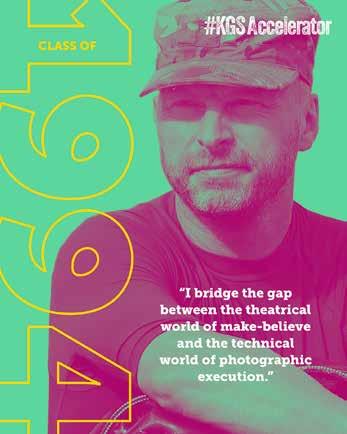
CHRIS ROSS
Cinematographer
Chris is a member of the creative team responsible for making a film, television series, advert or music video, working alongside the director to create the photographic imagery and atmosphere of the production.
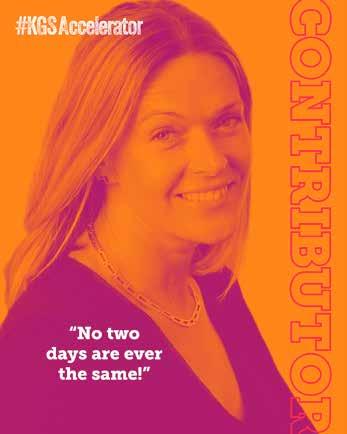
PROFESSOR SUE SMITH
Professor & Director, Centre for Small Business and Enterprise Development
Professor Smith is a leading expert in entrepreneurship and innovation, with a focus on start-up ecosystems and small business development.
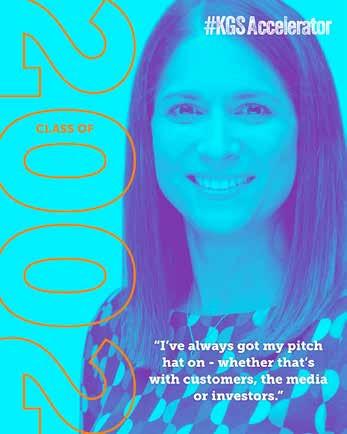
LARA MOTT
CEO & Co-Founder, ImproveWell
Lara co-founded HealthTech company ImproveWell, an app that allows NHS staff to share ideas and feedback, 24 hours a day, 7 days a week, to help improve the experience for both patients and staff themselves.
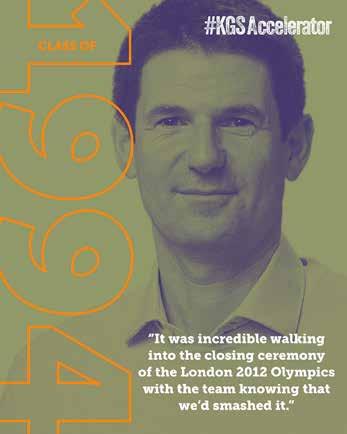
CHRIS LIPSCOMB
Managing Director, AXS
Chris heads a global leader in ticketing, working with well-known brands in sports and entertainment including the LA28 Olympic and Paralympic Games, Coachella Music and Arts Festival and The O2.
Bene Agere ac Laetari
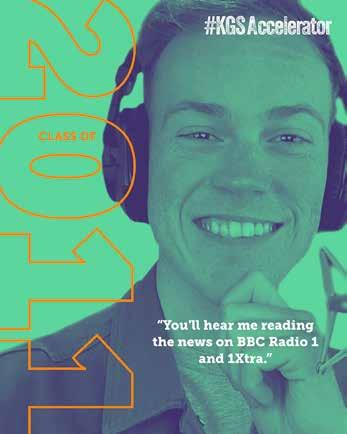
ANDREW ROGERS
Presenter for BBC Newsbeat
Andrew reports for Newsbeat, with a mission to tell stories that matter to young people in the UK. Talking to people about what affects their lives, and interviewing the biggest names in sport, music and culture.
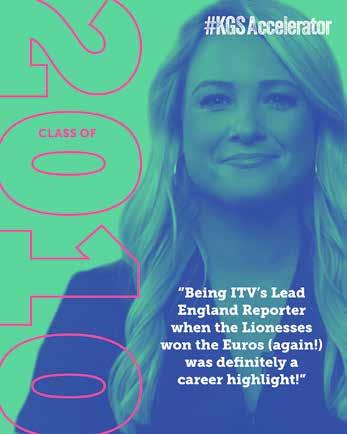
KATIE SHANAHAN
Sports Broadcaster
Katie covers major sporting events across ITV, Sky, talkSPORT & Stan Sport Australia, as well as being ITV’s dedicated Lionesses reporter for the UEFA Women’s Euros 2025.
Without doubt, English Literature A Level is the only subject which furnishes students with the opportunity to understand, evaluate and analyse not only the beauty of the written word, but its importance as a reflection of wider society and its beliefs and systems, both contemporary and historical. This ability to read with curiosity, reflect, critique and communicate your conclusions is a prerequisite for university degrees in any subject, as is the ability to construct and defend an argument.
Further information: Mrs PS Garside
Head of English pgarside@kgs.org.uk
Examination board: Eduqas
Entry requirements: GCSE grade 7 in English Literature
+ Ideal if you’re thinking about...
Publishing, journalism, law, teaching, creative writing, marketing, or roles where communication and critical analysis are key.
+ This subject combines well with...
History, Classical Civilisation, Drama – for literature, law, journalism or teaching careers.
English Literature specification. This is a linear course. Teaching is spread over two years at the end of which candidates will sit three separate examinations and complete one piece of coursework.
Component 1 (30% of the qualification) is open book. Students are required to complete two essays, one on pre-1900 poetry and one on a comparison of two, paired, post-1900 poetry texts.
Component 2 (30% of the qualification) takes the form of a closed book examination where students are, again, asked to produce two essays, one on a Shakespeare play and another on a pair of plays of which one will be preand the other post-1900.
Component 3 (20% of the qualification) gives students the opportunity to synthesise and reflect upon the knowledge they have gained from the course as a whole and to apply their skills of literary analysis to the examination of unseen poetry and unseen prose texts. They are required to write two essays in this section. The three examined components are each two hours in length.
Component 4 (20% of the qualification) takes the form of coursework and requires students to complete an assignment based on the reading of two prose texts, one pre- and one post-2000. This component is internally assessed and externally moderated and aims to allow learners to show knowledge and understanding of ways in which texts relate to one another and to literary traditions, movements and genres.
The proof of the versatility of English as a subject, with its wide-ranging and informative basis, lies in the variety of degree courses that students opt to study. Apart from the more obvious ‘English routes’ of the arts, where English is a perfect accompaniment to essay-based subjects such as History and Philosophy, the analytical nature of A Level English Literature means it is also regarded as a sound basis for those students who wish to pursue a degree in Sociology, or related areas, Law and Medicine. For graduates, careers such as copy writing, publishing, journalism, marketing and the Civil Service are just a few possibilities.
While it is not a prerequisite to have read comprehensively before beginning A Level English Literature, a love of reading and a curiosity about texts and their contexts is important. You should enjoy researching a text’s author and the period in which it was created. To prepare best over the summer, you should not only read a broad selection of challenging books, but also consider visiting current theatre productions, films and exhibitions.
Studying this subject develops you as an individual: intellectually, you gain confidence in thinking about texts in sophisticated and conceptual ways, as well as formulating well-researched, fluent and convincing arguments. More broadly, you will also develop your ability to discuss your ideas with others, often defending, and perhaps modifying, your point of view.
Understanding key human and physical processes, and having a diverse range of transferable skills, is a distinct advantage in an ever-changing and increasingly competitive world. Studying Geography A Level will give you this understanding, and will help develop enviable skills, complement your other subjects and help you at university and in future employment. Key topics at A Level include globalisation, the concept of ‘place’, water and carbon systems, cold environments, natural hazards and population and environment. Away from the classroom, you will complete both Human and Physical fieldwork.
Students also attend regular lectures at the Royal Geographical Society and the local Geographical Association branch.
Further information: Mrs L Macfarlane Head of Geography
lmacfarlane@kgs.org.uk
Examination board: AQA
Entry requirements: GCSE grade 7 in Geography
+ Ideal if you’re thinking about...
Environmental science, urban planning, international development, sustainability, or any career that explores people, places and planet.
+ This subject combines well with...
Biology, Economics, Politics – ideal for sustainability, planning or global development.
The A Level Geography course is assessed through two separate examination papers in Human and Physical Geography. Each paper is marked out of 120, lasts two and a half hours, and accounts for 40% of the final A Level grade. Students are taught by two specialist teachers, with subject expertise in Human and Physical Geography respectively, ensuring depth of understanding and high quality academic instruction across both areas of the specification. The papers are divided into three sections and assess students’ knowledge and understanding, analytical skills and ability to interpret unseen sources. Each topic culminates in an evaluative essay, developing students’ capacity to construct well structured and critical arguments.
Fieldwork is an essential part of the A Level Geography course. Students complete an independent investigation based on fieldwork carried out towards the end of the Lower Sixth, which contributes 20% of the final A Level grade. This provides an excellent opportunity to develop research, data analysis and enquiry skills, supported closely by teaching staff. Current fieldwork visits include a residential course at the Blencathra Centre in the Lake District, with previous trips to locations such as the Isle of Arran in Scotland.
Geography can add a great deal to your portfolio of skills and life experiences and provides an ideal framework for connecting and bringing together other fields of knowledge. It bridges the gap between the Sciences and the Arts making it a great A Level course for a large number of university degrees. At university you can study either Physical or Human Geography, Combined Geography, or other related degree courses such as Land Economy or Environmental Science. Geographers are highly employable and enter a wide range of careers including finance, research, law, consulting, humanitarian work and engineering. Geography opens so many doors and graduates with a Geography-related degree are more likely to be in full-time employment after graduation than the national average.
You should have a keen interest in the world around you, especially contemporary global issues. You will be encouraged to participate actively in lessons and to approach your studies with curiosity and a critical edge. You need to be open to having your opinions and perceptions of the world around you challenged. There are several books that we recommend reading to complement the course including Factfulness by Hans Rosling, Prisoners of Geography by Tim Marshall, The Almighty Dollar by Darhsini David, Adventures in the Anthropocene by Gaia Vince and When Rivers Run Dry by Fred Pearce.
You will develop an increasingly sophisticated understanding of geographical processes and patterns and their inter-relationships which will help you understand and explain what you see happening in the world around you. Unsurprisingly, Geography is the most relevant A Level subject in teaching students about climate change. Throughout the course you will develop your communication and teamwork skills, as well as those of research and critical analysis. These are all crucial transferable skills for university and the world of work.
Politics has never been a more relevant or important subject to study, and the changing political landscape demands a critical, inquiry-based approach. If you want to understand what is happening in UK and US politics –and why – this could be the subject for you.
Outside the classroom, we visited Parliament to hear from speakers across the political spectrum including Jacob Rees-Mogg, Wes Streeting, Zac Polanski and Alastair Campbell. Students got involved in leading school-based Parliament Week activities and took what they had learned to a local primary school, developing their own knowledge, leadership and oracy skills along the way. Speakers we welcomed to KGS included an ex-US federal employee who gave us a fascinating insight into the workings of the US government.
Further information: Mrs J Butcher
Head of Politics
jbutcher@kgs.org.uk
Examination board: Edexcel
Entry requirements: GCSE grade 7 in an essay-based subject, preferably English Literature
+ Ideal if you’re thinking about...
Law, journalism, diplomacy, public policy, campaigning, or careers in government, NGOs or international organisations.
+ This subject combines well with...
RP, Geography, History, Economics, – valuable for careers in law, policy, and public service.
In the Lower Sixth students study UK government and politics with a focus on the role and powers of the key branches of government, examining the theory and practice of Prime Ministerial power, the Cabinet, Parliament and the Supreme Court. We also study representative process and democracy, looking at elections, referendums, party policies, rights of citizens and pressure group power. Political ideologies make up the final part of the Lower Sixth course, where students learn about political ideas which have shaped political thinking, including the writings of Karl Marx, Edmund Burke, Betty Friedan and Mikhail Bakunin.
In the Upper Sixth students study American government and politics, with emphasis on the office of Presidency and their foreign and domestic policies, Congress, the Supreme Court, US political parties, elections, pressure groups and race relations.
A Level Politics is useful for a variety of degrees. An increasing number of our students read Politics, International Relations or a combination of Politics and Economics or History at some of the best universities in the country. We offer additional help and advice, including extension classes, to those who are considering reading PPE or Politics at Oxbridge. Career options are wide and graduates enter professions including those in the City, law, advertising, journalism, broadcasting, teaching and the Civil Service.
Are you interested in the world around you?
Do you want to understand what is happening in the news and the implications of national and international events?
Do you want to feel that you are studying a subject which has direct relevance to your everyday life?
Do you want to understand where political parties get their ideas from and how ideas and philosophy impact their beliefs and policies?
Do you enjoy discussion and debate? If you can answer yes to any of these then you are on the right track to becoming a knowledgeable and well-informed student of politics.
Throughout the course you will be asked to evaluate between different arguments and debates and should develop excellent skills of analysis and debate both in your written work and in your contributions in discussions. This course will also help you to examine the political ideas of previous generations and to compare them to the expectations of the modern world, whilst developing a keen sense of your own political ideas and values.

INTERESTS: HOCKEY, MENTORING, VIOLIN
8.15AM: Arrive at school and have coffee with friends in Café 100 before lessons.
8.30AM: In Tutor Time we discussed our UCAS personal statements. The Upper Sixth students were so helpful and gave us tips about what we should include and their experience. We also signed up for House Hockey in a couple of weeks’ time. Come on, Lovekyn!
PERIODS 1 & 2: Double Biology. We explored circulatory systems, culminating in a hands-on sheep heart dissection. This allowed us to identify key structures and understand how the heart is adapted to efficiently transport oxygen and nutrients around the body.
BREAK: Café 100 to meet up with friends and relax
PERIOD 3: Study period. Worked on my Extended Project Qualification in the Sixth Form Study.
PERIOD 4: Chemistry. We focused on atomic structure, using handheld spectroscopes to investigate spectra from flame tests. It’s fantastic being in the new Bridgen Science Centre laboratories.
1PM: Lunch with friends in Kingston, followed by a Science mentoring session with a First Year student. There are lots of leadership opportunities and we are trained to coach younger students which also helps to build our coaching skills and give back to the school community.
PERIOD 5 & 6: Games. Leave school with friends: I jump on the coach to Ditton Field for a hockey session ahead of an important match on Friday. Friends head off to play padel at a local tennis club and to climb at White Spider in Surbiton.
3.45PM: Had a quick catch-up about our Young Enterprise trip to Spitalfields next week.
8.30AM: Led a House Assembly to start to plan the highly competitive House Drama competition.
PERIOD 1: Study period. Picked up a hot chocolate and worked on my personal statement in the Sixth Form Study, before dropping into the careers office to see Mr Fitzgerald. With an open-door policy, students can visit anytime to discuss university options or future career paths.
PERIOD 2: In English we had a brilliant talk from a visiting author on their writing process and creative inspiration.
PERIOD 3: Service and Volunteering placement at a local primary school. I help the children with reading and have a fun game of football.
PERIOD 4: Back to school for study period where I worked on some homework with friends in the study area in the Sixth Form building.
LUNCH: Debating Society meeting: we started planning our next debate on assisted dying. Grabbed a baguette and fruit salad from Café 100.
PERIOD 5 & 6: Double History: A really engaging seminar-style lesson on the American Revolution.
AFTER SCHOOL: Rehearsal for the Sixth Form Production. I’m playing one of the main characters, so have lots of lines to learn!

If you enjoyed studying History at GCSE, you will love it at A Level. You will have to grapple with difficult yet fascinating questions. Was Adolf Hitler a uniquely evil individual? How revolutionary was the American Revolution? Unless you know history, you will not be able to understand the world you live in, for many of the problems of the world were spawned in the past.
Further information: Mrs M Cope Head of History
mcope@kgs.org.uk
Examination board: OCR
Entry requirements: GCSE grade 7 in History
+ Ideal if you’re thinking about...
Law, politics, academia, heritage, journalism, or any career that values research, argument and a deep understanding of the past.
+ This subject combines well with...
Mathematics, Politics, English Literature, Economics – ideal for careers in law, journalism or heritage.
The course is assessed in a linear fashion so that all three examined units will be taken at the end of the Upper Sixth year. You will be able to choose what you wish to study in both years of the Sixth Form. In the Lower Sixth you have two clear choices:
The Wars of the Roses and Henry VII 1445–1509 and Democracy and Dictatorship in Germany 1919–1963.
The American Revolution, 1740– 1796 and Churchill and British Politics 1930–1997.
In the Upper Sixth you will choose one unit out of a choice of three: Rebellion and Disorder under the Tudors 1485–1603. Russia and its Rulers 1855–1964.
The Changing Nature of Warfare 1792–1945.
The final unit is a non-examined unit where you have to write a coursework essay on almost any historical topic that you wish to study. You may extend your knowledge of an area you have already studied or study an entirely different topic.
A combination of assessment techniques will be used. You will be required to undertake extended writing and essays in all units, to present historical explanations, the significance of events, individuals, beliefs and movements, and to reach substantiated judgements. You will evaluate sources to reach judgements by analysis and evaluation, and to address historical claims and debates.
A Level History is excellent training for any career where you have to use evidence or make decisions, especially where those decisions affect other people. A qualification in History is regarded as highly desirable in careers such as law, medicine, business, finance, accountancy, tourism, town planning, politics, journalism, research and teaching.
If you are to fully enjoy History A Level it is essential that you enjoy reading. It would be useful for you to read a selection of the following history books and novels: The Winter King by Thomas Penn; Margaret Thatcher by Charles Moore; A Little History of the United States by James West Davidson; Churchill, A Biography by Roy Jenkins; The Sunne in Splendour by Sharon Penman; The Remains of the Day by Kazuo Ishiguro; The American Revolution: A History by Gordon S. Wood and any of the Bernie Gunther detective novels by Phillip Kerr.
You will become skilled at asking questions, some of them awkward. You will learn not to take everything at face value. You will develop empathy and understanding of the actions and achievements of others and you will learn how to prepare a case and how to argue that case convincingly; you will learn how to use evidence, draw conclusions and make judgements. Oracy is a key skill in History, which you will develop through regular seminars and debates. These attributes should enable you to think and work in an independent and co-operative manner.
Any student who enjoyed and was successful at Latin and or/Greek GCSE will relish the rigour and extension of Latin/Classical Greek A Levels. They offer the chance to become proficient in the language and to read more of the original texts, showing an appreciation of them within their literary, social and historical context.
Vocabulary revision is centred around that met in the other sections of the syllabus. We revise all main Latin constructions as well as looking at how to write stylish Latin. At A Level there is some new grammar but for the most part it is extending knowledge of grammar already learned in the GCSE course. We use the John Taylor Latin Beyond GCSE textbook. For Greek we make use of various resources, including the John Taylor Greek Beyond GCSE book.
Further information:
Mr W Nolan
Head of Classics
wnolan@kgs.org.uk
Examination board: OCR
Entry requirements: GCSE grade 7 in Latin or Classical Greek, as appropriate
+ Ideal if you’re thinking about...
Linguistics, literature, law, philosophy, archaeology, or academic research –particularly valuable for developing logical thinking.
+ This subject combines well with...
English Literature, History, Religious Studies – supports classical studies, law or philosophy.
Latin and Classical Greek A Level are structured in the same way, with four papers for each A Level.
Prose Literature – 25%
Latin students will study Cicero’s speech ‘pro Roscio Amerino’. In this rhetorical tour de force, Cicero defends a man accused of murdering his father to claim his inheritance.
Greek students will study Herodotus’ account of the Persian invasion of Greece including the Battle of Thermopylae.
Verse Literature – 25%
Latin students study a selection from Virgil’s Aeneid, telling the tragic story of Aeneas and Dido. Greek students will read sections from Homer’s Odyssey, relating Odysseus’ struggle to defeat the suitors and reclaim his proper place as ruler of Ithaca.
Unseen Translation – 33%
Through unseen practice, students will become sensitive to the genre, themes and motifs which are popular with particular authors and will build their knowledge of vocabulary and linguistic structures. The examination requires students to answer translation, comprehension and literary criticism questions on an unseen prose passage and an unseen verse passage.
Prose Composition or Comprehension – 17%
There is a choice between a short passage to translate into Latin/Ancient Greek or a passage in Latin/Ancient Greek on which you will answer comprehension, translation and grammar questions.
There is huge variation in the other subjects taken by Latin/Classical Greek students since these A Levels combine very well with numerous A Levels. The many transferable skills required for this subject make it invaluable to a huge range of careers in later life. Recently, Latin/Classical Greek students have gone on to study Computing, Philosophy, History, Physics, and Modern Languages, as well as Classics-related subjects like Ancient and Modern History, Oriental Studies and, of course, Classics itself. Recent years have also seen considerable Oxbridge success for Classics students.
A meticulous approach to learning vocabulary and grammar are essential to success in the language element of the course. Typical Classicists tend to have a love of reading and, more importantly, of learning, about anything and everything. It goes without saying that an interest in the ancient world, with all its moral dilemmas, scandals and politics, is a must.
It is true that you will not come away from Latin or Classical Greek A Level with the practical ability to mix chemicals safely or design a house, but you will have the hugely transferable skill of being able to analyse complex information and relate it to the modern world.
Studying these languages encourages students to reconcile the minutiae with the big picture. Classical subjects are not the study of one area but many, including literature, history, drama, politics and philosophy, which can all be used to develop understanding of today’s multicultural society.
Studying Mathematics A Level develops excellent problem-solving skills. You will learn how to think logically and analytically, tackle complex problems, break them down into a series of smaller steps, solve each one in turn and then assemble these answers into a solution to the original problem. These skills, in addition to being highly satisfying in their own right, are highly valued by employers as well as being key building blocks for the study of many other subjects.
Unless there are special circumstances, we expect a grade 8/9 at GCSE or IGCSE as this demonstrates that you will be able to make the transition to A Level Mathematics. Being competent at algebra is vital as these skills underpin the way we explain our solutions. We will be helping you with your algebra, and testing you on it, early in the course.
Further information:
Mr K Connor Head of Mathematics
kconnor@kgs.org.uk
Examination board: Edexcel
Entry requirements: GCSE grade 8 in Mathematics
+ Ideal if you’re thinking about... Engineering, economics, data science, finance, technology, or any field that values analytical thinking and numerical skills.
+ This subject combines well with...
Physics, Further Mathematics, Chemistry –essential for STEM careers and university pathways.
The Mathematics course covers topics in Pure Mathematics, Statistics and Mechanics.
Pure Mathematics extends ideas introduced at IGCSE such as calculus and trigonometry, setting them in their proper context. We also introduce new concepts such as integration and differential equations You will start to see how all the different branches of Mathematics link together and are used to solve increasingly complex problems.
In Statistics we study methods of analysing and comparing data, probability and statistical testing. This knowledge will be particularly useful in Economics, Psychology, Biology, Chemistry and Geography.
In Mechanics we apply mathematical ideas to the study of forces, Newtonian Laws of Motion and vectors. Mechanics is the ideal partner for Physics because many topics overlap but it also complements the other sciences.
Assessment will be in the form of examinations at the end of the course.
Each year students go on to study various Mathematics courses at university including Oxbridge. Other students find their understanding of Mathematics is essential as they move on to Science, Engineering, Computing and Economics courses. Statistics is widely used in Medicine and Geography courses. Further Mathematics students tend to go on to study various Mathematics courses, Physics or Engineering at universities including Oxbridge, Imperial, Warwick and UCL.
A good mathematician enjoys the challenge of problem-solving and takes satisfaction in reaching the correct answer. An interest in abstract concepts, such as algebra, and in how these ideas can be applied to real-life problems is also important.
Mathematics provides essential tools for further study in many areas, so curiosity, logical thinking and persistence are valuable qualities for success.
You will build on your knowledge so far by developing and understanding new techniques and skills used in a variety of contexts in other subjects as well. However, studying Mathematics also trains you to reason clearly, logically and accurately, all of which are vital skills in today’s world. You will learn to express yourself clearly and concisely and to fully understand the theory behind techniques. Consistency is crucial and your success will show you to be organised, committed and determined.
We attend lectures, review the latest journals or news stories and promote independent learning through the reading of books. Students are encouraged to act as mentors to younger students. There are also opportunities to enter competitions such as the Senior Mathematics Challenge and to develop a wider interest in the latest developments in Mathematics beyond the textbook!
Sixth Form is a time to become more independent whilst always being supported.
Your tutor will meet with you daily, getting to know your strengths and ambitions. They will help you manage your workload, stay organised and make informed decisions about your next steps.
Your subject teachers are equally invested in your progress, offering both challenge and encouragement. Whether you are already focused on a highly competitive university course or still exploring your options, you will receive thoughtful, tailored guidance.
Alongside academic guidance, your wellbeing remains a priority. Sixth Form can be demanding, and we are here to ensure you feel supported, confident and ready to make the most of every opportunity.
The House system and vertical tutor groups bring together students from different year groups, creating a strong sense of community and connection across the school. This structure provides leadership opportunities and a wider network of relationships throughout your time in the Sixth Form.

The support with university applications made a huge differenceit felt very personal. Sixth Form student
Studying Mathematics at AS Level will help consolidate and develop problem-solving skills. Students learn how to think logically and analytically, enabling them to take complex problems, break them down into a series of smaller steps, solve each one in turn and then assemble these answers into a solution to the original problem.
These skills, in addition to being highly satisfying in their own right, are highly valued by employers as well as being key building blocks for the study of many other subjects.
Unless there are special circumstances, we expect a grade 7 at GCSE or IGCSE as this demonstrates that you will be able to make the transition to AS Level Mathematics. Being competent at algebra is vital as these skills underpin the way we explain our solutions. We will be helping you with your algebra, and testing you on it, early in the course.
Further information:
Mr K Connor
Head of
Mathematics
kconnor@kgs.org.uk
Examination board: Edexcel
Entry requirements: GCSE grade 7 in Mathematics
+ Ideal if you’re thinking about...
Complementing other subjects with quantitative skills –useful for sciences, psychology, geography, economics, and business.
+ This subject combines well with...
Biology, Psychology, Geography –supports many sciences or social science courses.
Study AS Level Mathematics because:
– You want to develop your problem-solving skills and want to learn how mathematical concepts can be applied to real-life problems
– It provides the mathematical skills you need to support your study of other subjects
The Mathematics course covers topics in Pure Mathematics, Statistics and Mechanics. Pure Mathematics extends ideas introduced at IGCSE such as calculus and trigonometry, setting them in their proper context. We also introduce new concepts such as integration.
You will start to see how all the different branches of Mathematics link together and are used to solve increasingly complex problems.
In Statistics we study methods of analysing and comparing data, probability and statistical testing. This knowledge will be particularly useful in Economics, Psychology, Biology, Chemistry and Geography.
In Mechanics we apply mathematical ideas to the study of forces, Newtonian Laws of Motion and vectors. Mechanics is the ideal partner for Physics because many topics overlap but it also complements the other sciences.
Assessment will be in the form of examinations at the end of the course
Each year students go on to study various Mathematics-related courses at university. Other students find their understanding of Mathematics is essential as they move on to Science, Engineering, Computing and Economics courses. The study of Statistics is also valuable in Medicine and Geography courses.
A good mathematician enjoys the challenge of problem-solving and takes satisfaction in reaching the correct answer. An interest in abstract concepts, such as algebra, and in how these ideas can be applied to real-life problems is also important.
Mathematics provides essential tools for further study in many areas, so curiosity, logical thinking and persistence are valuable qualities for success.
You will build on your knowledge so far by developing and understanding new techniques and skills used in a variety of contexts in other subjects as well. However, studying Mathematics also trains you to reason clearly, logically and accurately, all of which are vital skills in today’s world. You will learn to express yourself clearly and concisely and to fully understand the theory behind techniques.
Consistency is crucial and your success will show you to be organised, committed and determined. We attend lectures, review the latest journals or news stories and promote independent learning through the reading of books.
For the most capable mathematicians, the Further Mathematics A Level offers a challenging syllabus which is excellent preparation for those planning on studying Mathematics, Computing Science, Physics, Engineering or Economics at university: indeed, it is almost essential for Oxbridge candidates in these subjects. You will require a grade 9 at IGCSE and will typically have a qualification beyond your IGCSE Mathematics, such as Additional Mathematics or GCSE Further Mathematics.
The most successful students enjoy the challenge of applying their knowledge to unravel a problem and there is a degree of satisfaction and enjoyment from solving a mathematical problem.
Further information:
Mr K Connor Head of Maths
kconnor@kgs.org.uk
Examination board: Edexcel
Entry requirements: GCSE grade 9 in Mathematics
+ Ideal if you’re thinking about...
University courses in mathematics, physics, engineering, or computer science, especially for those aiming for highly mathematical pathways.
+ This subject combines well with...
Mathematics, Physics, Computer Science – for highly numerate university routes.
There will be two options to study beyond the A Level Mathematics syllabus.
Option 1
A Level Mathematics with AS Further Mathematics
This fast-paced course is designed for those wanting a taste of Further Mathematics alongside three other A Level subjects. Students will cover content required for the A Level Mathematics and then continue onto an additional AS Further Mathematics course. This course will offer further study in Pure Mathematics, Statistics and Mechanics, introducing topics such as Complex Numbers, Matrices, Discrete Random Variables, and Work, Energy and Power. This course is only available to students who have studied FSMQ Additional Mathematics or GCSE Further Mathematics.
Option 2
A Level Mathematics and A Level Further Mathematics
This is the course for those students who want to study Mathematics in depth as it counts as two A Level option choices. Designed for those who have a passion for the subject, Further Mathematics is the perfect choice for you if you would like a fuller experience of Pure and Applied Mathematics, or are considering studying Mathematics at university. The syllabus will cover additional material in Pure Mathematics, Statistics and/or Mechanics, including Vectors, Differential Equations, Poisson Distributions and Circular Motion.
The assessment of both options will be by examination at the end of the course.
Many former students comment on how surprised they are that Mathematics features so heavily in other courses and how their confidence in their skills helped them make the transition to higher education easier. Other students use wwThe study of Mathematics installs a sense of logical process, discipline and perseverance, all of which are highly valued by employers.
Studying Mathematics trains you to reason clearly, logically and accurately, all of which are vital skills in today’s world. Former students acknowledge that Mathematics provided them with thinking skills they employ daily in a wide variety of careers. Consistency is crucial and your success will show you to be organised, committed and determined.
We attend lectures, review the latest journals or news stories and promote independent learning through the reading of books such as ‘The Story of Maths’ or ‘Alex’s Adventures in Numberland’. Students are encouraged to act as mentors to younger students through Community Service either coaching those who need extra support or stretching the more able with extension material. There are also opportunities to enter competitions such as the Senior Mathematics Challenge and to develop a wider interest in the latest developments in Mathematics beyond the textbook!
We offer French, German, Italian and Spanish at A Level. All four languages are taught following on from GCSE. Studying languages at A Level gives you plenty of scope to develop your own interests and to analyse and challenge received opinions, enabling you to formulate your own ideas on current affairs. Emphasis is placed on spoken communication as well as planning, structuring and writing essays. Grammar is taught through translation, and the study of film and literature is at the centre of the A Level syllabus, through which current and political issues are discussed. The course also contains an Independent Research Project, where a student’s area of interest can be explored further.
Further information:
Mrs T Russell Head of Modern Foreign Languages trussell@kgs.org.uk
Examination board: Edexcel
Entry requirements: GCSE grade 7 in the corresponding language
+ Ideal if you’re thinking about... International business, diplomacy, translation, teaching, or any career with a global focus or intercultural communication.
+ This subject combines well with...
English Literature, History, Politics –useful for global careers and communication roles.
The topics for the MFL A Level courses are rooted in the target language countries and range from social issues, trends and politics to intellectual and artistic culture.
The three exams focus on reading and listening skills, grammar and translation, and, of course, speaking. For the latter, students research their individual topics related to the target language country, taking a critical look at works of literature, film or music, festivals or personalities. Films and literature are also studied as part of the extended writing paper.
Sound knowledge of the grammar covered at GCSE level is essential. In addition to your timetabled lessons, you will have one speaking lesson on your own or in pairs with the MFL assistant. Grammar skills are honed to tackle the demands of the prose translations. Over time these essentially become a very accessible way to test fundamental grammatical knowledge.
Students are strongly encouraged to go abroad during their time in the Sixth Form. Work experience for all languages can be arranged through a company recommended by the School. There is also the opportunity to compete in debating competitions in your target language, which is invaluable preparation for the oral exams. We have an MFL society, arrange trips to the BFI and organise extension classes for all our students.
Many of our Sixth Form linguists mentor younger students, supporting them in their language learning whilst improving their own language skills and increasing confidence.
Employment rates are higher amongst MFL graduates than graduates with other degrees, an important factor to consider in today’s economic climate.
Languages lend themselves to being combined with another subject at university, such as Medicine, Law, Philosophy, Science, History, Engineering, Economics, Business Studies, Music or Journalism. Unemployment figures show that the percentage of MFL graduates without a job is considerably lower than the percentage of graduates with other degrees, an important factor to consider in today’s economic climate.
Studying a language opens up new horizons, gives students access to different countries and cultures and provides stimulation in so many different ways. It is one of the most enjoyable subjects to study and the one thing most adults regret not having pursued when they were younger. It is time to wake up to the enormous advantages that multilingualism can bring.
‘The economic cost of the UK’s linguistic underperformance – in terms of lost trade and investment –has been estimated at up to £48bn per year, or 3.5% of GDP.’
(The Times, July 2025)
There are huge educational, cultural and psychological benefits to learning a language. Modern language skills are priceless in today’s global professional market and we encourage the study of any language at university as a specialised subject and as combined honours with other subjects. Learning a language is an enriching and useful experience for students of any background and ability. Speaking a language, you are better prepared for the international stage.
If you have a passion for music and enjoy performing and composing, A Level Music could be the ideal choice for you. Many students regularly prepare performances for grade exams and playing these or other pieces for an A Level recording completes about half of the coursework.
If you have ever been curious about how music really works, why musicians find it so fulfilling, and how sound can have such a profound effect on people, this course will provide you with a solid foundation in analysis skills to help explain this. You will study some remarkable pieces of music in considerable detail as well as choosing areas of music to explore in more depth. You will also further develop and refine your composition skills.
Further information:
Mr M Laflin Director of Music
mlaflin@kgs.org.uk
Examination board: Eduqas
Entry requirements: GCSE grade 7 in Music
+ Ideal if you’re thinking about... Performance, composition, music production, teaching, sound engineering, or roles in arts and entertainment.
+ This subject combines well with...
Drama, English Literature, History – for composition, performance or teaching.
Component 1 of the course is Appraising Music, and it is worth 40% of the overall mark. It is assessed at the end of the course through a written paper comprising three sections: Listening, Analysis and Essay. Students study works from the Western classical tradition and a choice of two further areas of study (from a list of seven), including pop music, music for media, music for theatre, jazz, contemporary traditional music, and art music since 1910.
Component 2 is Performance, which can be a solo and/or an ensemble performance as a vocalist or instrumentalist, or it can be a music production using music technology. The performance needs to be at least 10 minutes long, and this component is worth 35% of the A Level marks. The performance is recorded in school between 1 March and 31 May of your final year and it is then assessed externally.
Component 3 is Composition. Students need to produce two compositions, one based on a brief set by the exam board, and one free composition. The process of composing happens mainly during lesson time, and work must be completed by 31 May of your final year. This component is worth 25% of the overall marks.
Following A Level Music, many students move on to university to study Music, either as a discrete subject or for joint honours. Many other options are available, such as conservatoires and other music colleges. Music Technology courses prefer students to have the all-round grounding of the Music A Level. Careers in music often centre around performing and teaching, but musicians are found in all walks of life, such as law, medicine, banking, journalism and arts administration.
In preparation for starting A Level Music, we recommend you get as much experience of different types of music as possible. The BBC Proms during the summer are an excellent introduction to a broad variety of music, and standing (promming) tickets are cheap, plentiful, and the best position in the house; other popular concert venues in London include the Southbank, the Barbican Centre, and the Wigmore Hall. BBC Radio 3 and Classic FM also provide useful introductions to all kinds of music: try to analyse the genre/ period/composer whenever you listen to a piece you do not yet know.
You will gain a broader and more detailed knowledge of styles and periods and be able to apply this knowledge to your own performing and composition. By taking a more careful and detailed look at how music works, you will be able to increase the range and depth of your own music-making, whichever style you prefer. You will also consider the subject from a musicological perspective, relating music to its political and social context and gaining an insight into the nature of performance.
Our experienced Sixth Form team offers one-to-one support with UCAS applications, including advice on Oxbridge and US applications with specialist staff. Here’s just a snapshot of the support on offer:
PSHE programme that includes sessions such as Taking a Gap Year, Interview Skills, Networking Skills and Using LinkedIn. A higher education programme supported by UNIFROG featuring:
The effective careers programme offers pupils impartial guidance about a wide range of future opportunities including university, career apprenticeships and taking a gap year.
Independent Schools Inspectorate
One-to-one careers guidance with a fully qualified, impartial careers and higher education professional. Interview coaching for competitive courses such as Veterinary Medicine, Medicine, Dentistry, Architecture, Degree Apprenticeships.
Access to local partnership events organised jointly by KGS, Tiffin Schools and The Kingston Academy, such as university talks, Multiple Mini Interview (MMI) practice for healthcare routes and virtual careers-themed alumni presentations.
Annual KGS Careers Evening.
Presentations by top professionals in their field including many alumni.
Oxbridge preparation including a full day of Thinking Skills Training and one-to-one mock virtual interview practice to mirror the selection process.
Applying to Medicine, Dentistry, Veterinary Medicine presentation.
Applying to Engineering at University presentation.
Applying to US universities UCAS launch.
Degree Apprenticeship presentation.
Oxbridge launch.
Entrance test preparation including UCAT for Medicine & Dentistry.
Decisions at 18 information evening.
Personal statement workshop.
Meet the (KGS) undergrads event.
Support from parents and former students as well as careers and educational experts can give you the competitive edge – and at KGS, we’ll make sure you connect with the right people.
Cardiff University / Durham University / Guildhall School of Music and Drama / Imperial College London
King’s College London / Kingston University / Lancaster
University / London School of Economics and Political Science / Loughborough University / Mountview
Academy of Theatre Arts / Newcastle University / Oxford Brookes University / Oxford School of Drama / Queen
Mary University of London / Queen’s University Belfast
Royal Academy of Dramatic Art / Royal Birmingham
Conservatoire / Royal Holloway, University of London
University College London / University of Bath
University of Birmingham / University of Bristol
University of Cambridge / University of Edinburgh
University of Exeter / University of Leeds / University of Liverpool / University of Manchester / University of Nottingham / University of Oxford / University of Southampton / University of St Andrews / University of Surrey / University of the Arts London / University of Warwick / University of York
Further information:
Mr A Fitzgerald Director of Careers & Universities afitzgerald@kgs.org.uk
Mr S Morris Deputy Director of Careers & Universities smorris@kgs.org.uk
NORTH AMERICA
Canada
University of Toronto
McGill University
USA
Duke University
USA
Stanford University
Pitzer College
University of California, Los Angeles
University of California, Berkeley
Work Well and Be Happy
USA
Harvard University
Boston University
University of Toronto, Canada / McGill University, Canada
Harvard University, USA / Duke University, USA / Stockholm School of Economics, Sweden / Bocconi University, Italy
Pitzer College, USA / Tilburg University, Netherlands University of California, Los Angeles, USA / University of California, Berkeley, USA / Stanford University, USA / Boston University, USA / Korea Advanced Institute of Science & Technology, South Korea
EUROPE / ASIA
Sweden Stockholm School of Economics
Italy Bocconi University
Netherlands Tilburg University
South Korea
Korea Advanced Institute of Science & Technology

17 students received a clean sweep of A*s
26
We offer 26 subjects in KGS Sixth Form
35% of all grades were A*
35 %
75% of grades achieved were A*/A

98% of grades achieved were A*/C
75% 98% 57
Over the past 9 years, 57 students have secured places at Oxford or Cambridge
This subject at A Level offers an exciting opportunity to learn about the human body in a sporting context. It includes an in-depth look at the physiological and psychological aspects of sports performance as well as the effects of history, culture and society on the world of sport today.
Further information: Miss H Naismith Head of Physical Education hnaismith@kgs.org.uk
Examination board: AQA
Entry requirements: GCSE grade 7 in Biology
+ Ideal if you’re thinking about...
Sports Science, Physiotherapy, Sport Business Management, Sports Psychology, Sports Analysis, Sports Medicine, Sports Journalist, coaching, teaching, health and fitness or performance sport.
+ This subject combines well with...
Biology, Psychology, Chemistry.
Specifically, this subject is designed to:
– Develop a deeper understanding of biomechanics, physiology and psychology which govern sports performance
– Illustrate the historical development of organised sport in the UK, globally, and the effects of socio-economic factors
– Examine the social context in which sports operate
– Extend and reward students’ commitment to sport and its associated activities
The A Level is split into 70% examination and 30% non- examination assessment (practical) with students assessed in the role of performer/coach.
Assessment of quantitative skills will represent a minimum of 15% of the overall A Level marks and students will be able to focus their skills as they will only be assessed in one activity/sport.
Areas of theoretical study:
– Applied Anatomy and Physiology
– Skill Acquisition
– Sport and Society
– Exercise Physiology
– Biomechanical Movement
– Sport Psychology
– The role of technology in Physical Activity and Sport
At the major universities, there is scope to combine Sports Science with additional subjects. The most popular universities for sports-related undergraduate courses are Birmingham, Loughborough, Bath, Durham and Exeter. According to a study by Sport England in 2010, sport’s contribution to the English economy reached £20.3 billion. This placed sport in the top 15 industry sectors in England above motor vehicles, telecoms services, legal services, accounting, publishing, advertising and the utilities. The number of people with sport-related jobs was estimated at over 400,000 – that’s 2.3% of all employment in England.
To undertake this course at A Level, candidates should have at least an A in Biology at GCSE, due to the overlap with this subject. A science is also required for some Sports Science courses at university. An interest and ability to perform in whatever roles of the sport chosen is also fundamental.
It really is an excellent and exciting A Level to take and a great choice if you are playing sport at a high level, as you can easily relate your experiences to your studies. It will help your performance by raising awareness of how you learn and perform under pressure of competition. With the new elements of officiating and coaching, you can also explore a different avenue of sports participation and performance.
Physics is at the heart of everything, from the building blocks of the atom, to the great expanse of the universe. How did the universe begin, and how will it end? Physics opens the door to a wide variety of career paths. The skills you will develop by studying Physics are those that employers will be looking for in new recruits. The range of potential career paths is huge – astrophysicists, geologists, pilots and surgeons all find A Level Physics essential.
Further information:
Mr I Deepchand Head of Physics
ideepchand@kgs.org.uk
Examination board: AQA
Entry requirements: GCSE grade 7 in Physics
+ Ideal if you’re thinking about...
Engineering, astrophysics, computer science, research, technology development, or any career requiring scientific and mathematical problem-solving.
+ This subject combines well with...
Biology, Chemistry, Mathematics and Computer Science.
Physics may be theoretical but the fun is real! We endeavour to teach the subject in a fun, relevant way at all levels. This is reflected in the popularity of Physics at A Level. In many ways, Physics in the Sixth Form is similar to GCSE: we will cover many familiar topics, such as forces and motion, electricity and waves.
The advantage at A Level is that, as we develop a greater level of complexity in both our explanations and understanding of these basic phenomena, we can apply them to many real-life situations.
Some topics are new, such as quantum physics, particle accelerators, and cosmology. Studying these areas is challenging yet immensely rewarding. It also gives us an excuse to visit world- leading facilities, such as CERN in Geneva, an experimental fusion reactor near Oxford, and also to observe the Northern Lights, possibly the greatest natural light show on the planet.
For the AQA qualification students will sit three papers, each worth approximately a third of the final mark. Topics assessed include electricity, particles and radiation, waves, and mechanics – the last of which has much in common with Maths. Students are encouraged to take Mathematics A Level with Physics though it is not essential. However, anyone planning to study Science and Engineering beyond A Level will usually find it a prerequisite.
The full A Level will contain the above material plus nuclear physics, further mechanics, thermal and astrophysics. The assessment model will comprise two papers, each worth 34% and 2 hours long covering specific topics.
The final 32% is assessed in a two- hour synoptic paper; all the skills and techniques developed throughout the A Level Physics course are brought to bear as we delve deeper into practical skills and data analysis. Astrophysics is the option offered at KGS and this will be assessed by means of short - and long-answer questions within the synoptic paper.
The skills outlined above are ones that any employer will value, regardless of your final career. Physics keeps your options open at university and in the workplace. Dentistry, Aviation Engineering with Pilot Studies, and Economics are three university destinations for KGS students with A Level Physics.
Physics at A Level will involve lots of problem solving and you will need to develop a logical and numerate approach in order to achieve the greatest success. Communication skills form an essential part of being an effective scientist. You will need to convey your findings both in written and oral form. You will be able to develop your skills of presentation and persuasion as you argue various points in your work.
A Level Physics requires someone prepared to ditch ‘everyday’ descriptions of phenomena and replace them with scientifically rigorous explanations. You will require an open mind to do this and at the same time you will develop computing and practical skills, teamwork and flexibility. The department regularly produces successful Oxbridge candidates. All this requires hard work, commitment and attention to detail.
Psychology is the scientific study of the mind and behaviour. It encompasses a wide range of topics, including perception, cognition, emotion, development, personality, social interactions and mental health. Psychologists use various research methods to explore these phenomena, including experiments, surveys, case studies and observations. They seek to understand how individuals think, feel and act, both individually and in groups, and how these processes are influenced by biological, psychological and social factors.
Psychology has practical applications in various fields, such as therapy, education, business and healthcare, aiming to improve individuals’ wellbeing and enhance our understanding of human nature.
Further information: Mrs A Edwards Head of Psychology aedwards@kgs.org.uk
Examination board: AQA
Entry requirements: GCSE grade 7 in an essay-based subject, preferably English Literature
+ Ideal if you’re thinking about...
Mental health, counselling, education, marketing, criminology, human resources, or further study in behavioural sciences.
+ This subject combines well with...
Any combination of subjects such as Biology, Sport, Business, History, English and Drama.
The Psychology specification introduces students to the broad range of topics. This course of study comprises three written units at A Level, with no coursework. The course is linear and therefore the three exams will be taken at the end of the two-year course.
Students will sit three papers:
Paper 1 – Introductory topics in psychology
Paper 2 – Psychology in context
Paper 3 – Issues and options in psychology
These three papers are equally weighted.
The emphasis is on applying knowledge and understanding, thereby developing students’ transferable skills of analysis, evaluation and critical thinking.
The specification offers a broad range of topics, with research methods in context. The compulsory content consists of social influence, memory, attachment, psychopathology, approaches in psychology, biopsychology, research methods and issues and debates in psychology. The second year of the course builds on these foundations; students can study various subject options such as relationships, gender, cognition and development, schizophrenia, eating behaviour, stress, aggression, forensic psychology and addiction. The exam papers include multiple choice, short answers and extended writing.
Psychology at university is incredibly popular and can lead to careers in most areas, but education, marketing, advertising, medicine, the law and human resources are common choices. For students who are thinking about becoming a professional psychologist, they need to ensure that their degree is recognised by the British Psychological Society and is suitable for Graduate Membership.
Communication skills play a pivotal role, facilitating the articulation of complex concepts in both writing and presentations. Moreover, an open-minded, empathetic approach is invaluable for embracing diverse perspectives and understanding others’ experiences. Cultivating these attributes enriches the learning journey and boosts success in A-level Psychology studies. Before diving into the course, exploring recommended readings such as “The Lucifer Effect” by Philip G Zimbardo and “How the Mind Works” by Steven Pinker, alongside engaging with TED talks, can greatly enhance comprehension and appreciation of the subject.
The Psychology course is not ‘an easy option’; there will be lots of content, studies, and theories to learn. You will find that you have to learn much more than you have ever had to at GCSE which will test your methods of revision. At the same time you will hopefully enjoy learning about how and why we behave in the way we do. An important skill that you will develop whilst studying A Level Psychology is the ability to analyse critically and evaluate studies and theories.
Are you interested in discussing and debating life’s toughest questions? Do you like challenging others’ ideas, and are you comfortable having your own ideas challenged too? Then this is the course for you! The Religion & Philosophy Department at KGS will help you navigate through a truly fascinating set of questions such as, ‘how can we know what is real?’, ‘what is the best way to ensure we act morally?’, and ‘does God exist?’
Further information: Mrs C Williams
Head of
Religion
& Philosophy
cwilliams@kgs.org.uk
Examination board: OCR Religious Studies
Entry requirements: GCSE grade 7 in Religious Studies
+ Ideal if you’re thinking about...
Studying anything from STEM or medicine to law, philosophy or the humanities, where strong critical thinking, analysis and clear argument are essential.
+ This subject combines well with...
A wide range of subjects, from Physics and Maths to History, Politics and English, making it a versatile complement that strengthens analytical thinking across both STEM and humanities pathways.
If you enjoyed GCSE Religious Studies then you can expect a great deal more discussion and depth of study of these topics in the Sixth Form, but equally there is no requirement for you to have studied this subject beforehand at all. A true philosopher is one who thinks deeply and clearly, and enjoys debate and problem solving. This subject sits naturally alongside any of the others on offer at KGS.
We follow the OCR Religious Studies A Level syllabus, which is split equally into three parts, as follows: Philosophy of Religion; Ethics; and Developments in Christian Thought. All three papers are examined via a set of three essays from a choice of four. You will have every opportunity to become an expert at structuring and writing essays by the end of the course. If you want to aim for the very highest grade, you have to do quite a bit of reading, but the beauty of the course is that you can have a certain amount of autonomy in those areas you would like to read about in more depth.
In the first module we cover important philosophical topics such as: Ancient Greek influences on modern Philosophy from Plato and Aristotle, whether God exists, and issues with the concept of God, as well as whether God-talk is meaningless.
In the second module we study ethical issues such as: whether religion should guide moral decision making, whether maximising human happiness should be humanity’s goal, whether there is such a thing as ‘morality’ in the first place, and the controversial issues of euthanasia, business ethics and sexual ethics.
In the latter module we consider various theological topics such as human nature, death and the afterlife, Jesus’ role as God, whether God can be known innately, or through revealed writings such as scripture, religious pluralism and the interplay between religion and the state, gender and society, and liberation theology.
Many of our students choose to continue studying Religion & Philosophy at undergraduate level, be it as a single or a joint honours degree. A great many university interviews involve a philosophical element, so the discussions we have in lessons are great preparation for this. For example, the course is an excellent preparation for students wishing to go into areas such as Law and Medicine; and it also complements subject areas such as Mathematics, History, Classics and English, as well as many others.
Lessons are focused on discussion which makes them lively affairs!
Having an opinion is therefore important, as is having the confidence and ability to challenge ideas that you read and hear. We teach, and insist upon, reasoned analysis and careful thinking, so you should be prepared to be challenged. As the assessment is through essay-writing, you need to be able to express yourself on paper.
The key skills which you will develop through this course are the ability to think, to understand how arguments are formulated and to be able to challenge arguments through the use of logic and evidence. You will be able to contrast the ideas of different scholars and come to reasoned conclusions. You will be thinking about some of the most important questions about life and the world around us.
To succeed in the 21st-century job market you must be emotionally intelligent, adaptable and resilient, as well as being able to handle tricky interviews and assessment centres. We want to give you the skills and flexibility you will need to stand out from the crowd for employers and recruiters. That’s why we make the development of empathy, critical thinking, problem solving, negotiation skills and teamwork an important part of both our subject teaching and co-curricular activities.
In addition to A Levels, all Lower Sixth students study an academic enrichment course, designed to allow you to explore areas of interest beyond the constraints of the curriculum and develop your life skills.
Whilst some courses will result in a qualification, that is not their sole purpose. Essentially, they are designed to help you build independence and broaden your knowledge. You can refer to your enrichment option in your UCAS personal statement, as well as gaining UCAS points for an Extended Project Qualification (EPQ).
QUALIFICATION EPQ LEVEL 3 (EDEXCEL)
This option allows you to explore a topic of personal interest, and then write a detailed, analytical project (in the form of a dissertation, investigation, performance or artefact) which is the equivalent of half an A Level (for which students can achieve an A* grade). This is a great opportunity to explore and analyse a topic in depth, to support arguments with detailed research, and then to reflect upon and evaluate the process. There is also an assessed oral presentation component. Students are assessed on both the quality of the final outcome (i.e. their dissertation, investigation, performance or artefact) and the way in which they completed the process.
This course introduces students to Critical Thinking as understood in university admissions tests, such as the Thinking Skills Assessment and the Biomedical Admissions Test. You will learn how to: – identify intermediate and main conclusions – identify assumptions – assess the significance of additional information which strengthens or weakens an argument
– detect reasoning errors – identify matching arguments – apply principles
– make and assess inferences and deductions from quantitative data
+ EXTENDED PROJECT QUALIFICATION (EPQ)
Scan the QR code for more information
The aim of the course is to introduce key themes in social and political thought through the reading of a series of extracts from key works in philosophy, political theory, sociology and economics. Themes will include political obligation, distributive justice, the nature of society, forms of social scientific explanation, the idea of history and historical explanation, feminism(s) and the idea of class.
The classes will be organised around the prior reading of the extract to provide a basis for structured discussion focusing on key ideas and themes.
As the course progresses, students will take the lead by presenting on a text or a theme. Each half-term there will be a written piece of work focusing on the ideas discussed.
An internationally recognised qualification which enables you to acquire a range of key leadership and management skills and put them into practice. The ILM is worth 8 UCAS points.
You will examine some key linguistic and cultural themes, whilst building up your vocabulary and grammatical base for the future. Ideal for students thinking of studying languages in some form at university.
Bene Agere ac Laetari
+ INSTITUTE OF LEADERSHIP & MANAGEMENT AWARD (ILM):
Scan the QR code for more information


The DELF is the perfect academic enrichment choice to continue studying French alongside your studies and is recognised worldwide. This course will enable you to develop and master the 4 skills (speaking, listening, reading and writing) and prepare you to sit the DELF B1 exam in the Summer term. It is recommended that students take this option only if they have achieved at least an A grade in their GCSE French.
INTRODUCTION TO THERMODYNAMICS
This course is intended for strong Mathematicians and Physicists considering applying to study degrees in Mechanical Engineering or Physics, and participants should preferably be taking either Further Maths or AS Further Maths. It explores the interaction of Heat, Temperature, Work and Energy, and how this can be applied to the design and analysis of thermodynamic flow processes such as Refrigeration/ Heat Pump Cycles and Steam Turbine Systems. Given the limited places on this course, any students wishing to pursue the Sciences further could look at the Open University courses or MOOCS as an alternative.
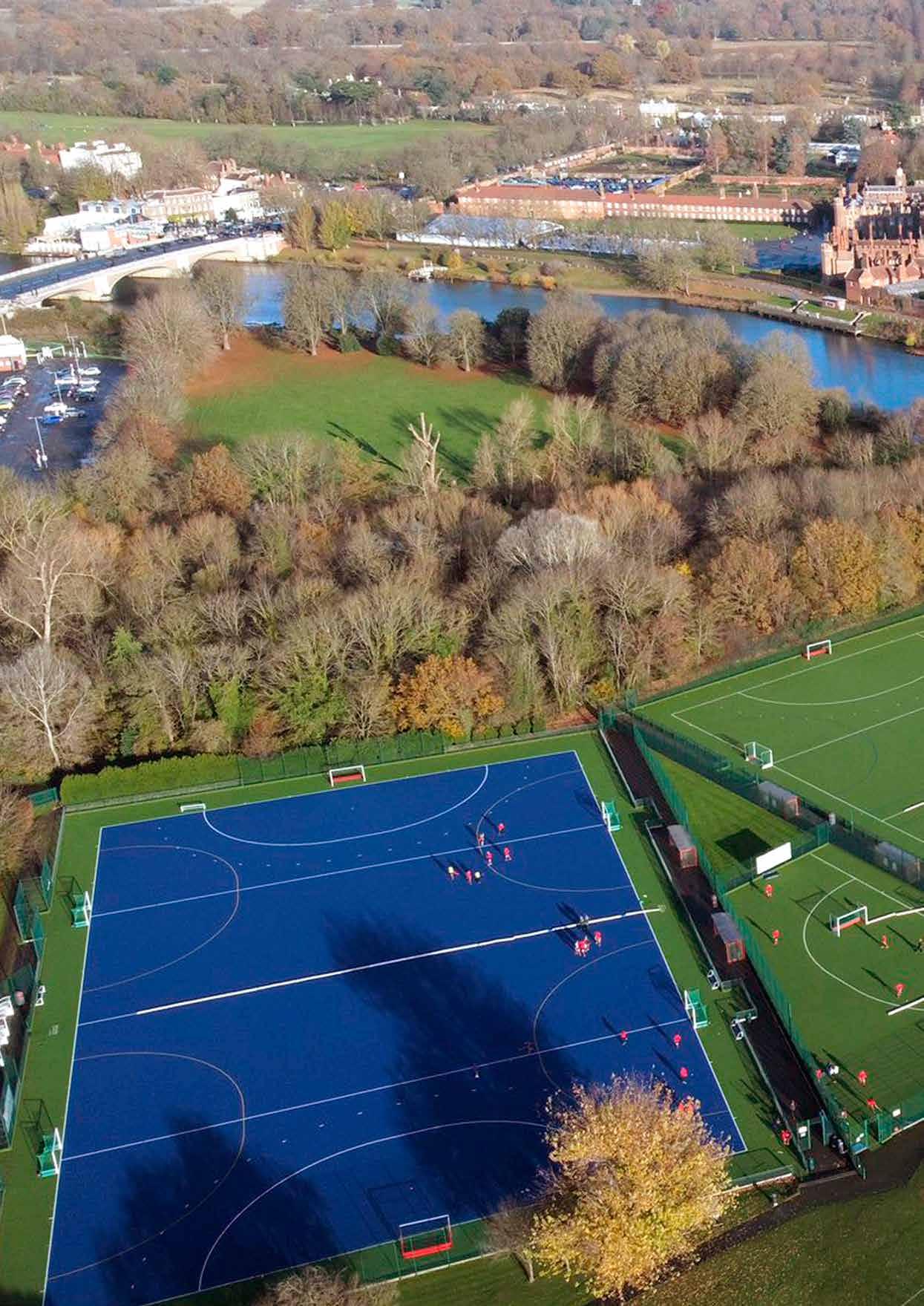
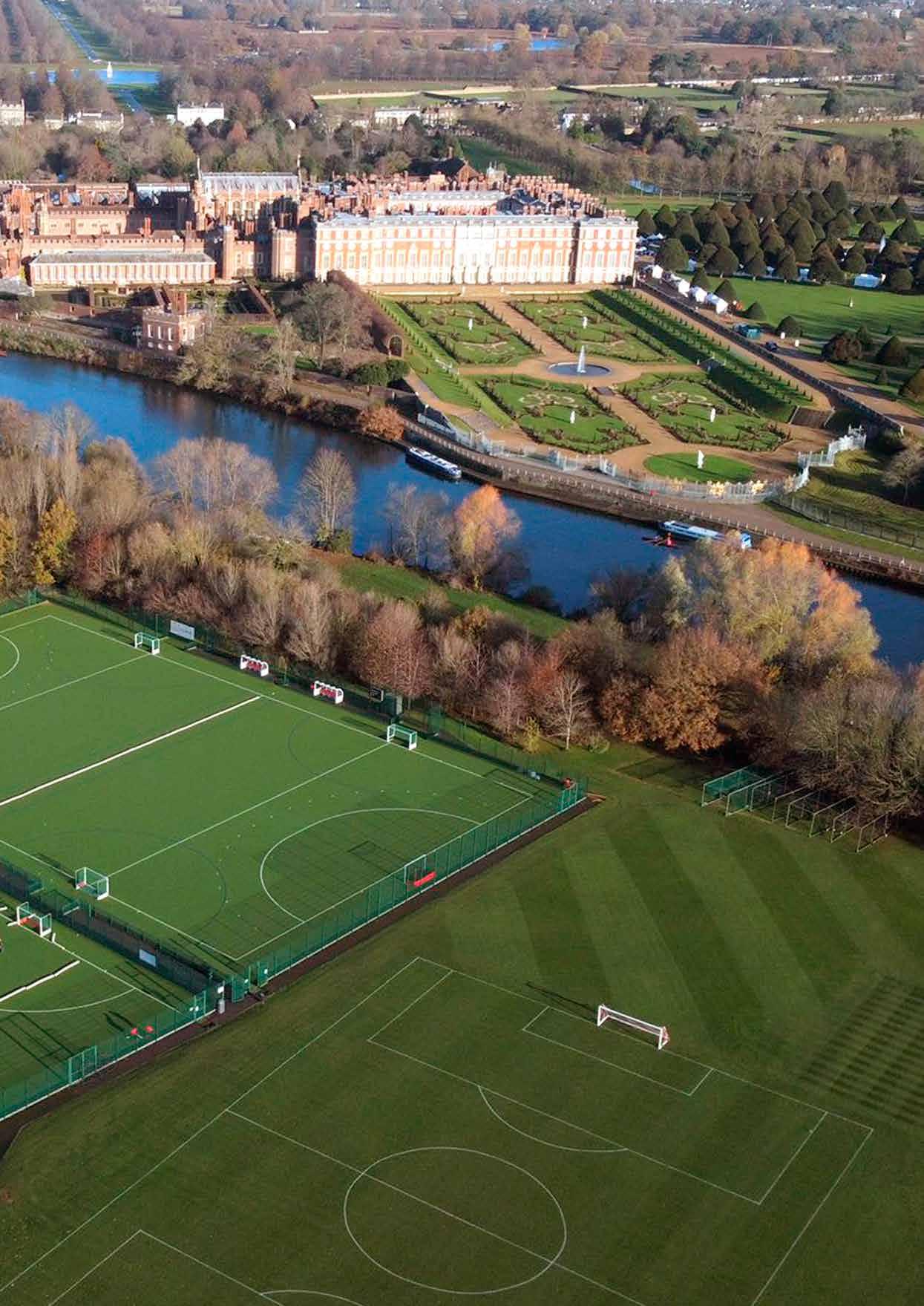
Kingston Grammar School
London Road
Kingston upon Thames
KT2 6PY