KRIRM I Winter 2014 I 1
FEATURES 3 4 6 8
Wagon Tracks
“Dealing with Change in Dynamic Times“ By Dr. Kim McCuistion
Great Partners to KRIRM
Oil and Gas and Equine Management Lectureship Instructors bring a first-class educational experience to Kingsville. By Ashley Patterson
Wilson Cattle Co.
Integrated from Ranch to Rail By Kindra Gordon
Published by the KING RANCH ® INSTITUTE FOR RANCH MANAGEMENT Texas A&M University-Kingsville 700 University Blvd., MSC 137 Kingsville, TX 78363 361-593-5401 361-593-5404 fax krirm@tamuk.edu http://krirm.tamuk.edu Clay P. Mathis, Ph.D., Director and Endowed Chair Ashley Patterson, Editor
A New Era
Three new management council members bring a fresh perspective to KRIRM By Ashley Patterson
MANAGEMENT COUNCIL Chair: James H. Clement Jr., King Ranch, Inc. Caroline Alexander Forgason, Robert J. Kleberg, Jr. & Helen C. Kleberg Foundation Gus T. Canales, A.T. Canales Ranches Dave DeLaney, King Ranch, Inc. Bob McCan, McFaddin Enterprises Eric Jacobsen, AgReserves, Inc. Neal Wilkins, Ph.D., East Wildlife Foundation John Welch, Welch Cattle Company Fred Bryant, Ph.D., Caesar Kleberg Wildlife Research Institute Allen Rasmussen, Ph.D., Texas A&M University-Kingsville
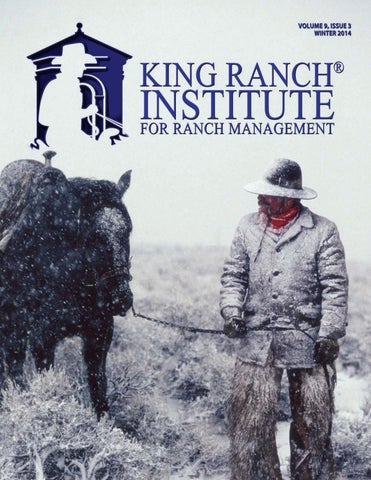
Cover Art: “ Winter’s Chill” David R. Stoecklein
2 I Winter 2014 I KRIRM
“Dealing with change in dynamic times” From Associate Professor, Dr. Kim McCuistion
I
t was an exciting year in 2013 for the King Ranch® Institute for Ranch Management. Not only did 2013 mark our 10-year anniversary, the Annual Holt Cat® Symposium on Excellence in Ranch Management was also a great success. The focus of the 2013 symposium was “An Industry in Transition: Dealing with Change”. The exceptional slate of symposium speakers made it crystal clear that we should expect more change in our industry in the years ahead. But the overriding question addressed was how ranchers can respond to cope in this dynamic time. We know that the recipe to success in the past is not necessarily what it will take to be successful in an unpredictable future. But, here is what we do know. The U.S. beef cows herd will likely continue to shrink a bit more, and that means a shrinking beef supply that should continue to support high calf prices. On the other side of the equation, there are many indicators that some of the major cost items, like fuel and grains, may be less expensive in the future, such that we see an overall decline in production costs. On top of that, some of the drought stricken areas of the country have been receiving more rain. This may allow the U.S. cow herd to stabilize and begin to grow during 2015 and beyond. In the meantime, we still have concerns that the smaller U.S. cow herd and overall low throughput of cattle is at a critical level. The feeding and packing industry have too much unused capacity and we are likely to see a correction with closure of more packing houses and feedyards. We need to maintain the infrastructure of this industry, and should be on guard about the ramifications of continued reductions in cattle numbers. Producers must ask themselves the question: If there is another
packer that closes, will it directly or indirectly affect me? What should I do to minimize that risk? With such risk in mind, and the optimistic market outlook and improving weather forecast, many ranchers may find opportunities to expand their operation by purchasing more land or leasing acreage. Land prices have increased dramatically over the last decade, but because it is among the safest investments there may still be opportunity for those with cash. The greatest opportunity may be for smaller scale operators that have the good fortune of finding a reasonable leasing option that will allow expansion. Regardless of how our industry expands in the coming years, the markets will remain volatile, opportunities for profitable business ventures will still be present, and those that embrace innovation and are prepared to cease new opportunities quickly while minimizing risk, will likely find great success in the years ahead. As we look forward to 2014 and beyond, KRIRM will continue to educate the next generation of ranch managers and provide continuing education opportunities for those involved in the ranching industry. We wish everyone a happy and prosperous New Year.
“We know that the recipe to success in the past is not necessarily what it will take to be successful in an unpredictable future.”
Photo by JoAnne Meeker
wagon WT tracks
KRIRM I Winter 2014 I 3
Lectureship attendess at Oil and Gas and Equine Management
Oil and Gas and Equine Manamgement lectureship instructors bring a first-class educational experience to Kingsville. By Ashley Patterson
E
ach year, the King Ranch® Institute for Ranch Management (KRIRM) hosts a series of lectureships as part of the Texas AgFinance Certificate in Advanced Ranch Management. These lectureships feature expert instructors from their respective fields who make the KRIRM lectureships first-class educational experiences. Two of the KRIRM lectureships, equine management and oil and gas, have become a favorite among participants, in particular because of the class instructors. These instructors have given much of their time and energy teaching their courses, becoming great partners and assets to KRIRM.
Judon Fambrough: Oil and Gas
Probably one of the most humorous and charismatic instructors in the KRIRM lectureship series, Judon Fambrough, senior lecturer and attorney at law at Texas A&M University, has instructed the W.B. “Dub” Yarborough Lectureship on Oil and Gas for the past six offerings of this class. He also taught the Canales Lectureship in Real Estate Law last year as a substitute for the annual Yarborough Lectureship. Fambrough finds Texas property rights a particularly interesting subject on which he researches, writes and gives presentations. This interest began at an early age, he said. He grew up on a farm on the South Plains of Texas where his father asked him questions about property rights. As a young boy, he did not know the answers and his father knew it. His father was simply thinking out loud. The quest for the answers continued long after his father died. After serving his country in Vietnam, Fambrough used his G.I. Bill to attend law school at the University of Missouri where he graduated in 1974. He started his employment with Texas A&M University in 1977 with a joint appointment in the Agricultural Economics Department and the Real Estate Center. The Agricultural Economic Department appointment came with a teaching requirement. In 1977, Fambrough taught his first course in Agricultural Law and continued until 1980 After that, he initiated a new course in Oil and Gas Law that 4 I Winter 2014 I KRIRM
he taught from 1980 to 2005. When he began working fulltime for the Texas Real Estate Center in 2005, the Oil and Gas Law Course ceased to be offered. Fambrough’s impact on Texas real estate has been farreaching. During his 36-year tenure at Texas A&M University, Fambrough published more than 300 articles on Texas real estate law, including articles on oil and gas law. Also, he gave more than 500 presentations to Texas landowners and agricultural groups. These include presentations to the Texas Farm Bureau, Texas Bankers Associations, the Texas Association of Land Brokers, county meeting of the Texas Extension Service, the International Right of Way Association, the annual Beef Cattle Short Courses at Texas A&M University, local boards of realtors, and many more. Fambrough’s presentations contain many humorous antidotes. “I tell everyone, I am a ‘Roads Scholar’. I have a great ability to travel but very little ability to think. I am not a Rhodes Scholar,” he said. The W.B. “Dub” Yarborough Lectureship on Oil and Gas at KRIRM covers the Rule of Capture, the rights and substances comprising the mineral estate, the rights and responsibility of mineral cotenants, the provisions contained in an oil and gas lease and how to negotiate better ones, and many others. The lectureship takes attendees on a field trip to the King Ranch where they visit an active drill site and learn about drilling rigs. The three-day lectureship entails an in-depth and comprehensive examination and discussion of mineral leasing and mineral production. Fambrough’s entertaining presentations and pertinent examples leave attendees asking the time and place of the next event. Fambrough gives numerous presentations each year to hundreds of people across Texas. However, because of the length of the KRIRM lectureship, he develops strong relationships with many of the attendees. “They are hard-working individuals like my dad who have specific questions and seek answers concerning property rights,” he explains. “I love the people, their backgrounds and their quest for knowledge. I have met some great people and correspond with many of them on a daily basis.”
Fambrough teaching the 2012 Oil and Gas Lectureship in Kingsville.
Dr. Ben Espy: Equine Management
The Richard Mifflin Kleberg, Jr. Family Lectureship on Equine Management is instructed by Dr. Ben Espy, a board certified specialist in equine reproduction and infertility. Espy received his biology degree from Duke University in 1991, and his doctor of veterinary medicine degree from Texas A&M University in 1996. Espy’s interest in veterinary medicine began at an early age. During the summers, Espy worked on King Ranch cleaning stalls and taking care of mares during the breeding season. He became a student of Dr. John Toelkes, the King Ranch veterinarian at that time, learning the ins-and-outs of taking care of mares during the breeding season. In 1998, Espy’s career took him to Lexington, Ky., to the Hagyard Equine Medical Institute, a practice home to more than 50 veterinarians who work on world-renowned race
horses and pleasure horses. In the 7 years Espy worked as an ambulatory vet and as a resident in infertility for Hagyard, he says he probably earned 15 to 20 years of experience, ultrasounding roughly 60 to 70 mares per day. After his time at Hagyard, Espy returned to Texas and worked with the San Antonio Stock Show & Rodeo as the rodeo veterinarian. He began building relationships with the rodeo cowboys and cowgirls, and soon started working independently on western performance horses, i.e., team roping and calf roping horses. Espy explained that this new clientele liked the idea of a veterinarian with a fresh perspective from working on race horses. Through word-of-mouth and a trusted circle of clients, Espy grew his business substantially. Working solely out of his truck—complete with a fully equipped clinic in the
Espy teaching a lab on King Ranch at the 2012 Equine Management Lectureship
continued on page 10
KRIRM I Winter 2014 I 5
Several thousand mother cows make up the Wilson Cattle Co. cowherd. Cows are English/Continental cross genetics and are bred to sires for terminal traits.
By Kindra Gordon
S
ynergy is defined as “the interaction of multiple elements in a system to produce an effect different from or greater than the sum of their individual effects.” That aptly describes what’s happening in the Pacific Northwest, where the Wilson family has built upon each generation to develop a successful synergy in the beef business. Today, the family business encompasses Wilson Cattle Co., which includes a cow-calf and stocker operation headquartered at North Powder, Ore., and Beef Northwest, one of the largest cattle feeding and backgrounding operations in the region, with a total, one-time capacity of 95,000 head at four feedyards. Two yards are located in Boardman, Ore., the others are in Nyssa, Ore., and Quincy, Wash. The two entities are operated independently, but are integral to one another, explains John Wilson, who is the fifth generation of the family. He explains that utilizing the individual carcass and performance data from the feedlot provides important information used for making genetic selection and herd management decisions not only for the Wilson cowherd, but also for the many customers who feed cattle at Beef Northwest. “It’s a big circle,” Wilson says of their beef production efforts using carcass performance data to continually strive to make the next year’s calf crop – and the retail product they produce – even better. 6 I Winter 2014 I KRIRM
Homestead History
Wilson Cattle Co. can be traced back to 1878, when John’s great-great grandfather was on the Oregon Trail and settled on 160 acres in a northeast Oregon valley near North Powder. Through the generations, the family has always focused on raising cattle even though sheep were popular in the area. John’s great grandfather also had a stint supplying horses for the Pony Express, but it is quality beef cattle that have become their legacy. By the 1920s, the Wilsons were running a stocker operation and helping run a 1,000-head finishing yard. From those beginnings, contiguous ranches have been added to the Wilson spread over the decades, and today they run several thousand mother cows in five herds. John proudly reports that the original 160 homestead acres are still part of the ranch. Their cowherd genetics focus on English/Continental crosses with predominantly Angus influenced sires. All bulls are selected for growth and carcass traits; most come from Thomas Angus Ranch at Baker City, Ore. “Because we don’t retain heifers from our own cow herd, we put a strong focus on selecting bulls for growth and grading.” They have cooperative arrangements with several ranches in the Northwest to raise replacement females for the Wilson herd; Wilson and his team work with those partners on trait selection.
A 70-day calving season With services from a from Feb. 15 to April 25 is private nutritionist, grasses are adhered to at Wilson Cattle sampled a couple times each Co., with weaning occurring summer and that information from Aug. 15 to Sept. 15. is used to adjust nutritional Ninety percent of the calves content of a mineral mix that they raise are destined for is offered to the cowherd. Country Natural Beef, a wellThe Wilson’s conservation established natural beef brand efforts have included restoring with retail distribution through riparian areas, enhancing Whole Foods and other West wildlife habitat and raising Coast regional stores. water tables on their ranches. In addition to the cowherd, Their environmental Western heritage is a proud part of the Wilson Cattle running stockers on both the stewardship has also carried Co. legacy. The family ranch now has the fifth and sixth home ranch and leased land over to their feedyards where generation involved in the operation. in the Northwest has, and they monitor groundwater continues to be, an integral part and continue to be innovative of Wilson Cattle Co. and the synergy it has with its feedlot with waste management efforts. entity Beef Northwest. Wilson is optimistic for the future of the beef business, saying, “We think the protein industry has a tremendous future and beef fits right into that. Our company has a Attention to Management very strong management team, and our strategic plan is to From the time a calf is born all the way through its continue to grow.” performance in the feedlot and on the rail, Wilson Cattle Co. That said, he recognizes that challenges always face the and Beef Northwest staff pay close attention to the beef they industry. Among them he counts mandatory country-ofare raising. While genetics and feedlot management are two origin labeling, labor availability, continued high land prices ends of that spectrum, grazing management is also key to the and regional water laws. system. Despite that, he says Wilson Cattle Co. and Beef Wilson shares that their grazing season on the ranch Northwest will continue to seek ways to utilize the technology begins about April 1 and runs through October. They use a available to improve the beef production process from gate to Savory-style intensive rotation with cows being moved to new plate, and their ultimate goal is to “keep moving forward.” pastures every 3 to 4 days, and allowing pastures to rest about 3 to 4 weeks before they are grazed again.
KRIRM I Winter 2014 I 7
By Ashley Patterson
A
vital piece to the success of the King Ranch® Institute for Ranch Management (KRIRM) comes from a group of people with strong ties to the ranching and agricultural industries, people who volunteer their time and extensive knowledge to contribute to the wise direction of KRIRM. Since the inception of KRIRM in 2003, this group of people— the management council—has served as guides to the director and faculty of KRIRM on issues such as lectureship and symposia topics, student projects, internal budgets, and more. Council members also assist in the selection of graduate students each spring and serve on graduate student committees. “The management council is an integral part of insuring the program provides practical knowledge along with the academic experience,” said KRIRM Management Council Chair, Jamey Clement of King Ranch, Inc. “Since the program is meant to produce graduates with a holistic approach to ranching, it was important the council have members that represent a broad range of experience, such as wildlife science, range management, cattle operations and general business administration.” From 2003 until 2012, the members of the management council were chair, Jamey Clement of King Ranch, Inc.; Paul Genho of AgReserves, Inc.; Lynn Drawe, retired director of the Welder Wildlife Foundation; Caroline Alexander Forgason of Robert J.
8 I Winter 2014 I KRIRM
Kleberg, Jr. and Helen C. Kleberg Foundation; Gus T. Canalas of A.T. Canales Ranches; Dave DeLaney of King Ranch, Inc.; Jack Hunt, retired CEO of King Ranch, Inc.; Bob McCan of McFaddin Enterprises; Allen Rasmussen, Ph.D., Dean of TAMUK Collge of Agriculture, Natual Resources, and Human Sciences; and Fred Bryant, Ph.D., Director of CKWRI. Clement explained that the collaborative efforts of the group allowed for comprehensive discussion on all topics related to the betterment of KRIRM. The stability and low turnover of the council during the first 10 years of KRIRM was integral to the early success of the program, said Clement. But as the program grew, so did the need for positive transitions. “There is a benefit to bringing in new people and along with them their perspective and a fresh look at the challenges we face,” said Clement. In an effort to bring in this new perspective to KRIRM, a transition of the management council at the end of 2012 added three new members as three standing members—Drawe, Genho, and Hunt—retired from the council. The three new members have an impressive background in the industry and have been integral partners to KRIRM. This New Year brings Erik Jacobsen of Deseret Cattle & Citrus, John Welch of Welch Cattle Company, and Neal Wilkins, Ph.D., of East Wildlife Foundation, to the management council.
Erik Jacobsen
Erik Jacobsen is Vice-President & General Manager of Cattle Operations for AgReserves, Inc., headquartered at Deseret Ranches in St. Cloud, Fla. Jacobsen began work at AgReserves in 1986 as a cattle foreman on Deseret Ranches of Florida and has served as vice-president and general manager since 2006. He worked for Smithfield Foods from 1995 to 2006 in various management positions including general manager. He is active in the industry, currently serving as 1st Vice-President of the Florida Cattlemen’s Association and Vice-Chairman of the Marketing and International Trade Committee of the National Cattlemen’s Beef Association. Jacobsen is a graduate of the University of Florida with a Bachelor of Science in Animal Science and earned a Master’s in Business Administration from Brigham Young University. He and his wife Renee, originally from Scottsdale, Ari., have been married for 23 years and have six children.
John Welch
After graduating from Texas A&M University with a degree in ag economics in 1972, Welch took a position with Cattle-Fax as a market analyst and then head of market research. In 1976, he moved to CattleFax’s parent association, the National Cattlemen’s Association, as the staff representative for cattle marketing and liaison for state affiliate cow-calf associations. Welch then worked with Triple G feedlot in Brighton, Co., and then Taurus Corporation in Boulder, Co., as market risk manager and customer contact person. In 1982, George Spencer, Bob Rufenacht, and Welch formed Summit Commodities and Summit Cattle Enterprises, operating a commodities brokerage office and owning grass and feedlot cattle. After selling the commodities business, Welch was involved in owning and leasing ranches as well as running cow-calf and yearling operations in Nebraska and Colorado. After selling the Nebraska ranch in 1992, he bought a ranch in Southern Colorado, which he still owns and operates. Also during this period, Welch was an associate of Mid-Kansas Agri Company, a management firm, in their livestock management division. In that role, Welch was involved in the Navajo Agricultural Enterprise and helped develop a 1,000 head cow herd for the Ute Mountain Ute tribe. In 2002, Welch accepted a position with the Spade Ranches as president and CEO. Spade Ranches owns and leases approximately 250,000 acres (6 different ranches) in west Texas running about 6,500 cows. Upon retirement from the Spades in 2012, John returned to his personal operation where he and his three sons operate Welch Cattle Company, running cow-calf operations in Kansas, Montana, and Colorado. He also personally runs yearlings on a contract basis with other ranches in Montana, Colorado and Texas.
Neal Wilkins, Ph.D.
Neal Wilkins is the President and CEO of the East Wildlife Foundation, a private operating foundation supporting wildlife conservation and other benefits of ranching and private land stewardship. The Foundation operates 218,000 acres of private ranchland in South Texas, where it achieves its mission through research, education and outreach. Wilkins has more than 25 years of experience leading research and conservation efforts across private lands in Texas, Tennessee, Florida, Washington, and Oregon. His primary focus has been management and conservation of land, water, and wildlife resources on private lands. Prior to joining the East Wildlife Foundation in 2012, Wilkins was a professor of wildlife science and served as the director of the Texas A&M Institute of Renewable Natural Resources and the Texas Water Resources Institute where he coordinated the programs of more than 45 scientists and professional staff. Until 2006, Wilkins was the statewide program leader for wildlife and fisheries with Texas A&M AgriLife Extension Service. Prior to joining the Texas A&M University faculty in 1998, he spent six years directing the wildlife and fisheries programs for Port Blakely Tree Farms, a 150,000-acre forest landholding in the Pacific Northwest. Wilkins is a director and former vice-president of the Texas Wildlife Association and is a professional member of the Boone & Crockett Club. Wilkins is a Certified Wildlife Biologist, holding a Bachelor of Science degree in Forestry from Stephen F. Austin State University, a Masters of Wildlife Science degree from Texas A&M University, and a Ph.D. in Wildlife Ecology from the University of Florida. Wilkins lives in San Antonio with his wife Sandra. He has a daughter (Ashley) in the nursing program at the University of Texas Health Science Center at Houston and a son (Matt) who is a senior at Texas A&M University.
An outlook for KRIRM
The success and reach of KRIRM in the first 10 years was directly made possible by the hard work of the KRIRM faculty, staff, students, and most of all, the direction and foresight of the original management council. The institute sincerely thanks the retiring members of the council for their time, effort, and advice throughout the beginning stages of KRIRM. These men share in the success of the program. The program has much to gain with these three new members bringing a new perspective to the council. “The new council members have the professional training we demand, but have the added benefit of experience in differing size operations and geographic regions,” said Clement. The new members’ extensive involvement in national trade organizations will also broaden the knowledge base and awareness of KRIRM, he added. The institute looks forward to the insight and new ideas that the new members will provide, and the influence they will have on the future of KRIRM and the ranching community.
KRIRM I Winter 2014 I 9
continued from page 5
Commit to Lifelong Learning
Upcoming Events March 10-12, 2014
W.B. “Dub” Yarborough Lectureship on Oil and Gas
May 14-16, 2014
Richard Mifflin Kleberg, Jr. Family Lectureship on Equine Management
August 11-14, 2014
John B. Armstrong Lectureship on Systems Thinking
10 I Winter 2014 I KRIRM
back of his diesel Excursion—Espy makes the rounds from Marble Falls, Texas, all the way to South Texas, easily raking in 60,000 miles per year on his vehicle. He enjoys working outdoors, traveling, and working with his clients and through the entire life of their horses. “I joke with my clients that I take care of [their horses] when they are athletes, and when they’re athletic careers are over, I turn them into brood mares,” said Espy. In addition to his western performance horse clients, Espy is also the King Ranch veterinarian, making frequent trips to Kingsville each spring to monitor the reproductive performance of the remuda. When Toelkes retired from King Ranch, he recommended Espy to fill his shoes. For Espy, the maturity level of the equine management lectureship participants is what satisfies his love for teaching. “Participants are so mature and sure about what they are learning and what they want to do,” he explained, “they don’t have a preconceived notion they are going to be vets like some of the high school and college student I teach.” Espy advises that it’s important to learn about horses because quite simply, they are a source of pride in the ranching industry. Expensive and frustrating, he said, but indispensible. “No matter how many four wheelers or helicopters you use to round up cattle, the horse has always, and I believe always will be, instrumental in the American Ranching industry,” said Espy. The equine management lectureship takes participants to the world’s greatest classroom—the King Ranch. On the field trips to the ranch, Espy and other equine professionals teach wet labs in hoof care, nutrition, reproduction, judging, and more. During the three-day lectureship, attendees spend each afternoon on the ranch, and everyone has the chance to participate in the hands-on labs. In addition to years of teaching at the equine lectureship, Dr. Espy teaches seven equine labs to KRIRM students on alternating years. Dr. Espy is a gifted teacher that relates very well to the KRIRM graduates students. His applied equine management teaching is an important component in the development of students in the Master’s in Ranch Management program.
Impact to KRIRM and the Industry
Instructors such as Fambrough and Espy make the KRIRM lectureship series a world-class educational event. The KRIRM outreach efforts reach more than 400 people annually, with attendance to both equine management and oil and gas among the highest of all lectureships. Instructors like these will continue to impact ranchers, landowners, ranch managers, and agriculturalists in the years to come. The oil and gas lectureship will be held March 10-12, 2014, and the equine management lectureship will be held May 14-16, 2014, both in Kingsville, Texas. To learn more about these lectureships and to register, call 361-593-5401 or visit krirm.tamuk.edu/lectureships.html.
KRIRM I Winter 2014 I 11
KING RANCH® INSTITUTE FOR RANCH MANAGEMENT
TEXAS A&M UNIVERSITY-KINGSVILLE
NON PROFIT ORG U.S. POSTAGE PAID CORPUS CHRISTI, TX
PERMIT NO. 1103
MSC 137 Texas A&M University-Kingsville Kingsville, TX 78363
Connect with us on Twitter! Keep up with the latest KRIRM news by followig us on Twitter! We post agendas, pictures, and information about our certificate program events. Stay connected with KRIRM! Help us reach 1,000 followers.