KRIRM I Fall 2014 I 1
FEATURES 3
Wagon Tracks
“Employee Rewards and Conflict“ By Dr. Clay Mathis
A Visionary Approach
4 6 8
Established in 2007, East Wildlife Foundation is dedicated to supporting wildlife conservation alongside ranching and sustainable livestock production. By Kindra Gordon
Meet KRIRM Class of 2016
KRIRM welcomes three new students
Sustainability: What it Means for the Beef Industry and Your Future
The 11th Annual Holt Cat® on Symposium on Excellence in Ranch Management will focus on sustainable beef production By Ashley Patterson
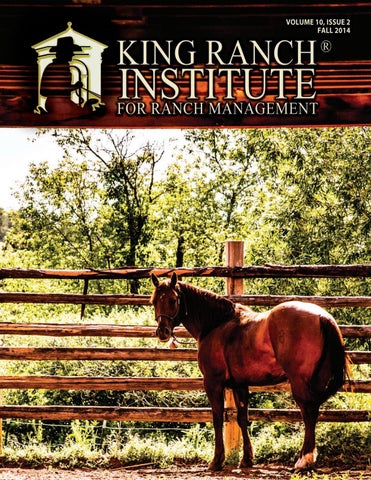
Cover Art: In Time Out Prairie Porch Photography 2 I Fall 2014 I KRIRM
Published by the KING RANCH ® INSTITUTE FOR RANCH MANAGEMENT Texas A&M University-Kingsville 700 University Blvd., MSC 137 Kingsville, TX 78363 361-593-5401 361-593-5404 fax krirm@tamuk.edu http://krirm.tamuk.edu Clay P. Mathis, Ph.D., Robert J. Kleberg, Jr. & Helen C. Kleberg Endowed Director Ashley Patterson, Editor
MANAGEMENT COUNCIL Chair: James H. Clement Jr., King Ranch, Inc. Caroline Alexander Forgason, Robert J. Kleberg, Jr. & Helen C. Kleberg Foundation Gus T. Canales, A.T. Canales Ranches Dave DeLaney, King Ranch, Inc. Bob McCan, McFaddin Enterprises Eric Jacobsen, AgReserves, Inc. Neal Wilkins, Ph.D., East Wildlife Foundation John Welch, Welch Cattle Company Fred Bryant, Ph.D., Caesar Kleberg Wildlife Research Institute Allen Rasmussen, Ph.D., Texas A&M University-Kingsville
“Employee Rewards and Conflict” From the Director, Dr. Clay Mathis
I
n my discussions with ranch managers and owners, we often spend time discussing labor and employee management. It’s a challenge to recruit, hire, and retain the right people for ranch jobs at all levels. I believe this to also be true in other industries. Graduates of the KRIRM program also face these questions when they transition back into the ranch workforce. Questions like: What is the right compensation structure? Base salary? Base salary plus bonus? Should the bonus or salary raises incentivize individual performance, team performance, or both? What are the trade-offs or implications of these incentives? There is no simple answer to these questions because there is also variation from one employee to the next regarding motivators. However, most will agree that the compensation structure should incentivize desired performance. So, what is desired performance? This depends based on the position, but if we take a look at middle management, then desired performance is general enough for discussion. Interestingly, each year when we hold our John B. Armstrong Lectureship on Systems Thinking in Natural Resources Management, one of the common questions attendees want to address revolves around some conflict between ranch employees. Thus, in the fall of 2011 a group of our graduate students
“It’s a challenge to recruit, hire, and retain the right people for ranch jobs at all levels.” Photo by JoAnne Meeker
specifically tackled the question: Why is there often conflict between managers of wildlife and cattle enterprises on the same ranch? The result of their efforts does shed some light on the topic of bonuses or raises that drive behavior. Students were challenged to first understand why the conflict occurs, and then to suggest solutions to the common problem. Their findings could be applied to conflict between managers of any types of enterprises on a ranch or in an organization, from farm managers to cattle managers to mineral managers. In essence, the managers of the separate enterprises on the ranch can become adversaries. But we must understand that even though there is conflict, the behavior of managers is typically rational. In for-profit ranching operations, it is generally expected and often incentivized that the cattle manager make every effort to maximize profit of the cattle enterprise, while the wildlife manager strives to do the same within the wildlife enterprise. They are working hard to do what they have been asked and often rewarded to do—make money within the portion of the operation that they control. However, a for-profit ranching operation has limited land mass and financial resources.
Continued on page 10
wagon WT tracks
KRIRM I Fall 2014 I 3
By Kindra Gordon
W
4 I Fall 2014 I KRIRM
ith the passing of Robert C. East in June 2007, the people of Texas were given a unique resource that represents almost a century of ranching heritage. His visionary estate plan established an endowment and 218,000 acres of ranch land for forming the East Wildlife Foundation, a nonprofit tax-exempt organization with a focus on supporting the heritage of ranching and wildlife conservation through education, research, and outreach. “Our mission is to make a difference in the future of wildlife conservation and cattle ranching by working to make sure these objectives complement each other on native rangelands,” explains Neal Wilkins, who is president and CEO of the Foundation. He recognizes that the mission is as unique as the Foundation noting that there is often an unnecessary “either-or mentality” toward wildlife management versus cattle ranching. It’s a novel approach on a large scale. The East Wildlife Foundation ranks as the second largest private operating foundation in Texas, and ranks 12th nationally. With more than 218,000 acres of South Texas rangeland, The Foundation is ranked as the 42nd largest private landowner in the United States with its lands serving as a field laboratory for research and education efforts. This land is operated as six separate ranches in parts of Jim Hogg, Starr, Willacy, and Kenedy Counties, with the Foundation’s ranch headquarters at the historic San Antonio Viejo Ranch, a 148,000-acre property. The ranchlands were traditionally maintained as native range for a working cattle ranch, and offer some of the best wildlife habitat in the nation. Wilkins credits the East family for their devotion to land conservation; he explains that they viewed the land, cattle, horses, wildlife and people all as one. “Their commitment to private lands stewardship was visionary. There is not another Foundation or non-profit like it,” Wilkins says.
Horses are part of the landscape at the 148,000-acre San Antonio Viejo Ranch, the headquarters and largest of the ranch properties. Photo by Wyman Meinzer.
Moving Forward
Wilkins, who joined the Foundation as its first CEO in August 2012, acknowledges that the Foundation is still relatively young. When it was established in 2007, the first few years were spent in a start-up phase with an independent board of directors first formed in 2011-12. Prior to joining the East Wildlife Foundation, Wilkins was a professor of wildlife science at Texas A&M (since 1998) and served as the director of the Texas A&M Institute of Renewable Natural Resources and the Texas Water Resources Institute where he coordinated the programs of more than 45 scientists and professional staff. Wilkins has focused on building the East Wildlife Foundation’s staff and also facilitating the implementation of several research projects on the Foundation’s ranch properties. Wilkins notes that the tough decisions for managing the Foundation’s land resources through a record drought have helped build a strong management team. He says, “We feel the best way to execute on the Foundation’s mission is to work with teams.” Collaborations include projects with Texas A&M-Kingsville, Texas A&M Institute of Renewable Natural Resources, the Texas Water Resources Institute, business groups and organizations, and five other universities throughout the state. The East Wildlife Foundation has also worked with the King Ranch® Institute for Ranch Management (KRIRM) having a student conduct a research project related to cattle and drought. And, KRIRM Director Clay Mathis serves on the East Wildlife Foundation’s Professional Advisory Group. Wilkins says it has been a natural fit for the East Wildlife Foundation and KRIRM to be closely aligned because of their similar goals for the future of conservation and ranching. Wilkins credits the Foundation’s strong start to a talented staff, a strong board of directors and experienced professional advisors. “The Foundation has attracted people with real vision and real passion,” he notes. Already, the East Wildlife Foundation has more than 15
scientific research projects in place on its ranchlands. Wilkins says, “Through the summer we’ll often have over a dozen researchers and graduate students on our properties on any one day. It can be a challenge to manage a working cattle ranch while also conducting intensive field research, but that is exactly what our mission calls for.” Pictured, graduate students collect data Some of the ongoing for a study on white-tailed deer. Photo by foundational research Wyman Meinzer. projects include designing and implementing monitoring of long-term trends in the distribution and abundance of the flora and fauna across the 218,000-acre East Wildlife Foundation lands in South Texas; generating vegetation maps that specifically define the vegetation associations of the East Wildlife Foundation lands; implementing a weather monitoring program for the ranch lands; generating a scientific natural history collection; and developing a geospatial database. Along with research, the Foundation will also strive to provide education and outreach to landowners, the public and even school children. As an example, Wilkins says with a large Hispanic youth population in Southwest Texas, they will strive to reconnect people to the land and reconnect an underserved population. “We hope to make a regional contribution in that way,” he says. Currently, the East Wildlife Foundation is working to deliver programming, knowledge, and leadership skills to the youth of South Texas. Eventually, after building curricula and relationships with schools and students, the goal will be to bring students to the ranch properties for field excursions and exposure to research, says Wilkins.
Focused on the Future
In all areas, Wilkins knows that the East Wildlife Foundation is a unique model, and he underscores the importance and value of this Foundation for the future of ranching and wildlife conservation. “Our resources are now perpetually committed to demonstrating those public benefits of ranching and private land stewardship.” He concludes, “We are in this for the long run and are working to build a solid Foundation. We are not trying to be flashy or showy; we are being quiet with our successes. We are going to put something in the store house before we dress up the windows. Our biggest focus is to make sure we are delivering in a way that honors the East family’s vision for supporting wildlife conservation and other public benefits of ranching and private land stewardship.” KRIRM I Fall 2014 I 5
Daniel Dalton
Daniel Dalton, a 6th generation cattleman, spent his first 10 years of life in Tuttle, Idaho, on the family beef cattle and dairy operations. From the time he could walk, he was with his dad learning the works of the trade. His family relocated to Snowville, Utah, where his father managed 400 head cow-calf and 50 fox-trotter broodmare outfit for Juddabeth/Flinder’s Ranches. Working alongside his dad and two younger brothers, the love of cattle, horses and agriculture were deeply implanted in Dalton’s heart. After graduating from Bear River High School, Dalton quickly fell into the cowboy lifestyle working for the Rose Ranch also in Snowville, Utah. His roles included calving first-calf heifers and mature cows. After turning 19, he chose to serve a 2-year volunteer church mission in Roseville, Ca. Upon his return, he was happy to be back in the saddle at the Rose Ranch, assisting with the broodmare operation, purebred Red Angus and commercial cows. In 2006, Dalton decided it was time to further his education at Utah State University, where in 2010 he earned a bachelor’s degree in agricultural systems and technology- agribusiness emphasis with minors in agricultural economics and animal science. Dalton was blessed to be employed as a ranch hand at Summer’s Cattle Company during his college years where he
Photo by Tom Urban 6 I Fall 2014 I KRIRM
assisted with terminal cross cows and stocker calves in a grow yard and pasture setting. During Dalton’s senior year in college, he interned at Deseret Cattle and Citrus in Saint Cloud, Fla. In this diverse and complex operation, he worked on the seed stock unit calving the first set of Deseret Red breed on the ranch. He also worked on a commercial cow-calf unit. During his time in Florida, he experienced an entirely different ranching setting than the mountains of Utah and Idaho. Dalton was pleased to accept a job as a herdsman with a sister ranch, the Rex Ranch in the Sandhills of Nebraska. He spent three years as a herdsman on the Eldred Unit overseeing the calving of mature cows, second-calf heifers, and first-calf heifers with the herd size of 700-900 head. While calving the first-calf heifers in a 40-day window, he oversaw two interns and 12 senior year vet students from Colorado State University. Dalton was also responsible for 1,000 head of yearling heifers during those years. He was the primary care taker of 19,000 acres using management intensive grazing practices, balancing rations, and yearly budget. In his fourth year, Dalton was promoted to a foreman on the 60,000 acre Abbott unit supervising two herdsman and interns while completing his own herdsman responsibilities. During his time on the Rex Ranch, Dalton served as safety committee chairman and sat on the standard operating procedure committee. Dalton is married to Jesse Mae, a past state FFA officer who has an agricultural education degree. They have two sons, Cinch (6) and Chauncey (2).
Tom Davis
Tom Davis was born and first introduced to cattle and farming on a dairy farm north of Ft. Worth, Texas. This environment gave him the opportunity to learn about every aspect of cattle, not just the beef cattle business. Davis was able to witness as his grandfather, J. Fred Davis, took a small family-owned dairy and turned it into a lucrative business. His grandfather’s ingenuity and legacy continues to influence Davis’s life today. In 1999, Davis and his family moved to a beef cattle ranch near Boyd, Texas, where they ran registered Charolais cattle and a cow-calf herd of Angus crosses. It was here that his father, Robert Davis, enstilled a drive for hard work and demonstrated the importance of continually diversifying one’s skill set. After the move to beef cattle, Davis was able to develop a variety of skills and a passion for horses, cattle, wheat farming, and grass management. Davis graduated from Boyd high school and attended Texas Tech University (TTU) to study agriculture and to work and learn from the ranches in west Texas. While studying at TTU, Davis received the opportunity to intern at the R.A. Brown Ranch in Throckmorton, Texas, where his ranching education was greatly enhanced. After graduating from TTU, Davis became a full-time welder and heavy machinery mechanic for a wind energy company in Lubbock,Texas. The job provided him a look into a different industry, and it also gave him a different perspective on the future of agriculture. Davis then went back to the family ranch and continued farming wheat and looking after the cowcalf herd. Tom would also day work at Ft. Worth area Bonds Ranch and Walsh Ranches. These ranches, their cowboys, and his father contributed most to his skills as a working cowboy and a manager. During Davis’s early twenties, he became involved with Camp John Marc, a summer camp for children with chronic illnesses and special needs. For two summers Davis worked with the horse program at the camp allowing children to ride and develop a relationship with horses. It was here Davis met his wife who is a certified child life specialist from Snellville, Ga.
Directly prior to entering the King Ranch® Institute for Ranch Management, Davis was farming wheat in north Texas, and developing a commercial herd in Boyd.
Jase Taylor
Growing up in a wildlife oriented family in Northern Utah, Jase Taylor learned early to love wildlife and to appreciate range as the home for the wildlife he loved. Starting at the age of 14, Taylor spent his summers and weekends living his dream as a big game and fly fishing guide on Deseret Land & Livestock in north east Utah. In 2005 he attended Weber State University on a track and field scholarship. In 2006 Taylor began a two-year LDS Church mission in Chicago, Ill., where he worked in the intercity area. After his mission, Taylor returned to Weber State University and completed an associates of science degree. While attending Weber State, he met and married his beautiful and talented wife, Tayler, and they have two beautiful children Kendyl Marie (3) and Easton Archer (1). In 2009, Taylor was invited to participate in a management training program with AgReserves, Inc. He transferred to BYU Idaho where he learned that his dream involved more than range and wildlife. Cattle were now in the mix and he was eager to learn how the three worked in synergy. While attending BYU Idaho, Taylor did extended internships with AgReserves on various operations including Deseret Cattle & Citrus in Florida, Deseret Cattle Feeders in Kansas, and Elberta Valley Ag (dairy) in Utah. Through these internships he was able to spend time working with crews in commercial cow-calf, heifer development, feedyard processing and health, dairy maternity and health, and artificial inseminating, and pregnancy checking operations. In 2012, Taylor graduated from BYU Idaho with a degree in plant and animal science, after which he returned to work at Deseret Cattle & Citrus in Florida and became a cattle unit foreman in 2012. He managed a 2,500 head commercial cow-calf unit. KRIRM I Fall 2014 I 7
By Ashley Patterson
E
ach fall, KRIRM hosts the annual Holt Cat® Symposium people, explained Clay Mathis, Ph.D., director of KRIRM. This on Excellence in Ranch Management, which provides high topic was chosen for symposium to educate beef producers on the quality education for industry stakeholders on various discussion surrounding sustainable beef production. topics in the ranching industry. The topic of each symposium is Sustainability has recently become important to consumers and always a timely issue, one which ranchers and agriculturalists can retailers and therefore is one that every sector of the beef industry benefit from understanding. The topic for the 11th Annual Holt should be educated about. As ranchers, attending this symposium Cat® Symposium on Excellence in can offer a look into what these Ranch Management will focus on consumers and retailers actually sustainable beef production. want from beef producers, while In the past few years, also learning what the industry is sustainability has become a doing about these demands. “buzzword” and hot topic “All sectors of the supply chain surrounding industry discussions, would like for beef demand and conferences, research, and more. supply to grow,” said Mathis. The Merriam-Webster online “Discussions that occur at this dictionary defines sustainability symposium could be an integral as “able to be used without being part of the beef industry response completely used up or destroyed,” to consumers, beef retailers, and “involving methods that do and others interested in the not completely use up or destroy sustainability of beef production. natural resources.” This issue as As an industry we must first it involves the ranching industry Symposium speakers are always industry experts, providing the best understand, and then respond.” This symposium will be a is only loosely defined, having education to symposium attendees. Pictured here is Evelyn Browningtwo-day event. The first day will different meanings for different Garriss, historical climatologist, speaking at the 2013 symposium. 8 I Fall 2014 I KRIRM
The symposium offers great networking opportunities with the industry trade show.
The 2013 Texas Farm Credit Certificate in Advanced Ranch Management recipients honored at the Thursday night reception and dinner.
focus specifically on the beef industry and will help attendees gain a more clear understanding of what consumers and others want as described by retailers and others in the supply chain, including McDonald’s, Cargill Meat Solutions, and Agri Beef Company. With each symposium, time for a speaker panel is always allotted, giving attendees the chance to ask questions of the speakers of the day. On the second day of symposium, attendees will hear from individuals outside the U. S. Beef Industry that have successfully addressed sustainability. One such industry is forestry that created a voluntary third-party forest certification program in the 1990s in response to market concerns about forest management. Attendees will also learn about a rancher-led program in South America that has successfully worked to validate conservation and sustainable stewardship of the Amazon Rainforest while producing beef. On day two there will also be opportunities to learn about the efforts of the Global Roundtable on Sustainable Beef, which was created
to advance continuous improvement in global beef value chain sustainability; and about new tools being developed for producers to aid in measuring sustainability. The symposium will conclude with attendees gaining from the perspective of the National Cattlemen’s Beef Association, Texas Cattle Feeders Association, and experienced ranch managers. As with each symposium, the fee of $150 includes meals, refreshments, workbook materials, and an in-depth tour of the legendary King Ranch. A ribeye steak dinner will also be held following the first day’s events. At this dinner, the 2014 Texas Farm Credit Certificate in Advanced Ranch Management recipients will be recognized. For more information about this event and to register, visit http:// krirm.tamuk.edu/symposium.html or call 361-593-5401. Updates will also be made on KRIRM’s Facebook and Twitter pages (www. facebook.com/krirm and @krirm).
Symposium attendess always enjoy the delicious ribeye dinner served at the reception honoring the certificate recipients.
Symposium will conclude with an in-depth tour of the King Ranch, specifically focusing on sustainability.
“Discussions that occur at this symposium could be an integral part of the beef industry response to consumers, beef retailers, and others interested in the sustainability of beef production. As an industry we must first understand, and then respond.” -Clay Mathis, Ph.D.
KRIRM I Fall 2014 I 9
Continued from page 3
Commit to Lifelong Learning
Upcoming Events September 19-20, 2014
B.K. “Kley” Johnson Lectureship on Current Ranching Issues: Human Resource Management
October 23-24, 2014
11th Annual Holt Cat® Symposium on Excellence in Ranch Management
December 15-18, 2014
Gus T. Canales Lectureship on Prescribed Burning
January 8-9, 2015
Real Estate Law Lectureship
Visit krirm.tamuk.edu or follow us on Facebook and Twitter to learn more about our upcoming events and program.
10 I Fall 2014 I KRIRM
Herein lays the challenge. If ranch ownership or a manager above the enterprise managers is interested in maximizing profit of the ranch as a whole, then optimizing enterprises on the ranch is generally required. Trade-offs between the enterprises must occur, but if enterprise managers are asked by ownership or a higher level manager to maximize enterprise-level profit, then the response is inevitably a competition for resources with differing land management goals. This is the rationally response to incentives. After the students peeled away the layers to understand why such conflict occurs they determined that a high-leverage solution for reducing this common employee conflict issue is for upper management to change the message and incentive structure so that achievement of ranch level goals are rewarded, not just enterprise-level goals. More specifically, managers of cattle, wildlife, or any other potentially competing enterprise on the ranch should be rewarded, in part, based on success of the ranch as a whole. This approach has been successfully employed in diverse agricultural organizations, but evaluation rewarding middle management based on financial success of the ranch alone is not without consequences. A few years ago, KRIRM graduate Jen Livsey conducted a broad human resources management survey across many of the largest ranches in the U.S.A. and identified that the most motivating factor to employees is bonuses based on personal achievement. Cowboys and other ranch employees are more engaged when they receive positive feedback on their individual performance. This is likely most motivating because it provides objective feedback on the performance the employee controls. So what does this mean? It means that it’s not easy to manage a team of people! When boiled down to a compensation plan and incentive structure, it makes sense to have a blend of incentives that include a base salary for security, bonus or salary raises based on personal achievement because it is most motivating, and additional bonus or salary raise based on ROA of the ranch as a whole because this rewards collective success across enterprises. Ownership and high-level managers will always be challenged to have a simplistic, yet effective compensation structure that rewards desired performance on ranches. Is the desired behavior being incentivized at your operation?
KRIRM I Fall 2014 I 11
KING RANCH® INSTITUTE FOR RANCH MANAGEMENT
TEXAS A&M UNIVERSITY-KINGSVILLE
MSC 137 Texas A&M University-Kingsville Kingsville, TX 78363
NON PROFIT ORG U.S. POSTAGE PAID AUSTIN, TX
PERMIT NO. 1718