Winter 2026 Volume 21, Issue 3
From the Director
Published By
Dr. Rick Machen, PhD Executive Director; Robert J. Kleberg, Jr. and Helen C. Kleberg Endowed Chair
Industry Support – The Lifeblood of KRIRM
S
ince its inception in 2003, the King Ranch® Institute for Ranch Management has largely been funded by private donations and gifts. A glimpse of the 2026 fiscal year budget indicates a bit over 85% of the budget is supported by private funds. Hence, as the title implies, industry support has been, is, and will be the lifeblood of KRIRM. The visionaries who created the Institute over two decades ago saw a present and ever-growing need for professionals who could sustainably manage large, complex ranch businesses. The traditional approach of promoting the cowboy with the greatest tenure wasn’t always the best choice. Those management opportunities still exist, but ranches don’t have to be terribly large to involve a complex business. The goal was to prepare those with ranch work experience to manage ownership expectations, personnel, animal and natural resources, upon completion of their Master of Science degree. Thus, the original specification of three to five years work experience beyond completion of an undergraduate degree. To attract candidates with management potential who were comfortably employed (some with a family), the founders realized financial support for students was necessary. Otherwise, students would have to secure a job or jobs, which would directly compete with classes, case study projects, and travel. Therefore, King Ranch family and management turned to their friends for support. In 2003, five student fellowships were endowed, the revenues from which have supported our 59 graduates and current students. Costs have risen appreciably since 2003 and fellowship stipends have now followed suit, so annual earnings from some of the original endowments now fall short of full support for a student. Looking forward, to grow student numbers, additional fellowship support is needed. Institute leadership quickly realized there were a host of topics vitally important to ranch managers that would not be addressed by academic coursework. Also, if these topics were important to KRIRM students, they would also be of interest to industry professionals. Hence, the compliment of outreach education opportunities (lectureships and annual symposium) have been developed for our students and are shared with others with interest in the subject matter. Topics include systems thinking, prescribed burning, application of advanced genetic technology, managing the cow-calf business, human resource management, managing the wildlife enterprise, equine management, managing brush and invasive plants, farm and ranch law, and the newest coming January 2026 - applied nutrition strategies for grazing livestock. Continued on page 10 2 King Ranch® Institute for Ranch Management | Winter 2026
700 University Blvd., MSC 137 Kingsville, TX 78363 361-593-5401 361-593-5404 fax krirm@tamuk.edu krirm.tamuk.edu
Rick Machen, PhD, Executive Director; Robert J. Kleberg, Jr. and Helen C. Kleberg Endowed Chair Emily Stribling, Editor
MANAGEMENT COUNCIL Chair: John Alexander, Jr., King Ranch, Inc. James Clement, III, Beggs Cattle Company Caroline Alexander Forgason, Robert J. Kleberg, Jr. & Helen C. Kleberg Foundation Heath Grigg, King Ranch, Inc. Jeff Hildebrand, Hilcorp Energy Company Shelby Horn, Abell Livestock Co. Rick Machen, PhD, King Ranch® Institute for Ranch Management Jim McAdams, McAdams Cattle Co. Shad Nelson, PhD, Texas A&M University-Kingsville Clint Richardson, AgReserves, Inc. Jason Van Tassell, Wilson Cattle Co. Neal Wilkins, PhD, East Foundation
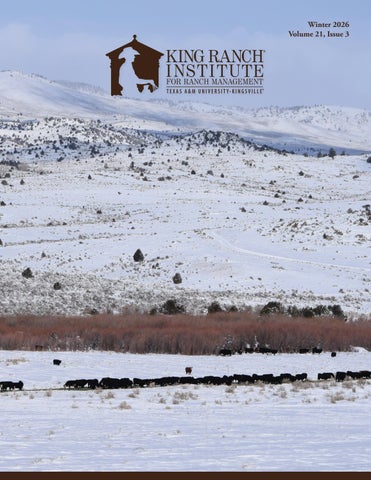
On the Cover Photo from Matador Ranches Beaverhead Division
In this Issue
Winter 2026, Volume 21, Issue 3
2
|
Industry Support is the Lifeblood of KRIRM KRIRM supporters provide opportunities for students and current managers alike and are vital to the success of our program.
4
|
Education & Innovation
6
|
8
|
Applied Nutrition Strategies for Grazing Livestock Lectureship This new lectureship is a practical, in-depth program designed to help ranchers improve livestock performance through better nutrition.
9
|
Event Agenda: Applied Nutrition Strategies for Grazing Livestock Lectureship
Highlights from the 22nd Annual HOLT CAT® Symposium on Excellence in Ranch Management ‒ Impacts of Beef Carcass Size on System Production Efficiency.
Class of 2026 - Inspired to be Future Industry Leaders KRIRM Class of 2026 reflect on their time at KRIRM, experience gained and the future ahead.
Our Mission
Our Vision
Sustaining our ranching heritage through education, innovation, and outreach.
We are determined to educate leaders who will make a positive difference in ranching and ensure that our hard-earned heritage is not lost.
Winter 2026 | King Ranch® Institute for Ranch Management 3
Education & Innovation
Highlights from the 22nd Annual HOLT CAT® Symposium on Excellence in Ranch Management ‒ Impacts of Beef Carcass Size on System Production Efficiency
By Robert Wells, PhD, PAS The King Ranch® Institute for Ranch Management held the 22nd Annual Holt Cat® Symposium on Excellence in Ranch Management in early November. This two-day in-person and virtual event was attended by over 280 ranchers from across the country. The symposium utilized a systems approach to explore the impact of the increasing carcass size on overall beef system production efficiency. Each segment of the value chain was considered; starting with the consumer then working through the packing plant, feedlot, commercial cow-calf producer and ending with the registered seedstock producer. Danette Amstein, Managing Principle at Midan Marketing, led the first afternoon with an intriguing summary into the mindset of the American consumer and their focus on beef quality. Midan Marketing has conducted in-depth consumer analysis in which they have identified numerous consumer market segments: “connected trendsetters (14%), claim seekers (24%), convenience cravers (17%), committed carnivores (23%), and classic palates (22%).” Across all market consumer segments, the top three characteristics influencing meat purchases are: price (47%), quality (45%) and taste (31%). Consumers continue to purchase beef as the center of the plate protein because they still see value in the product along with the increased quality, consistent taste, and eating experience. When consumers were asked about meat related health messages, 78% of the claim seekers desire a more detailed claim, while 92% of the respondents indicated that they would trust the message especially when delivered by their doctor or a nutritionist. When consumers were asked about sustainability, most wanted a more complete explanation of sustainability. Eighty-two percent of consumers would trust the message when delivered by the USDA or a dietitian. Most want to see the sus4 King Ranch® Institute for Ranch Management | Winter 2026
tainability claim on the package. Future trends indicate beef is in a good position to transparently tell the story of sustainability and the value of protein in the diet. While the industry saw a decline in beef demand in the decade of the 1980’s and early 1990’s, Kaylee Greiner with Texas Beef Council illustrated the increase in beef demand and subsequent $250/hd increased carcass value since 1998. The industry has achieved the increased consumer demand by increasing quality and consistency of the product while capitalizing on a pivotal muscle profiling research study. This study paved the way for new cuts to be developed: flat iron steak, shoulder petite tender, Denver steak, western griller, and country style ribs, to name a few. These new cuts increase carcass value by converting lower valued roasts into consumer preferred tender, lean cuts which brings more value to the total carcass. Consumers crave lean protein sources. Since 1989, the industry has developed methods to trim beef cuts so that two-thirds of all beef cuts in the meat case meet USDA guidelines for lean. This increase went from six lean cuts in 1989 to over 36 lean cuts by 2013. While carcass size has increased, the industry has found ways to deliver portion sized cuts. One example is partitioning the traditional sirloin steak into sirloin cap steaks and portioned center cut sirloin steaks. These cuts are 100% edible, no bone and much less fat, meeting consumer expectations. Dr. Glen Dolezal, retired Assistant Vice President of Cargill Protein discussed the impact of larger cattle at the packer level. Beef cold carcass weights have historically increased by about 5 lbs. per year until 2025. However, steer carcass weights are expected to close out 2025 near 950 lbs, 25 lbs heavier than the
year before. Carcass weight increase is being driven by better genetics allowing cow-calf producers to wean heavier calves, and feedlots feeding cattle longer (220 days), to a heavier and fatter endpoint. Low feed prices are facilitating low feedlot cost of gain which is overcoming the high cost of feeder cattle. Packers are encouraging heavier carcasses to increase plant tonnage throughput, spreading fixed costs over more pounds of beef product. While the increased days on feed and heavier carcasses has increased the average industry quality grade to over 80% choice or better, ribeye area has increased dramatically. The question then becomes, “How does the packer deliver a 12- or 16-ounce ribeye that is still over one inch thick?” Dr. Dolezal finished with a brief discussion on red meat yield vs. yield grade and dressing percentages. High dressing percentages create higher yield grades (more external fat) but can have a reduced impact on total saleable yield. The feeder perspective of larger cattle was delivered by Dr. Justin Gleghorn with Smith Cattle Company. Since 1971, the industry has reduced cow inventory by about 280,000 head per year. While reducing the cow inventory by 25% since 1980, total beef production has increased by 27%. Part of the remarkable increase in beef production is due to increasing days on feed from an average of less than 140 days in 2000 to near 200 days in 2025. The driving motivation of increased days on feed is the value proposition of heavier carcasses, quality grade premiums, low cost of gain and increased packer heavy weight carcasses limits. When calculating daily feeding margin, calculating hot carcass weight average daily gain, and knowing dry matter intake are essential to determining net margin on a per head basis. He cautioned that as cattle are becoming bigger in the feedlot, their organs are not increasing proportionately which may increase late-term mortality. Dr. Miles Theurer, DVM, Ph.D., Research Director for Veterinary Research and Consulting Services, LLC, summarized the health impacts of longer days on feed and larger cattle on feedlot health management. He cited USDA NAHMS data which identified approximately a 29% increase in feedlot closeout death loss (1.3% increased to 1.7%) from 1999 to 2021. However, when death loss incidence rate is expressed on a “deads per 10,000 days basis” feedlot death rate has not increased. This indicates days on feed is the primary driver for increased feedlot closeout mortality rate. However, timing of feeder calf mortality has shifted to more late-term incidences than in the past. Dr. Theurer closed out his presentation with a comment on number of vaccinations. He presented research that indicates too many vaccinations (greater than two for modified live vaccinations and greater than one for shipping fever) can increase bovine respiratory disease (BRD) in the feedlot. He concluded by indicating preconditioning programs over 60-days are preferred. Ranch level preconditioning programs should target an ADG of 2.0-2.25 lb/day. Higher ADG sets cattle up for health issues in the feedlot.
Dr. David Lalman, Oklahoma State University Extension Beef Cattle Specialist, explored the topic of increasing cow size. He started by reminding the audience that the cow-calf phase of production accounts for 74% of the total feed and 50% of the total maintenance energy to produce one pound of carcass weight. There is no genetic relationship between marbling or mature weight; however, there is a strong positive genetic correlation between yearling weight EPDs and mature cow weight. Thus, selecting for faster growing calves has a direct impact of increasing mature cow weight. As cows become larger, they eat more forage. The average of eight studies indicates for every 100 lbs. increase cow weight, forage dry matter intake increases 2.25 lbs. Put into a practical example, if a rancher who owns a 10,000acre ranch selected for industry average growth characteristics over a 30-year career, while keeping forage utilization at 28%, the ranch should stock 94 fewer cows today due to increased cow size. While cow size has increased, weaning weight is not increasing at a rate fast enough to offset the additional costs of the heavier cow. Calf weaning weight increases 10 lbs. for every 100 lbs. increase of cow weight. From a financial perspective, on the example 10,000-acre ranch, in today’s market to account for a reduced number of cows required to maintain stocking rate, the calves from a heavier cow must return a $134 per head premium to offset the decreased number of calves weaned. James Henderson, Bradley 3 Angus Ranch, discussed the effect of increasing cow weight on the registered cow herd. Mr. Henderson stated that the registered cow herd must balance annual cow costs, stocking rates with weaning weight EPDs. The concern for the purebred breeder is, while maintaining breed average or above weaning weight EPDs, the breeder must also optimize cow weight to not reduce cow numbers on an extensive, native grass production system. Additionally, breeders must also utilize genetics that will meet industry yield and grade expectations while not affecting cow fertility. Rounding out the symposium, Dr. Jason Sawyer, Chief Science Officer for the East Foundation, discussed new world screwworm (NWS) management decisions and actions ranchers should consider. He reminded the audience that this is not a new but rather reoccurring threat to US and Mexican cattle producers. The parasite was eradicated from the US in the 1970’s with the use of the sterile insect technique. He reported that Dectomax® has received a CA-1 approval for use in the treatment and prevention of NWS. Dr. Sawyer urged producers to develop a framework for risk assessment and mitigation strategies. In conclusion, the potential negative impacts of a smaller national cow herd have been offset with improved production efficiencies and use of EPDs to identify cattle that grow faster and larger coupled with lower resource utilization. Speakers reported the beneficial impacts of the larger calf carcass size, but also indicated there are a few negative effects that must be addressed and balanced in the entire production equation. Winter 2026 | King Ranch® Institute for Ranch Management 5
CLASS OF 2026 – INSPIRED TO BE FUTURE
Industry Leaders By Emily Stribling In May 2026, the next class of KRIRM graduates will earn their Master of Science in Ranch Management. The class of 2026 includes Mason Dahl, recipient of the Clement Family Endowed Fellowship; Carson King, recipient of the Tio Kleberg Endowed Fellowship; and Ben Wurz, recipient of the Four Sixes Ranch Endowed Fellowship. These individuals will be joining the elite group of 59 other graduates who have earned this title over the past two decades. CONNECTIONS TO LAST A LIFETIME When asked what they enjoyed most about their time at the Institute, the students unanimously answered, the people. “I will always remember all of people and their examples to me of leadership, knowledge, and professionalism,” states King. “Some of the most fulfilling relationships were built with the other current students and past alumni.” Wurz concurred adding, “It’s nice to be able to prioritize analytical thinking in a group setting, where we can solve problems together and help each other succeed.” When asked to describe his overall experience, Dahl shared the fulfillment he received from the authenticity of the program. “Working on real projects for real ranches—projects that make a tangible impact in an industry I care deeply about—was incredibly rewarding,” he says. “Meeting alumni who’ve gone on to lead and innovate, and connecting with others who are committed to solving real challenges, has been inspiring. The relationships built here are invaluable and the hands-on learning far surpasses what case studies alone could offer.” CURATING A TOOLBOX OF BUSINESS SKILLS While many KRIRM students enter the program wanting to improve their business skills, they often focus on the importance of accounting. While a crucial part of managing a business, this cohort of students greatly appreciated the hands-on application 6 King Ranch® Institute for Ranch Management | Winter 2026
of systems thinking – the ability to take a complex problem and break it down into its core components, to identify practical solutions and clear courses of action. Dahl shared, “I’ve also grown in how I communicate those ideas—presenting both the analysis and the solutions in a way that resonates with others and builds buy-in.” Wurz gained a variety of powerful tools from financial modeling to aid decision making, to insights on managing people and cultures within a company. “Overall,” he adds, “I think the experience has helped me organize and prioritize better than before.” King shared the wisdom he gained throughout the program stating, “You don’t realize how much you don’t know until you meet certain individuals. Through them, you begin to understand the depth and breadth of knowledge that different topics hold.” He continues on to describe how inspiring it is when speaking with those same individuals as they “acknowledge the importance of striving to be the best in your field—without needing to be the best in everyone else’s.” INTERNSHIPS A highlight for every KRIRM student is the opportunity to intern with a partnering ranch to begin applying what they have been learning all year to a sector of the industry or part of the country (or world) with which they are not as familiar. For the first time in KRIRM history, a student had the opportunity to intern abroad. Dahl and his wife, Sierra, worked with the Australian Agricultural Company (AACo)—a large vertically integrated beef system, operating for over 200 years. AACo manages more than 456,000 head of cattle across 16 million acres and markets through multiple channels, including three international branded beef programs. “Most of my time was spent on Canobie Station with an outstanding management team. At the time, they
were running over 47,000 pairs on 1.8 million acres,” remarks Dahl. Over the course of seven weeks he had the opportunity to work his way through the ranks starting as a ringer to serving as a leading hand, managing a small camp, and eventually spending time in the office with station management developing quarterly plans and analyzing AACo’s beef system. “My internship added tremendous value to my education by showing how systems thinking translates into systems implementation,” reflects Dahl. “What surprised me most, though, was the impact of culture. At Canobie Station, the culture was exceptional—built around development, results, safety, work ethic, and efficiency,” he adds. Part of Dahl’s project was focusing on ways to track company culture’s influence and incorporating it into their KPI dashboard. He states, “Since stepping onto Canobie, building and sustaining a strong company culture has been top of mind for me.” King, a Montana native, was tasked with evaluating the implementation of planting winter annuals like rye and oats as an alternative to feeding cubes and hay at Deseret Cattle and Timber (DCT) in Wewahitchka, FL. “My hat goes off to Darren Bevans and his team on helping me understand how DCT approaches these types of challenges and allowing me to watch how they operate in meetings and interact with one another,” states King. “I was able to work with multiple different departments and sit in meetings and was graciously treated like a member of the team.” When asked how his internship impacted his overall education experience, King remarked that DCT has great culture and being able to witness strong leadership in action was the most valuable takeaway. “From start to finish, I was inspired and led—just like the other employees I observed—and guided by the vision that leadership shared.”
succeed financially, but also make a lasting, positive impact on the industry,” remarks Dahl. When asked where they see themselves in the future, Wurz says, “I’d like to find a home on an operation that prioritizes profit without sacrificing tradition, ideally including a mix of time spent in the office and outside.” He adds, “I enjoy the financial and strategic parts of management, and I think I have a lot to offer there, but don’t want to ignore the fact that my love of the outdoors is what pushed me to pursue a career in this business in the first place.” Dahl seconds a focus on two passions stating, “I’ve always wanted to manage ranches and work at the intersection of business and livestock operations. My time at the Institute has strengthened that passion and shown me how to marry those two worlds effectively. Going forward, I aim to manage large ranches and develop programs that increase profitability while maintaining stewardship of land and livestock.” King reflects on the industry professionals he has met throughout the program and remarks on their examples of intense focus and sustained work ethic, demonstrated consistently over long periods of time. “Obviously the KRIRM education is not the end of a career and there is still much to do and learn,” states King. “It has been invaluable to me in networking, developing skills, and discovering role models of who and what, I want to become in my own career.”
Wurz, a Colorado native, interned with Cobalt Cattle’s Kismet feedyard in Southwest Kansas and completed a comparative analysis project on expansion strategies for the company. He worked to compare the hypothetical purchase of another feedyard by the company to a proposed expansion of the Kismet yard. “I learned a lot about managing people in a corporate environment, about the system that Cobalt has built, and how the company operates,” states Wurz. “I appreciate how much Cobalt focuses on taking care of their people, and it serves as a reminder that having good people on the ground is one of the biggest keys to success.” WHAT’S NEXT? With two years of training and new perspectives, the graduates are eager to rejoin the workforce and impact the industry. All three students mention keeping a focus on curating company culture and positive leadership wherever they go next—skills they have seen in action by KRIRM faculty, alumni, and industry professionals. “I plan to apply what I’ve learned about systems thinking, the importance of culture, and clear communication. Ultimately, I want to lead teams and organizations that not only
From internships to industry tours, students were inspired by the individuals and operations they encountered and look forward to applying those experiences and imparted wisdom to their future careers. Winter 2026 | King Ranch® Institute for Ranch Management 7
Applied Nutrition Strategies for Grazing Livestock Lectureship By Robert Wells, PhD, PAS
A
n innovative educational opportunity is coming to ranchers on January 15-16, 2026 with the launch of the Applied Nutrition Strategies for Grazing Livestock Lectureship. This one and a half-day program is designed to strengthen producers’ decision-making in an increasingly complex rangeland environment with deeper knowledge, sharper tools, and more profitable decision-making strategies. As ranching continues to evolve in response to changing markets, drought burden, and resource pressures, this lectureship delivers the practical knowledge and science-based training today’s ranchers need to stay ahead and create long-term profitability. The program opens with an exploration of rumen physiology, helping participants understand how cattle, sheep and goats digest forage and convert it into energy. By grounding ranchers in the fundamentals of rumen function—microbial populations, fermentation dynamics, passage rates, and nutrient absorption—the lectureship provides the biological lens needed to interpret forage tests, evaluate supplement strategies and troubleshoot performance issues. Next, the lectureship will teach ranchers how to use the power of observation to determine the historic and current nutritional status of the cow and pasture using body condition and manure scoring. We will discuss the benefits and pitfalls of each system and how to strategically use them to determine timing and type of nutrient supplementation for cows on pasture. Proper pasture management is paramount to setting up the ranch nutritional program for success. Understanding the ranch carrying capacity and setting a realistic stocking rate can have an enormous impact on the cost of herd supplementation. This lectureship will introduce you to simple, applied tools that can take the guess work out of determining a realistic, real-time stocking rate. In addition, instructors will guide ranchers through the Web Soil Survey and RAP—the Rangeland Analysis Platform—to determine long-term carrying capacity, monitor vegetation trends and calculate sustainable stocking rates. These tools empower ranchers to make data-driven grazing and feeding decisions that protect the land while supporting herd productivity. 8 King Ranch® Institute for Ranch Management | Winter 2026
Technology plays an integral role in the training. Participants will receive hands-on experience with the Oklahoma State University “Cowculator,” a widely used ration-balancing tool that allows producers to construct cost-effective diets using ranch-grown forages and strategic supplementation. Building on this foundation, the lectureship teaches ranchers how to estimate dry matter intake (DMI) using forage quality, environmental conditions, and the animal’s stage of production. Accurate DMI estimates are essential for predicting whether forage supply will meet herd demand, particularly during winter feeding, drought, or transitions in cow nutrient requirements. Economics is woven throughout the program, demonstrating how to apply financial analysis to nutrition and grazing strategies. Ranchers will practice comparing feed costs, evaluating supplement return-on-investment, and modeling the longterm profitability of different stocking and grazing scenarios. The emphasis on economics ensures that participants walk away with strategies that make biological and financial sense. The lectureship recognizes the growing role of sheep and goats in rangeland systems, offering a focused module on small ruminant nutrition requirements and management considerations unique to these species. This inclusion broadens the program’s value for diversified operations. Rounding out the experience is an engaging look at grazing land technology innovations, from methane mitigation strategies, remote sensing and digital mapping to automated water monitoring, GPS ear tags, and virtual fencing. Ranchers gain a practical understanding of tools that can expand efficiency, improve stewardship, and save valuable labor. By combining science, technology, economics, and practical field knowledge, the Applied Nutrition Strategies for Grazing Livestock Lectureship sets a new standard for producer education—empowering ranchers to thrive in an ever-changing rangeland landscape.
Applied Nutrition Strategies for Grazing Livestock Lectureship JANUARY 15-16, 2026 || KINGSVILLE, TX & ONLINE
A practical, in-depth program designed to help ranchers improve livestock performance through better nutrition. Topics will cover every stage of production—including cow, calf, bull, and weaned calf (preconditioning) nutrition—as well as feeding strategies for sheep and goats. Whether you're managing a cow-calf operation or running a multi-species ranch, you'll gain real-world insights and leave with tools to support animal performance, health and ranch profitability. Instructors: Robert Wells, PhD; Rick Machen, PhD; Natasha Mast, PhD
THURSDAY, JANUARY 15, 2026
FRIDAY, JANUARY 16, 2026
8:15 AM
8:15 AM Cost of Feeding Hay – the Addiction and Affliction
Welcome
8:30 AM Rumen Function, Physiology and Nutrient Utilization 9:15 AM Practical Tools to Monitor Animal Nutritional Status 10:00 AM 10:30 AM
Break Setting Carrying Capacity and Stocking Rate on the Ranch
12:00 PM
Lunch
1:00 PM
Supplementation Strategies (Are My Cows Getting Enough to Eat and of the Right Things at the Right Time?)
1:45 PM
Match the Cow to the Environment
2:30 PM
Break
3:00 PM
OSU Cowculator
3:45 PM
Nutritional Management of the Weaned Calf
4:30 PM
Day 1 Wrap-Up
5:00 PM
Adjourn
9:00 AM
Feed Additives
9:30 AM
Mineral Nutrition
10:00 AM
Break
10:30 PM
Small Ruminant Nutrition
11:30 PM
Nutrition Innovation of the Future
12:00 PM
Wrap-up & Adjourn
For a detailed agenda and to register, please scan the QR code above or visit: krirm.tamuk.edu/applied-nutrition
Winter 2026 | King Ranch® Institute for Ranch Management 9
Industry Support – The Lifeblood of KRIRM Continued... Side note – Participants who attend four lectureships and two symposia in 36 months qualify for the Texas Farm Credit Certificate in Advanced Ranch Management. The certificate program was made possible by a generous donation from Texas Farm Credit. Ranch owners/managers - this is an excellent professional development opportunity for your employees. Most events are offered both in-person and virtually, so if warranted, they can participate without ever leaving the ranch. Generous supporters have chosen to endow or sponsor several of these educational events. We continue to add to the educational offerings, so opportunities to partner in outreach education remain. These industry-serving opportunities have a broad reach; for example, the 2025 symposium was attended by folks from 27 states and four countries. The core of our graduate training centers around systems thinking and managerial accounting. Systems thinking is addressed in a ranch management course on their degree plan, a three-day systems thinking lectureship (which students do twice), and is a component in at least their capstone project. Perhaps the most important number a manager can know is unit cost of production. Whether the unit is a weaned calf, bale of hay, or trophy buck, if cost of production remains unknown, effective marketing is impossible and ranch profitability remains a mystery. Managerial accrual accounting is the industry-recognized means by which to accurately determine production cost. For several years, KRIRM adjunct faculty member Stan Bevers
taught our managerial accounting. Upon Stan’s premature passing, anonymous gifts endowed the Stan Bevers Memorial Fund, the earnings from which will compensate an industry professional accountant to teach our students. A recent example of industry support for KRIRM students. We need your help. Opportunities to join us in preparing the next generation of ranch managers and resource stewards or strengthening the skills of current managers are numerous. Endow or add to a student fellowship, sponsor an outreach education event, or join the Ranching Legacy Program as a Leader, Partner, or Advocate. Current supporters – Your gifts and donations are making a difference. Alumni are leaders in their communities while managing over 10 million acres of natural resources, almost 200,000 beef cows, the nation’s largest privately-owned bison herd, and 850 employees. Our outreach education has reached over 9,000 registered participants while offerings and audiences continue to grow. For your involvement we are humbly grateful. Thank you. If you are interested in joining our supporters, need more information about our outreach education activities, or would like to hear from faculty or our students, call 361-593-5401 or send an email to start the conversation: krirm@tamuk.edu. We welcome the opportunity to tell our story.
ANNUAL RANCHER LEGACY MEMBERSHIP OPPORTUNITIES & BENEFITS
RANCHING LEGACY LEADER $10,000 GIFT
RANCHING LEGACY PARTNER - RANCHING LEGACY ADVOCATE $5,000 GIFT $1,000 GIFT
• Opportunity for a personal half-day, one-on-one visit with an Institute team member at your ranch • Invitations and complimentary registrations to Institute-hosted events for two individuals to be used in year of gift • Special recognition at Institute-hosted events and in the Institute’s annual report • KRIRM Ranching Legacy Leaders ranch gate sign
• Opportunity for a personal half-day, one-on-one visit with an Institute team member at your ranch • Invitations and complimentary registrations to Institute-hosted events for one individual to be used in year of gift • Special recognition at Institute-hosted events and in the Institute’s annual report • KRIRM Ranching Legacy Partners ranch gate sign
• Invitation and complimentary registration to KRIRM annual HOLT CAT® Symposium on Excellence in Ranch Management for one individual to be used at the event following the time of gift • Special recognition at Institute-hosted events and in the Institute’s annual report • KRIRM Ranching Legacy Advocates ranch gate sign
To learn more about the Ranching Legacy Program or to donate online, please visit: krirm.tamuk.edu/giving
Master of Science in Ranch Management Be part of the legacy at the premier Master of Science in Ranch Management program. Through a systems approach to ranch management, we teach those with ranching experience to become progressive leaders and exceptional managers. Applications to the two-year master’s program are open December 1, 2025 through March 31, 2026. All KRIRM students will receive a $48,000 fellowship annually and may be eligible for additional scholarships. Core Experiences: Our graduates complete a minimum of 30 hours of coursework; however, the most impactful learning opportunities occur outside the classroom: • Addressing real-world ranch management challenges • Roundtable discussions with industry professionals • Experiential learning on the TAMUK H.R. Smith Ranch • On-ranch summer internship • Industry tours support network building 59 KRIRM alumni collectively manage: • 9 million acres of ranchland and wildlife habitat • 190,000 head of breeding cows • 850 ranch employees
“Investing two years at the Institute moved my career forward at least ten years, and will continue to pay dividends the rest of my professional career.” Tyler Gardner ‘20 || Ranch Manager, TA Ranch, WY
Learn more and apply today at: http://krirm.tamuk.edu/masters-program or call 361-593-5401
Connect with us online for the latest news and updates on the KRIRM program!
700 University Blvd, MSC 137 Kingsville, TX 78363
New Event for 2026! Applied Nutrition Strategies for Grazing Livestock Lectureship Rancher Learning Opportunities 2026 Event Schedule || Events Available In-Person & Online!
All events count toward the TFC Certificate in Advanced Ranch Management
Invest in Lifelong Learning – Improving Yourself and Your Ranch Employees The KRIRM lectureship series offers numerous lectureships per year and are designed to teach current and dynamic topics in the ranch management industry. Our lectureships apply to a range of people and organizations in the ranching industry: from ranch owners and managers to cowboys and accountants, as well as any agriculture stakeholder who is a lifelong learner. Register and view more information at: krirm.tamuk.edu/outreach Applied Nutrition Strategies for Grazing New! Livestock Lectureship January 15-16, 2026 || Kingsville, TX & Online
John B. Armstrong Lectureship on Systems Thinking for Ranchers August 10-12, 2026 || Kingsville, TX
Application of Advanced Genetic Technology in Beef Cattle Lectureship February 27-28, 2026 || Kingsville, TX & Online
Managing Farm and Ranch Employees Lectureship September 18-19, 2026 || Kingsville, TX & Online
Managing the Cow-Calf Business Lectureship March 16-17, 2026 || Kingsville, TX & Online To view more information and register for events, please scan the QR code or visit: krirm.tamuk.edu/outreach
HOLT CAT® Symposium on Excellence in Ranch Management November 5-6, 2026 || Kingsville, TX & Online
Connect with us online for the latest news and updates on the KRIRM program!
King Ranch® Institute for Ranch Management || Kingsville, TX || krirm.tamuk.edu || 361-593-5401