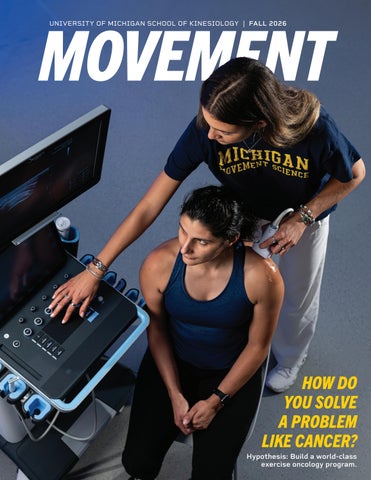
UNIVERSITY OF MICHIGAN SCHOOL OF KINESIOLOGY | FALL 2026
HOW DO YOU SOLVE A PROBLEM LIKE CANCER? Hypothesis: Build a world-class exercise oncology program.
FACULTY
ALUMNI
4
30 Cheer Like Pat
Lupus in Focus
PE alum Pat Muthart has donated to Kines for more than 30 years.
6
Resumé Builder
22
New dean John Cairney has the experience, tenacity, and curiosity for the job.
8
STUDENTS
Perseverance Through Failure An ACL tear kickstarted postdoctoral researcher HoWon Kim's next vocation.
10 Practice Partner 2.0 How professors are using generative AI to foster students' confidence
12 Teaching the Odds Mike Lorenc schools students on the nuances of the sports betting industry.
16 Ideas in Motion Rebecca Hasson spearheads creative brainstorming to get kids more active.
8
18 Making Meaning A zine workshop helps students tell their own stories.
20 Cultural Sampling Kines' Culture, Equity & Community Collective brings tastes and practices from various traditions to SKB.
22 The New Prescription for Perimenopause:
Strength training, according to a novel study run by PhD student Marnie McLean
24 Turning Point(e) 44-year-old PhD student Jessica Morschakov shares why she returned to college.
32 Leading the
Way Forward Introducing our newest group of expert advisors: the Health Sciences Advisory Board
34 So You Want to Be a Manager...
SM alum Salim Makki on the sacrifices he made and approach he takes to managing pro athletes
36 Started From
the Bottom, Now We're Here Two alums who work at community foundations reflect on their paths up the career ladder.
38 The All-Star Team Meet this year's lineup of elite (alumni) players.
26 What's Their Legacy? We look back at 15 years of the student-founded and -run Michigan Sport Business Conference.
28 A Passion Worth Paying For
Why master's student Kyla Nickerson chose athletic training, despite its cost
34
ON COVER Movement science junior Belzora Lovett demonstrates ultrasound technology. Photo by Andrew Mascharka/Michigan Photography
Photos by Leisa Thompson/Michigan Photography (2); Courtesy of Salim Makki
A documentary photography project showcases the lives of lupus patients.
MOVEMENT is published by the University of Michigan School of Kinesiology. Visit us online at kines.umich.edu/movement. Dean John Cairney Editor Mary Clare Fischer Writers Melissa Pick Burnazian Mary Clare Fischer Abbie Griffith Salim Makki Genevieve Monsma Art Direction & Design Sean Parsons Illustration Jacob Dwyer Sean Parsons Photographers Dieu-Nalio Chery Peter G. Hoffman Christina Kafkakis Marie Lamb Andrew Mascharka Christina Merrill Scott Soderberg Victoria Stevens Leisa Thompson Russell Verlinger
© 2026 Regents of the University of Michigan
Photos by Andrew Mascharka/Michigan Photography
The Regents of the University of Michigan Jordan B. Acker, Michael J. Behm, Mark J. Bernstein, Paul W. Brown, Sarah Hubbard, Denise Ilitch, Carl J. Meyers, Katherine E. White, Domenico Grasso, ex officio.
40
FEATURE
Research Question: How Do You Solve a Problem Like Cancer? Hypothesis: Build a world class exercise oncology program.
Let us know what you think! Contact the editor at fmarycla@umich.edu.
Nondiscrimination Policy Statement The University of Michigan, as an equal opportunity/ affirmative action employer, complies with all applicable federal and state laws regarding nondiscrimination and affirmative action. The University of Michigan is committed to a policy of equal opportunity for all persons and does not discriminate on the basis of race, color, national origin, age, marital status, sex, sexual orientation, gender identity, gender expression, disability, religion, height, weight, or veteran status in employment, educational programs and activities, and admissions. Inquiries or complaints may be addressed to the Senior Director for Institutional Equity, and Title IX/Section 504/ADA Coordinator, Office for Institutional Equity, 2072 Administrative Services Building, Ann Arbor, Michigan 48109-1432, 734-763-0235, TTY 734-647-1388, institutional. equity@umich.edu. For other University of Michigan information call 734-764-1817.
FACULTY
LUPUS IN FOCUS
Photos by Peter G. Hoffman
L
upus is considered rare; about 200,000 people in the United States live with the chronic autoimmune disease. But: “Lupus’ impact on individuals and the people they love can be big,” says Dominique Kinnett-Hopkins, an applied exercise science faculty member who leads the University of Michigan Community Advisory Board (CAB) for Lupus Care and Research. “Many aspects of living with lupus — fatigue, joint pain — involve managing invisible disabilities, and shedding light on those experiences is really important to increase education and awareness.” Add in that lupus is more prevalent and severe in Black communities, which remain underrepresented in clinical research and educational programming, and it felt past time for U-M to take some action. So faculty members, including Kinnett-Hopkins, partnered with the Lupus CAB and photographer Peter G. Hoffman on a documentary photography and storytelling project featuring Black people affected by lupus. The U-M Office of the Vice President for Research and a KIN ALL-IN! mini-grant (see page 21 for more on the latter) from the School of Kinesiology funded focus groups that identified five themes — beauty, complexity, diagnosis, absence and loss, and collaboration — to highlight during the subsequent interviews and portrait sessions with five CAB volunteers. The resulting art exhibit is now on display on the fifth floor of the Taubman Health Sciences Library at Michigan Medicine, with an aim to help patients, health care providers, and medical students learn from the CAB’s moving stories.
– MARY CLARE FISCHER
RESUMÉ BUILDER New dean John Cairney recalls some of his former academic adventures, proving why he’s the right choice for this ambitious job. John Cairney knows full well what it’s like to be the new kid at school, having racked up five academic degrees and served in senior leadership positions at three other universities (on multiple continents!). Now that he’s the dean of the University of Michigan School of Kinesiology, he thinks that experience — of learning new cultures, of leading collaborative efforts, of being a forever student — may come in handy. We selected just a few of the entries from his 98-page CV and annotated them with quotes from Cairney himself to illustrate why he’s well equipped to be the captain of our studious team. — MARY CLARE FISCHER
“It’s a disruptor program because it’s 1) mostly online and 2) a partnership with Real Madrid Football Club. I was genuinely there for the content and interested and engaged, but I was also a spy trying to figure out what they were doing and whether that model could work at another university.”
“I’m a bit of a unicorn in the sense that I trained in the social sciences, but I’ve also spent time in medicine, health sciences, and psychiatry."
6
FACULTY
MBA ‘25, Sport Management, Escuela Universitaria Real Madrid, Universidad Europea PGDipOL ‘24 (Postgraduate Diploma), Organizational Leadership, The University of Oxford PhD ‘02, Sociology University of Western Ontario MA ‘95, Sociology Queen’s University BA ‘93, Sociology Brock University
“I really wanted to understand leadership better. I knew I could go to a seminar for an afternoon and get some interesting ideas and talk to some people, but I wanted something deeper. I wanted to be challenged. The program at Oxford suited me in that sense because there were exams and written assignments. I hadn’t had to do either of those for decades! And it was good because I started to think like a student again. You forget how tough that is."
Photo by Andrew Mascharka/Michigan Photography
DEGREES
"I came to a place where I knew no one. I'm amazed at all the people that I've come to know and work with and value since then and that we can see each other at events and give each other a hug or a handshake and talk. These are Olympians, leaders of community and business, mayors, premiers of the state. That speaks to the fact that I thrive in meeting new people, learning about their interests, listening to their challenges, and then figuring out how we can help solve the issues keeping them up at night.”
ROLES AUGUST 2026-PRESENT
Dean | Professor School of Kinesiology, University of Michigan, United States
2020–2026
Head of school | Professor Human Movement and Nutrition Sciences, University of Queensland, Australia
2018-2020
“I led the formation of a research collaboration that required the buy-in of all clinical medicine departments. The politics behind that were venomous. I remember one particularly important meeting with the dean where one colleague was fighting hard against me. When the whole thing was over, another colleague said to me, You're like a prizefighter. You took shot after shot to the head, and you didn't get mad — you just stayed in there. When I was an academic but not a dean or a head of school, I didn't have the time, the inclination, or the desire to be the prizefighter. I didn't want to stay in the ring. I would get hit and then retreat back to my lab because I could control things over there. But now my job is to stay in there. That's what we need to do collectively as a leadership team, and that's what I need to do as dean.”
Director of graduate studies | Professor Kinesiology and Physical Education, University of Toronto, Canada
2016-PRESENT
Chair, Physical Literacy Research Group Sport4Life, Physical Literacy4Life
2013–2016
Co-research director Department of Family Medicine, Michael G. DeGroote School of Medicine, McMaster University, Canada
2008-2016
Faculty Department of Psychiatry and Behavioural Neuroscience, Michael G. DeGroote School of Medicine
“One of the things that has drawn me to kinesiology in terms of being part of a school is the multidisciplinarity. I think those kinds of environments are enriching. I think they lead to the best kind of scholarship when you can figure out how to collaborate across disciplines. And if you look at my career, you’d see that thread almost right from the very beginning.”
"When I started at the University of Toronto, I invited people to serve on PhD committees from disciplines that were quite different from the work that was happening. I remember a colleague, an exercise physiologist, saying to me after a few meetings, I didn't know what I could contribute here. But now I get it: Because I'm asking questions that are different than what other people are asking. And that enriches the conversation and gets us to a different place."
“My interest in pediatrics started when a colleague was looking to validate a measure for children's motivation to be active. We found that children with low motivation were more likely to have poor motor coordination. I started to think about the consequences for a child's growth and development if they couldn't play like other children. So that’s been part of my work in physical literacy: figuring out how to get everyone to be passionate about movement while meeting them where they are."
MOVEMENT FALL 2026
7
An ACL tear ended HoWon Kim’s career as a taekwondo performer but kickstarted his next vocation: ACL research. BY GENEVIEVE MONSMA
H
Clockwise from above: HoWon Kim shows off his past and current tools of the trade; Kim and faculty member Adam Lepley in the lab
8
FACULTY
Photos by Leisa Thompson/Michigan Photography
PERSEVERANCE THROUGH FAILURE
oWon Kim remembers the moment he knew something was wrong. During a taekwondo demonstration in South Korea, he was executing a stunt known as the “human stairs” — a move Kim had practiced hundreds of times. He’d stepped across his teammates’ backs and leapt into the air, spinning and kicking. But this time, he and his team were performing in an outdoor venue without a ceiling, and Kim jumped higher than usual. “I remember thinking, Why am I still in the air?” says Kim, now a postdoctoral research fellow at the U-M School of Kinesiology’s Performance, Rehabilitation & Injury Management through Exercise (PRIME) Lab. Under the bright stage lights, Kim couldn’t judge where the ground was, and he landed with an extended knee. Upon impact, he heard an unmistakable pop.
“It’s a typical sound of an ACL tear,” he says. Kim finished the routine then hobbled backstage, where he told his teammates he was hurt. An MRI provided the diagnosis: a torn anterior cruciate ligament, or ACL. The injury ultimately ended his taekwondo career, but it also set Kim on a path that brought him to the PRIME Lab, where his research now focuses on how to predict and improve outcomes after ACL injury using biomechanics, clinical neuroscience, wearable technology, and neuroimaging.
LOVE AT FIRST KICK
“In South Korea, almost all children learn taekwondo,” says Kim, who began practicing at the age of 7. He loved it immediately, especially the way he was able to chart his progress. “I could see improvement,” he says. “I would practice one skill and see it improve. And from that skill, I could advance to the next.” Over time, Kim gravitated to demonstration taekwondo, a performance-oriented practice that emphasizes precision, form, and artistry rather than sparring.
“It’s not a skill to attack people,” Kim says. “The purpose is to show how beautiful taekwondo is.” Eventually, Kim chose to pursue a bachelor’s degree in taekwondo, a major offered by a small group of universities in South Korea. While attending college, Kim also traveled with an advanced demonstration team, which performed in front of crowds that numbered in the thousands. Studying and performing taekwondo felt like Kim was living a dream — until it didn’t. After tearing his ACL during his second year in college, Kim began to question his future. The injury opened his eyes to the fact that being a taekwondo performer was probably not a realistic long-term goal. Envisioning a new path that involved helping athletes return to their sport safely after an injury, Kim left the demonstration team and took on a second major: sports medicine. After graduating, Kim moved to the United States, where he earned a master’s degree in athletic training at Weber State University in Utah. Along the way, he also discovered a new love: research. To him, research felt a lot like preparing for a taekwondo demonstration.
“You improve one part and keep improving, then show the new result to the world,” he says. Kim continued his education with a post-professional program at Ohio University while working as a high school athletic trainer and conducting research. There, he connected with a researcher who was studying how the central nervous system changes after musculoskeletal injuries. This was fascinating to Kim because it challenged the muscle-only focus of many rehabilitation programs. “I never thought about how the brain might change after an injury,” he says.
THE BRAIN-BODY CONNECTION
This work eventually led to his current research in the PRIME Lab, led by athletic training and movement science assistant professor Adam Lepley. The PRIME team is studying the intersection of body mechanics and the neurophysiological role in movement. Specifically, they’re investigating whether there are differences in brain activation after an injury that may impact performance, increase the risk of reinjury, and influence long-term outcomes — and whether those brain patterns predispose individuals to ACL injuries. They’re also exploring the use of wearable technology with commercial devices that capture real-world movement patterns outside the lab to see how daily physical activity after surgery may relate to recovery, brain adaptation, and long-term knee health. On the topic of daily activity, Kim says he has given up taekwondo. “I’m kind of a perfectionist,” he says. “And I know I cannot perform like I used to.” Kim does, however, channel his martial arts mindset into his research now, using five disciplines he learned from taekwondo: respect, patience, knowing right from wrong, self-motivation, and perseverance through failure. Research, he’s found, requires all of them — especially the last. “I know I may not be successful at first,” he says. “But if I keep trying and trying, that can help lead to a better result.”
MOVEMENT FALL 2026
9
For several years now, many U-M Kinesiology faculty members have actively incorporated generative AI (genAI) into their classes so students can see where it’s helpful (and where it’s not). One application that’s been a boon for students are chatbots featuring custom personas — fictional characters who represent likely members of the audience a company’s trying to serve — that allow students to practice interacting with customers, patients, or clients. Read on to see how genAI is helping these future health care providers and sport management professionals feel more confident and comfortable on the job. — MARY CLARE FISCHER
10 FACULTY
+ NEW CHAT
CLASS
SM 444: “Sales Management in the Sport Industry”
Professor: Ron Wade Hypothetical scenario: Calling someone who’s bought tickets in the past for the sports team you work for Personas: • Hardcore fan • Casual fan • Lapsed fan • Someone who’s looking for premium seating
Illustration by Jacob Dwyer
PRACTICE PARTNER 2.0
Techniques to practice: • Open-ended questions • Active listening Add-on: After the session is complete, students receive an instant summary, grading elements like their opening line and the quality of their listening and questions.
Add-on: Earlier this year, Bird published a paper identifying that Mobility Team students’ most frequent challenges involved:
FACULTY INSIGHT: “Many of these students have worked as assistants or physical therapy technicians or aides, where they're in the clinics and they’re being told what to do — clean equipment, set up equipment, or take patients through exercises — but everything's been planned out for them,” Bird says. “Here, they’re working in pairs but fairly autonomous, and that’s completely new to them. So the chatbots are a really nice way for students to practice their conversations and make mistakes before they get into a more highstakes environment.”
+ NEW CHAT
with a double major • Graduate student who’s a social smoker • Busy, exhausted nurse scenario: nursing home): • Nurse • Nursing home resident • Activities coordinator • Administrative manager Techniques to practice: •
Motivational interviewing (using active listening, open-ended questions, and reflections that mirror clients’ comments)
•
Coaching mentality (helping clients accomplish their own goals instead of telling them what to do)
Add-on: In some, albeit rare, instances, the chatbot timed out or refused to answer. But the ease of setup was well worth the few errors it made,
+ NEW CHAT
Professor: Michele Bird
Techniques to practice: • Clear, concise, polite communication • Patience • Empathy • Relaxed conversation that allows for rapport building
• Anxious undergraduate student
Wall says.
MVS 488/AES 470: “Mobility Team Program”
Personas: • Busy nurse • Reluctant patient • Overprotective family member
• Sedentary, burnt-out accountant
For the needs assessment (example
“One of the things with sales is that you have no idea who you're going to talk to and what kind of mood they're going to be in when they pick up the phone,” Wade says. “So we built some variation into the chatbot. Sometimes students reach out, and the recipient is very enthusiastic, excited, glad to hear from the organization. Sometimes they're put off, or they're busy, or they don't answer at all. And sometimes the open-ended questions that the students ask eventually unlock more and more information.”
Hypothetical scenario: Communication with various people on the hospital floor at Michigan Medicine, where participating students help patients get out of bed and stay active during hospital stays
For motivational interviewing:
1) communication with nursing staff regarding their roles 2) mobility clearance and coordination of mobility sessions, and 3) motivating patients.
FACULTY INSIGHT:
CLASS
Personas:
CLASS
MVS/AES 413: “Lifestyle Medicine: Science, Evidence, and Application”
Professor: Erin Wall Hypothetical scenarios: • Individual coaching in lifestyle medicine (the prevention and/ or treatment of chronic disease through lifestyle changes in areas like nutrition, physical activity, and sleep) •
Conducting a needs assessment with an organization to determine the appropriate lifestyle medicine program for that setting
FACULTY INSIGHT: “I wanted to give the students opportunities to practice behavior change theory in a clinically applicable way, to talk about these lifestyle pillars that the class covers. But it's hard to do that with their peers because students aren’t great at role playing,” Wall says. “The positive feedback was that these chatbots were such a safe, low-stakes way to practice these tools."
+ NEW CHAT
MOVEMENT FALL 2026 11
TEACHING THE
How one professor is preparing students — and other players in the game — to understand and question the sports betting industry. BY MARY CLARE FISCHER If you’ve watched sports lately — or really, anything on TV that includes ads — chances are you’ve seen a promo for online sports betting. Since 2018, when the U.S. Supreme Court made it possible for states* to legalize and regulate sports betting, online sportsbooks have become an increasingly intrinsic part of the professional sports landscape, with the profits to boot: more than $60 billion in revenue from over $650 billion in wagers over the last six years. “In the past couple years, working for one of these sports betting companies has been one of the most desirable career paths for our students,” says Mike Lorenc, a sport management clinical faculty member at Michigan Kinesiology. “But even the students who go on to work for a sports league or a team or a venue or in partnerships will likely be in a situation where they’ll work with sports betting companies. So giving them insight and understanding of this still very nascent and highly competitive and growing industry was really important to me.” Enter “Business, Law, and Ethics of the Online Sports Betting Industry,” a course that Lorenc launched two years ago. Before joining the U-M School of Kinesiology, Lorenc had served as head of industry for Google’s ticketing and gambling marketplaces and understood that a class on the online sports betting industry could bring value to sport management students. What he didn’t anticipate was just how much interest there would be in the topic — not only from students but also from journalists, policymakers,
and others eager to understand the nuances of a sector that, while generating tremendous profit, can come with potentially serious risks for the people engaging with it. “I’m really proud of this work,” Lorenc says. “Something that I was hoping to bring to the university when I joined only three years ago was a cross-section of emerging trends, technology, and sports. And sports betting’s clearly that. So to be able to leverage that experience and see it have an impact and grow exponentially already is fun.” Explore the next few pages to learn more about what Lorenc teaches the students who’ve taken his in-demand class; how he’s become a media pundit advocating for more industry regulation; where he’s taking his budding research studying students who sports bet; and how SM alumni believe their U-M experience helped prepare them to work in sports betting.
*Previously, Nevada had been the only state in which sports betting was legal, and online sports betting started there in 2010, well before the Supreme Court decision.
12 FACULTY
Photo Illustrations by Sean Parsons
ODDS
CLASS IS IN SESSION SCENARIO
THE DRAW
THE RETURNS
#1
Students are given a fake pot of $100 to spend at the beginning of the semester. Each week, they place bets on scenarios ranging from the Michigan vs. Ohio State game to the Super Bowl. Lorenc acts as the “house," offering simulated promotions. The goal is to push students to look past the marketing hooks and explain their underlying strategies.
“Something that students realize — and we spent lots of time talking about it — is that actually tracking bets gives them a much better understanding of their patterns and behaviors,” Lorenc says. “Many of them have talked about implementing a similar approach in their real-life betting.”
#2
For the second exam, students explore a concerning result from the survey of collegiate betting habits (see “Delving Into the Data,” page 15) and propose legislation for it.
“After learning about the risks, most of the students actually supported sports betting becoming more restrictive,” Lorenc says. “Some wanted to follow the UK model and prohibit TV advertisement of sports betting during games. Others wanted to be more restrictive about exposing people under the legal age of 21. A couple students even proposed that some college campuses actually become ‘dry' in the sense that they'd be bet-free."
A group assignment involves exploring sports betting markets within the United States. Michigan, for example, has the fewest restrictions. Anyone in the state, including students, can place a bet on collegiate sports and on player props, meaning they can bet on a specific collegiate athlete.
“The class was surprised by the vast differences in regulations from state to state,” Lorenc says. “Seeing that a legal bet in Ann Arbor might be entirely banned an hour away in Ohio opened their eyes to this complex, fragmented landscape."
SIMULATION BETTING
PROPOSING NEW LAWS
#3
COMPARING BETTING MARKETS
WINNING WAGERS Quite a few graduates of Lorenc’s class have gone on to work in the sports betting industry themselves. Here’s how their U-M experience helped them.
“During one lesson in the beginning of class, Professor Lorenc quantified how much $1 billion was. I was baffled by that initially. Now I see those numbers on a daily basis, and I’m numb to it at this point. But it’s really cool to occasionally step back and realize how much money I’m dealing with every day.” —Jasmine Fox (SM’ 25), player props trader, DraftKings
“The class helped me take a step back and look at the industry from a broader lens after being in the weeds with a specific team during my internship at FanDuel. Zooming out and being able to say, This is where we’re going or where other companies are going has been a big help.” —Rachel Boyan (SM ‘25), customer marketing promotions associate, FanDuel
MOVEMENT FALL 2026 13
RAISING HIS VOICE
In the past year, reporters from both local and national outlets have increasingly tapped Lorenc as an expert when sports betting is in the news. Lorenc thinks it’s because the discussions are becoming more nuanced. “Up till recently, lots of conversations, including in the media, were about the benefits of sports betting — it’s fun, it’s engaging, it brings in lots of tax dollars,” he says. “As we start digging deeper into the topic, though, people have realized that there’s lots of other consequences. So there’s more desire and demand from the media to talk about those aspects, and having two years of teaching a class on it helps me have a little less biased point of view, which lots of journalists appreciate.”
“The main pro [of legalizing sports betting] is obvious: We are finally regulating and capturing tax revenue from what used to be a massive, unsafe black market. But the cons are glaring. We are witnessing the total ‘gamification’ of sports, where every pitch and every snap is just another monetized dopamine hit.” —WalletHub
14 FACULTY
“Overall, the integration of sports betting into professional sports will require careful consideration and regulation to balance economic benefits with the risk of compromising the integrity of sports.” —Michigan News
Mike Lorenc
“There’s a growth and acceptance of sports betting and really blurry lines between editorial and commercial content, especially in sports talk radio as well as TV.” —WCMU Public Media
Photo by Christina Merrill/Michigan Photography
On the temptation of gambling scandals regarding player prop bets for athletes: "Some athletes, professional or collegiate, can justify they’re not, quoteunquote, ‘throwing’ a game. They’re only doing something small. They’re not impacting the game.” —NPR
Student bettors who reported placing their first bet in high school or earlier
First Years
Seniors
94%
38%
TAKE-HOME WINNINGS The class of 2029 arrived on campus already exposed to gambling, whereas previous cohorts largely adopted the habit during college, suggesting heavy advertising of sports betting has influenced a generational shift.
DELVING INTO THE DATA Little research exists on sports betting practices and virtually none on the behavior of college students who bet on sports. So Lorenc and his students decided to conduct their own survey, starting with data on how U-M students sports bet. Lorenc has now partnered with fellow U-M sport management faculty member Dae Hee Kwak to expand the research to other universities and build what they’re calling the Collegiate Sports Betting Longitudinal Database. Here, some insights from the U-M survey explain the pressing need for such studies to expand.
Student bettors who have placed a player prop bet on a U-M student-athlete
Students who have “chased losses” (betting more to try to recoup previous losses) No
55%
Prediction market users
71%
Other students
35%
TAKE-HOME WINNINGS Prediction market users consistently place riskier and more aggressive bets compared to the general betting population. So it's no surprise that students in this category frequently bet on student-athletes, raising concerns about integrity and pressure on their athlete peers.
Yes
45% TAKE-HOME WINNINGS Chasing losses is a classic behavioral marker for problem gambling and suggests that for many students, betting is not just casual entertainment but an emotional-financial cycle.
MOVEMENT FALL 2026 15
IDEAS IN MOTION
BY MARY CLARE FISCHER
Most problems worth addressing are complex — which means a variety of perspectives and ideas are often needed to deal with them. That’s what faculty member Rebecca Hasson was thinking when she spearheaded five dialogues held in different regions of Michigan, with the goal of exploring strategies to expand daily physical activity (PA) and physical education (PE) in the state’s schools and communities. Each of these two-day summits hosted diverse stakeholders: principals, teachers (PE and other subjects), researchers, school health coordinators. Hasson partnered with experienced facilitator Jeff Diedrich, who used a format known as Structured Dialogic Design to guide the participants in sharing ideas and determining which solutions might create the greatest impact. To break the process down so it’s easier to understand, we created our own Rube Goldberg machine* to show how each stage of the dialogues builds on one another and, eventually, produces motion in the right direction.
*A complex contraption designed to perform what seems like a simple task
16 FACULTY
1: Create a core planning team In addition to Hasson and Diedrich, choose five to seven people who 1) are respected in their fields, 2) have connections, and 3) will be candid in discussion Paul Liebenow: Michigan Elementary and Middle School Principals Association executive director at the time Deb Berkey: Michigan Association of Health, Physical Education, Recreation and Dance executive director Stacey Sills: Michigan School Health Coordinators Association president at the time Aaron Eling: Michigan Education Association secretary Andria Eisman: Wayne State University researcher at the time
2: Come up with a triggering question (to focus the dialogues without creating too many constraints) Q: What are factors that can contribute to prioritizing PA/PE in schools?
3: Identify the perspectives wanted at the dialogues and invite stakeholders who embody those
10 LBS
10 LBS
PRESS
CORE FINDINGS SIMILAR IDEAS AMONG REGIONS:
• Passing a state law mandate for 60 minutes of daily physical activity (PA) with a protected 30-minute physical education (PE) component Flexibility to implement in each district differently as needed Explicit equity provisions • Creating a state-level governmental structure (a ministry, department, or branch dedicated to PA/PE) • Fully funding regional school health coordinators State would fund entire salary and scale the existing program so there’s at least one coordinator in each of Michigan’s 83 counties
Illustration by Sean Parsons
What's created when Michigan educators, researchers, and school leaders tackle a complex problem together? A clearer path toward getting kids to be more active.
PLANNING DIALOGUES
10 L
LBS
CONVENING DIALOGUES IDEA GENERATION
4: Write down, individually and silently, responses to the triggering question
6: Each person explains intent of their idea (and answers group’s clarifying questions if necessary) Sample idea: “PE became a nonessential curriculum... Let's reprioritize it and make it essential — aka make it a core subject so it gets the same value, same prestige, same time, same quality as all the other core subjects.”
5: Share and capture ideas one by one in order around the table Sample idea: Elevate PE to a core subject
PRIORITIZING IDEAS 8: Individually choose the five most important ideas in the context of the triggering question
7: Categorize ideas based on significant similarities and hang them on the wall The facilitation team printed out each idea on a single piece of paper. The groups then sorted them into similar buckets and named those categories.
9: Compare ideas that receive two or more votes, asking: Q: If we were able to address factor X, would that significantly help address factor Y?
11: Facilitator creates report comparing and contrasting each dialogue
10: Software creates an “influence map” of ideas based on those conclusions
• Elevating PE to core curriculum status This would mandate certified teachers as well as substitutes when PE teachers are absent and eliminate the possibility of students opting out
DIFFERENCES:
• How technology affects childhood development (Northeast MI) • The importance of geographic and resource equity (Upper Peninsula) • How to emphasize student voice and youth agency (Southwest & Southeast MI) • If PA could be integrated into existing educational models to support students (Northwest MI) • Philanthropic sector engagement (Southeast MI)
NEXT STEPS: Based on impactful ideas, craft a strategic policy agenda and advocacy toolkit to give to legislators
MOVEMENT FALL 2026 17
STUDENTS
MAKING MEANING
Michigan Photography
Photo by Dieu-Nalio Chery/
T
he tables in room 2600 in the School of Kinesiology Building were covered with creative possibilities. There were piles of magazines, stacks of art supplies, and more than 40 zines as inspiration. Facilitators had explained the history and concept of zines: short, selfproduced booklets that combine writing, collage, art, research, and personal reflection, giving their makers the opportunity to take ownership of their narratives. All the students, faculty, and staff at the first Kinetic Press workshops had left to do was decide what story they wanted to tell. Funded by one of SoK’s annual Donor Innovation Grants, the Culture, Equity & Community Collective (CECC) had partnered with the Kines student org Michigan Women Empowerment in Sport and Entertainment (MWESE) to put on this series of zine-making workshops, themed loosely around women in sports. They’re just one example of how the CECC has elevated its programming game in the past couple of years, expanding the number of events and initiatives it offers to celebrate and educate the Kines community.
– MARY CLARE FISCHER
Turn the page to learn more about how the CECC filled our calendars throughout the year.
CULTURAL SAMPLING 1
Día de Muertos: A Celebration of Memory, Culture & Community
4
Accessibility in Action
Feat. faculty member Marisol Villagomez-Guzman, a screening of Coco, pan de muerto (traditional sweet bread), and hot chocolate! Workshop by Disability Equity Office
9
11
CEC Movie Night - Pride: The Gold in Our Melanin
Lunar New Year Lantern Decorating Film on African-American teenagers who became an elite swim team
14
CEC in the Classroom 11 a.m.
16
LINKS Storytelling Workshop
k
• Inclusive classroom practices
1st gen students, student mental health, positive classroom climates, challenging conversations
20 STUDENTS
SAMPLE Q: Why are you studying what you are? What is your ultimate goal?
ay to dog w t a e r G “ p thinkin e e d e o m so being t!o” t u o h it w lming overwhe man h Angst –Ryleig ) 5 ‘2 (MS SM
Adobe Stock (4)
• Series w/ Center for Research on Learning and Teaching
c Feedba
The Culture, Equity & Community Collective (CECC) made sure the Kines community was busy learning and growing even when they weren’t in the classroom, with events, programs, and a committee that brought tastes, traditions, and tips from different cultures into the School of Kinesiology Building. — MARY CLARE FISCHER
19
Runway of Dreams student org’s Adaptive Fashion Show
Funded by CEC’s Kin All-In! Mini-Grant program!
23
21
Ignite students visiting today
4/5 applied to Kines; all accepted!
21
27
and Whitaker Root
Photos courtesy of the U-M School of Kinesiology
Number of blankets tied and donated to Neutral Zone
30
CECC Committee Meeting!
“You b – and nelong here should bo one here you feel e making And if thotherwise. case, ple at is the a talk to sue come s.” –Elena V iñales, CECC ma nager
Contact kines-cecc@umich.edu for inclusive student support or programming suggestions.
MOVEMENT FALL 2026 21
Strength training, according to a novel study run by PhD student Marnie McLean. BY MARY CLARE FISCHER
During the phase known as perimenopause, it can seem like everything goes haywire. With less and less of the sex hormones estrogen and progesterone often come poor sleep, hot flashes, weight gain, and a whole host of other unpleasant (and varied) symptoms. These are the outward signs of an internal transformation that affects every system in the body — from how easily blood flows through the arteries to how quickly metabolism converts food into energy — and eventually increases the risk of chronic conditions like heart disease. But what if there was something that could mediate all that — and the biggest barrier was that no one had studied it yet? “I was reading a review paper about exercise training for endothelial function [the health and responsiveness of your blood vessels], and I realized we don’t know much about the effects of exercise during perimenopause,” recalls Marnie McLean (pictured above holding a clipboard), a movement science PhD student in Michigan Kinesiology’s Lifestyle, Exercise & Arteries (LEA) Lab. “There had been a few studies after menopause, but that’s when hormonal fluctuations are gone.” “Why do we not know what happens to people as they go through these events where things are happening to their bodies that they have no control over?” she says. “It seems like a lot of people avoid studying women because they have to ac22 STUDENTS
Photos by Leisa Thompson/Michigan Photography
THE NEW PRESCRIPTION FOR PERIMENOPAUSE:
count for a menstrual cycle. I figured: I have to do that in my everyday life. I can do that in my research.” Enter the Hemodynamics After Resistance Training (HeART) study, in which McLean brought perimenopausal women to the School of Kinesiology Building’s gym for full-body resistance training twice a week over four months. Twelve undergraduate students signed on to guide participants through classic exercises like chest presses, bicep curls, and crunches. There was also a control group of women who didn’t participate in exercise through the study but instead received a weekly email with health education about menopause. By some important measures analyzed so far, the study has been wildly successful. McLean says participants are regularly chest pressing more than half their body weight and leg pressing more than 300 pounds by the end of their 16 weeks working out at SKB. “It’s been really incredible to see people double or triple their strength over the course of four months,” says Igor Trifunovic, a recent U-M biomo-
lecular science grad who worked as a research assistant in the LEA Lab for several years, including on the HeART study. “The participants are always blown away by what they’re able to do by the end. We’ve had at least two participants say verbatim that they feel like a badass now.” At the start and the end of the study, participants came in to provide blood and urine samples and undergo assessments of their body composition and the function of their circulatory systems. They also completed an exercise test on the treadmill, a strength test with the chest press and the leg press, and surveys of their health history, demographic information, mood, sleep, and menopause-related quality of life. During the follow-up visits, many of the participants mentioned that they planned to continue strength training after the study because they were benefiting so much mentally and physically. “I was so interested in working with athletes in my past life,” says McLean, who received a rowing scholarship to attend undergrad. “But these women are athletes. Everyone has it in them. Abbi [Lane, an applied exercise science faculty member and McLean’s advisor] and I talk about Field of Dreams all the time. It’s like: If you build it, they will come.” Lane says that McLean doesn’t take enough credit for the work she’s done to keep people coming back. In the first group of HeART participants, 86% completed the program — very high turnout for a study that required people to show up in person twice a week for several months. “Marnie started something incredible,” Lane says. “She has been successful because of her genuine care and concern for everyone around her, including the students and participants. We have a team full of ‘day brighteners,’ and it’s magical.” Before the undergrad research assistants began working with the HeART participants, Lane, McLean, and a master’s student in the lab discussed the process of motivational
SURVEY Before beginning the HeART study, McLean sent out a survey to women aged 45-55 to gauge their exercise habits and preferences as well as barriers to and motivators for working out. The midlife women who responded most commonly: Were interested in resistance training as a form of physical activity Were interested in exercising to lower their risk of chronic disease, improve their mood, and improve their heart health Did not have a preference about exercising at home or at a gym Did not care whether they exercised individually or in a group setting
interviewing, a conversational technique that uses open-ended questions, listening, and encouragement to help people explore their goals and build confidence in their ability to change. McLean also intentionally matched the students and participants based on personality and shared interests when possible, e.g., pairing a woman who liked to travel with an undergrad who’d visited lots of national parks. “I’m very driven by human connection and being able to relate to people,” McLean says. “Four months of interaction is such a long time, and it feels like you can really get to know someone and share what you’re passionate about.” Trifunovic confirmed that these approaches worked. “I think part of the draw that kept the participants coming back is that it felt almost like a social hour to them,” he says, “while they were, at the same time, lifting very heavy weights.”
MOVEMENT FALL 2026 23
Clockwise from bottom: Jessica Morschakov's mother at her graduation from U-M Law School with Jessica as a child; Jessica with her husband and children the day she graduated with her bachelor's degree; Jessica at the Brighton Light House; Jessica and her daughter
24 STUDENTS
Photos Courtesy of Jessica Morshakov
Scan the QR code to hear from other nontraditional students, like U.S. Marine Corps veteran and applied exercise science major Mark Hinojosa-Navarro, and recent grads, like long-time strength and conditioning coach Chris Roy (AES ‘26).
TURNING POINT(E) Former ballerina and business owner Jessica Morschakov started her bachelor’s degree in sport management at age 38. She shares why any age can be the right one to go to college. BY MARY CLARE FISCHER
Since Jessica Morschakov (SM ‘23) was 14, she’d been in show business — first as a professional ballerina, then as an entrepreneur who managed a ballet academy, a performing arts nonprofit, and a commercial real estate firm at the same time. But in 2020, when the COVID pandemic shut down the live entertainment industry, Morschakov had enough time to consider the dream that still danced in her head: going to college. She thought about her mother, who’d attended the University of Michigan Law School after having children. “I remember, even from a very young age, being so impressed with what the university meant and stood for and how it changed my mom’s trajectory,” Morschakov says. “I realized that if college is something you want to do, then you should do it; it doesn’t matter how old you are.” Read on to see how Morschakov has been navigating multiple degrees as an older student.
Q: What brought you to U-M?
A: In 2020, when the pandemic happened, I was already feeling like I had done what I had set out to do in performing arts education and management. My husband and I decided it was a good time to take a pause and pursue things that we had wanted to do but didn’t have the opportunity to because we were so consumed with our businesses. Selling everything gave me the opportunity to start my bachelor’s degree in sport management in January 2021.
Photo by Christina Kafkafkis; Marie Lamb
Q: What was that like?
A: I absolutely fell in love with the program from day one. It was everything that I had wanted and hoped for. I met Dr. Mark Rosentraub [a sport management professor and co-director of the Center for Sports Venues & Real Estate Development] during a freshman seminar. I was so fascinated listening to him talk about his work that I immediately emailed him and said, Will you please teach me everything you know about venues and facilities and economic impact analysis? And he said, Yes, of course!
That would eventually bring me back to the program as a PhD student after I got my master’s at the Ford School [of Public Policy].
Q: What are some advantages of starting higher education in your 30s?
A: I feel like I’ve enjoyed it. This is something that I’m doing for myself, purely for self-fulfillment and self-joy. And I know I wouldn’t have felt that way at 18. I’m also much better at managing my time and feeling less overwhelmed than when I was younger, too.
Q: What has been challenging as an older student?
A: The fact that I had been out of school for so many years meant I had to adjust and get my brain to work in that way again. And then balancing three kids — my husband is extremely supportive and has been my rock through this, but he also has a tough schedule working 24-hour shifts three times a week as a firefighter. So the day-to-day family juggling is a lot.
Q: What has helped you manage so many responsibilities during school?
A: A lot of it is rooted in my ballet training. It was such a disciplined — and not always the healthiest — environment to be raised in. In ballet, you are trained to, every day, go in and look for the flaws and try to fix them. You’re never trained to go in and look for what’s right. If that’s the environment that you’re in during your formative years, it makes a person very self-driven. I know that constantly striving for unattainable perfection is not a realistic goal, but it can be hard to let that go.
Q: What’s your advice for people in their 30s (or older!) who are thinking about going to college for the first time?
A: It can be scary to walk away from the career that you’ve built and start over. But it’s OK to do that. And I think it’s important for people to feel OK doing that. I recognize that everybody’s situation is different, and I fortunately was in a situation that allowed me to do that because of the work that I did in my 20s. But I think people are more resourceful than they give themselves credit for. Just get started, and you’ll figure it out as you go.
MOVEMENT FALL 2026 25
y SSIONthe sport induster d I M C MSB innovation in hips they ne
We look back at 15 years of the student-founded and -run Michigan Sport Business Conference. For one day in October each year, the School of Kinesiology Building transforms. A stage appears in the Commons. Banners with big-name sponsors — Google, Major League Baseball, Red Bull, etc. — hang over the railings on each floor. People in business attire speak into walkie-talkies and consult clipboards to ensure everything is going as has been meticulously planned. These are members of the Kinesiology-based student group Michigan Sport Business Conference (MSBC), doing what MSBC has always done: hosting a conference that doesn't look like it's run by students. "We want to continue the standard that has been set,” says Brooke Barrie, a sport management junior and this year's co-president of MSBC. “That's what we hope to uphold." This fall marks the 15th year of the conference, a milestone that prompts a look back at how the event has outlasted the students who started it — and the people who made sure it would. —ABBIE GRIFFITH
26 STUDENTS
STUDENT FOUNDERS BRANDON RHODES (SM ‘13)
DUSTIN CAIRO (SM '12)
2010 Attended Northwestern
“We were learning a ton in the classroom but weren't getting the exposure to the industry that we wanted. And we felt Michigan was the best place to do that.”
Realized:
2011 Recruited DAVID HERMAN (SM ‘15)
University’s Sports Business Conference, geared toward students pursuing sports business as a career
to the executive board
2012 1ST KEYNOTE SPEAKER Stephen M. Ross — Michigan alumnus, real estate developer, and newly appointed owner of the Miami Dolphins.
“Once he committed to it, it put us on the map before we even had an event. Everyone had to rally around this and make sure it was successful.” —Rhodes
2013–2016 STAR LINEUP
• Former ESPN president John Skipper • Cleveland Cavaliers chairman Dan Gilbert
TO-DO LIST
Secure sponsorships Produce printed programs Coordinate a growing team Manage a budget Make mistakes
“MSBC w as about building a busine ss in rea l time: being to ld no, the failures, the succ esses, h aving to figure it all out. W e were ready to contribu t e to the workforc e on day one.” —Herma
n
Photos courtesy of Michigan Sport Business Conference
WHAT’S THEIR LEGACY?
s ity and elation s creativ d the r il e u ir b iration p p s o s t nal a 1. To in io iduals s iv s d e f in pro llow ve their 2. To a to achie
2016 ACCOLADE
Front-page feature on MSBC in Sports Business Journal (SBJ)
2020 PANDEMIC PIVOT Location: Online Theme: RE2020: Reunite and Get to Work
“What I loved about this ...is it’s student-driven…It passes down from year to year to different leadership teams, and each one is so impressive, for a group of college students to put on something like this and the way they’ve connected with the industry.” —John Shea, then the managing director of Teneo Sports and a former MSBC speaker, as quoted in SBJ
ortnoy, Estee P e senior vic t of presiden Jordan's Michael ce family offi
Focus on what’s driving conversation in the industry Front office Player's union Esports Sports betting
Date: October 23 Location: SKB
STUDENT PRESIDENTS Brooke Barrie
ROUND
WG 2021 NE
chool n: New S Locatio uilding iology B of Kines ever: essions 1st time t panel s u o k a re b Multiple
2022-25 NEW RECORDS 2023: 1,105 attendees
Tyler Winderman
ROSTER COUNT 5 departments • Creative & Branding • Event Planning • Marketing • People & Culture • Partnerships
2024: 1,137 attendees
41 student members
2025: 1,219 attendees
7 faculty and staff supporting the conference Partnership Expo that introduces sport companies to hundreds of students
CELEBRITY SPOTTING 2018-2019 AGENDA
2026 BUILT FOR WHAT'S NEXT
• Pundit Stephen A. Smith • NBA Hall of Famer Grant Hill • Reddit co-founder Alexis Ohanian • 2026 FIFA World Cup chief strategy and business officer Amy Hopfinger
“[I run into people all the time who tell me] they got their first job through a connection made at MSBC or that they’re now doing business with someone they met at the conference.” —Cairo
Adobe Stock (3)
THEMES
MOVEMENT FALL 2026 27
28 STUDENTS
Photos by Russell Verlinger/Cleveland Guardians
A PASSION WORTH PAYING FOR
All of them told her not to become an athletic trainer. Their reasoning: Athletic trainers are not paid as fairly as they should be, especially now that the AT Strategic Alliance (a group of four key organizations that set the national standards Kyla Nickerson's passion for athletic training — and the for athletic training) has changed the support she’s found through Michigan’s program — is profession’s requirements to include a helping her get closer to her calling. master’s degree. “They just wanted the best for me BY MARY CLARE FISCHER financially,” Nickerson says. “But athletic training is my dream. You know when you go to work, and you’re like, Ugh, I don’t want to go to work today? There hasn’t been a day when I’ve woken up It was frustrating for Michigan Kineand been like, I don’t want to go to work or I don’t want to go to my internship or I siology athletic training student Kyla don’t want to go to clinical. Because this is genuinely my passion. I know money is Nickerson to keep getting the same important, but my mental health is more important.” message from everyone she talked Nickerson hasn’t regretted her decision. Since enrolling in U-M’s Athletic to about her future career — the Training Program, she’s worked with the sports teams at Saline High School, athletic trainer she shadowed during the University of Michigan baseball team, and the Cleveland Guardians, gaining high school in Ohio, her favorite high experience at every level and building her collaborative and technical skills. school teacher, her undergraduate “I really enjoy interacting with the athletes and other athletic trainers and professors at Kent State University.
Adobe Stock
FINANCIAL BACKING
physical therapists,” Nickerson says. “Being able to see how they collaborate is really cool. And you meet so many different people from so many different walks of life that have one common goal: the health and performance of the athletes. I love being a part of a team and helping achieve that goal.” The U-M School of Kinesiology can’t do much about the professional salaries of athletic trainers or the updated degree requirements for the occupation. But the school has been investing in ways to offset the cost of its athletic training degree so graduates are better set up for success. For instance, receiving the $10,000 Paley Family Scholarship, created by Kines alum Jon Paley (SM ‘95) to support athletic training students, meant Nickerson had to take out fewer loans to pursue her dream. “Having help available to the people who really have a passion for this but don’t have the finances for it is very useful and very helpful,” Nickerson says. “It gets more people that actually want to be here, here. Hopefully there’ll be more scholarships in the future.” There are, in fact, already other scholarships available for incoming athletic training students at the U-M School of Kinesiology. Check out our “Financial Backing” sidebar for all the awards available to help these students master the craft they love.
Jon Paley doesn’t have a background in athletic training. But the sport management alum does have two children who each played three varsity sports, an experience that led him to create the Athletic Training Program’s first dedicated endowed scholarship fund. “When you’ve gone to as many youth sports events as I have, you’re going to see that injuries are part of the game,” Paley says. “And athletic trainers are the heroes involved in making sure that a) those injuries are dealt with immediately, b) they’re being followed up with properly, and c) the athletes aren’t being given clearance unless they’re actually cleared to play. So this is very important work.” Other Kines donors, too, have recognized the importance of athletic training (and graduate education in general). Below are the funds they’ve given to make it easier for the students to ply their trade.
Name: Dr. Michael N. Bucci Memorial Award
Name: Peter C. & Betty Jane Kinyon Fellowship
Award amount:
Award amount:
Description: Created to honor the commitment to health and wellness of the late Dr. Michael N. Bucci — a 1978 U-M graduate and lacrosse player — the award supports athletic training students with a preference for those who complete a clinical rotation with the U-M men’s lacrosse team as part of their training.
Description: Recognizes graduate students who embody the Michigan difference, as demonstrated through their innovation, creativity, character, leadership, and collegiality
Name: Lucile M. Swift Honors Scholarship
Description: Intended to defray the living expenses of master’s students in support of their research or scholarly activity
$1,000
Award amount:
$4,000
$9,000
Name: Zatkoff Family Graduate Scholarship Award amount:
$20,000
Description: Financially assists a master’s student who demonstrates professional promise and superior scholarship as well as financial need
MOVEMENT FALL 2026 29
Caption Tk
If you’re interested in cheering us on like Muthart, scan the QR code for opportunities to share your time, talent, or treasure with the SoK community.
ALUMNI
CHEER LIKE PAT
Photos by Scott Soderberg/Michigan Photography
P
at Muthart (PE ‘79) knows a little something about school spirit. Although the retired teacher and cheerleading coach has lived in the Houston area for more than 40 years, she still meets up regularly with college friends who remain in the Mitten. She wore a Michigan shirt every day for almost a month after the Wolverines won the college football national championship in 2024. And she’s given $5 to $10 a month to the University of Michigan School of Kinesiology for 33 years. “It hasn't been much,” Muthart says of her gifts to Kines, “but it's a little something every month. And you know, if everybody did that, oh my gosh, what a difference that would make.”
– MARY CLARE FISCHER
LEADING THE WAY FORWARD Introducing our newest group of expert advisors: the Health Sciences Advisory Board. BY MARY CLARE FISCHER
Since 2014, Michigan Kinesiology has benefited from expert advice and connections fostered by executives who serve on our Sport Management Advisory Board.
JOANNA HOLZMAN (MVS '98) PEDIATRIC OCCUPATIONAL THERAPIST, BARC Developmental Services
MONIQUE BUTLER (MVS '97) PRESIDENT, GRADUATE MEDICAL EDUCATION, HCA Healthcare
SCOTT SCHRIMSCHER (MVS '11) VICE PRESIDENT, STRATEGIC ACCOUNTS, Exos
JONATHAN HOTT (KIN '92) NEUROSURGEON FOR 20 YEARS + freelance neurosurgical medical expert and litigation consultant
So the school now has a Health Sciences Advisory Board, made up of high-level health care providers and managers, most of whom are Kines alumni themselves. They’re using their wealth of experience to: 1.
Network with our students and provide connections
2.
Provide perspectives on the current and emerging needs of their fields — plus how our curricula could evolve to best provide those skills
Meet the board members who are making the horizon clearer for our health sciences students, no matter which sector they have their eyes on.
DAMIAN LEE (MVS ‘99) ASSOCIATE PROFESSOR AND PROSTHODONTICS CHAIR, Tufts University School of Dental Medicine
32 ALUMNI
Photos courtesy of HSAB members
More recently, our Development team decided that our health sciences programs deserved the same level of industry guidance.
BRIAN BUSH (SM '01) REGIONAL DIRECTOR, NEURODIAGNOSTICS, Henry Ford Health
JAYSON TERRES (LSA '95) OWNER, Tyler Longview Oral Facial Surgery
SCOTT MIAL (MS PE '87) OCCUPATIONAL MEDICINE PHYSICIAN, Valor Healthcare
DARLENE RECKER (MVS '98) CARDIOTHORACIC ANESTHESIOLOGIST, Allied Anesthesia Associates & Silver Cross Hospital
RODNEY GOBLE (MVS '95) PRINCIPAL OWNER & MANAGING PARTNER, Legacy Center Sports Complex
JARRETT IRONS (KIN '96, MS KIN '99) VP OF SALES AND DEVELOPMENT, NPI MedLogic, Smith + Nephew
SHAWN REGAN (MVS '95) CO-FOUNDER & CHAIRMAN, Rhythmlink International (a medical device company that focuses on neurophysiological diagnostic equiment)
MOVEMENT FALL 2026 33
TO BE A
Dream Management Group founder Salim Makki (SM ‘19) shares the sacrifices he made and approach he took to manage professional athletes. AS TOLD TO MARY CLARE FISCHER
“I was born and raised in Dearborn, Michigan. I grew up loving everything about the University of Michigan, and when I first started watching football, obviously it was the Michigan Wolverines. When I came out of high school, I went to Wayne State University in Detroit and then transferred to U-M in 2016 to play for [Jim] Harbaugh. I knew what a great school U-M was, but the number one thing that drove me was that I wanted to live out my childhood dream of touching that M-Club banner. My brother’s been along with me my whole journey. We were at Michigan at the same time. He was doing his master’s at the Ford School of Public Policy, and I was doing my bachelor’s in sport management. After we graduated, he felt like he had to leave Michigan to set himself up to be more successful in life. So, as the baby brother who was always the ride-along, I moved with him to Miami, Florida. I’d tried coaching football, but it didn’t feel like my calling. I was trying to find another avenue to work in sports, but I didn’t know what that was. It went from coaching to: Should I be an agent? You have to get your master’s to be an agent, so I went back to school at the University of Miami Herbert Business School to study finance. While I was there, Kwity Paye — one of my best friends, who played football at Michigan, too — got drafted by the Indianapolis Colts. I remember we were at the Super Bowl in California in 2022 and I was talking to him about the internship I was doing for my master’s, and he was like, You should be my manager. You’re very on top of all your stuff. You carry yourself professionally. I want someone in my corner who I know has my back. I moved home to Michigan from Miami to live with my parents while I was trying to make this happen. I never went out. I never partied. I wasn’t making as much money as I wanted to. I had to drive my dad’s car for six months. You see a lot of people living their lives — going on vacations, dating that girl. You’re just sitting down and working and trying to figure things out. It’s a slow grind. It’s definitely not the elevator. You’re taking the stairs when you work in sports. You have to be willing to do everything and anything, from the small things of getting athletes’ cars washed to the big things of finding new finance deals. You cannot be prideful. Sometimes you’re required to work the whole day, and some days you don’t really do anything. Your schedule has to be extremely flexible. Maybe I won’t hear from my players the whole week, but then the weekend comes around, and all day, we’re talking, we’re figuring things out, they’re saying, I need this. I need that. Can you send me this? Can you send me that? People like to know they have somebody next to them that they can go to for everything. The only way you get there is by gaining their trust. Me and Kwity grew close originally because we ate the same food. I’m from Sierra Leone, and Kwity’s from 34 ALUMNI
— SALIM MAKKI
Photos courtesy of Salim Makki
SO YOU WANT MANAGER…
Liberia, which are basically neighbors. Mike Onwenu, a guard on the New England Patriots who I managed, is Nigerian. So we all relate culturally. Really, I’ve been lucky to meet good people who want to help me succeed. Greg Rousseau [a Buffalo Bills linebacker] has given me an opportunity beyond what I could have imagined to work with him. It’s the same for Mike, who went to the University of Michigan, who has my back through everything, who trusts my word for everything. I guess you’re doing something right when people be doing that. My parents were always big on doing the right thing, carrying yourself the right way. They always told me what was right and wrong and how to go about your business. You may not think you’re being watched or viewed, but you’re always being watched, you’re always being viewed. If you carry yourself the right way, someone’s gonna notice. The biggest payoff, though, has been the education. I’ve had the opportunity to meet people who are willing to teach me. Learning doesn’t get you paid all the time, but it will put you in a position to get paid one day because you’ve educated yourself and you’re well prepared. And now I’ve had input on the contracts of all the guys I work with. I’m not a certified agent. I can’t negotiate with the team. But they come to me when they have questions and ask me to explain and break things down. I can do that because I’ve connected with so many agents and asked so many questions that I understand how it all works. I was watching the show Ballers with The Rock, and he was talking about his stepdad, who worked in construction. Eventually, his stepdad met the owner of the company. A friend asked him, What’d you get out of that conversation? And his stepdad was like, That’s just another man. I could be in that position if I was willing to put in the work to be in that position. That’s how I view everything. You respect the grind, but you can do it, too, if you take a chance, work hard, and surround yourself with the right people.”
Clockwise from top: Salim Makki with linebacker Greg Rousseau when Rousseau's contract was extended with the Buffalo Bills; Makki and Rousseau at Rousseau's annual charity softball game; Makki with client Kwity Paye when the Las Vegas Raiders signed Paye in 2026
MOVEMENT FALL 2026 35
36 ALUMNI
Master’s student, School of Kinesiology After completing her bachelor’s degree in industrial and operations engineering at U-M, Roberts’ varsity rowing coach offered her a scholarship to stay an extra year and get her master’s. Her program of choice? Kinesiology. “I was strong in math and science so engineering seemed like what I should do,” she says. “Kinesiology was what I chose to do.”
Intern, Buffalo Bills Foundation After graduation, Roberts moved home to Orchard Park, New York, and volunteered for the locally based Buffalo Bills Foundation for a season, often driving a truck to a Gatorade Junior Training Camp at a school or a park and running kids through drills.
$10,000
$5,000
$1,000
Undergraduate sport management student, School of Kinesiology Intern, Detroit Tigers Community Relations and Public Affairs Stern’s time as an SM student and immediately post-grad was filled with internships for U-M Athletics, Palace Sports and Entertainment, and the Detroit Tigers. “I loved being able to go to school and study something that was a hobby and passion,” he says, “but then obviously turn that education into a career path as well.”
Coordinator, Florida Marlins Community Foundation A master’s degree in sport administration at the University of Miami led Stern south. An internship with the Florida (now Miami) Marlins’ foundation turned into seven years of learning how to fundraise, organize, and host events.
Senior manager of community programs, Bills Foundation Roberts had moved to Boston to become the suites coordinator for the arena now known as TD Garden but got a call from her former boss at the Bills within a year. “I came running back, thinking I’d be in Buffalo for a few years to get some experience and then go off someplace else,” she says.
Photos courtesy of Michelle Roberts and Jeremy Stern
— MARY CLARE FISCHER
JEREMY STERN
Michelle Roberts (MS KIN ‘99) and Jeremy Stern (SM ‘03) both came to the University of Michigan School of Kinesiology because they loved sports. As they continued in their careers, they realized one reason why: The people involved in sports often have a strong inclination towards community and helping others. “I consider it both a gift and a privilege to have a career where I’m able to earn a living and do good,” says Stern. Take a look at how the two alums, both of whom now work at community foundations, rose up the rungs of the professional fundraising ladder to become — no surprise here — the leaders and best.
MICHELLE ROBERTS
STARTED FROM THE BOTTOM, NOW WE’RE HERE
Program officer, (contract), Bills Foundation Five years later, in 2006, Roberts gave birth to her son (now a junior at U-M!) and resigned from the Bills, unable to envision a life of fulltime parenting and working. It took only a few weeks of grants sitting unread on her boss’ desk for said boss to see if Roberts was interested in some contract work.
Program officer (part-time), Bills Foundation Roberts offered to increase her hours in 2015 after the Pegula family purchased the Bills. “Every step of the way, I’ve been very clear about what I think I can do and what would make sense,” she says, “and it’s just worked.”
Executive director, Bills Foundation On the heels of the Bills’ new strategic plan in 2019, Roberts helped expand grantmaking focused on food insecurity. When the pandemic hit and local charities began canceling their fundraisers, Roberts co-launched a giving day that utilized autographed items to encourage fans to support local nonprofits — a campaign now in its sixth year.
Major gifts officer, Colorado Gives Foundation Since 2024, Stern has worked at a community foundation that leads an annual day of giving for Colorado nonprofits. “I’m able to match donors’ interests with the vast amount of community needs," he says. "It’s awesome to have a career where I can impact so many charities through the generosity of others wanting to make a difference.”
$1 Million
$500,000
Director of business development & public relations, Mile High Behavioral Healthcare Chief mission officer, Kempe Foundation Stern’s next jobs remained focused on development and community engagement but introduced him to new fields: mental health, substance abuse, and homeless services, and then child abuse, neglect, and trauma. “Now, when I see someone experiencing homelessness on the street or speak with someone who dealt with childhood trauma,” he says, “I can interact with them in a deeper and more meaningful way.”
$100,000
Senior walk manager, executive director, Crohn’s & Colitis Foundation (Rocky Mountain Chapter) In 2011, Stern and his wife moved to Denver. There, he found a job leading a fundraising walk program and eventually helped volunteers figure out how best to contribute to the cause.
$50,000
$20,000
Corporate services manager, Hands On Miami Stern then moved on to manage events that matched corporate volunteers with nonprofits that needed support. “Nowadays, you hear buzz terms like CSR (corporate social responsibility), and that’s what I was doing,” Stern says.
Vice president of community impact, Bills Foundation A promotion meant overseeing all of the team’s community outreach initiatives, including CPR training and AED access programs, and, eventually, creating an annual “Community Takeover” day where the 80-plus players visit local schools. “This community of western New York, and the relationship that this team has with it, is incredible,” Roberts says. “Every day, we have the opportunity to make a difference, and that’s what makes this work so rewarding.”
MOVEMENT FALL 2026 37
INTRODUCING…
THE ALL-STAR TEAM BRIAN DIEFENBACH
EARLY CAREER ACHIEVEMENT AWARD
(MVS ‘17)
After obtaining his undergraduate degree, Brian Diefenbach completed a master's degree in biomechanics from East Carolina University, with research focused on injury prevention and baseball and football performance. Diefenbach then gained industry experience through a research internship at the Nike Sports Research Lab and as a senior research engineer at Henry Ford Health before joining the Detroit Tigers in 2022 as a biomechanist. He has since been promoted to assistant director, performance science and, most recently, director of performance science, through which he helps maximize player on-field performance. POSITION
DIRECTOR, PERFORMANCE SCIENCE TEAM NAME DETROIT TIGERS
MEGAN TAKAHASHI
EARLY CAREER ACHIEVEMENT AWARD
Before her senior year at the University of Michigan, Megan Takahashi earned a competitive internship with creative agency and production company The Vault. Following graduation, she began her career in out-of-home advertising at JCDecaux before quickly reconnecting with The Vault founder Jon Paley (SM ‘95) and returning to the company where her professional journey began. Today, Takahashi oversees The Vault’s production of major commercial and branded content campaigns for global brands, including BMW, Disney, and Paramount+. She also leads The Vault’s summer internship program and regularly advises U-M students pursuing careers in sports, entertainment, and advertising. POSITION
PRODUCER TEAM NAME THE VAULT NYC
OUR STUDENTS NEED YOU Our top priority has always been to help our students earn a life-changing Michigan degree. But we also help with financial needs that pop up when a student least expects it. Scan to make a gift or give online at myumi.ch/Bo8Do.
38 ALUMNI
Photos courtesy of Brian Diefenbach and Megan Takahashi
(SM ‘18)
Each year, we call attention to some of the Kines community’s elite players by giving them one of the school’s Alumni Achievement Awards. Meet this year’s lineup.
HALEY GEFFEN
CAREER ACHIEVEMENT AWARD
(SM ‘99)
Haley Geffen is a six-time Emmy Award–winning director and co-founder of Coed Studios, where she has spent over two decades leading creative teams and bringing ambitious stories to life through film, commercial, and documentary work. After graduating from U-M, Geffen began her career at ESPN before moving into the NBA and NFL, where she discovered the power of storytelling to create human connection. She went on to direct award-winning campaigns for brands, including Nike, Under Armour, NBC Sports, GEICO, and the Olympic Games, and, in 2026, released her debut feature documentary, Safe Room. POSITION
FILM DIRECTOR, CO-FOUNDER TEAM NAME COED STUDIOS
ELMO MORALES
LIFETIME ACHIEVEMENT AWARD
(PE ‘68)
Photos by Victoria Stevens and courtesy of Elmo Morales
Throughout his varied career, Elmo Morales has created ways for movement to be accessible to everyone. He spent 30 years teaching physical education in Ann Arbor Public Schools, creating programs that encouraged students of all abilities to participate. He ran the business Elmo’s Ping Pong Palace under a pay-whatyou can model. And he founded the Dexter-Ann Arbor Run, helping transform the Ann Arbor Track Club from an elite competitive organization into one that welcomed runners of all ages and levels. His most enduring initiative, though, isn’t related to athletics; the retail store Elmo's T-Shirts, where students, alumni, and visitors have connected for decades, celebrates its 50-year anniversary in 2027. POSITION OWNER
TEAM NAME ELMO’S T-SHIRTS
Want to know more about who selects the winners of these awards? Interested in serving on the board of the Kinesiology Alumni Society (KAS) or getting involved with the school in other ways? Check out the KAS Board’s webpage at kines.umich.edu/alumni.
MOVEMENT FALL 2026 39
HOW DO
RESEARCH QUESTION
YOU SOLVE A
PROBLEM LIKE
CANCER? Hypothesis: Build a world-class exercise oncology program.
T
here are certainly some people, like movement science faculty member David Lipps, who have been studying the link between cancer and movement for a long time. But it’s only been in the last five years that evidence has started mounting about just how important physical activity is for thwarting the disease that remains one of the leading causes of death worldwide. Scientifically, we now know that exercise is key to cancer prevention. Combining exercise with immunotherapy can boost the effectiveness of the treatment for some patients. In patients with breast, prostate, and colon cancer, exercise has been associated with higher survival rates. Lipps sums it up: “Whether you’re looking at prevention, at treatment, or at survivorship, physical activity really impacts cancer outcomes.” “But,” he says, “there’s still a lot of questions remaining. We don’t have a good sense of the optimal amount and frequency of exercise for different types of cancer. There’s more to do to optimize exercise routines while people are in active treatment and then determine how to motivate people not only to do exercise but to maintain it. And on and on.” Lipps and his colleagues at the University of Michigan School of Kinesiology are using a full-court press to take on those questions. Between strategic hires to focus on exercise oncology; a range of grants tackling cancer across all phases; more financial support both internally and externally; and a new partnership with the University of Michigan Health Rogel Cancer Center, they’re positioning themselves as the innovators in (the) movement to counteract cancer. “It’s a really exciting time to be in exercise oncology,” Lipps says, “and I think the school made an investment at the right time to hopefully be a leader in it.” —MARY CLARE FISCHER PHOTOS BY ANDREW MASCHARKA/MICHIGAN PHOTOGRAPHY
40 EXERCISE ONCOLOGY
“I know there’s people who would say: Why have we not found a cure for cancer? It seems like we’ve been working on that forever. And the answer is that it’s a lot more complicated than it might seem on the surface. Exercise is sort of the same way. People may wonder: Why do we have to study exercise more if we already know that it’s good? I think there’s a lot we haven’t figured out about the nuanced ways exercise affects the body.” Undergraduate student Merrick Michaelson, who works with faculty member Erin Giles in the School of Kinesiology's wet lab
–Erin Giles, director of the Exercise Oncology Laboratory
MOVEMENT FALL 2026 41
PEOPLE
FACULTY
In 2019, former dean Lori Ploutz-Snyder launched a strategic hiring initiative, with the goal of breaking down silos and building around thematic areas that could become a strength for the U-M School of Kinesiology. Exercise oncology emerged as a powerful theme, given existing faculty and backing — the Rogel Cancer Center, for example, was willing to provide additional startup package money to support new hires in the area — but also the potential for future growth. “The school recognized that we could take advantage of having a top 10 cancer center combined with the number one Kines program,” says Lipps, who co-submitted the exercise oncology proposal. The pandemic delayed the hiring process but, over time, the school was able to hire three more faculty members dedicated to exercise oncology. Meet the team
EXERCISE ONCOLOGY TEAM FACULTY
David Lipps
Erin Giles
Angela Fong
Elizabeth Salerno
From left to right: Erin Giles, Elizabeth Salerno, Angela Fong, and David Lipps
IDEAS
Lipps: Therapeutic Massage for Chronic Pain Management in Breast Cancer Survivors
Following breast cancer treatment, up to 50% of patients experience persistent pain in the shoulder region. Myofascial massage (which targets the connective tissue surrounding muscle) has become popular because it is associated with no or mild side effects and can reduce pain and improve shoulder function, as established in our prior research. However, we’re not sure 1) whether significant improvements in those symptoms would continue over a longer 42 EXERCISE ONCOLOGY
STARTED AT KINES
SPECIALTY
2015
Examining how cancer therapies, including surgery and radiation therapy, impact movement biomechanics in survivors of cancer and developing strategies to reverse these changes
2022
How weight gain and changes in body composition during menopause increase cancer risk and progression and how to use diet, exercise, and pharmacological interventions to decrease that risk
2023
Implementing and evaluating physical activity interventions for historically marginalized cancer survivors
2025
How individuals age after cancer and how physical activity can improve outcomes such as cognitive function, mobility, and quality of life during the survivorship phase
period of regular massage and 2) which underlying mechanisms are at play. Our objective is to establish the effect over time of weekly myofascial massage on shoulder pain and measure accompanying changes in shoulder muscle stiffness and mobility in those who’ve had breast cancer. Fong: Acceptability and Comprehension of Culturally Tailored Informational Narratives Among Black Breast Cancer Survivors
We already know resistance exercise significantly improves health-related quality of life among people who’ve had breast cancer. Yet few of them are actually meeting the recommended exercise guidelines for resistance training; Black breast cancer survivors are at the low end, with only about 1 in 5 completing
at least two strength training sessions a week. Previously, our lab ran a clinical trial with 12 online resistance exercise sessions. Focus groups with Black cancer survivors and community members suggested we include informational narratives — culturally tailored, evidence-based stories — to make these sessions more effective for the Black population. The main goal of our research is to develop six informational narratives and to test how they resonate with the audience (see more on page 49). 67 7,265
RECOMMENDED PHYSICAL ACTIVITY FOR CANCER PATIENTS
Salerno: Characterizing Accelerated Aging in Young Women Diagnosed with Breast Cancer
Breast cancer is rising in younger women, particularly those under 50 years of age. A diagnosis of breast cancer can accelerate the aging process, but so far, most of this evidence comes from older adults. This means that certain aging outcomes haven't been studied in younger women, which limits our understanding of how to improve them with physical activity. We propose a study in young women newly diagnosed with breast cancer undergoing chemotherapy to characterize whether and how they’re aging. Our use of wearable devices will also allow us to better understand if there's a threshold of physical activity that protects against cancer-related health declines in this unique group.
“We used to call cancer an aging disease, and we’re not necessarily thinking of it that way anymore.” —SALERNO
“What kept coming up in conversation was: You can give us all this information we know is important, but if it doesn’t resonate with us, we won’t act on it. That’s the part that I as a scientist was missing.” —FONG
Giles: Combining AntiObesity Medications With Exercise for Breast Cancer
In preliminary studies using rodent models of obesity and breast cancer, our team found that tirzepatide — one of the new-generation GLP-1 medications that is already FDA-approved for weight loss — reduces the growth of several forms of breast cancer. However, weight loss with these new medications can also come with the loss of lean muscle mass, a factor strongly associated with poorer cancer outcomes. Since resistance exercise is an effective way to maintain muscle mass, we propose that combining resistance exercise and tirzepatide will prevent lean muscle mass loss and enhance anti-tumor effects relative to either intervention alone.
150 MINUTES
Moderate to vigorous exercise a week
AT LEAST
2SESSIONS
of resistance training a week (the same as the recommendation for the general public) Source: American College of Sports Medicine & American
Faculty member Erin Giles looking at tumor cells under a microscope
Cancer Society guideline
MOVEMENT FALL 2026 43
7,265
THE FINANCIALS
FUNDING
Slides of tumor cells
BUDGET
Here at Michigan Kinesiology, we’ve always aimed to be conscious stewards of our money. “We try to do things efficiently and effectively so that we don’t blast through the grant dollars in case the next grant doesn’t come as quickly as we hoped it would,” Giles explains. “But science is also more expensive than most people realize.” Here’s a sample of some recent budget items and their costs to reveal just how much high-quality research costs. FROM SALERNO’S GRANT STUDYING AGING IN YOUNGER PATIENTS WITH BREAST CANCER
67 7,265
FITBITS
$6,000 (60 participants x $100 per device) Fitbits with heart rate capabilities will be purchased for all participants to continuously measure physical activity throughout the study period.
44 EXERCISE ONCOLOGY
PARTICIPANT COMPENSATION
$4,050
60 participants will 67 receive $15 gift cards per data collection period for7,265 up to four timepoints ($3,600) as a monetary incentive. 30 participants will receive $15 gift cards for completing a semi-structured interview ($450).
Without funding, none of this research would happen. Below are samples of sources that have shown their support for Kines’ exercise oncology work.
INTERNAL
• Marie Hartwig Pilot Research Fund f Annual fund available to SoK researchers for pilot work • KIN-INSPIRE f A planning grant to support faculty teams in the preparation and submission of large, complex proposals with high potential for scholarly and societal impact (see more on page 46) • Rogel Cancer Center • U-M Strategic Initiative Fund f Designed to accelerate ideas that demonstrate institutional value, social impact, holistic problem-solving, and groundbreaking solutions
EXTERNAL
PUBLICATION COSTS
$2,000
Researchers often have to pay journals an article processing charge to publish their papers.
• American Cancer Society • American Institute for Cancer Research • National Institutes of Health (NIH) f Federal medical research agency, made up of 27 institutes and centers, each with its own research bent • Department of Defense • Private foundations • Kines donors
MELISSA PICK BURNAZIAN (SM ‘99)
How one breast cancer survivor and Kines alum decided to create the Kinesiology Oncology Innovation & Scholars Fund
Photo courtesy of Melissa Pick Burnazian
“I always knew I was high risk, coming from a family with multiple generations of ovarian and breast cancer, so I started getting mammograms and sonograms younger than recommended. I waited anxiously each year to hear, Everything looks good, so I could breathe again. In the spring of 2025, I noticed something looked different. After three rounds of grueling biopsies, my incredibly thorough radiologist diagnosed me with multi-quadrant invasive lobular breast cancer, an uncommon form of breast cancer that can be difficult to detect. Those are words I will never forget. I was devastated, but
knowing my family history, it had never really felt like an ‘if.’ It had always felt more like a ‘when.’ A single mastectomy was required but, given my risk and anxiety, I prophylactically chose a double mastectomy. It was fight or flight and it was time to fight. The fall before my diagnosis, I had begun focusing more intentionally on my health by improving my strength and endurance. For me, it was all about movement. I had no idea how important that movement would become. On June 24, 2025, I had a successful double mastectomy. The margins were clean and the lymph nodes were clear. Getting back to myself would take time, but going into surgery strong made all the difference in my recovery. Within weeks, I was walking 10,000 steps a day and by summer’s end, I was running again. There was still a road ahead with radiation, hormone suppression medication, monthly shots for several years, and reconstruction surgery in spring of 2026. Rather than stop me, it propelled me. In October, after radiation, I walked Manhattan from
Before undergoing breast reconstruction surgery, Pick Burnazian ran the New York City half marathon with a close friend who’d also had breast cancer.
“My goal was to do something hard and strong before I had to rebuild again,” she says. “That race was liberating.”
tip to tip, logging more than 40,000 steps. And in March 2026, weeks before reconstruction, I ran the NYC Half Marathon. It was movement. Movement gave me calm in the middle of the storm. After my first surgery, during a walk in Central Park, [SoK chief development officer] Robin Stock told me about the school’s work in exercise oncology and the professors leading the charge. I left knowing I had to meet them. That fall, I returned to Ann Arbor and sat with Dr. Salerno, Dr. Fong, Dr. Lipps, and Dr. Giles. I was deeply moved by their research and how closely it connected to my own experience with cancer, especially breast cancer. Kinesiology has been part of who I am since I first stepped foot on campus in 1995 so giving back always felt natural. But meeting them and seeing exercise oncology advancing right here in the School of Kinesiology made my reason for giving even more powerful. I wish I didn’t feel such a personal connection to their work, but this is my path. In the face of cancer, movement kept me going, brought me back to myself, and helped me move forward. Supporting this research gives meaning to one of the hardest chapters of my life. If this work can help someone else facing cancer feel stronger, recover better, and thrive, then there is immeasurable purpose in being part of it.” —MELISSA PICK BURNAZIAN
MOVEMENT FALL 2026 45
COLLABORATION
RENEW
Every other month, 30 or so people sit in a room on campus for two to three hours and talk about how to achieve a goal that none of them could reach alone. They make up the new Rogel Cancer Center working group on Rehabilitation, Exercise, Nutrition, and Emotional Wellness (RENEW), co-led by Lipps and Giles and consisting of both researchers and providers interested in how lifestyle changes can improve cancer outcomes. “You never want to be the smartest person in the room,” Giles says. “You want to surround yourself with people who are smarter than you. So if we can get all these smart people together, hopefully we can come up with ideas that are bigger and better than what the four of us at Kinesiology could have figured out on our own.” Right now, their funding target is an NIH program project grant, known as a P01. While an R01, NIH’s most common grant program for independent research, is designed to support one project related to a researcher’s specific expertise, a P01 is intended for a broad, multidisciplinary, often long-term research program that’s built around a basic theme — in this case, exercise oncology. The NIH landscape — what’s allowed, what’s prioritized — does keep changing, which makes long-term planning more challenging overall. But Lipps says they’re doing the legwork now so they’re prepared when the right opportunity arises. “We’re going to be ready to go,” he says. 46 EXERCISE ONCOLOGY
Faculty member Angela Fong and undergraduate student Chelsey Hewett reviewing study data
EXERCISE ONCOLOGY INITIATIVE The KIN-INSPIRE grant (see page 44) is providing two years of funding to create a centralized research hub bridging the School of Kinesiology and the Rogel Cancer Center. “We have the expertise at Michigan,” Fong says. “We just don’t have the infrastructure.” In addition to the Exercise Oncology team, a smaller group of RENEW members is working on building this framework, piece by piece. BUILDING BLOCK Define standardized exercise doses across diverse cancer types (breast, prostate, and colon, for example)
GOALS:
• Establish consistent methods for monitoring physical activity and measuring treatmentrelated side effects • Identify appropriate times for patients to start exercising,
depending on their cancer type and treatment plans BUILDING BLOCK Map the clinical recruitment pipeline within Rogel and apply this to an exercise-specific trial
GOALS:
• Develop best practices for launching and maintaining clinical trials
• Within the electronic health record, build in automatic referrals for exercise when eligible patients are diagnosed with cancer BUILDING BLOCK Design the framework for a centralized tele-exercise platform
GOALS:
• Map out staffing and equipment to carry out remote exercise research
• Select appropriate wearable technologies for remote safety monitoring BUILDING BLOCK Form an External Advisory Board (EAB)
GOALS:
• Identify and invite internationally recognized exercise oncology leaders outside of the U-M ecosystem — as well as leaders from professional organizations in the space — to serve on the EAB • Work with the Rogel Community Outreach and Engagement team to collect regular feedback from patient advocates
THE TEAM, THE TEAM, THE TEAM • Andrew Ludlow, movement science faculty • Laura Richardson, applied exercise science and movement science faculty • Sean Smith, medical director of Michigan Medicine's Cancer Rehabilitation Program
CLINICAL TRIAL The first large study coming out of the Exercise Oncology group is a sweeping clinical trial that gives exercise “prescriptions” to patients and tracks their progress remotely. In theory, cancer patients are encouraged to get the same amount and type of recommended exercise as everyone else (see page 43 for guidelines). But cancer treatments can do a number on the body and the brain. There are certain exercises that patients probably shouldn’t do if they’re healing from surgery. The muscles in a particular area may be tighter and less effective if they’ve had treatment that affects that region, which may mean they need to focus on strength or mobility exercises for that area. And, of course, patients are going to vary widely in terms of fitness level. The three-year Longitudinal Exercise Technology Study to Monitor Oncology patients with Virtual Engagement (LETS MOVE), set to launch in October, is the U-M Exercise Oncology group’s first collaborative effort in exploring how to personalize exercise routines across these diverse cancer patients. In the clinical trial, 450 oncology patients and survivors with a range of cancer types will have individual, virtual meetings with an exercise physiologist for 12 weeks. That person will provide each participant with a starting exercise “prescription” based on their individual fitness level, cancer type, and treatment and give advice on how to complete the workout(s) given the resources and equipment to which the patients have access.
“We’re planning to make it broad but then track and think about some implementation questions from the very beginning,” Salerno says. “What sort of adaptations might be necessary in this cancer type versus that cancer type? What may a colon cancer survivor need above and beyond what, say, a kidney cancer patient needs?” All participants will receive resistance bands, a smartwatch, and a body composition scale to track their lean muscle mass and other health measures. After each of the first 12 weeks, the exercise physiologist will update the participants’ prescriptions based on the data to ensure they’re performing exercises appropriate for their capacity at the time. “It has the potential to be a game changer for the university and for the state,” Fong says, “in the sense that it would be one of the few programs offered like this.”
Undergraduate student Maria Velat and faculty member Elizabeth Salerno go over clinical trial protocols
• Brendan McNeish, Michigan Medicine physical medicine and rehabilitation and neurology faculty • N. Lynn Henry, Rogel associate director for community outreach and engagement • Suzie Zick, Michigan Medicine research professor of family and integrative medicine • Karen Peterson, nutritional sciences professor
MOVEMENT FALL 2026 47
THE FUTURE WORKFORCE Clockwise from top: Slides of cells; M-CURES student Merrick Michaelson with cells in the wet lab; M-CURES student Belzora Lovett demonstrates the ultrasound she uses in her study of shoulder impingement
M-CURES
Select undergrads are getting paid to work full-time in an exercise oncology lab. “One of the biggest barriers to exercise oncology services in general,” says Salerno, “is the lack of a skilled workforce.” She knows this because a roundtable convened by the American College of Sports Medicine sent out a call to action for providers to assess, advise, and refer cancer patients to appropriate exercise programs — with an explicit call-out that there are simply not enough people trained in exercise oncology to do this well yet. The Exercise Oncology team’s first contribution to growing that pipeline is the Michigan Cancer Undergraduate Research in Exercise Scholars (M-CURES) Program, a paid summer research opportunity for select undergraduates to work full-time in the lab of — and be mentored by — either Lipps, Giles, Fong, or Salerno. “It provides students with the opportunity to be under this exercise oncology umbrella but then cultivate their own specific interests along the way,” Salerno says. Movement science senior and M-CURES student Merrick Michaelson, for instance, was looking for a wet lab experience so he could study the difference between cancer in animals versus cancer in humans and how exercise benefits both. “I’ve learned how to do science properly,” he says of his experience in the program, for which he worked with Giles in 48 EXERCISE ONCOLOGY
the Exercise Oncology Laboratory, “how much detail goes into it and how there’s steps to every process and how organized you have to be. It’s a lot more complex than you would think.” M-CURES student Belzora Lovett (pictured lower right), a movement science junior who worked with Lipps, is taking a different tack. She’s conducting her own study comparing shoulder impingement — where the tendon gets stuck between the bones — in participants who’ve undergone different breast cancer treatments and measuring the impact on range of motion, muscle stiffness, and strength. “I first joined Dr. Lipps’ Musculoskeletal Biomechanics & Imaging Laboratory freshman year and back then, I didn’t realize how much of an impact cancer could have on the musculoskeletal system,” she says. “M-CURES felt like a good opportunity to immerse myself in that research through my own project.” Several of the M-CURES students are helping out with the LETS MOVE trial (more on page 47), which gives them insight into a large study that could help equip them for the future; one plans to go on to a PhD while the others are preparing to apply to medical school.
RESEARCH COORDINATORS
What one alum and research coordinator learned from listening to Black breast cancer survivors “Talking to these cancer survivors made me realize how strong they are,” says Hala Abbas (MS MVS ‘24), “and how willing they are to do what’s best for them.” Abbas was reflecting on her experience interviewing Black people who’d had breast cancer about their levels of physical activity during survivorship (see pages 42-43 for more background) for Fong’s research on culturally tailored exercise programs. She’d expected to complete typical study management tasks as a clinical research coordinator for Fong, like recruiting participants, gathering consent, and scheduling visits. But knowing Abbas’ interest in improving her research skills, Fong had let her lead the study interviews. At the beginning, this involved asking questions like: How did you become active? What makes you stay active? What are barriers to physical activity that you’ve faced and how did you overcome them? If the participants had never exercised, it’d be: What would you need to start strength training? Over time, Abbas learned that many of these women lived in multigenerational homes; after work, one participant took care of both her aging parents and her grandkid. She heard that they were fundamental to their communities; another participant was in charge of all the volunteer opportunities at her church, for instance. “It became very clear that Black women are the pillars of their community, but it’s also a stress that is both societally placed on them and that they internally place on themselves,” Fong says. “So the messaging for our lab became: What happens when that pillar starts to develop a few cracks? How can it continue to uphold its community? Strength training is, yes, time for you, but it’s time for you so that you can, in fact, give to your community. And that little shift has really made the difference for us.” Through these conversations, Fong and Abbas were able to develop informational narratives — at their essence, stories — about a Black woman and her best friend. Although these characters were technically fictional, they were based on the collective experiences of the people in the focus groups. Fong and Abbas shared the narrative with Black women, both within and outside the focus groups, to see whether it resonated; with some minor tweaks based on feedback, they’ve now incorporated it into a new study, which tests online strength training for Black women and includes group discussions to help the participants work through any barriers to exercise. “Being able to take the data that we had collected and turn it into stories that other Black breast cancer survivors can hopefully relate to,” Abbas says, “really helped me understand why the exercise oncologists at the School of Kinesiology are doing what they’re doing.”
MOVEMENT FALL 2026 49
WOMEN IN SPORTS ARE CHANGING THE GAME. At the Michigan Center for Innovation in Women’s Sports, we aim to even the playing field for them.
The business of women’s sport is experiencing record-breaking growth, with unprecedented investments, rising media coverage, increased sponsorships, and expanding fan engagement driving historic commercial opportunities and financial returns. From 2023 to 2024, in fact, the industry experienced a near doubling of revenues, from just under $1 billion in 2023 to nearly $2 billion in 2024, with projections for further increases in future years. Yet despite growing participation, visibility, and financial investments, the infrastructure supporting women’s health, performance, and sociocultural wellbeing in sport is decades behind. Female athletes continue to face unique physiological, psychological, economic, and societal challenges that are not fully understood, addressed, or prioritized in research and practice. (For example, female athletes are up to eight times more likely to sustain an ACL injury than their male counterparts, with disparities observed across a wide spectrum of sports.)
As such, we seek to establish the Michigan Center for Innovation in Women’s Sports at the University of Michigan School of Kinesiology as a leader for the discovery, advancement, and implementation of practical, evidence-based solutions to enhance the female athlete across the spectrum of women’s sports, from youth through professional athletes. By focusing on both the biological (ACL tears, pregnancy, iron deficiency, injury mitigation) and commercial (NIL, contracts, economic impact) aspects of the industry, the center will serve as a first-of-its-kind hub with the sophistication and capability for meaningful research that helps girls and women enjoy and participate in all levels of sport for a lifetime. Research conducted by the center will be funded by philanthropy and internal and external grants. In August, it was announced that the launch of the center would be supported by the U-M Strategic Initiative Fund through the Look to Michigan campaign, but we are actively fundraising to sustain the center long-term.
Photo by Eric Bronson/Michigan Photography
CONTACT SOK CHIEF DEVELOPMENT OFFICER ROBIN STOCK AT RMSTOCK@UMICH.EDU TO TALK ABOUT HOW YOU CAN SUPPORT THE FUTURE OF WOMEN’S SPORTS TODAY.
50 EXERCISE ONCOLOGY
OUR STUDENTS NEED YOU Our top priority has always been to help our students earn a life-changing Michigan degree. But we also help with financial needs that pop up when a student least expects it. The SoK Enrichment Fund helps students participate in out-of-the classroom activities that are an important supplement to their education, such as treks, global education, internships, and other experiential learning opportunities.
Scan to make a gift or give online at myumi.ch/Bo8Do.
Right: Graduates walk from the Kinesiology Building to Hill Auditorium for the Kinesiology Commencement Ceremony. Photo by Eric Bronson/Michigan Photography.
Detach and include with your mailed payment...or skip the postage and go online!
Thank you for your support!
36644
NON-PROFIT ORGANIZATION U.S. POSTAGE PAID PERMIT NO. 144 ANN ARBOR, MI
830 N. University Ave. Ann Arbor, MI 48109-1048
Connect with Michigan Kinesiology kines.umich.edu
/umkines