THE PHILADELPHIA SOUND.
Refined Over Generations.
SEPTEMBER/OCTOBER 2026
0926_PhilOrch_Cover.indd 1
8/31/26 4:40 PM
CONTENTS
September/October 2026 Page 4
From the President and CEO Page 10
The Kimmel Center Turns 25 Page 11
Musicians Behind the Scenes Page 12
The All-Embracing World of Gustav Mahler’s Symphonies
This season, Yannick and the Philadelphians perform the First, Third, Fifth, and Seventh Symphonies Page 17
Noted in Passing Page 19
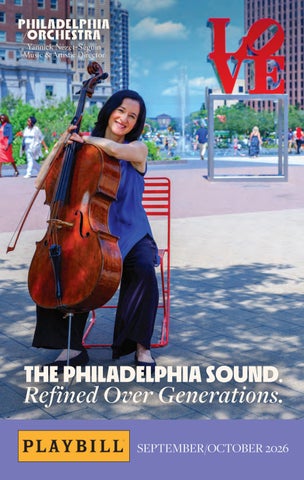
The Program On the Cover: Assistant Principal Cello Yumi Kendall (Elaine Woo Camarda and A. Morris Williams, Jr., Chair) at LOVE Park; photo by Jeff Fusco. To learn more about Yumi, scan the QR code.
®
President & CEO: Chief Financial Officer: Chief Operating Officer & SVP: Director of Manufacturing: Executive Assistant to CEO and COO:
Philip S. Birsh Shamindra Jagnanan Alex Birsh Robert Cusanelli Dalconerys Reyes
Managing Editor, Classic Arts: Art Director: Production Manager: Prepress Manager: Prepress Specialist: Creative Services Manager: Managing Program Editor: Program Editors:
Stephen Vrattos Kesler Thibert Jenna Perrino Sean Kenny Benjamin Hyacinthe Dean Greer Matt Bonanno Amy Asch Silvia Figueroa Scott Hale Dave Porello Khadijah Rentas
Publisher: Jolie Schaffzin Vice President of Sales: Joshua Stone Senior Revenue Officer: Glenn Shaevitz Head of Theatrical Sales: National Sales Director: Advertising Sales Associate: Sales and Marketing Specialist:
Nicholas Foster Clara Barragán Katie Clooney-Gainey Franchesca Reese Chris Kateff
Advertising Sales 729 Seventh Avenue, 4th Floor New York, New York 10019 (212) 557-5757 Chairman: Philip S. Birsh Editor in Chief Emeritus: Joan Alleman Secretary/Treasurer: Shamindra Jagnanan
PLAYBILL® is published by PLAYBILL Incorporated, 729 Seventh Avenue, 4th Floor, New York, NY 10019 Copyright 2026 by PLAYBILL Incorporated. All Rights Reserved. PLAYBILL® is a Registered Trademark of PLAYBILL Incorporated.
0926_Phil_TOC.indd 2
8/31/26 4:41 PM
FROM THE PRESIDENT AND CEO Dear Friends:
Jeff Fusco
Welcome to The Philadelphia Orchestra’s 2026–27 season. For more than 125 years, the Orchestra has told its story through sound—through moments of daring creativity, profound beauty, and shared discovery. Each season adds a new chapter, shaped by the extraordinary artists on our stage and the devoted community that surrounds them. This season is one that is rich with stories that reflect who we are today and where we are headed. Building on our legacy of artistry and innovation, this year brings epic musical journeys, bold premieres, and unforgettable experiences that reaffirm music’s power to connect us all. At the heart of the season is Yannick’s continued exploration of Mahler’s symphonies, works that span intimacy and grandeur, joy and transcendence. These towering masterpieces sit alongside an array of world premieres, from powerful new orchestrations of works by Leonard Bernstein and Florence Price to the newest creations by Reena Esmail and Joe Hisaishi, written for this Orchestra and for our time. Innovation takes center stage as well, with a groundbreaking multidisciplinary event that fuses orchestral music, visual art, and animation in The Party—an imaginative rethinking of what an orchestral experience can be. And our concert-opera journey continues with Wagner’s Lohengrin, a work of sweeping beauty and emotional depth. The 2026–27 season also celebrates the 25th anniversary of the Kimmel Center for the Performing Arts. Since opening its doors in 2001, the Kimmel Center has grown into far more than a performance venue. It is a gathering place for Philadelphia, a home for creativity and civic expression, and a powerful symbol of what the arts—and the freedom to experience and share together—can mean to a community. This season is an invitation—to listen deeply, to watch intently, to be moved, to celebrate with us, and to be part of living artistic traditions that continue to evolve with you at the center. Thank you for your ongoing support and for helping shape the stories we tell together. Best regards,
Ryan Fleur President and CEO
4
0926_Phil_Letter.indd 4
8/31/26 4:42 PM
THE PHILADELPHIA ORCHESTRA 2026–2027 Season Yannick Nézet-Séguin Music and Artistic Director Walter and Leonore Annenberg Chair Marin Alsop Principal Guest Conductor Ralph and Beth Johnston Muller Chair Joe Hisaishi Composer-in-Residence Sara Aldana Assistant Conductor Joseph Conyers Education and Community Ambassador Mark and Tobey Dichter Chair Charlotte Blake Alston Storyteller, Narrator, and Host Osagie and Losenge Imasogie Chair First Violins David Kim, Concertmaster James and Agnes Kim Foundation Chair Juliette Kang, First Associate Concertmaster Joseph and Marie Field Chair Christine Lim, Associate Concertmaster Marc Rovetti, Assistant Concertmaster Dr. James F. Dougherty Chair Barbara Govatos Robert E. Mortensen Chair Jonathan Beiler Hirono Oka
Richard Amoroso Robert and Lynne Pollack Chair Yayoi Numazawa Jason DePue Larry A. Grika Chair Jennifer Haas Miyo Curnow Elina Kalendarova Daniel Han Julia Li William Polk Mei Ching Huang Second Violins Kimberly Fisher, Principal Peter A. Benoliel Chair Paul Roby, Associate Principal Sandra and David Marshall Chair Dara Morales, Assistant Principal Anne M. Buxton Chair Philip Kates Peter A. Benoliel Chair Davyd Booth Paul Arnold Joseph Brodo Chair, given by Peter A.Benoliel Amy Oshiro-Morales Volunteer Committees Chair Yu-Ting Chen Jeoung-Yin Kim Willa Finck John Bian MuChen Hsieh Eliot Heaton Mika Gibbs
Violas Choong-Jin Chang, Principal Ruth and A. Morris Williams, Jr., Chair Kirsten Johnson, Associate Principal Kerri Ryan, Assistant Principal Burchard Tang Renard Edwards Anna Marie Ahn Petersen David Nicastro Che-Hung Chen Rachel Ku Marvin Moon Meng Wang Laura Fuller Stephen Savage Cellos Hai-Ye Ni, Principal Priscilla Lee, Associate Principal Ambassador Amy Gutmann and Dr. Michael Doyle Chair Yumi Kendall, Assistant Principal Elaine Woo Camarda and A. Morris Williams, Jr., Chair Richard Harlow Kathryn Picht Read John Koen Derek Barnes Alex Veltman Jiayin He Michael Katz Eugene Lin Basses Joseph Conyers, Principal Carole and Emilio Gravagno Chair
6
0926_Phil Roster.indd 4
8/31/26 4:44 PM
Gabriel Polinsky, Associate Principal Tobias Vigneau, Assistant Principal David Fay Duane Rosengard Nathaniel West Michael Franz Christian Gray Some members of the string sections voluntarily rotate seating on a periodic basis. Flutes Jeffrey Khaner, Principal Paul and Barbara Henkels Chair Patrick Williams, Associate Principal Rachelle and Ronald Kaiserman Chair Olivia Staton Erica Peel, Piccolo Oboes Philippe Tondre, Principal Samuel S. Fels Chair Peter Smith, Acting Co-Principal Elizabeth Starr Masoudnia, English Horn Joanne T. Greenspun Chair Clarinets Ricardo Morales, Principal Leslie Miller and Richard Worley Chair Samuel Caviezel, Associate Principal Sarah and Frank Coulson Chair Socrates Villegas
Paul R. Demers, Bass Clarinet Peter M. Joseph and Susan Rittenhouse Joseph Chair
Blair Bollinger, Bass Trombone Drs. Bong and Mi Wha Lee Chair
Bassoons Daniel Matsukawa, Principal Richard M. Klein Chair Mark Gigliotti, Co-Principal Angela Anderson Smith
Tuba Carol Jantsch, Principal Lyn and George M. Ross Chair
Horns Jennifer Montone, Principal Jeffrey Lang, Associate Principal Hannah L. and J. Welles Henderson Chair Victoria Knudtson, Assistant Principal Christopher Dwyer Chelsea McFarland Ernesto Tovar Torres Trumpets James Vaughen, Principal Marguerite and Gerry Lenfest Chair Travis Peterson, Associate Principal Anthony Prisk Sam Huss Trombones Nitzan Haroz, Principal Neubauer Family Foundation Chair Matthew Vaughn, Co-Principal Jack Grimm
Timpani Don S. Liuzzi, Principal Don S. Liuzzi Chair, given by Linda and David Glickstein Angela Zator Nelson, Associate Principal Percussion Christopher Deviney, Principal Charlie Rosmarin, Associate Principal Angela Zator Nelson Keyboards Davyd Booth Harp Elizabeth Hainen, Principal Librarians Nicole Jordan, Principal Holly Matthews Stage Personnel Dennis Moore, Jr., Manager Francis “Chip” O’Shea III Aaron Wilson
7
0926_Phil Roster.indd 6
8/31/26 4:44 PM
MUSIC AND ARTISTIC DIRECTOR
Landon Nordeman
Canadian-born conductor and pianist Yannick NézetSéguin is currently in his 15th season with The Philadelphia Orchestra, serving as music and artistic director. An inspired leader, Yannick is both an evolutionary and a revolutionary, developing the mighty “Philadelphia Sound” in new ways. His collaborative style, deeply rooted musical curiosity, and boundless enthusiasm have been heralded by critics and audiences alike. The Philadelphia Inquirer has said that under his baton the Orchestra is “at the top of its considerable form”; the Associated Press has called it “a premier orchestra at its peak”; and The New York Times wrote, “the ensemble, famous for its glowing strings and homogenous richness, has never sounded better.” Yannick has established himself as a musical leader of the highest caliber and one of the most thrilling and sought-after talents of his generation. He became the third music director of New York’s Metropolitan Opera in 2018. In addition, he has been artistic director and principal conductor of Montreal’s Orchestre Métropolitain since 2000. In 2017 he became the third-ever honorary member of the Chamber Orchestra of Europe. He served as music director of the Rotterdam Philharmonic from 2008 to 2018 (he is now honorary conductor) and was principal guest conductor of the London Philharmonic from 2008 to 2014. He has made wildly successful appearances with the world’s most revered ensembles and at many of the leading opera houses. Yannick has shown a deep commitment to expanding the repertoire by embracing an evergrowing and diverse group of today’s composers and by performing and recording the music of underappreciated composers of the past, including Florence Price, Clara Schumann, William Dawson, Lili Boulanger, Louise Farrenc, and William Grant Still. In 2018 he signed an exclusive recording contract with Deutsche Grammophon. Under his leadership The Philadelphia Orchestra returned to recording with 15 releases on that label, including Florence Price Symphonies Nos. 1 & 3, which won a GRAMMY® Award for Best Orchestral Performance in 2022. A native of Montreal, Yannick studied piano, conducting, composition, and chamber music at Montreal’s Conservatory of Music and continued his studies with renowned conductors, most notably Carlo Maria Giulini; he also studied choral conducting at Westminster Choir College in Princeton, New Jersey. Among Yannick’s honors are an appointment as Companion of the Order of Canada; Companion to the Order of Arts and Letters of Quebec; an Officer of the Order of Quebec; an Officer of the Order of Montreal; an Officier de l’Ordre des Arts et des Lettres; Musical America’s 2016 Artist of the Year; ECHO KLASSIK’s 2014 Conductor of the Year; a Royal Philharmonic Society Award; Canada’s National Arts Centre Award; the Prix Denise-Pelletier; the Oskar Morawetz Award; and honorary doctorates from the University of Quebec, the Curtis Institute of Music, Westminster Choir College of Rider University, McGill University, the University of Montreal, the University of Pennsylvania, Laval University, and Drexel University. To read Yannick’s full bio, please visit philorch.org/conductor. 8
0926_Phil_MusicDirector.indd 6
8/31/26 4:46 PM
THE KIMMEL CENTER TURNS 25
Twenty-five years ago, Philadelphia opened the doors to a new home for the performing arts, and to a new chapter for The Philadelphia Orchestra. The Kimmel Center for the Performing Arts was created with the belief that one of the world’s great orchestras deserved a home designed for artistic excellence and civic connection—a place built not only for performance, but for gathering, where artists, audiences, students, families, and communities could come together. Now stewarded by Ensemble Arts Philly, the Kimmel Center has grown into something its founders envisioned but couldn’t fully predict: a place where hundreds of thousands of people across all ages come together each year to experience the transformative power of the performing arts, through free and low-cost education programs, community events, family concerts, and more. We welcome you to the Kimmel Center for your performance and can’t wait to see you again. Explore the Kimmel Center’s impact and discover how you can join the 25th anniversary celebration at www.EnsembleArtsPhilly.org/ Kimmel25 or by scanning the QR code.
10
0926_Phil_KimmelCenter.indd 8
8/31/26 4:48 PM
MUSICIANS BEHIND THE SCENES Laura Fuller Viola Where were you born? I was born in Overland Park, Kansas. Todd Rosenberg
What piece of music could you play over and over again? Beethoven’s Symphony No. 7, the end of the last movement gives me goosebumps every single time. What piece of music never fails to move you? The second movement (Adagio assai) from Ravel’s Piano Concerto in G major. What do you love most about performing? I think music, whether performing or listening, is a beautiful and powerful way to press pause on the busyness of life and, in a sense, be transported into another world. When did you join the Orchestra? In 2026. Do you play any other instruments? Not currently, but I used to play violin and also played bass for a year in high school. What do you like to do in your spare time? I enjoy jogging, cooking, traveling, and listening to music. What’s your favorite movie? Gladiator. What do you love most about Philadelphia? The Orchestra! What’s the first album you ever bought or downloaded? A compilation called Romantic Favorites for Strings with the New York Philharmonic conducted by Leonard Bernstein, which includes works by Mahler, Barber, Vaughan Williams, and Tchaikovsky. What’s on your Spotify playlist? I have a playlist of about 250 of my favorite classical music tracks, but my recent favorite additions include the last movement of Schnittke’s Piano Quintet, the third movement of Britten’s String Quartet No. 1, and Schumann’s Dichterliebe. I also love ’90s old school rap. When was the first time you heard The Philadelphia Orchestra? My dad took me to Philly to hear Charles Dutoit conduct Copland’s Symphony No. 3 in 2000. I was in high school and was completely starstruck! What is your favorite memory with the Orchestra? Playing Stravinsky’s Rite of Spring with Yannick Nézet-Séguin. I love the piece and LOVED his interpretation! What advice would you give to aspiring young musicians? Never give up on your dreams! Especially regarding auditions, not winning at first can be an invaluable opportunity to learn and grow. Don’t be afraid to climb the ladder.
11
0926_Phil_MBS.indd 17
8/31/26 4:49 PM
Eugene Ormandy during a rehearsal.
Portrait of Gustav Mahler by Emil Orlik from 1902
10
0926_Mahler.indd 10
8/31/26 4:52 PM
THE ALL-EMBRACING WORLD OF GUSTAV MAHLER’S SYMPHONIES This season, Yannick and the Philadelphians perform the First, Third, Fifth, and Seventh Symphonies By Christopher H. Gibbs
“The symphony must be like the world, it must embrace everything.” Whether or not Gustav Mahler actually said this in 1907 to the Finnish composer Jean Sibelius, the sentiment resonates with other statements he made over the years. Expanding the idea further, some musicians have argued that, taken together, all of Mahler’s symphonies form a single gigantic work, fascinatingly interconnected and indeed all-embracing. Mahler’s symphonies are usefully divided into three groups. The first four are known as the “Wunderhorn” symphonies because in them he used songs composed to poems from the folk collection Des Knaben Wunderhorn (From the Youth’s Magic Horn). He next wrote three purely instrumental symphonies (Nos. 5, 6, and 7), and then, after the somewhat anomalous Eighth (the “Symphony of a Thousand”), he concluded his career with the trilogy of Das Lied von der Erde (The Song of the Earth), the Ninth Symphony, and the unfinished Tenth.
Mahler composed his symphonies over the course of a quarter century, generally during the summer months because he was otherwise preoccupied as one of the great conductors of the day. He was born in 1860 in a small Bohemian town into the family of a Jewish distiller and at age 15 moved to Vienna to begin studies at the Conservatory. He started his career with conducting jobs at provincial opera houses before assuming posts in Prague, Leipzig, Budapest, and Hamburg. In 1897 he was offered the greatest plum: the directorship of the Vienna Court Opera, the most powerful musical position in Europe. To get the job, he had accepted baptism in the Catholic faith. Mahler held the Vienna post for a decade before accepting prestigious appointments in New York, first with the Metropolitan Opera and then with the New York Philharmonic; he returned to Europe each summer to compose. Although some aspects of Mahler’s musical style and aesthetic commitments changed over the years, there are throughlines that help create the sense of a gigantic whole. His symphonies tackle eternal questions of life and death (funeral marches appear in many of them), of nature and the universe. The symphonies are deeply personal, qualities which Mahler in some instances candidly divulged and at other times attempted to hide. He often invites us to make connections between his life and music by giving titles and by making 13
0926_Mahler.indd 11
8/31/26 4:52 PM
Jessica Griffin
Over the course of this season Yannick Nézet-Séguin and The Philadelphia Orchestra present four of Mahler’s symphonies, beginning in October with the Fifth. In April they perform the Seventh Symphony, in May the Third, and in June the First. In addition, this season Yannick conducts a cycle of the nine completed Mahler symphonies at Carnegie Hall and the Metropolitan Opera, with the Philadelphians, the Met Orchestra, and the Vienna Philharmonic.
New York Public Library
comments in letters, sketches, and manuscript scores, an intense subjectivity that was a legacy of Beethoven and later Romantic composers. Some autobiographical moments in Mahler relate to one of the great debates of Romanticism: program music, about which he was deeply ambivalent. Symphonies during the earlier Classical era were usually “absolute,” not explicitly connected to literature, history, or other extra-musical elements. While Beethoven initially continued this approach, he also helped to forge a new path with his “Eroica” and “Pastoral” symphonies through titles and other programmatic clues. He opened further vistas in his Ninth Symphony by bringing in poetry and the human voice, a strategy Mahler emulated in his Second, Third, Fourth, and Eighth Symphonies. A manuscript of the Adagietto movement from Mahler’s Symphony No. 5, dated 1902, with marks by Gustav and Alma
Mahler composed almost exclusively in just two genres: songs and symphonies, which he interrelated in masterful ways. For his songs he initially used Wunderhorn poems drawn from an early-19th-century anthology. While these folk poems had attracted some earlier composers, they proved especially inspiring for the young Mahler and formed the basis of his first four symphonies. After writing three symphonies, each progressively longer and more complex, Mahler reached something of a limit. They all had programs of some sort—titles, stories, or poems—the compositional approach successfully pursued by his friend and rival Richard Strauss. But Mahler increasingly sought to suppress such extra-musical baggage: “Death to programs,” he proclaimed around the time of the Fourth Symphony, which was shorter, more modest in its orchestration, and, although it concludes with a Wunderhorn song, less programmatic. Symphonies Five, Six, and Seven are a trilogy that mark Mahler’s ostensible retreat from programs and vocal movements. During this time, he stopped using the Wunderhorn anthology and began to write songs based on the more elevated poetry of Friedrich Rückert. Even though songs are no longer boldly sung or overtly quoted in the middle symphonies, they go “underground,” as Mahler scholar Donald Mitchell has put it, and nonetheless leave traces through affinities of mood or brief allusions. These changes in Mahler’s compositional strategies coincided with crucial developments in his personal life. A medical crisis in early 1901 (internal hemorrhaging) brought the 40-year-old composer close to death. Soon thereafter he resigned his position as head of the Vienna Philharmonic’s subscription concerts, which he had taken up in 1898, and by the end of the year was engaged to Alma Schindler, who was 19 years his junior, and was starting his own family. The range of emotions explored in the Fifth Symphony, beginning with the solemn funeral march, including the magnificent “love song” of the famous Adagietto, and concluding with the blazing triumph 14
0926_Mahler.indd 12
8/31/26 4:52 PM
of the finale, may give some indication of Mahler’s hopes. The Sixth Symphony, which briefly carried the title “Tragic,” charts a very different and more somber course. The Seventh again seems a journey from darkness to light in a poetic work featuring two evocative “night music” movements. Mahler wrote the monumental Eighth Symphony in a white heat of inspiration during the summer of 1906. It is popularly known as the “Symphony of a Thousand” because of the enormous forces involved: an immense orchestra, mixed choirs and separate children’s chorus, organ, off-stage brass, and eight vocal soloists. The two-part work unfolds using a Latin Pentecost hymn and then the conclusion of Goethe’s Faust, Part II. Mahler’s astonishing feat of combining different languages, genres of music, and sacred and secular themes led to the greatest success of his career at its premiere in Munich in 1910. Leopold Stokowski and The Philadelphia Orchestra gave its American premiere in 1916. A series of devastating personal blows in 1907 led to another turning point in Mahler’s life: His beloved elder daughter died at the age of four, he resigned from the Vienna Court Opera, and he was diagnosed with a heart condition. The final three works followed: Das Lied von der Erde in the summer of 1908, the Ninth Symphony the next summer, and parts of the Tenth in the summer of 1910, but Mahler died in May 1911 before finishing it. Given their ultimate place in the composer’s output, it has proven all too tempting to view these pieces as pointing toward death, a “farewell” trilogy, the artistic testament of a dying man. Another famous Mahler soundbite to conclude—this from a letter he wrote to his wife in which he said, “My time will come.” The context was in relation to Strauss, as the sentence continues “when his has passed.” At the time of his death, age 50, Mahler was hailed as a great conductor but was seriously underrated, and often dismissed, as a composer. Strauss was more esteemed and far more often performed. Of the four symphonies the Philadelphians present this season, Mahler conducted his First 16 times, the Third a total of 15 times (not including a pre-premiere performance of the second movement in 1897 in Budapest), the Fifth nine times (he also performed just the Adagietto at a 1907 concert in Rome), and the Seventh just five times. It took decades for most of his pieces to enter the international repertoire, but in the wake of the 1960 centennial of his birth, Mahler was ascendent. By the end of the century, one might even say he
Mahler’s composition hut in Maiernigg, Austria, on Lake Wörth where he wrote the Symphonies No. 4, 5, 6, 7, and 8
15
0926_Mahler.indd 13
8/31/26 4:52 PM
had become the new Beethoven in popularity and with his music frequently performed at festival occasions. For more than a century, symphonies by Beethoven (usually the Fifth or Ninth) were used at celebratory events. The Philadelphia Orchestra’s inaugural concert in 1900 featured the Fifth. Now, when a music director begins or ends their tenure, or when a new concert hall is dedicated, it is often marked with a Mahler symphony. His time, the vast all-embracing vision of his music, has arrived. Christopher H. Gibbs is James H. Ottaway Jr. Professor of Music at Bard College and has been the program annotator for The Philadelphia Orchestra since 2000. He is the author of several books on Schubert and Liszt, and the co-author, with Richard Taruskin, of The Oxford History of Western Music, College Edition.
The Philadelphia Orchestra’s first commercial recording, Brahms’s Hungarian Dance No. 5 Caricature drawings satirizing Mahler’s conducting style when he was director of the Vienna Court Opera, originally published in 1901 in the German humorous magazine Fliegende Blätter (Flying Leaves) 16
0926_Mahler.indd 14
8/31/26 4:52 PM
NOTED IN PASSING
Jessica Griffin
The Philadelphia Orchestra mourns the passing of former violinist Booker Rowe on August 1 at the age of 85.
Born in Lexington, Kentucky, Mr. Rowe moved to Philadelphia at the age of two and began lessons in the sixth grade at the M. Hall Stanton School in North Philadelphia. In high school he was concertmaster of the West Philadelphia High School Orchestra, the All City High School Orchestra, and the All-Eastern Orchestra. He received his Bachelor of Music degree from Temple University and then played in the Nashville Symphony for two years. During this time, he also played in the Nashville Symphony String Quartet, making it the first racially integrated professional string quartet in the south. He received his master’s degree from Yale University and joined the National Symphony for the 1969–70 season. He premiered numerous new works by Black and other minority composers and played with many chamber music ensembles. He also performed with such artists as Sammy Davis, Jr., Isaac Hayes, Smokey Robinson, the Supremes, and Barbra Streisand, among others. He taught at Tennessee State University, Wesleyan University, the Settlement Music School, and the Community College of Philadelphia. In November 1968, Mr. Rowe received a phone call from Philadelphia Orchestra Personnel Manager Mason Jones saying that Eugene Ormandy had requested he play with the Orchestra for the remainder of the season as a substitute for a violinist who had just died. Thus, Mr. Rowe made history as the first Black musician to play in the ensemble. In 1970 Ormandy hired him back for a full-time position but on a conditional basis. He joined the Orchestra as a full-time member in 1971, the second Black member after violist Renard Edwards, who joined in 1970. Mr. Rowe retired in 2020. 17
0926_Phil_Noted.indd 15
8/31/26 5:40 PM
2026–2027 | 127TH SEASON MARIAN ANDERSON HALL
THE PHILADELPHIA ORCHESTRA Friday, October 9, at 2:00 Saturday, October 10, at 8:00 Dalia Stasevska Conductor Gil Shaham Violin Meredith Nautilus
First Philadelphia Orchestra performances
Saint-Saëns Violin Concerto No. 3 in B minor, Op. 61 I. Allegro non troppo II. Andantino quasi allegretto III. Molto moderato e maestoso—Allegro non troppo Intermission Sibelius Pohjola’s Daughter, Op. 49 Respighi Pines of Rome I. The Pine Trees of the Villa Borghese— II. Pine Trees near a Catacomb— III. The Pine Trees of the Janiculum— IV. The Pine Trees of the Appian Way This program runs approximately 2 hours.
The appearance of Dalia Stasevska is supported by Lead Sponsor the Julian and Lois Brodsky Foundation. These concerts are also part of the Peter A. Benoliel Violin Concerts, established in his honor by Dr. Richard M. Klein.
Philadelphia Orchestra concerts are broadcast on WRTI 90.1 FM on Sunday afternoons at 1 PM and are repeated on Monday evenings at 7 PM on WRTI HD 2. Visit www.wrti.org to listen live or for more details.
19
Jessica Griffin
THE PHILADELPHIA ORCHESTRA
20
The world-renowned Philadelphia Orchestra strives to share the transformative power of music with the widest possible audience, and to create joy, connection, and excitement through music in the Philadelphia region, across the country, and around the world. Through innovative programming, robust education initiatives, a commitment to its diverse communities, and the embrace of digital outreach, the ensemble is creating an expansive and inclusive future for classical music.
Yannick Nézet-Séguin is now in his 15th season with The Philadelphia Orchestra, serving as music and artistic director. His connection to the ensemble’s musicians has been praised by both concertgoers and critics, and he is esteemed by the musicians of the Orchestra, audiences, and the community. In addition to expanding the repertoire by embracing an ever-growing and diverse group of today’s composers, Yannick and the Orchestra are committed to performing and recording the works of previously overlooked composers.
The Philadelphia Orchestra takes great pride in its hometown, performing for the people of Philadelphia year-round, at the Kimmel Center for the Performing Arts, throughout the community, over the airwaves, and online. The Kimmel Center has been the ensemble’s home since 2001, and in 2024 Verizon Hall at the Kimmel Center was officially rededicated as Marian Anderson Hall in honor of the legendary contralto, civil rights icon, and Philadelphian. The Orchestra’s award-winning education and community programs connect, uplift, and celebrate nearly 40,000 Philadelphians and 250 schools from diverse communities annually, through inclusive arts education and vibrant engagement that reflect our city’s voices and expand access to creative opportunities. Students, families, and other community members can enjoy free and discounted experiences with The Philadelphia Orchestra through programs such as the Jane H. Kesson School Concerts, Family Concerts, Open Rehearsals, PlayINs, and Our City, Your Orchestra community concerts.
The Philadelphia Orchestra believes deeply in the power of music to connect people and the role cultural diplomacy can play in affecting change. Through concerts, national and international tours, residencies, and recordings, the Orchestra is a global ambassador and one of our nation’s greatest cultural exports. It performs annually at Carnegie Hall, the Highmark Mann Center, the Saratoga Performing Arts Center, and the Bravo! Vail Music Festival. The Orchestra also has a rich touring history, having first performed outside Philadelphia in its earliest days. In 1973 it became the first American orchestra to perform in the People’s Republic of China, launching a now-five-decade commitment of people-topeople exchange through music. Under Yannick’s leadership, the Orchestra returned to recording with 15 celebrated releases on the Deutsche Grammophon label, including the GRAMMY® Award– winning Florence Price Symphonies Nos. 1 & 3. The Orchestra also reaches thousands of radio listeners with weekly broadcasts on WRTI-FM and SiriusXM. For more information, please visit www.philorch.org.
Veikko Kahkonen
CONDUCTOR Dalia Stasevska is one of the most stratospherically ascendant musicians in classical music today. Principal guest conductor of the BBC Symphony, she has established herself as a commanding musical voice, a boundary-pushing innovator, and a fearless activist and advocate for change. She made her Philadelphia Orchestra debut in 2023 and appears with leading orchestras including the New York, Los Angeles, Berlin, Munich, Czech, Helsinki, and Rotterdam philharmonics; the San Francisco, Montreal, Toronto, Frankfurt Radio, and Finnish Radio symphonies; the Orchestre National de France; the Vienna Symphony at the Bregenz Festival; and regularly at the BBC Proms. A passionate opera conductor, Ms. Stasevska has conducted at Glyndebourne, the Finnish National Opera, and the Norwegian Opera. She has made debuts at the Los Angeles Opera with Glass’s Akhnaten and the Deutsche Oper Berlin with Britten’s A Midsummer Night’s Dream. She has been engaged by leading opera houses including the Metropolitan Opera and the Royal Opera in London. Ms. Stasevska was named “European of the Year” in 2025, recognized for promoting European values and democracy. Her honors include BBC Music Magazine’s Personality of the Year, the Alfred Kordelin Prize, the Royal Philharmonic Society’s Conductor Award, and the Order of Princess Olga from Ukraine.
21
Chris Lee
SOLOIST Gil Shaham made his Philadelphia Orchestra debut in 1988 at the Mann Center and has performed regularly with the Philadelphians ever since. He is one of the foremost violinists of our time, his flawless technique combined with inimitable warmth and generosity of spirit solidifying his renown as an American master. He is sought after worldwide for concerto appearances with leading orchestras and conductors, regularly giving recitals, and appearing with ensembles on the world’s great concert stages and at the most prestigious festivals. Recent and upcoming highlights include acclaimed recordings and performances of J.S. Bach’s complete sonatas and partitas for solo violin and recitals with his long-time duo partner, pianist Akira Eguchi, in performances throughout North America, Europe, and Asia. Mr. Shaham regularly appears with the Berlin, Israel, Los Angeles, and New York philharmonics; the Boston, Chicago, and San Francisco symphonies; and the Orchestre de Paris. He has engaged in multi-year residencies with the orchestras of Montreal, Stuttgart, and Singapore. He has maintained a particular focus on violin concertos of the 1930s— including works by Barber, Bartók, Berg, Korngold, and Prokofiev—and in recent years has premiered new commissions by Avner Dorman, Reena Esmail, and Mason Bates. He has recorded more than two dozen concerto and solo recordings, earning multiple GRAMMYs, a Grand Prix du Disque, the Diapason d’Or, and Gramophone Editor’s Choice awards. Many of these recordings appear on Canary Classics, the label he founded in 2004. Highlights include Virtuoso Violin Works, Elgar’s Violin Concerto, Hebrew Melodies, and The Butterfly Lovers. His 2016 recording 1930s Violin Concertos Vol. 2 and his 2021 recording of the Beethoven and Brahms concertos with the Knights were both nominated for GRAMMY Awards. Born in Champaign-Urbana, Illinois, in 1971, Mr. Shaham was awarded an Avery Fisher Career Grant in 1990 and in 2008 received the Avery Fisher Prize. In 2012 he was named “Instrumentalist of the Year” by Musical America. He plays the 1699 “Countess Polignac” Stradivarius and also an Antonio Stradivari violin, Cremona c. 1719, with the assistance of Rare Violins in Consortium, Artists and Benefactors Collaborative. He lives in New York City with his wife, violinist Adele Anthony, and their three children. Peter A. Benoliel Violin Concerts A passionate violinist from early childhood, Peter A. Benoliel joined the Philadelphia Orchestra Board of Directors in 1980 and served as chair from 1995 to 2000. His huge contributions to the Orchestra as a leader and philanthropist are paralleled only by his deep love for the violinists who help bring the famous Philadelphia Sound to the world. 22
FRAMING THE PROGRAM PARALLEL EVENTS The concert today opens with Nautilus, a brilliant curtain1880 Saint-Saëns Violin Concerto No. 3
1905 Sibelius Pohjola’s Daughter
1924 Respighi Pines of Rome
Music Tchaikovsky 1812 Overture Literature Zola Nana Art Cézanne Château de Medan History First pay phone installed Music Debussy La Mer Literature Wharton House of Mirth Art Picasso Two Youths History Einstein formulates Theory of Relativity
raiser by Anna Meredith. She originally wrote the brief work on her computer as a purely electronic piece that she released on her first two albums. Dalia Stasevska, who conducts The Philadelphia Orchestra today, suggested that she make an orchestral version. The French composer Camille Saint-Saëns traveled widely and appeared with the Philadelphians during a trip to America in 1906. He died in Algiers at the venerable age of 86. He composed the last of his three violin concertos for the great Spanish virtuoso Pablo de Sarasate, with whom he frequently collaborated.
In the late 19th century, prominent composers began to emerge from countries that had previously played rather minor roles in international musical life. Among these leading figures was Jean Sibelius in Finland, who was deeply connected with his native landscape, language, and cultural traditions. Sibelius is best known for his Violin Concerto, seven symphonies, and some dozen tone poems, including Pohjola’s Daughter. He too enjoyed a personal connection with the Philadelphians.
The concert ends with Ottorino Respighi’s evocative Pines of Rome, which explores the pine tree groves spread over Rome. This brilliantly scored musical homage to the Music city the composer so loved offers a feast of sound as the Gershwin Rhapsody in Blue orchestra is augmented by organ, a large contingent of Literature percussion instruments, recorded bird calls (shocking in Forster 1924), and antiphonal brass choirs positioned throughout A Passage to the hall. India Art Braque Sugar Bowl History Lenin dies
The Philadelphia Orchestra is the only orchestra in the world with three weekly broadcasts on SiriusXM’s Symphony Hall, Channel 66, on Mondays at 7 PM, Thursdays at 12 AM, and Saturdays at 4 PM. 23
THE MUSIC Nautilus Anna Meredith Born in London, January 12, 1978 Now living there
The chambered nautilus suggests delicacy: a pearly spiral, an ancient sea creature whose shell regulates its buoyancy. Anna Meredith’s Nautilus captures that image with six minutes of brass-edged dynamism. The disparity suits a composer who treats titles as suggestive provocations. Meredith has called them “one-word program notes”: They set the imagination in motion without dictating a narrative. Here, a compact figure repeatedly drives upward, gathering weight until the music feels as monumental as it is volatile. Written for electronics in 2011 and orchestrated a decade later, Nautilus also charts Meredith’s movement among sound worlds often labeled classical, pop, and experimental. A Call to Arms London-born and raised in Scotland, Meredith studied at the University of York and the Royal College of Music before serving as composer-in-residence with the BBC Scottish Symphony Orchestra from 2004 to 2007. The orchestral world helped form her craft. By 2011 she wanted to work beyond the commission system in which an ensemble initiated a piece, prescribed its forces, and supplied its deadline. Electronic production offered a different kind of authorship. Working at her computer, she could originate the project, construct every layer, and shape the finished recording. Meredith later described Nautilus as a sort of “call to arms (for myself!)” and a way to “reclaim” agency in her writing. Practical limits led her to simulate the sound of brass, since no ensemble stood ready to record it, yet the synthetic medium also let her pursue the energy of the musical idea on its own terms. Nautilus opened her debut extended play (EP), Black Prince Fury (2012), and reappeared at the start of Varmints, her first full-length album, in 2016. Varmints won the Scottish Album of the Year Award. Her subsequent projects have included Five Telegrams, premiered on the First Night of the BBC Proms (2018); the score for Bo Burnham’s film Eighth Grade; and FIBS, shortlisted for the 2020 Mercury Prize. Meredith was appointed a Member of the Most Excellent Order of the British Empire for services to music under Queen Elizabeth II in 2019. The circle closed in 2021, eliciting the current offering. After hearing Meredith’s band perform Nautilus, Dalia Stasevska asked for an orchestral version to open her first concert as chief conductor of the Lahti Symphony Orchestra in Finland. The orchestra commissioned the new realization, which Jack Ross, guitarist in Meredith’s band, fashioned with the composer. Stasevska conducted its premiere at Sibelius Hall on September 24
16, 2021. The score preserves the electronic original’s exactitude: Meredith prefers the conductor, trumpets, trombones, tuba, and percussion to use a click track while the players supply its visceral weight. A Closer Look Meredith often sketches a composition’s eventual course on paper, tracing changes in density, energy, and scale across time. Nautilus can be heard in the same way, as a small repertory of sharply defined objects whose presence and alignment continually change. A brilliant A-major sonority is reiterated in clipped, accented attacks across woodwinds and brass. The harmony scarcely moves; its repetition nevertheless gathers pressure. Soon an “extremely aggressive” chromatic line scrapes upward through the bassoons, low horns, trombones, tuba, marimba, and low strings, punctuated by tubular bells. Each exhilarating ascent resets itself and begins afresh. The form grows through accretion: The rising line disappears, returns in a new register, and acquires the bright edge of xylophone and high strings or the heft of low brass. Meredith recalls that the rising line was inspired by her walks on an ever-changing Scottish beach. Experimenting with the placement of her steps against the repeating pattern yielded the transformation heard later in the piece. As Nautilus gathers force, its meter becomes increasingly mercurial. Familiar cycles suddenly stretch beyond expectation; later, the same rapid pulse is regrouped, altering the music’s gait without checking its momentum. The music races onward, even as the listener’s footing shifts beneath it. A raucous new meter acquires still greater physical authority. Timpani and low strings begin to slide; snare drum, bass drum, and floor tom lock into the pulse; sustained woodwinds and violins swell against the repeated-note units; and trombones and tuba add a massive foundation. Nearly every layer converges in the final pages. At the climax, the lower instruments receive a startling instruction in the score: “FREEZE!” The upper pulse continues dynamically for an arresting breath longer until its cutoff. Meredith withholds the victory chord that a fanfare might otherwise promise. Nautilus ends still straining, pushing, and looking upward. —Justin Vickers Justin Vickers is Distinguished Professor of Music at Illinois State University and a specialist in Benjamin Britten and British music since 1900. His most recent book, co-edited with Joy H. Calico, is Childhood and the Operatic Imaginary Since 1900 (Oxford University Press, 2026) and he is currently completing a history of Britten’s Aldeburgh Festival. Nautilus was composed in 2011 and orchestrated in 2021. These are the first Philadelphia Orchestra performances of the work. The piece is scored for two flutes (I doubling piccolo), two oboes, two clarinets (II doubling bass clarinet), two bassoons, four horns, four trumpets (IV optional, but eight preferred), three trombones (six preferred), tuba (two preferred), timpani, percussion (bass drum, floor tom, marimba, snare drum, tubular bells, xylophone), and strings. Nautilus runs approximately six minutes in performance.
25
THE MUSIC Violin Concerto No. 3 Camille Saint-Saëns Born in Paris, October 9, 1835 Died in Algiers, December 16, 1921
Camille Saint-Saëns’s infallible knack for combining a virtuoso soloist with orchestra served him well throughout his long life: He composed more solo and orchestra concertante works than any other major Romantic composer—some 30 in all. In addition to five concertos for piano, three for violin, and two for cello, he also wrote a colorful variety of pieces, including Carnival of the Animals (with two solo pianists), Morceau de concert for harp, and the unusual Africa for piano and orchestra. The same melodic facility and ease that lend his operas and chamber works their nonchalant flow is found in ample measure in these works for soloist and orchestra as well. He was a composer of prodigious wit and sharp intellect, too; though he dashed off his most enduring works in a matter of days, his best music is as serious as Beethoven’s, as perfectly polished as Chopin’s, and as full of melody as Mozart’s. Among Saint-Saëns’s output are no fewer than eight works for solo violin and orchestra, including five showpieces such as the Havanaise, Op. 83. Of his three concertos for the instrument, only the Third, composed in 1880, has remained a part of the concert repertory. As with several of his other works for violin (including the First Concerto and the Introduction and Rondo capriccioso, Op. 28), it was written for Pablo de Sarasate, the Spanish virtuoso whose savvy and nimble musicianship made him one of the superstars of the 19th-century European stage. (Other works written for him include Max Bruch’s Second Concerto and Scottish Fantasy and Édouard Lalo’s Symphonie espagnole.) Sarasate played the Third Concerto’s premiere in Paris at the Théâtre du Châtelet in January 1881. A Closer Look The design of the B-minor Concerto is fairly traditional: Two dramatic outer movements are separated by an intensely lyrical central one. The first movement (Allegro non troppo), dispensing with the usual orchestral exposition, plunges directly into the violin’s first statement. This passionate initial subject, though it contains much of the character of an introduction, in fact forms the chief thematic material. This becomes apparent in the development section, which is driven forward by a series of what are essentially pyrotechnical embellishments of this sinuous five-note theme. Technical display is not, however, the primary motivation of this movement; the controlling mood is instead one of splendid melodism for which Saint-Saëns is justly admired. An unusual harmonic flavoring is lent by the key of B-flat major for the delicate slow movement (Andantino quasi allegretto)—strictly speaking one of the most jarringly 26
remote keys imaginable from the B-minor tonic. The effect is anything but jarring, though, for this is one of the composer’s most inspired moments. Indeed, when caught up in SaintSaëns’s melodic aplomb, most of us are more than willing to ignore the standard criticisms of this work, such as George Bernard Shaw’s characterization of it as a collection of “pretty scraps of serenade music sandwiched between pages from the great masters.” The finale (Molto moderato e maestoso—Allegro non troppo) clears the air with a full-throated introduction—some have likened it to a vocal recitative that precedes the grand aria—before launching into a vigorous dance built from a dotted rhythmic “snap” that brightens the mood immediately. This is interrupted by a lyrical and vaguely Mendelssohnian subject, then by a passage resembling the Prelude to Wagner’s Lohengrin— the appearance of which threatens, momentarily, to give credence to Shaw’s above statement. But Saint-Saëns’s structural intuition prevails, rounding out the work with panache and sheer exuberance. —Paul J. Horsley Paul J. Horsley is performing arts editor for The Independent in Kansas City. Previously he was program annotator and musicologist for The Philadelphia Orchestra and music and dance critic for The Kansas City Star. Saint-Saëns composed his Third Violin Concerto in 1880. Hugo Olk was the soloist in the first Philadelphia Orchestra performances of the Concerto, in November 1902; Fritz Scheel conducted. Most recently on a subscription series it was played by David Kim in May 2012, with Charles Dutoit on the podium. The work is scored for an orchestra of two flutes (II doubling piccolo), two oboes, two clarinets, two bassoons, two horns, two trumpets, three trombones, timpani, and strings, in addition to the solo violin. Performance time is approximately 28 minutes.
27
THE MUSIC Pohjola’s Daughter Jean Sibelius Born in Hämeenlinna, Finland, December 8, 1865 Died in Järvenpää, September 20, 1957
“This is the crucial hour, the last chance to make something big of myself and achieve great things.” Thus the 39-year-old Jean Sibelius wrote to his wife, Aino, in January 1905. Not that he wasn’t already quite well known, especially in his native Finland. His challenge was securing a larger renown, to be more than just a representative of a particular nation. The tone poem Finlandia, written six years earlier, aided the cause of Finnish independence from Russia and would eventually become something of an unofficial national anthem, as well as one of the composer’s most famous pieces. But Sibelius, who had studied in Berlin, as well as in Vienna, aspired to be compared with the preeminent Modernist composers, contemporaries like Richard Strauss and Gustav Mahler, who, though very much German, occupied the “universal” center. His letter to Aino continued, “Now the important thing is not to let up but to sustain the momentum.” New Paths One immediate consequence of importance for Pohjola’s Daughter was Sibelius breaking with his Finnish publishers and allying himself with a Berlin firm headed by Robert Lienau. Sibelius had recently visited the city and conducted acclaimed performances of his new Second Symphony. While in Berlin he heard Strauss conduct his massive Ein Heldenleben and Symphonia domestica, both of which fascinated and inspired him. By this point in his career, Sibelius had composed two of his seven symphonies, although he now declared, “I’m no longer writing a symphony, but rather a symphonic fantasy for orchestra. This is my genre!! Here I can move without feeling the weight of tradition.” Sibelius interrupted work on the Third Symphony and turned, as he had done before and would do many times later, to the Finnish national epic Kalevala. That enormous work had been transmitted orally for hundreds of years before Elias Lönnrot published an edition in 1835 (expanded in 1849). When Sibelius visited America in 1914 and was awarded an honorary doctorate from Yale University, the commendation noted that “What Wagner did with Teutonic legend, Dr. Sibelius has done in his own impressive way with the legends of Finland as embodied in her national epic. He has translated the Kalevala into the universal language of music, remarkable for its breadth, large simplicity, and the infusion of a deeply poetic personality.” A Northern Tale Of the many Kalevalaic stories that attracted Sibelius at different times, he now chose the part that told the tale of the old and venerable seer Väinämöinen. He 28
falls in love with Pohjola’s beautiful daughter, who spins gold from her perch on a rainbow. The demanding young beauty proposes a series of daunting tasks—for example making a boat from the broken shards of her spindle and, in a later part of the story, tying an egg in invisible knots—that ultimately defeat him. He must continue his journey from the north alone. Sibelius wanted to name the work after Väinämöinen, a title that Lienau realized would do little to advance the goal of international recognition. He suggested Pohjola’s Daughter, which gave Sibelius pause because of a recent Finnish opera with a similar name and so he countered with the Straussian title The Adventures of a Hero. The publisher ultimately got his way. Sibelius provided a brief prose synopsis of the story, which Lienau turned into poor German poetry and printed at the beginning of the score. It runs: Väinämöinen, old and steadfast, leaving the gloomy Kingdom of Pohjola and the home of mournful songs, goes homeward on his sleigh. Hark! What noise is that? He looks up and sees Pohjola’s daughter sitting on the rainbow spinning, brilliant, high in the blue sky. Intoxicated by her beauty, he pleads, “Come down to me, you lovely creature.” She teasingly refuses and he begs again. She demands, “Make me a boat out of my spindle, that is what I have long desired. Show me your magical skills and then I will gladly follow.” Väinämöinen, old and steadfast, toils in vain; his magic powers have forsaken him! Totally demoralized, deeply wounded, the beautiful maiden lost to him, he springs to his sleigh and goes! He holds his head high. Yet the hero can never despair, he will overcome all sorrow. The memory of the gentle sounds eases his pain and offers hope. Sibelius completed Pohjola’s Daughter in the summer of 1906 and at the end of the year conducted the premiere in St. Petersburg to great acclaim. A critic for the Russian Musical Gazette noted the affinity of the piece to Strauss, admiring “the same national feeling, spontaneity, and freedom, the same attraction for orchestral color, interest in myth and, above all, something that is a particular characteristic: an imaginative and bold use of orchestral sonority.” Indeed, the work calls for a slightly larger orchestra than Sibelius usually uses and does so to distinctive coloristic effect. A Closer Look The “fantasy” opens with a somber solo cello playing a fragmentary motive against atmospheric minor chords in the orchestra. Does this represent “old and steadfast” Väinämöinen? Do the repetitive and gradually building passages that soon follow depict his ride or the spinning of Pohjola’s daughter? Before one tries to relate the characters and storyline printed in the score’s preface to specific musical themes and sections of the piece, as commentators often do, we should note that Sibelius appears originally to have had a rather different tale in mind. During the early stages of composing the work, he refers in his letters to a piece called Luonnotar, yet another tale from the Kalevala, in this case its version of Genesis, the story of creation. Thus, passages that are said to represent Väinämöinen might just as easily be linked to some sort of primordial rumblings. Music rarely depicts realistic phenomena; composers often change their minds, lie, or are oblivious about the stories their music tells. While the soft oboe theme that is accompanied 29
by glowing strings and harp may evoke a beautiful maiden spinning gold on a rainbow, that is not necessarily what Sibelius originally or ultimately intended. Nor does it really matter. Perhaps it is more interesting to consider an observation by the preeminent Sibelius scholar, Erik Tawaststjerna, who writes: “The chief protagonists of the drama, Väinämöinen and Pohjola’s daughter, can be thought of as the first and second subjects respectively, and it is not too fanciful to suspect that the tension between the two themes reflects something of Sibelius’s own predicament musically. The massive, firmly hewn contours of Väinämöinen stand for the rhetoric of late Romanticism while the ethereal world of the daughter of the heavens looks forward to the horizons of Impressionism.” —Christopher H. Gibbs Christopher H. Gibbs is James H. Ottaway Jr. Professor of Music at Bard College and has been the program annotator for The Philadelphia Orchestra since 2000. He is the author of several books on Schubert and Liszt, and the co-author, with Richard Taruskin, of The Oxford History of Western Music, College Edition. Pohjola’s Daughter was composed from 1905 to 1906. Eugene Ormandy conducted the first Philadelphia Orchestra performances of the piece, in March 1938. It has been heard only a handful of times since then, the most recent subscription performances being in October/ November 2002, with Charles Dutoit on the podium. The Orchestra has recorded the work twice, both with Ormandy: in 1955 for CBS and in 1976 for RCA. The score calls for piccolo, two flutes, two oboes, English horn, two clarinets, bass clarinet, two bassoons, contrabassoon, four horns, two trumpets, two cornets, three trombones, tuba, timpani, harp, and strings. Pohjola’s Daughter runs approximately 17 minutes in performance.
30
THE MUSIC Pines of Rome Ottorino Respighi Born in Bologna, July 9, 1879 Died in Rome, April 18, 1936
Most of the glorious tradition of music in Italy is intimately connected to the voice, to Masses, oratorios, operas, and other lyrical splendors. One is more pressed to think of prominent Italian symphonies, concertos, or chamber music. Ottorino Respighi wrote in both vocal and instrumental genres and is best remembered for a trilogy of orchestral pieces inspired by his beloved city of Rome, as well as for works that wonderfully transform the past, such as Gregorian chant in his Concerto gregoriano (1921) and Church Windows (1925); arrangements of lute and keyboard music in three sets of Ancient Airs and Dances and The Birds (1927); and, closer to his own time, imaginative reworkings of Rossini’s delightful piano music in the ballet The Fantastic Toyshop. Tributes to the Eternal City Respighi’s path to Rome took more than half his life. He was born, raised, and initially studied in Bologna, but soon spread his wings, benefiting from education abroad. In his early 20s he spent a couple of seasons playing viola in an orchestra in St. Petersburg, where he took some influential lessons with Nikolai RimskyKorsakov. He went on to study with Max Bruch in Berlin. After teaching for some years back in his hometown, he moved at age 33 to Rome, where he spent the rest of his life. He soon wrote Fountains of Rome (1915–16), which celebrates four of the city’s famous fountains. This was the piece that eventually put him on the international map. Teaching at several institutions in Rome took up much of his time and he increasingly concentrated compositionally on orchestral music, including his two other tributes to the Eternal City: Pines of Rome (1923–24) and Roman Festivals (1928). The trilogy exhibits a masterful, extroverted, and magnificent orchestral technique, partly learned directly from RimskyKorsakov, but also tinged with elements of French Impressionism and the boldness of Richard Strauss’s tone poems. They are works of excess, ones that build to dazzling conclusions. A Closer Look Respighi acknowledged that while in Fountains of Rome he had tried “to reproduce by means of tone an impression of Nature,” in Pines of Rome he used “Nature as a point of departure, in order to recall memories and vision. The centuries-old trees which so characteristically dominate the Roman landscape become witnesses to the principal events in Roman life.” Respighi was essentially a conservative composer. Although he flirted at times with Modernist movements in Italian music, in 1932 he signed a manifesto condemning the 31
styles of Schoenberg, Stravinsky, and other contemporaries. He nonetheless worked a bit of innovative technology into Pines of Rome that was in sympathy with the Italian Futurists of his time but was unusual in the context of orchestral music: He calls for a recording of a nightingale in the third movement—a recording he is said to have made himself near the American Academy in Rome close to the Janiculum. The four movements are performed without pause. Respighi described each in the first edition of the score: The Pine Trees of the Villa Borghese. Children are at play in the pine groves of Villa Borghese; they dance round in circles, they play at soldiers, marching and fighting, they are wrought up by their own cries like swallows at evening, they come and go in swarms. Suddenly the scene changes, and … Pine Trees near a Catacomb. … we see the shades of the pine trees fringing the entrance to a catacomb. From the depth rises the sound of mournful psalm-singing, floating through the air like a solemn hymn, and gradually and mysteriously dispersing. The Pine Trees of the Janiculum. A quiver runs through the air: the pine trees of the Janiculum stand distinctly outlined in the clear light of a full moon. A nightingale is singing. The Pine Trees of the Appian Way. Misty dawn on the Appian Way: solitary pine trees guarding the magic landscape; the muffled, ceaseless rhythm of unending footsteps. The poet has a fantastic vision of bygone glories: trumpets sound and, in the brilliance of the newly risen sun, a consular army bursts forth towards the Sacred Way, mounting in triumph to the Capitol. —Christopher H. Gibbs Pines of Rome was composed in 1924. Respighi himself conducted the first Philadelphia Orchestra performances of the piece, in January 1926. The last time the Orchestra performed it on subscription was in April 2018, led by Stéphane Denève. The work has been recorded by the Orchestra five times: with Eugene Ormandy in 1946, 1958, and 1968 for CBS, and in 1973 for RCA; and with Riccardo Muti in 1984 for EMI. It can also be found in The Philadelphia Orchestra: The Centennial Collection (Historic Broadcasts and Recordings from 19171998), in a performance led by Muti from 1998. Respighi’s score calls for three flutes (III doubling piccolo), two oboes, English horn, two clarinets, bass clarinet, two bassoons, contrabassoon, four horns, four trumpets (one offstage), six offstage buccini (“Roman trumpets,” which attempt to imitate a historic army instrument—performed here on four trumpets and two trombones), three trombones, tuba, timpani, percussion (bass drum, cymbals, orchestra bells, ratchet, small glockenspiel, snare drum, tam-tam, tambourine, triangle), recorded sounds of a nightingale, harp, piano, celesta, organ, and strings. Pines of Rome runs approximately 22 minutes in performance.
Program notes © 2026. All rights reserved. Program notes may not be reprinted without written permission from The Philadelphia Orchestra Association. 32
MUSICAL TERMS GENERAL TERMS Aria: An accompanied solo song (often in ternary form), usually in an opera or oratorio Chord: The simultaneous sounding of three or more tones Chromatic: Relating to tones foreign to a given key (scale) or chord Concertante: A work featuring one or more solo instruments Fantasy: A composition free in form and more or less fantastic in character Harmonic: Pertaining to chords and to the theory and practice of harmony Harmony: The combination of simultaneously sounded musical notes to produce chords and chord progressions Meter: The symmetrical grouping of musical rhythms Modernism: A consequence of the fundamental conviction among successive generations of composers since 1900 that the means of musical expression in the 20th century must be adequate to the unique and radical character of the age Op.: Abbreviation for opus, a term used to indicate the chronological position of a composition within a composer’s output. Opus numbers are not always reliable because they are often applied in the order of publication rather than composition. Oratorio: Large-scale dramatic composition originating in the 16th century with text usually based on religious subjects. Oratorios are performed by choruses and solo voices with an instrumental accompaniment, and are similar to operas but without costumes, scenery, and actions. Recitative: Declamatory singing, free in tempo and rhythm Rondo: A form frequently used in symphonies and concertos for the final movement. It consists of a main section that alternates with a variety of contrasting
sections (A-B-A-C-A etc.). Scale: The series of tones which form (a) any major or minor key or (b) the chromatic scale of successive semi-tonic steps Serenade: An instrumental composition written for a small ensemble and having characteristics of the suite and the sonata Sonata: An instrumental composition in three or four extended movements contrasted in theme, tempo, and mood, usually for a solo instrument Suite: During the Baroque period, an instrumental genre consisting of several movements in the same key, some or all of which were based on the forms and styles of dance music Tempo: The speed of music Ternary: A musical form in three sections, A-B-A, in which the middle section is different than the outer sections Tone poem: A type of 19th-century symphonic piece in one movement, which is based upon an extramusical idea, either poetic or descriptive Tonic: The keynote of a scale THE SPEED OF MUSIC (Tempo) Allegretto: A tempo between walking speed and fast Allegro: Bright, fast Andantino: Slightly quicker than walking speed Capriccioso: Fanciful, freely Maestoso: Majestic Moderato: A moderate tempo, neither fast nor slow TEMPO MODIFIERS Molto: Very Non troppo: Not too much Quasi: Almost
31 33
AUDIENCE SERVICES We want you to enjoy each and every concert experience you share with us. We would love to hear about your experience at the Orchestra and it would be our pleasure to answer any questions you may have. Please don’t hesitate to contact us via phone at 215.893.1999, in person in the lobby, or online at ensembleartsphilly.org/contact-us. Purchase tickets online at www.philorch.org. Subscriber Services: 215.893.1955, Mon.–Fri., 9 AM–5 PM Please visit ensembleartsphilly.org/ tickets-and-events/ticket-information for information on Audience Services and Box Office hours and locations. On concert dates (two hours before concert time and through intermission), the Box Office will be located at: The Kimmel Center Broad and Spruce Streets Philadelphia, PA 19102 Web Site: For information about The Philadelphia Orchestra and its upcoming concerts or events, please visit philorch.org. Individual Tickets: Don’t assume that your favorite concert is sold out. Subscriber turnins and other special promotions can make last-minute tickets available. Visit us online at philorch.org. Subscriptions: The Philadelphia Orchestra offers a variety of subscription options each season. These multi-concert packages feature the best available seats, ticket exchange privileges, discounts on individual tickets, and many other benefits. Learn more at philorch.org. Ticket Turn-In: Subscribers who cannot use their tickets are invited to donate them and receive a tax-deductible acknowledgement by calling 215.893.1999. Twenty-four-hour notice is appreciated, allowing other patrons the opportunity to purchase these tickets and guarantee tax-deductible credit. PreConcert Conversations: PreConcert Conversations are held prior to most Philadelphia Orchestra subscription concerts, beginning one hour before the performance. Conversations are free to ticket holders, feature discussions of the season’s music and 34
music-makers, and are supported in part by the Hirschberg-Goodfriend Fund in memory of Adolf Hirschberg, established by Juliet J. Goodfriend. Lost and Found: Please call 215.670.2321. Late Seating: Late seating breaks usually occur after the first piece on the program or at intermission in order to minimize disturbances to other audience members. If you arrive after the concert begins, you will be seated only when appropriate breaks in the program allow. Accessible Seating: Accessible seating is available for every performance. Please visit philorch.org/patron-services/plan-your-visit/ accessibility for more information. Assistive Listening: With the deposit of a current ID, hearing enhancement devices are available at no cost from the Coat Check located in the lower lobby of the Kimmel Center. Hearing devices are available on a first-come, first-served basis. Large-Print Programs: Large-print programs for every subscription concert are available at the Coat Check located in the lower lobby of Kimmel Center. Please ask an usher for assistance. Fire Notice: The exit indicated by a red light nearest your seat is the shortest route to the street. In the event of fire or other emergency, please do not run. Walk to that exit. No Smoking: All public space in Ensemble Arts Philly venues is smoke-free. Cameras and Recorders: The taking of photographs or the recording of Philadelphia Orchestra concerts is strictly prohibited, but photographs are allowed before and after concerts and during bows. By attending this Philadelphia Orchestra concert you consent to be photographed, filmed, and/ or otherwise recorded for any purpose in connection with The Philadelphia Orchestra. Electronic Devices: All watch alarms should be turned off while in the concert hall and all cellular phones should be switched to silent mode. Use of smart glasses, smart watches, or other devices to record performances is prohibited.
BOARD OF TRUSTEES The Philadelphia Orchestra and Ensemble Arts BOARD OF TRUSTEES Ralph W. Muller, Chair Ryan Fleur, President and Chief Executive Officer Yannick Nézet-Séguin, Music and Artistic Director, The Philadelphia Orchestra James P. Brandau Patrick J. Brennan, M.D. Jeffrey Brown Karen Dougherty Buchholz Elaine Woo Camarda Joseph Ciresi David L. Cohen Michael M. Cone Joseph Conyers* Robert R. Corrato, M.D. Sarah Miller Coulson Robert Curley Robert J. Delany, Sr. Mark S. Dichter Jeff Dittus Carl E. Dranoff Joseph M. Field Ryan Fleur* Mark J. Foley John Fry Lauren Gilchrist Donald A. Goldsmith Amy Gutmann, Ph.D. Janet Haas, M.D. Susan Hakkarainen, Ph.D. Julia Haller, M.D. Robert C. Heim Nina Henderson Osagie O. Imasogie Patricia Harron Imbesi Philip P. Jaurigue Kenyatta Johnson* Bennett Keiser Christopher M. Keith David Kim* Neal W. Krouse Lauren Lambrugo* Joan Lau Deborah Ledley* Brook J. Lenfest Jeffrey A. Leonard Bruce G. Leto Tod J. MacKenzie Joseph M. Manko Sr.
John H. McFadden Jami Wintz McKeon Stan Middleman Dara Morales* Ralph W. Muller Yannick Nézet-Séguin* Amy Oshiro-Morales* Benjamin Persofsky Jon Michael Richter Caroline B. Rogers Charles E. Ryan Kerri Ryan* Adele K. Schaeffer Peter L. Shaw Adrienne Simpson Matthew A. Taylor Jennifer F. Terry Tiffany Thurman* Michael R. Vennera Rev. Dr. Alyn Waller Robert Wilson Richard B. Worley Joseph Zebrowitz, M.D. Bin Zhang
Susan Y. Kim Frederick W. Kyle Elizabeth M. Mahoney David G. Marshall Sandra G. Marshall Joseph J. McLaughlin, Jr. Edward A. Montgomery, Jr. Hilarie L. Morgan Henry N. Nassau Charles P. Pizzi Robert Pollack Robert L. Pratter Hon. Marjorie O. Rendell Lyn M. Ross David B. Rubenstein John F. Salveson Molly D. Shepard, Co-Chair Richard L. Smoot Leonard A. Sylk Sheldon L. Thompson Brian P. Tierney Charles K. Valutas Ramona Vosbikian Laurie Wagman
* Ex officio
As of August 2026
THE PHILADELPHIA ORCHESTRA AND ENSEMBLE ARTS PRESIDENT’S LEADERSHIP COUNCIL Robert Bogle Sheldon M. Bonovitz Willo Carey Kathleen P. Chimicles Gerard P. Cuddy Peter Dachowski Kenneth E. Davis Rodney D. Day III Peter J. Dean, Co-Chair Thomas A. Decker James F. Dougherty, V.M.D., CoChair Stacy M. Dutton Carole Haas Gravagno William P. Hankowsky H. Edward Hanway Martin A. Heckscher, Esq. David F. Hoffman Joseph H. Jacovini Lisa D. Kabnick Ronald L. Kaiserman, Esq. 35
PO_Donors_Sept_Oct-26.indd 35
8/25/26 4:19 PM
EXPERIENCE MORE. MAKE MORE POSSIBLE. Photo: Pete Checchia
PO_Donors_Sept_Oct-26.indd 36
8/25/26 4:19 PM
BECOME A MEMBER OF The Philadelphia Orchestra
HOW TO GIVE ONLINE philorch.org/donate
MEMBERSHIP HIGHLIGHTS
• Open Rehearsal tickets • Food and beverage discounts • Founders Lounge access • Receptions with artists • And more!
MAIL The Philadelphia Orchestra Annual Fund 300 South Broad Street Philadelphia, PA 19102
YOUR IMPACT
Member support sustains world-class artistry, champions new voices, and advances the Orchestra’s education and community programs. Join today!
IN-PERSON Leave a gift in our donation box in the Kimmel Center lobby. Envelopes are located
Explore membership and benefits
at the drop box.
CONTACT THE ANNUAL FUND OFFICE development@philorch.org or 215.893.3151
philorch.org/membership
PO_Donors_Sept_Oct-26.indd 37
Hours: M–F | 9 AM to 5 PM
8/25/26 4:19 PM
ANNUAL FUND Philanthropic support inspires and sustains The Philadelphia Orchestra’s work on stage, in our local communities, and around the world. We are proud to recognize our generous Annual Fund donors by name on this and subsequent pages. We extend our deepest gratitude to every donor, including those listed anonymously and at levels not included in this program. For more information about donating to the Annual Fund at any level, please contact us at 215.893.3151 or development@ philorch.org, or visit philorch.org/donate. Contributions listed were received between January 1, 2025, and June 30, 2026. Please contact us if your name has been omitted in error or if you would like to update your recognition name.
ARTISTIC COUNCIL $500,000 AND ABOVE Elaine W. Camarda and A. Morris Williams, Jr. Ambassador David L. Cohen (ret.) and Mrs. Rhonda R. Cohen Estate of Mr. Robert T. Foley Dr. Amy Gutmann and Dr. Michael Doyle Osagie and Losenge Imasogie James and Agnes Kim Foundation John H. McFadden and Lisa D. Kabnick Leslie A. Miller and Richard B. Worley Adele K. Schaeffer Waterman Trust Anonymous (3) ARTISTIC COUNCIL $125,000 TO $499,999 Lois and Julian Brodsky Elaine W. Camarda The CHG Charitable Trust Dr. Alan R. Cohen and Michele Langer Constance and Michael Cone Dr. and Mrs. Robert R. Corrato Sarah Miller Coulson Tobey and Mark Dichter Dr. James F. Dougherty Susan and Jonas Ellenberg Robert Heim and Eileen Kennedy Gretchen and M. Roy Jackson Bennett Keiser and Joy Wilf Keiser Dr. Richard M. Klein Neal Krouse and Karl Fong Ralph and Beth Johnston Muller Caroline B. Rogers Peter and Mari Shaw Dr. and Mrs. Joseph B. Townsend Carol Tyler PRESENTERS CIRCLE $75,000 TO $124,999 Joseph and Marie Field Mrs. Penelope P. Harris Sandy and David G. Marshall Ms. Stephanie W. Naidoff, Esq. Joe Neubauer and Jeanette Lerman-Neubauer Mr. Charles Ryan John and Sandra Stouffer PRESENTERS CIRCLE $50,000 TO $74,999 Dean S. Adler and Susanna Lachs Adler Judith Broudy Christos Coutifaris and Deborah Driscoll Linda and David Glickstein Otto Haas Charitable Trust Mr. and Mrs. Chris Keith Joseph M. Manko, in loving memory of Lynn Manko
Estate of Ron North Robert L. Pratter Salkind Family Foundation Diane Schneider Richard and Amanda Smoot Mr. Oscar Tang and Dr. Agnes Hsu-Tang Michael and Renee Vennera Anonymous PRESENTERS CIRCLE $25,000 TO $49,999 Vijay and Susan Aggarwal Donald E. Barb, Esq., and the Rev. Bruce H. Davidson Peter A. Benoliel* and Willo Carey James and Micaela Brandau Karen Dougherty Buchholz Mr. and Mrs. Christopher B. Chandor Mr. and Mrs. John Fry Barbara and Jerome Glickman Juliet J. Goodfriend and Marc R. Moreau Nancy Gottlieb and Michael Spolan Vivian and Mark Greenberg Susan Hakkarainen Julia A. Haller, M.D. Ed and Ellen Hanway Ann S. and Steven B. Hutton Patricia and John Imbesi Rachelle and Ronald Kaiserman Gay and Donald Kimelman Dr. Peter Langmuir and Dr. Colette Desrochers Drs. Joan and Brook Lau Marguerite and Gerry* Lenfest In honor of Katherine O. Leone Mr. and Mrs. Bruce Leto Chris and Jeffrey Libson Susan and Frank Mechura Dr. and Mrs. John L. Neigh Miriam Ort and Lawrence Hirsch Estates of Adolf and Geraldine Paier Claudio Pasquinelli and Kyong-Mi Chang Benjamin N. Persofsky and Danielle Sandsmark Robert and Lynne Pollack Red Moose Charitable Trust Beth L. Rogers Lyn M. Ross Vincent N. and Lila Russo Allan Schimmel and Reid Reames* Constance Smukler, Trustee Smukler-Lasch Family Trust Dr. Cecilia Segawa Seigle Tannenbaum Mr. Wayne Titerence and Ms. Vicki Mechner Thomas and Patricia Vernon Judith W. Whellan Steve and Mary Beth Young Martin Zeldin and Bill Brinkman Anonymous
38
PO_Donors_Sept_Oct-26.indd 38
8/25/26 4:19 PM
PRESENTERS CIRCLE $15,000 TO $24,999 Barbara A. Alleva and Donald Ross Gant Dr. James R. Anderson M. Therese and Barry Bentley Mr. and Mrs. Robert Bickford Drew Camarda Alice Chen-Plotkin and Joshua Plotkin John Cornell Joslyn G. Ewart Mr. and Mrs. Moses Feldman Claudia and Richard Fischer Ryan Fleur and Laura Banchero Drs. Peter and Pamela Freyd John and Beth Gamel The Gant Family Foundation Ken and Sue Greathouse Peter Grove and Nancy Greene Leon and Miriam Hamui Joseph and Bette Hirsch Terry and Ann Marie Horner Toba and Lawrence Kerson Kevin King and Susan West King Sanford and Carol Levy Household Sally and Tod MacKenzie Tom and Linda McCarthy Jane G. Pepper Jeffrey and Deborah Pierce The Estate of Miss E. Irene Reymann Jon and Karen Richter Dianne and Jeffrey Rotwitt Mr. Richard J. Shaginaw Molly Shepard and Peter Dean Joan N. Stern Mr. and Mrs. Sheldon Lee Thompson Charles and Suzanne Valutas Dr. Bettyruth Walter Jennifer and Ralph Watts Carol A. Westfall Anonymous (4) PRESENTERS CIRCLE $10,000 TO $14,999 Erika Aaron and Marc Fliegelman John R. Alchin and Hal Marryatt Mr. and Mrs. James Allison Charles Arnao and Rosemary Watt Barbara B. and Theodore R. Aronson Jim and Janet Averill William and Sylvia Barone Drs. Robert and Jean Belasco Mr. George Benes and Mr. Michael T. Mallee Isabelle Benton and Aileen White Jill and Sheldon Bonovitz Dr. and Mrs. Patrick J. Brennan Mr. and Mrs. Jonathan Broder Judy and Mark Brodsky James and Doris Brogan Dr. Eugenio* and Giuliana Calabi The Clarke Family Fund
Dr. Rosemary Cook Joyce Creamer Richard and Patricia Cummines Kenneth and Nancy Davis MaryAnn Edwards* Dr. Bruce Eisenstein in memory of Dr. Toby Eisenstein Alex J. Ettl Foundation Eph and Pat Fithian Mr. and Mrs. David M. Friedman Mr. and Ms. Donald A. Goldsmith Janet Goldstein In memory of Rena and Morton C. Grad and John de Lancie Nancy S. Halpern Fred and Michelle Harde Mr. and Mrs. Stephen Harris Katherine Hatton and Richard Bilotti Nina Henderson Ms. Rhoda K. Herrold, in memory of Deenie and Yale Evelev Richard H. Holzer Memorial Foundation Eric and Lenora Hume Stockton Illoway and Mac K. Griswold Ms. Lisa R. Jacobs Andrew Jacobson and Carol Overvold Lyn Kratz and Pamela French Jeffrey Leonard Nestor Llorente and Don Jones Lurie Family Foundation Dr. Ann Elizabeth Mayer Paul H. McKelvie Mr. and Mrs. Bruce McKittrick Missy and Bob McQuiston Estate of Mary and David Meese Arlene N. and David Morgan Dr. Jill Mortensen Mr. Alexander Nikas and Dr. Marianne Ruhl Nikas Mrs. Sarah Peterson Dr. and Mrs. Joel and Bobbie Porter Susan and David Rattner Allan Rayfield Mrs. Willa Rosenbloom Dr. Marta Rozans and Prof. Ilan Peleg Edward and Shelley Sigman Kathleen and Roger Smith Samuel and Rosanne Spear Walter and Alice Strine, Esqs. Kathrine Abbat Threefoot The Vert Charitable Trust Peggy Wachs Penelope and Thomas Watkins Mary E. Webb Anonymous (5) AMBASSADORS CIRCLE $5,000 TO $9,999 Mrs. Neysa Adams
Mr. and Mrs. Lawrence J. Arem Drs. Janine and Barry Arkles Lynn Axelroth and Cricket Handsaker The Albert W. Bader Foundation Drs. Claudia and Richard Balderston Carol Beam Jeff Benoliel and Amy Branch John D. Benson, Esq. Narinder and Tracy Bhalla Andrea Biondo and Kenneth Hartzell Allen D. Black* and R. Randolph Apgar Ms. Donna Brennan and Dr. James Bergey Dr. and Mrs. I. Stephen Brown Julie Jensen Bryan Mr. and Mrs. James M. Buck III Malcolm and Carla Cain Jennifer and David Cardy Robert Carmichael Kathleen and Nicholas Chimicles Kristine Christensen Celia Mendes Chumaceiro Georgette P. Ciukurescu Earl* and Margaret Clime Dr. Robert Cody Stephen Cohen and John McNett Ruth M. and Tristram* C. Colket, Jr. Peggy Cooke Jeffrey Cooper and Nancy Klaus Evelyn S.* and Rodney D. Day III Mr.* and Mrs. Willem K. Dikland Ellason Downs Perpetual Charitable Trust Ms. Carol S. Eicher Mr. and Mrs. Spencer Ervin, Jr. Audrey Escoll Andrew E. Faust and Ann Russavage-Faust Mary Felley Allen R. and Judy Brick Freedman John R. and Karen S. Fulton III Patsy and Ed Garno Jim and Kay Gately Anna Marie and Michael Gewirtz Ms. Phyllis S. Gitlin Howard and Norah Goldfine Mary L. Goldman David and Bonnie Goldmann Mrs. Antonia Gordon Charles and Alison Graham Lyn and Harry Groome Gni Grossman and Christopher Murray Diana and Robert Harding Mr. Charles Head, Jr., and Mr. John Faggotti Hope and Stephen Heaney Martin and Cynthia Heckscher Mr. and Mrs. Christopher Henkels, in memory of Paul M. Henkels Marybeth Henry Jan Hoek and Marja Hoek-Smit 39
PO_Donors_Sept_Oct-26.indd 39
8/25/26 4:19 PM
$5,000 TO $9,999 CONT. Mr. and Mrs. Joseph Jacovini Susan E. Kane Arthur M. Kaplan and R. Duane Perry Estate of Robert Michael Kelly Mr. and Ms. Andy Kirk Ms. Gabrielle Kissling Dr. and Mrs. Anton J. Kleiner Mr. and Mrs. Robert C. Kline Dr. Mel Kohn William Lake Leonard Jeff Lewis and Mary Ann Rossi In memory of David W. Lindstrom Mr. James P. MacElderry* and Ms. Marilyn S. Fishman Drs. Leon and Elsa Malmud Joseph Manko, Jr., and Jennifer Porges Dr. and Mrs. Richard Markowitz Dwight and Christina McCawley Susan and Graham McDonald Mr. and Mrs. James M. McGrath Mr. and Mrs. Joseph J. McLaughlin, Jr. Robert and Claire McLear Mr. and Mrs. Marshall Meyer Mr. and Mrs. Paul W. Meyer Madelyn Mignatti Mr. Mladen Milic and Dr. Barbara Wolf Mr. and Mrs. Stephen Miller Mr. and Mrs. Kenneth D. Mitchell Mr. and Mrs. H. Laddie Montague, Jr. Virginia Montgomery Mr. and Mrs. Rodman W. Moorhead III Mrs. Robert Morris Ms. Susan Mucciarone and Mr. David Moore Dr. Robert and Carla Myerson Mr. and Mrs. Benjamin R. Neilson Dick and Mimi Nenno Arthur E. Newbold IV Hai-Ye Ni and Alfred A. Brown Northwest Connecticut Community Foundation, Inc. Marie O’Donnell and Bruce Satalof Norman Olson Mr.* and Mrs. Richard Palmer Lili Perski Marjorie M. and Irwin Nat Pincus Fund Susan C. Porcino and Peter R. Porcino Dr. Carol A. Raviola Nancy J. Remy Maria and Eric Rieders Sevgi B. Rodan, Ph.D. Marney Roia Dr. Louis and Mrs. Val Rossman Linda S. Rothermel Marilyn C. Sanborne and Richard J. Labowskie Mr. and Mrs. Charles Schelke Mrs. Carole L. Schultz
Fredda L. Segal Christine J. Shamborsky Mary Ann Stehr Elizabeth Stokes and Lynne Brown Stacy Stone and Stephen McMillan Mr. and Mrs. William Stone Dr. Edward L. Sung Ardith Talbott Dr. Alan E. Tasoff and Jacalyn Shelley-Tasoff Cynthia Tehan and Ed Dougherty Ms. Nancy L. Tindall Bill Untereker Nancy and Bruce Urbschat Mr. and Mrs. Archbold D. van Beuren Richard and Carolyn Veith Maria Parisi Vickers Laurie Wagman Dr. R.J. Wallner Rebecca Wells and John Tobias Alan and Leni Windle Ursule Phaeton Yates Mr. and Mrs. Harold L. Yoh III Daniel Yoshor Walter A. Zanchuk and Norma Milne Zanchuk Stephen Zeller James W. and Debora C. Zug Anonymous (13) AMBASSADORS CIRCLE $3,500 TO $4,999 Kenneth Abbott Amaranth Foundation, Joan M. Moran, Trustee Gary and Mary Ammon Dr. Ronald and Mrs. Catherine Anderson Dr. Carolyn Asbury Mary Jo Ashenfelter and Thomas S. Heckman Myrna and Howard* Asher Theodore H. Ashford Sarah Batchelor and Kirk Schneider Joel D. Beaver Jan R. Birsch Mr. and Mrs. Stephen Bleyer Samuel A. Bobrow and Maxine Blum Dr. and Dr. Bruce M. Bogdanoff The Bohan and Fox Family Ira Brind and Stacey Spector Ms. Marilyn A. Brown Nancy Carey and DeWitt Brown Barbara R. Cobb for the Hamilton Family Foundation Hon. Lita Indzel Cohen Selden Cooper and Paige Edwards Ms. Eileen Courtney Dr. Ana Diez-Roux and Mr. Jose A. Tapia Ray Dombroski and Colleen DeMorat Henry and Katherine Donner Mr. Jay M. Donner
Dr. Andrew F. Drake Stacy Maria Dutton and Charles McMahon Barbara Eberlein and Jerry Wind Dr. Pamela Edmonds and Mr. David Chianese Ren Egawa in memory of Jan Popper Helen and Phillip Escaravage Robert N. and Doris D. Fanelli Nina Maria Fite Debbie and Bob Fleischman Ms. Jane Foster and Mr. Arthur Willson Mr. and Mrs. William W. Fox, Jr. Mr. and Mrs. Lawrence Fridkis Robert Gelsher Eduardo Glandt and George Ritchie Susan Kohn Gleeksman Joseph and Jane Goldblum Robert Graff Stephan A. Grupp and Sheryl Forste-Grupp Mr. Richard Guerrein and Mr. Harry Miller Mrs. Jane M. Hastings Archibald C. Hewes Mike Hinkson Kathy Hirsh-Pasek and Jeffrey Pasek Lois Horgan Dr. and Mrs. Leonid Hrebien Mark and Sally Hurwitz Erika James Ralph Johanson Mr. and Mrs. Melvin Jones Clare Kahn Donald and Dorothy Kardon Dr. Maureen Kelly Kenneth Klothen and Eve Biskind Klothen Timothy E. Koehler Mrs. Beth Ann Wahl Kolpen and Mr. Jack Kolpen Shira Kramer and Leon Josowitz Robert Logemann Drs. W.B. and Sarah S. Long Dr. and Mrs. Michael B. Love Lawrence and Nancy Ludgus Robert and Lynn V.D. Luft Mr. and Mrs. Robert Lukens Linda and David Marder Dr. Bernard A. Mason and Jane R. Mason Denise McCleary and Paul von Behren Russell L. McTague Michael and Anna Minkovich Margarita Montanaro Mrs. Beverly Monteverde Mr. Edward A. Montgomery, Jr. Mr. and Mrs. Stuart Ockman Ellen J. Odoner and Edward W. Kerson Mr. Frederick Oster and Ms. Catherine Jacobs
40
PO_Donors_Sept_Oct-26.indd 40
8/25/26 4:19 PM
Linda and David Paskin Barbara L. Phillips Mrs. Vivian W. Piasecki* Dr. Leo Podolsky and Ms. Debra Ross David Rhody David Richman and Janet Perry Dr. Elizabeth and Mr. Hershel Richman Gretchen and Jay Riley Pamela and Gresham Riley Mr. Hugh Rosenbaum Mr. and Mrs. Mark E. Rubenstein John Salveson William and Klare Scarborough David Seidman Mr. and Mrs. Robert W. Seminack Dr. M. Lana Sheer, in memory of Dr. J. Peter Jesson Janet A. Simon and Georg U. Simon Joseph Sinkus and Christopher Labonte Drs. Kobie A. Smith and Vincent T. Harris Mr. and Mrs. Robert L. Stevens Mr. Brian A. Stumm Gabriella and Norman Sykes Jack and Ramona Vosbikian Dr. and Ms. Scott A. Waldman Daniel V. Walls* Julie D. Williams John Zurlo and Margaret Kreher Anonymous (2) FRIENDS CIRCLE $2,500 TO $3,499 Dr. Janice Asher Richard and Jane Baron Ellen W. Baxter and Robert W. Kavash Cathy and Saul Behar Robert D. Behar Ms. Diane Bernoff Howard Blumstein Lois Boyce Ms. Linda Bross Mrs. Linda Burke The Estate of Mr. and Mrs. Charles M. Butler Mark and Cindy Butler Stephen Denning Dr. H.T. Dombrowski Dr. and Mrs. William L. Elkins Thomas Faracco Ellen W. Freeman Charles and Judith Freyer Michael Gealt and Maryjanet McNamara Dr. and Mrs. Thomas P. Gerrity Glazer Family Foundation Mr. and Mrs. William J. Hill Melissa Hsu Mr. and Mrs. Richard B. Johnson Lori Julian Mr. and Mrs. Howard L. Kaye
Denise and Robert Keyser David and Jane Kim Mrs. Sylvia Kreithen Janet Kronfeld Dr. Leona Laskin Sherman Leis and Bozena Bonneau Sheila Leith Fran and Leon L. Levy Merle and Marvin Levy Ms. Carolyn Lewis Sylvia and Norman Lieberman Jay Lippincott Elizabeth M. Mahoney Elizabeth McLean Dr. Howard and Janet Mendel Ms. Nancy L. Middlebrook Kathleen S. and Arthur S. Miller Dr. Margaret Motl Charles and Etta Nissman Jonathan Pearce Judy and Jim Pohlman Ms. Nancy Pontone Mr. and Mrs. Alfred Rauch, Jr. John and Claire Rodgers Ms. Ann Rosewater and Mr. Robert Kronley Joyce Seewald Sando Catherine and Stephan Schifter John Schueler and Karen Warner Henry and Yumi* Scott Howard J. Sedran and Martha Levine Irene Shabel Paul and Susan Shaman Marla Share Ms. Katharine Sokoloff and William B. McLaughlin III Paul Starita and Carolyn E. Prue Dr. Christina A. Stasiuk and Mr. George M. Farion Dr. Mary K. Stom and Ms. Dru E. Hammell Jadwiga Villa Mr. and Mrs. Luciano Virgili Nina Robinson Vitow Mr. and Mrs. Nicholas W. Wanck Mr. and Mrs.* David R. Wilmerding, Jr. Barbara Duby Wilson Earl and Jackie Wolf Anne Jeffrey Wright Sherley Young Ms. Margaret G. Zehner Benjamin E. Zuckerman and Marian Robinson Anonymous (4)
Daniel Christiansen Mr. Joseph H. Conyers Helen and Phillip Escaravage Ryan Fleur and Laura Banchero Mr. and Ms. Randy Gardner Andrea Gartner and Lee Clements Anna Marie and Michael Gewirtz Barbara S. Govatos Ruth M. Kasow Thomas Kerrigan Marjorie and Nolan* Miller Kathleen Moran and Nicholas Smith April and Brendan O’Brien Mr. and Mrs. Anthony Orlando Doris Parent Anna Marie Ahn Petersen Harold Hall Robinson Olivia Schultz Christopher Shaw Joseph Sinkus and Christopher Labonte Drs. Kobie A. Smith and Vincent T. Harris Anonymous *Deceased
We are proud to recognize the following musicians, retired musicians, and staff who have generously contributed to the Annual Fund. Mr. and Mrs. Blair J. Bollinger Davyd Booth and Carlos Perez* 41
PO_Donors_Sept_Oct-26.indd 41
8/25/26 4:19 PM
INSTITUTIONAL SUPPORT Generous support from corporations, foundations, and government agencies sustains The Philadelphia Orchestra with vital funding for performances, education programs, and a variety of innovative projects. We are proud to acknowledge our current institutional donors. For more information about institutional support for The Philadelphia Orchestra, please contact Ruth Auslander, managing director of institutional giving, at 215.790.5829 or rauslander@ensembleartsphilly.org. Contributions listed were received between January 1, 2025, and June 30, 2026. Please contact us if your name has been omitted in error or if you would like to update your recognition name.
$500,000 AND ABOVE Ford Foundation The Horace W. Goldsmith Foundation The Hess Foundation Knight Foundation William Penn Foundation Pennsylvania Department of Community & Economic Development Philadelphia City Council $100,000 TO $499,999 The Arcadia Foundation Bank of China The CHG Charitable Trust China National Tourist Office New York Independence Blue Cross Merck and Co., Inc. PECO PNC Bank The Presser Foundation TD Bank $50,000 TO $99,999 Paul M. Angell Foundation Bells Grocery Store Chubb John Ciccone Playhouse KeyBank Kind Insurance KPK Development Co. LP The McLean Contributionship Vault Communications TN Ward Company Builders Anonymous $25,000 TO $49,999 Abington Neurological Associates Action Karate Brotherston Homecare China Center for International Communication Development Comcast NBCUniversal Drexel University Eagles Autism Foundation Faegre Drinker Biddle & Reath, LLP Amy P. Goldman Foundation Gray Charitable Trust Hamilton Family Charitable Trust Highmark Blue Shield The Christian Humann Foundation JKG Florida Business Corp. Katznelson Associates, LP MKM Foundation Ninja Transfers LLC Oak View Group Hospitality Ollin, LLC Raynier Institute & Foundation Rush Order Tees Tito’s Handmade Vodka
$15,000 TO $24,999 Cozen O’Connor Duane Morris, LP Essential Utilities Ana Ferriera Law Office The Anne M. and Philip H. Glatfelter III Family Foundation Independence Foundation The Blanche and Irving Laurie Foundation JPMorganChase Mrs. Ressler’s Food Products Truist Universal Health Services, Inc. $10,000 TO $14,999 Always Best Care Senior Services Elliott-Lewis Corporation The Hassel Foundation Laudenbach Periodontics and Dental Implants Lincoln Financial Group Foundation One Source Reps Origlio Beverage Qlik MJ Settelen Subbio Center for Plastic Surgery Team Clean, Inc. $5,000 TO $9,999 The Capital Grille The Aaron Copland Fund for Music, Inc. C.S.F. Technologies DBS Audio Systems Deshow Wellness & Aesthetic Center Dolfinger-McMahon Foundation Gitlin Family Foundation Grant Thornton, LLP HUB International H.F Lenfest Fund of the Philadelphia Foundation Christian R. and Mary F. Lindback Foundation M&T Bank M3 Printing Philadelphia International Airport Sarah West Real Estate PC
42
PO_Donors_Sept_Oct-26.indd 42
8/25/26 4:19 PM
THE VOLUNTEER COMMITTEES FOR THE PHILADELPHIA ORCHESTRA The Volunteer Committees for The Philadelphia Orchestra are dedicated to supporting the Orchestra through audience development, educational programs, fundraising, community relations, and special events. The Committees were first formed in 1904 and have the distinction of being the oldest auxiliary volunteer organization associated with an orchestra in the United States. We are profoundly grateful for the Volunteers’ leadership and support throughout the years. For more information about the Volunteer Committees for The Philadelphia Orchestra, please contact Samantha Noll, assistant director of development events and volunteer relations, at 215.893.1956 or snoll@philorch.org. The Volunteer Committees for The Philadelphia Orchestra are grateful to the Lynn K. Manko Volunteer Endowment Fund for its ongoing support. List complete as of July 21, 2026 EXECUTIVE COMMITTEE OFFICERS Deborah Ledley*, President Richelle Rabenou, Immediate Past President Marie Kenkelen, Vice President Diane Larzelere, Treasurer Sheila Cox*, Secretary GOVERNING BOARD CHAIRS Central: Jean Park Main Line: Jill Acker New Jersey: Diane Larzelere Rittenhouse Square: Marlena Kleit and Fran Schwartz Starlight Circle: Anna Minkovich STANDING COMMITTEE CHAIRS Annual Giving: Nancy Galloway Education: Michelle Fella Przybylowski* Marketing: Robin Bender Stevens
Special Functions: Jennifer Porges Volunteer Archives: Elizabeth A. Crowell VOLUNTEER COMMITTEE MEMBERS Dennis Adams Dr. Susan C. Aldridge Kimberly Allen Pam Alles Barbara A. Alleva Rosana Anchondo-Issak* Mrs. Betsy Anderson Dr. Marilyn H. Appel Dr. Nikki Ariaratnam Kelly Arzoumanian Sylvia Barone William Barone Mrs. Mercer B. Barrows Mrs. Thomas E. Beach Mrs. H. Binney Beale Ms. Sandra Blumberg Beatty Mrs. Nancy Belber Isabelle Benton Susan Segal Berrigan Charlotte H. Biddle Deanna Blackwell Jordan Blackwell Mrs. Thomas H. Bliss Ann Young Bloom Mrs. Peter Bodenheimer Katherine Borish Lois Boyce Judith Bradley Sibby Brasler Anna Breyman Lev Breyman Mrs. Leanore Brookman Judith Broudy Ms. Carol Melman Brown Mrs. Roland K. Bullard II Robin Burgos Mrs. Howard Butcher IV Mrs. John P. Butler III Mrs. Donald F. Cafiero Mrs. Alfred M. Campbell III Beverly Caplan-Freeman Fran Cardella* Lorin Carlson-Healy Nicole A. Cashman Mrs. Thomas A.V. Cassel Sara Cerato Kris Christensen DeAnn P. Clancy Rebecca Clement Marsha Cohen Frances Connolly Peggy Cooke
Mrs. Lawrence Freed Cooper Michael Coraluzzi Sarah Miller Coulson Mrs. James E. Crutchfield Karen Cunningham Chris D’Ascenzo Mrs. J. David Davis James F. Davis* Mrs. Gerard de Lisser Colleen DeMorat Mimi Dimeling Denise Dolan Katherine Donner Mrs. Virginia Dowd Mrs. John G. Drosdick Duc Duclos Lynn Duclos Roberta Epstein* Mrs. Charles B. Fancher Mrs. C. Richard Farmer Kathleen Fitzgerald Mrs. Timothy E. Foster Diane Fuchs Katherine Garber Ms. Janine Gardner Judi Garst Nancy J. Gellman Robert Gelsher Mrs. Kimberly Gerson Mrs. Micki Ginsberg Mrs. Jean Givey Judy Glick Paula Goldstein Jennifer Goodbinder* Dr. Janice Taylor Gordon Dr. Thelma B. Gosfield Mrs. Richard B. Gould Carole H. Gravagno Grete Greenacre Susan Grossman Ms. Nancy V. Gulick Kate Hall Ronna Hall Noel Butcher Hanley Fred Harde Michelle Harde* Mrs. Jane M. Hastings Mrs. Patricia Heidler Marybeth Henry Mrs. Frances Herr* Mrs. Robert B. Hobbs, Jr. Joan R. Holmes Mrs. Stephen R. Holstad Eric Hume Lenora Hume Dr. Adrienne Jacoby David Jannetta Yardly R. Jenkins 43
PO_Donors_Sept_Oct-26.indd 43
8/25/26 4:19 PM
Jamie Joffe Karen Jones Mrs. Mary Anne Dutt Justice Mrs. Wilma C. Katz Ms. Phyllis Kauffman Debra Kempf Kris Kent Gina Kernicky John Kernicky Diane Kessler Liz Knudsen* Ms. Ellen G. Kopeland Mrs. Bernice J. Koplin Laura Bender Koropey Mrs. Anthony Lame Mrs. MaryAnn Landmesser Kelsey Larzelere Molly Lawrence Sheila Leith Mrs. Dana Thompson Lerch Mrs. Roy Lerman Anita Leto Mrs. Bruce Leto Mrs. Stephen Levin Sofia Leybin Liddy Lindsay Ric Lipman Mrs. Rosemary Livingston Lisa Lloyd Miss Phoebe Loh Carol Love, M.D. Mrs. Robert S. Lovett II Robin Lowey Rochelle Magarick Elizabeth Mahoney Joseph Manko, Sr. Sandy Marshall Linda Massey Mary MacGregor Mather Mrs. James McAdam Susan McChesney Dr. Susan McGroarty Mrs. Stella McSparran Ms. Peg Mertz Harvey S. Shipley Miller Mrs. Keiko Miller Leslie A. Miller
Mrs. Philippus Miller, Jr. Michael Minkovich JoAnn Morgano Mrs. Robert F. Morris, Jr. Ingrid Morsman Ms. Cathy Moss* Joanne Muhr Linda Mui Mrs. J. Brien Murphy Mrs. Albert B. Murphy III Chuck Nagele Patricia Nagele Lana Nania Carol Neiman* Mrs. John J. Nesbitt III Mrs. Patricia Ann Nogar Mrs. R. Barrett Noone Mrs. Wilber W. Oaks, Jr. Kay O’Grady Diane Oliva Mrs. Mimi O’Malley Carol Orenstein Mrs. Eleanor Oxman* Alice Pakman* Mrs. Regina H. Pakradooni Claudio Pasquinelli* Mrs. Sandra Pfaff Mrs. John W. Piasecki Linda Pizzi* Elizabeth Pontillo Mrs. Malcolm D. Pryor Mr. Kameron Rabenou Mrs. Ellen Ragone Jill Raich* Mrs. Alfred Rauch, Jr. Kate Brady Rauscher Josephine Rees Caroline B. Rogers Mrs. Randy S. Ronning Dr. Lucy B. Rorke-Adams Miriam Rosenwasser Mrs. Dianne Rotwitt* Mrs. John E. Royer, Jr. Lynn Salvo Joyce Seewald Sando Mrs. Harold F. Scattergood, Jr. Jason Schupbach
Mrs. Michael P. Schwartz Faye Senneca Linda A. Serotta Maria Shamkalian Marla Share Carol C. Sherman Annabelle Shore Ron Simon Ms. Irina Sipe Theresa Slater Mrs. Carol Smith Cyndee Solomon Ann Sorgenti Carol Spinelli Joyce Stein Dee Dee Stewart Lois Stick* Danielle Stoler Mrs. Kathleen Stone Stacy Stone* Dr. Judith Sills Swartz Roberta R. Tanenbaum Ms. Faith Tarangelo Ms. Mary Tattersfield Barbara Taylor Ling Tran Kathryn E. Tusler* Mrs. Hope Ulrich Mrs. Annegret Voparil Mrs. Ramona Vosbikian Mrs. Nancy Weiss Janine Weller Dr. Erlis Wickersham Mrs. Brooke N. Williams Julie D. Williams Mr. Alan Windle Ms. Marian Wissman Lisa Yakulis Selina Yang Sharon Yoh Bonnie Young Mrs. Gilbert G. Young Anonymous (4) *Denotes current members of the Philadelphia Orchestra Docent Program
The Volunteer Committees for The Philadelphia Orchestra gratefully acknowledge the following benefactors for their generous support of the Main Line Committee’s 2026 Notable Kitchen Tour: Bluebell Fine Cabinetry & Design Cullen Construction Ernst Brothers Judith Gibbons Hallowell Construction Company Kountry Kraft, Inc. Pinemar Royer Cooper Cohen Braunfeld LLC Skylight Foundation Spire Builders The Hope and Tim Ulrich Fund Lisa Yakulis Properties Peter Zimmerman Architects, Inc. 44
PO_Donors_Sept_Oct-26.indd 44
8/25/26 4:19 PM
ENDOWMENT We proudly recognize our generous donors to The Philadelphia Orchestra’s endowment. Their leadership gifts support the Orchestra and its programs in perpetuity, helping to ensure the legacy of the ensemble for the next generation. To learn how you and your family can be permanently associated with The Philadelphia Orchestra through an endowment gift, please contact Helen Escaravage, managing director of philanthropic engagement, at 215.893.1819 or hesca@philorch.org. List complete as of June 30, 2026
TRANSFORMATIONAL GIFTS The Annenberg Foundation Silicon Valley Community Foundation $10,000,000 Leslie A. Miller and Richard B. Worley The Neubauer Family Foundation $1,000,000 TO $9,999,999 The Acadia Fund Peter A. Benoliel* and Willo Carey Mr.* and Mrs.* J. Mahlon Buck, Jr. Estate of Anne M. Buxton Elaine Woo Camarda and A. Morris Williams, Jr. Sarah and Frank* Coulson Mark S. and Tobey Dichter Dr. James F. Dougherty Estate of Dwight V. Dowley Samuel S. Fels Fund Joseph and Marie Field Linda and David Glickstein Carole and Emilio* Gravagno Joanne T. Greenspun* Otto Haas Charitable Trust Phoebe W. Haas Charitable Trust “A” as recommended by Carole Haas Gravagno Phoebe W. Haas Charitable Trust “B” Robert Heim and Eileen Kennedy Hannah L. and J. Welles* Henderson Mr. Paul M.* and Mrs. Barbara B.* Henkels Hess Foundation Osagie and Losenge Imasogie The Kaiserman Family The James and Agnes Kim Foundation Dr. Richard M. Klein Drs. Bong and Mi-Wha* Lee The Lenfest Foundation Sandra and David Marshall Robert E. Mortensen* Ralph and Beth Johnston Muller Caroline B. Rogers Estate of Mary R. Romig-DeYoung Constance and Joseph* Smukler Estate of Edwin E. Tuttle Raymond H.* and Joanne T. Welsh Constance H. and Sankey Williams Ruth W.* and A. Morris Williams, Jr. Richard B. Worley Tribute Fund Zisman Family Foundation Anonymous (3)
$500,000 TO $999,999 Lois G. and Julian A. Brodsky Foundation J. Alexis* and Patricia M.* Burland T. Norwood* and Doreene* Collins Evelyn S.* and Rodney D. Day III Mrs. F. Eugene Dixon, Jr.* The Horace W. Goldsmith Foundation Gray Charitable Trust The Hamilton Family Foundation Mr. and Mrs. John C. Imbesi Orton P.* and Noël* Jackson Billy Joel Fund for Music Education Peter M. Joseph* and Susan Rittenhouse Joseph* Christian R. and Mary F. Lindback Foundation Estate of Katharine S. Matthews Vivian W. Piasecki* Lyn and George* Ross Gary and Ruthanne Schlarbaum Scott and Cynthia Schumacker Charlotte and Bob Watts Anonymous (3) $250,000 TO $499,999 Mr. and Mrs. James M. Buck III Peter Buttenwieser* and Terry Marek Ruth M. and Tristram C.* Colket, Jr. Michael and Constance Cone Kenneth Conners* L. Patrick Gage Toni and Bob Garrison Ed and Ellen Hanway Mrs. Winnifred Howard* Mr. and Mrs. Berton E. Korman William A. Loeb* Mr.* and Mrs. A. Bruce Mainwaring Winifred Mayes* Estate of Joseph F. McCrindle Mrs. J. Maxwell Moran* Mitchell and Hilarie Morgan Wendy and Derek Pew Foundation Robert and Lynne Pollack Lorraine* and David* Popowich Mrs. Eleanor K. Read* Ronald* and Marcia Rubin Peter and Mari Shaw Mr. and Mrs. Frank P. Slattery, Jr. Ann and Harold* Sorgenti Mr.* and Mrs. Bernard Spain Mr. and Mrs. Wilson H. Taylor Donors to the Allison Vulgamore Legacy Endowment Fund The Wahl Endowment Fund for Music Education, established by Beth Ann Wahl Kolpen Anonymous (4) 45
PO_Donors_Sept_Oct-26.indd 45
8/25/26 4:19 PM
$100,000 TO $249,999 Mr. and Mrs.* Leonard Abramson Lorraine and Ben* Alexander Mr. and Mrs. Sid R. Bass Donna and Jon Boscia Mr. Theodore A. Burtis* Donald R. Caldwell William B.* and Elizabeth* Chamberlin Catherine R. and Anthony A. Clifton Marie* and Peter* Dooner Michael and Joan Emmi Peter and Catherine Ernster The Moses Feldman Family Foundation Dr. Betty Gottlieb* The Frederick and Colette B. Heldring Charitable Fund Hirschberg-Goodfriend Fund established by Juliet J. Goodfriend Lynn and Tony* Hitschler David and Gale Hoffman Estate of Howard Hornstein The Hovey Foundation Joseph and Ann Jacovini Estate of Jane Kesson Joseph K.* and Bernice J. Koplin Neal W. Krouse Elena and Frederick Kyle Joanna M. Lewis Lomax Family Foundation Trust of Helen T. Madeira Joseph and Lynn* Manko Donors to the Lynn K. Manko Volunteer Endowment Fund Gene and Linda Massey The McCausland Foundation Stephanie and Michael Naidoff Jeffrey P. Orleans Estates of Mr. and Mrs. Eugene Ormandy Francis H. Rasmus Harold* and Frances* Rosenbluth Dr. Harry Rosenthal Frank Joseph Saul and Joseph Donald O’Keefe Endowment Christa and Calvin Schmidt Mr.* and Mrs.* John J.F. Sherrerd Richard and Amanda Smoot John and Sandra Stouffer Sunoco Mr. and Mrs. Leonard Sylk Robbi and Bruce Toll Mrs. Joseph B. Townsend* Mr. and Mrs. Archbold D. van Beuren James W. and Debora C. Zug Anonymous (4)
$50,000 TO $99,999 Estate of Phyllis H. Bernstein Mr. Frank Boni and Mrs. Julia Ann Gehman* Richard P. Brown, Jr.* Mr. and Mrs. William C. Buck Mr. and Mrs. Roland K. Bullard II John* and Helen* Christy D. Walter Cohen* and Family Stacy Maria Dutton Mrs. William Gerstley II* Deborah E. Glass Martin A. and Cynthia P. Heckscher Richard B. Kent, M.D. Ken and Molly Lawrence Doris and Joseph Levine Mrs. Elsie H. Lisovitch* The Malmud-Kravitz Foundation/ The Henrietta Varbalow Kravitz Fund John H. McFadden and Lisa D. Kabnick Frances C. Middleton* The Helen Sewall Minton Memorial Fund Janneke Seton Neilson* Mr. and Mrs. Jeremiah O’Grady Louise and Alan* Reed Mr.* and Mrs. Norman P. Robinson Dr. and Mrs. Francis Schumann Carol C. Sherman Mr. Oliver I. Shoemaker* The Sidewater Family Foundation Mr.* and Mrs.* Lewis S. Somers III Joseph and Joyce Stein—The Philibosian Foundation Karen and Shel Thompson James and Wendy Undercofler Mrs. Francis L. Van Dusen* Jack and Ramona Vosbikian Anonymous (2)
Mr. and Mrs. David S. Loeb, Jr. Dr.* and Mrs.* Francis R. Manlove Charles and Etta Nissman R. Steward Rauch* Mr.* and Mrs. Richard Ravenscroft Lois and Gerald Renthal Dr. and Mrs. Yale Richmond Robert and Caro Rock The Rubenstein Foundation Mr.* and Mrs. Samuel J. Savitz Mr. Nathan Snader* Mr. and Mrs. Robert L. Stevens Harue and Gaisi Takeuti Memorial Fund Bradford Wm. Voigt Allison Vulgamore Mary E. Webb Elizabeth C. Wiegers Richard C. Woodhams and Kiyoko Takeuti Anonymous (5) *Deceased
$25,000 TO $49,999 The Reba Bacharach Trust Helen and Jack* Bershad Stephen Breman David E. Brinson* Estate of Harold W. Brown In memory of Richard P. Brown Kathleen “Kit” Cafaro Mr. Joseph L. Castle* Cordelia E. Clement Don* and Viki Denny Charley* and Rogie Dickey In memory of David P. Eastburn Mr. David B. Ford Joanne B. and Arthur Frank Charles* and Beatriz Furr The Eugene Garfield Foundation Peter G. Gould and Robin M. Potter Mr. and Mrs.* J. Barton Harrison Joseph Kluger and Susan Lewis In memory of John B. Leake William Lake Leonard Mrs. Anna Hayward Lisle*
46
PO_Donors_Sept_Oct-26.indd 46
8/25/26 4:19 PM
ACADEMY OF MUSIC Restoration & Preservation Fund We gratefully acknowledge the following individuals, foundations, and corporations for their generous support of the Academy of Music Restoration Fund. We extend our gratitude to all supporters of the Academy of Music, including those not listed below and event sponsors. For more information about making a gift to the Academy Restoration Fund, please contact the Annual Fund office at 215.893.3151 or AcademyofMusic@philorch.org. Contributions received between January 1, 2025, and June 30, 2026
PROSCENIUM CIRCLE $25,000 AND ABOVE Joanna McNeil Lewis Leslie A. Miller and Richard B. Worley Pennsylvania Department of Community and Economic Development Caroline B. Rogers Twenty Fifth Century Foundation DIRECTORS CIRCLE $10,000 TO $24,999 Mr. and Mrs. S. Matthews V. Hamilton Jr. Mr. and Mrs. Harry Edward Hill III Bruce and Robyn Leto Ms. Jacqueline Badger Mars Sandra and David Marshall
FRIENDS $1,000 TO $1,499 Frank and Sandra Baldino Mr. and Mrs. Robert F. Carfagno Dr. and Mrs. Joseph P. Costabile Betsy and Kevin Donohoe Ryan Fleur and Laura Banchero Jim and Kay Gately Peter G. Gould and Robin M. Potter Ms. Rita W. Ingersoll William A. Loeb* Ms. Stefanie W. Lucas and Mr. Christopher Thompson Asuka and Karen Nakahara Mrs. Bonnie Rocap Catherine A. Worrall *Deceased
PRESIDENTS CIRCLE $5,000 TO $9,999 Mr. Rodney D. Day III Mr. and Mrs. Donald Kimelman Mr. and Mrs. Robert Legnini The Philadelphia Contributionship Mr.* and Mrs. Bernard Spain Penelope and Thomas Watkins BENEFACTORS AND PATRONS $1,500 TO $4,999 Barb and Clarke Blynn Sibby Brasler Mr. and Mrs. James M. Buck III Barbara R. Cobb Ian and Marci Comisky Penelope P. Harris Gail Howard Mr. and Mrs. Kenneth E. Jones Robert and Margot Keith Maxine de S. Lewis The McCausland Foundation Mr. and Mrs. Frank Mechura Mr. and Mrs. John Murabito Mr. and Mrs. Benjamin R. Neilson Valerie and Will Schwartz Harold A.* and Ann R. Sorgenti Mr. and Mrs. Archbold D. van Beuren Janine and Jeffrey Yass
47
PO_Donors_Sept_Oct-26.indd 47
8/25/26 4:19 PM
THE FRANCES ANNE WISTER SOCIETY Individuals who have included The Philadelphia Orchestra in their estate plans are recognized through membership in the Frances Anne Wister Society. Miss Wister made a long-lasting mark on the Orchestra through decades of volunteerism and by leaving a major portion of her estate in support of its continued excellence. We gratefully acknowledge the generosity and foresight of those who have joined the Wister Society, and we welcome others to follow their example and make the Orchestra the beneficiary of a bequest or other form of planned gift. If you would like more information about how to make a planned gift to the Orchestra, please contact Natalie Sandstrom, philanthropic engagement and legacy giving officer, at 215.790.5867 or nsandstrom@philorch.org. .
List complete as of June 30, 2026 Hon. Lynne Abraham Vijay and Susan Aggarwal Joseph and Julia Anisko Mr. and Mrs. Robert S. Balter Dr. F. Joshua Barnett* and Dr. Heidi Kolberg Mr.* and Mrs. Clifford W. Baumbach, Jr. Joel D. Beaver Mr. Peter A. Benoliel* and Willo Carey Ms. Jane Berryman Jan R. Birsch Wilson H. Black Jill and Sheldon Bonovitz Mrs. Frances Brenner Dr. Nancy Broz Beth* and Edward B. Brunswick Dr. Robert A. Bubeck Carol W. Buettger Peter L. Buttenwieser* and Terry A. Marek Ms. Kathleen Cafaro Mr. Donald R. Caldwell Beverly Caplan-Freeman Lawrence Chanen William Clemens* and Robert Leis Mr. and Mrs. Anthony A. Clifton Dr. Alan R. Cohen Ambassador David L. Cohen (ret.) and Mrs. Rhonda R. Cohen
Gianne Conard Mrs. M. Todd Cooke Joyce J. Creamer Ann Csink Tobey and Mark Dichter Lisa and Peter DiLullo Norman E. Donoghue, Esq. Mrs. Anne Dooley Dr. James F. Dougherty Dr. David J. Eschelman Dr. and Mrs. John Farmer Gilbert Feinberg and Nadeen Van Tuyle Anne S. Foote George and Joan Forde Mr. and Mrs. William W. Fox Jr. Joanne B. and Arthur Frank Mr. Charles* and Mrs. Beatriz Furr Neil Goldfarb Howard and Norah Goldfine Dr. Alfred E. and Adele* Goldman P. Duane Groves Betty and Gary Grunder Amy Gutmann and Michael Doyle Nancy S. Halpern Donna K. Hammaker, Esq., and Dr. Thomas M. Knadig Nimmi Harisinghani Mr. and Mrs. Henry Hauptfuhrer Martin A. Heckscher, Esq. Robert Heim and Eileen Kennedy Mrs. Rhoda Hershman Dr. Archibald C. Hewes Kris and Dick Hughey Michele G. Hyk-Farlow Linda R. Jacobs Jerome Kaplan, Esq. Dr. Richard B. Kent Robert E. Keppler Carolyn Kidder Dr. Richard M. Klein Mr. and Mrs. Robert C. Kline Dr. Deborah Komins Bernice J. Koplin and Joseph K. Koplin* Ms. Deborah Krauss Drs. Bong and Mi-Wha* Lee Dr. Sherman Leis William L. Leonard, Esq. Doris and Joseph Levine Judith Morgan Lloyd Denis Lohman and Ellen Feldman Lohman Mrs. Robert S. Lovett II Mr. Donald Malpass, Jr. Dr. and Mrs. Robert L. Meckelnburg Carol R. Meister Mrs. Philippus Miller, Jr. Arlene Notoro Morgan Ms. Fran D. Moskovitz
Dr. and Mrs. John L. Neigh Charles and Etta Nissman Hon. Joseph D. O’Keefe Mrs. Frank J. O’Malley Mrs. Peter B. Pakradooni John N. Park, Jr. Claudio Pasquinelli and Kyong-Mi Chang Miriam Passarella Barbara L. Phillips B.J. Phillips and Kath Howarth Robert and Lynne Pollack Nancy D. Pontone Roger T. Prichard and Astrid M. Caruso Janet T. and Frank P.* Reiche Mr. David Rhody Dr. and Mrs. Yale Richmond James. M. Roland Mr. Edward Rorer Dr. Harry Rosenthal Lyn and George* Ross Harold and Marianne* Sacks Jeffrey and Kendell Saunders Catherine and Steve Schifter Allan Schimmel Mr. and Mrs. Gary G. Schlarbaum Robert and Joan Shaffer Mr. Richard J. Shaginaw Edward and Shelley Sigman Mr. and Mrs. Richard L. Smoot Yara Snylyk and Christina Snylyk Dr. Norman Solomon and Dr. Merwin Geffen Mr.* and Mrs. Harold A. Sorgenti Marilyn and Dean R. Staats Alyce and Howard F. Stick John and Sandra Stouffer Dr. Norman L. Sykes Leonard and Barbara Sylk Andrew J. Szabo Peter H. and Elizabeth V. Talbot, in memory of Peter H. Talbot, Jr., and Frank A. Talbot Dr. Cecilia Segawa Seigle Tannenbaum Mr. and Mrs. Sheldon L. Thompson John and Gina Torzolini Thomas and Patricia Vernon Mrs. Herman B. Wagner Nicholas A. Walls Ruth W.* and A. Morris Williams, Jr. Jackie and Earl L. Wolf Dr. and Mrs. Theodore V. Yuhas Walter Zanchuk Benjamin Zuckerman, Esq., and Marian Robinson Anonymous (10) *Deceased
48
PO_Donors_Sept_Oct-26.indd 48
8/25/26 4:19 PM
MAKE A PLANNED GIFT to The Philadelphia Orchestra
Ensure your legacy, benefit your loved ones, and support The Philadelphia Orchestra—today and for years to come—with a planned gift. Planned giving can include a variety of deferred donations, such as bequests, IRA rollovers, and charitable gift annuities. Consider including The Philadelphia Orchestra in your estate plans.
To learn more about planned giving, or if you’ve already arranged for a legacy gift, visit philorchlegacy.org or contact: Natalie Sandstrom
“
I included The Philadelphia Orchestra in my estate plans because it is the cultural gem of Philadelphia, and I want to assure that future generations
Philanthropic Engagement and
enjoy what I have been
Legacy Giving Officer
privileged to enjoy.”
nsandstrom@philorch.org
— Joel Beaver, Wister Society member
Photo: Pete Checchia
215.790.5867
POA_DEVO_FY26_Planned Giving PO_Donors_Sept_Oct-26.indd 49 Playbill Ad.indd 1
4/17/26 8/25/26 3:48 4:19 PM PM
ADMINISTRATIVE STAFF The Philadelphia Orchestra and Ensemble Arts EXECUTIVE OFFICE Ryan Fleur, President and Chief Executive Officer Crystal Brewe, Executive Vice President and Chief Operating Officer Kristen Chun, Director, International Engagement Colleen Coffey-Snyder, Manager, Office of the President and Chief Executive Officer Sophia Konopelsky, Administrative Manager, Governance Christine Lauer, Administrative Coordinator ARTISTIC PLANNING Orchestral Programmimg Makiko Freeman, Artistic Administrator Christa Bean, Director, Artist Services and Choral Administrator Andrew Mellor, Audio Producer and Engineer Stephen Alston, Assistant to the Music and Artistic Director and Artist Liaison Carolyn Hupalowsky, Manager, Artistic Administration Theatrical Programming and Presentations Frances Egler, Vice President Napoleon Gladney, Director Tyler Daddario, Manager Stacey Ferraro, Programming Operations and Events Manager Laura McClatchy, Programming Artist Relations Manager Annika Jorgensen, Coordinator ARTISTIC PRODUCTION Tanya Derksen, Chief Artistic Production Officer Joanna Scorese, Administrative Manager, Artistic Production and Media Orchestra Production Kimberly Barna, Director Ashley Stonebraker, Director, Orchestra Personnel Michelle Zwi, Director, Orchestra Operations and Touring Joseph Scriva, Manager, Orchestra Personnel
Ashley Vogler, Administrative Coordinator, Orchestra Operations and Touring Production Andre Barette, Director King Rogers, Senior Production Manager, Academy of Music Eric Hagenbarth, Production Manager, Miller Theater Eileen Harris, Production Manager, Marian Anderson Hall and Special Projects Chris Nelson, Production Manager, Ancillary Spaces Travis Roberts, Performance Manager Adam Steinbauer, Production Manager, Perelman Theater and Education Alison McLeod, Associate Production Manager Augusta Zuerker, Administrative Assistant Academy of Music Kevin McEntee, Head Props Paul Myers, Head Electrician Beverly Nolan, Head Wardrobe William Ringland, Head Carpenter Greg Canzanese, Flyman Jim McPeak, Assistant Head Carpenter Scott Smith, Assistant Head Electrician Michael Troncone, Assistant Head Utility Steve Weber, Assistant Head Props Kimmel Center Amari Callaway, Head Wardrobe Christopher Hanes, Head Carpenter Ryan Morris, Head Electrician Kenneth Nash, Head Audio Walter Bass, Assistant Head Audio Walter Brown, Sr., Assistant Head Audio Michael Cobb-Durkin, Assistant Head Electrician Amber Faulhaber, Assistant Head Electrician Kristen Klumpp, Assistant Head Carpenter Miller Theater Bridget Brennan, Head Wardrobe Christine Gaydos, Head Props Jay Madara, Head Electrician Pete Mohan, Head Carpenter Joseph Schramm, Head Audio
Dave Cain, Assistant Head Fly Kyle Hanahan, Assistant Head Utility Joey Narducci, Assistant Head Electrician AUDIENCE EXPERIENCE / INFORMATION TECHNOLOGY Matt Cooper, Vice President and General Manager, Audience Services and Information Technology Meg Hackney, Director, Ticketing and Audience Services Jessa Bintliff, Manager, Audience Services Emily Grove, Training Manager Catherine Pappas, Subscription Project Manager Chrisla Dor, Priority Services Coordinator, The Philadelphia Orchestra Chris Eklund, Priority Services Coordinator, Ensemble Arts Philly Matthew Enters, Quality Assurance Coordinator Elijah Doss, Group Sales Representative Rob Lawlor, Group Sales Representative Nicola Scicchitano, Lead Audience Services Representative Danielle Woolis, Lead Audience Services Representative Damarise Johnson, Audience Services Representative Andy Svarczkopf, Audience Services Representative Logan Griffin, Audience Services Associate Kayla Jones, Audience Services Associate Alicia Katz, Ticketing Operations Associate Hazel Schaffer, Audience Services Associate Benji Childs, Tickets Operations Coordinator Box Office Dan Ahearn, Jr., Manager Michelle Messa, Assistant Manager Marie McCarthy, Assistant Treasurer William Qualls, Assistant Treasurer Thomas Sharkey, Assistant Treasurer Mike Walsh, Assistant Treasurer
50
PO_Donors_Sept_Oct-26.indd 50
8/25/26 4:19 PM
COMMUNICATIONS Andrea Garcia, Vice President Darrin T. Britting, Director, Publications and Content Development Lauren Hall, Director, Program Public Relations, Ensemble Arts Presentations Travis Wurges, Video Producer Roberta Gorin-Paracka, Associate Director, Digital Asset Management Doménica Castro, Marketing Content Associate Jake Rogan, Coordinator, Communications COMMUNITY IMPACT AND CIVIC ENGAGEMENT Leslie Patterson-Tyler, Senior Vice President Nadine Choucri, Coordinator Education Catherine Charlton, Vice President Eliza Bailey, Director, Theater and Dance Maya Jacobs, Director, Instrumental Music Joshua Lawrence, Manager, Jazz Education Programs Adrian Rosas, Manager, Orchestral Music Programs Mark Wong, Manager, Theater and Dance Education Programs Government Affairs Joel Volcy, Director DEVELOPMENT Kobie Smith, Chief Philanthropy Officer Anna Marie Gewirtz, Vice President, Philanthropy Liz Saccardi, Vice President, Philanthropy Rachel Messeck, Director, Development Communications Kelsea Reel, Development Manager Annual Fund Anne Henry, Senior Director Jennifer Pratt Johnson, Director April O’Brien, Director Kathleen Moran, Membership Manager Juan Carlos Mata, Development Coordinator Nina Mitchell, Development Coordinator Development Services Andrea Gartner, Managing Director Lisalotte Crampton, Manager Emiline Homan, Manager, Donor Research and Strategy Wesley Hershner, Data and Research Analyst
PO_Donors_Sept_Oct-26.indd 51
Donor Relations and Stewardship Joseph Sinkus, Director, Donor Relations Samantha Noll, Assistant Director, Development Events and Volunteer Relations Institutional Giving Ruth Auslander, Managing Director Rob Ruzanic, Senior Grants Manager Rachel Holder, Manager Lara Sinangil, Grants Manager Philanthropic Engagement Helen Escaravage, Managing Director Jen Beatty, Senior Officer Neva Kelly, Senior Officer Natalie Sandstrom, Philanthropic Engagement and Legacy Giving Officer Olivia Schultz, Manager FACILITIES James Pecora, Vice President Jennifer Stark, Director, Capital Projects Kevin Quinn, Chief Engineer Jonathan McCarthy, Maintenance Mechanic Gary Stanford, Maintenance Mechanic Kevin Hamilton, Dockmaster Trondell Hill, Project Manager, Housekeeping Derrick Johnson, Manager Evani Outerbridge, Business Manager, Housekeeping Angela Schiavo, Painter Donna Cloman, Administrative Assistant Brea Kelley, Administrative Assistant Office Services Kathie Cronk, Senior Manager, Workplace Operations Nahema Rivers, Administrative Services Manager FINANCE Mario Mestichelli, Executive Vice President and Chief Financial Officer Ruth Kasow, Vice President and Director Kevin Pearce, Controller Kathleen Curtis, Director, Budget and Planning Ashley Willcox, Senior Accounting Manager Laura DiGiambattista, Accounting Manager Jennifer Walker, Payroll Manager Kristoffer Domingo, Senior Accountant Jonelle Kelly, Senior Accountant, Payroll and Benefits Bridget Morgan, Senior Accountant Jennifer Munster, Senior Accountant
Lauren Tighe, Senior Accountant Jessica Kerler, Staff Accountant, Budget Mona Song, Staff Accountant Matthew Demetrides, Accounts Payable Accountant Stephanie Still, Staff Accountant, Accounts Jamie Zorrilla-Gray, Staff Accountant/Accounts Payable Lexi Foll, Administrative Coordinator Julrena Outen, Payroll Coordinator HOSPITALITY AND VENUE SERVICES Carrie Reynolds, Associate Vice President Business Development Conner Lucas, Director, Food and Beverage Business Jennifer Monahan, Director, Event Sales Audrey Gildea, Senior Sales Manager Event Services Shawn Cotugno, Senior Manager Katie Masterson, Senior Manager Shannon Walsh, Senior Manager, Scheduling and Client Relations Venue Services Lindsay Berckman, Senior Director Kyleigh Taylor, Director, Audience Experience Julie Bernard, Manager, Operations Support Delaney Burke, Manager, Guest Services Keith Donaghue, House Manager Rose Farrell, House Manager Korey Jones, Venue Manager, Kimmel Center Thomas J. Kerrigan, House Manager Todd Kunze, Venue Manager, Academy of Music and Miller Theater Erin Lunsford, Administrative Manager Devin Randall, Manager, Guest Services Hayden Abrahams, Operations Support Tyshawn Burrell, Operations Support Joshua Goldstein, Operations Support Andrew Hight, Operations Support Zapheir Johnson, Operations Support Safety and Security John Gallagher, Director Euronn McCloud-Armstrong, Assistant Director, Security Matthew Lally, Security Manager Henri Byrd, Security Supervisor Mia Lowry, Security Supervisor 51
8/25/26 4:19 PM
Dominic Mirarchi, Security Supervisor Anthony Williams, Security Supervisor Roland Carbonetta, Jr., Security Officer Clifford Cook, Security Officer Clarence Cottman, Security Officer Ronal Emile, Security Officer Kenneth L. Gilliard, Security Officer Nakesha Humbert, Security Officer Taebreya Lewis, Security Officer Sara Mahan, Security Officer Mian Mason, Security Officer Gregory Meek, Security Officer Leon Middleton, Security Officer Randall Monte, Security Officer Thomas Pierce, Security Officer Oliver Rigney, Security Officer Timothy Ryan, Security Officer David Sisco, Security Officer Derek Matterson, Security Officer INFORMATION TECHNOLOGY Jamie Shover, Vice President Pari Dasmuth, Director, Business Applications and Project Management Tristian Gay, Director Katherine Knorr, CRM and Business Application John Jardel, Senior Network Engineer Mohammed Djaballah, Manager, Business Intelligence Khalil Et Tkhyly, Business Intelligence Developer Mark Macalanda, Quality Assurance/ Testing Analyst Leo Konkel, IT Support Engineer Mpho Reed, IT Support Engineer
MARKETING Elizabeth Hess, Vice President Geoff Cohen, Associate Vice President, Marketing, Philadelphia Orchestra Karina Kacala, Senior Director Victoria McCabe, Director, Marketing, Philadelphia Orchestra Neil Waite, Director, Marketing, Ensemble Arts Presentations Carrie Williams, Associate Director, Marketing, Ensemble Arts Presentations Erica Barry, Manager, Marketing, Philadelphia Orchestra Kacy Hofstetter, Manager Taylor Martin, Manager Manisha Modi-Davis, Manager, Audience Development, Ensemble Arts Presentations Alec Newell, Manager, Audience Development, Philadelphia Orchestra Erin Witman, Manager, Marketing Administration Matthew Nicolosi, Senior Data Analyst Remy Perez, Graphic Design Project Manager Zoe King, Data Analyst Alison Hopkins, Marketing Associate Emma Noel, Marketing Associate Rachel Bennett, Graphic Designer Digital Marketing Daniel Christiansen, Senior Director, Digital Marketing Strategy and Web Shakerra Grays, Director, Digital Marketing—Web Sarah Biddle, Manager Brooke Grant, Manager, Web Content and UX
Rachael Micucci, Marketing Manager, Customer Journey Lindsay Goldschmidt, Digital Marketing Associate PEOPLE AND CULTURE Doris Parent, Chief Culture & People Officer Christopher Shaw, Vice President Jessica Rivera, Senior Director, People & Culture Operations Jazmyn Sellers, Manager Indonesia Young, Talent Management Specialist Ashley Colston, Coordinator ADMINISTRATIVE OFFICES 300 South Broad Street Philadelphia, PA 19102 Phone: 215.893.1900 www: philorch.org
52
PO_Donors_Sept_Oct-26.indd 52
8/31/26 6:35 PM
Photo: Allie Ippolito
SUPPORT ARTS EDUCATION WITH YOUR TAX DOLLARS Did you know that you can support our arts education programs and receive PA tax credit for up to 90% of your donation?
Your Impact In Action
40,000+
students served annually
6,150
students from 105 schools attended our Jane H. Kesson School Concerts
544
school buses brought students to the Kimmel Center
Scan to learn more, or visit philorch.org/EITC
POA_DEVO_FY27 EITC Playbill53 PO_Donors_Sept_Oct-26.indd Ad.indd 1
8/13/26 8/25/26 12:35 4:19 PM PM