

We gratefully thank our advertisers for their support of Atlanta School Guide
Publisher/President
PATRICK KILLAM Editor
PHIL KEELING
Marketing & Promotions
JEFF THOMPSON
Account Directors
LACEY JAMES BRIAN PICHOT
Contributing Writers
WHITNEY BRENNAN, DANIEL BEAUREGARD, PHIL KEELING
To search for independent schools by region or neighborhood, turn to page 38 and use the color-coded map to direct you to each region’s page number.
Once you’ve selected your region of interest, the charts beginning on page 40 include a comparison of features for each school in that region, along with the page number for each school’s ad.
Divided into regions of Atlanta, the color-coded maps beginning on page 43 provide each school’s location and page number for their ad.
To find a school or resource by name, turn to the advertiser index on page 105 to find the appropriate page number. 1 2 3 4
TO ADVERTISE CALL
770-992-0273
Space closing for Summer/Fall 2019 issue: April 12, 2019
Atlanta School Guide, Winter/Spring 2019, Volume 14, Issue 1. Published bi-annually by Killam Publishing, Inc., 200 Market Place, Suite 230, Roswell, GA 30075. Atlanta School Guide assumes no responsibility for errors, changes or omissions. Information may have changed since press time, so please verify all information when contacting a school or educational resource. Reproduction in whole or in part of any elements of this publication is strictly prohibited without the written permission of the publisher. © 2019 Killam Publishing, Inc.
For additional copies, further information or advertising, please contact:
KILLAM PUBLISHING, INC. P: 770-992-0273 F: 844-706-1545
info@killampublishing.com atlantaschoolguide.com

Local Schools
Recognized as Blue Ribbon Winners
The U.S. Department of Education has honored 13 Georgia schools as Blue Ribbon Schools for overall excellence. Some honored metro Atlanta public and independent schools include Austin Elementary, Christ the King School, Heards Ferry Elementary, Holy Redeemer Catholic School, Kittredge Magnet School, Lake Windward Elementary, Mount Bethel Christian Academy, Settles Bridge Elementary, Shakerag Elementary, and Simpson Elementary.
Suzuki School Launches Dual-Language Program
The Suzuki School, an independent preparatory preschool, instituted a Dual-Language Immersion program over the summer, in order to provide children with a deeper understanding of Spanish. The program places a full-time,
native-speaking instructor within the classroom, helping children to absorb their lessons in both English and Spanish.
Dunwoody Christian School Now Open
Dunwoody Christian School, a brand new independent school, opened its doors in Dunwoody in August. The nondenominational Christian school currently serves kindergarten through second-grade students, with plans to add a grade each year until it becomes a K-12 school. The school promises class sizes of no more than 12 students per each class.
Schools Nab Top ACT Scores
Metro Atlanta high schools once again posted the state’s five highest scores in the ACT college entrance exam for the 2017-2018 school year. The top five schools
were the Gwinnett School of Mathematics, Science, and Technology, Northview High, Walton High, Johns Creek High, and Chattahoochee High School.
Westminster Schools Makes Prestigious List
The Westminster Schools ranked among the top 25 schools in the nation when it comes to sending students on to Harvard, Princeton, and the Massachusetts Institute of Technology, according to the website PolarisList. The Westminster Schools ranked No. 23 for sending 26 students to those three colleges between 2015 and 2017. No other Georgia school made the top 100 list.
APS Receives Donation
From Gates Foundation Atlanta Public Schools and Achieve Atlanta, which helps APS students enroll in college, have received $532,000 from the Bill and Melinda Gates
Foundation to create a platform to help match students with colleges. APS also received a $90,000 grant to provide professional development and training for school counselors.
Primrose School Location to Expand
The Midtown Atlanta location of Primrose School, a system of accredited independent preschools, announced plans to move to a new 22,960 square-foot space. The new space will include another classroom, allowing for an additional 24 students. The new facility will also include a conference room, multipurpose room, a playground, and a library nook.
Approved for 2019
Georgia’s State Charter Schools Commission has authorized four new charter schools to open in the Atlanta area: Ethos Classical Charter School, Harriet Tubman School of Science and Tech, The Community Academy for Architecture and Design, and Yi Hwang Academy, a Korean-English immersion school. The new K-5 schools are scheduled to open in 2019.
Atlanta International School unveiled its new, state-of-the-art Primary Learning Center in September, doubling the size of the primary school.

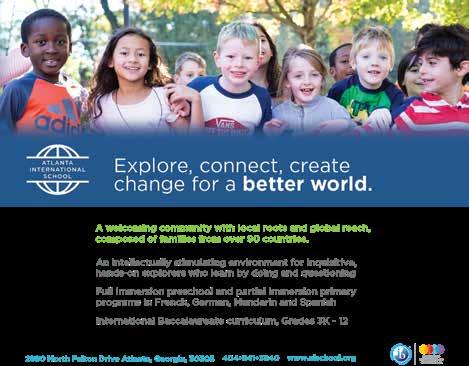
The center includes 20 new classrooms, a cafeteria, and a multi-purpose space. The center also makes room for a new Mandarin Chinese program, joining the school’s already established French, Spanish and German language offerings.
Buford City Schools was recognized as Georgia’s best school district by the ranking and review website Niche.com. Among the metro Atlanta districts in the top 10 are Forsyth County (No. 2), Decatur City Schools (No. 4) and Fayette County (No. 7).
Atlanta Schools Among Nation’s Healthiest More than 20 Georgia schools, including eight in metro Atlanta, were named among “America’s Healthiest Schools” by the Alliance for a Healthier Generation. The local schools include College Park’s Stonewall Tell Elementary; Flowery Branch Elementary and Spout Springs School of Enrichment in Flowery Branch; and Gainesville’s East Hall Middle School, Lanier Elementary, Mt. Vernon Exploratory Elementary, Tadmore Elementary and Wauka Mountain Multiple Intelligences Academy.
CHARTER SCHOOL A tax-supported public school that is independently run, allowing for greater educational choice for parents in the community.
EXPERIENTIAL LEARNING An educational approach using applied, hands-on methods of learning.
INTERNATIONAL BACCALAUREATE (IB) A specifically designed comprehensive academic program emphasizing traditional disciplines while instilling a global perspective in its students.
MAGNET SCHOOL A public school that offers a specific or enhanced curriculum designed for students of special interest or ability.
MONTESSORI A school following the principles developed by Dr. Maria Montessori focusing on the unique individuality, self-reliance and independence of children.
SPECIAL NEEDS A school or program for children who have mild-tomoderate learning differences. It usually features smaller class sizes, individualized attention and multisensory learning methods.
ACCREDITATION Official certification that guarantees a school provides an education of a reasonably high quality. Schools must prove levels of quality and maintain continuous standards of improvement.
ACT An alternative to the SAT, this national college admissions examination consists of subject area tests in English, Mathematics, Reading, and Science, with an optional 30-minute writing test.
ADEQUATE YEARLY PROGRESS (AYP) A measure of year-to-year student achievement on statewide assessments as required by the No Child Left Behind Act.
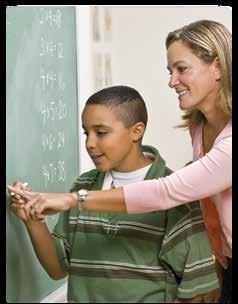
Education that applies to children from birth to age 8, focusing specifically on their development, including physical, emotional, sensory, communicative, cognitive, and social needs.
GEORGIA MILESTONES Tests designed to measure how well students in grades 3 through 12 acquire the skills and knowledge outlined in the state-adopted content standards. They replace the CRCT and involve both multiple-choice and free-response questions.
STANDARDS Statewide standards of academic content for all subjects K-12, to which every school must adhere and on which students are annually tested.
HOPE SCHOLARSHIP (Helping Outstanding Pupils Educationally)
A scholarship in Georgia funded by the Georgia Lottery that rewards academically achieving students with financial assistance to attend eligible public and private Georgia colleges and universities.
MISSION/PHILOSOPHY A statement outlining the guidelines a school fol-
lows as it works to achieve its various educational goals and/or maintain its performance standards.
A federal law passed in 2001 designed to ensure that all children have a fair and equal opportunity to obtain a high-quality education and meet state academic standards of proficiency.
The date by which an independent school notifies families of the acceptance of a child for enrollment to the school.
OPEN HOUSE An event held at a school where parents can learn more about the school and its offerings.
PSAT A standardized test that offers students practice for the SAT Reasoning Test and allows them to qualify for the National Merit Scholarship Program
REPLY DEADLINE The date by which parents must notify an accepting school of their commitment to enroll their child at the school.
SAT This standardized test measures the critical thinking, writing, and mathematical reasoning skills of students planning to attend college.
Did You Know: Graduates of independent schools are far more likely to go on to receiving a Bachelor’s or Master’s degree.
TEST (SSAT) The admissions test that many independent schools require students take in order to be considered for enrollment.
SUMMER CAMP A common destination for children and teenagers during the summer, at which they can participate in a variety of activities or classes.
Critical Communication
Many local and national organizations work to improve summer camps and public and private schools by identifying those that meet certain standards through accreditation. These groups also set policies and offer services to city and state educational communities. The following are just some of the associations and organizations you should know.
AdvancED advanc-ed.org
Advances education excellence through accreditation and school improvement initiatives.
The Association of Boarding Schools (TABS) boardingschools.com
Serves the development needs of boarding schools and provides information to potential students and their families.
Association Montessori Internationale (AMI) ami-global.org
Provides support, training
and development to Montessori schools.
Atlanta Area Association of Independent Schools (AAAIS) aaais.org
Promotes standards and best practices for Atlanta’s accredited independent schools.
Department of Education (DOE) gadoe.org
The governing body for the Georgia public school system for grades K-12.
Georgia Association of Christian Schools (GACS) gacs.org
Uses indicators of quality, voluntary self-improvement and peer review to measure Christian school performance.
Georgia Association of Private Schools for Exceptional Children (GAPSEC) gapsec.org
Shares information about programs at independent schools for students with learning disabilities.
Georgia Independent School Association (GISA) gisaschools.org
Serves the professional growth, advocacy and interscholastic needs of member schools.
Southern Association of Colleges and Schools (SACS) sacs.org
The recognized regional accrediting body for public and private schools in the eleven U.S. southern states.
Southern Association of Independent Schools (SAIS) sais.org
Provides accreditation, professional growth and leadership development for independent U.S. schools
For more information about these and other organizations and associations that ensure quality education among camps and schools, visit the websites of the Georgia Department of Education (www.gadoe.org) or the U.S. Department of Education (www.ed.gov).
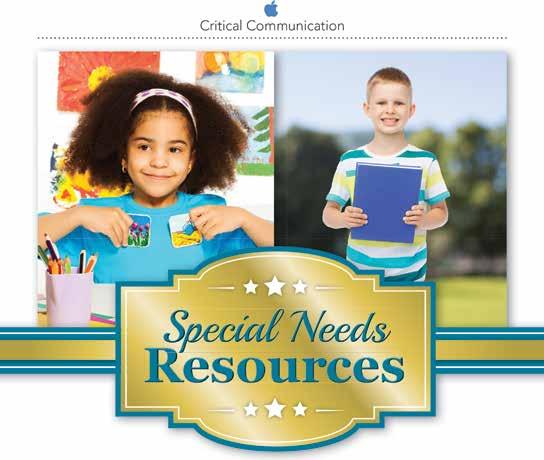
A learning disability is a neurological disorder that affects how your child processes certain information. Children with learning disabilities are as smart as or even smarter than other children, but may face challenges with reading, writing, spelling, reasoning and other functions. As a result, they often struggle to achieve in traditional classrooms. There are many types of learning disabilities, from Attention Deficit Hyperactivity Disorder (ADHD) and dyslexia to more serious forms such as autism.
Special needs schools are those that serve children who struggle with learning disabilities or don’t perform well in a conventional school environment. These schools use alternative approaches to instruction in order to help children learn more effectively and also achieve success in the classroom and in social settings. Other schools don’t specifically target those with learning disabilities, but may teach different kinds of students who have had difficulty learning in a typical class-

room setting. Others may teach average or even above-average learners while also offering additional programs and classes for students with learning differences.
First, it’s important to identify your child’s specific challenges. Students who exhibit average or above-average intelligence but often seem distracted and don’t perform well in a traditional classroom setting may be struggling with dyslexia, Asperger’s syndrome, ADHD or some other disorder that affects their ability to learn effectively. Also, disruptive or aggressive children may be exhibiting frustration brought on by a learning disability.
If you suspect your child may have a learning disability, it’s critical to have him or
her evaluated by a mental health professional. A diagnosis is necessary in order to address the child’s educational needs.
A professional evaluation is crucial in order to evaluate your child’s educational needs.
If your child is diagnosed with a learning disability and attends public school, talk with the principal, school counselor or another administrator about developing an Individualized Education Program (IEP). All public schools are required to create an IEP for students with learning disabilities who meet special education requirements. An IEP is a document that specifies your child’s learning situation and educational needs and outlines a course of action for teachers and other professionals to follow to help make sure your child learns to the best of his or her ability. u
If you feel your local public school isn’t the right environment for your child, or simply want to explore all your options, there are many quality independent schools in the metro Atlanta area devoted to helping children with special needs and learning issues. Visit the Georgia Association of Private Schools for Exceptional Children’s website (www.gapsec.org) or our listings for special needs schools on page 106 to help you with your search.
All special needs schools are not the same. The first step is to identify those schools that can address your child’s specific learning difficulty, and offer the level of special needs instruction that you (and perhaps a professional) feel is best for your child.
You may be more comfortable enrolling your child in a school that focuses specifically on his or her needs, or you may want a more diverse environment where he or she can interact with many different kinds of students. Familiarize yourself with the different options offered by each kind of school.
Traditional independent schools that offer special needs programs as part of a larger curriculum can offer that kind of environment, but may have larger class sizes than schools that specialize in specific learning disabilities. These kinds of schools may also focus more on academics than on the therapeutic aspects of special
needs education. Independent special needs schools can offer more individualized instruction and a more structured and predictable environment, and are likely to address nonacademic issues such as social skills and self-esteem.
As you begin searching for the right school for your child’s situation, here are some questions to keep in mind:
• Will your child fare better in a school that focuses on his or her specific learning disability, or would you rather that he or she be able to interact with students with a wide range of learning capabilities?
• Does the school serve a specific age range, or work with students on all grade levels? Many students with learning disabilities have trouble transitioning to new schools.
Continued on pg 20 u
Identify those schools that can best address your child’s specific learning difficulty.

• Does the school offer a variety of extracurricular activities, including arts and sports programs?
• Is the school accredited? If so, by which organizations?
• Is the staff certified to instruct special needs children, or those with your child’s specific learning difficulty?
• Does the school focus more on academics or on addressing the child’s therapeutic needs?
Many independent special needs schools participate in the Georgia Special Needs Scholarship program (GSNS), a school choice program available to special needs students attending Georgia public schools. The program offers funds to off-

set tuition and fees at participating private schools authorized by the State Board of Education. According to the Georgia Department of Education, scholarship amounts range from $2,500 to $13,500, with an average amount of around $6,000.
The Qualified Education Expense Credit program provides another scholarship option. Donations are made to an organization known as a Student Scholarship Organization (SSO), which uses the money to award scholarships to students in pre-K through grade 12. Many schools also offer their own scholarships or tuition assistance programs as well. Contact individual schools for details.
For more information on special needs schools and resources, please see our listings on page 106.
TREATING DEVELOPMENTAL SENSORY AND BEHAVIORAL INTERVENTIONS
Services
Occupational Therapy for children with mild to moderate issues, inclusive of, but not limited to PDD, ADD, ADHD, Autism, motor and sensory delays, sensory integrative dysfunction, and more. Exclusive Provider of: WIN® Write Incredibly Now® Handwriting Program
CHILD/PARENT ADVOCACY
IEP/504 accommodations help! KNOW THE FACTS BEFORE YOU SIGN!

FACILITATOR CERTIFICATION COURSE
Train to become a certified Facilitator. Learn how to help YOUR child while learning how to help others!
MENTORSHIPS
For pre-OT students and OT’s who are looking to gain new skills.
Handwriting, Sensory Skills, Homework Organization our specialities! Year round treatment and evaluative services available
Fun activity based individualized treatments designed specific to your child’s needs.
N. Schriber Orloff,


FAOTA CEO/Executive Director Children’s Special Services, LLC 770-394-9791 • info@childrens-services.com • www.childrens-services.com
Asperger’s Syndrome: A developmental disorder on the autism spectrum, characterized by high intelligence, difficulty with social situations and repetitive patterns of behavior and interest.
Attention Deficit Disorder (ADD): An outdated term used to refer to the inattentive form of ADHD, in which a person is typically inattentive or distractible, but not hyperactive or impulsive.
Attention Deficit Hyperactivity Disorder (ADHD): A brain-based syndrome affecting the regulation of functions including attention, concentration, memory and impulsivity.
Autism Spectrum Disorder: A developmental disorder affecting the ability to communicate and interact. Symptoms include repetitive behaviors; intense, narrow interests and sensory sensibility.
Dyslexia: A learning disability that impairs specific language skills, particularly reading.
Georgia Association of Private Schools for Exceptional Children (GAPSEC): An organization of independent schools serving students with learning disabilities and differences.
Georgia Special Needs Scholarship (GSNS): A school-choice scholarship program for special needs students being served by an IEP in Georgia public schools.
Individualized Educational Program (IEP): A written statement that outlines the needs of a public school student with learning disabilities and creates a customized plan for meeting those needs.
Individuals With Disabilities Education Act (IDEA): The federal law that governs how states and public education agencies that accept funding under the law address the educational needs of students with disabilities.
Learning Disability: A neurological condition that affects how one processes information. Learning disabilities can impair reading, writing, speech, math, reason, memory, attention and coordination, as well as social skills and emotional maturity.
Multisensory Instruction: An educational approach involving the use of all of a child’s senses, not just sight and hearing, to help with understanding concepts and solving problems.
Response to Intervention (RTI): A process used by educators to help identify and address the needs of students experiencing behavioral or educational challenges, based on screening, instruction and assessment.
Student Scholarship Organization (SSO): An organization authorized by the state of Georgia to receive funds and award scholarships under the Georgia Qualified Education Expense Tax Credit program.
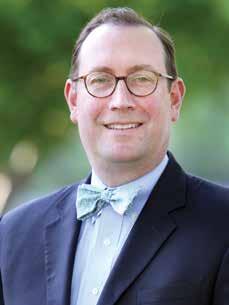
Headmaster of MPCS since July of 2018, Dr. Timothy Wiens has 25 years of experience as an educator and administrator in K-12 and postsecondary education. He holds a Master’s degree in Education from Bethel University, a Doctorate in Education from Saint Mary’s University of Minnesota, and a MBA from the University of Oxford’s Saïd Business School in England.
What is your educational philosophy?
I believe the purpose of education is to prepare students to flourish in this world. A K-12 education is meant to prepare students broadly, to understand the world around them, to engage the world in its many forms and functions, and to understand the complexities of a rapidly changing world.
What do you love most about your job?
I love being around students and seeing the impact their teachers have upon their thinking and their lives in general. A teacher’s impact is profound and can never be underestimated.
How is the field of education changing?
Technology has dramatically changed education. I believe education is inherently relational. Educators need to find the right balance between the personal and the technical, knowing both are important, but also understanding the importance of community and relationships.
How can parents best contribute to the education process?
The more/better we can engage them in the life of the school and communicate clearly together, the better the education we as a school can provide.
What advice would you offer parents about their children’s education?
Find a school that meets their childrens’ particular needs, not simply their desires. Find a school that can truly help your child flourish.
THE ESSENTIALS: MOUNT PARAN CHRISTIAN SCHOOL
Emphasis: MPCS is a college preparatory Christian school that seeks to prepare servantleaders to honor God.
Year Founded: 1976
Grades: PK3-12
Students: 1,100
Avg. Class Size: 14-20
Tuition Range: $8,000-$19,000
Accreditations or Affiliations: SAISAdvancED, GISA, GHSA, CESA
Location: 1275 Stanley Road, Kennesaw, GA 30152
Contact: 770-578-0182, mtparanschool.com



BY DANIEL BEAUREGARD
For many parents, a good education means much more than academics. While reading, math, and science are all important, having their child learn about such values as kindness, respect, and empathy for others is just as important, if not more so. Fortunately, most Atlantaarea public and independent schools incorporate some form of character education in their curricula, placing an emphasis on guiding children to become caring, involved members of society.
This is an area in which Georgia has led the way. The state devotes the entire month of September to the importance of character. Several years ago, a group of students and teachers at Cobb County’s Durham Middle School wrote their state senator, proposing a “Georgia Day” to honor character and good choices. Governor Nathan
importance of such values as democracy, respect for authority, equality, justice, liberty, patriotism, and respect for the natural environment. Students learn to respect others with an emphasis on altruism, honesty, and integrity, and are taught to respect themselves through self-esteem, accountability, and a strong work ethic.
The Cobb County School District boasts its own focus on character development with a calendar that emphasizes different character traits on a rotating basis throughout the school year, including respect, integrity, and responsibility. Instead of students receiving a separate lecture on selfrespect, that lesson is incorporated into the regular curriculum, across all disciplines. As students reach high school, a leadership development class called Principled Thinking focuses on developing character-driven skills
Deal extended the idea to a whole month spotlighting state history and the positive character traits of Georgians past and present. In March, 2012, Georgia became the first state to recognize and dedicate an entire month to history and character.
Georgia maintains this focus throughout the school year in its public-school curriculum. The Georgia Department of Education mandates character education as part of its Georgia Quality Core Curriculum Standards, required in elementary, middle, and high schools throughout the state. This “character curriculum” focuses on citizenship, having respect for others, and having respect for oneself.
The citizenship portion stresses the
to enable young adults to become positive leaders in their schools and communities.
This approach is similar to the one taken by the Atlanta International School (AIS), an independent school in Buckhead that uses the framework of the International Baccalaureate (IB) program to instill positive character traits in its students. At the core of this program is the goal of developing students who will be ready to create a better world through intercultural understanding and respect for others.
At AIS, the foundation is laid early: The Personal Social Education component of its Early Years program gives young
learners models, methods, and a vocabulary for handling social and emotional issues in a constructive way. As students continue, each grade’s IB program focuses on several distinct traits such as communication, open-mindedness, and risk-taking. At the beginning of each year, teachers work these principles into their lesson plans with an eye to shaping students into ideal global citizens who will use their knowledge to make a difference in the world and in their community.
At The Children’s School, an independent school in Midtown Atlanta for ages 3 to 8th grade, the goal goes beyond knowledge for its own sake. Here, the reason for learning is for students to better understand
the world around them so that they can fully engage with and make a positive impact on it. Immersive project-based learning expands their horizons beyond the campus so that they develop a sense of themselves as part of a larger community.
The school’s graduating 8th-graders have a unique opportunity to put their learning into practice in a new capstone experience that empowers them to take action on a social issue from an entrepreneurial perspective. Offered in partnership with Kennesaw State University's Shore Entrepreneurship Center, the project lasts the entire school year and partners students with social entrepreneurs from the Atlanta
IMMERSIVE PROJECT-BASED LEARNING EXPANDS THEIR HORIZONS BEYOND THE CAMPUS SO THAT THEY DEVELOP A SENSE OF THEMSELVES AS PART OF A LARGER COMMUNITY.
business community. As the project progresses, students explore the issues important to their community, and through self-directed projects, create solutions to benefit those issues and put them into place, right where they live.
Along with thinking for oneself and learning from failure, learning to respect the viewpoints of others is a key component of character-based education. At AIS, students are exposed to other cultures and different viewpoints, and learn to value others’ opinions, even when they don’t agree with them. Diversity is a core value at The Children’s School, not only as the basis for empowering children to authentically be themselves, but to give them the competence necessary to engage in their community.
Polly Williams, elementary school principal at The Galloway School in Atlanta, says she’s seen a paradigm shift in education
over the years, with more and more schools emphasizing project-based learning and collaborative problem-solving—an approach the Galloway School has employed since it was founded in 1969.
Students at the Galloway School are encouraged to come up with their own ideas, and to learn from their mistakes. As a process school rather than an outcome-based school, Galloway encourages its students to take risks, and provides a safe environment for them to do so.
“They can learn a lot by trying something,” Williams says, “and perhaps not having the outcome they anticipated, but learning from that.”
Students are also encouraged to explore their passions and beliefs, to ask questions, and speak out often on a regular basis in what Williams calls a “lively, discussion-rich environment.”
“It’s coming from them internally, instead of somebody telling them what to think or believe,” she says. “We think that’s incredibly important.”
For a look at the Georgia Department of Education’s Quality Core Curriculum materials, including information on its Character Education program, visit georgiastandards.org/ standards/pages/qcc.aspx.
For information on Cobb County’s Character Education program, visit cobbk12.org/ centraloffice/communications/ charactereducation.
For more information about the Character.org 11 principles and program, visit character.org.
BY WHITNEY BRENNAN
The transitions to middle and high school can be daunting for both children and parents. And the stress of those transitions is only compounded when you’re relocating to a new city or a new neighborhood. Middle and high school students enter larger schools and have to learn to cope with more peers, new teachers, and unfamiliar subjects, as well as becoming the youngest students in the school—again. While some stress will always accompany the move to middle and high school,

there should be excitement, too, as the change also means the possibility of new friends, new extracurricular activities, and more freedom in the hallways. The good news is that there are strategies for making the transition easier for both you and your child.
First and foremost is communication. Talk to your child and find out what concerns he or she has about moving up to middle or high school. Some of the most common concerns of new middle school students are being late, getting lost, failing, more challenging schoolwork, being bullied, and taking tests. As these students move into high school, their concerns change to making good grades, taking tests and final exams, difficult classes, turning work in on time, and preparing for college. However, not all children have the same concerns. Your child may be more worried about what you expect from him or her, as well as making friends, peer pressure, or getting into trouble. Discuss the transition to a new school with your child and ask them how they feel about the change so you can better understand their worries.


Second, make sure you and your child are familiar with the new school and its transition resources. Many metro Atlanta schools host an orientation or open house, which can be particularly helpful. These events typically allow students to meet teachers and other students, receive copies of their class schedules, and most importantly, familiarize themselves with their new surroundings. In addition, some schools also provide families with information packets that include materials about peer pressure and middle or high school expectations, student handbooks with the school’s guidelines, and an outline about what to expect on the first day of school. Middle and high schools also usually feature more extracurricular activities that allow your child to make friends and explore new interests, so find out as much as possible about what your new school has to offer. Of course, transitioning doesn’t end once school begins. Some middle and high schools offer peer programs that pair incoming sixth- and ninth-graders with older students who are available to answer
questions, help younger students navigate the school, open lockers, etc. At the very least, these older peers give younger students the comfort of knowing they have someone at the school to turn to during those tough first months. Teacher mentoring, small group Q&A sessions, and academic counselors are also great resources for students transitioning to new schools.
Part of moving up to middle school and high school means schoolwork will become more challenging. As a parent, your job is to help ensure that your child successfully navigates this new academic landscape. Grading systems might change to a letter grade or a 100-point scale, and assignments will be tougher, so be sure to meet with your child’s new teachers at the beginning of the year to inquire about new expectations and grading policies.
It’s important to ask about homework. How frequently will it be assigned? How much time will your child be expected to
spend on it? Will the homework be graded for accuracy, or will the teacher just check to make sure it was completed? The more information you and your child have about expectations at the new school, the more at ease you both will feel.
High school students should also be encouraged to think about what they want to do after they graduate. If they plan to attend college, they’ll need to choose collegepreparatory courses that will help them to achieve their goals, and perhaps advanced placement classes as well. Maintaining good grades is more important than ever for high school students, to increase their chances of attending the school of their choice. School counselors are a great resource for helping students prepare for life after high school.
Most importantly, continue to meet regularly with your child’s teachers throughout the year. It’s essential to know how
your child is doing so you can provide the assistance he or she may need. In addition to parent-teacher conferences, many metro Atlanta schools offer online programs where parents and students can monitor grades. Ask school administrators what options are available for tracking your child’s progress. Teachers also understand that transferring to middle or high school can be difficult, so if your child is feeling overwhelmed by the amount of schoolwork, discuss this with their child’s teacher; they may be able to help your child better organize his or her assignments.
A smooth transition to middle and high school is critical to your child’s future academic success. Armed with the information you need to help your child know what to expect—and what’s expected of them— you’re much more likely to help ensure that the transition is as seamless as possible.

BY PHIL KEELING

Mention the words “boarding school,” and many people may immediately think of images conjured from books and films. These images often go from one extreme to another: whether they’re drab, militaryinspired classrooms filled with unruly and troubled students that require discipline and
uniformity, or elitist institutions reserved for the super wealthy. These impressions are particularly common in America, where parents may have far less experience with the boarding school environment, and often misunderstand their benefits.
The reality is that a boarding education offers a wide variety of exciting opportuni-
ties to students who attend them. Statistics suggest that students who board are often more likely to succeed later in life. But the choice really comes down to this question: Are boarding schools the right educational and social fit for your child?
Most commonly, boarding schools are private educational institutions that place a greater emphasis on college preparation through a heavy focus on rigorous academic programs and extensive extracurricular activities. Smaller class sizes and lower teacher to student ratios are common, providing greater individual attention.
The usual practice of students living on campus also allows for a constant emphasis on education, both in and out of the classroom. Not only does this provide students with a discipline for individual study, it prepares them for the independence that they will be faced with when they attend college. In fact, in a study conducted by The Association of Boarding Schools (TABS), 78 percent of boarding school graduates reported being very well prepared for the nonacademic aspects of college life (managing time, handling independence and balancing social lives), compared to only 36 percent of private day school graduates and 23 percent of public school students. In addition to this, TABS also found that 50 percent of boarding school graduates go on to get advanced degrees, as opposed to 36 percent of students from private day schools, and 21 percent from public schools.
However, not all boarding schools require 24-hour on-campus residence. It has become increasingly common for some boarding schools to offer admission to day students who commute from local cities (day-boarding schools), while others operate on a five-day schedule. Brandon
Hall School in Atlanta’s Sandy Springs area offers day school, as well as seven-day and five-day boarding. Other types of boarding schools include coeducational, single-gender, religiously affiliated, military, and even junior boarding schools that typically serve children in grades 1 through 8. Therapeutic schools such as The Vanguard School in Lake Wales, Florida specialize in educating children with learning disabilities, and many other boarding schools provide specific support to students with emotional or behavioral problems. There are also specialty schools for children who want to focus on a particular interest, such as the outdoors, sports, science and technology, or the arts.
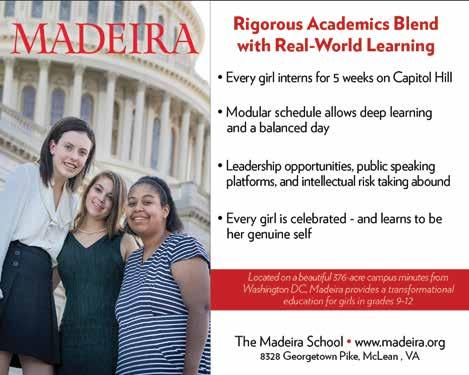
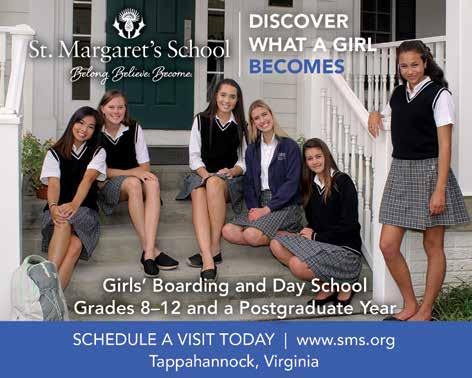
“Just like selecting a college, selecting a boarding school is so much about fit,” says Margaret Broad, Head of School Emerita at St. Margaret’s School in Tappahannock, Virginia. “It’s about the fit with the right program, the right community and the right atmosphere.” u

“THE KIDS THAT COME TO BOARDING SCHOOLS ARE TOP-NOTCH. THEY’RE COMING HERE BECAUSE THEY WANT TO HAVE AN ADVANTAGE IN BOTH ACADEMIC AND SOCIAL PREPARATION FOR COLLEGE.”
Choosing the wrong school can result in an unhappy child and a wasted educational opportunity. “My strongest advice for those looking into boarding schools is to visit,” says Broad. “Do research. Consider your priorities for your child. Visit a variety of schools that meet the parameters that you have outlined. Give it the same amount of time you would give to selecting a college.”
Web sites of organizations such as The Association of Boarding Schools (boardingschools.com) are great places to start the search for schools. The TABS online database lists nearly 200 boarding schools throughout the US, and an advanced search
allows parents to enter various criteria, including religious affiliation, grade level, athletic programs, courses offered and more. This allows interested parents to find a school that is every bit as unique as their child.
Taking advantage of these resources along with close attention paid to detail and the desires and needs of your child will be priceless when it comes to choosing the right boarding school.
As mentioned before, there are countless stereotypes and misconceptions when it comes to boarding schools. For example, many have been led to believe that boarding schools are primarily for troubled students who can’t succeed in a public or even private school environment.
Absolutely not, says Barbara Kennedy, Director of External Affairs at Chattanooga’s Baylor School. “Those of us who work at boarding schools still face a bit of a challenge in talking to families and telling
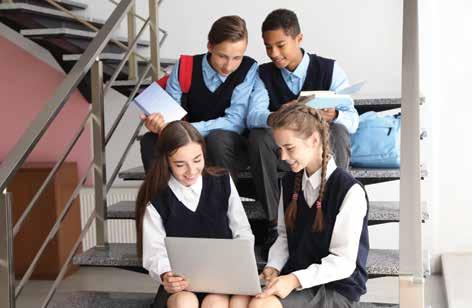

them, ‘This is not where bad kids go,’” she says. “The kids that come to boarding schools are top-notch. They’re coming here because they want to have an advantage in both academic and social preparation for college.”
But what about the cost? In weighing the costs of a boarding education, Kennedy says to “definitely consider everything you get for that tuition—the small classes, all the extracurricular activities, the college counseling. Don’t dismiss boarding schools because you might have sticker shock. Definitely try to apply, because you never know what kind of aid might be available.”
In addition to need-based financial aid, many schools offer merit-based aid and flexible tuition payment plans. For financial options at potential schools, speak to an admission or financial aid officer.
Like any major decision concerning your child’s future, deciding whether or not to board is a family choice. Making that choice involves a lot of important questions, such as: what are your child’s strengths and weaknesses as it pertains to boarding school?
What are yours and your child’s goals? Are you comfortable with the extended periods of separation that boarding school involves?
For many parents, making the decision to board is “a matter of deciding if your child needs outside mentoring, outside coaching or outside tutoring,” says Major Joe Watson, Director of Facilities and Property at Florida’s Lyman Ward Military Academy. “Sometimes, outside sources are just better. Parents may be the best person to raise their children, but they’re not always the best to teach them.”
Making that decision is difficult, and sometimes a little humbling. But boarding schools certainly should not be dismissed because of misconceptions. Be sure to visit some schools to discover the truth about the boarding experience. A boarding school education can provide a child not only with exceptional opportunities, but a sense of independence and personal growth.
Visit our Boarding School Directory on page 76 for a selection of boarding schools, each of which can offer something different for your child.
For a closer look at some featured boarding schools, turn to page 36
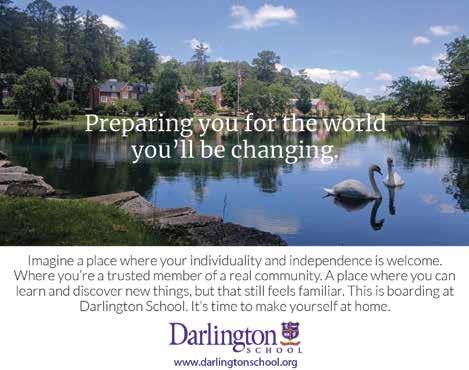
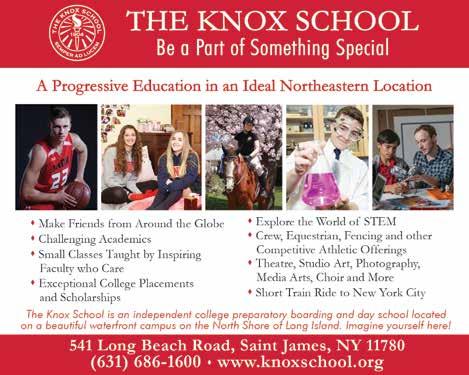
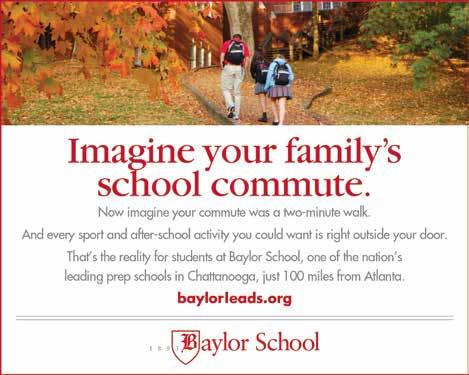
Founded in 1893, Baylor School’s mission is to foster in students the desire and ability to make a postive difference in the world. Baylor’s community is comprised of boarding students in grades 9-12 from 23 states and 14 countries. As a college preparatory school, the school believes that education is more than learning how to do homework; it’s also learning how to thrive. Baylor boarders come away from their experience, independent, poised, and confident to tackle whatever college sends their way. From aquatic science in the advanced research labs and wetlands area, to analyzing data of contemporary urban issues in AP human geography, students will choose from a wide array of electives and collegelevel courses, work with others who value academic achievement, and learn from faculty committed to helping them reach their full academic potential. Each element of the historic 690-acre campus overlooking the Tennessee River Gorge is beautiful, safe, and functional. To schedule a visit, call 423-267-5902, or email admission@baylorschool.org. For more information about Baylor School, visit baylorschool.org.
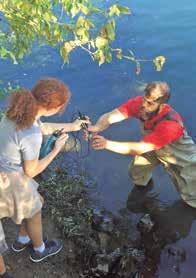
The Fessenden School is a place like no other—a place where words like distinct, unique, and incomparable genuinely apply. A place where, despite being surrounded by 41 picturesque New England acres, boys are never far from the excitement of Boston, one of the most vibrant and culturally rich cities in America—a city just 10 miles away. Fessenden is a place where tried and true educational techniques are woven seamlessly into a curriculum that appropriately challenges students based on their academic strengths and fuels a love of learning. Dedicated faculty, who understand how boys learn best, provide the individual support and encouragement each student needs to thrive academically, socially, and emotionally. Since 1903, Fessenden has prepared generations of middle school boys for life in secondary school and beyond. Today, the school enrolls boarding students in grades 5-9 from across the country and around the globe, and matriculates young men of good character who are poised to succeed in the multi-cultural, technology-driven world they will inherit. Learn more at fessenden.org or call 617-630-2300 to schedule a campus visit.
Stony Brook, NY
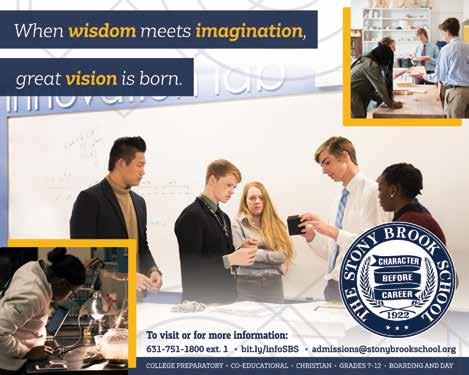
In an ever-changing world, tomorrow’s leaders need great vision. Founded in 1922 with the motto “Character Before Career,” The Stony Brook School educates students in the matters of the mind, body, and heart, and challenges students to become leaders with integrity and virtue. Distinguished for its academics and set apart by its mission, The Stony Brook School is widely known for its passion for character education. It is a Christian, co-ed, college preparatory boarding and day school for students in grades 7-12. The Stony Brook School offers a rigorous college preparatory program that combines traditional academics with competitive athletics and training in the visual and performing arts. Located on the beautiful north shore of Long Island, the 55-acre campus is home to students from 26 countries and all over the United States—emerging as one of the most diverse private schools in the nation. For more information, call 631-751-1800 or visit stonybrookschool.org.
Kingston, PA
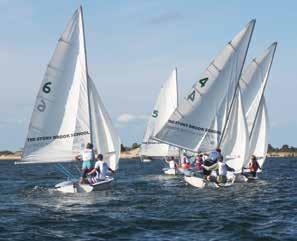
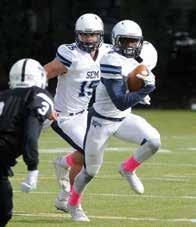
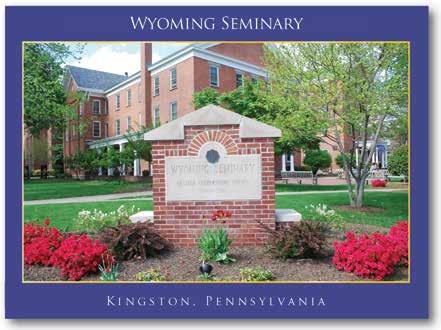
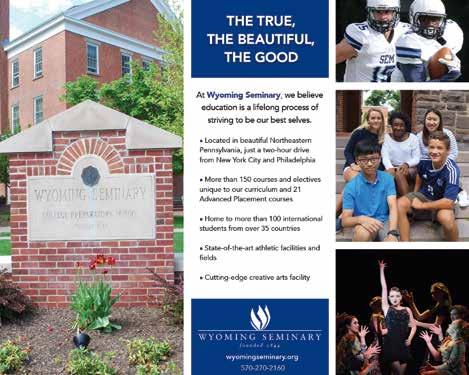
The Wyoming Seminary believes education is a lifelong process of striving to be one’s best self. The seminary is located in close proximity to dynamic East coast cities—only two hours from NYC and Philadelphia—and the beautiful Pocono mountain region with its many opportunities for outdoor adventure. Through effort, strong character, and an appreciation of diverse perspectives, each member of the school’s community honors the true, the beautiful, and the good in the community and in the world. More than 150 unique courses and electives are offered, along with 21 Advanced Placement courses. The Upper School is home to more than 100 international students from over 35 countries. The campus features several state-of-the-art athletic facilities and fields as well as a cutting-edge creative arts facility. College counselors guide students throughout their time at the school, providing personal attention to academic and special interests in an effort to find the perfect college fit for each individual. With first class academic, arts, and athletics offerings, Wyoming Seminary looks forward to welcoming students to its warm community in the Wyoming Valley of PA. For more information, call 570-270-2160 or visit wyomingseminary.org.
metro atlanta area map
For features of independent schools, turn to Education At a Glance on pg. 40. For public school system information by county, turn to pg. 86.
3 3
2
2
1 1
5 5
Boarding Schools Arkansas, Connecticut, Florida, Georgia, Massachusetts, New Hampshire, New York, Pennsylvania, Tennessee, Virginia
School County Guide
REGION 5: Atlanta West Austell, Emerson, Kennesaw, Powder Springs, Smyrna, Smyrna-Vinings
REGION 4: Atlanta South/ Southeast/Southwest Douglasville, Fairburn, Fayetteville, Locust Grove, Metro-Atlanta p.71
REGION 1: Atlanta North/Northwest
REGION 2: Atlanta North/Northeast
Alpharetta, Buckhead, Canton, Crabapple, Downtown Atlanta, East Cobb, Holly Springs, Marietta, North Buckhead, Roswell, West Cobb p.53
Alpharetta, Brookhaven, Cumming, Johns Creek, Peachtree Corners, Roswell p.59
REGION 3: Atlanta East Ansley Park, Athens, Dacula, Decatur, Midtown, Morningside, Northeast Atlanta
Educational Resources Tutoring, Summer Camps and Activities, Field Trips and Education Programs. Athens, Dacula, Decatur, Lilburn, Midtown, Stone Mountain, Watkinsville
This information reflects the latest available data at publication time. Please confirm with each individual school.

Marietta Beautiful parks, charming streets, 19th-century Victorian homes and historic sites make Marietta a desirable place to call home. Residents enjoy the vibrant downtown square, with its many restaurants, antique shops and happenings.
Woodstock Located in Cherokee County, Woodstock is, as locals say, “where modern amenities meet old Southern charm.” Historic Olde Towne pays a continual tribute to Woodstock’s pioneers through vintage shops and good old-fashioned Southern hospitality.
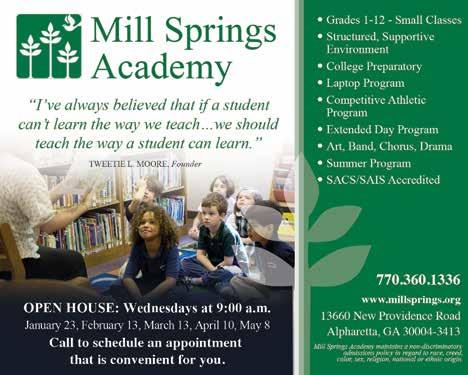

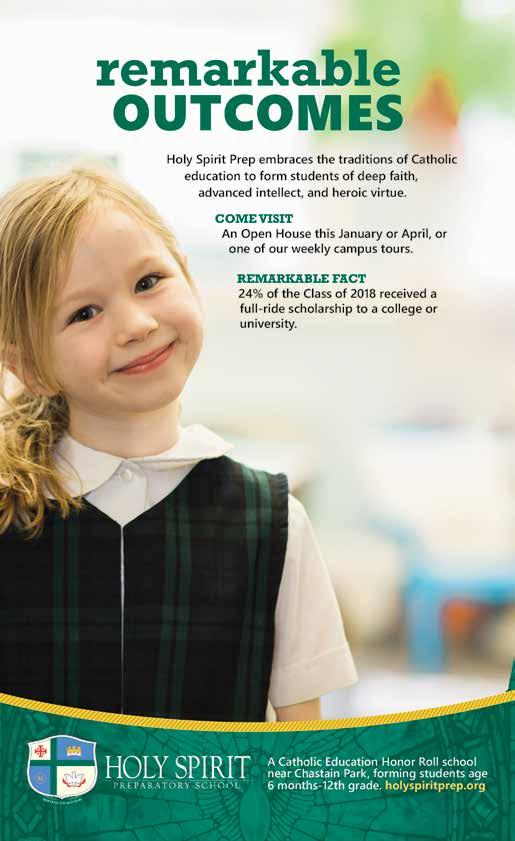
Alpharetta Offering exceptional shopping, entertainment and dining, Alpharetta also boasts many awardwinning parks and numerous housing options.The city is also home to a 12,000-seat outdoor concert venue, the Verizon Wireless Amphitheatre.
Chamblee This DeKalb County suburb attracts diverse residents, thanks to its International Village, a 394-acre neighborhood that is home to people representing more than 30 countries. Chamblee’s Antique Row is the South’s largest antiques area.


Open House Dates: Dec. 12, 9 a.m. - 2 p.m.
See tour dates on Facebook.
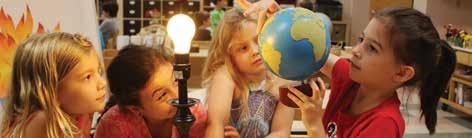
Teachers deliver a regular-education curriculum combining:
• Georgia Standards and National Core
• Differentiated Instruction
• Community-Based Experiences
• PE, Art, Foreign Language, Theatre and Culinary Arts
• Technology in every classroom
Rolling Admissions. Fully Accredited GAC. Now accepting students for 2019-20




Decatur A great mix of history and modernity, Decatur is home to more than 200 shops, restaurants, galleries and performance venues located along tree-lined streets. Events take place throughout the year at the city’s historic downtown square.
Stone Mountain With a revitalized downtown and a variety of family oriented activities, Stone Mountain has much to offer. The city’s four city parks, as well as Stone Mountain Park, make this one of the cleanest and “greenest” areas in Metro Atlanta.






Grades K - 8th
East Point The up-and-coming East Point area combines the charm of a small town with conveniences of a big city. Residents enjoy the city’s prime location near Hartsfield-Jackson Atlanta International Airport, MARTA and Downtown Atlanta.
Fairburn Less than half an hour from Atlanta, Fairburn is filled with historic buildings and boasts a peaceful, smalltown atmosphere. The city is home to the annual Georgia Renaissance Festival and the local campus of Georgia Military College.


Acworth Just 35 miles northwest of Atlanta, Acworth is convenient to the city while offering its own unique smalltown appeal. Its historic downtown is a charming mixture of past and present. Surrounded by Lake Acworth and Lake Allatoona, this thriving city is a popular destination for fishing, boating and many other recreational activities.
Douglasville A quick trip west of Atlanta on I-20, Douglasville has easy access to all that Atlanta offers—including Six Flags, 10 minutes away—but plenty of its own charm, too. Listed on the National Register of Historic Places, Downtown Douglasville’s historic district is an outstanding example of a turn-ofthe-century southern railroad town.




There are many benefits of a boarding school education. Boarding schools are an option for students seeking a more independent learning experience. Because students generally live on campus, learning takes place in and out of the classroom almost on a 24-hour basis.
When selecting a boarding school, it is important to visit the school campus, but representatives from many boarding schools visit Metro Atlanta throughout the year—contact each school for specific dates.



Avariety of improvements and innovative programs in Georgia’s public school systems have resulted in many stellar elementary, middle, and high schools across the Metro area. Different school systems feature specialized programs and academic opportunities, such as magnet, charter, vocational, or alternative schools to suit their respective students, parents, and communities. However, despite variations in programming and academic offerings, all public schools must offer the core curriculum as determined by the Georgia Board of Education. Here is a county-by-county guide to Metro Atlanta’s public school systems. For more information about the Georgia Department of Education, call 404-656-2800 or visit www.gadoe.org. u
Board of Education
770-606-5800
bartow.k12.ga.us
Total
2018 Georgia Milestone Scores:
3rd: (ELA) 510 (M) 524
5th: (ELA) 515 (M) 518
8th: (ELA) 510 (M) 508
2018 Average SAT: 1046
Top 3 Schools by Average 2018 SAT Score
Woodland 1051
Cass High 1050
Adairsville High 1033
What’s New Bartow County’s graduation rate continued to climb in 2018, rising to 87.1 percent from 83.4 percent in 2017. The Read to Grow program was introduced to strengthen literacy in Bartow County first graders.
2018 Georgia Milestone Scores:
3rd: (ELA) 520 (M) 541
5th: (ELA) 527 (M) 534
8th: (ELA) 528 (M) 514
2018 Average SAT: 1122
Top 5 Schools by Average 2018 SAT Score
Board of Education
770-479-1871
cherokeek12.net
Total # of Students:
Woodstock High 1134
Etowah High 1128
Creekview High 1127
Cherokee High 1115
Sequoyah High 1111
What’s New Cherokee County School District has initiated Express Gateway, a new online emergency contact information form. Five CCSD high school seniors were named semi-finalists in the 2019 National Merit Scholarship Program.
2018 Georgia Milestone Scores:
3rd: (ELA) 481 (M) 507
5th: (ELA) 493 (M) 492
8th: (ELA) 498 (M) 484
2018 Average SAT: 962
Top 5 Schools by Average 2018 SAT Score
Perry Career Academy 1077
Elite Scholars Academy 1060
Charles Drew High School 1058
M.E. Stilwell School of the Arts 1034
Morrow High School 1025
What’s New Elite Scholars Academy, Arnold Elementary School, and Suder Elementary School are fully eligible to join the Cambridge Assessment International Educational program.
Board of Education
770-426-3300 cobbk12.org
Board of Education
770-254-2800
cowetaschools.net
Board of Education
678-676-1200 dekalbschoolsga.org
2018 Georgia Milestone Scores:
3rd: (ELA) 518 (M) 527
5th: (ELA) 527 (M) 522
8th: (ELA) 530 (M) 518
2018 Average SAT: 1107
Top 5 Schools by Average
2018 SAT Score
Walton High School 1262
Lassiter High School 1204
Alan C. Pope High School 1203
Kennesaw High School 1172
Wheeler High School 1147
What’s New Harrison High School was awarded a FastTrack grant for an A/V technology and film lab by the Georgia Department of Education. The value of the grant is $120,000. The class of 2018’s scores are 19 points higher than the previous year.
2018 Georgia Milestone Scores:
3rd: (ELA) 513 (M) 523
5th: (ELA) 520 (M) 518
8th: (ELA) 526 (M) 532
2018 Average SAT: 1082
Top 3 Schools by Average
2018 SAT Score
Total # of Students:
Northgate High 1109 East Coweta High 1089 Newnan High 1044
What’s New Two students from Coweta County Schools have joined the Georgia School Superintendent’s 2018-19 Student Advisory Council. Members were selected from a pool of nearly 1,000 students on the basis of their essays about ideas for public education and their experience in community service.
2018 Georgia Milestone Scores:
3rd: (ELA) 485 (M) 503
5th: (ELA) 499 (M) 497
8th: (ELA) 499 (M) 492
2018 Average SAT: 998
Top 5 Schools by Average
2018 SAT Score
Chamblee Charter High 1172
DeKalb School of the Arts 1142
Lakeside High 1136
Dunwoody High 1131
DeKalb Early College Academy 1111
What’s New Kittredge Magnet School and Austin Elementary School both became 2018 National Blue Ribbon Schools. The schools, recognized for excellence in academics and closing achievement gaps, join more than 8,500 nationwide.
Board of Education 770-651-2000 douglas.k12.ga.us
Board of Education
770-460-3535 fcboe.org
Number of Schools
Elementary 20 Middle 8 High 5 Centers 3
Total # of Students: 26,537
Student Spending: $8,671
2018 Georgia Milestone Scores:
3rd: (ELA) 503 (M) 519
5th: (ELA) 515 (M) 514
8th: (ELA) 518 (M) 509
2018 Average SAT: 1005
Top 5 Schools by Average
2018 SAT Score
Chapel Hill High 1056
Alexander High 1033
Douglas County High 1029
Lithia Springs High 979
New Manchester High 937
What’s New The Class of 2018 has surpassed the graduation rate for the state of Georgia for the fourth consecutive year. 86.5 percent of students from all five Douglas County high schools successfully completed the twelfth grade.
2018 Georgia Milestone Scores:
3rd: (ELA) 533 (M) 545
5th: (ELA) 539 (M) 536
8th: (ELA) 543 (M) 543
2018 Average SAT: 1142
Board of Education
770-887-2461 forsyth.k12.ga.us
Total # of Students: 20,089 Student Spending: $9,750
Top 5 Schools by Average 2018 SAT Score McIntosh High 1210 Starr’s Mill High 1172 Whitewater High 1134 Sandy Creek High 1091 Fayette County High 1053
What’s New Rising Starr Middle School hosted an Open House with Community for Creativity, a program connecting middle schoolers with industry professionals.
Number of Schools
21
Total # of Students:
2018 Georgia Milestone Scores:
3rd: (ELA) 545 (M) 561
5th: (ELA) 550 (M) 565
8th: (ELA) 549 (M) 558
2018 Average SAT: 1167
Top 5 Schools by Average
2018 SAT Score
Lambert High 1221
South Forsyth High 1201
West Forsyth High 1149
Forsyth Central 1113
North Forsyth High 1112
What’s New SAT scores at Forsyth County Schools are the highest in the state of Georgia and above the national average for 2018. ACT test scores came out on top among the other counties and large school districts in Georgia for the fourth consecutive year.
Board of Education
470-254-3600 fultonschools.org
Board of Education
770-229-3700
spalding.k12.ga.us
Board of Education
678-301-6000
gwinnett.k12.ga.us
Total # of Students: 95,647
Student Spending: $10,609
2018 Georgia Milestone Scores:
3rd: (ELA) 512 (M) 529
5th: (ELA) 524 (M) 526
8th: (ELA) 517 (M) 508
2018 Average SAT: 1091
Top 5 Schools by Average 2018 SAT Score Northview HS 1275 Chattahoochee HS 1240
Johns Creek HS 1224
Alpharetta 1212 Cambridge 1184
What’s New Three Fulton County elementary schools are included in the 2018 National Blue Ribbon Schools, recognized in the “Exemplary High Performing” category. This is the first time three schools in Fulton won the honor in the same year.
2018 Georgia Milestone Scores:
3rd: (ELA) 481 (M) 504
5th: (ELA) 492 (M) 497
8th: (ELA) 501 (M) 491
2018 Average SAT: 974
Top 2 Schools by Average
2018 SAT Score Spalding High 1011 Griffin High 933
What’s New The Griffin-Spalding County School System garnered Farm To School Excellence honors at the 2018 Golden Radish Awards in Atlanta. The Golden Radish Award recognizes school districts in Georgia for best practices in procuring local food, acquainting students to new foods by taste tests, and including gardening and cooking in learning.
2018 Georgia Milestone Scores:
3rd: (ELA) 519 (M) 534
5th: (ELA) 527 (M) 529
8th: (ELA) 528 (M) 500
2018 Average SAT: 1102
Top 2 Schools by Average 2018 SAT Score
Gwinnett School of Math, Science, and Technology 1364 North Gwinnett High 1200
Brookwood High 1154
Parkview High 1150
Mill Creek High 1148
What’s New Six Gwinnett elementary schools may apply for the National NSEA Distinguished School Award, which provides $20,000 from the Georgia DoE’s Title I Program.
Board of Education
770-534-1080 hallco.org
Board of Education
770-957-6601
henry.k12.ga.us
Number of Schools
Elementary 14 Middle 6 High 7 Charter 11
Total # of Students: 28,008
Student Spending: $8,505
2018 Georgia Milestone Scores:
3rd: (ELA) 497 (M) 515
5th: (ELA) 510 (M) 511
8th: (ELA) 492 (M) 500
2018 Average SAT: 1054
Top 5 Schools by Average
2018 SAT Score
North Hall High 1109
Flowery Branch High 1072
Johnson High 1064
Chestatee High 1042
West Hall High 1013
What’s New Flowery Branch High School brought home the gold in the 2018 Odyssey of the Mind World Finals held at Iowa State University. Over 800 teams competed in the event.
2018 Georgia Milestone Scores:
3rd: (ELA) 495 (M) 510
5th: (ELA) 506 (M) 505
8th: (ELA) 513 (M) 492
2018 Average SAT: 1010
Top 5 Schools by Average 2018 SAT Score
Board of Education
770-443-8000
paulding.k12.ga.us
Total # of Students: 42,146
Student Spending: $9,016
Union Grove High 1110
Ola High 1071
Woodland High 1051
Eagles Landing High 1022
Stockbridge High 1016
What’s New Henry County’s high school graduation rate increased for the fourth consecutive year. Students completing the twelfth grade exceeded the state average by 5.87 percentage points.
Number of Schools
19
Total # of Students: 29,154
Student
2018 Georgia Milestone Scores:
3rd: (ELA) 512 (M) 524
5th: (ELA) 518 (M) 517
8th: (ELA) 500 (M) 511
2018 Average SAT: 1040
Top 5 Schools by Average
2018 SAT Score
North Paulding High 1059
South Paulding High 1046
Paulding County High 1032
East Paulding High 1027
Hiram High 1019
What’s New Ground was broken for the construction of a new college and career academy in Paulding County. The facility will serve students from all of Paulding’s high schools. The academy will help them develop the skills to meet employers’ future needs in the county.
of Schools
Board of Education
770-483-4713
rockdaleschools.org
Total # of Students: 16,265
Student Spending: $9,941
2018 Georgia Milestone Scores:
3rd: (ELA) 498 (M) 515
5th: (ELA) 512 (M) 505
8th: (ELA) 509 (M) 501
2018 Average SAT: 995
Top 3 Schools by Average
2018 SAT Score
Rockdale High 1023
Heritage High 992 Salem High 937
What’s New Rockdale County Public Schools was a recent recipient of the District of Distinction Award given by District Administration Magazine.
Total # of Students: 51,063
Student Spending: $15,625
2018 Georgia Milestone Scores:
3rd: (ELA) 492 (M) 513
5th: (ELA) 504 (M) 508
8th: (ELA) 504 (M) 492
2018 Average SAT: 997
Top 5 Schools by Average
2018 SAT Score
Grady High 1128
North Atlanta High 1085
Charles R. Drew Charter High 1058
Carver Early College 1020
Maynard Holbrook Jackson High 955
What’s New The Make Music Count app launched at C.W. Long Middle School. It teaches students how to master fractions, graphing, and more through popular music on the piano.
Board of Education
770-945-5035
bufordcityschools.org
Total # of Students: 4,690 Student
2018 Georgia Milestone Scores:
3rd: (ELA) 542 (M) 559
5th: (ELA) 536 (M) 550
8th: (ELA) 544 (M) 552
2018 Average SAT: 1142
What’s New The 2018 Buford Band of Wolves garnered top honors at the McEachern Marching Invitational. The band received superior ratings in all categories and earned the Grand Championship Trophy, a Buford first.
Board of Education
404-371-3601
csdecatur.net
of Schools
& 5th
Total # of Students: 5,105
Student Spending: $11,026
2018 Georgia Milestone Scores:
3rd: (ELA) 552 (M) 554
5th: (ELA) 551 (M) 542
8th: (ELA) 553 (M) 532
2018 Average SAT: 1162
What’s New The City Schools of Decatur will be opening a new school on Talley Street in 2019. It will serve grades three, four, and five. In addition, Ms. Stacey Foster, a Westchester teacher, was chosen as a state-level finalist for the Presidential Award for Excellence in Mathematics and Science Teaching.
Board of Education
770-536-5275 gcssk12.net
Number of Schools
Total # of Students: 8,714
Student Spending: $7,935
2018 Georgia Milestone Scores:
3rd: (ELA) 480 (M) 508
5th: (ELA) 495 (M) 499
8th: (ELA) 481 (M) 496
2018 Average SAT: 1000
What’s New The Gainesville Dragon Boat team finished first in the high school division at the annual Hong Kong Atlanta Dragon Boat Festival held at Lake Lanier Olympic Park. The team of twenty-one members is sponsored by the Gainesville High School Chinese and French clubs.
Board of Education
770-422-3500 marietta-city.org
Total # of Students: 9,183
Student Spending: $10,545
2018 Georgia Milestone Scores:
3rd: (ELA) 509 (M) 522
5th: (ELA) 517 (M) 518
8th: (ELA) 510 (M) 504
2018 Average SAT: 1072
What’s New The Marietta Board of Education honored cadets in the Marietta High School Air Force JROTC program. The forty-six cadets attended the Converse College Leadership School, earning numerous awards including Advanced School Leadership, Outstanding Logistics Officer, and Outstanding Group Commander.




are sometimes critical for students, and schools all over the country are making a point to include field trips and student tours as a regular part of their curriculum. And in a metro area like Atlanta, the opportunities for outside-of-the-box education are enormous! From science and technology to the arts, this guide to field trips and student tours is packed with experiences that will entertain and help develop growth in your kids.
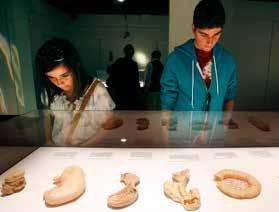
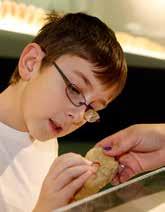
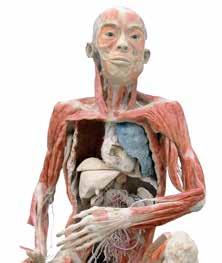
Rated one of the top field trips in Georgia, “BODIES…The Exhibition” is an excellent way for students to learn about the human anatomy in an intimate and informative way. Using an innovative polymer preservation process, the exhibition allows students to see the body’s inner beauty. With more than 200 actual human bodies and specimens on display, the exhibition provides a unique look into the human body. Docents are available throughout to answer questions and point out interesting details and teachable moments. Dedicated grade level (K-12) teacher’s guides with activities and worksheets are available to enhance the student’s visit and offer a one-on-one personal experience throughout the exhibition. Each system of the body is on display—skeletal, muscular, nervous, circulatory, respiratory, digestive, reproductive/urinary, fetal (optional), and the treated body. Vital health concerns such as obesity, smoking, cancer, cirrhosis, arthritis, and bone fractures are on display for those teachable moments. The exhibition provides details on how visitors can take better care of their body by making healthy lifestyle choices. For more information or to plan a field trip, call 678-920-6862 or visit bodiesatlanta.com
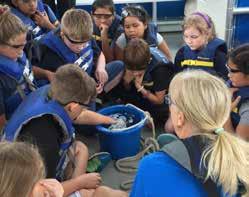
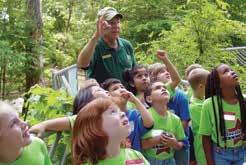
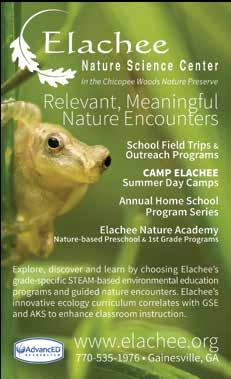
Engage students in memorable, relevant nature encounters at Elachee Nature Science Center, the only SACS/ AdvancED-accredited nature center in the southeastern United States.
Grade-specific STEAM-based environmental curriculum offers real-world opportunities for PreK-12 students to explore, discover and learn. Each program correlates with GSE and AKS to complement classroom instruction. Field trips take place at Elachee, nestled in one of Georgia’s largest protected green spaces the Chicopee Woods Nature Preserve, aboard the Lake Lanier Aquatic Leaning Center floating classroom or as an Elachee in Your Classroom outreach program. For more information, call 770-5351976 or visit elachee.org/school-programs.
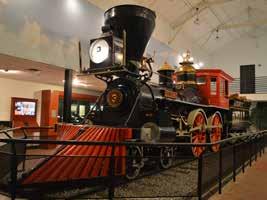
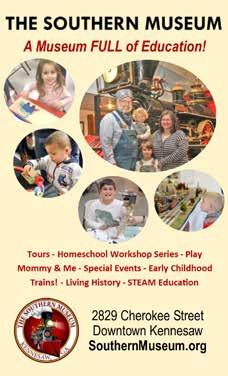
Experience history at the Southern Museum of Civil War & Locomotive History located in downtown Kennesaw. A prestigious Smithsonian Affiliations member, the Southern Museum is home to The General locomotive, made famous during the Great Locomotive Chase of 1862. The Jolley Education Center offers interactive exhibits that are fun for the entire family and the museum’s educational programs reinforce classroom learning by connecting historical information with artifacts. Museum education opportunities include tours, homeschool workshops, early childhood programs, and special events throughout the year. For more information, call 770-427-2117 or visit SouthernMuseum.org.




• Reproducible Activity Sheets


• School Group Ticket Pricing
• Docent-led Exhibition Tours GROUPS OF 10+ RESERVATION IS REQUIRED. Call 678-920-6862 or email atlgroupsales@prxi.com to book tickets.






-Martin H Fischer