Atlanta’s Leading Education Resource Winter/Spring 2020



Managing Homework

Atlanta’s Leading Education Resource Winter/Spring 2020
Atlanta Area Map
To search for independent schools by region or neighborhood, turn to page 38 and use the color-coded map to direct you to each region’s page number.
We gratefully thank our advertisers for their support of Atlanta School Guide
Publisher/President
PATRICK KILLAM
Editor
JACKSON STEWART
Marketing & Promotions
JEFF THOMPSON
Account Directors
MARIA ALEXANDER BRIAN PICHOT
Contributing Writers
MICHELLE BOURG, H.M. CAULEY, PHIL KEELING, DONNA NEALE
TO ADVERTISE CALL 770-992-0273
Space closing for Summer/Fall 2020 issue: April 10, 2020
Once you’ve selected your region of interest, the charts beginning on page 40 include a comparison of features for each school in that region, along with the page number for each school’s ad.
Divided into regions of Atlanta, the color-coded maps beginning on page 44 provide each school’s location and page number for their ad.
To find a school or resource by name, turn to the advertiser index on page 105 to find the appropriate page number. 1 2 3 4
Atlanta School Guide, Winter/Spring 2020, Volume 15, Issue 1. Published bi-annually by Killam Publishing, Inc., 200 Market Place, Suite 230, Roswell, GA 30075. Atlanta School Guide assumes no responsibility for errors, changes or omissions. Information may have changed since press time, so please verify all information when contacting a school or educational resource. Reproduction in whole or in part of any elements of this publication is strictly prohibited without the written permission of the publisher. © 2020 Killam Publishing, Inc.
For additional copies, further information or advertising, please contact:
P: 770-992-0273
F: 844-706-1545
info@killampublishing.com AtlantaSchoolGuide.com
Blue Ribbon
Four metro Atlanta public schools and three area independent schools have been named National Blue Ribbon Schools by the U.S. Department of Education. Daves Creek Elementary, Marietta Center for Advanced Academics, Sope Creek Elementary and Tritt Elementary School were the public school winners. Immaculate Heart of Mary, Our Lady of the Assumption Catholic School and Queen of Angels Catholic School were the independent schools that received the honor.
Georgia Awarded Literacy Grant
The Georgia Department of Education will receive nearly $180 million to fund its Literacy for Learning, Living and Leading in Georgia initiative, which aims to improve reading performance in students from birth through grade
12. The U.S. government’s Comprehensive Literacy State Development Grant program awarded the 179.2 million grant, which will be distributed to the state over five years.
Cristo Rey Names New President
Camille Naughton has been selected as the second president of Cristo Rey Jesuit High School effective July 1. Naughton has been with the school since its founding in 2013, most recently serving as vice president of advancement and corporate partnerships. She replaces retiring president Deacon Bill Garrett.
School Graduates 100% of 2019 Class
The Coretta Scott King Young Women’s Leadership Academy, an all-girls school in the Atlanta Public Schools system, achieved a 100% graduation rate for its class of
2019, with all 50 seniors graduating. Congratulations to all!
The Weber School Launches Sports Science Academy
The Weber School, an independent high school in Sandy Springs, opened the Weber Sports Science Academy this past fall. The academy offers an honors diploma program for students interested in sports medicine, physical therapies, fitness and sports management.
Metro Districts Surpass State Graduation Rates
The majority of metro Atlanta public school districts exceeded the average state graduation rate of 82%, according to data released by the Georgia Department of Education. Among the highest performers in the metro area were City Schools of Decatur with 95.2%, Forsyth County with 94.6%,
Buford City Schools with 92.6%, Fayette County with 90.2% and Paulding County with 88.8%. Congratulations to all!
The Lovett School introduced a paid busing program at the start of the 2019-20 school year. The program offers rides to Lovett students along two routes, with interested families paying an extra fee for the service. If the program proves successful, the school plans to add two additional routes for the following school year.
Website Ranks Atlanta’s Best High Schools Niche.com, a website that analyzes data to name the best schools, colleges, neighborhoods and companies, has named The Gwinnett School of Mathematics, Science and Technology as metro Atlanta’s best public high school. The Westminster Schools was named the metro area’s top independent high school. Northview, Walton, Alpharetta and Lambert high schools round out the top 5 public schools, with Pace Academy, The
Paideia School, Atlanta International School and Woodward Academy completing the top 5 independent schools.
APS Partners With Crowdfunding Website Atlanta Public Schools is one of 10 school districts in the country chosen to participate in a new program with crowdfunding website DonorsChoose. org. The school system has its own page on the site, which will allow potential donors to select specific classroom projects they’d like to contribute to.
CHARTER SCHOOL A tax-supported public school that is independently run, allowing for greater educational choice for parents in the community.
EXPERIENTIAL LEARNING An educational approach using applied, hands-on methods of learning.
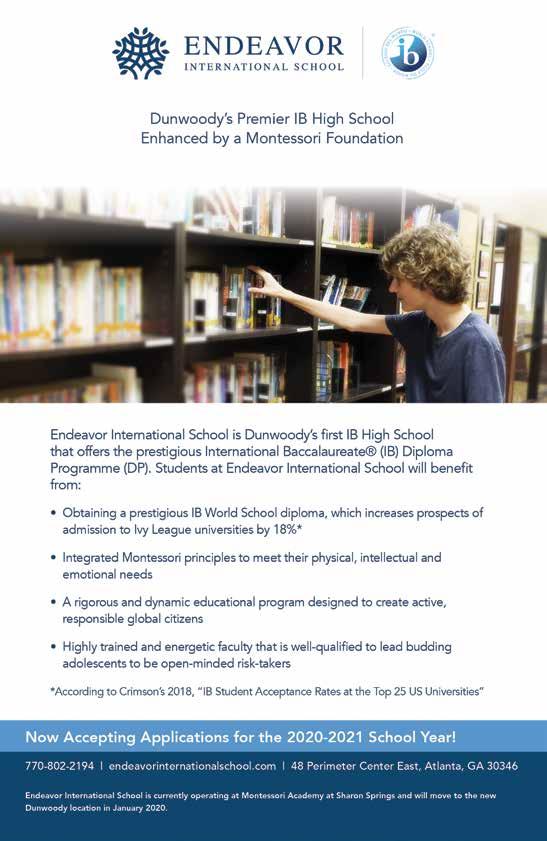
INTERNATIONAL BACCALAUREATE (IB) A specifically designed comprehensive academic program emphasizing traditional disciplines while instilling a global perspective in its students.
MAGNET SCHOOL A public school that offers a specific or enhanced curriculum designed for students of special interest or ability.
MONTESSORI A school following the principles developed by Dr. Maria Montessori focusing on the unique individuality, self-reliance and independence of children.
SPECIAL NEEDS A school or program for children who have mild to moderate learning differences. It usually features smaller class sizes, individualized attention and multisensory learning methods.
ACCREDITATION Official certification that guarantees a school provides an education of a reasonably high quality. Schools must prove levels of quality and maintain continuous standards of improvement.
ACT An alternative to the SAT, this national college admissions examination consists of subject area tests in English, mathematics, reading and science, with an optional 40-minute writing test.
COLLEGE AND CAREER READY PER-
FORMANCE INDEX (CCRPI) A school improvement, accountability and communication platform for all educational stakeholders that will prepare all Georgia public school students for colleges and careers.

Education that applies to children from birth to age 8, focusing specifically on their development, including physical, emotional, sensory, communicative, cognitive and social needs.
STUDENT SUCCEEDS ACT (ESSA) The main federal law for K–12 general education covers all students in public schools.
GEORGIA MILESTONES Tests designed to measure how well students in grades 3 through 12 acquire the skills and knowledge outlined in the state-adopted content standards. They replace the CRCT and involve both multiplechoice and free-response questions.
GEORGIA PERFORMANCE STANDARDS Statewide standards of academic content for all subjects K-12, to which every school must adhere and on which students are annually tested.
HOPE SCHOLARSHIP (Helping Outstanding Pupils Educationally)
A scholarship in Georgia funded by the Georgia Lottery that rewards academically achieving students with financial assistance to attend eligible
The federal Every Student Succeeds Act, approved in 2015, replaced the controversial No Child Left
Behind Act.
public and private Georgia colleges and universities.
MISSION/PHILOSOPHY A statement outlining the guidelines a school follows as it works to achieve its various educational goals and/or maintain its performance standards.
NOTIFICATION DEADLINE
The date by which an independent school notifies families of the acceptance of a child for enrollment to the school.
OPEN HOUSE An event held at a school where parents can learn more about the school and its offerings.
PSAT A standardized test that offers students practice for the SAT Reasoning Test and allows them to qualify for the National Merit Scholarship Program
REPLY DEADLINE The date by which parents must notify an accepting school of their commitment to enroll their child at the school.
SAT This standardized test measures the critical thinking, writing and mathematical reasoning skills of students planning to attend college.
SECONDARY SCHOOL ADMISSIONS
TEST (SSAT) The admissions test that many independent schools require students take in order to be considered for enrollment.
SUMMER CAMP A common destination for children and teenagers during the summer, at which they can participate in a variety of activities or classes.
Many local and national organizations work to bring out the best in summer camps and public, private and boarding schools by identifying schools that meet certain standards through accreditation. These groups also set policies, research educational advancements and offer services to the educational communities both in Atlanta and in Georgia. The following are just some of the associations and organizations you should know in your search for the best educational experience for your child.
AdvancED advanc-ed.org
The parent organization for the Southern Association of Colleges and Schools, AdvancED advances education excellence through accreditation and school improvement.
American Camp Association (ACA) acacamps.org
Accredits camps that meet industry-accepted and
government-recognized standards, educates owners and directors and establishes guidelines.
The Association of Boarding Schools (TABS) boardingschools.com
This organization of 250 boarding schools serves the professional development needs of boarding schools and provides information to potential students and their families.
Association of Christian Schools International (ACSI) acsi.org
ACSI strives to enable Christian educators and schools worldwide to teach effectively using Christcentered curricula and programs.
Association Montessori Internationale (AMI) ami-global.org
Recognizes schools that strongly adhere to Montessori principles and practices.
Atlanta Area Association of Independent Schools (AAAIS) aaais.org
Although not an accrediting agency, AAAIS is an affiliation of independent schools and operates under analogous principles and a common code of ethics.
The Council of International Schools (CIS) cois.org
The premier organization in international education for the accreditation of schools and the development of best practices.
Department of Education (DOE) gadoe.org
A statewide, policy-driven organization governing the public school system of education in Georgia for grades K-12, the Georgia DOE operates under the direction of the state superintendent of schools.
Georgia Accrediting Commission (GAC) gac.coe.uga.edu
GAC offers five levels of approval: provisionally accredited, accredited annually, accredited, accredited fully and accredited with quality.
Georgia Association of Christian Schools (GACS) gacs.org
Uses generally accepted indicators of quality, voluntary self-improvement and peer review to measure Christian schools.
Georgia Association of Educational Leaders (GAEL) gael.org
This statewide umbrella organization of six professional associations provides unity among school leadership organizations in Georgia.
Georgia Association of Private Schools for Exceptional Children (GAPSEC) gapsec.org
This state organization is for schools that serve students with learning issues.
Georgia Charter Schools Association (GCSA) gacharters.org
A membership organization whose mission is to be an effective advocate and service provider for all charter public schools in Georgia.
Georgia Independent School Association (GISA) gisaschools.org
An association of private, independent and parochial schools throughout the state whose mission is to advance excellence and collaboration among private, independent and parochial schools.
Georgia Partnership for Excellence in Education (GPEE) gpee.org
This nonprofit organization of business, education, community and government leaders aims to shape policy and reform public education in the state.
Georgia Private School Accreditation Council (GAPSAC) gapsac.org Association of K-12 private schools whose students are recognized and approved by the Georgia DOE for transferring credits to public schools on the same basis as students from public schools.
Georgia Professional Standards Commission (PSC) gapsc.com
A state organization responsible for setting and applying high standards for the preparation, certification and continued licensing of Georgia public educators, as well as
conduct of public school teachers and staff.
Georgia School Boards Association (GSBA) gsba.com
Representing Georgia’s 180 elected boards of education, GSBA provides leadership and services to local school boards.
National Association for the Education of Young Children (NAEYC) naeyc.org
The NAEYC focuses on the quality of educational and developmental services for children, from birth to age 8, including day care and pre-K centers. It is a national network of more than 300 local, state, and regional affiliates, and a growing global alliance.
National Association of Independent Schools (NAIS) nais.org
This association values and works to maintain the independent nature of each member school by promoting high standards of educational quality and ethical behavior.
National Association of Private Special Education Centers (NAPSEC) napsec.org
Represents private specialized education programs and their leaders u
by promoting high-quality programs and services for individuals with disabilities and their families.
National Christian School Association (NCSA) nationalchristian.org
An organization that accredits member schools, overseen by a board of administrators from Christian schools and universities.
National Council for Private School Accreditation (NCPSA) ncpsa.org
A consortium of several private school organi-
zations dedicated to preserving the integrity of the accreditation process for thousands of private schools across the nation.
Southeastern Association of Boarding Schools (SABS) sabs.org
An association of 18 boarding schools committed to promoting and supporting boarding education opportunities in Southeastern states, including the Carolinas, Alabama, Tennessee, Georgia and Florida.
Southern Association of Colleges and Schools (SACS) sacs.org
Member schools meet research-based standards and maintain continuous school improvement and quality assurance.
Southern Association of Independent Schools (SAIS) sais.org
Members meet quality standards, receive peer evaluation and implement a school plan focused on strategic improvement.
For more information about these and other organizations and associations that ensure quality education among camps and schools, visit the websites of the Georgia Department of Education (gadoe.org) or the U.S. Department of Education (ed.gov).

















A learning disability is a neurological disorder that affects how your child processes certain information. Children with learning disabilities are as smart as or even smarter than other children, but may face challenges with reading, writing, spelling, reasoning and other functions. As a result, they often struggle to achieve in traditional classrooms. There are many types of learning disabilities, from Attention Deficit Hyperactivity Disorder (ADHD) and dyslexia to more serious forms such as autism.


Special needs schools are those that serve children who struggle with learning disabilities or don’t perform well in a conventional school environment. These schools use alternative approaches to instruction in order to help children learn more effectively and also achieve success in the classroom and in social settings.
Other schools don’t specifically target those with learning disabilities, but may teach different kinds of students who have had difficulty learning in a typical class-

room setting. Others may teach average or even above-average learners while also offering additional programs and classes for students with learning differences.
First, it’s important to identify your child’s specific challenges. Students who exhibit average or above-average intelligence but often seem distracted and don’t perform well in a traditional classroom setting may be struggling with dyslexia, Asperger’s syndrome, ADHD or some other disorder that affects their ability to learn effectively. Also, disruptive or aggressive children may be exhibiting frustration brought on by a learning disability.
If you suspect your child may have a learning dis-
ability, it’s critical to have him or her evaluated by a mental health professional. A diagnosis is necessary in order to address the child’s educational needs.
A professional evaluation is crucial in order to evaluate your child’s educational needs.
If your child is diagnosed with a learning disability and attends public school, talk with the principal, school counselor or another administrator about developing an Individualized Education Program (IEP). All public schools are required to create an IEP for students with learning disabilities who meet special education requirements. An IEP is a document that specifies your child’s learning situation and educational needs and outlines a course of action for teachers and other professionals to follow to help make sure your child learns to the best of his or her ability. u
If you feel your local public school isn’t the right environment for your child or simply want to explore all your options, there are many quality independent schools in the metro Atlanta area devoted to helping children with special needs and learning issues. Visit the Georgia Association of Private Schools for Exceptional Children’s website (www.gapsec.org) or our listings for special needs schools on page 106 to help you with your search.
All special needs schools are not the same. The first step is to identify those schools that can address your child’s specific learning difficulty, and offer the level of special needs instruction that you (and perhaps a professional) feel is best for your child.
You may be more comfortable enrolling your child in a school that focuses specifically on his or her needs, or you may want a more diverse environment where he or she can interact with many different kinds of students. Familiarize yourself with the different options offered by each kind of school.
Traditional independent schools that offer special needs programs as part of a larger curriculum can offer that kind of environment, but may have larger class sizes than schools that specialize in specific learning disabilities. These kinds of schools may also focus more on academics than on the therapeutic aspects of special
needs education. Independent special needs schools can offer more individualized instruction and a more structured and predictable environment, and are likely to address nonacademic issues such as social skills and self-esteem.
As you begin searching for the right school for your child’s situation, here are some questions to keep in mind:
• Will your child fare better in a school that focuses on his or her specific learning disability, or would you rather that he or she be able to interact with students with a wide range of learning capabilities?
• Does the school serve a specific age range or work with students on all grade levels? Many students with learning disabilities have trouble transitioning to new schools.
Continued on page 22 u
Identify those schools that can best address your child’s specific learning difficulty.

Asperger’s syndrome: A developmental disorder on the autism spectrum, characterized by high intelligence, impaired social skills and repetitive patterns of behavior and interest.
Attention Deficit Disorder (ADD): A strain of ADHD (see below) marked by a difficulty maintaining focus or concentration and frequent or consistent fatigue. ADD differs from ADHD in that hyperactivity or impulse-control issues are markedly decreased.
Attention Deficit Hyperactivity
Disorder (ADHD): A chronic condition that includes hyperactivity, impulsive behavior and difficulty keeping one’s attention focused.
Autism: A developmental disorder that affects the ability to communicate and interact with others, accompanied by rigid, repetitive behavior patterns.
Dyslexia: A learning disability that impairs one’s ability to read.
Georgia Association of Private Schools for Exceptional Children (GAPSEC): An organization of independent schools serving students with learning disabilities and differences.
Georgia Special Needs Scholarship (GSNS): A school-choice scholarship program for special needs students being served by an IEP in Georgia public schools.
Individualized Educational Program (IEP): A written statement that outlines the needs of a public school student with learning disabilities and creates a customized plan for meeting those needs.
Individuals With Disabilities
Education Act (IDEA): The federal law that governs how states and public education agencies that accept funding under the law address the educational needs of students with disabilities.
Learning disability: A neurological condition that affects how one processes information.
• Does the school offer a variety of extracurricular activities, including arts and sports programs?
• Is the school accredited? If so, by which organizations?
• Is the staff certified to instruct special needs children or those with your child’s specific learning difficulty?
• Does the school focus more on academics or on addressing the child’s therapeutic needs?
Many independent special needs schools participate in the Georgia Special Needs Scholarship program (GSNS), a school choice program available to special needs students attending Georgia public schools. The program offers funds to off-
set tuition and fees at participating private schools authorized by the State Board of Education. According to the Georgia Department of Education, scholarship amounts range from $2,500 to $13,500, with an average amount of around $6,000.
The Qualified Education Expense Tax Credit program provides another scholarship option. Donations are made to an organization known as a Georgia Student Scholarship Organization (GaSSO), which uses the money to award scholarships to students in pre-K through grade 12. Many schools also offer their own scholarships or tuition assistance programs as well. Contact individual schools for details.
For more information on special needs schools and resources, please see our listings on page 106.
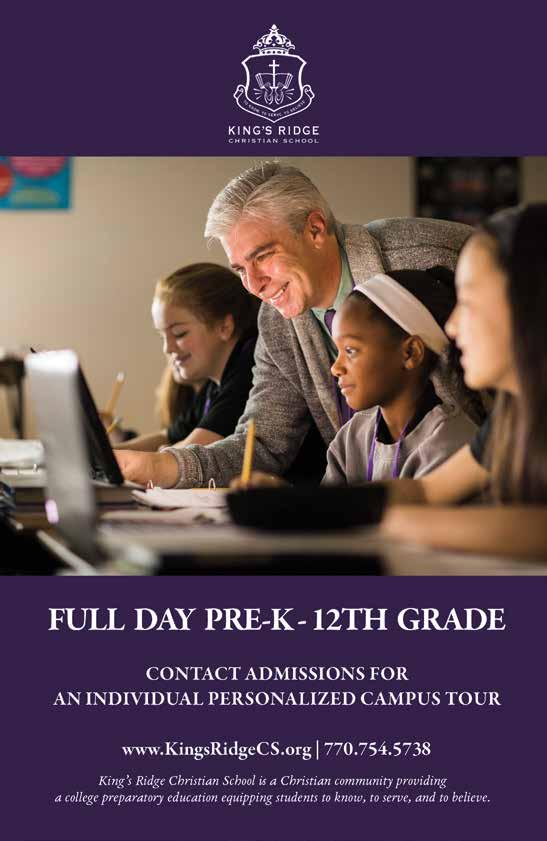
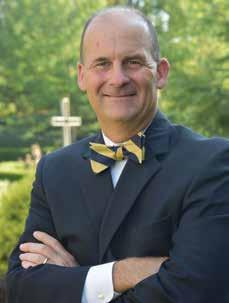
The Head of School at KRCS since 2017, Williams studied Christianity and communications at Baylor University and Houston Baptist University. He later received his master of arts in counseling from Denver Seminary and his Ed.D. in educational administration from the University of Houston.
What is your educational philosophy?
I believe each child has unique gifts and talents. The environment in which children grow up has a significant impact on their well-being and therefore underscores the importance of a Christian school’s value. Children must learn a growth mindset instead of the traditional fixed mindset, and be challenged to excel and achieve at their highest potential.
What do you love most about your job?
I love being a part of a faculty that loves the Lord, their students and their craft with all their heart, soul and mind.
How can parents best contribute to the education process?
Parental involvement and partnership with the school plays a vital role in the success of their child’s Christian school experience.
How is the field of education changing?
Content is ubiquitous and is easily ac-
cessible by all. Education must become student-centered and foster growth mindsets where students think critically and collaboratively while learning to solve real-world problems. We cannot continue to do the same thing and expect different results.
What advice would you offer parents about their children’s education?
“Trust in the Lord with all your heart and do not lean on your own understandings. In all your ways acknowledge Him and He will make your path straight.” Proverbs 3:5-6
Emphasis: Christian community providing a college preparatory education equipping students to know, serve and believe.
Year Founded: 2001
Grades: Pre-K-12
Students: 791
Avg. Class Size: 20
Tuition Range: $6,500-$21,200
Accreditations or Affiliations: SACS, SAIS, Cognia, GAC
Location: 2765 Bethany Bend, Alpharetta, GA 30004
Contact: 770-754-5738, KingsRidgeCS.org
BY H.M. CAULEY

or parents looking for educational options for their children, one of the best developments in education is the availability of a wider range of school choices than ever before. At the same time, this abundance of choice can be the source of stress when searching for a school, as parents work to weigh a greater number of alternatives objectively.
When searching for the right school for your child, there’s no more important part of the process than asking questions of the faculty and staff. From a school’s educational philosophy to its test scores and what it serves for lunch, it’s crucial to get as much information as possible to help you make the right decision for your child. But what questions should you ask?
The first thing to ask about is a school’s academics. Nicole Evans Jones, engagement specialist at Young Middle School and founding former principal at Purpose Built Schools, an Atlanta nonprofit charter school management group, encourages parents to consider just what they want their children to learn. “The course offerings and the extracurriculars may not fit your child’s needs,” she says. “Look at the course of study and talk about what the kids are learning.” Ideally, the program should enrich your child’s academic strengths and interests while also being able to support improvement where needed.
Ayanna Hill-Gill, head of school at Atlanta Girls’ School, agrees. After relocating to Atlanta from New Jersey in 2015, she visited local institutions to find the right fit for her own two children. When interviewing schools, Hill-Gill made sure to focus on the curriculum. “Coming from out of town, we wanted to make sure the curriculum was what my kids were accustomed to, so there would be a smooth transition,” she says.

“For instance, I wasn’t familiar with what one school used for math, so I asked to see some lessons to get a sense of the objectives,” she says.
For both students and schools, standardized test performance is only a snapshot of academic achievement, but it should be considered. Look at a school’s average test scores, and compare them to results for the past three to five years to determine if they are trending upward or downward. If a test area is weak, determine if there’s an underlying cause. A science and technology magnet school may score slightly lower than average in English, for example. What’s as important as the score is what’s being done to address any deficiencies and to keep improving.
For parents of middle and high school students, college preparation is of critical importance. Asking about the percentage of students at a school that go on to college—and which colleges—can help you learn about not just a school’s academic rigor, but also how well it supports a commitment to learning in its students. u
WHEN SEARCHING FOR THE RIGHT SCHOOL FOR YOUR CHILD, THERE’S NO MORE IMPORTANT PART OF THE PROCESS THAN ASKING QUESTIONS OF THE FACULTY AND STAFF.


Other topics about which to ask regarding academics include: How often is homework assigned and how much time does it require? Are tutoring and study assistance available? What programs and support are available for special needs or academically gifted students? What extracurricular activities are offered?
It’s also important to ask about teachers. Review the educational background and qualifications for individual teachers and note how these relate to the subjects they teach. While class size and student-teacher ratio are good indicators of how much individual attention can be expected, especially in the lower grades, how it’s computed can make a difference. For a clear picture, ask if the school includes staff such as librarians in its teacher count when determining its published ratio.
Every school has a unique culture and its own concept of involving the family in its approach to learning. The answers to questions about a school’s recent accomplishments and outstanding features can speak volumes about a school’s mission and values, and how it might make decisions affecting your child going forward.
Whether you’re investigating a public or independent school, Kari Schrock, principal of Laurel Ridge Elementary School, suggests asking just what it means to be a part of the school’s learning community. “I encourage parents to dig deeper to know what the school represents,” she says. She notes that it’s important for parents to know exactly what their expected level of involvement is, if any, and to make sure they’re able to make the required commitment. Parents may also
want to verify the frequency and method of teacher-to-family communication.
Other questions relating to a school’s culture include: Are uniforms required? Is transportation available for students who live at a distance? What are the behavior and discipline policies?
One important topic, whether you’re interviewing a traditional public, charter or independent school, is funding. Are there booster clubs, foundations or stakeholders that support the school?
Also, find out about tuition: what does it cover? Are there added fees for extracurricular activities, events outside of class or for equipment and supplies?
“When you step foot on a campus, you can get a sense of the school’s mission and you can find out what makes them different,” says Hill-Gill. “I look at how people address each other, what the vibe is when people are walking in the halls. Do they welcome you when you visit the classroom?” And if possible, bring your child along when you visit, she adds. “I think it’s important to have them involved in the process.”
A school visit can demonstrate all aspects of the school’s culture, from its safety and security procedures to how open and enthused the staff and faculty are. “It’s how you are greeted, not just in the office but in the halls,” says Jones. “Do the kids and teachers seem happy? Are they excited to talk about their school? You should see some visible evidence of parental involvement, from volunteers in the classrooms to PTA sign-up sheets on the walls.”
After discovering as much as possible about a school, the final decision about whether or not to enroll a child there comes down to one thing, says Hill-Gill. “It’s all about fit; you want the best fit, and only you know what works best for your child.”


1.What is the school’s educational philosophy or mission?
2.What are its safety and security procedures?
3.How does the school help students meet grade-level standards?
4.How is technology used at the school?
5.Does it offer strong arts or extracurricular programs?
6.How do students fare on the SAT and other standardized tests?
7. How does it work with students with learning difficulties or other challenges?
8.Does it have gifted/talented or other programs for exceptional students?
9.How do students get to school?
10.Is the school accredited, and if so, by which organizations?
BY PHIL KEELING

avigating Atlanta's educational landscape means discovering many types of schools with descriptions that may sound somewhat familiar: magnet, charter and special needs are just a few. One type of school that’s gaining more popularity in the metro area is Montessori education, named for Maria Montessori, an Italian physician and educator. These independent schools are rooted in the concept that children learn best through hands-on exploration that they follow at their own pace.
While they are perhaps best known for educating children in the preschool and elementary levels, Montessori schools and methods have been implemented up through the high school level. At each level, the focus is as much on social, physical and emotional development as academics. Life skills, responsibility and respect for the environment are taught alongside more traditional subjects, such as science, mathematics, history and language, creating a student that is truly well-rounded in both academic studies and
emotional maturity. Learning objectives are accomplished through experiential, practical and sensory activities in an organized setting at each school.
Montessori schools differ from traditional public or independent schools in several ways. Generally speaking, classrooms are less rigid, and the student, not the teacher, is the focus. You won’t see rows of children sitting at desks. Instead, students are grouped by age ranges rather than grades, and allowed to work and think independently. Montessori students are given the opportunity to learn from their own mistakes and grasp concepts at their own pace.
Essentially, this comes down to the child learning, understanding and using specific skills, rather than focusing on tests and forgetting that information the moment the exam is finished. Instead of giving a lecture or handing out assignments, teachers work one-on-one with students, providing guidance when necessary, like presenting a new
topic or a new challenge to meet when a child is ready. No grades are awarded, and there are no limits on how long a child follows a particular area of interest.
At Johns Creek Montessori School of Georgia, children work in one of three classroom community age groups. These groups range from 8 weeks to 15 months, 12 months to 36 months, and 21/2 to 6 years old. Children are free to explore activities that interest them and may work on as many activities as they like.
That mix of freedom and structure allows teachers to pay attention to changes in the development of their students and to adapt their lessons accordingly. It’s an approach that helps students grow not just academically, but personally.
Allowing young students to choose the activities that interest them most in life has led to many misunderstandings about Montessori education—specifically, that it lacks the structure and out-of-school opportunities that students in public or private schools receive. This couldn’t be further from the truth, says Lucy Bennett, director of


communications at Arbor Montessori.
“There’s a common misconception that with Montessori education we let them be completely independent, that there’s no discipline or guidance,” she says. “But we give freedom and limits.”
One of the main foundations of the Montessori experience is the concept of educating the whole child. That extends to topics that may not be part of a textbook curriculum, explains Patricia Craft-Heuer, director of education at Village Montessori School in Roswell.
“It’s about learning socially—learning grace and courtesy lessons,” Craft-Heuer says. “It’s learning about the world, that people are the same and have the same needs— housing, food, clothing. That sort of approach helps alleviate prejudice, which is important if the goal is to create children of the world. They need to learn about other countries
and how people live there.”
Part of that understanding comes from learning and emulating positive character traits such as respectfulness, kindness and helpfulness. “All of us here try to be good examples by living character education,” says Craft-Heuer. “It’s not just someone saying, ‘Do this, and you’ll be a good person.’ Children pick up on examples. They see the respect we have for everyone, from the youngest child to the principal. Even concepts of being helpful and loving are ingrained at a very young age.”
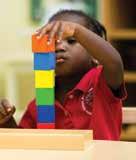
In addition to cultivating children’s minds, Montessori schools make physical activity a priority, as well. Instead of taking in information from textbooks or computers, students learn by working with materials in a tactile, hands-on environment. That may involve stacking blocks, organizing movable letters or learning to count with tiny animal figures. Montessori materials engage children’s different senses, helping them to comprehend
through activity and experience.
Montessori students learn across a wide range of subjects, just like their counterparts at more traditional schools. At Arbor Montessori, “We have art, music, Spanish and an athletics program,” says Bennett. “Montessori schools in the area are very robust in the same way independent schools are.”
Parents may wonder whether this approach is the right fit for their child. After all, every child learns in his or her own way. Montessori educators encourage parents to ask questions and talk about their child’s learning style, habits and home environment when visiting a school. Does your child learn better in a group setting or on their own?
Do they like to stay in one place or do they need to move around? Children who operate with few limits at home may not flourish within the structure of a Montessori school, and children used to very strict guidelines may have trouble adapting to a self-directed setting that allows them the freedom to explore on their own.
When considering a Montessori school, it’s important to understand that not all Montessori schools are the same. Since the term is not trademarked, any school can refer to itself by that name. Some may claim to follow an “alternative” or “hybrid” Montessori program, or offer Montessori instruction for just part of the day.
The most reliable sign of a school’s adherence to Montessori principles is certification: Montessori teachers are trained and certified in the Montessori method. What’s more, schools that have been accredited by organizations such as the Association Montessori International (co-founded by Maria Montessori) and the American Montessori Society have been determined to operate in accordance with Montessori standards.
In the end, says Julie Strickland, marketing and communications manager at Springmont School, the Montessori approach helps prepare students for the rigors of high school and higher education in ways they might not learn in a more traditional setting.
“Last year, my son who attended Springmont from age 2 through middle school was surprised to be invited to join the small team of undergraduates representing his university at an exclusive business casestudy competition,” Strickland says. “He was not convinced he was the most qualified of his classmates to serve. The professor listened to my son’s concerns and replied, ‘Yes, but you actually think, you’re curious, you ask good questions and communicate well, and most importantly, I have watched you lead a group. These are skills our team needs.’ These are skills my son developed in his Montessori environment and was able to build upon in high school, while his peers were just starting to develop those skills.”
Arbor Montessori School 404-321-9304, arbormontessori.org
Johns Creek Montessori School of Georgia 770-814-8001, jcmsog.com
Springmont School 404-252-3910, springmont.com
Village Montessori School 770-552-0834, vmschool.com
American Montessori Society 212-358-1250, amshq.org
Association Montessori International USA 703-746-9919, amiusa.org
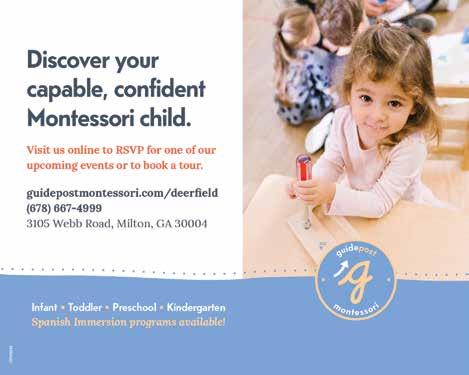
Guidepost Montessori at Deerfield is part of a growing network of schools that serves more than 3,000 families worldwide. This school is Guidepost Montessori’s first in Georgia and is located in the beautiful Bethany Crossing neighborhood of Milton. The school has three separate programs that serve infants and children age 6 weeks to 6 years: Infant (up to 18 months), Toddler (18 months to age 3) and Children’s House (age 3 to 6). Deerfield offers a full Spanish Immersion program for Toddler and Children’s House students and an optional, bilingual Spanish-English classroom that is now available for infants.

Guidepost Montessori classrooms foster self-sufficiency in an environment thoughtfully designed to encourage child-directed exploration, where the ultimate goal of education is authentic, holistic independence. Here, your child will gain the knowledge, confidence, creativity and social ability that will allow him to choose his own goals and pursue them over time.
Deerfield also offers an extended school day program, where children thrive in the Montessori curriculum all day long. 3105 Webb Road, Milton, GA 30004. 678-667-4999. guidepostmontessori.com/deerfield.
Montessori Kids Academy offers a traditional Montessori student-focused, constructivist teaching style. This growing school teaches children from 18 months to 3 years of age in its pre-primary classroom, 3 to 6 years of age in its primary classrooms and 6 to 12 years of age in its elementary classrooms. Montessori Kids Academy strives to maintain a low student-toteacher ratio in each classroom.
The school is housed in a 20,000-square-foot, state-of-the-art building complete with a children’s garden, outdoor classroom, spacious library, learning kitchen, computer lab, indoor café, outside picnic patio, two music rooms and traditional Montessori furnishings.
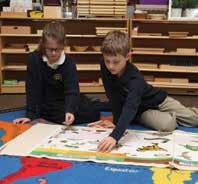
The following daily enrichments are offered as part of the Montessori curriculum at no additional cost: French, Spanish, music, art, cooking, coding and robotics, P.E. and organic gardening. Students enjoy daily yoga in their classrooms and the computer lab.
Montessori Kids Academy is an AdvancEd-accredited school and a member of the American Montessori Society. It currently participates in the Georgia Student Scholarship Program, a tax-savings initiative created to enable parents to use their money tax-free for education. 3034 Old Atlanta Road, Cumming, Ga., 30041. 678-916-9974. montessoricumming.com.


BY MICHELLE BOURG
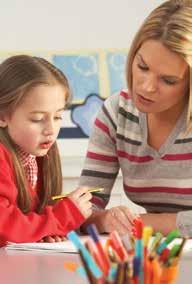
Back in the day, homework was something kids could do before dinner—a page of math problems and maybe a chapter of reading, done with the radio or TV on. Not any more: today’s academic environment is much more challenging, designed to help students meet the demands of a rapidly changing world. Homework is an integral part of that process. In addition, students encounter more demands on their time, with sports, clubs and community service frequently on the agenda. This means that handling homework efficiently
while truly learning from it is an essential skill to learn.
“As teachers, we are very cognizant of the workload students are being asked to handle inside and outside of the classroom,” says David-Aaron Roth, an English teacher in the upper school at Woodward Academy in College Park. “We work diligently to make sure that whatever assignments are being asked of the students outside of the classroom are truly supplemental and reinforce the learning in class.” By taking a step-by-step approach, students can master
the skills required for effective home study— skills that they’ll use throughout their lives.
The first step to productive homework management is to create a designated study space, with space to spread materials out and where parents can keep a watchful eye. Experts recommend keeping bedrooms reserved for sleep to promote good rest habits, and kids’ rooms often hold distractions such as a TV, games or toys, so a laptop at the kitchen or dining room table may be best, at least for younger children.
Next, set up a study time. Some kids like to come straight home and start while they’re still in “school mode;” others need to unwind first. Whatever the preferred time is, it should be reasonably close to the same time every day; our minds learn to adapt to functions done on a set schedule, and
it’s also a good way to begin to learn time management skills.
Within that set time, experiment with how to prioritize the workload: some kids prefer to start with demanding subjects while they’re relatively fresh and allot extra time to them, while others want to get the easier work out of the way first. Scan the day’s assignments together and plan a schedule based on both your child’s study style and the amount of work assigned in each subject, making sure that everything is covered. Children often need guidance with this, but giving them input on how they’d like to work goes a long way towards a positive attitude about the work itself.
Once the books are cracked, be available to clarify instructions or suggest an approach to a problem if needed, but let your

“WE WORK DILIGENTLY TO MAKE SURE THAT WHATEVER ASSIGNMENTS ARE BEING ASKED OF THE STUDENTS OUTSIDE OF THE CLASSROOM ARE TRULY SUPPLEMENTAL AND REINFORCE THE LEARNING IN CLASS.”
— DAVID-AARON ROTH
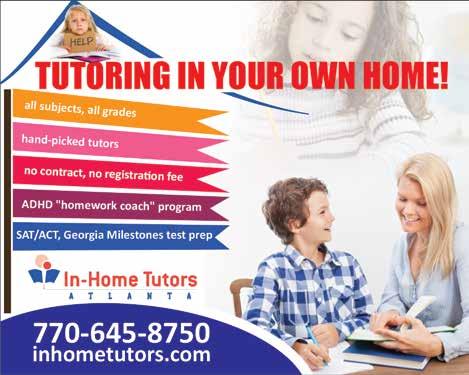
juggling multiple schedules; having someone there to focus exclusively on schoolwork helps everyone meet individual demands and gives them back time to be together as a family. For assistance with locating a qualified tutor that meets your individual needs, a good first step is contacting your child’s school. Other parents may be able to give referrals as well.
By working together with your child to create a plan and getting help when appropriate, you can make sure he or she works smarter, not harder, to get the most out of homework. Ultimately, kids want to do well, and understand the value of homework in the process of achieving that. Says Roth, “As long as each assignment, paper, test or quiz has a purpose, I believe students will rally around the work and see the greater goal in mind.”
1. Create a designated study space where parents can keep a watchful eye.
2. Plan a daily homework routine and stick to it.
3. Prioritize the workload and determine what to do first.
4. Be available for your child to clarify instructions or suggest an approach to a problem if needed.
5. When study time is over, review your child’s work.
6. Praise effort and progress, and review problem areas together to brainstorm on how to improve.
metro atlanta area map
For features of independent schools, turn to Education At a Glance on pg. 40. For public school system information by county, turn to pg. 89.
3 3
2
2
1 1
5 5
Boarding Schools Alabama, Connecticut, Florida, Georgia, Massachusetts, Mississippi, Pennsylvania, Tennessee
REGION 4: Atlanta South/ Southeast/Southwest Douglasville, Eagle’s Landing, Fairburn, Fayetteville, Locust Grove, Metro-Atlanta
REGION 5: Atlanta West Austell, Buckhead, Kennesaw, Marietta, Powder Springs, Smyrna/Vinings
Resources Tutoring, Summer Camps and Activities, Field Trips and Education Programs.
REGION 1: Atlanta North/Northwest
Buckhead, Chastain Park, Crabapple, Holly Springs, Marietta, Milton, North Buckhead, Roswell p.53
REGION 2: Atlanta North/Northeast
Alpharetta, Brookhaven, Buckhead, Cumming, Duluth, Dunwoody, Johns Creek, Peachtree Corners, Roswell
REGION 3: Atlanta East Athens, Dacula, Decatur, Lilburn, Morningside, Stone Mountain, Watkinsville
REGION 3: Atlanta East Ansley Park, Athens, Dacula, Decatur, Midtown, Morningside, Northeast Atlanta
This information reflects the latest available data at publication time. Please confirm with each individual school.

Occupational Therapy Evaluation and Testing for children with mild to moderate issues, inclusive of, but not limited to PDD, ADD, ADHD, Autism, motor and sensory delays, sensory integrative dysfunction, and more. Evaluations are detailed and definitive for all types of learning issues. Exclusive Provider of: WIN® Write Incredibly Now® Handwriting Program.
IEP/504 accommodations help! KNOW THE FACTS BEFORE YOU SIGN!
For pre-OT students and OT’s who are looking to gain new skills.

Alpharetta Once a small farming community, Alpharetta’s growth has exploded in recent years, and the North Fulton city is now one of Atlanta’s most affluent neighborhoods, creating the perfect mix of country living and lots of city amenities.
Woodstock Located in Cherokee County, Woodstock is, as locals say, “where modern amenities meet old Southern charm.” Historic Olde Towne pays a continual tribute to Woodstock’s pioneers through vintage shops and good old-fashioned Southern hospitality.


Duluth A successful mix of small-town charm and booming economic growth, Duluth plays host to many major corporations and is also home to numerous golf clubs, private tennis clubs and parks. The city prides itself on accommodating a growing, diverse population.
Dunwoody A popular community among young and established professionals alike, Dunwoody is often referred to as the “tennis set” neighborhood because of its numerous recreational outlets. Its location provides suburban living close enough to the city.
Serving children in grades Kindergarten to High School with language, learning and social challenges.


Call for a private tour
Teachers deliver a regular-education curriculum combining:
• Georgia Standards and National Core
• Differentiated Instruction
• Community-Based Experiences
• PE, Art, Foreign Language, Theatre and Culinary Arts
• Technology in every classroom
Rolling Admissions. Fully Accredited GAC. Now accepting students for 2020-21















Sowing the Seeds of Organic Learning
Decatur The county seat of DeKalb County, Decatur’s small-town charm revolves around the Courthouse Square, which features trendy restaurants and shopping, entertainment options and special events, including its annual summer beach bash.
Lawrenceville Located in the heart of Gwinnett County and known as “Crepe Myrtle City,” Lawrenceville is Atlanta’s second oldest city. Its historic downtown square, which has been revitalized, is home to a variety of shops, restaurants and community events.


Child-directed learning
McDonough One of the fastest-growing neighborhoods South of Atlanta, McDonough is the county seat of Henry County and features many historic structures around its town square. The city has ample green space and is a favorite destination for antique shoppers.
Peachtree City A master-planned city comprised of several smaller villages, Peachtree City’s many amenities include golf courses, lakes and an amphitheater. The city is renowned for its network of golf paths connecting its neighborhoods.



Acworth Surrounded by two lakes and 12 parks, Acworth offers plenty of recreation opportunities. Located 35 miles northwest of Atlanta, the town is convenient to both I-75 and Highway 41. Acworth is designated as a Georgia Main Street City.
Douglasville Located west of Atlanta on I-20, Douglasville has easy access to all that Atlanta offers. Listed on the National Register of Historic Places, Downtown Douglasville’s historic district is an outstanding example of a turn-ofthe-century southern railroad town.




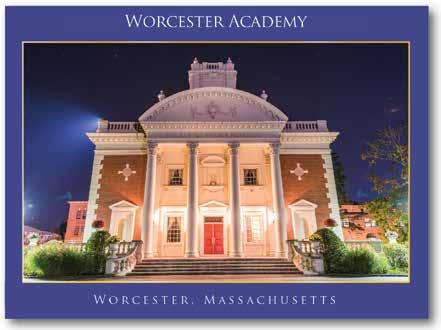

There are many benefits of a boarding school education. Boarding schools are an option for students seeking a more independent learning experience. Because students generally live on campus, learning takes place in and out of the classroom almost on a 24-hour basis.
When selecting a boarding school, it is important to visit the school campus, but representatives from many boarding schools visit metro Atlanta throughout the year—contact each school for specific dates.
Gainesville, Ga. .
The Nation’s Preeminent Military School for Boys
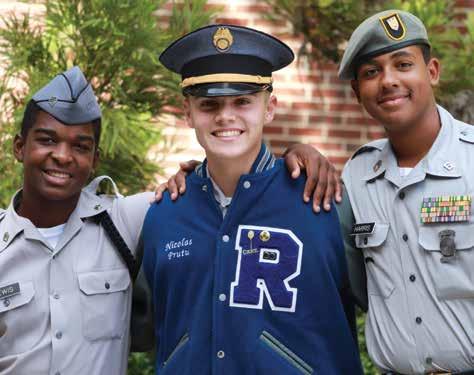
For over 112 years, Riverside Military Academy has remained one of the nation’s preeminent military boarding schools. The beautiful 200-acre campus in northern Georgia is a place where young men in grades 7-12 can reach their full potential. Home to a Corps of Cadets that averages over 500 cadets from 30 nations and 30 states, the military school offers a diverse and welcoming environment. Renowned for exemplary academics, competitive athletics and adherence to the honor code, the military academy has been transforming its students into future leaders since 1907.
Riverside Military Academy is not just a military high school; it’s a private school, all-boys school and boarding school all in one. Riverside Military combines the challenging education of a private school with a safe, structured environment of a military school and the limited distractions of an all-boys boarding school. Every aspect of life as a cadet at Riverside Military is designed to encourage exceptional academic achievement and personal growth. The focus of the Academy is to provide the “Best in Boys’ Education.”
For More Information: Riverside Military Academy, 2001 Riverside Drive, Gainesville, Ga. 30501, Apply@riversidemilitary.com, 800-462-2338, riversidemilitary.com
Cullman, Ala.
Just 180 miles west of Atlanta and located between two major airports, St. Bernard Preparatory School in Cullman, Ala., offers an exceptional coeducational college preparatory residential program for students in grades 7-12. Boasting a cutting-edge theater, liberal arts center and library and state-of-the-art athletic facilities on its 800acre campus, St. Bernard offers students from all ethnic, socioeconomic and religious backgrounds a rigorous college preparatory education steeped in the Benedictine tradition, designed to cultivate a love of learning and a life of virtue in young men and women within a community of faith and scholarship.
St. Bernard’s award-winning balanced curriculum prepares students for excellence, with the Class of 2019 having been awarded over $4.6 million in scholarships. St. Bernard prides itself on offering a tailor-made educational experience, providing a retreat from crowded classrooms and urban environment stress. Are you ready to take your first step on the journey of a lifetime? 1600 St. Bernard Drive SE, Cullman, Ala. 35055. 256-739-6682. stbernardprep.com.
Lake Wales, Fla.
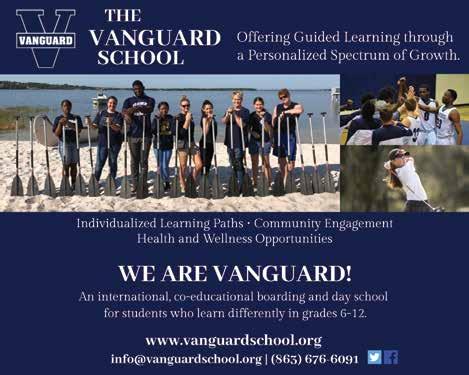
The Vanguard School has been providing individualized education to students who learn differently through skill assessment, multi-modality teaching, and focus on the whole student since 1966. The school uses a variety of teaching styles and consistently improves its services to meet the needs of its students. Its rolling admissions offers students and families the opportunity to join the Vanguard School family throughout the school year.
The school works with co-educational students in 6th through 12th grades who experience an array of learning challenges by addressing social/emotional learning opportunities, executive functioning solutions and helping students gain the confidence to stay motivated and attain their goals. Since the school meets students at their academic and social skill levels, they feel open to learning again. The Vanguard School focuses on guiding students to utilize core values (community, resilience, integrity, empathy and leadership) to self-evaluate their behaviors and intentions. All students are valued and celebrated for their individuality and strengths. 22000 U.S. Hwy. 27, Lake Wales, Fla. 33859. 863-676-6091. vanguardschool.org.


Avariety of improvements and innovative programs in Georgia’s public school systems have resulted in many stellar elementary, middle, and high schools across the metro area. Different school systems feature specialized programs and academic opportunities, such as magnet, charter, vocational, or alternative schools to suit their respective students, parents, and communities. However, despite variations in programming and academic offerings, all public schools must offer the core curriculum as determined by the Georgia Board of Education. Here is a county-by-county guide to metro Atlanta’s public school systems. For more information about the Georgia Department of Education, call 404-656-2800 or visit gadoe.org. u

The Academic Focus for the International Academy of Smyrna 2019-2020
What is our mission?
Developing Scholars who are Change Agents, Critical Thinkers and Global Citizens
How will we accomplish our mission?
Rigorous Instruction
Data-driven Instruction
Experiential Learning Service Learning Projects
Spanish in all Grades
5th/6th Grade Global Academy
Strong Stakeholder Involvement
Who are we?
We are the International Academy of Smyrna!
Visit our website: http://www.iasmyrna.org/ Now Enrolling Contact ias.admissions@iasmyrna.org
Number of Schools
Elementary 12 Middle 4 High 3
Career Academy 1
Transitional Academy 1
Total # of Students:
2019 Mean Georgia Milestone Scores:
3rd: (ELA) 510 (M)529
5th: (ELA) 515 (M) 516
8th: (ELA) 511 (M) 503
2019 Average SAT: 1038
Top 3 Schools by Average 2019 SAT Score
Adairsville High 1052
Woodland 1050
Cass High 1018 BARTOW
Board of Education
770-606-5800
bartow.k12.ga.us
What’s New: In 2019, all three Bartow County high schools recorded their highest graduation rates since 2012. The district’s overall rate rose from 87.1 in 2018 to 89.2 in 2019, a figure that exceeds the state graduation rate by more than 7 percent.
2019 Mean Georgia Milestone Scores:
3rd: (ELA) 522 (M) 545
5th: (ELA) 531 (M) 538
8th: (ELA) 535 (M) 514
2019 Average SAT: 1115
Top 5 Schools by Average 2019 SAT Score Etowah High 1128 Creekview High 1127
Sequoyah High 1116
Woodstock High 1116
River Ridge 1108
Board of Education
770-479-1871
cherokeek12.net
What’s New: After six months of gathering input from the community, the Board of Education has approved Blueprint, a 5-year strategic plan for the district’s continued success. Elements include a new vision, three core beliefs, and five priority areas.
2019 Mean Georgia Milestone Scores:
3rd: (ELA) 488 (M) 507
5th: (ELA) 497 (M) 493
8th: (ELA) 501 (M) 486
2019 Average SAT: 945
Top 5 Schools by Average 2019 SAT Score
Elite Scholars Academy 1075
M. E. Stilwell School of the Arts 1039
Morrow High School 994
Riverdale High School 950
Mundy’s Mill High School 937
Board of Education
What’s New: The Clayton County Board of Education approved the budget for the fiscal year 2020, which features a recommendation for pay increases for all employees.
Board of Education
770-426-3300 cobbk12.org
Board of Education
770-254-2800 cowetaschools.net
Board of Education
678-676-1200
dekalbschoolsga.org
2019 Mean Georgia Milestone Scores:
3rd: (ELA) 521 (M) 533
5th: (ELA) 531 (M) 526
8th: (ELA) 534 (M) 523
2019 Average SAT: 1114
Top 5 Schools by Average
2019 SAT Score
Walton High School 1288
Alan C. Pope High School 1220
Lassiter High School 1212
Wheeler High School 1196
Kennesaw High School 1161
What’s New: Both Sope Creek Elementary and Tritt Elementary earned national recognition as 2019 Blue Ribbon Schools from the US Department of Education in the category of Exemplary High Performing schools.
2019 Mean Georgia Milestone Scores:
3rd: (ELA) 525 (M) 532
5th: (ELA) 530 (M) 525
8th: (ELA) 536 (M) 535
2019 Average SAT: 1081
Top 3 Schools by Average
Total
2019 SAT Score Northgate High 1123 East Coweta High 1070 Newnan High 1057
What’s New: In order to provide room for the continued enrollment growth at East Coweta High, the Coweta County Board of Education is considering a redistricting of 400 to 450 students from East Coweta to Northgate High.
2019 Mean Georgia Milestone Scores:
3rd: (ELA) 496 (M) 511
5th: (ELA) 506 (M) 502
8th: (ELA) 506 (M) 496
2019 Average SAT: 994
Top 5 Schools by Average
2019 SAT Score
Total
Chamblee Charter High 1176
DeKalb Early College Academy 1161
Lakeside High 1144
Dunwoody High 1139
DeKalb School of the Arts 1135
What’s New: The DeKalb County School District broke ground on the new Smoke Rise Elementary School, scheduled to open for the 2020-21 school year. The new building will accommodate enrollment growth in Region 2 and the Tucker cluster.
Board of Education 770-651-2000 dcssga.org
Number of Schools
Elementary 20 Middle 8 High 5 Centers 3 Charter 1
Total # of Students: 29,346
Student Spending: $8,988
2019 Mean Georgia Milestone Scores:
3rd: (ELA) 511 (M) 520
5th: (ELA) 520 (M) 510
8th: (ELA) 522 (M) 504
2019 Average SAT: 999
Top 5 Schools by Average 2019 SAT Score
Douglas County High 1042
Alexander High 1012
Chapel Hill High 1007
New Manchester High 958
Lithia Springs High 954
What’s New: Since 2016, The Family Health Center at Douglas County Schools has been delivering a wide range of quality healthcare for students and staff. Services include immunizations, physicals, behavioral health, sick visits and well-child checks.
2019 Mean Georgia Milestone Scores:
3rd: (ELA) 544 (M) 544
5th: (ELA) 549 (M) 535 8th: (ELA) 551 (M) 541
2019 Average SAT: 1140
Board of Education
770-460-3990 fcboe.org
Total # of Students: 20,089 Student Spending: $10,040
Top 5 Schools by Average 2019 SAT Score McIntosh High 1219 Starr’s Mill High 1179 Whitewater High 1126
Sandy Creek High 1082
Fayette County High 1056
What’s New: The Fayette County Board of Education has begun live streaming all public meetings, including board meetings and public work sessions.
Number of Schools
21
Board of Education
770-887-2461 forsyth.k12.ga.us
Total # of Students:
2019 Mean Georgia Milestone Scores:
3rd: (ELA) 550 (M) 562
5th: (ELA) 555 (M) 568
8th: (ELA) 556 (M) 534
2019 Average SAT: 1162
Top 5 Schools by Average 2019 SAT Score
Lambert High 1212
South Forsyth High 1187 West Forsyth High 1129
Forsyth Central 1120 North Forsyth High 1118
What’s New: The Forsyth County Schools district is scheduled to open four new schools by 2022: Poole’s Mill Elementary in 2020, East Forsyth High and Hendricks Middle in 2021 and another elementary school in 2022. It is also planning to open two other facilities in 2021.
Total # of Students: 102,924
Student Spending: $10,841
2019 Mean Georgia Milestone Scores:
3rd: (ELA) 521 (M)534
5th: (ELA) 531 (M) 528
8th: (ELA) 522 (M) 512
2019 Average SAT: 1086
Top 5 Schools by Average 2019 SAT Score Northview HS 1290 Chattahoochee HS 1239
Johns Creek HS 1224
Alpharetta HS 1199
Cambridge 1185 FULTON
Board of Education
470-254-3600 fultonschools.org
Board of Education
770-229-3700
spalding.k12.ga.us
What’s New: April 21 and May 19 will be designated as Digital Learning Days for students while serving as regular work days for employees. Students will be able to maintain their focus on instruction through digital activities off campus.
2019 Mean Georgia Milestone Scores:
3rd: (ELA) 486 (M) 506
5th: (ELA) 502 (M) 495
8th: (ELA) 507 (M) 496
2019 Average SAT: 965
Top 2 Schools by Average 2019 SAT Score Spalding High 1007 Griffin High 914
What’s New: Griffin Region College and Career Academy was chosen as the recipient of a Smartflower unit, in partnership with Mohawk Group and Suncatch Energy. The new solar energy unit will give students the opportunity to learn about alternative energy sources and sustainability, while helping the school to offset power consumption and utilities costs.
2019 Mean Georgia Milestone Scores:
3rd: (ELA) 523 (M) 535
5th: (ELA) 528 (M) 533
8th: (ELA) 532 (M) 494
2019 Average SAT: 1094
Top 5 Schools by Average 2019 SAT Score
Gwinnett School of Math, Science, and Technology 1375 North Gwinnett High 1208
Board of Education
678-301-6000
gwinnett.k12.ga.us
Total
Gwinnett Online Campus 1161
Brookwood High 1149
Peachtree Ridge High 1132
What’s New: Four Gwinnett County students were chosen from a pool of nearly 1,000 applicants to serve on State School Superintendent Richard Woods’ 2019-20 Student Advisory Council.
Board of Education 770-534-1080 hallco.org
Board of Education
770-957-6601
henry.k12.ga.us
Number of Schools
2019 Mean Georgia Milestone Scores:
3rd: (ELA) 507 (M) 517
5th: (ELA) 514 (M) 509
8th: (ELA) 486 (M) 500
2019 Average SAT: 1039
Top 5 Schools by Average 2019 SAT Score
Board of Education
770-443-8000
paulding.k12.ga.us
Total # of Students: 29,214
Student Spending: $8,727
North Hall High 1088
Flowery Branch High 1073
Cherokee Bluff 1042
Chestatee High 1041
Johnson High 1031
What’s New: The Melvin Douglas and Victoria Kay Ivester Foundation has donated $2.2 million to Hall County’s Early College Program.
2019 Mean Georgia Milestone Scores:
3rd: (ELA) 503 (M) 517
5th: (ELA) 512 (M) 508
8th: (ELA) 517 (M) 493
2019 Average SAT: 1003
Top 5 Schools by Average 2019 SAT Score
Total # of Students: 46,718
Student Spending: $9,047
Ola High 1075
Union Grove High 1068
Eagles Landing High 1025
Locust Grove 1008
Luella High 998
What’s New: Henry County Schools may partner with the Henry County Board of Commissioners and the city of McDonough to bring the first Boys & Girls Club to the area. Number
2019 Mean Georgia Milestone Scores:
3rd: (ELA) 515 (M) 527
5th: (ELA) 527 (M) 519
8th: (ELA) 512 (M) 511
2019 Average SAT: 1039
Total # of Students:
Top 5 Schools by Average 2019 SAT Score
North Paulding High 1069
Paulding County High 1032
East Paulding High 1031
South Paulding High 1025
Hiram High 1013
What’s New: The district is now using SafeSchools Alert, a tipreporting service that allows students, staff and parents to submit safety concerns to the administration five different ways, including via text and email. Tipsters may choose to remain anonymous.
Number of Schools
Board of Education
770-483-4713
rockdaleschools.org
Total # of Students: 18,422
Student Spending: $9,826
2019 Mean Georgia Milestone Scores:
3rd: (ELA) 500 (M) 512
5th: (ELA) 514 (M) 500
8th: (ELA) 519 (M) 508
2019 Average SAT: 979
Top 3 Schools by Average 2019 SAT Score
Rockdale High 1013
Heritage High 982
Salem High 919
What’s New: Rockdale County’s school board was honored as a 2019 Exemplary Board, the highest status in the Georgia School Boards Association Board Recognition Program.
Board of Education
atlantapublicschools.us
Total # of Students:
58,634
Student Spending: $15,322
2019 Mean Georgia Milestone Scores:
3rd: (ELA) 500 (M) 518
5th: (ELA) 507 (M) 507
8th: (ELA) 510 (M) 495
2019 Average SAT: 994
Top 5 Schools by Average 2019 SAT Score
Atlanta Classical Academy 1250
Grady High 1094
Charles R. Drew Charter High 1078
North Atlanta High 1056
BEST Academy 931
What’s New: King Middle is now authorized to offer the middle school component of the rigorous International Baccalaureate World curriculum, creating a smooth transition to Jackson High’s IB World program. The district intends to eventually incorporate the whole Jackson cluster into the IB framework.
Board of Education
770-945-5035
bufordcityschools.org
Number of Schools
Total # of Students: 4,986
Student
2019 Mean Georgia Milestone Scores:
3rd: (ELA) 539 (M) 553
5th: (ELA) 538 (M) 550
8th: (ELA) 559 (M) 564
2019 Average SAT: 1122
What’s New: The opening of the new state-of-the art Buford High School has freed up space for younger grades to fill. The elementary school is now designated for kindergarten and the Buford Academy tends to students in 1st through 3rd grades.
Board of Education
404-371-3601
csdecatur.net Number of Schools
3rd-5th Grade Academy 1 4th & 5th Grade Academy 1
1 Early Learning Center 1
Total # of Students: 5,452
Student Spending: $11,384
2019 Mean Georgia Milestone Scores:
3rd: (ELA) 562 (M) 559
5th: (ELA) 560 (M) 551
8th: (ELA) 549 (M) 524
2019 Average SAT: 1177
What’s New: Glennwood Elementary has started a new after-school club, Boys in Action, to give black male students an opportunity for personal growth. Led by Michael Scott and Jonathan Holloman, this club’s students will participate in activities focused on building and affirming: leadership skills, confidence, friendships and a sense of belonging and empowerment.
Board of Education
770-536-5275
gcssk12.net
Number of Schools
6
Total # of Students: 8,386
Student Spending: $9,018
2019 Mean Georgia Milestone Scores:
3rd: (ELA) 487 (M) 509
5th: (ELA) 495 (M) 500
8th: (ELA) 478 (M) 493
2019 Average SAT: 997
What’s New: Three Gainesville Middle School students have committed to the 2019 REACH Georgia scholars program. Scholars are paired with a mentor through middle and high school, and must maintain good grades, behavior and attendance. Scholars who successfully complete the program and graduate from high school are awarded a $10,000 scholarship.
Board of Education 770-422-3500 marietta-city.org
Total # of Students: 9,940 Student Spending: $10,845
2019 Mean Georgia Milestone Scores:
3rd: (ELA) 512 (M) 524
5th: (ELA) 518 (M) 515
8th: (ELA) 519 (M) 507
2019 Average SAT: 1056
What’s New: The Marietta City Schools Office of Academic Achievement and Programs was awarded a $10,000 grant from Lockheed Martin to provide funding for STEM projects for the district. The funds will be used to create STEM resource boxes that contain curriculum and materials, which will be available for school checkout.