If you feel your local public school isn’t the right environment for your child or simply want to explore all your options, there are many quality independent schools in metro Atlanta devoted to helping children with special needs and learning issues. Visit the Georgia Association of Private Schools for Exceptional Children’s website (gapsec.org) or our listings for special needs schools on page 98 to help you with your search.
How Do I Find the Right School?
All special needs schools are not the same. The first step is to identify those schools that can address your child’s specific learning difficulty, and offer the level of special needs instruction that you (and perhaps a professional) feel is best for your child.
You may be more comfortable enrolling your child in a school that focuses specifically on his or her needs, or you may want a more diverse environment where he or she can interact with many different kinds of students. Familiarize yourself with the different options offered by each kind of school.
Traditional independent schools that offer special needs programs as part of a larger curriculum can offer that kind of environment, but may have larger class sizes than schools that specialize in specific learning disabilities. These kinds of schools may also focus more on academics than on the therapeutic aspects of special
needs education. Independent special needs schools can offer more individualized instruction and a more structured and predictable environment, and are likely to address nonacademic issues such as social skills and self-esteem.
As you begin searching for the right school for your child’s situation, here are some questions to keep in mind:
• Will your child fare better in a school that focuses on his or her specific learning disability, or would you rather that he or she be able to interact with students with a wide range of learning capabilities?
• Does the school serve a specific age range or work with students on all grade levels? Many students with learning disabilities have trouble transitioning to new schools.
Continued on Page 20 u
Identify those schools that can best address your child’s specific learning difficulty.
Critical Communication
• Does the school offer a variety of extracurricular activities, including arts and sports programs?
• Is the school accredited? If so, by which organizations?
• Is the staff certified to instruct special needs children or those with your child’s specific learning difficulty?
• Does the school focus more on academics or on addressing the child’s therapeutic needs?
Financial Assistance
Many independent special needs schools participate in the Georgia Special Needs Scholarship program (GSNS), a school choice program available to special needs students attending Georgia public schools. It offers funds to offset tuition and fees at
participating private schools authorized by the Georgia Board of Education. According to the Georgia Department of Education, scholarship amounts ranged from $532 to $19,184, with an average amount of about $7,767 for the 2025-2025 school year.
The Qualified Education Expense Tax Credit program provides another scholarship option. Donations are made to an organization known as a Georgia Student Scholarship Organization (GaSSO), which uses the money to award scholarships to students in pre-K through grade 12. Many schools also offer their own scholarships or tuition assistance programs as well. Contact individual schools for details.
For more information on special needs schools and resources, please see our listings on page 98.
TIPS
FOR STUDENTS WITH DYSLEXIA
SAINT FRANCIS SCHOOL’S
Saint Francis School understands that all students learn differently, especially those with dyslexia. Saint Francis teachers use these five strategies to help struggling readers develop strong foundational reading skills while fostering self-confidence, resilience, and a lifelong love of learning.
1 Use a Multisensory Approach
By using sight, sound, touch, and movement, multiple areas of the brain are activated simultaneously. This makes information more memorable and easier to recall later.
2 Focus on Phonemic Awareness
This approach teaches children to hear and manipulate the individual sounds within spoken words. Strong phonemic awareness predicts reading success.
3 Employ Structured Literacy Instruction
Structured literacy instruction is grounded in how the brain learns to read, ensuring that all
students, especially those with dyslexia, develop foundational reading skills.
4 Present Information in Manageable Chunks
Breaking information into smaller, more manageable pieces leads to improved retention and better comprehension.
5 Celebrate Progress
Celebrating each student’s progress builds confidence, reduces frustration, and fosters motivation.
COMMON SPECIAL NEEDS TERMS
Asperger’s Syndrome: An outdated diagnostic term that is no longer used. The symptoms that characterized Asperger’s are now classified as part of Autism Spectrum Disorder (ASD).
Attention Deficit Disorder (ADD): An outdated term used to refer to the inattentive form of ADHD, in which a person is typically inattentive or distractible, but not hyperactive or impulsive.
Attention Deficit Hyperactivity Disorder (ADHD): A brain-based syndrome affecting the regulation of functions including attention, concentration, memory, and impulsivity.
Autism Spectrum Disorder: A developmental disorder affecting the ability to communicate and interact. Symptoms include repetitive behaviors; intense, narrow interests; and sensory sensitivity.
Dyslexia: A learning disability that impairs specific language skills, particularly reading.
Georgia Association of Private Schools for Exceptional Children (GAPSEC): An organization of independent schools serving students with learning disabilities and differences.
Georgia Special Needs Scholarship (GSNS): A school-choice scholarship program for special needs students being served by an IEP in Georgia public schools.
Individualized Educational Program (IEP): A written statement that outlines the needs of a public school student with learning disabilities and creates a customized plan for meeting those needs.
Individuals With Disabilities Education Act (IDEA): The federal law that governs how states and public education agencies that accept funding under the law address the educational needs of students with disabilities.
Learning Disability: A neurological condition that affects how one processes information. Learning disabilities can impair reading, writing, speech, math, reason, memory, attention, and coordination, as well as social skills and emotional maturity.
Multisensory Instruction: An educational approach involving the use of all of a child’s senses, not just sight and hearing, to help with understanding concepts and solving problems.
Response to Intervention (RTI): A process used by educators to help identify and address the needs of students experiencing behavioral or educational challenges, based on screening, instruction, and assessment.
Student Scholarship Organization (SSO): An organization authorized by the state of Georgia to receive funds and award scholarships under the Georgia Qualified Education Expense Tax Credit program.
Brett Hardin
Head of School, Terra School at Serenbe
Dr. Brett Hardin has over 30 years of experience in educational nonprofits, public education, and independent schools. He has worked for the Georgia Council on Economic Education, and was previously the high school principal at The Paideia School. He has also taught high school economics and U.S. history in Atlanta Public Schools and Cobb County.
What is your educational philosophy? Schools should personalize learning to meet the unique needs of each child while preparing them to become thoughtful, ethical contributors to society.
How is the field of education changing? Advances in technology—particularly social media, instant access to information, and artificial intelligence—have fundamentally reshaped how students gather, process, and apply knowledge. While tools and methods will continue to evolve, our core mission remains constant: to prepare students with the skills, confidence, and agency they need to thrive in a changing world.
How can parents best contribute to the education process? Parents play a vital role as partners in their child’s education. At its core, this means helping children develop age-appropriate skills to advocate for themselves, solve problems, and grow in independence.
What do you love most about your job? What I value most is the opportunity to work alongside dedicated educators. It is a privilege to support them in creating meaningful learning experiences for students.
What advice would you offer parents about their children’s education? When evaluating a school, parents might ask: Are students excited to be here? Do they feel known and valued? Are they being challenged in ways that promote long-term growth?
TERRA SCHOOL AT SERENBE
Emphasis: Instilling students with adaptability, critical thinking, and a profound sense of societal responsibility.
Location: 255 Prom Field Road Chattahoochee Hills, GA 30268
Contact: 770-463-0081, terraatserenbe.org
HOW AI AND OTHER TOOLS ARE CHANGING EDUCATION
BY WENDY LITTLE
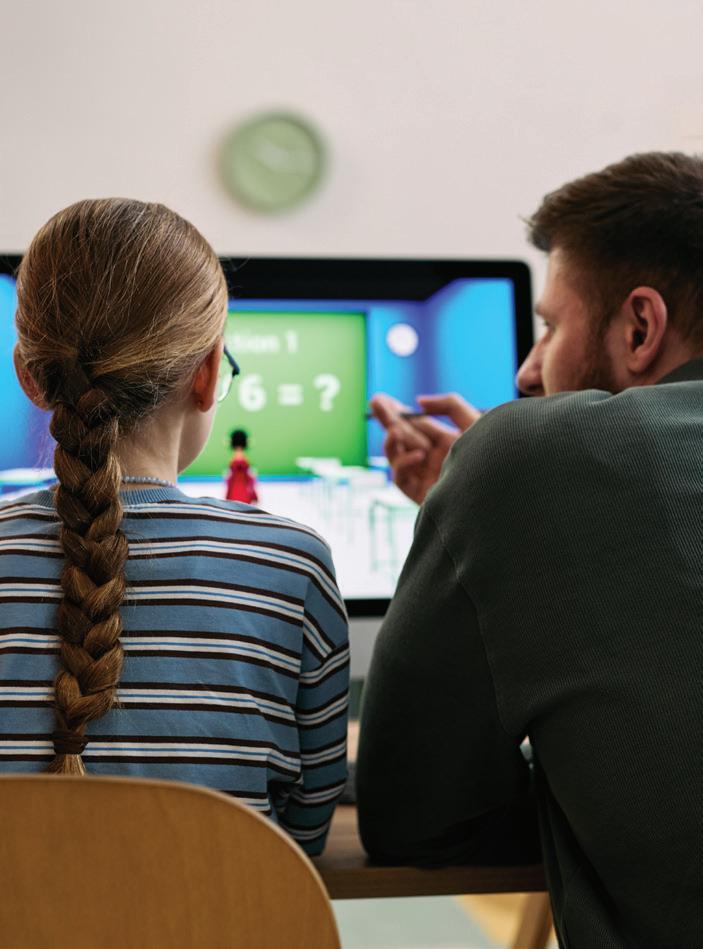
n recent years, technology has become an inseparable part of the modern educational experience. From artificial intelligence (AI) to online learning platforms, there’s no question that technology offers unprecedented opportunities for engagement, learning, and growth.
But as modern technology continues to expand in our schools, it raises crucial questions about excessive screen time, socialization, privacy, and the precise role of AI in the classroom.
TOO MUCH SCREEN TIME?
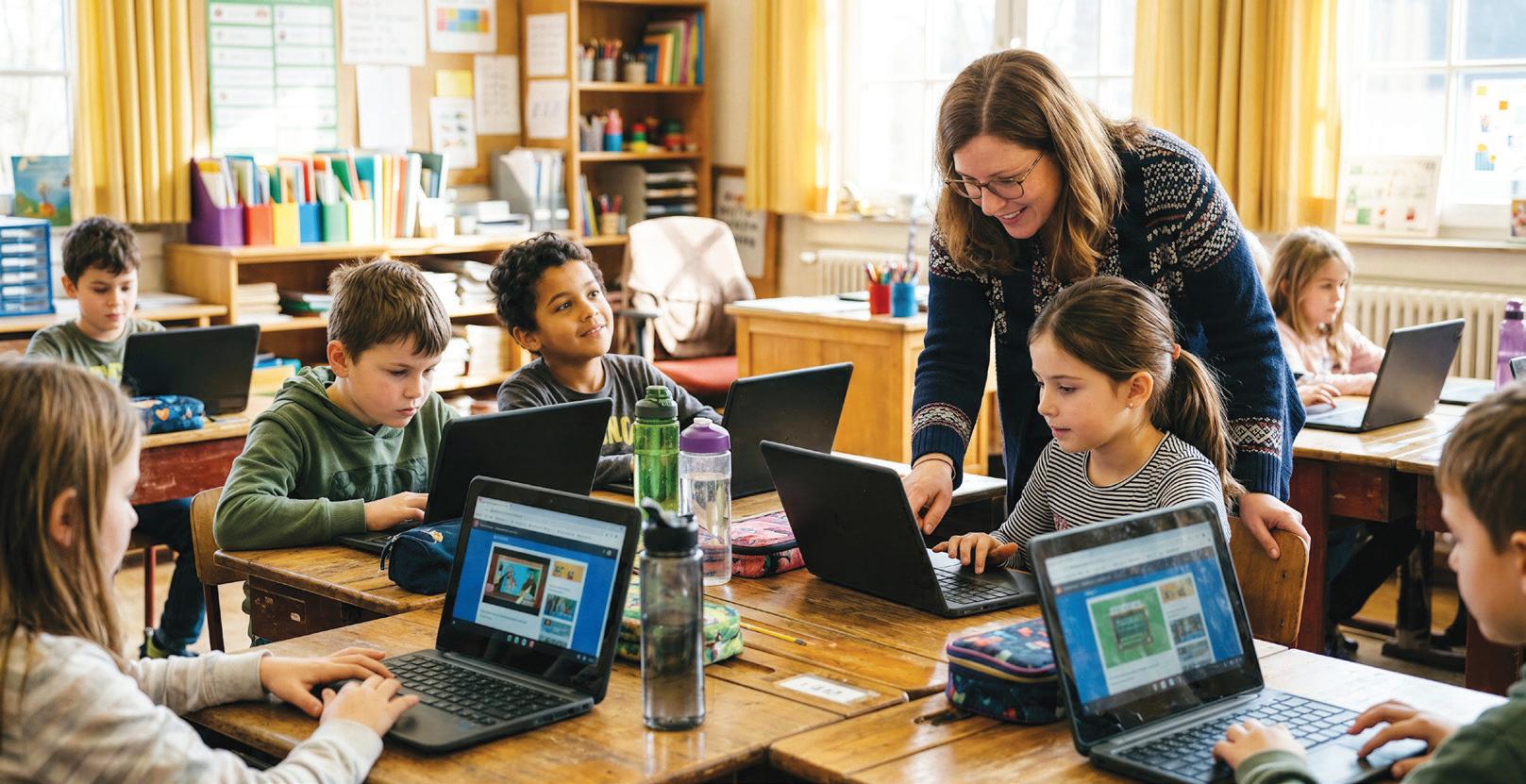
The concept of 1:1 devices (one device per student) has become a hallmark of technology in education, ensuring that each student has access to their own digital tool, such as a laptop, tablet, or Chromebook, to complete assignments, engage in research, and access online resources.
These devices offer students personalized access to digital content, enabling a more tailored learning experience. Additionally, they help students become more digitally
literate, providing them with the tools to critically evaluate information and communicate effectively online. This is invaluable in preparing them for the workforce, which increasingly demands technological proficiency.
Meanwhile, research has pointed to possible links between unrestricted screen use and issues like reduced attention spans, disrupted sleep patterns, and other issues. “Increased screen time can lead to emotional and behavioral problems,” according to a
use algorithms to analyze students' learning patterns, identify their strengths and weaknesses, and adjust lessons accordingly. Programs like Khan Academy, DreamBox, and Squirrel AI can modify math lessons in real time based on a student's performance.
For teachers, AI tools can help save time and improve classroom efficiency. They can access real-time data on students’ progress, allowing for better-informed decisions about lesson plans and interventions. AI can also assist with administrative
2025 study published by the American Psychological Association. What’s more, “kids with those problems often turn to screens to cope,” creating a vicious cycle, the study continued.
WILL AI REPLACE OUR TEACHERS?
In a few short years, AI has already begun revolutionizing the way students learn. AI-powered educational tools like adaptive learning platforms and virtual tutors
tasks, enabling educators to spend more time on direct instruction rather than grading and paperwork.
But these tools can also cause problems. According to a report released last year by the Center for Democracy and Technology, 71% of teachers said the use of AI forced them to try to determine whether students were doing their own work or using AI to do it for them.
But the rise of AI also raises questions about its role in education. One of the
biggest concerns is whether AI will reduce the need for human interaction in the classroom. Half of the students surveyed in the Center for Democracy and Technology report said that using AI made them feel less connected to their teachers. While AI can personalize learning, it can’t replace the emotional intelligence, mentorship, and guidance that teachers provide.
PROS AND CONS OF ONLINE LEARNING
Online learning platforms have gained tremendous popularity in recent years, especially during the COVID-19 pandemic. With platforms like Zoom and Google Classroom, students can attend classes virtually and access course materials and submit assignments online. These platforms also allow for asynchronous learning, where students can engage with content at their own pace.
While online learning has its benefits, it also raises concerns about engagement and socialization.
Online learning offers an opportunity to reach students in remote or underserved areas who may not have access to traditional educational resources. It can also provide flexibility for students with unique learning needs, allowing them to engage with lessons in a way that suits their individual pace and style, which can be especially helpful in public schools, where large class sizes and diverse needs can make personalized instruction difficult.
While online learning has its benefits, it also raises concerns about engagement and socialization. Studies show that during the pandemic, students struggled to stay motivated when learning remotely. Additionally, the digital divide disparities in access to technology and the internet can create inequalities in education, particularly for public school students from low-income families.
CONCERNS ABOUT PRIVACY
As technology continues to shape the classroom, schools are also adopting classroom management tools to help educators monitor and guide student behavior and learning. Programs like GoGuardian, ClassDojo, and LanSchool enable teachers to track students' activity on their devices in real time, ensuring that they remain focused on educational tasks. These tools can block distracting
websites, send notifications to students, and alert teachers when a student is off-task.
But the use of such tools raises important questions about privacy and autonomy. While classroom management software can be helpful in maintaining a focused learning environment, there’s a fine line between effective monitoring and overly invasive surveillance. In public schools, where students' privacy is protected by various regulations, it’s important for schools to use these tools in a way that respects students’ rights while ensuring that the technology is being used productively.
STRIKING THE RIGHT BALANCE
The future of education lies in blending technology with traditional teaching methods. Many schools both public and independent are beginning to adopt a hybrid model that combines digital and in-person learning. This approach allows
for greater flexibility, giving students the freedom to learn through a variety of media. Whether it’s a flipped classroom model, where students review content at home and engage in hands-on learning at school, or the integration of gamification, virtual reality, and interactive simulations, the possibilities for enhancing education through technology are vast.
As technology continues to shape the classroom, it can be both a helpful tool and a potential source of distraction for your child. It’s important that schools strike a balance between leveraging technology to enhance learning and ensuring that it doesn’t overshadow the vital role of human connection, critical thinking, and creativity. By being mindful of how technology is used and prioritizing its positive impact, educators, parents, and administrators can help foster a learning environment that embraces the best of both worlds technology and the human touch.
What Can Parents Do?
Here are some ways parents can help to promote responsible technology use outside of school.
1. Set clear rules to limit your child’s entertainment-related screen time.
2. Make sure school-issued devices are used for educational purposes only.
3. Ensure that screen time is balanced by personal interaction and physical activity.
4. Talk to your child about how to properly use AI for school assignments.
SCHOOL VISITS SCHOOL VISITS
WHAT TO LOOK FOR ON TOURS AND OPEN HOUSES
BY KEVIN FOREST MOREAU
When you’re searching for a new school for your child, open houses and school tours are two of the most valuable resources to help you decide whether a school is the right fit.
Most, if not all, independent schools host one or both of these events to help give parents a sense of what they have to offer. An open house provides parents face-to-face access with administrators and teachers, and opportunities to discuss the
school’s educational philosophy, tuition and other topics. A school tour, on the other hand, lets parents and prospective students visit classrooms and explore the campus, observing what the school looks like on a typical day.
Whether you attend an open house, a tour, or both, the key is to get as much information as possible to help you make the right decision. Here are some of the most important things to look for.
ACADEMICS AND CURRICULUM
You’ll want to know the school’s curriculum which topics it focuses on. And you’ll also want to get a sense of the academic track record of the school: its graduation rate, and how its students perform on college-aptitude tests like the ACT or SAT.
Beyond that, “parents should look for a program that is both rigorous and flexible, with clear pathways for students to be challenged at the right level while still being supported as learners,” says Nija Majmudar Meyer, vice president for enrollment management for Woodward Academy.
Meyer recommends asking questions like “How do you place students in the right level, and how often can that change as they grow? What support is available when a student needs reinforcement in a subject? And how do you extend learning for students who are ready for more challenges?”
Don’t be afraid to ask about how the school evaluates and trains its teachers.
What credentials are required? Do they undergo continuing education training?
But how a teacher provides instruction is just as important as what they teach, says Brandon Bryan, admissions director for Saint Francis High School.
“Do the teachers know the art of teaching, and not just the science of teaching?” he asks. “If a student isn’t quite getting the lesson one way, does the teacher know how to pull something else out of their toolbox and show them in a different way? Can they explain it verbally but also show you something visual to help you understand it?” u
“It’s important to know that a school has the spaces that are going to support your child’s interests or potential interests.”
Katherine Harrison, director of Admission for The Walker School
Observing a classroom in action during a school tour can give you real insight into what the day-to-day educational experience is like, says Katherine Harrison, director of Admission for The Walker School.
“Seeing how classes are run, seeing that the kids are up out of their seats building that DNA model or racing that car in their physical sciences class that they built themselves—that’s the difference,” she says.
COMMUNICATION
Let’s face it students (especially middleand high-schoolers) aren’t always the most forthcoming about how they’re doing. So parents may want to know how much communication they can expect from a school.
“One of the most important things is getting a sense of what the partnership would look like between home and school,” says Harrison, “because that’s a huge predictor of success.”
Schools often email parents with information about upcoming events, faculty changes, and other important news. But how do they communicate with parents about a student’s progress?
Ask staff members or parents of current students what communication with teachers
looks like. Do they share not just your child’s areas of strength, but also those that need work or encouragement? Can you email teachers or counselors or the principal or the dean directly? Do they respond in a timely manner?
“Can you find out how your child did on a test, or what their current assignments are?” asks Bryan.
FACILITIES AND TECHNOLOGY
As technology advances in areas ranging from virtual reality to artificial intelligence programs like ChatGPT, schools continue to try to keep up. Many students learn on school-issued tablets, and in science and technology labs that allow them to pursue fields of study that barely existed 20 years ago.
“Facilities matter most when they are
actively used to deepen learning and student experience,” Meyer says. “Instead of focusing only on how new or impressive a space looks, parents should look for whether students are creating, collaborating, and doing meaningful work in those environments.
“Technology is similar,” she continues. “The best sign is when technology is used as a tool for deeper learning, not just a device for convenience. How does the school teach responsible, healthy technology habits? What technology do students use for creation and problem-solving, not just note-taking?”
Perhaps more importantly to your child, does the school offer courses or clubs related to their technological interest?
“It’s important to know that a school has the spaces that are going to support your child’s interests or potential interests,” says Harrison.
If your child is into robotics, does the school have a robotics lab? Does it offer just a single introductory course, or does it go deeper? Does it compete in regional
Tuition and Financial Aid
5 Questions You Should Ask
1. What does the tuition cover (uniforms, textbooks, etc.)?
2. Are transportation, extracurricular activities, and after-school care extra?
3. Is there a discount if I have more than one child at the school?
4. Do you offer financial assistance?
5. Are there scholarship opportunities or grants I might apply for?
and statewide tournaments? The more a school focuses on areas that interest your child, the more likely they are to be engaged with other aspects of the school as well.
SCHOOL CULTURE
While it is somewhat harder to define, a school’s culture is equally as important as its academic rigor or its technological offerings. What does daily life really look like?
How do students appear on campus? Do they look confident or stressed? How do adults and students interact? Do adults treat them as individuals? What does counseling look like? Are there systems in place to help students deal with challenges outside of their schoolwork?
“During a tour, I always try to have parents in a common area when there’s a class change, so they can see how the kids are interacting,” says Harrison of The Walker School.
Once you’ve learned as much as possible about these areas, you and your child should have a clear idea of whether a school is the right fit for the both of you.
BY LAURA RAINES AND SHEILA COSGROVE
The educational experience is constantly changing, as technology and teaching methods evolve. But one aspect of school life remains as present as reading, writing, and arithmetic: bullying. It’s a problem that torments many children, and can have long-lasting effects long beyond a child’s school years. Fortunately, public and independent Atlanta schools have procedures in place to deal with the issue, and aim to tackle the problem through their curricula as well.
WHAT IS BULLYING?
Approximately 22% of students between the ages of 12
HOW ATL ANTA SCHOOLS DEAL WITH BULLYING
and 18 reported being bullied at school during the 2024-2025 school year, according to Defeat the Label, a nonprofit organization dedicated to empowering students to end bullying. And as many as 13 million students will be bullied this year, according to the Monique Burr Foundation for Children, a nonprofit organization dedicated to protecting children through prevention education programs.
Attacking the problem begins with having a clear definition. The website StopBullying.gov defines bullying as “unwanted, aggressive behavior among school-aged children that involves a real or perceived power imbalance.” Examples of bullying include making threats, spreading rumors, and either verbal or physical abuse.
Bullying usually takes the form of repetitive unkind behaviors directed by one student toward another, “where there’s some intention behind it,” says Sara Friedman, director of K-12 school counseling at The Lovett School. “That can look like spreading rumors. It can look like continual unkind comments about a person, about their appearance. So it comes in many forms. And because technology is such a part of students’ day-to-day lives, it often has an online component, where it can get further, quicker.”
TEACHING POSITIVE BEHAVIORS
Curtailing negative behaviors is necessary, but educators are finding that teaching positive behaviors and creating inclusive, supporting school environments can make a bigger impact.
Teaching responsibility and respect for others begins early at Johns Creek Montessori School of Georgia, where students range in age from 15 months to 6 years old.
“I think the hallmark is respect for the child,” says Debra Markham, the school’s director, referring to Montessori school founder Maria Montessori’s teachings. “One of Maria Montessori’s biggest inspirations was the idea that children have a great capacity for learning if you prepare their environment. The classroom is designed and set up so the children can learn about every function of the classroom, not just academics. They’re taught how to care for themselves.”
and inclusion. Through the Morning Meeting Mentors program, upper-school students have the opportunity to engage with and mentor fifth-grade students. Similarly, the Girl Talk program gives upper-school girls the chance to mentor middle-school girls.
“Preventing bullying and other issues between students can’t just come down to a campaign or a poster,” Friedman says. “It has to be part of our school culture to embrace character and kindness.”
As many as 13 million students will be bullied this year.
At The Lovett School, communication between the upper, middle, and lower schools helps foster a feeling of community
Toward that goal, the school employs a director of Belonging, who oversees a team of staffers dedicated to bringing students together to understand and celebrate their different heritages. “It really helps us emphasize the importance of including others, of accepting everyone and embracing each person’s dignity,” Friedman says. The department hosts events including outside speakers, interfaith services, and musical performances to help educate students about different cultures. u
WHAT YOU CAN DO
If you think your child may be the victim of a bully, there are plenty of resources available to help them navigate the situation.
Reporting an incident to a teacher or school counselor is an important first step toward addressing the problem.
“There’s a lot of available support on school campuses who can help early on before it grows into something bigger,” Friedman says.
But if your child is afraid of coming forward, there are a number of ways to report the situation anonymously.
The Georgia Department of Education operates a statewide school safety hotline (1-877-SAY-STOP) that allows students, parents, and educators to confidentially report instances of bullying, threats, and other safety issues 24 hours a day.
concerns. Concerned parties can submit information through the Say Something page on the Atlanta Public Schools website, the Say Something website, or the Say Something app.
Parents can also watch for warning signs. Your child may show decreased interest in school, have angry outbursts, or even hurt themselves.
But the most important thing you can do as a parent is to talk to your child. “Keeping the lines of communication open is superimportant,” Friedman says. “Be available and open to talk to your child if you think something is happening.”
Teaching responsibility and respect for others begins early.
Atlanta Public Schools uses the Say Something Anonymous Reporting System as its primary platform for reporting incidents of bullying or other safety
If your child tells you they’re being bullied, listen calmly, without getting upset, and offer your support.
The next step is to help them figure out an appropriate response to the bullying behavior. But don’t try to solve the problem for them. It’s important for them to feel as if they’re handling it themselves. This can help them feel less like a victim and feel
empowered to address any future incidents of bullying with more confidence.
And however they choose to handle the situation, encourage them to see a school counselor to help them deal with any emotions the bullying may have caused. Unresolved feelings around bullying can follow a child and affect their daily life for decades.
BULLYING RESOURCES
Stop Bullying stopbullying.gov
Georgia School Safety Hotline 1-877-SAY STOP (877-729-7867)
APS Say Something atlantapublicschools.us/families/ see-something-say-something
Say Something Anonymous Reporting System sandyhookpromise.org/ say-something-tips/
Say Something Hotline 1-844-5-SAYNOW (844-572-9669)
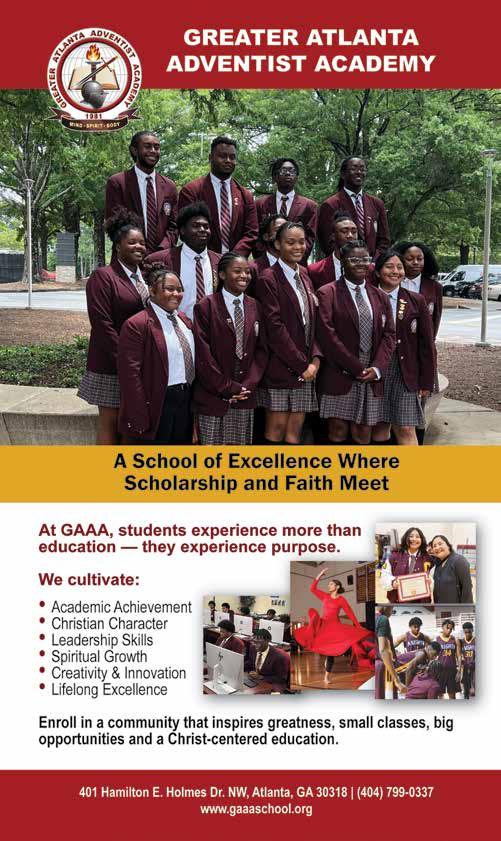
GREATER ATLANTA ADVENTIST ACADEMY
Nestled in the heart of Atlanta, Greater Atlanta Adventist Academy (GAAA) has long stood as a beacon of Christian education, purposefully shaping the minds, character, and spiritual lives of the next generation. Serving students in grades 9–12, GAAA offers a warm, nurturing, and faith-centered environment where academic rigor and spiritual development go hand in hand. Guided by the motto “Mind, Body, Excellence,” GAAA is committed to developing the whole child spiritually, intellectually, socially, emotionally, and physically, while inspiring students to reflect Christ’s character in all they do.
With intentionally small class sizes, students receive personalized attention and meaningful support within a structured, Christ-centered atmosphere that maintains high expectations and encourages leadership, confidence, and growth. GAAA’s academic program prepares students not only for graduation, but for life beyond the classroom through Dual Enrollment opportunities, participation in the GAfutures programs, and expanding careerfocused learning pathways.
The school’s innovative Technology Track provides hands-on experience in computer
applications, web design, and PC repair, culminating in opportunities to earn the nationally recognized CompTIA A+ certification. Over the years, GAAA has cultivated a legacy of producing graduates who have gone on to become artists, musicians, pilots, business owners, healthcare professionals, educators, and community leaders.
Students also thrive through a wide range of extracurricular and leadership opportunities, including National Honor Society, 4-H Club, Chess Club, United Student Movement (USM), athletics, and student government. GAAA’s growing Fine Arts program, featuring Choir, Handbells, Dance, and Drama, continues the school’s rich musical heritage while fostering creativity, confidence, and teamwork.
Weekly chapel services, spiritual retreats, worship experiences, and school-sponsored activities intentionally nurture students’ faith while building lifelong memories and friendships. At Greater Atlanta Adventist Academy, scholarship and faith truly meet inspiring students to lead, serve, achieve, and reflect Christ in every aspect of life.
Greater Atlanta Adventist Academy is located at 401 Hamilton E. Holmes Drive NW in Atlanta, GA, 30318. For more information, call 404-799-0337 or visit gaaaschool.org.
Photos by Behind the Dream
TOP ATLANTA SCHOOLS
HIGH MEADOWS SCHOOL
High Meadows School students in pre-K through eighth grade engage in wonder, discovery, and joyful learning on the school’s 42-acre campus. Its experiential approach to learning honors the magic of childhood, fostering inquiry, adventure, and play while supporting students’ academic and ethical growth.
Exploration and play are woven throughout the program, alongside a culture that nurtures prepared learners, respectful community members, and confident participants in their own educational journey. At HMS, the progressive approach to education is immediately evident.
Guided by passionate faculty, students are inspired to ask the next question, think critically, pursue what matters to them, and develop into respectful self-advocates. Through inquiry-based learning, students become reflective and motivated individuals
THE HOWARD SCHOOL
Discover The Howard School in Atlanta, where a different approach makes all the difference for students with language-based learning differences. The Howard School celebrates each child, transforming the learning experience and developing lifelong strengths.
The Howard School’s team of educators, speech-language pathologists, and literacy and math specialists delivers a tailored, strengthsbased education honoring each student’s profile while addressing challenges so students can reach their full academic potential.
For more than 75 years, Howard has combined traditional academics with research-
prepared for academic success and leadership as global citizens. Middle Years students take part in six-week mini-courses, such as avian embryology, gymnastics, and World Peace Game.
High Meadows’ renowned debate program has won 22 consecutive state championships.
HMS is an authorized International Baccalaureate World School offering the Primary Years Programme for pre-K through fifth grade.
High Meadows is located at 1055 Willeo Road in Roswell, GA, 30075. Learn more at highmeadows.org or call 770-993-2940.
by
based, scientifically proven methodologies. Small class sizes and individualized instruction create a supportive environment where students grow academically, socially, and emotionally.
Beyond the classroom, students explore a wide range of opportunities, including clubs, no-cut athletics, and no-cut theater and arts programs building confidence, discovering interests, and finding their voice.
Howard students gain the skills to understand how they learn and to advocate for themselves in college and beyond.
With rolling admissions and decisions, families have the flexibility to begin when the timing is right, without waiting for a traditional admissions cycle. Visit The Howard School to learn more today.
The Howard School is located at 1192 Foster St. NW in Atlanta, GA, 30318. Learn more at 404-377-7436 or howardschool.org
Photo
Jeff Reed
TOP ATLANTA SCHOOLS
LANDMARK CHRISTIAN SCHOOL
Choosing the right school for your child is one of the most important decisions you will make, and at Landmark Christian School, that decision comes with confidence.
Landmark partners with Christian families to provide an exceptional, Christ-centered education where every student is known, valued, and challenged to grow.
Serving more than 850 students from pre-K3 through 12th grade in Fairburn, GA, Landmark has built a close-knit learning community since 1989, with an average class size of just 18 students, ensuring your child receives the personalized attention they deserve.
Landmark's distinctive programs set graduates apart. Impact Leadership Training develops real-world servant leaders, while the Landmark Scholars program pushes students beyond standard coursework to pursue their passions and purpose.
SPRINGMONT SCHOOL
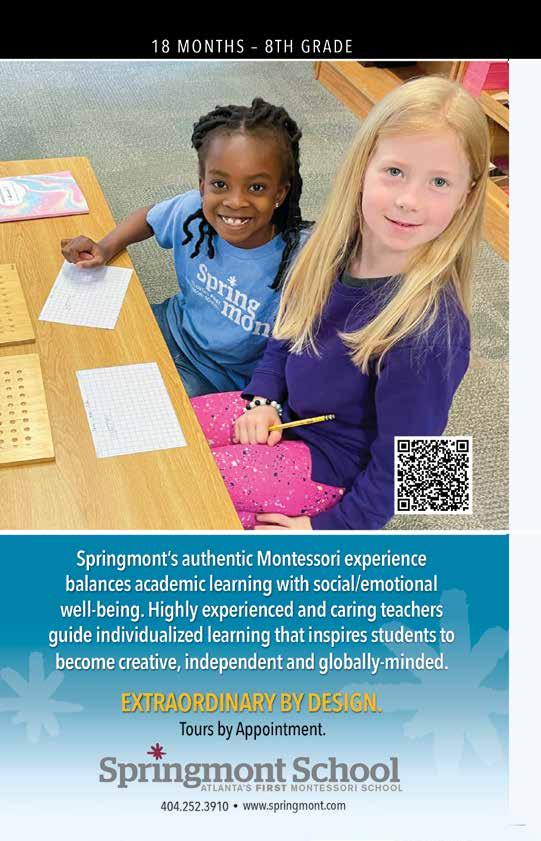
As the oldest Montessori school in the Southeast, Springmont offers students 18 months through eighth grade an authentic Montessori education. Individualized, hands-on learning is balanced with social/emotional well-being, inspiring its diverse and inclusive community of learners to become creative, independent, and globally minded.
Multi-aged classes and specially designed materials are complemented by highly
Rooted in a mission to equip college-bound students to embrace a Christ-centered worldview, every resource, program, and educator is dedicated to one goal: empowering each student to achieve their greatest potential and impact the world for Jesus Christ.
Landmark is located at 50 SE Broad St., Fairburn, GA, 30213. To learn more, call 770-306-0647 or visit landmarkchristianschool.org.
experienced and caring teachers who guide students’ curiosity toward meaningful, collaborative discoveries. Large, light-filled classrooms and a beautiful campus with natural areas, class gardens, and farm animals offer rich outdoor experiences.
Springmont’s middle school prepares students for success in Atlanta’s premier high schools and life beyond academics. Opportunities to hone time-management skills, experience active leadership roles, and work both independently and in diverse groups allow students to become engaged learners.
Springmont School is located at 5750 Long Island Drive NW, Atlanta, GA 30327. Admission tours are by appointment. Applications for the 2027-28 school year open Oct. 1 and are due Feb. 1. For more information call 404-252-3910 or visit springmont.com
TOP ATLANTA
WOODWARD ACADEMY
At Woodward Academy, ambition is met with intention. For high-achieving, forward-thinking families, Woodward offers an experience that reflects both their standards and their aspirations for their children. From pre-K through senior year, students are immersed in a dynamic environment designed to cultivate intellect, confidence, and global perspective.
Whether your child’s path is shaped in advanced STEM labs, on the stage, through competitive athletics, or in student-led ventures, Woodward offers the depth and breadth to match their potential. With 25 AP courses, 100+ clubs, a nationally respected Transition Learning Support Program, and a culture that prioritizes both excellence and character, students are known, challenged, and elevated. Beyond the classroom, meaningful experiences in global connections and service
learning ensure that students graduate accomplished, confident in who they are, and prepared for what’s next.
Each year, Woodward students earn $30+ million in scholarships and matriculate to more than 100 of the nation’s top colleges. This is more than preparation. It’s positioning your child to lead, to belong, and to thrive. Discover how your child can thrive at Woodward Academy schedule your visit today.
Woodward Academy has two locations: College Park, 404-765-4000, and Johns Creek, 404-765-4490. For more information, visit woodward.edu
5 THINGS TO KNOW: SAINT FRANCIS SCHOOL’S NEW MILTON MIDDLE SCHOOL
BY BRANDON BRYAN, Director of Admissions, Milton Campus
Families across North Atlanta are feeling it. Classrooms are full. Schools are growing. And many students are getting lost in the process. Starting in the 2026–2027 school year, Saint Francis School is expanding its Middle School (grades 6-8) to its 47-acre Milton campus, offering families a more personal path forward.
1. Students Are Known, Not Overlooked
With small class sizes, teachers truly know and understand how each student learns. Instead of being one of many, students are seen, heard, and valued every day.
2. Students Are Taught How to Learn
Beyond academics, students build skills in organization, time management, and study habits that carry into high school and beyond. This gives students a clear process they can rely on, not just information they’re expected to memorize.
3. Support Is Built Into the Day
Daily study sessions and guided support replace the need for outside tutoring, helping students stay on track without added pressure at home. Parents gain peace of mind knowing their child is getting help in real time, not falling behind after the school day ends.
4. Confidence Comes Back
When students start to understand the material, they begin to participate, take ownership, and believe in themselves again.
That confidence often shows up quickly: in the classroom, at home, and in their growing sense of self.
5. Big Opportunities, Small-School Feel
From athletics and robotics to fine arts and advanced academics, students experience a full campus experience without the chaos of a large school. They get access to highlevel opportunities while still being part of a close, supportive community.
As schools continue to grow, more families are searching for an environment where their child is truly known, challenged, and supported. The Milton expansion brings that opportunity closer to home.
Saint Francis School’s Milton campus is located at 13440 Cogburn Road, Milton, GA, 30004. For more information, please call 678-339-9989 or visit saintfrancisschools.com
area map
REGIONS FOR INDEPENDENT SCHOOLS N
For features of independent schools, turn to Education At a Glance on pg. 44. For public school system information by county, turn to pg. 79.
3 3
2
2
1 1
5 5
Education At a Glance
47
REGION 1: ATLANTA NORTH/NORTHWEST
REGION 2: ATLANTA NORTH/NORTHEAST
Education At a Glance
INDEPENDENT SCHOOLS
64 REGION 4: ATLANTA SOUTH/SOUTHEAST/SOUTHWEST
REGION 5: ATLANTA WEST
Education At a Glance
This information reflects the latest available data at publication time. Please confirm with each individual school.
INDEPENDENT SCHOOLS
*KEY:
Religious Affiliation: B = Baptist C = Christian
CC = Catholic E = Episcopal J = Jewish JC = Judeo-Christian
ND = Non-denominational P = Presbyterian
S = Seventh-day Adventist
REGION 1
Independent Schools
NEIGHBORHOODS OF NOTE
Marietta Beautiful parks, charming streets, 19th-century Victorian homes and historic sites make Marietta a desirable place to call home. Residents enjoy the vibrant downtown square, with its many restaurants, antique shops and happenings.
Woodstock Located in Cherokee County, Woodstock is, as locals say, “where modern amenities meet old Southern charm.” Historic Olde Towne pays a continual tribute to Woodstock’s pioneers through vintage shops and good old-fashioned Southern hospitality.
BUCKHEAD
BUCKHEAD
CHASTAIN PARK • BUCKHEAD
ROSWELL • EAST COBB
ROSWELL
Independent Schools
REGION
NEIGHBORHOODS OF NOTE
Alpharetta Offering exceptional shopping, entertainment and dining, Alpharetta also boasts many awardwinning parks and numerous housing options.The city is also home to a 12,000-seat outdoor concert venue, the Verizon Wireless Amphitheatre.
Chamblee This DeKalb County suburb attracts diverse residents, thanks to its International Village, a 394-acre neighborhood that is home to people representing more than 30 countries. Chamblee’s Antique Row is the South’s largest antiques area.
Independent Schools
NEIGHBORHOODS OF NOTE
Decatur A great mix of history and modernity, Decatur is home to more than 200 shops, restaurants, galleries and performance venues located along tree-lined streets. Events take place throughout the year at the city’s historic downtown square.
Stone Mountain With a revitalized downtown and a variety of family oriented activities, Stone Mountain has much to offer. The city’s four city parks, as well as Stone Mountain Park, make this one of the cleanest and “greenest” areas in Metro Atlanta.
ATHENS
COLLINS HILL • DECATUR
DACULA
EDGEWOOD • DRUID HILLS
LOGANVILLE
LOGANVILLE • MONROE
Independent Schools
NEIGHBORHOODS OF NOTE
East Point The up-and-coming East Point area combines the charm of a small town with conveniences of a big city. Residents enjoy the city’s prime location near the Hartsfield-Jackson Atlanta International Airport, MARTA and Downtown Atlanta.
Fairburn Less than half an hour from Atlanta, Fairburn is filled with historic buildings and boasts a peaceful, smalltown atmosphere. The city is home to the annual Georgia Renaissance Festival and the local campus of Georgia Military College.
EAGLES LANDING
FAYETTEVILLE • LOCUST GROVE
Independent Schools
FULTON
NEIGHBORHOODS OF NOTE
Acworth Just 35 miles northwest of Atlanta, Acworth is convenient to the city while offering its own unique smalltown appeal. Its historic downtown is a charming mixture of past and present. Surrounded by Lake Acworth and Lake Allatoona, this thriving city is a popular destination for fishing, boating and many other recreational activities.
Douglasville A quick trip west of Atlanta on I-20, Douglasville has easy access to all that Atlanta offers—including Six Flags, 10 minutes away—but plenty of its own charm, too. Listed on the National Register of Historic Places, Downtown Douglasville’s historic district is an outstanding example of a turn-ofthe-century southern railroad town.
ATLANTA WEST
COLLIER HEIGHTS
BUCKHEAD
POWDER SPRINGS • KENNESAW
There are many benefits of a boarding school education. Boarding schools are an option for students seeking a more independent learning experience. Because students generally live on campus, learning takes place in and out of the classroom almost on a 24-hour basis.
When selecting a boarding school, it is important to visit the school campus, but representatives from many boarding schools visit Metro Atlanta throughout the year—contact each school for specific dates.
Boarding Schools
SOUTHERN ILLINOIS • GEORGIA
WEST VIRGINIA • VIRGINIA
SPOTLIGHT ON METRO ATLANTA’S SCHOOL SYSTEMS
Avariety of improvements and innovative programs in Georgia’s public school systems have resulted in many stellar elementary, middle and high schools across the metro area. Different school systems feature specialized programs and academic opportunities, such as magnet, charter, vocational or alternative schools, to suit their respective students, parents and communities. However, despite variations in programming and academic offerings, all public schools must offer instruction aligned with standards approved by the Georgia Board of Education. Here is a county-by-county guide to metro Atlanta’s public school systems. For more information about the Georgia Department of Education, call 404-656-2800 or visit gadoe.org. u
CHARTER SCHOOLS
CHARTER SCHOOLS
CHARTER SCHOOLS
BARTOW
Board of Education
770-606-5800
bartow.k12.ga.us
CHEROKEE
Board of Education
770-479-1871
cherokeek12.net
CLAYTON
Board of Education
770-473-2700
clayton.k12.ga.us
Total
2025 Mean Georgia Milestone Scores:
3rd: (ELA) 496 (M) 521
5th: (ELA) 515 (M) 522
8th: (ELA) 514 (M) 537
2025 Average SAT: 1030
Top 3 Schools by Average
2025 SAT Score
Adairsville High 1068
Woodland High 1036
Cass High 987
What’s New: Lindsay Perry returns to Cass Middle School as its new principal, bringing 17 years of experience serving the Bartow County School System.
Total # of Students:
2025 Mean Georgia Milestone Scores:
3rd: (ELA) 510 (M) 531
5th: (ELA) 528 (M) 538
8th: (ELA) 523 (M) 546
2025 Average SAT: 1085
Top 5 Schools by Average 2025 SAT Score Sequoyah High 1113
Creekview High 1108
River Ridge High 1081
Woodstock High 1079
Etowah High 1072
What’s New: 2026 is the first year for Cherokee High School’s new location on Dr. Martin Luthor King Jr. Blvd. in Canton. Woodstock High school added a new 20-classroom, three-story building to its campus.
2025 Mean Georgia Milestone Scores:
3rd: (ELA) 470 (M) 496
5th: (ELA) 490 (M) 485
8th: (ELA) 493 (M) 500
2025 Average SAT: 888
Top 5 Schools by Average
2025 SAT Score
Elite Scholars Academy 1125
M. E. Stilwell School of the Arts 1020
Morrow High 969
Mundy’s Mill 927
Riverdale 906
PUBLIC SCHOOL COUNTY GUIDE
What’s New: In April, CCPS celebrated the opening of the Arena at Southlake, which will host graduations and other events.
COBB
Board of Education 770-426-3300 cobbk12.org
COWETA
Board of Education 770-254-2800 cowetaschools.net
DEKALB
Board of Education
678-676-1200 dekalbschoolsga.org
2025 Mean Georgia Milestone Scores:
3rd: (ELA) 513 (M) 528
5th: (ELA) 523 (M) 524
8th: (ELA) 524 (M) 537
2025 Average SAT: 1116
Top 5 Schools by Average 2025 SAT Score
Walton High 1260
Lassiter High 1206
Wheeler High 1191
Pope High 1185
Kennesaw Mtn. High School 1150
What’s New: The Wheeler Wildcat Boys Basketball team brought home the state championship trophy for the 11th time in school history.
2025 Mean Georgia Milestone Scores:
3rd: (ELA) 512 (M) 528
5th: (ELA) 521 (M) 525
8th: (ELA) 521 (M) 525
2025 Average SAT: 926
Top 3 Schools by Average 2025 SAT Score
Northgate High 1107
East Coweta High 1071
Total # of Students: 22,922 Student
Newnan High 1053
What’s New: The Coweta County School System earned a six-year reaccreditation with “Merit” from Cognia—one of the accreditation agency’s highest effectiveness ratings.
2025 Mean Georgia Milestone Scores:
3rd: (ELA) 486 (M) 508
5th: (ELA) 502 (M) 501
8th: (ELA) 498 (M) 508
2025 Average SAT: 934
Top 5 Schools by Average 2025 SAT Score
Total # of Students: 90,265
DeKalb Early Coll. Acad. 1158
Chamblee Charter 1120
DeKalb School of the Arts 1097
Druid Hills High 1053
Lakeside High 1041
What’s New: DeKalb County’s 2025 Career, Technical & Agricultural Education (CTAE) graduates achieved a 98% graduation rate. Arabia Mountain, Redan, and Tapestry Charter Schools led the district with 100% CTAE graduation rates.
DOUGLAS
Board of Education
770-651-2000 dcssga.org
Board of Education
770-460-3990
fcboe.org
FORSYTH
Board of Education
770-887-2461
forsyth.k12.ga.us
Total # of Students: 24,796
Student Spending: $12,524
2025 Mean Georgia Milestone Scores:
3rd: (ELA) 490 (M) 510
5th: (ELA) 511 (M) 506
8th: (ELA) 508 (M) 513
2025 Average SAT: 998
Top 5 Schools by Average
2025 SAT Score
Alexander High 1042
Douglas County High 998
Chapel Hill High 995
Lithia Springs High 971
New Manchester High 963
What’s New: Alexander High’s Cougars Boys Basketball team had a historic season, finishing with a record 30 wins—including its last 25 straight games—and winning its second state title in four years.
2025 Mean Georgia Milestone Scores:
3rd: (ELA) 536 (M) 545
5th: (ELA) 543 (M) 547
8th: (ELA) 549 (M) 565
2025 Average SAT: 1124
Top 5 Schools by Average
Total # of Students:
Student Spending: $13,940
2025 SAT Score
Starr’s Mill High 1175
McIntosh High 1171
Whitewater High 1125
Fayette County High 1046
Sandy Creek High 1041
What’s New: Fayette County High Athletic Director Ashley Lott was named the overall Class 3A Athletic Director of the Year and the Region 2-AAA winner by the Georgia Athletic Directors Association.
2025 Mean Georgia Milestone Scores:
3rd: (ELA) 528 (M) 551
5th: (ELA) 543 (M) 562
8th: (ELA) 541 (M) 569
2025 Average SAT: 1178
Top 5 Schools by Average
2025 SAT Score
Total
Alliance Academy 1282
Lambert High 1235
South Forsyth High 1226
Denmark High 1190
Forsyth Central 1138
What’s New: The Forsyth County Schools Board of Education approved an agreement with BusRight, Inc. to enhance the district’s school bus transportation system. The system includes a parent communication app that allows families to view live estimated arrival times for their child’s bus.
PUBLIC SCHOOL COUNTY GUIDE
DOUGLAS
Board of Education 470-254-3600 fultonschools.org
GRIFFINSPALDING
Board of Education 770-229-3700 gscs.org
Board of Education
678-301-6000 gcpsk12.org
Number of Schools Elementary 57 Middle 19
Total # of Students: 85,592
Student Spending: $16,360
2025 Mean Georgia Milestone Scores:
3rd: (ELA) 523 (M) 539
5th: (ELA) 536 (M) 534
8th: (ELA) 530 (M) 538
2025 Average SAT: 1076
Top 5 Schools by Average 2025 SAT Score Northview High 1254 Johns Creek High 1212
Alpharetta High 1207
Cambridge High 1153
Milton High 1141
What’s New: The Tri-Cities High School Dance Team earned the Georgia High School Association (GHSA) State Championship in the 3A–5A Hip Hop division at the state championships in Athens for the second year in a row.
Number of Schools
2025 Mean Georgia Milestone Scores:
3rd: (ELA) 472 (M) 496
5th: (ELA) 496 (M) 492
8th: (ELA) 494 (M) 509
2025 Average SAT: 962
Total # of Students: 8,987 Student
Top 2 Schools by Average 2025 SAT Score
969
957
What’s New: Dr. Donald Warren, previously the district’s interim superintendent, was officially named superintendent in January. Moreland Road Elementary has been certified as a Leader in Me Lighthouse School by FranklinCovey Education in recognition of the school’s outstanding results in school and student outcomes.
2025 Mean Georgia Milestone Scores:
3rd: (ELA) 504 (M) 525
5th: (ELA) 522 (M) 525 8th: (ELA) 520 (M) 544
2025 Average SAT: 1003
Top 5 Schools by Average 2025 SAT Score
Gwinnett School of Math, Science, and Technology 1360 North Gwinnett High 1165
Total # of
Brookwood High 1089
Mill Creek High 1064
Paul Duke STEM High 1044
What’s New: Dr. Alexandra Estrella was named was named the district’s new superintendent, bringing more than 26 years of experience as an educator and school system leader.
Number
Board of Education
770-534-1080 hallco.org
HENRY
Board of Education
770-957-6601
henry.k12.ga.us
PAULDING
Board of Education
770-443-8000
paulding.k12.ga.us
Total # of Students:
Student
2025 Mean Georgia Milestone Scores:
3rd: (ELA) 490 (M) 515
5th: (ELA) 501 (M) 506
8th: (ELA) 499 (M) 527
2025 Average SAT: 1043
Top 5 Schools by Average
2025 SAT Score
North Hall High 1083
Cherokee Bluff High 1056
Flowery Branch High 1054
Chestatee High 1049
Johnson High 1022
What’s New: The Johnson High School HOSA chapter earned Gold Elite Chapter Status, an honor achieved by only three chapters in the state.
2025 Mean Georgia Milestone Scores:
3rd: (ELA) 491 (M) 509
5th: (ELA) 505 (M) 497
8th: (ELA) 504 (M) 501
2025 Average SAT: 986
Top 5 Schools by Average
PUBLIC SCHOOL COUNTY GUIDE
Total # of Students:
2025 SAT Score
Union Grove 1070
Ola High 1038
Woodland High 1006
Locust Grove High 980 Dutchtown 972
What’s New: The Henry County Board of Education approved a new community service graduation requirement beginning with the class of 2028.
2025 Mean Georgia Milestone Scores:
3rd: (ELA) 501 (M) 522
5th: (ELA) 513 (M) 514
8th: (ELA) 513 (M) 524
2025 Average SAT: 962
Top 5 Schools by Average
Total # of Students:
2025 SAT Score
North Paulding 1054
Paulding County High 1054
South Paulding High 1026
East Paulding High 1016 Hiram High 1005
What’s New: All 34 schools in the Paulding County School District were awarded the Ready Georgia Seal of Preparedness for the 2025-2026 school year. Applications were reviewed by representatives from the Georgia Department of Education, Georgia Emergency Management and Homeland Security Agency, and other agencies.
HALL
PUBLIC SCHOOL COUNTY
ROCKDALE
ROCKDALE
Board of Education
770-483-4713
rockdaleschools.org
ATLANTA PUBLIC SCHOOLS
BUFORD CITY SCHOOLS
Number of Schools
2025 Mean Georgia Milestone Scores:
3rd: (ELA) 480 (M) 497
5th: (ELA) 498 (M) 490
8th: (ELA) 503 (M) 505
2025 Average SAT: 995
Top 3 Schools by Average 2025 SAT Score
Rockdale High 1032
Total # of Students: 14,722
Student Spending: $14,611
Heritage High 984
Salem High 924
What’s New: Rockdale County Public Schools was recently awarded more than $1.5 million by the Arthur M. Blank Family Foundation to help alleviate the cost for students to participate in boys and girls soccer, girls flag football, and other sports.
Board of Education
404-802-3500
atlantapublicschools.us Number of Schools
Total # of Students: 49,558
Student Spending: $25,042
2025 Mean Georgia Milestone Scores:
3rd: (ELA) 500 (M) 517
5th: (ELA) 509 (M) 506
8th: (ELA) 503 (M) 512
2025 Average SAT: 939
Top 5 Schools by Average 2025 SAT Score Atlanta Classical Academy 1245 Midtown High 1151 North Atlanta High 1027 Maynard Holbrook Jackson High 938 KIPP Atlanta Collegiate Academy 914
What’s New: Atlanta Public Schools, which serves approximately 50,000 students and their families, has received the 2026 Gallup Exceptional Workplace Award. This award recognizes workplace cultures that achieve more by helping employees focus on what they do best.
Board of Education
770-945-5035 bufordcityschools.org
Number of Schools
Elementary (K-1) 1 1st-3rd Grade Academy 1 4th-5th Grade Academy 1 Middle 1 High 1
Total # of Students: 6,048
Student Spending: $13,496
2025 Mean Georgia Milestone Scores:
3rd: (ELA) 531 (M) 547
5th: (ELA) 540 (M) 545
8th: (ELA) 552 (M) 580
2025 Average SAT: 1136
What’s New: Buford High School’s football team, the Wolves, won the 2025 GHSA Class 6A State Championship, defeating Carrollton 28–21 on Dec. 16, to finish an undefeated 15-0 season and secure their 15th state title.
CITY SCHOOLS OF DECATUR
Board of Education
404-371-3601
csdecatur.net
Total # of Students: 5,262
Student Spending: $17,603
2025 Mean Georgia Milestone Scores:
3rd: (ELA) 548 (M) 554
5th: (ELA) 562 (M) 567
8th: (ELA) 560 (M) 578
2025 Average SAT: 1181
What’s New: Decatur High School’s class of 2025 earned an average SAT score of 1181, placing City Schools of Decatur first among all public school districts in Georgia. The class of 2025 also earned an average ACT score of 24.6, the second-highest among all participating public school districts in the state.
GAINESVILLE CITY SCHOOLS
Board of Education
770-536-5275
gcssk12.net Number of Schools
Total # of Students:
8,254
Student Spending:
$13,910
2025 Mean Georgia Milestone Scores:
3rd: (ELA) 477 (M) 504
5th: (ELA) 497 (M) 498
8th: (ELA) 488 (M) 496
2025 Average SAT: 1017
What’s New: Aerin Durkin, gifted coordinator at Enota Multiple Intelligences Academy, was recently named the Georgia Association for Gifted Children’s 2026 teacher of the year. The award honors educators who demonstrate “exceptional commitment to the needs of gifted learners, innovative teaching practices, and leadership within the field of gifted education.”
MARIETTA CITY SCHOOLS
Board of Education
770-422-3500
marietta-city.org
Total # of Students:
8,513
Student Spending: $18,183
2025 Mean Georgia Milestone Scores:
3rd: (ELA) 515 (M) 529
5th: (ELA) 528 (M) 534
8th: (ELA) 513 (M) 529
2025 Average SAT: 1083
What’s New: The Georgia School Boards Association has named the Marietta City Schools Board of Education the 2025 Governance Team of the Year. This honor is awarded annually to a single system in Georgia that demonstrates the highest standards of school system leadership.