We gratefully thank our advertisers for their support of Atlanta School Guide
Publisher/President
PATRICK KILLAM Editor
EVERETT CATTS
Marketing & Promotions
JEFF THOMPSON
Account Directors
MARIA ALEXANDER
BRIAN PICHOT
Contributing Writers
ANNA BENTLEY, MICHELLE BOURG, KARIN PENDLEY KOSER
Metro Atlanta Area Map
To search for independent schools by region or neighborhood, turn to page 28 and use the color-coded map to direct you to each region’s page number.
Education At a Glance
To find a school or resource by name, turn to the advertiser index on page 82 to find the appropriate page number. 1 2 3 4
Once you’ve selected your region of interest, the charts beginning on page 30 include a comparison of features for each school in that region, along with the page number for each school’s ad.
Region Maps and Listings
Divided into regions of Atlanta, the color-coded maps beginning on page 33 provide each school’s location and page number for their ad.
Advertiser Index
TO ADVERTISE CALL 770-992-0273
Space closing for Winter/Spring 2022 issue: October 11, 2021
For additional copies, further information or advertising, please contact:
KILLAM PUBLISHING, INC. P: 770-992-0273 F: 844-706-1545
info@killampublishing.com AtlantaSchoolGuide.com
Alpharetta’s Premier Preschool
At Oak Grove Academy, we create a safe and nurturing environment where children thrive. Your child will benefit from:
• Newly renovated campus designed to enhance safety and learning
• STREAM program prepares young learners for future academic success
• Curriculum based on “The Four Cs:” critical thinking, communication, collaboration and creativity
• Highly trained educators experienced in nurturing children emotionally and intellectually
• Adaptable nutrition program with organic and wholesome ingredients
3460 Francis Road Alpharetta, GA 30004 (770) 874-8498
Cliff Valley Campus
1970 Cliff Valley Way NE Atlanta, GA 30329
404-602-0553
Our respectful and peaceful Montessori environments are thoughtfully designed to develop the whole child from infancy through middle school.
• AMI-accredited, child-centered Montessori curriculum individually tailored and focused on fostering independence
• Traditional Montessori materials used to develop sensorial, language, math and practical life skills
• Global awareness cultivated by our enriching Cultural Studies program
• A strong sense of community and excellent communication with parents
• Low student-to-teacher ratios and passionate, AMI-certified teachers
Druid Hills Campus
1215 South Ponce De Leon Ave NE Atlanta, GA 30306
404-531-2067
Serving students ages 8 weeks through 15 years. Accredited by the Association Montessori Internationale (AMI), AdvancED (SACS CASI) and Bright from the Start.
For more information, visit www.amischool.com
communities the companies serve or who plan to pursue majors or careers the companies want to encourage.
APS Adds Half-Hour to School Day
Elementary school students at Atlanta Public Schools will attend class for an extra 30 minutes when the 2021-22 academic year begins on Aug. 5. Officials say the additional instruction time is needed to help students who struggled during the pandemic.
Woodward Wrestlers Win National Titles
Two members of Woodward Academy’s wrestling
team finished as National Champions during the recent National High School Coaches Association High School Nationals Tournament in Virginia Beach, Va. Matthew Singleton won the National title, while Michael Kilic took home the junior national title and Gunner Filipowicz finished as national runner-up in the junior division. Additionally, Robby DeHaven finished third in the middle school division.
Atlanta School to Plant Community Garden Atlanta hip-hop duo EarthGang, comprised of Olu (Johnny Venus) and WowGr8 (Elan Parker), and
Jean Childs Young Middle School announced plans to create a community garden at the school during a ceremony on Earth Day, April 22. The duo contributed $10,000 to help fund the garden.
Atlanta Senior Offered $2.2 Million in Scholarships
Kamryn Stargell, a senior at North Atlanta High School, has been accepted into more than two dozen universities and offered over $2.2 million in scholarships. Stargell, who hopes to study biomedical engineering or biology, intends to attend medical school after graduating from college.
Education 101
Terms to Know in Your Search for the Right Educational Experience for Your Child
CHARTER SCHOOL A tax-supported public school that is independently run, allowing for greater educational choice for parents in the community.
EXPERIENTIAL LEARNING An educational approach using applied, hands-on methods of learning.
INTERNATIONAL BACCALAUREATE (IB) A specifically designed comprehensive academic program emphasizing traditional disciplines while instilling a global perspective in its students.
MAGNET SCHOOL A public school that offers a specific or enhanced curriculum designed for students of special interest or ability.
MONTESSORI A school following the principles developed by Dr. Maria Montessori, focusing on the unique individuality, self-reliance and independence of children.
SPECIAL NEEDS A school or program for children who have mild to moderate learning differences. It usually features smaller class sizes, individualized attention and multisensory learning methods.
ACCREDITATION Official certification that guarantees a school provides an education of a reasonably high quality. Schools must prove levels of quality and maintain continuous standards of improvement.
ACT An alternative to the SAT, this national college admissions examination consists of subject area tests in English, mathematics, reading and science, with an optional 40-minute writing test.
COLLEGE AND CAREER READY PER-
FORMANCE INDEX (CCRPI) A school improvement, accountability and communication platform for all educational stakeholders that will prepare all Georgia public
EARLY CHILDHOOD EDUCATION
Education that applies to children from birth to age 8, focusing specifically on their development, including physical, emotional, sensory, communicative, cognitive and social needs.
EVERY STUDENT SUCCEEDS ACT
(ESSA) The main federal law for K-12 general education covers all students in public schools.
GEORGIA MILESTONES Tests designed to measure how well students in grades 3 through 12 acquire the skills and knowledge outlined in the state-adopted content standards. They replaced the CRCT and involve both multiplechoice and free-response questions.
GEORGIA PERFORMANCE
STANDARDS Statewide standards of academic content for all subjects K-12, to which every school must adhere and on which students are annually tested.
Funded by the Georgia Lottery, this is a scholarship in the state that rewards academically achieving students with financial assistance to attend eligible
public and private Georgia colleges and universities.
MISSION/PHILOSOPHY A statement outlining the guidelines a school follows as it works to achieve its various educational goals and/or maintain its performance standards.
NOTIFICATION DEADLINE
The date by which an independent school notifies families of the acceptance of a child for enrollment to the school.
OPEN HOUSE An event held at a school where parents can learn more about the school and its offerings.
PSAT A standardized test that offers students practice for the SAT Reasoning Test and allows them to qualify for the National Merit Scholarship Program
REPLY DEADLINE The date by which parents must notify an accepting school of their commitment to enroll their child at the school.
SAT This standardized test measures the critical thinking, writing and mathematical reasoning skills of students planning to attend college.
SECONDARY SCHOOL ADMISSIONS
Did You Know?
Georgia's average SAT score in 2020 was 1043, five points below the previous year’s score of 1048.
TEST (SSAT) The admissions test that many independent schools require students take in order to be considered for enrollment.
SUMMER CAMP A common destination for children and teenagers during the summer, at which they can participate in a variety of activities or classes.
Deciphering Associations and Organizations
Many local and national organizations work to improve summer camps and public and private schools by identifying those that meet certain standards through accreditation. These groups also set policies and offer services to city and state educational communities. The following are just some of the associations and organizations you should know.
The Association of Boarding Schools (TABS) boardingschools.com
Serves the development needs of boarding schools and provides information to potential students and their families.
Association Montessori Internationale (AMI) ami-global.org
Provides support, training and development to Montessori schools.
Atlanta Area Association of Independent Schools (AAAIS) aaais.org Promotes standards and
best practices for Atlanta’s accredited independent schools.
Cognia cognia.org
Advances education excellence through accreditation and school improvement initiatives.
Department of Education (DOE) gadoe.org
The governing body for the Georgia public school system for grades K-12.
Georgia Association of Christian Schools (GACS) gacs.org
Uses indicators of quality, voluntary self-improvement and peer review to measure Christian school performance.
Georgia Association of Private Schools for Exceptional Children (GAPSEC) gapsec.org
Shares information about programs at independent schools for students with learning disabilities.
Georgia Independent School Association (GISA) gisaschools.org
Serves the professional growth, advocacy and interscholastic needs of member schools.
Southern Association of Colleges and Schools (SACS) sacs.org
The recognized regional accrediting body for public and private schools in the 11 U.S. Southern states.
Southern Association of Independent Schools (SAIS) sais.org
Provides accreditation, professional growth and leadership development for independent U.S. schools
For more information about these and other organizations and associations that ensure quality education among camps and schools, visit the websites of the Georgia Department of Education (gadoe.org) or the U.S. Department of Education (ed.gov).
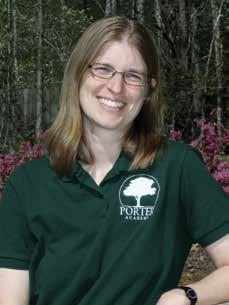
Lynn Schoeneck,
Head of School, Porter Academy
Lynn Schoeneck has been part of the Porter Academy community since 2004, starting as a classroom teacher. She earned her bachelor’s degree with honors in psychology from Wake Forest University and her master’s degree in occupational therapy from UNC at Chapel Hill. She is certified and licensed to practice occupational therapy and has attended continuing education courses.
What is your educational philosophy?
Any child can learn if they feel safe and are given the appropriate tools. A child needs the self-confidence and trust in those around them to be willing to take the risks involved in learning, knowing that their value as a person is not diminished if they struggle.
What do you love most about your job?
I not only have the privilege of being head of school, but I also serve as the students’ occupational therapist. I work with every child, every day, allowing me to develop a “ground floor” perspective. It brings me so much joy to truly know each child and see their growth.
How can parents best contribute to the education process?
Parents can best support their children’s education by supporting the positive relationships that the teachers are working to form with their children.
How is the field of education changing?
To succeed in today’s rapidly evolving world, children need to learn to be strong collaborators, communicators and innovators.
What advice would you offer parents about their children’s education?
Don’t power struggle over school expectations. If your child is resisting doing their homework, let the teachers respond accordingly. Take that pressure off your-
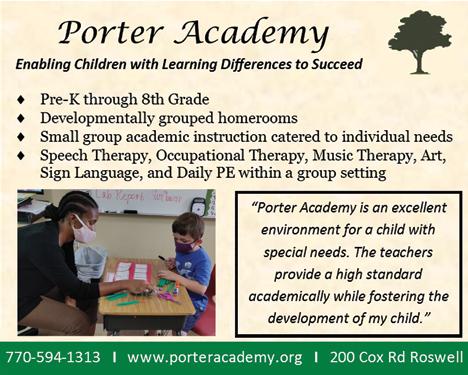
PORTER ACADEMY
Emphasis: Porter Academy is dedicated to educating children with learning or developmental differences by utilizing individualized programs.
Year Founded: 2000
Grades: Pre-K-8
Students: 64
Avg. Class Size: 12
Tuition Range: $20,467 - $21,301
Accreditations or Affiliations: SAIS, AdvancED, GAC, GISA, GAPSEC, AAAIS
Location: 200 Cox Road, Roswell, GA 30075
Contact: 770-594-1313, porteracademy.org
room setting. Others may teach average or even above-average learners while also offering additional programs and classes for students with learning differences.
How to Tell if Your Child Has a Special Needs Situation
First, it’s important to identify your child’s specific challenges. Students who exhibit average or above-average intelligence but often seem distracted and don’t perform well in a traditional classroom setting may be struggling with dyslexia, Asperger’s syndrome, ADHD or some other disorder that affects their ability to learn effectively. Also, disruptive or aggressive children may be exhibiting frustration brought on by a learning disability.
If you suspect your child may have a learning dis-
ability, it’s critical to have him or her evaluated by a mental health professional. A diagnosis is necessary in order to address the child’s educational needs.
After a Diagnosis: What’s Next?
A professional evaluation is crucial in order to evaluate your child’s educational needs.
If your child is diagnosed with a learning disability and attends public school, talk with the principal, school counselor or another administrator about developing an Individualized Education Program (IEP). All public schools are required to create an IEP for students with learning disabilities who meet special education requirements. An IEP is a document that specifies your child’s learning situation and educational needs and outlines a course of action for teachers and other professionals to follow to help make sure your child learns to the best of his or her ability.
If you feel your local public school isn’t the right environment for your child or simply want to explore all your options, there are many quality independent schools in metro Atlanta devoted to helping children with special needs and learning issues. Visit the Georgia Association of Private Schools for Exceptional Children’s website (gapsec.org) or our listings for special needs schools on page 82 to help you with your search.
How Do I Find the Right School?
All special needs schools are not the same. The first step is to identify those schools that can address your child’s specific learning difficulty, and offer the level of special needs instruction that you (and perhaps a professional) feel is best for your child.
You may be more comfortable enrolling your child in a school that focuses specifically on his or her needs, or you may want a more diverse environment where he or she can interact with many different kinds of students. Familiarize yourself with the different options offered by each kind of school.
Traditional independent schools that offer special needs programs as part of a larger curriculum can offer that kind of environment, but may have larger class sizes than schools that specialize in specific learning disabilities. These kinds of schools may also focus more on academics than on the therapeutic aspects of special
needs education. Independent special needs schools can offer more individualized instruction and a more structured and predictable environment, and are likely to address nonacademic issues such as social skills and self-esteem.
As you begin searching for the right school for your child’s situation, here are some questions to keep in mind:
• Will your child fare better in a school that focuses on his or her specific learning disability, or would you rather that he or she be able to interact with students with a wide range of learning capabilities?
• Does the school serve a specific age range or work with students on all grade levels? Many students with learning disabilities have trouble transitioning to new schools.
Identify those schools that can best address your child’s specific learning
Critical Communication
• Does the school offer a variety of extracurricular activities, including arts and sports programs?
• Is the school accredited? If so, by which organizations?
• Is the staff certified to instruct special needs children or those with your child’s specific learning difficulty?
• Does the school focus more on academics or on addressing the child’s therapeutic needs?
Financial Assistance
Many independent special needs schools participate in the Georgia Special Needs Scholarship program (GSNS), a school choice program available to special needs students attending Georgia public schools. It offers funds to offset tuition and
fees at participating private schools authorized by the State Board of Education. According to the Georgia Department of Education, scholarship amounts range from $2,500 to $13,500, with an average amount of around $6,000.
The Qualified Education Expense Tax Credit program provides another scholarship option. Donations are made to an organization known as a Georgia Student Scholarship Organization (GaSSO), which uses the money to award scholarships to students in pre-K through grade 12. Many schools also offer their own scholarships or tuition assistance programs as well. Contact individual schools for details.
For more information on special needs schools and resources, please see our listings on page 82.
Is Private School
Best for Your Child?
BY KARIN PENDLEY KOSER
THE MANY BENEFITS OF AN INDEPENDENT EDUCATION
Deciding how their children will be educated is a major concern for most Atlanta parents, sometimes starting as early as pregnancy, when some place their children on daycare waiting lists before they’re even born. Some parents purchase their homes in communities known for their excellent public schools, while others hope for the best in their existing neighborhoods.
For many parents, the answer lies in one of metro Atlanta’s abundant independent schools. Whether they’re looking for a strong religious foundation, an alternative approach to education or a proven track record of academic success, these parents have seemingly limitless options.
Choices range from established larger schools such as The Westminster Schools and Woodward Academy to smaller cam-
puses incorporating Montessori and other alternative learning methods to faith-based schools of all sizes and denominations.
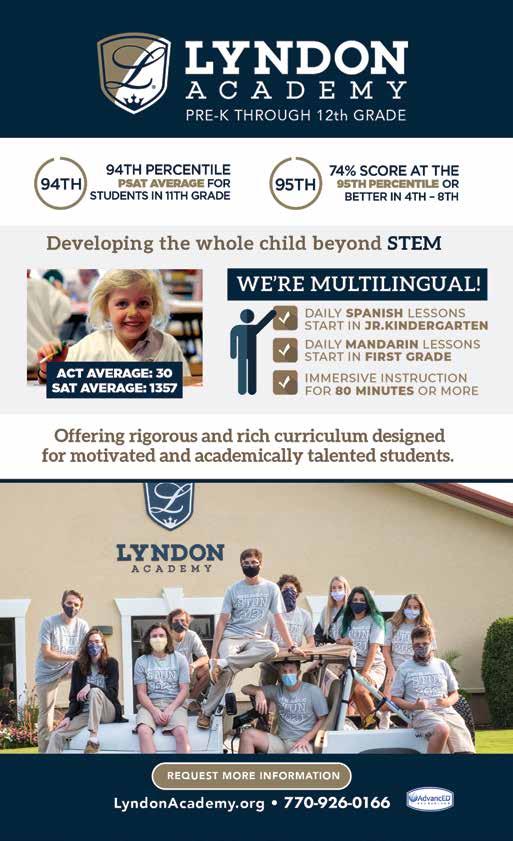
The average tuition for independent schools in Georgia is $9,300 for elementary schools and $10,050 for secondary schools, according to educationdata.org. Those costs allow independent schools to offer opportunities that aren’t always available in public schools, says Shanna Rein, director of admissions and parent and student relations at Lyndon Academy.
“Tuition at Lyndon Academy includes before- and after-school tutoring and an enrichment period which allows students even more opportunity to interact with their teachers and to receive additional support,” she says.
When considering the cost of an independent school education, parents should also make sure to factor in such ancillary costs as school uniforms, transportation, and extracurricular and off-campus activities.
SMALLER CLASSES
Parents choose independent schools for a variety of reasons. Some prefer that religion is included in their child’s education. “I like the spiritual grounding that a Catholic school offers,” says Decatur mom Lori Veden Brown, who has two daughters at St. Pius X Catholic School.
Others simply like the chance for more individualized attention than an independent school can offer. While metro Atlanta public schools can have as many as 35 or 40 students in a class led by one teacher, independent schools typically offer smaller class sizes.
“For parents contemplating whether to send their children to a private school, a great place to start is by considering a school’s average class size and student-
WHEN CONSIDERING THE COST OF AN INDEPENDENT SCHOOL EDUCATION, PARENTS SHOULD ALSO MAKE SURE TO FACTOR IN SUCH ANCILLARY COSTS
AS SCHOOL UNIFORMS, TRANSPORTATION, AND EXTRACURRICULAR AND OFF-CAMPUS ACTIVITIES.
to-teacher ratio alongside the range of programs and opportunities offered,” says Marcia Prewitt Spiller, Woodward’s senior vice president for academic and student life.
Woodward offers five schools on two campuses with an average class size of 14 and a student-teacher ratio of six to one.
“Small class sizes allow teachers to be flexible in the classroom and change things up if a particular lesson isn’t resonating,”
Prewitt Spiller says. “With fewer students, classroom management becomes far less of an issue and the ‘organized chaos’ of onthe-ground problem-solving is allowed to thrive. This environment breeds innovation, creativity and critical thinking around realworld problems—all necessary for students to be successful in today’s world.”
Meghan Stauts, director of marketing and communications at The Galloway School, says that Galloway’s low studentteacher ratio and small class sizes allow for individual attention, and lays the groundwork for student-teacher relationships to flourish.
“Our academically rigorous curriculum takes a student-led, inquiry-based approach to learning. We offer immersive experiences outside the classroom to project-based learning inside the classroom, encouraging students to try new things, take risks, innovate and collaborate,” Stauts says.
A BROADER CURRICULUM
Unique curricula that are difficult to find in public schools are another reason some parents chose private education for their children. Woodward’s offerings include
25 AP courses, as well as forensics and astronomy classes (with an in-house planetarium). And its Independent Scientific Research program pairs students with university professors to conduct research using realworld applications.
“Our students are working at a faster pace and immersed in a more rigorous curriculum that includes a trilingual program and robust fine arts opportunities,” Rein says.
Many independent schools in metro Atlanta offer more world languages to choose from than public schools do, and some have full language immersion programs and exchange programs.
“Being adoptive parents of a child born in China, we wanted our young daughter to stay connected to her native language and were so glad that she enjoyed the Chinese classes at Maylan Academy,” says Atlanta real estate agent Joan Kaplan.
MANY INDEPENDENT SCHOOLS IN METRO ATLANTA OFFER MORE WORLD LANGUAGES TO CHOOSE FROM THAN PUBLIC SCHOOLS DO, AND SOME HAVE FULL LANGUAGE IMMERSION PROGRAMS
AND EXCHANGE PROGRAMS.
”OUR CLASSROOMS ARE EQUIPPED WITH CAMERAS SO THAT STUDENTS CAN ATTEND IN REAL TIME AND NOT LOSE OUT ON INTERACTING WITH THEIR TEACHERS AND CLASSMATES.”
—Shanna Rein, Lyndon Academy
ADAPTING TO THE PANDEMIC
During the COVID-19 pandemic, most parents of school-age children have been tested as much or more than their children, juggling work and other family responsibilities while helping their kids stay on top of online classroom activities. Some staffers say the built-in advantages of independent schools gave them a leg up in adapting to the new reality.
“Our large spacious campus and small class sizes allowed us to physically distance students 6 feet apart easily,” says Woodward's Prewitt Spiller. “And, because of our existing resources in technology, faculty and staff expertise, and our ability to strategically plan and invest in additional tools and technology, we were in a unique position to continue offering an unparalleled education to remote and in-person learners.”
Galloway's Stauts feels the same.
“Galloway's small size of 750 students across three levels, ample resources for testing faculty, staff and students and outfitting campus with upgraded ventilation systems, and comprehensive schoolwide safety protocols have made our risk-mitigation strategies some of the safest in the state,” she says.
“Our classrooms are equipped with cameras so that students can attend in real time and not lose out on interacting with their teachers and classmates,” says Lyndon's Rein. “And we installed the Reme halo LED air filtration system, which has cut down drastically
on all illnesses.”
Even smaller independent schools have adapted easily. Katrina DeMarcus, a teaching assistant at Arbor Montessori School in Decatur, works to ensure student compliance with COVID-19 safety measures. “We’ve had no COVID-19 cases in our classroom of 3- to 6-yearolds,” she says.
If you’re thinking about sending your child to an independent school, consider looking at accredited schools—schools that have met certain standards of educational quality by one or more accrediting organizations. And be sure to talk with parents you know who send their children to independent schools; they may have good information to share.
HOW TO HELP THEM STUDY MORE EFFECTIVELY
BY MICHELLE BOURG
You check in on your kids, and it’s a typical scene: Your oldest is buried in a book and oblivious to “Sesame Street” blasting from the TV as your middle child recites along. Meanwhile, your youngest has taken the game controller apart. All children have their own ways of processing information, or what educational theorists commonly call learning styles. By getting a sense of how your child learns best— their learning style—you can
help them study and learn more effectively and achieve and build on success at school.
Over the past 30 years, extensive research has been conducted on learning styles. These systems typically recognize as few as three and as many as eight different styles, but usually center on three core modalities: visual (associating images with information), auditory (listening to and repeating information) and kinesthetic (typically processing information through touch
and manipulation, but also using gestures or movement while learning). Many systems, such as the VARK model (Visual, Auditory, Reading/Writing, Kinesthetic). include reading and writing as a separate style. Some also distinguish between solitary and group learners. Under the VARK model, these are called multimodal learners.
You can likely determine much about your child’s style through observation and from asking a teacher for his or hers; this can be particularly helpful in getting an idea how your child learns in a group setting. Several of the leading learning-style systems have online questionnaires, or you can ask a teacher or guidance counselor about more involved testing.
Once you have a good idea how your child learns best, you can incorporate some simple study strategies that will complement their preferences.
VISUAL LEARNERS
Visual learners are observant, detail-oriented and often gifted mimics. They easily absorb information from diagrams, charts and pictures and enjoy puzzles, flash cards and workbooks. They tend to struggle with scholastic activities like creative writing and figurative thinking.
With your visual learner, incorporate educational videos, draw pictures together or use objects to illustrate concepts like addition and subtraction. Encourage writing
down the steps in a math problem to see the processes. Help them develop visual memorization cues, like the old “knuckle trick” for the days in the months of the year. Help them practice converting these images to words quickly by making it a game with a timer.
AUDITORY LEARNERS
Auditory learners are the ones who “talk your ear off.” They like to “talk problems out” and frequently sound words out when reading. As a result, they’re often phonetic spellers. Writing is a struggle for them at times, and they need practice sorting visual material for better performance on tests.
Encourage your auditory child to read aloud. Review material by playing “question and answer,” and encourage him or her to explain or restate what he’s or she’s learned after a study session. Books on tape or other audio or video recordings are also useful. Auditory learners often learn well in groups and enjoy having a study partner or homework coach available.
KINESTHETIC LEARNERS
These are the kids who are always being told, “Don’t touch that.” They’re often physically active and need practice sitting still and listening.
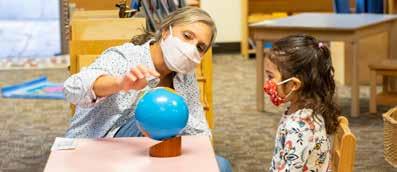
For this type of learner, stock up on supplies like clay, blocks, models and globes. Break study sessions into shorter time
FOR KINESTHETIC LEARNERS, STOCK UP ON SUPPLIES, LIKE CLAY, BLOCKS, MODELS AND GLOBES.
frames, and let your child move around as they study. Since this type of learner’s need for movement can be distracting to others, help them develop ways to “fidget quietly”—doodling in the margins of his notebook, squeezing a rubber ball or rolling a marble in their pocket.
Kinesthetic learners often become discouraged because traditional classrooms aren’t usually set up for their benefit. Sitting still and doing the work is often difficult for them, so be sure to give them lots of encouragement and speak with the teacher about your child’s unique needs.
READING AND WRITING (VERBAL) LEARNERS
These are the most “typical” learners, the ones with the class notes everyone wants to borrow. They frequently prefer learning alone at their own pace.
Encourage a verbal learner to write out notes, paraphrasing concepts into their own words and using bullet points. Even writing out the steps in a math problem can help cement the concepts mentally. When working with charts or graphs, have them write the ideas the data is conveying.
Closely related to the idea of learning styles is the concept of metacognition, or thinking about one’s own thought process. Studies have shown that having students think about and discuss their study strategies improves their study on future exams while also developing critical self-awareness skills that will benefit them as they grow up. After an exam or project, talk with your child about which study methods helped and which didn’t, and build future study sessions on the successful methods.
It’s important to remember that a preferred mode of learning may change over time, and doesn’t determine ability in a given subject: a reading and writing learner may in fact be more adept at math and science than creative writing. Also, an individual child will likely exhibit a mix of styles and benefit from adopting a variety of study techniques, depending on the subject and how they feel at the time. However, understanding your child’s learning style can be a useful tool in helping them achieve academic success.
For more information on learning styles, tests and questionnaires to help determine your child’s style, visit:
HOW SCHOOLS HELP L EAD THE PAT H TO A BRIGHT FUT URE PREPARING STUDENTS CAREER
For many high school students, deciding on a possible career can be a daunting decision. The options seem almost endless, and it can be hard to successfully translate interests into viable career options. Luckily, Georgia’s public and independent schools are dedicated to helping students wade the sometimes-murky waters of career preparation. By implementing special programs, offering enriching co-curricular activities and developing personal connections
BY ANNA BENTLEY
with students, Georgia’s schools are committed to getting students on the path to a bright future.
PROVIDING INDIVIDUALIZED GUIDANCE
One of the biggest advantages of independent schools is their smaller size, which allows counselors and advisors to make personal connections with students, helping to inform conversations about possible careers, college majors and college selections.
“This is addressed in several different ways,” says Krista Parker, the Atlanta Girls’ School’s middle and upper school director. Beginning with their junior year, students at the school go through a three-step process that starts with meetings with the college counselor to determine what their interests are and the colleges that could match them.
“Secondly, we require all of our students to complete two 70-hour internships while enrolled at AGS. These internships help students to see what the ‘real world’ looks like and helps them to not only see what careers they may want to pursue but also which ones they don’t! Third and probably most importantly is our commitment to establishing partnerships with organizations outside of the classroom. We connect our students with professionals in the science and technology field as well as the business and finance community.”
Small school sizes also help advance the counseling process. At Pace Academy, for instance, preparations can begin as early as ninth and 10th grade, with informational meetings for parents and students. And at Atlanta Girls’ School, the college counseling process begins in 10th grade with small group meetings with college representatives.
Students are encouraged to explore academic interests both in and outside the classroom, by either doubling up on core classes like math, science or English or exploring interests through electives or cocurricular/extracurricular activities.
At Atlanta Girls’ School, weekly assemblies can host guest speakers ranging from lawyers to dogsled racers so students can learn more about careers they may or may not have considered.
Similarly, “Pace Academy’s mission is to ‘create prepared, confident citizens of the world,’ which means that we offer academic, co-curricular and extracurricular
programs that expose students to many areas of study and related professional opportunities,” says Caitlin Jones, Pace’s director of communications. “… For example, upper school students interested in social innovation, global health or arts and urban life may choose to become involved in our Isdell Center for Global Leadership Fellows program, a two-year, co-curricular, teambased leadership program.”
OFFERING PROGRAMS FOR SUCCESS
Providing individualized options for students is a priority in Georgia’s public schools, as well. The Georgia Department of Education (GDOE)’s Career, Technical and Agricultural Education (CTAE) program offers students specialized instruction in more than 120 subjects, letting them explore careers before graduation—and even earn technical certifications, in some cases.
BE INVOLVED IN THEIR EDUCATION AND MAINTAIN AN OPEN
DIALOGUE ABOUT THEIR GOALS.
In this program, pathways are arranged in broad career clusters (for example, students can follow a graphic design pathway in the arts, A/V technology and communications cluster). Each pathway has its own sequence of three specialized courses, followed by an end-of-pathway assessment. Students can pick from more than 120 pathways in 17 clusters, including finance; IT; transportation, distribution and logistics; education and training; and agriculture, food and natural resources.
Though students pick their pathways in eighth grade, the program starts early, with career awareness lessons beginning in the first grade. Later in middle school, students take a career development inventory to help drill down into careers that might interest them before developing their personal graduation plan with input from their school counselor and parents.
“Middle-school students can learn about a variety of careers through exploratory courses, and CTAE has program of study documents available to assist students with mapping their course of study in high school and postsecondary enrollment,” says Meghan Frick, the GDOE’s director of communications. “These documents also assist with providing more information on careers associated with the Career Pathway the student is pursuing.”
WHAT PARENTS CAN DO
The path might seem clear for students who have solid ideas about their futures. But what about those who don’t know what they want to do?
Gaela Peters, school counselor and learning specialist at the Atlanta Girls’ School, says it has a weekly Education for the Development of Leadership and Service
program to expose students to different careers. The school also hosts annual special events where metro-area professionals speak about their industries.
Pace has similar programs in which it invites guest speakers and alumni to “discuss a variety of topics, with the goal of introducing students to global issues and a variety of career opportunities,” Jones says. “… Several club offerings also connect students to professionals in the Atlanta community.” But, she added, “The path toward an eventual career, however, truly starts with the college counseling process.”
Whether your child has a clear plan for what he or she wants to do, or is still struggling to figure it out, your involvement is crucial. Be involved in their education and maintain an open dialogue about their goals. Together with specialized school programs and guidance, strong parental support can help students set and achieve career goals that perfectly fit their skills and interests.
School County Guide
Boarding Schools Florida, Georgia, North Carolina, Pennsylvania, Tennessee, Texas p.68
REGION 4: Atlanta South/ Southeast/Southwest Fairburn, Fayetteville, Locust Grove, Metro-Atlanta, Newnan, Sharpsburg/Peachtree City, Stonecrest p.57
Educational Resources Tutoring, Summer Camps and Activities, Field Trips and Education Programs.
REGION 5: Atlanta West Austell, Buckhead, Kennesaw, Powder Springs, Smyrna, Vinings
Alpharetta, Buckhead, Chastain Park, Crabapple, Holly Springs, Marietta, Milton, Roswell p.42
REGION 3: Atlanta East Ansley Park, Athens, Dacula, Decatur, Midtown, Morningside, Northeast Atlanta
REGION 3: Atlanta East Athens, Bethlehem, Brookhaven, Dacula, Decatur, Norcross, Watkinsville
Education At a Glance
INDEPENDENT SCHOOLS
*KEY:
Religious Affiliation:
J =
P =
33
REGION 1: ATLANTA NORTH/NORTHWEST
REGION 2: ATLANTA NORTH/NORTHEAST
Education At a Glance
INDEPENDENT SCHOOLS
46 REGION 3: ATLANTA EAST
Education At a Glance
This information reflects the latest available data at publication
INDEPENDENT SCHOOLS
Religious Affiliation: C =
J =
NEIGHBORHOODS OF NOTE
Alpharetta Once a small farming community, Alpharetta’s growth has exploded in recent years, and the North Fulton city is now one of Atlanta’s most affluent neighborhoods, creating the perfect mix of country living and lots of city amenities.
Woodstock Located in Cherokee County, Woodstock is, as locals say, “where modern amenities meet old Southern charm.” Historic Olde Towne pays a continual tribute to Woodstock’s pioneers through vintage shops and good old-fashioned Southern hospitality.
BUCKHEAD
HOLLY SPRINGS
Visit us online to RSVP for one of our upcoming events or to book a tour.
Duluth A successful mix of small-town charm and booming economic growth, Duluth plays host to many major corporations and is also home to numerous golf clubs, private tennis clubs and parks. The city prides itself on accommodating a growing, diverse population.
Dunwoody A popular community among young and established professionals alike, Dunwoody is often referred to as the “tennis set” neighborhood because of its numerous recreational outlets. Its location provides suburban living close enough to the city.
Serving children in grades Kindergarten to High School with language, learning and social challenges.
Call for a private tour!!!
Teachers deliver a regular-education curriculum combining:
• Georgia Standards and National Core
• Differentiated Instruction
• PE, Art, Foreign Language, Theatre and Culinary Arts
• Technology in every classroom
Rolling Admissions. Fully Accredited GAC! A few openings remain for 2021-2022
Where authentic Christian mission and academic excellence aren’t mutually exclusive
ATLANTA EAST ATLANTA EAST
Independent Schools
NEIGHBORHOODS OF NOTE
Decatur The county seat of DeKalb County, Decatur’s small-town charm revolves around the Courthouse Square, which features trendy restaurants and shopping, entertainment options and special events, including its annual summer beach bash.
Lawrenceville Located in the heart of Gwinnett County and known as “Crepe Myrtle City,” Lawrenceville is Atlanta’s second oldest city. Its historic downtown square, which has been revitalized, is home to a variety of shops, restaurants and community events.
DACULA • BROOKHAVEN
WATKINSVILLE •
Independent Schools
NEIGHBORHOODS OF NOTE
McDonough One of the fastest-growing neighborhoods South of Atlanta, McDonough is the county seat of Henry County and features many historic structures around its town square. The city has ample green space and is a favorite destination for antique shoppers.
Peachtree City A master-planned city comprised of several smaller villages, Peachtree City’s many amenities include golf courses, lakes and an amphitheater. The city is renowned for its network of golf paths connecting its neighborhoods.
FAIRBURN
FAYETTEVILLE • LOCUST GROVE
Independent Schools
FULTON
NEIGHBORHOODS OF NOTE
Acworth Surrounded by two lakes and 12 parks, Acworth offers plenty of recreation opportunities. Located 35 miles northwest of Atlanta, the town is convenient to both I-75 and Highway 41. Acworth is designated as a Georgia Main Street City.
Douglasville Located west of Atlanta on I-20, Douglasville has easy access to all that Atlanta offers. Listed on the National Register of Historic Places, Downtown Douglasville’s historic district is an outstanding example of a turn-ofthe-century southern railroad town.
ATLANTA WEST
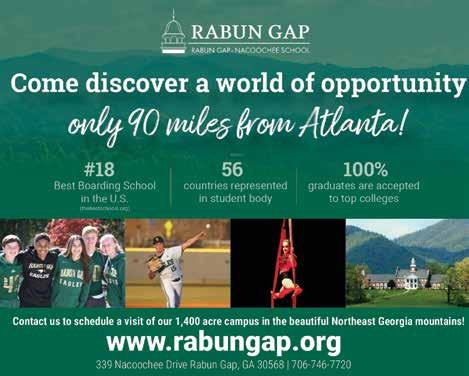
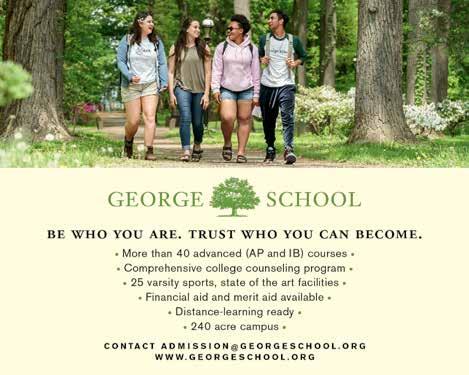
There are many benefits of a boarding school education. Boarding schools are an option for students seeking a more independent learning experience. Because students generally live on campus, learning takes place in and out of the classroom almost on a 24-hour basis.
When selecting a boarding school, it is important to visit the school campus, but representatives from many boarding schools visit Metro Atlanta throughout the year—contact each school for specific dates.
Boarding Schools
FLORIDA
NORTH CAROLINA
Top 5 Things
Atlantans May Not Know About McCallie
Atlanta is the #1 CITY for McCallie Alumni & Students. Atlanta is home to more McCallie Men than any city outside of Chattanooga.
McCallie’s campus is just 2 HOURS FROM ATLANTA in Chattanooga, TN. No matter the occasion it’s a quick trip up I-75 to McCallie.
3 The 3 MOST POPULAR COLLEGES for McCallie Alumni from the Class of 2020 were TENNESSEE, AUBURN, and YALE. In total, 165 McCallie graduates attended 82 colleges & universities in the US and abroad.
McCallie serves 4 MEALS PER DAY. Boys eat – and they eat a lot! In addition to breakfast, lunch & dinner, McCallie serves a 4th Meal at 9:30 PM.
McCallie fielded 5 STATE CHAMPIONSHIP TEAMS in 2019. In 2019, our tennis, soccer, swimming, cross country, and football teams all brought home state championship titles. 2 1 4 5 Ready to learn more? Visit mccallie.org/inquiry
SPOTLIGHT ON METRO ATLANTA’S SCHOOL SYSTEMS
Avariety of improvements and innovative programs in Georgia’s public school systems have resulted in many stellar elementary, middle and high schools across the metro area. Different school systems feature specialized programs and academic opportunities, such as magnet, charter, vocational or alternative schools, to suit their respective students, parents and communities. However, despite variations in programming and academic offerings, all public schools must offer the core curriculum as determined by the Georgia Board of Education. Here is a county-by-county guide to metro Atlanta’s public school systems. For more information about the Georgia Department of Education, call 404-656-2800 or visit gadoe.org. u
CHARTER SCHOOLS
CHARTER SCHOOLS
BARTOW
BARTOW
Board of Education
770-606-5800
bartow.k12.ga.us
CHEROKEE
Number of Schools Elementary 12
Transitional Academy 1
Total # of Students: 12,919
Student Spending: $10,027
2019 Mean Georgia Milestone Scores:
3rd: (ELA) 510 (M) 529
5th: (ELA) 515 (M) 516
8th: (ELA) 511 (M) 503
2020 Average SAT: 1025
Top 3 Schools by Average
2020 SAT Score
Woodland 1045
Adairsville High 1029
Cass High 999
What’s New: GDOT construction near Woodland High School will ultimately provide a wider road in front of the campus and a new entrance to the school. There will be a red light with pedestrian accommodations and speed reduction signage posted on the approaches to the school. It’s expected to be done in 2024.
2019 Mean Georgia Milestone Scores:
3rd: (ELA) 522 (M) 545
5th: (ELA) 531 (M) 538
8th: (ELA) 535 (M) 514
2020 Average SAT: 1100
Board of Education
770-479-1871
cherokeek12.net
CLAYTON
Total # of Students:
Student Spending: $9,564
Top 5 Schools by Average
2020 SAT Score
Cherokee High 1114 Creekview High 1110 Etowah High 1102
Sequoyah High 1100 Woodstock High 1097
What’s New: Six Cherokee County School District high schools raised more than $145,000 this year selling $5 raffle tickets for a chance to win a 2021 Jeep Wrangler, donated by Shottenkirk Chrysler Dodge Jeep Ram dealership in Canton.
2019 Mean Georgia Milestone Scores:
3rd: (ELA) 488 (M) 507
5th: (ELA) 497 (M) 493
8th: (ELA) 501 (M) 486
2020 Average SAT: 943
Top 5 Schools by Average
2020 SAT Score
Elite Scholars Academy 1078
M. E. Stilwell School of the Arts 1043
Morrow High School 985
PUBLIC SCHOOL COUNTY GUIDE
Board of Education
770-473-2700
clayton.k12.ga.us
Total
Lovejoy High School 948
Jonesboro High 945
What’s New: The Clayton County Public School System has created a Coronavirus Dashboard on the district website featuring relevant data on positive COVID-19 cases reported.
COBB
Number of Schools Elementary 65
Board of Education 770-426-3300 cobbk12.org
COWETA
Board of Education
770-254-2800 cowetaschools.net
DEKALB
Board of Education
678-676-1200 dekalbschoolsga.org
Total # of Students: 111,043
2019 Mean Georgia Milestone Scores:
3rd: (ELA) 521 (M) 533
5th: (ELA) 531 (M) 526
8th: (ELA) 534 (M) 523
2020 Average SAT: 1107
Top 5 Schools by Average
2020 SAT Score
Walton High School 1272
Alan C. Pope High School 1195
Lassiter High School 1195
Kell High School 1061
Wheeler High School 1160
What’s New: Fair Oaks Elementary got a $25,000 donation from Backpack Blessings to support the school’s Eagle’s Nest fund.
Spending: $10,262 Number of Schools
19 Middle 7 High 3 Charter & Career Academy 2 Alternative 2 Centre for Performing and Visual Arts 1
Education 1
Total # of Students: 22,212 Student Spending: $9,600
2019 Mean Georgia Milestone Scores:
3rd: (ELA) 525 (M) 532
5th: (ELA) 530 (M) 525
8th: (ELA) 536 (M) 535
2020 Average SAT: 1082
Top 3 Schools by Average 2020 SAT Score
Northgate High 1118
Newnan High 1076
What’s New: As part of their new Grow The Arts initiative, Patrons of the Nixon Centre have set aside $5,000 in grant money to be awarded to Coweta County teachers in support of fine arts classrooms for the 2021-22 school year.
Number of Schools Elementary 69 Middle 17 High 19 Charter 5 Magnet 3 Centers, Special Education and Alternative 24
Total # of Students: 95,715 Student Spending: $12,399
2019 Mean Georgia Milestone Scores:
3rd: (ELA) 496 (M) 511
5th: (ELA) 506 (M) 502
8th: (ELA) 506 (M) 496
2020 Average SAT: 990
Top 5 Schools by Average
2020 SAT Score
Chamblee Charter High 1177
DeKalb Early College Academy 1156
DeKalb School of the Arts 1144
Dunwoody High 1128
Lakeside High 1108
What’s New: DeKalb County School District has been named a National School Boards Association 2021 Magna Award first-place winner. DCSD is one of 15 winners—three grand prize and 12 firstplace winners—across the nation that received this honor.
DOUGLAS
Board of Education
770-651-2000 dcssga.org
Board of Education
770-460-3990
fcboe.org
FORSYTH
Board of Education
770-887-2461
forsyth.k12.ga.us
Total # of Students: 26,382
Student Spending: $9,779
2019 Mean Georgia Milestone Scores:
3rd: (ELA) 511 (M) 520
5th: (ELA) 520 (M) 510
8th: (ELA) 522 (M) 504
2020 Average SAT: 1002
Top 5 Schools by Average
2020 SAT Score
Alexander High 1035
Chapel Hill High 1032
Douglas County High 1018
Lithia Springs High 956
New Manchester High 946
What’s New: Eleven Douglas County students and one alternate were selected from more than 3,000 nominees for the prestigious Governor’s Honors Program (GHP) for 2021. GHP is a residential summer program for gifted and talented high school students.
2019 Mean Georgia Milestone Scores:
3rd: (ELA) 544 (M) 544
5th: (ELA) 549 (M) 535
8th: (ELA) 551 (M) 541
2020 Average SAT: 1124
Top 5 Schools by Average
Total # of Students: 20,162
2020 SAT Score
McIntosh High 1209
Starr’s Mill High 1161
Whitewater High 1090
Fayette County High 1050
Sandy Creek High 1044
What’s New: Fayette County High’s Army JROTC squad swept all area drill competitions they entered, earning an automatic bid to compete at state and winning its seventh straight area title.
2019 Mean Georgia Milestone Scores:
3rd: (ELA) 550 (M) 562
5th: (ELA) 555 (M) 568
8th: (ELA) 556 (M) 534
2020 Average SAT: 1161
Top 5 Schools by Average
2020 SAT Score
Total
Lambert High 1226
South Forsyth High 1202
Denmark High 1175
West Forsyth High 1135
Forsyth Central 1105
What’s New: Forsyth County’s high schools are modifying methods of reporting, grading, and scheduling. Students’ class rank will be removed from transcripts, quality points will be limited and course requirements for full-time students will be reduced, among other changes.
PUBLIC SCHOOL COUNTY GUIDE
FULTON
Board of Education 470-254-3600 fultonschools.org
GRIFFINSPALDING
Number of Schools
2019 Mean Georgia Milestone Scores:
3rd: (ELA) 521 (M) 534
5th: (ELA) 531 (M) 528
8th: (ELA) 522 (M) 512
2020 Average SAT: 1078
Board of Education 770-229-3700 spalding.k12.ga.us
GWINNETT
Total # of Students: 91,716
Student Spending: $11,408
Board of Education
678-301-6000 gcpsk12.org
Top 5 Schools by Average 2020 SAT Score Northview HS 1282 Chattahoochee HS 1233 Johns Creek HS 1220 Cambridge 1206 Alpharetta 1189
What’s New: Fulton County Schools is reviewing resources for textbook adoption for K-2 English language arts and AP world history. Potential resources are closely screened to assure they are aligned to the Georgia Standards for Excellence.
Number of Schools
2019 Mean Georgia Milestone Scores:
3rd: (ELA) 486 (M) 506
5th: (ELA) 502 (M) 495
8th: (ELA) 507 (M) 496
2020 Average
Total # of Students:
967
Top 2 Schools by Average 2020
996
929
What’s New: Keith Simmons has been named as the GriffinSpalding County School System (GSCS) School Superintendent. He is a veteran educator and has served in a variety of roles during his 25-plus-year career in education. The former principal of Griffin High School is returning, having served the past five years in Bibb County under prior GSCS Superintendent Curtis Jones.
2019 Mean Georgia Milestone Scores:
3rd: (ELA) 523 (M) 535
5th: (ELA) 528 (M) 533
8th: (ELA) 532 (M) 494
2020 Average SAT: 1097
Top 5 Schools by Average 2020 SAT Score
Gwinnett School of Math, Science, and Technology 1361 North Gwinnett High 1195
Gwinnett Online Campus 1145
Brookwood High 1143 Mill Creek High 1131
What’s New: In partnership with the Gwinnett County Public Library, GCPS provides Tutor.com as an online tutoring resource for students. Live tutoring support is available daily.
Board of Education
770-534-1080 hallco.org
HENRY
Board of Education
770-957-6601
schoolwires.henry.k12.ga.us
PAULDING
Total # of Students:
26,720
Student Spending:
$9,974
2019 Mean Georgia Milestone Scores:
3rd: (ELA) 507 (M) 517
5th: (ELA) 514 (M) 509
8th: (ELA) 486 (M) 500
2020 Average SAT: 1045
Top 5 Schools by Average
2020 SAT Score
Flowery Branch High 1079
North Hall High 1064
Chestatee High 1044
Cherokee Bluff 1036
Johnson High 1036
What’s New: Beginning with the 2021-22 school year, the Hall County School District is partnering with The Ivester Healthcare Scholars Program on a dual-enrollment program.
2019 Mean Georgia Milestone Scores:
3rd: (ELA) 503 (M) 517
5th: (ELA) 512 (M) 508
8th: (ELA) 517 (M) 493
2020 Average SAT: 1010
Top 6 Schools by Average
2020 SAT Score
Total # of Students:
42,611
Student Spending: $9,374
Ola High 1074
Union Grove High 1099
Woodland High 1017
Luella High 1005
Dutchtown High 991
Eagles Landing High 991
What’s New: Henry County Schools is slated to receive $53.3 million in federal stimulus monies from the American Rescue Plan.
PUBLIC SCHOOL COUNTY GUIDE
Board of Education
770-443-8000
paulding.k12.ga.us
Total # of Students: 30,226
Student Spending: $9,419
2019 Mean Georgia Milestone Scores:
3rd: (ELA) 515 (M) 527
5th: (ELA) 527 (M) 519
8th: (ELA) 512 (M) 511
2020 Average SAT: 1032
Top 5 Schools by Average
2020 SAT Score
Paulding County High 1058
North Paulding High 1042
East Paulding High 1032
South Paulding High 1024
Hiram High 989
What’s New: State Superintendent Richard Woods has named four Paulding County School District high schools to the list of Advanced Placement (AP) Honor Schools for 2021. Hiram High School, North Paulding High School, Paulding County High School and South Paulding High School all received honors in one or more AP categories.
HALL
ROCKDALE
ROCKDALE
Board of Education
770-483-4713
rockdaleschools.org
ATLANTA PUBLIC SCHOOLS
BUFORD CITY SCHOOLS
Number of Schools Elementary 11 Middle 4 High 3 Alternative 1
Career Academy 1 Magnet 1 Open Campus 1 Virtual School 1
Total # of Students: 16,104
Student Spending: $10,640
2019 Mean Georgia Milestone Scores:
3rd: (ELA) 500 (M) 512
5th: (ELA) 514 (M) 500
8th: (ELA) 519 (M) 508
2020 Average SAT: 974
Top 3 Schools by Average 2020 SAT Score
Rockdale High 1024
Heritage High 989
Salem High 933
What’s New: Rockdale County Public Schools (RCPS) is partnering with the nonprofit Kids’-Doc-On-Wheels to provide school-based telehealth and mobile medical services for its students.
Board of Education
404-802-3500
atlantapublicschools.us
of Schools
Total # of Students: 50,954
Student Spending: $16,269
2019 Mean Georgia Milestone Scores:
3rd: (ELA) 500 (M) 518
5th: (ELA) 507 (M) 507
8th: (ELA) 510 (M) 495
2020 Average SAT: 934
Top 5 Schools by Average 2020 SAT Score
Atlanta Classical Academy 1151 Grady High 1112
KIPP Atlanta Collegiate Academy 1067 North Atlanta High 1033
Charles R. Drew Charter High 968
What’s New: Atlanta Public Schools is the first school district in the country to receive the Living Popups Boxcar AR app, a tool designed to increase reading literacy in young readers. When aimed at the book’s pictures, any mobile device with the app will suddenly bring the characters to life using animated 3-D images.
Board of Education
770-945-5035
bufordcityschools.org
Number of Schools
Elementary (K-1) 1 1st-3rd Grade Academy 1 4th-5th Grade Academy 1 Middle 1 High 1
Total # of Students: 5,155
Student Spending: $11,050
2019 Mean Georgia Milestone Scores:
3rd: (ELA) 539 (M) 553
5th: (ELA) 538 (M) 550
8th: (ELA) 559 (M) 564
2020 Average SAT: 1125
What’s New: Buford City Schools was rated the best school district in Georgia in 2020, according to Niche’s annual report. This is the sixth straight year the district has earned that distinction. Niche rankings are based on rigorous analysis of data and reviews.
CITY SCHOOLS OF DECATUR
Board of Education
404-371-3601
csdecatur.net
& 5th
Total # of Students: 5,695
Student Spending: $12,874
2019 Mean Georgia Milestone Scores:
3rd: (ELA) 562 (M) 559
5th: (ELA) 560 (M) 551
8th: (ELA) 549 (M) 524
2020 Average SAT: 1170
What’s New: City Schools of Decatur’s nutrition department allows siblings attending school in person to take home extra meals for their siblings under the age of 18. Meal pickup will continue for virtual students at the TakeOutSpot at Decatur High School.
GAINESVILLE CITY SCHOOLS
Board of Education
770-536-5275
gcssk12.net
Total # of Students: 7,780 Student Spending: $9,716
2019 Mean Georgia Milestone Scores:
3rd: (ELA) 487 (M) 509
5th: (ELA) 495 (M) 500
8th: (ELA) 478 (M) 493
2020 Average SAT: 990
What’s New: Gainesville City Schools is partnering with Purposity, an app that connects users with one-to-one needs in the community. The app sends a notification detailing a need in the area, ranging from shoes and jackets to small household appliances. Individuals able to help can respond and coordinate the delivery.
MARIETTA CITY SCHOOLS
Board of Education
770-422-3500
marietta-city.org
Total # of Students:
8,716
Student Spending: $12,455
2019 Mean Georgia Milestone Scores:
3rd: (ELA) 512 (M) 524
5th: (ELA) 518 (M) 515
8th: (ELA) 519 (M) 507
2020 Average SAT: 1067
What’s New: The Marietta High School girls’ basketball team, the Lady Blue Devils, have won the Class 7A Girls State Championship. This is the program’s first state championship title since 1951 and its second overall.