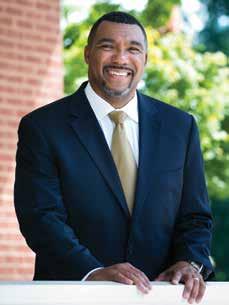
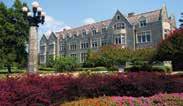
James Calleroz White has been the head of school at The Galloway School since 2018 and has more than 22 years of experience at independent schools throughout the United States. He holds a B.A. and a M.Ed. from Harvard University and an Ed.D. from Arizona State University.
What is your educational philosophy?
I believe that at the same time that educators are imparting knowledge and wisdom, they need to remain conscious of the fact that they are also serving as role models for their students. How we teach can be as significant as what we teach.
What do you love most about your job?
I love kids, so to be able to be in a role that allows me to do both what I love and feel that I am good at every day is a wonderful thing. To do what you love and love what you do is how I see my job.
How can parents best contribute to the education process?
Parents have to be partners with the school in terms of the work that goes into educating students. We all want what is best for students, and we have to work together if either of us expect this to be a reality.
How is the field of education changing? It’s hard not to think about the coronavirus crisis when answering this question. I remember a time in schools where email didn’t exist; to be in a completely online environment this past spring–and forced to do so in a matter of days–shows me just how far we have come in this journey and how much has changed.
What advice would you offer parents about their children’s education?
Find and nurture every opportunity for your child to find the joy in learning.
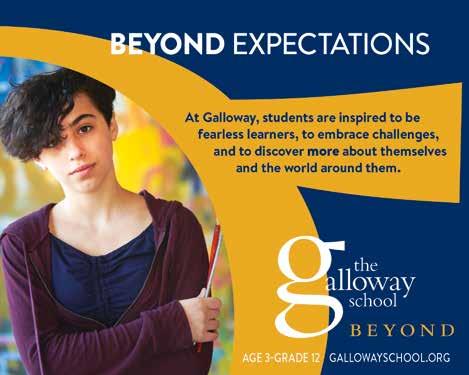
THE GALLOWAY SCHOOL
Emphasis: Galloway is a philosophically grounded, learnerfocused independent school.
Year Founded: 1969
Grades: PreK-12
Students: 750
Avg. Class Size: 15
Tuition Range: $17,500-$29,950
Accreditations or Affiliations: NAIS, SAIS, GISA, AAAIS, NACAC
Location: 215 Chastain Park Ave., Atlanta, GA 30342
Contact: 404-252-8389, gallowayschool.org
EASING INTO A SCHOOL
HOW TO ENSURE A SMOOTH TRANSITION
BY MICHELLE BOURG
As the old saying goes,
“Nothing is constant except change.” All change requires some adjustment, and a move is right up at the top of the list. This can be difficult for adults, let alone for children, who thrive on routine and have fewer coping skills. From preschool to college,
starting or changing schools is a dramatic— potentially traumatic—milestone. School is where children establish an identity and relationships outside the family; changing schools means establishing them all over again. When you combine this with a move, the stress levels can increase exponentially.
However, there are simple strategies you can follow to ease your family’s transition to both a new home and a new school.
BE PRESENT
One of the most important things you can do to help your children—and yourself—negotiate any life change is to maintain a calm presence. Children pick up on your feelings, so it’s important to communicate a positive attitude. If you’re anxious, young children especially may interpret this to mean that change is bad. Don’t overhype it, but convey the feeling that this is an adventure and your enthusiasm will be infectious. Spend extra time with your child, even if it’s just watching TV together. Encourage, but don’t push, him or her to talk about any concerns he or she may have. When you can’t be physically present, take a moment to check in with a call or text.
A good way to help kids feel positive about the situation is to give them a voice in decisions whenever appropriate. Whether it’s about choosing a school or selecting the day’s outfit, asking their opinion on things that affect them directly lets them feel that they’re part of the process and not just pawns in the game.
School changes during junior high or high school are times when this presence is especially needed, but it’s tricky to pull off unobtrusively. The situation is particularly fraught: bigger schools, new classmates, shifting social expectations and dating dynamics can make kids and parents feel like they’re on a new planet. There’s also increased pressure to excel academically, with students getting ready to make decisions about their
futures and contending with college admissions. With all this going on, it’s not surprising that one in four high school freshmen reports feeling extreme stress. Ironically, this is also the age at which your child is less likely to admit vulnerability or to confide in you. It’s crucial to “hold on loosely” while watching for warning signs such as changes in behavior, eating habits or grades before major problems develop. It’s a tough balancing act, but teens do appreciate knowing that their parents are available and paying attention.
BE PREPARED
The key to making any change successfully is preparation. Particularly if you’re changing school systems or transferring to a private school, the curriculum and culture are likely to be slightly different. Find out what’s been covered, and if there are areas that
ONE OF THE MOST IMPORTANT THINGS YOU CAN DO TO HELP YOUR CHILDREN—AND YOURSELF—NEGOTIATE ANY LIFE CHANGE IS TO MAINTAIN A CALM PRESENCE.
your child is unfamiliar with, arrange for extra study or tutoring so he or she won’t be behind. Read over the materials you receive from the school, such as parent and student handbooks, to familiarize yourself with policies and deadlines. The best source of inside information is someone who’s been there, so reach out to other parents. They’ll have useful insights to share, and talking about kids and schools is a surefire icebreaker when you’re new in the neighborhood.
As the big day looms, go over the logistics. Have a dress rehearsal: Take your child to the bus stop or drive them to school. Attend an orientation or arrange a tour so you can both see where the classrooms, cafeteria, restrooms and other facilities are. Meet the teachers together and encourage your child to ask questions. Will your child have a
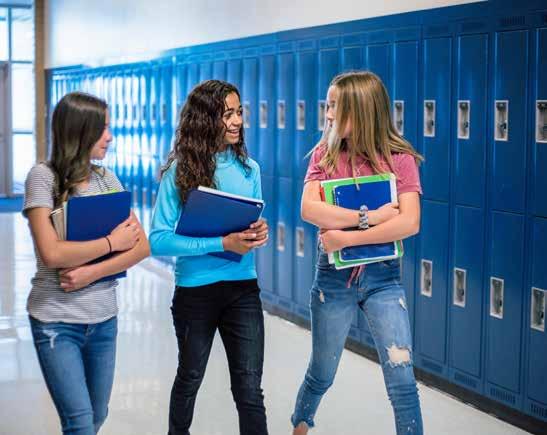
locker for the first time? Get a combination lock and let him or her practice so he or she is not frantically twirling the dial during the first homeroom bell. The day before, go over the supplies list twice and make sure you have everything. Get outfits, backpacks and other necessities ready so you’re not frazzled looking for shoes and ponytail holders in the morning.
Preparation is especially critical for children with ADHD, ASD issues, anxiety or learning disabilities, who especially need routine and structure. You may want to do multiple “dry runs” of a new routine. Many such children are visual learners and respond better to having information presented in picture form. Another tool is the Social Story, a short description of an activity or situation that gives specific informa-
tion about what to expect in that situation and why. Special education teachers can assist with creating these stories; resources are also available online.
While your child is adjusting to changes at school, try to maintain a home routine as similar as possible to the one you’re used to. When other areas of life are in flux, a familiar routine is reassuring for everyone and shifts the focus to the things that need to be relearned. Maintaining a set bedtime is especially important; tired kids (and adults) deal less well with stress.
BE PATIENT
As in any period of adjustment, patience is essential. Just like adults, kids can get cranky or sad when stressed. Some moodiness is normal and developmental regression in younger children, such as a bed-wetting inci-
dent, may occur. You may see a temporary decline in your child’s grades. Recognize that adjustment takes time, but if things don’t improve after a few weeks, consult with a teacher or counselor about your child’s classroom behavior and, if necessary, get advice about seeking professional help.
Lastly, don’t neglect yourself; the tension can rub off on you. You’re experiencing a life change, too, and you can weather it better—and better help your child—if you take care of yourself. So have that morning latte or take a walk.
It’s hard to predict how children will respond to changes in their routine, and their reactions may differ on different occasions. Being flexible, prepared and staying attentive to your child will help both of you negotiate a new school, and your new home, successfully.
Now Enrolling!
Dance classes for all levels starting at age 2. Call or email to schedule
Buckhead Centre in Chastain Square
Kate Gaul, Principal kgaul@atlantaballet.com 404.303.1501
Michael C. Carlos Dance Centre in West Midtown
Kelly Cooper, Centre Administrative Director admissions@atlantaballet.com 404.873.5811 x1225
Virginia-Highland Centre in Amsterdam Walk
Nicole Adams, Principal nadams@atlantaballet.com 404.883.2178
Learn more at centre.atlantaballet.com
Photo by Kim Kenney.
HOW STUDENTS ARE LEARNING IN THE DIGITAL AGE
BY E. MARCEL POURTOUT
As technology evolves, it continues to change the ways that people interact with one another—and the ways in which they exchange and absorb information. That’s particularly true in today’s classrooms, where teachers incorporate technological advances to create interactive
learning environments that parents are likely to find very different from their own school experiences.
The traditional classroom model is experiencing a 21st-century upgrade, with textbooks and chalkboards giving way to tablets and cutting-edge tools like 3-D print-
ers. Technology is no longer reserved for the computer lab. Instead, students interact with technological devices on a regular basis throughout the school day.
At King’s Ridge Christian School, an independent school in Alpharetta, teachers use Activpanel interactive displays and document cameras (devices that display objects for large audiences) in every classroom. In addition, “we heavily utilize iPads,” says Director of Communications Michelle Azzi, “and our teachers also utilize platforms like Seesaw and Spelling City.”
ROBOTS AND 3-D PRINTERS
But in today’s high-tech classroom, you’ll find much more than laptops and apps. You’re likely to see students learning about the fundamentals of robotics and creating prosthetic body parts with 3-D printers— machines that create three-dimensional objects from digital files, layer by layer.
Technology isn’t just changing the way students learn—it’s changing what they learn about, introducing them to tools and fields that once seemed like science fiction.
“Woodward Academy is doing some great things with technology,” says Van Jensen, the school’s editorial and creative manager for marketing and communications.
“There are robotics classes and clubs that are taking part in competitions. We have 3-D printers and classes doing everything from designing things in CAD (computeraided design) programs and then printing and assembling products.”
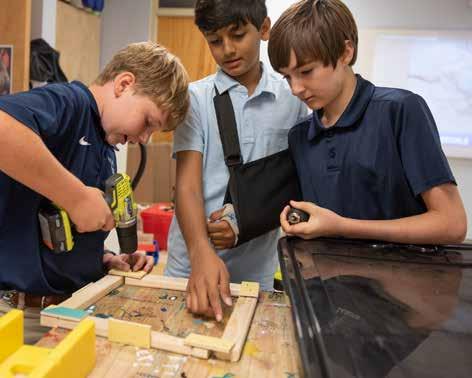
At Mount Vernon School in Sandy Springs, students can congregate in Maker Spaces—special areas where they engage in collaborative, hands-on projects, using contemporary technology like 3-D printing.
“All four Maker Spaces have multiple 3-D printers, and all grade levels use them for not only maker class projects but core classroom projects, as well,” says Alexandra
Blumencranz, executive director for the Mount Vernon Institute for Innovation at Mount Vernon School. “The projects range from jewelry to physical representation of architecture projects to torsion-powered cars in physics."
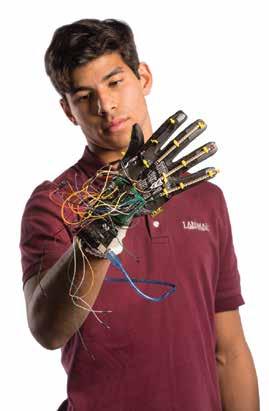
One early project found students working to create a prosthetic hand for teenager Alex Linkous, who was born with only part of his right hand.
“The students were led through a design thinking challenge to prototype hands that would best serve Alex and his wish to drive and hold a Coca-Cola at the same time,” Blumencranz says.
At Holy Innocents’ Episcopal School, students in Grades 1 through 3 can learn the basic building blocks of 21st-century technology in an after-school Velocity Tech program, working with tools like Lego models, robot drones and 3-D pens.
A robotics and programming course for fourth- through sixth-graders familiarizes students with such concepts as mechanical and electrical engineering, coding and
AT MOUNT VERNON SCHOOL IN SANDY SPRINGS, STUDENTS CAN CONGREGATE IN MAKER SPACES— SPECIAL AREAS WHERE THEY ENGAGE IN COLLABORATIVE, HANDS-ON PROJECTS, USING CONTEMPORARY TECHNOLOGY LIKE 3-D PRINTING.
sensors as they learn to think logically and analytically. A 3-D printing class allows students in Grades 4-8 to work hands-on with the equipment and even take home some of their creations.
Middle-schoolers at Mount Vernon can also participate in an after-school robotics course using Lego Mindstorms, kits that combine robotics technology with Lego building blocks.
Landmark Christian School offers several specialized programs, called academies, that offer in-depth instruction in different fields of interest. “Our Aviation Academy
has five flight simulators,” says Director of Marketing and Communications Paula Dobbs. The Academy of Arts and Media Production uses new iMac computers and professional-level production software to help students learn about music production and digital recording, as well as drones, HD cameras and professional-grade production software for students interested in film production.
EMPOWERING STUDENTS
Students utilize technology outside of the classroom, from social media to streaming
platforms to video games and tools that help them create music and make videos. So it only makes sense to incorporate it as a teaching aid. But educators are quick to point out that all of these devices and programs are just that—tools. The idea isn’t to make students dependent on technology— it’s for them to use it to learn and present information in new and creative ways that will keep them engaged.
“We believe in a balanced approach,” says Azzi of King’s Ridge Christian School. “The students use technology, and then we also have times where we do things by hand.”
“We give students the toolsets, skillsets and mindsets to have choice and agency in their work,” says Blumencranz with Mount Vernon School. “Using their creativity and curiosity, students use these classes and
materials to engage deeply in their work and make an impact in their community.”
And as technology grows more and more advanced, the ways in which students use it to learn and create will continue to transform, as well.
HOW TO HELP YOUR CHILD SUCCEED
BY E. MARCEL POURTOUT
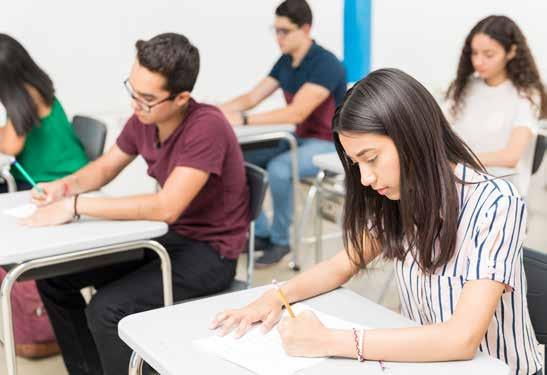
Standardized tests are a fact of life for children in both public and independent schools. A standardized test is one that is administered and graded in a consistent manner, usually given to students across an entire school or school system or even nationally, as opposed to one created by a teacher for a specific class. These tests are often used to determine whether your child passes to the next grade
level, or what kind of college they will attend. As a result, they can be a source of stress for students and parents alike. Fortunately, most schools offer programs and resources to help children prepare for these critical tests.
ELEMENTARY AND HIGH SCHOOL
If your child is enrolled in a Georgia public school, there are a number of tests he or she
IF YOUR CHILD IS ENROLLED IN A GEORGIA PUBLIC SCHOOL, THERE ARE A NUMBER OF TESTS HE OR SHE WILL BE REQUIRED TO TAKE AS PART OF THE GEORGIA MILESTONES ASSESSMENT SYSTEM.
will be required to take as part of the Georgia Milestones Assessment System.
Georgia Milestones spans Grade 3 through high school, and is designed to determine how well a student has absorbed the information taught in the classroom.
Students in Grades 3 through 8 currently take an end-of-grade test in English, language arts and math, while those in Grades 5 and 8 are also tested in science and social studies. High school students are tested at the end of each year in subjects including literature and composition, algebra, geometry, biology, physical science and U.S. history.
Students at independent schools may also be required to take standardized tests. Springmont, a Montessori school in Sandy Springs, administers the Iowa Test of Basic Skills to its primary and middle-school students each year.
Another standardized test independent school students are likely to encounter is the Secondary School Admission Test (SSAT), which measures the abilities of students looking to enroll in an independent school.
COLLEGE APTITUDE TESTS
Whether they’re from public or independent schools, all college-bound students are expected to take a college aptitude test like the SAT or the ACT as part of their application process. The SAT evaluates a student’s math, writing and critical reading skills, while the ACT covers English, math, reading, science and an optional writing component.
A great number of Atlanta-area public and independent schools offer prep courses
or workshops, or have counselors who work with students to help them prepare for college-preparatory testing.
Atlanta Public Schools offers test-prep opportunities “which focus on content preparation plus simulation of the testing environment,” says Seth Coleman, media relations manager.
At the Lovett School, “Our counselors have stayed abreast of the recent changes with both the ACT and SAT tests,” says Courtney Fowler, director of communications and marketing. Lovett’s college counseling department offers parent webinars, meets with families individually and connects families with free resources for test preparation, she said.
At Holy Innocents’ Episcopal School, “we partner with Applerouth Test Prep to provide proctored practice leading into the junior year,” says Tyler Sant, director of
college counseling.
“We also purchase access for all rising juniors and seniors to a fully-online test prep platform which allows students to prepare in a way that’s specifically tailored to their performance on each specific section of these tests.”
Outside of the school environment, testpreparation services like Kaplan and The Princeton Review offer instruction to help students prepare for college entrance exams.
The College Board, the organization that administers the SAT, offers a number of preparatory resources.
TutorATL is a free service that provides tutoring and homework help as well as resources for students preparing for college entrance exams. It’s available to students from Atlanta Public Schools, the Cobb County School District and Marietta City Schools, as well as members of the Boys and Girls
Club, and Atlanta-Fulton County Public Library and Cobb County Library patrons who are enrolled in a K-12 program.
TESTING TIPS
One of the most important things a student can do to prepare for these tests is, of course, to absorb their lessons throughout the school year. “Learning the critical thinking skills necessary to master the curriculum sets the student up to be able to do well on the test,” says Ken Connor, director of college advising for Wesleyan School.
But parents can implement several techniques at home to help their children prepare for standardized tests, whether they’re in-school assessments or college aptitude tests.
“Parents can help students by providing them with a space that can provide parental overview without becoming too invasive,”
says Connor. “Creating schedules for students that provide breaks will also help the student learn how to develop strong study habits.”
“Test prep requires the same type of discipline and commitment to a schedule as any other course of study,” says Sant of Holy Innocents’. “Their outcome will directly reflect the work they’ve put in. Having a consistent appointment on the calendar helps to reinforce consistency. It’s important that the practice mirrors the testing environment. That means sitting upright at a table or desk. No cell phone, no TV and no other distractions.”
Above all, make sure your child maintains a positive attitude, gets enough sleep and has a proper breakfast on the day of the test. With the right physical and mental preparation, he or she will be well on their way to acing these important tests.
STANDARDIZED TEST RESOURCES
Georgia Department of Education doe.k12.ga.us
Georgia College 411 gacollege411.org
College Board collegeboard.org
SAT
sat.collegeboard.org
SSAT ssat.org
ACT act.org
TutorATL tutoratl.org
metro atlanta area map
REGIONS FOR INDEPENDENT SCHOOLS N
For features of independent schools, turn to Education At a Glance on pg. 34. For public school system information by county, turn to pg. 73.
REGION 3: Atlanta East Athens, Dacula, Decatur, Lilburn, Morningside, Stone Mountain, Watkinsville
REGION 3: Atlanta East Ansley Park, Athens, Dacula, Decatur, Midtown, Morningside, Northeast Atlanta
*KEY:
Education At a Glance
37 REGION 1: ATLANTA NORTH/NORTHWEST
REGION 2: ATLANTA NORTH/NORTHEAST
Education At a Glance
INDEPENDENT SCHOOLS
53 REGION 3: ATLANTA EAST
Education At a Glance
SCHOOLS
68 BOARDING SCHOOLS
REGION 1
Independent Schools
NEIGHBORHOODS OF NOTE
Marietta Beautiful parks, charming streets, 19th-century Victorian homes and historic sites make Marietta a desirable place to call home. Residents enjoy the vibrant downtown square, with its many restaurants, antique shops and happenings.
Woodstock Located in Cherokee County, Woodstock is, as locals say, “where modern amenities meet old Southern charm.” Historic Olde Towne pays a continual tribute to Woodstock’s pioneers through vintage shops and good old-fashioned Southern hospitality.
CRABAPPLE • CHASTAIN PARK
1
HOLLY SPRINGS
ROSWELL
REGION
ATLANTA NORTH • NORTHEAST
Independent Schools
NEIGHBORHOODS OF NOTE
Alpharetta Offering exceptional shopping, entertainment and dining, Alpharetta also boasts many awardwinning parks and numerous housing options.The city is also home to a 12,000-seat outdoor concert venue, the
Amphitheatre.
Chamblee This DeKalb County suburb attracts diverse residents, thanks to its International Village, a 394-acre neighborhood that is home to people representing more than 30 countries. Chamblee’s Antique Row is the South’s largest antiques area.
DUNWOODY
Independent Schools
NEIGHBORHOODS OF NOTE
Decatur A great mix of history and modernity, Decatur is home to more than 200 shops, restaurants, galleries and performance venues located along tree-lined streets. Events take place throughout the year at the city’s historic downtown square.
Stone Mountain With a revitalized downtown and a variety of family oriented activities, Stone Mountain has much to offer. The city’s four city parks, as well as Stone Mountain Park, make this one of the cleanest and “greenest” areas in Metro Atlanta.
ATLANTA EAST
DECATUR
• AMI-accredited, child-centered Montessori curriculum individually tailored and
• Traditional Montessori materials used to develop sensorial, language, math and practical life skills
• Global awareness cultivated by our enriching Cultural Studies program
• A strong sense of community and excellent communication with parents
• Our respectful and peaceful Montessori environments are thoughtfully designed to develop the whole child from infancy through middle school.
East Point The up-and-coming East Point area combines the charm of a small town with conveniences of a big city. Residents enjoy the city’s prime location near the Hartsfield-Jackson Atlanta International Airport, MARTA and Downtown Atlanta.
Fairburn Less than half an hour from Atlanta, Fairburn is filled with historic buildings and boasts a peaceful, smalltown atmosphere. The city is home to the annual Georgia Renaissance Festival and the local campus of Georgia Military College.
SOUTH • SOUTHEAST
FAIRBURN
LOCUST GROVE •
ATLANTA WEST
Independent Schools
FULTON
REGION 5
NEIGHBORHOODS OF NOTE
Acworth Just 35 miles northwest of Atlanta, Acworth is convenient to the city while offering its own unique smalltown appeal. Its historic downtown is a charming mixture of past and present. Surrounded by Lake Acworth and Lake Allatoona, this thriving city is a popular destination for fishing, boating and many other recreational activities.
Douglasville A quick trip west of Atlanta on I-20, Douglasville has easy access to all that Atlanta offers—including Six Flags, 10 minutes away—but plenty of its own charm, too. Listed on the National Register of Historic Places, Downtown Douglasville’s historic district is an outstanding example of a turn-ofthe-century southern railroad town.
There are many benefits of a boarding school education. Boarding schools are an option for students seeking a more independent learning experience. Because students generally live on campus, learning takes place in and out of the classroom almost on a 24-hour basis.
When selecting a boarding school, it is important to visit the school campus, but representatives from many boarding schools visit Metro Atlanta throughout the year—contact each school for specific dates.
Boarding Schools
FLORIDA
GEORGIA • FLORIDA
An academically rigorous Quaker boarding and day high school in Newtown, Pennsylvania.
• Financial aid and merit aid available •
• More than 40 advanced (AP and IB) courses •
• Comprehensive college counseling program •
• 25 varsity sports and state of the art athletics facilities •
• 240 acre campus • www.georgeschool.org
SPOTLIGHT ON METRO ATLANTA’S SCHOOL SYSTEMS
Avariety of improvements and innovative programs in Georgia’s public school systems have resulted in many stellar elementary, middle and high schools across the metro area. Different school systems feature specialized programs and academic opportunities, such as magnet, charter, vocational or alternative schools to suit their respective students, parents and communities. However, despite variations in programming and academic offerings, all public schools must offer the core curriculum as determined by the Georgia Board of Education. Here is a county-by-county guide to metro Atlanta’s public school systems. For more information about the Georgia Department of Education, call 404-656-2800 or visit gadoe.org. u
PUBLIC SCHOOL COUNTY GUIDE
CHARTER SCHOOLS
The Academic Focus for the International Academy of Smyrna 2019-2020
What is our mission?
Developing Scholars who are Change Agents, Critical Thinkers and Global Citizens
How will we accomplish our mission?
Rigorous Instruction
Data-driven Instruction
Experiential Learning Service Learning Projects
Spanish in all Grades 5th/6th Grade Global Academy
Strong Stakeholder Involvement
Who are we?
We are the International Academy of Smyrna!
Visit our website: http://www.iasmyrna.org/ Now Enrolling Contact ias.admissions@iasmyrna.org
CHARTER SCHOOLS
BARTOW
Board of Education
770-606-5800
bartow.k12.ga.us
CHEROKEE
Number of Schools
Elementary 12
Middle 4
High 3
Career Academy 1
Transitional Academy 1
Total # of Students: 14,202
Student Spending: $9,115
2019 Mean Georgia Milestone Scores:
3rd: (ELA) 510 (M) 529
5th: (ELA) 515 (M) 516
8th: (ELA) 511 (M) 503
2019 Average SAT: 1038
Top 3 Schools by Average 2019 SAT Score
Adairsville High 1052
Woodland 1050
Cass High 1018
What’s New: State School Superintendent Richard Woods has named all three of the Bartow County School District high schools as Advance Placement Honor Schools for 2020. The recognition reflects the district’s successful efforts to expand access, improve performance, and build strong AP programs.
2019 Mean Georgia Milestone Scores:
3rd: (ELA) 522 (M) 545
5th: (ELA) 531 (M) 538
8th: (ELA) 535 (M) 514
2019 Average SAT: 1115
Board of Education
770-479-1871
cherokeek12.net
CLAYTON
Total # of Students:
Top 5 Schools by Average 2019 SAT Score Etowah High 1128 Creekview High 1127 Sequoyah High 1116
Woodstock High 1116 River Ridge 1108
What’s New: More than a dozen Woodstock High School students placed in the top ten of their respective competitions at the statewide Technology Student Association conference. Schools across Georgia competed in engineering contests.
2019 Mean Georgia Milestone Scores:
3rd: (ELA) 488 (M) 507
5th: (ELA) 497 (M) 493
8th: (ELA) 501 (M) 486
2019 Average SAT: 945
Top 5 Schools by Average 2019 SAT Score
Elite Scholars Academy 1075
M. E. Stilwell School of the Arts 1039
Morrow High School 994
Riverdale High School 950
Mundy’s Mill High School 937
What’s New: Two schools have been named among the top 50 high schools in Georgia by US News & World Report. Elite Scholars ranked 22nd and M.E. Stillwell ranked 31st.
COBB
Board of Education
770-426-3300 cobbk12.org
COWETA
Board of Education
770-254-2800 cowetaschools.net
DEKALB
Board of Education
678-676-1200 dekalbschoolsga.org
2019 Mean Georgia Milestone Scores:
3rd: (ELA) 521 (M) 533
5th: (ELA) 531 (M) 526
8th: (ELA) 534 (M) 523
2019 Average SAT: 1114
Top 5 Schools by Average
2019 SAT Score
Walton High School 1288
Alan C. Pope High School 1220
Lassiter High School 1212
Wheeler High School 1196
Kennesaw High School 1161
What’s New: Wheeler High School junior Ishaan Chaubey has launched a free virtual tutoring program available to all middle and high school students in the Cobb County school district. Volunteer student tutors are available to help across most subjects.
2019 Mean Georgia Milestone Scores:
3rd: (ELA) 525 (M) 532
5th: (ELA) 530 (M) 525
8th: (ELA) 536 (M) 535
2019 Average SAT: 1081
Top 3 Schools by Average
2019 SAT Score
Northgate High 1123
Total
East Coweta High 1070
Newnan High 1057
What’s New: The Coweta County Board of Education has named Evan Horton as the next Coweta County School System Superintendent. Horton was unanimously voted into the position by the board and commenced his duties on June 1.
2019 Mean Georgia Milestone Scores:
3rd: (ELA) 496 (M) 511
5th: (ELA) 506 (M) 502
8th: (ELA) 506 (M) 496
2019 Average SAT: 994
Top 5 Schools by Average
2019 SAT Score
Chamblee Charter High 1176
DeKalb Early College Academy 1161
Lakeside High 1144
Dunwoody High 1139
DeKalb School of the Arts 1135
What’s New: Peachcrest Elementary is the first school in the DeKalb County School District to implement an interactive playground. Installed in the school’s gym, the playground features a giant wall projection that functions as a touchscreen.
DOUGLAS
Board of Education
770-651-2000 dcssga.org
Board of Education
770-460-3990 fcboe.org
FORSYTH
Number of Schools
Elementary 20 Middle 8 High 5 Centers 3 Charter 1
Total # of Students: 29,253
Student Spending: $9,566
2019 Mean Georgia Milestone Scores:
3rd: (ELA) 511 (M) 520
5th: (ELA) 520 (M) 510
8th: (ELA) 522 (M) 504
2019 Average SAT: 999
Top 5 Schools by Average 2019 SAT Score
Douglas County High 1042
Alexander High 1012
Chapel Hill High 1007
New Manchester High 958
Lithia Springs High 954
What’s New: Douglas County School System has enhanced the safety of all of its high schools by installing a card access entry system. Doors will be locked during the day and students and staff may gain entry by using their ID badges.
2019 Mean Georgia Milestone Scores:
3rd: (ELA) 544 (M) 544
5th: (ELA) 549 (M) 535
8th: (ELA) 551 (M) 541
2019 Average SAT: 1140
Board of Education
770-887-2461 forsyth.k12.ga.us
Total # of Students: 21,174 Student Spending: $10,447
Top 5 Schools by Average 2019 SAT Score
McIntosh High 1219 Starr’s Mill High 1179 Whitewater High 1126
Sandy Creek High 1082
Fayette County High 1056
What’s New: Sandy Creek High School social studies teacher William Harris has been nominated for the National History Day Teacher of the Year award. The national winner gets $10,000.
Number of Schools
2019 Mean Georgia Milestone Scores:
3rd: (ELA) 550 (M) 562
5th: (ELA) 555 (M) 568
8th: (ELA) 556 (M) 534
2019 Average SAT: 1162
Top 5 Schools by Average
2019 SAT Score
Total
Lambert High 1212
South Forsyth High 1187 West Forsyth High 1129
Forsyth Central 1120
North Forsyth High 1118
What’s New: Forsyth County Schools is scheduled to open its 22nd elementary school in August for the 2020-21 school year. Poole’s Mill Elementary is located on the border with Cherokee County and will serve a large portion of North Forsyth.
DOUGLAS
Board of Education
470-254-3600 fultonschools.org
Board of Education
770-229-3700
spalding.k12.ga.us
Board of Education
678-301-6000
gwinnett.k12.ga.us
Total # of Students: 101,671
Student Spending: $11,072
2019 Mean Georgia Milestone Scores:
3rd: (ELA) 521 (M) 534
5th: (ELA) 531 (M) 528
8th: (ELA) 522 (M) 512
2019 Average SAT: 1086
Top 5 Schools by Average
2019 SAT Score
Northview HS 1290
Chattahoochee HS 1239
Johns Creek HS 1224
Alpharetta HS 1199
Cambridge 1185
What’s New: The Fulton County Schools district plans to open two new magnet schools in the fall of 2021. Construction is underway for Fairburn’s Global Impact Academy and Alpharetta’s Innovation Academy, and principals have been named.
2019 Mean Georgia Milestone Scores:
3rd: (ELA) 486 (M) 506
5th: (ELA) 502 (M) 495
8th: (ELA) 507 (M) 496
2019 Average SAT: 965
Top 2 Schools by Average
2019 SAT Score
Spalding High 1007 Griffin High 914
What’s New: In recognition of the dramatic improvement in student learning and achievement at Kennedy Road Middle School (KRMS), the International Center for Leadership in Education (ICLE) has named KRMS a 2020 Model School.
Total # of Students:
2019 Mean Georgia Milestone Scores:
3rd: (ELA) 523 (M) 535
5th: (ELA) 528 (M) 533
8th: (ELA) 532 (M) 494
2019 Average SAT: 1094
Top 5 Schools by Average
2019 SAT Score
Gwinnett School of Math, Science, and Technology 1375
North Gwinnett High 1208
Gwinnett Online Campus 1161
Brookwood High 1149
Peachtree Ridge High 1132
What’s New: Gwinnett School of Mathematics Science and Technology topped the list of the best high schools in Georgia and ranked 12th in the nation.
PUBLIC SCHOOL COUNTY GUIDE
Board of Education
770-534-1080 hallco.org
HENRY
Total # of Students: 28,732
Student Spending: $9,354
2019 Mean Georgia Milestone Scores:
3rd: (ELA) 507 (M) 517
5th: (ELA) 514 (M) 509
8th: (ELA) 486 (M) 500
2019 Average SAT: 1039
Top 5 Schools by Average 2019 SAT Score
North Hall High 1088
Flowery Branch High 1073
Cherokee Bluff 1042
Chestatee High 1041
Johnson High 1031
What’s New: Fifty-seven Hall County Schools district students were selected by the Greater Hall Chamber of Commerce for the Youth Leadership Hall Class of 2020.
2019 Mean Georgia Milestone Scores:
3rd: (ELA) 503 (M) 517
5th: (ELA) 512 (M) 508
8th: (ELA) 517 (M) 493
2019 Average SAT: 1003
Board of Education
770-957-6601
henry.k12.ga.us
PAULDING
Total # of Students: 47,507
Student Spending: $8,993
Top 5 Schools by Average 2019 SAT Score Ola High 1075
Union Grove High 1068
Eagles Landing High 1025
Locust Grove 1008
Luella High 998
What’s New: During the recent outbreak of COVID-19, teachers of Henry County Schools healthcare science programs donated their personal protective equipment to Piedmont Henry Hospital.
2019 Mean Georgia Milestone Scores:
3rd: (ELA) 515 (M) 527
5th: (ELA) 527 (M) 519
8th: (ELA) 512 (M) 511
2019 Average SAT: 1039
Board of Education
770-443-8000
paulding.k12.ga.us
Total # of Students:
Top 5 Schools by Average 2019 SAT Score
North Paulding High 1069
Paulding County High 1032
East Paulding High 1031
South Paulding High 1025
Hiram High 1013
What’s New: Paulding County School District’s Homeless Education Liaison Program (HELP) will benefit from a $20,000 Golden Grant from McDonald’s. The award was won by PCSD Title I Director Teresa Benefield and Homeless Education Liaison Dyan Earnhart, and the money will be used to increase services for the district’s homeless students.
HENRY
HALL
ROCKDALE
Number of Schools
ROCKDALE
Board of Education
770-483-4713
rockdaleschools.org
ATLANTA PUBLIC SCHOOLS
Total # of Students: 18,511
Student Spending: $9,924
2019 Mean Georgia Milestone Scores:
3rd: (ELA) 500 (M) 512
5th: (ELA) 514 (M) 500
8th: (ELA) 519 (M) 508
2019 Average SAT: 979
Top 3 Schools by Average 2019 SAT Score
Rockdale High 1013
Heritage High 982
Salem High 919
What’s New: Student photographs from Rockdale County Public Schools’ Fine Arts Department will be on display through the year at Piedmont Rockdale Hospital. They were chosen from entries for the Conyers Cherry Blossom Festival contest.
Board of Education
atlantapublicschools.us
BUFORD CITY SCHOOLS
Total # of Students:
58,359
Student Spending:
$15,917
2019 Mean Georgia Milestone Scores:
3rd: (ELA) 500 (M) 518
5th: (ELA) 507 (M) 507
8th: (ELA) 510 (M) 495
2019 Average SAT: 994
Top 5 Schools by Average 2019 SAT Score
Atlanta Classical Academy 1250
Grady High 1094
Charles R. Drew Charter High 1078
North Atlanta High 1056
BEST Academy 931
What’s New: The renovation of the former Parks Middle School building will be complete in August, allowing the facility to reopen as a new college and career academy for the 202021 school year. The school will be named in honor of district administrator Michael Maze, who passed away in 2019.
Board of Education
770-945-5035
bufordcityschools.org
Number of Schools
Total # of Students: 5,113
Student Spending: $10,560
2019 Mean Georgia Milestone Scores:
3rd: (ELA) 539 (M) 553
5th: (ELA) 538 (M) 550
8th: (ELA) 559 (M) 564
2019 Average SAT: 1122
What’s New: When the American Red Cross announced a shortage of blood donations during the COVID-19 pandemic, Buford City Schools organized its own blood drive, accounting for 111 units of blood donated over two days.
CITY SCHOOLS OF DECATUR
Board of Education
404-371-3601
csdecatur.net Number of Schools
5th
Total # of Students: 5,701
Student Spending: $11,681
2019 Mean Georgia Milestone Scores:
3rd: (ELA) 562 (M) 559
5th: (ELA) 560 (M) 551
8th: (ELA) 549 (M) 524
2019 Average SAT: 1177
What’s New: City Schools of Decatur (CSD) will benefit from its investment in the new fiber optic network being constructed by the city, which will be completed by this fall. CSD doesn’t plan to join the network until the summer of 2021, allowing time for testing and configuration of the system. The district’s current provider contract will remain in effect until the transition takes place.
GAINESVILLE CITY SCHOOLS
Board of Education
770-536-5275
gcssk12.net
Number of Schools
Total # of Students: 8,452 Student Spending: $9,377
2019 Mean Georgia Milestone Scores:
3rd: (ELA) 487 (M) 509
5th: (ELA) 495 (M) 500 8th: (ELA) 478 (M) 493
2019 Average SAT: 997
What’s New: The Hub has opened at Gainesville High School. Designed to be a centralized one-stop shop for resources, The Hub coordinates support and guidance to help students overcome their most challenging barriers. Volunteers are available to help with tutoring, college preparations and job placement, as well as mental and behavioral health, food and clothing needs and budget concerns.
MARIETTA CITY SCHOOLS
Board of Education
770-422-3500 marietta-city.org
Total
Student
2019 Mean Georgia Milestone Scores:
3rd: (ELA) 512 (M) 524
5th: (ELA) 518 (M) 515
8th: (ELA) 519 (M) 507
2019 Average SAT: 1056
What’s New: Marietta City Schools purchased 700 hot spots during the COVID-19 pandemic to ensure that students can access the tools they need to continue their classes through digital learning. The service will continue to be used through the opening of the 2020-21 school year.
EDUCATIONAL RESOURCES
Ways to Enhance your Child’s or Student’s Learning