to
know in your search for the right
educational experience for your child
CHARTER SCHOOL a tax-supported public school that is independently run, allowing for greater educational choice for parents in the community.
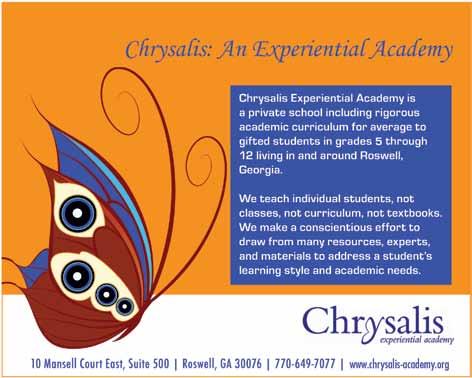
ExPERIENTIAL LEARNING an educational approach using applied, hands-on methods of learning.
INTERNATIONAL BACCALAUREATE (IB) a specifically designed comprehensive academic program emphasizing traditional disciplines while instilling a global perspective in its students.
MAGNET SCHOOL a public school that offers a specific or enhanced curriculum designed for students of special interest or ability.
MONTESSORI a school following the principles developed by dr. maria montessori focusing on the unique individuality, self-reliance and independence of children.
SPECIAL NEEDS a school or program for children who have mild-tomoderate learning differences. It usually features smaller class sizes, individualized attention and multisensory learning methods.
ACCREDITATION official certification that guarantees a school provides an education of a reasonably high quality. Schools must prove levels of quality and maintain continuous standards of improvement.
ACT an alternative to the SaT, this national college admissions examination consists of subject area tests in English, mathematics, reading and Science, with an optional 30minute writing test.
ADEqUATE YEARLY PROGRESS (AYP) a measure of year-to-year student achievement on statewide assessments as required by the n child left Behind act.
CRITERION-REFERENCED COMPETENCY TESTS (CRCT)
Tests designed to measure how well students in grades 1 through 8 acquire the skills and knowledge described in the Georgia Performance Standards.
EARLY CHILDHOOD EDUCATION
Education that applies to children from birth to age eight, focusing specifically on their development, including physical, emotional, sensory, communicative, cognitive and social needs.
GEORGIA HIGH SCHOOL GRADUATION TESTS (GHSGT)
all students seeking a Georgia high school diploma must pass four content areas as well as the Georgia high School Writing assessment.
GEORGIA PERFORMANCE
STANDARDS Statewide standards of academic content for all subjects k-12, to which every school must adhere and on which students are annually tested.
HOPE SCHOLARSHIP (Helping Outstanding Pupils Educationally)
a scholarship in Georgia, funded by the Georgia lottery, that rewards academically achieving students with financial assistance to attend eligible public and private Georgia colleges and universities.
MISSION/PHILOSOPHY a statement outlining the guidelines a school follows to achieve its goals or maintain performance standards.
NO CHILD LEFT BEHIND ACT
a federal law passed in 2001 designed to ensure that all children have a fair and equal opportunity to obtain a high-quality education and meet state academic standards of proficiency.
NOTIFICATION DEADLINE
The date by which an independent school notifies families of the acceptance of a child for enrollment to the school.
OPEN HOUSE an event held at a school, at which parents can learn more about the school and its offerings.
PSAT a standardized test that offers students practice for the SaT reasoning Test and allows them to qualify for the National merit Scholarship Program.
REPLY DEADLINE
The date by which parents must notify an accepting school of their commitment to enroll their child.
SAT This standardized test measures the critical thinking, mathematical reasoning, and writing skills of students planning to attend college.
Did You Know:
Georgia seniors scored an average of 1,452 on the SAT in 2012, a seven-point increase from 2011.
SECONDARY SCHOOL ADMISSIONS TEST (SSAT) The admissions test that many independent schools require students to take in order to be considered for enrollment.
SUMMER CAMP a common destination for children and teenagers during the summer, at which they can participate in a variety of activities or classes.
Communication
Deciphering Associations and Organizations
Many local and national organizations work to bring out the best in summer camps and public, private and boarding schools by identifying schools that meet certain standards through accreditation. These groups also set policies, research educational advancements and offer services to the educational communities both in Atlanta and in Georgia. The following are just some of the associations and organizations you should know in your search for the best educational experience for your child.
AdvancED www.advanc-ed.org
The parent organization for Southern Association of Colleges and Schools, AdvancED advances education excellence through accreditation and school improvement.
American Camp Association (ACA) www.acacamps.org
Accredits camps that meet industry-accepted and
government-recognized standards, educates owners and directors and establishes guidelines.
The Association of Boarding Schools (TABS) www.boardingschools.com
This organization of 300 boarding schools serves the professional development needs of boarding schools and provides information to potential students and their families.
Association of Christian Schools International (ACSI) www.acsi.org
ACSI strives to enable Christian educators and schools worldwide to effectively teach using Christ-centered curricula and programs.
Association Montessori Internationale (AMI) www.montessori-ami.org
Recognizes schools that strongly adhere to Montessori principles and practices.
Atlanta Area Association of Independent Schools (AAAIS) www.aaais.org
Although not an accrediting agency, AAAIS is an affiliation of independent schools and operates under analogous principles and a common code of ethics.
The Council of International Schools (CIS) www.cois.org
The premier organization in international education for the accreditation of schools and the development of best practices.
Department of Education (DOE) www.doe.k12.ga.us
A statewide, policy-driven organization governing the public school system of education in Georgia for K through 12, the DOE operates under the direction of the State Superintendent of Schools.
Georgia Accrediting Commission (GAC) www.coe.uga.edu/gac
GAC offers four levels of approval: preparation status, provisional accreditation, accreditation and accreditation with quality.
Georgia Association of Christian Schools (GACS) www.gacs.org
Uses generally accepted indicators of quality, voluntary self-improvement and peer review to measure Christian schools.
Georgia Association of Educational Leaders (GAEL) www.gael.org
This statewide umbrella organization of six professional associations provides unity among school leadership organizations in Georgia.
Georgia Association of Private Schools for Exceptional Children (GAPSEC) www.gapsec.org
This state organization is for schools that serve students with learning issues.
Georgia Charter Schools Association (GCSA) www.gacharters.org
A membership organization whose mission is to be an effective advocate and service provider for all charter public schools in Georgia.
Georgia Independent School Association (GISA)
www.gisaschools.org
An association of private, independent and parochial schools throughout the state whose mission is to advance excellence and collaboration among private, independent and parochial schools.
Georgia Partnership for Excellence in Education (GPEE) www.gpee.org
This non-profit organization of business, education, community and government leaders aims to shape policy and reform public education in the state.
Georgia Private School Accreditation Council (GAPSAC)
www.gapsac.org
Association of K-12 private schools whose students are recognized and approved by the Georgia DOE for transferring credits to public schools on the same basis as students from public schools.
Georgia Professional Standards Commission (PSC) www.gapsc.com
A state organization responsible for setting and applying high standards for the preparation, certification, and continued licensing of Georgia public educators. Prepara-
tion and conduct of public school teachers and staff.
Georgia School Boards Association (GSBA) www.gsba.com
Representing Georgia’s 180 elected boards of education, GSBA provides leadership and services to local boards of education.
National Association for the Education of Young Children (NAEYC) www.naeyc.org
The NAEYC focuses on the quality of educational and developmental services for children, from birth to age 8, including daycare and pre-K centers. It is a national network of more than 300 local, state, and regional affiliates, and a growing global alliance.
National Association of Independent Schools (NAIS) www.nais.org
The association values and works to maintain the independent nature of each member school by promoting high standards of educational quality and ethical behavior.
National Association of Private Special Education Centers (NAPSEC) www.napsec.org
Represents private specialized education programs and their leaders u
by promoting high-quality programs and services for individuals with disabilities and their families.
National Christian School Association (NCSA) www.nationalchristian.org Administrators from accredited schools, university educators and public schools preside over the accreditation process for NCSA.
National Council for Private School Accreditation (NCPSA) www.ncpsa.org
A consortium of several private school organi-
zations dedicated to preserving the integrity of the accreditation process for thousands of private schools across the nation.
Southeastern Association of Boarding Schools (SABS) www.sabs.org
An association of 23 boarding schools committed to promoting and supporting boarding education opportunities in Southeastern states, including the Carolinas, Alabama, Tennessee, Georgia and Florida.
Southern Association of Colleges and Schools (SACS) www.sacs.org
Member schools meet research-based standards and maintain continuous school improvement and quality assurance.
Southern Association of Independent Schools (SAIS) www.sais.org
Members meet quality standards, receive peer evaluation and implement a school plan focused on strategic improvement.
For more information about these and other organizations and associations that ensure quality education among camps and schools, visit the websites of the Georgia Department of Education (www.k12.ga.us) or the U.S. Department of Education (www.ed.gov).
Important dates
Dates subject to change. Please check with your local school district for updates. T = Traditional Calendar Y = Year-round Calendar


UBLIC SCHOOLS



FALL BREAK


OF a decatur, Paulding, rockdale enry

aug. 7 atlanta (T), Bartow, Buford, cobb, douglas, Gwinnett
aug. 8 forsyth, marietta
aug. 12 clayton, dekalb, fayette, fulton, Gainesville city, Griffin-Spalding, hall
Sept. 9-13 decatur
Sept. 16-20 cherokee
Sept. 23-27 atlanta (Y), Paulding
oct. 7-8 cobb, marietta
oct. 7-11 henry, rockdale
oct. 10-14 clayton
oct. 11-14 atlanta (T), coweta, douglas
oct. 14 dekalb, fayette, Gwinnett
oct.14-15 Bartow, Buford, fulton, Gainesville city, hall
oct. 14-18 Griffin-Spalding
oct. 18 forsyth
THANKSGIVING BREAK
nov. 25-29 atlanta (T,Y), Bartow, Buford, cherokee, clayton, cobb, coweta, decatur, dekalb, douglas, fayette, forsyth, fulton, Gainesville city, Griffin-Spalding, Gwinnett, hall, henry, marietta, Paulding, rockdale
INDEPENDENT SCHOOLS
Open Houses
oct. to mar., in general
Application Deadlines late Jan. to late feb., in general
TESTING DATES
oCTDEC SAT
dates apply to both public and independent schools. for registration deadlines, visit the appropriate websites.
oct. 5, nov. 2 and dec. 7
www.collegeboard.org
SSAT
oct. 12, nov. 9 and dec. 7
www.ssat.org
Special Needs Schools
Resources for Finding a School for Children with Learning Difficulties
What is a Special Needs School?
Special needs schools are those that serve children who struggle with learning disabilities or don’t perform well in a conventional school environment. These schools use alternative approaches to instruction in order to help children learn more effectively, and achieve success in the classroom and in social settings.
What is a Learning Disability?
A learning disability is a neurological disorder that affects how your child processes certain information. Children with learning disabilities are as smart as or even smarter than other children, but may face challenges with reading, writing, spelling, reasoning and other functions. As a result, they often struggle to achieve in traditional classrooms. Common learning disabilities include Attention Deficit Disorder (ADD), Attention Deficit Hyperactivity Disorder (ADHD), dyslexia, autism and Asperger’s syndrome.
If your child exhibits more intelligence than his or her schoolwork demonstrates, contact your physician or a licensed psychologist for an evaluation.
How Do I Find the Right School?
As you begin searching for the right school for your child’s situation, here are some questions to keep in mind:
• Will your child fare better in a school that focuses on his or her specific learning disability, or would you

rather that he be able to interact with students with a wide range of learning capabilities?
• Does the school serve a specific age range, or work with students on all grade levels? Many students with learning disabilities have trouble transitioning to new schools.
• Does the school offer a variety of sports, after-school activities and arts programs?
• Is the school accredited? If so, by which organizations?
• Is the staff certified to instruct students with your child’s particular learning difficulty?
• Does the school offer financial assistance?
Where to Turn: A Directory of Special Needs Schools
The Atlanta area boasts many public and private schools that serve students with learning difficulties. Here is a sampling of schools to help you with your search.
PUBLIC SCHOOLS
H.A.V.E.N. Academy
Students with emotional behavior disorders and autism. Grades 1 through 12. Two campuses in Smyrna. 678-842-6930 (Hawthorne School), 678-842-6899 (Fitzhugh Lee School). www.cobbk12.org/haven.
Margaret Harris Comprehensive School Special education school for students
with severe and multiple disabilities. Pre-K through 12. 678-874-7000. www.dekalb.k12.ga.us/margaretharris.
INDEPENDENT SCHOOLS
Alexsander Academy
Students with learning difficulties. Grades 2 through 8. 404-839-5910. www.alexsanderacademy.org.
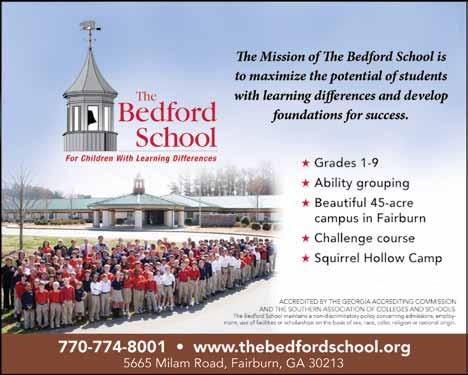
The Bedford School
Dyslexia, Asperger’s syndrome and other learning disabilities. Grades 1 through 9. 770-774-8001. www.thebedfordschool.org.
Center Academy
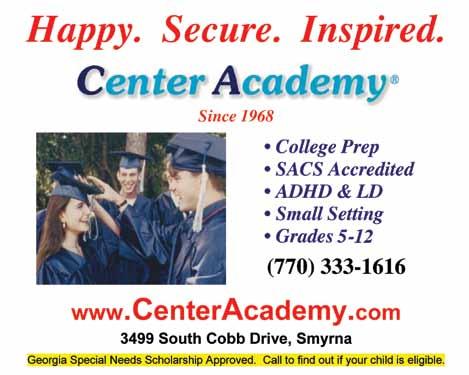
ADD, Asperger’s syndrome, dyslexia and other learning difficulties. Grades 5 through 12. 770-333-1616. www.centeracademy.com. u

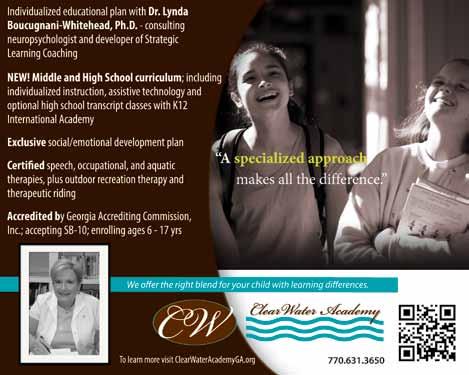
ClearWater Academy
ADD/ADHD, Asperger’s and other learning differences. Grades 1 through 12. 770-631-3650. www.clearwateracademyga.org.
Cumberland Academy
ADD/ADHD, autism, Asperger’s syndrome and learning disabilities. Grades 4 through 12. 404-835-9000. www.cumberlandacademy.org.
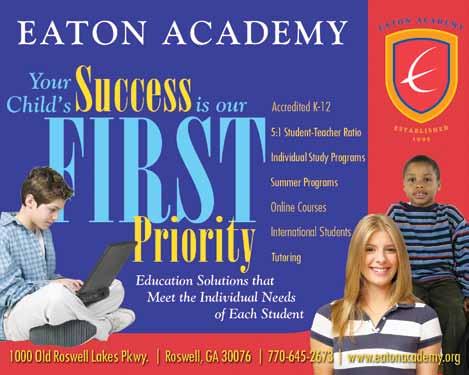
Eaton Academy
Average, gifted and students with learning challenges who have not responded to traditional methods. K through 12. 770-645-2673. www.eatonacademy.org.
The Hirsch Academy
Children 5 to 13 with learning differences. 404-378-9706. www.hirschacademy.org.
The Howard School
Language-learning disabilities and learning differences. K through 12. 404-377-7436. www.howardschool.org.
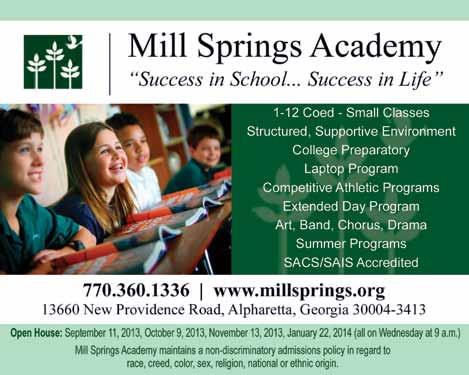
Mill Springs Academy ADHD and learning disabilities. Grades 1 through 12. 770-360-1336. www.millsprings.org.
Porter Academy ADHD, dyslexia and other differences. Pre-K through 8. 770-594-1313. www.porteracademy.org.
The Schenck School
Students with dyslexia. K through 6. 404-252-2591. www.schenck.org.
For an index of additional special needs schools, please turn to page 113.
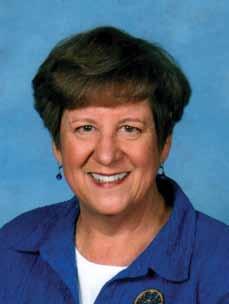
Betsy Box
Director, The Bedford School headmaster’s corner
Betsy Box is director of The Bedford School, which for 28 years has served children in grades 1 through 9 who have been professionally identified as having specific learning differences. Prior to founding the school, she worked at the reading research foundation in Berea, ky., and pioneered a program for students with learning disabilities at Woodward academy.
What is your educational philosophy? I believe that every child should have the opportunity to become the very best person possible. for children with learning disabilities, it is vital that they receive the proper testing and intervention in order to maximize their potential.
What do you love most about your job? I love watching the transformation for children and their families when they start feeling successful!
How can parents best contribute to the educational process? once you have found the right setting for your child, trust the school and work with them as a team.
How is the field of education changing? Education is changing because society is changing. The vast amount of information that has to be processed makes it very difficult for many children, especially for those who learn differently.
What advice would you offer parents about their children’s education? different children in the same family may need different educational settings. If you feel that there is something different about your child and that he is not getting what he needs, seek the appropriate advice from professionals, visit as many schools as you can, talk to other parents and children, and then follow your our gut instinct. you know the child best! don’t wait for your child to “grow out of it.” Get help as early as possible.
THE ESSENTIALS: THE BEDFORD SCHOOL
Emphasis: The mission of The Bedford School is to maximize the potential of children with learning differences.
Year Founded: 1985
Grades: 1-9
Students: 136
Avg. Class Size: 10
Tuition Range: $16,950
Accreditations or Affiliations: SacS, Georgia accrediting commission
Location: fairburn, Ga.
Contact: 770-774-8001 www.thebedfordschool.org
TEACHING CHILDREN TO BECOME GOOD CITIZENS EDUCATION Character
For many parents, a good education means much more than academics. While reading, math and science are all important, such values as kindness, respect and empathy for others are just as important, if not more so. Fortunately, most Atlanta-area public and independent schools incorporate some form of “character education” in their curricula, guiding children to become caring, involved members of society.
On the public school side, the Georgia Department of Education mandates character education as part of its Georgia Quality Core Curriculum Standards, meaning it’s required in all elementary, middle and high schools throughout the state. This “character curriculum” focuses on citizenship, respect for others and respect for oneself.
The citizenship portion stresses the importance of such values as democracy,
Atlanta International School uses the International Baccalaureate program to instill positive character traits in its students.
equality, respect for authority, justice, patriotism, liberty and respect for the natural environment. Students learn to respect others with an emphasis on altruism, humility and integrity, and are taught accountability, respect for themselves and a strong work ethic.
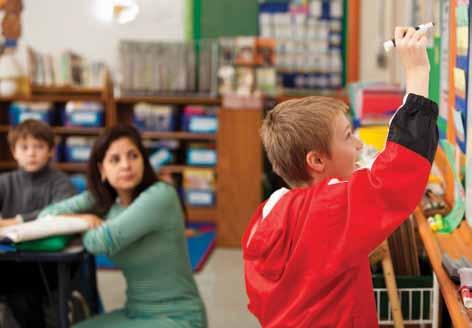
Georgia’s Quality Core Standards stress such values as democracy and respect for the environment.
The Cobb County School District boasts its own focus on character development, with a calendar that emphasizes different character traits including respect, integrity and responsibility, among others. Instead of students receiving a separate lecture on self-respect, that lesson is incorporated into the regular curriculum, across all disciplines, says spokesman Doug Goodwin.
That approach is similar to the one taken by the Atlanta International School (AIS), an independent school in Buckhead that uses the framework of the
International Baccalaureate (IB) program to instill positive character traits in its students.
At the heart of each grade’s IB program are several distinct traits such as communication, open-mindedness and risk-taking.
At the beginning of each year, teachers work those character traits and principles into their lesson plans with an eye toward sculpting students into ideal “global citizens” who will use what they’ve learned to make a difference in their community and in the world at large throughout their lives.
“Every time we sit down to think about what we’re doing with the students, it’s not only the [academic] objectives but it’s the IB learner program that’s at the heart of what we’re trying to do with our kids,” says Jennifer Weyburn, AIS’ head of middle school. u

Thinking for oneself, learning from failure
and respecting the views of others are all key components of a character-based education.
At The Children’s School, an independent school in Midtown Atlanta, guidance counselor Kathy Roberts visits each classroom twice a month to present a 40-minute class on the character trait of the month. During the month of February, the trait was courage, with tenacity and conviction as secondary traits. Each student learns the definition of each word and how to apply the trait in daily life.
During each session, Roberts teaches the students tools they can use to manage and communicate each character trait. In the case of courage, the students practice using the tools to conquer their nightmares, try something new, tell their parents that they’ve made a mistake or tell a friend that something is bothering them.
During the weeks Roberts doesn’t visit their classroom, teachers incorporate the school’s character and community-
building curriculum by having students journal about the traits and write reports on heroes that exemplify those traits, among other activities.
Learning From Mistakes
Polly Williams, director of admissions at the Galloway School in Atlanta, says she’s seen a paradigm shift in education over the years, with more and more schools emphasizing project-based learning and collaborative problem-solving—an approach the Galloway School has employed since it was founded in 1969.
Students at the Galloway School are encouraged to come up with their own ideas and to learn from their mistakes. As a process school rather than an outcomebased school, Galloway encourages its students to take risks, and provides a safe environment for them to do so.
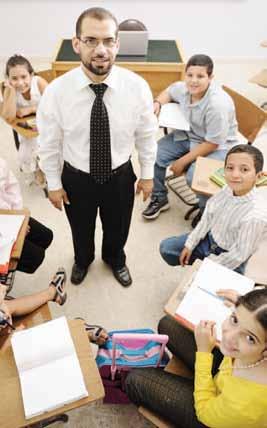
“They can learn a lot by trying something,” Williams says, “and perhaps not having the outcome they anticipated, but learning from that.”
Students are also encouraged to explore their passions and beliefs, to ask questions and speak out on a regular basis in what Williams calls a “lively, discussion-rich environment.”
“It’s coming from them internally, instead of somebody telling them what to think or believe,” she says. “We think that’s incredibly important.”
Respecting Differences
Along with thinking for oneself and learning from failure, learning to respect the viewpoints of others is a key component of character-based education. At AIS, says Weyburn, students are taught that different people have different frames of
reference. The school exposes students to other cultures and different viewpoints, and teaches them to value others’ opinions, even when they don’t agree with them.
Similarly, each classroom at The Children’s School has a “peace table,” says Roberts, where students are taught to sit down and talk out solutions when they have disputes with others. The students are also encouraged to use statements such as “I feel angry when…” to communicate their feelings. “These things teach the core values of respect, responsibility and cooperation,” she says.
“All of that has to be part of what you’re using to interact with people to try and develop solutions,” Weyburn says. “Part of our mission statement [at AIS] says, ‘Others with their differences can also be right.’”
In the end, Weyburn says, students who ask questions, think critically and take risks are more likely to develop into lifelong learners.
“It’s very well to learn things in the classroom,” she says. “But if you can’t take that knowledge out there into the world and activate it in the messy reality and complex situations that are out there, then what’s the point of learning all of those wonderful academic things?”
DID YOU KNOW?
Georgia devotes an entire month to the importance of character. A group of students and teachers at Cobb County’s Durham Middle School wrote their state senator proposing a “Georgia Day” to honor character and good choices. Gov. Nathan Deal extended the idea to a whole month spotlighting state history and the positive character traits of Georgians past and present. The first “Georgia Month” was observed in September 2012.




















































EDUCATION VIRTUAL






























ONLINE PROGRAMS ENHANCE
BY DANIEL BEAUREGARD


CLASSROOM LEARNING










In today’s technology-driven world, the definition of what a school is, or can be, is quickly changing. School systems and independent schools are offering new options in addition to the traditional brick-and-mortar school setting. These programs provide an education no less demanding than conventional classrooms for students who travel a great deal, are homeschooled, or are simply looking to supplement or speed up their current coursework.
What’s more, online learning can give students more attention than they might receive in the classroom. “In this environment, we are able to personalize instruction, and we have a wealth of information about our students,” says Heather Robinson, principal of Georgia Connections Academy, a K-12 virtual school.
A Different Option
Georgia Connections Academy is a charter school with a statewide attendance zone. The only requirement for admittance is that the student live in Georgia,
or reside there most of the time.
“We provide our families with the entire school program—we provide the curriculum and hard-copy textbooks to our younger students and e-books for older students,” Robinson says.
Like any public school, Georgia Connections Academy is free, and authorized by the state board of education. The difference is that instead of sitting in a traditional classroom, students work from home at their leisure, although they are required to work daily with a “learning coach,” usually a parent or guardian, in addition to working with their teacher.
Students are required to log attendance hours each day, as well as on an hourly basis, but they can start and end whenever they want. The only time students are required to be online is when they are scheduled to participate in a live session or meet with their teachers and fellow students in a virtual classroom. All of the teachers are certified by the state and work at a teaching center in Duluth and are available by phone or email. u
www.atlantaschoolguide.com

“I can’t say that Connections Academy is better than a traditional school,” Robinson says. “I can just say it’s a different option.” Currently, the school serves more than 2,000 students across the state.
Atlanta-Area Schools
There are several online schools available to metro Atlanta students. Georgia Cyber Academy, a charter virtual school, is the largest public school in the state, with 12,000 students in grades K-11. (The academy plans to add 12th grade for the 2013-2014 school year.) It uses a specialized curriculum developed by its parent company, K12.
The Georgia Virtual School, run by the Georgia Department of Education, offers middle- and high-school courses to students across the state. The Georgia Virtual School uses the approved Geor-

gia Performance Standards and Common Core Georgia Performance Standards curriculum, ensuring that students receive the same education they would in a school setting.
Decatur High School Assistant Principal Rochelle Lofstrand says her school uses Georgia Virtual School as an enrichment option for its students. “If we don’t offer courses or different levels here at the school, we don’t want that stopping a child in enriching their lives academically,” she says.
DeKalb County’s virtual high school, the DeKalb Online Learning Academy, is a branch of the DeKalb County system rather than a statewide charter. The DeKalb Learning Academy offers students the chance to take such core courses as language arts, business, social studies and more, as well as Advanced
Placement classes. Students can also make up classes they may have failed previously so that they can graduate on time. Students may take two classes per semester in addition to their regular coursework.
Virtual learning isn’t limited to public schools. Some independent schools have developed their own virtual learning programs. Eaton Academy in Roswell, for example, offers online courses for grades K-12. Students complete their work and submit it online, where it is graded by a teacher, says admissions coordinator Margie Cohan.
“There’s a lot of flexibility,” Cohan says. “For example, we can take a child who has been out and missed a great deal of school due to illness. The public schools would say he or she had to repeat the entire semester.”
Through its ELCA Connect program, Eagle’s Landing Christian Academy in McDonough, Ga., offers traditional core classes as well as electives, foreign languages and other courses that aren’t available in a classroom setting. These courses are available to students in all grades and to non-Eagle’s Landing students, such as homeschool students, as well.
And some schools that don’t offer their own online courses will allow students to take courses from online providers in certain circumstances, such as to fulfill a graduation requirement or enrich their academic experience. At Mount Pisgah Christian School, for instance, “a student might transfer to us and need or want additional credit in a world language that we don’t offer, such as German,” says Dr. Bryan Smith, head of Mount Pisgah’s upper school. “That student would be allowed to take that online course, provided the online provider is accredited.”
Best of Both Worlds Virtual learning programs like those provided by Connections Academy and Georgia Virtual School can help students in rural areas get the same coursework as those in more populated regions. Additionally, if a student excels in a given course and needs a more rigorous curriculum, virtual schools can provide that.
“Research is showing that students want a more rigorous and engaging learning environment,” says Christina Clayton, the GDOE’s director of instructional technology.
Ideally, online learning doesn’t replace classroom learning, she says, but rather offers the best of both worlds.
“I believe the best educational experience for a student is when an opportunity is provided for a blended environment—some face-to-face courses and some online,” she says. “However, there are cases, like students who are homebound and need to take all of their courses online, that we can provide that option for them to stay on track to graduate.”
Georgia Connections Academy www.connectionsacademy.com
Georgia Cyber Academy www.k12.com/gca
Georgia Virtual School www.gavirtualschool.org
DeKalb Online Academy www.dekalbonlineacademy.org
Eagle’s Landing www.elcaonline.org
Eaton Academy www.eatonacademy.org
Mount Pisgah Christian School www.experiencepisgah.org

Your Guide to
STANDARDIZED TESTS
WHY THEY’RE IMPORTANT AND HOW TO PREPARE
BY MURIEL VEGA
Whether your child attends a public or independent school, he or she will be required to take some form of standardized test.
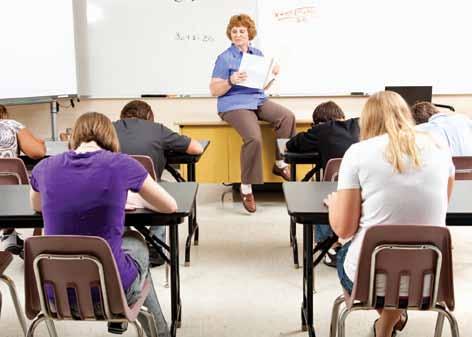
Astandardized test is one that is administered and graded in a consistent manner, usually given to students across an entire school or school system or even nationally, as opposed to one created by a teacher for a specific class.
These tests are often used to determine whether your child passes to the next grade level and what kind of college he or she attends.
On the pages that follow, we break down some of the most common standardized tests your child may encounter, as well as resources like websites, classes and tips on how to prepare your child for these important examinations.
Elementary and High School
If your child is enrolled in a Georgia public school, there are a number of tests he or she will be required to take. These include the Criterion-Reinforced Competency Test (CRCT), which measures how
well students in grades 1 through 8 have absorbed lessons in reading, arts, mathematics and English and language arts; students in grades 3 through 8 are also tested in science and social studies.
The End of Course Test (EOCT) similarly measures competency in science, social studies, mathematics and English language arts in grades 9 through 12. Students in the 11th grade currently are required to take the Georgia High School Graduation Test (GHSGT) in order to graduate from from high school. (Students who entered high school after fall 2011 will not be required to take the GHSGT.) The Georgia Department of Education website contains links to study guides for the CRCT, EOCT and GHGST. The Georgia Online Assessment System provides access to tests with the same kinds of questions that appear on the abovementioned tests.
Students at independent schools may also be required to take standardized
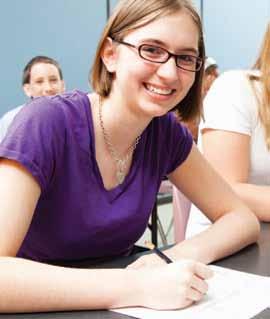
tests, such as the Iowa Tests of Basic Skills (ITBS). This test is administered to students in elementary (grades 3 through 5) and middle school (6 through 8). According to state law, public school districts may elect to administer the test as well.
Another standardized test independent school students are likely to encounter is the Secondary School Admission Test (SSAT), which helps independent schools to assess a student’s academic skills.
College Aptitude Tests
One test all college-bound students are guaranteed to take is the SAT (formerly the Scholastic Assessment Test), a college admissions test that evaluates reading, writing and math skills.
A number of Atlanta-area schools, including St. Pius X and Greater Atlanta Christian School (GAC), offer prep courses or workshops for the SATs. “We do offer an elective for SAT prep,” says Lori Davis, a college counselor at GAC. “You can also find practice tests at the College Board and Georgia College 411 web-

sites.” Emory University offers an SAT prep class, as well.
Another popular college admissions test, the ACT (originally an acronym for American College Testing), covers English, math, reading, science and an optional writing component. Students can find test preparation materials on the ACT’s website.
Students seeking additional preparation for the SAT may elect to take the PSAT, which provides firsthand practice for the SAT and also determines a student’s eligibility for the National Merit Scholarship program. Practice test questions are available through the College Board website.
Testing Tips
No matter what test your child is preparing to take, there are some things he or she can do to make the experience easier and less intimidating. “I tell students that they need to understand the test they are taking and know the test structure,” says GAC’s Davis. “For example, are you going to lose points for a wrong answer?”
Students who are preparing to take a standardized test should take practice tests, reading each question carefully and identifying key words so that they understand exactly what the question is asking. Encourage your child to evaluate multiple-choice questions, eliminating each answer until only the correct one remains. It’s also important for children to manage their study time effectively, review their basic skills and work on improving their vocabulary.
Above all, make sure your child maintains a positive attitude, gets enough sleep and has a proper breakfast on the day of the test. With the right physical and mental preparation, including practice tests and parental support, he or she will be well on their way to acing these important tests on the road to academic success.
STANDARDIZED TEST RESOURCES
Georgia Department of Education www.doe.k12.ga.us
Georgia Online Assessment System www.georgiaoas.org
Georgia College 411 www.gacollege411.org
College Board www.collegeboard.org
SAT www.sat.collegeboard.org
PSAT www.collegeboard.com/student/testing/ psat/about.html
SSAT www.ssat.org
ACT www.act.org
atlanta area map
REGIONS FOR INDEPENDENT SCHOOLS N
3 3 f or features of independent schools, turn to Education a t-a-Glance on pg. 36. f or public school system information by county, turn to pg. 89.
2
2
1 1
5 5
Boarding Schools Connecticut, Florida, Georgia, Illinois, Kentucky, New York, North Carolina, South Carolina, Virginia
Public School County Guide
Educational Resources Tutoring, Summer Camps and Activities, Field Trips and Outreach Programs.
REGION 4: Atlanta South/ Southeast/Southwest
Atlanta South, College Park, Douglasville, Downtown McDonough, East Point, Fairburn, Kedron area, Locust Grove, Newnan, Southeast Altanta p.75
REGION 5: Atlanta West Buckhead North, Kennesaw, Powder Springs, Marietta, Smyrna, Vinings
REGION 1: Atlanta North/Northwest
Alpharetta, Buckhead, Crabapple, East Cobb, Marietta, Roswell, Sandy Springs
REGION 2: Atlanta North/Northeast
p.51
Alpharetta, Dunwoody, Flowery Branch, Gainesville, Norcross, Northeast Atlanta, North Fulton, Sandy Springs
REGION 3: Atlanta East Ansley Park, Athens, Dacula, Decatur, Druid Hills, Lawrenceville, Lilburn, Midtown, Stone Mountain
p.58
Education At-a-Glance
This information reflects the latest available data at publication time. Please confirm with each individual school.
INDEPENDENT SCHooLS
REGIoN 1: ATLANTA NoRTH/NoRTHwEST
51 REGIoN 2: ATLANTA NoRTH/NoRTHEAST
Education At-a-Glance
INDEPENDENT SCHooLS
3: ATLANTA EAST
Education At-a-Glance
INDEPENDENT SCHooLS
REGIoN 5: ATLANTA wEST
BoARDING SCHooLS

Roswell With its mix of stately neighborhoods and new developments, its quaint downtown area and miles of trails through forests and along the Chattahoochee River, Roswell attracts many families and nature-loving residents to its city limits.
Sandy Springs Newbie, Sandy Springs became its own city in 2005, and multitudes of boutiques, bars and restaurants line Roswell Road, its main thoroughfare. Residents also enjoy the community’s many family-centered events held throughout the year.
BUCKHEAD




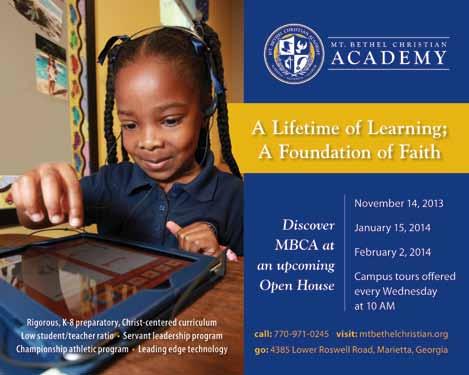
Eastside Christian School
u K5 - 8th grades
u Foreign language
u Small student/teacher ratio
u Visual & performing arts
u Athletics

u Computer technology education

• October 23, 2013, 9:30 a.m.
• January 15, 2014, 9:30 a.m.
• February 5, 2014, 9:30 a.m.





SANDY SPRINGS
Independent Schools
Norcross Founded in the late 1800s as a resort town for wealthy Atlantans, Norcross is Gwinnett County’s second oldest city. Today, with over 8,000 residents, it is a quiet city filled with upscale residential and retail developments.
Cumming Called the “Gateway to Leisure Living,” Cumming offers the best of small-town living, but in recent years, it has seen rapid commercial and residential development, attracting residents with its prime location near Lake Lanier.


Atlanta

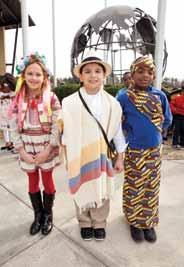
Victory World Christian School is
1 Pre-K (4) through 5th grade elementary program
1 High curriculum standards & creative learning environments
1 Interactive Technology in every classroom (whiteboards & laptops)
1 Rosetta Stone Spanish in all classes
1 Extracurricular Activities (ballet, jazz, chorus, drama, Tai-Kwon-do, piano)

Independent Schools
Stone Mountain More than just a mountain park, Stone Mountain also refers to a charming community of antique shops, art galleries and restaurants. Residents of Stone Mountain enjoy the miles of walking and biking paths available in the nearby park.
Lawrenceville Strolling the brick-paved sidewalks in the revitalized historic downtown of Lawrenceville, you’ll feel instantly at home. Chartered in 1821, the city has gone through many changes over the years but has maintained its small-town Southern charm.










Independent Schools
Ne I ghborhood S of Note
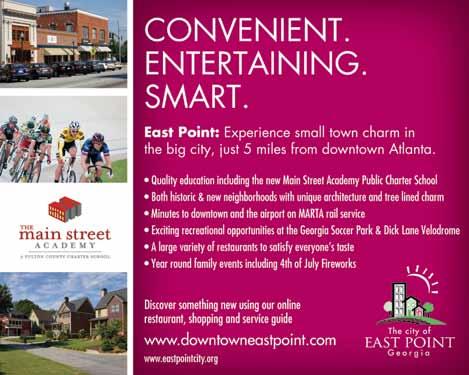
Newnan Established in 1828 and home to more than 30,000 residents, Newnan is one of the fastest-growing cities in Georgia. It has many new residential developments and boasts five historic districts filled with stately Southern homes.
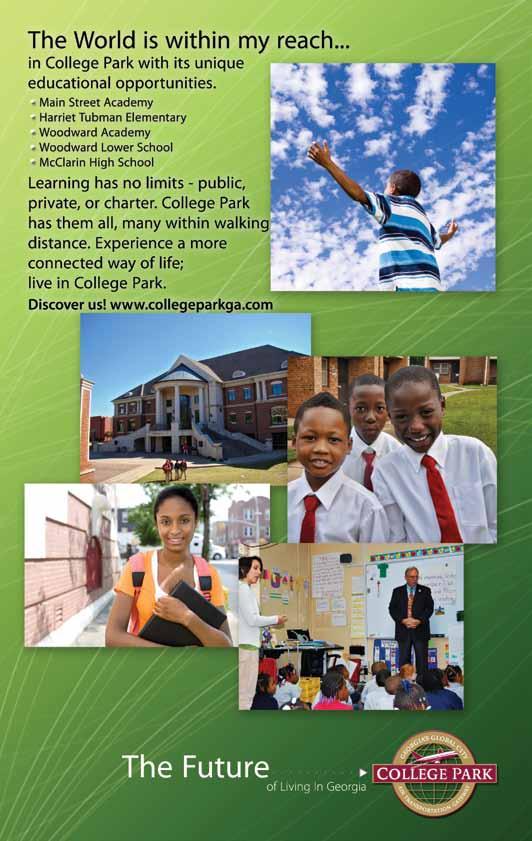
College Park College Park is home to a small-town main street and the busiest airport in the world—Hartsfield-Jackson Atlanta International Airport. The city is attracting young professionals and families by combining the historic elements with new developments.

ATLANTA S o UTH EAST





d
d
d
d
d


BAR TO W
Independent Schools
FULTON
Kennesaw Home to the popular Kennesaw Mountain National Battlefield Park, the city of Kennesaw takes pride in its excellent recreation opportunities and parks, rich history and thriving downtown. Kennesaw State University, the third largest university in Georgia, is well known for academic programs in business, education, and nursing.
Smyrna With its unique charm, solid government and city services, the city of Smyrna offers many fresh, trendy lifestyle options, and the Market Village plays host to numerous restaurants, bars and upscale shops. Known as the “Jonquil City,” because of the thousands of jonquils that flourish in gardens and along the streets in early spring.

KENNESA w


-V ININGS A REA
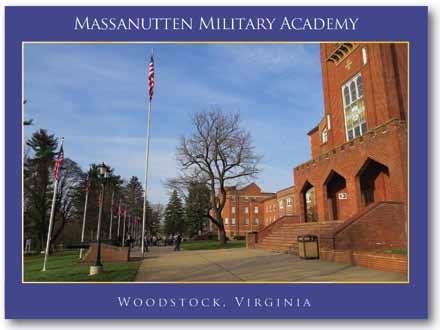

There are many benefits of a boarding school education. Boarding schools are an option for students seeking a more independent learning experience. Because students generally live on campus, learning takes place in and out of the classroom almost on a 24-hour basis.
When selecting a boarding school, it is important to visit the school campus, but representatives from many boarding schools visit metro atlanta throughout the year—contact each school for specific dates.
Boarding School
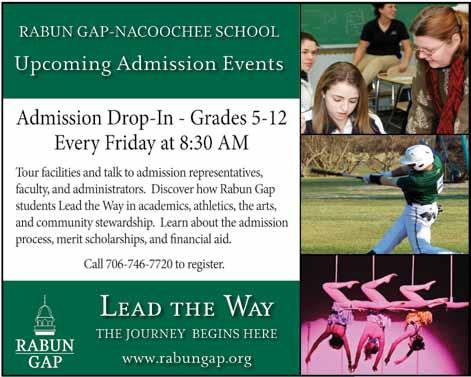
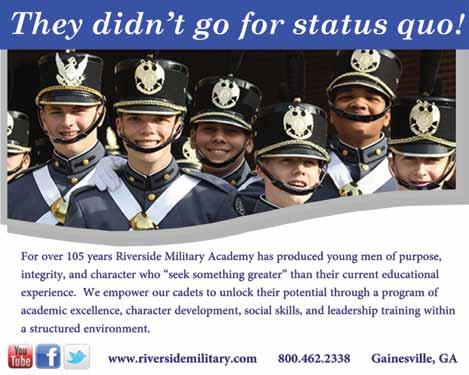
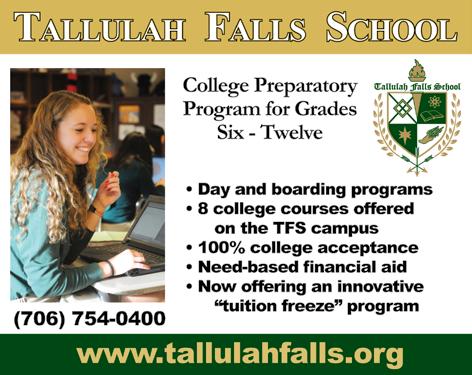
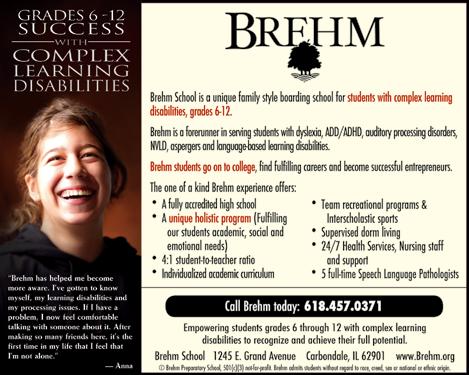

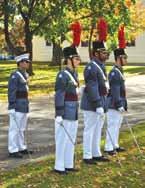


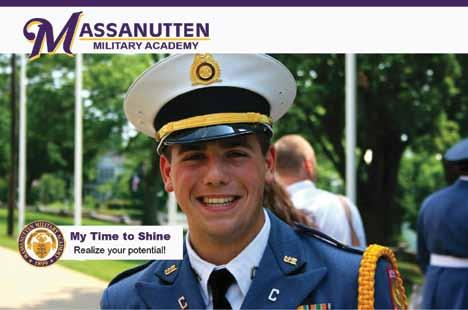
Established in 1889, on a 120 acre Campus, conveniently located in the beautiful Hudson Valley, just 60 miles north of New York City. Utilizing the military model for leadership and development, and a rigorous curriculum grounded by a demand for classical disciplines, our graduates are well equipped to succeed in their college career and in life.
Please schedule a visit with our admissions office and come see for yourself why our cadets are Set Apart for Excellence by being inspired, engaged and ready for their future.



Ben Lippen School
A Christian, coed, college and calling preparatory boarding and day school for 7th-12th grade students
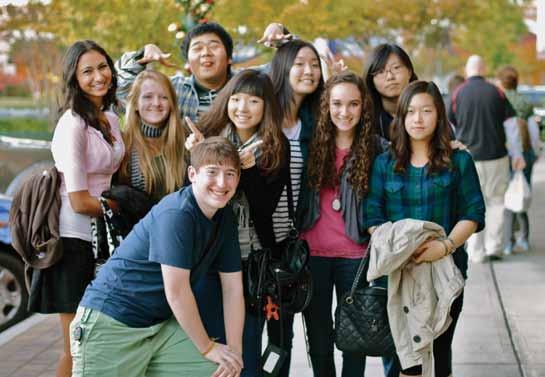
Join our globally diverse community instilling respect, responsibility, and integrity in the lives of young people. Stretch yourself academically as you develop your interests and pursue God’s calling for your life.
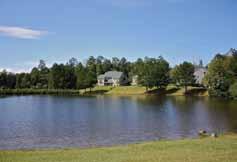
Located

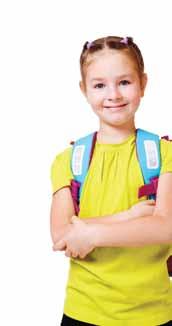
Avariety of improvements and innovative programs in Georgia’s public school systems have resulted in many stellar elementary, middle and high schools across the metro area. different school systems feature specialized programs and academic opportunities, such as magnet, charter, vocational or alternative schools to suit their respective students, parents and communities. however, despite variations in programming and academic offerings, all public schools must offer the core curriculum as determined by the Georgia Board of Education. here is a county-by-county guide to metro atlanta’s public school systems. for more information about the Georgia department of Education, call 404-656-2800 or visit www.gadoe.org. u
Board of Education
770-606-5800
www.bartow.k12.ga.us
Total # of Students: 13,937
Spending per Student: $8,311
What’s New
2012 Average CRCT Scores
3rd: (R) 848.47 (M) 845.13
5th: (R) 838.16 (M) 848.47
8th: (R) 840.10 (M) 818.49
2012 Average SAT: 1452
Top 3 Schools by Average 2012 SAT Score Cass High 1441
Woodland High 1440 Adairsville High 1402
The Bartow County College and Career Academy is slated to open in August of 2013. Bartow County Schools students who meet certain criteria will be able to participate in a dual college enrollment program.
Top 5 Schools by Average
Board of Education
770-479-1871
www.cherokee.k12.ga.us
Total # of Students: 38,679 Spending per Student: $7,744
What’s New
Cherokee County School District students continue to top national and state averages on Advanced Placement exams, with a test passage rate of 80 percent compared to Georgia’s rate of 53 percent and a national rate of 57 percent.
2012 Average CRCT Scores 3rd: (R) 830.75 (M) 820.74 5th: (R) 826.72 (M) 823.90 8th: (R) 832.71 (M) 814.01
2012 Average SAT: 1254
Top 5 Schools by Average
What’s New
Six Clayton County schools have been named “High Progress” schools by the Georgia Department of Education: Lovejoy, Riverdale, Forest Park, Jonesboro and North Clayton High Schools, and Lee Street Elementary School.
2012 Average CRCT Scores
3rd: (R) 850.01 (M) 848.92
5th: (R) 839.60 (M) 852.93
8th: (R) 846.56 (M) 837.80
2012 Average SAT: 1520
Top 5 Schools by Average 2012 SAT Score
Board of Education
770-426-3300
www.cobb.k12.ga.us
Total # of Students: 108,496 Spending per Student: $8,240
What’s New
Acworth’s Ford Elementary School has been selected to represent Georgia in the National Green Ribbon School Program due to its environmental efforts. Winners will be announced in June in a special ceremony in Washington, D.C.
2012
Board of Education
770-254-2800
www.coweta.k12.ga.us
Total # of Students: 22,038
per Student: $7,751
What’s New
Top 3 Schools by Average 2012
All three Coweta County Schools high schools have been named as “AP STEM Schools” in The College Board’s most recent Report to the Nation, based on Advanced Placement course offerings and student performance on the Advanced Placement exam.
2012 Average CRCT Scores
3rd: (R) 835.75 (M) 825.93 5th: (R) 827.10 (M) 825.83 8th: (R) 833.02 (M) 816.43
2012 Average SAT: 1343
Top 5 Schools by Average 2012 SAT Score
Board of Education
678-676-1200 www.dekalb.k12.ga.us
What’s New
The DeKalb County School District has received more than $600,000 in grants to launch dual language-immersion programs at three elementary schools: Rockbridge, Evansdale and Ashford Park.
COBB
DoUGlaS
2012 Average CRCT Scores
3rd: (R) 843.60 (M) 842.31
5th: (R) 833.97 (M) 834.71
8th: (R) 839.66 (M) 816.066
2012 Average SAT: 1373
Top 5 Schools by Average 2012 SAT Score
High 1418
Hill High 1384
Manchester High 1276 Lithia Springs High 1264
What’s New
Lithia Springs High School’s Reading Bowl team took home top honors at the Helen Ruffing Reading Bowl State Championship in the high school division.
Total # of Students: 20,534
Spending per Student: $9,018 Board of Education 770-460-3535 www.fcboe.org
What’s New
All five of Fayette’s public high schools made Georgia’s 2013 list of AP (Advanced Placement) Honor Schools, with each earning recognition in multiple categories based on the results of AP exams.
854.87
What’s New
In March, Forsyth County welcomed more than 300 educators for Breaking Barriers, a three-day conference exploring digital education and highlighting Forsyth’s successes in employing technology in the classroom.
DOUGLAS
Board of Education
770-229-3700 www.spalding.k12.ga.us
What’s New
Holcomb Bridge Middle School was one of three schools named to the state’s “Lighthouse Schools to Watch” program for its academic excellence and commitment to helping all students achieve at high levels. 2012
2012 Average SAT: 1580 Top 5 Schools by Average 2012 SAT Score
What’s New
Griffin High School student Ronnie Ross took home a gold medal in Electrical Construction Wiring at the SkillsuSA State Competition in March, and will go on to the National Leadership and Skills Conference in Kansas City in June.
2012 Average CRCT Scores 3rd: (R) 849.77 (M) 854.29 5th: (R) 840.59 (M) 851.95 8th: (R) 847.17 (M) 839.34 2012 Average SAT: 1498 Top 5 Schools by Average
What’s New Gwinnett County eighth-graders continue to excel on the Grade 8 State Writing Test, with 15 percent of county students scoring in the “exceeds” performance level in 2013, compared to a statewide average of 6 percent.
Board of Education
770-534-1080 www.hallco.org/boe
Board of Education
770-957-6601
www.henry.k12.ga.us
Board of Education
770-443-8000
www.paulding.k12.ga.us
What’s New
2012 Average CRCT Scores
3rd: (R) 840.27 (M) 835.70
5th: (R) 829.31 (M) 829.66
8th: (R) 836.24 (M) 822.33
2012 Average SAT: 1438
Top 5 Schools by Average 2012 SAT Score North Hall High 1536 Chestatee High 1449 West Hall High 1441 Flowery Branch High 1425 Johnson High 1400
Starting in the fall of 2013, The Earhart-Edison Exploration Academy will operate as a school-within-a-school on the North Hall Middle School campus, emphasizing a rigorous, projectbased education with instruction in science, technology, engineering and mathematics.
2012 Average CRCT Scores
3rd: (R) 846.84 (M) 845.93
5th: (R) 836.93 (M) 839.16 8th: (R) 841.30 (M) 825.98 2012 Average SAT: 1380
Total # of Students: 39,973
Spending per Student: $7,666
What’s New
Top 5 Schools by Average
Eighteen Henry County schools were presented with monetary awards equaling $30,000 by the Kroger Earning Plus Learning program in March. Walnut Creek Elementary received a $5,000 award to support student learning. Number of Schools
Total # of Students: 28,309 Spending per Student: $7,190
2012 Average CRCT Scores
3rd: (R) 847.66 (M) 847.40 5th: (R) 836.86 (M) 841.77 8th: (R) 840.62 (M) 823.13
2012 Average SAT: 1452
What’s New
Ten Paulding County schools were awarded $1,000 each by united Health Care in March to continue funding “Fuel up To Play 60,” a youth health program founded by the National Dairy Council, the uSDA and the National Football League to promote nutrition and physical activity.
HALL
2012 Average CRCT Scores
3rd: (R) 845.00 (M) 845.46
5th: (R) 836.85 (M) 839.48
8th: (R) 839.60 (M) 824.92
2012 Average SAT: 1356
Top 3 Schools by Average 2012 SAT Score
Board of Education
770-483-4713
www.rockdale.k12.ga.us
atlanta PUblIC SChoolS
Total # of Students: 15,309
Spending per Student: $9,282
What’s New
Rockdale County Public Schools was one of 25 state school districts honored in March for taking the 5 Million Meals challenge, an initiative aimed at increasing the amount of local food served to students.
Atlanta Public Schools was recognized by the Governor’s office of Student Achievement for significantly improving security procedures related to the Criterion-Reinforced Competency Test.
www.bufordcityschools.org
What’s New
2012 Average SAT: 1498
Buford High School student Grant Hall was named a STAR student at the annual STAR Student and Teacher luncheon in February. STAR students are seniors in the top 10 percent of their class with the highest SAT score. English teacher Tim Harris was also recognized.
Board of Education
404-370-4400
www.csdecatur.net
Total # of Students: 3,304
2012
What’s New
2012 Average SAT: 1570
Dale Duncan, a chorus teacher at Henderson Middle School, was named a 2013 LifeChanger of the Year in March. The award was one of 10 given to teachers across the country for making a positive difference in the lives of students. More than 400 teachers in 33 states were nominated for the award.
Board of Education
770-536-5275
www.gcss.k12.net
2012 Average SAT: 1383
Top School by Average 2012 SAT Score Gainesville High 1383
What’s New
Eighty-one percent of Gainesville City Schools eighth-graders met or exceeded standards on the most recent Eighth Grade Writing Assessment, up from 76 percent in 2012. In other news, the system expects to increase its budget by more than $2.5 million for the 2013-2014 school year.
Total # of Students: 8,459
2012 Average CRCT Scores
3rd: (R) 840.38 (M) 842.97 5th: (R) 834.03 (M) 834.92 8th: (R) 835.92 (M) 819.76
2012 Average SAT: 1459
What’s New
Voters in March approved the continuation of a 1-cent sales tax that could give Marietta City Schools more than $55 million over five years to renovate facilities, repay debt and improve technology and infrastructure at its schools.
EducaTIonal rESourcES




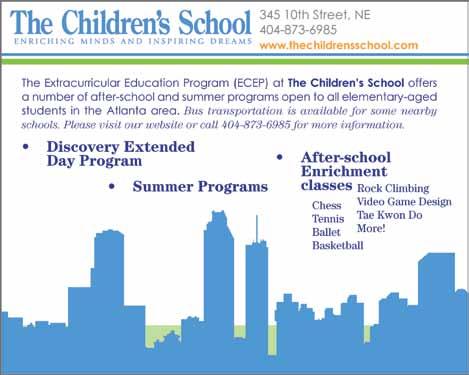
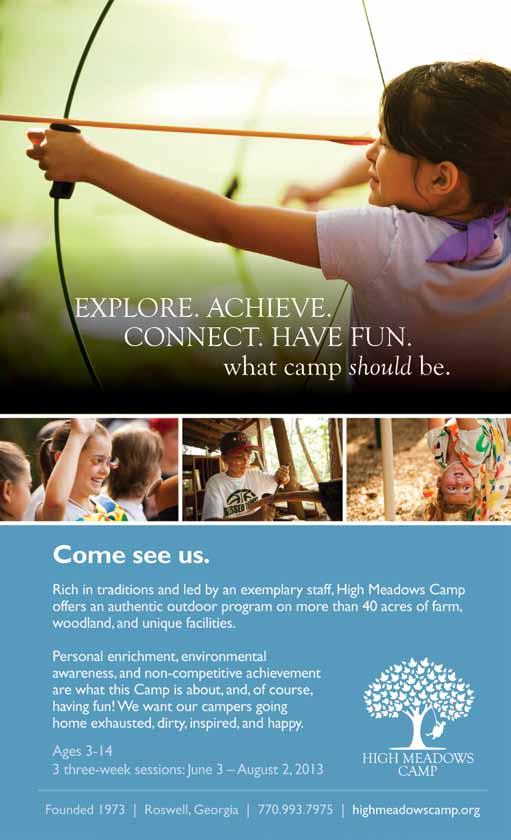
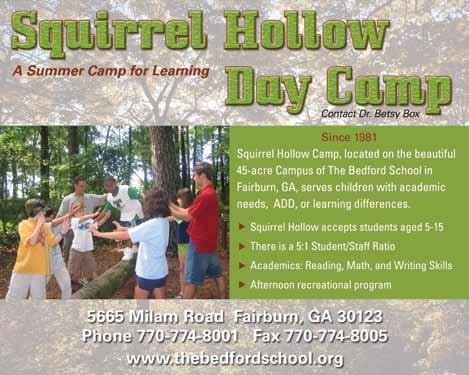
S UMMER C AMPS & A CTIVITIES


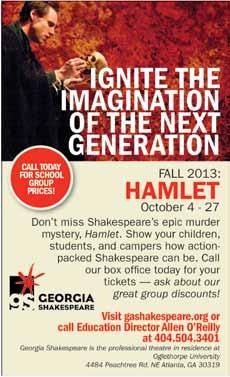

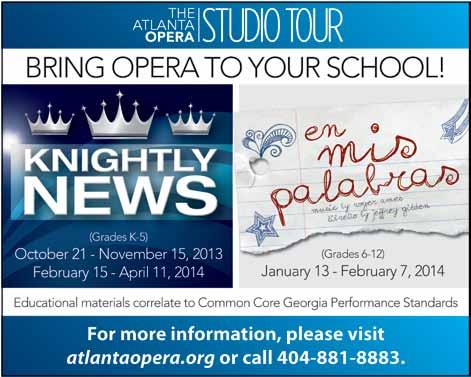




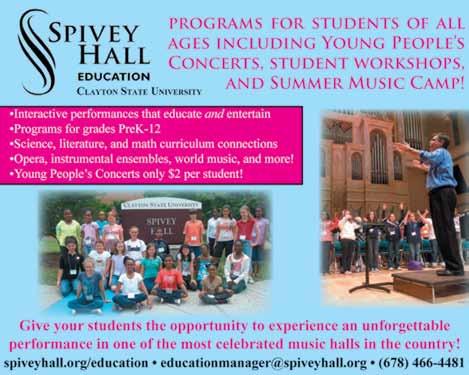
fIELD T RIPS & oUTREACH


ADVERTISER INDEX
Boarding Schools
Early Education
Special Needs & Learning Difficulties
Summer Camps & Activities

WIN TWo TIcKETS
To A BroADWAY ShoW AT ThE Fox ThEATrE!*
Gender: f m
Age: under 20 20-29 30-39 40-49 50-59 60+
Marital Status: Single married # of children: ______________________ ages : ______________________________
The primary reader of this publication is: mother father Student other ___________________________
Who is the primary decision maker for your child’s needs? mother father other _____________________________
Highest level of education completed: high School
Some college college Graduate masters +
Employment Status: full Time Part Time retired at-home Parent
Annual Household Income: under $25,000
$25,000-$49,999
$50,000-$74,999
$75,000-$99,999
$100,000-$124,999
$125,000 +
Your Opinion Matters
Your input is essential to the continued quality of our publication. Please help us by completing the following survey, making a copy of this page and mailing it to 200 Market Place, Ste. 230, Roswell, GA 30075, or faxing it to 770-649-7463. This information will not be used or provided for any sales or marketing purposes. Thank you!
What is your current dwelling status? own, house rent looking to buy a home own, condo/loft/Townhome relocating to atlanta other ______________________________
What is most important in your search for a school? location Tuition Test Scores School Size mission/Philosophy Sports Extracurriculars other ______________________________
What section(s) of this guide did you find most useful? critical communication School region Sections articles Public School Guide Education at-a-Glance Educational resource Guide other _____________________________
Will you choose a school or resource from this guide? yes no Name _____________________________________________________________________
What resources are you looking for in this guide? (Check all that apply.) Early learning Summer camps Private Schools Tutors Public Schools field Trips Special needs higher Education Boarding Schools homes & neighborhoods other______________________________
How often will you look for a new school for your child over the years? (Check all that apply.) Before Preschool Before kindergarten Before Primary School Before middle School Before high School higher Education other________________________________
How far in advance are you initiating your search for a school? 1-3 months 4-6 months 7-9 months 10-12 months more than 1 year
How long will you keep your current issue of Atlanta School Guide? 1-3 months 4-6 months 7-9 months 10-12 months more than 1 year
How often will you refer to your current issue?
How many adults in your household will be referring to this information?
How did you receive your copy of Atlanta School Guide?
*Each completed survey received will be entered into a random drawing to be held on Nov. 30, 2013. All entries must be received by this date. The winner will be notified upon selection.