




1 2 3 4
Metro Atlanta Area Map to search for independent schools by region or neighborhood, turn to page 34 and use the color-coded map to direct you to each region’s page number.
once you’ve selected your region of interest, the charts beginning on page 36 include a comparison of features for each school in that region, along with the page number for each school’s ad.
divided into regions of Atlanta, the color-coded maps beginning on page 40 provide each school’s location and page number for their ad.
Advertiser Index to find a school or resource by name, turn to the advertiser index on page 106 to find the appropriate page number.
We graciously thank our advertisers for their support of the Atlanta School Guide.
Publisher/Editor In Chief
PAtrIcK KIllAM
Editor
KEvIn ForESt MorEAu
Marketing & Promotions
JEFF tHoMPSon
Account Director
lAcEy JAMES
Contributing Writers
dAnIEl BEAurEGArd, SuSAn FloWErS, cAdy ScHulMAn
TO ADVERTISE CALL 770-992-0273
Space closing for Winter/Spring 2013 issue: october 19, 2012
Atlanta School Guide, Summer/Fall 2012, Volume 7, Issue 2 Published bi-annually by Killam Publishing, Inc., 200 Market Place, Suite 230, roswell, GA 30075. Atlanta School Guide assumes no responsibility for errors, changes or omissions. Information may have changed since press time, so please verify all information when contacting a school or educational resource. reproduction in whole or in part of any elements of this publication is strictly prohibited without the written permission of the publisher. © 2012 Killam Publishing, Inc.
For additional copies, further information or advertising, please contact:
KILLAM PUBLISHING, INC. P: 770-992-0273 F: 770-649-7463
pkillam@killampublishing.com
www.atlantaschoolguide.com

KEy: I = IndEPEndEnt ScHool, P = PuBlIc ScHool
6-10MONTHS AWAY
• Determine your child’s needs and expectations. I,P
• Research open house dates. I,P
• Inquire about each school’s admissions process. I
3 MONTHS AWAY
• Schedule any required health tests or immunizations. I,P
• To determine your school zone, use the county’s Web site or call the System directly. P
5 MONTHS AWAY
• Narrow down your choices. I,P
• Submit application and fees by the deadline. I
4 MONTHS AWAY
• Make a final decision and send in your acceptance to the school of your choice. I
2 WEEKS AWAY
• Find out what documentation is required registration.
• Complete tion forms and file with school.
• Prepare your child by making sure he or she gets a good night’s sleep, adheres to the dress code and is on time. I,P DAY OF CLASS 1ST
1 WEEK AWAY
• Attend registration or orientation. P

Dates subject to change. Please check with your local school district for updates. t = Traditional Calendar y = Year-round Calendar



Fall breaK


t Day o Cherokee, Paulding, Decatur


Aug. 6 Coweta, Douglas, Gwinnett, Henry, Atlanta (t)
Aug. 9 Forsyth, Marietta
Aug. 10 Hall
Aug. 13 Clayton, Cobb, DeKalb, Fayette, Fulton, Griffin-Spalding
Sep. 10-14 Decatur
Sep. 17-21 Cherokee
Oct. 4-5 Clayton
Oct. 8-9 Atlanta (t), Coweta
Sep. 24-28 Henry, Paulding, Atlanta (y)
Oct. 8 DeKalb, Fayette, Gwinnett, Marietta
All others, not applicable
Oct. 8-12 Douglas, GriffinSpalding, Rockdale
Oct. 12-15 Hall
Oct. 15 Buford, Fulton
Oct. 19 Forsyth
thanKSGiVinG breaK
November 19-23 Cherokee, Clayton, Cobb, Coweta, DeKalb, Douglas, Fayette, Forsyth, Griffin-Spalding, Gwinnett, Henry, Paulding, Rockdale, Atlanta (t, y), Buford, Decatur, Marietta
November 21-23 Fulton, Hall
open houses
Oct. to Mar., in general
application Deadlines Late Jan. to late Feb., in general
octDec Sat
Oct. 6, Nov. 3 and Dec. 1
Dates apply to both public and independent schools. For registration deadlines, visit the appropriate websites. SSat Oct. 13, Nov. 10 and Dec. 8 www.ssat.org
www.collegeboard.org
•
What you need to know to stay up to date with Atlanta and Georgia education
Early Learning Center to Open in Fall
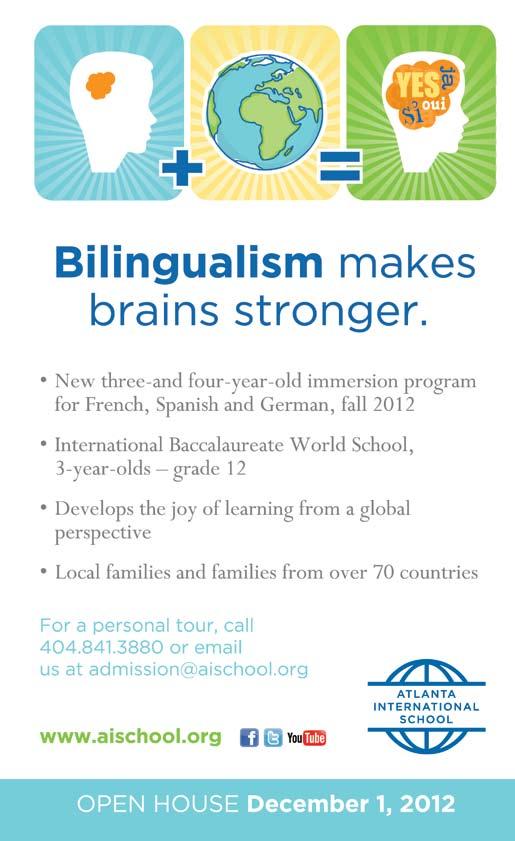
Atlanta international School is currently constructing an early learning center at its Buckhead campus. the center will offer full-immersion language instruction in French, German and Spanish for 3- and 4-year-old students, and is scheduled to open in August 2012.
Atlanta Public Schools Announces Closures
After a two-year determination process, Atlanta Public Schools has targeted seven schools for closure. capitol View elementary, White elementary, cook elementary, east lake elementary and herndon elementary were expected to close at the end of the 2011-2012 school year. Kennedy Middle School and Parks Middle School will close at the end of the 2013-2014 school year.
Georgia natural Gas donated $1.1 million to metro Atlanta schools recently as part of true Blue Schools, a program launched in 2008 to provide help to local schools.
Atlanta Colleges, Charters Pair Up
Morehouse and Spelman colleges will reserve spots for graduates of KiPP charter schools across the country. each school will set aside 15 slots in 20132014 and 20 spaces for each year after that.
Cristo Rey Plans Atlanta High School
the cristo Rey network, which has opened 24 independent catholic schools for underprivileged youth in the last decade, plans to open an Atlanta high school on the grounds of St. Paul of the cross church, slated to open in fall 2013.
Georgia Schools Win Environmental Award
Atlanta’s Springdale Park elementary, lithonia’s Arabia Mountain high School and Savannah country day School were among the 78 schools nationwide named as the first-ever u.S. department of education Green Ribbon Schools in April. the schools were chosen for their dedication to health and environmental issues.
Gov. Deal Unveils NeedsBased Scholarship
Georgia Gov. nathan deal in February announced a privately funded, needs-based scholarship program with the purpose of preparing low-income students for college. to receive $2,500 a year for up to four years, participating students must sign a contract in middle school that they will stay out of trouble and maintain a high school GPA of 2.5.
Provost Partners with Magic Johnson
Provost Academy Georgia, a free public online high school slated for a 2012 launch, recently announced a partnership with Magic Johnson Bridgescape learning centers, which will offer additional help for students at locations across the state.
Wildwood Christian Names Shelnutt New Head of School
Bill Shelnutt has been named new head of School for Wildwood christian Academy effec-
tive June 1, 2012. Shelnutt has held leadership positions at Brandon hall School, holy Spirit Preparatory School, and Mount Pisgah christian School.
Atlanta Retires “Small Schools” Concept
Atlanta Public Schools will consolidate 14 small high schools into four large schools by fall 2012. the move affects carver, Washington, South Atlanta and therrell high Schools, each of which is currently broken into four smaller schools, which focus on career skills in such areas as criminal justice and banking.

Greater Atlanta Christian Plans Sister School the Rwandan government has affirmed a land grant to Greater Atlanta christian School, with plans to open a sister school in Kigali. the school’s focus will share similarities with GAc’s emphasis on academics, character, faith and digital skills.
“Education Nation” Comes to Atlanta “education nation,” nBc news’ education initiative, visited Atlanta in May. the week-long event included discussion panels and town hall meetings.
CHARTER SCHOOL A tax-supported public school that is independently run, allowing for greater educational choice for a school community.
ExPERIENTIAL LEARNING An educational approach using applied, hands-on methods of learning.
INTERNATIONAL BACCALAUREATE (IB) A specifically designed comprehensive academic program emphasizing traditional disciplines while encouraging an international perspective.
MAGNET SCHOOL A public school that offers a specific or enhanced curriculum designed for students of special interest or ability.
MONTESSORI A school following the principles developed by dr. Maria Montessori focusing on the unique individuality, self-reliance and independence of children.
SPECIAL NEEDS SCHOOL A school or program for children who have mild-to-moderate learning differences. It usually features smaller class sizes, individualized attention and multi-sensory learning methods.
ACCREDITATION official certification that guarantees a school provides an education of a reasonably high quality. Schools must prove levels of quality and maintain continuous standards of improvement.
ACT An alternative to the SAt, this national college admissions examination consists of subject area tests in English, Mathematics, reading and Science, with an optional 30minute writing test.
ADEqUATE YEARLY PROGRESS (AYP) A measure of year-to-year student achievement on statewide assessments as required by the no child left Behind Act.
CRITERION-REFERENCED COMPETENCY TESTS (CRCT)
tests designed to measure how well students in grades one through eight acquire the skills and knowledge described in the Georgia Performance Standards.
Education that applies to children from birth to age eight, focusing specifically on their development, including physical, emotional, sensory, communicative, cognitive and social needs.
GEORGIA HIGH SCHOOL GRADUATION TESTS (GHSGT)
All students seeking a Georgia high school diploma must pass four content areas as well as the Georgia High School Writing Assessment.
GEORGIA PERFORMANCE
STANDARDS Statewide standards of academic content for all subjects K-12, to which every school must adhere and on which students are annually tested.
HOPE SCHOLARSHIP (Helping Outstanding Pupils Educationally)
A scholarship in Georgia, funded by the Georgia lottery, that rewards academically achieving students with financial assistance to attend eligible public and private Georgia colleges and universities.
MISSION/PHILOSOPHY A statement outlining the guidelines a school follows to achieve its goals or maintain performance standards.
A federal law passed in 2001 designed to ensure that all children have a fair and equal opportunity to obtain a high-quality education and meet state academic standards of proficiency.
NOTIFICATION DEADLINE
the date by which an independent school notifies families of the acceptance of a child for enrollment to the school.
OPEN HOUSE An event held at a school, at which parents can learn more about the school and its offerings.
PSAT A standardized test that offers students practice for the SAt reasoning test and allows them to qualify for the National Merit Scholarship Program.
REPLY DEADLINE the date by which parents must notify an accepting school of their commitment to enroll their child.
SAT this standardized test measures the critical thinking, mathematical reasoning, and writing skills of students planning to attend college.
Did
You Know:
More than 1,417,000 students to date have received HOPE scholarships totaling $6.4 billion.
SECONDARY SCHOOL ADMISSIONS TEST (SSAT) the admissions test that many independent schools require students to take in order to be considered for enrollment.
SUMMER CAMP A common destination for children and teenagers during the summer, at which they can participate in a variety of activities or classes.
communication
Many local and national organizations work to bring out the best in summer camps and public, private and boarding schools by setting policies, serving as advocates, researching educational advancements, identifying schools that meet certain standards through accreditation or by offering services to the educational communities both in Atlanta and in Georgia. the following are just some of the organizations you should know in your search for the best educational experience for your child.
American Camp Association (ACA) www.acacamps.org Accredits camps that meet industry-accepted and government-recognized standards, educates,and establishes guidelines.
The Association of Boarding Schools (TABS) www.boardingschools.com this organization of nearly 300 boarding schools serves the professional
development needs of boarding schools and provides information to potential students and their families.
Association of Christian Schools International (ACSI) www.acsi.org AcSI strives to enable christian educators and schools worldwide to effectively teach using christ-centered curricula and programs.
Association Montessori Internationale (AMI) www.montessori-ami.org
Founded in 1929, AMI recognizes schools that strongly adhere to Montessori principles and practices.
Atlanta Area Association of Independent Schools (AAAIS) aaais.org
Although not an accrediting agency, AAAIS is an affiliation of independent schools and operates under analogous principles and a common code of ethics.
Department of Education (DOE) www.doe.k12.ga.us
A statewide, policy-driven organization governing the public school system of education in Georgia for K-12, the doE operates under the direction of the State Superintendent of Schools.
Georgia Accrediting Commission (GAC) www.coe.uga.edu/gac GAc offers four levels of approval: preparation status, provisional accreditation, accreditation and accreditation with quality.
Georgia Association of Christian Schools (GACS) www.gacs.org uses generally accepted indicators of quality, voluntary self-improvement and peer review to measure schools.
Georgia Association of Educational Leaders (GAEL) www.gael.org
this statewide umbrella organization of six professional associations provides unity among school leadership organizations.
Georgia Association for Private Schools for Exceptional Children (GAPSEC) www.gapsec.org
this state organization is for schools that serve students with learning issues.
Georgia Independent School Association (GISA) www.gisa-schools.org
Association of private, independent and parochial schools whose mission is to advance excellence and collaboration among independent schools.
Georgia Partnership for Excellence in Education (GPEE) www.gpee.org
this non-profit organization of business, education, community and government leaders aims to shape policy and reform public education in the state.
Georgia Private School Accreditation Council (GAPSAC) www.gapsac.org
Association of K-12 private schools whose students are recognized and ap-
proved by the Georgia doE for transferring credits to public schools on the same basis as students from public schools.
Georgia Professional Standards Commission (PSC) www.gapsc.com
A state organization responsible for setting and applying high standards for the preparation, certification, and continued licensing of Georgia public educators. Preparation and conduct of public school teachers and staff.
Georgia School Boards Association (GSBA) www.gsba.com representing Georgia’s 180 elected boards of education, GSBA provides leadership and services to local boards of education.
National Association for the Education of Young Children (NAEYC) www.naeyc.org the nAEyc focuses on the quality of educational and developmental services for children, from birth to age eight, including daycare and Pre-K centers. It is a national network of over 300 local, state, and regional affiliates.
National Association of Independent Schools (NAIS) www.nais.org the association values and works to maintain the independent nature of each member school by promoting high standards of educational quality and ethical behavior.
National Christian School Association (NCSA) www.nationalchristian.org Administrators from accredited schools, university educators and public schools preside over the accreditation process for ncSA.
Southern Association of Colleges and Schools (SACS) www.sacs.org
Member schools meet research-based standards and maintain continuous school improvement and quality assurance. Its mission is the improvement of education in the South through accreditation.
Southern Association of Independent Schools (SAIS) www.sais.org
Members meet quality standards, receive peer evaluation and implement a school plan focused on strategic improvement.
For more information about these and other organizations and associations that ensure quality education among camps and schools, visit the websites of the Georgia department of Education (www.k12.ga.us) or the u.S. department of Education (www.ed.gov).
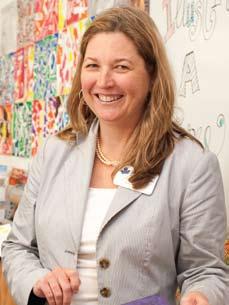
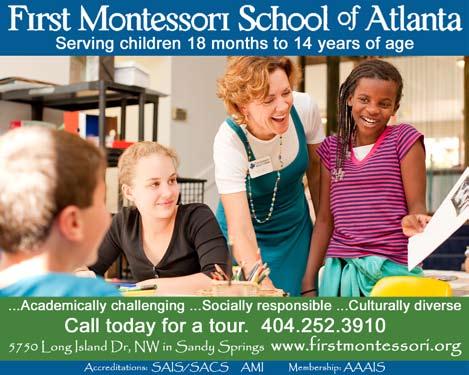
Now in her sixth year as Head of School, Jerri King is devoted to First Montessori’s mission to provide an educational experience crafted to each stage of development. She also speaks on education-related topics at schools and conferences, drawing on her years as a teacher and director of admissions for the Southeast’s oldest Montessori school.
What is your educational philosophy?
I believe education that serves a student over his or her lifetime is about more than learning “stuff.” To thrive, students should have a learning adventure that feeds their curiosity, their work ethic, their sense of responsibility and their character.
What do you love most about your job?
I love talking with our students about their most recent discovery and what interests them.
How can parents best contribute to the education process?
Parents are key to creating a partnership that is supportive to their child’s overall development. It is important that parents have confidence in the experience and professionalism the school’s faculty and staff have to offer.
How is the field of education changing?
Education is embracing the science of brain development and matching student
opportunities to those discoveries. Today, we see skill instruction balanced more often with context and creativity.
What advice would you offer parents about their children’s education?
Embrace the life lessons children learn in the struggles and challenges that naturally occur over the course of growing up. A student’s ability to rise above disappointments in high school and college is predicated on the experience of navigating minor disappointments earlier in life.
THe essenTials: FiRsT MOnTessORi sCHOOl OF aTlanTa emphasis: Activitybased learning experiences that support the development of the person in addition to academic skills.
Year Founded: 1963
Grades: Toddler through middle school students: 240
avg. Class size: Varies Tuition Range: $4,910 - $15,710
accreditations or affiliations: SACS, SAIS, AMI
location: Sandy Springs
Contact: 404-252-3910, www.firstmontessori.org

in and around Sandy Springs, GA! ound

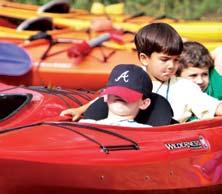









Make a big splash at the coolest event this summer on Saturday, July 28, 2011 from 9 a.m. to 4 p.m. in Sandy Springs, Georgia. Float from Morgan Falls Dam to Powers Island in a kayak, canoe , or raft down the Chattahoochee River.
music , crafts, and self-guided hikes at Powers Island.
ANNE FRANK IN THE WORLD EXHIBIT
Visit our Anne Frank in the World Exhibit located right above the Sandy Springs Welcome Center. More than 600 photographs chronicle Frank’s life from 1920s Germany all the way to her death in a Nazi conentration camp.

The tastiest place in Metro Atlanta, Young Chefs Academy in Sandy Springs offers weekly cooking classes for children, teens, and adults, too! Host a par ty, schedule a teambuilding this quality cooking facility. p




BY DANIEL BEAUREGARD




Rapid technological advancements are changing the way that people interact, communicate and access information. And more and more, educators are incorporating those advancements into the classroom. By using an array of accessible computer devices and programs, they create interactive learning environments, while also offering students a greater understanding of the technology they use every day.
As textbooks and chalkboards give way to laptops and interactive whiteboards, the traditional classroom model is getting a 21st-century update. Technology is no longer reserved for the computer lab. Instead, students interact with technological devices on a regular basis throughout the school day.
“Textbooks themselves are becoming a thing of the past. Everything is becoming digital,” says Steve Swells, technology instructor at McGinnis Woods Country Day School in Alpharetta.
After investing in an extensive collection of Apple products like MacBooks, iPads and iPod touches, Notre Dame Academy in Duluth did away with its traditional computer labs altogether, placing its computer equipment on carts to make it easier for students to access, says Ken Lemons, director of technology and education technology coordinator. In addition, there are enough iPads for every eighth-grader. The students use the computers in place of textbooks, and return them at the end of the year. While the devices are more expensive than books, they don’t receive as much wear and tear, Lemons says, making them more costeffective in the long run.
At Victory World Christian School in Norcross, every student from kindergarten through fifth grade is equipped with a Neo 2 laptop computer, which stays onsite at the end of the day, says Irene Prue, the school’s principal.
McGinnis Woods currently has close to 125 laptops, about one for every two students. At Trinity Chapel Academy

in Powder Springs, all middle and high school students are issued a MacBook, and at Wesleyan School in Norcross, every student in grades 5 through 12 is provided a tablet computer. This year, every third through fifth grade student at Greater Atlanta Christian School in Norcross was provided with an iPad.
The amount of computers and other devices such as smart boards differs from school to school. That’s especially true of public school systems. Every school in the DeKalb County Schools system is different, says Chief Information Officer Gary Brantley, “because every school has different needs.”
For example, schools that receive Title I funds (federal money made available to schools with a large number of students from low-income families) receive more funding for technology than other public schools.
Currently, Brantley says, all Title I schools in DeKalb County have smart

boards, and some also may have accessories, such as devices that allow wireless communication with the board.
As a result of a recently passed special-purpose local option sales tax, all DeKalb County schools “will have … some type of smart board,” Brantley says.
Plans call for every school to have wireless connectivity as well, which Brantley estimates will roll out sometime early next year.
Utilizing technology as an educational tool has had a profound impact on the ways both teachers and students function within the classroom.
Technology is a part of students’ daily lives outside of the classroom, so utilizing it as a teaching aid is a logical step. “The students need this,” Lemons says. “They grow up with digital technology. The traditional stand-and-deliver style of teaching where the teacher is writing things on the board and reciting the things the students need to learn just doesn’t work as well as it once did.”
At Victory World Christian School, the Neo 2 laptops allow teachers to tailor lessons to each student’s needs—for example, creating individual math worksheets for each child. “The responses are automatically scored so the teacher can see what areas each child needs help with,” says Prue. “The old-fashioned way, a day later the teacher would be correcting the worksheets and giving feedback. … It gives child and teacher immediate feedback so you can give a kind of individualized instruction.”
More than just a tool for teachers, contemporary technology is changing the way students learn and interact with their instructors. Instead of simply writing a report on something they’ve studied, Notre Dame students are required to “do some sort of presentation—creating movies or [recording] a podcast to give their impressions of what they’ve just learned,” says Lemons.
After completing a project, McGinnis Woods students create a presentation to show their classmates how to do what they just did. In that way, the students become teachers themselves.
Teachers, of course, aren’t the only ones excited about the educational ad-
vances offered by technology. Swells, with McGinnis Woods, says there’s “a quantum leap in their engagement and how much more they absorb the content.”
Swells believes that using technology in the classroom is more than a means of encouraging students to get excited about learning; it’s an obligation.
“They seem to learn more in a shorter period of time and seem to retain more,” he says. “The studies out there show that the test scores go up when they [participate in] this style of learning. So we, as responsible teachers, can’t ignore that. Because of these tools, we have more engaged learners.”
But don’t expect to see computers running a classroom any time soon, says Prue of Victory World Christian.
“We firmly believe that technology will never replace the teacher because kids, particularly at the elementary level, they really need that [face-to-face] contact,” she says. “But it sure does enhance instruction ”
Smart boards: Interactive white boards that act as large touch screens are replacing chalkboards. Students can use them to participate in hands-on activities, dropping and dragging animated items and using a pen to highlight different words.
Laptops and tablet computers: Textbooks are being replaced by compact computers and tablet devices such as the iPad. Devices such as the Neo 2 laptop developed by Renaissance Learning allow teachers to instantly test students’ reading comprehension and create individualized instruction. Students can also use them to collaborate with each other.
Software and applications: Students at McGinnis Woods use Microsoft PowerPoint to give presentations, while Notre Dame Academy students report on what they’ve learned via movies or podcasts. Students at Victory World Christian School use Rosetta Stone software to learn Spanish.

With changing demographic trends at home and a world economy driven by international businesses, proficiency in a second or even a third language is increasingly
BY SUSAN FLOWERS
considered a crucial component of success in business, education and other areas of life. As students prepare to compete in the global marketplace, parents and experts are placing more emphasis
on language instruction that begins at an early age.
“The ability to communicate, understand and empathize with people is going to be important in the global economy,” says Dr. Dell Giles, dual language coordinator at the Unidos Dual Language Charter School.
Being able to speak and read a second language also offers a number of educational benefits that go beyond the economic, say educators at metro Atlanta-area schools.
“Bilingually trained brains have more neural connections to draw on, which promotes a higher cognitive skill set in all of our students’ other academic and co-curricular endeavors,” says Kevin Glass, headmaster of the Atlanta International School (AIS), a K-12 independent school.

One of the most popular methods of learning another language is immersion.
Besa Tarazhi, owner of Tabula Rasa, cites a recent study that says the process helps the brain to develop even in areas unrelated to language, aiding with present-day problemsolving and possibly helping to protect the brain against Alzheimer’s later in life.
One of the most popular methods of learning another language is immersion, in which teachers and students speak primarily in the language being taught. The approach can be one-way, with lessons conducted entirely in a second language, or two-way, alternating between English and the other language.
“Foreign-language teachers will tell you the best way to become fluent is to
go to the country where the language is spoken,” says Minako Ahearn, principal of Seigakuin Atlanta International School. “Therefore, we find the best method is to immerse the children, so they can experience live language.”
At Seigakuin, “The students spend time with English-speaking teachers … for part of the day,” she says. The rest of the day, they are instructed in the Japanese language.
Two-way immersion, says Giles, empowers parents as much as their children. Spanish-speaking parents “are able to understand the work that students are bringing home” and participate in the process, she says.
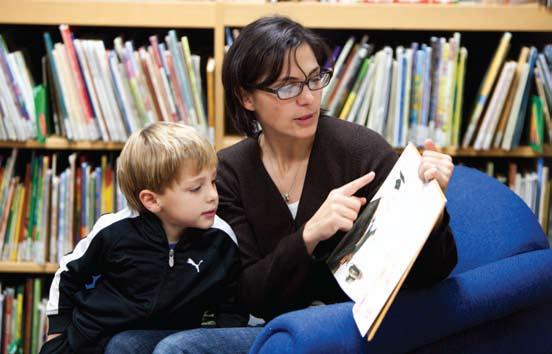
Learning a new language is a life-long commitment and is most beneficial when started as early as possible.
Learning a new language doesn’t end when the student leaves school. It’s a lifelong commitment, and is most beneficial when started as early as possible.
“All the research shows us the benefits of beginning as early as possible to capture the child’s natural motivation, cognitive vocabulary skills and innate grasp of grammar and pronunciation,” says Kevin Glass of AIS. “Young children learn languages naturally, like they learn skipping rope and riding a tricycle.”
Little Linguists Preschool admits babies as young as six weeks, says director Raquel Paulino, although the school prefers to begin with infants closer to six to eight months. Tabula Rasa will accept a child at two months of age. And this fall, AIS will open a full-immersion early learning center for children ages 3-5.
Educators say the language learned is less important than the learning process itself, which primes the brain for proficiency later on.
“It’s really not important what language the kids learn, so long as they learn one,” says Tarazhi.
Schools that offer full immersion aren’t a parent’s only option, however. Atlanta Public Schools’ middle and high schools offer French and Spanish courses. Many independent schools offer some foreign language instruction as well. Students at McGinnis Woods Country Day School in Alpharetta can learn Spanish through speech, music and special projects, while Gerard Preparatory School teaches Spanish, French, Japanese, German, Chinese and Latin.
Of course, it’s never too late to learn a new language as an adult. Schools like the Language Institute of Atlanta and the Language Institute of Georgia offer convenient night classes for working adults. Little Voyages in Sandy Springs offers instruction for children and adults, from day care to child-and-parent classes as well as night and weekend courses.
For those with tight schedules or who work better one-on-one, tutoring is another option. WyzAnt (www.wyzant.com) is an online resource that allows visitors to search a database of pre-screened, tested tutors in more than 200 subjects, including foreign language instruction.
Whatever level of instruction you’re looking for, ask lots of questions and be sure to ask for references. And remember that the work you do now will pay off in the long run.
Atlanta International School French, German, Spanish www.aischool.org
Language Institute of Atlanta
More than 50 languages www.atlantalanguage.com
Language Institute of Georgia French, German www.languageinga.com
Little Linguists International Preschool French, Spanish www.littlelinguistspreschool.com
Little Voyages
Arabic, Chinese, French, Hindi, Portuguese, Spanish www.littlevoyages.com
Seigakuin Atlanta International School Japanese www.seig.ac.jp/english/atlanta/index.htm
Tabula Rasa The Language Academy French, Spanish www.trlanguages.com
Unidos Dual Language Charter School Spanish www.clayton.k12.ga.us/facilities/schools/198.asp


BY CADY SCHULMAN
The differences between boys and girls are well-established, and are evident from an early age. Not surprisingly, studies have shown that those differences extend to the way boys and girls learn. For instance, girls are stronger when it comes to vocabulary and writing,
while boys tend to absorb information more visually and respond well to images and movement
Because of those differences in the way boys and girls process information, many educators and researchers find that students are able to learn more ef-
fectively in a single-gender environment, where the curriculum is tailored to their strengths and they are free from the distractions that come with a coed setting.
Educators at single-gender schools in the Atlanta area and the Southeast say that students at these schools perform better on tests and post higher grades than those at coed schools.
Research tends to back that conclusion: A four-year study conducted by Stetson University in Florida found that 85 percent of boys in single-gender classrooms scored proficient on the Florida Comprehensive Assessment Test, compared to 55 percent of boys in coed classes that taught the same curriculum.
Teachers at all-boy and all-girl schools say they are able to tailor their work to the ways each gender learns. Pinney Allen,
head of school at Atlanta Girls School, an independent school for girls, says that girls like to work where they can see faces and interact, such as around a table, while boys work better side-by-side.
“Those are the kinds of things you can structure a classroom around when there are only girls,” she says.
At Riverside Military Academy in Gainesville, classes are shorter—40 to 50 minutes—to accommodate the fact that boys have shorter attention spans.
“An hour and 40 minute class is very difficult,” says Lt. Col. Kevin Jarrard, the school’s commandant. “I can’t imagine trying to contain a teenage boy for 1 hour and 40 minutes.”
Boys also need more breaks for activity. At Brechmans Academy, an all-boys boarding school in Louisiana, the boys run two laps before school. “It’s important for them to get rid of some of that


Educators at single-gender schools say their students perform better on tests and post higher grades than coed students.
energy before they start their day,” says Sister Lynne Lieux, headmistress of Brechmans and Academy of the Sacred Heart, its all-girl counterpart.
Another advantage of a single-gender education is a lack of distraction from the opposite sex.
“There is no distraction in a singlegender environment—you know, the female distraction,” says Jerry Parker, principal at B.E.S.T. Academy, an all-male school on the campus of Ben Carson High School.
The same is true for all-girl schools. “From my point of view for girls, especially in the middle school area when their bodies are changing and their minds are changing, when you’re in a coed environment, you don’t do your best,” says Victoria Hudson, dean of students at Ivy
Preparatory Academy for Girls, a singlegender charter school in Norcross.
Sharon Hawkins Gay, academy leader for the all-girls Dorothy Height Leadership Academy at Ben E. Mays High School, says that her students are more focused.
“Girls don’t want to answer questions if boys are around,” she says. “Instead, they’re trying to capture their attention through their looks instead of their brains. With this academy, the girls are really focused. They’re all business.”
As a result, students are more engaged, says Hudson, a former math teacher at a coed school. At Ivy, “girls aren’t afraid to engage in lessons and ask questions.”
What’s more, Sacred Heart’s boarding school environment creates a sense of unity and purpose between students as they live and work together.
Although single-gender schools aren’t as widespread as co-educational schools, there are signs that the trend is growing. Ivy Preparatory Academy, for instance, recently opened both a second all-girls school and an all-boys school.
The nation saw a decline in singlegender schools during the 1950s and ’60s, says Allen of Atlanta Girls School, likely due in part to the women’s liberation movement. But at least 15 new girls’ schools have opened in the United States in the last 15 years, she says, a trend she hopes will continue.
“I hope they continue to grow,” she says. “It’s a very tried and true format. The more we learn about how learning takes place, the more we’re going to appreciate having single-gender alternatives.”
Academy of the Sacred Heart www.sshcoteau.org/academy
Atlanta Girls School www.atlantagirlsschool.org
B.E.S.T. Academy www.atlanta.k12.ga.us/Domain/2724
Berchmans Academy www.sshcoteau.org/berchmans
Coretta Scott King Young Women’s Leadership Academy www.atlanta.k12.ga.us/Page/12900
Dorothy Height Leadership Academy www.atlanta.k12.ga.us/Page/15307
Eagle Leadership Academy www.atlanta.k12.ga.us/domain/3373
Ivy Preparatory Academy for Girls www.ivyprepacademy.org
Riverside Military Academy www.riversidemilitary.com



metro atlanta area map
For features of independent schools, turn to Education At-a-Glance on pg. 36. For public school system information by county, turn to pg. 87.
3 3
2
2
1 1
5 5
Boarding Schools Connecticut, Georgia, Illinois, Mississippi, New Jersey, New York, North Carolina Southeastern States, Tennessee, Texas, Virginia
REGION 4: Atlanta South/ Southeast/Southwest Atlanta South, College Park, Eagle’s Landing, East Point, Fairburn, Lithonia, Newnan
REGION 5: Atlanta West Buckhead North, Kennesaw, Lithia Springs, Marietta, Powder Springs, Smyrna
REGION 1: Atlanta North/Northwest
Alpharetta, Buckhead, Marietta, North Fulton, North Metro Atlanta, Roswell, Sandy Springs
REGION 2: Atlanta North/Northeast
Alpharetta, Buford/Sugar Hill, Gainesville, Norcross, North Fulton, Northeast Atlanta, North Metro Atlanta, Sandy Springs
REGION 3: Atlanta East Ansley Park, Athens, Dacula, Decatur, Lilburn, Midtown, Monroe, Morningside, Stone Mtn.
This information reflects the latest available data at publication time. Please confirm with each individual school.



Alpharetta Once a small farming community, Alpharetta’s growth has exploded in recent years and is now one of Atlanta’s most affluent neighborhoods, creating the perfect mix of country living and city amenities.
Buckhead A development group is currently creating what is being referred to as the Rodeo Drive of the South, where luxury retailers and high-end restaurants will be the feature. Luxury condos offer residents city living at its finest.
The Heiskell School’s accelerated academic program and its focus on building Godly character have had a life-changing impact in the lives of children for more than 60 years.

OPEN HOUSE
Wed., August 8, 2012 Friday, October 19, 2012
9:00 a.m. - 11:00 a.m. Campus Tour and Orientation Meeting
3260 Northside Drive NW, Atlanta, Georgia 30305





Duluth A successful mix of small-town charm and booming economic growth, Duluth plays host to many major corporations and is also home to numerous golf clubs, private tennis clubs and parks. The city prides itself on accommodating a growing, diverse population.
Dunwoody A popular community among young and established professionals alike, Dunwoody is often referred to as the “tennis set” neighborhood because of its numerous recreational outlets. Its location provides suburban living close enough to the city.


Decatur The county seat of DeKalb County, Decatur’s small-town charm revolves around the Courthouse Square, which features trendy restaurants and shopping, entertainment options and special events, including its annual summer beach bash.
Lawrenceville Located in the heart of Gwinnett County and known as “Crepe Myrtle City,” Lawrenceville is Atlanta’s second oldest city. Its historic downtown square, which has been revitalized, is home to a variety of shops, restaurants and community events.




m O r N i NGS i DE • S t ONE m OUN t A i N for accuracy representative of
Ne I ghborhood S of Note
McDonough One of the fastest-growing neighborhoods South of Atlanta, McDonough is the county seat of Henry County and features many historic structures around its town square. The city has ample green space and is a favorite destination for antique shoppers.
Peachtree City A master-planned city comprised of several smaller villages, Peachtree City’s many amenities include golf courses, lakes and an amphitheater. The city is renowned for its network of golf paths connecting its neighborhoods.




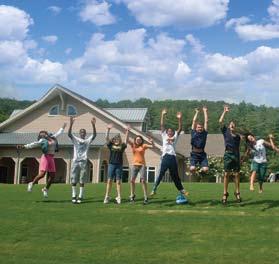

Our school was designed with a mission to give students a chance to learn about their global community in order to become leaders that will make a positive difference in the world.

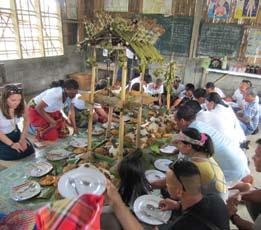
Our field trips are not just in our backyard. Each year, upper grade students and teachers, along with parents, have an opportunity to travel across the globe.


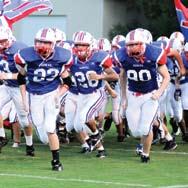
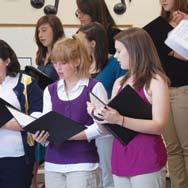
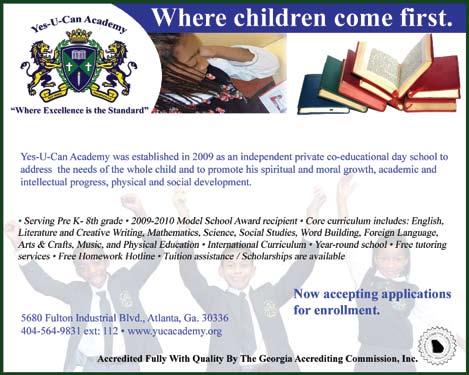

Kennesaw Home to the popular Kennesaw Mountain National Battlefield Park, the city of Kennesaw takes pride in its excellent recreation opportunities and parks, rich history and thriving downtown. Kennesaw State University, the third largest university in Georgia, is well known for academic programs in business, education, and nursing.
Smyrna With its unique charm, solid government and city services, the city of Smyrna offers many fresh, trendy lifestyle options, and the Market Village plays host to numerous restaurants, bars and upscale shops. Known as the “Jonquil City,” because of the thousands of jonquils that flourish in gardens and along the streets in early spring.

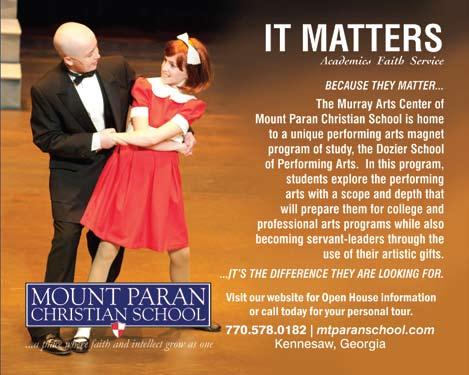
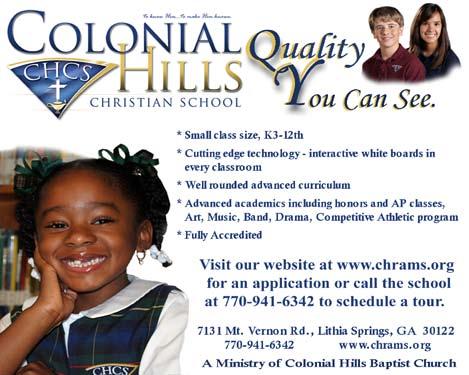
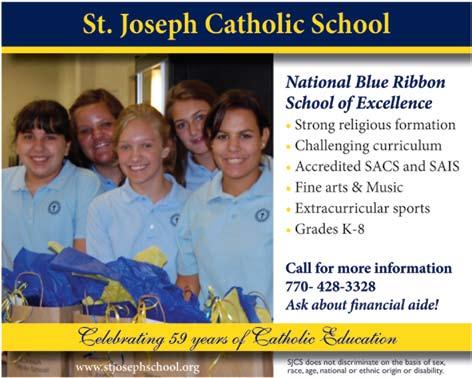
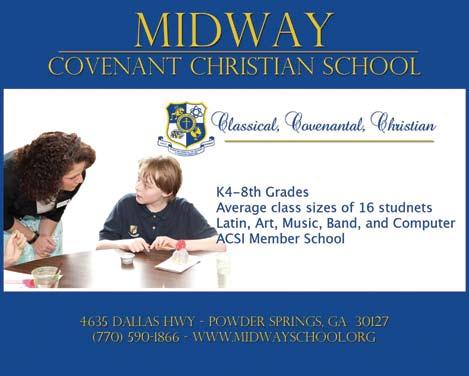
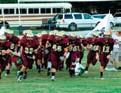



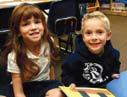
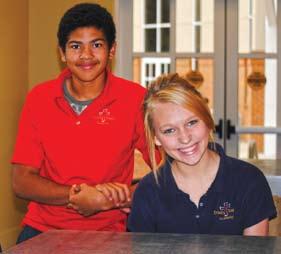
















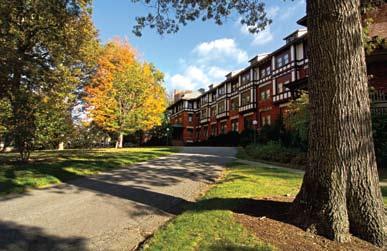


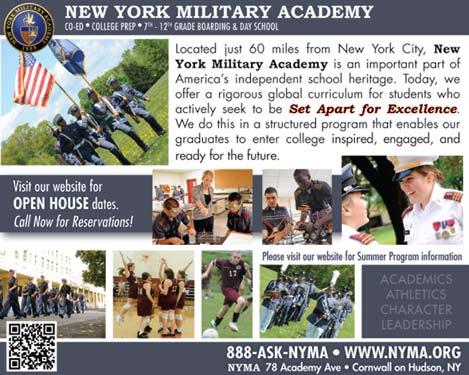
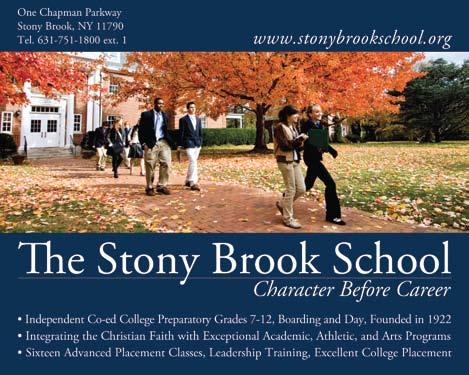
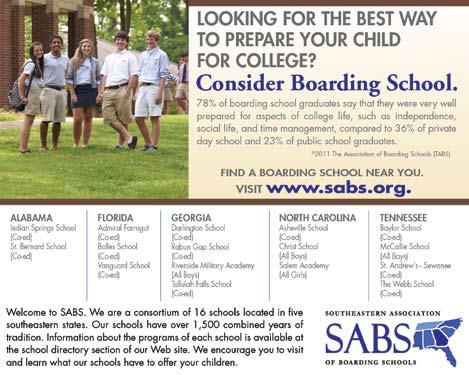
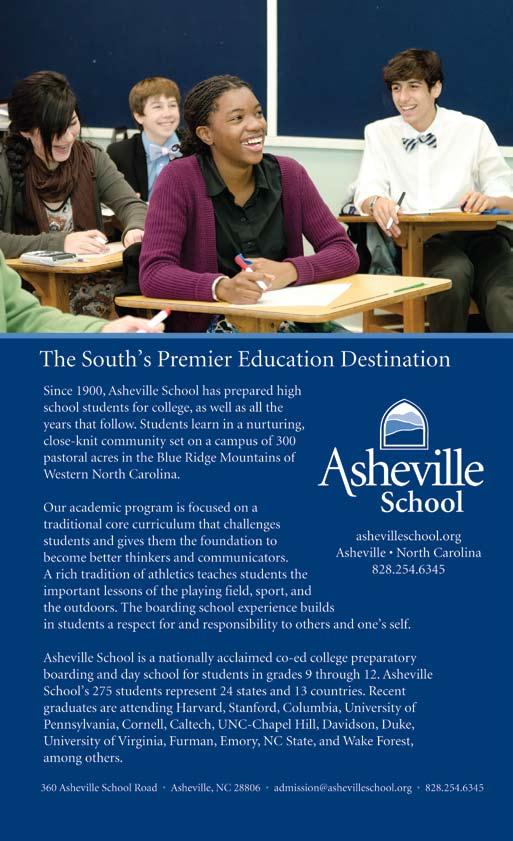
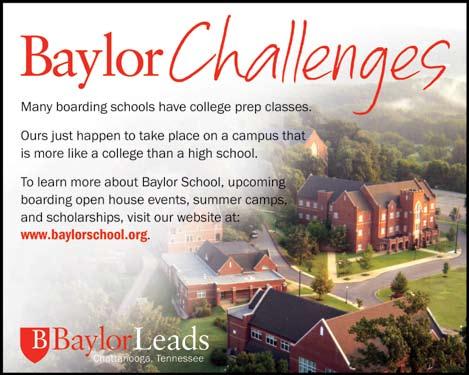
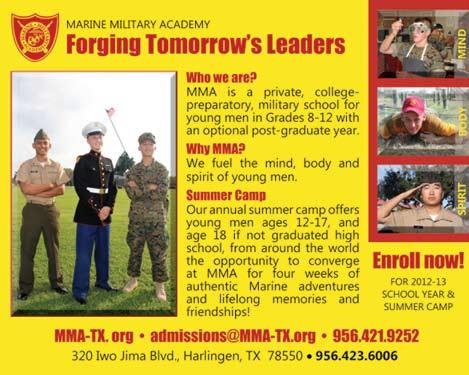
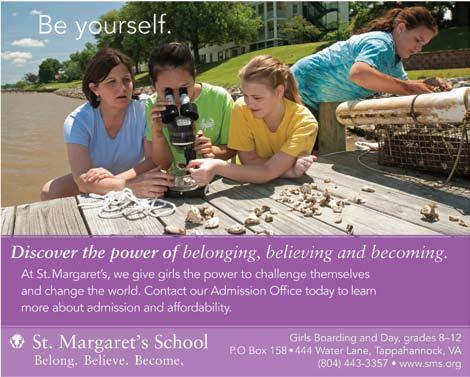
There are many benefits of a boarding school education. Boarding schools are an option for students seeking a more independent learning experience. Because students generally live on campus, learning takes place in and out of the classroom almost on a 24-hour basis.
When selecting a boarding school, it is important to visit the school campus, but representatives from many boarding schools visit Metro Atlanta throughout the year—contact each school for specific dates. u





























Avariety of improvements and innovative programs in Georgia’s public school systems have resulted in many stellar elementary, middle and high schools across the Metro area. different school systems feature specialized programs and academic opportunities, such as magnet, charter, vocational or alternative schools to suit their respective students, parents and communities. However, despite variations in programming and academic offerings, all public schools must offer the core curriculum as determined by the Georgia Board of Education. Here is a county-by-county guide to Metro Atlanta’s public school systems. For more information about the Georgia department of Education, call 404-656-2800 or visit www.gadoe.org. u
2011 Average CRCT Scores
3rd: (R) 853.23 (M) 846.82
5th:
2011 Average SAT: 1559
Top 5 Schools by Average
Board of Education
770-479-1871
www.cherokee.k12.ga.us
Total # of Students: 38,293
Spending per Student: $12,393
What’s New
Five cherokee high schools were named AP Science, technology, engineering and Math Schools for the second year in a row.
2011 Average CRCT Scores
(R)
2011
Board of Education
770-473-2700
www.clayton.k12.ga.us
What’s New
Shekema Silveri, a teacher at Mount Zion high, was named Georgia’s 2011 national Milken educator of the Year by the Milken Family Foundation. Silveri won a cash prize of $25,000.
2011 Average CRCT Scores 3rd: (R) 845.07 (M) 842.52 5th: (R) 839.17 (M) 850.31 8th: (R) 842.68 (M) 834.91
2011 Average SAT: 1522
Top 5 Schools by Average
Board of Education
770-426-3300
www.cobb.k12.ga.us
What’s New
cobb county eighth-graders outperformed their peers on the 2012 eighth Grade Writing Assessment. the average scale score of 220 is four points higher than the state score of 216.
Board of Education
770-254-2800 www.coweta.k12.ga.us
Number of Schools elementary 20 Middle 7 high 3 central education center 1 Alternative 1
Total # of Students: 22,560
Spending per Student: $9,535
What’s New
Board of Education
678-676-1200 www.dekalb.k12.ga.us
Board of Education
770-651-2000
www.douglas.k12.ga.us
2011 Average CRCT Scores
3rd: (R) 842.74 (M) 841.53
5th: (R) 834.18 (M) 836.97 8th: (R) 841.02 (M) 830.35
2011 Average SAT: 1485
Top 3 Schools by Average 2011 SAT Score northgate high 1524 newnan high 1508 east coweta high 1478
three coweta county elementary schools—Ruth hill, Western and White oak—will undergo renovations totaling more than $7.4 million. the renovations will be completed in July 2012.
Number of Schools elementary 77 Middle 19 high 20 center, Special education and Alternative 13 Start-up charter Schools 7
Total # of Students: 98,592
Spending per Student: $7,859
2011 Average CRCT Scores
3rd: (R) 832.10 (M) 822.45
5th: (R) 828.27 (M) 827.11
8th: (R) 831.57 (M) 813.75
2011 Average SAT: 1334
Top 5 Schools by Average 2011 SAT Score chamblee high 1626 lakeside high 1609 deKalb School of the Arts 1555 dunwoody high 1515 druid hills high 1415
What’s New the deKalb county School district appointed a new chief financial officer in March. Michael Perrone will be in charge of all school district finances and budgeting.
Number of Schools elementary 20 Middle 8 high 5 centers 2
Total # of Students: 24,951
Spending per Student: $10,964
2011 Average CRCT Scores
3rd: (R) 838.80 (M) 839.13
5th: (R) 832.64 (M) 834.85
8th: (R) 837.76 (M) 815.48
2011 Average SAT: 1352
Top 5 Schools by Average 2011 SAT Score Robert S. Alexander comprehensive high 1406 douglas county high 1406 chapel hill high 1325 lithia Springs high 1260 new Manchester high 1248
What’s New Jaslyn dukes of Stewart Middle School was named one of 10 Georgia teacher of the Year finalists. the winner was to be announced on June 1 at the Georgia teacher of the Year banquet at the Georgia international convention center.
Board of Education
770-460-3535 www.fcboe.org
Total # of Students:
Spending per Student: $9,937
What’s New
2011 Average CRCT Scores
3rd: (R) 858.37 (M) 861.02
5th: (R) 850.89 (M) 863.95
8th: (R) 847.81 (M) 845.10
2011 Average SAT: 1550
Top 5 Schools by Average 2011 SAT Score
Mcintosh high 1630 Starr’s Mill high 1611
Whitewater high 1506
Fayette county high 1491
Sandy creek high 1423
Alyson Pitzer, a second grade teacher at north Fayette elementary, is one of 50 horace Mann Fellowship recipients.
2011 Average CRCT Scores
3rd: (R) 861.44 (M) 856.05
5th: (R) 853.26 (M) 874.67
8th: (R) 851.26 (M) 855.30
2011 Average SAT: 1562
Board of Education
770-887-2461 www.forsyth.k12.ga.us
Total # of Students:
Spending per Student: $9,937
What’s New
Top 5 Schools by Average 2011 SAT Score South Forsyth high 1639 lambert high 1594 West Forsyth high 1564 north Forsyth high 1518 Forsyth central 1515
Forsyth county Schools leads metro area districts in having the highest graduation percentage: 86.27 percent. in other news, Forsyth county Schools’ 20th elementary school, Kelly Mill elementary, opens in August 2012.
of Schools
Total # of Students: 90,399
Spending per Student: $12,603
What’s New
2011 Average CRCT Scores
3rd: (R) 846.43 (M) 853.56
5th: (R) 840.07 (M) 852.84
8th: (R) 842.99 (M) 840.80
2011 Average SAT: 1560
Top 5 Schools by Average 2011 SAT Score
northview high 1751 chattahoochee high 1694 Alpharetta high 1679 Milton high 1659
Riverwood international charter School 1652
Five Fulton county seniors have been named winners in the 48th annual national Achievement Scholarship Program, a competition for African-American students. each won a $2,500 cash prize or an equivalent scholarship.
Board of Education
770-229-3700
www.spalding.k12.ga.us
Total # of Students: 10,860
Spending per Student: $10,659
What’s New
2011 Average CRCT Scores
3rd: (R) 834.60 (M) 831.90
5th: (R) 827.51 (M) 833.01
2011 Average SAT: 1328
Top 2 Schools by Average 2011 SAT Score Spalding high 1372 Griffin
the Griffin-Spalding Partners in education board of directors has awarded almost $20,000 in grants to Griffin-Spalding. thirty-eight projects were funded with amounts ranging from $75.95 to $1,000.
2011 Average CRCT Scores
3rd: (R) 844.87 (M) 849.33
5th: (R) 838.84 (M) 852.44
8th: (R) 842.04 (M) 838.40
2011 Average SAT: 1511
Top 5 Schools by Average
2011 SAT Score
Board of Education
678-301-6000
www.gwinnett.k12.ga.us
Spending per Student: $11,928
What’s New
Gwinnett School of Mathematics, Science, and technology 1914 Brookwood high 1610 Parkview high 1596 north Gwinnett high 1557 collins hill high 1547
Fifteen Gwinnett county students from the class of 2012 were among the 800 African-American students named as recipients of the national Achievement Scholarship, awarded by the national Merit Scholarship competition.
2011 Average CRCT Scores
3rd: (R) 837.47 (M) 838.31
5th: (R) 831.08 (M) 833.87
8th: (R) 835.21 (M) 820.90
2011 Average SAT: 1442
Top 5 Schools by Average
Board of Education
770-534-1080 www.hallco.org
Spending
2011 SAT Score north hall high 1615 chestatee high 1451 West hall high 1442 Flowery Branch
1438
1364
What’s New the Georgia State Board of education has approved charter petitions from chestnut Mountain elementary, Mount Vernon elementary and Flowery Branch high to become charter schools beginning with the 2012-2013 academic year.
Board of Education
770-957-6601
www.henry.k12.ga.us
# of Students: 40,951 Spending per Student: $11,159
2011 Average CRCT Scores
3rd: (R) 843.35 (M) 840.66 5th: (R) 836.98 (M) 837.48
(R) 839.84 (M)
2011 Average SAT: 1374
Board of Education
770-443-8000
www.paulding.k12.ga.us
What’s New
Stockbridge elementary is one of only 13 Georgia schools to receive the 2011 School of excellence Award for greatest gains in test scores.
2011 Average CRCT Scores 3rd: (R) 844.05 (M) 844.88 5th: (R) 836.89 (M) 840.40
2011 Average SAT: 1347
Top 5 Schools by Average 2011 SAT
www.rockdale.k12.ga.us
What’s New
Students and staff at Burnt hickory elementary and Shelton elementary were recognized for bringing in the most canned food—more than 5,200 pounds—during a recent food drive sponsored by helping hands.
2011 Average CRCT Scores 3rd: (R) 840.89 (M) 842.91 5th: (R) 834.40 (M) 841.90 8th: (R) 837.81 (M) 822.51
2011 Average SAT: 1349
Top 5 Schools by Average 2011 SAT Score
Rockdale Magnet School for Science and technology 1733 Rockdale career Academy 1447
What’s New heritage, Rockdale county and Salem high schools, along with the Rockdale career Academy, were named 2012 Advanced Placement honor Schools.
Board of Education
404-802-3500
www.atlanta.k12.ga.us
Number of Schools elementary 50 Middle 15 high 23 charter 13
Total # of Students: 48,909
Spending per Student: $17,595
Board of Education
770-945-5035
www.bufordcityschools.org
of Schools
1
2011 Average CRCT Scores
3rd: (R) 833.48 (M) 827.33
5th: (R) 827.09 (M) 829.93
8th: (R) 830.16 (M) 814.97
2011 Average SAT: 1269
Top 5 Schools by Average 2011 SAT Score
henry W. Grady high 1455 north Atlanta high 1439
carver early college 1398
Mays high 1354
South Atlanta law high 1271
What’s New
the Atlanta Public Schools Board of education recently approved the closing of seven schools and the repurposing of several others throughout the district, starting with the 2012-2013 school year. the seven schools are capitol View elementary, White elementary, cook elementary, east lake elementary, herndon elementary, Kennedy Middle School and Parks Middle School.
Total # of Students: 3,077 Spending per Student: $15,166
2011 Average CRCT Scores
3rd: (R) 846.39 (M) 853.72
5th: (R) 833.32 (M) 847.39
8th: (R) 845.00 (M) 844.78
2011 Average SAT: 1570
Board of Education
404-370-4400 www.csdecatur.net
of Schools elementary 4 Middle 1 high 1 intermediate (4/5) 1 career Academy 1 early learning center 1
Total # of Students: 2,875 Spending per Student: $19,157
2011 Average CRCT Scores
3rd: (R) 857.84 (M) 852.43
5th: (R) 846.35 (M) 854.36
8th: (R) 853.01 (M) 850.18
2011 Average SAT: 1518
Board of Education 770-422-3500 www.marietta-city.org Number of Schools elementary 7 Middle 1 high 1 Alternative 1 Sixth Grade 1 elementary (3-5) Magnet 1
Total # of Students: 7,852 Spending per Student: $12,091
2011 Average CRCT Scores
3rd: (R) 840.02 (M) 842.47
5th: (R) 833.49 (M) 838.35
8th: (R) 833.00 (M) 811.68
2011 Average SAT: 1482
What’s New
Buford elementary has been recognized as a Georgia title i distinguished School for meeting adequate yearly progress standards for the seventh consecutive year. it has also been recognized as a Georgia School of excellence.
What’s New teachers Maleea carnes March and Martina Baerman were nationally recognized by the center for Advanced Study of teaching and learning as demonstrating exemplary models of effective classroom interactions.
What’s New
For the sixth consecutive year, Marietta city Schools placed in the top ten u.S. School districts honored for technology Know-how. Marietta high School was named one of the nation’s best high schools in 2012 by U.S. News & World Report.