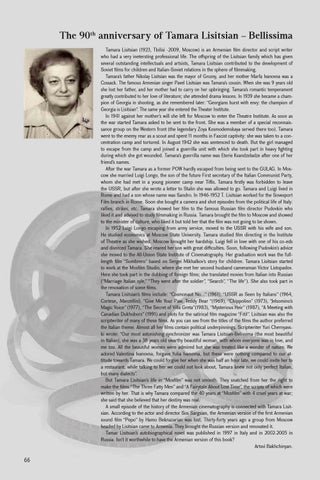
The 90th anniversary of Tamara Lisitsian – Bellissima Tamara Lisitsian (1923, Tbilisi -2009, Moscow) is an Armenian film director and script writer who had a very inetersting professional life. The offspring of the Lisitsian family which has given several outstanding intellectuals and artsists, Tamara Lisitsian contributed to the development of Soviet films for children and Italian-Soviet relations in the sphere of filmmaking. Tamara’s father Nikolay Lisitsian was the mayor of Grozny, and her mother Marfa Ivanovna was a Cossack. The famous Armenian singer Pavel Lisitsian was Tamara’s cousin. When she was 9 years old she lost her father, and her mother had to carry on her upbringing. Tamara’s romantic temperament greatly contributed to her love of literature; she attended drama lessons. In 1939 she became a champion of Georgia in shooting, as she remembered later: “Georgians burst with envy: the champion of Georgia is Lisitsian”. The same year she entered the Theater Institute. In 1941 against her mother’s will she left for Moscow to enter the Theatre Institute. As soon as the war started Tamara asked to be sent to the front. She was a member of a special reconnaissance group on the Western front (the legendary Zoya Kosmodemskaya served there too). Tamara went to the enemy rear as a scout and spent 11 months in Fascist captivity: she was taken to a concentration camp and tortured. In August 1942 she was sentenced to death. But the girl managed to escape from the camp and joined a guerrilla unit with which she took part in heavy fighting during which she got wounded. Tamara’s guerrilla name was Eterie Kvandzeladze after one of her friend’s names. After the war Tamara as a former POW hardly escaped from being sent to the GULAG. In Moscow she married Luigi Longo, the son of the future First secretary of the Italian Communist Party, whom she had met in a young pioneer camp near Tiflis. Tamara firstly was forbidden to leave the USSR, but after she wrote a letter to Stalin she was allowed to go. Tamara and Luigi lived in Rome and had a son whose name was Sandro. In 1946-1952 T. Lisitsian worked for the Sovexport Film branch in Rome. Soon she bought a camera and shot episodes from the political life of Italy: rallies, strikes, etc. Tamara showed her film to the famous Russian film director Pudovkin who liked it and advised to study filmmaking in Russia. Tamara brought the film to Moscow and showed to the minister of culture, who liked it but told her that the film was not going to be shown. In 1952 Luigi Longo escaping from army service, moved to the USSR with his wife and son. He studied economics at Moscow State University. Tamara studied film directing in the Institute of Theatre as she wished. Moscow brought her hardship. Luigi fell in love with one of his co-eds and divorced Tamara. She reared her son with great difficulties. Soon, following Pudovkin’s advice she moved to the All-Union State Institute of Cinematography. Her graduation work was the fulllength film “Sombrero” based on Sergei Mikhalkov’s story for children. Tamara Lisitsian started to work at the Mosfilm Studio, where she met her second husband cameraman Victor Listopadov. Here she took part in the dubbing of foreign films; she translated movies from Italian into Russian (“Marriage Italian syle,” “They went after the soldier”, “Search”, “The life”). She also took part in the renovation of some films. Tamara Lisitsian’s films include: “Cosmonaut No…” (1961), “USSR as Seen by Italians” (1964, Cortese, Marcellini), “Give Me Your Paw, Teddy Bear “(1969), “Chippolino” (1973), “Jelsomino’s Magic Voice” (1977), “The Secret of Villa Greta”(1983), “Mysterious Heir” (1987), “A Meeting with Canadian Dukhobors” (1991) and plots for the satirical film magazine “Fitil”. Lisitsian was also the scriptwriter of many of these films. As you can see from the titles of the films the author preferred the Italian theme. Almost all her films contain political underpinnings. Scriptwriter Yuri Chernyavski wrote: “Our most astonishing synchronizer was Tamara Lisitsian-Belissima (the most beautiful in Italian), she was a 38 years old swarthy beautiful woman, with whom everyone was in love, and me too. All the beautiful women were admired but she was treated like a wonder of nature. We adored Valentina Ivanovna, forgave Yulia Ivanovna, but these were nothing compared to our attitude towards Tamara. We could forgive her when she was half an hour late, we could invite her to a restaurant, while talking to her we could not look about, Tamara knew not only perfect Italian, but many dialects”. But Tamara Lisitsian’s life in “Mosfilm” was not smooth. They snatched from her the right to make the films “The Three Fatty Men” and “A Fairytale About Lost Time”, the scripts of which were written by her. That is why Tamara compared the 40 years at “Mosfilm” with 4 cruel years at war; she said that she believed that her destiny was real. A small episode of the history of the Armenian cinematography is connected with Tamara Lisitsian. According to the actor and director Sos Sargsian, the Armenian version of the first Armenian sound film “Pepo” by Hamo Beknazarian was lost. Thirty-forty years ago a group from Moscow headed by Lisitsian came to Armenia. They brought the Russian version and renovated it. Tamar Lisitsian’s autobiographical novel was published in 1997 in Italy and in 2002-2005 in Russia. Isn’t it worthwhile to have the Armenian version of this book? Artsvi Bakhchinyan.
66