APRIL 2021
3
WFEC Renewables Report
4
Steps for safe digging this spring
A supplement to the Oklahoma Living
4
Gluten Free Carrot Cake
Lig ght Post
the
PUBLISHED FOR MEMBERS OF KIAMICHI ELECTRIC COOPERATIVE
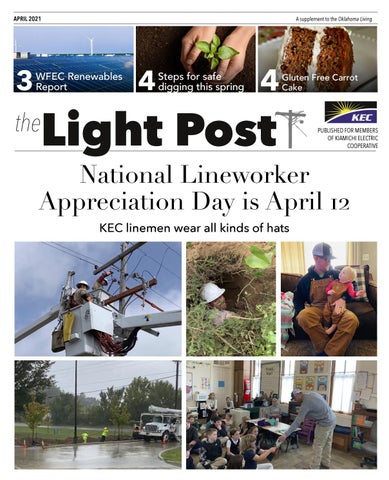
National Lineworker Appreciation Day is April 12 KEC linemen wear all kinds of hats
2 | the Light Post
ceo’s report
Kiamichi Electric Cooperative 944 SW Highway 2 PO Box 340 Wilburton, Oklahoma 74578 tele: (918) 465-2338 toll free: (800) 888-2731 FAX: (918) 465-2950 www.kiamichielectric.org email: support@kiamichielectric.org HOURS OF OPERATION Monday-Friday 8 am to 5 pm 24-HOUR OUTAGE HOTLINE (800) 888-2731 BOARD OF TRUSTEES Mark Ichord, President DISTRICT 6 Ron Pelanconi, Vice President DISTRICT 3 Russell Shaw, Treasurer DISTRICT 1 Amy Miller DISTRICT 2 David Ray DISTRICT 4 Don Parr DISTRICT 5 Larry Culwell DISTRICT 7 Brett Orme Executive Vice President-CEO Kiamichi Electric provides reliable and affordable electricity to members in Pushmataha, Leflore, Latimer, Atoka and Pittsburg Counties.
BRETT ORME
CHIEF EXECUTIVE OFFICER
If you were asked to associate an image or a person with KEC, I bet you would picture a lineworker. One of the most visible employees of the co-op, lineworkers work tirelessly to ensure our community receives uninterrupted power 24/7. “Lineworker” is listed as one of the top 10 most dangerous jobs in the U.S. This is understandable as they perform detailed tasks near high-voltage power lines. Regardless of the time of day, having to brave stormy weather and other challenging conditions, lineworkers must climb 40 feet in the air, often carrying heaving equipment to get the job done. Being a lineworker is not a glamorous or easy profession. It takes years of specialized training, ongoing education, dedication, and equally important, a sense of service and commitment. How else can you explain the willingness to leave the comfort of your home to tackle a challenging job in difficult conditions, when most are sheltering comfortably at home? This dedication and sense of service to the community is truly what sets them apart. That’s why we set aside the second Monday in April to celebrate and recognize the men and women who work around the clock to keep the lights on.
While lineworkers may be the most visible employees at KEC, it’s important to note that there is a team of highly skilled professionals working behind the scenes. Engineers provide ongoing expertise and guidance on the operations side of the co-op. Member service representatives are always standing by to take your calls and questions. Our information technology (IT) experts are continuously monitoring our system to help safeguard sensitive data. And these are just a few of the folks who work together to ensure we can deliver the service and reliability you expect and deserve. Without them, our lineworkers wouldn’t be able to “bring the light” to our community. Our dedicated and beloved lineworkers are proud to represent KEC, and they deserve all the appreciation and accolades that come their way on Lineworker Appreciation Day. On April 12, and any time you see a lineworker, I hope you’ll join me in thanking them for their exceptional service. I also hope you’ll remember that you have a dedicated team of professionals working behind the scenes at the co-op whose commitment to service runs just as deep.
the Light Post | 3
Ensuring reliability as power supply tightens You expect reliable and affordable electricity from your electric cooperative, so how does your co-op deliver on that promise? A complex network of electricity generators and tens of thousands of miles of electrical lines work together to ensure that enough electricity is available on the coldest winter morning and during the dog days of summer. What happens when the demand for power overwhelms the ability to provide it? That’s a particularly vexing question given the transition taking place in how electricity is produced and shared across this network. The key to meeting the energy needs so essential to your quality of life is balancing electricity supply with demand. While that may sound simple, there is a complex web of facilities and organizations that work together to make it happen each day. Regional transmission organizations coordinate, control and monitor the electric grid across several states in a region. Think
of them as energy traffic managers on an interstate highway system, regulating the number of cars – in this case, electricity – and their destination. Even so, on some days there is an imbalance in that system that leads to rolling power interruptions or blackouts—so-called “max-gen” events. In those cases, supply simply can’t keep up. In the Midcontinent region comprised of 15 states, there were six max-gen events from 2006-2016. Since 2016, there have been 15, including three last July and August alone. Simply, that’s because power plants that generate electricity are being closed faster than new producers come online. In most cases, traditional large-scale power suppliers such as coal and nuclear plants are being closed and replaced by alternatives on a much smaller scale. And this gap is closing more quickly despite the development of new natural gas-fueled power plants. As more electric utilities pursue zero- or
low-carbon initiatives by 2035 and beyond, this challenge will grow more complex. So, what’s the answer? Electric cooperatives and others in the energy sector will continue to develop renewable options and pursue new technologies. But absent new large-scale alternatives and advances in energy storage, the stalwarts of today’s energy fleet—coal and nuclear energy facilities—must continue to operate in many regions. In some, they remain the most cost-effective options for producing electricity.
Renewables Report
Data collected from Western Farmers Electric Cooperative — KEC’s wholesale power provider — reflects generation during December 2020, which shows 35 percent of the power generated by WFEC came from renewable sources.
4 | the Light Post
Know what’s below Steps for Safe Digging By Abby Berry
Spring is just around the corner, and there’s never been a better time to get outside and enjoy the fresh air. Perhaps you’re making plans for a new garden or a lawn makeover. However you’re planning to revamp your backyard oasis, remember to keep safety in mind for all projects–– especially those that require digging near underground utility lines. Most of us never think about the electric, gas, water and other utility lines buried below the ground, but hitting one of these lines while digging is not the reminder you’ll want––trust us! KEC reminds all members
who are planning a digging project to call 811 at least three business days before you start. Or you can submit a request online by visiting www.call811.com/811-In-Your-State. Here’s how the process works: After you call 811 or submit your request online, all affected utilities will be notified of your intent to dig. It may take the utilities a few days to get to your request, so please be patient. The affected utilities will send someone out to mark the buried lines with paint or flags. Before you break ground, confirm that all the utilities have responded to your request. If you placed your request by
phone, use the process explained by your 811 call center representative. If you submitted your request online, refer to your 811 center ticket to confirm everything. By taking this important step before you break ground on your project, you can help protect not only yourself but our community. Disrupting an underground utility line can interrupt service, cause injuries and cost money to repair, so remember to call 811 first and know what’s below.
Abby Berry writes on consumer and cooperative affairs for the National Rural Electric Cooperative Association, the national trade association representing more than 900 local electric cooperatives. From growing suburbs to remote farming communities, electric co-ops serve as engines of economic development for 42 million Americans across 56% of the nation’s landscape.
operation round up M O N T H LY U P D AT E Operation Round Up® is a voluntary bill roundup program that benefits local communities, organizations ,and needy families. Funding applications are available at Kiamichi Electric, local social services, or online at www.kiamichielectric.org. YEAR-TO-DATE COLLECTIONS 2020: $64,343.64 YEAR-TO-DATE DISBURSEMENTS 2020: $64,344.70 TOTAL COLLECTED SINCE INCEPTION: $1,672,218.50 TOTAL DISBURSEMENTS SINCE INCEPTION: $1,620,237.02
Gluten Free Carrot Cake INGREDIENTS • • • • • •
cooking spray 1 ½ cups white sugar ½ cup canola oil ½ cup applesauce 3 large eggs 2 cups gluten-free all-purpose baking flour
• • • • •
2 teaspoons ground cinnamon 1 teaspoon baking soda 1 teaspoon vanilla extract ½ teaspoon ground nutmeg 1 pound carrots, peeled and shredded
DIRECTIONS
Energy Efficiency
Tip of the Month Some manufacturers set water heater thermostats at 140 degrees, but most households usually only require them to be set at 120 degrees. Consider lowering your water heater’s temperature to save energy and slow mineral buildup in the heater and pipes.
Preheat the oven to 350ºF. Spray a 9x13-inch baking dish with cooking spray and line with parchment paper. Next, mix sugar, oil, applesauce and eggs together in a large bowl until well blended. Stir in flour, cinnamon, baking soda, vanilla extract and nutmeg; mix well. Stir in shredded carrots and pour batter into the prepared baking dish. Bake in the preheated oven until a toothpick inserted into the center comes out clean, 40 to 45 minutes. You can use two 9-inch round baking pans if you’d like. Baking time would be 35 minutes. Image and Recipe from AllRecipes.com