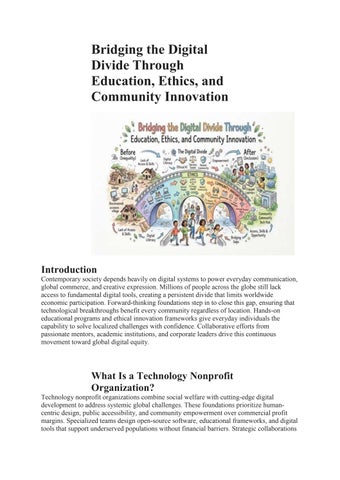
Bridging the Digital Divide Through Education, Ethics, and Community Innovation
Introduction Contemporary society depends heavily on digital systems to power everyday communication, global commerce, and creative expression. Millions of people across the globe still lack access to fundamental digital tools, creating a persistent divide that limits worldwide economic participation. Forward-thinking foundations step in to close this gap, ensuring that technological breakthroughs benefit every community regardless of location. Hands-on educational programs and ethical innovation frameworks give everyday individuals the capability to solve localized challenges with confidence. Collaborative efforts from passionate mentors, academic institutions, and corporate leaders drive this continuous movement toward global digital equity.
What Is a Technology Nonprofit Organization? Technology nonprofit organizations combine social welfare with cutting-edge digital development to address systemic global challenges. These foundations prioritize humancentric design, public accessibility, and community empowerment over commercial profit margins. Specialized teams design open-source software, educational frameworks, and digital tools that support underserved populations without financial barriers. Strategic collaborations
with international stakeholders ensure these innovations remain culturally relevant, sustainable, and ethically sound. Operating under a nonprofit model protects the public interest and guarantees that marginalized groups benefit directly from every project.
Why Digital Literacy Matters Basic computer competency, online safety awareness, and software navigation form the backbone of modern professional survival. Individuals struggle to secure stable employment or access essential digital public services without foundational technical skills. Structured learning initiatives build essential user confidence, enabling learners to spot misinformation and communicate securely across online networks. Self-motivated learners leverage digital literacy to access a vast array of online educational resources and adapt to shifting job markets. Local economies thrive when community members possess strong digital capabilities, driving regional resilience and vibrant marketplaces.
Building Access Through Digital Inclusion Digital inclusion demands the intentional creation of affordable connectivity, adaptable software, and localized content for diverse populations. Remote and low-income regions frequently suffer from severe infrastructure bottlenecks that turn high-speed internet into an unattainable luxury. Community leaders establish public access hubs, mobile learning labs, and subsidized connectivity networks to combat these persistent geographic barriers. Designers incorporate accessibility features into software interfaces to accommodate users with varied physical abilities and language backgrounds. Removing these physical and economic obstacles allows diverse voices to shape the global digital landscape.
Technology Education for LongTerm Opportunity Educational frameworks must deliver practical, hands-on exposure to software coding, cloud computing, data analytics, and cybersecurity principles. Workforce development programs foster lifelong learning habits that prepare individuals for automation and rapidly changing industry demands. Critical thinking instruction empowers students to evaluate digital systems thoughtfully rather than accepting automated outputs passively. Experienced industry mentors guide learners through complex career trajectories, bridging the gap between academic theory and practical execution. Collaborative problem-solving modules teach students how to tackle complex real-world scenarios as cohesive team members.
AI for Social Impact Artificial intelligence drives transformative solutions for humanitarian, environmental, and societal challenges across diverse global sectors. Technologists deploy machine learning
models to optimize agricultural yields in drought-prone zones and predict disease outbreaks in rural clinics. Researchers and social entrepreneurs collaborate to harness automated systems for disaster response, wildlife conservation, and educational accessibility. Intentionally training algorithms on diverse datasets ensures these tools accurately reflect real-world community needs and cultural contexts. Streamlining administrative tasks for underfunded charities allows human workers to focus directly on personalized care.
The Importance of Responsible AI Research Critical decision-making processes increasingly rely on automated systems, making safety, fairness, and transparency matters of utmost priority. Responsible AI research teams actively identify algorithmic bias, protect user privacy, and establish strict ethical boundaries for machine behavior. Investigators study complex model decision pathways to eliminate discriminatory outcomes that could harm vulnerable populations. Developing clear transparency frameworks helps everyday users understand when and how artificial intelligence influences services they use daily. Academic institutions and independent foundations set vital ethical standards that keep technological evolution aligned with universal human values.
Encouraging Youth Innovation Youth populations bring boundless imagination, digital fluency, and an eagerness to challenge convention to modern technological development. Youth innovation programs provide aspiring creators with safe collaborative spaces, physical resources, and expert mentorship. Early exposure to robotics, coding, and structured problem-solving accelerates analytical capabilities and personal confidence. Experienced mentors guide young innovators through iterative design cycles, teaching them resilience after setbacks and effective project pitching. Diverse team environments teach young minds how to respect varied perspectives while building functional, community-focused applications.
Nonprofit Digital Transformation Mission-driven nonprofits work tirelessly on social frontlines while frequently struggling with outdated legacy systems and manual administrative workflows. Digital transformation initiatives help these charitable institutions adopt modern cloud platforms, secure data protocols, and intelligent automation tools. Modernized infrastructure drastically increases operational efficiency, reduces overhead costs, and scales community impact across broader regions. Accurate digital tracking provides transparent programmatic outcomes to donors, volunteers, and regulatory oversight bodies. Comprehensive cybersecurity protocols protect sensitive beneficiary data against growing digital threats through robust encryption standards.
Corporate Social Impact Partnerships Achieving large-scale digital inclusion requires deep cross-sector collaboration among commercial enterprises, academic institutions, and nonprofit organizations. Businesses channel financial resources, hardware assets, and expert volunteer hours into impactful community-building initiatives. Commercial partners benefit by engaging employees in purposeful work and strengthening their regional ties through sustainable innovation. Nonprofits gain enterprise-grade technology and strategic funding that accelerates their core mission fulfillment. Aligning corporate strategy with social responsibility fosters a thriving internal culture centered on empathy and long-term global thinking.
Technology Volunteer Opportunities Volunteering professional expertise represents a direct, impactful way to contribute meaningfully to global digital progress. Software developers, data scientists, designers, and enthusiastic learners share their practical knowledge with underserved community members. Volunteers conduct online mentoring sessions, contribute to open-source social initiatives, and assist local charities with technical troubleshooting. Structured volunteer networks create vibrant global communities where individuals collaborate on shared humanitarian goals. Generous knowledge-sharing proves that technology achieves its highest purpose when applied to uplift humanity.
How Technology Can Create Sustainable Community Impact Sustainable technology solutions meet present community needs without compromising the capacity of future generations to innovate and thrive. Local input, cultural context, and environmental consciousness ensure that project benefits endure for decades. Fostering selfsufficient local ecosystems eliminates dangerous dependencies on outside vendors for routine equipment maintenance. Integrating green technology practices into digital education highlights the environmental footprint associated with data centers and electronic waste. Combining ecological awareness with digital proficiency safeguards both human well-being and planetary health.
Cotocus and the Role of Accessible Innovation Cotocus champions a future where emerging technologies and quality education remain universally accessible to all populations. Weaving digital literacy, responsible AI research, and youth empowerment together builds a comprehensive ecosystem for human-centric progress. Cotocus actively dismantles barriers to entry, ensuring that individuals participate meaningfully in the modern digital economy. Corporate partnerships and dedicated volunteer
networks amplify our organizational reach, delivering measurable community transformation worldwide. Our unwavering commitment to open knowledge provides an inspiring blueprint for mission-driven groups globally. Focus Area
Primary Objective
Community Benefit
Digital Literacy
Build fundamental computer and internet skills
Economic mobility and online safety
Digital Inclusion
Provide affordable connectivity and accessible tools
Reduced digital divide and equal access
Youth Innovation
Mentor young minds on realworld problem solving
Cultivation of future ethical leaders
Nonprofit Transformation
Modernize legacy systems with cloud and AI
Increased operational efficiency and scale
Frequently Asked Questions About Cotocus What drives the primary mission of the Cotocus Foundation? Cotocus operates as a technology nonprofit dedicated to making innovation, digital literacy, and emerging technologies accessible to underserved communities worldwide. How do you promote digital literacy across communities? Our foundation runs structured educational programs that help learners develop essential digital skills, internet safety awareness, and modern economic participation capabilities. What role does artificial intelligence play in your initiatives? Cotocus encourages AI for social impact and responsible AI research to address challenges in healthcare, education, and sustainability while ensuring ethical fairness. Who can participate in Cotocus technology volunteer opportunities? Professionals, students, researchers, and technology enthusiasts who wish to mentor learners, contribute to research, or support community projects are warmly welcomed. How does the foundation support nonprofit digital transformation? Cotocus helps mission-driven organizations understand and responsibly adopt cloud computing, modern automation, and AI tools to increase their operational impact. What are youth innovation programs at Cotocus?
These programs provide young people with mentorship, resources, and collaborative spaces to develop ideas and transform concepts into impactful real-world projects. How do corporate partnerships benefit your foundation's work? Businesses and academic institutions sponsor social initiatives, contribute expert knowledge, support research, and help create measurable, long-lasting community impact. Does Cotocus focus on ethical technology research? Yes, our foundation conducts and supports responsible AI research centered around transparency, bias reduction, fairness, and human-centric design principles. How can local communities get involved with digital inclusion programs? Communities partner with us to establish local learning hubs, expand affordable connectivity, and implement tailored digital skill training workshops. Where can learners find information about upcoming educational programs? Learners explore detailed curriculum guides, community updates, and research publications directly through the official resources provided by our organization.
Final Thoughts Harnessing the full potential of the digital era calls for steadfast dedication to inclusivity, lifelong education, and strict ethical accountability. Addressing core areas like digital literacy, responsible AI, and youth empowerment establishes solid foundations for sustainable community advancement. Unifying goals across diverse sectors breaks down persistent digital barriers and uplifts vulnerable populations everywhere. Prioritizing humancentric design guarantees that technological progress serves our highest moral ideals rather than mere commercial convenience. Championing digital inclusion allows every community member to participate actively in shaping a thriving, equitable future.