GAS LINES
NEW GREEK PIPELINE
COMPANY NEWS
SIEMENS’ MOBILE MOVE
A KHL Group publication
U.S. PRODUCTION RECORD
EURO GAS REPORT
www.compressortech2.com NOVEMBER 2026
SUBSCRIBE
NOW!
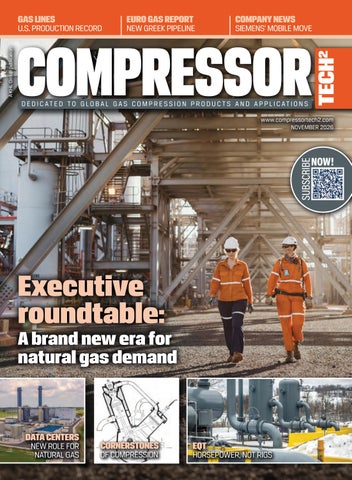
Executive roundtable:
A brand new era for natural gas demand
DATA CENTERS NEW ROLE FOR NATURAL GAS
CORNERSTONES OF COMPRESSION
EQT
HORSEPOWER, NOT RIGS
Forever pioneers. Forever for the better. Forever excellence. We pioneer solutions for the world’s largest industries, focusing on reducing hard-to-abate emissions. With future-facing technologies, digital solutions, and a continuously developing core portfolio, we have the experience, technology, and passion to drive sustainable progress.
AI-generated
everllence.com
FROM THE EDITOR
JACK BURKE
Editor Jack Burke jack.burke@khl.com Vice President of Content, Power Becky Schultz becky.schultz@khl.com
PRODUCTION Client Success & Delivery Manager Charlotte Kemp charlotte.kemp@khl.com Group Designer Jade Hudson Client Success & Creative Assistant Cuan Hansbury
CIRCULATION Subscriptions circulation@khl.com Data Manager Anna Philo anna.philo@khl.com Data Executive Vicki Rummery vicki.rummery@khl.com
EVENTS Events Manager Steven Webb steven.webb@khl.com
SALES Brand Manager PLUS USA/Mainland Europe Kristin Pride +1 720 298 8546 | kristin.pride@khl.com China Cathy Yao +86 (0)10 6553 6676 | cathy.yao@khl.com Japan Michihiro Kawahara +81 (0)3 32123671 | kawahara@rayden.jp Scandinavia/UK/Benelux Greg Roberts +44 (0) 7950 032224 | greg.roberts@khl.com Vice President Sales, Power Division Tony Radke 480 478 6302 tony.radke@khl.com Global Vice President Sales Alister Williams +1 312 860 6775 alister.williams@khl.com Chief Executive Officer James King Chief Financial Officer Paul Baker
© Copyright KHL Group, 2026 KHL GROUP AMERICAS LLC 14269 N 87th Street, Suite 205, Scottsdale, AZ 85260. americas@khl.com
www.compressortech2.com
Demand is not the problem
F
COMMENT
EDITORIAL
or much of the past decade, the natural gas compression industry has spent considerable time wondering where the next major source of demand would come from. That doesn’t appear to be the problem anymore. If there is a common thread running through the conversations in this year’s COMPRESSORTech2 Executive Roundtable, it is that executives see plenty of demand ahead. LNG exports continue to expand. Power generation is consuming more natural gas. Industrial projects are moving forward. And then there are data centers, whose appetite for electricity has suddenly made natural gas infrastructure part of a much larger conversation about how the United States will meet growing power demand. The more interesting question is whether the compression supply chain can keep up. Tyler Courtney, director, global energy & marine sales for Regal Rexnord, sees that challenge from the manufacturing side. Compression packagers are busy, customers are making capacity investments and equipment availability is increasingly affecting decisions about what gets installed. “The market isn’t going to wait for us,” Courtney said while discussing Regal Rexnord’s own investments in manufacturing capacity. That may be as good a summary of the current compression market as any. George Giourof, CEO of KB Delta, sees the same pressure farther downstream. Compressors are operating at high utilization rates while customers expect longer component life, shorter maintenance windows and immediate access to replacement parts. Rental fleets, in particular, increasingly view component cost through the much larger expense associated with having a compressor sitting idle. His formulation is equally telling: The question is becoming less about, “What does the part cost?” and more about, “What does it cost us if that compressor isn’t running?” For years, manufacturers learned to live with uncertainty over future oil and gas activity. Capacity had to be added carefully because nobody wanted to build factories, hire workers or expand supply chains for demand that might disappear before the investment paid for itself. Now the risk may be reversed. If LNG, power generation and data centers develop on anything approaching the scale now being discussed, the industry will need more than additional compressor horsepower. It will need larger manufacturing capacity, reliable component supply, controls and monitoring expertise, field service capabilities and a new generation of machinists, technicians and engineers. And existing equipment cannot simply be forgotten while everyone chases new projects. Jack Burke Editor | jack.burke@khl.com
The engine isn’t the most powerful part of this picture. it’s the power gen expertise behind it. With 24 locations across North America, the broadest support network, and an operation that does everything from remanufacturing Waukesha and CAT engines to custom power plant solutions, WPI knows true engine power lies in the partner you choose. Get more at wpi.com
INSIDE
NOVEMBER 2026
COMPRESSORTECH2 ISSN 1085-2468, is published monthly with combined issues of January/February and August/September by KHL Group Americas LLC, 11811 N. Tatum Blvd, Suite P118, Phoenix, Arizona, 85028, USA. Periodicals postage is paid at Phoenix, AZ, and additional mailing offices. POSTMASTER Send address changes to COMPRESSORTECH2, 11811 N. Tatum Blvd, Suite P118, Phoenix, Arizona, 85028, USA. Copyright © 2026 KHL Group Americas LLC. All Rights Reserved. Materials protected by U.S. and international copyright laws and treaties. Unauthorized duplication and publication is expressly prohibited.
ROUNDTABLE 20 Key executives sound off on the state of the industry
INDUSTRY 31 Regal Rexnord’s latest technology update 34 Emissions reporting leaves gaps, opportunties: Report 37 Electric vs. gas drive and grid access 40 Survey: stronger gas production, tighter service conditions 42 AI growth opens new market for natural gas infrastructure
SUBSCRIBE NOW: Scan this code to receive all the latest news in the gas industry.
MEMBER OF:
www.compressortech2.com
DEPARTMENTS 3 Editor’s Comment: Demand is not the problem 6 Industry News: LNG Canada project 8 Gas Lines: U.S. natural gas production hits record in July 10 Company News: Siemens targets data centers 12 Monitoring Government: FERC’s latest moves 14 Shale Play by Play: Iroquois compressor sites 16 Euro Gas Report: New pipeline for Greece 45 Events 47 Tech Corner: Highlights from GMC 53 Cornerstones of Compression: Part 1: European origins of two-cycle engine-compressors
GAS LINES
U.S. PRODUCTION RECORD
EURO GAS REPORT
NEW GREEK PIPELINE
COMPANY NEWS
SIEMENS’ MOBILE MOVE
www.compressortech2.com NOVEMBER 2026
NOW!
OUTSIDE
37 Scan the QR code to find us on LinkedIn: COMPRESSORTECH2
46
SUBSCRIBE
VOLUME 31 | NUMBER 9
42
A KHL Group publication
6
CONTENTS
16
Executive roundtable:
A brand new era for natural gas demand
DATA CENTERS NEW ROLE FOR NATURAL GAS
CORNERSTONES OF COMPRESSION
EQT
HORSEPOWER, NOT RIGS
20
Key industry executives on the market.
NOVEMBER 2026 | COMPRESSORTECH2 | 5
INDUSTRY NEWS
Shell approves LNG Canada Phase 2; will double site’s export capacity
S
hell and its partners have taken a final investment decision on the second phase of LNG Canada, clearing the way for an expansion that will double the Kitimat, British Columbia, facility’s production capacity to 28 million tonnes per annum (mtpa). The project will add two LNG processing trains to the existing two-train facility, taking LNG Canada from 14 mtpa to 28 mtpa. Commercial operations from Phase 2 are expected to begin in the early 2030s. Shell holds a 40% interest in LNG Canada and expects to receive nearly 6 mtpa of additional LNG from the expansion. The other joint venture participants are PETRONAS with 25%, PetroChina with 15%, Mitsubishi Corp. with 15% and Korea Gas Corp. with 5%.
PETROS, Höegh Evi to develop Kuching LNG terminal in Sarawak, Malaysia Höegh Evi has entered into an agreement with Petroleum Sarawak Berhad (PETROS) to jointly develop the proposed Kuching LNG Terminal in Sarawak, Malaysia. The project is planned as part of the Kuching Low-Carbon development and is intended to support power generation in Kuching while providing additional energy infrastructure for future industrial growth. Under the agreement, PETROS and Höegh Evi will jointly develop, own and operate the terminal. The project is expected to include a floating storage and regasification unit, mooring infrastructure, subsea and onshore pipelines and onshore receiving facilities. The partners are targeting first gas by the end of 2029 and are evaluating opportunities to accelerate the schedule as demand grows. In addition to regasification, the terminal is expected to support small-scale LNG distribution, truck loading, bunkering, storage and reloading activities. PETROS is serving as master developer of the broader Kuching Low-Carbon project. Höegh Evi and PETROS announced plans to develop an LNG terminal in Sarawak, Malaysia. IMAGE: HOEGH EVI
6 | COMPRESSORTECH2 | NOVEMBER 2026
Shell Canada Energy, an affiliate of Shell plc, announced a final investment decision on LNG Canada Phase 2, which will double production capacity at the facility in Kitimat, British Columbia. IMAGE: LNG CANADA
In addition to the two new trains, Phase 2 will include another LNG storage tank, a condensate tank, a loading berth and expanded utility and process systems at the Kitimat site. The expansion is also expected to produce a significant compression project upstream of the LNG plant. Coastal GasLink, the 670-km pipeline supplying the Kitimat facility with natural gas from northeastern British Columbia, will increase its transportation capacity primarily by adding compression rather than constructing another mainline. Shell said the expansion will require five new compressor stations. Front-end engineering work disclosed earlier this year called for five additional stations, each using about 30 MW of gas compression, along with modifications to other facilities on the system. That would represent roughly 150 MW of new compression capacity if the FEED configuration carries through into final construction. The compressor and driver suppliers have not been publicly identified. The additional compression is intended to substantially increase throughput. CT2 www.compressortech2.com
INDUSTRY NEWS
LNG Alliance affiliate seeks authorization for LNG export project Freedom LNG LLC, an affiliate of Singapore-based LNG Alliance, has applied to the U.S. Department of Energy (DOE) for authorization to export natural gas to Mexico for liquefaction and subsequent shipment. The proposed Bravo LNG project would be developed near the Port of Matamoros in Tamaulipas on the Gulf of Mexico. The facility would have an annual production capacity of approximately 6 million metric tons of LNG, according to the application. Under the proposed arrangement, Freedom LNG is seeking authorization to export up to 343 billion cubic feet (Bcf) of U.S. natural gas annually to Mexico, where the gas would be liquefied at the Bravo LNG facility. The company is also seeking authorization for the subsequent export of up to 307 Bcf annually of LNG produced from the U.S.-sourced natural gas. The project would receive natural gas transported through the Sur de TexasTuxpan pipeline, which connects U.S. supplies with g Mexico’s Gulf Coast.
TotalEnergies targets continued oil, gas growth through 2035
T
otalEnergies expects oil and gas production to continue growing through the end of the decade and into the first half of the 2030s as the company advances a portfolio of projects in several major producing regions. In its 2026 strategy and outlook, TotalEnergies said it expects overall energy production — including oil, gas and electricity — to grow about 4% annually through 2030. Oil and gas production is expected to increase by more than 3% per year on average between 2025 and 2030, supported by projects already under execution. Beyond 2030, TotalEnergies said its existing portfolio includes projects in Namibia, Nigeria, Libya, Malaysia, Mozambique and Papua New Guinea. The company said its proven reserves life of more than 12 years should allow it to maintain production of about 3 million boe/d through 2035. Against that base, TotalEnergies is targeting oil and gas production growth of 2% to 3% annually from 2030 through 2035,
The Cameron LNG terminal. TotalEnergies expects oil and gas production to continue growing through the end of the decade and into the first half of the 2030s. IMAGE: TOTALENERGIES
supplemented by exploration and access to previously discovered resources. To support its longer-term growth plans, TotalEnergies said it expects net investments of between $14 billion and $17 billion annually from 2027 through 2032. CT2
Baker Hughes, Venture Global and GE Vernova in power pact
IMAGE: LNG ALLIANCE
Baker Hughes has announced a new Power Frame Agreement with Venture Global and GE Vernova to support the development of behind-the-meter power generation capacity in the United States. The agreement establishes a framework for supplying gas turbines, steam turbines and associated equipment and services for up to 16 new power island units. The equipment will support Venture Global’s LNG production and liquefaction operations, as well as potential future data center projects www.compressortech2.com
developed adjacent to LNG facilities. Under the agreement, Baker Hughes will also provide the controls and electrical integration technology required for each power island, including electrical houses (E-houses) and electrical control systems The framework builds on the LNG power island architecture previously deployed by Baker Hughes at Venture Global facilities. The companies intend to use the existing design as a repeatable model for developing behind-the-meter power generation. CT2 NOVEMBER 2026 | COMPRESSORTECH2 | 7
GAS LINES
NATURAL GAS PRODUCTION
U.S. natural gas production hits record in July
P
U.S. NATURAL GAS PRODUCTION AS GROSS WITHDRAWALS (JAN 2010 - JULY 2026)
ermian growth and expanding takeaway capacity pushed gross withdrawals to 137 Bcf/d, while marketed and dry gas production also reached all-time highs, according to the U.S. Energy Information Administration (EIA). U.S. natural gas production reached a record high in July, driven primarily by increased output from the Permian Basin and continued expansion of pipeline takeaway capacity. Gross withdrawals — the total volume of natural gas produced at the wellhead — averaged 137 Bcf/d in July 2026, the highest monthly level on record. It marked the first new monthly record of 2026 following five record-setting months during 2025. The increase was led by Texas and New Mexico, where new wells continued to come online across the Permian Basin. Combined gross withdrawals in the two states rose by 1.7 Bcf/d, or 3.2%, from June to July. Production also increased by more than
constraints that have periodically limited Permian billion cubic feet per day (Bcf/d) gas takeaway and pressured regional prices. The Hugh Brinson Pipeline began interstate flows ahead of schedule during the summer, adding another route for gas moving out of West Texas. Additional pipeline capacity is expected to improve access from the Permian to Gulf Coast Data Source: U.S. Energy Information Administration, Natural Gas Monthly markets, including LNG export terminals. 0.1 Bcf/d in Louisiana, Oklahoma and North July also established records for both Dakota. marketed natural gas production and dry Rising gas-to-oil ratios in the basin are gas production. contributing additional associated gas Marketed production excludes gas used volumes as wells mature. for repressuring, vented and flared gas and Production growth during 2025 was also nonhydrocarbon gases removed from the supported by higher natural gas prices, well stream. improving well productivity and increased Dry production further excludes natural operating efficiency. gas plant liquids, leaving consumerThe July increase comes as new pipeline grade natural gas available for pipeline infrastructure begins easing transportation transportation and end use. CT2
BAKER HUGHES RIG COUNT
US NATURAL GAS STORAGE (Bcf) Source: Baker Hughes
1400 1200 1000 800 600 400 200 0 Sept-24
Sept-25 North America
Source: EIA
5000 4500 4000 3500 3000 2500 2000 1500 1000 500 0 January
Sept-26
HENRY HUB NATURAL GAS SPOT PRICE (US$/MMBtu)
Sept-24
Sept-25
8 | COMPRESSORTECH2 | NOVEMBER 2026
Five-Year High
Five-Year Low
BRENT CRUDE OIL PRICE (US$/Barrel) Source: EIA
$9.00 $8.00 $7.00 $6.00 $5.00 $4.00 $3.00 $2.00 $1.00 $0.00
December 2026
International
Sept-26
Source: EIA
$130.00 $120.00 $110.00 $100.00 $90.00 $80.00 $70.00 $60.00 $50.00 $40.00 $30.00 Sept-24
Sept-25
Sept-26
www.compressortech2.com
The Titan™ 350 is a world class highly efficient gas turbine designed in the 34 to 38 MW range. With robust design features based on the proud legacy of the Titan product line, it is fitted for flexible power or continuous duty.
COMPANY NEWS
Siemens Energy to supply 119 SGT-400 cores for Dynamis mobile power packages Siemens Energy has agreed to supply 119 SGT-400 gas turbine cores to Dynamis Power Solutions for integration into the company’s mobile power generation packages. The cores, each rated at approximately 15 MW, will be supplied over multiple years beginning in 2027. In total, the units represent more than 1.7 GW of generation capacity. Dynamis will integrate the Siemens Energy cores into its DT18, a new hypermobile power package designed for applications requiring flexible generation capacity and shorter deployment timelines. The DT18 will be marketed for a range of applications, including data centers, oil and gas operations, utilities and other industrial users. Dynamis said the DT18 builds on the engineering approach used in its DT35 platform and is intended to provide scalable generation with a smaller footprint and faster installation than a conventional power plant. Crawford said Dynamis has approximately 2 GW of packaged power capacity and that the SGT-400-based units will significantly expand that total.
An image of the SGT-400 core engine. IMAGE: SIEMENS ENERGY
10 | COMPRESSORTECH2 | NOVEMBER 2026
Tecnimont begins FEED work on 25 mtpa Argent LNG project
T
ecnimont USA Inc. has signed a frontend engineering design contract with Argent LNG for its planned 25 million tonnes per annum LNG export facility at Port Fourchon, Louisiana. Under the contract, Tecnimont USA, part of MAIRE, will carry out FEED engineering and provide technical support for the project’s Federal Energy Regulatory Commission permitting process. The scope includes project execution planning, engineering documentation, schedule and cost estimates, safety and reliability studies and integration of the facility’s major technology packages. Argent LNG is currently in FERC’s pre-filing
process under Docket No. PF25-11-000. Argent plans to develop the project in phases, with the first phase targeting approximately 12 mtpa and full buildout reaching 25 mtpa. The developer is targeting first LNG production around 2030. The Port Fourchon project is being designed around modular LNG technology rather than a conventional large-train configuration. Argent LNG says Baker Hughes will provide its NMBL modular liquefaction technology and LM9000 gas turbines for the project. The developer also lists Honeywell UOP and ABB among its technology partners. CT2
Tecnimont USA Inc. has signed a front-end engineering design contract with Argent LNG for its planned 25 million tonnes per annum LNG export facility at Port Fourchon, Louisiana. IMAGE: ARGENT LNG
PLAINS ALL AMERICAN PIPELINE has appointed Dean Liollio executive vice president and chief operating officer, effective Oct. 2. Liollio succeeds Chris Chandler, who is resigning from the company to pursue other interests. Plains said Chandler’s departure is not related to any disagreement concerning the company’s operations, policies or practices. Liollio most recently served
as senior vice president, special projects, a position he held since June 2024. He previously served as president of Plains Midstream Canada from 2020 to 2024, president of PAA Natural Gas Storage from 2008 to 2020 and president of Plains Gas Solutions from 2016 to 2020. Before joining Plains in 2008, Liollio held several executive positions, including president, CEO and director of EnergySouth Inc. and president and chief operating officer of CenterPoint’s natural gas
www.compressortech2.com
COMPANY NEWS
Burckhardt Compression wins MTU test facility order Burckhardt Compression has secured an order from MTU Maintenance BerlinBrandenburg to supply two high-speed compressor solutions for the company’s gas turbine test facility in Ludwigsfelde, Germany. The compressors will support performance testing carried out as part of MTU’s maintenance, repair and overhaul services for industrial gas turbine engines. MTU currently operates the test facility using natural gas but is preparing the site to handle blends containing up to 25% hydrogen. Burckhardt Compression said the compressor systems were designed to meet the reliability requirements of the test operation while supporting the facility’s future fuel plans. MTU Maintenance Berlin-Brandenburg specializes in maintenance of GE Aerospace LM-series industrial gas turbines. The Ludwigsfelde site, south of Berlin, is also adding a new production building as MTU expands capacity to accommodate increasing maintenance demand. Industrial gas turbines remain an important part of Europe’s power system, particularly for flexible generation used to balance variable renewable energy production.
Flow measurement consultancy and digital solutions provider KELTON has appointed Stuart Christie as managing director, succeeding Iain Pirie.
www.compressortech2.com
Mesa expands manufacturing for natural gas generation
M
esa Power Solutions has opened a new 220,000-square-foot manufacturing and administrative campus in Evansville, Wyoming, as the company expands production of natural gas-fired generation equipment for data centers, utilities, energy companies and other commercial and industrial customers. The facility, located at One Mesa Way, will consolidate about 300 existing employees and manufacture Mesa’s stationary and mobile generator-set platforms. Combined with the company’s San Antonio operation, Mesa said the two facilities will provide annual production capacity of approximately 3 to 4 GW. Mesa expects the Wyoming investment to generate an economic impact of about
$200 million by 2030. Mark Widener, chief commercial officer at Mesa Power Solutions, said both the Wyoming and San Antonio plants manufacture the company’s PowerCore stationary generators as well as mobile, trailer-mounted units. The product range uses engines from 8 liters to 22 liters, with the 22-liter platform currently representing the core of Mesa’s production. Mesa is an engine distributor for Hyundai Construction Equipment and imports bare long blocks from South Korea. The company then adds the components required for operation and integrates the engines with alternators to produce complete generator sets. CT2
Christie moves into the role from chief operating officer. He first joined Kelton in 2008 as an on-site measurement consultant in Qatar before spending more than a decade working in-house for a Middle East LNG producer. He returned to Kelton in 2021 as operations director and became COO in 2025. As managing director, Christie will oversee Kelton’s global operations, including its established North Sea business, expansion in the Middle East and growth efforts in
mainland Europe and the Americas. Pirie, who has been with Kelton for nearly 20 years and served as managing director for the past decade, will become executive director and continue working with Christie and the company’s leadership team. Christie will also join the leadership team of parent company Nexos Group, which acquired Kelton in 2024. Nexos provides engineering, procurement, construction and consulting services across the energy, infrastructure and power sectors.
NOVEMBER 2026 | COMPRESSORTECH2 | 11
COMPRESSED NEWS
distribution operations across a five-state region that included Houston. Plains owns and operates midstream energy infrastructure in the United States and Canada, including pipeline gathering and transportation systems, terminals and storage assets.
Mesa Power Solutions’ new manufacturing and administrative campus in Evansville, Wyoming. IMAGE: MESA
MONITORING GOVERNMENT
B
THE AUTHOR
ack in May of this year, the Federal Energy Regulatory Commission (FERC) voted unanimously to launch a Notice of Proposed Rulemaking (NOPR) to revise its blanket certificate program for fast-tracking interstate natural gas pipeline projects, including expansion of existing compressors. As of mid-October, FERC had yet to take action to finalize the changes, but various groups were maintaining keen interest in the outcome. West Virginia Attorney General J.B. McCuskey proclaimed on Oct. 7 he was leading a coalition of several states backing the proposed revisions. Twenty-six state attorneys general signed a letter urging FERC to adopt the proposals. “This Proposed Rule would benefit everyone, including gas producers who will be able to avoid red tape and consumers who will have greater access to affordable energy when they need it most,” McCuskey said in a press release. The Blanket Certificate Program was established in 1982 to provide streamlined authorization for certain natural gas infrastructure activities. Among other things, the proposed rulemaking would raise the cost limits for projects that qualify for the program. Blanket certificates have been limited to projects with a maximum cost of US$14.5 million that were authorized without being required to provide prior notice to FERC. That limit would increase to US$30 million for such projects under the proposed rule. In cases where prior notice of a project to FERC is required, the commission issues a notice providing 60 days to protest and/ or intervene. In those instances, the project cost threshold for blanket certification would increase to US$86 million from US$41.1 million under the proposed rule. FERC has already granted a
BRIAN FORD is editor in chief for Industrial Info Resources, which provides up-to-date project information on a wide range of industries across the globe. He has worked as a reporter and editor for newspapers and other publications since 1979.
12 | COMPRESSORTECH2 | NOVEMBER 2026
Proposal would revise program for fast-tracking interstate natural gas pipeline projects, including expansions of existing facilities. By Brian Ford
FERC proposes to expand, streamline blanket certificate program for natural gas temporary waiver of the existing cost limits at the urgings of the Interstate Natural Gas Association of America (INGAA), raising the blanket certification eligibility threshold for pipeline projects to US$61,650,000 if constructed and placed in service by May 31, 2028. In seeking the waiver, INGAA cited the rising costs of pipeline and compressor construction. Analysis by INGAA indicated there was a 256% median increase in cost per inch-mile for pipelines and a 172% median increase in cost per horsepower for compression between 2006 and 2024, according to a filing by FERC with the Federal Register. Specifically, INGAA’s analysis showed, using data from pipeline applications, that the median cost per inch-mile of pipeline construction rose 256.98% from 2006 to 2024 and the median cost per horsepower of compression projects rose 172.76% over the same period, for an average increase of 214.87%. FERC’s rulemaking proposal also proposes removing blanket certificate cost limits for expansions within the fence line of existing compressor stations under prior notice procedures, according to an analysis by the Van Ness Feldman law firm. “The NOPR explains that limiting this work to within the fence line would limit impacts on landowners but allow pipeline companies to expand their systems
using the expedited blanket certificate procedures,” the law firm said. Of course, not everybody is happy with the proposed rule. In July, Washington Attorney General Nick Brown and Massachusetts Attorney General Andrea Joy Campbell led 15 state attorneys general in a motion opposing the changes, according to the State Energy & Environmental Impact Center of the NYU School of Law. The attorneys general argued that the proposed rule “does not enable the Commission to fulfill [the] responsibilities” to “ensure that new pipelines do not unfairly burden everyday consumers, the air we breathe, and the water we use.” They added said that the proposal “is likely to raise energy bills, increase air pollution, and cause other harms without countervailing benefits.” A host of environmental groups are also against the rule. “Most people have never heard of FERC’s blanket certificate program, but the consequences could show up in their communities and on their energy bills,” said Megan C. Gibson, senior attorney at the Southern Environmental Law Center, in a press release. “This proposal could let pipeline companies spend tens of millions of dollars—with no cost ceiling for some projects while giving the public less notice and less opportunity to have any input or object.” CT2 www.compressortech2.com
STRONG PARTNERSHIP TO SERVE CUSTOMERS
WORLDWIDE
Burckhardt Compression AG info@burckhardtcompression.com www.burckhardtcompression.com
KB Delta Inc. info@kbdelta.com www.kbdelta.com
Niobrara*
Montana Thrust Belt
Heath**
Cody
BAKKEN***
Powder River Basin
Big Horn Basin
Williston Basin Gammon
Greater HilliardGreen River BaxterBasin Mancos
Niobrara* Park Basin
Uinta Basin Manning Canyon Piceance Mancos San Joaquin Basin Hermosa Basin Paradox Basin Monterey-Temblor Lewis Monterey, Santa Maria, Ventura, Los Angeles Basins
Forest City Basin
Denver Basin
Pierre Raton San Juan Basin Basin Anadarko Basin Palo Duro Bend Basin
Avalon-Bone Spring Barnett-Woodford Marfa Basin
HAYNESVILLE
SOCAR buys into Haynesville Comstock Resources signed a framework agreement under which Azerbaijan’s SOCAR will invest $1.65 billion in Comstock’s Haynesville assets. SOCAR will acquire non-operated interests of 20% in Legacy Haynesville and 15% in Western Haynesville upstream assets, plus a stake in the Pinnacle gathering and treating system. The partners will explore marketing Comstock’s gas internationally as LNG. Closing is expected by year-end.
Centalion buys Silver Hill Haynesville assets Centalion, the commodities trader formerly known as Gunvor, acquired Silver Hill Energy Partners’ Haynesville upstream and midstream assets in Texas and Louisiana. The package includes about 300 MMcf/d of net production, 72,000 net acres in the Haynesville and Bossier core, and roughly 300 gross operated locations. Terms were not disclosed.
Barrell tops 62,000 Smackover lithium acres Barrell Lithium has assembled more than 62,000 net mineral acres in the East Texas portion of the Smackover Formation, where lithium brine concentrations test from 600 to more than 800 mg/L. The company closed a Series C funding round. In the fourth quarter, it will begin selecting an operator partner to drill wells, build facilities, and deploy direct lithium extraction (DLE) technology.
14 | COMPRESSORTECH2 | NOVEMBER 2026
Appalachian Basin
Michigan Antrim Basin
Mowry
Devonian (Ohio) MARCELLUS Utica
Illinois Basin New Albany
Cherokee Platform ExcelloMulky
Chattanooga
FAYETTEVILLE
Arkoma Black Warrior Basin WOODFORD Basin Floyd-Neal Ardmore Basin
BARNETT HAYNESVILLE- Chattanooga BOSSIER TX-LA-MS Ft. Worth
Permian Basin
Current Plays Prospective Plays Basins * Mixed shale & chalk ** Mixed shale & Limestone *** Mixed shale & tight dolostone-siltstone-sandstone STACKED PLAYS
Conasuaga
Shallowest/youngest
Valley & Ridge Province
Intermediate depth/age Deepest/oldest
Salt Basin
Basin
Tuscaloosa Pearsall
EAGLE FORD
James Willis
Western Gulf
highlights the latest news from the major North American shale plays
MARCELLUS/UTICA
FERC approves EGTS PA-OH expansion FERC cleared Eastern Gas Transmission and Storage (EGTS) to begin construction of its 550,000 Dth/d Appalachian Reliability Project, roughly six months ahead of schedule. Gas will move from a new receipt point in Armstrong County, Pennsylvania, to Texas Eastern in Westmoreland County, Pennsylvania, and Rockies Express in Monroe County, Ohio. Work includes 3.9 miles of 30-inch pipe and turbine units at the JB Tonkin (20,500 hp) and Mullett (11,100 hp) compressor stations. Service is targeted for June 2028.
FERC okays three Iroquois compressor sites FERC issued a partial notice to proceed on Iroquois Gas Transmission’s $272 million Enhancement by Compression project. The notice covers compression and gas cooling equipment at the Athens and Dover stations in New York and the Milford station in Connecticut. The upgrade adds 125 MMcf/d of capacity to the 414-mile system. The fourth site, Brookfield, Connecticut, still awaits a state air permit for two gas-fired compressor units.
Kosciusko Junction pipeline clears federal permitting Boardwalk’s $1.1 billion Kosciusko Junction
MIDCONTINENT
Vega JV buys Toklan, gathering system Vega Upstream JV closed its $15 million acquisition of Toklan Oil and Gas, including the Deer Creek Gathering System. Toklan operates 28 producing wells on about 7,000 net acres in the Western Anadarko Basin.
www.compressortech2.com
e
SHALE NEWS
PERMIAN
Enbridge plans westbound Permian gas pipeline Enbridge launched a non-binding open season for West Texas Express, a proposed 2 Bcf/d natural gas pipeline running more than 150 miles west from the Waha area to El Paso, Texas. Targeted for service in fourth-quarter 2029, the line would supply power generators and industrial customers, including data centers, in West Texas, New Mexico, Arizona, and Mexico.
Energy Transfer buys Vaquero Midstream Energy Transfer agreed to acquire Vaquero Midstream for $2.625 billion in cash and units. Vaquero operates a 300-mile Delaware Basin pipeline network in Loving, Reeves, Ward and Winkler counties, Texas, and the three-train, 675 MMcf/d Caymus Processing Complex. The site can accommodate two more trains, lifting capacity to as much as 1.2 Bcf/d. Closing is expected in the fourth quarter.
Project won FERC approval and cleared its remaining federal permits. The 111-mile, 36inch Mississippi line adds two compressor stations (Holmes and Kosciusko), new units at Isola and Greenville stations, and four meter stations. It will move 1.175 Bcf/d of Marcellus/Utica and other gas to Southeast markets. Construction is planned for December, with first gas in April 2028.
Kinder Morgan plans Tennessee Southeast Connector Kinder Morgan is planning the Southeast Connector, a natural gas pipeline that would cross 10 Middle Tennessee counties and link its Tennessee Gas Pipeline and Southern Natural Gas systems. The company says
BAKKEN/WILLISTON
Bakken throughput to dip 5% Hess Midstream expects Chevron to drop from three Bakken rigs to two in December and projects 2027 Bakken throughput will fall about 5% before plateauing in 2028.
Flare gas powers 22 Bakken bitcoin mines Montana has permitted 22 small data centers in Richland and Roosevelt counties, on the Bakken’s edge, all owned by NYDIG. The bitcoin mining sites run generators on associated gas that would otherwise be flared. State regulators estimate the combined output of recent projects at about 177 MW.
EAGLE FORD
GAIL moves to exit Eagle Ford The U.S. unit of India’s GAIL is reviewing expressions of interest from U.S. companies for its 20% non-operated working interest in Eagle Ford assets, the company said. The position includes 91 wells and 13 proved undeveloped locations on 2,870 net acres in La Salle and Frio counties. GAIL acquired the position from Carrizo Oil & Gas in 2011 for $95 million.
Magnolia closes WildFire, sheds non-core assets Magnolia Oil & Gas closed its $4.06 billion WildFire Energy acquisition in September and expects fourth-quarter production of 159 to 161 Mboe/d, about half oil. The company sold Dimmit and Zavala County assets producing 1.4 Mboe/d for $47.5 million and 616 net acres in Gonzales County. Magnolia budgets $900 million to $950 million for 2027 drilling and completions.
the connection would deliver gas from both the Northeast and Gulf Coast to Southeast markets. Route surveys are underway. FERC pre-filing begins in December, with service targeted for 2029.
Columbia seeks to abandon Majorsville storage TC Energy’s Columbia Gas Transmission asked FERC to permanently abandon its Majorsville-Heard storage complex, three fields straddling the PA-WV line. Columbia would plug 71 wells, remove the Majorsville Compressor Station, and abandon 19.2 miles of pipeline, mostly in place. The estimated $103 million effort could take up to 10 years. The fields have been idle since 1996. CT2
Eight Citizen Anadarko wells online Citizen Energy Ventures says all eight wells in its 2025 Anadarko Basin drilling program were producing by the end of August and were completed at or below budget. Its 2026 program will drill and complete up to 12 wells in Oklahoma’s Cherokee Formation. The company’s has drilled more than 300 horizontal wells in the basin since 2012.
www.compressortech2.com
ROCKIES
Hess Midstream buys Chevron DJ assets Hess Midstream will acquire Chevron’s Denver-Julesburg (DJ) Basin midstream assets for $200 million in cash plus cancellation of Chevron’s entire stake in Hess Midstream. The assets include 400 Mbbl/d of oil and 300 MMcf/d of gas gathering capacity, 420 Mbbl of storage and a 20% stake in the 300 Mbbl/d Saddlehorn pipeline to Cushing.
Plains buys Silver Creek gathering system Plains All American will buy Silver Creek Midstream’s Wyoming Powder River Basin crude gathering system for about $585 million. The deal includes roughly 600 miles of pipeline, more than 350 Mbbl/d of capacity, 1.2 MMbbl of storage, and a 49% stake in the Iron Horse and Powder River Express pipelines.
NOVEMBER 2026 | COMPRESSORTECH2 | 15
EURO GAS REPORT
Anna Kachkova provides information on the latest gas compression news from Europe EUROPE
Burckhardt completes compressor cylinder liner repairs aboard LNG carriers in transit
THE AUTHOR
Burckhardt completes compressor cylinder liner repairs aboard LNG carriers in transit. Burckhardt Compression recently completed two compressor cylinder liner repair projects aboard LNG carriers traveling from Europe to the U.S. Gulf Coast. The company said performing the repairs during transit minimized operational disruptions and eliminated the need for scheduled downtime. For the first project, Burckhardt field service representatives (FSRs) boarded an LNG carrier in Dunkirk, France, in late June to repair fourth- and fifth-stage
ANNA KACHKOVA is an independent oil and gas writer based in Edinburgh, Scotland. She has over 17 years’ experience of covering the energy industry, including five years in Houston, Texas, as NewsBase’s North America editor. Her email address is: aikachkova@gmail.com
ALBANIA
TAP targets late 2027 completion of Albanian gas exit point The Trans Adriatic Pipeline (TAP) consortium plans to complete construction of a gas metering and pressure reduction station in Fier, Albania, in the fourth quarter of 2027. The facility will be handed over to Albania upon completion. The 877-km (545-mile) TAP pipeline transports natural gas from Azerbaijan to European markets. The consortium announced the start 16 | COMPRESSORTECH2 | NOVEMBER 2026
compressor cylinder liners during the vessel’s Atlantic crossing. The work was completed at sea through coordination between the onboard technicians and shore-based technical support. When the team disembarked at the Port of Houston in mid-July, the compressor returned to full service, allowing the vessel to maintain its operating schedule. In a separate project, another Burckhardt team boarded an LNG carrier in Huelva, Spain, in late August to repair a compressor cylinder liner during transit. The team completed the work before disembarking on the U.S. Gulf Coast in early September. The compressor returned to service without requiring additional vessel downtime.
NORWAY
Equinor raises cost estimate for Snøhvit Future project Equinor has increased the estimated cost of the Snøhvit Future project to NOK26.5 billion (US$2.8 billion) in 2026 prices, citing operational and construction challenges. The project includes onshore
of the implementation phase of the Fier South Exit Point project in April, following the award of an engineering, procurement and construction (EPC) contract in 2025. The contractor has not been publicly identified. The exit point is being built adjacent to the ACS03 gas compressor station. The project is part of the consortium’s broader efforts to add entry and exit points to the pipeline system, diversify gas supply sources and expand access to markets. In a related development, the consortium announced in early October that an
compression and electrification of the Hammerfest LNG facility in northern Norway. Despite the higher cost estimate, Equinor said the project schedule remains unchanged, with onshore compression expected to begin in 2029 and electrification scheduled for 2030. Trond Bokn, Equinor’s senior vice president for project development, attributed the cost increase to operational challenges at Hammerfest LNG, adverse weather and difficult rock conditions encountered during construction of the power cable tunnel. Bokn said the project has proven more complex than anticipated, with unforeseen technical and construction challenges affecting progress and costs. Snøhvit Future is approximately 60% complete. The compressor module was installed in August, and work continues at the Melkøya LNG facility, on the power cable tunnel and at supplier facilities. The Snøhvit partnership comprises Equinor Energy (36.79%), Petoro (30%), TotalEnergies (18.4%), Vår Energi (12%) and Harbour Energy (2.81%).
A block valve station at TAP’s Nea Mesimvria compressor station PHOTO: TAP
www.compressortech2.com
EURO GAS REPORT
GREECE
DESFA advances construction of natural gas pipeline to Patras
s
UKRAINE
Naftogaz and Siemens Energy explore compressor supply and infrastructure modernization Ukraine’s state-owned Naftogaz has signed a memorandum of understanding (MoU) with Siemens Energy covering energy infrastructure protection, underground gas storage modernization and power generation development. The agreement includes discussions on the potential supply of five gas turbine-driven compressor units to Naftogaz, according to Ukraine’s Ministry of Energy. The companies are also examining power generation technologies and automated control systems. Separately, the Ukrainian government is considering the use of 12 Siemens Energy gas turbine units for distributed power generation. Neither Siemens Energy nor Ukrainian officials disclosed technical specifications, capacities or potential delivery schedules for the compressor units. The MoU was signed during an early October meeting attended by Ukrainian and German companies, Ukrainian President Volodymyr Zelenskyy and German Chancellor Friedrich Merz.
Greek gas transmission system operator DESFA is moving forward with construction of a high-pressure natural gas pipeline to Patras following a final investment decision (FID) in late September. The project represents a major extension of Greece’s National Natural Gas Transmission System (NNGTS) and is part of DESFA’s broader plan to expand gas infrastructure into previously unserved areas. The pipeline will connect western DESFA is moving forward with construction of Greece to the national transmission a high-pressure natural gas pipeline to Patras network, initially serving Patras and the following a final investment decision (FID). Industrial Area of Patras. DESFA said the project will also establish infrastructure for future network expansion into other parts of the region. The approximately 145-km (90-mile), 20-inch (508-mm) pipeline will extend from the Perivolia area of Megalopolis to the Industrial Area of Patras, where a metering and regulating station will be installed. PHOTO: DESFA
ion
Naftogaz and Siemens Energy explore compressor supply and infrastructure modernization. PHOTO: REUTERS
LITHUANIA
Lithuania’s National Energy Regulatory Council (NERC), known locally as VERT, has approved gas transmission system operator Amber Grid’s 2026-2035 network development plan. For the first time, the plan was prepared jointly with Lithuania’s electricity transmission system operator, Litgrid, and addresses the development of natural gas, electricity and hydrogen infrastructure. The plan includes approximately €438.1
million (US$489.6 million) in investments in the natural gas transmission system. Amber Grid said the funding will focus primarily on reconstructing major gas pipelines, particularly the Panevėžys-Šiauliai and Vilnius-Kaunas routes, and modernizing compressor stations at Jauniūnai and Panevėžys. The plan also calls for €1.2 billion in hydrogen infrastructure investments, potentially increasing to €1.7 billion if a proposed branch is built in Lithuania. According to Amber Grid, a regional hydrogen network connecting six countries could become operational by 2035. CT2
additional 5.7 Bcf/year (160 million cubic meters/year) of capacity from Greece to a new Albanian exit point at Roskovec had become available. The additional capacity follows the conversion of the Nea Mesimvria interconnection point in Greece to bidirectional operation at the beginning of October. Nea Mesimvria is the TAP system’s second physical entry point, after Kipoi on the Greek-Turkish border. The consortium said bidirectional flows at Nea Mesimvria will improve market
integration and operational flexibility in response to changing market conditions. However, Albania currently lacks the gas transmission and distribution infrastructure needed to deliver TAP gas to end users. Plans to address that limitation include a proposed gas corridor between Fier and Vlore and the development of municipal distribution networks. In late 2024, the Albanian government signed a MoU with Azerbaijan’s SOCAR, a TAP consortium participant, to develop a gas distribution network in Korca.
Lithuanian regulator approves Amber Grid’s 10-year network development plan
NOVEMBER 2026 | COMPRESSORTECH2 | 17
Want to improve operational efficiency and maximize compressor reliability?
XperLUBE
Digital Commonrail Lubrication For reciprocating compressors, reliable and precise cylinder lubrication is critical. Inconsistent or excessive lubrication can lead to unplanned downtime, accelerated wear, and system issues. XperLUBE, our Digital Commonrail Lubrication System, delivers targeted, real-time lubrication exactly where and when it’s needed. The system features a standardized, modular architecture that simplifies integration across various compressor configurations. The result: optimized oil consumption, streamlined maintenance, and fast system adaptation for minimized downtime and enhanced overall compressor reliability.
Enabling change. For a better tomorrow.
Learn more by visiting www.hoerbiger.com/xperlube today!
EXECUTIVE
ROUNDTABLE
Five industry executives discuss rising natural gas demand, equipment reliability and the challenges of sustaining growth. By Jack Burke
Compression industry prepares for a new era of natural gas demand
T
he natural gas compression industry is entering what several industry executives describe as an unusually strong period of growth, driven by expanding LNG exports, increasing electricity demand, industrial development and the rapid construction of data centers. Yet the opportunities come with significant challenges. Equipment manufacturers are working to expand production capacity, operators are demanding greater reliability and longer service intervals, and an aging workforce is raising concerns about the industry’s ability to support a growing installed base. Perhaps most significantly, the industry is being asked to provide natural gas infrastructure on development schedules increasingly dictated by power generation projects rather than traditional oil and gas activity.
For COMPRESSORTech2’s annual Executive Roundtable, five executives representing different segments of the compression industry discussed these developments and their implications for 2027 and beyond.
A view of a process tower and associated piping at a processing facility.
The participants were Alex Wright, CEO of Ariel Corp.; George Giourof, CEO of KB Delta; Jim Saunders, CEO of MurCal; Tyler Courtney, director of global energy and marine sales at Regal Rexnord; and Sam
The Pluto LNG facility operated by Woodside Energy in Western Australia.
Five executives, five priorities for the compression industry COMPRESSORTech2’s Executive Roundtable participants identify the opportunities and challenges shaping the compression industry’s future.
Alex Wright CEO, Ariel Corp. — Sustaining growth through reliability and investment Wright sees LNG exports as the most significant long-term driver of natural gas compression demand, with 20 | COMPRESSORTECH2 | NOVEMBER 2026
the Permian Basin continuing to generate substantial equipment requirements. His priorities include increasing compressor capacity without sacrificing durability, extending the service life of existing equipment and investing in workforce development. Regulatory uncertainty represents a major risk to future growth.
George Giourof CEO, KB Delta — Keeping compressors operating longer
Giourof believes higher equipment utilization is changing how operators evaluate compressor components. Reliability, parts availability and lifecycle cost are increasingly important, particularly for rental fleets. Advances in valve materials and application-specific component selection offer opportunities to extend maintenance intervals and reduce downtime, while experienced field technicians remain essential. www.compressortech2.com
EXECUTIVE
ROUNDTABLE
Thigpen, CEO of Sapphire Gas Solutions. Their perspectives reflect a broad cross-section of the industry, including compressor manufacturing, aftermarket components, power transmission equipment, controls and monitoring systems, and natural gas delivery infrastructure. Although their businesses occupy different positions in the natural gas value chain, several common themes emerged: confidence in sustained demand, concern about equipment and workforce availability, and a growing emphasis on extending the productive life of existing assets.
LNG and data centers reshape demand While LNG exports remain a major source of anticipated natural gas demand, the emergence of data centers as large
Jim Saunders CEO, MurCal — Modernizing equipment and pursuing emerging markets Saunders sees opportunities in engine modernization, integrated controls and power generation applications, along with longer-term expansion in Latin America. He identifies remote monitoring and practical applications of AI as important developments while emphasizing the potential benefits of establishing an early presence in growing energy markets. www.compressortech2.com
electricity consumers is introducing another significant market for compression equipment and supporting infrastructure. Wright believes LNG exports will have the greatest overall impact on the compression industry during the next five years. “Ultimately, I think the math would tell you it’s LNG,” Wright said. “The liquefaction facilities being built in North America represent a step change in gas demand that is incredibly significant, akin to the shale revolution.” He said the implications extend beyond North America as LNG infrastructure helps establish natural gas as a major component of the energy mix in countries with limited domestic production. The long operating lives of LNG facilities also provide a degree of demand visibility that distinguishes these investments from shorter-term market developments. For Ariel, the Permian Basin remains particularly important. “While we certainly see broad strength across all our markets, the Permian remains the most impressive basin for us,” Wright said. He pointed to the concentration of compression equipment and continuing investment in a producing region with more than a century of hydrocarbon development. Courtney, meanwhile, sees the rapid expansion of data center infrastructure as a defining development for the equipment supply chain. “Power generation is huge, and I think
Tyler Courtney director, global energy and marine sales, Regal Rexnord — Building capacity for the power generation boom Courtney identifies data center development as a major opportunity for compression and power transmission equipment suppliers. Larger equipment, tighter delivery schedules and growing power generation requirements are influencing manufacturing investments and equipment selection. He sees the ability to anticipate demand and expand production capacity quickly enough as critical to future success.
this all ties back to the data center buildout we’re seeing,” he said. Regal Rexnord supplies equipment for power generation as well as compression applications, giving the company exposure to both the electricity demand associated with data centers and the infrastructure required to deliver their fuel. Courtney said compression packagers are already operating with substantial order backlogs and investing to expand manufacturing capacity. “Our gas compression packagers are extremely busy. They’re booked well into next year, and they’re making capital investments to expand capacity,” he said. The data center market also is changing how customers evaluate power generation options. Where adequate grid capacity is unavailable, developers are considering behind-the-meter generation and microgrids, creating additional requirements for natural gas delivery. Giourof sees LNG and power generation as the two principal drivers of compression demand, with data centers becoming an increasingly important contributor to electricity consumption. For compression operators, the implications are relatively straightforward: more natural gas must be gathered, processed and transported, and the equipment supporting those activities must operate reliably. Thigpen believes power generation, particularly for industrial facilities and
Sam Thigpen CEO, Sapphire Gas Solutions — Delivering gas where infrastructure cannot keep pace Thigpen believes data centers, industrial facilities and behind-the-meter power generation will drive strong demand for flexible natural gas delivery solutions. Virtual pipelines, LNG, CNG and mobile compression can help bridge infrastructure gaps. Coordinating the development of gas infrastructure with rapidly expanding power demand will be a central industry challenge. NOVEMBER 2026 | COMPRESSORTECH2 | 21
>
EXECUTIVE
ROUNDTABLE
data centers, will create the greatest opportunities over the next five years. “Meeting this demand will require more than additional generation capacity,” he said. “It will require a coordinated expansion of the entire natural gas value chain, including gathering, processing, transportation, compression and last-mile delivery.” The challenge, he suggested, is ensuring that the gas delivery infrastructure develops quickly enough to support projects operating on aggressive construction schedules.
Closing the infrastructure gap One of the consequences of rapid electricity demand growth is an increasing disconnect between the time required to develop new power generation facilities and the time necessary to construct pipelines and other supporting infrastructure. That gap is creating opportunities for alternative natural gas delivery systems. Sapphire Gas Solutions specializes in supplying natural gas where conventional pipeline infrastructure is unavailable, insufficient or constrained. Its operations include virtual pipelines, LNG and CNG delivery, and mobile compression. According to Thigpen, data centers and behind-the-meter generation have become major sources of demand for virtual pipeline services. “Virtual pipelines provide a way to bridge that gap, delivering natural gas directly to customers while permanent infrastructure is developed or where traditional pipeline access is not feasible,” he said. Historically, virtual pipelines have often been associated with emergency, temporary or supplemental gas supply. Thigpen said that role is evolving. “We view long-term energy infrastructure solutions as our primary growth driver moving forward,” he said. As power demand increases, mobile and modular gas systems are becoming part of longer-term infrastructure planning rather than serving exclusively as temporary measures. Thigpen said large power users increasingly require integrated gas supply arrangements that can support initial 22 | COMPRESSORTECH2 | NOVEMBER 2026
Ariel compressors utilized for ATCO EnPower carbon storage facility.
commissioning and continued operations. Sapphire’s mobile compression business, meanwhile, continues to serve pipeline evacuation projects, allowing operators to recover natural gas that might otherwise be stranded or vented during maintenance and construction. The company also participates in the renewable natural gas market, although Thigpen described recent RNG conditions as more challenging. A softer environmental credit market and weaker transportation-sector demand have affected project economics and financing. He believes broader acceptance of RNG in power generation and industrial applications, along with lower production costs, will be necessary to support more sustained development. The growing convergence of natural gas delivery and power generation is evident elsewhere in the supply chain. Saunders said MurCal is encountering new opportunities as power generation developers seek more comprehensive equipment integration and support. Some data center developers are adopting build-own-operate models in which they develop turnkey facilities and lease them to end users. Those arrangements can include direct involvement in specifying and assembling power generation equipment. Once engines, generators and cooling systems have been selected, controls integration becomes another critical consideration.
For companies such as MurCal, Saunders said, the opportunity extends beyond supplying individual products to designing and integrating complete systems.
Larger equipment, greater demands Increasing natural gas consumption is translating into larger compression packages and more demanding operating requirements. Wright said the industry’s expectations for reciprocating compressor horsepower have changed considerably. “Ten years ago, who would have believed that a ‘normal’ rental, wellhead, or gathering compressor would be over 2000 HP?” he said. Higher power ratings, however, introduce engineering trade-offs.
www.compressortech2.com
EXECUTIVE
ROUNDTABLE
“In some ways, these goals are in tension,” Wright said. “We can uprate a machine, but it’s not worth anything if the uprate shortens the lifecycle.” Manufacturers must balance higher horsepower with the mechanical durability and long service life operators expect. Courtney reported a similar trend in power transmission equipment. Larger compressor packages require larger drivers and couplings, creating additional demands on manufacturing capacity and equipment design. Regal Rexnord has invested in its Florence, Kentucky, operation to expand production capabilities for high-performance disc and diaphragm couplings, particularly for turbine-driven power generation applications. Courtney said availability has become an important factor in equipment selection. “A lot of what’s driving decisions right now, at least from what we can see, is availability. It’s a little bit of the Wild West,” he said. In some applications, packagers and end users are selecting equipment based on what can be obtained within the required project schedule. This is influencing choices among electric motors, reciprocating engines and gas turbines. Although site-specific factors such as electrical infrastructure remain important, lead times can substantially affect driver selection. Courtney said the power generation
market has become sufficiently constrained that some customers are retrofitting older aircraft engines for industrial applications. The equipment challenges also extend to the installed population of reciprocating compressors. Giourof said operators increasingly expect longer service intervals from components even as compression equipment operates at higher utilization rates. “Customers are expecting longer component life while at the same time running equipment harder and allowing less time for maintenance,” he said. That combination places additional demands on compressor valves, replacement parts and aftermarket support. Giourof said some recurring valve problems are associated with changes in operating conditions rather than ordinary component wear. Compressors may be operating across wider pressure ranges or different loading conditions than those for which they were originally configured. Changes in gas composition, speed, pulsation and cycling can influence valve performance and component life. “When customers begin seeing repeated failures or shorter-than-expected service life, the important question is not simply what part needs to be replaced,” he said. “It is whether something in the application has changed.”
Equipment reliability is becoming even more important to the industry.
Although equipment reliability has always been important to compression operators, the executives indicated that customers increasingly evaluate performance in terms of total lifecycle cost rather than initial equipment price. The shift is particularly pronounced among compression rental fleets. Giourof said those operators face intense pressure to maintain high equipment availability while controlling repair and maintenance expenses. For them, downtime represents more than the direct cost of a failed component. Equipment removed from
Reliability becomes a business priority
>
www.compressortech2.com
This is not a concept. We’re running on hydrogen.
THE ARIEL KBH. 25 to 500 Bar at 250kg/hr Ariel’s KBH is a vertically oriented, non lubricated, reciprocating compressor designed to maintain high gas purity, featuring the latest advanced materials allowing for optimal compression efficiency and reliability. Ariel KBH compressors can compress hydrogen gas to pressures up to 7,250 psig (500 barg) for trailer filling, hydrogen mobility, and other hydrogen storage and transport needs.
Find out more at arielcorp.com/hydrogen
EXECUTIVE
ROUNDTABLE
service also represents lost revenue. “Ultimately, the question is becoming less about, ‘What does the part cost?’ and more about, ‘What does it cost us if that compressor isn’t running?’” Giourof said. That calculation is creating opportunities for aftermarket suppliers capable of demonstrating reliable performance and competitive lifecycle costs. Material technology is another area of development. Giourof said advances in engineered thermoplastics, including carbon-filled PEEK, are providing alternatives to traditional valve component materials such as Nylon 6/6 and Nylon 4/6. Metallic materials remain important where temperatures, loads and operating conditions favor their use. The key, he said, is matching materials and component designs to actual operating conditions rather than applying a single solution across different applications. For Ariel, extending the operating life of existing compressors remains a fundamental part of the company’s strategy. Wright emphasized the importance of backward compatibility, continued parts availability and long-term service support. The manufacturer continues to produce and stock components for equipment delivered decades ago. Wright noted that while Ariel’s first compressor is displayed in the company’s lobby, its second unit remains in field operation with original-equipmentmanufacturer replacement parts. The company’s efforts to extend equipment life also include updated valves, sealing technology, capacity controls and monitoring systems. Regal Rexnord sees similar opportunities in maintaining existing power transmission equipment. Courtney highlighted the company’s coupling repair and recertification capabilities, which can help operators avoid replacing an entire coupling assembly. In some cases, recertification costs roughly half as much as purchasing a new coupling, he said. The company has also completed repairs www.compressortech2.com
Ariel Corp. is the largest manufacturer of separable reciprocating gas compressors.
during tightly scheduled plant turnarounds, removing couplings, shipping them to its Kentucky facility and returning them in time for reinstallation. For Thigpen, the growing importance of reliability reflects the increasingly critical applications served by natural gas infrastructure. An interruption to a gas delivery system supporting a data center or industrial power facility can have consequences far beyond the immediate compression equipment. Customers are therefore paying greater attention to preventive maintenance, spareparts inventories, service responsiveness and contingency planning. “Reliability must be engineered into the operation rather than addressed only when a problem occurs,” he said.
From equipment monitoring to actionable information Digital monitoring, automation and artificial intelligence are becoming increasingly important tools for improving compressor availability, but the executives distinguished between established applications and technologies that are still developing.
Wright said customers are becoming more sophisticated in their use of compressor operating data. Ariel’s Smart Compressor technology combines instrumentation, remote monitoring and digital twin capabilities intended to support maintenance planning, failure prevention and operating optimization. Operators are using the technology for applications ranging from reducing unnecessary site visits to improving flow and horsepower management. The company’s electronic variable clearance pocket, or eVCP, provides automated capacity control to accommodate changing operating requirements. Courtney identified torque monitoring as an increasingly useful method of evaluating complete rotating equipment systems. Regal Rexnord’s Powerlign system monitors torque through high-performance couplings used in turbine-driven and large electric motor-driven compressor applications. Torque information can help identify conditions such as compressor or driver problems and, in applicable machinery, blade fouling. Although customers continue to specify individual equipment components, Courtney said they are also taking a more integrated approach to monitoring complete drivetrains. NOVEMBER 2026 | COMPRESSORTECH2 | 25
>
EXECUTIVE
ROUNDTABLE
Artificial intelligence could improve the ability to analyze the considerable amounts of operating information generated by modern industrial equipment. “The big one for us is efficiency,” Courtney said, adding that improved monitoring can help operators move from reactive maintenance toward more predictive approaches. Saunders offered a more cautious assessment of AI’s current capabilities. Today’s systems, he said, are generally effective at identifying abnormal equipment conditions. Reliably predicting failures across different types of machinery remains considerably more difficult. He nevertheless sees substantial potential as larger operating datasets become available and analytical methods improve. For now, Saunders said, some of the clearest returns on monitoring investments come from comparatively straightforward applications. Asset tracking, service interval monitoring, remote fault diagnostics and fuel-level monitoring can reduce unnecessary service visits and improve maintenance scheduling. Remote controls also allow operators to start or stop equipment and adjust settings without sending personnel to the site. Maintenance decisions increasingly incorporate digital tools.
26 | COMPRESSORTECH2 | NOVEMBER 2026
Edge computing is becoming increasingly valuable because it allows equipment data to be processed locally and converted into information operators can use. In a CNG application, for example, pressure and temperature data can help estimate remaining operating hours rather than simply displaying individual measurements. “That transition from collecting data to producing actionable information is where much of the value is,” Saunders said. Looking ahead, he expects telemetry equipment to evolve into more comprehensive asset-management platforms, potentially supporting remote maintenance and software updates across multiple electronic systems. MurCal also sees opportunities in modernizing older natural gas engines through upgraded on-engine and off-engine controls, allowing operators to extend the service life of existing equipment. As fleets incorporate combinations of engines, generators, pumps and electricdriven machinery, Saunders expects demand for integrated control systems to continue increasing.
Workforce shortages threaten expansion Despite their optimism about market demand, all five executives identified workforce development as an important challenge. The shortage extends from manufacturing operations to field maintenance and technical engineering positions. Wright said Ariel faces ongoing demand for machinists, assemblers and maintenance technicians, while operators and service providers face shortages of mechanics and other skilled personnel. He attributed part of the problem to the industry’s historical failure to develop a sufficiently consistent pipeline of skilled trades employees. Cyclical downturns have compounded the challenge as experienced employees have left the energy sector without being replaced.
Ariel has responded by making substantial investments in internal and external training, including apprenticeship programs developed in cooperation with Ohio workforce authorities. The company trains hundreds of its employees and thousands of customer personnel annually. “Trade schools play a big role here but cannot do it on their own,” Wright said. “Companies must take a more active and direct role in producing their own skilled employees.” Courtney raised a related concern about the retirement of experienced technical specialists. Beyond recruiting manufacturing employees, he said, companies must develop succession plans that preserve the knowledge accumulated by longtime engineers and equipment specialists. Regal Rexnord has used industry events, including the Turbomachinery & Pump Symposium, as opportunities for younger engineers to work alongside more experienced personnel. Giourof emphasized the importance of practical field experience. He said technicians may enter the industry with strong classroom preparation but lack the experience necessary to interpret complex compressor operating conditions. Maintenance decisions increasingly incorporate software, analytical models and other digital tools, but Giourof cautioned against relying on those systems without considering what is happening to the equipment itself. “Technical education and technology provide important tools, but they should www.compressortech2.com
EXECUTIVE
ROUNDTABLE
KB Delta, based in Torrance, Cal., manufactures compressor valve parts.
support real-world experience, not replace it,” he said. Saunders believes companies should consider candidates with nontraditional technical backgrounds. MurCal has developed employees who entered the company through assembly, shipping and other positions, while also recruiting people whose experience in automotive mechanics, computers or software provides transferable skills. For Thigpen, industrywide investment in apprenticeships, technical education partnerships and hands-on training will be necessary to address shortages of mechanics, electricians, instrumentation specialists and other field personnel. The executives generally agreed that workforce development cannot be left entirely to educational institutions.
Opportunities — and risks — beyond 2027 Looking ahead, the executives remain confident about the compression industry’s growth prospects, although they identified different risks that could prevent companies from fully capitalizing on market demand. Courtney sees data center expansion as an unusually significant long-term opportunity. “We don’t see megatrends like this very often, and we’re right in the middle of one,” he said. Some customers are extending their planning horizons into the early 2030s, creating opportunities for manufacturers www.compressortech2.com
willing to invest in additional capacity. The risk, Courtney said, is reacting too slowly. Manufacturers must anticipate changes in equipment sizes, production requirements and customer demand while ensuring that capital investments are directed toward the right capabilities. For Wright, the principal concern is political and regulatory uncertainty. “This market is as good as I’ve ever seen it,” he said. “Demand for natural gas is on a tremendous upcycle and the opportunity is everywhere.” He said planned and funded projects provide considerable visibility into future equipment requirements, but regulatory decisions could delay or prevent projects from proceeding. Wright emphasized the need for durable permitting processes and a stable regulatory environment to support investment in LNG, power generation, data centers and industrial facilities. Giourof sees the opportunity extending beyond new compressor installations. Higher utilization rates and increased natural gas throughput will create demand for maintenance services, replacement components and technologies that improve equipment reliability. The risk is that equipment availability, parts lead times and shortages of experienced workers could limit the industry’s ability to support that growth. He also cautioned against maintaining established purchasing and maintenance practices when alternative approaches could improve equipment performance or reduce downtime. Saunders sees Latin America as an important emerging opportunity for the compression industry, citing expanding offshore activity, investments by major operators and changing political conditions in Argentina and Venezuela. “Latin America remains an interesting area of focus, driven by expanding offshore activity, major investments from operators such as ExxonMobil, Chevron, and Continental Resources, shifting political dynamics in Argentina and Venezuela, and recent mineral rights agreements,” he said.
Saunders also pointed to geopolitical instability in the Middle East and growing worldwide demand for natural gas and power generation as factors that could support development in the region. Although resource development typically takes several years, he believes companies that establish an operational presence in Latin America now could benefit from future investment as projects advance. Thigpen identified the mismatch between growing natural gas demand and the time required to develop supporting infrastructure as the industry’s greatest challenge. Pipelines, compression facilities and other infrastructure may require years to permit and construct, while power generation and industrial projects increasingly seek much faster delivery schedules. He called for greater coordination among producers, midstream operators, utilities, equipment suppliers, regulators and end users. “The companies that work together to anticipate demand, coordinate infrastructure development and deploy flexible solutions will help determine how effectively the industry captures this opportunity,” Thigpen said. For the compression industry, the next several years appear likely to be defined as much by execution as by market opportunity. Demand for natural gas is creating opportunities across equipment manufacturing, aftermarket services, controls, power transmission and infrastructure development. But converting that demand into sustainable growth will require sufficient manufacturing capacity, dependable supply chains, experienced personnel and equipment capable of meeting increasingly demanding operating requirements. The executives’ responses suggest that the industry’s central challenge is no longer simply identifying where the next wave of natural gas demand will originate. It is ensuring that the equipment, infrastructure and workforce needed to meet that demand are available when customers need them. CT2 NOVEMBER 2026 | COMPRESSORTECH2 | 27
ONE STOP
SHOP
www.kbdelta.com 310-530-1539 Torrance, California USA info@kbdelta.com • sales@kbdelta.com
TAKING CARE OF ALL YOUR COMPRESSOR VALVE NEEDS.
7
24
hrs
days
Metallic Plates|Thermoplastics|Springs|Buttons|Poppets|Kits|Center Bolts|Pins|Lift Washers|O-Rings
2026 BORSIG CT2 November.indd 1
07.10.2026 13:42:06
MONITORING
REGAL REXNORD
Regal Rexnord upgrades torque monitoring technology New sensors, electronics and software added.
M
onitoring the torque transmitted between a turbine and compressor can provide operators with valuable information about equipment performance, efficiency and maintenance requirements. For large turbomachinery installations, that information can help identify deteriorating performance and determine whether problems originate with the driver or the driven equipment. Regal Rexnord has updated its Powerlign torque monitoring system with new sensors, electronics and software designed to make that information more accessible, particularly for operators of older compressor installations. During an interview at the Turbomachinery & Pump Symposia in Houston, Emmet Stiff, business development manager for turbomachinery couplings at Regal Rexnord, discussed the development of Powerlign 2.0 and its applications in natural gas compression, LNG facilities and other industrial processes. The technology itself is not new. Regal Rexnord introduced the original Powerlign system through its Kop-Flex brand in the mid-1990s, using a measurement principle known as phase displacement to determine the torque transmitted through a coupling. “The idea of monitoring torque on a shaft is actually quite old,” Stiff said, explaining that engineers have understood for decades that the amount of twist in a shaft can be used to calculate torque. www.compressortech2.com
Traditional strain-gage systems measure deformation through electrical circuits attached to a shaft or coupling. While effective, those systems can be susceptible to degradation in high-temperature industrial environments. Powerlign instead uses the mechanical deformation of a specially designed coupling component, called a power wheel, to measure torque without requiring electronics or wiring on the rotating assembly.
Measuring through the coupling The power wheel incorporates two sets of spokes connected through a common inner diameter. As torque passes through the coupling, the metal undergoes a small amount of elastic deformation, changing the relative positions of ferromagnetic targets on the wheel. Stationary variable reluctance sensors mounted in the coupling guard detect those changes as the coupling rotates. The timing differences between the sensor signals are processed to determine the amount of twist and, consequently, the transmitted torque. Each power wheel is calibrated at the factory under known loads to establish the relationship between deformation and torque. By combining torque measurements with rotational speed, the system can calculate transmitted shaft power. That information is particularly valuable in large compressor trains, where the performance of the driver and driven equipment can change over time. Stiff described an application Regal Rexnord’s Powerlign 2.0 system uses phase displacement technology to measure transmitted torque and track the performance of industrial turbomachinery. IMAGE: REGAL REXNORD
involving a steam turbine driving a gas compressor. If the facility requires increasing steam input to maintain the same compression output, operators must determine whether the problem originates with the turbine or compressor. Without a direct measurement of transmitted shaft power, distinguishing between the two can be difficult. “By having a torque meter now, you can tell how much power is on the shaft, and you can isolate now driving and the driven,” Stiff said. If the turbine delivers increasing shaft power without a corresponding increase in compressor output, the compressor may be responsible for the deteriorating performance. Conversely, reduced shaft power for a given energy input could indicate a problem with the driver. This distinction can help operators target maintenance activities rather than performing unnecessary work on both machines. The information can also support evaluations of fuel consumption, equipment cleaning intervals and machinery upgrades. For example, operators replacing steam turbine blades or introducing new coatings can compare performance before and after the modification to determine whether the investment produced the anticipated efficiency improvement.
New electronics and communications Although the underlying mechanical measurement principle remains unchanged, Powerlign 2.0 incorporates significant updates to the monitoring equipment. Stiff said the previous generation relied on custom electronic components that had become increasingly difficult and expensive to source. The latest electronics used in the original system dated to approximately 2004. NOVEMBER 2026 | COMPRESSORTECH2 | 31
>
MONITORING
REGAL REXNORD
“We knew it was time to upgrade the electronics,” he said. The redesigned system uses four-wire variable reluctance sensors, replacing the previous three-wire configuration. The sensors incorporate resistance temperature detection, allowing the system to monitor temperature as well as the signals used to calculate torque. According to Stiff, the four-wire arrangement provides greater signal stability and reliability, an important consideration for equipment expected to operate continuously for many years. The conditioning unit has also been redesigned around commercially available components. Where the earlier system relied primarily on Modbus RS-485 communications, Powerlign 2.0 supports Modbus Ethernet, RS-485 and 4-20 mA analog signals. The expanded communications capabilities allow operators to integrate the system with both modern digital control systems and older industrial control architectures. The software has also been updated using a LabVIEW-based interface that presents operating information graphically. Rather than relying primarily on numerical outputs, operators can view trends in torque, speed, calculated horsepower and temperature over time. Stiff said this makes changes in equipment performance easier to identify and evaluate. The monitoring system is intended primarily for long-term performance analysis rather than instantaneous measurement of dynamic torque fluctuations. Measurements are averaged over approximately 10 seconds, making the system suitable for tracking operating trends but not for analyzing torsional vibration. That distinction is important because torsional vibration analysis requires equipment capable of capturing rapid variations and transient torque peaks.
Retrofit opportunities One of the significant applications for Powerlign 2.0 is retrofitting existing 32 | COMPRESSORTECH2 | NOVEMBER 2026
compressor installations, particularly older turbine-driven equipment where space limitations complicate the installation of monitoring systems. The technology requires access to a single measurement location along the coupling, with two sensors providing redundant signal detection. Stiff said the compact arrangement allows sensors to be installed in existing coupling guards, reducing the modifications required for older machines. The power wheel can also be positioned toward either the driver or driven end of the coupling, depending on available space, shaft dimensions and bearing load considerations. This flexibility is important because adding mass to a coupling can affect shaft dynamics and bearing loads. Coupling stiffness must also be considered when modifying an existing drivetrain, particularly in high-speed compressor applications where the coupling forms part of the overall rotating system. Stiff noted that many older installations were designed before the introduction of API 671, the industry’s special-purpose coupling specification, and may have substantially shorter distances between shaft ends than more recent equipment. Some close-coupled machines have shaft-end separations of only 5 to 7 inches, leaving limited room for additional instrumentation. The Powerlign configuration can accommodate certain space-constrained applications, although the suitability of a retrofit depends on the mechanical characteristics of the existing drivetrain. For operators seeking to extend the service life of older compressor trains, Stiff said adding torque monitoring during a planned outage could provide useful information for future maintenance decisions. Rather than replacing equipment prematurely, operators can use performance trends to evaluate when maintenance or component replacement is justified. Beyond identifying declining machinery performance, torque monitoring can help operators refine maintenance schedules
and assess the effectiveness of operating changes. Stiff cited compressor and turbine cleaning as an example. Fouling and other deposits can gradually reduce equipment efficiency, increasing the energy required to maintain production. By tracking shaft power and comparing operating performance over successive cleaning cycles, operators can better assess whether cleaning has restored efficiency and determine appropriate maintenance intervals. The same information can help evaluate machinery modifications, including turbine component upgrades and compressor rerates. Monitoring changes in energy input, transmitted shaft power and process output also provides a basis for evaluating overall equipment efficiency and potentially identifying opportunities to reduce fuel consumption and associated emissions. However, Stiff emphasized that the system is a trending tool rather than a replacement for specialized diagnostics. Another operational advantage is that the measurement equipment is separate from the coupling’s mechanical function. If the monitoring electronics lose power or stop operating, the coupling can continue transmitting torque. “The coupling will always work,” Stiff said, explaining that the mechanical connection does not depend on the monitoring system.
Applications Powerlign 2.0 is available with Regal Rexnord’s Kop-Flex and Ameridrives coupling products, which are used in demanding high-power, high-speed turbomachinery applications. Stiff said these include installations where diaphragm couplings accommodate axial movement caused by thermal growth. Such conditions are common in large steam turbine and gas turbine-driven compressor trains, including refrigeration compression systems used in LNG plants. Stiff said the principal objective of the updated system is to provide operators with better information for managing those costs while maintaining machinery reliability. CT2 www.compressortech2.com
IF YOU NEED IT, WE’LL BUILD IT.
At Sloan Lubrication, we design, build, deliver and install the industry’s best compressor lubrication systems. And when our customers need a custom design, our team gets to work to build the best. For more than 100 years, Sloan Lubrication has been perfecting the art and science of lubrication to protect critical machinery for customers throughout North America and around the world. To talk with our team about a custom system designed to meet your specific lubrication needs, call us at 1-412-828-2420.
1.800.722.0250 SLOANLUBRICATION.COM
EMISSIONS
METHANE REGULATIONS
Global methane regulations expand, bu IGU finds inconsistent standards, reporting rules. By Jack Burke
M
ethane regulations are expanding across the global natural gas industry, but differences in compliance requirements, emissions measurement and verification standards threaten to complicate international trade and increase costs for operators, according to a new report from the International Gas Union (IGU). The report, The global state of methane regulation: Convergence or fragmentation?, found that jurisdictions accounting for approximately 67% of global natural gas production have adopted or proposed operational rules addressing methane emissions. At the same time, global average upstream methane intensity has declined 10% since 2019, reflecting expanded emissions management programs, improved monitoring and greater adoption of internationally recognized reporting standards. However, the report cautions that the growing number of regulatory frameworks could create overlapping requirements for natural gas producers, pipeline operators and LNG suppliers, particularly those serving multiple international markets. The challenge, according to the IGU, is not necessarily a lack of agreement on the importance of reducing methane emissions. Rather, it is the absence of consistent methods for measuring emissions, verifying results and demonstrating compliance across jurisdictions.
Different approaches The report identifies five principal regulatory approaches emerging across global natural gas markets: market-access requirements, direct operational controls, emissions-related taxes and charges, buyer-driven procurement standards,
and mandatory reporting frameworks. These approaches frequently overlap, with individual countries employing several mechanisms simultaneously. The European Union has established the most extensive market-access framework, applying methane-related requirements to imported oil and natural gas under Regulation 2024/1787. The regulation extends its influence beyond European production facilities by requiring importers to demonstrate compliance with applicable methane monitoring, reporting and verification requirements. For LNG exporters and other international suppliers, this creates additional commercial pressure to document emissions performance throughout the supply chain. Other jurisdictions have concentrated on operational requirements.
Canada finalized enhanced methane regulations in 2025, strengthening leak detection and repair programs, venting restrictions and other operational controls for onshore oil and natural gas production, processing and transmission. Key compliance provisions begin taking effect in 2028. Norway employs a combination of operational regulations and taxation of natural gas released into the atmosphere, while Australia, South Africa and Vietnam have established broader greenhouse gas reporting frameworks. In the United States, the regulatory approach remains different. Congress disapproved the 2024 rule implementing the federal Waste Emissions Charge, while subsequent legislation deferred the statutory charge until emissions beginning in 2034. The IGU distinguishes between
METHANE REGULATIONS AMD THEIR LEVELS ■ A - Market access & imports ■ B - Operational controls ■ C - Pricing & fiscal incentives ■ D - Procuremet & contracts ■ E - Mandatory reporting & disclosure ■ Historical ■ In development / promised ■ Blank Each jurisdiction carries a five-cell fingerprint for xomplementary policy-instrument achetypes A-E. Most rely on operational controls (B); reporting duties (E) and pricing (C) follow; buyer-side procurement (D) is rare - and only rhe EU holds the import gate (A). Solid cells are enacted instruments; outlined cells exist only as develpoment programmes or proposals. United Kingdom ■■■■■
Norway ■■■■■
Russia ■■■■■
Iraq ■■■■■
South Korea ■■■■■
Kazakhstan ■■■■■ Canada ■■■■■ United States ■■■■■
Colombia ■■■■■
Vietnam ■■■■■
Gabon ■■■■■ Angola ■■■■■
Argentina ■■■■■
Indonesia ■■■■■
Egypt ■■■■■
GNQ ■■■■■ Brazil ■■■■■
Malaysia ■■■■■
Oman ■■■■■
Ghana ■■■■■
Japan ■■■■■ China ■■■■■
Qatar ■■■■■
Algeria ■■■■■
Mexico ■■■■■
Ecuador ■■■■■
Kuwait ■■■■■
EU ■■■■■
BIH ■■■■■ South Africa ■■■■■ Nigeria ■■■■■
Australia ■■■■■
EU Member states are shaded as one jurisdiction: Regulation 2024/1787 (families A & B) applies across all 27. Norway, the UK and Bosnia and Herzegovina appears separately. SOURCE: EnDepth AI
34 | COMPRESSORTECH2 | NOVEMBER 2026
www.compressortech2.com
- - - - - - - - - - - - - - - - - - -
EMISSIONS
METHANE REGULATIONS
d, but compliance challenges remain
rea ■
n ■■
a ■■
sia ■■
regulations that require operators to identify and correct methane emissions and those that primarily require emissions inventories and disclosure. Reporting programs can establish the foundation for more extensive emissions controls, but they do not necessarily require operators to make equipment repairs or implement specific methane reduction measures.
Implications for compression For natural gas compression operators, the expanding regulatory environment places greater emphasis on equipment integrity, leak detection, maintenance practices and documented emissions reductions. Across different jurisdictions, recurring operational requirements include leak detection and repair (LDAR) programs, restrictions on venting and routine flaring, natural gas recovery and structured emissions reporting. These requirements have direct implications for compressor stations, gas processing facilities and other installations where methane can be released through equipment leaks, maintenance activities and operational venting. Although the report does not quantify emissions specifically attributable to compression equipment, its findings underscore the importance of operational practices that can identify methane releases and verify corrective action. Operators increasingly must demonstrate not only that emissions have been measured, but also that identified problems have been investigated and addressed. The IGU emphasizes that effective regulation should account for differences in equipment, infrastructure, operating conditions and regional capabilities rather than imposing identical requirements across all facilities. It also argues that compliance methodologies should be available before associated obligations and penalties become enforceable, allowing operators sufficient time to implement monitoring systems and other necessary changes. www.compressortech2.com
Measurement standards Despite differences among national regulations, the report identifies increasing alignment around measurement-based emissions reporting. A principal example is the United Nations Environment Programme’s Oil and Gas Methane Partnership 2.0 (OGMP 2.0), which provides a framework for progressively improving the accuracy of methane emissions inventories. The program’s reporting structure moves beyond general emissions estimates toward source-level quantification and measurement-based verification. At Level 5, operators reconcile source-level emissions inventories with measurements conducted at the facility level, allowing discrepancies to be identified and investigated. The European Union’s methane import requirements recognize a compliance pathway incorporating OGMP 2.0 Level 5 reporting together with the required independent verification. However, the IGU cautions that membership in an international reporting initiative does not automatically establish regulatory compliance. Other programs are also contributing to greater consistency in emissions data. The Coalition for LNG Emission Abatement towards Net-zero (CLEAN), launched by Japanese utility JERA and South Korea’s KOGAS and coordinated by JOGMEC, collects emissions information from LNG suppliers through commercial relationships. The initiative has developed projectlevel methane reporting intended to give LNG buyers greater visibility into emissions associated with their supplies. Meanwhile, independent certification organizations such as MiQ provide voluntary methane emissions assessment frameworks. The IGU notes that these initiatives perform different functions and should not automatically be regarded as interchangeable. A reporting standard, commercial certification and legally recognized compliance determination may
rely on similar technical information while imposing different requirements.
Five priorities for alignment To address regulatory fragmentation, the IGU proposes an international framework for methane measurement, monitoring, reporting and verification. Rather than creating another independent reporting system, the organization recommends connecting existing standards and regulatory structures. Its proposed framework centers on five priorities: ■C ommon measurement standards: Broader recognition of OGMP 2.0 Level 4 and Level 5 reporting across regulatory jurisdictions and LNG procurement frameworks. ■ Mutual recognition of verification: Acceptance of qualified independent verifiers across jurisdictions, accompanied by expanded verification capacity. ■ Consistent emissions-intensity calculations: Common underlying data and transparent methods for reconciling differences in reporting boundaries, measurement units and productionbased calculations. ■ Compatible chain-of-custody systems: Shared approaches for connecting emissions measurements, certification information and commercial transactions. ■ Coordinated responses to major emissions events: Procedures that connect methane detection with investigation, corrective action and confirmation of results. The report identifies independent verification capacity as a particularly important potential constraint as new requirements take effect in 2027. Without sufficient qualified personnel and accepted verification procedures, companies could face delays in demonstrating compliance even when they have implemented appropriate emissions management systems. CT2 NOVEMBER 2026 | COMPRESSORTECH2 | 35
COMPRESSION EQT
Horsepower, not rigs F
or most of the shale era, the answer to falling production in Appalachia was another well. EQT Corp., the secondlargest natural gas producer in the U.S., is now pulling a different lever: horsepower. When EQT reported second-quarter results, it raised 2026 production guidance by about 90 Bcfe and credited lower gathering-system pressure. Base production ran about 3% ahead of plan, and new wells beat their type curves by about 8%. CFO Jeremy Knop told analysts the effect on well performance had “blown away” the company’s expectations. Sarah Fenton, EQT’s executive vice president of upstream, spoke about the program Sept. 23 at the Marcellus Shale Coalition’s SHALE INSIGHT conference in Erie, Pennsylvania. Lowering line pressure “allows my wells to breathe,” she said, and pressure-reduction projects are almost 20% to 25% more capital-efficient than drilling a new well. Fenton, who oversees EQT’s upstream operations, said the Justin Trettel, Vice President, Midstream, EQT Corporation. Process vessels and piping at the Kryptonite station.
EQT’s compression program is squeezing more gas out of Appalachian wells. The physics are available to anyone. The economics, so far, are not. By Jim Willis 2024 acquisition of Equitrans Midstream is her favorite of EQT’s deals. Compression was one of the synergies EQT counted on when it underwrote the purchase: loop lines, add horsepower, drop system pressure. What the company underestimated was the response. EQT is now tying its pipeline hydraulic model to its reservoir model so each informs the other, and recalibrating its forecasts for 2027 and 2028. “This is probably one of the only times someone’s gonna thank you for being wrong,” Fenton said. Justin Trettel, EQT’s vice president of midstream, sees it less as a miss than a blind spot. Before the deal, EQT could only make assumptions about how Equitrans’ systems were constrained. With both sides under one roof, he said, the opportunities “just have been greater than what we originally anticipated.”
The 500-pound target Trettel put a number on what EQT is aiming for. Under the company’s internal development standard, EQT Well Design (EWD), the goal is to have wells producing against 500 psig within a set number of months after they are turned in line. EQT declined to disclose that timeframe. “That’s not always a snap,” he said. “We may take it from 1,000 to 800 to then 500, but ultimately, we’re trying to get it to that 500 psig range.” That pressure matters because it is where wells can start benefiting from artificial lift such as tubing changes and plungers. It is also, for now, the floor.
www.compressortech2.com
“[The] floor is 500 for us today,” Trettel said. Pressures could go lower once a field reaches terminal decline, but EQT’s systems carry heavy volume, and many areas still have planned return-to-pad drilling that will push volumes back up. Rice has said more than 99% of EQT’s wells have been evaluated for compression potential. Gathering pressure is one of the EWD metrics, Trettel said, so any well flowing against higher-than-expected pressure gets flagged. The first gate is whether that well is underperforming its type curve. If it is, EQT models the likely uplift, prices the facilities — “number of compressors, how much horsepower, number of pipelines” — and weighs one against the other. “We’re not making a decision just [on the upstream] side, or just on the midstream side,” he said. “We’re making it as a collective EQT decision.” EQT’s first evaluation after the Equitrans deal produced 42 candidate projects, each ranked by expected return and then selected against the year’s capital budget and volume targets. Fenton said the guidance raise was a direct correlation to the pressure-reduction program. But the program targets mature wellbores, so the 8% outperformance on new wells invites an obvious question. Jaxson Fryer, lead equity research analyst at East Daley Analytics, raised it. The new-well beat, he said, “doesn’t necessarily mean that it’s 100% attributable to the compression. And especially because the compression is on the old wells.” He was similarly cautious about the 3% baseproduction figure, which is measured against EQT’s own internal plan. Fryer is no NOVEMBER 2026 | COMPRESSORTECH2 | 37
>
COMPRESSION EQT
critic of the company; he called EQT “a great company” that is being conservative in its forecasting. Fenton, in her SHALE INSIGHT remarks, put it differently. “It wasn’t us being too conservative,” she said. “It’s really for us fine-tuning the model.” Trettel, unprompted, gave ground on attribution. “Admittedly, pressure reduction isn’t going to necessarily correlate to all 8%,” he said. A brand-new well flowing at high wellhead pressure doesn’t care whether it is producing into 1,000 psig or 500. What lower system pressure does, both executives said, is extend a new well’s flat time. That is the plateau EQT holds with a managed choke before decline sets in. On older wells, lower pressure shallows the base decline. The flat-time gain adds up quickly when new wells come online at 20 to 30 MMcf/d. “For even a couple weeks,” Trettel said, “that’s material in our overall annual performance targets.”
What goes in the ground For equipment makers, the most useful part of EQT’s approach is how it sequences horsepower. Central facilities are the preferred, most economical option, but sizing them is the trap. “We don’t want to put that compression in too early and size it for the peak,” Trettel said. Because EQT controls both wells and
pipe, it can see when peak volumes will arrive and size for the post-peak profile instead. Where EQT plans to return to a pad for more wells, it starts with pad-level compression to support the existing wells. After the new wells peak, a central facility is layered in, and the pad units come out. EQT prefers to own its compression, particularly permanent central stations, and uses rental units at the pad. Owning the system has unlocked smaller wins too. EQT can now look at moving compressors between stations to keep horsepower working. And once neighboring gathering systems run at similar pressures, short interconnects let gas flow in either direction — impossible when one system sits at 800 psig and another at 500. EQT favors gas drive. “Electric is really hard,” Trettel said, citing utility lead times and power rates that can’t compete with gas. As both producer and gatherer, EQT also always has fuel on hand. Its cryogenic processing plant is the exception, and the company still compares electric and gas drive project by project. Lead times are real. “If you’re writing this article for CompressorTech, you know that they’re out 3-plus years,” Trettel said. But capital discipline, not delivery dates, sets the pace. “We’re not gonna put in a bunch of compression just to install it
THE NATURAL PROGRESSION WAUKESHA NATURAL GAS ALTERNATIVES
everywhere as quickly as we possibly can.” Lower pressure has also revived workovers — tubing replacements and cleanouts that didn’t pay under high line pressure. Trettel said the result is “a twofer”: the well recovers lost production, then declines more slowly than before.
Why ownership matters If the physics are straightforward, why isn’t every Appalachian producer doing this? “The compression part isn’t proprietary, it’s just owning the pipe,” Fryer said. A thirdparty gatherer earns volume times fee; the value of lower wellhead pressure, he said, “is recognized at the wellhead, upstream — not in the midstream party.” Trettel called that view “directionally correct.” Lowering pressure on an outside
COMPRESSION
Process vessels and piping at the Kryptonite station.
gatherer’s system is possible, he said, “it’s just a harder thing to accomplish.” EQT has good relationships with the other companies that gather its gas, but “their incentives are different than ours.” Trettel has spent most of his career on the midstream side, and he sees the gap in the size of the numbers. “We’re always talking about dimes or pennies, because that’s the gathering fee, versus the
PHOTOS: ELAN MIZRAHI PHOTOGRAPHY, COURTESY OF EQT CORPORATION
EQT
upstream side is always talking about this uplift in dollars,” he said. Williams, a major third-party gatherer in the basin, declined to participate in this article, citing the competitive nature of its gathering business and the commercial sensitivity of the topic. USA Compression did not make anyone available by deadline. Fryer said a producer on a third-party system could still get there. Options include an incremental fee for lower-pressure service, or tiered service by pressure, as with Antero Midstream’s separate high- and low-pressure gathering fees. The best candidates, he said, are mature Northeast wells on third-party systems. But he doesn’t expect a rush. “I don’t think the economics are there right now, or the incentives.”
The basin math The stakes are large. East Daley’s model shows the Northeast losing 13.4 Bcf/d to decline from 2026 through 2030 while adding 20.2 Bcf/d from new wells, for net
growth of about 6.7 Bcf/d. Most new drilling simply replaces what the basin loses. Flattening that decline changes the arithmetic. “If others start copying the strategy that EQT is doing,” Fryer said, “that is a very bullish case for Northeast gas, because your costs go down.” Fewer rigs would be needed to hold production flat, easing what he called “the treadmill that is the decline curve in the Northeast.” Fenton said the early gains won’t repeat indefinitely. The post-acquisition backlog of high-pressure systems offered unusual opportunity; going forward, EQT expects to lower pressures on a steady cadence under its EWD standards. With 42 projects identified and compressor lead times past three years, that cadence still adds up to sustained horsepower demand in a basin where the rig count has barely moved. For Trettel, the reason the math finally works for EQT is simple: “We’re talking about dollars here; it’s not dimes and pennies anymore.” CT2
MARKETS
DALLAS FED SURVEY
Dallas Fed survey shows stronger gas pro
N
atural gas production accelerated during the third quarter as oil and gas activity continued to expand across the Federal Reserve Bank of Dallas’ Eleventh District, although rising costs, longer supplier lead times and sharply different outlooks between producers and service companies continued to shape the market. The Dallas Fed Energy Survey’s broad business activity index remained solidly positive at 38.8 in the third quarter, down from 46.1 in the second quarter. The decline indicates that activity continued to expand, although at a somewhat slower pace. The survey covers energy companies operating in Texas, northern Louisiana and southern New Mexico, including E&P firms and oilfield service companies.
Survey covers energy companies operating in Texas, northern Louisiana and southern New Mexico. Survey respondents expect Henry Hub natural gas prices to average $3.29/ MMBtu at the end of 2026. Longer term, executives expect prices to reach an average of $3.82/MMBtu two years from now and $4.28/MMBtu five years from now. Henry Hub spot prices averaged $2.97/MMBtu during the survey period.
Service equipment utilization rises Conditions also strengthened for oilfield service companies, a sector that can provide an indication of demand for equipment, maintenance and field support. The equipment utilization index increased to 41.9 from 31.9 in the second quarter. Operating margins remained positive, although the index declined from 52.2 to 37.2, indicating that margins continued to expand but at a slower rate. The prices-received index remained positive at 16.3, down from 24.5.
Natural gas production gains Among E&P companies, the natural gas production index climbed to 14.8 from 3.7 in the second quarter. The oil production index also increased, rising to 20.7 from 15.0. The stronger gas reading comes as producers and midstream companies prepare for continued growth in LNG exports, power generation demand and other gas-intensive markets.
BUSINESS INDICATORS: ALL FIRMS CURRENT QUARTER (VERSUS PREVIOUS QUARTER) INDICATOR
CURRENT INDEX
PREVIOUS INDEX
% REPORTING % REPORTING % REPORTING INCREASE NO CHANGE DECREASE
Level of Business Activity
38.8
46.1
44.4
50.0
5.6
Capital Expenditures
32.8
40.9
44.8
43.2
12.0
Supplier Delivery Time
36.2
31.7
42.7
50.8
6.5
Employment
15.2
4.7
20.8
73.6
5.6
Employment Hours
20.0
11.8
26.4
67.2
6.4
Wages and Benefits
23.2
26.0
28.8
65.6
5.6
CURRENT INDEX
PREVIOUS INDEX
% REPORTING INCREASE
% REPORTING NO CHANGE
% REPORTING DECREASE
34.1
29.3
44.5
43.1
11.4
INDICATOR
CURRENT INDEX
PREVIOUS INDEX
% REPORTING INCREASE
% REPORTING NO CHANGE
% REPORTING DECREASE
Uncertainty
29.8
29.9
41.9
46.0
12.1
INDICATOR Company Outlook
40 | COMPRESSORTECH2 | NOVEMBER 2026
Cost pressures remained elevated The input cost index for service companies registered 60.4, down slightly from 64.4 in the previous quarter. E&P companies also reported continued increases in finding and development costs and lease operating expenses. All of the survey’s cost indexes remained above their historical averages. Dallas Fed. Supplier delivery times lengthened further during the quarter. The overall delivery-time index increased from 31.7 to 36.2, while the reading for E&P firms remained particularly high at 43.9. The service-company index rose from 11.1 to 21.4. Those findings could be significant for compression operators, packagers and equipment suppliers already dealing with lengthy lead times for engines, compressors, electrical equipment and other major components. The survey also found a sharp difference in how large and small producers expect to use additional cash generated during 2026. Among large E&P companies, 50% said their primary use of additional cash flow would be returns to shareholders or owners. Capital expenditures ranked second at 21%. Smaller producers were more inclined to reinvest. Capital expenditures were the leading choice among small E&P firms at 31%, followed by debt reduction at 23%. The distinction could be important for equipment suppliers because smaller producers may be more likely to direct incremental cash flow toward drilling, production equipment and infrastructure, while larger operators continue to emphasize capital discipline.
Producer and service outlooks Despite continued growth, sentiment varied significantly across the industry. The E&P outlook index reached 50.0, www.compressortech2.com
MARKETS
DALLAS FED SURVEY
as production, tighter service conditions while the service-company outlook index was only 4.6. Producer uncertainty was also substantially higher, with the E&P uncertainty index at 40.2 compared with 9.5 for service companies. Respondent comments pointed to geopolitical instability, rising costs, credit availability and uncertainty surrounding commodity prices as major concerns. One E&P respondent said material and labor costs continued to rise while debt financing became more expensive. Another said tighter bank lending was making it more difficult for smaller independent producers to compete. Service companies also cited pressure from higher costs and changing demand patterns. One respondent said data center construction was causing some firms to shift resources away from the energy sector, while another reported continued difficulty
attracting and retaining workers despite relatively high starting pay.
Labor market strengthens Employment conditions improved during the quarter. The aggregate employment index rose from 4.7 to 15.2, while the employeehours index increased from 11.8 to 20.0. The wages and benefits index remained positive at 23.2. Taken together, the survey points to an energy market that remains active, with stronger gas production and higher equipment utilization, but also continued pressure from costs, labor constraints and longer equipment lead times.
What respondents are saying “Material and labor costs continue to rise. Margins are being squeezed, and the cost of funding via debt continues to rise.”
REBUILD RE-ENGINEER REIMAGINE Beyond overhaul. Built for what’s next.
Get M o r e F r o m Yo ur In d u st r i a l Asse ts. BLACKSTO N E IN DUSTR IA L .CO M
“A global recession could ease the pressure on prices for crude and refined products.” “Pricing volatility is near an all-time high given the backdrop of Iran. Swings of $5, $10 and $20 up or down are common.” “For independents, credit for investment capital is tight, with many banks cutting back on their lending.” “We continue to see pricing pressure from operators, which will place further downward pressure on margins and risk continued growth.” “It is difficult to find people with strong work ethics who are willing to stay with you, even though starting pay is around $80,000 working half the year with great benefits.” “The only bright point is that demand from data center construction has caused some firms to reallocate away from the energy industry.” CT2
INFRASTRUCTURE AI AND MIDSTREAM
Grid constraints and data-center power requirements push developers toward dedicated pipelines, behind-the-meter natural gas generation
AI growth opens new market for natural gas infrastructure
A
rtificial intelligence may exist in the digital world, but the infrastructure required to support it is becoming an increasingly physical business for the natural gas industry. As data centers expand in both size and number, developers are confronting a basic problem: they need enormous quantities of reliable electricity, and in many regions the power grid cannot provide it quickly enough. That is opening a growing market for natural gas pipelines, onsite generation and the compression and measurement infrastructure needed to deliver fuel directly to large computing campuses. “AI may be digital, but it really is grounded in a physical infrastructure,” said Kyle Flanagan, manager of pipeline integrity and compliance for Greylock Energy’s midstream group. Greylock Energy is an oil and natural gas, exploration, production, and midstream company backed by ArcLight Capital Partners. Speaking at the GPA Midstream Convention, Flanagan said Greylock is seeing increasing interest from developers evaluating dedicated gas infrastructure as an alternative or supplement to traditional grid connections. The pace is significant enough that potential data-center projects now generate inquiries for the company on a near-weekly basis, he said. For the midstream industry, Flanagan said, the growth represents an unusual convergence of increasing natural gas demand and customers whose overriding priorities include reliability and speed to market.
An enormous new load Data centers already represent a significant share of U.S. electricity consumption, and 42 | COMPRESSORTECH2 | NOVEMBER 2026
projections point toward substantial growth. U.S. data centers consumed an estimated 176 TWh of electricity in 2023, equivalent to about 4.4% of total U.S. electricity consumption, according to Lawrence Berkeley National Laboratory. A 2026 update from the laboratory estimates data centers could account for about 11.8% of U.S. electricity consumption by 2030. Depending on assumptions surrounding server deployment, efficiency, cooling and other factors, the projected range is 9.5% to 15.3%. The rise of artificial intelligence is a major contributor. Unlike many industrial facilities, data centers operate essentially continuously. Servers process queries, train AI models, store information and deliver real-time results around the clock. The computing equipment itself represents the largest power load, but cooling can consume another significant portion of a facility’s electricity. Additional demand comes from networking, storage, lighting and other auxiliary systems. And as computing requirements increase, one of the most direct ways of increasing capacity is simply to install more servers. “The bigger the facility, the more servers you have,” Flanagan said. “Obviously, the more power it’s going to use.” The companies driving that expansion include some of the largest technology businesses in the world, including Amazon, Google, Meta and Microsoft. For natural gas companies, however, the important question is increasingly becoming not who is building the data centers, but how those facilities will obtain enough electricity to operate them.
When the grid cannot move quickly Flanagan identified grid constraints as one of the primary reasons data-center developers are considering direct natural gas solutions. Connection to the electric grid remains attractive when sufficient generation and transmission capacity are readily available. But the growth of large loads is moving considerably faster than transmission systems and new generation can be developed in some markets. “The electrical grid right now cannot expand fast enough,” Flanagan said. Behind-the-meter generation can provide a facility with dedicated electricity without depending entirely on the public grid. For developers, that can provide control over both generation capacity and project timing. It also addresses another fundamental data-center requirement: reliability. “They want 24/7 runtime,” Flanagan said. Developers also gain the ability to control their own generation rather than relying entirely on grid conditions, he said.
Pipelines as part of site selection That shift is making natural gas infrastructure an increasingly important component of data-center site selection. Proximity to both gas supply and pipeline capacity can make a location more attractive, particularly in producing regions with extensive transmission networks. Flanagan pointed to Ohio and Texas as examples. The Appalachian Basin provides large natural gas resources near rapidly developing data-center markets in Ohio and Virginia, while Texas combines major gas production with a rapidly expanding technology sector. www.compressortech2.com
INFRASTRUCTURE
PHOTO: WILLIAMS
AI AND MIDSTREAM
Williams is developing natural gas-fired generating facilities in New Albany, Ohio, to support growing electricity demand from data centers. Its Socrates North and South projects have a combined planned capacity of 400 MW.
But having a pipeline nearby does not necessarily mean sufficient capacity will be available when a data center begins operating. Greylock has encountered developers that initially identify one pipeline connection only to discover that the system is fully subscribed by the time the project advances, Flanagan said. That can force developers to consider a second or third connection option, potentially increasing pipeline mileage, cost and project complexity. The long development cycle for large data centers makes that particularly challenging. “The longer these development cycles, the more they have to turn to option B, C or D,” Flanagan said.
Midstream moves behind the meter Large midstream companies are already moving into the market. Williams’ Socrates development in New Albany, Ohio, provides a particularly visible example. The company’s Socrates North and South projects were designed as two separate 200-MW natural gas-fired generation facilities supporting data-center development in the Columbus area. Williams said in August that the first 200-MW phase of Socrates had entered service less than 18 months after commercialization. The company is developing a broader portfolio of natural gas-fired power projects aimed at the www.compressortech2.com
rapidly expanding data-center sector. But Flanagan said the opportunity extends beyond the country’s largest pipeline operators. Smaller and midsized midstream companies can potentially develop shorter dedicated laterals connecting interstate or intrastate pipelines with individual datacenter campuses. Greylock traditionally concentrated on gathering and midstream infrastructure associated with natural gas production. Flanagan said its direct-to-end-user pipeline work has expanded as data centers and other large energy users increasingly investigate dedicated gas supplies. The typical inquiry begins with a highlevel desktop study estimating pipeline routes and costs. Many potential projects never advance beyond that point. Those that do may proceed into a detailed feasibility study examining pipeline routing, steel costs, available capacity and commercial arrangements. Only after those issues have been resolved does the project begin moving toward permitting, contracts and procurement of long-lead equipment. That progression illustrates both the opportunity and uncertainty surrounding the market.
Infrastructure must keep pace The gas industry’s challenge will be ensuring that its own infrastructure does not become the next bottleneck. Flanagan said large new cross-country pipelines have become increasingly difficult to develop, placing more emphasis on expansions of existing systems and shorter projects connecting supply directly with new loads. Pipeline companies must anticipate where demand is developing rather than wait until capacity is exhausted. “We have to continue to expand infrastructure,” he said. “We have to be really proactive, and we have to avoid bottlenecks.” There are also community and regulatory challenges. Data centers are attracting increasing scrutiny over electricity consumption, water
requirements and effects on surrounding communities. In some locations, Flanagan said, proposed developments are encountering the kind of “not in my backyard” opposition previously directed toward other large energy and industrial projects. Pipeline infrastructure associated with those facilities can face similar concerns. That makes early communication with communities increasingly important as developers move into areas with little previous experience with either data centers or large gas infrastructure projects.
Gas takes a larger role in AI Natural gas is not the only solution being considered for the data-center power challenge. Technology companies are pursuing renewable power, nuclear generation, energy storage and other alternatives. Several have backed development of small modular nuclear reactors or agreements associated with existing nuclear plants. But natural gas currently offers a combination difficult for developers to ignore: existing domestic supply, large-scale dispatchable generation technology and an extensive pipeline network. Natural gas supplied more than 40% of the electricity consumed by U.S. data centers in 2024, according to International Energy Agency estimates cited by Pew Research Center. The IEA also expects gasfired generation to contribute substantially to incremental data-center power demand through the end of the decade. New data centers can require gathering and transmission capacity, dedicated laterals, pressure regulation, measurement, compression and long-term operation and maintenance — infrastructure that may remain in service for decades. For an industry accustomed to serving power plants, industrial facilities and local distribution systems, AI represents a potentially significant new class of customer. “Natural gas isn’t replacing the grid, nor is it the only solution,” Flanagan said. “But it really is rapidly becoming one of the most critical enablers of AI.” CT2 NOVEMBER 2026 | COMPRESSORTECH2 | 43
EVENTS & MEETINGS DIARY DATES
2027
APRIL
SEPTEMBER
JANUARY
POWERGEN Jan. 18-21 Salt Lake City, Utah Powergen.com
GPA MIDSTREAM TECHNICAL CONFERENCE April 19-22 Plano, Texas www.gpamidstream.org
MARCH
MAY
GCA EXPO AND CONFERENCE March 25-27 Galveston, Texas Gascompressor.org
EASTERN GAS COMPRESSION ROUNDTABLE May 4-6 Pittsburgh, Penn. www.egcr.org
SENSOR+TEST May 11-13 Nuremburg, Germany Sensor-test.de
JUNE
GPA MIDSTREAM Sept. 19-22 Arlington, Texas www.gpamidstream.org
ASME TURBO EXPO 2027 June 21-25 Calgary, Canada Asme.org BOLDFACE indicates shows and conferences in which COMPRESSORTECH2 is participating
For a complete listing of upcoming events, please scan the QR code or visit our website: www.compressortech2.com/events
CONTENT MARKETING with YOUR BRAND - OUR EXPERTISE By creating high-value content, establishing thought leadership, and reinforcing trust with proof and consistency, we guide buyers from awareness to decision-making and long-term loyalty. → Partner with a team of experts to create tailored content
Content written by KHL Content Studio drives higher engagement, achieving page reads up to 25 times higher than client written content
100% success rate of exceeding targeted reads (KPI) by deadline
Average 3,553 quality reads per Content Studio article in 2025
B E T H E VO I C E T H AT M AT T E R S www.khl.com
Audience-centric, insightful, valuable content powers effective marketing. It keeps you top of mind so buyers come to you when ready
→ Timely campaign reports provided on reach and engagement → Leverage the latest technology to deliver omni-channel campaigns
RATINGS ■ SPECIFICATIONS ■ INFORMATION
Advertise where the sourcing decisions begin. The CTSG is the go-to reference for gas compression professionals. Distributed with the April issue and at global trade shows, it connects your products with engineers, operators and service teams.
In print. Online. On the job.
BOOK YOUR ADVERT. GET NOTICED. GET SOURCED Stay connected to your industry online at: www.compressortechsg.com
TECH CORNER GMC
Presentations at the Gas Machinery Conference highlight industry innovations.
Innovation in gas compression extends beyond new equipment
I
nnovation in the natural gas compression industry is not always about developing an entirely new compressor, engine or control system. Sometimes it means making existing equipment more efficient, reducing maintenance requirements, improving access to operating information or finding ways to extend the life of machinery already in service. That broader definition of innovation emerged from two days of Industry Innovation Spotlight presentations at the Gas Machinery Conference in Indianapolis, where equipment manufacturers, technology developers and service providers outlined developments aimed at some of the industry’s most persistent operating challenges. Although the products and applications varied considerably, several common themes emerged: operators want greater reliability from existing equipment, more accessible performance data, lower emissions and technologies that reduce the time and expertise required to maintain increasingly complex compressor fleets. The presentations also illustrated how suppliers are responding to growing interest in natural gas-fired power generation while continuing to support traditional gathering, transmission and processing applications.
John Dunaway, general manager of Cook Compression’s U.S. aftermarket group, explained that traditional lined cylinders can be repaired by removing and replacing the sacrificial cylinder liner. Modern unlined cylinders present a different challenge because the cylinder body itself serves as the running bore. Repairing those surfaces requires rebuilding the worn material through a thermal spray process before machining the bore to its original dimensions. To expand that capability, Cook is installing a fully automated, robotically controlled plasma spray system at its Odessa, Texas, service center. The system is expected to become operational in early 2027. The equipment will supplement the company’s existing plasma spray operations and accommodate cylinders ranging from 6 to 24 inches in diameter. Dunaway said automation will improve
Extending the life of existing equipment Several presentations focused on extending the operating life of established compressor and engine designs rather than replacing them. Cook Compression outlined an expansion of its compressor cylinder repair capabilities, reflecting the increasing number of highspeed reciprocating compressors operating with unlined cylinders. www.compressortech2.com
Cook Compression outlined an expansion of its compressor cylinder repair capabilities, reflecting the increasing number of highspeed reciprocating compressors operating with unlined cylinders. PHOTO: COOK COMPRESSION
coating repeatability by precisely controlling spray parameters, movement and the number of coating passes. The system also will allow unattended operation, increasing the facility’s repair capacity. Cook typically quotes two- to threeweek repair lead times, although some jobs can be completed in days, depending on requirements. For operators facing long replacementequipment lead times, restoring an existing cylinder can provide an alternative to purchasing a replacement or maintaining extensive spare inventories. Another example came from Cooper Machinery Services, which announced the return of the Superior 16-cylinder SGTD engine for power generation applications. Hans Mathews, Cooper’s vice president of innovation, said the engine is being offered as a 2-MW generating unit, combining the established slow-speed design with updated electronic controls and combustion technology. Operating at 900 rpm, the engine is designed for long service life and field maintenance using conventional tools. The updated package incorporates an Altronic control system and electronic prechamber check technology intended to support current emissions requirements. Mathews emphasized the durability of the Superior platform, noting that many engines of the same family have remained in service for 40 to 50 years. The introduction illustrates how established mechanical designs can be adapted to new applications through improvements in controls, combustion and emissions performance.
Emissions reductions through equipment upgrades Reducing emissions while preserving NOVEMBER 2026 | COMPRESSORTECH2 | 47
>
TECH CORNER GMC
equipment performance was another recurring theme. Caterpillar highlighted developments involving its G3500 and G3600 natural gas engine platforms, emphasizing improvements that can be incorporated into existing equipment through retrofit and upgrade kits. Joshua Morrison of Caterpillar Oil and Gas discussed an upgrade for the G3516J that would increase output from 1,380 hp to 1,500 hp while providing a NOx emissions option as low as 0.3 g/bhp-hr. The company also highlighted fuel flexibility, including operation over a broad range of fuel heating values and methane numbers. For the G3600 Generation 2 platform, Caterpillar described an upgrade that can increase horsepower by approximately 10% while improving combustion characteristics and reducing carbon deposits. A separate closed crankcase ventilation system captures crankcase gases and returns them to the engine rather than releasing them to the atmosphere. Morrison said the retrofit can provide an additional methane emissions reduction of approximately 20% for the Generation 2 platform. The system also features an 8,000-hour filter replacement interval and is designed to reduce oil consumption and contamination. The developments reflect the industry’s increasing emphasis on reducing emissions through modifications to equipment already installed in the field. F.W. Murphy highlighted similar objectives through advances in its EICS electronic engine control systems. Bradley Denton, applications engineering manager, described technology intended to improve air-fuel control, engine diagnostics and emissions performance. The company’s engine management systems incorporate electronically controlled fuel and air metering, ignition management and real-time adjustment to changes in fuel composition. Denton explained that variations in fuel heating value can affect engine operation, requiring changes to ignition timing, fueling and load limits. 48 | COMPRESSORTECH2 | NOVEMBER 2026
By calculating changes in fuel energy content and adjusting control parameters automatically, the system is intended to maintain performance and emissions compliance under changing operating conditions. F.W. Murphy also highlighted a retrofit package designed to bring certain Caterpillar 3516 engine configurations from a 2-g NOx emissions level to 0.5 g/bhp-hr. The company’s approach reflects a broader transition toward electronic controls capable of making continuous adjustments that previously required manual intervention.
Reducing methane losses at the compressor Developments in compressor sealing technology also received attention. Gordon Erndt, director of Corporate Marketing at Ariel Corp., discussed the company’s new Dual Lock rod seal, a retrofit product designed to reduce leakage from reciprocating compressor packing. The company reported that installations have achieved leakage levels below the detection threshold of standard calibrated packing vent-flow monitors. The seal is designed to maintain sealing performance during both operation and shutdown, addressing dynamic and static leakage. According to the presentation, hundreds of installations have been completed across major U.S. producing regions, including the Permian Basin, Rocky Mountains, Midcontinent and Appalachian Basin. Ariel is expanding the available configurations as it develops additional applications for the technology. The approach is particularly relevant as operators seek to reduce methane emissions from existing compression equipment without requiring extensive changes to the compressor package, Erndt said. HOERBIGER presented another development involving compressor packing,
although its emphasis was on serviceability and maintenance logistics. Ben Kluding, the company’s head of sales, described a modular packing case under laboratory testing that separates the assembly into three principal components: the nose cup, a replaceable cartridge containing the packing rings and the flange. The design allows the nose cup and flange to remain at the operating site while the packing cartridge is replaced or returned for repair. Traditional packing-case maintenance can require shipping the entire assembly to a service facility, adding cost, weight and logistical complications. A replaceable cartridge could simplify maintenance, reduce spare-parts requirements and shorten repair turnaround times. The concept reflects a broader industry movement toward equipment designed for faster maintenance and component replacement.
Monitoring becomes more accessible Digital monitoring developments featured prominently across the two days, with suppliers emphasizing Siemens Energy highlighted continued development of its SGT-750 industrial gas turbine, which has an ISO output rating of 42.2 MW and is used in LNG, pipeline and power generation applications PHOTO: SIEMENS ENERGY
www.compressortech2.com
TECH CORNER GMC
improved data collection, simplified access and reduced maintenance demands. Machinery Monitoring Systems presented an updated wireless, battery-free sensor system intended for continuous equipment monitoring. John Biondolillo, the company’s chief technology officer, said the system was developed to address the maintenance burden associated with battery-powered wireless sensors, particularly at facilities with large numbers of monitoring points. The technology uses a powered charging beacon, wireless sensors and a receiving base station. According to Biondolillo, the system can support approximately 10,000 sensors per charging beacon, with sensors continuously scanning vibration waveforms at approximately 56,000 samples per second. The system analyzes data locally and can transmit alarms when abnormal conditions are detected. Improvements described during the presentation included charging coverage exceeding 300 feet, open-air data transmission distances of up to one mile and a redesigned sensor mounting arrangement. The company was awaiting regulatory approvals, including FCC authorization and hazardous-location certifications, before commercial deployment. The development illustrates the continuing push to make monitoring practical for equipment that may previously have been too expensive or difficult to instrument. Windrock addressed a different aspect
of equipment monitoring through its Summit portable analyzer. Jennifer Blackledge, Northeast business development manager, said the platform builds on Windrock’s established portable diagnostic technology while improving data quality, field productivity and connectivity. Among the changes are enhanced 24-bit signal acquisition, improved noise reduction, redesigned connections and an updated user interface. The system also incorporates realtime data integrity checks intended to identify questionable measurements while technicians are still at the equipment. That capability could reduce repeat site visits caused by incomplete or unreliable data collection. Blackledge said the platform was introduced in August and was undergoing field testing, with commercialization targeted for 2027.
Bringing analytics closer to the equipment
PHOTO: SOLAR TURBINES
Monico Monitoring emphasized the growing role of edge computing in compressor monitoring and diagnostics. Mike Granby, president and CEO, described developments expanding the capabilities of the company’s mCore monitoring platform beyond data collection and transmission. The platform can collect information from engines and compressor packages while supporting locally executed diagnostic applications. Rather than transferring all information to a remote server for analysis, operators can perform selected calculations and diagnostic functions at the equipment. Granby said this approach reduces dependence on communications networks and provides more immediate access to operating information. The company also introduced Vantage, a device management platform intended to simplify firmware updates, configuration
www.compressortech2.com
Solar Turbines highlighted modular compressor station configurations and pipeline simulation capabilities designed to improve project execution and system availability.
management and cybersecurity across large deployments. The system allows operators to review configuration changes, restore previous settings and automatically configure replacement devices. Additional capabilities include encrypted communications, local human-machine interfaces and support for customerdeveloped applications. The developments highlight how industrial monitoring platforms are evolving from data gateways into distributed computing systems capable of supporting more sophisticated analysis at individual compressor packages. Altronic also emphasized improved integration of operating information and control capabilities. Dave Bell, representing the company’s aftermarket business, introduced the NGI 3000 ignition system as the successor to the long-established CPU95. The replacement is designed to fit existing installations without requiring extensive rewiring or replacement of ignition coils and pickups. New features include configurable displays, expanded diagnostic capabilities and Ethernet and CAN communications. The company expects to introduce the system commercially in early 2027 following field testing. Altronic also highlighted integration of compressor monitoring capabilities developed with ACI Services into its DE and ACM control platforms. The collaboration provides additional access to equipment operating information and compressor performance monitoring without requiring separate hardware installations in many applications.
Applying AI to engineering workflows Artificial intelligence was represented not only in equipment monitoring but also in engineering and design activities. IDC Engineering described an AI-based system under development to automate the conversion of three-dimensional CAD models into production-ready two-dimensional drawings. NOVEMBER 2026 | COMPRESSORTECH2 | 49
>
TECH CORNER
GAS COMPRESSION
Jessica Flentge, business development representative, explained that traditional drawing automation relies on predefined rules governing views, dimensions and annotations. The AI-based system instead learns from previously approved engineering drawings, allowing it to recognize patterns in drafting practices and apply them to new components. The technology is intended to select drawing templates, determine appropriate views, recommend dimensions and annotations, and compare drawing information with bills of materials. Flentge said development testing has produced drawings in approximately four minutes with reported accuracy exceeding 85%. The system is being developed initially for Creo, with potential expansion to other CAD platforms. The company is working with industry partners to improve the models using actual engineering drawings and established design practices. The objective, she said, is not to replace engineers but to reduce repetitive drafting work and allow technical personnel to concentrate on engineering decisions. The development reflects a growing interest in using AI to improve the efficiency of technical workflows beyond traditional equipment monitoring.
Engineering analysis Solar Turbines discussed an emphasis on engineering analysis through pipeline system simulation. Rob Murphy, market strategy manager, described capabilities for evaluating pipeline compressor station configurations and overall system availability. The company uses customized hydraulic simulations and Monte Carlo analysis to evaluate the effects of equipment outages and determine whether additional standby capacity is necessary. The analysis can compare compressor arrangements operating in series or 50 | COMPRESSORTECH2 | NOVEMBER 2026
Sloan Lubrication Systems highlighted design improvements intended to increase the durability, serviceability and reliability of compressor lubrication equipment. PHOTO: SIEMENS ENERGY
parallel and examine the consequences of individual units becoming unavailable. Solar also highlighted its Open Ground Modular approach to compressor station construction. The system uses standardized, skidmounted subsystems, including inlet separators, utility modules and process coolers, to simplify project execution and reduce installed costs. Together, the offerings reflect an emphasis on improving equipment selection, station design and operating availability before capital investments are finalized.
Power generation offers another growth opportunity Growing demand for natural gas-fired power generation was evident in several presentations. Siemens Energy discussed developments involving its SGT-750 industrial gas turbine, which now has an ISO rating of 42.2 MW and an efficiency approaching 42%. Ben Lesh, sales manager, said the turbine combines high output with operational flexibility and extended maintenance intervals. He highlighted the turbine’s dry lowemissions combustion system and its ability to operate across a broad load range while maintaining emissions performance. Siemens Energy also pointed to the turbine’s expanding use in North America, including LNG and power generation applications. Cooper Machinery Services’ return of the Superior SGTD for generating service provided another example of manufacturers targeting distributed and industrial power applications. The developments reflect growing demand for equipment capable of supplying
reliable electricity to industrial facilities and other large energy users, including data centers.
Maintenance improvements remain central Not all the innovations presented involved advanced electronics or entirely new equipment platforms. Several suppliers emphasized incremental mechanical improvements that can have significant effects on operating reliability and maintenance costs. Regal Rexnord highlighted its portfolio of disc and torsionally flexible couplings, including the Thomas 925 HT coupling introduced for applications in the 5,000- to 5,500-hp range. Scott Levy, global product manager for disc couplings, discussed the company’s efforts to support new equipment installations, retrofits and replacement requirements. Sloan Lubrication Systems approached innovation from a similar perspective. Eric Sloan, director of marketing, argued that meaningful improvements often originate with problems identified by field technicians rather than major product development initiatives. He described modifications to lubrication-system components intended to simplify installation, improve durability and reduce maintenance problems. Examples included redesigned tubing supports, divider blocks less sensitive to mounting-bolt tightening and improvements to lubrication pumps and drive assemblies. Sloan also highlighted the company’s efforts to reduce excessive compressor lubrication, which can increase oil consumption, contribute to operating problems and create downstream contamination. The company is developing a maintenance intelligence program intended to draw on historical service records and operating experience to anticipate customer needs. The overall message was that equipment maintainability and effective technical support are themselves important forms of innovation. CT2 www.compressortech2.com
Need Poppets?
Made to Last!
Torrance, California USA * info@kbdelta * sales@kbdelta.com www.kbdelta.com * 310-530-1539
Want to achieve faster and more precise process control?
eHydroCOM
Electric Stepless Capacity Control System Boil-off gas flow rates can vary significantly due to ambient temperature fluctuations or tank filling/emptying operations. In these harsh environments, the compressor is operating at very low gas temperatures (especially in the first stage), and the boil-off gas tends to have much higher amounts of methane. A certified low temperature adapter, specifically developed for this application, allows the use of the proven eHydroCOM control system at gas temperatures as low as -160 °C.
Enabling change. For a better tomorrow.
Learn more by visiting www.hoerbiger.com/ehydrocom today!
CORNERSTONES
OF COMPRESSION
In the first installment of a six-part series, Cornerstones of Compression looks at the European origins of two-cycle gas engine-compressor development. By Norm Shade
History of two-cycle gas engine-compressor development PART 1: EUROPEAN ORIGINS
F
rom the very early days when internal combustion engines replaced steam engines, two-cycle gas enginecompressors have played a critical role in success and reliability of the oil and gas industry. This is the first of a six-part series on the history of two-cycle gas enginecompressor development. Earliest development of the internal combustion engine can be traced back as far as the 17th century, a time of growing scientific curiosity and mechanical innovation. In the 19th century, the limitations of steam power were becoming evident. Steam engines, while revolutionary, were bulky, inefficient and required a constant water supply, limiting their applicability. Visionaries of the time began to conceive a more compact and efficient means of harnessing power, envisioning an engine that could operate on the principles of internal combustion – a radical idea at the time.
Precise, durable components This period also saw advancements in metallurgy and mechanics, which were essential for the eventual construction of the internal combustion engine. The ability to craft more precise and durable
2
FIGURE Original patent drawings of Otto’s 1876 four-cycle engine, which improved efficiency and became the foundation for modern internal combustion engines.
engine components allowed for the intricate designs necessary for an internal combustion mechanism. The creation of such an engine was a collaborative effort, marked by groundbreaking contributions of numerous European inventors. The Lenoir engine, invented by BelgianFrench engineer Étienne Lenoir in 1858 was the first commercially successful internal combustion engine. Shown in Figure 1, it featured a horizontal power cylinder with a two-stroke cycle (“two-cycle”), doubleacting design that converted a steam engine to burn a mixture of coal gas and air,
1
FIGURE The two-cycle Lenoir engine in 1858 was the first commercially successful internal combustion engine.
www.compressortech2.com
ignited by a spark from a coil. Similar to a steam engine, slide valves admitted the air-fuel mixture and discharged exhaust gases. The air-fuel mixture was not compressed before ignition, which made the engine relatively quiet and durable, but inefficient.
Combustion process The two-cycle combustion process completes a power cycle in only one revolution of the crankshaft. During the first, outward (from the crankshaft), stroke, the end of the exhaust/intake (i.e., scavenging) is completed along with the compression of the air-fuel mixture. The second, inward (toward the crankshaft), stroke encompasses the combustion NOVEMBER 2026 | COMPRESSORTECH2 | 53
>
CORNERSTONES
OF COMPRESSION 3
FIGURE The 1878 Clerk design was the first successful two-cycle gas engine that used a separate charging cylinder (right) to compress the air-fuel mixture before combustion.
then a compression stroke where the piston moves outward (away from the crankshaft), compressing the trapped air-fuel mixture; then a power stroke where the mixture is ignited, causing an explosion that pushes the piston again inward; and finally an exhaust stroke where the piston moves outward, expelling the burned gases. The process requires two complete revolutions of the engine crankshaft, producing power on every other revolution. of the mixture, the expansion of the hot gases, and near the end of the stroke, the beginning of the scavenging flows that use fresh air or air-fuel mixture to sweep exhaust gases out of the cylinder.
Otto’s engine Although the Lenoir engine was inefficient and prone to overheating, it inspired subsequent inventors, including German engineer Nicholaus Otto, whose four-stroke cycle (“four-cycle”) engine greatly improved efficiency and became the foundation for modern internal combustion engines. Otto’s engine, invented in 1876, is shown in his original drawings in Figure 2. The single-acting piston compressed the fuel before ignition and used a connecting rod and crankshaft similar to those in modern engines. Subsequently, Otto invented the electric ignition in 1884. These inventions greatly improved efficiency and power. The engines used the four-stroke Otto cycle with an intake stroke where the piston moves inward (toward the crankshaft), drawing in a mixture of air and fuel;
Other developments The first successful two-stroke gas engine that compressed the air-fuel mixture before combustion is attributed to Scottish engineer Dugald Clerk in 1878. Shown in Figure 3, Clerk’s engine used a separate charging cylinder, which distinguished it from later crankcasescavenged designs. Other engineers, including Joseph Day of England and Karl Benz of Germany made significant contributions to two-cycle engine evolution. Day pioneered crankcase compression, which used the area below the piston as a charging pump, and later, valveless designs. In reality, his initial 1891 “valveless” engine design, shown in Figure 4, included a simple check valve in the inlet port communicating directly with the crankcase. Shortly after introduction of the new engine, one of Day’s workmen, Frederick Cock, patented a modification that enabled it to become genuinely valveless. An additional port lower in the cylinder wall allowed the skirt of the piston to control the inlet phase, thus
doing away with the check valve and giving rise to the classic three-port layout. The inlet port admits a fresh air-fuel mixture into the combustion chamber, the exhaust port vents the burned gases out of the cylinder, and the transfer port connects the combustion chamber to the crankcase, allowing the compressed fresh charge from the crankcase to enter the cylinder during the compression stroke. Development of early designs without intake and exhaust valves made two-cycle engines more attractive for many industrial applications, being simpler and easier to maintain, albeit with lower efficiency. The first natural gas engine in oil field use was built in 1893 by Joseph Reid of Oil City, Pennsylvania. The next issue will continue the history of two-cycle gas engine-compressor development in the U.S. oil and gas industry. CT2
4
FIGURE The 1891 Day engine pioneered two-cycle gas engine crankcase compression, which used the area below the piston as a charging pump.
→ Next issue: Early U.S. Oil & Gas Applications
1858 1876 1878 1884 1891 1893 The Lenoir engine was the first commercially successful internal combustion engine.
Nicholaus Otto’s four-stroke cycle engine was invented.
54 | COMPRESSORTECH2 | NOVEMBER 2026
First successful two-stroke gas engine that compressed air-fuel mixture before combustion.
Nicholaus Otto develops electric ignition for his engine.
Joseph Day’s initial “valveless” engine design included a simple check valve in the inlet port.
The first natural gas engine in oil field use was byilt by Joseph Reid in Oil City, Penn.
www.compressortech2.com
Compressor Elements is a full product-line provider of Gas Compressor Component repair and New Manufactured Parts. OEM and AFTERMARKET Repair Parts:
Valve Repair, Packing and Wiper Gland Repair, Cylinder-Relining & Plasma Spraying, Connecting Rod and Crosshead Repair, VVCP
New Manufactured Parts:
New Compressor Valves, New Pistons and Rods, New Valve Repair Kits, New Packing and Wiper Kits 2306 S. Stockton Monahans, TX 79756 (432) 943-6701 5733 Acton Circle Granbury, TX 76049
www.compressorelements.com
(817) 326-3663
ACCELERATE PERFORMANCE VALVES PACKING CASES PISTON & RIDER RINGS ROD RINGS OIL WIPERS PISTONS PISTON RODS ENGINEERING SERVICES SHOP SERVICES FIELD SERVICES
From traditional reciprocating compressor applications to emerging technologies, one full-service partner delivers nextlevel performance. Cook Compression custom-engineers components from the crosshead out and provides support services from the shop to the field. Reach out today to accelerate meaningful improvements in uptime, efficiency, and productivity. Scan to read more about how we help you accelerate performance.
North America +1 877 266 5226 Europe +44 151 355 5937 China +86 21 24112600
cookcompression.com
Cook Compression is a proud part of Dover Precision Components
CCO Ad - Compressor - CT2 - 051226.indd 1
7/8/26 11:38 AM