Weighing it all Out: The Promises and Pitfalls of Person-Centered Planning
By Elizabeth Neuville
On February 26 th , 35 people from United States, Canada, Netherlands, and India gathered online for a study group designed to help us analyze person centered planning as a human service practice through an SRV lens. The following paper is an effort to capture the discussion.
For many years, Keystone Institute has been offering SRV study sessions to graduates of the longer SRV courses, creating informal ways to explore SRV ideas, and bring together SRV practitioners from around the world. This year’s study series is organized around a central theme: Sharpening Our SRV Lens
The Good, the Bad, and the Unclear.” The purpose of this series is to examine contemporary human service practices through the conceptual framework of SRV, moving beyond simplistic judgments of “good” or “bad” and instead engaging in thoughtful, disciplined analysis.
In human services, there is a persistent tendency to categorize practices in binary terms. Certain approaches such as customized employment, inclusive post-secondary education, supported living, self-advocacy initiatives, or person-centered planning are often embraced as inherently positive. Others such as sheltered workshops, restrictive behavior plans, or particular behavioral methodologies may evoke strong negative reactions. While such judgments may arise from lived experience or deeply held values, they can also obscure the complexity inherent in any practice. From an SRV perspective, no human service practice is immune to distortion, misapplication, or unintended consequences. Likewise, even widely criticized practices may contain elements that warrant closer examination. Thus, rather than relying on reflexive endorsement or rejection, this study group seeks to cultivate nuance, discernment, and analytic rigor.
For this first session, the group tackled an SRV-centered analysis of the human service practice of person centered planning. This paper is an effort to capture the extraordinary conversations, learning and reflections from a group of 36 people from 4 countries in a two-hour session.
The study group itself reflected a diversity of experience and perspective. Participants brought varied levels of familiarity with both person-centered planning and SRV some with decades of practice and others relatively new to these ideas. This diversity is intentional and generative. The design of the session relied on shared inquiry: drawing on collective wisdom, challenging assumptions, and learning across differences in experience. Participants represented multiple countries and organizations, underscoring the broad relevance of these questions across contexts and cultures.
Person-centered planning has become widely adopted across many service systems and is often regarded as a hallmark of progressive, rights-oriented practice. It is deeply valued by many practitioners and families and has significantly influenced the direction of disability services internationally. At the same time, as with any widely embraced practice, it warrants careful analysis. If SRV teaches us anything, it is that even well-intentioned approaches operate within a social context shaped by unconscious devaluation. The “winds” of devaluation are always blowing. Therefore, even practices rooted in strong philosophical foundations remain vulnerable to drift, dilution, or contradiction in implementation.
The paper is structured in three parts. First, a brief overview will establish a common understanding of person-centered planning in its ideal form, including its philosophical roots and intended design features. Second, the insights generated by four small group discussions will be shared. Finally, major recommendations of the participants to safeguard the practice practical measures that might maximize the practice’s positive impact while mitigating the risks that accompany any human service intervention.
In essence, this study group was an exercise in disciplined hopefulness. It acknowledges the genuine promise embedded in many contemporary practices while refusing to suspend critical thought. By sharpening our SRV lens, we aim not merely to critique but to deepen our understanding so that the practices we adopt and promote truly enhance valued social roles, strengthen
community belonging, and increase access to the good things of life for people who are vulnerable to devaluation.
Part 1: Creating a Common Understanding of Person-Centered Planning and Linkages to SRV
This segment laid out a shared foundation for later analysis by describing person-centered planning as a collaborative, strength-based, and communityoriented process that places the person (and, as much as possible, their family) “in the driver’s seat.” Person Centered Planning is presented as moving beyond deficit/needs-based systems toward a holistic vision of a good life home, meaningful work, relationships, community participation, recreation, and personal growth paired with concrete, action-oriented steps that are revisited and adapted over time.
Key elements emphasized include the following:
Individual control and authority: The person receiving support is central to decisions and direction-setting.
Big, bold vision + tension for change: A compelling picture of a richer future that highlights the gap between “now” and “possible.”
Strengths, gifts, and identity discovery: Time is taken to understand who the person is (not just what services they need).
Community connection and meaningful roles: The plan aims to build belonging through relationships and participation with community members, coworkers, and people with shared interests.
Collaborative circles chosen by the person: Invitations and participation (including staff) are driven by the person’s choices.
Accessible, engaging process design: Meetings in personal/community spaces (not conference rooms), often in-person, sometimes “festive,” with graphic facilitation to keep the plan visible and usable.
Multiple tools/methods: PATH, MAPS, Personal Futures Planning (capacity search and roles), Essential Lifestyle Planning, One-Page Profiles, and Charting the LifeCourse each suited to different situations and purposes.
Person Centered Planning is often helpful when applied in specific life domains or in focused situations like moving towards inclusive schooling, defining “home,” transitions to adulthood, career/education aspirations, expanding social roles, and “unsticking” lives by clarifying pathways forward.
Connection points to Social Role Valorization
Person Centered Planning is explicitly linked to early leaders who were influenced by normalization/SRV (e.g., Beth Mount, John O’Brien, Jack Yates, and others), positioning it as emerging from a “fertile ground” of ideas about valued lives in community that were laid by SRV and its predecessor idea set.
Orientation to culturally valued analogues of a “good life”
Person Centered Planning’s focus on home, community, meaningful work, and freely given relationships dovetail nicely with to SRV’s idea of culturally valued analogues ordinary, recognizable life domains most people use to define a good life.
Counteracting SRV “wounds” associated with devaluation, including:
Deindividualization (through individualized discovery of gifts, preferences, identity)
Loss of control/autonomy (through authority, consent, and personled decision-making)
Replacement of freely given relationships with paid relationships (through intentional community connection and circle-building)
Distantiation/segregation (through non-segregated participation in typical community settings)
Discontinuity of relationships (by building durable connections beyond rotating staff)
Social role development as an intended outcome
We explicitly note that person centered planning has the scope to fosters the development of valued social roles because roles are embedded across the tools and life domains addressed.
Person Centered Planning’s strength-based orientation (capacity search, gifts, interests, talents) aligns with SRV’s emphasis on:
- Positive social image (seeing and presenting the person in powerful, appealing ways)
- Competency enhancement (linking interests/strengths to skillbuilding and opportunity)
The SRV themes of personal social integration and valued societal participation stresses the benefits of relationships between people with a devalued status and people with valued status, and person centered planning’s intentional design to place people in “typical places with typical people doing typical things in typical ways in recognizable roles.”
An explicitly SRV lens must be added to this mix, because even good methods are at risk of drifting because the “wind” of unconscious devaluation is always present meaning person centered planning can be diluted into paperwork, service-driven control, or segregated planning unless actively protected.
Model coherency can serve as a bridge between person centered planning and SRV analysis- helping us see the three evident components that make up human service models (assumptions will be discussed later)
1) Who is the person / what do they need? → person centered planning discovery/capacity search
2) What content should be offered? → a full, role-rich vision of the good life
3) How should it be offered? → choice of method, preparation, setting, invitations, how the plan is recorded/used
In its ideal form, this aligns person centered planning’s practice with SRV’s “audible click” of coherent alignment between identity/need, content, and method.
As we know from our training on the power of unconsciousness, there is often a tendency among people to apply simple solutions to complex problems, and so we know that caution should be used against adopting any tool as a universal solution and we of course urge retaining an SRV critique i.e., evaluate whether a method actually increases valued roles, real relationships, typical settings, and personal authority, or merely produces plans.
The following can serve as possible guiding questions to safeguard any person centered planning effort.
• Does the process increase real authority for the person (not symbolic choice)?
• Are the goals anchored in valued analogue life domains (home, work, relationships, community)?
• Will the plan lead to recognizable valued roles (with typical people/places/activities)?
• Does it build freely given relationships and reduce over-reliance on paid staff?
• Are actions tied to competency and opportunity, not just services?
• Is the plan protected from the “winds of devaluation” (turning into paperwork, compliance, or segregation)?
Part 2: Simple Analysis
The group then worked in smaller groups to identify two lists – the “promise” and the potential “pitfalls”, as captured below:
What about person centered planning holds GREAT promise for people to gain the good things of life?
1. The power people hold and how that shapes people- may be a new experience
2. A NEW ask- mindsets change (everyone)– unexpected! High expectancies are built in.
3. Restoration of people into “bigger” boxes – giving back what can be…
4. Rooted in assumptions of shared humanity
5. Speaks to people’s potential to experience a typical life
6. Assumptions of the leadership drive the outcome
7. Gathers people who care – not owned by the service system
8. Can foster identification
9. Workers can be powerful allies
10. Helps people tell and create their story
11. GREAT platform for brainstorming valued roles
12. Open’s people’s eyes to possibility
13. Proactive planning, constantly evolving
14. Incorporates stories into future
15. Giving of power
16. Fluidity, changes as people change, and ASSUMES CHANGE
17. Allows people to look without barriers
18. Creates connection & community
19. Help’s people break out of negative roles
20. Goals become achievable, not just possible
21. It can restore power and give energy
22. Shifts power back to the person and those who love them.
23. Interrupts learned helplessness created by years of system control.
24. Creates a felt experience of dignity.
25. For some people, it may truly be the first time anyone has asked, “What do you want?”
26. People can “explode onto the scene.” They feel seen. They feel powerful. They feel charged.
27. Visual facilitation the color, the drawing, the PATH, the MAPS can be deeply humanizing.
28. Jack Pearpoint describes: When someone sees a facilitator struggling to capture their meaning in an image, they may experience, perhaps for the first time: “Someone is trying to hear me.” The drawing becomes evidence of listening.
29. Imagery can: Slow down thinking. Makes abstract hopes visible. Communicates beyond words.
30. Affirming of people who don’t use conventional speech.
31. Help growth towards valued social roles and opportunities for role cascading
32. Exploring, considering new ideas and possibilities, and thinking big.
33. Offers people opportunity for choice, control, and autonomy
34. Give people choice and confidence and comfort that comes from the closeness of family and friends participating
35. More connections to larger community
36. Proactive rather than reactive
37. Brings together people who care deeply about the person
38. Creates vision, collaboration and hope
From what you know about SRV, what WORRIES you about person centered planning?
1. The impacts of devaluation are pervasive
2. Planning Circle’s tendency to fall back on what they know
3. Limited by complacency and compliance
4. Person gets lost in the desires of others
5. Stipulations of human services interfere
6. Circle members must have a deep vested interest in the person
7. Devaluation is ongoing – creates vulnerability
8. People need constant protection from harms of devaluation (Acknowledge the dark side)
9. MANY people are heavily controlled, even owned by the service system
10. Plans make the organization look good, maybe at the expense of the person
11. Without prep – really can hurt
12. Dependent on assumptions re: unpaid relationships, integrative efforts
13. Profound rejection if plan is abandoned – and nothing actually happens
14. Sometimes everything falls on family
15. Person centered planning is No MATCH for the client role!
16. Reliance on “wants” is different from needs
17. Some “dreams” are not going to be able to be fulfilled
18. Without a strong circle and invested others, who is there to push forward?
19. “Promising the moon”
20. A tool is a tool, over emphasis on self-determination at the expense of people making informed decisions.
21. Following through is a key of being prepared for hardship and bearing up through difficulties.
22. Overreliance on professionals, loss of participation, and contribution.
23. Power in person holding the pen-Power imbalance
24. Put power/capacity back in the hands of the person, even when support is required.
25. ‘Life Tasting’ must be a part of it, so that people learn what they might like and develop that
26. It's weird to have life planned in such a professional way while kitchen table, conversations, and planning are how life is planned in general.
27. It relies on: Funding systems, Waiver structures, Case management.
28. Regulatory documentation.
29. So the constant question becomes: Are we doing this for the person, or for the system?
30. Be careful not to do the system’s work for the system without realizing it.
31. We can unconsciously: Translate dreams into service units.
32. Language, standardization, dropdowns, and technique dilute depth.
33. PCP may become something we say we do rather than something that changes lives.
34. “Person-centered planning” has become institutionalized language. Across mental health, IDD, aging everyone says: “Yes, we do PCP. Here’s the dropdown.”
35. When PCP becomes a standardized system function: It risks becoming compliance. It risks becoming branding. It risks becoming detached from life outcomes.
36. But without depth, belief, and relational presence, it becomes aesthetic not transformative.
37. Are we facilitating meaning, or performing a method?
38. Devaluation is powerful and unconscious devaluation is always at play
39. Potential for losing Individualization as it gets applied person after person
40. Process gets rushed through seen as a function of service planning rather than a celebration of people.
Part 3: Cultivating Safeguards for Good Practice
How do we develop safeguards for using Person Centered Planning methods consistent with SRV ideas? How do we reduce the potentially negative impacts and really be conscious about the pitfalls?
Safeguard 1: Addressing the “Fragility of the Plan”
The first safeguard topic raised is the “fragility of the plan.” We note that plans may fall apart for many reasons: the plan may not have been truly personcentered in the first place, or life circumstances may disrupt it even when it was initially strong. This frames safeguards not as add-ons, but as design features: Person centered planning must be built to survive real life and systemic instability.
Safeguard
2:
Depth Before Technique
• Treat maps, graphics, and person-centered planning tools as supports not substitutes for understanding.
• Require facilitators to demonstrate how the plan connects to devaluation risks, wounding, and role outcomes (not merely to “nice images”)
Safeguard 3: Role-Explicit Planning
• Make valued social roles an explicit, required part of planning not optional.
• Test every goal for its relationship to role development, contribution, belonging, and community presence.
Safeguard 4: Protect Against the “Client Role”
• Identify how the client role is operating in the room (language, assumptions, suggestions).
• Ensure the person is not treated as an object of services but as an actor with purpose, gifts, and agency.
Safeguard 5: Build and Diversify Circles of Support
• Do not assume people have strong networks.
• Prevent “family-only burden” by intentionally expanding circles beyond family where possible, and by naming limits honestly so families do not leave feeling abandoned or blamed.
Safeguard 6: Cultural Responsiveness as a Design Requirement
• Adapt questions, pacing, decision expectations, and participation norms to fit cultural realities.
• Avoid importing a single cultural model of “independence” or “choice” that can unintentionally shame or exclude
Safeguard 7: Reality-Testing and Follow-Through Structures
• Convert vision into near-term, achievable steps the person can understand and experience.
• Establish accountability for follow-through so the plan does not become another rejection.
• Revisit plans periodically to sustain “fluidity” and prevent the postmeeting energy collapse that participants described.
Safeguard 8: “Life Tasting” for Informed Choice
• Build experiences into planning so the person can sample options and learn preferences.
• Treat learning and discovery as legitimate outcomes, not failures of decisiveness.
Safeguard 9: Guardrails Against Weaponized Choice
• Prohibit blame language (“you chose this”) and replace it with shared responsibility and iterative learning.
• Keep supports in place when preferences change; changing one’s mind is normal human behavior.
Summary
The most striking feature of this dialogue is its moral clarity: Person centered planning is not judged by its paperwork, its slogans, or its tools, but by whether it produces real life change, reduces devaluation, supports valued roles, and avoids harming people through false hope or coercive “choice.”
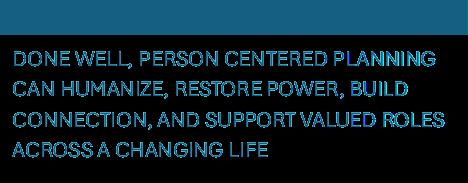
Participants also illuminated a paradox: Person centered planning can be both deeply empowering and deeply risky. The very features that make it powerful vision, positivity, big hopes, group attention can become sources of harm if ungrounded, systematized, or disconnected from follow-through. In SRV terms, person centered planning can either interrupt a life shaped by devaluation and learned helplessness or reinforce the same patterns under more attractive language.
This paper attempts to capture a sophisticated practitioner critique of personcentered planning, conducted by those familiar with both the practices of person-centered planning as well as concepts of Social Role Valorization. Done poorly, there is no doubt that the tools and techniques of person-centered planning can become mechanized compliance, technique without depth, or a hopeful performative process that ends as another rejection. With proper safeguarding, it has the capacity to expand people’s life experiences, crystalize a vision for a fuller life, and effectively move people towards that future.
In appreciation of all participants, Ashley Canaday, Ashlyn Ray, Christopher Liuzzo, David Bartlett, Eileen Gentile, Erin Kearney, Gina Graves, Hans Kroon, Jack Vermeulen, Jack Pealer, Jan Wolfswinkel, Janet Klees, Jennifer Myers, Karen Oosterhous, Katie Barmettler, Katie Arbaugh, Lisa Mathis, Lynn A Berthiaume, Maggie Jacobson, Megan Beedle, Rebecca Morrow, Remco Meijs, Sandy Randall, Tina Wiseman, Tom Doody, Viveka Chattopadhyay, Thomas Neuville, Pamela Seetoo, Gabriela Hagiu, Matt Nguyen, and Courtney Wagner. Particular appreciation to Victoria Hoshower, who co-led this session.