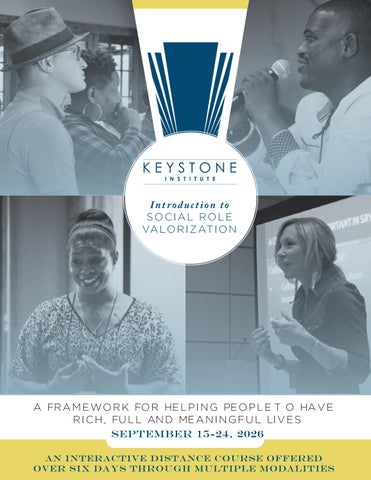
Int roduction to SOCIAL ROLE VA LO R I Z AT I O N
A FR A M E WO R K FO R HE L P I N G PE O P L E T O HA V E R I C H , FU L L AN D ME A N I N G F U L LI V E S September 15-24, 2026 An interactive distance course offered over six days through multiple modalities
Social Role Valorization
Resource Manual
The Keystone Institute 3700 Vartan Way Harrisburg, PA, 17110 717-909-9425 www.keystoneinstitute.com
09/2026
1
09/2026
2
An Introduction to Social Role Valorization Resource Manual Table of Contents I. PROGRAM ................................................................................................................................................. WELCOME LETTER ................................................................................................................................. PM1 SYLLABUS .............................................................................................................................................. PM3 PRE-WORKSHOP ASSIGNMENT ............................................................................................................. PM12 II. RESOURCE MATERIALS .................................................................................................................... ARTICLE: “HEY, JOE,” JOHN MCKNIGHT.............................................................................................. RM1 ARTICLE: “REFLECTION ON DIFFERENTNESS,” ANN O’CONNOR .......................................................... RM2 POEM: “YOU AND I,” ELAINE POPOVICH .............................................................................................. RM3 “A CREDO FOR SUPPORT,” NORMAN KUNC AND EMMA VAN DER KLIFT .............................................. RM4 ARTICLE: “AN OVERVIEW OF SOCIAL ROLE VALORIZATION THEORY,” JOE OSBURN .......................... RM7 SRV MEASURES THAT ARE PARTICULARLY RELEVANT TO CERTAIN WOUNDS ................................. RM17 OVERVIEW OF PASSING .................................................................................................................... RM18 DESCRIPTION OF A TYPICAL PASSING WORKSHOP ........................................................................... RM22 THE SRV JOURNAL: PUBLICATION AND ORDERING INFORMATION .................................................... RM28 LEARNING TO TEACH SRV .................................................................................................................. RM29 A SELECTED BIBLIOGRAPHY ON SRV ................................................................................................. RM31 ARTICLE: “IMPLEMENTING SOCIAL ROLE VALORIZATION ACROSS A LARGE HUMAN SERVICE ORGANIZATION: LESSONS & LEARNING,” DARCY ELKS AND ELIZABETH NEUVILLE ......................... RM39 ADVANCED ISSUES IN SRV BOOK FLYER............................................................................................ RM47 ISRVA MEMBERSHIP INFORMATION................................................................................................... RM49 III. SMALL GROUP WORK AND INDEPENDENT ASSIGNMENTS ................................................. REFLECTION ON WOUNDING .................................................................................................................. SG1 REFLECTION ON UNCONSCIOUSNESS ...................................................................................................... SG2 CONSERVATISM COROLLARY ................................................................................................................. SG3 REFLECTION ON MINDSETS AND EXPECTANCIES .................................................................................... SG7 IMAGERY ASSIGNMENT AND EXERCISE .................................................................................................. SG9 MODEL COHERENCY .............................................................................................................................. SG10 IMPLEMENTATION OF SOCIAL ROLE VALORIZATION AT DIFFERENT LEVELS OF SOCIAL ORGANIZATION ............................................................................................................................................................. SG12 REFLECTION ON MY NEXT STEPS/ACTION COMMITMENTS .................................................................. SG14
IV. PRESENTATION MATERIALS .......................................................................................................... MOST OF THE PRESENTATION SLIDES FROM THE PRESENTATION MODULES ..............................................67
V. SRV GRADUATE RESOURCES ........................................................................................................... SRV ACTION OPTIONS ........................................................................................................................... GR2 GRADUATE REFLECTION QUESTIONS ..................................................................................................... GR4 SUGGESTIONS FOR POTENTIAL FOLLOW-UP .......................................................................................... GR5 KEYSTONE INSTITUTE LIBRARY INFORMATION ...................................................................................... GR7 WEB RESOURCES FOR SOCIAL ROLE VALORIZATION ............................................................................ GR9
09/2026
3
09/2026
4
Acknowledgements: The materials in this manual, and those presented in the workshop, are offered with deep appreciation to the major developer, Dr. Wolf Wolfensberger, as well as those who have contributed to the teaching and development over the past decades. In particular, Darcy T. Elks, has worked with and taught these materials over many years, and we are appreciative of her leadership, mentoring, and partnership. Please respect the work and do not copy or disseminate further. All materials are taught with permission from the developers.
09/2026
5
09/2026
6
PROGRAM
Int roduction to SOCIAL ROLE VA LO R I Z AT I O N
“If we have no peace, it is because we have forgotten that w e b e l o n g t o e a c h o t h e r. ” – M o t h e r Te r e s a
Welcome to the Distance Introduction to Social Role Valorization Course! On behalf of the Keystone Institute, we would like to thank you for setting aside six days over two weeks for this important professional development event. We realize that time away from typical responsibilities is a major investment of your time and energy, and we are glad that both you and your agency have committed to learning about Social Role Valorization and how you can impact the lives of vulnerable people in powerful ways. The Keystone Institute is pleased to offer this workshop as a continued expression of our commitment to the principles of Social Role Valorization, and in support of services which are truly responsive to the needs of the people who are served. It is our hope that you will join many others over the years for whom this event has been a pivotal one – one which shapes our understanding and demands that we commit to listening more carefully and learning more deeply. We are so fortunate to have skilled presenters for this workshop, joined by numerous faculty members as group leaders, and those studying and learning the materials as well. Our workshop faculty members are also experienced in SRV theory and implementation, and have made significant commitments to learning and growing in this area. We are grateful for their time and experience. We are also glad that you have taken time to invest in this demanding and rigorous learning event, and we hope that you will leave this training with a passion to learn more. There is a broad range of opportunities for people wishing to pursue development in Social Role Valorization. We are excited about working in partnership with you in your personal and professional development, as well as serving as a resource to you in making a difference in the lives of the people you support. Elizabeth Neuville and Pam Seetoo The Keystone Institute 3700 Vartan Way Harrisburg, PA 17110 717-909-9425 eneuville@khs.org paseetoo@khs.org
09/2026
PM1
09/2026
PM2
Introduction to Social Role Valorization Course Syllabus September 15-24, 2026 The Keystone Institute 3700 Vartan Way Harrisburg, PA 17110 717-909-9425
www.keystoneinstitute.com Elizabeth (Betsy) Neuville Pamela Seetoo Gabriela Hagiu Matthew Nguyen Courtney Wagner
09/2026
– eneuville@khs.org – paseetoo@khs.org – ghagiu@khs.org – mnguyen@khs.org – cowagner@khs.org
PM3
Course Description:
An Introduction to Social Role Valorization: A Framework for Assisting People to Have Full, Rich, and Meaningful Lives
Workshop Leaders:
Elizabeth (Betsy) Neuville Pamela Seetoo Gabriela Hagiu Matthew Nguyen Courtney Wagner
Course Overview and Objectives:
An Introduction to Social Role Valorization is an intensive workshop which presents the idea of assisting people with disabilities and other devalued conditions to have positive social roles as a productive and helpful response to wounding life experiences. Social Role Valorization is a comprehensive theory which provides insights as to why certain groups of people become devalued in society, what life experiences are likely to befall people once they have become devalued in the eyes of others, why valued social roles are a powerful response in combatting the negative life experiences, and ten essential themes which can guide implementers in pursuing valued social roles by, with, and for those practitioners desire to serve. An Introduction to Social Role Valorization is the foundational course for communicating the theory of Social Role Valorization. This introduction is a pre-requisite to participating in the practicum workshop: An Introduction to PASSING. This foundational material is essential to those wishing to serve others in meaningful ways, and who are impassioned to make a difference in the lives of others. Many participants experience the learning within this event as the most helpful, inspiring, and clarifying body of knowledge they have been exposed to in their professional development, and it assists in long-term understanding and focus on being of service to others in ways that matter. The workshop includes pre-recorded as well as live presentations, small and large group live reflection and discussion, online forums and resource materials. Participants should be prepared for significant presentations. The objectives of this course are to provide better understanding of the negative life experiences of people who have been devalued and the implications of those life experiences, as well as to provide a framework which can serve as a foundational guide for those who are committed to the work of making life better for devalued people.
09/2026
PM4
Learning Resources:
Each participant of this workshop will receive a print and pdf version of the main workshop text, An Introduction to Social Role Valorization Resource Manual for a Comprehensive SRV Workshop. This manual includes: • Program – o Welcome Letter o Course Syllabus o Faculty Bios o Preparatory Participant Assignment for the Introduction to Social Role Valorization Workshop • Resource Materials – Poems Articles A Selected Bibliography on Social Role Valorization SRV Journal Order Form ISRVA Membership Information • Small Groups/Assignments • Presentation Materials – Most of the Slides from the Presentation Modules • SRV Graduate Resources – SRV Action Options Graduate Reflection Questions Suggestions for Potential Follow-Up Keystone Institute Library Information Web Resources for Social Role Valorization The Keystone Institute YouTube Channel – • This channel will hold all of the pre-recorded video modules needed for course assignments. Links will be provided for each of the assignments for your convenience in Google Classroom. Google Classroom: • This course will utilize Google Classroom as the central hosting platform for all aspects of the course. This syllabus as well as the course schedule will be posted on Google Classroom for participant use, all assignments are outlined in detail, and all links for live sessions.
Participant Expectations:
This course is a collection of live plenary sessions, small group work, pre-recorded video sessions, and online forum posting. In order to receive credit for the Introduction to Social Role Valorization workshop, it is expected that all participants will attend every session and complete every assignment.
09/2026
PM5
As this is a professional workshop, participants are expected to conduct themselves professionally while in session, with the same standards that apply to face-to-face workshops. This means that participants are expected to dress appropriately for a professional setting, be seated at a table or desk and in view of their camera during the length of the live sessions. The equipment which is required for the course is a laptop or a tablet, to assure each person has full technological capability and visibility for the course work. In addition, a reasonably strong internet connection which will allow full participation will be needed. Participants are expected to be free from other work responsibilities during the live sessions, and to do the best they can to minimize interruption. Significant coursework will be assigned outside of the live plenary sessions. A detailed list of course assignments for both week one and week two is provided below the course schedule. Please read thoroughly in order to make sure that you are able to be present for every session as well as fulfill every assignment. Faculty of the workshop will be available and happy to assist as much as possible with any questions or concerns you might have about the course material as well as any concerns you may have about the technological aspects of the workshop. Participants who attend all live sessions and complete all assignments will receive a certificate verifying the completion of the course.
Course Schedule: Week 1 Day 1
Tuesday, September 15
Day 2
Wednesday, September 16
Day 3
Thursday, September 17
9:00 AM – 1:00 PM | Live Zoom Session + Independent Assignment ~ 2 hours 9:00 AM – 2:15 PM | Live Zoom Session + Independent Assignment ~1 hour 30 minutes 9:00 AM – 2:30 PM | Live Zoom Session Week 2
Day 4
Tuesday, September 22
Day 5
Wednesday, September 23
Day 6
Thursday, September 24
09/2026
9:00 AM – 12:30 PM | Live Zoom Session + Independent Assignment: ~45 minutes 9:00 AM – 2:30 PM | Live Zoom Session + Independent Assignment ~ 30 minutes 9:00 AM – 12:30 PM | Live Zoom Session
PM6
Online Format Course Assignments Week 1 Day 1 - Tuesday, September 15, 2026 9:00AM– 1:00 PM
Live Zoom This live plenary session welcomes learners and introduces Sessions participants to the workshop. Included is a history of the theory of Social Role Valorization, a presentation on what our culture values and the definition of societal devaluation. We will introduce the wounding life experiences of devalued people. Manual pages 67-83
Independent Assignment
Participants will watch a pre-recorded session prior to the plenary meeting on Day 2. This session addresses “The Most Common Wounds of Devalued People”, the response patterns that those wounds engender, and some concluding points. Manual Pages: 76–77, 82–103 *These are difficult issues and learners should be aware that time will be given to discuss and reflect on them in the following live meeting.
Day 2 - Wednesday September 16, 2026 9:00AM– 2:15PM
Live Zoom This session includes a live presentation, small and large group Sessions discussions, and reflective exercises. It begins with structured discussion and time for questions about the presentation on the wounding life experiences of devalued people. Participants will then break into small groups for reflection, sharing, and discussion. Before concluding the topic of devaluation, there will be a brief reflection on “The Universality of Oppression” and a facilitated exercise titled “My Favorite Devalued People.” Manual Pages: 104–106 After the lunch break, participants will rejoin for an approximately one-hour live presentation on Social Role Valorization as a response to devaluation Manual Pages: 107–121 This will be followed by a live presentation introducing the 10 core themes of SRV, along with the culturally valued analogue. Manual Pages: 122–126
Independent Assignment
09/2026
Participants will view a 1.5-hour pre-recorded presentation on the Theme of Unconsciousness. Manual pages 127-135
PM7
Day 3 - Thursday, September 17, 2026 9:00AM– 2:30PM
Live Zoom Participants will join Zoom for a welcome followed by a small group Sessions session on the Theme of Unconsciousness. The small group session will be followed by a live presentation on the theme of Conservatism Corollary. Manual pages 136-142 After a break for lunch participants will re-join Zoom for a small group session focusing on the Conservatism Corollary. Manual pages SG3-6 The day will end with live presentations on the themes of Interpersonal Identification and Mindsets & Expectancies. Manual pages 143-149
Week 2 Day 4 - Tuesday, September 22, 2026 9:00AM– 12:30PM
Live Zoom Participants will join a plenary session for a live presentation Sessions covering the Theme of Role Expectancy and Role Circularity, which will incorporate both small group and large group discussion. Manual pages 150-154 The Theme of Symbolism and Imagery Use will be presented live, followed by instructions for an independent assignment to be completed before joining the workshop again on February 4th. Manual Pages 160-162
Independent Assignment
09/2026
Individual Assignment- participants will break from the live session and research some examples of imagery use. Each participant will return to the live session on September 23rd with at least one example of imagery use relating to vulnerable people to share with their small group and analyze in a small group session.
PM8
Day 5 - Wednesday, September 23, 2026 9:00AM– 12:00PM
Live Zoom Participants join a small group session to share their imagery Sessions examples and work through an analysis using the channels through which imagery is conveyed. Following the small group session, each group will present an example of their work to the large group. Participants will rejoin the plenary session for a live presentation on the Theme of Model Coherency & Relevance & Potency. Manual pages 170-177. The presentation will be followed by a large group session aimed at practicing Model Coherency analysis.
Independent Assignment
1:30PM– 2:30PM
Participants will watch a pre-recorded presentation on the Personal Competency Enhancement and Developmental Model. Manual Pages 178-192.
Live Zoom Participants watch and discuss “Living the Dream” together in a live Sessions session. Live presentation of the theme of Imitation and Modeling.
Day 6 - Thursday, September 24, 2026 9:00AM– 12:30PM
Live Zoom Participants will attend a live presentation on the final theme of Sessions Personal Social Integration and Valued Societal Participation. Incorporated into this presentation will be a video example of excellent use of integration and discussion on its benefits to people with and without disabilities, to those facilitating integration and to society as a whole. Manual Pages 200-215. Participants will join their final small group session for reflection and discussion on implementing SRV and individual action commitments for moving forward. Participants return to the large group session for closing thoughts and workshop closing.
09/2026
PM9
Keystone Institute Faculty
Elizabeth Neuville, Execu�ve Director Elizabeth “Betsy” Neuville is a globally recognized leader in disability services with over 40 years of experience advancing the lives of people with disabili�es and their families. As Execu�ve Director of Keystone Ins�tute, she plays a pivotal role in promo�ng inclusive, values-based prac�ces worldwide. Betsy has led major de-ins�tu�onaliza�on efforts across mul�ple countries, developing innova�ve service models that support people to live meaningful lives in their communi�es. A senior leader within Keystone Human Services for nearly four decades, Betsy has served as an administrator, educator, evaluator, and advocate, with deep exper�se in designing supports for highly vulnerable individuals and building strong, mission-driven organiza�ons. She is an accredited senior trainer in Social Role Valoriza�on (SRV), having studied under Dr. Wolf Wolfensberger, and provides training and consulta�on interna�onally across North America, Europe, and Asia. Betsy has also advanced the integra�on of person-centered planning with SRV, contribu�ng to more effec�ve and humane service approaches. In addi�on to her teaching and leadership, she has mentored genera�ons of change agents and con�nues to influence the field through her wri�ng, training, and global consul�ng work. She co-founded the Interna�onal SRV Associa�on and serves as senior educator and consultant for Keystone Ins�tute India, providing training, mentorship and leadership development across India. Betsy currently divides her �me between Delhi, India and Pennsylvania, United States. Pamela Seetoo, Associate Director Pam has worked to assist people to live rich, full community lives for over 30 years. Over the course of her life’s work, she has assisted people to leave ins�tu�ons and establish themselves in their communi�es, supported children and families within foster care and host home programs, provided service leadership, and focused on values-based educa�on and facilita�on. Since 2005, Pam has worked to educate others about the effects of social devalua�on of vulnerable popula�ons. She facilitates many presenta�ons at a variety of Social Role Valoriza�on (SRV) and related workshops, leads small group learning and has been a team leader at PASSING events. She develops and organizes an extraordinary employee development program for the Keystone Ins�tute and serves as a mentor and role model to many others. She has a strong interest in preserving and safeguarding the personal histories of people with disability and has developed workshops around this topic. Pam has been accredited as an SRV teacher by the North American Social Role Valoriza�on Council. Pam is also a member of the North American SRV Council.
09/2026
PM10
Gabriela Hagiu, Learning and Development Associate Gabriela Hagiu joined the Keystone Institute in May 2025 as a Learning and Development Associate. Originally from Romania, she brings a global, cross‑cultural perspective to her work, shaped by lived experience, migration, and adaptability across social and professional contexts. Gabriela has more than twenty years of experience supporting people who experience marginalization and is deeply committed to advancing human dignity and social justice. Her work is grounded in the principles of Social Role Valorization (SRV), which she began studying in 2017 through foundational and advanced training, including extensive experience with the PASSING assessment tool as both a practitioner and evaluator. Prior to joining the Keystone Institute, Gabriela served as a Grant Coordinator with Millersville University’s Inclusive Higher Education Consortium, where she helped advance fully inclusive postsecondary opportunities for students with intellectual disabilities. Courtney Wagner, Education Specialist Courtney Wagner joined the Keystone Institute in 2023, bringing over twelve years of experience working with people with intellectual disabilities. She was first introduced to the work of Dr. Wolfensberger and Social Role Valorization in college when she was studying to earn a degree in special education. After ten years of teaching and advocating for children with disabilities, Courtney switched her focus to inclusive post-secondary education, where her understanding of SRV and implementation of its practices flourished. She is skilled and practiced in the facilitation of PersonCentered Planning processes, including PATH and MAPS, and finds them to be powerful sources of fostering capacity and creating change in people’s lives. She is committed to pursuing the challenge of overcoming devaluation among people with disabilities and believes supporting people in identifying and achieving valued roles to live rich meaningful lives not only fulfills the life of the individual but also everyone that has the privilege of being part of that person’s journey. Matthew Nguyen, Education Specialist Matt joined the Keystone Institute in 2016, and brings over 17 years of experience supporting people with intellectual disabilities to live everyday lives, developing services for individual people, and successfully managing individualized programs and services. He began studying and using Social Role Valorization during his early years working at Keystone, and has worked to implement the ideas in the lives of people he has supported. Matt is committed to leading by example, and has used his roles in organizational leadership to influence others to also learn about and apply the ideas of SRV. Matt presents at Social Role Valorization workshops, leads small groups at workshops, and has team led at several PASSING workshops. Matt has also assisted with the implementation of the ideas of SRV through consultation and providing mentorship with teams and individual servers. He believes that engaging in personal human services to others enriches both service workers, leaders, and vulnerable people who they serve.
09/2026
PM11
Preparatory Participant Assignment for Introductory Social Role Valorization Workshop The principles and ideas you will be learning about will be much more impactful when you can see how they have affected the life of a person you are connected to in your own life. Additionally, learning about Social Role Valorization is most enriching and meaningful when you come to the workshop prepared. This includes spending some time with a person who is vulnerable or devalued, perhaps a person you have met through your work who experiences a disability or impairment. In preparation for the Social Role Valorization workshop, please: Familiarize yourself with the information pertaining to the life story of someone you know who lives with a devalued identity or condition. This will be your "focus person" for the material. The more fully you prepare this assignment, the more you will be able to personalize the material and draw guidance from it. Try to find out the following information about the person: 1. What relationships with family and friends does this person have, and what are the attributes of these relationships? 2. What type of residence does the person live in? 3. What type of day program, school, or work does the person have? 4. What is a typical day in the life of this person? 5. What does the person want in terms of their lifestyle and future? 6. What do others see in the future for this person? 7. What are the person's strengths and gifts? 8. Are there other relevant details? Please remember that all of this is confidential and for your learning only. It would be a good idea to ask the person you are writing about for their permission to use the information. Please invest time into preparing this information, as the more you invest in it, the richer your learning experience will be. Thank you
09/2026
PM12
RESOURCE M AT E R I A L S
Int roduction to SOCIAL ROLE VA LO R I Z AT I O N
“Community is much more than b e l o n g i n g t o s o m e t h i n g ; i t ’s about doing something together t h a t m a k e s b e l o n g i n g m a t t e r. ” –Brian Solis
This little house is also the neighborhood community center. Somebody is always there. People come and talk and drink coffee in the dining room. Sometimes they show movies.
'Hey Joe' – by John McKnight I met a remarkable woman in a little town in Southern Georgia. She worked for a service agency responsible for mentally retarded people in a three-county area. Her agency decided it was too focused on deficiencies and needed to think about the gifts, contributions, and capacities of the people who were its charges.
Whenever anybody was there, Joe would go in. Everybody came to know Joe, and he became a part of that neighborhood. When Christmas came, the volunteers gave Joe a radio of his own to listen to at home in the evening because Joe had been with them and had shared his gifts in the face of their hospitality.
So this woman began spending time with the people the agency had once called “clients” to see if she could understand -in their homeswhat gifts they had to offer. She went to the home of a forty-two-year-old man who had been the victim of special education -segregated education. His name is Joe. He has one short leg (at least he limps), and he doesn’t speak the way a lot of people speak. (I’m not sure what label deficiency-finding psychologists would give him. But I’m sure they would give him one.)
Joe began to go downtown at noon to eat at the diner. One day he went into the diner and the owner of the diner said, “Hey, Joe, what’s happening?” Joe looked at him and said, “The Smith house over in Boonesville burned down this morning. And out on Route 90, at that turnoff where you can have picnic, there was a drug bust. And Mr. Schiller over in Athens had a heart attack.” Everybody in the diner stopped talking and looked around at Joe. They couldn’t believe it. They realized that Joe knew the answer to the question “What’s happening?” because he listened to the radio all morning.
At age twenty-one, Joe had no place in society. So he went home to a pig farm. Every day he did two things. He fed the pigs twice a day, and he sat in the living room where he listened to the radio. (He couldn’t see to watch television.)
When I went to visit this town and the woman who introduced Joe’s gift of listening to the radio to the community, I saw an incredible thing. I saw, first of all that the dispatcher and Joe were in love with each other. Then when I went with Joe to lunch, I saw that everybody who came into the diner came over to Joe first and asked, “Joe, what’s happening?” And I realized that I was in the only town of the United States that now has the gift of a town crier. The woman told me she was planning to take Joe over to the newspaper editor. It had occurred to her that in this little town with a little newspaper and one editor, the editor couldn’t possibly know “what’s happening.” But by noon Joe knew. And if Joe would go over and talk to the editor every noon, the grasp, the breadth, the knowledge, of the newspaper and what it could report would expand mightily. So Joe is now a stringer for the local Gazette. He showers his gifts on the community because somebody knew that community is about capacities, contributions, and hospitalities -not about deficiencies, needs, and services.
The woman told me that after four days at Joe’s house she couldn’t find his gift. “But on the fifth day,” she said, “I realized what his gift was: he listens to the radio.” “I found out that three people in town spend all their time listening to the radio, and they get paid for it. One is in the sheriff’s office, one in the police department, and one in the local civildefense office. So I looked at each of these places where a person sits, listening to a radio all day. I liked the civil-defense office best. It’s a voluntary organization. They have a house that somebody gave them; so the voluntary ambulance people sleep in its bedrooms. There’s a desk and sitting right by the desk is a radio getting all the calls from the county. At the desk sits a twenty-seven-year-old woman who listens for calls and dispatches volunteers when someone needs an ambulance.” So she told the dispatcher, “I have somebody here who likes to listen to the radio as much as you do. I’d like to introduce you to him.” And so she introduced Joe to her, and they put a chair on the other side of the desk, and he sat there every day listening to the radio.
09/2026
RM1
, EHOLHYH WKDW ZH PXVW QRW KDWH EHLQJ GLIIHUHQW QRW GHQ\ LW , EHOLHYH WKDW GLIIHUHQFH LV RXU YRFDWLRQ 2XU GLIIHUHQFH LV D JLIW WR XV WR WKRVH DURXQG XV DQG WR VRFLHW\ %\ YRFDWLRQ , PHDQ WKDW HDFK RI XV LV FDOOHG WR EH WKH XQLTXH SHUVRQ *RG LQWHQGV XV WR EH DQG WKXV WR DFFRPSOLVK VRPHWKLQJ WKDW RQO\ ZH DV WKDW XQLTXH SHUVRQ FDQ GR %\ YRFDWLRQ , GR QRW PHDQ MREV RU FDUHHUV RU DFFRPSOLVKPHQWV VXFK DV ILQDQFLDO VXFFHVV RU IDPH RU JORU\ , DP VSHDNLQJ RQ WKH GHHSHU PRUH LPSRUWDQW OHYHO RI OLYLQJ WKH WUXWK DQG VHUYLQJ RWKHUV ZLWK WKDW WUXWK 7KRVH RI XV ZKR DUH DIIOLFWHG FDQ GLVFRYHU D JUHDW WUXWK 7KH PRUH GHHSO\ ZRXQGHG ZH DUH WKH HDVLHU LW LV WR VHH ,W LV WKH WUXWK RI WKH JUHDW GLJQLW\ RI KXPDQ EHLQJV DQG WKH HWHUQDO GHVWLQ\ WR ZKLFK ZH DUH DOO FDOOHG 2XU YRFDWLRQ LV WR OLYH WKH WUXWK WKDW WKLV LV QRW DOO WKHUH LV LQ OLIH ZKDW FDQ EH VHHQ RU WRXFKHG RU KHDUG ± WKDW XQGHU WKH VXUIDFH LV ZKHUH WKH WUHDVXUH LV EXULHG D SHDUO RI JUHDW SULFH 2XU YRFDWLRQ LV WR EH D VLJQ WR WKH ZRUOG RI VDFUHGQHVV RI HDFK KXPDQ OLIH IURP WKH PRPHQW RI FRQFHSWLRQ XQWLO QDWXUDO GHDWK
5HIOHFWLRQV RQ 'LIIHUHQWQHVV «3OHDVH IRUJLYH PH LI , GRQ¶W XVH WKH SURSHU ZRUG LQ YRJXH WKHVH GD\V IRU XV IRONV ZKR DUH FRQVLJQHG WR WKH FDWHJRULHV RI SK\VLFDOO\ KDQGLFDSSHG RU GHYHORSPHQWDOO\ GLVDEOHG RU PHQWDOO\ LPSDLUHG ,W ZRXOG ZHDU D SHUVRQ RXW WU\LQJ WR NHHS XS WR GDWH RQ WKH FXUUHQW DFFHSWDEOH ODQJXDJH ,Q DQ\ FDVH WKHUH¶V D ORW RI WDON WKHVH GD\V ± DQG IURP KDQGLFDSSHG SHRSOH DV ZHOO ± WKDW SHRSOH OLNH XV GR QRW ZDQW WR EH FRQVLGHUHG DV GLIIHUHQW RU DW OHDVW WKDW RXU GLIIHUHQFHV VKRXOG EH LJQRUHG EHFDXVH LW LV EHLQJ VDLG ZH DUH QR GLIIHUHQW WKDQ DQ\RQH HOVH 3HUKDSV WKLV LV RQH ZD\ RI LQVLVWLQJ WKDW RXU KXPDQ GLJQLW\ DQG YDOXH EH DFNQRZOHGJHG DQG DFFHSWHG 2U SHUKDSV WKLV LV DQ H[SUHVVLRQ RI KRZ RXU FXOWXUH OHYHOV HYHU\WKLQJ RXW WR D FHUWDLQ IODWQHVV RU VDPHQHVV %XW QHYHUWKHOHVV WKH UHDOLW\ RI RXU VLWXDWLRQ LV DQG WKHUH LV QR GHQ\LQJ LW WKDW ZH DUH GLIIHUHQW :H DUH GLIIHUHQW WKDQ WKRVH QRW VR DIIOLFWHG ZKLFK LV PRVW SHRSOH :H DUH E\ RXU DIIOLFWLRQ VHW DSDUW <HV ZH DUH GLIIHUHQW LQ VXSHUILFLDO ZD\V VXFK DV SK\VLFDO DSSHDUDQFHV PHQWDO FDSDELOLWLHV LQ WKH ZD\ ZH WDON RU GRQ¶W WDON %XW ZH DUH DOVR GLIIHUHQW LQ WKH ZD\ ZH SHUFHLYH WKH ZRUOG DQG UHDOLW\ DQG RXU SODFH LQ LW 2XU YHU\ SUHVHQFH UHPLQGV SHRSOH RI WKHLU RZQ YXOQHUDELOLW\ DQG PRUWDOLW\ DQG WKDW WKHLU LGROV RI \RXWK DQG EHDXW\ DQG SK\VLFDO ILWQHVV DUH SDVVLQJ DZD\ 6R EHFDXVH RI RXU GLIIHUHQFH DQG WKH KDUG WUXWK ZKLFK RXU SUHVHQFH VSHDNV ± DQG ZKLFK SHRSOH GRQ¶W ZDQW WR KHDU RWKHUV DYRLG XV DQG VRFLHW\ ZDQWV WR NHHS XV RXW RI VLJKW :H¶UH WROG ZH¶UH QRW SURGXFWLYH DQG 7KHUHIRUH QRW YDOXDEOH :H DUH PDGH SRRU DQG WKHQ WROG ZH DUH D ILQDQFLDO OLDELOLW\ WR VRFLHW\ 2XU GLIIHUHQFHV WKHQ EHFRPH WR RWKHUV RXU ZKROH LGHQWLW\ :H DUH FDOOHG ³YLFWLPV ³ RI VRPH GLVHDVH RU RWKHU RU SDWLHQWV LQVWHDG RI SHUVRQV RU ZH EHFRPH D ³FDVH´ DQG D QXPEHU LQ VRPHRQH¶V FDVH OHDG 7KH SURFHVV RI GHSHUVRQDOL]DWLRQ GHHSHQV DV ZH DUH UHJDUGHG DV OHVV WKDQ KXPDQ DQG RWKHUV ORRN SDVW XV RU WKURXJK XV DV LI ZH DUH QRW WKHUH
:H VHUYH RWKHUV EHVW , EHOLHYH E\ FDOOLQJ WKHP WR WKH WUXWK DERXW WKHPVHOYHV DQG DERXW KXPDQ OLIH DQG *RG 6LPSO\ E\ EHLQJ ZH ZKR DUH DIIOLFWHG FDOO RWKHUV WR WKH WUXWK 7KLV LV WKH JUHDW JLIW RI ZRXQGHG SHRSOH ± WKH WUXWK WKH ZRUOG KXQJHUV IRU WKH JLIW WKDW RWKHUV QHHG LI WKH\ DUH QRW WR ORVH WKHLU VRXOV 6R LQVWHDG RI GHQ\LQJ RXU GLIIHUHQFH RU KDWLQJ LW ZH KDYH FRPH WR VHH RXU GLIIHUHQFH DV D YRFDWLRQ DQG D JLIW ZH KDYH EHHQ JLYHQ WR VKDUH«)RU PRVW RI XV ZH GLVFRYHU RXU JLIWV DQG YRFDWLRQ RQO\ WKURXJK WKRVH DURXQG XV ZKR ORYH XV DQG VHUYH XSRQ XV 6KDUH \RXU JLIWV RI KHDUW DQG VRXO VR WKDW VLPSO\ E\ EHLQJ DQG VWUXJJOLQJ DJDLQVW DOO RGGV \RX ZLOO VHUYH OLIH
Ann O’Connor is a hospitaller at Unity Kitchen, in Syracuse, NY. She was invited to act as emcee at Team B’s Awards Luncheon on June 28, 1989. These excerpts of her opening remarks are from “Person to Person”, the newsletter of an Onandaga County, NY citizen advocacy group
+RZHYHU DV DOO RI XV KHUH NQRZ RQFH SHRSOH DUH ZLOOLQJ WR JLYH XV WKHLU DWWHQWLRQ DQG ORRN LQWR RXU H\HV WKH\ FDQ JHW WR NQRZ ZKR ZH DUH DQG WKH\ QR ORQJHU H[SHULHQFH RXU GLIIHUHQFH DV D SUREOHP RU EDUULHU RU D WKUHDW :KDW ZRXQGHG SHRSOH UHTXLUH LV DV :LOOLDP 6WULQJIHOORZ VD\V WKDW ZH EH FDOOHG E\ QDPH DQG WDNHQ VHULRXVO\
09/2026
RM2
7KH IROORZLQJ SLHFH LV D FOHDU GHSLFWLRQ RI WKH GLIIHUHQFH RXU VRFLHW\ VHHV EHWZHHQ SHRSOH ZLWK GLVDELOLWLHV DQG WKRVH ZLWKRXW <28 $1' , E\ (ODLQH 3RSRYLFK , DP D UHVLGHQW You reside. , DP DGPLWWHG You move in. , DP DJJUHVVLYH You are assertive. , KDYH EHKDYLRU SUREOHPV You are rude. , DP QRQ FRPSOLDQW You don't like being told what to do :KHQ , DVN \RX RXW IRU GLQQHU LW LV DQ RXWLQJ When you ask someone out, it is a date. , PDGH PLVWDNHV GXULQJ P\ FKHFN ZULWLQJ SURJUDP VRPHGD\ , PLJKW JHW D EDQN DFFRXQW You forgot to record some withdrawals from your account and the bank called to remind you. , ZDQWHG WR WDON WR WKH QLFH ORRNLQJ VWUDQJHU , VDZ DW WKH JURFHU\ VWRUH , ZDV WROG LW LV LQDSSURSULDWH WR WDON WR VWUDQJHUV You met your spouse in the produce department when neither of you could find the bean sprouts. , FHOHEUDWHG P\ ELUWKGD\ \HVWHUGD\ ZLWK ILYH RWKHU UHVLGHQWV DQG WZR VWDII PHPEHUV , KRSH P\ IDPLO\ VHQGV D FDUG Your family threw you a surprise party. Your brother couldn't make from out of state. It sounded wonderful. 0\ FDVH PDQDJHU VHQGV D UHSRUW HYHU\ PRQWK WR P\ JXDUGLDQ ,W VD\V HYHU\WKLQJ , GLG ZURQJ DQG VRPH WKLQJV , GLG ULJKW. You are still mad at your sister for calling your mom after you got that speeding ticket. , DP RQ D VSHFLDO GLHW EHFDXVH , DP ILYH SRXQGV RYHU P\ LGHDO ERG\ ZHLJKW Your doctor gave up telling you. , DP OHDUQLQJ KRXVHKROG VNLOOV. You hate housework. , DP OHDUQLQJ OHLVXUH VNLOOV Your t-shirt says you are a "couch potato". $IWHU , GR P\ EXGJHW SURJUDP WRQLJKW , PLJKW JHW WR JR WR 0F'RQDOGV LI , KDYH HQRXJK PRQH\ You were glad that new French restaurant took your charge card... 0\ FDVH PDQDJHU SV\FKRORJLVW 5 1 RFFXSDWLRQDO DQG SK\VLFDO WKHUDSLVWV QXWULWLRQLVW DQG KRXVH VWDII VHW JRDOV IRU PH IRU WKH QH[W \HDU You haven't decided what you want out of life. 6RPHGD\ , ZLOO EH GLVFKDUJHG PD\EH You will move onward and upward.
09/2026
RM3
Throughout history, people with physical and mental disabilities have been abandoned at birth, banished from society, used as court jesters, drowned and burned during The Inquisition, gassed in Nazi Germany, and still continue to be segregated, institutionalized, tortured in the name of behaviour management, abused, raped, euthanized, and murdered. Now, for the first time, people with disabilities are taking their rightful place as fully contributing citizens. The danger is that we will respond with remediation and benevolence rather than equity and respect. And so, we offer you
A Credo for Support Do Not see my disability as the problem. Recognize that my disability is an attribute. Do Not see my disability as a deficit. It is you who see me as deviant and helpless. Do Not try to fix me because I am not broken. Support me. I can make my contribution to the community in my own way. Do Not see me as your client. I am your fellow citizen. See me as your neighbour. Remember, none of us can be self-sufficient. Do Not try to modify my behaviour. Be still & listen. What you define as inappropriate may be my attempt to communicate with you in the only way I can.
Do Not try to change me, you have no right. Help me learn what I want to know. Do Not hide your uncertainty behind “professional” distance. Be a person who listens and does not take my struggle away from me by trying to make it all better.
09/2026
RM4
Do Not use theorems and strategies on me. Be with me. And when we struggle with each other, let that give rise to self-reflection. Do Not try to control me. I have a right to my power as a person. What you call non-compliance or manipulation may actually be the only way I can exert some control over my life. Do Not teach me to be obedient, submissive, and polite. I need to feel entitled to say “no” if I am to protect myself. Do Not be charitable towards me. The last thing the world needs is another Jerry Lewis. Be my ally against those who exploit me for their own gratification. Do Not try to be my friend. I deserve more than that. Get to know me. We may become friends. Do Not help me, even if it does make you feel good. Ask me if I need your help. Let me show you how you can best assist me. Do not admire me. A desire to live a full life does not warrant adoration. Respect me, for respect presumes equity. Do Not tell, correct, and lead. Listen, Support and Follow. Do Not work on me. Work with me.
Dedicated to the memory of Tracy Latimer Written and Produced by Norman Kunc and Emma Van der Klift Copyright 1995 Copies of the videotape/DVD available through Axis Consultation and Training (250)754-9939
09/2026
RM5
09/2026
RM6
An Overview of Social Role Valorization Theory Joe Osburn
EDITOR’S NOTE: The following is an updated version of an article originally published in The International SRV Journal in 1998 (Osburn, J. (1998). An Overview of Social Role Valorization Theory. SRV/VRS: The International Social Role Valorization Journal/La revue internationale de la Valorisation des roles sociaux, 3(1), 7-12). I asked the author to revise his original article to incorporate significant developments in SRV made by Wolfensberger since 1998. We are particularly pleased to offer this revised article in our first issue, as a clear overview of what this Journal is all about.
“SOCIAL ROLE VALORIZATION” (SRV) is the name given to a concept for transacting human relationships and human service, formulated in 1983 by Wolf Wolfensberger, Ph.D., as the successor to his earlier formulation of the principle of normalization (Lemay, 1995; Wolfensberger, 1972; Wolfensberger, 1983). His most recent definition of Social Role Valorization is: “The application of empirical knowledge to the shaping of the current or potential social roles of a party (i.e., person, group, or class) -- primarily by means of enhancement of the party’s competencies & image -- so that these are, as much as possible, positively valued in the eyes of the perceivers” (Wolfensberger & Thomas, 2005). THE BASIC PREMISE of SRV is that people are much more likely to experience the “good
09/2026
things in life” (Wolfensberger, Thomas, & Caruso, 1996) if they hold valued social roles than if they do not. Therefore, the major goal of SRV is to create or support socially valued roles for people in their society, because if a person holds valued social roles, that person is highly likely to receive from society those good things in life that are available to that society, and that can be conveyed by it, or at least the opportunities for obtaining these. In other words, all sorts of good things that other people are able to convey are almost automatically apt to be accorded to a person who holds societally valued roles, at least within the resources and norms of his/her society. There exists a high degree of consensus about what the good things in life are (Wolfensberger, et al., 1996). To mention only a few major examples, they include being accorded dignity, respect, acceptance; a sense of belonging; an education, and the development and exercise of one’s capacities; a voice in the affairs of one’s community and society; opportunities to participate; a decent material standard of living; an at least normative place to live; and opportunities for work and selfsupport. SRV is especially relevant to two classes of people in society: those who are already societally devalued, and those who are at heightened risk of becoming devalued. In fact, SRV is primarily a response to the historically universal phenomenon of social devaluation, and especially societal devaluation. In any society,
RM7
June 2006
there are groups and classes who are at value risk or already devalued in and by their society or some of its subsystems. (For instance, in North America, it has been estimated that from one-fourth to one-third of the population exists in a devalued state because of impairment, age, poverty or other characteristics that are devalued in society.) Devalued individuals, groups, and classes are far more likely than other members of society to be treated badly, and to be subjected to a systematic -- and possibly lifelong -- pattern of such negative experiences as the following. 1. Being perceived and interpreted as “deviant,” due to their negatively-valued differentness. The latter could consist of physical or functional impairments, low competence, a particular ethnic identity, certain behaviors or associations, skin color, and many others. 2. Being rejected by community, society, and even family and services. 3. Being cast into negative social roles, some of which can be severely negative, such as “subhuman,” “menace,” and “burden on society.” 4. Being put and kept at a social or physical distance, the latter most commonly by segregation. 5. Having negative images (including language) attached to them. 6. Being the object of abuse, violence, and brutalization, and even being made dead. THE REALITY that not all people are positively valued in their society makes SRV so important (Kendrick, 1994). It can help not only to prevent bad things from happening to socially vulnerable or devalued people, but can also increase the likelihood that they will experience the good things in life. Unfortunately, the good things in life are usually not accorded
09/2026
5
to people who are devalued in society. For them, many or most good things are beyond reach, denied, withheld, or at least harder to attain. Instead, what might be called “the bad things in life” are imposed upon them, such as the six experiences listed above. This is why having at least some valued social roles is so important. A person who fills valued social roles is likely to be treated much better than if he or she did not have these, or than other people who have the same devalued characteristics, but do not have equally valued social roles. There are several important reasons why this is so. One is that such a person is more likely to also have valued and competent allies or defenders who can mitigate the impacts of devaluation or protect the person from these. Also, when a person holds valued social roles, attributes of theirs that might otherwise be viewed negatively are much more apt to be put up with, or overlooked, or “dismissed” as relatively unimportant. IT IS ROLE-VALORIZING to enhance the perceived value of the social roles of a person, a group, or an entire class of people, and doing so is thus called social role valorization. There are two major broad strategies for pursuing this goal for (devalued) people: (1) enhancement of people’s social image in the eyes of others, and (2) enhancement of their competencies, in the widest sense of the term. Image and competency form a feedback loop that can be negative or positive. That is, a person who is competency-impaired is highly at risk of suffering image-impairment; a person who is impaired in image is apt to be responded to by others in ways that delimit or reduce or even prevent the person’s competency. But both processes work equally in the reverse direction. That is, a person whose social image is positive is apt to
RM8
6
The SRV JOURNAL
be provided with experiences, expectancies, and other life conditions which are likely to increase, or give scope to, his/her competencies; and a person who displays competencies is also apt to be imaged positively. Role-valorizing actions in the image-enhancement or competency-enhancement domains can be carried out on four distinct levels and sectors of social organization. 1. The individual; 2. The individual’s primary social systems, such as the family;
3. The intermediate level social systems of an individual or group, such as the neighborhood, community, and services the person receives; 4. The larger society of the individual or group, including the entire service system. Combining these different dimensions and levels yields a 2x4 matrix for classifying the major implications of SRV, as shown in Table 1 (adapted from Thomas, 1999).
Table 1: Social Role Valorization Action Implications Primarily to Enhance Social Images Individual Person
Arranging Physical & Social Conditions for a Specific Individual That are Likely to Enhance Positive Perceptions of That Individual by Others
Arranging Physical & Social Conditions for a Specific Person That are Likely to Enhance the Competencies of That Individual
Primary Social Systems
Arranging Physical & Social Conditions in a Primary Social System That are Likely to Enhance Positive Perceptions of a Person in & via This System
Arranging Physical & Social Conditions of a Person’s Social System That are Likely to Enhance That Person’s Competencies
Level of Action
09/2026
Primarily to Enhance Personal Competencies
Intermediate & Arranging Physical & Social Secondary Social Conditions in Secondary Social Systems Systems That are Likely to Enhance Positive Perceptions -in & via Those Systems -- of People in Them, & of Others like Them
Arranging Physical & Social Conditions in Secondary Social Systems That are Likely to Enhance the Competencies of People in Them
Entire Society of an Individual, Group, or Class of People
Arranging Physical & Social Conditions Throughout Society That are Likely to Enhance the Competencies of Classes of People
Arranging Physical & Social Conditions Throughout Society That are Likely to Enhance Positive Perceptions of Classes
RM9
June 2006
FOR THOSE who wish to improve the situation of devalued people, SRV constitutes a high-level and systematic framework to guide their actions. In other words, it provides a coherent overall conceptual foundation for addressing the plight of individuals, groups, or classes of devalued people. Within this overall framework, SRV points to comprehensive service principles, from which are derived major service strategies, from which, in turn, flow innumerable specific practical action measures. These principles, strategies, and action measures are relevant in both formal and informal service contexts, and are thoroughly spelledout in the SRV literature. In fact, SRV is one of the most fully articulated broad service schemas in existence. For example, within each of the eight boxes in Table 1, innumerable more specific role-valorizing actions can be imagined, and indeed, a great many have been explicitly identified (Thomas, 1999). Even in just the few words of the short definition of SRV (stated above), there is incorporated an enormous amount of explanatory power and implied actions which can give people much food for thought in their whole approach to serving others. If implemented, SRV can lead to a genuine address of the needs of the people served, and thus to a great increase in service quality and effectiveness. SRV IS A SOCIAL SCIENCE CONCEPT and is thus in the empirical realm. It rests on a solid foundation of well-established social science theory, research, and empiricism within fields such as sociology, psychology, and education and pedagogy, drawing upon multiple bodies of inquiry, such as role theory, learning theory, the function and power of social imagery, mind-sets and expectancies, group dynamics, the social and psychological processes involved
09/2026
7
in unconsciousness, the sociology of deviancy, and so forth. SRV weaves this body of knowledge into an overarching, systematic, and unified schema. SRV is not a value system or ideology, nor does it prescribe or dictate value decisions. Decisions about whether to implement SRV measures for any person or group, and to what extent, are ultimately determined by people’s higher-order (and not necessarily conscious) values which transcend SRV and come from other sources, such as their personal upbringing, family influences, political and economic ideas, worldviews, and explicit religions. What people do in their relationships and services, or in response to the needs of the people they serve, or for that matter in any other endeavors, depends greatly on their values, assumptions, and beliefs, including those they hold about SRV itself. However, SRV makes a big point of how positive personal and cultural values can be powerfully brought to bear if one wishes to pursue valued social roles for people. For example, in most western cultures, the Judeo-Christian value system and liberal democratic tradition are espoused and widely assented to, even if rarely actualized in full. SRV can recruit such deeply embedded cultural values and traditions on behalf of people who might otherwise be devalued and even dehumanized. Every society has values that can be thusly recruited to craft positive roles for people (Wolfensberger, 1972, 1998). As a social science schema, SRV is descriptive rather than prescriptive. That is, SRV can describe certain realities (e.g., social devaluation), and can say what are the likely outcomes of doing or not doing certain things in regard to those realities, in what has come to be called the “if this...then that” formulation of SRV (Wolfensberger, 1995a). For example, SRV
RM10
8
points out that if parents do things that help others to have a positive view of their child and that help the child acquire skills needed to participate positively in the community, then it is more likely that the child will be well-integrated into the community. If one does not emphasize the adult status of mentally retarded adults, and/or does not avoid things which reinforce their role stereotype as “eternal children” (such as referring to adults as children, engaging adults in children’s activities, and so on), then one is likely to perpetuate the common negative stereotype that mentally retarded adults really are overgrown children, with all the negative consequences that attend this stereotype. So, these are things that SRV can tell one. However, once people learn SRV, they themselves have to determine what they think about it, whether they believe in its power, whether they want to apply it in valorizing the roles of a person or class, and to what extent -- if at all -- they even want to valorize other people’s roles. For example, while SRV brings out the high importance of valued social roles, whether one decides to actually provide positive roles to people, or even believes that a specific person, group, or class deserves valued social roles, depends on one’s personal value system, which as noted, has to come from somewhere other than SRV. THE IDEAS BEHIND SRV first began to be generated by the work that was being conducted by Wolfensberger and his associates at the Training Institute for Human Service Planning, Leadership and Change Agentry, which he directs at Syracuse University. One major source of these ideas was an on-going effort on the part of Wolfensberger to continually explore, advance, and refine the principle of normalization -- an effort that began almost as
09/2026
The SRV JOURNAL
soon as normalization first appeared on the scene. For example, since normalization was first explicitly formulated in 1969, several books, numerous articles, chapters, and other publications (several hundred altogether) on the topic have been written and disseminated (see, for example, St-Denis & Flynn, 1999). And it was Wolfensberger, more than anyone else, whose writings successively clarified and helped to increase comprehension of the meaning and application of normalization. This process involved a concerted effort on his part to systematically incorporate into teaching and training materials the deepening understanding achieved in the course of: (a) thinking, writing, and teaching about normalization over the years; (b) its increasing incorporation into actual human service practice; and (c) numerous normalization-based service assessments, mostly using the PASS tool (Wolfensberger & Glenn, 1973, 1975, reprinted in 1978). There were also continuous attempts, again mostly on Wolfensberger’s part, to deal with frequent misconceptions and even “perversions” of the concept of normalization (see Wolfensberger, 1980), often due to the ease with which the term “normalization” itself could be (and was) misconstrued or misapplied. This stream of concentrated development resulted in an evolution in thinking which brought about the conceptual transition from normalization to Social Role Valorization. Not surprisingly, the main substance of the concept of SRV began to evolve before the concept itself was defined, and before a new term was coined to describe it. For instance, Wolfensberger’s last published formulation of the principle of normalization defined it as, “as much as possible, the use of culturally valued means in order to enable, establish and/or maintain valued social roles for people” (Wolfensberger
RM11
June 2006
& Tullman, 1982), thus foreshadowing both the new concept and the new term Social Role Valorization. This article was the first publication that articulated the insight that valued social roles for people at risk of social devaluation were -- even more than merely culturally normative conditions -- the real key to the good things of life for them. This represented such an advance that it was clearly a higher conceptualization than the earlier formulation of normalization. Thus, SRV definitely amounts to far more than a renaming or rewording of the normalization principle; rather, it constitutes a major conceptual breakthrough based on the double insight that (a) people with valued social roles will tend to be accorded desirable things, at least within the resources and norms of their society, and (b) the two major means to the creation, support, and defense of valued social roles are to enhance both a person’s image and competency. Another big boost to the conceptualization of Social Role Valorization was the work being done by Wolfensberger, and his Training Institute associate, Susan Thomas, over a three to four year period on a human service evaluation tool called PASSING (Wolfensberger & Thomas, 1983), which stands for “Program Analysis of Service Systems’ Implementation of Normalization Goals.” One could say that this first published edition of PASSING (i.e., the second edition) was ahead of its time in at least one sense: it spelled out the major action implications of the new concept of SRV in much more detail than in any other previous publication, and did so even before a term had been coined to name the new concept. PASSING thus incorporates mostly SRV concepts while still using the earlier normalization language. Happily, this anachronism is corrected in the anticipated third revised edition (Wolfensberger
09/2026
9
& Thomas, in press) which uses SRV terminology exclusively. The development of PASSING contributed much to the insight that actions to achieve the ultimate as well as intermediate goals and processes of SRV can all be classified as dealing with either image and/or competency enhancement. In order to help communicate new concepts, new terms are often needed. The selection of the term “Social Role Valorization” was quite deliberate (see, for example, Wolfensberger, 1983, 1984, 1985, and 1991a). Not only does it overcome many of the historical and other problems that had always plagued the term “normalization,” but it is based on two additional discoveries that are highly relevant to the essence of its meaning (Wolfensberger, 1985). 1. In modern French human service contexts, people had begun to use the word valorisation in order to signify the attachment of value to people. In Canadian French specifically, the term valorisation sociale had been used in teaching the normalization principle since ca. 1980 (Wolfensberger, 1991b). 2. In both French and English, the term valorization has its root in the Latin word valere, which means to value or accord worth. Relatedly, the word “valorization” has, or elicits, very strong positive connotations that clearly correspond to the concept it is meant to convey. In combination, the above discoveries suggested that in English “Social Role Valorization,” and in French La Valorisation des Roles Sociaux (Wolfensberger, 1991b), would be eminently suitable terms for the new concept, both having positive connotations, while being unfamiliar enough not to evoke wrong ideas. The French term brings out even better than the English the fact that people hold multiple roles, and that more than one can be valorized.
RM12
10
The SRV JOURNAL
Table 2: Sequence of Topics for a Leadership-Oriented Introductory Social Role Valorization (SRV) Workshop PART 1: INTRODUCTORY ORIENTATION a. How the Workshop Will be Conducted b. Introduction to the Workshop Topic, Including a Brief Preliminary Sketch of SRV c. Orientation to Some Concepts Crucial to the Workshop PART 2: SOCIAL EVALUATION, DEVALUATION & ITS IMPACT a. Basic Facts About Human Evaluation, & Social Devaluation Specifically b. The Devalued Classes in Contemporary Western Societies c. The Expressions of Social Devaluation: The Most Common Wounds of Devalued People d. The Common Effects on Devalued People of Being Systematically Wounded e. Conclusion to the Material on Wounds PART 3: A MORE DETAILED INTRODUCTION TO SRV a. The Rationale Behind SRV b. Some Facts About Social Role Theory That Are Easily Understood & Crucial to SRV c. A More Global Overview Sketch of Social Role Valorization (SRV) c1. Some Broad Facts About SRV c2. Making Distinctions Between Empirical Versus Nonempirical Propositions c3. Concluding Clarifications PART 4: TEN THEMES OF GREAT RELEVANCE TO UNDERSTANDING & APPLYING SRV a. Introduction to the Ten Themes b. The Dynamics of UNCONSCIOUSNESS, Particularly About Deviancy-Making, & the Unrecognized Aspects & Functions of Human Services c. The CONSERVATISM COROLLARY of SRV, i.e., the Importance of Employing the Most Valued Options, & Positive Compensation for Disadvantage d. The Importance of INTERPERSONAL IDENTIFICATION e. The Power of MIND-SETS & EXPECTANCIES f. The Realities of IMAGERY, Image Transfer, Generalization, & Enhancement g. The Concept of Service MODEL COHERENCY, With Its Requirements of RELEVANCE & POTENCY h. The Importance of PERSONAL COMPETENCY ENHANCEMENT & THE DEVELOPMENTAL MODEL i. The Pedagogic Power of IMITATION, Via Modeling & Interpersonal Identification j. The Relevance of ROLE EXPECTANCIES & ROLE CIRCULARITY to Deviancy-Making & Deviancy-Unmaking k. SOCIAL INTEGRATION & VALUED SOCIETAL PARTICIPATION of Devalued People in Valued Society l. Grouping & Association Issues That Derive From Combinations of Themes m. Conclusion to, & Relationship Among, All the Themes PART 5: IMPLEMENTATION, ELABORATIONS, CLARIFICATIONS & CONCLUSION a. Some Further Issues of SRV Implementation or Practice b. The Benefits of SRV c. Brief Review of the Limitations of, & Constraints on, SRV d. A Brief Note on the Limitations of This Workshop e. Ways to Learn More About SRV f. Conclusion & Adjournment
09/2026
RM13
June 2006
Finally, another advantage of the switch from normalization to SRV is that because Social Role Valorization is an uncommon term, people are more likely to listen to definitions and explanations of it rather than attaching their own preconceived notions to it, as they had tended to do with the word “normalization.” SRV IS BEING DISSEMINATED across the world. For example, in the English language, both the overarching SRV schema and its major elements have been described in an original introductory monograph (Wolfensberger, 1992), which was later revised into a 139-page edition (Wolfensberger, 1998) that now serves together with the PASSING manual (Wolfensberger & Thomas 1983; revision in press) as the main current SRV texts. Other prominent SRV-related texts in English are the published proceedings of the 1994 International SRV conference held in Ottawa (Flynn & Lemay, 1999), with many chapters that reflect recent perspectives on SRV, and two books published in England (Race, 1999, 2003). There is also a massive set of (unpublished) teaching materials used in SRV training by qualified trainers (Wolfensberger & Thomas, 2005). The multitude of SRV action implications to human services and human service workers are thoroughly spelled out in SRV and PASSING training workshops, both of which are intensive teaching events, conducted in a variety of formats, of anywhere from one to seven days in length. Table 2 provides a list of topics covered in the most recent version of introductory SRV training workshops. To date, most SRV and/or PASSING training events have been conducted in English, with several variations in terms of length (i.e., anywhere from half a day to five days duration),
09/2026
11
processes, and depth and quantity of content. There have also been a significant number of SRV/PASSING training events in French, conducted mainly by francophone trainers, again in different versions. In addition to English and French, such training has also been conducted in Spanish, Dutch, Welsh, Icelandic, Norwegian, and possibly other languages, typically with the aid of interpreters. Both the English SRV (Wolfensberger, 1991a) and PASSING (Wolfensberger & Thomas, 1983) texts have been translated into French (Wolfensberger, 1991b; Wolfensberger & Thomas, 1988), and the SRV monograph into Italian (Wolfensberger, 1991c) and Japanese (Wolfensberger, 1995b), and is in the process of being retranslated into German. Another obvious vehicle for dissemination (in English) of general SRV related information and news is The SRV Journal. On the internet, there are several websites devoted to SRV matters, including one called Social Role Valorization at <http://www.socialrolevalorization.com/>. There are also several groups in various countries that have formed around SRV; while these range from formal to informal and have slightly different purposes and processes, they tend to be composed of people well-versed in SRV development, dissemination, and/or application. Perhaps the two most prominent of these are the (North American) SRV Development, Training, and Safeguarding Council, comprised of members from both Canada and the United States of America, and the Australian SRV Group. The membership of both of these groups includes representatives of smaller more localized groups in various parts of their respective countries. Information on the most recent SRV-related developments, and/or SRV training events, can be requested from the above-mentioned Train-
RM14
12
ing Institute for Human Service Planning, Leadership and Change Agentry (800 South Wilbur Avenue, Suite 3B1 Syracuse, New York 13204, USA; 315/473-2978; fax: 315/473-2963).
The SRV JOURNAL Baltimore, MD: University Park Press, 71-115. Wolfensberger, W. (1983). Social Role Valorization: A proposed new term for the principle of Normalization. Mental Retardation, 21(6), 234-239.
References
Wolfensberger, W. (1984). A reconceptualization of Normalization as Social Role Valorization. Mental Retardation (Canada), 34(7), 22-26.
Flynn, R.J., & Lemay, R. (Eds.) (1999). A quarter-century of Normalization and Social Role Valorization: Evolution and impact. Ottawa: University of Ottawa Press.
Wolfensberger, W. (1985). Social Role Valorization: A new insight, and a new term, for Normalization. Australian Association for the Mentally Retarded Journal, 9(1), 4-11.
Kendrick, M. (1994). Some reasons why Social Role Valorization is important. SRV/VRS: The International Social Role Valorization Journal/La Revue Internationale de la Valorisation des Roles Sociaux, 1(1), 14-18.
Wolfensberger, W. (1991a). A brief introduction to Social Role Valorization as a high-order concept for structuring human services. Syracuse, NY: Training Institute for Human Service Planning, Leadership and Change Agentry (Syracuse University).
Lemay, R. (1995). Social Role Valorization and the principle of Normalization as guides for social contexts and human services for people at risk of societal devaluation. In Dell Orto, A. E. & Maraneli, R. P., Encyclopedia of disability and rehabilitation. New York: McMillan, 515-521. Race, D. (1999). Social Role Valorization & the English experience. London: Whiting & Birch Ltd. Race, D. (2003). Leadership and change in human services: Selected readings from Wolf Wolfensberger. New York & London: Routledge. St-Denis, C., & Flynn, R.J. (1999). A comprehensive bibliography on Normalization, Social Role Valorization, PASS, and PASSING, 1969 - 1999. In Flynn, R.J., & Lemay, R. (Eds.) (1999). A quarter-century of Normalization and Social Role Valorization: Evolution and impact. Ottawa: University of Ottawa Press, 507547. Thomas, S. (1999). Historical background and evolution of Normalization-related and Social Role Valorizationrelated training. In Flynn, R.J., & Lemay, R. (Eds.), A quarter-century of Normalization and Social Role Valorization: Evolution and impact. Ottawa: University of Ottawa Press, 353-374. Wolfensberger, W. (1972). The principle of Normalization in human services. Toronto: National Institute on Mental Retardation. Wolfensberger, W. (1980). The definition of Normalization: Update, problems, disagreements, and misunderstandings. In Flynn, R.J., & Nitsch, K.E. (Eds.), Normalization, social integration, and community services.
09/2026
Wolfensberger, W. (1991b). La valorisation des roles sociaux: Introduction a un concept reference pour l`organisation des services. (A. Dupont, V. Keller-Revaz, J. P. Nicoletti, & L. Vaney, Trans.) Geneve, Switzerland: Editions des Deux Continents. Wolfensberger, W. (1991c). La Valorizzazione del ruolo sociale: Una breve introduzione al concetto di valorizzazione del ruolo sociale inteso come concetto prioritario per la strutturazione dei servizi alle persone (M. Costantino & A. Domina, Trans.). Geneve, Switzerland: Editions des Deux Continents. Wolfensberger, W. (1992). A brief introduction to Social Role Valorization as a high-order concept for structuring human services. (2nd (rev.) ed.). Syracuse, NY: Training Institute for Human Service Planning, Leadership and Change Agentry (Syracuse University). Wolfensberger, W. (1995a). An “If this, then that” formulation of decisions related to Social Role Valorization as a better way of interpreting it to people. Mental Retardation, 33(3), 163-169. Wolfensberger, W.(1995b). A brief introduction to Social Role Valorization: A high order concept for addressing the plight of societally devalued people, and for structuring human services. (Japanese trans. by Y. Tomiyasu). Tokyo, Japan: K.K. Gakuensha. (Based on a revised and enlarged version of: Wolfensberger, W. (1992). A brief introduction to Social Role Valorization as a high-order concept for structuring human services. (2nd.(rev.) ed.). Syracuse, NY: Syracuse University Training Institute for Human Service Planning, Leadership, & Change Agentry.
RM15
June 2006
13
Wolfensberger, W. (1996). Reply to John O’Brien’s “Nobody outruns the trickster: A brief note on the meaning of the word ‘valorization.’” SRV/VRS: The International Social Role Valorization Journal/La revue internationale de la Valorisation des roles sociaux, 2(1), 16-20.
(Programme d’analyse des systemes de services application des buts de la valorisation des roles sociaux): Manuel des criteres et des mesures de la valorisation des roles sociaux. (2ieme ed.). (M. Roberge, trans.; J. Pelletier, Adap.) Toronto: l’Institut G. Allan Roeher & Les Communications Opell.
Wolfensberger, W. (1998). A brief introduction to Social Role Valorization: A high-order concept for addressing the plight of societally devalued people, and for structuring human services. (3rd ed.). Syracuse, NY: Training Institute for Human Service Planning, Leadership and Change Agentry (Syracuse University).
Wolfensberger, W., & Thomas, S. (2005). Introductory Social Role Valorization workshop training package. Syracuse, NY: Training Institute for Human Service Planning, Leadership and Change Agentry (Syracuse University).
Wolfensberger, W. (1999). Concluding reflections and a look ahead into the future for Normalization and Social Role Valorization. In R. J. Flynn & R. Lemay (Eds.), A quarter-century of Normalization and Social Role Valorization: Evolution and impact. University of Ottawa Press, 489-504. Wolfensberger, W., & Glenn, L. (1973). Program analysis of service systems (PASS): A method for the quantitative evaluation of human services. Handbook. Field Manual. (2nd ed.) Toronto: National Institute on Mental Retardation. Wolfensberger, W., & Glenn, L. (1975, reprinted 1978). Program Analysis of Service Systems (PASS): A method for the quantitative evaluation of human services: (3rd ed.). Handbook. Field Manual. Toronto: National Institute on Mental Retardation. Wolfensberger, W., & Thomas, S. (1983). PASSING (Program analysis of service systems’ implementation of Normalization goals): Normalization criteria and ratings manual (2nd ed.). Toronto: National Institute on Mental Retardation. Wolfensberger, W., & Thomas, S. (1988). PASSING
09/2026
Wolfensberger, W., & Thomas, S. (in press). PASSING: A tool for analyzing service quality according to Social Role Valorization criteria. Ratings manual. Syracuse, NY: Training Institute for Human Service Planning, Leadership and Change Agentry (Syracuse University). Wolfensberger, W., Thomas, S., & Caruso, G. (1996). Some of the universal “good things of life” which the implementation of Social Role Valorization can be expected to make more accessible to devalued people. SRV/VRS: The International Social Role Valorization Journal/La Revue Internationale de la Valorisation des Roles Sociaux, 2(2), 12-14. Wolfensberger, W., & Tullman, S. (1982). A brief overview of the principle of Normalization. Rehabilitation Psychology, 27(3), 131-145. Opell. JOE OSBURN is director of the Safeguards Initiative, Bardstown, KY, USA, and a member of the North American SRV Council. The citation for this article is: Osburn, J. (2006). An overview of Social Role Valorization theory. The SRV Journal, 1(1), 4-13.
RM16
659 0HDVXUHV WKDW DUH 3DUWLFXODUO\ 5HOHYDQW WR &HUWDLQ :RXQGV
:RXQG
5HOHYDQW 659 0HDVXUH
%RGLO\ ,PSDLUPHQW )XQFWLRQDO ,PSDLUPHQW 5HOHJDWLRQ WR /RZ 6WDWXV 5HMHFWLRQ 'HYLDQF\ 5ROH &DVWLQJ
(QKDQFHPHQW RI %RGLO\ &RPSHWHQFH %RGLO\ $SSHDUDQFH (QKDQFHPHQW RI )XQFWLRQDO &RPSHWHQFLHV 3RVLWLYH 0LQGVHWV DQG +LJK ([SHFWDQFLHV 2FFXSDQF\ RI 9DOXHG 5ROHV &RPSHWHQF\ DQG ,PDJH (QKDQFHPHQW 5HODWLRQVKLS &RQWLQXLW\ 3HUVRQDO 6RFLDO ,QWHJUDWLRQ 9DOXHG 6RFLHWDO 3DUWLFLSDWLRQ 3RVLWLYH 5ROH &DVWLQJ &RPSHWHQF\ (QKDQFHPHQW DQG ,PDJH (QKDQFHPHQW
'HYLDQF\ ,PDJLQJ
,PDJH (QKDQFHPHQW
%HLQJ 0XOWLSO\ -HRSDUGL]HG
,PDJH (QKDQFHPHQW 3RVLWLYH 5ROH &DVWLQJ
'LVWDQWLDWLRQ
3HUVRQDO 6RFLDO ,QWHJUDWLRQ 9DOXHG 6RFLDO 3DUWLFLSDWLRQ
$EVHQFH /RVV RI 1DWXUDO 5HODWLRQVKLSV
5HVWRUDWLRQ RI QDWXUDO UHODWLRQVKLSV HVWDEOLVKPHQW RI QHZ QDWXUDO UHODWLRQVKLSV YLD YDOXHG UROHV
'H $XWRQRPL]DWLRQ /RVV RI &RQWURO 3K\VLFDO 'LVFRQWLQXLW\
&RPSHWHQF\ (QKDQFHPHQW ,PDJH (QKDQFHPHQW 6WDELOLW\ RI 3ODFH
6RFLDO 5HODWLRQVKLS 'LVFRQWLQXLW\
5HODWLRQVKLS &RQWLQXLW\
'HLQGLYLGXDOL]DWLRQ
,QGLYLGXDOL]DWLRQ ,PDJH (QKDQFHPHQW
0DWHULDO 3RYHUW\ ,PSRYHULVKPHQW RI ([SHULHQFH
&RPSHWHQF\ (QKDQFHPHQW 3RVLWLYH 5ROH &DVWLQJ $SSOLFDWLRQ RI 'HYHORSPHQWDO 0RGHO &RPSHWHQF\ (QKDQFHPHQW 3RVLWLYH 0LQG 6HWV DQG +LJK ([SHFWDQFLHV 3HUVRQDO 6RFLDO ,QWHJUDWLRQ DQG 9DOXHG 6RFLHWDO 3DUWLFLSDWLRQ $SSOLFDWLRQ RI 'HYHORSPHQWDO 0RGHO &RPSHWHQF\ (QKDQFHPHQW 3RVLWLYH 0LQG 6HWV DQG +LJK ([SHFWDQFLHV
([FOXVLRQ IURP ³&XOWXV´ /LIH :DVWLQJ
09/2026
RM17
SYRACUSE UNIVERSITY TRAINING INSTITUTE FOR HUMAN SERVICE PLANNING, LEADERSHIP AND CHANGE AGENTRY 518 James Street Suite B3 Syracuse, NY 13204 315/473-2978 Revised Feb. 2007 (excerpt)
OVERVIEW OF “PASSING”: A TOOL FOR ANALYZING SERVICE QUALITY ACCORDING TO SOCIAL ROLE VALORIZATION CRITERIA Introduction PASSING is an instrument for evaluating the quality of any human service according to how well it implements Social Role Valorization theory. Social Role Valorization, or SRV, posits that people who fill positively valued social roles will be likely to obtain and receive the “good things in life”, while people who fill negatively valued social roles will find it much harder – sometimes impossible – to get the good things in life; in fact, they may be given onl y bad and harmful things. SRV further posits that the two major avenues towards positively valued social roles are image enhancement and competency enhancement; the more positive one’s image. And the more competent one is, the more one will have access to valued social roles, and therefore the good things of life. Obviously, SRV is of special relevance and applicability to people who currently hole devalued roles, or are at risk of being cast into such – in other words, to people who are devalued by their society. SRV draws on a wide and historically deep body of empiricism, in spelling out what contributes to being cast into devalued roles, or being able to obtain and hold valued social roles. However, SRV does not and cannot say whether any of this knowledge should be used in order to contribute to the role-valorization of any party. In other words, SRV deals only with what the realities of human perception, learning, social valuation, and behavior are; questions of whether anyone, or a particular party, should be valued or devalued, or should hold positively or negatively valued social roles, in what contexts, which specific roles, etc. – all these questions go beyond SRV because they are issues above the level of empiricism. PASSING is based on SRV, but PASSING gives only a brief explanation of SRV. Much more detailed and lengthy elaboration of SRV can be found in teaching events on it. Also, some aspects of SRV not covered in PASSING are found in a small book entitled A Brief Introduction to Social Role Valorization: A High Order Concept for Addressing the Plight of Societally Devalued People, and for Structuring Human Services. (Wolfensberger, 1998) PASSING first began to be developed in the summer of 1979, was first published in 1983, and the new revised edition with the new name was published in 2007. PASSING was once an acronym that stood for “Program Analysis of Service Systems’ Implementation of Normalization Goals.” However, Normalization was superseded by SRV, so in this new edition, PASSING is a name, not an acronym. PASSING is partially derived from the PASS (Wolfensberger and Glenn, 1973, 1975) method of service evaluation; PASS stands for Program Analysis of Service Systems. PASSING replaces all of those parts of PASS that deal with programmatic rather than administrative issues. The residual uses of PASS are described in a separate flyer that may be requested by the training institute. PASSING’s PURPOSES:
09/2026
RM18
PASSING was designed to try to meet the need for an evaluation method which would be able to do the following: Assess the quality of human services in relation to their adherence to Social Role Valorization(SRV) after Normalization and been re-conceptualized as SRV. SRV posits as the most important goal of services the establishment of valued social roles for people who are societally devalued or at value-risk.
$UHDV 3ULPDULO\ &RQFHUQHG ZLWK ,PDJH (QKDQF H PHQW
$UHDV 3ULPDULO\ &RQFHUQHG ZLWK &RPSHWHQF\ (QKDQFHPHQW
3+<6,&$/ 6(77,1* 2) 6(59,&( 5$7,1*6
3+<6,&$/ 6(77,1* 2) 6(59,&( 5$ 7 ,1*6
8 6(59,&( 6758&785(' *52 3,1*6 2 5(/$7, 16+,36 $021* 3(23/( 5$7,1*6
6(59,&( 6758&785(' *5283,1*6 5(/$7,216+,36 $021* 3(23/( * 5$7,1 6
6(59,&( 6758&785(' $&7,9,7,(6 27+(5 86( 2) 7,0( 5$7,1*6
6(59,&( 6758&785(' $&7,9,7,(6 27+(5 86(6 2) 7 ,0( 5$7,1*6
27+(5 6(59,&( /$1*8$*( 6<0%2/6 ,0$*(6 5$7,1*6
12 5$7,1*6 127 $33/,&$%/(
Each of the 42 ratings in PASSING is categorized as to whether it primarily affects recipients image or personal competencies; these are the two major goals of SRV. Ratings are further subdivided within these two major categories into one of four service domains: physical setting of service; service structured groupings and relationships; activities and other uses of time within a service; and miscellaneous. This makes eight potential categories into which a PASSING rating might fall. Thus, a rating that has to do with how an aspect of the physical setting affects recipients’ image would be located in the top left cell of the above chart. Each rating in PASSING consists of five sections: 1. A narrative explanation of the rating issue, called “General Statement of the Issue.” 2. A “Rating Requirements and Examples” chart, which has four columns: one contains a brief statement of the rating issue and focus; one gives one or more examples of the rating principle as actualized in normative society; a third gives one or more examples of the rating as actualized in hypothetical human service situations; and the last provides one or more examples of human service violations of the rating principles. 3. A “Differentiation from Other Ratings” section, which explains how the rating at hand differs from other ratings with which it is likely to be confused.
09/2026
RM19
4. A chart entitled “Suggested Guidelines for Collecting and Using Evidence” which lists typical sources of evidence for the rating, some key questions that must be answered in order to make a judgment on the rating, and some important and often overlooked considerations in regard to the rating. 5. Criteria for a continuum of five “levels” of service performance (explained below), called “Criteria and Examples for Rating Level Assignment.” Each rating in PASSING has five levels, i.e. statements about a continuum of service quality and service performance in the particular issue assessed by the rating. Each level represents the same degree of service quality across all ratings. That is, Level 1 stands for the same level of quality on all 42 ratings; Level 2 stands for the same level of quality on all ratings; etc. The rating levels are structured to form a balanced continuum, where the lowest level (Level 1, atrocious performance) represents the opposite of the highest level (Level 5, the “attainable ideal”), the intermediate levels (Levels 2 and 4) represent opposites of each other, and the middle level (Level 3) – the fulcrum of the balance – represents a service performance that is the balance of both strengths and shortcomings, so that the good and the harm done cancel each other out. The percentages of weight given to a particular rating are distributed the same way (within rounding error) across the five levels of each rating. Thus each Level 1 = -100% of the weight assigned to a rating, each Level 2 = -70%, each Level 3 = 0%, each Level 4 = +70%, and each Level 5 = +100% of the weight assigned to a rating. Level statements of positive performance in PASSING are phrased in terms of the likely impact that service practices will have in recipients’ image or competencies, because it cannot always be known with certainty that a particular outcome in terms of denigration or enhancement of recipients’ image or competencies was caused by any one particular service feature. For further information about PASSING or PASSING training materials or workshops, please contact the Training Coordinator at the Training Institute. References
Wolfensberger, W. (1972). The principle of normalization in human services. Toronto: National Institute on Mental Retardation. Wolfensberger, W. (1980). The definition of normalization: Update, problems, disagreements, and misunderstandings. In R. J. Flynn, & K. E. Nitsch (Eds.), Normalization, social integration, and community services (pp. 71-115). Wolfensberger, W. (1983a). Guidelines for evaluators during a PASS, PASSING or similar assessment of human service quality. Toronto, Canada: National Institute on Mental Retardation Wolfensberger, W. (1983b). Social Role Valorization: A proposed new term for the principle of normalization. Mental Retardation, 21(6), 234-239.. Wolfensberger, W. (1984). A reconceptualization of normalization as social role valorization. (Canadian) Mental Retardation, 34(2), 22-26. Wolfensberger, W. (1985). Social Role Valorization: A new insight, and a new term for normalization. Australian Association for the Mentally Retarded Journal 9(1), 4-11.
09/2026
RM20
Wolfensberger, W. (1998). A brief introduction to Social Role Valorization as a high order concept for structuring human services. (3rd edition) Syracuse, NY:Training Institutefor Human Service Planning, Leadership and Change Agentry (Syracuse University). Wolfensberger, W., & Glenn, L. (1975, reprinted 1978). Program Analysis of Service Systems (PASS); A method for the quantitative evaluation of human services (3rd ed.) Handbook and Field Manual. Toronto: National Institute for Mental Retardation. (earlier editions published in 1969 and 1973) Wolfensberger, W., & Thomas, S. (1980). PASSING (Program Analysis of Service Systems’ Implementation of Normalization Goals Wolfensberger, W., & Thomas, S. (2007). PASSING. A tool for analyzing service quality according to Social Role Valorization criteria. Ratings manual (3rd rev. ed.) Syracuse, NY: Training Institute for Human Service Planning, Leadership, & Change Agentry (Syracuse University)
09/2026
RM21
SYRACUSE UNIVERSITY TRAINING INSTITUTE FOR HUMAN SERVICE PLANNING, LEADERSHIP AND CHANGE AGENTRY 518 James Street Suite B3 Syracuse, NY 13204 315/473-2978 Revised February 2007
DESCRIPTION OF A TYPICAL PASSING WORKSHOP This narrative is intended to be complementary to another February, 2007 flyer called, “Overview of PASSING” that explains the PASSING tool itself, and Social Role Valorization (SRV) on which it is based. There are different ways of teaching PASSING. This is a description of a typical 4 ½ - 5 day introductory PASSING workshop that involves participants in field experiences with two practicum service sites, as explained below. For information on upcoming PASSING workshops (dates, places, etc.) contact the Training Coordinator at the address above. This workshop introduces trainees to the third (2007) edition of PASSING, which is a method for quantitatively and objectively assessing the Social Role Valorization-based quality of a human service. PASSING is especially applicable to services to impaired and/or other societally devalued persons, e.g., community residences, nursing homes, institutions, child development centers, special education programs, work-study programs, workshops, on-the-job training, psychiatric clinics, rehabilitation settings, welfare programs, etc. Settings such as these -- but of a relatively uncomplicated nature – are evaluated by participants as part of an introductory PASSING workshop. The usual primary goals of such a workshop are to: (a) train participants on the implications of SRV to all human services; (b) enable participants to begin to develop competency as evaluators of service quality; (c) learn how to evaluate services again SRV criteria; (d) begin to identify and train potential evaluators and leaders for later training and implementation of SAR$V and PASSING; and, in some cases, (e) provide a common orientation to service quality and evaluation to people from the same agency or locale. All participants at PASSING must first have participated in introductory training in SRV that usually takes three days, because an Introductory PASSING workshop is really advanced SRV training, and familiarity with SRV is taken for granted. Participants without SRV training would not understand the rationales behind some of the PASSING ratings, and would not apply PASSING properly. All participants should also have read the 1998 monograph by Wolfensberger that explains SRV, A Brief Introduction to Social Role Valorization: A High Order Concept for Addressing the Plight of Societally Devalued People, and for Structuring Human Services, available from the Training Institute. A PASSING workshop is conducted under the direction of a person highly experienced in and with PASSING, usually assisted by at least one other person of the same, or nearly the same, skill. These people are also called “floaters” because they will “float” over several teams as each team does its work. Either before the workshop begins, or soon thereafter, registrants are assigned to small teams in preparation for the visits to the services to be assessed, which are called “practicum sites.” Each team is under the direction of a team leader, who is a qualified individual who has had previous training or experience in PASSING. The team leaders are responsible for their teams’
09/2026
RM22
arrangements during the PASSING workshop, including the practicum site visits and the conciliation sessions, explained below. At least part of the morning of the first workshop day is taken up with plenary lectures reviewing PASSING’s structure, the guidelines for its application, how participants are to comport themselves during the site visits, and possibly examination of some of the more difficult rating issues in PASSING. At the conclusion of the lecture presentations, teams meet to prepare for their practicum assessments. Each team usually assesses two practicum sites. The first is usually a residential service, and the second is usually some type of non-residential day program: educational, habilitational, occupational, recreational, etc. Teams begin their practical assessments in the late morning or afternoon of the first day. In order to conduct a PASSING assessment, team members must have access to many and varied sources of information about the service, including documentary materials on it (usually provided in advance); interviews with representatives and recipients of services, and possibly others who may have relevant information; and observation of the program in operation. A typical schedule of a practicum assessment is as follows. If at all possible, even prior to the workshop, team members receive documentation on the two services they will assess so that they can do some advance reading. In the first team meeting, the team leader clarifies roles, responsibilities, and expectations for all team members, and the assessment schedule. Then, after (additional) reading of documentary materials on the service, the team makes a tour of the neighborhood surrounding the first practicum service typically by car, and occasionally on foot. Then, the team conducts a detailed interview of several hours with responsible service personnel, such as the director, program administrators, direct service workers, and sometimes one or more board members. The team then observes the program in operation, and if conditions permit, have a meal with the service recipients. At some point, the team is given a guided tour through the setting. The team may examine yet additional documentary material that it may have discovered, and speak with service recipients and servers. These activities continue through the evening of the first day. If necessary, the team may continue its assessment activities beginning early on the morning of the second day, such as further interviews and/or site visits, review of documentation about the service, observation of the program in operation, etc. After having collected as much information on the service as the limited time of a practicum permits (real evaluations take much longer), each team member spends 2-3 hours privately reviewing all the collected information and determining his/her individual judgment of the service’s performance on each of 42 service dimensions (“ratings”) assessed by PASSING. Each rating has five levels. Level 1 represents the poorest level of performance, and Level 5 represents the optimal level of service quality on an issue, with Levels 2, 3 and 4 representing intermediate levels between these. After each team member has completed the individual assignments of rating levels, the team begins a lengthy intra-team discussion (called “conciliation”) on the service. Conciliation starts with a lengthy “foundation discussion” on what the service is and does, and who the people are whom it serves: what they are like, what defines them, what they need. (PASSING teams are privileged in this regard, because so many services never spend as much time looking in a structured, prolonged, and theory-guided collected context at the existential identities of the people they serve, and their needs.) The team then determines the service’s performance on the 42 ratings, attempting to reach a consensus judgment on each rating. In light of the team’s total evidence, team members will sometimes have to change their minds about a level that they had previously considered to be correct during their private, individual, and preliminary level assignments. Because for practicum assessments,
09/2026
RM23
team levers are responsible for preparing written feedback to each assessed service, and because the tem leaders are already trained in PASSING, they carry the final responsibility for deciding which of the five levels to assign o a service on a rating. Each team leader may be assisted by one or more team members who have been designated to help record the team’s findings and recommendations. (For such recording, several forms exist which may be used to provide information to the assessed services about their performance on the evaluation.) After the team has discussed and analyzed all of its observations and other information in light of the 42 PASSING ratings, then it formulates the major strengths of the service as it perceives them, the major weaknesses, and the major overarching issues that affect a great many specific things that go on in the service, and the major recommendations (and possibly also the minor ones) that can be offered to the service. All of this is an abbreviated version of what teams would do for and during a real assessment, in contrast to a practical training assessment. Also, in a real assessment, where the team members would all be qualified evaluators, the team leader does not have a deciding vote on the rating levels. With the exception of the evening visit, a similar schedule is followed on the next two days for the team’s assessment of the second practicum site. Sometime during the last day of the workshop, participants from all the teams reconvene into plenary session in order to hear, and learn from, reports from each team, clarify final points on PASSING, and provide feedback on the assessment and workshop. Each team leader is usually responsible for developing and making an oral report of his or her team’s assessments to the plenary group. To the degree that time allows, the team as a whole assists in the preparation of the presentation, as directed by the team leader. In real assessments, there may also be a preliminary oral report by the entire team to the senior members of the service. For practicum assessments during training workshops, this is discouraged because it takes too much time, and because oral reports hastily prepared are apt top lack quality and completeness, and yet are taken very seriously by the assessed service. After the workshop, the team leader is supposed to deliver a written report for editing by the workshop leaders, and the final version of this report is supposed to be distributed to the assessed service, and to all team members. By itself, an introductory PASSING workshop will not quality many trainees to be full-fledged PASSING evaluators. It is entirely to be expected that most persons will require more PASSING and/or other training before that can perform as a qualified evaluator in real-life PASSING assessments of different types of services, or as a team leader in a future PASSING workshop. PASSING workshops are physically, intellectually, and sometimes emotionally demanding. Therefore, participants are asked to arrive well rested, and plan to forego all outside involvements during the days and nights of the workshop. These workshops have proven to be among the more demanding ones that participants have attended. At the same time, there has been little dissatisfaction with this fact. Although there have been some complaints that this expectancy was not properly clarified in advance. Thus, at various times, participants have arrives with the erroneous expectation of being able to master the workshop while only attending on a part-time basis, or spending evening sight-seeing, enjoying themselves with their families, etc. Some participants arrived at PSSING exhausted from work during the preceding days, and did not have the necessary reserves of energy and stamina to benefit optimally, or even endure through all parts of the practicum process.
09/2026
RM24
Participants must also anticipate that there is no single optimal structure for everyone and everything, and some trade-off in individual benefit is reasonable for the sake of maximal benefits to the maximum number of participants and the purpose of the workshop. As noted, full participation in a previous Introductory SRV workshop is a pre-requisite to attending a PASSING event. At an Introductory SRV workshop, participants at PASSING will already have learned that SRV can help people enormously in doing the right thing, but that it cannot be expected to “fix” human services. Neither can PASSING. Rather, PASSING teaches one to see more clearly how well or how poorly a service is implementing the various implications of SRV. It may also shed light on practices in entire fields. Thereby PASSING teaches bith SRV, as well as how to understand and evaluate services, and even how to construct them. A PASSING workshop usually also provides much insight into the larger societal and human service system contexts that determine how any specific service works. Participants should be able to leave a PASSING workshop more competent in SRV, but not necessarily armed to fix their own (or any) human services when they return home. As participants at PASSING events often discover, there are tremendous incentives for services to do things that are contrary to SRV, and the interests of their recipients, and many obstacles to their doing things that are consistent with SRV and good for their recipients. To the degree that this is true, this reality should not be taken as evidence that SRV is faulty, but rather, that there is something very wrong with the structuring of contemporary human service systems. Yet further, because participants will visit and study two existing services with real recipients, they are apt to be confronted in a very direct way with some very fundamental realities about the lives of wounded people, and about the limitations of human services. Thus, participants should come prepared to have some very deep questions of values and beliefs raised by the workshop experience that go beyond the scope of SRV, and which this workshop is neither intended nor capable of resolving. POTENTIAL PARTICIPANTS: The typical PASSING workshop is aimed at persons who are or aspire to be leaders in human services, especially in their local area, and especially in bringing about adaptive service change Additionally, the workshop is intended to support individuals who are , or are likely to become, committed to SRV and its implications for human services, and who are interested in a long-term process of assessing and/or improving local human services according to SRV principles. Potentially, many such individuals will be interested and able to develop beyond PASSING ratership competency, and become PASSING team leaders or even PASSING teachers and trainers. PREREQUISITES: 1. Participants must first have been to a full-length (at least 3 day) Introductory SRV workshop 2. Prior to training, participants must have read the 2007 PASSING Ratings Manual, and the relevant parts of the 1983 Guidelines for Evaluators During a PASS, PASSING or similar Assessment of Human Service Quality, because the workshop will not explicitly teach the ,materials contained in these two volumes. Since familiarity with these two volumes is taken for granted, in order to participate in a PASSING assessment, participants will receive little benefit if they have not done the requisite preparatory reading and study, and on top of that, they may obstruct the progress of other participants. Participants are responsible for having a copy of each book with them throughout the entire workshop. 3. Participants must arrive in time to attend the opening session, and must plan to stay throughout the entire workshop, which includes 4 evenings.
09/2026
RM25
FURTHER TRAINING: There are other workshops that are logical follow-ups to an Introductory PASSING workshop, including (a) workshops on evaluating services that are difficult to assess, (b) workshops on the use of instruments for evaluating more complex, or non-programmatic aspects of a service, and (c) workshops not related to evaluation, but to the issues that often become matters of intensive debate in evaluation teams. Reference: Wolfensberger, W., & Thomas, S. (2007). PASSING. A tool for analyzing service quality according to Social Role Valorization criteria. Ratings manual (3rd rev. ed.) Syracuse, NY: Training Institute for Human Service Planning, Leadership, & Change Agentry (Syracuse University
09/2026
RM26
09/2026
RM27
7KH 659 -RXUQDO Statement of Purpose We believe that Social Role Valorization (SRV), when well applied, has the potential to help societally devalued people to gain greater access to the good things of life, and to be spared at least some of the negative effects of social devaluation. Toward this end, the purposes of this journal include: 1. disseminating information about SRV; 2. informing readers of the relevance of SRV in addressing the devaluation of people in society generally and in human services particularly; 3. fostering, extending and deepening dialogue about, and understanding of, SRV; and 4. encouraging the application of SRV, as well as SRV-related research. We see this journal as a helpful addition to the international SRV training culture. We hope that the information provided in this journal will help those in relationship with devalued people, as well as those specifically involved in service to others (both formally and informally; and at all levels, including by family, friends, advocates, direct care workers, managers, trainers, etc.) to advocate for, and to provide, more valued life conditions and more relevant and coherent service. We believe that interested persons and ‘servers’ can do this primarily by helping devalued people to attain and maintain valued social roles. We believe that over the long run, such efforts will improve the life situations overall of vulnerable people, increasing their access to the ‘good things of life.’ We sincerely hope that this journal will contribute to such efforts.
Publication/Subscription Information: The journal will be published twice a year. Print copies of back issues will also be available on a limited basis for purchase. Subscription prices will be kept as affordable as possible. In addition to print subscriptions, more affordable PDF subscriptions are also available. PDF issues will be emailed at the time of publication. Also, you can subscribe to both the PDF and print issues for specially priced subscription rates, as shown below. Subscription rates (2 issues/year) for North America are:
x
individual — $85 USD - 2 Year Print Only; $65 USD - 2 Year PDF Only; $105 USD - 2 Year Print and PDF
x
organization — $150 USD - 2 Year Print Only; $125 USD - 2 Year PDF Only; $180 USD - 2 Year Print and PDF
x
student or family member — $35 USD - 1 Year Print Only; $30 USD - 1 Year PDF Only; $65 USD - 2 Year Print Only; $50 USD - 2 Year PDF Only
x
library — $275 USD - 2 Year Print and PDF; $400 USD - 2 Year Print and PDF plus all PDF back issues
Contact Information:
09/2026
Marc Tumeinski (Editor) The SRV Journal 74 Elm Street Worcester, MA 01609 USA 508 752 3670 journal@srvip.org
RM28
SYRACUSE UNIVERSITY
Learning to Teach Social Role Valorization (SRV) SOCIAL ROLE VALORIZATION, when well applied, has the potential to help societally devalued people to gain greater access to the good things in life and be spared at least some of the negative effects of social devaluation. This is one of the reasons why it is important for people to learn to teach SRV, so that its ideas and strategies are known and available to the right people in the right places who can apply it well. Unless people continue to be SRV trainers, the teaching and disseminating of SRV will cease. Many SRV trainers, for example, could teach lots of people how to implement SRV, but not how to teach it to others. At a certain point, there might be implementation of aspects of SRV, but the knowledge of SRV itself might not be passed on to others such as the next generation of human service workers. Teaching about SRV, and learning to teach SRV can be done in many ways, depending in part on one’s abilities, interests resources, and so on. The North American SRV Safeguarding, Training, and Development Council has developed a specific model for teaching people to competently do two things; a) to teach Social Role Valorization and b) to teach other people to teach SRV. People who can do the former, the council calls SRV trainers. Those who can do the latter, the Council calls “trainers of trainers” of SRV. The Council named this a “Trainer Formation Model”, i.e. a model for forming or developing SRV trainers and trainers of SRV trainers. A description of the Trainer Formation Model is available if you are interested at www.srvip.org/about_mission.php, also, see the article referenced below.
RESOURCE
SRV Development, Training & Safeguarding Council (2006). A Brief Overview of the North American SRV Council Trainer Formation Model (November 2005). The SRV Journal I(1), 58-62.
09/2026
RM29
09/2026
RM30
3700 Vartan Way Harrisburg PA 17110 The Keystone Institute
Spring 2022 A Selected Bibliography on Social Role Valorization (SRV) For Participants at an Introduction to SRV Workshop
The following bibliography contains a select number of SRV-relevant resources which may be referred to by presenters at an Introduction to Social Role Valorization workshop, or for which participants may have interest (For a more exhaustive bibliography on Normalization and SRV, See the 1999 chapter by St. Denis and Flynn). Literature within this bibliography appears in alphabetical order. The SRV Journal is devoted to articles, reviews and news related to SRV. Information and order forms for the SRV Journal can be found in the Resource Material section of this manual. Additional inquiries can be addressed to: Marc Tumeinski, Editor, SRV Implementation Project, 74 Elm Street, Worcester, MA 01609 USA Phone: (508) 752-4279 Email: info@srvip.org References Arcand, C. (2016). Claiming or behaving: A closer look at if and how Groupe Convex applies, monitors and disseminated Social Role Valorization. Armstrong, J. (2006). The Application of Social Role Valorization in Supporting people with Intellectual Disability – An Overview. Armstrong, J. (2007). “Wishing on a star”: The problems & solutions of relying on an ‘inclusive society’ to foster & provide a better life for people. The SRV Journal, 2(2), 9-16. Caruso, G., & Osburn, J. (2011). The Origins of “Best Practices” in the Principle of Normalization and Social Role Valorization. Journal of Policy and Practice in Intellectual Disabilities, Volume 8(3) Eastes. S. E. (1994). Agenda for Real Life: A blueprint for daily living programs in our communities. Louisville, KY: Advocado Press. Elks, D., & Neuville, E. (2007). Implementing Social Role Valorization across a large human service organization: Lessons & Learning. The SRV Journal, 2(2), 37-44.
09/2026
RM31
Flemming, C., Martin, E. D., Curtis, R., & Varda, K. (2019). Social role valorization and employment of people with the most significant disabilities. Journal of Rehabilitation, 85(3). Flynn, R. J. (1999). A comprehensive review of research conducted with the program evaluation instruments PASS and PASSING. In R. J. Flynn, & R. Lemay (Eds.), A quarter-century of normalization and Social Role Valorization: Evolution and impact (pp. 317-349). Ottawa, Ontario: University of Ottawa Press Flynn, R. J., & Aubry, T. D. (1999). Integration of persons with developmental or psychiatric disabilities; Conceptualization and measurement. In R. J. Flynn, & R. Lemay (Eds.), A quarter-century of normalization and Social Role Valorization: Evolution and impact (pp. 271-303). Ottawa, Ontario: University of Ottawa Press Flynn, R. J., & Lemay, R. (Eds.). (1999). A quarter-century of normalization and Social Role Valorization: Evolution and impact. Ottawa, Ontario: University of Ottawa Press Flynn, R. J., & Nitsch, K. E. (Eds.). (1980) Normalization, social integration, and community services. Baltimore: University Park Press. Held, R., Armstrong, J., Lemay R., & Thomas, S. (Eds.). (2020). Ageing and the Good things of Life: The Application of Social Role Valorization to Supporting People as They Age. Rockland, Ontario: Valor Press. Kendrick, M. (1994). Some reasons why Social Role Valorization is important. SRV-VRS: The International Social Role Valorization Journal, 1(1), 14-18. Kendrick, M. J. (2007). Valued Social Roles And The Necessity Of Values Based Leadership. The SRV Journal, 2(1), 14-18. Kugel,R., & Wolfensberger, W. (Eds.). (1969). Changing patterns in residential services for the mentally retarded. Washington: President’s Committee on Mental Retardation Lemay, R. A. (1995). Normalization and Social Role Valorization. In A. E. Dell Orto & R. P. Marinelli (Eds.), Encyclopedia of Disability and Rehabilitation (pp. 515 – 521). New York: Simon & Schuster Macmillan. Lemay, R. A. (1999). Roles, identitys, and expectancies: Positive contributions of role theory to Normalization and Social Role Valorization. In R. J. Flynn & R. A. Lemay (Eds.), A quarter-century of Normalization and Social Role Valorization: Evolution and Impact. Ottawa, Ontario: University of Ottawa Press. Lemay, R. A. (2001). Good Intentions and Hard Work Are Not Enough: Review of : Levy, P.F., (2001). The Nut Island Effect: When Good Teams Go Wrong. SRV-VRS: The Internaltion Social Role Valorization Journal, 4(1&2), 94-97.
09/2026
RM32
Lemay, R. A. (2006). Social role valorization insights into the social integration conundrum. Mental Retardation, 44(1), 1-12. Mann, G., & van Kraayenoord, C. (2011). The influence of Wolf Wolfensberger and his ideas. International Journal of Disability, Development and Education, 58(3), 203-211. Nirje, B. (1969). The normalization principle and its human management implications. In R. Kugel, & W. Wolfensberger (Eds.), Changing patterns in residential services for the mentally retarded (pp. 179-195). Washington, DC: President’s Committee on Mental Retardation. Nirje, B. (1999). How I came to formulate the Normalization principle. In R. J. Flynn, & R. Lemay (Eds.), A quarter-century of normalization and Social Role Valorization: Evolution and impact (pp. 17-50). Ottawa, Ontario: University of Ottawa Press. O’Brien, J. (2011). Celebrating the genius of Wolf Wolfensberger. Research and Practice for Persons with Severe Disabilities, 36(1-2), 76-79. Osburn, J. (2007). An overview of SRV Theory. The SRV Journal, 1(1), 4-13. Osburn, J. & Caruso, G. (2011). Some effects of the transition from normalization to Social Role Valorization. The SRV Journal, 6(1), 47-57. Osburn, J., Caruso, G., & Wolfensberger, W. (2011). The Concept of “Best Practice”: A brief overview of its meanings, scope, uses, and shortcomings. International Journal of Disiability, Development, and Education, 58(3), 213-222 Park, P. (2003). The Difference SRV Made in My Life. International Journal of Disability, Community & Rehabilitation, 3(1); SRV Edition. Race, D. (1999). Social Role Valorization and the English experience. London; Whiting and Birch Race, D. G. (2003). Valuing People and Valorization: Influences and differences between UK government policy and SRV. International Journal of Disability, Community & Rehabilitation, 3(1); SRV Edition. Race, D. G., Boxall, K., & Carson, I. (2005). Towards a dialogue for practice: Reconciling social role valorization and the social model of disability. Disability & Society, 20(5), 507-521. Reidy, D. E. (2001). The Trojan Horse Effect: The Client Role and its Impact on Integration. Leadership Perspectives in Developmental Disabilities, 1(3), Spring. Schultz, R. A. (2003). Aging and SRV – A challenge for the future. International Journal of Disability, Community & Rehabilitation, 3(1); SRV Edition. Sherwin, J. (2009). Social Role Valorization Theory as a Resource to “Person Centered Planning.” The SRV Journal, 4(2), 6-9.
09/2026
RM33
Sherwin, J. (2011). ‘The desire for friendship comes quickly, friendship does not’: An exploration of valued roles & relationships. The SRV Journal 6(2), 22-31. Sherwin, J. (2019). “SRV really expands my radar”: Lessons from people experienced in applying SRV. Brisbane: Australian Social Role Valorization Association Shevellar, L., & Sherwin, J. (2015). Choice, ideology and the challenges of applying social role valorization in mental health work. SRV Journal, 9(2), 45-56. St.-Denis, C., & Flynn, R. J. (1999). A comprehensive bibliography on normalization, Social Role Valorization, PASS and PASSING, 1969-1999. In R. J. Flynn, & R. Lemay (Eds.), A quarter-century of normalization and Social Role Valorization: Evolution and impact (pp. 507-547). Ottawa, Ontario: University of Ottawa Press. Thomas, S., & Wolfensberger, W. (1994). The Importance of Social Imagery in Interpreting Societally Devalued People to the Public. SRV-VRS: The International Social Role Valorization Journal, 1(1), 35-37. Thomas, S., & Wolfensberger, W. (1999). An overview of Social Role Valorization. In R. J. Flynn & R. A. Lemay, A quarter-century of normalization and Social Role Valorization: Evolution and impact (pp. 125159). Ottawa, Ontario: University of Ottawa Press. Tyree, M., Kendrick, M. J. & Block, S. (2011). Strengthening the role of the employee: An analysis of supported employment using social role valorization theory. Journal of Vocational Rehabilitation, 35(3), 197-209. Williams, P. (2011). A Tribute to Wolf Wolfensberger. The British Journal of Development Disabilities, 57(113), 109-116. Wolfensberger, W. (1970). The Principle of normalization and its implication for psychiatric services. American Journal of Psychiatry, 127, 291-297. Wolfensberger, W. (1972). The principle of normalization in human services. Toronto: National Institute on Mental Retardation. Wolfensberger, W. (1975). The origin and nature of our institutional models (revised & illustrated). Syracuse, New York: Human Policy Press. Wolfensberger, W. (1978). The ideal human service for a societally devalued group. Rehabilitation Literature, 39(1), 15-17. (Specifically on the imagery issue; this article was widely reprinted.) Wolfensberger, W. (1980). The definition of normalization: Update, problems, disagreements, and misunderstandings. In R. J. Flynn, & K. E. Nitsch (Eds.), Normalization, social integration, and community services (pp. 71-115).
09/2026
RM34
Wolfensberger, W. (1983). Guidelines for evaluators during a PASS, PASSING or similar assessment of human service quality. Toronto, Canada: National Institute on Mental Retardation Wolfensberger, W. (1983). Social Role Valorization: A proposed new term for the principle of normalization. Mental Retardation, 21(6), 234-239. Wolfensberger, W. (1988). Bref Survol et Introduction au Principe de la Valorisation des Roles Sociaux. Extrait de W. Wolfensberger et S. Thomas. PASSING: Programme d’analyse des systemes de services, application des buts de la Valorisation de Roles Sociaux, 2nd Edition. Toronto: Institut G. Allan Roeher. Wolfensberger, W. (1991). Reflections on a lifetime in human services and mental retardation. Mental Retardation, 29(1), 1-15. Wolfensberger, W. (1995). Social Role Valorization is too conservative. No, it’s too radical. Disability & Society, 10(3), 245-247. Wolfensberger, W. (1995). The normalization principle, and some major implications to architecturalenvironmental design. Syracuse, New York: Training Institute for Human Service Planning, Leadership and Change Agentry (Syracuse University). (A reprint of an item first published in 1977). Wolfensberger, W. (1996). “Normalization and Deinstitutionalization of Mentally Retarded Individuals; Controversy and Facts.” [Review of the article Normalization and Deinstitutionalization of Mentally Retarded Individuals; Controversy and Facts. American Psychologist, 42(8), 809-817.] SRV-VRS: The International Social Role Valorization Journal, 3(1), 54-61. Wolfensberger, W. (1996). Reply to John O’Brien’s “Nobody outruns the trickster: A brief note on the meaning of the world ‘valorization’.” SRV-VRS: The International Social Role Valorization Journal, 2(1), 16-20. Wolfensberger, W. (1998). A brief introduction to Social Role Valorization: A high-order concept for addressing the plight of societally devalued people, and for structuring human services (3rd rev. ed). Syracuse, New York: Training Institute for Human Service Planning, Leadership, and Change Agentry (Syracuse University) Wolfensberger, W. (1998). Social Role Valorization news and reviews. SRV-VRS: The International Social Role Valorization Journal, 3(1), 54-61. (Also published in Friend in the same issue as “Annotations et nouvelles: La VRS en bref,” 62-70.) Wolfensberger, W. (1999). A contribution to the history of Normalization, with primary emphasis on the establishment of Normalization in North America between 1967-1975. In R. J. Flynn, & R. Lemay (Eds.), A quarter-century of normalization and Social Role Valorization; Evolution and impact (pp. 51-123). Ottawa, Ontario: University of Ottawa Press.
09/2026
RM35
Wolfensberger, W. (1999). Concluding reflections and a look ahead into the future for Normalization and Social Role Valorization. In R. J. Flynn, & R. Lemay (Eds.), A quarter-century of normalization and Social Role Valorization; Evolution and impact (pp. 489-504). Ottawa, Ontario: University of Ottawa Press. Wolfensberger, W. (1999). Response to Professor Michael Oliver. In R. J. Flynn, & R. Lemay (Eds.), A quarter-century of normalization and Social Role Valorization; Evolution and impact (pp. 175-179). Ottawa, Ontario: University of Ottawa Press. Wolfensberger, W. (1999). Social Role Valorization news and reviews. SRV-VRS: The International Social Role Valorization Journal, 3(2), 44-55 (Also Published in French in the same issue as “Annotations et nouvelles; La VRS en bref,” 56-69.) Wolfensberger, W. (2000). An overview of Social Role Valorization. Mental Retardation, 3(8), 105-123. Wolfensberger, W. (2001). The problematic nature of the victim role. SRV-VRS: The International Social Role Valorization Journal, 4(1&2), 10-16. Wolfensberger, W. (2002). Social Role Valorization and, or versus, “empowerment.” Mental Retardation, 40. 252-258. Wolfensberger, W. (2002). Why Nebraska? In R. L. Schalock (Ed.), Out of the darkness and into the light; Nebraska’s experience with mental retardation (pp. 23-52). Washington, DC: American Association on Mental Retardation. Wolfensberger, W. (2011). An “If this, then that” formulation of decisions related to social role valorization as a better way of interpreting it to people. Intellectual and Developmental Disabilities, 49(6), 456-462. Wolfensberger, W. (2011). The systematic stripping of valued roles from people. The SRV Journal, 6(2), 15-18 Wolfensberger, W. (2011). Will there always be an institution? I: The impact of epidemiological trends. Intellectual and Developmental Disabilities, 49(6), 416-424. Wolfensberger, W. (2012). Advanced Issues in Social Role Valorization Theory. Plantagenet, Ontario: Valor Press. Wolfensberger, W. (2013). The Limitations of the Law in Human Services, Revised Edition. Ontario Canada: Valor Press. Wolfensberger, W. (2021). Model Coherency: The Key to Human Service Quality. Volume 1: An Explanation of Service Models, and Service Model Coherency. Rockland ON: Valor Press.
09/2026
RM36
Wolfensberger, W. (2021). Model Coherency: The Key to Human Service Quality. Volume 2: Designing a Human Service to Be Model Coherent in Accord with SRV. Rockland ON: Valor Press. Wolfensberger, W. (2021). Model Coherency: The Key to Human Service Quality. Volume 3: Evaluating a Human Service by Means of the Model Coherency Rating Tool. Rockland ON: Valor Press. Wolfensberger, W., & Glenn, L. (1975; reprinted 1978). Program Analysis of Service Systems (PASS): A method for the quantitative evaluation of human services (3rd ed.). Vol. I. Handbook. Vol. II. Field Manual. Toronto: National Institute on Mental Retardation. Wolfensberger, W., & Thomas, S. (2007). PASSING (Program Analysis of Service Systems’ Implementation of Normalization Goals): Normalization criteria and ratings manual (3rd rev. ed.). Syracuse, New York: Training Institute for Human Service Planning, Leadership & Change Agentry (Syracuse University). Wolfensberger, W., & Thomas, S. (1994). A critique of a critique of normalization. Australian Disability Review, No. 1, 15-19 Wolfenbserger, W., & Thomas, S. (1994). An analysis of the client role from a Social Role Valorization perspective. SRV-VRS: The International Social Role Valorization Journal, 1(1), 53-56. Wolfensberger, W., & Thomas, S. (1994). Constraints and Cautions in Formulating Recommendations to a Service, Especially in the Context of an External PASS or PASSING Evaluation. SRV-VRS: The International Social Role Valorization Journal, 1(2), 3-6. Wolfensberger, W., Thomas, S., & Caruso, G. (1996). Some of the Universal “Good Things of Life” Which the Implementation of SRV Can be Expected to Make More Accessible to Devalued People. The International Social Role Valorization Journal, 2(2), 12-14. Young, P. (2003). The Heart of the Matter. International Journal of Disability, Community & Rehabilitation, 3(1); SRV Edition.
09/2026
RM37
09/2026
RM38
Implementing Social Role Valorization Across a Large Human Service Organization: Lessons & Learning Darcy Elks & Elizabeth Neuville
Introduction OVER THE PAST SIX YEARS, we have worked extensively in partnership with a large human service organization to develop and implement a comprehensive training and development system to encourage responsive, high quality human services rooted in Social Role Valorization (Osburn, 2006; Race, 1999; Wolfensberger, 1998). We have tried to provoke a renewed focus on the role of services and service workers in helping people to experience full and rich lives by having valued social roles. We have been in somewhat of a unique situation of being able to work over a sustained period of time with one agency, and apply concerted planning, resources, time, and focused attention to this task. We began this project with many goals and expectations, and as so often happens, found unexpected difficulties in some areas and surprising growth in others. It seems that the lessons learned from our efforts can support the work of others who are working to use Social Role Valorization (SRV) within formal human service organizations. Keystone Human Services (KHS) is a large multi-state non-profit organization which was founded in 1972. With over 2500 employees across eight operating agencies in four states, Keystone is one of the larger provider agencies. At its inception, Keystone looked quite differ-
09/2026
ent than it does now. The organization was founded very much out of a commitment to social change and personal human service. Its founder, Dennis Felty, was one of a small group of people who worked at the Harrisburg (Pennsylvania, US) State Hospital at the time, and became convinced that the people living there could live a very different life if afforded the right supports. A small group of citizens began meeting and discussing possibilities for people to leave the institution. In their discussions and exploration, they discovered new ideas which were being used to find alternative ways for people with disabilities to live more fully, one of which was Normalization. THE PRINCIPLES OF NORMALIZATION (Wolfensberger, 1972) were powerful philosophical, ideological, and practical driving forces behind the development of the services. The founders speak fondly of the early days of the organization, when many decisions were made by asking the employees to use their Program Analysis of Service Systems (PASS) (Wolfensberger & Glenn, 1975) manuals to guide them in their decision making. Over the next 30 years, rapid growth and development in the size of the organization, the variety of services provided, and the many geographical locations have caused the current KHS to look quite different from that early organization. As the organization grew, the leadership was con-
RM39
cerned about slippage in the original vision and values that had shaped KHS. Dennis Felty, who has continued on as the President of Keystone, decided to start an internal training institute. He wanted the focus of the Keystone Institute (KI) to be that of preserving the enduring values and vision of the organization, strengthening the commitment of the work force to the people served, and communicating and teaching the core organizational principles and values to those who join the organization. Staff at the KI, under the leadership of Dr. Janet Kelley, decided that one of the best ways to go about achieving what Dennis wanted was to develop a critical mass of people within KHS who will be able to do the aforementioned things. In order to build critical mass, the key organizational efforts of the KI have included three major thrusts of action: I. Provision of Extensive Training in Social Role Valorization and Related Topics: The first thrust is providing an extensive and regular formal training schedule. We have developed and provided an annual schedule for six years which includes an array of educational opportunities that include: 1) Core SRV events such as SRV and PASSING (Wolfensberger & Thomas, 2007) which are offered at regular, periodic intervals. SRV is offered in a variety of formats that are carefully designed to advance people’s understanding from a beginner to an advanced grasp of the SRV material. For example, we offer an introductory SRV module which is presented as part of staff orientation in all of the agencies in KHS , a one-day presentation, a three-day presentation, and the four-day leadership presentation developed by the Syracuse University Training Institute.1 2) Events that cover more advanced topics, e.g., “Model Coherency,” “Threats To the Sanctity of Life of Devalued People,” etc. are
09/2026
routinely offered to participants who wish to further their knowledge; and 3) Workshops that primarily focus on the implementation of SRV concepts, e.g., “Supporting People to Have a Meaningful Day,” “What Is a Home,” and others. All the agencies are expected to encourage staff in different positions to attend the workshops that will strengthen their work. The number of people who have/have not attended the workshops is tracked and the Executive Director of the KI meets annually with the different agency directors and training coordinators to help them to establish an overall staff development plan. This plan includes targeting who will be attending what workshops throughout the coming year. This thrust of actions is intended to “spread the word” to as many people as possible, but also to “cast the net” for potential leaders. It is largely through these workshops that KI staff are able to identify those people who are keenly interested in further developing their SRV knowledge and competency. There is a relatively high level of participation in Keystone Institute events. On average, 75% of the top agency leadership staff have attended a three-day introductory SRV workshop, 55% of the management and supervisory staff, and 22% of the regular work force. The Keystone Institute provided over 9000 participant hours of training in 2006. Each agency funds the Keystone Institute costs as a percentage of their annual operating budget, so agencies want to make the most of these resources by fully participating in available educational events. II. Development and Support of New Leaders: In order for Social Role Valorization to be used to assist the people we serve to have better lives, we knew we needed to identify new leaders, support them, and provide them with mentoring and coaching. The following are
RM40
questions that we have grappled with and worked diligently to address: How do we find and call forth leadership? How do we nurture their development? How do we assist and support them to lead? Some of our answers to these questions are described below by the leadership programs we have put in place. III. Implementation of What Has Been Taught: A third focus of our efforts has been to assist interested parties to use the ideas that are taught in our workshops. We help with implementation in a number of ways, e.g., by making resources (books, articles, consultation, knowledgeable people) available to people and organizations, providing consultation and follow along as needed, and generally assisting individual services and programs to increase the responsiveness and quality of their services. Often, people who are part of the leadership group will assist in the consultations. Consultation are provided on a number of levels: the agency, service or program teams, or individually. An example of this type of consultation at the agency level would include helping agencies to develop hiring processes which communicate positively and clearly about the people served and the role of the service worker in the lives of the people they serve. At the program level, we have, for example, been asked to assist specific services to develop processes to encourage, track, and focus on valued roles for the people who are served. On the individual level, we have been asked to help support teams plan for the future for a specific person that they serve. Results IN ASSESSING THE IMPACT of all of our efforts within the above three areas, several ideas emerge as those which have been most successful.
09/2026
Finding and Fortifying Leaders Early in our work, we identified a group of interested and experienced employees within Keystone who would form our first Educator Development Group (EDG). This group met consistently over a period of three years, reviewing each theme of SRV with an eye to teaching and using the ideas in that theme, completing and working on a Personal Development Plan, developing and leading informal study groups, and developing presentation and facilitation skills. Several years later, another group of participants was identified and invited to be part of the second EDG. These individuals were asked to be part of the group because they had attended numerous KI events, shown enthusiasm for the ideas, voiced a willingness to learn more, possessed competencies that are important for leaders to have, and, most importantly, were passionate about assisting the people KHS serves to have a better life. These participants completed the Educator Development Curriculum and joined with the first group to become the SRV Leadership Group for the organization. As the third group of potential SRV educators begins their development, the Leadership Group continues to work within their agencies to be a resource for SRV, to provide teaching and education, and to use the ideas in their work. Throughout this process of finding and fortifying leaders we have used mentoring. The KI staff, other knowledgeable people from outside the KI, and the members of the leadership group all act as mentors to others. This has proven to be a wonderful way to fortify leaders. We have defined leadership broadly, to include both formal and informal leaders with the organization. We are working to develop both leaders who can teach and leaders who can implement what is taught by the KI. We do not expect that every “leader” will be able to do everything, but rather work with each person
RM41
to assist him/her to identify personal strengths, interests, gifts, and desired roles, and then we assist each person to develop a plan which will provide the opportunities to develop the competencies needed to fill the role(s) which the person desires. The SRV leadership group is diverse and includes people who have various roles in the organization, e.g., direct support employees, executive directors, and those who work in clinical positions. As well, participants in the leadership group include people who work with children, adults, and families in a variety of services, e.g., mental health, developmental disabilities, foster care, family-based support, and preschool services. The SRV Leadership Group has developed into an important structure within Keystone in a number of ways. These leaders serve as resources for the agencies and programs they work in by teaching SRV concepts in any number of ways, provoking and facilitating implementation, and being an SRV resource to those around them. As well, the SRV leaders have become important sources of strength for each other and others struggling to use the ideas in what can be difficult circumstances. Identifying Fertile Ground for the Use of SRV Concepts Trying to teach, use and apply the ideas broadly across a huge service system is a daunting task. Early efforts to systematize and impose requirements for agency participation were, perhaps predictably, ineffective. Part of the reason for this is that different parts of the organization were more receptive, had deeper commitments to using SRV ideas in their work, were in differing stages of development, had greater leadership depth, and more flexibility in making change. In other areas, we encountered resistance and lack of focus in efforts to train the workforce, and then support the use of the ideas in the actual services. Over time, we focused our efforts on finding parts of the organi-
09/2026
zation and groups of people who are receptive, and working on a small scale within those areas. This strategy has been much more successful, and we have found largely enthusiastic and positive responses from most participants over the past few years. Creating Spaces and Places for Discussion, Planning, and Learning Beyond the Workshops Our training schedule has included several three-day Introductory SRV courses provided several times each year, and most service areas within the organization require or at least encourage their staff to attend. Because of this, most of our courses are filled to capacity with waiting lists. This means that we have a large number of staff attending formal training events. As we looked at this, we realized that for many of these attendees, there is a real need to follow-up, to provoke their thinking, to give them opportunities to talk about what they have learned and how they will use it. Without this, people often leave the workshop quite inspired and ready to make change, but their passion and energy is not maintained, and even their knowledge of the ideas seemed to fade soon after attending. As well, efforts to make change are often not supported by coworkers, supervisors, and some families which cause the workshop attendees to become discouraged and disillusioned. Therefore, we decided to provide forums for people to discuss and think about the ideas that are taught in the workshops in informal ways. We wanted to give people across the organization that had been to the formal workshop and were keen to use the ideas within their programs the opportunity to network with others trying to use the ideas, to build alliances, and to share strategies that have worked. The first and perhaps most successful method for this was the development of the SRV Study Groups. These are two-hour ses-
RM42
sions focused on topics developed and facilitated by members of the SRV Leadership Group. The sessions are open to all “SRV Graduates,” and have been interesting, lively, intimate learning events which blend our most seasoned, impassioned workers with new and emerging staff who responded positively to the ideas in the workshop. The titles have included such interesting fare as, “When Is It a Wretched Compromise and When Is It Simply Wrong?’ and “Inclusion: It’s More than Just Showing Up.” A web-based bulletin board has provided another forum for discussion, and this has had some value and some success. Establishing topic areas such as teaching tips and strategies, current service practices and commentary, positive examples of people moving into valued social roles and the results, questions and discussion, follow-up from PASSING workshops, and others formed the structure for this effort. At times, the board has been used extensively and successfully. However, we have found that it requires a great deal of monitoring and care to keep it active.
•
•
•
Lessons and Learning THE FOLLOWING are lessons we have discerned from our efforts to date. Our Ambitious Agenda May Have Been Too Ambitious Our initial thoughts and planning sessions included many plans and procedures to be instituted and applied broadly across the organization. These included the following: • The development of consistent, specific training requirements in SRV and PASSING for each position within the organization. • The development of an SRV Mastery Program, where each employee must maintain a particular “level” of educa-
09/2026
•
•
tional attainment through completion of a core curriculum and annual continuing education. The development of an annual “webbased” refresher course/exam to be completed annually by each “SRV Graduate.” The development of a “credentialing,” or SRV mastery program, for management and leadership. Work in partnership with human resources (HR) departments to design work processes that reflect the organizational focus on Social Role Valorization. For example, we have encouraged the development of HR processes which clearly lay out the expectation that service workers need to learn about Social Role Valorization and implement it in the lives of the people served by KHS. As well, we have asked HR departments to look at key HR processes such as job announcements, interviews, position descriptions, staff evaluation, the matching processes between service workers and the person they will serve, to see if these processes are consistent with SRV so that positive mindsets are created. To impact on the agency culture to such an extent that staff (both supervisors and direct support workers) will consciously think about and evaluate the match between what they are doing in their work and what should be done for the people served from an SRV perspective. To encourage professional clinical staff to learn more about SRV and its use in clinical services.
THESE AMBITIOUS PLANS have proved to be exceedingly difficult to implement consistently across such a large group of related organizations. Even quite extensive efforts have often resulted in enormous commitments of
RM43
time and energy to track, train, and monitor across a workforce of 2500, and across multiple agencies, with little sustained progress and long-term impact on the lives of people served. Across agencies, and even within individual agencies, we discovered a range of receptivity to Social Role Valorization and related ideas. Organizational history, culture, and leadership seem to drive the depth of receptivity to the ideas, as well as the commitment to use the ideas to help the people served to have access to the good life (cf., Wolfensberger, Thomas & Caruso). Hence, our focus over the years has changed. Rather than think in terms of making a topdown impact agency-wide, we scaled down and looked for those fertile areas where we could make the most progress – where we thought the most fruit would come forth. For example, we have worked with several agencies within KHS who have identified SRV leaders (drawn from the Leadership Group) to lead the efforts for change, and this has proven to be very successful. Another example of this strategy has been to develop connections with other major initiatives within the organization that have sought us out to assist them to weave SRV into their efforts. One of the most successful examples of this is in the KHS-wide quality enhancement processes. Concepts such as individualization, effectiveness, the developmental model, and the culturally valued analogue have been identified as major areas around which service quality will be assessed at KHS. Since these ideas are drawn from SRV, we have worked to help staff understand them within the context of their organizational cultures and across a whole range of services. Consultation with individual services, and departments as diverse as community relations and information technology, have proven to be helpful and useful. Do Not Judge Who You Think Will/Will Not Be Receptive to the Ideas
09/2026
Often we have heard that direct support staff do not really benefit from attending an SRV presentation, yet we have found, and perhaps not surprisingly, that it seems that the efforts which have been the most fruitful have been those which have taken place closest to the people served. This has included working with agency staff who know the people they serve well and care deeply about their welfare. In many instances, these people have been found in some unexpected places. Some of the most positive responses to the ideas have been found in some of the least likely places, in the oldest service models, where larger groups of people are served together, and where systemic change may be the hardest to effect. Perhaps because people working in these settings can see most clearly the changes that need to happen. Social Role Valorization has provided a strong foundation for their work, and has inspired them to work with effective tools and a positive ideology towards individual change. The “Silk Flower” Effect is Difficult to Overcome Silk flowers are often beautiful, indeed much more beautiful than plastic flowers, but they are simply not the real thing. This effect can clearly be seen in services such as KHS, where there has been exposure to the ideas of Normalization and SRV throughout the history of the organization. Predictably in such a situation, the easiest things to do, such as having beautiful physical places for people to live, a stated focus on assisting people to become part of their communities, etc. are very present in the organization. Yet many of the things that are needed to help people truly have full and good lives have yet to be addressed in the ways they need to be. For example, many people served by KHS do participate in some ways in their communities, but many fewer people really have valued social roles in their communities. So in a way they have silk flowers – nice
RM44
activities, perhaps better than what is done in some other human service organizations, but still not the real thing – not a rich full, meaningful life with many valued social roles. We have found that in an environment where the more surface things to do are done well; it is difficult to help people see that there is much more that can be done. People (staff, families and even some of the people served) tend to think that services are the best that they can be and that indeed KHS “has arrived” so to speak. We have heard “but we are so much better than the other agencies.” We have worked diligently to give credit where credit is due, but also to assist people to see beyond the veneer and challenge themselves to think about what could be better.
to the struggles, as well as the hopes, we develop learning opportunities that will be responsive to the needs of the staff that are supporting the people served by KHS. The model coherency process has been very instrumental in our efforts to design these opportunities. For example, we have seen from our work with KHS agencies and talking with staff the confusion that exists around the direct support staff role, so we have developed specific opportunities for people to get together and learn about the role. Another example is the retreat series that the KI offers. This series is intended to assist people to come together and reflect on topics such as the gifts that people bring to their work, the connection between organizational and personal values, the role of community and culture in services, and the foundation There is Much Value in Being Able to Offer upon which people’s desire to serve is based. Core Events in a Sequenced Way to Build Competency An Individualized Approach to Leadership As mentioned above, the KI works hard to of- Development Serves Everyone Well fer a sequence of core events that aim at as- We have described the process we have in sisting participants to develop competency. place for identifying and fortifying leaders. This has proven to be very effective. We gen- This is a very individualized process. For exerally encourage people to get a foundation in ample, each person meets with a mentor who SRV theory and then move on the assists him/her to reflect on experiences, per“implementation workshops.” This allows for sonal gifts, talents, competencies, hopes, aspibuilding of people’s understanding over time. rations, etc., and then each person writes a PerAs well, after each educational event, partici- sonal Development Plan. This plan takes into pants are encouraged to take the ideas they account all of the above, and the recommended were exposed to and relate them to their work. learning experiences, challenges, etc. are very Often they come to the next event with lots of individualized. The mentoring process is also questions and are prepared to learn more and much tailored to each individual, and happens deepen the knowledge they already have in both formal and informal ways. This apgained. proach has attracted some people who otherwise might not have gotten involved (e.g., peoFlexibility in Our Approach to Education is ple who have lots of experience and consider Necessary themselves to be experts, and young people While we do have a set schedule (a template of who are anxious for big challenges and impasorts) of educational events that are offered tient with lots of bureaucracy.) each year, we also have learned that it is important to be flexible in our educational efforts Conclusion and offerings. As we work with agencies, listen
09/2026
RM45
WE ARE SURE that there is other learning that we have either overlooked in this paper or have not yet noticed, but we humbly present these to you in the hope that they will provoke thought and conversation, which will in turn lead to increased fruitfulness in the teaching and implementation of SRV for all of us. References
DARCY ELKS is an international consultant and a correspondent of the North American SRV Council. BETSY NEUVILLE is the Executive Director of the Keystone Institute in Pennsylvania (USA). The citation for this article is: Elks, D. & Neuville, E. (2006). Implementing Social Role Valorization across a large human service organization: Lessons & learnings. The SRV Journal, # (#), #-#.
Osburn, J. (2006). An overview of Social Role Valorization theory. The SRV Journal, 1(1), 4-13. Race, D. G. (1999). Social Role Valorization and the English experience. London: Whiting & Birch. Wolfensberger, W. (1972). The principle of normalization in human services. Toronto, Ontario, Canada: National Institute on Mental Retardation. Wolfensberger, W. (1998). A brief introduction to Social Role Valorization: A high-order concept for addressing the plight of societally devalued people, and for structuring human services (3rd rev. ed.). Syracuse, NY: Syracuse University Training Institute for Human Service Planning, Leadership & Change Agentry. Wolfensberger, W., & Glenn, L. (1975, reprinted 1978). PASS (Program Analysis of Service Systems): A method for the quantitative evaluation of human services: Vol. 1. Handbook: Vol. 2. Field manual (3rd ed.). Toronto, Ontario, Canada: National Institute on Mental Retardation. Wolfensberger, W., & Thomas, S. (2007). PASSING: A tool for analyzing service quality according to Social Role Valorization criteria. Ratings manual (3rd rev. ed.). Syracuse, NY: Syracuse University Training Institute for Human Service Planning, Leadership & Change Agentry. Wolfensberger, W., Thomas S. & Caruso, G. (1996). Some of the universal 'good things of life' which the implementation of Social Role Valorization can be expected to make more accessible to devalued people. SRV/VRS: The International Social Role Valorization Journal/La revue internationale de la Valorisation des rôles sociaux, 2(2), 12-14. Endnote 1. The Training Institute for Human Service Planning, Leadership & Change Agentry (Syracuse University) was founded by Dr. Wolf Wolfensberger. For more information about its work and training schedule, contact the Training Institute at: 800 South Wilbur Avenue, Suite 3B1, Syracuse, NY 13204 USA; 315 473 2978.
09/2026
RM46
Some of tŽůĨ tŽůĨĞŶƐďĞƌŐĞƌ͛Ɛ final thoughts on Social Role Valorization
Announcing : Advanced Issues in Social Role Valorization Theory “this book will enable the reader to have insights into the deep background of Wolfensberger’s thinking that have never appeared before in the available normalization/Social Role Valorization literature.” ;DŝĐŚĂĞů <ĞŶĚƌŝĐŬ͕ WŚ ͕ ĨƌŽŵ ŚŝƐ ĨŽƌĞǁŽƌĚͿ Author: Wolf Wolfensberger PhD, 1934-2011 Hardcover: 440 pages Publisher: Valor Press (Plantagenet ON – Canada) Language: English ISBN: 978-0-9868040-5-2 Copyright ©: 2012, Valor Press Product Dimensions: 22 x 16 x 3 cm Shipping Weight: 0.91 Kg Available: July 2012 Price: 80$ cdn + shipping & handling
sĂůŽƌ WƌĞƐƐ Valor Institute
200 du Comté Road P.O. Box 110 Plantagenet, Ontario K0B 1L0 1.613.673.3583 www.instvalor.ca or write to Sylvie Duchesne at sduchesne@instvalor.ca
09/2026
RM47
About Social Role Valorization (SRV) Social Role Valorization (SRV), a human service theory based on the ƉƌŝŶĐŝƉůĞ ŽĨ ŶŽƌŵĂůŝnjĂƚŝŽŶ, proposes that positively valued social roles are needed for people to attain what Wolfensberger has described as the ŐŽŽĚ ƚŚŝŶŐƐ ŽĨ ůŝĨĞ (well-being). This is of particular importance for individuals with impairments or otherwise at risk of being socially devalued by others, and therefore of great importance for human services to them. About the book The first two chapters explain ^Zs, and give depth and background to ^Zs as an empirical theory that is applicable to human services of all kinds, to all sorts of people. The remaining chapters are all revised and expanded versions of presentations that Dr. Wolfensberger had given at previous international ^Zs conferences. The topics treated in the chapters move from the general (chapters 2, 3, and 4) to the more specific (chapters 5, 6, and 7). The contents of the book are especially useful for people who do, or want to, teach ^Zs; for ^Zs researchers; and for those interested in implementing SRV in a systematic way, especially in service fields where ^Zs is new, not yet known, and not widely—if at all—embraced. About Wolf Wolfensberger (1934-2011) World renowned human service reformer, Professor Wolfensberger (Syracuse University) was involved in the development and dissemination of the ƉƌŝŶĐŝƉůĞ ŽĨ ŶŽƌŵĂůŝnjĂƚŝŽŶ and the originator of the program evaluation tools W ^^ ϯ and W ^^/E'͕ and of a number of service approaches that include ^Zs and ŝƚŝnjĞŶ ĚǀŽĐĂĐLJ. This book includes the following chapters FOREWORD, by Michael Kendrick PREFACE , Wd Z ϭ A BRIEF OVERVIEW OF SOCIAL ROLE VALORIZATION , Wd Z Ϯ THE ROLE OF THEORY IN SCIENCE, AND CRITERIA FOR A DEFINITION OF SOCIAL ROLE VALORIZATION AS AN EMPIRICALLY-BASED THEORY , Wd Z ϯ THE HIERARCHY OF PROPOSITIONS OF SOCIAL ROLE VALORIZATION, & THEIR EMPIRICALITY , Wd Z ϰ THE RELATIONSHIP OF SOCIAL ROLE VALORIZATION THEORY TO WORLDVIEWS AND VALUES , Wd Z ϱ VALUES ISSUES AND OTHER NON-EMPIRICAL ISSUES THAT ARE BROUGHT INTO SHARP FOCUS BY, OR AT, OCCASIONS WHERE SOCIAL ROLE VALORIZATION IS TAUGHT OR IMPLEMENTED , Wd Z ϲ ISSUES OF CHANGE AGENTRY IN THE TEACHING, DISSEMINATION AND IMPLEMENTATION OF SOCIAL ROLE VALORIZATION , Wd Z ϳ THE APPLICATION OF SOCIAL ROLE VALORIZATION PRINCIPLES TO CRIMINAL & OTHER DETENTIVE SETTINGS CONCLUSION TO THE BOOK Jul
09/2026
RM48
SUPPORT SRV, SHARE THE IDEAS, INFORM OTHERS, AND JOIN THE COLLABORATIVE EFFORT
The International Social Role Valorization Association Our international organization, comprised of individual and organizational members from across the globe, provides a network of support and alliance with others working to understand and use SRV. ISRVA maintains and updates the major SRV website, available in both English and French, keeps us all connected through social media, and provides opportunities for cross-cultural dialogue, training, and study for members. In addition, we support periodic International SRV Conferences, and offer small grants for SRV study and scholarship.
The purpose of the International Social Role Valorization Association is
Modest annual membership fees fund our activities, and we encourage you to consider joining. Membership provides for the strong support of ISRVA which will sustain our operations and maintain a central international source for information, mentors, SRV teaching, workshops, and opportunities to learn more. All membership donations are welcome in any amount, and we have a recommended guide in US dollars as follows:
Individual Member: $25.00 Student Member: $10.00 Contributing Member: $250-$500 Supporting Member: $501-$1,000 Sustaining Member: $1,001-$5,000 To join our effort, visit https://socialrolevalorization.com/become-a-member-2/ ISRVA operates under the informal and voluntary leadership of Guy Caruso, Jo Massarelli, Mary Kealy, Joe Osburn, Raymond Lemay, and Betsy Neuville. We are housed within the Keystone Institute, located at 3700 Vartan Way, Harrisburg, PA. 17101, US. We can be reached at info@socialrolevalorization.com.
09/2026
RM49
09/2026
RM50
“ Where there is passion, there is hope.” – Wo l f Wo l f e n s b e r g e r
SMALL GROUPS / ASSIGNMENTS
Int roduction to SOCIAL ROLE VA LO R I Z AT I O N
Reflection on Wounding Small Group Work
Think of examples of wounding you have seen.
How do wounding experiences affect people who have been devalued?
How have you participated in wounding other people?
09/2026
SG1
Reflection on Unconsciousness Small Group Work 1. Personal Unconsciousness: Think of examples where you have lost consciousness about important realities in regards to devalued people. What are you at risk of losing consciousness of?
2. Unconsciousness at Work: Think of examples of unconsciousness within the area of the organization you work within. What has the impact been? What is the risk of this unconsciousness if it continues?
3. Unconsciousness Regarding Concealed Societal Mandate to Oppress and Devalue: Think of any societal practices that clearly end up oppressing and devaluing people. What are they? How do they oppress people?
4. Unconsciousness as it Relates to the Person you Wrote About: Ask yourself, “If everyone in this person’s life was aware of the wounding process and really knew what the person’s life has been like and what the person faces on a daily basis, how would that awareness possibly change things for the person? How can your awareness change things for the person?
09/2026
SG2
Conservatism Corollary Small Group Work What are two vulnerabilities you have?
How do you compensate for your vulnerabilities?
1. ___________________________
1. ________________________________________ ________________________________________
2. ___________________________
2. ________________________________________ ________________________________________ ____
“Boy Scouts with a Difference” What skills and interests are being developed through involvement in the Boy Scout troop? _____________________________________________________________________________________ _____________________________________________________________________________________ _____________________________________________________________________________________ Positive Compensation for Disadvantage: How might you use the conservatism corollary to address the development of similar skills and interests?
Less Common, & Negatively Valued
Less Common but Highly Valued
Statistically Common Typical Prevalent
Social Role Valorization Conservatism Corollary
09/2026
SG3
09/2026
SG4
09/2026
SG5
Individual Scenario Person: _____________________________________________________________________________ Situation: ___________________________________________________________________________________ ___________________________________________________________________________________ ___________________________________________________________________________________ Vulnerabilities:
Prevent: __________________________________
1. _______________________________________ Reduce: __________________________________ 2. _______________________________________ Compensate: ______________________________
Less Common, & Negatively Valued
Less Common but Highly Valued
Statistically Common Typical Prevalent
Social Role Valorization
Conservatism Corollary
09/2026
SG6
Reflection on Mindsets and Expectancies Individual Work Please read the following excerpts from “Take Risks, Ride the River” Then answer the questions on the following page. Last June our family took a river trip to Utah for seven days. Since we live in the West, taking a river trip isn’t a very exceptional experience because a lot of families in the West take rafting trips. But there were a few exceptional parts of our trip. On the last day of our trip, we had a particularly notable experience. As we began to unpack, several other rafts floated up to the take-out point as well. The kids called to me that amazingly there was another raft on the river with a person who used a wheelchair. We soon noticed that actually there were three rafters who had people with disabilities. This was a “special” raft trip. As we unpacked, a leader from the other group came over and said, “Oh, you guys do trips for people with disabilities too.” And I said, “No, this is a family trip.” We talked for a bit as I unpacked, and she asked me a number of questions. The first question was how long we had been on the river. I said, “We have been on seven days.” And she said they had clients with very severe needs and their clients couldn’t tolerate such a long trip so they were only able to take a four hour trip. She asked me how we fed our son on the river, because she said that eating and preparing food was very hard for their clients and she didn’t know how we would be able to accomplish this. I told her, “We used Wilson’s gastrostomy tube and washed his syringes with all the other dishes using boiled river water with a little Clorox.” She asked how we arranged for sleeping. They didn’t spend the night on the river since some of their clients used wheelchairs and wouldn’t be able to get in and out of the tents easily. I told her, “Two of us, whoever was available, lifted Wilson in and out of the tent in whatever fashion people could get him in and out.” She asked who was on this trip to support our son since their clients required at least one adult per client to meet their intensive needs. I said, “We all supported him. His dad and I did most of the feeding and gave him medicine, but the other kids did most of the other physical assistance supports during the day.” Then came the topic of heat stroke and heat exhaustion. She asked how we kept Wilson from wilting. “Well, we all wilted a lot,” I said. “With squirt guns, swimming, water fights, and tossing Wilson in the river when he told us he was hot, heat stroke hadn’t proved to be a problem.” What about physical therapy while we were on the river? Clients with physical disabilities need therapy to keep their bodies working. I replied, “Well, we had no physical therapy for a whole week, but we had swimming, floating with a life jacket, stretching out on a hot tube of the raft, bumping through rapids on a big cousin’s lap, and if you weren’t too sunburned, you might get a lotion massage in the evening.” The woman ended the conversation saying that she admired us and was glad that our son had the ability to participate with us on this trip. The TASH Newsletter, Volume 18: Issue 5 by Barbara Buswell 09/2026
SG7
After reading the article, reflect on the following questions:
1. What were some of the mindsets held by the leader of the large group trip?
2. What were some of the mindsets held by the mother?
__________________________________
________________________________
__________________________________
________________________________
__________________________________
________________________________
__________________________________
________________________________
__________________________________
________________________________
__________________________________
________________________________
__________________________________
________________________________
__________________________________
________________________________
__________________________________
________________________________
__________________________________
________________________________
__________________________________
________________________________
__________________________________
________________________________
3. What are some mindsets held about the person you wrote about in your preparatory assignment for this workshop? __________________________________________________________________________ __________________________________________________________________________ __________________________________________________________________________ 4. What are the impacts of these mindsets on the person? __________________________________________________________________________ __________________________________________________________________________ __________________________________________________________________________ 5. How might you shift your own mindsets or impact the mindsets of others to bring about positive change? __________________________________________________________________________ __________________________________________________________________________ __________________________________________________________________________ __________________________________________________________________________
09/2026
SG8
Imagery Assignment and Exercise Small Group Work Find an example of imagery from everyday life or human services which is juxtaposed with devalued people. Good places to search are newspapers, the internet (google disability, schizophrenia, autism, etc), magazines, billboards, or human service settings. Please be sure to be able to provide some context for the image you find. The image you choose could convey positive or negative images about devalued people. Please be prepared to present your answers to the following questions:
1. Where is the image from? (Please provide some context for the image. I.e. Was it an article? From of particular service provider? Something you’ve seen in your community?) _______________________________________________________________________ _______________________________________________________________________ _______________________________________________________________________ 2. What message is conveyed by the image about people who have been devalued? ________________________________________________________________________ ________________________________________________________________________ ________________________________________________________________________
3. Which of the “channels” does this image use to convey a message about people?
I. II. III. IV. V. VI.
Personal Presentation Physical Setting Social Environment (The People Surrounding the Person) Activities Language Miscellaneous (Logos, Symbols, Funding)
Please have the image emailed to your group leader to be shared with your small group in the live session. Your group leader email can be found on google classroom.
09/2026
SG9
INSTRUCIONS: Please watch the video at the following link: https://www.yout ube.com/watch?v =taguWtJUjoo
Model Coherency Small Group Work: Randolph Township Transition Program
Assumptions _________________________ _________________________ _________________________ _________________________ _________________________
Who?
_________________________ _________________________
_______________________________
_________________________
_______________________________
_________________________
_______________________________
_________________________
_______________________________
_________________________
_______________________________
_________________________
_______________________________
Then fill in the blanks: Who are the people? What is being provided? How is the service delivering the content? What are the underlying assumptions the service is making about Who, What, and How? Then please fill out the reflection questions on the next page about Relevance and Potency.
_________________________ _________________________ _________________________ _________________________
Direction of Coherency
What?
How?
_______________________________
_______________________________
_______________________________
_______________________________
_______________________________
_______________________________
_______________________________
_______________________________
_______________________________
_______________________________
_______________________________
_______________________________
09/2026
SG10
Relevance
Potency
What do the recipients of the Randolph Township Transitional Program need?
Could more positive assumptions be made about the recipients of the Transitional Program?
________________________________
__________________________________
________________________________
__________________________________
________________________________
__________________________________
________________________________
__________________________________
________________________________
__________________________________
________________________________
__________________________________
________________________________ ________________________________ ________________________________ ________________________________
What might be a more powerful way of delivering the content? (The content being: what the recipients need more than other things.) __________________________________
What do the recipients need more than other things? ________________________________ ________________________________ ________________________________ ________________________________ ________________________________ ________________________________ ________________________________ ________________________________ ________________________________ ________________________________ Are they getting it?
__________________________________ __________________________________ __________________________________ __________________________________ __________________________________ __________________________________ __________________________________ __________________________________ __________________________________ __________________________________ __________________________________ __________________________________ __________________________________ __________________________________ __________________________________ __________________________________ __________________________________ __________________________________ __________________________________
09/2026
SG11
Implementation of Social Role Valorization at Different Levels of Social Organization Individual Assignment Social Role Valorization (SRV) holds many implications for action at various levels of social organization. Each of these levels of organization has its own particular disposition or “climate”. An analysis of this climate will greatly increase the likelihood that one will be effective in efforts to implement SRV action implications at a given level of social organization. The simple three part format below is designed to assist in making such an analysis. I.
II.
III.
09/2026
In the first column of the attached chart, identify the major elements of what you think a receptive climate would look like in each of the seven identified levels of social organization. For example, an element of a receptive climate in a local church might be “history of solicitousness for vulnerable people.” Or, a receptive climate at the community level might be, “many accessible resources for people with physical impairments.” In the second and third columns, identify the kinds of climates that actually exist in each of these three levels, noting characteristics that facilitate and act as barriers to SRV. Based on the above analysis, identify in the fourth column the major specific actions you would like to pursue or support to help implement SRV at the level of social organization which you think is most appropriate for you personally.
SG12
Implementation of Social Role Valorization at Different Levels of Social Organization Cont… Levels
Elements of a Receptive Climate
Facilitators of SRV
Barriers to SRV
Actions
Society
Community
Neighborhood
Family
Faith Community
Human Service Field
Specific Human Service Agency or Program
09/2026
SG13
Reflection on My Next Steps/Action Commitment Small Group Work
09/2026
SG14
Int roduction to SOCIAL ROLE VA LO R I Z AT I O N
P R E S E N TAT I O N M AT E R I A L S
“Injustice anywhere is a threat to justice ever ywhere.” – M a r t i n L u t h e r K i n g J r.
INTRODUCTION TO SOCIAL ROLE VALORIZATION Presented by Elizabeth Neuville and Pamela Seetoo With Other Faculty Assisting
_____________________________________________________________________________________ _____________________________________________________________________________________ _____________________________________________________________________________________ _____________________________________________________________________________________ _____________________________________________________________________________________ _____________________________________________________________________________________ _____________________________________________________________________________________ _____________________________________________________________________________________ _____________________________________________________________________________________ _____________________________________________________________________________________ _____________________________________________________________________________________ NOT TO BE FURTHER COPIED
67
A DEFINITION OF “SOCIAL ROLE VALORIZATION (SRV)”, SUPERSEDING “THE PRINCIPLE OF NORMALIZATION”
The enablement, establishment, enhancement, maintenance, and/or defense of
valued social roles for people – particularly those at value-risk by using, as much as possible, culturally valued means
_____________________________________________________________________________________ _____________________________________________________________________________________ _____________________________________________________________________________________ _____________________________________________________________________________________ _____________________________________________________________________________________ _____________________________________________________________________________________ _____________________________________________________________________________________ _____________________________________________________________________________________ _____________________________________________________________________________________ _____________________________________________________________________________________ _____________________________________________________________________________________ _____________________________________________________________________________________ 68
DEFINITION OF SOCIAL ROLE VALORIZATION
The application of empirical knowledge to the shaping of the current or potential social roles of a party (i.e., person, group, or class) _ primarily by means of enhancement of the party’s competencies & image – so that these roles are, as much as possible, positively valued in the eyes of the perceivers.
_____________________________________________________________________________________ _____________________________________________________________________________________ _____________________________________________________________________________________ _____________________________________________________________________________________ _____________________________________________________________________________________ _____________________________________________________________________________________ _____________________________________________________________________________________ _____________________________________________________________________________________ _____________________________________________________________________________________ _____________________________________________________________________________________ _____________________________________________________________________________________ _____________________________________________________________________________________ 69
SOCIAL ROLE VALORIZATION The Good Things of Life
Valued Social Roles
Image Enhancement
Competency Enhancement
_____________________________________________________________________________________ _____________________________________________________________________________________ _____________________________________________________________________________________ _____________________________________________________________________________________ _____________________________________________________________________________________ _____________________________________________________________________________________ _____________________________________________________________________________________ _____________________________________________________________________________________ _____________________________________________________________________________________ _____________________________________________________________________________________ _____________________________________________________________________________________ _____________________________________________________________________________________ 70
WHAT IS “VISION”? “The ability to perceive something not actually visible through mental acuteness or foresight. It is the force of power of imagination.” (Webster’s Encyclopedic Dictionary)
“It is the act of seeing things invisible.” (Jonathan Swift)
Vision helps us to act out of imagination rather than memory. Vision is a dream + a commitment to make the dream come true.
_____________________________________________________________________________________ _____________________________________________________________________________________ _____________________________________________________________________________________ _____________________________________________________________________________________ _____________________________________________________________________________________ _____________________________________________________________________________________ _____________________________________________________________________________________ _____________________________________________________________________________________ _____________________________________________________________________________________ _____________________________________________________________________________________ _____________________________________________________________________________________ _____________________________________________________________________________________ 71
VISION A Full Meaningful Life in Major Life Spheres: •Home •School •Work •Relationships •Recreation/Leisure •Spiritual
_____________________________________________________________________________________ _____________________________________________________________________________________ _____________________________________________________________________________________ _____________________________________________________________________________________ _____________________________________________________________________________________ _____________________________________________________________________________________ _____________________________________________________________________________________ _____________________________________________________________________________________ _____________________________________________________________________________________ _____________________________________________________________________________________ _____________________________________________________________________________________ _____________________________________________________________________________________ 72
IDENTIFICATION Identification is, “ The becoming or making oneself one with another in feeling, interest, or action” (Oxford English Dictionary)
“ I choose to identify with the poor. I choose to give my life for the hungry. I choose to give my life for those who have been left out of the sunlight of opportunity.” Martin Luther King Jr. Chicago 1966
_____________________________________________________________________________________ _____________________________________________________________________________________ _____________________________________________________________________________________ _____________________________________________________________________________________ _____________________________________________________________________________________ _____________________________________________________________________________________ _____________________________________________________________________________________ _____________________________________________________________________________________ _____________________________________________________________________________________ _____________________________________________________________________________________ _____________________________________________________________________________________ _____________________________________________________________________________________ 73
A TENTATIVE DEFINITION OF SOCIAL DEVALUATION The attribution of low, or even no, value to a person or group By another person or group On the basis of some characteristic (usually a difference) Devaluation is not the same as: Being rude, impolite, discourteous Disliking a person Making demands upon a person
_____________________________________________________________________________________ _____________________________________________________________________________________ _____________________________________________________________________________________ _____________________________________________________________________________________ _____________________________________________________________________________________ _____________________________________________________________________________________ _____________________________________________________________________________________ _____________________________________________________________________________________ _____________________________________________________________________________________ _____________________________________________________________________________________ _____________________________________________________________________________________ _____________________________________________________________________________________ 74
THE SOCIAL DEFINITION OF DEVIANCY A Person Becomes Perceived or Defined as Deviant…
1. By being different from others… 2. In one or more dimensions… 3. Which are perceived as significant by a majority or ruling segment of society… 4. Who value this difference negatively
_____________________________________________________________________________________ _____________________________________________________________________________________ _____________________________________________________________________________________ _____________________________________________________________________________________ _____________________________________________________________________________________ _____________________________________________________________________________________ _____________________________________________________________________________________ _____________________________________________________________________________________ _____________________________________________________________________________________ _____________________________________________________________________________________ _____________________________________________________________________________________ _____________________________________________________________________________________ 75
THE MOST COMMON “WOUNDS” OF DEVALUED PERSONS 1.
Physical Impairment
3. 4.
Relegation to low (“Deviant”) status Rejection, perhaps by family, neighbors, community, society, service workers Cast into multiple historic deviancy roles Symbolic stigmatizing, “marking”, “deviancy-imaging”, “branding” Living in a state of multiple jeopardy Distantiation: usually via segregation and also congregation
5. 6. 7. 8.
2. Functional Impairment
9. Loss of control, perhaps even autonomy and freedom 10. Physical discontinuity 11. Social and relationship discontinuity
_____________________________________________________________________________________ _____________________________________________________________________________________ _____________________________________________________________________________________ _____________________________________________________________________________________ _____________________________________________________________________________________ _____________________________________________________________________________________ _____________________________________________________________________________________ _____________________________________________________________________________________ _____________________________________________________________________________________ _____________________________________________________________________________________ _____________________________________________________________________________________ _____________________________________________________________________________________ 76
THE MOST COMMON “WOUNDS” OF DEVALUED PERSONS (cont’d) 12. Loss of natural/freely-given relationships and substitution of artificial / “paid” ones 13. Deindividualization 14. Involuntary material poverty 15. Impoverishment of experience, especially that of the typical, valued world 16. Exclusion from knowledge of/participation in higher-order value systems 17. Having one’s life wasted 18. Brutalization, “Death-making” 19. Awareness of being a source of anguish to those who love one 20. Awareness of being an alien in the valued world; personal insecurity, perhaps dislike of oneself
_____________________________________________________________________________________ _____________________________________________________________________________________ _____________________________________________________________________________________ _____________________________________________________________________________________ _____________________________________________________________________________________ _____________________________________________________________________________________ _____________________________________________________________________________________ _____________________________________________________________________________________ _____________________________________________________________________________________ _____________________________________________________________________________________ _____________________________________________________________________________________ _____________________________________________________________________________________ 77
OUR SOCIETY TODAY PLACES HIGH VALUE ON: Wealth, material prosperity, material goods Health & Beauty of body Youth, newness Competence, independence, intelligence Productivity, achievement (Adult) individualism & unrestrained choice Hedonistic / sensualistic pleasure
_____________________________________________________________________________________ _____________________________________________________________________________________ _____________________________________________________________________________________ _____________________________________________________________________________________ _____________________________________________________________________________________ _____________________________________________________________________________________ _____________________________________________________________________________________ _____________________________________________________________________________________ _____________________________________________________________________________________ _____________________________________________________________________________________ _____________________________________________________________________________________ _____________________________________________________________________________________ 78
DETERMINANTS OF THE SEVERITY OF THE SOCIAL DEVALUATION OF A PERSON OR GROUP
1. How precious / important / deeply held by observers are the values perceived to be violated by the person or group 2. How many values are perceived to be violated by the person or group 3. The degree to which the values are perceived to be violated by the person or group
_____________________________________________________________________________________ _____________________________________________________________________________________ _____________________________________________________________________________________ _____________________________________________________________________________________ _____________________________________________________________________________________ _____________________________________________________________________________________ _____________________________________________________________________________________ _____________________________________________________________________________________ _____________________________________________________________________________________ _____________________________________________________________________________________ _____________________________________________________________________________________ _____________________________________________________________________________________ 79
MINORITY GROUPS WIDELY DEVALUED IN WESTERN SOCIETIES People who are impaired in
Senses: Vision, Hearing Body: Cerebral Palsy, Epilepsy, Paralysis, Amputation, Severe / Chronic Sickness, Near Death Mind: Intellectual Disability, Mental Illness
People who are seen as being very disordered in their conduct or behavior Activity Level: Hyperactive, Lethargic Sexual Orientation or Conduct Self-Destructive, “Substance” Dependent
_____________________________________________________________________________________ _____________________________________________________________________________________ _____________________________________________________________________________________ _____________________________________________________________________________________ _____________________________________________________________________________________ _____________________________________________________________________________________ _____________________________________________________________________________________ _____________________________________________________________________________________ _____________________________________________________________________________________ _____________________________________________________________________________________ _____________________________________________________________________________________ _____________________________________________________________________________________ 80
MINORITY GROUPS WIDELY DEVALUED IN WESTERN SOCIETIES People who are socially rebellious People who have committed crimes People who are poor People who have few or unwanted skills (e.g., are illiterate) People who are unemployed People who are rejected for other reasons, for example, due to: Age: Unborn, Newborns, Aged Race, Nationality, Ethnicity Religion
_____________________________________________________________________________________ _____________________________________________________________________________________ _____________________________________________________________________________________ _____________________________________________________________________________________ _____________________________________________________________________________________ _____________________________________________________________________________________ _____________________________________________________________________________________ _____________________________________________________________________________________ _____________________________________________________________________________________ _____________________________________________________________________________________ _____________________________________________________________________________________ _____________________________________________________________________________________ 81
HISTORICAL ROLE PERCEPTIONS OF INDIVIDUALS OR GROUPS WHO ARE DIFFERENT AND / OR DEVALUED 1. Non-Human A. Pre-Human B. No Longer Human C. Sub-Human: Animal, Vegetable, Object D. “Other”, Alien (i.e., Nonhuman, but not Subhuman)
2. Menace, Evil, or Object of Dread 3. Waste Material, Garbage, Discardable 4. Trivial, or Object of Ridicule
_____________________________________________________________________________________ _____________________________________________________________________________________ _____________________________________________________________________________________ _____________________________________________________________________________________ _____________________________________________________________________________________ _____________________________________________________________________________________ _____________________________________________________________________________________ _____________________________________________________________________________________ _____________________________________________________________________________________ _____________________________________________________________________________________ _____________________________________________________________________________________ _____________________________________________________________________________________ 82
HISTORICAL ROLE PERCEPTIONS OF INDIVIDUALS OR GROUPS WHO ARE DIFFERENT AND / OR DEVALUED 5. Object of Pity 6. Burden of Charity 7. Child: A. Eternally B. Once Again
8. Ambiguous borderline role of the Holy Innocent 9. Human Services Client 10. Sick / Diseased Organism, or as a Sickness Itself 11. Dying, Already Dead, as Good as Dead, or Better Off Dead
_____________________________________________________________________________________ _____________________________________________________________________________________ _____________________________________________________________________________________ _____________________________________________________________________________________ _____________________________________________________________________________________ _____________________________________________________________________________________ _____________________________________________________________________________________ _____________________________________________________________________________________ _____________________________________________________________________________________ _____________________________________________________________________________________ _____________________________________________________________________________________ _____________________________________________________________________________________ 83
-
CULTURALLY PREVALENT IMAGE POLARITIES Virtue
+
Sin / Diabolicness / Evil Irresponsibility Criminality / Corruption Pity / Charity Attrac- Ugliness / Disorder tiveness Darkness / Shadow
Virtue / Angelicness / Divinity Responsibility Lawfulness / Morality Respect / Entitlement Beauty / Order Light / White / Bright
LifeRelated
Health / Vitality Strength / Power Warm New / Youth Growth Humanity Wholeness / Completeness
Illness / Death Incapacity/Impairment/Weakness Cold Old Decay Subhumanity Incompleteness / Brokenness
Quality/ Poverty Place Dirty Bottom / Down / Low Back Left Last, End Out Worthlessness / Discardable
Wealth Clean Top / Up / High Front / Forward Right First, Beginning In Value
_____________________________________________________________________________________ _____________________________________________________________________________________ _____________________________________________________________________________________ _____________________________________________________________________________________ _____________________________________________________________________________________ _____________________________________________________________________________________ _____________________________________________________________________________________ _____________________________________________________________________________________ _____________________________________________________________________________________ _____________________________________________________________________________________ _____________________________________________________________________________________ _____________________________________________________________________________________ 84
COMMON MAJOR WAYS OF SYMBOLICALLY “MARKING” & “DEVIANCY-IMAGING” DEVALUED PEOPLE 1. Putting services for people at value-risk into value-tainted locations and facilities 2. Grouping devalued people in image-impairing ways to each other 3. Applying value-impairing methods, activities and structures to devalued people 4. Giving devalued people comical, bizarre or negative names and labels 5. Giving comical, bizarre, or other deviancy image-enlarging names and logos to agencies and services to devalued people 6. Neglecting the personal appearance imagery of people at risk 7. Funding services to devalued people with image-tainted monies or devaluing appeals
_____________________________________________________________________________________ _____________________________________________________________________________________ _____________________________________________________________________________________ _____________________________________________________________________________________ _____________________________________________________________________________________ _____________________________________________________________________________________ _____________________________________________________________________________________ _____________________________________________________________________________________ _____________________________________________________________________________________ _____________________________________________________________________________________ _____________________________________________________________________________________ _____________________________________________________________________________________ 85
MAJOR MULTIPLE JEOPARDIES IN THE LIVES OF DEVALUED PEOPLE 1. Being scapegoated for anything bad that has happened / will happen 2. Being suspected of belonging to more than one devalued group / class 3. Being cast into more than one deviancy role 4. Being treated worse for a suspected or real offense than are valued people 5. Upon being vindicated, receiving less restitution, if any
_____________________________________________________________________________________ _____________________________________________________________________________________ _____________________________________________________________________________________ _____________________________________________________________________________________ _____________________________________________________________________________________ _____________________________________________________________________________________ _____________________________________________________________________________________ _____________________________________________________________________________________ _____________________________________________________________________________________ _____________________________________________________________________________________ _____________________________________________________________________________________ _____________________________________________________________________________________ 86
ONE OF THE MOST COMMON RESPONSES TO DEVALUED PEOPLE IS DISTANTIATION, EITHER OF ONESELF, OR OF THE DEVALUED PERSON I.
Physical Distantiation A.
Physical Exclusion (e.g., architectural barriers)
B.
Physical Segregation: Separate Facilities and Groupings, Institutions, Impoverished Areas, Reservations Physical Confinement: Prisons, some Institutions and Nursing Homes Physical Ejection: Banishment, Expulsion Physical Destruction: Deadly Assault, Capital Punishment, Abortion, “Euthanasia” , Genocide
C. D. E.
_____________________________________________________________________________________ _____________________________________________________________________________________ _____________________________________________________________________________________ _____________________________________________________________________________________ _____________________________________________________________________________________ _____________________________________________________________________________________ _____________________________________________________________________________________ _____________________________________________________________________________________ _____________________________________________________________________________________ _____________________________________________________________________________________ _____________________________________________________________________________________ _____________________________________________________________________________________ 87
ONE OF THE MOST COMMON RESPONSES TO DEVALUED PEOPLE IS DISTANTIATION, EITHER OF ONESELF, OR OF THE DEVALUED PERSON (cont’d) II.
Social Distantiation A. Avoidance of Interactions (e.g., impersonalization, ignoring the presence of people) B. Using Language, Deviance Imagery or Other Actions for Social Degradation: 1. 2.
Age Degradation Status-Degradation
_____________________________________________________________________________________ _____________________________________________________________________________________ _____________________________________________________________________________________ _____________________________________________________________________________________ _____________________________________________________________________________________ _____________________________________________________________________________________ _____________________________________________________________________________________ _____________________________________________________________________________________ _____________________________________________________________________________________ _____________________________________________________________________________________ _____________________________________________________________________________________ _____________________________________________________________________________________ 88
POTENTIAL INDICATORS OF SOCIAL DISTANCE BETWEEN WORKERS & DEVALUED PEOPLE Uniforms Tags, badges, insignia, keys Low sharing of physical space by workers & “clients” Different food, better food, or better food service Different forms of address Separate (perhaps reserved) parking Separate entrances Special privileges for workers
_____________________________________________________________________________________ _____________________________________________________________________________________ _____________________________________________________________________________________ _____________________________________________________________________________________ _____________________________________________________________________________________ _____________________________________________________________________________________ _____________________________________________________________________________________ _____________________________________________________________________________________ _____________________________________________________________________________________ _____________________________________________________________________________________ _____________________________________________________________________________________ _____________________________________________________________________________________ 89
COMMON FORMS OF CONTROL & DEAUTONOMIZATION OF DEVALUED PEOPLE 1. Being made / rendered / kept in dependency to Individuals, Agencies, or the Service Structure generally 2. Having to Deal With, and Report to, Offices, Agencies, Authorities 3. Having to Fill Out Forms – often without being able to cope with such 4. Being “Registered” 5. Being Moved About
_____________________________________________________________________________________ _____________________________________________________________________________________ _____________________________________________________________________________________ _____________________________________________________________________________________ _____________________________________________________________________________________ _____________________________________________________________________________________ _____________________________________________________________________________________ _____________________________________________________________________________________ _____________________________________________________________________________________ _____________________________________________________________________________________ _____________________________________________________________________________________ _____________________________________________________________________________________ 90
COMMON FORMS OF CONTROL & DEAUTONOMIZATION OF DEVALUED PEOPLE (cont’d) 6.
Being Segregated, Kept Out, Excluded
7.
Being Forced to Live in Impoverished Areas
or Other Special Locales 8.
Being in Institutions, Prisons
9.
Having One’s Associations Controlled
10.
Being Disenfranchised
11.
Being Denaturalized
_____________________________________________________________________________________ _____________________________________________________________________________________ _____________________________________________________________________________________ _____________________________________________________________________________________ _____________________________________________________________________________________ _____________________________________________________________________________________ _____________________________________________________________________________________ _____________________________________________________________________________________ _____________________________________________________________________________________ _____________________________________________________________________________________ _____________________________________________________________________________________ _____________________________________________________________________________________ 91
SOME CRUCIAL DIFFERENCES BETWEEN PHYSICAL DISCONTINUITIES EXPERIENCED BY VALUED & DEVALUED PEOPLE 1. Often, the cause of a devalued person’s physical discontinuity is rejection by those in control of the person 2. Devalued people get moved around much more often even within the same locale, agency, and facility 3. Devalued people frequently get moved:
A. Against their will and without their consent B. With little or no prior notice C. As “punishment” (e.g., as a result of some negative incident or interaction)
_____________________________________________________________________________________ _____________________________________________________________________________________ _____________________________________________________________________________________ _____________________________________________________________________________________ _____________________________________________________________________________________ _____________________________________________________________________________________ _____________________________________________________________________________________ _____________________________________________________________________________________ _____________________________________________________________________________________ _____________________________________________________________________________________ _____________________________________________________________________________________ _____________________________________________________________________________________ 92
SOME CRUCIAL DIFFERENCES BETWEEN PHYSICAL DISCONTINUITIES EXPERIENCED BY VALUED & DEVALUED PEOPLE (cont’d) 4. Devalued people commonly get moved in ways and for reasons which are chaotic, and/or bizarre, but which are almost always interpreted as being “for their own good” 5. As a result of a discontinuity, a devalued person’s situation is more likely to worsen than improve
_____________________________________________________________________________________ _____________________________________________________________________________________ _____________________________________________________________________________________ _____________________________________________________________________________________ _____________________________________________________________________________________ _____________________________________________________________________________________ _____________________________________________________________________________________ _____________________________________________________________________________________ _____________________________________________________________________________________ _____________________________________________________________________________________ _____________________________________________________________________________________ _____________________________________________________________________________________ 93
SOME CRUCIAL DIFFERENCES BETWEEN PHYSICAL DISCONTINUITIES EXPERIENCED BY VALUED & DEVALUED PEOPLE (cont’d) 6. Devalued people have few possessions to connect them with the places where they have been, and/or are often unable to bring possessions with them when they are moved 7. Devalued people do not usually have the resources and competencies of valued people to cope with discontinuities, and to maintain contact with places where they have been, and with people in those places
_____________________________________________________________________________________ _____________________________________________________________________________________ _____________________________________________________________________________________ _____________________________________________________________________________________ _____________________________________________________________________________________ _____________________________________________________________________________________ _____________________________________________________________________________________ _____________________________________________________________________________________ _____________________________________________________________________________________ _____________________________________________________________________________________ _____________________________________________________________________________________ _____________________________________________________________________________________ 94
THE MAJOR RISKS / INJURIES INFLICTED BY PHYSICAL DISCONTINUITY Disorientation, confusion, and therefore, lowered performance Insecurity
Loss of possessions Relationship Loss Stress, often leading to illness and death
_____________________________________________________________________________________ _____________________________________________________________________________________ _____________________________________________________________________________________ _____________________________________________________________________________________ _____________________________________________________________________________________ _____________________________________________________________________________________ _____________________________________________________________________________________ _____________________________________________________________________________________ _____________________________________________________________________________________ _____________________________________________________________________________________ _____________________________________________________________________________________ _____________________________________________________________________________________ 95
SOME OF THE MORE COMMON AND POWERFUL DYNAMICS THAT CONTRIBUTE HEAVILY TO MAKING & KEEPING PEOPLE DEVALUED, WEAK, AND POOR 1. Widespread negative societal attitudes towards poor and otherwise devalued people 2. Oppression and exploitation of devalued, weak, powerless, poor, and disabled people by powerful and wealthy interests 3. Exclusion of devalued people from societal participation and benefits, in good part via segregation and congregation 4. Unemployment built into the economy in order to keep it stable 5. Teaching and reinforcement of dependence and low competence in devalued people by society and human services 6. Systematic societal patterns of transferring wealth from the lower to the upper social strata
_____________________________________________________________________________________ _____________________________________________________________________________________ _____________________________________________________________________________________ _____________________________________________________________________________________ _____________________________________________________________________________________ _____________________________________________________________________________________ _____________________________________________________________________________________ _____________________________________________________________________________________ _____________________________________________________________________________________ _____________________________________________________________________________________ _____________________________________________________________________________________ _____________________________________________________________________________________ 96
MAJOR ELEMENTS OF THE CONTEMPORARY PATTERN OF SYSTEMATIC DEATHMAKING OF DEVALUED CLASSES 1. Medicalized Abortion of Unwanted / Impaired Unborns 2. Active or Passive Medicalized Killing of Impaired Newborns 3. Increasing Move Toward Withholding / Withdrawing of Medical Supports from Long-Term Medically or Nursing Dependent People 4. Systematic Withdrawal of Healthcare from the Poor
_____________________________________________________________________________________ _____________________________________________________________________________________ _____________________________________________________________________________________ _____________________________________________________________________________________ _____________________________________________________________________________________ _____________________________________________________________________________________ _____________________________________________________________________________________ _____________________________________________________________________________________ _____________________________________________________________________________________ _____________________________________________________________________________________ _____________________________________________________________________________________ _____________________________________________________________________________________ 97
MAJOR ELEMENTS OF THE CONTEMPORARY PATTERN OF SYSTEMATIC DEATHMAKING OF DEVALUED CLASSES (cont’d) 5.
Systematic and Large-Scale Placement of Devalued People on Prescription Psychoactive Drugs
6.
The Abandonment of People to Street Drugs
7.
“Dumping” of Disabled People into Unsupported and Abandoned Community Living, where Such Persons can End Up on the Street, in Jail, and Victims of Violence
8.
Systematic Promotion and Facilitation of Suicide by Troubled and Dependent People
_____________________________________________________________________________________ _____________________________________________________________________________________ _____________________________________________________________________________________ _____________________________________________________________________________________ _____________________________________________________________________________________ _____________________________________________________________________________________ _____________________________________________________________________________________ _____________________________________________________________________________________ _____________________________________________________________________________________ _____________________________________________________________________________________ _____________________________________________________________________________________ _____________________________________________________________________________________ 98
RESPONSE PATTERNS THAT ARE ENGENDERED BY WOUNDS 1. Preoccupation with one’s own condition 2. Feeling/Being/Acting like an alien in the world 3. Sorrowing over all the good things one missed, & the bad things one suffered 4. A sense of worthlessness, dislike of self, despair 5. Insecurity 6. Failure sets & avoidance mentalities 7. Searching for the abandoner (i.e., the quest for “the wanted person”)
_____________________________________________________________________________________ _____________________________________________________________________________________ _____________________________________________________________________________________ _____________________________________________________________________________________ _____________________________________________________________________________________ _____________________________________________________________________________________ _____________________________________________________________________________________ _____________________________________________________________________________________ _____________________________________________________________________________________ _____________________________________________________________________________________ _____________________________________________________________________________________ _____________________________________________________________________________________ 99
RESPONSE PATTERNS THAT ARE ENGENDERED BY WOUNDS (cont’d) 8.
Fantasy & inventions about positive relationships that do not exist & may never have existed 9. Seeking/demanding physical contact, perhaps insatiably 10. Testing of the genuineness of personal & social relationships 11. Withdrawing from human contact, perhaps even from reality 12. Turning the hurt into resentment/hatred 13. Rage, perhaps violence, at the world or self 14. A sapping of energy – both physical & mental
_____________________________________________________________________________________ _____________________________________________________________________________________ _____________________________________________________________________________________ _____________________________________________________________________________________ _____________________________________________________________________________________ _____________________________________________________________________________________ _____________________________________________________________________________________ _____________________________________________________________________________________ _____________________________________________________________________________________ _____________________________________________________________________________________ _____________________________________________________________________________________ _____________________________________________________________________________________ 100
CONCLUDING POINTS ABOUT THE “WOUNDS” OF DEVALUED PEOPLE 1. 2. 3. 4. 5. 6.
Some wounds are struck by nature, but all can be inflicted by people Being devalued places one at highest risk of suffering any or all the other wounds Not all wounded people get devalued There is much universality about the wounding process & its transaction There is a certain predictability about the sequence of wounds Few people are conscious of the wounding dynamics and their consequences
_____________________________________________________________________________________ _____________________________________________________________________________________ _____________________________________________________________________________________ _____________________________________________________________________________________ _____________________________________________________________________________________ _____________________________________________________________________________________ _____________________________________________________________________________________ _____________________________________________________________________________________ _____________________________________________________________________________________ _____________________________________________________________________________________ _____________________________________________________________________________________ _____________________________________________________________________________________ 101
CONCLUDING POINTS ABOUT THE “WOUNDS” OF DEVALUED PEOPLE (cont’d) 7.
People do not appreciate the role of human services in wounding A. Being devalued often puts one into human services B. Human services play a huge role in inflicting wounding experiences C. There is vast unconsciousness & denial in human services about the wounds and the human service contribution to them D. The public often sees the wounds differently than people in human services
8. 9.
The cycle of wounding also damages society and the wounders Wounds must be deeply understood in order to take action on them.
_____________________________________________________________________________________ _____________________________________________________________________________________ _____________________________________________________________________________________ _____________________________________________________________________________________ _____________________________________________________________________________________ _____________________________________________________________________________________ _____________________________________________________________________________________ _____________________________________________________________________________________ _____________________________________________________________________________________ _____________________________________________________________________________________ _____________________________________________________________________________________ _____________________________________________________________________________________ 102
HUMAN SERVICES VERY FREQUENTLY DO THE FOLLOWING TO DEVALUED / POWERLESS PEOPLE Exclude them from services Give them lower quality services Give them less information, truth, choice Brutalize them: • Apply more drastic measures than those applied to valued people • Apply in hurtful / controlling / destructive fashion measures which are applied beneficially to valued people • Apply techniques that are still experimental / risky • Attach overwhelmingly negative images to them and/or to their services Make / keep them poor Inflict physical, social, and relationship discontinuities on them “Waste” their lives
_____________________________________________________________________________________ _____________________________________________________________________________________ _____________________________________________________________________________________ _____________________________________________________________________________________ _____________________________________________________________________________________ _____________________________________________________________________________________ _____________________________________________________________________________________ _____________________________________________________________________________________ _____________________________________________________________________________________ _____________________________________________________________________________________ _____________________________________________________________________________________ _____________________________________________________________________________________ 103
THE UNIVERSALITY OF OPPRESSION
_____________________________________________________________________________________ _____________________________________________________________________________________ _____________________________________________________________________________________ _____________________________________________________________________________________ _____________________________________________________________________________________ _____________________________________________________________________________________ _____________________________________________________________________________________ _____________________________________________________________________________________ _____________________________________________________________________________________ _____________________________________________________________________________________ _____________________________________________________________________________________ _____________________________________________________________________________________ 104
WHAT CONSTITUTES “OPPRESSION” 1. An entire class in society is systematically and severely mistreated by the majority or ruling class 2. The mistreatment virtually always involves: a. Impoverishment b. Denial / Diminishment of political voice and power
3. Over the long run, most members of the class at issue experience a quality of life that is much below that of those who are not mistreated
_____________________________________________________________________________________ _____________________________________________________________________________________ _____________________________________________________________________________________ _____________________________________________________________________________________ _____________________________________________________________________________________ _____________________________________________________________________________________ _____________________________________________________________________________________ _____________________________________________________________________________________ _____________________________________________________________________________________ _____________________________________________________________________________________ _____________________________________________________________________________________ _____________________________________________________________________________________ 105
“My Favorite Devalued Group” Exercise _____________________________________________________________________________________ _____________________________________________________________________________________ _____________________________________________________________________________________ _____________________________________________________________________________________ _____________________________________________________________________________________ _____________________________________________________________________________________ _____________________________________________________________________________________ _____________________________________________________________________________________ _____________________________________________________________________________________ _____________________________________________________________________________________ _____________________________________________________________________________________ _____________________________________________________________________________________ _____________________________________________________________________________________ _____________________________________________________________________________________ _____________________________________________________________________________________ _____________________________________________________________________________________ _____________________________________________________________________________________ _____________________________________________________________________________________ _____________________________________________________________________________________ _____________________________________________________________________________________ _____________________________________________________________________________________ _____________________________________________________________________________________ _____________________________________________________________________________________ _____________________________________________________________________________________ _____________________________________________________________________________________ _____________________________________________________________________________________ _____________________________________________________________________________________ _____________________________________________________________________________________ _____________________________________________________________________________________ 106
^K / > ZK> s >KZ/ d/KE
ͺͺͺͺͺͺͺͺͺͺͺͺͺͺͺͺͺͺͺͺͺͺͺͺͺͺͺͺͺͺͺͺͺͺͺͺͺͺͺͺͺͺͺͺͺͺͺͺͺͺͺͺͺͺͺͺͺͺͺͺͺͺͺͺͺͺͺͺͺͺͺͺͺͺͺͺͺͺͺͺͺͺͺͺͺͺͺ ͺͺͺͺͺͺͺͺͺͺͺͺͺͺͺͺͺͺͺͺͺͺͺͺͺͺͺͺͺͺͺͺͺͺͺͺͺͺͺͺͺͺͺͺͺͺͺͺͺͺͺͺͺͺͺͺͺͺͺͺͺͺͺͺͺͺͺͺͺͺͺͺͺͺͺͺͺͺͺͺͺͺͺͺͺͺͺ ͺͺͺͺͺͺͺͺͺͺͺͺͺͺͺͺͺͺͺͺͺͺͺͺͺͺͺͺͺͺͺͺͺͺͺͺͺͺͺͺͺͺͺͺͺͺͺͺͺͺͺͺͺͺͺͺͺͺͺͺͺͺͺͺͺͺͺͺͺͺͺͺͺͺͺͺͺͺͺͺͺͺͺͺͺͺͺ ͺͺͺͺͺͺͺͺͺͺͺͺͺͺͺͺͺͺͺͺͺͺͺͺͺͺͺͺͺͺͺͺͺͺͺͺͺͺͺͺͺͺͺͺͺͺͺͺͺͺͺͺͺͺͺͺͺͺͺͺͺͺͺͺͺͺͺͺͺͺͺͺͺͺͺͺͺͺͺͺͺͺͺͺͺͺͺ ͺͺͺͺͺͺͺͺͺͺͺͺͺͺͺͺͺͺͺͺͺͺͺͺͺͺͺͺͺͺͺͺͺͺͺͺͺͺͺͺͺͺͺͺͺͺͺͺͺͺͺͺͺͺͺͺͺͺͺͺͺͺͺͺͺͺͺͺͺͺͺͺͺͺͺͺͺͺͺͺͺͺͺͺͺͺͺ ͺͺͺͺͺͺͺͺͺͺͺͺͺͺͺͺͺͺͺͺͺͺͺͺͺͺͺͺͺͺͺͺͺͺͺͺͺͺͺͺͺͺͺͺͺͺͺͺͺͺͺͺͺͺͺͺͺͺͺͺͺͺͺͺͺͺͺͺͺͺͺͺͺͺͺͺͺͺͺͺͺͺͺͺͺͺͺ ͺͺͺͺͺͺͺͺͺͺͺͺͺͺͺͺͺͺͺͺͺͺͺͺͺͺͺͺͺͺͺͺͺͺͺͺͺͺͺͺͺͺͺͺͺͺͺͺͺͺͺͺͺͺͺͺͺͺͺͺͺͺͺͺͺͺͺͺͺͺͺͺͺͺͺͺͺͺͺͺͺͺͺͺͺͺͺ ͺͺͺͺͺͺͺͺͺͺͺͺͺͺͺͺͺͺͺͺͺͺͺͺͺͺͺͺͺͺͺͺͺͺͺͺͺͺͺͺͺͺͺͺͺͺͺͺͺͺͺͺͺͺͺͺͺͺͺͺͺͺͺͺͺͺͺͺͺͺͺͺͺͺͺͺͺͺͺͺͺͺͺͺͺͺͺ ͺͺͺͺͺͺͺͺͺͺͺͺͺͺͺͺͺͺͺͺͺͺͺͺͺͺͺͺͺͺͺͺͺͺͺͺͺͺͺͺͺͺͺͺͺͺͺͺͺͺͺͺͺͺͺͺͺͺͺͺͺͺͺͺͺͺͺͺͺͺͺͺͺͺͺͺͺͺͺͺͺͺͺͺͺͺͺ ͺͺͺͺͺͺͺͺͺͺͺͺͺͺͺͺͺͺͺͺͺͺͺͺͺͺͺͺͺͺͺͺͺͺͺͺͺͺͺͺͺͺͺͺͺͺͺͺͺͺͺͺͺͺͺͺͺͺͺͺͺͺͺͺͺͺͺͺͺͺͺͺͺͺͺͺͺͺͺͺͺͺͺͺͺͺͺ ͺͺͺͺͺͺͺͺͺͺͺͺͺͺͺͺͺͺͺͺͺͺͺͺͺͺͺͺͺͺͺͺͺͺͺͺͺͺͺͺͺͺͺͺͺͺͺͺͺͺͺͺͺͺͺͺͺͺͺͺͺͺͺͺͺͺͺͺͺͺͺͺͺͺͺͺͺͺͺͺͺͺͺͺͺͺͺ ͺͺͺͺͺͺͺͺͺͺͺͺͺͺͺͺͺͺͺͺͺͺͺͺͺͺͺͺͺͺͺͺͺͺͺͺͺͺͺͺͺͺͺͺͺͺͺͺͺͺͺͺͺͺͺͺͺͺͺͺͺͺͺͺͺͺͺͺͺͺͺͺͺͺͺͺͺͺͺͺͺͺͺͺͺͺͺ
ϭϬϳ
&/E/d/KE^ E / ^ Z > s Ed dK ^Zs ϭ͘ ,ƵŵĂŶ ^ĞƌǀŝĐĞ͗ ĂŶLJƚŚŝŶŐ ĚŽŶĞ ďLJ ŽŶĞ Žƌ ŵŽƌĞ ƉĞƌƐŽŶƐ ƚŽͬĨŽƌ ŽƚŚĞƌ ƉĞƌƐŽŶƐ ƚŚĂƚ ŝƐ ŝŶƚĞŶĚĞĚ ƚŽ ďĞ ŚĞůƉĨƵů ĂŶĚ ďĞŶĞĨŝĐŝĂů Ϯ͘ &ŽƌŵĂů ^ĞƌǀŝĐĞ͗ ĂŶLJ ƐĞƌǀŝĐĞ ƚŚĂƚ ŝƐ ŽƌŐĂŶŝnjĞĚ͕ ŽĨƚĞŶ ŝŶĐŽƌƉŽƌĂƚĞĚ ĂŶĚ ĚĞůŝǀĞƌĞĚ ďLJ Ă ƉƌŝǀĂƚĞ Žƌ ƉƵďůŝĐ ŽƌŐĂŶŝnjĂƚŝŽŶ ϯ͘ /ŶĨŽƌŵĂů ^ĞƌǀŝĐĞ͗ ĂŶLJ ƐĞƌǀŝĐĞ ƚŚĂƚ ŝƐ ŽĨĨĞƌĞĚ ŽƵƚƐŝĚĞ ƚŚĞ ĐŽŶƚĞdžƚ ŽĨ ĂŶ ŽƌŐĂŶŝnjĂƚŝŽŶ Žƌ ĨŽƌŵĂů ƉĂŝĚ ĂƌƌĂŶŐĞŵĞŶƚ͖ ŽĨƚĞŶ ĚŽŶĞ ĂƐ ƉĂƌƚ ŽĨ ŽŶĞ͛Ɛ ŽƌĚŝŶĂƌLJ ůŝĨĞ͕ ŽĨƚĞŶ ƐƉŽŶƚĂŶĞŽƵƐ ͺͺͺͺͺͺͺͺͺͺͺͺͺͺͺͺͺͺͺͺͺͺͺͺͺͺͺͺͺͺͺͺͺͺͺͺͺͺͺͺͺͺͺͺͺͺͺͺͺͺͺͺͺͺͺͺͺͺͺͺͺͺͺͺͺͺͺͺͺͺͺͺͺͺͺͺͺͺͺͺͺͺͺͺͺͺͺ ͺͺͺͺͺͺͺͺͺͺͺͺͺͺͺͺͺͺͺͺͺͺͺͺͺͺͺͺͺͺͺͺͺͺͺͺͺͺͺͺͺͺͺͺͺͺͺͺͺͺͺͺͺͺͺͺͺͺͺͺͺͺͺͺͺͺͺͺͺͺͺͺͺͺͺͺͺͺͺͺͺͺͺͺͺͺͺ ͺͺͺͺͺͺͺͺͺͺͺͺͺͺͺͺͺͺͺͺͺͺͺͺͺͺͺͺͺͺͺͺͺͺͺͺͺͺͺͺͺͺͺͺͺͺͺͺͺͺͺͺͺͺͺͺͺͺͺͺͺͺͺͺͺͺͺͺͺͺͺͺͺͺͺͺͺͺͺͺͺͺͺͺͺͺͺ ͺͺͺͺͺͺͺͺͺͺͺͺͺͺͺͺͺͺͺͺͺͺͺͺͺͺͺͺͺͺͺͺͺͺͺͺͺͺͺͺͺͺͺͺͺͺͺͺͺͺͺͺͺͺͺͺͺͺͺͺͺͺͺͺͺͺͺͺͺͺͺͺͺͺͺͺͺͺͺͺͺͺͺͺͺͺͺ ͺͺͺͺͺͺͺͺͺͺͺͺͺͺͺͺͺͺͺͺͺͺͺͺͺͺͺͺͺͺͺͺͺͺͺͺͺͺͺͺͺͺͺͺͺͺͺͺͺͺͺͺͺͺͺͺͺͺͺͺͺͺͺͺͺͺͺͺͺͺͺͺͺͺͺͺͺͺͺͺͺͺͺͺͺͺͺ ͺͺͺͺͺͺͺͺͺͺͺͺͺͺͺͺͺͺͺͺͺͺͺͺͺͺͺͺͺͺͺͺͺͺͺͺͺͺͺͺͺͺͺͺͺͺͺͺͺͺͺͺͺͺͺͺͺͺͺͺͺͺͺͺͺͺͺͺͺͺͺͺͺͺͺͺͺͺͺͺͺͺͺͺͺͺͺ ͺͺͺͺͺͺͺͺͺͺͺͺͺͺͺͺͺͺͺͺͺͺͺͺͺͺͺͺͺͺͺͺͺͺͺͺͺͺͺͺͺͺͺͺͺͺͺͺͺͺͺͺͺͺͺͺͺͺͺͺͺͺͺͺͺͺͺͺͺͺͺͺͺͺͺͺͺͺͺͺͺͺͺͺͺͺͺ ͺͺͺͺͺͺͺͺͺͺͺͺͺͺͺͺͺͺͺͺͺͺͺͺͺͺͺͺͺͺͺͺͺͺͺͺͺͺͺͺͺͺͺͺͺͺͺͺͺͺͺͺͺͺͺͺͺͺͺͺͺͺͺͺͺͺͺͺͺͺͺͺͺͺͺͺͺͺͺͺͺͺͺͺͺͺͺ ͺͺͺͺͺͺͺͺͺͺͺͺͺͺͺͺͺͺͺͺͺͺͺͺͺͺͺͺͺͺͺͺͺͺͺͺͺͺͺͺͺͺͺͺͺͺͺͺͺͺͺͺͺͺͺͺͺͺͺͺͺͺͺͺͺͺͺͺͺͺͺͺͺͺͺͺͺͺͺͺͺͺͺͺͺͺͺ ͺͺͺͺͺͺͺͺͺͺͺͺͺͺͺͺͺͺͺͺͺͺͺͺͺͺͺͺͺͺͺͺͺͺͺͺͺͺͺͺͺͺͺͺͺͺͺͺͺͺͺͺͺͺͺͺͺͺͺͺͺͺͺͺͺͺͺͺͺͺͺͺͺͺͺͺͺͺͺͺͺͺͺͺͺͺͺ ͺͺͺͺͺͺͺͺͺͺͺͺͺͺͺͺͺͺͺͺͺͺͺͺͺͺͺͺͺͺͺͺͺͺͺͺͺͺͺͺͺͺͺͺͺͺͺͺͺͺͺͺͺͺͺͺͺͺͺͺͺͺͺͺͺͺͺͺͺͺͺͺͺͺͺͺͺͺͺͺͺͺͺͺͺͺͺ ͺͺͺͺͺͺͺͺͺͺͺͺͺͺͺͺͺͺͺͺͺͺͺͺͺͺͺͺͺͺͺͺͺͺͺͺͺͺͺͺͺͺͺͺͺͺͺͺͺͺͺͺͺͺͺͺͺͺͺͺͺͺͺͺͺͺͺͺͺͺͺͺͺͺͺͺͺͺͺͺͺͺͺͺͺͺͺ
ϭϬϴ
&/E/d/KE^ E / ^ Z > s Ed dK ^Zs ;ĐŽŶƚ͛ĚͿ ϰ͘ WƌŽŐƌĂŵŵĂƚŝĐ͗ ĚĞĂůƐ ǁŝƚŚ ǁŚĂƚ ǁŽƵůĚ ĂĚĚƌĞƐƐ ƌĞĐŝƉŝĞŶƚ͛Ɛ ŶĞĞĚƐ ĂŶĚ ƚŚĞƌĞĨŽƌĞ ďĞ ďĞŶĞĨŝĐŝĂů ƚŽ ƚŚĞŵ ϱ͘ EŽŶ WƌŽŐƌĂŵŵĂƚŝĐ͗ ĞǀĞƌLJƚŚŝŶŐ ĞůƐĞ ƚŚĂƚ ĞŝƚŚĞƌ ĐŽŶƐƚƌĂŝŶƐ Žƌ ĨĂĐŝůŝƚĂƚĞƐ ƚŚĞ ĂĚĚƌĞƐƐ ŽĨ ƌĞĐŝƉŝĞŶƚ͛Ɛ ŶĞĞĚƐ
ͺͺͺͺͺͺͺͺͺͺͺͺͺͺͺͺͺͺͺͺͺͺͺͺͺͺͺͺͺͺͺͺͺͺͺͺͺͺͺͺͺͺͺͺͺͺͺͺͺͺͺͺͺͺͺͺͺͺͺͺͺͺͺͺͺͺͺͺͺͺͺͺͺͺͺͺͺͺͺͺͺͺͺͺͺͺͺ ͺͺͺͺͺͺͺͺͺͺͺͺͺͺͺͺͺͺͺͺͺͺͺͺͺͺͺͺͺͺͺͺͺͺͺͺͺͺͺͺͺͺͺͺͺͺͺͺͺͺͺͺͺͺͺͺͺͺͺͺͺͺͺͺͺͺͺͺͺͺͺͺͺͺͺͺͺͺͺͺͺͺͺͺͺͺͺ ͺͺͺͺͺͺͺͺͺͺͺͺͺͺͺͺͺͺͺͺͺͺͺͺͺͺͺͺͺͺͺͺͺͺͺͺͺͺͺͺͺͺͺͺͺͺͺͺͺͺͺͺͺͺͺͺͺͺͺͺͺͺͺͺͺͺͺͺͺͺͺͺͺͺͺͺͺͺͺͺͺͺͺͺͺͺͺ ͺͺͺͺͺͺͺͺͺͺͺͺͺͺͺͺͺͺͺͺͺͺͺͺͺͺͺͺͺͺͺͺͺͺͺͺͺͺͺͺͺͺͺͺͺͺͺͺͺͺͺͺͺͺͺͺͺͺͺͺͺͺͺͺͺͺͺͺͺͺͺͺͺͺͺͺͺͺͺͺͺͺͺͺͺͺͺ ͺͺͺͺͺͺͺͺͺͺͺͺͺͺͺͺͺͺͺͺͺͺͺͺͺͺͺͺͺͺͺͺͺͺͺͺͺͺͺͺͺͺͺͺͺͺͺͺͺͺͺͺͺͺͺͺͺͺͺͺͺͺͺͺͺͺͺͺͺͺͺͺͺͺͺͺͺͺͺͺͺͺͺͺͺͺͺ ͺͺͺͺͺͺͺͺͺͺͺͺͺͺͺͺͺͺͺͺͺͺͺͺͺͺͺͺͺͺͺͺͺͺͺͺͺͺͺͺͺͺͺͺͺͺͺͺͺͺͺͺͺͺͺͺͺͺͺͺͺͺͺͺͺͺͺͺͺͺͺͺͺͺͺͺͺͺͺͺͺͺͺͺͺͺͺ ͺͺͺͺͺͺͺͺͺͺͺͺͺͺͺͺͺͺͺͺͺͺͺͺͺͺͺͺͺͺͺͺͺͺͺͺͺͺͺͺͺͺͺͺͺͺͺͺͺͺͺͺͺͺͺͺͺͺͺͺͺͺͺͺͺͺͺͺͺͺͺͺͺͺͺͺͺͺͺͺͺͺͺͺͺͺͺ ͺͺͺͺͺͺͺͺͺͺͺͺͺͺͺͺͺͺͺͺͺͺͺͺͺͺͺͺͺͺͺͺͺͺͺͺͺͺͺͺͺͺͺͺͺͺͺͺͺͺͺͺͺͺͺͺͺͺͺͺͺͺͺͺͺͺͺͺͺͺͺͺͺͺͺͺͺͺͺͺͺͺͺͺͺͺͺ ͺͺͺͺͺͺͺͺͺͺͺͺͺͺͺͺͺͺͺͺͺͺͺͺͺͺͺͺͺͺͺͺͺͺͺͺͺͺͺͺͺͺͺͺͺͺͺͺͺͺͺͺͺͺͺͺͺͺͺͺͺͺͺͺͺͺͺͺͺͺͺͺͺͺͺͺͺͺͺͺͺͺͺͺͺͺͺ ͺͺͺͺͺͺͺͺͺͺͺͺͺͺͺͺͺͺͺͺͺͺͺͺͺͺͺͺͺͺͺͺͺͺͺͺͺͺͺͺͺͺͺͺͺͺͺͺͺͺͺͺͺͺͺͺͺͺͺͺͺͺͺͺͺͺͺͺͺͺͺͺͺͺͺͺͺͺͺͺͺͺͺͺͺͺͺ ͺͺͺͺͺͺͺͺͺͺͺͺͺͺͺͺͺͺͺͺͺͺͺͺͺͺͺͺͺͺͺͺͺͺͺͺͺͺͺͺͺͺͺͺͺͺͺͺͺͺͺͺͺͺͺͺͺͺͺͺͺͺͺͺͺͺͺͺͺͺͺͺͺͺͺͺͺͺͺͺͺͺͺͺͺͺͺ ͺͺͺͺͺͺͺͺͺͺͺͺͺͺͺͺͺͺͺͺͺͺͺͺͺͺͺͺͺͺͺͺͺͺͺͺͺͺͺͺͺͺͺͺͺͺͺͺͺͺͺͺͺͺͺͺͺͺͺͺͺͺͺͺͺͺͺͺͺͺͺͺͺͺͺͺͺͺͺͺͺͺͺͺͺͺͺ
ϭϬϵ
y DW> ^ K& EKEͲWZK'Z DD d/ /^^h ^ d, d KDDKE>z KE^dZ /E KZ /^dKZd WZK'Z DD d/ KE ^ &hE /E'͗
/ŶĂĚĞƋƵĂƚĞ ĨƵŶĚƐ ZĞƋƵŝƌĞŵĞŶƚƐ ĂƚƚĂĐŚĞĚ ƚŽ ĨƵŶĚƐ WĞƌĐĞŝǀĞĚ ŶĞĞĚ ƚŽ ĐŽŶƚƌŽů ĞdžƉĞŶĚŝƚƵƌĞƐ
,/^dKZ/ >͗
,ŝƐƚŽƌŝĐĂů ůŽĐĂƚŝŽŶ KůĚ ĐŽŵŵŝƚŵĞŶƚƐ WƌĞǀŝŽƵƐ ďŽĂƌĚ ĚĞĐŝƐŝŽŶƐ &ƌĞĞͬŝŶĞdžƉĞŶƐŝǀĞ ďƵŝůĚŝŶŐƐ
ͺͺͺͺͺͺͺͺͺͺͺͺͺͺͺͺͺͺͺͺͺͺͺͺͺͺͺͺͺͺͺͺͺͺͺͺͺͺͺͺͺͺͺͺͺͺͺͺͺͺͺͺͺͺͺͺͺͺͺͺͺͺͺͺͺͺͺͺͺͺͺͺͺͺͺͺͺͺͺͺͺͺͺͺͺͺͺ ͺͺͺͺͺͺͺͺͺͺͺͺͺͺͺͺͺͺͺͺͺͺͺͺͺͺͺͺͺͺͺͺͺͺͺͺͺͺͺͺͺͺͺͺͺͺͺͺͺͺͺͺͺͺͺͺͺͺͺͺͺͺͺͺͺͺͺͺͺͺͺͺͺͺͺͺͺͺͺͺͺͺͺͺͺͺͺ ͺͺͺͺͺͺͺͺͺͺͺͺͺͺͺͺͺͺͺͺͺͺͺͺͺͺͺͺͺͺͺͺͺͺͺͺͺͺͺͺͺͺͺͺͺͺͺͺͺͺͺͺͺͺͺͺͺͺͺͺͺͺͺͺͺͺͺͺͺͺͺͺͺͺͺͺͺͺͺͺͺͺͺͺͺͺͺ ͺͺͺͺͺͺͺͺͺͺͺͺͺͺͺͺͺͺͺͺͺͺͺͺͺͺͺͺͺͺͺͺͺͺͺͺͺͺͺͺͺͺͺͺͺͺͺͺͺͺͺͺͺͺͺͺͺͺͺͺͺͺͺͺͺͺͺͺͺͺͺͺͺͺͺͺͺͺͺͺͺͺͺͺͺͺͺ ͺͺͺͺͺͺͺͺͺͺͺͺͺͺͺͺͺͺͺͺͺͺͺͺͺͺͺͺͺͺͺͺͺͺͺͺͺͺͺͺͺͺͺͺͺͺͺͺͺͺͺͺͺͺͺͺͺͺͺͺͺͺͺͺͺͺͺͺͺͺͺͺͺͺͺͺͺͺͺͺͺͺͺͺͺͺͺ ͺͺͺͺͺͺͺͺͺͺͺͺͺͺͺͺͺͺͺͺͺͺͺͺͺͺͺͺͺͺͺͺͺͺͺͺͺͺͺͺͺͺͺͺͺͺͺͺͺͺͺͺͺͺͺͺͺͺͺͺͺͺͺͺͺͺͺͺͺͺͺͺͺͺͺͺͺͺͺͺͺͺͺͺͺͺͺ ͺͺͺͺͺͺͺͺͺͺͺͺͺͺͺͺͺͺͺͺͺͺͺͺͺͺͺͺͺͺͺͺͺͺͺͺͺͺͺͺͺͺͺͺͺͺͺͺͺͺͺͺͺͺͺͺͺͺͺͺͺͺͺͺͺͺͺͺͺͺͺͺͺͺͺͺͺͺͺͺͺͺͺͺͺͺͺ ͺͺͺͺͺͺͺͺͺͺͺͺͺͺͺͺͺͺͺͺͺͺͺͺͺͺͺͺͺͺͺͺͺͺͺͺͺͺͺͺͺͺͺͺͺͺͺͺͺͺͺͺͺͺͺͺͺͺͺͺͺͺͺͺͺͺͺͺͺͺͺͺͺͺͺͺͺͺͺͺͺͺͺͺͺͺͺ ͺͺͺͺͺͺͺͺͺͺͺͺͺͺͺͺͺͺͺͺͺͺͺͺͺͺͺͺͺͺͺͺͺͺͺͺͺͺͺͺͺͺͺͺͺͺͺͺͺͺͺͺͺͺͺͺͺͺͺͺͺͺͺͺͺͺͺͺͺͺͺͺͺͺͺͺͺͺͺͺͺͺͺͺͺͺͺ ͺͺͺͺͺͺͺͺͺͺͺͺͺͺͺͺͺͺͺͺͺͺͺͺͺͺͺͺͺͺͺͺͺͺͺͺͺͺͺͺͺͺͺͺͺͺͺͺͺͺͺͺͺͺͺͺͺͺͺͺͺͺͺͺͺͺͺͺͺͺͺͺͺͺͺͺͺͺͺͺͺͺͺͺͺͺͺ ͺͺͺͺͺͺͺͺͺͺͺͺͺͺͺͺͺͺͺͺͺͺͺͺͺͺͺͺͺͺͺͺͺͺͺͺͺͺͺͺͺͺͺͺͺͺͺͺͺͺͺͺͺͺͺͺͺͺͺͺͺͺͺͺͺͺͺͺͺͺͺͺͺͺͺͺͺͺͺͺͺͺͺͺͺͺͺ ͺͺͺͺͺͺͺͺͺͺͺͺͺͺͺͺͺͺͺͺͺͺͺͺͺͺͺͺͺͺͺͺͺͺͺͺͺͺͺͺͺͺͺͺͺͺͺͺͺͺͺͺͺͺͺͺͺͺͺͺͺͺͺͺͺͺͺͺͺͺͺͺͺͺͺͺͺͺͺͺͺͺͺͺͺͺͺ
ϭϭϬ
y DW> ^ K& EKEͲWZK'Z DD d/ /^^h ^ d, d KDDKE>z KE^dZ /E KZ /^dKZd WZK'Z DD d/ KE ^ > ' >ͬ:h / / >͗
tŚĂƚ ŝƐ ĨŽƌďŝĚĚĞŶ tŚĂƚ ŝƐ ƉĞƌŵŝƐƐŝďůĞ tŚĂƚ ŝƐ ŵĂŶĚĂƚĞĚ >ŝĐĞŶƐŝŶŐ ƌĞƋƵŝƌĞŵĞŶƚƐ͗ ,ĞĂůƚŚ Θ ^ĂĨĞƚLJ &ŝƌĞ ŽŶŝŶŐ
ZĞƐƚƌŝĐƚĞĚ ĐŚŽŝĐĞ ŽĨ ůŽĐĂƚŝŽŶ ďĞĐĂƵƐĞ ƐŝƚĞ ŵƵƐƚ ďĞ ŐŽǀĞƌŶŵĞŶƚͲŽǁŶĞĚ ůĂŶĚ ŽƵƌƚͲŝŵƉŽƐĞĚ ĚĞŝŶƐƚŝƚƵƚŝŽŶĂůŝnjĂƚŝŽŶ ĚĞĂĚůŝŶĞƐ
ͺͺͺͺͺͺͺͺͺͺͺͺͺͺͺͺͺͺͺͺͺͺͺͺͺͺͺͺͺͺͺͺͺͺͺͺͺͺͺͺͺͺͺͺͺͺͺͺͺͺͺͺͺͺͺͺͺͺͺͺͺͺͺͺͺͺͺͺͺͺͺͺͺͺͺͺͺͺͺͺͺͺͺͺͺͺͺ ͺͺͺͺͺͺͺͺͺͺͺͺͺͺͺͺͺͺͺͺͺͺͺͺͺͺͺͺͺͺͺͺͺͺͺͺͺͺͺͺͺͺͺͺͺͺͺͺͺͺͺͺͺͺͺͺͺͺͺͺͺͺͺͺͺͺͺͺͺͺͺͺͺͺͺͺͺͺͺͺͺͺͺͺͺͺͺ ͺͺͺͺͺͺͺͺͺͺͺͺͺͺͺͺͺͺͺͺͺͺͺͺͺͺͺͺͺͺͺͺͺͺͺͺͺͺͺͺͺͺͺͺͺͺͺͺͺͺͺͺͺͺͺͺͺͺͺͺͺͺͺͺͺͺͺͺͺͺͺͺͺͺͺͺͺͺͺͺͺͺͺͺͺͺͺ ͺͺͺͺͺͺͺͺͺͺͺͺͺͺͺͺͺͺͺͺͺͺͺͺͺͺͺͺͺͺͺͺͺͺͺͺͺͺͺͺͺͺͺͺͺͺͺͺͺͺͺͺͺͺͺͺͺͺͺͺͺͺͺͺͺͺͺͺͺͺͺͺͺͺͺͺͺͺͺͺͺͺͺͺͺͺͺ ͺͺͺͺͺͺͺͺͺͺͺͺͺͺͺͺͺͺͺͺͺͺͺͺͺͺͺͺͺͺͺͺͺͺͺͺͺͺͺͺͺͺͺͺͺͺͺͺͺͺͺͺͺͺͺͺͺͺͺͺͺͺͺͺͺͺͺͺͺͺͺͺͺͺͺͺͺͺͺͺͺͺͺͺͺͺͺ ͺͺͺͺͺͺͺͺͺͺͺͺͺͺͺͺͺͺͺͺͺͺͺͺͺͺͺͺͺͺͺͺͺͺͺͺͺͺͺͺͺͺͺͺͺͺͺͺͺͺͺͺͺͺͺͺͺͺͺͺͺͺͺͺͺͺͺͺͺͺͺͺͺͺͺͺͺͺͺͺͺͺͺͺͺͺͺ ͺͺͺͺͺͺͺͺͺͺͺͺͺͺͺͺͺͺͺͺͺͺͺͺͺͺͺͺͺͺͺͺͺͺͺͺͺͺͺͺͺͺͺͺͺͺͺͺͺͺͺͺͺͺͺͺͺͺͺͺͺͺͺͺͺͺͺͺͺͺͺͺͺͺͺͺͺͺͺͺͺͺͺͺͺͺͺ ͺͺͺͺͺͺͺͺͺͺͺͺͺͺͺͺͺͺͺͺͺͺͺͺͺͺͺͺͺͺͺͺͺͺͺͺͺͺͺͺͺͺͺͺͺͺͺͺͺͺͺͺͺͺͺͺͺͺͺͺͺͺͺͺͺͺͺͺͺͺͺͺͺͺͺͺͺͺͺͺͺͺͺͺͺͺͺ ͺͺͺͺͺͺͺͺͺͺͺͺͺͺͺͺͺͺͺͺͺͺͺͺͺͺͺͺͺͺͺͺͺͺͺͺͺͺͺͺͺͺͺͺͺͺͺͺͺͺͺͺͺͺͺͺͺͺͺͺͺͺͺͺͺͺͺͺͺͺͺͺͺͺͺͺͺͺͺͺͺͺͺͺͺͺͺ ͺͺͺͺͺͺͺͺͺͺͺͺͺͺͺͺͺͺͺͺͺͺͺͺͺͺͺͺͺͺͺͺͺͺͺͺͺͺͺͺͺͺͺͺͺͺͺͺͺͺͺͺͺͺͺͺͺͺͺͺͺͺͺͺͺͺͺͺͺͺͺͺͺͺͺͺͺͺͺͺͺͺͺͺͺͺͺ ͺͺͺͺͺͺͺͺͺͺͺͺͺͺͺͺͺͺͺͺͺͺͺͺͺͺͺͺͺͺͺͺͺͺͺͺͺͺͺͺͺͺͺͺͺͺͺͺͺͺͺͺͺͺͺͺͺͺͺͺͺͺͺͺͺͺͺͺͺͺͺͺͺͺͺͺͺͺͺͺͺͺͺͺͺͺͺ ͺͺͺͺͺͺͺͺͺͺͺͺͺͺͺͺͺͺͺͺͺͺͺͺͺͺͺͺͺͺͺͺͺͺͺͺͺͺͺͺͺͺͺͺͺͺͺͺͺͺͺͺͺͺͺͺͺͺͺͺͺͺͺͺͺͺͺͺͺͺͺͺͺͺͺͺͺͺͺͺͺͺͺͺͺͺͺ
ϭϭϭ
y DW> ^ K& EKEͲWZK'Z DD d/ /^^h ^ d, d KDDKE>z KE^dZ /E KZ /^dKZd WZK'Z DD d/ KE ^ WK>/d/ >͗
WƌĞƐƐƵƌĞƐ ƚŽ ƉůĞĂƐĞ Ă ƉŽǁĞƌĨƵů ƉƵďůŝĐ ĨŝŐƵƌĞ Žƌ Ă ĨƌŝĞŶĚ ŽĨ ƐƵĐŚ Ă ƉĞƌƐŽŶ ĞƐŝƌĞ ƚŽ ĂƉƉĞĂƐĞ ŵŝůŝƚĂŶƚ ĂĚǀŽĐĂĐLJ ŐƌŽƵƉƐ
^d &&͗
ǀĂŝůĂďŝůŝƚLJ dƌĂŝŶŝŶŐ Θ YƵĂůŝĨŝĐĂƚŝŽŶƐ tŚĂƚ ƚŚĞLJ ůŝŬĞ ƚŽ ĚŽ hŶŝŽŶ ĚĞŵĂŶĚƐ ͬ ƌĞƋƵŝƌĞŵĞŶƚƐ ͬ ƉƌĞƐƐƵƌĞƐ ŽŶƚƌŽů ŽǀĞƌ
W Z^KE >/dz͗
ĐƚŽƌƐ͛ ƚŚŝƌƐƚ ĨŽƌ ƌĞĐŽŐŶŝƚŝŽŶ͕ ĨĂŵĞ &ĞƵĚŝŶŐ ĨĂĐƚŝŽŶƐ KƚŚĞƌ ͞ƉĞƌƐŽŶĂů ĂŐĞŶĚĂƐ͟ ͺͺͺͺͺͺͺͺͺͺͺͺͺͺͺͺͺͺͺͺͺͺͺͺͺͺͺͺͺͺͺͺͺͺͺͺͺͺͺͺͺͺͺͺͺͺͺͺͺͺͺͺͺͺͺͺͺͺͺͺͺͺͺͺͺͺͺͺͺͺͺͺͺͺͺͺͺͺͺͺͺͺͺͺͺͺͺ ͺͺͺͺͺͺͺͺͺͺͺͺͺͺͺͺͺͺͺͺͺͺͺͺͺͺͺͺͺͺͺͺͺͺͺͺͺͺͺͺͺͺͺͺͺͺͺͺͺͺͺͺͺͺͺͺͺͺͺͺͺͺͺͺͺͺͺͺͺͺͺͺͺͺͺͺͺͺͺͺͺͺͺͺͺͺͺ ͺͺͺͺͺͺͺͺͺͺͺͺͺͺͺͺͺͺͺͺͺͺͺͺͺͺͺͺͺͺͺͺͺͺͺͺͺͺͺͺͺͺͺͺͺͺͺͺͺͺͺͺͺͺͺͺͺͺͺͺͺͺͺͺͺͺͺͺͺͺͺͺͺͺͺͺͺͺͺͺͺͺͺͺͺͺͺ ͺͺͺͺͺͺͺͺͺͺͺͺͺͺͺͺͺͺͺͺͺͺͺͺͺͺͺͺͺͺͺͺͺͺͺͺͺͺͺͺͺͺͺͺͺͺͺͺͺͺͺͺͺͺͺͺͺͺͺͺͺͺͺͺͺͺͺͺͺͺͺͺͺͺͺͺͺͺͺͺͺͺͺͺͺͺͺ ͺͺͺͺͺͺͺͺͺͺͺͺͺͺͺͺͺͺͺͺͺͺͺͺͺͺͺͺͺͺͺͺͺͺͺͺͺͺͺͺͺͺͺͺͺͺͺͺͺͺͺͺͺͺͺͺͺͺͺͺͺͺͺͺͺͺͺͺͺͺͺͺͺͺͺͺͺͺͺͺͺͺͺͺͺͺͺ ͺͺͺͺͺͺͺͺͺͺͺͺͺͺͺͺͺͺͺͺͺͺͺͺͺͺͺͺͺͺͺͺͺͺͺͺͺͺͺͺͺͺͺͺͺͺͺͺͺͺͺͺͺͺͺͺͺͺͺͺͺͺͺͺͺͺͺͺͺͺͺͺͺͺͺͺͺͺͺͺͺͺͺͺͺͺͺ ͺͺͺͺͺͺͺͺͺͺͺͺͺͺͺͺͺͺͺͺͺͺͺͺͺͺͺͺͺͺͺͺͺͺͺͺͺͺͺͺͺͺͺͺͺͺͺͺͺͺͺͺͺͺͺͺͺͺͺͺͺͺͺͺͺͺͺͺͺͺͺͺͺͺͺͺͺͺͺͺͺͺͺͺͺͺͺ ͺͺͺͺͺͺͺͺͺͺͺͺͺͺͺͺͺͺͺͺͺͺͺͺͺͺͺͺͺͺͺͺͺͺͺͺͺͺͺͺͺͺͺͺͺͺͺͺͺͺͺͺͺͺͺͺͺͺͺͺͺͺͺͺͺͺͺͺͺͺͺͺͺͺͺͺͺͺͺͺͺͺͺͺͺͺͺ ͺͺͺͺͺͺͺͺͺͺͺͺͺͺͺͺͺͺͺͺͺͺͺͺͺͺͺͺͺͺͺͺͺͺͺͺͺͺͺͺͺͺͺͺͺͺͺͺͺͺͺͺͺͺͺͺͺͺͺͺͺͺͺͺͺͺͺͺͺͺͺͺͺͺͺͺͺͺͺͺͺͺͺͺͺͺͺ ͺͺͺͺͺͺͺͺͺͺͺͺͺͺͺͺͺͺͺͺͺͺͺͺͺͺͺͺͺͺͺͺͺͺͺͺͺͺͺͺͺͺͺͺͺͺͺͺͺͺͺͺͺͺͺͺͺͺͺͺͺͺͺͺͺͺͺͺͺͺͺͺͺͺͺͺͺͺͺͺͺͺͺͺͺͺͺ ͺͺͺͺͺͺͺͺͺͺͺͺͺͺͺͺͺͺͺͺͺͺͺͺͺͺͺͺͺͺͺͺͺͺͺͺͺͺͺͺͺͺͺͺͺͺͺͺͺͺͺͺͺͺͺͺͺͺͺͺͺͺͺͺͺͺͺͺͺͺͺͺͺͺͺͺͺͺͺͺͺͺͺͺͺͺͺ ͺͺͺͺͺͺͺͺͺͺͺͺͺͺͺͺͺͺͺͺͺͺͺͺͺͺͺͺͺͺͺͺͺͺͺͺͺͺͺͺͺͺͺͺͺͺͺͺͺͺͺͺͺͺͺͺͺͺͺͺͺͺͺͺͺͺͺͺͺͺͺͺͺͺͺͺͺͺͺͺͺͺͺͺͺͺͺ
ϭϭϮ
dtK d,Zh^d^ K& ^Zs ϭ͘ dŽ ĐŚĂŶŐĞ ƉĞƌĐĞƉƚŝŽŶƐ ŽĨ ƉĞƌĐĞŝǀĞƌ ƐŽ ƉŽƐŝƚŝǀĞ ƐŽĐŝĂů ũƵĚŐŵĞŶƚƐ ǁŝůů ďĞ ŵĂĚĞ Ϯ͘ dŽ ĂƐƐŝƐƚ ƉĞŽƉůĞ ǁŝƚŚ Ă ĚĞǀĂůƵĞĚ ƐƚĂƚƵƐ ƚŽ ŚĂǀĞ Ă ĨƵůů ĂŶĚ ŵĞĂŶŝŶŐĨƵů ůŝĨĞ ʹ ͞dŚĞ ŐŽŽĚ things in ůŝĨĞ͟
ͺͺͺͺͺͺͺͺͺͺͺͺͺͺͺͺͺͺͺͺͺͺͺͺͺͺͺͺͺͺͺͺͺͺͺͺͺͺͺͺͺͺͺͺͺͺͺͺͺͺͺͺͺͺͺͺͺͺͺͺͺͺͺͺͺͺͺͺͺͺͺͺͺͺͺͺͺͺͺͺͺͺͺͺͺͺͺ ͺͺͺͺͺͺͺͺͺͺͺͺͺͺͺͺͺͺͺͺͺͺͺͺͺͺͺͺͺͺͺͺͺͺͺͺͺͺͺͺͺͺͺͺͺͺͺͺͺͺͺͺͺͺͺͺͺͺͺͺͺͺͺͺͺͺͺͺͺͺͺͺͺͺͺͺͺͺͺͺͺͺͺͺͺͺͺ ͺͺͺͺͺͺͺͺͺͺͺͺͺͺͺͺͺͺͺͺͺͺͺͺͺͺͺͺͺͺͺͺͺͺͺͺͺͺͺͺͺͺͺͺͺͺͺͺͺͺͺͺͺͺͺͺͺͺͺͺͺͺͺͺͺͺͺͺͺͺͺͺͺͺͺͺͺͺͺͺͺͺͺͺͺͺͺ ͺͺͺͺͺͺͺͺͺͺͺͺͺͺͺͺͺͺͺͺͺͺͺͺͺͺͺͺͺͺͺͺͺͺͺͺͺͺͺͺͺͺͺͺͺͺͺͺͺͺͺͺͺͺͺͺͺͺͺͺͺͺͺͺͺͺͺͺͺͺͺͺͺͺͺͺͺͺͺͺͺͺͺͺͺͺͺ ͺͺͺͺͺͺͺͺͺͺͺͺͺͺͺͺͺͺͺͺͺͺͺͺͺͺͺͺͺͺͺͺͺͺͺͺͺͺͺͺͺͺͺͺͺͺͺͺͺͺͺͺͺͺͺͺͺͺͺͺͺͺͺͺͺͺͺͺͺͺͺͺͺͺͺͺͺͺͺͺͺͺͺͺͺͺͺ ͺͺͺͺͺͺͺͺͺͺͺͺͺͺͺͺͺͺͺͺͺͺͺͺͺͺͺͺͺͺͺͺͺͺͺͺͺͺͺͺͺͺͺͺͺͺͺͺͺͺͺͺͺͺͺͺͺͺͺͺͺͺͺͺͺͺͺͺͺͺͺͺͺͺͺͺͺͺͺͺͺͺͺͺͺͺͺ ͺͺͺͺͺͺͺͺͺͺͺͺͺͺͺͺͺͺͺͺͺͺͺͺͺͺͺͺͺͺͺͺͺͺͺͺͺͺͺͺͺͺͺͺͺͺͺͺͺͺͺͺͺͺͺͺͺͺͺͺͺͺͺͺͺͺͺͺͺͺͺͺͺͺͺͺͺͺͺͺͺͺͺͺͺͺͺ ͺͺͺͺͺͺͺͺͺͺͺͺͺͺͺͺͺͺͺͺͺͺͺͺͺͺͺͺͺͺͺͺͺͺͺͺͺͺͺͺͺͺͺͺͺͺͺͺͺͺͺͺͺͺͺͺͺͺͺͺͺͺͺͺͺͺͺͺͺͺͺͺͺͺͺͺͺͺͺͺͺͺͺͺͺͺͺ ͺͺͺͺͺͺͺͺͺͺͺͺͺͺͺͺͺͺͺͺͺͺͺͺͺͺͺͺͺͺͺͺͺͺͺͺͺͺͺͺͺͺͺͺͺͺͺͺͺͺͺͺͺͺͺͺͺͺͺͺͺͺͺͺͺͺͺͺͺͺͺͺͺͺͺͺͺͺͺͺͺͺͺͺͺͺͺ ͺͺͺͺͺͺͺͺͺͺͺͺͺͺͺͺͺͺͺͺͺͺͺͺͺͺͺͺͺͺͺͺͺͺͺͺͺͺͺͺͺͺͺͺͺͺͺͺͺͺͺͺͺͺͺͺͺͺͺͺͺͺͺͺͺͺͺͺͺͺͺͺͺͺͺͺͺͺͺͺͺͺͺͺͺͺͺ ͺͺͺͺͺͺͺͺͺͺͺͺͺͺͺͺͺͺͺͺͺͺͺͺͺͺͺͺͺͺͺͺͺͺͺͺͺͺͺͺͺͺͺͺͺͺͺͺͺͺͺͺͺͺͺͺͺͺͺͺͺͺͺͺͺͺͺͺͺͺͺͺͺͺͺͺͺͺͺͺͺͺͺͺͺͺͺ
ϭϭϯ
^K / > ZK> ;ĂƐ ĚĞĨŝŶĞĚ ďLJ ƐŽĐŝŽůŽŐŝƐƚ dĂůĐŽƚƚ WĂƌƐŽŶƐͿ
ƐŽĐŝĂů ƌŽůĞ ŵĂLJ ďĞ ĚĞĨŝŶĞĚ ĂƐ Ă ƐŽĐŝĂůůLJ ĞdžƉĞĐƚĞĚ ƉĂƚƚĞƌŶ ŽĨ ďĞŚĂǀŝŽƌƐ͕ ƌĞƐƉŽŶƐŝďŝůŝƚŝĞƐ͕ ĞdžƉĞĐƚĂƚŝŽŶƐ͕ ĂŶĚ ƉƌŝǀŝůĞŐĞƐ
ͺͺͺͺͺͺͺͺͺͺͺͺͺͺͺͺͺͺͺͺͺͺͺͺͺͺͺͺͺͺͺͺͺͺͺͺͺͺͺͺͺͺͺͺͺͺͺͺͺͺͺͺͺͺͺͺͺͺͺͺͺͺͺͺͺͺͺͺͺͺͺͺͺͺͺͺͺͺͺͺͺͺͺͺͺͺͺ ͺͺͺͺͺͺͺͺͺͺͺͺͺͺͺͺͺͺͺͺͺͺͺͺͺͺͺͺͺͺͺͺͺͺͺͺͺͺͺͺͺͺͺͺͺͺͺͺͺͺͺͺͺͺͺͺͺͺͺͺͺͺͺͺͺͺͺͺͺͺͺͺͺͺͺͺͺͺͺͺͺͺͺͺͺͺͺ ͺͺͺͺͺͺͺͺͺͺͺͺͺͺͺͺͺͺͺͺͺͺͺͺͺͺͺͺͺͺͺͺͺͺͺͺͺͺͺͺͺͺͺͺͺͺͺͺͺͺͺͺͺͺͺͺͺͺͺͺͺͺͺͺͺͺͺͺͺͺͺͺͺͺͺͺͺͺͺͺͺͺͺͺͺͺͺ ͺͺͺͺͺͺͺͺͺͺͺͺͺͺͺͺͺͺͺͺͺͺͺͺͺͺͺͺͺͺͺͺͺͺͺͺͺͺͺͺͺͺͺͺͺͺͺͺͺͺͺͺͺͺͺͺͺͺͺͺͺͺͺͺͺͺͺͺͺͺͺͺͺͺͺͺͺͺͺͺͺͺͺͺͺͺͺ ͺͺͺͺͺͺͺͺͺͺͺͺͺͺͺͺͺͺͺͺͺͺͺͺͺͺͺͺͺͺͺͺͺͺͺͺͺͺͺͺͺͺͺͺͺͺͺͺͺͺͺͺͺͺͺͺͺͺͺͺͺͺͺͺͺͺͺͺͺͺͺͺͺͺͺͺͺͺͺͺͺͺͺͺͺͺͺ ͺͺͺͺͺͺͺͺͺͺͺͺͺͺͺͺͺͺͺͺͺͺͺͺͺͺͺͺͺͺͺͺͺͺͺͺͺͺͺͺͺͺͺͺͺͺͺͺͺͺͺͺͺͺͺͺͺͺͺͺͺͺͺͺͺͺͺͺͺͺͺͺͺͺͺͺͺͺͺͺͺͺͺͺͺͺͺ ͺͺͺͺͺͺͺͺͺͺͺͺͺͺͺͺͺͺͺͺͺͺͺͺͺͺͺͺͺͺͺͺͺͺͺͺͺͺͺͺͺͺͺͺͺͺͺͺͺͺͺͺͺͺͺͺͺͺͺͺͺͺͺͺͺͺͺͺͺͺͺͺͺͺͺͺͺͺͺͺͺͺͺͺͺͺͺ ͺͺͺͺͺͺͺͺͺͺͺͺͺͺͺͺͺͺͺͺͺͺͺͺͺͺͺͺͺͺͺͺͺͺͺͺͺͺͺͺͺͺͺͺͺͺͺͺͺͺͺͺͺͺͺͺͺͺͺͺͺͺͺͺͺͺͺͺͺͺͺͺͺͺͺͺͺͺͺͺͺͺͺͺͺͺͺ ͺͺͺͺͺͺͺͺͺͺͺͺͺͺͺͺͺͺͺͺͺͺͺͺͺͺͺͺͺͺͺͺͺͺͺͺͺͺͺͺͺͺͺͺͺͺͺͺͺͺͺͺͺͺͺͺͺͺͺͺͺͺͺͺͺͺͺͺͺͺͺͺͺͺͺͺͺͺͺͺͺͺͺͺͺͺͺ ͺͺͺͺͺͺͺͺͺͺͺͺͺͺͺͺͺͺͺͺͺͺͺͺͺͺͺͺͺͺͺͺͺͺͺͺͺͺͺͺͺͺͺͺͺͺͺͺͺͺͺͺͺͺͺͺͺͺͺͺͺͺͺͺͺͺͺͺͺͺͺͺͺͺͺͺͺͺͺͺͺͺͺͺͺͺͺ ͺͺͺͺͺͺͺͺͺͺͺͺͺͺͺͺͺͺͺͺͺͺͺͺͺͺͺͺͺͺͺͺͺͺͺͺͺͺͺͺͺͺͺͺͺͺͺͺͺͺͺͺͺͺͺͺͺͺͺͺͺͺͺͺͺͺͺͺͺͺͺͺͺͺͺͺͺͺͺͺͺͺͺͺͺͺͺ ͺͺͺͺͺͺͺͺͺͺͺͺͺͺͺͺͺͺͺͺͺͺͺͺͺͺͺͺͺͺͺͺͺͺͺͺͺͺͺͺͺͺͺͺͺͺͺͺͺͺͺͺͺͺͺͺͺͺͺͺͺͺͺͺͺͺͺͺͺͺͺͺͺͺͺͺͺͺͺͺͺͺͺͺͺͺͺ
ϭϭϰ
zŽƵƌ sĂůƵĞĚ ^ŽĐŝĂů ZŽůĞƐ
ͺͺͺͺͺͺͺͺͺͺͺͺͺͺͺͺͺͺͺͺͺͺͺͺͺͺͺͺͺͺͺͺͺͺͺͺͺͺͺͺͺͺͺͺͺͺͺͺͺͺͺͺͺͺͺͺͺͺͺͺͺͺͺͺͺͺͺͺͺͺͺͺͺͺͺͺͺͺͺͺͺͺͺͺͺͺͺ ͺͺͺͺͺͺͺͺͺͺͺͺͺͺͺͺͺͺͺͺͺͺͺͺͺͺͺͺͺͺͺͺͺͺͺͺͺͺͺͺͺͺͺͺͺͺͺͺͺͺͺͺͺͺͺͺͺͺͺͺͺͺͺͺͺͺͺͺͺͺͺͺͺͺͺͺͺͺͺͺͺͺͺͺͺͺͺ ͺͺͺͺͺͺͺͺͺͺͺͺͺͺͺͺͺͺͺͺͺͺͺͺͺͺͺͺͺͺͺͺͺͺͺͺͺͺͺͺͺͺͺͺͺͺͺͺͺͺͺͺͺͺͺͺͺͺͺͺͺͺͺͺͺͺͺͺͺͺͺͺͺͺͺͺͺͺͺͺͺͺͺͺͺͺͺ ͺͺͺͺͺͺͺͺͺͺͺͺͺͺͺͺͺͺͺͺͺͺͺͺͺͺͺͺͺͺͺͺͺͺͺͺͺͺͺͺͺͺͺͺͺͺͺͺͺͺͺͺͺͺͺͺͺͺͺͺͺͺͺͺͺͺͺͺͺͺͺͺͺͺͺͺͺͺͺͺͺͺͺͺͺͺͺ ͺͺͺͺͺͺͺͺͺͺͺͺͺͺͺͺͺͺͺͺͺͺͺͺͺͺͺͺͺͺͺͺͺͺͺͺͺͺͺͺͺͺͺͺͺͺͺͺͺͺͺͺͺͺͺͺͺͺͺͺͺͺͺͺͺͺͺͺͺͺͺͺͺͺͺͺͺͺͺͺͺͺͺͺͺͺͺ ͺͺͺͺͺͺͺͺͺͺͺͺͺͺͺͺͺͺͺͺͺͺͺͺͺͺͺͺͺͺͺͺͺͺͺͺͺͺͺͺͺͺͺͺͺͺͺͺͺͺͺͺͺͺͺͺͺͺͺͺͺͺͺͺͺͺͺͺͺͺͺͺͺͺͺͺͺͺͺͺͺͺͺͺͺͺͺ ͺͺͺͺͺͺͺͺͺͺͺͺͺͺͺͺͺͺͺͺͺͺͺͺͺͺͺͺͺͺͺͺͺͺͺͺͺͺͺͺͺͺͺͺͺͺͺͺͺͺͺͺͺͺͺͺͺͺͺͺͺͺͺͺͺͺͺͺͺͺͺͺͺͺͺͺͺͺͺͺͺͺͺͺͺͺͺ ͺͺͺͺͺͺͺͺͺͺͺͺͺͺͺͺͺͺͺͺͺͺͺͺͺͺͺͺͺͺͺͺͺͺͺͺͺͺͺͺͺͺͺͺͺͺͺͺͺͺͺͺͺͺͺͺͺͺͺͺͺͺͺͺͺͺͺͺͺͺͺͺͺͺͺͺͺͺͺͺͺͺͺͺͺͺͺ ͺͺͺͺͺͺͺͺͺͺͺͺͺͺͺͺͺͺͺͺͺͺͺͺͺͺͺͺͺͺͺͺͺͺͺͺͺͺͺͺͺͺͺͺͺͺͺͺͺͺͺͺͺͺͺͺͺͺͺͺͺͺͺͺͺͺͺͺͺͺͺͺͺͺͺͺͺͺͺͺͺͺͺͺͺͺͺ ͺͺͺͺͺͺͺͺͺͺͺͺͺͺͺͺͺͺͺͺͺͺͺͺͺͺͺͺͺͺͺͺͺͺͺͺͺͺͺͺͺͺͺͺͺͺͺͺͺͺͺͺͺͺͺͺͺͺͺͺͺͺͺͺͺͺͺͺͺͺͺͺͺͺͺͺͺͺͺͺͺͺͺͺͺͺͺ ͺͺͺͺͺͺͺͺͺͺͺͺͺͺͺͺͺͺͺͺͺͺͺͺͺͺͺͺͺͺͺͺͺͺͺͺͺͺͺͺͺͺͺͺͺͺͺͺͺͺͺͺͺͺͺͺͺͺͺͺͺͺͺͺͺͺͺͺͺͺͺͺͺͺͺͺͺͺͺͺͺͺͺͺͺͺͺ ͺͺͺͺͺͺͺͺͺͺͺͺͺͺͺͺͺͺͺͺͺͺͺͺͺͺͺͺͺͺͺͺͺͺͺͺͺͺͺͺͺͺͺͺͺͺͺͺͺͺͺͺͺͺͺͺͺͺͺͺͺͺͺͺͺͺͺͺͺͺͺͺͺͺͺͺͺͺͺͺͺͺͺͺͺͺͺ ͺͺͺͺͺͺͺͺͺͺͺͺͺͺͺͺͺͺͺͺͺͺͺͺͺͺͺͺͺͺͺͺͺͺͺͺͺͺͺͺͺͺͺͺͺͺͺͺͺͺͺͺͺͺͺͺͺͺͺͺͺͺͺͺͺͺͺͺͺͺͺͺͺͺͺͺͺͺͺͺͺͺͺͺͺͺͺ ͺͺͺͺͺͺͺͺͺͺͺͺͺͺͺͺͺͺͺͺͺͺͺͺͺͺͺͺͺͺͺͺͺͺͺͺͺͺͺͺͺͺͺͺͺͺͺͺͺͺͺͺͺͺͺͺͺͺͺͺͺͺͺͺͺͺͺͺͺͺͺͺͺͺͺͺͺͺͺͺͺͺͺͺͺͺͺ ͺͺͺͺͺͺͺͺͺͺͺͺͺͺͺͺͺͺͺͺͺͺͺͺͺͺͺͺͺͺͺͺͺͺͺͺͺͺͺͺͺͺͺͺͺͺͺͺͺͺͺͺͺͺͺͺͺͺͺͺͺͺͺͺͺͺͺͺͺͺͺͺͺͺͺͺͺͺͺͺͺͺͺͺͺͺͺ ͺͺͺͺͺͺͺͺͺͺͺͺͺͺͺͺͺͺͺͺͺͺͺͺͺͺͺͺͺͺͺͺͺͺͺͺͺͺͺͺͺͺͺͺͺͺͺͺͺͺͺͺͺͺͺͺͺͺͺͺͺͺͺͺͺͺͺͺͺͺͺͺͺͺͺͺͺͺͺͺͺͺͺͺͺͺͺ ͺͺͺͺͺͺͺͺͺͺͺͺͺͺͺͺͺͺͺͺͺͺͺͺͺͺͺͺͺͺͺͺͺͺͺͺͺͺͺͺͺͺͺͺͺͺͺͺͺͺͺͺͺͺͺͺͺͺͺͺͺͺͺͺͺͺͺͺͺͺͺͺͺͺͺͺͺͺͺͺͺͺͺͺͺͺͺ ͺͺͺͺͺͺͺͺͺͺͺͺͺͺͺͺͺͺͺͺͺͺͺͺͺͺͺͺͺͺͺͺͺͺͺͺͺͺͺͺͺͺͺͺͺͺͺͺͺͺͺͺͺͺͺͺͺͺͺͺͺͺͺͺͺͺͺͺͺͺͺͺͺͺͺͺͺͺͺͺͺͺͺͺͺͺͺ ͺͺͺͺͺͺͺͺͺͺͺͺͺͺͺͺͺͺͺͺͺͺͺͺͺͺͺͺͺͺͺͺͺͺͺͺͺͺͺͺͺͺͺͺͺͺͺͺͺͺͺͺͺͺͺͺͺͺͺͺͺͺͺͺͺͺͺͺͺͺͺͺͺͺͺͺͺͺͺͺͺͺͺͺͺͺͺ ͺͺͺͺͺͺͺͺͺͺͺͺͺͺͺͺͺͺͺͺͺͺͺͺͺͺͺͺͺͺͺͺͺͺͺͺͺͺͺͺͺͺͺͺͺͺͺͺͺͺͺͺͺͺͺͺͺͺͺͺͺͺͺͺͺͺͺͺͺͺͺͺͺͺͺͺͺͺͺͺͺͺͺͺͺͺͺ ͺͺͺͺͺͺͺͺͺͺͺͺͺͺͺͺͺͺͺͺͺͺͺͺͺͺͺͺͺͺͺͺͺͺͺͺͺͺͺͺͺͺͺͺͺͺͺͺͺͺͺͺͺͺͺͺͺͺͺͺͺͺͺͺͺͺͺͺͺͺͺͺͺͺͺͺͺͺͺͺͺͺͺͺͺͺͺ ͺͺͺͺͺͺͺͺͺͺͺͺͺͺͺͺͺͺͺͺͺͺͺͺͺͺͺͺͺͺͺͺͺͺͺͺͺͺͺͺͺͺͺͺͺͺͺͺͺͺͺͺͺͺͺͺͺͺͺͺͺͺͺͺͺͺͺͺͺͺͺͺͺͺͺͺͺͺͺͺͺͺͺͺͺͺͺ ͺͺͺͺͺͺͺͺͺͺͺͺͺͺͺͺͺͺͺͺͺͺͺͺͺͺͺͺͺͺͺͺͺͺͺͺͺͺͺͺͺͺͺͺͺͺͺͺͺͺͺͺͺͺͺͺͺͺͺͺͺͺͺͺͺͺͺͺͺͺͺͺͺͺͺͺͺͺͺͺͺͺͺͺͺͺͺ ͺͺͺͺͺͺͺͺͺͺͺͺͺͺͺͺͺͺͺͺͺͺͺͺͺͺͺͺͺͺͺͺͺͺͺͺͺͺͺͺͺͺͺͺͺͺͺͺͺͺͺͺͺͺͺͺͺͺͺͺͺͺͺͺͺͺͺͺͺͺͺͺͺͺͺͺͺͺͺͺͺͺͺͺͺͺͺ ͺͺͺͺͺͺͺͺͺͺͺͺͺͺͺͺͺͺͺͺͺͺͺͺͺͺͺͺͺͺͺͺͺͺͺͺͺͺͺͺͺͺͺͺͺͺͺͺͺͺͺͺͺͺͺͺͺͺͺͺͺͺͺͺͺͺͺͺͺͺͺͺͺͺͺͺͺͺͺͺͺͺͺͺͺͺͺ
ϭϭϱ
,Kt W Z^KE ;K ^ Zs ZͿ t/>> &KZD ^K / > :h 'D Ed Khd EKd, Z W Z^KEͬ'ZKhW 2EVHUYHU GHHSO\ LQIOXHQFHG E\ YDULRXV IDFWRUV
5HODWLYLVWLF 6RFLDO -XGJPHQW 3HUVRQ *URXS 7UDQVIRUPHG )LOWHUHG %\
REVHUYHG
2EVHUYHU¶V RZQ FKDUDFWHULVWLFV H[SHULHQFHV LQFOXGLQJ H[SHFWDWLRQ IURP SUHYLRXV FRQWDFWV ZLWK REVHUYHG SHUVRQ JURXS
&KDUDFWHULVWLFV RI REVHUYHU¶V VRFLDO HQYLURQPHQW H J YDOXHV H[SHFWDWLRQV QRUPV FRQYHQWLRQV
&KDUDFWHULVWLFV RI REVHUYHU¶V SK\VLFDO HQYLURQPHQW H J GHSULYDWLRQ VWUHVV
:KDW LV DFWXDOO\ REVHUYHG L H DQRWKHU SHUVRQ¶V JURXS¶V ³DSSHDUDQFH´RU EHKDYLRU
ͺͺͺͺͺͺͺͺͺͺͺͺͺͺͺͺͺͺͺͺͺͺͺͺͺͺͺͺͺͺͺͺͺͺͺͺͺͺͺͺͺͺͺͺͺͺͺͺͺͺͺͺͺͺͺͺͺͺͺͺͺͺͺͺͺͺͺͺͺͺͺͺͺͺͺͺͺͺͺͺͺͺͺͺͺͺͺ ͺͺͺͺͺͺͺͺͺͺͺͺͺͺͺͺͺͺͺͺͺͺͺͺͺͺͺͺͺͺͺͺͺͺͺͺͺͺͺͺͺͺͺͺͺͺͺͺͺͺͺͺͺͺͺͺͺͺͺͺͺͺͺͺͺͺͺͺͺͺͺͺͺͺͺͺͺͺͺͺͺͺͺͺͺͺͺ ͺͺͺͺͺͺͺͺͺͺͺͺͺͺͺͺͺͺͺͺͺͺͺͺͺͺͺͺͺͺͺͺͺͺͺͺͺͺͺͺͺͺͺͺͺͺͺͺͺͺͺͺͺͺͺͺͺͺͺͺͺͺͺͺͺͺͺͺͺͺͺͺͺͺͺͺͺͺͺͺͺͺͺͺͺͺͺ ͺͺͺͺͺͺͺͺͺͺͺͺͺͺͺͺͺͺͺͺͺͺͺͺͺͺͺͺͺͺͺͺͺͺͺͺͺͺͺͺͺͺͺͺͺͺͺͺͺͺͺͺͺͺͺͺͺͺͺͺͺͺͺͺͺͺͺͺͺͺͺͺͺͺͺͺͺͺͺͺͺͺͺͺͺͺͺ ͺͺͺͺͺͺͺͺͺͺͺͺͺͺͺͺͺͺͺͺͺͺͺͺͺͺͺͺͺͺͺͺͺͺͺͺͺͺͺͺͺͺͺͺͺͺͺͺͺͺͺͺͺͺͺͺͺͺͺͺͺͺͺͺͺͺͺͺͺͺͺͺͺͺͺͺͺͺͺͺͺͺͺͺͺͺͺ ͺͺͺͺͺͺͺͺͺͺͺͺͺͺͺͺͺͺͺͺͺͺͺͺͺͺͺͺͺͺͺͺͺͺͺͺͺͺͺͺͺͺͺͺͺͺͺͺͺͺͺͺͺͺͺͺͺͺͺͺͺͺͺͺͺͺͺͺͺͺͺͺͺͺͺͺͺͺͺͺͺͺͺͺͺͺͺ ͺͺͺͺͺͺͺͺͺͺͺͺͺͺͺͺͺͺͺͺͺͺͺͺͺͺͺͺͺͺͺͺͺͺͺͺͺͺͺͺͺͺͺͺͺͺͺͺͺͺͺͺͺͺͺͺͺͺͺͺͺͺͺͺͺͺͺͺͺͺͺͺͺͺͺͺͺͺͺͺͺͺͺͺͺͺͺ ͺͺͺͺͺͺͺͺͺͺͺͺͺͺͺͺͺͺͺͺͺͺͺͺͺͺͺͺͺͺͺͺͺͺͺͺͺͺͺͺͺͺͺͺͺͺͺͺͺͺͺͺͺͺͺͺͺͺͺͺͺͺͺͺͺͺͺͺͺͺͺͺͺͺͺͺͺͺͺͺͺͺͺͺͺͺͺ ͺͺͺͺͺͺͺͺͺͺͺͺͺͺͺͺͺͺͺͺͺͺͺͺͺͺͺͺͺͺͺͺͺͺͺͺͺͺͺͺͺͺͺͺͺͺͺͺͺͺͺͺͺͺͺͺͺͺͺͺͺͺͺͺͺͺͺͺͺͺͺͺͺͺͺͺͺͺͺͺͺͺͺͺͺͺͺ ͺͺͺͺͺͺͺͺͺͺͺͺͺͺͺͺͺͺͺͺͺͺͺͺͺͺͺͺͺͺͺͺͺͺͺͺͺͺͺͺͺͺͺͺͺͺͺͺͺͺͺͺͺͺͺͺͺͺͺͺͺͺͺͺͺͺͺͺͺͺͺͺͺͺͺͺͺͺͺͺͺͺͺͺͺͺͺ ͺͺͺͺͺͺͺͺͺͺͺͺͺͺͺͺͺͺͺͺͺͺͺͺͺͺͺͺͺͺͺͺͺͺͺͺͺͺͺͺͺͺͺͺͺͺͺͺͺͺͺͺͺͺͺͺͺͺͺͺͺͺͺͺͺͺͺͺͺͺͺͺͺͺͺͺͺͺͺͺͺͺͺͺͺͺͺ ͺͺͺͺͺͺͺͺͺͺͺͺͺͺͺͺͺͺͺͺͺͺͺͺͺͺͺͺͺͺͺͺͺͺͺͺͺͺͺͺͺͺͺͺͺͺͺͺͺͺͺͺͺͺͺͺͺͺͺͺͺͺͺͺͺͺͺͺͺͺͺͺͺͺͺͺͺͺͺͺͺͺͺͺͺͺͺ
ϭϭϲ
Z ^KE^ t,z s >h ^K / > ZK> ^ Z ^K /DWKZd Ed ϭ͘ sĂůƵĞĚ ƌŽůĞƐ ŐŝǀĞ Ă ƉĞƌƐŽŶ ͞ WůĂĐĞ͟ ŝŶ ƐŽĐŝĞƚLJ Ϯ͘ sĂůƵĞĚ ƌŽůĞƐ ĂĨĨĞĐƚ Ăůů ĂƐƉĞĐƚƐ ŽĨ Ă ƉĞƌƐŽŶ͛Ɛ ůŝĨĞ ϯ͘ sĂůƵĞĚ ƌŽůĞƐ ĞŶĂďůĞ ƉĞŽƉůĞ ƚŽ ĞdžƉĞƌŝĞŶĐĞ ǀĂůƵĞĚ ƉĂƌƚŝĐŝƉĂƚŝŽŶ ŝŶ ƐŽĐŝĞƚLJ ϰ͘ dŚĞ ŵŽƌĞ ǀĂůƵĞĚ ƚŚĞ ƌŽůĞƐ ƚŚĂƚ Ă ƉĞƌƐŽŶ ŚŽůĚƐ͕ ƚŚĞ ŵŽƌĞ ůŝŬĞůLJ ŝƚ ŝƐ ƚŚĂƚ ƚŚĞ ͞ŐŽŽĚ ƚŚŝŶŐƐ ŽĨ ůŝĨĞ͟ ǁŝůů ĐŽŵĞ ƚŽ ƚŚĂƚ ƉĞƌƐŽŶ ϱ͘ sĂůƵĞĚ ƐŽĐŝĂů ƌŽůĞƐ ŚĞůƉ ƚŽ ĐŽŵƉĞŶƐĂƚĞ ĨŽƌ ĂŶĚ ĞǀĞŶ ŽǀĞƌĐŽŵĞ ƐƚŝŐŵĂ ϲ͘ sĂůƵĞĚ ƐŽĐŝĂů ƌŽůĞƐ ŵĂLJ ĂĨĨŽƌĚ ƐŽŵĞ ƉƌŽƚĞĐƚŝŽŶ ϳ͘ sĂůƵĞĚ ƐŽĐŝĂů ƌŽůĞƐ ĐĂŶ ďĞ ƌĞƐƚŽƌĂƚŝǀĞ ĂŶĚ ŚĞĂůŝŶŐ
ͺͺͺͺͺͺͺͺͺͺͺͺͺͺͺͺͺͺͺͺͺͺͺͺͺͺͺͺͺͺͺͺͺͺͺͺͺͺͺͺͺͺͺͺͺͺͺͺͺͺͺͺͺͺͺͺͺͺͺͺͺͺͺͺͺͺͺͺͺͺͺͺͺͺͺͺͺͺͺͺͺͺͺͺͺͺͺ ͺͺͺͺͺͺͺͺͺͺͺͺͺͺͺͺͺͺͺͺͺͺͺͺͺͺͺͺͺͺͺͺͺͺͺͺͺͺͺͺͺͺͺͺͺͺͺͺͺͺͺͺͺͺͺͺͺͺͺͺͺͺͺͺͺͺͺͺͺͺͺͺͺͺͺͺͺͺͺͺͺͺͺͺͺͺͺ ͺͺͺͺͺͺͺͺͺͺͺͺͺͺͺͺͺͺͺͺͺͺͺͺͺͺͺͺͺͺͺͺͺͺͺͺͺͺͺͺͺͺͺͺͺͺͺͺͺͺͺͺͺͺͺͺͺͺͺͺͺͺͺͺͺͺͺͺͺͺͺͺͺͺͺͺͺͺͺͺͺͺͺͺͺͺͺ ͺͺͺͺͺͺͺͺͺͺͺͺͺͺͺͺͺͺͺͺͺͺͺͺͺͺͺͺͺͺͺͺͺͺͺͺͺͺͺͺͺͺͺͺͺͺͺͺͺͺͺͺͺͺͺͺͺͺͺͺͺͺͺͺͺͺͺͺͺͺͺͺͺͺͺͺͺͺͺͺͺͺͺͺͺͺͺ ͺͺͺͺͺͺͺͺͺͺͺͺͺͺͺͺͺͺͺͺͺͺͺͺͺͺͺͺͺͺͺͺͺͺͺͺͺͺͺͺͺͺͺͺͺͺͺͺͺͺͺͺͺͺͺͺͺͺͺͺͺͺͺͺͺͺͺͺͺͺͺͺͺͺͺͺͺͺͺͺͺͺͺͺͺͺͺ ͺͺͺͺͺͺͺͺͺͺͺͺͺͺͺͺͺͺͺͺͺͺͺͺͺͺͺͺͺͺͺͺͺͺͺͺͺͺͺͺͺͺͺͺͺͺͺͺͺͺͺͺͺͺͺͺͺͺͺͺͺͺͺͺͺͺͺͺͺͺͺͺͺͺͺͺͺͺͺͺͺͺͺͺͺͺͺ ͺͺͺͺͺͺͺͺͺͺͺͺͺͺͺͺͺͺͺͺͺͺͺͺͺͺͺͺͺͺͺͺͺͺͺͺͺͺͺͺͺͺͺͺͺͺͺͺͺͺͺͺͺͺͺͺͺͺͺͺͺͺͺͺͺͺͺͺͺͺͺͺͺͺͺͺͺͺͺͺͺͺͺͺͺͺͺ ͺͺͺͺͺͺͺͺͺͺͺͺͺͺͺͺͺͺͺͺͺͺͺͺͺͺͺͺͺͺͺͺͺͺͺͺͺͺͺͺͺͺͺͺͺͺͺͺͺͺͺͺͺͺͺͺͺͺͺͺͺͺͺͺͺͺͺͺͺͺͺͺͺͺͺͺͺͺͺͺͺͺͺͺͺͺͺ ͺͺͺͺͺͺͺͺͺͺͺͺͺͺͺͺͺͺͺͺͺͺͺͺͺͺͺͺͺͺͺͺͺͺͺͺͺͺͺͺͺͺͺͺͺͺͺͺͺͺͺͺͺͺͺͺͺͺͺͺͺͺͺͺͺͺͺͺͺͺͺͺͺͺͺͺͺͺͺͺͺͺͺͺͺͺͺ ͺͺͺͺͺͺͺͺͺͺͺͺͺͺͺͺͺͺͺͺͺͺͺͺͺͺͺͺͺͺͺͺͺͺͺͺͺͺͺͺͺͺͺͺͺͺͺͺͺͺͺͺͺͺͺͺͺͺͺͺͺͺͺͺͺͺͺͺͺͺͺͺͺͺͺͺͺͺͺͺͺͺͺͺͺͺͺ ͺͺͺͺͺͺͺͺͺͺͺͺͺͺͺͺͺͺͺͺͺͺͺͺͺͺͺͺͺͺͺͺͺͺͺͺͺͺͺͺͺͺͺͺͺͺͺͺͺͺͺͺͺͺͺͺͺͺͺͺͺͺͺͺͺͺͺͺͺͺͺͺͺͺͺͺͺͺͺͺͺͺͺͺͺͺͺ ͺͺͺͺͺͺͺͺͺͺͺͺͺͺͺͺͺͺͺͺͺͺͺͺͺͺͺͺͺͺͺͺͺͺͺͺͺͺͺͺͺͺͺͺͺͺͺͺͺͺͺͺͺͺͺͺͺͺͺͺͺͺͺͺͺͺͺͺͺͺͺͺͺͺͺͺͺͺͺͺͺͺͺͺͺͺͺ
ϭϭϳ
^KD K& t, d KE^d/dhd ^ ͞d, 'KK d,/E'^ /E >/& ͟ &KZ DK^d W KW> ϭ͘ 'ŽŽĚ ,ĞĂůƚŚ͖ ƐĞĐƵƌŝƚLJ͕ ƐĂĨĞƚLJ͕ ƉƌŽƚĞĐƚŝŽŶ Ϯ͘ ŚŽŵĞ ϯ͘ &ƌŝĞŶĚƐ͕ ĨĂŵŝůLJ͕ ůŽǀĞĚ ŽŶĞƐ͖ ďĞůŽŶŐŝŶŐ ŝŶ ĂŶ ŝŶƚŝŵĂƚĞ ŐƌŽƵƉ ϰ͘ ĐĐĞƉƚĂŶĐĞ͕ ǁĞůĐŽŵŝŶŐ ϱ͘ EŽƚ ďĞŝŶŐ ƐĞĞŶ ĂƐ ŽĚĚ͕ ƐƚƌĂŶŐĞ ϲ͘ ,ĂǀŝŶŐ Ă ƐĂLJ ϳ͘ &ƌĞĞĚŽŵ ŽĨ ŵŽǀĞŵĞŶƚ ϴ͘ ĐĐĞƐƐ ƚŽ ƚŚĞ ƉůĂĐĞƐ ǁŚĞƌĞ ŽƌĚŝŶĂƌLJ ĞǀĞƌLJĚĂLJ ůŝĨĞ ŝƐ ĐŽŶĚƵĐƚĞĚ ϵ͘ KƉƉŽƌƚƵŶŝƚŝĞƐ ƚŽ ĚŝƐĐŽǀĞƌ Θ ĚĞǀĞůŽƉ ƚĂůĞŶƚƐ ϭϬ͘ ,ĂǀŝŶŐ ƐŽŵĞƚŚŝŶŐ ŝŵƉŽƌƚĂŶƚ ƚŽ ĐŽŶƚƌŝďƵƚĞ Θ ďĞŝŶŐ ĂĐŬŶŽǁůĞĚŐĞĚ ϭϭ͘ ĐĐĞƐƐ ƚŽ ǁŽƌŬ͕ ĞƐƉĞĐŝĂůůLJ ǀĂůƵĞĚ Θ ĂĚĞƋƵĂƚĞůLJ ĐŽŵƉĞŶƐĂƚĞĚ ǁŽƌŬ ϭϮ͘ &Ăŝƌ Θ :ƵƐƚ ƚƌĞĂƚŵĞŶƚ ͬ ZĞƐƉĞĐƚ ϭϯ͘ ĞŝŶŐ ƚƌĞĂƚĞĚ ĂƐ ĂŶ ŝŶĚŝǀŝĚƵĂů ͺͺͺͺͺͺͺͺͺͺͺͺͺͺͺͺͺͺͺͺͺͺͺͺͺͺͺͺͺͺͺͺͺͺͺͺͺͺͺͺͺͺͺͺͺͺͺͺͺͺͺͺͺͺͺͺͺͺͺͺͺͺͺͺͺͺͺͺͺͺͺͺͺͺͺͺͺͺͺͺͺͺͺͺͺͺͺ ͺͺͺͺͺͺͺͺͺͺͺͺͺͺͺͺͺͺͺͺͺͺͺͺͺͺͺͺͺͺͺͺͺͺͺͺͺͺͺͺͺͺͺͺͺͺͺͺͺͺͺͺͺͺͺͺͺͺͺͺͺͺͺͺͺͺͺͺͺͺͺͺͺͺͺͺͺͺͺͺͺͺͺͺͺͺͺ ͺͺͺͺͺͺͺͺͺͺͺͺͺͺͺͺͺͺͺͺͺͺͺͺͺͺͺͺͺͺͺͺͺͺͺͺͺͺͺͺͺͺͺͺͺͺͺͺͺͺͺͺͺͺͺͺͺͺͺͺͺͺͺͺͺͺͺͺͺͺͺͺͺͺͺͺͺͺͺͺͺͺͺͺͺͺͺ ͺͺͺͺͺͺͺͺͺͺͺͺͺͺͺͺͺͺͺͺͺͺͺͺͺͺͺͺͺͺͺͺͺͺͺͺͺͺͺͺͺͺͺͺͺͺͺͺͺͺͺͺͺͺͺͺͺͺͺͺͺͺͺͺͺͺͺͺͺͺͺͺͺͺͺͺͺͺͺͺͺͺͺͺͺͺͺ ͺͺͺͺͺͺͺͺͺͺͺͺͺͺͺͺͺͺͺͺͺͺͺͺͺͺͺͺͺͺͺͺͺͺͺͺͺͺͺͺͺͺͺͺͺͺͺͺͺͺͺͺͺͺͺͺͺͺͺͺͺͺͺͺͺͺͺͺͺͺͺͺͺͺͺͺͺͺͺͺͺͺͺͺͺͺͺ ͺͺͺͺͺͺͺͺͺͺͺͺͺͺͺͺͺͺͺͺͺͺͺͺͺͺͺͺͺͺͺͺͺͺͺͺͺͺͺͺͺͺͺͺͺͺͺͺͺͺͺͺͺͺͺͺͺͺͺͺͺͺͺͺͺͺͺͺͺͺͺͺͺͺͺͺͺͺͺͺͺͺͺͺͺͺͺ ͺͺͺͺͺͺͺͺͺͺͺͺͺͺͺͺͺͺͺͺͺͺͺͺͺͺͺͺͺͺͺͺͺͺͺͺͺͺͺͺͺͺͺͺͺͺͺͺͺͺͺͺͺͺͺͺͺͺͺͺͺͺͺͺͺͺͺͺͺͺͺͺͺͺͺͺͺͺͺͺͺͺͺͺͺͺͺ ͺͺͺͺͺͺͺͺͺͺͺͺͺͺͺͺͺͺͺͺͺͺͺͺͺͺͺͺͺͺͺͺͺͺͺͺͺͺͺͺͺͺͺͺͺͺͺͺͺͺͺͺͺͺͺͺͺͺͺͺͺͺͺͺͺͺͺͺͺͺͺͺͺͺͺͺͺͺͺͺͺͺͺͺͺͺͺ ͺͺͺͺͺͺͺͺͺͺͺͺͺͺͺͺͺͺͺͺͺͺͺͺͺͺͺͺͺͺͺͺͺͺͺͺͺͺͺͺͺͺͺͺͺͺͺͺͺͺͺͺͺͺͺͺͺͺͺͺͺͺͺͺͺͺͺͺͺͺͺͺͺͺͺͺͺͺͺͺͺͺͺͺͺͺͺ ͺͺͺͺͺͺͺͺͺͺͺͺͺͺͺͺͺͺͺͺͺͺͺͺͺͺͺͺͺͺͺͺͺͺͺͺͺͺͺͺͺͺͺͺͺͺͺͺͺͺͺͺͺͺͺͺͺͺͺͺͺͺͺͺͺͺͺͺͺͺͺͺͺͺͺͺͺͺͺͺͺͺͺͺͺͺͺ ͺͺͺͺͺͺͺͺͺͺͺͺͺͺͺͺͺͺͺͺͺͺͺͺͺͺͺͺͺͺͺͺͺͺͺͺͺͺͺͺͺͺͺͺͺͺͺͺͺͺͺͺͺͺͺͺͺͺͺͺͺͺͺͺͺͺͺͺͺͺͺͺͺͺͺͺͺͺͺͺͺͺͺͺͺͺͺ ͺͺͺͺͺͺͺͺͺͺͺͺͺͺͺͺͺͺͺͺͺͺͺͺͺͺͺͺͺͺͺͺͺͺͺͺͺͺͺͺͺͺͺͺͺͺͺͺͺͺͺͺͺͺͺͺͺͺͺͺͺͺͺͺͺͺͺͺͺͺͺͺͺͺͺͺͺͺͺͺͺͺͺͺͺͺͺ
ϭϭϴ
&/E/d/KE K& ͞^K / > ZK> s >KZ/ d/KE ;^ZsͿ͕͟ ^hW Z^ /E' ͞d, WZ/E /W> K& EKZD >/ d/KE͟ dŚĞ ĞŶĂďůĞŵĞŶƚ͕ ĞƐƚĂďůŝƐŚŵĞŶƚ͕ ĞŶŚĂŶĐĞŵĞŶƚ͕ ŵĂŝŶƚĞŶĂŶĐĞ͕ ĂŶĚͬŽƌ ĚĞĨĞŶƐĞ ŽĨ ǀĂůƵĞĚ ƐŽĐŝĂů ƌŽůĞƐ ĨŽƌ ƉĞŽƉůĞ ʹ ƉĂƌƚŝĐƵůĂƌůLJ ƚŚŽƐĞ Ăƚ ǀĂůƵĞͲƌŝƐŬ ďLJ ƵƐŝŶŐ͕ ĂƐ ŵƵĐŚ ĂƐ ƉŽƐƐŝďůĞ͕ ĐƵůƚƵƌĂůůLJ ǀĂůƵĞĚ ŵĞĂŶƐ
ͺͺͺͺͺͺͺͺͺͺͺͺͺͺͺͺͺͺͺͺͺͺͺͺͺͺͺͺͺͺͺͺͺͺͺͺͺͺͺͺͺͺͺͺͺͺͺͺͺͺͺͺͺͺͺͺͺͺͺͺͺͺͺͺͺͺͺͺͺͺͺͺͺͺͺͺͺͺͺͺͺͺͺͺͺͺͺ ͺͺͺͺͺͺͺͺͺͺͺͺͺͺͺͺͺͺͺͺͺͺͺͺͺͺͺͺͺͺͺͺͺͺͺͺͺͺͺͺͺͺͺͺͺͺͺͺͺͺͺͺͺͺͺͺͺͺͺͺͺͺͺͺͺͺͺͺͺͺͺͺͺͺͺͺͺͺͺͺͺͺͺͺͺͺͺ ͺͺͺͺͺͺͺͺͺͺͺͺͺͺͺͺͺͺͺͺͺͺͺͺͺͺͺͺͺͺͺͺͺͺͺͺͺͺͺͺͺͺͺͺͺͺͺͺͺͺͺͺͺͺͺͺͺͺͺͺͺͺͺͺͺͺͺͺͺͺͺͺͺͺͺͺͺͺͺͺͺͺͺͺͺͺͺ ͺͺͺͺͺͺͺͺͺͺͺͺͺͺͺͺͺͺͺͺͺͺͺͺͺͺͺͺͺͺͺͺͺͺͺͺͺͺͺͺͺͺͺͺͺͺͺͺͺͺͺͺͺͺͺͺͺͺͺͺͺͺͺͺͺͺͺͺͺͺͺͺͺͺͺͺͺͺͺͺͺͺͺͺͺͺͺ ͺͺͺͺͺͺͺͺͺͺͺͺͺͺͺͺͺͺͺͺͺͺͺͺͺͺͺͺͺͺͺͺͺͺͺͺͺͺͺͺͺͺͺͺͺͺͺͺͺͺͺͺͺͺͺͺͺͺͺͺͺͺͺͺͺͺͺͺͺͺͺͺͺͺͺͺͺͺͺͺͺͺͺͺͺͺͺ ͺͺͺͺͺͺͺͺͺͺͺͺͺͺͺͺͺͺͺͺͺͺͺͺͺͺͺͺͺͺͺͺͺͺͺͺͺͺͺͺͺͺͺͺͺͺͺͺͺͺͺͺͺͺͺͺͺͺͺͺͺͺͺͺͺͺͺͺͺͺͺͺͺͺͺͺͺͺͺͺͺͺͺͺͺͺͺ ͺͺͺͺͺͺͺͺͺͺͺͺͺͺͺͺͺͺͺͺͺͺͺͺͺͺͺͺͺͺͺͺͺͺͺͺͺͺͺͺͺͺͺͺͺͺͺͺͺͺͺͺͺͺͺͺͺͺͺͺͺͺͺͺͺͺͺͺͺͺͺͺͺͺͺͺͺͺͺͺͺͺͺͺͺͺͺ ͺͺͺͺͺͺͺͺͺͺͺͺͺͺͺͺͺͺͺͺͺͺͺͺͺͺͺͺͺͺͺͺͺͺͺͺͺͺͺͺͺͺͺͺͺͺͺͺͺͺͺͺͺͺͺͺͺͺͺͺͺͺͺͺͺͺͺͺͺͺͺͺͺͺͺͺͺͺͺͺͺͺͺͺͺͺͺ ͺͺͺͺͺͺͺͺͺͺͺͺͺͺͺͺͺͺͺͺͺͺͺͺͺͺͺͺͺͺͺͺͺͺͺͺͺͺͺͺͺͺͺͺͺͺͺͺͺͺͺͺͺͺͺͺͺͺͺͺͺͺͺͺͺͺͺͺͺͺͺͺͺͺͺͺͺͺͺͺͺͺͺͺͺͺͺ ͺͺͺͺͺͺͺͺͺͺͺͺͺͺͺͺͺͺͺͺͺͺͺͺͺͺͺͺͺͺͺͺͺͺͺͺͺͺͺͺͺͺͺͺͺͺͺͺͺͺͺͺͺͺͺͺͺͺͺͺͺͺͺͺͺͺͺͺͺͺͺͺͺͺͺͺͺͺͺͺͺͺͺͺͺͺͺ ͺͺͺͺͺͺͺͺͺͺͺͺͺͺͺͺͺͺͺͺͺͺͺͺͺͺͺͺͺͺͺͺͺͺͺͺͺͺͺͺͺͺͺͺͺͺͺͺͺͺͺͺͺͺͺͺͺͺͺͺͺͺͺͺͺͺͺͺͺͺͺͺͺͺͺͺͺͺͺͺͺͺͺͺͺͺͺ ͺͺͺͺͺͺͺͺͺͺͺͺͺͺͺͺͺͺͺͺͺͺͺͺͺͺͺͺͺͺͺͺͺͺͺͺͺͺͺͺͺͺͺͺͺͺͺͺͺͺͺͺͺͺͺͺͺͺͺͺͺͺͺͺͺͺͺͺͺͺͺͺͺͺͺͺͺͺͺͺͺͺͺͺͺͺͺ
ϭϭϵ
&/E/d/KE K& ^K / > ZK> s >KZ/ d/KE dŚĞ ĂƉƉůŝĐĂƚŝŽŶ ŽĨ ĞŵƉŝƌŝĐĂů ŬŶŽǁůĞĚŐĞ ƚŽ ƚŚĞ ƐŚĂƉŝŶŐ ŽĨ ƚŚĞ ĐƵƌƌĞŶƚ Žƌ ƉŽƚĞŶƚŝĂů ƐŽĐŝĂů ƌŽůĞƐ ŽĨ Ă ƉĂƌƚLJ ;ŝ͘Ğ͕͘ ƉĞƌƐŽŶ͕ ŐƌŽƵƉ͕ Žƌ ĐůĂƐƐͿ ƉƌŝŵĂƌŝůLJ ďLJ ŵĞĂŶƐ ŽĨ ĞŶŚĂŶĐĞŵĞŶƚ ŽĨ ƚŚĞ ƉĂƌƚLJ͛Ɛ ĐŽŵƉĞƚĞŶĐŝĞƐ Θ ŝŵĂŐĞ ƐŽ ƚŚĂƚ ƚŚĞƐĞ ƌŽůĞƐ ĂƌĞ͕ ĂƐ ŵƵĐŚ ĂƐ ƉŽƐƐŝďůĞ͕ ƉŽƐŝƚŝǀĞůLJ ǀĂůƵĞĚ ŝŶ ƚŚĞ ĞLJĞƐ ŽĨ ƚŚĞ ƉĞƌĐĞŝǀĞƌƐ͘ ͺͺͺͺͺͺͺͺͺͺͺͺͺͺͺͺͺͺͺͺͺͺͺͺͺͺͺͺͺͺͺͺͺͺͺͺͺͺͺͺͺͺͺͺͺͺͺͺͺͺͺͺͺͺͺͺͺͺͺͺͺͺͺͺͺͺͺͺͺͺͺͺͺͺͺͺͺͺͺͺͺͺͺͺͺͺͺ ͺͺͺͺͺͺͺͺͺͺͺͺͺͺͺͺͺͺͺͺͺͺͺͺͺͺͺͺͺͺͺͺͺͺͺͺͺͺͺͺͺͺͺͺͺͺͺͺͺͺͺͺͺͺͺͺͺͺͺͺͺͺͺͺͺͺͺͺͺͺͺͺͺͺͺͺͺͺͺͺͺͺͺͺͺͺͺ ͺͺͺͺͺͺͺͺͺͺͺͺͺͺͺͺͺͺͺͺͺͺͺͺͺͺͺͺͺͺͺͺͺͺͺͺͺͺͺͺͺͺͺͺͺͺͺͺͺͺͺͺͺͺͺͺͺͺͺͺͺͺͺͺͺͺͺͺͺͺͺͺͺͺͺͺͺͺͺͺͺͺͺͺͺͺͺ ͺͺͺͺͺͺͺͺͺͺͺͺͺͺͺͺͺͺͺͺͺͺͺͺͺͺͺͺͺͺͺͺͺͺͺͺͺͺͺͺͺͺͺͺͺͺͺͺͺͺͺͺͺͺͺͺͺͺͺͺͺͺͺͺͺͺͺͺͺͺͺͺͺͺͺͺͺͺͺͺͺͺͺͺͺͺͺ ͺͺͺͺͺͺͺͺͺͺͺͺͺͺͺͺͺͺͺͺͺͺͺͺͺͺͺͺͺͺͺͺͺͺͺͺͺͺͺͺͺͺͺͺͺͺͺͺͺͺͺͺͺͺͺͺͺͺͺͺͺͺͺͺͺͺͺͺͺͺͺͺͺͺͺͺͺͺͺͺͺͺͺͺͺͺͺ ͺͺͺͺͺͺͺͺͺͺͺͺͺͺͺͺͺͺͺͺͺͺͺͺͺͺͺͺͺͺͺͺͺͺͺͺͺͺͺͺͺͺͺͺͺͺͺͺͺͺͺͺͺͺͺͺͺͺͺͺͺͺͺͺͺͺͺͺͺͺͺͺͺͺͺͺͺͺͺͺͺͺͺͺͺͺͺ ͺͺͺͺͺͺͺͺͺͺͺͺͺͺͺͺͺͺͺͺͺͺͺͺͺͺͺͺͺͺͺͺͺͺͺͺͺͺͺͺͺͺͺͺͺͺͺͺͺͺͺͺͺͺͺͺͺͺͺͺͺͺͺͺͺͺͺͺͺͺͺͺͺͺͺͺͺͺͺͺͺͺͺͺͺͺͺ ͺͺͺͺͺͺͺͺͺͺͺͺͺͺͺͺͺͺͺͺͺͺͺͺͺͺͺͺͺͺͺͺͺͺͺͺͺͺͺͺͺͺͺͺͺͺͺͺͺͺͺͺͺͺͺͺͺͺͺͺͺͺͺͺͺͺͺͺͺͺͺͺͺͺͺͺͺͺͺͺͺͺͺͺͺͺͺ ͺͺͺͺͺͺͺͺͺͺͺͺͺͺͺͺͺͺͺͺͺͺͺͺͺͺͺͺͺͺͺͺͺͺͺͺͺͺͺͺͺͺͺͺͺͺͺͺͺͺͺͺͺͺͺͺͺͺͺͺͺͺͺͺͺͺͺͺͺͺͺͺͺͺͺͺͺͺͺͺͺͺͺͺͺͺͺ ͺͺͺͺͺͺͺͺͺͺͺͺͺͺͺͺͺͺͺͺͺͺͺͺͺͺͺͺͺͺͺͺͺͺͺͺͺͺͺͺͺͺͺͺͺͺͺͺͺͺͺͺͺͺͺͺͺͺͺͺͺͺͺͺͺͺͺͺͺͺͺͺͺͺͺͺͺͺͺͺͺͺͺͺͺͺͺ ͺͺͺͺͺͺͺͺͺͺͺͺͺͺͺͺͺͺͺͺͺͺͺͺͺͺͺͺͺͺͺͺͺͺͺͺͺͺͺͺͺͺͺͺͺͺͺͺͺͺͺͺͺͺͺͺͺͺͺͺͺͺͺͺͺͺͺͺͺͺͺͺͺͺͺͺͺͺͺͺͺͺͺͺͺͺͺ ͺͺͺͺͺͺͺͺͺͺͺͺͺͺͺͺͺͺͺͺͺͺͺͺͺͺͺͺͺͺͺͺͺͺͺͺͺͺͺͺͺͺͺͺͺͺͺͺͺͺͺͺͺͺͺͺͺͺͺͺͺͺͺͺͺͺͺͺͺͺͺͺͺͺͺͺͺͺͺͺͺͺͺͺͺͺͺ
ϭϮϬ
^K / > ZK> s >KZ/ d/KE 7KH Good Things of Life
9DOXHG 6RFLDO 5ROHV
,PDJH (QKDQFHPHQW
&RPSHWHQF\ (QKDQFHPHQW
ͺͺͺͺͺͺͺͺͺͺͺͺͺͺͺͺͺͺͺͺͺͺͺͺͺͺͺͺͺͺͺͺͺͺͺͺͺͺͺͺͺͺͺͺͺͺͺͺͺͺͺͺͺͺͺͺͺͺͺͺͺͺͺͺͺͺͺͺͺͺͺͺͺͺͺͺͺͺͺͺͺͺͺͺͺͺͺ ͺͺͺͺͺͺͺͺͺͺͺͺͺͺͺͺͺͺͺͺͺͺͺͺͺͺͺͺͺͺͺͺͺͺͺͺͺͺͺͺͺͺͺͺͺͺͺͺͺͺͺͺͺͺͺͺͺͺͺͺͺͺͺͺͺͺͺͺͺͺͺͺͺͺͺͺͺͺͺͺͺͺͺͺͺͺͺ ͺͺͺͺͺͺͺͺͺͺͺͺͺͺͺͺͺͺͺͺͺͺͺͺͺͺͺͺͺͺͺͺͺͺͺͺͺͺͺͺͺͺͺͺͺͺͺͺͺͺͺͺͺͺͺͺͺͺͺͺͺͺͺͺͺͺͺͺͺͺͺͺͺͺͺͺͺͺͺͺͺͺͺͺͺͺͺ ͺͺͺͺͺͺͺͺͺͺͺͺͺͺͺͺͺͺͺͺͺͺͺͺͺͺͺͺͺͺͺͺͺͺͺͺͺͺͺͺͺͺͺͺͺͺͺͺͺͺͺͺͺͺͺͺͺͺͺͺͺͺͺͺͺͺͺͺͺͺͺͺͺͺͺͺͺͺͺͺͺͺͺͺͺͺͺ ͺͺͺͺͺͺͺͺͺͺͺͺͺͺͺͺͺͺͺͺͺͺͺͺͺͺͺͺͺͺͺͺͺͺͺͺͺͺͺͺͺͺͺͺͺͺͺͺͺͺͺͺͺͺͺͺͺͺͺͺͺͺͺͺͺͺͺͺͺͺͺͺͺͺͺͺͺͺͺͺͺͺͺͺͺͺͺ ͺͺͺͺͺͺͺͺͺͺͺͺͺͺͺͺͺͺͺͺͺͺͺͺͺͺͺͺͺͺͺͺͺͺͺͺͺͺͺͺͺͺͺͺͺͺͺͺͺͺͺͺͺͺͺͺͺͺͺͺͺͺͺͺͺͺͺͺͺͺͺͺͺͺͺͺͺͺͺͺͺͺͺͺͺͺͺ ͺͺͺͺͺͺͺͺͺͺͺͺͺͺͺͺͺͺͺͺͺͺͺͺͺͺͺͺͺͺͺͺͺͺͺͺͺͺͺͺͺͺͺͺͺͺͺͺͺͺͺͺͺͺͺͺͺͺͺͺͺͺͺͺͺͺͺͺͺͺͺͺͺͺͺͺͺͺͺͺͺͺͺͺͺͺͺ ͺͺͺͺͺͺͺͺͺͺͺͺͺͺͺͺͺͺͺͺͺͺͺͺͺͺͺͺͺͺͺͺͺͺͺͺͺͺͺͺͺͺͺͺͺͺͺͺͺͺͺͺͺͺͺͺͺͺͺͺͺͺͺͺͺͺͺͺͺͺͺͺͺͺͺͺͺͺͺͺͺͺͺͺͺͺͺ ͺͺͺͺͺͺͺͺͺͺͺͺͺͺͺͺͺͺͺͺͺͺͺͺͺͺͺͺͺͺͺͺͺͺͺͺͺͺͺͺͺͺͺͺͺͺͺͺͺͺͺͺͺͺͺͺͺͺͺͺͺͺͺͺͺͺͺͺͺͺͺͺͺͺͺͺͺͺͺͺͺͺͺͺͺͺͺ ͺͺͺͺͺͺͺͺͺͺͺͺͺͺͺͺͺͺͺͺͺͺͺͺͺͺͺͺͺͺͺͺͺͺͺͺͺͺͺͺͺͺͺͺͺͺͺͺͺͺͺͺͺͺͺͺͺͺͺͺͺͺͺͺͺͺͺͺͺͺͺͺͺͺͺͺͺͺͺͺͺͺͺͺͺͺͺ ͺͺͺͺͺͺͺͺͺͺͺͺͺͺͺͺͺͺͺͺͺͺͺͺͺͺͺͺͺͺͺͺͺͺͺͺͺͺͺͺͺͺͺͺͺͺͺͺͺͺͺͺͺͺͺͺͺͺͺͺͺͺͺͺͺͺͺͺͺͺͺͺͺͺͺͺͺͺͺͺͺͺͺͺͺͺͺ ͺͺͺͺͺͺͺͺͺͺͺͺͺͺͺͺͺͺͺͺͺͺͺͺͺͺͺͺͺͺͺͺͺͺͺͺͺͺͺͺͺͺͺͺͺͺͺͺͺͺͺͺͺͺͺͺͺͺͺͺͺͺͺͺͺͺͺͺͺͺͺͺͺͺͺͺͺͺͺͺͺͺͺͺͺͺͺ
ϭϮϭ
d, D :KZ Z hZZ/E' d, D ^ /E d, Dh>d/dh K& /DW>/ d/KE^ K& ^K / > ZK> s >KZ/ d/KE ϭ͘ Ϯ͘ ϯ͘ ϰ͘ ϱ͘ ϲ͘ ϳ͘ ϴ͘
dŚĞ ŝƐƐƵĞ ŽĨ ƵŶĐŽŶƐĐŝŽƵƐŶĞƐƐ WŽƐŝƚŝǀĞ ĐŽŵƉĞŶƐĂƚŝŽŶ ĨŽƌ ĚŝƐĂĚǀĂŶƚĂŐĞ dŚĞ ĚLJŶĂŵŝĐƐ ŽĨ ŝŶƚĞƌƉĞƌƐŽŶĂů ŝĚĞŶƚŝĨŝĐĂƚŝŽŶ dŚĞ ƉŽǁĞƌ ŽĨ ŵŝŶĚƐĞƚƐ ĂŶĚ ĞdžƉĞĐƚĂŶĐŝĞƐ WŽǁĞƌ ŽĨ ƌŽůĞ ĞdžƉĞĐƚĂŶĐŝĞƐ ĂŶĚ ƌŽůĞ ĐŝƌĐƵůĂƌŝƚLJ ^LJŵďŽůŝƐŵ ĂŶĚ ŝŵĂŐĞƌLJ ƵƐĞ ^ĞƌǀŝĐĞ ŵŽĚĞů ĐŽŚĞƌĞŶĐLJ WĞƌƐŽŶĂů ĐŽŵƉĞƚĞŶĐLJ ĞŶŚĂŶĐĞŵĞŶƚ ŝŶ Ă ĚĞǀĞůŽƉŵĞŶƚĂů ŵŽĚĞů ϵ͘ WŽǁĞƌ ŽĨ ŝŵŝƚĂƚŝŽŶ ĂŶĚ ŵŽĚĞůŝŶŐ ϭϬ͘ WĞƌƐŽŶĂů ƐŽĐŝĂů ŝŶƚĞŐƌĂƚŝŽŶ͕ ĂŶĚ ǀĂůƵĞĚ ƐŽĐŝĂů ĂŶĚ ƐŽĐŝĞƚĂů ƉĂƌƚŝĐŝƉĂƚŝŽŶ ͺͺͺͺͺͺͺͺͺͺͺͺͺͺͺͺͺͺͺͺͺͺͺͺͺͺͺͺͺͺͺͺͺͺͺͺͺͺͺͺͺͺͺͺͺͺͺͺͺͺͺͺͺͺͺͺͺͺͺͺͺͺͺͺͺͺͺͺͺͺͺͺͺͺͺͺͺͺͺͺͺͺͺͺͺͺͺ ͺͺͺͺͺͺͺͺͺͺͺͺͺͺͺͺͺͺͺͺͺͺͺͺͺͺͺͺͺͺͺͺͺͺͺͺͺͺͺͺͺͺͺͺͺͺͺͺͺͺͺͺͺͺͺͺͺͺͺͺͺͺͺͺͺͺͺͺͺͺͺͺͺͺͺͺͺͺͺͺͺͺͺͺͺͺͺ ͺͺͺͺͺͺͺͺͺͺͺͺͺͺͺͺͺͺͺͺͺͺͺͺͺͺͺͺͺͺͺͺͺͺͺͺͺͺͺͺͺͺͺͺͺͺͺͺͺͺͺͺͺͺͺͺͺͺͺͺͺͺͺͺͺͺͺͺͺͺͺͺͺͺͺͺͺͺͺͺͺͺͺͺͺͺͺ ͺͺͺͺͺͺͺͺͺͺͺͺͺͺͺͺͺͺͺͺͺͺͺͺͺͺͺͺͺͺͺͺͺͺͺͺͺͺͺͺͺͺͺͺͺͺͺͺͺͺͺͺͺͺͺͺͺͺͺͺͺͺͺͺͺͺͺͺͺͺͺͺͺͺͺͺͺͺͺͺͺͺͺͺͺͺͺ ͺͺͺͺͺͺͺͺͺͺͺͺͺͺͺͺͺͺͺͺͺͺͺͺͺͺͺͺͺͺͺͺͺͺͺͺͺͺͺͺͺͺͺͺͺͺͺͺͺͺͺͺͺͺͺͺͺͺͺͺͺͺͺͺͺͺͺͺͺͺͺͺͺͺͺͺͺͺͺͺͺͺͺͺͺͺͺ ͺͺͺͺͺͺͺͺͺͺͺͺͺͺͺͺͺͺͺͺͺͺͺͺͺͺͺͺͺͺͺͺͺͺͺͺͺͺͺͺͺͺͺͺͺͺͺͺͺͺͺͺͺͺͺͺͺͺͺͺͺͺͺͺͺͺͺͺͺͺͺͺͺͺͺͺͺͺͺͺͺͺͺͺͺͺͺ ͺͺͺͺͺͺͺͺͺͺͺͺͺͺͺͺͺͺͺͺͺͺͺͺͺͺͺͺͺͺͺͺͺͺͺͺͺͺͺͺͺͺͺͺͺͺͺͺͺͺͺͺͺͺͺͺͺͺͺͺͺͺͺͺͺͺͺͺͺͺͺͺͺͺͺͺͺͺͺͺͺͺͺͺͺͺͺ ͺͺͺͺͺͺͺͺͺͺͺͺͺͺͺͺͺͺͺͺͺͺͺͺͺͺͺͺͺͺͺͺͺͺͺͺͺͺͺͺͺͺͺͺͺͺͺͺͺͺͺͺͺͺͺͺͺͺͺͺͺͺͺͺͺͺͺͺͺͺͺͺͺͺͺͺͺͺͺͺͺͺͺͺͺͺͺ ͺͺͺͺͺͺͺͺͺͺͺͺͺͺͺͺͺͺͺͺͺͺͺͺͺͺͺͺͺͺͺͺͺͺͺͺͺͺͺͺͺͺͺͺͺͺͺͺͺͺͺͺͺͺͺͺͺͺͺͺͺͺͺͺͺͺͺͺͺͺͺͺͺͺͺͺͺͺͺͺͺͺͺͺͺͺͺ ͺͺͺͺͺͺͺͺͺͺͺͺͺͺͺͺͺͺͺͺͺͺͺͺͺͺͺͺͺͺͺͺͺͺͺͺͺͺͺͺͺͺͺͺͺͺͺͺͺͺͺͺͺͺͺͺͺͺͺͺͺͺͺͺͺͺͺͺͺͺͺͺͺͺͺͺͺͺͺͺͺͺͺͺͺͺͺ ͺͺͺͺͺͺͺͺͺͺͺͺͺͺͺͺͺͺͺͺͺͺͺͺͺͺͺͺͺͺͺͺͺͺͺͺͺͺͺͺͺͺͺͺͺͺͺͺͺͺͺͺͺͺͺͺͺͺͺͺͺͺͺͺͺͺͺͺͺͺͺͺͺͺͺͺͺͺͺͺͺͺͺͺͺͺͺ ͺͺͺͺͺͺͺͺͺͺͺͺͺͺͺͺͺͺͺͺͺͺͺͺͺͺͺͺͺͺͺͺͺͺͺͺͺͺͺͺͺͺͺͺͺͺͺͺͺͺͺͺͺͺͺͺͺͺͺͺͺͺͺͺͺͺͺͺͺͺͺͺͺͺͺͺͺͺͺͺͺͺͺͺͺͺͺ
ϭϮϮ
/ŶƚƌŽĚƵĐƚŝŽŶ ƚŽ ƚŚĞ dŚĞŵĞƐ
ͺͺͺͺͺͺͺͺͺͺͺͺͺͺͺͺͺͺͺͺͺͺͺͺͺͺͺͺͺͺͺͺͺͺͺͺͺͺͺͺͺͺͺͺͺͺͺͺͺͺͺͺͺͺͺͺͺͺͺͺͺͺͺͺͺͺͺͺͺͺͺͺͺͺͺͺͺͺͺͺͺͺͺͺͺͺͺ ͺͺͺͺͺͺͺͺͺͺͺͺͺͺͺͺͺͺͺͺͺͺͺͺͺͺͺͺͺͺͺͺͺͺͺͺͺͺͺͺͺͺͺͺͺͺͺͺͺͺͺͺͺͺͺͺͺͺͺͺͺͺͺͺͺͺͺͺͺͺͺͺͺͺͺͺͺͺͺͺͺͺͺͺͺͺͺ ͺͺͺͺͺͺͺͺͺͺͺͺͺͺͺͺͺͺͺͺͺͺͺͺͺͺͺͺͺͺͺͺͺͺͺͺͺͺͺͺͺͺͺͺͺͺͺͺͺͺͺͺͺͺͺͺͺͺͺͺͺͺͺͺͺͺͺͺͺͺͺͺͺͺͺͺͺͺͺͺͺͺͺͺͺͺͺ ͺͺͺͺͺͺͺͺͺͺͺͺͺͺͺͺͺͺͺͺͺͺͺͺͺͺͺͺͺͺͺͺͺͺͺͺͺͺͺͺͺͺͺͺͺͺͺͺͺͺͺͺͺͺͺͺͺͺͺͺͺͺͺͺͺͺͺͺͺͺͺͺͺͺͺͺͺͺͺͺͺͺͺͺͺͺͺ ͺͺͺͺͺͺͺͺͺͺͺͺͺͺͺͺͺͺͺͺͺͺͺͺͺͺͺͺͺͺͺͺͺͺͺͺͺͺͺͺͺͺͺͺͺͺͺͺͺͺͺͺͺͺͺͺͺͺͺͺͺͺͺͺͺͺͺͺͺͺͺͺͺͺͺͺͺͺͺͺͺͺͺͺͺͺͺ ͺͺͺͺͺͺͺͺͺͺͺͺͺͺͺͺͺͺͺͺͺͺͺͺͺͺͺͺͺͺͺͺͺͺͺͺͺͺͺͺͺͺͺͺͺͺͺͺͺͺͺͺͺͺͺͺͺͺͺͺͺͺͺͺͺͺͺͺͺͺͺͺͺͺͺͺͺͺͺͺͺͺͺͺͺͺͺ ͺͺͺͺͺͺͺͺͺͺͺͺͺͺͺͺͺͺͺͺͺͺͺͺͺͺͺͺͺͺͺͺͺͺͺͺͺͺͺͺͺͺͺͺͺͺͺͺͺͺͺͺͺͺͺͺͺͺͺͺͺͺͺͺͺͺͺͺͺͺͺͺͺͺͺͺͺͺͺͺͺͺͺͺͺͺͺ ͺͺͺͺͺͺͺͺͺͺͺͺͺͺͺͺͺͺͺͺͺͺͺͺͺͺͺͺͺͺͺͺͺͺͺͺͺͺͺͺͺͺͺͺͺͺͺͺͺͺͺͺͺͺͺͺͺͺͺͺͺͺͺͺͺͺͺͺͺͺͺͺͺͺͺͺͺͺͺͺͺͺͺͺͺͺͺ ͺͺͺͺͺͺͺͺͺͺͺͺͺͺͺͺͺͺͺͺͺͺͺͺͺͺͺͺͺͺͺͺͺͺͺͺͺͺͺͺͺͺͺͺͺͺͺͺͺͺͺͺͺͺͺͺͺͺͺͺͺͺͺͺͺͺͺͺͺͺͺͺͺͺͺͺͺͺͺͺͺͺͺͺͺͺͺ ͺͺͺͺͺͺͺͺͺͺͺͺͺͺͺͺͺͺͺͺͺͺͺͺͺͺͺͺͺͺͺͺͺͺͺͺͺͺͺͺͺͺͺͺͺͺͺͺͺͺͺͺͺͺͺͺͺͺͺͺͺͺͺͺͺͺͺͺͺͺͺͺͺͺͺͺͺͺͺͺͺͺͺͺͺͺͺ ͺͺͺͺͺͺͺͺͺͺͺͺͺͺͺͺͺͺͺͺͺͺͺͺͺͺͺͺͺͺͺͺͺͺͺͺͺͺͺͺͺͺͺͺͺͺͺͺͺͺͺͺͺͺͺͺͺͺͺͺͺͺͺͺͺͺͺͺͺͺͺͺͺͺͺͺͺͺͺͺͺͺͺͺͺͺͺ ͺͺͺͺͺͺͺͺͺͺͺͺͺͺͺͺͺͺͺͺͺͺͺͺͺͺͺͺͺͺͺͺͺͺͺͺͺͺͺͺͺͺͺͺͺͺͺͺͺͺͺͺͺͺͺͺͺͺͺͺͺͺͺͺͺͺͺͺͺͺͺͺͺͺͺͺͺͺͺͺͺͺͺͺͺͺͺ
ϭϮϯ
KE Wd d, d /^ /DWKZd Ed /E ^Zs ƵůƚƵƌĂůůLJ sĂůƵĞĚ ŶĂůŽŐƵĞ ͞ s ͟
ƵůƚƵƌĞͲĂƉƉƌŽƉƌŝĂƚĞŶĞƐƐ ͬ ƵůƚƵƌĞͲ ŝŶĂƉƉƌŽƉƌŝĂƚĞŶĞƐƐ
ŐĞͲĂƉƉƌŽƉƌŝĂƚĞŶĞƐƐ ͬ ŐĞͲŝŶĂƉƉƌŽƉƌŝĂƚĞŶĞƐƐ
ͺͺͺͺͺͺͺͺͺͺͺͺͺͺͺͺͺͺͺͺͺͺͺͺͺͺͺͺͺͺͺͺͺͺͺͺͺͺͺͺͺͺͺͺͺͺͺͺͺͺͺͺͺͺͺͺͺͺͺͺͺͺͺͺͺͺͺͺͺͺͺͺͺͺͺͺͺͺͺͺͺͺͺͺͺͺͺ ͺͺͺͺͺͺͺͺͺͺͺͺͺͺͺͺͺͺͺͺͺͺͺͺͺͺͺͺͺͺͺͺͺͺͺͺͺͺͺͺͺͺͺͺͺͺͺͺͺͺͺͺͺͺͺͺͺͺͺͺͺͺͺͺͺͺͺͺͺͺͺͺͺͺͺͺͺͺͺͺͺͺͺͺͺͺͺ ͺͺͺͺͺͺͺͺͺͺͺͺͺͺͺͺͺͺͺͺͺͺͺͺͺͺͺͺͺͺͺͺͺͺͺͺͺͺͺͺͺͺͺͺͺͺͺͺͺͺͺͺͺͺͺͺͺͺͺͺͺͺͺͺͺͺͺͺͺͺͺͺͺͺͺͺͺͺͺͺͺͺͺͺͺͺͺ ͺͺͺͺͺͺͺͺͺͺͺͺͺͺͺͺͺͺͺͺͺͺͺͺͺͺͺͺͺͺͺͺͺͺͺͺͺͺͺͺͺͺͺͺͺͺͺͺͺͺͺͺͺͺͺͺͺͺͺͺͺͺͺͺͺͺͺͺͺͺͺͺͺͺͺͺͺͺͺͺͺͺͺͺͺͺͺ ͺͺͺͺͺͺͺͺͺͺͺͺͺͺͺͺͺͺͺͺͺͺͺͺͺͺͺͺͺͺͺͺͺͺͺͺͺͺͺͺͺͺͺͺͺͺͺͺͺͺͺͺͺͺͺͺͺͺͺͺͺͺͺͺͺͺͺͺͺͺͺͺͺͺͺͺͺͺͺͺͺͺͺͺͺͺͺ ͺͺͺͺͺͺͺͺͺͺͺͺͺͺͺͺͺͺͺͺͺͺͺͺͺͺͺͺͺͺͺͺͺͺͺͺͺͺͺͺͺͺͺͺͺͺͺͺͺͺͺͺͺͺͺͺͺͺͺͺͺͺͺͺͺͺͺͺͺͺͺͺͺͺͺͺͺͺͺͺͺͺͺͺͺͺͺ ͺͺͺͺͺͺͺͺͺͺͺͺͺͺͺͺͺͺͺͺͺͺͺͺͺͺͺͺͺͺͺͺͺͺͺͺͺͺͺͺͺͺͺͺͺͺͺͺͺͺͺͺͺͺͺͺͺͺͺͺͺͺͺͺͺͺͺͺͺͺͺͺͺͺͺͺͺͺͺͺͺͺͺͺͺͺͺ ͺͺͺͺͺͺͺͺͺͺͺͺͺͺͺͺͺͺͺͺͺͺͺͺͺͺͺͺͺͺͺͺͺͺͺͺͺͺͺͺͺͺͺͺͺͺͺͺͺͺͺͺͺͺͺͺͺͺͺͺͺͺͺͺͺͺͺͺͺͺͺͺͺͺͺͺͺͺͺͺͺͺͺͺͺͺͺ ͺͺͺͺͺͺͺͺͺͺͺͺͺͺͺͺͺͺͺͺͺͺͺͺͺͺͺͺͺͺͺͺͺͺͺͺͺͺͺͺͺͺͺͺͺͺͺͺͺͺͺͺͺͺͺͺͺͺͺͺͺͺͺͺͺͺͺͺͺͺͺͺͺͺͺͺͺͺͺͺͺͺͺͺͺͺͺ ͺͺͺͺͺͺͺͺͺͺͺͺͺͺͺͺͺͺͺͺͺͺͺͺͺͺͺͺͺͺͺͺͺͺͺͺͺͺͺͺͺͺͺͺͺͺͺͺͺͺͺͺͺͺͺͺͺͺͺͺͺͺͺͺͺͺͺͺͺͺͺͺͺͺͺͺͺͺͺͺͺͺͺͺͺͺͺ ͺͺͺͺͺͺͺͺͺͺͺͺͺͺͺͺͺͺͺͺͺͺͺͺͺͺͺͺͺͺͺͺͺͺͺͺͺͺͺͺͺͺͺͺͺͺͺͺͺͺͺͺͺͺͺͺͺͺͺͺͺͺͺͺͺͺͺͺͺͺͺͺͺͺͺͺͺͺͺͺͺͺͺͺͺͺͺ ͺͺͺͺͺͺͺͺͺͺͺͺͺͺͺͺͺͺͺͺͺͺͺͺͺͺͺͺͺͺͺͺͺͺͺͺͺͺͺͺͺͺͺͺͺͺͺͺͺͺͺͺͺͺͺͺͺͺͺͺͺͺͺͺͺͺͺͺͺͺͺͺͺͺͺͺͺͺͺͺͺͺͺͺͺͺͺ
ϭϮϰ
h>dhZ >>z s >h E >K'h ^ŽĐŝĞƚĂů WƌĂĐƚŝĐĞ͗
͘ tŚŝĐŚ ĐĂŶ ďĞ ĞŶĐŽƵŶƚĞƌĞĚ ǁŝƚŚ Ăƚ ůĞĂƐƚ ƌĞĂƐŽŶĂďůĞ ĨƌĞƋƵĞŶĐLJ ŝŶ ƚŚĞ ǀĂůƵĞĚ ƐĞĐƚŽƌ ŽĨ ƐŽĐŝĞƚLJ͘ ͘ tŝƚŚ ǁŚŝĐŚ ŵŽƐƚ ŵĞŵďĞƌƐ ŽĨ ƐŽĐŝĞƚLJ ǁŽƵůĚ ďĞ ĨĂŵŝůŝĂƌ͘ ͘ KĨ ǁŚŝĐŚ ŵŽƐƚ ŵĞŵďĞƌƐ ŽĨ ƚŚĞ ƐŽĐŝĞƚLJ ǁŽƵůĚ ŚŽůĚ ŵŽƐƚ ƉŽƐŝƚŝǀĞ ĞdžƉĞĐƚĂƚŝŽŶƐ ĂŶĚ ŝŵĂŐĞƐ͘ ,Q RWKHU ZRUGV ³:KDW KDSSHQV IRU SHRSOH ZKR KDYH D VRFLHWDOO\ YDOXHG VWDWXV"´
)URP :ROIHQVEHUJHU DQG 7KRPDV
ͺͺͺͺͺͺͺͺͺͺͺͺͺͺͺͺͺͺͺͺͺͺͺͺͺͺͺͺͺͺͺͺͺͺͺͺͺͺͺͺͺͺͺͺͺͺͺͺͺͺͺͺͺͺͺͺͺͺͺͺͺͺͺͺͺͺͺͺͺͺͺͺͺͺͺͺͺͺͺͺͺͺͺͺͺͺͺ ͺͺͺͺͺͺͺͺͺͺͺͺͺͺͺͺͺͺͺͺͺͺͺͺͺͺͺͺͺͺͺͺͺͺͺͺͺͺͺͺͺͺͺͺͺͺͺͺͺͺͺͺͺͺͺͺͺͺͺͺͺͺͺͺͺͺͺͺͺͺͺͺͺͺͺͺͺͺͺͺͺͺͺͺͺͺͺ ͺͺͺͺͺͺͺͺͺͺͺͺͺͺͺͺͺͺͺͺͺͺͺͺͺͺͺͺͺͺͺͺͺͺͺͺͺͺͺͺͺͺͺͺͺͺͺͺͺͺͺͺͺͺͺͺͺͺͺͺͺͺͺͺͺͺͺͺͺͺͺͺͺͺͺͺͺͺͺͺͺͺͺͺͺͺͺ ͺͺͺͺͺͺͺͺͺͺͺͺͺͺͺͺͺͺͺͺͺͺͺͺͺͺͺͺͺͺͺͺͺͺͺͺͺͺͺͺͺͺͺͺͺͺͺͺͺͺͺͺͺͺͺͺͺͺͺͺͺͺͺͺͺͺͺͺͺͺͺͺͺͺͺͺͺͺͺͺͺͺͺͺͺͺͺ ͺͺͺͺͺͺͺͺͺͺͺͺͺͺͺͺͺͺͺͺͺͺͺͺͺͺͺͺͺͺͺͺͺͺͺͺͺͺͺͺͺͺͺͺͺͺͺͺͺͺͺͺͺͺͺͺͺͺͺͺͺͺͺͺͺͺͺͺͺͺͺͺͺͺͺͺͺͺͺͺͺͺͺͺͺͺͺ ͺͺͺͺͺͺͺͺͺͺͺͺͺͺͺͺͺͺͺͺͺͺͺͺͺͺͺͺͺͺͺͺͺͺͺͺͺͺͺͺͺͺͺͺͺͺͺͺͺͺͺͺͺͺͺͺͺͺͺͺͺͺͺͺͺͺͺͺͺͺͺͺͺͺͺͺͺͺͺͺͺͺͺͺͺͺͺ ͺͺͺͺͺͺͺͺͺͺͺͺͺͺͺͺͺͺͺͺͺͺͺͺͺͺͺͺͺͺͺͺͺͺͺͺͺͺͺͺͺͺͺͺͺͺͺͺͺͺͺͺͺͺͺͺͺͺͺͺͺͺͺͺͺͺͺͺͺͺͺͺͺͺͺͺͺͺͺͺͺͺͺͺͺͺͺ ͺͺͺͺͺͺͺͺͺͺͺͺͺͺͺͺͺͺͺͺͺͺͺͺͺͺͺͺͺͺͺͺͺͺͺͺͺͺͺͺͺͺͺͺͺͺͺͺͺͺͺͺͺͺͺͺͺͺͺͺͺͺͺͺͺͺͺͺͺͺͺͺͺͺͺͺͺͺͺͺͺͺͺͺͺͺͺ ͺͺͺͺͺͺͺͺͺͺͺͺͺͺͺͺͺͺͺͺͺͺͺͺͺͺͺͺͺͺͺͺͺͺͺͺͺͺͺͺͺͺͺͺͺͺͺͺͺͺͺͺͺͺͺͺͺͺͺͺͺͺͺͺͺͺͺͺͺͺͺͺͺͺͺͺͺͺͺͺͺͺͺͺͺͺͺ ͺͺͺͺͺͺͺͺͺͺͺͺͺͺͺͺͺͺͺͺͺͺͺͺͺͺͺͺͺͺͺͺͺͺͺͺͺͺͺͺͺͺͺͺͺͺͺͺͺͺͺͺͺͺͺͺͺͺͺͺͺͺͺͺͺͺͺͺͺͺͺͺͺͺͺͺͺͺͺͺͺͺͺͺͺͺͺ ͺͺͺͺͺͺͺͺͺͺͺͺͺͺͺͺͺͺͺͺͺͺͺͺͺͺͺͺͺͺͺͺͺͺͺͺͺͺͺͺͺͺͺͺͺͺͺͺͺͺͺͺͺͺͺͺͺͺͺͺͺͺͺͺͺͺͺͺͺͺͺͺͺͺͺͺͺͺͺͺͺͺͺͺͺͺͺ ͺͺͺͺͺͺͺͺͺͺͺͺͺͺͺͺͺͺͺͺͺͺͺͺͺͺͺͺͺͺͺͺͺͺͺͺͺͺͺͺͺͺͺͺͺͺͺͺͺͺͺͺͺͺͺͺͺͺͺͺͺͺͺͺͺͺͺͺͺͺͺͺͺͺͺͺͺͺͺͺͺͺͺͺͺͺͺ
ϭϮϱ
&ŽƵƌ ŝƐƚŝŶĐƚ >ĞǀĞůƐ ŽĨ ^ŽĐŝĂů ĐƚŝŽŶ /HYHO 7KH LQGLYLGXDO /HYHO 7KH SULPDU\ JURXSV IDPLO\ FRPPXQLW\ JDQJ DQ\ VPDOO FORVH NQLW JURXS /HYHO 6HFRQGDU\ VRFLDO V\VWHPV QHLJKERUKRRG ORFDO FRPPXQLW\ VHUYLFH DJHQF\ /HYHO 7KH VRFLHW\ HLWKHU DV D ZKROH RU DW OHDVW LQ EURDG FURVV VHFWLRQ
ͺͺͺͺͺͺͺͺͺͺͺͺͺͺͺͺͺͺͺͺͺͺͺͺͺͺͺͺͺͺͺͺͺͺͺͺͺͺͺͺͺͺͺͺͺͺͺͺͺͺͺͺͺͺͺͺͺͺͺͺͺͺͺͺͺͺͺͺͺͺͺͺͺͺͺͺͺͺͺͺͺͺͺͺͺͺͺ ͺͺͺͺͺͺͺͺͺͺͺͺͺͺͺͺͺͺͺͺͺͺͺͺͺͺͺͺͺͺͺͺͺͺͺͺͺͺͺͺͺͺͺͺͺͺͺͺͺͺͺͺͺͺͺͺͺͺͺͺͺͺͺͺͺͺͺͺͺͺͺͺͺͺͺͺͺͺͺͺͺͺͺͺͺͺͺ ͺͺͺͺͺͺͺͺͺͺͺͺͺͺͺͺͺͺͺͺͺͺͺͺͺͺͺͺͺͺͺͺͺͺͺͺͺͺͺͺͺͺͺͺͺͺͺͺͺͺͺͺͺͺͺͺͺͺͺͺͺͺͺͺͺͺͺͺͺͺͺͺͺͺͺͺͺͺͺͺͺͺͺͺͺͺͺ ͺͺͺͺͺͺͺͺͺͺͺͺͺͺͺͺͺͺͺͺͺͺͺͺͺͺͺͺͺͺͺͺͺͺͺͺͺͺͺͺͺͺͺͺͺͺͺͺͺͺͺͺͺͺͺͺͺͺͺͺͺͺͺͺͺͺͺͺͺͺͺͺͺͺͺͺͺͺͺͺͺͺͺͺͺͺͺ ͺͺͺͺͺͺͺͺͺͺͺͺͺͺͺͺͺͺͺͺͺͺͺͺͺͺͺͺͺͺͺͺͺͺͺͺͺͺͺͺͺͺͺͺͺͺͺͺͺͺͺͺͺͺͺͺͺͺͺͺͺͺͺͺͺͺͺͺͺͺͺͺͺͺͺͺͺͺͺͺͺͺͺͺͺͺͺ ͺͺͺͺͺͺͺͺͺͺͺͺͺͺͺͺͺͺͺͺͺͺͺͺͺͺͺͺͺͺͺͺͺͺͺͺͺͺͺͺͺͺͺͺͺͺͺͺͺͺͺͺͺͺͺͺͺͺͺͺͺͺͺͺͺͺͺͺͺͺͺͺͺͺͺͺͺͺͺͺͺͺͺͺͺͺͺ ͺͺͺͺͺͺͺͺͺͺͺͺͺͺͺͺͺͺͺͺͺͺͺͺͺͺͺͺͺͺͺͺͺͺͺͺͺͺͺͺͺͺͺͺͺͺͺͺͺͺͺͺͺͺͺͺͺͺͺͺͺͺͺͺͺͺͺͺͺͺͺͺͺͺͺͺͺͺͺͺͺͺͺͺͺͺͺ ͺͺͺͺͺͺͺͺͺͺͺͺͺͺͺͺͺͺͺͺͺͺͺͺͺͺͺͺͺͺͺͺͺͺͺͺͺͺͺͺͺͺͺͺͺͺͺͺͺͺͺͺͺͺͺͺͺͺͺͺͺͺͺͺͺͺͺͺͺͺͺͺͺͺͺͺͺͺͺͺͺͺͺͺͺͺͺ ͺͺͺͺͺͺͺͺͺͺͺͺͺͺͺͺͺͺͺͺͺͺͺͺͺͺͺͺͺͺͺͺͺͺͺͺͺͺͺͺͺͺͺͺͺͺͺͺͺͺͺͺͺͺͺͺͺͺͺͺͺͺͺͺͺͺͺͺͺͺͺͺͺͺͺͺͺͺͺͺͺͺͺͺͺͺͺ ͺͺͺͺͺͺͺͺͺͺͺͺͺͺͺͺͺͺͺͺͺͺͺͺͺͺͺͺͺͺͺͺͺͺͺͺͺͺͺͺͺͺͺͺͺͺͺͺͺͺͺͺͺͺͺͺͺͺͺͺͺͺͺͺͺͺͺͺͺͺͺͺͺͺͺͺͺͺͺͺͺͺͺͺͺͺͺ ͺͺͺͺͺͺͺͺͺͺͺͺͺͺͺͺͺͺͺͺͺͺͺͺͺͺͺͺͺͺͺͺͺͺͺͺͺͺͺͺͺͺͺͺͺͺͺͺͺͺͺͺͺͺͺͺͺͺͺͺͺͺͺͺͺͺͺͺͺͺͺͺͺͺͺͺͺͺͺͺͺͺͺͺͺͺͺ ͺͺͺͺͺͺͺͺͺͺͺͺͺͺͺͺͺͺͺͺͺͺͺͺͺͺͺͺͺͺͺͺͺͺͺͺͺͺͺͺͺͺͺͺͺͺͺͺͺͺͺͺͺͺͺͺͺͺͺͺͺͺͺͺͺͺͺͺͺͺͺͺͺͺͺͺͺͺͺͺͺͺͺͺͺͺͺ
ϭϮϲ
hE KE^ /Kh^E ^^
ͺͺͺͺͺͺͺͺͺͺͺͺͺͺͺͺͺͺͺͺͺͺͺͺͺͺͺͺͺͺͺͺͺͺͺͺͺͺͺͺͺͺͺͺͺͺͺͺͺͺͺͺͺͺͺͺͺͺͺͺͺͺͺͺͺͺͺͺͺͺͺͺͺͺͺͺͺͺͺͺͺͺͺͺͺͺͺ ͺͺͺͺͺͺͺͺͺͺͺͺͺͺͺͺͺͺͺͺͺͺͺͺͺͺͺͺͺͺͺͺͺͺͺͺͺͺͺͺͺͺͺͺͺͺͺͺͺͺͺͺͺͺͺͺͺͺͺͺͺͺͺͺͺͺͺͺͺͺͺͺͺͺͺͺͺͺͺͺͺͺͺͺͺͺͺ ͺͺͺͺͺͺͺͺͺͺͺͺͺͺͺͺͺͺͺͺͺͺͺͺͺͺͺͺͺͺͺͺͺͺͺͺͺͺͺͺͺͺͺͺͺͺͺͺͺͺͺͺͺͺͺͺͺͺͺͺͺͺͺͺͺͺͺͺͺͺͺͺͺͺͺͺͺͺͺͺͺͺͺͺͺͺͺ ͺͺͺͺͺͺͺͺͺͺͺͺͺͺͺͺͺͺͺͺͺͺͺͺͺͺͺͺͺͺͺͺͺͺͺͺͺͺͺͺͺͺͺͺͺͺͺͺͺͺͺͺͺͺͺͺͺͺͺͺͺͺͺͺͺͺͺͺͺͺͺͺͺͺͺͺͺͺͺͺͺͺͺͺͺͺͺ ͺͺͺͺͺͺͺͺͺͺͺͺͺͺͺͺͺͺͺͺͺͺͺͺͺͺͺͺͺͺͺͺͺͺͺͺͺͺͺͺͺͺͺͺͺͺͺͺͺͺͺͺͺͺͺͺͺͺͺͺͺͺͺͺͺͺͺͺͺͺͺͺͺͺͺͺͺͺͺͺͺͺͺͺͺͺͺ ͺͺͺͺͺͺͺͺͺͺͺͺͺͺͺͺͺͺͺͺͺͺͺͺͺͺͺͺͺͺͺͺͺͺͺͺͺͺͺͺͺͺͺͺͺͺͺͺͺͺͺͺͺͺͺͺͺͺͺͺͺͺͺͺͺͺͺͺͺͺͺͺͺͺͺͺͺͺͺͺͺͺͺͺͺͺͺ ͺͺͺͺͺͺͺͺͺͺͺͺͺͺͺͺͺͺͺͺͺͺͺͺͺͺͺͺͺͺͺͺͺͺͺͺͺͺͺͺͺͺͺͺͺͺͺͺͺͺͺͺͺͺͺͺͺͺͺͺͺͺͺͺͺͺͺͺͺͺͺͺͺͺͺͺͺͺͺͺͺͺͺͺͺͺͺ ͺͺͺͺͺͺͺͺͺͺͺͺͺͺͺͺͺͺͺͺͺͺͺͺͺͺͺͺͺͺͺͺͺͺͺͺͺͺͺͺͺͺͺͺͺͺͺͺͺͺͺͺͺͺͺͺͺͺͺͺͺͺͺͺͺͺͺͺͺͺͺͺͺͺͺͺͺͺͺͺͺͺͺͺͺͺͺ ͺͺͺͺͺͺͺͺͺͺͺͺͺͺͺͺͺͺͺͺͺͺͺͺͺͺͺͺͺͺͺͺͺͺͺͺͺͺͺͺͺͺͺͺͺͺͺͺͺͺͺͺͺͺͺͺͺͺͺͺͺͺͺͺͺͺͺͺͺͺͺͺͺͺͺͺͺͺͺͺͺͺͺͺͺͺͺ ͺͺͺͺͺͺͺͺͺͺͺͺͺͺͺͺͺͺͺͺͺͺͺͺͺͺͺͺͺͺͺͺͺͺͺͺͺͺͺͺͺͺͺͺͺͺͺͺͺͺͺͺͺͺͺͺͺͺͺͺͺͺͺͺͺͺͺͺͺͺͺͺͺͺͺͺͺͺͺͺͺͺͺͺͺͺͺ ͺͺͺͺͺͺͺͺͺͺͺͺͺͺͺͺͺͺͺͺͺͺͺͺͺͺͺͺͺͺͺͺͺͺͺͺͺͺͺͺͺͺͺͺͺͺͺͺͺͺͺͺͺͺͺͺͺͺͺͺͺͺͺͺͺͺͺͺͺͺͺͺͺͺͺͺͺͺͺͺͺͺͺͺͺͺͺ ͺͺͺͺͺͺͺͺͺͺͺͺͺͺͺͺͺͺͺͺͺͺͺͺͺͺͺͺͺͺͺͺͺͺͺͺͺͺͺͺͺͺͺͺͺͺͺͺͺͺͺͺͺͺͺͺͺͺͺͺͺͺͺͺͺͺͺͺͺͺͺͺͺͺͺͺͺͺͺͺͺͺͺͺͺͺͺ
ϭϮϳ
ŽŶƐĐŝŽƵƐŶĞƐƐ ZĂŝƐŝŶŐ ^ƚƌĂƚĞŐŝĞƐ ͺͺͺͺͺͺͺͺͺͺͺͺͺͺͺͺͺͺͺͺͺͺͺͺͺͺͺͺͺͺͺͺͺͺͺͺͺͺͺͺͺͺͺͺͺͺͺͺͺͺͺͺͺͺͺͺͺͺͺͺͺͺͺͺͺͺͺͺͺͺͺͺͺͺͺͺͺͺͺͺͺͺͺͺͺͺͺ ͺͺͺͺͺͺͺͺͺͺͺͺͺͺͺͺͺͺͺͺͺͺͺͺͺͺͺͺͺͺͺͺͺͺͺͺͺͺͺͺͺͺͺͺͺͺͺͺͺͺͺͺͺͺͺͺͺͺͺͺͺͺͺͺͺͺͺͺͺͺͺͺͺͺͺͺͺͺͺͺͺͺͺͺͺͺͺ ͺͺͺͺͺͺͺͺͺͺͺͺͺͺͺͺͺͺͺͺͺͺͺͺͺͺͺͺͺͺͺͺͺͺͺͺͺͺͺͺͺͺͺͺͺͺͺͺͺͺͺͺͺͺͺͺͺͺͺͺͺͺͺͺͺͺͺͺͺͺͺͺͺͺͺͺͺͺͺͺͺͺͺͺͺͺͺ ͺͺͺͺͺͺͺͺͺͺͺͺͺͺͺͺͺͺͺͺͺͺͺͺͺͺͺͺͺͺͺͺͺͺͺͺͺͺͺͺͺͺͺͺͺͺͺͺͺͺͺͺͺͺͺͺͺͺͺͺͺͺͺͺͺͺͺͺͺͺͺͺͺͺͺͺͺͺͺͺͺͺͺͺͺͺͺ ͺͺͺͺͺͺͺͺͺͺͺͺͺͺͺͺͺͺͺͺͺͺͺͺͺͺͺͺͺͺͺͺͺͺͺͺͺͺͺͺͺͺͺͺͺͺͺͺͺͺͺͺͺͺͺͺͺͺͺͺͺͺͺͺͺͺͺͺͺͺͺͺͺͺͺͺͺͺͺͺͺͺͺͺͺͺͺ ͺͺͺͺͺͺͺͺͺͺͺͺͺͺͺͺͺͺͺͺͺͺͺͺͺͺͺͺͺͺͺͺͺͺͺͺͺͺͺͺͺͺͺͺͺͺͺͺͺͺͺͺͺͺͺͺͺͺͺͺͺͺͺͺͺͺͺͺͺͺͺͺͺͺͺͺͺͺͺͺͺͺͺͺͺͺͺ ͺͺͺͺͺͺͺͺͺͺͺͺͺͺͺͺͺͺͺͺͺͺͺͺͺͺͺͺͺͺͺͺͺͺͺͺͺͺͺͺͺͺͺͺͺͺͺͺͺͺͺͺͺͺͺͺͺͺͺͺͺͺͺͺͺͺͺͺͺͺͺͺͺͺͺͺͺͺͺͺͺͺͺͺͺͺͺ ͺͺͺͺͺͺͺͺͺͺͺͺͺͺͺͺͺͺͺͺͺͺͺͺͺͺͺͺͺͺͺͺͺͺͺͺͺͺͺͺͺͺͺͺͺͺͺͺͺͺͺͺͺͺͺͺͺͺͺͺͺͺͺͺͺͺͺͺͺͺͺͺͺͺͺͺͺͺͺͺͺͺͺͺͺͺͺ ͺͺͺͺͺͺͺͺͺͺͺͺͺͺͺͺͺͺͺͺͺͺͺͺͺͺͺͺͺͺͺͺͺͺͺͺͺͺͺͺͺͺͺͺͺͺͺͺͺͺͺͺͺͺͺͺͺͺͺͺͺͺͺͺͺͺͺͺͺͺͺͺͺͺͺͺͺͺͺͺͺͺͺͺͺͺͺ ͺͺͺͺͺͺͺͺͺͺͺͺͺͺͺͺͺͺͺͺͺͺͺͺͺͺͺͺͺͺͺͺͺͺͺͺͺͺͺͺͺͺͺͺͺͺͺͺͺͺͺͺͺͺͺͺͺͺͺͺͺͺͺͺͺͺͺͺͺͺͺͺͺͺͺͺͺͺͺͺͺͺͺͺͺͺͺ ͺͺͺͺͺͺͺͺͺͺͺͺͺͺͺͺͺͺͺͺͺͺͺͺͺͺͺͺͺͺͺͺͺͺͺͺͺͺͺͺͺͺͺͺͺͺͺͺͺͺͺͺͺͺͺͺͺͺͺͺͺͺͺͺͺͺͺͺͺͺͺͺͺͺͺͺͺͺͺͺͺͺͺͺͺͺͺ ͺͺͺͺͺͺͺͺͺͺͺͺͺͺͺͺͺͺͺͺͺͺͺͺͺͺͺͺͺͺͺͺͺͺͺͺͺͺͺͺͺͺͺͺͺͺͺͺͺͺͺͺͺͺͺͺͺͺͺͺͺͺͺͺͺͺͺͺͺͺͺͺͺͺͺͺͺͺͺͺͺͺͺͺͺͺͺ ͺͺͺͺͺͺͺͺͺͺͺͺͺͺͺͺͺͺͺͺͺͺͺͺͺͺͺͺͺͺͺͺͺͺͺͺͺͺͺͺͺͺͺͺͺͺͺͺͺͺͺͺͺͺͺͺͺͺͺͺͺͺͺͺͺͺͺͺͺͺͺͺͺͺͺͺͺͺͺͺͺͺͺͺͺͺͺ ͺͺͺͺͺͺͺͺͺͺͺͺͺͺͺͺͺͺͺͺͺͺͺͺͺͺͺͺͺͺͺͺͺͺͺͺͺͺͺͺͺͺͺͺͺͺͺͺͺͺͺͺͺͺͺͺͺͺͺͺͺͺͺͺͺͺͺͺͺͺͺͺͺͺͺͺͺͺͺͺͺͺͺͺͺͺͺ ͺͺͺͺͺͺͺͺͺͺͺͺͺͺͺͺͺͺͺͺͺͺͺͺͺͺͺͺͺͺͺͺͺͺͺͺͺͺͺͺͺͺͺͺͺͺͺͺͺͺͺͺͺͺͺͺͺͺͺͺͺͺͺͺͺͺͺͺͺͺͺͺͺͺͺͺͺͺͺͺͺͺͺͺͺͺͺ ͺͺͺͺͺͺͺͺͺͺͺͺͺͺͺͺͺͺͺͺͺͺͺͺͺͺͺͺͺͺͺͺͺͺͺͺͺͺͺͺͺͺͺͺͺͺͺͺͺͺͺͺͺͺͺͺͺͺͺͺͺͺͺͺͺͺͺͺͺͺͺͺͺͺͺͺͺͺͺͺͺͺͺͺͺͺͺ ͺͺͺͺͺͺͺͺͺͺͺͺͺͺͺͺͺͺͺͺͺͺͺͺͺͺͺͺͺͺͺͺͺͺͺͺͺͺͺͺͺͺͺͺͺͺͺͺͺͺͺͺͺͺͺͺͺͺͺͺͺͺͺͺͺͺͺͺͺͺͺͺͺͺͺͺͺͺͺͺͺͺͺͺͺͺͺ ͺͺͺͺͺͺͺͺͺͺͺͺͺͺͺͺͺͺͺͺͺͺͺͺͺͺͺͺͺͺͺͺͺͺͺͺͺͺͺͺͺͺͺͺͺͺͺͺͺͺͺͺͺͺͺͺͺͺͺͺͺͺͺͺͺͺͺͺͺͺͺͺͺͺͺͺͺͺͺͺͺͺͺͺͺͺͺ ͺͺͺͺͺͺͺͺͺͺͺͺͺͺͺͺͺͺͺͺͺͺͺͺͺͺͺͺͺͺͺͺͺͺͺͺͺͺͺͺͺͺͺͺͺͺͺͺͺͺͺͺͺͺͺͺͺͺͺͺͺͺͺͺͺͺͺͺͺͺͺͺͺͺͺͺͺͺͺͺͺͺͺͺͺͺͺ ͺͺͺͺͺͺͺͺͺͺͺͺͺͺͺͺͺͺͺͺͺͺͺͺͺͺͺͺͺͺͺͺͺͺͺͺͺͺͺͺͺͺͺͺͺͺͺͺͺͺͺͺͺͺͺͺͺͺͺͺͺͺͺͺͺͺͺͺͺͺͺͺͺͺͺͺͺͺͺͺͺͺͺͺͺͺͺ ͺͺͺͺͺͺͺͺͺͺͺͺͺͺͺͺͺͺͺͺͺͺͺͺͺͺͺͺͺͺͺͺͺͺͺͺͺͺͺͺͺͺͺͺͺͺͺͺͺͺͺͺͺͺͺͺͺͺͺͺͺͺͺͺͺͺͺͺͺͺͺͺͺͺͺͺͺͺͺͺͺͺͺͺͺͺͺ ͺͺͺͺͺͺͺͺͺͺͺͺͺͺͺͺͺͺͺͺͺͺͺͺͺͺͺͺͺͺͺͺͺͺͺͺͺͺͺͺͺͺͺͺͺͺͺͺͺͺͺͺͺͺͺͺͺͺͺͺͺͺͺͺͺͺͺͺͺͺͺͺͺͺͺͺͺͺͺͺͺͺͺͺͺͺͺ ͺͺͺͺͺͺͺͺͺͺͺͺͺͺͺͺͺͺͺͺͺͺͺͺͺͺͺͺͺͺͺͺͺͺͺͺͺͺͺͺͺͺͺͺͺͺͺͺͺͺͺͺͺͺͺͺͺͺͺͺͺͺͺͺͺͺͺͺͺͺͺͺͺͺͺͺͺͺͺͺͺͺͺͺͺͺͺ ͺͺͺͺͺͺͺͺͺͺͺͺͺͺͺͺͺͺͺͺͺͺͺͺͺͺͺͺͺͺͺͺͺͺͺͺͺͺͺͺͺͺͺͺͺͺͺͺͺͺͺͺͺͺͺͺͺͺͺͺͺͺͺͺͺͺͺͺͺͺͺͺͺͺͺͺͺͺͺͺͺͺͺͺͺͺͺ ͺͺͺͺͺͺͺͺͺͺͺͺͺͺͺͺͺͺͺͺͺͺͺͺͺͺͺͺͺͺͺͺͺͺͺͺͺͺͺͺͺͺͺͺͺͺͺͺͺͺͺͺͺͺͺͺͺͺͺͺͺͺͺͺͺͺͺͺͺͺͺͺͺͺͺͺͺͺͺͺͺͺͺͺͺͺͺ
ϭϮϴ
t/ >z Wd d, KZ/ ^ KZ Z ^KE^ t,z d/KE^ K& Kd, W Z^KE^ ĂŶĚ ^z^d D^ Z ͕ KZ KD ͕ Z &d K& KE^ /Kh^E ^^ ϭ͘ ŽŶĨůŝĐƚƐ ďĞƚǁĞĞŶ ŝŶĚŝǀŝĚƵĂůƐ͛ Žƌ ƐŽĐŝĂů ƐLJƐƚĞŵƐ͛ ŚŝŐŚĞƌ ŝĚĞĂůƐ ĂŶĚ ďĂƐĞƌ ĚƌŝǀĞƐ ƌĞƐƵůƚ ŝŶ ƌĞƉƌĞƐƐŝŽŶ ŝŶƚŽ ƵŶĐŽŶƐĐŝŽƵƐŶĞƐƐ ŽĨ ŝŵƉƵůƐĞƐ ĂŶĚ ďĞůŝĞĨƐ ũƵĚŐĞĚ ĂƐ ͞ƵŶǁŽƌƚŚLJ͟ Ϯ͘ DƵĐŚ ůĞĂƌŶŝŶŐ ŝƐ ƵŶĐŽŶƐĐŝŽƵƐ ϯ͘ 'ƌĂĚƵĂů ĂƚƚƌŝƚŝŽŶ ŽǀĞƌ ͞ŐĞŶĞƌĂƚŝŽŶƐ͟ ŝŶ ƚŚĞ ĐŽŶƐĐŝŽƵƐ ŝŶƚĞƌƉƌĞƚĂƚŝŽŶ ĂŶĚ ĂĨĨŝƌŵĂƚŝŽŶ ŽĨ ƌĂƚŝŽŶĂůĞƐ ĨŽƌ ƉƌĂĐƚŝĐĞƐ ϰ͘ dŚĞ ŵŽƌĞ ĐŽŵƉůĞdž Ă ƉŚĞŶŽŵĞŶŽŶ ŝƐ ƚŚĞ ůĞƐƐ ŝŶƚĞůůŝŐŝďůĞ ŝƚ ŝƐ ƚŽ ŚƵŵĂŶƐ ϱ͘ dŚĞ ŶĂƚƵƌĂů ƚĞŶĚĞŶĐLJ ŽĨ ĨŽƌŵĂů ŽƌŐĂŶŝnjĂƚŝŽŶĂů ƉƌŽĐĞƐƐĞƐ ŝƐ ƚŽǁĂƌĚ ůŽǁĞƌĞĚ ĐŽŶƐĐŝŽƵƐŶĞƐƐ ϲ͘ ^LJƐƚĞŵĂƚŝĐ ŵŽĚĞůŝŶŐ͕ ĞǀĞŶ ĞdžĂůƚĂƚŝŽŶ͕ ŽĨ ƵŶĐŽŶƐĐŝŽƵƐŶĞƐƐ ĂŶĚͬŽƌ ƐLJƐƚĞŵĂƚŝĐ ĞdžƚŝŶĐƚŝŽŶ ͬ ƉƵŶŝƐŚŵĞŶƚ ŽĨ ĐŽŶƐĐŝŽƵƐŶĞƐƐ ͺͺͺͺͺͺͺͺͺͺͺͺͺͺͺͺͺͺͺͺͺͺͺͺͺͺͺͺͺͺͺͺͺͺͺͺͺͺͺͺͺͺͺͺͺͺͺͺͺͺͺͺͺͺͺͺͺͺͺͺͺͺͺͺͺͺͺͺͺͺͺͺͺͺͺͺͺͺͺͺͺͺͺͺͺͺͺ ͺͺͺͺͺͺͺͺͺͺͺͺͺͺͺͺͺͺͺͺͺͺͺͺͺͺͺͺͺͺͺͺͺͺͺͺͺͺͺͺͺͺͺͺͺͺͺͺͺͺͺͺͺͺͺͺͺͺͺͺͺͺͺͺͺͺͺͺͺͺͺͺͺͺͺͺͺͺͺͺͺͺͺͺͺͺͺ ͺͺͺͺͺͺͺͺͺͺͺͺͺͺͺͺͺͺͺͺͺͺͺͺͺͺͺͺͺͺͺͺͺͺͺͺͺͺͺͺͺͺͺͺͺͺͺͺͺͺͺͺͺͺͺͺͺͺͺͺͺͺͺͺͺͺͺͺͺͺͺͺͺͺͺͺͺͺͺͺͺͺͺͺͺͺͺ ͺͺͺͺͺͺͺͺͺͺͺͺͺͺͺͺͺͺͺͺͺͺͺͺͺͺͺͺͺͺͺͺͺͺͺͺͺͺͺͺͺͺͺͺͺͺͺͺͺͺͺͺͺͺͺͺͺͺͺͺͺͺͺͺͺͺͺͺͺͺͺͺͺͺͺͺͺͺͺͺͺͺͺͺͺͺͺ ͺͺͺͺͺͺͺͺͺͺͺͺͺͺͺͺͺͺͺͺͺͺͺͺͺͺͺͺͺͺͺͺͺͺͺͺͺͺͺͺͺͺͺͺͺͺͺͺͺͺͺͺͺͺͺͺͺͺͺͺͺͺͺͺͺͺͺͺͺͺͺͺͺͺͺͺͺͺͺͺͺͺͺͺͺͺͺ ͺͺͺͺͺͺͺͺͺͺͺͺͺͺͺͺͺͺͺͺͺͺͺͺͺͺͺͺͺͺͺͺͺͺͺͺͺͺͺͺͺͺͺͺͺͺͺͺͺͺͺͺͺͺͺͺͺͺͺͺͺͺͺͺͺͺͺͺͺͺͺͺͺͺͺͺͺͺͺͺͺͺͺͺͺͺͺ ͺͺͺͺͺͺͺͺͺͺͺͺͺͺͺͺͺͺͺͺͺͺͺͺͺͺͺͺͺͺͺͺͺͺͺͺͺͺͺͺͺͺͺͺͺͺͺͺͺͺͺͺͺͺͺͺͺͺͺͺͺͺͺͺͺͺͺͺͺͺͺͺͺͺͺͺͺͺͺͺͺͺͺͺͺͺͺ ͺͺͺͺͺͺͺͺͺͺͺͺͺͺͺͺͺͺͺͺͺͺͺͺͺͺͺͺͺͺͺͺͺͺͺͺͺͺͺͺͺͺͺͺͺͺͺͺͺͺͺͺͺͺͺͺͺͺͺͺͺͺͺͺͺͺͺͺͺͺͺͺͺͺͺͺͺͺͺͺͺͺͺͺͺͺͺ ͺͺͺͺͺͺͺͺͺͺͺͺͺͺͺͺͺͺͺͺͺͺͺͺͺͺͺͺͺͺͺͺͺͺͺͺͺͺͺͺͺͺͺͺͺͺͺͺͺͺͺͺͺͺͺͺͺͺͺͺͺͺͺͺͺͺͺͺͺͺͺͺͺͺͺͺͺͺͺͺͺͺͺͺͺͺͺ ͺͺͺͺͺͺͺͺͺͺͺͺͺͺͺͺͺͺͺͺͺͺͺͺͺͺͺͺͺͺͺͺͺͺͺͺͺͺͺͺͺͺͺͺͺͺͺͺͺͺͺͺͺͺͺͺͺͺͺͺͺͺͺͺͺͺͺͺͺͺͺͺͺͺͺͺͺͺͺͺͺͺͺͺͺͺͺ ͺͺͺͺͺͺͺͺͺͺͺͺͺͺͺͺͺͺͺͺͺͺͺͺͺͺͺͺͺͺͺͺͺͺͺͺͺͺͺͺͺͺͺͺͺͺͺͺͺͺͺͺͺͺͺͺͺͺͺͺͺͺͺͺͺͺͺͺͺͺͺͺͺͺͺͺͺͺͺͺͺͺͺͺͺͺͺ ͺͺͺͺͺͺͺͺͺͺͺͺͺͺͺͺͺͺͺͺͺͺͺͺͺͺͺͺͺͺͺͺͺͺͺͺͺͺͺͺͺͺͺͺͺͺͺͺͺͺͺͺͺͺͺͺͺͺͺͺͺͺͺͺͺͺͺͺͺͺͺͺͺͺͺͺͺͺͺͺͺͺͺͺͺͺͺ
ϭϮϵ
t,z ^K Dh , s >h d/KE /^ hE KE^ /Kh^ E &h >^ ^K Dh , hE KE^ /Kh^ yWZ ^^/KE
/͘ ^ŽŵĞ ĨƵĞůƐ ŽĨ ĚĞǀĂůƵĂƚŝŽŶ ĂƌĞ ĂƉƉĂƌĞŶƚůLJ ďƵŝůƚͲŝŶ͗ ͘ dŽ ŚƵŵĂŶ ŶĂƚƵƌĞ͗ ϭ͘ &ĞĂƌ ŽĨ ƚŚĞ ƵŶŬŶŽǁŶ Ϯ͘ Ɛ ƉĂƌƚ ŽĨ ͞ƚƌŝďĂůŝƐŵƐ͟ ƚŚĂƚ ƐƵƉƉŽƌƚ ŝŶƚĞƌŶĂů ĐŽŚĞƐŝŽŶ Ăƚ ƚŚĞ ĐŽƐƚ ŽĨ ĚĞĨŝŶŝŶŐ ŽƵƚƐŝĚĞƌƐ ĂƐ ĚĞǀŝĂŶƚ ϯ͘ Ɛ ƉĂƌƚ ŽĨ ƚŚĞ ƐŽĐŝĂů ƐƚƌĂƚŝĨŝĐĂƚŝŽŶ ĞŶĐŽƵŶƚĞƌĞĚ ŝŶ Ăůů ƐŽĐŝĞƚŝĞƐ
͘ dŚĞ ƉƌŝĐĞ ŽĨ ƐŽĐŝĂů ŽƌĚĞƌ ƌĞƐƚƐ ŽŶ ŶĞŐĂƚŝǀĞ ŝŶƚĞƌƉƌĞƚĂƚŝŽŶ ŽĨ ƉĞŽƉůĞ ǁŚŽ ǀŝŽůĂƚĞ ŽƚŚĞƌƐ ĂŶĚ ƚŚĞ ůĂǁ
ͺͺͺͺͺͺͺͺͺͺͺͺͺͺͺͺͺͺͺͺͺͺͺͺͺͺͺͺͺͺͺͺͺͺͺͺͺͺͺͺͺͺͺͺͺͺͺͺͺͺͺͺͺͺͺͺͺͺͺͺͺͺͺͺͺͺͺͺͺͺͺͺͺͺͺͺͺͺͺͺͺͺͺͺͺͺͺ ͺͺͺͺͺͺͺͺͺͺͺͺͺͺͺͺͺͺͺͺͺͺͺͺͺͺͺͺͺͺͺͺͺͺͺͺͺͺͺͺͺͺͺͺͺͺͺͺͺͺͺͺͺͺͺͺͺͺͺͺͺͺͺͺͺͺͺͺͺͺͺͺͺͺͺͺͺͺͺͺͺͺͺͺͺͺͺ ͺͺͺͺͺͺͺͺͺͺͺͺͺͺͺͺͺͺͺͺͺͺͺͺͺͺͺͺͺͺͺͺͺͺͺͺͺͺͺͺͺͺͺͺͺͺͺͺͺͺͺͺͺͺͺͺͺͺͺͺͺͺͺͺͺͺͺͺͺͺͺͺͺͺͺͺͺͺͺͺͺͺͺͺͺͺͺ ͺͺͺͺͺͺͺͺͺͺͺͺͺͺͺͺͺͺͺͺͺͺͺͺͺͺͺͺͺͺͺͺͺͺͺͺͺͺͺͺͺͺͺͺͺͺͺͺͺͺͺͺͺͺͺͺͺͺͺͺͺͺͺͺͺͺͺͺͺͺͺͺͺͺͺͺͺͺͺͺͺͺͺͺͺͺͺ ͺͺͺͺͺͺͺͺͺͺͺͺͺͺͺͺͺͺͺͺͺͺͺͺͺͺͺͺͺͺͺͺͺͺͺͺͺͺͺͺͺͺͺͺͺͺͺͺͺͺͺͺͺͺͺͺͺͺͺͺͺͺͺͺͺͺͺͺͺͺͺͺͺͺͺͺͺͺͺͺͺͺͺͺͺͺͺ ͺͺͺͺͺͺͺͺͺͺͺͺͺͺͺͺͺͺͺͺͺͺͺͺͺͺͺͺͺͺͺͺͺͺͺͺͺͺͺͺͺͺͺͺͺͺͺͺͺͺͺͺͺͺͺͺͺͺͺͺͺͺͺͺͺͺͺͺͺͺͺͺͺͺͺͺͺͺͺͺͺͺͺͺͺͺͺ ͺͺͺͺͺͺͺͺͺͺͺͺͺͺͺͺͺͺͺͺͺͺͺͺͺͺͺͺͺͺͺͺͺͺͺͺͺͺͺͺͺͺͺͺͺͺͺͺͺͺͺͺͺͺͺͺͺͺͺͺͺͺͺͺͺͺͺͺͺͺͺͺͺͺͺͺͺͺͺͺͺͺͺͺͺͺͺ ͺͺͺͺͺͺͺͺͺͺͺͺͺͺͺͺͺͺͺͺͺͺͺͺͺͺͺͺͺͺͺͺͺͺͺͺͺͺͺͺͺͺͺͺͺͺͺͺͺͺͺͺͺͺͺͺͺͺͺͺͺͺͺͺͺͺͺͺͺͺͺͺͺͺͺͺͺͺͺͺͺͺͺͺͺͺͺ ͺͺͺͺͺͺͺͺͺͺͺͺͺͺͺͺͺͺͺͺͺͺͺͺͺͺͺͺͺͺͺͺͺͺͺͺͺͺͺͺͺͺͺͺͺͺͺͺͺͺͺͺͺͺͺͺͺͺͺͺͺͺͺͺͺͺͺͺͺͺͺͺͺͺͺͺͺͺͺͺͺͺͺͺͺͺͺ ͺͺͺͺͺͺͺͺͺͺͺͺͺͺͺͺͺͺͺͺͺͺͺͺͺͺͺͺͺͺͺͺͺͺͺͺͺͺͺͺͺͺͺͺͺͺͺͺͺͺͺͺͺͺͺͺͺͺͺͺͺͺͺͺͺͺͺͺͺͺͺͺͺͺͺͺͺͺͺͺͺͺͺͺͺͺͺ ͺͺͺͺͺͺͺͺͺͺͺͺͺͺͺͺͺͺͺͺͺͺͺͺͺͺͺͺͺͺͺͺͺͺͺͺͺͺͺͺͺͺͺͺͺͺͺͺͺͺͺͺͺͺͺͺͺͺͺͺͺͺͺͺͺͺͺͺͺͺͺͺͺͺͺͺͺͺͺͺͺͺͺͺͺͺͺ ͺͺͺͺͺͺͺͺͺͺͺͺͺͺͺͺͺͺͺͺͺͺͺͺͺͺͺͺͺͺͺͺͺͺͺͺͺͺͺͺͺͺͺͺͺͺͺͺͺͺͺͺͺͺͺͺͺͺͺͺͺͺͺͺͺͺͺͺͺͺͺͺͺͺͺͺͺͺͺͺͺͺͺͺͺͺͺ
ϭϯϬ
hE/s Z^ > ^K / d > E ^ t,/ , Wh^, dKt Z ^ d, Z d/KE K& s/ E z /͘
EĞĞĚ ĨŽƌ ĂƚƚĂŝŶŵĞŶƚ ŽĨ ŝĚĞŶƚŝƚLJ ĂŶĚ ƐĞĐƵƌŝƚLJ ďLJ ĚĞĨŝŶŝŶŐ ĂŶĚ ĚĞĨĞŶĚŝŶŐ ƚŚĞ ƐĞůĨ ;Ğ͘Ő͕͘ ŝŶ ƚĞƌŵƐ ŽĨ ǁŚĂƚ ĐŽŶƐƚŝƚƵƚĞƐͿ͗ ͘ ,ƵŵĂŶŶĞƐƐ ͘ tŽƌƚŚ ;Ğ͘Ő͕͘ ǀĂůƵĞ͕ ŵŽƌĂůŝƚLJ͕ ĐŽŵƉĞƚĞŶĐŝĞƐͿ ͘ dŚĞ ƐŽĐŝĂů ďŽƵŶĚĂƌŝĞƐ ŽĨ ƐŽĐŝĞƚLJ ĂŶĚ ƐŽĐŝĂů ŐƌŽƵƉŝŶŐƐ ĂŶĚ ǁŚĂƚ ůŝĞƐ ďĞLJŽŶĚ
ͺͺͺͺͺͺͺͺͺͺͺͺͺͺͺͺͺͺͺͺͺͺͺͺͺͺͺͺͺͺͺͺͺͺͺͺͺͺͺͺͺͺͺͺͺͺͺͺͺͺͺͺͺͺͺͺͺͺͺͺͺͺͺͺͺͺͺͺͺͺͺͺͺͺͺͺͺͺͺͺͺͺͺͺͺͺͺ ͺͺͺͺͺͺͺͺͺͺͺͺͺͺͺͺͺͺͺͺͺͺͺͺͺͺͺͺͺͺͺͺͺͺͺͺͺͺͺͺͺͺͺͺͺͺͺͺͺͺͺͺͺͺͺͺͺͺͺͺͺͺͺͺͺͺͺͺͺͺͺͺͺͺͺͺͺͺͺͺͺͺͺͺͺͺͺ ͺͺͺͺͺͺͺͺͺͺͺͺͺͺͺͺͺͺͺͺͺͺͺͺͺͺͺͺͺͺͺͺͺͺͺͺͺͺͺͺͺͺͺͺͺͺͺͺͺͺͺͺͺͺͺͺͺͺͺͺͺͺͺͺͺͺͺͺͺͺͺͺͺͺͺͺͺͺͺͺͺͺͺͺͺͺͺ ͺͺͺͺͺͺͺͺͺͺͺͺͺͺͺͺͺͺͺͺͺͺͺͺͺͺͺͺͺͺͺͺͺͺͺͺͺͺͺͺͺͺͺͺͺͺͺͺͺͺͺͺͺͺͺͺͺͺͺͺͺͺͺͺͺͺͺͺͺͺͺͺͺͺͺͺͺͺͺͺͺͺͺͺͺͺͺ ͺͺͺͺͺͺͺͺͺͺͺͺͺͺͺͺͺͺͺͺͺͺͺͺͺͺͺͺͺͺͺͺͺͺͺͺͺͺͺͺͺͺͺͺͺͺͺͺͺͺͺͺͺͺͺͺͺͺͺͺͺͺͺͺͺͺͺͺͺͺͺͺͺͺͺͺͺͺͺͺͺͺͺͺͺͺͺ ͺͺͺͺͺͺͺͺͺͺͺͺͺͺͺͺͺͺͺͺͺͺͺͺͺͺͺͺͺͺͺͺͺͺͺͺͺͺͺͺͺͺͺͺͺͺͺͺͺͺͺͺͺͺͺͺͺͺͺͺͺͺͺͺͺͺͺͺͺͺͺͺͺͺͺͺͺͺͺͺͺͺͺͺͺͺͺ ͺͺͺͺͺͺͺͺͺͺͺͺͺͺͺͺͺͺͺͺͺͺͺͺͺͺͺͺͺͺͺͺͺͺͺͺͺͺͺͺͺͺͺͺͺͺͺͺͺͺͺͺͺͺͺͺͺͺͺͺͺͺͺͺͺͺͺͺͺͺͺͺͺͺͺͺͺͺͺͺͺͺͺͺͺͺͺ ͺͺͺͺͺͺͺͺͺͺͺͺͺͺͺͺͺͺͺͺͺͺͺͺͺͺͺͺͺͺͺͺͺͺͺͺͺͺͺͺͺͺͺͺͺͺͺͺͺͺͺͺͺͺͺͺͺͺͺͺͺͺͺͺͺͺͺͺͺͺͺͺͺͺͺͺͺͺͺͺͺͺͺͺͺͺͺ ͺͺͺͺͺͺͺͺͺͺͺͺͺͺͺͺͺͺͺͺͺͺͺͺͺͺͺͺͺͺͺͺͺͺͺͺͺͺͺͺͺͺͺͺͺͺͺͺͺͺͺͺͺͺͺͺͺͺͺͺͺͺͺͺͺͺͺͺͺͺͺͺͺͺͺͺͺͺͺͺͺͺͺͺͺͺͺ ͺͺͺͺͺͺͺͺͺͺͺͺͺͺͺͺͺͺͺͺͺͺͺͺͺͺͺͺͺͺͺͺͺͺͺͺͺͺͺͺͺͺͺͺͺͺͺͺͺͺͺͺͺͺͺͺͺͺͺͺͺͺͺͺͺͺͺͺͺͺͺͺͺͺͺͺͺͺͺͺͺͺͺͺͺͺͺ ͺͺͺͺͺͺͺͺͺͺͺͺͺͺͺͺͺͺͺͺͺͺͺͺͺͺͺͺͺͺͺͺͺͺͺͺͺͺͺͺͺͺͺͺͺͺͺͺͺͺͺͺͺͺͺͺͺͺͺͺͺͺͺͺͺͺͺͺͺͺͺͺͺͺͺͺͺͺͺͺͺͺͺͺͺͺͺ ͺͺͺͺͺͺͺͺͺͺͺͺͺͺͺͺͺͺͺͺͺͺͺͺͺͺͺͺͺͺͺͺͺͺͺͺͺͺͺͺͺͺͺͺͺͺͺͺͺͺͺͺͺͺͺͺͺͺͺͺͺͺͺͺͺͺͺͺͺͺͺͺͺͺͺͺͺͺͺͺͺͺͺͺͺͺͺ
ϭϯϭ
hE/s Z^ > ^K / d > E ^ t,/ , Wh^, dKt Z ^ d, Z d/KE K& s/ E z //͘ ^ƚƌĂƚŝĨŝĐĂƚŝŽŶ͕ ƐƚĂƚƵƐ͕ ĂŶĚ ƉƌŝǀŝůĞŐĞ͕ ĞƐƉĞĐŝĂůůLJ ŝŶ ƚŚĞ ƌĞĂůŵ ŽĨ͗ ͘ ĐŽŶŽŵŝĐƐ͕ ǁŚŝĐŚ ĐŽŵŵŽŶůLJ ŵĞĂŶƐ ƚŚĂƚ ƐŽŵĞ ƉĞŽƉůĞ ŵƵƐƚ ďĞ ŵĂĚĞ ͬ ŬĞƉƚ ƉŽŽƌ ƚŽ ĂƐƐƵƌĞ ƚŚĂƚ͗ ZŝĐŚ ĐĂŶ ƐƚĂLJ ƌŝĐŚ WŽŽƌ ǁŝůů ƉĞƌĨŽƌŵ ŶĞĐĞƐƐĂƌLJ ďƵƚ ƵŶƉůĞĂƐĂŶƚ ĐŚŽƌĞƐ >ŝǀĞůŝŚŽŽĚ ŽĨ ͞ĚĞǀŝĂŶĐLJ ŵĂŬĞƌƐ͟ ŝƐ ĂƐƐƵƌĞĚ ͘ ůĂƐƐ ͬ ƐƚĂƚƵƐ ͬ ƉŽǁĞƌ ŵĂŝŶƚĞŶĂŶĐĞ ĂŶĚ ĞŶŚĂŶĐĞŵĞŶƚ͕ ƌĞŐĂƌĚůĞƐƐ ŽĨ ĞĐŽŶŽŵŝĐ ĂĚǀĂŶƚĂŐĞƐ
ͺͺͺͺͺͺͺͺͺͺͺͺͺͺͺͺͺͺͺͺͺͺͺͺͺͺͺͺͺͺͺͺͺͺͺͺͺͺͺͺͺͺͺͺͺͺͺͺͺͺͺͺͺͺͺͺͺͺͺͺͺͺͺͺͺͺͺͺͺͺͺͺͺͺͺͺͺͺͺͺͺͺͺͺͺͺͺ ͺͺͺͺͺͺͺͺͺͺͺͺͺͺͺͺͺͺͺͺͺͺͺͺͺͺͺͺͺͺͺͺͺͺͺͺͺͺͺͺͺͺͺͺͺͺͺͺͺͺͺͺͺͺͺͺͺͺͺͺͺͺͺͺͺͺͺͺͺͺͺͺͺͺͺͺͺͺͺͺͺͺͺͺͺͺͺ ͺͺͺͺͺͺͺͺͺͺͺͺͺͺͺͺͺͺͺͺͺͺͺͺͺͺͺͺͺͺͺͺͺͺͺͺͺͺͺͺͺͺͺͺͺͺͺͺͺͺͺͺͺͺͺͺͺͺͺͺͺͺͺͺͺͺͺͺͺͺͺͺͺͺͺͺͺͺͺͺͺͺͺͺͺͺͺ ͺͺͺͺͺͺͺͺͺͺͺͺͺͺͺͺͺͺͺͺͺͺͺͺͺͺͺͺͺͺͺͺͺͺͺͺͺͺͺͺͺͺͺͺͺͺͺͺͺͺͺͺͺͺͺͺͺͺͺͺͺͺͺͺͺͺͺͺͺͺͺͺͺͺͺͺͺͺͺͺͺͺͺͺͺͺͺ ͺͺͺͺͺͺͺͺͺͺͺͺͺͺͺͺͺͺͺͺͺͺͺͺͺͺͺͺͺͺͺͺͺͺͺͺͺͺͺͺͺͺͺͺͺͺͺͺͺͺͺͺͺͺͺͺͺͺͺͺͺͺͺͺͺͺͺͺͺͺͺͺͺͺͺͺͺͺͺͺͺͺͺͺͺͺͺ ͺͺͺͺͺͺͺͺͺͺͺͺͺͺͺͺͺͺͺͺͺͺͺͺͺͺͺͺͺͺͺͺͺͺͺͺͺͺͺͺͺͺͺͺͺͺͺͺͺͺͺͺͺͺͺͺͺͺͺͺͺͺͺͺͺͺͺͺͺͺͺͺͺͺͺͺͺͺͺͺͺͺͺͺͺͺͺ ͺͺͺͺͺͺͺͺͺͺͺͺͺͺͺͺͺͺͺͺͺͺͺͺͺͺͺͺͺͺͺͺͺͺͺͺͺͺͺͺͺͺͺͺͺͺͺͺͺͺͺͺͺͺͺͺͺͺͺͺͺͺͺͺͺͺͺͺͺͺͺͺͺͺͺͺͺͺͺͺͺͺͺͺͺͺͺ ͺͺͺͺͺͺͺͺͺͺͺͺͺͺͺͺͺͺͺͺͺͺͺͺͺͺͺͺͺͺͺͺͺͺͺͺͺͺͺͺͺͺͺͺͺͺͺͺͺͺͺͺͺͺͺͺͺͺͺͺͺͺͺͺͺͺͺͺͺͺͺͺͺͺͺͺͺͺͺͺͺͺͺͺͺͺͺ ͺͺͺͺͺͺͺͺͺͺͺͺͺͺͺͺͺͺͺͺͺͺͺͺͺͺͺͺͺͺͺͺͺͺͺͺͺͺͺͺͺͺͺͺͺͺͺͺͺͺͺͺͺͺͺͺͺͺͺͺͺͺͺͺͺͺͺͺͺͺͺͺͺͺͺͺͺͺͺͺͺͺͺͺͺͺͺ ͺͺͺͺͺͺͺͺͺͺͺͺͺͺͺͺͺͺͺͺͺͺͺͺͺͺͺͺͺͺͺͺͺͺͺͺͺͺͺͺͺͺͺͺͺͺͺͺͺͺͺͺͺͺͺͺͺͺͺͺͺͺͺͺͺͺͺͺͺͺͺͺͺͺͺͺͺͺͺͺͺͺͺͺͺͺͺ ͺͺͺͺͺͺͺͺͺͺͺͺͺͺͺͺͺͺͺͺͺͺͺͺͺͺͺͺͺͺͺͺͺͺͺͺͺͺͺͺͺͺͺͺͺͺͺͺͺͺͺͺͺͺͺͺͺͺͺͺͺͺͺͺͺͺͺͺͺͺͺͺͺͺͺͺͺͺͺͺͺͺͺͺͺͺͺ ͺͺͺͺͺͺͺͺͺͺͺͺͺͺͺͺͺͺͺͺͺͺͺͺͺͺͺͺͺͺͺͺͺͺͺͺͺͺͺͺͺͺͺͺͺͺͺͺͺͺͺͺͺͺͺͺͺͺͺͺͺͺͺͺͺͺͺͺͺͺͺͺͺͺͺͺͺͺͺͺͺͺͺͺͺͺͺ
ϭϯϮ
hE/s Z^ > ^K / d > E ^ t,/ , Wh^, dKt Z ^ d, Z d/KE K& s/ E z ///͘
EĞĞĚ ĨŽƌ ƐĐĂƉĞŐŽĂƚŝŶŐ ƚĞŶƐŝŽŶ ƌĞůĞĂƐĞ͕ ĞƐƉĞĐŝĂůůLJ ŝŶ ƚŝŵĞƐ ŽĨ ƐƚƌĞƐƐ͕ ďLJ͗ ͘ džƉůĂŝŶŝŶŐ ƉŚĞŶŽŵĞŶĂ ƚŚĂƚ ĂƌĞ ĐŽŵƉůĞdž͕ ĂŶĚ ƉŽƐƐŝďůLJ ŽƚŚĞƌǁŝƐĞ ƵŶŝŶƚĞůůŝŐŝďůĞ͕ ĂƐ ŚĂǀŝŶŐ ďĞĞŶ ĐĂƵƐĞĚ ďLJ ;ĚĞǀŝĂŶƚͿ ƉĞŽƉůĞ ͘ >ĞŐŝƚŝŵŝnjŝŶŐ ƉƵŶŝƐŚŝŶŐ ͬ ŵŝƐƚƌĞĂƚŵĞŶƚ ŽĨ ƉƌĞƐƵŵĞĚ ŵĂůĞĨĂĐƚŽƌƐ͕ ƚŚĞƌĞďLJ ƌĞůĞĂƐŝŶŐ ĨƌƵƐƚƌĂƚŝŽŶ
ͺͺͺͺͺͺͺͺͺͺͺͺͺͺͺͺͺͺͺͺͺͺͺͺͺͺͺͺͺͺͺͺͺͺͺͺͺͺͺͺͺͺͺͺͺͺͺͺͺͺͺͺͺͺͺͺͺͺͺͺͺͺͺͺͺͺͺͺͺͺͺͺͺͺͺͺͺͺͺͺͺͺͺͺͺͺͺ ͺͺͺͺͺͺͺͺͺͺͺͺͺͺͺͺͺͺͺͺͺͺͺͺͺͺͺͺͺͺͺͺͺͺͺͺͺͺͺͺͺͺͺͺͺͺͺͺͺͺͺͺͺͺͺͺͺͺͺͺͺͺͺͺͺͺͺͺͺͺͺͺͺͺͺͺͺͺͺͺͺͺͺͺͺͺͺ ͺͺͺͺͺͺͺͺͺͺͺͺͺͺͺͺͺͺͺͺͺͺͺͺͺͺͺͺͺͺͺͺͺͺͺͺͺͺͺͺͺͺͺͺͺͺͺͺͺͺͺͺͺͺͺͺͺͺͺͺͺͺͺͺͺͺͺͺͺͺͺͺͺͺͺͺͺͺͺͺͺͺͺͺͺͺͺ ͺͺͺͺͺͺͺͺͺͺͺͺͺͺͺͺͺͺͺͺͺͺͺͺͺͺͺͺͺͺͺͺͺͺͺͺͺͺͺͺͺͺͺͺͺͺͺͺͺͺͺͺͺͺͺͺͺͺͺͺͺͺͺͺͺͺͺͺͺͺͺͺͺͺͺͺͺͺͺͺͺͺͺͺͺͺͺ ͺͺͺͺͺͺͺͺͺͺͺͺͺͺͺͺͺͺͺͺͺͺͺͺͺͺͺͺͺͺͺͺͺͺͺͺͺͺͺͺͺͺͺͺͺͺͺͺͺͺͺͺͺͺͺͺͺͺͺͺͺͺͺͺͺͺͺͺͺͺͺͺͺͺͺͺͺͺͺͺͺͺͺͺͺͺͺ ͺͺͺͺͺͺͺͺͺͺͺͺͺͺͺͺͺͺͺͺͺͺͺͺͺͺͺͺͺͺͺͺͺͺͺͺͺͺͺͺͺͺͺͺͺͺͺͺͺͺͺͺͺͺͺͺͺͺͺͺͺͺͺͺͺͺͺͺͺͺͺͺͺͺͺͺͺͺͺͺͺͺͺͺͺͺͺ ͺͺͺͺͺͺͺͺͺͺͺͺͺͺͺͺͺͺͺͺͺͺͺͺͺͺͺͺͺͺͺͺͺͺͺͺͺͺͺͺͺͺͺͺͺͺͺͺͺͺͺͺͺͺͺͺͺͺͺͺͺͺͺͺͺͺͺͺͺͺͺͺͺͺͺͺͺͺͺͺͺͺͺͺͺͺͺ ͺͺͺͺͺͺͺͺͺͺͺͺͺͺͺͺͺͺͺͺͺͺͺͺͺͺͺͺͺͺͺͺͺͺͺͺͺͺͺͺͺͺͺͺͺͺͺͺͺͺͺͺͺͺͺͺͺͺͺͺͺͺͺͺͺͺͺͺͺͺͺͺͺͺͺͺͺͺͺͺͺͺͺͺͺͺͺ ͺͺͺͺͺͺͺͺͺͺͺͺͺͺͺͺͺͺͺͺͺͺͺͺͺͺͺͺͺͺͺͺͺͺͺͺͺͺͺͺͺͺͺͺͺͺͺͺͺͺͺͺͺͺͺͺͺͺͺͺͺͺͺͺͺͺͺͺͺͺͺͺͺͺͺͺͺͺͺͺͺͺͺͺͺͺͺ ͺͺͺͺͺͺͺͺͺͺͺͺͺͺͺͺͺͺͺͺͺͺͺͺͺͺͺͺͺͺͺͺͺͺͺͺͺͺͺͺͺͺͺͺͺͺͺͺͺͺͺͺͺͺͺͺͺͺͺͺͺͺͺͺͺͺͺͺͺͺͺͺͺͺͺͺͺͺͺͺͺͺͺͺͺͺͺ ͺͺͺͺͺͺͺͺͺͺͺͺͺͺͺͺͺͺͺͺͺͺͺͺͺͺͺͺͺͺͺͺͺͺͺͺͺͺͺͺͺͺͺͺͺͺͺͺͺͺͺͺͺͺͺͺͺͺͺͺͺͺͺͺͺͺͺͺͺͺͺͺͺͺͺͺͺͺͺͺͺͺͺͺͺͺͺ ͺͺͺͺͺͺͺͺͺͺͺͺͺͺͺͺͺͺͺͺͺͺͺͺͺͺͺͺͺͺͺͺͺͺͺͺͺͺͺͺͺͺͺͺͺͺͺͺͺͺͺͺͺͺͺͺͺͺͺͺͺͺͺͺͺͺͺͺͺͺͺͺͺͺͺͺͺͺͺͺͺͺͺͺͺͺͺ
ϭϯϯ
t,z ^K Dh , s >h d/KE /^ hE KE^ /Kh^ E &h >^ ^K Dh , hE KE^ /Kh^ yWZ ^^/KE //͘
DĂŶLJ ƌĞůŝŐŝŽƵƐ ĂŶĚ ƐŽĐŝŽͲƉŽůŝƚŝĐĂů ŝĚĞĂůƐ ƚŽ ǁŚŝĐŚ ƉĞŽƉůĞ ĂƐƐĞŶƚ ƉƌŽŚŝďŝƚ ƚŚĞ ĚĞǀĂůƵĂƚŝŽŶƐ ƚŚĂƚ ĨůŽǁ ŝŶĞǀŝƚĂďůLJ ĨƌŽŵ ƚŚĞ ŶĞŐĂƚŝǀĞ ŝŶƚĞƌƉƌĞƚĂƚŝŽŶƐ
///͘
dŚŝƐ ůĞĂĚƐ ƚŽ Ă ĐůĂƐŚ ďĞƚǁĞĞŶ ƉĞŽƉůĞ͛Ɛ ŝĚĞĂůƐ ĂŶĚ ƚŚĞŝƌ ƚƌƵĞ ĨĞĞůŝŶŐƐ ĂŶĚ ĂĐƚŝŽŶƐ
&/$6+
ͺͺͺͺͺͺͺͺͺͺͺͺͺͺͺͺͺͺͺͺͺͺͺͺͺͺͺͺͺͺͺͺͺͺͺͺͺͺͺͺͺͺͺͺͺͺͺͺͺͺͺͺͺͺͺͺͺͺͺͺͺͺͺͺͺͺͺͺͺͺͺͺͺͺͺͺͺͺͺͺͺͺͺͺͺͺͺ ͺͺͺͺͺͺͺͺͺͺͺͺͺͺͺͺͺͺͺͺͺͺͺͺͺͺͺͺͺͺͺͺͺͺͺͺͺͺͺͺͺͺͺͺͺͺͺͺͺͺͺͺͺͺͺͺͺͺͺͺͺͺͺͺͺͺͺͺͺͺͺͺͺͺͺͺͺͺͺͺͺͺͺͺͺͺͺ ͺͺͺͺͺͺͺͺͺͺͺͺͺͺͺͺͺͺͺͺͺͺͺͺͺͺͺͺͺͺͺͺͺͺͺͺͺͺͺͺͺͺͺͺͺͺͺͺͺͺͺͺͺͺͺͺͺͺͺͺͺͺͺͺͺͺͺͺͺͺͺͺͺͺͺͺͺͺͺͺͺͺͺͺͺͺͺ ͺͺͺͺͺͺͺͺͺͺͺͺͺͺͺͺͺͺͺͺͺͺͺͺͺͺͺͺͺͺͺͺͺͺͺͺͺͺͺͺͺͺͺͺͺͺͺͺͺͺͺͺͺͺͺͺͺͺͺͺͺͺͺͺͺͺͺͺͺͺͺͺͺͺͺͺͺͺͺͺͺͺͺͺͺͺͺ ͺͺͺͺͺͺͺͺͺͺͺͺͺͺͺͺͺͺͺͺͺͺͺͺͺͺͺͺͺͺͺͺͺͺͺͺͺͺͺͺͺͺͺͺͺͺͺͺͺͺͺͺͺͺͺͺͺͺͺͺͺͺͺͺͺͺͺͺͺͺͺͺͺͺͺͺͺͺͺͺͺͺͺͺͺͺͺ ͺͺͺͺͺͺͺͺͺͺͺͺͺͺͺͺͺͺͺͺͺͺͺͺͺͺͺͺͺͺͺͺͺͺͺͺͺͺͺͺͺͺͺͺͺͺͺͺͺͺͺͺͺͺͺͺͺͺͺͺͺͺͺͺͺͺͺͺͺͺͺͺͺͺͺͺͺͺͺͺͺͺͺͺͺͺͺ ͺͺͺͺͺͺͺͺͺͺͺͺͺͺͺͺͺͺͺͺͺͺͺͺͺͺͺͺͺͺͺͺͺͺͺͺͺͺͺͺͺͺͺͺͺͺͺͺͺͺͺͺͺͺͺͺͺͺͺͺͺͺͺͺͺͺͺͺͺͺͺͺͺͺͺͺͺͺͺͺͺͺͺͺͺͺͺ ͺͺͺͺͺͺͺͺͺͺͺͺͺͺͺͺͺͺͺͺͺͺͺͺͺͺͺͺͺͺͺͺͺͺͺͺͺͺͺͺͺͺͺͺͺͺͺͺͺͺͺͺͺͺͺͺͺͺͺͺͺͺͺͺͺͺͺͺͺͺͺͺͺͺͺͺͺͺͺͺͺͺͺͺͺͺͺ ͺͺͺͺͺͺͺͺͺͺͺͺͺͺͺͺͺͺͺͺͺͺͺͺͺͺͺͺͺͺͺͺͺͺͺͺͺͺͺͺͺͺͺͺͺͺͺͺͺͺͺͺͺͺͺͺͺͺͺͺͺͺͺͺͺͺͺͺͺͺͺͺͺͺͺͺͺͺͺͺͺͺͺͺͺͺͺ ͺͺͺͺͺͺͺͺͺͺͺͺͺͺͺͺͺͺͺͺͺͺͺͺͺͺͺͺͺͺͺͺͺͺͺͺͺͺͺͺͺͺͺͺͺͺͺͺͺͺͺͺͺͺͺͺͺͺͺͺͺͺͺͺͺͺͺͺͺͺͺͺͺͺͺͺͺͺͺͺͺͺͺͺͺͺͺ ͺͺͺͺͺͺͺͺͺͺͺͺͺͺͺͺͺͺͺͺͺͺͺͺͺͺͺͺͺͺͺͺͺͺͺͺͺͺͺͺͺͺͺͺͺͺͺͺͺͺͺͺͺͺͺͺͺͺͺͺͺͺͺͺͺͺͺͺͺͺͺͺͺͺͺͺͺͺͺͺͺͺͺͺͺͺͺ ͺͺͺͺͺͺͺͺͺͺͺͺͺͺͺͺͺͺͺͺͺͺͺͺͺͺͺͺͺͺͺͺͺͺͺͺͺͺͺͺͺͺͺͺͺͺͺͺͺͺͺͺͺͺͺͺͺͺͺͺͺͺͺͺͺͺͺͺͺͺͺͺͺͺͺͺͺͺͺͺͺͺͺͺͺͺͺ
ϭϯϰ
t,z ^K Dh , s >h d/KE /^ hE KE^ /Kh^ E &h >^ ^K Dh , hE KE^ /Kh^ yWZ ^^/KE /s͘
/Ŷ ŽƌĚĞƌ ƚŽ ƌĞƐŽůǀĞ ƚŚŝƐ ĐůĂƐŚ͕ ĚĞǀĂůƵŝŶŐ ƐĞŶƚŝŵĞŶƚƐ ũƵĚŐĞĚ ƵŶǁŽƌƚŚLJ ďLJ ƚŚĞ ŝĚĞĂůŝnjĞĚ ĐŽŶƐĐŝĞŶĐĞ ĂƌĞ ĚƌŝǀĞŶ ͞ŝŶƚŽ ŚŝĚŝŶŐ͟ ŝŶ ƚŚĞ ƵŶĐŽŶƐĐŝŽƵƐ
s͘
hŶĐŽŶƐĐŝŽƵƐ ƌĞƉƌĞƐƐĞĚ ĨĞĞůŝŶŐƐ ĐĞĂƐĞůĞƐƐůLJ ƉƌĞƐƐ ĨŽƌ ƌĞůĞĂƐĞ
/(7 0( 287
/(7 0( 287
s/͘
%$' )((/,1*6
/(7 0( 287
/Ĩ ŶŽƚ ĞdžƉƌĞƐƐĞĚ ĚŝƌĞĐƚůLJ͕ ƚŚĞLJ ŝŶĞǀŝƚĂďůLJ ĞŵĞƌŐĞ ŝŶĚŝƌĞĐƚůLJ ;Ğ͘Ő͕͘ ƐLJŵďŽůŝĐĂůůLJͿ
ͺͺͺͺͺͺͺͺͺͺͺͺͺͺͺͺͺͺͺͺͺͺͺͺͺͺͺͺͺͺͺͺͺͺͺͺͺͺͺͺͺͺͺͺͺͺͺͺͺͺͺͺͺͺͺͺͺͺͺͺͺͺͺͺͺͺͺͺͺͺͺͺͺͺͺͺͺͺͺͺͺͺͺͺͺͺͺ ͺͺͺͺͺͺͺͺͺͺͺͺͺͺͺͺͺͺͺͺͺͺͺͺͺͺͺͺͺͺͺͺͺͺͺͺͺͺͺͺͺͺͺͺͺͺͺͺͺͺͺͺͺͺͺͺͺͺͺͺͺͺͺͺͺͺͺͺͺͺͺͺͺͺͺͺͺͺͺͺͺͺͺͺͺͺͺ ͺͺͺͺͺͺͺͺͺͺͺͺͺͺͺͺͺͺͺͺͺͺͺͺͺͺͺͺͺͺͺͺͺͺͺͺͺͺͺͺͺͺͺͺͺͺͺͺͺͺͺͺͺͺͺͺͺͺͺͺͺͺͺͺͺͺͺͺͺͺͺͺͺͺͺͺͺͺͺͺͺͺͺͺͺͺͺ ͺͺͺͺͺͺͺͺͺͺͺͺͺͺͺͺͺͺͺͺͺͺͺͺͺͺͺͺͺͺͺͺͺͺͺͺͺͺͺͺͺͺͺͺͺͺͺͺͺͺͺͺͺͺͺͺͺͺͺͺͺͺͺͺͺͺͺͺͺͺͺͺͺͺͺͺͺͺͺͺͺͺͺͺͺͺͺ ͺͺͺͺͺͺͺͺͺͺͺͺͺͺͺͺͺͺͺͺͺͺͺͺͺͺͺͺͺͺͺͺͺͺͺͺͺͺͺͺͺͺͺͺͺͺͺͺͺͺͺͺͺͺͺͺͺͺͺͺͺͺͺͺͺͺͺͺͺͺͺͺͺͺͺͺͺͺͺͺͺͺͺͺͺͺͺ ͺͺͺͺͺͺͺͺͺͺͺͺͺͺͺͺͺͺͺͺͺͺͺͺͺͺͺͺͺͺͺͺͺͺͺͺͺͺͺͺͺͺͺͺͺͺͺͺͺͺͺͺͺͺͺͺͺͺͺͺͺͺͺͺͺͺͺͺͺͺͺͺͺͺͺͺͺͺͺͺͺͺͺͺͺͺͺ ͺͺͺͺͺͺͺͺͺͺͺͺͺͺͺͺͺͺͺͺͺͺͺͺͺͺͺͺͺͺͺͺͺͺͺͺͺͺͺͺͺͺͺͺͺͺͺͺͺͺͺͺͺͺͺͺͺͺͺͺͺͺͺͺͺͺͺͺͺͺͺͺͺͺͺͺͺͺͺͺͺͺͺͺͺͺͺ ͺͺͺͺͺͺͺͺͺͺͺͺͺͺͺͺͺͺͺͺͺͺͺͺͺͺͺͺͺͺͺͺͺͺͺͺͺͺͺͺͺͺͺͺͺͺͺͺͺͺͺͺͺͺͺͺͺͺͺͺͺͺͺͺͺͺͺͺͺͺͺͺͺͺͺͺͺͺͺͺͺͺͺͺͺͺͺ ͺͺͺͺͺͺͺͺͺͺͺͺͺͺͺͺͺͺͺͺͺͺͺͺͺͺͺͺͺͺͺͺͺͺͺͺͺͺͺͺͺͺͺͺͺͺͺͺͺͺͺͺͺͺͺͺͺͺͺͺͺͺͺͺͺͺͺͺͺͺͺͺͺͺͺͺͺͺͺͺͺͺͺͺͺͺͺ ͺͺͺͺͺͺͺͺͺͺͺͺͺͺͺͺͺͺͺͺͺͺͺͺͺͺͺͺͺͺͺͺͺͺͺͺͺͺͺͺͺͺͺͺͺͺͺͺͺͺͺͺͺͺͺͺͺͺͺͺͺͺͺͺͺͺͺͺͺͺͺͺͺͺͺͺͺͺͺͺͺͺͺͺͺͺͺ ͺͺͺͺͺͺͺͺͺͺͺͺͺͺͺͺͺͺͺͺͺͺͺͺͺͺͺͺͺͺͺͺͺͺͺͺͺͺͺͺͺͺͺͺͺͺͺͺͺͺͺͺͺͺͺͺͺͺͺͺͺͺͺͺͺͺͺͺͺͺͺͺͺͺͺͺͺͺͺͺͺͺͺͺͺͺͺ ͺͺͺͺͺͺͺͺͺͺͺͺͺͺͺͺͺͺͺͺͺͺͺͺͺͺͺͺͺͺͺͺͺͺͺͺͺͺͺͺͺͺͺͺͺͺͺͺͺͺͺͺͺͺͺͺͺͺͺͺͺͺͺͺͺͺͺͺͺͺͺͺͺͺͺͺͺͺͺͺͺͺͺͺͺͺͺ
ϭϯϱ
KE^ Zs d/^D KZK>> Zz ŽƌŽůůĂƌLJ ¾ ƉƌŽƉŽƐŝƚŝŽŶ ƚŚĂƚ ĨŽůůŽǁƐ ĨƌŽŵ ĂŶŽƚŚĞƌ ƚŚĂƚ ŚĂƐ ĂůƌĞĂĚLJ ďĞĞŶ ƉƌŽǀĞĚ͖ ĂŶ ŝŶĨĞƌĞŶĐĞ Žƌ ĚĞĚƵĐƚŝŽŶ͖ ĂŶLJƚŚŝŶŐ ƚŚĂƚ ĨŽůůŽǁƐ ĂƐ Ă ŶŽƌŵĂů ƌĞƐƵůƚ ŽŶƐĞƌǀĂƚŝƐŵ ¾DĂŬŝŶŐ ĂǀĂŝůĂďůĞͬĐŚŽŽƐŝŶŐ ƚŚĞ ŵŽƐƚ ǀĂůƵĞĚ ŽƉƚŝŽŶ ŽŶ ďĞŚĂůĨ ŽĨ Ă ƉĞƌƐŽŶ ǁŚŽ ŚĂƐ Ă ĚĞǀĂůƵĞĚ ƐƚĂƚƵƐ ʹ ͞ŵŽƐƚ ǀĂůƵĞĚ ŽƉƚŝŽŶ͟ ĐŽƌŽůůĂƌLJ
ͺͺͺͺͺͺͺͺͺͺͺͺͺͺͺͺͺͺͺͺͺͺͺͺͺͺͺͺͺͺͺͺͺͺͺͺͺͺͺͺͺͺͺͺͺͺͺͺͺͺͺͺͺͺͺͺͺͺͺͺͺͺͺͺͺͺͺͺͺͺͺͺͺͺͺͺͺͺͺͺͺͺͺͺͺͺͺ ͺͺͺͺͺͺͺͺͺͺͺͺͺͺͺͺͺͺͺͺͺͺͺͺͺͺͺͺͺͺͺͺͺͺͺͺͺͺͺͺͺͺͺͺͺͺͺͺͺͺͺͺͺͺͺͺͺͺͺͺͺͺͺͺͺͺͺͺͺͺͺͺͺͺͺͺͺͺͺͺͺͺͺͺͺͺͺ ͺͺͺͺͺͺͺͺͺͺͺͺͺͺͺͺͺͺͺͺͺͺͺͺͺͺͺͺͺͺͺͺͺͺͺͺͺͺͺͺͺͺͺͺͺͺͺͺͺͺͺͺͺͺͺͺͺͺͺͺͺͺͺͺͺͺͺͺͺͺͺͺͺͺͺͺͺͺͺͺͺͺͺͺͺͺͺ ͺͺͺͺͺͺͺͺͺͺͺͺͺͺͺͺͺͺͺͺͺͺͺͺͺͺͺͺͺͺͺͺͺͺͺͺͺͺͺͺͺͺͺͺͺͺͺͺͺͺͺͺͺͺͺͺͺͺͺͺͺͺͺͺͺͺͺͺͺͺͺͺͺͺͺͺͺͺͺͺͺͺͺͺͺͺͺ ͺͺͺͺͺͺͺͺͺͺͺͺͺͺͺͺͺͺͺͺͺͺͺͺͺͺͺͺͺͺͺͺͺͺͺͺͺͺͺͺͺͺͺͺͺͺͺͺͺͺͺͺͺͺͺͺͺͺͺͺͺͺͺͺͺͺͺͺͺͺͺͺͺͺͺͺͺͺͺͺͺͺͺͺͺͺͺ ͺͺͺͺͺͺͺͺͺͺͺͺͺͺͺͺͺͺͺͺͺͺͺͺͺͺͺͺͺͺͺͺͺͺͺͺͺͺͺͺͺͺͺͺͺͺͺͺͺͺͺͺͺͺͺͺͺͺͺͺͺͺͺͺͺͺͺͺͺͺͺͺͺͺͺͺͺͺͺͺͺͺͺͺͺͺͺ ͺͺͺͺͺͺͺͺͺͺͺͺͺͺͺͺͺͺͺͺͺͺͺͺͺͺͺͺͺͺͺͺͺͺͺͺͺͺͺͺͺͺͺͺͺͺͺͺͺͺͺͺͺͺͺͺͺͺͺͺͺͺͺͺͺͺͺͺͺͺͺͺͺͺͺͺͺͺͺͺͺͺͺͺͺͺͺ ͺͺͺͺͺͺͺͺͺͺͺͺͺͺͺͺͺͺͺͺͺͺͺͺͺͺͺͺͺͺͺͺͺͺͺͺͺͺͺͺͺͺͺͺͺͺͺͺͺͺͺͺͺͺͺͺͺͺͺͺͺͺͺͺͺͺͺͺͺͺͺͺͺͺͺͺͺͺͺͺͺͺͺͺͺͺͺ ͺͺͺͺͺͺͺͺͺͺͺͺͺͺͺͺͺͺͺͺͺͺͺͺͺͺͺͺͺͺͺͺͺͺͺͺͺͺͺͺͺͺͺͺͺͺͺͺͺͺͺͺͺͺͺͺͺͺͺͺͺͺͺͺͺͺͺͺͺͺͺͺͺͺͺͺͺͺͺͺͺͺͺͺͺͺͺ ͺͺͺͺͺͺͺͺͺͺͺͺͺͺͺͺͺͺͺͺͺͺͺͺͺͺͺͺͺͺͺͺͺͺͺͺͺͺͺͺͺͺͺͺͺͺͺͺͺͺͺͺͺͺͺͺͺͺͺͺͺͺͺͺͺͺͺͺͺͺͺͺͺͺͺͺͺͺͺͺͺͺͺͺͺͺͺ ͺͺͺͺͺͺͺͺͺͺͺͺͺͺͺͺͺͺͺͺͺͺͺͺͺͺͺͺͺͺͺͺͺͺͺͺͺͺͺͺͺͺͺͺͺͺͺͺͺͺͺͺͺͺͺͺͺͺͺͺͺͺͺͺͺͺͺͺͺͺͺͺͺͺͺͺͺͺͺͺͺͺͺͺͺͺͺ ͺͺͺͺͺͺͺͺͺͺͺͺͺͺͺͺͺͺͺͺͺͺͺͺͺͺͺͺͺͺͺͺͺͺͺͺͺͺͺͺͺͺͺͺͺͺͺͺͺͺͺͺͺͺͺͺͺͺͺͺͺͺͺͺͺͺͺͺͺͺͺͺͺͺͺͺͺͺͺͺͺͺͺͺͺͺͺ
ϭϯϲ
d, ͞ KE^ Zs d/^D KZK>> Zz͟ dK ^Zs /^ Z/s &ZKD d, &K>>Kt/E' yW>/ /d ^^hDWd/KE^ /͘
DŽƐƚ ƉĞŽƉůĞ ŚĂǀĞ Ăƚ ůĞĂƐƚ ƐŽŵĞ ǁŽƵŶĚŝŶŐ ĞdžƉĞƌŝĞŶĐĞƐ ŝŶ ƚŚĞŝƌ ůŝǀĞƐ͘ ,ŽǁĞǀĞƌ͕ ƚŚĞƌĞ ĂƌĞ ƐŽŵĞ ĐƌƵĐŝĂů ĚŝĨĨĞƌĞŶĐĞƐ ďĞƚǁĞĞŶ ǀĂůƵĞĚ ƉĞŽƉůĞ ĂŶĚ ĚĞǀĂůƵĞĚ ƉĞŽƉůĞ ;ĂŶĚ ƚŚĞŝƌ ĨĂŵŝůŝĞƐͿ͗ ͘ ĞǀĂůƵĞĚ ƉĞŽƉůĞ ;ĂŶĚ ƚŚĞŝƌ ĨĂŵŝůŝĞƐͿ ĞdžŝƐƚ ŝŶ Ă ƐƚĂƚĞ ŽĨ ͞ŚĞŝŐŚƚĞŶĞĚ ǀƵůŶĞƌĂďŝůŝƚLJ͟
//͘
ϭ͘ dŚĞLJ ŵĂLJ ďĞ ŵĞŵďĞƌƐ ŽĨ Ă ŐƌŽƵƉ Žƌ ĐůĂƐƐ ƚŚĂƚ ŝƐ ĐŽůůĞĐƚŝǀĞůLJ͕ ƐƚĞƌĞŽƚLJƉŝĐĂůůLJ ĚĞǀĂůƵĞĚ Ϯ͘ DĂŶLJ ŚĂǀĞ ĞdžƉĞƌŝĞŶĐĞĚ ůŽŶŐͲƐƚĂŶĚŝŶŐ ǁŽƵŶĚŝŶŐ ĂŶĚ ĚĞŐƌĂĚĂƚŝŽŶ
ͺͺͺͺͺͺͺͺͺͺͺͺͺͺͺͺͺͺͺͺͺͺͺͺͺͺͺͺͺͺͺͺͺͺͺͺͺͺͺͺͺͺͺͺͺͺͺͺͺͺͺͺͺͺͺͺͺͺͺͺͺͺͺͺͺͺͺͺͺͺͺͺͺͺͺͺͺͺͺͺͺͺͺͺͺͺͺ ͺͺͺͺͺͺͺͺͺͺͺͺͺͺͺͺͺͺͺͺͺͺͺͺͺͺͺͺͺͺͺͺͺͺͺͺͺͺͺͺͺͺͺͺͺͺͺͺͺͺͺͺͺͺͺͺͺͺͺͺͺͺͺͺͺͺͺͺͺͺͺͺͺͺͺͺͺͺͺͺͺͺͺͺͺͺͺ ͺͺͺͺͺͺͺͺͺͺͺͺͺͺͺͺͺͺͺͺͺͺͺͺͺͺͺͺͺͺͺͺͺͺͺͺͺͺͺͺͺͺͺͺͺͺͺͺͺͺͺͺͺͺͺͺͺͺͺͺͺͺͺͺͺͺͺͺͺͺͺͺͺͺͺͺͺͺͺͺͺͺͺͺͺͺͺ ͺͺͺͺͺͺͺͺͺͺͺͺͺͺͺͺͺͺͺͺͺͺͺͺͺͺͺͺͺͺͺͺͺͺͺͺͺͺͺͺͺͺͺͺͺͺͺͺͺͺͺͺͺͺͺͺͺͺͺͺͺͺͺͺͺͺͺͺͺͺͺͺͺͺͺͺͺͺͺͺͺͺͺͺͺͺͺ ͺͺͺͺͺͺͺͺͺͺͺͺͺͺͺͺͺͺͺͺͺͺͺͺͺͺͺͺͺͺͺͺͺͺͺͺͺͺͺͺͺͺͺͺͺͺͺͺͺͺͺͺͺͺͺͺͺͺͺͺͺͺͺͺͺͺͺͺͺͺͺͺͺͺͺͺͺͺͺͺͺͺͺͺͺͺͺ ͺͺͺͺͺͺͺͺͺͺͺͺͺͺͺͺͺͺͺͺͺͺͺͺͺͺͺͺͺͺͺͺͺͺͺͺͺͺͺͺͺͺͺͺͺͺͺͺͺͺͺͺͺͺͺͺͺͺͺͺͺͺͺͺͺͺͺͺͺͺͺͺͺͺͺͺͺͺͺͺͺͺͺͺͺͺͺ ͺͺͺͺͺͺͺͺͺͺͺͺͺͺͺͺͺͺͺͺͺͺͺͺͺͺͺͺͺͺͺͺͺͺͺͺͺͺͺͺͺͺͺͺͺͺͺͺͺͺͺͺͺͺͺͺͺͺͺͺͺͺͺͺͺͺͺͺͺͺͺͺͺͺͺͺͺͺͺͺͺͺͺͺͺͺͺ ͺͺͺͺͺͺͺͺͺͺͺͺͺͺͺͺͺͺͺͺͺͺͺͺͺͺͺͺͺͺͺͺͺͺͺͺͺͺͺͺͺͺͺͺͺͺͺͺͺͺͺͺͺͺͺͺͺͺͺͺͺͺͺͺͺͺͺͺͺͺͺͺͺͺͺͺͺͺͺͺͺͺͺͺͺͺͺ ͺͺͺͺͺͺͺͺͺͺͺͺͺͺͺͺͺͺͺͺͺͺͺͺͺͺͺͺͺͺͺͺͺͺͺͺͺͺͺͺͺͺͺͺͺͺͺͺͺͺͺͺͺͺͺͺͺͺͺͺͺͺͺͺͺͺͺͺͺͺͺͺͺͺͺͺͺͺͺͺͺͺͺͺͺͺͺ ͺͺͺͺͺͺͺͺͺͺͺͺͺͺͺͺͺͺͺͺͺͺͺͺͺͺͺͺͺͺͺͺͺͺͺͺͺͺͺͺͺͺͺͺͺͺͺͺͺͺͺͺͺͺͺͺͺͺͺͺͺͺͺͺͺͺͺͺͺͺͺͺͺͺͺͺͺͺͺͺͺͺͺͺͺͺͺ ͺͺͺͺͺͺͺͺͺͺͺͺͺͺͺͺͺͺͺͺͺͺͺͺͺͺͺͺͺͺͺͺͺͺͺͺͺͺͺͺͺͺͺͺͺͺͺͺͺͺͺͺͺͺͺͺͺͺͺͺͺͺͺͺͺͺͺͺͺͺͺͺͺͺͺͺͺͺͺͺͺͺͺͺͺͺͺ ͺͺͺͺͺͺͺͺͺͺͺͺͺͺͺͺͺͺͺͺͺͺͺͺͺͺͺͺͺͺͺͺͺͺͺͺͺͺͺͺͺͺͺͺͺͺͺͺͺͺͺͺͺͺͺͺͺͺͺͺͺͺͺͺͺͺͺͺͺͺͺͺͺͺͺͺͺͺͺͺͺͺͺͺͺͺͺ
ϭϯϳ
d, ͞ KE^ Zs d/^D KZK>> Zz͟ dK ^Zs /^ Z/s &ZKD d, &K>>Kt/E' yW>/ /d ^^hDWd/KE^ ;ĐŽŶƚ͛ĚͿ ϭ͘ dŚĞLJ ŵĂLJ ŚĂǀĞ ŶĞǀĞƌ ďĞĞŶ ĂĐĐŽƌĚĞĚ ǀĂůƵĞĚ
ƐƚĂƚƵƐ Žƌ ĐůĂƐƐ Ϯ͘ dŚĞLJ ĂƌĞ ŵŽƌĞ ůŝŬĞůLJ ƚŽ ƐƵĨĨĞƌ ŵƵůƚŝƉůĞ ǁŽƵŶĚƐ ĂŶĚ ƐƚƌĞƐƐĨƵů ůŝǀĞƐ ϯ͘ dŚĞLJ ĂƌĞ ůŝŬĞůLJ ƚŽ ĐŽŶƚŝŶƵĞ ƚŽ ďĞ ƐƵďũĞĐƚĞĚ ƚŽ ƌĞůĞŶƚůĞƐƐ͕ ƌĞƉĞĂƚĞĚ ǁŽƵŶĚŝŶŐ͕ ƚŽ ƚŚĞ ƉŽŝŶƚ ŽĨ ĚĞĂƚŚŵĂŬŝŶŐ
͘ tŽƵŶĚƐ ŝŶĨůŝĐƚĞĚ ŽŶ ĚĞǀĂůƵĞĚ ͬ ǀƵůŶĞƌĂďůĞ ƉĂƌƚŝĞƐ ŚĂǀĞ ŵƵĐŚ ŵŽƌĞ ƐĞƌŝŽƵƐ͕ ůŽŶŐͲƚĞƌŵ͕ ƉĞƌǀĂƐŝǀĞ ŝŵƉĂĐƚ ƚŚĂŶ ƚŚĞ ƐĂŵĞ ǁŽƵŶĚƐ ŝŶĨůŝĐƚĞĚ ŽŶ Ă ƌĞůĂƚŝǀĞůLJ ǀĂůƵĞĚ ͬ ŶŽŶͲǀƵůŶĞƌĂďůĞ ƉĂƌƚLJ
ͺͺͺͺͺͺͺͺͺͺͺͺͺͺͺͺͺͺͺͺͺͺͺͺͺͺͺͺͺͺͺͺͺͺͺͺͺͺͺͺͺͺͺͺͺͺͺͺͺͺͺͺͺͺͺͺͺͺͺͺͺͺͺͺͺͺͺͺͺͺͺͺͺͺͺͺͺͺͺͺͺͺͺͺͺͺͺ ͺͺͺͺͺͺͺͺͺͺͺͺͺͺͺͺͺͺͺͺͺͺͺͺͺͺͺͺͺͺͺͺͺͺͺͺͺͺͺͺͺͺͺͺͺͺͺͺͺͺͺͺͺͺͺͺͺͺͺͺͺͺͺͺͺͺͺͺͺͺͺͺͺͺͺͺͺͺͺͺͺͺͺͺͺͺͺ ͺͺͺͺͺͺͺͺͺͺͺͺͺͺͺͺͺͺͺͺͺͺͺͺͺͺͺͺͺͺͺͺͺͺͺͺͺͺͺͺͺͺͺͺͺͺͺͺͺͺͺͺͺͺͺͺͺͺͺͺͺͺͺͺͺͺͺͺͺͺͺͺͺͺͺͺͺͺͺͺͺͺͺͺͺͺͺ ͺͺͺͺͺͺͺͺͺͺͺͺͺͺͺͺͺͺͺͺͺͺͺͺͺͺͺͺͺͺͺͺͺͺͺͺͺͺͺͺͺͺͺͺͺͺͺͺͺͺͺͺͺͺͺͺͺͺͺͺͺͺͺͺͺͺͺͺͺͺͺͺͺͺͺͺͺͺͺͺͺͺͺͺͺͺͺ ͺͺͺͺͺͺͺͺͺͺͺͺͺͺͺͺͺͺͺͺͺͺͺͺͺͺͺͺͺͺͺͺͺͺͺͺͺͺͺͺͺͺͺͺͺͺͺͺͺͺͺͺͺͺͺͺͺͺͺͺͺͺͺͺͺͺͺͺͺͺͺͺͺͺͺͺͺͺͺͺͺͺͺͺͺͺͺ ͺͺͺͺͺͺͺͺͺͺͺͺͺͺͺͺͺͺͺͺͺͺͺͺͺͺͺͺͺͺͺͺͺͺͺͺͺͺͺͺͺͺͺͺͺͺͺͺͺͺͺͺͺͺͺͺͺͺͺͺͺͺͺͺͺͺͺͺͺͺͺͺͺͺͺͺͺͺͺͺͺͺͺͺͺͺͺ ͺͺͺͺͺͺͺͺͺͺͺͺͺͺͺͺͺͺͺͺͺͺͺͺͺͺͺͺͺͺͺͺͺͺͺͺͺͺͺͺͺͺͺͺͺͺͺͺͺͺͺͺͺͺͺͺͺͺͺͺͺͺͺͺͺͺͺͺͺͺͺͺͺͺͺͺͺͺͺͺͺͺͺͺͺͺͺ ͺͺͺͺͺͺͺͺͺͺͺͺͺͺͺͺͺͺͺͺͺͺͺͺͺͺͺͺͺͺͺͺͺͺͺͺͺͺͺͺͺͺͺͺͺͺͺͺͺͺͺͺͺͺͺͺͺͺͺͺͺͺͺͺͺͺͺͺͺͺͺͺͺͺͺͺͺͺͺͺͺͺͺͺͺͺͺ ͺͺͺͺͺͺͺͺͺͺͺͺͺͺͺͺͺͺͺͺͺͺͺͺͺͺͺͺͺͺͺͺͺͺͺͺͺͺͺͺͺͺͺͺͺͺͺͺͺͺͺͺͺͺͺͺͺͺͺͺͺͺͺͺͺͺͺͺͺͺͺͺͺͺͺͺͺͺͺͺͺͺͺͺͺͺͺ ͺͺͺͺͺͺͺͺͺͺͺͺͺͺͺͺͺͺͺͺͺͺͺͺͺͺͺͺͺͺͺͺͺͺͺͺͺͺͺͺͺͺͺͺͺͺͺͺͺͺͺͺͺͺͺͺͺͺͺͺͺͺͺͺͺͺͺͺͺͺͺͺͺͺͺͺͺͺͺͺͺͺͺͺͺͺͺ ͺͺͺͺͺͺͺͺͺͺͺͺͺͺͺͺͺͺͺͺͺͺͺͺͺͺͺͺͺͺͺͺͺͺͺͺͺͺͺͺͺͺͺͺͺͺͺͺͺͺͺͺͺͺͺͺͺͺͺͺͺͺͺͺͺͺͺͺͺͺͺͺͺͺͺͺͺͺͺͺͺͺͺͺͺͺͺ ͺͺͺͺͺͺͺͺͺͺͺͺͺͺͺͺͺͺͺͺͺͺͺͺͺͺͺͺͺͺͺͺͺͺͺͺͺͺͺͺͺͺͺͺͺͺͺͺͺͺͺͺͺͺͺͺͺͺͺͺͺͺͺͺͺͺͺͺͺͺͺͺͺͺͺͺͺͺͺͺͺͺͺͺͺͺͺ
ϭϯϴ
d, ͞ KE^ Zs d/^D KZK>> Zz͟ dK ^Zs /^ Z/s &ZKD d, &K>>Kt/E' yW>/ /d ^^hDWd/KE^ ;ĐŽŶƚ͛ĚͿ ͘ ^ŽŵĞ ƉƌĂĐƚŝĐĞƐ ƚŚĂƚ ĂƌĞ ŶŽƌŵĂƚŝǀĞ ;Žƌ ĞǀĞŶ ĞŶŚĂŶĐŝŶŐͿ ƚŽ ƉĞŽƉůĞ ŽĨ ƚŚĞ ǀĂůƵĞĚ ĐƵůƚƵƌĞ ŵĂLJ ďĞ ŚĂƌŵĨƵů ŝĨ ĞŶŐĂŐĞĚ ŝŶ ďLJ Ă ĚĞǀĂůƵĞĚ ͬ ǀƵůŶĞƌĂďůĞ ƉĂƌƚLJ ďĞĐĂƵƐĞ ƚŚĞ ŵĞĂƐƵƌĞ ŝŶ ƐŽŵĞ ǁĂLJ ĨƵƌƚŚĞƌ ŚĞŝŐŚƚĞŶƐ ƚŚĂƚ ƉĂƌƚLJ͛Ɛ ŝŶŝƚŝĂů ǀƵůŶĞƌĂďŝůŝƚLJ
ͺͺͺͺͺͺͺͺͺͺͺͺͺͺͺͺͺͺͺͺͺͺͺͺͺͺͺͺͺͺͺͺͺͺͺͺͺͺͺͺͺͺͺͺͺͺͺͺͺͺͺͺͺͺͺͺͺͺͺͺͺͺͺͺͺͺͺͺͺͺͺͺͺͺͺͺͺͺͺͺͺͺͺͺͺͺͺ ͺͺͺͺͺͺͺͺͺͺͺͺͺͺͺͺͺͺͺͺͺͺͺͺͺͺͺͺͺͺͺͺͺͺͺͺͺͺͺͺͺͺͺͺͺͺͺͺͺͺͺͺͺͺͺͺͺͺͺͺͺͺͺͺͺͺͺͺͺͺͺͺͺͺͺͺͺͺͺͺͺͺͺͺͺͺͺ ͺͺͺͺͺͺͺͺͺͺͺͺͺͺͺͺͺͺͺͺͺͺͺͺͺͺͺͺͺͺͺͺͺͺͺͺͺͺͺͺͺͺͺͺͺͺͺͺͺͺͺͺͺͺͺͺͺͺͺͺͺͺͺͺͺͺͺͺͺͺͺͺͺͺͺͺͺͺͺͺͺͺͺͺͺͺͺ ͺͺͺͺͺͺͺͺͺͺͺͺͺͺͺͺͺͺͺͺͺͺͺͺͺͺͺͺͺͺͺͺͺͺͺͺͺͺͺͺͺͺͺͺͺͺͺͺͺͺͺͺͺͺͺͺͺͺͺͺͺͺͺͺͺͺͺͺͺͺͺͺͺͺͺͺͺͺͺͺͺͺͺͺͺͺͺ ͺͺͺͺͺͺͺͺͺͺͺͺͺͺͺͺͺͺͺͺͺͺͺͺͺͺͺͺͺͺͺͺͺͺͺͺͺͺͺͺͺͺͺͺͺͺͺͺͺͺͺͺͺͺͺͺͺͺͺͺͺͺͺͺͺͺͺͺͺͺͺͺͺͺͺͺͺͺͺͺͺͺͺͺͺͺͺ ͺͺͺͺͺͺͺͺͺͺͺͺͺͺͺͺͺͺͺͺͺͺͺͺͺͺͺͺͺͺͺͺͺͺͺͺͺͺͺͺͺͺͺͺͺͺͺͺͺͺͺͺͺͺͺͺͺͺͺͺͺͺͺͺͺͺͺͺͺͺͺͺͺͺͺͺͺͺͺͺͺͺͺͺͺͺͺ ͺͺͺͺͺͺͺͺͺͺͺͺͺͺͺͺͺͺͺͺͺͺͺͺͺͺͺͺͺͺͺͺͺͺͺͺͺͺͺͺͺͺͺͺͺͺͺͺͺͺͺͺͺͺͺͺͺͺͺͺͺͺͺͺͺͺͺͺͺͺͺͺͺͺͺͺͺͺͺͺͺͺͺͺͺͺͺ ͺͺͺͺͺͺͺͺͺͺͺͺͺͺͺͺͺͺͺͺͺͺͺͺͺͺͺͺͺͺͺͺͺͺͺͺͺͺͺͺͺͺͺͺͺͺͺͺͺͺͺͺͺͺͺͺͺͺͺͺͺͺͺͺͺͺͺͺͺͺͺͺͺͺͺͺͺͺͺͺͺͺͺͺͺͺͺ ͺͺͺͺͺͺͺͺͺͺͺͺͺͺͺͺͺͺͺͺͺͺͺͺͺͺͺͺͺͺͺͺͺͺͺͺͺͺͺͺͺͺͺͺͺͺͺͺͺͺͺͺͺͺͺͺͺͺͺͺͺͺͺͺͺͺͺͺͺͺͺͺͺͺͺͺͺͺͺͺͺͺͺͺͺͺͺ ͺͺͺͺͺͺͺͺͺͺͺͺͺͺͺͺͺͺͺͺͺͺͺͺͺͺͺͺͺͺͺͺͺͺͺͺͺͺͺͺͺͺͺͺͺͺͺͺͺͺͺͺͺͺͺͺͺͺͺͺͺͺͺͺͺͺͺͺͺͺͺͺͺͺͺͺͺͺͺͺͺͺͺͺͺͺͺ ͺͺͺͺͺͺͺͺͺͺͺͺͺͺͺͺͺͺͺͺͺͺͺͺͺͺͺͺͺͺͺͺͺͺͺͺͺͺͺͺͺͺͺͺͺͺͺͺͺͺͺͺͺͺͺͺͺͺͺͺͺͺͺͺͺͺͺͺͺͺͺͺͺͺͺͺͺͺͺͺͺͺͺͺͺͺͺ ͺͺͺͺͺͺͺͺͺͺͺͺͺͺͺͺͺͺͺͺͺͺͺͺͺͺͺͺͺͺͺͺͺͺͺͺͺͺͺͺͺͺͺͺͺͺͺͺͺͺͺͺͺͺͺͺͺͺͺͺͺͺͺͺͺͺͺͺͺͺͺͺͺͺͺͺͺͺͺͺͺͺͺͺͺͺͺ
ϭϯϵ
d, ͞ KE^ Zs d/^D KZK>> Zz͟ dK ^Zs ϭ͘ dŚĞ ŵŽƌĞ ǀƵůŶĞƌĂďůĞ Ă ƉĞƌƐŽŶ ͬ ĨĂŵŝůLJ ŝƐ͕ ƚŚĞ ŐƌĞĂƚĞƌ ŝƐ ƚŚĞ ŶĞĞĚ ĨŽƌ͕ ĂŶĚ ƚŚĞ ƉŽƐŝƚŝǀĞ ŝŵƉĂĐƚ ŽĨ͗ ͘ WƌĞǀĞŶƚŝŶŐ ĂĚĚŝƚŝŽŶĂů ǁŽƵŶĚƐ ͘ ZĞĚƵĐŝŶŐ ĞdžŝƐƚŝŶŐ ĚĞǀĂůƵĂƚŝŽŶ͕ ŝŵƉĂŝƌŵĞŶƚ͕ Žƌ ŽƚŚĞƌ ǀƵůŶĞƌĂďŝůŝƚLJ ĞǀĞŶ ďLJ ŽŶůLJ Ă ƐŵĂůů ĂŵŽƵŶƚ ͘ WƌŽǀŝĚŝŶŐ ƉŽƐŝƚŝǀĞ ĐŽŵƉĞŶƐĂƚŝŽŶ ʹ ĞǀĞŶ ͞ďĞŶĚŝŶŐ ŽǀĞƌ ďĂĐŬǁĂƌĚƐ͟ ʹ ƚŽ ďĂůĂŶĐĞ ŽĨĨ ƚŚĞ ǀƵůŶĞƌĂďŝůŝƚLJ Žƌ ĚĞǀĂůƵĂƚŝŽŶ Ϯ͘ tŚĞŶ ƚŚĞƌĞ ŝƐ Ă ƌĂŶŐĞ ŽĨ ĂǀĂŝůĂďůĞ ŵĞĂƐƵƌĞƐ ͬ ŽƉƚŝŽŶƐ ĨŽƌ ĞŶŚĂŶĐŝŶŐ ƐŽĐŝĂů ŝŵĂŐĞ Žƌ ƉĞƌƐŽŶĂů ĐŽŵƉĞƚĞŶĐLJ ;Žƌ ĂůůĞǀŝĂƚŝŶŐ ǀƵůŶĞƌĂďŝůŝƚLJͿ ƚŚĞ ŵŽƌĞ ǀĂůƵĞĚ ĂŶĚ ůĞĂƐƚ ͞ƌŝƐŬLJ͟ ŵĞĂƐƵƌĞ ŝƐ ƚŚĞ ĂĚĂƉƚŝǀĞ ŽŶĞ ƚŽ ƉƌĞǀĞŶƚ͕ ƌĞĚƵĐĞ ĂŶĚ ĐŽŵƉĞŶƐĂƚĞ ĨŽƌ ǀƵůŶĞƌĂďŝůŝƚLJ ͺͺͺͺͺͺͺͺͺͺͺͺͺͺͺͺͺͺͺͺͺͺͺͺͺͺͺͺͺͺͺͺͺͺͺͺͺͺͺͺͺͺͺͺͺͺͺͺͺͺͺͺͺͺͺͺͺͺͺͺͺͺͺͺͺͺͺͺͺͺͺͺͺͺͺͺͺͺͺͺͺͺͺͺͺͺͺ ͺͺͺͺͺͺͺͺͺͺͺͺͺͺͺͺͺͺͺͺͺͺͺͺͺͺͺͺͺͺͺͺͺͺͺͺͺͺͺͺͺͺͺͺͺͺͺͺͺͺͺͺͺͺͺͺͺͺͺͺͺͺͺͺͺͺͺͺͺͺͺͺͺͺͺͺͺͺͺͺͺͺͺͺͺͺͺ ͺͺͺͺͺͺͺͺͺͺͺͺͺͺͺͺͺͺͺͺͺͺͺͺͺͺͺͺͺͺͺͺͺͺͺͺͺͺͺͺͺͺͺͺͺͺͺͺͺͺͺͺͺͺͺͺͺͺͺͺͺͺͺͺͺͺͺͺͺͺͺͺͺͺͺͺͺͺͺͺͺͺͺͺͺͺͺ ͺͺͺͺͺͺͺͺͺͺͺͺͺͺͺͺͺͺͺͺͺͺͺͺͺͺͺͺͺͺͺͺͺͺͺͺͺͺͺͺͺͺͺͺͺͺͺͺͺͺͺͺͺͺͺͺͺͺͺͺͺͺͺͺͺͺͺͺͺͺͺͺͺͺͺͺͺͺͺͺͺͺͺͺͺͺͺ ͺͺͺͺͺͺͺͺͺͺͺͺͺͺͺͺͺͺͺͺͺͺͺͺͺͺͺͺͺͺͺͺͺͺͺͺͺͺͺͺͺͺͺͺͺͺͺͺͺͺͺͺͺͺͺͺͺͺͺͺͺͺͺͺͺͺͺͺͺͺͺͺͺͺͺͺͺͺͺͺͺͺͺͺͺͺͺ ͺͺͺͺͺͺͺͺͺͺͺͺͺͺͺͺͺͺͺͺͺͺͺͺͺͺͺͺͺͺͺͺͺͺͺͺͺͺͺͺͺͺͺͺͺͺͺͺͺͺͺͺͺͺͺͺͺͺͺͺͺͺͺͺͺͺͺͺͺͺͺͺͺͺͺͺͺͺͺͺͺͺͺͺͺͺͺ ͺͺͺͺͺͺͺͺͺͺͺͺͺͺͺͺͺͺͺͺͺͺͺͺͺͺͺͺͺͺͺͺͺͺͺͺͺͺͺͺͺͺͺͺͺͺͺͺͺͺͺͺͺͺͺͺͺͺͺͺͺͺͺͺͺͺͺͺͺͺͺͺͺͺͺͺͺͺͺͺͺͺͺͺͺͺͺ ͺͺͺͺͺͺͺͺͺͺͺͺͺͺͺͺͺͺͺͺͺͺͺͺͺͺͺͺͺͺͺͺͺͺͺͺͺͺͺͺͺͺͺͺͺͺͺͺͺͺͺͺͺͺͺͺͺͺͺͺͺͺͺͺͺͺͺͺͺͺͺͺͺͺͺͺͺͺͺͺͺͺͺͺͺͺͺ ͺͺͺͺͺͺͺͺͺͺͺͺͺͺͺͺͺͺͺͺͺͺͺͺͺͺͺͺͺͺͺͺͺͺͺͺͺͺͺͺͺͺͺͺͺͺͺͺͺͺͺͺͺͺͺͺͺͺͺͺͺͺͺͺͺͺͺͺͺͺͺͺͺͺͺͺͺͺͺͺͺͺͺͺͺͺͺ ͺͺͺͺͺͺͺͺͺͺͺͺͺͺͺͺͺͺͺͺͺͺͺͺͺͺͺͺͺͺͺͺͺͺͺͺͺͺͺͺͺͺͺͺͺͺͺͺͺͺͺͺͺͺͺͺͺͺͺͺͺͺͺͺͺͺͺͺͺͺͺͺͺͺͺͺͺͺͺͺͺͺͺͺͺͺͺ ͺͺͺͺͺͺͺͺͺͺͺͺͺͺͺͺͺͺͺͺͺͺͺͺͺͺͺͺͺͺͺͺͺͺͺͺͺͺͺͺͺͺͺͺͺͺͺͺͺͺͺͺͺͺͺͺͺͺͺͺͺͺͺͺͺͺͺͺͺͺͺͺͺͺͺͺͺͺͺͺͺͺͺͺͺͺͺ ͺͺͺͺͺͺͺͺͺͺͺͺͺͺͺͺͺͺͺͺͺͺͺͺͺͺͺͺͺͺͺͺͺͺͺͺͺͺͺͺͺͺͺͺͺͺͺͺͺͺͺͺͺͺͺͺͺͺͺͺͺͺͺͺͺͺͺͺͺͺͺͺͺͺͺͺͺͺͺͺͺͺͺͺͺͺͺ
ϭϰϬ
/(66 &20021 $1' 1(*$7,9(/< 9$/8('
/(66 &20021 %87 +,*+/< 9$/8('
67$7,67,&$//< &20021 7<3,&$/ 35(9$/(17
62&,$/ 52/( 9$/25,=$7,21 &216(59$7,60 &252//$5< ͺͺͺͺͺͺͺͺͺͺͺͺͺͺͺͺͺͺͺͺͺͺͺͺͺͺͺͺͺͺͺͺͺͺͺͺͺͺͺͺͺͺͺͺͺͺͺͺͺͺͺͺͺͺͺͺͺͺͺͺͺͺͺͺͺͺͺͺͺͺͺͺͺͺͺͺͺͺͺͺͺͺͺͺͺͺͺ ͺͺͺͺͺͺͺͺͺͺͺͺͺͺͺͺͺͺͺͺͺͺͺͺͺͺͺͺͺͺͺͺͺͺͺͺͺͺͺͺͺͺͺͺͺͺͺͺͺͺͺͺͺͺͺͺͺͺͺͺͺͺͺͺͺͺͺͺͺͺͺͺͺͺͺͺͺͺͺͺͺͺͺͺͺͺͺ ͺͺͺͺͺͺͺͺͺͺͺͺͺͺͺͺͺͺͺͺͺͺͺͺͺͺͺͺͺͺͺͺͺͺͺͺͺͺͺͺͺͺͺͺͺͺͺͺͺͺͺͺͺͺͺͺͺͺͺͺͺͺͺͺͺͺͺͺͺͺͺͺͺͺͺͺͺͺͺͺͺͺͺͺͺͺͺ ͺͺͺͺͺͺͺͺͺͺͺͺͺͺͺͺͺͺͺͺͺͺͺͺͺͺͺͺͺͺͺͺͺͺͺͺͺͺͺͺͺͺͺͺͺͺͺͺͺͺͺͺͺͺͺͺͺͺͺͺͺͺͺͺͺͺͺͺͺͺͺͺͺͺͺͺͺͺͺͺͺͺͺͺͺͺͺ ͺͺͺͺͺͺͺͺͺͺͺͺͺͺͺͺͺͺͺͺͺͺͺͺͺͺͺͺͺͺͺͺͺͺͺͺͺͺͺͺͺͺͺͺͺͺͺͺͺͺͺͺͺͺͺͺͺͺͺͺͺͺͺͺͺͺͺͺͺͺͺͺͺͺͺͺͺͺͺͺͺͺͺͺͺͺͺ ͺͺͺͺͺͺͺͺͺͺͺͺͺͺͺͺͺͺͺͺͺͺͺͺͺͺͺͺͺͺͺͺͺͺͺͺͺͺͺͺͺͺͺͺͺͺͺͺͺͺͺͺͺͺͺͺͺͺͺͺͺͺͺͺͺͺͺͺͺͺͺͺͺͺͺͺͺͺͺͺͺͺͺͺͺͺͺ ͺͺͺͺͺͺͺͺͺͺͺͺͺͺͺͺͺͺͺͺͺͺͺͺͺͺͺͺͺͺͺͺͺͺͺͺͺͺͺͺͺͺͺͺͺͺͺͺͺͺͺͺͺͺͺͺͺͺͺͺͺͺͺͺͺͺͺͺͺͺͺͺͺͺͺͺͺͺͺͺͺͺͺͺͺͺͺ ͺͺͺͺͺͺͺͺͺͺͺͺͺͺͺͺͺͺͺͺͺͺͺͺͺͺͺͺͺͺͺͺͺͺͺͺͺͺͺͺͺͺͺͺͺͺͺͺͺͺͺͺͺͺͺͺͺͺͺͺͺͺͺͺͺͺͺͺͺͺͺͺͺͺͺͺͺͺͺͺͺͺͺͺͺͺͺ ͺͺͺͺͺͺͺͺͺͺͺͺͺͺͺͺͺͺͺͺͺͺͺͺͺͺͺͺͺͺͺͺͺͺͺͺͺͺͺͺͺͺͺͺͺͺͺͺͺͺͺͺͺͺͺͺͺͺͺͺͺͺͺͺͺͺͺͺͺͺͺͺͺͺͺͺͺͺͺͺͺͺͺͺͺͺͺ ͺͺͺͺͺͺͺͺͺͺͺͺͺͺͺͺͺͺͺͺͺͺͺͺͺͺͺͺͺͺͺͺͺͺͺͺͺͺͺͺͺͺͺͺͺͺͺͺͺͺͺͺͺͺͺͺͺͺͺͺͺͺͺͺͺͺͺͺͺͺͺͺͺͺͺͺͺͺͺͺͺͺͺͺͺͺͺ ͺͺͺͺͺͺͺͺͺͺͺͺͺͺͺͺͺͺͺͺͺͺͺͺͺͺͺͺͺͺͺͺͺͺͺͺͺͺͺͺͺͺͺͺͺͺͺͺͺͺͺͺͺͺͺͺͺͺͺͺͺͺͺͺͺͺͺͺͺͺͺͺͺͺͺͺͺͺͺͺͺͺͺͺͺͺͺ ͺͺͺͺͺͺͺͺͺͺͺͺͺͺͺͺͺͺͺͺͺͺͺͺͺͺͺͺͺͺͺͺͺͺͺͺͺͺͺͺͺͺͺͺͺͺͺͺͺͺͺͺͺͺͺͺͺͺͺͺͺͺͺͺͺͺͺͺͺͺͺͺͺͺͺͺͺͺͺͺͺͺͺͺͺͺͺ
ϭϰϭ
WK^^/ > KE^dZ /Ed^ dK d, WW>/ d/KE K& d, ͞ KE^ Zs d/^D KZK>> Zz͟ dK ^Zs ϭ͘ dŚĞ ŵŽƐƚ ǀĂůƵĞĚ ŽƉƚŝŽŶ ŵĂLJ ŶŽƚ ďĞ ĨĞĂƐŝďůĞ Ϯ͘ EĞƵƚƌĂů ͬ ǀĂůƵĞĚ ŵĞĂƐƵƌĞƐ ĨŽƌ ǀĂůƵĞĚ ƉĞŽƉůĞ ĐĂŶ ƐŽŵĞƚŝŵĞƐ ďĞĐŽŵĞ ĚĞǀĂůƵŝŶŐ ǁŚĞŶ ĂƉƉůŝĞĚ ƚŽ ĂůƌĞĂĚLJ ĚĞǀĂůƵĞĚ ͬ ŵĂƌŐŝŶĂů ƉĞŽƉůĞ ϯ͘ dŚĞ ǀĂůƵĞ ĂƚƚĂĐŚĞĚ ƚŽ ĐĞƌƚĂŝŶ ŵĞĂƐƵƌĞƐ ƐŽŵĞƚŝŵĞƐ ǀĂƌŝĞƐ ĂĐĐŽƌĚŝŶŐ ƚŽ ĐŽŶƚĞdžƚ ϰ͘ ^ŽŵĞ ŵĞĂƐƵƌĞƐ ŵĂLJ ĐŽŶĨůŝĐƚ ǁŝƚŚ ĞĂĐŚ ŽƚŚĞƌ ŝŶ ĐĞƌƚĂŝŶ ƐŝƚƵĂƚŝŽŶƐ ĂŶĚ ŝŶ ĐĞƌƚĂŝŶ ƉĞŽƉůĞ͛Ɛ ůŝǀĞƐ
ͺͺͺͺͺͺͺͺͺͺͺͺͺͺͺͺͺͺͺͺͺͺͺͺͺͺͺͺͺͺͺͺͺͺͺͺͺͺͺͺͺͺͺͺͺͺͺͺͺͺͺͺͺͺͺͺͺͺͺͺͺͺͺͺͺͺͺͺͺͺͺͺͺͺͺͺͺͺͺͺͺͺͺͺͺͺͺ ͺͺͺͺͺͺͺͺͺͺͺͺͺͺͺͺͺͺͺͺͺͺͺͺͺͺͺͺͺͺͺͺͺͺͺͺͺͺͺͺͺͺͺͺͺͺͺͺͺͺͺͺͺͺͺͺͺͺͺͺͺͺͺͺͺͺͺͺͺͺͺͺͺͺͺͺͺͺͺͺͺͺͺͺͺͺͺ ͺͺͺͺͺͺͺͺͺͺͺͺͺͺͺͺͺͺͺͺͺͺͺͺͺͺͺͺͺͺͺͺͺͺͺͺͺͺͺͺͺͺͺͺͺͺͺͺͺͺͺͺͺͺͺͺͺͺͺͺͺͺͺͺͺͺͺͺͺͺͺͺͺͺͺͺͺͺͺͺͺͺͺͺͺͺͺ ͺͺͺͺͺͺͺͺͺͺͺͺͺͺͺͺͺͺͺͺͺͺͺͺͺͺͺͺͺͺͺͺͺͺͺͺͺͺͺͺͺͺͺͺͺͺͺͺͺͺͺͺͺͺͺͺͺͺͺͺͺͺͺͺͺͺͺͺͺͺͺͺͺͺͺͺͺͺͺͺͺͺͺͺͺͺͺ ͺͺͺͺͺͺͺͺͺͺͺͺͺͺͺͺͺͺͺͺͺͺͺͺͺͺͺͺͺͺͺͺͺͺͺͺͺͺͺͺͺͺͺͺͺͺͺͺͺͺͺͺͺͺͺͺͺͺͺͺͺͺͺͺͺͺͺͺͺͺͺͺͺͺͺͺͺͺͺͺͺͺͺͺͺͺͺ ͺͺͺͺͺͺͺͺͺͺͺͺͺͺͺͺͺͺͺͺͺͺͺͺͺͺͺͺͺͺͺͺͺͺͺͺͺͺͺͺͺͺͺͺͺͺͺͺͺͺͺͺͺͺͺͺͺͺͺͺͺͺͺͺͺͺͺͺͺͺͺͺͺͺͺͺͺͺͺͺͺͺͺͺͺͺͺ ͺͺͺͺͺͺͺͺͺͺͺͺͺͺͺͺͺͺͺͺͺͺͺͺͺͺͺͺͺͺͺͺͺͺͺͺͺͺͺͺͺͺͺͺͺͺͺͺͺͺͺͺͺͺͺͺͺͺͺͺͺͺͺͺͺͺͺͺͺͺͺͺͺͺͺͺͺͺͺͺͺͺͺͺͺͺͺ ͺͺͺͺͺͺͺͺͺͺͺͺͺͺͺͺͺͺͺͺͺͺͺͺͺͺͺͺͺͺͺͺͺͺͺͺͺͺͺͺͺͺͺͺͺͺͺͺͺͺͺͺͺͺͺͺͺͺͺͺͺͺͺͺͺͺͺͺͺͺͺͺͺͺͺͺͺͺͺͺͺͺͺͺͺͺͺ ͺͺͺͺͺͺͺͺͺͺͺͺͺͺͺͺͺͺͺͺͺͺͺͺͺͺͺͺͺͺͺͺͺͺͺͺͺͺͺͺͺͺͺͺͺͺͺͺͺͺͺͺͺͺͺͺͺͺͺͺͺͺͺͺͺͺͺͺͺͺͺͺͺͺͺͺͺͺͺͺͺͺͺͺͺͺͺ ͺͺͺͺͺͺͺͺͺͺͺͺͺͺͺͺͺͺͺͺͺͺͺͺͺͺͺͺͺͺͺͺͺͺͺͺͺͺͺͺͺͺͺͺͺͺͺͺͺͺͺͺͺͺͺͺͺͺͺͺͺͺͺͺͺͺͺͺͺͺͺͺͺͺͺͺͺͺͺͺͺͺͺͺͺͺͺ ͺͺͺͺͺͺͺͺͺͺͺͺͺͺͺͺͺͺͺͺͺͺͺͺͺͺͺͺͺͺͺͺͺͺͺͺͺͺͺͺͺͺͺͺͺͺͺͺͺͺͺͺͺͺͺͺͺͺͺͺͺͺͺͺͺͺͺͺͺͺͺͺͺͺͺͺͺͺͺͺͺͺͺͺͺͺͺ ͺͺͺͺͺͺͺͺͺͺͺͺͺͺͺͺͺͺͺͺͺͺͺͺͺͺͺͺͺͺͺͺͺͺͺͺͺͺͺͺͺͺͺͺͺͺͺͺͺͺͺͺͺͺͺͺͺͺͺͺͺͺͺͺͺͺͺͺͺͺͺͺͺͺͺͺͺͺͺͺͺͺͺͺͺͺͺ
ϭϰϮ
zE D/ ^ K& /Ed ZW Z^KE > / Ed/&/ d/KE
ͺͺͺͺͺͺͺͺͺͺͺͺͺͺͺͺͺͺͺͺͺͺͺͺͺͺͺͺͺͺͺͺͺͺͺͺͺͺͺͺͺͺͺͺͺͺͺͺͺͺͺͺͺͺͺͺͺͺͺͺͺͺͺͺͺͺͺͺͺͺͺͺͺͺͺͺͺͺͺͺͺͺͺͺͺͺͺ ͺͺͺͺͺͺͺͺͺͺͺͺͺͺͺͺͺͺͺͺͺͺͺͺͺͺͺͺͺͺͺͺͺͺͺͺͺͺͺͺͺͺͺͺͺͺͺͺͺͺͺͺͺͺͺͺͺͺͺͺͺͺͺͺͺͺͺͺͺͺͺͺͺͺͺͺͺͺͺͺͺͺͺͺͺͺͺ ͺͺͺͺͺͺͺͺͺͺͺͺͺͺͺͺͺͺͺͺͺͺͺͺͺͺͺͺͺͺͺͺͺͺͺͺͺͺͺͺͺͺͺͺͺͺͺͺͺͺͺͺͺͺͺͺͺͺͺͺͺͺͺͺͺͺͺͺͺͺͺͺͺͺͺͺͺͺͺͺͺͺͺͺͺͺͺ ͺͺͺͺͺͺͺͺͺͺͺͺͺͺͺͺͺͺͺͺͺͺͺͺͺͺͺͺͺͺͺͺͺͺͺͺͺͺͺͺͺͺͺͺͺͺͺͺͺͺͺͺͺͺͺͺͺͺͺͺͺͺͺͺͺͺͺͺͺͺͺͺͺͺͺͺͺͺͺͺͺͺͺͺͺͺͺ ͺͺͺͺͺͺͺͺͺͺͺͺͺͺͺͺͺͺͺͺͺͺͺͺͺͺͺͺͺͺͺͺͺͺͺͺͺͺͺͺͺͺͺͺͺͺͺͺͺͺͺͺͺͺͺͺͺͺͺͺͺͺͺͺͺͺͺͺͺͺͺͺͺͺͺͺͺͺͺͺͺͺͺͺͺͺͺ ͺͺͺͺͺͺͺͺͺͺͺͺͺͺͺͺͺͺͺͺͺͺͺͺͺͺͺͺͺͺͺͺͺͺͺͺͺͺͺͺͺͺͺͺͺͺͺͺͺͺͺͺͺͺͺͺͺͺͺͺͺͺͺͺͺͺͺͺͺͺͺͺͺͺͺͺͺͺͺͺͺͺͺͺͺͺͺ ͺͺͺͺͺͺͺͺͺͺͺͺͺͺͺͺͺͺͺͺͺͺͺͺͺͺͺͺͺͺͺͺͺͺͺͺͺͺͺͺͺͺͺͺͺͺͺͺͺͺͺͺͺͺͺͺͺͺͺͺͺͺͺͺͺͺͺͺͺͺͺͺͺͺͺͺͺͺͺͺͺͺͺͺͺͺͺ ͺͺͺͺͺͺͺͺͺͺͺͺͺͺͺͺͺͺͺͺͺͺͺͺͺͺͺͺͺͺͺͺͺͺͺͺͺͺͺͺͺͺͺͺͺͺͺͺͺͺͺͺͺͺͺͺͺͺͺͺͺͺͺͺͺͺͺͺͺͺͺͺͺͺͺͺͺͺͺͺͺͺͺͺͺͺͺ ͺͺͺͺͺͺͺͺͺͺͺͺͺͺͺͺͺͺͺͺͺͺͺͺͺͺͺͺͺͺͺͺͺͺͺͺͺͺͺͺͺͺͺͺͺͺͺͺͺͺͺͺͺͺͺͺͺͺͺͺͺͺͺͺͺͺͺͺͺͺͺͺͺͺͺͺͺͺͺͺͺͺͺͺͺͺͺ ͺͺͺͺͺͺͺͺͺͺͺͺͺͺͺͺͺͺͺͺͺͺͺͺͺͺͺͺͺͺͺͺͺͺͺͺͺͺͺͺͺͺͺͺͺͺͺͺͺͺͺͺͺͺͺͺͺͺͺͺͺͺͺͺͺͺͺͺͺͺͺͺͺͺͺͺͺͺͺͺͺͺͺͺͺͺͺ ͺͺͺͺͺͺͺͺͺͺͺͺͺͺͺͺͺͺͺͺͺͺͺͺͺͺͺͺͺͺͺͺͺͺͺͺͺͺͺͺͺͺͺͺͺͺͺͺͺͺͺͺͺͺͺͺͺͺͺͺͺͺͺͺͺͺͺͺͺͺͺͺͺͺͺͺͺͺͺͺͺͺͺͺͺͺͺ ͺͺͺͺͺͺͺͺͺͺͺͺͺͺͺͺͺͺͺͺͺͺͺͺͺͺͺͺͺͺͺͺͺͺͺͺͺͺͺͺͺͺͺͺͺͺͺͺͺͺͺͺͺͺͺͺͺͺͺͺͺͺͺͺͺͺͺͺͺͺͺͺͺͺͺͺͺͺͺͺͺͺͺͺͺͺͺ
ϭϰϯ
ϱ WZ d/ > /DW>/ d/KE^ K& /Ed ZW Z^KE > / Ed/&/ d/KE WĞŽƉůĞ ǁŚŽ ŝĚĞŶƚŝĨLJ ǁŝƚŚ ŽƚŚĞƌƐ ǁŝůů ŐĞŶĞƌĂůůLJ͗ tĂŶƚ ŐŽŽĚ ƚŚŝŶŐƐ ĨŽƌ ƚŚĞ ŽƚŚĞƌƐ tĂŶƚ ƚŽ ďĞ ǁŝƚŚ ƚŚĞ ŽƚŚĞƌƐ ŽŵŵƵŶŝĐĂƚĞ ŐŽŽĚ ƚŚŝŶŐƐ ĂďŽƵƚ ƚŚĞ ŽƚŚĞƌƐ tĂŶƚ ƚŽ ƉůĞĂƐĞ ƚŚĞ ŽƚŚĞƌƐ͖ ĚŽ ǁŚĂƚ ƚŚĞLJ ĂƐŬ WŽƐƐŝďůLJ ǁĂŶƚ ƚŽ ďĞ ůŝŬĞ ƚŚĞŵ
ͺͺͺͺͺͺͺͺͺͺͺͺͺͺͺͺͺͺͺͺͺͺͺͺͺͺͺͺͺͺͺͺͺͺͺͺͺͺͺͺͺͺͺͺͺͺͺͺͺͺͺͺͺͺͺͺͺͺͺͺͺͺͺͺͺͺͺͺͺͺͺͺͺͺͺͺͺͺͺͺͺͺͺͺͺͺͺ ͺͺͺͺͺͺͺͺͺͺͺͺͺͺͺͺͺͺͺͺͺͺͺͺͺͺͺͺͺͺͺͺͺͺͺͺͺͺͺͺͺͺͺͺͺͺͺͺͺͺͺͺͺͺͺͺͺͺͺͺͺͺͺͺͺͺͺͺͺͺͺͺͺͺͺͺͺͺͺͺͺͺͺͺͺͺͺ ͺͺͺͺͺͺͺͺͺͺͺͺͺͺͺͺͺͺͺͺͺͺͺͺͺͺͺͺͺͺͺͺͺͺͺͺͺͺͺͺͺͺͺͺͺͺͺͺͺͺͺͺͺͺͺͺͺͺͺͺͺͺͺͺͺͺͺͺͺͺͺͺͺͺͺͺͺͺͺͺͺͺͺͺͺͺͺ ͺͺͺͺͺͺͺͺͺͺͺͺͺͺͺͺͺͺͺͺͺͺͺͺͺͺͺͺͺͺͺͺͺͺͺͺͺͺͺͺͺͺͺͺͺͺͺͺͺͺͺͺͺͺͺͺͺͺͺͺͺͺͺͺͺͺͺͺͺͺͺͺͺͺͺͺͺͺͺͺͺͺͺͺͺͺͺ ͺͺͺͺͺͺͺͺͺͺͺͺͺͺͺͺͺͺͺͺͺͺͺͺͺͺͺͺͺͺͺͺͺͺͺͺͺͺͺͺͺͺͺͺͺͺͺͺͺͺͺͺͺͺͺͺͺͺͺͺͺͺͺͺͺͺͺͺͺͺͺͺͺͺͺͺͺͺͺͺͺͺͺͺͺͺͺ ͺͺͺͺͺͺͺͺͺͺͺͺͺͺͺͺͺͺͺͺͺͺͺͺͺͺͺͺͺͺͺͺͺͺͺͺͺͺͺͺͺͺͺͺͺͺͺͺͺͺͺͺͺͺͺͺͺͺͺͺͺͺͺͺͺͺͺͺͺͺͺͺͺͺͺͺͺͺͺͺͺͺͺͺͺͺͺ ͺͺͺͺͺͺͺͺͺͺͺͺͺͺͺͺͺͺͺͺͺͺͺͺͺͺͺͺͺͺͺͺͺͺͺͺͺͺͺͺͺͺͺͺͺͺͺͺͺͺͺͺͺͺͺͺͺͺͺͺͺͺͺͺͺͺͺͺͺͺͺͺͺͺͺͺͺͺͺͺͺͺͺͺͺͺͺ ͺͺͺͺͺͺͺͺͺͺͺͺͺͺͺͺͺͺͺͺͺͺͺͺͺͺͺͺͺͺͺͺͺͺͺͺͺͺͺͺͺͺͺͺͺͺͺͺͺͺͺͺͺͺͺͺͺͺͺͺͺͺͺͺͺͺͺͺͺͺͺͺͺͺͺͺͺͺͺͺͺͺͺͺͺͺͺ ͺͺͺͺͺͺͺͺͺͺͺͺͺͺͺͺͺͺͺͺͺͺͺͺͺͺͺͺͺͺͺͺͺͺͺͺͺͺͺͺͺͺͺͺͺͺͺͺͺͺͺͺͺͺͺͺͺͺͺͺͺͺͺͺͺͺͺͺͺͺͺͺͺͺͺͺͺͺͺͺͺͺͺͺͺͺͺ ͺͺͺͺͺͺͺͺͺͺͺͺͺͺͺͺͺͺͺͺͺͺͺͺͺͺͺͺͺͺͺͺͺͺͺͺͺͺͺͺͺͺͺͺͺͺͺͺͺͺͺͺͺͺͺͺͺͺͺͺͺͺͺͺͺͺͺͺͺͺͺͺͺͺͺͺͺͺͺͺͺͺͺͺͺͺͺ ͺͺͺͺͺͺͺͺͺͺͺͺͺͺͺͺͺͺͺͺͺͺͺͺͺͺͺͺͺͺͺͺͺͺͺͺͺͺͺͺͺͺͺͺͺͺͺͺͺͺͺͺͺͺͺͺͺͺͺͺͺͺͺͺͺͺͺͺͺͺͺͺͺͺͺͺͺͺͺͺͺͺͺͺͺͺͺ ͺͺͺͺͺͺͺͺͺͺͺͺͺͺͺͺͺͺͺͺͺͺͺͺͺͺͺͺͺͺͺͺͺͺͺͺͺͺͺͺͺͺͺͺͺͺͺͺͺͺͺͺͺͺͺͺͺͺͺͺͺͺͺͺͺͺͺͺͺͺͺͺͺͺͺͺͺͺͺͺͺͺͺͺͺͺͺ
ϭϰϰ
Ϯ /ŶƚĞƌƉĞƌƐŽŶĂů ŝĚĞŶƚŝĨŝĐĂƚŝŽŶ ^ƚƌĂƚĞŐŝĞƐ ŽĨ ^ƉĞĐŝĂů ZĞůĞǀĂŶĐĞ ƚŽ ^Zs ϭ͘ 'ĞƚƚŝŶŐ ƉƌŝǀŝůĞŐĞĚ ƉĞŽƉůĞ ƚŽ ƐĞĞ ƚŚĞŵƐĞůǀĞƐ ŝŶ ƉĞŽƉůĞ ǁŚŽ ĂƌĞ ĚĞǀĂůƵĞĚ Žƌ Ăƚ ƌŝƐŬ Ϯ͘ 'ĞƚƚŝŶŐ ĚĞǀĂůƵĞĚ ƉĞŽƉůĞ ƚŽ ŝĚĞŶƚŝĨLJ ǁŝƚŚ ƉĞƌƐŽŶƐ ŽĨ ĂĚĂƉƚŝǀĞ ŝĚĞŶƚŝƚLJ͕ ĂŶĚ ůŽŽŬ ƚŽ ƚŚĞŵ ĂƐ ŵŽĚĞůƐ
ͺͺͺͺͺͺͺͺͺͺͺͺͺͺͺͺͺͺͺͺͺͺͺͺͺͺͺͺͺͺͺͺͺͺͺͺͺͺͺͺͺͺͺͺͺͺͺͺͺͺͺͺͺͺͺͺͺͺͺͺͺͺͺͺͺͺͺͺͺͺͺͺͺͺͺͺͺͺͺͺͺͺͺͺͺͺͺ ͺͺͺͺͺͺͺͺͺͺͺͺͺͺͺͺͺͺͺͺͺͺͺͺͺͺͺͺͺͺͺͺͺͺͺͺͺͺͺͺͺͺͺͺͺͺͺͺͺͺͺͺͺͺͺͺͺͺͺͺͺͺͺͺͺͺͺͺͺͺͺͺͺͺͺͺͺͺͺͺͺͺͺͺͺͺͺ ͺͺͺͺͺͺͺͺͺͺͺͺͺͺͺͺͺͺͺͺͺͺͺͺͺͺͺͺͺͺͺͺͺͺͺͺͺͺͺͺͺͺͺͺͺͺͺͺͺͺͺͺͺͺͺͺͺͺͺͺͺͺͺͺͺͺͺͺͺͺͺͺͺͺͺͺͺͺͺͺͺͺͺͺͺͺͺ ͺͺͺͺͺͺͺͺͺͺͺͺͺͺͺͺͺͺͺͺͺͺͺͺͺͺͺͺͺͺͺͺͺͺͺͺͺͺͺͺͺͺͺͺͺͺͺͺͺͺͺͺͺͺͺͺͺͺͺͺͺͺͺͺͺͺͺͺͺͺͺͺͺͺͺͺͺͺͺͺͺͺͺͺͺͺͺ ͺͺͺͺͺͺͺͺͺͺͺͺͺͺͺͺͺͺͺͺͺͺͺͺͺͺͺͺͺͺͺͺͺͺͺͺͺͺͺͺͺͺͺͺͺͺͺͺͺͺͺͺͺͺͺͺͺͺͺͺͺͺͺͺͺͺͺͺͺͺͺͺͺͺͺͺͺͺͺͺͺͺͺͺͺͺͺ ͺͺͺͺͺͺͺͺͺͺͺͺͺͺͺͺͺͺͺͺͺͺͺͺͺͺͺͺͺͺͺͺͺͺͺͺͺͺͺͺͺͺͺͺͺͺͺͺͺͺͺͺͺͺͺͺͺͺͺͺͺͺͺͺͺͺͺͺͺͺͺͺͺͺͺͺͺͺͺͺͺͺͺͺͺͺͺ ͺͺͺͺͺͺͺͺͺͺͺͺͺͺͺͺͺͺͺͺͺͺͺͺͺͺͺͺͺͺͺͺͺͺͺͺͺͺͺͺͺͺͺͺͺͺͺͺͺͺͺͺͺͺͺͺͺͺͺͺͺͺͺͺͺͺͺͺͺͺͺͺͺͺͺͺͺͺͺͺͺͺͺͺͺͺͺ ͺͺͺͺͺͺͺͺͺͺͺͺͺͺͺͺͺͺͺͺͺͺͺͺͺͺͺͺͺͺͺͺͺͺͺͺͺͺͺͺͺͺͺͺͺͺͺͺͺͺͺͺͺͺͺͺͺͺͺͺͺͺͺͺͺͺͺͺͺͺͺͺͺͺͺͺͺͺͺͺͺͺͺͺͺͺͺ ͺͺͺͺͺͺͺͺͺͺͺͺͺͺͺͺͺͺͺͺͺͺͺͺͺͺͺͺͺͺͺͺͺͺͺͺͺͺͺͺͺͺͺͺͺͺͺͺͺͺͺͺͺͺͺͺͺͺͺͺͺͺͺͺͺͺͺͺͺͺͺͺͺͺͺͺͺͺͺͺͺͺͺͺͺͺͺ ͺͺͺͺͺͺͺͺͺͺͺͺͺͺͺͺͺͺͺͺͺͺͺͺͺͺͺͺͺͺͺͺͺͺͺͺͺͺͺͺͺͺͺͺͺͺͺͺͺͺͺͺͺͺͺͺͺͺͺͺͺͺͺͺͺͺͺͺͺͺͺͺͺͺͺͺͺͺͺͺͺͺͺͺͺͺͺ ͺͺͺͺͺͺͺͺͺͺͺͺͺͺͺͺͺͺͺͺͺͺͺͺͺͺͺͺͺͺͺͺͺͺͺͺͺͺͺͺͺͺͺͺͺͺͺͺͺͺͺͺͺͺͺͺͺͺͺͺͺͺͺͺͺͺͺͺͺͺͺͺͺͺͺͺͺͺͺͺͺͺͺͺͺͺͺ ͺͺͺͺͺͺͺͺͺͺͺͺͺͺͺͺͺͺͺͺͺͺͺͺͺͺͺͺͺͺͺͺͺͺͺͺͺͺͺͺͺͺͺͺͺͺͺͺͺͺͺͺͺͺͺͺͺͺͺͺͺͺͺͺͺͺͺͺͺͺͺͺͺͺͺͺͺͺͺͺͺͺͺͺͺͺͺ
ϭϰϱ
^dZ d '/ ^ &KZ &K^d Z/E' /Ed ZW Z^KE > / Ed/&/ d/KE ϭ͘ /ŵƉƌŽǀŝŶŐ ƚŚĞ ĂƉƉƌŽĂĐŚĂďŝůŝƚLJ ŽĨ ĞĂĐŚ ƉĂƌƚLJ ďLJ ƚŚĞ ŽƚŚĞƌ Ϯ͘ /ŵƉƌŽǀŝŶŐ ƚŚĞ ůŝŬĞůŝŚŽŽĚ ƚŚĂƚ ǁŚĞŶ ĐŽŶƚĂĐƚ ŽĐĐƵƌƐ͕ ŝƚ ŝƐ ƉŽƐŝƚŝǀĞ ϯ͘ &ŝŶĚŝŶŐ ĂŶĚ ĞŵƉŚĂƐŝnjŝŶŐ ĐŽŵŵŽŶĂůŝƚŝĞƐ ƐŚĂƌĞĚ ďLJ ƚŚĞ ƉĂƌƚŝĞƐ ϰ͘ ŶŐĂŐŝŶŐ ĞĂĐŚ ƉĂƌƚLJ ŝŶ ĞdžƉĞƌŝĞŶĐĞƐ ǁŝůů ŚĞůƉ ƚŚĞŵ ƐĞĞ ƚŚĞ ǁŽƌůĚ ƚŚƌŽƵŐŚ ŽŶĞ ĂŶŽƚŚĞƌ͛Ɛ ĞLJĞƐ ϱ͘ &ŽƐƚĞƌŝŶŐ ĞĂĐŚ ƉĂƌƚLJ͛Ɛ ƐĞŶƐĞ ŽĨ ƌĞƐƉŽŶƐŝďŝůŝƚLJ ĨŽƌ ŽŶĞ ĂŶŽƚŚĞƌ ϲ͘ ŶŐĂŐŝŶŐ ŝŶ ƐŚĂƌĞĚ ĞdžƉĞƌŝĞŶĐĞƐ͕ ƉĂƌƚŝĐƵůĂƌůLJ ŝŶƚĞŶƐĞ ƐŚĂƌĞĚ ĞdžƉĞƌŝĞŶĐĞƐ ͺͺͺͺͺͺͺͺͺͺͺͺͺͺͺͺͺͺͺͺͺͺͺͺͺͺͺͺͺͺͺͺͺͺͺͺͺͺͺͺͺͺͺͺͺͺͺͺͺͺͺͺͺͺͺͺͺͺͺͺͺͺͺͺͺͺͺͺͺͺͺͺͺͺͺͺͺͺͺͺͺͺͺͺͺͺͺ ͺͺͺͺͺͺͺͺͺͺͺͺͺͺͺͺͺͺͺͺͺͺͺͺͺͺͺͺͺͺͺͺͺͺͺͺͺͺͺͺͺͺͺͺͺͺͺͺͺͺͺͺͺͺͺͺͺͺͺͺͺͺͺͺͺͺͺͺͺͺͺͺͺͺͺͺͺͺͺͺͺͺͺͺͺͺͺ ͺͺͺͺͺͺͺͺͺͺͺͺͺͺͺͺͺͺͺͺͺͺͺͺͺͺͺͺͺͺͺͺͺͺͺͺͺͺͺͺͺͺͺͺͺͺͺͺͺͺͺͺͺͺͺͺͺͺͺͺͺͺͺͺͺͺͺͺͺͺͺͺͺͺͺͺͺͺͺͺͺͺͺͺͺͺͺ ͺͺͺͺͺͺͺͺͺͺͺͺͺͺͺͺͺͺͺͺͺͺͺͺͺͺͺͺͺͺͺͺͺͺͺͺͺͺͺͺͺͺͺͺͺͺͺͺͺͺͺͺͺͺͺͺͺͺͺͺͺͺͺͺͺͺͺͺͺͺͺͺͺͺͺͺͺͺͺͺͺͺͺͺͺͺͺ ͺͺͺͺͺͺͺͺͺͺͺͺͺͺͺͺͺͺͺͺͺͺͺͺͺͺͺͺͺͺͺͺͺͺͺͺͺͺͺͺͺͺͺͺͺͺͺͺͺͺͺͺͺͺͺͺͺͺͺͺͺͺͺͺͺͺͺͺͺͺͺͺͺͺͺͺͺͺͺͺͺͺͺͺͺͺͺ ͺͺͺͺͺͺͺͺͺͺͺͺͺͺͺͺͺͺͺͺͺͺͺͺͺͺͺͺͺͺͺͺͺͺͺͺͺͺͺͺͺͺͺͺͺͺͺͺͺͺͺͺͺͺͺͺͺͺͺͺͺͺͺͺͺͺͺͺͺͺͺͺͺͺͺͺͺͺͺͺͺͺͺͺͺͺͺ ͺͺͺͺͺͺͺͺͺͺͺͺͺͺͺͺͺͺͺͺͺͺͺͺͺͺͺͺͺͺͺͺͺͺͺͺͺͺͺͺͺͺͺͺͺͺͺͺͺͺͺͺͺͺͺͺͺͺͺͺͺͺͺͺͺͺͺͺͺͺͺͺͺͺͺͺͺͺͺͺͺͺͺͺͺͺͺ ͺͺͺͺͺͺͺͺͺͺͺͺͺͺͺͺͺͺͺͺͺͺͺͺͺͺͺͺͺͺͺͺͺͺͺͺͺͺͺͺͺͺͺͺͺͺͺͺͺͺͺͺͺͺͺͺͺͺͺͺͺͺͺͺͺͺͺͺͺͺͺͺͺͺͺͺͺͺͺͺͺͺͺͺͺͺͺ ͺͺͺͺͺͺͺͺͺͺͺͺͺͺͺͺͺͺͺͺͺͺͺͺͺͺͺͺͺͺͺͺͺͺͺͺͺͺͺͺͺͺͺͺͺͺͺͺͺͺͺͺͺͺͺͺͺͺͺͺͺͺͺͺͺͺͺͺͺͺͺͺͺͺͺͺͺͺͺͺͺͺͺͺͺͺͺ ͺͺͺͺͺͺͺͺͺͺͺͺͺͺͺͺͺͺͺͺͺͺͺͺͺͺͺͺͺͺͺͺͺͺͺͺͺͺͺͺͺͺͺͺͺͺͺͺͺͺͺͺͺͺͺͺͺͺͺͺͺͺͺͺͺͺͺͺͺͺͺͺͺͺͺͺͺͺͺͺͺͺͺͺͺͺͺ ͺͺͺͺͺͺͺͺͺͺͺͺͺͺͺͺͺͺͺͺͺͺͺͺͺͺͺͺͺͺͺͺͺͺͺͺͺͺͺͺͺͺͺͺͺͺͺͺͺͺͺͺͺͺͺͺͺͺͺͺͺͺͺͺͺͺͺͺͺͺͺͺͺͺͺͺͺͺͺͺͺͺͺͺͺͺͺ ͺͺͺͺͺͺͺͺͺͺͺͺͺͺͺͺͺͺͺͺͺͺͺͺͺͺͺͺͺͺͺͺͺͺͺͺͺͺͺͺͺͺͺͺͺͺͺͺͺͺͺͺͺͺͺͺͺͺͺͺͺͺͺͺͺͺͺͺͺͺͺͺͺͺͺͺͺͺͺͺͺͺͺͺͺͺͺ
ϭϰϲ
THE POWER OF MINDSETS AND EXPECTANCIES
_______________________________________________________________________________________ _______________________________________________________________________________________ _______________________________________________________________________________________ _______________________________________________________________________________________ _______________________________________________________________________________________ _______________________________________________________________________________________ _______________________________________________________________________________________ _______________________________________________________________________________________ _______________________________________________________________________________________ _______________________________________________________________________________________ _______________________________________________________________________________________ _______________________________________________________________________________________ 147
^KD Z > s Ed D/E ^ d^ dŚĞ ŶĂƚƵƌĞ ŽĨ ŚƵŵĂŶ ŶĂƚƵƌĞ ,Žǁ ƉĞŽƉůĞ ƉĞƌĐĞŝǀĞ ĂŶĚ ǀĂůƵĞ ĞĂĐŚ ŽƚŚĞƌ tŚĂƚ ŝƐ a ͞ŐŽŽĚ ůŝĨĞ͟ ĂŶĚ ǁŚĂƚ ƉĞŽƉůĞ ĐĂŶ ĂŶĚ ƐŚŽƵůĚ ĚŽ ƚŽ ĂƚƚĂŝŶ a ͞ŐŽŽĚ ůŝĨĞ͟ tŚĂƚ ƉĞŽƉůĞ ŶĞĞĚ ĂŶĚ ŚŽǁ ŶĞĞĚƐ ƐŚŽƵůĚ ďĞ ĂĚĚƌĞƐƐĞĚ tŚĂƚ ŚƵŵĂŶƐ ĐĂŶ ĂĐĐŽŵƉůŝƐŚ ĂŶĚ ǁŚĂƚ ŽŶĞ ĐĂŶ ĞdžƉĞĐƚ ĨƌŽŵ ŚƵŵĂŶƐ ^ƚĞƌĞŽƚLJƉĞƐ ŽĨ ƉĞŽƉůĞ ,Žǁ ƐƵƉƉŽƌƚƐ ƐŚŽƵůĚ ďĞ ƌĞŶĚĞƌĞĚ ĂŶĚ ǁŚĂƚ ŵĂŬĞƐ ƐƵƉƉŽƌƚƐ ŐŽŽĚ
ͺͺͺͺͺͺͺͺͺͺͺͺͺͺͺͺͺͺͺͺͺͺͺͺͺͺͺͺͺͺͺͺͺͺͺͺͺͺͺͺͺͺͺͺͺͺͺͺͺͺͺͺͺͺͺͺͺͺͺͺͺͺͺͺͺͺͺͺͺͺͺͺͺͺͺͺͺͺͺͺͺͺͺͺͺͺͺ ͺͺͺͺͺͺͺͺͺͺͺͺͺͺͺͺͺͺͺͺͺͺͺͺͺͺͺͺͺͺͺͺͺͺͺͺͺͺͺͺͺͺͺͺͺͺͺͺͺͺͺͺͺͺͺͺͺͺͺͺͺͺͺͺͺͺͺͺͺͺͺͺͺͺͺͺͺͺͺͺͺͺͺͺͺͺͺ ͺͺͺͺͺͺͺͺͺͺͺͺͺͺͺͺͺͺͺͺͺͺͺͺͺͺͺͺͺͺͺͺͺͺͺͺͺͺͺͺͺͺͺͺͺͺͺͺͺͺͺͺͺͺͺͺͺͺͺͺͺͺͺͺͺͺͺͺͺͺͺͺͺͺͺͺͺͺͺͺͺͺͺͺͺͺͺ ͺͺͺͺͺͺͺͺͺͺͺͺͺͺͺͺͺͺͺͺͺͺͺͺͺͺͺͺͺͺͺͺͺͺͺͺͺͺͺͺͺͺͺͺͺͺͺͺͺͺͺͺͺͺͺͺͺͺͺͺͺͺͺͺͺͺͺͺͺͺͺͺͺͺͺͺͺͺͺͺͺͺͺͺͺͺͺ ͺͺͺͺͺͺͺͺͺͺͺͺͺͺͺͺͺͺͺͺͺͺͺͺͺͺͺͺͺͺͺͺͺͺͺͺͺͺͺͺͺͺͺͺͺͺͺͺͺͺͺͺͺͺͺͺͺͺͺͺͺͺͺͺͺͺͺͺͺͺͺͺͺͺͺͺͺͺͺͺͺͺͺͺͺͺͺ ͺͺͺͺͺͺͺͺͺͺͺͺͺͺͺͺͺͺͺͺͺͺͺͺͺͺͺͺͺͺͺͺͺͺͺͺͺͺͺͺͺͺͺͺͺͺͺͺͺͺͺͺͺͺͺͺͺͺͺͺͺͺͺͺͺͺͺͺͺͺͺͺͺͺͺͺͺͺͺͺͺͺͺͺͺͺͺ ͺͺͺͺͺͺͺͺͺͺͺͺͺͺͺͺͺͺͺͺͺͺͺͺͺͺͺͺͺͺͺͺͺͺͺͺͺͺͺͺͺͺͺͺͺͺͺͺͺͺͺͺͺͺͺͺͺͺͺͺͺͺͺͺͺͺͺͺͺͺͺͺͺͺͺͺͺͺͺͺͺͺͺͺͺͺͺ ͺͺͺͺͺͺͺͺͺͺͺͺͺͺͺͺͺͺͺͺͺͺͺͺͺͺͺͺͺͺͺͺͺͺͺͺͺͺͺͺͺͺͺͺͺͺͺͺͺͺͺͺͺͺͺͺͺͺͺͺͺͺͺͺͺͺͺͺͺͺͺͺͺͺͺͺͺͺͺͺͺͺͺͺͺͺͺ ͺͺͺͺͺͺͺͺͺͺͺͺͺͺͺͺͺͺͺͺͺͺͺͺͺͺͺͺͺͺͺͺͺͺͺͺͺͺͺͺͺͺͺͺͺͺͺͺͺͺͺͺͺͺͺͺͺͺͺͺͺͺͺͺͺͺͺͺͺͺͺͺͺͺͺͺͺͺͺͺͺͺͺͺͺͺͺ ͺͺͺͺͺͺͺͺͺͺͺͺͺͺͺͺͺͺͺͺͺͺͺͺͺͺͺͺͺͺͺͺͺͺͺͺͺͺͺͺͺͺͺͺͺͺͺͺͺͺͺͺͺͺͺͺͺͺͺͺͺͺͺͺͺͺͺͺͺͺͺͺͺͺͺͺͺͺͺͺͺͺͺͺͺͺͺ ͺͺͺͺͺͺͺͺͺͺͺͺͺͺͺͺͺͺͺͺͺͺͺͺͺͺͺͺͺͺͺͺͺͺͺͺͺͺͺͺͺͺͺͺͺͺͺͺͺͺͺͺͺͺͺͺͺͺͺͺͺͺͺͺͺͺͺͺͺͺͺͺͺͺͺͺͺͺͺͺͺͺͺͺͺͺͺ ͺͺͺͺͺͺͺͺͺͺͺͺͺͺͺͺͺͺͺͺͺͺͺͺͺͺͺͺͺͺͺͺͺͺͺͺͺͺͺͺͺͺͺͺͺͺͺͺͺͺͺͺͺͺͺͺͺͺͺͺͺͺͺͺͺͺͺͺͺͺͺͺͺͺͺͺͺͺͺͺͺͺͺͺͺͺͺ
ϭϰϴ
yW Z/ E ^ Z ^W / >>z >/< >z dK > s WKt Z&h> /DWZ ^^/KE^ t, E d, z Z ͗ &ŝƌƐƚ /ŵƉƌĞƐƐŝŽŶƐ džƉĞƌŝĞŶĐĞĚ ĞĂƌůLJ ŝŶ ůŝĨĞ /ŶƚĞŶƐĞ ŽŶĨŝƌŵŝŶŐ ŽĨ ĞĂƌůŝĞƌ ƐƚĞƌĞŽƚLJƉĞƐ ƌĂŵĂƚŝĐĂůůLJ ĐŽƵŶƚĞƌ ƚŽ ĞdžƉĞĐƚĂƚŝŽŶƐ
ͺͺͺͺͺͺͺͺͺͺͺͺͺͺͺͺͺͺͺͺͺͺͺͺͺͺͺͺͺͺͺͺͺͺͺͺͺͺͺͺͺͺͺͺͺͺͺͺͺͺͺͺͺͺͺͺͺͺͺͺͺͺͺͺͺͺͺͺͺͺͺͺͺͺͺͺͺͺͺͺͺͺͺͺͺͺͺ ͺͺͺͺͺͺͺͺͺͺͺͺͺͺͺͺͺͺͺͺͺͺͺͺͺͺͺͺͺͺͺͺͺͺͺͺͺͺͺͺͺͺͺͺͺͺͺͺͺͺͺͺͺͺͺͺͺͺͺͺͺͺͺͺͺͺͺͺͺͺͺͺͺͺͺͺͺͺͺͺͺͺͺͺͺͺͺ ͺͺͺͺͺͺͺͺͺͺͺͺͺͺͺͺͺͺͺͺͺͺͺͺͺͺͺͺͺͺͺͺͺͺͺͺͺͺͺͺͺͺͺͺͺͺͺͺͺͺͺͺͺͺͺͺͺͺͺͺͺͺͺͺͺͺͺͺͺͺͺͺͺͺͺͺͺͺͺͺͺͺͺͺͺͺͺ ͺͺͺͺͺͺͺͺͺͺͺͺͺͺͺͺͺͺͺͺͺͺͺͺͺͺͺͺͺͺͺͺͺͺͺͺͺͺͺͺͺͺͺͺͺͺͺͺͺͺͺͺͺͺͺͺͺͺͺͺͺͺͺͺͺͺͺͺͺͺͺͺͺͺͺͺͺͺͺͺͺͺͺͺͺͺͺ ͺͺͺͺͺͺͺͺͺͺͺͺͺͺͺͺͺͺͺͺͺͺͺͺͺͺͺͺͺͺͺͺͺͺͺͺͺͺͺͺͺͺͺͺͺͺͺͺͺͺͺͺͺͺͺͺͺͺͺͺͺͺͺͺͺͺͺͺͺͺͺͺͺͺͺͺͺͺͺͺͺͺͺͺͺͺͺ ͺͺͺͺͺͺͺͺͺͺͺͺͺͺͺͺͺͺͺͺͺͺͺͺͺͺͺͺͺͺͺͺͺͺͺͺͺͺͺͺͺͺͺͺͺͺͺͺͺͺͺͺͺͺͺͺͺͺͺͺͺͺͺͺͺͺͺͺͺͺͺͺͺͺͺͺͺͺͺͺͺͺͺͺͺͺͺ ͺͺͺͺͺͺͺͺͺͺͺͺͺͺͺͺͺͺͺͺͺͺͺͺͺͺͺͺͺͺͺͺͺͺͺͺͺͺͺͺͺͺͺͺͺͺͺͺͺͺͺͺͺͺͺͺͺͺͺͺͺͺͺͺͺͺͺͺͺͺͺͺͺͺͺͺͺͺͺͺͺͺͺͺͺͺͺ ͺͺͺͺͺͺͺͺͺͺͺͺͺͺͺͺͺͺͺͺͺͺͺͺͺͺͺͺͺͺͺͺͺͺͺͺͺͺͺͺͺͺͺͺͺͺͺͺͺͺͺͺͺͺͺͺͺͺͺͺͺͺͺͺͺͺͺͺͺͺͺͺͺͺͺͺͺͺͺͺͺͺͺͺͺͺͺ ͺͺͺͺͺͺͺͺͺͺͺͺͺͺͺͺͺͺͺͺͺͺͺͺͺͺͺͺͺͺͺͺͺͺͺͺͺͺͺͺͺͺͺͺͺͺͺͺͺͺͺͺͺͺͺͺͺͺͺͺͺͺͺͺͺͺͺͺͺͺͺͺͺͺͺͺͺͺͺͺͺͺͺͺͺͺͺ ͺͺͺͺͺͺͺͺͺͺͺͺͺͺͺͺͺͺͺͺͺͺͺͺͺͺͺͺͺͺͺͺͺͺͺͺͺͺͺͺͺͺͺͺͺͺͺͺͺͺͺͺͺͺͺͺͺͺͺͺͺͺͺͺͺͺͺͺͺͺͺͺͺͺͺͺͺͺͺͺͺͺͺͺͺͺͺ ͺͺͺͺͺͺͺͺͺͺͺͺͺͺͺͺͺͺͺͺͺͺͺͺͺͺͺͺͺͺͺͺͺͺͺͺͺͺͺͺͺͺͺͺͺͺͺͺͺͺͺͺͺͺͺͺͺͺͺͺͺͺͺͺͺͺͺͺͺͺͺͺͺͺͺͺͺͺͺͺͺͺͺͺͺͺͺ ͺͺͺͺͺͺͺͺͺͺͺͺͺͺͺͺͺͺͺͺͺͺͺͺͺͺͺͺͺͺͺͺͺͺͺͺͺͺͺͺͺͺͺͺͺͺͺͺͺͺͺͺͺͺͺͺͺͺͺͺͺͺͺͺͺͺͺͺͺͺͺͺͺͺͺͺͺͺͺͺͺͺͺͺͺͺͺ
ϭϰϵ
zE D/ ^ K& ZK> /Z h> Z/dz
ͺͺͺͺͺͺͺͺͺͺͺͺͺͺͺͺͺͺͺͺͺͺͺͺͺͺͺͺͺͺͺͺͺͺͺͺͺͺͺͺͺͺͺͺͺͺͺͺͺͺͺͺͺͺͺͺͺͺͺͺͺͺͺͺͺͺͺͺͺͺͺͺͺͺͺͺͺͺͺͺͺͺͺͺͺͺͺ ͺͺͺͺͺͺͺͺͺͺͺͺͺͺͺͺͺͺͺͺͺͺͺͺͺͺͺͺͺͺͺͺͺͺͺͺͺͺͺͺͺͺͺͺͺͺͺͺͺͺͺͺͺͺͺͺͺͺͺͺͺͺͺͺͺͺͺͺͺͺͺͺͺͺͺͺͺͺͺͺͺͺͺͺͺͺͺ ͺͺͺͺͺͺͺͺͺͺͺͺͺͺͺͺͺͺͺͺͺͺͺͺͺͺͺͺͺͺͺͺͺͺͺͺͺͺͺͺͺͺͺͺͺͺͺͺͺͺͺͺͺͺͺͺͺͺͺͺͺͺͺͺͺͺͺͺͺͺͺͺͺͺͺͺͺͺͺͺͺͺͺͺͺͺͺ ͺͺͺͺͺͺͺͺͺͺͺͺͺͺͺͺͺͺͺͺͺͺͺͺͺͺͺͺͺͺͺͺͺͺͺͺͺͺͺͺͺͺͺͺͺͺͺͺͺͺͺͺͺͺͺͺͺͺͺͺͺͺͺͺͺͺͺͺͺͺͺͺͺͺͺͺͺͺͺͺͺͺͺͺͺͺͺ ͺͺͺͺͺͺͺͺͺͺͺͺͺͺͺͺͺͺͺͺͺͺͺͺͺͺͺͺͺͺͺͺͺͺͺͺͺͺͺͺͺͺͺͺͺͺͺͺͺͺͺͺͺͺͺͺͺͺͺͺͺͺͺͺͺͺͺͺͺͺͺͺͺͺͺͺͺͺͺͺͺͺͺͺͺͺͺ ͺͺͺͺͺͺͺͺͺͺͺͺͺͺͺͺͺͺͺͺͺͺͺͺͺͺͺͺͺͺͺͺͺͺͺͺͺͺͺͺͺͺͺͺͺͺͺͺͺͺͺͺͺͺͺͺͺͺͺͺͺͺͺͺͺͺͺͺͺͺͺͺͺͺͺͺͺͺͺͺͺͺͺͺͺͺͺ ͺͺͺͺͺͺͺͺͺͺͺͺͺͺͺͺͺͺͺͺͺͺͺͺͺͺͺͺͺͺͺͺͺͺͺͺͺͺͺͺͺͺͺͺͺͺͺͺͺͺͺͺͺͺͺͺͺͺͺͺͺͺͺͺͺͺͺͺͺͺͺͺͺͺͺͺͺͺͺͺͺͺͺͺͺͺͺ ͺͺͺͺͺͺͺͺͺͺͺͺͺͺͺͺͺͺͺͺͺͺͺͺͺͺͺͺͺͺͺͺͺͺͺͺͺͺͺͺͺͺͺͺͺͺͺͺͺͺͺͺͺͺͺͺͺͺͺͺͺͺͺͺͺͺͺͺͺͺͺͺͺͺͺͺͺͺͺͺͺͺͺͺͺͺͺ ͺͺͺͺͺͺͺͺͺͺͺͺͺͺͺͺͺͺͺͺͺͺͺͺͺͺͺͺͺͺͺͺͺͺͺͺͺͺͺͺͺͺͺͺͺͺͺͺͺͺͺͺͺͺͺͺͺͺͺͺͺͺͺͺͺͺͺͺͺͺͺͺͺͺͺͺͺͺͺͺͺͺͺͺͺͺͺ ͺͺͺͺͺͺͺͺͺͺͺͺͺͺͺͺͺͺͺͺͺͺͺͺͺͺͺͺͺͺͺͺͺͺͺͺͺͺͺͺͺͺͺͺͺͺͺͺͺͺͺͺͺͺͺͺͺͺͺͺͺͺͺͺͺͺͺͺͺͺͺͺͺͺͺͺͺͺͺͺͺͺͺͺͺͺͺ ͺͺͺͺͺͺͺͺͺͺͺͺͺͺͺͺͺͺͺͺͺͺͺͺͺͺͺͺͺͺͺͺͺͺͺͺͺͺͺͺͺͺͺͺͺͺͺͺͺͺͺͺͺͺͺͺͺͺͺͺͺͺͺͺͺͺͺͺͺͺͺͺͺͺͺͺͺͺͺͺͺͺͺͺͺͺͺ ͺͺͺͺͺͺͺͺͺͺͺͺͺͺͺͺͺͺͺͺͺͺͺͺͺͺͺͺͺͺͺͺͺͺͺͺͺͺͺͺͺͺͺͺͺͺͺͺͺͺͺͺͺͺͺͺͺͺͺͺͺͺͺͺͺͺͺͺͺͺͺͺͺͺͺͺͺͺͺͺͺͺͺͺͺͺͺ
ϭϱϬ
& < >KKW dt E ZK> yW d E z Θ ZK> W Z&KZD E ([SHFWDQFLHV
3HUIRUPDQFH ͺͺͺͺͺͺͺͺͺͺͺͺͺͺͺͺͺͺͺͺͺͺͺͺͺͺͺͺͺͺͺͺͺͺͺͺͺͺͺͺͺͺͺͺͺͺͺͺͺͺͺͺͺͺͺͺͺͺͺͺͺͺͺͺͺͺͺͺͺͺͺͺͺͺͺͺͺͺͺͺͺͺͺͺͺͺͺ ͺͺͺͺͺͺͺͺͺͺͺͺͺͺͺͺͺͺͺͺͺͺͺͺͺͺͺͺͺͺͺͺͺͺͺͺͺͺͺͺͺͺͺͺͺͺͺͺͺͺͺͺͺͺͺͺͺͺͺͺͺͺͺͺͺͺͺͺͺͺͺͺͺͺͺͺͺͺͺͺͺͺͺͺͺͺͺ ͺͺͺͺͺͺͺͺͺͺͺͺͺͺͺͺͺͺͺͺͺͺͺͺͺͺͺͺͺͺͺͺͺͺͺͺͺͺͺͺͺͺͺͺͺͺͺͺͺͺͺͺͺͺͺͺͺͺͺͺͺͺͺͺͺͺͺͺͺͺͺͺͺͺͺͺͺͺͺͺͺͺͺͺͺͺͺ ͺͺͺͺͺͺͺͺͺͺͺͺͺͺͺͺͺͺͺͺͺͺͺͺͺͺͺͺͺͺͺͺͺͺͺͺͺͺͺͺͺͺͺͺͺͺͺͺͺͺͺͺͺͺͺͺͺͺͺͺͺͺͺͺͺͺͺͺͺͺͺͺͺͺͺͺͺͺͺͺͺͺͺͺͺͺͺ ͺͺͺͺͺͺͺͺͺͺͺͺͺͺͺͺͺͺͺͺͺͺͺͺͺͺͺͺͺͺͺͺͺͺͺͺͺͺͺͺͺͺͺͺͺͺͺͺͺͺͺͺͺͺͺͺͺͺͺͺͺͺͺͺͺͺͺͺͺͺͺͺͺͺͺͺͺͺͺͺͺͺͺͺͺͺͺ ͺͺͺͺͺͺͺͺͺͺͺͺͺͺͺͺͺͺͺͺͺͺͺͺͺͺͺͺͺͺͺͺͺͺͺͺͺͺͺͺͺͺͺͺͺͺͺͺͺͺͺͺͺͺͺͺͺͺͺͺͺͺͺͺͺͺͺͺͺͺͺͺͺͺͺͺͺͺͺͺͺͺͺͺͺͺͺ ͺͺͺͺͺͺͺͺͺͺͺͺͺͺͺͺͺͺͺͺͺͺͺͺͺͺͺͺͺͺͺͺͺͺͺͺͺͺͺͺͺͺͺͺͺͺͺͺͺͺͺͺͺͺͺͺͺͺͺͺͺͺͺͺͺͺͺͺͺͺͺͺͺͺͺͺͺͺͺͺͺͺͺͺͺͺͺ ͺͺͺͺͺͺͺͺͺͺͺͺͺͺͺͺͺͺͺͺͺͺͺͺͺͺͺͺͺͺͺͺͺͺͺͺͺͺͺͺͺͺͺͺͺͺͺͺͺͺͺͺͺͺͺͺͺͺͺͺͺͺͺͺͺͺͺͺͺͺͺͺͺͺͺͺͺͺͺͺͺͺͺͺͺͺͺ ͺͺͺͺͺͺͺͺͺͺͺͺͺͺͺͺͺͺͺͺͺͺͺͺͺͺͺͺͺͺͺͺͺͺͺͺͺͺͺͺͺͺͺͺͺͺͺͺͺͺͺͺͺͺͺͺͺͺͺͺͺͺͺͺͺͺͺͺͺͺͺͺͺͺͺͺͺͺͺͺͺͺͺͺͺͺͺ ͺͺͺͺͺͺͺͺͺͺͺͺͺͺͺͺͺͺͺͺͺͺͺͺͺͺͺͺͺͺͺͺͺͺͺͺͺͺͺͺͺͺͺͺͺͺͺͺͺͺͺͺͺͺͺͺͺͺͺͺͺͺͺͺͺͺͺͺͺͺͺͺͺͺͺͺͺͺͺͺͺͺͺͺͺͺͺ ͺͺͺͺͺͺͺͺͺͺͺͺͺͺͺͺͺͺͺͺͺͺͺͺͺͺͺͺͺͺͺͺͺͺͺͺͺͺͺͺͺͺͺͺͺͺͺͺͺͺͺͺͺͺͺͺͺͺͺͺͺͺͺͺͺͺͺͺͺͺͺͺͺͺͺͺͺͺͺͺͺͺͺͺͺͺͺ ͺͺͺͺͺͺͺͺͺͺͺͺͺͺͺͺͺͺͺͺͺͺͺͺͺͺͺͺͺͺͺͺͺͺͺͺͺͺͺͺͺͺͺͺͺͺͺͺͺͺͺͺͺͺͺͺͺͺͺͺͺͺͺͺͺͺͺͺͺͺͺͺͺͺͺͺͺͺͺͺͺͺͺͺͺͺͺ
ϭϱϭ
d, &KhZ Z Yh/Z D Ed^ K& ^K / > ZK> s >KZ/ d/KE Z ' Z /E' d, h^ K& d, zE D/ K& ZK> yW d E z E ZK> /Z h> Z/dz
ϭ͘ ,ĞůƉ ƉĞŽƉůĞ Ăƚ ƌŝƐŬ ŽĨ ĚĞǀĂůƵĂƚŝŽŶ ĂǀŽŝĚ ďĞĐŽŵŝŶŐ ĞŶƚƌĂƉƉĞĚ ŝŶ ŶĞŐĂƚŝǀĞ ƌŽůĞ ĐŝƌĐƵůĂƌŝƚŝĞƐ Ϯ͘ ŵďĞĚ ƉĞƌƐŽŶƐ Ăƚ ƌŝƐŬ ŝŶƚŽ ƉŽƐŝƚŝǀĞ ƌŽůĞ ĐŝƌĐƵůĂƌŝƚŝĞƐ ϯ͘ ,ĞůƉ ƉĞŽƉůĞ ǁŚŽ ĂƌĞ ĞŶƚƌĂƉƉĞĚ ŝŶ ŶĞŐĂƚŝǀĞ ƌŽůĞ ĨĞĞĚďĂĐŬ ůŽŽƉƐ ƚŽ ďƌĞĂŬ ŽƵƚ ŽĨ ƚŚĞƐĞ ϰ͘ ,ĞůƉ ƐƵĐŚ ƉĞŽƉůĞ ƚŽ ĞŶƚĞƌ ƉŽƐŝƚŝǀĞ ƌŽůĞ ĐŝƌĐƵůĂƌŝƚŝĞƐ
ͺͺͺͺͺͺͺͺͺͺͺͺͺͺͺͺͺͺͺͺͺͺͺͺͺͺͺͺͺͺͺͺͺͺͺͺͺͺͺͺͺͺͺͺͺͺͺͺͺͺͺͺͺͺͺͺͺͺͺͺͺͺͺͺͺͺͺͺͺͺͺͺͺͺͺͺͺͺͺͺͺͺͺͺͺͺͺ ͺͺͺͺͺͺͺͺͺͺͺͺͺͺͺͺͺͺͺͺͺͺͺͺͺͺͺͺͺͺͺͺͺͺͺͺͺͺͺͺͺͺͺͺͺͺͺͺͺͺͺͺͺͺͺͺͺͺͺͺͺͺͺͺͺͺͺͺͺͺͺͺͺͺͺͺͺͺͺͺͺͺͺͺͺͺͺ ͺͺͺͺͺͺͺͺͺͺͺͺͺͺͺͺͺͺͺͺͺͺͺͺͺͺͺͺͺͺͺͺͺͺͺͺͺͺͺͺͺͺͺͺͺͺͺͺͺͺͺͺͺͺͺͺͺͺͺͺͺͺͺͺͺͺͺͺͺͺͺͺͺͺͺͺͺͺͺͺͺͺͺͺͺͺͺ ͺͺͺͺͺͺͺͺͺͺͺͺͺͺͺͺͺͺͺͺͺͺͺͺͺͺͺͺͺͺͺͺͺͺͺͺͺͺͺͺͺͺͺͺͺͺͺͺͺͺͺͺͺͺͺͺͺͺͺͺͺͺͺͺͺͺͺͺͺͺͺͺͺͺͺͺͺͺͺͺͺͺͺͺͺͺͺ ͺͺͺͺͺͺͺͺͺͺͺͺͺͺͺͺͺͺͺͺͺͺͺͺͺͺͺͺͺͺͺͺͺͺͺͺͺͺͺͺͺͺͺͺͺͺͺͺͺͺͺͺͺͺͺͺͺͺͺͺͺͺͺͺͺͺͺͺͺͺͺͺͺͺͺͺͺͺͺͺͺͺͺͺͺͺͺ ͺͺͺͺͺͺͺͺͺͺͺͺͺͺͺͺͺͺͺͺͺͺͺͺͺͺͺͺͺͺͺͺͺͺͺͺͺͺͺͺͺͺͺͺͺͺͺͺͺͺͺͺͺͺͺͺͺͺͺͺͺͺͺͺͺͺͺͺͺͺͺͺͺͺͺͺͺͺͺͺͺͺͺͺͺͺͺ ͺͺͺͺͺͺͺͺͺͺͺͺͺͺͺͺͺͺͺͺͺͺͺͺͺͺͺͺͺͺͺͺͺͺͺͺͺͺͺͺͺͺͺͺͺͺͺͺͺͺͺͺͺͺͺͺͺͺͺͺͺͺͺͺͺͺͺͺͺͺͺͺͺͺͺͺͺͺͺͺͺͺͺͺͺͺͺ ͺͺͺͺͺͺͺͺͺͺͺͺͺͺͺͺͺͺͺͺͺͺͺͺͺͺͺͺͺͺͺͺͺͺͺͺͺͺͺͺͺͺͺͺͺͺͺͺͺͺͺͺͺͺͺͺͺͺͺͺͺͺͺͺͺͺͺͺͺͺͺͺͺͺͺͺͺͺͺͺͺͺͺͺͺͺͺ ͺͺͺͺͺͺͺͺͺͺͺͺͺͺͺͺͺͺͺͺͺͺͺͺͺͺͺͺͺͺͺͺͺͺͺͺͺͺͺͺͺͺͺͺͺͺͺͺͺͺͺͺͺͺͺͺͺͺͺͺͺͺͺͺͺͺͺͺͺͺͺͺͺͺͺͺͺͺͺͺͺͺͺͺͺͺͺ ͺͺͺͺͺͺͺͺͺͺͺͺͺͺͺͺͺͺͺͺͺͺͺͺͺͺͺͺͺͺͺͺͺͺͺͺͺͺͺͺͺͺͺͺͺͺͺͺͺͺͺͺͺͺͺͺͺͺͺͺͺͺͺͺͺͺͺͺͺͺͺͺͺͺͺͺͺͺͺͺͺͺͺͺͺͺͺ ͺͺͺͺͺͺͺͺͺͺͺͺͺͺͺͺͺͺͺͺͺͺͺͺͺͺͺͺͺͺͺͺͺͺͺͺͺͺͺͺͺͺͺͺͺͺͺͺͺͺͺͺͺͺͺͺͺͺͺͺͺͺͺͺͺͺͺͺͺͺͺͺͺͺͺͺͺͺͺͺͺͺͺͺͺͺͺ ͺͺͺͺͺͺͺͺͺͺͺͺͺͺͺͺͺͺͺͺͺͺͺͺͺͺͺͺͺͺͺͺͺͺͺͺͺͺͺͺͺͺͺͺͺͺͺͺͺͺͺͺͺͺͺͺͺͺͺͺͺͺͺͺͺͺͺͺͺͺͺͺͺͺͺͺͺͺͺͺͺͺͺͺͺͺͺ
ϭϱϮ
ZK> yW d E / ^ Z Wd dK W Zd/ h> Z>z WKt Z&h> t, E͗
ϭ͘ ƉĞƌƐŽŶ ŝƐ ŝŶ Ă ŶĞǁͬ ƵŶĨĂŵŝůŝĂƌ ƐŝƚƵĂƚŝŽŶ Ϯ͘ dŚĞƌĞ ĂƌĞ ƉŽƐŝƚŝǀĞ ƌŽůĞ ŵŽĚĞůƐ ŝŶ ƚŚĞ ĞŶǀŝƌŽŶŵĞŶƚ ϯ͘ dŚĞ ƉĞŽƉůĞ ŐŝǀŝŶŐ ƚŚĞ ƌŽůĞ ĞdžƉĞĐƚĂŶĐLJ ŵĞƐƐĂŐĞƐ ĚŽ ƐŽ ǁŝƚŚ ĂƵƚŚŽƌŝƚLJ ĂŶĚ ĞdžƉĞƌƚŝƐĞ ͺͺͺͺͺͺͺͺͺͺͺͺͺͺͺͺͺͺͺͺͺͺͺͺͺͺͺͺͺͺͺͺͺͺͺͺͺͺͺͺͺͺͺͺͺͺͺͺͺͺͺͺͺͺͺͺͺͺͺͺͺͺͺͺͺͺͺͺͺͺͺͺͺͺͺͺͺͺͺͺͺͺͺͺͺͺͺ ͺͺͺͺͺͺͺͺͺͺͺͺͺͺͺͺͺͺͺͺͺͺͺͺͺͺͺͺͺͺͺͺͺͺͺͺͺͺͺͺͺͺͺͺͺͺͺͺͺͺͺͺͺͺͺͺͺͺͺͺͺͺͺͺͺͺͺͺͺͺͺͺͺͺͺͺͺͺͺͺͺͺͺͺͺͺͺ ͺͺͺͺͺͺͺͺͺͺͺͺͺͺͺͺͺͺͺͺͺͺͺͺͺͺͺͺͺͺͺͺͺͺͺͺͺͺͺͺͺͺͺͺͺͺͺͺͺͺͺͺͺͺͺͺͺͺͺͺͺͺͺͺͺͺͺͺͺͺͺͺͺͺͺͺͺͺͺͺͺͺͺͺͺͺͺ ͺͺͺͺͺͺͺͺͺͺͺͺͺͺͺͺͺͺͺͺͺͺͺͺͺͺͺͺͺͺͺͺͺͺͺͺͺͺͺͺͺͺͺͺͺͺͺͺͺͺͺͺͺͺͺͺͺͺͺͺͺͺͺͺͺͺͺͺͺͺͺͺͺͺͺͺͺͺͺͺͺͺͺͺͺͺͺ ͺͺͺͺͺͺͺͺͺͺͺͺͺͺͺͺͺͺͺͺͺͺͺͺͺͺͺͺͺͺͺͺͺͺͺͺͺͺͺͺͺͺͺͺͺͺͺͺͺͺͺͺͺͺͺͺͺͺͺͺͺͺͺͺͺͺͺͺͺͺͺͺͺͺͺͺͺͺͺͺͺͺͺͺͺͺͺ ͺͺͺͺͺͺͺͺͺͺͺͺͺͺͺͺͺͺͺͺͺͺͺͺͺͺͺͺͺͺͺͺͺͺͺͺͺͺͺͺͺͺͺͺͺͺͺͺͺͺͺͺͺͺͺͺͺͺͺͺͺͺͺͺͺͺͺͺͺͺͺͺͺͺͺͺͺͺͺͺͺͺͺͺͺͺͺ ͺͺͺͺͺͺͺͺͺͺͺͺͺͺͺͺͺͺͺͺͺͺͺͺͺͺͺͺͺͺͺͺͺͺͺͺͺͺͺͺͺͺͺͺͺͺͺͺͺͺͺͺͺͺͺͺͺͺͺͺͺͺͺͺͺͺͺͺͺͺͺͺͺͺͺͺͺͺͺͺͺͺͺͺͺͺͺ ͺͺͺͺͺͺͺͺͺͺͺͺͺͺͺͺͺͺͺͺͺͺͺͺͺͺͺͺͺͺͺͺͺͺͺͺͺͺͺͺͺͺͺͺͺͺͺͺͺͺͺͺͺͺͺͺͺͺͺͺͺͺͺͺͺͺͺͺͺͺͺͺͺͺͺͺͺͺͺͺͺͺͺͺͺͺͺ ͺͺͺͺͺͺͺͺͺͺͺͺͺͺͺͺͺͺͺͺͺͺͺͺͺͺͺͺͺͺͺͺͺͺͺͺͺͺͺͺͺͺͺͺͺͺͺͺͺͺͺͺͺͺͺͺͺͺͺͺͺͺͺͺͺͺͺͺͺͺͺͺͺͺͺͺͺͺͺͺͺͺͺͺͺͺͺ ͺͺͺͺͺͺͺͺͺͺͺͺͺͺͺͺͺͺͺͺͺͺͺͺͺͺͺͺͺͺͺͺͺͺͺͺͺͺͺͺͺͺͺͺͺͺͺͺͺͺͺͺͺͺͺͺͺͺͺͺͺͺͺͺͺͺͺͺͺͺͺͺͺͺͺͺͺͺͺͺͺͺͺͺͺͺͺ ͺͺͺͺͺͺͺͺͺͺͺͺͺͺͺͺͺͺͺͺͺͺͺͺͺͺͺͺͺͺͺͺͺͺͺͺͺͺͺͺͺͺͺͺͺͺͺͺͺͺͺͺͺͺͺͺͺͺͺͺͺͺͺͺͺͺͺͺͺͺͺͺͺͺͺͺͺͺͺͺͺͺͺͺͺͺͺ ͺͺͺͺͺͺͺͺͺͺͺͺͺͺͺͺͺͺͺͺͺͺͺͺͺͺͺͺͺͺͺͺͺͺͺͺͺͺͺͺͺͺͺͺͺͺͺͺͺͺͺͺͺͺͺͺͺͺͺͺͺͺͺͺͺͺͺͺͺͺͺͺͺͺͺͺͺͺͺͺͺͺͺͺͺͺͺ
ϭϱϯ
d, , EE >^ d,ZKh', t,/ , ZK> yW d E / ^ Z yWZ ^^ ϭ͘ Ϯ͘ ϯ͘ ϰ͘ ϱ͘ ϲ͘
WŚLJƐŝĐĂů ƐĞƚƚŝŶŐƐ ĂŶĚ ĞŶǀŝƌŽŶŵĞŶƚƐ͘ WĞƌƐŽŶĂů ƉƌĞƐĞŶƚĂƚŝŽŶ ^ŽĐŝĂů ĐŽŶƚĞdžƚƐ͕ ŝ͘Ğ͘ ƉĞŽƉůĞ ĂƌŽƵŶĚ Ă ƉĞƌƐŽŶ >ĂŶŐƵĂŐĞ ĐƚŝǀŝƚŝĞƐ͕ ďĞŚĂǀŝŽƌƐ ĂŶĚ ƵƐĞƐ ŽĨ ƚŝŵĞ DŝƐĐĞůůĂŶĞŽƵƐ
ͺͺͺͺͺͺͺͺͺͺͺͺͺͺͺͺͺͺͺͺͺͺͺͺͺͺͺͺͺͺͺͺͺͺͺͺͺͺͺͺͺͺͺͺͺͺͺͺͺͺͺͺͺͺͺͺͺͺͺͺͺͺͺͺͺͺͺͺͺͺͺͺͺͺͺͺͺͺͺͺͺͺͺͺͺͺͺ ͺͺͺͺͺͺͺͺͺͺͺͺͺͺͺͺͺͺͺͺͺͺͺͺͺͺͺͺͺͺͺͺͺͺͺͺͺͺͺͺͺͺͺͺͺͺͺͺͺͺͺͺͺͺͺͺͺͺͺͺͺͺͺͺͺͺͺͺͺͺͺͺͺͺͺͺͺͺͺͺͺͺͺͺͺͺͺ ͺͺͺͺͺͺͺͺͺͺͺͺͺͺͺͺͺͺͺͺͺͺͺͺͺͺͺͺͺͺͺͺͺͺͺͺͺͺͺͺͺͺͺͺͺͺͺͺͺͺͺͺͺͺͺͺͺͺͺͺͺͺͺͺͺͺͺͺͺͺͺͺͺͺͺͺͺͺͺͺͺͺͺͺͺͺͺ ͺͺͺͺͺͺͺͺͺͺͺͺͺͺͺͺͺͺͺͺͺͺͺͺͺͺͺͺͺͺͺͺͺͺͺͺͺͺͺͺͺͺͺͺͺͺͺͺͺͺͺͺͺͺͺͺͺͺͺͺͺͺͺͺͺͺͺͺͺͺͺͺͺͺͺͺͺͺͺͺͺͺͺͺͺͺͺ ͺͺͺͺͺͺͺͺͺͺͺͺͺͺͺͺͺͺͺͺͺͺͺͺͺͺͺͺͺͺͺͺͺͺͺͺͺͺͺͺͺͺͺͺͺͺͺͺͺͺͺͺͺͺͺͺͺͺͺͺͺͺͺͺͺͺͺͺͺͺͺͺͺͺͺͺͺͺͺͺͺͺͺͺͺͺͺ ͺͺͺͺͺͺͺͺͺͺͺͺͺͺͺͺͺͺͺͺͺͺͺͺͺͺͺͺͺͺͺͺͺͺͺͺͺͺͺͺͺͺͺͺͺͺͺͺͺͺͺͺͺͺͺͺͺͺͺͺͺͺͺͺͺͺͺͺͺͺͺͺͺͺͺͺͺͺͺͺͺͺͺͺͺͺͺ ͺͺͺͺͺͺͺͺͺͺͺͺͺͺͺͺͺͺͺͺͺͺͺͺͺͺͺͺͺͺͺͺͺͺͺͺͺͺͺͺͺͺͺͺͺͺͺͺͺͺͺͺͺͺͺͺͺͺͺͺͺͺͺͺͺͺͺͺͺͺͺͺͺͺͺͺͺͺͺͺͺͺͺͺͺͺͺ ͺͺͺͺͺͺͺͺͺͺͺͺͺͺͺͺͺͺͺͺͺͺͺͺͺͺͺͺͺͺͺͺͺͺͺͺͺͺͺͺͺͺͺͺͺͺͺͺͺͺͺͺͺͺͺͺͺͺͺͺͺͺͺͺͺͺͺͺͺͺͺͺͺͺͺͺͺͺͺͺͺͺͺͺͺͺͺ ͺͺͺͺͺͺͺͺͺͺͺͺͺͺͺͺͺͺͺͺͺͺͺͺͺͺͺͺͺͺͺͺͺͺͺͺͺͺͺͺͺͺͺͺͺͺͺͺͺͺͺͺͺͺͺͺͺͺͺͺͺͺͺͺͺͺͺͺͺͺͺͺͺͺͺͺͺͺͺͺͺͺͺͺͺͺͺ ͺͺͺͺͺͺͺͺͺͺͺͺͺͺͺͺͺͺͺͺͺͺͺͺͺͺͺͺͺͺͺͺͺͺͺͺͺͺͺͺͺͺͺͺͺͺͺͺͺͺͺͺͺͺͺͺͺͺͺͺͺͺͺͺͺͺͺͺͺͺͺͺͺͺͺͺͺͺͺͺͺͺͺͺͺͺͺ ͺͺͺͺͺͺͺͺͺͺͺͺͺͺͺͺͺͺͺͺͺͺͺͺͺͺͺͺͺͺͺͺͺͺͺͺͺͺͺͺͺͺͺͺͺͺͺͺͺͺͺͺͺͺͺͺͺͺͺͺͺͺͺͺͺͺͺͺͺͺͺͺͺͺͺͺͺͺͺͺͺͺͺͺͺͺͺ ͺͺͺͺͺͺͺͺͺͺͺͺͺͺͺͺͺͺͺͺͺͺͺͺͺͺͺͺͺͺͺͺͺͺͺͺͺͺͺͺͺͺͺͺͺͺͺͺͺͺͺͺͺͺͺͺͺͺͺͺͺͺͺͺͺͺͺͺͺͺͺͺͺͺͺͺͺͺͺͺͺͺͺͺͺͺͺ
ϭϱϰ
WZ d/ ^ t,/ , Z d Θ W ZW dh d E ' d/s ZK> /Z h> Z/d/ ^ KZ t,/ , Z d ZK> KE&h^/KE /E d, >/s ^ K& s >h W KW> ϭ͘
/ŵƉŽƐŝŶŐ ŝŶĐŽŶƐŝƐƚĞŶƚ ƌŽůĞƐ ŽŶ Ă ƉĞƌƐŽŶ Ă͘ tŝƚŚŝŶ Ă ƐĞƌǀŝĐĞ ď͘ ĞƚǁĞĞŶ Žƌ ĂŵŽŶŐ ƐĞƌǀŝĐĞƐ dĂŬŝŶŐ ĂǁĂLJ ĚĞǀĂůƵĞĚ ƉĞŽƉůĞ͛Ɛ ŵĞĂŶŝŶŐĨƵů ĂŶĚ ƉŽƐŝƚŝǀĞ ƌŽůĞƐ /ŵƉŽƐŝŶŐ ƌŽůĞƐ ŵĂŝŶůLJ ƚŽ ďĞŶĞĨŝƚ Ă͘ KƚŚĞƌ ƉĞŽƉůĞ ď͘ dŚĞ ƐĞƌǀŝĐĞ /ŵƉŽƐŝŶŐ ĚĞƐƚƌƵĐƚŝǀĞ ƌŽůĞƐ /ŶĂƉƉƌŽƉƌŝĂƚĞůLJ ƚĂŬŝŶŐ ƌŽůĞƐ ĂǁĂLJ ĨƌŽŵ ƉĞŽƉůĞ ƚŚĂƚ ƚŚĞLJ ŵĂLJ ďĞ ĂĨƌĂŝĚ ƚŽ ŐŝǀĞ ƵƉ
Ϯ͘ ϯ͘
ϰ͘ ϱ͘
ͺͺͺͺͺͺͺͺͺͺͺͺͺͺͺͺͺͺͺͺͺͺͺͺͺͺͺͺͺͺͺͺͺͺͺͺͺͺͺͺͺͺͺͺͺͺͺͺͺͺͺͺͺͺͺͺͺͺͺͺͺͺͺͺͺͺͺͺͺͺͺͺͺͺͺͺͺͺͺͺͺͺͺͺͺͺͺ ͺͺͺͺͺͺͺͺͺͺͺͺͺͺͺͺͺͺͺͺͺͺͺͺͺͺͺͺͺͺͺͺͺͺͺͺͺͺͺͺͺͺͺͺͺͺͺͺͺͺͺͺͺͺͺͺͺͺͺͺͺͺͺͺͺͺͺͺͺͺͺͺͺͺͺͺͺͺͺͺͺͺͺͺͺͺͺ ͺͺͺͺͺͺͺͺͺͺͺͺͺͺͺͺͺͺͺͺͺͺͺͺͺͺͺͺͺͺͺͺͺͺͺͺͺͺͺͺͺͺͺͺͺͺͺͺͺͺͺͺͺͺͺͺͺͺͺͺͺͺͺͺͺͺͺͺͺͺͺͺͺͺͺͺͺͺͺͺͺͺͺͺͺͺͺ ͺͺͺͺͺͺͺͺͺͺͺͺͺͺͺͺͺͺͺͺͺͺͺͺͺͺͺͺͺͺͺͺͺͺͺͺͺͺͺͺͺͺͺͺͺͺͺͺͺͺͺͺͺͺͺͺͺͺͺͺͺͺͺͺͺͺͺͺͺͺͺͺͺͺͺͺͺͺͺͺͺͺͺͺͺͺͺ ͺͺͺͺͺͺͺͺͺͺͺͺͺͺͺͺͺͺͺͺͺͺͺͺͺͺͺͺͺͺͺͺͺͺͺͺͺͺͺͺͺͺͺͺͺͺͺͺͺͺͺͺͺͺͺͺͺͺͺͺͺͺͺͺͺͺͺͺͺͺͺͺͺͺͺͺͺͺͺͺͺͺͺͺͺͺͺ ͺͺͺͺͺͺͺͺͺͺͺͺͺͺͺͺͺͺͺͺͺͺͺͺͺͺͺͺͺͺͺͺͺͺͺͺͺͺͺͺͺͺͺͺͺͺͺͺͺͺͺͺͺͺͺͺͺͺͺͺͺͺͺͺͺͺͺͺͺͺͺͺͺͺͺͺͺͺͺͺͺͺͺͺͺͺͺ ͺͺͺͺͺͺͺͺͺͺͺͺͺͺͺͺͺͺͺͺͺͺͺͺͺͺͺͺͺͺͺͺͺͺͺͺͺͺͺͺͺͺͺͺͺͺͺͺͺͺͺͺͺͺͺͺͺͺͺͺͺͺͺͺͺͺͺͺͺͺͺͺͺͺͺͺͺͺͺͺͺͺͺͺͺͺͺ ͺͺͺͺͺͺͺͺͺͺͺͺͺͺͺͺͺͺͺͺͺͺͺͺͺͺͺͺͺͺͺͺͺͺͺͺͺͺͺͺͺͺͺͺͺͺͺͺͺͺͺͺͺͺͺͺͺͺͺͺͺͺͺͺͺͺͺͺͺͺͺͺͺͺͺͺͺͺͺͺͺͺͺͺͺͺͺ ͺͺͺͺͺͺͺͺͺͺͺͺͺͺͺͺͺͺͺͺͺͺͺͺͺͺͺͺͺͺͺͺͺͺͺͺͺͺͺͺͺͺͺͺͺͺͺͺͺͺͺͺͺͺͺͺͺͺͺͺͺͺͺͺͺͺͺͺͺͺͺͺͺͺͺͺͺͺͺͺͺͺͺͺͺͺͺ ͺͺͺͺͺͺͺͺͺͺͺͺͺͺͺͺͺͺͺͺͺͺͺͺͺͺͺͺͺͺͺͺͺͺͺͺͺͺͺͺͺͺͺͺͺͺͺͺͺͺͺͺͺͺͺͺͺͺͺͺͺͺͺͺͺͺͺͺͺͺͺͺͺͺͺͺͺͺͺͺͺͺͺͺͺͺͺ ͺͺͺͺͺͺͺͺͺͺͺͺͺͺͺͺͺͺͺͺͺͺͺͺͺͺͺͺͺͺͺͺͺͺͺͺͺͺͺͺͺͺͺͺͺͺͺͺͺͺͺͺͺͺͺͺͺͺͺͺͺͺͺͺͺͺͺͺͺͺͺͺͺͺͺͺͺͺͺͺͺͺͺͺͺͺͺ ͺͺͺͺͺͺͺͺͺͺͺͺͺͺͺͺͺͺͺͺͺͺͺͺͺͺͺͺͺͺͺͺͺͺͺͺͺͺͺͺͺͺͺͺͺͺͺͺͺͺͺͺͺͺͺͺͺͺͺͺͺͺͺͺͺͺͺͺͺͺͺͺͺͺͺͺͺͺͺͺͺͺͺͺͺͺͺ
ϭϱϱ
^h'' ^d t z^ K& ^d >/^,/E' E ^hWWKZd/E' WK^/d/s Θ E, E /E' & < >KKW^ /E d, ZK> ^ K& W KW> t,K Z s >h ͕ Θ K& t,KD >/dd> , E yW d
ϭ͘ WƌĂĐƚŝĐĞ ĐŽŶƐĐŝŽƵƐŶĞƐƐ ŽĨ ƚŚĞ ŵĞĂŶŝŶŐ ĂŶĚ ƵƐĞ ŽĨ ƌŽůĞ ĐŽŵŵƵŶŝĐĂƚŽƌƐ Ϯ͘ dŽ ƚŚĞ ĚĞŐƌĞĞ ƚŚĂƚ Ă ƉĞƌƐŽŶ ŚĂƐ ďĞĞŶ ƌŽůĞͲ ĚŝŵŝŶŝƐŚĞĚ͕ ƚƌLJ ƚŽ ďĞƐƚŽǁ ƉŽƐŝƚŝǀĞ ƌŽůĞƐ Žƌ ƌŽůĞ ĞůĞŵĞŶƚƐ ϯ͘ /Ŷ ŶĞǁ ƐŝƚƵĂƚŝŽŶƐ͗ Ă͘ /ŵŵĞĚŝĂƚĞůLJ ŝŵƉŽƐĞ ƉŽƐŝƚŝǀĞ͕ ĚĞŵĂŶĚŝŶŐ ĞdžƉĞĐƚĂŶĐŝĞƐ ď͘ ,ĂǀĞ ƉŽƐŝƚŝǀĞ ƌŽůĞ ŵŽĚĞůƐ ŝŶ ƉůĂĐĞ
ϰ͘ ƐƐŽĐŝĂƚĞ ƉĞƌƐŽŶƐ ǁŚŽ ŚĂǀĞ ďĞĞŶ ƌŽůĞͲĚŝŵŝŶŝƐŚĞĚ ǁŝƚŚ ƉĞŽƉůĞ ŝŶ ŚŝŐŚͲƐƚĂƚƵƐ ƌŽůĞƐ ͺͺͺͺͺͺͺͺͺͺͺͺͺͺͺͺͺͺͺͺͺͺͺͺͺͺͺͺͺͺͺͺͺͺͺͺͺͺͺͺͺͺͺͺͺͺͺͺͺͺͺͺͺͺͺͺͺͺͺͺͺͺͺͺͺͺͺͺͺͺͺͺͺͺͺͺͺͺͺͺͺͺͺͺͺͺͺ ͺͺͺͺͺͺͺͺͺͺͺͺͺͺͺͺͺͺͺͺͺͺͺͺͺͺͺͺͺͺͺͺͺͺͺͺͺͺͺͺͺͺͺͺͺͺͺͺͺͺͺͺͺͺͺͺͺͺͺͺͺͺͺͺͺͺͺͺͺͺͺͺͺͺͺͺͺͺͺͺͺͺͺͺͺͺͺ ͺͺͺͺͺͺͺͺͺͺͺͺͺͺͺͺͺͺͺͺͺͺͺͺͺͺͺͺͺͺͺͺͺͺͺͺͺͺͺͺͺͺͺͺͺͺͺͺͺͺͺͺͺͺͺͺͺͺͺͺͺͺͺͺͺͺͺͺͺͺͺͺͺͺͺͺͺͺͺͺͺͺͺͺͺͺͺ ͺͺͺͺͺͺͺͺͺͺͺͺͺͺͺͺͺͺͺͺͺͺͺͺͺͺͺͺͺͺͺͺͺͺͺͺͺͺͺͺͺͺͺͺͺͺͺͺͺͺͺͺͺͺͺͺͺͺͺͺͺͺͺͺͺͺͺͺͺͺͺͺͺͺͺͺͺͺͺͺͺͺͺͺͺͺͺ ͺͺͺͺͺͺͺͺͺͺͺͺͺͺͺͺͺͺͺͺͺͺͺͺͺͺͺͺͺͺͺͺͺͺͺͺͺͺͺͺͺͺͺͺͺͺͺͺͺͺͺͺͺͺͺͺͺͺͺͺͺͺͺͺͺͺͺͺͺͺͺͺͺͺͺͺͺͺͺͺͺͺͺͺͺͺͺ ͺͺͺͺͺͺͺͺͺͺͺͺͺͺͺͺͺͺͺͺͺͺͺͺͺͺͺͺͺͺͺͺͺͺͺͺͺͺͺͺͺͺͺͺͺͺͺͺͺͺͺͺͺͺͺͺͺͺͺͺͺͺͺͺͺͺͺͺͺͺͺͺͺͺͺͺͺͺͺͺͺͺͺͺͺͺͺ ͺͺͺͺͺͺͺͺͺͺͺͺͺͺͺͺͺͺͺͺͺͺͺͺͺͺͺͺͺͺͺͺͺͺͺͺͺͺͺͺͺͺͺͺͺͺͺͺͺͺͺͺͺͺͺͺͺͺͺͺͺͺͺͺͺͺͺͺͺͺͺͺͺͺͺͺͺͺͺͺͺͺͺͺͺͺͺ ͺͺͺͺͺͺͺͺͺͺͺͺͺͺͺͺͺͺͺͺͺͺͺͺͺͺͺͺͺͺͺͺͺͺͺͺͺͺͺͺͺͺͺͺͺͺͺͺͺͺͺͺͺͺͺͺͺͺͺͺͺͺͺͺͺͺͺͺͺͺͺͺͺͺͺͺͺͺͺͺͺͺͺͺͺͺͺ ͺͺͺͺͺͺͺͺͺͺͺͺͺͺͺͺͺͺͺͺͺͺͺͺͺͺͺͺͺͺͺͺͺͺͺͺͺͺͺͺͺͺͺͺͺͺͺͺͺͺͺͺͺͺͺͺͺͺͺͺͺͺͺͺͺͺͺͺͺͺͺͺͺͺͺͺͺͺͺͺͺͺͺͺͺͺͺ ͺͺͺͺͺͺͺͺͺͺͺͺͺͺͺͺͺͺͺͺͺͺͺͺͺͺͺͺͺͺͺͺͺͺͺͺͺͺͺͺͺͺͺͺͺͺͺͺͺͺͺͺͺͺͺͺͺͺͺͺͺͺͺͺͺͺͺͺͺͺͺͺͺͺͺͺͺͺͺͺͺͺͺͺͺͺͺ ͺͺͺͺͺͺͺͺͺͺͺͺͺͺͺͺͺͺͺͺͺͺͺͺͺͺͺͺͺͺͺͺͺͺͺͺͺͺͺͺͺͺͺͺͺͺͺͺͺͺͺͺͺͺͺͺͺͺͺͺͺͺͺͺͺͺͺͺͺͺͺͺͺͺͺͺͺͺͺͺͺͺͺͺͺͺͺ ͺͺͺͺͺͺͺͺͺͺͺͺͺͺͺͺͺͺͺͺͺͺͺͺͺͺͺͺͺͺͺͺͺͺͺͺͺͺͺͺͺͺͺͺͺͺͺͺͺͺͺͺͺͺͺͺͺͺͺͺͺͺͺͺͺͺͺͺͺͺͺͺͺͺͺͺͺͺͺͺͺͺͺͺͺͺͺ
ϭϱϲ
^h'' ^d t z^ K& ^d >/^,/E' E ^hWWKZd/E' WK^/d/s Θ E, E /E' & < >KKW^ /E d, ZK> ^ K& W KW> t,K Z s >h ͕ Θ K& t,KD >/dd> , E yW d ;ĐŽŶ͛ƚĚͿ
ϱ͘ ŚŽŽƐĞ ĂŶĚ ƐƵƉƉŽƌƚ ƌŽůĞƐ ǁŚŝĐŚ ĐŽŶĨŝƌŵ Ă ƉĞƌƐŽŶ͛Ɛ ƉŽƐŝƚŝǀĞ ͬ ƐƉĞĐŝĂů ŝĚĞŶƚŝƚŝĞƐ͕ ƚĂůĞŶƚƐ͕ ŐŝĨƚƐ ϲ͘ ĚĚ ǀĂůƵĞ ƚŽ ƌŽůĞƐ ďLJ ůĂƌŝĨLJŝŶŐ ĂŶĚ ƌĞĐŽŐŶŝnjŝŶŐ ƉŽƐŝƚŝǀĞ ĞůĞŵĞŶƚƐ ŝŶ ĞĂĐŚ ƉĞƌƐŽŶ͛Ɛ ƌŽůĞ;ƐͿ ϳ͘ ŽŶƐƚƌƵĐƚ ƌŽůĞƐ ĂŶĚ ƌŽůĞ ĐŽŵŵƵŶŝĐĂƚŽƌƐ ŽĨ ͬ ĨŽƌ ƐĞƌǀŝĐĞ ǁŽƌŬĞƌƐ
ͺͺͺͺͺͺͺͺͺͺͺͺͺͺͺͺͺͺͺͺͺͺͺͺͺͺͺͺͺͺͺͺͺͺͺͺͺͺͺͺͺͺͺͺͺͺͺͺͺͺͺͺͺͺͺͺͺͺͺͺͺͺͺͺͺͺͺͺͺͺͺͺͺͺͺͺͺͺͺͺͺͺͺͺͺͺͺ ͺͺͺͺͺͺͺͺͺͺͺͺͺͺͺͺͺͺͺͺͺͺͺͺͺͺͺͺͺͺͺͺͺͺͺͺͺͺͺͺͺͺͺͺͺͺͺͺͺͺͺͺͺͺͺͺͺͺͺͺͺͺͺͺͺͺͺͺͺͺͺͺͺͺͺͺͺͺͺͺͺͺͺͺͺͺͺ ͺͺͺͺͺͺͺͺͺͺͺͺͺͺͺͺͺͺͺͺͺͺͺͺͺͺͺͺͺͺͺͺͺͺͺͺͺͺͺͺͺͺͺͺͺͺͺͺͺͺͺͺͺͺͺͺͺͺͺͺͺͺͺͺͺͺͺͺͺͺͺͺͺͺͺͺͺͺͺͺͺͺͺͺͺͺͺ ͺͺͺͺͺͺͺͺͺͺͺͺͺͺͺͺͺͺͺͺͺͺͺͺͺͺͺͺͺͺͺͺͺͺͺͺͺͺͺͺͺͺͺͺͺͺͺͺͺͺͺͺͺͺͺͺͺͺͺͺͺͺͺͺͺͺͺͺͺͺͺͺͺͺͺͺͺͺͺͺͺͺͺͺͺͺͺ ͺͺͺͺͺͺͺͺͺͺͺͺͺͺͺͺͺͺͺͺͺͺͺͺͺͺͺͺͺͺͺͺͺͺͺͺͺͺͺͺͺͺͺͺͺͺͺͺͺͺͺͺͺͺͺͺͺͺͺͺͺͺͺͺͺͺͺͺͺͺͺͺͺͺͺͺͺͺͺͺͺͺͺͺͺͺͺ ͺͺͺͺͺͺͺͺͺͺͺͺͺͺͺͺͺͺͺͺͺͺͺͺͺͺͺͺͺͺͺͺͺͺͺͺͺͺͺͺͺͺͺͺͺͺͺͺͺͺͺͺͺͺͺͺͺͺͺͺͺͺͺͺͺͺͺͺͺͺͺͺͺͺͺͺͺͺͺͺͺͺͺͺͺͺͺ ͺͺͺͺͺͺͺͺͺͺͺͺͺͺͺͺͺͺͺͺͺͺͺͺͺͺͺͺͺͺͺͺͺͺͺͺͺͺͺͺͺͺͺͺͺͺͺͺͺͺͺͺͺͺͺͺͺͺͺͺͺͺͺͺͺͺͺͺͺͺͺͺͺͺͺͺͺͺͺͺͺͺͺͺͺͺͺ ͺͺͺͺͺͺͺͺͺͺͺͺͺͺͺͺͺͺͺͺͺͺͺͺͺͺͺͺͺͺͺͺͺͺͺͺͺͺͺͺͺͺͺͺͺͺͺͺͺͺͺͺͺͺͺͺͺͺͺͺͺͺͺͺͺͺͺͺͺͺͺͺͺͺͺͺͺͺͺͺͺͺͺͺͺͺͺ ͺͺͺͺͺͺͺͺͺͺͺͺͺͺͺͺͺͺͺͺͺͺͺͺͺͺͺͺͺͺͺͺͺͺͺͺͺͺͺͺͺͺͺͺͺͺͺͺͺͺͺͺͺͺͺͺͺͺͺͺͺͺͺͺͺͺͺͺͺͺͺͺͺͺͺͺͺͺͺͺͺͺͺͺͺͺͺ ͺͺͺͺͺͺͺͺͺͺͺͺͺͺͺͺͺͺͺͺͺͺͺͺͺͺͺͺͺͺͺͺͺͺͺͺͺͺͺͺͺͺͺͺͺͺͺͺͺͺͺͺͺͺͺͺͺͺͺͺͺͺͺͺͺͺͺͺͺͺͺͺͺͺͺͺͺͺͺͺͺͺͺͺͺͺͺ ͺͺͺͺͺͺͺͺͺͺͺͺͺͺͺͺͺͺͺͺͺͺͺͺͺͺͺͺͺͺͺͺͺͺͺͺͺͺͺͺͺͺͺͺͺͺͺͺͺͺͺͺͺͺͺͺͺͺͺͺͺͺͺͺͺͺͺͺͺͺͺͺͺͺͺͺͺͺͺͺͺͺͺͺͺͺͺ ͺͺͺͺͺͺͺͺͺͺͺͺͺͺͺͺͺͺͺͺͺͺͺͺͺͺͺͺͺͺͺͺͺͺͺͺͺͺͺͺͺͺͺͺͺͺͺͺͺͺͺͺͺͺͺͺͺͺͺͺͺͺͺͺͺͺͺͺͺͺͺͺͺͺͺͺͺͺͺͺͺͺͺͺͺͺͺ
ϭϱϳ
t,z /d /^ h^h >>z ^K /&&/ h>d dK >/ Z d s >h W Z^KE &ZKD E ' d/s ZK> ^ E /E h> d WK^/d/s >z s >h KE ^ ϭ͘
dŚĞ ĚĞǀĂůƵĞĚ ƉĞƌƐŽŶ͛Ɛ ƌŽůĞ ŵŽĚĞůƐ ĂƌĞ ůŝŬĞůLJ ƚŽ ďĞ ŵŽƐƚůLJ ĚĞǀĂůƵĞĚ ͬ ŶĞŐĂƚŝǀĞ ŽŶĞƐ ůŵŽƐƚ Ăůů ĞŶǀŝƌŽŶŵĞŶƚƐ ĨŽƌ ĚĞǀĂůƵĞĚ ƉĞŽƉůĞ ĐŽŶǀĞLJ ŶĞŐĂƚŝǀĞ ƌŽůĞ ĞdžƉĞĐƚĂŶĐŝĞƐ dŚĞ ĚĞǀĂůƵĞĚ ƉĞƌƐŽŶ ŝƐ ĂƉƚ ƚŽ ƌĞĐĞŝǀĞ ŶĞŐĂƚŝǀĞ ƌŽůĞ ŵĞƐƐĂŐĞƐ ĨƌŽŵ ĂůŵŽƐƚ Ăůů ƚŚĞ ƉĞŽƉůĞ ƐͬŚĞ ĞŶĐŽƵŶƚĞƌƐ ĞǀĂůƵĞĚ ƉĞŽƉůĞ ŚĂǀĞ ƵƐƵĂůůLJ ďĞĞŶ ƐŽĐŝĂůŝnjĞĚ ŝŶƚŽ ŶĞŐĂƚŝǀĞ ƌŽůĞƐ ŽǀĞƌ Ă ůŽŶŐ ƉĞƌŝŽĚ ŽĨ ƚŝŵĞ dŚĞ ĚĞǀĂůƵĞĚ ƉĞƌƐŽŶ ŵĂLJ ĨĞĞů ǀĞƌLJ ŝŶƐĞĐƵƌĞ ŝŶ ĂŶLJ ŽƚŚĞƌ ƌŽůĞ ŽƚŚĞƌ ƚŚĂŶ Ă ĨĂŵŝůŝĂƌ ;ŶĞŐĂƚŝǀĞͿ ŽŶĞ
Ϯ͘ ϯ͘ ϰ͘ ϱ͘
ͺͺͺͺͺͺͺͺͺͺͺͺͺͺͺͺͺͺͺͺͺͺͺͺͺͺͺͺͺͺͺͺͺͺͺͺͺͺͺͺͺͺͺͺͺͺͺͺͺͺͺͺͺͺͺͺͺͺͺͺͺͺͺͺͺͺͺͺͺͺͺͺͺͺͺͺͺͺͺͺͺͺͺͺͺͺͺ ͺͺͺͺͺͺͺͺͺͺͺͺͺͺͺͺͺͺͺͺͺͺͺͺͺͺͺͺͺͺͺͺͺͺͺͺͺͺͺͺͺͺͺͺͺͺͺͺͺͺͺͺͺͺͺͺͺͺͺͺͺͺͺͺͺͺͺͺͺͺͺͺͺͺͺͺͺͺͺͺͺͺͺͺͺͺͺ ͺͺͺͺͺͺͺͺͺͺͺͺͺͺͺͺͺͺͺͺͺͺͺͺͺͺͺͺͺͺͺͺͺͺͺͺͺͺͺͺͺͺͺͺͺͺͺͺͺͺͺͺͺͺͺͺͺͺͺͺͺͺͺͺͺͺͺͺͺͺͺͺͺͺͺͺͺͺͺͺͺͺͺͺͺͺͺ ͺͺͺͺͺͺͺͺͺͺͺͺͺͺͺͺͺͺͺͺͺͺͺͺͺͺͺͺͺͺͺͺͺͺͺͺͺͺͺͺͺͺͺͺͺͺͺͺͺͺͺͺͺͺͺͺͺͺͺͺͺͺͺͺͺͺͺͺͺͺͺͺͺͺͺͺͺͺͺͺͺͺͺͺͺͺͺ ͺͺͺͺͺͺͺͺͺͺͺͺͺͺͺͺͺͺͺͺͺͺͺͺͺͺͺͺͺͺͺͺͺͺͺͺͺͺͺͺͺͺͺͺͺͺͺͺͺͺͺͺͺͺͺͺͺͺͺͺͺͺͺͺͺͺͺͺͺͺͺͺͺͺͺͺͺͺͺͺͺͺͺͺͺͺͺ ͺͺͺͺͺͺͺͺͺͺͺͺͺͺͺͺͺͺͺͺͺͺͺͺͺͺͺͺͺͺͺͺͺͺͺͺͺͺͺͺͺͺͺͺͺͺͺͺͺͺͺͺͺͺͺͺͺͺͺͺͺͺͺͺͺͺͺͺͺͺͺͺͺͺͺͺͺͺͺͺͺͺͺͺͺͺͺ ͺͺͺͺͺͺͺͺͺͺͺͺͺͺͺͺͺͺͺͺͺͺͺͺͺͺͺͺͺͺͺͺͺͺͺͺͺͺͺͺͺͺͺͺͺͺͺͺͺͺͺͺͺͺͺͺͺͺͺͺͺͺͺͺͺͺͺͺͺͺͺͺͺͺͺͺͺͺͺͺͺͺͺͺͺͺͺ ͺͺͺͺͺͺͺͺͺͺͺͺͺͺͺͺͺͺͺͺͺͺͺͺͺͺͺͺͺͺͺͺͺͺͺͺͺͺͺͺͺͺͺͺͺͺͺͺͺͺͺͺͺͺͺͺͺͺͺͺͺͺͺͺͺͺͺͺͺͺͺͺͺͺͺͺͺͺͺͺͺͺͺͺͺͺͺ ͺͺͺͺͺͺͺͺͺͺͺͺͺͺͺͺͺͺͺͺͺͺͺͺͺͺͺͺͺͺͺͺͺͺͺͺͺͺͺͺͺͺͺͺͺͺͺͺͺͺͺͺͺͺͺͺͺͺͺͺͺͺͺͺͺͺͺͺͺͺͺͺͺͺͺͺͺͺͺͺͺͺͺͺͺͺͺ ͺͺͺͺͺͺͺͺͺͺͺͺͺͺͺͺͺͺͺͺͺͺͺͺͺͺͺͺͺͺͺͺͺͺͺͺͺͺͺͺͺͺͺͺͺͺͺͺͺͺͺͺͺͺͺͺͺͺͺͺͺͺͺͺͺͺͺͺͺͺͺͺͺͺͺͺͺͺͺͺͺͺͺͺͺͺͺ ͺͺͺͺͺͺͺͺͺͺͺͺͺͺͺͺͺͺͺͺͺͺͺͺͺͺͺͺͺͺͺͺͺͺͺͺͺͺͺͺͺͺͺͺͺͺͺͺͺͺͺͺͺͺͺͺͺͺͺͺͺͺͺͺͺͺͺͺͺͺͺͺͺͺͺͺͺͺͺͺͺͺͺͺͺͺͺ ͺͺͺͺͺͺͺͺͺͺͺͺͺͺͺͺͺͺͺͺͺͺͺͺͺͺͺͺͺͺͺͺͺͺͺͺͺͺͺͺͺͺͺͺͺͺͺͺͺͺͺͺͺͺͺͺͺͺͺͺͺͺͺͺͺͺͺͺͺͺͺͺͺͺͺͺͺͺͺͺͺͺͺͺͺͺͺ
ϭϱϴ
^KD DKZ ^h'' ^d/KE^ &KZ h^/E' d, KE Wd K& s >h ^K / > ZK> ^ ϭ͘ tŚĞŶ ƐƵƉƉŽƌƚŝŶŐ Ă ƉĞƌƐŽŶ ƚŽ ůĞĂƌŶ Ă ƌŽůĞ ĐŽŶƐĐŝŽƵƐůLJ ƵƐĞ ƚŚĞ ĨĞĞĚďĂĐŬ ůŽŽƉ ĂŶĚ ƌŽůĞ ĐŽŵŵƵŶŝĐĂƚŽƌƐ Ϯ͘ /Ŷ ŶĞǁ ƐŝƚƵĂƚŝŽŶƐ͗ ,ĂǀĞ ŚŝŐŚ ĞdžƉĞĐƚĂƚŝŽŶƐ WůĞŶƚLJ ŽĨ ƌŽůĞ ŵŽĚĞůƐ ϯ͘ ŚŽŽƐĞ ĂŶĚ ƐƵƉƉŽƌƚ ƌŽůĞƐ ƚŚĂƚ ĐŽŶĨŝƌŵ Ă ƉĞƌƐŽŶ͛Ɛ ŝĚĞŶƚŝƚLJ͕ ƚĂůĞŶƚƐ ĂŶĚ ŐŝĨƚƐ ϰ͘ dŚŝŶŬ ŝŶ ƚĞƌŵƐ ŽĨ ĂƐ ŵĂŶLJ ǀĂůƵĞĚ ƌŽůĞƐ ĂƐ ƉŽƐƐŝďůĞ ĞǀĞŶ ŝĨ ƚŚĞ ƉĞƌƐŽŶ LJŽƵ ƐƵƉƉŽƌƚ ĐĂŶ ŽŶůLJ Ĩŝůů ƉĂƌƚ ŽĨ ƐŽŵĞ ŽĨ ƚŚĞ ƌŽůĞƐ
ͺͺͺͺͺͺͺͺͺͺͺͺͺͺͺͺͺͺͺͺͺͺͺͺͺͺͺͺͺͺͺͺͺͺͺͺͺͺͺͺͺͺͺͺͺͺͺͺͺͺͺͺͺͺͺͺͺͺͺͺͺͺͺͺͺͺͺͺͺͺͺͺͺͺͺͺͺͺͺͺͺͺͺͺͺͺͺ ͺͺͺͺͺͺͺͺͺͺͺͺͺͺͺͺͺͺͺͺͺͺͺͺͺͺͺͺͺͺͺͺͺͺͺͺͺͺͺͺͺͺͺͺͺͺͺͺͺͺͺͺͺͺͺͺͺͺͺͺͺͺͺͺͺͺͺͺͺͺͺͺͺͺͺͺͺͺͺͺͺͺͺͺͺͺͺ ͺͺͺͺͺͺͺͺͺͺͺͺͺͺͺͺͺͺͺͺͺͺͺͺͺͺͺͺͺͺͺͺͺͺͺͺͺͺͺͺͺͺͺͺͺͺͺͺͺͺͺͺͺͺͺͺͺͺͺͺͺͺͺͺͺͺͺͺͺͺͺͺͺͺͺͺͺͺͺͺͺͺͺͺͺͺͺ ͺͺͺͺͺͺͺͺͺͺͺͺͺͺͺͺͺͺͺͺͺͺͺͺͺͺͺͺͺͺͺͺͺͺͺͺͺͺͺͺͺͺͺͺͺͺͺͺͺͺͺͺͺͺͺͺͺͺͺͺͺͺͺͺͺͺͺͺͺͺͺͺͺͺͺͺͺͺͺͺͺͺͺͺͺͺͺ ͺͺͺͺͺͺͺͺͺͺͺͺͺͺͺͺͺͺͺͺͺͺͺͺͺͺͺͺͺͺͺͺͺͺͺͺͺͺͺͺͺͺͺͺͺͺͺͺͺͺͺͺͺͺͺͺͺͺͺͺͺͺͺͺͺͺͺͺͺͺͺͺͺͺͺͺͺͺͺͺͺͺͺͺͺͺͺ ͺͺͺͺͺͺͺͺͺͺͺͺͺͺͺͺͺͺͺͺͺͺͺͺͺͺͺͺͺͺͺͺͺͺͺͺͺͺͺͺͺͺͺͺͺͺͺͺͺͺͺͺͺͺͺͺͺͺͺͺͺͺͺͺͺͺͺͺͺͺͺͺͺͺͺͺͺͺͺͺͺͺͺͺͺͺͺ ͺͺͺͺͺͺͺͺͺͺͺͺͺͺͺͺͺͺͺͺͺͺͺͺͺͺͺͺͺͺͺͺͺͺͺͺͺͺͺͺͺͺͺͺͺͺͺͺͺͺͺͺͺͺͺͺͺͺͺͺͺͺͺͺͺͺͺͺͺͺͺͺͺͺͺͺͺͺͺͺͺͺͺͺͺͺͺ ͺͺͺͺͺͺͺͺͺͺͺͺͺͺͺͺͺͺͺͺͺͺͺͺͺͺͺͺͺͺͺͺͺͺͺͺͺͺͺͺͺͺͺͺͺͺͺͺͺͺͺͺͺͺͺͺͺͺͺͺͺͺͺͺͺͺͺͺͺͺͺͺͺͺͺͺͺͺͺͺͺͺͺͺͺͺͺ ͺͺͺͺͺͺͺͺͺͺͺͺͺͺͺͺͺͺͺͺͺͺͺͺͺͺͺͺͺͺͺͺͺͺͺͺͺͺͺͺͺͺͺͺͺͺͺͺͺͺͺͺͺͺͺͺͺͺͺͺͺͺͺͺͺͺͺͺͺͺͺͺͺͺͺͺͺͺͺͺͺͺͺͺͺͺͺ ͺͺͺͺͺͺͺͺͺͺͺͺͺͺͺͺͺͺͺͺͺͺͺͺͺͺͺͺͺͺͺͺͺͺͺͺͺͺͺͺͺͺͺͺͺͺͺͺͺͺͺͺͺͺͺͺͺͺͺͺͺͺͺͺͺͺͺͺͺͺͺͺͺͺͺͺͺͺͺͺͺͺͺͺͺͺͺ ͺͺͺͺͺͺͺͺͺͺͺͺͺͺͺͺͺͺͺͺͺͺͺͺͺͺͺͺͺͺͺͺͺͺͺͺͺͺͺͺͺͺͺͺͺͺͺͺͺͺͺͺͺͺͺͺͺͺͺͺͺͺͺͺͺͺͺͺͺͺͺͺͺͺͺͺͺͺͺͺͺͺͺͺͺͺͺ ͺͺͺͺͺͺͺͺͺͺͺͺͺͺͺͺͺͺͺͺͺͺͺͺͺͺͺͺͺͺͺͺͺͺͺͺͺͺͺͺͺͺͺͺͺͺͺͺͺͺͺͺͺͺͺͺͺͺͺͺͺͺͺͺͺͺͺͺͺͺͺͺͺͺͺͺͺͺͺͺͺͺͺͺͺͺͺ
ϭϱϵ
^zD K>/^D E /D ' Zz h^
ͺͺͺͺͺͺͺͺͺͺͺͺͺͺͺͺͺͺͺͺͺͺͺͺͺͺͺͺͺͺͺͺͺͺͺͺͺͺͺͺͺͺͺͺͺͺͺͺͺͺͺͺͺͺͺͺͺͺͺͺͺͺͺͺͺͺͺͺͺͺͺͺͺͺͺͺͺͺͺͺͺͺͺͺͺͺͺ ͺͺͺͺͺͺͺͺͺͺͺͺͺͺͺͺͺͺͺͺͺͺͺͺͺͺͺͺͺͺͺͺͺͺͺͺͺͺͺͺͺͺͺͺͺͺͺͺͺͺͺͺͺͺͺͺͺͺͺͺͺͺͺͺͺͺͺͺͺͺͺͺͺͺͺͺͺͺͺͺͺͺͺͺͺͺͺ ͺͺͺͺͺͺͺͺͺͺͺͺͺͺͺͺͺͺͺͺͺͺͺͺͺͺͺͺͺͺͺͺͺͺͺͺͺͺͺͺͺͺͺͺͺͺͺͺͺͺͺͺͺͺͺͺͺͺͺͺͺͺͺͺͺͺͺͺͺͺͺͺͺͺͺͺͺͺͺͺͺͺͺͺͺͺͺ ͺͺͺͺͺͺͺͺͺͺͺͺͺͺͺͺͺͺͺͺͺͺͺͺͺͺͺͺͺͺͺͺͺͺͺͺͺͺͺͺͺͺͺͺͺͺͺͺͺͺͺͺͺͺͺͺͺͺͺͺͺͺͺͺͺͺͺͺͺͺͺͺͺͺͺͺͺͺͺͺͺͺͺͺͺͺͺ ͺͺͺͺͺͺͺͺͺͺͺͺͺͺͺͺͺͺͺͺͺͺͺͺͺͺͺͺͺͺͺͺͺͺͺͺͺͺͺͺͺͺͺͺͺͺͺͺͺͺͺͺͺͺͺͺͺͺͺͺͺͺͺͺͺͺͺͺͺͺͺͺͺͺͺͺͺͺͺͺͺͺͺͺͺͺͺ ͺͺͺͺͺͺͺͺͺͺͺͺͺͺͺͺͺͺͺͺͺͺͺͺͺͺͺͺͺͺͺͺͺͺͺͺͺͺͺͺͺͺͺͺͺͺͺͺͺͺͺͺͺͺͺͺͺͺͺͺͺͺͺͺͺͺͺͺͺͺͺͺͺͺͺͺͺͺͺͺͺͺͺͺͺͺͺ ͺͺͺͺͺͺͺͺͺͺͺͺͺͺͺͺͺͺͺͺͺͺͺͺͺͺͺͺͺͺͺͺͺͺͺͺͺͺͺͺͺͺͺͺͺͺͺͺͺͺͺͺͺͺͺͺͺͺͺͺͺͺͺͺͺͺͺͺͺͺͺͺͺͺͺͺͺͺͺͺͺͺͺͺͺͺͺ ͺͺͺͺͺͺͺͺͺͺͺͺͺͺͺͺͺͺͺͺͺͺͺͺͺͺͺͺͺͺͺͺͺͺͺͺͺͺͺͺͺͺͺͺͺͺͺͺͺͺͺͺͺͺͺͺͺͺͺͺͺͺͺͺͺͺͺͺͺͺͺͺͺͺͺͺͺͺͺͺͺͺͺͺͺͺͺ ͺͺͺͺͺͺͺͺͺͺͺͺͺͺͺͺͺͺͺͺͺͺͺͺͺͺͺͺͺͺͺͺͺͺͺͺͺͺͺͺͺͺͺͺͺͺͺͺͺͺͺͺͺͺͺͺͺͺͺͺͺͺͺͺͺͺͺͺͺͺͺͺͺͺͺͺͺͺͺͺͺͺͺͺͺͺͺ ͺͺͺͺͺͺͺͺͺͺͺͺͺͺͺͺͺͺͺͺͺͺͺͺͺͺͺͺͺͺͺͺͺͺͺͺͺͺͺͺͺͺͺͺͺͺͺͺͺͺͺͺͺͺͺͺͺͺͺͺͺͺͺͺͺͺͺͺͺͺͺͺͺͺͺͺͺͺͺͺͺͺͺͺͺͺͺ ͺͺͺͺͺͺͺͺͺͺͺͺͺͺͺͺͺͺͺͺͺͺͺͺͺͺͺͺͺͺͺͺͺͺͺͺͺͺͺͺͺͺͺͺͺͺͺͺͺͺͺͺͺͺͺͺͺͺͺͺͺͺͺͺͺͺͺͺͺͺͺͺͺͺͺͺͺͺͺͺͺͺͺͺͺͺͺ ͺͺͺͺͺͺͺͺͺͺͺͺͺͺͺͺͺͺͺͺͺͺͺͺͺͺͺͺͺͺͺͺͺͺͺͺͺͺͺͺͺͺͺͺͺͺͺͺͺͺͺͺͺͺͺͺͺͺͺͺͺͺͺͺͺͺͺͺͺͺͺͺͺͺͺͺͺͺͺͺͺͺͺͺͺͺͺ
ϭϲϬ
s Z/Kh^ /D ' ^ ^^K / d t/d, W Z^KE KEs z D ^^ ' ^ Khd d, d W Z^KE͛^͗ ϭ͘ ^ŽĐŝĂů ƐƚĂƚƵƐ ;Ğ͘Ő͕͘ ǀĂůƵĞ ĂŶĚ ƌĞƐƉĞĐƚ Žƌ ůŽǁ ǀĂůƵĞ͕ ƉŽǁĞƌ Žƌ ƉŽǁĞƌůĞƐƐŶĞƐƐ ͬ ǀŽŝĐĞůĞƐƐŶĞƐƐͿ Ϯ͘ ^ŽĐŝĂů ƌŽůĞƐ ;Ğ͘Ő͕͘ ĚĞǀĞůŽƉŝŶŐ ƉĞƌƐŽŶ Žƌ ƐƚƵŶƚĞĚ͕ ŚĞĂůƚŚLJ ƉĞƌƐŽŶ Žƌ ͞ƉĂƚŝĞŶƚ͕͟ ĐŝƚŝnjĞŶ ƚĂdžƉĂLJĞƌ Žƌ ͞ƐŽĐŝĂů ůĞĞĐŚ͟Ϳ ϯ͘ ŐĞ /ĚĞŶƚŝƚLJ ;Ğ͘Ő͕͘ ŵĂƚƵƌĞ ĂĚƵůƚ Žƌ ĞƚĞƌŶĂů ĐŚŝůĚ͕ ƚLJƉŝĐĂů LJŽƵŶŐƐƚĞƌ Žƌ ƉƌĞŵĂƚƵƌĞůLJ ŽůĚͿ ϰ͘ ^ŝŵŝůĂƌŝƚLJ ƚŽ ŽƚŚĞƌƐ ĂŶĚ ƉůĂĐĞ ŝŶ ƐŽĐŝĞƚLJ ;Ğ͘Ő͕͘ ŵĞŵďĞƌ ŽĨ ƚŚĞ ĐŽŵŵƵŶŝƚLJ Žƌ ŽƵƚĐĂƐƚͿ ϱ͘ ŽŵƉĞƚĞŶĐĞ ;Ğ͘Ő͕͘ ŝŶƚĞůůŝŐĞŶĐĞ ĂŶĚ ƐŬŝůů Žƌ ŝŶĐĂƉĂĐŝƚLJ͕ ƐƚƌĞŶŐƚŚ Žƌ ǁĞĂŬŶĞƐƐ͕ ĂďŝůŝƚLJ Žƌ ŝŵƉĂŝƌŵĞŶƚͿ ϲ͘ DŝƐĐĞůůĂŶĞŽƵƐ ƉĞƌƐŽŶĂů ĂƚƚƌŝďƵƚĞƐ Žƌ ĐŚĂƌĂĐƚĞƌŝƐƚŝĐƐ ;Ğ͘Ő͕͘ ĂƚƚƌĂĐƚŝǀĞŶĞƐƐ Žƌ ƵŐůŝŶĞƐƐ͕ ǁĞĂůƚŚ Žƌ ƉŽǀĞƌƚLJ͕ ĂůĞƌƚŶĞƐƐ Žƌ ŝŶƐĞŶƐŝƚŝǀŝƚLJͿ ͺͺͺͺͺͺͺͺͺͺͺͺͺͺͺͺͺͺͺͺͺͺͺͺͺͺͺͺͺͺͺͺͺͺͺͺͺͺͺͺͺͺͺͺͺͺͺͺͺͺͺͺͺͺͺͺͺͺͺͺͺͺͺͺͺͺͺͺͺͺͺͺͺͺͺͺͺͺͺͺͺͺͺͺͺͺͺ ͺͺͺͺͺͺͺͺͺͺͺͺͺͺͺͺͺͺͺͺͺͺͺͺͺͺͺͺͺͺͺͺͺͺͺͺͺͺͺͺͺͺͺͺͺͺͺͺͺͺͺͺͺͺͺͺͺͺͺͺͺͺͺͺͺͺͺͺͺͺͺͺͺͺͺͺͺͺͺͺͺͺͺͺͺͺͺ ͺͺͺͺͺͺͺͺͺͺͺͺͺͺͺͺͺͺͺͺͺͺͺͺͺͺͺͺͺͺͺͺͺͺͺͺͺͺͺͺͺͺͺͺͺͺͺͺͺͺͺͺͺͺͺͺͺͺͺͺͺͺͺͺͺͺͺͺͺͺͺͺͺͺͺͺͺͺͺͺͺͺͺͺͺͺͺ ͺͺͺͺͺͺͺͺͺͺͺͺͺͺͺͺͺͺͺͺͺͺͺͺͺͺͺͺͺͺͺͺͺͺͺͺͺͺͺͺͺͺͺͺͺͺͺͺͺͺͺͺͺͺͺͺͺͺͺͺͺͺͺͺͺͺͺͺͺͺͺͺͺͺͺͺͺͺͺͺͺͺͺͺͺͺͺ ͺͺͺͺͺͺͺͺͺͺͺͺͺͺͺͺͺͺͺͺͺͺͺͺͺͺͺͺͺͺͺͺͺͺͺͺͺͺͺͺͺͺͺͺͺͺͺͺͺͺͺͺͺͺͺͺͺͺͺͺͺͺͺͺͺͺͺͺͺͺͺͺͺͺͺͺͺͺͺͺͺͺͺͺͺͺͺ ͺͺͺͺͺͺͺͺͺͺͺͺͺͺͺͺͺͺͺͺͺͺͺͺͺͺͺͺͺͺͺͺͺͺͺͺͺͺͺͺͺͺͺͺͺͺͺͺͺͺͺͺͺͺͺͺͺͺͺͺͺͺͺͺͺͺͺͺͺͺͺͺͺͺͺͺͺͺͺͺͺͺͺͺͺͺͺ ͺͺͺͺͺͺͺͺͺͺͺͺͺͺͺͺͺͺͺͺͺͺͺͺͺͺͺͺͺͺͺͺͺͺͺͺͺͺͺͺͺͺͺͺͺͺͺͺͺͺͺͺͺͺͺͺͺͺͺͺͺͺͺͺͺͺͺͺͺͺͺͺͺͺͺͺͺͺͺͺͺͺͺͺͺͺͺ ͺͺͺͺͺͺͺͺͺͺͺͺͺͺͺͺͺͺͺͺͺͺͺͺͺͺͺͺͺͺͺͺͺͺͺͺͺͺͺͺͺͺͺͺͺͺͺͺͺͺͺͺͺͺͺͺͺͺͺͺͺͺͺͺͺͺͺͺͺͺͺͺͺͺͺͺͺͺͺͺͺͺͺͺͺͺͺ ͺͺͺͺͺͺͺͺͺͺͺͺͺͺͺͺͺͺͺͺͺͺͺͺͺͺͺͺͺͺͺͺͺͺͺͺͺͺͺͺͺͺͺͺͺͺͺͺͺͺͺͺͺͺͺͺͺͺͺͺͺͺͺͺͺͺͺͺͺͺͺͺͺͺͺͺͺͺͺͺͺͺͺͺͺͺͺ ͺͺͺͺͺͺͺͺͺͺͺͺͺͺͺͺͺͺͺͺͺͺͺͺͺͺͺͺͺͺͺͺͺͺͺͺͺͺͺͺͺͺͺͺͺͺͺͺͺͺͺͺͺͺͺͺͺͺͺͺͺͺͺͺͺͺͺͺͺͺͺͺͺͺͺͺͺͺͺͺͺͺͺͺͺͺͺ ͺͺͺͺͺͺͺͺͺͺͺͺͺͺͺͺͺͺͺͺͺͺͺͺͺͺͺͺͺͺͺͺͺͺͺͺͺͺͺͺͺͺͺͺͺͺͺͺͺͺͺͺͺͺͺͺͺͺͺͺͺͺͺͺͺͺͺͺͺͺͺͺͺͺͺͺͺͺͺͺͺͺͺͺͺͺͺ ͺͺͺͺͺͺͺͺͺͺͺͺͺͺͺͺͺͺͺͺͺͺͺͺͺͺͺͺͺͺͺͺͺͺͺͺͺͺͺͺͺͺͺͺͺͺͺͺͺͺͺͺͺͺͺͺͺͺͺͺͺͺͺͺͺͺͺͺͺͺͺͺͺͺͺͺͺͺͺͺͺͺͺͺͺͺͺ
ϭϲϭ
& dKZ^ d, d D 'E/&z d, && d/s E ^^ K& /D ' D ^^ ' ^
ϭ͘ Ŷ ŝŵĂŐĞ ŵĞƐƐĂŐĞ ĞŶůĂƌŐĞƐ Žƌ ƌĞŝŶĨŽƌĐĞƐ Ă ƉƌĞͲĞdžŝƐƚŝŶŐ ŵŝŶĚͲƐĞƚ͕ ƐƚĞƌĞŽƚLJƉĞ͕ ĞdžƉĞĐƚĂŶĐLJ Ϯ͘ /ƚ ŝƐ ĐŽŶǀĞLJĞĚ ďLJ ŵƵůƚŝƉůĞ ĐŽŵŵƵŶŝĐĂƚŝŽŶ ĐŚĂŶŶĞůƐ ϯ͘ /ƚ ŝŵƉĂĐƚƐ ŽŶ ƚŚĞ ƵŶĐŽŶƐĐŝŽƵƐ ŽĨ ƌĞĐĞŝǀĞƌƐ ϰ͘ /ƚ ŝƐ ƐĞŶƚ ŽƵƚ ƌĞůĞŶƚůĞƐƐůLJ ͺͺͺͺͺͺͺͺͺͺͺͺͺͺͺͺͺͺͺͺͺͺͺͺͺͺͺͺͺͺͺͺͺͺͺͺͺͺͺͺͺͺͺͺͺͺͺͺͺͺͺͺͺͺͺͺͺͺͺͺͺͺͺͺͺͺͺͺͺͺͺͺͺͺͺͺͺͺͺͺͺͺͺͺͺͺͺ ͺͺͺͺͺͺͺͺͺͺͺͺͺͺͺͺͺͺͺͺͺͺͺͺͺͺͺͺͺͺͺͺͺͺͺͺͺͺͺͺͺͺͺͺͺͺͺͺͺͺͺͺͺͺͺͺͺͺͺͺͺͺͺͺͺͺͺͺͺͺͺͺͺͺͺͺͺͺͺͺͺͺͺͺͺͺͺ ͺͺͺͺͺͺͺͺͺͺͺͺͺͺͺͺͺͺͺͺͺͺͺͺͺͺͺͺͺͺͺͺͺͺͺͺͺͺͺͺͺͺͺͺͺͺͺͺͺͺͺͺͺͺͺͺͺͺͺͺͺͺͺͺͺͺͺͺͺͺͺͺͺͺͺͺͺͺͺͺͺͺͺͺͺͺͺ ͺͺͺͺͺͺͺͺͺͺͺͺͺͺͺͺͺͺͺͺͺͺͺͺͺͺͺͺͺͺͺͺͺͺͺͺͺͺͺͺͺͺͺͺͺͺͺͺͺͺͺͺͺͺͺͺͺͺͺͺͺͺͺͺͺͺͺͺͺͺͺͺͺͺͺͺͺͺͺͺͺͺͺͺͺͺͺ ͺͺͺͺͺͺͺͺͺͺͺͺͺͺͺͺͺͺͺͺͺͺͺͺͺͺͺͺͺͺͺͺͺͺͺͺͺͺͺͺͺͺͺͺͺͺͺͺͺͺͺͺͺͺͺͺͺͺͺͺͺͺͺͺͺͺͺͺͺͺͺͺͺͺͺͺͺͺͺͺͺͺͺͺͺͺͺ ͺͺͺͺͺͺͺͺͺͺͺͺͺͺͺͺͺͺͺͺͺͺͺͺͺͺͺͺͺͺͺͺͺͺͺͺͺͺͺͺͺͺͺͺͺͺͺͺͺͺͺͺͺͺͺͺͺͺͺͺͺͺͺͺͺͺͺͺͺͺͺͺͺͺͺͺͺͺͺͺͺͺͺͺͺͺͺ ͺͺͺͺͺͺͺͺͺͺͺͺͺͺͺͺͺͺͺͺͺͺͺͺͺͺͺͺͺͺͺͺͺͺͺͺͺͺͺͺͺͺͺͺͺͺͺͺͺͺͺͺͺͺͺͺͺͺͺͺͺͺͺͺͺͺͺͺͺͺͺͺͺͺͺͺͺͺͺͺͺͺͺͺͺͺͺ ͺͺͺͺͺͺͺͺͺͺͺͺͺͺͺͺͺͺͺͺͺͺͺͺͺͺͺͺͺͺͺͺͺͺͺͺͺͺͺͺͺͺͺͺͺͺͺͺͺͺͺͺͺͺͺͺͺͺͺͺͺͺͺͺͺͺͺͺͺͺͺͺͺͺͺͺͺͺͺͺͺͺͺͺͺͺͺ ͺͺͺͺͺͺͺͺͺͺͺͺͺͺͺͺͺͺͺͺͺͺͺͺͺͺͺͺͺͺͺͺͺͺͺͺͺͺͺͺͺͺͺͺͺͺͺͺͺͺͺͺͺͺͺͺͺͺͺͺͺͺͺͺͺͺͺͺͺͺͺͺͺͺͺͺͺͺͺͺͺͺͺͺͺͺͺ ͺͺͺͺͺͺͺͺͺͺͺͺͺͺͺͺͺͺͺͺͺͺͺͺͺͺͺͺͺͺͺͺͺͺͺͺͺͺͺͺͺͺͺͺͺͺͺͺͺͺͺͺͺͺͺͺͺͺͺͺͺͺͺͺͺͺͺͺͺͺͺͺͺͺͺͺͺͺͺͺͺͺͺͺͺͺͺ ͺͺͺͺͺͺͺͺͺͺͺͺͺͺͺͺͺͺͺͺͺͺͺͺͺͺͺͺͺͺͺͺͺͺͺͺͺͺͺͺͺͺͺͺͺͺͺͺͺͺͺͺͺͺͺͺͺͺͺͺͺͺͺͺͺͺͺͺͺͺͺͺͺͺͺͺͺͺͺͺͺͺͺͺͺͺͺ ͺͺͺͺͺͺͺͺͺͺͺͺͺͺͺͺͺͺͺͺͺͺͺͺͺͺͺͺͺͺͺͺͺͺͺͺͺͺͺͺͺͺͺͺͺͺͺͺͺͺͺͺͺͺͺͺͺͺͺͺͺͺͺͺͺͺͺͺͺͺͺͺͺͺͺͺͺͺͺͺͺͺͺͺͺͺͺ
ϭϲϮ
dzW/ > D / d,ZKh', t,/ , /D ' ^^K / d/KE^ dK ; s >h Ϳ W KW> Z KEs z ŚĂƌĂĐƚĞƌŝƐƚŝĐƐ ŽĨ ƚŚĞ WŚLJƐŝĐĂů ^ĞƚƚŝŶŐ͗ /ŶƚĞƌŶĂů ΘͬŽƌ ĞdžƚĞƌŶĂů ĂƉƉĞĂƌĂŶĐĞ ĂƐƉĞĐƚƐ͗ ,ĂƌŵŽŶLJ ǁŝƚŚ ŶĞŝŐŚďŽƌŚŽŽĚ ŽŶƐŝƐƚĞŶĐLJ ǁŝƚŚ ĐƵůƚƵƌĂůůLJ ǀĂůƵĞĚ ĂŶĂůŽŐƵĞ ĞĂƵƚLJ͕ ƵƉŬĞĞƉ͕ Θ ƐĞĂƐŽŶĂů ĂƉƉŽŝŶƚŵĞŶƚƐ ŐĞͲĂƉƉƌŽƉƌŝĂƚĞŶĞƐƐ
>ŽĐĂƚŝŽŶ ͬ WƌŽdžŝŵŝƚLJ ,ŝƐƚŽƌLJ ^ŽĐŝĂů :ƵdžƚĂƉŽƐŝƚŝŽŶƐ͕ ƐƐŽĐŝĂƚŝŽŶƐ͕ Θ 'ƌŽƵƉŝŶŐƐ͗ WĞŽƉůĞ ƐĞƌǀĞĚ͕ ƉĞƌŚĂƉƐ ĂƐ ĐůŝĞŶƚƐ WĂŝĚ Žƌ ƵŶƉĂŝĚ ƐĞƌǀĞƌƐ͗ ƐƚĂĨĨ͕ ǀŽůƵŶƚĞĞƌƐ͕ ŽƚŚĞƌƐ ͺͺͺͺͺͺͺͺͺͺͺͺͺͺͺͺͺͺͺͺͺͺͺͺͺͺͺͺͺͺͺͺͺͺͺͺͺͺͺͺͺͺͺͺͺͺͺͺͺͺͺͺͺͺͺͺͺͺͺͺͺͺͺͺͺͺͺͺͺͺͺͺͺͺͺͺͺͺͺͺͺͺͺͺͺͺͺ ͺͺͺͺͺͺͺͺͺͺͺͺͺͺͺͺͺͺͺͺͺͺͺͺͺͺͺͺͺͺͺͺͺͺͺͺͺͺͺͺͺͺͺͺͺͺͺͺͺͺͺͺͺͺͺͺͺͺͺͺͺͺͺͺͺͺͺͺͺͺͺͺͺͺͺͺͺͺͺͺͺͺͺͺͺͺͺ ͺͺͺͺͺͺͺͺͺͺͺͺͺͺͺͺͺͺͺͺͺͺͺͺͺͺͺͺͺͺͺͺͺͺͺͺͺͺͺͺͺͺͺͺͺͺͺͺͺͺͺͺͺͺͺͺͺͺͺͺͺͺͺͺͺͺͺͺͺͺͺͺͺͺͺͺͺͺͺͺͺͺͺͺͺͺͺ ͺͺͺͺͺͺͺͺͺͺͺͺͺͺͺͺͺͺͺͺͺͺͺͺͺͺͺͺͺͺͺͺͺͺͺͺͺͺͺͺͺͺͺͺͺͺͺͺͺͺͺͺͺͺͺͺͺͺͺͺͺͺͺͺͺͺͺͺͺͺͺͺͺͺͺͺͺͺͺͺͺͺͺͺͺͺͺ ͺͺͺͺͺͺͺͺͺͺͺͺͺͺͺͺͺͺͺͺͺͺͺͺͺͺͺͺͺͺͺͺͺͺͺͺͺͺͺͺͺͺͺͺͺͺͺͺͺͺͺͺͺͺͺͺͺͺͺͺͺͺͺͺͺͺͺͺͺͺͺͺͺͺͺͺͺͺͺͺͺͺͺͺͺͺͺ ͺͺͺͺͺͺͺͺͺͺͺͺͺͺͺͺͺͺͺͺͺͺͺͺͺͺͺͺͺͺͺͺͺͺͺͺͺͺͺͺͺͺͺͺͺͺͺͺͺͺͺͺͺͺͺͺͺͺͺͺͺͺͺͺͺͺͺͺͺͺͺͺͺͺͺͺͺͺͺͺͺͺͺͺͺͺͺ ͺͺͺͺͺͺͺͺͺͺͺͺͺͺͺͺͺͺͺͺͺͺͺͺͺͺͺͺͺͺͺͺͺͺͺͺͺͺͺͺͺͺͺͺͺͺͺͺͺͺͺͺͺͺͺͺͺͺͺͺͺͺͺͺͺͺͺͺͺͺͺͺͺͺͺͺͺͺͺͺͺͺͺͺͺͺͺ ͺͺͺͺͺͺͺͺͺͺͺͺͺͺͺͺͺͺͺͺͺͺͺͺͺͺͺͺͺͺͺͺͺͺͺͺͺͺͺͺͺͺͺͺͺͺͺͺͺͺͺͺͺͺͺͺͺͺͺͺͺͺͺͺͺͺͺͺͺͺͺͺͺͺͺͺͺͺͺͺͺͺͺͺͺͺͺ ͺͺͺͺͺͺͺͺͺͺͺͺͺͺͺͺͺͺͺͺͺͺͺͺͺͺͺͺͺͺͺͺͺͺͺͺͺͺͺͺͺͺͺͺͺͺͺͺͺͺͺͺͺͺͺͺͺͺͺͺͺͺͺͺͺͺͺͺͺͺͺͺͺͺͺͺͺͺͺͺͺͺͺͺͺͺͺ ͺͺͺͺͺͺͺͺͺͺͺͺͺͺͺͺͺͺͺͺͺͺͺͺͺͺͺͺͺͺͺͺͺͺͺͺͺͺͺͺͺͺͺͺͺͺͺͺͺͺͺͺͺͺͺͺͺͺͺͺͺͺͺͺͺͺͺͺͺͺͺͺͺͺͺͺͺͺͺͺͺͺͺͺͺͺͺ ͺͺͺͺͺͺͺͺͺͺͺͺͺͺͺͺͺͺͺͺͺͺͺͺͺͺͺͺͺͺͺͺͺͺͺͺͺͺͺͺͺͺͺͺͺͺͺͺͺͺͺͺͺͺͺͺͺͺͺͺͺͺͺͺͺͺͺͺͺͺͺͺͺͺͺͺͺͺͺͺͺͺͺͺͺͺͺ ͺͺͺͺͺͺͺͺͺͺͺͺͺͺͺͺͺͺͺͺͺͺͺͺͺͺͺͺͺͺͺͺͺͺͺͺͺͺͺͺͺͺͺͺͺͺͺͺͺͺͺͺͺͺͺͺͺͺͺͺͺͺͺͺͺͺͺͺͺͺͺͺͺͺͺͺͺͺͺͺͺͺͺͺͺͺͺ
ϭϲϯ
dzW/ > D / d,ZKh', t,/ , /D ' ^^K / d/KE^ dK ; s >h Ϳ W KW> Z KEs z ;ĐŽŶƚ͛ĚͿ ĐƚŝǀŝƚŝĞƐ͕ dŝŵĞ hƐĞ͕ Θ ZŚLJƚŚŵƐ͗ dLJƉĞƐ ŽĨ ĂĐƚŝǀŝƚŝĞƐ ĂŶĚ ƐĞƌǀŝĐĞƐ ŽŵďŝŶĂƚŝŽŶ ͬ ^ĞƉĂƌĂƚŝŽŶ ŽĨ ĨƵŶĐƚŝŽŶƐ ^ĐŚĞĚƵůĞƐ ĂŶĚ ƌŽƵƚŝŶĞƐ
WĞƌƐŽŶĂů /ŵĂŐĞƌLJ͗ ƉƉĞĂƌĂŶĐĞ WŽƐƐĞƐƐŝŽŶƐ ƵƚŽŶŽŵLJ ĂŶĚ ZŝŐŚƚƐ
>ĂŶŐƵĂŐĞ͗ WĞƌƐŽŶĂů ŶĂŵĞƐ ĂŶĚ ůĂďĞůƐ ^ĞƌǀŝĐĞ ŶĂŵĞƐ ĂŶĚ ůĂďĞůƐ ^ĞƚƚŝŶŐ ĂŶĚ ůŽĐĂƚŝŽŶ ŶĂŵĞƐ
DŝƐĐĞůůĂŶĞŽƵƐ ^ĞƌǀŝĐĞ ƐƉĞĐƚƐ ĚŵŝŶŝƐƚƌĂƚŝŽŶ ĂŶĚ ůĂǁ &ƵŶĚŝŶŐ ^LJŵďŽůƐ ĂŶĚ ůŽŐŽƐ
ͺͺͺͺͺͺͺͺͺͺͺͺͺͺͺͺͺͺͺͺͺͺͺͺͺͺͺͺͺͺͺͺͺͺͺͺͺͺͺͺͺͺͺͺͺͺͺͺͺͺͺͺͺͺͺͺͺͺͺͺͺͺͺͺͺͺͺͺͺͺͺͺͺͺͺͺͺͺͺͺͺͺͺͺͺͺͺ ͺͺͺͺͺͺͺͺͺͺͺͺͺͺͺͺͺͺͺͺͺͺͺͺͺͺͺͺͺͺͺͺͺͺͺͺͺͺͺͺͺͺͺͺͺͺͺͺͺͺͺͺͺͺͺͺͺͺͺͺͺͺͺͺͺͺͺͺͺͺͺͺͺͺͺͺͺͺͺͺͺͺͺͺͺͺͺ ͺͺͺͺͺͺͺͺͺͺͺͺͺͺͺͺͺͺͺͺͺͺͺͺͺͺͺͺͺͺͺͺͺͺͺͺͺͺͺͺͺͺͺͺͺͺͺͺͺͺͺͺͺͺͺͺͺͺͺͺͺͺͺͺͺͺͺͺͺͺͺͺͺͺͺͺͺͺͺͺͺͺͺͺͺͺͺ ͺͺͺͺͺͺͺͺͺͺͺͺͺͺͺͺͺͺͺͺͺͺͺͺͺͺͺͺͺͺͺͺͺͺͺͺͺͺͺͺͺͺͺͺͺͺͺͺͺͺͺͺͺͺͺͺͺͺͺͺͺͺͺͺͺͺͺͺͺͺͺͺͺͺͺͺͺͺͺͺͺͺͺͺͺͺͺ ͺͺͺͺͺͺͺͺͺͺͺͺͺͺͺͺͺͺͺͺͺͺͺͺͺͺͺͺͺͺͺͺͺͺͺͺͺͺͺͺͺͺͺͺͺͺͺͺͺͺͺͺͺͺͺͺͺͺͺͺͺͺͺͺͺͺͺͺͺͺͺͺͺͺͺͺͺͺͺͺͺͺͺͺͺͺͺ ͺͺͺͺͺͺͺͺͺͺͺͺͺͺͺͺͺͺͺͺͺͺͺͺͺͺͺͺͺͺͺͺͺͺͺͺͺͺͺͺͺͺͺͺͺͺͺͺͺͺͺͺͺͺͺͺͺͺͺͺͺͺͺͺͺͺͺͺͺͺͺͺͺͺͺͺͺͺͺͺͺͺͺͺͺͺͺ ͺͺͺͺͺͺͺͺͺͺͺͺͺͺͺͺͺͺͺͺͺͺͺͺͺͺͺͺͺͺͺͺͺͺͺͺͺͺͺͺͺͺͺͺͺͺͺͺͺͺͺͺͺͺͺͺͺͺͺͺͺͺͺͺͺͺͺͺͺͺͺͺͺͺͺͺͺͺͺͺͺͺͺͺͺͺͺ ͺͺͺͺͺͺͺͺͺͺͺͺͺͺͺͺͺͺͺͺͺͺͺͺͺͺͺͺͺͺͺͺͺͺͺͺͺͺͺͺͺͺͺͺͺͺͺͺͺͺͺͺͺͺͺͺͺͺͺͺͺͺͺͺͺͺͺͺͺͺͺͺͺͺͺͺͺͺͺͺͺͺͺͺͺͺͺ ͺͺͺͺͺͺͺͺͺͺͺͺͺͺͺͺͺͺͺͺͺͺͺͺͺͺͺͺͺͺͺͺͺͺͺͺͺͺͺͺͺͺͺͺͺͺͺͺͺͺͺͺͺͺͺͺͺͺͺͺͺͺͺͺͺͺͺͺͺͺͺͺͺͺͺͺͺͺͺͺͺͺͺͺͺͺͺ ͺͺͺͺͺͺͺͺͺͺͺͺͺͺͺͺͺͺͺͺͺͺͺͺͺͺͺͺͺͺͺͺͺͺͺͺͺͺͺͺͺͺͺͺͺͺͺͺͺͺͺͺͺͺͺͺͺͺͺͺͺͺͺͺͺͺͺͺͺͺͺͺͺͺͺͺͺͺͺͺͺͺͺͺͺͺͺ ͺͺͺͺͺͺͺͺͺͺͺͺͺͺͺͺͺͺͺͺͺͺͺͺͺͺͺͺͺͺͺͺͺͺͺͺͺͺͺͺͺͺͺͺͺͺͺͺͺͺͺͺͺͺͺͺͺͺͺͺͺͺͺͺͺͺͺͺͺͺͺͺͺͺͺͺͺͺͺͺͺͺͺͺͺͺͺ ͺͺͺͺͺͺͺͺͺͺͺͺͺͺͺͺͺͺͺͺͺͺͺͺͺͺͺͺͺͺͺͺͺͺͺͺͺͺͺͺͺͺͺͺͺͺͺͺͺͺͺͺͺͺͺͺͺͺͺͺͺͺͺͺͺͺͺͺͺͺͺͺͺͺͺͺͺͺͺͺͺͺͺͺͺͺͺ
ϭϲϰ
s/ E z KEd d͗ W Z^KE ^ Zs ƚŽ W Z^KE ^ Zs ^d && D D Z ƚŽ W Z^KE ^ Zs 3(5621 6(59(' 67$)) 0(0%(5 ,GHQWLILHG DV 'HYLDQW
3ODFHG LQ JURXSV RI RWKHU GHYLDQW 3(23/( 6(59('
,PLWDWHV RWKHU 3(23/( 6(59(' 67$)) 0(0%(56
67$)) 0(0%(56
([SHFWHG WR DFW GHYLDQWO\ 3(23/( 6(59(' 67$)) 0(0%(56 $FW GHYLDQWO\
%27+ 6RFLDOO\ 'HYDOXHG
68%&8/785( 2)
%27+
.HSW LQ JURXSV RI GHYLDQW 3(23/( 6(59(' 67$)) 0(0%(56
'(9,$1&<
3HUFHLYHG DV PRUH GHYLDQW
6RFLDO WLHV UHODWLRQVKLSV ZLWK GHYLDQW 3(23/( 6(59(' 67$)) 0(0%(56
ͺͺͺͺͺͺͺͺͺͺͺͺͺͺͺͺͺͺͺͺͺͺͺͺͺͺͺͺͺͺͺͺͺͺͺͺͺͺͺͺͺͺͺͺͺͺͺͺͺͺͺͺͺͺͺͺͺͺͺͺͺͺͺͺͺͺͺͺͺͺͺͺͺͺͺͺͺͺͺͺͺͺͺͺͺͺͺ ͺͺͺͺͺͺͺͺͺͺͺͺͺͺͺͺͺͺͺͺͺͺͺͺͺͺͺͺͺͺͺͺͺͺͺͺͺͺͺͺͺͺͺͺͺͺͺͺͺͺͺͺͺͺͺͺͺͺͺͺͺͺͺͺͺͺͺͺͺͺͺͺͺͺͺͺͺͺͺͺͺͺͺͺͺͺͺ ͺͺͺͺͺͺͺͺͺͺͺͺͺͺͺͺͺͺͺͺͺͺͺͺͺͺͺͺͺͺͺͺͺͺͺͺͺͺͺͺͺͺͺͺͺͺͺͺͺͺͺͺͺͺͺͺͺͺͺͺͺͺͺͺͺͺͺͺͺͺͺͺͺͺͺͺͺͺͺͺͺͺͺͺͺͺͺ ͺͺͺͺͺͺͺͺͺͺͺͺͺͺͺͺͺͺͺͺͺͺͺͺͺͺͺͺͺͺͺͺͺͺͺͺͺͺͺͺͺͺͺͺͺͺͺͺͺͺͺͺͺͺͺͺͺͺͺͺͺͺͺͺͺͺͺͺͺͺͺͺͺͺͺͺͺͺͺͺͺͺͺͺͺͺͺ ͺͺͺͺͺͺͺͺͺͺͺͺͺͺͺͺͺͺͺͺͺͺͺͺͺͺͺͺͺͺͺͺͺͺͺͺͺͺͺͺͺͺͺͺͺͺͺͺͺͺͺͺͺͺͺͺͺͺͺͺͺͺͺͺͺͺͺͺͺͺͺͺͺͺͺͺͺͺͺͺͺͺͺͺͺͺͺ ͺͺͺͺͺͺͺͺͺͺͺͺͺͺͺͺͺͺͺͺͺͺͺͺͺͺͺͺͺͺͺͺͺͺͺͺͺͺͺͺͺͺͺͺͺͺͺͺͺͺͺͺͺͺͺͺͺͺͺͺͺͺͺͺͺͺͺͺͺͺͺͺͺͺͺͺͺͺͺͺͺͺͺͺͺͺͺ ͺͺͺͺͺͺͺͺͺͺͺͺͺͺͺͺͺͺͺͺͺͺͺͺͺͺͺͺͺͺͺͺͺͺͺͺͺͺͺͺͺͺͺͺͺͺͺͺͺͺͺͺͺͺͺͺͺͺͺͺͺͺͺͺͺͺͺͺͺͺͺͺͺͺͺͺͺͺͺͺͺͺͺͺͺͺͺ ͺͺͺͺͺͺͺͺͺͺͺͺͺͺͺͺͺͺͺͺͺͺͺͺͺͺͺͺͺͺͺͺͺͺͺͺͺͺͺͺͺͺͺͺͺͺͺͺͺͺͺͺͺͺͺͺͺͺͺͺͺͺͺͺͺͺͺͺͺͺͺͺͺͺͺͺͺͺͺͺͺͺͺͺͺͺͺ ͺͺͺͺͺͺͺͺͺͺͺͺͺͺͺͺͺͺͺͺͺͺͺͺͺͺͺͺͺͺͺͺͺͺͺͺͺͺͺͺͺͺͺͺͺͺͺͺͺͺͺͺͺͺͺͺͺͺͺͺͺͺͺͺͺͺͺͺͺͺͺͺͺͺͺͺͺͺͺͺͺͺͺͺͺͺͺ ͺͺͺͺͺͺͺͺͺͺͺͺͺͺͺͺͺͺͺͺͺͺͺͺͺͺͺͺͺͺͺͺͺͺͺͺͺͺͺͺͺͺͺͺͺͺͺͺͺͺͺͺͺͺͺͺͺͺͺͺͺͺͺͺͺͺͺͺͺͺͺͺͺͺͺͺͺͺͺͺͺͺͺͺͺͺͺ ͺͺͺͺͺͺͺͺͺͺͺͺͺͺͺͺͺͺͺͺͺͺͺͺͺͺͺͺͺͺͺͺͺͺͺͺͺͺͺͺͺͺͺͺͺͺͺͺͺͺͺͺͺͺͺͺͺͺͺͺͺͺͺͺͺͺͺͺͺͺͺͺͺͺͺͺͺͺͺͺͺͺͺͺͺͺͺ ͺͺͺͺͺͺͺͺͺͺͺͺͺͺͺͺͺͺͺͺͺͺͺͺͺͺͺͺͺͺͺͺͺͺͺͺͺͺͺͺͺͺͺͺͺͺͺͺͺͺͺͺͺͺͺͺͺͺͺͺͺͺͺͺͺͺͺͺͺͺͺͺͺͺͺͺͺͺͺͺͺͺͺͺͺͺͺ
ϭϲϱ
t,z d, Z /^ ^K Dh , hE KE^ /Kh^ ^zD K>/ KDDhE/ d/KE DKE' ,hD E /E'^ E t,z /d /^ ^K WKt Z&h> E && d/s ϭ͘
dŚĞƌĞ ŝƐ Ă ŐƌĞĂƚ ĚĞĂů ŽĨ ƵŶĐŽŶƐĐŝŽƵƐŶĞƐƐ͕ ĂŶĚ ƌĞůĂƚŝǀĞůLJ ůŝƚƚůĞ ĐŽŶƐĐŝŽƵƐŶĞƐƐ͕ ŝŶ Ăůů ŚƵŵĂŶ ĞŶĚĞĂǀŽƌƐ
Ϯ͘
^LJŵďŽůŝĐ ĐŽŵŵƵŶŝĐĂƚŝŽŶ ŝƐ ǀĞƌLJ ͞ƉƌŝŵŝƚŝǀĞ͟ ďĞŚĂǀŝŽƌ͕ ǁŝƚŚ ŵĂŶLJ ƐLJŵďŽůƐ ĚĞĞƉůLJ ƌŽŽƚĞĚ ŝŶ ƚŚĞ ͞ĐŽůůĞĐƚŝǀĞ ƵŶĐŽŶƐĐŝŽƵƐ͟
ϯ͘
dŽƚĂůŝƚLJ ŽĨ ǁŚĂƚ ƐLJŵďŽůƐ ƵƐĞĚ ƚŽ ŵĞĂŶ ĂŶĚ ƚŚĞƌĞĨŽƌĞ ƚŚĞ ŵĞƐƐĂŐĞƐ ƚŚĞLJ Ɛƚŝůů ĐĂƌƌLJ͕ ŝƐ ŽĨƚĞŶ ƵŶŬŶŽǁŶ Žƌ ĨŽƌŐŽƚƚĞŶ
ϰ͘
/ŶĐŽŶƐŝƐƚĞŶĐLJ ŝŶ ďĞůŝĞĨƐ Žƌ ǀĂůƵĞƐ ůĞĂĚƐ ƚŽ ƌĞƉƌĞƐƐŝŽŶ ŽĨ ůĞƐƐ ͞ŶŽďůĞ͟ ďĞůŝĞĨ ŽĨ ǀĂůƵĞ͖ ǁŚĂƚĞǀĞƌ ŝƐ ƌĞƉƌĞƐƐĞĚ ŝŶ ƵŶĐŽŶƐĐŝŽƵƐŶĞƐƐ ƐĞĞŬƐ ĞdžƉƌĞƐƐŝŽŶ͕ ƵƐƵĂůůLJ ƐLJŵďŽůŝĐĂůůLJ
ϱ͘
^LJŵďŽůŝĐ ĐŽŵŵƵŶŝĐĂƚŝŽŶ ŝƐ ŽĨƚĞŶ ĚŝƌĞĐƚĞĚ ƚŽǁĂƌĚƐ ƚŚĞ ƌĞĐĞŝǀĞƌ͛Ɛ ƵŶĐŽŶƐĐŝŽƵƐ
ϲ͘
ǀĞŶ ǁŚĞŶ ƚŚĞLJ ŝŵƉĂĐƚ ƐƚƌŽŶŐůLJ͕ ƐLJŵďŽůŝĐ ĐŽŵŵƵŶŝĐĂƚŝŽŶƐ ĂƌĞ ĚŝĨĨŝĐƵůƚ ƚŽ ĚĞĐŽĚĞ ;ŝŶ ƉĂƌƚ ďĞĐĂƵƐĞ ŽĨ Ăůů ƚŚĞ ĂďŽǀĞͿ ĂŶĚ ĂƌĞ ƚŚĞƌĞĨŽƌĞ ǀĞƌLJ ƌĞƐŝƐƚĂŶƚ ƚŽ ĐŽŶƐĐŝŽƵƐ ĂŶĂůLJƐŝƐ ĂŶĚ ƌĞƐŽůƵƚŝŽŶ
ͺͺͺͺͺͺͺͺͺͺͺͺͺͺͺͺͺͺͺͺͺͺͺͺͺͺͺͺͺͺͺͺͺͺͺͺͺͺͺͺͺͺͺͺͺͺͺͺͺͺͺͺͺͺͺͺͺͺͺͺͺͺͺͺͺͺͺͺͺͺͺͺͺͺͺͺͺͺͺͺͺͺͺͺͺͺͺ ͺͺͺͺͺͺͺͺͺͺͺͺͺͺͺͺͺͺͺͺͺͺͺͺͺͺͺͺͺͺͺͺͺͺͺͺͺͺͺͺͺͺͺͺͺͺͺͺͺͺͺͺͺͺͺͺͺͺͺͺͺͺͺͺͺͺͺͺͺͺͺͺͺͺͺͺͺͺͺͺͺͺͺͺͺͺͺ ͺͺͺͺͺͺͺͺͺͺͺͺͺͺͺͺͺͺͺͺͺͺͺͺͺͺͺͺͺͺͺͺͺͺͺͺͺͺͺͺͺͺͺͺͺͺͺͺͺͺͺͺͺͺͺͺͺͺͺͺͺͺͺͺͺͺͺͺͺͺͺͺͺͺͺͺͺͺͺͺͺͺͺͺͺͺͺ ͺͺͺͺͺͺͺͺͺͺͺͺͺͺͺͺͺͺͺͺͺͺͺͺͺͺͺͺͺͺͺͺͺͺͺͺͺͺͺͺͺͺͺͺͺͺͺͺͺͺͺͺͺͺͺͺͺͺͺͺͺͺͺͺͺͺͺͺͺͺͺͺͺͺͺͺͺͺͺͺͺͺͺͺͺͺͺ ͺͺͺͺͺͺͺͺͺͺͺͺͺͺͺͺͺͺͺͺͺͺͺͺͺͺͺͺͺͺͺͺͺͺͺͺͺͺͺͺͺͺͺͺͺͺͺͺͺͺͺͺͺͺͺͺͺͺͺͺͺͺͺͺͺͺͺͺͺͺͺͺͺͺͺͺͺͺͺͺͺͺͺͺͺͺͺ ͺͺͺͺͺͺͺͺͺͺͺͺͺͺͺͺͺͺͺͺͺͺͺͺͺͺͺͺͺͺͺͺͺͺͺͺͺͺͺͺͺͺͺͺͺͺͺͺͺͺͺͺͺͺͺͺͺͺͺͺͺͺͺͺͺͺͺͺͺͺͺͺͺͺͺͺͺͺͺͺͺͺͺͺͺͺͺ ͺͺͺͺͺͺͺͺͺͺͺͺͺͺͺͺͺͺͺͺͺͺͺͺͺͺͺͺͺͺͺͺͺͺͺͺͺͺͺͺͺͺͺͺͺͺͺͺͺͺͺͺͺͺͺͺͺͺͺͺͺͺͺͺͺͺͺͺͺͺͺͺͺͺͺͺͺͺͺͺͺͺͺͺͺͺͺ ͺͺͺͺͺͺͺͺͺͺͺͺͺͺͺͺͺͺͺͺͺͺͺͺͺͺͺͺͺͺͺͺͺͺͺͺͺͺͺͺͺͺͺͺͺͺͺͺͺͺͺͺͺͺͺͺͺͺͺͺͺͺͺͺͺͺͺͺͺͺͺͺͺͺͺͺͺͺͺͺͺͺͺͺͺͺͺ ͺͺͺͺͺͺͺͺͺͺͺͺͺͺͺͺͺͺͺͺͺͺͺͺͺͺͺͺͺͺͺͺͺͺͺͺͺͺͺͺͺͺͺͺͺͺͺͺͺͺͺͺͺͺͺͺͺͺͺͺͺͺͺͺͺͺͺͺͺͺͺͺͺͺͺͺͺͺͺͺͺͺͺͺͺͺͺ ͺͺͺͺͺͺͺͺͺͺͺͺͺͺͺͺͺͺͺͺͺͺͺͺͺͺͺͺͺͺͺͺͺͺͺͺͺͺͺͺͺͺͺͺͺͺͺͺͺͺͺͺͺͺͺͺͺͺͺͺͺͺͺͺͺͺͺͺͺͺͺͺͺͺͺͺͺͺͺͺͺͺͺͺͺͺͺ ͺͺͺͺͺͺͺͺͺͺͺͺͺͺͺͺͺͺͺͺͺͺͺͺͺͺͺͺͺͺͺͺͺͺͺͺͺͺͺͺͺͺͺͺͺͺͺͺͺͺͺͺͺͺͺͺͺͺͺͺͺͺͺͺͺͺͺͺͺͺͺͺͺͺͺͺͺͺͺͺͺͺͺͺͺͺͺ ͺͺͺͺͺͺͺͺͺͺͺͺͺͺͺͺͺͺͺͺͺͺͺͺͺͺͺͺͺͺͺͺͺͺͺͺͺͺͺͺͺͺͺͺͺͺͺͺͺͺͺͺͺͺͺͺͺͺͺͺͺͺͺͺͺͺͺͺͺͺͺͺͺͺͺͺͺͺͺͺͺͺͺͺͺͺͺ
ϭϲϲ
d, KE^ Yh E ^ K& s/ E zͲ/D '/E' K& ; s >h Ϳ W KW> ϭ͘ džƉƌĞƐƐĞƐ ƐŽĐŝĂů ĚĞǀĂůƵĂƚŝŽŶ ůĂƌŐĞůLJ ŝŶ ƚŚĞ ƌĞĂůŵ ŽĨ ƚŚĞ ƵŶĐŽŶƐĐŝŽƵƐ Ϯ͘ dĞĂĐŚĞƐ ƚŚĂƚ Ă ŐƌŽƵƉ ƐŚŽƵůĚ ďĞ ĚĞǀĂůƵĞĚ͗ Ă͘ DĂƐƐŝǀĞůLJ͕ ƚŽ ŵĂŶLJ ƉĞŽƉůĞ ď͘ KǀĞƌ ŐĞŶĞƌĂƚŝŽŶƐ Đ͘ /Ŷ Ă ǁĂLJ ƚŚĂƚ ĐĂŶ Ɛƚŝůů ĂůůŽǁ ƉĞŽƉůĞ ƚŽ ĐŽŶƚŝŶƵĞ ƚŽ ŐŝǀĞ ůŝƉ ƐĞƌǀŝĐĞ ĂŶĚ ƚŽŬĞŶ ŽďĞĚŝĞŶĐĞ ƚŽ ŚŝŐŚĞƌ ŝĚĞĂůƐ
ϯ͘ ŶƐƵƌĞƐ ƚŚĂƚ ĚĞǀĂůƵĂƚŝŽŶ ǁŝůů ŶĞǀĞƌ ďĞ ĨƵůůLJ ƌĞĐŽŐŶŝnjĞĚ ĂŶĚ ƌŽŽƚĞĚ ŽƵƚ͕ ĞǀĞŶ ǁŝƚŚŝŶ ĂŶLJ ŽŶĞ ŝŶĚŝǀŝĚƵĂů ͺͺͺͺͺͺͺͺͺͺͺͺͺͺͺͺͺͺͺͺͺͺͺͺͺͺͺͺͺͺͺͺͺͺͺͺͺͺͺͺͺͺͺͺͺͺͺͺͺͺͺͺͺͺͺͺͺͺͺͺͺͺͺͺͺͺͺͺͺͺͺͺͺͺͺͺͺͺͺͺͺͺͺͺͺͺͺ ͺͺͺͺͺͺͺͺͺͺͺͺͺͺͺͺͺͺͺͺͺͺͺͺͺͺͺͺͺͺͺͺͺͺͺͺͺͺͺͺͺͺͺͺͺͺͺͺͺͺͺͺͺͺͺͺͺͺͺͺͺͺͺͺͺͺͺͺͺͺͺͺͺͺͺͺͺͺͺͺͺͺͺͺͺͺͺ ͺͺͺͺͺͺͺͺͺͺͺͺͺͺͺͺͺͺͺͺͺͺͺͺͺͺͺͺͺͺͺͺͺͺͺͺͺͺͺͺͺͺͺͺͺͺͺͺͺͺͺͺͺͺͺͺͺͺͺͺͺͺͺͺͺͺͺͺͺͺͺͺͺͺͺͺͺͺͺͺͺͺͺͺͺͺͺ ͺͺͺͺͺͺͺͺͺͺͺͺͺͺͺͺͺͺͺͺͺͺͺͺͺͺͺͺͺͺͺͺͺͺͺͺͺͺͺͺͺͺͺͺͺͺͺͺͺͺͺͺͺͺͺͺͺͺͺͺͺͺͺͺͺͺͺͺͺͺͺͺͺͺͺͺͺͺͺͺͺͺͺͺͺͺͺ ͺͺͺͺͺͺͺͺͺͺͺͺͺͺͺͺͺͺͺͺͺͺͺͺͺͺͺͺͺͺͺͺͺͺͺͺͺͺͺͺͺͺͺͺͺͺͺͺͺͺͺͺͺͺͺͺͺͺͺͺͺͺͺͺͺͺͺͺͺͺͺͺͺͺͺͺͺͺͺͺͺͺͺͺͺͺͺ ͺͺͺͺͺͺͺͺͺͺͺͺͺͺͺͺͺͺͺͺͺͺͺͺͺͺͺͺͺͺͺͺͺͺͺͺͺͺͺͺͺͺͺͺͺͺͺͺͺͺͺͺͺͺͺͺͺͺͺͺͺͺͺͺͺͺͺͺͺͺͺͺͺͺͺͺͺͺͺͺͺͺͺͺͺͺͺ ͺͺͺͺͺͺͺͺͺͺͺͺͺͺͺͺͺͺͺͺͺͺͺͺͺͺͺͺͺͺͺͺͺͺͺͺͺͺͺͺͺͺͺͺͺͺͺͺͺͺͺͺͺͺͺͺͺͺͺͺͺͺͺͺͺͺͺͺͺͺͺͺͺͺͺͺͺͺͺͺͺͺͺͺͺͺͺ ͺͺͺͺͺͺͺͺͺͺͺͺͺͺͺͺͺͺͺͺͺͺͺͺͺͺͺͺͺͺͺͺͺͺͺͺͺͺͺͺͺͺͺͺͺͺͺͺͺͺͺͺͺͺͺͺͺͺͺͺͺͺͺͺͺͺͺͺͺͺͺͺͺͺͺͺͺͺͺͺͺͺͺͺͺͺͺ ͺͺͺͺͺͺͺͺͺͺͺͺͺͺͺͺͺͺͺͺͺͺͺͺͺͺͺͺͺͺͺͺͺͺͺͺͺͺͺͺͺͺͺͺͺͺͺͺͺͺͺͺͺͺͺͺͺͺͺͺͺͺͺͺͺͺͺͺͺͺͺͺͺͺͺͺͺͺͺͺͺͺͺͺͺͺͺ ͺͺͺͺͺͺͺͺͺͺͺͺͺͺͺͺͺͺͺͺͺͺͺͺͺͺͺͺͺͺͺͺͺͺͺͺͺͺͺͺͺͺͺͺͺͺͺͺͺͺͺͺͺͺͺͺͺͺͺͺͺͺͺͺͺͺͺͺͺͺͺͺͺͺͺͺͺͺͺͺͺͺͺͺͺͺͺ ͺͺͺͺͺͺͺͺͺͺͺͺͺͺͺͺͺͺͺͺͺͺͺͺͺͺͺͺͺͺͺͺͺͺͺͺͺͺͺͺͺͺͺͺͺͺͺͺͺͺͺͺͺͺͺͺͺͺͺͺͺͺͺͺͺͺͺͺͺͺͺͺͺͺͺͺͺͺͺͺͺͺͺͺͺͺͺ ͺͺͺͺͺͺͺͺͺͺͺͺͺͺͺͺͺͺͺͺͺͺͺͺͺͺͺͺͺͺͺͺͺͺͺͺͺͺͺͺͺͺͺͺͺͺͺͺͺͺͺͺͺͺͺͺͺͺͺͺͺͺͺͺͺͺͺͺͺͺͺͺͺͺͺͺͺͺͺͺͺͺͺͺͺͺͺ
ϭϲϳ
d, KE^ Yh E ^ K& s/ E zͲ/D '/E' K& ; s >h Ϳ W KW> ϰ͘ ŽŶĨŝƌŵƐ ĚĞǀĂůƵĞĚ ƐƚĂƚƵƐ ŽĨ ǀŝĐƚŝŵ;ƐͿ ŝŶ ƚŚĞŝƌ ŽǁŶ ĞLJĞƐ ĂŶĚ ƚŚŽƐĞ ŽĨ ƐŽĐŝĞƚLJ ϱ͘ >ĞŐŝƚŝŵŝnjĞƐ ŝƐƚĂŶƚŝĂƚŝŽŶ ĂŶĚ ƐĞŐƌĞŐĂƚŝŽŶ ϲ͘ &ƌĞĞnjĞƐ ĚĞǀĂůƵĞĚ ƉĞŽƉůĞ ŝŶƚŽ ŶĞŐĂƚŝǀĞůLJ ǀĂůƵĞĚ ĂŶĚ ĐŽŵƉĞƚĞŶĐLJͲĚŝŵŝŶŝƐŚŝŶŐ ƌŽůĞƐ ϳ͘ >ĞŐŝƚŝŵŝnjĞƐ͕ ĂŶĚ ĞǀĞŶ ŝŶǀŝƚĞƐ͕ ďƌƵƚĂůŝnjĂƚŝŽŶ͕ ĞǀĞŶ ŐĞŶŽĐŝĚĞ͕ ŽĨ ŶĞŐĂƚŝǀĞůLJͲŝŵĂŐĞĚ ƉĞƌƐŽŶƐ ͬ ŐƌŽƵƉƐ ϴ͘ ŶĂďůĞƐ ƌĞĂů ƐŽĐŝĂů ƉŽůŝĐŝĞƐ ŽĨ ĚĞǀĂůƵĂƚŝŽŶ͕ ŚĂƚƌĞĚ ĂŶĚ ŽƉƉƌĞƐƐŝŽŶ ƚŽ ďĞ ƉĞƌƉĞƚƌĂƚĞĚ͕ ĚĞƐƉŝƚĞ ƌĞĐƵƌƌŝŶŐ ĞĨĨŽƌƚƐ ƚŽ ƌĞŵĞĚŝĂƚĞ ƚŚĞ ǀŝĐƚŝŵƐ͛ ƉůŝŐŚƚ ϵ͘ ZĂŝƐĞƐ Ă ůŽƚ ŽĨ ŵŽŶĞLJ ͺͺͺͺͺͺͺͺͺͺͺͺͺͺͺͺͺͺͺͺͺͺͺͺͺͺͺͺͺͺͺͺͺͺͺͺͺͺͺͺͺͺͺͺͺͺͺͺͺͺͺͺͺͺͺͺͺͺͺͺͺͺͺͺͺͺͺͺͺͺͺͺͺͺͺͺͺͺͺͺͺͺͺͺͺͺͺ ͺͺͺͺͺͺͺͺͺͺͺͺͺͺͺͺͺͺͺͺͺͺͺͺͺͺͺͺͺͺͺͺͺͺͺͺͺͺͺͺͺͺͺͺͺͺͺͺͺͺͺͺͺͺͺͺͺͺͺͺͺͺͺͺͺͺͺͺͺͺͺͺͺͺͺͺͺͺͺͺͺͺͺͺͺͺͺ ͺͺͺͺͺͺͺͺͺͺͺͺͺͺͺͺͺͺͺͺͺͺͺͺͺͺͺͺͺͺͺͺͺͺͺͺͺͺͺͺͺͺͺͺͺͺͺͺͺͺͺͺͺͺͺͺͺͺͺͺͺͺͺͺͺͺͺͺͺͺͺͺͺͺͺͺͺͺͺͺͺͺͺͺͺͺͺ ͺͺͺͺͺͺͺͺͺͺͺͺͺͺͺͺͺͺͺͺͺͺͺͺͺͺͺͺͺͺͺͺͺͺͺͺͺͺͺͺͺͺͺͺͺͺͺͺͺͺͺͺͺͺͺͺͺͺͺͺͺͺͺͺͺͺͺͺͺͺͺͺͺͺͺͺͺͺͺͺͺͺͺͺͺͺͺ ͺͺͺͺͺͺͺͺͺͺͺͺͺͺͺͺͺͺͺͺͺͺͺͺͺͺͺͺͺͺͺͺͺͺͺͺͺͺͺͺͺͺͺͺͺͺͺͺͺͺͺͺͺͺͺͺͺͺͺͺͺͺͺͺͺͺͺͺͺͺͺͺͺͺͺͺͺͺͺͺͺͺͺͺͺͺͺ ͺͺͺͺͺͺͺͺͺͺͺͺͺͺͺͺͺͺͺͺͺͺͺͺͺͺͺͺͺͺͺͺͺͺͺͺͺͺͺͺͺͺͺͺͺͺͺͺͺͺͺͺͺͺͺͺͺͺͺͺͺͺͺͺͺͺͺͺͺͺͺͺͺͺͺͺͺͺͺͺͺͺͺͺͺͺͺ ͺͺͺͺͺͺͺͺͺͺͺͺͺͺͺͺͺͺͺͺͺͺͺͺͺͺͺͺͺͺͺͺͺͺͺͺͺͺͺͺͺͺͺͺͺͺͺͺͺͺͺͺͺͺͺͺͺͺͺͺͺͺͺͺͺͺͺͺͺͺͺͺͺͺͺͺͺͺͺͺͺͺͺͺͺͺͺ ͺͺͺͺͺͺͺͺͺͺͺͺͺͺͺͺͺͺͺͺͺͺͺͺͺͺͺͺͺͺͺͺͺͺͺͺͺͺͺͺͺͺͺͺͺͺͺͺͺͺͺͺͺͺͺͺͺͺͺͺͺͺͺͺͺͺͺͺͺͺͺͺͺͺͺͺͺͺͺͺͺͺͺͺͺͺͺ ͺͺͺͺͺͺͺͺͺͺͺͺͺͺͺͺͺͺͺͺͺͺͺͺͺͺͺͺͺͺͺͺͺͺͺͺͺͺͺͺͺͺͺͺͺͺͺͺͺͺͺͺͺͺͺͺͺͺͺͺͺͺͺͺͺͺͺͺͺͺͺͺͺͺͺͺͺͺͺͺͺͺͺͺͺͺͺ ͺͺͺͺͺͺͺͺͺͺͺͺͺͺͺͺͺͺͺͺͺͺͺͺͺͺͺͺͺͺͺͺͺͺͺͺͺͺͺͺͺͺͺͺͺͺͺͺͺͺͺͺͺͺͺͺͺͺͺͺͺͺͺͺͺͺͺͺͺͺͺͺͺͺͺͺͺͺͺͺͺͺͺͺͺͺͺ ͺͺͺͺͺͺͺͺͺͺͺͺͺͺͺͺͺͺͺͺͺͺͺͺͺͺͺͺͺͺͺͺͺͺͺͺͺͺͺͺͺͺͺͺͺͺͺͺͺͺͺͺͺͺͺͺͺͺͺͺͺͺͺͺͺͺͺͺͺͺͺͺͺͺͺͺͺͺͺͺͺͺͺͺͺͺͺ ͺͺͺͺͺͺͺͺͺͺͺͺͺͺͺͺͺͺͺͺͺͺͺͺͺͺͺͺͺͺͺͺͺͺͺͺͺͺͺͺͺͺͺͺͺͺͺͺͺͺͺͺͺͺͺͺͺͺͺͺͺͺͺͺͺͺͺͺͺͺͺͺͺͺͺͺͺͺͺͺͺͺͺͺͺͺͺ
ϭϲϴ
hEdZhd,^ KZ ZZKZ^ KDDKE>z WZKW ' d Khd s/ E z /D ' Zz ϭ͘ /ŵĂŐĞ ŝƐƐƵĞ ĚŽĞƐŶ͛ƚ ĞdžŝƐƚ͖ ŶĞŐĂƚŝǀĞ ũƵdžƚĂƉŽƐŝƚŝŽŶƐ ĂƌĞ ĐŽŝŶĐŝĚĞŶƚĂů Žƌ ƐĞůĞĐƚŝǀĞůLJ ƉƵďůŝĐŝnjĞĚ Ϯ͘ WĞŽƉůĞ ĚŽ ŶŽƚ ŶŽƚŝĐĞ ŝŵĂŐĞƐ ϯ͘ WĞŽƉůĞ ĚŽ ŶŽƚ ƌĞƐƉŽŶĚ ƚŽ ŝŵĂŐĞƌLJ ϰ͘ WĞŽƉůĞ ƐŚŽƵůĚ ŶŽƚ ŶŽƚŝĐĞ Žƌ ƌĞƐƉŽŶĚ ƚŽ ;ŶĞŐĂƚŝǀĞͿ ŝŵĂŐĞƌLJ͕ ĂŶĚ ƚŚĞƌĞĨŽƌĞ͕ ŝŵĂŐĞƌLJ ŶĞĞĚ ŶŽƚ ďĞ ĂĚĚƌĞƐƐĞĚ ϱ͘ /ŵĂŐĞ ĞŶŚĂŶĐĞŵĞŶƚ ŽĨ ĚĞǀĂůƵĞĚ ƉĞŽƉůĞ ŝƐ ͞ŵĞƌĞůLJ ĐŽƐŵĞƚŝĐ͟ ĂŶĚ ƚŚƵƐ ůĂĐŬƐ ƌĞĂůŝƚLJ Žƌ ŝŵƉŽƌƚ͕ Žƌ ŝƐ ĞǀĞŶ ƉŚŽŶLJ ϲ͘ dŚĞƌĞ ŝƐ ŶŽ ĐŽŶŶĞĐƚŝŽŶ ďĞƚǁĞĞŶ ĚĞǀŝĂŶĐLJ ŝŵĂŐĞƌLJ ĂŶĚ ŽƚŚĞƌ ĚĞǀĂůƵĂƚŝŽŶƐ ŽĨ ĚĞǀĂůƵĞĚ ƉĞŽƉůĞ ϳ͘ ĞŶĞĨŝƚƐ ŽĨ ƐŽŵĞ ŶĞŐĂƚŝǀĞ ŝŵĂŐĞƐ ĨĂƌ ŽƵƚǁĞŝŐŚ ƚŚĞ ĐŽƐƚ ;Ğ͘Ő͕͘ ŝŶ ĨƵŶĚ ƌĂŝƐŝŶŐͿ ͺͺͺͺͺͺͺͺͺͺͺͺͺͺͺͺͺͺͺͺͺͺͺͺͺͺͺͺͺͺͺͺͺͺͺͺͺͺͺͺͺͺͺͺͺͺͺͺͺͺͺͺͺͺͺͺͺͺͺͺͺͺͺͺͺͺͺͺͺͺͺͺͺͺͺͺͺͺͺͺͺͺͺͺͺͺͺ ͺͺͺͺͺͺͺͺͺͺͺͺͺͺͺͺͺͺͺͺͺͺͺͺͺͺͺͺͺͺͺͺͺͺͺͺͺͺͺͺͺͺͺͺͺͺͺͺͺͺͺͺͺͺͺͺͺͺͺͺͺͺͺͺͺͺͺͺͺͺͺͺͺͺͺͺͺͺͺͺͺͺͺͺͺͺͺ ͺͺͺͺͺͺͺͺͺͺͺͺͺͺͺͺͺͺͺͺͺͺͺͺͺͺͺͺͺͺͺͺͺͺͺͺͺͺͺͺͺͺͺͺͺͺͺͺͺͺͺͺͺͺͺͺͺͺͺͺͺͺͺͺͺͺͺͺͺͺͺͺͺͺͺͺͺͺͺͺͺͺͺͺͺͺͺ ͺͺͺͺͺͺͺͺͺͺͺͺͺͺͺͺͺͺͺͺͺͺͺͺͺͺͺͺͺͺͺͺͺͺͺͺͺͺͺͺͺͺͺͺͺͺͺͺͺͺͺͺͺͺͺͺͺͺͺͺͺͺͺͺͺͺͺͺͺͺͺͺͺͺͺͺͺͺͺͺͺͺͺͺͺͺͺ ͺͺͺͺͺͺͺͺͺͺͺͺͺͺͺͺͺͺͺͺͺͺͺͺͺͺͺͺͺͺͺͺͺͺͺͺͺͺͺͺͺͺͺͺͺͺͺͺͺͺͺͺͺͺͺͺͺͺͺͺͺͺͺͺͺͺͺͺͺͺͺͺͺͺͺͺͺͺͺͺͺͺͺͺͺͺͺ ͺͺͺͺͺͺͺͺͺͺͺͺͺͺͺͺͺͺͺͺͺͺͺͺͺͺͺͺͺͺͺͺͺͺͺͺͺͺͺͺͺͺͺͺͺͺͺͺͺͺͺͺͺͺͺͺͺͺͺͺͺͺͺͺͺͺͺͺͺͺͺͺͺͺͺͺͺͺͺͺͺͺͺͺͺͺͺ ͺͺͺͺͺͺͺͺͺͺͺͺͺͺͺͺͺͺͺͺͺͺͺͺͺͺͺͺͺͺͺͺͺͺͺͺͺͺͺͺͺͺͺͺͺͺͺͺͺͺͺͺͺͺͺͺͺͺͺͺͺͺͺͺͺͺͺͺͺͺͺͺͺͺͺͺͺͺͺͺͺͺͺͺͺͺͺ ͺͺͺͺͺͺͺͺͺͺͺͺͺͺͺͺͺͺͺͺͺͺͺͺͺͺͺͺͺͺͺͺͺͺͺͺͺͺͺͺͺͺͺͺͺͺͺͺͺͺͺͺͺͺͺͺͺͺͺͺͺͺͺͺͺͺͺͺͺͺͺͺͺͺͺͺͺͺͺͺͺͺͺͺͺͺͺ ͺͺͺͺͺͺͺͺͺͺͺͺͺͺͺͺͺͺͺͺͺͺͺͺͺͺͺͺͺͺͺͺͺͺͺͺͺͺͺͺͺͺͺͺͺͺͺͺͺͺͺͺͺͺͺͺͺͺͺͺͺͺͺͺͺͺͺͺͺͺͺͺͺͺͺͺͺͺͺͺͺͺͺͺͺͺͺ ͺͺͺͺͺͺͺͺͺͺͺͺͺͺͺͺͺͺͺͺͺͺͺͺͺͺͺͺͺͺͺͺͺͺͺͺͺͺͺͺͺͺͺͺͺͺͺͺͺͺͺͺͺͺͺͺͺͺͺͺͺͺͺͺͺͺͺͺͺͺͺͺͺͺͺͺͺͺͺͺͺͺͺͺͺͺͺ ͺͺͺͺͺͺͺͺͺͺͺͺͺͺͺͺͺͺͺͺͺͺͺͺͺͺͺͺͺͺͺͺͺͺͺͺͺͺͺͺͺͺͺͺͺͺͺͺͺͺͺͺͺͺͺͺͺͺͺͺͺͺͺͺͺͺͺͺͺͺͺͺͺͺͺͺͺͺͺͺͺͺͺͺͺͺͺ ͺͺͺͺͺͺͺͺͺͺͺͺͺͺͺͺͺͺͺͺͺͺͺͺͺͺͺͺͺͺͺͺͺͺͺͺͺͺͺͺͺͺͺͺͺͺͺͺͺͺͺͺͺͺͺͺͺͺͺͺͺͺͺͺͺͺͺͺͺͺͺͺͺͺͺͺͺͺͺͺͺͺͺͺͺͺͺ
ϭϲϵ
DK > K, Z E z E Z > s E E WKd E z
ͺͺͺͺͺͺͺͺͺͺͺͺͺͺͺͺͺͺͺͺͺͺͺͺͺͺͺͺͺͺͺͺͺͺͺͺͺͺͺͺͺͺͺͺͺͺͺͺͺͺͺͺͺͺͺͺͺͺͺͺͺͺͺͺͺͺͺͺͺͺͺͺͺͺͺͺͺͺͺͺͺͺͺͺͺͺͺ ͺͺͺͺͺͺͺͺͺͺͺͺͺͺͺͺͺͺͺͺͺͺͺͺͺͺͺͺͺͺͺͺͺͺͺͺͺͺͺͺͺͺͺͺͺͺͺͺͺͺͺͺͺͺͺͺͺͺͺͺͺͺͺͺͺͺͺͺͺͺͺͺͺͺͺͺͺͺͺͺͺͺͺͺͺͺͺ ͺͺͺͺͺͺͺͺͺͺͺͺͺͺͺͺͺͺͺͺͺͺͺͺͺͺͺͺͺͺͺͺͺͺͺͺͺͺͺͺͺͺͺͺͺͺͺͺͺͺͺͺͺͺͺͺͺͺͺͺͺͺͺͺͺͺͺͺͺͺͺͺͺͺͺͺͺͺͺͺͺͺͺͺͺͺͺ ͺͺͺͺͺͺͺͺͺͺͺͺͺͺͺͺͺͺͺͺͺͺͺͺͺͺͺͺͺͺͺͺͺͺͺͺͺͺͺͺͺͺͺͺͺͺͺͺͺͺͺͺͺͺͺͺͺͺͺͺͺͺͺͺͺͺͺͺͺͺͺͺͺͺͺͺͺͺͺͺͺͺͺͺͺͺͺ ͺͺͺͺͺͺͺͺͺͺͺͺͺͺͺͺͺͺͺͺͺͺͺͺͺͺͺͺͺͺͺͺͺͺͺͺͺͺͺͺͺͺͺͺͺͺͺͺͺͺͺͺͺͺͺͺͺͺͺͺͺͺͺͺͺͺͺͺͺͺͺͺͺͺͺͺͺͺͺͺͺͺͺͺͺͺͺ ͺͺͺͺͺͺͺͺͺͺͺͺͺͺͺͺͺͺͺͺͺͺͺͺͺͺͺͺͺͺͺͺͺͺͺͺͺͺͺͺͺͺͺͺͺͺͺͺͺͺͺͺͺͺͺͺͺͺͺͺͺͺͺͺͺͺͺͺͺͺͺͺͺͺͺͺͺͺͺͺͺͺͺͺͺͺͺ ͺͺͺͺͺͺͺͺͺͺͺͺͺͺͺͺͺͺͺͺͺͺͺͺͺͺͺͺͺͺͺͺͺͺͺͺͺͺͺͺͺͺͺͺͺͺͺͺͺͺͺͺͺͺͺͺͺͺͺͺͺͺͺͺͺͺͺͺͺͺͺͺͺͺͺͺͺͺͺͺͺͺͺͺͺͺͺ ͺͺͺͺͺͺͺͺͺͺͺͺͺͺͺͺͺͺͺͺͺͺͺͺͺͺͺͺͺͺͺͺͺͺͺͺͺͺͺͺͺͺͺͺͺͺͺͺͺͺͺͺͺͺͺͺͺͺͺͺͺͺͺͺͺͺͺͺͺͺͺͺͺͺͺͺͺͺͺͺͺͺͺͺͺͺͺ ͺͺͺͺͺͺͺͺͺͺͺͺͺͺͺͺͺͺͺͺͺͺͺͺͺͺͺͺͺͺͺͺͺͺͺͺͺͺͺͺͺͺͺͺͺͺͺͺͺͺͺͺͺͺͺͺͺͺͺͺͺͺͺͺͺͺͺͺͺͺͺͺͺͺͺͺͺͺͺͺͺͺͺͺͺͺͺ ͺͺͺͺͺͺͺͺͺͺͺͺͺͺͺͺͺͺͺͺͺͺͺͺͺͺͺͺͺͺͺͺͺͺͺͺͺͺͺͺͺͺͺͺͺͺͺͺͺͺͺͺͺͺͺͺͺͺͺͺͺͺͺͺͺͺͺͺͺͺͺͺͺͺͺͺͺͺͺͺͺͺͺͺͺͺͺ ͺͺͺͺͺͺͺͺͺͺͺͺͺͺͺͺͺͺͺͺͺͺͺͺͺͺͺͺͺͺͺͺͺͺͺͺͺͺͺͺͺͺͺͺͺͺͺͺͺͺͺͺͺͺͺͺͺͺͺͺͺͺͺͺͺͺͺͺͺͺͺͺͺͺͺͺͺͺͺͺͺͺͺͺͺͺͺ ͺͺͺͺͺͺͺͺͺͺͺͺͺͺͺͺͺͺͺͺͺͺͺͺͺͺͺͺͺͺͺͺͺͺͺͺͺͺͺͺͺͺͺͺͺͺͺͺͺͺͺͺͺͺͺͺͺͺͺͺͺͺͺͺͺͺͺͺͺͺͺͺͺͺͺͺͺͺͺͺͺͺͺͺͺͺͺ
ϭϳϬ
d, &KhZ ͞ KDWKE Ed^͟ K& s Zz ,hD E ^ Zs/ d, d KD /E /EdK ,hD E ^ Zs/ DK > /͘ &ƵŶĚĂŵĞŶƚĂů͕ ŽĨƚĞŶ ƵŶĐŽŶƐĐŝŽƵƐ ĂƐƐƵŵƉƚŝŽŶƐ ĂŶĚ ƚŚĞŽƌŝĞƐ ĂďŽƵƚ͗ ͘ dŚĞ ŶĂƚƵƌĞ ŽĨ ƚŚĞ ǁŽƌůĚ ĂŶĚ ƚŚĞ ŵĞĂŶŝŶŐ;ƐͿ ŽĨ ůŝĨĞ ͘ dŚĞ ŶĂƚƵƌĞ ŽĨ ŚƵŵĂŶ ŶĂƚƵƌĞ ϭ͘ tŚĂƚ ŝƐ ŚƵŵĂŶŶĞƐƐ ĂŶĚ ǁŚŽ ŝƐ ŚƵŵĂŶ Ϯ͘ tŚĂƚ ŵŽƚŝǀĂƚĞƐ ƉĞŽƉůĞ ĂŶĚ ŝŶĨůƵĞŶĐĞƐ ƚŚĞŝƌ ďĞŚĂǀŝŽƌ ϯ͘ tŚŽ ĂŶĚ ǁŚĂƚ ŝƐ ǀĂůƵĂďůĞ ĂŶĚ ŝŵƉŽƌƚĂŶƚ ͘ WƌŽďůĞŵ ƉĂƌĂŵĞƚĞƌƐ ϭ͘ ĞĨŝŶŝƚŝŽŶ Ϯ͘ ĂƵƐĞ;ƐͿ ϯ͘ ͞^ŽůƵƚŝŽŶƐ͟ ͺͺͺͺͺͺͺͺͺͺͺͺͺͺͺͺͺͺͺͺͺͺͺͺͺͺͺͺͺͺͺͺͺͺͺͺͺͺͺͺͺͺͺͺͺͺͺͺͺͺͺͺͺͺͺͺͺͺͺͺͺͺͺͺͺͺͺͺͺͺͺͺͺͺͺͺͺͺͺͺͺͺͺͺͺͺͺ ͺͺͺͺͺͺͺͺͺͺͺͺͺͺͺͺͺͺͺͺͺͺͺͺͺͺͺͺͺͺͺͺͺͺͺͺͺͺͺͺͺͺͺͺͺͺͺͺͺͺͺͺͺͺͺͺͺͺͺͺͺͺͺͺͺͺͺͺͺͺͺͺͺͺͺͺͺͺͺͺͺͺͺͺͺͺͺ ͺͺͺͺͺͺͺͺͺͺͺͺͺͺͺͺͺͺͺͺͺͺͺͺͺͺͺͺͺͺͺͺͺͺͺͺͺͺͺͺͺͺͺͺͺͺͺͺͺͺͺͺͺͺͺͺͺͺͺͺͺͺͺͺͺͺͺͺͺͺͺͺͺͺͺͺͺͺͺͺͺͺͺͺͺͺͺ ͺͺͺͺͺͺͺͺͺͺͺͺͺͺͺͺͺͺͺͺͺͺͺͺͺͺͺͺͺͺͺͺͺͺͺͺͺͺͺͺͺͺͺͺͺͺͺͺͺͺͺͺͺͺͺͺͺͺͺͺͺͺͺͺͺͺͺͺͺͺͺͺͺͺͺͺͺͺͺͺͺͺͺͺͺͺͺ ͺͺͺͺͺͺͺͺͺͺͺͺͺͺͺͺͺͺͺͺͺͺͺͺͺͺͺͺͺͺͺͺͺͺͺͺͺͺͺͺͺͺͺͺͺͺͺͺͺͺͺͺͺͺͺͺͺͺͺͺͺͺͺͺͺͺͺͺͺͺͺͺͺͺͺͺͺͺͺͺͺͺͺͺͺͺͺ ͺͺͺͺͺͺͺͺͺͺͺͺͺͺͺͺͺͺͺͺͺͺͺͺͺͺͺͺͺͺͺͺͺͺͺͺͺͺͺͺͺͺͺͺͺͺͺͺͺͺͺͺͺͺͺͺͺͺͺͺͺͺͺͺͺͺͺͺͺͺͺͺͺͺͺͺͺͺͺͺͺͺͺͺͺͺͺ ͺͺͺͺͺͺͺͺͺͺͺͺͺͺͺͺͺͺͺͺͺͺͺͺͺͺͺͺͺͺͺͺͺͺͺͺͺͺͺͺͺͺͺͺͺͺͺͺͺͺͺͺͺͺͺͺͺͺͺͺͺͺͺͺͺͺͺͺͺͺͺͺͺͺͺͺͺͺͺͺͺͺͺͺͺͺͺ ͺͺͺͺͺͺͺͺͺͺͺͺͺͺͺͺͺͺͺͺͺͺͺͺͺͺͺͺͺͺͺͺͺͺͺͺͺͺͺͺͺͺͺͺͺͺͺͺͺͺͺͺͺͺͺͺͺͺͺͺͺͺͺͺͺͺͺͺͺͺͺͺͺͺͺͺͺͺͺͺͺͺͺͺͺͺͺ ͺͺͺͺͺͺͺͺͺͺͺͺͺͺͺͺͺͺͺͺͺͺͺͺͺͺͺͺͺͺͺͺͺͺͺͺͺͺͺͺͺͺͺͺͺͺͺͺͺͺͺͺͺͺͺͺͺͺͺͺͺͺͺͺͺͺͺͺͺͺͺͺͺͺͺͺͺͺͺͺͺͺͺͺͺͺͺ ͺͺͺͺͺͺͺͺͺͺͺͺͺͺͺͺͺͺͺͺͺͺͺͺͺͺͺͺͺͺͺͺͺͺͺͺͺͺͺͺͺͺͺͺͺͺͺͺͺͺͺͺͺͺͺͺͺͺͺͺͺͺͺͺͺͺͺͺͺͺͺͺͺͺͺͺͺͺͺͺͺͺͺͺͺͺͺ ͺͺͺͺͺͺͺͺͺͺͺͺͺͺͺͺͺͺͺͺͺͺͺͺͺͺͺͺͺͺͺͺͺͺͺͺͺͺͺͺͺͺͺͺͺͺͺͺͺͺͺͺͺͺͺͺͺͺͺͺͺͺͺͺͺͺͺͺͺͺͺͺͺͺͺͺͺͺͺͺͺͺͺͺͺͺͺ ͺͺͺͺͺͺͺͺͺͺͺͺͺͺͺͺͺͺͺͺͺͺͺͺͺͺͺͺͺͺͺͺͺͺͺͺͺͺͺͺͺͺͺͺͺͺͺͺͺͺͺͺͺͺͺͺͺͺͺͺͺͺͺͺͺͺͺͺͺͺͺͺͺͺͺͺͺͺͺͺͺͺͺͺͺͺͺ
ϭϳϭ
d, &KhZ ͞ KDWKE Ed^͟ KZ > D Ed^ K& s Zz ,hD E ^ Zs/ d, d KD /E /EdK ,hD E ^ Zs/ DK > ;ĐŽŶƚ͛ĚͿ //͘ dŚĞ ƉĞŽƉůĞ ƌĞĐĞŝǀŝŶŐ ƚŚĞ ƐĞƌǀŝĐĞ ///͘dŚĞ ƉƌŽŐƌĂŵ ͞ĐŽŶƚĞŶƚ͟ ;ŝ͘Ğ͕͘ ǁŚĂƚ ŝƐ ŐŝǀĞŶ Žƌ ĚŽŶĞ ƚŽ ƚŚĞ ƉĞŽƉůĞͿ /s͘dŚĞ ƉƌŽŐƌĂŵ ͞ƉƌŽĐĞƐƐĞƐ͟ ;ŝ͘Ğ͕͘ ŚŽǁ ƚŚĞ ĐŽŶƚĞŶƚ ŝƐ ƌĞŶĚĞƌĞĚͿ͗ ͘ DĞƚŚŽĚƐ ƵƐĞĚ͕ ŝŶĐůƵĚŝŶŐ ƐĞƚƚŝŶŐ ͘ >ĂŶŐƵĂŐĞ ĂĚŽƉƚĞĚ ĂŶĚ ƵƐĞĚ ŝŶ ĂŶĚ ĂďŽƵƚ ƚŚĞ ƐĞƌǀŝĐĞ ĂŶĚ ƚŽ ĂŶĚ ĂďŽƵƚ ƚŚĞ ƉĞŽƉůĞ ͘ ,Žǁ ƉĞŽƉůĞ ĂƌĞ ŐƌŽƵƉĞĚ ƚŽ ƌĞĐĞŝǀĞ ƚŚĞ ĐŽŶƚĞŶƚ ͘ /ĚĞŶƚŝƚLJ ŽĨ ƚŚĞ ƐĞƌǀĞƌƐ ;ŝ͘Ğ͕͘ ƚŚĞ ͞ǁŽƌŬĞƌƐ͟Ϳ ͺͺͺͺͺͺͺͺͺͺͺͺͺͺͺͺͺͺͺͺͺͺͺͺͺͺͺͺͺͺͺͺͺͺͺͺͺͺͺͺͺͺͺͺͺͺͺͺͺͺͺͺͺͺͺͺͺͺͺͺͺͺͺͺͺͺͺͺͺͺͺͺͺͺͺͺͺͺͺͺͺͺͺͺͺͺͺ ͺͺͺͺͺͺͺͺͺͺͺͺͺͺͺͺͺͺͺͺͺͺͺͺͺͺͺͺͺͺͺͺͺͺͺͺͺͺͺͺͺͺͺͺͺͺͺͺͺͺͺͺͺͺͺͺͺͺͺͺͺͺͺͺͺͺͺͺͺͺͺͺͺͺͺͺͺͺͺͺͺͺͺͺͺͺͺ ͺͺͺͺͺͺͺͺͺͺͺͺͺͺͺͺͺͺͺͺͺͺͺͺͺͺͺͺͺͺͺͺͺͺͺͺͺͺͺͺͺͺͺͺͺͺͺͺͺͺͺͺͺͺͺͺͺͺͺͺͺͺͺͺͺͺͺͺͺͺͺͺͺͺͺͺͺͺͺͺͺͺͺͺͺͺͺ ͺͺͺͺͺͺͺͺͺͺͺͺͺͺͺͺͺͺͺͺͺͺͺͺͺͺͺͺͺͺͺͺͺͺͺͺͺͺͺͺͺͺͺͺͺͺͺͺͺͺͺͺͺͺͺͺͺͺͺͺͺͺͺͺͺͺͺͺͺͺͺͺͺͺͺͺͺͺͺͺͺͺͺͺͺͺͺ ͺͺͺͺͺͺͺͺͺͺͺͺͺͺͺͺͺͺͺͺͺͺͺͺͺͺͺͺͺͺͺͺͺͺͺͺͺͺͺͺͺͺͺͺͺͺͺͺͺͺͺͺͺͺͺͺͺͺͺͺͺͺͺͺͺͺͺͺͺͺͺͺͺͺͺͺͺͺͺͺͺͺͺͺͺͺͺ ͺͺͺͺͺͺͺͺͺͺͺͺͺͺͺͺͺͺͺͺͺͺͺͺͺͺͺͺͺͺͺͺͺͺͺͺͺͺͺͺͺͺͺͺͺͺͺͺͺͺͺͺͺͺͺͺͺͺͺͺͺͺͺͺͺͺͺͺͺͺͺͺͺͺͺͺͺͺͺͺͺͺͺͺͺͺͺ ͺͺͺͺͺͺͺͺͺͺͺͺͺͺͺͺͺͺͺͺͺͺͺͺͺͺͺͺͺͺͺͺͺͺͺͺͺͺͺͺͺͺͺͺͺͺͺͺͺͺͺͺͺͺͺͺͺͺͺͺͺͺͺͺͺͺͺͺͺͺͺͺͺͺͺͺͺͺͺͺͺͺͺͺͺͺͺ ͺͺͺͺͺͺͺͺͺͺͺͺͺͺͺͺͺͺͺͺͺͺͺͺͺͺͺͺͺͺͺͺͺͺͺͺͺͺͺͺͺͺͺͺͺͺͺͺͺͺͺͺͺͺͺͺͺͺͺͺͺͺͺͺͺͺͺͺͺͺͺͺͺͺͺͺͺͺͺͺͺͺͺͺͺͺͺ ͺͺͺͺͺͺͺͺͺͺͺͺͺͺͺͺͺͺͺͺͺͺͺͺͺͺͺͺͺͺͺͺͺͺͺͺͺͺͺͺͺͺͺͺͺͺͺͺͺͺͺͺͺͺͺͺͺͺͺͺͺͺͺͺͺͺͺͺͺͺͺͺͺͺͺͺͺͺͺͺͺͺͺͺͺͺͺ ͺͺͺͺͺͺͺͺͺͺͺͺͺͺͺͺͺͺͺͺͺͺͺͺͺͺͺͺͺͺͺͺͺͺͺͺͺͺͺͺͺͺͺͺͺͺͺͺͺͺͺͺͺͺͺͺͺͺͺͺͺͺͺͺͺͺͺͺͺͺͺͺͺͺͺͺͺͺͺͺͺͺͺͺͺͺͺ ͺͺͺͺͺͺͺͺͺͺͺͺͺͺͺͺͺͺͺͺͺͺͺͺͺͺͺͺͺͺͺͺͺͺͺͺͺͺͺͺͺͺͺͺͺͺͺͺͺͺͺͺͺͺͺͺͺͺͺͺͺͺͺͺͺͺͺͺͺͺͺͺͺͺͺͺͺͺͺͺͺͺͺͺͺͺͺ ͺͺͺͺͺͺͺͺͺͺͺͺͺͺͺͺͺͺͺͺͺͺͺͺͺͺͺͺͺͺͺͺͺͺͺͺͺͺͺͺͺͺͺͺͺͺͺͺͺͺͺͺͺͺͺͺͺͺͺͺͺͺͺͺͺͺͺͺͺͺͺͺͺͺͺͺͺͺͺͺͺͺͺͺͺͺͺ
ϭϳϮ
,hD E ^ Zs/ DK > ¾ tŚŽ ĂƌĞ ƚŚĞ ƉĞŽƉůĞ ƚŽ ďĞ ƐĞƌǀĞĚ͖ ¾ tŚĂƚ ĚŽ ƚŚĞLJ ŶĞĞĚ͖ ¾ ŶĚ ŚŽǁ ƐŚŽƵůĚ ǁŚĂƚ ƚŚĞLJ ŶĞĞĚ ďĞ ĚĞůŝǀĞƌĞĚ͗ ¾ hƐŝŶŐ ǁŚĂƚ ŵĞƚŚŽĚƐ͕ ¾ /Ŷ ǁŚĂƚ ƐĞƚƚŝŶŐƐ͕ ¾ /Ŷ ǁŚĂƚ ŬŝŶĚ ŽĨ ŐƌŽƵƉŝŶŐ͕ ¾ LJ ǁŚĂƚ ƐĞƌǀĞƌƐ͕ ¾ Θ ŚŽǁ ƐŚŽƵůĚ Ăůů ŽĨ ƚŚŝƐ ďĞ ƚĂůŬĞĚ ĂďŽƵƚ͍
ͺͺͺͺͺͺͺͺͺͺͺͺͺͺͺͺͺͺͺͺͺͺͺͺͺͺͺͺͺͺͺͺͺͺͺͺͺͺͺͺͺͺͺͺͺͺͺͺͺͺͺͺͺͺͺͺͺͺͺͺͺͺͺͺͺͺͺͺͺͺͺͺͺͺͺͺͺͺͺͺͺͺͺͺͺͺͺ ͺͺͺͺͺͺͺͺͺͺͺͺͺͺͺͺͺͺͺͺͺͺͺͺͺͺͺͺͺͺͺͺͺͺͺͺͺͺͺͺͺͺͺͺͺͺͺͺͺͺͺͺͺͺͺͺͺͺͺͺͺͺͺͺͺͺͺͺͺͺͺͺͺͺͺͺͺͺͺͺͺͺͺͺͺͺͺ ͺͺͺͺͺͺͺͺͺͺͺͺͺͺͺͺͺͺͺͺͺͺͺͺͺͺͺͺͺͺͺͺͺͺͺͺͺͺͺͺͺͺͺͺͺͺͺͺͺͺͺͺͺͺͺͺͺͺͺͺͺͺͺͺͺͺͺͺͺͺͺͺͺͺͺͺͺͺͺͺͺͺͺͺͺͺͺ ͺͺͺͺͺͺͺͺͺͺͺͺͺͺͺͺͺͺͺͺͺͺͺͺͺͺͺͺͺͺͺͺͺͺͺͺͺͺͺͺͺͺͺͺͺͺͺͺͺͺͺͺͺͺͺͺͺͺͺͺͺͺͺͺͺͺͺͺͺͺͺͺͺͺͺͺͺͺͺͺͺͺͺͺͺͺͺ ͺͺͺͺͺͺͺͺͺͺͺͺͺͺͺͺͺͺͺͺͺͺͺͺͺͺͺͺͺͺͺͺͺͺͺͺͺͺͺͺͺͺͺͺͺͺͺͺͺͺͺͺͺͺͺͺͺͺͺͺͺͺͺͺͺͺͺͺͺͺͺͺͺͺͺͺͺͺͺͺͺͺͺͺͺͺͺ ͺͺͺͺͺͺͺͺͺͺͺͺͺͺͺͺͺͺͺͺͺͺͺͺͺͺͺͺͺͺͺͺͺͺͺͺͺͺͺͺͺͺͺͺͺͺͺͺͺͺͺͺͺͺͺͺͺͺͺͺͺͺͺͺͺͺͺͺͺͺͺͺͺͺͺͺͺͺͺͺͺͺͺͺͺͺͺ ͺͺͺͺͺͺͺͺͺͺͺͺͺͺͺͺͺͺͺͺͺͺͺͺͺͺͺͺͺͺͺͺͺͺͺͺͺͺͺͺͺͺͺͺͺͺͺͺͺͺͺͺͺͺͺͺͺͺͺͺͺͺͺͺͺͺͺͺͺͺͺͺͺͺͺͺͺͺͺͺͺͺͺͺͺͺͺ ͺͺͺͺͺͺͺͺͺͺͺͺͺͺͺͺͺͺͺͺͺͺͺͺͺͺͺͺͺͺͺͺͺͺͺͺͺͺͺͺͺͺͺͺͺͺͺͺͺͺͺͺͺͺͺͺͺͺͺͺͺͺͺͺͺͺͺͺͺͺͺͺͺͺͺͺͺͺͺͺͺͺͺͺͺͺͺ ͺͺͺͺͺͺͺͺͺͺͺͺͺͺͺͺͺͺͺͺͺͺͺͺͺͺͺͺͺͺͺͺͺͺͺͺͺͺͺͺͺͺͺͺͺͺͺͺͺͺͺͺͺͺͺͺͺͺͺͺͺͺͺͺͺͺͺͺͺͺͺͺͺͺͺͺͺͺͺͺͺͺͺͺͺͺͺ ͺͺͺͺͺͺͺͺͺͺͺͺͺͺͺͺͺͺͺͺͺͺͺͺͺͺͺͺͺͺͺͺͺͺͺͺͺͺͺͺͺͺͺͺͺͺͺͺͺͺͺͺͺͺͺͺͺͺͺͺͺͺͺͺͺͺͺͺͺͺͺͺͺͺͺͺͺͺͺͺͺͺͺͺͺͺͺ ͺͺͺͺͺͺͺͺͺͺͺͺͺͺͺͺͺͺͺͺͺͺͺͺͺͺͺͺͺͺͺͺͺͺͺͺͺͺͺͺͺͺͺͺͺͺͺͺͺͺͺͺͺͺͺͺͺͺͺͺͺͺͺͺͺͺͺͺͺͺͺͺͺͺͺͺͺͺͺͺͺͺͺͺͺͺͺ ͺͺͺͺͺͺͺͺͺͺͺͺͺͺͺͺͺͺͺͺͺͺͺͺͺͺͺͺͺͺͺͺͺͺͺͺͺͺͺͺͺͺͺͺͺͺͺͺͺͺͺͺͺͺͺͺͺͺͺͺͺͺͺͺͺͺͺͺͺͺͺͺͺͺͺͺͺͺͺͺͺͺͺͺͺͺͺ
ϭϳϯ
DŽĚĞů ŽŚĞƌĞŶĐLJ /ŵƉĂĐƚ Identity & Needs “WHO”
Directions of Coherency
Process “HOW”
Content “WHAT”
Methods Workers
Grouping Language Setting
ͺͺͺͺͺͺͺͺͺͺͺͺͺͺͺͺͺͺͺͺͺͺͺͺͺͺͺͺͺͺͺͺͺͺͺͺͺͺͺͺͺͺͺͺͺͺͺͺͺͺͺͺͺͺͺͺͺͺͺͺͺͺͺͺͺͺͺͺͺͺͺͺͺͺͺͺͺͺͺͺͺͺͺͺͺͺͺ ͺͺͺͺͺͺͺͺͺͺͺͺͺͺͺͺͺͺͺͺͺͺͺͺͺͺͺͺͺͺͺͺͺͺͺͺͺͺͺͺͺͺͺͺͺͺͺͺͺͺͺͺͺͺͺͺͺͺͺͺͺͺͺͺͺͺͺͺͺͺͺͺͺͺͺͺͺͺͺͺͺͺͺͺͺͺͺ ͺͺͺͺͺͺͺͺͺͺͺͺͺͺͺͺͺͺͺͺͺͺͺͺͺͺͺͺͺͺͺͺͺͺͺͺͺͺͺͺͺͺͺͺͺͺͺͺͺͺͺͺͺͺͺͺͺͺͺͺͺͺͺͺͺͺͺͺͺͺͺͺͺͺͺͺͺͺͺͺͺͺͺͺͺͺͺ ͺͺͺͺͺͺͺͺͺͺͺͺͺͺͺͺͺͺͺͺͺͺͺͺͺͺͺͺͺͺͺͺͺͺͺͺͺͺͺͺͺͺͺͺͺͺͺͺͺͺͺͺͺͺͺͺͺͺͺͺͺͺͺͺͺͺͺͺͺͺͺͺͺͺͺͺͺͺͺͺͺͺͺͺͺͺͺ ͺͺͺͺͺͺͺͺͺͺͺͺͺͺͺͺͺͺͺͺͺͺͺͺͺͺͺͺͺͺͺͺͺͺͺͺͺͺͺͺͺͺͺͺͺͺͺͺͺͺͺͺͺͺͺͺͺͺͺͺͺͺͺͺͺͺͺͺͺͺͺͺͺͺͺͺͺͺͺͺͺͺͺͺͺͺͺ ͺͺͺͺͺͺͺͺͺͺͺͺͺͺͺͺͺͺͺͺͺͺͺͺͺͺͺͺͺͺͺͺͺͺͺͺͺͺͺͺͺͺͺͺͺͺͺͺͺͺͺͺͺͺͺͺͺͺͺͺͺͺͺͺͺͺͺͺͺͺͺͺͺͺͺͺͺͺͺͺͺͺͺͺͺͺͺ ͺͺͺͺͺͺͺͺͺͺͺͺͺͺͺͺͺͺͺͺͺͺͺͺͺͺͺͺͺͺͺͺͺͺͺͺͺͺͺͺͺͺͺͺͺͺͺͺͺͺͺͺͺͺͺͺͺͺͺͺͺͺͺͺͺͺͺͺͺͺͺͺͺͺͺͺͺͺͺͺͺͺͺͺͺͺͺ ͺͺͺͺͺͺͺͺͺͺͺͺͺͺͺͺͺͺͺͺͺͺͺͺͺͺͺͺͺͺͺͺͺͺͺͺͺͺͺͺͺͺͺͺͺͺͺͺͺͺͺͺͺͺͺͺͺͺͺͺͺͺͺͺͺͺͺͺͺͺͺͺͺͺͺͺͺͺͺͺͺͺͺͺͺͺͺ ͺͺͺͺͺͺͺͺͺͺͺͺͺͺͺͺͺͺͺͺͺͺͺͺͺͺͺͺͺͺͺͺͺͺͺͺͺͺͺͺͺͺͺͺͺͺͺͺͺͺͺͺͺͺͺͺͺͺͺͺͺͺͺͺͺͺͺͺͺͺͺͺͺͺͺͺͺͺͺͺͺͺͺͺͺͺͺ ͺͺͺͺͺͺͺͺͺͺͺͺͺͺͺͺͺͺͺͺͺͺͺͺͺͺͺͺͺͺͺͺͺͺͺͺͺͺͺͺͺͺͺͺͺͺͺͺͺͺͺͺͺͺͺͺͺͺͺͺͺͺͺͺͺͺͺͺͺͺͺͺͺͺͺͺͺͺͺͺͺͺͺͺͺͺͺ ͺͺͺͺͺͺͺͺͺͺͺͺͺͺͺͺͺͺͺͺͺͺͺͺͺͺͺͺͺͺͺͺͺͺͺͺͺͺͺͺͺͺͺͺͺͺͺͺͺͺͺͺͺͺͺͺͺͺͺͺͺͺͺͺͺͺͺͺͺͺͺͺͺͺͺͺͺͺͺͺͺͺͺͺͺͺͺ ͺͺͺͺͺͺͺͺͺͺͺͺͺͺͺͺͺͺͺͺͺͺͺͺͺͺͺͺͺͺͺͺͺͺͺͺͺͺͺͺͺͺͺͺͺͺͺͺͺͺͺͺͺͺͺͺͺͺͺͺͺͺͺͺͺͺͺͺͺͺͺͺͺͺͺͺͺͺͺͺͺͺͺͺͺͺͺ
ϭϳϰ
Z Yh/Z D Ed^ &KZ ZK> Ͳs >KZ/ /E' D ^hZ ^ dK /d, Z && d/s KZ D y/D/ ϭ͘
ZĞůĞǀĂŶĐĞ͗ WƌĞĐŝƐĞ ŵĂƚĐŚŝŶŐ ŽĨ ƐĞƌǀŝĐĞ ĐŽŶƚĞŶƚ ƚŽ ƌĞĐŝƉŝĞŶƚ͛Ɛ ŶĞĞĚƐ ͘ DĂũŽƌ ŝƐƐƵĞƐ ĂŶĚ ŶĞĞĚƐ ĂƌĞ ĐŽƌƌĞĐƚůLJ ŝĚĞŶƚŝĨŝĞĚ ĂŶĚ ĂĚĚƌĞƐƐĞĚ ͘ tŚĞƌĞǀĞƌ Ă ŵĞĂƐƵƌĞ ƚƌŝĞƐ ƚŽ ĂĚĚƌĞƐƐ ƚŚĞ ŶĞĞĚƐ ŽĨ ŵŽƌĞ ƚŚĂŶ ϭ ƉĞƌƐŽŶ͕ ƌĞůĞǀĂŶƚ ĨŽĐƵƐ ĨŽƌ ĞĂĐŚ ƉĞƌƐŽŶ ŝƐ ƉƌĞƐĞƌǀĞĚ Ϯ͘ WŽƚĞŶĐLJ͗ ͘ dŚĞ ŵŽƐƚ ĞĨĨĞĐƚŝǀĞ ƉƌŽĐĞƐƐĞƐ ĂƌĞ ƵƐĞĚ ĨŽƌ ĐŽŶǀĞLJŝŶŐ Ă ĐŽŶƚĞŶƚ ͘ ƌĞĐŝƉŝĞŶƚ͛Ɛ ƚŝŵĞ ŝƐ ƵƐĞĚ ǁŝƚŚ ŝŶƚĞŶƐŝƚLJ ĂŶĚ ĞĨĨŝĐŝĞŶĐLJ ϯ͘ /Ŷ ŝŵƉůĞŵĞŶƚĂƚŝŽŶ͕ ŶŽ ĂǀŽŝĚĂďůĞ ŚĂƌŵ ŝƐ ŝŶĨůŝĐƚĞĚ
ͺͺͺͺͺͺͺͺͺͺͺͺͺͺͺͺͺͺͺͺͺͺͺͺͺͺͺͺͺͺͺͺͺͺͺͺͺͺͺͺͺͺͺͺͺͺͺͺͺͺͺͺͺͺͺͺͺͺͺͺͺͺͺͺͺͺͺͺͺͺͺͺͺͺͺͺͺͺͺͺͺͺͺͺͺͺͺ ͺͺͺͺͺͺͺͺͺͺͺͺͺͺͺͺͺͺͺͺͺͺͺͺͺͺͺͺͺͺͺͺͺͺͺͺͺͺͺͺͺͺͺͺͺͺͺͺͺͺͺͺͺͺͺͺͺͺͺͺͺͺͺͺͺͺͺͺͺͺͺͺͺͺͺͺͺͺͺͺͺͺͺͺͺͺͺ ͺͺͺͺͺͺͺͺͺͺͺͺͺͺͺͺͺͺͺͺͺͺͺͺͺͺͺͺͺͺͺͺͺͺͺͺͺͺͺͺͺͺͺͺͺͺͺͺͺͺͺͺͺͺͺͺͺͺͺͺͺͺͺͺͺͺͺͺͺͺͺͺͺͺͺͺͺͺͺͺͺͺͺͺͺͺͺ ͺͺͺͺͺͺͺͺͺͺͺͺͺͺͺͺͺͺͺͺͺͺͺͺͺͺͺͺͺͺͺͺͺͺͺͺͺͺͺͺͺͺͺͺͺͺͺͺͺͺͺͺͺͺͺͺͺͺͺͺͺͺͺͺͺͺͺͺͺͺͺͺͺͺͺͺͺͺͺͺͺͺͺͺͺͺͺ ͺͺͺͺͺͺͺͺͺͺͺͺͺͺͺͺͺͺͺͺͺͺͺͺͺͺͺͺͺͺͺͺͺͺͺͺͺͺͺͺͺͺͺͺͺͺͺͺͺͺͺͺͺͺͺͺͺͺͺͺͺͺͺͺͺͺͺͺͺͺͺͺͺͺͺͺͺͺͺͺͺͺͺͺͺͺͺ ͺͺͺͺͺͺͺͺͺͺͺͺͺͺͺͺͺͺͺͺͺͺͺͺͺͺͺͺͺͺͺͺͺͺͺͺͺͺͺͺͺͺͺͺͺͺͺͺͺͺͺͺͺͺͺͺͺͺͺͺͺͺͺͺͺͺͺͺͺͺͺͺͺͺͺͺͺͺͺͺͺͺͺͺͺͺͺ ͺͺͺͺͺͺͺͺͺͺͺͺͺͺͺͺͺͺͺͺͺͺͺͺͺͺͺͺͺͺͺͺͺͺͺͺͺͺͺͺͺͺͺͺͺͺͺͺͺͺͺͺͺͺͺͺͺͺͺͺͺͺͺͺͺͺͺͺͺͺͺͺͺͺͺͺͺͺͺͺͺͺͺͺͺͺͺ ͺͺͺͺͺͺͺͺͺͺͺͺͺͺͺͺͺͺͺͺͺͺͺͺͺͺͺͺͺͺͺͺͺͺͺͺͺͺͺͺͺͺͺͺͺͺͺͺͺͺͺͺͺͺͺͺͺͺͺͺͺͺͺͺͺͺͺͺͺͺͺͺͺͺͺͺͺͺͺͺͺͺͺͺͺͺͺ ͺͺͺͺͺͺͺͺͺͺͺͺͺͺͺͺͺͺͺͺͺͺͺͺͺͺͺͺͺͺͺͺͺͺͺͺͺͺͺͺͺͺͺͺͺͺͺͺͺͺͺͺͺͺͺͺͺͺͺͺͺͺͺͺͺͺͺͺͺͺͺͺͺͺͺͺͺͺͺͺͺͺͺͺͺͺͺ ͺͺͺͺͺͺͺͺͺͺͺͺͺͺͺͺͺͺͺͺͺͺͺͺͺͺͺͺͺͺͺͺͺͺͺͺͺͺͺͺͺͺͺͺͺͺͺͺͺͺͺͺͺͺͺͺͺͺͺͺͺͺͺͺͺͺͺͺͺͺͺͺͺͺͺͺͺͺͺͺͺͺͺͺͺͺͺ ͺͺͺͺͺͺͺͺͺͺͺͺͺͺͺͺͺͺͺͺͺͺͺͺͺͺͺͺͺͺͺͺͺͺͺͺͺͺͺͺͺͺͺͺͺͺͺͺͺͺͺͺͺͺͺͺͺͺͺͺͺͺͺͺͺͺͺͺͺͺͺͺͺͺͺͺͺͺͺͺͺͺͺͺͺͺͺ ͺͺͺͺͺͺͺͺͺͺͺͺͺͺͺͺͺͺͺͺͺͺͺͺͺͺͺͺͺͺͺͺͺͺͺͺͺͺͺͺͺͺͺͺͺͺͺͺͺͺͺͺͺͺͺͺͺͺͺͺͺͺͺͺͺͺͺͺͺͺͺͺͺͺͺͺͺͺͺͺͺͺͺͺͺͺͺ
ϭϳϱ
^hDD Zz K& Z > s E E WKd E z ZĞůĞǀĂŶĐĞ͗ tŚĂƚ Ž ZĞĐŝƉŝĞŶƚƐ EĞĞĚ͍ tŚĂƚ Ž dŚĞLJ EĞĞĚ DŽƌĞ ƚŚĂŶ KƚŚĞƌ dŚŝŶŐƐ͍ ƌĞ dŚĞLJ 'ĞƚƚŝŶŐ /ƚ͍ WŽƚĞŶĐLJ͗ tŚĂƚ ƌĞ ƚŚĞ DŽƐƚ WŽǁĞƌĨƵů tĂLJƐ ŽĨ ĞůŝǀĞƌŝŶŐ ƚŚĞ ŽŶƚĞŶƚ͍
ͺͺͺͺͺͺͺͺͺͺͺͺͺͺͺͺͺͺͺͺͺͺͺͺͺͺͺͺͺͺͺͺͺͺͺͺͺͺͺͺͺͺͺͺͺͺͺͺͺͺͺͺͺͺͺͺͺͺͺͺͺͺͺͺͺͺͺͺͺͺͺͺͺͺͺͺͺͺͺͺͺͺͺͺͺͺͺ ͺͺͺͺͺͺͺͺͺͺͺͺͺͺͺͺͺͺͺͺͺͺͺͺͺͺͺͺͺͺͺͺͺͺͺͺͺͺͺͺͺͺͺͺͺͺͺͺͺͺͺͺͺͺͺͺͺͺͺͺͺͺͺͺͺͺͺͺͺͺͺͺͺͺͺͺͺͺͺͺͺͺͺͺͺͺͺ ͺͺͺͺͺͺͺͺͺͺͺͺͺͺͺͺͺͺͺͺͺͺͺͺͺͺͺͺͺͺͺͺͺͺͺͺͺͺͺͺͺͺͺͺͺͺͺͺͺͺͺͺͺͺͺͺͺͺͺͺͺͺͺͺͺͺͺͺͺͺͺͺͺͺͺͺͺͺͺͺͺͺͺͺͺͺͺ ͺͺͺͺͺͺͺͺͺͺͺͺͺͺͺͺͺͺͺͺͺͺͺͺͺͺͺͺͺͺͺͺͺͺͺͺͺͺͺͺͺͺͺͺͺͺͺͺͺͺͺͺͺͺͺͺͺͺͺͺͺͺͺͺͺͺͺͺͺͺͺͺͺͺͺͺͺͺͺͺͺͺͺͺͺͺͺ ͺͺͺͺͺͺͺͺͺͺͺͺͺͺͺͺͺͺͺͺͺͺͺͺͺͺͺͺͺͺͺͺͺͺͺͺͺͺͺͺͺͺͺͺͺͺͺͺͺͺͺͺͺͺͺͺͺͺͺͺͺͺͺͺͺͺͺͺͺͺͺͺͺͺͺͺͺͺͺͺͺͺͺͺͺͺͺ ͺͺͺͺͺͺͺͺͺͺͺͺͺͺͺͺͺͺͺͺͺͺͺͺͺͺͺͺͺͺͺͺͺͺͺͺͺͺͺͺͺͺͺͺͺͺͺͺͺͺͺͺͺͺͺͺͺͺͺͺͺͺͺͺͺͺͺͺͺͺͺͺͺͺͺͺͺͺͺͺͺͺͺͺͺͺͺ ͺͺͺͺͺͺͺͺͺͺͺͺͺͺͺͺͺͺͺͺͺͺͺͺͺͺͺͺͺͺͺͺͺͺͺͺͺͺͺͺͺͺͺͺͺͺͺͺͺͺͺͺͺͺͺͺͺͺͺͺͺͺͺͺͺͺͺͺͺͺͺͺͺͺͺͺͺͺͺͺͺͺͺͺͺͺͺ ͺͺͺͺͺͺͺͺͺͺͺͺͺͺͺͺͺͺͺͺͺͺͺͺͺͺͺͺͺͺͺͺͺͺͺͺͺͺͺͺͺͺͺͺͺͺͺͺͺͺͺͺͺͺͺͺͺͺͺͺͺͺͺͺͺͺͺͺͺͺͺͺͺͺͺͺͺͺͺͺͺͺͺͺͺͺͺ ͺͺͺͺͺͺͺͺͺͺͺͺͺͺͺͺͺͺͺͺͺͺͺͺͺͺͺͺͺͺͺͺͺͺͺͺͺͺͺͺͺͺͺͺͺͺͺͺͺͺͺͺͺͺͺͺͺͺͺͺͺͺͺͺͺͺͺͺͺͺͺͺͺͺͺͺͺͺͺͺͺͺͺͺͺͺͺ ͺͺͺͺͺͺͺͺͺͺͺͺͺͺͺͺͺͺͺͺͺͺͺͺͺͺͺͺͺͺͺͺͺͺͺͺͺͺͺͺͺͺͺͺͺͺͺͺͺͺͺͺͺͺͺͺͺͺͺͺͺͺͺͺͺͺͺͺͺͺͺͺͺͺͺͺͺͺͺͺͺͺͺͺͺͺͺ ͺͺͺͺͺͺͺͺͺͺͺͺͺͺͺͺͺͺͺͺͺͺͺͺͺͺͺͺͺͺͺͺͺͺͺͺͺͺͺͺͺͺͺͺͺͺͺͺͺͺͺͺͺͺͺͺͺͺͺͺͺͺͺͺͺͺͺͺͺͺͺͺͺͺͺͺͺͺͺͺͺͺͺͺͺͺͺ ͺͺͺͺͺͺͺͺͺͺͺͺͺͺͺͺͺͺͺͺͺͺͺͺͺͺͺͺͺͺͺͺͺͺͺͺͺͺͺͺͺͺͺͺͺͺͺͺͺͺͺͺͺͺͺͺͺͺͺͺͺͺͺͺͺͺͺͺͺͺͺͺͺͺͺͺͺͺͺͺͺͺͺͺͺͺͺ
ϭϳϲ
Z Yh/Z D Ed^ &KZ ZK> Ͳs >KZ/ /E' D ^hZ ^ dK /d, Z && d/s KZ D y/D/ ϭ͘ ZĞůĞǀĂŶĐĞ͕ ŝ͘Ğ͘ ƉƌĞĐŝƐĞ ŵĂƚĐŚŝŶŐ ŽĨ ƐĞƌǀŝĐĞ ĐŽŶƚĞŶƚ ƚŽ ƌĞĐŝƉŝĞŶƚƐ ŶĞĞĚƐ Žƌ ƉƌŽďůĞŵƐ Ă͘ DĂũŽƌ ƉƌŽďůĞŵƐ ĂŶĚ ŶĞĞĚƐ ĂƌĞ ĐŽƌƌĞĐƚůLJ ŝĚĞŶƚŝĨŝĞĚ ĂŶĚ ĂĚĚƌĞƐƐĞĚ͕ ǁŝƚŚ ŵŽƌĞ ďĂƐŝĐͬƵƌŐĞŶƚͬƉƌĞƐƐŝŶŐ ŶĞĞĚƐ ĂŶĚ ƉƌŽďůĞŵƐ ĂĚĚƌĞƐƐĞĚ ĨŝƌƐƚ ď͘ tŚĞƌĞǀĞƌ Ă ŵĞĂƐƵƌĞ ƚƌŝĞƐ ƚŽ ĂĚĚƌĞƐƐ ƚŚĞ ŶĞĞĚƐ ŽĨ ŵŽƌĞ ƚŚĂŶ ŽŶĞ ƉĞƌƐŽŶ͕ ƌĞůĞǀĂŶĐĞ ĨŽĐƵƐ ĨŽƌ ĞĂĐŚ ƉĞƌƐŽŶ ŝƐ ƉƌĞƐĞƌǀĞĚ Ϯ͘ WŽƚĞŶĐLJ͕ ŝ͘Ğ͘ ƚŚĞ ŵĞĂƐƵƌĞ ĐĂƉŝƚĂůŝnjĞƐ ŽŶ ƉƌŽĐĞƐƐĞƐ ůŝŬĞůLJ ƚŽ ďƌŝŶŐ ĂďŽƵƚ Ă ƌĞƐƵůƚ Ă͘ dŚĞ ŵŽƐƚ ĞĨĨĞĐƚŝǀĞ ƉƌŽĐĞƐƐĞƐ ĂƌĞ ĞŵƉůŽLJĞĚ ĨŽƌ ĐŽŶǀĞLJŝŶŐ Ă ĐŽŶƚĞŶƚ ď͘ ƌĞĐŝƉŝĞŶƚƐ ƚŝŵĞ ŝƐ ƵƐĞĚ ǁŝƚŚ ŝŶƚĞŶƐŝƚLJ ĂŶĚ ĞĨĨŝĐŝĞŶĐLJ ϯ͘ /Ŷ ŝŵƉůĞŵĞŶƚĂƚŝŽŶ͕ ŶŽ ĂǀŽŝĚĂďůĞ ŚĂƌŵ ŝƐ ŝŶĨůŝĐƚĞĚ ƚŚĂƚ ĞŶůĂƌŐĞƐ Žƌ ĐƌĞĂƚĞƐ ŶĞĞĚƐ ĂŶĚ ƉƌŽďůĞŵƐ ͺͺͺͺͺͺͺͺͺͺͺͺͺͺͺͺͺͺͺͺͺͺͺͺͺͺͺͺͺͺͺͺͺͺͺͺͺͺͺͺͺͺͺͺͺͺͺͺͺͺͺͺͺͺͺͺͺͺͺͺͺͺͺͺͺͺͺͺͺͺͺͺͺͺͺͺͺͺͺͺͺͺͺͺͺͺͺ ͺͺͺͺͺͺͺͺͺͺͺͺͺͺͺͺͺͺͺͺͺͺͺͺͺͺͺͺͺͺͺͺͺͺͺͺͺͺͺͺͺͺͺͺͺͺͺͺͺͺͺͺͺͺͺͺͺͺͺͺͺͺͺͺͺͺͺͺͺͺͺͺͺͺͺͺͺͺͺͺͺͺͺͺͺͺͺ ͺͺͺͺͺͺͺͺͺͺͺͺͺͺͺͺͺͺͺͺͺͺͺͺͺͺͺͺͺͺͺͺͺͺͺͺͺͺͺͺͺͺͺͺͺͺͺͺͺͺͺͺͺͺͺͺͺͺͺͺͺͺͺͺͺͺͺͺͺͺͺͺͺͺͺͺͺͺͺͺͺͺͺͺͺͺͺ ͺͺͺͺͺͺͺͺͺͺͺͺͺͺͺͺͺͺͺͺͺͺͺͺͺͺͺͺͺͺͺͺͺͺͺͺͺͺͺͺͺͺͺͺͺͺͺͺͺͺͺͺͺͺͺͺͺͺͺͺͺͺͺͺͺͺͺͺͺͺͺͺͺͺͺͺͺͺͺͺͺͺͺͺͺͺͺ ͺͺͺͺͺͺͺͺͺͺͺͺͺͺͺͺͺͺͺͺͺͺͺͺͺͺͺͺͺͺͺͺͺͺͺͺͺͺͺͺͺͺͺͺͺͺͺͺͺͺͺͺͺͺͺͺͺͺͺͺͺͺͺͺͺͺͺͺͺͺͺͺͺͺͺͺͺͺͺͺͺͺͺͺͺͺͺ ͺͺͺͺͺͺͺͺͺͺͺͺͺͺͺͺͺͺͺͺͺͺͺͺͺͺͺͺͺͺͺͺͺͺͺͺͺͺͺͺͺͺͺͺͺͺͺͺͺͺͺͺͺͺͺͺͺͺͺͺͺͺͺͺͺͺͺͺͺͺͺͺͺͺͺͺͺͺͺͺͺͺͺͺͺͺͺ ͺͺͺͺͺͺͺͺͺͺͺͺͺͺͺͺͺͺͺͺͺͺͺͺͺͺͺͺͺͺͺͺͺͺͺͺͺͺͺͺͺͺͺͺͺͺͺͺͺͺͺͺͺͺͺͺͺͺͺͺͺͺͺͺͺͺͺͺͺͺͺͺͺͺͺͺͺͺͺͺͺͺͺͺͺͺͺ ͺͺͺͺͺͺͺͺͺͺͺͺͺͺͺͺͺͺͺͺͺͺͺͺͺͺͺͺͺͺͺͺͺͺͺͺͺͺͺͺͺͺͺͺͺͺͺͺͺͺͺͺͺͺͺͺͺͺͺͺͺͺͺͺͺͺͺͺͺͺͺͺͺͺͺͺͺͺͺͺͺͺͺͺͺͺͺ ͺͺͺͺͺͺͺͺͺͺͺͺͺͺͺͺͺͺͺͺͺͺͺͺͺͺͺͺͺͺͺͺͺͺͺͺͺͺͺͺͺͺͺͺͺͺͺͺͺͺͺͺͺͺͺͺͺͺͺͺͺͺͺͺͺͺͺͺͺͺͺͺͺͺͺͺͺͺͺͺͺͺͺͺͺͺͺ ͺͺͺͺͺͺͺͺͺͺͺͺͺͺͺͺͺͺͺͺͺͺͺͺͺͺͺͺͺͺͺͺͺͺͺͺͺͺͺͺͺͺͺͺͺͺͺͺͺͺͺͺͺͺͺͺͺͺͺͺͺͺͺͺͺͺͺͺͺͺͺͺͺͺͺͺͺͺͺͺͺͺͺͺͺͺͺ ͺͺͺͺͺͺͺͺͺͺͺͺͺͺͺͺͺͺͺͺͺͺͺͺͺͺͺͺͺͺͺͺͺͺͺͺͺͺͺͺͺͺͺͺͺͺͺͺͺͺͺͺͺͺͺͺͺͺͺͺͺͺͺͺͺͺͺͺͺͺͺͺͺͺͺͺͺͺͺͺͺͺͺͺͺͺͺ ͺͺͺͺͺͺͺͺͺͺͺͺͺͺͺͺͺͺͺͺͺͺͺͺͺͺͺͺͺͺͺͺͺͺͺͺͺͺͺͺͺͺͺͺͺͺͺͺͺͺͺͺͺͺͺͺͺͺͺͺͺͺͺͺͺͺͺͺͺͺͺͺͺͺͺͺͺͺͺͺͺͺͺͺͺͺͺ
ϭϳϳ
W Z^KE > KDW d E z E, E D Ed E d, s >KWD Ed > DK >
ͺͺͺͺͺͺͺͺͺͺͺͺͺͺͺͺͺͺͺͺͺͺͺͺͺͺͺͺͺͺͺͺͺͺͺͺͺͺͺͺͺͺͺͺͺͺͺͺͺͺͺͺͺͺͺͺͺͺͺͺͺͺͺͺͺͺͺͺͺͺͺͺͺͺͺͺͺͺͺͺͺͺͺͺͺͺͺ ͺͺͺͺͺͺͺͺͺͺͺͺͺͺͺͺͺͺͺͺͺͺͺͺͺͺͺͺͺͺͺͺͺͺͺͺͺͺͺͺͺͺͺͺͺͺͺͺͺͺͺͺͺͺͺͺͺͺͺͺͺͺͺͺͺͺͺͺͺͺͺͺͺͺͺͺͺͺͺͺͺͺͺͺͺͺͺ ͺͺͺͺͺͺͺͺͺͺͺͺͺͺͺͺͺͺͺͺͺͺͺͺͺͺͺͺͺͺͺͺͺͺͺͺͺͺͺͺͺͺͺͺͺͺͺͺͺͺͺͺͺͺͺͺͺͺͺͺͺͺͺͺͺͺͺͺͺͺͺͺͺͺͺͺͺͺͺͺͺͺͺͺͺͺͺ ͺͺͺͺͺͺͺͺͺͺͺͺͺͺͺͺͺͺͺͺͺͺͺͺͺͺͺͺͺͺͺͺͺͺͺͺͺͺͺͺͺͺͺͺͺͺͺͺͺͺͺͺͺͺͺͺͺͺͺͺͺͺͺͺͺͺͺͺͺͺͺͺͺͺͺͺͺͺͺͺͺͺͺͺͺͺͺ ͺͺͺͺͺͺͺͺͺͺͺͺͺͺͺͺͺͺͺͺͺͺͺͺͺͺͺͺͺͺͺͺͺͺͺͺͺͺͺͺͺͺͺͺͺͺͺͺͺͺͺͺͺͺͺͺͺͺͺͺͺͺͺͺͺͺͺͺͺͺͺͺͺͺͺͺͺͺͺͺͺͺͺͺͺͺͺ ͺͺͺͺͺͺͺͺͺͺͺͺͺͺͺͺͺͺͺͺͺͺͺͺͺͺͺͺͺͺͺͺͺͺͺͺͺͺͺͺͺͺͺͺͺͺͺͺͺͺͺͺͺͺͺͺͺͺͺͺͺͺͺͺͺͺͺͺͺͺͺͺͺͺͺͺͺͺͺͺͺͺͺͺͺͺͺ ͺͺͺͺͺͺͺͺͺͺͺͺͺͺͺͺͺͺͺͺͺͺͺͺͺͺͺͺͺͺͺͺͺͺͺͺͺͺͺͺͺͺͺͺͺͺͺͺͺͺͺͺͺͺͺͺͺͺͺͺͺͺͺͺͺͺͺͺͺͺͺͺͺͺͺͺͺͺͺͺͺͺͺͺͺͺͺ ͺͺͺͺͺͺͺͺͺͺͺͺͺͺͺͺͺͺͺͺͺͺͺͺͺͺͺͺͺͺͺͺͺͺͺͺͺͺͺͺͺͺͺͺͺͺͺͺͺͺͺͺͺͺͺͺͺͺͺͺͺͺͺͺͺͺͺͺͺͺͺͺͺͺͺͺͺͺͺͺͺͺͺͺͺͺͺ ͺͺͺͺͺͺͺͺͺͺͺͺͺͺͺͺͺͺͺͺͺͺͺͺͺͺͺͺͺͺͺͺͺͺͺͺͺͺͺͺͺͺͺͺͺͺͺͺͺͺͺͺͺͺͺͺͺͺͺͺͺͺͺͺͺͺͺͺͺͺͺͺͺͺͺͺͺͺͺͺͺͺͺͺͺͺͺ ͺͺͺͺͺͺͺͺͺͺͺͺͺͺͺͺͺͺͺͺͺͺͺͺͺͺͺͺͺͺͺͺͺͺͺͺͺͺͺͺͺͺͺͺͺͺͺͺͺͺͺͺͺͺͺͺͺͺͺͺͺͺͺͺͺͺͺͺͺͺͺͺͺͺͺͺͺͺͺͺͺͺͺͺͺͺͺ ͺͺͺͺͺͺͺͺͺͺͺͺͺͺͺͺͺͺͺͺͺͺͺͺͺͺͺͺͺͺͺͺͺͺͺͺͺͺͺͺͺͺͺͺͺͺͺͺͺͺͺͺͺͺͺͺͺͺͺͺͺͺͺͺͺͺͺͺͺͺͺͺͺͺͺͺͺͺͺͺͺͺͺͺͺͺͺ ͺͺͺͺͺͺͺͺͺͺͺͺͺͺͺͺͺͺͺͺͺͺͺͺͺͺͺͺͺͺͺͺͺͺͺͺͺͺͺͺͺͺͺͺͺͺͺͺͺͺͺͺͺͺͺͺͺͺͺͺͺͺͺͺͺͺͺͺͺͺͺͺͺͺͺͺͺͺͺͺͺͺͺͺͺͺͺ
ϭϳϴ
^KD D :KZ Z ^KE^ t,z W Z^KE > KDW d E z E, E D Ed K& s >h W KW> /^ ^K /DWKZd Ed
ϭ͘ ŽŵƉĞƚĞŶĐLJ ĚĞǀĞůŽƉŵĞŶƚ ĂŶĚ ĞdžĞƌĐŝƐĞ ŝƐ ƚŚĞ ŶĂƚƵƌĂů ŐƌŽǁƚŚ ŵŽĚĞ ŽĨ ŚƵŵĂŶƐ Ϯ͘ WĞƌƐŽŶĂů ĐŽŵƉĞƚĞŶĐLJ ŝƐ ŚŝŐŚůLJ ĐƵůƚƵƌĂůůLJ ǀĂůƵĞĚ ϯ͘ dŚĞ ŵŽƌĞ ĐŽŵƉĞƚĞŶƚ ĂŶ ŝŶĚŝǀŝĚƵĂů ŝƐ͕ ƚŚĞ ŵŽƌĞ ĂĐĐĞƉƚŝŶŐ ƐŽĐŝĞƚLJ ǁŝůů ďĞ ŽĨ ĂŶLJ ŶĞŐĂƚŝǀĞůLJ ǀĂůƵĞĚ ĚŝĨĨĞƌĞŶĐĞƐ ƐͬŚĞ ŵĂLJ ŚĂǀĞ ϰ͘ dŚĞ ƉŽƐƐĞƐƐŝŽŶ ŽĨ ĐŽŵƉĞƚĞŶĐŝĞƐ ŝƐ ůŝŬĞůLJ ƚŽ ĞŶĂďůĞ Ă ƉĞƌƐŽŶ ƚŽ ŽǀĞƌĐŽŵĞ Ă ĨƵŶĐƚŝŽŶĂů ŝŵƉĂŝƌŵĞŶƚ ͺͺͺͺͺͺͺͺͺͺͺͺͺͺͺͺͺͺͺͺͺͺͺͺͺͺͺͺͺͺͺͺͺͺͺͺͺͺͺͺͺͺͺͺͺͺͺͺͺͺͺͺͺͺͺͺͺͺͺͺͺͺͺͺͺͺͺͺͺͺͺͺͺͺͺͺͺͺͺͺͺͺͺͺͺͺͺ ͺͺͺͺͺͺͺͺͺͺͺͺͺͺͺͺͺͺͺͺͺͺͺͺͺͺͺͺͺͺͺͺͺͺͺͺͺͺͺͺͺͺͺͺͺͺͺͺͺͺͺͺͺͺͺͺͺͺͺͺͺͺͺͺͺͺͺͺͺͺͺͺͺͺͺͺͺͺͺͺͺͺͺͺͺͺͺ ͺͺͺͺͺͺͺͺͺͺͺͺͺͺͺͺͺͺͺͺͺͺͺͺͺͺͺͺͺͺͺͺͺͺͺͺͺͺͺͺͺͺͺͺͺͺͺͺͺͺͺͺͺͺͺͺͺͺͺͺͺͺͺͺͺͺͺͺͺͺͺͺͺͺͺͺͺͺͺͺͺͺͺͺͺͺͺ ͺͺͺͺͺͺͺͺͺͺͺͺͺͺͺͺͺͺͺͺͺͺͺͺͺͺͺͺͺͺͺͺͺͺͺͺͺͺͺͺͺͺͺͺͺͺͺͺͺͺͺͺͺͺͺͺͺͺͺͺͺͺͺͺͺͺͺͺͺͺͺͺͺͺͺͺͺͺͺͺͺͺͺͺͺͺͺ ͺͺͺͺͺͺͺͺͺͺͺͺͺͺͺͺͺͺͺͺͺͺͺͺͺͺͺͺͺͺͺͺͺͺͺͺͺͺͺͺͺͺͺͺͺͺͺͺͺͺͺͺͺͺͺͺͺͺͺͺͺͺͺͺͺͺͺͺͺͺͺͺͺͺͺͺͺͺͺͺͺͺͺͺͺͺͺ ͺͺͺͺͺͺͺͺͺͺͺͺͺͺͺͺͺͺͺͺͺͺͺͺͺͺͺͺͺͺͺͺͺͺͺͺͺͺͺͺͺͺͺͺͺͺͺͺͺͺͺͺͺͺͺͺͺͺͺͺͺͺͺͺͺͺͺͺͺͺͺͺͺͺͺͺͺͺͺͺͺͺͺͺͺͺͺ ͺͺͺͺͺͺͺͺͺͺͺͺͺͺͺͺͺͺͺͺͺͺͺͺͺͺͺͺͺͺͺͺͺͺͺͺͺͺͺͺͺͺͺͺͺͺͺͺͺͺͺͺͺͺͺͺͺͺͺͺͺͺͺͺͺͺͺͺͺͺͺͺͺͺͺͺͺͺͺͺͺͺͺͺͺͺͺ ͺͺͺͺͺͺͺͺͺͺͺͺͺͺͺͺͺͺͺͺͺͺͺͺͺͺͺͺͺͺͺͺͺͺͺͺͺͺͺͺͺͺͺͺͺͺͺͺͺͺͺͺͺͺͺͺͺͺͺͺͺͺͺͺͺͺͺͺͺͺͺͺͺͺͺͺͺͺͺͺͺͺͺͺͺͺͺ ͺͺͺͺͺͺͺͺͺͺͺͺͺͺͺͺͺͺͺͺͺͺͺͺͺͺͺͺͺͺͺͺͺͺͺͺͺͺͺͺͺͺͺͺͺͺͺͺͺͺͺͺͺͺͺͺͺͺͺͺͺͺͺͺͺͺͺͺͺͺͺͺͺͺͺͺͺͺͺͺͺͺͺͺͺͺͺ ͺͺͺͺͺͺͺͺͺͺͺͺͺͺͺͺͺͺͺͺͺͺͺͺͺͺͺͺͺͺͺͺͺͺͺͺͺͺͺͺͺͺͺͺͺͺͺͺͺͺͺͺͺͺͺͺͺͺͺͺͺͺͺͺͺͺͺͺͺͺͺͺͺͺͺͺͺͺͺͺͺͺͺͺͺͺͺ ͺͺͺͺͺͺͺͺͺͺͺͺͺͺͺͺͺͺͺͺͺͺͺͺͺͺͺͺͺͺͺͺͺͺͺͺͺͺͺͺͺͺͺͺͺͺͺͺͺͺͺͺͺͺͺͺͺͺͺͺͺͺͺͺͺͺͺͺͺͺͺͺͺͺͺͺͺͺͺͺͺͺͺͺͺͺͺ ͺͺͺͺͺͺͺͺͺͺͺͺͺͺͺͺͺͺͺͺͺͺͺͺͺͺͺͺͺͺͺͺͺͺͺͺͺͺͺͺͺͺͺͺͺͺͺͺͺͺͺͺͺͺͺͺͺͺͺͺͺͺͺͺͺͺͺͺͺͺͺͺͺͺͺͺͺͺͺͺͺͺͺͺͺͺͺ
ϭϳϵ
^KD D :KZ Z ^KE^ t,z W Z^KE > KDW d E z E, E D Ed K& s >h W KW> /^ ^K /DWKZd Ed ;ĐŽŶƚ͛ĚͿ
ϱ͘ ŽŵƉĞƚĞŶĐŝĞƐ ĂƌĞ ŶĞĐĞƐƐĂƌLJ ŝŶ ŽƌĚĞƌ ƚŽ ƉĞƌĨŽƌŵ ǀĂůƵĞĚ ƌŽůĞƐ ϲ͘ WĞŽƉůĞ ǁŚŽ ŽŶĐĞ ƉŽƐƐĞƐƐĞĚ ĐŽŵƉĞƚĞŶĐŝĞƐ ǁŝůů ďĞ ŵŽƌĞ ǀĂůƵĞĚ ĞǀĞŶ ĂĨƚĞƌ ƚŚĞLJ ůŽƐĞ ƚŚĞŵ ϳ͘ ŽŵƉĞƚĞŶĐLJ ĞŶŚĂŶĐĞŵĞŶƚ ŝƐ ƚŚĞ ƐƚĂƚĞĚ ŐŽĂů ĂŶĚ ĞdžƉůŝĐŝƚ ŵŝƐƐŝŽŶ ŽĨ ŵŽƐƚ ŚƵŵĂŶ ƐĞƌǀŝĐĞƐ
ͺͺͺͺͺͺͺͺͺͺͺͺͺͺͺͺͺͺͺͺͺͺͺͺͺͺͺͺͺͺͺͺͺͺͺͺͺͺͺͺͺͺͺͺͺͺͺͺͺͺͺͺͺͺͺͺͺͺͺͺͺͺͺͺͺͺͺͺͺͺͺͺͺͺͺͺͺͺͺͺͺͺͺͺͺͺͺ ͺͺͺͺͺͺͺͺͺͺͺͺͺͺͺͺͺͺͺͺͺͺͺͺͺͺͺͺͺͺͺͺͺͺͺͺͺͺͺͺͺͺͺͺͺͺͺͺͺͺͺͺͺͺͺͺͺͺͺͺͺͺͺͺͺͺͺͺͺͺͺͺͺͺͺͺͺͺͺͺͺͺͺͺͺͺͺ ͺͺͺͺͺͺͺͺͺͺͺͺͺͺͺͺͺͺͺͺͺͺͺͺͺͺͺͺͺͺͺͺͺͺͺͺͺͺͺͺͺͺͺͺͺͺͺͺͺͺͺͺͺͺͺͺͺͺͺͺͺͺͺͺͺͺͺͺͺͺͺͺͺͺͺͺͺͺͺͺͺͺͺͺͺͺͺ ͺͺͺͺͺͺͺͺͺͺͺͺͺͺͺͺͺͺͺͺͺͺͺͺͺͺͺͺͺͺͺͺͺͺͺͺͺͺͺͺͺͺͺͺͺͺͺͺͺͺͺͺͺͺͺͺͺͺͺͺͺͺͺͺͺͺͺͺͺͺͺͺͺͺͺͺͺͺͺͺͺͺͺͺͺͺͺ ͺͺͺͺͺͺͺͺͺͺͺͺͺͺͺͺͺͺͺͺͺͺͺͺͺͺͺͺͺͺͺͺͺͺͺͺͺͺͺͺͺͺͺͺͺͺͺͺͺͺͺͺͺͺͺͺͺͺͺͺͺͺͺͺͺͺͺͺͺͺͺͺͺͺͺͺͺͺͺͺͺͺͺͺͺͺͺ ͺͺͺͺͺͺͺͺͺͺͺͺͺͺͺͺͺͺͺͺͺͺͺͺͺͺͺͺͺͺͺͺͺͺͺͺͺͺͺͺͺͺͺͺͺͺͺͺͺͺͺͺͺͺͺͺͺͺͺͺͺͺͺͺͺͺͺͺͺͺͺͺͺͺͺͺͺͺͺͺͺͺͺͺͺͺͺ ͺͺͺͺͺͺͺͺͺͺͺͺͺͺͺͺͺͺͺͺͺͺͺͺͺͺͺͺͺͺͺͺͺͺͺͺͺͺͺͺͺͺͺͺͺͺͺͺͺͺͺͺͺͺͺͺͺͺͺͺͺͺͺͺͺͺͺͺͺͺͺͺͺͺͺͺͺͺͺͺͺͺͺͺͺͺͺ ͺͺͺͺͺͺͺͺͺͺͺͺͺͺͺͺͺͺͺͺͺͺͺͺͺͺͺͺͺͺͺͺͺͺͺͺͺͺͺͺͺͺͺͺͺͺͺͺͺͺͺͺͺͺͺͺͺͺͺͺͺͺͺͺͺͺͺͺͺͺͺͺͺͺͺͺͺͺͺͺͺͺͺͺͺͺͺ ͺͺͺͺͺͺͺͺͺͺͺͺͺͺͺͺͺͺͺͺͺͺͺͺͺͺͺͺͺͺͺͺͺͺͺͺͺͺͺͺͺͺͺͺͺͺͺͺͺͺͺͺͺͺͺͺͺͺͺͺͺͺͺͺͺͺͺͺͺͺͺͺͺͺͺͺͺͺͺͺͺͺͺͺͺͺͺ ͺͺͺͺͺͺͺͺͺͺͺͺͺͺͺͺͺͺͺͺͺͺͺͺͺͺͺͺͺͺͺͺͺͺͺͺͺͺͺͺͺͺͺͺͺͺͺͺͺͺͺͺͺͺͺͺͺͺͺͺͺͺͺͺͺͺͺͺͺͺͺͺͺͺͺͺͺͺͺͺͺͺͺͺͺͺͺ ͺͺͺͺͺͺͺͺͺͺͺͺͺͺͺͺͺͺͺͺͺͺͺͺͺͺͺͺͺͺͺͺͺͺͺͺͺͺͺͺͺͺͺͺͺͺͺͺͺͺͺͺͺͺͺͺͺͺͺͺͺͺͺͺͺͺͺͺͺͺͺͺͺͺͺͺͺͺͺͺͺͺͺͺͺͺͺ ͺͺͺͺͺͺͺͺͺͺͺͺͺͺͺͺͺͺͺͺͺͺͺͺͺͺͺͺͺͺͺͺͺͺͺͺͺͺͺͺͺͺͺͺͺͺͺͺͺͺͺͺͺͺͺͺͺͺͺͺͺͺͺͺͺͺͺͺͺͺͺͺͺͺͺͺͺͺͺͺͺͺͺͺͺͺͺ
ϭϴϬ
ZK Z ^ K& W Z^KE > KDW d E z ϭ͘ ŽĚŝůLJ ŝŶƚĞŐƌŝƚLJ Θ ŚĞĂůƚŚ͕ ĂŶĚ ƚŚĞ ĐĂƉĂĐŝƚLJ ƚŽ ƉƌŽƚĞĐƚ Θ ŵĂŝŶƚĂŝŶ ƚŚĞƐĞ Ϯ͘ ŽĚŝůLJ ĐŽŵƉĞƚĞŶĐĞ͗ ƐƚƌĞŶŐƚŚ͕ ĂŐŝůŝƚLJ͕ ƐƚĂŵŝŶĂ ϯ͘ ^ĞůĨͲŚĞůƉ ƐŬŝůůƐ ϰ͘ ĂƉĂĐŝƚLJ ƚŽ ƉƌŽũĞĐƚ Ă ƉŽƐŝƚŝǀĞ ƉĞƌƐŽŶĂů ĂƉƉĞĂƌĂŶĐĞ ϱ͘ ŽŵŵƵŶŝĐĂƚŝŽŶ ϲ͘ /ŶƚĞůůĞĐƚƵĂů ĂďŝůŝƚLJ͕ ƐŬŝůůƐ͕ ŚĂďŝƚƐ Θ ĚŝƐĐŝƉůŝŶĞƐ ͺͺͺͺͺͺͺͺͺͺͺͺͺͺͺͺͺͺͺͺͺͺͺͺͺͺͺͺͺͺͺͺͺͺͺͺͺͺͺͺͺͺͺͺͺͺͺͺͺͺͺͺͺͺͺͺͺͺͺͺͺͺͺͺͺͺͺͺͺͺͺͺͺͺͺͺͺͺͺͺͺͺͺͺͺͺͺ ͺͺͺͺͺͺͺͺͺͺͺͺͺͺͺͺͺͺͺͺͺͺͺͺͺͺͺͺͺͺͺͺͺͺͺͺͺͺͺͺͺͺͺͺͺͺͺͺͺͺͺͺͺͺͺͺͺͺͺͺͺͺͺͺͺͺͺͺͺͺͺͺͺͺͺͺͺͺͺͺͺͺͺͺͺͺͺ ͺͺͺͺͺͺͺͺͺͺͺͺͺͺͺͺͺͺͺͺͺͺͺͺͺͺͺͺͺͺͺͺͺͺͺͺͺͺͺͺͺͺͺͺͺͺͺͺͺͺͺͺͺͺͺͺͺͺͺͺͺͺͺͺͺͺͺͺͺͺͺͺͺͺͺͺͺͺͺͺͺͺͺͺͺͺͺ ͺͺͺͺͺͺͺͺͺͺͺͺͺͺͺͺͺͺͺͺͺͺͺͺͺͺͺͺͺͺͺͺͺͺͺͺͺͺͺͺͺͺͺͺͺͺͺͺͺͺͺͺͺͺͺͺͺͺͺͺͺͺͺͺͺͺͺͺͺͺͺͺͺͺͺͺͺͺͺͺͺͺͺͺͺͺͺ ͺͺͺͺͺͺͺͺͺͺͺͺͺͺͺͺͺͺͺͺͺͺͺͺͺͺͺͺͺͺͺͺͺͺͺͺͺͺͺͺͺͺͺͺͺͺͺͺͺͺͺͺͺͺͺͺͺͺͺͺͺͺͺͺͺͺͺͺͺͺͺͺͺͺͺͺͺͺͺͺͺͺͺͺͺͺͺ ͺͺͺͺͺͺͺͺͺͺͺͺͺͺͺͺͺͺͺͺͺͺͺͺͺͺͺͺͺͺͺͺͺͺͺͺͺͺͺͺͺͺͺͺͺͺͺͺͺͺͺͺͺͺͺͺͺͺͺͺͺͺͺͺͺͺͺͺͺͺͺͺͺͺͺͺͺͺͺͺͺͺͺͺͺͺͺ ͺͺͺͺͺͺͺͺͺͺͺͺͺͺͺͺͺͺͺͺͺͺͺͺͺͺͺͺͺͺͺͺͺͺͺͺͺͺͺͺͺͺͺͺͺͺͺͺͺͺͺͺͺͺͺͺͺͺͺͺͺͺͺͺͺͺͺͺͺͺͺͺͺͺͺͺͺͺͺͺͺͺͺͺͺͺͺ ͺͺͺͺͺͺͺͺͺͺͺͺͺͺͺͺͺͺͺͺͺͺͺͺͺͺͺͺͺͺͺͺͺͺͺͺͺͺͺͺͺͺͺͺͺͺͺͺͺͺͺͺͺͺͺͺͺͺͺͺͺͺͺͺͺͺͺͺͺͺͺͺͺͺͺͺͺͺͺͺͺͺͺͺͺͺͺ ͺͺͺͺͺͺͺͺͺͺͺͺͺͺͺͺͺͺͺͺͺͺͺͺͺͺͺͺͺͺͺͺͺͺͺͺͺͺͺͺͺͺͺͺͺͺͺͺͺͺͺͺͺͺͺͺͺͺͺͺͺͺͺͺͺͺͺͺͺͺͺͺͺͺͺͺͺͺͺͺͺͺͺͺͺͺͺ ͺͺͺͺͺͺͺͺͺͺͺͺͺͺͺͺͺͺͺͺͺͺͺͺͺͺͺͺͺͺͺͺͺͺͺͺͺͺͺͺͺͺͺͺͺͺͺͺͺͺͺͺͺͺͺͺͺͺͺͺͺͺͺͺͺͺͺͺͺͺͺͺͺͺͺͺͺͺͺͺͺͺͺͺͺͺͺ ͺͺͺͺͺͺͺͺͺͺͺͺͺͺͺͺͺͺͺͺͺͺͺͺͺͺͺͺͺͺͺͺͺͺͺͺͺͺͺͺͺͺͺͺͺͺͺͺͺͺͺͺͺͺͺͺͺͺͺͺͺͺͺͺͺͺͺͺͺͺͺͺͺͺͺͺͺͺͺͺͺͺͺͺͺͺͺ ͺͺͺͺͺͺͺͺͺͺͺͺͺͺͺͺͺͺͺͺͺͺͺͺͺͺͺͺͺͺͺͺͺͺͺͺͺͺͺͺͺͺͺͺͺͺͺͺͺͺͺͺͺͺͺͺͺͺͺͺͺͺͺͺͺͺͺͺͺͺͺͺͺͺͺͺͺͺͺͺͺͺͺͺͺͺͺ
ϭϴϭ
ZK Z ^ K& W Z^KE > KDW d E z ;ĐŽŶƚ͛ĚͿ ϳ͘ DŽƚŝǀĂƚŝŽŶ͕ ŝŶŝƚŝĂƚŝǀĞ͕ ĂŶĚ ĚƌŝǀĞ ϴ͘ ŽŵƉĞƚĞŶƚ Θ ƌĞƐƉŽŶƐŝďůĞ ĞdžĞƌĐŝƐĞ ŽĨ ƉĞƌƐŽŶĂů ĂƵƚŽŶŽŵLJ Θ ĐŽŶƚƌŽů ϵ͘ ĚĞƋƵĂƚĞ ǀŽůŝƚŝŽŶĂů ĐŽŶƚƌŽů ŽǀĞƌ ŽŶĞ͛Ɛ ŝŵƉƵůƐĞƐ Θ ŵŽǀĞŵĞŶƚƐ ϭϬ͘ ŽŶĨŝĚĞŶĐĞ͕ ƐĞůĨͲƉŽƐƐĞƐƐŝŽŶ ϭϭ͘ ^ŽĐŝĂů Θ ƌĞůĂƚŝŽŶƐŚŝƉ ĐŽŵƉĞƚĞŶĐLJ ϭϮ͘ hŶĨŽůĚŝŶŐ Θ ĞdžƉƌĞƐƐŝŽŶ ŽĨ ƐĞůĨ͕ ŝŶĚŝǀŝĚƵĂůŝƚLJ ͺͺͺͺͺͺͺͺͺͺͺͺͺͺͺͺͺͺͺͺͺͺͺͺͺͺͺͺͺͺͺͺͺͺͺͺͺͺͺͺͺͺͺͺͺͺͺͺͺͺͺͺͺͺͺͺͺͺͺͺͺͺͺͺͺͺͺͺͺͺͺͺͺͺͺͺͺͺͺͺͺͺͺͺͺͺͺ ͺͺͺͺͺͺͺͺͺͺͺͺͺͺͺͺͺͺͺͺͺͺͺͺͺͺͺͺͺͺͺͺͺͺͺͺͺͺͺͺͺͺͺͺͺͺͺͺͺͺͺͺͺͺͺͺͺͺͺͺͺͺͺͺͺͺͺͺͺͺͺͺͺͺͺͺͺͺͺͺͺͺͺͺͺͺͺ ͺͺͺͺͺͺͺͺͺͺͺͺͺͺͺͺͺͺͺͺͺͺͺͺͺͺͺͺͺͺͺͺͺͺͺͺͺͺͺͺͺͺͺͺͺͺͺͺͺͺͺͺͺͺͺͺͺͺͺͺͺͺͺͺͺͺͺͺͺͺͺͺͺͺͺͺͺͺͺͺͺͺͺͺͺͺͺ ͺͺͺͺͺͺͺͺͺͺͺͺͺͺͺͺͺͺͺͺͺͺͺͺͺͺͺͺͺͺͺͺͺͺͺͺͺͺͺͺͺͺͺͺͺͺͺͺͺͺͺͺͺͺͺͺͺͺͺͺͺͺͺͺͺͺͺͺͺͺͺͺͺͺͺͺͺͺͺͺͺͺͺͺͺͺͺ ͺͺͺͺͺͺͺͺͺͺͺͺͺͺͺͺͺͺͺͺͺͺͺͺͺͺͺͺͺͺͺͺͺͺͺͺͺͺͺͺͺͺͺͺͺͺͺͺͺͺͺͺͺͺͺͺͺͺͺͺͺͺͺͺͺͺͺͺͺͺͺͺͺͺͺͺͺͺͺͺͺͺͺͺͺͺͺ ͺͺͺͺͺͺͺͺͺͺͺͺͺͺͺͺͺͺͺͺͺͺͺͺͺͺͺͺͺͺͺͺͺͺͺͺͺͺͺͺͺͺͺͺͺͺͺͺͺͺͺͺͺͺͺͺͺͺͺͺͺͺͺͺͺͺͺͺͺͺͺͺͺͺͺͺͺͺͺͺͺͺͺͺͺͺͺ ͺͺͺͺͺͺͺͺͺͺͺͺͺͺͺͺͺͺͺͺͺͺͺͺͺͺͺͺͺͺͺͺͺͺͺͺͺͺͺͺͺͺͺͺͺͺͺͺͺͺͺͺͺͺͺͺͺͺͺͺͺͺͺͺͺͺͺͺͺͺͺͺͺͺͺͺͺͺͺͺͺͺͺͺͺͺͺ ͺͺͺͺͺͺͺͺͺͺͺͺͺͺͺͺͺͺͺͺͺͺͺͺͺͺͺͺͺͺͺͺͺͺͺͺͺͺͺͺͺͺͺͺͺͺͺͺͺͺͺͺͺͺͺͺͺͺͺͺͺͺͺͺͺͺͺͺͺͺͺͺͺͺͺͺͺͺͺͺͺͺͺͺͺͺͺ ͺͺͺͺͺͺͺͺͺͺͺͺͺͺͺͺͺͺͺͺͺͺͺͺͺͺͺͺͺͺͺͺͺͺͺͺͺͺͺͺͺͺͺͺͺͺͺͺͺͺͺͺͺͺͺͺͺͺͺͺͺͺͺͺͺͺͺͺͺͺͺͺͺͺͺͺͺͺͺͺͺͺͺͺͺͺͺ ͺͺͺͺͺͺͺͺͺͺͺͺͺͺͺͺͺͺͺͺͺͺͺͺͺͺͺͺͺͺͺͺͺͺͺͺͺͺͺͺͺͺͺͺͺͺͺͺͺͺͺͺͺͺͺͺͺͺͺͺͺͺͺͺͺͺͺͺͺͺͺͺͺͺͺͺͺͺͺͺͺͺͺͺͺͺͺ ͺͺͺͺͺͺͺͺͺͺͺͺͺͺͺͺͺͺͺͺͺͺͺͺͺͺͺͺͺͺͺͺͺͺͺͺͺͺͺͺͺͺͺͺͺͺͺͺͺͺͺͺͺͺͺͺͺͺͺͺͺͺͺͺͺͺͺͺͺͺͺͺͺͺͺͺͺͺͺͺͺͺͺͺͺͺͺ ͺͺͺͺͺͺͺͺͺͺͺͺͺͺͺͺͺͺͺͺͺͺͺͺͺͺͺͺͺͺͺͺͺͺͺͺͺͺͺͺͺͺͺͺͺͺͺͺͺͺͺͺͺͺͺͺͺͺͺͺͺͺͺͺͺͺͺͺͺͺͺͺͺͺͺͺͺͺͺͺͺͺͺͺͺͺͺ
ϭϴϮ
^KD &hE D Ed > /Ed ZZ > d ^^hDWd/KE^ Khd ,hD E E dhZ d, d Z KE^/^d Ed t/d, d, s >KWD Ed > DK > /͘
,ƵŵĂŶƐ ĂĐŚŝĞǀĞ ŐƌĞĂƚĞƌ ǁĞůůͲďĞŝŶŐ ǀŝĂ ĐŽŶƐĐŝŽƵƐŶĞƐƐ͕ ĂĐƚŝǀŝƚLJ ĂŶĚ ĞŶŐĂŐĞŵĞŶƚ͕ ƚŚĂŶ ǀŝĂ ŝĚůĞŶĞƐƐ͕ ŝŶĐŽŚĞƌĞŶĐLJ͕ ĂůŝĞŶĂƚŝŽŶ
//͘ ,ƵŵĂŶ ďĞŝŶŐ ŚĂǀĞ ǀĂƐƚůLJ ŵŽƌĞ ŐƌŽǁƚŚ ƉŽƚĞŶƚŝĂů ƚŚĂŶ ŝƐ͗ ͘ ZĞĂůŝnjĞĚ ďLJ ŵŽƐƚ ƉĞŽƉůĞ ͘ ůŝĐŝƚĞĚ ďLJ ŵĂŶLJ ƌŽůĞ ĚĞĨŝŶŝƚŝŽŶƐ ĂŶĚ ĞdžƉĞĐƚĂƚŝŽŶ ĂŶĚ ďLJ ŵŽƐƚ ŚƵŵĂŶ ƐĞƌǀŝĐĞƐ ͘ ƉƉĂƌĞŶƚ ŝŶ Ă ƐƉĞĐŝĨŝĐ ŝŶĚŝǀŝĚƵĂů͗ dŚĞ ĨƵůů ŐƌŽǁƚŚ ƉŽƚĞŶƚŝĂů ŽĨ Ă ƉĞƌƐŽŶ ĐĂŶŶŽƚ ďĞ ƉƌĞĚŝĐƚĞĚ͖ ŝƚ ŽŶůLJ ďĞĐŽŵĞƐ ĂƉƉĂƌĞŶƚ ǁŚĞŶ ƚŚĞ ƉĞƌƐŽŶ͛Ɛ ůŝĨĞ ĂŶĚ ŐƌŽǁƚŚ ĐŽŶĚŝƚŝŽŶƐ ĂƌĞ ŽƉƚŝŵŝnjĞĚ ͺͺͺͺͺͺͺͺͺͺͺͺͺͺͺͺͺͺͺͺͺͺͺͺͺͺͺͺͺͺͺͺͺͺͺͺͺͺͺͺͺͺͺͺͺͺͺͺͺͺͺͺͺͺͺͺͺͺͺͺͺͺͺͺͺͺͺͺͺͺͺͺͺͺͺͺͺͺͺͺͺͺͺͺͺͺͺ ͺͺͺͺͺͺͺͺͺͺͺͺͺͺͺͺͺͺͺͺͺͺͺͺͺͺͺͺͺͺͺͺͺͺͺͺͺͺͺͺͺͺͺͺͺͺͺͺͺͺͺͺͺͺͺͺͺͺͺͺͺͺͺͺͺͺͺͺͺͺͺͺͺͺͺͺͺͺͺͺͺͺͺͺͺͺͺ ͺͺͺͺͺͺͺͺͺͺͺͺͺͺͺͺͺͺͺͺͺͺͺͺͺͺͺͺͺͺͺͺͺͺͺͺͺͺͺͺͺͺͺͺͺͺͺͺͺͺͺͺͺͺͺͺͺͺͺͺͺͺͺͺͺͺͺͺͺͺͺͺͺͺͺͺͺͺͺͺͺͺͺͺͺͺͺ ͺͺͺͺͺͺͺͺͺͺͺͺͺͺͺͺͺͺͺͺͺͺͺͺͺͺͺͺͺͺͺͺͺͺͺͺͺͺͺͺͺͺͺͺͺͺͺͺͺͺͺͺͺͺͺͺͺͺͺͺͺͺͺͺͺͺͺͺͺͺͺͺͺͺͺͺͺͺͺͺͺͺͺͺͺͺͺ ͺͺͺͺͺͺͺͺͺͺͺͺͺͺͺͺͺͺͺͺͺͺͺͺͺͺͺͺͺͺͺͺͺͺͺͺͺͺͺͺͺͺͺͺͺͺͺͺͺͺͺͺͺͺͺͺͺͺͺͺͺͺͺͺͺͺͺͺͺͺͺͺͺͺͺͺͺͺͺͺͺͺͺͺͺͺͺ ͺͺͺͺͺͺͺͺͺͺͺͺͺͺͺͺͺͺͺͺͺͺͺͺͺͺͺͺͺͺͺͺͺͺͺͺͺͺͺͺͺͺͺͺͺͺͺͺͺͺͺͺͺͺͺͺͺͺͺͺͺͺͺͺͺͺͺͺͺͺͺͺͺͺͺͺͺͺͺͺͺͺͺͺͺͺͺ ͺͺͺͺͺͺͺͺͺͺͺͺͺͺͺͺͺͺͺͺͺͺͺͺͺͺͺͺͺͺͺͺͺͺͺͺͺͺͺͺͺͺͺͺͺͺͺͺͺͺͺͺͺͺͺͺͺͺͺͺͺͺͺͺͺͺͺͺͺͺͺͺͺͺͺͺͺͺͺͺͺͺͺͺͺͺͺ ͺͺͺͺͺͺͺͺͺͺͺͺͺͺͺͺͺͺͺͺͺͺͺͺͺͺͺͺͺͺͺͺͺͺͺͺͺͺͺͺͺͺͺͺͺͺͺͺͺͺͺͺͺͺͺͺͺͺͺͺͺͺͺͺͺͺͺͺͺͺͺͺͺͺͺͺͺͺͺͺͺͺͺͺͺͺͺ ͺͺͺͺͺͺͺͺͺͺͺͺͺͺͺͺͺͺͺͺͺͺͺͺͺͺͺͺͺͺͺͺͺͺͺͺͺͺͺͺͺͺͺͺͺͺͺͺͺͺͺͺͺͺͺͺͺͺͺͺͺͺͺͺͺͺͺͺͺͺͺͺͺͺͺͺͺͺͺͺͺͺͺͺͺͺͺ ͺͺͺͺͺͺͺͺͺͺͺͺͺͺͺͺͺͺͺͺͺͺͺͺͺͺͺͺͺͺͺͺͺͺͺͺͺͺͺͺͺͺͺͺͺͺͺͺͺͺͺͺͺͺͺͺͺͺͺͺͺͺͺͺͺͺͺͺͺͺͺͺͺͺͺͺͺͺͺͺͺͺͺͺͺͺͺ ͺͺͺͺͺͺͺͺͺͺͺͺͺͺͺͺͺͺͺͺͺͺͺͺͺͺͺͺͺͺͺͺͺͺͺͺͺͺͺͺͺͺͺͺͺͺͺͺͺͺͺͺͺͺͺͺͺͺͺͺͺͺͺͺͺͺͺͺͺͺͺͺͺͺͺͺͺͺͺͺͺͺͺͺͺͺͺ ͺͺͺͺͺͺͺͺͺͺͺͺͺͺͺͺͺͺͺͺͺͺͺͺͺͺͺͺͺͺͺͺͺͺͺͺͺͺͺͺͺͺͺͺͺͺͺͺͺͺͺͺͺͺͺͺͺͺͺͺͺͺͺͺͺͺͺͺͺͺͺͺͺͺͺͺͺͺͺͺͺͺͺͺͺͺͺ
ϭϴϯ
^KD ^^hDWd/KE^͕ Z > d/E' dK ,hD E E dhZ ͕ t,/ , Z ,/',>z Z > s Ed dK s >KWD Ed > / K>K'z ,ƵŵĂŶ ĞŝŶŐƐ ƚŚƌŝǀĞ ŽŶ͗ ϭ͘ ŚĂůůĞŶŐĞ͕ ŶŽƚ ŵŝŶĚůĞƐƐ͕ ĞŶĚůĞƐƐ ƉůĞĂƐƵƌĞ Ϯ͘ tŽƌŬ͕ ŶŽƚ ŝĚůĞŶĞƐƐ ϯ͘ tŽƌŬ ƚŚĂƚ ĐĂŶ ďĞ ƵŶĚĞƌƐƚŽŽĚ ϰ͘ DĞĂŶŝŶŐĨƵů ƌĞůĂƚŝŽŶƐŚŝƉ ƚŽ Ă͘ KŶĞ͛Ɛ ŽƌŝŐŝŶƐ͕ ďĞůŽŶŐŝŶŐŶĞƐƐ͕ ƐĞŶƐĞ ŽĨ ĐŽŶƚŝŶƵŝƚLJ ĂďŽƵƚ ŽŶĞ͛Ɛ ůŝĨĞ ď͘ ^ƚĂďůĞ ƉƌŝŵĂƌLJ ŐƌŽƵƉƐ͕ ŶŽƚ ƚƌĂŶƐŝĞŶƚ ĂůůŝĂŶĐĞƐ Đ͘ dŚĞ ůĂƌŐĞƌ ĐƵůƚƵƌĞ ϱ͘ EĂƚƵƌĂů ĐŽŶƐĐŝŽƵƐŶĞƐƐ ŽĨ ƐĞůĨ ĂŶĚ ƐŽĐŝĂů ƉƌŽĐĞƐƐĞƐ͕ ŶŽƚ Ă ĚƌƵŐͲƐƵƐƚĂŝŶĞĚ ĐŽŶƐĐŝŽƵƐŶĞƐƐ Žƌ ƵŶĐŽŶƐĐŝŽƵƐŶĞƐƐ ϲ͘ /ŶƐƉŝƌĞĚ ĐŽŵŵŝƚŵĞŶƚ ƚŽ ƐŽĐŝĞƚLJ ͺͺͺͺͺͺͺͺͺͺͺͺͺͺͺͺͺͺͺͺͺͺͺͺͺͺͺͺͺͺͺͺͺͺͺͺͺͺͺͺͺͺͺͺͺͺͺͺͺͺͺͺͺͺͺͺͺͺͺͺͺͺͺͺͺͺͺͺͺͺͺͺͺͺͺͺͺͺͺͺͺͺͺͺͺͺͺ ͺͺͺͺͺͺͺͺͺͺͺͺͺͺͺͺͺͺͺͺͺͺͺͺͺͺͺͺͺͺͺͺͺͺͺͺͺͺͺͺͺͺͺͺͺͺͺͺͺͺͺͺͺͺͺͺͺͺͺͺͺͺͺͺͺͺͺͺͺͺͺͺͺͺͺͺͺͺͺͺͺͺͺͺͺͺͺ ͺͺͺͺͺͺͺͺͺͺͺͺͺͺͺͺͺͺͺͺͺͺͺͺͺͺͺͺͺͺͺͺͺͺͺͺͺͺͺͺͺͺͺͺͺͺͺͺͺͺͺͺͺͺͺͺͺͺͺͺͺͺͺͺͺͺͺͺͺͺͺͺͺͺͺͺͺͺͺͺͺͺͺͺͺͺͺ ͺͺͺͺͺͺͺͺͺͺͺͺͺͺͺͺͺͺͺͺͺͺͺͺͺͺͺͺͺͺͺͺͺͺͺͺͺͺͺͺͺͺͺͺͺͺͺͺͺͺͺͺͺͺͺͺͺͺͺͺͺͺͺͺͺͺͺͺͺͺͺͺͺͺͺͺͺͺͺͺͺͺͺͺͺͺͺ ͺͺͺͺͺͺͺͺͺͺͺͺͺͺͺͺͺͺͺͺͺͺͺͺͺͺͺͺͺͺͺͺͺͺͺͺͺͺͺͺͺͺͺͺͺͺͺͺͺͺͺͺͺͺͺͺͺͺͺͺͺͺͺͺͺͺͺͺͺͺͺͺͺͺͺͺͺͺͺͺͺͺͺͺͺͺͺ ͺͺͺͺͺͺͺͺͺͺͺͺͺͺͺͺͺͺͺͺͺͺͺͺͺͺͺͺͺͺͺͺͺͺͺͺͺͺͺͺͺͺͺͺͺͺͺͺͺͺͺͺͺͺͺͺͺͺͺͺͺͺͺͺͺͺͺͺͺͺͺͺͺͺͺͺͺͺͺͺͺͺͺͺͺͺͺ ͺͺͺͺͺͺͺͺͺͺͺͺͺͺͺͺͺͺͺͺͺͺͺͺͺͺͺͺͺͺͺͺͺͺͺͺͺͺͺͺͺͺͺͺͺͺͺͺͺͺͺͺͺͺͺͺͺͺͺͺͺͺͺͺͺͺͺͺͺͺͺͺͺͺͺͺͺͺͺͺͺͺͺͺͺͺͺ ͺͺͺͺͺͺͺͺͺͺͺͺͺͺͺͺͺͺͺͺͺͺͺͺͺͺͺͺͺͺͺͺͺͺͺͺͺͺͺͺͺͺͺͺͺͺͺͺͺͺͺͺͺͺͺͺͺͺͺͺͺͺͺͺͺͺͺͺͺͺͺͺͺͺͺͺͺͺͺͺͺͺͺͺͺͺͺ ͺͺͺͺͺͺͺͺͺͺͺͺͺͺͺͺͺͺͺͺͺͺͺͺͺͺͺͺͺͺͺͺͺͺͺͺͺͺͺͺͺͺͺͺͺͺͺͺͺͺͺͺͺͺͺͺͺͺͺͺͺͺͺͺͺͺͺͺͺͺͺͺͺͺͺͺͺͺͺͺͺͺͺͺͺͺͺ ͺͺͺͺͺͺͺͺͺͺͺͺͺͺͺͺͺͺͺͺͺͺͺͺͺͺͺͺͺͺͺͺͺͺͺͺͺͺͺͺͺͺͺͺͺͺͺͺͺͺͺͺͺͺͺͺͺͺͺͺͺͺͺͺͺͺͺͺͺͺͺͺͺͺͺͺͺͺͺͺͺͺͺͺͺͺͺ ͺͺͺͺͺͺͺͺͺͺͺͺͺͺͺͺͺͺͺͺͺͺͺͺͺͺͺͺͺͺͺͺͺͺͺͺͺͺͺͺͺͺͺͺͺͺͺͺͺͺͺͺͺͺͺͺͺͺͺͺͺͺͺͺͺͺͺͺͺͺͺͺͺͺͺͺͺͺͺͺͺͺͺͺͺͺͺ ͺͺͺͺͺͺͺͺͺͺͺͺͺͺͺͺͺͺͺͺͺͺͺͺͺͺͺͺͺͺͺͺͺͺͺͺͺͺͺͺͺͺͺͺͺͺͺͺͺͺͺͺͺͺͺͺͺͺͺͺͺͺͺͺͺͺͺͺͺͺͺͺͺͺͺͺͺͺͺͺͺͺͺͺͺͺͺ
ϭϴϰ
^KD &hE D Ed > ^^hDWd/KE^ d, d Z KE^/^d Ed t/d, d, s >KWD Ed > DK > Khd t, d /^ E ͬ t, d ͞tKZ<^͟ dK &K^d Z s >KWD Ed > 'ZKtd, ϭ͘ 'ĞŶĞƌĂůůLJ͕ Ă ƐƵŝƚĂďůĞ ƐĞƌǀŝĐĞ ŝƐ ƉŽƚĞŶƚŝĂůůLJ ŵŽƌĞ ŝŵƉĂĐƚĨƵů͗ Ă͘ dŚĞ ĞĂƌůŝĞƌ ŝŶ ůŝĨĞ ŝƚ ŝƐ ďĞŐƵŶ ď͘ dŚĞ ƐŽŽŶĞƌ ĂĨƚĞƌ ŽŶƐĞƚ ŽĨ ĂŶ ŝŵƉĂŝƌŵĞŶƚ Žƌ ǀƵůŶĞƌĂďŝůŝƚLJ ŝƚ ŝƐ ďĞŐƵŶ Đ͘ KŶ ƉĞŽƉůĞ ǁŚŽ ĂƌĞ ƐĞǀĞƌĞůLJ ŝŵƉĂŝƌĞĚ͕ ŵŽƌĞ ƐŽ ƚŚĂŶ ŵŝůĚůLJ ŝŵƉĂŝƌĞĚ Ϯ͘ /Ĩ ƌĞůŝĞǀĞĚ ĨƌŽŵ ĨĞĂƌƐ͕ ŝŶƐĞĐƵƌŝƚLJ͕ ĂŶdžŝĞƚŝĞƐ͕ ĂŶĚ ŽƚŚĞƌ ƉĞƌƐŽŶĂůŝƚLJ ĐŽŶƐƚƌŝĐƚŝŽŶƐ͕ ƉĞŽƉůĞ ǁŝƚŚ ĚŝƐĂďŝůŝƚŝĞƐ ĐĂŶ ƐŚŽǁ ĚƌĂŵĂƚŝĐ ŐĂŝŶƐ͕ ĞǀĞŶ ŝŶ ŵĞĂƐƵƌĞĚ ŝŶƚĞůůŝŐĞŶĐĞ͕ ĂŶLJƚŝŵĞ ĚƵƌŝŶŐ ƚŚĞŝƌ ůŝǀĞƐ ͺͺͺͺͺͺͺͺͺͺͺͺͺͺͺͺͺͺͺͺͺͺͺͺͺͺͺͺͺͺͺͺͺͺͺͺͺͺͺͺͺͺͺͺͺͺͺͺͺͺͺͺͺͺͺͺͺͺͺͺͺͺͺͺͺͺͺͺͺͺͺͺͺͺͺͺͺͺͺͺͺͺͺͺͺͺͺ ͺͺͺͺͺͺͺͺͺͺͺͺͺͺͺͺͺͺͺͺͺͺͺͺͺͺͺͺͺͺͺͺͺͺͺͺͺͺͺͺͺͺͺͺͺͺͺͺͺͺͺͺͺͺͺͺͺͺͺͺͺͺͺͺͺͺͺͺͺͺͺͺͺͺͺͺͺͺͺͺͺͺͺͺͺͺͺ ͺͺͺͺͺͺͺͺͺͺͺͺͺͺͺͺͺͺͺͺͺͺͺͺͺͺͺͺͺͺͺͺͺͺͺͺͺͺͺͺͺͺͺͺͺͺͺͺͺͺͺͺͺͺͺͺͺͺͺͺͺͺͺͺͺͺͺͺͺͺͺͺͺͺͺͺͺͺͺͺͺͺͺͺͺͺͺ ͺͺͺͺͺͺͺͺͺͺͺͺͺͺͺͺͺͺͺͺͺͺͺͺͺͺͺͺͺͺͺͺͺͺͺͺͺͺͺͺͺͺͺͺͺͺͺͺͺͺͺͺͺͺͺͺͺͺͺͺͺͺͺͺͺͺͺͺͺͺͺͺͺͺͺͺͺͺͺͺͺͺͺͺͺͺͺ ͺͺͺͺͺͺͺͺͺͺͺͺͺͺͺͺͺͺͺͺͺͺͺͺͺͺͺͺͺͺͺͺͺͺͺͺͺͺͺͺͺͺͺͺͺͺͺͺͺͺͺͺͺͺͺͺͺͺͺͺͺͺͺͺͺͺͺͺͺͺͺͺͺͺͺͺͺͺͺͺͺͺͺͺͺͺͺ ͺͺͺͺͺͺͺͺͺͺͺͺͺͺͺͺͺͺͺͺͺͺͺͺͺͺͺͺͺͺͺͺͺͺͺͺͺͺͺͺͺͺͺͺͺͺͺͺͺͺͺͺͺͺͺͺͺͺͺͺͺͺͺͺͺͺͺͺͺͺͺͺͺͺͺͺͺͺͺͺͺͺͺͺͺͺͺ ͺͺͺͺͺͺͺͺͺͺͺͺͺͺͺͺͺͺͺͺͺͺͺͺͺͺͺͺͺͺͺͺͺͺͺͺͺͺͺͺͺͺͺͺͺͺͺͺͺͺͺͺͺͺͺͺͺͺͺͺͺͺͺͺͺͺͺͺͺͺͺͺͺͺͺͺͺͺͺͺͺͺͺͺͺͺͺ ͺͺͺͺͺͺͺͺͺͺͺͺͺͺͺͺͺͺͺͺͺͺͺͺͺͺͺͺͺͺͺͺͺͺͺͺͺͺͺͺͺͺͺͺͺͺͺͺͺͺͺͺͺͺͺͺͺͺͺͺͺͺͺͺͺͺͺͺͺͺͺͺͺͺͺͺͺͺͺͺͺͺͺͺͺͺͺ ͺͺͺͺͺͺͺͺͺͺͺͺͺͺͺͺͺͺͺͺͺͺͺͺͺͺͺͺͺͺͺͺͺͺͺͺͺͺͺͺͺͺͺͺͺͺͺͺͺͺͺͺͺͺͺͺͺͺͺͺͺͺͺͺͺͺͺͺͺͺͺͺͺͺͺͺͺͺͺͺͺͺͺͺͺͺͺ ͺͺͺͺͺͺͺͺͺͺͺͺͺͺͺͺͺͺͺͺͺͺͺͺͺͺͺͺͺͺͺͺͺͺͺͺͺͺͺͺͺͺͺͺͺͺͺͺͺͺͺͺͺͺͺͺͺͺͺͺͺͺͺͺͺͺͺͺͺͺͺͺͺͺͺͺͺͺͺͺͺͺͺͺͺͺͺ ͺͺͺͺͺͺͺͺͺͺͺͺͺͺͺͺͺͺͺͺͺͺͺͺͺͺͺͺͺͺͺͺͺͺͺͺͺͺͺͺͺͺͺͺͺͺͺͺͺͺͺͺͺͺͺͺͺͺͺͺͺͺͺͺͺͺͺͺͺͺͺͺͺͺͺͺͺͺͺͺͺͺͺͺͺͺͺ ͺͺͺͺͺͺͺͺͺͺͺͺͺͺͺͺͺͺͺͺͺͺͺͺͺͺͺͺͺͺͺͺͺͺͺͺͺͺͺͺͺͺͺͺͺͺͺͺͺͺͺͺͺͺͺͺͺͺͺͺͺͺͺͺͺͺͺͺͺͺͺͺͺͺͺͺͺͺͺͺͺͺͺͺͺͺͺ
ϭϴϱ
^KD &hE D Ed > ^^hDWd/KE^ d, d Z KE^/^d Ed t/d, d, s >KWD Ed > DK > Khd t, d /^ E ͬ t, d ͞tKZ<^͟ dK &K^d Z s >KWD Ed > 'ZKtd,
ϯ͘
WĞŽƉůĞ ƐŚŽƵůĚ ďĞ ĂĨĨŽƌĚĞĚ ƚŚĞ ůĞĂƐƚ ƌĞƐƚƌŝĐƚŝǀĞ ƐĞƌǀŝĐĞ ;ŝ͘Ğ͕͘ ŶĞŝƚŚĞƌ ŵŽƌĞ ƐĞƌǀŝĐĞƐ ŶŽƌ ƌĞƐƚƌŝĐƚŝŽŶƐ ƐŚŽƵůĚ ďĞ ŝŵƉŽƐĞĚ ƚŚĂŶ ƚŚĂƚ ƉĞƌƐŽŶ ŶĞĞĚƐͿ sĂƐƚůLJ ŵŽƌĞ ŬŶŽǁůĞĚŐĞ ĂŶĚ ƚĞĐŚŶŽůŽŐLJ ĞdžŝƐƚƐ ĂďŽƵƚ ŚŽǁ ƚŽ ĂĚǀĂŶĐĞ ƉĞŽƉůĞ ƚŽǁĂƌĚ ƚŚĞŝƌ ƉŽƚĞŶƚŝĂů ƚŚĂŶ ŝƐ ŬŶŽǁŶ ďLJ͕ Žƌ ƵƚŝůŝnjĞĚ ŝŶ͕ ĂŶLJ ŽŶĞ ƐĞƌǀŝĐĞ͖ ƚŚĞƌĞĨŽƌĞ͕ ŶŽ ŵĂƚƚĞƌ ŚŽǁ ŐŽŽĚ ĂŶLJ ƐĞƌǀŝĐĞ ͬ ĂŐĞŶĐLJ ŝƐ ƚŚĞƌĞ ĞdžŝƐƚƐ Ă ďĞƚƚĞƌ ǁĂLJ
ϰ͘
ͺͺͺͺͺͺͺͺͺͺͺͺͺͺͺͺͺͺͺͺͺͺͺͺͺͺͺͺͺͺͺͺͺͺͺͺͺͺͺͺͺͺͺͺͺͺͺͺͺͺͺͺͺͺͺͺͺͺͺͺͺͺͺͺͺͺͺͺͺͺͺͺͺͺͺͺͺͺͺͺͺͺͺͺͺͺͺ ͺͺͺͺͺͺͺͺͺͺͺͺͺͺͺͺͺͺͺͺͺͺͺͺͺͺͺͺͺͺͺͺͺͺͺͺͺͺͺͺͺͺͺͺͺͺͺͺͺͺͺͺͺͺͺͺͺͺͺͺͺͺͺͺͺͺͺͺͺͺͺͺͺͺͺͺͺͺͺͺͺͺͺͺͺͺͺ ͺͺͺͺͺͺͺͺͺͺͺͺͺͺͺͺͺͺͺͺͺͺͺͺͺͺͺͺͺͺͺͺͺͺͺͺͺͺͺͺͺͺͺͺͺͺͺͺͺͺͺͺͺͺͺͺͺͺͺͺͺͺͺͺͺͺͺͺͺͺͺͺͺͺͺͺͺͺͺͺͺͺͺͺͺͺͺ ͺͺͺͺͺͺͺͺͺͺͺͺͺͺͺͺͺͺͺͺͺͺͺͺͺͺͺͺͺͺͺͺͺͺͺͺͺͺͺͺͺͺͺͺͺͺͺͺͺͺͺͺͺͺͺͺͺͺͺͺͺͺͺͺͺͺͺͺͺͺͺͺͺͺͺͺͺͺͺͺͺͺͺͺͺͺͺ ͺͺͺͺͺͺͺͺͺͺͺͺͺͺͺͺͺͺͺͺͺͺͺͺͺͺͺͺͺͺͺͺͺͺͺͺͺͺͺͺͺͺͺͺͺͺͺͺͺͺͺͺͺͺͺͺͺͺͺͺͺͺͺͺͺͺͺͺͺͺͺͺͺͺͺͺͺͺͺͺͺͺͺͺͺͺͺ ͺͺͺͺͺͺͺͺͺͺͺͺͺͺͺͺͺͺͺͺͺͺͺͺͺͺͺͺͺͺͺͺͺͺͺͺͺͺͺͺͺͺͺͺͺͺͺͺͺͺͺͺͺͺͺͺͺͺͺͺͺͺͺͺͺͺͺͺͺͺͺͺͺͺͺͺͺͺͺͺͺͺͺͺͺͺͺ ͺͺͺͺͺͺͺͺͺͺͺͺͺͺͺͺͺͺͺͺͺͺͺͺͺͺͺͺͺͺͺͺͺͺͺͺͺͺͺͺͺͺͺͺͺͺͺͺͺͺͺͺͺͺͺͺͺͺͺͺͺͺͺͺͺͺͺͺͺͺͺͺͺͺͺͺͺͺͺͺͺͺͺͺͺͺͺ ͺͺͺͺͺͺͺͺͺͺͺͺͺͺͺͺͺͺͺͺͺͺͺͺͺͺͺͺͺͺͺͺͺͺͺͺͺͺͺͺͺͺͺͺͺͺͺͺͺͺͺͺͺͺͺͺͺͺͺͺͺͺͺͺͺͺͺͺͺͺͺͺͺͺͺͺͺͺͺͺͺͺͺͺͺͺͺ ͺͺͺͺͺͺͺͺͺͺͺͺͺͺͺͺͺͺͺͺͺͺͺͺͺͺͺͺͺͺͺͺͺͺͺͺͺͺͺͺͺͺͺͺͺͺͺͺͺͺͺͺͺͺͺͺͺͺͺͺͺͺͺͺͺͺͺͺͺͺͺͺͺͺͺͺͺͺͺͺͺͺͺͺͺͺͺ ͺͺͺͺͺͺͺͺͺͺͺͺͺͺͺͺͺͺͺͺͺͺͺͺͺͺͺͺͺͺͺͺͺͺͺͺͺͺͺͺͺͺͺͺͺͺͺͺͺͺͺͺͺͺͺͺͺͺͺͺͺͺͺͺͺͺͺͺͺͺͺͺͺͺͺͺͺͺͺͺͺͺͺͺͺͺͺ ͺͺͺͺͺͺͺͺͺͺͺͺͺͺͺͺͺͺͺͺͺͺͺͺͺͺͺͺͺͺͺͺͺͺͺͺͺͺͺͺͺͺͺͺͺͺͺͺͺͺͺͺͺͺͺͺͺͺͺͺͺͺͺͺͺͺͺͺͺͺͺͺͺͺͺͺͺͺͺͺͺͺͺͺͺͺͺ ͺͺͺͺͺͺͺͺͺͺͺͺͺͺͺͺͺͺͺͺͺͺͺͺͺͺͺͺͺͺͺͺͺͺͺͺͺͺͺͺͺͺͺͺͺͺͺͺͺͺͺͺͺͺͺͺͺͺͺͺͺͺͺͺͺͺͺͺͺͺͺͺͺͺͺͺͺͺͺͺͺͺͺͺͺͺͺ
ϭϴϲ
/DW>/ d/KE^ d, d &>Kt &ZKD E Wd E K& d, ^^hDWd/KE^ K& d, s >KWD Ed > DK > ϭ͘ dŚĞ ĂƐƐƵŵƉƚŝŽŶƐ ĂŶĚ ŝŵƉůŝĐĂƚŝŽŶƐ ŽĨ ƚŚĞ ĚĞǀĞůŽƉŵĞŶƚĂů ŵŽĚĞů ĂƌĞ ŽĨ ƵŶŝǀĞƌƐĂů ƌĞůĞǀĂŶĐĞ ƚŽ͗ Ă͘ WĞŽƉůĞ ŽĨ Ăůů ĂŐĞƐ ĂŶĚ ĚĞŐƌĞĞƐ ŽĨ ĂďŝůŝƚLJ ď͘ ůů ƚLJƉĞƐ ŽĨ ƐĞƌǀŝĐĞƐ͗ ĞĚƵĐĂƚŝŽŶĂů͕ ŚĂďŝůŝƚĂƚŝŽŶ͕ ƌĞƐŝĚĞŶƚŝĂů͕ ŵĞĚŝĐĂů͕ ĐŽƌƌĞĐƚŝŽŶĂů͕ ĞƚĐ͘ Ϯ͘ ĞĐĂƵƐĞ ĚĞǀĞůŽƉŵĞŶƚĂů ƉŽƚĞŶƚŝĂů ŝƐ ŵŽƌĞ ŽĨƚĞŶ ƵŶĚĞƌĞƐƚŝŵĂƚĞĚ ƚŚĂŶ ŽǀĞƌĞƐƚŝŵĂƚĞĚ͕ ŽŶĞ ƐŚŽƵůĚ ĂůǁĂLJƐ ďĞ ĂŐŐƌĞƐƐŝǀĞ ŝŶ ŽŶĞ͛Ɛ ĞdžƉĞĐƚĂƚŝŽŶƐ ŽĨ ǁŚĂƚ Ă ƉĞƌƐŽŶ ĐĂŶ ůĞĂƌŶ͕ ĂĐŚŝĞǀĞ͕ ďĞĐŽŵĞ ϯ͘ EĞdžƚ ƚŽ ƐŚĞĞƌ ŵĂŝŶƚĞŶĂŶĐĞ ŽĨ ůŝĨĞ͕ Ă ĚĞǀĞůŽƉŵĞŶƚĂů ĂƉƉƌŽĂĐŚ ͬ ŵŽĚĞů ŝƐ ƉƌŽďĂďůLJ ƚŚĞ ŵŽƐƚ ŝŵƉŽƌƚĂŶƚ ƌĞƋƵŝƌĞŵĞŶƚ ŽĨ Ă ŚƵŵĂŶ ƐĞƌǀŝĐĞ ϰ͘ ^ŽĐŝĂů ZŽůĞ sĂůŽƌŝnjĂƚŝŽŶ ŝƐ ŽŶĞ ŽĨ Ă ŶƵŵďĞƌ ŽĨ ĞŵďŽĚŝŵĞŶƚƐ ŽĨ ƚŚĞ ĚĞǀĞůŽƉŵĞŶƚĂů ŵŽĚĞů ĂŶĚ ŝƐ ƉƌŽďĂďůLJ ƚŚĞ ŵŽƐƚ ƐLJƐƚĞŵĂƚŝĐ ŽĨ ƚŚĞƐĞ ͺͺͺͺͺͺͺͺͺͺͺͺͺͺͺͺͺͺͺͺͺͺͺͺͺͺͺͺͺͺͺͺͺͺͺͺͺͺͺͺͺͺͺͺͺͺͺͺͺͺͺͺͺͺͺͺͺͺͺͺͺͺͺͺͺͺͺͺͺͺͺͺͺͺͺͺͺͺͺͺͺͺͺͺͺͺͺ ͺͺͺͺͺͺͺͺͺͺͺͺͺͺͺͺͺͺͺͺͺͺͺͺͺͺͺͺͺͺͺͺͺͺͺͺͺͺͺͺͺͺͺͺͺͺͺͺͺͺͺͺͺͺͺͺͺͺͺͺͺͺͺͺͺͺͺͺͺͺͺͺͺͺͺͺͺͺͺͺͺͺͺͺͺͺͺ ͺͺͺͺͺͺͺͺͺͺͺͺͺͺͺͺͺͺͺͺͺͺͺͺͺͺͺͺͺͺͺͺͺͺͺͺͺͺͺͺͺͺͺͺͺͺͺͺͺͺͺͺͺͺͺͺͺͺͺͺͺͺͺͺͺͺͺͺͺͺͺͺͺͺͺͺͺͺͺͺͺͺͺͺͺͺͺ ͺͺͺͺͺͺͺͺͺͺͺͺͺͺͺͺͺͺͺͺͺͺͺͺͺͺͺͺͺͺͺͺͺͺͺͺͺͺͺͺͺͺͺͺͺͺͺͺͺͺͺͺͺͺͺͺͺͺͺͺͺͺͺͺͺͺͺͺͺͺͺͺͺͺͺͺͺͺͺͺͺͺͺͺͺͺͺ ͺͺͺͺͺͺͺͺͺͺͺͺͺͺͺͺͺͺͺͺͺͺͺͺͺͺͺͺͺͺͺͺͺͺͺͺͺͺͺͺͺͺͺͺͺͺͺͺͺͺͺͺͺͺͺͺͺͺͺͺͺͺͺͺͺͺͺͺͺͺͺͺͺͺͺͺͺͺͺͺͺͺͺͺͺͺͺ ͺͺͺͺͺͺͺͺͺͺͺͺͺͺͺͺͺͺͺͺͺͺͺͺͺͺͺͺͺͺͺͺͺͺͺͺͺͺͺͺͺͺͺͺͺͺͺͺͺͺͺͺͺͺͺͺͺͺͺͺͺͺͺͺͺͺͺͺͺͺͺͺͺͺͺͺͺͺͺͺͺͺͺͺͺͺͺ ͺͺͺͺͺͺͺͺͺͺͺͺͺͺͺͺͺͺͺͺͺͺͺͺͺͺͺͺͺͺͺͺͺͺͺͺͺͺͺͺͺͺͺͺͺͺͺͺͺͺͺͺͺͺͺͺͺͺͺͺͺͺͺͺͺͺͺͺͺͺͺͺͺͺͺͺͺͺͺͺͺͺͺͺͺͺͺ ͺͺͺͺͺͺͺͺͺͺͺͺͺͺͺͺͺͺͺͺͺͺͺͺͺͺͺͺͺͺͺͺͺͺͺͺͺͺͺͺͺͺͺͺͺͺͺͺͺͺͺͺͺͺͺͺͺͺͺͺͺͺͺͺͺͺͺͺͺͺͺͺͺͺͺͺͺͺͺͺͺͺͺͺͺͺͺ ͺͺͺͺͺͺͺͺͺͺͺͺͺͺͺͺͺͺͺͺͺͺͺͺͺͺͺͺͺͺͺͺͺͺͺͺͺͺͺͺͺͺͺͺͺͺͺͺͺͺͺͺͺͺͺͺͺͺͺͺͺͺͺͺͺͺͺͺͺͺͺͺͺͺͺͺͺͺͺͺͺͺͺͺͺͺͺ ͺͺͺͺͺͺͺͺͺͺͺͺͺͺͺͺͺͺͺͺͺͺͺͺͺͺͺͺͺͺͺͺͺͺͺͺͺͺͺͺͺͺͺͺͺͺͺͺͺͺͺͺͺͺͺͺͺͺͺͺͺͺͺͺͺͺͺͺͺͺͺͺͺͺͺͺͺͺͺͺͺͺͺͺͺͺͺ ͺͺͺͺͺͺͺͺͺͺͺͺͺͺͺͺͺͺͺͺͺͺͺͺͺͺͺͺͺͺͺͺͺͺͺͺͺͺͺͺͺͺͺͺͺͺͺͺͺͺͺͺͺͺͺͺͺͺͺͺͺͺͺͺͺͺͺͺͺͺͺͺͺͺͺͺͺͺͺͺͺͺͺͺͺͺͺ ͺͺͺͺͺͺͺͺͺͺͺͺͺͺͺͺͺͺͺͺͺͺͺͺͺͺͺͺͺͺͺͺͺͺͺͺͺͺͺͺͺͺͺͺͺͺͺͺͺͺͺͺͺͺͺͺͺͺͺͺͺͺͺͺͺͺͺͺͺͺͺͺͺͺͺͺͺͺͺͺͺͺͺͺͺͺͺ
ϭϴϳ
&/E/d/KE^ E / ^ Z > s Ed dK W Z^KE > KDW d E z E, E D Ed ϭ͘ >ĞĂƌŶŝŶŐ Žƌ ĐƋƵŝƐŝƚŝŽŶ͗ ĐƋƵŝƌŝŶŐ ŶĞǁ ƐŬŝůůƐ Θ ĐŽŵƉĞƚĞŶĐŝĞƐ Ϯ͘ WĞƌĨŽƌŵĂŶĐĞ͗ hƚŝůŝnjŝŶŐ ƚŚĞ ƐŬŝůůƐ Θ ĐŽŵƉĞƚĞŶĐŝĞƐ ĂůƌĞĂĚLJ ƉŽƐƐĞƐƐĞĚ ϯ͘ <ŶŽǁůĞĚŐĞ͗ ŽŐŶŝƚŝŽŶ͕ ƵŶĚĞƌƐƚĂŶĚŝŶŐ ϰ͘ ^Ŭŝůů͗ ďŝůŝƚLJ ƚŽ ƵƐĞ ŬŶŽǁůĞĚŐĞ ŽŶĞ ƉŽƐƐĞƐƐĞƐ ϱ͘ ,ĂďŝƚƐ Θ ŝƐĐŝƉůŝŶĞƐ͗ dŚŝŶŐƐ ŽŶĞ ĚŽĞƐ ƌŽƵƚŝŶĞůLJ͕ ĐƵƐƚŽŵĂƌŝůLJ
ͺͺͺͺͺͺͺͺͺͺͺͺͺͺͺͺͺͺͺͺͺͺͺͺͺͺͺͺͺͺͺͺͺͺͺͺͺͺͺͺͺͺͺͺͺͺͺͺͺͺͺͺͺͺͺͺͺͺͺͺͺͺͺͺͺͺͺͺͺͺͺͺͺͺͺͺͺͺͺͺͺͺͺͺͺͺͺ ͺͺͺͺͺͺͺͺͺͺͺͺͺͺͺͺͺͺͺͺͺͺͺͺͺͺͺͺͺͺͺͺͺͺͺͺͺͺͺͺͺͺͺͺͺͺͺͺͺͺͺͺͺͺͺͺͺͺͺͺͺͺͺͺͺͺͺͺͺͺͺͺͺͺͺͺͺͺͺͺͺͺͺͺͺͺͺ ͺͺͺͺͺͺͺͺͺͺͺͺͺͺͺͺͺͺͺͺͺͺͺͺͺͺͺͺͺͺͺͺͺͺͺͺͺͺͺͺͺͺͺͺͺͺͺͺͺͺͺͺͺͺͺͺͺͺͺͺͺͺͺͺͺͺͺͺͺͺͺͺͺͺͺͺͺͺͺͺͺͺͺͺͺͺͺ ͺͺͺͺͺͺͺͺͺͺͺͺͺͺͺͺͺͺͺͺͺͺͺͺͺͺͺͺͺͺͺͺͺͺͺͺͺͺͺͺͺͺͺͺͺͺͺͺͺͺͺͺͺͺͺͺͺͺͺͺͺͺͺͺͺͺͺͺͺͺͺͺͺͺͺͺͺͺͺͺͺͺͺͺͺͺͺ ͺͺͺͺͺͺͺͺͺͺͺͺͺͺͺͺͺͺͺͺͺͺͺͺͺͺͺͺͺͺͺͺͺͺͺͺͺͺͺͺͺͺͺͺͺͺͺͺͺͺͺͺͺͺͺͺͺͺͺͺͺͺͺͺͺͺͺͺͺͺͺͺͺͺͺͺͺͺͺͺͺͺͺͺͺͺͺ ͺͺͺͺͺͺͺͺͺͺͺͺͺͺͺͺͺͺͺͺͺͺͺͺͺͺͺͺͺͺͺͺͺͺͺͺͺͺͺͺͺͺͺͺͺͺͺͺͺͺͺͺͺͺͺͺͺͺͺͺͺͺͺͺͺͺͺͺͺͺͺͺͺͺͺͺͺͺͺͺͺͺͺͺͺͺͺ ͺͺͺͺͺͺͺͺͺͺͺͺͺͺͺͺͺͺͺͺͺͺͺͺͺͺͺͺͺͺͺͺͺͺͺͺͺͺͺͺͺͺͺͺͺͺͺͺͺͺͺͺͺͺͺͺͺͺͺͺͺͺͺͺͺͺͺͺͺͺͺͺͺͺͺͺͺͺͺͺͺͺͺͺͺͺͺ ͺͺͺͺͺͺͺͺͺͺͺͺͺͺͺͺͺͺͺͺͺͺͺͺͺͺͺͺͺͺͺͺͺͺͺͺͺͺͺͺͺͺͺͺͺͺͺͺͺͺͺͺͺͺͺͺͺͺͺͺͺͺͺͺͺͺͺͺͺͺͺͺͺͺͺͺͺͺͺͺͺͺͺͺͺͺͺ ͺͺͺͺͺͺͺͺͺͺͺͺͺͺͺͺͺͺͺͺͺͺͺͺͺͺͺͺͺͺͺͺͺͺͺͺͺͺͺͺͺͺͺͺͺͺͺͺͺͺͺͺͺͺͺͺͺͺͺͺͺͺͺͺͺͺͺͺͺͺͺͺͺͺͺͺͺͺͺͺͺͺͺͺͺͺͺ ͺͺͺͺͺͺͺͺͺͺͺͺͺͺͺͺͺͺͺͺͺͺͺͺͺͺͺͺͺͺͺͺͺͺͺͺͺͺͺͺͺͺͺͺͺͺͺͺͺͺͺͺͺͺͺͺͺͺͺͺͺͺͺͺͺͺͺͺͺͺͺͺͺͺͺͺͺͺͺͺͺͺͺͺͺͺͺ ͺͺͺͺͺͺͺͺͺͺͺͺͺͺͺͺͺͺͺͺͺͺͺͺͺͺͺͺͺͺͺͺͺͺͺͺͺͺͺͺͺͺͺͺͺͺͺͺͺͺͺͺͺͺͺͺͺͺͺͺͺͺͺͺͺͺͺͺͺͺͺͺͺͺͺͺͺͺͺͺͺͺͺͺͺͺͺ ͺͺͺͺͺͺͺͺͺͺͺͺͺͺͺͺͺͺͺͺͺͺͺͺͺͺͺͺͺͺͺͺͺͺͺͺͺͺͺͺͺͺͺͺͺͺͺͺͺͺͺͺͺͺͺͺͺͺͺͺͺͺͺͺͺͺͺͺͺͺͺͺͺͺͺͺͺͺͺͺͺͺͺͺͺͺͺ
ϭϴϴ
dtK D :KZ ZK ^dZ d '/ ^ &KZ E, E /E' d, KDW d E / ^ K& W Z^KE ϭ͘
ZĞĚƵĐŝŶŐ ŽďƐƚĂĐůĞƐ ƚŽ ĂŶ ĞdžƉĂŶĚĞĚ ďĞŚĂǀŝŽƌĂů ƌĞƉĞƌƚŽŝƌĞ͗ Ă͘ /Ŷ ƚŚĞ ƉŚLJƐŝĐĂů ĞŶǀŝƌŽŶŵĞŶƚ ď͘ /Ŷ ƚŚĞ ƐŽĐŝĂů ĞŶǀŝƌŽŶŵĞŶƚ Đ͘ /ŶͬŽĨ ƚŚĞ ďŽĚLJ Ă͘ ŝƌĞĐƚůLJ ď͘ /ŶĚŝƌĞĐƚůLJ͕ ǀŝĂ ƉƌŽƐƚŚĞƐĞƐ ĂŶĚ ŽƌƚŚŽƚŝĐƐ Ě͘ /Ŷ ƚŚĞ ŵŝŶĚ͗ ŵŝŶĚƐĞƚ͕ ŵŽƚŝǀĂƚŝŽŶ͕ ĞƚĐ͘ ĐƚƵĂů ĨĂĐŝůŝƚĂƚŝŽŶ ŽĨ ĨƵŶĐƚŝŽŶĂůŝƚLJ ƚŚƌŽƵŐŚ Ă͘ dŚĞ ƉŚLJƐŝĐĂů ĞŶǀŝƌŽŶŵĞŶƚ ď͘ dŚĞ ƐŽĐŝĂů ĞŶǀŝƌŽŶŵĞŶƚ Đ͘ KƚŚĞƌ ƚĞĂĐŚŝŶŐ ƉƌĂĐƚŝĐĞƐ
Ϯ͘
ͺͺͺͺͺͺͺͺͺͺͺͺͺͺͺͺͺͺͺͺͺͺͺͺͺͺͺͺͺͺͺͺͺͺͺͺͺͺͺͺͺͺͺͺͺͺͺͺͺͺͺͺͺͺͺͺͺͺͺͺͺͺͺͺͺͺͺͺͺͺͺͺͺͺͺͺͺͺͺͺͺͺͺͺͺͺͺ ͺͺͺͺͺͺͺͺͺͺͺͺͺͺͺͺͺͺͺͺͺͺͺͺͺͺͺͺͺͺͺͺͺͺͺͺͺͺͺͺͺͺͺͺͺͺͺͺͺͺͺͺͺͺͺͺͺͺͺͺͺͺͺͺͺͺͺͺͺͺͺͺͺͺͺͺͺͺͺͺͺͺͺͺͺͺͺ ͺͺͺͺͺͺͺͺͺͺͺͺͺͺͺͺͺͺͺͺͺͺͺͺͺͺͺͺͺͺͺͺͺͺͺͺͺͺͺͺͺͺͺͺͺͺͺͺͺͺͺͺͺͺͺͺͺͺͺͺͺͺͺͺͺͺͺͺͺͺͺͺͺͺͺͺͺͺͺͺͺͺͺͺͺͺͺ ͺͺͺͺͺͺͺͺͺͺͺͺͺͺͺͺͺͺͺͺͺͺͺͺͺͺͺͺͺͺͺͺͺͺͺͺͺͺͺͺͺͺͺͺͺͺͺͺͺͺͺͺͺͺͺͺͺͺͺͺͺͺͺͺͺͺͺͺͺͺͺͺͺͺͺͺͺͺͺͺͺͺͺͺͺͺͺ ͺͺͺͺͺͺͺͺͺͺͺͺͺͺͺͺͺͺͺͺͺͺͺͺͺͺͺͺͺͺͺͺͺͺͺͺͺͺͺͺͺͺͺͺͺͺͺͺͺͺͺͺͺͺͺͺͺͺͺͺͺͺͺͺͺͺͺͺͺͺͺͺͺͺͺͺͺͺͺͺͺͺͺͺͺͺͺ ͺͺͺͺͺͺͺͺͺͺͺͺͺͺͺͺͺͺͺͺͺͺͺͺͺͺͺͺͺͺͺͺͺͺͺͺͺͺͺͺͺͺͺͺͺͺͺͺͺͺͺͺͺͺͺͺͺͺͺͺͺͺͺͺͺͺͺͺͺͺͺͺͺͺͺͺͺͺͺͺͺͺͺͺͺͺͺ ͺͺͺͺͺͺͺͺͺͺͺͺͺͺͺͺͺͺͺͺͺͺͺͺͺͺͺͺͺͺͺͺͺͺͺͺͺͺͺͺͺͺͺͺͺͺͺͺͺͺͺͺͺͺͺͺͺͺͺͺͺͺͺͺͺͺͺͺͺͺͺͺͺͺͺͺͺͺͺͺͺͺͺͺͺͺͺ ͺͺͺͺͺͺͺͺͺͺͺͺͺͺͺͺͺͺͺͺͺͺͺͺͺͺͺͺͺͺͺͺͺͺͺͺͺͺͺͺͺͺͺͺͺͺͺͺͺͺͺͺͺͺͺͺͺͺͺͺͺͺͺͺͺͺͺͺͺͺͺͺͺͺͺͺͺͺͺͺͺͺͺͺͺͺͺ ͺͺͺͺͺͺͺͺͺͺͺͺͺͺͺͺͺͺͺͺͺͺͺͺͺͺͺͺͺͺͺͺͺͺͺͺͺͺͺͺͺͺͺͺͺͺͺͺͺͺͺͺͺͺͺͺͺͺͺͺͺͺͺͺͺͺͺͺͺͺͺͺͺͺͺͺͺͺͺͺͺͺͺͺͺͺͺ ͺͺͺͺͺͺͺͺͺͺͺͺͺͺͺͺͺͺͺͺͺͺͺͺͺͺͺͺͺͺͺͺͺͺͺͺͺͺͺͺͺͺͺͺͺͺͺͺͺͺͺͺͺͺͺͺͺͺͺͺͺͺͺͺͺͺͺͺͺͺͺͺͺͺͺͺͺͺͺͺͺͺͺͺͺͺͺ ͺͺͺͺͺͺͺͺͺͺͺͺͺͺͺͺͺͺͺͺͺͺͺͺͺͺͺͺͺͺͺͺͺͺͺͺͺͺͺͺͺͺͺͺͺͺͺͺͺͺͺͺͺͺͺͺͺͺͺͺͺͺͺͺͺͺͺͺͺͺͺͺͺͺͺͺͺͺͺͺͺͺͺͺͺͺͺ ͺͺͺͺͺͺͺͺͺͺͺͺͺͺͺͺͺͺͺͺͺͺͺͺͺͺͺͺͺͺͺͺͺͺͺͺͺͺͺͺͺͺͺͺͺͺͺͺͺͺͺͺͺͺͺͺͺͺͺͺͺͺͺͺͺͺͺͺͺͺͺͺͺͺͺͺͺͺͺͺͺͺͺͺͺͺͺ
ϭϴϵ
dtK ZK ^dZ d '/ ^͕ E Dh>d/W> ^h Ͳ^dZ d '/ ^͕ &KZ E, E /E' d, W Z^KE > KDW d E / ^ K& ; s >h Ϳ W Z^KE /͘
//͘
Z > s E ;ŝ͘Ğ͕͘ ƉƌĞĐŝƐĞ ŵĂƚĐŚŝŶŐ ŽĨ ƚLJƉĞ ĂŶĚ ŶĂƚƵƌĞ ŽĨ Ă ĚĞǀĞůŽƉŵĞŶƚĂů ĂĐƚŝǀŝƚLJ Žƌ ƐĞƌǀŝĐĞ ƚŽ ƚŚĞ ŶĞĞĚƐ ŽĨ Ă ƉĞƌƐŽŶ ƐĞƌǀĞĚͿ͗ ͘ WĞƌƐŽŶ͛Ɛ ŵĂũŽƌ ŶĞĞĚƐ ĂƌĞ ŐĞŶƵŝŶĞůLJ ŝĚĞŶƚŝĨŝĞĚ ĂŶĚ ĂĚĚƌĞƐƐĞĚ ͘ ,ŝŐŚ ĚĞŐƌĞĞ ŽĨ ŝŶĚŝǀŝĚƵĂůŝnjĂƚŝŽŶ ŽĨ ƉĞƌƐŽŶ͕ ŝŶĐůƵĚŝŶŐ ŝŶ ĂĚĚƌĞƐƐ ŽĨ ŶĞĞĚƐ ͘ tŚĞƌĞǀĞƌ Ă ŵĞĂƐƵƌĞ ƚƌŝĞƐ ƚŽ ĂĚĚƌĞƐƐ ƚŚĞ ŶĞĞĚƐ ŽĨ ŵŽƌĞ ƚŚĂŶ ŽŶĞ ƉĞƌƐŽŶ͕ ƌĞůĞǀĂŶĐĞ ĨŽĐƵƐ ĨŽƌ ĞĂĐŚ ƉĞƌƐŽŶ ŝƐ ƉƌĞƐĞƌǀĞĚ WKd E z ;ŝ͘Ğ͕͘ ƚŚĞ ŵĞĂƐƵƌĞ ĐĂƉŝƚĂůŝnjĞƐ ŽŶ ƐƚƌĂƚĞŐŝĞƐ ůŝŬĞůLJ ƚŽ ŵĂŬĞ ĂĚĚƌĞƐƐ ŽĨ Ă ƉĞƌƐŽŶ͛Ɛ ŶĞĞĚƐ ĞĨĨĞĐƚŝǀĞͿ͗ ͘ WĞƌƐŽŶ͛Ɛ ƚŝŵĞ ŝƐ ƵƐĞĚ ǁŝƚŚ ŝŶƚĞŶƐŝƚLJ ĂŶĚ ĞĨĨŝĐŝĞŶĐLJ ͘ ĨĨĞĐƚŝǀĞ ĂĚĚƌĞƐƐ ŽĨ ƉĞƌƐŽŶ͛Ɛ ŶĞĞĚƐ ŝƐ ĨĂĐŝůŝƚĂƚĞĚ͕ Žƌ Ăƚ ůĞĂƐƚ ŶŽƚ ŚŝŶĚĞƌĞĚ͕ ďLJ͗ ϭ͘ ^ŝnjĞ ŽĨ ŐƌŽƵƉŝŶŐ ǁŝƚŚ ŽƚŚĞƌ ƉĞŽƉůĞ Ϯ͘ ŽŵƉŽƐŝƚŝŽŶ ŽĨ ŐƌŽƵƉŝŶŐ ǁŝƚŚ ŽƚŚĞƌ ƉĞŽƉůĞ
ͺͺͺͺͺͺͺͺͺͺͺͺͺͺͺͺͺͺͺͺͺͺͺͺͺͺͺͺͺͺͺͺͺͺͺͺͺͺͺͺͺͺͺͺͺͺͺͺͺͺͺͺͺͺͺͺͺͺͺͺͺͺͺͺͺͺͺͺͺͺͺͺͺͺͺͺͺͺͺͺͺͺͺͺͺͺͺ ͺͺͺͺͺͺͺͺͺͺͺͺͺͺͺͺͺͺͺͺͺͺͺͺͺͺͺͺͺͺͺͺͺͺͺͺͺͺͺͺͺͺͺͺͺͺͺͺͺͺͺͺͺͺͺͺͺͺͺͺͺͺͺͺͺͺͺͺͺͺͺͺͺͺͺͺͺͺͺͺͺͺͺͺͺͺͺ ͺͺͺͺͺͺͺͺͺͺͺͺͺͺͺͺͺͺͺͺͺͺͺͺͺͺͺͺͺͺͺͺͺͺͺͺͺͺͺͺͺͺͺͺͺͺͺͺͺͺͺͺͺͺͺͺͺͺͺͺͺͺͺͺͺͺͺͺͺͺͺͺͺͺͺͺͺͺͺͺͺͺͺͺͺͺͺ ͺͺͺͺͺͺͺͺͺͺͺͺͺͺͺͺͺͺͺͺͺͺͺͺͺͺͺͺͺͺͺͺͺͺͺͺͺͺͺͺͺͺͺͺͺͺͺͺͺͺͺͺͺͺͺͺͺͺͺͺͺͺͺͺͺͺͺͺͺͺͺͺͺͺͺͺͺͺͺͺͺͺͺͺͺͺͺ ͺͺͺͺͺͺͺͺͺͺͺͺͺͺͺͺͺͺͺͺͺͺͺͺͺͺͺͺͺͺͺͺͺͺͺͺͺͺͺͺͺͺͺͺͺͺͺͺͺͺͺͺͺͺͺͺͺͺͺͺͺͺͺͺͺͺͺͺͺͺͺͺͺͺͺͺͺͺͺͺͺͺͺͺͺͺͺ ͺͺͺͺͺͺͺͺͺͺͺͺͺͺͺͺͺͺͺͺͺͺͺͺͺͺͺͺͺͺͺͺͺͺͺͺͺͺͺͺͺͺͺͺͺͺͺͺͺͺͺͺͺͺͺͺͺͺͺͺͺͺͺͺͺͺͺͺͺͺͺͺͺͺͺͺͺͺͺͺͺͺͺͺͺͺͺ ͺͺͺͺͺͺͺͺͺͺͺͺͺͺͺͺͺͺͺͺͺͺͺͺͺͺͺͺͺͺͺͺͺͺͺͺͺͺͺͺͺͺͺͺͺͺͺͺͺͺͺͺͺͺͺͺͺͺͺͺͺͺͺͺͺͺͺͺͺͺͺͺͺͺͺͺͺͺͺͺͺͺͺͺͺͺͺ ͺͺͺͺͺͺͺͺͺͺͺͺͺͺͺͺͺͺͺͺͺͺͺͺͺͺͺͺͺͺͺͺͺͺͺͺͺͺͺͺͺͺͺͺͺͺͺͺͺͺͺͺͺͺͺͺͺͺͺͺͺͺͺͺͺͺͺͺͺͺͺͺͺͺͺͺͺͺͺͺͺͺͺͺͺͺͺ ͺͺͺͺͺͺͺͺͺͺͺͺͺͺͺͺͺͺͺͺͺͺͺͺͺͺͺͺͺͺͺͺͺͺͺͺͺͺͺͺͺͺͺͺͺͺͺͺͺͺͺͺͺͺͺͺͺͺͺͺͺͺͺͺͺͺͺͺͺͺͺͺͺͺͺͺͺͺͺͺͺͺͺͺͺͺͺ ͺͺͺͺͺͺͺͺͺͺͺͺͺͺͺͺͺͺͺͺͺͺͺͺͺͺͺͺͺͺͺͺͺͺͺͺͺͺͺͺͺͺͺͺͺͺͺͺͺͺͺͺͺͺͺͺͺͺͺͺͺͺͺͺͺͺͺͺͺͺͺͺͺͺͺͺͺͺͺͺͺͺͺͺͺͺͺ ͺͺͺͺͺͺͺͺͺͺͺͺͺͺͺͺͺͺͺͺͺͺͺͺͺͺͺͺͺͺͺͺͺͺͺͺͺͺͺͺͺͺͺͺͺͺͺͺͺͺͺͺͺͺͺͺͺͺͺͺͺͺͺͺͺͺͺͺͺͺͺͺͺͺͺͺͺͺͺͺͺͺͺͺͺͺͺ ͺͺͺͺͺͺͺͺͺͺͺͺͺͺͺͺͺͺͺͺͺͺͺͺͺͺͺͺͺͺͺͺͺͺͺͺͺͺͺͺͺͺͺͺͺͺͺͺͺͺͺͺͺͺͺͺͺͺͺͺͺͺͺͺͺͺͺͺͺͺͺͺͺͺͺͺͺͺͺͺͺͺͺͺͺͺͺ
ϭϵϬ
dtK ZK ^dZ d '/ ^͕ E Dh>d/W> ^h Ͳ^dZ d '/ ^͕ &KZ E, E /E' d, W Z^KE > KDW d E / ^ K& ; s >h Ϳ W Z^KE ͘
hƐĞ ŽĨ ĐŽŵƉĞƚĞŶĐLJͲĞŶŚĂŶĐŝŶŐ ƉĞƌƐŽŶĂů ŵĂƚĞƌŝĂů ƐƵƉƉŽƌƚƐ ĂŶĚ ĞƋƵŝƉŵĞŶƚ WŚLJƐŝĐĂů ƐĞƚƚŝŶŐ ĨĞĂƚƵƌĞƐ ;ĂƐ ĂƉƉůŝĐĂďůĞͿ ƚŚĂƚ ƉƌŽŵŽƚĞ ƉĞƌƐŽŶ͛Ɛ ŐƌŽǁƚŚ͗ ϭ͘ ĂƐŝůLJ ĂĐĐĞƐƐŝďůĞ ƐĞƚƚŝŶŐ Ϯ͘ >ŽĐĂƚĞĚ ĂŵŝĚƐƚ ƌĞƐŽƵƌĐĞƐ ƚŚĂƚ ƉƌŽǀŝĚĞ ŽƉƉŽƌƚƵŶŝƚŝĞƐ ĨŽƌ ĐŽŵƉĞƚĞŶĐLJ ĚĞǀĞůŽƉŵĞŶƚ ϯ͘ WŚLJƐŝĐĂůůLJ ĐŽŵĨŽƌƚĂďůĞ ϰ͘ ŽŵƉĞƚĞŶĐLJͲĐŚĂůůĞŶŐŝŶŐ ĞŶǀŝƌŽŶŵĞŶƚ ƚŚĂƚ ŝƐ ŶĞŝƚŚĞƌ ŽǀĞƌͲ ŶŽƌ ƵŶĚĞƌͲƉƌŽƚĞĐƚŝǀĞ WƌŽŵŽƚŝŽŶ ŽĨ ĞƐƚĂďůŝƐŚŵĞŶƚ ŽĨ ĐƵůƚƵƌĂůůLJ ǀĂůƵĞĚ͗ ϭ͘ ƵƚŽŶŽŵLJ ĂŶĚ ƌŝŐŚƚƐ Ϯ͘ /ŶƚĞƌƉĞƌƐŽŶĂů ŝŶƚĞƌĂĐƚŝŽŶƐ ϯ͘ ^ŽĐŝŽͲƐĞdžƵĂů ŝĚĞŶƚŝƚLJ
͘
͘
ͺͺͺͺͺͺͺͺͺͺͺͺͺͺͺͺͺͺͺͺͺͺͺͺͺͺͺͺͺͺͺͺͺͺͺͺͺͺͺͺͺͺͺͺͺͺͺͺͺͺͺͺͺͺͺͺͺͺͺͺͺͺͺͺͺͺͺͺͺͺͺͺͺͺͺͺͺͺͺͺͺͺͺͺͺͺͺ ͺͺͺͺͺͺͺͺͺͺͺͺͺͺͺͺͺͺͺͺͺͺͺͺͺͺͺͺͺͺͺͺͺͺͺͺͺͺͺͺͺͺͺͺͺͺͺͺͺͺͺͺͺͺͺͺͺͺͺͺͺͺͺͺͺͺͺͺͺͺͺͺͺͺͺͺͺͺͺͺͺͺͺͺͺͺͺ ͺͺͺͺͺͺͺͺͺͺͺͺͺͺͺͺͺͺͺͺͺͺͺͺͺͺͺͺͺͺͺͺͺͺͺͺͺͺͺͺͺͺͺͺͺͺͺͺͺͺͺͺͺͺͺͺͺͺͺͺͺͺͺͺͺͺͺͺͺͺͺͺͺͺͺͺͺͺͺͺͺͺͺͺͺͺͺ ͺͺͺͺͺͺͺͺͺͺͺͺͺͺͺͺͺͺͺͺͺͺͺͺͺͺͺͺͺͺͺͺͺͺͺͺͺͺͺͺͺͺͺͺͺͺͺͺͺͺͺͺͺͺͺͺͺͺͺͺͺͺͺͺͺͺͺͺͺͺͺͺͺͺͺͺͺͺͺͺͺͺͺͺͺͺͺ ͺͺͺͺͺͺͺͺͺͺͺͺͺͺͺͺͺͺͺͺͺͺͺͺͺͺͺͺͺͺͺͺͺͺͺͺͺͺͺͺͺͺͺͺͺͺͺͺͺͺͺͺͺͺͺͺͺͺͺͺͺͺͺͺͺͺͺͺͺͺͺͺͺͺͺͺͺͺͺͺͺͺͺͺͺͺͺ ͺͺͺͺͺͺͺͺͺͺͺͺͺͺͺͺͺͺͺͺͺͺͺͺͺͺͺͺͺͺͺͺͺͺͺͺͺͺͺͺͺͺͺͺͺͺͺͺͺͺͺͺͺͺͺͺͺͺͺͺͺͺͺͺͺͺͺͺͺͺͺͺͺͺͺͺͺͺͺͺͺͺͺͺͺͺͺ ͺͺͺͺͺͺͺͺͺͺͺͺͺͺͺͺͺͺͺͺͺͺͺͺͺͺͺͺͺͺͺͺͺͺͺͺͺͺͺͺͺͺͺͺͺͺͺͺͺͺͺͺͺͺͺͺͺͺͺͺͺͺͺͺͺͺͺͺͺͺͺͺͺͺͺͺͺͺͺͺͺͺͺͺͺͺͺ ͺͺͺͺͺͺͺͺͺͺͺͺͺͺͺͺͺͺͺͺͺͺͺͺͺͺͺͺͺͺͺͺͺͺͺͺͺͺͺͺͺͺͺͺͺͺͺͺͺͺͺͺͺͺͺͺͺͺͺͺͺͺͺͺͺͺͺͺͺͺͺͺͺͺͺͺͺͺͺͺͺͺͺͺͺͺͺ ͺͺͺͺͺͺͺͺͺͺͺͺͺͺͺͺͺͺͺͺͺͺͺͺͺͺͺͺͺͺͺͺͺͺͺͺͺͺͺͺͺͺͺͺͺͺͺͺͺͺͺͺͺͺͺͺͺͺͺͺͺͺͺͺͺͺͺͺͺͺͺͺͺͺͺͺͺͺͺͺͺͺͺͺͺͺͺ ͺͺͺͺͺͺͺͺͺͺͺͺͺͺͺͺͺͺͺͺͺͺͺͺͺͺͺͺͺͺͺͺͺͺͺͺͺͺͺͺͺͺͺͺͺͺͺͺͺͺͺͺͺͺͺͺͺͺͺͺͺͺͺͺͺͺͺͺͺͺͺͺͺͺͺͺͺͺͺͺͺͺͺͺͺͺͺ ͺͺͺͺͺͺͺͺͺͺͺͺͺͺͺͺͺͺͺͺͺͺͺͺͺͺͺͺͺͺͺͺͺͺͺͺͺͺͺͺͺͺͺͺͺͺͺͺͺͺͺͺͺͺͺͺͺͺͺͺͺͺͺͺͺͺͺͺͺͺͺͺͺͺͺͺͺͺͺͺͺͺͺͺͺͺͺ ͺͺͺͺͺͺͺͺͺͺͺͺͺͺͺͺͺͺͺͺͺͺͺͺͺͺͺͺͺͺͺͺͺͺͺͺͺͺͺͺͺͺͺͺͺͺͺͺͺͺͺͺͺͺͺͺͺͺͺͺͺͺͺͺͺͺͺͺͺͺͺͺͺͺͺͺͺͺͺͺͺͺͺͺͺͺͺ
ϭϵϭ
d, KDDKE W, EKD EKE K& Z s Z^/KE dK d, ͞>Kt ^d KDDKE EKD/E dKZ͟ /E ^ Zs/ ^ dd/E'^ /Ĩ ƚŚĞ ŵĂũŽƌŝƚLJ ŽĨ Ă ŐƌŽƵƉ ŽĨ ƉĞŽƉůĞ͕ Ă ĨĞǁ͕ Žƌ ĞǀĞŶ ŽŶůLJ ϭ͕ ƌĞƋƵŝƌĞ ƐŝŐŶŝĨŝĐĂŶƚůLJ ŵŽƌĞ ƐƚƌƵĐƚƵƌĞ ĂŶĚ ͬ Žƌ ƌĞƐƚƌŝĐƚŝŽŶ ƚŚĂŶ ƚŚĞ ƌĞƐƚ͕ ƚŚĞŶ ƚŚŝƐ ƐĂŵĞ ĚĞŐƌĞĞ ŽĨ ƐƚƌƵĐƚƵƌĞ ŝĨ ŽĨƚĞŶ ŝŵƉŽƐĞĚ ŽŶ Ăůů ŵĞŵďĞƌƐ ŽĨ ƚŚĞ ŐƌŽƵƉ ŽŵŵŽŶ ŽƵƚĐŽŵĞƐ ĂƌĞ͗ ĞŝŶĚŝǀŝĚƵĂůŝnjĂƚŝŽŶ ʹ Ăůů ƉĞŽƉůĞ ďŽƵŶĚ ďLJ ƐĂŵĞ ƌƵůĞƐ ĂŶĚ ƌŽƵƚŝŶĞƐ͕ ĞƐƉĞĐŝĂůůLJ ĂĨƚĞƌ ĂŶ ŝŶĐŝĚĞŶƚ ǁŝƚŚ ŽŶĞ ŝŶĚŝǀŝĚƵĂů ZĞƐƚƌŝĐƚŝŽŶ ŝŶ ƉĞƌƐŽŶ͛Ɛ ŝŶƚĞŐƌĂƚŝǀĞ ĂŶĚ ŽƚŚĞƌ ŝŶǀŽůǀĞŵĞŶƚƐ >ŽǁĞƌĞĚ ŽƉƉŽƌƚƵŶŝƚŝĞƐ ĨŽƌ ƌŝƐŬ͕ ĞdžƉůŽƌĂƚŝŽŶ͕ ĐŚĂůůĞŶŐĞ ʹ ƚŚƵƐ ĂůƐŽ ůĞƐƐ ŐƌŽǁƚŚ >ĞƐƐ ŝŵƉĂŝƌĞĚ ƉĞŽƉůĞ ĂƌĞ͕ Žƌ ĂƉƉĞĂƌ͕ ŽǀĞƌƐƚĂĨĨĞĚ EĞŐĂƚŝǀĞ ŝŵĂŐĞƐ ŽĨ ŵŽƌĞ ŝŵƉĂŝƌĞĚ ƉĞŽƉůĞ ŽĨƚĞŶ ƚƌĂŶƐĨĞƌ ƚŽ ŽƚŚĞƌ͕ ůĞƐƐ ŝŵƉĂŝƌĞĚ͕ ƉĞŽƉůĞ
ͺͺͺͺͺͺͺͺͺͺͺͺͺͺͺͺͺͺͺͺͺͺͺͺͺͺͺͺͺͺͺͺͺͺͺͺͺͺͺͺͺͺͺͺͺͺͺͺͺͺͺͺͺͺͺͺͺͺͺͺͺͺͺͺͺͺͺͺͺͺͺͺͺͺͺͺͺͺͺͺͺͺͺͺͺͺͺ ͺͺͺͺͺͺͺͺͺͺͺͺͺͺͺͺͺͺͺͺͺͺͺͺͺͺͺͺͺͺͺͺͺͺͺͺͺͺͺͺͺͺͺͺͺͺͺͺͺͺͺͺͺͺͺͺͺͺͺͺͺͺͺͺͺͺͺͺͺͺͺͺͺͺͺͺͺͺͺͺͺͺͺͺͺͺͺ ͺͺͺͺͺͺͺͺͺͺͺͺͺͺͺͺͺͺͺͺͺͺͺͺͺͺͺͺͺͺͺͺͺͺͺͺͺͺͺͺͺͺͺͺͺͺͺͺͺͺͺͺͺͺͺͺͺͺͺͺͺͺͺͺͺͺͺͺͺͺͺͺͺͺͺͺͺͺͺͺͺͺͺͺͺͺͺ ͺͺͺͺͺͺͺͺͺͺͺͺͺͺͺͺͺͺͺͺͺͺͺͺͺͺͺͺͺͺͺͺͺͺͺͺͺͺͺͺͺͺͺͺͺͺͺͺͺͺͺͺͺͺͺͺͺͺͺͺͺͺͺͺͺͺͺͺͺͺͺͺͺͺͺͺͺͺͺͺͺͺͺͺͺͺͺ ͺͺͺͺͺͺͺͺͺͺͺͺͺͺͺͺͺͺͺͺͺͺͺͺͺͺͺͺͺͺͺͺͺͺͺͺͺͺͺͺͺͺͺͺͺͺͺͺͺͺͺͺͺͺͺͺͺͺͺͺͺͺͺͺͺͺͺͺͺͺͺͺͺͺͺͺͺͺͺͺͺͺͺͺͺͺͺ ͺͺͺͺͺͺͺͺͺͺͺͺͺͺͺͺͺͺͺͺͺͺͺͺͺͺͺͺͺͺͺͺͺͺͺͺͺͺͺͺͺͺͺͺͺͺͺͺͺͺͺͺͺͺͺͺͺͺͺͺͺͺͺͺͺͺͺͺͺͺͺͺͺͺͺͺͺͺͺͺͺͺͺͺͺͺͺ ͺͺͺͺͺͺͺͺͺͺͺͺͺͺͺͺͺͺͺͺͺͺͺͺͺͺͺͺͺͺͺͺͺͺͺͺͺͺͺͺͺͺͺͺͺͺͺͺͺͺͺͺͺͺͺͺͺͺͺͺͺͺͺͺͺͺͺͺͺͺͺͺͺͺͺͺͺͺͺͺͺͺͺͺͺͺͺ ͺͺͺͺͺͺͺͺͺͺͺͺͺͺͺͺͺͺͺͺͺͺͺͺͺͺͺͺͺͺͺͺͺͺͺͺͺͺͺͺͺͺͺͺͺͺͺͺͺͺͺͺͺͺͺͺͺͺͺͺͺͺͺͺͺͺͺͺͺͺͺͺͺͺͺͺͺͺͺͺͺͺͺͺͺͺͺ ͺͺͺͺͺͺͺͺͺͺͺͺͺͺͺͺͺͺͺͺͺͺͺͺͺͺͺͺͺͺͺͺͺͺͺͺͺͺͺͺͺͺͺͺͺͺͺͺͺͺͺͺͺͺͺͺͺͺͺͺͺͺͺͺͺͺͺͺͺͺͺͺͺͺͺͺͺͺͺͺͺͺͺͺͺͺͺ ͺͺͺͺͺͺͺͺͺͺͺͺͺͺͺͺͺͺͺͺͺͺͺͺͺͺͺͺͺͺͺͺͺͺͺͺͺͺͺͺͺͺͺͺͺͺͺͺͺͺͺͺͺͺͺͺͺͺͺͺͺͺͺͺͺͺͺͺͺͺͺͺͺͺͺͺͺͺͺͺͺͺͺͺͺͺͺ ͺͺͺͺͺͺͺͺͺͺͺͺͺͺͺͺͺͺͺͺͺͺͺͺͺͺͺͺͺͺͺͺͺͺͺͺͺͺͺͺͺͺͺͺͺͺͺͺͺͺͺͺͺͺͺͺͺͺͺͺͺͺͺͺͺͺͺͺͺͺͺͺͺͺͺͺͺͺͺͺͺͺͺͺͺͺͺ ͺͺͺͺͺͺͺͺͺͺͺͺͺͺͺͺͺͺͺͺͺͺͺͺͺͺͺͺͺͺͺͺͺͺͺͺͺͺͺͺͺͺͺͺͺͺͺͺͺͺͺͺͺͺͺͺͺͺͺͺͺͺͺͺͺͺͺͺͺͺͺͺͺͺͺͺͺͺͺͺͺͺͺͺͺͺͺ
ϭϵϮ
d, WKt Z K& /D/d d/KE
ͺͺͺͺͺͺͺͺͺͺͺͺͺͺͺͺͺͺͺͺͺͺͺͺͺͺͺͺͺͺͺͺͺͺͺͺͺͺͺͺͺͺͺͺͺͺͺͺͺͺͺͺͺͺͺͺͺͺͺͺͺͺͺͺͺͺͺͺͺͺͺͺͺͺͺͺͺͺͺͺͺͺͺͺͺͺͺ ͺͺͺͺͺͺͺͺͺͺͺͺͺͺͺͺͺͺͺͺͺͺͺͺͺͺͺͺͺͺͺͺͺͺͺͺͺͺͺͺͺͺͺͺͺͺͺͺͺͺͺͺͺͺͺͺͺͺͺͺͺͺͺͺͺͺͺͺͺͺͺͺͺͺͺͺͺͺͺͺͺͺͺͺͺͺͺ ͺͺͺͺͺͺͺͺͺͺͺͺͺͺͺͺͺͺͺͺͺͺͺͺͺͺͺͺͺͺͺͺͺͺͺͺͺͺͺͺͺͺͺͺͺͺͺͺͺͺͺͺͺͺͺͺͺͺͺͺͺͺͺͺͺͺͺͺͺͺͺͺͺͺͺͺͺͺͺͺͺͺͺͺͺͺͺ ͺͺͺͺͺͺͺͺͺͺͺͺͺͺͺͺͺͺͺͺͺͺͺͺͺͺͺͺͺͺͺͺͺͺͺͺͺͺͺͺͺͺͺͺͺͺͺͺͺͺͺͺͺͺͺͺͺͺͺͺͺͺͺͺͺͺͺͺͺͺͺͺͺͺͺͺͺͺͺͺͺͺͺͺͺͺͺ ͺͺͺͺͺͺͺͺͺͺͺͺͺͺͺͺͺͺͺͺͺͺͺͺͺͺͺͺͺͺͺͺͺͺͺͺͺͺͺͺͺͺͺͺͺͺͺͺͺͺͺͺͺͺͺͺͺͺͺͺͺͺͺͺͺͺͺͺͺͺͺͺͺͺͺͺͺͺͺͺͺͺͺͺͺͺͺ ͺͺͺͺͺͺͺͺͺͺͺͺͺͺͺͺͺͺͺͺͺͺͺͺͺͺͺͺͺͺͺͺͺͺͺͺͺͺͺͺͺͺͺͺͺͺͺͺͺͺͺͺͺͺͺͺͺͺͺͺͺͺͺͺͺͺͺͺͺͺͺͺͺͺͺͺͺͺͺͺͺͺͺͺͺͺͺ ͺͺͺͺͺͺͺͺͺͺͺͺͺͺͺͺͺͺͺͺͺͺͺͺͺͺͺͺͺͺͺͺͺͺͺͺͺͺͺͺͺͺͺͺͺͺͺͺͺͺͺͺͺͺͺͺͺͺͺͺͺͺͺͺͺͺͺͺͺͺͺͺͺͺͺͺͺͺͺͺͺͺͺͺͺͺͺ ͺͺͺͺͺͺͺͺͺͺͺͺͺͺͺͺͺͺͺͺͺͺͺͺͺͺͺͺͺͺͺͺͺͺͺͺͺͺͺͺͺͺͺͺͺͺͺͺͺͺͺͺͺͺͺͺͺͺͺͺͺͺͺͺͺͺͺͺͺͺͺͺͺͺͺͺͺͺͺͺͺͺͺͺͺͺͺ ͺͺͺͺͺͺͺͺͺͺͺͺͺͺͺͺͺͺͺͺͺͺͺͺͺͺͺͺͺͺͺͺͺͺͺͺͺͺͺͺͺͺͺͺͺͺͺͺͺͺͺͺͺͺͺͺͺͺͺͺͺͺͺͺͺͺͺͺͺͺͺͺͺͺͺͺͺͺͺͺͺͺͺͺͺͺͺ ͺͺͺͺͺͺͺͺͺͺͺͺͺͺͺͺͺͺͺͺͺͺͺͺͺͺͺͺͺͺͺͺͺͺͺͺͺͺͺͺͺͺͺͺͺͺͺͺͺͺͺͺͺͺͺͺͺͺͺͺͺͺͺͺͺͺͺͺͺͺͺͺͺͺͺͺͺͺͺͺͺͺͺͺͺͺͺ ͺͺͺͺͺͺͺͺͺͺͺͺͺͺͺͺͺͺͺͺͺͺͺͺͺͺͺͺͺͺͺͺͺͺͺͺͺͺͺͺͺͺͺͺͺͺͺͺͺͺͺͺͺͺͺͺͺͺͺͺͺͺͺͺͺͺͺͺͺͺͺͺͺͺͺͺͺͺͺͺͺͺͺͺͺͺͺ ͺͺͺͺͺͺͺͺͺͺͺͺͺͺͺͺͺͺͺͺͺͺͺͺͺͺͺͺͺͺͺͺͺͺͺͺͺͺͺͺͺͺͺͺͺͺͺͺͺͺͺͺͺͺͺͺͺͺͺͺͺͺͺͺͺͺͺͺͺͺͺͺͺͺͺͺͺͺͺͺͺͺͺͺͺͺͺ
ϭϵϯ
E /D/d d/KE DK >͗ & dKZ^ d, d D < /D/d d/KE >/< >z dK d < W> 02'(/ '(021675$725 ,'(17,7<
/,1.6 72 ($&+ 27+(5
/($51(5 ,'(17,7<
0RGHOV RU ³IDFVLPLOHV´ WKHUHRI SUHVHQW 2QH RU PRUH LQ VXIILFLHQW QXPEHUV LQ OHDUQHU¶V SHUVRQV ZKR FDQ ZLOO SHUIRUP GHVLUHG HQYLURQPHQW EHKDYLRUV 0RGHOV IDFVLPLOHV SHUIRUP EHKDYLRUV SHUKDSV UHSHDWHGO\ KDELWXDOO\ RU +DV FKDUDFWHULVWLFV H[DJJHUDWHGO\ ZKLOH OHDUQHU LV DWWHQGLQJ WKDW OHDUQHU DGPLUHV YDOXHG ,I QHFHVVDU\ OHDUQHU LV SURPSWHG WR DVSLUHV WR LGHQWLILHV LPLWDWH ZLWK $FWXDOO\ SHUKDSV KDELWXDOO\ SHUIRUPV EHKDYLRUV
&DSDFLW\ WR LPLWDWH DW OHDVW LQ DSSUR[LPDWLRQ 2SSRUWXQLW\ WR LPLWDWH $ZDUHQHVV RI HQYLURQPHQW RWKHUV WKHLU EHKDYLRUV RZQ EHKDYLRUV
/HDUQHU LV UHLQIRUFHG IRU HYHU FORVHU DSSUR[LPDWLRQV RI GHPRQVWUDWHG EHKDYLRUV
2SHQ VXVFHSWLEOH WR OHDUQLQJ QHZ DOWHUQDWH EHKDYLRUV
0RGHOV PD\ DOVR EH UHLQIRUFHG
3RVLWLYH YLHZ RI LGHQWLILFDWLRQ ZLWK ORYH IRU WKH PRGHO
/HDUQHU ³UHKHDUVHV´ EHKDYLRUV
ͺͺͺͺͺͺͺͺͺͺͺͺͺͺͺͺͺͺͺͺͺͺͺͺͺͺͺͺͺͺͺͺͺͺͺͺͺͺͺͺͺͺͺͺͺͺͺͺͺͺͺͺͺͺͺͺͺͺͺͺͺͺͺͺͺͺͺͺͺͺͺͺͺͺͺͺͺͺͺͺͺͺͺͺͺͺͺ ͺͺͺͺͺͺͺͺͺͺͺͺͺͺͺͺͺͺͺͺͺͺͺͺͺͺͺͺͺͺͺͺͺͺͺͺͺͺͺͺͺͺͺͺͺͺͺͺͺͺͺͺͺͺͺͺͺͺͺͺͺͺͺͺͺͺͺͺͺͺͺͺͺͺͺͺͺͺͺͺͺͺͺͺͺͺͺ ͺͺͺͺͺͺͺͺͺͺͺͺͺͺͺͺͺͺͺͺͺͺͺͺͺͺͺͺͺͺͺͺͺͺͺͺͺͺͺͺͺͺͺͺͺͺͺͺͺͺͺͺͺͺͺͺͺͺͺͺͺͺͺͺͺͺͺͺͺͺͺͺͺͺͺͺͺͺͺͺͺͺͺͺͺͺͺ ͺͺͺͺͺͺͺͺͺͺͺͺͺͺͺͺͺͺͺͺͺͺͺͺͺͺͺͺͺͺͺͺͺͺͺͺͺͺͺͺͺͺͺͺͺͺͺͺͺͺͺͺͺͺͺͺͺͺͺͺͺͺͺͺͺͺͺͺͺͺͺͺͺͺͺͺͺͺͺͺͺͺͺͺͺͺͺ ͺͺͺͺͺͺͺͺͺͺͺͺͺͺͺͺͺͺͺͺͺͺͺͺͺͺͺͺͺͺͺͺͺͺͺͺͺͺͺͺͺͺͺͺͺͺͺͺͺͺͺͺͺͺͺͺͺͺͺͺͺͺͺͺͺͺͺͺͺͺͺͺͺͺͺͺͺͺͺͺͺͺͺͺͺͺͺ ͺͺͺͺͺͺͺͺͺͺͺͺͺͺͺͺͺͺͺͺͺͺͺͺͺͺͺͺͺͺͺͺͺͺͺͺͺͺͺͺͺͺͺͺͺͺͺͺͺͺͺͺͺͺͺͺͺͺͺͺͺͺͺͺͺͺͺͺͺͺͺͺͺͺͺͺͺͺͺͺͺͺͺͺͺͺͺ ͺͺͺͺͺͺͺͺͺͺͺͺͺͺͺͺͺͺͺͺͺͺͺͺͺͺͺͺͺͺͺͺͺͺͺͺͺͺͺͺͺͺͺͺͺͺͺͺͺͺͺͺͺͺͺͺͺͺͺͺͺͺͺͺͺͺͺͺͺͺͺͺͺͺͺͺͺͺͺͺͺͺͺͺͺͺͺ ͺͺͺͺͺͺͺͺͺͺͺͺͺͺͺͺͺͺͺͺͺͺͺͺͺͺͺͺͺͺͺͺͺͺͺͺͺͺͺͺͺͺͺͺͺͺͺͺͺͺͺͺͺͺͺͺͺͺͺͺͺͺͺͺͺͺͺͺͺͺͺͺͺͺͺͺͺͺͺͺͺͺͺͺͺͺͺ ͺͺͺͺͺͺͺͺͺͺͺͺͺͺͺͺͺͺͺͺͺͺͺͺͺͺͺͺͺͺͺͺͺͺͺͺͺͺͺͺͺͺͺͺͺͺͺͺͺͺͺͺͺͺͺͺͺͺͺͺͺͺͺͺͺͺͺͺͺͺͺͺͺͺͺͺͺͺͺͺͺͺͺͺͺͺͺ ͺͺͺͺͺͺͺͺͺͺͺͺͺͺͺͺͺͺͺͺͺͺͺͺͺͺͺͺͺͺͺͺͺͺͺͺͺͺͺͺͺͺͺͺͺͺͺͺͺͺͺͺͺͺͺͺͺͺͺͺͺͺͺͺͺͺͺͺͺͺͺͺͺͺͺͺͺͺͺͺͺͺͺͺͺͺͺ ͺͺͺͺͺͺͺͺͺͺͺͺͺͺͺͺͺͺͺͺͺͺͺͺͺͺͺͺͺͺͺͺͺͺͺͺͺͺͺͺͺͺͺͺͺͺͺͺͺͺͺͺͺͺͺͺͺͺͺͺͺͺͺͺͺͺͺͺͺͺͺͺͺͺͺͺͺͺͺͺͺͺͺͺͺͺͺ ͺͺͺͺͺͺͺͺͺͺͺͺͺͺͺͺͺͺͺͺͺͺͺͺͺͺͺͺͺͺͺͺͺͺͺͺͺͺͺͺͺͺͺͺͺͺͺͺͺͺͺͺͺͺͺͺͺͺͺͺͺͺͺͺͺͺͺͺͺͺͺͺͺͺͺͺͺͺͺͺͺͺͺͺͺͺͺ
ϭϵϰ
>/< >z D > Wd/s Z ^WKE^ ^ dK͕ E W Zs Z^/KE^ K&͕ /D/d d/KEͲZ > d W 'K'/ ^ ͘ &ĂŝůƵƌĞ ƚŽ ƌĞĐŽŐŶŝnjĞ ƚŚĞ ƉŽǁĞƌ ŽĨ ŝŵŝƚĂƚŝŽŶ͗ ϭ͘ ^ƵďƐƚŝƚƵƚŝŶŐ ĂŶ ŝŶĨĞƌŝŽƌ ƉĞĚĂŐŽŐLJ͕ ƉĞƌŚĂƉƐ ĞǀĞŶ ĂƐ ƉƵƌƉŽƌƚĞĚůLJ ƐƵƉĞƌŝŽƌ Ϯ͘ &ĂŝůƵƌĞ ƚŽ ƌĞĐŽŐŶŝnjĞ ŝƚƐ ƉŽǁĞƌ ŝŶ ƌĞĨĞƌĞŶĐĞ ƚŽ Ă ƐƉĞĐŝĨŝĐ ŐƌŽƵƉ ͘ ĐŬŶŽǁůĞĚŐĞŵĞŶƚ ŽĨ ŝƚƐ ƉŽǁĞƌ ǁŝƚŚ Ă ƐƉĞĐŝĨŝĐ ŐƌŽƵƉ͕ ďƵƚ ĞdžƉůŝĐŝƚ ƌĞũĞĐƚŝŽŶ ŽĨ ŝƚƐ ƵƐĞ ϭ͘ &Žƌ ŝĚĞŽůŽŐLJͲƌĞůĂƚĞĚ ƌĞĂƐŽŶƐ͗ Ă͘ ͞ ĞĐĂƵƐĞ ƚŚĞ ǁŽƌůĚ ŝƐ ĨƵůů ŽĨ ďĂĚ ŵŽĚĞůƐ͟ ď͘ WĞƌǀĞƌƚĞĚ ŝŶĚŝǀŝĚƵĂůŝƐŵ ĂŶĚ ƌĞůĂƚŝǀŝƐŵ͗ ͞ ǀĞƌLJŽŶĞ ƐŚŽƵůĚ ĚŽ ƚŚĞŝƌ ŽǁŶ ƚŚŝŶŐ͟ Đ͘ ͞/ƚ ǁŝůů ďƌŝŶŐ ĐŽŵƉĞƚĞŶĐLJͲŝŵƉĂŝƌĞĚ ůĞĂƌŶĞƌƐ ƚŽ ĨƌƵƐƚƌĂƚŝŽŶ͕ ĂŶŐĞƌ͕ Žƌ ƉŽŽƌĞƌ ƐĞůĨͲŝŵĂŐĞ͟ ͺͺͺͺͺͺͺͺͺͺͺͺͺͺͺͺͺͺͺͺͺͺͺͺͺͺͺͺͺͺͺͺͺͺͺͺͺͺͺͺͺͺͺͺͺͺͺͺͺͺͺͺͺͺͺͺͺͺͺͺͺͺͺͺͺͺͺͺͺͺͺͺͺͺͺͺͺͺͺͺͺͺͺͺͺͺͺ ͺͺͺͺͺͺͺͺͺͺͺͺͺͺͺͺͺͺͺͺͺͺͺͺͺͺͺͺͺͺͺͺͺͺͺͺͺͺͺͺͺͺͺͺͺͺͺͺͺͺͺͺͺͺͺͺͺͺͺͺͺͺͺͺͺͺͺͺͺͺͺͺͺͺͺͺͺͺͺͺͺͺͺͺͺͺͺ ͺͺͺͺͺͺͺͺͺͺͺͺͺͺͺͺͺͺͺͺͺͺͺͺͺͺͺͺͺͺͺͺͺͺͺͺͺͺͺͺͺͺͺͺͺͺͺͺͺͺͺͺͺͺͺͺͺͺͺͺͺͺͺͺͺͺͺͺͺͺͺͺͺͺͺͺͺͺͺͺͺͺͺͺͺͺͺ ͺͺͺͺͺͺͺͺͺͺͺͺͺͺͺͺͺͺͺͺͺͺͺͺͺͺͺͺͺͺͺͺͺͺͺͺͺͺͺͺͺͺͺͺͺͺͺͺͺͺͺͺͺͺͺͺͺͺͺͺͺͺͺͺͺͺͺͺͺͺͺͺͺͺͺͺͺͺͺͺͺͺͺͺͺͺͺ ͺͺͺͺͺͺͺͺͺͺͺͺͺͺͺͺͺͺͺͺͺͺͺͺͺͺͺͺͺͺͺͺͺͺͺͺͺͺͺͺͺͺͺͺͺͺͺͺͺͺͺͺͺͺͺͺͺͺͺͺͺͺͺͺͺͺͺͺͺͺͺͺͺͺͺͺͺͺͺͺͺͺͺͺͺͺͺ ͺͺͺͺͺͺͺͺͺͺͺͺͺͺͺͺͺͺͺͺͺͺͺͺͺͺͺͺͺͺͺͺͺͺͺͺͺͺͺͺͺͺͺͺͺͺͺͺͺͺͺͺͺͺͺͺͺͺͺͺͺͺͺͺͺͺͺͺͺͺͺͺͺͺͺͺͺͺͺͺͺͺͺͺͺͺͺ ͺͺͺͺͺͺͺͺͺͺͺͺͺͺͺͺͺͺͺͺͺͺͺͺͺͺͺͺͺͺͺͺͺͺͺͺͺͺͺͺͺͺͺͺͺͺͺͺͺͺͺͺͺͺͺͺͺͺͺͺͺͺͺͺͺͺͺͺͺͺͺͺͺͺͺͺͺͺͺͺͺͺͺͺͺͺͺ ͺͺͺͺͺͺͺͺͺͺͺͺͺͺͺͺͺͺͺͺͺͺͺͺͺͺͺͺͺͺͺͺͺͺͺͺͺͺͺͺͺͺͺͺͺͺͺͺͺͺͺͺͺͺͺͺͺͺͺͺͺͺͺͺͺͺͺͺͺͺͺͺͺͺͺͺͺͺͺͺͺͺͺͺͺͺͺ ͺͺͺͺͺͺͺͺͺͺͺͺͺͺͺͺͺͺͺͺͺͺͺͺͺͺͺͺͺͺͺͺͺͺͺͺͺͺͺͺͺͺͺͺͺͺͺͺͺͺͺͺͺͺͺͺͺͺͺͺͺͺͺͺͺͺͺͺͺͺͺͺͺͺͺͺͺͺͺͺͺͺͺͺͺͺͺ ͺͺͺͺͺͺͺͺͺͺͺͺͺͺͺͺͺͺͺͺͺͺͺͺͺͺͺͺͺͺͺͺͺͺͺͺͺͺͺͺͺͺͺͺͺͺͺͺͺͺͺͺͺͺͺͺͺͺͺͺͺͺͺͺͺͺͺͺͺͺͺͺͺͺͺͺͺͺͺͺͺͺͺͺͺͺͺ ͺͺͺͺͺͺͺͺͺͺͺͺͺͺͺͺͺͺͺͺͺͺͺͺͺͺͺͺͺͺͺͺͺͺͺͺͺͺͺͺͺͺͺͺͺͺͺͺͺͺͺͺͺͺͺͺͺͺͺͺͺͺͺͺͺͺͺͺͺͺͺͺͺͺͺͺͺͺͺͺͺͺͺͺͺͺͺ ͺͺͺͺͺͺͺͺͺͺͺͺͺͺͺͺͺͺͺͺͺͺͺͺͺͺͺͺͺͺͺͺͺͺͺͺͺͺͺͺͺͺͺͺͺͺͺͺͺͺͺͺͺͺͺͺͺͺͺͺͺͺͺͺͺͺͺͺͺͺͺͺͺͺͺͺͺͺͺͺͺͺͺͺͺͺͺ
ϭϵϱ
>/< >z D > Wd/s Z ^WKE^ ^ dK͕ E W Zs Z^/KE^ K&͕ /D/d d/KEͲZ > d W 'K'/ ^ ;ĐŽŶƚ͛ĚͿ Ϯ͘ &Žƌ ŵĂŶĂŐĞŵĞŶƚ ƌĞĂƐŽŶƐ͗ ͞/ƚ ĐŽƐƚƐ ƚŽŽ ŵƵĐŚ͕ ŝƐ ƚŽŽ ŝŶĐŽŶǀĞŶŝĞŶƚ͕͟ ĞƚĐ͘
͘ WĞƌǀĞƌƚĞĚ ĂƉƉůŝĐĂƚŝŽŶƐ ŽĨ ŝŵŝƚĂƚŝŽŶ ƐƚƌĂƚĞŐŝĞƐ ϭ͘ WƌĞƐĞŶƚŝŶŐ ŶĞŐĂƚŝǀĞ ŵŽĚĞůƐ͕ ǁŚĞƚŚĞƌ ŝŶƚĞŶƚŝŽŶĂůůLJ Žƌ ŶŽƚ Ϯ͘ DŝƐƚĂŬĞŶůLJ ƌĞŝŶĨŽƌĐŝŶŐ ŶĞŐĂƚŝǀĞ ŝŵŝƚĂƚŝŶŐ ϯ͘ WƌĞǀĞŶƚŝŽŶ ŽĨ ŝŶƚĞƌŶĂůŝnjĂƚŝŽŶ ŽĨ ůĞĂƌŶŝŶŐ ďLJ ĨŝdžĂƚŝŶŐ Ă ƉĞƌƐŽŶ ŽŶ ƚŚĞ ƐƵƉĞƌĨŝĐŝĂů ŝŵŝƚĂƚŝŽŶ ŽĨ ĂŶ ĂĚŵŝƌĞĚ ŵŽĚĞů ϰ͘ ďĚŝĐĂƚŝŶŐ Ăůů ŽƚŚĞƌ ƉĞĚĂŐŽŐŝĞƐ ĂĨƚĞƌ ďƌŝŶŐŝŶŐ ŝŶ ŐŽŽĚ ŵŽĚĞůƐ
ͺͺͺͺͺͺͺͺͺͺͺͺͺͺͺͺͺͺͺͺͺͺͺͺͺͺͺͺͺͺͺͺͺͺͺͺͺͺͺͺͺͺͺͺͺͺͺͺͺͺͺͺͺͺͺͺͺͺͺͺͺͺͺͺͺͺͺͺͺͺͺͺͺͺͺͺͺͺͺͺͺͺͺͺͺͺͺ ͺͺͺͺͺͺͺͺͺͺͺͺͺͺͺͺͺͺͺͺͺͺͺͺͺͺͺͺͺͺͺͺͺͺͺͺͺͺͺͺͺͺͺͺͺͺͺͺͺͺͺͺͺͺͺͺͺͺͺͺͺͺͺͺͺͺͺͺͺͺͺͺͺͺͺͺͺͺͺͺͺͺͺͺͺͺͺ ͺͺͺͺͺͺͺͺͺͺͺͺͺͺͺͺͺͺͺͺͺͺͺͺͺͺͺͺͺͺͺͺͺͺͺͺͺͺͺͺͺͺͺͺͺͺͺͺͺͺͺͺͺͺͺͺͺͺͺͺͺͺͺͺͺͺͺͺͺͺͺͺͺͺͺͺͺͺͺͺͺͺͺͺͺͺͺ ͺͺͺͺͺͺͺͺͺͺͺͺͺͺͺͺͺͺͺͺͺͺͺͺͺͺͺͺͺͺͺͺͺͺͺͺͺͺͺͺͺͺͺͺͺͺͺͺͺͺͺͺͺͺͺͺͺͺͺͺͺͺͺͺͺͺͺͺͺͺͺͺͺͺͺͺͺͺͺͺͺͺͺͺͺͺͺ ͺͺͺͺͺͺͺͺͺͺͺͺͺͺͺͺͺͺͺͺͺͺͺͺͺͺͺͺͺͺͺͺͺͺͺͺͺͺͺͺͺͺͺͺͺͺͺͺͺͺͺͺͺͺͺͺͺͺͺͺͺͺͺͺͺͺͺͺͺͺͺͺͺͺͺͺͺͺͺͺͺͺͺͺͺͺͺ ͺͺͺͺͺͺͺͺͺͺͺͺͺͺͺͺͺͺͺͺͺͺͺͺͺͺͺͺͺͺͺͺͺͺͺͺͺͺͺͺͺͺͺͺͺͺͺͺͺͺͺͺͺͺͺͺͺͺͺͺͺͺͺͺͺͺͺͺͺͺͺͺͺͺͺͺͺͺͺͺͺͺͺͺͺͺͺ ͺͺͺͺͺͺͺͺͺͺͺͺͺͺͺͺͺͺͺͺͺͺͺͺͺͺͺͺͺͺͺͺͺͺͺͺͺͺͺͺͺͺͺͺͺͺͺͺͺͺͺͺͺͺͺͺͺͺͺͺͺͺͺͺͺͺͺͺͺͺͺͺͺͺͺͺͺͺͺͺͺͺͺͺͺͺͺ ͺͺͺͺͺͺͺͺͺͺͺͺͺͺͺͺͺͺͺͺͺͺͺͺͺͺͺͺͺͺͺͺͺͺͺͺͺͺͺͺͺͺͺͺͺͺͺͺͺͺͺͺͺͺͺͺͺͺͺͺͺͺͺͺͺͺͺͺͺͺͺͺͺͺͺͺͺͺͺͺͺͺͺͺͺͺͺ ͺͺͺͺͺͺͺͺͺͺͺͺͺͺͺͺͺͺͺͺͺͺͺͺͺͺͺͺͺͺͺͺͺͺͺͺͺͺͺͺͺͺͺͺͺͺͺͺͺͺͺͺͺͺͺͺͺͺͺͺͺͺͺͺͺͺͺͺͺͺͺͺͺͺͺͺͺͺͺͺͺͺͺͺͺͺͺ ͺͺͺͺͺͺͺͺͺͺͺͺͺͺͺͺͺͺͺͺͺͺͺͺͺͺͺͺͺͺͺͺͺͺͺͺͺͺͺͺͺͺͺͺͺͺͺͺͺͺͺͺͺͺͺͺͺͺͺͺͺͺͺͺͺͺͺͺͺͺͺͺͺͺͺͺͺͺͺͺͺͺͺͺͺͺͺ ͺͺͺͺͺͺͺͺͺͺͺͺͺͺͺͺͺͺͺͺͺͺͺͺͺͺͺͺͺͺͺͺͺͺͺͺͺͺͺͺͺͺͺͺͺͺͺͺͺͺͺͺͺͺͺͺͺͺͺͺͺͺͺͺͺͺͺͺͺͺͺͺͺͺͺͺͺͺͺͺͺͺͺͺͺͺͺ ͺͺͺͺͺͺͺͺͺͺͺͺͺͺͺͺͺͺͺͺͺͺͺͺͺͺͺͺͺͺͺͺͺͺͺͺͺͺͺͺͺͺͺͺͺͺͺͺͺͺͺͺͺͺͺͺͺͺͺͺͺͺͺͺͺͺͺͺͺͺͺͺͺͺͺͺͺͺͺͺͺͺͺͺͺͺͺ
ϭϵϲ
t z^ /E t,/ , dK h^ /D/d d/KE &KZ ,/ s/E' ^K / > ZK> s >KZ/ d/KE /E ,hD E ^ Zs/ ^ E >^ t, Z ϭ͘ <ŶŽǁ ŝƚƐ ƉŽǁĞƌ Ϯ͘ Ğ ŵŝŶĚĨƵů ŽĨ ƚŚĞ ĐŽŶƚƌŝďƵƚŝŽŶƐ ĂŶĚ ŝŶƐƉŝƌĂƚŝŽŶ ƌĞĐĞŝǀĞĚ ĨƌŽŵ ŐƌĞĂƚ ŵŽĚĞůƐ ϯ͘ /ĚĞŶƚŝĨLJ ǁŚĂƚ ƚŽ ŵŽĚĞů ϰ͘ /ŶƚĞƌƉƌĞƚ ƚŽ ƌĞůĞǀĂŶƚ ŽƚŚĞƌƐ ǁŚĂƚ ƐŚŽƵůĚ ďĞ ŵŽĚĞůĞĚ ϱ͘ ŝƐĐĞƌŶ ŐŽŽĚ ŵŽĚĞůƐ ϲ͘ ^ƵƌƌŽƵŶĚ ŽƚŚĞƌƐ͕ ĞƐƉĞĐŝĂůůLJ ǀƵůŶĞƌĂďůĞ ƉĞƌƐŽŶƐ͕ ǁŝƚŚ ŐŽŽĚ ŵŽĚĞůƐ ϳ͘ Ɛ ŵƵĐŚ ĂƐ ƉŽƐƐŝďůĞ͕ ƉƌŽƚĞĐƚ ĚĞǀĂůƵĞĚ ͬ ǀƵůŶĞƌĂďůĞ ƉĞƌƐŽŶƐ ĨƌŽŵ ĞdžƉŽƐƵƌĞ ƚŽ ďĂĚ ŵŽĚĞůƐ ͺͺͺͺͺͺͺͺͺͺͺͺͺͺͺͺͺͺͺͺͺͺͺͺͺͺͺͺͺͺͺͺͺͺͺͺͺͺͺͺͺͺͺͺͺͺͺͺͺͺͺͺͺͺͺͺͺͺͺͺͺͺͺͺͺͺͺͺͺͺͺͺͺͺͺͺͺͺͺͺͺͺͺͺͺͺͺ ͺͺͺͺͺͺͺͺͺͺͺͺͺͺͺͺͺͺͺͺͺͺͺͺͺͺͺͺͺͺͺͺͺͺͺͺͺͺͺͺͺͺͺͺͺͺͺͺͺͺͺͺͺͺͺͺͺͺͺͺͺͺͺͺͺͺͺͺͺͺͺͺͺͺͺͺͺͺͺͺͺͺͺͺͺͺͺ ͺͺͺͺͺͺͺͺͺͺͺͺͺͺͺͺͺͺͺͺͺͺͺͺͺͺͺͺͺͺͺͺͺͺͺͺͺͺͺͺͺͺͺͺͺͺͺͺͺͺͺͺͺͺͺͺͺͺͺͺͺͺͺͺͺͺͺͺͺͺͺͺͺͺͺͺͺͺͺͺͺͺͺͺͺͺͺ ͺͺͺͺͺͺͺͺͺͺͺͺͺͺͺͺͺͺͺͺͺͺͺͺͺͺͺͺͺͺͺͺͺͺͺͺͺͺͺͺͺͺͺͺͺͺͺͺͺͺͺͺͺͺͺͺͺͺͺͺͺͺͺͺͺͺͺͺͺͺͺͺͺͺͺͺͺͺͺͺͺͺͺͺͺͺͺ ͺͺͺͺͺͺͺͺͺͺͺͺͺͺͺͺͺͺͺͺͺͺͺͺͺͺͺͺͺͺͺͺͺͺͺͺͺͺͺͺͺͺͺͺͺͺͺͺͺͺͺͺͺͺͺͺͺͺͺͺͺͺͺͺͺͺͺͺͺͺͺͺͺͺͺͺͺͺͺͺͺͺͺͺͺͺͺ ͺͺͺͺͺͺͺͺͺͺͺͺͺͺͺͺͺͺͺͺͺͺͺͺͺͺͺͺͺͺͺͺͺͺͺͺͺͺͺͺͺͺͺͺͺͺͺͺͺͺͺͺͺͺͺͺͺͺͺͺͺͺͺͺͺͺͺͺͺͺͺͺͺͺͺͺͺͺͺͺͺͺͺͺͺͺͺ ͺͺͺͺͺͺͺͺͺͺͺͺͺͺͺͺͺͺͺͺͺͺͺͺͺͺͺͺͺͺͺͺͺͺͺͺͺͺͺͺͺͺͺͺͺͺͺͺͺͺͺͺͺͺͺͺͺͺͺͺͺͺͺͺͺͺͺͺͺͺͺͺͺͺͺͺͺͺͺͺͺͺͺͺͺͺͺ ͺͺͺͺͺͺͺͺͺͺͺͺͺͺͺͺͺͺͺͺͺͺͺͺͺͺͺͺͺͺͺͺͺͺͺͺͺͺͺͺͺͺͺͺͺͺͺͺͺͺͺͺͺͺͺͺͺͺͺͺͺͺͺͺͺͺͺͺͺͺͺͺͺͺͺͺͺͺͺͺͺͺͺͺͺͺͺ ͺͺͺͺͺͺͺͺͺͺͺͺͺͺͺͺͺͺͺͺͺͺͺͺͺͺͺͺͺͺͺͺͺͺͺͺͺͺͺͺͺͺͺͺͺͺͺͺͺͺͺͺͺͺͺͺͺͺͺͺͺͺͺͺͺͺͺͺͺͺͺͺͺͺͺͺͺͺͺͺͺͺͺͺͺͺͺ ͺͺͺͺͺͺͺͺͺͺͺͺͺͺͺͺͺͺͺͺͺͺͺͺͺͺͺͺͺͺͺͺͺͺͺͺͺͺͺͺͺͺͺͺͺͺͺͺͺͺͺͺͺͺͺͺͺͺͺͺͺͺͺͺͺͺͺͺͺͺͺͺͺͺͺͺͺͺͺͺͺͺͺͺͺͺͺ ͺͺͺͺͺͺͺͺͺͺͺͺͺͺͺͺͺͺͺͺͺͺͺͺͺͺͺͺͺͺͺͺͺͺͺͺͺͺͺͺͺͺͺͺͺͺͺͺͺͺͺͺͺͺͺͺͺͺͺͺͺͺͺͺͺͺͺͺͺͺͺͺͺͺͺͺͺͺͺͺͺͺͺͺͺͺͺ ͺͺͺͺͺͺͺͺͺͺͺͺͺͺͺͺͺͺͺͺͺͺͺͺͺͺͺͺͺͺͺͺͺͺͺͺͺͺͺͺͺͺͺͺͺͺͺͺͺͺͺͺͺͺͺͺͺͺͺͺͺͺͺͺͺͺͺͺͺͺͺͺͺͺͺͺͺͺͺͺͺͺͺͺͺͺͺ
ϭϵϳ
t z^ /E t,/ , dK h^ /D/d d/KE &KZ ,/ s/E' ^K / > ZK> s >KZ/ d/KE /E ,hD E ^ Zs/ ^ E >^ t, Z ϴ͘
/Ŷ ƐŝƚƵĂƚŝŽŶƐ ƚŚĂƚ ĂƌĞ ŶĞǁ Žƌ ĞƋƵŝǀŽĐĂů ƚŽ ƚŚĞ ůĞĂƌŶĞƌ͕ ŚĂǀĞ ƉŽƐŝƚŝǀĞ ŵŽĚĞůƐ ŝŶ ƉůĂĐĞ ĨƌŽŵ ƚŚĞ ƐƚĂƌƚ ϵ͘ WƌŽŵŽƚĞ ƉĞŽƉůĞ͛Ɛ ƐĞŶƐĞ ŽĨ ŝĚĞŶƚŝĨŝĐĂƚŝŽŶ ǁŝƚŚ ƉĞƌƐŽŶƐ ǁŚŽ ĂƌĞ ŐŽŽĚ ŵŽĚĞůƐ ϭϬ͘ ZĞŝŶĨŽƌĐĞ ƉŽƐŝƚŝǀĞ ŝŵŝƚĂƚŝŽŶ ϭϭ͘ Ğ Ă ŐŽŽĚ ŵŽĚĞů ŽŶĞƐĞůĨ ƚŽ ĚĞǀĂůƵĞĚ ƉĞƌƐŽŶƐ͕ ƐĞƌǀŝĐĞ ǁŽƌŬĞƌƐ͕ ĂĚǀŽĐĂƚĞƐ͕ ĨĂŵŝůŝĞƐ͕ ĂŶĚ ƚŚĞ ƉƵďůŝĐ
ͺͺͺͺͺͺͺͺͺͺͺͺͺͺͺͺͺͺͺͺͺͺͺͺͺͺͺͺͺͺͺͺͺͺͺͺͺͺͺͺͺͺͺͺͺͺͺͺͺͺͺͺͺͺͺͺͺͺͺͺͺͺͺͺͺͺͺͺͺͺͺͺͺͺͺͺͺͺͺͺͺͺͺͺͺͺͺ ͺͺͺͺͺͺͺͺͺͺͺͺͺͺͺͺͺͺͺͺͺͺͺͺͺͺͺͺͺͺͺͺͺͺͺͺͺͺͺͺͺͺͺͺͺͺͺͺͺͺͺͺͺͺͺͺͺͺͺͺͺͺͺͺͺͺͺͺͺͺͺͺͺͺͺͺͺͺͺͺͺͺͺͺͺͺͺ ͺͺͺͺͺͺͺͺͺͺͺͺͺͺͺͺͺͺͺͺͺͺͺͺͺͺͺͺͺͺͺͺͺͺͺͺͺͺͺͺͺͺͺͺͺͺͺͺͺͺͺͺͺͺͺͺͺͺͺͺͺͺͺͺͺͺͺͺͺͺͺͺͺͺͺͺͺͺͺͺͺͺͺͺͺͺͺ ͺͺͺͺͺͺͺͺͺͺͺͺͺͺͺͺͺͺͺͺͺͺͺͺͺͺͺͺͺͺͺͺͺͺͺͺͺͺͺͺͺͺͺͺͺͺͺͺͺͺͺͺͺͺͺͺͺͺͺͺͺͺͺͺͺͺͺͺͺͺͺͺͺͺͺͺͺͺͺͺͺͺͺͺͺͺͺ ͺͺͺͺͺͺͺͺͺͺͺͺͺͺͺͺͺͺͺͺͺͺͺͺͺͺͺͺͺͺͺͺͺͺͺͺͺͺͺͺͺͺͺͺͺͺͺͺͺͺͺͺͺͺͺͺͺͺͺͺͺͺͺͺͺͺͺͺͺͺͺͺͺͺͺͺͺͺͺͺͺͺͺͺͺͺͺ ͺͺͺͺͺͺͺͺͺͺͺͺͺͺͺͺͺͺͺͺͺͺͺͺͺͺͺͺͺͺͺͺͺͺͺͺͺͺͺͺͺͺͺͺͺͺͺͺͺͺͺͺͺͺͺͺͺͺͺͺͺͺͺͺͺͺͺͺͺͺͺͺͺͺͺͺͺͺͺͺͺͺͺͺͺͺͺ ͺͺͺͺͺͺͺͺͺͺͺͺͺͺͺͺͺͺͺͺͺͺͺͺͺͺͺͺͺͺͺͺͺͺͺͺͺͺͺͺͺͺͺͺͺͺͺͺͺͺͺͺͺͺͺͺͺͺͺͺͺͺͺͺͺͺͺͺͺͺͺͺͺͺͺͺͺͺͺͺͺͺͺͺͺͺͺ ͺͺͺͺͺͺͺͺͺͺͺͺͺͺͺͺͺͺͺͺͺͺͺͺͺͺͺͺͺͺͺͺͺͺͺͺͺͺͺͺͺͺͺͺͺͺͺͺͺͺͺͺͺͺͺͺͺͺͺͺͺͺͺͺͺͺͺͺͺͺͺͺͺͺͺͺͺͺͺͺͺͺͺͺͺͺͺ ͺͺͺͺͺͺͺͺͺͺͺͺͺͺͺͺͺͺͺͺͺͺͺͺͺͺͺͺͺͺͺͺͺͺͺͺͺͺͺͺͺͺͺͺͺͺͺͺͺͺͺͺͺͺͺͺͺͺͺͺͺͺͺͺͺͺͺͺͺͺͺͺͺͺͺͺͺͺͺͺͺͺͺͺͺͺͺ ͺͺͺͺͺͺͺͺͺͺͺͺͺͺͺͺͺͺͺͺͺͺͺͺͺͺͺͺͺͺͺͺͺͺͺͺͺͺͺͺͺͺͺͺͺͺͺͺͺͺͺͺͺͺͺͺͺͺͺͺͺͺͺͺͺͺͺͺͺͺͺͺͺͺͺͺͺͺͺͺͺͺͺͺͺͺͺ ͺͺͺͺͺͺͺͺͺͺͺͺͺͺͺͺͺͺͺͺͺͺͺͺͺͺͺͺͺͺͺͺͺͺͺͺͺͺͺͺͺͺͺͺͺͺͺͺͺͺͺͺͺͺͺͺͺͺͺͺͺͺͺͺͺͺͺͺͺͺͺͺͺͺͺͺͺͺͺͺͺͺͺͺͺͺͺ ͺͺͺͺͺͺͺͺͺͺͺͺͺͺͺͺͺͺͺͺͺͺͺͺͺͺͺͺͺͺͺͺͺͺͺͺͺͺͺͺͺͺͺͺͺͺͺͺͺͺͺͺͺͺͺͺͺͺͺͺͺͺͺͺͺͺͺͺͺͺͺͺͺͺͺͺͺͺͺͺͺͺͺͺͺͺͺ
ϭϵϴ
^KD K s/Kh^ Z ^KE^ t,z /D/d d/KE K& s >h Wd/s DK >^ E , s /DWKZd E &KZ d, >/s ^ K& s >h W Z^KE^ ϭ͘ ,ĞůƉƐ ĞůŝŵŝŶĂƚĞ ůŝĨĞͲǁĂƐƚŝŶŐ ŽĨ ĚĞǀĂůƵĞĚ ƉĞƌƐŽŶƐ Ă͘ ,ĞůƉŝŶŐ ƚŽ ƚŚǁĂƌƚ ůŝĨĞͲĚĞĨŝŶŝŶŐ ĂŶĚ ĞdžƚĞƌŶĂůůLJ ŝŵƉŽƐĞĚ ƌŽůĞ ƐƚĞƌĞŽƚLJƉĞƐ ď͘ &ĂĐŝůŝƚĂƚŝŶŐ ƚƌĂŶƐŵŝƐƐŝŽŶ ŽĨ ĐŽŵŵŽŶ ǁŝĚĞůLJͲŬŶŽǁŶ ĞdžƉĞƌŝĞŶĐĞƐ Đ͘ ,ĞůƉŝŶŐ ƚŚĞ ĂĐƋƵŝƐŝƚŝŽŶ ŽĨ ǀŝƚĂů͕ ůŝĨĞͲƐƵƐƚĂŝŶŝŶŐ ƐŬŝůůƐ Ϯ͘ ŶĂďůĞƐ Ă ĚĞǀĂůƵĞĚ ƉĞƌƐŽŶ ƚŽ ƉĞƌĨŽƌŵ ŝŶ ŵŽƌĞ ǀĂůƵĞĚ ǁĂLJƐ ϯ͘ EĂƚƵƌĂů͕ ƉŽǁĞƌĨƵů ƉƌŽĐĞƐƐ ĂŶĚ ƚŚƵƐ͗ Ă͘ ĨĂŝƌůLJ ƉĂŝŶůĞƐƐ ǁĂLJ ƚŽ ůĞĂƌŶ ď͘ 'ĞŶĞƌĂůůLJ ŝŶĐŽŶƐƉŝĐƵŽƵƐ ĂŶĚ ŶŽƚ ŝŵĂŐĞͲƚĂŝŶƚĞĚ
ͺͺͺͺͺͺͺͺͺͺͺͺͺͺͺͺͺͺͺͺͺͺͺͺͺͺͺͺͺͺͺͺͺͺͺͺͺͺͺͺͺͺͺͺͺͺͺͺͺͺͺͺͺͺͺͺͺͺͺͺͺͺͺͺͺͺͺͺͺͺͺͺͺͺͺͺͺͺͺͺͺͺͺͺͺͺͺ ͺͺͺͺͺͺͺͺͺͺͺͺͺͺͺͺͺͺͺͺͺͺͺͺͺͺͺͺͺͺͺͺͺͺͺͺͺͺͺͺͺͺͺͺͺͺͺͺͺͺͺͺͺͺͺͺͺͺͺͺͺͺͺͺͺͺͺͺͺͺͺͺͺͺͺͺͺͺͺͺͺͺͺͺͺͺͺ ͺͺͺͺͺͺͺͺͺͺͺͺͺͺͺͺͺͺͺͺͺͺͺͺͺͺͺͺͺͺͺͺͺͺͺͺͺͺͺͺͺͺͺͺͺͺͺͺͺͺͺͺͺͺͺͺͺͺͺͺͺͺͺͺͺͺͺͺͺͺͺͺͺͺͺͺͺͺͺͺͺͺͺͺͺͺͺ ͺͺͺͺͺͺͺͺͺͺͺͺͺͺͺͺͺͺͺͺͺͺͺͺͺͺͺͺͺͺͺͺͺͺͺͺͺͺͺͺͺͺͺͺͺͺͺͺͺͺͺͺͺͺͺͺͺͺͺͺͺͺͺͺͺͺͺͺͺͺͺͺͺͺͺͺͺͺͺͺͺͺͺͺͺͺͺ ͺͺͺͺͺͺͺͺͺͺͺͺͺͺͺͺͺͺͺͺͺͺͺͺͺͺͺͺͺͺͺͺͺͺͺͺͺͺͺͺͺͺͺͺͺͺͺͺͺͺͺͺͺͺͺͺͺͺͺͺͺͺͺͺͺͺͺͺͺͺͺͺͺͺͺͺͺͺͺͺͺͺͺͺͺͺͺ ͺͺͺͺͺͺͺͺͺͺͺͺͺͺͺͺͺͺͺͺͺͺͺͺͺͺͺͺͺͺͺͺͺͺͺͺͺͺͺͺͺͺͺͺͺͺͺͺͺͺͺͺͺͺͺͺͺͺͺͺͺͺͺͺͺͺͺͺͺͺͺͺͺͺͺͺͺͺͺͺͺͺͺͺͺͺͺ ͺͺͺͺͺͺͺͺͺͺͺͺͺͺͺͺͺͺͺͺͺͺͺͺͺͺͺͺͺͺͺͺͺͺͺͺͺͺͺͺͺͺͺͺͺͺͺͺͺͺͺͺͺͺͺͺͺͺͺͺͺͺͺͺͺͺͺͺͺͺͺͺͺͺͺͺͺͺͺͺͺͺͺͺͺͺͺ ͺͺͺͺͺͺͺͺͺͺͺͺͺͺͺͺͺͺͺͺͺͺͺͺͺͺͺͺͺͺͺͺͺͺͺͺͺͺͺͺͺͺͺͺͺͺͺͺͺͺͺͺͺͺͺͺͺͺͺͺͺͺͺͺͺͺͺͺͺͺͺͺͺͺͺͺͺͺͺͺͺͺͺͺͺͺͺ ͺͺͺͺͺͺͺͺͺͺͺͺͺͺͺͺͺͺͺͺͺͺͺͺͺͺͺͺͺͺͺͺͺͺͺͺͺͺͺͺͺͺͺͺͺͺͺͺͺͺͺͺͺͺͺͺͺͺͺͺͺͺͺͺͺͺͺͺͺͺͺͺͺͺͺͺͺͺͺͺͺͺͺͺͺͺͺ ͺͺͺͺͺͺͺͺͺͺͺͺͺͺͺͺͺͺͺͺͺͺͺͺͺͺͺͺͺͺͺͺͺͺͺͺͺͺͺͺͺͺͺͺͺͺͺͺͺͺͺͺͺͺͺͺͺͺͺͺͺͺͺͺͺͺͺͺͺͺͺͺͺͺͺͺͺͺͺͺͺͺͺͺͺͺͺ ͺͺͺͺͺͺͺͺͺͺͺͺͺͺͺͺͺͺͺͺͺͺͺͺͺͺͺͺͺͺͺͺͺͺͺͺͺͺͺͺͺͺͺͺͺͺͺͺͺͺͺͺͺͺͺͺͺͺͺͺͺͺͺͺͺͺͺͺͺͺͺͺͺͺͺͺͺͺͺͺͺͺͺͺͺͺͺ ͺͺͺͺͺͺͺͺͺͺͺͺͺͺͺͺͺͺͺͺͺͺͺͺͺͺͺͺͺͺͺͺͺͺͺͺͺͺͺͺͺͺͺͺͺͺͺͺͺͺͺͺͺͺͺͺͺͺͺͺͺͺͺͺͺͺͺͺͺͺͺͺͺͺͺͺͺͺͺͺͺͺͺͺͺͺͺ
ϭϵϵ
W Z^KE > ^K / > /Ed 'Z d/KE E s >h ^K / d > W Zd/ /W d/KE
ͺͺͺͺͺͺͺͺͺͺͺͺͺͺͺͺͺͺͺͺͺͺͺͺͺͺͺͺͺͺͺͺͺͺͺͺͺͺͺͺͺͺͺͺͺͺͺͺͺͺͺͺͺͺͺͺͺͺͺͺͺͺͺͺͺͺͺͺͺͺͺͺͺͺͺͺͺͺͺͺͺͺͺͺͺͺͺ ͺͺͺͺͺͺͺͺͺͺͺͺͺͺͺͺͺͺͺͺͺͺͺͺͺͺͺͺͺͺͺͺͺͺͺͺͺͺͺͺͺͺͺͺͺͺͺͺͺͺͺͺͺͺͺͺͺͺͺͺͺͺͺͺͺͺͺͺͺͺͺͺͺͺͺͺͺͺͺͺͺͺͺͺͺͺͺ ͺͺͺͺͺͺͺͺͺͺͺͺͺͺͺͺͺͺͺͺͺͺͺͺͺͺͺͺͺͺͺͺͺͺͺͺͺͺͺͺͺͺͺͺͺͺͺͺͺͺͺͺͺͺͺͺͺͺͺͺͺͺͺͺͺͺͺͺͺͺͺͺͺͺͺͺͺͺͺͺͺͺͺͺͺͺͺ ͺͺͺͺͺͺͺͺͺͺͺͺͺͺͺͺͺͺͺͺͺͺͺͺͺͺͺͺͺͺͺͺͺͺͺͺͺͺͺͺͺͺͺͺͺͺͺͺͺͺͺͺͺͺͺͺͺͺͺͺͺͺͺͺͺͺͺͺͺͺͺͺͺͺͺͺͺͺͺͺͺͺͺͺͺͺͺ ͺͺͺͺͺͺͺͺͺͺͺͺͺͺͺͺͺͺͺͺͺͺͺͺͺͺͺͺͺͺͺͺͺͺͺͺͺͺͺͺͺͺͺͺͺͺͺͺͺͺͺͺͺͺͺͺͺͺͺͺͺͺͺͺͺͺͺͺͺͺͺͺͺͺͺͺͺͺͺͺͺͺͺͺͺͺͺ ͺͺͺͺͺͺͺͺͺͺͺͺͺͺͺͺͺͺͺͺͺͺͺͺͺͺͺͺͺͺͺͺͺͺͺͺͺͺͺͺͺͺͺͺͺͺͺͺͺͺͺͺͺͺͺͺͺͺͺͺͺͺͺͺͺͺͺͺͺͺͺͺͺͺͺͺͺͺͺͺͺͺͺͺͺͺͺ ͺͺͺͺͺͺͺͺͺͺͺͺͺͺͺͺͺͺͺͺͺͺͺͺͺͺͺͺͺͺͺͺͺͺͺͺͺͺͺͺͺͺͺͺͺͺͺͺͺͺͺͺͺͺͺͺͺͺͺͺͺͺͺͺͺͺͺͺͺͺͺͺͺͺͺͺͺͺͺͺͺͺͺͺͺͺͺ ͺͺͺͺͺͺͺͺͺͺͺͺͺͺͺͺͺͺͺͺͺͺͺͺͺͺͺͺͺͺͺͺͺͺͺͺͺͺͺͺͺͺͺͺͺͺͺͺͺͺͺͺͺͺͺͺͺͺͺͺͺͺͺͺͺͺͺͺͺͺͺͺͺͺͺͺͺͺͺͺͺͺͺͺͺͺͺ ͺͺͺͺͺͺͺͺͺͺͺͺͺͺͺͺͺͺͺͺͺͺͺͺͺͺͺͺͺͺͺͺͺͺͺͺͺͺͺͺͺͺͺͺͺͺͺͺͺͺͺͺͺͺͺͺͺͺͺͺͺͺͺͺͺͺͺͺͺͺͺͺͺͺͺͺͺͺͺͺͺͺͺͺͺͺͺ ͺͺͺͺͺͺͺͺͺͺͺͺͺͺͺͺͺͺͺͺͺͺͺͺͺͺͺͺͺͺͺͺͺͺͺͺͺͺͺͺͺͺͺͺͺͺͺͺͺͺͺͺͺͺͺͺͺͺͺͺͺͺͺͺͺͺͺͺͺͺͺͺͺͺͺͺͺͺͺͺͺͺͺͺͺͺͺ ͺͺͺͺͺͺͺͺͺͺͺͺͺͺͺͺͺͺͺͺͺͺͺͺͺͺͺͺͺͺͺͺͺͺͺͺͺͺͺͺͺͺͺͺͺͺͺͺͺͺͺͺͺͺͺͺͺͺͺͺͺͺͺͺͺͺͺͺͺͺͺͺͺͺͺͺͺͺͺͺͺͺͺͺͺͺͺ ͺͺͺͺͺͺͺͺͺͺͺͺͺͺͺͺͺͺͺͺͺͺͺͺͺͺͺͺͺͺͺͺͺͺͺͺͺͺͺͺͺͺͺͺͺͺͺͺͺͺͺͺͺͺͺͺͺͺͺͺͺͺͺͺͺͺͺͺͺͺͺͺͺͺͺͺͺͺͺͺͺͺͺͺͺͺͺ
ϮϬϬ
W Z^KE > ^K / > /Ed 'Z d/KE E s >h ^K / > W Zd/ /W d/KE KE^/^d^ K&͗ ĚĂƉƚŝǀĞ ƉĂƌƚŝĐŝƉĂƚŝŽŶ ďLJ Ă ;ĚĞǀĂůƵĞĚͿ ƉĞƌƐŽŶ͕ /Ŷ Ă ĐƵůƚƵƌĂůůLJ ŶŽƌŵĂƚŝǀĞ ƋƵĂŶƚŝƚLJ ŽĨ ĐŽŶƚĂĐƚƐ͕ ŝŶƚĞƌĂĐƚŝŽŶƐ͕ Θ ƉŽƐŝƚŝǀĞ ƌĞůĂƚŝŽŶƐŚŝƉƐ͕ tŝƚŚ ŽƌĚŝŶĂƌLJ ĐŝƚŝnjĞŶƐ͕ /Ŷ ŶŽƌŵĂƚŝǀĞ ƐŚĂƌĞĚ ĂĐƚŝǀŝƚŝĞƐ͕ ƚŚĂƚ ĂƌĞ ƉĂƌƚ ŽĨ ƌĞĐŽŐŶŝnjĂďůĞ ƌŽůĞƐ͕ ĂŶĚ ĂƌƌŝĞĚ ŽƵƚ ŝŶ ǀĂůƵĞĚ ;Žƌ Ăƚ ůĞĂƐƚ ŽƌĚŝŶĂƌLJͿ ƉŚLJƐŝĐĂů Θ ƐŽĐŝĂů ƐĞƚƚŝŶŐƐ͘ ĚĂƉƚĞĚ ĨƌŽŵ ƚŚĞ ǁŽƌŬ ŽĨ tŽůĨ tŽůĨĞŶƐďĞƌŐĞƌ
ͺͺͺͺͺͺͺͺͺͺͺͺͺͺͺͺͺͺͺͺͺͺͺͺͺͺͺͺͺͺͺͺͺͺͺͺͺͺͺͺͺͺͺͺͺͺͺͺͺͺͺͺͺͺͺͺͺͺͺͺͺͺͺͺͺͺͺͺͺͺͺͺͺͺͺͺͺͺͺͺͺͺͺͺͺͺͺ ͺͺͺͺͺͺͺͺͺͺͺͺͺͺͺͺͺͺͺͺͺͺͺͺͺͺͺͺͺͺͺͺͺͺͺͺͺͺͺͺͺͺͺͺͺͺͺͺͺͺͺͺͺͺͺͺͺͺͺͺͺͺͺͺͺͺͺͺͺͺͺͺͺͺͺͺͺͺͺͺͺͺͺͺͺͺͺ ͺͺͺͺͺͺͺͺͺͺͺͺͺͺͺͺͺͺͺͺͺͺͺͺͺͺͺͺͺͺͺͺͺͺͺͺͺͺͺͺͺͺͺͺͺͺͺͺͺͺͺͺͺͺͺͺͺͺͺͺͺͺͺͺͺͺͺͺͺͺͺͺͺͺͺͺͺͺͺͺͺͺͺͺͺͺͺ ͺͺͺͺͺͺͺͺͺͺͺͺͺͺͺͺͺͺͺͺͺͺͺͺͺͺͺͺͺͺͺͺͺͺͺͺͺͺͺͺͺͺͺͺͺͺͺͺͺͺͺͺͺͺͺͺͺͺͺͺͺͺͺͺͺͺͺͺͺͺͺͺͺͺͺͺͺͺͺͺͺͺͺͺͺͺͺ ͺͺͺͺͺͺͺͺͺͺͺͺͺͺͺͺͺͺͺͺͺͺͺͺͺͺͺͺͺͺͺͺͺͺͺͺͺͺͺͺͺͺͺͺͺͺͺͺͺͺͺͺͺͺͺͺͺͺͺͺͺͺͺͺͺͺͺͺͺͺͺͺͺͺͺͺͺͺͺͺͺͺͺͺͺͺͺ ͺͺͺͺͺͺͺͺͺͺͺͺͺͺͺͺͺͺͺͺͺͺͺͺͺͺͺͺͺͺͺͺͺͺͺͺͺͺͺͺͺͺͺͺͺͺͺͺͺͺͺͺͺͺͺͺͺͺͺͺͺͺͺͺͺͺͺͺͺͺͺͺͺͺͺͺͺͺͺͺͺͺͺͺͺͺͺ ͺͺͺͺͺͺͺͺͺͺͺͺͺͺͺͺͺͺͺͺͺͺͺͺͺͺͺͺͺͺͺͺͺͺͺͺͺͺͺͺͺͺͺͺͺͺͺͺͺͺͺͺͺͺͺͺͺͺͺͺͺͺͺͺͺͺͺͺͺͺͺͺͺͺͺͺͺͺͺͺͺͺͺͺͺͺͺ ͺͺͺͺͺͺͺͺͺͺͺͺͺͺͺͺͺͺͺͺͺͺͺͺͺͺͺͺͺͺͺͺͺͺͺͺͺͺͺͺͺͺͺͺͺͺͺͺͺͺͺͺͺͺͺͺͺͺͺͺͺͺͺͺͺͺͺͺͺͺͺͺͺͺͺͺͺͺͺͺͺͺͺͺͺͺͺ ͺͺͺͺͺͺͺͺͺͺͺͺͺͺͺͺͺͺͺͺͺͺͺͺͺͺͺͺͺͺͺͺͺͺͺͺͺͺͺͺͺͺͺͺͺͺͺͺͺͺͺͺͺͺͺͺͺͺͺͺͺͺͺͺͺͺͺͺͺͺͺͺͺͺͺͺͺͺͺͺͺͺͺͺͺͺͺ ͺͺͺͺͺͺͺͺͺͺͺͺͺͺͺͺͺͺͺͺͺͺͺͺͺͺͺͺͺͺͺͺͺͺͺͺͺͺͺͺͺͺͺͺͺͺͺͺͺͺͺͺͺͺͺͺͺͺͺͺͺͺͺͺͺͺͺͺͺͺͺͺͺͺͺͺͺͺͺͺͺͺͺͺͺͺͺ ͺͺͺͺͺͺͺͺͺͺͺͺͺͺͺͺͺͺͺͺͺͺͺͺͺͺͺͺͺͺͺͺͺͺͺͺͺͺͺͺͺͺͺͺͺͺͺͺͺͺͺͺͺͺͺͺͺͺͺͺͺͺͺͺͺͺͺͺͺͺͺͺͺͺͺͺͺͺͺͺͺͺͺͺͺͺͺ ͺͺͺͺͺͺͺͺͺͺͺͺͺͺͺͺͺͺͺͺͺͺͺͺͺͺͺͺͺͺͺͺͺͺͺͺͺͺͺͺͺͺͺͺͺͺͺͺͺͺͺͺͺͺͺͺͺͺͺͺͺͺͺͺͺͺͺͺͺͺͺͺͺͺͺͺͺͺͺͺͺͺͺͺͺͺͺ
ϮϬϭ
W Z^KE > ^K / > /Ed 'Z d/KE E s >h ^K / > W Zd/ /W d/KE K& s >h W KW> Kh',d dK d < W> /E s Z/ ͙ 6RFLDO &RQWDFWV ZLWK 9DOXHG 2UGLQDU\ 3HRSOH 3HUVRQ WR 3HUVRQ 6PDOO *URXSV /DUJH *URXSV ,QWLPDWH FRQWLQXLQJ UHODWLRQVKLSV ±)DPLO\ ±)ULHQGV ±$GYRFDWHV 2QJRLQJ EXW QRW LQWLPDWH LQWHUDFWLRQV &DVXDO DFTXDLQWDQFHV 6XSHUILFLDO FRQWDFWV
,Q 9DOXHG 2UGLQDU\ 6HWWLQJV
,Q 9DOXHG 2UGLQDU\ $FWLYLWLHV RI
+RPHV 6FKRROV :RUN 6HWWLQJV &KXUFKHV 6KRSV 6WRUHV 5HFUHDWLRQ )DFLOLWLHV
'DLO\ /LYLQJ /HDUQLQJ :RUNLQJ :RUVKLSSLQJ 6KRSSLQJ )XQ 6SRUWV *HWWLQJ $URXQG
ͺͺͺͺͺͺͺͺͺͺͺͺͺͺͺͺͺͺͺͺͺͺͺͺͺͺͺͺͺͺͺͺͺͺͺͺͺͺͺͺͺͺͺͺͺͺͺͺͺͺͺͺͺͺͺͺͺͺͺͺͺͺͺͺͺͺͺͺͺͺͺͺͺͺͺͺͺͺͺͺͺͺͺͺͺͺͺ ͺͺͺͺͺͺͺͺͺͺͺͺͺͺͺͺͺͺͺͺͺͺͺͺͺͺͺͺͺͺͺͺͺͺͺͺͺͺͺͺͺͺͺͺͺͺͺͺͺͺͺͺͺͺͺͺͺͺͺͺͺͺͺͺͺͺͺͺͺͺͺͺͺͺͺͺͺͺͺͺͺͺͺͺͺͺͺ ͺͺͺͺͺͺͺͺͺͺͺͺͺͺͺͺͺͺͺͺͺͺͺͺͺͺͺͺͺͺͺͺͺͺͺͺͺͺͺͺͺͺͺͺͺͺͺͺͺͺͺͺͺͺͺͺͺͺͺͺͺͺͺͺͺͺͺͺͺͺͺͺͺͺͺͺͺͺͺͺͺͺͺͺͺͺͺ ͺͺͺͺͺͺͺͺͺͺͺͺͺͺͺͺͺͺͺͺͺͺͺͺͺͺͺͺͺͺͺͺͺͺͺͺͺͺͺͺͺͺͺͺͺͺͺͺͺͺͺͺͺͺͺͺͺͺͺͺͺͺͺͺͺͺͺͺͺͺͺͺͺͺͺͺͺͺͺͺͺͺͺͺͺͺͺ ͺͺͺͺͺͺͺͺͺͺͺͺͺͺͺͺͺͺͺͺͺͺͺͺͺͺͺͺͺͺͺͺͺͺͺͺͺͺͺͺͺͺͺͺͺͺͺͺͺͺͺͺͺͺͺͺͺͺͺͺͺͺͺͺͺͺͺͺͺͺͺͺͺͺͺͺͺͺͺͺͺͺͺͺͺͺͺ ͺͺͺͺͺͺͺͺͺͺͺͺͺͺͺͺͺͺͺͺͺͺͺͺͺͺͺͺͺͺͺͺͺͺͺͺͺͺͺͺͺͺͺͺͺͺͺͺͺͺͺͺͺͺͺͺͺͺͺͺͺͺͺͺͺͺͺͺͺͺͺͺͺͺͺͺͺͺͺͺͺͺͺͺͺͺͺ ͺͺͺͺͺͺͺͺͺͺͺͺͺͺͺͺͺͺͺͺͺͺͺͺͺͺͺͺͺͺͺͺͺͺͺͺͺͺͺͺͺͺͺͺͺͺͺͺͺͺͺͺͺͺͺͺͺͺͺͺͺͺͺͺͺͺͺͺͺͺͺͺͺͺͺͺͺͺͺͺͺͺͺͺͺͺͺ ͺͺͺͺͺͺͺͺͺͺͺͺͺͺͺͺͺͺͺͺͺͺͺͺͺͺͺͺͺͺͺͺͺͺͺͺͺͺͺͺͺͺͺͺͺͺͺͺͺͺͺͺͺͺͺͺͺͺͺͺͺͺͺͺͺͺͺͺͺͺͺͺͺͺͺͺͺͺͺͺͺͺͺͺͺͺͺ ͺͺͺͺͺͺͺͺͺͺͺͺͺͺͺͺͺͺͺͺͺͺͺͺͺͺͺͺͺͺͺͺͺͺͺͺͺͺͺͺͺͺͺͺͺͺͺͺͺͺͺͺͺͺͺͺͺͺͺͺͺͺͺͺͺͺͺͺͺͺͺͺͺͺͺͺͺͺͺͺͺͺͺͺͺͺͺ ͺͺͺͺͺͺͺͺͺͺͺͺͺͺͺͺͺͺͺͺͺͺͺͺͺͺͺͺͺͺͺͺͺͺͺͺͺͺͺͺͺͺͺͺͺͺͺͺͺͺͺͺͺͺͺͺͺͺͺͺͺͺͺͺͺͺͺͺͺͺͺͺͺͺͺͺͺͺͺͺͺͺͺͺͺͺͺ ͺͺͺͺͺͺͺͺͺͺͺͺͺͺͺͺͺͺͺͺͺͺͺͺͺͺͺͺͺͺͺͺͺͺͺͺͺͺͺͺͺͺͺͺͺͺͺͺͺͺͺͺͺͺͺͺͺͺͺͺͺͺͺͺͺͺͺͺͺͺͺͺͺͺͺͺͺͺͺͺͺͺͺͺͺͺͺ ͺͺͺͺͺͺͺͺͺͺͺͺͺͺͺͺͺͺͺͺͺͺͺͺͺͺͺͺͺͺͺͺͺͺͺͺͺͺͺͺͺͺͺͺͺͺͺͺͺͺͺͺͺͺͺͺͺͺͺͺͺͺͺͺͺͺͺͺͺͺͺͺͺͺͺͺͺͺͺͺͺͺͺͺͺͺͺ
ϮϬϮ
D E/E'^ KE&h^/E'>z hd t/ >z dd , dK d, d ZD ͞/Ed 'Z d/KE͟ ͘ dĞƌŵƐ ǁŝƚŚ ŵƵůƚŝƉůĞ ŵĞĂŶŝŶŐƐ ;Ğ͘Ő͕͘ ŵĂŝŶƐƚƌĞĂŵŝŶŐͿ ͘ WĞƌǀĞƌƐŝŽŶƐ ŽĨ ƉĞƌƐŽŶĂů ƐŽĐŝĂů ŝŶƚĞŐƌĂƚŝŽŶ ϭ͘ ͞ ƵŵƉŝŶŐ͟ Ă ĚĞǀĂůƵĞĚ ƉĞƌƐŽŶ ŝŶƚŽ ƐŽĐŝĞƚLJ Ă͘ tŚĞŶ ƚŚĞ ƉĞƌƐŽŶ ůĂĐŬƐ ĂĚĞƋƵĂƚĞ ĂďŝůŝƚŝĞƐ ƚŽ ĐŽƉĞ ď͘ tŝƚŚŽƵƚ ƐƵƉƉŽƌƚ ƐLJƐƚĞŵƐ Đ͘ /ŶƚŽ ĐŽŵŵƵŶŝƚLJ ĂƌĞĂƐ ĂůƌĞĂĚLJ ƐĂƚƵƌĂƚĞĚ ǁŝƚŚ ŽƚŚĞƌ ;ƐĞƌǀŝĐĞƐ ƚŽͿ ĚĞǀĂůƵĞĚ ƉĞŽƉůĞ Ϯ͘ ĞŶLJŝŶŐ ƉĞŽƉůĞ ŶĞĞĚĞĚ ƐƉĞĐŝĂů ƐĞƌǀŝĐĞƐ ϯ͘ ^ĞƌǀŝŶŐ Ă ǁŝĚĞ ǀĂƌŝĞƚLJ ŽĨ ĚĞǀĂůƵĞĚ ƉĞŽƉůĞ ǁŝƚŚŝŶ ƚŚĞ ƐĂŵĞ ƐĞƚƚŝŶŐ
ͺͺͺͺͺͺͺͺͺͺͺͺͺͺͺͺͺͺͺͺͺͺͺͺͺͺͺͺͺͺͺͺͺͺͺͺͺͺͺͺͺͺͺͺͺͺͺͺͺͺͺͺͺͺͺͺͺͺͺͺͺͺͺͺͺͺͺͺͺͺͺͺͺͺͺͺͺͺͺͺͺͺͺͺͺͺͺ ͺͺͺͺͺͺͺͺͺͺͺͺͺͺͺͺͺͺͺͺͺͺͺͺͺͺͺͺͺͺͺͺͺͺͺͺͺͺͺͺͺͺͺͺͺͺͺͺͺͺͺͺͺͺͺͺͺͺͺͺͺͺͺͺͺͺͺͺͺͺͺͺͺͺͺͺͺͺͺͺͺͺͺͺͺͺͺ ͺͺͺͺͺͺͺͺͺͺͺͺͺͺͺͺͺͺͺͺͺͺͺͺͺͺͺͺͺͺͺͺͺͺͺͺͺͺͺͺͺͺͺͺͺͺͺͺͺͺͺͺͺͺͺͺͺͺͺͺͺͺͺͺͺͺͺͺͺͺͺͺͺͺͺͺͺͺͺͺͺͺͺͺͺͺͺ ͺͺͺͺͺͺͺͺͺͺͺͺͺͺͺͺͺͺͺͺͺͺͺͺͺͺͺͺͺͺͺͺͺͺͺͺͺͺͺͺͺͺͺͺͺͺͺͺͺͺͺͺͺͺͺͺͺͺͺͺͺͺͺͺͺͺͺͺͺͺͺͺͺͺͺͺͺͺͺͺͺͺͺͺͺͺͺ ͺͺͺͺͺͺͺͺͺͺͺͺͺͺͺͺͺͺͺͺͺͺͺͺͺͺͺͺͺͺͺͺͺͺͺͺͺͺͺͺͺͺͺͺͺͺͺͺͺͺͺͺͺͺͺͺͺͺͺͺͺͺͺͺͺͺͺͺͺͺͺͺͺͺͺͺͺͺͺͺͺͺͺͺͺͺͺ ͺͺͺͺͺͺͺͺͺͺͺͺͺͺͺͺͺͺͺͺͺͺͺͺͺͺͺͺͺͺͺͺͺͺͺͺͺͺͺͺͺͺͺͺͺͺͺͺͺͺͺͺͺͺͺͺͺͺͺͺͺͺͺͺͺͺͺͺͺͺͺͺͺͺͺͺͺͺͺͺͺͺͺͺͺͺͺ ͺͺͺͺͺͺͺͺͺͺͺͺͺͺͺͺͺͺͺͺͺͺͺͺͺͺͺͺͺͺͺͺͺͺͺͺͺͺͺͺͺͺͺͺͺͺͺͺͺͺͺͺͺͺͺͺͺͺͺͺͺͺͺͺͺͺͺͺͺͺͺͺͺͺͺͺͺͺͺͺͺͺͺͺͺͺͺ ͺͺͺͺͺͺͺͺͺͺͺͺͺͺͺͺͺͺͺͺͺͺͺͺͺͺͺͺͺͺͺͺͺͺͺͺͺͺͺͺͺͺͺͺͺͺͺͺͺͺͺͺͺͺͺͺͺͺͺͺͺͺͺͺͺͺͺͺͺͺͺͺͺͺͺͺͺͺͺͺͺͺͺͺͺͺͺ ͺͺͺͺͺͺͺͺͺͺͺͺͺͺͺͺͺͺͺͺͺͺͺͺͺͺͺͺͺͺͺͺͺͺͺͺͺͺͺͺͺͺͺͺͺͺͺͺͺͺͺͺͺͺͺͺͺͺͺͺͺͺͺͺͺͺͺͺͺͺͺͺͺͺͺͺͺͺͺͺͺͺͺͺͺͺͺ ͺͺͺͺͺͺͺͺͺͺͺͺͺͺͺͺͺͺͺͺͺͺͺͺͺͺͺͺͺͺͺͺͺͺͺͺͺͺͺͺͺͺͺͺͺͺͺͺͺͺͺͺͺͺͺͺͺͺͺͺͺͺͺͺͺͺͺͺͺͺͺͺͺͺͺͺͺͺͺͺͺͺͺͺͺͺͺ ͺͺͺͺͺͺͺͺͺͺͺͺͺͺͺͺͺͺͺͺͺͺͺͺͺͺͺͺͺͺͺͺͺͺͺͺͺͺͺͺͺͺͺͺͺͺͺͺͺͺͺͺͺͺͺͺͺͺͺͺͺͺͺͺͺͺͺͺͺͺͺͺͺͺͺͺͺͺͺͺͺͺͺͺͺͺͺ ͺͺͺͺͺͺͺͺͺͺͺͺͺͺͺͺͺͺͺͺͺͺͺͺͺͺͺͺͺͺͺͺͺͺͺͺͺͺͺͺͺͺͺͺͺͺͺͺͺͺͺͺͺͺͺͺͺͺͺͺͺͺͺͺͺͺͺͺͺͺͺͺͺͺͺͺͺͺͺͺͺͺͺͺͺͺͺ
ϮϬϯ
D E/E'^ KE&h^/E'>z hd t/ >z dd , dK d, d ZD ͞/Ed 'Z d/KE͟ ͘
ŽŶĐĞƉƚƐ͕ ǁŚŝĐŚ ĂƌĞ ƉŽƐƐŝďůLJ ǀĂůŝĚ͕ ďƵƚ ŶŽƚ ƚŚĞ ƐĂŵĞ ĂƐ͕ ƉĞƌƐŽŶĂů ƐŽĐŝĂů ŝŶƚĞŐƌĂƚŝŽŶ ϭ͘ ŽŽƌĚŝŶĂƚŝŽŶ ŽĨ ĂŐĞŶĐŝĞƐ͕ ĂĚŵŝŶŝƐƚƌĂƚŝǀĞ ĚĞƉĂƌƚŵĞŶƚƐ͕ ĞƚĐ͘ Ϯ͘ ŽͲůŽĐĂƚŝŶŐ ŽĨ ǀĂƌŝŽƵƐ ƐĞƌǀŝĐĞƐ ƚŽ ĚĞǀĂůƵĞĚ ƉĞŽƉůĞ ϯ͘ >ŽĐĂƚŝŶŐ ƉƌŽŐƌĂŵƐ ĨŽƌ ĚĞǀĂůƵĞĚ ƉĞŽƉůĞ ǁŝƚŚŝŶ ƚŚĞ ĐŽŵŵƵŶŝƚLJ ϰ͘ hƐŝŶŐ ŐĞŶĞƌŝĐ ƐĞƌǀŝĐĞƐ ŶŽŶͲŝŶƚĞŐƌĂƚŝǀĞůLJ
ͺͺͺͺͺͺͺͺͺͺͺͺͺͺͺͺͺͺͺͺͺͺͺͺͺͺͺͺͺͺͺͺͺͺͺͺͺͺͺͺͺͺͺͺͺͺͺͺͺͺͺͺͺͺͺͺͺͺͺͺͺͺͺͺͺͺͺͺͺͺͺͺͺͺͺͺͺͺͺͺͺͺͺͺͺͺͺ ͺͺͺͺͺͺͺͺͺͺͺͺͺͺͺͺͺͺͺͺͺͺͺͺͺͺͺͺͺͺͺͺͺͺͺͺͺͺͺͺͺͺͺͺͺͺͺͺͺͺͺͺͺͺͺͺͺͺͺͺͺͺͺͺͺͺͺͺͺͺͺͺͺͺͺͺͺͺͺͺͺͺͺͺͺͺͺ ͺͺͺͺͺͺͺͺͺͺͺͺͺͺͺͺͺͺͺͺͺͺͺͺͺͺͺͺͺͺͺͺͺͺͺͺͺͺͺͺͺͺͺͺͺͺͺͺͺͺͺͺͺͺͺͺͺͺͺͺͺͺͺͺͺͺͺͺͺͺͺͺͺͺͺͺͺͺͺͺͺͺͺͺͺͺͺ ͺͺͺͺͺͺͺͺͺͺͺͺͺͺͺͺͺͺͺͺͺͺͺͺͺͺͺͺͺͺͺͺͺͺͺͺͺͺͺͺͺͺͺͺͺͺͺͺͺͺͺͺͺͺͺͺͺͺͺͺͺͺͺͺͺͺͺͺͺͺͺͺͺͺͺͺͺͺͺͺͺͺͺͺͺͺͺ ͺͺͺͺͺͺͺͺͺͺͺͺͺͺͺͺͺͺͺͺͺͺͺͺͺͺͺͺͺͺͺͺͺͺͺͺͺͺͺͺͺͺͺͺͺͺͺͺͺͺͺͺͺͺͺͺͺͺͺͺͺͺͺͺͺͺͺͺͺͺͺͺͺͺͺͺͺͺͺͺͺͺͺͺͺͺͺ ͺͺͺͺͺͺͺͺͺͺͺͺͺͺͺͺͺͺͺͺͺͺͺͺͺͺͺͺͺͺͺͺͺͺͺͺͺͺͺͺͺͺͺͺͺͺͺͺͺͺͺͺͺͺͺͺͺͺͺͺͺͺͺͺͺͺͺͺͺͺͺͺͺͺͺͺͺͺͺͺͺͺͺͺͺͺͺ ͺͺͺͺͺͺͺͺͺͺͺͺͺͺͺͺͺͺͺͺͺͺͺͺͺͺͺͺͺͺͺͺͺͺͺͺͺͺͺͺͺͺͺͺͺͺͺͺͺͺͺͺͺͺͺͺͺͺͺͺͺͺͺͺͺͺͺͺͺͺͺͺͺͺͺͺͺͺͺͺͺͺͺͺͺͺͺ ͺͺͺͺͺͺͺͺͺͺͺͺͺͺͺͺͺͺͺͺͺͺͺͺͺͺͺͺͺͺͺͺͺͺͺͺͺͺͺͺͺͺͺͺͺͺͺͺͺͺͺͺͺͺͺͺͺͺͺͺͺͺͺͺͺͺͺͺͺͺͺͺͺͺͺͺͺͺͺͺͺͺͺͺͺͺͺ ͺͺͺͺͺͺͺͺͺͺͺͺͺͺͺͺͺͺͺͺͺͺͺͺͺͺͺͺͺͺͺͺͺͺͺͺͺͺͺͺͺͺͺͺͺͺͺͺͺͺͺͺͺͺͺͺͺͺͺͺͺͺͺͺͺͺͺͺͺͺͺͺͺͺͺͺͺͺͺͺͺͺͺͺͺͺͺ ͺͺͺͺͺͺͺͺͺͺͺͺͺͺͺͺͺͺͺͺͺͺͺͺͺͺͺͺͺͺͺͺͺͺͺͺͺͺͺͺͺͺͺͺͺͺͺͺͺͺͺͺͺͺͺͺͺͺͺͺͺͺͺͺͺͺͺͺͺͺͺͺͺͺͺͺͺͺͺͺͺͺͺͺͺͺͺ ͺͺͺͺͺͺͺͺͺͺͺͺͺͺͺͺͺͺͺͺͺͺͺͺͺͺͺͺͺͺͺͺͺͺͺͺͺͺͺͺͺͺͺͺͺͺͺͺͺͺͺͺͺͺͺͺͺͺͺͺͺͺͺͺͺͺͺͺͺͺͺͺͺͺͺͺͺͺͺͺͺͺͺͺͺͺͺ ͺͺͺͺͺͺͺͺͺͺͺͺͺͺͺͺͺͺͺͺͺͺͺͺͺͺͺͺͺͺͺͺͺͺͺͺͺͺͺͺͺͺͺͺͺͺͺͺͺͺͺͺͺͺͺͺͺͺͺͺͺͺͺͺͺͺͺͺͺͺͺͺͺͺͺͺͺͺͺͺͺͺͺͺͺͺͺ
ϮϬϰ
ϭϵ DK^d>z DW/Z/ > Z d/KE > ^ /E ^hWWKZd K& ^K / > /Ed 'Z d/KE K& ; s >h Ϳ W Z^KE^ /͘ ĞŶĞĨŝƚƐ ƚŽ ŝŶƚĞŐƌĂƚĞĚ ;ĚĞǀĂůƵĞĚͿ ƉĞƌƐŽŶ͗ ;ϭͿ ;ϮͿ
͘ WƌŽƚĞĐƚŝŽŶ ŽĨ ƉĞƌƐŽŶ͛Ɛ ǁĞůĨĂƌĞ ͬ ƐĂĨĞƚLJ͕ ŝŶ ƚŚĂƚ ŚƵƌƚĨƵů ƉƌĂĐƚŝĐĞƐ ƚŚƌŝǀĞ ŵŽƌĞ ĐŽŵŵŽŶůLJ ŝŶ ƐĞŐƌĞŐĂƚĞĚ ƐĞƚƚŝŶŐƐ ĨŽƌ ĚĞǀĂůƵĞĚ ƉĞŽƉůĞ ͘ ŶŚĂŶĐĞŵĞŶƚ ŽĨ ;ĚĞǀĂůƵĞĚͿ ƉĞƌƐŽŶ͛Ɛ ĐŽŵƉĞƚĞŶĐŝĞƐ ϭ͘^ĞƌǀŝĐĞƐ ŝŶ ŽƉĞŶ ƐĞƚƚŝŶŐƐ ĂƌĞ ŵŽƌĞ ůŝŬĞůLJ ƚŽ ďĞ ŽĨ ŚŝŐŚĞƌ ƋƵĂůŝƚLJ Ϯ͘ 'ƌĞĂƚĞƌ ŽƉƉŽƌƚƵŶŝƚŝĞƐ ŝŶ ŽƉĞŶ ƐĞƚƚŝŶŐƐ ƚŽ͗ Ă͘>ĞĂƌŶ Žƌ ƉĞƌĨŽƌŵ͕ ďĞĐĂƵƐĞ͗
;ϯͿ
ŝ͘ /ŶƚĞŐƌĂƚĞĚ ƉŚLJƐŝĐĂů ƐĞƚƚŝŶŐƐ ĂƌĞ ŵŽƌĞ ůŝŬĞůLJ ƚŽ ďĞ ŶŽƌŵĂƚŝǀĞ ĂŶĚ ƚŚĞƌĞĨŽƌĞ ƚŽ ĞůŝĐŝƚ ŶŽƌŵĂƚŝǀĞ ďĞŚĂǀŝŽƌ ŝŝ͘ WĞŽƉůĞ ĂƌĞ ůŝŬĞůLJ ƚŽ ŚŽůĚ ŶŽƌŵĂƚŝǀĞ ĞdžƉĞĐƚĂŶĐŝĞƐ ĨŽƌ ƚŚŽƐĞ ǁŚŽŵ ƚŚĞLJ ĞŶĐŽƵŶƚĞƌ ŝŶ ŵŽƌĞ ŶŽƌŵĂƚŝǀĞ ƐĞƚƚŝŶŐƐ͕ ǁŚŝĐŚ ŝŶ ƚƵƌŶ ĞůŝĐŝƚƐ ŵŽƌĞ ŶŽƌŵĂƚŝǀĞ ďĞŚĂǀŝŽƌƐ
;ϰͿ
ͺͺͺͺͺͺͺͺͺͺͺͺͺͺͺͺͺͺͺͺͺͺͺͺͺͺͺͺͺͺͺͺͺͺͺͺͺͺͺͺͺͺͺͺͺͺͺͺͺͺͺͺͺͺͺͺͺͺͺͺͺͺͺͺͺͺͺͺͺͺͺͺͺͺͺͺͺͺͺͺͺͺͺͺͺͺͺ ͺͺͺͺͺͺͺͺͺͺͺͺͺͺͺͺͺͺͺͺͺͺͺͺͺͺͺͺͺͺͺͺͺͺͺͺͺͺͺͺͺͺͺͺͺͺͺͺͺͺͺͺͺͺͺͺͺͺͺͺͺͺͺͺͺͺͺͺͺͺͺͺͺͺͺͺͺͺͺͺͺͺͺͺͺͺͺ ͺͺͺͺͺͺͺͺͺͺͺͺͺͺͺͺͺͺͺͺͺͺͺͺͺͺͺͺͺͺͺͺͺͺͺͺͺͺͺͺͺͺͺͺͺͺͺͺͺͺͺͺͺͺͺͺͺͺͺͺͺͺͺͺͺͺͺͺͺͺͺͺͺͺͺͺͺͺͺͺͺͺͺͺͺͺͺ ͺͺͺͺͺͺͺͺͺͺͺͺͺͺͺͺͺͺͺͺͺͺͺͺͺͺͺͺͺͺͺͺͺͺͺͺͺͺͺͺͺͺͺͺͺͺͺͺͺͺͺͺͺͺͺͺͺͺͺͺͺͺͺͺͺͺͺͺͺͺͺͺͺͺͺͺͺͺͺͺͺͺͺͺͺͺͺ ͺͺͺͺͺͺͺͺͺͺͺͺͺͺͺͺͺͺͺͺͺͺͺͺͺͺͺͺͺͺͺͺͺͺͺͺͺͺͺͺͺͺͺͺͺͺͺͺͺͺͺͺͺͺͺͺͺͺͺͺͺͺͺͺͺͺͺͺͺͺͺͺͺͺͺͺͺͺͺͺͺͺͺͺͺͺͺ ͺͺͺͺͺͺͺͺͺͺͺͺͺͺͺͺͺͺͺͺͺͺͺͺͺͺͺͺͺͺͺͺͺͺͺͺͺͺͺͺͺͺͺͺͺͺͺͺͺͺͺͺͺͺͺͺͺͺͺͺͺͺͺͺͺͺͺͺͺͺͺͺͺͺͺͺͺͺͺͺͺͺͺͺͺͺͺ ͺͺͺͺͺͺͺͺͺͺͺͺͺͺͺͺͺͺͺͺͺͺͺͺͺͺͺͺͺͺͺͺͺͺͺͺͺͺͺͺͺͺͺͺͺͺͺͺͺͺͺͺͺͺͺͺͺͺͺͺͺͺͺͺͺͺͺͺͺͺͺͺͺͺͺͺͺͺͺͺͺͺͺͺͺͺͺ ͺͺͺͺͺͺͺͺͺͺͺͺͺͺͺͺͺͺͺͺͺͺͺͺͺͺͺͺͺͺͺͺͺͺͺͺͺͺͺͺͺͺͺͺͺͺͺͺͺͺͺͺͺͺͺͺͺͺͺͺͺͺͺͺͺͺͺͺͺͺͺͺͺͺͺͺͺͺͺͺͺͺͺͺͺͺͺ ͺͺͺͺͺͺͺͺͺͺͺͺͺͺͺͺͺͺͺͺͺͺͺͺͺͺͺͺͺͺͺͺͺͺͺͺͺͺͺͺͺͺͺͺͺͺͺͺͺͺͺͺͺͺͺͺͺͺͺͺͺͺͺͺͺͺͺͺͺͺͺͺͺͺͺͺͺͺͺͺͺͺͺͺͺͺͺ ͺͺͺͺͺͺͺͺͺͺͺͺͺͺͺͺͺͺͺͺͺͺͺͺͺͺͺͺͺͺͺͺͺͺͺͺͺͺͺͺͺͺͺͺͺͺͺͺͺͺͺͺͺͺͺͺͺͺͺͺͺͺͺͺͺͺͺͺͺͺͺͺͺͺͺͺͺͺͺͺͺͺͺͺͺͺͺ ͺͺͺͺͺͺͺͺͺͺͺͺͺͺͺͺͺͺͺͺͺͺͺͺͺͺͺͺͺͺͺͺͺͺͺͺͺͺͺͺͺͺͺͺͺͺͺͺͺͺͺͺͺͺͺͺͺͺͺͺͺͺͺͺͺͺͺͺͺͺͺͺͺͺͺͺͺͺͺͺͺͺͺͺͺͺͺ ͺͺͺͺͺͺͺͺͺͺͺͺͺͺͺͺͺͺͺͺͺͺͺͺͺͺͺͺͺͺͺͺͺͺͺͺͺͺͺͺͺͺͺͺͺͺͺͺͺͺͺͺͺͺͺͺͺͺͺͺͺͺͺͺͺͺͺͺͺͺͺͺͺͺͺͺͺͺͺͺͺͺͺͺͺͺͺ
ϮϬϱ
ϭϵ DK^d>z DW/Z/ > Z d/KE > ^ /E ^hWWKZd K& ^K / > /Ed 'Z d/KE K& ; s >h Ϳ W Z^KE^ ;ϱͿ
ŝŝŝ͘ WĞŽƉůĞ ƌĞƐƉŽŶĚ ƉŽƐŝƚŝǀĞůLJ ƚŽ ŶŽƌŵĂƚŝǀĞ ďĞŚĂǀŝŽƌ͕ ǁŚŝĐŚ ŝƐ ƚŚƵƐ ƌĞŝŶĨŽƌĐĞĚ ĂŶĚ ƐƚƌĞŶŐƚŚĞŶĞĚ ŝǀ͘ 'ƌĞĂƚĞƌ ĂĐĐĞƐƐ ƚŽ ǀĂůƵĞĚ ;ƉĞĞƌͿ ŵŽĚĞůƐ ͬ ŵŽĚĞůŝŶŐ͕ ŵĂŬŝŶŐ ĂƉƉƌŽƉƌŝĂƚĞ ŝŵŝƚĂƚŝŽŶ ŵŽƌĞ ůŝŬĞůLJ ǀ͘ dLJƉŝĐĂůůLJ͕ ŝŶƚĞŐƌĂƚĞĚ ƐĞƚƚŝŶŐƐ ĂĨĨŽƌĚ Ă ŐƌĞĂƚĞƌ ǀĂƌŝĞƚLJ ŽĨ ĞdžƉĞƌŝĞŶĐĞƐ ď͘ džĞƌĐŝƐĞ ĂƵƚŽŶŽŵLJ͕ ĐŚŽŝĐĞ͕ ĨƌĞĞĚŽŵ͕ ĂŶĚ ĐŝƚŝnjĞŶƐŚŝƉ ƉƌŝǀŝůĞŐĞƐ Đ͘ DĞĞƚ Ă ǁŝĚĞƌ ƌĂŶŐĞ ŽĨ ƉĞŽƉůĞ͕ ĂŶĚ ĨŽƌŵ ŵƵƚƵĂůůLJ ƐĂƚŝƐĨLJŝŶŐ ƌĞůĂƚŝŽŶƐŚŝƉƐ ͘ ŶŚĂŶĐĞŵĞŶƚ ŽĨ ; ĞǀĂůƵĞĚͿ ƉĞƌƐŽŶ͛Ɛ ƐŽĐŝĂů ŝŵĂŐĞ͕ ǀŝĂ ŐƌĞĂƚĞƌ ůŝŬĞůŝŚŽŽĚ ƚŚĂƚ͗ ϭ͘dŚĞ ŝŵĂŐĞ ŽĨ ǀĂůƵĞĚ ĂĐƚŽƌƐ ŝŶ Ă ƐĞƚƚŝŶŐ ǁŝůů ƚƌĂŶƐĨĞƌ ͬ ŐĞŶĞƌĂůŝnjĞ ƚŽ ĂŶ ŝŶƚĞŐƌĂƚĞĚ ;ĚĞǀĂůƵĞĚͿ ŽŶĞ Ϯ͘ ^ĞƌǀŝĐĞƐ ĂƌĞ ŵŽƌĞ ůŝŬĞůLJ ƚŽ ďĞ ďĂƐĞĚ ŽŶ ƌŝŐŚƚ ƌĂƚŚĞƌ ƚŚĂŶ ƉŝƚLJ ͬ ĐŚĂƌŝƚLJ
;ϲͿ ;ϳͿ ;ϴͿ ;ϵͿ
;ϭϬͿ ;ϭϭͿ
ͺͺͺͺͺͺͺͺͺͺͺͺͺͺͺͺͺͺͺͺͺͺͺͺͺͺͺͺͺͺͺͺͺͺͺͺͺͺͺͺͺͺͺͺͺͺͺͺͺͺͺͺͺͺͺͺͺͺͺͺͺͺͺͺͺͺͺͺͺͺͺͺͺͺͺͺͺͺͺͺͺͺͺͺͺͺͺ ͺͺͺͺͺͺͺͺͺͺͺͺͺͺͺͺͺͺͺͺͺͺͺͺͺͺͺͺͺͺͺͺͺͺͺͺͺͺͺͺͺͺͺͺͺͺͺͺͺͺͺͺͺͺͺͺͺͺͺͺͺͺͺͺͺͺͺͺͺͺͺͺͺͺͺͺͺͺͺͺͺͺͺͺͺͺͺ ͺͺͺͺͺͺͺͺͺͺͺͺͺͺͺͺͺͺͺͺͺͺͺͺͺͺͺͺͺͺͺͺͺͺͺͺͺͺͺͺͺͺͺͺͺͺͺͺͺͺͺͺͺͺͺͺͺͺͺͺͺͺͺͺͺͺͺͺͺͺͺͺͺͺͺͺͺͺͺͺͺͺͺͺͺͺͺ ͺͺͺͺͺͺͺͺͺͺͺͺͺͺͺͺͺͺͺͺͺͺͺͺͺͺͺͺͺͺͺͺͺͺͺͺͺͺͺͺͺͺͺͺͺͺͺͺͺͺͺͺͺͺͺͺͺͺͺͺͺͺͺͺͺͺͺͺͺͺͺͺͺͺͺͺͺͺͺͺͺͺͺͺͺͺͺ ͺͺͺͺͺͺͺͺͺͺͺͺͺͺͺͺͺͺͺͺͺͺͺͺͺͺͺͺͺͺͺͺͺͺͺͺͺͺͺͺͺͺͺͺͺͺͺͺͺͺͺͺͺͺͺͺͺͺͺͺͺͺͺͺͺͺͺͺͺͺͺͺͺͺͺͺͺͺͺͺͺͺͺͺͺͺͺ ͺͺͺͺͺͺͺͺͺͺͺͺͺͺͺͺͺͺͺͺͺͺͺͺͺͺͺͺͺͺͺͺͺͺͺͺͺͺͺͺͺͺͺͺͺͺͺͺͺͺͺͺͺͺͺͺͺͺͺͺͺͺͺͺͺͺͺͺͺͺͺͺͺͺͺͺͺͺͺͺͺͺͺͺͺͺͺ ͺͺͺͺͺͺͺͺͺͺͺͺͺͺͺͺͺͺͺͺͺͺͺͺͺͺͺͺͺͺͺͺͺͺͺͺͺͺͺͺͺͺͺͺͺͺͺͺͺͺͺͺͺͺͺͺͺͺͺͺͺͺͺͺͺͺͺͺͺͺͺͺͺͺͺͺͺͺͺͺͺͺͺͺͺͺͺ ͺͺͺͺͺͺͺͺͺͺͺͺͺͺͺͺͺͺͺͺͺͺͺͺͺͺͺͺͺͺͺͺͺͺͺͺͺͺͺͺͺͺͺͺͺͺͺͺͺͺͺͺͺͺͺͺͺͺͺͺͺͺͺͺͺͺͺͺͺͺͺͺͺͺͺͺͺͺͺͺͺͺͺͺͺͺͺ ͺͺͺͺͺͺͺͺͺͺͺͺͺͺͺͺͺͺͺͺͺͺͺͺͺͺͺͺͺͺͺͺͺͺͺͺͺͺͺͺͺͺͺͺͺͺͺͺͺͺͺͺͺͺͺͺͺͺͺͺͺͺͺͺͺͺͺͺͺͺͺͺͺͺͺͺͺͺͺͺͺͺͺͺͺͺͺ ͺͺͺͺͺͺͺͺͺͺͺͺͺͺͺͺͺͺͺͺͺͺͺͺͺͺͺͺͺͺͺͺͺͺͺͺͺͺͺͺͺͺͺͺͺͺͺͺͺͺͺͺͺͺͺͺͺͺͺͺͺͺͺͺͺͺͺͺͺͺͺͺͺͺͺͺͺͺͺͺͺͺͺͺͺͺͺ ͺͺͺͺͺͺͺͺͺͺͺͺͺͺͺͺͺͺͺͺͺͺͺͺͺͺͺͺͺͺͺͺͺͺͺͺͺͺͺͺͺͺͺͺͺͺͺͺͺͺͺͺͺͺͺͺͺͺͺͺͺͺͺͺͺͺͺͺͺͺͺͺͺͺͺͺͺͺͺͺͺͺͺͺͺͺͺ ͺͺͺͺͺͺͺͺͺͺͺͺͺͺͺͺͺͺͺͺͺͺͺͺͺͺͺͺͺͺͺͺͺͺͺͺͺͺͺͺͺͺͺͺͺͺͺͺͺͺͺͺͺͺͺͺͺͺͺͺͺͺͺͺͺͺͺͺͺͺͺͺͺͺͺͺͺͺͺͺͺͺͺͺͺͺͺ
ϮϬϲ
ϭϵ DK^d>z DW/Z/ > Z d/KE > ^ /E ^hWWKZd K& ^K / > /Ed 'Z d/KE K& ; s >h Ϳ W Z^KE^ ;ϭϮͿ
͘ ^ƚƌĞŶŐƚŚĞŶĞĚ ƐĞůĨͲŝŵĂŐĞ /͘ ĞŶĞĨŝƚƐ ƚŽ ŽƚŚĞƌ ŝŶƚĞƌĞƐƚĞĚ ƉĂƌƚŝĞƐ͗ ͘ ĞŶĞĨŝƚƐ ƚŽ ƉĞƌƐŽŶ͛Ɛ ĨĂŵŝůLJ ĂŶĚ ŽƚŚĞƌ ĐůŽƐĞ ƐƵƉƉŽƌƚŝǀĞ ƌĞůĂƚŝŽŶƐŚŝƉƐ͕ ŝĨ ĂŶLJ ϭ͘ZĞĚƵĐĞĚ ŵŽƚŝǀĂƚŝŽŶ ƚŽ ďĞ ĂƐŚĂŵĞĚ͕ ƚŽ ĚĞŶLJ ƚŚĞ ƉĞƌƐŽŶ͛Ɛ ĞdžŝƐƚĞŶĐĞ Žƌ ŽŶĞ͛Ɛ ƌĞůĂƚŝŽŶƐŚŝƉ ƚŽ ƚŚĞ ƉĞƌƐŽŶ Ϯ͘ sŝĂ ƉĞƌƐŽŶ͛Ɛ ĞŶŚĂŶĐĞĚ ĐŽŵƉĞƚĞŶĐŝĞƐ ĂŶĚ ŝŵĂŐĞ͕ ŽƉƉŽƌƚƵŶŝƚLJ ĨŽƌ ŵŽƌĞ ŶŽƌŵĂƚŝǀĞůLJ ŝŶĐůƵƐŝǀĞ ;ĨĂŵŝůLJͿ ĞǀĞŶƚƐ ĂŶĚ ĐĞůĞďƌĂƚŝŽŶƐ ;Ğ͘Ő͕͘ ǁĞĚĚŝŶŐƐ͕ ŚŽůŝĚĂLJƐͿ ϯ͘ 'ƌĞĂƚĞƌ ůŝŬĞůŝŚŽŽĚ ƚŚĂƚ ƚŚĞ ĨĂŵŝůLJ ǁŝůů ĚĞǀĞůŽƉ ĐŽŶƚĂĐƚƐ ǁŝƚŚ ĨĂŵŝůŝĞƐ ŽĨ ƚŚĞ ŶŽŶͲĚŝƐĂďůĞĚͬ ŶŽŶͲĚĞǀĂůƵĞĚ ĂƐƐŝŵŝůĂƚŽƌƐ
;ϭϯͿ ;ϭϰͿ
;ϭϱͿ
ͺͺͺͺͺͺͺͺͺͺͺͺͺͺͺͺͺͺͺͺͺͺͺͺͺͺͺͺͺͺͺͺͺͺͺͺͺͺͺͺͺͺͺͺͺͺͺͺͺͺͺͺͺͺͺͺͺͺͺͺͺͺͺͺͺͺͺͺͺͺͺͺͺͺͺͺͺͺͺͺͺͺͺͺͺͺͺ ͺͺͺͺͺͺͺͺͺͺͺͺͺͺͺͺͺͺͺͺͺͺͺͺͺͺͺͺͺͺͺͺͺͺͺͺͺͺͺͺͺͺͺͺͺͺͺͺͺͺͺͺͺͺͺͺͺͺͺͺͺͺͺͺͺͺͺͺͺͺͺͺͺͺͺͺͺͺͺͺͺͺͺͺͺͺͺ ͺͺͺͺͺͺͺͺͺͺͺͺͺͺͺͺͺͺͺͺͺͺͺͺͺͺͺͺͺͺͺͺͺͺͺͺͺͺͺͺͺͺͺͺͺͺͺͺͺͺͺͺͺͺͺͺͺͺͺͺͺͺͺͺͺͺͺͺͺͺͺͺͺͺͺͺͺͺͺͺͺͺͺͺͺͺͺ ͺͺͺͺͺͺͺͺͺͺͺͺͺͺͺͺͺͺͺͺͺͺͺͺͺͺͺͺͺͺͺͺͺͺͺͺͺͺͺͺͺͺͺͺͺͺͺͺͺͺͺͺͺͺͺͺͺͺͺͺͺͺͺͺͺͺͺͺͺͺͺͺͺͺͺͺͺͺͺͺͺͺͺͺͺͺͺ ͺͺͺͺͺͺͺͺͺͺͺͺͺͺͺͺͺͺͺͺͺͺͺͺͺͺͺͺͺͺͺͺͺͺͺͺͺͺͺͺͺͺͺͺͺͺͺͺͺͺͺͺͺͺͺͺͺͺͺͺͺͺͺͺͺͺͺͺͺͺͺͺͺͺͺͺͺͺͺͺͺͺͺͺͺͺͺ ͺͺͺͺͺͺͺͺͺͺͺͺͺͺͺͺͺͺͺͺͺͺͺͺͺͺͺͺͺͺͺͺͺͺͺͺͺͺͺͺͺͺͺͺͺͺͺͺͺͺͺͺͺͺͺͺͺͺͺͺͺͺͺͺͺͺͺͺͺͺͺͺͺͺͺͺͺͺͺͺͺͺͺͺͺͺͺ ͺͺͺͺͺͺͺͺͺͺͺͺͺͺͺͺͺͺͺͺͺͺͺͺͺͺͺͺͺͺͺͺͺͺͺͺͺͺͺͺͺͺͺͺͺͺͺͺͺͺͺͺͺͺͺͺͺͺͺͺͺͺͺͺͺͺͺͺͺͺͺͺͺͺͺͺͺͺͺͺͺͺͺͺͺͺͺ ͺͺͺͺͺͺͺͺͺͺͺͺͺͺͺͺͺͺͺͺͺͺͺͺͺͺͺͺͺͺͺͺͺͺͺͺͺͺͺͺͺͺͺͺͺͺͺͺͺͺͺͺͺͺͺͺͺͺͺͺͺͺͺͺͺͺͺͺͺͺͺͺͺͺͺͺͺͺͺͺͺͺͺͺͺͺͺ ͺͺͺͺͺͺͺͺͺͺͺͺͺͺͺͺͺͺͺͺͺͺͺͺͺͺͺͺͺͺͺͺͺͺͺͺͺͺͺͺͺͺͺͺͺͺͺͺͺͺͺͺͺͺͺͺͺͺͺͺͺͺͺͺͺͺͺͺͺͺͺͺͺͺͺͺͺͺͺͺͺͺͺͺͺͺͺ ͺͺͺͺͺͺͺͺͺͺͺͺͺͺͺͺͺͺͺͺͺͺͺͺͺͺͺͺͺͺͺͺͺͺͺͺͺͺͺͺͺͺͺͺͺͺͺͺͺͺͺͺͺͺͺͺͺͺͺͺͺͺͺͺͺͺͺͺͺͺͺͺͺͺͺͺͺͺͺͺͺͺͺͺͺͺͺ ͺͺͺͺͺͺͺͺͺͺͺͺͺͺͺͺͺͺͺͺͺͺͺͺͺͺͺͺͺͺͺͺͺͺͺͺͺͺͺͺͺͺͺͺͺͺͺͺͺͺͺͺͺͺͺͺͺͺͺͺͺͺͺͺͺͺͺͺͺͺͺͺͺͺͺͺͺͺͺͺͺͺͺͺͺͺͺ ͺͺͺͺͺͺͺͺͺͺͺͺͺͺͺͺͺͺͺͺͺͺͺͺͺͺͺͺͺͺͺͺͺͺͺͺͺͺͺͺͺͺͺͺͺͺͺͺͺͺͺͺͺͺͺͺͺͺͺͺͺͺͺͺͺͺͺͺͺͺͺͺͺͺͺͺͺͺͺͺͺͺͺͺͺͺͺ
ϮϬϳ
ϭϵ DK^d>z DW/Z/ > Z d/KE > ^ /E ^hWWKZd K& ^K / > /Ed 'Z d/KE K& ; s >h Ϳ W Z^KE^ ͘ ĞŶĞĨŝƚƐ ƚŽ ƐŽĐŝĞƚLJ ;ϭϲͿ
ϭ͘'ƌĞĂƚĞƌ ůŝŬĞůŝŚŽŽĚ ƚŚĂƚ ƚŚĞ ĚĞǀĂůƵĞĚ ƉĞƌƐŽŶ ǁŝůů ĐŽŶƚƌŝďƵƚĞ ƚŽ ƐŽĐŝĞƚLJ Ϯ͘ tŝƚŚ ƉƌŽƉĞƌ ŵŽĚĞůŝŶŐ͕ ŝŶƚĞƌƉƌĞƚĂƚŝŽŶ͕ ĂŶĚ ƐƵƉƉŽƌƚƐ͕ ŝŶƚĞŐƌĂƚŝŽŶ ǁŝƚŚ ĚŝƐĂďůĞĚ ͬ ĚĞǀĂůƵĞĚ ƉĞŽƉůĞ͗ Ă͘'ĞŶƚůĞƐ ƉĞŽƉůĞ
;ϭϳͿ ;ϭϴͿ
ď͘ ƌŽĂĚĞŶƐ ƐŽĐŝĞƚLJ ƚŽůĞƌĂŶĐĞ ŽĨ ĚŝĨĨĞƌĞŶƚŶĞƐƐ
;ϭϵͿ
ϯ͘ KĨƚĞŶ ;ďƵƚ ŶŽƚ ĂůǁĂLJƐͿ ĐŚĞĂƉĞƌ ƚŚĂŶ ƐĞŐƌĞŐĂƚĞĚ ƐĞƚƚŝŶŐƐ ͬ ƐĞƌǀŝĐĞƐ
ͺͺͺͺͺͺͺͺͺͺͺͺͺͺͺͺͺͺͺͺͺͺͺͺͺͺͺͺͺͺͺͺͺͺͺͺͺͺͺͺͺͺͺͺͺͺͺͺͺͺͺͺͺͺͺͺͺͺͺͺͺͺͺͺͺͺͺͺͺͺͺͺͺͺͺͺͺͺͺͺͺͺͺͺͺͺͺ ͺͺͺͺͺͺͺͺͺͺͺͺͺͺͺͺͺͺͺͺͺͺͺͺͺͺͺͺͺͺͺͺͺͺͺͺͺͺͺͺͺͺͺͺͺͺͺͺͺͺͺͺͺͺͺͺͺͺͺͺͺͺͺͺͺͺͺͺͺͺͺͺͺͺͺͺͺͺͺͺͺͺͺͺͺͺͺ ͺͺͺͺͺͺͺͺͺͺͺͺͺͺͺͺͺͺͺͺͺͺͺͺͺͺͺͺͺͺͺͺͺͺͺͺͺͺͺͺͺͺͺͺͺͺͺͺͺͺͺͺͺͺͺͺͺͺͺͺͺͺͺͺͺͺͺͺͺͺͺͺͺͺͺͺͺͺͺͺͺͺͺͺͺͺͺ ͺͺͺͺͺͺͺͺͺͺͺͺͺͺͺͺͺͺͺͺͺͺͺͺͺͺͺͺͺͺͺͺͺͺͺͺͺͺͺͺͺͺͺͺͺͺͺͺͺͺͺͺͺͺͺͺͺͺͺͺͺͺͺͺͺͺͺͺͺͺͺͺͺͺͺͺͺͺͺͺͺͺͺͺͺͺͺ ͺͺͺͺͺͺͺͺͺͺͺͺͺͺͺͺͺͺͺͺͺͺͺͺͺͺͺͺͺͺͺͺͺͺͺͺͺͺͺͺͺͺͺͺͺͺͺͺͺͺͺͺͺͺͺͺͺͺͺͺͺͺͺͺͺͺͺͺͺͺͺͺͺͺͺͺͺͺͺͺͺͺͺͺͺͺͺ ͺͺͺͺͺͺͺͺͺͺͺͺͺͺͺͺͺͺͺͺͺͺͺͺͺͺͺͺͺͺͺͺͺͺͺͺͺͺͺͺͺͺͺͺͺͺͺͺͺͺͺͺͺͺͺͺͺͺͺͺͺͺͺͺͺͺͺͺͺͺͺͺͺͺͺͺͺͺͺͺͺͺͺͺͺͺͺ ͺͺͺͺͺͺͺͺͺͺͺͺͺͺͺͺͺͺͺͺͺͺͺͺͺͺͺͺͺͺͺͺͺͺͺͺͺͺͺͺͺͺͺͺͺͺͺͺͺͺͺͺͺͺͺͺͺͺͺͺͺͺͺͺͺͺͺͺͺͺͺͺͺͺͺͺͺͺͺͺͺͺͺͺͺͺͺ ͺͺͺͺͺͺͺͺͺͺͺͺͺͺͺͺͺͺͺͺͺͺͺͺͺͺͺͺͺͺͺͺͺͺͺͺͺͺͺͺͺͺͺͺͺͺͺͺͺͺͺͺͺͺͺͺͺͺͺͺͺͺͺͺͺͺͺͺͺͺͺͺͺͺͺͺͺͺͺͺͺͺͺͺͺͺͺ ͺͺͺͺͺͺͺͺͺͺͺͺͺͺͺͺͺͺͺͺͺͺͺͺͺͺͺͺͺͺͺͺͺͺͺͺͺͺͺͺͺͺͺͺͺͺͺͺͺͺͺͺͺͺͺͺͺͺͺͺͺͺͺͺͺͺͺͺͺͺͺͺͺͺͺͺͺͺͺͺͺͺͺͺͺͺͺ ͺͺͺͺͺͺͺͺͺͺͺͺͺͺͺͺͺͺͺͺͺͺͺͺͺͺͺͺͺͺͺͺͺͺͺͺͺͺͺͺͺͺͺͺͺͺͺͺͺͺͺͺͺͺͺͺͺͺͺͺͺͺͺͺͺͺͺͺͺͺͺͺͺͺͺͺͺͺͺͺͺͺͺͺͺͺͺ ͺͺͺͺͺͺͺͺͺͺͺͺͺͺͺͺͺͺͺͺͺͺͺͺͺͺͺͺͺͺͺͺͺͺͺͺͺͺͺͺͺͺͺͺͺͺͺͺͺͺͺͺͺͺͺͺͺͺͺͺͺͺͺͺͺͺͺͺͺͺͺͺͺͺͺͺͺͺͺͺͺͺͺͺͺͺͺ ͺͺͺͺͺͺͺͺͺͺͺͺͺͺͺͺͺͺͺͺͺͺͺͺͺͺͺͺͺͺͺͺͺͺͺͺͺͺͺͺͺͺͺͺͺͺͺͺͺͺͺͺͺͺͺͺͺͺͺͺͺͺͺͺͺͺͺͺͺͺͺͺͺͺͺͺͺͺͺͺͺͺͺͺͺͺͺ
ϮϬϴ
d, D :KZ EKEͲ DW/Z/ > E ͬKZ WZ/D Z/>z / K>K'/ > Z d/KE > &KZ ^K / > /Ed 'Z d/KE /^ d, d /Ed 'Z d/KE /^ DKZ KE^/^d Ed t/d, s >h / >^ d, d Z D /E KhZ h>dhZ E /d^ , Z/d '
ϭ͘ /ĚĞĂůŝnjĞĚ ǀĂůƵĞƐ ŽĨ Ăůů ŵĂũŽƌ ĨĂŝƚŚ ƚƌĂĚŝƚŝŽŶƐ ;Ğ͘Ő͕͘ ĂĐĐĞƉƚĂŶĐĞ͕ ĐŽŵƉĂƐƐŝŽŶ͕ ŵƵƚƵĂů ĂƐƐŝƐƚĂŶĐĞ͕ ƐĞůĨͲ ƐĂĐƌŝĨŝĐĞ͕ ŵƵƚƵĂů ƐƵďŵŝƐƐŝŽŶͿ Ϯ͘ ĂƐŝĐ ŝĚĞĂůŝnjĞĚ ƐŽĐŝŽͲƉŽůŝƚŝĐĂů ǀĂůƵĞƐ ŽĨ ĞƋƵĂůŝƚLJ ĂŶĚ ĐŝǀŝĐ ƉĂƌƚŝĐŝƉĂƚŝŽŶ
ͺͺͺͺͺͺͺͺͺͺͺͺͺͺͺͺͺͺͺͺͺͺͺͺͺͺͺͺͺͺͺͺͺͺͺͺͺͺͺͺͺͺͺͺͺͺͺͺͺͺͺͺͺͺͺͺͺͺͺͺͺͺͺͺͺͺͺͺͺͺͺͺͺͺͺͺͺͺͺͺͺͺͺͺͺͺͺ ͺͺͺͺͺͺͺͺͺͺͺͺͺͺͺͺͺͺͺͺͺͺͺͺͺͺͺͺͺͺͺͺͺͺͺͺͺͺͺͺͺͺͺͺͺͺͺͺͺͺͺͺͺͺͺͺͺͺͺͺͺͺͺͺͺͺͺͺͺͺͺͺͺͺͺͺͺͺͺͺͺͺͺͺͺͺͺ ͺͺͺͺͺͺͺͺͺͺͺͺͺͺͺͺͺͺͺͺͺͺͺͺͺͺͺͺͺͺͺͺͺͺͺͺͺͺͺͺͺͺͺͺͺͺͺͺͺͺͺͺͺͺͺͺͺͺͺͺͺͺͺͺͺͺͺͺͺͺͺͺͺͺͺͺͺͺͺͺͺͺͺͺͺͺͺ ͺͺͺͺͺͺͺͺͺͺͺͺͺͺͺͺͺͺͺͺͺͺͺͺͺͺͺͺͺͺͺͺͺͺͺͺͺͺͺͺͺͺͺͺͺͺͺͺͺͺͺͺͺͺͺͺͺͺͺͺͺͺͺͺͺͺͺͺͺͺͺͺͺͺͺͺͺͺͺͺͺͺͺͺͺͺͺ ͺͺͺͺͺͺͺͺͺͺͺͺͺͺͺͺͺͺͺͺͺͺͺͺͺͺͺͺͺͺͺͺͺͺͺͺͺͺͺͺͺͺͺͺͺͺͺͺͺͺͺͺͺͺͺͺͺͺͺͺͺͺͺͺͺͺͺͺͺͺͺͺͺͺͺͺͺͺͺͺͺͺͺͺͺͺͺ ͺͺͺͺͺͺͺͺͺͺͺͺͺͺͺͺͺͺͺͺͺͺͺͺͺͺͺͺͺͺͺͺͺͺͺͺͺͺͺͺͺͺͺͺͺͺͺͺͺͺͺͺͺͺͺͺͺͺͺͺͺͺͺͺͺͺͺͺͺͺͺͺͺͺͺͺͺͺͺͺͺͺͺͺͺͺͺ ͺͺͺͺͺͺͺͺͺͺͺͺͺͺͺͺͺͺͺͺͺͺͺͺͺͺͺͺͺͺͺͺͺͺͺͺͺͺͺͺͺͺͺͺͺͺͺͺͺͺͺͺͺͺͺͺͺͺͺͺͺͺͺͺͺͺͺͺͺͺͺͺͺͺͺͺͺͺͺͺͺͺͺͺͺͺͺ ͺͺͺͺͺͺͺͺͺͺͺͺͺͺͺͺͺͺͺͺͺͺͺͺͺͺͺͺͺͺͺͺͺͺͺͺͺͺͺͺͺͺͺͺͺͺͺͺͺͺͺͺͺͺͺͺͺͺͺͺͺͺͺͺͺͺͺͺͺͺͺͺͺͺͺͺͺͺͺͺͺͺͺͺͺͺͺ ͺͺͺͺͺͺͺͺͺͺͺͺͺͺͺͺͺͺͺͺͺͺͺͺͺͺͺͺͺͺͺͺͺͺͺͺͺͺͺͺͺͺͺͺͺͺͺͺͺͺͺͺͺͺͺͺͺͺͺͺͺͺͺͺͺͺͺͺͺͺͺͺͺͺͺͺͺͺͺͺͺͺͺͺͺͺͺ ͺͺͺͺͺͺͺͺͺͺͺͺͺͺͺͺͺͺͺͺͺͺͺͺͺͺͺͺͺͺͺͺͺͺͺͺͺͺͺͺͺͺͺͺͺͺͺͺͺͺͺͺͺͺͺͺͺͺͺͺͺͺͺͺͺͺͺͺͺͺͺͺͺͺͺͺͺͺͺͺͺͺͺͺͺͺͺ ͺͺͺͺͺͺͺͺͺͺͺͺͺͺͺͺͺͺͺͺͺͺͺͺͺͺͺͺͺͺͺͺͺͺͺͺͺͺͺͺͺͺͺͺͺͺͺͺͺͺͺͺͺͺͺͺͺͺͺͺͺͺͺͺͺͺͺͺͺͺͺͺͺͺͺͺͺͺͺͺͺͺͺͺͺͺͺ ͺͺͺͺͺͺͺͺͺͺͺͺͺͺͺͺͺͺͺͺͺͺͺͺͺͺͺͺͺͺͺͺͺͺͺͺͺͺͺͺͺͺͺͺͺͺͺͺͺͺͺͺͺͺͺͺͺͺͺͺͺͺͺͺͺͺͺͺͺͺͺͺͺͺͺͺͺͺͺͺͺͺͺͺͺͺͺ
ϮϬϵ
t,z /^ /Ed 'Z d/KE 'KK &KZ͙ <ŝĚƐ ǁŝƚŚ ĚŝƐĂďŝůŝƚŝĞƐ <ŝĚƐ ǁŝƚŚŽƵƚ ĚŝƐĂďŝůŝƚŝĞƐ &ĂŵŝůŝĞƐ ŽĨ ŬŝĚƐ ǁŝƚŚ ĚŝƐĂďŝůŝƚŝĞƐ &ĂŵŝůŝĞƐ ŽĨ ŬŝĚƐ ǁŝƚŚŽƵƚ ĚŝƐĂďŝůŝƚŝĞƐ ^ŽĐŝĞƚLJ dĞĂĐŚĞƌƐ
ͺͺͺͺͺͺͺͺͺͺͺͺͺͺͺͺͺͺͺͺͺͺͺͺͺͺͺͺͺͺͺͺͺͺͺͺͺͺͺͺͺͺͺͺͺͺͺͺͺͺͺͺͺͺͺͺͺͺͺͺͺͺͺͺͺͺͺͺͺͺͺͺͺͺͺͺͺͺͺͺͺͺͺͺͺͺͺ ͺͺͺͺͺͺͺͺͺͺͺͺͺͺͺͺͺͺͺͺͺͺͺͺͺͺͺͺͺͺͺͺͺͺͺͺͺͺͺͺͺͺͺͺͺͺͺͺͺͺͺͺͺͺͺͺͺͺͺͺͺͺͺͺͺͺͺͺͺͺͺͺͺͺͺͺͺͺͺͺͺͺͺͺͺͺͺ ͺͺͺͺͺͺͺͺͺͺͺͺͺͺͺͺͺͺͺͺͺͺͺͺͺͺͺͺͺͺͺͺͺͺͺͺͺͺͺͺͺͺͺͺͺͺͺͺͺͺͺͺͺͺͺͺͺͺͺͺͺͺͺͺͺͺͺͺͺͺͺͺͺͺͺͺͺͺͺͺͺͺͺͺͺͺͺ ͺͺͺͺͺͺͺͺͺͺͺͺͺͺͺͺͺͺͺͺͺͺͺͺͺͺͺͺͺͺͺͺͺͺͺͺͺͺͺͺͺͺͺͺͺͺͺͺͺͺͺͺͺͺͺͺͺͺͺͺͺͺͺͺͺͺͺͺͺͺͺͺͺͺͺͺͺͺͺͺͺͺͺͺͺͺͺ ͺͺͺͺͺͺͺͺͺͺͺͺͺͺͺͺͺͺͺͺͺͺͺͺͺͺͺͺͺͺͺͺͺͺͺͺͺͺͺͺͺͺͺͺͺͺͺͺͺͺͺͺͺͺͺͺͺͺͺͺͺͺͺͺͺͺͺͺͺͺͺͺͺͺͺͺͺͺͺͺͺͺͺͺͺͺͺ ͺͺͺͺͺͺͺͺͺͺͺͺͺͺͺͺͺͺͺͺͺͺͺͺͺͺͺͺͺͺͺͺͺͺͺͺͺͺͺͺͺͺͺͺͺͺͺͺͺͺͺͺͺͺͺͺͺͺͺͺͺͺͺͺͺͺͺͺͺͺͺͺͺͺͺͺͺͺͺͺͺͺͺͺͺͺͺ ͺͺͺͺͺͺͺͺͺͺͺͺͺͺͺͺͺͺͺͺͺͺͺͺͺͺͺͺͺͺͺͺͺͺͺͺͺͺͺͺͺͺͺͺͺͺͺͺͺͺͺͺͺͺͺͺͺͺͺͺͺͺͺͺͺͺͺͺͺͺͺͺͺͺͺͺͺͺͺͺͺͺͺͺͺͺͺ ͺͺͺͺͺͺͺͺͺͺͺͺͺͺͺͺͺͺͺͺͺͺͺͺͺͺͺͺͺͺͺͺͺͺͺͺͺͺͺͺͺͺͺͺͺͺͺͺͺͺͺͺͺͺͺͺͺͺͺͺͺͺͺͺͺͺͺͺͺͺͺͺͺͺͺͺͺͺͺͺͺͺͺͺͺͺͺ ͺͺͺͺͺͺͺͺͺͺͺͺͺͺͺͺͺͺͺͺͺͺͺͺͺͺͺͺͺͺͺͺͺͺͺͺͺͺͺͺͺͺͺͺͺͺͺͺͺͺͺͺͺͺͺͺͺͺͺͺͺͺͺͺͺͺͺͺͺͺͺͺͺͺͺͺͺͺͺͺͺͺͺͺͺͺͺ ͺͺͺͺͺͺͺͺͺͺͺͺͺͺͺͺͺͺͺͺͺͺͺͺͺͺͺͺͺͺͺͺͺͺͺͺͺͺͺͺͺͺͺͺͺͺͺͺͺͺͺͺͺͺͺͺͺͺͺͺͺͺͺͺͺͺͺͺͺͺͺͺͺͺͺͺͺͺͺͺͺͺͺͺͺͺͺ ͺͺͺͺͺͺͺͺͺͺͺͺͺͺͺͺͺͺͺͺͺͺͺͺͺͺͺͺͺͺͺͺͺͺͺͺͺͺͺͺͺͺͺͺͺͺͺͺͺͺͺͺͺͺͺͺͺͺͺͺͺͺͺͺͺͺͺͺͺͺͺͺͺͺͺͺͺͺͺͺͺͺͺͺͺͺͺ ͺͺͺͺͺͺͺͺͺͺͺͺͺͺͺͺͺͺͺͺͺͺͺͺͺͺͺͺͺͺͺͺͺͺͺͺͺͺͺͺͺͺͺͺͺͺͺͺͺͺͺͺͺͺͺͺͺͺͺͺͺͺͺͺͺͺͺͺͺͺͺͺͺͺͺͺͺͺͺͺͺͺͺͺͺͺͺ
ϮϭϬ
& />/d dKZ^ KZ ZZ/ Z^ /E KhZ͙ ^ĞƚƚŝŶŐƐ͗ ĐĐĞƐƐ͕ ƐƵƌƌŽƵŶĚŝŶŐƐ͕ ƌĞƐŽƵƌĐĞƐ ƉƉĞĂƌĂŶĐĞ͕ ŚŝƐƚŽƌLJ͕ ĂĞƐƚŚĞƚŝĐƐ 'ƌŽƵƉŝŶŐƐ͗ ^ŝnjĞ͕ ĐŽŶŐƌĞŐĂƚŝŽŶ ŽŵƉŽƐŝƚŝŽŶ /ŵĂŐĞƐ ;ŵĞƐƐĂŐĞƐͿ͗ WĞƌƐŽŶĂů ĂƉƉĞĂƌĂŶĐĞƐ tŽƌŬĞƌƐ EĂŵĞƐ͕ ůĂďĞůƐ ^LJŵďŽůƐ ĐƚŝǀŝƚŝĞƐ Ž ƚŚĞLJ ŚĞůƉ Žƌ ŚŝŶĚĞƌ ƐŽĐŝĂů ŝŶƚĞŐƌĂƚŝŽŶ͍ Ž ƚŚĞLJ ŝŶǀŝƚĞ ĂĐĐĞƉƚĂŶĐĞ Žƌ ƌĞũĞĐƚŝŽŶ ďLJ ŽƚŚĞƌ ƉĞŽƉůĞ͍ ͺͺͺͺͺͺͺͺͺͺͺͺͺͺͺͺͺͺͺͺͺͺͺͺͺͺͺͺͺͺͺͺͺͺͺͺͺͺͺͺͺͺͺͺͺͺͺͺͺͺͺͺͺͺͺͺͺͺͺͺͺͺͺͺͺͺͺͺͺͺͺͺͺͺͺͺͺͺͺͺͺͺͺͺͺͺͺ ͺͺͺͺͺͺͺͺͺͺͺͺͺͺͺͺͺͺͺͺͺͺͺͺͺͺͺͺͺͺͺͺͺͺͺͺͺͺͺͺͺͺͺͺͺͺͺͺͺͺͺͺͺͺͺͺͺͺͺͺͺͺͺͺͺͺͺͺͺͺͺͺͺͺͺͺͺͺͺͺͺͺͺͺͺͺͺ ͺͺͺͺͺͺͺͺͺͺͺͺͺͺͺͺͺͺͺͺͺͺͺͺͺͺͺͺͺͺͺͺͺͺͺͺͺͺͺͺͺͺͺͺͺͺͺͺͺͺͺͺͺͺͺͺͺͺͺͺͺͺͺͺͺͺͺͺͺͺͺͺͺͺͺͺͺͺͺͺͺͺͺͺͺͺͺ ͺͺͺͺͺͺͺͺͺͺͺͺͺͺͺͺͺͺͺͺͺͺͺͺͺͺͺͺͺͺͺͺͺͺͺͺͺͺͺͺͺͺͺͺͺͺͺͺͺͺͺͺͺͺͺͺͺͺͺͺͺͺͺͺͺͺͺͺͺͺͺͺͺͺͺͺͺͺͺͺͺͺͺͺͺͺͺ ͺͺͺͺͺͺͺͺͺͺͺͺͺͺͺͺͺͺͺͺͺͺͺͺͺͺͺͺͺͺͺͺͺͺͺͺͺͺͺͺͺͺͺͺͺͺͺͺͺͺͺͺͺͺͺͺͺͺͺͺͺͺͺͺͺͺͺͺͺͺͺͺͺͺͺͺͺͺͺͺͺͺͺͺͺͺͺ ͺͺͺͺͺͺͺͺͺͺͺͺͺͺͺͺͺͺͺͺͺͺͺͺͺͺͺͺͺͺͺͺͺͺͺͺͺͺͺͺͺͺͺͺͺͺͺͺͺͺͺͺͺͺͺͺͺͺͺͺͺͺͺͺͺͺͺͺͺͺͺͺͺͺͺͺͺͺͺͺͺͺͺͺͺͺͺ ͺͺͺͺͺͺͺͺͺͺͺͺͺͺͺͺͺͺͺͺͺͺͺͺͺͺͺͺͺͺͺͺͺͺͺͺͺͺͺͺͺͺͺͺͺͺͺͺͺͺͺͺͺͺͺͺͺͺͺͺͺͺͺͺͺͺͺͺͺͺͺͺͺͺͺͺͺͺͺͺͺͺͺͺͺͺͺ ͺͺͺͺͺͺͺͺͺͺͺͺͺͺͺͺͺͺͺͺͺͺͺͺͺͺͺͺͺͺͺͺͺͺͺͺͺͺͺͺͺͺͺͺͺͺͺͺͺͺͺͺͺͺͺͺͺͺͺͺͺͺͺͺͺͺͺͺͺͺͺͺͺͺͺͺͺͺͺͺͺͺͺͺͺͺͺ ͺͺͺͺͺͺͺͺͺͺͺͺͺͺͺͺͺͺͺͺͺͺͺͺͺͺͺͺͺͺͺͺͺͺͺͺͺͺͺͺͺͺͺͺͺͺͺͺͺͺͺͺͺͺͺͺͺͺͺͺͺͺͺͺͺͺͺͺͺͺͺͺͺͺͺͺͺͺͺͺͺͺͺͺͺͺͺ ͺͺͺͺͺͺͺͺͺͺͺͺͺͺͺͺͺͺͺͺͺͺͺͺͺͺͺͺͺͺͺͺͺͺͺͺͺͺͺͺͺͺͺͺͺͺͺͺͺͺͺͺͺͺͺͺͺͺͺͺͺͺͺͺͺͺͺͺͺͺͺͺͺͺͺͺͺͺͺͺͺͺͺͺͺͺͺ ͺͺͺͺͺͺͺͺͺͺͺͺͺͺͺͺͺͺͺͺͺͺͺͺͺͺͺͺͺͺͺͺͺͺͺͺͺͺͺͺͺͺͺͺͺͺͺͺͺͺͺͺͺͺͺͺͺͺͺͺͺͺͺͺͺͺͺͺͺͺͺͺͺͺͺͺͺͺͺͺͺͺͺͺͺͺͺ ͺͺͺͺͺͺͺͺͺͺͺͺͺͺͺͺͺͺͺͺͺͺͺͺͺͺͺͺͺͺͺͺͺͺͺͺͺͺͺͺͺͺͺͺͺͺͺͺͺͺͺͺͺͺͺͺͺͺͺͺͺͺͺͺͺͺͺͺͺͺͺͺͺͺͺͺͺͺͺͺͺͺͺͺͺͺͺ
Ϯϭϭ
^KD D :KZ ^dZ d '/ ^ &KZ ZZ E'/E' WK^/d/s >z yW Z/ E /Ed 'Z d/s KEd d^͕ /Ed Z d/KE^͕ E Z > d/KE^,/W^ /͘ ĚĚƌĞƐƐ ĐŚĂƌĂĐƚĞƌŝƐƚŝĐƐ ĂŶĚ ĐŽŶĚŝƚŝŽŶƐ ŽĨ ĚĞǀĂůƵĞĚ ƉĞƌƐŽŶƐ ǁŚŝĐŚ ĂƌĞ ĂƉƚ ƚŽ ĞůŝĐŝƚ ƌĞũĞĐƚŝŽŶ ĨƌŽŵ ŽƚŚĞƌƐ͕ ĂŶĚ ƚŚĞƌĞĨŽƌĞ ƚŽ ƉƌĞǀĞŶƚ ͬ ŝŶŚŝďŝƚ ŝŶƚĞŐƌĂƚŝŽŶ ͘ ZĞĚƵĐĞ ĂŶdžŝĞƚLJͲ ĂŶĚ ƌĞũĞĐƚŝŽŶͲƉƌŽǀŽŬŝŶŐ ƉĞƌƐŽŶĂů ĐŚĂƌĂĐƚĞƌŝƐƚŝĐƐ ŽĨ ĚĞǀĂůƵĞĚ ƉĞƌƐŽŶƐ ͘ ŶĐŽƵƌĂŐĞ͕ ĚĞǀĞůŽƉ ĂŶĚ ŝŶƐƚŝůů ǀĂůƵĞĚ ƐŽĐŝĂů ŚĂďŝƚƐ ͘ ŝƐƉĞƌƐĞ ĚĞǀĂůƵĞĚ ƉĞŽƉůĞ ĂŶĚ ƐĞƌǀŝĐĞƐ ƚŚƌŽƵŐŚŽƵƚ ƚŚĞ ĐŽŵŵƵŶŝƚLJ ĂŶĚ ŶĞŝŐŚďŽƌŚŽŽĚ ͘ ^ƵƌƌŽƵŶĚ ǁŝƚŚ ƉŽƐŝƚŝǀĞ ŝŵĂŐĞƐ ͘ &ŽƐƚĞƌ ǀĂůƵĞĚ ƐŽĐŝĂů ƌŽůĞƐ ĨŽƌ ĚĞǀĂůƵĞĚ ƉĞŽƉůĞ
ͺͺͺͺͺͺͺͺͺͺͺͺͺͺͺͺͺͺͺͺͺͺͺͺͺͺͺͺͺͺͺͺͺͺͺͺͺͺͺͺͺͺͺͺͺͺͺͺͺͺͺͺͺͺͺͺͺͺͺͺͺͺͺͺͺͺͺͺͺͺͺͺͺͺͺͺͺͺͺͺͺͺͺͺͺͺͺ ͺͺͺͺͺͺͺͺͺͺͺͺͺͺͺͺͺͺͺͺͺͺͺͺͺͺͺͺͺͺͺͺͺͺͺͺͺͺͺͺͺͺͺͺͺͺͺͺͺͺͺͺͺͺͺͺͺͺͺͺͺͺͺͺͺͺͺͺͺͺͺͺͺͺͺͺͺͺͺͺͺͺͺͺͺͺͺ ͺͺͺͺͺͺͺͺͺͺͺͺͺͺͺͺͺͺͺͺͺͺͺͺͺͺͺͺͺͺͺͺͺͺͺͺͺͺͺͺͺͺͺͺͺͺͺͺͺͺͺͺͺͺͺͺͺͺͺͺͺͺͺͺͺͺͺͺͺͺͺͺͺͺͺͺͺͺͺͺͺͺͺͺͺͺͺ ͺͺͺͺͺͺͺͺͺͺͺͺͺͺͺͺͺͺͺͺͺͺͺͺͺͺͺͺͺͺͺͺͺͺͺͺͺͺͺͺͺͺͺͺͺͺͺͺͺͺͺͺͺͺͺͺͺͺͺͺͺͺͺͺͺͺͺͺͺͺͺͺͺͺͺͺͺͺͺͺͺͺͺͺͺͺͺ ͺͺͺͺͺͺͺͺͺͺͺͺͺͺͺͺͺͺͺͺͺͺͺͺͺͺͺͺͺͺͺͺͺͺͺͺͺͺͺͺͺͺͺͺͺͺͺͺͺͺͺͺͺͺͺͺͺͺͺͺͺͺͺͺͺͺͺͺͺͺͺͺͺͺͺͺͺͺͺͺͺͺͺͺͺͺͺ ͺͺͺͺͺͺͺͺͺͺͺͺͺͺͺͺͺͺͺͺͺͺͺͺͺͺͺͺͺͺͺͺͺͺͺͺͺͺͺͺͺͺͺͺͺͺͺͺͺͺͺͺͺͺͺͺͺͺͺͺͺͺͺͺͺͺͺͺͺͺͺͺͺͺͺͺͺͺͺͺͺͺͺͺͺͺͺ ͺͺͺͺͺͺͺͺͺͺͺͺͺͺͺͺͺͺͺͺͺͺͺͺͺͺͺͺͺͺͺͺͺͺͺͺͺͺͺͺͺͺͺͺͺͺͺͺͺͺͺͺͺͺͺͺͺͺͺͺͺͺͺͺͺͺͺͺͺͺͺͺͺͺͺͺͺͺͺͺͺͺͺͺͺͺͺ ͺͺͺͺͺͺͺͺͺͺͺͺͺͺͺͺͺͺͺͺͺͺͺͺͺͺͺͺͺͺͺͺͺͺͺͺͺͺͺͺͺͺͺͺͺͺͺͺͺͺͺͺͺͺͺͺͺͺͺͺͺͺͺͺͺͺͺͺͺͺͺͺͺͺͺͺͺͺͺͺͺͺͺͺͺͺͺ ͺͺͺͺͺͺͺͺͺͺͺͺͺͺͺͺͺͺͺͺͺͺͺͺͺͺͺͺͺͺͺͺͺͺͺͺͺͺͺͺͺͺͺͺͺͺͺͺͺͺͺͺͺͺͺͺͺͺͺͺͺͺͺͺͺͺͺͺͺͺͺͺͺͺͺͺͺͺͺͺͺͺͺͺͺͺͺ ͺͺͺͺͺͺͺͺͺͺͺͺͺͺͺͺͺͺͺͺͺͺͺͺͺͺͺͺͺͺͺͺͺͺͺͺͺͺͺͺͺͺͺͺͺͺͺͺͺͺͺͺͺͺͺͺͺͺͺͺͺͺͺͺͺͺͺͺͺͺͺͺͺͺͺͺͺͺͺͺͺͺͺͺͺͺͺ ͺͺͺͺͺͺͺͺͺͺͺͺͺͺͺͺͺͺͺͺͺͺͺͺͺͺͺͺͺͺͺͺͺͺͺͺͺͺͺͺͺͺͺͺͺͺͺͺͺͺͺͺͺͺͺͺͺͺͺͺͺͺͺͺͺͺͺͺͺͺͺͺͺͺͺͺͺͺͺͺͺͺͺͺͺͺͺ ͺͺͺͺͺͺͺͺͺͺͺͺͺͺͺͺͺͺͺͺͺͺͺͺͺͺͺͺͺͺͺͺͺͺͺͺͺͺͺͺͺͺͺͺͺͺͺͺͺͺͺͺͺͺͺͺͺͺͺͺͺͺͺͺͺͺͺͺͺͺͺͺͺͺͺͺͺͺͺͺͺͺͺͺͺͺͺ
ϮϭϮ
^KD D :KZ ^dZ d '/ ^ &KZ ZZ E'/E' WK^/d/s >z yW Z/ E /Ed 'Z d/s KEd d^͕ /Ed Z d/KE^͕ E Z > d/KE^,/W^ ;ĐŽŶƚ͛ĚͿ //͘
,ĞůƉ ƉŽƚĞŶƚŝĂů ŝŶƚĞŐƌĂƚŽƌƐ ƚŽ ŝĚĞŶƚŝĨLJ ǁŝƚŚ ĚĞǀĂůƵĞĚ ƉĞƌƐŽŶƐ ͘ &ŝŶĚ ĂŶĚ ĞŵƉŚĂƐŝnjĞ ďĂĐŬŐƌŽƵŶĚƐ͕ ŝŶƚĞƌĞƐƚƐ͕ ĂĐƚŝǀŝƚŝĞƐ ĂŶĚ ŝŶǀŽůǀĞŵĞŶƚƐ ƚŚĂƚ ĚĞǀĂůƵĞĚ ƉĞƌƐŽŶ ĂŶĚ ƉŽƚĞŶƚŝĂů ŝŶƚĞŐƌĂƚŽƌƐ ƐŚĂƌĞ ͘ WĂŝƌ ƵƉ ĚĞǀĂůƵĞĚ ĂŶĚ ǀĂůƵĞĚ ƉĞƌƐŽŶ ŝŶ ĐŽŽƉĞƌĂƚŝǀĞ ƚĂƐŬƐ͕ Ăƚ ǁŚŝĐŚ ƚŚĞ ĐŚĂŶĐĞƐ ŽĨ ƐƵĐĐĞƐƐ ĂƌĞ ƌĞůĂƚŝǀĞůLJ ŐŽŽĚ ;Ğ͘Ő͕͘ ďŽĂƌĚ ͬ ĐŽŵŵŝƚƚĞĞ ǁŽƌŬ͕ ƐĐŚŽŽů ƉƌŽũĞĐƚƐ͕ ŶĞŝŐŚďŽƌŚŽŽĚ ĐůĞĂŶͲƵƉͿ ͘ ZĞƋƵĞƐƚ ͬ ĞůŝĐŝƚ ͬ ƐƚƌƵĐƚƵƌĞ ƐĂƚŝƐĨLJŝŶŐ͕ ĚŝƌĞĐƚ͕ ƉĞƌƐŽŶĂů͕ ŚĞůƉŝŶŐ ŝŶǀŽůǀĞŵĞŶƚƐ ďLJ ǀĂůƵĞĚ ƉĞƌƐŽŶ ǁŝƚŚ ĚĞǀĂůƵĞĚ ƉĞƌƐŽŶƐ ;Ğ͘Ő͕͘ ĐŝƚŝnjĞŶ ĂĚǀŽĐĂĐLJͿ ZĞǁĂƌĚ ĂŶĚ ƌĞŝŶĨŽƌĐĞ ĂŶLJ ŝŶƚĞŐƌĂƚŝǀĞ ŐĞƐƚƵƌĞƐ Žƌ ĂĐƚƐ ďLJ ǀĂůƵĞĚ ƉĞƌƐŽŶƐ ;Ğ͘Ő͕͘ ƉƌŝǀĂƚĞ ĐŽŵŵĞŶĚĂƚŝŽŶƐ͕ ĐŽŵŵĞŶƚƐ ƚŽ ƐŝŐŶŝĨŝĐĂŶƚ ŽƚŚĞƌƐͿ
///͘
ͺͺͺͺͺͺͺͺͺͺͺͺͺͺͺͺͺͺͺͺͺͺͺͺͺͺͺͺͺͺͺͺͺͺͺͺͺͺͺͺͺͺͺͺͺͺͺͺͺͺͺͺͺͺͺͺͺͺͺͺͺͺͺͺͺͺͺͺͺͺͺͺͺͺͺͺͺͺͺͺͺͺͺͺͺͺͺ ͺͺͺͺͺͺͺͺͺͺͺͺͺͺͺͺͺͺͺͺͺͺͺͺͺͺͺͺͺͺͺͺͺͺͺͺͺͺͺͺͺͺͺͺͺͺͺͺͺͺͺͺͺͺͺͺͺͺͺͺͺͺͺͺͺͺͺͺͺͺͺͺͺͺͺͺͺͺͺͺͺͺͺͺͺͺͺ ͺͺͺͺͺͺͺͺͺͺͺͺͺͺͺͺͺͺͺͺͺͺͺͺͺͺͺͺͺͺͺͺͺͺͺͺͺͺͺͺͺͺͺͺͺͺͺͺͺͺͺͺͺͺͺͺͺͺͺͺͺͺͺͺͺͺͺͺͺͺͺͺͺͺͺͺͺͺͺͺͺͺͺͺͺͺͺ ͺͺͺͺͺͺͺͺͺͺͺͺͺͺͺͺͺͺͺͺͺͺͺͺͺͺͺͺͺͺͺͺͺͺͺͺͺͺͺͺͺͺͺͺͺͺͺͺͺͺͺͺͺͺͺͺͺͺͺͺͺͺͺͺͺͺͺͺͺͺͺͺͺͺͺͺͺͺͺͺͺͺͺͺͺͺͺ ͺͺͺͺͺͺͺͺͺͺͺͺͺͺͺͺͺͺͺͺͺͺͺͺͺͺͺͺͺͺͺͺͺͺͺͺͺͺͺͺͺͺͺͺͺͺͺͺͺͺͺͺͺͺͺͺͺͺͺͺͺͺͺͺͺͺͺͺͺͺͺͺͺͺͺͺͺͺͺͺͺͺͺͺͺͺͺ ͺͺͺͺͺͺͺͺͺͺͺͺͺͺͺͺͺͺͺͺͺͺͺͺͺͺͺͺͺͺͺͺͺͺͺͺͺͺͺͺͺͺͺͺͺͺͺͺͺͺͺͺͺͺͺͺͺͺͺͺͺͺͺͺͺͺͺͺͺͺͺͺͺͺͺͺͺͺͺͺͺͺͺͺͺͺͺ ͺͺͺͺͺͺͺͺͺͺͺͺͺͺͺͺͺͺͺͺͺͺͺͺͺͺͺͺͺͺͺͺͺͺͺͺͺͺͺͺͺͺͺͺͺͺͺͺͺͺͺͺͺͺͺͺͺͺͺͺͺͺͺͺͺͺͺͺͺͺͺͺͺͺͺͺͺͺͺͺͺͺͺͺͺͺͺ ͺͺͺͺͺͺͺͺͺͺͺͺͺͺͺͺͺͺͺͺͺͺͺͺͺͺͺͺͺͺͺͺͺͺͺͺͺͺͺͺͺͺͺͺͺͺͺͺͺͺͺͺͺͺͺͺͺͺͺͺͺͺͺͺͺͺͺͺͺͺͺͺͺͺͺͺͺͺͺͺͺͺͺͺͺͺͺ ͺͺͺͺͺͺͺͺͺͺͺͺͺͺͺͺͺͺͺͺͺͺͺͺͺͺͺͺͺͺͺͺͺͺͺͺͺͺͺͺͺͺͺͺͺͺͺͺͺͺͺͺͺͺͺͺͺͺͺͺͺͺͺͺͺͺͺͺͺͺͺͺͺͺͺͺͺͺͺͺͺͺͺͺͺͺͺ ͺͺͺͺͺͺͺͺͺͺͺͺͺͺͺͺͺͺͺͺͺͺͺͺͺͺͺͺͺͺͺͺͺͺͺͺͺͺͺͺͺͺͺͺͺͺͺͺͺͺͺͺͺͺͺͺͺͺͺͺͺͺͺͺͺͺͺͺͺͺͺͺͺͺͺͺͺͺͺͺͺͺͺͺͺͺͺ ͺͺͺͺͺͺͺͺͺͺͺͺͺͺͺͺͺͺͺͺͺͺͺͺͺͺͺͺͺͺͺͺͺͺͺͺͺͺͺͺͺͺͺͺͺͺͺͺͺͺͺͺͺͺͺͺͺͺͺͺͺͺͺͺͺͺͺͺͺͺͺͺͺͺͺͺͺͺͺͺͺͺͺͺͺͺͺ ͺͺͺͺͺͺͺͺͺͺͺͺͺͺͺͺͺͺͺͺͺͺͺͺͺͺͺͺͺͺͺͺͺͺͺͺͺͺͺͺͺͺͺͺͺͺͺͺͺͺͺͺͺͺͺͺͺͺͺͺͺͺͺͺͺͺͺͺͺͺͺͺͺͺͺͺͺͺͺͺͺͺͺͺͺͺͺ
Ϯϭϯ
^ Zs/ ^ dd/E' Θ WZK'Z D , Z d Z/^d/ ^ E /E,/ /d KZ & />/d d W Z^KE > ^K / > /Ed 'Z d/KE /E ϰ /&& Z Ed ^W, Z ^ K& >/& d/s/dz /2: Â Â 'HJUHH RI Â Â +,*+ ,QWHJUDWLRQ )DFLOLWDWLRQ
5HVLGHQFH
'HYHORSPHQWDO $FWLYLWLHV
5HFUHDWLRQ
2WKHU 6RFLDO $FWLYLWLHV
/DUJH ,QVWLWXWLRQ 1XUVLQJ +RPH 5HJLRQDO &HQWHU /DUJH *URXS 5HVLGHQFH 6PDOO *URXS 5HVLGHQFH $SW &RPSOH[ 6KHOWHUHG $SW )RVWHU +RPH %RDUGLQJ +RPH 2ZQ +RPH ,QGHSHQGHQW $SW
6HJUHJDWHG EXLOGLQJ LQ VHJUHJDWHG VLWH 6HJUHJDWHG EXLOGLQJ LQ LQWHJUDWHG VLWH 6HYHUDO VSHFLDO FODVVHV LQ UHJXODU VFKRRO 6HJUHJDWHG ZRUN VWDWLRQ LQ LQGXVWU\ EXVLQHVV RU VSHFLDO FODVVHV LQ UHJXODU VFKRRO ,QWHJUDWHG ZRUN VWDWLRQ LQ LQGXVWU\ EXVLQHVV *HQHULF HDUO\ HGXFDWLRQ 5HJXODU FODVV 2Q WKH MRE WUDLQLQJ 2SHQ HPSOR\PHQW
/DUJH VHJUHJDWHG JURXSV RQO\ 6HJUHJDWHG IDFLOLWLHV 6PDOO JURXSV VHJUHJDWHG LQ JHQHULF IDFLOLWLHV /DUJH JURXS YDFDWLRQV 6PDOO JURXSV QRQ VHJUHJDWHG JHQHULF IDFLOLWLHV 6PDOO JURXS YDFDWLRQV ,QGLYLGXDO KREELHV 6SHLFDO LQWHJUDWHG VRFLDO FOXEV ,QGLYLGXDO YDFDWLRQV *HQHULF VRFLDO FOXEV ,QGLYLGXDO LQWHJUDWHG DFWLYLWLHV
6SHFLDO VHJUHJDWHG WUDQVSRUWDWLRQ RQO\ &RPPXQLW\ VKRSSLQJ EXW RQO\ LQ GHYLDQF\ JURXSV 6PDOO GHYLDQF\ JURXS SXEOLF WUDQVSRUW 3XEOLF WUDQVSRUW RQO\ ,QGLYLGXDO ZRUVKLS LQ JHQHULF FKXUFK )UHTXHQW LQWHJUDWHG FRPPXQLW\ VKRSSLQJ
ͺͺͺͺͺͺͺͺͺͺͺͺͺͺͺͺͺͺͺͺͺͺͺͺͺͺͺͺͺͺͺͺͺͺͺͺͺͺͺͺͺͺͺͺͺͺͺͺͺͺͺͺͺͺͺͺͺͺͺͺͺͺͺͺͺͺͺͺͺͺͺͺͺͺͺͺͺͺͺͺͺͺͺͺͺͺͺ ͺͺͺͺͺͺͺͺͺͺͺͺͺͺͺͺͺͺͺͺͺͺͺͺͺͺͺͺͺͺͺͺͺͺͺͺͺͺͺͺͺͺͺͺͺͺͺͺͺͺͺͺͺͺͺͺͺͺͺͺͺͺͺͺͺͺͺͺͺͺͺͺͺͺͺͺͺͺͺͺͺͺͺͺͺͺͺ ͺͺͺͺͺͺͺͺͺͺͺͺͺͺͺͺͺͺͺͺͺͺͺͺͺͺͺͺͺͺͺͺͺͺͺͺͺͺͺͺͺͺͺͺͺͺͺͺͺͺͺͺͺͺͺͺͺͺͺͺͺͺͺͺͺͺͺͺͺͺͺͺͺͺͺͺͺͺͺͺͺͺͺͺͺͺͺ ͺͺͺͺͺͺͺͺͺͺͺͺͺͺͺͺͺͺͺͺͺͺͺͺͺͺͺͺͺͺͺͺͺͺͺͺͺͺͺͺͺͺͺͺͺͺͺͺͺͺͺͺͺͺͺͺͺͺͺͺͺͺͺͺͺͺͺͺͺͺͺͺͺͺͺͺͺͺͺͺͺͺͺͺͺͺͺ ͺͺͺͺͺͺͺͺͺͺͺͺͺͺͺͺͺͺͺͺͺͺͺͺͺͺͺͺͺͺͺͺͺͺͺͺͺͺͺͺͺͺͺͺͺͺͺͺͺͺͺͺͺͺͺͺͺͺͺͺͺͺͺͺͺͺͺͺͺͺͺͺͺͺͺͺͺͺͺͺͺͺͺͺͺͺͺ ͺͺͺͺͺͺͺͺͺͺͺͺͺͺͺͺͺͺͺͺͺͺͺͺͺͺͺͺͺͺͺͺͺͺͺͺͺͺͺͺͺͺͺͺͺͺͺͺͺͺͺͺͺͺͺͺͺͺͺͺͺͺͺͺͺͺͺͺͺͺͺͺͺͺͺͺͺͺͺͺͺͺͺͺͺͺͺ ͺͺͺͺͺͺͺͺͺͺͺͺͺͺͺͺͺͺͺͺͺͺͺͺͺͺͺͺͺͺͺͺͺͺͺͺͺͺͺͺͺͺͺͺͺͺͺͺͺͺͺͺͺͺͺͺͺͺͺͺͺͺͺͺͺͺͺͺͺͺͺͺͺͺͺͺͺͺͺͺͺͺͺͺͺͺͺ ͺͺͺͺͺͺͺͺͺͺͺͺͺͺͺͺͺͺͺͺͺͺͺͺͺͺͺͺͺͺͺͺͺͺͺͺͺͺͺͺͺͺͺͺͺͺͺͺͺͺͺͺͺͺͺͺͺͺͺͺͺͺͺͺͺͺͺͺͺͺͺͺͺͺͺͺͺͺͺͺͺͺͺͺͺͺͺ ͺͺͺͺͺͺͺͺͺͺͺͺͺͺͺͺͺͺͺͺͺͺͺͺͺͺͺͺͺͺͺͺͺͺͺͺͺͺͺͺͺͺͺͺͺͺͺͺͺͺͺͺͺͺͺͺͺͺͺͺͺͺͺͺͺͺͺͺͺͺͺͺͺͺͺͺͺͺͺͺͺͺͺͺͺͺͺ ͺͺͺͺͺͺͺͺͺͺͺͺͺͺͺͺͺͺͺͺͺͺͺͺͺͺͺͺͺͺͺͺͺͺͺͺͺͺͺͺͺͺͺͺͺͺͺͺͺͺͺͺͺͺͺͺͺͺͺͺͺͺͺͺͺͺͺͺͺͺͺͺͺͺͺͺͺͺͺͺͺͺͺͺͺͺͺ ͺͺͺͺͺͺͺͺͺͺͺͺͺͺͺͺͺͺͺͺͺͺͺͺͺͺͺͺͺͺͺͺͺͺͺͺͺͺͺͺͺͺͺͺͺͺͺͺͺͺͺͺͺͺͺͺͺͺͺͺͺͺͺͺͺͺͺͺͺͺͺͺͺͺͺͺͺͺͺͺͺͺͺͺͺͺͺ ͺͺͺͺͺͺͺͺͺͺͺͺͺͺͺͺͺͺͺͺͺͺͺͺͺͺͺͺͺͺͺͺͺͺͺͺͺͺͺͺͺͺͺͺͺͺͺͺͺͺͺͺͺͺͺͺͺͺͺͺͺͺͺͺͺͺͺͺͺͺͺͺͺͺͺͺͺͺͺͺͺͺͺͺͺͺͺ
Ϯϭϰ
& dKZ^ d, d Dh^d KE^/ Z /E KZ Z dK d ZD/E d/D/E'͕ ^W ͕ 'Z ͕ WWZKWZ/ d E ^^͕ d ͘ K& /Ed 'Z d/KE K& s >h W Z^KE /EdK s >h KDDhE/dz͕ /E WWZKy/D d KZ Z K& d, /Z /DWKZd E ϭ͘
WĞƌƐŽŶ͛Ɛ ĐŽŵƉĞƚĞŶĐŝĞƐ
Ϯ͘
ǀĂŝůĂďůĞ ƐƵƉƉŽƌƚƐ ;Ğ͘Ő͕͘ ŶĞĐĞƐƐĂƌLJ ƐĞƌǀŝĐĞƐ͕ ĐŽŶƐƵůƚĂŶƚƐ͕ ƉĞŽƉůĞͿ
ϯ͘
>ŝŬĞůŝŚŽŽĚ ŽĨ ƐƵĐĐĞƐƐ ;Ğ͘Ő͕͘ ĂƌĞ ƉŽƚĞŶƚŝĂů ŝŶƚĞŐƌĂƚŝŽŶ ĨĂĐŝůŝƚĂƚŽƌƐ ŝŶ ƉůĂĐĞͿ
ϰ͘
>ŝŬĞůLJ ĂĚǀĂŶƚĂŐĞƐ ŽĨ͗ Ă͘ dŚĞ ƉĞƌƐŽŶ ď͘ ƐƐŝŵŝůĂƚŽƌƐ Đ͘ KƚŚĞƌ ;ĨƵƚƵƌĞ͍Ϳ ĚĞǀĂůƵĞĚ ƉĞƌƐŽŶƐ Ě͘ KƚŚĞƌƐ ;Ğ͘Ő͕͘ ĨĂŵŝůLJͿ
ϱ͘
ŽƐƚƐ ƚŽ͗ Ă͘ dŚĞ ƉĞƌƐŽŶ ď͘ ƐƐŝŵŝůĂƚŽƌƐ Đ͘ ŐĞŶĐLJ Ě͘ ^ŽĐŝĞƚLJ
ͺͺͺͺͺͺͺͺͺͺͺͺͺͺͺͺͺͺͺͺͺͺͺͺͺͺͺͺͺͺͺͺͺͺͺͺͺͺͺͺͺͺͺͺͺͺͺͺͺͺͺͺͺͺͺͺͺͺͺͺͺͺͺͺͺͺͺͺͺͺͺͺͺͺͺͺͺͺͺͺͺͺͺͺͺͺͺ ͺͺͺͺͺͺͺͺͺͺͺͺͺͺͺͺͺͺͺͺͺͺͺͺͺͺͺͺͺͺͺͺͺͺͺͺͺͺͺͺͺͺͺͺͺͺͺͺͺͺͺͺͺͺͺͺͺͺͺͺͺͺͺͺͺͺͺͺͺͺͺͺͺͺͺͺͺͺͺͺͺͺͺͺͺͺͺ ͺͺͺͺͺͺͺͺͺͺͺͺͺͺͺͺͺͺͺͺͺͺͺͺͺͺͺͺͺͺͺͺͺͺͺͺͺͺͺͺͺͺͺͺͺͺͺͺͺͺͺͺͺͺͺͺͺͺͺͺͺͺͺͺͺͺͺͺͺͺͺͺͺͺͺͺͺͺͺͺͺͺͺͺͺͺͺ ͺͺͺͺͺͺͺͺͺͺͺͺͺͺͺͺͺͺͺͺͺͺͺͺͺͺͺͺͺͺͺͺͺͺͺͺͺͺͺͺͺͺͺͺͺͺͺͺͺͺͺͺͺͺͺͺͺͺͺͺͺͺͺͺͺͺͺͺͺͺͺͺͺͺͺͺͺͺͺͺͺͺͺͺͺͺͺ ͺͺͺͺͺͺͺͺͺͺͺͺͺͺͺͺͺͺͺͺͺͺͺͺͺͺͺͺͺͺͺͺͺͺͺͺͺͺͺͺͺͺͺͺͺͺͺͺͺͺͺͺͺͺͺͺͺͺͺͺͺͺͺͺͺͺͺͺͺͺͺͺͺͺͺͺͺͺͺͺͺͺͺͺͺͺͺ ͺͺͺͺͺͺͺͺͺͺͺͺͺͺͺͺͺͺͺͺͺͺͺͺͺͺͺͺͺͺͺͺͺͺͺͺͺͺͺͺͺͺͺͺͺͺͺͺͺͺͺͺͺͺͺͺͺͺͺͺͺͺͺͺͺͺͺͺͺͺͺͺͺͺͺͺͺͺͺͺͺͺͺͺͺͺͺ ͺͺͺͺͺͺͺͺͺͺͺͺͺͺͺͺͺͺͺͺͺͺͺͺͺͺͺͺͺͺͺͺͺͺͺͺͺͺͺͺͺͺͺͺͺͺͺͺͺͺͺͺͺͺͺͺͺͺͺͺͺͺͺͺͺͺͺͺͺͺͺͺͺͺͺͺͺͺͺͺͺͺͺͺͺͺͺ ͺͺͺͺͺͺͺͺͺͺͺͺͺͺͺͺͺͺͺͺͺͺͺͺͺͺͺͺͺͺͺͺͺͺͺͺͺͺͺͺͺͺͺͺͺͺͺͺͺͺͺͺͺͺͺͺͺͺͺͺͺͺͺͺͺͺͺͺͺͺͺͺͺͺͺͺͺͺͺͺͺͺͺͺͺͺͺ ͺͺͺͺͺͺͺͺͺͺͺͺͺͺͺͺͺͺͺͺͺͺͺͺͺͺͺͺͺͺͺͺͺͺͺͺͺͺͺͺͺͺͺͺͺͺͺͺͺͺͺͺͺͺͺͺͺͺͺͺͺͺͺͺͺͺͺͺͺͺͺͺͺͺͺͺͺͺͺͺͺͺͺͺͺͺͺ ͺͺͺͺͺͺͺͺͺͺͺͺͺͺͺͺͺͺͺͺͺͺͺͺͺͺͺͺͺͺͺͺͺͺͺͺͺͺͺͺͺͺͺͺͺͺͺͺͺͺͺͺͺͺͺͺͺͺͺͺͺͺͺͺͺͺͺͺͺͺͺͺͺͺͺͺͺͺͺͺͺͺͺͺͺͺͺ ͺͺͺͺͺͺͺͺͺͺͺͺͺͺͺͺͺͺͺͺͺͺͺͺͺͺͺͺͺͺͺͺͺͺͺͺͺͺͺͺͺͺͺͺͺͺͺͺͺͺͺͺͺͺͺͺͺͺͺͺͺͺͺͺͺͺͺͺͺͺͺͺͺͺͺͺͺͺͺͺͺͺͺͺͺͺͺ ͺͺͺͺͺͺͺͺͺͺͺͺͺͺͺͺͺͺͺͺͺͺͺͺͺͺͺͺͺͺͺͺͺͺͺͺͺͺͺͺͺͺͺͺͺͺͺͺͺͺͺͺͺͺͺͺͺͺͺͺͺͺͺͺͺͺͺͺͺͺͺͺͺͺͺͺͺͺͺͺͺͺͺͺͺͺͺ
Ϯϭϱ
ϲ /^d/E d WKd Ed/ > ^Zs 'K >^ sĂůŽƌŝnjĂƚŝŽŶ ŽĨ ƚŚĞ ƉŽƐŝƚŝǀĞ ƌŽůĞƐ ĂůƌĞĂĚLJ ŚĞůĚ ďLJ Ă ƉĞƌƐŽŶ ǀĞƌƚŝŶŐ Ă ƉĞƌƐŽŶ͛Ɛ ĞŶƚƌLJ ŝŶƚŽ ;ĂĚĚŝƚŝŽŶĂůͿ ĚĞǀĂůƵĞĚ ƌŽůĞƐ ƐƐŝƐƚŝŶŐ Ă ƉĞƌƐŽŶ͛Ɛ ĞŶƚƌLJ ŝŶƚŽ ŶĞǁ ǀĂůƵĞĚ ƌŽůĞƐ Žƌ ƚŽ ƌĞŐĂŝŶ ƉƌĞǀŝŽƵƐ ǀĂůƵĞĚ ƌŽůĞƐ ,ĞůƉŝŶŐ Ă ƉĞƌƐŽŶ ƚŽ ĞƐĐĂƉĞ ĚĞǀĂůƵĞĚ ƌŽůĞƐ ZĞĚƵĐŝŶŐ ƚŚĞ ŶĞŐĂƚŝǀĞ ƌŽůĞƐ ĂůƌĞĂĚLJ ŚĞůĚ ďLJ ƚŚĞ ƉĞƌƐŽŶ džĐŚĂŶŐŝŶŐ ĚĞǀĂůƵĞĚ ƌŽůĞƐ ĂůƌĞĂĚLJ ŚĞůĚ ďLJ ƚŚĞ ƉĞƌƐŽŶ ĨŽƌ ůĞƐƐ ĚĞǀĂůƵĞĚ ŶĞǁ ƌŽůĞƐ ͺͺͺͺͺͺͺͺͺͺͺͺͺͺͺͺͺͺͺͺͺͺͺͺͺͺͺͺͺͺͺͺͺͺͺͺͺͺͺͺͺͺͺͺͺͺͺͺͺͺͺͺͺͺͺͺͺͺͺͺͺͺͺͺͺͺͺͺͺͺͺͺͺͺͺͺͺͺͺͺͺͺͺͺͺͺͺ ͺͺͺͺͺͺͺͺͺͺͺͺͺͺͺͺͺͺͺͺͺͺͺͺͺͺͺͺͺͺͺͺͺͺͺͺͺͺͺͺͺͺͺͺͺͺͺͺͺͺͺͺͺͺͺͺͺͺͺͺͺͺͺͺͺͺͺͺͺͺͺͺͺͺͺͺͺͺͺͺͺͺͺͺͺͺͺ ͺͺͺͺͺͺͺͺͺͺͺͺͺͺͺͺͺͺͺͺͺͺͺͺͺͺͺͺͺͺͺͺͺͺͺͺͺͺͺͺͺͺͺͺͺͺͺͺͺͺͺͺͺͺͺͺͺͺͺͺͺͺͺͺͺͺͺͺͺͺͺͺͺͺͺͺͺͺͺͺͺͺͺͺͺͺͺ ͺͺͺͺͺͺͺͺͺͺͺͺͺͺͺͺͺͺͺͺͺͺͺͺͺͺͺͺͺͺͺͺͺͺͺͺͺͺͺͺͺͺͺͺͺͺͺͺͺͺͺͺͺͺͺͺͺͺͺͺͺͺͺͺͺͺͺͺͺͺͺͺͺͺͺͺͺͺͺͺͺͺͺͺͺͺͺ ͺͺͺͺͺͺͺͺͺͺͺͺͺͺͺͺͺͺͺͺͺͺͺͺͺͺͺͺͺͺͺͺͺͺͺͺͺͺͺͺͺͺͺͺͺͺͺͺͺͺͺͺͺͺͺͺͺͺͺͺͺͺͺͺͺͺͺͺͺͺͺͺͺͺͺͺͺͺͺͺͺͺͺͺͺͺͺ ͺͺͺͺͺͺͺͺͺͺͺͺͺͺͺͺͺͺͺͺͺͺͺͺͺͺͺͺͺͺͺͺͺͺͺͺͺͺͺͺͺͺͺͺͺͺͺͺͺͺͺͺͺͺͺͺͺͺͺͺͺͺͺͺͺͺͺͺͺͺͺͺͺͺͺͺͺͺͺͺͺͺͺͺͺͺͺ ͺͺͺͺͺͺͺͺͺͺͺͺͺͺͺͺͺͺͺͺͺͺͺͺͺͺͺͺͺͺͺͺͺͺͺͺͺͺͺͺͺͺͺͺͺͺͺͺͺͺͺͺͺͺͺͺͺͺͺͺͺͺͺͺͺͺͺͺͺͺͺͺͺͺͺͺͺͺͺͺͺͺͺͺͺͺͺ ͺͺͺͺͺͺͺͺͺͺͺͺͺͺͺͺͺͺͺͺͺͺͺͺͺͺͺͺͺͺͺͺͺͺͺͺͺͺͺͺͺͺͺͺͺͺͺͺͺͺͺͺͺͺͺͺͺͺͺͺͺͺͺͺͺͺͺͺͺͺͺͺͺͺͺͺͺͺͺͺͺͺͺͺͺͺͺ ͺͺͺͺͺͺͺͺͺͺͺͺͺͺͺͺͺͺͺͺͺͺͺͺͺͺͺͺͺͺͺͺͺͺͺͺͺͺͺͺͺͺͺͺͺͺͺͺͺͺͺͺͺͺͺͺͺͺͺͺͺͺͺͺͺͺͺͺͺͺͺͺͺͺͺͺͺͺͺͺͺͺͺͺͺͺͺ ͺͺͺͺͺͺͺͺͺͺͺͺͺͺͺͺͺͺͺͺͺͺͺͺͺͺͺͺͺͺͺͺͺͺͺͺͺͺͺͺͺͺͺͺͺͺͺͺͺͺͺͺͺͺͺͺͺͺͺͺͺͺͺͺͺͺͺͺͺͺͺͺͺͺͺͺͺͺͺͺͺͺͺͺͺͺͺ ͺͺͺͺͺͺͺͺͺͺͺͺͺͺͺͺͺͺͺͺͺͺͺͺͺͺͺͺͺͺͺͺͺͺͺͺͺͺͺͺͺͺͺͺͺͺͺͺͺͺͺͺͺͺͺͺͺͺͺͺͺͺͺͺͺͺͺͺͺͺͺͺͺͺͺͺͺͺͺͺͺͺͺͺͺͺͺ ͺͺͺͺͺͺͺͺͺͺͺͺͺͺͺͺͺͺͺͺͺͺͺͺͺͺͺͺͺͺͺͺͺͺͺͺͺͺͺͺͺͺͺͺͺͺͺͺͺͺͺͺͺͺͺͺͺͺͺͺͺͺͺͺͺͺͺͺͺͺͺͺͺͺͺͺͺͺͺͺͺͺͺͺͺͺͺ
Ϯϭϲ
^KD WK/Ed^ K& > Z/&/ d/KE K& KDDKE KE&h^/KE^ Khd ^K / > ZK> s >KZ/ d/KE ;^ZsͿ ϭ͘ dŚĞ ƚĞƌŵƐ ͞ŶŽƌŵ͟ Žƌ ͞ŶŽƌŵĂƚŝǀĞ͟ ŵĂLJ ƌĞĨĞƌ ďŽƚŚ ƚŽ ǁŚĂƚ ŝƐ ƚLJƉŝĐĂů ĂŶĚ ǁŚĂƚ ŝƐ ǀĂůƵĞĚ Ϯ͘ ĂĐŚ ƚŚĞŵĞ ŽĨ ^Zs ŝƐ͕ ĂŶĚ Ăůů ŽĨ ŝƚƐ ŝŵƉůŝĐĂƚŝŽŶƐ ĂƌĞ͕ ŝŶƚĞƌƌĞůĂƚĞĚ ĂŶĚ ŵƵƚƵĂůůLJ ƌĞŝŶĨŽƌĐŝŶŐ ϯ͘ ^Zs ŝƐ Ă ƉƐLJĐŚŽͲƐŽĐŝĂů ƐĐŝĞŶƚŝĨŝĐ ƚŚĞŽƌLJ͕ ǁŝƚŚ ƐƚƌŽŶŐ ƌŽŽƚƐ ďŽƚŚ ŝŶ ĞŵƉŝƌŝĐŝƐŵ ĂŶĚ ŝŶ ƉŽƐŝƚŝǀĞ ǀĂůƵĞƐ͕ ƚŚĂƚ ŝƐ ƵŶŝǀĞƌƐĂůůLJ ĂƉƉůŝĐĂďůĞ ƚŽ ŚƵŵĂŶ ƐĞƌǀŝĐĞƐ ϰ͘ ^Zs ŝƐ Ă ƐĐŝĞŶƚŝĨŝĐĂůůLJ ͞ĞůĞŐĂŶƚ͟ ƚŚĞŽƌLJ ϱ͘ dǁŽ ĐŽŶƐƚƌĂŝŶƚƐ ƚŽ ƐĐŽƉĞ ĂŶĚ ƵƚŝůŝƚLJ ŽĨ ^Zs ĂƌĞ͗ Ă͘ /ƚ ŝƐ Ă ƐĞĐƵůĂƌ ƚŚĞŽƌLJ ŽĨ ĞŵƉŝƌŝĐĂů ĚŽŵĂŝŶ ď͘ WŽƚĞŶƚŝĂů ďĞŶĞĨŝƚƐ ŽĨ ^Zs ĂƌĞ ĚĞĞƉůLJ ĚĞƉĞŶĚĞŶƚ ƵƉŽŶ ƉŽƐŝƚŝǀĞŶĞƐƐ ŽĨ ĐƵůƚƵƌĂů ǀĂůƵĞƐ ϲ͘ ^Zs ŝƐ ŶŽƚ ƚŚĞ ƐĂŵĞ ĂƐ ŶŽƌŵĂůŝnjĂƚŝŽŶ͕ ŶŽƌ ŝƐ ŝƚ ƚŚĞ ƐĂŵĞ ĂƐ ǁŚĂƚ ŽƚŚĞƌƐ ƐĂLJ ŶŽƌŵĂůŝnjĂƚŝŽŶ ŝƐ ϳ͘ EŽƌŵĂůŝnjĂƚŝŽŶ͕ ĂŶĚ ƚŽ Ă ůĞƐƐĞƌ ĞdžƚĞŶƚ ^Zs͕ ŚĂƐ ďĞĞŶ ƐƵďũĞĐƚ ƚŽ ŝŶŶƵŵĞƌĂďůĞ ŵŝƐƵŶĚĞƌƐƚĂŶĚŝŶŐƐ͕ ŵŝƐŝŶƚĞƌƉƌĞƚĂƚŝŽŶƐ͕ ĂŶĚ ŽƵƚƌŝŐŚƚ ƉĞƌǀĞƌƐŝŽŶƐ ͺͺͺͺͺͺͺͺͺͺͺͺͺͺͺͺͺͺͺͺͺͺͺͺͺͺͺͺͺͺͺͺͺͺͺͺͺͺͺͺͺͺͺͺͺͺͺͺͺͺͺͺͺͺͺͺͺͺͺͺͺͺͺͺͺͺͺͺͺͺͺͺͺͺͺͺͺͺͺͺͺͺͺͺͺͺͺ ͺͺͺͺͺͺͺͺͺͺͺͺͺͺͺͺͺͺͺͺͺͺͺͺͺͺͺͺͺͺͺͺͺͺͺͺͺͺͺͺͺͺͺͺͺͺͺͺͺͺͺͺͺͺͺͺͺͺͺͺͺͺͺͺͺͺͺͺͺͺͺͺͺͺͺͺͺͺͺͺͺͺͺͺͺͺͺ ͺͺͺͺͺͺͺͺͺͺͺͺͺͺͺͺͺͺͺͺͺͺͺͺͺͺͺͺͺͺͺͺͺͺͺͺͺͺͺͺͺͺͺͺͺͺͺͺͺͺͺͺͺͺͺͺͺͺͺͺͺͺͺͺͺͺͺͺͺͺͺͺͺͺͺͺͺͺͺͺͺͺͺͺͺͺͺ ͺͺͺͺͺͺͺͺͺͺͺͺͺͺͺͺͺͺͺͺͺͺͺͺͺͺͺͺͺͺͺͺͺͺͺͺͺͺͺͺͺͺͺͺͺͺͺͺͺͺͺͺͺͺͺͺͺͺͺͺͺͺͺͺͺͺͺͺͺͺͺͺͺͺͺͺͺͺͺͺͺͺͺͺͺͺͺ ͺͺͺͺͺͺͺͺͺͺͺͺͺͺͺͺͺͺͺͺͺͺͺͺͺͺͺͺͺͺͺͺͺͺͺͺͺͺͺͺͺͺͺͺͺͺͺͺͺͺͺͺͺͺͺͺͺͺͺͺͺͺͺͺͺͺͺͺͺͺͺͺͺͺͺͺͺͺͺͺͺͺͺͺͺͺͺ ͺͺͺͺͺͺͺͺͺͺͺͺͺͺͺͺͺͺͺͺͺͺͺͺͺͺͺͺͺͺͺͺͺͺͺͺͺͺͺͺͺͺͺͺͺͺͺͺͺͺͺͺͺͺͺͺͺͺͺͺͺͺͺͺͺͺͺͺͺͺͺͺͺͺͺͺͺͺͺͺͺͺͺͺͺͺͺ ͺͺͺͺͺͺͺͺͺͺͺͺͺͺͺͺͺͺͺͺͺͺͺͺͺͺͺͺͺͺͺͺͺͺͺͺͺͺͺͺͺͺͺͺͺͺͺͺͺͺͺͺͺͺͺͺͺͺͺͺͺͺͺͺͺͺͺͺͺͺͺͺͺͺͺͺͺͺͺͺͺͺͺͺͺͺͺ ͺͺͺͺͺͺͺͺͺͺͺͺͺͺͺͺͺͺͺͺͺͺͺͺͺͺͺͺͺͺͺͺͺͺͺͺͺͺͺͺͺͺͺͺͺͺͺͺͺͺͺͺͺͺͺͺͺͺͺͺͺͺͺͺͺͺͺͺͺͺͺͺͺͺͺͺͺͺͺͺͺͺͺͺͺͺͺ ͺͺͺͺͺͺͺͺͺͺͺͺͺͺͺͺͺͺͺͺͺͺͺͺͺͺͺͺͺͺͺͺͺͺͺͺͺͺͺͺͺͺͺͺͺͺͺͺͺͺͺͺͺͺͺͺͺͺͺͺͺͺͺͺͺͺͺͺͺͺͺͺͺͺͺͺͺͺͺͺͺͺͺͺͺͺͺ ͺͺͺͺͺͺͺͺͺͺͺͺͺͺͺͺͺͺͺͺͺͺͺͺͺͺͺͺͺͺͺͺͺͺͺͺͺͺͺͺͺͺͺͺͺͺͺͺͺͺͺͺͺͺͺͺͺͺͺͺͺͺͺͺͺͺͺͺͺͺͺͺͺͺͺͺͺͺͺͺͺͺͺͺͺͺͺ ͺͺͺͺͺͺͺͺͺͺͺͺͺͺͺͺͺͺͺͺͺͺͺͺͺͺͺͺͺͺͺͺͺͺͺͺͺͺͺͺͺͺͺͺͺͺͺͺͺͺͺͺͺͺͺͺͺͺͺͺͺͺͺͺͺͺͺͺͺͺͺͺͺͺͺͺͺͺͺͺͺͺͺͺͺͺͺ ͺͺͺͺͺͺͺͺͺͺͺͺͺͺͺͺͺͺͺͺͺͺͺͺͺͺͺͺͺͺͺͺͺͺͺͺͺͺͺͺͺͺͺͺͺͺͺͺͺͺͺͺͺͺͺͺͺͺͺͺͺͺͺͺͺͺͺͺͺͺͺͺͺͺͺͺͺͺͺͺͺͺͺͺͺͺͺ
Ϯϭϳ
^KD KDDKE D/^ KE Wd/KE^͕ D/^/Ed ZWZ d d/KE^͕ KZ KhdZ/',d W Zs Z^/KE^ K& ^K / > ZK> s >KZ/ d/KE ;^ZsͿ z /d^ Z > KZ >> ' , Z Ed^ /͘ DŝƐŝŶƚĞƌƉƌĞƚŝŶŐ ^Zs͗ ͘ ^Zs ŽŶůLJ ƐŚĂƉĞƐ ƚŚĞ ĞŶǀŝƌŽŶŵĞŶƚ͕ ŶĞǀĞƌ ƚƌŝĞƐ ƚŽ ŶŽƌŵĂůŝnjĞ ƚŚĞ ƉĞƌƐŽŶ͕ ĂŶĚ ƚŚĞƌĞĨŽƌĞ ĚŽĞƐ ŶŽƚ ĚĞĂů ǁŝƚŚ ĐůŝŶŝĐĂů ƐĞƌǀŝĐĞƐ ƚŽ ƚŚĞ ŝŶĚŝǀŝĚƵĂů ͘ ^Zs ŽŶůLJ ͬ ƉƌŝŵĂƌŝůLJ ƐŚĂƉĞƐ ƚŚĞ ƉĞƌƐŽŶ ƌĂƚŚĞƌ ƚŚĂŶ͗ ϭ͘ dŚĞ ůĂƌŐĞƌ ƐĞƌǀŝĐĞ ĐŽŶƚĞdžƚ Ϯ͘ ^ŽĐŝĞƚLJ ͘ WĞƌƐŽŶƐ ǁŚŽ ĂƌĞ ĚĞǀĂůƵĞĚ ŵƵƐƚ ďĞĐŽŵĞ ͞ŶŽƌŵĂů͟ ͘ Ɛ ůŽŶŐ ĂƐ Ă ƉĞƌƐŽŶ͛Ɛ ŝŵĂŐĞ ŝƐ ƉŽƐŝƚŝǀĞ͕ ĐŽŵƉĞƚĞŶĐLJ ĞŶŚĂŶĐĞŵĞŶƚ ŝƐ ƵŶŝŵƉŽƌƚĂŶƚ ͘ Ɛ ůŽŶŐ ĂƐ Ă ƉĞƌƐŽŶ ƉŽƐƐĞƐƐĞƐ ĐŽŵƉĞƚĞŶĐŝĞƐ͕ ŝŵĂŐĞ ĞŶŚĂŶĐĞŵĞŶƚ ŝƐ ƵŶŝŵƉŽƌƚĂŶƚ ͺͺͺͺͺͺͺͺͺͺͺͺͺͺͺͺͺͺͺͺͺͺͺͺͺͺͺͺͺͺͺͺͺͺͺͺͺͺͺͺͺͺͺͺͺͺͺͺͺͺͺͺͺͺͺͺͺͺͺͺͺͺͺͺͺͺͺͺͺͺͺͺͺͺͺͺͺͺͺͺͺͺͺͺͺͺͺ ͺͺͺͺͺͺͺͺͺͺͺͺͺͺͺͺͺͺͺͺͺͺͺͺͺͺͺͺͺͺͺͺͺͺͺͺͺͺͺͺͺͺͺͺͺͺͺͺͺͺͺͺͺͺͺͺͺͺͺͺͺͺͺͺͺͺͺͺͺͺͺͺͺͺͺͺͺͺͺͺͺͺͺͺͺͺͺ ͺͺͺͺͺͺͺͺͺͺͺͺͺͺͺͺͺͺͺͺͺͺͺͺͺͺͺͺͺͺͺͺͺͺͺͺͺͺͺͺͺͺͺͺͺͺͺͺͺͺͺͺͺͺͺͺͺͺͺͺͺͺͺͺͺͺͺͺͺͺͺͺͺͺͺͺͺͺͺͺͺͺͺͺͺͺͺ ͺͺͺͺͺͺͺͺͺͺͺͺͺͺͺͺͺͺͺͺͺͺͺͺͺͺͺͺͺͺͺͺͺͺͺͺͺͺͺͺͺͺͺͺͺͺͺͺͺͺͺͺͺͺͺͺͺͺͺͺͺͺͺͺͺͺͺͺͺͺͺͺͺͺͺͺͺͺͺͺͺͺͺͺͺͺͺ ͺͺͺͺͺͺͺͺͺͺͺͺͺͺͺͺͺͺͺͺͺͺͺͺͺͺͺͺͺͺͺͺͺͺͺͺͺͺͺͺͺͺͺͺͺͺͺͺͺͺͺͺͺͺͺͺͺͺͺͺͺͺͺͺͺͺͺͺͺͺͺͺͺͺͺͺͺͺͺͺͺͺͺͺͺͺͺ ͺͺͺͺͺͺͺͺͺͺͺͺͺͺͺͺͺͺͺͺͺͺͺͺͺͺͺͺͺͺͺͺͺͺͺͺͺͺͺͺͺͺͺͺͺͺͺͺͺͺͺͺͺͺͺͺͺͺͺͺͺͺͺͺͺͺͺͺͺͺͺͺͺͺͺͺͺͺͺͺͺͺͺͺͺͺͺ ͺͺͺͺͺͺͺͺͺͺͺͺͺͺͺͺͺͺͺͺͺͺͺͺͺͺͺͺͺͺͺͺͺͺͺͺͺͺͺͺͺͺͺͺͺͺͺͺͺͺͺͺͺͺͺͺͺͺͺͺͺͺͺͺͺͺͺͺͺͺͺͺͺͺͺͺͺͺͺͺͺͺͺͺͺͺͺ ͺͺͺͺͺͺͺͺͺͺͺͺͺͺͺͺͺͺͺͺͺͺͺͺͺͺͺͺͺͺͺͺͺͺͺͺͺͺͺͺͺͺͺͺͺͺͺͺͺͺͺͺͺͺͺͺͺͺͺͺͺͺͺͺͺͺͺͺͺͺͺͺͺͺͺͺͺͺͺͺͺͺͺͺͺͺͺ ͺͺͺͺͺͺͺͺͺͺͺͺͺͺͺͺͺͺͺͺͺͺͺͺͺͺͺͺͺͺͺͺͺͺͺͺͺͺͺͺͺͺͺͺͺͺͺͺͺͺͺͺͺͺͺͺͺͺͺͺͺͺͺͺͺͺͺͺͺͺͺͺͺͺͺͺͺͺͺͺͺͺͺͺͺͺͺ ͺͺͺͺͺͺͺͺͺͺͺͺͺͺͺͺͺͺͺͺͺͺͺͺͺͺͺͺͺͺͺͺͺͺͺͺͺͺͺͺͺͺͺͺͺͺͺͺͺͺͺͺͺͺͺͺͺͺͺͺͺͺͺͺͺͺͺͺͺͺͺͺͺͺͺͺͺͺͺͺͺͺͺͺͺͺͺ ͺͺͺͺͺͺͺͺͺͺͺͺͺͺͺͺͺͺͺͺͺͺͺͺͺͺͺͺͺͺͺͺͺͺͺͺͺͺͺͺͺͺͺͺͺͺͺͺͺͺͺͺͺͺͺͺͺͺͺͺͺͺͺͺͺͺͺͺͺͺͺͺͺͺͺͺͺͺͺͺͺͺͺͺͺͺͺ ͺͺͺͺͺͺͺͺͺͺͺͺͺͺͺͺͺͺͺͺͺͺͺͺͺͺͺͺͺͺͺͺͺͺͺͺͺͺͺͺͺͺͺͺͺͺͺͺͺͺͺͺͺͺͺͺͺͺͺͺͺͺͺͺͺͺͺͺͺͺͺͺͺͺͺͺͺͺͺͺͺͺͺͺͺͺͺ
Ϯϭϴ
^KD KDDKE D/^ KE Wd/KE^͕ D/^/Ed ZWZ d d/KE^͕ KZ KhdZ/',d W Zs Z^/KE^ K& ^K / > ZK> s >KZ/ d/KE ;^ZsͿ z /d^ Z > KZ >> ' , Z Ed^ ;ĐŽŶƚ͛ĚͿ //͘
dĂŬŝŶŐ ŽŶĞ ^Zs ĞůĞŵĞŶƚ ŽƵƚ ŽĨ ĐŽŶƚĞdžƚ͕ Žƌ ŽǀĞƌͲĞŵƉŚĂƐŝnjŝŶŐ ŽŶĞ ƚŽ ƚŚĞ ĞdžĐůƵƐŝŽŶ ŽĨ ŽƚŚĞƌƐ͕ ƉĞƌŚĂƉƐ ďĞĐĂƵƐĞ ŽĨ Ă ƉƌĞǀŝŽƵƐ ŵŝƐŝŶƚĞƌƉƌĞƚĂƚŝŽŶ͗ ͘ ŶLJ ďĞŚĂǀŝŽƌ ŽŶ ƚŚĞ ƉĂƌƚ ŽĨ ƚŚĞ ĚĞǀĂůƵĞĚ ƉĞƌƐŽŶ͕ ĂŶLJ ĂƉƉĞĂƌĂŶĐĞ͕ Žƌ ĂĐƚŝǀŝƚLJ͕ ĞƚĐ͘ ŝƐ ĂĐĐĞƉƚĞĚ ďĞĐĂƵƐĞ ĨƌĞĞ ĐŚŽŝĐĞ ĂŶĚ ŝŶĚŝǀŝĚƵĂů ĚŝĨĨĞƌĞŶĐĞƐ ͞ĂƌĞ ŶŽƌŵĂů͟ ͘ &ƌĞĞĚŽŵ ŽĨ ĐŚŽŝĐĞ ŝƐ ƚŚĞ ĞƉŝƚŽŵĞ ŽĨ ^Zs ͘ ŶLJƚŚŝŶŐ ĐĂŶ ďĞ ĂƉƉůŝĞĚ ƚŽ ĚĞǀĂůƵĞĚ ƉĞŽƉůĞ ĂƐ ůŽŶŐ ĂƐ ŝƚ ŝƐ ŶŽƌŵĂƚŝǀĞ ĨŽƌ ͬ ĂŵŽŶŐ ǀĂůƵĞĚ ƉĞŽƉůĞ ͘ ĞǀĂůƵĞĚ ƉĞŽƉůĞ ĂƌĞ ƉĞƌŵŝƚƚĞĚ ʹ ĞǀĞŶ ĞŶĐŽƵƌĂŐĞĚ ʹ ƚŽ ƉĂƌƚŝĐŝƉĂƚĞ ŝŶ ƚŚĞ ƉĞƌǀĞƌƐŝŽŶƐ ŽĨ ƚŚĞ ůĂƌŐĞƌ ĐƵůƚƵƌĞ ;ĚƌƵŐ ƵƐĞ͕ ƐĞdžƵĂů ƉƌŽŵŝƐĐƵŝƚLJ͕ ĞƚĐ͘Ϳ
ͺͺͺͺͺͺͺͺͺͺͺͺͺͺͺͺͺͺͺͺͺͺͺͺͺͺͺͺͺͺͺͺͺͺͺͺͺͺͺͺͺͺͺͺͺͺͺͺͺͺͺͺͺͺͺͺͺͺͺͺͺͺͺͺͺͺͺͺͺͺͺͺͺͺͺͺͺͺͺͺͺͺͺͺͺͺͺ ͺͺͺͺͺͺͺͺͺͺͺͺͺͺͺͺͺͺͺͺͺͺͺͺͺͺͺͺͺͺͺͺͺͺͺͺͺͺͺͺͺͺͺͺͺͺͺͺͺͺͺͺͺͺͺͺͺͺͺͺͺͺͺͺͺͺͺͺͺͺͺͺͺͺͺͺͺͺͺͺͺͺͺͺͺͺͺ ͺͺͺͺͺͺͺͺͺͺͺͺͺͺͺͺͺͺͺͺͺͺͺͺͺͺͺͺͺͺͺͺͺͺͺͺͺͺͺͺͺͺͺͺͺͺͺͺͺͺͺͺͺͺͺͺͺͺͺͺͺͺͺͺͺͺͺͺͺͺͺͺͺͺͺͺͺͺͺͺͺͺͺͺͺͺͺ ͺͺͺͺͺͺͺͺͺͺͺͺͺͺͺͺͺͺͺͺͺͺͺͺͺͺͺͺͺͺͺͺͺͺͺͺͺͺͺͺͺͺͺͺͺͺͺͺͺͺͺͺͺͺͺͺͺͺͺͺͺͺͺͺͺͺͺͺͺͺͺͺͺͺͺͺͺͺͺͺͺͺͺͺͺͺͺ ͺͺͺͺͺͺͺͺͺͺͺͺͺͺͺͺͺͺͺͺͺͺͺͺͺͺͺͺͺͺͺͺͺͺͺͺͺͺͺͺͺͺͺͺͺͺͺͺͺͺͺͺͺͺͺͺͺͺͺͺͺͺͺͺͺͺͺͺͺͺͺͺͺͺͺͺͺͺͺͺͺͺͺͺͺͺͺ ͺͺͺͺͺͺͺͺͺͺͺͺͺͺͺͺͺͺͺͺͺͺͺͺͺͺͺͺͺͺͺͺͺͺͺͺͺͺͺͺͺͺͺͺͺͺͺͺͺͺͺͺͺͺͺͺͺͺͺͺͺͺͺͺͺͺͺͺͺͺͺͺͺͺͺͺͺͺͺͺͺͺͺͺͺͺͺ ͺͺͺͺͺͺͺͺͺͺͺͺͺͺͺͺͺͺͺͺͺͺͺͺͺͺͺͺͺͺͺͺͺͺͺͺͺͺͺͺͺͺͺͺͺͺͺͺͺͺͺͺͺͺͺͺͺͺͺͺͺͺͺͺͺͺͺͺͺͺͺͺͺͺͺͺͺͺͺͺͺͺͺͺͺͺͺ ͺͺͺͺͺͺͺͺͺͺͺͺͺͺͺͺͺͺͺͺͺͺͺͺͺͺͺͺͺͺͺͺͺͺͺͺͺͺͺͺͺͺͺͺͺͺͺͺͺͺͺͺͺͺͺͺͺͺͺͺͺͺͺͺͺͺͺͺͺͺͺͺͺͺͺͺͺͺͺͺͺͺͺͺͺͺͺ ͺͺͺͺͺͺͺͺͺͺͺͺͺͺͺͺͺͺͺͺͺͺͺͺͺͺͺͺͺͺͺͺͺͺͺͺͺͺͺͺͺͺͺͺͺͺͺͺͺͺͺͺͺͺͺͺͺͺͺͺͺͺͺͺͺͺͺͺͺͺͺͺͺͺͺͺͺͺͺͺͺͺͺͺͺͺͺ ͺͺͺͺͺͺͺͺͺͺͺͺͺͺͺͺͺͺͺͺͺͺͺͺͺͺͺͺͺͺͺͺͺͺͺͺͺͺͺͺͺͺͺͺͺͺͺͺͺͺͺͺͺͺͺͺͺͺͺͺͺͺͺͺͺͺͺͺͺͺͺͺͺͺͺͺͺͺͺͺͺͺͺͺͺͺͺ ͺͺͺͺͺͺͺͺͺͺͺͺͺͺͺͺͺͺͺͺͺͺͺͺͺͺͺͺͺͺͺͺͺͺͺͺͺͺͺͺͺͺͺͺͺͺͺͺͺͺͺͺͺͺͺͺͺͺͺͺͺͺͺͺͺͺͺͺͺͺͺͺͺͺͺͺͺͺͺͺͺͺͺͺͺͺͺ ͺͺͺͺͺͺͺͺͺͺͺͺͺͺͺͺͺͺͺͺͺͺͺͺͺͺͺͺͺͺͺͺͺͺͺͺͺͺͺͺͺͺͺͺͺͺͺͺͺͺͺͺͺͺͺͺͺͺͺͺͺͺͺͺͺͺͺͺͺͺͺͺͺͺͺͺͺͺͺͺͺͺͺͺͺͺͺ
Ϯϭϵ
^KD KDDKE D/^ KE Wd/KE^͕ D/^/Ed ZWZ d d/KE^͕ KZ KhdZ/',d W Zs Z^/KE^ K& ^K / > ZK> s >KZ/ d/KE ;^ZsͿ z /d^ Z > KZ >> ' , Z Ed^ ;ĐŽŶƚ͛ĚͿ ͘ dŽƚĂů ŝŵŵĞƌƐŝŽŶ ŽĨ ƉĞƌƐŽŶ ŝŶƚŽ Ăůů ĂƐƉĞĐƚƐ ŽĨ ƚLJƉŝĐĂů ĐŽŵŵƵŶŝƚLJ ůŝĨĞ͕ ǁŝƚŚŽƵƚ ƚŚŽƵŐŚƚĨƵů ƌĞŐĂƌĚ ĨŽƌ ŝŶĚŝǀŝĚƵĂů ĐĂƉĂĐŝƚŝĞƐ Žƌ ĂǀĂŝůĂďůĞ ƐƵƉƉŽƌƚƐ &͘ dŽƌƚƵŽƵƐ ĂǀŽŝĚĂŶĐĞ ŽĨ ůĂŶŐƵĂŐĞ ƚŚĂƚ ĚĞƐĐƌŝďĞƐ Žƌ ĚĞŶŽƚĞƐ ƚŚĂƚ Ă ƉĞƌƐŽŶ Žƌ ŐƌŽƵƉ ŚĂƐ ĂŶ ŝŵƉĂŝƌŵĞŶƚ Žƌ ĚĞǀĂůƵĞĚ ĐŽŶĚŝƚŝŽŶ '͘ &ĂŝůƵƌĞ ƚŽ ƌĞĐŽŐŶŝnjĞ ͬ ƵƚŝůŝnjĞ ŵƵůƚŝƉůŝĐŝƚLJ ŽĨ ^ŽĐŝĂů ZŽůĞ sĂůŽƌŝnjŝŶŐ ŽƉƚŝŽŶƐ ///͘ DŝƐĐĞůůĂŶĞŽƵƐ͗ ͘ ĞǀĂůƵĞĚ ƉĞŽƉůĞ ĂƌĞ ŶŽƚ ĚĞǀĂůƵĞĚ͕ Žƌ Ăƚ ůĞĂƐƚ͕ ŽŶĞ ƐŚŽƵůĚ ƉƌĞƚĞŶĚ ƚŚĞLJ ĂƌĞ ŶŽƚ ͘ ^Zs ŝƐ ŽŶůLJ ĂŶŽƚŚĞƌ ŶĂŵĞ ĨŽƌ ŶŽƌŵĂůŝnjĂƚŝŽŶ͖ ƚŚĞ Ϯ ĂƌĞ ƚŚĞ ƐĂŵĞ ͺͺͺͺͺͺͺͺͺͺͺͺͺͺͺͺͺͺͺͺͺͺͺͺͺͺͺͺͺͺͺͺͺͺͺͺͺͺͺͺͺͺͺͺͺͺͺͺͺͺͺͺͺͺͺͺͺͺͺͺͺͺͺͺͺͺͺͺͺͺͺͺͺͺͺͺͺͺͺͺͺͺͺͺͺͺͺ ͺͺͺͺͺͺͺͺͺͺͺͺͺͺͺͺͺͺͺͺͺͺͺͺͺͺͺͺͺͺͺͺͺͺͺͺͺͺͺͺͺͺͺͺͺͺͺͺͺͺͺͺͺͺͺͺͺͺͺͺͺͺͺͺͺͺͺͺͺͺͺͺͺͺͺͺͺͺͺͺͺͺͺͺͺͺͺ ͺͺͺͺͺͺͺͺͺͺͺͺͺͺͺͺͺͺͺͺͺͺͺͺͺͺͺͺͺͺͺͺͺͺͺͺͺͺͺͺͺͺͺͺͺͺͺͺͺͺͺͺͺͺͺͺͺͺͺͺͺͺͺͺͺͺͺͺͺͺͺͺͺͺͺͺͺͺͺͺͺͺͺͺͺͺͺ ͺͺͺͺͺͺͺͺͺͺͺͺͺͺͺͺͺͺͺͺͺͺͺͺͺͺͺͺͺͺͺͺͺͺͺͺͺͺͺͺͺͺͺͺͺͺͺͺͺͺͺͺͺͺͺͺͺͺͺͺͺͺͺͺͺͺͺͺͺͺͺͺͺͺͺͺͺͺͺͺͺͺͺͺͺͺͺ ͺͺͺͺͺͺͺͺͺͺͺͺͺͺͺͺͺͺͺͺͺͺͺͺͺͺͺͺͺͺͺͺͺͺͺͺͺͺͺͺͺͺͺͺͺͺͺͺͺͺͺͺͺͺͺͺͺͺͺͺͺͺͺͺͺͺͺͺͺͺͺͺͺͺͺͺͺͺͺͺͺͺͺͺͺͺͺ ͺͺͺͺͺͺͺͺͺͺͺͺͺͺͺͺͺͺͺͺͺͺͺͺͺͺͺͺͺͺͺͺͺͺͺͺͺͺͺͺͺͺͺͺͺͺͺͺͺͺͺͺͺͺͺͺͺͺͺͺͺͺͺͺͺͺͺͺͺͺͺͺͺͺͺͺͺͺͺͺͺͺͺͺͺͺͺ ͺͺͺͺͺͺͺͺͺͺͺͺͺͺͺͺͺͺͺͺͺͺͺͺͺͺͺͺͺͺͺͺͺͺͺͺͺͺͺͺͺͺͺͺͺͺͺͺͺͺͺͺͺͺͺͺͺͺͺͺͺͺͺͺͺͺͺͺͺͺͺͺͺͺͺͺͺͺͺͺͺͺͺͺͺͺͺ ͺͺͺͺͺͺͺͺͺͺͺͺͺͺͺͺͺͺͺͺͺͺͺͺͺͺͺͺͺͺͺͺͺͺͺͺͺͺͺͺͺͺͺͺͺͺͺͺͺͺͺͺͺͺͺͺͺͺͺͺͺͺͺͺͺͺͺͺͺͺͺͺͺͺͺͺͺͺͺͺͺͺͺͺͺͺͺ ͺͺͺͺͺͺͺͺͺͺͺͺͺͺͺͺͺͺͺͺͺͺͺͺͺͺͺͺͺͺͺͺͺͺͺͺͺͺͺͺͺͺͺͺͺͺͺͺͺͺͺͺͺͺͺͺͺͺͺͺͺͺͺͺͺͺͺͺͺͺͺͺͺͺͺͺͺͺͺͺͺͺͺͺͺͺͺ ͺͺͺͺͺͺͺͺͺͺͺͺͺͺͺͺͺͺͺͺͺͺͺͺͺͺͺͺͺͺͺͺͺͺͺͺͺͺͺͺͺͺͺͺͺͺͺͺͺͺͺͺͺͺͺͺͺͺͺͺͺͺͺͺͺͺͺͺͺͺͺͺͺͺͺͺͺͺͺͺͺͺͺͺͺͺͺ ͺͺͺͺͺͺͺͺͺͺͺͺͺͺͺͺͺͺͺͺͺͺͺͺͺͺͺͺͺͺͺͺͺͺͺͺͺͺͺͺͺͺͺͺͺͺͺͺͺͺͺͺͺͺͺͺͺͺͺͺͺͺͺͺͺͺͺͺͺͺͺͺͺͺͺͺͺͺͺͺͺͺͺͺͺͺͺ ͺͺͺͺͺͺͺͺͺͺͺͺͺͺͺͺͺͺͺͺͺͺͺͺͺͺͺͺͺͺͺͺͺͺͺͺͺͺͺͺͺͺͺͺͺͺͺͺͺͺͺͺͺͺͺͺͺͺͺͺͺͺͺͺͺͺͺͺͺͺͺͺͺͺͺͺͺͺͺͺͺͺͺͺͺͺͺ
ϮϮϬ
Int roduction to SOCIAL ROLE VA LO R I Z AT I O N
–Meg Wheatley
S R V G R A D U AT E RESOURCES
“ Without reflection, we go blindly on our way, creating more unintended consequences, and failing to achieve anything useful.”
SRV Graduate Resources
Congratulations! You have successfully completed one of the most important professional development events that the Keystone Institute has to offer. The ideas you have learned about are a core part of our values and beliefs as an organization, are at the heart of the work that we do, and have great relevance in supporting people to have fulfilling and rich lives. We hope you have also found them to hold great meaning and potentially powerful impacts to your call to action alongside vulnerable people. You have been exposed to a great amount of information in a relatively brief period of time, so it would not be surprising if you are feeling a bit overwhelmed. This follow-up manual is designed to help organize the resources which are available to you, and help you take full advantage of the vibrant SRV learning community offered and facilitated through the Keystone Institute. Below are some of the resources provided in this packet, with a brief description of each:
09/2026
SRV Action Options: A list of ideas for making the most of your learning. Graduate Reflection Questions: Spend some time reflecting on these questions. Please feel free to reach out to us to talk about your ideas, questions, and reflections. Suggestions for Potential Follow-Up: A more comprehensive list of potential actions from the Training Institute. Keystone Institute Library Information: We have a wealth of books, some are hard to find and rare, pertaining to SRV and the facilitation tools that these ideas have inspired. Web Resources for Social Role Valorization
GR1
SRV Action Options
Now that you have attended SRV, it is important that some follow-up occurs to help you apply the ideas in your work and personal life, for those who choose to do so. We recommend the following action items for you, and would be happy to assist you in accomplishing any of them:
09/2026
Attend a PASSING Workshop. This is a critical “next step” for those wishing to learn more. This workshop will bring the ideas of SRV home to you as you see the principles at work in actual services. PASSING, as you may have heard, is a long and arduous 4 ½ days, but well worth the effort and energy. Read related books and materials. See http://www.librarything.com/catalog/KeystoneInstitute for our online catalogue. Attached you will find more information. Attend other SRV- related educational events that are on the Keystone Institute schedule. The schedule can be found on our website at https://www.keystonehumanservices.org/keystone-institute/ Check out the SRV website at https://socialrolevalorization.com/. Consider taking a more advanced SRV-related training workshop. We are happy to give you more information on these events and offer recommendations. Consider becoming a member of the International SRV Association (ISRVA). Membership information is at the end of the Resource Materials section page RM49. Connect with other SRV graduates who are passionate about the ideas and are implementing them to assist people who are devalued to gain access to the good things in life. o For those external to Keystone Human Services we would be happy to connect you with others in your area and have shared similar experiences. o For employees of Keystone Human Services we can connect you to a member of SRV Leadership in your respective agency. Those members have a great deal of knowledge and understanding and work in Human Services, so are apt to be able to assist you in implementing the ideas of SRV as they pertain to the specific work you do in support of vulnerable people. o You have invariably made connections during your time at this particular workshop. Do keep in touch with those you have met! We will provide you each with a photo directory after the workshop. It is beneficial to both get connected with those more experienced with the ideas of SRV and also with those who are in the beginning stages of their journey of learning and growth. Attend the SRV Study Groups. Read about the upcoming topics on our website (link provided above) under the events schedule and make it a priority to attend most, if not all, of these informal discussion groups. They are short in duration and typically last 2 to 2 ½ hours, where rich, thoughtful conversation takes place. Take time to discuss and think about these ideas in the course of your service to others. Look for ways to grow and assess the service you are providing as it relates to the ideas of GR2
09/2026
SRV. Be a source of support for others working on implementing these ideas and make sure you have support in these endeavors as well. Join one of several Facebook groups. You will receive links at the conclusion of the workshop to join. And finally, for those that have completed both a full Introduction to SRV Workshop and also a PASSING workshop, we offer the Educator Development Group. This curriculum is typically offered on a bi-annual basis and requires a commitment to attending a full day session monthly for a year. The ideas and themes of SRV are taught and explored deeply and there is much more of a focus on conversation and the individual’s personal learning and growth. This curriculum is open to both those internal and external to Keystone Human Services. Please do contact us if you are interested and would like further information.
GR3
Graduate Reflection Questions
Many people upon leaving an Introductory SRV Workshop feel overwhelmed and unsure what first steps could be taken when they go back to work or to their personal life. We suggest that further reflection around what action you might take on a personal, perhaps agency, community, and societal level is helpful to people struggling with these issues. Please consider the following questions-we suggest you discuss your reflections with someone in your area of service, or with similar experiences, that has worked through and with these ideas for quite some time. Again, we are happy to connect you with someone.
09/2026
How have you promoted valued social roles for the people you support? How do you plan to increase the number and strength of the positive roles that people have? In what ways could the focus on roles be improved and sharpened? Think of one person you know who has a devalued status-how might that person’s life change as a result of having more valued social roles? Do significant and on-going efforts to “walk in the shoes” of devalued people happen in your service? How could you improve this? Do you know all that you need to about the life experiences of each person you support? How many of these wounds are, or have been, present in the person’s life? Think of at least 3 ways that the Conservatism Corollary (positive compensation for vulnerability) could be applied in the life of someone you know. How might that person’s life be changed as a result? Think about what specific actions you are planning to take as a result of these ideas, and discuss these ideas with the person, and if you work in services, your supervisor.
GR4
Suggestions for Potential Follow-Up Actions to Social Role Valorization (SRV) or PASSING By Dr. Wolf Wolfensberger Training Institute for Human Service Planning, Leadership and Change Agentry 518 James Street Suite B3 Syracuse NY 13204 315-473-2978 A powerful host of action implications at the individual, intermediate, and societal levels are explicitly identified as part of the content of Social Role Valorization (SRV) and PASSING training. However, participants in Social Role Valorization and PASSING workshops often ask for specific advice, in addition to these implications, about how best to influence others to support and practice SRV. In response to these types of requests, we have compiled the following lists of suggestions for follow up actions. We hope that it is helpful to you, and would appreciate any suggestions you have for modifications or additions. Actions Primarily Related to Personal Initiative 1. Stop or minimize as much as possible one’s own participation in the processes of wounding and social devaluation 2. Strive to become the best possible personal model of SRV principles and values in terms of one’s own perceptions, language, and actions. 3. Maintain close personal contact with devalued people 4. Develop and/or participate in an “SRV support community” 5. Inform service leaders, politicians, and other decision makers of one’s commitment to SRV principles, and the reasons for having made this commitment. 6. Campaign for positive perceptions and interpretations of people with disabilities and other devalued conditions and services to them. (e.g. post positive newspaper articles, commend others publicly for positive interpretations, scour agency documentation for devaluing imagery or language.) 7. Establish or maintain contact with, and support the work of, The Training Institute for Human Service Planning, Leadership, and Change Agentry. Actions Oriented to One’s Service Agency or Other Organizations 8. Adopt SRV as the official agency/organizational policy 9. Systematically identify SRV implications for one’s organization and/or agency service. 10. Categorize whether SRV-implied improvements are going to be easy, moderate, or hard to achieve. 11. Establish service priorities and developmental goals based on the above implications 12. Routinely elicit SRV-oriented program recommendations from both within or outside one’s organization. 13. Invite visits to and comment about one’s own service by persons who are skilled in highly ideologized SRV-based analysis of service. 14. Embrace a policy of regular external PASSING (or similar values-based) assessments for agency or organizational services, and strive to institute recommended improvements. 15. Conduct internal self assessments of one’s own services using PASSING 09/2026
GR5
16. Arrange mutual PASSING assessments of each others services with other agencies and service staff. 17. Form and utilize an external SRV advisory board. 18. Ask members, staff, and others to submit SRV-based reviews for all agency/organization policies, program issues, practices, or plans. 19. Incorporate knowledge of, commitment to, and implementation of SRV into regular personnel reviews and performance assessments. 20. Subscribe to the SRV Journal and TIPS (Training Institute Publication Series) Newsletter Actions by Individuals/Organizations Primarily Related to Training 21. Support others in attending Introductory SRV and PASSING workshops 22. Support those who already have received sound introductory training by encouraging and enabling them to a. Develop competencies in PASSING report authorship b. Acquire PASSING team leadership skills c. Attend intermediate and advanced SRV and PASSING training 23. Participate in and send service personnel to other related values-based workshops, such as those which provide a more in-depth treatment of human service issues that may not be fully explicated in introductory SRV or PASSING workshops. 24. Sponsor, support, and encourage SRV training for other service providers, service users, families, interested citizens, funders, legislators, volunteers, and others in one’s own locale, service region, and state. 25. Obtain consultation and training from SRV oriented leaders in various areas of agency services or organizational concerns 26. Incorporate a strong ideological theme in efforts to educate the public. 27. Purchase and make available SRV training materials, such as slide shows, films, and teaching curricula. 28. Foster occasions for informal discussions about SRV, and its specific day to day implementation. 29. Provide informal orientation, and, where appropriate, formal training in SRV for people who are served by human service agencies. 30. Provide formal in-service training sessions for organization/agency members in SRV and PASSING 31. Engage board and advisory committees in regular orientation and training in SRV and PASSING 32. Conduct ongoing presentations on SRV for external groups
09/2026
GR6
Keystone Institute Library Information
You can follow this link for a list of all of our library resources: http://www.librarything.com/catalog/KeystoneInstitute Library resources are available for all to use for learning, research, and educational purposes. The library is located within the Keystone Institute office suite. In order to keep resources available, no materials may be removed from this library without first signing them out. Borrowers are requested to return materials as promised. We use these materials frequently for training events. Loan Policies: Videos and DVDs may be viewed in the library at any time. They cannot be checked out except with prior permission. Please contact Institute staff to request an exception. Books may be checked out for a 2 week period. Several rare and valuable books are not available for check-out – see Institute staff for access to these:
Christmas in Purgatory
Shame of the States
City on the Hill
The History of Human Services
The Complete Set of TIPS Newsletters
For all other books, please fill out a check-out form and leave in the folder provided
09/2026
GR7
Keystone Institute Resource Check-out Loan Policies: Videos and DVD’s may be viewed in the library at any time. They cannot be checked out except with prior permission. Please contact either Betsy, Pam, Elisa or Matt to request this. Books may be checked out for a 2 week period. Several rare and valuable books/DVDs are not available for check-out – see Institute staff for access to these. Christmas in Purgatory Shame of the States City on the Hill Wolfensberger’s History of Human Services For all other books, please fill out the form below and leave in the folder provided. Name:
_____________________________________________________
Telephone Number:
_____________________________________________________
Agency:
_____________________________________________________
Title/Author:
_____________________________________________________
Date checked out:
_____________________________________________________
Promised date of return:
_____________________________________________________
Help us safeguard these resources for everyone to use!!! I understand that I am responsible for all materials borrowed from the KI Library. Loss of any materials will incur the replacement cost of the book. Many of our books are out of print or hard to find, and replacement costs may be expensive.
Signature
09/2026
Date
GR8
Web Resources for Social Role Valorization
International SRV Association Website: https://socialrolevalorization.com/
The SRV YouTube Channel: https://www.youtube.com/c/ISRVA
The Keystone Institute: https://www.keystonehumanservices.org/keystone-institute/
Seeking the Way: A Blog by Keystone Institute India: https://keystoneinstituteindia.wordpress.com/
SRV Implementation Project Website (Massachusetts): http://www.srvip.org/
SRV Blog: http://blog.srvip.org/
Southern Ontario SRV Training Group: http://www.srv-sotg.ca/
Visit Social Role Valorization on Facebook o International SRV Association Facebook Page: https://www.facebook.com/groups/280067349420572/ o Social Role Valorization Facebook Page: https://www.facebook.com/groups/8623212156/
This resource includes links to some of Dr. Wolfensberger’s workshops, including the mega workshop “The History of Human Services”: o Minnesota Council for Developmental Disabilities: https://mn.gov/mnddc/ o A History of Human Services: https://mn.gov/mnddc/wolfensberger/index.html
Legacy Website Honoring Dr. Wolfensberger: https://www.wolfwolfensberger.com/
09/2026
GR9
09/2026
GR10
Our mission is to create opportunities for growth and meaningful life choices so that all people can be valued, contributing members of their community.
KEYSTONEHUMANSERVICES.ORG