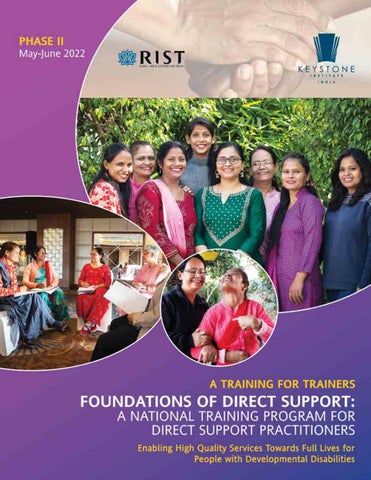
Foundations of Direct Support: A National Training Program for Direct Support Practitioners Training for Trainers
Phase II
Trainer’s Manual Edition 1 May-June 2022
Keystone Institute India
B-6/22, First Floor, Safdarjung Enclave New Delhi – 110029 Tel: 011 49053451/52 | www.keystonehumanservices.org
Table of
CONTENTS I.
Welcome Letter
v
II. Schedule III.
vii
Module Structure
1
IV. Training Resources V.
9
Modules Module 6: Health & Wellbeing
15
Module 7: Positive Approaches to Challenging Behaviour
63
Module 8: Community Membership
75
Module 9: Family Collaboration
83
Module 10: Legal Framework
103
Module 11: Advocacy & Activism
103
Module 12: Promoting Competency
103
Module 13: Sexual Wellbeing
103
Module 14: Taking Leadership
105
Foundations of Direct Support: A National Training Program for Direct Support Practitioners iii
Welcome to Phase 2 of the Foundations of Direct Support: A National Training for Direct Support Practitioners, Training of Trainers. On behalf of Keystone Institute India, we would like to thank you for setting aside significant time and commitment to become master trainers of this rich and new development course to promote the competence of direct support practitioners across India. We realize that time away from typical responsibilities is a major investment of your time and energy, and we are glad that both you and your organization have committed to learning about and teaching Foundations of Direct Support for a new and respected profession within India, all working towards rich, full lives for people with intellectual and developmental disabilities. This second phase of the Training for Trainers of the National Training for Direct Support Practitioners is a deep dive into critical subject areas that are key to person-centered support and empowerment of people with disabilities. YOU belong to the first cadre of Master Trainers pioneering this high-quality, value based training to develop highly competent and sensitive Direct Support Practitioners who can support and empower people with disabilities to lead rich, valued, and meaningful lives. We are privileged to have excellent faculty who bring with them decades of experience both on the ground and in training for this course. Many of our faculty are content experts and leaders in this space and are passionate about implementing and training in best practices. We are also happy and honored that you have taken the time to invest in this rigorous and demanding training course, and we hope that you will leave this event with a passion and commitment to teach others and learn more. We are excited to partner with you and support your endeavours in enhancing the lives of the people you serve. Elizabeth Neuville and Leela Raj Keystone Institute India B-6/22, First Floor, Safdarjung Enclave New Delhi – 110029 Tel: 011 49053451/52
eneuville@khs.org lraj@khs.org
SCHEDULE PHASE 2 Trainer Preparation WEEK 1 DAY 2 May 2022
3 May 2022
TIME
ACTIVITY
04.00 PM – 05.00 PM
• Welcome & Opening of Phase 2
Until meeting next day
• Participants to review prerecorded presentation videos of Module 6 Health & Wellbeing - Section 1 & 2
03.00 PM – 05.30 PM
• Welcome to Day 2 • Open House • Live online presentation of Module 6, Section 3
4 May 2022
Until meeting next day
• Participants to review prerecorded presentation video of Module 6, Section 4
03.00 PM – 05.30 PM
• Welcome to Day 3 • Open House • Live online presentation of Module 6, Section 5
6 May 2022
03.00 PM – 5.30 PM
• Welcome to Day 4 • Live online presentation of Module 7 Positive Approaches to Challenging Behavior • Wrap up Phase 2, Week 1
WEEK 2 13 May 2022
03.00 PM – 06.00 PM
• Welcome to Phase 2, Week 2 • Live online presentation of Module 8 – Community Membership
Until meeting next day
• Participants to review the prerecorded presentation video of Module 6, Section 6 (Mental Health Wellness)
vi Foundations of Direct Support: A National Training Program for Direct Support Practitioners
DAY
TIME
16 May 2022
04.00 PM – 05.30 PM
ACTIVITY • Welcome to Day 2 • Open House • Wrap up Phase 2, Week 2
WEEK 3 30 May 2022
10.00 AM – 01.30 PM
• Welcome to Phase 2, Week 3 • Live online presentation of Module 9 Family Collaboration
31 May 2022
10.00 AM – 01.30 PM
• Welcome to Day 2 • Continue live online presentation of Module 9 - Family Collaboration • Wrap up Phase 2, Week 3
Until next session
• Participants to review the prerecorded presentation video of Module 10 - Legal Framework
03.00 PM – 05.30 PM
• Welcome to Phase 2, Week 4
WEEK 4 7 June 2022
• Open House • Live online presentation of Module 11 – Advocacy & Activism WEEK 5 27 June 2022
10.00 AM – 01.00 PM
• Welcome to Phase 2, Week 5 • Live online presentation of Module 12 – Promoting Competency • Wrap up Phase 2, Week 5
WEEK 6 (In-Person New Delhi) 11 July 2022
10.00 AM – 04.00 PM
• Welcome to Phase 2, Week 6 • Live face-to-face presentation of Module 13 – Sexual Wellbeing • Practicum Overview
PRACTICUM (In-Person New Delhi) 12–13 July 2022
• Details will be shared soon
Foundations of Direct Support: A National Training Program for Direct Support Practitioners vii
List of Presentation Videos Demo Presenter
Length of Video
Link
1. Assessing Healthcare Needs
Neelam
53 minutes
https://youtu.be/4tXGijscjBA
2. Assisting with Activities of Daily Living
Neelam
30 minutes
https://youtu.be/OZ3YF78Rvlc
3. Health & Safety
Neelam
30 minutes
https://youtu.be/cGPdVtNVndM
Leela
63 minutes
https://youtu.be/ux_lmGYUcb4
Shampa
12 minutes
https://youtu.be/SmqZB2hDvkQ
Video Demo Name
4. Mental Health Wellness
5. Legal Framework
...People learn very quickly when they have a need for the skills and information. If it will change their lives, if it will help them accomplish what is important to them, everyone can become a good learner. We learn complex competencies and knowledge in a matter of weeks, not months or years. And people learn best in community, when they are engaged with one another, when everyone is both student and teacher, expert and apprentice, in a rich exchange of experiences and learnings. - Margaret Wheatley
PHASE 2 MODULE STRUCTURE Modules, Sections and Approximate Duration PHASE 2 MODULE 6. Promoting Health and Wellbeing
SECTION
DURATION (Hrs)
1. Assessing Health Care Needs of People with Intellectual & Developmental Disabilities
1.5
2. Assisting with Activities of Daily Living
1.0
3. Common Health Problems & Interventions
2.5
4. Health & Safety
1.5
5. Health & Wellness
2.0
6. Mental Health Wellness
1.5
7. Positive Approaches to Challenging Behaviour
2.5
8. Community Membership
2.5
9. Family Collaboration
6.0
10. Promoting Competence
3.0
11. Sexual Wellbeing
6.0
12. Legal Framework
1.0
13. Advocacy and Activism
2.0
14. Taking Leadership
1.5
Foundations of Direct Support: A National Training Program for Direct Support Practitioners 3
Take care of yourself, be healthy, and always believe you can be successful in anything you truly want.
- Alessandra Amrosio
Module 6: Health & Wellbeing
Health and Wellbeing
Something isn’t right…
Foundations of Direct Support: A National Training Program for Direct Support Practitioners 7
SECTION 1: Assessing Health Care Needs of People with Intellectual & Developmental Disabilities
Agenda • Health Outcomes for People with Disabilities • Assessing Health Needs • Behavior as an Indicator of Illness • Vital Signs • Accuracy in Assessing Vital Signs • Special Considerations for People with Disabilities
8 Foundations of Direct Support: A National Training Program for Direct Support Practitioners
Health Outcomes for People with Disabilities
Foundations of Direct Support: A National Training Program for Direct Support Practitioners 9
A young woman with a mild level of intellectual disability developed an earache. Her mum took her to a general physician who prescribed antibiotics for her. However, the pain continued and got worse. Her mum then took her to the emergency department. They had to wait over five hours to be seen, and as time progressed, the pain worsened. The young woman found it difficult to cope with her pain and expressed this by sitting on the floor, rocking, making sounds, and holding her head. When the doctor came the mum tried to explain, but she was dismissed. And the doctor wrote in her chart that the woman was having a temper tantrum. The young woman and her mum were asked to leave and return after she ‘settled down’. She died six hours later in her mum’s arms. An investigation into the cause of death identified that she had died as a result of undiagnosed meningitis.
Assessing Health Needs
10 Foundations of Direct Support: A National Training Program for Direct Support Practitioners
Something isn’t right…
SYMPTOMS
SIGNS
Foundations of Direct Support: A National Training Program for Direct Support Practitioners 11
Signs on skin Signs on eyes/ears/nose Signs in breathing/respiration Changes in eating habits Change in bowel habits Urinary changes Signs specific to women Signs specific to men
12 Foundations of Direct Support: A National Training Program for Direct Support Practitioners
Baseline Medical History Daily Life
Observe and Respond
Communication Ability Interpreting Internal Cues Documentation Regular Health Checkups
Behavior as an Indicator of Illness
Foundations of Direct Support: A National Training Program for Direct Support Practitioners 13
General Activity Level
Specific Behaviour
Body Positioning
Quiet
Refusing to eat
Outstretched
Restless
Crying
Drowsy
Holding stomach
Alert
Rubbing elbow
Nervous
Jerky movements
Calm
Limping
Overactive
Hitting face/head
Twisted Bent over Cramped Foetal position
Changes in energy levels or losing interest in activities
Aggression or any self-injurious behaviour
Be mindful of…
Changes in sleep habits, moods or appetite
Behaviour changes and trigger points for same
14 Foundations of Direct Support: A National Training Program for Direct Support Practitioners
What should you dodo now? What should first?and the doctor? What should you you say to John ∙ Talk to John about going for a Take not toimmediately to the ∙ Tell• John talk hospital blood test ∙ Make sure understands what the • Talk to he John’s family ∙ Call John’s doctor immediately and doctor is saying, and let the doctor know • Review schedule aJohn’s test medical history he is confused by this ∙ Don’t do anything, it’s John’s ∙ Don’t say anything choice if he wants to take the test
Vital Signs
Foundations of Direct Support: A National Training Program for Direct Support Practitioners 15
Factors Affecting Temperature
Age
Illness
Weather
Medication History
Temperature
Infection
Time of Day
Exercise
Emotions
16 Foundations of Direct Support: A National Training Program for Direct Support Practitioners
Remember
Temperature
Gloves Hand hygiene Device hygiene Readings
Ways to Assess
Temperature
Orally
Temple Touch
Tympanic
Axillary
Foundations of Direct Support: A National Training Program for Direct Support Practitioners 17
Ways to Measure
Pulse
Apical Brachial
Radial
18 Foundations of Direct Support: A National Training Program for Direct Support Practitioners
Factors Affecting BP
Blood Pressure
Age & Gender Weight Emotions Heredity
Medications
Disease conditions Viscosity of Blood Conditions of Blood Vessels
Foundations of Direct Support: A National Training Program for Direct Support Practitioners 19
Accuracy in Assessing Vital Signs
Gayatri has autism. During a routine check-up, the nurse briskly walked into the room and immediately placed the blood pressure cuff onto Gayatri’s arm.
This frightened her (who did not understand what the doctor was doing), which elevated her BP during the assessment. In turn, the doctor incorrectly diagnosed Gayatri with hypertension.
20 Foundations of Direct Support: A National Training Program for Direct Support Practitioners
Points to Note
1
2
3
Person’s appearance and behavior
Skin appearance and temperature
Timing of medication just before assessment
4 What’s “Normal” for the person
Factors Affecting Accuracy of Vital Signs
Foundations of Direct Support: A National Training Program for Direct Support Practitioners 21
Special Considerations for People with Disabilities
22 Foundations of Direct Support: A National Training Program for Direct Support Practitioners
Health and Wellbeing
SECTION 2: Assisting with Activities of Daily Living
Foundations of Direct Support: A National Training Program for Direct Support Practitioners 23
AGENDA
▪ What are Activities of Daily Living ▪ Assisting with Eating ▪ Assisting with Personal Care ▪ ▪ ▪ ▪ ▪ ▪ ▪
Bathing Dental Care Hair Care Toileting Nail Care Menstrual Care Clothing
ACTIVITIES OF DAILY LIVING
24 Foundations of Direct Support: A National Training Program for Direct Support Practitioners
▪ What are activities of daily living (ADL)? ▪ Eating
▪ Dressing ▪ Hygiene
▪ Mobility
▪ What are instrumental activities of daily living (IADL) ?
ADL and Support
Foundations of Direct Support: A National Training Program for Direct Support Practitioners 25
Potential Needs of People with IDD Need for consistency Reminders to perform personal care tasks Assistance in making changes Encouragement or acceptance Reminders of how to perform tasks
Assisting with Eating
26 Foundations of Direct Support: A National Training Program for Direct Support Practitioners
Foundations of Direct Support: A National Training Program for Direct Support Practitioners 27
Positioning
1
2
3
4
Maintain good body alignment
Provide comfort
Inhibit unhelpful reflex patterns
Decrease respiratory problems
Positioning Essentials Ensure body as upright as possible
Prevent head from tipping back
Ensure chair fits the individual
Ensure feet are supported
Ensure individual is relaxed
Reposition if required
Alert individuals before positioning
Ensure upright position post eating
28 Foundations of Direct Support: A National Training Program for Direct Support Practitioners
Personal Care
Foundations of Direct Support: A National Training Program for Direct Support Practitioners 29
Guidelines Wash your hands before and after physically assisting the individual Place the head of the toothbrush alongside the teeth with the bristles at 45º angle Use a back and forth ‘vibrating’ / up and down / circular motion
Even individuals who not have any Brush the outer side of each tooth withdo this technique ✔ Repeat or this technique on the inside surfaces teeth dentures need mouth care. This ✔ For the inside surfaces of the front teeth, tilt the brush vertically and brush up would include at least a daily, gentle and down using the front part of the brush head ✔ Brush the topsand of the teeth using a back forth motion brushing rinsing ofandthe gums, tongue ✔ Brush the tongue and roof of the mouth. ✔ Don’t brush too hard ✔
✔
Best remedy for bleeding gums is to keep brushing gently
30 Foundations of Direct Support: A National Training Program for Direct Support Practitioners
BATHING
✔
Review Precautions
✔ Allow as much independence as possible are helpingyourself Kantha get ready for her eveningplan bathing ✔ You Familiarise with person-centred routine. She requires assistance transferring from her walker ✔ Poor bathing habits increase chances of bed ✔ Consider use of special equipment to the shower chair, but otherwise performs all her own ✔ Check water temperature sores/infections bathing activities. In the past, Kantha had slipped on the ✔ bathroom Examinefloor skinbecause for injuries/indications thethe floor wascan wet. What should you ✔ Inadequate drying after bath cause fungal ✔ doHonour personal choice before assisting Kantha to the shower chair to ensure she infections ✔ does Wash own hands not your slip this time? ✔✔ Demonstrate correct bathing procedure Remove the shower curtain BeA.wary of scrubbing the body too hard or using products ✔ Close prevent drafts the floor B. windows Spread a to small towel across that may irritate the skin ✔ Ensure privacy draw curtains, close doors C. Place the-bathmat on the shower floor ✔ Guard against spreading bacterial infection from one body ✔ Gather all supplies beforehand ✔ Encourage use of toilet before bathing part to another ✔ Place a mat/towel on bathroom floor ✔ Ensure use of after-bath products to keep skin healthy ✔ Follow top-to-bottom approach ✔ Watch out for any skin irritations; report if any ✔ When finished, wash hands and straighten bath area
ORAL CARE
MENSTRUAL CARE
NAIL CARE
TOILETING
HAIR CARE
✔
BATHING
DENTAL CARE
HAIR CARE
TOILETING
NAIL CARE
MENSTRUAL CARE
✔
Important Considerations
products
MENSTRUAL CARE
NAIL CARE
TOILETING
✔ Section long hair to avoid pulling and tugging
BATHING
HAIR CARE
✔ Teach and assist with drying hair and applying hair
ORAL CARE
Guidelines
✔ Teach and assist the individual to comb or brush hair from scalp to ends
✔ Special care while handling curly hair ✔ Gentle touch
✔ Ensure cleanliness of comb/hair brush
BATHING
range
ORAL CARE
MENSTRUAL CARE
NAIL CARE
✔ Never leave the person served out of hearing
TOILETING
✔ Promote independence
HAIR CARE
✔ Ensure safety and dignity always
✔ Familiarise yourself with adaptive equipment used
✔ Follow hygiene practices
Foundations of Direct Support: A National Training Program for Direct Support Practitioners 31
with wings, thin, etc ✔ Skipped cycles
products timely can ✔ Not ✔ changing Pre-menstrual symptoms cause deadly infections ✔ Report unusual conditions
CLOTHING
32 Foundations of Direct Support: A National Training Program for Direct Support Practitioners
BATHING
ORAL CARE
TOILETING
NAIL CARE
MENSTRUAL CARE
✔✔ Ensure use of product as per directions ✔Nail Female staff only for care important overall health on ✔packing Medications ✔ People with diabetes may require help ✔ Pads – Used externally; many varieties ✔ Consent and clear communication of health professional and available; depends upon ✔ brands Period flow ✔ Advisable to trim nails every fortnight specific features – high absorbency, ✔ Mark the date
HAIR CARE
Guidelines Keep in mind
Health and Wellbeing
SECTION 4: Common Health Problems and Interventions
Foundations of Direct Support: A National Training Program for Direct Support Practitioners 33
Agenda • The Crucial Four • Aspiration • Dehydration • Seizures • Constipation • Other Common Health Issues • Incontinence and UTI • Pressure Injuries • Allergies and Asthma • Diabetes
The Crucial Four
34 Foundations of Direct Support: A National Training Program for Direct Support Practitioners
Aspiration
Seizures
Aspiration
Dehydration
Dehydration
1
2
4
3 Constipation
Constipation
Seizures
Foundations of Direct Support: A National Training Program for Direct Support Practitioners 35
Aspiration
Dehydration
Constipation
Seizures
Aspiration
Dehydration
Constipation
Seizures
Choking Dysphagia Aspiration
36 Foundations of Direct Support: A National Training Program for Direct Support Practitioners
Aspiration
Dehydration
Choking
Signs
Constipation
Seizures
Constipation
Seizures
Dysphagia Aspiration
Aspiration
Dehydration
Choking Dysphagia
Indications
Aspiration
Foundations of Direct Support: A National Training Program for Direct Support Practitioners 37
Aspiration
Dehydration
Constipation
Seizures
Constipation
Seizures
Choking Dysphagia Aspiration
Case Study Behavior Other Signs Interventions Risk factors Common foods
Aspiration
Dehydration
38 Foundations of Direct Support: A National Training Program for Direct Support Practitioners
Aspiration
Dehydration
Constipation
Seizures
Constipation
Seizures
Signs Risk Factors Causes Prevention & Interventions
Aspiration
Dehydration
Foundations of Direct Support: A National Training Program for Direct Support Practitioners 39
Aspiration
Dehydration
Constipation
Seizures
Example General Signs Specific Signs Risk Factors Alerts Influencing Factors Prevention Treatment Review
Aspiration
Dehydration
Constipation
Seizures Example Risks Causes Triggers Signs Treatment Response Seeking Medical Help Helping Manage Reporting and Documenting
40 Foundations of Direct Support: A National Training Program for Direct Support Practitioners
Aspiration
Choking - Signs
Seizures
Constipation
Dehydration
Unable to talk 01
Loose consciousness
Skin turning bluish
Aspiration
Signs of Choking
06
Clutch their chest
Look panicked
02
07
05
03
04
Wheeze
Cough Forcefully
Seizures
Constipation
Dehydration
Dysphagia Pain while swallowing
Choking/coughing
Food getting stuck
Chest pain/pressure
Heartburn/acid reflux
Indications of Dysphagia
Gurgling sounds
Unexpected weight loss
Food remaining in the mouth
Foundations of Direct Support: A National Training Program for Direct Support Practitioners 41
Aspiration
Dehydration
Constipation
Example
Seizures
Sarla has cerebral palsy Sarla loves cup cakes She has trouble swallowing and her food is pureed She longs for ‘real’ food and has a history of grabbing food Neighbour brings cupcakes for a birthday party Sarla grabs one when you are not looking Sarla looks agitated and soon becomes unconscious. You give CPR and call for help, but….it’s too late!
Aspiration
Dehydration
Constipation
Seizures
Behavioural Indications 01
Watering eyes
02
Coughing or choking during meals
03
Irregular breathing, turning blue, wheezing or rapid respiration
06
07
Feeling something stuck in throat
Getting tired during a meal
08
Difficulty swallowing or chewing
04
Coughing/clearing the throat before/after swallowing
09
Runny nose, sneezing or persistent coughing during or after meals
05
Food and fluid falling out the person’s mouth
10
A gurgling voice during or after eating or drinking
42 Foundations of Direct Support: A National Training Program for Direct Support Practitioners
Aspiration
Seizures
Constipation
Dehydration
Risk Factors 01
Having decreased muscle tone or coordination
02
Inadequately trained staff
03
Weak/absent coughing/gagging reflexes
04
Poor chewing/swallowing skills
Aspiration
05
06
Acid reflux
Poor self-eating skills or habits
09
Impaired mobility
10
Difficulty holding head up/sitting up straight
0 7
Medication side effects
11
Problems with oral or dental health
08
Inappropriate fluid consistency and/or food textures
12
Epileptic seizures
Dehydration
Seizures
Constipation
Risk Factor - Foods 01
Grapes
04
Dry, crumbly food
07
Whole hard fruits
02
Peanut butter
05
Dry meat
08
Candy with nuts
03
Sandwiches
06
Whole, raw vegetables
09
Hard nuts
Foundations of Direct Support: A National Training Program for Direct Support Practitioners 43
Aspiration
Seizures
Constipation
Dehydration
Interventions
Awareness & Training
Aspiration
Alteration of Body Position
Diet modification
Seizures
Constipation
Dehydration
Important to Remember Intervention and Supervision
Identification and planning
04 03
Observation
01
Prevention is critical
02
44 Foundations of Direct Support: A National Training Program for Direct Support Practitioners
Aspiration
Dehydration
Constipation
Seizures
Aspiration
Dehydration
Constipation
Seizures
Review Based on your knowledge of swallowing problems, what could have gone wrong? -
Dhoni should have been hospitalized when he got a chest cold
-
The thickened orange juice Dhoni drank did not allow him to swallow pills effectively
-
Dhoni should not have had his medication in a tablet form
-
Dhoni should have had medications before his breakfast
Foundations of Direct Support: A National Training Program for Direct Support Practitioners 45
Aspiration
Signs Dry skin or chapped lips
Seizures
Constipation
Dehydration
Lethargy or decreased alertness
Extreme thirst 02
01
Fever
03
04
05 08
07
Dry, hard stools
Aspiration
06
Constipation
Decreased urinary output
Dark colored urine
Seizures
Constipation
Dehydration
Causes and Risk Factors Access difficulties
01
Assistance needs
02
Dyspha gia
03
Drooling
04
Refusal of food and fluids
05
Suppression of thirst mechanisms
06
Communication difficulty
07
Medical conditions Fluid loss from other conditions Effects of medication
08 09 10
46 Foundations of Direct Support: A National Training Program for Direct Support Practitioners
Aspiration
Dehydration
Constipation
Seizures
Prevention Regularly offer water throughout the day
Pay attention to any weather changes
Understand the person’s communication style
Urine or stool pattern changes
Be aware of other medical conditions
Medications
Interventions Offer fluids if the person is alert and can drink safely
Aspiration
Dehydration
Else contact healthcare professional for intravenous fluids
Constipation
Seizures
Example Wilson – 24 year old with moderate intellectual disability Lives with 4 roommates; attends a day program Works with Mukesh – a DSP at the day program Mukesh notices Wilson spending a long time in bathroom Wilson’s behavioural outbursts Mukesh’s concern
Foundations of Direct Support: A National Training Program for Direct Support Practitioners 47
48 Foundations of Direct Support: A National Training Program for Direct Support Practitioners
Aspiration
Seizures
Constipation
Dehydration
Risk Factors 01
Neuromuscular degenerative disorders
07
Immobility and poor body alignment
02
Spinal cord injuries or birth defects
08
Toilet routine and privacy
03
Muscle weakness
09
Medications
04
Diets poor in fiber/fluids
10
Hemorrhoids
05
Swallowing skills
11
Frequent laxative use
06
Access to bathroom
12
Psychiatric issues
Aspiration
Constipation
Dehydration
Seizures
Prevention 01
Medication side effects
03
Diet
02
Physical activity
Foundations of Direct Support: A National Training Program for Direct Support Practitioners 49
Aspiration
Dehydration
Constipation
Seizures
Treatment
Medication
Aspiration
Dehydration
Manual Modalities
Constipation
Seizures
Review At the suggestion of Wilson’s physician, Mukesh helps him track his food and fluids for two weeks. Mukesh shows Wilson that he is eating balanced meals but is not drinking enough fluids. Mukesh encourages Wilson to drink more water throughout the day. Wilson’s physician also prescribed him a laxative that he could take as needed. Because of Wilson’s depression, he was not getting as much physical activity as he needs. Mukesh helped Wilson choose activities that he enjoyed and could practice every day, including taking walks around his neighborhood.
50 Foundations of Direct Support: A National Training Program for Direct Support Practitioners
Aspiration
Constipation
Dehydration
Seizures
Meet Meena and Richard Richard - a 35-year old man with a mild intellectual disability who lives in the community. Meena - a new DSP working with him Meena’s been told Richard has seizure disorder; limited details given by her supervisor Richard’s seizure during grocery shopping Dazed look Lip smacking Loss of bladder control Meena is clueless and helpless Meena realizes there’s a lot she needs to learn
Seizures
• Epilepsy is another name for seizure disorder • More prevalent for people with developmental disability • May impact daily living skills • Is a spectrum condition • Seizures vs Convulsions
Foundations of Direct Support: A National Training Program for Direct Support Practitioners 51
Aspiration
Seizures
Constipation
Dehydration
Risks
1
2
3
Loss of consciousness
Cognitive damage
SUDEP
Aspiration
Seizures
Constipation
Dehydration
Causes Electrolyte imbalance
Low blood sugar
Stroke
07
01
Congenital issues
02
06
03
05 04
Infections
Medication non-compliance
Head injuries
52 Foundations of Direct Support: A National Training Program for Direct Support Practitioners
Aspiration
Dehydration
Constipation
Seizures
Triggers Stress
Poor nutrition
Missed medication
Flickering lights
Skipping meals
Illness/ allergies
Lack of sleep
Emotions
Heat/ humidity
Foundations of Direct Support: A National Training Program for Direct Support Practitioners 53
Aspiration
Seizures
Constipation
Dehydration
Treatment
01
02
03
Medication
Surgery
Dietary therapy
Aspiration
Dehydration
Constipation
Seizures
Stay with the individual until the seizure is over Call for medical help if seizure lasts for more than 5 minutes
Response to seizure
Keep the individual comfortable and safe from injury If in public, keep onlookers away Don’t hold the person down or put anything in their mouth Don’t give any pills/water/food until the individual is fully alert Stay calm and supportive
54 Foundations of Direct Support: A National Training Program for Direct Support Practitioners
Aspiration
Dehydration
Constipation
Seizures
Multiple seizures happen one after the other without the person regaining consciousness between seizure episodes Seizures happen closer together than usual for that person
When to call for medical help
If the individual appears to be choking or having trouble breathing The seizure happens in a body of water, such as a pool or bathtub The person injures themselves during a seizure This is the first seizure the person has ever experienced Seizures that last for five minutes or longer
Aspiration
Dehydration
Constipation
Seizures
Helping to Manage
Information Community Empowerment
Foundations of Direct Support: A National Training Program for Direct Support Practitioners 55
Aspiration
Dehydration
Seizures
Constipation
Reporting and Documenting
Be aware of likely triggers
Aspiration
Provide appropriate assistance
Dehydration
Record conditions and description
Seizures
Constipation
What to document ▪
Time of the seizure
▪
Any drug or alcohol use
▪
Parts of the body affected
▪
Types of movement
▪
Antecedent conditions
▪
Impairment in consciousness
▪
Changes in skin colour
▪
Any resulting injuries
▪
Condition after the seizure
▪
Any difficulty with recall
▪
Who the seizure was reported to
56 Foundations of Direct Support: A National Training Program for Direct Support Practitioners
Other Common Health Issues
Urinary / Faecal Incontinence
Foundations of Direct Support: A National Training Program for Direct Support Practitioners 57
Urinary Tract Infection (UTI) Signs and Symptoms 01
Strong and persistent urge to urinate Burning sensation while urinating
03
Frequent, small amounts of urine Urine that is cloudy/pink/red
05
02
04
Rectal pain in men and pelvic pain in women Strong smelling urine
06
Urinary Tract Infection Prevention and Treatment Drinking adequate water
01
Drinking other fluids
02
Correct cleaning
03
58 Foundations of Direct Support: A National Training Program for Direct Support Practitioners
Pressure Injuries
Sore or intact skin
Breakage in area of skin
Common areas
Foundations of Direct Support: A National Training Program for Direct Support Practitioners 59
Pressure injuries Prevention 03
02
01 Change positions frequently
Keep pressure off
Follow good hygiene
Treatment 01 Wash sore
03
02 Seek medical help
Emergency medical care
Allergies
Cause
Symptoms
Anaphylaxis
Prevention
60 Foundations of Direct Support: A National Training Program for Direct Support Practitioners
Asthma
Cause Symptoms Prevention and Treatment
Foundations of Direct Support: A National Training Program for Direct Support Practitioners 61
Health and Wellbeing
SECTION 4:
Health and Safety
62 Foundations of Direct Support: A National Training Program for Direct Support Practitioners
Agenda • Safety • Privacy • Dignity • Communication • Independence • Infection Control • Fire safety • First Aid
Foundations of Direct Support: A National Training Program for Direct Support Practitioners 63
Safety -
Preventing Falls Preventing Shocks and Electrocution Preventing Burns and Scalds Preventing Poisoning or Chemical Accidents Preventing other Household Injuries
64 Foundations of Direct Support: A National Training Program for Direct Support Practitioners
Preventing Falls
Assist people who might fall
Foundations of Direct Support: A National Training Program for Direct Support Practitioners 65
Clean up floor spills
Pick up things dropped on floor
66 Foundations of Direct Support: A National Training Program for Direct Support Practitioners
Remove potential tripping hazards
Unplug electricals when not in use
Foundations of Direct Support: A National Training Program for Direct Support Practitioners 67
Limit use of extension chords
Place rubber mats in bathrooms
68 Foundations of Direct Support: A National Training Program for Direct Support Practitioners
Install grab rails
Straighten carpets/rugs/throws
Foundations of Direct Support: A National Training Program for Direct Support Practitioners 69
Clear entrances and passages
Ensure good lighting
70 Foundations of Direct Support: A National Training Program for Direct Support Practitioners
Exercise/physiotherapy can help
Use walkers/canes for support
Foundations of Direct Support: A National Training Program for Direct Support Practitioners 71
Use special equipment for emergency alert
Preventing Shocks and Electrocution
72 Foundations of Direct Support: A National Training Program for Direct Support Practitioners
Preventing Burns and Scalds
Foundations of Direct Support: A National Training Program for Direct Support Practitioners 73
Preventing other Household Injuries
Teach Safety - Modelling - Using every teachable opportunity - Providing positive reinforcement
74 Foundations of Direct Support: A National Training Program for Direct Support Practitioners
Do not discuss personal issues
Respect personal space and belongings
Respect confidentiality
Close door before assisting
Knock and wait
Foundations of Direct Support: A National Training Program for Direct Support Practitioners 75
Dignity
76 Foundations of Direct Support: A National Training Program for Direct Support Practitioners
Communication
Foundations of Direct Support: A National Training Program for Direct Support Practitioners 77
Independence
78 Foundations of Direct Support: A National Training Program for Direct Support Practitioners
Infection Control
Foundations of Direct Support: A National Training Program for Direct Support Practitioners 79
Controlling spread of germs
• Hand washing • Choice of soap •Remove any protective equipment •Moisturizing
80 Foundations of Direct Support: A National Training Program for Direct Support Practitioners
Foundations of Direct Support: A National Training Program for Direct Support Practitioners 81
82 Foundations of Direct Support: A National Training Program for Direct Support Practitioners
Fire Safety
Foundations of Direct Support: A National Training Program for Direct Support Practitioners 83
Response to Fire Remember to RACEE If you smell smoke or discover a fire at your site, you must do the following in the order outlined: • • • • •
Remove/Rescue Alert (contact) Contain (control) Extinguish (put out) Evacuate (leave)
In the Event of a Fire
84 Foundations of Direct Support: A National Training Program for Direct Support Practitioners
First Aid
Thank you!
www.youtube.com/c/powerupwithpowerpoint
Foundations of Direct Support: A National Training Program for Direct Support Practitioners 85
Health and Wellbeing
Health and Wellness
86 Foundations of Direct Support: A National Training Program for Direct Support Practitioners
Wellness and Healthy Lifestyle
Foundations of Direct Support: A National Training Program for Direct Support Practitioners 87
A healthy lifestyle
Exercise
Diet
Nutrition & Weight Management
Health care management
Exercise
Health Checkups
Sleep
Stress management
Infection control
Hygiene & Grooming
88 Foundations of Direct Support: A National Training Program for Direct Support Practitioners
In your opinion, are Shashi’s decisions helpful or not?
▪ Shashi baked a cake to celebrate Devi’s first night at the home. ▪ Shashi told Devi that “lights out” was at 10.00 and he must comply. ▪ Shashi told Devi he could not watch television in his bedroom. ▪ Shashi decided that she should get Devi’s bath ready for her.
Foundations of Direct Support: A National Training Program for Direct Support Practitioners 89
Dis(ability)
Good Nutrition
90 Foundations of Direct Support: A National Training Program for Direct Support Practitioners
Foundations of Direct Support: A National Training Program for Direct Support Practitioners 91
92 Foundations of Direct Support: A National Training Program for Direct Support Practitioners
Foundations of Direct Support: A National Training Program for Direct Support Practitioners 93
General Tips Make half your plate fruits and vegetables
02
Avoid oversized portions
03 Make at least half of your grains whole grains
04
01 Enjoy your food, but eat less
05
Drink water instead of sugary drinks
94 Foundations of Direct Support: A National Training Program for Direct Support Practitioners
Foundations of Direct Support: A National Training Program for Direct Support Practitioners 95
Preparation Method
96 Foundations of Direct Support: A National Training Program for Direct Support Practitioners
Setting up for success
1
2
3
4
5
Healthy snacks easily reachable
Junk once in a while
Fruits, cut vegetables on table
Water within reach
Portion packaged food
Foundations of Direct Support: A National Training Program for Direct Support Practitioners 97
Smaller plates
Smaller serving utensils
Condiments from bowls
Portion large items
Extra food out of sight
98 Foundations of Direct Support: A National Training Program for Direct Support Practitioners
Foundations of Direct Support: A National Training Program for Direct Support Practitioners 99
03
Exercise: For a healthy body & mind
100 Foundations of Direct Support: A National Training Program for Direct Support Practitioners
Aerobic activity
Muscle strengthening activity
Foundations of Direct Support: A National Training Program for Direct Support Practitioners 101
Balance and Flexibility
102 Foundations of Direct Support: A National Training Program for Direct Support Practitioners
Other Strategies Join In
Start Small
B
A
Recognize Small Efforts
C
Get it Right
E
Be Encouraging
D
Exercise Think of one person you support who would benefit from increased exercise – Come up with one exercise idea to try with that person that is new to them.
Foundations of Direct Support: A National Training Program for Direct Support Practitioners 103
Supporting healthy lifestyles Model Healthy Choices
Learn and Educate
Support Choices
Build Routine
Know the person’s wants/needs
Review ∙Help them research current food and exercise guidelines ∙Help them find healthier versions of their favorite food ∙ Help them sign up for daily workout sessions with a personal trainer ∙ Hide unhealthy foods so they can’t eat them ∙ Teach them what you learned about healthy lifestyles
104 Foundations of Direct Support: A National Training Program for Direct Support Practitioners
Foundations of Direct Support: A National Training Program for Direct Support Practitioners 105
Health and Wellbeing
Mental Health Wellness
106 Foundations of Direct Support: A National Training Program for Direct Support Practitioners
Can take many forms
What are mental health conditions? Conditions that impact a person’s thinking, feeling or mood
Diagnosis requires clinical judgement
When a person has both a developmental disability and a mental health condition, the person is said to have a “co-occurring diagnosis of a mental health condition”.
Foundations of Direct Support: A National Training Program for Direct Support Practitioners 107
Biopsychosocial Approach
Biological Aspects
Psychological Aspects
Social Aspects
Genetic, biological component
sts
Family history Psychological challenges Social connections
Physical illness Verbal communication challenges portunity to contribute Communication Functional challenges Recreation
Role of DSP
Challenges with control and regulation Stressful life events Behaviour
Healthy habits
108 Foundations of Direct Support: A National Training Program for Direct Support Practitioners
A 35 year old woman, Lakshmi, has moved into an apartment in the community, sharing the apartment with two other women in their 30s. It’s been a couple of months since Lakshmi moved here from an institution where she lived since she was 10. The women are supported by direct support staff. Lakshmi is mostly withdrawn, aloof, and cries frequently. One day she screams at her roommate and throws things around the room for no apparent reason. Another day she seemed disoriented when they were getting down to having lunch around 2 pm. Lakshmi has intellectual disability. She has diabetes for which she takes medication. At the institution, she was used to having lunch at 12 and followed a strict routine around food. She had a couple of good friends at the institution. Please share your thoughts using the biopsychosocial approach.
Foundations of Direct Support: A National Training Program for Direct Support Practitioners 109
Review
Amar Mona You support two individuals named Amar and Mona. On Wednesday morning, you went to Amar’s home and found him screaming and yelling. On Thursday, you went to see Mona and found her screaming and yelling.
Revie w
• What can you do to support Amar?
110 Foundations of Direct Support: A National Training Program for Direct Support Practitioners
Specific Mental Health Conditions
Mania
Depression Anxiety Disorder s
Foundations of Direct Support: A National Training Program for Direct Support Practitioners 111
112 Foundations of Direct Support: A National Training Program for Direct Support Practitioners
Depression – Support Strategies
Focus on one topic at a time
Plan positive activities
Be creative
Use positive thinking
01
02
03
04
Foundations of Direct Support: A National Training Program for Direct Support Practitioners 113
Mania
Changes in sleep, eating patterns and overall activity levels
What is realistic
01
02
Behavior changes
03
114 Foundations of Direct Support: A National Training Program for Direct Support Practitioners
Mania – Support Strategies
Reduce simulation
01
Brief conversations
02
Encourage sleep
03
Recognize emotion
04
Use grounding strategies
05
Mania - Review
Jamal has recently been giggling a lot, talking non-stop and pacing; he also made several remarks toward female DSPs, which is not usual for him. He offered to take Anita, his DSP, to Mauritius on his jet. As his DSP, and from you just learned what would be best to do?
Foundations of Direct Support: A National Training Program for Direct Support Practitioners 115
Anxiety Disorders Apprehensive
Stressed
Afraid
Scared
Restless
Various Terms Concerned
Worried
Panicked
Nervous
116 Foundations of Direct Support: A National Training Program for Direct Support Practitioners
Foundations of Direct Support: A National Training Program for Direct Support Practitioners 117
Anxiety Disorders – Support Strategies
Reduce anxiety and stress
Minimize change
Environment management
01
02
03
Anxiety Disorders – Other Strategies
Empathy
Consistency
Prevention
Autonomy
01
02
03
04
118 Foundations of Direct Support: A National Training Program for Direct Support Practitioners
Power
Genuineness
01
02
Relationship
04 Modeling
03 Trust
Foundations of Direct Support: A National Training Program for Direct Support Practitioners 119
QUIZ
• Which of the following are common mental health conditions among people with IDD? o Depression o Anxiety o Bipolar disorder o All of the above • Shanti gets easily stressed and hits others when she is asked to do household chores. Shanti has many interests and strengths, one of which is drawing. How might you best support Shanti if she shows signs of becoming agitated? o Offer Shanti opportunities to draw, but when she shows signs that she is becoming stressed, take the drawing materials away o Let Shanti know that if she does not hit others, she can have the drawing materials after she does her chores o Allow Shanti the opportunity to draw when she starts to become stressed and at other times during the day when she isn’t doing chores o Don’t let Shanti have drawing materials until she shows that she will not hit others for one week
120 Foundations of Direct Support: A National Training Program for Direct Support Practitioners
• True or False: Intellectual disabilities are typically present at birth or appear during the developmental period.
• When someone has both an IDD and a mental health condition, this is commonly referred to as o Double diagnosis o Multiple medical challenges o Simultaneous conditions o Co-occurring conditions
Foundations of Direct Support: A National Training Program for Direct Support Practitioners 121
There is no greater disability in society than the inability to see a person as more. - Robert M. Hensel
Module 7: Positive Approaches to Challenging Behaviour
Foundations of Direct Support: A National Training Program for Direct Support Practitioners 125
Defining Behaviour Examples of “behaviors” Explain Clearly
B
126 Foundations of Direct Support: A National Training Program for Direct Support Practitioners
REMEMBER: Behaviour = Communication
Interferes with learning
Also think…
Interferes with participation in the community Hurts self or others Affects the emotional health of the family
Foundations of Direct Support: A National Training Program for Direct Support Practitioners 127
External Environment (including socio-emotional factors)
Factors that affect behaviour
•
Distractions
•
Are you rewarding a behaviour without meaning to? (Giving something to make her quiet and easier)
•
Can you change the setting that bothers the individual? –heat/cold/noisy
•
Are your expectations matched with his ability?
•
Core factors of the disability
•
Past learning
•
Family issues
•
Unmet needs
•
Abuse
Internal Environment
Factors that affect behaviour
• Pain • Hormones • Effect of medication • Sensory Issues • Health – allergies/seizures • Mental Health
128 Foundations of Direct Support: A National Training Program for Direct Support Practitioners
Wrong Patterns
Difficult behaviors get faster results So Difficult behaviours occur again and again
Foundations of Direct Support: A National Training Program for Direct Support Practitioners 129
But – No assumptions please Most Important Factors: 1. Relationship 2. Relationship 3. Relationship
What we have to put into place ▪ Increase involvement
▪ Decrease confusion and unnecessary distractions
▪ Allow easy access to materials ▪ Address transitions ▪ Consistency ▪ Notice
▪ Daily schedule
130 Foundations of Direct Support: A National Training Program for Direct Support Practitioners
The Importance of
Choice
Teaching Functional Skills
Foundations of Direct Support: A National Training Program for Direct Support Practitioners 131
Supportive Interactions
Sometimes, a crisis occurs despite our best efforts
132 Foundations of Direct Support: A National Training Program for Direct Support Practitioners
Stages of Behaviour
• Can you think of what behaviours you might see at each stage? • Discuss in your group.
AGITATION SIGNS
YOUR RESPONSE
RAGE SIGNS YOUR RESPONSE
RECOVERY SIGNS
1.Withdrawal (physical or emotional) 2. Power struggle 3. Protest (person or situation) 4. Fidgeting, tensing
1. Recognize signs of stress 2. Remain calm 3. Use quiet voice 4. Slow down speech 5. Take a deep breath 6. Use fewer words, less emotion
1.Screaming 2. Emotional to explosive 3. Biting, hitting, and/or kicking 4. Self-injury 5.Destroying property
1. Fragile 2. Sleeping 3. Withdrawal into fantasy 4. Apologizing
1. Ensure safety of others 2. Control fight-or-fligh t tendency 3. Do not posture or arrange yourself
YOUR RESPONSE 1.
Remain calm and quiet 2. Reassure student 3. Do not debrief or reexamine Incident with student
Foundations of Direct Support: A National Training Program for Direct Support Practitioners 133
AGITATION SIGNS
YOUR RESPONSE
RAGE SIGNS
YOUR RESPONSE
RECOVERY SIGNS
YOUR RESPONSE
5. Rocking, foot tapping 6. Loud voice, name calling, verbal threats 7. Tears
7. Avoid power struggle 8. Be flexible—the child cannot 9. Do not trap student in corner
6. Physical escape; “fight or flight” 7. Abusive insults to staff and peers
4.Remember that less is more 5. Remain calm and quiet 6. Do not lecture 7. Disengage emotionally 8. Preserve student dignity
5. May not remember or deny episode occurred 6. Expressions of relief 7. May show gratitude
4. Do not moralize or preach 5. Take time for yourself to regroup by taking a break 6. Preserve confidentialit y! 7. Do not share “war stories”
70%
20% 10%
134 Foundations of Direct Support: A National Training Program for Direct Support Practitioners
Some people think they are in community, but they are only in proximity. True community requires commitment and openness. It is a willingness to extend yourself to encounter and know the other. - David Spangler
Module 8: Community Membership
Community is a group of people who come together for a common reason.
Foundations of Direct Support: A National Training Program for Direct Support Practitioners 137
Everyone needs Community. Community needs everyone.
A community that excludes even one of its members is no community at all – Dan Wilkins
138 Foundations of Direct Support: A National Training Program for Direct Support Practitioners
Community involvement
History
Role of Human Service Client
Especially important to people with disabilities
Services
Foundations of Direct Support: A National Training Program for Direct Support Practitioners 139
In (but not of) the Community -
Physical integration does not necessarily lead to social integration – Lemay, 2006
• Aditya lives in a group home with nine other adults who have disabilities. On some days he attends a day centre with 20 other people also with disabilities. His support worker is encouraging him to research training programs that could eventually lead to employment. The program provides computers where he can conduct his research. On weekends, his family sometimes picks him up to spend time at their house.
140 Foundations of Direct Support: A National Training Program for Direct Support Practitioners
• Prabha lives in an apartment with a roommate in a program that provides support services. She is currently unemployed and is looking for either a part time job or an interesting volunteer opportunity. Because she doesn’t have a computer, she goes to the cyber café a few days a week to search for jobs and work on her resume and surf the internet for areas that interest her. She has gotten to know one of the staff there and they often take a break together for coffee or just a walk. On weekends, Prabha and her roommate often host potluck dinners for friends and/or family.
Being part of a Community
Community Presence
Community Participation
Community Inclusion
Foundations of Direct Support: A National Training Program for Direct Support Practitioners 141
What Does Community Inclusion Encompass?
Family Roles
Friendships
Education
Work & Career
Leisure & Recreation
Civic Life
Spirituality
142 Foundations of Direct Support: A National Training Program for Direct Support Practitioners
Elements of Community Inclusion Active participation Natural supports
Choice
Valued roles
Responsibility
Barriers to Community Engagement
Acceptance
People with disabilities segregated, congregated, distanced Mindsets, attitudes, stigmatization and discrimination Autonomy, self-determination and expectations Accessibility and other barriers Other - (Hastabacka et al., 2016)
Foundations of Direct Support: A National Training Program for Direct Support Practitioners 143
Connections with Community
Roles
Relationships
Places
144 Foundations of Direct Support: A National Training Program for Direct Support Practitioners
Community Mapping helps figure out what talents, gifts, skills, and capacities lie within a community, and find ways that the community can strengthen itself by “bringing” out those gifts and using the capacities that already exist.
Foundations of Direct Support: A National Training Program for Direct Support Practitioners 145
146 Foundations of Direct Support: A National Training Program for Direct Support Practitioners
Foundations of Direct Support: A National Training Program for Direct Support Practitioners 147
Town of Herbertpur Located on the bank of river Asan. As of 2011 India Census, Herbertpur had a population of 9,782. Languages spokenHindi, English, Punjabi, Garhwali and Tibetan. Self sufficient town
Here you find diversity in religious beliefs
148 Foundations of Direct Support: A National Training Program for Direct Support Practitioners
Celebrations happen here !!
Community Gathering
Foundations of Direct Support: A National Training Program for Direct Support Practitioners 149
Café | Restaurants
Bakery
150 Foundations of Direct Support: A National Training Program for Direct Support Practitioners
What do people do for a living ?
Major Local Businesses
Foundations of Direct Support: A National Training Program for Direct Support Practitioners 151
Domestic Connectivity
Passing time ??
152 Foundations of Direct Support: A National Training Program for Direct Support Practitioners
Where do people study ?
Fitness & Lifestyle Services
Foundations of Direct Support: A National Training Program for Direct Support Practitioners 153
Digital Seva Kendra & Postal Services
Healthcare Services
154 Foundations of Direct Support: A National Training Program for Direct Support Practitioners
Standard of Living
Financial Services
Foundations of Direct Support: A National Training Program for Direct Support Practitioners 155
Educational Institutions Farm Area/ unoccupied Space Residential Area Religious places Medical Stores/Clinics/Individual practitioners Banks and ATMs Departmental Stores Eateries, bakeries and confectionary stores Selfcare and Beauty Services Celebration Hall Other Small Business Shops (Electrical, furniture &Plywood, marble work, iron work, etc.) Small Shops Police Station Post office Hospital, Local Court Bus Stand
156 Foundations of Direct Support: A National Training Program for Direct Support Practitioners
Final Thoughts Authentic inclusion is not likely to happen when people with disability “visit community” in large groups. It IS likely to happen if people with disability are introduced to people, places, and activities which are a good fit for them…individually, one person at a time. Just because this is a challenge does not mean it is not true. So…get out there, see what’s around, see who’s around and your life will get richer and more included as well!
Foundations of Direct Support: A National Training Program for Direct Support Practitioners 157
Before you start to judge me, step into my shoes, walk the life I’m living and if you get as far as I am, just maybe you will see how strong I really am. - Anonymous
Module 9: Family Collaboration
Family Collaboration Developed by Darcy Elks For Keystone Institute India
INTRODUCTION Purpose Goal Structure
Foundations of Direct Support: A National Training Program for Direct Support Practitioners 161
►
The importance of collaborative relationships with families
►
The importance of understanding the kinds of hurtful experiences families may have had
►
What families want from direct support staff
►
Some possible challenges you may encounter when collaborating with families
►
Some guidelines to foster collaboration between staff and families
What You Will Learn:
Part 1: Creating the Context Focus on Family: a Mindset ►
The importance/value of family relationships for all people, especially vulnerable people
►
Vision for collaborative staff family relationships
► ►
Understanding Family Experiences Reflecting on our role and responsibility in the life of the person with a disability
162 Foundations of Direct Support: A National Training Program for Direct Support Practitioners
Part 2: Fostering Collaborative Relationships ►
Brief review of key ideas in part 1
►
Some possible challenges that could impact staff/family relationships
►
General guidelines to help develop collaborative relationships
►
Family and staff presentations of positive examples
►
Working through some situations
►
Conclusion
Part 1: Creating the Context
Foundations of Direct Support: A National Training Program for Direct Support Practitioners 163
Focus on Family: a Mindset
►
The importance/value of family relationships for all people, especially vulnerable people Reflection Questions: 1. Think about the importance of family in your own life. 2. What would your life be without your family? Write down your thoughts and we will have a brief sharing afterwards.
A Family Is……
❖
A Changing Life Mobile
❖
A Balanced Environment
❖
A Birthplace of Creativity
❖
A Formation Center of Human Relationships
❖
A Shelter in the Time of Storm
❖
An Education Center
❖
A Museum of Memories
❖
A Mutual Admiration Society From Edith Schaffer
164 Foundations of Direct Support: A National Training Program for Direct Support Practitioners
VISION FOR COLLABORATIVE FAMILY/STAFF RELATIONSHIPS: PARTNERSHIP Partner = someone associated with another in a common undertaking, partnership implies relationship Being in partnership means: ►
Working together for good of person with disability
Working Together ► ►
Being open, willing to listen to each other Having a shared vision
►
Having a sense of one another’s vulnerabilities, pressures, etc.
►
Willingness to accept challenges from one another
►
Willingness to try to understand one another’s point of view
►
Others you can think of:
While some families may contribute to hurtful life experiences of a person with a disability, for example:
IT IS IMPORTANT TO REMEMBER THAT:
• • • • •
Rejection Participating in segregation Denial of autonomy Contributing to life-wasting Conveying to person that he/she stresses the family
A family also has tremendous potential to: • Protect from some wounding • Share the suffering which comes from wounding life experiences • Offset some of the negative effects of wounding
Foundations of Direct Support: A National Training Program for Direct Support Practitioners 165
SOME TYPICAL DIFFICULT EXPERIENCES OF FAMILIES WHO HAVE A MEMBER WITH A DISABILITY
Dealing with the “differentness” of your family member Experiencing negative attitudes towards your family member from others Experiencing value crisis and disagreements Needs of family member may be hard to meet at times Getting a reputation as “difficult” Living with the impact on the whole family that even a small negative experience can generate Having to ask for help
SOME TYPICAL DIFFICULT EXPERIENCES OF FAMILIES WHO HAVE A MEMBER WITH A DISABILITY (cont.’d)
Having to see your family member be wounded Having your vision for your family member dampened or even scoffed at Being let down by the very services that say they are there to help Being humiliated by service professionals Having to endure the self righteousness of others (e.g., professionals, other family members, friends)
166 Foundations of Direct Support: A National Training Program for Direct Support Practitioners
SOME TYPICAL DIFFICULT EXPERIENCES OF FAMILIES WHO HAVE A MEMBER WITH A DISABILITY (cont.’d)
Experiencing some of the same wounds your family members with a disability experience (e.g., rejection, cast into negative roles, etc.) Feeling guilt/inadequate Coping with the vulnerability of your family member with a disability Being judged by others Being fearful of •The future •The effects of advocacy •Placing the life of your family member in someone else’s hands
Foundations of Direct Support: A National Training Program for Direct Support Practitioners 167
WHAT FAMILIES WANT FROM STAFF Respect – for family and traditions, spiritual preferences
A belief in the worth and value of their family members
See the whole person not just the disability
True appreciation and acceptance of their family members
An honest interest in getting to know their family members
Genuine concern that their family member be loved and have a full, meaningful life
Openness and willingness to learn from the family
Honesty – even if painful
Expertise
Patience
Humility
168 Foundations of Direct Support: A National Training Program for Direct Support Practitioners
Foundations of Direct Support: A National Training Program for Direct Support Practitioners 169
Role Confusion (role of staff/family) e.g., staff as cleaner
SOME POSSIBLE CHALLENGES THAT COULD IMPACT STAFF/FAMILY RELATIONSHIPS
Supporting the person with a disability when there is a difference of opinion between the person and family When there is a difference of opinion between what you think is best and what the family thinks is best Honoring a family’s traditions and spirituality if they are different (maybe in conflict) with yours There is poor communication between you and the family
170 Foundations of Direct Support: A National Training Program for Direct Support Practitioners
Some Possible Challenges That Could Impact Staff/Family Relationships The person you work with shares a confidence with you and you think that the family should have the information, but the person does not want you to share it. The family is committed to traditional ways of doing things and is not willing to let their family member try to do things differently You do not know much about the past experiences of the person you are supporting
Sharing of Two Stories About Collaboration Between Staff and Family
Staff/family share story #1 What did I learn from this story?
Staff/Family share story #2 What did I learn from this story?
Foundations of Direct Support: A National Training Program for Direct Support Practitioners 171
Some Ideas To Help Develop Collaborative Staff Family Relationships
Some Ideas To Help Develop Collaborative Staff Family Relationships
►
Really listen to what family members (e.g., parents, siblings, grandparents) are saying
►
Try to put yourself in the shoes of family member(s) and the person you are supporting
►
Be respectful and patient
►
Remember the importance of your role in the life of the person with a disability
►
Don’t jump to conclusions
►
Be open to suggestions of family members
►
Let the past be the past
►
Be interested in learning from the family
►
Encourage family members
►
Be positive
172 Foundations of Direct Support: A National Training Program for Direct Support Practitioners
► ►
How are family members responding to the situation? Why might the family be responding in this way?
►
How can you respond in a way that is respectful of the family and the family member with a disability?
►
Is there a way that you can respond which will build trust with the family?
►
Is there a way that you can respond which will affirm and strengthen your relationship with the family and the person with a disability?
►
Is the person with a disability and a vision of a full meaningful life at the heart of the conversation?
►
What can staff and family do on a regular basis to nurture and build a collaborative relationship?
Questions To Guide Our Actions When Thinking About A Specific Challenging Situation
Foundations of Direct Support: A National Training Program for Direct Support Practitioners 173
Concluding Thought
Alone we can do so little. Together we can do so much.
…Hellen Keller
THANK YOU!
174 Foundations of Direct Support: A National Training Program for Direct Support Practitioners
The marvelous richness of human experience would lose something of rewarding joy if there were no limitations to overcome. The hilltop hour would not be half so wonderful if there were no dark valleys to traverse. - Helen Keller
Module 10: Legal Framework
Legal Provisions
Rights of Persons with Disabilities Act
Historical Background No Specific Law till 1995 Ratification of UNCRPD by India In 2010, Government agrees to bring new Disability Law Rights of Persons with Disabilities Act passed in 2016
Foundations of Direct Support: A National Training Program for Direct Support Practitioners 177
Salient features Definition of disability changed from medical model of disability to rights based model
Focus on barriers
21 categories of disabilities named
Clauses on Rehabilitation, Health, Education
Separate Clauses on Women/Children
Punishment Clause
178 Foundations of Direct Support: A National Training Program for Direct Support Practitioners
RPD mentions : • Equality and non-discrimination
• Protection from cruelty and inhuman treatment
• Accessibility in voting • Time-limit for compliance with some of its substantive provisions
Education Free Education for children with Disabilities aged 6-18
Choice to select Special Education or Inclusive Education
5% reservations in Higher Education
Foundations of Direct Support: A National Training Program for Direct Support Practitioners 179
Employment
4% reservation in employment
Reservation category includes autism, intellectual disabilities
Complaint Mechanisms Chief Commissioner of Disabilities
State commissioner of Disabilities
Special Courts
180 Foundations of Direct Support: A National Training Program for Direct Support Practitioners
Case Study I Amar’s parents wanted him to study in a nearby school to save time in commuting. However, when they approached one of the local schools to know about admission procedure, they were told the school does not have a Special Educator; the school is not ready to admit him as he will need specialized education.
What steps can be taken?
Case Study II Roshenara has completed her graduation degree and is looking for a job. As she scans the advertisements, she found that the Railways is looking for staff – but in the advertisements, there is no mention of reservation for persons with autism. She wants to apply for this job and avail reservation given to persons with autism.
What steps can she take?
Foundations of Direct Support: A National Training Program for Direct Support Practitioners 181
Case Study III Kavita was very happy that she will be voting for the first time. She received her Voter Card recently. However, when elections were announced, she learnt that her booth is on the first floor of a nearby school. She finds it difficult to climb the stairs. She also heard that support persons are not allowed during elections. She felt very sad.
What steps can be taken so that Kavita can cast her vote?
182 Foundations of Direct Support: A National Training Program for Direct Support Practitioners
So many of our dreams at first seem impossible, then they seem improbable, and then, when we summon the will, they soon become inevitable. - Christopher Reeve
Module 11: Advocacy & Activism
Foundations of Direct Support: A National Training Program for Direct Support Practitioners 185
186 Foundations of Direct Support: A National Training Program for Direct Support Practitioners
All persons with intellectual disabilities can be selfadvocates. I've got a voice and even without a voice I can communicate in other ways.
Foundations of Direct Support: A National Training Program for Direct Support Practitioners 187
Persons with intellectual disabilities can work and earn money. Obviously they will take decisions of their lives in such a scenario. Devanshi Joshi, a young woman with Downs Syndrome, said in a video interview that she thinks earning money is an important part of her life. We are seeing groups of self-advocates with different developmental disabilities in India these days.
Excerpts: Why it is important for People with Intellectual Disabilities to have a voice of their own. - Katherine Owen (UK) and Jackie Downer (UK)
I can take a risk, have a relationship
People must listen to me.
I can go to the shop with support and if required, can take help from others.
I can think for myself
I am not incapable and take decisions of my own
188 Foundations of Direct Support: A National Training Program for Direct Support Practitioners
As care-givers, we sometimes think we need to take decisions on behalf of persons with intellectual disabilities. Sometimes, we treat them as “children” even when they are adults. We need to change our mindset and understand everyone has equal legal capacity i.e. right to be an adult individual with personal choices and thoughts.
Foundations of Direct Support: A National Training Program for Direct Support Practitioners 189
According to our law, a person with any kind of disability can take action if his/her rights are violated. Care-givers can also lodge similar complaint if they see any violation. This can be done after discussing the same with the person violated. Care-givers can support the person with intellectual disabilities to become a self-advocate in such cases.
190 Foundations of Direct Support: A National Training Program for Direct Support Practitioners
Case Study I A popular TV serial shows a character with intellectual disabilities as a very incompetent/childish person. Everyone talks to her in the serial as if she is a baby although she is an adult. The other characters use the term “mentally retarded” when they talk about her. What activities can self-advocates do after watching this serial?
Foundations of Direct Support: A National Training Program for Direct Support Practitioners 191
Case Study II Private buses do not stop at a particular bus-stop even though many passengers wait there. The conductor of the bus says that since this is the time when a special school nearby closes, most of the passengers at the bus-stop are disabled. Disabled students have bus-passes and do not need to buy tickets. So, if many of them take the private bus, they will run at a loss. How can one find a solution to this problem?
Case Study III The corporation office of a metro city decides to make a list of vulnerable people so that they can be given preference at the time of a medical emergency like Covid-19. They have enlisted the elderly and transgenders but left out those with disabilities. They are starting the survey in seven days time. How can self-advocates act as change agents in this kind of scenario?
192 Foundations of Direct Support: A National Training Program for Direct Support Practitioners
Foundations of Direct Support: A National Training Program for Direct Support Practitioners 193
Your present circumstances don’t determine where you can go; they merely determine where you start. - Nido Qubein
Module 12: Promoting Competency
Foundations of Direct Support: A National Training Program for Direct Support Practitioners 197
198 Foundations of Direct Support: A National Training Program for Direct Support Practitioners
Our lives begin to end the day we become silent about things that matter. - Martin Luther King, Jr.
Module 13: Sexual Wellbeing
Foundations of Direct Support: A National Training Program for Direct Support Practitioners 201
202 Foundations of Direct Support: A National Training Program for Direct Support Practitioners
Our fingerprints don’t fade from the lives we touch. - Judy Blume
Module 14: Taking Leadership
Foundations of Direct Support: A National Training Program for Direct Support Practitioners 205
206 Foundations of Direct Support: A National Training Program for Direct Support Practitioners
Keystone Institute India
B-6/22, First Floor, Safdarjung Enclave New Delhi – 110029 Tel: 011 49053451/52 | www.keystonehumanservices.org