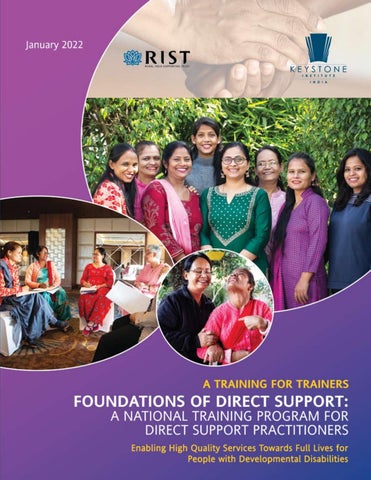
Foundations of Direct Support: A National Training Program for Direct Support Practitioners Training for Trainers
Trainer’s Manual Edition 1 January, 2022
Keystone Institute India
B-6/22, First Floor, Safdarjung Enclave New Delhi – 110029 Tel: 011 49053451/52 | www.keystonehumanservices.org
Table of
CONTENTS I.
Welcome Letter
v
II. Acknowledgements
vi
III. Schedule
vii
IV. Course Overview
1
V.
5
KII Mentorship
VI. Training Resources
9
VII.
Modules
Module 1: A Deeper Look at Disability
15
Module 2: Understanding Direct Support Services
63
Module 3: Code of Values & Ethics
75
Module 4: Person-Centred Thinking
83
Module 5: Orientation to Social Role Valorization
103
Foundations of Direct Support: A National Training Program for Direct Support Practitioners iii
Dear participants, Welcome to Foundations of Direct Support: A National Training for Direct Support Practitioners, Training of Trainers. On behalf of Keystone Institute India, we would like to thank you for setting aside significant time and commitment to become master trainers of this rich and new development course to promote the competence of direct support practitioners across India. We realize that time away from typical responsibilities is a major investment of your time and energy, and we are glad that both you and your organization have committed to learning about and teaching Foundations of Direct Support for a new and respected profession within India, all working towards rich, full lives for people with intellectual and developmental disabilities. In keeping with our commitment to providing high-quality, value based training, Keystone Institute India brings to you a comprehensive training program that will create the first cadre of Master Trainers – YOU are one of them – and who will go on to develop highly competent and sensitive Direct Support Practitioners who can support and empower people with disabilities to lead rich, valued, and meaningful lives. We are fortunate to have excellent faculty who bring with them decades of experience both on the ground and in training for this course. Many of our faculty are content experts and leaders in this space and are passionate about implementing and training in best practices. We are also happy and honored that you have taken the time to invest in this rigorous and demanding training course, and we hope that you will leave this event with a passion and commitment to teach others and learn more. We are excited to partner with you and support your endeavours in enhancing the lives of the people you serve. Elizabeth Neuville and Leela Raj Keystone Institute India B-6/22, First Floor, Safdarjung Enclave New Delhi – 110029 Tel: 011 49053451/52
eneuville@khs.org lraj@khs.org
Acknowledgements
This course curriculum and content is a labour of love and intensive research. It brings together the ideas and voices of leading experts across the world including India. We are deeply appreciative to the primary designer and editor of these materials, Leela Raj, Project Leader at KII. Our heartfelt gratitude to content experts Aparna Das, Shampa Sengupta, Parul Kumtha, Nirupa Bhangar, and Milton Tyree and Darcy Elks in the USA. This crucial training would not have been possible without the critical insights and expert reviews from Betsy Neuville, Director, KII, Poonam Natarajan, Merry Barua, Nidhi Singhal, Neelam Sodhi, Geeta Mondol, and Joy Hopkins in Georgia, USA and to them we offer our heartfelt appreciation. Our sincere thanks to Nidhi Anand who made the materials come alive with powerful, visually appealing PowerPoint slide decks. And last but not the least, we offer our gratitude to all the individuals and organizations who willingly contributed their time and feedback in our pilot series the results of which are evident in this training. Finally, gratitude to the Rural India Supporting Trust, our partners in creating change across India in the lives of people with disability and their families. Please respect the work and do not copy or disseminate further. All materials herein are taught with permission from the developers.
vi Foundations of Direct Support: A National Training Program for Direct Support Practitioners
SCHEDULE PHASE 1 Trainer Preparation DAY
TIME
ACTIVITY
9.00 AM – 11.00 AM
Welcome & Opening
DAY 1 20 January 2022
Module 1, Section 1 Module 1, Section 2 11.00 AM – 05.00 PM
Participants to review any or all of the prerecorded presentation videos of Module 1 and/or Module 2
05.00 PM – 06.00 PM
Open House: Wrap up to Day 1
9.00 AM – 11.00 AM
Welcome to Day 2
DAY 2 21 January 2022
Open House Module 3 11.00 AM – 05.00 PM
Participants to review any or all of the prerecorded presentation videos of Modules 3, 4 and/or 5
05.00 – 06.00 PM
Open House: Wrap up to Day 2
9.00 AM – 12.00 PM
Open House
DAY 3 22 January 2022
Trainer Formation and Preparation Phase 1 Closing
Foundations of Direct Support: A National Training Program for Direct Support Practitioners vii
List of Presentation Videos Video Demo Name
1.
Course Welcome and Introductory Remarks
Demo Presenter
Length of Video
Link
Betsy
10 minutes
https://youtu.be/14DGDg58i5w
2. A Deeper Look at Disability: Disability is Natural
Betsy
14 minutes
https://youtu.be/VpeXWMYAlLM
3. A Deeper Look at Disability: Myths and Facts about Disability
Leela
16 minutes
4. A Deeper Look at Disability: Models of Disability
Betsy
22 minutes
https://youtu.be/K_37qLdzmBc
5. A Deeper Look at Disability: An Overview of Developmental Disabilities
Leela
41 minutes
https://youtu.be/dX6sBYXUIvY
6. Understanding Direct Support Services
Betsy
34 minutes
https://youtu.be/mTLYfPynagE
7. Code of Ethics
Leela
18 minutes
https://youtu.be/4J_TFCG8gVg
8. Person-Centred Thinking
Betsy
41 minutes
https://youtu.be/5XkCKDoLpwE
9. The Basics of Social Role Valorization
Betsy
67 minutes
https://youtu.be/EUE5zBzH_OY
https://youtu.be/DJ5YdqUeH70
Course Overview
...People learn very quickly when they have a need for the skills and information. If it will change their lives, if it will help them accomplish what is important to them, everyone can become a good learner. We learn complex competencies and knowledge in a matter of weeks, not months or years. And people learn best in community, when they are engaged with one another, when everyone is both student and teacher, expert and apprentice, in a rich exchange of experiences and learnings. - Margaret Wheatley
Foundations of Direct Support: A National Training Program for Direct Support Practitioners 1
Course Overview Purpose of Course The Foundations of Direct Support: A National Training Program for Direct Support Practitioners is a Training Course for Trainers. This course seeks to create a powerful cadre of Master Trainers who will contribute to realizing our shared vision of developing a highly competent professional workforce of Direct Support Practitioners (DSP). The overarching goal of this course is to create a respected and valued profession of direct support service in India. Grounded on principles of person-centred approaches and Social Role Valorization, this comprehensive training program seeks to develop a professional community of Direct Support Practitioners that is not just sensitive and caring but is also competent and ethical – a trained workforce of professionals who work alongside people with intellectual and developmental disabilities to support and empower them to live rich, full, and meaningful lives.
Trainer Qualifications Experience in providing training programs to staff and/or families Commitment to inclusive practices Excellent English proficiency
Use of the Course Materials These course materials may be used by persons approved by Keystone Institute India (KII) who have been duly trained. Brief Course Reports will be submitted by trainers after any modules are taught so their use can be tracked. Periodic revisions to the course materials will be made by KII and circulated to approved trainers. The course is recommended to be taught with the modules in sequence. Part 1 (Modules 1-5) should be taught in its entirety and in sequence. Part 2 (Module 6-14) may be taught in sections and in a flexible sequence, although Trainers are encouraged to use the recommended sequence. Trainers may personalize the materials in minor ways such as adding trainer photographs, etc., especially in the opening and closing slide sets.
Foundations of Direct Support: A National Training Program for Direct Support Practitioners 3
All materials must remain with the KII and RIST logos and with full credit for development in the materials and in the participants manuals. Trainer materials and speaker notes must be protected and safeguarded – they may not be shared with others. KII will provide each trainer with participants manual samples in English. PowerPoint presentations will be available in Hindi, and a few other major languages this first year. Speaker notes are given as guidelines - trainers may adapt them to suit their own style.
Modules, Sections and Approximate Duration MODULE
SECTION
DURATION (Hrs)
1. Disability is Natural
1.0
2. Myths & Facts
1.0
3. Models of Disability
1.0
** Disability Awareness & Sensitization Group Activities
1.0
4. Disabilities Overview
1.5
PHASE 1 1. A Deeper Look at Disability
2. Understanding Direct Support Services
2.0
3. Code of Values & Ethics
1.5
4. Person-Centred Thinking
1.5
5. Orientation to Social Role Valorization
1.5
PHASE 2 6. Promoting Health and Wellbeing 7. Positive Approaches to Challenging Behaviour 8. Community Membership 9. Family Collaboration 10. Promoting Competence 11. Sexual Wellbeing 12. Legal Framework 13. Advocacy and Activism 14. Taking Leadership
4 Foundations of Direct Support: A National Training Program for Direct Support Practitioners
KII Mentorship
Community is much more than belonging to something; it’s about doing something together that makes belonging matter. - Brian Solis
KII MENTORSHIP KII Support for Trainers As with all our trainings, KII will provide ongoing support and guidance as you move ahead teaching and training promising and aspiring Direct Support Practitioners. Keystone Institute India will provide all materials, PowerPoints, speakers notes and trainer training for each module, downloadable and in print if needed Keystone Institute India will host an Online FDS Trainer’s Forum for the use of trainer communication, assistance, and networking KII is available to support individual trainers with planning and problem solving as needed via a helpline for FDS Trainers KII will periodically update and improve the materials based on Trainer experiences. A helpline for trainer support will be provided.
Foundations of Direct Support: A National Training Program for Direct Support Practitioners 7
- Jerry Kiracofe
Welcoming & Opening
TRAINING RESOURCES
To discover a new way of coming to know their clients as people, the participating staff must be introduced to a tool that is grounded in the values, beliefs and assumptions of typical citizenship and community.
Foundations of Direct Support EĂƚŝŽŶĂů WƌŽĨĞƐƐŝŽŶĂů dƌĂŝŶŝŶŐ WƌŽŐƌĂŵ ĨŽƌ ƚŚŽƐĞ ǁŽƌŬŝŶŐ ĚŝƌĞĐƚůLJ ǁŝƚŚ ƉĞŽƉůĞ ǁŝƚŚ ŝŶƚĞůůĞĐƚƵĂů ĂŶĚ ĚĞǀĞůŽƉŵĞŶƚĂů ĚŝƐĂďŝůŝƚŝĞƐ
Foundations of Direct Support: A National Training Program for Direct Support Practitioners 11
About the Trainers
12 Foundations of Direct Support: A National Training Program for Direct Support Practitioners
Pathway to Effective Direct Support Practice
Knowledge & Skill Development Promoting Health & Wellbeing Positive Approaches to Challenging Behaviour Community Membership Family Collaborations and Individual Voices
Laying the Foundation
Promoting Competence Sexual Wellbeing
A Deeper Look at Disability
Legal Framework
Understanding Direct Support Services
Advocacy and Activism
Code of Values & Ethics
Taking Leadership
Wrap Up & Certification
Person-Centered Thinking An Orientation to Social Role Valorization
Foundations of Direct Support: A National Training Program for Direct Support Practitioners 13
14 Foundations of Direct Support: A National Training Program for Direct Support Practitioners
Disability is a matter of perception. If you can do just one thing well, you’re needed by someone. - Martina Navratilova
MODULES
Module 1: A Deeper Look at Disability
WĂƌƚ ϭ͗ ŝƐĂďŝůŝƚLJ ŝƐ EĂƚƵƌĂů
Module 1: A Deeper Look at Disability
WĂƌƚ Ϯ͗ DLJƚŚƐ ĂŶĚ &ĂĐƚƐ ĂďŽƵƚ ŝƐĂďŝůŝƚLJ WĂƌƚ ϯ͗ DŽĚĞůƐ ŽĨ ŝƐĂďŝůŝƚLJ WĂƌƚ ϰ͗ Ŷ ŽǀĞƌǀŝĞǁ ŽĨ ĚĞǀĞůŽƉŵĞŶƚĂů ĚŝƐĂďŝůŝƚŝĞƐ
Foundations of Direct Support: A National Training Program for Direct Support Practitioners 17
A Simple Fact
18 Foundations of Direct Support: A National Training Program for Direct Support Practitioners
Foundations of Direct Support: A National Training Program for Direct Support Practitioners 19
20 Foundations of Direct Support: A National Training Program for Direct Support Practitioners
People to walk beside you…
Foundations of Direct Support: A National Training Program for Direct Support Practitioners 21
• dŽ ĐĂƌĞ ĂďŽƵƚ LJŽƵƌ ĨƵƚƵƌĞ • dŽ ŽƉĞŶ ƐŽŵĞ ĚŽŽƌƐ • dŽ ĂƉƉƌĞĐŝĂƚĞ LJŽƵƌ ŐŝĨƚƐ
22 Foundations of Direct Support: A National Training Program for Direct Support Practitioners
Go Deeper: A Dialogue Session • /Ŷ YƵĂƌƚĞƚ 'ƌŽƵƉƐ
͞dŚŝŶŬ ŽĨ Ă ƚŝŵĞ ǁŚĞŶ LJŽƵ ŵĞƚ ƐŽŵĞŽŶĞ ǁŝƚŚ Ă ĚŝƐĂďŝůŝƚLJ ʹ ǁŚĂƚ ĚŝĚ LJŽƵ ƚŚŝŶŬ͍ ,Žǁ ĚŝĚ LJŽƵ ƌĞĂĐƚ͍ tŽƵůĚ LJŽƵ ůŝŬĞ ƚŽ ŚĂǀĞ ƌĞĂĐƚĞĚ ĚŝĨĨĞƌĞŶƚůLJ ĂŶĚ ŚŽǁ͍͟ • &ŝƌƐƚ ƉƉŽŝŶƚ Ă 'ƌŽƵƉ >ĞĂĚĞƌ
Your Task zŽƵƌ ŐƌŽƵƉ ůĞĂĚĞƌ ĂůůŽǁƐ LJŽƵ Ă ĨĞǁ ŵŝŶƵƚĞƐ ƚŽ ƌĞĨůĞĐƚ ŽŶ ƚŚĞ ƋƵĞƐƚŝŽŶ͕ ĂŶĚ ĞĂĐŚ ŐƌŽƵƉ ŵĞŵďĞƌƐ ƐŚĂƌĞƐ ƚŚĞŝƌ ƚŚŽƵŐŚƚƐ͘ dŚĞ ŐƌŽƵƉ ƚŚĞŶ ĚŝƐĐƵƐƐĞƐ ĂŶĚ ĚĞĐŝĚĞƐ ŽŶ KE /E^/',d ƚŚĞLJ ŚĂǀĞ ŐĂŝŶĞĚ ĨƌŽŵ ƚŚĞŝƌ ĐŽŶǀĞƌƐĂƚŝŽŶ͘ hƐŝŶŐ ǁĂůů͕ ƉůĞĂƐĞ ǁƌŝƚĞ ;Žƌ ĚƌĂǁ͊Ϳ LJŽƵƌ ŐƌŽƵƉ ŝŶƐŝŐŚƚ
Foundations of Direct Support: A National Training Program for Direct Support Practitioners 23
dƌĂĐŬ ƚŝŵĞ
The Role of Group Leader
ůů sŽŝĐĞƐ ĂƌĞ ,ĞĂƌĚ KƌŐĂŶŝnjĞ ƚŚĞ 'ƌŽƵƉ ƚŽ ŽŵƉůĞƚĞ ƚŚĞ dĂƐŬ
24 Foundations of Direct Support: A National Training Program for Direct Support Practitioners
Section 2: Myths and Facts
Foundations of Direct Support: A National Training Program for Direct Support Practitioners 25
Myth or Fact? Disability does not define the identity of the person. Fact Disability does not define the identity of the person. Disability is just one aspect of the person.
Myth or Fact? Non-disabled people are obligated to “take care of” people with disabilities.
Myth People may offer assistance to whomever they choose, but most people with disabilities prefer to be responsible for themselves.
26 Foundations of Direct Support: A National Training Program for Direct Support Practitioners
Myth or Fact? Wheelchair use is confining; people who use wheelchairs are “wheelchair-bound.”
Myth
A wheelchair, like a bicycle or an automobile, is a personal assistive device that enables someone to get around.
Myth or Fact?
People with disabilities are more comfortable with “their own kind.”
Myth People with disabilities like anyone else are most comfortable with people they like and enjoy spending time with.
Foundations of Direct Support: A National Training Program for Direct Support Practitioners 27
Myth or Fact? People with disabilities are less likely to have accidents than other employees Fact Studies find that workers with disabilities perform significantly higher than their counterparts without disabilities in the area of safety.
Myth or Fact?
Curious children should never stare at or ask people about their disabilities.
Myth Many children have a natural, uninhibited curiosity and may stare or ask questions that some adults consider embarrassing. But scolding curious children may make them think having a disability is “wrong” or “bad”.
28 Foundations of Direct Support: A National Training Program for Direct Support Practitioners
Myth or Fact? People with disabilities live totally different lives from people without disabilities.
Myth
People with disabilities are people first – they have the same needs, dreams, hopes, and desires like everyone else.
Myth or Fact? Most people with disabilities cannot have sexual relationships.
Myth
People with disabilities, like other people, are sexual beings.
Foundations of Direct Support: A National Training Program for Direct Support Practitioners 29
Myth or Fact? People with disabilities deserve pity.
Myth! People with disability do not suffer because of their disability. Having a disability does not automatically mean a poor quality of life.
Myth or Fact?
People with disabilities can lead a productive and a fulfilling life.
Fact! People with disabilities are capable of participating fully in community life just like their peers without disabilities. The challenge is to focus on their abilities not on their limitations.
30 Foundations of Direct Support: A National Training Program for Direct Support Practitioners
Myth or Fact?
People with disability are sick and in constant pain.
Myth! People with disabilities are like people without disabilities – they get sick on occasion or sometimes may be in pain.
Myth or Fact? Some disabilities may not be visible.
Fact Not every disability is physical or can be easily seen.
Foundations of Direct Support: A National Training Program for Direct Support Practitioners 31
32 Foundations of Direct Support: A National Training Program for Direct Support Practitioners
Purposes
Provide cause and responsibility explanations
Guide the formulation and implementation of policy
Determine which academic disciplines study and teach the disability experience
Capacity to shape the selfidentity of PWDs
03
02
Provides definitions of disability
01
04
05 06
07
Influence professional practice
Powerful influence on public perception
The Moral/Religious Model
• • • •
Đƚ ŽĨ 'ŽĚ ŽŶƐĞƋƵĞŶĐĞ ŽĨ ĂĐƚƐ dĞƐƚ ŽĨ ĨĂŝƚŚ ZĞĚĞŵƉƚŝŽŶ
Foundations of Direct Support: A National Training Program for Direct Support Practitioners 33
IUUUU G G G G G G G G G G G G G G G G G G G G G UUUUUU G G G G G G G G G T G UI - Henderson & Bryan, 2011
ˈp G G G G G G Gn G G G G G G G G G G G G G G G SG SG G UIG - Niemann, 2005
The Medical Model • DĞĚŝĐĂů ƉƌŽďůĞŵͬĚŝĂŐŶŽƐŝƐ • ďŶŽƌŵĂůͬƉĂƚŚŽůŽŐŝĐĂů • 'ŽĂů ƚŽ ĐƵƌĞ • ZŽůĞ ŽĨ ƉĂƚŝĞŶƚͬĐůŝĞŶƚ
34 Foundations of Direct Support: A National Training Program for Direct Support Practitioners
I{ G G G G G G G G G G G G G G G T G G GN NG G G G G G UIG - Johnstone, 2012
ˈh G G G G G G G G SG G G G G SG G SG UIGG - Carlson, 2010
The Charity Model • sŝĐƚŝŵƐ ŽĨ ĐŝƌĐƵŵƐƚĂŶĐĞƐ • KďũĞĐƚƐ ŽĨ ƉŝƚLJ • ƐƐŝƐƚĂŶĐĞ ĨƌŽŵ ĂďůĞͲďŽĚŝĞĚ • ^ƉĞĐŝĂů ƐĞƌǀŝĐĞƐ
Foundations of Direct Support: A National Training Program for Direct Support Practitioners 35
I{ Gj Gt G G G G G G G G G UG{ G G G SG G G G UIG - Duyan, 2007
The Social Model • ^ŽĐŝĂů ĐŽŶƐƚƌƵĐƚ • ^ŽĐŝĂů ĂƐƉĞĐƚƐ ŽĨ ĚŝƐĂďŝůŝƚLJ • /ŵƉĂŝƌŵĞŶƚ ǀƐ ĚŝƐĂďŝůŝƚLJ • ^ƚƌŽŶŐ ŝŶĨůƵĞŶĐĞ ŽŶ ĐƵƌƌĞŶƚ ƐŽĐŝĂů ƉŽůŝĐŝĞƐ
36 Foundations of Direct Support: A National Training Program for Direct Support Practitioners
ˈ k G G G SG G G G SG G G G G SGO PG G G G G G G SG G G G G G G SG O PG G G G SG G G G G G G SG G G G G G SG GO PG G SG G G G G G G G G G G G G G G G G Uˉ
ˈ k G G G G G ˈ ˉG G G G G G G G G G G G ˅ G G G Uˉ - Purtell, 2013
- Fundamental Principles of Disability, UPIAS, 1976
The Human Rights Model
Foundations of Direct Support: A National Training Program for Direct Support Practitioners 37
I{ G G G G G G G G G G G G G G SG G G G SG G G ˅ G G UGp G G G G G G G G G G V G SG G SG G G G˄ ˅G G G G G G UIG - Quinn & Degener, 2002
38 Foundations of Direct Support: A National Training Program for Direct Support Practitioners
The Power of Words & Respectful Language (Handout) Positive words
Negative words
Winner
Loser
Love
Hate
Pride
Shame
Fair
Unfair
Strength
Weakness
Enable
Disable
Allow
Restrict
Able
Unable
Unique
Handicapped
Choice
Forced
Possible
Impossible
Include
Exclude
Capable
Crippled
Potential
Confined
Support
Condemn
Talent
Deficit
Assist
Impair
Determined
Lazy
Empower
Control
Enduring
Suffering
Engage
Disengage
Accept
Reject
Befriend
Ignore
Embrace
Avoid
Care
Bother
Help
Dependent
Foundations of Direct Support: A National Training Program for Direct Support Practitioners 39
Words can make you feel a certain way. The words you use can affect how other people feel and how you act towards them. The positive words on this Worksheet can help you treat others in a more respectful way. YOU HAVE THE POWER TO CHOOSE HOW YOU USE WORDS. The words we use when talking to or describing others can be very powerful. Sometimes the negative words we use about disability causes us to see what the person cannot do before we see their abilities. For example, when you say handicapped, you automatically look at that individual’s challenges. Instead, say someone with a disability… See the PERSON before the disability. People with disabilities are people like everyone else. Disability is natural; it does not make a person less valuable to society. When we interact with people with disabilities we should focus on their unique personal characteristics instead of defining who they are based on their disability. Having a disability is not a “problem”, it is a natural part of life. The words we use have the power to build positive images about disability. Respectful language is important to everyone and especially so for people with disabilities as it conveys respect and acknowledgement that they are viewed as a person with his or her unique identity and an identity beyond the disability. The words we use to describe one another can have an enormous impact on the perceptions we and others have, how we treat one another, mutual expectations, and how welcome we make people feel. Here are a few guidelines that explain preferred terminology and offer suggestions for appropriate ways to describe people with disabilities. 1. Do not focus on a disability unless it is crucial to a situation. Avoid tear-jerking human interest stories about incurable diseases, congenital impairments, or severe injury. Focus instead on issues that affect the quality of life for those same persons, such as accessible transportation, housing, affordable health care, employment opportunities, and discrimination. 2. Do not portray successful people with disabilities as superhuman. Even though the public may admire super-achievers, portraying people with disabilities as superstars raises false expectations that all people with disabilities should achieve at this level. 3. Do not sensationalize a disability by saying afflicted with, crippled with, suffers from, victim of, and so on. Instead say person who has multiple sclerosis or man who had polio. 4. Do not use generic labels for disability groups, such as “the retarded,” “the deaf.” Emphasize people, not labels. Say “people with intellectual disabilities” or “people who are deaf”. 5. Put people first, not their disability. Say “woman with arthritis,” “children who are deaf,” “people with disabilities.” This puts the focus on the persons, not the particular functional limitation. Crippled, deformed, suffers from, victim of, the retarded, infirm, etc. are never acceptable under any circumstances. 6. Emphasize abilities, not limitations. For example, say: “uses a wheelchair/braces,” “walks with crutches,” rather than “confined to a wheelchair,” “wheelchair-bound” or “is crippled.” Similarly, do not use emotional descriptors such as “unfortunate,” “pitiful,” and so forth. 7. Do not imply disease when discussing disabilities that result from a prior disease episode. People who had polio and experience its aftereffects years later have a post polio disability. They are not currently experiencing the disease. Do not imply disease with people whose disability has resulted
40 Foundations of Direct Support: A National Training Program for Direct Support Practitioners
from anatomical or physiological damage (e.g., person with spina bifida or cerebral palsy). Reference to a disease associated with a disability is acceptable only with chronic diseases, such as arthritis, Parkinson’s disease, or multiple sclerosis. People with disabilities should never be referred to as “patients” or “cases” unless their relationship with their doctor is under discussion. 8. Promote that people with disabilities are active participants of society. We know that persons with disabilities interacting with non-disabled people in social and work environments help break down barriers and open lines of communications. 9. And last, but most importantly, respect the person’s preference in the way they are referred to or described.
Examples of Respectful Language (by Kathie Snow) SAY
INSTEAD OF
People with disabilities
The handicapped or disabled
He has a cognitive disability/intellectual disability
He’s mentally retarded
She has autism
She’s autistic
He has Down syndrome
He’s Down’s; a mongoloid
She has a learning disability
She’s learning disabled
He has a physical disability
He’s a quadriplegic/is crippled
She’s of short stature/she’s a little person
She’s a dwarf/midget
He has a mental health condition
He’s emotionally disturbed/mentally ill
She uses a wheelchair
She’s confined to/is wheelchair bound
He receives special ed services
He’s in special ed
She has a developmental delay
She’s developmentally delayed
Children without disabilities
Normal or healthy kids
Communicates with her eyes/devices/etc.
Is non-verbal
Congenital disability
Birth defect
Brain injury
Brain damaged
Accessible parking, hotel room, etc.
Handicapped parking, hotel room, etc.
She needs….or she uses…..
She has a problem with…. She has special needs
Foundations of Direct Support: A National Training Program for Direct Support Practitioners 41
Respectful Language Exercise Handout to be given to participants prior to this exercise.
HANDOUT (Power of words and Respectful language) Respectful Language Exercise Cut out the word pieces for each group yy Group 1: Jaspreet is a talented student who uses a wheelchair because she has paraplegia yy Group 2: Kishore has a learning disability which makes reading a challenge for him yy Group 3: Chandni assists her friend who has a visual impairment through the dark passage yy Group 4: Sarita has cerebral palsy and uses an electronic device to communicate yy Group 5: Harpreet has intellectual disability and needs help with daily living skills yy Group 6: Yami has ADHD which makes it difficult for her to concentrate in class Put the word pieces for each group into separate bags (e.g. Ziploc) and label the bags with group numbers Divide the participants into groups Instructions for students: yy Create sentences from the word pieces in the bag assigned to you yy There are no punctuation marks so it is your responsibility to put them in where required yy The sentences you create should NOT use negative words yy You may refer to the “Power of Words” handout you have received for help
Group 1 Best possible sentence: Jaspreet is a talented student who uses a wheelchair because she has paraplegia Jackie
is
a
talented
student
who
uses
a
wheelchair
because
she
has
paraplegia
handicapped
confined
is
crippled
restricted
lazy
loser
42 Foundations of Direct Support: A National Training Program for Direct Support Practitioners
Group 2 Best possible sentence: Kishore has a learning disability which makes reading a challenge Kiran
has
a
learning disability
which
makes
reading
a
challenge
for
him
is
disabled
weakness
impossible
students
ignore
him
reject
learning
Group 3 Best possible sentence: Chandni assists her friend who has a visual impairment through the dark passage Cathy
assists
Her
friend
who
has
a
visual
impairment
through
the
dark
passage
suffers
from
avoids
in
is
unable
to help
Group 4 Best possible sentence: Sarita has cerebral palsy and uses an electronic device to communicate Savita
has
cerebral palsy
and
uses
an
electronic
device
to
communicate
is
crippled
relies
on
is
restricted
using
is
a
loser
Group 5 Best possible sentence: Harpreet has intellectual disability and needs help with daily living skills Harpreet
has
intellectual
disability
and
needs
help
with
daily
living
skills
is
mentally
retarded
disabled
is
stupid
she
has
no friends
Group 6 Best possible sentence: Yami has ADHD which makes it difficult for her to concentrate in class Yami
has
ADHD
which
makes
it
difficult
for
her
to
concentrate
in
class
impossible
restricts
learning
is
a
weakness
handicap
Foundations of Direct Support: A National Training Program for Direct Support Practitioners 43
Activity (10 minutes) Break up the participant group into smaller groups of 4 each. Give each group a Respectful Sentence Activity word bag Explain the activity to the participants Give participants 5 minutes to create their “Respectful” sentence After each group has created their sentence, have a member from each group write their sentence on the board As a group, go over each sentence making corrections and revisions as necessary
Reflection (5 minutes) Have participants engage in discussion about the activity. Sample questions to ask: What was the experience like to create the sentence? Was it easy to separate the words that brought up positive images from the negative ones? Do you think you can practice Respectful Language when communicating with others?
44 Foundations of Direct Support: A National Training Program for Direct Support Practitioners
Disability Awareness & Sensitization Activities Autism & Attention Deficit/Hyperactivity Disorder This activity is designed to show how people with autism and/or ADHD are bothered by things most people don’t notice and in people with the latter affect their ability to concentrate. People with autism are often extra sensitive to noise, movement and even things like background noises most of us don’t notice. Remember, not everyone with autism or ADHD has these problems. Divide the class into groups of 5. Explain that they will each have a job to do. Go over their jobs and tell them they will start when you give the signal. One participant in each group will play the part of someone with autism. The other 4 people each have different jobs: Person #1 - You will play the part of a person with autism. Your job is to try and listen to what Person #5 is reading to you so you can take a test on the material. Try to ignore everyone else. Person #2 - Stand behind the participant playing the part of someone with autism. Rub the edge of an index card (or piece of cardboard) against the back of their neck. You do not need to rub hard, but keep doing it over and over. Person #3 - Grab a book (any book will do), lean close to Person #1 and read in a loud voice the entire time. Person #4 - Pat Person #1 on the head and shoulder the entire time. Person #5 - Using a normal voice, read a paragraph to Person #1 then ask them questions about what you read. Do NOT try to drown out the other noises. Have all the participants take a turn being Person #1 before you discuss it. How did it feel to have so much commotion going on? Did it make them want to scream or get away? Were they able to concentrate on the paragraph being read? What might have helped? Autism is a developmental disability that usually appears during the first three years of life. The cause is unknown. It affects how a person’s brain works, but not all people with autism are affected the same way.
Foundations of Direct Support: A National Training Program for Direct Support Practitioners 45
Intellectual Disability Activity 1 – Difficulty understanding Have 2 participants sit back to back. Give one participant a paper with an abstract shape on it (page 11 of Disability Awareness Packet). Without seeing each other, he/she must explain to the other participant how to draw the shape. Give the second participant a pencil and piece of paper. He/she must draw the shape following the first participant’s directions. What were the problems? What would have helped?
Activity 2 – How it feels Make a paper copy for each participant of the “German Test” on page 12 and “Test your awareness” on page 13 of the Disability Awareness Packet. Hand out the “German Test”. Tell them they have 5 minutes to read the paragraph and answer the questions. Tell them it is an easy test and all the answers are right there in the paragraph. When participants complain they can’t do it, tell them to “try harder”. As soon as the time is up, take up their papers. Hand out “Test Your Awareness.” Tell participants to follow the directions on the page. Tell them this test should be very easy because it is in English. When they are finished, have them raise their hands to show if they found 3 Fs. How many found 4 Fs? 5 Fs? Did anyone find more? The correct answer is 6. Most people miss the Fs in the word “OF”. This is because we pronounce this as “ov” so our brain skips right over this when we are looking for “f.” Discuss how it felt to be given a German test and told to “try harder.” Did that help them do it? How many people stopped trying when they saw what the test was? How did it feel to realize they didn’t count all the Fs? How did it feel to have your brain “trick” you on this test? How would it feel if this happened to you all the time, every day? When a person has an intellectual disability, it means that they learn slower. Because they learn more slowly, they don’t learn as much as other people might. There are over 200 known causes for intellectual disability. About one-third of the time, no one knows what caused it. Not everyone with an intellectual disability is alike. One person can have mild problems while another may have severe problems.
46 Foundations of Direct Support: A National Training Program for Direct Support Practitioners
Cerebral Palsy/Physical Disabilities Activity 1 – In a wheelchair Borrow a wheelchair from a disability agency or a hospital nearby. Have each participant take a turn sitting in the chair. Have them try different activities: Going from one part of the building to another, pushing the wheelchair with their hands Going through the lunch line Getting a book off the top shelf in the library Going to the bathroom Going through an outside door Being in a group where everyone else is standing up Discuss how being in the wheelchair felt. What would have made things better? Students in wheelchairs are often left out of games or PE or given the job of keeping score. Discuss how this would feel. What if you hate keeping score? No one likes to be treated as if they are helpless. If you see someone in a wheelchair, don’t just do things for them. Ask if they want help first.
Activity 2 – Using one hand Have participants try different activities using only one hand. Eating lunch Opening a jar that has a screw-on lid Playing catch Holding a stack of papers and handing out one at a time Going to the bathroom. Discuss the problems the participants had. What if they couldn’t use either hand? What problems would there be if they were in a wheelchair AND couldn’t use their hands?
Foundations of Direct Support: A National Training Program for Direct Support Practitioners 47
48 Foundations of Direct Support: A National Training Program for Direct Support Practitioners
Foundations of Direct Support: A National Training Program for Direct Support Practitioners 49
50 Foundations of Direct Support: A National Training Program for Direct Support Practitioners
Foundations of Direct Support: A National Training Program for Direct Support Practitioners 51
52 Foundations of Direct Support: A National Training Program for Direct Support Practitioners
Foundations of Direct Support: A National Training Program for Direct Support Practitioners 53
54 Foundations of Direct Support: A National Training Program for Direct Support Practitioners
Foundations of Direct Support: A National Training Program for Direct Support Practitioners 55
56 Foundations of Direct Support: A National Training Program for Direct Support Practitioners
Foundations of Direct Support: A National Training Program for Direct Support Practitioners 57
58 Foundations of Direct Support: A National Training Program for Direct Support Practitioners
Foundations of Direct Support: A National Training Program for Direct Support Practitioners 59
60 Foundations of Direct Support: A National Training Program for Direct Support Practitioners
Foundations of Direct Support: A National Training Program for Direct Support Practitioners 61
By empowerment I mean connecting with a community of peers and caregivers on a mutually respectful level, and fully participating in the decisions affecting one’s life. - David Fisher
Module 2: Understanding Direct Support Services
Foundations of Direct Support: A National Training Program for Direct Support Practitioners 65
66 Foundations of Direct Support: A National Training Program for Direct Support Practitioners
Foundations of Direct Support: A National Training Program for Direct Support Practitioners 67
68 Foundations of Direct Support: A National Training Program for Direct Support Practitioners
Foundations of Direct Support: A National Training Program for Direct Support Practitioners 69
70 Foundations of Direct Support: A National Training Program for Direct Support Practitioners
Foundations of Direct Support: A National Training Program for Direct Support Practitioners 71
72 Foundations of Direct Support: A National Training Program for Direct Support Practitioners
Foundations of Direct Support: A National Training Program for Direct Support Practitioners 73
74 Foundations of Direct Support: A National Training Program for Direct Support Practitioners
What you do makes a difference, and you have to decide what kind of difference you want to make. - Jane Goodall
Module 3: Code of Values & Ethics
CODE OF ETHICS
Foundations of Direct Support: A National Training Program for Direct Support Practitioners 77
78 Foundations of Direct Support: A National Training Program for Direct Support Practitioners
Foundations of Direct Support: A National Training Program for Direct Support Practitioners 79
80 Foundations of Direct Support: A National Training Program for Direct Support Practitioners
Foundations of Direct Support: A National Training Program for Direct Support Practitioners 81
82 Foundations of Direct Support: A National Training Program for Direct Support Practitioners
A person unaccustomed to sharing a dream needs a careful listener. A person whose dream calls for a change in his relationship with an important helper, needs respectful validation and the listener’s willingness to figure out a changing relationship. - John & Connie Lyle O’Brien
Module 4: Person-Centred Thinking
Person Centered Thinking & Planning
Foundations of Direct Support: A National Training Program for Direct Support Practitioners 85
PersonͲCentered Thinking can Guide Us… dŽǁĂƌĚƐ Ă ǀŝƐŝŽŶ ŽĨ Ă ĨƵůů ůŝĨĞ dŽǁĂƌĚƐ Ă ĐŽŵŵƵŶŝƚLJ ŽĨ ƐƵƉƉŽƌƚ ƚŽ ǁĂůŬ ĂůŽŶŐƐŝĚĞ ƉĞŽƉůĞ dŽǁĂƌĚƐ Ă ƐŽĐŝĞƚLJ ǁŚĞƌĞ ĞǀĞƌLJŽŶĞ͛Ɛ ŐŝĨƚƐ ĂƌĞ ǁĞůĐŽŵĞĚ ĂŶĚ ŽĨĨĞƌĞĚ dŽǁĂƌĚƐ ƚŚĞ ƐƚĞƉƐ ŶĞĞĚĞĚ ƚŽ ŚĞůƉ Ă ƉĞƌƐŽŶ ŵŽǀĞ ŝŶƚŽ ƚŚĞ ůŝĨĞ ƚŚĞLJ ĚĞƐŝƌĞ dŽǁĂƌĚƐ Ă ƉŽƐŝƚŝǀĞ ĂŶĚ ƉŽƐƐŝďůĞ ĨƵƚƵƌĞ ĨŽƌ ƐŽŵĞŽŶĞ ǁĞ ĐĂƌĞ ĂďŽƵƚ
86 Foundations of Direct Support: A National Training Program for Direct Support Practitioners
What is Typical? WƌŽŐƌĂŵƐ ĂŶĚ ƐĞƌǀŝĐĞƐ ĨŽƌ ƉĞŽƉůĞ ǁŝƚŚ ĚŝƐĂďŝůŝƚŝĞƐ ƚĞŶĚ ƚŽ ďĞ ĨŽĐƵƐĞĚ ŽŶ ƚŚĞŝƌ ƐLJƐƚĞŵ͙͘
Foundations of Direct Support: A National Training Program for Direct Support Practitioners 87
SystemͲCentered….. Tries to fit people into programs….
Programs often want to “service people”
88 Foundations of Direct Support: A National Training Program for Direct Support Practitioners
Foundations of Direct Support: A National Training Program for Direct Support Practitioners 89
90 Foundations of Direct Support: A National Training Program for Direct Support Practitioners
All Sorts of LABELS get applied….
Foundations of Direct Support: A National Training Program for Direct Support Practitioners 91
And the program sets about trying to fix the person….
Then and only then….
ĂŶ ƚŚĞ ƉĞƌƐŽŶ ũŽŝŶ ƌĞŐƵůĂƌ ĐŽŵŵƵŶŝƚLJ ůŝĨĞ͙͘͘
92 Foundations of Direct Support: A National Training Program for Direct Support Practitioners
Problems with program/system thinking
• DĂŶLJ ƉĞŽƉůĞ ŐĞƚ ƐƚƵĐŬ ĨŽƌĞǀĞƌ ŝŶ ƐĞŐƌĞŐĂƚĞĚ ƐĞƚƚŝŶŐƐ • WĞŽƉůĞ ŵŝƐƐ ŽƵƚ ŽŶ ůŝĨĞ ƚŽĚĂLJ ĂŶĚ ƚŽŵŽƌƌŽǁ • dŚĞ ƐĞƌǀŝĐĞ ƚĞŶĚƐ ƚŽ ƚƌLJ ƚŽ ŵĞĞƚ ŝƚƐ ŽǁŶ ŶĞĞĚƐ • WĞŽƉůĞ ŐĞƚ ƐĞĞŶ ĂƐ Ăůů ƚŚĞ ƐĂŵĞ • WĞŽƉůĞ ǁŚŽ ĚŽŶ͛ƚ ŐĞƚ ͞ĨŝdžĞĚ͟ ĨƌƵƐƚƌĂƚĞ ƉĞŽƉůĞ • dŚĞ ĐŽŵŵƵŶŝƚLJ ŵŝƐƐĞƐ ŽƵƚ ŽŶ ƉĞŽƉůĞ͛Ɛ ƚĂůĞŶƚƐ ĂŶĚ ĐĂƉĂĐŝƚŝĞƐ
Foundations of Direct Support: A National Training Program for Direct Support Practitioners 93
Person Centred Thinking takes a VERY DIFFERENT perspective…
94 Foundations of Direct Support: A National Training Program for Direct Support Practitioners
People Belong to Themselves…. …. Their Families … and their Communities….
ĞƚŚ DŽƵŶƚ͕ ϮϬϭϵ
Foundations of Direct Support: A National Training Program for Direct Support Practitioners 95
96 Foundations of Direct Support: A National Training Program for Direct Support Practitioners
“Important To” and “Important For” BETSY
“Important To” and “Important For”
/ŵƉŽƌƚĂŶƚ to DĞ͍ ϭ͘ >ŝǀŝŶŐ ŝŶ ƚŚĞ ĐŽƵŶƚƌLJƐŝĚĞ Ϯ͘ ,ĂǀŝŶŐ ƉĞƚ ĂŶŝŵĂůƐ ;ĚŽŐ ĐĂƚ͕ ĞƚĐͿ ϯ͘ dĂŬŝŶŐ ŽŶĞ ĨĂŵŝůLJ ƚƌŝƉ ĞǀĞƌLJ LJĞĂƌ ϰ͘ DŽƌŶŝŶŐ ƌŽƵƚŝŶĞ
/ŵƉŽƌƚĂŶƚ for DĞ͍ ϭ͘ ZĞƐŝƐƚ ŝŵƉƵůƐŝǀĞ ŝĚĞĂƐ Ϯ͘ ^ĂǀĞ ŵŽŶĞLJ ϯ͘ džĞƌĐŝƐĞ ϱ ƚŝŵĞƐ ǁĞĞŬůLJ ϰ͘ <ĞĞƉ ŝŶ ƚŽƵĐŚ ǁŝƚŚ ĞdžƚĞŶĚĞĚ ĨĂŵŝůLJ
/ŵƉŽƌƚĂŶƚ ƚŽ DĞ͍ ϭ͘ Ϯ͘ ϯ͘
/ŵƉŽƌƚĂŶƚ ĨŽƌ DĞ͍ ϭ͘ Ϯ͘ ϯ͘
Foundations of Direct Support: A National Training Program for Direct Support Practitioners 97
How about one person with a disability you work with?
/ŵƉŽƌƚĂŶƚ ƚŽ͗
/ŵƉŽƌƚĂŶƚ ĨŽƌ͗
98 Foundations of Direct Support: A National Training Program for Direct Support Practitioners
Ajit’s Strengths….
Foundations of Direct Support: A National Training Program for Direct Support Practitioners 99
How well do you know the person you support?
• dŚĞ ƉĞƌƐŽŶ͛Ɛ ͞ƐƚŽƌLJ͟ ĂŶĚ ůŝĨĞ ĞdžƉĞƌŝĞŶĐĞƐ • ĂƉĂĐŝƚŝĞƐ ĂŶĚ 'ŝĨƚƐ • ͞tŚĂƚ tŽƌŬƐ͟ ĂŶĚ ͞tŚĂƚ ŽĞƐŶ͛ƚ tŽƌŬ͟ ŝŶ ƚŚĞ ƉĞƌƐŽŶ͛Ɛ ůŝĨĞ • tŚĂƚ ƚŚĞ ƉĞƌƐŽŶ ŶĞĞĚƐ ƚŽ ďĞ ƐĂĨĞ ĂŶĚ ŚĞĂůƚŚLJ ʹ Ăƚ ŚĞƌ ďĞƐƚ • /ŶƚĞƌĞƐƚƐ ĂŶĚ ƉĂƐƐŝŽŶƐ • /ŵƉŽƌƚĂŶƚ ůŝĨĞ ŵŽŵĞŶƚƐ • ƌĞĂŵƐ ĂŶĚ ĞƐŝƌĞƐ
100 Foundations of Direct Support: A National Training Program for Direct Support Practitioners
“A personͲcentered plan can help those involved with the focus person see the total person, recognize his or her desires and interests, and discover completely new ways of thinking about the future of the person.” — ĞƚŚ DŽƵŶƚ Θ <ĂLJ ǁĞƌŶŝŬ͕ ϭϵϴϴ
Foundations of Direct Support: A National Training Program for Direct Support Practitioners 101
102 Foundations of Direct Support: A National Training Program for Direct Support Practitioners
If we have no peace, it is because we have forgotten that we belong to each other. - Mother Teresa
Module 5: Orientation to Social Role Valorization
Direct Support Professionals have a BIG impact • zŽƵ ŬŶŽǁ ƚŚĞ ƉĞŽƉůĞ LJŽƵ ƐĞƌǀĞ ĚŝĨĨĞƌĞŶƚůLJ ƚŚĂŶ ĂŶLJŽŶĞ ĞůƐĞ • zŽƵ ƐƉĞŶĚ Ă ŐƌĞĂƚ ĚĞĂů ŽĨ ƚŝŵĞ ǁŝƚŚ ƉĞŽƉůĞ ŝŶ ĞǀĞƌLJĚĂLJ ƐŝƚƵĂƚŝŽŶƐ • ,Žǁ LJŽƵ ŝŶƚĞƌĂĐƚ ǁŝƚŚ ƉĞŽƉůĞ ǁŝƚŚ ĚŝƐĂďŝůŝƚŝĞƐ ƚĞĂĐŚĞƐ ŽƚŚĞƌƐ
Foundations of Direct Support: A National Training Program for Direct Support Practitioners 105
Agenda WĂƌƚ ϭ KƵƌ 'ŽĂů͗ dŚĞ 'ŽŽĚ dŚŝŶŐƐ ŽĨ >ŝĨĞ WĂƌƚ Ϯ͗ tŚĂƚ ^ƚĂŶĚƐ ŝŶ ƚŚĞ tĂLJ͍ WĂƌƚ ϯ͗ ,Žǁ ĂŶ ŝƌĞĐƚ ^ƵƉƉŽƌƚ WƌĂĐƚŝƚŝŽŶĞƌƐ ,ĞůƉ͍
Our Goal: The Good Things of Life
106 Foundations of Direct Support: A National Training Program for Direct Support Practitioners
“What do you think are the “good things of life” that you think most people are hoping to gain?”
Foundations of Direct Support: A National Training Program for Direct Support Practitioners 107
What Stands in the Way? The problem is….. dŚĞƐĞ ŐŽŽĚ ƚŚŝŶŐƐ ŽĨ ůŝĨĞ ĂƌĞ ŽĨƚĞŶ EKd ĞĂƐŝůLJ ĂǀĂŝůĂďůĞ ƚŽ ƉĞŽƉůĞ ǁŝƚŚ ĚŝƐĂďŝůŝƚŝĞƐ ŝŶ ŵŽƐƚ ƐŽĐŝĞƚŝĞƐ͘
108 Foundations of Direct Support: A National Training Program for Direct Support Practitioners
Social Devaluation DĞĂŶƐ ƚŚĂƚ ƉĞŽƉůĞ ǁŝƚŚ ĚŝƐĂďŝůŝƚLJ ĂƌĞ ũƵĚŐĞĚ ĂƐ ďĞŝŶŐ ŽĨ ůĞƐƐ ǀĂůƵĞ ƚŚĂŶ ŽƚŚĞƌ ƉĞŽƉůĞ͙͘͘ hƐƵĂůůLJ ŽŶ ƚŚĞ ďĂƐŝƐ ŽĨ Ă ĐŚĂƌĂĐƚĞƌŝƐƚŝĐ ;ůŝŬĞ Ă ƉŚLJƐŝĐĂů ĚŝƐĂďŝůŝƚLJ͕ ĂŶ ŝŶƚĞůůĞĐƚƵĂů ĚŝƐĂďŝůŝƚLJ͕ ĂƵƚŝƐŵ͕ Ă ŵĞŶƚĂů ŝůůŶĞƐƐ͕ ƚŚĞ ĐŽůŽƌ ŽĨ ƚŚĞŝƌ ĐŽŵƉůĞdžŝŽŶ͕ ĞƚĐ͘Ϳ
The “Wounds” of Devaluation ϭ͘ WĞŽƉůĞ ŐĞƚ ĚĞĨŝŶĞĚ ďLJ ƚŚĞŝƌ ĚŝƐĂďŝůŝƚLJ
Foundations of Direct Support: A National Training Program for Direct Support Practitioners 109
110 Foundations of Direct Support: A National Training Program for Direct Support Practitioners
Foundations of Direct Support: A National Training Program for Direct Support Practitioners 111
What are some of the negative stereotypes you are aware of? dŚŽƐĞ ƉĞŽƉůĞ ǁŝƚŚ ĚŝƐĂďŝůŝƚŝĞƐ ĂƌĞ ͺͺͺͺͺͺͺͺͺͺͺͺͺ ͘
The “Eternal Child”
112 Foundations of Direct Support: A National Training Program for Direct Support Practitioners
Object of Pity
Foundations of Direct Support: A National Training Program for Direct Support Practitioners 113
Object of Ridicule
114 Foundations of Direct Support: A National Training Program for Direct Support Practitioners
Foundations of Direct Support: A National Training Program for Direct Support Practitioners 115
116 Foundations of Direct Support: A National Training Program for Direct Support Practitioners
And What ARE the Good Things of Life? ͞tŚĂƚ ĂƌĞ ƚŚĞ ƋƵĂůŝƚŝĞƐ ĂŶĚ ĐŚĂƌĂĐƚĞƌŝƐƚŝĐƐ ŽĨ Ă ŐŽŽĚ ůŝĨĞ͍͟ ͞tŚĂƚ ĚŽ LJŽƵ ƚŚŝŶŬ ĂƌĞ ƚŚĞ ͞ŐŽŽĚ ƚŚŝŶŐƐ ŽĨ ůŝĨĞ͟ ƚŚĂƚ ŵŽƐƚ ƉĞŽƉůĞ ĂƌĞ ŚŽƉŝŶŐ ƚŽ ŐĂŝŶ͍͟ ͞tŚĂƚ ĂƌĞ ƚŚĞ ŵŽƐƚ ŝŵƉŽƌƚĂŶƚ ͚ŐŽŽĚ ƚŚŝŶŐƐ͛ ŽĨ ůŝĨĞ ƚŚĂƚ LJŽƵ ĐŚĞƌŝƐŚ ĂŶĚ ŚŽůĚ ĚĞĂƌ͍͟ ͞ ƚ ƚŚĞ ĞŶĚ ŽĨ LJŽƵƌ ůŝĨĞ͕ ǁŚĂƚ ĚŽ LJŽƵ ƚŚŝŶŬ ƚŚĂƚ LJŽƵ ǁŽƵůĚ ůŝŬĞ ƚŽ ƐĂLJ LJŽƵ ŚĂǀĞ ĂĐĐŽŵƉůŝƐŚĞĚ ĂŶĚ ĞdžƉĞƌŝĞŶĐĞĚ͍͟ ͞tŚĂƚ ĚŽ LJŽƵ ůŽǀĞ ĂďŽƵƚ LJŽƵƌ ůŝĨĞ͍͟
Foundations of Direct Support: A National Training Program for Direct Support Practitioners 117
Opportunities
Financial Stability
Freely- Given Friendships
A Good Reputation
A Robust Self-Image
The Good Things of Life
Personal Growth and Learning
Belonging and Acceptance A Rich, Full Lifestyle
Valued Social Roles
EMPLOYEE
118 Foundations of Direct Support: A National Training Program for Direct Support Practitioners
Money/Benefits Opportunities
EMPLOYEE
Friends and Colleagues Reputation and SelfImage Belonging Personal Growth
Foundations of Direct Support: A National Training Program for Direct Support Practitioners 119
Going Swimming
120 Foundations of Direct Support: A National Training Program for Direct Support Practitioners
But being a SWIMMER is a Social Role
Foundations of Direct Support: A National Training Program for Direct Support Practitioners 121
,Žǁ ĂŶ ŝƌĞĐƚ ^ƵƉƉŽƌƚ WƌĂĐƚŝƚŝŽŶĞƌƐ ,ĞůƉ͍
Think AgeͲAppropriate! • dŚŝŶŬ ŽĨ ƌŽůĞƐ ƚŚĂƚ ĞŶŚĂŶĐĞ ƚŚĞ ƉĞƌƐŽŶ͛Ɛ '
122 Foundations of Direct Support: A National Training Program for Direct Support Practitioners
An Adult Artist
Foundations of Direct Support: A National Training Program for Direct Support Practitioners 123
Small Groupings are generally better
124 Foundations of Direct Support: A National Training Program for Direct Support Practitioners
tŚŽ DŝŐŚƚ ŚĂǁŶĂ ĞĐŽŵĞ͍
tŚĂƚ ƌŽůĞƐ ŵŝŐŚƚ ŚĂǁŶĂ ƚƌLJ ŽƵƚ ĂŶĚ Kh> ďĞ Ă ŐŽŽĚ Ĩŝƚ͍ &ƌŝĞŶĚͬ ĞƐƚ ĨƌŝĞŶĚͬƐŝƐƚĞƌ ŽůůĞŐĞ ^ƚƵĚĞŶƚ ,ŽƐƚĞƐƐ WĂƌƚLJͲŐŽĞƌ ΎΎ ^ŚŽƉƉĞƌ ^ƚŝƚĐŚĞƌ ΎΎ dƌĂǀĞůĞƌ DĞŵďĞƌ ŽĨ Ă ͞ĨƌŝĞŶĚ ŐƌŽƵƉ͟ KƵƚĚŽŽƌƐƉĞƌƐŽŶ ΎΎ ,ŝŬĞƌ EĂƚƵƌĞ ůŽǀĞƌ ĂĐŬLJĂƌĚ ŐĂƌĚĞŶĞƌ ΎΎ &ĂƐŚŝŽŶŝƐƚĂ ĐƚŝǀŝƐƚ ĨŽƌ Ă ͞ĐĂƵƐĞ͟ ʹ ĞŶǀŝƌŽŶŵĞŶƚ͕ ƌŝŐŚƚƐ͕ ĞƚĐ͘ /ŶĚĞƉĞŶĚĞŶƚ ǁŽŵĂŶ 'ŝƌůĨƌŝĞŶĚͬƉĂƌƚŶĞƌ WƌŽƚĠŐĠ ZŽŽŵ ŵĂƚĞͬ,ŽƵƐĞŵĂƚĞ
DƵƐŝĐ ůŽǀĞƌ /ŶƐƚĂŐƌĂŵŵĞƌ ^ŽĐŝĂů DĞĚŝĂ ƵĨĨ ŵƉůŽLJĞĞ zŽƵŶŐ WƌŽĨĞƐƐŝŽŶĂů ŵĂƚĞƵƌ WŚŽƚŽŐƌĂƉŚĞƌ ΎΎ ĂŶŬ ĐĐŽƵŶƚ ,ŽůĚĞƌ ΎΎ ŽůůĞĐƚŽƌ ŶŝŵĂů ůŽǀĞƌ WĞƚ ŽǁŶĞƌ ĂŶĐĞƌͬĐůƵďďĞƌ ŽŶĐĞƌƚͲŐŽĞƌ ZƵŶŶĞƌ / zŽŐĂ WƌĂĐƚŝƚŝŽŶĞƌ ΎΎ DĞŵďĞƌ ŽĨ Ă ĨĂŝƚŚ ĐŽŵŵƵŶŝƚLJ ,ŝŶĚƵ ǁŽƌƐŚŝƉƉĞƌ dƌĂŝŶĞĞ sĂĐĂƚŝŽŶĞƌ ΎΎ WŝůŐƌŝŵĂŐĞƌ ĂLJ ƚƌŝƉƉĞƌ tŚĂƚƐ ƉƉĞƌ
Foundations of Direct Support: A National Training Program for Direct Support Practitioners 125
Help People Look their Best
126 Foundations of Direct Support: A National Training Program for Direct Support Practitioners
Opportunities
Financial Stability
Freely- Given Friendships
A Good Reputation
A Robust Self-Image
The Good Things of Life
Personal Growth and Learning
Belonging and Acceptance A Rich, Full Lifestyle
Valued Social Roles
Foundations of Direct Support: A National Training Program for Direct Support Practitioners 127
128 Foundations of Direct Support: A National Training Program for Direct Support Practitioners
Keystone Institute India
B-6/22, First Floor, Safdarjung Enclave New Delhi – 110029 Tel: 011 49053451/52 | www.keystonehumanservices.org