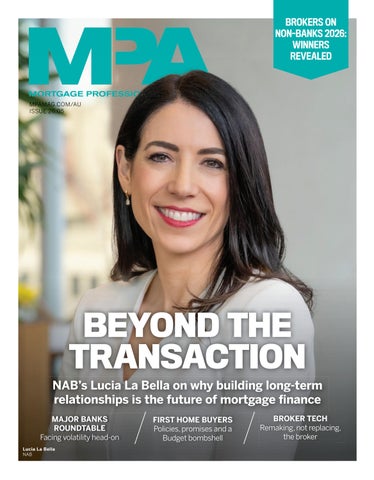
BROKERS ON NON-BANKS 2026: WINNERS REVEALED
MPAMAG.COM/AU ISSUE 26.05
BEYOND THE TRANSACTION NAB’s Lucia La Bella on why building long-term relationships is the future of mortgage finance MAJOR BANKS ROUNDTABLE Facing volatility head-on
FIRST HOME BUYERS Policies, promises and a Budget bombshell
BROKER TECH Remaking, not replacing, the broker
Lucia La Bella NAB
00-OFC_SUBBED.indd 2
10/8/2026 7:15:55 AM
The new ANZ Broker Portal A better way to broker Manage your home loan portfolio Visibility of all your settled loans in one place.
Track your applications See updates as they happen, meaning fewer follow ups and more certainty.
Keep your information secure Multi-factor authentication and designated support staff access.
To find out more, visit anz.com/broker or talk to your ANZ Residential Broker Manager.
ANZ and Brokers. Working better together.
anz.com/broker Accessible for eligible users in accordance with the ANZ Broker Portal Terms of Use. Australian credit licence 234527.
01-IFC_Contents_SUBBED V2.indd 1
10/7/2026 11:52:30 AM
OCTOBER 2026
CONNECT WITH US
CONTENTS
Got a story or suggestion, or just want to find out some more information? x.com/MPAMagazineAU facebook.com/Mortgage ProfessionalAU
UPFRONT 02 Editorial
Why a broking shakeout will bear fruit
32 FEATURES
MAJOR BANKS ROUNDTABLE
12
Facing a turbulent year head-on
04 Statistics
A snapshot of recent market highs and lows
06 Opinion
Opportunity hasn’t disappeared, it’s shifted, says Liberty’s David Smith
FEATURES 48 Self-employed lending
Understanding the power of storytelling
54 First home buyers
Policies, promises and a Budget bombshell
PEOPLE 70 Brokerage insight
SPECIAL REPORT
BROKERS ON NON-BANKS Rewarding growth in a cooling market
62
Janine Wade on building Ikaya piece by peace
72 Other life
Nurse-broker Ronald Gatbonton’s remarkable dual career
FEATURES
BIG INTERVIEW
TRANSFORMATION
NAB’S LUCIA LA BELLA
CommBank is building tech for the 81%
Why lasting relationships are shaping the future of mortgage finance
08
66 FEATURES
FLEXIBLE LENDING
Pallas Capital on the ‘missing middle’ reshaping property finance
MPAMAG.COM/AU NOW ONLINE: Our daily newsletter. Keep on top of property market trends, business strategy, and what industry leaders have to say.
www.mpamag.com/au
01-IFC_Contents_SUBBED V2.indd 1
1
10/8/2026 9:10:21 AM
UPFRONT
EDITOR’S LETTER www.mpamag.com/au OCTOBER 2026
Shake it out
O
“
nly when the tide goes out do you discover who’s been swimming naked,” so goes the classic Warren Buffet phrase. If the Oracle of Omaha has any desire to see what an unclothed mortgage broker looks like, he’d do well to visit Australia over the coming 12 months, for rarely has the broking industry carried more players scrambling for a smaller piece of the pie. Fresh MFAA data shows a walloping 24,000 registered brokers in Australia, or one for every 904 adults, among the highest ratios of brokers to the general population in the world. Mortgage brokers in Australia settled a record 81.6% of every new home loan written nationally in the June 2026 quarter – about as much of the market as the channel can realistically take. Yet the pipeline they’re competing over is contracting. The Australian Bureau of Statistics recorded a 5.4% fall in new dwelling loan commitments, to 134,225, in the June 2026 quarter. Since May’s federal Budget flagged the end of tax concessions for property investors, the majors have reported sharper drops still: Westpac a 20% decline in applications and NAB and CBA each around 15%. Put simply, the arithmetic is getting uncomfortable, uncomfortably fast. The conversations I’ve had with brokers this winter carry the same undertone – too many operators for the amount of deals out there, and a growing sense the market can’t sustain everyone who piled in during the boom years.
Fewer brokers writing more considered, better-serviced loans beats a crowded field competing on volume alone. If the shakeout comes, the ones who survive it will be the ones the industry actually needed all along But that’s not a crisis – it’s overdue. The brokers who have built genuine expertise, who understand credit policy across a dozen lenders rather than three, who can guide clients through the bad times as well as the good times, who have formed trusted partnerships with their clients, will keep winning business regardless of which way the tide is turning. It’s the ones who rode easy growth without building that depth who’ll feel the squeeze first. A smaller, sharper broker market will be a healthier one. Fewer brokers writing more considered, better-serviced loans beats a crowded field competing on volume alone. If the shakeout comes, the ones who survive it will be the ones the industry actually needed all along.
EDITORIAL Editor William Farrington Writers Kim Champion, Mina Martin, Bennett Richardson, William Farrington Contributor David Smith Lead Production Editor Karen Atienza
ART & PRODUCTION Designer Cess Rodriguez APAC Project Management Lead Shara Vargas
SALES & MARKETING Publisher Claire Tan
CORPORATE Chief Executive Officer Mike Shipley Chief Operating Officer George Walmsley Chief Commercial Officer Justin Kennedy Chief Revenue Officer Dane Taylor Chief Human Resources Officer Julia Bookallil
2
tel: +612 8437 4711 william.farrington@keymedia.com
$
B
A A
SUBSCRIPTION ENQUIRIES
tel: +61 2 8311 5831 • fax: +61 2 8437 4753 subscriptions@keymedia.com.au
ADVERTISING ENQUIRIES claire.tan@keymedia.com
KM Business Information Australia Pty Ltd tel: +61 2 8437 4700 • fax: +61 2 9439 4599 www.keymedia.com Australia, Canada, USA, UK, NZ and Asia
Mortgage Professional Australia is part of an international family of B2B publications and websites for the mortgage industry AUSTRALIAN BROKER
simon.kerslake@keymedia.com T +61 2 8437 4786
NZ ADVISER
alex.knowles@keymedia.com T +64 9 200 1319
CANADIAN MORTGAGE PROFESSIONAL shane.lakhani@keymedia.com T +1 720-441-2255
MORTGAGE PROFESSIONAL AMERICA charles.weed@keymedia.com T +1 720-441-2255
MORTGAGE INTRODUCER (UK)
Copyright is reserved throughout. No part of this publication can be reproduced in whole or part without the express permission of the editor. Contributions are invited, but copies of work should be kept, as the magazine can accept no responsibility for loss.
www.mpamag.com/au
02-03_Editorial_SUBBED_V2.indd 2
S
I
EDITORIAL ENQUIRIES
matt.bond@keymedia.com T +44 203 868 3406
William Farrington, editor, MPA
S
10/8/2026 9:12:32 AM
J s w $ d
SFG
Stability. Scale. Long-Term Partnership.
$1
BILLION IN LOAN BOOK VALUE
A NEW 10-YEAR AGREEMENT WITH SFG. Jack Fouracre and Fouracre Financial have signed a new 10-year aggregation agreement with SFG. Their loan book recently reached $1 billion, and we’re proud to back their next decade of growth.
Looking for a Long-Term Aggregating Business Partner?
Scan to Join SFG 1300 303 382
specialistfinancegroup.com.au
Australian Credit Licence No. 387025
02-03_Editorial_SUBBED_V2.indd 3
10/7/2026 10:24:08 AM
UPFRONT
STATISTICS BROKER MARKET SHARE AT A GLANCE
AUSTRALIANS’ LIFE MILESTONE ASPIRATIONS AND TRADE-OFFS
62%
41%
81.6%
of new home loans facilitated by brokers in June 2026, a record
willing to delay milestones
hope to achieve lifestyle or retirement goals
73%
see home ownership as part of financial success
4
percentage point rise in broker market share over the year to June 2026
NATIONAL HOUSING DOWNTURN EXTENDS TO SIXTH MONTH Home prices fell 0.2% nationally in September and are now 3.3% below their March peak, with annual growth slowing to 0.1%. The combined capitals fell 0.3% over the month, while regional markets held steady and remain 5.1% higher than a year ago.
27.7
percentage point increase in broker market share over the past eight years
NATIONAL SNAPSHOT, SEPTEMBER 2026 Monthly home price growth
-0.2% $139.08bn
new home lending facilitated by brokers in the June quarter
Source: MFAA, 3 September 2026
4
Regional areas
0.0% +5.1%
monthly year-on-year
Annual home price growth
Capital cities
-0.3% +0.1% -1.6%
monthly
year-on-year
National median value
Change from March peak
$886,000
-3.3%
Source: realestate.com.au, Home Price Report, PropTrack Home Price Index, 1 October 2026
www.mpamag.com/au
04-05_Statistics_SUBBED_V3.indd 4
10/7/2026 9:35:51 AM
MORTGAGE DEMAND STAYS IN DECLINE
85%
Equifax data shows overall mortgage demand fell 14.1% year-on-year in August, marking a fifth straight month of decline. First home buyer demand dropped 20.1% – the largest annual decrease since 2022 – while credit card demand returned to growth at 2.9%.
say financial situation has some or strong influence on decisions
59%
AUSTRALIAN CREDIT DEMAND BY CATEGORY AUGUST 2026 (YoY)
expect to make significant sacrifices 5
+2.9% +1.3%
0
-0.8%
-5
54%
hope to achieve housing and financial security goals
AUSSIES STILL CHASING BIG GOALS
-10
-11.4% -14.1%
NGM Group’s Defining Moments research finds 73% of Australians see home ownership as part of financial success, though 59% expect to make significant sacrifices to get there and 62% are willing to delay milestones as long as they’re eventually achieved.
-15
-20
-20.1% Overall First home Investor Refinance Personal Credit card mortgage buyer mortgage switching loan demand demand mortgage demand (different demand demand (2+ mortgages) lender) Source: Equifax, 2026
Source: NGM Group, 2026
AUSTRALIANS OPEN TO AI-ASSISTED LENDING
RESALE PROFITABILITY EASES FROM RECORD HIGHS
New Experian research finds 59% of credit-active Australians would let an AI agent apply for a loan or credit card on their behalf, while 79% trust large language models to compare loans across providers.
Cotality’s Pain & Gain report shows 95.4% of home resales returned a profit in the June quarter, down from a 21-year high of 96.1% in the March quarter. The median gain slipped to $371,000 while median losses edged up to $45,000.
AI TRUST BY TASK TYPE Consumer attitude
RATE OF PROFIT AND LOSS % of respondents
Comfortable with AI agent compiling/searching for best offers
81%
Trust LLMs to compare loans across providers
79%
Comfortable with AI agent negotiating on their behalf
77%
Comfortable with AI agent completing identity checks
69%
Comfortable with AI agent accepting a loan offer based on pre-set criteria
68%
Comfortable with an AI agent applying for credit on their behalf
59%
Source: Experian in partnership with Forrester, AI in Risk: The Rise of Agentic Commerce, 2026
Profit-making resales rate
Loss-making resales rate
95.4%
4.6% Median returns
Median gain
Median loss
$371,000
$45,000 Source: Cotality, Housing resale profits retreat from record as downturn begins to bite, 16 September 2026
www.mpamag.com/au
04-05_Statistics_SUBBED_V3.indd 5
5
10/7/2026 6:31:03 PM
UPFRONT
OPINION
GOT AN OPINION THAT COUNTS? Email william.farrington@keymedia.com
The two advantages brokers already have Opportunity hasn’t disappeared, it has shifted, argues Liberty chief distribution officer David Smith THE CURRENT challenge for brokers isn’t a lack of opportunity. It’s recognising where activity remains strong and being prepared to act on it. While it’s easy to focus on changing conditions and policy shifts, the reality is that lending activity continues across many market segments. According to ABS data, in the quarter ending June 2026, there were 134,225 new home loans, valued at $97.6 billion. If customers are still seeking lending solutions, the question for brokers is where they focus
current and future lending strategies. However, activity continues in other areas of the market, creating opportunities for brokers willing to expand their knowledge and skill set. For example, commercial lending and commercial SMSF remain active areas of the market for brokers supporting business owners and self-managed super fund borrowers. Personal lending may also present opportunities to support customers with a broader range of financial needs. By building their knowledge and exploring specialisations to complement their existing
Now is a good time to strengthen referral networks, build future pipelines and have pre-approvals sorted ahead of time their attention and how they position themselves to support changing customer needs. For brokers looking to tap into active areas of the market, capabilities and resources available are already available that may not yet be fully utilised. Two strategies worth focusing on are expanding into new lending segments and making better use of existing relationships and referral networks.
A good time to upskill One way brokers can position themselves for success is by broadening their expertise beyond the segments they’ve traditionally worked in. Recent policy changes to residential SMSF lending, negative gearing and capital gains tax may prompt some borrowers to reassess their
6
offering, brokers can expand their range of solutions and be better placed to meet evolving customer needs. Some borrowers, including first home buyers, may be waiting for conditions to shift before moving ahead with a property purchase. That doesn’t mean brokers need to wait. Now is a good time to strengthen referral networks, build future pipelines and have preapprovals sorted ahead of time. When customers are ready to enter the market, brokers who have done the groundwork will be well positioned to support them.
focused on generating new business, leaving little time to focus on retention. In today’s market, some of the strongest opportunities may already exist within a broker’s customer base. Start by understanding where customers are now. Have their circumstances changed? Are they considering their next property purchase, looking to invest or seeking ways to improve their cash flow? Sometimes, a simple conversation is all it takes to uncover a new opportunity. Technology has also made it easier to stay connected. From CRM platforms to automated and AI-powered solutions, brokers now have access to tools that can help them engage with their customer base more efficiently and consistently. Reviewing existing relationships, reconnecting with past customers and strengthening referral networks can help create new opportunities without the need to start from scratch. In many cases, future business opportunities are already sitting within a broker’s existing network.
Supporting both strategies with flexible lending solutions As brokers expand into new lending segments and deepen relationships with existing customers, understanding non-bank lending can help them support a wider range of borrowers. As policies and market conditions evolve, non-bank lenders can offer greater flexibility in credit assessment and servicing. Regular engagement with BDMs and credit teams can help brokers build confidence in unfamiliar scenarios and identify more ways to meet customer needs. While market conditions continue to evolve, opportunity remains available to the brokers willing to adapt. Those who broaden their expertise, strengthen existing relationships and apply flexible lending solutions will be well placed to support customers and drive future growth.
Use the tools at your disposal While expanding into new lending segments can help uncover opportunities, it’s also important to look at what’s already available to you. Many brokers have spent the past few years
David Smith has been the chief distribution officer of non-bank lender Liberty since January 2024.
www.mpamag.com/au
06-07_Opinion_SUBBED_V2.indd 6
10/7/2026 8:05:34 AM
Unlocking more value for investors More ways to help your clients invest, with enhanced policy flexibility, reduced rental income shading and a lowered 5% deposit requirement for eligible investors.
Scan the QR code to find out more.
Conditions, credit criteria, eligibility, fees & charges apply. LVR up to 95% for new and existing Investment Property Loans Principal & Interest repayments with Lenders Mortgage Insurance. 15 years Interest Only term available for new and existing Investment Property Loans, up to 80% LVR. Investor Rental Income Shading 5%: Available for eligible new and existing investor home loan applications where verified rental income from investment properties is used to assess serviceability. “QR Code” is a registered trademark of Denso Wave Incorporated. © Westpac Banking Corporation ABN 33 007 457 141 AFSL and Australian credit licence 233714.
06-07_Opinion_SUBBED_V2.indd 7
10/7/2026 8:05:42 AM
PEOPLE
BIG INTERVIEW
WHAT MAKES A GREAT BROKER? THAT’S PERSONAL NAB’s Lucia La Bella on why lasting relationships – backed by the right banking partner – are shaping the future of mortgage finance ASK LUCIA LA BELLA what makes a great mortgage broker, and technical ability isn’t the first thing she mentions. Not because it doesn’t matter – for NAB’s executive general manager, specialised distribution, it’s a given. In La Bella’s view, what sets great brokers apart is something more personal: the relationships they build with their customers over time. “What increasingly sets great brokers apart is their ability to build strong relationships and develop a deep understanding of their customers,” she says in her first interview with MPA. “Brokers need to be able to think strategically and play the long game to do the right thing by the customer.” For many brokers, that’s already fundamental to how they work – understanding where a customer is today, how their circumstances may evolve and building relationships that can span different life stages and generations. As the intergenerational wealth transfer gathers pace, those long-term relationships are becoming even more valuable. “When brokers are there for the customer’s whole journey, they’re much more likely to build enduring relationships,” she says. In many ways, La Bella’s perspective on the broking industry mirrors how she leads her team at NAB. “My leadership style is collaborative, but accountability is important to me. “One of the biggest lessons I’ve learned is the
8
importance of listening deeply, whether that’s to customers, brokers or the people you lead. When people feel heard and understood, that’s what drives good outcomes.” Ten years at NAB – spanning business lending, commercial real estate, business and private banking, markets and premier banking,
Going deeper The long-term customer relationships La Bella describes are playing out against an increasingly complex financial backdrop. Customers are navigating decisions around buying a home, investing, building wealth and supporting the next generation – often at the same time.
“What increasingly sets great brokers apart is their ability to build strong relationships and develop a deep understanding of their customers” through to her current role leading specialised distribution – hasn’t shifted that philosophy one bit. And it’s a principle she believes applies just as much to bankers as it does to brokers: “Being willing to ask questions, verify information and understand what’s really happening in a customer’s circumstances… that’s all part of being a trusted adviser, being relationship led and being able to do that verification along the way.” Curiosity, in other words, matters on both sides of the table – broker and banker alike are ultimately working for the same customer – and it’s part of why La Bella has worked hard at building tight-knit relationships with NAB’s accredited brokers.
“At NAB, our focus is on the relationship and understanding what the customer is trying to achieve – not just the transaction in front of them,” says La Bella. “Their needs will change over time, whether that’s an investment property, building wealth or supporting kids into their next home, and we want to be able to bring in the right expertise at the right time. “That relationship-led approach aligns strongly with where we see the broker industry heading. Brokers know their customers and their ambitions, and we can work alongside them to support those broader needs as they emerge.” For eligible customers, that can include additional support through NAB Premier Banking,
www.mpamag.com/au
08-11_Big Interview_SUBBED_V2.indd 8
10/7/2026 9:08:08 AM
PROFILE Name: Lucia La Bella Role: Executive general manager, specialised distribution Years in the industry: 10 years Years at NAB: 10 years Team size: ~500 Expertise: Small business, chartered accounting, finance, property development, operations, sales distribution, transformation
www.mpamag.com/au
08-11_Big Interview_SUBBED_V2.indd 9
9
10/7/2026 9:08:22 AM
PEOPLE
BIG INTERVIEW helping NAB be a partner for what’s next as their broader banking needs evolve. “For customers who come to NAB through a broker, the broker-customer relationship remains critical,” says La Bella. “Premier provides an additional layer of support around the customer’s broader banking needs, while the broker continues to support their lending relationship.” Changing policy settings are one example of the complexity customers and brokers are navigating. La Bella points to the Budget’s changes to negative gearing and the capital gains tax (CGT) discount on property investors. “While the announcements are behind us, many people are still looking for clarity on what those changes mean in practice,” she says. “With investors reassessing how they enter the property market, they’re looking for information and greater clarity. That brings opportunities for brokers to provide information and education, and to connect customers with professionals like lawyers, accountants and financial planners.” The changes are also prompting some investors to look more broadly at their property options, including commercial property. “It’s important to remember that commer-
cial property is a different asset class to residential property,” she says. “Commercial property is driven by broad economic and business confidence, and employment growth. Residential property is driven more by population growth, housing supply and household demand.” Commercial property brings its own considerations, from the strength of the tenant and lease terms to the quality and sustainability of income. For La Bella, it’s another example of why understanding the customer’s circumstances – and knowing when to bring in additional expertise – matters.
Finding your niche For all the complexity in the market, La Bella’s outlook on the opportunities ahead for brokers comes back to the same principle: relationships. She points out that the market has moved dramatically in nine months alone – from 6–7% property growth at the start of the year to three rate rises and sweeping tax changes that have sent the market the other way since – and treats that volatility as the new normal rather than a crisis to manage around. She expects refinancing to become increas-
ingly important as the market changes, making regular customer check-ins even more valuable – whether a customer’s job or financial circumstances have changed, whether areas such as income protection insurance need to be considered, or whether there’s anything else they need support with. As buyers take longer to commit, La Bella’s advice for brokers isn’t about widening the net but homing in on what makes you unique. “I always encourage brokers to think about their niche. Who are the customers you really want to support and what are you passionate about?” “If you’re passionate about supporting young people on their wealth journey, maybe you’ll be on social media and finding your customer base there. If it’s more baby boomers, they might be at golf clubs and you’re playing golf. By identifying your niche, you’re going to connect with like-minded people and then you can do business that way.” To return to an earlier point, it’s “less about the transaction and more about building your customer base around things that are meaningful to you.”
HOW CHANGING MARKET CONDITIONS ARE SHAPING CUSTOMER CONVERSATIONS Negative gearing and CGT changes are leaving property investors seeking clarity
Changing circumstances reinforce the value of strong, ongoing broker-customer relationships
Growing customer interest in new-build rentvesting strategies
10
Brokers can play an important role in helping customers understand their options and connecting them with appropriate specialists Some investors are looking more broadly at commercial property
www.mpamag.com/au
08-11_Big Interview_SUBBED_V2.indd 10
10/7/2026 9:08:30 AM
Up to
$3K cashback on an eligible 1 ME home loan.
$3k cashback on $700k+ refinances from another lender (LVR ≤80%). $2k cashback on $400k+ LMI purchases and refinances (LVR >80% to 95%, LMI payable).
Want to know more? Talk to ME today! The legal stuff. 1. $3,000 cashback for eligible refinances from another lender (min $700k lending, LVR ≤80%). $2,000 cashback for eligible purchases and refinances (min $400k lending, LVR >80% to 95%, LMI payable). Apply by 28/02/2027 and settle within 120 days. SpendME account required. Eligibility criteria, exclusions, and T&Cs apply. ME Bank is a division of Bank of Queensland Limited ABN 32 009 656 740 AFSL and Australian Credit Licence 244616.
08-11_Big Interview_SUBBED_V2.indd 11
10/7/2026 9:08:37 AM
SPECIAL REPORT
BROKERS ON NON-BANKS
2026
BROKERS ON NON-BANKS Brokers sent more business to non-banks for a third straight year, pushed by bank tightening as much as pulled by choice. Bluestone holds gold, but the field is closing and turnaround times are the price of growth
AUSTRALIA’S NON-BANKS were supposed to be the fallback option, but the nation’s brokers have spent three years pushing them up the ladder. In the June 2026 quarter, non-banks grew more than 25 times faster than the banks that were supposed to keep them in that lane. Non-bank lending rose 65.2% year-on-year to $10.49 billion, against the 2.6% growth managed by the major banks and other authorised deposit-taking institutions over the same period, according to data from the Australian Bureau of Statistics (ABS). Non-banks now hold 10.7% of new home lending value. That growth came despite a broader market that cooled sharply. New loan commitments fell 5.4% in number and 5.2% in value from the June quarter, as the Reserve Bank of Australia raised the cash rate for a third time in 2026. The cash rate was lifted once again in September.
12
MPA’s Brokers on Non-Banks 2026 survey asked brokers to rate 12 qualifying nonbanks across 10 categories, including two new entrants. • Bluestone claimed overall gold for a third consecutive year, medalling in every category. • MA Money leapt seven places to claim silver. • Pepper Money’s overall score rebounded sharply to take bronze. • Thinktank completed a two-year climb into its first category medals and fourth place overall. Pushed and pulled MPA’s survey data shows 72.74% of brokers sent more business to non-banks this year than last, a third annual rise. Part of that is
push, with bank credit tightening now brokers’ top reason for going non-bank. The rest is pull, which one broker explained: “Non-banks have filled the competitive gaps by taking a holistic view of self-employed borrowers, investors and niche property buyers, and they’ve been able to approve and process complex loans in hours.” Why broker sentiment matters This matters at scale. Brokers facilitated a record-high 81.6% of new residential home loans in the June 2026 quarter, according to Cotality data commissioned by the MFAA. The association’s CEO, Anja Pannek, says the shift leaves significant opportunities for nonbanks to build durable broker partnerships. What separates the winners What distinguishes this year’s winners isn’t
www.mpamag.com/au
12-27_Brokers on Non-Banks_SUBBED_V5.indd 12
10/7/2026 12:25:49 PM
complicated – it’s consistency, says outsource Financial CEO Tanya Sale. “The lenders that earn strong support from brokers are typically those that deliver on their turnaround times, apply credit policies consistently and keep brokers informed throughout the process,” she says. Ask brokers what matters most, and the answer has barely changed in three years. BDM support, credit policy and turnaround times have held first, second and third place every year since 2024, a settled consensus from an audience that rarely agrees. Bluestone took gold in the first two this year, though turnaround times went to Prospa instead, the one gap in what would otherwise be a clean sweep of brokers’ top three priorities. “My relationship with the BDM helps if I need anything done which is urgent,” one broker said. Brand is another story. Brand recognition sat tied for second as recently as 2023 and has finished dead last for three years since. A recognisable name buys far less broker trust than a credit assessor who picks up the phone. Clients are a different matter. Lack of brand awareness is still the second-biggest barrier to brokers sending non-banks more business. That’s where Pepper Money’s brand recognition gold counts, with Bluestone earning silver and Liberty bronze. Growing pains Growth, though, brings a cost. Broker sentiment on turnaround times reversed this year, and the brokers who explained why keep landing on the same cause: growth outpacing capacity. “A lot of second-tier lenders are being smashed with a lot of business that no longer qualifies with the majors,” a broker noted. For brokers deciding where to place their next scenario, a proven track record still counts, but so does asking any lender, winners included, how they’re managing this year’s growth.
METHODOLOGY
TYPICAL RESPONDENT
ACL holder (14%)
Credit rep (86%)
Has been in the industry for more than 15 years
Writes $20m–$40m worth of mortgages a year
Is most likely to live in Qld or NSW
Years as a broker Over 15 years
2 years or less
(27%)
(17%)
58%
have six years or more as a broker
3–5 years (25%)
6–15 years
In this year’s survey, brokers were asked to rank non-bank lenders across 10 categories: BDM support; brand recognition; commission structure; communications, training and development; credit policy; interest rates; online platform and services; product diversification opportunities; product range and turnaround times. Brokers could rank the non-banks with a score out of five in each category. Only those institutions that achieved a response rate of at least 10% were included in the final list. The survey also recorded broker responses on their preferred non-banks in these areas: specialist lending, first home buyers, property investors, commercial, alt doc, SMSF and foreign non-residents. MPA asked the brokers a series of questions relating to their business with non-bank lenders, as well as which non-bank they would like to see added to their aggregator’s panel, but these did not influence the overall score.
(31%)
What do brokers want from non-banks? RANKING
AVERAGE RATING
BDM support
1
4.845
Credit policy
2
4.747
Turnaround times
3
4.653
Interest rates
4
4.202
Product range
5
4.158
Communications, training and development
6
4.028
Product diversification opportunities
7
4.012
Online platform and services
8
3.925
Commission structure
9
3.698
Brand recognition
10
3.271
www.mpamag.com/au
12-27_Brokers on Non-Banks_SUBBED_V5.indd 13
13
10/7/2026 12:25:55 PM
SPECIAL REPORT
BROKERS ON NON-BANKS
WHY USE A NON-BANK? The reasons brokers give have tilted towards necessity, but they’re just as clear about what non-banks are getting right The push, the catch Brokers like to think they’re choosing nonbanks. Increasingly, the banks are doing the choosing for them. Non-bank usage keeps setting records. In 2026, 72.74% of brokers say they sent more business to non-banks than the year before, a third straight annual rise and a new high for the survey, up from 70.11% in 2025 and 66.74% in 2024. Look closer, though, and the pace has slowed. Last year’s gain was 3.37 points, this year’s just 2.63. The rapid recovery that began in 2023 looks like it is settling into a steadier climb. FBAA chief executive officer Leo Gagic sees that as a strength, not a stall. “While the pace of expansion has moderated, that is a sign of market maturity rather than a ceiling being reached,” he says. The banks’ own credit tightening is now the biggest single reason brokers give for making the move. The bank side is shrinking, too. Mark Hewitt, general manager of industry and partnerships at Australian Finance Group (AFG), points to three shifts:
HSBC’s exit from Australian retail banking, Suncorp’s ongoing migration into ANZ’s systems and Bank Australia’s proposed merger with P&N Group. That’s the push. The pull is just as real. Hewitt says serviceability is often the biggest factor drawing brokers in on its own merits. “They (non-banks) have also remained open to complex borrowing structures, including lending to companies and trusts, where policy and assessment can require greater flexibility,” he says. “These strengths mean non-banks are increasingly considered early in the process because they are the right fit, rather than only after a bank has declined the application,” he adds. Brokers back this up with real enthusiasm, not just necessity. “They have more flexibility in terms of credit policy, especially with specialist loans,” one broker said. Bluestone backs that sentiment with results, taking gold for credit policy this year, with MA Money silver and Thinktank bronze.
NEARLY THREE IN FOUR BROKERS SENT NON-BANKS MORE BUSINESS IN 2026 THAN IN THE PREVIOUS YEAR
2026
2025
Yes – 72.74% No – 27.26%
Yes – 70.11% No –29.89%
+2.63 points more brokers said yes than in 2025
14
The flip, the flag Brokers’ reason for choosing a non-bank has undergone a complete about-turn. Banks tightening their credit policy has rocketed to the top spot in 2026 at 31.12%, nearly doubling from 16.34% in 2025, when it sat third behind documentation flexibility and a wider view on credit scores. Both former front-runners fell this year: documentation flexibility to 21.73% from 25.59%, and a wider view on credit scores tumbling hardest of all, down to 16.94% from 24.59%. Because brokers could pick only one reason, part of that fall is simply the flip side of bank tightening’s rise. This isn’t a steady trend – it’s a whipsaw. The same reason sat at 23.4% in 2024, dropped to 16.34% in 2025, then jumped to 31.12% in 2026, swinging by double digits in both directions over three years. That volatility suggests this reason tracks the broader bank lending environment rather than any lasting shift in what brokers value about non-banks. The push comes and goes. The pull – flexibility on documentation, credit and complex structures – keeps showing up. Brokers’ own reasons paint an even richer picture. Self-managed super fund (SMSF) lending, alt doc pathways, non-conforming clients, company and trust borrowers, and increased borrowing capacity came up repeatedly. “Banks’ policy has tightened up and isn’t diverse or flexible, and many of our clients don’t fit the standard bank requirements,” one broker said. The MFAA’s Pannek frames the underlying appeal more broadly than any single reason on the list. “A non-bank’s appeal could be a competitive product, a particular credit policy or expertise that suits the client’s circumstances,” she says, adding that this can be especially
www.mpamag.com/au
12-27_Brokers on Non-Banks_SUBBED_V5.indd 14
10/7/2026 12:25:58 PM
valuable for self-employed Australians, investors and borrowers with more complex income sources. Other brokers described the same appeal at length. “The non-bank lenders have continued to provide strong competition to the major banks over the past year by offering competitive interest rates, more flexible lending policies and, in many cases, faster turnaround times,” one said. “They have also been prepared to consider borrowers and lending scenarios that may not fit the tighter credit appetite of the major banks.”
BANK CREDIT TIGHTENING BECOMES THE TOP REASON TO GO NON-BANK Banks have tightened their credit policy
31.12% The client lacks standard documentation (ie payslips)
21.73% Takes a wider view than customer’s credit score
16.94%
The forecast, the shortfall Broker predictions and broker reality keep missing each other two years running, though the gap between them is narrowing. Heading into 2026, brokers forecast the under-20% usage band would shrink to 35.91%. It landed at 44.75%, an 8.84-point overshoot. The year before, brokers forecast 36.09% for 2025’s under-20% band, but the real figure came in at 49.25%, a 13.16-point miss. The direction of the error hasn’t changed – brokers still expect a bigger swing towards non-banks than actually happens – but the size of that error has shrunk by a third in a single year. Far from a criticism of the sector, it shows broker sentiment already strongly favours non-banks and that brokers are getting a clearer read on the pace of that shift each year. One caveat: each forecast comes from that year’s respondents and each result from the next year’s, so the miss reflects broker sentiment as a whole, not the same brokers getting it wrong. That makes the new 2027 forecast, which is more optimistic than last year’s, worth scrutinising. It predicts the under-20% band will shrink again to 31.31%, and the 21–40% band, already the largest band above 20% at 32.04%, will climb further to 35.36%. The FBAA’s Gagic reads that optimism as well founded, not wishful. “As borrower awareness and broker confidence continue to grow, we expect non-banks to increase their share of the market, particularly in more specialist and underserved segments,” he says.
Regulatory changes have prevented client going to the bank (ie investors)
9.58% More personalised services
5.52%
FORECAST VS REALITY: NON-BANK FLOWS GROW, JUST NOT AS FAST AS PREDICTED 2026 forecast
2026 actual
2027 forecast
Less than 20%
ACTUAL 44.75%
21-40% 32.04% 41-60% 13.26% 61-80% 6.26% 81-100% 3.68% 0%
10%
20%
30%
40%
50%
Brokers forecast 35.91% would send less than a fifth of their loans to non-banks in 2026. The actual figure was 44.75%.
www.mpamag.com/au
12-27_Brokers on Non-Banks_SUBBED_V5.indd 15
15
10/7/2026 12:26:05 PM
SPECIAL REPORT
BROKERS ON NON-BANKS
CONFIDENCE DECIDES THE WINNERS Client demand for non-banks is near a record high. Price still caps how much of that becomes business, so the lenders winning are the ones converting openness into settlements despite it, not the ones racing to discount CLIENT OPENNESS TO NON-BANKS REBOUNDS IN 2026
The wall Price was supposed to keep clients away. Nine in 10 brokers say their clients are open to nonbanks anyway. Higher rates and fees are still the single dominant barrier to sending nonbanks more business, climbing to 73.48% in 2026 from 70.11% in 2025 and 67.69% in 2024, a third consecutive annual rise. Every other listed barrier now sits in single digits – lack of brand awareness a distant second at 8.10%, itself down from 9.68% the year before. Price isn’t just the biggest obstacle to non-bank volume anymore – it’s increasingly the only one that registers at scale. Resimac took gold for interest rates this year, Bluestone claimed silver and RedZed earned bronze, and the result carries real weight given how much brokers value the category. Interest rates rank fourth of 10 in this year’s importance rating, well ahead of factors such
Brokers who say their clients are typically open to considering non-bank products
2025
2026
Yes – 85.45% No – 14.52%
Yes – 90.50% No – 9.50%
+5.05 points more brokers said yes than in 2025
PRICE DWARFS EVERY OTHER BARRIER TO NON-BANK VOLUME
16
73.48%
8.10%
5.89%
4.05%
3.31%
2.76%
2.21%
0.18%
Higher rates/fees
Lack of brand awareness
Other
Poor turnaround times
Customers want a branch network
Poor service
They are not on my aggregator’s panel
Poor commission
www.mpamag.com/au
12-27_Brokers on Non-Banks_SUBBED_V5.indd 16
10/7/2026 12:26:10 PM
What if more of your deals could work? Lending solutions to help brokers open more doors. Bluestone.com.au
12-27_Brokers on Non-Banks_SUBBED_V5.indd 17
10/7/2026 12:26:14 PM
SPECIAL REPORT
BROKERS ON NON-BANKS as commission structure and brand recognition. Winning here means beating competition for something brokers care about.
The tell
HIGHLIGHTS: BENEFITS OF USING A NON-BANK BDM support
Broker comments show the price story runs deeper than the headline figure and points to opportunity as well as complaint. • “It’s a mix of a few things, higher rates and fees, lack of brand awareness and poor service on the online platform post settlement.” Another named a specific growth pocket rather than a generic gripe. • “Higher rates, which create borrowing capacity issues, and poor turnaround times aside, company and trust structure loans with construction lending are a big niche that could create significant business if rates improve.” A third pushed back on the premise. • “No barriers. Most clients are SMEs,” they said, a reminder that for a meaningful slice of brokers, price isn’t a barrier at all.
The bounce
Bluestone
MA Money
Thinktank
ORDE Financial
MA Money
MA Money
Thinktank
Commission structure
Bluestone
Credit policy
Client openness to non-bank products fell to 85.45% in 2025 from 91% in 2024, a drop of nearly six points. It didn’t last. Openness climbed back to 90.50% in 2026, a 5.05-point recovery in a single year that leaves it just half a point shy of the 2024 peak.
The gap Converting that openness into settlements is where the real competition now sits. The FBAA’s Gagic says the answer comes down to confidence and clarity, not just product. “The key continues to be education, confidence and accessibility,” he says. “Brokers play a critical role in helping Australians understand the options available in the market and navigate the competitive offerings that best serve their needs.” He credits the sector’s progress so far while pointing to what still needs work. “The industry has done exceptionally well in improving
18
Bluestone
broader brand awareness, simplifying service offerings and demonstrating consistency in service and decision-making, but this needs to continue as part of the natural evolution of the market,” Gagic says.
The confidence outsource Financial’s Sale sees the same pattern from a different angle, rooted in flexibility rather
than price. “Brokers are increasingly turning to non-bank lenders because they offer a level of flexibility that traditional banks often just can’t match,” she says, pointing to self-employed borrowers, property investors and clients with complex income arrangements as the segments where that flexibility counts most. “It has been evident over a lengthy period that non-bank lenders are more accessible
www.mpamag.com/au
12-27_Brokers on Non-Banks_SUBBED_V5.indd 18
10/7/2026 12:26:25 PM
and responsive,” she adds. “Brokers often have direct access to the credit assessors, which leads to faster assessments and a more practical approach to reviewing applications.” Gagic ties it together. “The more confident brokers are in explaining non-bank solutions and matching products to client needs, the more likely that client interest will convert into a successful outcome,” he says. With client appetite already near a record high, that confidence, not further discounting, looks like the lever most likely to move the needle next.
HIGHLIGHTS: PRODUCTS AND BRANDING Interest rates
Resimac
Bluestone
RedZed
Bluestone
Liberty
La Trobe Financial
Pepper Money
The picks Brokers appreciate quality products backed by simplicity and support, and their votes for best non-bank product this year went to: • Bluestone Prime Alt Doc: “Competitive rate, good credit policies, great turnaround time, great support from BDM” • Liberty SMSF: “Liberty works very closely with me on these deals, does what they say they’ll do in the timeframe and communication is excellent. I feel they really care” • MA Money Prime Alt Doc: “It offers competitive pricing, flexible income verification for self-employed borrowers and fast turnaround times, making it a strong option for borrowers who don’t meet traditional bank documentation requirements” • Pepper Money Alt Doc Products: “Pepper is our preference with alt and low doc because they provide good interest rates, BDM support and consistent service” Product strength shows up in the medal table as well. Bluestone won gold in product range and product diversification opportunities this year, with La Trobe Financial silver for range and MA Money silver for diversification; Pepper Money earned bronze in both. The harder test is keeping pace with the volume those votes bring in.
Brand recognition
Pepper Money
Product range
Bluestone
Product diversification opportunities
Bluestone
MA Money
Pepper Money
www.mpamag.com/au
12-27_Brokers on Non-Banks_SUBBED_V5.indd 19
19
10/7/2026 12:26:38 PM
SPECIAL REPORT
BROKERS ON NON-BANKS
TECHNOLOGY, TURNAROUND AND SERVICE Turnaround times reverse for the first time in years as growth outpaces capacity, and brokers want better technology and more people, not one or the other The overload Brokers asked for better technology, but also said they needed more people. Turnaround times reversed hard in 2026. Brokers reporting improvement or no change fell to 76.04% from 92.1% in 2025, while those reporting a worsening more than tripled to 23.97% from 7.85%. “Larger volume appears to be going through non-banks, which is turning usual turnaround times and replies into much longer waits. I dare say it’s due to a combination of high volume and the same staff numbers,” one broker said. Another wrote, “Increase in volume to nonbank lenders has seen timeframes for usual assessment extend past the advertised SLA.” A third put it more evenly. “Great volume going to non-banks have seen SLAs a little longer, but still acceptable.” outsource Financial’s Sale says the balancing act only gets harder from here. “The key challenge will be balancing growth with service delivery,” she says. “As volumes increase, maintaining turnaround times, credit quality and broker satisfaction will be critical.”
The spread The squeeze isn’t uniform. Some brokers report noticeably longer waits during peak periods. Others report no change, depending on the lender and product type. One broker said that “SLAs significantly impacted by peak periods, but acceptable turnaround time outside of these periods,” a pattern that points to a capacity-scaling challenge tied to the sector’s own growth rather than a broad drop in commitment. Turnaround times gold this
20
year went to Prospa, with Bluestone silver and MA Money bronze.
The plateau Commission structure has gone quiet by comparison. The “no difference” response climbed to 76.24% in 2026 from 71.90% in 2025, while combined improvement eased to 20.46% from 23.80% and worsened fell to 3.31% from 3.57%. Commission terms aren’t moving much for most brokers. Bluestone still topped the category, one of its seven golds this year, with ORDE Financial silver and MA Money bronze.
The swap Technology and more BDMs and credit assessors have traded the top spot for three years. Technology led in 2024 at 23.75%, ahead of simpler income verification at 23.28%, with more BDMs and credit assessors a distant third. In 2025, more BDMs and credit assessors surged to first at 23.10% as technology and income verification fell sharply. In 2026, technology reclaims the top spot at 24.17%, with more BDMs and credit assessors close behind at 23.14%. The more telling shift sits underneath the top two: better communica-
TURNAROUND WORSENS FOR NEARLY ONE IN FOUR BROKERS AS COMMISSIONS FLATLINE Improved
No difference
Worsened
Turnaround times
38.02%
38.02%
23.97%
Includes 7.23% improved significantly and 2.69% worsened significantly
Commission structures
20.46%
76.24%
3.31%
Includes 4.34% improved significantly
www.mpamag.com/au
12-27_Brokers on Non-Banks_SUBBED_V5.indd 20
10/7/2026 12:26:33 PM
NIC SYDNEY NATIONAL INDUSTRY CONFERENCE
TIME IS RUNNING OUT. ARE YOU COMING?
THURS. OCT. 29
STRENGTHEN WHAT TECHNOLOGY CAN’T REPLACE REGISTER NOW fbaa.com.au 12-27_Brokers on Non-Banks_SUBBED_V5.indd 21
10/7/2026 12:26:50 PM
SPECIAL REPORT
BROKERS ON NON-BANKS tion fell to 8.26% from 12.86%, and the catchall “other” category also fell. Brokers are narrowing their wish list into two concrete asks rather than spreading requests thin.
HIGHLIGHTS: TURNAROUND, TECH, COMMUNICATION Turnaround times
The subtext Broker comments complicate any story that pits technology against people. Several brokers want both at once. “Better tech and more BDMs, skilled ones,” one wrote. Others describe specific process failures that seem to be capacity issues technology alone won’t fix. “More assessors for faster turnaround,” one said. “Documents already provided aren’t being read on the back end, or they aren’t reaching the credit team,” said another. Technology topped this list in two of the last three years, including 2024, suggesting its appeal may be a preference as much as a response to current pressure on the sector. Some brokers took the opposite view, saying, “happy as is,” and “they (non-banks) do well,” a reminder that not every broker behind the wish list is frustrated. Bluestone topped communications, training and development, followed by MA Money with silver and Thinktank bronze. MFAA’s Pannek sees both threads pointing the same way. “Better technology, education and access to experienced people who can work through more complex scenarios will be important,” she says. AFG’s Hewitt agrees the winners will be defined by how easy they make the process, not just how quickly they work. “Lenders that make the broker experience faster and easier will be well placed to grow,” he says.
Prospa
Bluestone
MA Money
Communications, training and development
Bluestone
MA Money
Thinktank
MA Money
Firstmac
Online platform and services
Bluestone
HOW COULD NON-BANKS IMPROVE THEIR SERVICE LEVELS?
22
24.17%
23.14%
17.77%
15.91%
10.74%
8.26%
Better technology
More BDMs/ credit assessors
Simpler income verification process
Better trained BDMs/ credit assessors
Other
Better communication
www.mpamag.com/au
12-27_Brokers on Non-Banks_SUBBED_V5.indd 22
10/7/2026 12:27:04 PM
CBA008
CBA0081-MPA 0926-v1A.indd 1 12-27_Brokers onAdvert Non-Banks_SUBBED_V5.indd 23
24/9/2026 3:42 10/7/2026 12:27:06 PMpm
SPECIAL REPORT
BROKERS ON NON-BANKS
WHAT YOU’RE SAYING Do you think the non-banks have provided enough competition to the banks over the last year? Why or why not?
YES
NO
“Yes, especially around the low-doc space” “Yes, they are still doing deals where majors have pulled out, for example, lending to trusts” “Yes. Non-banks adopt a more commercial mindset, especially for non-straightforward deals” “Without a doubt, in particular SMSF lending” “Yes, non-bank lenders are open to all customers, not just the ‘perfect on paper’ clients, helping people without ready documents or a clean repayment history. Rates may be slightly higher, but it’s a price many will pay to get back on their feet”
“No, need some sharper rates in prime space” “No, I think they service different products” “No, rates and up-front valuations are a deterrent” “No. The majors know the place they hold in Australia and are resistant to giving up even a fraction of a per cent. I believe the non-banks should push harder” “No. If non-banks had better trained credit personnel, they would write double the volume they are presently writing. And this does not mean having to drop or diminish credit standards in the process”
Overall broker sentiment Non-banks have won the competition argument in specialist lending, flexibility, SMSF and low-doc scenarios. Price sensitivity concentrates in mainstream prime and full-doc lending instead, not the segments where non-banks have already won brokers over.
24
www.mpamag.com/au
12-27_Brokers on Non-Banks_SUBBED_V5.indd 24
10/7/2026 12:27:12 PM
FINAL RESULTS Bluestone claims a third straight overall gold, sweeping all seven preferredlender categories on the back of seven category golds and three silvers THREE YEARS, three overall golds, and this year Bluestone didn’t just win – it swept. The lender took gold in seven of the 10 judged categories: BDM support; commission structure; communications, training and development; credit policy; online platform and services; product diversification opportunities; and product range. It took silver in the remaining three: brand recognition, interest rates and turnaround times. A medal in every single category on the table. Brokers backed that up with their feet, not just their scorecards. Bluestone was named the preferred non-bank across all seven tracked categories this year – specialist lending, first home buyers, property investors, alt doc, SMSF, foreign non-residents and, for the first time, commercial lending – a narrow win that extends 2025’s sixcategory sweep into a clean run across the board. Chief commercial officer Tony MacRae credits the run to something simple. “It’s a reflection of the care, dedication and expertise our team brings every day, and our ongoing commitment to making it easier for brokers to do business with us,” he says. It shows in the comments. One broker called Bluestone’s turnaround times “fantastic.” Another said its BDM team “responds on time without any delay.” A newer broker to the panel said that consistency gave them “the confidence to talk highly of the brand” to their own clients. The field has closed in. Bluestone’s winning score eased to 4.30 from 4.43, and its lead over second place narrowed to 0.25 points from 0.86. While it still medalled in every category under pressure from a stronger pack and a turnaround times reversal in the whole sector, most of the gap it built in 2025 is gone. Growth is testing lenders across the board this year, and MacRae doesn’t pretend Bluestone is
immune. Rising application volumes have put periods of pressure on turnaround times sectorwide, he says. The difference is how fast a lender notices and responds. For Bluestone, that has meant continued investment in frontline teams, operational capability and technology, plus a constant effort to strip friction out of the broker experience. “We don’t see service and growth as competing priorities,” MacRae says. “Sustainable growth only comes when brokers have confidence that their deals will be handled by people who understand the complexity of their clients’ situations and are committed to finding a way forward.” He’s not treating the result as a finish line. “We’re proud of this result, but we see it as motivation rather than a milestone,” MacRae says. “We’ll continue raising the bar, so brokers can have confidence that when they bring us a scenario, they’ll have a team that’s committed to finding a way forward.”
BROKERS’ PREFERRED LENDERS BY CATEGORY
Specialist lending, first home buyers, property investors, commercial, alt doc, SMSF, foreign non-residents:
Bluestone
FINAL RESULTS Non-bank
Overall score
1st
Bluestone
7 gold • 3 silver
4.30
2nd
MA Money
5 silver • 2 bronze
4.04
3rd
Pepper Money
1 gold • 2 bronze
3.96
4th
Thinktank
3 bronze
3.96
5th
Liberty
1 bronze
3.90
6th
ORDE Financial
1 silver
3.83
7th
RedZed
1 bronze
3.80
8th
Resimac
1 gold
3.76
9th
Firstmac
1 bronze
3.70
10th
La Trobe Financial
1 silver
3.61
Rankings are based on unrounded scores: Pepper Money scored 3.964 and Thinktank 3.955.
www.mpamag.com/au
12-27_Brokers on Non-Banks_SUBBED_V5.indd 25
25
10/7/2026 12:27:22 PM
SPECIAL REPORT
BROKERS ON NON-BANKS OVERALL RANKING: RUNNERS-UP COMMENTS
2nd
MA MONEY MA Money made the single biggest jump in this year’s rankings, from ninth to second overall, with your overall score up more than 80%. What changed internally over the past 12 months to drive a shift of that scale? Tim Lemon, national sales manager: Over the past 12 months, we’ve invested significantly in our people, service proposition and product range, and I think brokers are increasingly seeing the benefit of that. We’ve strengthened our BDM team with highly experienced people who are well known in the non-bank sector and have strong reputations for service. We’ve backed that with a service model that gives brokers a 48-hour SLA, direct access to credit analysts and support from our credit development manager, who works alongside our BDMs to workshop deals upfront. At the same time, we’ve broadened the ways brokers can work with MA Money. We’ve added bridging loans and commercial loans and expanded our residential loans up to $15 million, giving brokers more reasons to consider us across a wider range of customer scenarios. As our brand recognition has grown, we’ve seen an influx of brokers using MA Money for the first time and more existing brokers doing
PEPPER MONEY
3rd
more business with us. Ultimately, credibility comes from consistently delivering what you say you will, and I think this result reflects the trust we’ve built with brokers. A rise like this naturally raises the bar for what comes next. Where is MA Money focused for the year ahead to build on this result rather than see it as a one-off? TL: Our focus is on continuing to give more brokers a reason to try MA Money for the first time, while making the experience even better for those already doing business with us. That means continuing to expand our policy to create more lending opportunities, while consistently improving our credit and settlement processes and reducing time to decision. We’re also looking at how technology can better support our BDMs, giving them faster access to the information they need so they can be even more responsive to brokers. The goal is to combine that speed with the accessibility and human decision-making we’re known for. We want to work with brokers upfront, understand the deal properly and give them greater confidence in getting the right decision the first time.
THINKTANK
4th
Pepper Money’s score climbed to 3.96 from 3.48, a strong recovery. What’s driving that improvement? Barry Saoud, chief executive, mortgages and commercial lending Our focus is on being really helpful to brokers, giving them more ways to help their customers, making it easier to do business with us and backing that with an experienced team who understands lending. We’ve launched AltDoc Xpress to make the process simpler for self-employed customers, introduced App Tracker to give brokers greater visibility from application through to settlement, and expanded our SMSF and commercial lending options.
Thinktank climbed from 11th overall in 2024 to fourth this year, winning its first medals in BDM support, communications and training, and credit policy. What drove that improvement? Belinda Wright, general manager of sales: The improvement reflects a consistent focus as we’ve continued to expand our presence in the market in the areas that matter most to brokers: strong relationships, accessible and experienced people, clear credit policy and practical support throughout the life of a deal. We’ve continued to invest in our BDM and credit teams, our communication and training, and in making it easier for brokers to do business with us.
You placed second among brokers’ preferred lenders in four categories this year. What explains that broad trust? BS: Pepper Money has more than 26 years of specialist lending experience, but today we can help brokers across a much broader range of customer needs. That could be a first home buyer looking for a way into the market, a self-employed customer needing an alt doc solution, an investor building their portfolio or a customer whose circumstances require a more specialist approach. Being recognised across four very different categories is a strong indication that brokers trust us to help.
With Thinktank in the top four, where do you see the next opportunity for growth? BW: For Thinktank, the opportunity isn’t about chasing a particular ranking. It’s about continuing to improve the broker experience and strengthening the role we play in helping brokers meet the increasingly complex financing needs of their clients in a challenging operating environment. There is still plenty we can and want to do, from further simplifying processes and strengthening our technology to continuing to develop our people, products and service proposition.
26
www.mpamag.com/au
12-27_Brokers on Non-Banks_SUBBED_V5.indd 26
10/7/2026 12:27:26 PM
2026
20260828_Bank_MPA_Mag_210x268mm_FP_FA.indd 1 12-27_Brokers on Non-Banks_SUBBED_V5.indd 27
9/9/2026 10/7/2026 12:27:3310:27 PM am
PEOPLE
EXPERT SPOTLIGHT
COMPLEX DEALS MADE SIMPLE? IT’S NOT ROCKET SCIENCE Aaron Taylor, head of sales strategy and performance at Bluestone, on turning complex borrower profiles into straightforward deals PICTURE THE borrower a legacy lending policy was built for: one job, one payslip, one income, steady as clockwork. That borrower profile is becoming increasingly irrelevant in modern Australia as the workforce reorganises itself around selfemployed businesses, contract work, side hustles and the gig economy. As a result, the traditional PAYG borrower is no longer representative of the broader market. These aren’t marginal borrowers scraping by, either. Many have genuinely strong earning capacity and solid financial positions – their income simply refuses to sit neatly inside the boxes a standard lending model expects it to fill. Add higher interest rates, tax reform and a general sense of economic unease, and the case for a broker who can offer more than a rate comparison only gets stronger. Yet lending policy is still playing catch-up. According to Aaron Taylor, head of sales strategy and performance at specialist lender Bluestone, this glaring mismatch isn’t a matter of risk appetite – it comes down to fundamental product design. “Many traditional credit models are designed for straightforward financials and consistent income,” he tells MPA. “When income is seasonal, comes from multiple sources or linked to business performance, it can be harder for standard assessments to reflect a borrower’s true financial position.”
28
In other words, the borrower hasn’t failed the lending test – the lending test has failed the borrower. “That’s where specialist lending can make a difference, taking a more considered view of the borrower behind the application.” Taylor describes a deliberate shift away from a policy checklist and towards something closer to judgement and storytelling – a reflec-
Bluestone – and the wider alternative lending scene – are simply reading the same borrower more accurately than a legacy lending model ever could.
Tell a story The word ‘story’ regularly comes up in discussions with Taylor. He talks about the impor-
“Be curious. You don’t need to become a specialist lending expert overnight” tion of the heavy weighting towards selfemployed borrowers on Bluestone’s books. Taylor says, “Self-employed customers continue to be one of the biggest segments we see,” alongside borrowers with alternative income verification needs, those recovering from a temporary credit setback, and customers whose profile sits outside standard policy despite having every capacity to service a loan. “These borrowers aren’t necessarily higher risk; they simply earn income differently. Many are successful professionals and business owners whose financial strength isn’t always reflected through a standard payslip or traditional lending assessment.” None of these factors, in Taylor’s telling, makes such borrowers a bigger gamble.
tance of creating a narrative around a borrower’s circumstances, rather than just looking at a credit file as a set of boxes to tick. “Every application tells a story, and commonsense assessment allows us to understand the context behind the numbers. That human element remains incredibly important in specialist lending,” he says. To help simplify matters, Bluestone’s credit teams are trained to look at the broader financial position and circumstances behind the loan application. And the earlier that context reaches the right people, the smoother the deal tends to run. It all starts with a deceptively simple action on behalf of brokers: picking up the phone. Taylor says, “We encourage brokers to have conversations with our BDMs and credit
www.mpamag.com/au
28-31_Expert Spotlight_Bluestone_SUBBED_V2.indd 28
10/8/2026 7:36:13 AM
PROFILE Name: Aaron Taylor Title: Head of sales strategy and perfomance Company: Bluestone Years in the industry: 8 Expertise: A specialist in solution-based lending, helping brokers navigate complex scenarios with confidence Career highlights: Partnering with brokers and customers throughout Australia and New Zealand to deliver tailored lending outcomes
www.mpamag.com/au
28-31_Expert Spotlight_Bluestone_SUBBED_V2.indd 29
29
10/8/2026 7:36:39 AM
PEOPLE
EXPERT SPOTLIGHT
teams early. That upfront collaboration often saves time and helps identify the right solution sooner. We’re focused on making specialist lending easier to navigate, not harder.” He also advises brokers to give timing as much consideration as technique. Bringing a specialist lender into the conversation early – rather than treating it as a last resort once a mainstream bank has already said no – keeps more options open for the client. “If a broker identifies early that a customer’s circumstances may sit outside standard credit policy, considering specialist lenders upfront
Got questions? Ask better, not more For all the emphasis on judgement and storytelling, the method for getting there isn’t rocket science: talk to the client like a person, not an applicant. “I’d encourage brokers to take a human approach and spend a little more time understanding what’s happening in a customer’s world,” Taylor says. For self-employed clients specifically, that means going beyond the P&L spreadsheet and into the business itself – how long it’s been running, whether an accountant has
“Every application tells a story, and commonsense assessment allows us to understand the context behind the numbers” can help avoid unnecessary declines or delays,” he explains. “The earlier brokers understand all available pathways, the more confidently they can guide their customers.” That confidence extends well past settlement day. Rightfully so, given a loan application isn’t a finish line but a pitstop in a much longer relationship. The hallmark of a great broker-borrower relationship involves “working with the customer for a long-term plan and being there to navigate the whole term of the mortgage, not just getting them across the starting line”.
recommended any structural changes, and how it’s held up since COVID and the recent round of tax changes. Has the cost-of-living squeeze actually landed on their household budget? Have they ever struggled to make a repayment on time? These are questions worth normalising rather than raising as red flags. None of them replaces a credit file, but they tend to surface the details a checklist misses – the kind that allow a broker to spot an opportunity long before the numbers alone would. “These conversations often reveal far more
SPOTTING AN ALT DOC OPPORTUNITY A borrower may be a candidate for alt doc lending if they:
Are self-employed or run their own business
30
Have recently restructured their business
Earn income from multiple sources
Have financials that don’t yet reflect current trading performance
than a checklist ever could,” Taylor says, “helping brokers build a clearer picture of the customer’s circumstances and identify potential opportunities earlier in the process.”
The virtues of curiosity Bluestone has worked hard at simplifying infrastructure for brokers whose client base skews towards business owners, contractors and the self-employed, starting with alt doc lending options designed for borrowers whose income simply can’t be verified the traditional way, but whose businesses show strong cash flow and a solid repayment history regardless. The group also invests heavily in broker training, BDM support and real-world scenario discussions, on the theory that the more brokers understand what specialist lending can actually do, the more of these opportunities they’ll be able to extract from their existing client base. A few starting points Taylor suggests brokers use to sniff out self-employed lending opportunities in their existing books include: • Are you self-employed, and if so, how long have you been operating the business? • Has your income changed recently or come from more than one source? • Have rising rates or the cost of living had a noticeable impact on your budget? • Have you experienced a credit event or ever struggled to make a repayment on time? Above all, Taylor advises, “Be curious. You don’t need to become a specialist lending expert overnight. Start by understanding the common scenarios that sit outside prime policy and partner with lenders who can provide support and guidance along the way. “The reality is that most brokers already have specialist lending opportunities within their existing customer base. Think about the customers you’ve had to scale back expectations for, those you’ve been unable to help right now, or those you’ve asked to come back in six to 12 months.”
www.mpamag.com/au
28-31_Expert Spotlight_Bluestone_SUBBED_V2.indd 30
10/8/2026 7:44:29 AM
28-31_Expert Spotlight_Bluestone_SUBBED_V2.indd 31
10/8/2026 7:44:48 AM
FEATURES
MAJOR BANKS ROUNDTABLE 2026
FACING A TURBULENT YEAR HEAD-ON From mortgage fraud to AI, the major banks’ broker leaders get frank about a volatile year in lending
TALK ABOUT a volatile time for the Australian mortgage finance industry. Amid a Budget that’s split the sector down the middle, a housing market that’s finally showing cracks after years of relentless growth, lending volumes retreating across owner-occupiers and investors, and a fraud crisis to reckon with, there was no shortage of material for Australia’s five largest banks and
32
two leading brokers to dive into at this year’s major banks roundtable. May’s Federal Budget remains the biggest single spectre hanging over the industry. Pitched by the government as a correction between young buyers and investors, the removal of negative gearing and capital gains tax concessions – alongside sweeping changes to discretionary trust taxation – has at least
sparked deep contemplation among brokers and lenders as they work out how the reforms will shift who buys what, and when. House prices, meanwhile, have started to move in a direction few predicted this time last year. According to the Real Estate Institute of Australia, the national median house price fell 1.2% in the June quarter – its
www.mpamag.com/au
32-47_Major Roundtable_SUBBED_design fixes needed.indd 32
10/7/2026 10:04:32 AM
first quarterly decline since September 2024 – while the median for other dwellings dropped 0.9% to $751,839, its first fall since March 2023. Annual growth remains positive, at 7.9% for houses and 6.1% for other dwellings, but the softening is real in the New South Wales and Victoria powerhouses, driven by four cash rate increases (at the time of writing,
with a strong likelihood of more to come) through 2026 and the lingering uncertainty created by the Budget’s tax reforms. Lending volumes have also been pared back, albeit unevenly. Australian Bureau of Statistics data shows first-home buyer loan commitments fell 2.9% in the June quarter compared with the previous quarter – a genuine pullback, but a modest one next to
the 8.6% quarterly drop recorded for investor loan commitments, nearly three times the size. Then there’s the pressing issue of home loan fraud in the mortgage finance industry, which has brought to the fore questions over integrity and due diligence at all stages of the application process. It is against this dizzying backdrop that
www.mpamag.com/au
32-47_Major Roundtable_SUBBED_design fixes needed.indd 33
33
10/7/2026 10:04:38 AM
FEATURES
MAJOR BANKS ROUNDTABLE 2026
THE PANELLISTS BANKERS
Adam Brown Executive, broker distribution, NAB
Natalie Smith General manager retail broker, ANZ
Wendy Brown Head of broker sales, Macquarie Bank
Sarah Willsallen Head of broker distribution, Westpac
Baber Zaka General manager of third-party banking, Commonwealth Bank BROKERS
Lucy Blain Director, Blain Financial
34
Melissa Procajlo Senior broker and director, Pro Good Finance
MPA gathered leaders from the five major banks, alongside two brokers, to talk through what it all means for the year ahead. Around the table this year were Natalie Smith, general manager, retail broker at ANZ; Sarah Willsallen, head of broker distribution at Westpac; Wendy Brown, head of broker sales at Macquarie Bank; Adam Brown, executive, broker distribution at NAB; and Baber Zaka, general manager of third-party banking at Commonwealth Bank (CBA). Joining them from the broker side were Lucy Blain, director at Blain Financial, and Melissa Procajlo, senior broker and director at Pro Good Finance.
There is no ignoring the fact that home loan fraud is a rising concern that requires a whole-ofindustry approach. What do you see as the majors’ role in stamping it out? Natalie Smith, general manager retail broker at ANZ, taking the first word, stressed that the majors have a really important role in terms of mortgage fraud. “Many brokers must be accredited with major lenders through their aggregator, indicating the important role major lenders play in setting industry standards.” She pushed back on the idea that fraud is a new challenge for the industry: “It might feel like a growing issue, but it is an issue lenders and brokers have long managed as part of their day-to-day operations.” What has changed, she said, is the method: “We’re seeing repeat offenders find new ways to re-enter the industry, or access outcomes they’d been shut off from i nprevious years.” Conduct standards, clear controls and solid onboarding and offboarding processes are paramount. Sarah Willsallen, head of broker distribution at Westpac, argued fraud requires a coordinated, holistic industry approach. “It’s an industry problem that requires an industry response,” she said, especially as fraudsters become more sophisticated at using AI tech-
nology. She pointed to Westpac’s investment in detection technology: “We’ve embraced AI as a supporting tool in the home loan assessment process, which not only helps us identify potential fraud but also helps enable faster decisions for our brokers and customers.” Willsallen also flagged the bank’s work to educate and raise awareness of scams, a new aggregator hub launching in October that “captures additional data points for broker accreditation,” and the rollout of two-factor authentication and delegate access across broker platforms. “All banks have a role to play, but larger banks can play an important leadership and convening role. We all need to be working closely together to mitigate fraud, address systemic issues and help brokers and customers protect themselves,” said Wendy Brown, Macquarie Bank’s head of broker sales. She argued for a heavier focus on data feeds instead of documents, saying, “If we could get a data feed from the ATO (Australian Taxation Office), it would not only make things easier for customers, but we have mitigated fraud on valuations because it’s an API straight into our system, a live feed no one can edit.” However, she acknowledged the practical hurdle: “I totally understand it’s a legislative challenge at the moment for the ATO to give us that data, but it would be great for customers and would go a long way towards protecting the integrity of the financial system as a whole.” It’s undoubtedly “a serious issue,” continued Adam Brown, executive broker distribution at NAB. He drew a distinction between opportunistic misconduct and organised crime, although both require an equal amount of serious attention. “NAB has a zero tolerance for criminal behaviour and you’ve got to stamp it out quickly and definitively. That’s where I think industry as a whole – lenders, aggregators and industry associations – really play a role, and we need to work together to fight this crime effectively,” he said.
www.mpamag.com/au
32-47_Major Roundtable_SUBBED_design fixes needed.indd 34
10/7/2026 10:04:47 AM
32-47_Major Roundtable_SUBBED_design fixes needed.indd 35
10/7/2026 10:05:01 AM
FEATURES
MAJOR BANKS ROUNDTABLE 2026
Turning to the brokers, ACT-based Lucy Blain, director at Blain Financial, has a client base that skews towards government-linked pay, which limits her exposure: “We’re not seeing the outliers – it’s more straight down the line.” She praised the shift toward direct data feeds for valuations: “We’re using a lot of systems now where we’re not only gathering bank statements from third-party systems –
Melissa Procajlo, senior broker and director at Pro Good Finance, working with a diverse, often self-employed client base with very different income structures, raised a recurring frustration: brokers rarely learn why a deal was flagged. “You submit it, it gets a red flag, and the bank comes back and says it’s a red flag – and you’re like, cool, what is the red flag?”
“That shift is going to be predicated less on the Budget and more on the interest rate cycle. Supply remains a challenge, but the mix will matter just as much” Natalie Smith, ANZ not relying on the clients to give them to us – but they now hook into the ATO portal. So, we get direct from the data feed all of their bank statements, a full sweep of their ATO portal: notices of assessment, income tax returns, HECS statements, whether the tax has been paid. It completely puts you one step ahead.”
W. Brown jumped in, explaining that the red flags brokers encounter are often driven by data rather than assessor judgement. With a dataset as large as Macquarie’s, a flag might come from something as seemingly minor as a pattern of arrears on a particular street. “That quickly becomes thematic because our dataset is so big. With a much smaller
dataset, trends like that could easily go unnoticed.” She noted that teaching brokers the minutiae of how fraud is conducted and detected can be a double-edged sword – it can make public the very procedures bad actors use to commit illegal activity in the first place. Nonetheless, W. Brown advocates for more education, not less. “If the industry had known what to identify, [syndicated fraud] could have been identified a lot earlier.” Adam Brown brought it back to the fundamentals of knowing your customer: “The fundamentals of good broking and good banking is understanding who you’re working with. Who is the person, what do they do, what’s their background? Is it too good to be true?” Or, as Blain said, “Does it pass the pub test?”
Now that the Budget dust has settled, how do you generally believe it will impact the mortgage finance industry in terms of deal flows, investor demand, house prices and the broker-borrower relationship? Zaka framed the Budget as just one piece of a much bigger puzzle of factors “that are going
BROKER MARKET SHARE OF NEW HOME LOANS OVER THE YEARS Mortgage broker market share, 2018-2026 % of new residential home loans
85 80 75 70 65 60 55 50
Mar 2018
Sep 2020
Sep 2021
Sep 2022
Mar 2023
Sep 2024
Sep 2025
Mar 2026 Source: MFAA
36
www.mpamag.com/au
32-47_Major Roundtable_SUBBED_design fixes needed.indd 36
10/7/2026 10:06:47 AM
to be influencing borrowing power at the moment. Ultimately, it comes down to borrower confidence.” With interest rates, inflation and housing supply all still unresolved, he argued that confidence wouldn’t fully return, at least for now. Yet Zaka framed this complexity as playing to brokers’ strengths, stressing that “this type of environment really lends itself to personalised, relationship-led advice.” His overall view? “The Budget provides some positive signals for the market, but sustainable growth won’t come from a single policy announcement. It will come from improving housing supply, maintaining customer confidence, and continuing the strong collaboration between lenders, brokers and government.” A. Brown agreed that uncertainty drives customers back to trusted advisers – brokers, accountants, financial planners – all fielding the same question: “Is now still a good time?” He pointed out the weight this puts on brokers already deep into a client relationship: “You might have been talking with a customer for three months, six months, 12 months, two years on potential investment, property purchases or upgrades or renovations.” Layered on top of the Budget is a run of interest rate increases and their squeeze on household budgets, a situation A. Brown describes as follows: “There’s pressure on household budgets and living standards... and broader global geopolitical uncertainty adding to that.” Willsallen pointed to research from Westpac’s economics team on the affordability gap driving the market. “Housing affordability ultimately comes back to supply – but supply at the right price point that matches the median incomes of Australia,” she said. “Median income in Australia is about $70,000, and capital city house prices are at more than a million dollars – they just don’t align.” For her, the fix isn’t simply more homes: “It’s building more affordable and well-located homes near jobs, near education, near healthcare, at a price point that
regular Australians can afford.” Echoing previous comments, she sees this complexity as an opportunity for brokers: “As customers navigate those affordability challenges... trusted guidance becomes ever more valuable.”
problem at the tail end of 2025. The Budget “is going to help change the composition of where the housing market is going,” Smith said, pointing to an observable shift from investors to owner-occupiers. She continued: “We don’t expect house price declines to be
“Competition is great. If we were all the same, I actually think the loser in that would be the customer” Sarah Willsallen, Westpac Smith reminded the room that affordability – housing, groceries or otherwise – is at the crux of the issues facing Australians. That certainly predates the Budget, with rate hikes and geopolitical strife exacerbating the
felt evenly – not by location, and not across property types. There will be some segments more greatly impacted than others, and that’s one point for the average broker to consider: what are the customer’s circumstances and
www.mpamag.com/au
32-47_Major Roundtable_SUBBED_design fixes needed.indd 37
37
10/7/2026 10:07:06 AM
FEATURES
MAJOR BANKS ROUNDTABLE 2026
where is the housing stock located. Looking forward, Smith is predicting a more refinance-led market, with investor activity unlikely to come back as strongly as owneroccupied lending. “That shift is going to be predicated less on the Budget and more on the interest rate cycle. Supply remains a challenge, but the mix will matter just as much.” The general feeling is that the market is taking a bit of a pause. W. Brown noted that market activity eased around the Federal Budget period before beginning to recover, although she cautioned that seasonal factors, including school holidays, may have contributed to some of that movement. “We are seeing owner-occupiers off a little, but investors are off a bit more,” said W. Brown. Regardless of the mix, “I think brokers have the best opportunity to demonstrate the value they add. They’re the interpreter, the guide for customers. They can help them navigate the new landscape, as long as they’ve got the right foundations and are educating their customers.” Zaka also pointed to a
“I think brokers have the best opportunity to demonstrate the value they add. They’re the interpreter, the guide for customers” Wendy Brown, Macquarie Bank broader opportunity for differentiation: “Changes like these can create an opportunity for brokers to differentiate through proactive customer engagement, helping customers understand what developments mean for their individual circumstances.” That confidence in the broker channel was echoed from the other side of the table. Blain described continuously repricing her existing loan book rather than pushing refinances to another lender. “Can we get a better rate at this bank? Sure, there might be cheaper rates, but that doesn’t make it a good move
38
for you,” she said of a typical conversation, framing this value-add as client education: “It’s about educating them so they become an absolute expert on their next purchase.” Procajlo drew a comparison to past downturns in real estate, where the weaker operators fell away. In blunter terms: “Crap real estate agents used to leave the industry when there was a downturn, and it’s the same for brokers. If your business is not thriving now, then you need to have a good hard look at yourself as to why that is, because there is a lot of opportunity… there are always people
transacting, there’s deaths, there’s divorces, there’s people growing families, there are transactions everywhere.”
Broker question from Lucy Blain: If we’re all lending under the Australian Prudential Regulation Authority’s (APRA) framework, why can one bank decline a deal that another approves without issue? Is policy becoming a competitive advantage, or should the industry be moving towards greater consistency? Blain stepped up as the first broker guest to grill the roundtable on an issue close to her heart: policy inconsistency across the panel. As a broker working across dozens of lenders operating under the same APRA framework, she’s the one left explaining to a client why a deal that sailed through at one bank was declined outright at another – often with little insight into what actually drove the difference.
www.mpamag.com/au
32-47_Major Roundtable_SUBBED_design fixes needed.indd 38
10/7/2026 10:07:27 AM
Forward thinking to keep you in front.
We’ve got an eye on the future, not just for our business but for yours. Our promise is to bring you the technology to help solve the challenges of today and to create the opportunities of tomorrow.
Go far. Go together. afgonline.com.au ACN: 066 385 822 | Australian Credit Licence: 389087
32-47_Major Roundtable_SUBBED_design fixes needed.indd 39
10/7/2026 10:07:34 AM
FEATURES
MAJOR BANKS ROUNDTABLE 2026
Willsallen argued that risk appetite is inseparable from a lender’s total book, factoring in loan-to-value ratios among other metrics. “Lenders operate within the same regulatory framework, but each applies its own credit policies and risk appetite based on a range of factors, including portfolio mix.” A declined deal doesn’t necessarily mean a bad customer, she added: “What might not meet one lender’s criteria might meet another’s.” Variety, added Willsallen, ultimately benefits borrowers: “Competition is great. If we were all the same, I actually think the loser in that would be the customer.” It’s up to the broker to be the “navigator and translator” to guide clients through this range of options. Smith agreed, framing policy as one of several levers alongside price and proposition. “It’s very hard for an average customer coming off the street to understand the ANZ policy landscape, but brokers help navigate and guide customers,” she said. When it
40
comes to disparate policy settings, everything beyond the APRA minimum “goes to your own bank appetite in terms of the customer segments policies support,” Smith continued. “We don’t all attract the same type of customers, and our policies also reflect and support our customer base.”
that loan may not be supported by a particular lender.” A. Brown pushed back on the idea of standardising risk appetite across the industry. “If you look at aggregator panels, you might have 30 or 40 lenders – some have up to 70. That breadth creates more options for Australians,” he noted. “One bank won’t necessarily be the right choice for every customer or situation. Having that choice, and brokers being able to help a customer identify that option for them, is so critical.” Zaka continued: “Policy is a differentiating factor and is core to the strategy of each of the major banks. You either go broad, like CBA, to target a bigger customer base, or you can go very, very narrow, like some of the second-tier lenders.” Banks can’t be one-sizefits-all, he said, because “our customer base is not one size fits all. They’re very unique customers in very unique situations, and each bank makes decisions about who they can best support, and where they’re going to put their risk appetite.” As for Macquarie, “We’re quite diverse across all of Australia. And policy really does lean into where you want to play,” said W. Brown. She pointed out that all banks have their own risk appetite and specialisations, which naturally creates different sets of outcomes for some borrowers. “If we went all exactly the same, brokers actually lose out
“NAB has a zero tolerance for criminal behaviour and you’ve got to stamp it out quickly and definitively” Adam Brown, NAB Smith added a variable to the original question – why the same deal can get different answers at different banks isn’t always down to policy. “It’s partly policy, but policy isn’t the only answer there,” she said. “It could be some data that is unique to that lender, or an insight that lender has, and therefore,
from that,” she said. “Aggregators often have 70 lenders on their panel so they can look after every Australian at every stage of their loan. Some Australians need something very different at the beginning to what they need at the end.” Procajlo knows the frustration of incon-
www.mpamag.com/au
32-47_Major Roundtable_SUBBED_design fixes needed.indd 40
10/7/2026 10:08:58 AM
MEDIAN DWELLING PRICES ACROSS AUSTRALIA Dec 25
Mar 26
Jun 26
1,500 1,250 1,000
$,000
1,000 750 500 250 0 NSW
VIC
Qld
SA
WA
Tas
NT
ACT
Australia Source: Australian Bureau of Statistics
sistent outcomes all too well – she just wishes there was more transparency from the banks on how data influences lending decisions. That gap, she said, is exactly what keeps her up at night, describing deals that clear at one bank and stall at another with no explanation given.
Almost every broker I speak to says that rate is no longer the top priority for clients. It’s flexible credit policy, strong BDM support and consistent turnaround times. How are you meeting these demands? W. Brown described policy as the real gatekeeper before service quality even comes into play. “Policy is a critical starting point, and we’re continually looking at ways to support a broader range of customer scenarios where appropriate,” she said. On BDMs, she was blunt about what doesn’t count as support: “There’s no point in having a BDM if all they say is, ‘Go to the
credit hotline, go to the chat and resolve it’.” Macquarie targets consistency over speed: “Confidently consistent is what we’ve always worked towards, for turnaround times. We are confidently consistent no matter whether it’s a self-employed deal or a more straightforward PAYG deal. Brokers know we’ll pick up their application in hours if not minutes, regardless of the customer or complexity of the application.” Zaka revealed that CBA prioritises superior outcomes, and confidence in the application proceeding smoothly, over assessment times, when it comes to complex files. When brokers come in with complex scenarios, “they want us to actually opine on these more complicated situations, to be able to provide the support that they need,” he said. On BDMs specifically, he described a shift away from relationship visits towards problem-solving: “It needs to be much more around credit knowledge, credit policy, being able to support the brokers in difficult ques-
tions, difficult times.” He hears the same thing directly from brokers all the time: “‘If I’m calling my BDM, it’s because something’s gone wrong. I’m not just calling for a chat’.” Willsallen agreed rate alone won’t win the business. “A competitive rate gets you onto the shortlist, but it’s great service and certainty that helps you win broker and customer trust,” she said. Westpac’s broker feedback consistently comes back to four things: “Strong BDM relationships and support, competitive pricing, sensible policy, and reliable turnaround times. And we’ve invested heavily across all four of those areas, because the experience – for brokers and customers – matters just as much as the rate.” “Trust and consistency are two really core components,” continued A. Brown. “It’s also ensuring that we can bring the best of NAB to the customer’s situation.” And as Australia’s largest business bank, NAB is uniquely positioned to handle one substantial cohort of the
www.mpamag.com/au
32-47_Major Roundtable_SUBBED_design fixes needed.indd 41
41
10/7/2026 10:08:17 AM
32-47_Major Roundtable_SUBBED_design fixes needed.indd 42
10/7/2026 10:13:19 AM
32-47_Major Roundtable_SUBBED_design fixes needed.indd 43
10/7/2026 10:14:18 AM
FEATURES
MAJOR BANKS ROUNDTABLE 2026
THE BUDGET: WHAT ACTUALLY CHANGED
Negative gearing – restricted to new residential builds only
Capital gains tax – 50% discount removed, replaced with cost-base indexation and a 30% minimum tax rate
Discretionary trusts – minimum 30% taxation of trust structures used to hold or manage property investments, excluding pre-nominated beneficiaries
Instant asset write-off – $20,000 instant asset write-off for small business made permanent
SMSFs – Limited Recourse Borrowing Arrangements for residential property banned
44
Australian public: “If I think about a typical NAB customer, they might be self-employed, they might be looking to grow their business at some stage in the future. How can we utilise our business banking capabilities to support that customer over the longer term, beyond just the home loan? Yes, there’s policy; yes, there’s price; yes, there’s relationship – that’s important for a broker to recommend you as an option – but it’s also really understanding the customer’s lifetime journey and what they’re going to need out of a large bank.” Smith explained how broker feedback shapes all of ANZ’s investment decisions, pointing to a boost in BDM support made a few years ago that has been well received by both brokers and frontline staff. “We have a really strong policy setting that has been foundational to us for a long period of time, and that continues to underpin the offering we have in market,” she explained. “We’re known for, and continue to invest in, our BDM support. A couple of years ago, we increased the level of support to our brokers, and that’s held us in good stead… It’s always a watch point for us, making sure we’ve got the right level of support depending
equip us with the tools to be able to deliver service to market. A lot of it does come from the BDM support and making sure that they’re available.” Blain agreed, describing what she wants from a BDM in blunt terms. “I don’t see that person as someone who’s an admin supporter. They’re someone who is allowing me to accelerate the business and get back to the client even faster.”
Broker question from Melissa Procajlo: Clawbacks were designed to protect against broker misconduct, but in practice they’re now triggered whenever a borrower refinances or pays out early, even when the broker did nothing wrong and the client’s decision is about market conditions, not conduct. Is there any consideration of restructuring clawback triggers so they reflect broker behaviour, rather than penalising brokers for decisions entirely outside their control? Procajlo used her turn at the table to make the case for brokers as small-business owners absorbing a cost few outside the industry ever see. She traced how the job itself has
“You’re kind of selling yourself out of a role, because this is a relationshipbased industry” Baber Zaka, CBA on what’s happening in the market at the time. We’ve also invested in consistency in our assessment process, and that’s improved throughout the course of this year. It remains a key area of focus, supported by technology investment.” As for the brokers, Procajlo has “definitely” seen a step change in how the majors have approached BDM support over the past 12 months. “As the broker role evolves, the BDM role also needs to evolve with it,” she said. “I think it’s important that the lenders identify that and help us with our education, and
changed over her decade in broking – from simply matching a product, to something that now involves ongoing education, postloan service, rising compliance obligations, and at times, feeling “like a counsellor”. Against that backdrop, and after five years of geopolitical and COVID-era upheaval, she pointed to a pattern she’s seeing more of: brokers being hit with a clawback even in instances outside of their control. It is not a new grievance, but a pressing one, nonetheless. Smith defended clawback as a mechanism
www.mpamag.com/au
32-47_Major Roundtable_SUBBED_design fixes needed.indd 44
10/7/2026 10:15:41 AM
for aligning interests rather than punishing brokers. “The effort that the broker puts in, the lender also puts in – that loan is not there for either of us,” she said. “Clawback has a really important purpose in making sure that the incentives are aligned for all of the industry.” Zaka framed clawback as one piece of a wider profitability equation rather than something to consider in isolation. “For the broker channel to continue delivering good outcomes for customers, it needs to remain sustainable for all participants,” he said. “Clawback is one part of a profit equation alongside commissions up front and trail. You can’t look at one without looking at the others.” Willsallen confirmed Westpac had already adjusted its policy following a review. “We conducted a review of our clawback policy a number of years ago, when we reduced our
“It’s about educating them so they become an absolute expert on their next purchase” Lucy Blain, Blain Financial clawback period from two years to 18 months,” she said, adding there are no further reviews currently planned. A. Brown confirmed NAB’s own shift. “We changed ours to a sliding scale two years ago,” he said, referencing a move away from a flat two-year clawback period. Procajlo pressed further, asking whether clawback exemptions are assessed case by case or applied as a blanket rule. Zaka confirmed CBA does make exceptions. “We’re definitely open to exemptions if there’s been a divorce, if there’s been a death, or any other major life change,” he said. “There is a
negotiation that can happen if there is a specific circumstance.” But he drew a clear line for elective sales: “If it’s a customer who’s just decided to sell because they wanted to, well, no one wins in that scenario.” Procajlo said that line doesn’t always sit comfortably with the reality on the ground. “I don’t think it’s openly discussed, and I don’t think it’s encouraged by the bank. To be honest, I don’t usually challenge it, because half the time it’s not worth the time pushing it,” she said. But she described the cumulative toll on small brokerages when circumstances stack up: “I’ve got a broker in my business
www.mpamag.com/au
32-47_Major Roundtable_SUBBED_design fixes needed.indd 45
45
10/7/2026 10:16:20 AM
FEATURES
MAJOR BANKS ROUNDTABLE 2026
“You submit it, it gets a red flag, and the bank comes back and says it’s a red flag – and you’re like, ‘Cool, what is the red flag?’” Melissa Procajlo, Pro Good Finance that has had multiple clawbacks in succession... a lot of people that bought with very low deposits in the last couple of years are now in negative equity on their asset, and they’re liquidating the asset and they don’t have any other option.” She called it one of the hardest parts of the job: “It’s a really hard cost to the business.”
What is the latest word on how AI and technology are reshaping the mortgage finance industry? To round the discussion off, participants had their say on how the most disruptive piece of
technology of the modern era is impacting their chosen profession. AI is “having a big impact on lenders,” began W. Brown, who described the technology as an extension of a long-running effort to combine human judgement with automation. “We’ve always, whether we were using AI or other digital tools, talked about how we can best support our teams to be more productive and use technology to facilitate that,” she said. But she raised a sharp warning on cost: “We’ve already heard of some brokers who spent $10,500 in one month on tokens... if you extrapolate that
out, that could be paying a salary of over $120,000. So, it’s important to understand the value being generated alongside that investment.” Her second concern was data handling: “It’s really important brokers truly understand how their data, and customer data by extension, is being handled.” A. Brown agreed AI’s real value is freeing up time for relationships, not replacing them. “It doesn’t replace the relationships and the advisory that a human can provide,” he said. “What we’re using it for is to take away the administration tasks, with the intent of spending more time with the customer.” Smith raised a dimension she felt was missing from the conversation: how AI is shaping the customer before they even reach a broker. “What we don’t talk about a lot, though, is the consumer in this, and how AI is permeating consumer decision-making. They’re becoming the companion that they turn to first.”
MOST AUSTRALIANS COMFORTABLE WITH AN AI AGENT HANDLING A CREDIT APPLICATION
75%
28%
Would feel more comfortable using an LLM that is provided by or connected to a financial provider they already trust
Would feel more comfortable giving an AI agent conditional or full autonomy for a loan or credit card application Source: The Rise of Agentic Commerce report, Experian
46
www.mpamag.com/au
32-47_Major Roundtable_SUBBED_design fixes needed.indd 46
10/7/2026 10:16:48 AM
She was quick to note the regulated environment still requires a human in the loop: “We have responsible lending guidelines... that means that they’re always going to come to a person,” while acknowledging that person increasingly comes “with a perspective that’s shaped by AI”. Willsallen agreed on the upside of AI, but was equally clear on the risk side, particularly around fraud, identity verification, data security and trust. “Responsible AI governance is just as important as innovation,” she said. Zaka closed with a caution aimed squarely at brokers over-automating client contact. “I’ve spent a lot of time with some brokers just saying, ‘I’m trying to minimise my process so I can just meet my customer for five minutes and everything else is automated’,” he revealed. “You’re kind of selling yourself out of a role, because this is a relationshipbased industry.” He also flagged a longer-term threat to broker value: “Some of the tools out there do lower the barriers of entry for what you need a broker for... you have to have a value add, and that is knowing the market, understand what customers want, knowing the policies and knowing how you’re differentiating what you’re doing versus what could be automated.” If the roundtable delivered a single verdict, it was that a turbulent market rewards those who are prepared for it. Three cash rate increases, a Budget that has redrawn the investor playbook and a housing market softening across New South Wales and Victoria have left borrowers asking whether now is still a good time to buy, and many are taking that question to a trusted adviser. Around the table, the majors were united on the fundamentals: know your customer, lean on direct data feeds rather than documents to keep fraudsters out, and back brokers with BDMs who solve problems instead of redirecting them to a credit hotline.
www.mpamag.com/au
32-47_Major Roundtable_SUBBED_design fixes needed.indd 47
47
10/7/2026 10:19:24 AM
FEATURES
SECTOR FOCUS: SELF-EMPLOYED
Telling the self-employed lending story Self-employed borrowers don’t fit a template anymore, and the brokers who can tell their story are the ones who’ll stand out
48
www.mpamag.com/au
48-53_Sector Focus_Self-Employed_SUBBED.indd 48
10/7/2026 10:44:44 AM
BROKERS ARE expected to be many things these days – price comparers, trusted advisers, counsellors and diversified finance gurus. For brokers with a heavy contingent of self-employed borrowers on their books, they’re increasingly expected to be something else: storytellers. Increasingly, every self-employed application must be, in effect, a pitch. And the applications that stall rarely do so because a document is missing – they stall because a broker didn’t explain what the numbers actually mean. A
application should clearly explain how the business earns income, what, if anything, has changed over the relevant period, and whether any one-off items, add-backs or structural changes need to be explained.” Tim Lemon, national sales manager at MA Money, points to two details that often go missing from that story specifically. “Existing tax debt may affect product eligibility and cashout options, as the debt may need to be repaid as part of the loan,” Lemon says, “while changes or continuation in an ABN can be important
“Self-employed customers are often assessed through a backward-looking lens, but when dealing with lenders, brokers can add real value by explaining the direction of the business and the factors supporting future income” Caesar Ibrahim, Liberty business with multiple entities, several income streams, or a one-off expense sitting oddly in the financials isn’t necessarily a red flag. It’s just a plot point nobody has explained yet – and left unexplained, it becomes the assessor’s problem to solve, rarely in the applicant’s favour. One of the challenges Caesar Ibrahim, group manager – residential at Liberty, sees is receiving a self-employed application with an incomplete story. “Many self-employed customers have multiple entities, income streams and business expenses that can be difficult to understand without the right context,” he says. “It’s helpful to highlight anything unusual early, whether that’s a recent change in business structure, large one-off expenses or fluctuations in income.” Logan Hilton, regional sales manager for NSW, ACT and Qld at Resimac, couldn’t agree more. “The most common issue is not always the documents themselves, but the explanation around them,” he says. “A strong self-employed
when assessing their self-employed history.” The end result of failing to tell the right story? Miss any of it, and a customer “may not be matched with the product that best suits their circumstances”. And if telling a complete story is important, so is ensuring the story is travelling in the right direction. “Self-employed customers are often assessed through a backward-looking lens, but when dealing with lenders, brokers can add real value by explaining the direction of the business and the factors supporting future income,” Ibrahim says. “The clearer that picture is, the easier it becomes to identify pathways forward for the customer.” Simon Elwig, head of broker operations at ME Bank, part of BOQ Group, stresses that financials, on their own, simply aren’t enough. “The most common issue is not providing enough context upfront,” Elwig says. “Financials tell part of the story, but broker commentary is often what helps connect the dots.”
www.mpamagazine.com.au www.mpamag.com/au
48-53_Sector Focus_Self-Employed_SUBBED.indd 49
49
10/7/2026 10:44:53 AM
FEATURES
SECTOR FOCUS: SELF-EMPLOYED
“A business can be performing well, but the customer may be waiting for invoices to be paid or experiencing a timing gap between income coming in and expenses going out” Tim Lemon, MA Money Where there have been unusual business expenses, large write-offs, changes in profitability, tax arrangements or shifts in business structure, he says explaining those upfront “can significantly improve assessment efficiency”.
Rising mortgage stress The need for a narrative comes at a critical time for self-employed borrowers. New data from Equifax shows SME owners are carrying mortgages roughly 50% larger than those of the general public and falling behind on repayments at a faster rate. This condition suggests that when cash flow tightens, the business owner’s own home loan is often one of the first things pushed to the back of the queue to keep the business running. Rising tax defaults, softening SME cashflow confidence, and a fresh compliance load from the payday super reform are only adding to that pressure. “Self-employed customers can face different financial pressures to PAYG borrowers because business income can be more variable and influenced by broader economic conditions,” says Sergio Delvescovo, national
sales manager, broker channel at ING Australia. “However, every customer’s circumstances are unique, which is why it’s important to understand the strength of the business, the sustainability of income and the
short-term pressure even when the underlying business remains sound.” Whatever the stress data shows, it hasn’t dented lender appetite for the segment. If anything, the opposite is true at ME Bank. “We’re seeing strong growth in self-employed lending through the broker channel, outpacing growth across our broader broker book,” Elwig says, pointing to increased application volumes and average self-employed loan sizes that now sit above the broker-channel average. He adds a degree of caution, though: “While growth has moderated in recent months and remains something we’re monitoring closely, the broader trend is positive.”
“The most common issue is not always the documents themselves, but the explanation around them” Logan Hilton, Resimac customer’s overall financial position, rather than relying on broad assumptions.” While Hilton is careful not to characterise all self-employed customers as higher risk, “we do recognise the importance of understanding their full financial position” – making “early engagement and clear deal structuring” of paramount importance. Lemon notes that MA Money hasn’t seen a significant rise in stress so much as a consistent, often misread pattern: “A business can be performing well, but the customer may be waiting for invoices to be paid or experiencing a timing gap between income coming in and expenses going out. That can create
Reading the real cash flow, not just the tax return Storytelling matters most, in practice, at exactly the point where a tax return and a business’s real financial position start to diverge, which cost-ofliving pressure has made a far more common occurrence than it once was. “Cost-of-living pressures are affecting selfemployed borrowers just as much as PAYG customers, so it’s important that living expenses are realistic and reflect what a customer is actually spending,” Elwig says. But he’s equally clear that the other side of the ledger needs the same scrutiny. “A tax return doesn’t always tell the full story
WHAT A SELF-EMPLOYED STORY SHOULD INCLUDE
Flag any recent change in business structure
50
Explain large one-off expenses or write-offs
Note any existing tax debt and how it affects cash-out or eligibility
Clarify ABN continuity or changes
Explain fluctuations in income, not just report them
Point to the direction the business is heading, not just where it’s been
www.mpamag.com/au
48-53_Sector Focus_Self-Employed_SUBBED.indd 50
10/7/2026 10:49:13 AM
Banking shouldn’t cost the earth. Partner with Gateway Bank and achieve more for your clients’ pockets and the planet. At Gateway, we value the important role brokers play in achieving their clients’ goals. Our range of discounted Green Home Loans, along with our ethical lending and investment policies, provide you with a competitive offering for your clients.
Personal service from start to finish
No channel conflict
Ethical Lending & Investment Policies
Competitive rates, progressive policies & innovative solutions
Single underwriter assessment for each deal
Australian Government 5% Deposit Scheme panel member
Get in touch: 1300 302 474 or visit gatewaybank.com.au/broker Gateway Bank Limited | ABN 47 087 650 093 AFSL/Australian Credit Licence Number 238293
48-53_Sector Focus_Self-Employed_SUBBED.indd 51
10/7/2026 10:49:22 AM
FEATURES
SECTOR FOCUS: SELF-EMPLOYED
of a self-employed borrower’s position, so we’ll look beyond the headline figures to understand how the business is performing and the income it is genuinely generating.” In practice, that means weighing verified business income, liabilities and eligible addbacks together, rather than anchoring to a single number. “That helps us assess each application on its merits, while ensuring we represent a borrower’s repayment capacity accurately and responsibly,” he says.
The Budget question For all the noise around the Budget, the lenders assessing self-employed applicants are, for now, staying the course. “At this stage, we continue to assess applications based on a customer’s financial position, income stability and ability to meet repayments,” Delvescovo says. “It’s still early to understand the full impact of the proposed changes, and we’re not seeing them materially change how we assess self-employed customers today.” Ibrahim strikes the same note, while flagging where the real work is likely to land if the reforms proceed. Brokers, he stresses, “play an important role in helping to clarify a customer’s broader financial position, particularly where trusts, multiple entities or diverse income streams are involved”. Hilton frames the changes as one input among several rather than a determining factor, with the focus remaining on “the appli-
uing to refine their self-employed offering more broadly. ING has made three specific changes: eligible customers can now be assessed on one year of financials instead of two; joint owners holding at
“It’s important to understand the strength of the business, the sustainability of income and the customer’s overall financial position, rather than relying on broad assumptions” Sergio Delvescovo, ING Australia least 50% of a company can use profits proportionate to their ownership; and retained company profit can now be used for servicing. “Our focus has been on ensuring quality selfemployed customers can be assessed on their individual circumstances,” Delvescovo says. Resimac has made comparable moves on documentation by accepting one-year financials in eligible scenarios and adopting a director wages approach. It has also leaned further into its risk tolerance, considering some Prime fulldoc applicants with existing tax debt where the underlying business remains sustainable. Hilton dubs it “Resimac’s intelligent lending approach”. As always, MA Money accepts one year of financials on its Full Doc product and an Alt Doc
“Financials tell part of the story, but broker commentary is often what helps connect the dots” Simon Elwig, ME Bank cant’s actual business performance, cash flow, obligations and capacity to service a loan over time”.
Adapting to change That steady-as-she-goes posture on tax policy hasn’t stopped any of the lenders from contin-
52
how much property values and borrowing needs have shifted in those markets. Ibrahim frames Liberty’s approach less around specific policy levers and more as a philosophy applied case by case. “A one-size-fits-
pathway for borrowers without traditional documentation. Recent policy changes include accepting one-day GST registration and a sixmonth ABN for Near Prime Plus and Specialist loans. Outside of Budget-related changes, the group recently upped maximum loan amounts for properties in regional Australia, reflecting
all approach doesn’t always work,” he says, and that flexibility extends beyond documentation into how the lender treats a changing market altogether. In his view, opportunities don’t disappear when conditions shift. “They evolve… our role is to help brokers identify pathways forward for borrowers whose circumstances may not fit traditional lending models,” he says. ME Bank has also doubled down on flexibility, giving eligible self-employed borrowers three separate ways to demonstrate income: a wagesonly assessment, one year of financials, or the more traditional two-year assessment. It has also cut its minimum business operating history requirement from two years to 18 months. These changes are less about loosening standards and more about providing additional verification pathways. “These changes better reflect the different ways modern small businesses are structured and how self-employed people earn their income,” says Elwig. Regardless of the lender-specific mechanics, the messaging is the same: self-employed borrowers aren’t a one-size-fits-all cohort, and lenders are finally building policy that reflects it. Every business, and every business owner, comes with its own set of circumstances and requirements – and the brokers who can turn that into a clear, well-told story at the application stage are the ones who’ll stand out.
www.mpamag.com/au
48-53_Sector Focus_Self-Employed_SUBBED.indd 52
10/7/2026 10:49:35 AM
48-53_Sector Focus_Self-Employed_SUBBED.indd 53
10/7/2026 10:49:43 AM
FEATURES
SECTOR FOCUS: FIRST HOME BUYERS
Policies, promises and a Budget bombshell Younger Australians are getting a leg up into the housing market – but could first-home buyer remorse be close behind?
IT’S RARE to have so much policy attention – and so much policy contradiction – aimed at a single demographic. But anything seems possible in 2026. Take first home buyers. The federal government’s expanded 5% Deposit Scheme, now uncapped on both income and places, has stripped away one of the biggest barriers standing between renters and their first purchase: the deposit itself. No more waiting years to scrape together 20%. No more paying Lenders Mortgage Insurance just to get in the door. For a generation that’s watched home ownership drift further out of reach with every passing year, it looks, on paper, like a genuine turning point. Then the May Budget came crashing into
54
the housing market like a bull in a china shop, with changes that have completely upended the housing narrative – changes experts warn could have some dramatic unintended consequences for the first-home buyer cohort. Add falling prices that aren’t matched by falling interest rates, and a housing downturn that could erase over a trillion dollars in property wealth, and the picture gets even murkier.
The deposit scheme paradox Twelve months into the substantially expanded 5% Deposit Scheme, Blake Buchanan, general manager of mortgage aggregator Specialist Finance Group (SFG), has seen the interest surge accordingly. “For many first home buyers,
servicing isn’t necessarily the initial problem, accumulating a deposit while paying increasingly high rents is,” he says. But while the scheme has broadened access, Darren McLeod, Beyond Bank’s head of third party and lending solutions, notes the shift hasn’t dramatically changed who is applying. He agrees, though, that the scheme is particularly useful for customers with the income capacity to service a home loan “but who would otherwise need to spend several more years saving for a larger deposit”. So far, so good on the policy front for first home buyers, yet the government seems all too willing to give with one hand and take with the other. There is mounting concern that the monumental tax changes announced in the May Budget – specifically, the removal of negative gearing and capital gains tax (CGT) benefits – will result in heightened competition from the investor class for homes at the affordable end of the spectrum – the very homes that younger buyers see as their entry to the housing market. Buchanan says, “I’m… concerned investors may increasingly move towards lower-priced properties, where yields are typically stronger. That’s precisely the market first home buyers occupy. If investors move down the price curve while reduced rental supply contributes to higher rents, first home buyers could face greater competition for property while simultaneously finding it harder to save their deposit.” McLeod sees a related pressure point building in a different corner of the market:
www.mpamag.com/au
54-57_Sector Focus_First Home Buyers_SUBBED.indd 54
10/7/2026 3:24:44 PM
the negative gearing and CGT carve-outs for new-build properties have increased investor interest in new-build construction, “which may lead to stronger competition in that segment of the market”. Yet in the near term, first-home buyer activity appears to be outpacing the investor cohort. Australian Bureau of Statistics data shows first home buyer loan commitments fell 2.9% quarter-on-quarter in the June quarter, compared with an 8.6% quarterly drop in investor loan commitments – nearly three times the pullback. The gap widens further by value: first home buyer lending edged up 0.2% over the quarter while investor lending value fell 10.2%. That divergence raises the obvious next question: are first home buyers actually gaining ground, or is investor retreat simply flattering the numbers?
Not quite a silver bullet At face value, falling house prices sound like a godsend for prospective buyers, but as is usually the case, the reality is more nuanced. “In a housing market where borrowing capacity is closely linked to income growth, slower price appreciation can improve affordability and make it easier for first home buyers to enter the market,” McLeod says. “However, these measures alone are unlikely to solve Australia’s housing affordability challenges. The fundamental issue remains a shortage of housing supply relative to demand.” There’s also the fact that house prices are coming down, but interest rates certainly are not. McLeod argues that a modest reduction in interest rates “can materially improve borrowing power and loan servicing capacity, often more than a small decline in property values”. However, thanks to four rate rises from the Reserve Bank of Australia in 2026, and a likelihood of more to come, the trend is currently moving in the opposite direction. Buchanan takes a harder line on what falling prices actually mean in aggregate: “Some will benefit [from falling house prices], but I fear
FHB VOLUMES HOLDING THEIR OWN AGAINST INVESTORS First home buyer lending value up 0.2% quarter-on-quarter
2
Investor lending value down 10.2% quarter-on-quarter
0 -2 -4 -6
First home buyer loan commitments down 2.9% quarter-on-quarter
-8 Investor loan commitments down 8.6% quarter-on-quarter
-12 -12
Source: Australian Bureau of Statistics
significantly more Australians will be adversely affected. Some forecasts suggest the housing downturn could ultimately erase more than $1 trillion in residential property wealth. Making millions of existing homeowners poorer is a very blunt instrument for improving housing affordability.” His preference is for prices to be supported rather than destroyed: “We should be focused on increasing housing supply rather than destroying existing housing wealth.”
exactly where negative equity risk starts to bite, since a 5% equity buffer leaves very little room to move should house prices fall by double digits. That’s less of a concern for a homeowner who wants to stay put. Negative equity, McLeod notes, “only becomes a real issue if a homeowner needs to sell or refinance while the property’s value is below the outstanding loan balance. For buyers who remain in their home and
“If investors move down the price curve while reduced rental supply contributes to higher rents, first home buyers could face greater competition for property” Blake Buchanan, SFG McLeod strikes a similar note: “A more sustainable outcome would be a period of slower or relatively flat house price growth, allowing wages and household incomes to gradually catch up.”
The overlooked risk: negative equity and squeezed savings For low-deposit homeowners, falling prices are
continue meeting their repayments, a temporary decline in value is often just that, temporary.” But life events can sometimes get in the way. As Buchanan says, “The danger comes if unemployment, illness or another life event forces a sale. If the sale doesn’t extinguish the mortgage, the borrower can potentially lose their home and still owe money to the lender. That’s a
www.mpamagazine.com.au www.mpamag.com/au
54-57_Sector Focus_First Home Buyers_SUBBED.indd 55
55
10/7/2026 1:20:59 PM
FEATURES
SECTOR FOCUS: FIRST HOME BUYERS
THE 5% DEPOSIT SCHEME EXPANSION Income caps removed – previously capped at $125,000 for singles and $200,000 for couples (combined); now open to all eligible first home buyers regardless of income
Place caps removed – scheme was previously limited to a set number of guarantees issued each financial year; that annual cap has been scrapped entirely
“A more sustainable outcome would be a period of slower or relatively flat house price growth, allowing wages and household incomes to gradually catch up” Darren McLeod, Beyond Bank serious risk and reinforces the importance of appropriate insurance and financial buffers.” Compounding the problem is the squeeze on household budgets more broadly. “Higher everyday expenses, including rent, groceries, utilities and insurance, mean there is often less disposable income available to put towards savings each month,” adds McLeod.
What buyers – and brokers – should do differently With soaring monthly repayments grabbing the headlines lately, it is understandable that brokers have an impetus to get their clients onto the lowest rate possible. But going down this path could actually do more harm than good. “Preserving cash is often just as important as achieving a competitive rate,” says McLeod. For brokers, the risk of over-indexing on rate is compounded by a second mistake: writing a client off too early. McLeod says it’s worth asking more questions rather than assuming a
56
thin savings balance rules someone out – digging deeper often turns up alternatives like a parental gift, proceeds from selling other assets, or a strong rental payment history that can satisfy genuine savings requirements instead. For its part, Beyond Bank is an active participant in the government scheme, and for buyers outside the scheme’s eligibility, McLeod points to a parent equity option allowing borrowing of up to 110% of the purchase price, alongside fully assessed pre-approvals lasting 120 days – giving buyers room to negotiate in a competitive market. Servicing settings help too: the bank takes 100% of allowances and overtime where ongoing, excludes HECS/ HELP debt due within two years, and counts 100% of most government pension income expected to continue for at least five years. Buchanan makes a case for zooming out rather than fixating on the here and now. “The most common mistake I see is focusing entirely on interest rates and today.
Property price caps raised – caps were lifted in line with average house prices and now vary by region (including Sydney’s cap rising to $1.5 million, Brisbane’s to $1 million)
Borrowers should also consider government assistance, lender policy, total costs and their medium-term circumstances. Think about where your career, family and finances could be in three to five years, not simply what you can borrow today.” That often means front-loading the work before a client even starts looking. Buchanan recommends starting the planning process as early as possible. “Understand the client’s deposit, borrowing capacity, scheme eligibility, grants and lender options before they find the property. Establishing a realistic purchasing range early allows a first home buyer to negotiate confidently and avoids disappointment later,” he says. Amid these shifting dynamics, first home buyers can at least agree on one thing: with brokers now settling nearly 82% of all residential home loans, they know exactly where to turn for guidance through an increasingly complicated market.
www.mpamag.com/au
54-57_Sector Focus_First Home Buyers_SUBBED.indd 56
10/7/2026 1:21:12 PM
Make it happen with Resimac. We’re combining smart technology with human expertise to help brokers make informed lending decisions powered by insight. Because at the home of intelligent lending, the smart wins.
broker.resimac.com.au Credit subject to assessment and lending criteria. Eligibility, fees, charges, terms and conditions apply. Resimac Group Ltd ABN 55 095 034 003 Australian Credit Licence 247829.
54-57_Sector Focus_First Home Buyers_SUBBED.indd 57
10/7/2026 1:21:35 PM
FEATURES
SECTOR FOCUS: BROKER TECHNOLOGY
Remaking, not replacing, the broker Broking is emerging as the ultimate AI-proof profession for one simple reason: trust matters
ONE COULD make the case that mortgage broking is one of the most AI-proof professions out there. Sure, AI is changing the face of mortgage broking before our very eyes, but humancentricity is baked into the value proposition. A mortgage is, for most people, the single largest financial commitment they will ever make – a decision no calculator can weigh on its own. When the stakes are that high, people want to deal with people, not a machine. The tepid uptake of digital mortgages validates this thesis. Talk to the people pushing broker tech forward, though, and a clear theme emerges: it’s making busy work easier for brokers. It may sound trivial, but when half of broking has historically been chasing documents, re-keying data and cross-checking figures against lender policy, the impact is immense.
58
“AI can help surface inconsistencies, missing information or documents that do not align with the expected requirements, but brokers are ultimately responsible for their judgement and decision making” Nicole Devine, Mortgage Choice “Technology delivers its greatest value when it enhances, rather than replaces, the broker–client relationship,” says Leo Gagic, chief executive of the Finance Brokers Association of Australia (FBAA). “By reducing costs, automating routine tasks,
and improving efficiency, AI and associated technology allows brokers to focus on what clients value most: trust, guidance, communication and long-term relationships.” Nicole Devine, group executive general manager, product financial services within
www.mpamag.com/au
58-61_Sector Focus_Broker Tech_SUBBED_V2.indd 58
10/7/2026 11:11:45 AM
REA Group-owned Mortgage Choice, describes the same design principle. Mortgage Choice’s AI roadmap, she says, was built to answer one question: “How can AI cut back on the most time-consuming, repetitive tasks in a broker’s workload, which can be spent on the parts of broking that require human experience and judgement?” Russell Graham, head of product and design at AFG, strikes a similar tone: “We started from a simple question – which parts of a broker’s day eat time without adding value for the client?” No prizes for the right answer: document handling and the sheer complexity of keeping up with credit policy across dozens of lenders. It is evident that broker tech is evolving with these circumstances in mind.
Inside the toolkits For an organisation representing 14,000-plus brokers, the FBAA sees its role as steering adoption rather than building its own products. “Our past research has shown us that older brokers are less inclined to adopt new technology and AI, but this can change as we educate them more and they see the benefits,” Gagic says, pointing to events like the FBAA National Industry Conference as a venue for brokers to compare notes on what’s working and what available options best fit their business needs. The centrepiece of Mortgage Choice’s
toolkit is Gemini Gems, a suite of more than a dozen custom AI assistants covering everything from marketing and compliance to document verification. “They sit within the Google Workspace environment that brokers already use, which reduces the need to learn a new platform and
AFG’s toolkit targets two pressure points: documentation and policy complexity. Its AI Document Intelligence tool “classifies and organises files as they arrive, runs completeness checks and converts documents into prefilled fact-find fields,” Graham explains. The second, Lender Insights, “puts the right guid-
“Technology delivers its greatest value when it enhances, rather than replaces, the broker–client relationship” Leo Gagic, FBAA helps drive adoption,” Devine says, adding that each Gem was “built around the problems [brokers] have told us are consuming their time,” with brokers directly involved in the design. The clearest productivity gain to date has come from compliance. “In one of our largest businesses, pre-submission compliance review previously took one to two hours per file,” she says. “Following the introduction of the Compliance Review Gem, that process was reduced to approximately 10–20 minutes per file, freeing a full-time staff member to focus on packaging and processing work that supports settlements.” An AI Academy of eLearning, webinars and training has also been “a critical factor in the success of our AI solutions”.
ance in front of the broker at the point of submission, which means fewer avoidable declines and less rework,” drawing on data from “more than 4,300 brokers rather than one book of business”. What’s driven adoption in Graham’s view is the clarity around using the tools responsibly – brokers want guidance on where the line sits on client data and disclosure. “Brokers value AI most where it removes administrative load rather than where it touches customer guidance. They want their judgement to remain the ‘product’.” As a result, AFG’s BrokerEngine Plus has averaged an NPS of +41 this financial year.
Tackling bottlenecks While time to yes is an important metric for
COMMON BROKING BOTTLENECKS
Document verification
Varying lender processes
Manual assessment requirements
Sequential document chasing
Policy mismatches
Referral network admin
www.mpamagazine.com.au www.mpamag.com/au
58-61_Sector Focus_Broker Tech_SUBBED_V2.indd 59
59
10/7/2026 11:11:52 AM
FEATURES
SECTOR FOCUS: BROKER TECHNOLOGY
MORTGAGE CHOICE’S ‘GEMINI GEMS’
Compliance Review Gem to reduce pre-submission review time
Document Verification Gem to help brokers streamline document collection
brokers, deal flow bottlenecks tend to emerge in other areas. “The biggest challenges remain document verification, varying lender processes and manual assessment requirements,” Gagic says. “Technology is helping overcome these bottlenecks through automation, better
Strategic Retention Coach Gem to identify actionable retention strategies
referral networks more effectively through improved communication, tracking and client relationship management,” Gagic says, pointing broadly to CRM systems and marketing automation as the categories doing this work across the industry. Devine points to a specific example built
“AI handles the analysis and surfaces the recommendation, and the broker makes the call” Russell Graham, AFG system integration and improved data sharing.” Graham puts the friction at the presubmission stage. “Incomplete files, documents chased in sequence rather than up front and policy mismatches that only surface once an application is with the lender slow the process.” This is exactly the gap AFG’s Document Intelligence and Lender Insights are built to close. Mortgage Choice has made huge advancements in tackling annoying bottlenecks. A compliance review that once took one to two hours per file now takes as little as 10 minutes with its Compliance Review Gem. Bottlenecks are also being improved when managing referral networks. “Technology is helping brokers manage
60
into Mortgage Choice’s CRM: intent insights drawn from realestate.com.au and PropTrack data, which “helps brokers identify whether a client may be indicating buying or selling intent”. AFG’s Partner Connect tool, built into BrokerEngine Plus, lets a broker “raise a referral from the deal they are already working on, with the client’s details carried across rather than re-entered, and then track its progress,” meaning “brokers capture opportunities they previously let go, without adding to their workload”.
Humans have the final say Devine describes a division of labour inside Mortgage Choice’s toolkit that is representative of how the broader industry is evolving.
Company Financials Analyst Gem, which acts as a mortgage credit analyst
“AI can help surface inconsistencies, missing information or documents that do not align with the expected requirements, but brokers are ultimately responsible for their judgement and decision making.” It’s the same principle she applied earlier to the Gems generally – support the work around a decision, never replace the decision itself. Graham sees that same division of labour only deepening. “AI handles the analysis and surfaces the recommendation, and the broker makes the call.” Gagic adds, “Technology is becoming increasingly important in fraud mitigation and prevention through timely identity verification, document authentication, data analytics and AI-driven machine learning risk detection.” He frames the payoff less as a compliance box-tick and more as a trust dividend across the whole chain. “This helps protect clients, support lender confidence, preserve brand integrity and ultimately ensure legitimate borrowers can move through the process more smoothly and securely.” In the end, the whole argument for why the broking profession might be uniquely AI-proof runs through the philosophy of these innovations. As Gagic says, “The real value is that these tools create more time for meaningful human interaction rather than replacing it.”
www.mpamag.com/au
58-61_Sector Focus_Broker Tech_SUBBED_V2.indd 60
10/7/2026 11:12:06 AM
58-61_Sector Focus_Broker Tech_SUBBED_V2.indd 61
10/7/2026 11:12:16 AM
FEATURES
TECHNOLOGY
Building tech for the 81% Tech is helping brokers cut friction, accelerate decisions and have greater certainty on deals, says CommBank’s Joann Dakwer
ASK BROKERS what they want most out of the origination journey and “speed” invariably comes up at the top of the list. It’s understandable. With the overwhelming majority – over 81% in fact – of new home loans now coming through the broker channel, they’ve got a lot on their plate – and brokers aren’t just dealmakers anymore. Increasingly, they’re strategists and trusted partners to an ever-expanding client list. At that scale, friction stops being a minor inconvenience and becomes a systemic problem. A clunky escalation process, a slow valuation turnaround, a documentation bottleneck – multiplied across a channel now responsible for eight in 10 new home loans,
62
even small inefficiencies can add up, creating unnecessary time and complexity for brokers and their customers. For lenders, that arithmetic cuts the other way too. Brokers aren’t bound to a single lender – they place business wherever it best serves their client, which means friction has become a genuine point of competitive differentiation between banks. A lender that makes the process easier – faster answers, fewer manual touchpoints, better visibility over a deal in progress – doesn’t just win goodwill from brokers. It wins a larger share of flow in a channel that now decides where most home lending actually lands.
The data backs that up. MPA’s Brokers on Banks 2026 survey found turnaround times among the top three factors brokers use to judge a lender, behind only credit policy and BDM support, with digital platforms and technology both scoring above four out of five on importance. Turnaround times are also coming into sharper focus for brokers: the share of brokers reporting deteriorating turnaround times soared from below 7% in 2025 to nearly 30% in 2026. While Joann Dakwer, CommBank’s technology and broker enablement lead, agrees that speed-to-yes matters – she thinks it’s often a proxy for something else. “What sits behind that is certainty. When someone is
www.mpamag.com/au
62-65_Exclusive Feature_CBA_SUBBED_V3.indd 62
10/7/2026 11:14:01 AM
Sponsored by
buying a home, they want to know where they stand, and their broker wants to be able to give them that confidence as quickly as possible.” she tells MPA. “That’s why time-to-yes is an important lens for us when we think about where technology can make the biggest difference,” she explains. “We’re investing in greater automation, better use of data and simpler processes to help us make decisions faster. We’re seeing the impact of that investment already, and we’ll keep looking for opportunities to make the experience faster and simpler for brokers and their customers.” CommBank has spent recent years attacking these friction points, starting with a fairly simple process. “We’re always asking where the points of friction are, what’s taking too long, what’s harder than it needs to be,” Dakwer says. “And then looking at how technology can help us change that.”
Built for choice, tailored for brokers While brokers are now the clear preference for home loan originations, CommBank’s philosophy has to flex across a genuinely mixed customer base – some want a broker, some want to deal with the bank directly, others are happy doing it all digitally. Its answer is a multichannel approach built on shared foundations, so the experience stays consistent no matter which door a customer walks through. But Dakwer is clear that broker-specific investment matters immensely, especially given how unique the broker journey is. “That is why we invest specifically in broker tools and experiences that make it simpler to do business with us, give brokers better access to the information they need and help them deliver a great experience for their customers.” One of the clearest examples of that is CommBank’s new self-serve escalations feature, which lets brokers flag or query a stalled application digitally, rather than picking up the phone to the Broker Support Hub. The feature is about making that process quicker and easier, while giving
“We’re always asking where the points of friction are, what’s taking too long, what’s harder than it needs to be. And then looking at how technology can help us change that” Joann Dakwer, CommBank SPEED AND TECH RANK AMONG TOP FIVE BROKER PRIORITIES
What do brokers want from banks? Category Category rank rank 2026 2025
Credit policy
1
1
4.778
BDM support
2
2
4.644
Turnaround times
3
3
4.633
Interest rates
4
4
4.433
Online platform & services
5
5
4.144
Product range
6
6
4.112
Brand trust
7
7
Commission structure
8
9
3.809
Communications, training & development
9
8
3.618
Diversification opportunities
10
10
3.876
3.124
Ranked on scale from least important (1) to most important (5) Source: MPA Brokers on Banks survey 2026
www.mpamag.com/au
62-65_Exclusive Feature_CBA_SUBBED_V3.indd 63
63
10/7/2026 11:14:16 AM
FEATURES
TECHNOLOGY brokers more visibility and control over managing their pipeline. It’s an area where CommBank is already registering with brokers. In MPA’s Brokers on Banks 2026 survey, CommBank ranked second nationally for online platform and services, with brokers highlighting clean portals and systems that support faster assessment. That same instinct feeds into how CommBank thinks about its broader broker contact strategy. The goal, Dakwer says, is to use technology to create efficiencies in the way brokers and their teams work, freeing up time and energy to focus on the moments that matter most with their customers. Artificial intelligence is a growing part of that equation, but strictly as a support act. Dakwer says, “It’s not there to replace relationships – it should enhance them, giving our people and brokers more time for the conversations where human judgement, experience and connection really count.”
COMMBANK’S TECH PRIORITIES FOR BROKERS
Self-serve escalations
Greater automation across the origination journey
More to do
AI as a support tool
Faster time-to-yes
Freeing up relationship managers For all the talk of automation, speed and selfserve tools, broking remains, at its core, a relationship business – arguably more so now than ever, as clients lean on brokers for guidance through an increasingly complex lending environment. The risk with any technology investment is that it could start to compete with that relationship rather than support it. CommBank’s approach has been to keep the two firmly separate: let automation take on the processdriven work, and free up the humans on both sides of the deal to do the parts that humans do best. That thinking runs through the bank’s own relationship managers just as much as it does its broker-facing tools. As automation absorbs more of the process-driven work – escalations among them – relationship managers are freed up for the conversations that actually require their judgement. As Dakwer says, “By automating some of the simpler workflows, we can give our people more time to focus on the conversa-
64
ment. The aim is fewer manual handoffs and a faster path to an answer. New in-app application tracking gives homebuyers visibility over their own progress – with the benefit flowing back to brokers as well. “They’re not only helping their customers into home ownership, but in many cases helping them navigate a broader banking relationship,” Dakwer says. “By creating a better experience around the customer throughout that journey, we can complement the role brokers play.”
Freeing up relationship managers
Looking ahead, Dakwer’s priority is bringing more of CommBank’s broader technology capability into the broker experience – but only the parts brokers actually say they need. “We want to keep making it easier for brokers to do business with us and give them the technology, information and support they need to deliver great outcomes for their customers,” she says. “What excites me about where we’re heading is the opportunity to bring more of the technology and capabilities we’re building across CommBank into the broker experience. But equally, we want to make sure we’re building the things that matter to brokers.” That’s why ongoing feedback remains central to the approach.
“By automating some of the simpler workflows, we can give our people more time to focus on the conversations, relationships and support where that human connection really matters” Joann Dakwer, CommBank tions, relationships and support where that human connection really matters.” Beyond the broker portal, CommBank is applying the same efficiency lens right across the origination journey – from information capture and verification, through valuations, credit decisioning, documentation and settle-
“Listening to their feedback and understanding what would make it easier to do business with us is a really important part of how we shape that experience. There’s a lot more we can do, and we’re excited about what that can mean for brokers and their customers,” Dakwer says.
www.mpamag.com/au
62-65_Exclusive Feature_CBA_SUBBED_V3.indd 64
10/7/2026 11:14:28 AM
Build a business for yourself, not by yourself. When you join the Mortgage Choice network, you tap into a wealth of experience and resources designed to build your knowledge, skills and confidence. Our franchise structure provides all the support you need, from technology and marketing to compliance and business development.
Mortgage Choice Pty Limited (ABN 57 009161 979, Australian Credit Licence 382869) and Smartline Operations Pty Limited (ABN 86 086 467 727 Australian Credit Licence 385325) are owned by REA Group Limited.
62-65_Exclusive Feature_CBA_SUBBED_V3.indd 65
10/7/2026 11:15:24 AM
FEATURES
FLEXIBLE LENDING
The ‘missing middle’ that’s reshaping property finance Demand for flexible funding between bank debt and development finance is surging, and Pallas Capital says it’s structural, not cyclical AUSTRALIA’S PROPERTY finance market has always been drawn in two colours: mainstream bank debt on one end, specialist development finance on the other. Increasingly, neither colour is quite right for the deal in front of a broker. Take Jason Arnold, group executive – origination at Pallas Capital’s word for it. Arnold is increasingly seeing a “missing middle” emerge
66
out of the property market. On the one hand, traditional bank lending is the forte of established assets, standard borrower profiles and vanilla lending scenarios. On the other, specialist development finance is the place to go for construction and development projects, often involving overly complex funding structures and delivery risks. “The ‘missing middle’ sits between these
two segments,” Arnold tells MPA. “It typically includes property-backed transactions that require greater flexibility than a traditional bank may offer, but do not warrant a dedicated development finance solution.” That gap covers more territory than the name suggests – residual stock facilities, predevelopment funding, vacant land finance, subdivision projects, investment acquisitions and refinancing transactions.
www.mpamag.com/au
66-69_Exclusive Feature_Pallas Capital_SUBBED_V2.indd 66
10/7/2026 11:44:27 AM
Sponsored by
And it’s not just Arnold seeing the missing middle grow. Australia’s 22,000-plus brokers are also noticing. They are demanding funding options with greater flexibility than conventional bank lending, without requiring the scale or complexity typically associated with specialist development finance. “Many transactions sit between these two ends of the market, particularly where there are unique property characteristics, timesensitive opportunities or more nuanced borrower circumstances,” says Arnold.
area. Arnold says, “We’re also seeing growing demand for pre-development funding. Developers often require capital well before a project reaches construction, whether for planning, approvals, design work or other early-stage costs. Access to funding at this stage can be critical in maintaining project
“Borrowers are increasingly seeking funding solutions that can accommodate a wider range of property-backed transactions, while brokers are looking for greater choice when sourcing finance solutions for their clients” Jason Arnold, Pallas Capital
Where demand is concentrated Value-wise, the missing middle covers a pretty broad spectrum, with particularly strong activity across transactions ranging from $1 million to $7.5 million. It spans both residential and commercial property, and multiple points of the property lifecycle – securing an asset, repositioning it, managing holding costs, or refinancing existing facilities. The numbers back it up. “While construction remains our largest single loan category, pre-development, investment and residual stock facilities collectively account for more than 50% of our current loan book as at 14 September 2026, highlighting the depth of demand across these segments,” Arnold explains. Refinancing is a significant part of that picture as borrowers reassess existing facilities and seek funding structures that better align with their current objectives, timelines and asset strategies. Pre-development funding is another growth
market where selling conditions can vary significantly, these facilities can help borrowers manage residual inventory while preserving optionality.” One trend ties everything together: flexibility. “The continued strength across predevelopment, investment, residual stock and
momentum and progressing projects through key milestones.” Residual stock finance rounds out the picture, driven less by construction risk than by timing. The product refers to funding secured against a developer’s unsold, completed units once a project reaches practical completion. “These opportunities often require lenders to take a more tailored approach to assessing the asset, borrower objectives and exit strategy,” he explains. “Residual stock finance remains another active area of demand, particularly as developers seek greater flexibility around the timing of asset sales and project exits. In a
refinancing activity reflects a growing need for flexible funding solutions that support borrowers across multiple stages of the property lifecycle,” Arnold says.
Adapting the offering Pallas’s response has been to widen what it can say yes to, without loosening how it says it. The lender offers interest-only facilities for business purposes from $1 million to $7.5 million with loan-to-value ratios of up to 75% (depending on the loan type, and subject to credit assessment and lending criteria), covering residential and commercial investment, residual stock finance, pre-develop-
WHERE THE MISSING MIDDLE PLAYS
Residual stock finance
Pre-development funding
Vacant land finance
Subdivision projects
Investment acquisitions
Refinancing of existing facilities
www.mpamag.com/au
66-69_Exclusive Feature_Pallas Capital_SUBBED_V2.indd 67
67
10/7/2026 11:44:40 AM
FEATURES
FLEXIBLE LENDING Arnold reads the broader trend of institutional interest in the sector as a vote of confidence. “Ongoing institutional interest in the sector reflects growing confidence in the role non-bank lenders play in supporting segments of the market that may be underserved by traditional funding channels.”
SAYING YES TO MORE
Interest-only facilities for business purposes up to $7.5m
Loan-to-value ratios up to 75%
ment funding, vacant land and subdivision opportunities, alongside support for SME and self-employed borrowers seeking property acquisition, refinancing, cash-out and debt consolidation. “Our focus has been on providing lending solutions that address a broad range of property-backed funding requirements while maintaining a streamlined process for brokers and borrowers,” Arnold says. “From a credit perspective, our approach focuses on understanding the individual
Loan types including residential and commercial investment; residual stock, pre-development funding and more
Support for SME and self-employed borrowers seeking property acquisition, refinancing, cash-out and debt consolidation
Institutional muscle None of that flexibility works without capital to back it, and Arnold points to institutional funding as the piece that’s changed most for Pallas over the past year. “Institutional capital continues to play an increasingly important role in the growth and development of the non-bank lending sector,” he says. “Greater institutional participation provides lenders with access to more diversi-
“Greater institutional participation provides lenders with access to more diversified funding sources and additional capacity to support borrowers across a broader range of transaction types” Jason Arnold, Pallas Capital transaction, security position and proposed exit strategy. This allows us to assess a broader range of lending opportunities, while continuing to apply disciplined credit assessment processes within our established framework.” Fast turnaround times, flexible interest servicing options and a no-clawback broker proposition round out the offering.
68
fied funding sources and additional capacity to support borrowers across a broader range of transaction types.” For Pallas specifically, that’s shown up as a $540.5 million lending facility backed by one of Australia’s banks, increasing available funding capacity and further supporting Pallas’s ability to deliver property-backed lending solutions to brokers and borrowers.
Structural, not just cyclical Part of what’s pushing brokers into this space is coming from outside it altogether, with higher interest rates, evolving bank credit policies and ongoing regulatory requirements creating challenges for many borrowers seeking traditional finance. “At the same time, elevated construction costs and ongoing market uncertainty have increased the need for flexibility across various stages of the property lifecycle,” Arnold adds. The question is whether that’s a temporary reaction to current conditions or something more permanent. Arnold comes down on the side of structural. “We believe a number of structural factors are contributing to the growth of this segment, although short-term market conditions also play a role. Borrowers are increasingly seeking funding solutions that can accommodate a wider range of property-backed transactions, while brokers are looking for greater choice when sourcing finance solutions for their clients,” he says. That reading gets some independent support: the Reserve Bank of Australia’s March 2026 Financial Stability Review found that non-bank lending growth “has remained strong” even as non-banks still account for only around 6% of financial system assets. “While interest rates, credit conditions and broader economic factors will continue to influence demand, we expect flexible funding solutions to remain an important part of the Australian property finance market,” says Arnold. The missing middle, in other words, has stopped being a gap and started being a market.
www.mpamag.com/au
66-69_Exclusive Feature_Pallas Capital_SUBBED_V2.indd 68
10/7/2026 11:44:52 AM
8042 reviews on
66-69_Exclusive Feature_Pallas Capital_SUBBED_V2.indd 69
10/7/2026 11:45:05 AM
PEOPLE
BROKERAGE INSIGHT
Building Ikaya piece by peace How Janine Wade turned a working holiday visa into back-to-back Champion Broker wins WHEN
SOUTH
AFRICAN-BORN
globetrotter Janine Wade said goodbye to her adopted home of the UK for good, she wasn’t quite sure how long Australia would actually let her stay. All she had was a one-year working holiday visa on her British passport, and hopefully, a company willing to sponsor her would decide the rest. She did know one thing, though: she wanted to have her own business at some point, whatever that business may be. “I wasn’t particularly fussed with having it in finance – it was just that I wanted to have my own business,” says Wade. That sponsorship search led her, through a UK connection, to industry legend Mario Rehayem, the chief executive of prominent non-bank lender Pepper Money. Having worked as a business development manager in the UK, Wade assumed that’s the role she’d be slotted into, but Rehayem had other plans. Seeing her potential as a mortgage broker, he built an entirely new role around her. She recalls Rehayem saying, “No, no, I think you can do broker stuff here. I’m going to make a role for you.” This origin story of an elite, award-winning broker isn’t the most typical one – the profession chose her, not the other way around. But having celebrated the 10th anniversary of her Manly-based mortgage brokerage Ikaya earlier this year, clearly fate got it right this time.
What’s in a name?
on from Pepper Money, she actually had a different business forming in the background – one built around health, food and fitness, a passion she’d nurtured her entire life. Broking, she assumed, was a pitstop in a longer journey. But the broking industry had other plans in mind. Friends and family kept calling, pleading for help buying their first, second or third home. As much as she loved – and still loves
sands of miles away from her native South Africa. The brokerage’s name, however, carries a piece of Wade’s roots. “It was something to link me back to my South African heritage. My husband speaks Zulu, and we were chatting about names. He said, ‘Why don’t you call it Ikaya? It means home of peace.’ We dropped the H – it’s actually spelled I-K-H-A-Y-A – so as not to confuse the Australians.”
“A guy would say, ‘I settled $429 million.’ I’d just say, ‘Yeah, I had a great year’ – and that would be it” – health and fitness, “I really got a kick out of helping people buy their homes and investments – it was just a very big interest of mine. I’ve always loved helping people who don’t have very much, who haven’t come from a very privileged background”. Wade went all in, launching her own mortgage broking business in Sydney’s affluent Northern Beaches in 2016, thou-
Making waves As Wade’s profile grew, recognition through her mortgage aggregator Australian Finance Group (AFG) followed, and it well and truly caught her off guard. “Winning the New South Wales Champion Broker in 2024 – the year before, it wasn’t even on my radar that I could ever get that,” she recalls. “Then going to the Gold Coast for
GOOD THINGS COME IN THREES • Crowned AFG Champion Broker of the Year in 2024 • Crowned AFG Champion Broker of the Year once again in 2025, marking first-ever back-to-back win for a mortgage broker • Crowned AFG Champion Broker (NSW/ACT) in 2026
By the time Wade eventually decided to move
70
www.mpamag.com/au
70-71_Brokerage Insight_SUBBED_V3.indd 70
10/7/2026 11:28:26 AM
IKAYA AT A GLANCE Founder: Janine Wade Founded: 2016 Location: Manly, Sydney Team size: 15 (8 onshore, 7 in the Philippines) Services offered: Home loans, investment loans, refinancing, personal loans and everything in between
the first time and winning the Champion Broker for the whole of AFG. Even watching the video back, I thought, ‘No, he’s going to say someone else’s name.’” Not content with that win, Wade returned in 2025 to scoop up the award once again, making her the first broker to achieve that back-to-back feat. “Winning it back-to-back was mental, especially for a woman,” she says. “At the AFG top 50 the year before, I looked around and counted maybe five women out of 50 brokers on stage. And then I went on to win it again while I was pregnant.” Incredibly, following this interview, Wade went on to be crowned AFG Champion Broker (NSW/ACT) in 2026. The raw numbers are equally impressive. Wade settled $429 million on her own in the 2025–26 financial year – no easy feat considering the number of plates she has spinning at any one time. “I’m not even working full-time,” she says. “I’ve got three children, so I don’t work five
days a week in the office. I work a lot of evenings and some weekends in between.”
Biggest challenge, greatest pride Recruitment has been both the hardest part of running Ikaya and the thing Wade is proudest of. Watching her sister’s struggles getting back into the workforce after having children shaped her philosophy from day one: bring in capable women who’d been overlooked simply for stepping away to raise a family. “My first three staff all started that way,” Wade says. It’s meant investing time training brokers from scratch rather than hiring people with existing mortgage experience – a trade-off she’s had to keep defending as the business has grown. “It was also challenging, because I had to invest time training them rather than hiring someone who already had mortgage experience.” But bringing more women into broking matters to her. She recalls being presumed to be someone’s PA rather than an award-
winning broker at various industry events – although thankfully, these misconceptions have decreased over time. None of this fazed her too deeply, as she has been holding her own around blokes since childhood. “Even at school, I had more guy friends than I did girlfriends because I was very into off-road motorbikes,” she says, amused. Her dad built the family a go-kart, and she’d race it down the street against the boys next door. She skateboarded too, and at 13 was already the unofficial (and entirely unlicensed) designated driver on school trips. But female success, she suspects, often gets undersold. “I think women are brought up not to say it outright. A guy would say, ‘I settled $429 million.’ I’d just say, ‘Yeah, I had a great year’ – and that would be it.” A decade in, Ikaya has grown to around 15 staff across Sydney and the Philippines. The next phase is promoting from within – training credit analysts into broker roles so she can step back into more of a mentoring role herself. As luck would have it, one of Wade’s three children gate-crashed the Zoom call just as she was discussing the trials and tribulations of being a business owner, mum, mentor, rugby coach and tennis obsessive. She deftly handled the welcome interruption with the grace of someone who had been there, done that a hundred times before. There will undoubtedly be another hundred more.
www.mpamag.com/au
70-71_Brokerage Insight_SUBBED_V3.indd 71
71
10/7/2026 11:29:21 AM
PEOPLE
OTHER LIFE
TELL US ABOUT YOUR OTHER LIFE Email william.farrington@keymedia.com
e to in g ta u g ht m it h rs u n y c n e rg e w “E m n a n d p e rf o rm p ri o riti se, p la n cip le s I ca rry into p u rp o se – p ri o nve rs a ti o n a n d e ve ry c li e nt c n g in g d e cis io n” e ve ry life- c h a
20+
13
Years Ronald Gatbonton has Years he has spent in the worked as a registered nurse emergency department, clinical across the Philippines and Australia mentoring and nurse education
2
Professions he balances, united by one mission: helping people through life’s biggest moments
THE BROKER WHO NURSES Balancing broking and nursing, this professional finds the same values in both careers RONALD GATBONTON, a finance strategist at Right Wealth, has spent more than two decades as a registered nurse alongside his mortgage broking career. He began nursing in the Philippines before migrating to Australia, where he continued in one of Sydney’s busy emergency departments, and he never left.
72
“Even after establishing my career as a mortgage broker, I chose to remain in emergency nursing because it continually reminds me why I entered healthcare in the first place – to support people through some of the most challenging moments of their lives,” Gatbonton says. He says nursing and broking, though worlds apart, share the same foundation.
“More than two decades in nursing have taught me that while circumstances can change in an instant, compassion, preparation and clear communication never go out of style,” he says. “Emergency nursing has shaped not only the professional I am today, but also the values I bring to every client and every conversation.”
www.mpamag.com/au
72-IBC-OBC_Other Life_SUBBED_V2.indd 72
10/7/2026 11:38:58 AM
The new CommBank Yello. A whole new world of points and perks.
🔎🔎 CommBank Yello
BRIGHTEN
Eligibility criteria applies. Commonwealth Bank of Australia ABN 48 123 123 124.
72-IBC-OBC_Other Life_SUBBED_V2.indd 73
10/7/2026 11:38:08 AM
72-IBC-OBC_Other Life_SUBBED_V2.indd 74
10/7/2026 1:23:39 PM