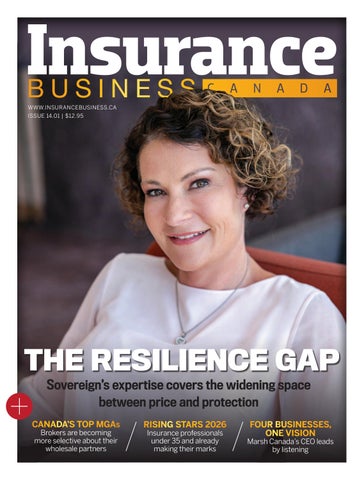
WWW.INSURANCEBUSINESS.CA ISSUE 14.01 | $12.95
THE RESILIENCE GAP Sovereign’s expertise covers the widening space between price and protection CANADA’S TOP MGAs Brokers are becoming more selective about their wholesale partners
00_OFC Spine OBC - SUBBED.indd 2
RISING STARS 2026 Insurance professionals under 35 and already making their marks
FOUR BUSINESSES, ONE VISION
Marsh Canada’s CEO leads by listening
10/8/2026 2:55:14 AM
Get ahead—and stay there—with the power of V Squared Victor’s commercial broker portal for small to mid-size accounts allows you to quote, bind and issue one-year or three-year policies* within minutes, 24 hours a day. It’s fast and easy to use V2. Choose multiple quote options to present to clients, get certificates of insurance—and even add CGL** without any further questions. Products currently available on V2: • Architects & Engineers Small Firms liability insurance • Construction Small Projects insurance • Directors & Officers Management liability insurance for non-profit organizations • Technology Small Firms liability insurance
Get a quote today! victorinsurance.ca/vsquared *The policy term for Construction Small Projects insurance would be the term of the construction project, with a maximum duration of 12 months. **Victor Construction Small Projects policyholders interested in obtaining certificates of insurance and adding CGL to their insurance coverage should ask their broker to send a request to: vsquared.ca@victorinsurance.com. © 2025 Victor Insurance Managers Inc. | 25-2515162-CAN
IFC-01_Contents v3 - SUBBED.indd 2
10/8/2026 3:03:18 AM
ISSUE 14.01
CONNECT WITH US Got a story or suggestion, or just want to find out some more information?
CONTENTS
x.com/InsuranceBizCA facebook.com/InsuranceBusinessCanada
UPFRONT 02 Editorial
FEATURES
08
04
CGL LIMITATIONS
THE RESILIENCE GAP
12
Complex pollution incidents require the comprehensive coverage SUM offers
Storms and floods: brokers conquer Canada-wide weather-related challenges of 2026
FEATURES 32 Construction insurance’s balancing act
A competitive market is giving builders more options, yet experts say lurking risks are being overlooked
SPECIAL REPORTS
EXPERT SPOTLIGHT
Sovereign’s underwriting expertise covers the widening space between a softening price cycle and a hardening risk reality
FEATURES
PEOPLE
INDUSTRY ICON
RECOGNIZING CHANGING EXPECTATIONS
Quality, not quantity, valued by brokers in their relationships with MGAs
Co-operators provides bespoke life insurance by looking at the whole picture
Stay agile to gain a competitive advantage, says Marsh Canada CEO Teresa Palandra
29
19 Brokers on MGAs 2026
35 Rising Stars 2026
Leading through influence: insurance professionals under 35 and already making their marks
16
FEATURES
READING THE FINE PRINT
Standard coverage may not cut it – check policy details, cautions Victor executive
INSURANCEBUSINESS.CA CHECK IT OUT ONLINE www.insurancebusiness.ca 1
IFC-01_Contents v3 - SUBBED.indd 1
10/8/2026 3:03:39 AM
UPFRONT
EDITORIAL
www.insurancebusiness.ca EDITORIAL
Managing Editor Paul Lucas Managing Editor, Special Reports Chris Sweeney
When the whole country needed them
N
o corner of Canada has been spared in 2026. Ten extreme weather events across Alberta, Saskatchewan, and Manitoba caused over $1.8 billion in insured damage this summer, according to IBC and CatIQ − with Edmonton hit repeatedly by flooding throughout June and July. Storms on June 9 and 10 alone drove insured losses past $900 million across Saskatchewan and Manitoba. Ontario and Quebec absorbed $439 million in thunderstorm damage between June 30 and July 3, before the Niagara region was struck by back-to-back flooding in late July and August that caused nearly $360 million in further damage, according to IBC. In early September, torrential rainfall in Cape Breton washed out roads, cut power to 40,000 customers, and prompted a state of local emergency across three counties. From Alberta to Nova Scotia, no region has been left untouched. The numbers that frame this moment are sobering. Canada’s annual insured weather losses now average more than $3.7 billion over the past decade, up from $1.4 billion the decade before, according to IBC, and flood- and water-related losses have grown more
Canada’s P&C industry has processed extraordinary volumes under sustained pressure this year than 300 percent over the past two decades compared with the 20 years prior, according to CatIQ data cited by IBC. Against that backdrop, clients are arriving at renewal conversations confused, anxious, and often underinsured − and brokers are the ones holding those conversations. That is work that does not appear in insured loss totals. It happens in the call where a flooded Edmonton homeowner discovers their sewer backup coverage is sub-limited. It happens when a Cape Breton business owner is trying to establish whether lost access to their premises triggers business interruption coverage when the damage is to public infrastructure rather than their own building. Canada’s P&C industry has processed extraordinary volumes under sustained pressure this year. Brokers are central to that function − not as intermediaries but as the human infrastructure that connects frightened clients to a complex system at precisely the moment the system is under its greatest load. That is a role worth recognizing, and one that 2026 has tested more completely than most years in recent memory. Feel proud of everything you do. The team at Insurance Business Canada
North America Editor – Insurance Gia Snape Journalists Branislav Urosevic, Danny Wood, Chris Davis, Bryony Garlick News Writers Mark Rosanes, Joshua Recamara, Roxanne Libatique Staff Writers Mallory Hendry, Manal Ali, Bennett Richardson, Emily Douglas, Kim Champion Copy Editors Christina Jelinek, Tara Tovell, Allison Ingusan
ART & PRODUCTION
Designers Joenel Salvador, Aira Olgado, JP Dizon, Noel Avendano VP – Production Monica Lalisan Creative Director Marla Morelos Production Coordinators Loiza Razon, Kat Guzman Project Management Executive Frances Tayamora Project Management Specialist Bea Redondo
SALES & MARKETING
Head of Insurance – Sales & Marketing Cathy Masek Head of Business Development, North America Chad Beck Business Development Managers Tanya Pacheco, Manal Shah
CORPORATE
Chief Executive Officer Mike Shipley Chief Operating Officer George Walmsley President Tim Duce Chief Information Officer Terry Szames Director – People and Culture Julia Bookallil
Editorial Inquiries paul.lucas@keymedia.com Subscription Inquiries subscriptions@keymedia.com Advertising Inquiries cathy.masek@keymedia.com
KM Business Information Canada Ltd 317 Adelaide Street West, Suite 910 Toronto, ON M5V 1P9 tel: +1 416 644 8740 www.keymedia.com Canada, USA, Australia, UK, NZ, and Asia
Insurance Business Canada is part of an international family of B2B publications, websites and events for the insurance industry Insurance Business America chad.beck@keymedia.com T +1 720 649 5799 Insurance Business UK gemma.powell@keymedia.com T +44 20 7193 0935 Insurance Business Australia, NZ, APAC sophie.knight@keymedia.com T +61 2 8437 47OO
2
www.insurancebusiness.ca
02-03 Editorial - SUBBED.indd 2
Copyright is reserved throughout. No part of this publication can be reproduced in whole or part without the express permission of the editor. Contributions are invited, but copies of work should be kept, as the magazine can accept no responsibility for loss.
10/8/2026 2:55:49 AM
G an co w
1 Sou 2 De
Desja trade 200 R
12852_WM
A trusted partner you and your clients can count on
Partner with us
Grow your business and amplify your community impact with Desjardins
An experienced partner with over 75 years1 of expertise in life and health insurance, and recognized for its financial strength by AM Best.2
1 Source: Desjardins.com/on/en/about-us/governance-democracy/group-structure/other-networks/dfs.html 2 Desjardins Financial Security Receives Strong Credit Ratings from AM Best Reflecting Its Financial Strength - Desjardins.com/on/en/news/dfs-receives-strong-credit-ratings-from-am-best.html Desjardins Insurance refers to Desjardins Financial Security Life Assurance Company. Desjardins®, Desjardins Insurance®, all trademarks containing the word Desjardins, as well as related logos are trademarks of the Fédération des caisses Desjardins du Québec, used under licence. 200 Rue des Commandeurs, Lévis QC G6V 6R2 / 1-866-647-5013
12852_WMLHI_Overarching_IBPrintMag_8_25x10_875_EN_Pilar3_v4.indd 1 02-03 Editorial - SUBBED.indd 3
2026-09-22 16:05 10/8/2026 2:55:53 AM
PEOPLE
EXPERT SPOTLIGHT
THE INSURER BUILDING RESILIENCE WHILE THE MARKET CUTS RATE How do you grow in a soft market without buying business?
OPPORTUNITY AND uncertainty have a strange habit of arriving together. Because while commercial rates have fallen by 7 percent in Q2 and capacity is still abundant, beneath the surface the risks threatening businesses are becoming more difficult to manage. From record-breaking climate losses to increasingly sophisticated cyber threats, the gap between a
“While property rates have declined for nine consecutive quarters, underwriting discipline and risk selection have become more important to us, not less,” says Taylor. “It’s about understanding the quality of the book, being clear on the risks that you want to write and when you need to walk away.”
“We’re very intentional about the partners we work with. It allows us to dedicate our expertise and resources to those relationships to create meaningful opportunities along the way” Colette Taylor, Sovereign Insurance softening price cycle and a hardening risk reality is deepening. That widening space between price and protection is the resilience gap. It’s within that gap that Sovereign Insurance has defined its niche. As Colette Taylor, chief operating officer at Sovereign Insurance, explains, a soft market isn’t an excuse to simply cut prices in pursuit of growth. Instead, it’s an opportunity to demonstrate the value of underwriting expertise and disciplined risk selection.
4
‘Our underwriting expertise makes all the difference’ “At Sovereign, our underwriting expertise makes all the difference,” Taylor notes. “That’s what gives us the confidence to seek out opportunities in our target areas and to be competitive with them. We understand that sustainable growth comes from the quality of the business that you’re writing, not simply just the volume of business that you can put into your portfolio.”
It’s a strategy that’s been honed over recent years, with Sovereign focusing on deepening partner relationships and maintaining underwriting standards while its people remained highly engaged throughout periods of real change. “We have proven the individual pieces,” says Taylor. “The next four years are about connecting them so they compound. Underwriting expertise, partner relationships, and how we operate should each make the others stronger.” For Taylor and her team, success depends on maintaining those relationships and growing from there, while leaning into Sovereign’s homegrown roots. “Sovereign is Canadian owned and operated,” she says, “and I think that’s more important than ever right now. That means all of our underwriting authority, all our decision-making, is done here in Canada. Having that so close to our partners allows us to be nimble. It means we can make decisions fast, empowering the people within Sovereign to respond to our partners about opportunities quickly.” Sovereign is also deliberately focused, which is a choice rather than a limitation. Being part of the Co-operators Group gives it the best of both worlds: the financial strength
www.insurancebusiness.ca
04-07_Expert Spotlight v2 - SUBBED.indd 4
10/8/2026 2:58:32 AM
PROFILE Name: Colette Taylor Company: Sovereign Insurance Title: Chief operating officer Years in the industry: 30
www.insurancebusiness.ca
04-07_Expert Spotlight v2 - SUBBED.indd 5
5
10/8/2026 2:58:51 AM
PEOPLE
EXPERT SPOTLIGHT
and values of Co-operators combined with its own underwriting authority, appetite, and the specialist relationships that define Sovereign itself.
‘We’re very intentional about the partners we work with’ That focus is what allows Taylor and her team to put the right resources and expertise against the right relationships, which leads to better outcomes for everyone involved.
dedicate our expertise and resources to those relationships to create meaningful opportunities along the way. For us, it’s about being easy to do business with. You have to be competitive from a pricing standpoint, have a market-leading proposition, and people have to enjoy dealing with you too.” It’s that level of care coupled with industry expertise that Taylor believes will define Sovereign’s success in the years to come. As for growth opportunities, she tells Insurance
“Sovereign is Canadian owned and operated − and I think that’s more important than ever right now. That means all of our underwriting authority, all our decision making, is done here in Canada” Colette Taylor, Sovereign Insurance “It creates more consistency in how we’re able to show up,” Taylor says. “Because when we’re making decisions, we’re making them with great confidence − which our partners can feel.” Sovereign reaches the market one way: through brokers and MGAs. There is no Sovereign direct channel, no second route to the same client. When a partner grows, Sovereign grows. And as the broker landscape consolidates, that commitment carries even greater weight. The 10 largest broker groups now control roughly one-third of national brokerdistributed premium, up from about 28 percent in 2022 − meaning status now has to be earned with fewer partners who have real leverage. For Taylor, this is further confirmation that Sovereign is on the right path. “We’re very intentional about the partners we work with,” she says. “It allows us to
6
Business that they focus on “going deeper before going wider.” “There’s significant opportunity in our core mid-market business,” she notes, “and headroom to grow in the segments where we have strong underwriting expertise, established capabilities, and a clear understanding of the risks we want to write.” Energy and natural resources is another area where Sovereign is deliberately building, as is cyber. Worryingly, Canadian organizations are paying a record $7.11 million on average for a data breach, according to IBM’s Cost of a Data Breach Report 2026 – and yet just 22 percent of respondents carry any form of cyber insurance, and only 12 percent hold a dedicated stand-alone policy, according to IBC. For Taylor, this isn’t a demand problem − it’s a design fault.
‘The one Canadian businesses trust with the risks that matter’ “As an industry, we’ve built cyber products for specialists to sell to other specialists,” says Taylor, “which works well when brokers have deep cyber expertise and are then able to sell that product on. However, it makes it much harder to navigate for brokers who don’t. Brokers need the confidence to speak the language. We are building cyber so that a generalist broker can sell it with confidence. That is how the protection gap actually closes.” Aside from cyber, Sovereign is also looking at AI and its impact on underwriting, claims, and risk identification. “AI will help our underwriters analyze information more efficiently,” Taylor says, “meaning they can focus on the risks that require deeper judgment − because decisions that need empathy will always require the human touch. The opportunity here goes beyond simple automation; it’s to use technology to give our people more time to focus on the areas where they add the most value. The test is whether our partners feel it: faster answers, clearer decisions, and more underwriter time on the risks that need judgment.” And in a market where opportunity and uncertainty are increasingly going hand in hand, that human-led trust may prove to be Sovereign’s most valuable differentiator of all. For Taylor, that is the point of the strategy: to make resilience an advantage Canadian businesses can buy, not just an outcome they hope for. “We’re not trying to win a headline this year,” says Taylor. “We’re trying to be the insurer the industry looks to, and the one Canadian businesses trust with the risks that matter most to their future.”
www.insurancebusiness.ca
04-07_Expert Spotlight v2 - SUBBED.indd 6
10/8/2026 2:58:44 AM
DAILY NEWS AND AWARD-WINNING CONTENT TRUSTED BY INSURANCE PROFESSIONALS WORLDWIDE In a market where risks and regulations shift fast, you can’t rely on yesterday’s news. The Insurance Business e-newsletter delivers the latest headlines, expert analysis and industry insight direct to your inbox – free. Get breaking news, specialist coverage across key lines, regulatory updates and commentary that helps you advise clients with confidence and spot new opportunities.
Stay informed. Stay credible. Stay one step ahead.
SCAN TO LEARN MORE
www.insurancebusinessmag.com/ca/newsletter
04-07_Expert Spotlight v2 - SUBBED.indd 7
10/8/2026 2:58:51 AM
SPECIAL PROMOTIONAL FEATURE
ENVIRONMENTAL CLAIMS
Mind the general liability gap! From cleanup to legal fees, pollution incidents carry costs many policies won’t cover WHEN YOU think about environmental insurance, the first thing that tends to come to mind is Erin Brockovich. The movie depicting the story of the Hinkley groundwater contamination was a Hollywood blockbuster that acted as a social catalyst for change in environmental safeguarding, instigating a shift in mindset when it comes to safety. Since the early 90s, renewed media attention and social scrutiny on issues like pollution, forever chemicals, and hazardous waste have led to more interest in environmental insurance – and unintentionally revealed a dangerous coverage gap. But environmental risk itself has changed too. Today, an incident doesn’t need to resemble a large-scale industrial disaster to result in significant financial consequences. A leak, spill, transportation incident, or waste-handling issue can trigger cleanup requirements, regulatory scrutiny, and thirdparty claims – often leaving businesses facing costs they hadn’t anticipated. When dealing with commercial general liability (CGL), the insurance that many entities believe covers a multitude of possible
8
losses, there are widening gaps, especially around pollution. “There are all different types of limitations of the CGL,” says Christine Nauth, vice president, environmental impairment liability practice leader at SUM Insurance. “They have broad forms – some can include absolute pollution exclusions, others can provide insurance by giving sudden and accidental coverage. There are all these different levels that the CGL could or could not provide coverage for. And, depending on those gaps, that’s where we at SUM step in.”
Claims alert Example one Construction of a commercial building in the northern Canadian region. During the period when there was no electricity in the building to power the heating system, diesel-powered portable heaters were used. When the building’s electricity was working, the diesel tank was disconnected from the heater. Unfortunately, the tank/hose was not properly capped and leaked undetected, releasing 2000 litres over a few days.
“This is a good example because contractors generally do not identify as having EIL exposure,” says Nauth. “However, the example above speaks to a common practice within the industry, especially in northern regions or outside the summer months in Canada. This seemingly insignificant claim has cost over $2.5 million – and the project did carry a wrap-up policy which denied the pollution loss.”
www.insurancebusiness.ca
08-11_EF SUM v2 - SUBBED.indd 8
10/8/2026 2:59:20 AM
Brought to you by
SUM’s team of experts underwrites what has become one of the leading environmental insurance programs in Canada. In collaboration with first-class markets, SUM offers a full product suite, encompassing site-specific, nonsite-specific, and/or project-specific coverages. Because, as Nauth tells IB, many businesses are still operating under a false sense of security when it comes to environmental coverage.
“Even if an organization is getting some pollution coverage under CGL, there are large exclusions that they may not be aware of. [For instance], if you’re handling waste, even though you have this S&A coverage under the CGL, the handling of waste is excluded under most policies. And that’s just one small example of where somebody would think they have coverage and they don’t.”
It’s these hidden exposure gaps that can bring a business to its knees. Many companies still mistakenly believe that environmental risks impact only heavy industry, such as chemical plants or energy farms, when in reality any company can fall prey to an incident. And misconceptions around CGL are one of the most persistent gaps in the market right now – and
www.insurancebusiness.ca
08-11_EF SUM v2 - SUBBED.indd 9
9
10/8/2026 2:59:26 AM
SPECIAL PROMOTIONAL FEATURE
ENVIRONMENTAL CLAIMS
subsequently the hidden costs associated with pollution, too.
Claims alert Example two Vandals broke the caps of two 1000-litre totes of liquid sawdust stored at the insured’s facility, which is located at the banks of the St. Lawrence Seaway. As a result, sawdust was released into the St. Lawrence Seaway. The Seaway management corporation shut down boat traffic on the Seaway, and two power plants were shut down. The CGL policy had a Pollution Exclusion and denied coverage – and the EIL policy was in place to pay the claims. “This is another good example, because who could have foreseen that sawdust would ever be considered a contaminant?” questions Nauth. “However, the regulators had no way of knowing what the white floating substance was, so they acted out of an abundance of caution. In certain scenarios, ordinary materials can become pollutants at high concentrations or appear as contaminants.” “There are so many hidden costs here. There are fines and penalties, there are disposal site costs, auto policy exposures, and emergency expenses too,” adds Nauth. And, going beyond the immediate costs, there are the long-term financial repercussions, with legal fees often impacting the total value of a pollution claim – especially if the insurance isn’t found to be liable. “I believe that really is the beauty of our line at SUM,” says Nauth. “While we don’t have a ton of large claims or claims that come into fruition, the majority of notice of claims … have our legal team and adjusters involved from the off. There are so many legal fees as well that go into a claim that the client or the insured may not even be aware of.
10
“As well as legal, there are the remediation and long-term environmental monitoring costs. In Canada, there’s no industry standard for environmental policies. There are certain coverages that a policy provides and should be broad enough to include. [For instance], if remediation takes place, and the spill is contained, there are still regulations that could force an insured to monitor that site for six months afterwards, if dealing with soil, just to ensure the site meets the acceptable levels. And for water that period increases to a year. Those are costs that the insured would have to incur if they don’t have these broader types of coverages under an EIL policy.” At SUM, they tackle a variety of risks in this realm, from contractors and remediation operations, to tanks, to products and completed operations hazards, the transportation sector, and environmental consultants – placing them in the perfect position for whatever issues arise. “At SUM, we ensure that the agreements we offer into the marketplace are pretty broad,” says Jeff Somerville, MD at SUM Insurance. “The selection of risks is a little narrower. We don’t write all comers, so to speak. [With environmental], this is somewhere in which underwriting thoroughness and competency are key contributors to the outcome.” And, as Nauth says, there’s no industry standard policy for pollution – meaning that coverage here is bespoke and specialized too. “It’s a smaller marketplace,” adds Somerville. “The coverage has been sliced and diced into something more niche. That means when brokers are presented with any commercial insurance risk, they ought to be considering their pollution exposure. Because the ‘off-the-shelf ’ mainstream coverages are excluding it.”
Claims alert Example three The insured’s equipment caught fire at a job site, resulting in a spill of 250 litres of hydraulic oil onto the soils of the thirdparty property. Equipment was covered under a separate policy, which paid to have it replaced. However, the CGL policy had an Absolute Pollution Exclusion and did not respond to contamination. As such, the claim was reported under the EIL policy. “Again, this is general construction involving equipment that could have been costly to the contractor if there were no EIL policy in place,” explains Nauth. And while general liability insurance policies have standard pollution exclusions, there may also be other endorsements to further restrict any coverage provided under a general liability policy. Nowadays, firms like SUM are offering specialized coverages to suit individual needs. “One of our value propositions at SUM is sustainability and continuity,” adds Somerville. “We’ve been offering this coverage for a long time. We know what we’re doing, we understand the marketplace, and we offer what we offer because we know it really provides value.” And, as environmental exposures continue to evolve, identifying those risks early will be key. For brokers, that means looking beyond the obvious environmental hazards and examining exactly where existing policies could leave a client exposed. After all, this isn’t about whether a business has some form of pollution coverage; it’s really about understanding what that coverage will actually respond to when an incident occurs. Because in an ever-changing and increasingly complex environmental landscape, discovering a gap before an incident is considerably easier than discovering it afterwards.
www.insurancebusiness.ca
08-11_EF SUM v2 - SUBBED.indd 10
10/8/2026 2:59:23 AM
SUM_IBC
TRY US FOR SOLUTIONS IN REAL TIME, THE ONLY TIME THAT MATTERS TO YOU. Commercial General Liability Umbrella & Excess Liability Environmental Liability Professional Liability Construction Hospitality Property & Inland Marine Lifesciences Cannabis Industry Programme Marine & Logistics Directors & Officers Liability Security & Protection Programme Ontario-West: 1-877-603-7864 Quebec-East: 1-855-845-7861
Please visit our website for full product details and contact information:
w w w. s u m i n s u r a n c e . c a SUM_IBC Ad_Full Page_Clock 9_2026.indd 1 08-11_EF SUM v2 - SUBBED.indd 11
9/23/26 1:01 PM 10/8/2026 2:59:27 AM
SPECIAL PROMOTIONAL FEATURE
HOLISTIC FINANCES
Why the insurance experience matters more now Co-operators’ David Forestell on how changing expectations around access, advice, and personalization are influencing the way Canadians engage with life insurance DEATH, DISABILITY, or other serious loss may be impossible to predict, but its financial consequences do not have to be absorbed all at once. Insurance exists to make the financially unmanageable manageable: a relatively small, planned cost today can protect against a much larger one later. Canadians still see the value of protection, but they are less willing to work around a complicated process to get it. They expect life insurance to fit more naturally into the way they already manage their finances. The customer has different expectations regarding how they engage with life insurance protection. “The old model where a salesperson on a bike might go door to door to sell policies is gone,” says David Forestell, vice president of group markets distribution at Co-operators. “It’s a completely different world. So we really need to figure out how best to make it fit for them.” “Clients today expect the life insurance journey to be different than what it was in the past. They want better access to advisors and information, clearer explanations, and solutions that fit more naturally into their lives.” For insurers, personalization is less about offering more variations of the same product and more about understanding the obligations a particular client is currently carrying. At Co-operators, that has meant widening the number of ways in rather than picking one. Since they offer multiple distribution channels, clients can choose how they
12
purchase coverage. In practice, that means the company’s exclusive advisor force, managing general agents, and a digital experience, with clients choosing the route that suits them.
Milestones on a different schedule The moments traditionally used to prompt an insurance conversation are no longer arriving on anything resembling a standard timetable. Forestell says this shift has undone the standard product logic.
“What are the risks that you’re exposed to, whether it be your home, your car, your retirement income, your loss of employment, your loss of life, something to do with your children?” he asks. “What are the major events that could happen in your lifetime that could cause a financial challenge? And then what insurance do you put in place to make sure you’re covered in the unlikely event of one of those occurring?”
“The days of a one-size-fits-all life insurance program are gone by the wayside. Canadians are reaching life’s milestones on very different timelines” David Forestell, Co-operators “The days of a one-size-fits-all life insurance program are gone by the wayside,” he says. “Canadians are reaching life’s milestones on very different timelines, whether that’s buying a home, starting a family, or supporting aging parents. People are following increasingly unique financial journeys, and our job is to meet them where they are, with the right advice, technology, and solutions to support their needs.” That leads to an oft-used industry term. For Forestell, “holistic” means starting with risk exposure rather than product.
A household carrying a larger mortgage later in life, for instance, may also be saving aggressively for retirement while helping an adult child or parent. The appropriate life insurance decision is difficult to make sensibly without seeing those competing obligations. The breadth of the shelf is what makes that conversation possible, he says, with property and casualty coverage sitting alongside life and wealth in a single plan versus separate transactions. That broader view matters because when protection feels disconnected
www.insurancebusiness.ca
12-13_EF Cooperators v2 - SUBBED.indd 12
10/8/2026 2:59:49 AM
Brought to you by
Clients may also want an outside view of their situation, particularly when their own biases or blind spots make decisions harder. An advisor can help surface risks they have missed and clarify what matters most. Telling somebody that life insurance exists is easy, but helping them decide whether a premium fits alongside their other financial priorities requires judgement.
Measuring success
from the rest of a household’s finances, it is easier to postpone or overlook.
Why the gap stays open Financial security for Canadians is the stated goal, but a large share of the country is not there yet. According to the 2023 Canadian Insurance Barometer Study conducted by LIMRA and Life Happens, 31 percent of Canadian adults, roughly 8.4 million people, say they need life insurance or need more of it. The same research found that four in 10 Canadians say their families would face financial hardship within six months if the primary wage earner died unexpectedly. Forestell points to three reasons the gap persists. The first is complexity, which “continues to be a challenge.” The second is cost: “inflation, the rising cost pressures that individuals feel that they have.” The third is deferral. People treat coverage as a decision for later. “It’s not viewed as an urgent thing,” he says of the mindset. “It’s something they don’t believe they need today.” “There’s a huge opportunity for the industry to have more meaningful conversations, provide useful information, and streamline the process for individuals,” he says, “while giving them advice that builds confidence and helps them understand which products fit their needs at different stages of life.”
Co-operators has invested in technology across research, illustrations, and the application process, with the aim of giving clients more straightforward information and helping advisors move cases through more efficiently. As access changes, advice becomes even more important Forestell does not see technology making the advisor redundant. Clients increasingly expect to research products on their own, use digital tools, and move through parts of the process independently. But as financial situations become more complex, clients may be more willing to rely on an advisor they believe has the expertise to help them avoid costly mistakes. “Life insurance is a product that is sold, not bought,” he says. “It’s not a mandatory product that clients are required to have. Home insurance, for example, you may need for your mortgage. Life insurance, however, is something you should have, while many do not.” That is what preserves the role. “There is a key need for those advisors to support that discussion and help people walk through what are their risks, and what do they need to be covered in the unlikely event of a catastrophe.” Industry research points the same way. In LIMRA’s Insurance Barometer Study, cited in a 2025 Canadian Reinsurance Conference panel summary published by RGA, 46 percent of respondents said they would research life insurance online but ultimately buy in person, a pattern that favours hybrid models over purely digital ones.
For all the industry’s investment in technology, distribution, and product development, Forestell’s way of judging success is pretty straightforward. “If we can reduce the uninsured or underinsured population, that is success,” he says. That keeps the focus on the outcome rather than the process. Faster applications, more digital options, and greater advisor efficiency can all make insurance more accessible, but the larger question is whether these improvements result in more Canadians having the protection they need. “We need to make life insurance more accessible, more personalized, and integrated into their broader financial decisions,” Forestell says. “I think that’s critical. If we can do that, more Canadians will have the protection they need.” For Forestell, simplicity is part of getting there. If complexity and competing financial pressures are among the reasons people put off coverage, reducing the work involved in understanding and obtaining coverage can make it more likely that clients follow through. But he also wants life insurance considered earlier and alongside the rest of a household’s finances, rather than dealt with separately after a particular milestone. “Holistic financial advice and incorporating life insurance into financial plans will be critical for Canadians,” he says. “It is something that is not top of mind by many individuals, but it’s something that should be.”
www.insurancebusiness.ca
12-13_EF Cooperators v2 - SUBBED.indd 13
13
10/8/2026 3:00:03 AM
A SYMBOL OF TRUST. AN EXPRESSION OF GRATITUDE. A logo is a symbol clients trust for advice they can count on. We thank the exceptional insurance companies – our partners – who help us deliver peace of mind to so many Canadians. Your support makes the difference.
14-15_IBAO DPS.indd 14
10/8/2026 3:00:30 AM
2026 IBAC partners Magenta LeveL
Bronze Level: Northbridge, Lloyd’s, Optimum, Pafco.
14-15_IBAO DPS.indd 15
10/8/2026 3:00:34 AM
SPECIAL PROMOTIONAL FEATURE
ENVIRONMENTAL CLAIMS
Insured for the accident. Who insures the contamination? Environmental losses handled by Victor in Canada show how routine jobs become six- and seven-figure cleanups that ordinary policies won’t touch ENVIRONMENTAL ACCIDENTS attract lasting scrutiny. Regulators, lenders, customers, and business partners all take notice, and cleanup rarely ends the reputational impact. As a result, environmental and pollution liability insurance is increasingly becoming a prerequisite for financing, permits, and contracts, with many organizations now expected to prove they have adequate coverage before doing business. The Kearl oil sands mine in northern Alberta shows how quickly environmental incidents can escalate. In 2023, an overflow released 5.3 million litres of tailings-contaminated wastewater, while separate groundwater seepage went undisclosed to downstream Indigenous communities for months. The fallout included an environmental protection order, multiple investigations, regulatory fines, and nine charges laid in early 2025. Events of that scale are not everyday occurrences, but they shape what counterparties now expect, and they raise an uncomfortable question for any business that handles, disturbs, or sits near a contaminant: if it happened again, who would pay? The answer is often less reassuring than the policyholder assumes. The gap between what a business thinks it is insured for and what its policies actually cover is the recurring theme in environmental claims, and it tends to reveal itself at the worst possible moment − after the loss, when the cleanup invoices start to arrive.
16
www.insurancebusiness.ca
16-18_EF Victor - SUBBED.indd 16
10/8/2026 3:00:59 AM
Brought to you by
Victor’s case to brokers and their clients is a straightforward one: a stand-alone environmental and pollution liability policy is worth buying precisely because of the gaps that open when a business relies on its standard policies alone. The three cases that follow are drawn from Victor’s own files. “Most buyers think their general liability policy will respond to a spill,” says Marc LeBrun, senior vice president and environmental department leader at Victor in Canada. “It usually will not, and the gap is widest exactly when the contamination is most expensive to deal with.”
Why standard coverage stops short Standard commercial general liability (CGL) policies typically include an absolute pollution exclusion that removes coverage for most pollution events, including environmental releases, mandated cleanup, and contractor-
an older building can produce an asbestos claim; a heating or plumbing contractor can trigger a pollution condition. LeBrun calls it an exposure that is “everywhere, even when the business does not think of itself as an environmental risk” and that treats its reach as a permanent feature of the market rather than a passing one.
Two policies, and still a gap Consider a contractor hired to replace an aging oil boiler on a hospital roof. The work required opening the roof and installing temporary waterproofing, but a blocked storm drain and overnight rain sent water through existing cracks into the floors below. What began as water damage quickly became a contamination claim. The moisture disturbed asbestos, uncovered lead and mould, and forced parts of the hospital to be evacuated.
“A spill that gets into a wetland or a water table costs a different order of magnitude than the same spill on bare ground, and a response plan that everyone on site is trained on and aware of is worth more than most people give it credit for” Marc LeBrun, Victor caused contamination. Construction wrap-up policies have similar gaps, often excluding risks such as asbestos and mould. The result is a pollution-shaped gap in coverage. Standard policies cover routine risks like fire and theft, while environmental contamination requires separate specialty insurance if a business has purchased it. The exposure is not confined to the obvious industries, either. A routine renovation in
The contractor carried both a construction wrap-up policy and a standalone contractors pollution liability (CPL) policy. Both responded, but neither covered everything. The wrap-up policy covered the water damage and, through a limited pollution endorsement, the lead contamination. Asbestos and mould remained excluded. The CPL covered the asbestos and shared the lead costs, but mould was excluded because the
ENVIRONMENTAL CLAIMS ARE RARELY JUST CLEANUP COSTS A pollution loss can trigger expenses well beyond removing the contaminant. Environmental consultants investigate the extent of contamination and develop remediation plans. Laboratory testing determines whether soil and groundwater meet regulatory standards. Specialized contractors excavate, transport, and dispose of contaminated materials. Regulators may require ongoing monitoring before a site is cleared. Restoration work often follows remediation to return the property to its previous condition.
contractor had not purchased the optional mould endorsement. That endorsement would have covered mould contamination and typically requires an additional premium, a supplementary questionnaire, and proof of mould-awareness training. “Mould is the coverage people skip because they assume it only matters to remediation specialists,” LeBrun says. “Then a heating contractor has a water loss and discovers mould was the one piece nobody insured.” The roughly $50,000 remediation bill fell to the contractor − a small slice of the overall loss, but the only significant gap in an otherwise well-covered claim.
Significant costs can add up A second case shows how a seemingly innocent decision can trigger multiple policies with vastly different coverage
www.insurancebusiness.ca
16-18_EF Victor - SUBBED.indd 17
17
10/8/2026 3:01:03 AM
SPECIAL PROMOTIONAL FEATURE
ENVIRONMENTAL CLAIMS
COVERAGE DETAILS WORTH CHECKING BEFORE A CLAIM Does the policy include cleanup and restoration costs? Are asbestos, lead, and mould included, excluded, or available by endorsement? Are defence costs inside or outside the policy limit? agreements. A subcontractor drilling at a Montreal park struck an underground electrical conduit after relocating a borehole without confirming utility locations. About 10,000 litres of insulating mineral oil leaked into the soil. The firm’s commercial general liability policy covered the damaged conduit, but certain aspects of the environmental damage resulted in pollution costs that fell to its professional liability and stand-alone contractors pollution liability (CPL) policies. The matter settled for $975,000, with the CPL policy paying roughly $601,000.
gets into a wetland or a water table costs a different order of magnitude than the same spill on bare ground,” LeBrun says, “and a response plan that everyone on site is trained on and aware of is worth more than most people give it credit for.”
Reading the fine print The through-line in all three cases is that the coverage was only ever as good as the policy language. Whether a loss is paid often turns on quiet wording in the definitions and exclusions: if asbestos and lead sit
“Mould is the coverage people skip because they assume it only matters to remediation specialists. Then a heating contractor has a water loss and discovers mould was the one piece nobody insured” Marc LeBrun, Victor The same lesson applies to premises risks. In rural Saskatchewan, a failed pipe fitting released about 90,000 litres of liquid fertilizer into a drainage ditch and nearby marsh. A premises pollution policy covered the thirdparty damage and more than a year of cleanup, at a cost of roughly $1.9 million. “A spill that
18
inside or outside the definition of a pollution condition, if cleanup costs include the cost of restoring damaged property, if a claimsmade form has a retroactive date that was carried over from the prior insurer to avoid a gap. That is why the placement conversation matters as much as the policy itself.
Does the definition of “loss” include civil fines or penalties where legally insurable? If the policy is claims-made, has the retroactive date been preserved after switching insurers? Are emergency remediation costs available for immediate response following a spill?
It is unglamorous work, and that may be why it gets skipped. The buyer in the hospital case did almost everything right and still absorbed the mould loss because a single endorsement went unpurchased. “It’s important to review these policies before a loss occurs,” LeBrun said. “The time to clarify a definition is when the policy is being placed, not when the contamination is already in the ground.” For more information about Victor environmental insurance, visit: https:// www.victorinsurance.ca/environmental. For brokers interested in Victor environmental sales tools and resources such as claims examples to share with clients, visit https://www.victorinsurance.ca/ environmentalsalestools.
www.insurancebusiness.ca
16-18_EF Victor - SUBBED.indd 18
10/8/2026 3:01:09 AM
SPECIAL REPORT
Brokers on
MGAs 2026 Discernment is replacing volume as brokers become more selective about their wholesale partners – meet Canada’s top MGAs
CONTENTS
PAGE
Feature article .............................................. 20 Methodology ................................................ 21 Brokers on MGAs 2026 ............................... 27
www.insurancebusinwvess.ca
Brokers on MGAs 2026 subbed v9_cmj.indd 19
19
10/8/2026 2:50:38 AM
SPECIAL REPORT BUSINESS STRATEGY
BROKERS ON MGAs 2026
THE MGAs BROKERS TRUST CANADA’S BROKERS don’t want more MGAs; they want the right ones. Insurance Business Canada’s 2026 Brokers on MGAs, which set out to find the top MGAs in Canada, found a channel where brokers are concentrating their trust in a smaller, proven set of managing general agents (MGAs) rather than casting a wider net. The share of brokers using an MGA 11–50 times in six months rose four points to 54 percent, even as the share of their book placed through MGAs held essentially flat, at 44 percent vs. 45 percent in 2024. Rate every MGA on responsiveness, and it’s obvious why: brokers know exactly which partners have earned that trust. A gap of 1.63 points on a 5-point scale separates the best-rated MGA in this year’s survey from the worst, nearly double the spread in reputation, the field’s most consistent category. Brokers aren’t shopping for more MGA relationships. They’re getting ruthless about which ones deserve to keep them. That modest uptick in frequency, rather than in overall book share, is telling. It points to brokers deepening their working relationship with fewer, more trusted MGAs, the channel consolidating in depth even as it holds flat in breadth. The flattening is specific to individual broker relationships, not the wider Canadian MGA market. Steve Masnyk, former executive director of the Canadian Association of Managing General Agents
20
This year’s Brokers on MGAs report, at a glance
44%
Broker survey
Key insights
Industry forecast
~50%
Broker allocation to MGAs held nearly flat at 44% in 2026 vs. 45% in 2024, as brokers concentrate their trust in a smaller, proven set of partners.
A former CAMGA executive director predicts Canada’s MGA market could grow from 20% to nearly 50% of commercial insurance within a decade.
Broker survey
Broker survey
1.63pt
52%
Responsiveness showed the widest brokerrated gap of any category this year, a 1.63-point spread on a 5-point scale.
More than half of brokers say the MGAs they work with saw service improve over the past year, while just 4% saw decline.
Sources: Insurance Business Canada’s Brokers on MGAs 2026 broker survey (n = 428); industry forecast per Steve Masnyk, former executive director, Canadian Association of Managing General Agents, as reported by Canadian Underwriter, January 2026. See Methodology for full survey details.
(CAMGA), has predicted that MGAs could grow their share of the Canadian commercial market from about 20 percent to nearly 50 percent over the next five to 10 years. Ontario’s MGA channel already generated six percent of the province’s total P&C direct written premium in 2023, or roughly $2.3 billion, according to the Financial Services Regulatory Authority of Ontario (FSRA). For several years, Canada’s 5-Star MGA story was one of expansion, with brokers turning to more MGAs for more of their business. That growth has now levelled off,
shifting attention to what differentiates partners beyond size. This year’s survey asked brokers to rate wholesale partners across nine categories, including responsiveness, technical expertise, and pricing. Sean Duggan, senior vice president, special risks and claims, at KRGinsure in Orillia, Ontario, says that the spread comes down to how well an MGA balances a specific set of strengths against what brokers actually need. “The best MGAs will effectively align their strengths and adapt to broker expectations on value and their clients’ evolving needs in
www.insurancebusiness.ca
Brokers on MGAs 2026 subbed v9_cmj.indd 20
10/8/2026 2:50:40 AM
both hard and soft market cycles, namely providing stable capacity, niche expertise and specialization, speed of service, nimble underwriting, product innovation, accessible platforms, and, finally, responsive claims service,” he says. A total of 14 MGAs earned this year’s 5-Star recognition, with products across four different MGAs named Brokers’ Pick medallists based on broker vote. What sets this year’s winners apart, brokers say, is how they outperform competitors, whether through specialist expertise, a willingness to underwrite complex risks, or faster service. Hundreds of brokers rated their MGA relationships on price, coverage, service, technology, and claims handling. The results show broad satisfaction with the MGA channel, alongside greater selectivity about which partners earn their business.
Claims and responsiveness set today’s top MGAs apart Not every category separates strong MGAs from weaker ones equally. Some, like reputation, are places where nearly every MGA performs similarly. Others, like responsiveness, show a much wider gap between the best and worst performers, which is where this year’s differentiation is really happening. Across the MGAs surveyed for this report, responsiveness split the field more than any other category, with a full 1.63-point spread on the 5-point scale between the best and worst performer. Reputation, by contrast, barely moved between MGAs. Technical expertise and reputation both score highest on average, suggesting most MGAs have the fundamentals in hand. Compensation is the only category to average below 4.0 across the full field, and it shows the secondwidest spread after responsiveness. Duggan says this tracks with what he sees driving broker loyalty day to day. “Claims handling by MGAs is generally
improved, with faster communication and increased visibility with data insights, as well as better service timelines, stakeholder integration, and reliable client outcomes,” he says. “It remains a key metric and differentiator for MGAs, but there is always room for improvement, such as faster claims cycle times, more consistent client communication, and sharing portfolio insights with brokers to stay ahead of emerging trends and issues.” That emphasis on claims as a trust-builder echoes what IBC found in its own 5-Star Claims rankings for Canadian insurers in 2026, where responsiveness and communication were the deciding factors between top and bottom performers. On technical expertise specifically, the category with the highest average score in this year’s survey, Duggan points to the underwriting bench itself as the real differentiator. “A deep bench of responsive and relationship-driven underwriters who are solution-oriented, understand industryspecific exposures and evolving risks, and use this knowledge to provide tailored solutions with innovative products to brokers and clients,” he says, adding that this matters more than it used to. “Risks are becoming more complex and less predictable as change accelerates, making expertise, technology, and innovative products even more critical now to keep pace.” That technical bench is most visible, Duggan says, in how an MGA handles niche or emerging risk, the kind of business standard markets won’t touch. “This is a core reason MGAs exist, combining specialized underwriting expertise, market access, technology, and product innovation to add value for brokers and serve clients,” he says. Real skill in this space, he adds, is about more than a willingness to say yes. “It involves effective and competitive pricing, nimble service, and matching innovative products with a deep understanding of specific industry sectors and key risks for
METHODOLOGY Insurance Business Canada conducted a survey of brokers nationwide to determine the best businesses in the wholesale distribution channel. The survey asked respondents to rate the performance and service of each of their wholesale partners on a scale of 1 (poor) to 5 (excellent) against the following nine criteria: • ability to place niche or emerging risks • compensation (commissions, bonus, profit share, etc.) • geographical reach • marketing support • overall responsiveness • pricing • reputation • technical expertise and product knowledge • technology or automation The MGAs that earned an average score of 4.0 or greater in at least one category were awarded a 5-Star designation. MGAs that received an average score of 4.0 or greater in all categories received an All-Star designation. Brokers also named the top insurance products offered by an MGA. The four insurance products that received the most votes from brokers were awarded the Brokers’ Pick medal.
those classes.” It’s a useful lens heading into the winners ahead, several of whom built their reputation on exactly this kind of specialized placement. Compensation’s weaker showing doesn’t surprise him either. Duggan frames it as a structural question about how compensation is built, weighing growth, retention, and long-term portfolio quality together. “It should be balanced and multi-faceted,
www.insurancebusiness.ca
Brokers on MGAs 2026 subbed v9_cmj.indd 21
21
10/8/2026 2:50:44 AM
SPECIAL REPORT BUSINESS STRATEGY
BROKERS ON MGAs 2026
Brokers have settled into a steady MGA habit
Three-year trend data
How Canadian brokers’ use of MGAs has moved, or hasn’t, since 2024
44%
of Canadian brokers place 11–25% of their overall business through an MGA in 2026, the largest single cohort and virtually unchanged from 45% in 2024. Source: Insurance Business Canada’s Brokers on MGAs broker 2026 survey (n = 428)
Three years, almost no movement Comparing 2024 and 2026 across the two headline survey questions Share of business placed through an MGA, under 10% 2024
32%
2026
32%
0 pt change
Used an MGA 11–50 times in the past six months 2024
+4 pt 50%
2026
54%
Source: Insurance Business Canada’s Brokers on MGAs broker survey, 2024 and 2026 (n = 466 and n = 428, respectively)
Share of business placed through an MGA, 2026
Frequency of MGA use in the past 6 months, 2026
Full breakdown of survey responses Full breakdown of survey responses
11–25% 44%
11–50 uses
32%
Less than 10
54%
Under 10% 26–50%
24% 16%
More than 75%
51–99 uses 12%
5%
More than 100
51–75% 3%
10%
The distribution is nearly identical to 2024, when the same top band held 45%.
More than half of brokers now fall into the 11–50 band, up modestly from 50% in 2024.
Source: Insurance Business Canada’s Brokers on MGAs 2026 broker survey (n = 428)
Source: Insurance Business Canada’s Brokers on MGAs 2026 broker survey (n = 428)
Figures reflect broker survey responses collected by Insurance Business Canada for the 2026 Brokers on MGAs report. Respondent counts vary by year (428 in 2026, 312 in 2025, 466 in 2024); percentages are shown as reported and have not been reweighted for sample size. Some totals may not sum to 100% due to rounding. See Methodology for full survey details.
rewarding growth and volume, retention, and long-term portfolio quality,” he says. “Taking a longer-term view, with full transparency on compensation incentives, is also an important feature of any successful partnership with MGAs.” He also points to a factor the survey did not directly measure: due diligence. “Many brokers have elevated their levels of due diligence of MGAs’ governance framework
22
and controls, using compliance checklists and disclosure requirements, to prequalify MGA partners and mitigate customer risk,” he says. Taken together, the results suggest that brokers are becoming more selective, favouring MGAs that stand out on responsiveness, claims handling, and niche expertise. They aren’t chasing more MGAs; they’re chasing the right ones.
Canadian MGA market trends: broker satisfaction and challenges In addition to the headline usage numbers, this year’s survey asked brokers to grade their MGA relationships in more granular terms, on service trajectory, technology, and claims, and to name what frustrates them and what they wish existed. The picture that emerges is a market broadly satisfied with the status quo but with clear points brokers want addressed. Service quality is trending in the right direction. More than half of brokers, 52 percent, say the MGAs they work with have improved service over the past year, while 44 percent say it has held steady, and just 4 percent report a decline. That improvement is showing up most visibly in technology: brokers rate ease of doing business through their MGAs’ digital platforms highly, with 79 percent describing themselves as satisfied or very satisfied. Policy administration and digital quoting platforms and broker submission portals are, by a wide margin, the technologies brokers say their MGAs have used most successfully, a pattern consistent with what IBC found in its Global 5-Star Technology and Software Providers rankings earlier this year. That progress isn’t universal, however. A meaningful minority of brokers described a preference for the old way of doing things or said their MGA simply hasn’t caught up. One broker said their MGA relies on “traditional email for submissions” because “our business is too niche” for a portal to handle well. Another broker was more direct about resisting the shift entirely, saying, “I still like to go directly to the underwriter. Prefer not to use portals as they are too time-consuming.” Where brokers do have complaints, they cluster around three areas: pricing competitiveness, turnaround speed, and underwriting flexibility. Pricing was the single most-cited frustration, cited by roughly
www.insurancebusiness.ca
Brokers on MGAs 2026 subbed v9_cmj.indd 22
10/8/2026 2:50:48 AM
“What was a specialty yesterday is treated as standard today, and in that arena, we win through our scale, our investment in trust, our long-standing relationships, and our management of claims, the proven track record over the years” Cameron Copeland, SPG Canada
12 percent of brokers who answered the question, with one broker noting simply that “prices are often higher than other MGAs, which is why they aren’t my first choice.” Turnaround time was close behind, particularly on complex or specialty submissions. One broker described the experience as feeling like “I am the underwriter,” adding, “I don’t mind doing one app, but four portals drive me nuts.” Others pointed to a lack of underwriting flexibility, with brokers describing MGAs that “cannot think outside the box” or that force referrals back to an underwriter for decisions brokers feel they should be able to make themselves. Claims handling follows a different pattern. Nearly half of respondents, 45 percent, said they simply hadn’t had a claim to judge their MGA on yet. Among those who had, sentiment ran strongly positive, but the sheer number of “no experience yet” answers is itself worth noting. Finally, brokers were asked what coverage they wish their MGA partners offered but currently don’t. No single gap dominated, but earthquake and waterdeductible buydown products, standalone cyber for personal lines, short-term rental and vacant dwelling coverage, and condo and strata-specific products each came up
repeatedly, pointing to specific, addressable white space rather than a broad complaint about product breadth.
5-Star MGAs 2026: two winners, two philosophies What brings brokers back For Cameron Copeland, president of SPG Canada, based in Vancouver, the flattening in broker-MGA relationships hasn’t changed what actually drives loyalty: brokers are focused on growing their own business, not adding more wholesale partners to do it. “Brokers are still trying to grow their business, and I think that’s the thing that matters. That’s what we stay focused on.” Brokers running a renewal book still need a subscription manager they trust for that side of the business, he says, and SPG Canada positions itself as that single, dependable partner rather than one of a dozen small MGAs a broker has to juggle. The second part is differentiation, where he says the value shows up in flexibility rather than familiarity. “If a broker is serving a client well and they’ve got a new operation putting the focus on coverage, that’s where our toolbox and our experience with tricky coverages can help. If the broker has competition from another broker underpricing them, our flexibility on
coverage and price can help them retain or win that risk,” he adds. “If the client is suffering an economic downturn, whether that’s construction, trucking, or another industry facing headwinds, we’ve got the flexibility to do things like premium adjustment features or balancing deductible and coverage limits with price to help them through it.” Copeland is direct about what a narrower, cheaper competitor can and can’t offer in comparison. “A new entrant might have a really good solution in one area, buying market share so they’re super cheap. That helps a broker where price is the issue, but it doesn’t help where coverage is the issue or where the client needs product expertise the broker doesn’t otherwise have access to.” The pitch, as he frames it, is that a broker working with several specialists is stuck matching each problem to a different partner. “Within one relationship with us, they can say, ‘Today I’ve got this situation, tomorrow I’ve got that one, and our deck of underwriters and our toolbox of products can meet those needs.’” For Jeff Hart, president and CEO of Vailo Insurance Services, based in Vancouver, BC, who has spent more than 25 years in the MGA space, brokers come back for consistency rather than growth for its own sake. “Our brokers know that when they come to Vailo, they’re going to get a response one way or the other, and it’s going to be a thoughtful, respectful response,” he says. “We’re an underwriting MGA. We’re not out there looking to cash flow underwriting, so there is trust in what we do.” That discipline extends to how Vailo manages its book over time. “We take it to heart that we need to maintain profitable underwriting contracts, because that’s what we need to carry on our business and continue to support our brokers on a go-forward basis,” he says.
www.insurancebusiness.ca
Brokers on MGAs 2026 subbed v9_cmj.indd 23
23
10/8/2026 2:50:54 AM
SPECIAL REPORT BUSINESS STRATEGY
BROKERS ON MGAs 2026
“We’re deep in our expertise in casualty, with senior underwriters running our portfolios and on the front lines, but it’s also important for us to make sure we have broad capabilities so brokers can come to Vailo and write all the lines required to package up a policy” Jeff Hart, Vailo Insurance Services “Our brokers don’t want to see us chasing premium levels where they probably shouldn’t go, because it’s not sustainable from an underwriting profitability standpoint. So, we find that middle ground. But the most important thing for us is our trust, our relationship, our service levels to our brokers, and our technical expertise, which sets us apart from many of our competitors.”
The specialist’s case Brokers surveyed for this report singled out SPG Canada’s willingness to take on clients the standard market has already turned away, including those cancelled for non-payment or with a history of multiple claims.
24
Copeland says that willingness rests on two things. “It’s how we use our people and our product in these situations and what makes us different in doing so.” The people side, he says, comes down to experience earned over multiple market cycles. “Our people have been creative MGA underwriters for a long time. They’ve gone through multiple market cycles; they’ve seen competitors come and leave; they’ve seen the standard carriers. Many of our people have worked for standard carriers before, so they understand their pricing and their approach, and they stay in a narrow lane. Our people are very experienced at how to step outside that lane and help a client.” On the mechanics of actually underwriting a risk the standard market has walked away from, he describes a deliberate rebalancing of who carries the risk. “Largely speaking, what we do is figure out how we can transfer enough of the risk back to the client that they can still financially withstand, but that gives them enough skin in the game that we’re aligned. Then we accept the risk transfer for the financial exposure they can’t absorb themselves. You want to increase the client’s retention just a little bit, so you have alignment in managing the risk upfront.” Standard carriers, he says, simply won’t put in that work. “If it doesn’t fit their lane and their appetite, they’ll choose to work on other things, but that brings it into our world.” The other half of the answer is SPG Canada’s subscription structure, spreading a single risk across multiple carriers rather than placing it with one insurer alone. “If we get it wrong, one carrier isn’t paying the full brunt of the loss. We’re spreading it across multiple carriers where we have enough premium in the pool within that class of business to support that fractional size of the loss. A single carrier may not have enough premium in the pool to support 100 percent of the loss.” Copeland calls it a genuinely strategic part of the business. “If you’re going to
take a little more risk up front, you have to manage how you’re going to handle the severity on the back end. We do that through subscription, and we’re a very efficient subscription manager.”
The generalist’s case Brokers describe Vailo as a strong generalist across CGL and specialty property, and for Hart, that breadth is a deliberate choice rather than a hedge against picking a lane. The advantage, as he frames it, is efficiency rather than versatility for its own sake. “It’s more efficient for a broker to come to Vailo and place their casualty plus the other ancillary lines of business, rather than having to place four or five different policies for their client. We try to broaden out our product scope as much as possible to bundle it together into a package. It obviously helps with renewal retention, but it also helps our brokers be more efficient with their time.” That same efficiency drive is behind Vailo’s investment in VEE, the company’s proprietary digital quoting and binding platform. “We’re building VEE to take that efficiency even further, giving brokers a faster, more direct way to quote and bind with us digitally, without losing the underwriting discipline that’s always been our foundation,” he says. “It’s not about replacing the relationship or the expertise. It’s about removing friction so brokers can get to a decision faster.” With the market tight across the board, he says that efficiency argument matters more than it used to. “The market’s the market right now, and it’s tough going for everybody. If we can provide some efficiency to ourselves and to our brokers, adding on some of those ancillary coverages that help get an account across the line for both ourselves and our brokers, then it’s a win-win.”
Where the discipline shows Copeland treats pricing and speed as two separate problems, not a single trade-off.
www.insurancebusiness.ca
Brokers on MGAs 2026 subbed v9_cmj.indd 24
10/8/2026 2:50:59 AM
Four MGAs brokers turn to for their toughest risks The most-cited product picks from this year’s Brokers on MGAs survey
INSIGHTS Brokers’ Pick 2026
This year’s medalists The top-voted MGA in each of four standout product categories
As part of our editorial process, Insurance Business Canada’s researchers interviewed the subject matter expert below for an independent analysis of this report and its findings. Sean Duggan Senior Vice President, Special Risks and Claims KRGinsure
2026 Survey respondent comments
Hard-to-place homeowners
SPG Canada
“I like the willingness of the underwriter to work with me to get coverage for clients that may be cancelled for non-payment or multiple claims” “Excellent product, service, and competitive pricing”
2026 Survey respondent comments
“Technical expertise, efficiency, and responsiveness” Builders risk
“Outside-the-box thinking”
NovaRisk
2026 Survey respondent comments
“Will work with operations such as underpinning and plumbing” Commercial general liability
Vailo Insurance Services
“Great rates; can cover various operations and exposures”
2026 Survey respondent comments
“The best. They let you use the platform, teach you how to, and stand by to support you when needed” Cyber
Forward Insurance Managers
“Fast quote response and competitive cost”
Medalists are the top-voted MGA in each product category from this year’s survey. Broker comments are anonymous survey verbatims, lightly cleaned for spelling and clarity only. See Methodology for full survey details.
Source: Insurance Business Canada, 2026 Brokers on MGAs survey
On pricing, the discipline is rooted in data. “Pricing is around competitiveness and sustainability. The premium produced by a class of business needs to support the losses within that class, and if the premium collected isn’t supporting the losses, we’re going to have an issue over the longer term. That’s what leads to the market cycle. Certainly, in a soft market,
pricing does go below sustainability in many classes of business, so whether it’s an MGA or an insurance company, we will all reach walkaway points within classes that suffer from overcompetition, oversupply, and people buying market share instead of staying price disciplined.” SPG Canada’s answer to that pressure is its own claims and pricing history. “We
have an incredible database of information over our history, which allows us to develop technical pricing knowledge and really understand what the loss cost is. That’s our North Star. Then it’s building expertise and flexibility with our underwriters so they can price around that, using coverage and deductible features to be more competitive without walking away from discipline.” He’s candid that walking away from a risk is sometimes the right call and that the underwriters need to feel supported when they make it. “We just have to trust that if the industry does what it’s done in the past, it’ll overcorrect in the wrong direction, and that will come back.” On speed, he doesn’t dispute that SPG Canada is struggling with it and explains why in some detail. “All of our renewals are being worked like new business because we’re applying new pricing, tools, and coverage to nearly every account. There’s generally an issue with every file, whether that’s broker competition, an economic headwind, or a client wanting more coverage, and bringing fresh eyes to that takes resources,” he says. “At the same time, our success rate on new business is going down because more people are competing for it.” The result is a deliberate prioritization. “We’re working harder on our renewal book and having less success on new business, so we’re prioritizing with a bias toward our existing clients, the files that need rethinking, and the brokers dealing with situations outside their control.”
www.insurancebusiness.ca
Brokers on MGAs 2026 subbed v9_cmj.indd 25
25
10/8/2026 2:51:03 AM
SPECIAL REPORT BUSINESS STRATEGY
BROKERS ON MGAs 2026
He offers brokers a concrete way to help. “If a submission comes in addressed to eight different underwriting companies, it probably has a low success probability, and we’ll likely deprioritize it. If an email comes in addressed only to us saying, ‘I need your help solving this problem,’ that’s something we can focus on, and it increases the chance of success. So, if brokers want to help us with speed, help us prioritize the opportunity. Help us understand if this is one to lean into or one where our time is better spent elsewhere.” For Hart, the discipline shows up on the pricing side of that same tension. “We definitely want to stay competitive on the service side of things and make sure that we’re relevant on all our key pillars of service, expertise, relationships, and trust,” he says. “We appreciate and understand that we need to be competitive from a pricing and coverage standpoint, but we understand where the lines are in the sand from a pricing standpoint, and our brokers understand that there are certain walkaway points.” That transparency, he says, is what earns Vailo credibility on both sides of the table. “That’s frankly how we get the respect that we do get from our brokers and our carrier partners; we need to be competitive, but we’re not going to follow it to the bottom. There are walkaway points, but we do it respectfully, openly, and transparently to our brokers.” He says the same discipline reassures Vailo’s carrier partners. “They appreciate that we’re good stewards of their capacity and that they’re in good hands. We’ve been doing this long enough that we understand and appreciate where that line is.”
Five more of Canada’s top MGAs of 2026
the Brokers’ Pick medal for builders risk, with brokers highlighting its builders’ risk and course-of-construction expertise. Technical depth is a key differentiator, with brokers praising its “efficiency and responsiveness” and “outside-the-box thinking” on complex frame risks. As specialist capacity becomes scarcer in the standard market, NovaRisk’s niche positioning remains a strength.
expertise, responsiveness, and strong broker relationships. Brokers highlighted its highly trained, professional team, quick turnaround, and willingness to find solutions. Across its specialty lines, the combination of technical depth and personal service remains a key strength.
PAL Insurance Brokers
The next 12–24 months could see MGA growth shift toward larger risks, with Masnyk pointing to fronting capacity arrangements as a potential driver. These structures give MGAs access to the capacity needed to write mid-market business, expanding beyond the smaller commercial accounts they have traditionally handled. In the US and UK, nearly half of MGA capacity already flows through such arrangements, while Canada is still early in the shift. Growth is also likely to bring tighter scrutiny, including compliance checklists, disclosure requirements, and governance reviews. The MGAs positioned for this next phase share many of this year’s 5-Star strengths: responsiveness, technical depth, and the ability to handle complex risks.
PAL Insurance Brokers’ success comes from its clearly defined niche in party, event, and wedding liability. Brokers highlight its coverage for weddings, graduations, and community events, with several noting there are few alternatives for these risks. Speed is another strength, with brokers citing quick response times and competitive premiums as reasons they return.
Premier Canada Assurance | Premier Marine Premier Canada Assurance | Premier Marine stands out for responsiveness and its marine and watercraft niche. Brokers highlighted quick responses, competitive premiums, and coverage for boats, cottages, and other watercraft-related risks, where standard market options can be limited. Its specialist positioning makes it a reliable option for hard-to-place risks.
Trinity Underwriting Brokers highlighted Trinity Underwriting’s responsiveness, underwriting ease, pricing, and broad risk appetite. One praised its combination of being “fast, digital, and experts,” while others cited its expertise and ease of underwriting. Its willingness to consider risks that standard markets may not makes Trinity a go-to option for brokers.
NovaRisk NovaRisk enters this year’s list as an All-Star across all nine rated categories. It also won
26
Burns & Wilcox Burns & Wilcox earned praise for its
Growth returns to the mid-market, not the broker relationship
What this year’s 5-Star winners have in common This year’s 5-Star MGAs reflect what Canada’s brokers have been signalling: they want the right partners, not more of them. The strongest performers combine technical underwriting expertise with responsiveness, clear communication, and reliable follow-through. Many winners also stand out through specialist expertise, a willingness to take on risks the standard market has declined, or a strong comfort with complexity. Claims handling is emerging as another key differentiator, as brokers increasingly value service quality over scale.
www.insurancebusiness.ca
Brokers on MGAs 2026 subbed v9_cmj.indd 26
10/8/2026 2:51:07 AM
BROKERS ON MGAs 2026 Ability to place niche or emerging risks
Geographical reach
Marketing support
Premier Canada Assurance | Premier Marine
Premier Canada Assurance | Premier Marine
Milnco Insurance
Phone: 604 669 5211 Email: marketing@premiergroup.ca Website: premiergroup.ca SPG Canada Phone: 1 877 532 6864 Email: info@spgcanada.ca Website: spgcanada.ca NovaRisk Phone: 416 362 4936 Email: info@novarisk.com Website: novarisk.com Vailo Insurance Services Phone: 1 877 787 6737 Email: info@vailo.ca Website: vailo.ca Abex Insurance Agile Underwriting Solutions
Phone: 604 669 5211 Email: marketing@premiergroup.ca
PAL Trinity Underwriting
Website: premiergroup.ca SPG Canada Phone: 1 877 532 6864 Email: info@spgcanada.ca Website: spgcanada.ca NovaRisk Phone: 416 362 4936 Email: info@novarisk.com Website: novarisk.com Vailo Insurance Services Phone: 1 877 787 6737 Email: info@vailo.ca Website: vailo.ca Abex Insurance Agile Underwriting Solutions
Overall responsiveness SPG Canada Phone: 1 877 532 6864 Email: info@spgcanada.ca Website: spgcanada.ca NovaRisk Phone: 416 362 4936 Email: info@novarisk.com Website: novarisk.com Vailo Insurance Services Phone: 1 877 787 6737 Email: info@vailo.ca Website: vailo.ca Abex Insurance
Aurora Underwriting Solutions
Aurora Underwriting Solutions
Burns & Wilcox
CFC Underwriting
CFC Underwriting
Forward Insurance Managers
Forward Insurance Managers
Milnco Insurance
Milnco Insurance
PAL
CFC Underwriting
PAL
Special Risk Insurance Managers
Forward Insurance Managers
Agile Underwriting Solutions Aurora Underwriting Solutions Burns & Wilcox
Milnco Insurance
Special Risk Insurance Managers Marketing support
PAL
NovaRisk
Special Risk Insurance Managers
Compensation (commission, bonuses, profit-share, etc.)
Phone: 416 362 4936
Trinity Underwriting
NovaRisk
Website: novarisk.com
Phone: 416 362 4936
Vailo Insurance Services
Email: info@novarisk.com
Phone: 1 877 787 6737
Website: novarisk.com
Email: info@vailo.ca
Phone: 1 877 532 6864
Aurora Underwriting Solutions
Website: vailo.ca
Email: info@spgcanada.ca
CFC Underwriting
Abex Insurance
Forward Insurance Managers
Aurora Underwriting Solutions
Milnco Insurance
CFC Underwriting
Trinity Underwriting
Forward Insurance Managers
Trinity Underwriting
Email: info@novarisk.com Pricing SPG Canada
Website: spgcanada.ca NovaRisk Phone: 416 362 4936 Email: info@novarisk.com Website: novarisk.com
www.insurancebusiness.ca
Brokers on MGAs 2026 subbed v9_cmj.indd 27
27
10/8/2026 2:51:13 AM
SPECIAL REPORT BUSINESS STRATEGY
BROKERS ON MGAs 2026
BROKERS ON MGAs 2026 Pricing
Reputation
Technology/automation
Vailo Insurance Services
Milnco Insurance
Aurora Underwriting Solutions
PAL
CFC Underwriting
Phone: 1 877 787 6737 Email: info@vailo.ca Website: vailo.ca
Special Risk Insurance Managers Trinity Underwriting
Abex Insurance Agile Underwriting Solutions Aurora Underwriting Solutions
Technical expertise and product knowledge SPG Canada
Burns & Wilcox
Phone: 1 877 532 6864
CFC Underwriting
Email: info@spgcanada.ca
Forward Insurance Managers
Milnco Insurance PAL Trinity Underwriting
All Stars
Website: spgcanada.ca
Milnco Insurance
NovaRisk
PAL
Phone: 416 362 4936
Special Risk Insurance Managers
Email: info@novarisk.com
Trinity Underwriting
Website: novarisk.com
NovaRisk Phone: 416 362 4936 Email: info@novarisk.com Website: novarisk.com
Vailo Insurance Services
Aurora Underwriting Solutions
Reputation
Phone: 1 877 787 6737
CFC Underwriting
Premier Canada Assurance | Premier Marine
Email: info@vailo.ca
Forward Insurance Managers
Website: vailo.ca Phone: 604 669 5211
Abex Insurance
Email: marketing@premiergroup.ca
Agile Underwriting Solutions
Website: premiergroup.ca
Aurora Underwriting Solutions
Milnco Insurance
Brokers’ Pick
SPG Canada
Burns & Wilcox
Phone: 1 877 532 6864
CFC Underwriting
Email: info@spgcanada.ca
Forward Insurance Managers
Phone: 1 877 532 6864
Website: spgcanada.ca
Milnco Insurance
Email: info@spgcanada.ca
NovaRisk
PAL
Phone: 416 362 4936 Email: info@novarisk.com
Vailo Insurance Services Phone: 1 877 787 6737 Email: info@vailo.ca Website: vailo.ca Abex Insurance
Hard-to-place Homeowners
Website: spgcanada.ca NovaRisk
Trinity Underwriting
Builders risk Phone: 416 362 4936
Technology/automation
Email: info@novarisk.com Website: novarisk.com
NovaRisk Phone: 416 362 4936 Email: info@novarisk.com Website: novarisk.com
Agile Underwriting Solutions Aurora Underwriting Solutions
SPG Canada
Special Risk Insurance Managers
Website: novarisk.com
Vailo Insurance Services
Vailo Insurance Services Commercial general liability Phone: 1 877 787 6737 Email: info@vailo.ca Website: vailo.ca
Burns & Wilcox
Phone: 1 877 787 6737
CFC Underwriting
Email: info@vailo.ca
Forward Insurance Managers
Website: vailo.ca
Cyber
Forward Insurance Managers
28
Forward Insurance Managers
www.insurancebusiness.ca
Brokers on MGAs 2026 subbed v9_cmj.indd 28
10/8/2026 2:51:16 AM
PEOPLE
INDUSTRY ICON
THE CEO WHO LEADS BY LISTENING The new Marsh Canada CEO on rallying four businesses around one vision, and why leadership isn’t about having every answer WHEN TERESA PALANDRA was named CEO of Marsh Canada this summer, the appointment carried an unusual wrinkle: she wasn’t stepping into a single role so much as adding one. Palandra continues as president of Mercer Canada, a post she has held since 2023, while now also leading Marsh Canada’s risk, reinsurance, and consulting businesses, succeeding Sarah Robson, who retired after more than 33 years at Marsh. She stepped into a market softening on price even as catastrophe risk climbs – commercial rates fell 6 percent in the first quarter of 2026 alone, while insured losses from extreme weather have nearly tripled over the past decade. Palandra did not respond by trying to master every corner of the business personally. “There’s a difference between being able to bring all these capabilities to bear and making sure that clients are aware, versus needing to be the subject matter expert,” Palandra says. “We have subject matter expertise across our businesses. We’re very fortunate to have that, so I will certainly leverage that.”
Leading without being the loudest voice in the room Palandra’s answer to the scale of the job is not specialization but unification: getting colleagues across Marsh’s businesses to unite around a single identity.
jobs but one mandate spanning several businesses under a shared purpose. When Palandra talks about Marsh, she means the whole portfolio: risk, reinsurance and capital, management consulting, and people and investments. A common vision
“We all bring such unique and compelling skill sets and expertise to bear that when we combine it together, we really are unique and differentiated in terms of how we can support clients” “It’s really about working with our colleagues to rally around that one Marsh, that one brand, that one team,” Palandra says. “We all bring such unique and compelling skill sets and expertise to bear that when we combine it together, we really are unique and differentiated in terms of how we can support clients.” That framing carries into how she runs Mercer and Marsh at once, seeing it as not two
across those businesses, she says, is what creates connectivity across the organization and lets the firm put clients at the centre. Rather than setting targets and working backward, Palandra trusts results to follow once priorities are in the right order. “Focusing on clients first, putting our people around them, I think the outcomes for the business will happen naturally if you start with
www.insurancebusiness.ca
29-31_Industry Icon - SUBBED.indd 29
29
10/8/2026 3:01:49 AM
PEOPLE
INDUSTRY ICON
PROFILE Name: Teresa Palandra Title: CEO, Marsh Canada; president, Mercer Canada CEO since: August 1, 2026 Succeeded: Sarah Robson (33+ years at Marsh) Based in: Toronto
30
www.insurancebusiness.ca
29-31_Industry Icon - SUBBED.indd 30
10/8/2026 3:01:56 AM
the right motivation, purpose, and priority,” Palandra says. “Which is clients and people. I think the business outcomes will follow.”
What kept her in insurance Palandra’s own career traces back to a similar instinct: the work matters because of who it serves. She points to the ethical weight of the work itself as part of what makes it worth doing, alongside the intellectual demands of advising clients through genuinely difficult decisions. “There is a fundamental importance it brings to economic resilience and growth,” Palandra says. “At its core, our work is about helping clients navigate uncertainty and protect their assets and the things that matter to them. There’s something deeply meaningful about working in an industry where the value
market. She named three forces weighing on Canadian executives: trade and geopolitical uncertainty, sluggish growth, and the pace of AI adoption. “The Canada-US trade relationship and CUSMA negotiations and the broader fracturing of what we’ll call global order are certainly keeping CEOs up at night,” Palandra says. “We’re in an era where there are ground wars, culture wars, and trade wars that are all happening simultaneously.” Growth, meanwhile, is expected to stay modest even as labour markets stabilize, and that combination is squeezing margins and forcing harder strategic tradeoffs across Canadian boardrooms right now. Palandra says AI is the source of genuine anxiety in Canadian boardrooms. Leaders worry their organizations can’t
“Those who invest in resilience and innovation and are able to stay agile now are going to capture that market share from those that don’t” you create directly impacts people’s livelihoods, job security, community well-being.” That mix of intellectual challenge, human impact, and complex problem-solving alongside sharp colleagues is what has kept Palandra in the sector throughout her career. Risk management and advisory work demands deep thinking and sound ethical judgment, she says, and the genuine partnerships built with clients along the way make it worthwhile.
Reading the pressures on Canadian boardrooms Palandra’s first year isn’t landing in a quiet
move fast enough to capture the opportunity, or that they’ll be left behind altogether, and those concerns are already shaping capital allocation and strategic planning decisions today.
Turning volatility into an advantage Despite the pressure, Palandra sees opportunity for organizations willing to act, starting with how they treat AI itself. “If they can embrace that strategically, and as not just a cost-cutting tool but a real driver of competitive advantage, those organizations are going to emerge stronger,” Palandra says.
MARSH AT A GLANCE Countries: 130 Employees: 95k+ Annual revenue: $27 billion Q2 2026 revenue growth: 6% (5% underlying) She points to research from Marsh’s own consulting arm, Oliver Wyman, to argue that disruption need not be purely defensive. “Our recent Oliver Wyman research found that 65 percent of CEOs see competitive disruption as an opportunity,” Palandra says. “Those who invest in resilience and innovation and are able to stay agile now are going to capture that market share from those that don’t.” Resilience, she believes, comes from three things together: risk thinking built into strategic planning, insurance paired with operational stress-testing, and a leadership culture that treats uncertainty as normal. In practice, that means reviewing potential supply chain vulnerabilities, stresstesting technology infrastructure, and making sure both backup systems and human expertise are in place to manage through disruption, Palandra says. The cultural piece, she says, is the one she considers most critical of the three. “Companies that invest in resilience now, in their supply chains and their cyber defence, [their] workforce flexibility and their decision-making processes, those are going to be the ones that can turn volatility into opportunity,” Palandra says. “That’s the mindset that we’re trying to help our clients with, and that’s the mindset we’re trying to encourage them to build.”
www.insurancebusiness.ca
29-31_Industry Icon - SUBBED.indd 31
31
10/8/2026 3:01:58 AM
FEATURES
SECTOR FOCUS: CONSTRUCTION
Easy placement hides a harder reckoning Brokers, underwriters, and claim adjusters say Canada’s easiest construction insurance market in years is masking risks quietly building underneath it all CANADA’S CONSTRUCTION insurance market has rarely been this easy to place into, with premiums softening, capacity expanding, and deals closing faster than they have in years. But talk to the people actually inside it, and a different picture emerges: cyber gaps nobody’s pricing for, valuation problems that surface only after a loss, and claims costs already pulling against the same soft conditions everyone’s enjoying. Robert Manson, managing partner of Mitch Insurance’s Durham Region branch, is watching that tension up close. Premiums
32
are stabilizing or dropping 15 to 20 points year over year, and risks that once needed a specialty market or an MGA are now landing with standard insurers. “It’s probably the easiest placement environment that we’ve seen in several years, or at least in my now almost 10-year brokering career,” Manson says. The conditions holding that market up are pulling against each other, he notes. Claims costs keep rising as repairs, labour, and inflation drive up severity, even as falling interest rates eat into the investment income insurers rely on for profit.
“I don’t see how premiums can drop, claims can rise, investment income for insurance companies can lower, and the soft market continue,” Manson says. “They just don’t seem to go hand in hand.”
Placement has never been easier That easier placement hasn’t come with a drop in underwriting standards, according to Daniel Ball, vice president, broker, and project risk advisor, construction and infrastructure group at NFP Canada. “The market has softened, but it hasn’t become careless,” Ball says. “More capacity
www.insurancebusiness.ca
32-34 Sector Focus -SUBBED.indd 32
10/8/2026 3:02:30 AM
and competition are giving buyers leverage again, particularly on pricing, limits, and program design.” What separates clients getting strong results, Ball notes, is whether they can demonstrate how risk will actually be managed once work is underway. Brokers today are expected to be in the room much earlier, he says, helping test risk allocation, shape insurance requirements, and translate project complexity into something underwriters can support. “The conversation has shifted from ‘can you get this placed?’ to ‘how do we make better risk decisions before we go to market?’” he adds.
The risks nobody’s pricing for yet Even in that friendlier environment, contractors are carrying gaps they don’t realize they have, Manson says, and two top the list: cyber and pollution.
average of 24 days of downtime, with 81 percent of operational technology incidents involving inadequate separation from IT systems. The deeper issue, in his view, is organizational: cyber still gets treated as a back-office IT problem instead of a project risk. “The line between cyber risk and operational risk has effectively disappeared,” Gray says. Pollution carries the same pattern, Manson notes, and in an older city, the exposure is baked into the building stock itself. “A number of our contractors just seem not to appreciate that working in an older city like Toronto, every potential renovation on an older commercial building, every older residential building, carries the possibility of disturbing a pollutant that we may not even know was there,” he says.
“I don’t see how premiums can drop, claims can rise, investment income for insurance companies can lower, and the soft market continue” Robert Manson, Mitch Insurance “A lot of the stuff we’re still seeing is the cyber liability and pollution liability risks many contractors don’t believe apply to them until something goes wrong,” he observes. “They appear to assume, ‘I live in the physical world, what could happen to me?,’” Manson says. “My concern is that most won’t fully appreciate the exposure until it either happens to themselves or within their industry.” That underappreciation is measurable, according to Kyle Gray, technical underwriter team lead, cyber at QBE Canada. QBE research found that each cyber incident in construction causes an
More than a century of urban history leaves plenty to disturb: contaminated soil, asbestos, lead, fuel spills, any of which can surface mid-project. “There’s a lot,” Manson warns. “It seems underappreciated.”
Valuation problems hiding in plain sight Some of the sharpest gaps show up before a single beam moves, according to Derek Reedie, head of engineering and construction at HDI Global Canada. Office-to-residential conversions break the basic premise that construction insurance is built on.
LARGEST SEVERE WEATHER EVENTS, 2025 March 28–31 Ontario and Quebec ice storm
$490 million May Flin Flon and La Ronge wildfires
$300 million July Calgary hailstorm
$160 million August Prairie severe storms
$235 million December BC atmospheric river series
$90 million Source: Insurance Bureau of Canada / CatIQ
“As soon as you have a renovation project, you always have the question of, well, what is that existing structure worth and how do you insure it?” Reedie says. “That’s the largest question for the insurance piece.” He adds that a vacant asset bought below its true replacement cost raises the question, on what basis should it actually be insured, since a discounted purchase price can create a misleading starting point for coverage? Multi-unit buildings carry their own version of the problem, according to Peter Kennedy, managing director at Aon. “Obviously, in a multi-unit build, it’s a much bigger exposure,” Kennedy says. “There’s an aggregation of values, which can present challenges, especially in natural catastrophe areas, whether it’s flood or earthquake.”
www.insurancebusiness.ca
32-34 Sector Focus -SUBBED.indd 33
33
10/8/2026 3:02:32 AM
FEATURES
SECTOR FOCUS: CONSTRUCTION
A single incident can also spread in every direction at once. “You can have a fire on the fifth floor of a high-rise building,” Kennedy says. “You’re going to have the fire damage on the fifth floor, smoke damage going up the next five floors, and water damage going down the bottom five floors once the fire department’s there too.”
When claims hit, the strain multiplies Economic pressure is already showing up in claims frequency elsewhere, according to a source who leads a financial lines practice
from them that they’re going to answer your call the day after is paramount, Powell says. According to Leszek Bialy, senior vice president of corporate risk in Aviva Canada’s global corporate and specialty division, the same mismatch shows up on the largest projects, where a rain delay can trigger contract penalties without a single thing breaking. A rainstorm delaying a concrete pour, for instance, can trigger contract penalties that a traditional policy wouldn’t cover, since no physical damage ever actually occurred. Soft costs carry a version of the same gap, he says: hard construction costs are well understood, but the fees and financing around them often aren’t. “That’s where it can be concerning – larger-scale projects could be underinsured on the soft costs,” Bialy warns. Insurance has always been a cyclical business, Manson notes, and the ease of the current market won’t last forever. “I don’t necessarily expect a hard market tomorrow,” he says, “but I think we will eventually return to a more balanced marketplace, and potentially faster than some brokers believe.”
“I can cash out today, but it might be another year before a contractor can come and the price may have gone up 25 percent,” Galea says. Lee Powell, vice president of major and complex loss at Sedgwick, notes the same limited pool of contractors and engineers gets pulled toward whichever disaster hits hardest. “There’ ll be a fire in Alberta, there could be a flood in Toronto − contractors and engineers will go where the work is,” Powell says.
“The market has softened, but it hasn’t become careless” Daniel Ball, NFP Canada at a global specialty insurer, speaking on condition of anonymity. Claims against architects and engineers are arriving more often, not because design quality has slipped but because tighter margins leave less space for error. “Those lower margins translate to less room for mistakes,” the source tells Insurance Business. “If there is a mistake or impairment, contractors or project owners are more likely to go against their third-party design team to rectify that mistake.” That pressure is landing in a market not expected to firm up soon, with renewals falling 5 to 10 percent year over year and untested capacity chasing accounts. “Price should not be everything,” the source says, “because if you’re buying on price, I think you will be disappointed.” Claims adjusters are watching a parallel strain build. Michael Galea, senior vice president of national operations at Sedgwick, says tariffs on materials are already complicating settlements, since insureds have little incentive to cash out while repair costs keep climbing.
34
The businesses that recover fastest, he adds, arrange response teams before a disaster hits, not after. Having a plan for who you’re going to reach out to when this happens, and a commitment
SECTORS TARGETED IN RANSOMWARE INCIDENTS IN 2025 Building, construction and property
14%
IT and telecommunications
20%
Manufacturing
4%
Pharmaceuticals, medical supplies, and healthcare
4%
Logistics and transport
4%
9%
Legal services Energy and utilities Education and training
5%
Automotives
5%
9% 7% 9%
9%
Finance and insurance Government and administration Other
Source: QBE/Control Risks
www.insurancebusiness.ca
32-34 Sector Focus -SUBBED.indd 34
10/8/2026 3:02:37 AM
SPECIAL REPORT
2026 Meet the brokers, underwriters, and advisors redefining leadership as Canada’s best young insurance professionals under 35
CONTENTS
PAGE
Feature article .............................................. 36 Methodology ................................................ 37 Rising Stars 2026 ........................................ 47
www.insurancebusiness.ca www.insurancebusiness.ca
IBC 14.01_Rising Stars 2026 - v4 - SUBBED_cmj.indd 35
35 35
10/8/2026 2:52:02 AM
SPECIAL REPORT BUSINESS STRATEGY
RISING STARS 2026
THE NEXT GENERATION IS ALREADY LEADING THE INDUSTRY has spent the past year navigating a market in transition, with hardening conditions in some lines and increasingly competitive, soft market pricing in others, such as construction and transport. With that background, Insurance Business Canada presents its 11th annual Rising Stars list, spotlighting the best young insurance professionals under 35 in Canada who have demonstrated leader-
ship and achievement in the industry over the past year. Crystal Kaustinen, commercial manager and office manager at KRGinsure and one of this year’s five independent judges, says what stood out about the 2026 cohort was a shared refusal to wait for permission. “A lot of them are already taking on bigger responsibilities, helping their teams, mentoring others, and finding better ways
KEY INSIGHTS: IBC RISING STARS 2026 1.67%
Q1 2026 COMMERCIAL RATE CHANGE
01
29 MIN
AVERAGE CYBER BREAKOUT TIME
51%
WINNERS AGED 33–35
Canadian commercial insurance renewal rates averaged just 1.67% in Q1 2026 – less than half the Q1 2025 rate – a dramatic deceleration reshaping how brokers approach client conversations.
04
Applied Systems, Applied Commercial Index
02
36
Who is eligible for Canada’s Rising Stars under-35 list
$8.9B
2024 CATASTROPHE LOSSES
Winners in underwriter, broker, auditor, and advisor roles now account for 28% of the cohort – more than double the 12% share in 2023 – while C-suite and president-level winners have disappeared from the list for two consecutive years.
Q1’25
3.85%
2023
12%
Q1’26
1.67%
2026
28%
Cyber premiums are softening at the exact moment attacks are accelerating: average attacker breakout time fell to 29 minutes in 2025, a 65% increase in speed from 2024, with the fastest recorded case at 27 seconds.
05
CrowdStrike, 2026 Global Threat Report
03
28%
UNDERWRITER/ BROKER
The 2026 cohort is the oldest on record: 51% of winners were aged 33–35, up from 36% in 2023 – a growing wave of career changers entering insurance mid-life rather than straight out of school.
06
The six profiled winners span community brokerages and multinational risk practices alike – exceptional talent emerging from every corner of the country. Alberta
Saskatchewan
Ontario
Nova Scotia
to do things,” she says. “They are looking beyond their own role and thinking about the impact they can have on their clients, their workplace, and the industry.” Fellow judge Mila Araujo, assistant vice president, DigitalShield and personal cyber insurance practice leader – North America at NFP, puts it another way. “Leadership today isn’t defined solely by title,” she says. “Many emerging professionals are leading through influence long before they’re managing teams.”
British Columbia Canada-wide
2023
34%
Property catastrophe reinsurance has been in a firming cycle since 2021, driven in part by a record $8.9 billion in Canadian catastrophe losses in 2024 and the country’s second-worst wildfire season on record – pressure that may ease in 2026 as global reinsurer capacity grows.
2026
51%
Guy Carpenter Canada, 2026 Executive Outlook
Nominees were required to be aged 35 or under as of August 1, 2026 and committed to a career in insurance. Only nominees who had not previously been recognized were considered. This year’s list was determined by an independent panel of five industry leaders, with 51 percent of winners aged 33–35, and 28 percent held underwriter, broker, auditor, or advisor titles, continuing a multi-year shift in who gets recognized.
The Canadian insurance market shaping this year’s Rising Stars How the Rising Star profile has changed since 2023 Professionals across Canada are contending with a market that rewards neither pure hustle nor pure longevity on its own. The proportion of Rising Stars winners aged 33–35 has grown to 51 percent in 2026 from 34 percent in 2023, suggesting that
www.insurancebusiness.ca
IBC 14.01_Rising Stars 2026 - v4 - SUBBED_cmj.indd 36
10/8/2026 2:52:03 AM
recognition is increasingly going to professionals closer to the top of the eligible age range rather than the youngest entrants. Last year’s Rising Stars report on Canada’s insurance market flagged the same rapid advancement pattern taking hold across the industry. At the same time, the share of winners in underwriter, broker, auditor, and advisor roles more than doubled, rising from 12 percent in 2023 to 28 percent in 2026. Meanwhile, managers, leads, seniors, and partners remained the largest category each year, while C-suite and president-level winners have been absent from the list for the past two years. Years in the industry tells a less linear story. The share of winners with one to five years of experience fell to 17 percent in 2024 before rebounding to 42 percent in 2026, its highest point across the four years reviewed. Read alongside the age data, this points to a growing cohort of winners who are older professionals newer to insurance and, specifically, career changers rather than young lifers who joined the industry straight out of school. It’s a pattern that lines up with several of this year’s profiled winners. That shift mirrors broader workforce pressure across the industry. In PwC’s 27th Annual Global CEO Survey, 47 percent of insurance industry respondents cited a lack of workforce skills as a barrier to reinventing their business, with the gap widest in specialized roles such as underwriting and actuarial work. Layered onto that is a generational mismatch: Gen Z is projected to make up nearly 25 percent of the global workforce by 2025, according to McKinsey research cited by Talent Canada, yet insurance continues to struggle to attract young talent at the same rate as other sectors.
the average increase falling to 1.67 percent, less than half the 3.85 percent recorded in the same quarter of 2025, according to Applied Systems’ Applied Commercial Index. IBC reported this marked the steepest year-on-year deceleration since the index launched, with Canadian casualty rates also declining for an eleventh consecutive quarter. Aon’s Spring 2026 Canadian Insurance Market Update similarly found insurers competing actively for quality commercial accounts as capacity remains ample across most lines. That competitive pressure is not universal, however. Guy Carpenter Canada notes that the property catastrophe reinsurance market has been in a firming cycle since 2021, driven in part by a record $8.9 billion in catastrophe losses in 2024. The Insurance Marketplace Realities 2026 Report from WTW points to Canada’s second-worst wildfire season on record, with more than 7.25 million hectares burned, as a factor keeping certain property and casualty segments under pressure even as broader commercial rates ease. That pressure may be easing too: Guy Carpenter Canada’s 2026 Executive Outlook points to a softening reinsurance market for 2026, citing favourable global reinsurer performance and limited 2025 catastrophe losses, with reinsurer capacity outstripping demand by 20 percent globally at mid-year renewals. As one 2026 winner describes it from the broker’s chair, renewal rate increases of 30–40 percent are not unusual in tightening lines, while their own specialty of construction and transport remains “a very, very soft market right now,” a split that lines up with the broader market data above.
How Canadian commercial insurance market trends are shaping the 2026 Rising Stars
At 7 am in Calgary, a broker is walking a multinational energy client through the early stages of a cyber incident. On a Main Street in Assiniboia, Saskatchewan, a brokerage built from zero on the strength of one person’s word is open for business. In Halifax, a senior vice president
Layered onto this is a market that is softening overall but unevenly so. Canadian commercial insurance renewal rates decelerated sharply in the first quarter of 2026, with
Six winners: a dispatch from the front lines
METHODOLOGY Starting in March, Insurance Business Canada invited insurance professionals across the country to nominate their most exceptional young talent for the 11th annual Rising Stars list. Nominees had to be aged 35 or under (as of August 1, 2026) and be committed to a career in insurance with a clear passion for the industry. To maintain a focus on new talent, only nominees who hadn’t been previously recognized as a Rising Star (or Young Gun) were considered. Nominees were asked about their current role, key achievements, and career goals, as well as the contributions they’ve made to shaping the industry. Recommendations from managers and senior industry professionals were also taken into account. The Rising Stars were determined by an independent panel of industry leaders composed of the following: Chris McLean Aon Crystal Kaustinen KRGinsure MaryKate Townsend Lloyd’s Mila Araujo NFP Richard McGee CannGen Insurance Canada
is preparing to make the broker community’s case to the people who write the rules. In British Columbia, an operations manager is holding the line on service standards while the business grows around her. Six winners with different answers to the same question: what does it mean to be exceptional right now, in this market?
www.insurancebusiness.ca
IBC 14.01_Rising Stars 2026 - v4 - SUBBED_cmj.indd 37
37
10/8/2026 2:52:08 AM
SPECIAL REPORT BUSINESS STRATEGY
RISING STARS 2026
HOW THE RISING STARS PROFILE HAS CHANGED Four years of IBC Rising Stars, 2023–26
51%
28%
Winners aged 33–35, 2026 Up from 34% in 2023
Underwriter/broker/advisor titles, 2026 Up from 12% in 2023
Share of winners aged 33–35 The top age band has grown every year since 2023 34%
2023
51%
46%
43%
2024
2025
2026
30%
42%
2025
2026
Share of winners with 1–5 years of experience Fell in 2024, then rebounded to its highest point in 2026 32%
2023
17% 2024
Share of winners in underwriter, broker, or advisor roles More than doubled since 2023, as C-suite winners disappeared 12%
17%
2023
2024
20%
2025
28%
2026
“The worst time to figure out how a cyber claim works is when you’re right in the middle of one. I wanted to create something practical that both clients and advisors could use during an actual incident” Joel Askew, Navacord
The professionals recognized on these pages share no single credential, career trajectory, or corner of the industry. What they share is an impact that ripples outward, improving the people around them, the clients who depend on them, and the profession.
Joel Askew
Unit Manager and Commercial Services and Cyber Excellence Lead Navacord Age: 31
Quick profile: Joel Askew is a 2026 Rising Star and cyber excellence lead at Navacord Alberta. He built the brokerage’s national Cyber Claims Protocol and leads commercial risk placement for complex mid-market and energy clients.
Building systems that outlast the individual Leading a commercial services team of nine direct reports at Navacord Alberta, Joel Askew is part of a brokerage network that has completed a coast-to-coast expansion
38
across Canada, supporting complex midmarket, large, and multinational industrial and energy clients. He also provides technical guidance to all 14 junior service staff across the office. Cyber has become one of the fastest-growing corners of Canada’s commercial insurance market and increasingly a segment where response speed matters as much as coverage breadth. On top of those leadership and advisory responsibilities, he serves as the office’s cyber excellence lead, a role he stepped into when it became vacant. Over the past year, Askew developed a cyber claims protocol mapping out the full life cycle of a cyber incident, from initial reporting and breach coaching through to forensic investigation, regulatory considerations, and claims resolution. Drawing on data and experience across Navacord’s network, he is working with other internal experts on how the protocol can be applied across its national platform. He credits national cyber practice leader Patrick Bourk as a mentor who supported that expansion. “The worst time to figure out how a cyber claim works is when you’re right in
the middle of one,” Askew says. “I wanted to create something practical that both clients and advisors could use during an actual incident.” Askew has also authored a client-facing presentation on how AI and deepfake technology are being used by cybercriminals to facilitate social engineering, business email compromise, and funds transfer fraud. He cites the CrowdStrike 2026 Global Threat Report, which found the average breakout time – the interval between an attacker gaining initial access and moving laterally to a second system – fell to 29 minutes in 2025. That marks a 65 percent increase in attack speed from 2024, with the fastest observed case at 27 seconds. Beyond the office, Askew maintains an active presence at the University of Calgary’s risk management community, mentoring students regardless of whether the firm is actively recruiting them. He was also selected by Chubb as one of their Rising Stars, an insurer-led recognition program for high-potential brokers across Canada and the United States.
www.insurancebusiness.ca
IBC 14.01_Rising Stars 2026 - v4 - SUBBED_cmj.indd 38
10/8/2026 2:52:13 AM
Q&A Q: You stepped into the cyber excellence lead role when it became vacant and built it into something the whole organization now relies on. What did you see in that gap that made you want to fill it? A: Cyber was already becoming a large part of client conversations, but there were still a lot of advisors in our office who didn’t spend all day dealing with cyber insurance claims and security trends. I saw an opportunity to contribute by supporting them and helping develop resources they could use in day-today conversations. Q: Your cyber claims protocol is now being applied throughout Navacord. Walk me through what problem it was solving. A: If a client has a data breach or a ransomware attack, there’s often a lot of uncertainty around who needs to be called and how insurance fits into the response. We mapped out the whole life cycle of a claim, from initial reporting through to claims resolution, so clients and advisors would know what to expect during an actual incident.
A: Giving someone an answer is the easiest route to go, but in commercial insurance there are very few situations where everything fits neatly into a box. I try to spend more time explaining how I approached a decision rather than just telling somebody what to do. A great mentor teaches people how to make decisions when the answers aren’t obvious. The goal isn’t to solve that problem for them; it’s to help them solve the next one on their own.
Talsa Warken
Account Executive Lakeview Insurance Brokers Age: 33
Quick profile: Talsa Warken is a 2026 Rising Star and account executive at Lakeview Insurance Brokers, where she opened a new office in Assiniboia, Saskatchewan, three years ago. She built her book of business from scratch and helped found the province’s #BrokersCare charitable initiative.
Building trust from nothing Q: AI and deepfake technology are changing how cybercriminals operate. What’s the most important thing a commercial client needs to understand about that right now that most of them don’t? A: What I’ve really seen within the last year is what happens after an attacker gets access. AI is helping attackers work faster and at a greater scale than they ever have before. Once inside a client system, they can more easily identify valuable systems, locate sensitive information, abuse trusted user accounts, and move through cloud environments much more efficiently than they could in the past. Q: You talk about building judgement in people rather than just giving them answers. What’s the difference, in practice, between a mentor who develops people and one who just makes them dependent?
Rather than inheriting a book of business, Talsa Warken built her own from scratch in the community she calls home, relying on trust, meaningful relationships, and steady organic growth. Coming from an entrepreneurial family of restaurant owners, tradespeople, and small business operators, Warken, an account executive at Lakeview Insurance Brokers in Saskatchewan, chose insurance and then chose to do it her own way, leaving a previous brokerage to open a new office in Assiniboia rather than acquire an existing one. “The hardest part was building trust from zero. I wasn’t just opening an office; I was asking people to believe in a name they had never heard before,” she says. “While I brought personal credibility with me, I had chosen to stand behind a new company, and I had to earn people’s trust in me again. Rebuilding that trust was harder than I expected.”
While many clients knew her from her previous brokerage, Warken knew trust had to be earned all over again. She rebuilt her client base one relationship at a time through community involvement, consistent marketing, and an unwavering commitment to service. In just three years, she has grown the brokerage from the ground up, expanded her team, and transformed a Main Street property into the brokerage’s home, a deliberate investment in the heart of the community she serves. She was also part of the founding group behind the #BrokersCare initiative in Saskatchewan, a grassroots fundraiser launched through the Insurance Brokers Association of Saskatchewan in 2021. It started out supporting STARS Air Ambulance exclusively before broadening into a provincially recognized program that now gives away thousands of dollars annually to causes including youth mental health, children’s learning and development, food insecurity, and community resilience, with past recipients including Ronald McDonald House Charities, KidSport, and the Canadian Red Cross. Warken has also taken her advocacy to Parliament Hill on behalf of the Emerging Brokers. She believes the gap with policymakers is not a lack of awareness about insurance but a lack of understanding of the broker’s role. While most people recognize the importance of insurance, they don’t always see the day-to-day work brokers do to advocate for clients, provide choice, and help them navigate complex decisions. Unlike representatives tied to a single insurer, brokers work on behalf of their clients. One of the clearest priorities we have consistently advocated for is keeping the Bank Act and the Insurance Act separate. The goal is simple: to protect consumers by ensuring they are not pressured to purchase insurance at the same time they are obtaining credit, keeping clients at the centre of every decision. As one client told her, “I don’t even have the words that express how grateful I am for
www.insurancebusiness.ca
IBC 14.01_Rising Stars 2026 - v4 - SUBBED_cmj.indd 39
39
10/8/2026 2:52:17 AM
SPECIAL REPORT BUSINESS STRATEGY
RISING STARS 2026
RISING STARS 2026 WINNERS BY PROVINCE WHERE THE 2026 COHORT COMES FROM
All 52 winners in the 2026 cohort, by nominee province 26
Ontario Alberta
10
British Columbia
6
Saskatchewan
5
Jane Kivlichan
Manitoba
1
Newfoundland and Labrador
1
Office and Compliance Manager Royal Claims Services
Nova Scotia
1
Age: 35
New Brunswick
1
Quebec
1 Source: Insurance Business Canada, Rising Stars 2026 nominations data
“To me, there isn’t a line between work and life. The business, the relationships, and the community all go hand in hand, and that’s exactly how I want it” Talsa Warken, Lakeview Insurance Brokers
you. The time you have spent with me going over everything and the honesty you have given me means so much.” Warken sees her work and life as one and the same. Building a successful business isn’t just a career. It’s a way to invest in the people and community she calls home.
Q&A Q: You left your previous brokerage to open a brand new Lakeview office in a region where nobody knew the name yet. What was the hardest part of that first year that nobody warned you about? A: With opening a new office, I was asking people to believe in a brokerage name they’d never heard of before. In my area, and in our industry generally, trust is relationship-based, and it’s a huge part of what we do. Even though I had personal credibility from a different brokerage, no one really
40
happen. I knew it might be slower and it probably wouldn’t be a straight line, but I trusted that I knew what I wanted to do. I also had to trust the group at Lakeview; they believed in me, and I believed in them, and knowing I still had a real say in decisions made a world of difference.
had that same trust in the new name I was now representing. Q: The #BrokersCare initiative has gone national. When you were part of founding it in Saskatchewan, did you expect it to travel that far? A: I never really thought it would go national, but there was always a hope that if there were a thriving initiative, people would pick up on it. The buy-in wasn’t even hard. Everyone was so excited about it, and now all the provinces have taken it and started doing their own campaigning and giving back. Q: You’ve built a book, a team, a property, and a community presence in three years. What’s the one decision that made the most difference? A: I made the decision to trust myself, even when I didn’t fully know what was going to
Quick profile: Jane Kivlichan is a 2026 Rising Star and the operational backbone of Royal Claims Services in British Columbia. She oversees compliance, processing, and client liaison functions and is recognized for maintaining operational consistency through a period of rapid business growth.
Building the foundation everyone else stands on “It was an opportunity that came my way,” Jane Kivlichan says of her entry into the industry after working at a law firm that dealt with insurance companies. Four years on, she is the operational backbone of Royal Claims Services in British Columbia, overseeing processing and BDX functions, client liaison, compliance, and the internal workflows that keep the business running as it grows. Kivlichan’s standout achievement over the past year has been maintaining the quality and consistency of core operations through a period of business growth, when service delivery, accuracy, and internal coordination all come under pressure. She also took ownership of compliance without being directed to, building expertise in an area she identified as critically important. “When I started here, all the processes were kind of in people’s heads and not really written down,” she says. “I gathered as much information as I could from
www.insurancebusiness.ca
IBC 14.01_Rising Stars 2026 - v4 - SUBBED_cmj.indd 40
10/8/2026 2:52:40 AM
Insurance Business’ special reports provide an expert-collated resource for the industry, highlighting best-in-class partners, leading service providers and the professionals driving innovation across the insurance sector. In 2027, Insurance Business will produce a comprehensive portfolio of special reports covering topics and trends that are top of mind for industry professionals.
•
5-Star Claims
•
Elite Women
•
5-Star Cyber
•
Hot List
•
5-Star Construction
•
Rising Stars
•
5-Star Technology and Software Providers
•
Top Insurance Brokers
•
Brokers on MGAs
•
Top Insurance Employers
If you would like further details on how to be involved, please get in touch via email at sophia.egho@keymedia.com.
IBC 14.01_Rising Stars 2026 - v4 - SUBBED_cmj.indd 41
10/8/2026 2:52:45 AM
SPECIAL REPORT BUSINESS STRATEGY
RISING STARS 2026 “Inconsistency creates uncertainty, and that can lead to different decisions for similar situations. Without consistent processes, people don’t feel comfortable and confident in making decisions, so it can cause confusion, rework, and frustration” Jane Kivlichan, Royal Claims Services
everyone’s minds, did my own research, and put some processes in place.” Her nominator describes her as someone who combines operational excellence with kindness and patience, a genuine commitment to helping others that has made her a trusted internal leader as much as an operational one. Staff turn to her for guidance, and her willingness to stop what she’s doing to support a colleague is, in her nominator’s words, part of what sets her apart.
Q&A Q: You took ownership of compliance without being directed to. What did you see that others hadn’t, and how did you go about building that expertise? A: I’ve always enjoyed solving problems and building processes to make things work better and easier. I saw a great opportunity to do that at a growing company. It was
42
still quite small when I joined, and we’ve grown quite a bit since then.” Q: You describe consistency as the most important trait in an insurance leader. What does inconsistency actually cost an organization when it shows up? A: Consistency isn’t necessarily rigid. Things in the industry are often changing, but as long as you have consistent expectations, that’s key to success. Q: Operations roles in insurance don’t always get the recognition that clientfacing roles do. What would you say to someone who underestimates how much the back end of a brokerage or claims business matters? A: When operations are running well, you don’t notice them, and I think that’s kind of the point. No company can have long-term success without a good operational base. It’s the foundation that allows everyone else to do their jobs better.
Brayden York
Vice President, Client Executive BFL CANADA Risk and Insurance Services Age: 34
Quick profile: Brayden York is a 2026 Rising Star and vice president and client executive at BFL Canada. A former in-house risk manager, he has helped clients reduce their total cost of risk by more than $1 million across multiple engagements.
Building frameworks that outlast the deal Brayden York serves as vice president and client executive at BFL CANADA Risk and Insurance Services, one of Canada’s largest employee-owned commercial insurance brokerages, where he leads complex commercial client relationships across midmarket and enterprise organizations.
What distinguishes him is his background as a former in-house risk manager, five years spent on the client side of the table that fundamentally changed how he thinks about the broker’s role. “I spent close to five years sitting on the client side, so I understand how frustrating broking can be for a client,” York says. “Many insurance discussions remain heavily focused on annual renewal cycles. As a risk manager, I cared about the total cost of risk, internal optics, and long-term strategy. So, in practice, I’m not acting like an intermediary. I strive to act as an extension of their risk management function.” In practice, that means anchoring every engagement in total cost of risk rather than premium, building programs with governance in mind, and being willing to support clients when making risk decisions. York has helped clients identify opportunities that contributed to total cost of risk reductions exceeding $1 million across multiple engagements. In each case, the savings resulted from a combination of program redesign, market strategy, and operational improvements tailored to the client’s circumstances. “The turning point is when we quantify the total cost of risk and isolate where the leakage actually is,” York says. “Many insurance discussions remain heavily focused on annual renewal cycles. Once the conversation shifts from renewal to optimization and total cost of risk, the opportunities become much clearer.” The outcome, he is careful to point out, is never just a one-year result. The real value sits in the repeatable framework that continues to generate savings across multiple renewal cycles. Within two years of joining BFL, York received partner recognition. As one client noted in a reference, “He feels more like an extension of our team than an outside service provider. He’s very client-centric and has not only identified potential areas for our risk management operations to improve but has also been a resource to help us attain those improvements.”
www.insurancebusiness.ca
IBC 14.01_Rising Stars 2026 - v4 - SUBBED_cmj.indd 42
10/8/2026 2:52:49 AM
“I build for governance, thinking about what the CFO, board, and audit committee need to see, not just what gets through renewal” Brayden York, BFL Canada
York holds the RIMS-CRMP designation and actively supports early-career professionals, pushing them toward the same shift in mindset: away from transactional placement and toward genuine risk advisory grounded in business outcomes.
from, and they’re typically operating on a legacy program that’s been rolled forward without being properly stress-tested. The turning point is when we quantify the total cost of risk and isolate where the leakage actually is. Once we shift the conversation from renewal to optimization and the total cost of risk, everything changes. Q: A lot of brokers talk about being strategic advisors. What does that actually look like in practice on a day-to-day basis? A: It means I’m not waiting for renewal to create value. I’m consistently reviewing loss data, challenging assumptions, and identifying where clients are overinsured, underinsured, or misallocating capital. It also means being willing to support clients when making risk decisions. If a client is facing a challenging risk decision, I address it directly with data instead of defaulting to agreement. That’s the difference between a strategic advisor and being transactional.
Q&A Q: You spent time as an in-house risk manager before moving to the broker side. How has that shaped the way you advise clients differently from brokers who came up through traditional placement? A: I spent close to five years sitting on the client side, so I understand how frustrating broking can be for a client. Many insurance discussions remain heavily focused on annual renewal cycles. As a risk manager, I cared about the total cost of risk, internal optics, and long-term strategy. So, in practice, I’m not acting like an intermediary. I strive to act as an extension of their risk management function.
Q: You’re two years into BFL and already a partner. What do you know now about building trust at the executive level that you wish you had known earlier? A: Early in my career, I thought trust came from having the right answers. What I didn’t fully appreciate at the time was that trust at the executive level isn’t built on having all the answers. It’s built on how you think, communicate, and simplify complexity. Executives don’t want more insurance detail. They want to understand risk in terms that enable them to make decisions with confidence.
Q: You helped clients reduce their total cost of risk by more than $1 million across multiple engagements. Walk me through how those engagements typically start and what the turning point is. A: Most engagements start the same way. The client believes inefficiencies may exist within their existing program but lacks clarity on where the inefficiencies are coming
Matthew Cutulle
Commercial Account Executive Mowen Insurance Brokers O/A A Division of Oracle RMS Age: 24
Quick profile: Matthew Cutulle is a 2026 Rising Star and commercial account
executive at Mowen Insurance Brokers in Ontario. He manages a full commercial client portfolio across multiple lines and built a structured renewal playbook now used across his team.
Building repeatable client value Despite being so young, Matthew Cutulle has built a reputation at Mowen Insurance Brokers in Ontario that belies his age. As a commercial account executive, he manages the full cycle of a commercial client portfolio, from exposure assessment and underwriting submissions through to placement, renewals, and claims liaison across property, casualty, professional liability, cyber, fleet, auto, and specialty lines. Cutulle worked in claims handling before becoming a broker and says many of the tools he picked up there carried directly into his current role. “It was an industry I kind of just fell into,” he says of insurance. “But honestly, it was probably one of the best decisions I’ve made.” He credits Mowen’s CEO and president with ongoing one-on-one mentorship, alongside seven of the 10 courses completed toward his CIP designation. Over the past year, Cutulle led several complex commercial renewals, securing continuity of coverage through early carrier engagement and disciplined submission quality. That work isn’t always comfortable. He has had to deliver double-digit premium increases to clients twice his age, aware that some may wonder whether the number reflects his young age rather than the market itself. His response is to bring clients a full market picture rather than a single option, sometimes splitting a single account across carriers, liability with one insurer, property with another, and fleet with a third when that combination saves more than bundling everything with one company. In one case, he moved a client’s policy after 14 years with the same insurer, reducing their premium by tens of thousands at renewal. Beyond his own files, he developed a structured renewal playbook, including
www.insurancebusiness.ca
IBC 14.01_Rising Stars 2026 - v4 - SUBBED_cmj.indd 43
43
10/8/2026 2:52:53 AM
SPECIAL REPORT BUSINESS STRATEGY
RISING STARS 2026 “The amount of work that you put in today pays you tomorrow” Matthew Cutulle, Mowen Insurance Brokers
timelines, checklists, and a standardized proposal format, that improved turnaround times and consistency across the team. “I treat all my clients the same,” Cutulle says. “One client could be paying $500,000; another could be paying $2,000. They’re all going to get the same level of service from our staff and me.” Cutulle points to a common blind spot among smaller commercial clients who accept automatic renewals year after year. Even modest annual increases compound significantly over a decade or more. “I find being the most transparent with your client works best,” Cutulle says of his approach to hard renewal conversations. “I’ll go to market, shop it around, negotiate with the current market on risk, and give my client a full profile of what’s going on, and then let them make the decision.”
Q&A Q: You’re 24 and already developing internal tools and training resources that the broader team relies on. Where does that instinct come from at this stage of your career? A: Before I became a broker, I worked in claims handling, and a lot of the tools I learned there were transferable into my dayto-day role. My current mentors have been teaching me and helping me grow; we do a lot of one-on-one training. I’ve asked the right questions and taken courses so I can be a better broker, not just for myself but for my clients and for our overall team. Q: The market has been hardening, and carrier appetite has been tightening. Tell me about a renewal that really tested you over the past year and how you got it across the line.
44
A: I specialize in construction and transport, which is actually a very soft market right now; prices are competitive. But when renewal rates do spike, sometimes 30 or 40 percent, you have to have those hard conversations with your client. So I’ll go to market, shop it around, and give my client a full breakdown, sometimes splitting the account across carriers rather than keeping it all with one company, so they can save money on certain lines while still getting better coverage overall. Q: You’ve said your biggest strength is turning complex commercial risk into clear, confident decisions. What’s the most common mistake you see brokers make when they’re trying to do that? A: Not full transparency. I find a lot of clients have been with the same market for 15 or 20 years, and their broker hasn’t gone back to check it in that time. Historically, a market stays competitive for about two to three years before you need to shop it again. After 15 years, premiums get out of hand, and there’s a lot of room for savings that clients never see.”
Mark Townsend
Account Executive/Commercial Risk Leader – Halifax/Senior Vice President Aon Age: 34
Quick profile: Mark Townsend is a 2026 Rising Star holding three concurrent roles at Aon’s Halifax office, including senior vice president. He is president of the Insurance Brokers Association of Nova Scotia (IBANS) and a national advocate for the broker channel through IBAC’s Hill Day.
Building the broker’s role in advocacy Based at Aon’s Halifax office, Mark Townsend holds three concurrent roles: account executive, senior vice president, and commercial risk leader, alongside serving as president of the Insurance Brokers Association of Nova Scotia (IBANS). As an account executive, he manages a portfolio of complex commercial and public sector clients. As commercial risk leader, his role isn’t formal oversight of the sales team; they don’t report to him. It’s helping the account team draw on the full breadth of Aon. “I help provide ways that we can leverage the best of Aon to the rest of our account team,” Townsend says, pointing to risk capital, health capital, and wealth expertise as areas he helps connect clients to. His promotion to senior vice president over the past year recognized sustained performance and what his manager cited as a collaborative leadership style and focus on continuous learning. Townsend’s path into insurance began with an eight-month co-op residency during his MBA. Eight years into the industry, he has since completed his CAIB, CRM, and CIP designations in quick succession before moving on to his FCIP, taking one deliberate break during that process when his first son was born. On the broker association side, this year Townsend attended the Insurance Brokers Association of Canada’s (IBAC) Hill Day for the third time, which involved direct advocacy with government decision-makers in Ottawa to advance national public policy issues on behalf of brokers and consumers. IBAC’s advocacy on this issue dates back to 1988, when the association launched its Broker Identity Program in response to federal proposals that could have blurred the line between banking and insurance. “The biggest thing we try to communicate is the value of the broker and how we’re advocates for consumers and businesses, not for insurance companies,” he says. Chief among IBAC’s recurring asks is maintaining that
www.insurancebusiness.ca
IBC 14.01_Rising Stars 2026 - v4 - SUBBED_cmj.indd 44
10/8/2026 2:52:58 AM
“I’ve been fortunate to work alongside and learn from some strong leaders who have championed professionals and also development and lifelong learning” Mark Townsend, Aon
separation under the Bank Act, protecting consumers from what Townsend calls the “high-pressure sales tactics” that can come with being offered insurance at the point of getting credit from a bank, which can ultimately lead to consumers being deprived of choice if they feel their mortgage or line of credit is tied to purchasing insurance from the bank. Thanks, in part, to IBAC’s advocacy, a review of the Bank Act has been pushed to 2033 under the federal government’s 2025 to 2026 budget and, in the meantime, the important consumer protection provisions will remain in place. Townsend is currently serving his one-year term as IBANS president and is set to become chair of the board next year. He also joined the IBAC board in September 2026. In parallel with these responsibilities, he completed his FCIP designation, crediting several mentors, including Aon’s interim CEO, COO, branch manager, and broker technical lead, with reinforcing the importance of continuous learning. “Early in your career, it’s easy to focus on just the technical insurance, coverage, claims, contracts, and placements,” he says. “The FCIP challenged me to think about how business strategy, organizational culture, financial stewardship, technology,
and risk all interact. Good leadership is rarely about finding the perfect answer; it’s about balancing competing priorities and making sound decisions with incomplete information.”
Q&A Q: You’re a senior vice president at Aon and president of IBANS simultaneously. How does leading an industry association change the way you think about your work as a broker? A: It’s forced me to zoom out. My focus at Aon is naturally on helping individual clients manage their risk, but leading IBANS means thinking about what’s best for the profession as a whole, including education, advocacy, recruitment, and regulation. That broader perspective has actually made me a better broker. Q: You completed your FCIP while managing both positions. What pushed you to take that on, and what did it change about how you think? A: I never wanted to reach a point where I thought I’d got everything figured out, because that’s impossible in our industry. The FCIP was an opportunity to deepen my understanding of strategy, leadership, and risk management, and it reinforced that we need to anticipate change rather than simply react to it. Q: You’ve engaged with government on broker advocacy through Hill Day. What’s the single most important thing you want policymakers to understand about the broker channel? A: Every day, brokers help Canadians navigate increasingly complex risk and insurance decisions. We provide advice, choice, and local expertise, and when a claim occurs, we’re usually the first call people make because they trust us to guide them through what can be a very stressful situation. These relationships allow brokers to bring a consumer-focused perspective to national policy issues.
Q: What does the next generation of brokers in Atlantic Canada need to be prepared for that the current generation wasn’t? A: The pace of change. Technology, client expectations, regulations, data analytics, cyber and climate risk, and workforce demographics are all evolving at once. Technical insurance knowledge will always matter, but the future belongs to brokers who combine that with strong relationshipbuilding and a genuine commitment to continuous learning.
Where Canada’s insurance Rising Stars cohort is headed next The demographic and title shifts covered earlier in this report, an older, more experienced cohort increasingly recognized at the underwriter, broker, and advisor level rather than management titles alone, are on track to continue. That shift is landing in a market moving in the same direction, toward more competition for the professionals actually delivering the work, not just those managing it. Applied Systems has since paused publication of the Q1 2026 rate index we cited earlier, as it reworks how it delivers market intelligence entirely, itself a signal of how quickly the softening cycle has reshaped the tools brokers rely on. Marsh’s Global Insurance Market Index for Canada recorded a similar six percent decline in Canadian commercial rates for the same quarter, with cyber insurance rates specifically down five percent. Cyber is where the gap between falling rates and rising risk is widest. Even as cyber rates soften, the CrowdStrike 2026 Global Threat Report found that attackers are moving faster than ever, with 82 percent of 2025 intrusions involving no malware at all, as attackers rely on stolen credentials and legitimate tools instead, while AI-enabled attacks rose 89 percent year over year. That gap between falling premiums and accelerating attacker speed is a live pressure
www.insurancebusiness.ca
IBC 14.01_Rising Stars 2026 - v4 - SUBBED_cmj.indd 45
45
10/8/2026 2:53:04 AM
SPECIAL REPORT BUSINESS STRATEGY
RISING STARS 2026
point for brokers across the cohort working in cyber, including 2026 winner Joel Askew, whose national Cyber Claims Protocol was built for exactly this kind of pressure.
What connects Canada’s 2026 insurance Rising Stars What connects this year’s winners is a shared refusal to treat their early wins as endpoints. As York puts it of his own work, the outcome “creates a repeatable framework that continues to generate value over multiple years.” There is a throughline of turning a single achievement into something durable that continues to generate value without them in the room. Taken together, it’s a signal of what separates early promise from lasting impact across Canadian insurance broking more broadly, recognition following the people building things that outlast them, not just the people who arrived first.
Judges Q&A Crystal Kaustinen, CIP, AIPC Office Manager and Commercial Manager, Commercial Lines KRGinsure
Q: What stood out for you about this year’s winners? Any qualities or accomplishments that set them apart from their peers? A: A lot of them are already taking on bigger responsibilities, helping their teams, mentoring others, and finding better ways to do things. They are obviously strong technically, but they are also curious and willing to ask questions. In insurance, none of us ever knows everything, so being open to learning is a huge strength. They are looking beyond their own role and thinking about the impact they can have on their clients, their workplace, and the industry. Q: With succession planning and retirements top of mind for insurers, how are these young professionals stepping into leadership earlier than past generations?
46
A: I think some of it is happening out of necessity. We know a lot of experience is going to leave the industry through retirement, and companies are realizing they cannot wait until someone is about to retire to start developing the next person. Young professionals are being included in bigger conversations earlier and are being trusted with projects and responsibilities that may have traditionally gone to someone with more years in the industry. They also seem less focused on leadership being tied to a title. They are stepping up, taking ownership, and becoming people their teams can rely on. But employers still need to support them. We cannot just give people more work and call it development. They need mentorship, feedback, and access to the knowledge of the people who came before them. Q: AI adoption is reshaping underwriting, claims, and broking. How are this year’s winners using technology while still building the client relationships and judgment the role demands? A: I think the strongest people see AI and technology as tools. They can help us work faster, improve documentation, and reduce some of the repetitive work, but they do not replace judgement or relationships. In broking, a client does not just need someone to get them a quote. They need someone who understands their business, asks good questions, identifies gaps, and explains coverage in a way they can understand. AI can give you information, but it does not always give you the context. You still need to verify what you are looking at, use your professional judgement, and take responsibility for the advice you are giving. Ideally, technology gives us more time to focus on the client, not less.
do with that knowledge. Can you explain something clearly? Can you handle a difficult conversation? Can you take feedback? Can people trust you to follow through? The people who stand out are also the ones who take ownership. They do not just point out a problem and walk away. They think about the solution, communicate when something is going off track, and take responsibility for the outcome. Mentorship matters too, but the best young professionals do not just wait for someone to teach them. They ask questions, look for opportunities to learn, and then share that knowledge with the people around them. Q: What gaps still exist in how the industry attracts and develops young talent, and what should employers be doing differently? A: I still think we do a poor job of explaining how many different careers exist in insurance. A lot of us ended up in this industry by accident. Young people may know about sales or claims, but they may not understand all the opportunities in underwriting, risk management, technology, analytics, operations, or leadership. Once we attract people, we also need to do a better job of developing them. Sending someone to a course is not a development plan. They need a chance to apply what they learned, take on meaningful work, and understand what their next step could look like. Employers need to provide mentorship, regular feedback, and exposure to different parts of the business. Young professionals also need to feel that their ideas are being heard, even when the final decision may be different.”
Mila Araujo Assistant Vice President, DigitalShield and Personal Cyber Insurance Practice Leader – North America
Q: Hard skills get someone in the door, but what is separating the winners who are actually advancing – is it EQ, mentorship, communication, or something else? A: Technical knowledge gets you started, but advancing usually depends on what you can
NFP
Q: What stood out for you about this year’s winners? Any qualities or accomplishments that set them apart from their peers? A: What impressed me most was that many
www.insurancebusiness.ca
IBC 14.01_Rising Stars 2026 - v4 - SUBBED_cmj.indd 46
10/8/2026 2:53:07 AM
of this year’s winners aren’t simply executing within their roles; they’re actively helping shape the future of the industry. They demonstrate a combination of technical capability, strategic thinking, and an eagerness to challenge conventional approaches. They aren’t waiting for permission to lead – they’re identifying opportunities, building relationships across their organizations and communities, and creating meaningful impact early in their careers. Q: With succession planning and retirements top of mind for insurers, how are these young professionals stepping into leadership earlier than past generations? A: Leadership today isn’t defined solely by title. Many emerging professionals are leading through influence long before they’re managing teams. They’re taking ownership of strategic initiatives, driving innovation, mentoring peers, and becoming trusted voices within their organizations. Many are not only comfortable collaborating across departments but also seek out these opportunities, which gives them a broader understanding of the business.
Q: AI adoption is reshaping underwriting, claims, and broking. How are this year’s winners using technology while still building the client relationships and judgement the role demands? A: The strongest professionals understand that AI is an accelerator, not a replacement for human expertise. They’re embracing technology to improve efficiency, uncover insights, and eliminate repetitive work, while recognizing that trust, empathy, collaboration, critical thinking, and sound judgement remain uniquely human strengths. The future belongs to professionals who are confident and who know how to combine technological capability with authentic relationships, team-building, and thoughtful decision-making. Q: Hard skills get someone in the door, but what is separating the winners who are actually advancing – is it EQ, mentorship, communication, or something else? A: Technical expertise gets your career started, but communication, emotional intelligence, curiosity, and adaptability are what create long-term success. The profes-
sionals who continue to stand out are those who seek feedback, invest in mentoring relationships, communicate complex ideas clearly, and remain committed to continuous learning. They’re building reputations as people others want to work with, not simply because of what they know, but because of the energy they bring to the organization and its culture and how they lead and collaborate. Q: What gaps still exist in how the industry attracts and develops young talent, and what should employers be doing differently? A: Insurance continues to have an incredible opportunity to better showcase the meaningful, innovative, and purpose-driven careers our industry offers. Young professionals want opportunities to make an impact, embrace emerging technologies, and solve real-world problems. Employers can accelerate development by providing earlier exposure to cross-functional experiences, investing in mentorship, encouraging innovation, and creating environments where new ideas are welcomed and celebrated.
2026 Jane Kivlichan Office and Compliance Manager Royal Claims Services Website: royalclaims.ca
Ispita Ranjan Senior Risk Consultant and Team Leader, Allianz Risk Consulting Allianz Commercial Canada
Mark Townsend Account Executive/Commercial Risk Leader – Halifax/Senior Vice President Aon
Brayden York Vice President, Client Executive BFL CANADA Risk and Insurance Services
Phone: 416 898 583 Email: tina.ruparel@agcs.allianz.com Website: commercial.allianz.com
Phone: 902 401 4264 Email: mark.townsend1@aon.ca Website: aon.ca
Joel Askew Unit Manager, Commercial Services and Cyber Excellence Lead Navacord
Matthew Cutulle Commercial Account Executive Mowen Insurance Brokers O/A A Division of Oracle RMS
Phone: 250 231 6879 Email: joel.askew@navacord.com Website: lloydsadd.com
Phone: 647 921 1969 Email: mcutulle@mowen.ca Website: mowen.ca
Phone: 306 241 3010 Email: byork@bflcanada.ca Website: bflcanada.ca Harnoor Uppal Insurance Broker Armour Insurance Brokers Phone: 647 607 7724 Email: harnoor@armour-insurance.com Website: armour-insurance.com
www.insurancebusiness.ca
IBC 14.01_Rising Stars 2026 - v4 - SUBBED_cmj.indd 47
47
10/8/2026 2:53:14 AM
SPECIAL REPORT BUSINESS STRATEGY
RISING STARS 2026 2026 Mitchell Patriarche Underwriter, Reinsurance Everest Reinsurance Company
Jack DiGiuseppe Commercial Account Executive BrokerLink
Raniel Oyos Sales Team Lead Sharp Insurance
Email: mitchell.patriarche@everestre.com
Jessie Dodman Leader of Digital Transformation, Canada and Caribbean Gallagher
Robert Roughley Commercial Broker Roughley Insurance Brokers
Karlee Kabatow Broker/Co-Owner Tom Agencies
Rowan Geddes Commercial Account Executive HUB International
Phone: 306 642 3019 Email: twarken@lakeviewinsurance.com Website: lakeviewinsurance.com/saskatchewan
Kayla Squires Personal Lines Sales and Service GoToInsure
Samantha Thorne Account Manager Mitch Insurance Brokers
Aidan Battley Marketing and Communications Lead Mutual Fire Insurance
Kiarash Soltani Director of Business Development Special Risk Insurance Managers
Sarah Klatt Commercial Auto Underwriter II Heartland Mutual Insurance
Alan Falukozi Programs Lead Fortress Insurance Company
Kori Duff Licensed Insurance Advisor Surex
Scott Withers Senior Director/Toronto Growth Leader WTW
Alannah Doxtater National Growth and Partnerships Director Sharp Insurance
Laurel Ansell Senior Commercial Lines Account Executive Mitch Insurance
Shamita Kumar Senior Diversity, Inclusion, Equity, Belonging, and Community Program Manager Zurich Canada
Lauren Fotheringham Associate Underwriter – Management Liability Ridge Canada Cyber Solutions
Sukhpreet Kaur Lead Insurance Advisor InsureLine Brokers (Empire)
Talsa Warken Account Executive Lakeview Insurance Brokers
Ashley Bushfield Licensed Insurance Advisor Surex Blair Ball Assistant Vice President, Individual H&D, Life and Analytics Manulife Blake Knebel Risk Management Director Nova Mutual Insurance Cameron Kurkjian Multi-Like Broker/Claims Team Lead Nation West Insurance Chris Strazzeri Broker Billyard Insurance Group Cole Lambertus Senior Underwriter – Process Management Chubb Dylan Pinter-Findlater Manager, Digital Underwriting Strategy, National Commercial Lines Intact Fowad Ahmed Assistant Vice President, Commercial Underwriting Liberty Mutual Canada
48
Leah Jurgens Commercial/Farm Broker Atlas York Insurance
Tyler McConnell Assistant Vice President Axis Insurance
Mack Steele Producer C.M. Steele Insurance Brokers
Vanessa Duguay Business Development Advisor – Atlantic Region Promutuel Insurance East (Promutuel Assurance Côte-Est)
Madison Paje Senior Underwriter Special Risk Insurance Managers
William Ferland Underwriter Revau
Mandeep Kaur Business Development Manager AiA Insurance Brokers
Yonas Alemyehu National Sales Leader, Commercial Insurance BrokerLink
Melissa Cheng Assistant Vice President – Underwriting Development Special Risk Insurance Managers
Zac Isfjord Director, Commercial Sales Western Financial Group
Michelle Bragg Vice President of Personal Lines Billyard Insurance Group Miranda Michel Underwriting Manager Sandbox Mutual Insurance
Haroon John Insurance Broker Billyard Insurance Group (Clarkson Branch)
Mitchell Mackett Advisor Sun Life
Isaac Cohen Sales Consultant, Individual Insurance RBC Insurance
Natasha Newsome Communications Specialist Sharp Insurance
INSIGHTS As part of our editorial process, Insurance Business Canada’s researchers interviewed the subject matter expert below for an independent analysis of this report and its findings.
Crystal Kaustinen, CIP, AIPC Commercial Manager and Office Manager KRGinsure
www.insurancebusiness.ca
IBC 14.01_Rising Stars 2026 - v4 - SUBBED_cmj.indd 48
10/8/2026 2:53:23 AM
NOVEMBER 17, 2026 AUTOMOTIVE BUILDING (EXHIBITION PLACE)
BE PART OF THE EVENT OF THE YEAR Leading insurance professionals from across the country will come together for the Insurance Business Canada Awards – an evening dedicated to celebrating and recognizing the industry’s best. Join us for this unmissable gala at the Automotive Building (Exhibition Place) on November 17th. We look forward to welcoming the top names in the insurance industry.
For table reservations or sponsorship opportunities, visit ibawards.ca or scan the QR code.
SILVER AWARD PARTNER
AWARDS PARTNERS
ASSOCIATE SPONSOR
SOCIAL MEDIA SPONSOR
EXPERIENCE SPONSORS
PHOTOBOOTH SPONSOR
HOTEL PARTNER
OFFICIAL MEDIA
C
IBC 14.01_Rising Stars 2026 - v4 - SUBBED_cmj.indd 49
OFFICIAL JEWELLERY PARTNER
RED CARPET SPONSOR
A
N
A
ORGANIZER
D
A
www.insurancebusiness.ca
49
10/8/2026 2:57:36 AM
7.75 in.
10.625 in.
10.875 in.
8.25 in.
! ! " ! ! !
00_OFC Spine OBC - SUBBED.indd 3
10/8/2026 2:55:07 AM