SEPTEMBER 2017 ISSUE 14.17
Aggregators speak up Roundtable covers consumer groups and clawbacks /06
A massive undertaking Public submissions shed light on ASIC’s remuneration review proposals /16
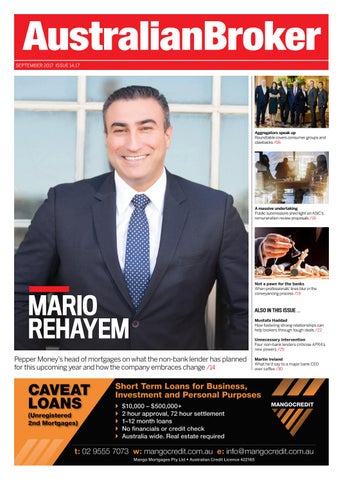
MARIO REHAYEM Pepper Money’s head of mortgages on what the non-bank lender has planned for this upcoming year and how the company embraces change /14
Not a pawn for the banks When professionals’ lines blur in the conveyancing process /19
ALSO IN THIS ISSUE … Mustafa Haddad How fostering strong relationships can help brokers through tough deals /22 Unnecessary intervention Four non-bank lenders criticise APRA’s new powers /25 Martin Ireland What he’d say to a major bank CEO over coffee /30
NEWS
IN THIS SECTION
Lenders Banks roll out fairer SME loan contracts /04
Aggregators Better consultation needed with consumer groups /06
Technology High demand spurs rapid-fire funding at neobank /10
Regulators ASIC to shine spotlight on broker fraud /12
Consumers Mortgage Choice negotiates higher commissions /08
www.brokernews.com.au SEPTEMBER 2O17 EDITORIAL Editor Otiena Ellwand News Editor Miklos Bolza Production Editor Roslyn Meredith
DATES TO WATCH
Upcoming can’t-miss events
ART & PRODUCTION Design Manager Daniel Williams Designer Martin Cosme
12 SEPTEMBER
18 SEPTEMBER
Dispute Resolution Conference
ASIC Regtech Showcase
Commercial lending webinar
With regtech top of mind for both regulators and the industry in general, this event in Sydney aims to stimulate engagement, explore the opportunities and barriers to regtech deployment, and identify potential areas for collaboration
Australian Broker’s sister publication MPA is hosting this webinar at 12:30pm about the long-term benefits of diversifying into the commercial space and why and how brokers can break into this market
The Credit and Investments Ombudsman is hosting this conference for the financial services industry. Two hundred delegates, including brokers, regulators, debt servicers and lenders, are expected to attend
27 SEPTEMBER
Production Manager Alicia Chin Traffic Coordinator Freya Demegilio
SALES & MARKETING Sales Manager Simon Kerslake Account Manager Rajan Khatak Marketing and Communications Manager Lisa Narroway
CORPORATE Chief Executive Officer Mike Shipley Chief Operating Officer George Walmsley Managing Director Justin Kennedy Publisher Simon Kerslake Chief Information Officer Colin Chan Human Resources Manager Julia Bookallil
EDITORIAL ENQUIRIES
Otiena Ellwand +61 2 8437 4792 Otiena.Ellwand@keymedia.com.au
SUBSCRIPTION ENQUIRIES
tel: +61 2 8O11 4992 fax: +61 2 9439 4599 subscriptions@keymedia.com.au
10 OCTOBER – 1 DEC
11 OCTOBER
11 - 13 OCTOBER
Connective Conference 2017
Banking Innovation 2017
Credit Law Conference
Connective is bringing its conference to Vic, WA, Qld, NSW and SA on various dates from October to December. The conference promises to inspire brokers with new business development strategies, marketing techniques, insights from industry experts, and workshops on health, mindfulness and more
This Sydney-based conference will feature presentations from experts and disruptive innovators within the financial services space who will outline what the future holds for banking practices
The 27th annual event in Surfers Paradise brings together banks, credit unions, regulators, associations and market disruptors to discuss the future of credit and lending
ADVERTISING ENQUIRIES
Simon Kerslake +61 2 8437 4786 simon.kerslake@keymedia.com.au Rajan Khatak +61 2 8437 4772 rajan.khatak@keymedia.com.au Key Media Pty Ltd Regional head office, Level 1O, 1–9 Chandos St, St Leonards, NSW 2065, Australia tel: +61 2 8437 4700 fax: +61 2 9439 4599 www.keymedia.com Offices in Sydney, Auckland, Denver, London, Toronto, Manila, Singapore, Bengaluru
24 - 26 OCTOBER
25 OCTOBER
24 NOVEMBER
Women in Leadership Conference
Loan protection webinar
FBAA National Industry Conference
This Sydney event features some of Australia’s most successful businesswomen, including the CEOs of Suncorp, the City of Sydney and Mirvac, who will share their stories of leadership struggles and accomplishments, and teach women how to drive career growth
At MPA’s lunchtime webinar you can learn about loan protection and why more and more brokers are making this an integral part of their offering
This year’s conference on the Gold Coast will equip brokers and other industry members with useful knowledge and practical strategies to help them succeed in an increasingly challenging market
2
www.brokernews.com.au
This magazine is printed on paper produced from 1OO% sustainable forestry, grown and managed specifically for the paper pulp industry Copyright is reserved throughout. No part of this publication can be reproduced in whole or part without the express permission of the editor. Contributions are invited, but copies of work should be kept, as Australian Broker magazine can accept no responsibility for loss. Australian Broker is the most-often read industry publication, according to independent research carried out by the Ehrenberg-Bass Institute for Marketing Science at the University of South Australia in December 2008. The research also found that brokers rate Australian Broker as the best for both news content and feature articles, followed by sister publication MPA. Overall, on all categories, Australian Broker ranks top followed by MPA. The results were based on a sample of 405 respondents who were the subject of telephone interviews.
NEWS
LENDERS WESTPAC REFINES SERVICEABILITY CRITERIA has announced a series of new serviceability criteria in response to APRA’s tighter regulatory requirements. Serviceability will now be calculated using a 20-year, or 240-month, term on all its portfolio loans. Additionally, a rental interest tax deduction will be calculated using the customer’s annual percentage rate. The bank has implemented a staged approach to these policy changes, which affect Westpac and subsidiaries St. George, Bank of Melbourne and BankSA.
LENDING FOR CONSTRUCTION AND NEW DWELLINGS ROSE IN JUNE 2017 Source: HIA, ABS data
12,000
Seasonally adjusted
11,500
WESTPAC
Trend
11,000 10,500 10,000
Number of loans
9,500 9,000 8,500 8,000 7,500 7,000 6,500 6,000 5,500 5,000
MYSTATE GROWS BROKER LOANS BY 40%
“The improvements have raised small business lending standards and provide important protections for small business customers.“ Peter Kell Deputy chairman, ASIC
4
www.brokernews.com.au
The major lenders have agreed to comply with ASIC’s recommendations for scrapping unfair terms and conditions from their small business loan contracts four major banks have agreed to eliminate unfair terms in their small business lending contracts after nine months of consultation with ASIC. One of the major changes includes the elimination of ‘entire agreement clauses’ that absolve the banks from responsibility for conduct, statements or representations they make to borrowers outside the written contract. The use of indemnification clauses, which are the part of an agreement that lays out which party will bear the monetary costs for losses incurred by another, has also been significantly limited. For instance, banks will not be allowed to force SME customers to cover losses or costs incurred due to fraud, THE
negligence or wilful misconduct by the banks. ‘Material adverse change event’ clauses, which permitted banks to call in a default for an unspecified negative change in a customer’s circumstances, have been removed. Finally, restrictions to how banks can vary contracts in specific circumstances have been put in place. If these variations convince the customer to try to exit the contract, banks will have to provide a period of between 30 and 90 days allowing them to do so. “The improvements have raised small business lending standards and provide important protections for small business customers. ASIC will be following up with other lenders to ensure that their small
Jun-17
Jun-16
Jun-14
Jun-15
Jun-13
Jun-11
Jun-12
Jun-10
Jun-08
BANKS ROLL OUT FAIRER SME LOAN CONTRACTS
Jun-09
Jun-07
Jun-05
Jun-06
Jun-04
Jun-02
Jun-03
Jun-01
Jun-99
Jun-00
Jun-97
Jun-98
Jun-95
Jun-96
Jun-94
Jun-92
4,000 Jun-93
at Tasmanian-based BROKERS bank MyState have grown the number of brokeroriginated loans by 40% during the 2017 financial year, bringing in 73% of all home loans through the third party channel. The bank also reported an increase of 11.3% in MyState’s residential loan book, bringing the total book to $4.08bn – 1.6 times higher than the industry average. The bank also saw $1.68bn in home loan applications and $1.19bn in home loan settlements during FY17.
4,500
business contracts do not contain unfair terms, and we will continue to work with the [Small Business Ombudsman] on these issues,” ASIC deputy chairman Peter Kell said. The big four will commence contacting relevant SME customers who entered into or renewed a loan from 12 November 2016. This coverage will apply to small business loan facilities of up to $3m. ASIC will be monitoring how the banks use these clauses, in order to determine whether they are applied or relied upon in an unfair manner. The regulator will work with Australian Small Business and Family Enterprise Ombudsman Kate Carnell to assess the results of this monitoring. “The banks’ initial underdone response to the legislation serves as a reminder that banks were once again trying to ‘game’ the rules, and this erodes trust. There are now very positive signs that the big four banks are demonstrating industry leadership in embracing best practice,” said Carnell.
NEWS
A G G R E G AT O R S CLAWBACKS THERE FOR A REASON, SAY AGGREGATORS aggregators have come out in support of clawbacks. Connective director Mark Haron says they are part of the commission structure’s economy, and Outsource Financial CEO Tanya Sale says they prevent churn. “If we want the higher upfront commissions, then you have to have clawbacks in that equation from the lender’s perspective,” Haron said at MPA’s recent Aggregators Roundtable. Sale said she was not a fan of taking them away, but that common sense needed to prevail in terms of how clawbacks were applied. TWO
LENDERS TO TOUR FAR NORTH QUEENSLAND road trip organised by aggregator AFG in northern Queensland is about to celebrate its 10th year of bringing lenders to this oft-overlooked region. AFG BDM Garry Downes launched the excursion in 2008 with himself and six lenders packed into a Tarago van driving up the coast. The aggregator hosted end-of-year celebrations for its brokers in Rockhampton, Mackay, Townsville and Cairns. Last year’s event attracted 145 brokers to four locations, with 10 lenders in attendance. This year’s event is in the works. A
COOL HEADS, POSITIVE APPROACH RECOMMENDED Aggregators have called for better consultation with and education of consumer groups and the public following recent reports reflecting poorly on brokers heads have called on the broking industry to respond more productively to consumer reports targeting broker remuneration, fraud and other negative topics. At the recent Aggregators Roundtable held by Australian Broker’s sister publication MPA, Mark Haron, director of Connective, said the industry as a whole needed to be more consultative and to better inform consumer groups. “We do need to engage with them. We need to get that voice of the consumer in the process as we move towards a self-regulatory structure.” By consulting with these groups and reinforcing the positive values that brokers bring, consumer AGGREGATOR
6
www.brokernews.com.au
groups can be brought onside, Haron said. This process has begun through the combined industry forum that’s working to consult with these groups. “One of those things that we’re embarking on through the forum is to talk to consumer groups to keep them better informed as to what the industry is doing so that their reactions will therefore be educated,” he said. Tanya Sale, CEO of Outsource Financial, was more cautious, saying the industry had to carefully select which groups it sat down with. “We have to choose the consumer groups or group that’s willing to listen and learn. They just keep on throwing out these bombs
… and they’re so ill-informed it’s not funny.” Blake Buchanan, GM aggregation at eChoice, said consumer groups had a voice in the mainstream media, while aggregators and brokers did not. “These consumer groups get out in the mainstream media, which touches the consumer [while] we report back within our industry. We don’t really have a strong voice to the open consumer market, and that’s one thing I think we can really start working on.” Brokers could also step up and help with this as well, he added. “If you’re in a community, you should be engaging with your community leaders and your community press and telling them what you do for the residents and their consumers. “I think it’s one thing to circulate this negative press amongst our own industry and whinge about it, but we should be positive in our response and take it back to consumers.”
“We have to choose the consumer groups or group that’s willing to listen and learn. They just keep on throwing out these bombs … and they’re so ill-informed it’s not funny.” Tanya Sale CEO, Outsource Financial
NEWS
CONSUMERS FORMER BROKER SLAMS COMMISSION MODEL former industry veteran has criticised commissions as encouraging brokers to push clients to take higher loans. In a Four Corners interview aired on 21 August, ex-broker Philip Dempsey said targets forcing brokers to lend a certain amount per month or cross-sell products such as insurance were causing “serious issues” and incentivised negative behaviour. “There have definitely been cases where brokers have lent more money or encouraged people to apply for more money than they can comfortably afford to repay,” he said. A
BROKERAGE LAUNCHED TO FIGHT CANCER and Robyn Roberts are two brokers who deserve honourable mention. The regional brokers have established a brokerage dedicated to helping Australians fight cancer. They’ve pledged to donate 15% of all upfront and trail commissions on loans written through Fight Cancer Home Loans to the Cancer Council for the life of the loans. The structure of the contract with Cancer Council NSW means the money will go directly from the aggregator to the charity without passing through the brokerage. FRED
MORTGAGE CHOICE NEGOTIATES HIGHER COMMISSIONS
FY17 saw two “best ever” results as the franchise’s loan book increased by 3.2% to $53.4bn, and settlements rose by 1.2% to $12.3bn. Market share remained flat at 3.7%. Settlements from the four major banks have continued decreasing at Mortgage Choice, falling from 51% to 47% between the 2016 and 2017 financial years. The share coming from ‘other banks’ rose from 30% to 33%, while building societies and credit unions remained steady at 6% and 7% respectively. Meanwhile, non-bank market share rose from 6% to 8%. Cash net profit after tax was $22.6m, an increase of 10.2% from 2016, while statutory net profit after tax was $22.2m, an increase of 13.5%. The company has increased its franchise network by 49 branches, taking these to a total of 449. The number of brokers also increased by 36, bringing the total number to 654 across the country’s network.
National franchise Mortgage Choice has reported an increase in broker commissions amid some positive financial results Choice’s average upfront commission rate for FY17 was 0.6544%, a slight increase from 0.647% in FY16. On the other hand, its average trail commissions are predicted to fall to 0.175% by June 2021 as the franchise’s loan book matures. “The trend in relation to commissions over this recent period has been that they have increased somewhat. So we reset the commercial terms with a number of our significant lenders over the last 24 months, whereby our rates of commission have actually increased,” said Mortgage Choice CEO John Flavell during a financial results briefing on 24 August. The decline in trail commission rates is associated with the MORTGAGE
“There’s rogue in any industry, but there’s definitely rogue brokers out there, because you get industries growing really fast and there’s money to be made. It’s going to attract, on the odd occasion, the wrong type of people.” Mark Bouris Chairman, Yellow Brick Road
proportion of the loan book that was generated with commissions set prior to the GFC, he said. Regarding ASIC’s broker remuneration review, Flavell reiterated the regulator’s point that brokers deliver positive consumer outcomes and the current remuneration model is relatively solid and robust. “If there are opportunities to strengthen that, then it’s at the fringes,” he said. Mortgage Choice received $75.1m in upfront commissions and $96.4m in trail in FY17. It paid $54.6m in upfront and $59.1m in trail during this same time period, putting the firm’s net core commission earnings at $57.7m.
VV$40,614,829,064 BROKERS SETTLED NEARLY $50BN IN HOME LOANS IN JUNE 2017 QUARTER Source: MFAA’s quarterly market survey; comparator analysis
0
$49,462,793,648
$46,000,026,461
$50,186,797,460
$48,576,813,258
$46,384,652,957
$43,390,028,301
$49,872,636,110
$49,544,774,789
$47,174,030,668
$40,614,829,064
$41,324,540,266
$39,316,257,254
$34,138,287,539
$36,871,974,415
$24,154,666,925
10
$24,154,666,925
20
$30,611,631,280
30 $bn
$32,008,589,215
40
$43,702,286,402
50
Jan-Mar Apr-Jun Jul-Sep Oct-Dec Jan-Mar Apr-Jun Jul-Sep Oct-Dec Jan-Mar Apr-Jun Jul-Sep Oct-Dec Jan-Mar Apr-Jun Jul-Sep Oct-Dec Jan-Mar Apr-Jun 2013 2013 2013 2013 2014 2014 2014 2014 2015 2015 2015 2015 2016 2016 2016 2016 2017 2017
8
www.brokernews.com.au
NEWS
TECHNOLOGY
MORTGAGE MARKETPLACE UPGRADES DASHBOARD marketplace HashChing has overhauled its broker dashboard, adding a number of features that let brokers visualise, track and boost their performance. The cornerstone of the upgrade is a set of performance analytics that measure personal metrics such as the number of reviews, average response time, and success rate for each individual broker. Brokers can use the dashboard to improve their service and see how far they need to progress before becoming a premium broker. MORTGAGE
HIGH DEMAND SPURS RAPID-FIRE FUNDING AT NEOBANK
than hundreds. The level of interest has been enormous, so we basically brought forward our second funding round,” he said. While this had been planned for early next year, Xinja moved it forward to September and October in order to move more quickly and get its products out at a faster rate. Wilson predicts that Xinja will become an ADI in 2018. To become a full-service bank offering credit cards, debit cards, deposits and mortgages, staff numbers would have to grow from the current eight employees to 180 in three years, he added. The government’s revised bank licensing regime has sped up Xinja’s progress even more, he added. “What the regime changes mean is it’s going to be a lot easier than we initially imagined. We were all pretty comfortable about getting qualified under the old scheme, and we’re really quite optimistic now it’s changed.”
Australia’s newest entrant into the banking market will work with brokers as it accelerates towards becoming a fully fledged bank coming on to the scene in June, neobank Xinja has reached its second round of funding in record time, with high consumer demand accelerating the firm through its initial growth phases faster than predicted. In an interview with Australian Broker, CEO Eric Wilson elaborated on how the bank planned to work with brokers in the future to develop its home loan products. “We’re planning a series of design workshops with brokers to bring them in and ask about customers. We’re doing a customer-centric design process to make sure we understand the problems brokers face and FIRST
things that their customers come across,” Wilson said. “It’s not about how we design products; it’s how we solve their problems. We’re hoping to run a couple of sessions now and a few more as we get closer to the release date, to make sure we design products that help solve problems for brokers.” Xinja has released the very first version of its app and will be sending out its first pre-paid debit cards in four to five weeks. It will then be releasing these in increasing numbers to registered customers over the next couple of months, Wilson said. “We are way ahead of our plan with pre-registration targets. We’re talking thousands rather
THE COSTLY IMPACTS OF CYBERATTACKS Source: Cyber regulation in Asia Pacific, Deloitte report 2017
Cybercrime costs
US
$575bn
per year
In 2016, hackers withdrew US$81m from the Bangladesh Central Bank
used malware to steal US$2.17m from eight banks in Taiwan
accessed and leaked the details of 3.2 million customer cards from several Indian banks
stole US$65m bitcoins from Hong Kong-based digital currency exchange Bifinex
In 2017 Korea’s seven main banks were threatened with a distributed denial of service attacks should they fail to pay a ransom
10
www.brokernews.com.au
FROM APPLICATION TO SETTLEMENT IN 30 DAYS Tic:Toc celebrated its first month in business with a number of milestones, including supporting its first customer through the application, approval and settlement process within 30 days. The firm, which boasted a ‘22-minute home loan’ at its launch on 11 July, said it had since had 25,000 people check its website and 12,642 apply to start a loan application. The latter number included those using a trial feature that allowed them to test the application process anonymously. FINTECH
TECHNOLOGY UPDATE
UNDER-30S MORTGAGE APPLICATION HOTSPOTS Source: CreditSimple.com.au
Western Australia
Northern Territory
South Australia
Queensland
GARRY ROSS DIVERSIFIES INTO INVESTMENT PROPERTY REFERRAL John Manciameli talks to Garry Ross, CEO of Money Links
11% 17% 16% 15% 13% Victoria
14%
Australian Capital Territory
12%
What first inspired you to help your clients with their investment property aspirations? I’ve always been passionate about A working with my clients to create wealth and choices. I advise clients how they can pay off their mortgages in 15 years instead of 30; this is something I talk about consistently as too many people rely on their superannuation to fund their retirement lifestyles. As a broker, I’m in an incredibly unique and responsible position to offer advice around property investment.
Q
Tasmania
13% New South Wales
Top postcodes per state
Gary Ross
Bottom postcodes per state
Percentage of mortgage applications from under-30s
Why did you choose to work with Slipstream? When I learned that Slipstream A was the only company in Australia to offer an independent panel of verified investment property research houses and buyers’ agents, it immediately piqued my interest. I saw the value for my clients straight away. I went along to one of Slipstream’s Introductory Seminars and the offering felt a good natural fit with my team. At the event I also learned about the comprehensive training program they offer. Before starting with Slipstream, I didn’t fully understand the investment property process, but under their guidance it’s given me confidence to launch a new area of my business.
Q
NON-MAJOR REFRESHES BROKER PORTAL Bank has taken brokers’ feedback into account in designing its revamped broker portal. The new website layout is in line with the bank’s renewed strategic focus on the third party channel. Resources such as online tools, forms and product information have been placed together. Other features include a visual arrangement of aggregators on the accreditation page to facilitate the accreditation process, and easier access to contact details for lending support, broker administration, general enquiries and construction loans. MYSTATE
What are the key benefits of Q working with Slipstream? Slipstream offers a unique level of A mentorship and education for brokers, plus regular workshops where you can earn CPD points with a range of independent speakers. I now have access to high-level expertise and guidance. This means I can paint a picture for each individual scenario that’s relevant to today’s property market, which is critical because it gives my clients access to the financial insights that will assist
John Manciamelli
them to make informed decisions about buying investment property. Slipstream doesn’t leave anything uncovered. Their program teaches you the good, bad and the ugly about investing in property, then arms you with the knowledge so I can pass this on to my clients. What feedback have you received from clients you’ve worked with? It’s incredibly rewarding to see my A clients create wealth through quality property investments. For example, thanks to Slipstream, a couple that I’ve been working with for six years now own four properties (a mix of off-the-plan and existing property), which have created over $700k in capital growth. They’re so happy they think I ‘walk on water’, but they also said they wish they’d met me nine years ago!
Q
How much has Slipstream impacted the bottom line of your day-to-day business? I’m happy to say it’s added an extra A 100k per year to my business. As well as the financial reward though, I’ve grown professionally and my mantra is: if you do the right thing by people, the money will take care of itself.
Q
What’s the most important piece of advice you would share with other brokers? Don’t wait! Diversifying into A investment property referral isn’t a get-rich-quick scheme. If you’re in the broking industry for the long haul and are passionate about helping clients to have more choices, and you’re also prepared to educate yourself along the way, then this is for you. Besides, you don’t pay Slipstream anything until your client makes the decision to invest in a property, so what do you have to lose?
Q
NEWS
R E G U L AT O R S
COSTELLO CALLS ON RBA TO LIFT RATES treasurer Peter Costello has said the RBA should lift the cash rate soon to avoid a potential debt catastrophe. Now chairman of the national Future Fund, Costello warned that low rates were contributing to “massive imbalances” in the economy. “We have to normalise interest rates, and the longer you leave it the more unbalanced your economy is going to get,” he told The Weekend Australian. He suggested Australians weren’t concerned about debt because of the low interest rates. FORMER
ASIC TO SHINE SPOTLIGHT ON BROKER FRAUD The regulator says it will focus on enforcing higher standards in the financial services industry, paying close attention to lending practices has flagged gatekeeper culture as a key risk in the finance and credit industry, promising to put the spotlight on lending practices in the broker community. In the ASIC Enforcement Outcomes: January to June 2017 report released on 22 August, the regulator said gatekeeper culture and conduct was one of its main priorities, along with digital disruption and cyber threats. “We are focusing on culture and incentives that result in poor financial advice, irresponsible lending and mis-selling to retail investors and consumers, which can undermine trust and confidence in the financial system,” ASIC wrote. Over the next six months, ASIC said it would focus on enforcing higher standards in the financial ASIC
GOVT STRENGTHENS APRA’S CRISIS POWERS federal government has released draft legislation aimed at providing APRA with enhanced powers during times of financial crisis, following a recommendation from the Financial System Inquiry. The legislation would allow APRA to “act decisively to facilitate the orderly resolution of a distressed bank or insurer”, among other things. International experience during the GFC showed that regulators needed “powerful, flexible and timely tools” to resolve financial institutions in distress, the government said. THE
12
www.brokernews.com.au
services industry, paying close attention to responsible lending practices in the consumer credit sector. That includes what is expected of lenders in assessing loans (eg fraudulent loans) submitted by brokers, and what is required to meet the obligations for assessing and verifying the borrower’s financial circumstances. The regulator has the power to recover expenses from individuals under investigation who caused those costs to be incurred in the first place. “We have the power to make an order to recover our costs where, as a result of an investigation, a person is convicted, a judgment is awarded, or a declaration or other order is made.” This includes salary costs for ASIC staff working on the investigation, associated travel expenses, fees for
external legal counsel, and charges related to expert analysis. From January to June, ASIC began 57 investigations and completed 80. In total, 59% of instances of misconduct dealt with by ASIC were breaches of the NCCP Act, including dishonest conduct, misleading statements, misappropriation, theft, and fraud by credit providers or credit licence holders. At the same time, five individuals were charged in criminal proceedings, including former Westpac home finance manager David St Pierre, who dishonestly used his position and submitted loan applications for approval when he knew they contained false information and false documents. St Pierre obtained over $2.5m for Westpac customers, which was then invested in a now-failed Tasmanian property development scheme. Although sentenced to three years in prison, after six months the court ordered that he be released on a $1,000 recognisance order and three-year good behaviour bond.
MISCONDUCT IS LARGEST IN CREDIT SERVICES AREA Source: ASIC Enforcement Outcomes: January to June 2017
59% Credit
8% Dishonest conduct, misleading statements
30% Other financial services misconduct
3% Theft, fraud, misappropriation
SUMMARY OF ASIC’S KEY ENFORCEMENT RESULTS Source: ASIC Enforcement Outcomes: January to June 2017
57
32
investigations commenced
criminal charges laid
80
11
investigations completed
infringement notices issued
23
5
individuals removed from financial services
persons charged in criminal proceedings
$618.8m
$1.4m
paid in compensation/remediation
infringement notices paid
203
399
persons charged in summary prosecutions for strict liability offences
criminal charges laid in summary prosecutions for strict liability offences
FBAA APPLAUDS ACCC’S INCREASED BANK SCRUTINY ACCC has said it is going to investigate how the big banks set rates for their mortgage products, something the FBAA called on them to do back in June. ACCC chairman Rod Sims said the regulator had sent out information notices to the big four and Macquarie to seek to understand their rate decisions, how much banks rely on the RBA’s official cash rate when setting them, and how they measure profitability against the interest of consumers. The FBAA said it was pleased the ACCC had decided to act. THE
FE AT URES
COVER STORY
GAZE INTO THE CRYSTAL BALL This may have been a tough year so far for the industry, but for the quick and nimble non-bank lender Pepper Money it has meant opportunities. Mortgages boss Mario Rehayem explains some of the exciting developments the lender has in the works
KEY BUSINESS METRICS 1H17
$22.7m profit after tax for Pepper’s Australia and NZ division – up from $17.4m for the same period the year before
New residential loan originations up 17% to $1.38bn
50% of loans originated through brokers
8%
42%
direct to consumer
through white label products
Loan book by type
31%
69.4%
interest-only
owner-occupier
69%
30.6%
principal and interest
investor
Loan book geographical breakdown
26.7%
37.3%
Vic/Tas
NSW/ACT
17.5%
6.7%
Qld
SA/NT
11.9% WA
14
www.brokernews.com.au
Rehayem expected 2017 to be a “turbulent” year for the mortgage industry, but what his crystal ball didn’t make clear was just how uncertain some things would be. “It’s hard enough for someone who’s in the know to understand what’s going on, let alone your average consumer,” says Rehayem, Pepper Money’s managing director of Australian mortgages and personal loans. And the one thing businesses can’t afford to do is complicate matters even more, he says. “If there’s ever a point in time for us to become simpler than ever, it is now.” So what does Rehayem predict the year ahead will hold? “The crystal ball tells me it’s going to be a very good year for Pepper, because whenever the opportunities arise in the market where there’s a clampdown, we have, I would say, a knack to understand where to enter,” he says. Since Pepper opened its doors in 2000, it’s been providing mortgage products to underserved communities. Every time the market has moved or requirements have changed, Pepper has adapted to ensure it continues to offer credit to Australians who deserve a second chance. It just so happens that non-conforming clients now encompass an even broader swathe of the population. Rehayem is confident that while other lenders are busy secondguessing themselves, Pepper will be able to capitalise on its MARIO
strengths and its track record, and the market will play out to its benefit. Even though Pepper is a flexible and agile non-conforming lender, the environment it’s currently playing in is different than it was before, and those changes can’t be ignored, he says. “It’s still a changing environment … and we have to be quick and nimble to be able to act, otherwise we will definitely fall behind. But Pepper’s always been known as the one that does not lag in that area; we’re confident this
a natural progression for Pepper, Rehayem says, and will help the lender appeal to its existing customer base, 40% of whom are self-employed. Pepper is currently conducting broker focus groups with some of the leading commercial writers in the country in order to find out what nuisances and gaps exist in the commercial market so it can develop products that best suit the needs of brokers and their clients. The company prides itself on its regular consultation with brokers and consumers, which pays off when a product is introduced to the market and it takes off, Rehayem says. The commercial business will hopefully do the same when it’s launched early next year. “We know what people want, we know what the consumers are asking for and we know what the brokers are starving for,”
“We cannot change the big levers that are getting pulled at the moment, so ... brokers just need to focus on the consumer, their customer base, and focus on their business” year that we’ll close off extremely strong,” he says. The non-bank’s results for the first half of 2017 certainly suggest he’s right, with new residential loan originations up 17% to $1.38bn. It will be a busy year for Pepper as the lender launches its commercial loans, trains brokers to get the most out of the two new tools in its “customer conversion toolkit”, unveils a direct-toconsumer marketing campaign, and continues to foster strong growth of its white label and personal loan products. Providing commercial loans is
Rehayem says. The company also unveiled two technology solutions for brokers, Pepper Product Selector and Pepper Resolve, at its National Insights Roadshow series in June. The tools have different uses. Pepper Product Selector is a digital tool that allows brokers to provide their clients with indicative offers within two minutes, and Pepper Resolve is an integrated solution that does this in real time. Nearly 630 brokers have already used the Pepper Product Selector tool since it was introduced at
Mario Rehayem, managing director of Australian mortgages and personal loans, Pepper Money
the roadshows, and 190 brokers have now used it to submit their first ever non-conforming loans to the lender. According to Pepper, six out of 10 borrowers miss out on a finance solution despite being eligible for the types of loans the non-bank offers. These unique broker solutions have been created to help a broker match their customer with the most appropriate Pepper home loan product, and help the customer understand what they are likely to receive when they make one of the most important decisions of their life. Pepper is currently in discussion with aggregator groups
to roll out the Pepper Resolve tool. After several years in the concept and development phases, Rehayem says it’s rewarding to see how these tools have been embraced by the third party channel. Pepper will continue to provide brokers with training around all the features of the tools at state-based training sessions in October and November. These workshops will pick up where the roadshows left off and provide brokers with further detail to help them understand nonconforming loans, and how to use the five-step sales process to talk to clients so they better
understand their credit journeys. “If you’re not familiar with non-conforming policies, you’re going to shy away from it; so this is what the tool does, it brings that familiarity straight up from day one,” he says. Conversing with consumers Rehayem says the company has come to realise that it needs to do more to lift brand awareness among consumers so they’re “knocking on the door of the broker, saying, ‘I actually need a Pepper loan’,” he says. In September, Pepper will launch a full-scale marketing campaign, featuring
advertisements on the radio, bus shelters and billboards to tell confused customers that there are alternatives and they should seek out a mortgage broker to discuss their options. While Pepper has had a direct channel since 2012, it plays a minor part in the business. The latest half-year financial results for the Australian market show that around 50% of its loans were originated through the broker channel, 42% were through the lender’s white label products, and 8% were direct to consumer. “[The broker channel] is definitely the channel that is the backbone of this business from the Australian mortgages distribution perspective,” he says. Rehayem expects the advertising campaign to grow both the broker and direct channels, with an uplift in calls, enquiries and customers. “No matter what brokers say or do, we cannot change the big levers that are getting pulled at the moment, so I think that brokers just need to focus on the consumer, their customer base, and focus on their business,” Rehayem says. He believes that when there are factors that cannot be controlled, brokers, aggregators and lenders need to find a way to embrace them quickly or get left behind. Thanks to Pepper’s global footprint, Rehayem has the advantage of foresight. Those overseas businesses have endured through various governments’ regulatory crackdowns, giving some hint of what the future might hold for Australia as so much in the industry has yet to be determined following ASIC’s remuneration review and the Sedgwick report. In the meantime, Rehayem says: “We need to focus on our business, and we will continue to drive our business plan and keep a close eye on what is happening out there, and we will adapt when we need to adapt.” AB www.brokernews.com.au
15
FE AT URES
NE WS ANALYSIS
A MOUNTAIN TO CLIMB The Treasury has released the industry’s submissions on ASIC’s Review of Mortgage Broker Remuneration, revealing the ongoing friction between brokers and banks, and the industry forum’s daunting task at hand trove of submissions representing the vast and varied opinions of major banks, aggregators, consumer groups and independent brokers in response to ASIC’s Review of Mortgage Broker Remuneration have been released, shedding some much-needed clarity on where they all stand regarding the regulator’s 13 key findings and six proposals. The 27 publicly released responses – eight were confidential – provide the industry with a mountain of material to process. Clearly there is still a lot of work to be done before a final outcome is determined, but one thing most groups could agree on was the importance of getting a chance to self-regulate through the industry forum. Trying to come up with a solution that’s considered fair and sustainable for those involved is a massive undertaking, one that the government supports and is willing to wait for. “I welcome the proactive steps taken by the mortgage industry forum to engage with the government and consumer stakeholders on the issue of mortgage broker remuneration,” Financial Services Minister Kelly O’Dwyer said, adding that the government would take the forum’s process into account when finalising its response. The industry has its work cut out for it. A
Aggregators express concerns As expected, most aggregators discouraged wholesale changes to broker remuneration and pointed out their concerns and misgivings regarding ASIC’s findings. They argued that, for the most 16
www.brokernews.com.au
part, the current regulatory framework was sufficient and did not require modification. “We are concerned there is a risk that any such changes could result in unintended negative consequences for the competitiveness of the
The review was based on data from 2012 to 2015, which is not necessarily reflective of the increased regulatory guidance and scrutiny the industry has undergone since then, Connective said. “Implementing changes based on
“It is important to remember that the existing commission model for mortgage brokers is not broken” AFG industry and ultimately, less favourable consumer outcomes,” Connective said in its submission. Connective had concerns about the review abandoning the existing responsible lending framework, “instead seeking to solve a poorly defined problem with an impossible to implement solution”.
that data may be attempting to solve concerns that no longer exist.” AFG said the development of the broking industry had given lenders without a large branch network access to an effective distribution system, limiting the oligopoly of the four major banks. “It is important to remember that
the existing commission model for mortgage brokers is not broken,” AFG said. The aggregator did not support the introduction of a standard fixed fee, but it did agree with NAB that upfront commission should be paid on the drawn-down amount rather than the approved amount. Smartline also said this might be an appropriate way to go. AFG said some responsibility should be put on lenders to review how they priced loans, to reduce the incentive for consumers to take out larger loans than necessary. AFG also had a strong rebuke for the ABA-sponsored Sedgwick review, warning the government not to give it more weight than it deserved but to treat it as one submission from a special interest group. “It is AFG’s contention that the comments in the ABA Report about
ASIC’S SIX PROPOSALS Source: ASIC
1
2
3
4
5
6
Changing the standard commission model
Moving away from bonus commissions and bonus payments
Moving away from soft-dollar benefits
Clearer disclosure of ownership structures
Establishing a new public reporting regime on consumer outcomes and competition
Improving the oversight of brokers by lenders and aggregators
the mortgage broking industry are misguided and open to allegations of bias or partisanship,” it said. AFG added that some banks were using this as justification to implement changes designed to reduce and marginalise the financial viability of the broking industry. Mortgage Choice said the current commission model was sound and appropriately compensated brokers for their time and effort. It said that if ASIC wished to change the shape and nature of lending, then it needed to go about this through lender credit policy and lender pricing. “The only truly effective mechanism available to the regulator is through being more prescriptive in lender underwriting policy or shaping the economics at the lender end to drive an increase in consumer pricing at the higher risk end of the market,” Mortgage Choice said. Major banks suggest commission changes The ABA, which represents 25 banks, including the four majors, said it believed the ASIC proposals “align strongly with the intent of the recommendations of the Sedgwick Review, in particular, the focus on reforms and improvements that reduce the risk of poor customer outcomes”. The association said it supported the opportunity to develop a self-regulatory response “to change payments and governance arrangements in mortgage broking”, and was actively participating in the industry forum. Its submission did not directly address the main point in ASIC’s
review, which centred on changing the standard commission model. It said the banking industry was still considering responses to ASIC’s Proposals 1, 2, 3 and 6 and how they would work in conjunction with the third party recommendations made by Sedgwick. The Sedgwick review was released in April, about a month after ASIC’s report. Three of its 21 recommendations directly related to mortgage brokers, including one suggestion that banks adopt a remuneration structure for aggregators and brokers that did not link payments to loan size, instead proposing a “holistic approach” to performance management. NAB, Westpac and CBA all submitted separate reports from the
important improvements that NAB believes should be applied broadly across the industry,” the submission said. NAB also said it would work with the industry to come up with a model that did not directly link payments to loan size, and it suggested the industry consider attaching key performance indicators, such as KPIs, to the payment of trail commissions. “NAB will increase oversight on all aggregators it deals with as a lender to assist with ensuring brokers perform preliminary assessments thoroughly. To ensure lenders are comfortable with the quality of the initial discussions, lenders should be able to access preliminary assessments as, and when, they need
“There’s a mismatch between what consumers think they are getting when they see a broker and what they receive” Consumer Groups one handed in by the ABA on behalf of its members. There was no public submission from ANZ. NAB suggested several changes to brokers’ commission. One of its key points was to adjust payments so upfront commission was based on the amount drawn down, not the total facility amount. It also suggested paying upfront commission net of offset account balances. “NAB supports these changes and will work through the requirements to implement them. These are
to,” the bank said. Another key area NAB addressed was in regard to increasing governance and oversight of brokers. The bank said aggregators needed greater oversight of brokers to ensure they continued to be accessible to customers who settled loans with credit assistance provided by those brokers, and lenders needed visibility of this oversight. Westpac’s contribution was more muted, referring to the ABA’s submission and its work with the joint industry forum. The bank did
OPINIONS VOICED Twenty-six submissions were made public from the following: 1. Australian Bankers’ Association 2. Australian Finance Group 3. Australian Finance Industry Association 4. Aussie Home Loans 5. Central Lending Solutions 6. Customer Owned Banking Association 7. Connective 8. Commonwealth Bank of Australia 9. Everfirst Financial Services 10. FBAA 11. Shawn French 12. Futurity 13. Tim Howard 14. Joint Consumer Groups 15. KeyInvest Lending Services 16. Loan Market 17. Loans Actually 18. MFAA 19. Mortgage Choice 20. NAB 21. RFS Finance 22. Rice Warner 23. Smartline Home Loans 24. Specialist Finance Group 25. Barry Thatcher 26. Universal Wealth Management 27. Westpac
www.brokernews.com.au
17
FE AT URES
HOW COMMISSIONS ARE TYPICALLY SPLIT ON A $500K LOAN Source: ASIC
say, however, that “steps to change the standard commission model would need to be taken with care to prevent market distortion and unintended consequences”. Consumer groups say overhaul needed Consumer groups CHOICE, Consumer Action, Financial Counselling Australia and the Financial Rights Legal Centre also made their voices clear in a joint submission suggesting that the current broker remuneration structure should be completely overhauled. The groups recommended that upfront commissions should be replaced with a ‘fixed fee for advice’ model (either through a lump sum or hourly rates), while trail should be scrapped entirely. “Based on cases that financial counsellors and community legal centres see, it appears that some mortgage brokers are so motivated by commissions that they put customers at significant risk and take extreme steps, including likely document fraud and breaches of the responsible lending obligations under the [NCCP Act],” they said. The consumer groups also requested that they be included in future industry discussions to address the issues raised by ASIC. The industry forum to date hasn’t included these groups, but that is slated to change. Strengthening partnerships with them has been identified as an important step. The groups went above just addressing ASIC’s six proposals, saying the regulator needed to widen its scope and deal with other problems in the broking sector. As brokers’ market share grows, they must be held to higher standards, they said. “ASIC’s research into consumer perceptions of brokers revealed that there’s a mismatch between what consumers think they are getting when they see a broker and what they receive.” FBAA disappointed in findings Conclusions drawn by ASIC’s review “directly contradict” findings within 18
www.brokernews.com.au
the broking industry, the FBAA said in its submission. “We were surprised by some of the findings in that they are not supported by our own observations and those of our members, some even going so far as to directly contradict our understanding of the segment,” FBAA executive director Peter White said in the submission. The FBAA also maintains that there is no correlation between broker commission and consumer borrowing patterns. “Any change to remuneration models which adversely impact brokers provide no gain to consumers. Any proposal for change must evidence a clear business case in favour of consumers,” White wrote. “The FBAA will not support changes to remuneration models that injure the profession and deliver no consumer benefit.” Noting that ASIC’s data indicated a possible correlation between broker-arranged loans, loan size and LVR, White said commissions could not be singled out as the causative factor. “Incentives are an inherent part of any sales or fee for service model, but we should not rush to call an incentive a conflict of interest.” LVR-weighted commission payments would be difficult to implement and administer, he
$400
$200
paid upfront
per annum trail
Aggregator
$2,700
$700
paid upfront
per annum trail
Broker
time frame or a “utilisation trigger” so the broker’s income is not left to matters outside their control. MFAA focuses on industry forum In a 46-page paper submitted to the Treasury, the MFAA gave the green
“Such changes could result in unintended negative consequences for the competitiveness of the industry and ultimately, less favourable consumer outcomes” Connective said, which NAB and Westpac also pointed out. “It may be possible to base commission payments on the utilised/drawn down balance and not on large amounts left in redraw,” White added, although this would need to be subject to a reasonable
light to certain proposals while expressing its concern about others. Linking upfront commission to loan size was flagged by the MFAA, with ideas such as implementing a cap on the maximum LVR, or paying upfront based on both loan size and complexity, being
shot down by the organisation. Paying different-sized upfront commissions around a pre-agreed pivot point also comes with risks, including potential impacts on tax-based investor lending and first home buyers, MFAA CEO Mike Felton told Australian Broker in an exclusive interview before the submissions were released publicly. Felton said the MFAA was fully behind moving away from bonus commissions and payments as they could cause heightened conflicts of interest. Both ASIC and Treasury have been clear about giving the industry the chance to self-regulate, and Felton is taking that task seriously. “Self-regulation is not a right,” he said. “It’s an opportunity. It’s also not an invitation to do business as usual. We have to use it as a window of opportunity to make meaningful change so that we can drive an increase in trust, confidence and sustainability of our industry.” AB
OPINION
BROKERS, STAND YOUR GROUND Peter Mericka, property lawyer at Lawyers Conveyancing, breaks down the conveyancing transaction and urges brokers not to become pawns of the banks in the process
unless ConVey completes these to BigLaw’s satisfaction. BigLaw expects that ConVey will either absorb the costs, or that ConVey will pass these costs on to Anna (which means Anna is paying for work BigLaw has already been paid to perform by Tier2). BigLaw uses a scam that involves telling ConVey in a letter that if it does not perform
the past two decades in the mortgage and conveyancing industries, I have observed that brokers have drifted from the role of advocate for the borrower to little more than a mouthpiece for the bank. In other words, instead of representing the borrower to the bank, the broker now tends to represent the bank to the borrower. This has consequences for the relationship between the borrower and their own legal representative, and for the ethical standing of the broker. Many banks and non-bank lenders are outsourcing the preparation of mortgage documents to large law firms, while others in-source this task to specialist teams. As an example for the purpose of this article, I will assume that a borrower (Anna) has sought assistance from a mortgage broker (Harry), and that the chosen lender (Tier2 bank) has outsourced its mortgage preparation to a large law firm (BigLaw). I will also assume that the borrower has appointed a conveyancing lawyer (ConVey) to complete the conveyancing transaction. BigLaw’s client is Tier2, Harry’s client is Anna, and ConVey’s client is also Anna. This much is clear. What is not as clear is the relationship that Harry and ConVey are believed to share with BigLaw and Tier2, and how this relationship may conflict with the duties Harry and ConVey owe to Anna. OVER
How brokers unwittingly perpetuate the ‘BigLaw’ extortion scam When Harry prepared Anna’s initial loan application he entered ConVey’s details as Anna’s legal representative. Anna did not retain ConVey for the purposes of providing services to BigLaw, but because they were included BigLaw has decided ConVey is now at its disposal. BigLaw informs ConVey that it represents Tier2, and sets a number of tasks, deadlines and conditions for ConVey to perform. BigLaw says settlement cannot be booked
and BigLaw are working against her, but Harry steps in to convince her that it is ConVey’s role as her conveyancer to do as Tier2 and BigLaw demand. Harry maintains his relationship with Anna, and Anna turns on ConVey for failing to provide the level of service and protection she was paying for. ConVey loses Anna as a client and accepts that perpetuating the scam is necessary for its own survival in a highly competitive industry. Tips for brokers to avoid becoming conflicted The BigLaw scam is gradually being exposed and challenged, and it will not be long before brokers who facilitate it will be called to account for their conduct. My advice to brokers is to not fall into the trap of becoming unwitting advocates for banks or the law firms representing them. Brokers are professionals who are being paid a fee for service. A broker’s responsibility does not end with the submission of a loan application. Rather, it starts with the loan application and does not conclude until settlement.
Brokers have drifted from the role of advocate for the borrower to little more than a mouthpiece for the bank
Peter Mericka Legal practitioner at Lawyers Conveyancing in Melbourne, real estate agent, consumer advocate and former mortgage broker
these tasks, BigLaw will not allow ConVey to book settlement. If settlement can’t be booked, BigLaw will not deliver the required funds for settlement, and settlement will be delayed or cancelled. Anna will then hold ConVey responsible for the failed settlement. To make sure that Anna will blame ConVey, BigLaw tells Anna at the outset that her settlement will be jeopardised unless ConVey ‘cooperates’ with BigLaw by fulfilling all of its requirements. ConVey realises that both it and its client are being exploited, and it refuses to provide free services or to extract costs from Anna for the benefit of BigLaw. This is where BigLaw calls on Harry to keep ConVey under control. BigLaw emails Harry and tells him that settlement is likely to be delayed because ConVey is not cooperating and there are outstanding requirements that must be fulfilled before settlement can be booked. Harry then writes to ConVey, making it clear that ConVey is failing to protect Anna and that he expects ConVey to “do the job Anna’s paying you to do”. Harry cc’s Anna on the email and Anna lets ConVey know that she will hold ConVey responsible if settlement is delayed. ConVey tries to explain to Anna that Tier2
It is essential to determine and maintain a clear distinction between the roles of each professional representative in order to ensure that legal and ethical responsibilities are maintained and clients’ interests are protected. Always ask, “Who is my client?” While the bank may be investing in the broker by way of commission, the borrower is investing in the broker by way of trust. The broker should assume that the bank will obtain any documents or information it requires from its customer, and not expect the broker to do so. If the broker becomes involved in satisfying the bank’s requirements, it should be as a courtesy to the client, and not because they are fulfilling a demand of the bank. If the bank makes any threat to delay settlement, the broker should see the bank as threatening to harm the client, and take the bank to task. The borrower’s legal representative is not appointed to assist the bank or the broker, and so neither should call on the borrower’s legal representative for assistance. The broker should never tell the borrower that their legal representative will or should become involved in the loan transaction without first confirming that this is clearly included in their engagement agreement. AB www.brokernews.com.au
19
PEOPLE
CAUGHT ON CAMERA Set in beautiful Port Douglas, the Finsure and LoanKit National Conference treated over 200 delegates to an unforgettable four days, which included unique activities, incredible dining and networking experiences and invaluable educational seminars. The keynote speakers included communications coach Chris Helder and former ballet dancer Li Cunxin, author and protagonist of Mao’s Last Dancer, who both inspired and educated the delegates. The national conference comes off the back of a successful year for the Finsure Group, which also hosted its first annual Commercial Conference in May. The group placed sixth on the latest BRW Fast 100 list, and ranked first among the fastest-growing financial companies on the list. Photography by Simon Kerslake
20
www.brokernews.com.au
www.brokernews.com.au
21
PEOPLE
Have an interesting deal? Had a particularly difficult or interesting deal? Why not share it with us? Email:
Otiena.Ellwand@keymedia.com.au
A BIG DEAL
Mustafa Haddad, finance manager at Anne Street Partners, talks about the importance of fostering strong relationships with lender BDMs, which can help you work through tough deals together to reach your clients’ goals
Location: Sydney
THE FACTS
Loan size $380,000
Loan term 30 years
provide documentation evidencing her prospective new employment. Once the valuation report was completed and the client had provided all the required documentation, I was able to submit an application to Westpac with just seven business days left until settlement. This was going to be very tight. However, because I had such a great relationship with the BDM, built on trust over numerous previous successful deals, we were able to expedite the application and the property settled on time, exceeding my client’s expectations. Had my client not been able to settle, she would have lost the $50,000 deposit that she had paid upon exchange of contracts. She would also have missed out on the capital growth of the property, which was approximately $100,000 based on market value at the time of settlement. THE TAKEAWAY
Client Single, first home buyer
for the purchase, which was going to be tricky in view of her recent change in financial circumstances and the short time frame. Luckily, as a broker I have access to over 20 lenders and have fostered strong relationships with many of their BDMs. I’ve built positive relationships with them by being patient and understanding when an issue arises with the bank. I work with them to achieve the desired outcome, rather than hounding them. It also helps if you learn as much as you can about the lenders’ products, policies and niches to help you identify opportunities.
THE SCENARIO
As a home loan broker, I see many different and memorable situations in which clients require urgent and professional assistance. One instance remains at the forefront of my mind. A client approached Anne Street Partners for urgent assistance to purchase their first home. They had approximately two weeks until settlement and had not organised finance prior to contacting us. To complicate matters further, the client had recently lost their job. The property being purchased was an off-the-plan unit that the client had exchanged contracts on two years earlier, right before the Sydney housing boom. The client had requested that the vendor release her from the contract; however, the vendor was not willing to do so, nor were they willing to grant her an extension for settlement. So the client needed to find finance 22
www.brokernews.com.au
Goal Purchase first home
THE SOLUTION
Mustafa Haddad Finance manager, Anne Street Partners
I spoke directly to my Westpac BDM about my client’s situation, and they were keen to help me develop a solution for my client in a short space of time. To get things underway, I ordered an upfront valuation of the property and asked the client to
As her broker, it gave me immense satisfaction to see the effort of two weeks of negotiation, multiple phone calls, and moving with fierce urgency result in a mammoth win for the client, who finally got her dream home. Here at Anne Street Partners, we exist to help Australians create a brighter future – and in this instance I feel we were certainly able to fulfil this promise. This experience gave me insight into the importance of building great BDM relationships and business partnerships. It gave me a better understanding of how I can reach a solution regardless of the circumstances and not have to turn a client away. It also demonstrated the impact that I, as a broker, can have on helping people achieve their lifestyle goals. We are a key part of a client’s journey. Without my assistance and the relationship I had with Westpac, the client may not have been able to settle, which would have been absolutely devastating for her. After my client settled on her property, I reflected on the journey we had taken together. The experience gave me an immense sense of accomplishment, especially when my client personally thanked me for going above and beyond. She remarked that she would not have been able to achieve such a result, or receive that level of service, had she applied for the loan online. I now understand that my skills and experience really do help to change my clients’ lives. AB
www.brokernews.com.au
23
FE AT URES
Get involved in the discussion Share your thoughts at
brokernews.com.au
FROM THE FORUM
Top comments from trending stories on brokernews.com.au
FORMER BROKER SLAMS COMMISSION MODEL
CLAWBACKS THERE FOR A REASON, SAY AGGREGATORS
A former industry veteran has criticised commissions as encouraging brokers to push clients to take higher loans. In a Four Corners interview aired on 21 August, ex-broker Philip Dempsey said targets forcing brokers to lend a certain amount per month or to cross-sell products such as insurance were causing “serious issues”, and incentivised negative behaviour. “There have definitely been cases where brokers have lent more money or encouraged people to apply for more money than they can comfortably afford to repay,” he said.
Two aggregators have come out in support of clawbacks: Connective director Mark Haron says they are part of the commission structure’s economy, and Outsource Financial CEO Tanya Sale says they prevent churn. “If we want the higher upfront commissions, then you have to have clawbacks in that equation from the lender’s perspective,” Haron said at MPA’s Aggregators Roundtable. Sale said she was not a fan of taking them away, but common sense needed to prevail in terms of how clawbacks were applied.
What a load of rot. Since the introduction of NCCP and responsible lending, 99% of brokers are doing the right thing by the client and also the lenders. This bloke is simply displaying attention-seeking behaviour. I am proud to be a broker and also to be part of a large group of ex-bank managers who are all brokers and who all do the right thing! We only submit loans that customers can afford and that lenders will approve. As far as doing a large loan for the sake of a large loan, well, sorry, but I have not done that in 35 years of lending. Sunshine Coast Broker on 23/08/17 at 9:10 AM
In all my 10 years in third party – many of those spent looking after 300 brokers for a bank – I have never come across a broker who would push for a higher loan amount for commissions. It makes no sense. Even for those not looking solely after their clients’ interests, we are paid on the life of the loan, so you would earn more placing the client in a more conservative loan amount to ensure tenure of trail. In the case above, the developer and the broker were working together. The issue is brokers who gain commissions from a developer. This practice should be banned and, in my experience, is the only time I’ve seen a broker push something not in a client’s interest. There is not enough money to be made in broking to not look after clients’ interests long term, which includes correct product choice and loan amount.
Cranky Old Broker on 16/08/17 at 8:54 AM
Clawbacks were introduced when upfronts and trails were much higher than they are now. Bank profits are increasing, so overall, the current clawback system needs to be reviewed and modified. I believe clawbacks need to stay; however, they should not be equal to 100% upfront and not for as long as 24 months in some cases. Xavier Quenon on 16/08/17 at 8:56 AM
I am not familiar with any other industry where you need to return your earnings after two years of receiving them. Brokers are merely custodians of upfront payments for up to 24 months. A fairer solution is a progressive clawback over 12 months, eg full clawback in the first two months, then reduced by 10% every month until month 12. This could be standardised for the industry so brokers know where they stand. But I suppose ‘fairness’ may not be in the banks’ vocabulary. Another cranky old broker on 16/08/17 at 9:29 AM
I think a true reflection of a broker’s competence can be gauged by the number of arrears and distressed loans in their portfolio. To suggest that brokers are driving the push to property is ludicrous. It is simply that the market thinks the rosy days will never end. Those who are experienced know that this is not true and warn their clients accordingly.
When commissions were reduced by 30% years ago, did the banks reduce clawbacks? No! We are the only industry that does the job and then gets clawback when the consumer sells, refinances, etc. Yes, clawbacks are needed to stop the ratbags who churn clients, but they should not be charged to brokers doing the right thing; that is, looking after the client and providing them with good outcomes.
Peter Peters on 23/08/17 at 9:13 AM
Scott on 16/08/17 at 9:33 AM
Rachelle Eyndhoven on 23/08/17 at 9:10 AM
24
Distinctly unfair when applied to clients selling or paying debt. My business was nearly wiped out by clawbacks last month, none of which were refinances, so whilst Tanya is right in saying they are there to stop churn, she is also wrong in that banks are simply using them to screw over lenders when businesses/properties sell, thereby undoing a hell of a lot of good work that the broker has done.
www.brokernews.com.au
IN THE NE WS
UNNECESSARY INTERVENTION A joint submission from four leading non-bank lenders says the government plans to provide APRA with a ‘wide net’ of regulatory powers, creating uncertainty in the sector leading non-bank lenders have criticised the powers the government plans to grant APRA in overseeing the non-ADI lending sector. In a joint submission to the Treasury, Pepper Group, Liberty Financial, Firstmac and RESIMAC said that while they recognised the need for financial stability and sound lending practices, the significant differences between non-ADIs and ADIs needed to be considered. “Non-ADI lenders promote healthy competition within the finance sector, and service areas and customers that ADIs lenders cannot or are unable to service,” they said in the submission. The regulation of non-banks should thus be limited to “exceptional circumstances” if activity by a non-ADI lender is deemed to threaten the stability of the financial system. The Treasury initially said APRA’s additional oversight would be a “reserve power” for when excesses were observed in the system, but the recent exposure draft went further than expected, creating “unnecessary regulatory intervention” and “regulatory uncertainty” within the sector, the lenders said. “It casts an extremely wide net, both in terms of the proposed entities to be regulated and the level of regulatory oversight. We recommend that the legislation be modified to facilitate a more targeted regulatory approach to avoid causing unintended instability in the capital markets, the non-ADI lending sector and the Australian economy more generally.” The submission, prepared by legal firm King and Wood Mallesons, proposes a number of specifics with regard to any future regulatory powers granted to APRA, some of which include: • The definition of non-ADI lenders should be restricted only to those engaging in lending finance or in activities that directly result in FOUR
the origination of loans. • When assessing the impact of non-ADI lending practices on financial stability, the activities of non-ADI lenders related to ADIs should be excluded. • Specific details of when APRA can create a ‘rule’ to further regulate a non-ADI lender should be contained either within the legislation or the guidance notes accompanying that rule. • This rule-making power will be limited to targeting macroprudential concerns rather than regulating overall business aspects of the non-bank lender. • Proposed rules that apply to the non-ADI lending sector will be no worse than any specific rule applying to the ADI sector. • Directions to refrain from lending activities should only be made in the event of repeated and severe non-compliance by the lender. The statement said vague regulation would negatively affect the confidence of the investors funding non-bank lenders, reducing the sustainability of the lenders’ business models and thus restricting competition. It may also have the unintended consequence of negatively impacting consumers, said Pepper Group CEO Mike Culhane. “What we’re worried about is a possible situation where if everyone is looked at through the same lens from an APRA perspective, there could be a situation where there’s little differentiation in product allowed, and as a result, those waves of customers would be disenfranchised,” he said. Culhane said he just wanted to make sure that any regulations were clear in regard to what exactly APRA was trying to accomplish. AB www.brokernews.com.au
25
DATA
QUEENSLAND
NSW SPOTLIGHT
Housing markets in the Sunshine Coast and Gold Coast are shining bright The lack of new residential construction in these areas after the GFC caused vacancy rates to drop. Meanwhile, migration flows have strengthened as a result of the many job opportunities generated by tourism. “The Gold Coast has benefited from the investment delivered for the 2018 Commonwealth Games, and this has significantly improved the infrastructure in the region, transforming it into an international hub,” says Real Estate Institute of Queensland CEO Antonia Mercorella in REIQ’s March Quarter Queensland Market Monitor report. The report also says the Sunshine Coast and Cold Coast are the top destinations for interstate migration, with over 10,000 people moving into these areas in 2016. “Our hope is that the recovering coal price will give the Queensland economy a much-needed boost and that the Government’s recently announced infrastructure and jobs programs succeed in creating jobs for Queenslanders that will help them gain secure and affordable housing,” Mercorella states. Area
Type Median value
Quarterly
12-month
growth
growth
Brisbane
H
$520,000
-0.8%
4.0%
QLD Country
H
$435,000
1.4%
1.4%
Brisbane
U
$405,000
0.0%
-2.4%
QLD Country
U
$379,000
1.1%
3.6%
WESTERN AUSTRALIA
Perth’s had a lot of ups and downs, but the market is set for resurgence “Net overseas migration has weakened and the net interstate migration inflows became net outflows. Consequently, Perth’s vacancy rate of 5.6% in March quarter 2017 is well above the balanced market rate of around 3%. Rents have also collapsed,” says Angie Zigomanis, senior manager at BIS Oxford Economics, in the company’s Residential Property Prospects 2017 to 2020 report. However, the city is set to catch a break soon, as economic conditions should hit their lowest point in 2018/19. The construction of new dwellings is also expected to come to a halt, thus addressing the issue of oversupply. “An improving trend is expected to appear by 2019/20, with [the market] forecast to recover [its] losses,” the report indicates. Affordability could certainly play a role in the recovery as prices continue to dip; thus, those who invest at this time could be reaping benefits soon if they are prepared to wait the storm out. Area
Type Median value
Quarterly
12-month
growth
growth
SYDNEY TAKES A ‘BREATHER’
A cooling of investor demand may have a tempering effect on Sydney’s house values
slowing investor demand and new stock entering the market as apartment projects reach completion, values in Sydney look like they will plateau as the market adjusts to this shift. Nonetheless, the blow to the market is not anticipated to be particularly strong. Median house prices are expected to fall by a maximum of 5% in the next couple of years. Interest rates remain low, so even if rental rates go down investors should still be able to make mortgage repayments without being forced to sell their properties below value.
Stadium creates jobs boom, with $60m in contracts awarded
Rail funding Government pledges $400m for regional freight rail line
Tourism boost Fund provides $300m to improve regional tourist attractions
Prison jobs New Grafton prison set to deliver 600 permanent jobs
SUBURB TO WATCH: BLACKBUTT
H
$510,000
-1.0%
-2.8%
Median price (houses)
WA Country
H
$350,000
-4.2%
-6.0%
$741,246
Perth
U
$410,000
2.5%
-2.4%
WA Country
U
$300,000
1.7%
-6.7%
www.brokernews.com.au
Western Sydney Stadium
Sydney buoyed by strong economy For Michael Yardney, CEO of Metropole Property Strategists, the decline represents the Sydney property market “taking a well-deserved breather”. “The underlying fundamentals are still strong – last year, Sydney created almost a third of all the new jobs around the country,” Yardney explains. “Sydney’s housing market is likely to still outperform the other property markets other than Melbourne in 2017, underpinned by major infrastructure spending, strong economic growth and employment growth, leading to population growth.” Yardney anticipates that the reimplementation of the First Home Owner Grant will help boost the percentage of owner-occupiers looking at established units. With wealthy buyers looking at properties near their workplaces in the city, he expects inner- and middle-ring suburbs to be the top performers. “In Sydney, there’s still heavy demand for apartments,” says Philippe Brach, CEO of Multifocus Properties & Finance. “Although it’s going to slow down in terms of growth, because the demand is way outstripping the supply, property prices are going to carry on increasing.” AB
Perth
26
OPPORTUNITIES AND KEY INFRASTRUCTURE
WITH
Median price (units) $497,052
Source: CoreLogic
12-month growth
3-year growth
5-year growth
Indicative gross rental yield
13.3%
40.7%
68.3%
4.3%
12-month growth
3-year growth
5-year growth
Indicative gross rental yield
13.4%
38.3%
60.1%
4.3%
AUSTRALIAN CAPITAL TERRITORY
Gungahlin and Belconnen, two of Canberra’s top-performing regions, boast housing markets that are performing well SUBURB SPOTLIGHT: BLACKBUTT
Forest reserve flourishes in great location The home of the Blackbutt Forest Reserve, which covers the eastern half of the suburb, Blackbutt is just 3km from the Shellharbour city centre, giving residents the best of both beautiful, open parklands and urban living. The shore is only a few minutes’ drive away, and properties here provide gorgeous views of Port Kembla Beach. Shellharbour’s shopping centre is nearby as well. With the appeal of this suburb, property prices have been soaring: both houses and units recorded 13% growth over the 12 months to July 2017. This trend shows no signs of faltering, since investor returns are coming in reasonably strong at 4.3%.
HIGHEST-YIELD SUBURBS IN NEW SOUTH WALES Suburb
Type
Median price
Quarterly growth
12-month growth
Broulee
H
$502,500
10%
16%
Broken Hill
H
$108,000
0%
-2%
Sussex Inlet
H
$410,000
-1%
-2%
Malua Bay
H
$483,000
3%
11%
Peak Hill
H
$113,000
-18%
-35%
Metropole Property Strategists CEO Michael Yardney agrees that Canberra has been a strong performer over the past year and remains on track to be a star in the national property market, even with slowed growth. Over the past nine years, Canberra has seen dwelling values increase by 35%. “It is the only housing market, other than our two big capital cities, where the cumulative capital gain has been greater than 30% post-GFC,” he says. However, Philippe Brach, CEO of Multifocus Properties & Finance, calls for caution. “Canberra has changed their policies and they’re looking at decentralising a lot of the government departments,” he explains. With departments being spread out across the country to states like Victoria, this could affect employment opportunities. “I think investors are being cautious about Canberra,” he says. Area
Type Median value
Quarterly
12-month
growth
growth
Canberra
H
$673,750
5.3%
5.8%
Canberra
U
$438,500
-0.3%
2.8%
www.brokernews.com.au
27
DATA
Quarterly
12-month
growth
growth
Adelaide
H
$450,000
0.0%
3.3%
SA Country
H
$300,000
2.7%
0.9%
Adelaide
U
$365,000
1.9%
4.3%
SA Country
U
$176,000
-16.2%
1.1%
VICTORIA
MEDIAN HOUSE AND UNIT PRICES
Apartment oversupply limits housing demand in Melbourne
$1,000,000
Type Median value
Quarterly
12-month
growth
growth
Melbourne
H
$690,000
4.5%
7.8%
VIC Country
H
$334,000
1.5%
2.9%
Melbourne
U
$507,000
3.5%
1.0%
VIC Country
U
$262,000
-0.6%
1.0%
28
www.brokernews.com.au
Total auctions
68
Sold
37
Not sold
12
Clearance rate
75.5%
PERTH Total auctions
33
Sold
10
Not sold
6 62.5%
$1,100,000
Houses
Units
Sydney Melbourne Brisbane Adelaide
Perth
Hobart
$500,000
$273,500
$385,000
$0
$390,000
$100,000
$490,000
$200,000
$310,000
$300,000
$433,000
$500,000 $400,000
$530,000
$700,000 $600,000
$685,000
$800,000
$875,000
$900,000
$695,000
In spite of the oversupplied apartment market, there are several drivers of growth in Melbourne. Levels of both net overseas migration and net interstate migration are high and the resulting population growth has absorbed much of the new supply pouring in, moderating decline. On the flip side, there is a dearth of stock in the detached housing market. BIS Oxford Economics’ Residential Property Prospects 2017 to 2020 report indicates that the median house price in Melbourne is set to be higher in 2020 than it is in 2017. However, many may end up choosing to rent instead of buy as a result of falling rental rates in the now-competitive market. “The dual effect of the emergence of an oversupply and further APRA directives that will reduce bank lending to investors will increasingly dampen the price outlook in Melbourne,” comments Angie Zigomanis, senior manager at BIS Oxford Economics. Area
ADELAIDE
Clearance rate
$386,500
Type Median value
Auction activity increased across the combined capital cities for the week ending 27 August, with 2,239 homes taken to auction, the largest number of auctions held since the first week of June. The larger volume returned a preliminary auction clearance rate of 71.1%, up from the previous week’s final results when 2,064 auctions were held and 69.8% were cleared. Over the corresponding week last year, the clearance rate was 74.5% and 2,153 auctions were held. As more results are collected it is expected that the final auction clearance rate will be revised down to within the high 60% range, where clearance rates have been tracking since early June. Melbourne saw a higher volume of auctions this week (1,116). However, the clearance rate for the city fell to 73.8%, while Sydney’s preliminary clearance rate increased to 71.6% across a higher volume of auctions week-on-week (814).
$525,000
Area
WEEK ENDING 20 AUGUST 2017
Darwin
$415,000
While South Australia’s economic problems are expected to have an impact on the property market within the next couple of years, causing it to bottom out, the outlook for the state is anticipated to improve by 2020. “Prices are expected to then stabilise and show a small increase by 2019/2020,” says Angie Zigomanis senior manager at BIS Oxford Economics. Until then, “Adelaide will continue to suffer”, says Philippe Brach, CEO of Multifocus Properties & Finance. “It recently had a bit of bad news with car manufacturing pulling out, and now the submarines are not going to be all built there,” he adds. With Adelaide not being a major destination for investors, rising national interest rates will not have a significant effect on property prices. However, owner-occupiers will definitely feel the sting. “In this market, the owner-occupier ratio to investors is the usual one we’ve had for many years, which is around 70% owner-occupiers to 30% investors,” Brach explains.
CAPITAL CITY AUCTION CLEARANCE RATES
$605,000
The downturn has maintained Adelaide’s status as an affordable market
$367,000
SOUTH AUSTRALIA
Canberra
CAPITAL CITY HOME VALUE CHANGES Capital city
Weekly change
Monthly change
Year-to-date change
12-month change
Sydney
-0.4%
0.5%
7.8%
11.6%
Melbourne
-0.2%
0.9%
10.0%
15.4%
Brisbane
0.5%
0.7%
1.4%
3.6%
Adelaide
-0.6%
0.8%
3.5%
4.1%
Perth
-0.6%
-0.7%
-3.0%
-3.2%
-0.2%
0.6%
6.5%
10.0%
Combined 5 capitals
*Brisbane results are for the combined Brisbane and Gold Coast region. The monthly change is the change over the past 28 days.
BRISBANE CANBERRA Total auctions
62
Sold
37
Not sold
15
Clearance rate
Total auctions
138
Sold
44
Not sold
53
Clearance rate
45.4%
71.2%
SYDNEY Total auctions
814
Sold
461
Not sold
183
Clearance rate
71.6%
TASMANIA
MELBOURNE Total auctions
1,116
Total auctions
8
Sold
710
Sold
5
Not sold
252
Not sold
1
Clearance rate
Clearance rate
73.8%
TASMANIA
Area
For the next few years, Tasmania’s capital city is on track to perform well According to the BIS Oxford Economics Residential Property Prospects 2017 to 2020 report, Hobart is expected to be among the top growers in the national property market over the next three years. “Hobart is expected to be the main destination for the improving interstate migration, as well as for migrants from the rest of the state,” says Angie Zigomanis, senior manager at BIS Oxford Economics. “Together with low interest rates, this should help to support further price rises in the city, despite the oversupply at the state level.” Indeed, BIS Oxford Economics’ findings indicate that, overall, Tasmania is in oversupply as a result of limited population growth, a stage that is expected to last a couple more years.
83.3%
Type
Median value
Quarterly growth
12-month growth
Hobart
H
$387,000
-1.3%
6.5%
TAS Country
H
$262,000
-3.0%
1.2%
Hobart
U
$315,000
5.0%
3.4%
TAS Country
U
$245,000
6.5%
0.9%
All data sourced from CoreLogic.com.au
www.brokernews.com.au
29
PEOPLE
IN THE HOT SEAT Martin Ireland, of Resolve Finance, has a friend to thank for him discovering a passion for mortgage broking. Here’s what he thinks of the challenges brokers are facing and what he’d say if he had the ear of one of the major banks’ CEOs Who or what inspired you to become a broker? When I moved to Australia 11 years ago, a very good friend of A mine was already a broker. He spoke highly and passionately about the industry, the opportunities and the flexibility it could provide. I’d always had an interest in finance and it seemed the right fit for my personality, so I decided to give it a go and he took me under his wing. I have always enjoyed helping people reach their goals; it’s very satisfying to build such long-lasting relationships.
Q
What are some of the challenges you’re facing right now as a broker? To mention a few: the pressure from APRA on the banks A means constant changes to policies, servicing and rates. Big shifts in the investment space, including changes to the maximum term for interest-only loans and maximum LVRs for investment loans, are creating a bit of a minefield. The different rates for interest-only loans over P&I loans are also challenging to navigate. Specific to the WA market is tighter loan serviceability, making it harder for clients to borrow, and the general lack of consumer confidence. The property market in WA is low and rates are low, but customers are still quite reluctant to commit to buying or building.
Q
If you could sit down for a coffee with any one of the major banks’ CEOs, what would you talk to them about? I would discuss why banks are making uniform changes A across the country rather than making changes that are potentially only needed in certain markets. We would love for them to consider different LVRs/lending policies based on the market segments rather than just a one-policy-fits-all. I’d also be keen to get their predictions and insights on both interest rates and the property market, and find out whether they believe the recent changes in the investment lending space will be permanent.
Q
What’s something that you’re looking forward to over the coming months? We have a networking day with our aggregator coming up A shortly – they are always fun. It’s good to get out of the office and mix with other brokers, BDMs and chat about the industry. I also have a couple of PD days ahead, which are great to attend. And I have two young kids so I’m very much looking forward to some quality holiday time with them. AB
Q
30
www.brokernews.com.au
CONGRATULATIONS & GOOD LUCK TO ALL FINALISTS
Friday 27 October • The Star Sydney www.australianmortgageawards.com.au Event Partner
Award sponsors
Official publications
Organised by
www.brokernews.com.au
31
32
www.brokernews.com.au