Pumpkin Patches + Recipes
TRIP PLANNER: COLUMBIA RIVER GORGE PG. 56
Autumn’s Best of Banff
Saunas + Cold Plunges
SPECIAL DOUBLE ISSUE
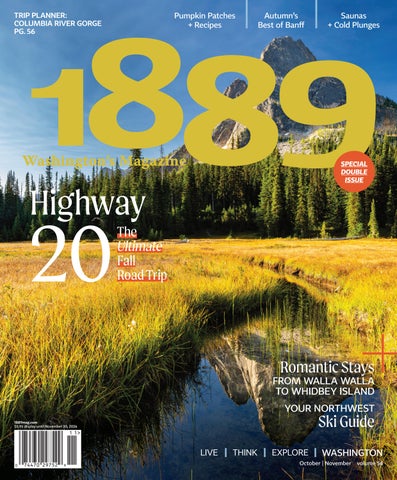
The Ultimate Fall Road Trip
Romantic Stays
FROM WALLA WALLA TO WHIDBEY ISLAND
YOUR NORTHWEST
Ski Guide
1889mag.com $5.95 display until November 30, 2026
LIVE
THINK
EXPLORE
WASHINGTON
October | November
volume 56
For those whose expectations have evolved beyond the ordinary, discover the Northwest’s ultimate address in Portland. Unparalleled space and finishes. Extraordinary architecture. And the legendary service of the world’s most celebrated name in luxury. Live here, always. Discover what awaits at The Ritz-Carlton Residences, Portland | rcrportland.com Patrick Clark, Principal Broker 503.446.9636 RitzCarltonPDX@CIRevg.com The Ritz-Carlton Residences, Portland are not owned, sold or developed by The Ritz-Carlton Hotel Company, L.L.C. or its affiliates (“The Ritz-Carlton”). Ready Capital uses The Ritz-Carlton marks under a license from The Ritz-Carlton, which has not confirmed the accuracy of any of the statements or representations made herein.
Your c�������n� gateway to nine destinations PORTLAND
Jason Hummel/State of Washington Tourism
Beacon Rock State Park in the Columbia River Gorge features a hiking trail built into the side of the 848-foot basalt rock.
4 1889 WASHINGTON’S MAGAZINE OCTOBER | NOVEMBER 2026
Explore the Gorge Tackle scenic trails, dive into regional history and kick back with local beer or wine on your next getaway to the Columbia River Gorge. (pg. 56)
OCTOBER | NOVEMBER 2026
1889 WASHINGTON’S MAGAZINE
5
Enjoy cozy accommodations and delightful wines during a romantic getaway to Abeja in Walla Walla.
FEATURES OCTOBER | NOVEMBER 2026 • volume 56
30
42
Highway 20
Art by the Sea
The most beautiful drive over the North Cascades you’ve never done … until now.
A stunning visual walk through Museo in Whidbey Island’s Langley, the “Village by the Sea.”
written by Ryn Pfeuffer
written by Kerry Newberry
36 Love is in the Air A guide to Washington’s most intimate getaways to celebrate love by land and by sea.
6
1889 WASHINGTON’S MAGAZINE OCTOBER | NOVEMBER 2026
Abeja
written by Corinne Whiting
DEPARTMENTS OCTOBER | NOVEMBER 2026 • volume 56
61
LIVE + THINK 14 SAY WA?
Stevenson Mushroom Festival, Oktoberfest in Leavenworth, Polyrhythmics.
18 FOOD + DRINK Paul Zizka/Banff & Lake Louise Tourism
Planted at Reveille, Ladd & Lass Brewing.
22 FARM TO TABLE
Pumpkins at Jensen Farms and Bellewood Farms.
26 HOME + DESIGN
A tiny home in big woods.
EXPLORE 50 TRAVEL SPOTLIGHT
22
Ghost town, Govan.
52 ADVENTURE
Four amazing sauna + cold plunge experiences.
54 LODGING
Salish Lodge & Spa.
56 TRIP PLANNER
The Columbia Gorge in fall.
61 NW DESTINATION
26
Jensen Farms
Aaron Davis/Nakamoto Forestry
Banff, Alberta.
10 Editor’s Letter 11 1889 Online 63 Map of Washington
COVER
photo by Stephen Matera North Cascades (see “Highway 20: The Most Beautiful Drive You’ve Never Done,” pg. 30) OCTOBER | NOVEMBER 2026
1889 WASHINGTON’S MAGAZINE
7
CONTRIBUTORS
LAUREN KRAMER Writer Iconic Washington Cultural Institutions “Researching our state’s iconic cultural institutions made me realize anew what a treasure of experiences we have at our fingertips. Whether we choose to explore history, governance, ambition, agriculture, art or natural beauty, every corner of Washington offers a unique perspective on our past and our future. Visit one of these destinations, and you’ll leave enriched and inspired by the stories of those who’ve shaped and molded the Evergreen State.” (pg. 88) Lauren Kramer is a Bellinghambased freelance writer who was born in Cape Town, South Africa. She relishes raising a family in the Pacific Northwest and writes about social issues, food, travel and fascinating people.
JACKIE DODD Writer + Photographer Beervana
CORINNE WHITING Writer Native-Owned
“I may be biased, but the Pacific Northwest has the most outstanding breweries and overall beer scene. No matter how many breweries I visit, there always seems to be a new one somewhere within driving distance that I haven’t tried yet. Maybe it’s the fact that the majority of the hops grown on this continent come from the Yakima Valley region, maybe it’s our superior water supply, or possibly the farm-to-fermenter mentality of our brewers, but there is no greater place than here to be a craft beer fan.” (pg. 18 + 74)
“Being a travel writer who’s focused on the Pacific Northwest for nearly fifteen years has afforded me countless opportunities to learn about and connect with Indigenous communities, spanning from BC’s Haida Gwaii to Washington’s Walla Walla. Writing this piece about all of the ways readers can currently experience the beautiful culture and cuisine of the region’s Native peoples felt both educational and meaningful, especially at this fragile moment in time.” (pg. 94)
Jackie Dodd is a writer, photographer and cookbook author serving up beer-infused recipes in Seattle.
8 1889 WASHINGTON’S MAGAZINE OCTOBER | NOVEMBER 2026
Corinne Whiting is a freelance travel and lifestyle writer with a master’s in cultural studies from the University of Edinburgh, Scotland. She’s spent extensive amounts of time in both Washingtons—the city and the state—and she loves to trot around the country and globe whenever opportunities arise, too.
RYN PFEUFFER Writer Highway 20: The Most Beautiful Drive You’ve Never Done “The Methow Valley is one of my favorite fall long-weekend getaways, especially in midOctober, when the larches turn gold and the rest of the foliage isn’t far behind. I love this time of year for the cooler temperatures, fewer crowds and the chance to slow down and spend time in the small towns along Highway 20. Writing this feature felt like sharing a road trip I already love.” (pg. 30) Ryn Pfeuffer’s work has appeared in AFAR, Business Insider, Cruise Critic, Men’s Health, National Geographic Traveler, The Seattle Times and Travel + Leisure. She lives on Whidbey Island with her partner and rescue puppy.
EDITOR
Kevin Max
CREATIVE DIRECTOR
Allison Bye
WEB MANAGER SOCIAL MEDIA MANAGER
Aaron Opsahl Joni Kabana
OFFICE MANAGER
Cindy Miskowiec
DIRECTOR OF SALES
Jenny Kamprath
BEERVANA COLUMNIST CONTRIBUTING WRITERS CONTRIBUTING PHOTOGRAPHERS CONTRIBUTING ARTISTS
Jackie Dodd Cathy Carroll, Melissa Dalton, Joni Kabana, Lauren Kramer, Kerry Newberry, Ryn Pfeuffer, Ben Salmon, Corinne Whiting Jackie Dodd, Stephen Matera, Bill Purcell, Aaron Theisen Jenna Lechner
Headquarters
70 SW Century Dr. Suite 100-218 Bend, Oregon 97702
592 N. Sisters Park Ct. Suite B Sisters, OR 97759
www.1889mag.com/subscribe @1889washington
All rights reserved. No part of this publiCation may be reproduCed or transmitted in any form or by any means, eleCtroniCally or meChaniCally, inCluding photoCopy, reCording or any information storage and retrieval system, without the express written permission of Statehood Media. ArtiCles and photographs appearing in 1889 Washington’s Magazine may not be reproduCed in whole or in part without the express written Consent of the publisher. 1889 Washington’s Magazine and Statehood Media are not responsible for the return of unsoliCited materials. The views and opinions expressed in these artiCles are not neCessarily those of 1889 Washington’s Magazine, Statehood Media or its employees, staff or management.
OCTOBER | NOVEMBER 2026
1889 WASHINGTON’S MAGAZINE 9
FROM THE
EDITOR
IF YOU’RE like me, fall is top four when it comes to seasons. Truth be told, it’s probably top two for me. Winter is up there, too. If I had to explain autumn in Washington to unserious summerists or spring ascetics, I wouldn’t. I would hand them this issue of 1889 and walk away knowing I had just made another convert. With the cool fall air, the art expression of turning leaves, smaller shows at galleries, wild game on menus and snow capping the tallest peaks, comes romance. Begin with a drive we’ve all talked about, but few have done—Highway 20. It’s over the North Cascades, past high alpine lakes, past Mazama and into Methow Valley. Vibrant yellow larch trees seem to bottle the summer sun in their leaves. Cool air circles the deck of Old Schoolhouse taproom on the Chewuch River. Hot Korean fried chicken is being plated at Linwood in Twisp. Countless miles of trails meander through the floor of the valley. Turn to page 30 if this sounds like your kind of fall getaway. If you need inspiration for your next romantic fall experience, turn to page 36. We take you to our five best ideas of the season for romance.
10 1889 WASHINGTON’S MAGAZINE OCTOBER | NOVEMBER 2026
From Whidbey to Walla Walla, water to wine, by sea and by land, these all share one thing in common—beauty and intrigue. Book one of these trips, and reconnect with the love of your life after a busy and smoky summer. If you’re sure you’ve found the one and are considering taking the plunge, better to first test their boundaries with one of these four sauna and cold plunge experiences. Maybe she’s only a warm body. Maybe he runs too cold. From a wood-fired sauna on the edge of the Salish Sea to a Finnish sauna steps from the Puget Sound, you will divine the true character of your partner in the pendulum of emotions. Turn to page 52 for that test. Grab a windbreaker, a scarf, a rain jacket, your lover and a sense of adventure for smalltown charm. Follow along with us as we skirt the northern bank of the Columbia River in Trip Planner (pg. 56). You’ll find hale hikes, a Stonehenge replica, great beer and a quietly growing wine scene as you work your way east. Book a treehouse cabin at Skamania Lodge, light a candle and let the world gently sway around you.
1889 ONLINE More ways to connect with your favorite Washington content www.1889mag.com | #1889washington | @1889washington
SHOP 1889 GEAR Stop by Local, our curated online shop, and show your state pride with 1889 T-shirts, hats and other apparel. Buy local. Feel good. www.1889mag.com/shop
YOUR PNW NEWSLETTER More Pacific Northwest, delivered to your inbox! Sign up for our Adventure Mail newsletter and get access to the latest getaways, giveaways and more. www.1889mag.com/1889-newsletter
NEVER MISS AN ISSUE Read 1889 Washington’s Magazine and 1859 Oregon’s Magazine anywhere, on any device, with our digital edition. Follow us today on Issuu.com.
WASHINGTON: IN FOCUS Have a photo that captures your Washington experience? Share it with us by filling out the Washington: In Focus form on our website. If chosen, you’ll be published here! www.1889mag.com/in-focus photo by Lee Chiew
www.bit.ly/statehood mediadigital
Love is in the air (literally!) at Rattlesnake Lake, near North Bend.
OCTOBER | NOVEMBER 2026
1889 WASHINGTON’S MAGAZINE
11
SAY WA? 14 FOOD + DRINK 18 FARM TO TABLE 22
pg. 22 Fall is the time for large orange squash at Jensen and Bellewood farms.
Bellewood Farms
HOME + DESIGN 26
Endless Inspiration. Joyful. Festive. Celebrate.
Destination. —All in One Place.
Shop our 200 stores for your holiday gifts, wrapped up in style. Enjoy festive dining and 24. Snowflake Lane, our nightly parade, beginning at 7pm from November 27 – December 24 100 Bellevue Collection Gift Card each night Book a Shop & Stay package with a $100 you stay at one of three on-site hotels—all just minutes from Seattle.
bellevuecollection.com/getaway
say wa?
Tidbits + To-dos
Stevenson Mushroom Festival
written by Lauren Kramer
CA mark LE you ND r AR
Stevenson Mushroom Festival Unearth the fascinating world of fungi during the Stevenson Mushroom Festival on October 17. Visitors can enjoy mushroom-inspired food, educational experiences, artisan products and activities at participating locations throughout Stevenson. The event is free, but some workshops, products, food, passport activities or special experiences may have an additional cost.
Bellingham Improv Festival
Día de Los Muertos, held October 25 in Tieton, is a vibrant community celebration honoring loved ones who have passed while embracing the beauty of life. The event, held at the Mighty Tieton Warehouse, features a community altar, colorful artwork, a mercado, live performances and a lowrider car show, followed by an exhibition that runs through November 15.
Bellingham’s Upfront Theatre is the venue for the Bellingham Improv Festival on November 5 through 8. This annual celebration of improvisational theater brings together talented improv troupes from across the Pacific Northwest and beyond. It offers performances and workshops tailored to those hoping to deepen their craft, explore new techniques or try improv for the first time. Festival passes are available, bundling multiple shows and offering discounts on workshops.
www.tietonarts.org/ddlm
www.theupfront.com/bif
Día de Los Muertos
14
Visit Bellingham
Yakima Valley Tourism
www.stevensonmushroomfestival.com
1889 WASHINGTON’S MAGAZINE OCTOBER | NOVEMBER 2026
say wa?
CA mark y LE our ND AR
Leavenworth Chamber of Commerce
Oktoberfest in Leavenworth Leavenworth’s Oktoberfest is back, spanning the weekends of October 2 and 3, 9 and 10, and 16 and 17. This year’s festival features three stages with live entertainment, including traditional dancers, the Swiss group Oesch’s die Dritten and Austria’s Freddy Pfister Band. Yodeling queen Manuela Horn will be performing, and beer gardens at the Leavenworth Festhalle and Front Street Park will be offering libations. www.leavenworth.org/ oktoberfest
Halloween is coming early to Coupeville, on Whidbey Island, this year, with a “Halloweekend” October 22 through 25. That’s when there will MORE INSIDE be a scavenger hunt, a Spells and Plan your visit Brews Bike Ride and Beer Garden, to Coupeville with a torchlight parade and a pumpkin the help of our race. Coupeville was the backdrop for Trip Planner on pg. 111 the film Practical Magic, and movie screenings will be held at the Coupeville Recreation Hall, as well as a self-guided walking tour of all the Front Street sites included in the movie. www.coupevillehistoricwaterfront.com
Skagit Valley Festival of Family Farms
Celebrate Halloweekend in Coupeville
Skagit Valley Festival of Family Farms Skagit Valley’s Festival of Family Farms is a free event October 3 and 4 where visitors can take a self-guided tour of local county farms, meet the farmers, pet animals and sample fresh produce. www.festivaloffamilyfarms.com
OCTOBER | NOVEMBER 2026
1889 WASHINGTON’S MAGAZINE
15
say wa?
“It was obvious that the live version of the music that we recorded was powerful and it had a purpose and it was inspiring,” Bloom said in an interview. “And we’ve just been drinking that Kool-Aid ever since.” Indeed, over the past decade and a half, Polyrhythmics has become one of the state’s busiest and best bands, building a sizable nationwide fan base drawn to its ultra-tight live show and a string of excellent studio albums that explore the far reaches of the funk universe. Their most recent full-length—2025’s Life From Below— is “an explosive blend of funk, soul, psych, Afrobeat, jazz and more,” wrote influential Seattle radio station KEXP, that was “recorded live to capture the raw dynamism of their craft.” The two sides of Polyrhythmics— on stage and in the studio—intermingle constantly, Bloom said. Sometimes, the band works out its songs and arrangements on the road and then brings them into the studio to capture the magic. Other times, they record a song and then find that it “develops a life of its own” in the live setting, Bloom said—a process that often provides inspiration for the next studio session for the next batch of tunes. It’s a symbiotic relationship that, like the music itself, is ever evolving, Seattle’s Polyrhythmics push he said. and pull on the boundaries of funk “We’ve been doing this for almost Longtime live funk band twenty years, and, you know, the live written by Ben Salmon Polyrhythmics adapt to new band will have a life cycle. It’ll come sounds along their journey. to an end someday. But the recording process really never has to end,” Bloom said. THE CINEMATIC, psychedelic Seattle-based funk band Poly“And with all the playing around the country we’ve done, we rhythmics started in 2010 as a recording project for guitarist just keep developing new influBen Bloom and drummer Grant Schroff—a couple of serious ences, and our music has defiListen on Spotify vinyl enthusiasts who thought it would be cool to put out music nitely adapted to those influences on 45 RPM records. over the years,” he continued. “But They were right about that—it was cool. From the jump, the it does all have a common sort of band stood out within the West Coast’s vibrant funk, jazz ’n’ thread, which is groovy music jam scene thanks not only to its snappy interpretation of classic made by people who are playing funk (think Tower of Power or Earth, Wind & Fire), but also its off each other. It’s syncopated and seamless incorporation of the kinds of melodies and interlock- highly arranged and really geared ing rhythms found in West African music. to take you on a journey. People It wasn’t long before the project found its way to the stage, seem to like that journey, and too. And once it got there, it was hard to stay away for long. we’re thankful for that.”
Musician
Kelly Robbins
Get into the Groove
16
1889 WASHINGTON’S MAGAZINE OCTOBER | NOVEMBER 2026
Robbie Greenberg
say wa?
Bibliophile
Jason Dove Mark is an environmental activist and former longtime editorin-chief of Sierra magazine.
Memory as Resistance How remembering the natural world can help restore it interview by Cathy Carroll
WE HEAR about the grim effects of climate change daily—and see them for ourselves— but many think they lack the power or resources to do anything about it. In The Earth Said Remember Me: How to Revive Our Memories and Restore the Planet, Bellingham-based author Jason Dove Mark offers a resistance manual for rejecting Earth’s devastation as “the new normal.” He outlines four antidotes—easy, everyday, even joyful—practices anyone can take: Go outside, and notice the natural world; bear witness by speaking up about environmental change; make a record, such as a nature journal; and pass it on by talking about the changes you’ve witnessed and listening to what older generations remember.
What has given you the greatest sense of hope while researching this book? One thing is the stories of the citizen scientists that I profile in this book, whether they’re chronicling monarch populations or the fate of glaciers in the Cascade Mountains. Often they’re chronicling loss, but their unquenchable spirit, their own hopefulness, is contagious. They’re all volunteers, doing this work just out of passion and commitment, and some have dedicated untold hours. Whether that’s taking photos of glaciers or counting monarch butterflies, it’s all a side hustle. That’s incredibly inspiring and hopeful. In the book, I share stories of the comeback of the salmon on a few rivers, the Elwha here in Washington, the Klamath in Northern California and Southern Oregon. It shows that when humans are able to get out of the way or repair the damage from the past, nature has a way of bouncing back. That’s a wonderful lesson for the present and the future. How can memory give us hope for the future? One of the big dangers I see in our current environmental predicament is that people will just get used to how things are and assume that this is always the way things have been. They will come to mistake today for forever or for always. It’s important to remember the stories of environmental victories or comebacks. Another incredible one for those of us who live in Washington State or in Greater Cascadia is the comeback of the bald eagle.
OCTOBER | NOVEMBER 2026
I’m not that old—I’m 51. When I was growing up, they were vanishingly rare, and I still get excited every time I see a bald eagle. So, to have a long memory is to also know that progress is possible. Just as we can kind of forget environmental destruction and it can become invisible, we can also forget environmental victories and environmental progress, and that becomes invisible, too. So, memory is a way of sustaining hope for the future in part because memory and imagination are so linked. How can going outside and paying attention help? To have any memories of the living world, the number one thing is to go outside. That seems elementary, but it’s not just about going outside. It’s about going outside and then noticing and fixing your attention on something. I’ve done that mostly with birds, but you could do it with anything— trees or dragonflies or salamanders—any sort of living thing under the sun. When you do that around wildlife, you create an emotional frisson. To have an encounter with a great blue heron or a barred owl or a bald eagle, that’s an incredible way in which you’re making contact with this ambassador from another world and creating a firm memory. Anytime you learn something, it excites the memory—you get a reward hit. That’s why it feels good to learn new stuff. If you expand your attention to the morethan-human world, in that act of noticing, you’re going to create indelible memories. 1889 WASHINGTON’S MAGAZINE
17
food + drink
Ladd & Lass Brewing in Seattle’s University District perfects its craft in the same spot where the Ramones, Soundgarden and other iconic bands grew up.
Beervana
Ladd & Lass and a Well-Built Pint written and photographed by Jackie Dodd
ARCHITECTURE IS a surprisingly perfect precursor to brewing beer. Both require the ability to hold two seemingly opposite ideas in your head at once. There is math and creativity, art and science, vibe and precision. You can make something technically perfect that still feels completely soulless, or something beautiful that falls apart because you ignored the fundamentals. Good beer, like good architecture, needs both. 18 1889 WASHINGTON’S MAGAZINE OCTOBER | NOVEMBER 2026
Given that, it may not be surprising that Nick Ladd and Jessie Quan, the husband-and-wife team behind Seattle’s Ladd & Lass Brewing, both came to beer with backgrounds in architecture. Nick is a former architect who eventually turned years of homebrewing and fermentation obsession into a professional brewing career. Jessie worked as both an architect and environmental graphic designer before taking on the marketing, design, branding, cleaning, pouring, customer service and all-the-things on the taproom side of Ladd & Lass. The brewery sits in Seattle’s University District, in a space with its own creative history. Before Ladd & Lass, it was home to Floating Bridge Brewing, and farther back, the Rainbow Tavern, a music venue that hosted bands including the Ramones and Soundgarden. Ladd & Lass has deliberately held onto that idea of the space as a gathering place, even if the amps have been replaced by fermenters. For Jessie and Nick, that sense of community has been one of the most meaningful parts of building the brewery. “We were wholeheartedly embraced by the beer community in Seattle,” Quan said.
That might sound like the nice thing every brewery owner is supposed to say about their local beer scene, except Ladd & Lass seems to have built its entire business around the same idea. Not only have the beer professionals embraced the two and the quiet perfection of their beer, but the locals also showed up and became regulars almost overnight. Their University DisLADD & LASS BREWING trict taproom welcomes 722 NE 45TH ST. kids, dogs and outside SEATTLE www.laddandlassbrewing.com food. There are nonalcoholic options along with What to Know: cider and wine, and the • Kid- and dog-friendly • Open seven days a week brewery describes its goal as creating a place for beer lovers and non-beer lovers alike. It feels less like beer as a velvet-rope hobby for people who can identify obscure hop varieties blindfolded and more like beer as the reason everyone ended up in the same room. That doesn’t mean the beer itself is an afterthought. Quite the opposite. “I don’t brew the beer, Nick does, so I can say this,” Quan said. “It’s really good. It’s respected because he’s so good at what he does.” She has evidence for the bragging rights. Nick is a nationally ranked BJCP judge as well as Ladd & Lass’s head brewer, and the brewery has collected awards across a range of styles. Their beer list reflects the same refusal to stay in one lane. Ladd & Lass has brewed crisp lagers, West Coast IPAs, hazy IPAs, farmhouse saisons, mixed-fermentation beers, barleywines and imperial stouts, among plenty of others. Their current lineup continues that stylistic range rather than building the entire identity around whichever IPA happens to be fashionable this year. One beer, though, means more than another medal or a wellbuilt recipe. The Pale Project began as a collaboration between three homebrew friends: Nick, Tony Ochsner of Micro Homebrew and their friend Shawn Miller. The idea was to find the sweet spot between the pale ales they loved in the early 2000s and the more hop-forward versions that came later. After Shawn died from cancer, the beer became a tribute to him. A portion of its proceeds supports the Shawn Miller Memorial Scholarship for First Generation Students through the Cascadia College Foundation. The scholarship was established in 2022 in recognition of Miller’s twenty-three years of work supporting community college students. It feels fitting for a brewery built around community. Make something good, make it carefully and then figure out how to make it matter beyond their own walls. Maybe that architectural background really was good training after all. You start with an idea. You obsess over the details. You make sure the structure works, and then make it beautiful. If you’ve done it right, you build a place people want to stay. And they’ve done just that.
FROM TOP Jessie Quan of Ladd & Lass, and one of the two husband-and-wife architects-turned-craft brewers. Ladd & Lass beers are consistent national award winners for their quality across many styles.
OCTOBER | NOVEMBER 2026
1889 WASHINGTON’S MAGAZINE 19
Photo: Jason Alexander
food + drink
Cocktail Card recipe courtesy of Dark Harbour / Long Beach
Plasma Wave • 1/2 ounce almond syrup or orgeat (we recommend BG Reynolds) • 1/2 ounce lime juice • 1 ounce passion fruit syrup (we recommend BG Reynolds) • 11/2 ounces grapefruit juice • 21/2 ounces Planteray original dark rum, or your dark or spiced rum of choice Add all ingredients into a shaker. Flash blend, or shake with crushed ice. Pour unstrained into your vessel of choice, such as a tiki mug or big snifter. Garnish as desired.
Dining
ABOVE, AT LEFT Aimee Dailey-Fallat brings together diners and local farms at Port Townsend’s Fort Worden. ABOVE Her plant-based menu brings so much flavor that even committed carnivores indulge themselves.
Planted at Reveille written and photographed by Lauren Kramer AIMEE DAILEY-FALLAT loves nothing more than introducing diners to the kinds of food she adores. Her venue is Planted at Reveille at Port Townsend’s Fort Worden, a light-filled, high-ceilinged restaurant where she serves a flavorful taste of the Olympic Peninsula in a mostly meatless menu. “I started four years ago with a vision of connecting people to local farms and local food,” she said. At first, her business was strictly catering, with events ranging from fifteen up to 300. Then a space became available at Fort Worden, and Dailey-Fallat couldn’t pass up the opportunity. She expanded the business, adding the restaurant and a meal box offering to her catering. Every week she creates a new plant-based menu, using mostly organic and hyperlocal foods and breaking the meatless rule just for eggs. “I’m vegan, though I eat eggs, so everything on the menu is what I eat,” she said. “I believe strongly that if we could all eat more plants, it would make things a whole lot better for the environment.” Diners come in for coffee and scones, hearty muffins, tempeh grain bowls, kale caesar salads, smoothies, sandwiches and burritos. There’s dairy-free grilled cheese, divinely soft focaccia, hot soups and miso noodle bowls. Her food is made with love, and it’s so tasty that even committed carnivores won’t miss their meat. Dailey-Fallat’s ingredients, utensils and decor all emphasize locally grown produce and local artists. She serves London Fog teas and lattes in cute mugs made by local potter K2 Clay, and the art on her walls is by Annalisa Barelli. The fresh and dried flower arrangements are all by local growers, and even the communal dining table was made (and donated) by a local furniture builder. As a result, a meal at Planted is a true Port Townsend experience, exposing visitors to locally grown food and local talent in everything from tea and coffee to cheese and produce. “It was really important to me to wrap the community as much as I could around the café,” she said. “This way, people coming from out of town can really have a taste of what Port Townsend has to offer.” 210 BATTERY WAY PORT TOWNSEND www.plantedporttownsend.com
20 1889 WASHINGTON’S MAGAZINE OCTOBER | NOVEMBER 2026
food + drink
written by Lauren Kramer
Photos, clockwise from top right: Blue Skies Bakery, Bobby Ryan/Inspired Earth, LULUMIÈRE
LULUMIÈRE SHOWER STEAMERS Linda Takano was selling her candles at a craft fair a few years ago when bath bombs caught her eye. “I loved the idea of them, but I never take a bath,” she said. “I thought, why not make bath bombs for shower people?” That’s how her LULUMIÈRE shower steamers came about in 2020. Takano’s steamers, made with essential oils, melt when they come in contact with water, releasing their fragrance into a steamy shower. The marshmallow-shaped steamers create an aromatherapy experience at home and are available in two scents: lavender and eucalyptus, and peppermint and eucalyptus. Visit the LULUMIÈRE website for a list of retailers or to order. www.lulumiere.com
BLUE SKIES BAKERY GRANOLA Krissy Biernacki was baking bread in 2011 when a customer asked for sugar-free granola. A hobby baker at heart, she gave it a try, and her granola was so successful, she gave up breadmaking to focus on Blue Skies Bakery granola full time. In 2024, her cardamom-coconut blend, inspired by her travels in south India, won a Good Food Award. Today it’s one of four flavors offered by this small-batch Tacoma-based business. There’s a Columbia Gorge classic blend, a cranberry-hazelnut granola and a new, grain-free coconut-pecan granola. Biernacki began her bakery in 2011, formulating her recipes with quality, mostly organic ingredients that are sugar-free and baked longer than other granolas. As part of the company’s Giving Program, she donates a percentage of gross sales to a different nonprofit each month. Look for Blue Skies Granola at Safeway, Metropolitan Markets, cafés and coffee shops. www.blueskiesbakery.com
INSPIRED EARTH ARTISANAL TEAS If you love tea, you’ll want to try the flavors of Inspired Earth made on San Juan Island. Owner Bobby Ryan’s eight flavors incorporate local ingredients like madrona bark, dandelion, hibiscus, roses and blueberries. His blends include Madrona Sencha, Chocolate Rock, Blueberry Blissful Belly, Spicy Lover and Bobby’s Basil Chai. The island entrepreneur also crafts a range of chocolate bars containing his teas. Look for his products at the San Juan Island Farmers Market, the San Juan Food Co-Op and online. www.inspiredearthtea.com
OCTOBER | NOVEMBER 2026
1889 WASHINGTON’S MAGAZINE
21
farm to table
Farm to Table
The pumpkin patch at Bellewood Farms in Lynden shows its true colors in fall.
Pick of the Season Visiting pumpkin patches around the state to find the best take-home treats for fall
IT’S THAT TIME of year when pumpkin-tinged everything seems to take over coffee counters and cozy corner displays. But luckily for Washingtonians, there’s plenty of farmland dedicated to pumpkin patches, if you’d rather get out to explore the real deal, among a vibrant sea of orange-hued winter squash. In Ellensburg, Hilary Jensen owns Jensen Farms with her husband, John. The venue came to life in 2012, after she got laid off from an office job. “I’d never grown a pumpkin in my life, so I traded in my business attire and laptop for overalls and a tractor and got to work,” she said. Today, the 36-acre farm grows 3 to 6 acres of pumpkins, depending on the year, and most of their space is used for fall family fun. “Our focus is on creating a place where you can make memories,” she said. Think u-pick pumpkins, hayrides, a petting zoo, kids’ zone, axe throwing, plus weekend fare from BBQ smoked brisket to fresh apple-cider donuts. Other seasonal treats, like pumpkin cheesecake in a cup, can be found at their Sips + Sweets coffee shack. 22 1889 WASHINGTON’S MAGAZINE OCTOBER | NOVEMBER 2026
Jensen Farms grows fifty-plus varieties of pumpkins, from 60-plus-pound carvers to itty-bitty tabletop selections and edible options for recipes both savory and sweet. They start all of their seeds in early June and transplant about two weeks later. This year, they’ll be harvesting late September, as they get ready to open the gates October 3. Jensen said pumpkins grow well in the PNW since they don’t like wet feet. “They like a lot of water, but then they need time to soak it all up,” she said. “That’s why we don’t water daily.” Bellewood Farms President Eric Abel notes that for them, Lynden’s long summer days, mild temperatures, fertile soils and consistent moisture create ideal growing conditions for pumpkins, too. “Cool nights also help reduce plant stress, allowing vines to stay healthy and produce large, high-quality pumpkins throughout the growing season,” he added. The 62-acre Bellewood Farms has a pumpkin patch (the largest in Whatcom County) that opens October 1, where you’ll find large carving and specialty options, as well as sugar
Photo: Bellewood Farms
written by Corinne Whiting
Jensen Farms
Bellewood Farms
Jensen Farms
farm to table
CLOCKWISE FROM TOP Hayrides are just one activity at the bustling Jensen Farms in autumn; there is also a petting zoo, axe throwing and fall treats such as fresh apple-cider donuts. An overview of the 62-acre Bellewood Farms, with a corn maze and apple orchard. Hilary and John Jensen are the husband-and-wife team behind Jensen Farms.
pumpkins for baking. Locals return each fall for the free corn maze, cafe-bakery and an apple orchard with 25,000 trees. Visit their large farmstead to collect goodies including cider, peanut butter and apples, or pick your own beginning Labor Day through October. The venue also operates the first apple distillery in the state; sample their brandies, bourbon, gins and liqueurs (don’t miss one called pumpkin spice). A main draw at Bellewood, though, must be the homemade pumpkin pies. While they can’t share the secret recipe, dough for their special crust can be purchased on-site. For first-time pumpkin chefs, Jensen offers encouragement. “Before you jump in, enjoy all of the inspiration you can find on
sites like Pinterest, or in the checkout line at the grocery store,” she said. “You can find recipes for anything from pumpkin cheeseballs and pumpkin soup, to squash burgers, gnocchi and baked goods galore.” When choosing varieties for the kitchen, remember many pumpkins make great ornamental displays in the fall, and are ready to be cooked once the Christmas tree goes up. (Check out options like Jarrahdale, Blue Doll, Speckled Hound, Cinderella and Rouge Vif d’Etampes.) Personally, Jensen finds nothing better than getting her hands on a Sugar Pie or Winter Luxury variety to bake a scrumptious, old-fashioned, scratch-made pumpkin pie. OCTOBER | NOVEMBER 2026
1889 WASHINGTON’S MAGAZINE 23
farm to table
Roast Pumpkin and Maple-Sage Butter
Upwell Wine & Coffee / SEATTLE Rosanne Zhu SERVES 4 FOR THE ROAST PUMPKIN • 1 small pumpkin, cut in half, peeled, seeded and diced into ½-inch pieces • Oil • Salt, to taste
Washington Recipes
Cozy Pumpkin Dishes for Fall Chicken Pumpkin Curry
Lifelong, Chicken Soup Brigade / SEATTLE Lauren Daniel, executive chef SERVES 4-6 • 2 tablespoon olive oil • 1 medium yellow onion, diced ¼ inch • 1 red bell pepper, seeds removed, diced ¼ inch • 1 orange bell pepper, seeds removed, diced ¼ inch • 1 jalapeño pepper, stems and seeds removed, diced ¼ inch • 2 garlic cloves, minced • 2 tablespoons red curry paste • 1 teaspoon turmeric • 1 teaspoon ground cumin • 1 tablespoon fish sauce or soy sauce • 2 each lime leaves or bay leaves • 1 can (14.5 ounces) coconut milk • 4 cups chicken stock • 1 tablespoon brown sugar • 1½ pounds chicken breast, cut into 1-inch pieces • 4½ cups pumpkin, peeled, stem and seeds removed, diced ½ inch • 2 tablespoons lime juice • 1 can (14.5 ounces) chickpeas, drained
• 3½ cups baby spinach, stems removed • 2 tablespoons Thai basil leaves, chopped Place a large pan or skillet over medium-high heat. Add the oil. Once the oil is hot, add the onion, and sauté until the onion is translucent, about 2 to 3 minutes. Next add the bell pepper and jalapeño, and sauté for another 2 minutes. The peppers should start to become tender. Stir in the garlic, and cook for another minute or until fragrant. It is important to constantly stir so the garlic does not burn. Mix in the curry paste, turmeric, cumin, fish sauce or soy sauce, lime or bay leaves, coconut milk, chicken stock and brown sugar. Stir all together. Add the chicken breast and pumpkin. Allow the curry to come to a boil, and then simmer for about 15 to 20 minutes or until the chicken reaches an internal temperature of 165 degrees and the pumpkin is cooked through and tender. Stir in the lime juice, chickpeas and spinach. Cook for another 2 to 3 minutes or until the spinach is wilted. Stir in the basil. Serve over rice, or rice noodles.
24 1889 WASHINGTON’S MAGAZINE OCTOBER | NOVEMBER 2026
FOR THE SPICED PEPITAS • ½ cup pepitas (aka pumpkin seeds) • Cajun spice blend • ½ teaspoon salt • 1 tablespoon vegetable oil FOR THE ROAST PUMPKIN Preheat oven to 350 degrees. Spray pumpkin with oil, and season with salt. Roast in oven for 8 to 10 minutes until soft and cooked through. FOR THE MAPLE-SAGE BUTTER Combine all ingredients in a microwavesafe bowl. Place in microwave, and cook on high for 1 minute until butter is melted. FOR THE SPICED PEPITAS Combine all ingredients in a small mixing bowl. Spread ingredients on a small cookie sheet. Bake at 350 degrees for 5 minutes until lightly toasted. TO FINISH In a bowl, add roast pumpkin, top with maple-sage butter and garnish with the spiced pepitas.
Upwell Wine & Coffee
Warm up with a flavorful and hearty bowl of Chicken Pumpkin Curry. (photo: Lifelong)
FOR THE MAPLE-SAGE BUTTER • 1 stick salted butter • 1 sprig fresh sage • ¼ cup maple syrup
Roast Pumpkin and Maple-Sage Butter.
HARVEST MORE MEMORIES
ENJOY THE SEASON WORTH SAVORING, JUST WEST OF PORTLAND
Olea Vineyards
As the vineyards come alive with harvest, discover Portland’s closest wine country at its most vibrant. Enjoy small-batch wines, meet passionate winemakers, and linger over colorful vineyard views that turn an afternoon tasting into a memory worth returning for.
TUALATINVALLEY.ORG/WINE
etvor.com/wine56
This tiny home packs big personality into its small footprint in the Gorge.
home + design
Home + Design
Dreaming Big and Building Small A visual artist and a builder team up to create a 448-square-foot tiny house in the heart of the Columbia River Gorge written by Melissa Dalton 26 1889 WASHINGTON’S MAGAZINE OCTOBER | NOVEMBER 2026
home + design
Constanza Gajardo/Tiny House Giant Journey
THE DOUGLAS FIR trees that surround Stephen Proctor’s tiny house tower well above it, with views of Rock Cove and the Columbia River peeking between their trunks. On a clear day, Proctor can see the Bridge of the Gods downriver, and the Cascades on the Oregon side. But most mornings, when he walks into his yard, he’s looking up at the trees. “I call it the cathedral,” said Proctor. “People ask me, ‘Why do you live in such a small space? Isn’t it claustrophobic?’” He gestured to the trees. “I feel more claustrophobic in a big house in the suburbs that’s just surrounded by other houses than here.” Proctor, a visual artist born and raised in Arkansas, worked for the music industry in Nashville for fifteen years before relocating to the Pacific Northwest in 2018. The impetus was a text from a friend, who was then visiting Seattle. “He texted me saying, ‘Dude, it’s late July and gorgeous. I’m outside, it’s not hot, it’s not sweaty, I’m not being carried off by mosquitoes,’” Proctor recalled. “We just asked, ‘What are we doing with our lives? Why don’t we live in this paradise?’” The nature of Proctor’s job—he works in various media, including landscape cinematography, aerial photography and music video production—means he just needed to be within an easy drive to a major airport, so he gave Portland a try for a year and then sold his house in Nashville. From the start, his goal was to buy a parcel of land, and live small. In Stevenson, he found a beautiful 1.22-acre lot without HOA fees or CC&Rs. He commissioned a 330-square-foot tiny house on wheels from a Battle Ground builder and brought it to his site in 2020. But when he reached out to the county about connecting the house to local utilities, he was instead met with a violation notice. It turned out, his tiny house on wheels was in the middle of a changing regulatory field in the state. Proctor suddenly faced an uncertain inspection process and possible “deconstruction” to see inside the structure for permitting reasons, with no clear idea of the costs or time it would take to resolve. He decided to sell the tiny house rather than let it sit empty for an undetermined length of time. “I was like, ‘Let’s hit the reset,’” said Proctor. He researched all of his options, including a yurt, shipping container home and treehouse, before settling on building something more permanent (read: with a foundation). Next, he purchased plans online via DEN Outdoors for a 448-squarefoot home, with a covered porch and a loft bed—technically, a size upgrade from the first tiny house—and found builder Billy Basse, of the Carson-based Basse Construction. Basse had learned the trade from his grandfather decades ago. “He taught me how to read a framing square when I was 11 or 12,” said Basse, whose been working in construction ever since. Basse and Proctor OCTOBER | NOVEMBER 2026
1889 WASHINGTON’S MAGAZINE 27
Constanza Gajardo/Tiny House Giant Journey Aaron Davis/Nakamoto Forestry
Aaron Davis/Nakamoto Forestry
Constanza Gajardo/Tiny House Giant Journey
home + design
CLOCKWISE FROM TOP LEFT The porch enhances the connection to the outdoors and the “cathedral.” Every space is well accounted for, including the sleeping loft. A dining nook with a live-edge counter and great view. A small but functional kitchen, where everything has its place.
hit it off immediately. “Billy is not just a builder; he’s a craftsman,” said Proctor. “He really caught the vision for it. That’s the key, is finding the right contractor, who doesn’t question why you’re not doing the ‘normal’ house thing.” Basse reviewed the plans and offered key modifications. “I drew up a new set of drawings, and then worked pretty closely with Stephen to get everything he wanted to fit in that little tiny space,” said Basse. They tweaked the original design to give it a crawl-space foundation rather than pier blocks and then added seismic supports, as well as hefty structural beams to withstand the Gorge’s weather. “We have to deal with winds up to 130 miles an hour, in three-second gusts,” noted Basse. Inside, they added an egress window to the sleeping loft, and extended the kitchen workspace by 16 inches for more functionality. As far as finishes, Proctor wanted to keep it simple, with “yakisugi,” or shou sugi ban, siding on the exterior, from Nakamoto Forestry. The siding is cypress wood that’s been burned and oiled in an ancient Japanese technique in order to provide excellent water, fire and pest resistance. “I wanted the house to be 28 1889 WASHINGTON’S MAGAZINE OCTOBER | NOVEMBER 2026
both striking and unique without calling too much attention to itself, because it does blend in with the trees,” said Proctor. Inside, the milieu is predominantly white walls, with tongueand-groove wood on the vaulted ceiling and oak floors. Natural accents include a live-edge slab for a kitchen counter and riverrock floor in the bathroom, with hits of black in the wood stove and cabinetry. In the summer of 2022, Proctor got to move in, having passed a new set of inspections with flying colors thanks to Basse. He appreciates how living small shapes his daily life. “It’s slowed me down and made me much more comfortable with stillness and silence,” said Proctor. “I love to pay attention to the small, quiet things that nature is doing.” So much so, that a recent project has been to publish a book of art and reflections called Wild Wonder: What Nature Teaches Us About Slowing Down and Living Well. All because, eight years ago, he couldn’t resist the call of the Pacific Northwest landscape. “I just wanted big trees,” said Proctor. “Landing in the Columbia River Gorge was the dream come true.”
home + design
Get the Look of the Gorge Tiny Home
Walnut Studiolo started in Portland, Oregon, in 2009, when owner Geoffrey Franklin wanted oldfashioned leather bar wraps for his bike and started making them. The product line has since expanded, and this is the place to find leather drawer and cabinet pulls in eight different styles, four leather colors and three metal choices.
written by Melissa Dalton Since 1986, Crackerjack Contemporary Crafts has been selling handmade crafts, first in a Wallingford store, and since 2020, online. Check out these hand-carved wooden spoons, made in Seattle, for a tactile take on your typical serving utensil, each sure to be one-of-a-kind.
www.walnutstudiolo.com
Photos, clockwise from top: Crackerjack Contemporary Crafts, Lindsey Rickert/Walnut Studiolo, Christopher Dibble/Milbourn Woodworks, Kiln Goddess
www.crackerjackcrafts.myshopify.com
Milbourn Woodworks, a small woodworking team based in Portland, Oregon, collaborated with Revive Designs to create the gorgeous Western Modern Sofa. Made with traditional joinery and sustainably sourced PNW woods, they write that it is inspired by “coastal cottages, rustic mountain cabins and modern lodges of the Pacific Northwest.” Perfect to become the centerpiece in any tiny getaway. Kiln Goddess is a kiln rental and ceramics shop based in Snohomish that celebrates creativity via handmade, original pieces. We like the watertight Patchwork Mini Vase, just 3½ inches tall and 3 inches wide for a just-picked stem, to add a little earthy personality to a shelf or table.
www.milbourn woodworks.com
www.kilngoddess.com OCTOBER | NOVEMBER 2026
1889 WASHINGTON’S MAGAZINE
29
The Most Beautiful Drive You’ve Never Done written by Ryn Pfeuffer map by Jenna Lechner
The trip doesn’t really begin when you leave Seattle. It begins somewhere beyond Marblemount, where Highway 20 hugs the Skagit River and the mountains close in. For the next hundred-odd miles, the North Cascades Highway crosses one of the state’s wildest corners, climbing from damp western forests to glacier-carved high country before dropping into the sunny Methow. Come fall, cottonwoods flare along the rivers while western larches paint the higher slopes yellow.
30 1889 WASHINGTON’S MAGAZINE OCTOBER | NOVEMBER 2026
Larch trees turn the North Cascades into a colorful work of art in fall. (photo: Stephen Matera)
OCTOBER | NOVEMBER 2026
1889 WASHINGTON’S MAGAZINE 31
M
arblemount, about two hours northeast of Seattle, is the place to fill the tank and pick up any last-minute provisions. The Shell station on Highway 20 has gas, snacks and restrooms; services become scarce beyond here. Tiny Newhalem, built around Seattle City Light’s Skagit River hydroelectric project, is the last real outpost before the route goes gloriously off-grid. Next up: Diablo. Even if you’ve seen the photographs, Diablo Lake is startling. The reservoir glows an almost-suspicious shade of blue-green, courtesy of “rock flour”—microscopic particles pulverized by glaciers and carried downstream, where they remain suspended in the water and scatter sunlight. The signed viewpoint at milepost 131.7 has easy parking, picnic tables and vault toilets, plus a clear look at Diablo Dam in the distance. In bright sun, the lake can look almost neon; under clouds, the color deepens. Tempted to jump in? North Cascades lakes rarely warm above 50 degrees. Better to paddle it: Bring your own kayak or canoe, and launch at Colonial Creek Campground, about 2 miles west. There are no rentals on the lake. East of Diablo, Ross Lake stretches more than 20 miles to the Canadian border and reaches nearly 500 feet deep near Ross Dam. There’s no vehicle access to its southern
end; even Ross Lake Resort’s floating cabins are reached by trail and boat. Fishing runs through October 31, while falling water levels begin exposing rocky shoreline usually hidden during summer. Highway 20 soon starts gaining altitude en route to Rainy Pass, at 4,862 feet, where autumn’s headliner begins showing off. Larch season usually starts gathering steam in late September, peaks as October arrives, and can end quickly after the first hard storm. For maximum payoff with minimal suffering, take the Rainy Lake Trail. Starting at the milepost 158 trailhead, the paved path runs about a mile each way to a glacial lake tucked beneath a steep cirque. It gains only about 70 feet, making it suitable for kids and strollers, and is designated wheelchair accessible, though some manual-chair users may need assistance. Some of the best larch viewing doesn’t require a trail at all. Between Rainy and Washington passes, yellow needles brighten the roadside and sweep across the higher slopes. A few minutes east, Washington Pass may offer the highest scenery-to-footstep ratio in the state. Park in the large signed lot, and follow the short paved path for a knockout view of Liberty Bell Mountain, Early Winters Spires and Highway 20 curling through a hairpin hundreds of feet below. At 5,477 feet, you’ve reached the drive’s high point.
Some of the best larch viewing doesn’t require a trail at all. Between Rainy and Washington passes, yellow needles brighten the roadside and sweep across the higher slopes.
32 1889 WASHINGTON’S MAGAZINE OCTOBER | NOVEMBER 2026
Among the amazing sites coming over Highway 20 is Diablo Lake, with its vibrant and changing colors. (photo: Greg Balkin/State of Washington Tourism)
OCTOBER | NOVEMBER 2026
1889 WASHINGTON’S MAGAZINE 33
From here, the Cascades change personalities. The descent into the Methow brings ponderosa pine and open hillsides, while the horizon seems to stretch with every mile. You’ve crossed into the Cascade rain shadow, and it feels as though someone adjusted Washington’s contrast setting.
F
rom here, the Cascades change personalities. The descent into the Methow brings ponderosa pine and open hillsides, while the horizon seems to stretch with every mile. You’ve crossed into the Cascade rain shadow, and it feels as though someone adjusted Washington’s contrast setting. At the upper end of the Methow, Mazama barely qualifies as a town, part of its considerable charm. The Mazama Store is its unofficial clubhouse, though the bakery case may be the real center of civic life. The rustic breads have a devoted following, particularly the sea-salt baguettes, which start coming out around 9 a.m. and can sell out on busy days. You’ll also find pastries, sandwiches, coffee, produce, wine and pantry staples; outdoor gear is available across the courtyard at Goat’s Beard Mountain Supplies. Buy the baguette—you’ll figure out what to do with it later. For an overnight, Freestone Inn & Cabins sits on a small lake at Wilson Ranch, with trails practically outside the door. Lodge rooms have gas fireplaces and private decks or balconies; cabins add kitchenettes and more space, and select units welcome pets. After a chilly October hike, the twenty-four-hour outdoor hot tub is hard to resist. Mazama Public House doubles as the area’s post-adventure living room, where fire pits and mountain views come with Old Schoolhouse beer and a crowd that looks like it probably broke a sweat before ordering fries. The seasonal menu has featured everything from a smoked-chicken BLT to short-rib chili. Afterward, autumn’s longer nights offer another reason to stay outside. The Methow is known for exceptionally clear skies; down-valley, Gunn Ranch Road is one of Methow Dark Sky’s recommended spots for getting away from the glow of buildings. Twenty minutes south, Winthrop goes all-in on its Old West aesthetic—false-front buildings, wooden sidewalks, the full yeehaw—but there’s plenty happening behind the saloon cosplay.
34 1889 WASHINGTON’S MAGAZINE OCTOBER | NOVEMBER 2026
ABOVE The majesty of the North Cascades and Washington Pass. AT FAR LEFT, FROM TOP The Gorge Powerhouse in Newhalem. The social center of the area, The Mazama Store on the eastern side of the pass. The small Western-themed town of Winthrop is an outdoor mecca. (photos: Jason Hummel/State of Washington Tourism)
Browse Trail’s End Bookstore for regional history, nature writing and books by Northwest authors, and then head to Old Schoolhouse Brewery and make a play for an outdoor table along the Chewuch River. The kitchen uses Okanogan County beef and organic lamb raised about a mile away; the Greek lamb burger is a fitting order. Beer is brewed using unfiltered North Cascades water, and seasonal pours rotate alongside year-round favorites. Another 10 miles south, Twisp is the Methow stop easiest to underestimate. TwispWorks, a former U.S. Forest Service campus, has been reinvented as a creative compound for working artists, makers and small businesses, plus a second Old Schoolhouse taproom. Linwood is reason enough to stick around for dinner. Open Thursday through Sunday, its frequently changing, Asian-leaning menu has featured Korean fried chicken, pork-belly curry, pad Thai, drunken
noodles and curry fried rice. The week’s offerings are posted online, and takeout orders can be placed by call or text. Retracing Highway 20 has its advantages. Washington Pass often looks better in the afternoon light, and Diablo Lake can be a completely different color than it was that morning. And the trip comes with an expiration date. Highway 20 closes each year after snow and avalanche danger make the high passes impassable. In 2025, WSDOT shut the gates on December 4, though the Cascades ultimately decide when the driving season is over. That’s perhaps the best argument for going in autumn. The fall color is fleeting, and Highway 20 itself is living on borrowed time. For a few weeks, you can make the drive in its autumn prime—and still have that salted baguette from Mazama riding shotgun. OCTOBER | NOVEMBER 2026
1889 WASHINGTON’S MAGAZINE 35
A guide to some of Washington’s most intimate getaways, celebrating love by land & by sea
Y E K THE UR O Y O T T R A HE
written by Corinne Whiting
W
ashington proves an ideal destination for reasons spanning from its jaw-dropping beauty and thriving community of creatives to a delightful culinary scene showcasing fresh fare from the sea (and sound). Then, of course, there’s the robust wine industry, producing the second-largest amount of any state in the country. Finding a romantic getaway here is no challenge at all; it’s just a matter of what you’re craving. Whether you’d prefer time in the mountains or a week by the water, are seeking out adventure and movement, or are looking for rejuvenation and rest, these five venues will welcome you with open arms.
36 1889 WASHINGTON’S MAGAZINE OCTOBER | NOVEMBER 2026
For mindful couples wanting an escape within city limits, 1 Hotel Seattle offers a stylish urban sanctuary with a sense of calm. Located just a short walk from both downtown and South Lake Union, it’s a stay you can feel good about, too, thanks to the property’s sustainable practices. Here, unwind among meaningful materials that mirror the region’s natural beauty—a palette of creams and beiges, reclaimed wood finishes, stone-clad millwork, 1,200-plus living plants cared for by a team of dedicated “plant whisperers,” moss-inspired art (like on the lobby’s living wall) plus furniture crafted by local artisans. The hotel will soon be LEED Silver Certified, and they collaborate often with nonprofit partners. Upon arrival, it’s immediately evident the designers have been intentional with every decorative touch and pampering amenity included.
FROM TOP The Alder House Suite at 1 Hotel Seattle offers a sophisticated and sustainable style. The La Loba restaurant is great for Spanish dishes from a James Beardnominated chef. (photos: Mikkel Vang/1 Hotel Seattle)
with seasonally driven culinary offerings—rooted in Spanish tradition—that are “playful, soulful and meant to be shared.” Date night becomes even more whimsical when taking advantage of the restaurant’s theatrical side; order tableside gin and tonics or beef tartare, prepared before you in real time. Close out the evening with a dreamy nightcap at adjacent Drift.
In between big city adventures, cozy up with your partner by the meditative fireplace, or simply savor your Scandinavian-esque guest room where plush robes, earth-friendly linens and skyline views might make you tempted to stay put. Yet in the evening, feel the alluring pull toward the downstairs eatery. Dive into Spanish-inspired dishes at La Loba, which James Beard-nominated chef Oscar Amador Edo describes as a “high-energy, elegant space where nature plays a central role.” He says the menu reflects that same spirit,
In between big city adventures, cozy up with your partner by the meditative fireplace, or simply savor your Scandinavian-esque guest room where plush robes, earth-friendly linens and skyline views might make you tempted to stay put.
OCTOBER | NOVEMBER 2026
1889 WASHINGTON’S MAGAZINE 37
Get away at the cozy and historic Captain Whidbey inn, where local cuisine takes center stage. (photo: Kyle Houck/Captain Whidbey)
Nothing says romance quite like a ferry whisking you off on a nearby adventure. Consider steering yourself toward Whidbey Island, a hub for outdoor adventurers and seafood lovers alike. There’s nothing pretentious about Captain Whidbey, a historic inn with thirty rooms, suites and cabins, in addition to a tranquil backdrop as romantic as they come. Watching a full moon rise beyond the island’s ancient trees is a memory to last a lifetime. The 6-acre property, nestled among old-growth firs and perched along the water’s edge (you can kayak off the inn’s private dock), comes with distinctive quirks like slanted floorboards in the cozy lodge. You’ll also find charming details throughout, ranging from a 112-year-old fireplace and a chef ’s
garden to outdoor twinkle lights and fire pits. The welcoming on-site restaurant sources locally whenever possible, and you will be tempted to pull up a chair and stay awhile. Sean Prater, Captain Whidbey culinary director, raves that although the island isn’t a distant escape, it feels a world away. To him, something about this venue harkens to an earlier era. “Captain Whidbey embodies that spirit of revisiting a time when the world was slower and you were able to simply sit back and take in the beauty of your surroundings,” he says. Through everevolving dishes, the kitchen pays homage to 17,000 acres of island farmland that Prater claims produce “the tastiest berries, most vibrant beets, creamiest cheeses and a secret stash of wild
38 1889 WASHINGTON’S MAGAZINE OCTOBER | NOVEMBER 2026
mushrooms that is the envy of foragers the world over.” Of course every dish can be complemented by Washington wines, connecting you even more closely to this fertile land. While on Whidbey, consider wandering the tranquil trails of Meerkerk Gardens, which spans 10 acres of exquisitely maintained gardens surrounded by 43 acres of peaceful woodland. When the season’s right, hop aboard Deception Pass Tours for whale watching and wildlife spotting, or on the island’s south end, savor year-round beauty at Double Bluff, undoubtedly one of the country’s best dog-friendly beaches. Twenty miles north of there, take a 5.6-mile roundtrip hike along the stunning bluffs and beaches of Ebey’s Landing National Historical Reserve.
CLOCKWISE FROM TOP Hotel Bellwether in Bellingham sits in the Squalicum Harbor with stunning views. The Lighthouse Suite is the ultimate romantic getaway. Hit the floating sauna, and soak in and sweat out the stress of 2026. (photos, clockwise from top: Hotel Bellwether, Hotel Bellwether, Damian Vines/Hotel Bellwether)
Delicious local fare abounds; in Langley, visit Saltwater Fish House & Oyster Bar or sibling restaurant Prima Bistro. And in Coupeville, of Practical Magic fame, relish the island’s coveted Penn Cove mussels at welcoming spots like MORE INSIDE Toby’s Tavern, Front Plan your visit Street Grill and The to Coupeville with the help of our Oystercatcher. For an Trip Planner on pg. 111 enchanted night on the owners’ organic farm, grab a counter seat at Orchard Kitchen; you’ll get to taste island abundance and perhaps make new friends along the way. Something else special has recently arrived: Passage, at the newly renovated Inn at Langley, where Michelin-starred chef Johnny Spero brings an elevated tasting-menu experience rooted in the bounty of Whidbey and the Salish Sea.
In the northwest corner of the state, about 20 miles from the Canadian border, Bellingham’s Hotel Bellwether combines a luxurious getaway with sensational views. The boutique hotel is located steps from Squalicum Harbor marina, and spectacular nature vistas are visible nearly every direction you turn. To the east, find the Cascade Mountains featuring 10,750-foot-tall Mount Baker, which is particularly majestic during sunrises and epic snowfalls. To the west sit the magic-tinged San Juan Islands. For the ultimate treat, reserve the Bellwether’s recently renovated Lighthouse Suite, a three-story, 900-square-foot find that offers 360-degree views of Bellingham Bay from its top floor. Enjoy this standalone home-away-from-home simply for yourselves (no kids or pets allowed), while taking advantage of two private balconies facing the water and an indoor gas fireplace. Nearby, go on a (guided) kayaking or (self-led) brewery tour, or meander your way along scenic Chuckanut Drive. The hotel recently installed a floating sauna, too, that will eventually bob out onto Bellingham Bay; rent out the entire space for just you two. At mealtime, enjoy casual fare—and perhaps live tunes—at Lighthouse Pub, or make a reservation at Lighthouse Grill, where you can feast on delectable dishes like prime New York strip, pan-seared lingcod and seafood pasta.
The boutique hotel is located steps from Squalicum Harbor marina, and spectacular nature vistas are visible nearly every direction you turn. OCTOBER | NOVEMBER 2026
1889 WASHINGTON’S MAGAZINE 39
CLOCKWISE FROM TOP LEFT Dining at The SOMM’s Bin 47 is a lavish affair for you and your partner. Learn how to blend wines at The SOMM’s blending room. End your day at Vin de Spa, where treatments will set your mind and body at ease. (photos: Victoria Wright/The SOMM, Robert Benson/ The SOMM, Robert Benson/The SOMM)
Just thirty minutes from Seattle, a new wine-centric property called The SOMM is generating buzz in the heart of Woodinville Wine Country. Perhaps you’ve been drawn in by the temptation of wine tastings at regional staples like DeLille, Chateau Ste. Michelle (whose summer concert series is a rite of passage for locals) and Charles Smith (currently celebrating their twentyfifth anniversary by offering free tastings throughout the year). Or maybe you’ve anchored your Woodinville getaway around a special-occasion meal at Barking Frog or The Herbfarm. No matter if you’re here to celebrate something momentous or everyday life, this lodging option promises to delight, especially for those who consider wine a favorite pastime. The 164-room SOMM, part of Marriott’s Autograph Collection, places you steps from 100-plus tasting rooms and scenic trails. During your stay, wander into on-site Vin de Spa to replenish your body and soul in the sauna, steam room and relaxation lounge. Book couples’ treatments for side-by-side indulgences like The Chateau Scrub + Massage or a Two Vines Facial. Looking for an activity to spice things up? With your partner by your side, test out your winemaking skills at Woodinville’s first and only dedicated blending room—a chic space showcasing wine country vibes (and hues). With the help of on-site sommeliers, you’ll get to taste, blend and bottle your own personalized creation, using top-notch varietals from across Washington state. While the experience is complimentary for overnight guests, visitors are welcomed to join at $89 per person. At mealtime, treat yourself to exquisite fare prepared by executive chef Maximillian Petty’s team at Bin 47. Celebrate your love over caviar, Spanish octopus, aged rib eye, sea scallops and other delicacies, of course paired with some of the most scrumptious varietals the region has to offer. To keep the conversation flowing, connect even further over cocktails and vineyard views at The Shed rooftop, which overlooks the Sammamish River Valley and Mount Rainier. For the ultimate culinary splurge, book a seat on Thursday or Friday evening at The Summit, an evolving, sixteen-course blind tasting that’s said to capture the essence of the Pacific Northwest in season. Settle in at Bin 47’s intimate chef’s counter for a behind-the-scenes tour of an unforgettable experience “that flows from water to pasture to forest and concludes somewhere sweet, smoky or unexpectedly delightful.” (No two Summits are the same; reservations are required.)
40 1889 WASHINGTON’S MAGAZINE OCTOBER | NOVEMBER 2026
Abeja’s winery and inn bring together wine, Walla Walla and wonderful walks through the vines. (photo: Abeja)
Wine country magic continues nearly four-and-a-half hours southeast of Seattle, where there’s a charming, sun-soaked town where a Main Street still exists. In this friendly place, multiple identities coexist; you might come across cowboys and farmers, scholars and sommeliers. Hints of the past mingle with the buzz of the future, and upon your first visit, you’ll immediately wonder why you’ve never stopped here before. Of course, wine remains a major anchor of this lush valley, with Walla Walla offering more than 130 wineries consisting of 2,900 acres of planted vineyards. And it doesn’t get more romantic than staying in the midst of it all, on a 49-acre site that’s home to the Abeja winery and The Inn at Abeja. Pick your preferred accommodations—ranging from a petite private cottage and elevated hideaway suite to a two-bedroom carriage house—all on a restored, century-old farmstead in the foothills of the Blue Mountains.
Perks range from a welcome glass of Abeja wine upon arrival to a daily, two-course country breakfast. (Fun fact: The property’s winemaker, Daniel Wampfler, has also been making wine for actor Kyle MacLachlan’s Pursued by Bear label since 2008.) Abeja’s Retreat to Romance package allows lovebirds to enhance their stay with flowers, chocolates and a personalized waxsealed note. Every month, The Kitchen at Abeja’s five-course prix fixe dinner menu gets refreshed. A stay at the inn already includes a traditional tasting at the winery, but now guests looking for a more elevated memory can enjoy Abeja’s Estate Experience all year. This includes a tour, where you’ll learn about the property’s gardens and historical significance, followed by a seated tasting of limited-release wines enjoyed alongside small bites from The Kitchen at Abeja. New this year is the option for a Skysill Estate Tasting, which includes the opportunity to taste Abeja’s Skysill Estate wines. What a way to celebrate the love of your life! The Bunk House cottage at Abeja is just one of the charming lodging options on-site. (photo: Abeja)
OCTOBER | NOVEMBER 2026
1889 WASHINGTON’S MAGAZINE 41
ART BY THE SEA written by Kerry Newberry photography courtesy of Museo
ON WHIDBEY ISLAND, a handful of enchanting towns dot the Puget Sound. But Langley— the “Village by the Sea”—might just be the most irresistible of them all. Its tiny downtown packs in a little bit of everything: a nostalgic general store, an indie bookshop, good places to eat and galleries that reward a slow look. Museo, a longtime fixture on First Street, is exactly that kind of place. You wander in on a whim and linger far longer than planned. Inside the bright, airy 1,500-square-foot space, you’ll find contemporary paintings, sculpture and ceramics from artists with a deep sense of place. The gallery is the work of husband-and-wife owners Michael Dickter and Nancy Whittaker, a perfect balance of perspectives. He’s a working artist. She’s a museum veteran. Together they’ve built something around a simple idea: Art should be something people fall in love with. More than forty artists from around the Puget Sound and beyond fill the walls, and new work arrives often enough to keep regulars coming back for more. On a recent visit, Whidbey local Michael Howard, a former fine arts professor, was showing lush, layered paintings inspired by Pacific Northwest forests. Just nearby, Laura Hudson’s surreal, dreamy visions offered a more mystical take of island life. In her piece Moon Swim, humans, whales and a sailboat drift together through water the color of twilight. Talent clearly runs in the family—her mother is the renowned bronze sculptor Georgia Gerber. Rounding out the mix are Dickter’s own luminous birds, flowers and other small wonders—each one quietly asking you to slow down and take it all in. For more information, visit www.museolangley.com. OCTOBER | NOVEMBER 2026 42 1889 WASHINGTON’S MAGAZINE 2026
Michael Howard, Mount Shuksan from Herman’s Saddle, acrylic on canvas.
OCTOBER | NOVEMBER 2026
1889 WASHINGTON’S MAGAZINE 43
FROM TOP Artist Michael Howard. Michael Howard, Forest, South Whidbey Island, acrylic on canvas.
44 1889 WASHINGTON’S MAGAZINE OCTOBER | NOVEMBER 2026
CLOCKWISE FROM LEFT Michael Dickter, A Lovely View of Heaven, oil on canvas. Michael Dickter, Chasing a Feather, oil on canvas. Michael Dickter, Unbound, oil on canvas. Artist Michael Dickter.
CLOCKWISE FROM LEFT Laura Hudson, Shared Shipping Lanes, acrylic on canvas. Laura Hudson, Dock Dwellers, acrylic on canvas. Artist Laura Hudson.
46 1889 WASHINGTON’S MAGAZINE OCTOBER | NOVEMBER 2026
OCTOBER | NOVEMBER 2026
1889 WASHINGTON’S MAGAZINE 47
TRAVEL SPOTLIGHT 50 ADVENTURE 52 LODGING 54 TRIP PLANNER 56
pg. 52 Take the plunge, and then scurry back to the sauna. Four cool experiences.
Lloyd Mullen/Seaside Sauna
NORTHWEST DESTINATION 61
FOR WEEKENDS THAT DESERVE ANOTHER NIGHT
Let Woodinville be your year-round escape, where world-class wine meets Pacific Northwest soul. Across every season, discover quiet fairways, riverside trails, and tasting rooms that capture the spirit of wine country. At The SOMM, craft your own custom wine blend, savor locally inspired fare at Bin 47, or settle in with a handcrafted cocktail atop The Shed, overlooking the Sammamish River Valley. Make time to restore at Vin de Spa, where thoughtful treatments invite you to slow down, reset, and reconnect. Then retreat to spacious guest rooms made for slow mornings, soft landings, and one more night in Woodinville.
PLAN YOUR STAY WITH CURATED OFFERS & PACKAGES
TheSomm.com
@SommHotel
14800 NE 144TH STREET WOODINVILLE, WA 98072
Travel Spotlight
Dark History
The old schoolhouse stands in the ghost town of Govan.
The unsolved murder mysteries of a modern-day ghost town written by Joni Kabana
Bigstock
TO SOME, October is “Murder Month,” where the dead rise and ghosts stay up all night for some feisty antics and where skeletons have wobbly dance parties. So what better time is there than October and November to visit one of Washington’s most notorious ghost towns, the one whose history includes multiple unsolved murders? Located an hour west of Spokane and 25 miles east of Coulee City in Lincoln County, Govan was established in 1889 as a Central Washington Railway station. After a large sandbank was discovered in 1890, the town grew rapidly as sand was used to construct the railway. Govan was thriving when two of its wealthiest residents (Judge J.A. Lewis and his wife, Penelope) were brutally murdered with an ax in their home in 1902. Less than a year later, a masked gunman killed C.S. Thennes at the Govan Saloon, and in 1941, a woman was found dead in her farmhouse. Her son was listed as a missing person, and his body wasn’t discovered in a nearby field for another eight years. All of these murders are unsolved. You’d think several murders would be enough to drive people away, but it was the fire of 1927 that took the town’s foundation away as it destroyed most of the commercial district, leaving some willing to rebuild but most never returning. Due to a declining population, the Govan school was shuttered in 1942, and by 1967, the Post Office closed. Like many ghost towns, people left smaller towns as agriculture became more mechanized and railroads were replaced by the car with highways bypassing towns (in this case, it was U.S. Route 2). But the old schoolhouse still stands, and Govan’s population of three still love living there. Today, visitors include ghost town aficionados and those seeking dark skies for photography and star gazing. Visitors must exercise caution because the buildings are fragile and unsafe to enter. To reach Govan, journey west on U.S. Highway 2 from Wilbur for about 6 miles. Turn left on Bodeau Road, and then stay left at the intersection. That’s where you’ll find ghosts playing pianos, and mummy teachers trolling the old school building.
50
1889 WASHINGTON’S MAGAZINE OCTOBER | NOVEMBER 2026
Fall in love with Fairhaven!
Join our Adventure Mail newsletter and get access to all things Washington and Oregon, including getaways, giveaways, dining and more!
Share the beauty of autumn on Bellingham Bay.
BELLINGHAM, WA | 360.756.1005
Subscribe today at 1889mag.com/1889-newsletter
www.thechrysalisinnandspabellingham.curiocollection.com
Explore More!
bellingham.org
adventure
Between sauna sessions, Connect Wellness members can relax in the garden, senses heightened to birdsong and changing seasons.
Adventure
Sweat, Plunge, Connect Wood-fired saunas and cold water are reshaping how people connect with nature and themselves written by Cathy Carroll
Around Washington, heat-cold contrast therapy is taking on distinctly Northwest forms. At Seaside Sauna in Port Townsend, the plunge is the Salish Sea, with views of the San Juan Islands and the Cascade Range beyond. On Bainbridge Island, Fire + Floe pairs a wood-fired Finnish sauna with a jump in Puget Sound. On the Olympic Peninsula, SeaTsu Sauna brings the ritual into a forest setting, with a saltwater plunge and mobile wood-fired saunas, including one built from a repurposed 1953 horse trailer. In Vancouver, what began as a backyard saunaand-plunge is expanding into a larger, nature-focused spa on a 2-acre site, with plans for multiple saunas, a steam room, hot tub and cold plunge. 52 1889 WASHINGTON’S MAGAZINE OCTOBER | NOVEMBER 2026
For many, this experience offers not only physical and mental benefits, but a way to navigate more boldly through life, connect more deeply with nature and embark on more outdoor adventures. Michelle Baker of Connect Wellness in Vancouver has watched that transformation unfold. Some people who initially shied away from cold water now gravitate toward it, sending her photos of plunging in places they once avoided: the Pacific Ocean, rivers and alpine lakes. Baker teaches newcomers to cycle through heat, cold and rest, usually three times. Her advice for the plunge is simple: “Just rip the Band-Aid off. Get in the cold water, take three long
Photo: Kevin Gilgan/Connect Wellness
IN THE WOOD-FIRED SAUNA, the heat builds until your skin is slick with sweat and time seems to warp, slow— melt. Then the cold: a plunge into water that triggers a cascade of responses, from brain to blood vessels. You breathe, wait and emerge changed—seemingly in every cell.
Lloyd Mullen/Seaside Sauna
The cold plunge at Seaside Sauna in Port Townsend is the Salish Sea itself.
slow breaths through your nose.” After about thirty seconds, she said, you begin to relax into it. For many, including Baker, the practice has always been about much more than wellness optimization. In the winter of 2017, while deep in grief after the unexpected death of her sons’ father, she discovered thermal cycling at a Portland spa. Something about alternating heat and cold broke through. “It was like the first time that my anxiety and stress and mood felt better,” she said. The next spring, Baker spent her tax refund on a barrel sauna and built a makeshift spa in her Vancouver backyard, complete with a rinse shower and claw-foot tubs she found along the roadside. She spent the next two or three years working through her grief with contrast therapy at the heart of it. “It was life changing,” she said. “It changed how I parented. It changed how I moved through the world.” When she opened that backyard spa to others during the pandemic, people came. Connect Wellness launched in fall 2021, just as cold plunging was taking off on social media. What began as a four-person backyard setup quickly grew into a community and four daily sessions with as many as twentytwo people in each. One member arrived after losing her mother and struggling with life at home. Eventually, Baker saw her take on outdoor adventures she never would have previously, such as solo camping with an eye toward one day traveling the country in a van. Even in suburban Vancouver, Baker said, the sauna can become a gateway to the outdoors. Between cycles, people relax in the garden, senses heightened, watching birds or noticing the changing seasons. One member told her that after a difficult day at work, she found herself captivated by ants marching along a leaf. The sauna followed by cold water is the entry point. What comes after—the noticing, the curiosity, the widening world— is the real plunge.
SAUNA + COLD PLUNGE EXPERIENCES TO EXPLORE Seaside Sauna PORT TOWNSEND This wood-fired sauna on the edge of the Salish Sea is where owner Karyn Stillwell loves guiding people into the cold. People have gathered around heat and cold for centuries for health and for connection—a practice that Stillwell wants to revive in modern life. She’s also a certified Wim Hof Method instructor, who shows how conscious breathing works with cold water immersion. Her motto: “In cold, I trust.” www.seasidesaunapt.com SeaTsu Sauna BLYN SeaTsu was inspired by the Finnish word sisu, meaning inner strength, which owner Lusa Maria seeks to stoke with wood-fired saunas and cold plunges off the
OCTOBER | NOVEMBER 2026
grid. She does this at her forest sanctuary and by bringing mobile saunas to the sea, a lake or river. The option to stay in a cedar-framed geodesic dome offers a full immersion in forest bathing, a Japanese practice that encourages slowing down and being fully present in the forest. www.seatsusauna.com Fire + Floe BAINBRIDGE ISLAND Pair the wood-fired Finnish sauna experience with a plunge in Puget Sound or a rustic outdoor shower. Move at your own pace between heat and cold or opt to rest in the warmth. Beyond regular sessions, curated events—sauna under the moon, oysters by the fire, sauna and s’mores with kids—turn the ritual into a celebration. www.fireandfloe.com
1889 WASHINGTON’S MAGAZINE 53
lodging
Photos: Salish Lodge & Spa
ROOMS All eighty-nine recently renovated guest rooms come with gas fireplaces and comfy reading chairs; some also have oversized soaking tubs. New for 2026, three Waterfall Suites go bigger, with sweeping views of the falls and Snoqualmie River Valley. Look closer, and you’ll find Pacific Northwest craftsmanship throughout, including art and textiles from Eighth Generation, the Snoqualmie Tribe-owned art and lifestyle brand that works with Native artists.
DINING
Lodging
CLOCKWISE FROM TOP Snoqualmie Falls plunges more than 250 feet in a majestic and recurring act. New suites at Salish Lodge overlook the falls with floor-to-ceiling windows. The restaurant serves up majestic sights for foodies.
Salish Lodge & Spa written by Kerry Newberry IN A STATE stacked with natural wonders, Snoqualmie Falls still stops you in your tracks. The 268-foot waterfall plunges over ancient volcanic flows, into a gorge thick with old-growth forest. Catch it at the right hour, and the mist throws off rainbows. Peregrine falcons return each year to nest on rock ledges, while DID YOU KNOW? the surrounding temperate rainforest teems with wildlife. Just above the cascades in a scene that feels almost fairy-tale, Twin Peaks fans, take note. The lodge played Salish Lodge & Spa makes the most of its remarkable perch, the Great Northern pairing wild evergreen surroundings with refined comfort. Hotel in the opening scenes of the 1990s What began in 1916 as a modest eight-room lodge, has grown cult classic TV show, into one of Washington’s most celebrated small resorts. putting Salish Lodge on the pop-culture map. But there’s more to the story. For the local Snoqualmie InToday, fans can raise dian Tribe, the falls were never just spectacular scenery. They a glass to agent Dale Cooper with a cocktail are sacred ground, woven into the tribe’s identity since time imnamed in his honor. memorial. In 2019, the tribe acquired the lodge and ancestral land surrounding it—returning stewardship to where it began—and set to work on a series of ambitious renovations. Now, for the lodge’s 110th anniversary, three new Waterfall Suites offer an even-closer connection to the landscape. Floor-to-ceiling windows overlook the falls and Snoqualmie River Valley, where mist drifts through the trees and light shifts by the hour. 6501 RAILROAD AVE. SE SNOQUALMIE www.salishlodge.com
54
1889 WASHINGTON’S MAGAZINE OCTOBER | NOVEMBER 2026
At the main restaurant, every table comes with a spectacular backdrop: Snoqualmie Falls plunging through the forested gorge below. The seasonal menu stays rooted in the Pacific Northwest, with standouts like cedar-smoked salmon and sweet-corn agnolotti. The wine list leans local, including bottles from Twin Peaks star Kyle MacLachlan’s Pursued by Bear label. Come morning, there’s the legendary “Honey from Heaven” service—a generous pour of honey over warm biscuits that turns breakfast into a bit of delicious theater.
WELLNESS The spa brings nature indoors, with treatments that tap into Pacific Northwest ingredients and traditions. Try ashiatsu or traditional Hawaiian lomi lomi massage, or settle in for a forest-inspired body scrub or garden facial. Then linger in the waterfall hot tub, sauna or steam room, surrounded by natural wood and stone. Back in your room, a pillow menu promises sweet dreams.
SNOQUALMIE FALLS Learn why the falls are central to Snoqualmie culture and tradition. Begin at the Snoqualmie Falls sdukw albixw Visitor Center, home to exhibits and work by tribal artists. Then follow the 1.4-mile round-trip trail through temperate rainforest, where markers identify native flora and fauna by their Snoqualmie names and traditional uses.
EAT
SHOP
STAY
PLAY
Make Stevenson, WA Your Columbia Gorge Adventure Headquarters
Find a Little More Time for Each Other Wine, rivers, and golden sunsets. Come to the Tri-Cities, slow down, and enjoy the moment.
What’s in You?
VisitTri-Cities.com
Plan Your Tri-Cities Getaway
trip planner
56 1889 WASHINGTON’S MAGAZINE OCTOBER | NOVEMBER 2026
trip planner
An unusual hike at Beacon Rock State Park includes fifty-two switchbacks to surmount an 848-foot monolith.
Columbia Gorge The Washington banks of the river come with many unexpected turns written by Ryn Pfeuffer
THE OREGON SIDE of the Columbia River Gorge gets most of the attention. Across the river, Highway 14 offers a different kind of road trip, winding past small towns and some genuinely unexpected stops. Come fall, the summer crowds have eased, and the drive gets even better. If you’ve only seen the Gorge from I-84, you’ve missed half the story.
Day
Jason Hummel/State of Washington Tourism
CAPE HORN • BEACON ROCK • STEVENSON Not far beyond Vancouver, Highway 14 settles into the Columbia River Gorge. The road grows quieter as the river slips in and out of view, particularly striking against the changing foliage. One of the easiest payoffs is Cape Horn Overlook, where the Columbia sweeps below forested bluffs. Hikers can tackle the 7.2mile Cape Horn loop, gaining about 1,300 feet. Hike it counterclockwise to get the steepest climb out of the way early and save Cape Horn Falls for later. Park free at the Skamania County Park & Ride at Highway 14 and Salmon Falls Road; no pass is required. The lower section closes February 1 through July 15 to protect nesting peregrine falcons, making fall a good time for the full loop. A few miles east, Beacon Rock State Park deserves more than a drive-by. Lewis and Clark named the 848-foot basalt monolith in 1805, but nearly a century later, plans called for blasting it apart for jetty stone. Geologist Henry Biddle bought the rock and built the remarkable trail still clinging to its side. Fifty-two switchbacks and twenty-two bridges cover the 1.8-mile round trip, gaining about 580 feet. The park remains open year-round; a Discover Pass is required. In late fall and winter, wet leaves or ice may decide for you. By afternoon, Stevenson makes a natural home base. The Columbia Gorge Museum is worth keeping in your pocket for a rainy day, with exhibits exploring Indigenous history and the region’s logging and fishing past. Kids can search for Gifford P. Twiggs, the museum’s Bigfoot mascot, hiding among the displays. October gets appropriately Northwest on October 17, when the Stevenson Mushroom Festival brings fungi-themed events and a passport-style mushroom hunt to town. By Thanksgiving, mushrooms give way to twinkle lights. Christmas in the Gorge spreads holiday events MORE INSIDE
Read more about the Stevenson Mushroom Festival on pg. 14
OCTOBER | NOVEMBER 2026
1889 WASHINGTON’S MAGAZINE 57
WHITE SALMON • WIND • GIRAFFES East of Stevenson, the Gorge begins to change. Dense forest gradually opens to drier hillsides, with Mount Hood appearing across the Columbia when the clouds cooperate. White Salmon sits high above the river, but the real surprise is how much is packed into its tiny downtown. White Salmon Baking Co. turns flour from small Pacific Northwest mills into wood-fired breads worth taking home. Everybody’s Brewing is the local standby; the move is nachos on the covered patio, preferably with Mount Hood making an appearance. October 10 brings Mountain Town Throwdown, a gathering of local makers and musicians, with family activities in the afternoon and live music beginning at 5 p.m. Between White Salmon and Lyle, you’ll understand why the Gorge became a windsurfing capital. Doug’s Beach State Park sits in the narrow Rowena Gap, where the terrain amplifies the wind enough to create expert-level conditions. Watching from shore is entertainment enough when whitecaps race down the Columbia. A few miles later, Highway 14 produces its best plot twist: giraffes. Schreiner Farms, a working ranch outside Lyle, is home to several exotic species, and visitors can drive the main ranch road for free from 9 a.m. to dusk daily. Stay in the car, and turn around at the giraffe barn; private animal tours can be booked ahead. Back in White Salmon, Henni’s Kitchen & Bar feels more worldly than you might expect from a tiny Gorge town. South African chef-owner Christiaan Erasmus brings a global streak to the menu; if the bobotie—a curried beef dish topped with savory egg custard and served with rice— is available, order it. The menu changes seasonally. CLOCKWISE FROM TOP LEFT Guests can book treehouse lodging at Skamania Lodge. Water recreation on the Columbia River at White Salmon. The Cape Horn Overlook is a photo opp for the whole family. The Columbia Gorge Museum tells the story of the Gorge, from early Native American fishing to steamwheelers.
58 1889 WASHINGTON’S MAGAZINE OCTOBER | NOVEMBER 2026
Greg Balkin/State of Washington Tourism
Day
Greg Balkin/State of Washington Tourism
around Skamania County, while November 27 brings Plaid Friday, Stevenson’s flannel-clad answer to Black Friday. Walking Man Brewing has been a Stevenson fixture since 2000. Pair the locally made Beacon Rock pretzel with the awardwinning Walking Man IPA, or try beer-braised wings in Cherry Stout BBQ sauce with a pint of the namesake stout. On November 25, the brewery marks its twenty-sixth anniversary with live music and special beer releases. Skamania Lodge has regular guest rooms, but this is the Gorge—sleeping in a tree seems more appropriate. Its treehouses sit among the Douglas firs, with private decks and fireplaces; several accommodate families. Older kids can test themselves on the Aerial Park’s twenty-eight suspended obstacles, assuming the grown-ups don’t get there first.
Greg Balkin/State of Washington Tourism
trip planner
Jason Hummel/State of Washington Tourism
trip planner
OCTOBER | NOVEMBER 2026
1889 WASHINGTON’S MAGAZINE 59
The Stonehenge replica was built to honor fallen soldiers in WWI.
EAT Everybody’s Brewing www.everybodysbrewing.com Henni’s Kitchen + Bar www.henniskitchenandbar.com Jacob Williams Winery www.jacobwilliamswinery.com Walking Man Brewing www.walkingmanbeer.com White Salmon Baking Co. www.whitesalmonbaking.com
STAY Skamania Lodge www.skamania.com
PLAY Beacon Rock State Park www.parks.wa.gov/find-parks/ state-parks/beacon-rockstate-park Cape Horn Overlook www.fs.usda.gov/r06/ columbiarivergorge/ recreation/cape-horn-overlook Christmas in the Gorge www.skamania.org/ christmas-in-the-gorge Columbia Gorge Museum www.columbiagorgemuseum.org Concours de Maryhill www.concoursdemaryhill.com Doug’s Beach State Park www.parks.wa.gov/find-parks/ state-parks/dougs-beachstate-park Maryhill Museum of Art www.maryhillmuseum.org Mountain Town Throwdown www.explorewhitesalmon.com Schreiner Farms www.schreinerfarms.com Stevenson Mushroom Festival www.stevensonmushroom festival.com
Jason Hummel/State of Washington Tourism
COLUMBIA GORGE, WASHINGTON
trip planner
Day WINE • STONEHENGE • ART By the third day, the Gorge barely resembles where the trip began. Dense forest has given way to the dry, open hills of Eastern Washington. Near Wishram, Avery Recreation Area is an easy stop along the Columbia, with Mount Hood visible on clear days. Camping ends October 31, but the river access remains worthwhile later in the season. Next door, Jacob Williams Winery has one of those patios that can derail the day’s schedule, overlooking the Columbia with Mount Hood across the river. Start with the syrah or cabernet sauvignon, and then build a picnic from local meats and cheeses. Kids and leashed dogs are welcome on the patio. In December and January, the tasting room opens Friday and Saturday only. Farther east, things get wonderfully strange. On a bluff above the Columbia stands a fullscale concrete Stonehenge. Sam Hill commissioned the monument to honor Klickitat County service members killed in World War I; his crypt lies a short walk away. Both are free and open from 7 a.m. to dusk year-round. Late afternoon is particularly good, when the monoliths cast long shadows across the bluff. Three miles away, Maryhill Museum of Art may be an even bigger surprise. Its eclectic collection includes Rodin sculptures and Queen
60 1889 WASHINGTON’S MAGAZINE OCTOBER | NOVEMBER 2026
Marie of Romania memorabilia, plus Théâtre de la Mode—miniature mannequins dressed in elaborate postwar French fashions. Maryhill is open through November 15, and then closes for winter. October 3 is the insider date to circle. Concours de Maryhill brings special cars to the museum grounds, while the historic Maryhill Loops Road opens to ordinary drivers from noon to 2 p.m. Normally closed to automobiles, the roughly 3-mile road snakes uphill through twenty-five curves. Vintage racers take over the following day for the Maryhill Loops Hillclimb. November and December require some flexibility. Horsethief Lake closes November 1 through March 31, although other portions of Columbia Hills Historical State Park remain accessible. Stonehenge and Schreiner Farms remain open year-round. Fall weather varies dramatically across the Gorge. October highs in the drier eastern end average in the mid-60s, dropping into the low 40s by December; farther west, expect more rain and possible ice on Highway 14. Check WSDOT before leaving. Summer may get longer days, but fall and early winter bring fewer crowds—and a road trip where giraffes and Stonehenge somehow make perfect sense.
northwest destination
Larch season in Banff National Park is not to be missed.
Northwest Destination
Banff, Alberta
For your next trip, head to the Canadian Rockies town where scenic was invented written by Ryn Pfeuffer
Paul Zizka/Banff & Lake Louise Tourism
MOST TRAVELERS picture Banff under a blanket of snow or buzzing with summer crowds. But locals know another season worth planning around. For a few weeks each fall, alpine larches ignite the mountainsides in brilliant gold, bull elk announce the rut with eerie, highpitched bugles and cool mornings draw hikers onto the trails as the day’s first light reaches the peaks. By the end of September, sunrise comes near 7:30 a.m., making dawn starts considerably more civilized than in summer. Larch season is blink-and-you-miss-it brief, typically arriving in mid-September and fading by early October, with colors often peaking during the final week of September. Unlike the surrounding pine and spruce, alpine larches are deciduous conifers: Their needles turn yellow before dropping for winter. Against gray limestone cliffs and glacial-blue lakes, the effect is spectacular.
OCTOBER | NOVEMBER 2026
1889 WASHINGTON’S MAGAZINE
61
Paul Zizka/Banff & Lake Louise Tourism
BANFF, ALBERTA
northwest destination
EAT The Balkan www.banffbalkan.ca Listening Lounge www.rimrockresort.com/ dine-drink/listening-room Wild Flour Bakery www.wildflourbakery.ca
STAY
Lake Louise Summer Gondola www.skilouise.com/ tickets-passes/summertickets/summer-gondolalift-tickets Parks Canada www.parks.canada.ca
No autumn hike is more iconic than Larch Valley and Sentinel Pass, two stages of the same hike from Moraine Lake. The moderate trek to Larch Valley covers 5.5 miles round trip with 1,800 feet of climbing; continuing to the pass brings the outing to 7 miles, 2,700 feet of gain and five to six hours. The payoff is an alpine amphitheater filled with brilliant larches beneath the Ten Peaks. Getting there requires some planning: Private vehicles aren’t permitted on Moraine Lake Road. Parks Canada shuttles operate daily until October 12, with 60 percent of seats released at 8 a.m. Mountain Time two days prior to departure. Peak morning slots get snatched up fast, so create a Parks Canada account in advance and be logged in when tickets drop. Prefer to leave the hiking boots behind? The Lake Louise Summer Gondola runs into October, carrying visitors high over the valley to mountain viewpoints, easy trails and occasional sightings of grizzlies below. Gondola-and-shuttle packages let guests combine the ride with Lake Louise without worrying about logistics. If you’ve already hiked Banff’s classics, head south to Kananaskis Country. Pocaterra Ridge, near Highwood Pass, offers 6 miles of hiking, 2,000 feet of climbing and long sections beyond the treeline overlooking larch-filled valleys. The best way to dodge peak-season, patience-testing crowds is to visit midweek. The classic route is point-to-point, so arrange two cars or hike partway and double back. A Kananaskis Conservation Pass is required for parking. Autumn in the Rockies can deliver four seasons in a single day, especially once you gain elevation. Don’t let blue skies in Banff fool you—several thousand feet higher, you could be hiking into wind, snow, ice (or all three). Come prepared with layers, waterproof 62 1889 WASHINGTON’S MAGAZINE OCTOBER | NOVEMBER 2026
Jeff Bartlett/Travel Alberta
PLAY
ROAM Creative/Travel Alberta
Rimrock Banff www.rimrockresort.com
CLOCKWISE FROM TOP Mountains reflect in an alpine lake at Sentinel Pass in Banff National Park. Be on the lookout for elk during your stay. Ride, stroll or dine your way through the stunning town of Banff.
footwear, microspikes and bear spray, and download trail maps in town; cell service isn’t a sure thing in the backcountry. From late August through mid-October, another soundtrack takes over the Bow Valley: the elk rut. Listen for the bulls’ bugle at dawn and dusk, particularly in open meadows and along the edges of town. Photographers know the drill: Bring the long lens, and give wildlife plenty of room. Stay at least 30 meters (about three bus lengths) from elk, and never position yourself between a bull and his harem. After a day outside, retreat to the newly reimagined Rimrock Banff, part of Accor’s Emblems Collection, perched on Sulphur Mountain overlooking the Bow Valley. Its 2026 transformation introduced four new dining and drinking venues and a thermal bathhouse expected to debut this fall. Splurge on a Vista View room, where mountain-and-valley views fill the windows, and then save the nightcap for the discreet Listening Lounge. Sink into a leather chair with a craft cocktail or rare whisky while vinyl spins—Miles Davis’ Kind of Blue is already in the rotation. In town, The Balkan turns dinner into entertainment every Thursday, Friday and Sunday with its free Greek Night—belly dancing, Greek dancing and plate smashing alongside flaming saganaki and Alberta beef souvlaki. Order the house Dirty Fetini, and settle in for the show. The next morning, stop at Wild Flour Bakery on Bear Street for coffee and a still-warm cinnamon bun, and then take one last walk through town. By October’s end, snow begins reclaiming the high country, and the last yellow needles drift to the ground. Miss it, and you’ll have to wait another year.
1889 MAPPED
The points of interest below are culled from stories and events in this edition of 1889. Oroville
Bellingham
San Juan Islands
Friday Harbor
North Cascades National Park
Mount Vernon
Port Port Angeles Townsend Sequim
Forks
Chelan
Bellevue
Port Orchard
Aberdeen
Newport
Marysville Everett
Seattle
Shelton
Colville Okanogan
Whidbey Island
Olympic National Park
Republic
Winthrop
Tacoma
Renton Kent Federal Way
Wilbur
Waterville
Leavenworth
Spokane Davenport
Wenatchee Ephrata Ritzville
Montesano Olympia
Mount Rainier N.P.
Ellensburg Colfax
Chehalis
South Bend
Pullman Yakima Pomeroy
Long Beach Cathlamet
Kelso Longview
Mount St. Helens National Volcanic Monument
Prosser
White Salmon Vancouver
Richland
Mount Adams
Pasco
Dayton
Asotin
Walla Kennewick Walla
Goldendale
Stevenson
Live + Think
Explore
14 Stevenson Mushroom Festival
50 Govan
20 Planted at Reveille
52 Connect Wellness
21 Inspired Earth
54 Salish Lodge & Spa
22 Jensen Farms
56 Doug’s Beach State Park
22 Bellewood Farms
61 Banff, Alberta
OCTOBER | NOVEMBER 2026
1889 WASHINGTON’S MAGAZINE
63
The Golden Season is Calling
Fall moves at a different pace at Sunriver Resort. Just 15 minutes from Bend, Oregon, golden aspens, miles of trails, and crisp mountain air set the scene for the season. Linger over a round of golf, unwind with an afternoon at The Spa, and settle in for cool evenings by the fire. Whether you’re planning a weekend for two, a family getaway, or simply a few unhurried days outdoors, there’s no better place to savor fall. Stay your way with inviting guest rooms, spacious suites, and vacation rentals made for gathering, and discover why golden memories are best made at Sunriver Resort.
PLAN YOUR GETAWAY AT SUNRIVERRESORT.COM
TRIP PLANNER: COUPEVILLE PG. 111
A Dream Home in the Forest
The Olympic Peninsula’s New Glamping Getaway
Indigenous Art, Culture + Cuisine
ICONIC WASHINGTON DESTINATIONS TO EXPLORE ART, HISTORY + MORE
LIVE
THINK
EXPLORE
WASHINGTON
October | November
volume 56
FEATURES OCTOBER | NOVEMBER 2026 • volume 56
88 Iconic Washington Cultural Institutions From Tacoma’s Washington State History Museum to Bainbridge Island’s Bloedel Reserve, experience Washington through its cultural landmarks.
Bloedel Reserve spans 140 stunning acres on Bainbridge Island.
66
94
100
Native-Owned
Glass Art
Explore Indigenous culture, art and businesses around the state.
Dive into the incredible glass works of celebrated artist and Lummi Nation member Dan Friday.
written by Corinne Whiting
1889 WASHINGTON’S MAGAZINE OCTOBER | NOVEMBER 2026
written by Kerry Newberry
Reva Keller/State of Washington Tourism
written by Lauren Kramer
DEPARTMENTS OCTOBER | NOVEMBER 2026 • volume 56
LIVE + THINK
110
70 SAY WA?
Zipline tours, chocolate-making classes, Tacoma’s Serpentfoot.
74 FOOD + DRINK
Amber ales, Seattle’s Homer restaurant.
78 FARM TO TABLE Tasty tomato recipes.
82 HOME + DESIGN
A North Bend dream home in the forest.
Menizei
EXPLORE
115
106 TRAVEL SPOTLIGHT Maryhill Museum of Art.
76
108 ADVENTURE Touring Spokane.
110 LODGING
Menizei on the Olympic Peninsula.
111 TRIP PLANNER
Coupeville on Whidbey Island.
115 NW DESTINATION
Belathée Photography/Homer
Destination BC/Olli Dickerson
Tofino, BC.
118 Map of Washington 120 Until Next Time
COVER
photo by Bill Purcell Washington State History Museum, Tacoma (see “Iconic Washington Cultural Institutions,” pg. 88)
OCTOBER | NOVEMBER 2026
1889 WASHINGTON’S MAGAZINE
67
SAY WA? 70 FOOD + DRINK 74 FARM TO TABLE 78
pg. 82 A love of the outdoors is at the heart of this couple’s North Bend dream home.
Nic Lehoux
HOME + DESIGN 82
YOUR NEXT FAVORITE PLACE. Wood River Valley
Find out how to stay and play. Visit valleychamber.org
Start planning. Keep exploring. Never stop dreaming. Camping, Dining, Fishing, Hiking, Music, Festivals, Mountain Biking and Much More.
say wa?
Photos, from top: Olympic Peninsula Visitor Bureau, Bigstock
Tidbits + To-dos Canopy Tours NW
written by Lauren Kramer
Sol Duc Hot Springs If you’re planning a trip to the Olympic Peninsula, don’t miss a visit to Sol Duc Hot Springs, open through the end of October. The hot sulphur baths range in temperature from 99 to 104 degrees. Surrounded by forested mountains, this replenishing soak is a great tonic for achy muscles after a long hike. Bathing sessions can be booked in ninety-minute segments throughout the day. www.olympicnationalparks.com
Chocolate Classes
Zipline Adventures with Canopy Tours NW Canopy Tours NW on Camano Island is offering a guided zipline journey through the forest canopy of historic Kristoferson Farm. There are six ziplines ranging from gentle introductory rides to soaring forest flights and a smooth, controlled final descent from more than 40 feet. Tours run throughout the fall, and reservations are recommended. www.canopytoursnw.com
70
1889 WASHINGTON’S MAGAZINE OCTOBER | NOVEMBER 2026
If you’ve ever aspired to make chocolate, consider signing up for a class with the Chocolate Man in Lake Forest Park. The company, headed by longtime chocolatier Bill Fredericks, offers introductory to advanced classes in truffle making, as well as sessions on fruit and wine gels, chocolate tempering, rum truffles and dipping and finishing techniques. No question, this is a decadently sweet way to learn a new skill. www.chocolateman.com
The Dalles, OR FIND YOUR WIDE OPEN
5 4 1- 2 9 6 - 2 2 3 1 - e x p l o r e t h e d a l l e s . c o m
say wa?
Serpentfoot relocated from Denver to Washington in 2020.
Musician
Vibes With Volume Tacoma trio Serpentfoot makes hard rock look easy
Listen on Spotify
ON EVERY Bandcamp page, there’s a little section where artists can include some basic biographical information. Serpentfoot’s starts with the following: BOY HOWDY FUN & ROWDY STONEY LOUDY SWEATY CROWDY And there you have it. In just a handful of rhyming words, you have a sense for what the band is all about: high-octane, probably heavy (or at least heavy-lidded) rock ’n’ roll that can turn a room full of people into a rambunctious, ear-splitting, steamy good time. And now to fill in the details: Serpentfoot is a trio from Tacoma that specializes in a particularly propulsive brand of psychedelic garage-rock, complete with galloping rhythms, hyperactive bass lines and an array of cool guitar parts—sometimes fuzzy, sometimes barbed, sometimes crunchy, sometimes spaced out. This is a band that can both deliver a catchy melody and maintain a muscular groove at the same time, making it look easy along the way. “We just like to make cool stuff that sounds good and is fun to listen to,” said guitarist Jordan Twiggs. “We take it seriously but not too seriously, because I feel like if you do that you kind of lose a sense of what you started doing it for, which is just to make hopefully rad music.” Twiggs co-founded Serpentfoot with bassist Philip Shellabarger and original drummer Michael Ross in the mid-2010s. They lived in Denver at that time and then relocated to Washington in the summer of 2020 in search of a fresh start and an easier home 72
1889 WASHINGTON’S MAGAZINE OCTOBER | NOVEMBER 2026
base for touring. Ross stayed behind, and drummer Ryan Schilawski joined the band not long after the move. “We toured through here in 2017 and thought it was amazing,” Shellabarger said. “The scenery, the scene, the people, the atmosphere. … I think there’s a reason so many influential bands came out of the Pacific Northwest. It’s inspiring.” After settling in, Serpentfoot got to work. They wrote, recorded and released their sprawling third album W—eight tracks in 2023 and eight more in 2024—and started playing shows up and down the west coast, winning over crowds with their likeable blend of punk energy, memorable riffs, cosmic jams and kaleidoscopic vibes. Perhaps the most striking thing about Serpentfoot is the efficiency with which it goes about rocking. Twiggs, Shellabarger and Schilawski build vibrant worlds with their dynamic racket, but they do so in a way that feels lean and not-so-mean, without a lot of wasted effort. “Our approach is to take stuff that we think sounds amazing and put it all together,” Schilawski said. “We take a little bit of this and a little bit of that and a little bit of this over there, and then we strip it down to the essentials, and that’s what’s cool about it.” The result is a band that can fit in on just about any concert bill—in between indie bands or metal bands or whoever. “We can be a miasma that floats in between different genres,” Twiggs said. “I’m not going to say we’re genre-bending, but we’re definitely just messing around with what we like and it happens to come out the way it does.”
Photo: 2Jupiter Photography
written by Ben Salmon
Bibliophile
What 10,000 Years of Fire, Ice and Resilience Can Teach Us Now
Marjorie Kittle
say wa?
David B. Williams’ new book makes the case that the Cascades hold a deeper kind of hope interview by Cathy Carroll
WHAT IF each time we adventured in—or even glanced at— Washington’s Cascade Range, we were filled with not just wonder, but hope, too? Award-winning author David B. Williams’ latest book, In the Range of Fire and Ice, offers just that. Williams reveals powerful stories of recovery and resilience in the face of climate change, offering a view of the range mostly unseen—as a living, evolving realm of fire, ice and hope. What changed the way you see these mountains while researching the book? As always happens when I write a book, I thought I had a good grasp on the subject when I began. Of course, I was wrong. My field time, deep research and discussions with experts revealed how much there is to discover about the Cascades. I had little understanding, for example, of the convoluted geology, described by one geologist as some of the most complex on Earth, or how the use of fire by Native people shaped the forests. Nor did I know that nearly every whitebark pine tree owes its existence to Clark’s nutcrackers, that wolverines are returning on their own or that George McClellan (of Civil War fame) was a surprisingly good naturalist who spent time in the Cascades. And, I have just touched the surface of these amazing mountains and their stories of human and natural history, stories that continue to help me deepen my love for this landscape. In speaking with anthropologists, park rangers, climate scientists,
Seattle-based naturalist and author David B. Williams’ extensive fieldwork uncovering the stories of the Cascade Range allows readers to see the mountains with new eyes.
ecologists and others, did one moment in the field stand out? It’s not a single moment but a series of experiences. I had the good fortune to visit Mount St. Helens a half dozen times working on the book. I hiked to the northern edge of the crater of Mount St. Helens and saw the Crater Glacier, the world’s youngest and, arguably, coolest mass of moving ice. I hiked along a grove of trees just miles from the summit, where old-growth Douglas firs and western red cedars skyscrapered so high it hurt my neck to look to the top. I visited the Pumice Plain—the area devastated by the 1980 eruption—with several ecologists, each of whom shared their passion for this place and how flowers, shrubs, trees, birds, insects and mammals are returning and reviving the land. As ecologist Dylan Fischer told me: “In forty years, we won’t be able to see that ridge—a forest will have taken over.” His statement gave me a profound sense of hope and inspiration that the world can renew itself, leaving me truly in awe of this sacred place and of this singular range of fire and ice.
What do you hope readers will see differently about Washington’s Cascade peaks? Throughout the book, I have tried to illustrate the long-term relationship between people and the mountains. In contrast to what early settlers, explorers and archaeologists believed, people have been traveling into and through the Cascades for at least 10,000 years. That timeline stretches so far back that they would have witnessed the volcanic evolution of Mount St. Helens from a foothill to its graceful pre-1980 peak, which is so totally astounding. So much of what people see and do in the mountains, from where trees and plants, such as huckleberry, grow, to the route of trails and roads, to the place names that intrigue and inspire us, is the result of previous visitors, explorers and residents. I hope that after reading my book people have new dimensions in which to experience the Cascades. I hope that they don’t simply see beauty but that they also see a geography of place formed by the long-term connections between people, plants, animals and geology.
OCTOBER | NOVEMBER 2026
1889 WASHINGTON’S MAGAZINE
73
food + drink
Beervana
Amber Ale Gets Another Pour written and photographed by Jackie Dodd
FOR YEARS, amber ale was front and center. Before hazies took over tap lists, before every brewery suddenly needed a lager program, before beer got weird and used every conceivable edible ingredient in the brewing process, amber ale was there—steady, coppercolored, malt-forward, balanced and deeply drinkable. Steadfast, but easy to overlook. But beer has a funny way of coming back around. After years of bigger, louder, sweeter, thicker, stranger beers, drinkers are going back to the beginning and rediscovering what we first fell in love with. Lagers are having a moment. West Coast IPAs are clearer and crisper. Brewers are remembering that restraint is not a lack of imagination, but rather the whole trick.
Talking Cedar, brewed in Grand Mound, offers an authentic and full-bodied amber made on Chehalis tribal land.
74
1889 WASHINGTON’S MAGAZINE OCTOBER | NOVEMBER 2026
food + drink
Sample Boundary Bay Brewing’s Railroad Ave. Amber Ale in Bellingham.
Washington has always had a special relationship with amber ales. It’s a style that just seems to fit this place. It matches the weather, the food, the mood. A good amber has enough malt character to feel substantial without becoming heavy. For a generation of Washington drinkers, Mac & Jack’s wasn’t just an amber ale, it was THE amber ale. And for those of a certain age, it was their first craft beer and pushed them down the path to becoming craft beer obsessed. African Amber belongs in the state’s beer history books, right there with the breweries and beers that helped teach people in the Northwest that local beer could be more than a novelty. It was everywhere, the tap handle noticeable from across the room, and in more bars in Washington than it wasn’t, or so it seemed. That beer mattered. But history is history, and beer changes when it changes hands. Mac & Jack’s is no longer the same independent Redmond brewery that built its reputation one pint at a time. It was sold, folded into private-equity ownership, and its production moved away from its longtime home. According to brewers familiar with the beer, the recipe has changed, too, including the use of hop extract rather than the dry hopping process they used for decades, a swap akin to sinning in the beer world. Maybe some drinkers won’t notice. Maybe some will. Maybe some will insist it tastes exactly the same because nostalgia is a powerful seasoning. With a new owner, new home and new recipe, it’s time to lay to rest the amber we grew up with. Give it the due respect it deserves as part of beer history and move to something new, and lucky for us, there are quite a few great options these days to quench that thirst. Washington amber ales do not need to live in the past. It doesn’t need to be defined forever by one legacy beer, especially one that now belongs more in our memory than on tap. Amber ale solves a problem modern craft beer created for itself. Not everyone wants another IPA. Not everyone wants a light lager. Not everyone wants a beer that tastes like dessert, looks radioactive or requires a paragraph of explanation before the first sip. Plenty of drinkers want flavor, but not fatigue. They want malt character, but not flavor chaos. They want a beer that tastes like someone made intentional choices and then knew when to stop. The best modern ambers are not trying to cosplay as 1990s draft-only pub beers. They are cleaner, more intentional and
often more precise. They use malt character as the foundation, not the whole house. They finish dry enough to keep you coming back. They have enough bitterness to avoid becoming sweet, but not so much that they drift into IPA territory and start blurring into another beer’s identity. Washington already has several worth seeking out to become your new old favorite: Hellbent Brewing Company’s Red Patina Amber Ale in Seattle is a strong example of where amber can go when it leans into balance instead of nostalgia: malt, toast, caramel, enough hop structure and a finish that does not overstay its welcome. Elliott Bay Brewing Company’s Gateway Amber gives the style an organic, old-school Seattle pub interpretation, with caramel, light toast and a clean hop finish. It is exactly the kind of beer that proves “classic” and “current” do not have to be enemies. Icicle Brewing’s Dirtyface Amber Lager from Leavenworth approaches the idea from the lager side, smooth and malt-driven with a clean finish. It is amber for the drinker who wants structure, restraint and a pint that feels made for mountain air. Brick West Brewing Co.’s Amber Ale in Spokane offers another easy-drinking, modern version, with toasted bread, light caramel sweetness and a crisp finish. It is approachable without apologizing for having flavor. Talking Cedar’s Amber, brewed on Chehalis tribal land, brings the style into a new Washington chapter. Deep amber in color, smooth and malt-forward, with notes of hazelnut, graham cracker, roasted cocoa nibs and toasted pumpernickel, it is exactly the kind of beer that can speak to where Washington amber has been while pointing toward where it can go next. Boundary Bay Brewing’s Railroad Ave. Amber Ale in Bellingham is another classic worth revisiting, a medium-bodied American amber with malty caramel sweetness, low bitterness and a refreshing finish. It has the old-school Northwest amber bones, but still drinks clean and current, which is exactly the lane this style should be driving in. Washington beer does not need another trend-chasing tap handle. It needs beers with identity. Beers that taste local. Beers that pair with actual food and trivia nights at the pub. We need a beer that people order because they want a pint, not because they are trying to win a badge on an app. Amber ale is built for that.
Plenty of drinkers want flavor, but not fatigue. They want malt character, but not flavor chaos. They want a beer that tastes like someone made intentional choices and then knew when to stop. OCTOBER | NOVEMBER 2026
1889 WASHINGTON’S MAGAZINE 75
Belathée Photography/Homer
Homer written by Lauren Kramer
CLOCKWISE FROM LEFT Inside Beacon Hill’s Lebanese hot spot, Homer. Homer’s plates are built for sharing. Signature dishes include the lamb leg and kebab.
Photo: Kim Creative Studios, LLC
HOMER IN SEATTLE’S Beacon Hill neighborhood doesn’t A plate of grilled dates with turmeric and pistachio oil were open until 5 p.m. Tuesdays through Sundays, but when that beautifully rich nuggets of sweetness, while the roasted hallouhour rolls around, expect a long line of hungry diners willing to mi with caramelized cabbage, barberries and green tahini was wait for a table at this Lebanese restaurant. It’s the second year an utterly divine combination of flavors. Our lamb leg and kebab, a dish full of sophisticated flavor, was in a row that Logan Cox, executive chef who co-owns Homer with his wife, Sara Knowles, has been a finalist for the James served with grilled kale, smoked cherries, sunchoke and a sprinkling of toasted quinoa that delivered a deBeard award for Best Chef: Northwest and Palightful crunch. The dessert menu, with burnt cific. You only need to spend a few minutes in cheesecake, a dark chocolate halva cookie and this cozy eatery to understand why. HOMER sundaes with spiced cashews and maraschino We pulled up a coveted seat at the bar, the 3013 BEACON AVE. S. cherries, looked incredible. Cox has clearly perfect vantage point for watching the culiSEATTLE www.restauranthomer.com nary team whip up their magic. Using just a thought long and hard about his flavor and texture combinations, and they make for an wood-fired grill and a massive domed oven, extraordinary meal. Cox and co turn out hot, irresistibly soft pita Homer has a warm, neighborly vibe, and feels friendly, unbread, roasted halloumi with caramelized cabbage, divinely decadent, rich dips and a grilled protein selection that tastes so pretentious and intimate despite its acclaim and its truly artmuch better thanks to Cox’s innovative infusions with ingredi- ful cuisine. Back when he first opened the restaurant doors in 2018, Cox told Eater he wanted the restaurant to be affordable, ents like barberries, halva, herb de berber and labneh. Homer’s plates are built for sharing, so we ordered a selec- casual and family-friendly. He’s truly achieved this and more, tion, dipping pita bread into dishes pooling with hummus, lab- with sumptuously rich Levantine flavors that live long in the neh and an otherworldly squash, green chili and hazelnut dip. culinary memory.
76
Cocktail Card
• Watermelon-mint soda water (or your favorite sparkling water), to top • Fresh mint sprigs, for garnish
recipe courtesy of Uno Más Tacos & Tequila / Spokane
• 1½ ounces cucumberinfused tequila blanco • 3 ounces watermelon juice • ½ ounce lime juice
Summer Water
Combine the tequila, watermelon juice and lime juice in a glass with ice. Top with the soda water, and garnish with fresh mint sprigs.
1889 WASHINGTON’S MAGAZINE OCTOBER | NOVEMBER 2026
Lauren Kramer
Belathée Photography/Homer
Dining
food + drink
written by Lauren Kramer
Photos, clockwise from top right: Flying Bird Botanicals, Lauren Kramer, Fresh Perspective
BLACK GARLIC Leland Harmell was a serial food entrepreneur with six companies under his belt when he first tasted black garlic, and was hooked. “It’s an umami bomb that delivers an explosion of flavor,” he said. “There’s nothing quite like it!” Harmell decided to make his own back in 2018, and that experiment turned into Fresh Perspective, a Washougalbased black garlic company with four retail products: bulbs of black garlic, a black garlic purée, black garlic-infused honey and a balsamic-infused black garlic liquid. Sourcing organic, non-GMO garlic from California, Harmell ages it for twentyfive days at low temperature and high humidity. As the garlic caramelizes and its amino acids break down, its color changes from white to black. The finished product is rich in antioxidants and is a flavorful ingredient in aiolis, sauces, marinades, dressings, proteins and vegetables. Buy it online and in natural food stores, co-ops and independent grocery stores throughout the state. www.eatblackgarlic.com
FLYING BIRD BOTANICALS Ancient Sunrise, Bluebird Morning. Peaceful Spirit, Twilight Mint. These are just a few of the organic, herbal teas made by Flying Bird Botanicals, a Bellingham-based company that crafts artisan teas. Owner Scout Urling began making tea in her kitchen in 2006, selling on Etsy and in farmers markets. Today her range of more than twenty-five teas is sold nationwide, featuring ingredients sourced domestically and abroad from organic farms and wildcrafted herbs. The collection includes nourishing cough and cold elixirs, Irish breakfast, pregnancy tea and dozens of tantalizing, unique flavors available loose-leaf or in plant-based, biodegradable teabags. Fun packaging with original, hand-drawn illustrations and recycled steel tins adds to the whimsical appeal of Flying Bird’s nourishing teas, designed to nip the PNW’s cold weather in the bud. Find these teas online and at gift shops and select grocers throughout Washington. www.flyingbirdbotanicals.com
CHIMACUM VALLEY GRAINERY One taste of the bread made at Chimacum Valley Grainery in the Olympic Peninsula, and it’s hard to go back to the processed breads at grocery stores. This grainery is on a quest to restore bread’s integrity, wholesomeness and nutrition, which is why its founders, Keith and Crystie Kisler, are organic growers of wheat, spelt, rye, buckwheat, barley and oats. The couple farms these cereals organically in fields a mile from their bread ovens, using regenerative farming techniques that prioritize soil health. Post-harvest, they mill the grains on-site in stone mills, baking sourdough, baguettes and other breads. The taste of bread made with this freshmilled, organic flour, is incomparable to the breads most of us have come to know. Look for their breads and unique flour varieties, including Elwha River spelt, Estonian Sangaste rye and Salish blue wheat online or at grocery stores on the Olympic Peninsula. www.chimacumgrain.com
OCTOBER | NOVEMBER 2026
1889 WASHINGTON’S MAGAZINE 77
farm to table
Farm to Table
Washington-grown tomatoes are a versatile kitchen staple.
Tantalizing Tomatoes Their many uses stems from their fruit and vegetable nature
Christina Conrad
written by Corinne Whiting
THERE ARE FEW FOODS that capture the essence of seasonal bounty as beautifully as a ripe, juicy tomato. This colorful ingredient has been the muse to poets and the envy of chefs for as long as we can remember. No backyard cookout or park picnic is complete without its presence: on succulent burgers, BLTs and salads, or savored simply—sliced and sprinkled with salt and pepper, mostly unadorned so that its flavor can truly shine. 78
1889 WASHINGTON’S MAGAZINE OCTOBER | NOVEMBER 2026
While botanically a fruit, tomatoes would be considered the pinnacle of seasonal vegetables by many. And most anyone would argue that homegrown tomatoes far surpass those found in the store. Thankfully, online resources provided by organizations like Seattle’s Tilth Alliance offer tips on growing your own vibrant gems at home. They share that cool spring temperatures can prove a challenge in the Pacific Northwest. And because each tomato variety only has a set number of days “from transplant to first fruit,” delays in planting can significantly shorten harvests. That’s why those seeking a bountiful return will want to plant early and employ some tried-and-true tricks to keep tomatoes happy and healthy until the weather warms.
Food coach Christina Conrad, who owns Foodie with a Life and recently launched a new community-building experience called Supper Club, explains that, although Washington tomatoes ripen a bit later than most, she views this as a gift. “You get them through the summer until late September, just as it’s starting to turn to fall but you can still feel summer lingering,” she said. And although this ingredient is available year-round in commercial grocery stores, Conrad finds summer tomatoes from Washington to be genuinely special. “There’s nothing else like them, and that short window is part of what makes them worth waiting for.” Every summer Conrad grows her own; these prove the best starting point for almost anything she does in the kitchen. When not pulling them from her personal garden, she hunts tomatoes down at her local farmers market. The University District Farmers Market is her go-to; here she enjoys chatting with the growers. “I’ll often ask if they have any overripe or banged-up tomatoes—the ones that are too soft to sell at full price,” she said. “They’re usually happy to pass them along at a discount, and for something like gazpacho, they’re perfect. It’s a great way to engage with the farmers and reduce waste at the same time.” Conrad loves gazpacho since it’s the kind of dish that has no real recipe. “Every tomato has its own shape, size and acidity, so it comes out a little different every time, in the best way,” she said. She typically starts with garden-grown, “sun-drenched, warm tomatoes that still smell like the vine.” From there, she says, it’s quite simple. The recipe involves about 2½ pounds of those tomatoes, a handful of lemon cucumbers and Persian cucumbers (also from her garden), a serrano pepper (because she likes it hot) and good olive oil. “I take proportions cues from a Spanish chef I love whose work is rooted in Andalusian home cooking, but otherwise I let the tomatoes lead,” she said. Further, gazpacho makes use of really imperfect products—the ones that are bruised or a little funky. You can also make it ahead of time, as it keeps beautifully in the fridge for a couple of days. Chef Johnny Spero, of brand-new tasting menu restaurant Passage at Whidbey Island’s The Inn at Langley, most enjoys eating his tomatoes unadulterated. Spero, who’s been cooking since he first started working in restaurants at age 16, describes his dream recipe: “If it’s a tomato right off the vine, just slicing it, smoked olive oil, white soy and salt,” he said. “Sometimes that’s all you need.” At his venue they work with plentiful farmers through the Whidbey Island Grown Co-op. Since this is his first summer here, he’s thrilled to experience the variety each farm grows and to finally bite into a straight-off-the-vine island tomato for himself. He expects to see Sungolds everywhere. “I’ve got a great relationship with all of [the farms], so I’m really excited to see what everybody does differently,” he said. Having most recently served as executive chef at José Andrés’ Minibar in Washington, D.C., Spero will be a good source to assess flavor differences between East and West Coast tomatoes. “Being so close to the ocean, the soil, the amount of sun and
Teo Crider
farm to table
Chef Johnny Spero of Passage at Whidbey Island’s The Inn at Langley implores us to keep our tomatoes out of the fridge.
rain that we get,” he said. “I’m curious to see how much that’s going to play into what I’m used to eating back home versus being here.” When it comes to working with fresh tomatoes, Spero says less is always more. “Never put them in the fridge,” he advised. It kills the texture and flavor, and they become cold and mushy. “I usually store them on a tray at room temperature, out of the sun, with the bottom facing up—so where it was pulled from the vine is facing down.” Since the base of the tomato tends to be a little more delicate, it will get soft if all of the weight sits there while it’s ripening. When selecting your tomatoes, Conrad says, they should have just a little give when you press gently, and don’t be afraid to smell them, too. Contrary to what one might think, color isn’t a reliable indicator of ripeness, especially with heirlooms and other varieties where the hues run all over. “Trust your nose,” she advised. “Ideally, it should smell like it was still hanging from the plant. You’ll know when it smells like a fresh tomato you want to eat.” OCTOBER | NOVEMBER 2026
1889 WASHINGTON’S MAGAZINE
79
farm to table
Washington Recipes
I Say Tomato Gazpacho
Foodie with a Life, Supper Club / SEATTLE Christina Conrad SERVES 4-6 AS A FIRST COURSE
Core the tomatoes, and cut into large chunks. Cut the peeled cucumbers into large pieces. Core and seed the bell pepper, and then chop into chunks. Add the tomatoes, cucumber, bell pepper, garlic, shallot, jalapeño (if using), a generous pinch of salt and a splash of sherry vinegar to a blender. Purée until smooth. With the motor running, drizzle in the olive oil. Continue blending until the mixture becomes silky and emulsified, about 1 minute after the sound of the blender changes from chopping to smoothing out. Taste and adjust the seasoning with more salt, vinegar or olive oil as needed. The flavors will mellow as the soup chills. Transfer to the refrigerator and chill for at least 2 hours or overnight. To serve, pour into glasses or bowls. Drizzle with additional olive oil, and finish with a pinch of salt. Serve cold. Use within 2 days.
Pan de Tomate with Candied Olives and “Garlic Girl” Spread.
Pan de Tomate with Candied Olives and “Garlic Girl” Spread Bin 47, The SOMM Hotel & Spa / WOODINVILLE Maximillian Petty, executive chef SERVES 4 FOR THE CANDIED OLIVES • ½ cup orange juice • 2 tablespoons sugar • 1 small dried chili • 1 cup Castelvetrano olives, pitted and halved FOR THE “GARLIC GIRL” SPREAD • ¼ cup honey-fermented garlic • ¼ cup garlic confit • ¼ cup garlic oil • 2 teaspoons sherry vinegar • 2 teaspoons smoked maple syrup • 1 teaspoon kosher salt FOR THE TOMATO TOPPING • 2 cups canned confit tomatoes, drained, OR 4 large very ripe tomatoes, grated or crushed by hand* • 1 tablespoon extra-virgin olive oil • ½ teaspoon kosher salt FOR SERVING • 2 tablespoons extra-virgin olive oil, for frying • 4 thick slices sourdough focaccia • “Garlic girl” spread (see recipe) • Tomato topping (see recipe) • Candied olives (see recipe) • Baby basil leaves • Flaky sea salt
80 1889 WASHINGTON’S MAGAZINE OCTOBER | NOVEMBER 2026
FOR THE CANDIED OLIVES In a small saucepan, combine orange juice, sugar and the dried chili. Bring to a simmer over medium heat, and cook until slightly syrupy, about 5 minutes. Add olives, and simmer for 3 minutes. Remove from heat and cool completely. FOR THE “GARLIC GIRL” SPREAD Combine all ingredients in a blender. Blend until smooth and spreadable. Set aside. FOR THE TOMATO TOPPING If using canned confit tomatoes, drain and lightly crush by hand. If using fresh tomatoes, grate or crush by hand, and toss with olive oil and kosher salt. Let sit for 5 minutes before using. TO ASSEMBLE AND SERVE Heat olive oil in a large sauté pan over medium heat. Fry focaccia until goldenbrown and crisp on the outside while remaining soft in the center, about 2 to 3 minutes per side. Spread a generous layer of “garlic girl” spread over each piece of warm focaccia. Spoon crushed tomatoes evenly over the top. Scatter with candied olives, and finish with baby basil leaves and a pinch of flaky sea salt. Serve immediately. *Chef’s note: This dish is at its best when the tomatoes are peak-season ripe. If great tomatoes aren’t available, highquality canned confit tomatoes often deliver even better flavor.
Photos, from left: Bigstock, Bin 47 at The SOMM
• 6 medium-to-large ripe tomatoes (about 2½ pounds) • 1 English cucumber or 5 lemon cucumbers, peeled • 1 bell pepper (preferably red, orange or yellow) • 1 garlic clove • 1 shallot or ½ small white onion • 1 jalapeño or serrano pepper (optional) • Salt • Sherry vinegar • ¼ cup extra-virgin olive oil, plus more for serving
e p a Esc to Sunny Sequim!
Tucked in the rain shadow of the Olympic Mountains, Sequim is full of natural beauty, outdoor adventure, and small town charm. Any time is a great time to visit Sequim on the Olympic Peninsula!
visitsunnysequim.com 1-800-737-8462
home + design
Home + Design
Wild at Heart A couple build their dream home to embrace the natural landscape in the Washington forest written by Melissa Dalton photography by Nic Lehoux
82 1889 WASHINGTON’S MAGAZINE OCTOBER | NOVEMBER 2026
home + design
WHEN JOAN AND KEN Vaughn wake up in the morning in their North Bend home, the first thing they see out the bedroom window is a massive old-growth stump with a cedar tree growing out the top, its bark covered in furry green moss. In their bathroom, the skylight above the vanity captures the treetops waving against a changing sky. Walking into the main living spaces, it’s an even larger forest panorama, with floor-to-ceiling walls of glass that frame the trunks of Douglas firs towering above the vine maples and sword ferns waving 4 feet high. “That room is where I usually land most of the time—when we’re inside,” said Joan. Such was the point when the couple embarked on building their dream home here years ago. “We wanted to build a house in the middle of the forest that felt like you were part of the forest,” said Joan. “Where the inside was out, and the outside was in, and you were always connected.” The couple—she grew up in Seattle and he in Eastern Washington—have long bonded over their love of being outdoors. After meeting at college in Bellingham and moving in together, “we always had a little garden in the rental places that we had,” said Joan. That, of course, continued through every home they shared, as they raised children and led careers in food service (him) and engineering (her). They eventually settled into a North Bend house, close to popular local trailheads and spots to enjoy their favorite outdoor pastimes, and got to know the neighbors well. Still, “we’d been dreaming about building our own home for a long, long time,” said Joan. After a five-year search for land, they lucked out and found some just a half-mile down the road: an almost 2-acre forested plot with no streams, which can present construction restrictions. “The property went up for sale, and it was a kind of a bidding war, but we jumped on it,” said Joan. “We’ve had friends in this area now for almost twenty years, and it’s nice to stay close. We got very fortunate.” As a board member at a nonprofit years ago, Joan had previously met architect Mark Johnson of Signal Architecture + Research, and she knew that he and Signal would understand her and Ken’s vision for their home. “She was at a board meeting where we spoke about how buildings yield to the land and how we design
The Vaughns’ North Bend home sits among the trees.
“We wanted to build a house in the middle of the forest that felt like you were part of the forest. Where the inside was out, and the outside was in, and you were always connected.” — Joan Vaughn, homeowner
OCTOBER | NOVEMBER 2026
1889 WASHINGTON’S MAGAZINE 83
home + design
by listening to the land first,” said Johnson. “Then we create something that fits in the place and the space for the people who use it. That’s something that just stuck with her and Ken.” The first visit to the site was a memorable one. “It was about as stereotypical Pacific Northwest as you can imagine,” said architect Joe Sadoski. “It had been raining for about four straight days, and it was hard to perceive where the site started and stopped through the mossy trees and the cedars. You were soaked within thirty seconds. That alone made it a powerful place. You have to merge with this.” They clocked the old-growth stumps, some measuring 15 feet tall and up to 8 feet in diameter. “As big as VW vans,” said 84 1889 WASHINGTON’S MAGAZINE OCTOBER | NOVEMBER 2026
Sadoski, and which the couple intended to keep. Then they started to conceive the overall design as “a series of rooms in the forest,” said Johnson, placed around its natural features. They kept the plan all one level to foster aging in place, and arranged the rooms as essentially one central living zone with an attached primary suite, and a guest end that includes a flex room and Joan’s art studio. The garage, complete with doors tall enough for a car with a kayak to pull inside, are connected via a covered patio. The approach to construction, led by Dovetail General Contractors, proved equally important, as the couple wanted as little disturbance to the site as could be managed. Dovetail paid meticulous attention to detail. “One challenge was
home + design
FROM LEFT, TOP TO BOTTOM The living area is an homage to the outdoors and designed with earthy tones. The owners saved the plot’s big boulders unscathed by digging equipment for a more natural appeal in their landscape. The couple easily transitions to the outdoors and their fire pit and patio. A skylight in the bathroom creates further connection to the elements. Likewise, floor-to-ceiling windows make the natural outdoors an ongoing exhibit.
maintaining that forested feel as close to a house as possible when you actually have to construct the house with heavy equipment,” said Johnson. For instance, when so many large boulders were discovered underground, which Ken, a self-described “rockhound” sought to preserve, the contractors lifted them out with straps rather than metal pincers so as not to leave visible scratches as evidence they had ever been moved. “Everyone had an understanding of that importance of the natural surfaces and the natural character of things,” said Johnson. Now, the exterior of the home is clad dark-stained cedar, and surrounded with patios and garden beds, thanks to assistance
from Ohashi Landscape Services. The boulders are woven into the landscape, while, not counting a 5-foot perimeter around the house, the surrounding trees remain untouched. Inside, the interior palette is spare. White walls, concrete floors, cedar ceilings and black metal accents keep the focus on the forest, with strategic windows capturing perspectives from all angles, much to Joan and Ken’s daily delight upon waking. “When we approach a site, there’s been something that was there before us, right?” said Johnson. “The past is the future, if you respond to what’s always been there. For this site in particular, that was the trees.” OCTOBER | NOVEMBER 2026
1889 WASHINGTON’S MAGAZINE 85
home + design
Outdoor Accoutrements Home goods for backyard hangs written by Melissa Dalton
Blu Dot combines glass fiber-reinforced concrete with a dash of organicism in the Small Talk Side Table, to give it a fun, curving form, a substantial visual heft and a finish that can withstand weather. Plus, we like the colors, including olive, rust and ivory. www.bludot.com
Should the party need a little pick-up, we recommend the JBL Go speaker for playing tunes. It’s lightweight (only a half pound). It’s portable, due to the little carry tab on the corner. And it’s waterproof, in case there’s any rain, which has been known to happen at many a PNW backyard barbecue.
86
The Grillskär Collection from IKEA does it all. Being modular, it can be configured with a sink, grill or prep counter or, our personal favorite, into a potting station, thanks to a detachable back panel that keeps tools close at hand. A powder-coated galvanized-steel base and stainless-steel counter not only look good, but it’s durable enough to leave outside.
The simplicity of the JWDA Rechargeable LED Table Lamp at Lumens is part of its charm. It only has a base, with a brass dimmer knob, and an opaque glass shade for a warm glow after the sun sets. No need to worry about a tangle of cords or plugs with this one, either—the concealed USB port and battery offers up to ten hours of illumination on a single charge.
www.ikea.com/us
www.lumens.com
1889 WASHINGTON’S MAGAZINE OCTOBER | NOVEMBER 2026
Photos, clockwise from top left: IKEA, Blu Dot, JBL, Lumens
www.jbl.com
Iconic Washington
Cultural Institutions of the state’s top destinations for experiencing its history, art and soul written by Lauren Kramer
UR STATE is a hive of innovation, agriculture, cutting-edge technology, entrepreneurialism, art and culture. And there’s no better place to gain perspective of these achievements than at our top cultural institutions. Spanning east to west, these museums, parks, reserves and theaters highlight the path we’ve journeyed to this present time, and the forces, talents and personalities of those who have shaped it. This year, pack a spirit of curiosity, and put these incredible venues on your bucket list.
88
1889 WASHINGTON’S MAGAZINE OCTOBER | NOVEMBER 2026
Explore lush landscapes that change with the seasons at Bloedel Reserve on Bainbridge Island. (photo: Reva Keller/State of Washington Tourism)
YAKIMA
Yakima Valley Museum Known as the “fruit bowl of the nation,” Yakima has a rich and significant history, one that is beautifully exhibited and explained at the Yakima Valley Museum. It focuses on natural history, irrigation and the multicultural labor that built the region’s agricultural industry from sagebrush desert into a worldwide producer of apples, hops and cherries. Check out the horse-drawn vehicle collection, and don’t miss the exhibit on Justice William O. Douglas, a passionate hiker and environmentalist who was the longest-serving justice on the U.S. Supreme Court. The museum covers the history of fruitgrowing in the valley and the history and culture of the Plateau people. What did it take to shape the valley into a powerful, fertile agricultural hub? This place has all the answers. | 2105 Tieton Dr., Yakima; www.yvmuseum.org
The Yakima Valley Museum offers a great slice of history for those who prefer an interactive setting. (photo: Yakima Valley Museum)
SEATTLE
Museum of History & Industry
The Olympic Sculpture Park subtly unfolds over 9 acres along the Sound. (photo: Benjamin Benschneider/Seattle Art Museum)
SEATTLE
Olympic Sculpture Park Created in 2007 by the Seattle Art Museum, the 9-acre Olympic Sculpture Park allows visitors to experience the Pacific Northwest’s valleys, forest groves, meadows and shoreline at one single destination. Pathways lead to twenty-two contemporary sculptures set against
stunning views of the Olympic Mountains and Puget Sound, with notable artworks like The Eagle by Alexander Calder and Wake by Richard Serra. Open dawn to dusk daily, with free admission, there are free tours available on request. | 2901 Western Ave., Seattle; www.seattleart museum.org
What’s the history of our region, where are we now and what does the future look like? That’s what the Museum of History & Industry (MOHAI) seeks to answer in its collection of stories, artifacts and innovations from Seattle and the Puget Sound. Permanent exhibitions capture Seattle’s history from wilderness to global tech and culture hub; its legacy of invention from Boeing to Amazon, Microsoft and Starbucks; and its maritime history. Be sure to check out the current exhibition exploring the symbolism and meaning of the American flag, on view through November 15. | 860 Terry Ave. N., Seattle; www.mohai.org AT RIGHT The Museum of History & Industry tells many good stories to visitors of all ages. (photo: MOHAI)
OCTOBER | NOVEMBER 2026
1889 WASHINGTON’S MAGAZINE 89
TUKWILA
The Museum of Flight Located at Boeing Field in Tukwila, The Museum of Flight is the world’s largest private air and space museum, chronicling the city’s impact on aviation and aerospace. Its T.A. Wilson Great Gallery contains dozens of suspended aircraft, ranging from a 1917 biplane to the fastest jet ever built. Visitors can inspect the first presidential jet, learn about space exploration and the Space Shuttle trainer that prepares astronauts for their journeys and tour the “Red Barn,” Boeing’s original 1909 manufacturing plant. The museum also explores the oral histories and artifacts of important male and female pilots and engineers. Look out for a new exhibit on air attendant uniforms and how styles and fashions have changed over the years. | 9404 E. Marginal Way S., Seattle; www.museumofflight.org
The Museum of Flight in Tukwila documents our biggest aviation achievements and the people behind them. (photo: Museum of Flight)
90 1889 WASHINGTON’S MAGAZINE OCTOBER | NOVEMBER 2026
The astounding Bloedel Reserve on Bainbridge Island ranks as one of the top botanical gardens in the country. (photo: Keith Brofsky/Bloedel Reserve)
BAINBRIDGE ISLAND
Bloedel Reserve Often listed as the state’s best botanical garden and one of the top in the country, Bloedel Reserve’s 140 acres were shaped by Prentice and Virginia Bloedel. Between the 1950s and 1970s the couple transformed a rough Northwest forest into a series of curated gardens with distinctive landscapes. Lush colors, textures and shapes define the reserve, where sweeping vistas meet ponds, boardwalks, woodland trails, meadows, a bird marsh, a moss garden and a Japanese garden. The scenery changes with every season, and visitors can book ahead for events such as sketch walks, plein air painting, photography, forest bathing and guided tours of specific gardens and plants. The reserve is open year-round Tuesdays through Sundays, and tickets can be purchased online. | 7571 NE Dolphin Drive, Bainbridge Island; www.bloedelreserve.org
TACOMA
Washington State History Museum The Washington State History Museum is the place to get to know our state’s rich history, with interactive exhibitions that highlight the stories and cultures of our communities. A new permanent exhibition, This Is Native Land, shares Native history, culture and community through perspectives representing
sixty tribes. Other galleries explore natural history, migration, industrialization and the state’s largest model train layout. This year, rotating exhibitions feature the era of Alice in Wonderland, the art of deception in World War II and the prolific work of photographer Asahel Curtis. | 1911 Pacific Ave., Tacoma; www.washington history.org
AT RIGHT While at the Washington State History Museum, explore the An American Experiment (Washington’s Version) exhibition (pictured at right) through November 15 or its new permanent exhibition This is Native Land. (photo: Washington State Historical Society)
OCTOBER | NOVEMBER 2026
1889 WASHINGTON’S MAGAZINE
91
NORTH CASCADES
North Cascades Environmental Learning Center
Spokane’s Northwest Museum of Arts and Culture is one of Washington’s Smithsonian affiliates. (photo: Dean Davis/ Northwest Museum of Arts and Culture)
The tree-sheltered campus of the North Cascades Environmental Learning Center, on the shores of Diablo Lake in North Cascades National Park, was designed to be a hub of discovery in a rich, biologically diverse landscape. It hosts school and youth programs, family camps, boat tours, photography and art retreats, conferences and group retreats. The campus is composed of a classroom, library and learning lab, overnight lodging, an amphitheater, outdoor learning shelters and trails, and a lakeside dining hall. Its annual programs include Base Camp’s overnight learning adventures where guests enjoy season-specific educational sessions with naturalists like bird-watching, wildflower walks and mushroom identification, Family Getaways with daylong activities designed for multigenerational groups and a Diablo Lake boat and lunch tour that runs from July through September. Fall, when the leaves of North Cascades’ larch trees shimmer with gold, is an especially beautiful—and less expensive—time to visit. | 1940 Diablo Dam Road, Rockport; www.ncascades.org
SPOKANE
Northwest Museum of Arts and Culture Featuring traveling exhibitions and no permanent display, there’s always something new to see at the MAC. Founded in 1916, it’s one of Washington’s five Smithsonian affiliates, and its exhibits rotate every four-to-six months. Right now those displays include European armor and weaponry, America at 250 years: twenty-five decades of collected memories and a collection of Columbia River Plateau weaving baskets. The museum is also home to the 1898 Campbell House, a 13,000-square-foot historic residence that showcases life in Spokane at the turn of the twentieth century. Designed by Kirtland Cutter, its basement gambling parlor was the “man cave” of 1910, a hideaway where gentlemen would smoke, drink and gamble in privacy from social expectations and the eyes of women and servants on the main floor. | 2316 W. First Ave., #100, Spokane; www.northwestmuseum.org
92 1889 WASHINGTON’S MAGAZINE OCTOBER | NOVEMBER 2026
OLYMPIA
Capitol Campus The seat of state government is a magnificent campus with grand buildings and spectacular gardens. Visitors to the Capitol Campus can reserve a guided tour of specific sites, or do selfguided tours with more limited accessibility. If you’re looking for a more in-depth perspective, a free, guided tour is the way
to go—though it can require advance reservations. At the Legislative Building, daily fifty-minute tours, guided by volunteer ambassadors, cover the architecture and history of the Capitol. (For tour times, visit www.capitol.wa.gov/ tours/legislative-buildingtours.) Tours of the Governor’s Mansion, the official governor’s residence since 1909, are available just eleven
Spokane’s Bing Crosby Theater has hosted performances since 1915. (photo: Bing Crosby Theater)
SPOKANE An adventure and a learning vehicle, the North Cascades Environmental Learning Center takes place in a stunning setting. (photo: North Cascades Institute)
times over the course of the year, so booking ahead is essential if you want to explore the mansion. Memorial tours, honoring Washingtonians who have served in the armed forces and law enforcement, are held weekdays by appointment. And botanical tours, exploring the exquisite botanical campus designed by the Olmsted Brothers, are held weekdays by reservation. They cover the West Campus’ plant life and sustainable landscape practices. Tours of the East Campus’ pollinator garden can be scheduled separately. To make a reservation on one of these guided tours, email tours@des.wa.gov. | 416 Sid Snyder Ave. SW, Olympia; www.capitol.wa.gov/tours
George Washington adorns the bronze seal of the State of Washington embedded in the marble floor of the Legislative Building. Free, public tours of the building take place daily. (photo: Washington State Department of Enterprise Services)
OCTOBER | NOVEMBER 2026
Bing Crosby Theater Washington has many historic theaters, but few know the history of Spokane’s Bing Crosby Theater. Back in 1925, Harry “Bing” Crosby performed for five months during intermission and between movies, playing some of his earliest musical engagements at what was then known as The Clemmer Theater. Not long after, he was swept into Hollywood acclaim. Today, the historic 1915 theater remains a beloved Spokane cultural institution, hosting a wide variety of performances forty-five weeks a year. Look for a large photo of Crosby in the lobby and original murals on the walls, painted by Ivar Petersen. | 901 W. Sprague Ave., Spokane; www.bing crosbytheater.com
1889 WASHINGTON’S MAGAZINE
93
NativeOwned Supporting Washington’s Indigenous art, culture & cuisine year-round written by Corinne Whiting
T
hroughout Washington, it’s common for businesses and events to offer an acknowledgement that recognizes Indigenous people as original stewards of the land they’re on. Today more than 14,000 Native citizens call this beautiful state home, and Washington has twenty-nine federally recognized Indigenous tribes; this includes the Muckleshoot, Puyallup, Snoqualmie, Suquamish and Tulalip nations. According to Visit Seattle, “Tribes are committed to preserving Indigenous culture; engaging with the community through events, museums and cultural centers; and protecting natural resources.” They add that resources like the Puget Sound remain a vital source of marine life for those situated along its coast. While designated holidays like Indigenous Peoples’ Day (typically observed on the second Monday in October) and Native American Heritage Month (November) help educate others and foster connections, it’s important to support Native-run organizations, businesses and partnerships all year. Organizations like Intentionalist make it easy to search for Native-owned offerings.
94 1889 WASHINGTON’S MAGAZINE OCTOBER | NOVEMBER 2026
Explore the rich history of the Suquamish people at the Suquamish Museum on the Kitsap Peninsula. (photo: Greg Balkin/ State of Washington Tourism)
OCTOBER | NOVEMBER 2026
1889 WASHINGTON’S MAGAZINE 95
Eighth Generation in Seattle partners with Native artists around the country. (photo: Eighth Generation)
On Chief Seattle’s Land As the only major city named for a Native American chief, Seattle is built on the unceded, traditional territories of the Coast Salish people. In what’s now the Pioneer Square neighborhood, formerly called “Little Crossing Over Place” (dzidzəlal’ič) in the shared Lushootseed language, Coast Salish tribes once gathered, socialized and traded. Today visitors can see nods to this era in Pioneer Park, where there’s a totem pole created by Tlingit carver Charles Brown, a bust of Chief Seattle by sculptor James Wehn and artwork called Day/Night by Hachivi Edgar Heap of Birds. Other Native public art can be found around town like A Salish Welcome, the 16-foot-tall, cast-bronze sculpture by renowned artist Marvin Oliver (of Quinault and Isleta-Pueblo heritage), located near the Ballard Locks. In 2014, the Seattle City Council designated the second Monday in October as Indigenous Peoples’ Day. Last year’s Native American Heritage Month featured events ranging from a joyful gathering at Daybreak Star Indian Cultural Center, located on 20 acres in Magnolia’s Discovery Park and home to a permanent collection of Native art, to a tribe-led live canoe carving at Cannonball Arts, a downtown creative hub launched as a partnership between the Muckleshoot Indian Tribe and New Rising Sun. In West Seattle last November, folks wandered the goods of Indigenous vendors at West Seattle’s Duwamish Longhouse and Cultural Center’s Native Art Market. When this cedarpost-and-beam structure opened in 2009 as the Duwamish 96 1889 WASHINGTON’S MAGAZINE OCTOBER | NOVEMBER 2026
Tribe’s HQ (with gallery exhibits, programming and community events), it was the newest tribal longhouse constructed in Seattle in more than 150 years. December brought Indigenous Peoples’ Night, presented by Muckleshoot Indian Tribe, to a lively Kraken hockey game at Climate Pledge Arena. Some connections carried into the new year. At the Burke Museum, for example, an alluring exhibit called Woven in Wool: Resilience in Coast Salish Weaving, created in partnership with Native artists and the Coast Salish Wool Weaving Center, stays on display through August 30. And Seattleites have long flocked to Eighth Generation’s downtown store (motto: Native-Designed and Tribally Owned) for their stunning blankets, amongst other art and lifestyle treasures.
A bust of Chief Seattle by sculptor James Wehn is flanked by Day/Night by Hachivi Edgar Heap of Birds in Seattle’s Pioneer Park. (photo: Alliance for Pioneer Square)
Inside Pike Place Market, you can ogle more work by Native talents like self-taught Tlingit artist Harmony Hoss, who has sold her work here since 2008. She draws intricate prints freehand using pen and ink, acrylic paint and colored pencils. Jacinthe Demmert, a craftsman of the Haida Nation, learned Haida basketry from her mother and created Kaigani Craft in 2018 to share her cedar bark baskets, jewelry and hand-painted fabrics. And Rayana White (Tsimshian/Haida) creates fleece boot liners and tunic dresses made from upcycled materials.
Breaking Bread Together Native-run restaurants seem a great way to expose guests to Indigenous culture and cuisine they might not otherwise try. In Tacoma, for example, diners savor fresh, seasonal meals at venues like Woven Seafood & Chophouse, created by the Puyallup Tribe in partnership with chef-founder Roy Yamaguchi, and Tibbitts @ Fern Hill, a reservation-only Indigenous brunch restaurant led by chef Shawn Tibbitts. Tibbitts grew up in Tacoma but is Alaska Native, with Aleut, Yupik and Alutiiq heritage; he’s also part of Sealaska Corporation. He describes his restaurant as being chef-owned, chefoperated and chef-present, and the food is “scratch-built and shaped by Indigenous storytelling, Pacific Northwest ingredients and the community that has helped carry this restaurant forward.” “My Native culture influences my cooking through respect, storytelling, resourcefulness and the responsibility to feed people with care,” he said. At the eatery, Tibbitts blends traditional Alaska Native food ideas with local resources. “The goal is not to Americanize those traditions,” he said, “but to let them influence, inspire and enhance what I cook while still respecting where they come from. I stay connected with tribal elders, cousins and family back home in places like Nushagak and Ketchikan, and I am still learning from the old knowledge.” Current menu favorites include the Alaskan Cristo with reindeer sausage, the Lobster Bomb, Foraged Fungi Frittata and Huckleberry French Toast. Though the dishes rotate with the seasons, the through-line remains on wild food influences, seafood, berries, smoke, local ingredients and a direct chef-to-guest experience. “I leaned into my roots and created my own Indigenous brunch philosophy,” Tibbitts said. The result, it seems, has made a splash amongst diners from near and far. Other culinary options across the state include Spokane’s Indigenous Eats, a Native-owned restaurant brand founded by Yakama Nation member Jenny Slagle and her husband, Andrew. The concept seeks inspiration from family frybread recipes and powwow food traditions. Back in Seattle, Off the Rez was first to serve Native/Indigenous food in the city. Their tasty creations can now be ordered
FROM LEFT Shawn Tibbitts is the Alaska Native chef-owner of Tibbitts @ Fern Hill, a reservation-only Indigenous brunch restaurant in Tacoma. Savor seafood chowder at Woven Seafood & Chophouse, created by the Puyallup Tribe in partnership with chef-founder Roy Yamaguch on Tacoma’s waterfront. (photos, from left: Matt Shaps/Tibbitts @ Fern Hill, Woven Seafood & Chophouse)
from roaming food trucks, through catering services or from their bustling café inside the University of Washington’s Burke Museum. “Native food was really unrepresented in Seattle at the time that we opened, and we were really excited to share our food with people here,” said owner Mark McConnell, of the Blackfeet Nation. “I wanted to be able to show people a taste of some of the foods I grew up eating, and it’s really special to be able to do that.” Patrons love their Indian tacos (think beef chili, veggie chili, chicken chile verde) served on handmade frybread—a concept that’s a staple on reservations and in Native homes. Some of their items are less traditional, though, like the BBQ smoked pork taco. “Cooking with smoke is a traditional method of Indigenous cooking, so I thought it would be a fun way to mix it up, taking a traditional method of cooking but making a riff on different flavors,” McConnell explained. When Off the Rez first opened in 2011, patrons asked a lot of questions about frybread. “That’s less frequent now, which is fun,” he said. “Many people have told us we have made them frybread converts.” Exposing folks to new cultures and cuisine can no doubt be a beautiful thing. In Pike Place Market, Emmett Watson’s Oyster Bar has been open since 1978. But when Brian Trask (Oglala Lakota) took over in 2024, they began sourcing clams, salmon and most oysters from Indigenous suppliers. In White Center, Nacho Mama’s Fry Bread Café is an Indigenous-owned (S’Klallam) business where you’ll find handmade frybread, Native tacos and other comfort food rooted in tradition and community. OCTOBER | NOVEMBER 2026
1889 WASHINGTON’S MAGAZINE 97
Off the Rez serves up frybread and more from its Seattle café and food truck. (photo: AJ Ragasa/Off the Rez)
Uplifting Partnerships Get a bird’s-eye view on the region’s beauty thanks to Kenmore Air, which, in collaboration with the Puyallup Tribe of Indians, runs seasonal seaplane service from Tacoma’s waterfront. Passengers can climb aboard popular daily South Sound scenic flight tours as well as scheduled service to the San Juan Islands and Victoria, BC (that connect in South Lake Union). New for 2026, Kenmore Air also offers the option to hop a connecting flight between Tacoma and South Lake Union (call to book). David Gudgel, president at Kenmore Air, describes these flights as both peaceful and stunning—and a “truly unique Pacific Northwest experience.” He adds that partnering with the Puyallup Tribe is an incredible honor. “The partnership began in May 2022 with mutual interest in expanding access to the South Sound while being rooted in respect for the land and its original stewards,” he said. “In August 2023, we 98 1889 WASHINGTON’S MAGAZINE OCTOBER | NOVEMBER 2026
launched our popular twenty-five-minute South Sound scenic flight as our initial service offering that was well received by South Sound locals. Together, we’re building something unique and community-focused.” This spring the Puyallup Tribe was the presenting sponsor for the Northwest Flower & Garden Festival. And recently, they made history by coming together with FIFA to welcome soccer fans from around the globe to Seattle; this historic partnership marked the first time an Indigenous nation was formally represented at the World Cup.
Connections Around the State Throughout Washington, each tribe—with its own culture, language and history—has various ways of sharing traditions through tribal museums, cultural centers or community
Indigenous restaurants are still very scarce, and we need more of them—not just for food, but for representation, culture, story and community. Every Native-owned business helps create visibility and reminds people that our cultures are still here, still growing and still contributing.” — Shawn Tibbitts, Tibbitts @ Fern Hill owner and chef
He believes that when we support one another, the whole city, state, country and world become stronger. He also shores up tribal communities and Native-run businesses whenever possible. “Indigenous restaurants are still very scarce,” he said, “and we need more of them—not just for food, but for representation, culture, story and community. Every Native-owned business helps create visibility and reminds people that our cultures are still here, still growing and still contributing.” McConnell, too, is thrilled to see an increase in Nativeowned businesses, yet he admits there still aren’t enough. “I think it’s important to have a variety of cultures and food represented because it keeps culture alive,” he said. “It also creates a community space for Indigenous people to go have a taste of some food that they grew up with, which is such a wonderful thing.”
gatherings. In Central Washington’s Coulee Dam, the educational Colville Tribal Museum welcomes visitors seasonally, from June through September. On the Olympic Peninsula, Neah Bay’s Makah Cultural & Research Center showcases 300- to 500-year-old artifacts recovered from the Ozette Archaeological Site. North of Seattle, you can explore the Hibulb Cultural Center (in Tulalip), or ride the ferry to Bainbridge Island and journey up to the Suquamish Museum. This venue on the Port Madison Reservation features informative exhibits and a tribal-owned gift shop that stocks goods spanning from books and art to exquisitely crafted jewelry. On Washington’s islands this May, for the sixth year, Esqalph etse Kwelengsen (“Gathering of the Eagles” in the Xwlemi’ language) welcomed a seven-island canoe journey during which participants paddled their ancestral highways and visited their sacred homelands. This “Celebration of Intergenerational Cultural Heritage” included stops for potluck-potlatch-style gatherings of food, storytelling, meditation, prayer circles, traditional song and dances, arts and more. The destinations included Fidalgo and Lopez islands, San Juan Island, Shaw and Orcas islands, Lummi Island and Island of Chachusen. All events were free and open to the public, with the journey concluding with a festive clam and oyster bake.
Support Local For entrepreneurs like Tibbitts, it always circles back to community. He tries to support local and small businesses across Washington as much as he can, calling this “an amazing state with talented restaurants, artists, makers, farmers, families and communities all trying to build something meaningful.”
The Hibulb Cultural Center offers an interactive look into the region’s history and includes a 50-acre natural history preserve. (photo: Seattle NorthCountry)
OCTOBER | NOVEMBER 2026
1889 WASHINGTON’S MAGAZINE 99
Heart of Glass The art of Da Frida n y
written by Kerry Newberry | photography courtesy of Dan Friday
DAN FRIDAY is in his element before most people have finished their first cup of coffee. In the hot shop, where molten glass glows the color of a setting sun, the celebrated artist and Lummi Nation member works with calm precision, shaping the radiant material into the sleek outline of a bear or the graceful curve of a salmon. “I call them sculptures of light,” he said. The natural world has always been Friday’s greatest source of inspiration. Ravens, salmon, owls, foxes and bears recur throughout his work, rendered in forms that feel both timeless and distinctly modern. Rather than pursuing realism, he pares each subject to its essence. “Instead of details, I’m looking for a subtle silhouette,” he said. A bear becomes little more than a nose, two ears and a tail—just enough to be unmistakable. “I want the sculpture to be glassy before it’s anything else.” Raised in a family of artists, Friday spent summers on the Lummi Reservation immersed in Coast Salish traditions. His family’s legacy of cedar carving and basket weaving continues to influence his work. Watching glassblowers for the first time, Friday knew he’d found his medium. “It’s so dynamic. It’s also dangerous—but not life-threatening—and difficult. You’re dealing with extreme heat, gravity and timing.” Every successful piece depends on a team moving in sync. 100 1889 WASHINGTON’S MAGAZINE OCTOBER | NOVEMBER 2026
Three decades later, Friday has collaborated with distinguished artists including Dale Chihuly and Preston Singletary while exhibiting nationally. As his career has grown, community has remained his guiding principle. “In this hyper-connected world, I think everybody is looking for their tribe,” he said. “People often come to glassblowing for the art and the glitz and stay for the community.” That belief inspired him to establish the Native Youth Outreach Program at Pilchuck Glass School, introducing Indigenous youth to glass as a powerful form of artistic expression. To Friday, glass is a study in contrasts. “It’s resilient and fragile. There’s a preciousness to that.” He often recalls a 3,700-year-old Egyptian glass bust at the Corning Museum of Glass. “It looked like it could have been made yesterday,” he said. It’s a reminder that every sculpture can outlast its maker, preserving not only light, but the story it carries. Find Dan Friday’s artwork at Stonington Gallery in Seattle. You can also see his work in permanent collections throughout Washington, including the Whatcom Museum, the Burke Museum, the Museum of Northwest Art and Seattle Aquarium’s Ocean Pavilion. For more information and upcoming exhibitions, visit www.fridayglass.com.
Kwul Kwul Tw sku-to, furnace-sculpted glass. In Coast Salish and Lummi tradition, Raven is revered as creator, trickster and bringer of light. Dan Friday reimagines this ancestral figure in blown glass, cane and sandblasting, giving the sculpture a luminous, refractive presence.
OCTOBER | NOVEMBER 2026
1889 WASHINGTON’S MAGAZINE 101
Wex’liem Comb, hand-sculpted glass. Wex’liem, meaning “place of frogs” in the Lummi language, reimagines traditional cedarroot and bark combs as finely sculpted glass forms. Delicate yet enduring, these luminous works elevate everyday cultural objects into contemporary art. AT FAR RIGHT, CLOCKWISE FROM TOP LEFT Dan Friday showcases his craft at the renowned Corning Museum of Glass in upstate New York. He was also a contestant in Season 3 of the glass-blowing competition Blown Away. Scälla, Steller Orca, hand-blown, sculpted and cut glass. Created in honor of Friday’s great aunt Pauline Hillaire (1931-2016), known as Scälla, meaning “of the Killer Whale,” this work celebrates a renowned Lummi historian, storyteller, author and lifelong advocate for Native culture and art. Smoke Basket with Lightning Pattern, blown, fused and sandblasted mosaic glass. Inspired by the master weaving of Friday’s auntie, Fran James (1924-2013), this series translates traditional Lummi basketry into glass. Full Circle Totem, furnace-sculpted glass. This story pole narrates the ecosystem of the Pacific Northwest, where bears, salmon, forests and owls exist in a cycle of mutual dependence.
102 1889 WASHINGTON’S MAGAZINE OCTOBER | NOVEMBER 2026
Schaenexw Run, hand-sculpted glass. Dan Friday’s striking installation of colorful migrating salmon flows through the atrium and hallways of the Seattle Aquarium’s Ocean Pavilion. The piece is one of three commissioned works by the artist on display throughout the pavilion.
Kulshan Bear kwái-it-shin, furnace-sculpted glass. Named for Kulshan— the Lummi name for Mount Baker—this bear incorporates the mountain’s silhouette into its form. One side of the glass is transparent, the other sandblasted to a soft matte finish, allowing the sculpture to shift with changing light.
104 1889 WASHINGTON’S MAGAZINE OCTOBER | NOVEMBER 2026
ADVENTURE 108 LODGING 110 TRIP PLANNER 111 NORTHWEST DESTINATION 115
pg. 108 Dive deeper into the story of Spokane on your next getaway.
Jason Hummel/Visit Spokane
TRAVEL SPOTLIGHT 106
travel spotlight
Travel Spotlight An unusual path brought the Maryhill Museum of Art into being. Once designed as a Beaux-Arts mansion, it became a museum before a regal home.
Maryhill at 100
Find art, history and the unexpected on a visit to the Columbia River Gorge written by Joni Kabana
Kelly Turso Photo/Maryhill Museum of Art
WHILE DRIVING along the Columbia River Gorge about 100 miles east of Portland near Biggs, you might notice a castle-like structure sitting on a hill. Perched high above sweeping cliffs, Maryhill Museum of Art seems out of place in its surrounding arid landscape. TIME magazine once called it “the world’s most isolated art museum,” and author John Tuhy titled Sam Hill’s biography The Prince of Castle Nowhere. When you step inside, you feel like you have been transported back in time in another faraway country. Maryhill’s history is as unexpected as its setting. Originally conceived as a Beaux-Arts mansion by visionary entrepreneur Samuel Hill and designed by architects responsible for major government buildings in Washington, D.C., the estate was never lived in as first intended. Instead, through the influence of avant-garde dancer Loïe Fuller, art collector Alma de Bretteville Spreckels and Queen Marie of Romania, it was transformed into a museum shaped by artistic ambition and international friendships. Today, visitors encounter an eclectic collection that reflects its unconventional origin. Sculptures and drawings by Auguste Rodin are found in the galleries alongside royal mementos connected to Queen Marie of Romania, contemporary Indigenous art, rotating exhibitions and regional works that reflect the surrounding landscape. Just a few miles away you can find the Maryhill Stonehenge Memorial, an emotionally moving, full-scale replica built as a World War I tribute. History and art blend into something immersive rather than institutional at this formidable museum. Festivities include summer solstice gatherings and starry night campouts with astronomers, and the museum recently celebrated its centennial, marking 100 years since its dedication by Queen Marie. And don’t miss the outdoor sculpture collection throughout the gardens along the walkways overlooking the Columbia River Gorge south of the museum’s main entrance. Maryhill Museum of Art is an inspiring destination for a Northwest road trip. Set aside the entire day to peruse the treasures found in this museum, as a quick stop undoubtedly would leave you wishing for more time spent there. For more information, see www.maryhillmuseum.org.
106
MORE INSIDE
1889 WASHINGTON’S MAGAZINE OCTOBER | NOVEMBER 2026
Plan your Gorge visit with the help of our Trip Planner on pg. 56
meet me in
chelan county
Some places don’t just welcome you - they invite you to slow down, breathe deep and savor every moment.
Plan your visit at visitchelancounty.com
Craig Goodwin/Visit Spokane
adventure
Adventure
Scratch the Surface From a Rembrandt to Armenian kebabs to a river reclaimed against all odds, Spokane rewards the curious written by Cathy Carroll
The Spokane River is the thread connecting adventure and culture in the heart of the city.
YOU FINISH a morning paddle on the Spokane River, pull your board onto shore and within minutes you’re standing in front of a Rembrandt. Later, appetite whetted by athletics and aesthetics, you’re sharing Armenian kebabs while hearing how one restaurateur’s family is preserving the culture their grandparents risked everything to keep alive. Scratching the surface of Spokane reveals the stories of artists, entrepreneurs and historians who have shaped the city. Following the river unspools the thread connecting adventure and culture, from the deep ancestral ties of the Spokane Tribe to its railroading history to the turning point of Expo ’74, which spurred the residents to reclaim the waterfront, reshaping the city’s identity. Until then, rail yards and industry had cut them off from the river. More than a World’s Fair, the 1974 event was a testament to what’s possible when a small group of people come together with a bold vision. Riverfront Park is the place to begin. Start by “feeding” the Garbage-Eating Goat, one of the original sculptures of Expo ’74, when Spokane, the smallest city to host a World’s Fair, used the massive event to clean up its downtown area. The late local legend Sister Paula Mary Turnbull, “the welding nun,” created the beloved steel metal goat that “eats” small bits of trash fed to it (via a hidden vacuum). 108
1889 WASHINGTON’S MAGAZINE OCTOBER | NOVEMBER 2026
Move on to the other thirty-three sculptures in the 64-acre park, meandering around the granite spiral to read the Sherman Alexie poem engraved into it, “The Place Where Ghosts of Salmon Jump.” The backdrop is a view of the Spokane Falls, integral to Spokane tribal heritage, and the poem’s subject. After exploring other installations, connect with the Gonzaga Loop Trail, a 3-mile path that wraps through the University District, over the Don Kardong Bridge to Gonzaga University’s Jundt Art Museum. For free, take in works of Rodin, Rembrandt, Goya, Picasso and Warhol. To connect with the living, breathing soul of Spokane, Alana Livingston shares the perspective she gained growing up there and returning in her 30s with a renewed appreciation for her hometown. Her Wander Spokane walking tours include Riverfront Park art and iconic landmarks such as the Great Northern
Libby Kamrowski/Visit Spokane
Wander Spokane
Troy Walsh/Visit Spokane
adventure
Following the river unspools the thread connecting adventure and culture, from the deep ancestral ties of the Spokane Tribe to its railroading history to the turning point of Expo ’74, which spurred the residents to reclaim the waterfront, reshaping the city’s identity. Railway Clocktower, a 1902 boomtown relic from the rails-andtimber heyday, but go well beyond that, too. For instance, at Skewers, the roasted lamb khashlama comes not just with thin, soft lavash flatbread, but also a glimpse into the Armenian-American experience. Owner Mirak Kazanjian is on a mission to share not only the traditional food he was raised on, but to raise awareness about a global political and social movement to officially label as genocide the slaughter of 1.5 million Armenians in 1915, and justice for the victims. His grandparents survived the ordeal, and Kazanjian seeks to preserve the culture, driven to prove the enemy failed. Another stop, O’Doherty’s Irish Grille, has anchored downtown Spokane for more than three decades, operating out of a centuryold building once ruled by Jimmie Durkin, the region’s legendary liquor tycoon who once let a Baptist minister preach from the saloon window against alcohol, making his business boom. “Guests also get to experience the hospitality that makes the place feel more like someone’s living room than a business, whether it’s your first visit or you’ve been coming in for years,” said Livingston. These stops become part of a bigger story about community, culture and belonging. What Livingston offers in real time, historian Bill Youngs captures in a longer arc in his book The Fair and the Falls and in Echoes of Expo, the Webby-nominated podcast. They tell of a city that lost its river to rail yards and suburban flight, then won it back through a collective act of civic imagination. Along with a boomtown liquor magnate, a young Armenian restaurateur, a welding nun and falls thundering through the heart of the city, the stories stay with you. Just as Spokane found its way back to itself, you just might, too. AT LEFT, FROM TOP Riverfront Park, where the whole story of Spokane begins—and keeps unfolding. Alana Livingston’s Wander Spokane walking tours blend landmarks and Spokane history. The Garbage-Eating Goat, beloved Expo ’74 original and Riverfront Park’s charmingly interactive sculpture.
OCTOBER | NOVEMBER 2026
1889 WASHINGTON’S MAGAZINE
109
lodging
RITUALS + ENHANCEMENTS
Menizei written by Lauren Kramer
THE RAIN is pelting down on my tent, perched on the edge of the rainforest on a high bluff of the Olympic Peninsula. Some 250 feet below, the Salish Sea is whipped into a frenzy of whitecaps, and I can hear the waves crashing hard against the beach. Forget sleeping bags—I’m in a king-size bed, warmed by a toasty electric blanket, in one of the three luxe tents that opened this year not far from Port Angeles. Surrounded by fir, cedar and hemlock trees, these fully equipped tents bring luxury finishes to a campsite with magnificent views, and one that’s anything but traditional. Campers get private, custom-built saunas, bathrooms with hot showers and Toto bidets, and a completely private sanctum to experience the serenity of the rainforest. Owners Janice Wilson and Mark Zawistoski designed Menizei as a seasonal, adults-only forest cocooning retreat for couples seeking calm, connection and rest. The tents are available April through October, and guests need to bring nothing more than clothes, food and a sense of adventure. Menizei takes care of everything else. 463 LAWRENCE FOREST ROAD JOYCE www.menizei.com
Guests can choose from three optional curated wellness rituals that support rest, presence and reflection. There’s a scent-guided cedar sauna ritual, a couples’ milestone ritual for anniversaries, proposals or honeymoons and a nocturne ritual with a sleep elixir. On-site massages and professional photography sessions can be booked in advance.
110
1889 WASHINGTON’S MAGAZINE OCTOBER | NOVEMBER 2026
Menizei
Guests can pre-order charcuterie boards, granola for breakfast and hot dog kits for their dinner. Tents come with an outdoor table, a propane camping stove and pots, pans and utensils to prepare a camp-style meal outside. Inside the tents are stocked with a kettle, tea and coffee, a small refrigerator, drinking water and complimentary ingredients for mixing an Old Fashioned cocktail.
Lodging
Menizei
FOOD
Surrounded by fir, cedar and hemlock trees, these fully equipped tents bring luxury finishes to a campsite with magnificent views, and one that’s anything but traditional.
Cindy Marie Photography/Menizei
An overnight at Menizei is high-end camping redefined. Its spacious tents come with electrical outlets, soft linens, lanterns, beautiful decks with Adirondack chairs and a fully equipped fire pit stocked with wood and ready for a magical night under the stars. Five steps from each tent is a fivestar bathroom where heated floors lead to a high-pressure shower equipped with superb bathing products. There are robes, divinely soft towels, a bidet toilet with a heated seat and a sauna with glass walls overlooking the treetops and ocean. The team at Menizei has thought of every last detail, from complimentary EV chargers to in-tent safes and carts on wheels, so guests can easily move their belongings from car to tent.
Isaac Gautschi/Menizei
AMENITIES
CLOCKWISE FROM LEFT A private sauna at Menizei overlooks the rainforest. Views of the Salish Sea from the deck. A pre-ordered charcuterie board served to your tent.
trip planner
The historic wharf in Coupeville on Whidbey Island juts into Penn Cove.
Coupeville The small Whidbey Island town on Penn Cove is practically magic
Photo: Greg Balkin/State of Washington Tourism
written by Ryn Pfeuffer
THE FIRST TIME I watched Practical Magic, I had never heard of Coupeville. Nearly three decades later, after moving to Whidbey Island, it’s easy to see why filmmakers landed here—Hollywood didn’t have to do much work. Between Penn Cove, the waterfront, the fog that sometimes drifts through town and a downtown lined with nineteenth-century buildings, Coupeville already looked like a movie set. With Practical Magic 2 having arrived this fall, a new wave of out-of-towners will undoubtedly make the trip looking for traces of Sally and Gillian Owens. What they’ll find instead is something better: a town where people still live and work along the historic waterfront.
Day INVITING LODGING • LOCAL SHOPS • MUSSELS Nobody accidentally ends up in Coupeville. You either board the ferry in Mukilteo for the twenty-minute crossing to Clinton or arrive from the north via Deception Pass. By the time you reach Coupeville, you’ve already gotten a glimpse of why people make the trip. For lodging, consider Captain Whidbey. Set beneath towering fir and madrona trees along Penn Cove, the property has lived several lives—as a boarding house, post office and private residence—before becoming the boutique hotel it is today. The storied lodge, with its massive madrona beams and century-old stone fireplace, has aged quite gracefully. For a splurge, reserve one of the waterfront cabins. The Filson Cabin layers wool blankets, vintage maps, leather chairs and Northwest touches onto sweeping views across Penn Cove toward the Olympic Mountains. Visitors who prefer to park once and explore on foot should consider the Anchorage Inn. Perched on a bluff overlooking Penn Cove, it’s an easy stroll to the waterfront, shops and restaurants. Front Street curves along the shoreline much as it has since the late 1800s, when Coupeville served as OCTOBER | NOVEMBER 2026
1889 WASHINGTON’S MAGAZINE 111
Greg Balkin/State of Washington Tourism
trip planner
a busy port for Central Whidbey’s farming community. Unlike some historic towns preserved primarily for tourists, Coupeville feels lived in—which, of course, it is. A few blocks can easily take up an afternoon. Kingfisher Bookstore serves as the town’s literary living room, stocking an excellent selection of regional history, nature writing and contemporary fiction. Frequent author events and a savvy staff keep locals returning. Housed in an 1883 former saloon, Elkhorn Trading Company occupies one of Coupeville’s oldest commercial buildings. Maritime antiques, vintage photographs, hand-carved duck decoys, nautical charts and assorted curiosities fill the landmark site, each seemingly carrying a story. The scent alone is usually enough to lure people into Lavender Wind. Inside, the family-run shop sells products made with lavender grown on nearby Whidbey fields, including culinary blends, bath products, dried bouquets and gifts that travel surprisingly well. Stretching into Penn Cove, the public wharf remains one of Coupeville’s defining landmarks. Once a hub for maritime trade, it’s now a favorite spot for watching cormorants dive, harbor seals surface and mussel boats work the cove. Many people don’t realize they’re looking across one of the most consequential places in Northwest whale history. In 1970, Southern Resident orcas were captured in Penn Cove, an 112 1889 WASHINGTON’S MAGAZINE OCTOBER | NOVEMBER 2026
Greg Balkin/State of Washington Tourism
FROM TOP Captain Whidbey overlooks Penn Cove and is a top spot for overnighting in Coupeville. Kingfisher Bookstore brings together curious locals and local authors.
trip planner
Jack Penland/Embrace Whidbey and Camano Islands
episode that helped spark growing public concern about keeping whales in captivity. The view alone explains why filmmakers noticed Coupeville in the first place. When dinner rolls around, Osprey Fish Co. is one of the town’s tastiest options. The restaurant is entirely gluten-free, though you’d never guess it from the menu. Fish and chips, frozen margaritas, Aperol Spritz on tap and a patio facing the water make it a relaxed, family-friendly choice. At some point, order the Penn Cove mussels—practically every waterfront restaurant serves them. Front Street Grill serves several preparations, including its popular coconut green curry mussels, while Toby’s Tavern and Osprey Fish Co. also feature the local specialty. Chances are good they were harvested just offshore, within view of Front Street.
Day
Jack Penland/Embrace Whidbey and Camano Islands
The landscape surrounding Coupeville tells as much of the town’s story as the waterfront itself. A few miles south, Ebey’s Landing National Historical Reserve protects more than 17,000 acres of farmland, prairie, forest and coastline. Rather than preserving a single landmark, the reserve encompasses an entire working landscape where nineteenth-century farms and homes continue to shape the view. What makes it special is that nothing was frozen in time. Farms are worked; people live in homes that have stood here for generations. Daily life continues alongside preservation. Depending on the season, people may go by fields of grain destined for local bakeries and restaurants, including Goldie’s, whose pizza dough is made using flour milled from grain grown nearby at Ebey Road Farm. Ask a local about Ebey’s Landing, and they’ll probably offer the same advice: Go clockwise. You’ll get the uphill portion out of the way first and then spend the return trip wandering the shoreline beneath the bluff. A Discover Pass is required. Within minutes, Admiralty Inlet stretches below. Bald eagles ride the updrafts. Container ships, Navy vessels and ferries move through one of the busiest marine corridors in the Pacific Northwest. During migration season, gray whales occasionally frequent nearby waters. Before returning to town, continue south to Fort Casey State Park. Built at the turn of the twentieth century as part of Puget Sound’s coastal defense system, Fort Casey continues to offer sightseers the chance to explore massive concrete gun batteries fronting Admiralty Inlet. Just beyond, Admiralty Head Lighthouse watches over the Port Townsend-Coupeville ferry route. Ferry traffic, coastal fortifications and the Olympic Mountains share the same horizon. Back in Coupeville, conversations shift from filming locations and witch hats to where everyone’s having dinner.
Jake Rinn/Goldie’s
WALK THROUGH HISTORY • LIGHTHOUSE • PIZZA
FROM TOP Walk Ebey’s Landing clockwise, and take in coastal wildlife. Wood-fired pizza at Goldie’s is an island favorite among locals. Admiralty Head Lighthouse watches over the Port Townsend-Coupeville ferry route.
OCTOBER | NOVEMBER 2026
1889 WASHINGTON’S MAGAZINE 113
EAT Front Street Grill www.fsgcoupeville.com Goldie’s and The Roost www.goldiesandtheroost.com Little Red Hen Bakery www.littleredhenbakery whidbey.com Osprey Fish Co. www.ospreyfishco.com Toby’s Tavern www.tobysuds.com
STAY Anchorage Inn www.anchorage-inn.com Captain Whidbey www.captainwhidbey.com
PLAY Ebey’s Landing National Historical Reserve www.nps.gov/ebla Elkhorn Trading Company (360) 678-2250 Fort Casey State Park www.parks.wa.gov/find-parks/ state-parks/fort-caseyhistorical-state-park Greenbank Farm www.portoc.org/greenbankfarm-2 Kingfisher Bookstore www.kingfisherbookstore.com Lavender Wind www.shop.lavenderwind.com
Little Red Hen Bakery has become something of a Coupeville institution. On busy weekends, the line can stretch out the door. 114
An island institution, Little Red Hen Bakery is known for cardamom knots, sticky buns and other baked delights.
Chef-owner Sedrick “Seddy” Livingston built loaves, cardamom knots and sticky buns before a loyal following during his years at Seattle’s they disappear from the case. The bakery is curDelancey prior to opening Goldie’s. Wood- rently undergoing a major expansion, expected fired pizzas emerge throughout the evening to be completed in 2026, to increase production alongside handmade pasta and vegetable-for- while preserving its role as one of the town’s favorite gathering spots. ward dishes built around seasonal MARK YOUR CALENDAR With coffee in hand, venture a produce grown on Whidbey and For one weekend each few blocks past the waterfront. neighboring farms. During a reOctober, Coupeville fully Coupeville’s history isn’t concent meal, almost every table had embraces its connection a smoked beet salad topped with to Practical Magic. Expect fined to a single street. Preserved witch hats on Front homes, churches and residential whipped chèvre, candied pistachios Street, themed cocktails, movie screenings, neighborhoods continue the story and poached pear vinaigrette. costume contests and long after Front Street ends. Upstairs, The Roost offers a comtravelers from across the country. Locals tend to If you’re heading south toward pletely different mood. The adultssee it with equal parts only, horseshoe-shaped cocktail bar affection and amusement. the ferry, make one final stop at After all, the town was Greenbank Farm. Once one of the overlooks Penn Cove and attracts a charming long ahead world’s largest loganberry farms, mix of locals, ferry commuters and Hollywood showed up— it just happens to look the property now features gallerweekenders. Arrive before sunset, especially good in a cape. ies, wine-tasting rooms, walking order a Pink Panther (made with gin, Campari, rosé, absinthe and grapefruit), trails and locally owned shops. By Sunday afternoon, movie fans arriving for and settle in for one of the island’s best views. Practical Magic will still be comparing filming locations. Meanwhile, locals will be debating Day where to find the best chowder, how shellfish season is shaping up or how crowded the ferry BAKED GOODS • GREENBANK FARM might be. The film became part of the story, but not Little Red Hen Bakery has become something the whole story. Hollywood may have introof a Coupeville institution. On busy weekends, duced Coupeville to a wider audience, but the line can stretch out the door as regulars arrive what keeps people coming back has always early for laminated pastries, crusty sourdough been here.
1889 WASHINGTON’S MAGAZINE OCTOBER | NOVEMBER 2026
Jake Rinn/Little Red Hen Bakery
COUPEVILLE, WASHINGTON
trip planner
Destination BC/Jordan Dyck
northwest destination
Northwest Destination
Tofino, BC
Surfing, rainforest trails and whales on Vancouver Island’s west coast written by Ryn Pfeuffer
IN MOST SURF TOWNS, competitions are for surfers. In Tofino, Queen of the Peak feels like it’s for everyone. Each September or October, some of Canada’s best female surfers converge on Cox Bay along Vancouver Island’s rugged west coast. Founded to celebrate women in surfing, Queen of the Peak draws competitors, photographers, families and spectators for a weekend framed by Pacific swells and rainforest-covered mountains.
The quiet little BC coastal town Tofino comes alive during surf season.
OCTOBER | NOVEMBER 2026
1889 WASHINGTON’S MAGAZINE
115
northwest destination
INSIDER TIPS FOR QUEEN OF THE PEAK Don’t camp out in one spot all day. The competition is centered around Cox Bay, but conditions can shift quickly. Follow the crowd—and the announcers. Depending on the swell, the best viewing spot may change throughout the day. Bring binoculars. The beach looks close, but the surfers can feel surprisingly far away. A small pair of binoculars makes a huge difference when trying to follow individual competitors.
Be sure to take a surf lesson while you’re there. Many visitors spend the entire weekend watching surfing without ever trying it. Surf Sister often sees increased demand during Queen of the Peak weekend, and there’s something satisfying about attempting your own wobbly popup after watching the pros. Don’t leave after the finals. The awards ceremony, post-event celebrations and community gathering afterward are often more memorable than the competition itself. Queen of the Peak has always been as much about celebrating women in surfing as crowning a champion.
The contest includes shortboard, longboard and junior divisions, but the atmosphere is what sets it apart. Onlookers line the beach, photographers stake out positions along the dunes and strangers strike up conversations while keeping an eye on the changing conditions. You don’t need to know the difference between a longboard and a shortboard to appreciate the energy. Base yourself at Pacific Sands Beach Resort near Cox Bay, a short walk from the surfing action. For a splurge, the iconic Wickaninnish Inn gives guests front-row views of Chesterman Beach and the wild Pacific beyond. By October, storm season is beginning to stir. The same Pacific weather systems that send nearly everyone indoors become part of the pull in Tofino, where the line between bad weather and the main event gets blurry.
116 1889 WASHINGTON’S MAGAZINE OCTOBER | NOVEMBER 2026
Destination Vancouver/Jordan Dyck
Watch at least one heat from the headland. Most spectators stay on the sand, but the viewpoints above Cox Bay offer a better sense of the wave patterns and just how powerful the Pacific can be.
Destination BC/Abby Cooper
Treat it like a beach festival, not a sporting event. The vibe is more community gathering than professional competition. Expect beach dogs, kids digging in the sand, local vendors, coffee in hand and lots of cheering from people who know every competitor by name.
In the morning, locals queue up for coffee, donuts and breakfast sandwiches before making their way to Cox Bay. Once on the beach, it becomes obvious why the surf community chose this specific place. Cox Bay feels wild in a way that many surf destinations no longer do. Sure, development exists. But the landscape still dominates the view. When it’s time to explore beyond the competition, the Rainforest Trail in Pacific Rim National Park Reserve delivers an easy introduction to the region’s towering cedars, hanging moss and fern-covered forest. One of the trail’s most fascinating features is easy to miss: Many of the giant trees began life atop fallen “nurse logs,” using decaying wood as a seedbed before sending roots to the forest floor below. If you’re short on time, Trail A is the better choice, passing
through deeper gullies and beneath some of the park’s largest cedars. Just down the road, Chesterman Beach feels noticeably quieter. Frank Island gets most of the attention, but it’s worth spending some time looking down. As the tide retreats, shallow pools reveal a surprising amount of marine life, encouraging even non-beachcombers to stop, kneel and explore. October is also one of the best months for wildlife viewing. Whale-watching excursions with Jamie’s Whaling Station or Remote Passages frequently encounter feeding humpback whales offshore, along with sea otters, harbor seals, Steller sea lions and bald eagles. In Clayoquot Sound, black bear tours offer the chance to watch bears emerge from the rainforest and methodically patrol the shoreline, flipping rocks in search of shore crabs exposed by the receding tide. Of course, a visit during Queen of the Peak wouldn’t be complete without getting in the water. Surf Sister, North America’s first all-female surf school, helped create the culture that ultimately inspired the competition. Founded in 1999 to make surfing more welcoming and accessible to women, the school has introduced thousands of newcomers to the sport and remains a cornerstone of Tofino’s surf community. Eventually, even the most dedicated beachgoers get hungry. For a casual meal, head to Big Daddy’s Fish Fry for locally caught halibut and chips served from a humble roadside stand. Shelter Restaurant offers waterfront views of fishing boats and seaplanes across Clayoquot Sound. For something fancier, Wolf in the Fog remains one of Tofino’s most coveted tables. Nationally acclaimed for its creative West Coast cuisine, dishes like potato-crusted oysters and local halibut showcase the restaurant’s knack for elevating Vancouver Island ingredients. The cocktail program draws as much praise as the food. If a storm rolls in during your visit, head to the Wickaninnish Inn’s On the Rocks Bar. With a cocktail in hand and floor-to-ceiling windows facing the Pacific, it’s a first-rate place to watch waves explode against the shoreline. Queen of the Peak might get you to Tofino. Everything else—the rainforest, the wildlife, the surf culture and the untamed Pacific coastline— makes it hard to leave. Editor’s note: Organizers have postponed this year’s Queen of the Peak event but aim to return in 2027. OCTOBER | NOVEMBER 2026
TOFINO, BRITISH COLUMBIA
Destination Canada/Brian Caissie
Bryanna Bradley
northwest destination
EAT Big Daddy’s Fish Fry www.bigdaddysfishfry.ca Pluvio Restaurant + Rooms www.pluvio.ca Rhino Coffee House www.rhinocoffeehouse.com Shelter Restaurant www.shelterrestaurant.com Tacofino www.tacofino.com Wolf in the Fog www.wolfinthefog.com
STAY Pacific Sands Beach Resort www.pacificsands.com Wickaninnish Inn www.wickinn.com
PLAY Jamie’s Whaling Station www.jamies.com Mux̣šiƛa Hot Springs in Nism̓ aakqin (formerly Maquinna Marine Provincial Park) www.mhssahousaht.ca/ hot-springs-maquinna-park Pacific Rim National Park Reserve www.parks.canada.ca/ pn-np/bc/pacificrim Queen of the Peak www.queenofthepeak.com Remote Passages Marine Excursions www.remotepassages.com Surf Sister www.surfsister.com
CLOCKWISE FROM TOP LEFT The Rainforest Trail in Pacific Rim National Park is a good way to get grounded in Tofino. A surfer rides a wave at the annual Queen of the Peak women’s surf competition in Tofino. October is a prime month for whale watching from Tofino. A dish at Wolf in the Fog, one of Tofino’s most coveted reservations.
1889 WASHINGTON’S MAGAZINE 117
1889 MAPPED
The points of interest below are culled from stories and events in this edition of 1889. Oroville
Bellingham
San Juan Islands
Friday Harbor
North Cascades National Park
Mount Vernon
Port Port Angeles Townsend Sequim
Forks
Shelton Aberdeen
Newport
Marysville Everett Chelan
Seattle Bellevue
Port Orchard Tacoma
Colville Okanogan
Whidbey Island
Olympic National Park
Republic
Winthrop
Renton Kent Federal Way
Wilbur
Waterville
Leavenworth
Spokane Davenport
Wenatchee Ephrata Ritzville
Montesano Olympia
Mount Rainier N.P.
Ellensburg Colfax
Chehalis
South Bend
Pullman Yakima Pomeroy
Long Beach Cathlamet
Kelso Longview
Mount St. Helens National Volcanic Monument
Prosser
White Salmon Vancouver
118
Richland
Mount Adams
Pasco
Walla Kennewick Walla
Goldendale
Stevenson
Live + Think
Explore
70 Canopy Tours NW
106 Maryhill Museum of Art
70 Chocolate Man
108 Riverfront Park
76 Homer
110 Menizei
77 Fresh Perspective
111 Captain Whidbey
80 Bin 47
115 Tofino, BC
1889 WASHINGTON’S MAGAZINE OCTOBER | NOVEMBER 2026
Dayton
Asotin
LIVE THINK EXPLORE Discover the best of the Evergreen State with a subscription to 1889 Washington’s Magazine. PNW getaways, destination dining, outdoor adventures and more!
Save 50% off cover price 1 year for $18.89 | Gift subscriptions available Subscribe today at 1889mag.com/subscribe
Until Next Time A sunset view of Mount Rainier from Badger Peak in the Dark Divide Roadless Area east of Mount St. Helens. photo by Aaron Theisen
seaside is for Making time for family time
We love sleepovers and school and camps and clubs and playdates and every-Saturday soccer games. But we also know the importance of spending time as a family. In whatever shape or form your family takes! So if real life is making it hard to get everyone together, book a long fall weekend—or better yet a full work-from-wherever week—in Seaside.
@visitseasideOR
seasideOR.com
Continue for Special Inserts
CANADA’S FAVORITE FAMILY RESORT
TM
ALWAYS WELCOMES YOU GUARANTEED SNOW
VAST TERRAIN
NO LINE UPS
CANADA’S LARGEST
25ft Average Annual Snowfall
7,759 Acres 119 Runs & 17 Lifts
Second-Largest Lift Capacity in Canada
Totally Ski-In, Ski-Out Resort Village
YOUR DOLLAR GOES FURTHER
2
ND
READERS’ CHOICE AWARDS BEST CANADIAN SKI RESORT
2024
Favorable exchange rates from USD to CAD
HIGHEST ICE RINK IN CANADA
UNIQUE DINING EXPERIENCES
PRIVATE HOT TUB CONDOS
FAMOUS GUNBARREL COFFEE
KETTLE VALLEY STEAKHOUSE
BOOK YOUR TRIP DIRECT WITH RESORT FOR BEST CHOICE & PRICE NO DYNAMIC PRICING ON ACCOMMODATION, LIFTS, LESSONS OR RENTALS 1-800 - 663-2772
BOOKDIRECT@BIGWHITE.COM
BIGWHITE.COM
For powder lovers, Big White Ski Resort in BC is a must-visit. (photo: Big White Ski Resort)
UNPLUG AND
TOUCH SNOW IN A SENSE, skiing is just the excuse, nonetheless a good excuse for connection—to get away with family, get off screens, immerse yourself in the outdoors, glide with zen-like agility over acres of snow-covered trails before heading in for an evening of good food and drink. The Pacific Northwest and the Northern Rockies, unlike many other ski destinations, remain affordable and familyfriendly and are dropped into some of the country’s most beautiful surroundings. But let’s briefly test this claim.
A publication of Statehood Media
Cover: Methow Valley
www.1859oregonmagazine.com www.1889mag.com
photo: Jason Hummel/State of Washington Tourism
2026 SKI NORTHWEST 3
OREGON
With its historic lodge, terrain parks and 4,540 vertical feet, Timberline is a winter adventure to remember. (photo: Timberline)
Find yourself in the Oregon Cascades and surrounded by options for winter adventure. In this area, any kind of ski will do nicely—alpine, Nordic or backcountry. There’s Skibowl, with ten lifts serving 1,500 feet of vertical and known for its night skiing. And Mt. Hood Meadows with eleven lifts and 2,777 vertical drop. Finally, Timberline with eight lifts and 4,540 vertical drop. Grab a cocktail at Timberline Lodge, built in 1937 as part of FDR’s New Deal. With Cooper Spur Mountain Resort just 32 miles up Highway 35 and Teacup Nordic just
4 SKI NORTHWEST 2026
10 miles beyond that, you’ll find two great venues to strap on skis without getting tied down in debt. In the winter, Hood River is a gourmet bedroom community for winter sports. Treat yourself and family to a suite at the Lightwell Hotel + Spa, and grab a cocktail at the Lobby Bar. Saunter over to Solstice for a wood-fired pizza. For local-meets-gourmet and good wine, head to Celilo Restaurant. As you’re walking through town, take a minute to breathe in the cool mountain air on the banks of the Columbia River.
Keep the good times rolling into the evening at Skibowl, where night skiing features thirty-seven lit runs. (photo: mthoodterritory.com)
YOU COME TO RECONNECT. YOU’RE OUR PEOPLE.
WASHINGTON
Washington is a ski destination masquerading as a state. Okanogan County has the honest bragging rights of having the most extensive groomed Nordic ski trails in the United States. Find yourself in the Methow Valley, with cross-country terrain for the whole family in one of the most breathtaking ski settings anywhere. Head out across 300 kilometers of groomed and tracked trails, grab soup and a sandwich at the Mazama Store and then head back out for more.
The Methow Valley is a Nordic skier’s paradise. (photo: Jason Hummel/State of Washington Tourism)
6
SKI NORTHWEST 2026
Retreat to Sun Mountain Lodge in the middle of the Okanogan-Wenatchee National Forest. No matter how your day starts, it’s always better when it begins at Rocking Horse Bakery in Winthrop. Find a good book at Trail’s End independent bookstore, and, before kicking and gliding along the Methow River bank, kick back with your coffee, breakfast sandwich or homemade granola, fruit and the fiber of your actual book.
Washington is a ski destination masquerading as a state.
This ad funded in part by the Okanogan County Hotel/Motel Lodging Tax Fund
SKINNY SKIS welcome 200+km groomed daily kids ski free
methowtrails.org
EsCApe to Hood River Stash your gear, settle in with a glass of Oregon wine, and stay well.
Trade your hiking boots for snowshoes, warm up fireside with s’mores under the watchful eye of Mt. Hood, then sink into The Spa at Lightwell to melt away the winter chill. With thoughtfully designed rooms, local flavors an elevator ride away, and Hood River just outside your door, make Lightwell your basecamp for winter pursuits.
Plan Your Stay | lightwellhotel.com | @lightwellhotel
CANADA
Find ski-in, ski-out accommodations and numerous mouthwatering food options at the Big White Ski Resort village in British Columbia. (photo: Big White Ski Resort)
Blame Canada. Blame Canada for having some of the best snow and best ski resorts in the West. Now give yourself a currency discount, which has been U.S. dollar favorable for the past few years.
8
SKI NORTHWEST 2026
An hour southeast of Kelowna (an Alaska Airlines destination) is Big White Ski Resort, with sixteen lifts, 2,765 skiable acres and a village with more than twenty restaurants. Check into Sundance
Resort, and relax in its heated outdoor pool and hot tubs under the stars. No matter if you skied downhill or cross-country or took to winter trails on a fat-tire bike,
rejuvenation is in your zodiac sign prophecy for the evening. Book a spa day at the Spa at Stone Bridge, and feel the year’s stress fall by the wayside while the kids are still out night skiing.
Project is funded totally or in part, as applicable, by the Okanogan County Hotel/Motel Lodging Tax Fund
FREE MAPS AND GUIDES! Call 888.431.3080, Scan the QR Code, or visit OkanoganCountry.com to start planning your adventure today!
SCAN HERE!
MONTANA
Skiers of all skill levels will find something to enjoy at Discovery Ski Area, southeast of Missoula. (photo: Montana Department of Commerce)
10
SKI NORTHWEST 2026
If you’re truly serious about winter, you go to Missoula in the Northern Rockies. With Missoula as your hub, you can indulge in big mountain backcountry skiing, fantastic lift serve and miles of Nordic trails. With Discovery Ski Area 90 miles southeast of town, Blacktail Mountain 120 miles north and Lost Trail Powder Mountain 94 miles due south, Missoula is the base camp for adventure without the
on-mountain inflation. Mix it up with closer-in Nordic trails. Pattee Canyon Recreation Area and Rattlesnake National Recreation Area offer two different cross-country experiences. The Missoula Nordic Ski Club maintains 6 miles of groomed trails at the former. The latter is a wilderness touring area with amazing scenery. An hour north of Missoula, you can jump on 18 kilometers of the Seeley Creek
Nordic Trails, classic and skate groomed trails maintained by Seeley Lake Nordic Ski Club. Breweries are the culture of food and drink in Missoula. Cranky Sam Public House, Iron Horse Brew Pub and Bayern are just a few brewpubs with extraordinary menus. Raise a pint, and toast to your ski getaway that has brought you all together in what will be a fond family memory for the ages.
Discover the best of the Pacific Northwest with a subscription to 1859 Oregon’s Magazine or 1889 Washington’s Magazine. PNW getaways, destination dining, outdoor adventures and more!
Save 50% off cover price Gift subscriptions available
Subscribe Today! 1859 Oregon’s Magazine
1889 Washington’s Magazine
ADVENTURE IS A FOUR-SEASON WORD
You won’t find a more inspiring mountain town than Missoula, with five ski areas and resorts within driving distance, three rivers at your doorstep and seven wilderness areas waiting to be explored. Follow fresh tracks along snowy mountain trails, chase big-thrills on downhill runs or enjoy the quiet beauty of the winter landscape. Outside may be cold, but the community is warm and welcoming—from locally loved restaurants and craft breweries to stunning galleries and fascinating museums, there is always something to discover in Missoula. Whether you spend your days adventuring on winter trails or exploring local favorites in town, you are sure to find unexpected moments that make winter in Missoula unforgettable. Plan your stay in Missoula today! Call 1.800.526.3465 or visit destinationmissoula.org/ski for more information.
2026 Brings Winds of Change The Same Amazing Wines, New Consumers
Two States. One Wine Region. Hundreds of Great Wines.
UR ST P L A N YO
C O L L E G E P L A C E • D AY T O N • M I LT O N - F R E E WAT E R • WA I T S B U R G • WA L L A WA L L A
AY T O D AY
WA L L AWA L L A . O R G
The
GENERATIONAL SHIFT of Wine Consumers in the PNW We’re now getting notes of ATVs, blending battles & heavy metal
Walking the vineyard at Sagecliffe Resort & Spa near Quincy, Washington. Cover: Figgins, Walla Walla Valley, Washington A publication of Statehood Media www.1859oregonmagazine.com www.1889mag.com
photo, above: Greg Balkin/State of Washington Tourism; cover: Mark VanDonge/Visit Walla Walla 2026 PNW Wine Guide
3
Younger generations are learning about wine in new ways that center on experience rather than expert sermons.
T
he global wine industry is experiencing a generational shift from tasting rooms and wine clubs full of Baby Boomers to Millennials and Gen Z, who are just meh on wine as it is currently offered. In 2025, wine market volumes fell another 5 percent, marking a fifth consecutive drop in annual sales. Last year also marked the first time in two decades that the industry dropped below the 300-million-case threshold. Part of the problem is one of a demographic shift. Baby Boomers, a strong demographic for the wine industry, have been aging out and being replaced with Millennials and Gen Z, who have different ideas about wine
4
PNW Wine Guide 2026
consumption. The Wine Market Council’s 2025/2026 U.S. Consumer Benchmark Segmentation Survey revealed there are now approximately 9 million fewer adult wine consumers compared to 2023. These wine consumers are not created equally. The engine of the industry, Baby Boomers, see wine as a nightly reward and symbol of relaxation at home. This group, however, saw a large decline over the past two years, from 32 percent of all wine drinkers in 2023 to 26 percent in 2025. Over the same period, Millennials and legal-age Gen Z increased, while Generation X remained flat. The industry value of the younger generations, however, is lower than their grandparents. These younger
generations view wine more as for special occasions rather than a nightly salve. The cost of a good bottle of wine is as intimidating to them as the sommelier-driven descriptions are. Kids these days are finding new ways to drink socially outside of the boundaries of the wine industry. The top three categories for Millennials, for example, are new ready-to-drink cocktails in a can, agave spirits and nonalcoholic drinks such as Athletic Brewing Co.’s Moscow “Mule,” according to data from the Wine & Spirits Wholesalers of America (WSWA) SipSource data, Grand View Research and Global Market Insights. There are fewer younger drinkers, they have different attitudes toward wine and, to top it off, the
younger generations are the first who will not do better than their parents since 1940, according to Opportunity Insights, a Harvard University-based research team. The study found that absolute mobility—the fraction of children who earn more than their parents—fell from 90 percent to 50 between children born in the 1940s and 1980s. Absolute income mobility has fallen across the entire income distribution, with the largest declines for families in the middle class. As disposable income becomes more limited for younger generations, the cost of a bottle of wine is increasingly a concern. The marketing pivot is already under way, as winemakers seek new ways to engage their evolving class of consumers.
photo: Bigstock
the Heart of Washington Wine Country ®
in Tri-Cities
What’s in You?
VisitTri-Cities.com
Plan your trip now
Show Us Your Cans The less expensive and more mobile wine in a can is now prevalent throughout liquor stores. Brands such as House Wine (Seattle), Union Wine Company’s Underwood (Tualatin, OR), Joe to Go from Wine by Joe (Dundee, OR) and Goose Ridge Estate (Richland, WA) seek consumers who want to take cans with them on hikes, trails and camping—places that have been synonymous with beer.
Brands seek consumers who want to take cans with them on hikes, trails and camping—places that have been synonymous with beer.
A useful trend in the wine industry is canning wine, such as Union Wine Co.’s Underwood options, to allow for easy transport in the outdoors.
Show Me (Less) Money An enduring legend of the wine industry held that you couldn’t get a decent bottle of pinot noir for less than $30. Whether true or not, the overwhelming majority of winemakers modeled their businesses on bottle sales of $30 or more. In 2002, however, the Dobbes Family Estate in Dundee, Oregon, recognized an underserved market and became one of the early PNW wineries to create a lower-priced tier of wine under the brand Wine by Joe. Others such as Tranche and Corliss created a value-tier wine (Secret Squirrel) from the same estate-grown grapes that fill $100 bottles. This brand aims for a $25 to $30 price point. Likewise in Idaho’s Sunnyslope wine region, which includes twenty-one wineries, the quality is high but prices are not. In the Caldwell area, 30 miles west of Boise, members of the Sunnyslope Wine Trail have omitted pretense and price and replaced them with experience and affordability to entice a younger demographic.
6
PNW Wine Guide 2026
photo: Union Wine Co.
WASHINGTON’S MOST AWARD WINNING WINERY WASHINGTON’S MOST AWARD WINNING WASHINGTON’S MOST AWARD WINNING WINERY WINERY 5,000+ AWARDS & COUNTING! 5,000+ 5,000+ AWARDS AWARDS & & COUNTING! COUNTING!
Maryhill Winery is a celebrated Washington destination for both seasoned wine enthusiasts Maryhill Winery is celebrated Washington destination for both wine enthusiasts Maryhill is a awine celebrated destination both seasoned seasoned wine enthusiasts and thoseWinery exploring for the Washington first time. Drawing from for vineyards across the state, Maryhill and those exploring wine for the first time. Drawing from vineyards across the state, Maryhill and those exploring wine for theoffirst time. Drawing fromfrom vineyards thegrape state,varieties, Maryhill crafts an expansive collection award winning wines moreacross than 35 crafts an expansive collection of award winning wines from more than 35 grape varieties, crafts collection of award winning from more four thanscenic 35 grape varieties, guidedan byexpansive a philosophy of passion, patience, andwines balance. Across tasting room guided by a philosophy of passion, patience, and balance. Across four scenic tasting room guided byguests a philosophy of passion, and flights balance. Across four scenic tasting room locations, are invited to enjoypatience, curated wine and thoughtfully prepared culinary locations, guests are to curated wine flights and thoughtfully prepared culinary locations, guests are invited invited to enjoy enjoy winewe flights andcall thoughtfully offerings that celebrate the wines andcurated the region proudly home. Weprepared invite youculinary to join offerings that celebrate the wines and the region we proudly call home. We invite you to join offerings that celebrate the wines and the region us and experience the story behind every bottle.we proudly call home. We invite you to join us us and and experience experience the the story story behind behind every every bottle. bottle.
AWARD WINNING WINE | RESTAURANT | EVENT SPACE AWARD AWARD WINNING WINNING WINE WINE | | RESTAURANT RESTAURANT | | EVENT EVENT SPACE SPACE Experience a Maryhill Moment with Us. Experience Experience a a Maryhill Maryhill Moment Moment with with Us. Us.
M A RY H I L LW I N E RY. C O M | @ M A RY H I L LW I N E RY M MA AR RY YH H II L LL LW W II N NE ER RY Y .. C CO OM M | | @ @M MA AR RY YH H II L LL LW W II N NE ER RY Y
CLOCKWISE FROM TOP LEFT The Blood of Gods wine event in Walla Walla, now in its fifth year. ATV tours in Durant’s vineyard and olive tree grove. Maryhill Winery’s tasting room in Goldendale, Washington.
Show Me the Fun Wineries are now reconsidering leather chairs in tasting rooms for ATVs in the soil, as younger wine consumers crave experience over staid sipping and swirling. Especially among Oregon wineries, you’ll find so-called “blending battles” at Brooks Wine in Amity, where guests compete to make their own fantastic blends of wines, while getting purple hands. Maryhill Winery with tasting rooms in Goldendale, Spokane, Woodinville and Vancouver has also tapped into the chill vibe of the younger crowd. All of its venues offer live music and, at Goldendale, guests can play disc golf or bocce at a dog-friendly winery. Durant Vineyards in Dayton, Oregon, offers ATV educational excursions through their winery and olive tree grove to give visitors a grounded basis for the estate wines and olive oil they will later taste on the premises. King Estate Winery made its own shift to a younger generation vibe by transforming its formal dining restaurant into an
8
PNW Wine Guide 2026
indoor-outdoor wine tasting experience while making the food more accessible to Millennials and Gen Z. This beautiful estate has crafted quality wines at an affordable price point for more than thirty years. The Walla Walla wine-growing region was early to pivot from holding mostly exclusive and expensive events that centered on high-minded education to more accessible events that allow people to participate in the gifts of its AVA at a lower price point and without pretense. A Spring Kickoff Weekend is sometimes referred to as the “dress rehearsal” for the
more polished Spring Release Weekend in May. Also, in its fifth year, the Blood of the Gods Annual Merrymaking brings together the strange bedfellows of heavy metal music and full-bodied regional wines in July. The shape and size of the wine industry is changing, but so too is the creativity behind its marketers. Ten years from today, we may consume differently, but there will be more options for your own cultural blend. Will it be sipping a legendary merlot in a luxurious tasting room or coming in from the loamy soils of the vineyard for a six pack to go?
photos, clockwise from top left: Visit Walla Walla, Durant at Red Ridge Farms, Maryhill Winery
Durant Vineyards in Dayton, Oregon, offers ATV educational excursions through their winery and olive tree grove to give visitors a grounded basis for the estate wines and olive oil they will later taste on the premises.
2026 PNW Wine Guide
9
BLEND YOUR IDEAL GETAWAY AT THE SOMM HOTEL & SPA
Woodinville Wine Country is the gateway to Washington wine, where the region’s character is embodied through artistry, hospitality, and the spirit of the Pacific Northwest. At The SOMM, guests are invited to experience Washington wine in a more personal way through our immersive wine blending room. Guided by expert sommeliers, guests are invited to craft a custom vintage from the Columbia Valley AVA while discovering the stories behind the state's celebrated wine regions. That same spirit of discovery shapes every stay, from thoughtfully paired seasonal fare at Bin 47 and golden-hour views from The Shed with Mount Rainier on the horizon to restorative rituals at Vin de Spa, creating a wine country retreat designed to be savored. Here, wine is the thread that connects each experience. Days unfold among evergreen landscapes and renowned wineries, while evenings gather around thoughtfully paired meals, shared bottles, and easy conversation. Rooted in the beauty, craftsmanship, and welcoming spirit of the Pacific Northwest, The SOMM captures the essence of Woodinville, where remarkable wines, unforgettable landscapes, and meaningful moments come together.
BOO
YOUR WINE
COUNTRY ESCAPE
TheSomm.com
@SommHotel
14800 NE 144TH STREET WOODINVILLE, WA 98072
STOP AND SMELL THE ROSES
AND LET YOUR PALATE BLOOM, JUST WEST OF PORTLAND
David Hill Vineyards & Winery
In Tualatin Valley, family-owned vineyards offer more than Pinot Noir, crafting precise Rosé, Chardonnay, and site-driven varietals in limited quantities. The experience is intimate, the wines are intentional, and the reward is in taking your time. Plan your visit at TUALATINVALLEY.ORG/WINE
etvor.com/wine44
Oregon’s AVAs 22 20
19
21
1
11
4
5
12
2
200
23
3
15
16
7
8
14
6
9 10
13
17 18
Source: Oregon Wine Board
1.
12
Willamette Valley
7.
Dundee Hills
13. Southern Oregon
19. Columbia Gorge
2. Yamhill-Carlton
8. McMinnville
14. Umpqua Valley
20. Columbia Valley
3. Chehalem Mountains
9. Eola-Amity Hills
15. Red Hill Douglas County
21.
4. Tualatin Hills
10. Van Duzer Corridor
16. Elkton Oregon
5. Laurelwood District
11. Mount Pisgah, Polk County
17.
22. The Rocks District of Milton-Freewater
6. Ribbon Ridge
12. Lower Long Tom
18. Applegate Valley
PNW Wine Guide 2026
Rogue Valley
Walla Walla Valley
23. Snake River Valley
A century of commitment. And counting.
For over 100 years we have seen the cycles, weathered the storms and adapted with the times, steadfast in our commitment to support producers and rural communities alike. Because some things should never change.
Learn more at AgWestFC.com.
Equal Housing Lender This institution is an equal opportunity provider and employer.
AGWEST 18830-153 Commitment_7.81x4.62_1889 Mag_v1.indd 1
6/1/26 4:06 PM
Pub/s: 1889 Mag Traffic: 6/16/26 Trim: 7.81”w x 4.62”h Live: n/a
Run Date: TBD Color: CMYK Bleed: n/a Version: 1
Author: TH
Visit Idaho Wine Country SUNNYSLOPE , IDAHO
Scan for more info!
u
Award-winning wines from Idaho’s Snake River Valley
u
Guided wine tours
u
Events, tastings, and seasonal festivals
u
21 wineries and growing!
Washington’s AVAs 20
19
18
1 14
21
17
12
15 13
11
16 7
6
10 8
4
2 3
5 Source: Washington State Wine Commission
1. Puget Sound
6. Lewis-Clark Valley
12. Rattlesnake Hills
18. Ancient Lakes
2. Columbia Gorge
7.
Columbia Valley
13. Snipes Mountain
19. Rocky Reach
3. The Burn of Columbia Valley
8. Candy Mountain
14. Naches Heights
20. Lake Chelan
4. Horse Heaven Hills
9. Goose Gap
15. Wahluke Slope
21. Beverly
10. Red Mountain
16. White Bluffs
11. Yakima Valley
17. Royal Slope
5. Walla Walla Valley
14
9
PNW Wine Guide 2026
LIVE THINK EXPLORE Discover the best of the Pacific Northwest with a subscription to 1859 Oregon’s Magazine or 1889 Washington’s Magazine. PNW getaways, destination dining, outdoor adventures and more!
Save 50% off cover price Gift subscriptions available
Subscribe Today! 1859 Oregon’s Magazine
1889 Washington’s Magazine