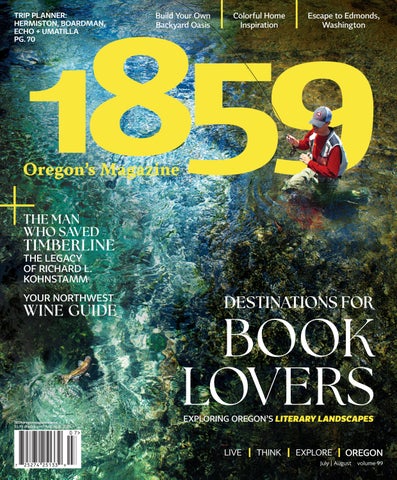
TRIP PLANNER: HERMISTON, BOARDMAN, ECHO + UMATILLA PG. 70
Build Your Own Backyard Oasis
Colorful Home Inspiration
Escape to Edmonds, Washington
THE MAN WHO SAVED
TIMBERLINE THE LEGACY OF RICHARD L. KOHNSTAMM
YOUR NORTHWEST
WINE GUIDE
1859oregonmagazine.com $5.95 display until August 31, 2026
EXPLORING OREGON’S LITERARY LANDSCAPES
LIVE
THINK
EXPLORE
OREGON
July | August
volume 99
BRIDGING THE GAPS ON AMANDA’S TRAIL Each New Year, as coastal mist drifts through the spruce and fir, people gather beneath a quiet suspension bridge on Amanda’s Trail between Cape Perpetua and Yachats. They stand near a small amphitheater and statue, offering prayers, cedar sprigs, and moments of silence. It is a pause between years—a time to honor the past and recommit to respect, understanding, and shared stewardship in the year ahead. Amanda’s Trail is beautiful, but its meaning runs deeper than the sweeping Pacific views that flank it. This stretch of the Oregon Coast Trail follows a path once walked under duress by Indigenous people forcibly removed from their homelands in the mid‑1800s. The trail is named for Amanda, a blind Coos woman whose courage and endurance have come to symbolize Oregon’s own painful “Trails of Tears.” When storms and time weakened the suspension bridge over Amanda’s Creek, rebuilding it became about more than safe passage. The restoration renewed a vital link—physically reconnecting the trail and symbolically honoring the stories carried across this land. Supported by Oregon Lottery funding and guided by community and tribal partners, the new bridge strengthens connections between cultures, generations, and place. Each New Year, hikers return beneath its span, reminded that remembrance, like the trail itself, is something we choose to walk together.
oregonlottery.org/parks LOTTERY GAMES ARE BASED ON CHANCE AND SHOULD BE PL AYED FOR ENTERTAINMENT ONLY.
Greetings from
Everything you love about summer, all in one place. Bike rides before breakfast, afternoons on the Deschutes River, and evenings in The Backyard long after the sun goes down. Across 3,300 acres, mix and match your days, revisit your favorites, and find something new in between. The only thing missing is you.
Book your stay at SunriverResort.com
The team at Rainshadow Organics heads out to harvest produce at the Central Oregon farm.
2
1859 OREGON’S MAGAZINE JULY | AUGUST 2026
From the Ground Up photography by Daniel Stark Rainshadow Organics’ Sarahlee Lawrence and her crew bring farm-fresh, organic carrots and more to the Central Oregon community. (pg. 20)
JULY | AUGUST 2026
1859 OREGON’S MAGAZINE
3
Harvest mussels, explore tide pools and more at educational coastal workshops and foraging excursions with Shifting Tides, lead by marine biologist and educator Alanna Kieffer.
FEATURES JULY | AUGUST 2026 • volume 99
56 Clamshell Your Computers Learn more about the intricate biospheres of the Oregon Coast through an outdoor classroom at Shifting Tides.
4
40
46
Oregon’s Literary Destinations
King of the Mountain
The books that inspired the stories and the settings that still infuse these places—from Kesey and the coast to Molly Gloss and the Blue Mountains.
The vast and storied life of the man whose legacy is the founding and success of the historic Timberline Lodge—Richard L. Kohnstamm.
written by Jean Chen Smith
written by Daniel O’Neil
1859 OREGON’S MAGAZINE JULY | AUGUST 2026
Sophia Knox/Shifting Tides
written by Kerry Newberry
DEPARTMENTS JULY | AUGUST 2026 • volume 99
LIVE + THINK
26
14 NOTEBOOK
Art in The Pearl, Sunriver Music Festival, Glitterfox’s new album.
18 FOOD + DRINK
Marionberry margaritas, Domek in Eugene, ballpark bites.
20 FARM TO TABLE
Carrots from the High Desert.
28 HOME + DESIGN
A mural-centered home in Newport.
Tambi Lane
34 MIND + BODY
36
DIY backyard oasis.
36 ARTIST IN RESIDENCE
Portland’s Limei Lai and her multimedia works.
EXPLORE
66
64 TRAVEL SPOTLIGHT
The Pendleton Underground.
66 ADVENTURE
Three hidden gems for summer discovery.
Daniel O’Neil
Daniel Patterson/Nez Perce Wallowa Homeland
68 LODGING
10 Editor’s Letter 11 1859 Online 78 Map of Oregon 80 Until Next Time
COVER
photo by Tyler Roemer (see “Oregon’s Iconic Literary Destinations,” pg. 40)
6
1859 OREGON’S MAGAZINE JULY | AUGUST 2026
The Inn at Dayton.
70 TRIP PLANNER
Hermiston’s rugged beauty.
75 NW DESTINATION
Diving into Edmonds, Washington.
Tapping into Traditions September 17-20, 2026
Mt. Angel Oktoberfest is grateful to our sponsors:
Bark Boys
Shuttles available from Salem, Portland, Woodburn and Silverton
oktoberfest.org Mt. Angel, Oregon
CONTRIBUTORS
YU KITO LEE Illustrator Home + Design DIY
TAMBI LANE Photographer Homegrown Chef
DANIEL O’NEIL Writer King of the Mountain
DANIEL STARK Photographer Farm to Table
“I was excited for the opportunity to illustrate a home decor piece featuring this rainbow mural. I’ve always loved interior design and architecture. I’m a sucker for room tours and browsing vintage furniture stores. I love this idea because it’s such a simple way to bring more fun and personality into a space. I think everyone could use a rainbow mural of their own, and the best part is that every rainbow would be unique. If you try this project in your home, I’d love to see it!” (pg. 32)
“After photographing a second cookbook, I knew it was time to transition from portraits and running a full-time studio to photographing food. Collaboration has been a favorite part of photography for me, and working in a new genre gave me an opportunity to create with many new and talented people. My favorite perk of them all, and the answer to the most-asked question, is yes! I usually do get to taste all of the dishes I photograph, and who doesn’t love that!” (pg. 26)
“Plenty has been written about Timberline over the decades, for good reason. Yet the story of how RLK saved Timberline seems to have been overlooked, forgotten. I learned of it while working briefly at Timberline not long ago. I think knowing this story adds a new level of appreciation and respect both for Timberline and for RLK and crew.” (pg. 46)
“One of my favorite parts of photography is meeting the people behind Oregon’s unique communities and landscapes. Visiting Rainshadow Organics in Sisters offered a chance to witness the dedication, hard work and optimism that define so many local farms. Spending time with Sarahlee Lawrence and documenting the journey from field to table was both inspiring and rewarding.” (pg. 20)
Yu “Yuey” Kito Lee is a Japanese illustrator based in Los Angeles, where she lives with her husband and their three children. She strives to share meaningful stories that bring people closer to their communities and to one another across cultures.
With nearly two decades of experience in photography, Tambi Lane is a food and beverage photographer in Bend. She enjoys time with her family and two French bulldogs.
8 1859 OREGON’S MAGAZINE JULY | AUGUST 2026
Growing up, Daniel O’Neil learned to ski and then to snowboard at Timberline. He has since contributed many articles to The Snowboarder’s Journal. O’Neil currently lives with his family on the north Oregon Coast.
Daniel Stark is an accomplished portrait and editorial photographer based in Bend. With an unwavering passion for storytelling through imagery, Daniel masterfully captures the essence of his subjects, unveiling their unique narratives with every click of his camera.
EDITOR
Kevin Max
CREATIVE DIRECTOR
Allison Bye
WEB MANAGER
Aaron Opsahl
SOCIAL MEDIA MANAGER
Joni Kabana
OFFICE MANAGER
Cindy Miskowiec
DIRECTOR OF SALES
Jenny Kamprath
ACCOUNT EXECUTIVE
Terresa Clark
HOMEGROWN CHEF
Thor Erickson
BEERLANDIA COLUMNIST
Jeremy Storton
CONTRIBUTING WRITERS
Cathy Carroll, Jean Chen Smith, Melissa Dalton, Joni Kabana, Lauren Kramer, Julie Lee, Kerry Newberry, Daniel O’Neil, Ben Salmon, James Sinks
CONTRIBUTING PHOTOGRAPHERS
David N. Braun, Annie Crawley, Tambi Lane, Daniel O’Neil, David Papazian, Tyler Roemer, Daniel Stark
CONTRIBUTING ARTISTS
Yu Kito Lee, Lori LaBissoniere O’Neil, Kate Wong
Headquarters
70 SW Century Dr. Suite 100-218 Bend, Oregon 97702
592 N. Sisters Park Ct. Suite B Sisters, OR 97759
www.1859magazine.com/subscribe @1859oregon
All rights reserved. No part of this publiCation may be reproduCed or transmitted in any form or by any means, eleCtroniCally or meChaniCally, inCluding photoCopy, reCording or any information storage and retrieval system, without the express written permission of Statehood Media. ArtiCles and photographs appearing in 1859 Oregon’s Magazine may not be reproduCed in whole or in part without the express written Consent of the publisher. 1859 Oregon’s Magazine and Statehood Media are not responsible for the return of unsoliCited materials. The views and opinions expressed in these artiCles are not neCessarily those of 1859 Oregon’s Magazine, Statehood Media or its employees, staff or management.
JULY | AUGUST 2026
1859 OREGON’S MAGAZINE 9
FROM THE
EDITOR
LONG BEFORE Gen Z was vibing, there was tangible Kesey-ness to the state of Oregon. The soggy forests on the coast—trees to some, lumber to others. The endurance of Hank Stamper was a beauty all itself. The shortening of days for a dying culture. The last glow of an America setting just west over the Pacific. Kesey and other writers overlay different regions of Oregon to such an extent that going there feels like being back in the pages, living alongside its protagonists and walking in their boots. This is what you’ll find on page 40, “Oregon’s Literary Destinations,” as writer Jean Chen Smith takes us to some of Oregon’s places where you’ll feel like you’ve stepped back between the covers of these classic books. In Sometimes a Great Notion, Stamper seems to understand from an uneducated outside looking in: “He couldn’t seem to get his teeth into anything. Except books. The things in books was darn near more real to him than the things breathing and eating.” Another towering figure in Oregon modern history spent his life in the Mount Hood National Forest and mostly under the iconic roof of Timberline Lodge. Richard L. Kohnstamm is a name that any Oregonian will know as the man who spent his life making the master craftsmanship of the Works Progress Administration
10 1859 OREGON’S MAGAZINE JULY | AUGUST 2026
a world-class ski lodge and destination. Where others failed, Kohnstamm brought a discipline, a vision and a sense of ownership that no others had. He dedicated his life to raising the requisite funds to feed his growing vision for the lodge and resort. He was someone whom legislators could get behind when their hats were out for public funding. He was someone whose employees saw as a fair leader of whom they never wanted to run afoul. You can read this excellent piece on the man who saved Timberline on page 46. Another ray of nostalgia comes from our Travel Spotlight. Set in Pendleton, today known for the Pendleton Round-Up rodeo, this piece peers back in time when Pendleton, at the turn of the century, was a thriving post for wool transportation due to the density of sheep farms in the area. This western outpost was also a den of iniquity. A tour of that era begins at the Pendleton Underground. Incidentally, Kesey’s last book, Last Go Round, is set in Pendleton during the 1911 Round-Up. No doubt the elements of the Underground were lurking and bucking, too. Read more on page 64. A perfect Oregon way to read this issue is to find and make the Marionberry Margarita recipe on page 18, and then sip knowing the marionberry was invented at Oregon State University in, well, Marion County. Cheers!
1859 ONLINE More ways to connect with your favorite Oregon content www.1859oregonmagazine.com | #1859oregon | @1859oregon
HAVE A PHOTO THAT SHOWS OFF YOUR OREGON EXPERIENCE? Share it with us by filling out the Oregon Postcard form on our website. If chosen, you’ll be published here. www.1859oregon magazine.com/postcard photo by Brian Jim Wildflowers carpet the Memaloose area of the Columbia River Gorge.
YOUR PNW NEWSLETTER Never Miss an Issue. Read 1859 Oregon’s Magazine and 1889 Washington’s Magazine anywhere, on any device, with our digital edition. Follow us today on Issuu.com. www.bit.ly/statehoodmediadigital
More Pacific Northwest, delivered to your inbox! Sign up for our Adventure Mail newsletter and get access to the latest getaways, giveaways and more. www.1859oregonmagazine.com/live/ subscribe-to-oregon-adventure-mail
SHOP LOCAL Stop by Local, our curated online shop of goods made by businesses in the Pacific Northwest, or show your state pride with 1859 T-shirts, hats and other apparel. Buy local. Feel good. www.1859oregon magazine.com/shop
JULY | AUGUST 2026
1859 OREGON’S MAGAZINE
11
FOOD + DRINK 18 FARM TO TABLE 20 HOME + DESIGN 28 MIND + BODY 34 ARTIST IN RESIDENCE 36
pg. 28 A Newport home takes inspiration from the coastal city’s historic bayfront murals.
David Papazian Photography
NOTEBOOK 14
If you know us, you know Oregon.
Some of the most compelling stories in the Pacific Northwest are happening right in your backyard.
opb.org
notebook
CAmark y LEN our DA R
Tidbits + To-dos written by Cathy Carroll
Art in The Pearl
Art in The Pearl Fine Arts & Crafts Festival Portland’s beloved and largest outdoor art fair marks its thirtieth anniversary September 5 through 7 in the Pearl District. More than 140 juried artists from the U.S. and Canada bring original work in a range of styles. Browse, buy and chat with them about their inspiration and process. With live music and artist demonstrations, this free event also partners with the Pearl District Neighborhood Association to keep the North Park Blocks venue clean year-round. www.artinthepearl.com
Portland Coffee Roasters is marking three decades of community connection with a limited-edition Anniversary Roast from longtime partners in Costa Rica, Colombia and Ethiopia, with notes of citrus, dark brown sugar and dried stone fruit. The company is also partnering with Growing Gardens to plant thirty new home and school gardens across Portland, building on a partnership of more than a decade for a deeper collaboration on food access and community resilience. www.portlandcoffee roasters.com
14
1859 OREGON’S MAGAZINE JULY | AUGUST 2026
Headlands Coastal Lodge
Portland Coffee Roasters’ Thirtieth Anniversary Roast
Pacific City Wellness Escape Tap into the restorative power of the Oregon Coast in Pacific City with Headlands Coastal Lodge & Spa’s new escape package that includes a Marine Moisture Drench full-body kelp treatment with ocean-derived minerals, refreshing mocktails and a charcuterie board delivered from Meridian Restaurant & Bar as you relax with serene views of the Pacific and Haystack Rock at Tidepools Spa & Wellness—take home a luxury bathrobe, too. www.headlandslodge.com/offers/the-coastal-spa-escape
notebook
Titilayo Ayangade/Sunriver Music Festival
CA
ur R yo A k D ar N m LE
Limited-Edition Sparkling, Chillable Red Release Party On July 12, Landmass Wines releases its cult-favorite Tomato Season—a limitededition sparkling red made from pinot meunier—juicy, dry and meant to be served cold. Expect a pumping patio, tomato-themed bites from Astral and playful tomatothemed vibes at the family- and pet-friendly tasting room on NE Fremont Street in Portland. www.landmasswines.com
Catch Grammy Award-winning pianist Michelle Cann at this year’s Sunriver Music Festival.
Sunriver Music Festival The forty-ninth season of Sunriver Music Festival from August 10 through 20 in Bend and Sunriver, curated by Artistic Director and Conductor Brett Mitchell, brings world-class orchestra musicians and acclaimed soloists performing eclectic works by American composers, from Aaron Copland to Edgar Meyer, as well as four classical concerts, a pops concert, a chamber concert and a fun, informal family concert exploring orchestra instruments through music by John Williams, including Harry Potter and the Sorcerer’s Stone. www.sunrivermusic.org
ur yo AR k r D ma EN
Oregon Fruit Co.
CA
L
Oregon’s Homegrown Maraschino In 1925, an Oregon State University researcher invented the modern maraschino by bleaching cherries white and dyeing them red—the American cocktail cherry was born and endured. Oregon Fruit Co. is changing that with their new Cocktail Cherries sourced from the Willamette Valley and Columbia River Gorge, finished with Jacobsen Sea Salt harvested from the pristine waters of Netarts Bay and packed in thick syrup with no artificial dyes, perfect for summer cocktails and mocktails. www.oregonfruit.com
JULY | AUGUST 2026
1859 OREGON’S MAGAZINE
15
notebook
Musician
Looking Inward
Glitterfox’s new album, decoder, seamlessly brings together indie rock, pop, folk, soul and new wave.
Portland’s Glitterfox makes music for dancing and deep feelings written by Ben Salmon
Julia Varga
Listen on Spotify
GLITTERFOX IS A POWERHOUSE live band—more than the sum of its parts, and its parts are terrific. Together, bassist Eric Stalker and drummer Blaine Heinonen are a formidable rhythm section that gives the Portland band’s songs a stylish and sturdy foundation. Guitarist Andrea Walker is a font of inventive and memorable melodies, thanks to a seemingly bottomless bag of riffs, licks and chord progressions. And lead singer Solange Igoa is both a compelling vocalist and a charismatic presence at the front of the stage. All four help bring Glitterfox’s tunes to life, too, but the seeds of those tunes are usually planted by Walker—an enthusiastic and fruitful songwriter, they said. “Generally, I’ll make a demo of a song so the band can get the general vibe, but then each person takes their part and makes it better,” Walker said. “It’s almost kind of like a rock tumbler— it gets bounced around and around and people flesh out their parts, and then, as a band, we develop the idea from there.” Eleven of those ideas appear on Glitterfox’s excellent 2025 album decoder, a collection of vibrant and propulsive tracks that incorporate indie rock, folk, pop, soul and new wave in a way that feels natural and effortless. Thematically, the album “traces deeply personal terrain,” according to the band’s website, touching on “queer love, personal transformation, neurodivergence and the emotional aftershocks of a romantic split.” For Walker, songwriting is a way to process what’s going on in their world and the world around them. “Every single song I write is from a deep place in my life. I write songs about the deepest things I’m experiencing and the 16
1859 OREGON’S MAGAZINE JULY | AUGUST 2026
strongest things I’m struggling with, so there’s real human experience in there,” they said. “But one thing about Glitterfox is we want people to come to our shows and dance,” Walker continued. “So the content of the song might be incredibly heavy, but we’ll play a dance beat and something you can rock out to.” In other words, they write songs for the multifaceted nature of the human experience—joy and sorrow, certainty and confusion, wonder and disappointment, courage and fear. Music, Walker says, is a kind of magic—one with the power to lift us up, bring us together and connect us with each other by shining a light on our common ground. “When I hear a beautiful song, it just touches me on the inside,” Walker said, “and I’m so grateful someone took the time to write it.” Walker’s deep-dive approach also buffers them from the volatile nature of trying to make a career out of music and worrying too much about streaming numbers or ticket sales. “The only way to weather those constant peaks and valleys, I think, is to turn inward and ask, ‘Why am I doing this? What kind of songs do I want to write? What do I want people to feel when they come to one of our shows?’” they said. “It’s the difference between chasing something that’s cool and trending versus, like, chasing something that’s deep within yourself as an artist and understanding how I want to present these songs so they connect with people.”
Courtesy of Glen Van Peski
notebook
Ultralight backpacker Glen Van Peski shares lessons on purposeful living in take less. do more.
Bibliophile
The Ultralight Life Trail-tested insights reveal how carrying less can create freedom and fulfillment interview by Cathy Carroll
ENGINEER, ENTREPRENEUR, philanthropist and longtime ultralight backpacker Glen Van Peski of Bend believes the best way to move forward in life is by carrying less. In his award-winning book take less. do more.: Surprising Life Lessons in Generosity, Gratitude, and Curiosity from an Ultralight Backpacker, Van Peski explores how subtracting rather than adding can lead to greater freedom, purpose and joy. Drawing from decades of outdoor adventures and personal experiences, he shares lessons on generosity, gratitude, curiosity and resilience—from investing creatively in relationships to reframing life’s setbacks and learning to embrace failure as part of growth. Through a philosophy rooted in simplicity and service, Van Peski encourages readers to live within their means, deepen connections and create more meaningful lives. He founded Gossamer Gear, a company dedicated to ultralight backpacking equipment in 1998, after he’d become fascinated by lightweight travel in the wilderness and started sewing his own gear. All profits from the book are donated to the Pacific Crest Trail Association.
How has the “take less, do more” philosophy shaped your life off the trail? On the trail, a lighter pack means less strain on your body, the ability to hike more miles, a deeper connection to the wilderness you are moving through and greater capacity to help others in an emergency. Off the trail, a life focused on less stuff creates margin for more of what matters. That margin—physical, mental and financial— gives me the energy and resources to engage more fully with people around me. It means I can notice and say yes to opportunities I might otherwise have been too busy to even see, or too depleted to pursue. With margin, my attention can turn outward to others, instead of being consumed by my own concerns. What’s one experience that’s emblematic of that philosophy? When I finished the manuscript, I needed photos for a website and called a friend who seems to know everyone. He sent me to Bruce. We met at Sparrow Bakery (in Bend), and Bruce said I should really talk to his friend Gary, but not to wait because Gary had just received a terminal diagnosis. I set up another meeting at Sparrow. In the meantime, I remembered a hiker friend I owed
JULY | AUGUST 2026
photography work, but I had margin in my schedule, so I kept the meeting with Gary. He had quit his job, not wanting to spend his last months working, which left little money for a few bucket-list dreams. Because we consistently set aside funds in a separate account for this kind of thing, we were able to help him hike in Patagonia before he died. Margin, created in advance, allowed us to do more than just offer sympathy. What do you think people discover about themselves when they spend multiple days outside carrying everything they need? On longer backpacking trips, people usually discover a couple of things. First, all the little items that “don’t weigh much” add up to a surprisingly heavy pack. Life is like that, too; many small commitments, each reasonable on its own, can accumulate until they overwhelm us and rob us of margin. Second, after hikers do the work of reducing pack weight, they realize how little they actually need—once they have the skills—to be safe and have fun in the wilderness. In life, we often relearn the same lesson: Our fondest memories are rarely about the stuff; they’re about the experiences and the people we shared them with. 1859 OREGON’S MAGAZINE
17
food + drink
Cocktail Card recipe courtesy of Brendon Martin, general manager at Hearth & Vine / PORTLAND
Sip a taste of summer with this cocktail from one of Portland’s newest dining destinations, a restaurant and bar housed within the landmark Henry Weinhard Brewery Building in the Pearl District.
Beerlandia
Marionberry Margarita FOR THE COCKTAIL • 1½ ounces blanco tequila • ¾ ounce lime juice • ½ ounce triple sec • ¾ ounce marionberry syrup (see recipe) • Dehydrated lime wheel, for garnish • Salt, for rim
Message in a Bottle
FOR THE MARIONBERRY SYRUP • 2 cups frozen marionberries, thawed • 2 cups white granulated sugar • 1 cup water • 2 tablespoons lemon juice
written by Jeremy Storton | illustration by Lori LaBissoniere O’Neil
FOR THE COCKTAIL Salt the rim of a glass. Combine tequila, lime juice, triple sec and marionberry syrup in an ice-filled cocktail shaker. Shake vigorously, and then strain into a rocks glass filled with ice cubes. Garnish with a dehydrated lime wheel.
18
1859 OREGON’S MAGAZINE JULY | AUGUST 2026
Photo: Aubrie LeGault/Hearth & Vine
FOR THE MARIONBERRY SYRUP Combine ingredients in a high-powered blender. Blend on high speed for about 2 minutes. Strain through a fine mesh sieve using a rubber spatula to push the purée through the mesh, leaving the seeds behind. Transfer the strained syrup to an airtight container, and refrigerate for up to 2 weeks.
ABOUT SIX and a half millennia ago, beer came into the picture. What likely began as a divinely inspired or serendipitous mistake became an intentional practice, and beer has braided itself into our culture ever since. It has influenced our understanding of science, our economy, inventions we take for granted and, since water was unsafe to drink, a way for us to survive and thrive. For example, as they ran short of “necessary supplies” (beer), the Mayflower pilgrims stopped in Plymouth, short of their target in Virginia, to resupply. One could easily argue that one of the first things these early Americans did was go on a beer run. I thought about this one Friday night after a long week as I cracked open a bottle of pale lager to ease into the weekend. I miss the thrill of discovering new beers from around the world. But, as I sipped, I considered that new discoveries sometimes don’t lie in the future, but rather, the past. Around fifty years ago, the craft beer movement was born in California, but it didn’t take long to work its way to Oregon and lay a solid foundation. One thing we know for sure is that craft beer is a movement of rediscovery. We didn’t invent new beer styles; we merely took examples from Europe, redefined them and sent them back, cementing our place in global beer culture. However, in every bottle we rediscovered, it’s as if there was a note from brewers and cultures over the millennia, whispering their secrets of wisdom and hope. That baton has been passed down to us, with all the obligation that goes with it. We now hold that message in our hands, and it’s up to us to decide what we do with it.
food + drink
BEST PLACES FOR
BALLPARK BITES The Hillsboro Hops are uncorking a new collaboration with Argyle Winery as their new ballpark debuts this season. Pair bubbly (or pinot) in the Dugout Lounge with comfort eats like wood-fired pizza, BBQ and gourmet dogs, turning game day into a full-on culinary experience. Hops fans can bring their game ticket to the Dundee tasting room for a complimentary house flight. 4450 NE CENTURY BLVD. HILLSBORO www.milb.com/hillsboro
Photos: Domek
HILLSBORO HOPS
CLOCKWISE FROM LEFT Chef Andrew Hroza at Domek in Eugene. Dishes are Eastern European with ingredients from the Northwest, such as these pelmeni dumplings (right) and macha cabbage (below).
Dining
Domek
PORTLAND PICKLES
written by Kerry Newberry
Summer nights at Portland Pickles games come with standout ballpark fare. Expect Zenner’s hot dogs, vegan brats, dill pickle kettle chips and pickles on a stick, plus Underwood Wines or a briny, sparkling Pickletini from Straightaway Cocktails. Rotating collaborations with local food makers keep things fresh—think pickle ice cream and pickle donuts.
At Chemeketa Baseball Field, marionberries rule. Find them in hard cider, milkshakes and berry-packed hand pies, alongside classic hits like hot dogs, nachos, pretzels and churros. In July, Berry Days Weekend ramps it up with jam giveaways, hand pies galore and berry-themed games for the whole family.
EUGENE HAS NO SHORTAGE of brew pubs, food truck pods and farmto-table fare. What’s been missing? A chef-driven bistro with a point of view. Enter Domek, chef Andrew Hroza’s downtown restaurant, where Eastern European comfort dishes meet the bounty of the Pacific Northwest. Step inside, and you’ll find a bright dining room that blends Scandinavian cool with neighborhood warmth. Globe chandeliers, lush greenery and artwork by Vesna Pavlović create a polished-yet-inviting vibe. An elevated corner bar, framed MARK YOUR CALENDAR by blush-pink banquettes and marble-topped bistro tables, offers From August 26 through a prime perch. 29, Domek celebrates Before opening Domek, Hroza earned acclaim at upscale brewUkrainian Week, when Hroza spotlights pubs including Chicago’s Goose Island, Warpigs in Copenhagen regional favorites such and Ninkasi’s Better Living Room in Eugene. Here, he draws on as handmade varenyky, nostalgic salad mimosa, his Eastern European roots while showcasing hyper-local ingrecrispy deruny (potato dients. Think potato croquettes stuffed with smoked wild trout, pancakes) and the restaurant’s much-loved Dungeness crab piroshki and chilled borscht brightened with chicken Kyiv. heirloom tomatoes from Camas Swale Farm. The breakout hit is the shrimp toast: a thick slice of buttery brioche from nearby Noisette Pastry Kitchen piled high with sweet Oregon bay shrimp and finished with a zippy herb sauce. Pair it with a glass of crisp pinot gris from Antiquum Farm, one of several standout local producers featured on the wine list—and the winery where Hroza cooked before launching Domek. Save room for dessert. A rotating selection of elaborate cakes often includes miodownik, the beloved Polish honey cake, and kremówka—delicate layers of custard and pastry reminiscent of a mille-feuille.
4000 LANCASTER DRIVE NE SALEM www.marionberriesbaseball.com
454 WILLAMETTE ST. EUGENE www.domekeugene.com
4727 SE 92ND AVE. PORTLAND www.portlandpicklesbaseball.com
MARION BERRIES
JULY | AUGUST 2026
1859 OREGON’S MAGAZINE
19
farm to table
Rainshadow Organics owner Sarahlee Lawrence was born and raised on the land she now farms in Central Oregon.
20 1859 OREGON’S MAGAZINE JULY | AUGUST 2026
Freshly harvested carrots at Rainshadow Organics.
Farm to Table
Carrots: Not Just for Rabbits Family-owned Rainshadow Organics grows carrots and more in Deschutes County written by Julie Lee | photography by Daniel Stark IF YOU THINK of carrots as dull root vegetables, you are in for a bunch of surprises. As vegetables go, carrots are “tops” in delivering health benefits; they are chock-full of vitamins, minerals and antioxidants that support immunity and heart, brain, kidney and liver health, making them an important addition to every diet. One cup of raw, chopped carrots contains approximately 50 calories, 12 grams of carbohydrates, 4 grams of dietary fiber and 1 gram of protein and provides 100 percent daily value in vitamin A. It is no secret that these beta-carotene-rich tubers aid in eye health; however, they also contribute to skin health, promoting a healthy glow. Packed with antioxidants, antimicrobial properties and fiber, carrots are fat-free, cholesterol-free and low in sodium. Carrots contribute to gut health, aiding digestion to keep things moving. Growing up with a diabetic father, carrots were a staple in our home, proving to be a low glycemic snack that assists with blood sugar management. While often thought of as an afternoon snack, the best time to eat
carrots is in the morning, or in combination with healthy fats, to capitalize on absorption of nutrients. Consuming them earlier in the day on an empty stomach maximizes vitamin absorption. While orange is the prominent color for carrots with their high amount of beta-carotene, you will find these crunchy treats in a rainbow of options: yellow, red, purple and white. Each color comes armed with unique rewards: Purples help with healthy gut biomes, improved cognition and heart health; yellow carrots contain lutein, helping with vision and brain health; and red carrots can lower stroke risk. Carrots come in all sizes, and no matter the size, there is minor difference in health benefits between baby carrots and regularly sized carrots. Sarahlee Lawrence has been growing farm-fresh carrots for more than a decade. Rainshadow Organics, in the heart of Central Oregon’s high desert, approaches agriculture with an intense regard for land and soil health combined with an understanding that farming integrity helps produce nutrient-dense foods.
JULY | AUGUST 2026
1859 OREGON’S MAGAZINE 21
farm to table
Rainshadow Organics provides organic produce, grains and meats to the Central Oregon community, where Rainshadow products can be found at farmers markets and farm stands and on local menus.
Lawrence was born and raised on the land she now farms, though her plans had a windy path. She grew up raising cattle and hay on what she calls a “typical, small family farm in Central Oregon” before going off to college, where she studied environmental science and further boosted a love for food and farming. Reading Michael Pollan’s books inspired a “come to Jesus” moment for Lawrence, and a firm realization that “food is our future.” When Lawrence’s parents, Chris and David Lawrence, decided they were ready to downsize their involvement after forty years of arduous work, the timing intersected with Sarahlee’s life goals. Though she had no experience raising vegetables, she decided to try it on 2 acres of an old horse pasture. “My parents weren’t going to give me the whole farm,” she said laughing, “without a plan.” What started as 2 acres seventeen years ago is now 15 robust acres of vegetable crops. From the onset, certification as an organic farm was of utmost importance to Lawrence, which required a three-year transition and a heavy dose of patience. Rainshadow Organics is a Full Diet Community Supported Agriculture (CSA) farm, providing organic produce, grains and meats directly from farm to table. They sell exclusively in Central Oregon, or within 30 miles 22 1859 OREGON’S MAGAZINE JULY | AUGUST 2026
of the farm, and you will find Rainshadow products at various farmers markets and farm stands, as well as on menus in local Central Oregon restaurants. As we celebrate the international year of the woman farmer, Rainshadow currently employs all females on the farm. “We used to be more co-ed in the early days, but for whatever reason, we currently have all women working the farm,” said Lawrence. “It has been a formidable team of women for the past five years, though we have a weekend animal guy!” Carrots are just one crop grown at Rainshadow, though they are a favorite. “Everyone’s favorite vegetable at the farmers markets is a carrot,” said Lawrence. “It’s the one vegetable I don’t want to be without. The sweet flavor of a carrot is profound when they haven’t traveled far—people seek them out.” According to Lawrence, carrots grow well in Central Oregon, which can be a challenging climate for crops, with both high heat and frost creating farming obstacles. She plants carrots monthly starting on Valentine’s Day each year and then plants each month until July, storing the harvest in 33-degree containers to preserve quality and freshness for cooler months. The year-round availability and versatility of carrots help with food security as well. “You can eat them raw, cooked, in
“Everyone’s favorite vegetable at the farmers markets is a carrot. It’s the one vegetable I don’t want to be without. The sweet flavor of a carrot is profound when they haven’t traveled far—people seek them out.” — Sarahlee Lawrence, owner of Rainshadow Organics everything from pasta to soup … so many ways ... shit, it’s like Forrest Gump!” Lawrence said. Her favorite way to eat carrots, though, is simple: fresh from the field. Carrots are also a favorite of Ambar Estate’s acclaimed winery chef, Heidi Whitney-Schile. “The change of season and flavors [from winter to spring] always gives me so much joy,” she said, noting that the colors and flavors of produce like carrots are extra vibrant after a long winter of stodgier vegetables. One of the first things she picks up when the farmers markets reopen in spring are “beautiful carrots,” and Nantes are her favorite due to the sweet, crisp, earthy flavors, perfect for both savory dishes and dessert. “Carrots are versatile and overlooked, usually relegated to stocks or dips, and I believe they should be a main event!” Whitney-Schile shares a couple favorite recipes for spring carrots: a savory carrot mousse, or “mashed potatoes’ more sophisticated cousin,” which she enjoys serving with a simple roasted chicken for complementary flavors and carrot cake. “I know, I know, carrot cake is very divisive,” she stated. “I worked on this recipe after a friend told me they ‘hate carrot cake,’ and I made it my personal mission to prove them wrong and change their mind.” For those who do not like raisins, any dried fruit works, and for extra zip, add chopped apricots. The star ingredient, though, is pineapple, which enhances the sweetness of the carrots and melds everything together. Executive chef Aaron Bedard from the Stephanie Inn Dining Room in Cannon Beach loves to whip up his curried carrot salad with citrus honey vinaigrette for guests, family and friends, using Kingfisher Farms Yaya carrots, Public Coast honey and curry powder. And culinary genius and social influencer Jordan Curtis of @hoteatscoolfeets in Portland shares his guest-awing carrot dish: grilled carrots with stracciatella and chili crisp, great for either an impressive side or main meal.
FROM TOP Rainshadow Organics owner Sarahlee Lawrence and her mom, Chris Lawrence. The Rainshadow team hard at work harvesting carrots. Find seasonal produce and more at the Rainshadow Organics Farm Store.
JULY | AUGUST 2026
1859 OREGON’S MAGAZINE 23
Tossing the Traditional Salad
Curried Carrot Salad with Citrus Honey Vinaigrette Stephanie Inn / CANNON BEACH Aaron Bedard, executive chef SERVES 4 FOR THE CITRUS HONEY VINAIGRETTE • 1 orange, zested • ¼ cup Public Coast Farm honey • ¼ cup champagne wine vinegar • 1 teaspoon Dijon mustard • ½ cup avocado oil • Salt, to taste FOR THE CURRIED CARROT SALAD • 10 ounces Kingfisher Farms Yaya carrots (or favorite Oregon carrots), peeled • 1 tablespoon olive oil • 1 tablespoon curry powder • 2 ounces seedless grapes • 2 tablespoons Public Coast Farm honey • ½ cup water • ½ cup sugar • 2 ounces walnuts • 4 ounces sheep’s milk feta cheese • ¼ ounce Public Coast Farm micro carrot • Citrus honey vinaigrette (see recipe) • Salt and pepper, to taste FOR THE CITRUS HONEY VINAIGRETTE Combine ingredients in a container, and
MORE ONLINE
Curried Carrot Salad with Citrus Honey Vinaigrette.
emulsify with an immersion blender until fully incorporated. Add salt to taste. FOR THE CURRIED CARROT SALAD Preheat oven to 350 degrees. Toss carrots, olive oil and curry powder together in a bowl, and season with salt and pepper to taste. Place on a small sheet pan, and roast at 350 degrees until slightly tender, about 20 minutes. Set aside to cool. Toss grapes and honey together in a bowl, and place on a small sheet pan. Roast at 350 degrees until slightly softened. Set aside to cool. In a small sauce pot, combine water and sugar, and bring to a boil. Add walnuts to boiling syrup, and cook for 1 minute. Drain syrup from the walnuts. Place the walnuts on a small sheet pan, and roast until golden-brown, about 8-10 minutes. Set aside to cool. Artfully place curried carrots, feta cheese, honey-roasted grapes and candied walnuts on a serving plate, top with micro carrots and drizzle with citrus honey vinaigrette.
For recipes for Carrot Mousse, Carrot Cake and Grilled Carrots with Stracciatella and Chili Crisp, head to our website at www.1859oregonmagazine.com/carrotrecipes
Stephanie Inn
Oregon Recipes
Discover the best of Oregon with a subscription to 1859 Oregon’s Magazine. Local getaways, destination dining, Oregon-grown recipes and more!
Save 50% off cover price 1 year for $18.59 | Gift subscriptions available Subscribe today at 1859oregonmagazine.com/subscribe
farm to table
Grilled Summer Carrots with Labneh, Za’atar, Hazelnuts and Honey Vinegar
Homegrown Chef
The Carrot and the Comedy written by Thor Erickson | photography by Tambi Lane I WAS A YOUNGER MAN when I stood near the edge of the green in downtown Ashland, feeling entirely invisible in the best possible way. In a place like Ashland, everyone is watching someone else portray somebody, and so this 20-something without an agenda could simply be—undisturbed. Two actors sat face-to-face beneath a string of hanging bulbs, rehearsing scenes from A Midsummer Night’s Dream with the complete seriousness required for a comedy that questions whether human dignity is more than just a romantic illusion. Between them sat a dented tin bowl—the kind you find at the back of any honest Oregon kitchen—overflowing with carrots fresh from someone’s garden, and two mason jars of water catching the last amber light of evening. Unflinching, the thespians, while reciting lines, bit into carrots and drank water, resulting in a comedic shower of masticated vegetables. Shakespeare himself was no stranger to imperfection. His plots are full of knots that don’t quite untangle, jokes that land sideways, lovers who speak in circles. Scholars have spent centuries seeking smooth answers for the rough edges, but the roughness is the point. His most revered plays aren’t the tidy ones. They’re the ones with something ungainly and alive still moving inside them. An Oregon carrot pulled from rocky ground has that same quality—gnarled, forked, improbably sweet. The difficult soil left its mark, and that’s what you remember.
Because comedy, the real kind, has always lived close to embarrassment. Close to appetite. Close to the stubborn and unglamorous physical fact of being human. Shakespeare understood this. He kept putting food in scenes where people were trying to be magnificent. He let the body interrupt the poetry. Good carrots, like good people, rarely emerge straight and uncomplicated from the ground. Rocky beginnings leave their scars. Difficult, cold nights do something to sweetness—drive it inward, concentrate it, make the vegetable earn what it offers. A carrot improves with hardship. Frost is not its enemy; frost is its education. The unforgiving season becomes part of the flavor, and you can taste it if you’re paying attention. So, too, with actors. So, too, with Oregon. In Oregon kitchens, carrots have long played supporting roles—roasted alongside a Sunday chicken, folded into good stock, diced into stew on a February evening when nothing outside looks promising. We underestimate them for this reason. But a fresh carrot eaten outdoors, with cold water from a mason jar on a warm Rogue Valley evening, yields a pleasure that expensive meals strive to imitate. Most never quite get there. The carrot was already there. No banquet. No wine. No spectacle—only two people beneath Oregon trees speaking lines 400 years old to one another, spitting carrots into each other’s faces as the summer dark gathered around them.
26 1859 OREGON’S MAGAZINE JULY | AUGUST 2026
SERVES 4 • ½ cup Oregon hazelnuts, toasted and roughly crushed • 12 medium carrots, peeled, tops trimmed to 1/2 inch • 4 tablespoons olive oil, divided • 1 teaspoon Jacobsen large flake sea salt • ½ teaspoon black pepper, freshly cracked • 1 garlic clove, finely chopped or microplaned • 1 cup labneh • 1 tablespoon fresh lemon juice • 2 tablespoons white wine vinegar or sherry vinegar • 1 teaspoon honey • 2 tablespoons za’atar In a dry skillet over medium heat, toast the hazelnuts until the skins crack and the nuts smell nutty, about 4-5 minutes. Wrap in a clean towel, rub off the skins and crush roughly with the flat of a knife. Set aside. Wash and peel the carrots. If carrots are thick, halve them lengthwise. Toss with 2 tablespoons olive oil, the flaky salt and cracked pepper. Let them sit at room temperature while the grill heats (a cold carrot on a hot grill will steam rather than char). Stir the finely chopped or microplaned garlic into the labneh along with the lemon juice and a pinch of salt. Spread generously across the base of a wide serving platter, using the back of a spoon to make swooping wells. The labneh should be cool and thick. Whisk together the vinegar and honey with the remaining 2 tablespoons olive oil until emulsified. Taste
it—it should be sharp, a little sweet and strong enough to cut through the labneh. Adjust with a pinch of salt. Over high heat on a welloiled grill or cast-iron grill pan, lay carrots in a single layer. Grill undisturbed for 4-5 minutes until deep char marks form. Turn, and grill another 3-4 minutes. Carrots should be tender through but still have some resistance—not soft. Work in batches if needed. When ready to plate, lay the hot carrots directly over the cool labneh. Scatter the hazelnuts generously across. Dust everything with za’atar, letting it fall into the labneh and the char. Drizzle the honey vinegar over the top, and then finish with a final pour of good olive oil. Serve immediately—the contrast of hot carrot against cool labneh is the whole point. CHEF’S NOTES On carrots: Farmers market carrots in summer are sweeter and more irregular than supermarket ones— that unevenness is an asset on the grill. Leave an inch of green top on if you have them; they char beautifully. On labneh: If you can’t find labneh, strain full-fat Greek yogurt through cheesecloth overnight. The result is nearly identical. Do not use lowfat—it will weep on the plate. On za’atar: Quality varies enormously. Look for blends with whole dried thyme, sumac and sesame seeds. A good za’atar smells herbal and slightly sour. A stale one smells like dust. On the vinegar: Sherry vinegar gives more depth; white wine vinegar gives more brightness. Either works.
farm to table
From Shakespearean roots: grilled summer carrots with labneh, za’atar, hazelnuts and honey vinegar.
JULY | AUGUST 2026
1859 OREGON’S MAGAZINE 27
home + design
Two architects from Newport created a home that reflected the colorful mural-laden Newport they grew up in.
28 1859 OREGON’S MAGAZINE JULY | AUGUST 2026
home + design
“The entire design of the house was focused around the concept of trying to do something fun. I think architecture gets taken way too seriously, too often. We wanted to create something that people looked at and smiled.” — Dustin Capri, Capri Architecture co-founder and homeowner
Home + Design
All in Good Fun A couple build their dream home in Newport around bright color and a custom mural written by Melissa Dalton photography by David Papazian Photography IN THE 1990S, large-scale murals started appearing along the main street of the historic Bayfront quarter in Newport. Four popped up at the end of Bay Boulevard as it heads into town, including an old canning label, and one with a fishing boat and dory leaning against one another. Above the Bay Market, orcas cavort under pink-streaked skies, while across the street, giant gray whales sink under the waves on an industrial facade. These days, there are more than two dozen murals, blending in among the commercial docks, seafood markets, shops and restaurants. “Bayfront had this huge capital project in the ’90s where private investment and public dollars came together and supported all these artists to come out and paint many of the buildings with these vibrant murals,” said architect Dustin Capri, who grew up in town and remembers seeing them as a kid, as well as the feeling of joy that they inspired. Such is how he and his wife, Amanda, both architects and founders of Capri Architecture, got the idea for a 35-foot-tall mural to become the centerpiece of their new home. “The entire design of the house was focused around the concept of trying to do something fun,” said Dustin. “I think architecture gets taken way too seriously, too often. We wanted to create something that people looked at and smiled.” The couple had previously lived in the historic Bensell House, built in 1885, but jumped at the chance to purchase the lot next door when it became available. They wanted to stay in their neighborhood just steps from downtown Bayfront, so close they hear the sea lions barking at Port Dock One. “We’re little urbanists at heart, living in a rural area, so we wanted to be close to our walkable core,” said Amanda. Next came the challenge of designing a home for themselves and their two children—a process that took them half a decade as they worked without the benefit of JULY | AUGUST 2026
1859 OREGON’S MAGAZINE
29
home + design
CLOCKWISE FROM LEFT A three-story mural by Blaine Fontana refers back to the murals of Newport’s bay area. The kitchen plays its part in the colors that recall Newport and its murals. A roof deck allows family members to take in the sounds and coastal breeze. The library features a glass-top table and wonderful views of the bay. The living room keeps its views wide open with furniture that doesn’t steal the space. The powder room is a happy splash of pink with climbing monkeys.
30 1859 OREGON’S MAGAZINE JULY | AUGUST 2026
a client’s constraints. “When you don’t have the client who’s given you their priorities and their goals, you’re just kind of treading water in too big of a lake,” said Amanda. The two-sided mural became an anchor in their design, with an electric color palette, including magenta, royal blue, grass green, deep yellow and turquoise. “We wanted to depict the full rainbow spectrum of colors without it being so literal,” said Amanda. On one side, there’s an oversized seagull feather set against swirling geometry, and strings of bull kelp on the opposite. The mural is wrapped by an open tread staircase ascending three floors, so glimpses of it can be seen from various vantage points in the house. “The whole design spirals out from there,” said Dustin. For their mural artist, they chose the Portland-based Blaine Fontana, whose work they saw at their friend’s nearby restaurant, Local Ocean. Fontana has painted over a hundred mural
home + design
projects over the past thirteen years, and credits his current career to youthful habits. “I used to do a lot of graffiti when I was younger, and now I’m actually paid to paint walls,” said Fontana, who spent two weeks on the installation, employing dozens of cans of spray paint, and starting the project with an “aerosol tutorial” for the couple’s two children. “Daphne was really proud of her bunnies,” said Fontana. “So, I put a little Easter egg in there of a bunny coming out of the graphic, so they could brag about helping.” That sense of play permeates the rest of the house design, whether the architects were choosing bright sunshades on the front and back facades to control sun exposure, then bringing them inside for functional kitchen shelving, or adding colorful furniture pieces. In the powder room, hot pink wallpaper backs a vanity with monkey statues climbing the lighting, while the glass-topped library table reveals a view into the
downstairs level. By contrast, there are moments of calm interspersed within the vibrancy via the tightly edited material palette, including white walls, wood floors and black metal accents, and spots like the primary bathroom sauna, or a roof deck surrounded by a succulent garden. Since finishing up in 2025 and moving in, the family has been watching how the brilliant mural colors cast rainbow shadows against the white walls throughout the seasons, with different hues dominating at different times of year to “animate” the interior. They like how the mural is framed in large panels of glass at the front, so passers-by can see it from the sidewalk, in a nice little homage to those Bayfront murals of old. “There are nautical elements without it feeling like a kitschy theme,” said Amanda. “The mural shows these lesser-recognized, but really instrumental, species that we see on our beaches every day, so it feels like it belongs here just beautifully.” JULY | AUGUST 2026
1859 OREGON’S MAGAZINE 31
DIY
For a Vibrant Accent Wall, Follow the Rainbow written by Melissa Dalton | illustration by Yu Kito Lee
ADD A PUNCH of color and whimsy to your home decor by designing your own rainbow mural. PICK THE PALETTE Choose your favorite rainbow hues, using the acronym ROYGBIV. It stands for red, orange, yellow, green, blue, indigo and violet. To do this, go to the paint section or store, and gather color cards from the same brand, with one for each color in the ROYGBIV spectrum. Select the hues that are on the same row of the color cards, i.e. each color is the first or second one down from the top. That way, they will all have the same intensity. GATHER TOOLS This project can be completed using sample pots of wall paint. Matte or flat sheens will hide wall imperfections. For the paintbrush, we recommend our all-time favorite: the Wooster Shortcut. It’s 2 inches wide, so it will fit inside a sample pot, and has a short ergonomic rubber handle for easy maneuvering. The bristles are angled, which helps to give a more precise line. 32
1859 OREGON’S MAGAZINE JULY | AUGUST 2026
CREATE THE SHAPE The rainbow will have six or seven stripes, depending on preference, but these can be in any form you wish to execute. Paint them in horizontal or vertical lines. Have them arch across the wall, or just a corner. Or, do both, and have them arch into a straight line. Figure out roughly how tall and wide the mural will be, and decide where to put the apex of the arch. Calculate the width of each stripe and if they will have a white space in between them. A good rule of thumb is to make the stripes 6 inches wide, and any white spaces between them 1 or 2 inches. SKETCH Once the shape is decided, do a preliminary sketch on the wall with pencil or chalk. This drawing will be the guide for the brush. If doing an arch, grab a nail or tack, a string and a pencil. Tap the nail into the wall at the bottom center of the arch, making sure the
string will reach from there to the apex, and form the entire width of the curve that you want your rainbow to take. Attach the string to the nail. Pencil a tick line at the location of every stripe, moving from the apex down to the bottom center until all stripes (and white spaces, if using) are accounted for. Then pull the string taut and sketch the curves lightly, making sure to meet the tick marks so each stripe is an equal width. When it’s time to make straight lines, use a level. PAINT Load up the brush with enough paint, and slowly follow the pencil lines. Apply gentle, consistent pressure to ensure all the bristles make contact with the wall. Use baby wipes to clean up any smears, or wait for the paint to dry, and paint over any errant marks with the correct color. Cover wet brushes with Ziploc bags or Saran wrap between painting sessions.
home + design
Happy Color for Home
Whether opting for the bright red, dusty green or yellow sand versions, this classic Danish-designed thermal carafe is sure to punch up the tablescape. The durable plastic shell has a glass liner, to keep liquids hot or cold for a long time. Available at Canoe, online or in the Portland store.
Local finds to brighten up your space written by Melissa Dalton
The Portland-based and online shop Woonwinkel is the go-to place for finding happy color and curated home goods. (After all, the owner was formerly a color designer themselves.) These Bobbin Salt & Pepper Grinders are sculptural and eyecatching, thanks to their rubberwood shape and eight coats of high-gloss lacquer, available in eight different shades.
www.canoe.design
Photos, clockwise from top left: Woonwinkel, Canoe, Lark Mountain Modern, River Cabaan
www.woonwinkel home.com
Trust the taste of interior stylist and designer Karie Higgins to find things that make people ask: “Where’d you get that?” The Arnold Circus Stool, designed by Martino Gamper, is formed from polyethylene plastic, so it can be used inside or out, with a cool tilted, faceted silhouette. Plus, there’s so many fun colors to choose from. Available via Higgins’ shop at the River Cabaan. www.rivercabaan.com/shopcabaan
The Patchwork Geo Tea Towel, found at Bend’s Lark Mountain Modern, has a cheerful rainbow print and the kind of function needed in the kitchen. It’s made of premium microfiber, for a soft hand-feel, quick dry time and an absorbency that picks up spills quickly. www.larkmountainmodern.com JULY | AUGUST 2026
1859 OREGON’S MAGAZINE
33
mind + body
Mind + Body
How to Create a Backyard Oasis A mind and body retreat inspired by culture and travel written by Jean Chen Smith | illustrations by Kate Wong
AS TRAVEL INCREASINGLY blends with wellness and design, more people are looking to recreate that sense of escape at home—especially during the summer months, when longer days and warm weather make outdoor living more inviting. Rooted in the connection between mind and body, and enriched by cultural influences from destinations around the world, this guide draws on global spa traditions and nature-forward design to shape a more intentional outdoor experience.
34
1859 OREGON’S MAGAZINE JULY | AUGUST 2026
mind + body
Build the Foundation: Mind and Body Every retreat begins with a sense of grounding. Start by carving out a dedicated space for movement and stillness—whether that is morning stretching, Pilates flows or evening meditation. All-weather outdoor yoga mats provide a stable base, while Snow Peak’s Lounge Cushion invites slower moments of pause. Together, these elements create a zone that supports both energy and recovery, reinforcing the connection between physical movement and mental clarity.
Layer in Culture Through Design To evoke the feeling of travel, design becomes the bridge between home and destination. Low-slung seating, such as the Keter Corfu Four-Piece Patio Seating Set, establishes a relaxed, resort-style foundation, while natural materials like wood, rattan and woven fibers bring warmth and texture. Incorporate Moroccan, Japanese or Balinese-inspired lanterns to introduce global influence, and anchor the space with a statement element like the Breeo X Series Smokeless Fire Pit, which is available in four sizes and adds both visual focus and functional warmth. Overhead, pergolas, shade sails or cabana-style canopies create structure and soften the light, while natural fiber rugs—like the Rifle Paper Co. Veranda Terracotta Indoor/Outdoor Rug— define the space and add a tactile layer underfoot. These details work together to create an environment that feels collected, intentional and globally inspired.
Set the Mood with Lighting Lighting is what transforms a backyard into an experience. As the sun sets, warm Edison-style string lights create a soft glow overhead, while solar lanterns and weather-safe LED candles add depth and dimension at ground level. The goal is not brightness, but atmosphere—an ambient, diffused light that mirrors evenings spent dining outdoors in coastal towns or tucked-away courtyards abroad.
Engage the Senses A true retreat goes beyond visuals—it engages all five senses. Sound, scent and subtle details help shift the space from
functional to immersive. A portable speaker like TRIBIT StormBox Lava Portable Bluetooth Speaker can bring in calming playlists or nature sounds, while layered fragrance from candles— such as the Rifle Paper Co. Clementine and Clove Candle—adds warmth and depth to the environment. These small additions create a sensory backdrop that encourages relaxation and presence. For cooler mornings or evenings outdoors, layering in functional apparel like the Duluth Trading Women’s Chick-Nic Long-Sleeve Shirt adds comfort without sacrificing style, making it easy to transition from movement and meditation to casual outdoor lounging.
Create Ritual Through Food and Drink Inspired by global travel, food and drink become part of the experience. An outdoor cooking element like the Ooni Karu Pizza Oven transforms casual dining into an interactive ritual, echoing the communal feel of European piazzas. For a more versatile, everyday grilling experience, the recteq Bullseye Deluxe 380BD pellet grill brings precision and ease to outdoor cooking, allowing you to seamlessly shift from quick weeknight meals to slow, flavor-rich weekend gatherings. For quieter moments, a Matcha Kari starter kit introduces a Japanese-inspired tea ritual, inviting mindfulness through preparation and pause. Whether hosting or enjoying a solo evening, these elements bring culture and intention to everyday routines.
Add Comfort and Texture Finally, layer in the elements that make the space feel like a true escape. Weather-resistant pillows in global prints introduce color and pattern. Hammocks or hanging chairs create an effortless place to unwind, reinforcing the idea that this is not just a backyard— it is a place to linger. By thoughtfully combining wellness, cultural inspiration and sensory design, even a modest outdoor space can become a meaningful retreat. The result is a backyard that does more than look beautiful—it supports how you move, rest and reconnect, offering a summerlong invitation to slow down and step, even briefly, into a world of your own making.
A true retreat goes beyond visuals—it engages all five senses. Sound, scent and subtle details help shift the space from functional to immersive JULY | AUGUST 2026
1859 OREGON’S MAGAZINE
35
artist in residence
Portland multimedia artist Limei Lai has found herself anew somewhere between Chinese and American influences.
Artist in Residence
Threading Time and Cultures Portland multimedia artist Limei Lai connects others while finding herself LIMEI LAI speaks four different Chinese languages, and her English is excellent. She is originally from China, but her daughter was born in the United States. Lai misses the subtropical environment and lifestyle of her original home, but she enjoys much, including the rain, in her new home, Portland, where she has lived and made art for the past ten years. Lai’s art carries distinctive Asian notes, yet it was very influenced by what she calls “American-American” mentors at art school in Portland. She is rooted in two worlds, to generations before and after her, and her experiential art allows her to connect with even more people here, endlessly. 36
1859 OREGON’S MAGAZINE JULY | AUGUST 2026
Daniel O’Neil
written by Daniel O’Neil
250 years is a brief chapter in a MUCH LONGER story
Experience the story of the Cayuse, Umatilla, and Walla Walla tribes, who for more than 15,000 years have inhabited the Plateau region of the Pacific Northwest. C U LTU R A L I N S T I TUT E
89.9 FM allclassical.org
717 SW 10th Ave Portland, OR 97205 503.223.4720 www.Maloys.com
www.tamástslikt.org • 541.429.7700 47106 Wildhorse Blvd. Pendleton, OR 97801 Exhibits, Museum Store Open Tues-Sat, 10am-5pm Kinship Cafe Open Tues-Sat 11am-2pm First Fridays are FREE!
Still till waters
For fine antique and custom jewelry, or for repair work, come visit us, or shop online at Maloys.com. We also buy.
Lai spent the first twenty years of her life in a village in the city of Chaozhou, in Guangdong province, near the Taiwan Strait. Chaozhou was one of China’s earlier ports to open its doors to international trading. Lai’s village, population several hundred, specializes in embroidery. By age 8, the girls begin to do their own embroidery. The community there is tight, stable—most people grew up together and grow old together. Tradition expects daughters to raise families, not to question their role or themselves. Lai didn’t fit into such a predetermined life. A friend of Lai’s was an artist, and the two took summer drawing classes together. “Back in China, the education required you to have a more unified skill set, and the lines and the shading needed to be clean,” Lai said. “But my lines were pretty messy. So I wasn’t really thinking that I had any potential at all until I came here. I started at Portland Community College, and I realized that the messy lines can be art, too.” Today, Lai’s friends and family in China do not understand her art. She figures her drawings would give her Chinese art teachers a headache. But Lai does not intend to move west again. “China was my home, but the United States is my home,” she said. Lai makes art in Portland of all shapes and kinds, like she’s trying different frequencies to connect with the broadest range of people possible. Visual art, writing, performative movement, bookmaking, song—recently, Lai’s art has appeared in shows at Portland’s Lan Su Chinese Garden, the Salem Art Association’s Bush Barn Art Center and Blackfish Gallery in Portland. After earning a BFA from Pacific Northwest College of Art, Lai has learned to express herself in many seemingly unrelated ways. It might be part of her search for this self she has created while living in a country that embraces individualism and allows for radical, ungoverned artistic expression. After thirty years of cultural and political education in China, and born in
Photos: Courtesy of Limei Lai
“Art is not something that you buy, a painting to put at home, to decorate. It’s this one moment of experience—you go in there, and it makes you think, it makes you ask questions, or it makes you experience some sort of emotion.” Limei Lai’s work includes both two-dimensional and three-dimensional pieces, as well as sound production and dance.
38 1859 OREGON’S MAGAZINE JULY | AUGUST 2026
— Limei Lai
Courtesy of Limei Lai
artist in residence
“When I have to really express my own language, I always go back to fabric because that really connects to my roots throughout my life, with the stitches,” Limei Lai said.
a time when the birth of a daughter was lamented, Lai has had to find herself anew. “There’s a whole long fifteen years of this process of taking what I have culturally and putting it on the table, thinking about it, and figuring out what I want to keep, and what I want to change,” she said. “So when I started school, that was when I felt like I didn’t have to be super practical about this ‘woman’s life path.’ Instead, I could think about what life really is.” Over the years in Portland, Lai has learned a lot from her elders, older Asian immigrant women she has interviewed. Over the course of four years, Lai talked with fifteen women and then created a body of work, four small books, that is partly hers and partly art she made with them. Installation pieces also play an important role in Lai’s introspection and her desire to reach others. When she thinks about creating an experience for people, something tangible and shared, it makes more sense to create a whole environment, she figures. “Because art is not something that you buy, a painting to put at home, to decorate,” she said. “It’s this one moment of experience—you go in there, and it makes you think, it makes you ask questions, or it makes you experience some sort of emotion.” “Mei’s restlessness moved her to build dance, singing, poetry, storytelling, bookmaking, sound production and sculpture into immersive participatory installations,” said her friend, Wendy Noonan, a writer and a teacher at PNCA. “I think she looks for herself in the faces of those she involves in her art as well as in the mediums and practice, the movements and the sounds she expresses. It all reflects her fire to live, to make.” Using energy from her ancestors, from her daughter, from her community, and from her own dynamic self, Lai amplifies her actions and her voice. “If I talk to a thousand people, then we collectively build this communal space that may not be over a consistently long time period but is somewhat consistent in a very timeless way.”
Daniel O’Neil
A piece from Limei Lai’s Mending series.
JULY | AUGUST 2026
1859 OREGON’S MAGAZINE 39
Oregon’s Iconic
Destinations { Getaways where books & place meet } written by Jean Chen Smith regon’s landscapes have long served as both muse and setting for generations of writers, shaping stories that range from children’s classics and counterculture novels to modern memoirs of wilderness, identity and selfdiscovery. From the misty Pacific coastline and working river towns to the high desert and dense evergreen forests, the state’s geography has a way of imprinting itself onto the literary imagination. Across Oregon, readers can still trace these narratives in real time, visiting the streets of Portland neighborhoods that inspired beloved children’s books, the Columbia River towns that anchor early American history and the rugged coastal stretches that echo themes of isolation, resilience and reinvention. In many cases, the line between fiction and place feels intentionally permeable, as if the stories were never meant to be confined to the page alone. For travelers and readers, the experience becomes more than literary nostalgia. It becomes an immersive journey through living landscapes where literature and geography continue to reflect one another. Standing on a riverbank, walking a coastal bluff or exploring a quiet neighborhood street, we are invited to see how Oregon’s places not only inspired these books, but continue to carry their spirit forward today.
If you thought magic wasn’t real, walk into Powell’s City of Books in Portland, and feel the tangible thrill. (photo: Gritchelle Fallesgon/Travel Oregon)
Portland’s Grant Park is home to the Beverly Cleary Sculpture Garden, featuring statues of Ramona Quimby, Henry Huggins and Ribsy. (photo: Regional Arts & Culture Council; artwork: © Lee Hunt, part of the City of Portland Public Art Collection)
{ Walking Through Ramona Quimby’s Neighborhood } Few fictional neighborhoods feel as real as the one in the Ramona Quimby books by Beverly Cleary. Cleary grew up in northeast Portland and used her childhood streets as the setting for beloved titles like Ramona the Pest, along with other entries in the Ramona series that brought everyday childhood moments vividly to life. Today, visitors can wander through the same neighborhood that inspired the stories. In Grant Park, the Beverly Cleary Sculpture Garden features playful statues of Ramona Quimby, Henry Huggins and Ribsy splashing in a fountain, turning a quiet green space into a living tribute to Portland’s literary legacy. Nearby, the real Klickitat Street— home of the fictional Quimby family—still winds through a quiet residential neighborhood shaded by tall trees, offering an almost unchanged glimpse into the world Cleary immortalized on the page.
No literary stop in Portland would be complete without browsing the shelves at Powell’s City of Books, the world-famous independent bookstore occupying an entire city block, where color-coded rooms and endless stacks create a destination in itself for readers of all ages. Readers can easily lose an afternoon exploring its maze of bookshelves. Afterward, settle in for dinner at 82 Acres, the Portland outpost of Abbey Road Farm, where the farm’s seasonal ingredients and philosophy carry seamlessly from field to table. Nibble on naan, seafood rice and chicken roulade, and sip garden-inspired cocktails—think fresh herbs and subtle infusions, all reflecting the restaurant’s farm-forward culinary ethos. For the night, the elegant Heathman Hotel has long hosted authors and literary events, making it a fitting base for a bookinspired stay, with a reputation as one of Portland’s most literaryminded hotels.
JULY | AUGUST 2026
1859 OREGON’S MAGAZINE 41
{ The Rugged Coast of Sometimes a Great Notion } Ken Kesey’s novel Sometimes a Great Notion draws deeply from Oregon’s raw coastal landscapes, weaving a story of grit, pride and family conflict against the backdrop of the Pacific Northwest’s logging culture. The story of a stubborn logging family unfolds along the Siuslaw River and the stormy Pacific shoreline, where land and water shape both livelihood and identity. The fictional town of Wakonda was largely modeled after coastal communities along Siletz Bay. Travelers can experience landscapes that echo the literary classic along the central Oregon Coast, where riverbanks, logging routes and dense coastal forests still shape the rhythm of daily life. Around Gleneden Beach and nearby Siletz Bay, the scenery feels pulled straight from Kesey’s world: misty shorelines giving way to thick stands of Sitka spruce and winding waterways that recall the novel’s tension between people and place. Stay at Salishan
Coastal Lodge, where forest trails, shoreline paths and guided yoga sessions offer a slower way to take in the surroundings. For a more introspective counterpoint to the novel’s rugged individualism, a visit to Luminous Soul Center offers meditation, energy work and wellness experiences that evoke the internal struggles and emotional undercurrents Kesey threads through his characters. For a deeper connection to the setting, explore nearby riverbanks and forested trails, or paddle quiet inlets where the water reflects the same moody skies Kesey described. The landscape here is rain-soaked and deeply tied to the logging culture that once defined the region; it still carries the spirit of independence at the heart of the novel. After a day outdoors, coastal dining spots like Side Door Cafe and Tidal Raves extend the sense of place into the evening, pairing ocean views with Pacific Northwest flavors, before retreating to the lodge where the sound of wind through the trees replaces the rush of the river.
ABOVE Kayaking on the Siletz River and into a forested landscape of the Coastal Range that Kesey knew so well. (photo: Cody Cha/Explore Lincoln City) AT RIGHT Fly-fishing on the Fall River in Central Oregon has the remote feel of The River Why. (photo: Rich Bacon/Visit Bend)
42 1859 OREGON’S MAGAZINE JULY | AUGUST 2026
{ Rivers and Reflection in The River Why } The philosophical fly-fishing novel The River Why by David James Duncan captures the spiritual pull of wild rivers across the Pacific Northwest, where water becomes both setting and meditation, a living force that shapes identity, solitude and the search for meaning. The novel’s meditative pace and reverence for nature reflect a deeper search for meaning along untamed waterways, where time slows and observation becomes its own form of understanding. Though the river in the novel is set in the Coastal Range, the same spirit is alive in the landscapes surrounding Bend, where the rushing waters of the Deschutes River draw anglers, hikers and outdoor enthusiasts into its rhythm, with trails like the Deschutes River Trail, Smith Rock State Park and the Phil’s Trail system offering everything from gentle riverside walks to more challenging climbs and singletrack routes through ponderosa pine forest. The high desert terrain unfolds in layers of pine forest, volcanic ridgelines and crystal-clear rivers, creating a sense of stillness and scale that mirrors the contemplative tone Duncan so vividly evokes in his writing, where vastness and quiet detail exist side by side. After a day spent fly-fishing Central Oregon’s rivers, exploring river trails or lingering along the water’s edge, visitors often return to Bend’s vibrant downtown for a casual tasting and dining experience at Stoller Wine Bar, best known for its curated selection of award-winning Oregon wines—particularly pinot noir and chardonnay—and delicious flatbreads, served in a warm, community-centered space. Travelers can also unwind at SweatHouz, a modern recovery space centered on heat and cold therapy designed to restore balance after time outdoors. For casual dining, Sen Thai Noodles offers a flavorful, noodle-focused menu that reflects Bend’s growing range of global influences. Settle in for the night at Riverhouse Lodge, which sits along the Deschutes River, pairing on-site dining and riverfront views with immediate access to nature.
JULY | AUGUST 2026
1859 OREGON’S MAGAZINE 43
{ Where River Meets Sea in Astoria } At the mouth of the Columbia River, Astoria feels like a living edge between river and sea, as captured in Astoria by Peter Stark, which recounts John Jacob Astor’s early 1810s attempt to establish a fur trading post on the Pacific Coast. The book’s portrait of ambition, isolation and maritime uncertainty still resonates in a landscape shaped by fog, tides and the powerful current of the Columbia River. Much of the story’s atmosphere can still be experienced through Astoria’s viewpoints and trails. The Astoria Column, perched high above town, offers sweeping views of the Columbia River meeting the Pacific; it is an essential perspective on the same waters that challenged early explorers. For a more immersive outdoor experience, the Astoria Riverwalk Trail follows the working waterfront, while nearby Clatsop Loop Trail in Ecola State Park (just south along the coast) winds through Sitka spruce forest to dramatic ocean overlooks once used as vantage points by early travelers along this rugged shoreline. History feels especially close at Fort Astoria, the site of the original 1811 trading post, where interpretive markers trace the beginnings of early settlement in the region. Nearby, Battery Russell at Fort Stevens State Park offers another layer of coastal defense history, with overgrown military bunkers overlooking the same stormy coastline that shaped the region’s early strategic importance. After a day on the trails, Astoria’s waterfront provides a strong connection to the town’s maritime character. Bowpicker Fish & Chips, a converted fishing vessel-turnedseafood stand, serves locally caught albacore tuna as crispy, beer-battered fish and chips—a simple, no-frills preparation that has become an Oregon Coast staple, while South Bay Wild Fish House highlights fresh, seasonal seafood just steps from the river. For an overnight stay, Bowline Hotel sits right along the Columbia River itself, placing guests near the water that defines the town’s history and identity.
The book’s portrait of ambition, isolation and maritime uncertainty still resonates in a landscape shaped by fog, tides and the powerful current of the Columbia River. 44 1859 OREGON’S MAGAZINE JULY | AUGUST 2026
Oregon’s Blue Mountains are as rugged and isolated as they were during the homesteading era of The Jump-Off Creek. (photo: Travel Baker County)
{ Jump-Off Creek: Homestead Country in Eastern Oregon } In The Jump-Off Creek by Molly Gloss, Eastern Oregon’s high country becomes the main setting. The novel follows a widowed homesteader who takes on a remote claim in the Blue Mountains, where isolation, weather and terrain shape every aspect of daily life. Gloss renders this frontier landscape with quiet precision, capturing the rhythms of survival in a place defined by distance, self-reliance and the stark beauty of the land itself. Travelers looking to experience the world behind the novel can head into northeastern Oregon’s Blue Mountains region, particularly areas within the Umatilla National Forest and the Wallowa-Whitman backcountry, where forested ridgelines, alpine meadows and winding creeks echo the novel’s setting. While Jump-Off Creek itself is a fictional place, the surrounding landscape is very real—accessible today through hiking routes, scenic byways and small mountain communities that still feel shaped by the same forces of remoteness and resilience. Outdoor access points include hikes around Anthony Lakes
Mountain Resort, where summer trails lead through wildflower-filled basins and high-elevation lakes, and the Elkhorn Crest Trail, which offers sweeping ridgeline views of some of Oregon’s most rugged terrain. The Phillips Lake Recreation Area near Baker City provides a quieter alternative, with shoreline walks, fishing and forested picnic areas that reflect the solitude and stillness central to the novel’s atmosphere. For lodging, Geiser Grand Hotel in Baker City offers a restored nineteenth-century stay that fits the region’s mining-era history, while nearby Bridge Street Inn provides a simpler, historic downtown base within walking distance of Baker City’s old brick core. Together, they anchor visitors in a town that still feels connected to the frontier era Gloss writes about. Dining in Baker City adds another layer to the experience. Barley Brown’s is a local staple known for craft beer and hearty Pacific Northwest fare. For a casual stop between drives or hikes, local cafés in downtown Baker City provide a glimpse into everyday life in this remote corner of Oregon.
Best Independent Bookstores While Oregon is home to a wide range of independent bookstores, these five offer a strong starting point for exploring the state’s literary landscape. Spanning from Portland to Eastern Oregon, they reflect the character of their communities while celebrating the enduring appeal of locally owned bookshops.
Powell’s City of Books
The most iconic bookstore in Oregon—and one of the largest independent bookstores in the world. Powell’s fills an entire city block with color-coded rooms, rare finds and endless shelves spanning new, used and rare titles. 1005 W. BURNSIDE ST. PORTLAND www.powells.com
Paulina Springs Books
A Central Oregon favorite offering a thoughtfully curated selection of new releases, regional titles and staff recommendations that reflect the spirit of the high desert. 252 W. HOOD AVE. SISTERS www.paulinasprings books.com
Grass Roots Books A long-standing community bookstore in downtown Corvallis known for its strong literary curation, author
events and deep ties to Oregon State University’s intellectual community. 251 SW MADISON AVE. CORVALLIS www.grassroots bookstore.com
Klindt’s Booksellers
The oldest bookstore in Oregon, operating since 1870. Klindt’s offers a historic Main Street atmosphere paired with a carefully selected mix of contemporary and regional literature. 315 E. 2ND ST. THE DALLES www.klindtsbooks.com
Sunriver Books & Music
A welcoming mountaintown bookstore near Bend featuring author events, curated staff picks and a strong focus on Pacific Northwest writing and outdoor literature. 57100 BEAVER DRIVE SUNRIVER www.sunriverbooks.com
A biophilic interior meets the bibliophilic consumer at Paulina Springs Books in Sisters. (photo: Paulina Springs Books)
JULY | AUGUST 2026
1859 OREGON’S MAGAZINE 45
Richard L. Kohnstamm’s name is synonymous with Timberline Lodge. He is widely credited for resurrecting it and making it one of the grand lodges of America. (photo: Timberline)
46 1859 OREGON’S MAGAZINE JULY | AUGUST 2026
How Richard L. Kohnstamm saved & made Timberline written by Daniel O’Neil
JULY | AUGUST 2026
1859 OREGON’S MAGAZINE 47
“Portlanders were beaten by Timberline’s continued failure, and nobody believed in the potential I could see.” — RLK Tucked into Mount Hood’s southern flank, where the forest fades into the alpine, Timberline Lodge looks as if it were born from the mountain. It’s an Oregon icon as monumental as Mount Hood itself. But in early 1955 the lodge was shuttered. No one could make Timberline work as a business, and the U.S. Forest Service, responsible for maintaining Timberline Lodge, considered burning it down. One man’s vision changed all of this. When Richard L. Kohnstamm skied Timberline in the early 1950s, he imagined what the lodge and ski area could become, would become, with the right management and enough devotion. Fortunately, for Oregon, the nation and the world, Kohnstamm’s dream crystallized into today’s Timberline. 48
1859 OREGON’S MAGAZINE JULY | AUGUST 2026
ABOVE The pitched roofs of Timberline Lodge beneath the steep terrain of Mount Hood. AT FAR LEFT Richard L. Kohnstamm poses with a tool of the trade—a Sno-Cat used for grooming and transportation. (photos: Timberline)
“How this 1955 white elephant is being turned into the national treasure it was intended to be …” — RLK After a glorious dedication by FDR in 1937, and a few postwar years of prosperity, Timberline Lodge looked condemned in early 1955, nothing like the historic monument it is today. Closed to the public, it was inhabited by a caretaker who never let his Saint Bernard dog out to relieve itself. Hand-woven textiles plugged broken windows, and much of the lodge’s original wooden furniture had been stolen or hacked into firewood. In May 1955, when Kohnstamm took some friendly advice and applied for the Forest Service permit to operate Timberline, he had little, if any, competition. Neither did he have any experience in hospitality. Born in 1926, Kohnstamm grew up in a well-off Jewish family in New York City. He had gone to summer camps in Maine where
he gained an appreciation for the outdoors, and he had dreamed of running a boys’ camp one day. After graduating from Columbia University with a master’s degree in social work, Kohnstamm moved to Portland in 1952 to work at Neighborhood House helping teens and seniors. His caring nature and camp leader mindset would transition perfectly into running a slopeside hotel. As a skier, Kohnstamm recognized Timberline’s inherent value—it had, after all, been built as a ski lodge. Time spent in the army during the Allied occupation of Germany had introduced Kohnstamm to Europe’s great ski lodges. Impressed with the buildings’ design and charm, he liked how people gathered at these destination resorts to ski or just to visit. “Dad wasn’t an avid skier per se, but he skied, and everything surrounding skiing he liked,” said Jeff Kohnstamm, president of R.L.K. and Company, which has operated Timberline since 1955. “The social aspect of it was very intriguing to him, I think.” The early 1960s proved fortuitous for Kohnstamm as the American ski industry gained popularity. “Everything JULY | AUGUST 2026
1859 OREGON’S MAGAZINE
49
Today, Richard Kohnstamm’s presence in Timberline Lodge lives on in this grand portrait by Henk Pander. (photo: Daniel O’Neil)
is timing,” he once said. In his first years, Kohnstamm drew no salary, and the business looked doomed at times, but he and Timberline were fated to succeed. Fortune intervened in other ways for Kohnstamm. His parents had owned a chemicals company in New York and left him with a trust fund, which Kohnstamm borrowed money against to fund improvements at Timberline. In 1956 he had the Pucci chairlift constructed, which helped beckon more guests. And in 1959 a 22-year-old named Molly arrived at Timberline to ski and waitress tables for the summer. By winter, Richard and Molly Kohnstamm were married and starting the family they would raise at Timberline. Against the odds, with rudimentary equipment and infrastructure in a harsh alpine environment, Kohnstamm remained steadfast. “Nothing comes simply at Timberline—nothing,” he once wrote. “It was very slow going at first, like trying to push a locomotive off dead center.” While Molly gave ski lessons and looked after their four boys, Kohnstamm enhanced the “sense of place” at Timberline. He revitalized the lodge and ski area, created ski schools for winter and ski camps for summer and built a reputation with Portland’s elite and Oregon’s politicians. “He was persistent with Timberline,” Molly Kohnstamm said. “It used all of his skills, and he worked well with politics. It was just a perfect job for him. He was lucky, and always considered himself very lucky.”
“This place really runs on the devotion of the many, many people who work here.” — RLK Fortune, effort and perseverance alone could not have saved Timberline. Kohnstamm’s character and personal approach carried the collective effort that redefined the place and its experience. A tall and imposing figure, Kohnstamm’s presence was felt at Timberline. Those who knew him recall a steelyeyed gaze and a heart of gold. He was confident in himself and his beliefs, unwavering in opinion, yet modest, humble and kind. “He appreciated people and what they did for him,” Molly Kohnstamm said. Kohnstamm was dyslexic, so what he learned, he committed to memory. He knew the ins and outs of every aspect at Timberline, and would step in to help with any task required. Litter irritated him enough that he made attempts to train mountain ravens to take trash to the garbage can. The only fault of his that Molly can recall was his, and her, inability to remember people’s names. “That’s not a good thing when you’re in the hospitality industry,” she
said. “So to some people he seemed aloof because he didn’t recognize them, and he probably should have.” Kohnstamm’s big-city upbringing helped shape him into the right leader for a publicly owned ski lodge. He rejected what he called the “white shoe crowd,” the class-conscious New Yorkers of his milieu, and fit in better out west. “He was very open to hippies or whatever,” Jeff Kohnstamm said. “He wasn’t beyond that in the least—he appreciated it, I think. And he was very comfortable being with anyone of any economic strata or status. He was never a member of a country club or even a business club. That wasn’t what he was into. He could hang out with whoever and work with whoever, and I think people appreciated that.” Kohnstamm possessed an innate ability to work with others as their superior yet also as their equal, to make people feel comfortable, to want to work for him. Rather than act as a king in his castle, Kohnstamm remained aware that Timberline belonged to the people. “The place is bigger than any of us,” Jeff Kohnstamm said. “So it creates a work culture where people are aspirational of the place, and it’s not just about you and me or the boss.” Like the lodge’s monolithic stone walls and timbers, Kohnstamm had the support of loyal employees who, following their boss’s lead, strove to make Timberline succeed and flourish. A collaborative spirit defined Kohnstamm’s management from day one. “It was looking at it like, ‘How do you make this thing work?’” Jeff Kohnstamm said. “And his approach was to get people on board with his vision. He was obviously the leader of that vision, marshaling those forces, getting people involved, getting people to care. And quite frankly, it was probably a slower, more methodical way to get Timberline back on its feet. But because of that, he had buy-in with folks.” Kohnstamm’s technique worked. Many employees stayed with him and advanced through the ranks at Timberline, helping to make the lodge and ski resort as successful as Kohnstamm had envisioned back in 1955. A heated swimming pool, new chairlifts and a new day lodge and conference wing all contributed to Timberline’s renewed appeal. By the time Kohnstamm had succeeded in seeing the lodge declared a National Historic Landmark in 1977, Timberline was welcoming 1 million visitors a year. Then, in the late 1980s, snowboarding appeared on the scene. Kohnstamm immediately shared snowboarders’ optimism for their new sport, and he liked their energy. Snowboarding soon expanded the ski area’s offerings with pioneering terrain parks, while summer camps made Timberline the center of snowboard progression and culture in the 1990s and 2000s. Kohnstamm believed in fairness. His respect for others was mutual, and his relationship with employees was JULY | AUGUST 2026
1859 OREGON’S MAGAZINE 51
BELOW An iconic sweater, a U.S. National Ski Hall of Fame medal and other memories of Kohnstamm rest in a corner of his former office at Timberline, now occupied by his son Jeff. AT FAR RIGHT Richard and Jeff Kohnstamm. (photos, from left: Daniel O’Neil, Timberline)
actually a friendship—they called him “R.L.” When Timberline played softball in an annual tournament with other Pacific Northwest ski areas, Kohnstamm watched every game and cheered his team on, win or lose. “That was one of the best parts of R.L., is that he was able to immerse himself in not just the business but in the people that made his business successful,” said Scott Skellenger, general manager at Timberline, and an employee since 1989 who played on those teams. All along, Kohnstamm’s social worker background was never far behind him. He encountered newcomers without judgement. “I think he probably found satisfaction in having people who showed up on the Pacific Crest Trail start as a dishwasher and then learn how to be a cook and a chef—watching that happen, watching people grow,” Jeff Kohnstamm said. Kohnstamm’s kindness and wisdom reached beyond Timberline. When Ron Wyden was elected as one of Oregon’s youngest-ever members of the House of Representatives, even he looked to Kohnstamm as a mentor. Over the decades that followed, the two discussed issues from education to health care and recreation. 52 1859 OREGON’S MAGAZINE JULY | AUGUST 2026
“He was good at understanding how people tick,” Senator Wyden said. “It’s really easy if you’re an executive and a prominent leader to sit down and start talking about yourself. Dick always wanted to give other people a chance to talk about themselves and to find out what’s important to them.” Kohnstamm had a knack for finding people’s strengths and using them to elevate both the person and Timberline. He made employees feel that they were important to the project at hand, and he kept tabs on what his employees needed. When he learned that an employee was sick or required urgent dental work, he would buy them a blanket or secretly pay the bill. Father figure, mentor, support figure—Kohnstamm meant different things to different people. “He had a lovely side where he really cared about the people that worked here,” said Tammy Melton-Villali, who began working at Timberline in 1986 and today serves as director of sales and catering. “He was good about taking care of people and doing things outside of what you might expect, to make sure people were doing well and were as happy and healthy as possible.”
All the while, Kohnstamm also had time for his family, whether they were in Portland or at Timberline. Molly remembers him as “a wonderful father.” Because he focused his attention on Timberline, Kohnstamm did not serve on any charitable boards. But he did use Timberline to support and host social outreach programs for children, disabled skiers and others in need of the joys that Timberline has to offer. “R.L. brought the family into Timberline’s family resort, not only with the people that he welcomed personally, but he made the employees feel like family, too,” Skellenger said. “He was just the pinnacle of generous, kind and caring, yet also a super astute, smart businessman.”
“I was absolutely determined that all these developments would happen. But the process was exhausting. I kept feeling as though I was pushing the Forest Service ahead of me with one hand and then tugging Timberline behind me with the other to make things progress and improve.” — RLK While Timberline operated like one big family, there was no question about who was in charge. With Kohnstamm wandering the lodge five days a week, unmistakable in his European ski sweater, popping his head in to see how things were going, talking with employees about what could be improved, lending a hand where needed, the boss seemed omnipresent. “His favorite saying was, ‘The cat’s away, the mouse will play,’” Molly Kohnstamm said. Molly described her husband as “a gentle disciplinarian, but a very effective one.” At home, when there was trouble to address, Kohnstamm would call the offender in for an intimidating, one-on-one “den talk,” a thing of legend still in the Kohnstamm family. At Timberline, Kohnstamm tolerated employees’ mistakes but not people taking advantage of or disrespecting the place. “R.L. had a vision of how he wanted things to be,” Melton-Villali said. “He had a really good sense of the visual, what it should look like, what it shouldn’t look like. Keeping the place looking sharp and tight, having friendly employees, that was important, and that’s what carried it through decade after decade.” Kohnstamm believed in hard work, and no job was beneath him. At Timberline, he led by example, picking up trash, sweeping the front steps or making sure the beds in the rooms were done to his expectations. “He always had his eye on every angle, every aspect of the business,” Skellenger said.
Never was Kohnstamm more stern and resolved than in his dealings with the Forest Service. He spent seventeen years petitioning the agency to build the Wy’East Day Lodge, for example, because the historic lodge couldn’t support all of Timberline’s visitors anymore. Jeff recalls his father complaining about the Forest Service at the dinner table, and Molly vividly remembers the decades of constant challenges. “He was always at loggerheads with the Forest Service, and that’s the only people I could think of that he was at loggerheads with,” she said. Friction arose from the predicament of a publicly owned building and ski resort being managed by a private entity, with little precedent to rely on. Also, Kohnstamm had made Timberline a success and been lauded for his efforts, and some in the Forest Service resented this. In the late 1970s, the renewal of Kohnstamm’s operating permit was delayed to the point where he and Molly had actually planned their going-away party. It took a visit to Washington, D.C., and the intervention of Oregon senators Mark Hatfield and Bob Packwood to renew the permit at the eleventh hour. “That was very stressful and irritating,” Molly Kohnstamm said. “They just didn’t value Timberline for what it was.” Mike Edrington, forest supervisor for the Mount Hood National Forest from 1990 to 1994, had a positive experience working with Kohnstamm, but he also took a different approach. At their first meeting, Kohnstamm arrived, “a great big gruff guy,” with his two lawyers. Edrington asked to speak with Kohnstamm alone, and he then explained that he wanted to work in partnership with Kohnstamm. “This big sigh came out of Dick, and he just relaxed, and that set the tone,” Edrington said.
JULY | AUGUST 2026
1859 OREGON’S MAGAZINE
53
“Timberline wasn’t built by osmosis. People didn’t wake up one morning and say, ‘I want a mountain, and I want recreation, and I want good food when I’m tired and I take off my skis and come to the dining room.’ It happened because Dick Kohnstamm built it, and led it, and showed the way to all kinds of people.” — U.S. Senator Ron Wyden
Kohnstamm’s professionalism and his love for Timberline stood out among the many permittees that Edrington worked with in his career. “Dick’s objective was to give the public an excellent experience with both the ski area and Timberline Lodge,” he said. “And that’s unusual. A lot of concessionaires are in that business to make money, and they lose sight of the historic significance of the site that they’re managing under a permit. To Dick, Timberline was his responsibility. It was just so evident in his dealings with the public.” Today, Timberline and the Forest Service have a healthy working relationship, even as forest supervisors come and go. Meta Loftsgaarden, current forest supervisor for the Mount Hood National Forest, said she believes their partnership is stronger for the culture that Kohnstamm fostered. She also recognizes the magnitude of Kohnstamm’s legacy. “Quite frankly, without Richard’s vision, all that might exist from Timberline are historic pictures and some artifacts,” Loftsgaarden said.
“… Timberline fits into the fabric of the Pacific Northwest. It suits its people so well: fine, and very understated; real, and not at all flashy; democratic, and very special.” — RLK Today, Timberline welcomes some 2 million visitors a year. Kohnstamm’s legacy lives throughout Timberline, from the traditional Saint Bernard dogs, Heidi and Bruno, to the Friends of Timberline, a nonprofit co-founded by Kohnstamm to recreate the artisanal craftwork that gives the lodge its original 1930s character. His morals set the standard for how guests and employees are treated and valued. And his commanding figure still watches over Timberline from the nearly life-size Henk Pander portrait commissioned after Kohnstamm passed in 2006. 54 1859 OREGON’S MAGAZINE JULY | AUGUST 2026
Kohnstamm’s wisdom still echoes in what they call “R.L.-isms” at Timberline. When a winter proved difficult, he might say, “Jeff, it’s not all sunglasses and autographs, is it?” Or, if it was raining instead of snowing, “This is why we’re not Vail, because we would’ve been Vail a long time ago if the conditions were slightly different on the hill.” “I think his legacy is more the way we do things, how he did it, rather than his personality,” Jeff Kohnstamm said. Jeff took over in 1992, but Kohnstamm remained involved, and the two shared an office until 2006. For all he did, the U.S. Ski and Snowboard Hall of Fame inducted Kohnstamm in 1992, and the National Ski Areas Association recognized him with a lifetime achievement award in 1999. More significantly, in 2009 Congress created the 125acre Richard L. Kohnstamm Memorial Area, which extends alongside and above Timberline in the Mount Hood Wilderness. Senator Wyden was crucial in securing this tribute, due in part to Kohnstamm’s role in forging Oregon’s recreation economy and putting the state on the map for skiing. “Timberline wasn’t built by osmosis,” Wyden said. “People didn’t wake up one morning and say, ‘I want a mountain, and I want recreation, and I want good food when I’m tired and I take off my skis and come to the dining room.’ It happened because Dick Kohnstamm built it, and led it, and showed the way to all kinds of people.” Looking back, it is easy to imagine Timberline Lodge in ruins, or vanished, if Kohnstamm had never arrived with his vision. “I can remember when I was young, his customers and friends at the time would constantly thank him for just having the place open,” Jeff Kohnstamm said. “And we don’t look at it that way. We look at it like, ‘Of course Timberline’s here, of course it’s open, it always has been.’ But the old-timers didn’t. They really appreciated that, and I remember hearing that often. I never hear it anymore.” “A lot of people considered him the savior of Timberline, and they really respected him and loved him for that,” Molly Kohnstamm said. “Timberline is his legacy, whether people know it’s his or not—it is.”
Jeff Kohnstamm today continues his father’s legacy at Timberline. (photo: Daniel O’Neil)
JULY | AUGUST 2026
1859 OREGON’S MAGAZINE 55
Marine educator Alanna Kieffer (right) leads immersive tide pool walks and coastal foraging excursions along the Oregon Coast from early spring through September. (photo: Sophia Knox)
COASTAL CURIOSITY written by Kerry Newberry photography courtesy of Shifting Tides
FOR MARINE BIOLOGIST and educator Alanna Kieffer, magic begins when the tide goes out. Raised in Seaside, she forged an early connection to the ocean while volunteering with the Haystack Rock Awareness Program in Cannon Beach, where she discovered her calling in marine science. Over the years, Kieffer has explored marine ecosystems from Australia and the Philippines to Panama, Barbados and Bimini. Yet no matter where her travels take her, she always returns to the stretch of coastline that first sparked her curiosity. That passion ultimately inspired Shifting Tides, the educational platform and workshop series she launched in 2023 to help others discover the wonders hidden between Oregon’s tides. Through guided tide pool walks and coastal foraging excursions—including mussel harvesting and bay clamming—Kieffer introduces participants to the rich web of life thriving where land and sea meet. “The Oregon Coast may not be a tropical beach destination, but that’s what makes it so special,” said Kieffer. “Our cold, nutrient-rich waters and ever-changing marine conditions create one of the most diverse and vibrant intertidal ecosystems in the world.” That diversity often catches visitors by surprise. As the tide recedes, tide pools brim with life, revealing creatures rarely seen beneath the waves. Jewel-toned nudibranchs cling to rocky outcrops. Lush seaweed forests sway with the currents. Dinner-plate-sized sea anemones ripple in the surf-swept pools. “Exploring at low tide and seeing the incredible array of life that’s normally underwater is always amazing,” she said. She likens the experience to scuba diving on land. For Kieffer, every outing is a chance to help people discover that some of Oregon’s most remarkable wildlife is hiding just beneath their feet. To learn more and find upcoming workshops, visit www.shiftingtidesnw.com. 56
1859 OREGON’S MAGAZINE JULY | AUGUST 2026
An ochre sea star clings to the rocks of Oregon’s intertidal zone, home to a remarkable diversity of colorful and charismatic marine life. (photo: Sophia Knox)
Alanna Kieffer teaches sustainable mussel harvesting and foraging practices during one of her coastal workshops. (photo: Sophia Knox)
58 1859 OREGON’S MAGAZINE JULY | AUGUST 2026
JULY | AUGUST 2026
1859 OREGON’S MAGAZINE 59
An opalescent nudibranch, one of Oregon’s most striking sea slugs, found inside a mussel shell during a tide pool workshop. (photo: Rachelle Hacmac)
60 1859 OREGON’S MAGAZINE JULY | AUGUST 2026
FROM TOP Alanna Kieffer’s programs take place along the Oregon Coast from Cannon Beach and Garibaldi to Newport. A beachside feast featuring wild-foraged mussels cooked over an open fire along with local cider, goat cheese and Wolf Moon bread; one of Kieffer’s newer offerings is a coastal campout on the Tillamook Coast with hikes, foraging and campfire meals. (photos, from top: Sophia Knox, Travis Thompson/Elevation 0m)
TRAVEL SPOTLIGHT 64 ADVENTURE 66 LODGING 68 TRIP PLANNER 70
pg. 70 Trip Planner heads east along the Columbia to Hermiston, Boardman, Echo and Umatilla.
Gritchelle Fallesgon/Travel Oregon
NORTHWEST DESTINATION 75
Weaving Cultures, Crafting Stories at Interwoven Interwoven is where cultures meet. Debuting in Pendleton, Oregon, this three-day celebration brings together Indigenous and Western artists, designers, and makers for an unforgettable experience of fashion, food, and culture. From visionary runway shows on horseback and immersive workshops to chef-inspired flavors and a vibrant makers market, Interwoven honors tradition while shaping what is next. Come discover the creativity, craftsmanship, and stories that make Pendleton unlike anywhere else, and where legend is still in the making.
Pendleton, Oregon | OCT 15-17, 2026 | interwovenoregon.com
travel spotlight
Travel Spotlight Travel Pendleton
Beneath the Streets
Discover the sultry past of Pendleton through its underground history written by Joni Kabana IN THE TOWN of Pendleton, history presents itself as you walk alongside old buildings, peruse the interiors of shops and read heritage signage. But did you know remnants of the region’s history are also found underground? The Pendleton Underground offers visitors a fascinating glimpse into a wilder chapter of the American West where legends and stories shaped one of Oregon’s most colorful frontier towns. At street level, downtown Pendleton is charming with brick storefronts and western heritage historical elements with the hum of a modern rural community. But descend a staircase into the Pendleton Underground, and suddenly the atmosphere shifts. Dimly lit tunnels and preserved passageways reveal how early Pendleton operated after dark in the late 1800s and early 1900s. Pendleton was a bustling railroad and wool hub in its boom years, attracting rowdy cowboys, eager merchants, sleep deprived miners and curious travelers from around the world. The Pendleton Underground developed as a network of businesses and corridors connecting saloons, gambling halls, opium dens and bordellos, all discreetly tucked away below the main streets. These spaces allowed commerce and nightlife to take place away from public scrutiny. Today, guided tours blend storytelling with carefully preserved architecture sharing tales of Chinese immigrants, “working” women, bootleggers and entrepreneurs who shaped the town’s identity. Rather than romanticizing the past, the experience highlights the complexity of frontier life and the diverse communities that once called Pendleton home. Visitors experience a history lesson and time travel all rolled into one experience. Cool underground air, original brickwork and battered wooden doors that are seen along the alleyways create an atmosphere very different from what is found above ground. When visiting the Pendleton Underground, check out the town’s unique shops, lively breweries and Western-themed art galleries. You’ll discover a destination where history is layered (literally!) with each step you take. For more information, see www. pendletonundergroundtours.org.
Relics of Pendleton’s past— from Chinese immigrants and the working women of a frontier town.
64
1859 OREGON’S MAGAZINE JULY | AUGUST 2026
Join our Adventure Mail newsletter and get access to all things Oregon and Washington, including getaways, giveaways, dining and more! Subscribe today at 1859oregonmagazine.com/ live/subscribe-to-oregon-adventure-mail
Crossroads Carnegie Art Center Historic Baker City, Oregon Welcomes you to First Friday Art Walk
Eat, drink and sleep in our quaint and charming town while enjoying the vibrant art scene. Explore a Northeastern Oregon gem! Our 2026 First Friday Schedule
April 3
April Open Theme Show “This Land is Your Land”
June 5
“Substrate” Pattie Young (metal), Kathy Pennington (mosaics), and Andrea Stone (painter/mosaics)
May 1
Joachim McMillian (Modern Impressionist painter)
July 3 “The Educator’s Palette” Prevot, Godwin, Street, Thomas, and Ballard (multimedia)
August 7
Debra Otterstein (Scratchboard and Feather Painting)
October 2
“Journeys & Convergence” Denise Stone, Jan Clark, and Linda Peterson (paint, batik and mixed media)
September 4
November 6 December 4
September Open Regional (Our Biggest Show of the Year – a judged show with numerous awards) Marlene Kingman (pastel, watercolor), Christie Lower (felt), and City-wide En Plein Air Exhibition Dawn Marie deLara (mixed media)
2020 Auburn Avenue, Baker City, Oregon www.crossroads-arts.org 541.523.5369 • angela@crossroads-arts.org Hours: 10am to 5pm Monday through Saturday
Scan for a map of downtown Baker City.
adventure
Adventure
Beyond the Obvious
Gearhart Golf Links, one of the oldest on the West Coast, casts the Oregon coastline with a historic framing.
Where art, ancestry and an unhurried coastline reward the curious traveler written by Cathy Carroll
66
1859 OREGON’S MAGAZINE JULY | AUGUST 2026
An Oregon Summer, the Old-School Way Oregon Coast culture as it was at the turn of the last century—unhurried, unvarnished and beautifully analog, unfolds effortlessly in Gearhart—a town that has been quietly, deliberately itself since it was platted as a resort community in 1890. In the mornings, the marine layer rolls in off the Pacific, at Gearhart Golf Links, one of the oldest courses west of the Mississippi, hearkens to misty St Andrews Links, the Scottish birthplace of golf. By midday, the fog lifts to reveal the coastline that shaped American culinary legend James Beard, who summered here as a boy, gathering driftwood with his mother on the beach to build fires and roast hot dogs on sticks. Happily, it’s easy to indulge in both histories here. Summon Beard while planning the day over fortifying espresso, flaky pastries and savory tarts at beloved local favorite King Tide Bakery, where framed oil portraits and clean white wainscotting fits the
Kathleen Nyberg/McMenamins
OREGON HAS ALWAYS rewarded those willing to look past the obvious. This summer three experiences—a sacred homecoming, a reimagined museum and a coastal town seemingly unchanged since 1890—make that case compellingly. Gearhart offers a rare and unhurried step back. In Portland, a decadelong transformation has reinvented the only major art museum between San Francisco and Seattle. And in the Wallowa Valley, the Tamkaliks Celebration offers the chance to experience one of Oregon’s most breathtaking landscapes through the eyes of the people who have always called it home.
Mario Gallucci/Portland Art Museum
adventure
and Pacific Northwest artists throughout the collection. As the only major art museum between San Francisco and Seattle, the reimagined campus makes that role undeniable.
Discovering Waláwa in Wallowa County
The glass-fronted Mark Rothko Pavilion anchors a reimagined Portland Art Museum campus that adds nearly 100,000 square feet of gallery and public space.
town’s 1900s vibe. Head to the beach for a ritual that Beard celebrated in Cook It Outdoors—roaming the shoreline searching for wild greens. Heed his mid-century evangelizing of razor clamming: Grab a clam gun to extricate the mollusks from wet sand at low tide. Beard’s philosophy—cooking close to the source, honest and unglamorous in the best way—endures here. After a round at Gearhart Golf Links, retreat to McMenamins Gearhart Hotel and its sprawling back lawn, where fire pits, lawn games and weekend live music invite guests to linger over a craft beverage. A stay at the Cape Cod-style hotel, built on the site where coastal resorts have stood—and burned—since 1890, feels like stepping into Gearhart’s original golf retreat. Bring your dog and an unhurried mindset. Bring your tweeds for the nineteenth annual U.S. Hickory Open at Gearhart Golf Links on September 11 through 13.
Wallowa Lake—a glassy, long ribbon of water cradled by steep glacial moraines and the largest concentration of 9,000-foot summits in Oregon—can be appreciated especially in summer. But the valley carries equal weight as the ancestral homeland of the Nimiipuu (Nez Perce). The annual Tamkaliks Celebration and Friendship Feast on July 17 through 19 is a chance to experience this land through the eyes of its original inhabitants, with drumming and dancers in full regalia. Forcibly removed in 1877 and scattered across reservations in the Pacific Northwest, Canada and Oklahoma, Nimiipuu descendants gather as part of the powwow first envisioned by Earl “Taz” Conner, a descendant of Old Chief Joseph, in 1989. Tamkaliks—a Nimiipuu word meaning “from where you can see the mountains”—has since grown into a three-day celebration of culture, reunion and community, featuring Grand Entry, traditional dance contests, drum circles and a Sunday walasit service at the Wallowa Longhouse, capped by a Friendship Feast open to all.
To take in a Mark Rothko canvas, with its large scale and evocative embrace of color, is akin to watching a sunset—the full experience must be in person. It’s a fitting centerpiece for the Portland Art Museum, where an expansion and renovation a decade in the making came to fruition in November. Reborn as an immersive cultural hub, the redesigned campus invites visitors to move seamlessly between world-class collections, rooftop terraces, plazas and the glass-fronted Mark Rothko Pavilion—a light-filled new entrance named for the artist who grew up in Portland, after emigrating from Latvia. He took his first art classes at the museum. The expansion adds nearly 100,000 square feet of gallery and public space, revolutionizing accessibility. Open-air spaces connecting its historic brick buildings allow for quiet reflection, something not commonly found in many major metropolitan museums. By day, the pavilion offers glimpses of art and activity within, and by night, it glows as a beacon in downtown Portland’s cultural district. Reinstalled galleries draw fresh thematic connections between works, elevating the visibility of Native American, Black
Roger Averbeck/Nez Perce Wallowa Homeland
Portland Art Museum, Reborn
Dancers in full regalia celebrate—and welcome everyone to join them—each July for Tamkaliks, a homecoming for the Nimiipuu (Nez Perce) in Wallowa County.
JULY | AUGUST 2026
1859 OREGON’S MAGAZINE 67
lodging
AMENITIES Great touches at the inn include a wireless iron, motion-activated heated towel racks in the bathrooms and quality Makari Le Bosquet bathing products. Rooms feature Nespresso coffee machines, tea, an electric kettle, a wine fridge and robes and slippers.
Photos: The Inn at Dayton
DINING
Lodging
CLOCKWISE FROM TOP The Inn at Dayton nicely melds three buildings for a unified look and feel. Daily wine tastings bring guests together for a sip. A legacy room at the inn is stylish, cozy and tasteful.
The Inn at Dayton written by Lauren Kramer IT TAKES a special kind of magic to transform three seriously dilapidated, adjacent buildings from 1911, 1913 and 1913 respectively into a stylish boutique hotel. That was the task architect Paul Falsetto faced as he designed the elegant Inn at Dayton, which opened in June 2025. The project required blending the Bank of Dayton, the Stuckey Building and the Harris Building, and Falsetto seamlessly merged them into a polished, twelve-room inn spread over 20,000 square feet. Guests can choose between upscale legacy rooms or heritage (standard) rooms, but its worth the splurge at this inn. The legacy rooms feature 20-foot ceilings, dual-sided electric fireplaces separating the sleeping quarters from the living rooms, and decadently comfortable furniture adorned with soft throws and high thread count linens. Perfect for a romantic retreat or a weekend of wine tasting with friends, the rooms are an oasis of calm, peace and good taste. They merge a modern aesthetic with the historic character of the buildings, and the blend is thoughtfully executed such that guests never feel like they’re in an old space. Rather, the interiors feel fresh, contemporary and luxurious, making this an inn that’s hard to leave. 520 3RD ST. DAYTON www.theinnatdayton.com
68 1859 OREGON’S MAGAZINE JULY | AUGUST 2026
Guests choose their in-room breakfast the night before from a menu that includes yogurt, locally made pastries, cheese, fresh fruit and charcuterie, delivered to the room at a prearranged time the next morning. From 4:30 to 6:30 p.m. daily, guests head to the inn’s wine lounge for complimentary local wine tastings and charcuterie.
HISTORY The three buildings that house The Inn at Dayton had served several purposes in Dayton since the early 1900s. For two of the structures, their spacious second floors had accommodated the ceremonies of fraternal organizations like the Masons and Oddfellows. Their reconstruction, which began in 2023, included complicated seismic upgrades to the same precise standards required of new buildings. Take the stairs to the second floor, and a red brick wall on one side is a stark reminder that the conjoined, artfully connected buildings were once separate entities.
DON’T MISS Include a splashy dinner at the Joel Palmer House, a couple of blocks from the inn. This is a special, white-tablecloth establishment with a rich history and a menu laden with delicious culinary surprises. The farm-to-table fare makes for an innovative, unforgettable and extravagant celebration.
VISIT V ISIT S SAGE AGE An Interactive Visitor Center
Discover the SAGE Center, where interactive y, y exhibits bring the story of agriculture, energy, life fe f . From and industry in the Port of Morrow to life. stepping into our tractor simulator to exploring Ke K y Ingredient Theater and racing on the the Key fo f r visitors of Amazon Racers, there’s something for enj nj y. n oy. y all ages to enjoy.
MAKERS MA M AK A KE ER RS MK et S rkR aE
WELCOME W EL LC COME C CENTER ENTER
Ice IIc ce Cream ce Cre Cr rea eam am
P: 541-481-7243 101 Olson Rd, Boardman, OR 97818
WWW.VISITSAGE.COM WWW.V . ISITSAGE.COM .V
trip planner
Grinds, Rinds and Happy Finds From mountain biking to watermelon to vistas, discover sweetness and adventure in Oregon’s rugged country written by James Sinks
The joy of mountain biking on the flowy canyon trails near Sno Road Winery near the small town of Echo.
70 1859 OREGON’S MAGAZINE JULY | AUGUST 2026
trip planner
COME SUMMER, it’s good to keep two important things in mind about Hermiston, the agricultural and industrial hub that’s grown into Eastern Oregon’s largest city. First, there’s much more to the up-and-coming burb and the surrounding area than mouthwatering local watermelons. Dubbed Oregon’s “Rugged Country,” it’s a wide-open playground that many passersby miss en route to crowds elsewhere. Their loss. From fishing the Columbia to plying dusty biking trails to sampling street tacos to exploring farms and wineries along historical byways, you can easily fill a weekend and then some. And the second thing: Still get a watermelon (or two). Climate and soil conditions are near perfect for the juicy, messy, flavorful fruit—and that’s helped put Hermiston on the national map. The deliciousness is feted at two local summer festivals, and melons even adorn a water tank overlooking town. At nearby Walchli Farms, the Northwest’s largest producer, the fifth-generation family harvests more than a half million of the sweet orbs annually. Get one just off the vine (and other fresh produce) at the farm’s blue “big shed” from mid-July to September. How does one choose a good watermelon? Visitors have plenty of strategies, said Karie Walchli, who in addition to helping with the farm is a local tourism official. “You don’t want to question grandma’s family wisdom,” she said, wisely. Walchli says ripeness and sweetness are better when telltale webbing on the rind has spread out, and when melons make an audible ping when thumped. No noise, and it may signal the interior heart is cracked. While agriculture remains a leading industry in the Columbia plateau and onions are among predictable local smells, the windswept countryside today grows much more than crops and cattle. The historic range of Umatilla, Walla Walla and Cayuse tribes, the area is seeing a contemporary boom in sprawling data centers attracted by water and hydropower, plus food processors, natural gas-fired generators and retailer distribution centers. The development helps explain why the region is bucking a rural trend and adding people and jobs: Hermiston is now home to almost 20,000. Eastern Oregon’s second-largest city, Pendleton, has about 17,000. Also, while some destinations will do the entertaining for you, Oregon’s rugged country will make you work for it. Don’t pack light. Along with your sense of adventure, bring boats or boards, boots, frisbees, fishing poles, golf clubs and mountain bikes. And, of course, napkins.
Day Gritchelle Fallesgon/Travel Oregon
FARM TRAIL • BIRD-WATCHING • RIVER LODGING At the eastern end of the Columbia River Gorge, fish have taken over a former downtown. In the 1960s, the city of Boardman—named after Oregon’s first parks superintendent—was forced to higher ground by the rising Columbia River, due to the John JULY | AUGUST 2026
1859 OREGON’S MAGAZINE 71
72 1859 OREGON’S MAGAZINE JULY | AUGUST 2026
Beginning during World War II, symmetrical rows of more than 1,000 earthen igloos spread for miles at the Umatilla Army Chemical Depot, stashing bombs, mustard gas and deadly chemical weapons. The project also brought jobs to nearby Hermiston, which had been founded in 1907 at the site of an Old West travelers’ lodge. In town, sirens were strung to warn of toxic leaks. The stored weapons were incinerated between 2004 and 2011 and sirens removed (some repurposed as tsunami alarms on the coast), but the eerie bunkers remain and remain off-limits. For fun exploring what’s in-limits, in a valley where Oregon Trail pioneers camped is the circa-1888 farm town of Echo, named after the daughter of a civic founder. An easy walkabout includes ten preserved historic buildings, a vintage gas station and a riverfront heritage site with an old wagon and jailhouse. There’s also adrenaline: Bounce miles of free mountain bike trails in a canyon at Sno Road Winery, accessible past lush pivotirrigated cropland. The highly rated course hosts a professional race each spring. Afterward, refuel at charming Nic’s Corner Bistro, with espresso and a full bar, plus a brunch menu with avocado toast and build-your-own breakfast bowls.
SAGE Center
Day Dam being built downstream. Now a thriving industrial hub, the city’s replacement riverfront is a recreation-focused stretch where you can shed calories, and maybe catch some of those fish. An educational first stop is the Sustainable Agriculture and Energy (SAGE) Center, just off Interstate 84. Built by the Port of Morrow and open until 4 p.m. weekdays, the interactive science and travel center highlights Boardman-operating industries including cheesemaker Tillamook, and there’s even a potato harvester simulator. It’s also a starting spot for the River to Hills Farm Trail. The 60-mile route traces parts of both the Lewis and Clark National Historic Trail and the Oregon Trail to farms with honey, flowers and, yes, watermelons. Among the more than twenty stops are u-pick lavender and you-drink wine. With so many rivers in Oregon, you might expect more hotels on shorelines. Boardman has a good one: River Lodge + Cabins offers unobstructed views of passing tugs pushing barges, a riverfacing hot tub and pool and access to the Columbia River Heritage Trail. The nearby marina park is a free watercraft launch point. If history floats your boat, visit a no-longer-afloat steel tug named Captain Al James, now a park centerpiece. And if you feel like a fling in a wrist-curling way, try frisbee golf at Sailboard Beach. If that’s not enough sweaty for you, bike 10 miles to the marshy Umatilla National Wildlife Refuge, a destination for migrating waterfowl, birdwatchers and, some times of the year, hunters. Built in 1916, the wooden former Boardman railroad station is now a whistle stop for beer and pizza lovers. Named after the owners, Burnt Field Brewing bakes pies in a 675-degree brick oven, so it’s also fair to expect a little burnt crust. For a fun game you’ll always win, order the potato surprise—maybe it’ll be jo-jos, maybe garlic fries. Back at River Lodge, settle at beachfront fire pits for sunset views at in-house restaurant Two Barrels Taps + Grill, named after irrigation water barrels famously lugged by town founder Samuel Boardman in his truck. Later, if you’re in the mood for strong drinks and local company, there’s laughter, billiards and even farm-fresh eggs by the dozen at tavern Smiley’s Happy Place, which absolutely lives up to its name.
HISTORY • MOUNTAIN BIKING • WINE SLUSHIES
Gritchelle Fallesgon/Travel Oregon
Judiaann Woo/Eastern Oregon Visitors Association
The River to Hills Farm Trail shows off its best-known produce, watermelon.
Day
ABOVE, FROM TOP The Sustainable Agriculture and Energy (SAGE) Center is a state jewel and the starting point for the River to Hills Farm Trail. Burnt Field Brewing is a great stop for craft beer and wood-fired pizzas.
trip planner FROM TOP There’s no better way to cool down and rejuvenate than with wine slushies at Echo Ridge Cellars. The small town of Echo has a classic Americana feel.
Joni Kabana/Eastern Oregon Visitors Association
Gritchelle Fallesgon/Travel Oregon
The 60-mile River to Hills Farm Trail traces parts of both the Lewis and Clark National Historic Trail and the Oregon Trail to farms with honey, flowers and, yes, watermelons. Among the more than twenty stops are u-pick lavender and you-drink wine. The former Koontz general store is now the art-filled tasting room and cellar of Sno Road Winery. Sip on a shaded patio where seating includes a former ski lift chair-turned-swing. Thanks to eastside sun, their reds are big and silky including Vintage 38, a lovely cabernet-carménère named after co-owner Lois Piercy’s antique Ford pickup. Squeeze in nine holes at municipal Echo Hills Golf Course, and then, after hitting the greens, find your way back to reds and whites. Cool off with wine slushies in a rehabbed 1943 grain silo that houses family-run boutique Echo Ridge Cellars. The population in blue-collar Hermiston isn’t just growing. It’s also growing increasingly diverse, and almost half the residents are now of Hispanic descent. Coincidentally or not, it’s also a place where you can find terrific Mexican food. With an abundance of food trucks, a street taco crawl can start pretty much anywhere. Or wing it to Pollos Paparey on 11th Street for roasted chicken and handmade tortillas. At La Laguna, a sports bar in the downtown district, try the ceviche, inventive Mexican sushi with ingredients like fish, beef and bacon, and margaritas many ways. If for some reason you’re looking for healthier fare? Veg Out has salads and wraps. Don’t get too filled up: Twilight is walking time. It takes about fifteen minutes uphill to reach the popular-for-good-reason sunset viewpoint atop the city’s most prominent natural landmark, 610-foot-high basalt Hermiston Butte. In the wild, pheasants are really good at hiding, and you need to flush them out. Downtown, The Pheasant Blue Collar Bar & Grill also has a surprise, and it’s not just because it was featured on Ghost Hunters. Once the hiding spot for a Prohibition bar, its cute diner now leads to a cavernous backroom nightspot with a DJ, two bars, pool tables and— another happy surprise—you can also order dessert. JULY | AUGUST 2026
1859 OREGON’S MAGAZINE 73
Joni Kabana/Eastern Oregon Visitors Association
HERMISTON, BOARDMAN, ECHO + UMATILLA, OREGON
trip planner
EAT Burnt Field Brewing www.burntfieldbrewing.com Hale’s Tavern www.hales-tavern.menu-world.com La Laguna Sportsbar www.lalagunasports.com Nic’s Corner Bistro @nicscornerbistro on Instagram The Pheasant Blue Collar Bar & Grill www.thepheasantbarandgrill.com Pollos Paparey (541) 371-4337 Smiley’s Happy Place (541) 481-3222 Two Barrels Taps + Grill www.twobarrelsboardman.com Veg Out www.vegoutsalads.wixsite.com/ vegout-2
STAY Holiday Inn Express Hermiston www.ihg.com Oxford Suites Hermiston www.oxfordcollection.com River Lodge + Cabins www.riverlodgeandcabins.com
PLAY Echo Ridge Cellars www.echoridgecellars.com Echo Hills Golf Club www.echohillsgolfcourse.com Hat Rock State Park www.stateparks.oregon.gov Hermiston Butte Park www.hermiston.gov McNary Wildlife Natural Area www.nww.usace.army.mil Lewis and Clark National Historic Trail www.nps.gov/lecl Pacific Salmon Visitor Information Center www.nww.usace.army.mil River to Hills Farm Trail www.visiteasternoregon.com SAGE Center www.visitsage.com Sno Road Winery www.snoroadwinery.com Walchli Farms (541) 567-4300
The 70-foot-high Hat Rock as described by Lewis and Clark on their expedition is now the showpiece of Hat Rock State Park.
Day GIANT COWBOY • HAT ROCK • SALMON Uncle Bill may be the most-photographed fella in the town of Umatilla. A ten-minute drive from Hermiston and just downstream of the McNary Dam, the community—established near the site of a more-than10,000-year-old Indigenous village where the Umatilla River meets the Columbia—is today home to 7,000 people, a state prison and one 35-foot-tall painted cowboy, Bill. Actually a sign in front of a grocery store, the cowpoke was built in 1954 and towers over Sixth Street, where he’s a kitschy reminder of the region’s Old West days and poses for selfies. From there, it’s a quick jaunt or jog to the McNary Wildlife Natural Area, where connected ponds attract trout and bass and people who want to catch them. The riverfront park is also laced with shaded paths and access to a protected walkway on the Interstate 82 span across the Columbia into Washington, if you want to brag about running to another state. When exploring new cities, it’s always a good idea to ask for breakfast tips. In Hermiston, the advice was unanimous. At Hale’s Tavern, you’ll find plenty of cowboy memorabilia and even more food. Portions are legendary. The omelets? Six eggs each. On their westward Voyage of Discovery in 1805, explorers Meriwether Lewis and William Clark—happy to be past the Rockies and floating downriver—made note of a 70-foothigh rock that resembled a felt hat. It still does. Fenced to keep climbers off, the basalt formation is the star of Hat Rock State Park, which also includes fishing, birds, hiking and
74 1859 OREGON’S MAGAZINE JULY | AUGUST 2026
a boat launch onto the Columbia River’s Lake Wallula, formed by McNary Dam. The dayuse park accesses a 7-mile chunk of the Lewis and Clark Heritage Trail. Charles McNary was a U.S. Senator and vice presidential candidate from Oregon who helped land funding in the 1930s to begin the dam system on the Columbia. The 1.4-milewide McNary Dam was completed in 1954. At the base, wander the Pacific Salmon Visitor Information Center and, when fish get in a spawning mood and head upstream, you can wave to them through windows on the fish ladder. Also, there’s a frisbee golf course on the grass. Winner controls the music on the way home. And don’t forget, before you put Oregon’s rugged country in the rearview mirror, things that go thump in the afternoon. Grab that watermelon.
Deep in territory of Native Americans in Umatilla stands a 1954-built towering cowboy, known as Uncle Bill. (photo: Umatilla Chamber of Commerce)
northwest destination
Northwest Destination
Dive into Edmonds A city park in the artsy Seattle suburb is one of the Northwest’s premier underwater attractions
Annie Crawley (YouTube.com/AnnieCrawley)
written by James Sinks
Using a dive light to search beneath ledges and among pilings, diver Daniel Dembowy explores Edmonds Underwater Park in Washington’s Salish Sea. Artificial structures within the park provide habitat for a diverse community of marine life, from tiny nudibranchs to giant Pacific octopuses.
IN A VERY cool way, it’s a skate park. And also a crab park, an anemone park and a cod park. In the 1970s, a 27-acre property just offshore in the Seattle suburb of Edmonds was designated as a conservation area—and then became a city park for those brave enough for the Puget Sound’s chill. More than a half century later, the submerged playground now attracts some 25,000 scuba divers and snorkelers annually—making it one of the most-visited dive spots in the Pacific Northwest—and helps the public appreciate the importance, beauty and fragility of the ocean. Because marine life and birds are protected, you can’t fish, crab, kayak or bring dogs onto adjacent sand, so the place teems with colorful plants and animals starting at the water’s edge. Beneath the surface, it’s not unusual to come face-to-face with skates, urchins, jellies, ling cod and even harbor seals. “There is so much to discover in our underwater backyard,” said Annie Crawley, an international underwater photographer who calls Edmonds home. She helps raise visibility about the
park through her videos and website, and invites the curious to take scuba lessons and to join what she calls Annie’s Dive Team. To her, the city park is both a jewel and a springboard to urge better stewardship of oceans and their inhabitants, even microscopic phytoplankton that are responsible for producing half of the world’s oxygen. Easy to find and popular because Seattle is just 15 miles to the south, Edmonds Underwater Park is near the local ferry terminal and steps from Edmonds’ lively downtown district. To help underwater visitors navigate the park and not get carried by constant currents, volunteers have strung guide ropes between purposely sunk structures and boats. Volunteers also patrol for invasive species and maintain underwater signs. While the park allows diving year-round, warmer months are more popular as visibility tends to be better—depending on the day, you can sometimes see as far as 40 feet. (Some days, it’s only 2 feet.) And when it’s easier to see, it’s easier to explore the park’s 2.5 miles of submerged trails, some which descend to a depth of 45 feet. JULY | AUGUST 2026
1859 OREGON’S MAGAZINE 75
Elise Giordano/Discover Snohomish County
northwest destination
Along with the underwater playground, Edmonds boasts forty-seven parks and recreation spots including a kayakable lake. Want to see sea life without a wetsuit? It’s also a launch point for whale watching tours. 76 1859 OREGON’S MAGAZINE JULY | AUGUST 2026
And no, the water is never warm, even in summer. Temps peak at 52 degrees, making scuba suits a required fashion statement. You need to be certified or in a class to explore the park and can even dive at night with a free permit, but you’re never allowed to hit the water alone. Whether you’re a beginner or a veteran, all divers and snorkelers must swim with a buddy. The happy upshot: You’ll have company to explore Edmonds’ vibrant, above-ground art and culinary scene. Home to about 42,000 people, the suburb is a onetime logging camp and mill town in the former range of the Coast Salish peoples, and in its industrial heyday produced most of the region’s cedar roof shingles. The inviting city sits along a mile of Puget Sound, looking across the water to the peaks of the Olympics to the west. As such, sunset views from Brackett’s Landing on the shoreline are a reliable crowd pleaser. Along with the underwater playground, Edmonds boasts forty-seven parks and recreation spots including a kayakable lake. Want to see sea life without a wetsuit? It’s also a launch point for whale watching tours.
James Sinks
EDMONDS, WASHINGTON
Nate Watters/Discover Snohomish County
Feed It Creative/MARKET Seafood Eatery
northwest destination
EAT Bar Americano www.drinkatbaramericano.com Calypso www.calypsoedmonds.com Daphnes www.drinkatdaphnesbar.com Kelnero www.kelnero.bar MARKET Seafood Eatery www.marketfreshfish.com Molly Moon’s www.mollymoon.com Niles Peacock Kitchen & Bar www.nilespeacock.com
STAY Best Western Edmonds Harbor Inn www.bestwestern.com Hotel Indigo Everett Waterfront www.ihg.com
PLAY Cascadia Art Museum www.cascadiaartmuseum.org Edmonds Historical Museum www.historicedmonds.org Edmonds Underwater Park www.edmondsunderwaterpark.com CLOCKWISE FROM FAR LEFT Only a short distance from Seattle, Edmonds makes a perfect weekend getaway. Find galleries and more in Edmonds’ walkable historic downtown. After a day on (or in) the water, tuck into a mouthwatering lobster roll at MARKET Seafood Eatery. A metal salmon sculpture adds whimsy to a jetty.
In 2005, the suburban community was tapped as a national “Preserve America Community” for its heritage protection efforts. In 2018, it was named the state of Washington’s first Certified Creative District, a nod to its multifaceted art attractions. There’s an arts festival in June, a summer music series and galleries sprinkled in the walkable historic downtown, which radiates from a fountain-and-traffic roundabout at the intersection of Fifth and Main. Cascadia Art Museum rotates regional exhibits in a redeveloped former Safeway grocery store. Statues and sculptures help to decorate Waterfront Walkway Park. On a jetty, a school of whimsical metal salmon twist atop poles in the breeze. And at night, rows of solar-powered lights embedded in the pavement create a “luminous forest” on Fourth Street. For international travelers, Edmonds also offers the opportunity to pilgrimage to the headquarters of Rick Steves, a native who launched one of the world’s most-loved European tour and guidebook companies. There’s a library, store and travel advisors. And yes, Steves lives nearby and has been known to stop by. Did getting wet whet your appetite?
Puget Sound Whale Tours www.pugetsoundexpress.com Rick Steves’ Europe www.ricksteves.com
Dive into crab and lobster rolls at MARKET Seafood Eatery. Sample Caribbean flavors at Calypso. Try the angry bar nuts and charcuterie at Kelnero. And it’s not uncommon to find awardwinning bartender and chef Niles Peacock, whose sourdough pizza earned best-in-nation honors in 2022, serving up pies, salads, sandwiches and gluten-free dishes at his kitchen and bar near the ferry terminal. The place also has a dog-friendly patio. For dessert, there’s a dairy wonderland at the local storefront of Seattle ice cream chain Molly Moon’s. Expect a line for sundaes with an assortment of toppings including Magic Shell. It’s not a typical topping, but you can buy Lactaid at the counter. While downtown, you might accidentally walk right past one of the Seattle area’s most highly acclaimed cocktail bars, Daphnes. It’s understandable, as the establishment occupies only 250 square feet and there’s room for just nine at the bartop. The hole-in-the-wall doesn’t even have a full-number address: It’s at 415½ Main. If you’re fortunate and seats are open, grab a spot. A few blocks from the water and the underwater park, let the conversation drift to ocean conservation, or anything deep, really. JULY | AUGUST 2026
1859 OREGON’S MAGAZINE
77
1859 MAPPED
The points of interest below are culled from stories and events in this edition of 1859.
Astoria Seaside
Milton-Freewater
Cannon Beach
Hood River Portland Tillamook Gresham
Pendleton
The Dalles
Joseph La Grande
Maupin Government Camp
Pacific City Lincoln City
Baker City
Salem Newport
Madras
Albany Corvallis
Prineville Sisters
Florence
John Day
Redmond
Ontario
Bend
Eugene Springfield
Sunriver Burns
Oakridge Coos Bay Bandon
Roseburg
Grants Pass
Paisley
Medford Brookings
Jacksonville Ashland
Klamath Falls
Lakeview
Live + Think
Explore
15 Oregon Fruit Co.
64 Pendleton Underground
15 Sunriver Music Festival
66 Tamkaliks Celebration
19 Domek
68 The Inn at Dayton
20 Rainshadow Organics
70 Hat Rock State Park
36 Lan Su Chinese Garden
75 Edmonds, Washington
78 1859 OREGON’S MAGAZINE JULY | AUGUST 2026
Until Next Time The sun sets behind a distant sea stack on the Southern Oregon Coast. photo by David N. Braun
Continue for Special Inserts
Experience
INDIGENOUS OREGON
Plan Your Trip
Food, culture & gaming
E XPER I EN CE I N D I G EN O US O R EG O N
1
Welcome From the sagebrush vistas and rock formations of the high desert to the Pacific coastline, the Cascades, the Columbia River Gorge, the Blue Mountains and the Steens, few places in the world offer such beauty as the homelands of Oregon’s nine federally recognized tribes. Here, they welcome you to learn more about the public events, museums, food businesses, family-friendly casino resorts and guided activities that help them sustain their way of life and livelihoods. Across the state Oregon’s tribes welcome you to book a visit for a thermal soak, a teepee glamping experience or a river float. You can play a round of golf at a worldclass golf course, attend a powwow or salmon bake, take a guided scenic horseback ride or see a headliner band play – followed by a hearty steak and cocktail, your favorite table game and a cozy stay at a casino resort hotel or RV park all in the same day. In Southern Oregon, travelers may now experience the thrill and beauty of paddling the newly undammed Klamath River after the biggest dam removal in history. Expert guides welcome paddlers of all skill levels to see firsthand the historical significance of these abundant salmon runs and the impact of environmental stewardship. The ways to learn about and support Oregon’s tribes are endless. HOW TO VISIT RESPECTFULLY Tribes have created events and developed attractions to share their culture, but also seek to balance the needs of their communities with visits from nontribal members. When you visit, please exercise respect and follow some basic guidelines. Tribal events that are open to the public will be clearly marked as such; assume all other gatherings are private. Refrain from picking up or removing artifacts or disturbing burial or sacred sites. If you are invited to attend a ceremony, adhere to your host’s guidance. Don’t bring weapons, drugs or alcohol to tribal lands. Ask permission before taking photos of persons or events.
Experience
INDIGENOUS OREGON
On the cover: Kahmussa Green, an enrolled member of the Confederated Tribes of Warm Springs, is pictured along the way to Central Oregon’s Kah-Nee-Ta Hot Springs Resort. Named after her great grandmother, Kahmussa is a former Miss Warm Springs, a college cross-country athlete, and wears red here in support of her advocacy of Missing and Murdered Indigenous Women and relatives.
She adorns her body and carries the history of her family and Native people of her homeland with pride, wearing a corduroy trade dress and green beaded set handmade by an elder and knowledge keeper. The wampum necklaces, bone and brass breastplate — all over 100 years old — reflect the history and strength of her family. The hand drum and handbell pay respect to the spiritual walk and way of life she and her people pass down through generations. She holds a drum made by her great grandfather, made from deer hide stretched over a hand-skived drum ring of a juniper tree. Otter fur hair wraps, seashell hair ties and an eagle plume come from gifts bestowed by Mother Earth. Plan Your Trip
Food, culture & gaming
TRIBE PROFILES 3 CONFEDERATED TRIBES OF GRAND RONDE Grand Ronde 4 CONFEDERATED TRIBES OF SILETZ INDIANS Siletz 5 CONFEDERATED TRIBES OF COOS, LOWER UMPQUA & SIUSLAW INDIANS Coos Bay 6 COQUILLE INDIAN TRIBE North Bend 7 COW CREEK BAND OF UMPQUA TRIBE OF INDIANS Roseburg 8 THE KLAMATH TRIBES Chiloquin 9 BURNS PAIUTE TRIBE Burns 10 CONFEDERATED TRIBES OF THE UMATILLA INDIAN RESERVATION Pendleton 11 CONFEDERATED TRIBES OF WARM SPRINGS Warm Springs 12 DRIVE TIME MAP & TRIBAL TRAVEL PLAZAS
Photo by Edward Heath, an enrolled member of the Confederated Tribes of Warm Springs. For more about Kahmussa Green and two other young leaders from the Confederated Tribes of Warm Springs, watch the video.
An official publication of the Oregon Tourism Commission in collaboration with the nine federally recognized tribes of Oregon. Toll-free 800.547.7842 TravelOregon.com Email: info@traveloregon.com
Confederated Tribes of Grand Ronde
Lincoln City
Portland
Confederated Tribes of Grand Ronde
COURTESY OF CHACHALU TRIBAL MUSEUM AND CULTURAL CENTER
Based in the foothills of the Coast Range, the Confederated Tribes of Grand Ronde comprise a multitude of Native tribes from the Pacific Northwest. They include the Kalapuya of the central river valleys; the Chinook along the Columbia River; the Tillamook along the Coast; and the Molalla, Umpqua, Rogue River, Chasta and others to the south. For generations, their people fished, hunted, gathered, traveled and traded, establishing centuries-old cultures in homelands that stretched across what is now called Western Oregon, Southwest Washington and Northern California. Their way of life was forever altered in the 1800s with western expansion, when more than 30 tribes and bands were forced from their lands and relocated to a 61,000-acre reservation along the Yamhill River in the Coast Range. Before long, most of that land was taken away too, along with their federal tribal recognition and rights. People whose self-sufficiency and connection to place dated back thousands of years were left without a home in their own homeland. It took a deep toll. Through decades of injustice, the tribes persevered and eventually triumphed. In the 1980s, they succeeded in reestablishing federal recognition as the Confederated Tribes of Grand Ronde, restoring their tribal rights in the eyes of the federal government and regaining a portion of their lands. It proved a powerful foothold on the path back to self-sufficiency. Today 11,500 acres of that original reservation allotment is the home of a strong and successful tribal confederation. Among the forested hills and verdant river valleys 60 miles southwest of Portland, the Confederated Tribes of Grand Ronde welcome guests to an array of tribal enterprises and visitor attractions. They include the Spirit Mountain Casino, the Spirit Mountain Lodge, the Big Buck Campground, and the Chachalu Tribal Museum and Cultural Center, celebrating a tapestry of cultures and a resilient spirit that defines the tribes today. NEARBY VISITOR ATTRACTIONS Situated between Portland and the Coast, the tribes’ Spirit Mountain Lodge makes an ideal base for exploring the region. Campers also find a welcome spot on tribal lands: Big Buck Campground has sites for tents and RVs along Agency Creek in Grand Ronde, along with access to several miles of maintained trails. It’s a short drive east into the Willamette Valley wine country, where Yamhill-Carlton wineries have helped build Oregon’s worldwide reputation for pinot noir. Less than a half-hour west, coastal towns like Pacific City and Neskowin invite visitors to enjoy sandy beaches, forested headlands, fresh seafood and other delights of the Oregon Coast. Southeast of the Grand Ronde Reservation near Dallas, Baskett Slough National Wildlife Refuge preserves some of the disappearing native ecosystem of the Willamette Valley, a nutrient-rich mix of marsh and grasslands. The 2,500-acre refuge is a magnet for migrating waterfowl. Nearby Black Rock Mountain attracts mountain bikers for a network of free-ride trails that has earned the coveted “Epic Ride” designation from the International Mountain Bike Association. THE PEOPLE OF THE FALLS The Grand Ronde Tribes have a special connection to Willamette Falls, the village home of their Clackamas and Clowewalla ancestors and a vital site for harvesting salmon and lamprey. They know it simply as tumwata,
Chachalu Tribal Museum and Cultural Center the Chinook jargon word for waterfall. After the tribes were evicted from their lands in the 1850s, these spectacular horseshoe-shaped falls — the most voluminous waterfall in the Northwest — succumbed to development and industrial use. In 2019 the Confederated Tribes of Grand Ronde reacquired a portion of this sacred site when they purchased the abandoned Blue Heron Paper Mill at the falls. Now the tribes are restoring the ecological health of tumwata and reestablishing their cultural connections to this historical homeland. A significant ceremonial first step was erecting a fishing scaffold at the falls to allow the tribes to exercise their traditional tribal fishing rights. Now extensive restoration work is underway: removing industrial buildings and waste, repairing the natural water channels, reestablishing native plantings and restoring riparian habitat for native fish, birds and other wildlife. Working with state, federal, local and tribal partners, future plans call for a riverwalk that provides public access to the falls, as well as tribal initiatives that may include a tribal center, educational spaces and hospitality venues. E XPER I EN CE I N D I G EN O US O R EG O N
3
Confederated Tribes of Siletz Indians
Lincoln City Newport
Confederated Tribes of Siletz Indians
With their ancestral lands spanning more than 20 million acres from the Pacific Coast to the Cascade Range, the Confederated Tribes of Siletz Indians is one of the most diverse confederations on a single reservation in the United States. It comprises more than 30 bands, including the Clatsop, Chinook, Klickitat, Molala, Kalapuya, Tillamook, Alsea, Siuslaw/Lower Umpqua, Coos, Coquille, Upper Umpqua, Tututni, Chetco, Tolowa, Takelma, Galice/Applegate and Shasta. Historically, the communities operated independently, rooted to their place with diverse landscapes and languages, yet twined together by broad networks of trade and kinship. Because the Confederated Tribes of Siletz Indians are made up of a diverse group of Indigenous peoples, they represent an array of cultural practices, histories, and ways of living that differ from region to region. Trade economies ranged from timber to fur and varied depending on the season. Coastal communities had diets rich in seafood and shellfish, while deer and elk were food staples for inland communities. Cuisines were rounded out with regional ingredients like salmon, berries, nuts and herbs that still make their way to Siletz family tables today. When you visit, your experience will be enriched by many histories and cultures.
VISITOR ATTRACTIONS “It’s Better at the Beach” says the slogan of the Chinook Winds Casino Resort in Lincoln City, and that’s exactly where you’ll find this oceanfront entertainment complex owned and operated by the Confederated Tribes of Siletz Indians. Its many amenities include gaming, dining, live entertainment, an 18-hole golf course and miles of Pacific beaches right outside the door. Stay at the resort hotel or camp at the tribal-owned Logan Road RV Park just two blocks away, with 24-hour shuttle service to the casino and access to its pool and spa. Paddling Oregon’s coastal waters is one of the best ways to experience the region. The Lower Salmon River, Siletz Bay National Wildlife Refuge and Devil’s Lake State Recreation Area are just a few examples of protected waters perfect for kayaking. You’ll find plenty of public put-ins along the beautiful Siletz River, along with locally owned guide services for those who want to fish. Experience the open waters of the Pacific on a fishing charter or whale-watching tour out of Depoe Bay or Newport. Yaquina Head and Newport’s South Jetty are popular spots for active sports like surfing and kiteboarding. 4
E XPER I EN CE I N D I G EN O US O R EG O N
For those more comfortable enjoying the water from dry land, the region offers dozens of tide pools and coastal trails that are suitable for all activity levels. You can also get a true taste of the Pacific by indulging in fresh and sustainable seafood at restaurants dotting many of these coastal communities. CULTURAL HIGHLIGHTS The Siletz Tribal Arts and Heritage Society is the driving force behind Ghii Dee-Ne Dvn (“A Place for the People”), a new tribal cultural center that will complement the existing Siletz Community Center on Government Hill. Inside, visitors will have a chance to see historical documents and artifacts, as well as learn more about the cultures and histories of the Siletz Tribe. Ghii Dee-Ne Dvn is under construction in 2026. For more information visit SiletzArtsHeritageSociety.org. The Siletz Tribe proudly supports the broader community through the Siletz Tribal Charitable Contribution Fund. Through the fund and other resources, the tribe has distributed more than $21.2 million to nonprofit organizations throughout Oregon and beyond.
FROM LEFT: COURTESY OF THE CONFEDERATED TRIBES OF SILETZ INDIANS (2)
From left: salmon bake; Nesika Illahee Pow-Wow
COURTESY OF CONFEDERATED TRIBES OF COOS, LOWER UMPQUA AND SIUSLAW INDIANS
Confederated Tribes of Coos, Lower Umpqua and Siuslaw Indians
Confederated Tribes of
Coos Bay Coos, Lower Umpqua and Siuslaw Indians
Medford
A sense of abundance and gratitude defines the Confederated Tribes of Coos, Lower Umpqua and Siuslaw Indians, a cultural identity that springs from the richness of their ancestral homeland. Since long before written records, the miluk (Coos), hanis (Coos), shayuushtl’a (Siuslaw) and quuiich (Lower Umpqua) people thrived along the freshwater rivers and saltwater bays of what today is called the Central and South Coast of Oregon. Their historic territory extended some 2,500 square miles, from the wind-sculpted sand dunes along the Pacific to the ancient forests of the Coast Range. Deeply connected with this ruggedly beautiful landscape, the people had everything they needed. They built villages of cedarplank houses; crafted clothing and utensils; and enjoyed a varied diet of shellfish, fish, game and edible plants. Even when faced with violent transgressions and devastating loss of their life-giving lands, the tribes continued to carry on their values, celebrating the abundance of their culture. The lessons and knowledge passed down from ancestors continue to guide today’s tribal citizens, who have rebuilt a strong and successful community on Oregon’s Central and South Coast. The tribes’ Three Rivers Casino Resort is a top regional destination and a mainstay of the local economy, in turn strengthening several other tribal businesses and supporting vital tribal services. In 2022 the casino distributed $6 million to the tribes’ government programs, funding housing, health care, cultural education, youth outreach, environmental-restoration work and more. The tribes’ generosity and compassion are also reflected in the Three Rivers Foundation, which seeks to enrich the health and welfare of the land and the people of its historical homelands. The foundation awarded $1.4 million to more than 100 grassroots community organizations in 2021, and has awarded nearly $2.7 million since it began awarding grants in 2012. Visitors to the Central and South Coast may feel a sense of abundance, too, when they experience the area’s stunning environment of clear-running rivers, thick forests, beaches and dunes. It is a gift from the generations who came long before and the hard work of current tribal citizens, staff and partners implementing restoration efforts — a reminder to all to cherish and care for these priceless waters and lands while visiting. Traditional high-prow canoes are carved from the trunk of a western redcedar. NEARBY VISITOR ATTRACTIONS With its stunning scenery, winsome coastal towns, and mile after mile of sandy beaches, Oregon’s Coast has long been a trails and other recreation opportunities at the Oregon Dunes favorite vacation destination. In fact, several vacations’ worth National Recreation Area office in Reedsport. Visitors of attractions and outdoor recreation await visitors from also can help the tribes in their efforts to weed out invasive Florence to Coos Bay, the heart of the tribal lands. species and restore the native dune ecology by volunteering Florence sits near the mouth of the Siuslaw River, where its with the Oregon Dunes Restoration Collaborative. riverfront Historic Old Town invites a stroll past fishing boats, Coos Bay and Winchester Bay are known for some of the shops, coffeehouses and seafood eateries. Just 2 miles away, best crabbing and sportfishing on the Coast, with boating the Three Rivers Casino Resort provides a perfect base for services and charters available in the Charleston Marina visiting the region and taking on 18 holes at the tribally owned and Salmon Harbor Marina. Gray whales also abound Ocean Dunes Golf Links, where the unique course layout in local waters during winter migration; the Umpqua winds among dunes, shore pines and beach grasses. River Whale Watching Station, near the Umpqua River Dunes are a dominant feature all along the coastline south Lighthouse, and Cape Arago State Park are particularly of Florence. Long stretches of sandy beach billow into dunes good locations to see these magnificent mammals as they as high as 500 feet at the Oregon Dunes National Recreation surface just offshore. Area, the largest expanse of coastal dunes in North America. Enjoy them on foot, on horseback or even cruising down the slopes on a sandboard. Visitors can learn more about hiking E XPER I EN CE I N D I G EN O US O R EG O N
5
Coquille Indian Tribe
Medford
Ancestors of the Coquille Indian Tribe flourished for thousands of years on a homeland stretching across more than 1 million acres in what is today Southwestern Oregon. Although uprooted and nearly erased in the 19th century, the Coquille people held fast to their tribal identity and culture. Today the Coquille (pronounced ko-kwel) Indian Tribe numbers nearly 1,200 citizens and is one of the Coos Bay area’s largest employers, active in hospitality, forestry, health care, construction and other ventures. The tribe proudly practices its ancient tradition of potlatch, allocating its resources to enrich the whole community. Its unofficial motto is “Take what you need and leave some for the others.” After decades of hard work and tireless testimony, the tribe succeeded in restoring its official status with the federal government in 1989. It has reawakened traditional tribal languages, seasonal ceremonies and other expressions of its sovereignty. Its citizens include master artisans in beading, basket weaving, wood carving and contemporary mediums, carrying forward the cultural heritage of the Coquille. The tribe has slowly regained stewardship of about 10,000 acres of its largely wooded homeland. Its loving management of the land has earned national recognition for sustainable forestry. The Coquille also partner with Oregon Department of Fish and Wildlife to co-manage 10.5 million acres in Southwest Oregon and along the Pacific Ocean. The Coquille people take special pride in the tribe’s Community Plankhouse, a traditionally inspired cedar-built gathering place for feasting, drumming and dancing. The tribe has also established Kilkich, a community of rented and owner-occupied homes on tribal land near Charleston that surrounds its tribal medical and educational facilities. The Coquille are strong, resilient and welcoming people. They invite everyone to come and enjoy the world-class hospitality Interpretive signage at Face Rock State Scenic Viewpoint for which the Coquille Indian Tribe is known. explains the Native American legend of Ewauna, an adventurous young girl who wandered too far out into the sea. OUTDOOR ATTRACTIONS ON THE SOUTH COAST Outdoor recreation abounds in the Coos Bay, North Bend and Southern Oregon is also home to several great golf destinaCharleston region, known as Oregon’s Adventure Coast. tions. Ko-Kwel Casino Resort Coos Bay provides convenient For anglers, Coos Bay and the Pacific Ocean provide an lodging and tee-time transportation for many of the local links, enticing array of fertile fishing grounds. The more protected including Bandon Dunes Golf Resort. Just 22 miles south waters of Coos Bay harbor rockfish, salmon and crab, which of the Ko-Kwel Casino Resort, Bandon Dunes is consistently can be harvested nearly year-round. Larger vessels with ranked among the world’s best golf experiences. experienced captains can cross the bar into the open Pacific After an active day outdoors, treat yourself to the foodie to target halibut, salmon and lingcod. Big water or small, this paradise of the South Coast. Famous for its fresh fish and is one of the top fishing destinations in the Pacific Northwest, chips, chowders, Dungeness crab, and oysters, the South with plenty of charters, guides and outfitters to help you fill Coast serves up seafood any way you like it. Pair your favorite the freezer. dish with a local craft brew or locally flavored distilled spirits The Oregon Dunes National Recreation Area lines much from the Ko-Kwel Spirits Distillery and Tasting Room. of the shoreline, the largest expanse of coastal dunes in North The only tribally owned distillery in the state of Oregon, America. Whether you’re eager to travel by horsepower, boot Ko-Kwel Spirits is new in 2026, a partnership with the awardpower, bike or board power, local rental shops can set you up winning Heritage Distilling Company. with supplies for your day on the dunes. 6
E XPER I EN CE I N D I G EN O US O R EG O N
LARRY ANDREASEN
Coquille Indian Tribe
Coos Bay
Cow Creek Band of Umpqua Tribe of Indians
Coos Bay
Cow Creek Band of Umpqua Tribe of Indians
Medford
The Cow Creek Band of Umpqua Tribe of Indians has a proud history in Southern Oregon, with an ancestral territory that spanned from the Umpqua and Rogue river drainages to the north and south, and the Cascade and coastal mountain ranges to the east and west. Cow Creek Umpqua people were traditionally seasonal people. They spent summers in the mountains and winters in the valleys, gathering fish and lamprey, hunting wild game, and storing berries and other vegetation. Since time immemorial, they have experienced a deep connection with the land, water and bountiful natural resources that unite them and their homeland. In an 1853 treaty with the United States, the tribe relinquished rights to its homeland in exchange for a sum of $12,000 plus clothes, supplies, farming provisions and a small reservation at the base of Table Rock near Medford. That treaty was abandoned three years later after war ravaged regional tribes. Many tribal members were moved to the reservations of the Grand Ronde, or elsewhere across the Pacific Northwest. After decades of tireless dedication and support from tribal members and the greater community, the tribe’s commitment to organize and be represented was finally fulfilled in 1982, when the U.S. government formally recognized the Cow Creek Band of Umpqua Tribe of Indians. Its people finally had a voice and its culture began to heal.
FROM LEFT: LANESSA PIERCE; COURTESY OF TAKELMA ROASTING
From left: South Umpqua Falls; Takelma Roasting Company NEARBY VISITOR ATTRACTIONS Seven Feathers is set among mountains and a stunning world of forests, wildlife and natural wonder, midway between the top destinations of Crater Lake and the famous Oregon Coast. The nearby Umpqua National Forest is filled with opportunities for hiking, mountain biking, camping and fishing. Flyfishermen from all over the world come to the North Umpqua River in hopes of landing steelhead. Hikers and mountain bikers take on the North Umpqua Trail, an epic 69-mile route that threads along the river’s banks and high bluffs. The Rogue-Umpqua Scenic Byway also rambles along the river, a drive aptly nicknamed the Highway of Waterfalls. Throughout the region, up-and-coming Umpqua Valley wineries beckon visitors to their tasting rooms to sample pinot noir and other varietals. At Wildlife Safari, visitors get thrilling up-close views of roaming elephants, lions and cheetahs from the comfort and safety of their vehicles.
SEVEN FEATHERS CASINO RESORT Surrounded by rivers, mountains, forests and wildlife that sustain the spirits of its people, the Cow Creek Band of Umpqua Tribe of Indians has established several successful enterprises in and around Roseburg and Canyonville. These beautiful landscapes and the tribe’s renowned hospitality attract travelers from all over the world to Seven Feathers Casino Resort. Year after year, guests name Seven Feathers as one of their favorite gaming and hotel destinations. The Las Vegas-style casino is a leader in attracting big-name musical, comedy and other entertainment acts. The K-Bar Steak House is a visitor favorite, featuring game raised on tribal lands and vegetables grown in the Tuú Yap’a Xumá (“Good People Food”) tribal garden. The River Rock Spa offers luxurious treatments and relaxation areas to restore body, mind and spirit. The tribe welcomes those adventuring by RV to its Seven Feathers RV Resort, a top-rated Good Sam resort located right across the street from the casino and hotel. E XPER I EN CE I N D I G EN O US O R EG O N
7
The Klamath Tribes
Ashland
Klamath Tribes
Klamath Falls
The largest freshwater lake in Oregon, Upper Klamath Lake is the heart of the Klamath Basin — and the soul of the Klamath, Modoc and Yahooskin-Paiute people who have lived here since ancient times. Together they make up the Klamath Tribes, whose ancestral lands encompass a breathtakingly beautiful and diverse landscape of forest, grassland, mountains and waterways across (and beyond) what is today Southern Oregon. For hundreds of generations, the tribes of the Klamath thrived in this rich land east of the Cascades. They fished its lakes and rivers, hunted in its forests and marshes, and survived the lean winter months on their prudent reserves from the abundant seasons. The self-sufficiency of the Klamath Tribes endures today, even in the face of broken treaties, the loss of tribal lands, the brutal Modoc War and ongoing battles to maintain their water rights. The Klamath Tribes Aquatics staff is working to heal waterways and restore sustainable fisheries. The Klamath Tribes Cultural and Heritage Department teaches tribal language, hosts tribal ceremonies, runs a Culture Camp for tribal youth, and is designing a tribal museum and interpretive center. The tribal-owned KLA-MO-YA Casino, Sleep Inn & Suites and Crater Lake Junction Travel Center in Chiloquin create jobs and strengthen the local economy. With a traditional greeting of Waq’li’si, the Klamath Tribes welcome you to their homeland. As you marvel at bird-filled skies and shimmering lakes, take a moment to appreciate how these and so many other special places are an integral part of the Klamath people. Respecting the land and the water also respects those who came before and hold these places sacred.
8
E XPER I EN CE I N D I G EN O US O R EG O N
Giiwas (Crater Lake) Tribal ancestors witnessed a sudden, violent volcanic explosion, which collapsed the summit of Moyaina (Mt. Mazama) and left behind an immense crater that eventually filled with snowmelt and rainwater. THE GATEWAY TO SPECTACULAR CRATER LAKE You can’t help but feel the power of Giiwas (Crater Lake), a place of deep spiritual significance to the Klamath Tribes. Oral histories recount how tribal ancestors witnessed a sudden, violent volcanic explosion, which collapsed the summit of Moyaina (Mt. Mazama) and left behind an immense crater that eventually filled with snowmelt and rainwater. Remarkable for its clarity and its astounding, brilliant hue, crystalline Crater Lake descends to a depth of 1,949 feet, the deepest lake in the United States and one of the deepest in the world. Gazing down from the rim at Crater Lake National Park, visitors today are encouraged to share in the millenniaold tradition of respect and gratitude. The southern park entrance is 40 miles north of Chiloquin.
PAUL WILSON
NEARBY VISITOR ATTRACTIONS Averaging more than 300 days of sunshine per year, the climate of the Klamath region is ideal for outdoor activities in every season. As you enjoy the region, remember that these traditional lands and waterways are sacred to the Klamath people. Please do your part to keep them pristine. Walk softly, carry out what you carry in, and conserve water and other natural resources. Birding is impressive year-round but especially in early spring, when more than 1 million birds descend on the Klamath Basin. As it’s a key resting spot during their migration along the Pacific Flyway, more than 350 species have been tallied in area lakes and marshes. Enhance your birding experience at the Winter Wings Festival in February, which hosts a variety of field trips and workshops. Spring through fall offers nearly endless opportunities for camping, hiking, fishing, golfing, mountain biking and horseback riding. Collier Memorial State Park is one of many spots to enjoy the area’s rivers. Spring Creek gushes forth from a nearby spring and flows through the park, where it converges with the Williamson River, known for its fine trout fishing. An equestrian trail in the park’s horse camp leads to plentiful riding in the adjacent Fremont-Winema National Forest. Come winter, the Klamath Basin transforms into one of Southern Oregon’s top skiing and snowmobiling destinations. The Walter Haring Sno-Park near Chemult and the Great Meadows Sno-Park west of Klamath Falls on OR-140 offer hundreds of miles of groomed trails for skis and snow machines.
Pendleton Ontario
Burns Paiute Tribe
Burns Paiute Tribe
FROM LEFT: COURTESY OF BURNS PAIUTE TRIBE; GREG VAUGHN
The Burns Paiute Tribe are Northern Paiute people, culturally related to all the other Indigenous people of the Great Basin, a region that spans what is today Eastern Oregon, Nevada, Western Utah and parts of California. The Burns Paiute were created here and have lived in the high desert since time immemorial. Current archaeological evidence in the Northern Great Basin points to a tribal history spanning more than 750 generations, which is in keeping with the tribe’s own understanding of its origins and homelands. Northern Paiute oral history speaks to a time of ice and water before land was present. As land emerged, Paiute people lived in balance with the four-legged, winged and other creatures who are indigenous to this place. Tribal members today follow unwritten sacred laws for living and protecting families, their ancestors and the ecosystem through their cultural practices and heritage. Its primary values are reciprocity and balance.
NEARBY VISITOR ATTRACTIONS Burns Paiute country is the wide-open West, where horizons seem to stretch on forever. This broad landscape is punctuated with dramatic natural features like Steens Mountain, a 30-mile-long fault block that rises thousands of feet from the desert floor, and the Alvord Desert, a vast playa, or dry lake bed. Throughout the region, visitors can explore thermal springs, hiking trails, rock-rimmed rivers, and wildlife that includes sage grouse, pronghorn, bighorn sheep and wild horses. The 59-mile Steens Loop Tour Route gives a good overview of the vast and varied region. Just south of Burns, Malheur National Wildlife Refuge encompasses 187,000 acres rich with riparian meadows, lakes and wetlands — a true oasis for thousands upon thousands of migrating birds. Between the communities of Hines and Burns, the Burns Paiute Tribe owns and operates the Old Camp RV Park near the original Burns Paiute Reservation. Although convenient to U.S. Route 20, it’s far enough off the highway that guests can experience the calm and quiet of the high desert. All sites are big-rig-friendly pull-throughs, with 30- to 50-amp full hookups. Bathrooms with showers, Wi-Fi, electricity, water and sewer are all included in daily, weekly and monthly rates.
From left: Burns Paiute Powwow; Steens Mountain TUKWAHONE’ CULTURE & HERITAGE CENTER A cultural center and venue for tribal businesses is coming to downtown Burns. The Burns Paiute Tribe, in partnership with the Burns Paiute Foundation, is raising funds to renovate a 7,500-square-foot commercial building located on Main Street. The Tukwahone’ Culture & Heritage Center will showcase the history of the tribe through exhibits and photos. It also will provide a high-visibility location for tribal artisans to sell their works and commercial space for tribal members to grow small businesses. Not only will tribal members benefit from the center, Tukwahone’ will create another destination for visitors and an economic boost for Harney County.
E XPER I EN CE I N D I G EN O US O R EG O N
9
Confederated Tribes of the Umatilla Indian Reservation
Pendleton Confederated Tribes of the Umatilla Indian Reservation
Ontario
NEARBY VISITOR ATTRACTIONS There’s a world of natural wonders to experience in this sliver of Eastern Oregon. Anglers will want to visit Indian Lake, a pristine 80-acre mountain lake on tribal land that’s stocked with rainbow trout; it also features 42 campsites and a picnic area with barbecues. Hikers can enjoy trails that meander through fragrant juniper, sagebrush, spruce and ponderosa pines in the North Fork Umatilla Wilderness. Emigrant Springs State Heritage Area offers tent sites and cabins tucked into old-growth forest. Wildhorse Resort & Casino draws both birders and golfers to its nationally recognized championship golf course. Modeled after traditional Scottish-style links with deep bunkers and fine fescue grass, the course ripples around several ponds and marshes that attract abundant birdlife, including the yellow-headed blackbird and ruddy duck. Off-site, south of Pendleton, CTUIR-owned Birch Creek Golf Course is fun and playable yet still challenging to golfers of all abilities. Head to the Old West-style town of Pendleton to embark on a self-guided tour with stops at local hatmakers, brewers and distillers. Be sure to include a stop at the Hamley Western Store & Saddle Shop, which has operated from this location 10
E XPER I EN CE I N D I G EN O US O R EG O N
Tribal artist display at Tamástslikt Cultural Institute along the Oregon Trail since 1905 (and is now owned by the CTUIR), and the iconic Pendleton Woolen Mill, founded six generations ago in 1863. Many of the mill’s patterns were inspired by the tribes of Northeastern Oregon. Join Pendleton Underground Tours to learn about the life of Chinese immigrants in this region and the underground economy of the 1900s boomtown. In September the Pendleton Round-Up — one of the world’s largest and most legendary rodeos — captivates visitors with bull riding, barrel racing, Indian relay races, parades, concerts and the Happy Canyon Night Show, Oregon’s Official State Outdoor Pageant and Wild West Show.
COURTESY OF THE CONFEDERATED TRIBES OF THE UMATILLA INDIAN RESERVATION
Generous in spirit and nature, the Cayuse, Umatilla and Walla Walla tribes were documented in the Lewis and Clark journals to have greeted and assisted the travelers as they passed through on their way west and their return east. Some 35 years later, the Oregon Trail cut through the heart of the tribes’ homelands, which stretched from the pine- and fir-forested Blue Mountains west to the Columbia River lowlands, and north beyond Washington’s Walla Walla Valley. The Walla Walla and Umatilla are river peoples who lived along the Yakama, Umatilla and Walla Walla rivers and their confluences with the Columbia. The Cayuse lived along upper tributary valleys and in the Blue Mountains. They were known far and wide for their equestrian skills and for selectively breeding large herds of Cayuse horses — a stout, swift and agile breed well suited for the steep and rocky terrain. All three tribes moved in a seasonal cycle from sheltered winter villages to fishing sites to hunting, celebration and trading camps, sustained primarily by salmon, roots, berries, deer and elk. In 1855 the Cayuse, Umatilla and Walla Walla tribes entered into a treaty with the U.S. government that ceded 6.4 million acres for a Umatilla Reservation that was less than half the 800 square miles promised. Later federal legislation further reduced the reservation to its current 172,000 acres located east and southeast of Pendleton. In the Treaty of 1855, the tribes reserved perpetual off-reservation rights to fish at their usual and accustomed sites; to trap, hunt and gather foods and medicines; and to pasture livestock on open and unclaimed lands. Today the Confederated Tribes of the Umatilla Indian Reservation (CTUIR) is a thriving community. Its state-ofthe-art tribal government headquarters provide police, fire, health, educational and environmental services. It has a newspaper and radio station, public transportation, and a business park. Locals and visitors alike enjoy a variety of tribal enterprises like the Wildhorse Resort & Casino, Tamástslikt Cultural Institute, Arrowhead Travel Plaza, Mission Market, Cayuse Holdings, Hamley’s Western Store, Steakhouse & Café and Birch Creek Golf Course.
Confederated Tribes of Warm Springs
Madras Confederated Tribes of Warm Springs
The Warm Springs Reservation sits among the iconic landmarks of Mt. Hood to the north, Mt. Jefferson to the south and the Deschutes River to the east. The 644,000-acre reservation is home to three Native American tribes: Warm Springs, Wasco and Paiute. The cultures of the Warm Springs, Wasco and Paiute peoples have shaped the distinct lands they inhabit. Both the Wasco and Warm Springs Tribes are river people. The Wasco Tribe and Warm Springs Tribe originated from the Columbia River, near present-day The Dalles and Hood River. The original name of the Columbia River by the Chinook-speaking Wasco Tribe was Wimahl. The Sahaptian speakers of Warm Springs referred to the river as Nch’i-Wàna, meaning “Great River.” As original inhabitants of Southeastern Oregon and its desert landscape, the Paiute Tribe historically practiced a more nomadic lifestyle to acquire game and other food that varied by the season. The members of the Paiute Tribe who came to settle on the Warm Springs Reservation make up a small band of the much larger Paiute Tribe farther east and south; some of their descendants are members of today’s Burns Paiute Tribe in Eastern Oregon. Since resettling to the Warm Springs Reservation and forming the Confederated Tribes of Warm Springs, tribal members have established homes, businesses and a variety of visitor amenities here among the ponderosa pines and dramatic, rocky river canyons of the high desert.
COURTESY OF SPIN THE HANDLE
NEARBY VISITOR ATTRACTIONS Residents and visitors enjoy numerous opportunities for recreation in the Warm Springs region, a rugged, rocky landscape bathed in sunshine and sage. About 25 miles north of Bend, Smith Rock State Park is renowned among rock climbers and also offers hiking, trail running, biking, rock climbing, slacklining and horseback riding. The nearby communities of Bend, Sisters, Redmond and Madras offer memorable experiences for enjoying local breweries, shops, spas, scenic drives, skiing, camping and more. Fishing permits are available to the public for certain areas on the Warm Springs Reservation such as High Lakes, Lake Simtustus and the Metolius arm of Lake Billy Chinook. Purchasing a fishing permit in specific areas also allows the public to use designated campgrounds like Dry Creek Campground on the Deschutes River. Enjoy the stunning landscape, the rushing sounds of the river and a quiet getaway by visiting these historically sacred grounds in the spring or summer. On the Lower Deschutes River, anglers can cast for trout and steelhead along a 6-mile stretch of the east bank without a tribal permit from April through October. Farther downstream, the Deschutes grows wide and rambunctious and is a favorite destination for whitewater rafting. Several outfitters run day trips out of Maupin. WARM SPRINGS, GATEWAY TO THE HIGH DESERT On OR-26 along the serene Deschutes River, the community of Warm Springs welcomes visitors with several tribal-owned attractions and local businesses. The Museum at Warm Springs is a great place to start. Life-size traditional dwellings, multi-media presentations and a rotating selection of exhibits bring to life the culture of the Wasco, Warm Springs and Paiute. The Smithsonian Institution has lauded its
The Deschutes River is a popular spot for fishing and rafting. collection of family heirlooms, trade items and ceremonial artifacts as one of the most complete owned by a North American Indian tribe. Its galleries also display historic photographs from the museum’s vast archive and fine art from Warm Springs and other Native artists. More fine art is available at the museum’s gift shop, along with an excellent selection of books, photographs, jewelry, posters and prints, and a variety of souvenirs. Right across the highway, the Indian Head Casino hosts a variety of slots, table games and tournaments, all-day dining at the Cottonwood Restaurant and late-night fare at the Tule Grill. The Warm Springs Tribes welcome visitors to the revitalized historic Kah-Nee-Ta Hot Springs Resort. Guests may enjoy amenities like mineral hot-springs soaking pools and tubs, along with all the other resort amenities that have drawn visitors for more than 50 years. Kah-Nee-Ta Village accommodations include a 30-room motel, 20 traditional tipis and 51 RV sites. The Deschutes River is a key draw, widely acclaimed for its rainbow trout and steelhead fishing. Littleleaf Guide Service and Spin the Handle offer trips on the “Native side” of the river. With access by drift boat or four-wheel-drive across reservation land, guests enjoy the solitude of 39 miles of blue-ribbon waters. E XPER I EN CE I N D I G EN O US O R EG O N
11
Drive Time Map
MAP KEY
Tribal Travel Plaza Oregon Welcome Center
mi
79 m
/1 53
km
/2
i/ 12 mkm 19
ASHLAND
341
km
6 km
JOHN DAY
153 mi / 24 2.5 hrs
130 m i/ 2.25 209 km hrs
m 29 k i / 1 hours m 80 1.75
BAKER CITY 72
mi
132 mi / 2 13 k 2.5 hrs m
/1 16 k
m
ONTARIO
m 09 k i / 2 rs m 0 13 2.5 h
BURNS
Crater Lake
76 mi / 122 MEDFORD1.5 hr km s
hrs
mi / 2.75 224 k hrs m
km 24 / 1 hrs i m 77 1.5
i/
147 m 2.7 i / 2 5 h 37 rs km
139
40 mi/ 64 km .75 hr
71 mi / 114 km 1.25 hrs 96 mi / 155 km 1.5 hrs
MFR
101 mi / 2.5 163 km hou rs
137 mi / 221 km / 2.75 hrs
BEND
107 m i/ 1.75 172 km hrs
50 m 80 kmi/ 1 hr
1 hr
48 mi / 77 km
78 mi / 126 km 1.5 hrs
128 mi / 206 km 2.25 hrs
7 km i/8 54 m 1 hr
i/ 29 mm 47 k .5 hr
RDM
4.5
r
.5 h
rs i / 19 2 hrs 6 km
m
BROOKINGS
/2
EUGENE
ROSEBURG
6 km 134 mi / 21 2.5 hrs
122 m
km
k 14 /2 mi hrs 133 2.5
61 mi / 98 km / 1.25 hrs
GOLD BEACH
08
LA GRANDE
212 m
127 km 79 mi / JOSEPH 1.25 hrs
1h
r .75 hm i/ 43 km 69 EUG
170 mi / 3 h 274 rs km
/2
ALBANY
FLORENCE
83 mi / 126 km 2 hrs
mi
Mt. Hood 1 km 100 mi / 16 2 hrs
129
CORVALLIS NEWPORT 54 mi / 87 km / 1 hr
COOS BAY
51 mi/ 82 1 hr
/ 76 1 hr km
47 m i
32 m .5 h i/5r 2 km 24 mi/ 39 km .5 hrs
57 mi / 92 km 1 hr
40
mi PDT .75 / 64 hr km 2.5 hrs 146 mi / 235 km 52 m i/ PENDLETON .75 84 km hr
HOOD RIVER
km
49 mi/ 79 km .75 hr
44 m 71 kmi/ .75 hr 25 mi/ 40 km .5 hr
LINCOLN CITY
OREGON CITY SALEM
UMATILLA
1 km i/7 44 m hr .7 5
i/1 hr 2 1.75 7 km s hrs PORTLAND 1 hr m 100 k 70 mi / 113 km / 1.5 hrs 62 mi / 56 m 1.5 h km i / rs 142 / 90 k i s r m h m 8 5 8 2.2
i/ 20 mkm 32
TILLAMOOK
OTH
BOARDMAN
PDX
127 mi / 204 km 2.5 hrs
SEASIDE
95
70 mi / 113 km 1.25 hrs
17 27 kmi/ .5 h m r
ASTORIA
LMT
96 mi / 155 km KLAMATH 1.75 hrs
FALLS
LAKEVIEW MCDERMITT
Tribal Travel Plazas
These tribal-owned, full-service rest stops include gas stations and mini marts, and most offer truck and RV services, electric-car charging stations, cafes, auto supplies and visitor information. ARROWHEAD TRAVEL PLAZA 72485 Highway 331, Pendleton ArrowheadTravelPlaza.com
PLATEAU TRAVEL PLAZA 215 Northwest Cherry Lane, Madras PlateauTravelPlaza.com
MISSION MARKET 46493 Mission Road, Pendleton MyMissionMarket.com
CRATER LAKE JUNCTION TRAVEL CENTER 34315 Highway 97 North, Chiloquin
SEVEN FEATHERS TRUCK & TRAVEL CENTER 130 Creekside Road, Canyonville I5Exit99.com
GRAND RONDE STATION 26820 Salmon River Highway, Grand Ronde GrandRondeStation.com
2026 Brings Winds of Change The Same Amazing Wines, New Consumers
Two States. One Wine Region. Hundreds of Great Wines.
UR ST P L A N YO
C O L L E G E P L A C E • D AY T O N • M I LT O N - F R E E WAT E R • WA I T S B U R G • WA L L A WA L L A
AY T O D AY
WA L L AWA L L A . O R G
The
GENERATIONAL SHIFT of Wine Consumers in the PNW We’re now getting notes of ATVs, blending battles & heavy metal
Walking the vineyard at Sagecliffe Resort & Spa near Quincy, Washington. Cover: Figgins, Walla Walla Valley, Washington A publication of Statehood Media www.1859oregonmagazine.com www.1889mag.com
photo, above: Greg Balkin/State of Washington Tourism; cover: Mark VanDonge/Visit Walla Walla 2026 PNW Wine Guide
3
Younger generations are learning about wine in new ways that center on experience rather than expert sermons.
T
he global wine industry is experiencing a generational shift from tasting rooms and wine clubs full of Baby Boomers to Millennials and Gen Z, who are just meh on wine as it is currently offered. In 2025, wine market volumes fell another 5 percent, marking a fifth consecutive drop in annual sales. Last year also marked the first time in two decades that the industry dropped below the 300-million-case threshold. Part of the problem is one of a demographic shift. Baby Boomers, a strong demographic for the wine industry, have been aging out and being replaced with Millennials and Gen Z, who have different ideas about wine
4
PNW Wine Guide 2026
consumption. The Wine Market Council’s 2025/2026 U.S. Consumer Benchmark Segmentation Survey revealed there are now approximately 9 million fewer adult wine consumers compared to 2023. These wine consumers are not created equally. The engine of the industry, Baby Boomers, see wine as a nightly reward and symbol of relaxation at home. This group, however, saw a large decline over the past two years, from 32 percent of all wine drinkers in 2023 to 26 percent in 2025. Over the same period, Millennials and legal-age Gen Z increased, while Generation X remained flat. The industry value of the younger generations, however, is lower than their grandparents. These younger
generations view wine more as for special occasions rather than a nightly salve. The cost of a good bottle of wine is as intimidating to them as the sommelier-driven descriptions are. Kids these days are finding new ways to drink socially outside of the boundaries of the wine industry. The top three categories for Millennials, for example, are new ready-to-drink cocktails in a can, agave spirits and nonalcoholic drinks such as Athletic Brewing Co.’s Moscow “Mule,” according to data from the Wine & Spirits Wholesalers of America (WSWA) SipSource data, Grand View Research and Global Market Insights. There are fewer younger drinkers, they have different attitudes toward wine and, to top it off, the
younger generations are the first who will not do better than their parents since 1940, according to Opportunity Insights, a Harvard University-based research team. The study found that absolute mobility—the fraction of children who earn more than their parents—fell from 90 percent to 50 between children born in the 1940s and 1980s. Absolute income mobility has fallen across the entire income distribution, with the largest declines for families in the middle class. As disposable income becomes more limited for younger generations, the cost of a bottle of wine is increasingly a concern. The marketing pivot is already under way, as winemakers seek new ways to engage their evolving class of consumers.
photo: Bigstock
the Heart of Washington Wine Country ®
in Tri-Cities
What’s in You?
VisitTri-Cities.com
Plan your trip now
Show Us Your Cans The less expensive and more mobile wine in a can is now prevalent throughout liquor stores. Brands such as House Wine (Seattle), Union Wine Company’s Underwood (Tualatin, OR), Joe to Go from Wine by Joe (Dundee, OR) and Goose Ridge Estate (Richland, WA) seek consumers who want to take cans with them on hikes, trails and camping—places that have been synonymous with beer.
Brands seek consumers who want to take cans with them on hikes, trails and camping—places that have been synonymous with beer.
A useful trend in the wine industry is canning wine, such as Union Wine Co.’s Underwood options, to allow for easy transport in the outdoors.
Show Me (Less) Money An enduring legend of the wine industry held that you couldn’t get a decent bottle of pinot noir for less than $30. Whether true or not, the overwhelming majority of winemakers modeled their businesses on bottle sales of $30 or more. In 2002, however, the Dobbes Family Estate in Dundee, Oregon, recognized an underserved market and became one of the early PNW wineries to create a lower-priced tier of wine under the brand Wine by Joe. Others such as Tranche and Corliss created a value-tier wine (Secret Squirrel) from the same estate-grown grapes that fill $100 bottles. This brand aims for a $25 to $30 price point. Likewise in Idaho’s Sunnyslope wine region, which includes twenty-one wineries, the quality is high but prices are not. In the Caldwell area, 30 miles west of Boise, members of the Sunnyslope Wine Trail have omitted pretense and price and replaced them with experience and affordability to entice a younger demographic.
6
PNW Wine Guide 2026
photo: Union Wine Co.
WASHINGTON’S MOST AWARD WINNING WINERY WASHINGTON’S MOST AWARD WINNING WASHINGTON’S MOST AWARD WINNING WINERY WINERY 5,000+ AWARDS & COUNTING! 5,000+ 5,000+ AWARDS AWARDS & & COUNTING! COUNTING!
Maryhill Winery is a celebrated Washington destination for both seasoned wine enthusiasts Maryhill Winery is celebrated Washington destination for both wine enthusiasts Maryhill is a awine celebrated destination both seasoned seasoned wine enthusiasts and thoseWinery exploring for the Washington first time. Drawing from for vineyards across the state, Maryhill and those exploring wine for the first time. Drawing from vineyards across the state, Maryhill and those exploring wine for theoffirst time. Drawing fromfrom vineyards thegrape state,varieties, Maryhill crafts an expansive collection award winning wines moreacross than 35 crafts an expansive collection of award winning wines from more than 35 grape varieties, crafts collection of award winning from more four thanscenic 35 grape varieties, guidedan byexpansive a philosophy of passion, patience, andwines balance. Across tasting room guided by a philosophy of passion, patience, and balance. Across four scenic tasting room guided byguests a philosophy of passion, and flights balance. Across four scenic tasting room locations, are invited to enjoypatience, curated wine and thoughtfully prepared culinary locations, guests are to curated wine flights and thoughtfully prepared culinary locations, guests are invited invited to enjoy enjoy winewe flights andcall thoughtfully offerings that celebrate the wines andcurated the region proudly home. Weprepared invite youculinary to join offerings that celebrate the wines and the region we proudly call home. We invite you to join offerings that celebrate the wines and the region us and experience the story behind every bottle.we proudly call home. We invite you to join us us and and experience experience the the story story behind behind every every bottle. bottle.
AWARD WINNING WINE | RESTAURANT | EVENT SPACE AWARD AWARD WINNING WINNING WINE WINE | | RESTAURANT RESTAURANT | | EVENT EVENT SPACE SPACE Experience a Maryhill Moment with Us. Experience Experience a a Maryhill Maryhill Moment Moment with with Us. Us.
M A RY H I L LW I N E RY. C O M | @ M A RY H I L LW I N E RY M MA AR RY YH H II L LL LW W II N NE ER RY Y .. C CO OM M | | @ @M MA AR RY YH H II L LL LW W II N NE ER RY Y
CLOCKWISE FROM TOP LEFT The Blood of Gods wine event in Walla Walla, now in its fifth year. ATV tours in Durant’s vineyard and olive tree grove. Maryhill Winery’s tasting room in Goldendale, Washington.
Show Me the Fun Wineries are now reconsidering leather chairs in tasting rooms for ATVs in the soil, as younger wine consumers crave experience over staid sipping and swirling. Especially among Oregon wineries, you’ll find so-called “blending battles” at Brooks Wine in Amity, where guests compete to make their own fantastic blends of wines, while getting purple hands. Maryhill Winery with tasting rooms in Goldendale, Spokane, Woodinville and Vancouver has also tapped into the chill vibe of the younger crowd. All of its venues offer live music and, at Goldendale, guests can play disc golf or bocce at a dog-friendly winery. Durant Vineyards in Dayton, Oregon, offers ATV educational excursions through their winery and olive tree grove to give visitors a grounded basis for the estate wines and olive oil they will later taste on the premises. King Estate Winery made its own shift to a younger generation vibe by transforming its formal dining restaurant into an
8
PNW Wine Guide 2026
indoor-outdoor wine tasting experience while making the food more accessible to Millennials and Gen Z. This beautiful estate has crafted quality wines at an affordable price point for more than thirty years. The Walla Walla wine-growing region was early to pivot from holding mostly exclusive and expensive events that centered on high-minded education to more accessible events that allow people to participate in the gifts of its AVA at a lower price point and without pretense. A Spring Kickoff Weekend is sometimes referred to as the “dress rehearsal” for the
more polished Spring Release Weekend in May. Also, in its fifth year, the Blood of the Gods Annual Merrymaking brings together the strange bedfellows of heavy metal music and full-bodied regional wines in July. The shape and size of the wine industry is changing, but so too is the creativity behind its marketers. Ten years from today, we may consume differently, but there will be more options for your own cultural blend. Will it be sipping a legendary merlot in a luxurious tasting room or coming in from the loamy soils of the vineyard for a six pack to go?
photos, clockwise from top left: Visit Walla Walla, Durant at Red Ridge Farms, Maryhill Winery
Durant Vineyards in Dayton, Oregon, offers ATV educational excursions through their winery and olive tree grove to give visitors a grounded basis for the estate wines and olive oil they will later taste on the premises.
2026 PNW Wine Guide
9
BLEND YOUR IDEAL GETAWAY AT THE SOMM HOTEL & SPA
Woodinville Wine Country is the gateway to Washington wine, where the region’s character is embodied through artistry, hospitality, and the spirit of the Pacific Northwest. At The SOMM, guests are invited to experience Washington wine in a more personal way through our immersive wine blending room. Guided by expert sommeliers, guests are invited to craft a custom vintage from the Columbia Valley AVA while discovering the stories behind the state's celebrated wine regions. That same spirit of discovery shapes every stay, from thoughtfully paired seasonal fare at Bin 47 and golden-hour views from The Shed with Mount Rainier on the horizon to restorative rituals at Vin de Spa, creating a wine country retreat designed to be savored. Here, wine is the thread that connects each experience. Days unfold among evergreen landscapes and renowned wineries, while evenings gather around thoughtfully paired meals, shared bottles, and easy conversation. Rooted in the beauty, craftsmanship, and welcoming spirit of the Pacific Northwest, The SOMM captures the essence of Woodinville, where remarkable wines, unforgettable landscapes, and meaningful moments come together.
BOO
YOUR WINE
COUNTRY ESCAPE
TheSomm.com
@SommHotel
14800 NE 144TH STREET WOODINVILLE, WA 98072
STOP AND SMELL THE ROSES
AND LET YOUR PALATE BLOOM, JUST WEST OF PORTLAND
David Hill Vineyards & Winery
In Tualatin Valley, family-owned vineyards offer more than Pinot Noir, crafting precise Rosé, Chardonnay, and site-driven varietals in limited quantities. The experience is intimate, the wines are intentional, and the reward is in taking your time. Plan your visit at TUALATINVALLEY.ORG/WINE
etvor.com/wine44
Oregon’s AVAs 22 20
19
21
1
11
4
5
12
2
200
23
3
15
16
7
8
14
6
9 10
13
17 18
Source: Oregon Wine Board
1.
12
Willamette Valley
7.
Dundee Hills
13. Southern Oregon
19. Columbia Gorge
2. Yamhill-Carlton
8. McMinnville
14. Umpqua Valley
20. Columbia Valley
3. Chehalem Mountains
9. Eola-Amity Hills
15. Red Hill Douglas County
21.
4. Tualatin Hills
10. Van Duzer Corridor
16. Elkton Oregon
5. Laurelwood District
11. Mount Pisgah, Polk County
17.
22. The Rocks District of Milton-Freewater
6. Ribbon Ridge
12. Lower Long Tom
18. Applegate Valley
PNW Wine Guide 2026
Rogue Valley
Walla Walla Valley
23. Snake River Valley
A century of commitment. And counting.
For over 100 years we have seen the cycles, weathered the storms and adapted with the times, steadfast in our commitment to support producers and rural communities alike. Because some things should never change.
Learn more at AgWestFC.com.
Equal Housing Lender This institution is an equal opportunity provider and employer.
AGWEST 18830-153 Commitment_7.81x4.62_1889 Mag_v1.indd 1
6/1/26 4:06 PM
Pub/s: 1889 Mag Traffic: 6/16/26 Trim: 7.81”w x 4.62”h Live: n/a
Run Date: TBD Color: CMYK Bleed: n/a Version: 1
Author: TH
Visit Idaho Wine Country SUNNYSLOPE , IDAHO
Scan for more info!
u
Award-winning wines from Idaho’s Snake River Valley
u
Guided wine tours
u
Events, tastings, and seasonal festivals
u
21 wineries and growing!
Washington’s AVAs 20
19
18
1 14
21
17
12
15 13
11
16 7
6
10 8
4
2 3
5 Source: Washington State Wine Commission
1. Puget Sound
6. Lewis-Clark Valley
12. Rattlesnake Hills
18. Ancient Lakes
2. Columbia Gorge
7.
Columbia Valley
13. Snipes Mountain
19. Rocky Reach
3. The Burn of Columbia Valley
8. Candy Mountain
14. Naches Heights
20. Lake Chelan
4. Horse Heaven Hills
9. Goose Gap
15. Wahluke Slope
21. Beverly
10. Red Mountain
16. White Bluffs
11. Yakima Valley
17. Royal Slope
5. Walla Walla Valley
14
9
PNW Wine Guide 2026
LIVE THINK EXPLORE Discover the best of the Pacific Northwest with a subscription to 1859 Oregon’s Magazine or 1889 Washington’s Magazine. PNW getaways, destination dining, outdoor adventures and more!
Save 50% off cover price Gift subscriptions available
Subscribe Today! 1859 Oregon’s Magazine
1889 Washington’s Magazine