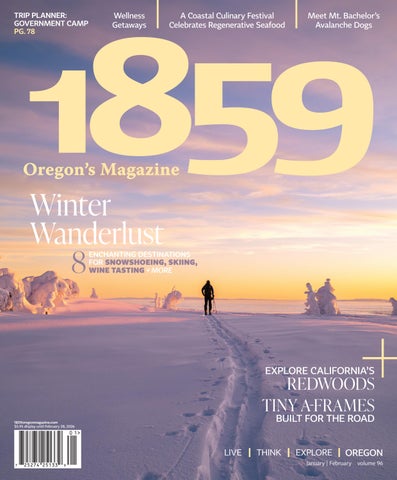
TRIP PLANNER: GOVERNMENT CAMP PG. 78
Wellness Getaways
A Coastal Culinary Festival Celebrates Regenerative Seafood
Meet Mt. Bachelor’s Avalanche Dogs
ENCHANTING DESTINATIONS FOR SNOWSHOEING, SKIING, WINE TASTING + MORE
EXPLORE CALIFORNIA’S
REDWOODS TINY A-FRAMES BUILT FOR THE ROAD
1859oregonmagazine.com $5.95 display until February 28, 2026
LIVE
THINK
EXPLORE
OREGON
January | February
volume 96
Explore The Dalles The Best Hidden Gem for History, Adventure & Taste in the Northwest
Tucked along the Columbia River Gorge, The Dalles, Oregon is a rich historical destination that blends outdoor adventure and exceptional local flavor. A hidden gem for travelers in the know, this vibrant town offers memorable experiences at every turn. From storied landmarks to scenic river views, The Dalles has something for every kind of traveler. Here are a few highlights to inspire your visit.
Walk Through History
Follow in the footsteps of Lewis and Clark, who loved the area so much they camped here not once, but twice during their expedition. Experience stories that span from ancient Indigenous cultures to the pioneer era. Throughout town, historic buildings, museums, and Oregon’s oldest bookstore invite you to connect with the original adventure.
Taste the Region
Known as the highest per-capita producer of sweet cherries, The Dalles delivers some of the juiciest fruit you’ll ever taste. The region’s rich agricultural roots of wheat, grapes, cattle, and sheep make it a haven for farm-to-table dining. Visit local orchards, farmers markets, and tasting rooms to savor the bounty.
Get Outside
Adventure comes naturally here. The Columbia River offers prime conditions for fishing, boating, kayaking, paddleboarding, and jet skiing. Anglers may even catch a glimpse of the legendary river monsters (sturgeon) that have inhabited these waters for generations.
Savor Fun Local Craft
The Dalles’ food and drink scene is as welcoming as it is flavorful. Enjoy locally sourced cuisine, sip wine at Sunshine Mill & Winery inside a historic flour mill ( just one of many tasting rooms), or sample craft beer at Freebridge Brewing in the iconic Mint Building.
Feel the Music
Dubbed “Little Music City,” The Dalles boasts a thriving live music scene, with performances nearly every night. Intimate venues showcase talented regional artists across a range of genres, creating unforgettable evenings filled with sound and atmosphere.
Discover the Unexpected
From Bigfoot lore to immersive museums, The Dalles delights with its unique attractions. The Columbia Gorge Discovery Center offers engaging exhibits for all ages, while the Fort Dalles Museum, Original Wasco County Courthouse, and National Neon Sign Museum provide fascinating glimpses into the area’s past and culture. Be sure to explore local shops and eateries along the East Gorge Food Trail.
Learn more at ExploreTheDalles.com disMake The Dalles your next must-visit destination and dis cover a place where history, adventure, and flavor come together effortlessly.
(541) 296-2231
Gabrielle Homer (left) of Painted Hills Natural Beef loves riding her horse with her niece Kassidy Homer, the youngest cowgirl of the Homer clan.
2 1859 OREGON’S MAGAZINE JANUARY | FEBRUARY 2026
Till the Cows Come Home photography by Joni Kabana For Fossil’s Gabrielle Homer, ranching is a way of life. Read her story and savor local beef recipes in Farm to Table. (pg. 22)
JANUARY | FEBRUARY 2026
1859 OREGON’S MAGAZINE
3
Mt. Bachelor’s avalanche dogs work about four to five days per week during the winter season.
FEATURES JANUARY | FEBRUARY 2026 • volume 96
64 Working Mountain Dogs Meet Mt. Bachelor’s avalanche dogs—trained rescuers and beloved companions—who work tirelessly to keep the slopes safe during the winter season. written by Kerry Newberry
46 Winter Destinations Celebrate the magic of Oregon’s cold season with snow-dusted forests, cozy retreats and thrilling outdoor adventures across the state’s most enchanting winter escapes. written by Jean Chen Smith
54 Native Lands Garrett Lockrem/Mt. Bachelor
Explore the Land Back movement as the Nez Perce reconnect with their ancestral Wallowa Valley, reclaiming land and revitalizing culture in Oregon’s rugged northeast.
4
written by Daniel O’Neil 1859 OREGON’S MAGAZINE JANUARY | FEBRUARY 2026
DEPARTMENTS JANUARY | FEBRUARY 2026 • volume 96
LIVE
30
12 NOTEBOOK
From Nordic skiing in Bend to crafting in Portland, Oregon’s winter events are worth exploring.
16 FOOD + DRINK
Sip Basque cider from Cascade Locks, sample wild-foraged, small-batch tea or savor coast-inspired dishes during Winter Waters.
Danny Martin/Bivvi
22 FARM TO TABLE
Rancher Gabrielle Homer of Painted Hills Natural Beef shares her journey in Fossil.
30 HOME + DESIGN
Bivvi’s tiny A-frames, crafted in Sisters, bring cozy cabins to backyards and beyond.
35 MIND + BODY
Relax at Corvallis’ Misogi or Ashland’s Lithia Springs Resort for ultimate wellness experiences.
38 ARTIST IN RESIDENCE
Writer Walidah Imarisha shares her story.
THINK 83 18
Luke Dolkas of Luke’s Frame Shop in Portland turns framing into an artful connection.
44 GAME CHANGER
Talent Maker City rebuilds creativity and community in Southern Oregon after the 2020 Almeda wildfire.
EXPLORE 72 TRAVEL SPOTLIGHT
Tambi Lane
28
Mitch Crispe
42 MY WORKSPACE
Portland’s Freakybuttrue Peculiarium celebrates weirdness with aliens, cryptids and bug-themed ice cream.
74 ADVENTURE
8 Editor’s Letter 9 1859 Online 86 Map of Oregon 88 Until Next Time
Feed elk in Seaside, watch whales on the coast or bird-watch in Chiloquin this winter.
76 LODGING
Pacific City’s Headlands Coastal Lodge offers ocean views, tide pooling and forest bathing adventures.
78 TRIP PLANNER
Government Camp on Mount Hood is your winter playground for skiing, snowshoeing and fondue.
83 NW DESTINATION
Explore California’s Redwood National and State Parks and Arcata’s Sixties-by-the-Sea charm.
COVER
photo by Whitney Whitehouse (see “Where Winter Feels Like Magic,” pg. 46)
JANUARY | FEBRUARY 2026
1859 OREGON’S MAGAZINE
5
CONTRIBUTORS
JONI KABANA Photographer Farm to Table
JEAN CHEN SMITH Writer Where Winter Feels Like Magic
CHAMISA KELLOGG Illustrator Home + Design DIY
TAMBI LANE Photographer Homegrown Chef
“One of my all-time favorite types of photo assignments is walking into a place where the scene is highly active and the subject matter is beyond what I’m accustomed to. I love making pictures of life as it comes and portraits of interesting people whose lifestyles are vastly different than my own. Gabrielle Homer has the type of jubilant personality that is so exquisitely charming, it’s a bit startling. Watching her work her magic on the Painted Hills Natural Beef heritage farm left an indelible impression on my heart and mind.” (pg. 22)
“Working on this story felt like an invitation to rediscover Oregon through a deeper, more intimate lens. As a wellnessfocused travel writer, I’m always drawn to places where nature, comfort and community intersect, and this story delivered all three. Exploring these winter destinations reminded me how restorative the season can be, and how each town reveals its own quiet kind of wonder when the temperatures drop.” (pg. 46)
“Working on this illustration brought up memories of friends and family, the sharp scent of wood smoke in the air and the squish and crunch of a s’more between my teeth. There’s something magical about a fire pit on a chilly winter evening, and I hope I captured that unique quality in this image.” (pg. 34)
“Photographing my second cookbook was the moment I realized food photography held the creativity and collaboration I’d long been craving. Leaving behind portrait sessions and a full-time studio opened the door to a new kind of work—one that brought me into the kitchens of passionate chefs and makers across Oregon. Collaboration remains my favorite part of the job, and, to answer the most common question, yes—I usually do get to taste everything I photograph, and it never gets old.” (pg. 28)
When not working on programming and restoration of the Spray General Store, you can find Joni Kabana out on backroads digging up stories and visuals of small-town rural America.
Jean Chen Smith is a freelance writer and editor based in Corvallis. Her work has appeared in USA Today, Travel + Leisure, Forbes Advisor, The Oregonian and more. When not sharing her love of travel with readers, she’s teaching Pilates at her studio and obsessing over her teacup shih tzus, Tonka and Paisley.
6 1859 OREGON’S MAGAZINE JANUARY | FEBRUARY 2026
Chamisa Kellogg is an illustrator and children’s author based in Portland. She creates illustrations for books, textiles, games and animation. See more of her work on Instagram @studio.chamisa.
A photographer of more than twenty years, Tambi Lane focuses on food, beverage and editorial projects throughout Central Oregon. She enjoys time with her family and her two French bulldogs when she’s not behind the lens.
EDITOR
Kevin Max
CREATIVE DIRECTOR
Allison Bye
WEB MANAGER
Aaron Opsahl
SOCIAL MEDIA MANAGER
Joni Kabana
OFFICE MANAGER
Cindy Miskowiec
DIRECTOR OF SALES
Jenny Kamprath
HOMEGROWN CHEF
Thor Erickson
BEERLANDIA COLUMNIST
Jeremy Storton
CONTRIBUTING WRITERS
Cathy Carroll, Jean Chen Smith, Melissa Dalton, Joni Kabana, Julie Lee, Kerry Newberry, Daniel O’Neil, Ben Salmon, James Sinks
CONTRIBUTING PHOTOGRAPHERS
Brian Chambers, Joni Kabana, Tambi Lane, Daniel O’Neil, Whitney Whitehouse
CONTRIBUTING ARTISTS
Chamisa Kellogg
Headquarters
70 SW Century Dr. Suite 100-218 Bend, Oregon 97702
592 N. Sisters Park Ct. Suite B Sisters, OR 97759
www.1859magazine.com/subscribe @1859oregon
All rights reserved. No part of this publiCation may be reproduCed or transmitted in any form or by any means, eleCtroniCally or meChaniCally, inCluding photoCopy, reCording or any information storage and retrieval system, without the express written permission of Statehood Media. ArtiCles and photographs appearing in 1859 Oregon’s Magazine may not be reproduCed in whole or in part without the express written Consent of the publisher. 1859 Oregon’s Magazine and Statehood Media are not responsible for the return of unsoliCited materials. The views and opinions expressed in these artiCles are not neCessarily those of 1859 Oregon’s Magazine, Statehood Media or its employees, staff or management.
JANUARY | FEBRUARY 2026
1859 OREGON’S MAGAZINE 7
FROM THE
EDITOR
GIVING BACK is a social and moral imperative. In northeastern Oregon, a bit of that is happening as part of the Land Back movement, which prioritizes the return of ancestral lands to the original inhabitants, in this case the Nez Perce Tribe of the Wallowa Valley. Writer Daniel O’Neil takes us inside the movement to restore Indigenous ownership of culturally and ecologically significant lands (pg. 54). These efforts have facilitated the reintroduction of sockeye salmon, restored grasslands and provided spaces for tribal gatherings, spiritual practices and cultural education. This effort has brought about the Nez Perce Wallowa Homeland—a 320-acre parcel near Wallowa, which serves as a hub for tribal members to reconnect with their ancestral lands. Another way to get back to the land, sorta, is through a nano mobile A-frame house that you can tow to destinations that allow them, or to use for artistic purposes on your property. Bivvi, a small company out of Sisters, makes the case for nostalgia and modernity with a con-
8 1859 OREGON’S MAGAZINE JANUARY | FEBRUARY 2026
nection to the outdoors. See Home + Design on page 30. After a year characterized by legerdemain and fraud, touching wood seems like a good theme. To that end, make plans to escape to the artful craftsmanship of Timberline Lodge and the cool ski town below, Government Camp. What was dedicated by FDR in 1937 is a good place to reset and define your New Deal (pg. 78). Treat yourself to some of the more imaginative ways to get “Beyond the Spa” this year. Oregon is many things: a top wine grower, a massive hops producer, a state with an oceanfront that is technically a state highway and a top destination for holistic wellness travel. Turn to page 35 and dive into destinations that include Japanese purification rituals, mineral-rich waters, contrast therapy and float sessions, regenerative farm retreats and more. If relaxation seems like too much work, shake up a gingery High Tide Martini (pg. 21) and kick back with your partner and the sweet sounds of Kennebec’s new album (pg. 14).
1859 ONLINE More ways to connect with your favorite Oregon content www.1859oregonmagazine.com | #1859oregon | @1859oregon
EN TO TER WIN !
FIVEPINE WINTER WELLNESS PACKAGE
HAVE A PHOTO THAT SHOWS OFF YOUR OREGON EXPERIENCE? Share it with us by filling out the Oregon Postcard form on our website. If chosen, you’ll be published here! www.1859oregonmagazine.com/postcard photo by Jennifer Norman Snow blankets the Hackleman Old Growth Trail.
YOUR PNW NEWSLETTER More PNW, delivered to your inbox! Sign up for our Adventure Mail newsletter and get access to the latest Northwest getaways, giveaways, DIY projects and more. www.1859oregonmagazine.com/live/ subscribe-to-oregon-adventure-mail
Enter for a chance to win a rejuvenating wellness weekend at FivePine Lodge in Sisters! One winner will receive two nights in FivePine’s luxurious Serenity Cabin, daily delivery of deluxe coffee and tea service with mimosas, and two sixty-minute spa treatments at Shibui Spa. Complete the weekend of snowy adventure with complimentary snowshoe rentals and a set of custom FivePine yoga mats to take home at the end of your magical getaway. Enter at www.1859oregonmagazine.com/ contests/fivepine Sweepstakes runs January 1-31.
SHOP LOCAL Stop by Local, our curated online shop of goods made by businesses in the Pacific Northwest. Find jewelry, specialty foods and more. Or show your state pride with 1859 T-shirts, hats and other apparel. Buy local. Feel good. www.1859oregonmagazine.com/shop
JANUARY | FEBRUARY 2026
1859 OREGON’S MAGAZINE
9
NOTEBOOK 12 FOOD + DRINK 16 FARM TO TABLE 22 HOME + DESIGN 30 MIND + BODY 35
pg. 20 Discover the culinary wonders of the Oregon Coast this February with Winter Waters, a festival celebrating local seafood, sea vegetables and coastal ecosystems through chef-led dinners, foraging tours and hands-on experiences.
Rachelle Hacmac
ARTIST IN RESIDENCE 38
WARM UP WITH A COLD ONE
Breakside Brewery Beaverton, OR
Explore Tualatin Valley’s craft breweries, cideries, and taphouses, where local flavor and friendly spaces come together to create the perfect place to unwind. Find your new favorite pour at TUALATINVALLEY.ORG/TAP-SEASON
etvor.com/tap13
notebook
Tidbits + To-dos Toni Toreno
written by Cathy Carroll
CAmark y LEN our DA R
Arts and Crafts with collage The family-owned store collage in Portland has been inspiring crafters and makers since 2004, transforming the sterile art supply store concept into a fun experience in person and online. The curated art and craft supply stores offer everything from painting tools and washi tape to kids’ goods and local finds. A beloved creative hub, collage also hosts free monthly Tuesday night craft events at the NE Alberta and SE Division locations. www.collagepdx.com
Tempranillo from Bryn Mawr Vineyards
Nordic Ski to Live Piano Nordic ski or snowshoe to live music from Bend pianist and composer Paula Dreyer with her immersive Piano Flow Live series February 7 and March 6 at the Meissner Nordic Community Ski Area. Wear wireless headphones as you traverse the trails, or relax fireside and listen to live piano in a magical alpine setting. www.meissnernordic.org/events www.pauladreyer.com/piano-flow-live
12
1859 OREGON’S MAGAZINE JANUARY | FEBRUARY 2026
Embrace the warmth of Spain with this 2021 tempranillo from Bryn Mawr Vineyards. Tempranillo may be Spain’s signature red, but at Bryn Mawr—Welsh for “big hill”—it finds a fresh voice grown high on the western crest of the Eola-Amity Hills and nurtured through organic and regenerative farming practices. This vintage, heady with dark fruit and layered depth, mirrors the vineyard’s rugged elegance. www.brynmawrvineyards.com
notebook
FisherPoets Gathering
CA mar LE k yo ND ur AR
FisherPoets Gathering Since 1998, the FisherPoets Gathering has drawn commercial fishing voices and devoted fans to Astoria. Today it hosts nearly 100 poets, songwriters and storytellers sharing maritime stories in pubs, theaters and galleries across town. At the February 27 through March 1 event, expect readings, music, workshops, open mics and tributes—authentic, salty and deeply human—celebrating the culture, labor and lore of the working waterfront. www.fisherpoets.org
our rk y DAR a m EN
CAL
She’s Speaking Live
Treehouse Drinking Co. Organic Hot Chocolate
She’s Speaking Live She’s Speaking Live, three concerts in Salem, Portland and Eugene happening March 6 through 8, spotlight eight acclaimed Oregon singer-songwriters backed by an all-star band addressing the underrepresentation of women in the music industry. In this Women’s History Month celebration, expect jazz, R&B, indie, Americana, folk, blues and a special guest artist at each stop: Mary Flower in Salem, Halie Loren in Eugene and Lady A, aka Anita White, in Portland. www.shesspeakingsongs.com
Any outing is better with decadent organic chocolate to go. Stash a Treehouse Drinking Co. pouch in your pack, and make a rich treat with just hot water. Crafted in Portland, the chocolate is sustainably sourced from a leading organic, farmer-owned cooperative in Peru. Flavors include the Original, with 72 percent cacao; Sea Salt, with smoked salt harvested from the Pacific; Mocha, with organic fair-trade coffee; and Coconut, a vegan hot chocolate with dry coconut milk. www.treehouseoriginals.com
JANUARY | FEBRUARY 2026
1859 OREGON’S MAGAZINE
13
notebook
Musician
Cinematic Sounds Eric Phillips blends acoustic folk, ambient and jazz on Kennebec’s The Water Wheel written by Ben Salmon ERIC PHILLIPS currently lives outside New York City, but he moved there very recently after ten years in Portland, and when it’s time to move again, he may return to the Rose City, where he spent a “pretty formative period” of his life and the life of his long-running band, Kennebec. “The whole project started there, and it still feels very rooted there, in a way,” he said. “I moved there after college because I’d heard great things and that there was this great music scene, and it was a little more affordable than most of the other coastal cities. And I had been hearing tons of sweet music out of the Northwest.” Among the attractions that brought Phillips to Portland: Seattle indie-folk giants Fleet Foxes; proximity to a personal mentor, film composer Mark Orton; and the music of Ryan Francesconi and Mirabai Peart, a guitar-violin duo who put out an album called Road to Palios in 2012. “(Their songs are) absolutely beautiful,” he said. “There’s kind of a subtle classical thing going on, but it really feels more like ambient music. There’s something very soothing about it, and they’re amazing musicians.”
From that answer alone, you can begin to piece together the sound of Kennebec, which released an album called The Water Wheel in late 2025. Gentle but intense, buoyant and gorgeous, it’s a seamless amalgam of acoustic folk and organic ambient music, touched with hints of jazz, soul and hip-hop—a combination that gives the music an exploratory spirit and a horizonwide, cinematic feel. Phillips grew up listening to the popular folk rock of the 1960s and ’70s but was inspired in college by artists like Flying Lotus and Floating Points—not just sonically, but also by their uncompromising vision and their drive to connect with audiences through bold and ambitious combinations of sound. “The ethos was very much, like, ‘I’m just going to do the craziest thing I can think of 100 percent of the time and try to make it into a cohesive album, aesthetically blending all the different things I love,’” he said. “That’s what I’ve tried to do with Kennebec, as opposed to saying, ‘OK, now I’m going to make this kind of album.’” The Water Wheel is a “de facto concept album about impermanence and the cyclical nature of life on Earth,” according to Phillips, rooted in part in his struggle to reconcile his own personal happiness—after falling in love, it’s worth noting—with a day-to-day life spent navigating an increasingly uncertain and unstable world. The result is a record that’s soothing and cathartic—“a balm for our chaotic times,” he said. That’s not a theme that he planned, mind you. It just emerged during the creative process. “I set a goal to try to make a more acoustic album, and I kind of did that,” he said. “But as far as the thematic ideas, I only really ever figure them out after the album has come out, you know?”
Kennebec’s album The Water Wheel fuses the disparate forms of hip-hop, jazz and soul into a cohesive voice.
14
1859 OREGON’S MAGAZINE JANUARY | FEBRUARY 2026
Courtesy of Kennebec
Listen on Spotify
notebook
Bibliophile
A Life Unfixed Memoir and media platform reframe upheaval and illness as a doorway to radical love and meaning KIMBERLY WARNER’S newly released memoir, Unfixed, traces her quest for wholeness after confronting long-buried family truths, New Age self-improvement dogma and the perfectionism that shaped her. After developing a rare neurological disorder in 2015, the filmmaker began creating award-winning films, limited series, podcasts, memoirs and live roundtables. Her work, a space where adversity becomes a source of creative intelligence and philosophical insight, has been recognized by PBS, Harvard Medical School and the Invisible Disabilities Association, among others. She lives on a farm in North Plains, west of Portland. What felt most urgent for you to explore in your book, film and audio work? In 2018, still staggering from a rare neurological disorder that left me with unrelenting vertigo, I sat down at my husband’s computer with the urgency of someone trying to catch herself mid-fall. The dizziness wasn’t metaphorical—it was the axis around which my entire life had begun to tilt. I was living inside a mystery novel, chasing clues, consulting experts, trying to discern which sensations were symptoms and which were fear. Writing became my handhold. If I could get the story onto the page, maybe I could steady the room long enough to understand it. I wasn’t narrating my illness as much as reclaiming the narrative from the panic loop telling my brain: ‘If she’s this desperate to fix something, we must be in danger.’ Unfixed, published by Empress Editions—a press fiercely devoted to midlife women’s stories—became both survival instinct and an act of love. I set myself one mandate: Find the love inside the chaos. Not just self-love, but a radical, expansive love that could hold every person in my life with tenderness rather than judgment. That became the spine of the memoir, and its central
Courtesy of Kimberly Warner
interview by Cathy Carroll
Filmmaker, author and podcast host Kimberly Warner’s acclaimed work bridges storytelling and medical advocacy.
question: What if the very thing you can’t fix is what will save your life? By 2019, that question turned outward. For the Unfixed documentary series, I sought people living with incurable, often terminal conditions who had found ways to build meaningful lives in bodies that refused to cooperate. What I discovered was a community at the crossroads of pain and joy, despair and delight—people who had developed a creative intelligence about suffering, metabolizing it so that meaning didn’t arrive after illness, but through it. They showed me what writing had whispered: Transformation happens the moment we stop fighting the current and let it carry us someplace new. What conversations do you hope Unfixed’s growing platform sparks beyond disability communities— perhaps in medicine, culture or how we define a meaningful life? From chronic illness to heartbreak, from ecological grief to midlife reinvention, every human eventually faces something we can’t control, resolve or fix. Unfixed began as my memoir but has evolved into Unfixed Media—a platform devoted to one essential practice:
learning to live inside the question instead of sprinting toward resolution, trusting that what unmoors us might also remake us. Problems approached from the outside-in only reinforce structures built on certainty and control. What if medicine abandoned diagnostic resolution as the primary goal and moved toward relational inquiry? What if culture stopped mistaking comfort for meaning? What if we recognized uncertainty not as a problem to overcome, but as the very condition for becoming? Through conversations across medicine, art, spirituality and politics, I’ve discovered that staying open—finding meaning without answers—generates new forms of knowledge and power. First, we must enter the discomfort, the authentic lived experiences, and hold them not just in our minds, but in our hearts. This isn’t passive acceptance. It’s an active metabolizing of experience that reveals how duality is always at play, and how our hearts can hold both the breaking and the becoming. This is genuine transformation—rooted in paradox, vulnerability and the courageous act of staying present to what refuses to be fixed. MORE ONLINE
JANUARY | FEBRUARY 2026
Learn more at www.unfixedmedia.com
1859 OREGON’S MAGAZINE
15
food + drink
Beerlandia
Fermentably Oregon written by Jeremy Storton ROUGHLY TWENTY years ago, I started homebrewing on a lark. It was equal parts curiosity and living life in Beer Town. This began my journey into global beer education, but something strange happened along the way: The more I learned about beer, the more I learned about our craft and culture. And, the more I learned about fermentation, the more I realized beer was just the beginning. My notion of craft has changed since my first visit to Oregon in the early 1990s. Back then, it was formed by my grandfather’s incredible beef jerky he made in Jacksonville. Since then, craft has become much more sophisticated, diverse and iconic. Somewhere in the soul of Oregon, right next to our love for adventure and outdoor places, is an immense appreciation of anything well-crafted. Beer takes a lot of credit for this, but, dare I say it, there’s more to life than beer, especially here. After a couple of days traveling through the state, it becomes abundantly clear that Oregon has a way
with fermented beverages, and it’s unreasonable to expect anyone to choose only one. If it’s true the average craft beer drinker is more educated, better traveled and perhaps has a couple of extra dollars in his or her pocket, then rumors of brand and beverage disloyalty must also be true. Much to the brewer’s dismay, this is to our benefit. I don’t stray too far from beer, but it was Oregon beer that taught me to appreciate other beverages in the first place. When I occasionally pass on the pint, I thoroughly enjoy the wine, cider, sake and spirits made here in our state. We are better, more intelligent drinkers if we are promiscuous drinkers, and craft-anything drinkers are the best people, especially in Oregon. BELOW Ella McCallion and Jasper Smith are the wife-and-husband team behind Son of Man in Cascade Locks. Aged for six months in oak foeders, Son of Man’s Sagardo features a pour-top cork for perfecting long pours from up high.
MUST-TRY LOCAL LIBATIONS Creating a short list of my favorite Oregon non-beer craft beverages is a fool’s errand, but here goes! CIDER Son of Man: This Basque cider made with Oregon apples is meant to pair with food. Do the long pour with the Sagardo. Portland Cider Co.: Years ago, they made a Gatoradeinspired cider that blew me away. Their lineup remains delightfully diverse. Two Towns Ciderhouse: They taught me that cider doesn’t have to be a one-note sugar bomb. The Cosmic Crisp is a great substitute for champagne. SAKE SakéOne’s Momokawa: The Pearl Nigori displays notes of banana, pineapple and coconut, all of which come from fermented rice. WINE Abacela: Spanish wine from Oregon’s Willamette Valley. Try the tempranillo if you like red, or the albariño if you like white.
Melissa Bradley/Son of Man
A to Z Wineworks: Try the unoaked chardonnay, because butter is for drinkers down south.
16
Erath: This everyday pinot noir is a taste of Oregon terroir in a bottle.
1859 OREGON’S MAGAZINE JANUARY | FEBRUARY 2026
Domaine Serene: This pinot noir may be expensive, but save your money. It’s worth it. Portlandia: Great name. Tasty wine, especially their rosé on warm sunny days. Honorable mentions (they’re not technically in Oregon, but close enough): Va Piano Vineyards: The syrah has complex flavors of stone fruit, marionberry, dark chocolate, tobacco and leather—rugged and sophisticated, just like Oregon. Maryhill Winery: This refreshing and sturdy viognier stands up to winter fare. SPIRITS Crater Lake Spirits: Try the Rock and Rye for a deliciously quick Old Fashioned, or Black Butte Whiskey (with Deschutes Brewery) for something more refined. Wild Roots: I mixed drinks with the gin and raspberry vodka for years. They were always on point. Bull Run Distillery: My wife once gifted me a bottle of the Straight Bourbon Whiskey. It didn’t last long.
Music warms the world Come home to comfort.
89.9 FM allclassical.org
717 SW 10th Ave Portland, OR 97205 503.223.4720 www.Maloys.com
Our FREE guided mill tours offer a behind-the-scenes peek at our process, from dyeing the wool to the finishing touches. Sign up online, or call: 541-276-6911. For store locations, visit PENDLETON-USA.COM
For fine antique and custom jewelry, or for repair work, come visit us, or shop online at Maloys.com. We also buy.
food + drink
BEST PLACES FOR
CULINARY DEEP DIVES Dreaming of winter truffles? Join other enthusiasts at the annual Oregon Truffle Festival this February. Now celebrating its twentieth year, this singular event blends truffle hunts, chef-led tastings and truffle-dog training, offering a deep dive into the ecology, flavor and lore of Oregon’s native truffles. The festivities begin on February 6 with The Joriad North American Truffle Dog Championship—the only competition of its kind in North America. www.oregontrufflefestival.org
Photos: Wild Coast Brew
OREGON TRUFFLE FESTIVAL
ABOVE Charred myrtle nuts, artist’s conk and fireweed merge in Wild Coast Brew’s The Trickster tea. AT RIGHT Micha and Dan Silvius, owners of Wild Coast Brew and adventurous foragers.
ZWICKELMANIA Hosted by the Oregon Brewers Guild over Presidents Day weekend, Zwickelmania is a statewide craft beer extravaganza. More than 120 breweries, including more than fifty in the Portland area, throw open their doors for guided tastings, creative food pairings, brewery tours, live music and more. Expect the unexpected—ghost stories at Lebanon’s Barsideous Brewing and a zwickels and pickles pairing at Boneyard Beer in Bend.
Gastronomy
Wild Coast Brew written by Kerry Newberry
Explore the future of local seafood at the Blue Foods Forum, where chefs, scientists, innovators, fishers and ocean advocates come together for collaborative learning. Last year’s inaugural event featured live seafood butchery demos, roundtables and lightning talks— all centered on fostering resilient coastal economies through sustainable blue foods. The forum is held February 1 and 2 at Portland’s Redd on Salmon Street as part of the Winter Waters series.
ON MOST DAYS, you can find Micha and Dan Silvius farming or foraging across their nearly 30-acre property in the Oregon Coast Range. About five years ago, the couple shifted from running a small B&B near Coos Bay to launching Wild Coast Brew, a small-batch tea company celebrated for its experimental blends and wildforaged ingredients. “We’d always had bunches of herbs growing everywhere, and I used those to make our first blend,” Micha recalled. She tucked a jar of the tea into the kitchen for guests. “People loved it so much they began asking to purchase it.” That delicate mix of rose petals, lavender, mint, lemon balm, hops, calendula and yarrow became The Heroine—now one of their most beloved teas. Since then, they’ve expanded the farm, and their long-standing practice of foraging has become a hallmark of their blends. “Foraging is fun and it gets us out into nature,” Dan said. It also fuels inspiration for some of their most creative teas. “We’re looking for unique ingredients, but also for ways to elevate common ones.” Their limited-edition teas capture this ethos best. The Trickster features roasted myrtle nuts with a coffee-like depth, paired with sweet fireweed and earthy artist’s conk. For chai fans, The Stoic layers traditional warming spices with added complexity from madrone bark and conifer needles. Each blend is packaged in reusable, artist-designed canisters with eye-catching illustrations of coastal flora and fauna by Isla Rose—part of the couple’s commitment to sustainability. “We make our teas to be nourishing,” said Micha, “and to create a connection to a place.”
www.winterwaterspnw.com
www.wildcoastbrew.com
www.oregoncraftbeer.org
BLUE FOODS FORUM
18 1859 OREGON’S MAGAZINE JANUARY | FEBRUARY 2026
food + drink Parmesan and fontina cheese, Calabrian chili honey and truffle salt top Hey Luigi’s heavenly crocchette di patate.
CRAVINGS:
COZY ITALIAN VIBES FEDÉ Arrive early to this charming husband-andwife-owned trattoria in Astoria—its loyal following means no reservations and often a line at the door. But the wait is worth it, especially if you’re lucky enough to land a table overlooking the Columbia River, where ships drift by as you dine. Start with the arugula salad, a zesty tumble of greens tossed with lemon, olive oil, and slivers of pecorino. For pasta, standouts include the linguine with wild prawns and the bucatini dotted with fresh clams—simple and unmistakably coastal. 1 12TH ST., #2 ASTORIA www.fedeastoria.com
HEY LUIGI Gabriel Pascuzzi’s new spot in Portland’s Slabtown neighborhood is an ode to Italianinspired bar snacks, shareable pasta and inventive cocktails. The intimate room— aglow with moody lighting, vintage posters and cascades of leafy greenery—feels like the perfect escape from long winter evenings. Try the artichoke-heart fritti with herby aioli and umami-packed anchovy toast. And for a cocktail that doubles as dessert, don’t miss the Sicilian Vacation— a creamy amaro float. 2175 NW RALEIGH ST., SUITE 105 PORTLAND www.hey-luigi.com
PIZZA CAPO After tasting local pinots, head to this wine country favorite, where you can warm up with chewy Neapolitan-style wood-fired pizza. Classics range from a pie topped with wild mushrooms to the salt-kissed clam pizza. Recent specials included fire-roasted zucchini and a pie layered with earthy roasted carrots. Before you go, stop by Third Street Books just a few blocks away to pick up a new cookbook by local authors.
Hey Luigi
318 NE THIRD ST. MCMINNVILLE www.pizza-capo.com
JANUARY | FEBRUARY 2026
1859 OREGON’S MAGAZINE
19
food + drink
Dining
Winter Waters written by Kerry Newberry WHAT BEGAN as a handful of chef-led popups starring local seafood and cool seaweed dishes has evolved into a full-fledged culinary extravaganza. In just three short years, Winter Waters has transformed February along the Oregon Coast. Now entering its fourth year, the coastal festival brings together chefs, fishers, scientists and renegade tastemakers to spotlight local regenerative seafood and the region’s expanding sea-vegetable scene. Throughout February, towns from Seaside to Brookings will host sea-inspired pop-ups, communal dinners, trivia nights and hands-on tours designed to deepen understanding of coastal ecosystems and showcase the delicious ingredients they support. One of the most anticipated returning events is Feast of the Local Fishes, a sensational sell-out dinner party that blends coastal crabbing with hyperlocal ingredients. Guests haul in crab pots before gathering at Garibaldi’s historic Coast Guard boathouse for a feast prepared by Tournant, culinary phenoms known for their immersive farm-to-fire cooking. New this year, city collaborations in Newport, Lincoln City, Coos Bay and Reedsport introduce an expanded blend of dining and educational experiences. Look for tours of the state’s first sea urchin ranch, chef-led tastings of lesser-known local fish, sushi-making and seafood butchery classes and guided dockside walks of the state’s largest commercial fishing fleet. For more information, visit www.winterwaterspnw.com.
Throughout February, towns from Seaside to Brookings will host sea-inspired pop-ups, communal dinners, trivia nights and hands-on tours. 20
1859 OREGON’S MAGAZINE JANUARY | FEBRUARY 2026
CLOCKWISE FROM LEFT Oregon tataki albacore at a Winter Waters dinner by Savvy Food Co. and Lovely Rita at The Hoxton Hotel. Jaret Foster of Tournant helps prepare the Winter Waters Feast of the Local Fishes. The feast, held at Garibaldi’s historic Coast Guard boathouse, is a celebration of Oregon seafood. Alanna Kieffer (left), who co-founded Winter Waters with Kristen Penner and Rachelle Hacmac, leads foraging and tide pooling workshops with her company Shifting Tides.
food + drink
Cocktail Card recipe courtesy of Kismet’s Landing / REEDSPORT
High Tide Martini
JANUARY | FEBRUARY 2026
Chill a martini glass while preparing the cocktail. In a shaker filled with ice, combine the Gray Whale Gin, yuzu juice, pickled ginger juice and seaweed. Shake vigorously until ice crystals form in the drink. Strain, and pour into the chilled martini glass. For garnish, wrap the pickled ginger around the seaweed, secure it with a pick and lay it across the rim of the glass before serving.
1859 OREGON’S MAGAZINE
Photo: Kismet’s Landing
Photos: Rachelle Hacmac
• 1½ ounces Gray Whale Gin • ½ ounce yuzu juice • ½ ounce pickled ginger juice • 2 pieces pickled ginger • 1 small piece of seaweed, for garnish
21
farm to table
Gabrielle Homer of Painted Hills Natural Beef walks the pasture after feeding cattle in Fossil.
22
1859 OREGON’S MAGAZINE JANUARY | FEBRUARY 2026
farm to table
Farm to Table
What’s for Dinner? Oregon Beef 2026 is the International Year of the Woman Farmer— meet rancher Gabrielle Homer of Painted Hills Natural Beef written by Julie Lee photography by Joni Kabana OREGON BEEF is our state’s second-largest agricultural commodity, just behind the nursery industry, in its local, regional and state economic impact. The Oregon Beef Council helps to oversee the success of this important industry and assists ranchers in all thirty-six counties in Oregon that are raising beef. As we launch the International Year of the Woman Farmer in 2026, Oregon has a leg up on statistics; a 2022 Census of Agriculture showed that 44 percent of commodity producers in the state are women, versus a national average of 36 percent. The National Association of State Departments of Agriculture (NASDA) declared 2026 to be the year to honor women in the industry, a global commitment made to empower and recognize the contributions of women in agriculture. Rancher Gabrielle Homer of Painted Hills Natural Beef is a born-and-raised Oregonian. Her parents migrated to Oregon from New York City in 1963, when her father accepted a teaching fellowship at the University of Portland. Her mom, raised in Spanish Harlem in the Bronx, put herself through nursing school, becoming a surgical nurse at Good Samaritan Hospital in Portland, where Gabrielle was born. Though teaching was a calling for Gabrielle’s father, the stronger career siren was in farming. After her parents settled in Oregon, they purchased property in Dallas, and from a young age, Gabrielle was on a horse, working long summer hours in a hay field. “It was a great way to grow up,” she said. Gabrielle met her husband, Will Homer, in 1995. “Our first date was in Lincoln City, and when we were visiting with my parents, he laughed (so loud) the windows shook. I was hooked.” Though JANUARY | FEBRUARY 2026
1859 OREGON’S MAGAZINE 23
Gabrielle Homer (far right) with part of her large extended family (from left, Kassidy Homer, Lee Homer with border collie Chance, Mehrten Homer, Will Homer and Trey Homer).
they met after college, both were Oregon State University graduates and, when comparing notes, realized they had shared a class together in the spring of 1988: sex education. Will moved to his family’s ranch in Fossil after graduation, working cattle and growing crops, with Gabrielle joining him after they married. While the family was raising quality cattle, according to Gabrielle, “there was little reward for selling into the current market,” and after discussions with fellow ranchers, Painted Hills Natural Beef was formed, a coalition of seven ranchers working together to sell natural and premium beef in the Northwest. “Ranching was struggling to find financial (stability),” Gabrielle said. “The prices being paid for cattle in the market were stagnant, while expenses were increasing. Being able to become more vertical in the business allowed us to offset risk in one segment by participating in other segments.” The Homers purchased shares in one of the seven ranches, becoming owners. It’s a family business through and through— one son, Trey, works for Homer Ranch, the family ranch in Fossil, and another son, Cal, lives in Hermiston, working in the industry for Beef Northwest Feeders. In the Painted Hills business model, there are multiple ways to participate: raising cattle on the ranch, buying calves and putting them on feed, and harvesting and packing beef. “Operating vertically in multiple aspects of the business serves to minimize risk,” said Gabrielle. “We try to support the ranchers and operate to maximize (fiscal) sustainability.” 24 1859 OREGON’S MAGAZINE JANUARY | FEBRUARY 2026
Having not grown up in the cattle industry, Gabrielle embraced a steep learning curve, performing every function in the company and often being the only woman in the room bidding at cattle auctions. “I see women in ranching working side-by-side with men and often taking the lead roles in operations,” Gabrielle noted. “I feel we are uniquely suited to both caring for animals and land, as well as managing finances, labor and family succession plans. Most every ranch I know has a strong female component in their management, and while the cowboy image is often associated with ranching, strong women in the industry serve critical and vital roles, keeping ranches operating and solvent.” Gabrielle oversees all aspects of the cattle market, and one of her favorite parts of the job is standing in a store, talking with consumers about exactly where their beef comes from. She feels “blessed with the opportunity to ride over the ranch, work cattle and learn more about the land that we are stewards of.” Beef can be an important part of a balanced diet, and the density of nutrition received in a portion size makes it a highly desirable food source. Rich in protein, zinc, iron and vitamin B, as well as other nutritional building blocks, eating quality beef protects against muscle loss, supports bone health and prevents nutrient deficiencies. Will Wise, CEO of the Oregon Beef Council, has a storied career leading Oregon’s agricultural commodities. “It has been a joy to see Oregon’s farmers and ranchers working side-by-side with Oregon’s top chefs to jointly promote the bounty of our land,”
he said. “We are getting agricultural and culinary leaders closer together than ever before, and both parties appreciate each other and have become friends and colleagues in a common effort.” In 2022, Painted Hills Natural Beef was awarded Industry Professional of the Year by the Oregon CattleWomen’s Association (OCW), a huge honor and inspiration for Gabrielle to join the association. She is now president-elect. “I fell in love with the work of OCW and their focus on education, promotion and legislation in support of the cattle and beef industry,” said Gabrielle. “When current president Morgan Kromm, a true ‘boots on the ground’ rancher, asked me to be her president-elect, I was beyond thrilled to serve the ranch women of the state of Oregon.” Gabrielle will assume the office in December 2026. “I will be ready to advance our mission and be supported by a membership of hardworking, dedicated and beautiful women,” she said. Wise has worked with top Oregon chefs on behalf of Oregon agriculture throughout his career and met Timberline Lodge executive chef Leif Eric Benson at a ski race event at Timberline. “(Chef Benson) helped me start a culinary committee for the Oregon Beef Council when I took a job as their CEO,” he said. Benson, the first Oregon Beef Council Chef of the Year, loves cooking with beef and offers an easy and mess-free recipe, a cold-sear rib eye steak. Chef Benjamin Waterman grew up cooking for family and friends starting at a young age, eventually landing in the Northwest during Portland’s culinary renaissance in 2009, working with Portland culinary juggernauts Greg and Gabi Denton, Gregory Gourdet and Vitaly Paley. Now head chef at the Dossier Hotel’s French-inspired restaurant, Bistro Alder, Waterman uses New American cuisine as his inspiration, preparing dishes like his wagyu meatball with Dijon cream sauce and herbs with thought and passion. He shares that recipe with us here. And Gabrielle offers her adaptation of a brisket dish—chuck roast with elotes, an award-winning recipe featured at CattleCon, and inspired by a trip to Lubbock, Texas.
Painted Hills Natural Beef
farm to table
Sear the chuck roast before moving it to the oven.
Oregon Recipes
Beef, Three Ways Chuck Roast with Elotes
Painted Hills Natural Beef / FOSSIL Gabrielle Homer SERVES 8 FOR THE CHUCK ROAST • 3-pound chuck roast • 1 tablespoon minced garlic • 1 tablespoon kosher salt • 1 tablespoon pepper, coarse-ground • 1 tablespoon Tajín seasoning • 1 tablespoon olive oil • 1 cup beef broth FOR THE CORN • 2 cans of corn • 2 tablespoons butter • ½ cup crema or sour cream • ½ cup mayonnaise • ¼ cup crumbled queso fresco • ½ teaspoon fajita seasoning • Cilantro (optional)
Gabrielle Homer cuts twine from a hay bale while feeding one of their herds.
on both sides. Add beef broth, cover and cook in a 250-degree oven for 3½ to 4 hours, until fork-tender. FOR THE CORN Put corn in saucepan with juice, and bring just to a boil. Drain well. Add butter and stir until melted. In a bowl, mix crema (or sour cream), mayonnaise, queso fresco and fajita seasoning. Add corn, and stir to combine. Top with a sprinkle of fajita seasoning and more crumbled queso fresco. Garnish with cilantro (optional). TO SERVE Shred the chuck roast, and serve with a side of the prepared corn.
FOR THE CHUCK ROAST Season chuck roast with garlic, salt, pepper and Tajín. Heat olive oil in Dutch oven, and brown roast
Top the corn with crumbled queso fresco. (photo: Painted Hills Natural Beef)
JANUARY | FEBRUARY 2026
1859 OREGON’S MAGAZINE 25
farm to table
When color has begun to develop on the meatballs, pull them from the oven, and allow them to rest for 5 minutes. While meatballs are resting, mix the Dijon and cream together in a saucepot, and slowly bring to a simmer. Place the rested meatballs in cream sauce, and simmer slightly until the meatballs are well coated. Using a thermometer, check the internal temperature of the meatballs for doneness, about 145 degrees. Garnish each meatball with green onion and chives. Plate the meatballs individually, or serve family style in a large bowl. Serve immediately.
Wagyu meatballs with Dijon cream sauce and herbs.
Cold-Sear Rib Eye Steak or Strip Loin Chef Leif Benson, Oregon’s Culinary Ambassador SERVES 1 EACH
Dossier Hotel
• Rib eye or strip loin steak, 1½-inch thickness or more • Coarse salt • Fresh-ground pepper
Wagyu Meatballs with Dijon Cream Sauce and Herbs Bistro Alder, Dossier Hotel / PORTLAND Chef Benjamin Waterman MAKES 9 MEATBALLS • 1 pound Wagyu ground beef • 1 tablespoon paprika • 1½ teaspoons onion powder • ½ teaspoon garlic powder • 1 teaspoon ground cumin • 1½ teaspoons kosher salt • 1 teaspoon black peppercorn, ground • 1 teaspoon granulated sugar • 2 tablespoons parsley, finely chopped • 2 eggs • ¼ cup breadcrumbs • 1 cup Dijon mustard • 1 cup heavy cream
• ½ cup green onions, sliced thin in rounds • 2 tablespoons chives, sliced thin Combine ground beef with all spices and sugar in a mixing bowl, mixing until well incorporated. Add parsley and whole egg, continuing to mix until all ingredients are well mixed. Mix in breadcrumbs, and then allow to rest for about 5 minutes, allowing breadcrumbs to fully saturate any meatball moisture. Portion the meat mixture into 2-ounce meatballs, shaping balls in palm of both hands, rolling until tightly formed. Place all portions on a sheet tray lined with foil. Place sheet under a high broil, and roast until color development forms, roughly 5-8 minutes. (The goal is to only develop color, as the meatballs will be finished and fully cooked through in the Dijon cream sauce.)
26 1859 OREGON’S MAGAZINE JANUARY | FEBRUARY 2026
Using a nonstick pan, place steak in a cold pan with no oil on high heat. Cook steak for 2 minutes, and then flip. Steak will be gray at this point. Cook for 2 more minutes, and then flip again. Reduce heat to medium, cook for another 2 minutes and then flip again until 125 degrees for medium-rare is reached, or desired doneness and color. Flip again if needed. Let rest for 5 minutes before cutting. Season with coarse salt (such as Maldon salt) and pepper, to taste.
Cold-sear rib eye steak or strip loin. (photo: Leif Benson)
EXPLORE
A journey you’ll keep dreaming about.
Scan to take a ride with us! DAILY S UMMER T R AINS
I
TR AV EL PAC K AGES
I
LO CAL GUI D E S
Get on track to adventure at AlaskaRailroad.com
NEW E XHIBITION
A VOLCANIC EXPLORATION
OPENS FEBRUARY 7 h i g hd e s e r t m u s e u m . o r g
BEND, OREGON
farm to table
Each perfectly poached egg is a small victory that can play out in many dishes.
28 1859 OREGON’S MAGAZINE JANUARY | FEBRUARY 2026
farm to table
How to Cook a Perfect Poached Egg • 1 very fresh egg • 1-2 teaspoons distilled white vinegar • 1 tablespoon kosher salt for the pot and another pinch for seasoning after • Fresh-cracked black pepper (I love a crack of pepper on my poached egg!) Fill a medium saucepan with 5-6 inches of water. Heat until it reaches a gentle simmer at 180 degrees (use your thermometer for this). Add vinegar—not for flavor, but for structure. It helps the egg white hold itself together. Crack the egg into a cup. This gives you control and lets you admire the yolk. Swirl the water by giving it a slow, relaxed stir. Think “meandering river,” not “washing machine.” Gently lower the egg into the center of the swirl. Then leave it alone. No poking. Cook for 3 minutes. The egg will gather itself. Trust the process. Lower it back in if it needs more time. Using a slotted spoon, lift the egg out of the saucepan. Let the water drain. Admire your work. Season lightly with salt and pepper. Chef’s note: I put poached eggs atop many things. From breakfast dishes and salads to pastas and noodle or rice dishes, a poached egg is always a welcome addition.
Homegrown Chef
Life Poach
written by Thor Erickson | photography by Tambi Lane IT WAS A COLD January morning washed in frozen fog—formed after warm air rode up over the Cascade Range and settled above colder air, trapping it like a blanket of hollandaise sauce. The ponderosa pines outside leaned into it, quiet and contemplative, waiting to see whether the sun was going to bother showing up. Standing in my kitchen, staring at the coffee maker as it bubbled away, it hit me—it’s time for a poached egg. After a shot of caffeine, I gathered the necessary tools—a large pot, a slotted spoon, an instant-read thermometer and a small cup. A friend whose hens lived lives of enviable luxury had just given me a dozen fresh eggs. Once I cooked them in perfectly heated water, white vinegar and salt, these beautiful brown orbs would make the perfect breakfast. As I prepared to poach my egg, I recalled the first time I learned this valuable technique—correctly. I was an eager teenage cook working in a busy kitchen. My first attempt hit the boiling water with a splash that sent hot water all over my face. The egg immediately frayed into a sad, cloudy tangle—a culinary ghost. The next few didn’t improve matters. The result was a mess of overcooked egg whites, broken yolks and a pile of eggshells. Merrill, a more experienced cook, came to my rescue. She dialed the water down until it shifted from a chaotic boil to a soft, thoughtful simmer. She added a splash of vinegar, a pinch of salt and cracked a fresh egg—carefully—into a little ramekin, then coaxed the water into a gentle swirl. Merrill then expertly slipped the egg into the water. Something changed. The whites didn’t panic or scatter; they gathered. They wrapped themselves around the yolk like they finally felt safe. I leaned in, holding my breath, watching that little egg with intensity as it transformed. Three minutes later, she lifted a perfectly poached egg from the water. Firm whites. Delicate wobble. Quiet triumph. “The egg knows what it wants to be. Your job is to guide it, not scold it,” Merrill said. “Gentle water, gentle hands—respect the egg, respect the technique, respect temperament.” These were Merrill’s parting words as she returned to her workstation. This egg on this winter morning would be no different. I set it on toast, sprinkled a little salt, and sliced in. The yolk flowed out slowly—golden, rich, like sunshine peeking through the morning fog. JANUARY | FEBRUARY 2026
1859 OREGON’S MAGAZINE
29
home home++design design
The Mountains Are Calling In Sisters, a trio of friends produce tiny A-frames on wheels so people can get closer to nature written by Melissa Dalton
SOME FOUNDERS come up with their startup idea in a garage. Dylan Woock and Alex Zelaya were camping in the Pacific Northwest woods. “We had spent a ton of time backpacking and sharing a tent on these epic trips out to the Wallowas in Eastern Oregon, or up to Washington, and we were pretty burned out on our respective career paths,” remembered Woock. The two had met in college at the University of Oregon, and by 2019, Woock was working as an architectural designer in Portland, while Zelaya was getting his MBA. On one of their excursions, they asked themselves: “What if we created a product for the masses that allowed people to get outside, out to these really beautiful places that we’re experiencing?” And so, their company, Bivvi, was born.
Escape to nature with Bivvi’s tiny A-frame cabins, thoughtfully designed for adventure seekers and backyard dreamers. These portable retreats blend nostalgic charm with modern functionality, offering a cozy haven for exploration and relaxation.
30
1859 OREGON’S MAGAZINE JANUARY JANUARY||FEBRUARY FEBRUARY 2026 2026
Bivvi is short for bivouac, which refers to a temporary shelter for sleeping outside, and from the start, the friends liked the idea of an alternative to the backcountry fire lookouts and yurts that they were always struggling to reserve. “They’re always booked up solid,” said Woock. Early on, they decided their structure would be an A-frame shape, just shrunk down to fit on a 10-foot trailer. “People love the A-frame,” said Woock. “It’s instant nostalgia.” Even better, the shape has proven to be practical and ready for four seasons, thanks to its durability (“It can withstand snow and tree branches falling on it,” said Woock) and the ease of construction. In the summer of 2020, Woock built the first prototype in his Southeast Portland driveway, using a trailer, a bunch of 2x4s and a large canvas tent to cover the site. They then trucked the finished cabin to a wedding venue in St. Paul for photo shoots and teamed with an influencer on
Danny Martin/Bivvi
Home + Design
32 1859 OREGON’S MAGAZINE JANUARY | FEBRUARY 2026
Graham Fielder/Bivvi
Bivvi
Instagram to auction off overnight stays, which proved popular mid-pandemic. “That kind of launched us into the zeitgeist,” said Woock. “The one thing everyone wanted was to get out of their house and escape, and we were essentially presenting this little escape pod.” A-frames made their United States debut after World War II, and the form became exponentially popular between the 1950s and the 1970s, in part due to the plethora of prefab kits available on the market. Bivvi follows in the footsteps of companies like the Seattle-based Lindal Homes, whose A-frame graced the cover of Popular Mechanics magazine in 1966, except their cabins are now built, since 2023, in their Sisters workshop, with co-owner and build lead Kyle Robeson. Robeson and Woock, both raised in Central Oregon, have known each other since the fourth grade and share a love for making things. Robeson worked in residential construction for seven years before Bivvi, while Woock remembers his crafty and artistic grandmother giving him his first tool at a young age: a scroll saw. “Which, if you know, is a super dangerous tool to give to a child,” laughed Woock. When Robeson walked through the prototype, he had important feedback that only a good friend can deliver. “He was like, ‘There’s no way, this thing’s too small,’” said Woock. “‘We have to make it bigger.’” They tweaked the new version, expanding from 80 square feet to 120 square feet, and changed the slope of the roofline to accommodate better head clearance at the angled walls. “The original Bivvi started out as a sleeping cabin, to throw down sleeping mats and bags, like a warming shelter,” said Woock. “But this completely changed the usability.” Having worked out the “tiny tolerances” to make everything fit, now the shelter can be customized by the client to include things like a folding bed/ couch, kitchenette, water closet and shower enclosure. While it’s possible to see a Bivvi on the road—most recently the company took one to Bend’s WinterFest as a warming hut—many people reach out because they want a mini guesthouse, office or studio in their backyard. Take Tim Ritter, who lives in Bend but has an Airbnb in McKenzie Bridge, and wanted to add a second rentable unit to the property. After seeing recent wildfires in the area, he wanted that new structure to be on wheels. Plus, “my wife has always wanted a little A-frame mountain cabin just for the aesthetics of it,” said Ritter. The Bivvi delivers on that front, with its exterior standing seam metal roof and tongue-and-groove cedar siding painted black. That’s contrasted with an interior that’s a mix of pale woods, including white oak, pine and Douglas fir. “We wanted materials that would evoke that classic cabin aesthetic, but also age gracefully, and be nontoxic, and speak to what has worked in the Pacific Northwest,” said Woock. The highlight is the massive triangular window, measuring 9 feet wide at the base and 7 feet tall to the apex, and encircled in LED lights for a warm glow. “Your eyes are constantly looking out the window because it’s an entire wall,” said Ritter, who particularly likes holing up in the A-frame during a rainstorm. “The reason we bought the property is because it’s in such a beautiful landscape, and it feels like the Bivvi really accentuates that.”
Graham Fielder/Bivvi
home + design
home + design
HOME GOODS FOR AROUND THE FIRE PIT For when the fire is only keeping toes warm, wrap up the rest of you in an Arcturus Rainier Wool Blanket. At 64”x 88,” the twin size is plenty big enough, comes in an array of classic patterns and blends 70 percent wool with 30 percent hypoallergenic synthetic fibers, making it washable when it comes inside. (www.arcturus gear.com) CLOCKWISE FROM TOP A stunning triangular window frames fantastic views, bringing the beauty of the outdoors into the cozy A-frame cabin. The kitchenette features sleek, modern finishes, blending functionality with a warm, cabin-inspired aesthetic. The shower showcases thoughtful design and premium materials for a spa-like experience in nature.
The Klarako Crystal Lantern is a classy upgrade on the typical camp lantern. The removable stainlesssteel cage comes in several colors, from silver and gold, to olive green, and wraps a crystal glass prism and changeable bulb. Three color temperatures accommodate any ambience, and the rechargeable USB connection makes relighting easy. (www.klarako.com) What’s better than a classic Adirondack chair? An Adirondack loveseat that can fit two, courtesy of Rejuvenation’s Vaughn Teak Adirondack Bench. Made of durable FSC-certified teak, it resists water, heat and moisture, so it’ll be in use all year round. (www. rejuvenation.com) Based on historical diaries of those who traveled the trail, The Oregon Trail game came out in 1974 and introduced ensuing generations of eighth graders to nineteenthcentury pioneer life. We love this can cooler for the cheeky nod to so many of those players’ fates. (www. bit.ly/oregontrailcancooler)
JANUARY | FEBRUARY 2026
1859 OREGON’S MAGAZINE
33
DIY
How to Build a Backyard Fire Pit written by Melissa Dalton | illustration by Chamisa Kellogg
Choose fire-resistant materials for the outer ring and a high-quality steel campfire ring for the interior. There are fire pit kits available, which already have the block and steel ring matched up. If personalizing a design, buy the ring first, since it will guide the size and shape of the resulting pit. Just know that porous rocks, such as river rock, can explode when heated, since the water trapped inside them turns to steam.
BUILD THE RING Place the first layer of fire pit blocks around the gravel ring, so that the outer edges of the gravel and the block align. Most tutorials recommend these blocks touch, but others say to leave tiny air gaps on this row for the fire to oxygenate. Use a rubber mallet to ensure they remain level. Check that the steel insert fits inside before proceeding to the next layer of block. Add the second layer of block, ensuring these rocks touch and joints are staggered with the lower layer. Use landscape or masonry adhesive to secure in place. Repeat the process with a third layer of block, and when finished, let the adhesive cure per manufacturer instructions.
MARK THE SPOT AND CLEAR Lay out the materials in the chosen configuration, and then use a shovel to mark the outside edge. Alternatively, you can also leave a buffer ring around the exterior perimeter
FINISH AND LIGHT A FIRE Insert the metal ring, fitting the lip over the blocks. Add lava rock to the bottom of the pit, until it meets the metal ring. Build a fire, and break out the s’mores!
IN 1977, an architectural handbook called A Pattern Language decreed: “There is no substitute for fire. Build the fire in a common space … where it provides a natural focus for talk and dreams and thought.” While this refers to an indoor fireplace, we can also apply it to the backyard. Here are our tips to build an outdoor fire pit—a surprisingly easy weekend project when you have the right materials. PICK A SPOT Before starting, always check local regulations about what is allowed in your jurisdiction. General guidelines are wide-ranging, and suggest a spot anywhere from 10 to 25 feet away from any structures or trees. Make sure there is a water source close at hand, the ground is level and utilities have been identified before digging. CHOOSE THE SIZE, SHAPE AND MATERIALS At minimum, the pit should be 3 feet in diameter, which will accommodate couples and small groups, and the sidewalls 1 foot high. Ensure enough space for people and furniture to sit 6 feet away.
of the pit, filled in with gravel. Dig out the intended area several inches deep, keeping the ground level. Pack down the dirt with a tamper. Add gravel, and compact it.
34 1859 OREGON’S MAGAZINE JANUARY | FEBRUARY 2026
mind + body
Beyond the Spa Redefining wellness travel in 2026 written by Jean Chen Smith
WELLNESS TRAVEL has evolved far beyond traditional spa treatments. In 2026, travelers are seeking immersive, holistic experiences that nourish the mind, body and soul in authentic settings. From ancient rituals to modern innovations, the focus is on deep restoration, connection to nature and personalized self-care. Oregon, with its diverse landscapes and innovative wellness destinations, is emerging as a top spot for these transformative escapes. CORVALLIS
Misogi Ancient practice meets contemporary rejuvenation at Misogi, a modern sanctuary for heat and cold therapy that emphasizes rest, recovery and connection in a welcoming social setting. Blending the traditional Japanese ritual of purification through cold water immersion, breathing and meditation, in addition to hydro contrast therapy, visitors can experience a wellness reset that goes beyond the typical spa day. (220 NW 2nd St., Corvallis; www.misogicorvallis.com) ASHLAND
Lithia Springs Resort
BEND
SweatHouz + ChillWell Bend has long been a playground for outdoor enthusiasts, but it is quickly becoming a wellness haven as well. Visitors can explore snowshoeing or fat biking through pristine winter forests during the day and then unwind at several healing centers. SweatHouz Bend Contrast Therapy Studio offers a variety of therapies, including saunas, cold plunge tubs, vitamin C showers and much more. ChillWell Plunge Sauna Float offers float therapy, a wellness practice where you relax inside a warm, shallow tank filled with highly concentrated Epsom-salt water. The salt makes the body feel buoyant and relaxed. (SweatHouz, 210 SW Century Dr., Suite #100, Bend; www.sweathouz.com | ChillWell Plunge Sauna Float, 1484 NW Wall St., Bend; www.chillwellbend.com) CARLTON
Inn the Ground Nestled in the lush Willamette Valley in Carlton, Inn the Ground offers a uniquely immersive wellness experience, promoting mindfulness and a reduction in sensory distractions. Set on a regenerative farm, this boutique inn invites guests
Zachary C. Person/Visit Corvallis
Located in Ashland, Lithia Springs Resort is Southern Oregon’s top-tier wellness destination. Renowned for its
mineral-rich waters, containing lithium, sulfur and other natural elements, the retreat offers guests a deeply restorative soaking experience. The waters are believed to help with muscle and joint comfort, along with relaxation and stress relief. For overnight guests, Lithia Springs also offers private mineral soaking pools in each luxurious bungalow and suite. (2165 W. Jackson Road, Ashland; www. lithiaspringsresort.com)
Take the (cold) plunge at Misogi in Corvallis.
JANUARY | FEBRUARY 2026
1859 OREGON’S MAGAZINE
35
mind + body
Wrap yourself in the ultra-soft, sustainable bedding and loungewear from Cariloha, ideal for enhancing sleep optimization through breathable, temperatureregulating comfort. Consider adding a cozy statement chair or sectional lounger from Hulala Home to create a space dedicated to unwinding. (www. cariloha.com, www. hulalahome.com) For deeper restoration, the HigherDOSE Infrared Sauna Blanket brings the benefits of heat therapy directly into your living room, promoting relaxation, circulation and stress relief. (www. higherdose.com)
Indulge in ultimate relaxation at The Allison Spa, offering integrative therapies and treatments inspired by the natural beauty of Oregon wine country.
to reconnect with nature through scenic hiking trails, farm-fresh cuisine and curated wellness amenities like bodywork, yoga and sound baths. After a day of exploring nearby vineyards or unwinding in the peaceful surroundings, visitors can indulge in luxurious suites designed for ultimate comfort and relaxation. (15250 NW Panther Creek Road, Carlton; www.theground. love/stay/inn-the-ground) CANNON BEACH
The Stephanie Inn Located on the picturesque Oregon Coast, the Stephanie Inn is one of the Pacific Northwest’s premier beachfront retreats, known for its luxurious rooms and sweeping ocean views. Spa Stephanie elevates the experience with fullservice, seasonal treatments crafted to nourish and pamper the body. The property also prioritizes sleep optimization, offering king beds with Tempur-Pedic mattresses, gas fireplaces, deep soaking tubs and thoughtfully curated comforts designed to support deep rest. Soft linens, a cozy ambience and heated bathroom floors all work together to create an environment that naturally supports a deeply restorative night’s sleep. (2740 Pacific Ave., Cannon Beach; www.stephanieinn.com)
Its world-class spa extends far beyond traditional massages and facials, offering integrative therapies such as halotherapy sessions, guided meditation and assisted stretch treatments that deepen overall well-being. Guests can also enjoy restorative services inspired by the region’s natural bounty, along with mindful movement classes and wellness-focused cuisine that supports holistic health. Beyond the spa, outdoor activities such as hiking and cycling enhance the experience, creating a seamless blend of nature and nurture. (2525 Allison Lane, Newberg; www.theallison.com)
NEWBERG
The Allison Inn & Spa Nestled in the heart of Oregon wine country, The Allison Inn & Spa blends luxury and tranquility in a way that redefines relaxation.
36 1859 OREGON’S MAGAZINE JANUARY | FEBRUARY 2026
Find deep relaxation with float therapy at ChillWell, where you can unwind in a warm, Epsom-salt water tank designed to soothe your body and mind.
ChillWell
You can also embrace the spirit of wellness right at home. Start by setting the tone with Old Whaling Company candles, whose clean, coastalinspired scents instantly shift a room into a calming oasis. Their slow, even burn and soothing fragrance profiles create a sense of tranquility throughout your space, whether you are unwinding after a long day or setting the mood for a mindful ritual. (www.oldwhaling company.com)
The Allison Inn & Spa
HOW TO CREATE A WELLNESS SANCTUARY AT HOME
LITERARY ARTS FIND YOUR STORY HERE
literary-arts.org
Find your story here. Literary Arts Bookstore & Cafe 716 SE Grand Ave., Portland, OR BOOKS | COFFEE | FOOD | EVENTS | CLASSES | COMMUNITY
artist in residence
Sharing Words Writer Walidah Imarisha believes in the transformative power of stories written by Daniel O’Neil
AS A KID, Walidah Imarisha had a big imagination. She grew up overseas on U.S. military bases, mostly in Germany and Iceland, where her mother worked as a teacher for the Department of Defense. Early exposure to cultures and places beyond America, and a look deep inside the American system, forged a wide worldview that Imarisha continues to express in words today. 38 1859 OREGON’S MAGAZINE JANUARY | FEBRUARY 2026
Courtesy of Walidah Imarisha
Writer and educator Walidah Imarisha shares the transformative power of storytelling through her work, fostering understanding and connection.
Imarisha wrote her first real poem when she was 8 or 9 years old. But it wasn’t until high school in Springfield that she began sharing her poems, performing spoken word and learning some hard truths about domestic American society. On the military bases, many of the kids at school were of color, like Imarisha. But in Springfield she was one of only a few. In Springfield she witnessed and experienced what she called a “very racially hostile environment,” and she sought answers. As a devoted reader, Imarisha found an explanation to this intolerance by reading history books like Howard Zinn’s A People’s History of the United States and other, as she put it, “long-arching looks at American history from different perspectives.” Absorbing these texts, both in high school and as an undergraduate at Portland State University, then fed her writing. “My poetry really grew and developed because I used it as an emotional outlet to write about the things I was learning,” Imarisha said. “This brought up a lot of emotions and feelings, so I began writing poetry all the time to be able to process and externalize those feelings so that they weren’t something that was hurting me. I was, I think, just naturally, instinctually trying to alchemize the historical pain I was taking in into some sort of productive art.” Imarisha then taught writing and poetry, first on the K-12 level, and then, after earning a graduate degree, at PSU, Oregon State University, Stanford University and Pacific Northwest College of the Arts. She also published and edited several books. Today, Imarisha works at PSU as director of the Center for Black Studies and associate professor in the Black Studies Department. Besides teaching, she is currently working on a collection of short, speculative stories centered on race in Oregon, and, as always, she continues to write entirely for herself. “To me, poetry is a pedagogical way of engaging with the world, of taking the world in, but also of opening yourself up to the world,” Imarisha said. “So I write poetry that, the vast majority of it, no one will ever read because it’s not meant for that. It’s meant for me to be able to understand the world, my life issues, things happening on a different level, not just a strictly intellectual level. Those pieces aren’t about the quality of the poem. They are about the act of poeting, if we make it into a verb.” Imarisha does not limit her creative output to her own work or her university teaching. She is also a strident political and
artist in residence
“To me, poetry is a pedagogical way of engaging with the world, of taking the world in, but also of opening yourself up to the world. So I write poetry that, the vast majority of it, no one will ever read because it’s not meant for that. It’s meant for me to be able to understand the world, my life issues, things happening on a different level, not just a strictly intellectual level. Those pieces aren’t about the quality of the poem. They are about the act of poeting, if we make it into a verb.” — Walidah Imarisha had, different modes of expression, supporting them to make their writing sound like and feel like themselves,” Bates said. “She has established this really trusting relationship as a teacher with them. I think it has to do with how she shares her own creative self and her own work in that setting and kind of opens up the hood to show how this writing happens.” Writing has helped Imarisha make sense of the world since she crafted her first poems while living overseas. As a writer and educator, she believes in the power of words to present understanding and acceptance. “On a human level and on an organizing level, what shifts people’s frameworks and what opens them up to new information, it’s not statistics or historical data—it’s stories,” Imarisha said. “It’s feeling some sort of connection. It’s understanding things at a human level. And I think that presenting those kinds of stories allows people to say, ‘Wait a minute, this story doesn’t coincide with what I’ve already been told. Let me find out more.’”
Courtesy of Walidah Imarisha
Sean Bascom
civic activist in Portland and around the state. For example, Imarisha is one of several prominent Black artists involved with the Keaton Otis Memorial Parklet and vigils in Northeast Portland. (Otis was shot and killed during an incident with Portland police officers in 2010.) For the last two years, she and two other Black professors from PSU, Dr. Ryan Petteway and Dr. Lisa Bates, have worked with a cohort of students in the Oregon State Penitentiary system who are earning degrees in Black Studies at PSU. Guided by Imarisha and colleagues, the incarcerated students recently published a project titled Memory and Place in Black Portland, which included photos taken by formerly incarcerated, degree-seeking Black Portlanders and creative writings by incarcerated students. Convincing the students to write poetry wasn’t easy at first, but Imarisha’s lifelong dedication to words and to her community made an inspiring impression. “Walidah is very unintimidating in the context of teaching, and really supportive of the modes of expression that everyone
FROM LEFT Walidah Imarisha at the book release event for Memory and Place in Black Portland in January 2025. Recently unveiled artwork at the Keaton Otis Memorial Parklet in Northeast Portland. Imarisha’s book Angels with Dirty Faces won the 2017 Oregon Book Award for Creative Nonfiction.
JANUARY | FEBRUARY 2026
1859 OREGON’S MAGAZINE
39
MY WORKSPACE 42
pg. 42 Craftsmanship and creativity come together to transform art into timeless connections at Luke’s Frame Shop.
Natalie Gildersleeve
GAME CHANGER 44
Stories that meet you where you live. opb.org
my workspace
Borders of Beauty How a Portland framer turns art into connection written by Joni Kabana photography by Natalie Gildersleeve
Step into Luke’s Frame Shop in Southeast Portland and you’ll catch the scent of sawdust mingled with espresso, the hum of quiet concentration and the faint laughter of a team that feels more like family. Owner Luke Dolkas moves easily through the space. He is part craftsman and part conductor, balancing art, conversation and his own compassion with the precision of a gold-leaf edge.
Dolkas’ story begins far from Portland’s rainy streets, in the foothills of Auburn, California, where his childhood included love for animals, climbing trees and fostering his endless imagination. He studied engineering at UC Santa Barbara, but his heart kept tugging toward art. When a friend described Portland’s bookstores, beer-serving theaters and quirky coffeehouses, he packed his car and drove north, sight unseen. “I was mentally hooked,” he said. “I knew I’d find my people here.”
42
1859 OREGON’S MAGAZINE JANUARY | FEBRUARY 2026
my workspace
He did. A job at an art store led him to framing—first managing a small department, then teaching others and eventually opening his own shop in 2008. Today, he oversees two locations, designing, cutting, sanding, mentoring and somehow still making time for winemaking with his kids, long walks with his golden retriever, Chef, and music-filled drives that end wherever whimsy leads.
Dolkas credits his wife, Rachel, as his anchor and creative counterpart. “She sees the whole picture,” he said. “I couldn’t do this without her.” His latest project, a mirror encased in twin golden frames, bursting with flowers inspired by a trip to Paris, reflects both his playful spirit and reverence for beauty. “Every frame is a doorway,” he said. “The art, the people, the stories. They take me somewhere new every day.” For Dolkas, framing is more than a craft. It’s a passport to wonder.
JANUARY | FEBRUARY 2026
1859 OREGON’S MAGAZINE
43
game changer
Nurturing Talent A community workshop rises from the ashes in Southern Oregon written by James Sinks
WHEN THE ravenous Almeda wildfire raced up the Rogue Valley in 2020, in its path was the city of Talent, where 6,300 people live between Ashland and Medford. By the time the flames were finally doused, the blaze wiped out some 2,300 homes—with more than 700 of those in Talent—and blackened much of Main Street. Now, half a decade after destruction tore through town, creativity is helping to take its place—and to bring a scarred community together. 44
1859 OREGON’S MAGAZINE JANUARY | FEBRUARY 2026
At a redeveloped site where several downtown buildings were turned to ash, a newly built 8,000-square-foot workshop buzzes with activity and learning. Saws whine in a carpentry shop while wheels spin in a pottery class. A 3D printer farm hums, and screen printing and stained glass-making classes fill the calendar. There’s even a small garden in back where native plants like marigolds and indigo are raised so homegrown artists can turn them into natural color inks. This is the Talent Maker City, a nonprofit that built and opened the sleek wood-and-concrete shared artisan space to fanfare in 2024—and has since seen more than double the anticipated traffic from class attendees, local businesses and equipment renters, said founder and executive director Allison French. “It’s mind blowing, the impact, to see that many people in one space,” she said. The first year in the new $4.5 million building, almost 9,000 people came to create and connect. Among the users are the owners of the local brewpub who carved beer taps in the woodshop, students from Ashland and Talent schools, and a nonprofit that helps disabled people with monthly wheelchair maintenance workshops.
Photo: Arkitek Design/Talent Maker City
Talent Maker City is a $4.5 million investment that sprung from the ashes of the 2020 Almeda wildfire.
Alli French/Talent Maker City
Talent Maker City offers a range of hands-on workshops for adults, families and kids, from woodworking to ceramics.
Lucia McGuire/Talent Maker City
Makers’ spaces are communal hubs where visitors can share workshop and studio space, expensive craft equipment like laserguided saws and even darkrooms, sort of like libraries or clubs for artisans and small businesses. Several now operate across the state including the Eugene Makerspace, Portland’s Open Bench Project and the university-affiliated OSU-Cascades Makerspace in Bend. The Talent version got its start before the fire, in 2016, in a rented space in a nearby strip mall. The fire and then the pandemic really highlighted the worth to the community, said Talent Mayor Darby Ayers-Flood, who also runs the local chamber of commerce and previously served on the nonprofit’s board. In the pandemic, 3D printers created protective face shields and manifolds that boosted the capacity of local hospital respirators to keep COVID patients alive. And when the fire hit, the space became a mutual aid station for response personnel, allowed for people to gather and make signs to help with the cleanup, and even provided banks of outlets so displaced victims could charge cellphones. After the devastation was cleared, the nonprofit and its community-focused mission were embraced as a way to bring a heartbeat back downtown. “Sixty percent of our city’s brick and mortar was destroyed in the fire,” said Ayers-Flood. Many local businesses picked up and left, often with a nudge from insurance companies that didn’t want to pay idle merchants to wait for available space to come back online. “Rebuilding on the commercial side has been really challenging,” she said. That made the Talent Maker City project increasingly important. It gave the city a needed jolt, and a point of municipal pride. Now, she said, the nonprofit also could use a new jolt of its own, in a financial sense. While a flurry of activity and state, federal and Oregon Community Foundation grants helped to get the place built—and it was fast-tracked so it could tap big-dollar short-term redevelopment funds—the nonprofit ended up covering about $1 million of the $4.5 million price tag with a high-interest-rate construction loan. However, then fundraising dollars dried up, and the loan has been stubbornly difficult to repay. Part of the problem is that capital grants typically available to nonprofits can’t be used to service and retire real estate loans, French said. That’s forcing creative thinking in a financial sense, including an effort to refinance the debt. “We also are looking to expand and diversify our revenue streams,” French said. Unlike some maker spaces, the Talent nonprofit is not a membership organization. It’s open to anyone for classes, which cost about $50 each, and some scholarships are available thanks to the Oregon Community Foundation. The public can also rent space and equipment when classes aren’t using them. And while demand has far exceeded expectations, there are no plans to expand, which is understandable given the nonprofit’s debt headache. However, there are plans afoot to take more classes on the road, thanks to recently donated electric cargo vans from the local Red
Cross. The Talent nonprofit already owns a converted school bus with a mobile bicycle shop, which sits in back by the native plant garden but heads into the community to help at-risk kids to get their own wheels and learn repair skills at the same time. Catherine Mead-Glandon and her daughter moved to the Rogue Valley in 2024 and heard from a friend about the nonprofit and its array of classes. Curious, they signed up for lathe lessons to make wooden pens. Now, they’re hooked. They’ve sewn shopping bags, made jewelry, learned to paint and built benches in the wood shop. “We have made many new friends that we love seeing when we get classes together,” she said. “And best of all, my daughter and I have a place to go where we can bond while learning an amazing new skill.” A onetime health and wellness schoolteacher, French said the gratifying aspects of the nonprofit go beyond the physical things that are created there. A success, she said, is bringing people together. “We work hard to create a sense of belonging here. Look at the state of the world now and know we should be leaning more together. This is a community space. It’s not red or blue; it’s neighborly things. We fix fences together.” It’s making, and remaking, connections. MORE ONLINE
To learn more or to check out Talent Maker City’s workshops, visit www.talentmakercity.org
JANUARY | FEBRUARY 2026
1859 OREGON’S MAGAZINE 45
Get outside with snowshoes and a sense of adventure in Eastern Oregon. (photo: Whitney Whitehouse)
46
1859 OREGON’S MAGAZINE JANUARY | FEBRUARY 2026
Where Winter Feels Like
EIGHT OREGON DESTINATIONS FOR THE BEST WINTER EXPERIENCES written by Jean Chen Smith
WHEN WINTER’S CHILL settles in, it is easy to slip into routine with gray skies, busy schedules and the familiar hum of daily life. But in Oregon, the season unfolds differently. Here, snow-dusted forests, ocean mist and mountain air transform the cold into something magical. Whether you are chasing powder in Bend, sipping wine by a fire in Jacksonville or standing beneath a canopy of stars in the Wallowas, our state invites you to rediscover winter as it was meant to be—romantic, restorative and full of wonder. These destinations do not just endure winter. On the contrary, they celebrate it, reminding us that beauty thrives in the quiet months, too. JANUARY | FEBRUARY 2026
1859 OREGON’S MAGAZINE
47
Bend A snow lover’s paradise, Bend transforms into a winter wonderland framed by the Cascade Mountain Range. Powdery slopes at Mount Bachelor, tranquil snowshoe and fat bike trails in the Deschutes National Forest and nearby hot springs make this a true cold-weather playground. After a day of adventure, unwind with inventive cocktails and melt-in-your-mouth steaks at Hawkeye & Huckleberry Lounge where executive chef Carlos Anthony Ochoa leads the kitchen. The atmosphere is vibrant and playful, with rooms modeled after glamping tents, a vintage trailer and massive event space tucked in the back. There is live music on Friday nights, making it the ideal spot to get out of the cold, unwind and enjoy great tunes. Or savor elevated, locally inspired cuisine at the newly opened Amaterra Kitchen + Social Club right in downtown. The members‑first spot (a one‑time $25 Social Club membership applies) offers curated wine flights in the afternoon and evolves into full‑service dining as evening descends. From shareable small plates and precision‑crafted cocktails to seasonal entrées that reflect the bounty of the Pacific Northwest, every detail is designed to connect land, flavor and people. The interior’s exposed brick, communal tables and double‑sided fireplace set the tone: elevated without being over the top. As night falls, the town’s crystal-clear skies reveal a dazzling canopy of stars. Retreat to your private vacation rental home at Tetherow, where you can expect to find luxurious accommodations.
Fat bikes can be a great way to explore winter trails around Central Oregon. (photo: Visit Bend)
CLOCKWISE FROM TOP Soak in the scenery at Fitton Green Natural Area. Corvallis Indoor Winter Market showcases local produce and crafts. Warm up with a seasonally inspired meal and glass of wine at Corazón. (photos, clockwise from top: Visit Corvallis, Visit Corvallis, Corazón)
Corvallis Nestled in the Willamette Valley, Corvallis exudes small-town charm and wintry bliss. Home to Oregon State University, it blends youthful energy with lush forests, winding rivers, a flourishing arts community and a culinary scene that champions local flavors and inventive dining. Winter days invite slow exploration, whether you’re strolling the Riverfront Commemorative Park or hiking through Fitton Green Natural Area as fog drapes the hills and evergreens glisten with rain or frost. When conditions cooperate, a drive up to nearby Marys Peak, the highest point in the Coast Range, is a must, offering sweeping vistas of snow-dusted landscapes Back in town, warm up with locally roasted coffee and pastries at Greenhouse Coffee + Plants, where a menagerie of plants and gifts can be found, along with freshly brewed coffee and light snacks. Dinner fits naturally into the rhythm of the day at Corazón, an intimate downtown restaurant known for its seasonally shifting menu of globally inspired dishes rooted in local ingredients, paired with one of the city’s most impressive wine lists. Settle in for the night at the Courtyard by Marriott Corvallis, tucked along the Willamette River with peaceful waterside views. And if you’re visiting between January and April, the Corvallis Indoor Winter Market adds a festive flourish, bringing together farmers, makers and artisans with fresh produce, handcrafted goods and one-of-a-kind seasonal finds.
Skinning up Tumalo Mountain for backcountry skiing yields powder and views. (photo: Whitney Whitehouse/Visit Bend)
Home to Oregon State University, Corvallis blends youthful energy with lush forests, winding rivers, a flourishing arts community and a culinary scene that champions local flavors and inventive dining. JANUARY | FEBRUARY 2026
1859 OREGON’S MAGAZINE
49
Skiing through fresh pow at Mount Hood’s Timberline Lodge is a winter must. (photo: Timberline Lodge)
Joseph
Find winter serenity at Wallowa Lake surrounded by snowy peaks. (photo: Jennifer Piper/Wallowa County Chamber)
Tucked in the remote northeastern part of the state in Wallowa County, Joseph is often called the “Little Switzerland” of Oregon. It sits at the foot of the Wallowa Mountains, just a few miles from Wallowa Lake, surrounded by dramatic peaks. Winter offers an off-the-beaten-path, serene experience with access to cross-country skiing, snowshoeing and snowmobiling, or stroll peaceful trails and watch for wildlife at Wallowa Lake State Park, which is open year-round. In town, the slower pace invites cozy exploration with many art galleries, small boutiques and restaurants. Founded in 1988, Aspen Grove is a fine-art gallery and custom framing studio with more than 200 original and limited-edition pieces. They showcase a collection of prints from esteemed Western and Native American artists. Phinney Gallery of Fine Art features a good selection of bronze sculptures, along with art by Northwest artists. For some hearty fare, grab a table at Embers Brewhouse, which serves pub food in the heart of downtown. Unwind at Kokanee Inn, a cozy retreat that offers charming guest rooms and one private cabin. Unwind beside one of the outdoor fire pits, or curl up with a good book in one of the inn’s cozy lounges.
Ale-braised rabbit with ricotta gnocchi at Larks Home Kitchen Cuisine in Ashland. (photo: KJ Lakin Media/Larks Home Kitchen Cuisine)
50
Ashland Home to the Oregon Shakespeare Festival, Ashland’s winter charm comes alive with twinkling lights, mountain air and nearby access to downhill skiing. Downtown’s cozy cafés and boutique shops give it an old-world warmth. Outdoor enthusiasts can explore nearby Lithia Park’s peaceful trails dusted with snow or take a short drive to Mt. Ashland for skiing and snowboarding adventures. When hunger strikes, savor hearty farm-to-table meals at local favorites like Larks Home Kitchen Cuisine, where seasonal flavors shine. After a day of exploration, rest comfortably at the stylish retro Ashland Hills Hotel & Suites.
1859 OREGON’S MAGAZINE JANUARY | FEBRUARY 2026
Mount Hood Just a couple hours from Portland, this alpine region delivers classic winter enchantment. Book your reservations at the iconic Timberline Lodge, a National Historic Landmark since 1977. Perched at 6,000 feet on Mount Hood, the lodge provides effortless ski-in, ski-out access, crackling fires and inviting rooms. With more than six dining options, you can enjoy everything from casual mountain comfort food to refined Northwest cuisine—without ever stepping outside. Beyond the property, Government Camp is aglow with winter energy, offering snowshoe trails, tubing hills and lively après-ski spots perfect for unwinding after a day on the slopes. As the snow drapes the evergreens and the mountain glows pink at sunset, you’ll understand why this section of Oregon captures the very essence of the season’s splendor. MORE INSIDE
Plan your next visit to Government Camp and Mount Hood with the help of our Trip Planner on pg. 78
JANUARY | FEBRUARY 2026
1859 OREGON’S MAGAZINE 51
CANNON BEACH For a different kind of winter allure, the Oregon Coast shines in its own quiet way. Misty mornings, dramatic surf and cozy fireside inns make Cannon Beach enchanting even under gray skies. Meander along the expansive sandy shores, marveling at the iconic Haystack Rock standing tall against the winter tide. Explore nearby forested trails at Tillamook State Forest, which is filled with Sitka spruce, Douglas fir and western hemlock. These areas are lush, often fog-draped, and especially magical in winter. Pop into Sleepy Monk Coffee Roasters for a warm cup of locally roasted brew. Savor fresh, seasonal fare at the Wayfarer Restaurant & Lounge, where ocean views and hearty meals make every bite memorable. For a cozy overnight stay, opt for the Stephanie Inn, where guests find that luxury and comfort go hand-in-hand. 52
1859 OREGON’S MAGAZINE JANUARY | FEBRUARY 2026
Cannon Beach’s iconic Haystack Rock pairs well with a winter sky. (photo: Travel Oregon)
Portland
CLOCKWISE FROM TOP Jacksonville epitomizes a winter wonderland. Wood-fired pizza at DANCIN Vineyards near Jacksonville. Gather by the fire in downtown Jacksonville’s historic, cozy setting. (photos, clockwise from top: Jacksonville Chamber of Commerce, DANCIN Vineyards, Jacksonville Chamber of Commerce)
Jacksonville Step into a picture-perfect storybook in Jacksonville, a historic Gold Rush town that glows in winter, with boutique inns and a walkable downtown. Wander through the historic downtown, reminiscent of a Hallmark movie for its historic architecture, tree-lined streets and nostalgic atmosphere. Explore the Jacksonville Historic District, which displays beautifully preserved 1800s buildings, quaint shops and art galleries. To stretch your legs, hike the Jacksonville Woodlands trails, a peaceful forested trail system just minutes from downtown. Take a scenic drive to Table Rocks, which is about thirty minutes away. The Upper and Lower Table Rock trails offer breathtaking views of the Rogue Valley below, great for a daytime adventure. Afterward, head to DANCIN Vineyards for some award-winning pinot noir and artisan wood-fired pizza. For a cozy dinner, savor seasonal fare at The Restaurant at Jacksonville Inn, a local favorite known for its romantic setting and elevated comfort food. Afterward, retreat to McCully House Inn, where fireplaces and plush beds make it easy to unwind.
Step into a picture-perfect storybook in Jacksonville, a historic Gold Rush town that glows in winter, with boutique inns and a walkable downtown.
Portland’s tree-lined streets shimmer under glimmering lights, creating a cozy winter charm that feels both urban and intimate. The Rose City invites visitors to linger in its many cafés, independent bookstores and art-filled neighborhoods. Spend a day exploring the Portland Art Museum, which houses a permanent collection of more than 42,000 objects, renowned for its diverse range that includes Native American and Asian art. Food lovers need to visit Takibi, where the omakase experience highlights the delicate balance of Japanese craftsmanship and Pacific Northwest ingredients. The unforgettable culinary journey feels intimate and inspired. For casual fare, G-Love hits the spot. Savor a playful and inventive “vegetables as the main event” dining experience. Afterward, sip craft cocktails at Multnomah Whiskey Library or sample seasonal brews at Deschutes Brewery Portland Public House. For a refined stay, check into the Heathman Hotel, a historic downtown landmark known for its literary heritage, artful interiors and warm hospitality. Whether you are admiring snowdusted views of Mount Hood on a clear day or ducking into Powell’s Books for an afternoon escape, winter in Portland offers a perfect blend of culture, comfort and quiet magic.
Visitors examine Elias Sime’s Tightrope: Eyes and Ears of a Bat (1) at the Portland Art Museum. (photo: Mario Gallucci/Portland Art Museum)
JANUARY | FEBRUARY 2026
1859 OREGON’S MAGAZINE 53
Always Forever AS THE NEZ PERCE RETURN TO THE WALLOWA VALLEY, OREGON’S HISTORY MOVES FORWARD
written and photographed by Daniel O’Neil In the spring of 1877, led by “Young Chief Joseph”—or, Hinmatóowyalahtq’it, “Thunder Rolling in the Mountains”—the Wallowa Band of Nez Perce who had inhabited the Wallowa Valley for more than 10,000 years was forced to leave its prairies, fishing sites, sky-piercing peaks and sacred gravesites so that Euro-Americans could settle there instead. But the history did not end there. In this century, the Wallowa Band descendents and other Nez Perce have begun to return to that richly rugged northeast corner of Oregon. The Land Back movement has existed across the United States since Indigenous lands were first taken, since the Occupation of Alcatraz in 1969, and especially since the late 2010s. Also called land return, the cause seeks to restore Indigenous ownership of homelands, especially places of cultural or ecological significance. Over the last decade in Oregon, tribes and tribal members have been slowly, quietly reacquiring properties across the state. While symbolic land returns like at Willamette Falls and Cape Foulweather have recently restored tribal possession there and elsewhere, land returns have been most powerful in the rolling country that begins at Wallowa Lake. Here, where the glacial moraine lake issues from a jagged ceiling of 9,000-foot peaks, the Nez Perce—or, Niimíipuu—are coming home again. Little by little, the Nez Perce Tribe, based on their reservation at nearby Lapwai in Idaho, as well as Wallowa Band Nez Perce from the reservations at Colville and Umatilla, have resumed ownership of lands. Far more than mere properties, these Indigenous-owned lands provide a place to access and care for tribally important plants and animals, to gather as a people, to reconnect spiritually with their true home and to reassert their timeless presence in this area that still echoes their names. 54 1859 OREGON’S MAGAZINE JANUARY | FEBRUARY 2026
Wallowa Lake and its mountains provide a center point to life in the Wallowa Country.
JANUARY | FEBRUARY 2026
1859 OREGON’S MAGAZINE 55
and return happens in various ways throughout the country and the state. Across Oregon, properties returned to tribes tend to be small and dispersed, and the avenues of acquisition are diverse. Yet one factor remains constant. “Land return is most effective on a hyperlocal level,” said Anna-Liza Victory, who manages the Coalition of Oregon Land Trusts’ Oregon Land Justice Project. “It is individual to individual, nonprofit to nonprofit, and it’s very place-based. It happens on the ground and in very specific ways, and it has to match the context of who you’re working with and where you’re working.” In Wallowa County, lands have recently returned to Nez Perce ownership through private donations, tribal and nonprofit purchases, and agreements with land trusts. The size of these returns ranges from 16,000 acres to 1 acre, yet all prove equally significant because tribes were, and remain, land-based sovereign nations. Besides reasserting Indigenous possession, these properties allow tribes and tribal members the ability to manage the land according to traditional ecological practices that are already helping to restore the landscape—for example, by reviving salmon populations and streams, restoring former ranchlands to abundant natural grasslands and offering refuge for animals like bighorn sheep, black bear and gray wolves. But the benefits don’t end there. “It is so much more than just the land,” said Victory, who was born and raised in the Pacific Northwest and is a citizen of the Cherokee Nation. “The land is the foundation, but it comes with so many opportunities for tribal communities, families and individuals to then get out on the lands and revitalize culture— like elders teaching youth about Indigenous ecological knowledge, stories, songs, ceremonies, things that they grew up with or that their parents and grandparents taught them. It’s things like being able to gather 56 1859 OREGON’S MAGAZINE JANUARY | FEBRUARY 2026
CLOCKWISE FROM TOP LEFT The Wallowa Country is home to millennia of Nez Perce history. A statue of Young Chief Joseph stands in The Warde Park in Enterprise. His original gravesite having been disturbed, Old Chief Joseph’s remains were moved here to Wallowa Lake in 1926.
First Foods and medicines and materials for weaving and basketry that maybe people haven’t had access to for generations but now do, and they can teach the next generation, and then something isn’t lost forever.” Indigenous land ownership extends far beyond the jurisdictional and cultural. The physical and spiritual health benefits for tribal members are critical, too, lifegiving. Reconnecting with the places where their ancestors lived, and where the spirits of those people and the animals and plants that they have known forever still reside, offers a wellspring of vitality and existence. “There are so many aspects of land return that people don’t see from the outside but that for Indigenous people and tribal communities are the point of it,” Victory said. “It’s not just about, ‘Yeah, we own land, we have this huge land base.’ This land gives us access to ourselves and our cultures and being able to live the lives we’re supposed to live and be who we are.”
It is so much more than just the land. The land is the foundation, but it comes with so many opportunities for tribal communities, families and individuals to then get out on the lands and revitalize culture—like elders teaching youth about Indigenous ecological knowledge, stories, songs, ceremonies, things that they grew up with or that their parents and grandparents taught them. It’s things like being able to gather First Foods and medicines and materials for weaving and basketry that maybe people haven’t had access to for generations but now do, and they can teach the next generation, and then something isn’t lost forever.” — Anna-Liza Victory, Oregon Land Justice Project manager
JANUARY | FEBRUARY 2026
1859 OREGON’S MAGAZINE 57
A
s Indigenous ownership advances across the state, all of Oregon stands to benefit. As Dr. Ken Lucero, Tribal and Indigenous Lands Director for the Trust for Public Land, explained, land returns also serve non-Indigenous people on many levels. “Practically, they protect some of the most ecologically important landscapes in the country—headwaters, wildlife corridors, forests and canyons that benefit everyone through clean water, healthy fisheries and climate resilience,” Lucero said. “Symbolically, they acknowledge that the prosperity of the United States was built on land taken from Native nations, and that there is a path, however incremental, toward a more honest and just relationship.” In the early 1990s, long before the recent Land Back movement gathered force, the Trust for Public Land brokered a deal with a private landowner to purchase a 10,300-acre former cattle ranch situated in Oregon some 40 miles north of Joseph, in historical Nez Perce country. Then, in 1997, after the Nez Perce Tribe had approached TPL about the tribe’s long relationship with those lands, TPL abandoned its plan to donate the land to the U.S. Fish and Wildlife Service and conveyed it instead to the Nez Perce Tribe, which renamed it Hetes’wits Wetes, or Precious Lands.
58 1859 OREGON’S MAGAZINE JANUARY | FEBRUARY 2026
ABOVE Am’sáaxpa, the former Hayes Ranch, became Nez Perce Tribe property in 2020.
Considering it a “living homeland,” the tribe’s wildlife and fisheries staff have managed the Precious Lands Wildlife Area for multiple values, including biggame and carnivore habitats, salmon and steelhead recovery along the Grande Ronde River, cultural and educational use and limited public access for hunting and recreation. The Precious Lands, which has grown to some 17,000 acres with subsequent purchases of key habitat, has restored both the landscape’s ecosystems and the Nez Perce presence on their homeland here. The successes of this endeavor continue to reverberate. “Projects such as the return of Precious Lands to the Nez Perce demonstrate that conservation and tribal sovereignty can work together, and that land returns can serve as a model for healing—between tribal nations and the federal government, and between people and the places that sustain them,” Lucero said. The many benefits of land return are inevitably countered by challenges. Funding proves a major constraint to land acquisitions and to the ongoing stewardship required of landscapes and wildlife habitats. Related to funding, tribal government capacity to handle administrative and land management responsibilities can restrict a tribe’s involvement in land returns. Sometimes, a tribe cannot accept a land donation
because of the inherent costs and labor of maintaining the property. This is where Indigenous-led land trusts like Nvn-nes-’a Land Trust—the first of its kind in Oregon, recently founded by four tribal members yet unaffiliated with any tribe—can play a greater role in land return. Public sentiment can also get in the way. Racism and stereotypes reinforce fears of, for instance, casinos popping up on Indigenous-owned lands, and landowners have been known to triple the price of a property with the belief that tribes have plenty of money these days. Land trusts have faced opposition from donors who don’t want lands given away to tribes. “There’s still a lot of distrust, or not enough education among people, among landowners and among Oregonians in general,” Victory said. However, even in conservative, rural areas like Wallowa County, the Land Back movement has steadfast advocates. In 2018, the United Methodist Church presented the Nez Perce Tribe with the deed to 1.5 acres of property along the Wallowa River just above the lake, and in 2021 it gave its church in the town of Wallowa to the tribe. In 2023, Wallowa Land Trust returned 30 acres on the west moraine of Wallowa Lake to the Nez Perce Tribe, and the following year
BELOW Although the Nez Perce have not lived in Wallowa County since their expulsion in 1877, the town of Joseph adopted Young Chief Joseph’s name and image for its rodeo.
it facilitated the transfer of 17 acres and a house to the tribe—this was a donation made by David and Dolores Bridges, a retired local couple. The first official return, however, took place in 1926 when the remains of Old Chief Joseph, Young Chief Joseph’s father, were reburied above Wallowa Lake, today a Nez Perce National Historical Park site. “That reconnection means so much for us, and those people who reach out to us and care that there is some healing that can happen, and who can be a part of it— those people and those organizations are etched into our lives, into our tribe from here on,” said Shannon Wheeler, chairman of the Nez Perce Tribal Executive Committee. “Understanding the things and the qualities that allow us to be who we are, and reestablishing those, it’s in the help that comes from organizations or individuals by donating land back. It is truly a blessing for us and something that we actually need.” The Nez Perce Tribe is also actively pursuing properties near Wallowa Lake and the outflowing river, including the 148-acre Am’sáaxpa (former Hayes Farm) property and its three-quarter mile river frontage, another 5 acres of nearby riverfront, and a conservation easement on the 9 acres of land and river owned by Wallowa Lake Lodge at the head of the lake. These
JANUARY | FEBRUARY 2026
1859 OREGON’S MAGAZINE 59
60 1859 OREGON’S MAGAZINE JANUARY | FEBRUARY 2026
The west moraine of Wallowa Lake, where the Nez Perce Tribe now owns 100 acres of property.
properties will support the tribe’s fisheries department in its efforts to reintroduce sockeye salmon to the area. “It’s really important for us that we’re reestablishing ourselves in our own homeland because there’s history there, not only the land to us, but us to the land as well,” Wheeler said. “There’s interaction and reciprocities that happen between the work that we do on the land and what the land provides.” These interactions and reciprocities also connect the tribe and lands to the local non-tribal community. Kathleen Ackley, executive director of Wallowa Land Trust, has helped facilitate such reconciliation over the last decade. In 2018, WLT took its mission statement’s inclusion of Indigenous voices more seriously and visited Wallowa Band Nez Perce on the reservations at Colville, Lapwai and Umatilla to hold listening sessions. At all three, they heard tribal members express frustration with access to Wallowa lands where they could gather traditional plants and connect with the place they still consider home. In response, WLT developed in 2019 a program that brings Nez Perce people back onto their homelands, hosted by non-Indigenous private landowners. Distances from the reservations, especially Colville, make visiting prohibitive, and some tribal members admitted a sense of unwelcomeness from previous trips to the Wallowa Country. For the annual two-day event, WLT covers travel expenses, lodging and meals for nearly 200 tribal members who now have welcome access to 18,000 acres of land (and counting). “For us, this was a way of thinking maybe we won’t be able to return every square inch—that’s not realistic—but if there’s a way we can work with the landowner to at least restore access, that builds that larger picture of what Land Back means,” Ackley said. “We’re not saying land return is about having to give your property to the tribe. You can return land in a manner by working with Native people to provide access for traditional activities.”
It’s really important for us that we’re reestablishing ourselves in our own homeland because there’s history there, not only the land to us, but us to the land as well. There’s interaction and reciprocities that happen between the work that we do on the land and what the land provides.” — Shannon Wheeler, Nez Perce Tribal Executive Committee chairman
JANUARY | FEBRUARY 2026
1859 OREGON’S MAGAZINE 61
W
hen the Wallowa Band of Nez Perce was forced off of its homeland by the U.S. Army in 1877, resulting in a tragic, battle-stricken flight toward Canada, many of the survivors were sent to live in the Nespelem Valley, on the new reservation at Colville in northeastern Washington. But during the turbulent decades beforehand, political and religious divisions had already split the Nez Perce. As a result, Nez Perce who identify as Wallowa Band descendents are today enrolled in the Confederated Tribes of the Colville Reservation, the Confederated Tribes of the Umatilla Indian Reservation and the Nez Perce Tribe, as well as tribes in Oklahoma and Canada. In small yet powerfully meaningful ways, some land return projects offer opportunities to reunite the Wallowa Band. For example, Wallowa Land Trust has a Nez Perce member from each of those three tribes on its board of directors. And, since 2007, the 62-acre Iwetemlaykin State Heritage Site near Wallowa Lake has joined
62 1859 OREGON’S MAGAZINE JANUARY | FEBRUARY 2026
David Jensen
The benefits of this gathering event extend to landowners who learn about stewarding their land from the area’s original land managers. In return, tribal members are helping the welcoming properties to thrive by actively caring for those lands. And, even more importantly, such cooperation begins to normalize the presence of Nez Perce in the towns and on the landscape of Wallowa County. “Once you start developing those personal relationships, it changes from ‘them and us’ and becomes more of an ‘us,’” Ackley said. “The more opportunities that we have to make those personal relationships with people, it changes the dynamic.”
ABOVE, FROM TOP Iwetemlaykin State Heritage Site, situated between Wallowa Lake and Joseph, offers contemplative trails through a storied landscape. The Nez Perce Tribe at a land return celebration on the west moraine of Wallowa Lake in 2024.
the three tribes together as co-owners with Oregon State Parks in a place of reflection and contemplation. Other efforts to bring Wallowa Band descendents back onto their ancestral territory include the gathering events hosted by WLT and activities organized by the Josephy Center for Arts and Culture in Joseph. But another project, the Nez Perce Wallowa Homeland, dedicates itself exclusively to bringing the Wallowa Band together as a people and together with the land. Located beside the town of Wallowa, the NPWH owns a 320-acre property where tribal members can convene and can commune with the land—a place in the Wallowa Valley to call home again. NPWH began thirty years ago and remains a nonprofit organization. It is not affiliated with any tribe, and some of its staff and many volunteers are non-Indigenous residents of Wallowa County.
“We’re supposed to be a hub, is how I see it, of bringing our people together back on the land—it’s always been about the land,” said NPWH board chairman chu’ma “Douglas Marconi, Junior,” a Wallowa Band descendent who lives in Nespelem and is enrolled at Colville. “If we can get people back to the homelands, you begin to build a relationship with the homelands again, and then that creates this pull back to that place. This can be accomplished with Land Back, but the actual individuals need to want to do it for themselves— that’s where it should start.” Besides offering a place for Nez Perce to pitch a tent when visiting, NPWH hosts a summer camp for Wallowa Band youth and an annual July powwow, Tamkaliks. A longhouse serves tribal members throughout the year by providing a space for traditional spiritual practices, a key component of reuniting the
ABOVE This Nez Perce Wallowa Homeland entrance marks Niimíipuu territory but welcomes everyone.
displaced, dispersed Wallowa Band with its homeland. “We come into that home and practice—we pray, we sing, we have a meal and we bring that medicine back home, and we come back and do it again,” chu’ma said. These efforts to reestablish a connection with one another and with the Wallowa Country chu’ma calls “heart work” because it comes from the heart and does not pay monetarily. “Heart work” upholds and enables the NPWH mission to steward the land, maintain kinship between Nez Perce people and others of all backgrounds, and to do so “always and forever.” “We are the living proof of the prayers of the old ones,” chu’ma said, echoing the words of his elders. “We are what they prayed for. So we have a responsibility to their prayers and to their work, to continue this work.” JANUARY | FEBRUARY 2026
1859 OREGON’S MAGAZINE 63
THE AVALANCHE DOGS OF MT. BACHELOR written by Kerry Newberry photography courtesy of Mt. Bachelor HIGH ON THE SLOPES of Mt. Bachelor, four remarkable canines serve as essential members of the Pro Ski Patrol team. The roster includes Ruddy, an endearing border collie, and equally winsome golden retrievers Shasta, Cashew and Jetty. To visitors, these avalanche dogs may seem like charming companions on patrol, but their work is far more sophisticated. Training begins when the pups are just eight to twelve weeks old and follows the rigorous, multiyear Swiss Guidelines for avalanche dog preparation. In the earliest months, the focus is on basic obedience and mountain-travel skills such as riding snowmobiles and chairlifts, as well as shadowing their handler on skis. Playful hide-and-seek sessions evolve into treat-based search exercises, eventually building to complex scenarios like locating and digging out a buried person in a deep snow cave. The training is both mentally and physically demanding, yet essential for real-world rescue conditions. On average, it takes two to four years for a dog to pass certification tests. Handlers— selected from the most seasoned patrollers—undergo equally rigorous evaluations and commit to continual training themselves. While primed for true avalanche rescues, the dogs are most often used for preemptive searches or to sweep zones rather than respond to active emergencies. Yet with 101 ski runs spread across 4,300 acres of lift-accessible terrain, there’s no doubt these skilled avy dogs play a vital role in keeping the mountain safe. And when the tails start wagging, it’s clear they’re more than happy to lend a helping paw.
64
1859 OREGON’S MAGAZINE JANUARY | FEBRUARY 2026
FROM LEFT Drew Clendenen, a Mountain Patrol supervisor and leader of the avalanche dog program at Mt. Bachelor, with his avy dog, Shasta. (photo: Jack Rosell Visuals) The Mt. Bachelor patrol team counts on smart, driven, scent-savvy dogs— Labradors, golden retrievers, German shepherds and border collies lead the pack, but any dog with the right instinct and temperament can succeed. Golden retrievers are valued for their easy trainability, strong prey drive and natural retrieval instincts. (photo: Garrett Lockrem)
JANUARY | FEBRUARY 2026
1859 OREGON’S MAGAZINE 65
Left to right: Joshua Bowden and Cashew; Aaron Fudge (filling in for Alex Sypek) and Ruddy; Drew Clendenen and Shasta; and Tyler Buwalda and Jetty. When a new dog joins the program, the first step is selecting a handler—a significant responsibility. Handlers typically come from the existing dog program and are active patrollers who have trained or assisted with other dogs. They oversee the dog’s training, care and overall performance. Training a successful avalanche rescue dog takes the full patrol team and three to four years of dedication. Sponsors like Subaru, the official partner of Mt. Bachelor’s avalanche dog program, help with training, vet bills, food and insurance. Additional support comes from avy dog apparel sales and a local sponsorship from Ruffwear for the dogs’ uniforms. (photo: Garrett Lockrem)
Ruddy is up at Mt. Bachelor year-round with his handlers and helps patrol bike trails in the summer. His favorite activities include searching, fetching, tug-of-war and hiking the ski and bike trails. Beyond their operational role, the avalanche dogs serve as ambassadors, promoting guest education and safety through community demonstrations and interactions throughout the season. (photo: Garrett Lockrem)
66 1859 OREGON’S MAGAZINE JANUARY | FEBRUARY 2026
In their first year, avalanche dogs master obedience and mountain travel, riding chairlifts and snowmobiles, and skiing or snowboarding alongside their handler. (photo: Austin White)
JANUARY | FEBRUARY 2026
1859 OREGON’S MAGAZINE 67
CLOCKWISE FROM LEFT Search-and-rescue skills are developed through hide-and-seek games where the dog is given a high-value reward for a successful search. (photo: Madeline Mary)
As the dog matures, training advances to tackle more challenging tasks such as blind, scent-based searches and navigating snow caves. Most of this work unfolds on Mt. Bachelor, where Mountain Patrol simulates real-world scenarios—venturing to remote off-summit locations and demanding exercises in avalanche debris areas. (photo: Madeline Mary)
68 1859 OREGON’S MAGAZINE JANUARY | FEBRUARY 2026
Another essential quality for an avy dog? Loving snow, of course. (photo: Garrett Lockrem)
JANUARY | FEBRUARY 2026
1859 OREGON’S MAGAZINE 69
ADVENTURE 74 LODGING 76 TRIP PLANNER 78 NORTHWEST DESTINATION 83
pg. 78 Discover winter magic in Government Camp, Mount Hood’s ultimate alpine escape, with a dash of history.
mthoodterritory.com
TRAVEL SPOTLIGHT 72
See why & learn more at:
WALLOWACOUNTYCHAMBER.COM
travel spotlight
Step into the whimsical world of The Freakybuttrue Peculiarium, where the bizarre and curious come to life in Portland’s temple of oddities.
Portland’s Temple of the Weird
Something Peculiarium this way comes in an already-odd city PEEK THROUGH the door of The Freakybuttrue Peculiarium in Northwest Portland, and you’ll swear you’ve stumbled into the dreams of a mad scientist, or maybe the nightmares of an imaginative child who never quite grew up. This offbeat museum-shop hybrid is equal parts art installation, curiosity cabinet and love letter to all things bizarre. You’ll find walls lined with glowing alien fetuses, cryptid exhibits and framed photos that seem to follow you with knowing eyes. There’s even a “surgery experience” that lets brave visitors pose as the patient (or the doctor!) under bright, eerie lights. Founded in 2011 by self-described “collector of the curious” Mike Wellins and friends, the Peculiarium celebrates Portland’s proud weirdness with a wink and a grin. Each room brims with oddities that blur the line between fact and fiction, humor and horror. But beneath the monster masks and melted wax lies something more tender: a creative playground that invites wonder rather than fear. Visitors of all ages wander through, giggling, shrieking and snapping selfies with Bigfoot. Local artists contribute new pieces regularly, ensuring no two visits are the same. There’s even an ice cream counter serving up bug-themed sundaes— proof that the Peculiarium’s sense of adventure extends to the taste buds. Yet amid the mayhem, the place carries a curious calm. Maybe it’s the reminder that imagination has no limits or that joy often hides in the strangest corners. “Stay peculiar,” the sign at the exit reads. In a city famous for keeping things weird, The Freakybuttrue Peculiarium stands proudly as Portland’s beating, glitter-covered heart of oddity.
The Freakybuttrue Peculiarium
written by Joni Kabana
adventure Guided elk-feeding tours at Jewell Meadows Wildlife Area let visitors toss alfalfa while observing these massive mammals up close.
Wild Winter: Connecting Through Wildlife Reunite with the natural world when it seems asleep—but isn’t
ODFW
written by Cathy Carroll
WINTER IS OFTEN mistaken for a season of dormancy—but look closer. You’ll see a natural world alive with drama and beauty, from tens of thousands of snow geese taking flight over the Klamath Basin, to herds of Roosevelt elk moving through the Coast Range, to whales migrating through the Pacific. Guides and naturalists can deepen the experience, helping you spot these animals while sharing insights into how species and ecosystems are interconnected— and deepening our perspective on how we fit into the natural world. Here are some guided and unguided experiences to consider. 74
1859 OREGON’S MAGAZINE JANUARY | FEBRUARY 2026
LONESOME DUCK RANCH | CHILOQUIN
Klamath Basin Birding Tens of thousands of snow geese are resting on wetlands of the Klamath Basin, a fine feathered duvet of aviary serenity. Then the entire flock launches, turning the sky white, the black tips of their wings an added graphic touch for aesthetics. High-pitched trumpeting pierces the silence in this sliver of a 10 million-acre watershed, a signature moment in the basin. It’s one of the most important wildlife areas on the Pacific Flyway. About 80 percent of all migrating waterfowl travel through the basin. Mid-February through the end of March is the best time to spot some of the area’s 350 bird species, with winter birds still lingering and early birds arriving for spring, said wildlife biologist Marshal Moser, who leads birding and nature tours at Lonesome Duck Ranch, in Chiloquin, prime birding territory.
adventure
Marshal Moser
spotted offshore, but the seasonal highlight is the gray whale migration. Peak viewing runs from late December through late March or early April, when thousands of whales travel between their breeding and feeding grounds. About 200 resident gray whales also linger near Oregon most of the year, offering additional chances to spot them. Watch for the telltale blow—a 6- to 12-foot spout—as whales surface. Gray whales usually take three to five breaths before making a deeper dive that may reveal their tail flukes. Calm, clear days help you distinguish spouts from whitecaps. While whales can be seen with the naked eye, binoculars significantly improve the experience. (www.myodfw.com/wildlife-viewing/ species/marine-life) Keep an eye out for the American dipper, which plunges underwater to feed on aquatic insects, while on a birding tour at Chiloquin’s Lonesome Duck Ranch.
JEWELL MEADOWS WILDLIFE AREA | SEASIDE
Both novice and seasoned birders are rewarded here. Take the water ouzel, or American dipper—it dives underwater, clings to slippery rocks in fast-flowing streams to feed on aquatic insects and pops back up like a cork, a tiny marvel. “It’s especially fun for me to show them to people,” said Moser. Even experienced birders have trouble finding them, but Moser can almost guarantee it, especially in winter, because they like cold water and he knows where they gather. Winter is also ideal for spotting rough-legged hawks and discovering more than a hundred bald eagles together in a field. Great horned owls nest in winter, and Moser, knowing those locations, makes it easy to spot them. (www.lonesomeduck.com)
Observe herds of Roosevelt elk moving through the mist on winter mornings at Jewell Meadows Wildlife Area in Seaside. These massive mammals weighing up to a ton or more roam freely, their dark, beard-like manes framing studious faces and elegantly curved antlers. From December through February, guided elk-feeding tours offer up-close views of elk from an open-air wagon that brings visitors to several feeding sites where you help toss alfalfa into the fields. The state Department of Fish and Wildlife does this to provide supplemental feed to the elk in winter, enhance public viewing opportunities and reduce conflicts on adjacent private lands. Tours book fast, but you can see the elk from Highway 202 at Jewell Meadows most days in winter. Best viewing times are in the mornings until about noon and in late afternoon and evening. (www.myodfw.com/jewell-meadows-wildlife-areavisitors-guide)
Valley to Coast Birding January and February are ideal for spotting migrating duck, geese and swans wintering in the valley along with migrating raptors such as rough-legged hawks, red-tailed hawks and bald eagles. “People don’t think of going on bird-watching hikes in winter, but it is a great time to spot birds in trees and on posts as the foliage is gone,” said Paige Mair, co-owner of Nature in Flight Tours, which leads outings from the valley to the coast. Beginning bird-watchers might want to start with waterfowl. “They are easy to spot, usually stay swimming in large groups and don’t move quickly,” said Mair. They congregate at area wildlife refuges, lakes and ponds, including at Talking Water Gardens park in Albany. Along the Willamette River and wooded paths in winter, look for golden-crowned sparrows, white-throated sparrows, golden-crowned kinglets and varied thrushes. (www.natureinflighttours.com) OREGON COAST
Whale Watching In winter, whales are among the Oregon coast’s biggest draws. Gray whales, humpbacks, orcas and sperm whales can all be
Volunteers stationed along the coast help visitors spot migrating and resident whales during annual Whale Watch Weeks held in December and March.
Oregon Parks and Recreation Department
NATURE IN FLIGHT TOURS | CORVALLIS
Elk Feeding
JANUARY | FEBRUARY 2026
1859 OREGON’S MAGAZINE 75
ROOMS Each of the thirty-three oceanview rooms is a serene retreat featuring cozy fireplaces, warm cedar accents and soft globe lighting. Floor-to-ceiling windows and private balconies frame crashing waves and windswept dune grass. Thoughtful amenities include deep soaking tubs, reading nooks and custom racks for surfboards or bikes. Many rooms are also dog-friendly. Photos: Headlands Coastal Lodge & Spa
WELLNESS
Lodging
CLOCKWISE FROM TOP Headlands Coastal Lodge sits on the edge of the Pacific and near Haystack Rock. Views from rooms at Headlands have a natural and calming effect. Fat tire biking along the beach at Pacific City.
Headlands Coastal Lodge & Spa written by Kerry Newberry ON A BRISK, moonlit night, I peer into tide pools, mesmerized by wispy sea anemones. Our local guide knows every creature that calls the intertidal zone home. When rain begins to patter, we wander just a few minutes across the beach to our luxe lodging at Headlands Coastal Lodge & Spa. One of the coast’s most celebrated escapes, Headlands is a study in thoughtful design. Warm, lodge-like interiors—leather couches, sheepskin throws, intimate fireplace nooks—are balanced by contemporary touches like sea-grass light fixtures and sculptural branch chandeliers. Expansive windows frame rolling dunes, surfers carving waves and the striking silhouette of Haystack Rock, seamlessly bringing the outside in. Perched on a bluff with every room facing the ocean, the lodge invites lingering. But it’s the adventure offerings that truly elevate the stay. By dawn, I was skimming over swells in a dory boat, fishing for lingcod with a seasoned local captain. That afternoon, a guide led me on a meditative forest-bathing walk through misty evergreens. With options ranging from whale watching and dune hikes to stargazing and oyster shucking, this is the ultimate retreat for anyone craving a renewed sense of wonder along Oregon’s wild coast. Before the sand was even out of my shoes, I’d already booked my return. 33000 CAPE KIWANDA DRIVE PACIFIC CITY www.headlandslodge.com
76 1859 OREGON’S MAGAZINE JANUARY | FEBRUARY 2026
Relax and rejuvenate at the onsite Tidepools Spa, where offerings range from Ayurvedicinspired facials to marine massages with hydrating kelp leaf wraps. The fitness center offers a full gym with Peloton bikes and Precor equipment, slow yoga and meditation classes, a steam room and an outdoor hot tub overlooking the ocean.
ADVENTURE CENTER Explore the coast with one of the resort’s expert Adventure Coaches. Hike coastal dunes, kayak quiet rivers, tide pool at twilight or ride fat-tire bikes along the beach. You can also learn to surf, fish from a dory boat or go clamming and foraging. Need gear? No problem—they’ve got you covered from cruiser bikes and surfboards to trekking poles and binoculars.
DINING Catch sunrise or sunset from the stunning Meridian Restaurant & Bar, a stylish space with exposed golden beams and soaring windows overlooking the ocean. Open daily, the restaurant serves coastal cuisine, including avocado toast topped with Dungeness crab, local steamer clams with chorizo and crispy crab arancini rolls.
LIVE THINK EXPLORE Discover the best of Oregon with a subscription to 1859 Oregon’s Magazine. Local getaways, destination dining, DIY projects and more!
Save 50% off cover price 1 year for $18.59 | Gift subscriptions available Subscribe today at 1859oregonmagazine.com/subscribe
trip planner
78 1859 OREGON’S MAGAZINE JANUARY | FEBRUARY 2026
trip planner
Go With the Snow Government Camp bustles with the needs and delights of its winter visitors
mthoodterritory.com
written by James Sinks ONCE, AS WINTER APPROACHED, you didn’t want to be anywhere near Government Camp. On the southern flank of volcanic Mount Hood, this is where heavy-laden clouds from the Pacific begin dumping moisture—and keep dumping. In the era of the Oregon Trail, westward caravans were loathe to get caught here by inclement weather along the steep and slow-to-navigate Cascade-crossing toll route, known as the Barlow Road. The community at the top got its name in 1849 after U.S. Cavalry troops en route to Fort Vancouver abandoned wagons and supplies amid heavy snows. Times have certainly changed. These days, rather than a place to escape from, Government Camp is one of Oregon’s premier winter destinations to escape to. Just an hour from Portland when conditions are clear, the laid-back alpine hamlet sports four downhill ski areas, one zany tubing park and a latticework of snowshoe, cross-country and snowmobile trails. No matter what you do, afterward there’s an abundance of another thrilling thing: fondue. First called Wy’East by native Multnomah peoples, Mount Hood is Oregon’s tallest peak at 11,249 feet and named after a British admiral. Government Camp, at a mountainside elevation of about 4,000 feet, averages 21 feet of snow annually. When an all-season road was completed in the 1920s, it paved the way for the transformation to a snow lovers’ destination. Early winter recreationists from Portland’s Scandinavian community first developed a ski jump, followed by rope tows and downhill runs. The Jumping Norwegians, as they were known, also brought their affinity for melty cheese. (The way to say “thank you” in Norwegian is “takk.”) As the popularity grew, the mountain became home to the nation’s first organized ski patrol, the third ski chairlift in the country and, briefly, an aerial gondola “Skiway” that ferried passengers upward on converted buses for 75 cents a trip. Buses still make the trek to “Govy” if you’d rather not drive—but they’re no longer the danglingfrom-wires variety. “To Oregonians, Mount Hood is not just a mountain,” wrote the authors of a 1968 Sunset Travel Guide to Oregon. “It is THE Mountain.” AT LEFT Nestled on Mount Hood’s slopes, Government Camp offers a picturesque winter retreat with endless alpine adventures.
JANUARY | FEBRUARY 2026
1859 OREGON’S MAGAZINE 79
Timberline Lodge
ABOVE Timberline Lodge: a historic alpine gem on Mount Hood’s snowy slopes. AT FAR RIGHT, FROM TOP Snowshoeing through the serene beauty of Mount Hood National Forest. The Ratskeller for pizza and beer in Govy. Cosmic Tubing at Mt. Hood Skibowl: a dazzling nighttime adventure. The cozy charm of the Blue Ox bar at Timberline Lodge.
Day A HISTORIC LODGE • NIGHT SKIING + TUBING En route, rent snowshoes and provision up in Sandy or Welches, easy stopping points on the way east and upward. If you didn’t buy one online, make sure to grab a Sno-Park Permit, which helps pay for snowplows and is required to park at recreation spots and trailheads between November and April 30. A three-day pass is $9. Another good idea: Stock up on carbs at kitschy Skyway Bar and Grill in Zigzag, where the creamy macaroni and cheese is dreamy, no matter which of the eighteen add-ins you choose, from brisket to blue cheese to sauerkraut (yes, sauerkraut). While the year-round population of Government Camp hovers around eighty, you wouldn’t know it once the flurries arrive. Weekends, you’ll find that many people lining up at popular ski lifts, or hoisting pints at late-night gathering spots. The tiny, tidy downtown is a three-block cluster of wooden restaurants, lodges, a keepsake-filled market and vacation rentals. The community rests in a draw between Mount Hood and the 2-mile-long Tom Dick and Harry Mountain, which also forms the geological bowl at Mt. Hood Skibowl resort. The name comes not from actual people but rather from a trio of nubs along its 5,066-foot-high summit. Dedicated by President Franklin Roosevelt in 1937 as Oregon suffered through the Great Depression, the iconic Timberline Lodge sits 6 winding miles above Government Camp at a snowier elevation of about 6,000 feet. The entire place is a showpiece, as the New-Deal-era Works Progress Administration 80 1859 OREGON’S MAGAZINE JANUARY | FEBRUARY 2026
didn’t just hire masons and carpenters to build the cavernous 55,000-square-foot alpine hotel. Also receiving much-needed paychecks were artisans who filled the place with intricate tilework, paintings and wood-carved animals. The state’s only ski-in and ski-out hotel, Timberline also is home to giant fireplaces, two bars (one of them, the Blue Ox, hidden in the basement) and Saint Bernards named Heidi and Bruno, and it was the setting for one scary movie: the exterior shots for the fictional Overlook Hotel in the 1980 movie adaptation of Stephen King’s The Shining. Shimmering but not in a frightening way, three of Mount Hood’s downhill resorts including Timberline illuminate runs for night skiing. The lights first flickered on in 1966 at Mt. Hood Skibowl, and it now ranks as America’s largest night ski area, with thirty-seven lit runs plus Cosmic Tubing, where you bounce downhill to dance music and a laser light show. Afterward, if downhill disco made you hungry, there’s pizza, a fireplace and lore at The Ratskeller, once the finish line for a legendary annual ski race from Timberline to Government Camp. Now, you’ll only race to the bar or in the video arcade, if that’s your thing. Like most Govy eateries, there’s also pretzels and melty cheese. If you’re already a little sore, and even if you’re not, warm up in Timberline’s sauna and spacious outdoor hot tub, open to hotel guests until 11 p.m.
trip planner
Day
Timberline Lodge
mthoodterritory.com
mthoodterritory.com
mthoodterritory.com
SNOWSHOEING • WATERFALLS • LOCAL EATS Daylight doesn’t last as long in the winter, and neither does untrampled overnight snow, so getting up early is a thing on the mountain. As such, so is strong coffee. Happily, there’s espresso waiting at High Mountain Cafe— along with cinnamon rolls, breakfast burritos and that happy feeling that comes with a day without household chores. The Mount Hood National Forest encompasses some 1.1 million acres and, after the snow melts, yields a third of the state’s drinking water. While still frozen, it’ll whet your thirst for adventure. For the budget-conscious and crowd-avoidant, snowshoes are a perfect way to take it in. You don’t need to go far: Gears and guided tours can be found in town at Mt. Hood Outfitters. For the adrenaline and noise junkie set, they also offer ninety-minute snowmobile rides. Nearby at the Nordic center at Mt. Hood Meadows ski resort, cross-country skiers can ply 15 kilometers of groomed trails, or you can join guided snowshoe treks to 100-foot-high Sahalie Falls. Passes are required. Want to go guide-free? One of the state’s most popular snowshoe trips tromps around Trillium Lake, just east of town and submerging part of the original Barlow Road. A 4.4-mile lollipop route takes you from a sno-park on U.S. Highway 26 to the lake loop trail, which offers stunning views of the mountain when clouds clear. In the coldest months, the lake—which sits at 3,700 feet—freezes over, but check conditions with the Forest Service before venturing onto the ice. Warm up afterward with happy vibes and fare at Glacier Public House, which caters both to Bavarian-fare-seeking carnivores and herbivores, with schnitzel of both the chicken and cauliflower variety. And, of course, fondue. If you feel like fine dining at elevation, the nationally acclaimed and historic Cascade Dining Room at Timberline is a culinary must-visit. Savor views, Northwest organic fare, an expansive wine list and a charcuterie plate that could be a meal by itself. Reservations are a very good idea. After twilight falls on the mountain and especially when the moon is up, there’s an understandable urge to venture back into the crystalline solitude. Capitalizing on that rising demand, guided nighttime snowshoe walks are regularly scheduled at Cooper Spur Mountain Resort, Timberline and Mt. Hood Meadows, plus at Mt. Hood Outfitters. “The view of the mountain is amazing if you have a clear night,” said Craig Gwydir, the Trips Chair for Portland-based nonprofit Trails Club of Oregon. “These tours and meetup events are great for folks just getting started.” Still have energy? It’s a chill après-ski scene at Charlie’s Mountain View, with music, billiards and drink specials. If you’re the one who’s chilled, happily you won’t need to look far for a crackling fireplace. JANUARY | FEBRUARY 2026
1859 OREGON’S MAGAZINE 81
EAT Cascade Dining Room www.timberlinelodge.com Charlie’s Mountain View www.charliesmountain view.com
mthoodterritory.com
GOVERNMENT CAMP, OREGON
trip planner
Glacier Public House www.glacierpublichouse.com High Mountain Cafe www.highmountaincafe.com Huckleberry Inn www.huckleberry-inn.com Mt. Hood Brewing Co. www.mthoodbrewing.com The Ratskeller www.ratskellerpizzeria.com Skyway Bar and Grill www.skywaybarandgrill.com
STAY Best Western Mt. Hood Inn www.bestwestern.com Collins Lake Resort www.collinslakeresort.com Cooper Spur Mountain Resort www.cooperspur.com Timberline Lodge www.timberlinelodge.com
PLAY Cosmic Tubing www.skibowl.com/ winter-activities/tubing Cooper Spur Mountain Resort www.cooperspur.com Mt. Hood Cultural Center and Museum www.mthoodmuseum.org Mt. Hood Meadows www.skihood.com Mt. Hood Outfitters www.mthoodoutfitters.com Mt. Hood Skibowl www.skibowl.com Trillium Lake Loop Trail #761 www.fs.usda.gov Timberline Lodge www.timberlinelodge.com Valian Sports www.valianssports.com
Visitors admire a detailed model of Timberline Lodge at the Mt. Hood Cultural Center and Museum, a hub for exploring the region’s rich history.
Day COMFORT FOOD • CULTURAL CENTER • BREWS Packing up at Timberline, also bid adieu to Bruno or Heidi, the friendly Saint Bernard mascot ambassadors who’ve been part of the hotel’s legacy since its early days—aside from a brief spell in the 1950s where they were replaced by huskies. The newest versions were born in July. Bruno is the twelfth hotel dog to have that name, and Heidi is the tenth. Mainstays at the lobby and the adjacent skiing day lodge, they are treated as employees and get days off, so check their hours to see when they’re at work. Also a longtime favorite is the venerable Huckleberry Inn, named after the tart blueberry relative that grows in the upland Mount Hood wilderness. Actually a restaurant, it’s a wood-paneled place where hunger doesn’t stand a sliver of a chance, with hangover cures like steak and eggs, biscuits and gravy and notfor-the-meek $7 donuts. True to its name, you can also get huckleberry shakes anytime, and syrup at the register—along with Band-Aids, mosquito repellent and sunscreen. If you’re done crashing on the slopes, find a more comfortable crash course in local history at the Mt. Hood Cultural Center and Museum, open daily between 9 a.m. and 5 p.m. Wander among antique skis, trophy cases from local recreationist clubs and a gift shop featuring local artisans. Some of the old photos feature the one-lift Summit Pass ski area in town, one of the first local ski hills—and now the proposed site of a major mountain project. Timberline, which now owns that beginnerfriendly ski hill, envisions an aerial gondola (but not with buses) that would ferry passengers upward to the main resort, 2.5 miles away.
82 1859 OREGON’S MAGAZINE JANUARY | FEBRUARY 2026
The vision, now under review by the Forest Service, would both expand the Timberline ski territory and also eliminate the need for as many people to drive to the lodge. Before leaving downtown, the handful of local merchants would love for you to visit, preferably with your wallet. The bevy of breweries that give Portland its well-deserved nickname of “Beervana” all rely on the clean water that cascades from Mount Hood. None get water closer to the source than Mt. Hood Brewing Co., which opened its first location in 1991 in Government Camp. In the flagship pub, try local-themed Ice Axe IPA and Timberline Tucker, named after a 1950s-era Sno-Cat. Also on the menu: seasonal comfort food like chicken pot pie and, of course, Bavarian pretzels and cheese. It’s a fine place to toast to Mount Hood, and say “takk” for a wintry weekend well spent.
Mt. Hood Brewing Co.’s refreshing craft beers for the win. (www.mthoodterritory.com)
Humboldt Lodging Alliance
northwest destination
Northwest Destination
Wander and Wonder Among California’s Giants Dreamlike and misty, winter is a serene time to explore Redwood National and State Parks written by James Sinks THE WORLD can make you feel small, sometimes. Among those times, in a very good way, is when you are being absolutely dwarfed by the world’s largest trees, and maybe embracing a few. Endangered California coastal redwoods—the tallest of them reaching more than 350 feet and alive since the era of Jesus— once thrived in some 2 million acres along the Pacific coastline. That was before the 1850s, when the Gold Rush lured legions of European settlers west. The trees were too massive to cut for the region’s Indigenous peoples, who saw the trees as sacred and lived among them, but the new arrivals had big saws. Local tribes were decimated and in some tragic cases slaughtered, and the volumes of lumber helped feed mills and the new economy. For the next century, most of the ancient trees—which can be upward of 15 feet across—were harvested with the help of increasingly sophisticated logging methods. But some were left standing, thanks to a conservation movement born in the early 1900s. Results of those efforts, several connected preserves make up the Redwood National and State Parks, which together cover about 139,000 acres and 40 miles of rugged Northern California coastline along U.S. Highway 101. Of the protected landscape, virgin forests account for roughly 40,000 acres, home to 45 percent of the remaining old-growth redwoods in the world. Majestic redwoods tower over serene trails in California’s Redwood National and State Parks.
JANUARY | FEBRUARY 2026
1859 OREGON’S MAGAZINE
83
84 1859 OREGON’S MAGAZINE JANUARY | FEBRUARY 2026
Photos, clockwise from top: Humboldt Lodging Alliance, Martin Swett, Matt Filar
northwest destination
With ferns, wildlife, campgrounds, beaches and the mind-bogglingly tall old-timers, it’s an ideal place—six hours by car from Portland—to get in touch with outdoor splendor and your inner tree hugger. Open year round, the parks’ busiest stretch falls between late spring and fall. Yet if you aren’t scared off by precipitation (and a little mud), the dreamlike and often-misty winter months will make many trails feel like they’re all yours. While snow is uncommon in the coastal lowlands, it’s still a good idea to pack layers, boots and rain gear. The popular Lady Bird Johnson Grove, named by President Nixon, is accessible via a flat 1.5-mile nature trail. Other easy-to-reach routes depart near the Prairie Creek Visitor Center, just off the Newton B. Drury Scenic Parkway, named after the national and state parks director and early manager of the Save the Redwoods League who advocated for the preserves. For a longer and more remote hiking challenge, the legendary Tall Trees Grove Trail is miles away up gravel roads, and then the steep 4.5-mile hike takes several hours, but the payoff is the chance to gape at oldgrowth majesty. Only fifty groups are allowed to hike it per day, and free permits are issued up to twenty-four hours ahead of time on the Park Service’s website. Among the park’s residents—albeit off-limits— is the world’s tallest, named Hyperion and soaring to 380 feet. There isn’t a marked trail, and it’s illegal to get too close, punishable by a $5,000 fine, in order to protect the tree and its roots from human-caused damage. Most of the onetime sawmills are now shuttered, and coastal redwoods instead largely buoy local tourism. Near the town of Klamath, where the Klamath River empties into the Pacific, is the Trees of Mystery theme park, where tall tales are celebrated among the tall trees. Statues of fictional lumberjack Paul Bunyan and his giant blue ox, Babe, stand watch in the parking lot, and there’s also an aerial gondola through the forest canopy.
Also nearby is the Tour Thru Tree, where for $5 you can drive through a living redwood via a 7-foot-wide carved tunnel. It’s free to visit Redwood National Park, while some of the connected state parks have dayuse fees. If reveling in the wonders of nature makes you feel a bit like a hippie, and also like eating a bit more healthily, you’re in exquisite luck just south in the city of Arcata, a coastal college town that’s been dubbed Sixties by the Sea for its progressive vibe. Founded in 1850 as Union and renamed in 1860 with a native Yurok word describing neighboring Humboldt Bay, Arcata is now home to 18,725 people, the Humboldt Crabs summer league baseball team, the campus of Cal Poly Humboldt and a smorgasbord of organic and farm-to-table eateries. Among the downtown buildings near the walkable Arcata civic plaza is Jacoby’s Storehouse, a circa-1857 California Historic Landmark that today is a mall with shops and cafés. Nearby is the century-old Hotel Arcata, where you can still rent rooms, and the Minor Theatre, where the stage trapdoor was reportedly installed at the request of magician Harry Houdini. If you’re a bit on the chilled side after a trip on the wild side, warm up with espresso and a dip in a private hot tub at Finnish Country Sauna & Tubs, which also has a coffee bar. For magic of the flavorful sort, duck into organic Cafe Phoenix, where the locally sourced breakfast and lunch menu includes huevos rancheros, gluten-free waffles, soups and smoothies. At dinner, soak up the outdoor vibe with steaks at Campground, or go Italian with pasta, wood-fired pizzas and seafood dishes at Salt. The region also is part of the famed Emerald Triangle, once the top illegal cannabis-producing region in the world. Any local haze in Sixties by the Sea is probably coastal fog, though. Probably. Anytime in town, if you’d like a tree fix, you won’t need to go far. Just blocks from downtown, the 790-acre Arcata Community Forest invites with trails, playgrounds and huggable redwoods.
With ferns, wildlife, campgrounds, beaches and the mind-bogglingly tall old-timers, it’s an ideal place to get in touch with outdoor splendor and your inner tree hugger.
JANUARY | FEBRUARY 2026
CALIFORNIA REDWOODS + ARCATA, CALIFORNIA
northwest destination
EAT The Big Blue Cafe www.thebigbluecafe.com Cafe Phoenix www.facebook.com/ cafephoenixarcata Campground www.campgroundarcata.com The Kitchen Arcata www.thekitchenarcata.com The Pub at the Creamery www.facebook.com/ thepubatc Salt www.saltfishhouse.com Wildflower Cafe and Bakery www.wildflowercafe bakery.com
STAY Front Porch Inn www.frontporchinn.net Hotel Arcata www.hotelarcata.com Redwood Parks campgrounds www.nps.gov
PLAY Arcata Community Forest www.cityofarcata.org Finnish Country Sauna & Tubs www.cafemokkaarcata.com Jacoby’s Storehouse (707) 826-2426 Redwood National and State Parks www.nps.gov Tour Thru Tree www.famousredwoods.com/ tour_thru Trees of Mystery www.treesofmystery.net
AT FAR LEFT, CLOCKWISE FROM TOP The Redwood National and State Parks together cover about 139,000 acres. Jacoby’s Storehouse in Arcata blends historic charm with modern shops and cafés. Golden grasses meet crashing waves along the misty Northern California coast.
1859 OREGON’S MAGAZINE 85
1859 MAPPED
The points of interest below are culled from stories and events in this edition of 1859.
Astoria Seaside
Milton-Freewater
Cannon Beach
Hood River Portland Tillamook Gresham
Pendleton
The Dalles
Joseph La Grande
Maupin Government Camp
Pacific City Lincoln City
Baker City
Salem Newport
Madras
Albany Corvallis
Prineville Redmond
Sisters Florence
John Day Ontario
Bend
Eugene Springfield
Sunriver Burns
Oakridge Coos Bay Bandon
Roseburg
Grants Pass
Paisley
Medford Brookings
Jacksonville Ashland
Klamath Falls
Lakeview
Live
Think
Explore
12 Bryn Mawr Vineyards
42 Luke’s Frame Shop
72
The Freakybuttrue Peculiarium
19 Fedé
44 Talent Maker City
74
Lonesome Duck Ranch
22 Painted Hills Natural Beef
76
Headlands Coastal Lodge & Spa
30 Bivvi
78
Timberline Lodge
35 Misogi
83
Redwood National and State Parks
86 1859 OREGON’S MAGAZINE JANUARY | FEBRUARY 2026
Remember the last time your family visited the forest? It’s a place of wonder and imagination for the whole family—where stories come to life. And it’s closer than you think. Sounds like it’s time to plan your next visit. Make the forest part of your story today at a local park near you or find one at DiscoverTheForest.org.
Until Next Time Dawn begins to light the looping roadway at Rowena Crest Viewpoint in the Gorge. photo by Brian Chambers
Continue for Special Insert
WHERE WE LIVE
WHERE WE WIN
theskagit.com C C A A S S II N N O O •• R R E E S S O O R R T T
Must Must be be 21 21 or or older older with with valid valid ID. ID. Details Details at at Rewards Rewards Club. Management Club. Management reserves reserves all all rights. rights. ©2026 ©2026 Upper Upper Skagit Skagit Indian Indian Tribe Tribe dba dba Skagit Skagit Valley Valley Casino Casino Resort. Resort.
Tulalip Resort Casino
Relaxing massage treatments at the luxurious T Spa in Tulalip Resort Casino, offering Nativeinspired rituals and therapies for ultimate rejuvenation.
PACIFIC NORTHWEST CASINOS
THE AFFORDABLE RESET FINDING VALUE & FUN AT NORTHWEST CASINOS IN 2026
W
e’ve seen prices of food, travel and entertainment all increase over the past year. Inflation is up, but there are some unexpected budget-friendly ways to get out for a 2026 reset. Casinos in the Pacific Northwest offer an all-in-one value proposition that is hard to beat when it comes to fun, entertainment, dining, recreation and budget. Book a midweek reservation to save a little more. The Pacific Northwest casino is more than a place to gamble—it’s a multifaceted entertainment resort accessible to the smart, budget-conscious traveler. Here are some of our favorites and how you can enjoy them and sleep well at night.
A publication of Statehood Media
Cover photo: Bigstock
www.1859oregonmagazine.com www.1889mag.com 2026 PACIFIC NORTHWEST CASINOS
3
WASHINGTON
UNWIND IN THE BEAUTY: THE SKAGIT CASINO RESORT
The Skagit Casino Resort
J
ust south of Bellingham, and in the bountiful Skagit Valley, The Skagit Casino Resort models a fun getaway with a Las Vegas-style casino, dining options for all tastes and nearby activities that will keep your visit active and beautiful. Sign up for Skagit Rewards and start earning points toward gaming perks. Feeling lucky? Skagit Casino gave away $45 million in jackpots in 2024 alone! Book midweek nights at the Skagit Hotel or Skagit Ridge Hotel to save a little extra. Dine in-house at Express Eats or Tacos & Tequila. Express Eats serves all-day breakfast as well as a deep roster of burgers and other
The Skagit Casino Resort offers gaming, dining and scenic getaways in Skagit Valley.
sandwiches. Get three street tacos ($11) and a margarita at Tacos & Tequila. Tired of winning? Meander into town for breakfast at the locally famous Arctic Fox Bakery in Bow, scheduled to reopen March 15. For a
bit of romance, head to the Samish Bay Overlook just a short drive north, where paragliders are often soaring overhead. At the end of your Skagit getaway, you will have scenic drives, overlooks and, perhaps, a jackpot story of your own to talk about.
WASHINGTON
THE GETAWAY YOU DESERVE: 12 TRIBES COLVILLE CASINOS
T
he Twelve Tribes of Colville came to be by an act of the United States government in 1872 under President Ulysses S. Grant thereby combining twelve tribes and reducing their lands to acres along the Columbia River. Today, you have vast options when it comes to the 12 Tribes Colville Casinos. The three properties are at Coulee Dam, Omak and Lake Chelan, each with its own nearby adventures. Known for its blackjack tournaments, each property, however, has
4 PACIFIC NORTHWEST CASINOS 2026
its own charm. The flagship property is the Omak casino, just south of the Canadian border on Highway 97. Rooms in the hotel have windows that showcase the vast rugged terrain of the surrounding Okanogan country. Typical midweek rooms run about $170, and just a little more on weekends. Look for special seasonal packages such as the Staycation, Rise ‘n’ Shine or Romance. Just east of Omak is Omak Lake, the state’s largest saline lake at 3,244 acres. Though the shoreline is prohibited to
non-tribal members, the boat launch and waters are open to the public for boating in its crystal-blue waters. Gaming includes slots, blackjack, poker, roulette and more. Bonus, hit the 12 Sports Book, and kick back while your team comes in big for you. Feeling lucky after a straight flush with spades? Grab a set of clubs across the road at Okanagan Valley Golf Club, where it’s $40 for eighteen holes, or $25 for nine. Wind down at the casino’s Loggers Pub, where the bourbon BBQ ribs or salmon will pair nicely with a craft IPA.
Photos: Legends Casino Hotel
WASHINGTON
TAKE IN HISTORY & WINNINGS: LEGENDS CASINO HOTEL
O
n the edge of the Yakama Indian Reservation and just west of the Tri-Cities, Legends Casino Hotel offers 200 rooms with eighteen of those luxury suites, outfitted with Native murals and Native Naturals bath amenities, a Native American-owned company that uses Native botanicals. The Celilo Suite is the essence of renewal, with a relaxing soaking tub and 800 square feet of mindspace. The nicely appointed rooms average $150-$160 per night, with the option to ramp up to a deluxe suite in the $240 range. The hotel also has an indoor pool and hot tub for those who don’t have a private soaking tub. Because you’ve earned it this year, book some time and pampering at the new Sage Spa—from body wraps to pedicures. Join Legends Rewards and get perks on games and entertainment,
6 PACIFIC NORTHWEST CASINOS 2026 6 PACIFIC
FROM TOP Legends’ grand lobby: an elegant and welcoming space with Native-inspired decor. Delicious dining options with diverse cuisines to satisfy every palate. A relaxing indoor pool and hot tub for ultimate comfort and leisure.
dining discounts and others. Legends welcomes such entertainment brand names as Jay Leno (April 24) and Tommy James and the Shondells (April 11). Who doesn’t love an all-you-can-eat buffet? Mondays through Fridays from 11 a.m. to 2 p.m., feast on soups, salads and sandwiches. Thursdays and Friday 4 p.m. to 9 p.m., enjoy seafood and fish and chips, respectively. Legendary Burgers, Madres Mexican restaurant and pizza at Creations round out the dining options. Walk to the Yakama Nation Cultural Center to learn more about the history of the Yakama Nation, made up of fourteen tribes and bands. A short 12-mile drive south, head to the Toppenish National Wildlife Refuge, an almost 2,000-acre wetland preserve where you’ll find lots of shorebirds and upland wildlife such as coyotes, deer and badgers.
WASHINGTON
OCEANSIDE LUXURY AT TULALIP RESORT CASINO
A
Photos: Tulalip Resort Casino
new 70,250-square-foot expansion complete, the Tulalip luxury resort and casino is just a short drive north of Seattle. The resort has more than 300 luxury rooms designed with traditional Tulalip Tribes decor and a pool and hot tub for relaxation. Book midweek when rates are $140-$160 per night for a deluxe queen. Don’t give up your fitness routine, as Tulalip has a fitness room with many of the cardio machines you’d find at your own fitness club. Across from that is the T Spa, a luxurious sanctuary offering deep tissue
8
PACIFIC NORTHWEST CASINOS 2026
massages as well as Native-inspired spa rituals, body treatments and skin therapies. Ask about the Enchanted Forest Facial, which brings you under the spell of snow mushroom, birch water and reishi mushrooms. For entertainment, the resort has a full suite of slots and table games, as well as a cabaret venue, a ballroom for bigger bands. Resort dining options include Asian cuisine at Journeys East, Mexican dishes at Salish Sun Taqueria and stone-fired pizza at Blazing Paddles. A short drive south of the resort puts you at the Hibulb Cultural Center
and Natural History Preserve, where you can learn about the history of the Tulalip Tribes and meander the 50-acre natural preserve. Just 7 miles south, find peace at the Evergreen Arboretum and Gardens. This 3.5-acre redoubt has eleven gardens, including the Urban Tree Walk, Rock Garden, Northwest Native Plant Trail, Japanese Maple Grove and others. BELOW, CLOCKWISE FROM LEFT Stunning Tulalip Tribes decor in a grand and inviting space. Luxurious accommodations with traditional Tulalip-inspired designs and modern amenities. Diverse culinary options, including Asian, Mexican, stone-fired pizza and traditional salmon feasts.
LIVE THINK EXPLORE Discover the best of the Pacific Northwest with a subscription to 1859 Oregon’s Magazine or 1889 Washington’s Magazine. PNW getaways, destination dining, outdoor adventures and more!
Save 50% off cover price Gift subscriptions available
Subscribe Today! 1859 Oregon’s Magazine
1889 Washington’s Magazine
Photos: Seven Feathers Casino Resort
FROM TOP An iconic bronze-cast eagle sculpture welcomes visitors to Seven Feathers. Relax at the River Rock Spa with its soaking pool and sauna. Take in an exciting live show or performance at Seven Feathers.
OREGON
HIT WATERFALLS BEFORE THE TABLES AT SEVEN FEATHERS CASINO RESORT
S
even Feathers sits between Eugene and Medford in Oregon’s Umpqua Valley, home to many beautiful waterfalls—Deadline Falls, Fern Falls and Fall Creek Falls to name a few. After a vigorous hike to waterfalls, come back to Seven Feathers’ River Rock Spa and take to the calming soaking pool, the sauna and massage treatments. Find your cozy space in Seven Feathers’ 300-room hotel—perhaps a newly renovated 600-square-foot king suite with Jacuzzi tub and walk-in
10 PACIFIC NORTHWEST CASINOS 2026 10 PACIFIC
shower. Midweek rates run from $120$150 per night. The K-Bar Steak House (porterhouse and filet mignon steaks) and Stix Bar & Grill (Baja salmon and lemon ricotta pasta) are two of many restaurants and bars on Seven Feathers’ campus. Entertainment runs the gamut from comedy shows to Fleetwood Mac and Michael Jackson tribute bands. An indoor pool and fitness center will keep you fit if the weather doesn’t abide. Know that out front you can find Skookum Hyak, the largest bronze-cast eagle in the world.