TRIP PLANNER: COOS BAY + SHORE ACRES PG. 62
Your Northwest Ski Guide
Winter Squash Recipes to Try This Season
The Legacy of Oswald West
DESTINATIONS, EXPERIENCES + THINGS WE LOVE RIGHT NOW
BEST OREGON ALBUMS OF 2026
1859oregonmagazine.com $5.95 display until December 31, 2026
LIVE
THINK
EXPLORE
OREGON
November | December
volume 101
Looking for a new tradition? We’d love to apply.
The Old West, All Grown Up
exploresisters.com
Signs of the Season photography by Aubrie LeGault At Nottinghamshire Farms in St. Paul, Amanda Stevens and her family bring winter squash and more to the masses. (pg. 22)
FROM LEFT Delicata squash fill a bin at Nottinghamshire Farms in St. Paul. Farm co-owner Amanda Stevens carries a crate of freshly harvested winter squash from the farm’s fields.
2 1859 OREGON’S MAGAZINE NOVEMBER | DECEMBER 2026
NOVEMBER | DECEMBER 2026
1859 OREGON’S MAGAZINE 3
FEATURES
Jacob Hashimoto’s The City and The Sky is just one of the many artworks travelers can spot while at Portland International Airport.
NOVEMBER | DECEMBER 2026 • volume 101
48 PDX-G No longer a mere conveyor belt for hurried travelers, Portland International Airport has become a gallery of world-class art that invites visitors to slow down and meander among regional masterpieces.
4
36
42
Best of Oregon
Being Oswald West
Twenty-three places, experiences and things we love right now— niche hotels, private saunas, Tuscan-inspired lunches.
The Canada-born Oregon governor changed the state for the better but was often at odds with his progressive label during his governorship.
written by Jean Chen Smith
written by Daniel O’Neil
1859 OREGON’S MAGAZINE NOVEMBER | DECEMBER 2026
Mario Gallucci/Port of Portland
written by Kerry Newberry
HEAD OUT. STAY IN. Spectacular ocean views. Innovative coastal cuisine. Restorative spa treatments. Sunset bonfires on the beach. Heart-pumping dune hikes. It’s luxury, Oregon style.
PACIFIC CITY, OR
HEADLANDSLODGE.COM
844.218.0510
DEPARTMENTS NOVEMBER | DECEMBER 2026 • volume 101
62
LIVE + THINK 14 NOTEBOOK
Nature journaling, tea towel originals, the best twenty-six albums of the year.
20 FOOD + DRINK
Bar Nouveau, tinned Oregon oysters, The Glyde cocktail.
22 FARM TO TABLE Oregon’s Adventure Coast
Seasonal squash in St. Paul, kabocha pain perdu.
26
68
28 HOME + DESIGN
A smart update to a historic Mount Hood cabin.
32 ARTIST IN RESIDENCE
Amy Lay paints the West from Eastern Oregon.
EXPLORE 56 TRAVEL SPOTLIGHT
The Portland Japanese Garden.
58 ADVENTURE
Five trail runs for the ages.
60 LODGING
Hotel Reynard, Troutdale.
62 TRIP PLANNER
Coos Bay and the Oregon Dunes National Recreation Area.
68 NW DESTINATION
Tambi Lane
The Neon Museum Las Vegas
Las Vegas.
10 Editor’s Letter 11 1859 Online 70 Map of Oregon 72 Until Next Time
COVER
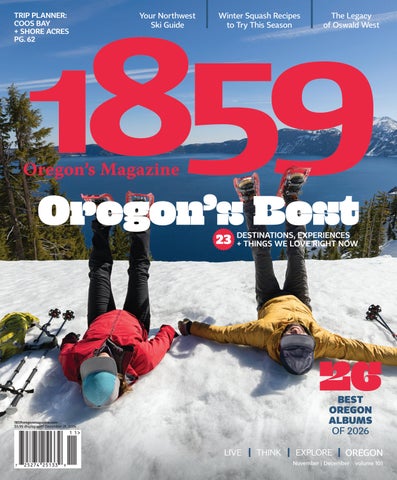
photo by Katie Falkenberg Crater Lake (see “The Best of Oregon,” pg. 36)
6
1859 OREGON’S MAGAZINE NOVEMBER | DECEMBER 2026
A Season Made for Tradition Experience the magic of the season at Sunriver Resort, where snowy adventures and holiday celebrations bring family and friends together. From festive dining and twinkling lights to sleigh rides, ice skating and cherished holiday traditions, there’s something for everyone to enjoy. Just 15 minutes from Bend, Oregon, make a getaway of it with inviting guest rooms, spacious suites and vacation rentals for every kind of winter stay. Where memories become traditions for years to come.
DISCOVER TRADITIONS & PLAN YOUR WINTER GETAWAY AT SUNRIVERRESORT.COM
CONTRIBUTORS
BEN SALMON Writer Musician
JEAN CHEN SMITH Writer The Best of Oregon
BRAD ALSTON Illustrator Beerlandia
TAMBI LANE Photographer Homegrown Chef
“A lot of people stop seeking out new music at some point, but not me. I’ve always loved keeping up with the latest releases, no matter the genre—from punk to pop to country to jazz and all points in between. Lucky for me, Oregon is fertile ground for new sounds. Combing through all the incredible albums made by artists across the state for 1859 is one of the highlights of my year!” (pg. 16)
“The hardest part of selecting the Best of Oregon was narrowing the list—there’s so much here worth sharing. I organized my picks into hotels, experiences, gear, culinary adventures and gifts, with something for everyone. One of my favorite things about living in Oregon is having talented makers, excellent local businesses and memorable places to explore close to home. This feature gave me a few more reasons to appreciate being here.” (pg. 36)
“When creating this illustration to honor our local beer, I wanted to evoke the exquisite craftsmanship of Oregon beer. I was inspired by commercial illustrators from the early twentieth century, who created bright, eye-catching paintings of products for magazines. I wanted my ‘perfect pint’ to have a gem-like quality, and feel like a masterpiece made by both our unique natural ingredients and our skilled brewers.” (pg. 20)
“After photographing a second cookbook, I knew it was time to transition from portraits and running a full-time studio to photographing food. Collaboration has been a favorite part of photography for me, and working in a new genre gave me an opportunity to create with many new and talented people. My favorite perk of them all, and the answer to the most-asked question, is yes! I usually do get to taste all of the dishes I photograph, and who doesn’t love that!” (pg. 26)
Ben Salmon has been writing about music for publications far and wide for more than two decades. He lives in Bend with his family and his records.
Jean Chen Smith is a freelance writer and editor based in Corvallis. Her work has appeared in USA Today, Travel + Leisure, Forbes Advisor, The Oregonian and more. When not sharing her love of travel with readers, she’s teaching Pilates at her studio and obsessing over her teacup shih tzus, Tonka and Paisley.
8 1859 OREGON’S MAGAZINE NOVEMBER | DECEMBER 2026
Brad Alston is a freelance illustrator based in Portland. A graduate of the School of Visual Arts in NYC, he fell in love with the land and culture of Oregon while working as a traveling educator. His work can be found on Instagram @sharkseatingpeople and at www.bradalston.com.
With nearly two decades of experience in photography, Tambi Lane is a food and beverage photographer in Bend. She enjoys time with her family and two French bulldogs.
EDITOR
Kevin Max
CREATIVE DIRECTOR
Allison Bye
WEB MANAGER
Aaron Opsahl
SOCIAL MEDIA MANAGER
Joni Kabana
OFFICE MANAGER
Cindy Miskowiec
DIRECTOR OF SALES
Jenna White
HOMEGROWN CHEF
Thor Erickson
BEERLANDIA COLUMNIST
Jeremy Storton
CONTRIBUTING WRITERS
Cathy Carroll, Jean Chen Smith, Melissa Dalton, Joni Kabana, Julie Lee, Kerry Newberry, Daniel O’Neil, Ben Salmon, James Sinks
CONTRIBUTING PHOTOGRAPHERS
Katie Falkenberg, Tambi Lane, Aubrie LeGault, Armand Nour, Daniel O’Neil
CONTRIBUTING ARTISTS
Brad Alston
Headquarters
70 SW Century Dr. Suite 100-218 Bend, Oregon 97702
592 N. Sisters Park Ct. Suite B Sisters, OR 97759
www.1859magazine.com/subscribe @1859oregon
All rights reserved. No part of this publiCation may be reproduCed or transmitted in any form or by any means, eleCtroniCally or meChaniCally, inCluding photoCopy, reCording or any information storage and retrieval system, without the express written permission of Statehood Media. ArtiCles and photographs appearing in 1859 Oregon’s Magazine may not be reproduCed in whole or in part without the express written Consent of the publisher. 1859 Oregon’s Magazine and Statehood Media are not responsible for the return of unsoliCited materials. The views and opinions expressed in these artiCles are not neCessarily those of 1859 Oregon’s Magazine, Statehood Media or its employees, staff or management.
NOVEMBER | DECEMBER 2026
1859 OREGON’S MAGAZINE 9
FROM THE
EDITOR
AMONG THE 500 or so aphorisms I live by (Ferris Bueller be damned!) is: “Never meet your hero.” Yet that’s exactly what I do in this issue. Governor Oswald West, the man who came from Canada and finagled his way into deeming all Oregon’s coast public property, preempting a greedy private grab-bag, the man who had the courage to defy friends and foes to get it done, tells only a sliver of the story of who he was. Daniel O’Neil comes back to us with a fuller and more complicated picture of the horseback-riding, motorcareschewing fourteenth governor of Oregon. Read the robust character sketch of Oswald West in “In Oregon’s Saddle” on page 42. One heroic image not marred in this issue is that of PDX. Once the aviation version of backwaters, Portland International Airport is today a cultural icon with an esteemed art collection for those who have a little time to linger before (or after) your flight. If you’re among the eternally vigilant travelers who arrive an hour early (like me), you’ll be in the right mindspace to wander among the more than eighty works of art from regional and national artists such as Dyani White Hawk, Jacob Hashimoto and Kate Newby. Turn to Gallery on page 48. Another local artist who deserves your attention is Amy Lay, who is busy re-creating Western art in a more complex yet accessible way. Out
10 1859 OREGON’S MAGAZINE NOVEMBER | DECEMBER 2026
near Union in Eastern Oregon, she began in pencil, but when she added oil paint, her figures took on new dimensions and meaning. See her work on page 32. No “Best of” issue would be complete without our best places, experiences and things we love right now. Imagine cool lodgings in getaway towns like The Jennings Hotel in Joseph and The Westman Hotel in Bend. Add bounty such as vine-totable dinners in places like Lachini Vineyards, Rex Hill and Sokol Blosser. These are just a few of our favorites for the year. See page 36 for more of what we like right now. Our music writer, Ben Salmon, always has an ear for talent, and across genres. His “26 Best Oregon Albums of 2026” (pg. 16) inspire you to expand your listening lexicon. As I write now, I am on the third listening date with Marisa Anderson’s The Anthology of UnAmerican Folk Music, which I discovered in Ben’s bests of 2026. She’s a talented guitarist who can seamlessly move through music from Southeast Asia, the Middle East and the old Soviet Union. As we close out the year together, I invite you to glide easily into the new one. Shake (or stir) The Glyde martini (pg. 20) with local spirits and blue cheese, put your head in Ben Salmon’s sound cloud and feel yourself drifting into 2027.
1859 ONLINE More ways to connect with your favorite Oregon content www.1859oregonmagazine.com | #1859oregon | @1859oregon
HAVE A PHOTO THAT SHOWS OFF YOUR OREGON EXPERIENCE? Share it with us by filling out the Oregon Postcard form on our website. If chosen, you’ll be published here. www.1859oregon magazine.com/postcard photo by Eric Valentine Meacham Divide, located in the Blue Mountains, is a premier destination for cross-country skiing and snowshoeing.
SUNRIVER RESORT ER T GETAWAY PACKAGE N ! E N I W Enter for a chance TO
to win a getaway to Sunriver Resort! One winner will receive a two-night stay for two, a $250 spa credit and a $150 dining credit to use during your stay. Enter for a chance to win at www.1859 oregonmagazine.com/ contests/sunriver Sweepstakes runs January 1-31, 2027. NOVEMBER | DECEMBER 2026
GIFT 1859 GEAR Stop by Local, our curated online shop, and find the perfect gift or share your state pride with 1859 T-shirts, hats and other apparel. Buy local. Feel good. www.1859oregon magazine.com/shop 1859 OREGON’S MAGAZINE
11
NOTEBOOK 14 FOOD + DRINK 20 FARM TO TABLE 22 HOME + DESIGN 28 ARTIST IN RESIDENCE 32
Amy Lay captures the animal spirit of the West from Eastern Oregon.
Amy Lay
pg. 32
COYOTE. PORCUPINES. WESTERN PULP ART. TATTOOS.
ART. WILDLIFE. STORIES. OF THE HIGH DESERT.
notebook
Tidbits + To-dos written by Cathy Carroll
Element Art + Home Decor Encaustic paintings by contemporary artist Leah Svendsen are inspired by the natural world and the character of rural life near the dramatic, glacially carved Wallowa Mountains. She offers workshops at her studio and gallery on Main Street in Joseph, along with original works by other local painters, ceramicists, sculptors, woodworkers, glass artists, jewelry designers and furniture makers. The shop’s thoughtfully chosen everyday objects range from handmade tableware to cozy blankets and robes. www.elementofjoseph.com
14
Portland artist Sue Selbie was sketching “helicopter” seed pods from her maple tree and nigella shrub, playing with shape and color, as she does when decorating her holiday table. Now they’re designs on her Winter Gathering tea towel set. Her Spiced Pomegranate Holiday towel reflects a winter ritual of drying orange slices for table decor. These useful, everyday art objects, tied with a ribbon and a coordinating pomegranate tag, are gift-ready.
Softstar Shoes
www.greenstitch.com
www.softstarshoes.com
1859 OREGON’S MAGAZINE NOVEMBER | DECEMBER 2026
The “elves” of Softstar shoes in Philomath handcraft minimal, zero-drop footwear in small batches using materials such as eco-friendly leathers and merino wool. The footwear with wide toe boxes is designed to let feet move freely to develop and strengthen naturally. Aesthetics are also part of the formula, from cozy slippers and running shoes to simple, elegant ballet flats and stylish boots. The employeeowner team offers tours of their workshop, too.
Photos, clockwise from top: Leah Svendsen, Softstar Shoes, Sue Selbie
Tea Towel Gift Sets
notebook
Why not resolve to deepen your relationship with the natural world around you this year? Two books from Eugene author and illustrator Emily Poole are perfect guides. Drawing inspiration from the artist’s illustrations, The Nature Notebook helps readers observe and record phenology—nature’s cycles through the seasons. Paired with Poole’s vividly illustrated Cascade of Life: An Artist’s Seasonal Guide to the Wild Northwest, the nuances of the seasons will fully unfold. www.epooleart.com www.mountaineers.org/books
Amy Williams/Oregon King Tides Project
Nature Journaling
Oregon King Tides Project Entering a photo contest can help the Oregon King Tides Project document extreme tidal events’ effects on beaches, waterways, homes and roads November 23 through 27, December 22 through 26 and January 20 through 24. Submit photos of flooding, erosion and other impacts during these extreme tidal events to help guide sea-level rise modeling and mapping and educate others about the impacts of climate change on the coast. www.oregonkingtides.net
our rk y DAR a m N
Wanderlust Tours
CA mar LE k yo ND ur AR
CAL
E
Starlight, Moonlight and Meteor Shower Snowshoe Tours Experience one of the year’s most prolific meteor showers on a guided nighttime snowshoe through the Deschutes National Forest near Mount Bachelor. Wanderlust Tours’ naturalist guides lead the way through snowy woods beneath starry skies, with hot cocoa to warm the journey. Viewing the Geminids meteor shower is best December 11 through 13, but Starlight and Moonlight Snowshoe Tours running December 4 through 20 also offer a chance to see meteors stream across the winter night sky. www.wanderlusttours.com/ special-events#geminids
NOVEMBER | DECEMBER 2026
1859 OREGON’S MAGAZINE
15
From Astoria to Burns, Salem to Sisters—and, of course, the world-class music scene in Portland—musicians from Oregon created incredible sounds in 2026. Here are the twenty-six best albums released by artists across the state this year.
written by Ben Salmon | illustration by Allison Bye
16
1859 OREGON’S MAGAZINE NOVEMBER | DECEMBER 2026
notebook
Helen | Linda’s Head
Deo5 Light Pollution 1.0 “I just make music,” says Deo5’s bio on Bandcamp. “A music making person.” Sometimes, that’s all you need. Well, that and a nifty audio production program, a seemingly endless supply of song ideas and impeccable influences such as Brian Eno and Aphex Twin. Deo5 is from Salem, and Light Pollution 1.0 is a collection of ambient bleeps, bloops, tones and zones that are totally unassuming but also undeniably charming and endlessly listenable.
George Colligan featuring Zyanna Be in the Right Now George Colligan wears a lot of hats: world-class jazz pianist and composer, in-demand accompanist among giants of the genre, vital cog in the New York City scene and professor at Portland State University. Be in the Right Now features performances by a number of Colligan’s students who have evolved into top-notch players themselves. At the center is powerhouse vocalist Zyanna Melada, who turns Colligan’s bouncy tunes into fierce and forceful jazz bangers.
Helen Linda’s Head Astoria’s Liz Harris is one of Oregon’s most revered (and off-the-beaten-path) musicians; her solo work has appeared on this list in past years under her longtime nom d’artiste, Grouper. But in 2026, she reunited with her bandmates in Helen to
release their first album in eleven years, Linda’s Head. The result is a set of songs that take the Grouper sound— stretched-out ambient hymns draped in reverb—and condense it down into perfect little bedroom dream-pop songs for those gray coastal days.
Koworker Smirkules The intertwining of hiphop and jazz goes way back, through Guru and A Tribe Called Quest, Madlib and Kendrick Lamar. Now here comes Smirkules, the third album from Portland duo Koworker, aka rapper Old Grape God and beatmaker MLTZR. The latter builds a foundation that’s jazzy, experimental and unpredictable, while the former delivers rhymes (and non-rhymes) from his preferred perspective out in left field. Together, they’re dope. And weird. Which is extra dope.
Cumbia is a popular and upbeat style of music with roots that run deep throughout Latin America, Africa and beyond. Orquestra Pacifico Tropical is an eleven-piece band from Portland that puts a Northwest spin on cumbia, injecting an already partyfriendly style of music with psychedelic touches, rock ’n’ roll muscle and underground cool. Last but not least, El Poder is OPT’s first album in eight years—a welcome return from one of Oregon’s most irresistible bands.
Saoirse Dream grimdark Somewhere between glitchy, variegated hyperpop and crunchy, heart-on-sleeve emopop-punk sits Saoirse Dream, a project helmed by Catherine Egbert—a trans singer-songwriter from Portland and a walking, talking, highly productive factory of giant hooks. On grimdark, Egbert balances her various interests perfectly, bringing together chiptune squiggles, killer guitar riffs, earworm melodies and a particularly modern set of frustrations in a way that makes perfect, fist-pumping sense.
Marisa Anderson | The Anthology of UnAmerican Folk Music
Marisa Anderson The Anthology of UnAmerican Folk Music Longtime Portlander Marisa Anderson is one of the great guitarists on the planet, known for her exquisite touch and adventurous approach. Her 2026 release is a stunner: Given access to the vast record collection of famed archivist Harry Smith, Anderson zeroed in on music from Southeast Asia, the U.S.S.R. and Islamic and Arabic regions of the world— places the U.S. has been in conflict with over the past half-century. Her acoustic interpretations of the works she chose are artful and eye-opening.
Shaun Astor
Colin Smith
Orquestra Pacifico Tropical El Poder
NOVEMBER | DECEMBER 2026
1859 OREGON’S MAGAZINE
17
notebook
Jason Hill
Orquestra Pacifico Tropical | El Poder
Skillethead Check the Weather
Spirit Mother Thistle
There’s no shortage of bluegrass fans in Central Oregon, whether you’re talking about the traditional string-band stuff or progressive newgrass jams. So it’s no wonder that Skillethead—a band made up of skilled pickers from Bend and Sisters—has become one of the most beloved bands in the region in recent years. Their debut album, Check the Weather, bridges the old and the new, showcasing the band’s chops and its open-minded approach to the genre.
Spirit Mother is originally from Long Beach, California, but they now make their home base in Burns, where they recorded their third album in the attic of a century-old cabin. Harney County may not be known as a hub for heavy rock ’n’ roll, but Spirit Mother brings swagger and stomp to the region, and you can hear the high desert reverberating in Thistle’s hardy blues foundation, its out-there psychedelic vibes and its dusty, desolate roots influence.
State Parks Hide the Dogs Oregon has no shortage of beautiful state parks that are worth exploring. Here’s another one: State Parks, a Eugene trio that boasts crisp guitar riffs, can’t-miss hooks and memorable melodies instead of challenging trails, towering trees and breathtaking views. Hide the Dogs is the band’s first full-length album, and it’s packed with ten dreamy pop-rock tunes that twinkle, churn and soar in a way that feels straight out of the Pacific Northwest’s storied indie tradition.
16 MORE ALBUMS WORTH HEARING Blackwater Holylight | Not Here Not Gone Cherry Cheeks | D.O. and The Bytes
emancipator | Chrysalis
The King Dot | Dead
Free Static | Sharks Lung in Plastic
Roman Norfleet and Be Present Art Group | The Remembering
Fernando Viciconte | Traitors Table
Phosphene | Velveteen
Barry Walker Jr. | Paleo Sol
Miles Powers | A Head Without a Body
Withering Of Light | Silent Wings and Ghost Voices
CPTN OVER | CPTN OVER
Steven Golliday | Your Brother in Time
Alela Diane | Who’s Keeping Time?
Gabriel Kahane and Roomful of Teeth | Elevator Songs
18 1859 OREGON’S MAGAZINE NOVEMBER | DECEMBER 2026
Rhododendron | Ascent Effort
Cyr Beckley
notebook
Bibliophile
Author Mary Grace Marquiss sees creative expression as a prescription for navigating loss and anxiety and finding strength and self-discovery.
Life in Watercolor An artist discovers perspective and strength in creative expression interview by Cathy Carroll
IN REVEALING the personal stories that fueled her art, Mary Grace Marquiss details the power of creative expression in navigating life’s challenges, from divorce to cancer and her sister’s suicide. The Bend-based painter points to creativity to calm anxiety, take control and learn to let go. Behind the Painting recounts the events that inspired ten of her paintings over three decades. The works respond to the joys and tragedies in the life of an artist on the road to personal discovery and offer an inspiring, honest take on facing challenges with watercolors and a canvas.
How did painting help in processing some of the hardest experiences you faced? Painting is a personal expression—the process of bringing something from within oneself to the outside in visual form. The red poppy on the cover of my book was the first painting that revealed a circular language between my life and my art. A woman purchased the red poppy painting In Full Swing to honor her passionate friend who had taken her life after a tough divorce. When I discovered I would need to navigate my own divorce, I was teaching an art class in her home and saw that painting each week. I was amazed at the strength the painting held. Had I painted such a strong image? I had. Each week as I stepped into her home and taught the art class, the poppy painting mirrored back the strength I desperately needed at that point in my life but had forgotten I held within. I could do this. How did profound loss change you or your art? The morning after my sister jumped off a bridge in Portland I entered her house. Upstairs in her office, I saw a map of Ireland hanging behind her desk. I stepped closer and studied the map. I had never been to Ireland, but at that moment, I felt my sister’s spirit prompting me to take a trip there. Following her service, I flew to Ireland, and as I sat painting a lovely cottage,
NOVEMBER | DECEMBER 2026
a chaffinch settled on a stone wall to my left and watched me paint. I thought it would fly away, but it patiently watched as I finished the sketch, dropped in the watercolor and took a photograph. The bird felt like Betty’s spirit. Hadn’t she prompted me to take the trip? Once home, I created a painting of the bird, which graces my home. Betty’s spirit is always with me. What do you hope readers take away from your art and the stories behind it? Life is woven with beauty, challenges and loss. It seems that if a lesson is not learned, it will return and be offered again. Art in nature has been one of my greatest teachers. Color, shape, values, texture and line are the design elements I see in nature and use in my art. Art is physiologically calming. Studies reveal that making art reduces the stress hormone cortisol, and new research shows the brain on art is transformed. As a watercolor artist and art teacher for over thirty years, I have found watercolor to be especially helpful in learning to let go and not be stuck in an emotion. Purchase three primary colors, a quality watercolor brush and good paper. Paint on dry paper for control and drop paint into a wet shape to watch the colors swim and let go. Art has taught me to be kind to myself and the importance of play. 1859 OREGON’S MAGAZINE
19
Photo: Tyler Valzania
food + drink
Cocktail Card recipe courtesy of The Malarkey / PORTLAND
The Glyde • 11/2 ounces vodka • 1/2 ounce gin • 1/4 ounce dry vermouth • 1/4 ounce fino sherry • Splash of caper brine (or favorite olive brine) • 2 blue cheesestuffed olives, for garnish • 1 cocktail onion, for garnish Combine the vodka, gin, dry vermouth, fino sherry and a splash of caper brine in a mixing glass. Add ice, and stir for 30 seconds, until the martini is chilled. Strain the drink into a chilled martini glass. Garnish with the blue cheese-stuffed olives and cocktail onion.
Beerlandia
“Craft” is a Culture as Much as a Process written by Jeremy Storton | illustration by Brad Alston WHAT MAKES Oregon beer so special? All bias aside, it’s a fair question. Bavaria, the Czech Republic, Flanders, London and Denver all produce world-class beer. Yet Oregon has a remarkable ability to produce beers that stand up to the scrutiny of global judges and come home dripping with medals. The question is: Why? There are two fundamental ways to make great beer: Use better ingredients or better brewing practices. We have an abundance of both. Oregon has been growing and breeding hops for generations. Local maltsters brought character and complexity to barley, and Oregon yeast producers gave brewers the tools to push their creativity even further. But ingredients are only a part of the equation; someone still has to turn them into beer. In 2007, I started homebrewing and thus started paying attention. This was when I realized something bigger was happening. Craft brewing had just found its footing, but we were still heavily inspired by European imports. I remember listening to brewers discuss tinkering with techniques, new methods and experiments that failed but led to future collaborations that paid off. I remember watching good homebrewers apply benevolent pressure on commercial brewers, resulting in better beer. That might be what makes Oregon beer so special. We are a community of people who make things: farmers, cheesemakers, winemakers, chefs, coffee roasters and brewers. Oregon’s craft culture respects tradition, but encourages DIY, experimentation, independence and a healthy dose of anything-you-can-do-I-can-do-better. In Oregon, “craft” isn’t a label; it’s a way of thinking that defines us. Maybe that’s why beer tastes better in Oregon. The real magic happens in the space between tradition and experimentation, between competition and collaboration, or between knowing how something has always been done and still wondering, “What if?” This is how we make the best of Oregon beer even better.
20 1859 OREGON’S MAGAZINE NOVEMBER | DECEMBER 2026
food + drink
BEST PICKS FOR
www.culinarybreedingnetwork.com
Photos, from top: Culinary Breeding Network, Durant/Ekone Tinned Seafood, Ranger Chocolate Co.
EKONE’S TINNED FISH WITH DURANT OLIVE OIL Two Pacific Northwest favorites come together for a seriously snackable bite. Ekone Tinned Seafood’s smoky, briny oysters are packed in Durant’s Oregon-made olive oils, available in two limited-edition tins. Choose between herbaceous Koroneiki extra-virgin olive oil or jalapeñofused oil for a bright kick of heat. A stylish way to start any holiday gathering. www.ekoneseafood.com
RANGER CHOCOLATE CO. EXPLORER SERIES BARS For the adventurer on your list, look to Ranger Chocolate Co.’s Explorer Series bars, inspired by Oregon landscapes and cacaogrowing regions around the world. At 25 grams, the bars are perfectly sized for a gift basket or road-trip snack. The artful packaging, like Crater Lake on the Sea Salt Chocolate Bar, brings each destination to life. Even better, a portion of annual proceeds supports the National Parks Conservation Association. www.rangerchocolate.co
Kelsey Curtis/Bar Nouveau
Radicchio devotees will swoon over this tribute to the bittersweet winter green. In Radicchio: A Celebration of the Beloved Italian Vegetable, a collection of forty-five recipes range from pasta, including potato gnocchi tossed in radicchio pesto, to salads and sweets—with showstoppers like a decadent chocolate radicchio cake topped with mascarpone frosting. Between recipes, you’ll meet the farmers and cooks who champion the vegetable in both Italy and the Pacific Northwest, along with a look at radicchio’s history and flavors.
Trang Nguyen/Bar Nouveau
RADICCHIO COOKBOOK
Trang Nguyen/Bar Nouveau
CULINARY GIFTS
CLOCKWISE FROM TOP Creative dishes at the pop-upturned-bistro Bar Nouveau in Portland. The cozy interior of the restaurant in the St. Johns neighborhood. Chef Althea Grey Potter and her magnum opus, Bar Nouveau.
Dining
Bar Nouveau written by Kerry Newberry PORTLANDERS SPENT months stalking the opening of Bar Nouveau. Nearly a year later, the pop-up-turned-upscale French-inspired bistro remains one of the buzziest tables in the city. Tucked onto a leafy street in the historic St. Johns neighborhood, chef Althea Grey Potter and her all-female team have packed the restaurant with personality, and the details reward a second look. Start in the entryway, where recipe pages from vintage cookbooks paper the walls and quirky paintings hang beside antique cabinets stacked with mismatched china and paperback romance novels (more on those later). Inside, chandeliers cast a glow over the intimate dining room that’s equal parts whimsy and charm. The food is every bit as playful, each plate arriving with a little flourish. On a recent visit, a towering pair of cheddar-and-garlic gougères stuffed with jalapeñoflecked shrimp salad drew oohs and aahs from the whole table. Deviled eggs, crowned with cornichons, were equally delightful. Bring friends for the spiced chicken schnitzel. Honey-drizzled and paired with a crisp haricots verts salad, it was the night’s standout: crunchy, savory and generous enough to go around. Close behind was the duck-and-blackberry sausage with gruyère creamed corn, zucchini and apricot moutarde. Then comes the grand finale. Too full for dessert? At least say oui to the Happy Ending: a smattering of sweets from local chocolatier Bees & Beans, a pour of Cointreau Noir and one of those vintage romance novels promising a happily-ever-after. 7425 N. LEAVITT AVE. PORTLAND www.nouveaufoodandwine.com
NOVEMBER | DECEMBER 2026
1859 OREGON’S MAGAZINE
21
farm to table
Freshly harvested winter squash, including butternut, spaghetti and acorn squash, alongside sugar pie pumpkins, occupy bins at Nottinghamshire Farms in St. Paul.
Farm to Table
Going All in on Squash Amanda Stevens balances family, fresh-market farming and the realities of growing organic produce in Oregon written by Julie Lee | photography by Aubrie LeGault
22 1859 OREGON’S MAGAZINE NOVEMBER | DECEMBER 2026
IT’S A FAMILY-FIRST FARM for Amanda Stevens at Nottinghamshire Farms in St. Paul, with her three kids, ranging in age from 4 to 11, providing many helping hands, big and small. Stevens herself grew up farming grass seed from a young age before heading to Oregon State University to major in agriculture. Her senior year took her to New Zealand for a summer job, and it was there she met her husband, Anthony. The couple worked on Anthony’s family cattle ranch abroad until 2014, eventually moving to the United States to manage her family’s farm. It was the first foray into fresh-market farming for either of them. They began growing strawberries and
CLOCKWISE FROM LEFT Amanda and Anthony Stevens, co-owners of Nottinghamshire Farms, stand with a crate of freshly harvested winter squash. The farm’s entrance sign welcomes visitors looking to find organic seasonal produce. One of Amanda’s favorite types of winter squash is the Black Futsu squash, a Japanese variety grown at the farm.
corn before expanding into squash, which added a more sustainable cash flow. They now grow nineteen different crops, most identifiable by name, realizing early on that the best practice for economies of scale is not to get “too fancy” with what is grown and distributed. Stevens said they are “really tight” on what they grow, with business margins in commodities constantly shrinking. With winter squash, they will pivot varieties based on market conditions, particularly dependent on the price paid for crops. “You don’t choose your price in organics,” she said. “You are told what the price is.” Squash is one of her favorite crops. “You plant it, and it grows strong and lovely,” said Stevens. It’s also one of the most financially sustainable. While Stevens finds human resources a challenging layer on top of running a bustling farm business, it’s worth it to her because of her fifteen employees and additional contractors. “We love our employees and our crew,” she said, “and making a difference in their lives and in the local economy.” She just wishes it was more “respected.” With the surge of bigger companies infiltrating local communities and sucking away business, Stevens said that “while we live next to the ‘Amazon’ of organic farming, which we really can’t compete against, I love making a sale, knowing each one impacts everyone who works with us.”
It’s also a constant learning process. “The challenge with fresh markets is that you are only as good as your last shipment,” Stevens said. “We’re always trying to find a pattern.” Nottinghamshire Farms’ main business is wholesale focused, with online ordering a staple. The bulk of their retail business gets distributed through Charlie’s Produce Portland, landing in organic-forward retailers such as New Seasons Market and LifeSource Natural Foods in Salem. As we conclude the International Year of the Woman Farmer, Stevens exemplifies the reason for females to be recognized in farming. “I love having my own business and being my own boss, only having myself to blame if I mess something up,” she said, laughing. “But I wouldn’t be able to do this without my husband. We’re a team. This business is so personal and intensive; for me, it would be impossible to imagine doing it with someone else. We’re all in.” That includes her kids, who love to help pack squash for distribution. Want an impressive company dish? Whipped Goat CheeseStuffed Squash Blossoms is an innovative recipe from Amaterra Kitchen + Social Club executive chef Jeff Kelly that is sure to deliver. Delicata squash is a Stevens family favorite and the “easiest to cook.” “I’m probably really boring,” said Stevens. “Roasted squash with olive oil and salt is all you need.” She also loves pumpkin soup … and pumpkin coffee creamer. “It’s so delicious—it makes you wonder about the stuff you buy in the store.” NOVEMBER | DECEMBER 2026
1859 OREGON’S MAGAZINE 23
farm to table
Oregon Recipes
Two Sides of Savory Squash
Pumpkin Soup
Amanda Stevens, Nottinghamshire Farms
Whipped Goat CheeseStuffed Squash Blossoms.
Whipped Goat CheeseStuffed Squash Blossoms Amaterra Kitchen + Social Club / BEND Jeff Kelly, executive chef SERVES 6 FOR THE WHIPPED GOAT CHEESE FILLING • 2/3 cup fresh chèvre goat cheese, room temperature • 1/8 cup heavy cream • 3 teaspoons honey • Zest of ½ orange • 1 tablespoon chives, finely chopped • 1/4 teaspoon kosher salt • Small pinch white pepper • 1 teaspoon olive oil FOR THE SQUASH BLOSSOMS • 6 large, fresh squash blossoms • 1/2 cup all-purpose flour • 3/8 cup rice flour • 1/4 teaspoon kosher salt • 1/2 cup very cold sparkling water • Neutral oil, for frying FOR THE SUMAC-ROASTED SHALLOT YOGURT • 2 medium shallots • 1 tablespoon olive oil • 1½ teaspoons ground sumac
• 2/3 cup Greek yogurt • 1/2 teaspoon honey • 1 teaspoon fresh lemon juice • 1/4 teaspoon kosher salt • 1 tablespoon water, as needed FOR THE WHIPPED GOAT CHEESE FILLING Bring goat cheese to room temperature. Whip the chèvre with the heavy cream until smooth and light. Fold in honey, orange zest, chives, salt, white pepper and olive oil. Taste—it should be tangy first, with subtle honey and orange in the background. Transfer to a piping bag, and refrigerate until needed. FOR THE SQUASH BLOSSOMS Carefully open each blossom, and remove the interior stamen. Check for insects or debris, and gently rinse if necessary. Pat completely dry. Pipe approximately 25-30 grams of goat cheese into each blossom. Twist the petals gently to close. Refrigerate while preparing the batter. For the batter, combine flour, rice flour and salt. Whisk in the cold sparkling water just until combined (a
24 1859 OREGON’S MAGAZINE NOVEMBER | DECEMBER 2026
few lumps are fine.) Keep the batter very cold. Dip each stuffed blossom in the batter, allowing excess to drip off. Fry at 350-360 degrees Fahrenheit until crisp and lightly golden, about 2-3 minutes. Drain on a rack, and season immediately with a little salt. FOR THE SUMAC-ROASTED SHALLOT YOGURT Slice the shallots into thin rings or julienne. Toss with olive oil, sumac and a pinch of salt. Roast at 375 degrees until soft, lightly caramelized and beginning to crisp at the edges, approximately 15-20 minutes. Cool completely. Mix the yogurt with honey, lemon juice, salt and enough water to make it smooth and spoonable rather than thick. Fold in about two-thirds of the roasted shallot. Reserve the rest for garnish. Taste and adjust with additional lemon or sumac if necessary. TO SERVE Spoon some of the sumacroasted shallot yogurt onto each plate. Place the fried squash blossoms on top of the yogurt. Garnish with chives if desired, and serve.
Brennan Pebbles
SERVES 6-8 • 1 large onion, chopped • 2 carrots, peeled and chopped • 1 teaspoon freshly ground garlic • 1 bay leaf • 1¾ tablespoons unsalted butter • 2 tablespoons olive oil • 1 medium pumpkin, deseeded and roughly chopped • 1 medium Yukon gold potato, roughly chopped • 1¾ pints vegetable or chicken stock (may need a little extra depending on soup consistency) • 3½ ounces heavy cream • 3 tablespoons pumpkin seeds • Salt and freshly ground pepper, to taste Place the onion, carrots, garlic, bay leaf, butter and half the olive oil into a large pan, cooking over low to medium heat for approximately 10 minutes, or until the vegetables are tender but not browned. Add the pumpkin and potato, mixing to combine, and cook for 2-3 more minutes. Pour in the stock, stirring well, and bring to a boil. Reduce heat to a gentle simmer, cover the pan with a lid and continue to cook for approximately 40 minutes, or until the squash is tender when knife-tested. Pick out the bay leaf, and blend the soup until smooth, using a stick blender. Add the cream and a little more stock if the soup is thick. Taste, and add salt and pepper to taste. Heat the remaining oil in a frying pan over medium heat, adding the pumpkin seeds, and fry quickly until the seeds start to pop. Remove from pan. Ladle the soup into bowls, and serve with a swirl of cream, topping with toasted pumpkin seeds.
Stay at Historic Lake Creek Lodge
Join our Adventure Mail newsletter and get access to all things Oregon and Washington, including getaways, giveaways, dining and more! Subscribe today at 1859oregonmagazine.com/ live/subscribe-to-oregon-adventure-mail
717 SW 10th Ave Portland, OR 97205 503.223.4720 www.Maloys.com
Check out our mid-week special 541.588.2150 lakecreeklodge.com Established 1935
13375 SW FS Rd. 1419 Camp Sherman, OR
Starry Night For fine antique and custom jewelry, or for repair work, come visit us, or shop online at Maloys.com. We also buy.
farm to table Kabocha Pain Perdu FOR THE KABOCHA SQUASH • 1½ pounds kabocha squash • 2¼ cups dashi (homemade or from powder) • 3 teaspoons soy sauce • 3 teaspoons sake • 1 teaspoon mirin • 3 teaspoons sugar FOR THE PAIN PERDU (FRENCH TOAST) • 4 large eggs • ⅓ cup granulated sugar • ½ vanilla bean, split lengthwise, or 2 teaspoons vanilla bean paste or vanilla extract • 1¼ cups whole milk • ½ cup heavy cream • Kosher salt • 1-day-old medium loaf brioche, sliced 1½ inches thick • 3 tablespoons (or more) unsalted butter, divided • Jacobsen flaky sea salt FOR THE SYRUP • 4 tablespoons pure maple syrup • 4 tablespoons Japanese sweet soy sauce FOR THE KABOCHA SQUASH Cut the squash in half. Remove any seeds and insides from the squash, and cut it into uniform bite-size pieces (about 1½ inches). Leave the skin on as it will become very tender as it cooks. Place the pieces of squash in a small pan in a single layer. You want the pan to be just big enough to hold the squash without too much extra space. Pour the dashi into the pan, and cover. Place over a medium heat, and bring to a boil. Add the soy, sake, mirin and sugar to the pan, and swirl the pan gently to mix. Cover, and reduce the heat, so that the liquid simmers. Leave for around 20-30 minutes
26
until the squash is tender to a knifepoint. At this point, turn down the heat. Let the rest of the liquid evaporate and the squash just begin to caramelize. Remove the pan from heat, and let it rest covered. FOR THE PAIN PERDU (FRENCH TOAST) Whisk the eggs and granulated sugar in a large bowl until frothy. Scrape in seeds from ½ vanilla bean, split lengthwise; discard pod or reserve for another use. (Alternatively, add 2 teaspoons vanilla bean paste or vanilla extract.) Whisk until smooth. Add whole milk, heavy cream and a pinch of kosher salt, and whisk custard until no streaks of unincorporated egg remain. Working with 1 slice at a time, submerge brioche into the custard, and let soak long enough to saturate but not so long that they fall apart. Transfer to a rimmed baking sheet. Melt 2 tablespoons unsalted butter in a skillet over medium heat. Working with 2 or 3 slices, cook bread until golden-brown underneath, 2-5 minutes. Turn, reduce heat to medium-low, add 1 tablespoon unsalted butter and cook until browned on other side, 2-5 minutes. Transfer to plates. Repeat with remaining bread over medium-low heat, working in batches of 2 or 3 slices and adding more butter to pan as needed. FOR THE SYRUP Mix the maple syrup and soy sauce together, and set aside. TO ASSEMBLE Place a thick slice of the prepared pain perdu on a plate. Top with several pieces of the cooked kabocha squash, and drizzle the syrup over the top.
1859 OREGON’S MAGAZINE NOVEMBER | DECEMBER 2026
farm to table
Homegrown Chef
Tuesdays with Mori-San written by Thor Erickson | photography by Tambi Lane
Kabocha squash and pain perdu in a maple and sweet soy drizzle.
IN THE EARLY 1990s, I took a second job cooking breakfast to make ends meet. The restaurant was known for doing everything fresh— nothing from a can. Next door was a popular Japanese sushi restaurant, and the back doors of both kitchens opened into a shared hallway lined with a nail salon, an insurance office and a bail bondsman. Every Tuesday morning, food-service deliveries arrived before sunrise. Often, both restaurants’ groceries were stacked together on the same pallet, and someone had to sort everything out. That’s how I met Mori. Mori was about ten years older than me, maybe 5-foot-6, with a flattop haircut and a very low voice. His English was limited and heavily accented. He had trained for years in Japan to become a master chef and manage a sushi restaurant, and the owner had brought him to America to run this one. Mori ran a tight ship. One morning, he poked his head through our back door. “Rice?” he asked. He was looking for a missing bag of short-grain rice. I searched everywhere but couldn’t find it. Feeling bad, I handed him a plate of freshly made French toast. He took it back to his restaurant. A little while later, he returned with a huge smile. “You now call me Mori-San,” he said. And from that day forward, every Tuesday morning, I arrived early and sorted the delivery pallet. I neatly stacked Mori-San’s groceries beside his back door before putting ours away. He appreciated the organization. Soon, he began stopping by almost every day.
“French toast?” Sometimes I made him pancakes or waffles. Mori-San loved the sweeter side of breakfast. One snowy November afternoon, as I was finishing my shift, Mori-San appeared in the hallway. “You eat?” he asked. “Yes!” I replied. A few minutes later, he returned carrying a giant Styrofoam cup filled with fragrant Japanese curry—thin slices of beef, potatoes and carrots— and another container of sticky rice. It was perfect. Cooks often don’t want to eat the food they’ve been preparing all day. That curry was exactly what I needed on a cold winter afternoon. Another morning, a snowstorm dropped 10 inches on the ground. Business was slow, and we eventually closed early. I made Mori-San his usual French toast. Later, he brought me kabocha squash that he had slowly cooked in dashi, mirin and a touch of soy sauce. The squash was tender, sweet and deeply savory—the perfect balance of umami and sweetness. He watched me take a bite. “This make you strong,” Mori-San said. I smiled. He was right. Looking back, I realize that second job gave me more than a little extra money. It gave me a friendship built in a back hallway between two kitchens, over missing rice, French toast, Japanese curry and kabocha squash. So here is my recipe for the best French toast I know, topped with Mori-San’s sweet-savory kabocha. It is French-Japanese fusion at its best. Trust me. “This make you strong.”
NOVEMBER | DECEMBER 2026
1859 OREGON’S MAGAZINE 27
home + design
Home + Design
A Rustic Mount Hood Cabin Gets a Refined Glow-Up A trio of talented professionals rehab a century-old cabin outside Rhododendron written by Melissa Dalton | photography by Stephanie Sternhagen
TUCKED INTO the forested flank of Mount Hood, between Rhododendron and Government Camp and just off the highway, is a subdivision unlike how we typically think of the word. It began around 1914, when the Forest Service surveyed areas of Mount Hood National Forest and set aside several tracts and lots to build summer cabins. This was all a part of a national effort in 1915 formalized as the Term Occupancy Act, or “Cabin in the Woods” program. To this day, the federal government owns the land, while the cabin and its maintenance belong to the homeowners, with a special use permit up for issue every twenty years.
Elements like a stylish dining table and chairs update the cabin while retaining pine walls and cabinets.
28
1859 OREGON’S MAGAZINE NOVEMBER | DECEMBER 2026
home + design
A 1919 Forest Service publication described it thus: “When, tired of the daily grind, you say to yourself, ‘I need a vacation,’ your first thought is to get away from civilization and its trammels. Your next is to find interesting and health-giving recreation. In the national forests in Oregon, you may find both, and much besides.” Fees for the lots were low—118 sites along the Zigzag River went for just $10 a year at that time. Construction kept to a slow pace until 1920, due to difficulty accessing the sites, and bumped when the Mount Hood Loop Highway was completed in 1924. Today, there are about 14,000 recreational residences in 114 forests nationwide, with 549 of these in the Mount Hood National Forest. Many of these were small, deliberately rustic structures, never intended for year-round use—much like this one built in 1927, which recently underwent a full-scale remodel. “The owners never could quite get settled for longer stays, due to the challenges of daily life in a small space with lots of quirks,” said Colin Jensen, architect and founder of the Portland-based THESIS Studio Architecture. Beginning in 2022, Jensen joined up with builder Alex Thostenson of North Swell Design Build and Vicki Simon Interior Design to rehab the cabin’s 970 square feet. Strict federal design guidelines govern any alterations to the exterior, as the cabins are intended to maintain a rustic appearance that blends into the natural environment. However, the interior can be modified, and this one needed a lot, from structural upgrades to better storage, and a kitchen that didn’t feel quite so cramped. “They wanted to bring it up to a level of construction quality that was going to last for another fifty-plus years,” said Jensen. After design passed Forest Service review, the team started by gutting the interior. “Then we left the flat framing of the exterior up, held up with chains and straps, and essentially built a house inside of the house,” said Thostenson. The team’s goal was to stay within the existing footprint, so the key move in the redesign was to utilize vertical space. They removed a low, sub-8-foot ceiling to vault the interiors and added collar ties. Not only did this create a greater sense of space and a loft, accessible by a ship’s ladder, but the team could then insert storage wherever possible, such as sleek cabinets above closets, hatches stowing Christmas decorations and panels obscuring the refrigerator and laundry machines, or hiding muddy and snowy gear. “The clutter really felt like it was closing in from all sides, so that made it so we could spread out into the living space more,” said Jensen. The walls, cabinets, closets and ceilings were all clad in pine, rather than cedar, to keep the budget manageable, with the continuous run of the wood letting the storage hide in plain sight. “That allowed us to play up the woodsy, cabin-y vibe,” said Jensen. “We weren’t shy of wood features and knots and things like that.” For the builder, the entire endeavor was “a carpenter’s dream,” said Thostenson. “Everything in that place is a custom cut because nothing is square or level.” Light reconfiguration of the plan reformed the kitchen from a tight galley to an L-shape: “Like a game
FROM TOP From the rustic and minimalist bedroom to the laundry cabinets, knotty pine is used throughout the cabin.
NOVEMBER | DECEMBER 2026
1859 OREGON’S MAGAZINE 29
home + design
CLOCKWISE FROM LEFT Red accents, from the stove to window frames, add punches of color throughout the cabin. An 800-pound copper soaking tub pairs relaxation with a view. The restored fireplace showcases the cabin’s original character.
of inches,” said Jensen. The existing number of bedrooms and bathrooms were retained so as to respect the septic system constraints, while the bonus loft provides an additional spot to read or watch movies after a day outside. Crucial elements, like the windows and fireplace, were all restored. The chimney stone was cleared of moss and water stains so as to be artfully revealed by a carefully scribed pine frame and the original mantle put back in place, while the window frames were painted a punchy red. Simon brought in a mix of cozy furnishings, lighting and textiles. The final piece was an 800-pound copper soaking tub placed underneath the window in the primary bedroom, since the nearby bathroom didn’t have 30 1859 OREGON’S MAGAZINE NOVEMBER | DECEMBER 2026
room. “What’s better than taking a tub with that view onto the creek?” asked Jensen. Meanwhile, construction access proved to be only a little less challenging than a hundred years ago, since heavy equipment and delivery trucks could not access the site. Thostenson reported that his team had to lie on their stomachs and hand dig roughly 10 yards of dirt out from under the house to insert foundation footings, cart the dirt uphill 50 to 75 yards to a trailer and then hand-pack all of the lumber into the site. “This project was once in a lifetime,” said Thostenson. And perhaps a promise that, even with all of our technological innovations over the last century, it’s still possible to get away from it all.
home + design
Get the Look of the Cabin
For those who love natural fibers like wool, but don’t care for hand-washing, the Eco-Wise Wool Blanket from Pendleton is their prize. It’s made of 100 percent colorfast virgin wool, yet cleans up in the laundry machine. Available in three sizes and four classic patterns, like this Lodge Plaid, it’s a time-tested win.
written by Melissa Dalton
www.pendleton-usa.com George Nelson designed the first bubble lamp in 1952, and it still looks fresh today. For the Nelson Saucer Crisscross Bubble Pendant, a visible steel infrastructure is covered by a translucent plastic polymer shade. That creates not only a rippling, organic shape but also a soft glow, perfect for cabin coziness. Available at Design Within Reach.
Leave it to Ann Sacks to make a common ceramic field tile even cooler, by giving it an elongated shape (that’s 2 x 11) and a beautiful glaze (made in Japan from recycled glazes). The result is deep color and the perfect amount of surface variation.
Like the rehabbed cabin outside Rhododendron, this range from Fisher & Paykel is the best of old and new, merging classic good looks with an induction cooktop and convection oven. It comes in red, white and stainless steel, but we think the red color is the cherry on top. www.fisherpaykel.com/us
www.annsacks.kohler.com NOVEMBER | DECEMBER 2026
1859 OREGON’S MAGAZINE
Photos, clockwise from top: DWR, Pendleton, Fisher & Paykel, Stephanie Sternhagen
www.dwr.com
31
artist in residence
Artist in Residence
Furtive Glances Amy Lay’s paintings convey a sense of the wild written by Daniel O’Neil
ABOUT 18 MILES outside of Union, in northeastern Oregon where the Blue and Wallowa mountains crown the horizon, Amy Lay practices what she’s always done. In quick, instinctive motions she pencils lines across a canvas, shaping an elk or songbird seen recently at home or while on horseback, giving form to the ever-present wind and the looming mountains. Later, she’ll add oil paint to flesh out the creature she’s bringing to life, all an exercise in paying homage to the place she and her subjects have always called home. 32 1859 OREGON’S MAGAZINE NOVEMBER | DECEMBER 2026
Lay’s great-grandparents homesteaded the ranch where she and her family still keep some horses but no longer raise livestock. For Lay, learning to ride a horse was like learning to ride a bike, and rather than cruise the neighborhood with friends, Lay hung out with animals and enjoyed the creative freedom provided by isolation and the outdoors. Her parents and extended family pursued artistic muses of their own—painting, music, writing—and always encouraged Lay to follow hers. At recess, Lay would cut giant pieces of white paper from a roll and sketch horses and scenes, to her teachers’ and parents’ delight. Art school at Eastern Oregon University taught Lay the basics, but she didn’t have any classes in painting. She did study watercolor, though, and it shows in her work: graphite or charcoal lines, then
Photo: courtesy of Amy Lay
Amy Lay’s painting Rebel.
Let the World Wait. Walk a little farther. Talk a little longer. Leave the afternoon open. Since 1970
One of a Kind Custom Design
Powered by Nature OREGONSWILDRIVERSCOAST.COM
Visit Our Showroom Tuesday-Friday: 11-5 Saturday: 10-4
YOUR SOUND SANCTUARY
Custom Design, Repair & Appraisal Consultations BY APPOINTMENT Please Call: 503-636-4025
89.9 FM allclassical.org
27 A Avenue, Lake Oswego dykevandenburgh.com
Photos: courtesy of Amy Lay
artist in residence
turpentine (instead of water) and oil paint, a process she’ll ago. As she began selling her work, oil paint entered Lay’s reprepeat several times, layering her work. Had Lay followed in ertoire at the suggestion of gallerists. Today, galleries across the the typical contemporary Western wildlife painter’s path, she West and several on the East Coast sell her work. For Sarah Serre, gallery director at Mountain Trails Gallery in would have formally studied Western art and learned techJackson, Wyoming, Lay’s use nique from a Western masof contrast, charcoal marks ter. Instead, she taught herand vibrant passages of color self, relying on no one but brings motion and vitality to herself, true to the ethos of each piece. “There is a beauwhere she’s from. tiful juxtaposition between “That’s probably the thing the strength and majesty of that I’m the most proud of the wildlife she depicts and with my work,” Lay said. “And the soft, almost ethereal apit came about out of strife, plication of her brushwork,” really, and just not having the Serre said. “This interplay means to go to the proper gives her work a sense of schools or have the proper both energy and delicacy. education, maybe. Now I’m The result is work that feels just so glad I never went to — Amy Lay both grounded in the natural any workshops or classes. At the time I was very embarrassed, and I was a little ashamed of my- world and touched by something more mystical. Amy has an exceptional ability to capture not only the expression of an animal, self, but that was a great advantage that I didn’t know anything.” After teaching social studies at Union High School for a de- but also its spirit and presence.” Lay’s technique culminates in a furtive, full-of-life glimpse of cade, and painting at night while her kids slept, Lay had established herself enough to become a full-time artist fifteen years an animal in the wild. She describes her process as loose. Besides
“I don’t want to put too much out there. I don’t want to make [my paintings] too descriptive for the viewer. I want it to be a little ghostly so there’s a little more for the viewer to interpret.”
34 1859 OREGON’S MAGAZINE NOVEMBER | DECEMBER 2026
working impulsively and quickly, Lay lets the pigment and pencil lines run, like in watercolor. “It’s too restrictive otherwise, and the movement gets halted,” she said. “I don’t like [my eye] to get stopped throughout. I think movement is very, very important, especially when you put a painting in a room.” Another aspect of Lay’s approach further explains the lifelike idiosyncracy of each animal she paints. Rather than work from a static representation, Lay uses a photo as quick reference but paints more from memory and according to intuition. The result is dreamlike, somewhere between realism and imagination, the product of an artist who grew up, and continues to live, immersed in nature. “I don’t want to put too much out there,” Lay said. “I don’t want to make [my paintings] too descriptive for the viewer. I want it to be a little ghostly so there’s a little more for the viewer to interpret. I think that too much is given to us now, especially when everything is so copied in AI.” Moving forward, Lay sees herself becoming more of a Western painter in the traditional style. Until now, she has focused on wildlife rather than bucking broncos and cowboys in spurs. Yet her alluring sense of ambiguity remains here, too. “I don’t quite fit yet, but I want to fit because I think that’s who I am, to be honest,” she said. “So I think I’m trying to figure that out. I mean, I’m there, but I’m not there.”
CLOCKWISE FROM TOP LEFT Blue Mood by Amy Lay. Primarily self-taught, Lay’s loose, ethereal style is influenced by her northeastern Oregon roots. Lay’s pieces Snow Blanket and Rocky Mountain Handsome.
NOVEMBER | DECEMBER 2026
1859 OREGON’S MAGAZINE 35
THE BEST OF OREGON The Places, Experiences and Things We Love Right Now written by Jean Chen Smith
There’s a lot to love about Oregon—and plenty to choose from. For this year’s “best of Oregon,” we narrowed it down to the places, experiences and products worth knowing about right now: hotels worth planning a weekend around, mineral springs made for lingering, wine-country lunches that stretch into the afternoon and gear ready for a forecast that can change by the hour.
36 1859 OREGON’S MAGAZINE NOVEMBER | DECEMBER 2026
FROM TOP A rustic chic experience at The Jennings Hotel in Joseph makes an alluring case for staying inside in the outdoor mecca. The Lightwell Hotel + Spa is a perfect base camp for your Hood River getaway. (photos, from top: Greg Hennes/The Jennings Hotel, Lightwell Hotel + Spa)
Best Hotels Worth Planning a Trip Around Oregon’s best hotels know the room is only the beginning. These four make their surroundings part of the experience, whether you’re waking beneath the Wallowas, sipping cocktails in a former post office or watching the Pacific shift and churn outside your window.
being let in on a very good secret than checking into a conventional hotel. Individually designed rooms, a communal kitchen and a Finnish sauna encourage guests to settle in, while the Wallowa Mountains provide all the entertainment anyone could reasonably need. | www.jenningshotel.com
BEND
The Westman Hotel Bend’s historic 1932 post office has been reborn as The Westman, a twenty-three-room boutique hotel that retains the building’s architectural character while adding a heated outdoor soaking pool, courtyard and Minnie’s, its intimate lobby bar. Downtown is outside the door, but the hotel has enough personality that staying in for one more cocktail can easily derail dinner plans. | www.westmanhotelbend.com
Waucoma Hotel, while downstairs a subterranean spa with a warm soaking pool, sauna and treatments makes a compelling argument for lingering long after the hiking boots come off. | www.lightwellhotel.com
HOOD RIVER
Lightwell Hotel + Spa The Lightwell Hotel offers Hood River visitors a place to play hard and recover well afterward. Its sixty-nine rooms occupy the reimagined 1904
JOSEPH
The Jennings Hotel Above Main Street in Joseph, The Jennings Hotel feels more like
CANNON BEACH
Stephanie Inn There are plenty of places to see Haystack Rock, but few make the view feel as wonderfully indulgent as the Stephanie Inn. The oceanfront boutique hotel folds breakfast, afternoon wine and an evening nightcap into the stay, leaving guests with the delicious sense that there is nowhere else they particularly need to be. | www.stephanieinn.com
NOVEMBER | DECEMBER 2026
1859 OREGON’S MAGAZINE 37
PORTLAND
CASCADA In the Alberta Arts District, CASCADA turns the wellness weekend into something you can experience without leaving Portland. Guests move between vitality pools of varying temperatures, sauna, steam and relaxation spaces, with massages, facials, movement classes and hotel rooms upstairs for anyone who decides a day pass simply is not long enough. | www.cascada.me
BEND
SWTHZ Bend knows a thing or two about sore muscles, and SWTHZ offers an appropriately streamlined answer: a private suite, an infrared sauna and a cold plunge. The sixty-minute contrasttherapy sessions make an especially satisfying encore to a morning spent skiing, running, riding or hiking around Central Oregon. | www.sweathouz. com/bend-book-now
ASHLAND
Lithia Springs Resort + Waterstone Spa At Lithia Springs Resort, mineral water drawn from beneath the property is
“In the Alberta Arts District, CASCADA turns the wellness weekend into something you can experience without leaving Portland.” piped directly into private soaking tubs, turning the simple act of taking a bath into the centerpiece of the stay. Add a massage or facial at the on-site Waterstone Spa and a wander through the gardens, and Ashland’s theatrical side suddenly has some serious competition. | www.lithiaspringsresort. com/waterstone-spa
ASHLAND
Chozu Bath & Tea Gardens Chozu takes its cues from Japanese bathing traditions, pairing hot soaking pools with steam, sauna and a bracing cold plunge in a tucked-away garden setting. Stay afterward for tea or sake, and the transition back to the real world becomes considerably gentler. | www.chozugardens.com
Best Places to Soak, Sweat and Reset Oregon wellness draws from the landscape, from thermal and mineral waters to high-desert retreats, while urban spaces bring sauna, cold plunge and communal bathing closer to home.
38 1859 OREGON’S MAGAZINE NOVEMBER | DECEMBER 2026
In the Alberta Arts District in Portland, the saunas, steam rooms and pools of CASCADA beckon at the end of a stressful week. (photo: CASCADA Thermal Springs + Hotel)
Best Gear for Oregon’s Unpredictable Weather Oregonians know the forecast is more of a suggestion than a promise. The trick is not dressing for rain, sun, wind or cold; it is wearing pieces capable of dealing with several of them before lunch.
Stio Wilcox Fleece Jacket
MiiR Sashiko Insulated Long Jacket
Stio’s Wilcox Fleece Jacket is the layer to grab when an Oregon morning starts chilly but doesn’t quite call for a puffer. The plush, high-pile fleece brings plenty of warmth without feeling overly technical, and its easygoing silhouette works just as well for a trailhead start as it does for lunch in town. It’s the kind of cozy midlayer that earns heavy rotation once fall arrives. | www.stio.com
Seattle-based MiiR brings a little polish to Pacific Northwest layering with its Sashiko Insulated Long Jacket. Inspired by Japanese design, the longer silhouette and lightweight insulation make it a smart choice when you want warmth without looking like you’re headed for the trail. | www.miir.com
chilly morning but easy to slip beneath a jacket when rain arrives. | www.pakaapparel.com
Danner Mountain 600 Leaf GTX Born from a Portland bootmaker, Danner footwear looks at home on Oregon terrain for good reason. The Mountain 600 Leaf GTX, available for both men and women, combines waterproof GORE-TEX with a grippy Vibram outsole, and its recraftable construction means a well-loved pair can keep accumulating trail stories instead of heading for the landfill. | www.danner.com
Weatherman Travel Umbrella Paka Original Crew Sweater
Few pieces earn permanent residency by the front door quite like Patagonia’s Nano Puff. Lightweight, packable and warm even when damp, it works alone on cool days and disappears neatly beneath a waterproof shell when Oregon decides to add rain to the equation. | www. patagonia.com
There is something particularly appealing about alpaca when the goal is warmth without piling on heavy layers. Paka’s Original Crew Sweater is made with Peruvian alpaca fiber and works as the cozy middle layer in the equation: substantial enough for a
Yes, real Oregonians do occasionally use umbrellas— especially when they are this compact. Weatherman’s Travel Umbrella folds to under a foot, weighs less than a pound and is wind-tunnel tested up to 45 mph, which gives it a fighting chance when drizzle turns sideways. | www.weatherman.com
NOVEMBER | DECEMBER 2026
1859 OREGON’S MAGAZINE
Photos, clockwise from top left: Stio, MiiR, Danner, Weatherman, Paka, Patagonia
Patagonia Nano Puff Jacket
39
Best Ways to Eat Your Way Through Oregon Wine Country The Willamette Valley’s most interesting tasting rooms increasingly come with forks. These experiences treat wine less as the main event than as one half of a conversation between vineyard and kitchen.
ABOVE Vine- and farm-to-table seven-course meals allow guests to drink in the best of Oregon at Field & Vine events such as this one at Lachini Vineyards. AT FAR RIGHT A beautiful dish at Sokol Blosser’s Farm & Forage in the Dundee Hills. (photos, from left: Jean Chen Smith, Carter Hiyama/Sokol Blosser)
Best Gifts With Roots in Oregon The best Oregon gifts are useful, edible, wearable or experiential— and preferably come with a good story. Give these to someone who loves the state, misses the state or simply needs convincing that Oregon produces more than pinot noir and hazelnuts.
40
Nodoguro Dinner Ticket
BOGS Spruce Chelsea Boots
For the person who would rather collect meals than things, give them a seat at Nodoguro. The intimate Portland dining experience releases dinners as ticketed dates, making the gift feel a little like scoring admission to a performance—except dinner is the show. | www.nodoguropdx.com
The waterproof BOGS Spruce Chelsea comes in men’s and women’s styles, pairing a streamlined, easyon shape with cushioned support and plenty of traction for wet sidewalks, muddy trails and everyday dog walks. They’re a practical gift for Oregon’s wet-weather months, with enough polish to wear long after the rain lets up. | www.bogsfootwear.com
1859 OREGON’S MAGAZINE NOVEMBER | DECEMBER 2026
Field & Vine Dinners in the Field Field & Vine moves dinner around Oregon, setting long tables at farms and vineyards and letting each host property determine the evening’s sense of place. Seven family-style courses showcase ingredients from the host and neighboring farms, meaning the scenery is not simply pretty—it is often responsible for what is on your plate. | www.fieldandvineevents.com/ farm-dinner-series
them with wines from the Dundee Hills. At a shared table overlooking wine country, ingredients such as mushrooms, nettles, hazelnuts and seasonal fruit turn a tasting into a long, leisurely lunch worth arranging an afternoon around. | www.sokolblosser.com/experience/ chefs-table--farm-and-forage
NEWBERG
Saturday Luncheon at The Villa at Lachini Vineyards
Sokol Blosser Farm & Forage
REX HILL Somm’s Table
Sokol Blosser’s Farm & Forage takes the phrase “taste of place” almost literally, building six courses around ingredients grown on the estate or sourced from nearby farms and pairing
REX HILL’s Somm’s Table turns wine tasting into a five-course, sommelier-led experience centered on the interplay between food and wine. Seasonal courses are paired with limited-release
Lachini’s Tuscan-inspired Villa makes a fitting stage for its Saturday luncheons, which begin with bubbly and a vineyard stroll before moving into an elevated tasting. A four-course, Italian-inspired lunch from Rosmarino follows, paired with Lachini wines and panoramic Chehalem Mountains views. | www.lachinivineyards.com/event
Showers Pass PORLITE Refuge Jacket
Rumpl Travel Puffy Blanket
Flower & Bone Supply Miracle Skin Facial Oil
Portland-founded Showers Pass understands that “waterproof” is not an abstract concept in Oregon. Its men’s and women’s PORLITE Refuge Jackets are serious, PFAS-free rain shells built for wet-weather riding and outdoor use. Come the rainy months, you will be known as a favorite gift giver. | www.showerspass.com
Portland-based Rumpl’s Travel Puffy Blanket packs down small enough to toss in a daypack or car, yet provides welcome warmth for camping trips, beach days and chilly nights around the fire. Made with recycled materials, it’s a practical Oregon gift designed to go places. | www.rumpl.com
Newberg-based Flower & Bone Supply approaches skin care more like cooking, making small-batch formulas with foodgrade oils and slow-infused whole herbs. Its Miracle Skin Facial Oil blends jojoba with ingredients including sea buckthorn and carrot seed oils, resulting in a small bottle that feels distinctly more special than another generic bath set. | www.flowerandbonesupply.com
DAYTON
NEWBERG
NOVEMBER | DECEMBER 2026
1859 OREGON’S MAGAZINE
Photos, from left: Nodoguro, BOGS, Showers Pass, Rumpl, Flower & Bone Supply
VARIOUS LOCATIONS
pinot noir and chardonnay and guided by a wine professional, creating an intimate and thoughtfully paced meal. On a recent outing, winery chef Mark Zeitouni’s Umpqua lamb loin with chickpea purée was out of this world, showcasing the chef’s knack for turning seasonal ingredients into dishes that complement the wines without competing with them. | www.rexhill.com/ visit-us/tastings-experiences
41
1859 OREGON’S MAGAZINE NOVEMBER | DECEMBER 2026
Photo: Oregon Historical Society Research Library
42
Imagine Oregon in 1910, its towns mere nuclei, its government coalescing, its identity forging. In that year, women in Oregon still could not vote. Key government agencies like the Board of Forestry did not exist, the working class had few protections and prisoners had it abjectly rough. Even Oregon’s beaches lay vulnerable to private ownership, a scheme that sounds like sacrilege today. By addressing these and other issues, Oswald West brought Oregon into a more recognizable state. Governor from 1911 to 1915, his achievements remain relevant in the twenty-first century and will continue to define much of what Oregon stands for. Far from perfect, however, West also championed views that modern-day Oregonians would largely reject. West loved to ride horses, a skill he learned as a youth. In a sense, then, he sat at ease in the saddle guiding Oregon forward, harnessing disparate views across the state to arrive at a distinct expression of polity. Oregon as we and the world know it would not look familiar without those four years with Governor West at the reins.
In Oregon’s Saddle GOVERNOR OSWALD WEST LED OREGON INTO ITS OWN 110 YEARS AGO written by Daniel O’Neil
NOVEMBER | DECEMBER 2026
1859 OREGON’S MAGAZINE
43
W
est was born in a town few, if any, Oregonians have heard of—Guelph—in Ontario, Canada, in 1873. His father dealt in livestock and worked as a butcher, and he liked to frequent the saloon. West’s mother resented the latter and encouraged young West to pursue a higher path in life. Having relocated to Salem in 1877, West acquired his father’s skills with animals, including hunting, but not his taste for booze—he never took a sip and forever scorned those who did. A schoolboy until age 15, West then took a job at the Ladd & Bush Bank in Salem, a move that set him on the path toward politics. Over the course of a decade at the bank, West learned about politics and law from figures like Asahel Bush, a controversial figure who became West’s mentor, and several judges. Under their tutelage, West began reading about law, and in 1910 he passed the state bar exam, self-taught. Prior to becoming governor, West was already serving the State of Oregon. Appointed state land agent by the governor in 1903, West successfully helped recover nearly 1 million acres of state land that had been illegally acquired by speculators. Then, in 1907, the governor named him as state railroad commissioner. These offices contributed to West’s popularity in Salem and Portland, springboards to launching his campaign for the governorship in 1910.
F
rom a perspective more than a century removed, it’s tricky to evaluate West’s single term as Oregon’s governor. Oregon was vastly different back then, having only been a state for fifty years. Yet Governor West unarguably played a formative role in defining what Oregon is, means and stands for today, perhaps more than any other figure in the state’s short history.
44 1859 OREGON’S MAGAZINE NOVEMBER | DECEMBER 2026
For his time, West was an archetypal Oregonian. An outdoorsman, he could hunt, handle firearms and ride horses and even donkeys. As governor, he famously traveled on horseback to and from a governors’ conference in Idaho, and in his lifetime he rode in the saddle across other parts of the state, including down some of the coastline he later safeguarded from private ownership. West once got in a fistfight with a reporter, and on several occasions he used a loaded gun to apprehend criminals. Bold and confident in a Wild West kind of way, he also helped shape modernday laws, practices and values related to women’s rights (including suffrage), the penitentiary system and natural resources. West was a Democrat, and he ran his 1910 campaign for governor as a Progressive reformer promoting the benefits of direct government through, for example, the initiatives and referendums that Oregon is known for today. Elected by a margin of not even 7,000 votes, the 37-year-old became Oregon’s youngest governor. As governor, West approved the creation of state entities that remain essential today. These include the Board of Control, which Oswald West in 1910. oversees banks, public ser(photo: Oregon Historical Society Research Library) vice corporations, wages, hours, pensions and working conditions; the State Highway Commission; the Board of Forestry, which later established the Oregon Department of Forestry; and the Board of Fish and Game Commissioners, which eventually led to the Oregon Department of Fish and Wildlife. Oregon’s workers gained other important advances under West. The minimum wage, worker’s compensation and widow’s pension laws all came into being during his administration. The 1910s were also a time of expansion in terms of transportation. The automobile was reshaping society just like West’s government was, and new roads were required.
Originally built in 1913 as the Wests’ summer home in Cannon Beach, today’s West-Bouvy Cabin was crafted as a replica after arson destroyed the original in 1991. (photo: Daniel O’Neil)
West’s leadership led to the construction of the Columbia Gorge Highway, which began in 1912 and notably included the labor of prison inmates involved in a rehabilitative work program developed by West. These achievements aside, West is best known for another success that Oregonians would never dare second-guess, yet that many might unknowingly take for granted: the public domain of shoreline that runs along Oregon’s entire coast. At the time West became governor, speculators and wealthy landowners coveted beachfront real estate that included the beach itself, as still exists in other states. But as automobile travel arrived, and driveable roads along the rugged coast remained nonexistent, the average Oregonian wished to use the beaches as roads. Before becoming governor, West had lived in Astoria, and in 1912 he and his wife had a summer home built in Cannon Beach. He had traveled by horseback along stretches of the north Oregon Coast and appreciated its intense beauty. This
direct experience with the coast and its communities influenced West’s interest in keeping Oregon’s beaches public. Building on an existing law in Clatsop County, on Oregon’s northernmost stretch of coastline, in 1913 West proposed that the state’s entire Pacific border be declared a public highway. The bill passed almost immediately and became law on February 11, 1913, designating Oregon’s beaches as a public thoroughfare and therefore protected from development and fragmented ownership. But this only applied to the tidal zone—a subsequent bill in 1967, under Governor Tom McCall, extended the public domain to include the dry sand zone, thus securing the entirety of Oregon’s beaches for public access. “In the administration of this … trust, a broad protective policy should be declared and maintained,” West wrote in 1949. “No local selfish interest should be permitted, through politics or otherwise, to destroy or even impair this great birthright of our people.”
NOVEMBER | DECEMBER 2026
1859 OREGON’S MAGAZINE 45
West is best known for another success that Oregonians would never dare second-guess, yet that many might unknowingly take for granted: the public domain of shoreline that runs along Oregon’s entire coast.
Recognizing this critical legislation for Oregon’s beaches, in 1956 the State Parks Commission renamed a coastal jewel, until then called Short Sand Beach State Park, Oswald West State Park. Today, the 3.5 square miles of old-growth forest and immaculate coastline are one of Oregon’s most visited and beloved state parks.
F
rom his vision for Oregon’s beaches to his consensusbuilding style of governance, West’s legacy remains definitively Oregonian. A closer look, however, reveals incongruencies in his principles that many Oregonians would fiercely oppose today. A man of his times, West’s vilifying stance on liquor seems shockingly un-Oregonian today, but Prohibition was supported by a majority of Oregonians, and Americans, in its day. West vehemently detested alcohol and blamed much of society’s ills on drinking, but his experiences as a youth, the sufferings brought on by a negligent alcoholic father, explain his contempt. Other issues are harder to ignore. Double standards reveal themselves today as antiquated attempts at righteousness. For example, while West promoted the rights and wellbeing of prisoners—including matters like leniency and parole, prison reform and inmate work programs, as well as attempting to abolish the death penalty—he also defended eugenics and forced sterilizations. “Degenerates and the feeble-minded should not be allowed to reproduce their kind,” West wrote in his biennial
46 1859 OREGON’S MAGAZINE NOVEMBER | DECEMBER 2026
In recognition of his achievements for Oregon, the State Parks Commission renamed one of its north coast crown jewels Oswald West State Park. (photo: Daniel O’Neil)
message to Oregon’s legislative assembly in 1913. “Society should be protected from this curse.” The cure, in West’s view, was sterilization and emasculation. A similar dichotomy involved race, a troubled topic in Oregon’s history. West crusaded for an end to what was called “white slavery,” or the forced prostitution of white women, but he did nothing to rid Oregon’s Constitution of its “exclusion provision” that, from 1857 to 1926, de jure prevented Black people from living in the state. West’s former employer and mentor, Asahel Bush, was a vocal supporter of Black exclusion in Oregon, despite his opposition
to slavery here. Similarly, West advocated for the remembrance of pioneers, yet he made no effort to assist Oregon’s Indigenous peoples.
A
fter serving as governor for only one term, West, alongside his wife and daughter, left Salem for Portland, and he resumed practicing law. In 1918 the Wests had another daughter, and the former governor ran unsuccessfully for a seat in the United States Senate. Over the following decades, West contributed as a columnist to Oregon newspapers, continuing his advocacy for natural
resources management but also espousing more conservative views including opposition to organized labor and the New Deal. West died in 1960 and was buried in Salem. Oregon is a complex arrangement of diverse landscapes, voices and values. Oswald West’s legacy seems to embody this fact. Pushing Oregon significantly forward in only four years of office, West might be seen as the state’s most contributive governor, whether one agrees with parts of his legacy or otherwise. In more ways than not, during such a formative era, Oregon benefitted from having Governor Oswald West in the saddle.
NOVEMBER | DECEMBER 2026
1859 OREGON’S MAGAZINE 47
The Art of Portland International Airport written by Kerry Newberry photography by Mario Gallucci/Port of Portland AT MOST AIRPORTS, art is something you walk past on the way to Gate C12. At PDX, it invites you to slow down and take it all in. After an eleven-year, $2.15 billion transformation, the largest public infrastructure project in Oregon history, Portland International Airport emerged with a renewed focus on the architecture, artists and creative spirit of the Pacific Northwest. The result feels less like a place to hurry through than an introduction to the city. For Wendy Given, visual and performing arts program manager for the Port of Portland, that sense of connection is precisely the point. “Public art is capable of humanizing a bustling airport by connecting travelers with unique experiences through artwork, voices and stories,” she said. Today, the airport’s arts program features more than eighty original works created by prominent regional and national artists, along with fifteen rotating exhibitions throughout the terminal. The collection spans large-scale sculptures and maximalist murals to Indigenous wood carvings, reflecting the breadth and character of the region. Above the TSA checkpoints, twin towering video walls immerse travelers in Pacific Northwest landscapes, from forests and mountains to waterfalls, the Painted Hills and the coast. In the C concourse, the twenty-two-seat PDX Hollywood Theatre microcinema screens short films by local filmmakers—offering another reason to pause. And the program continues to evolve. Artists behind major terminal commissions receive six-month gallery exhibitions; next up is Kate Newby, whose exhibition exploring the creation of The Sound of Trees is on view in the North Mezzanine Art Gallery through early 2027. AT RIGHT Jacob Hashimoto, The City and The Sky. Hashimoto’s piece, hanging from the ceiling in two areas of Portland International Airport’s Concourse E, nods to Portland neighborhoods and the surrounding natural beauty with canopies of kitelike discs that reflect the atmosphere of the Pacific Northwest and draw inspiration from his Japanese heritage.
48
1859 OREGON’S MAGAZINE NOVEMBER | DECEMBER 2026
NOVEMBER | DECEMBER 2026
1859 OREGON’S MAGAZINE 49
CLOCKWISE FROM LEFT Dyani White Hawk, Blessed to Be. As a member of the Sičáŋǧu Lakota, White Hawk took inspiration from Mount Hood for her 55-foot-long mosaic, emphasizing the shared Indigenous belief in the sacrality of mountains. Nick Stokes, The History of Film in Oregon. Digitally created and printed as a large-scale, 160-foot mural, Stokes’ piece is a celebration of more than 100 years of filmmaking in Oregon. Travelers encounter a visual timeline that spans seasons, eras and landscapes with sixty on-screen references from Oregon’s catalogue of more than 700 films made since 1909. Sanford Biggers, Odyssey. Biggers’ geometric sculptures, printed with quilt patterns, are part of his Codex series, which was originally inspired by people who once hid designs in quilts to help formerly enslaved people find the route to freedom. The sculptures reference several antique quilts sourced from the Oregon Historical Society, including quilts brought along the Oregon Trail by new immigrants to the region.
50
1859 OREGON’S MAGAZINE NOVEMBER | DECEMBER 2026
NOVEMBER | DECEMBER 2026
1859 OREGON’S MAGAZINE 51
52 1859 OREGON’S MAGAZINE NOVEMBER | DECEMBER 2026
BELOW Kate Newby, The Sound of Trees. Newby’s 75-foot-long installation evokes Oregon’s forested landscape through textured, handmade glazed ceramic tiles with distinct colors focused on the fall season. AT FAR LEFT, CLOCKWISE FROM TOP James Lavadour, Conduit. A display of thirty-six individual paintings by the revered Pendleton-based artist, a member of the Confederated Tribes of the Umatilla Indian Reservation, is displayed by the south escalators of PDX. Inspired by Lavadour’s connection to nature, he put the compositions together like poems for passing travelers. Lillian Pitt, Celestial Ancestors. Pitt, a member of the Confederated Tribes of Warm Springs, crafted this sculpture to reflect on themes of movement, connection and shared humanity. The five luminous figures in steel, copper and colorful glass encircle the sculpture as guardians and guides. Mountain forms ground the sculpture in the landscape of the Pacific Northwest. Dan Friday, Glass Sculpture Exhibition. Friday is a member of the Lummi Nation and a Washington-based glass artist. He typically works with simple themes and forms, often employing subtle silhouettes when making his iconic totem sculptures. His more narrative pieces are a personal expression or a means of processing a life event, often with an underlying statement. Yoonhee Choi, Between. Choi, a Portland architect and artist, designed thousands of colorful figures on two 56foot glass walls alongside the north and south security queues. This piece was the first time she worked in glass. Her colorful lines and shapes were inspired by the experience of traveling—like the flight paths on our airplane seat screens and the blue and green speech bubbles we stare at as we text on our phones.
NOVEMBER | DECEMBER 2026
1859 OREGON’S MAGAZINE
53
TRAVEL SPOTLIGHT 56 ADVENTURE 58 LODGING 60 TRIP PLANNER 62
pg. 56 Now more than 60 years old, the Portland Japanese Garden has matured into one of the most tranquil getaways in the Portland area.
Rebecca Saltonstall/Portland Japanese Garden
NORTHWEST DESTINATION 68
A news service that reports only to you.
Some of the most compelling stories in the Pacific Northwest are happening right in your backyard.
opb.org
travel spotlight
Travel Spotlight
Tranquility Found
The Portland Japanese Garden is where minds go to be set at ease written by Joni Kabana
Roman Johnston/Portland Japanese Garden
WHERE DO YOU GO when you want to set aside the stresses of daily living? Do you have a favorite place where you can clear your mind and open yourself to new thoughts, change a pattern or consider alternative pathways? Nestled in the high hills in Portland, the Portland Japanese Garden is a place of extraordinary beauty where even the most jaded soul can find solace and reprieve from upsets and angst. Above all, it is a place to be inspired. Within its 12.5 acres, eight types of gardens can be found, along with a genuine tea house. You also can see intricate design nuances when viewing the Japanese architecture found scattered within the gardens. (Don’t miss the Cultural Village!) Stroll along exquisitely manicured pathways, pass by gurgling streams and take in delicate growth on trees and ground coverings. This wonderland is meant to be experienced at a slow pace with no time pressure to be someplace else. Built in 1963, the Portland Japanese Garden is an exemplary portrayal of Japanese appreciation for tranquility. His Excellency Nobuo Matsunaga, the former ambassador of Japan to the United States, deemed the garden as the “most beautiful and authentic Japanese garden in the world outside of Japan.” In addition to the lovely gardens, events are often held in the spaces, frequently outdoors with a spectacular view of Mount Hood. From art exhibits to performances to specialized markets, the garden hosts a plethora of activities, always with a nod toward simplicity, peace and stillness. Volunteers are welcomed to help tend the gardens, and if you become a member, you can spend time there outside of normal visitors’ hours. For more information, see www.japanesegarden.org.
56
Built in 1963, the Portland Japanese Garden is a stunning 12.5-acre mental retreat.
1859 OREGON’S MAGAZINE NOVEMBER | DECEMBER 2026
Gift
Oregon Discover the best of Oregon with a subscription to 1859 Oregon’s Magazine. Local getaways, destination dining, Oregon-grown recipes and more!
Purchase a gift subscription and SAVE 50% off cover price Subscribe today at 1859oregonmagazine.com/subscribe
adventure
Melanie Griffin/Eugene, Cascades & Coast
Pre’s Trail through Eugene’s Alton Baker Park offers the soft surface Steve Prefontaine championed for runners.
Adventure
Run Deep
Five trails that reveal what makes Oregon running culture distinctive written by Cathy Carroll
WITH EVERY footfall on Oregon’s abundant running trails comes a sensory reward: the fragrance of dense forest, the rush of a river, the sweep of high desert or the sight of a Cascade peak rising ahead. But some trails offer something beyond a beautiful place to run. Their connections to history, geography, running culture or a legendary athlete give them a story—and over time, make them iconic. As your quads pump and your breathing settles into a rhythm, you’ll discover why Oregon’s running culture is widely recognized, has deep roots, extends to every corner of the state and continues to evolve. What makes a trail iconic? Explore any of these five for an answer to that question. 58
1859 OREGON’S MAGAZINE NOVEMBER | DECEMBER 2026
adventure
PORTLAND
Wildwood Trail For generations of Portland runners, the roughly 30-mile Wildwood Trail winding through Forest Park has been woven into not only the city’s running culture, but its broader creative culture, too. Its steep climbs, muddy stretches and towering trees are just part of the experience of this urban trail-running institution. It’s part of Portland’s cultural imagination, most recently in part because of Colin Meloy’s Wildwood novel and LAIKA’s new stop-motion film, which brought the fantastical Forest Park setting to the screen in October. An Oregon Film Trail marker is slated for installation near Pittock Mansion, just off the running path. This route offers something rare: a deep immersion in the Northwest forest without leaving the city that continues to connect running with Portland culture. EUGENE
Pre’s Trail Pre’s Trail in Alton Baker Park is a living tribute to Steve Prefontaine, the legendary University of Oregon distance runner who helped turn distance running into something approaching the local civic identity in the 1970s. Runners well beyond the state are still inspired by his all-out ethic: “To give anything less than your best is to sacrifice the gift.” Channel his spirit on this roughly 4-mile, wood-chip path proposed by Prefontaine, who’d appreciated the soft-surface forest running trails of Scandinavia. On twisting Skyline Boulevard near Eugene’s Hendricks Park in 1975, the track star died in a car accident at age 24. It’s commemorated by Pre’s Rock, a global pilgrimage site where athletes leave running shoes, medals and race bibs in his honor. His mysterious death at the height of his fame played a role in his American folk hero status, according to Daniel Wojcik, a professor of English and folklore studies at UO. Wojcik says Prefontaine’s legend rests on his courage, rebelliousness, endurance and willingness to pursue his goals with complete abandon while remaining good-natured and kind-hearted. Watch the biopics Prefontaine or Without Limits or the documentary Fire on the Track: The Steve Prefontaine Story, and then head out to set a personal best.
Cap Wilderness, following the Wallowa River through forest and mountain country. It’s a taste of the area’s spectacular scenery in a destination-worthy trail experience. COAST
Oregon Coast Trail At 425 miles, the Oregon Coast Trail offers a range of sections that each reveal a distinct experience. One standout is Ecola State Park near Seaside with cliffside viewpoints along an 8-mile segment of the Oregon Coast Trail, and the 2.5-mile Clatsop Loop Trail, a historical interpretive route and the trail over Tillamook Head. Your footsteps follow in those of Captain William Clark and twelve members of the Corps of Discovery from 1806. At one point, Clark described the view as “the grandest and most pleasing prospects which my eyes ever surveyed.” During your run, watch for deer, elk or eagles, as well as migrating gray whales throughout winter and spring. CENTRAL OREGON
Smith Rock At Smith Rock State Park, running can feel like a religious experience, amid a cathedral of volcanic-tuff spires rising alongside the Crooked River. The Misery Ridge Loop distills the essence of the region into about 4 miles tracing a ridge overlooking the high desert and the Cascades. Below, climbers work their way up the walls and the Monkey Face pillar. In the rare case that a resident prairie falcon buzzes you, stay tuned in to safe footing on this exposed, unforgettable route.
The challenging trail through Smith Rock State Park kicks your butt and clears your mind.
EASTERN OREGON For a glimpse of where Oregon’s trail culture may be headed, look east. The 530-mile Blue Mountains Trail winds from Wallowa Lake to John Day, connecting seven wilderness areas, three national forests and a string of small communities. Launched in 2021 after more than half a century of dreaming and planning, its route continues to evolve through mapping, maintenance and volunteer work. Head to the West Fork Wallowa section near Joseph for an 11.6-mile round-trip trail run into the Eagle
Visit Central Oregon
Blue Mountains Trail
NOVEMBER | DECEMBER 2026
1859 OREGON’S MAGAZINE 59
ROOMS
Zoe Ching/Hotel Reynard
All eight rooms pair king-size beds and plush linens with distinctly local vibes. Custom beadboard, handmade tile and earthy hues nod to the flora and fauna of the nearby Sandy River Delta. Even the wellstocked minibars get the local treatment with canned wines from Carly Laws’ Freetime Wine in Hood River, craft beer brewed exclusively for the hotel by Commensal Fermentation and pre-ground coffee from neighboring Good Coffee.
Lodging
CLOCKWISE FROM TOP Comfortable rooms with clean lines and plush linens. Spaces are cleverly used and stocked with local products. Try Hotel Reynard’s restaurant, where you’ll find Ava Gene alum Bill Wallander’s culinary touch.
Hotel Reynard written by Kerry Newberry TWENTY MINUTES east of Portland, in a century-old building in downtown Troutdale, the newly opened Hotel Reynard plants you at the western gateway to the Columbia River Gorge without asking you to give up the comforts of a small town. It’s also a short walk from the beloved Sugarpine Drive-In. The hotel’s name nods to Reynard the Fox, the wily character of European folklore (and a cameo player in Chaucer’s Canterbury Tales). Inside, the design embraces that old-world country charm. Salvaged wood and stone, local artwork, custom tile and textured wallpaper are layered throughout the reimagined building. The details are subtle, but they give the eight rooms a distinct sense of place. Spend the day wandering the trails of the Sandy River Delta, pedaling the Gorge’s cycling routes or chasing down its waterfalls. By evening, you’ll have little reason to get back in the car. Downstairs, a woodsy sixty-seat restaurant run by Bill Wallander, an alum of Portland standouts Ava Gene’s and Quaintrelle, is the plan. Grab a table, and feel like a local. 302 HISTORIC COLUMBIA RIVER HIGHWAY TROUTDALE www.hotelreynard.com
60 1859 OREGON’S MAGAZINE NOVEMBER | DECEMBER 2026
AJ Meeker/Hotel Reynard
Zoe Ching/Hotel Reynard
CREATIVE SPIRIT Local art adds personality to the rooms, with nearly two dozen works by eight Oregon artists. Look for vibrant paintings by Emily Wise and Tylor Rogers, tactile fiber pieces by Carly Mick and ceramics by local makers. Custom lampshades from Portland Garment Factory, ceramic lamps by Pigeon Toe Ceramics and hand-painted shower tile by Gabi Villaseñor of Mixed Needs add even more handcrafted character.
NATURE Adventure beckons just outside downtown Troutdale. Hike the miles of trails at Sandy River Delta or chase one of the Columbia River Gorge’s spectacular waterfalls. Cyclists can easily hop on the Ch’ak Ch’ak Trail, a scenic 3-mile segment of the historic 40-Mile Loop trail system that passes through Troutdale’s Sharon Nesbit Heritage Park.
DINING The sixty-seat corner tavern channels rustic charm with century-old wood floors, a red-oak back bar and cozy banquettes along the window wall. In the kitchen, Bill Wallander, an alum of Ava Gene’s and Quaintrelle, turns out comfort dishes that let local ingredients shine, from a bifana-inspired steak sandwich with thinly sliced marinated beef on a fluffy roll from Fressen Bakery to roast chicken with mustard greens from Troutdale’s Mora Mora Farm.
bellingham.org
John Reischman Chris Jones and the Jaybirds & the Night Drivers The Burnett Sisters Band • Rick Faris Band Fog Holler • Tuesday String Band • The Rosa Lees
3 DAYS OF MUSIC ON THE OREGON COAST
WORLD-CLASS BLUEGRASS • JAMS • WORKSHOPS • VENDORS
January 28-30, 2027 Join Us at the Florence Events Center! Get Your Tickets Today at wintermusicfestival.org #FlorenceWinterMusic
Oregon’s Adventure Coast
trip planner
Holiday at the Bay Come for the Shore Acres lights, stay for the adventures written by James Sinks
PERCHED ABOVE the Pacific, the gardens at Shore Acres have always celebrated the wonders of nature. Come the holidays, they also sparkle. Built in the early 1900s by timber and shipping tycoon Louis J. Simpson, the bluff-top gardens boasted a priceless view while mixing native plants with exotic trees and flowers, brought back to Coos Bay from around the world on his wooden sailships. Yet like many early seafarers, Simpson’s fortunes sank. After his mansion burned down, demand dived for his boats and then stock markets hit bottom in the Great Depression, he sold the scenic site in 1942 to the state for just $29,000. Today, the former estate is one of the jewels of Oregon’s park system, with trails, ocean vistas and 7 acres of botanical gardens—which get dressed up and lit up between Thanksgiving and New Year’s. Now in its thirty-eighth year, Holiday Lights at Shore Acres has grown into one of the state’s mittenworthy pilgrimages. 62 1859 OREGON’S MAGAZINE NOVEMBER | DECEMBER 2026
Now in its thirty-eighth year, Coos Bay’s Holiday Lights at Shore Acres is a destination spectacle.
“We wanted to find out if anybody would come out to the park in the dark,” said co-founder Shirley Bridgham, who with her husband, David, dreamt up the first light display as a park fundraiser, which they’ve helped organize every year since more than 600 people showed up the first night. The light show is now so popular—more than 40,000 visited last year—there’s now a reservation system for parking. While it’s free to prowl among whimsical displays such as a Sasquatch silhouette, it’s $10 to park. But don’t just visit for the lights. Home to the deepest harbor between Puget Sound and San Francisco, Coos Bay is the Oregon Coast’s biggest city and offers abundant things to do—but it’s still not a metropolis. The lack of urban crowds is a feature rather than a flaw when it comes to nearby trails, museums, beaches and the downtown waterfront boardwalk. Rain or shine (and a little precipitation is a safe bet), it’s a perfect place to celebrate nature and the season—any season, really.
THE QUIET SIDE O F T H E C OA S T M O D E R N C A B I N S A N D R V S I T E S O N T H E S H O R E S O F C O O S B AY
Gray whales heading south. King Tides at Shore Acres. Chowder in Charleston, then back to a warm cabin on the water. Winter is when Coos Bay is at its quietest, and its best. RECOMMENDED IN 1859’S BEST OF OREGON
See you by the bay. B AY P O I N T L A N D I N G . C O M
trip planner
Day On the way into Coos Bay from the north is the Oregon Dunes National Recreation Area, covering 40 miles, zigzagged with trails and the largest expanse of coastal dunes in North America. Stop for maps and tips at the Siuslaw National Forest’s visitor center in Reedsport. From the John Dellenback trailhead along U.S. Highway 101, a 1-mile nature loop trail weaves through tunnels of trees while a 5-mile out-and-back trek takes you toward the beach among the tallest of the dunes, some reaching 500 feet. It’s named after the Oregon congressman who championed protection of the dunes in the 1970s. Rather experience the landscape with a bit more adrenaline? Spinreel Dune Buggy and ATV Rentals are open year-round, even when it’s damp. Still morning? Reserve spots in their daily caravan tours. Previously called Marshfield, Coos Bay is home to about 15,600 people and one of three locales on the Pacific side of the namesake bay, along with North Bend and the fishing port of Charleston. The region is part of the ancestral range of the Coos and Coquille peoples, who were friendly to settlers yet were still forcibly relocated in the 1850s. Learn about that sad local chapter—and some happier ones about the growth of the region—at the Coos History Museum, open Tuesdays through Saturdays. Another tragic episode is also memorialized there: Coos Bay was the site of Oregon’s only recorded lynching, in 1902. Today, the Coquille Tribe runs the Ko-Kwel Casino Resort in a former sawmill (it was once known as “The Mill”) on the Coos Bay waterfront, where you’ll find wagering, several eateries and bay views. You can also acquaint yourself with the bay on the boardwalk adjacent to the historic downtown district, and maybe do a little holiday shopping while you’re at it. Feeling snacky? Catch fish (the delicious, crispy, fried variety) at The Boat restaurant. Overlooking the commercial fishing fleet at nearby Charleston harbor is the University of Oregon’s Marine Life Center, an interactive museum with living sea creatures in tanks and not-living skeletons overhead. As a fundraiser, you can adopt a whale bone. No, you can’t take it home. If you don’t have a parking reservation for the Shore Acres light show, hop aboard the free shuttle. The best time to arrive is just before dusk, said Bridgham, so plan accordingly. The views and your hands are even happier with their hot cider. The fundraiser volunteers will be even happier when you visit the gift shop. In the town of North Bend in the historic Odd Fellows Building you’ll find Wildflour, where you can slow down and warm up, inside and out. You may suspect you’ve reached North Bend from the “Welcome to North Bend” neon sign across the highway. 64 1859 OREGON’S MAGAZINE NOVEMBER | DECEMBER 2026
Oregon’s Adventure Coast
DUNES • BOARDWALK • S’MORES
The menu leans organic and local, and all the pasta sauces are gluten free. Try the caprese steak bites and the catch of the day. On the craft drink menu, the “Devils Punchbowl” is their spin on an old-fashioned, with housemade hot honey simple syrup. Retire to cabins or Airstream trailers at Bay Point Landing, a Scandinavian-styled camping resort with an indoor saltwater pool. If it’s dry, each unit has a fire pit, and they sell s’mores kits. Rainy? Don’t despair. You can always eat marshmallows indoors.
Day GOLF • ART • SEA STACKS Few Oregonians evoke the mystique as dynamic runner Steve Prefontaine, who held every American record between 2 miles and 10,000 meters when he died in 1975 at the age of 24. A Coos Bay native, his legacy is celebrated with murals downtown, museum exhibits and an annual run every September. The murals make a fine starting line for a morning run to Marshfield High School, where the track is named after him. It’s about a 2-mile roundtrip.
Travel Oregon
Oregon’s Adventure Coast
Bigstock
trip planner
CLOCKWISE FROM LEFT Oregon Dunes National Recreation Area is a great place to head out for a hike with family in tow. The stark beauty of the area is best represented by the Bandon sea stacks. The birthplace of Steve “Pre” Prefontaine celebrates the famed Oregon runner. Dive into the region’s history at Coos History Museum.
For after-jogging java, give it a go at So It Goes Coffeehouse, where there’s also used books and—they say—iffy poetry. More creativity waits in Coos Bay’s art museum, the only one on the Oregon Coast. Tuesdays through Saturdays, explore seven galleries and a Prefontaine exhibit in its art deco building. In 1999, using profits from selling his greeting card company, an entrepreneur opened a Scottish-style links golf course south of Coos Bay, near Bandon. Almost immediately, it was declared one of the best golf venues in the country, and Bandon Dunes has been expanding since, now boasting five full-size and two par-3 golf courses. While open to the public, the resort is world renowned and has impressive waitlists—for some courses, over a year—so book ahead if you’re interested. Off-season bonuses: More openings and rates for day visitors drop to $180 from their summer peak of more than $400. For less-serious duffers, there’s an 18-hole putting course, cozy restaurant McKee’s Pub and a hiking trail that leads to a hidden meditation labyrinth. For a less pricey and more-sheltered-from-coastal-winds alternative, Coos Golf Club lets you lose balls in a wooded valley. Set along the beach, Bandon boasts a walkable old town, prodigious cranberry producers and miles of sand that increasingly
attract fat-tire bicyclists. Low-tide routes near Bandon can take you along sea stacks, through rocky tunnels and past the local lighthouse. Calories await at Bandon Fish Market, or try the Irish egg rolls—stuffed with corned beef, potatoes and cabbage—at Foley’s Irish Pub. At Cranberry Sweets, stock up on locally made gummy gifts for yourself and maybe other people. Back in North Bend, visit a working gallery where everything is completely trashed. Here on Saturdays, artisans with the nonprofit Washed Ashore convert plastic ocean rubbish into largerthan-life sculptures like fish and sea stars. Their handiwork is even displayed at the Smithsonian. Food and vino share top billing at Restaurant O, with French, Italian and even Thai-influenced dishes and recognition from Wine Spectator magazine for its expansive wine list. The place features the cuisine of television-featured chef Eoghain O’Neill, who is married to a local physician. It’s not far to the 101-year-old Egyptian Theatre, which still shows movies, live music and plays, and also is home to Oregon’s last Wurlitzer theater pipe organ in its original spot. Listed on the National Register of Historic Places, it’s like a time machine, with popcorn. NOVEMBER | DECEMBER 2026
1859 OREGON’S MAGAZINE 65
Oregon’s Adventure Coast
EAT 7 Devils Brewing Co. www.7devilsbrewery.com Blue Heron Bistro www.blueheronbistro.net The Boat Fish and Chips www.theboatfishchips.website
Foley’s Irish Pub www.foleysirishpubbandon.com Restaurant O www.restauranto.us So It Goes Coffeehouse www.soitgoescoffee.com Wildflour www.wildflourpub.com
STAY Bandon Dunes Golf Resort www.bandondunesgolf.com Bay Point Landing www.baypointlanding.com Coos Bay Manor B&B www.thecoosbaymanor.com Ko-Kwel Casino Resort www.kokwelresorts.com
PLAY Bandon Dunes Golf Resort www.bandondunesgolf.com Cape Arago State Park www.stateparks.oregon.gov Coos Art Museum www.coosartmuseum.org Coos History Museum www.cooshistory.org Coos Golf Club www.coosgolfclub.com Egyptian Theater www.egyptiantheatre.events Fat Tire Biking www.bandon.com/cycle-hike Golden and Silver Falls Natural Area www.stateparks.oregon.gov Oregon Dunes Natural Recreation Area www.fs.usda.gov Shore Acres Holiday Lights www.shoreacres.net South Slough Reserve www.oregon.gov Spinreel Dune Buggy & ATV Rental www.ridetheoregondunes.com Washed Ashore www.washedashore.org Wavecrest Discoveries www.wavecrestdiscoveries.com
Eugenie Frerichs/Travel Oregon
Face Rock Creamery www.facerockcreamery.com Oregon’s Adventure Coast
COOS BAY + SHORE ACRES, OREGON
trip planner
CLOCKWISE FROM LEFT The prodigious Silver Falls among towering pines in an old-growth forest. Sunset Bay State Park shows its true evening colors. Face Rock Creamery in Bandon is world-renowned for its craft cheese.
Day OUTDOOR ADVENTURES • BEACH LOOP • WHALES In cooler and wetter months especially, few things here feel like rush hour. But it’s safe to expect a little traffic at Blue Heron Bistro, a Bavarian-inspired spot where pies spin in a glass case and where brunch is the La-Z-Boy of comfort food. Ease into the French toast many ways including the adults-only Whiskey Baconator. The Coos Bay area has been dubbed Oregon’s Adventure Coast. Pick any direction to see why. To the northeast is a grove of 250-year-old towering trees called the Jerry Phillips preserve, near the trailhead to the tumbling Golden and Silver Falls, each more than 200 feet high and even more impressive after rains. The access road is bumpy and one lane in spots. At the South Slough Reserve, hang out with an abundance of birds and other critters on plank trails and while kayaking the tidal estuary. Paddle access is near Charleston, or 5 miles south at Hinch Bridge. And if you’d rather ocean fish from boats, charters leave daily from Charleston. You can reel in lingcod and rockfish year-round. Don’t miss the Cape Arago Beach Loop, which connects three state parks including Shore Acres, all with spectacular viewpoints for stormwatching. Waves crash and sea lions cavort at Simpson Beach and a nearby reef,
66 1859 OREGON’S MAGAZINE NOVEMBER | DECEMBER 2026
named after the onetime Shore Acres baron. Sunset Bay State Park is one of Oregon’s most photographed beaches for good reason, surrounded by steep sandstone cliffs, plus tide pools. The road ends at the rugged headland of Cape Arago, and its trails to the sea. Another winter bonus, come December the parks offer a prime vantage for the coast’s annual migration of gray whales, as the giants mosey to warmer water off Baja California for the whale pickup scene, to mate and have babies. Fuel up at 7 Devils Brewing’s Waterfront Alehouse, where there are no poor menu choices. The name pays respect to the rugged terrain south of Cape Arago, mapped by nineteenth century explorer Jedediah Smith. And if the trip hasn’t been awesome enough, the local Face Rock Creamery—named for a natural landmark near Bandon—sells award-winning curds and such. At Wavecrest Discoveries, legendary local nature guide Marty Giles—who has been leading groups into the outdoors for over a half century—said every time of year is a good time to explore the adventure coast. Rain makes the Oregon Dunes easier to walk on, for instance, she said. “There’s no such thing as bad weather,” she said. “Just inappropriate clothing.”
northwest destination
Northwest Destination
Another Dimension of Las Vegas Away from the casinos, a mock grocery store leads to a multisensory art world written by James Sinks
WHEN IT COMES to the gambling-and-entertainment mecca of Las Vegas, it’s not uncommon to lose a thing or two. Money. Sobriety. Inhibitions. In an unusual off-strip grocery store called Omega Mart, you can also lose touch with reality. At first, things may seem almost normal among the aisles. But then, through a secret passageway in a refrigerated drink cooler, you might or might not wander into another dimension. Gape in glowing caverns, with giant flowers unfurled overhead. Stumble among mesmerizing murals, and spin down corkscrew slides. In a phone booth, listen to cryptic messages and try to decipher a mystery of what exactly happened to the store’s greedy management. Open since 2021, the store is part of a growing chain of irrepressibly smile-inducing multisensory installations known as Meow Wolf. Sprawling over some 52,000 square feet, the experience is part modern art museum, part escape room and part McDonald’s playland for adults, even though it’s open to all ages. There’s even a speakeasy hidden amid the Day-Glo labyrinth. Immersive faux worlds are part of the fun of Vegas, from the replica French streetscape (with real croissants) at Paris Las Vegas to the indoor gondolas of The Venetian Resort to the Manhattan glitz at New York New York Hotel & Casino. It’s a city that sells escapism, after all. Yet Meow Wolf, which doesn’t have a casino, still defies easy categorization. 68
1859 OREGON’S MAGAZINE NOVEMBER | DECEMBER 2026
The company says 325 writers, performers, set designers and visual artists helped Omega Mart come to life. In addition, it is meant to be explored, as opposed to consumed. Unlike art museums, you’re invited to touch stuff, to discover additional stuff. Open doors and drawers. Press buttons. Pick up phone receivers. Crawl through things. “You might come for the spectacle, but we hope you leave with something more, a sense of curiosity, a moment of wonder or a story you’ll still be talking about on the flight home to Oregon,” said Morgan Turken, Omega Mart’s general manager. Part of the charm, the place absolutely does not take itself seriously. You even can easily get lost in the brightly lit Omega Mart store, reading irreverent signage and mock product labels. Dream of Mushroom-flavored soup. Nut-free salted peanuts. Mashed potato-flavored soda. Anything you can pick up is available for sale. In the store, one sign advises you to not forget ice. Another: “Don’t forget yourself.” The brainchild of artists in New Mexico who got their start repurposing junk into displays inside warehouses, Meow Wolf has expanded across the southwest with the help of investors including Game of Thrones author George R.R. Martin. New installations are on the drawing board in Los Angeles and New York City. Each location has a different but still
Photos, from top: Christopher DeVargas/Meow Wolf, Meow Wolf
ABOVE The indescribable Meow Wolf Omega Mart, where 52,000 square feet of another planet lie just behind one of these refrigerator doors. AT RIGHT Inside Meow Wolf is an ineffable exploration that boggles the mind with creativity.
northwest destination
The Neon Museum Las Vegas
LAS VEGAS, NEVADA
The Neon Museum’s neon boneyard is home to more than 250 signs.
EAT Balla Italian Soul www.saharalasvegas.com Main Street Provisions www.mainstprovisions.com Mon Ami Gabi www.monamigabi.com Sinatra www.wynnlasvegas.com Sushi Roku www.sushiroku.com Underground Speakeasy www.themobmuseum.org
STAY otherworldly theme—in Houston, for instance, it’s an interdimensional radio station; in Denver, it’s a spaceport. A quick 2-mile Uber ride from the strip, Omega Mart is the showcase tenant at a campy neon mall complex called AREA15, near a Universal Studios haunted house, an axe-throwing bar, an ice cream museum and a coin-op fortune-telling alien, in the mold of the old Zoltar from the movie Big. Admission to the Omega Mart experience averages $54. Vegas doesn’t do subtle. Larger-than-life lights (and sounds) are ubiquitous here, so much that the desert oasis has earned the nickname as the “Brightest City on Earth.” You can see the Luxor Las Vegas hotel’s “sky beam” spotlight from orbit. The local professional soccer team? The Las Vegas Lights. Stroll among some of the fixtures that made Las Vegas famous, and fill your Instagram feed, at The Neon Museum, home to many original glowing signs that advertised Sin City and its early excesses. You can visit the city’s neon past day or night, but admission is more at night, when the signs—from such legendary venues as the Stardust and Mirage—flicker to life. The nonprofit museum’s neon boneyard, with more than 250 signs arranged on the ground, is surreal in a real-world way. The city’s name actually means “the meadows,” as there were some when the area was first settled. Now, it’s a whole lot of concrete in the Nevada desert, with pools and parties and nightclubs and mostly good decisions.
Golden Gate Casino www.goldengatecasino.com
Want to find a little nature? On the western edge of town, you can hike dozens of trails in the Red Rock Canyon National Conservation Area. These days, visitor traffic is down due to tighter travel budgets and fewer international travelers, particularly from Canada, so hotels are rolling out the welcome mat with room rates that seem like misprints. And no matter what time of year you go, you will not run out of things to do, or shows to see, or world-class places to eat. Enjoy casinos? There are more than 150. Are you a poser, in a good way? At the southern end of the strip, stand in line for photos at the iconic Welcome to Fabulous Las Vegas sign, also lit up. The new Sphere theater is itself a lightshow, inside and out. The indoor conservatory at the Bellagio Hotel & Casino is breathtaking in its holiday finery. The STRAT tower (once called the Stratosphere) is the highest freestanding observation tower in the country. And walk in the footsteps of the Brat Pack in the historic downtown district on Fremont Street, known as Glitter Gulch and home to the city’s oldest hotel, the circa-1906 Golden Gate. Perhaps the most satisfying, quintessentially Vegas show is on the bistro patio at Mon Ami Gabi at the Paris Las Vegas, under a replica Eiffel Tower and with a front-row seat for the timeless Bellagio fountains, across the street. With drinks in hand, waterspouts dancing and ever-present neon flashing, it’s a good bet that you’ll still be trying to make sense of Meow Wolf. You may never look at a grocery store walk-in cooler the same way again.
Find hiking trails and natural beauty at the nearby Red Rock Canyon National Conservation Area. (Photo: Bigstock)
NOVEMBER | DECEMBER 2026
1859 OREGON’S MAGAZINE 69
MGM Resorts www.mgmresorts.com Caesars Hotels www.caesars.com The Venetian Resort www.venetianlasvegas.com
PLAY AREA15 www.area15.com Fremont Street www.fremontstreet experience.com Las Vegas sign www.visitlasvegas.com Meow Wolf www.meowwolf.com/ visit/las-vegas Neon Museum www.neonmuseum.org Red Rock Canyon www.redrockcanyonlv.org Sphere www.thesphere.com STRAT tower www.thestrat.com
1859 MAPPED
The points of interest below are culled from stories and events in this edition of 1859.
Astoria Seaside
Milton-Freewater
Cannon Beach
Hood River Portland Tillamook Gresham
Pendleton
The Dalles
Joseph La Grande
Maupin Government Camp
Pacific City Lincoln City
Baker City
Salem Newport
Madras
Albany Corvallis
Prineville Sisters
Florence
John Day
Redmond
Ontario
Bend
Eugene Springfield
Sunriver Burns
Oakridge Coos Bay Bandon
Roseburg
Grants Pass
Paisley
Medford Brookings
Jacksonville Ashland
Klamath Falls
Lakeview
Live + Think
Explore
14 Wanderlust Tours
56 Portland Japanese Garden
14 Softstar Shoes
58 Blue Mountains Trail
21 Bar Nouveau
60 Hotel Reynard
22 Nottinghamshire Farms
62 Shore Acres State Park
32 Eastern Oregon University
68 Las Vegas, Nevada
70 1859 OREGON’S MAGAZINE NOVEMBER | DECEMBER 2026
Remember the last time your family visited the forest? It’s a place of wonder and imagination for the whole family—where stories come to life. And it’s closer than you think. Sounds like it’s time to plan your next visit. Make the forest part of your story today at a local park near you or find one at DiscoverTheForest.org.
Until Next Time In between the changing of seasons at Trillium Lake. photo by Armand Nour
Continue for Special Insert
CANADA’S FAVORITE FAMILY RESORT
TM
ALWAYS WELCOMES YOU GUARANTEED SNOW
VAST TERRAIN
NO LINE UPS
CANADA’S LARGEST
25ft Average Annual Snowfall
7,759 Acres 119 Runs & 17 Lifts
Second-Largest Lift Capacity in Canada
Totally Ski-In, Ski-Out Resort Village
YOUR DOLLAR GOES FURTHER
2
ND
READERS’ CHOICE AWARDS BEST CANADIAN SKI RESORT
2024
Favorable exchange rates from USD to CAD
HIGHEST ICE RINK IN CANADA
UNIQUE DINING EXPERIENCES
PRIVATE HOT TUB CONDOS
FAMOUS GUNBARREL COFFEE
KETTLE VALLEY STEAKHOUSE
BOOK YOUR TRIP DIRECT WITH RESORT FOR BEST CHOICE & PRICE NO DYNAMIC PRICING ON ACCOMMODATION, LIFTS, LESSONS OR RENTALS 1-800 - 663-2772
BOOKDIRECT@BIGWHITE.COM
BIGWHITE.COM
For powder lovers, Big White Ski Resort in BC is a must-visit. (photo: Big White Ski Resort)
UNPLUG AND
TOUCH SNOW IN A SENSE, skiing is just the excuse, nonetheless a good excuse for connection—to get away with family, get off screens, immerse yourself in the outdoors, glide with zen-like agility over acres of snow-covered trails before heading in for an evening of good food and drink. The Pacific Northwest and the Northern Rockies, unlike many other ski destinations, remain affordable and familyfriendly and are dropped into some of the country’s most beautiful surroundings. But let’s briefly test this claim.
A publication of Statehood Media
Cover: Methow Valley
www.1859oregonmagazine.com www.1889mag.com
photo: Jason Hummel/State of Washington Tourism
2026 SKI NORTHWEST 3
OREGON
With its historic lodge, terrain parks and 4,540 vertical feet, Timberline is a winter adventure to remember. (photo: Timberline)
Find yourself in the Oregon Cascades and surrounded by options for winter adventure. In this area, any kind of ski will do nicely—alpine, Nordic or backcountry. There’s Skibowl, with ten lifts serving 1,500 feet of vertical and known for its night skiing. And Mt. Hood Meadows with eleven lifts and 2,777 vertical drop. Finally, Timberline with eight lifts and 4,540 vertical drop. Grab a cocktail at Timberline Lodge, built in 1937 as part of FDR’s New Deal. With Cooper Spur Mountain Resort just 32 miles up Highway 35 and Teacup Nordic just
4 SKI NORTHWEST 2026
10 miles beyond that, you’ll find two great venues to strap on skis without getting tied down in debt. In the winter, Hood River is a gourmet bedroom community for winter sports. Treat yourself and family to a suite at the Lightwell Hotel + Spa, and grab a cocktail at the Lobby Bar. Saunter over to Solstice for a wood-fired pizza. For local-meets-gourmet and good wine, head to Celilo Restaurant. As you’re walking through town, take a minute to breathe in the cool mountain air on the banks of the Columbia River.
Keep the good times rolling into the evening at Skibowl, where night skiing features thirty-seven lit runs. (photo: mthoodterritory.com)
YOU COME TO RECONNECT. YOU’RE OUR PEOPLE.
WASHINGTON
Washington is a ski destination masquerading as a state. Okanogan County has the honest bragging rights of having the most extensive groomed Nordic ski trails in the United States. Find yourself in the Methow Valley, with cross-country terrain for the whole family in one of the most breathtaking ski settings anywhere. Head out across 300 kilometers of groomed and tracked trails, grab soup and a sandwich at the Mazama Store and then head back out for more.
The Methow Valley is a Nordic skier’s paradise. (photo: Jason Hummel/State of Washington Tourism)
6
SKI NORTHWEST 2026
Retreat to Sun Mountain Lodge in the middle of the Okanogan-Wenatchee National Forest. No matter how your day starts, it’s always better when it begins at Rocking Horse Bakery in Winthrop. Find a good book at Trail’s End independent bookstore, and, before kicking and gliding along the Methow River bank, kick back with your coffee, breakfast sandwich or homemade granola, fruit and the fiber of your actual book.
Washington is a ski destination masquerading as a state.
This ad funded in part by the Okanogan County Hotel/Motel Lodging Tax Fund
SKINNY SKIS welcome 200+km groomed daily kids ski free
methowtrails.org
EsCApe to Hood River Stash your gear, settle in with a glass of Oregon wine, and stay well.
Trade your hiking boots for snowshoes, warm up fireside with s’mores under the watchful eye of Mt. Hood, then sink into The Spa at Lightwell to melt away the winter chill. With thoughtfully designed rooms, local flavors an elevator ride away, and Hood River just outside your door, make Lightwell your basecamp for winter pursuits.
Plan Your Stay | lightwellhotel.com | @lightwellhotel
CANADA
Find ski-in, ski-out accommodations and numerous mouthwatering food options at the Big White Ski Resort village in British Columbia. (photo: Big White Ski Resort)
Blame Canada. Blame Canada for having some of the best snow and best ski resorts in the West. Now give yourself a currency discount, which has been U.S. dollar favorable for the past few years.
8
SKI NORTHWEST 2026
An hour southeast of Kelowna (an Alaska Airlines destination) is Big White Ski Resort, with sixteen lifts, 2,765 skiable acres and a village with more than twenty restaurants. Check into Sundance
Resort, and relax in its heated outdoor pool and hot tubs under the stars. No matter if you skied downhill or cross-country or took to winter trails on a fat-tire bike,
rejuvenation is in your zodiac sign prophecy for the evening. Book a spa day at the Spa at Stone Bridge, and feel the year’s stress fall by the wayside while the kids are still out night skiing.
Project is funded totally or in part, as applicable, by the Okanogan County Hotel/Motel Lodging Tax Fund
FREE MAPS AND GUIDES! Call 888.431.3080, Scan the QR Code, or visit OkanoganCountry.com to start planning your adventure today!
SCAN HERE!
MONTANA
Skiers of all skill levels will find something to enjoy at Discovery Ski Area, southeast of Missoula. (photo: Montana Department of Commerce)
10
SKI NORTHWEST 2026
If you’re truly serious about winter, you go to Missoula in the Northern Rockies. With Missoula as your hub, you can indulge in big mountain backcountry skiing, fantastic lift serve and miles of Nordic trails. With Discovery Ski Area 90 miles southeast of town, Blacktail Mountain 120 miles north and Lost Trail Powder Mountain 94 miles due south, Missoula is the base camp for adventure without the
on-mountain inflation. Mix it up with closer-in Nordic trails. Pattee Canyon Recreation Area and Rattlesnake National Recreation Area offer two different cross-country experiences. The Missoula Nordic Ski Club maintains 6 miles of groomed trails at the former. The latter is a wilderness touring area with amazing scenery. An hour north of Missoula, you can jump on 18 kilometers of the Seeley Creek
Nordic Trails, classic and skate groomed trails maintained by Seeley Lake Nordic Ski Club. Breweries are the culture of food and drink in Missoula. Cranky Sam Public House, Iron Horse Brew Pub and Bayern are just a few brewpubs with extraordinary menus. Raise a pint, and toast to your ski getaway that has brought you all together in what will be a fond family memory for the ages.
Discover the best of the Pacific Northwest with a subscription to 1859 Oregon’s Magazine or 1889 Washington’s Magazine. PNW getaways, destination dining, outdoor adventures and more!
Save 50% off cover price Gift subscriptions available
Subscribe Today! 1859 Oregon’s Magazine
1889 Washington’s Magazine
ADVENTURE IS A FOUR-SEASON WORD
You won’t find a more inspiring mountain town than Missoula, with five ski areas and resorts within driving distance, three rivers at your doorstep and seven wilderness areas waiting to be explored. Follow fresh tracks along snowy mountain trails, chase big-thrills on downhill runs or enjoy the quiet beauty of the winter landscape. Outside may be cold, but the community is warm and welcoming—from locally loved restaurants and craft breweries to stunning galleries and fascinating museums, there is always something to discover in Missoula. Whether you spend your days adventuring on winter trails or exploring local favorites in town, you are sure to find unexpected moments that make winter in Missoula unforgettable. Plan your stay in Missoula today! Call 1.800.526.3465 or visit destinationmissoula.org/ski for more information.