Studies from the Center for Neuropsychology and Neuroscience Research at Kessler Foundation
Who Benefits Most from Brain Training and Exercise in Progressive MS? New findings based on larger trial data show that memory and IQ levels may influence rehab results.
The Key Takeaway: Stronger memory and higher IQ before MS may boost response to rehab aimed at improving thinking speed.
Terms to Know: Progressive MS: A type of multiple sclerosis where symptoms get worse over time Cognitive processing speed: How fast your brain takes in and responds to information Cognitive rehabilitation: Brain
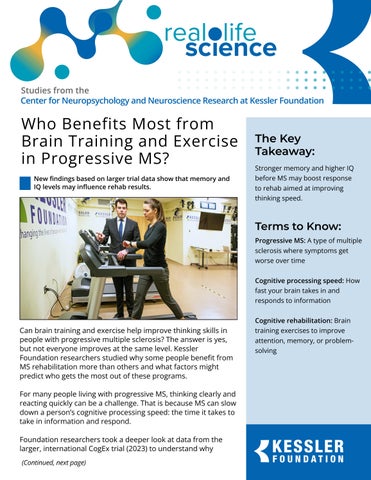
Can brain training and exercise help improve thinking skills in people with progressive multiple sclerosis? The answer is yes, but not everyone improves at the same level. Kessler Foundation researchers studied why some people benefit from MS rehabilitation more than others and what factors might predict who gets the most out of these programs. For many people living with progressive MS, thinking clearly and reacting quickly can be a challenge. That is because MS can slow down a person’s cognitive processing speed: the time it takes to take in information and respond. Foundation researchers took a deeper look at data from the larger, international CogEx trial (2023) to understand why (Continued, next page)
training exercises to improve attention, memory, or problemsolving
(Continued from first page) some people with progressive MS improved with brain training and exercise more than others. (The CogEx trial tested whether brain training and/or exercise could help improve cognitive processing speed in people with progressive MS. More than 300 participants took part in different 12-week combinations of cognitive rehabilitation or computer training and aerobic exercise training or physiotherapy.) What the data revealed Not everyone improved the same way. Some showed big gains in thinking speed, while others showed little or none Two factors stood out as most important for improvement:
Why these results matter These findings suggest that onesize-fits-all rehabilitation treatments are not equally beneficial for people with progressive MS. Personalized approaches based on individual symptoms, background, and brain health show more promise. In the future, doctors and therapists may use information like memory and IQ levels to help predict how well someone might respond to training—and adjust the approach if needed.
Learn more: This study, “Correlates of Processing Speed Change With Combined Cognitive Rehabilitation and Exercise in Progressive MS: Secondary Analysis of the CogEx Trial” was published in Neurorehabilitation & Neural Repair (2025). The lead researcher was Brian M. Sandroff, PhD, assistant director, neuroscience research, in the Center for Neuropsychology and Neuroscience Research at Kessler Foundation. To read the full study, scan the QR code at left or visit: doi.org/10.1177/ 1545968325133 1586.
Better memory ability at the start of the study Higher estimated IQ before MS symptoms began Factors like age, gender, MS disability status, or how closely participants followed the rehab program did not predict who improved
120 Eagle Rock Avenue, Suite 100 | East Hanover, NJ 07936-3147 973.324.8362 | KesslerFoundation.org facebook.com/KesslerFoundation | twitter.com/KesslerFdn | instagram.com/kesslerfdn linkedin.com/company/the-kessler-foundation | soundcloud.com/kesslerfoundation