brainwaves
Center for Traumatic Brain Injury Research at Kessler Foundation Northern New Jersey Traumatic Brain Injury System
FALL 2025
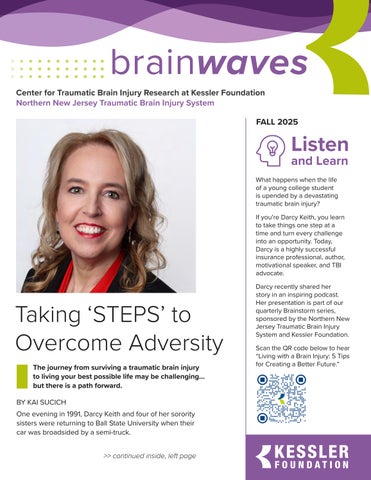
Listen and Learn What happens when the life of a young college student is upended by a devastating traumatic brain injury? If you’re Darcy Keith, you learn to take things one step at a time and turn every challenge into an opportunity. Today, Darcy is a highly successful insurance professional, author, motivational speaker, and TBI advocate.
Taking ‘STEPS’ to Overcome Adversity The journey from surviving a traumatic brain injury to living your best possible life may be challenging… but there is a path forward. BY KAI SUCICH One evening in 1991, Darcy Keith and four of her sorority sisters were returning to Ball State University when their car was broadsided by a semi-truck. >> continued inside, left page
Darcy recently shared her story in an inspiring podcast. Her presentation is part of our quarterly Brainstorm series, sponsored by the Northern New Jersey Traumatic Brain Injury System and Kessler Foundation. Scan the QR code below to hear “Living with a Brain Injury: 5 Tips for Creating a Better Future.”
Taking ‘STEPS’ to Overcome Adversity << continued from front cover Two of her sisters were killed instantly; Darcy, who was sitting in the back seat, and the two women in the front survived. But only Darcy sustained lifechanging injuries, including a traumatic brain injury, brain bleed, and a collapsed lung. The 22-year-old senior spent six days in a coma and underwent months of rehabilitation to address memory loss and other cognitive deficits, rightside paralysis, and emotional difficulties. “I was an actuarial science major, excelling in my studies, and suddenly couldn’t recall anything I had learned,” says Darcy. “It was frustrating… I cried a lot. At some point, I had to accept I was no longer the same person. With that understanding, I shifted my mindset to focus not on what I couldn’t do, but on all that I could.” “I share my story to inspire others to never give up on their dreams.” –Darcy Keith Reaching new milestones Darcy returned to school, switched her major to insurance, and modified her learning style. She sat up front in class to avoid distractions, recorded lectures, and worked with a study partner. Eighteen
months later, she earned her degree with the goal of becoming a Chartered Property Casualty Underwriter (CPCU). She married and had a child, but admits, “It was hard to balance family, work, and studying for this certification, so I put the coursework on the back burner.” Finally, in 2016, encouraged by her husband and daughter, she passed the rigorous exam and received her CPCU designation. Today, Darcy is a full-time business analyst in the insurance field, an award-winning motivational speaker, and advocate for brain injury survivors. “I share my story to inspire others to never give up on their dreams,” says Darcy. Continuing the fight As a member of the Brain Injury Advisory Council of the Brain Injury Association of America, Darcy is committed to reducing the stigma associated with TBI. She adds, “Like many others living with TBI, I still face real challenges that cannot be ignored. Doing so would deny who we are and all that we are capable of.” One step at a time Darcy created a five-step plan to help overcome life’s challenges. It is based on acceptance, positivity,
Let’s connect! facebook.com/KesslerFoundation | x.com/KesslerFdn | instagram.com/KesslerFdn |
determination, and support (See below). In addition, Darcy stresses the importance of being socially and cognitively active. Her advice? “Try something new every day, be open to new experiences, and focus on becoming the best version of you.” Kai Sucich is a research assistant at Kessler Foundation.
Take Five! Darcy Keith suggests following these five “STEPS” to help overcome adversity after TBI: 1. S – Surrender. Let go of things that are out of your control. 2. T – Try not to be a victim. Forget the “why me?” and look at situations as an opportunity to enhance your emotional well-being. 3. E – Embrace a positive attitude. A can-do spirit will help improve outlook and selfconfidence. When you accomplish a goal, celebrate. 4. P – Persevere. Stay the course with fortitude and determination. 5. S – Specifically ask for help. The more exact your request, the more likely you will receive appropriate assistance.
linkedin.com/company/the-Kessler-Foundation soundcloud.com/KesslerFoundation
There’s No Place Like Home BY NICOLE GVOTH, MS, CCC-SLP Returning home after a brain injury can be as uplifting as it is challenging. But there’s no better place to rebuild cognition, confidence, and independence. Familiar surroundings and the comfort of one’s own home can be a significant boost to individuals with a traumatic brain injury. However, daily activities may still be difficult to navigate. Cognitive issues—including deficits in attention, information processing, memory, and problem-solving—can impact a person’s ability to successfully manage everyday tasks. Here are some strategies to help reinforce cognitive skills and foster greater independence: Optimize your environment
• Work in a quiet space, free of background noise and other distractions • Focus on one task at a time. Break larger chores into smaller steps. Gradually try to incorporate more complex activities
• Tackle important tasks at a time of day when you feel most alert and attentive • Pace yourself and take breaks as needed Get organized
• Create a daily schedule to help stay on track • Use a timer to set deadlines and manage completion of projects • Keep a notebook with information that is important for you to remember • Maintain a calendar on your phone or on
paper to remind you about appointments, taking medications, and other responsibilities
Involve family and friends Asking for help may be uncomfortable, but family and trusted friends can be a great source of support. They can assist you in managing medications, keeping track of bills, and coordinating other activities. They can also reinforce strategies you have learned. Build on your progress Continue to work with a licensed speech language pathologist (speech therapist) to help maximize your cognitive strengths. They will partner with you to create meaningful goals, guide your progress, monitor your improvement, and empower you to succeed. Nicole Gvoth, MS, CCC-SLP, is a speech language pathology specialist at Kessler Institute for Rehabilitation, Chester campus.
A Smart Start to Life at Home Adjusting to a new normal after TBI can be difficult. To help ease the transition to life ahead, the Model Systems Knowledge Translation Center, in collaboration with the nation’s TBI Model System Centers—including Kessler Foundation—has developed a wide range of free resources for TBI survivors and their families. These important fact sheets, videos, podcasts, and more can be accessed on the MSKTC website at msktc.org/tbi/factsheets or scan the QR code.
Changing the lives of people with disabilities
120 Eagle Rock Avenue, Suite 100 East Hanover, NJ 07936-3147 973.324.8362 | KesslerFoundation.org BrainWaves is published tri-annually by the Northern New Jersey Traumatic Brain Injury Model System, a collaborative research and treatment network led by Kessler Foundation and funded by the National Institute on Disability, Independent Living and Rehabilitation Research. (NIDILRR Grant #90DPTB0032)
Help us help you! Join one of Kessler Foundation’s research studies that are expanding the understanding and treatment of TBI. For more information, scan the code at left, or go to Bit.ly/48Mpx6h.
‘RU’ Ready for a New Brain Injury Resource? Rutgers University recently launched Synapse, a nationwide, student-led organization focused on creating a supportive brain injury community. Rutgers – New Brunswick recently joined more than 20 universities across the country in offering a new program called Synapse that brings together students and brain injury survivors. The chapter’s two-fold mission is to provide social support to individuals with TBI and to educate and inspire the next generation of leaders in neurorehabilitation and related fields. The program centers on three core activities:
• Peer support groups (https://tinyurl.com/PSG-Sign-up) – Led
by trained student facilitators, people with TBI and caregivers are able to share experiences and build social connections
• Buddy programs (https://tinyurl.com/BP-Sign-up) – TBI survivors and students build relationships through one-on-one pairings • Educational events – Lectures and conferences provide insight on advances in TBI care and treatment and promote injury awareness
In addition to connecting with individuals with TBI, students in this unique program gain exposure to career paths in medicine, neuroscience, social work, cognitive therapy, and advocacy. For more information, contact rutgerssynapse@gmail.com or visit https://sites.google.com/ view/rutgerssynapse